


Abstract
Bulk compressibility of reservoir rocks can be characterized dynamically or statically, and both vary with burial depth due to increasing temperature and pressure. To quantify these effects, cyclic hydrostatic compression tests are conducted on two reservoir sandstones under confining pressure up to 50 MPa at three temperatures (30 °C, 70 °C, and 110 °C). Experimental results show that static bulk compressibility is consistently larger than dynamic values across all tested conditions. As confining pressure increases, static compressibility decreases more sharply than dynamic compressibility, leading to a gradual reduction in their discrepancy. In contrast, temperature exerts a weaker yet more complex influence. Elevated temperature increases dynamic bulk compressibility, but has opposite effects on static compressibility upon loading versus unloading: it reduces static compressibility upon hydrostatic loading but enhances it upon unloading. This complex temperature dependence is attributed to thermally induced stress, which resists hydrostatic compression during loading but assists decompression during unloading. The influence of thermal stress is more pronounced at low confining pressures. These findings highlight that temperature not only alters the magnitude of static compressibility but also introduces path-dependent asymmetry between loading and unloading, which has important implications for reservoir geomechanics, subsidence prediction, and production-induced compaction in high-temperature environments.
1. Introduction
The mechanical properties of reservoir rocks vary with burial depth as both temperature and stress increase [1]. Understanding the elastic responses of granular sandstones and their temperature and pressure dependence is of great importance for geophysical exploration, oil and gas production, and reservoir geomechanics [2,3,4]. As a result, it is necessary to investigate the coupled thermal and mechanical effects on rock properties and to identify the underlying mechanisms.
Rock mechanical responses can be characterized by either dynamic or static elastic properties, such as bulk compressibility. Dynamic bulk compressibility is derived from acoustic wave velocity measurements, whereas static bulk compressibility is determined from stress–strain curves in triaxial compression tests [5,6]. Since reservoir rocks deform statically in situ, static tests better represent actual stress and strain variations within reservoirs, while dynamic tests capture only the elastic component of rock response [7,8]. Both dynamic and static properties are sensitive to the applied temperature and pressure, but their dependencies may differ substantially.
The temperature and confining pressure dependence of acoustic velocities has been extensively investigated [9,10,11,12,13,14,15,16]. A well-established consensus is that acoustic velocities increase with confining pressure but decrease with temperature. Ignoring these effects would lead to overestimation of porosity from transit-time logs. Correspondingly, dynamic compressibility of rocks decreases with increasing pressure and increases with rising temperature [16]. Lobree (1968) reported that bulk compressibility of three outcrop sandstones increased by approximately 15% over the temperature range from 20 °C to 200 °C [17]. Similar findings were obtained by Somerton et al. (1974) [9], who observed average increases of 14–23% in bulk compressibility for various sandstones under the same temperature range.
In contrast, the temperature dependence of static bulk compressibility remains poorly understood despite extensive research on pressure effects. Previous studies have consistently shown that static bulk compressibility decreases with increasing confining pressure due to crack closure and grain boundary stiffening [7,18,19,20,21,22,23,24]. However, reliable data on temperature effects are scarce and often contradictory. Araújo et al. (1997) and Hettema and Pater (1998) reported that decreasing static bulk compressibility occurs with increasing temperature from 20 to 150 °C for various sandstones [20,21]. Conversely, Hassanzadegan et al. (2012) found that the temperature dependence of drained bulk modulus for Flechtinger sandstone was stress-dependent: it increased from 10.25 to 11.74 GPa at high stresses and decreased from 3.39 to 3.05 GPa at low stresses [22]. Notably, no previous studies have systematically investigated temperature effects on static bulk compressibility under cyclic hydrostatic loading conditions, nor have they quantitatively compared the temperature–pressure dependencies of dynamic and static compressibility in the same rock samples.
This study aims to address this critical research gap by conducting cyclic hydrostatic compression tests on two reservoir sandstones at three temperatures (30 °C, 70 °C, and 110 °C) with a maximum confining pressure of 50 MPa. Firstly, the sample characteristics and experimental setup are described. Subsequently, acoustic velocities, volumetric strains, and dynamic and static bulk compressibility as functions of temperature and confining pressure are presented. Finally, the underlying mechanisms governing the observed thermomechanical behaviors, with a particular focus on the static–dynamic compressibility discrepancy and its temperature–pressure dependence, are discussed.
2. Materials and Methods
2.1. Sample Description
Two reservoir sandstone samples (#SL20 and #SL29), drilled from the Liaohe Depression, are selected for this study. The samples are obtained from different burial depths, as shown in Table 1. Following the International Society for Rock Mechanics (ISRM) recommended standards [25], the samples are machined into cylindrical specimens with a length-to-diameter ratio of ~2:1. The end faces of each specimen are ground flat and parallel with a tolerance of ±0.025 mm. Following specimen preparation, the dry weight of each specimen is measured and recorded. The specimens are then dried in a vacuum oven at 105 °C until a constant weight is achieved. The bulk density of dry specimens is calculated from their measured weight and geometric dimensions. Subsequently, the effective porosity and grain density are determined using a helium porosimeter, with the results presented in Table 1.
Table 1.
Basic physical parameters of two sandstone samples.
The mineralogical compositions of two samples are determined by X-ray diffraction (XRD) analysis, as shown in Table 2. Both samples are classified as quartz sandstones based on their mineralogy. Sample #SL20 contains more than 20 wt.% feldspar, whereas no feldspar is detected in sample #SL29. Sample #SL20 also has a higher content of carbonate minerals (e.g., calcite and dolomite) compared to sample #SL29. Conversely, the clay content in sample #SL20 is significantly lower than that in sample #SL29.
Table 2.
Mineral composition of two sandstone samples.
2.2. Experimental Setups
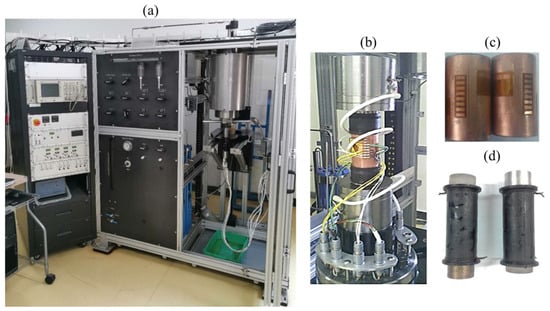
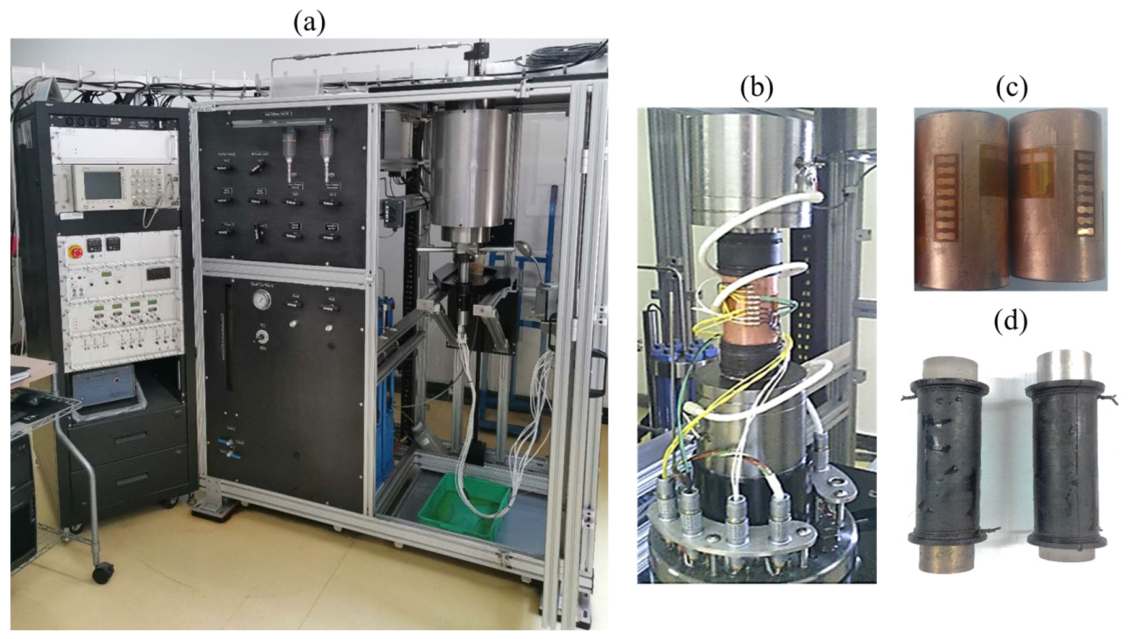
Static and dynamic rock properties are measured simultaneously using a servo-hydraulically controlled triaxial testing system (AutoLab 1500 (New England Research Inc., White River Junction, VT, USA)), as illustrated in Figure 1a. The experimental setup integrates two main subsystems: a conventional triaxial loading system and an ultrasonic measurement system [26].
Figure 1.
(a) The servo-hydraulically controlled triaxial testing system (AutoLab 1500); (b) Prepared sample assembly; (c) Prepared samples with strain gauges; (d) The process of attaching copper foil.
The triaxial loading system comprises a high-precision load cell, a pressure intensifier capable of applying confining pressure up to 68 MPa, a pore pressure system, and a digital data acquisition system. The ultrasonic system consists of piezoelectric transducers (PZTs) embedded within the top and bottom endcaps (Figure 1b) and a high-speed digital oscilloscope (Figure 1a). The acoustic PZTs include one pair of P-wave transducers with a central frequency of 0.75 MHz and two pairs of S-wave transducers (SH and SV polarization) with a central frequency of 0.45 MHz. Titanium buffer stacks are installed at the front of both endcaps to protect the PZTs and ensure reliable acoustic transmission under high-pressure conditions. The rock specimen, wrapped with copper foil, is positioned between the two buffer stacks (Figure 1b). The contact interfaces between the specimen and buffers are jacketed by Viton rubber sleeves to ensure proper alignment and to prevent relative sliding during testing. Prior to strain gauge installation, the copper foil is tightly bonded to the specimen surface by vacuum sealing the assembly with a rubber sleeve and end plugs (Figure 1d), followed by hydrostatic pressurization at 20 MPa for 48 h in a hydraulic tank. This procedure ensures intimate contact between the copper foil and the irregular specimen surface. Four sets of strain gauges are then affixed to the copper foil surface (Figure 1c). Three of these sets are used for deformation measurements: two vertical sets for axial strain and one radial set for circumferential strain.
Temperature control is achieved using three heating belts wrapped around the confining vessel, which heat the mineral oil and subsequently the rock specimen. The actual specimen temperature is monitored using two thermocouples mounted in close proximity to the top and bottom ends of the specimen. The temperature measurement uncertainty is ±1 °C throughout the experiments.
2.3. Experimental Procedures and Analysis Method
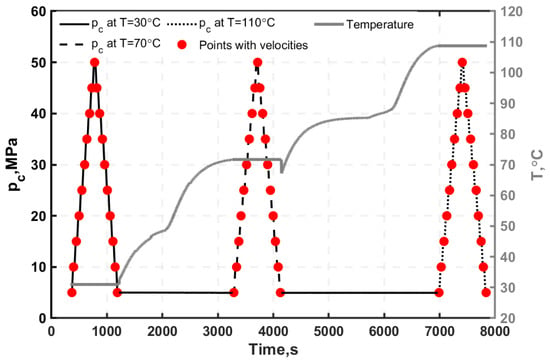
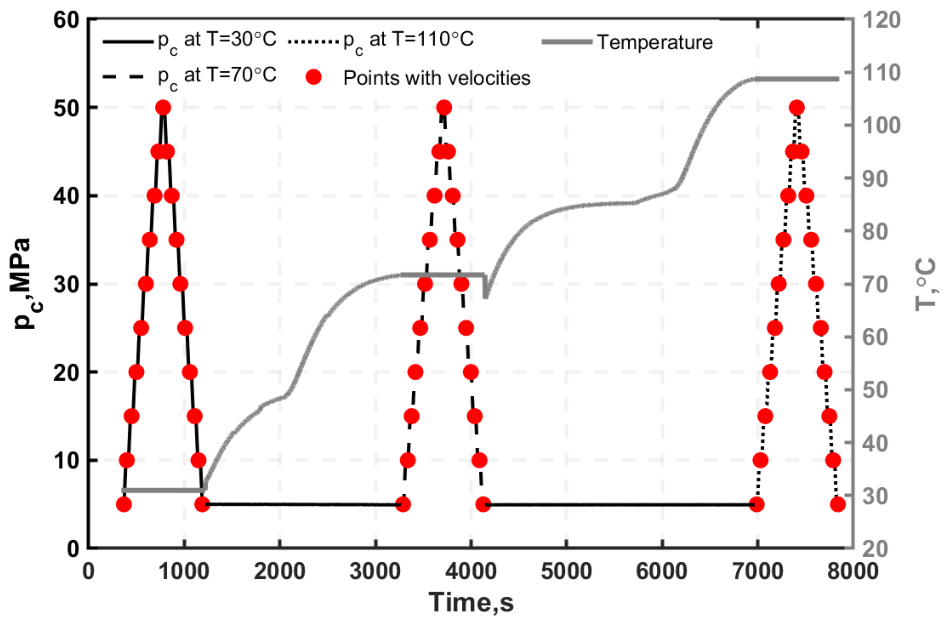
The assembled specimen stack shown in Figure 1b is mounted inside the confining vessel, which is subsequently filled with mineral oil using the confining pump. Three complete hydrostatic pressure cycles with a maximum confining pressure of 50 MPa are applied to each specimen, as illustrated in Figure 2. Each pressure cycle is conducted at a constant temperature, which is increased stepwise from 30 °C to 70 °C, and finally to 110 °C. After completing each pressure cycle, the confining pressure is reduced to and maintained at 5 MPa, while the system is heated to the next target temperature. Temperature is held constant for a minimum of 2 h to ensure thermal equilibrium throughout the specimen before initiating the subsequent pressure cycle.
Figure 2.
The experimental procedure, including hydrostatic load-unload cycles at three different temperatures (30, 70, and 110 °C).
Ultrasonic P-, SH-, and SV-waveforms are recorded in the axial direction at 5 MPa intervals upon hydrostatic loading and unloading (Figure 2). The first-arrival time of each waveform is manually picked, and the net travel time through the specimen is calculated by subtracting the travel time through the titanium buffer stacks. Ultrasonic wave velocities are then determined using the strain-corrected specimen length and the measured net travel time. The two orthogonal S-wave velocities (SH and SV) are nearly identical for both specimens, indicating that the sandstones are effectively transversely isotropic with negligible anisotropy in the plane perpendicular to the bedding. Therefore, the average of the two S-wave velocities is used in all subsequent calculations. The dynamic bulk compressibility (Cdyn) is expressed in terms of P- and S-wave velocities, as well as the bulk density [5], as follows:
During the hydrostatic pressure cycles, both axial (εa) and radial (εr) strains are continuously recorded. Volumetric strain (εvol) is calculated using the relationship εvol = εa + 2εr [6]. Static bulk compressibility (Cst) is derived from the confining pressure (pc) versus volumetric strain curves. Specifically, the pressure–strain data are processed by linear regression of the data points between two consecutive ultrasonic velocity measurement points.
3. Experimental Results
3.1. Ultrasonic Velocity
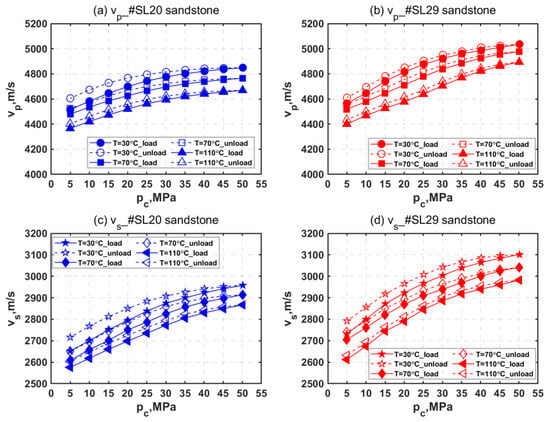
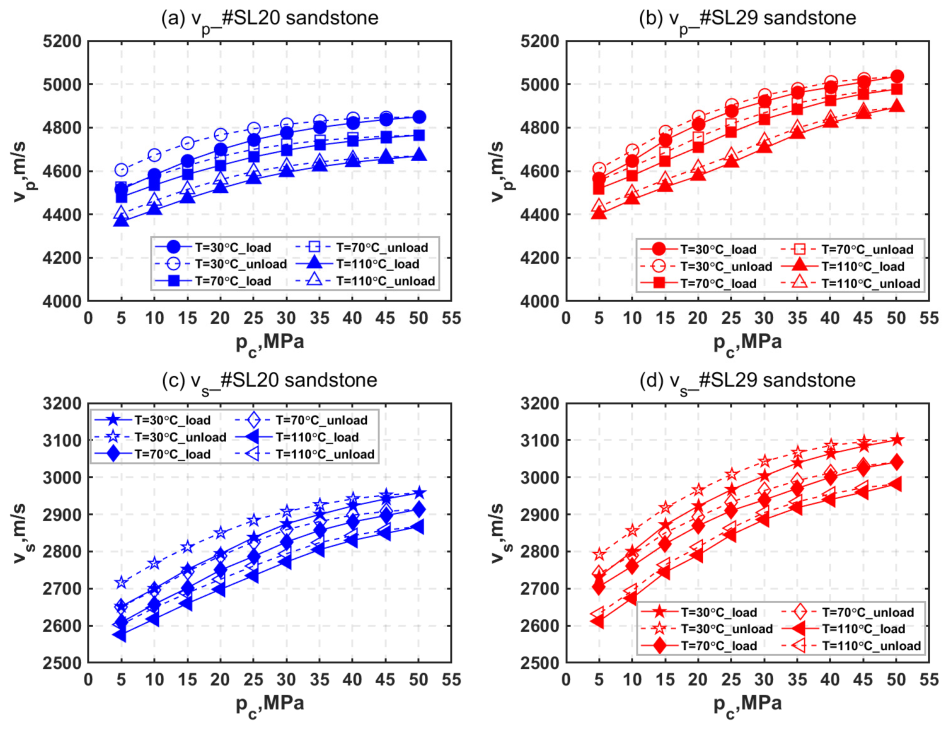
Figure 3 exhibits the variations in P- and S-wave velocities (vP and vS) during hydrostatic loading and unloading cycles at three temperature levels (30 °C, 70 °C, and 110 °C) for both sandstone samples (#SL20 and #SL29). As expected, sample #SL29, with lower porosity (Figure 3c,d), displays consistently higher velocities than sample #SL20, with higher porosity (Figure 3a,b), especially at high confining pressures. At each constant temperature, both vP and vS increase monotonically with increasing confining pressure (pc). This pressure dependence is strongly nonlinear, with the velocity increase rate decreasing progressively as confining pressure rises. Notably, significant hysteresis is observed between loading and unloading cycles: at the same confining pressure, velocities measured upon unloading are consistently higher than those measured upon loading. This velocity hysteresis becomes more pronounced as confining pressure decreases.
Figure 3.
Ultrasonic P- and S-wave velocities (vP and vS) as a function of the confining pressure (pc) and the temperature (T) in the process of hydrostatic loading and unloading for (a,c) #SL20 sandstone and (b,d) #SL29 sandstone.
At a given confining pressure, both vP and vS decrease with increasing temperature (T), consistent with established rock physics relationships, as shown in Figure 3. The magnitude of velocity reduction increases with temperature, with the most significant decrements observed between 70 °C and 110 °C. Furthermore, the velocity hysteresis between the loading and unloading cycles is most pronounced at the temperature of 30 °C for both samples, with the only exception being vP for sample #SL29 in Figure 3c.
3.2. Stress–Strain Relationships
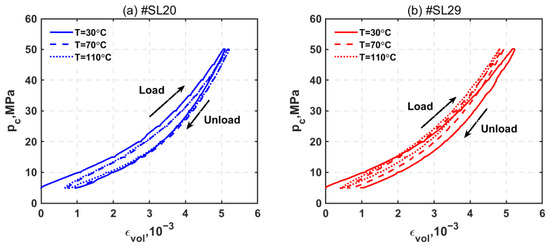
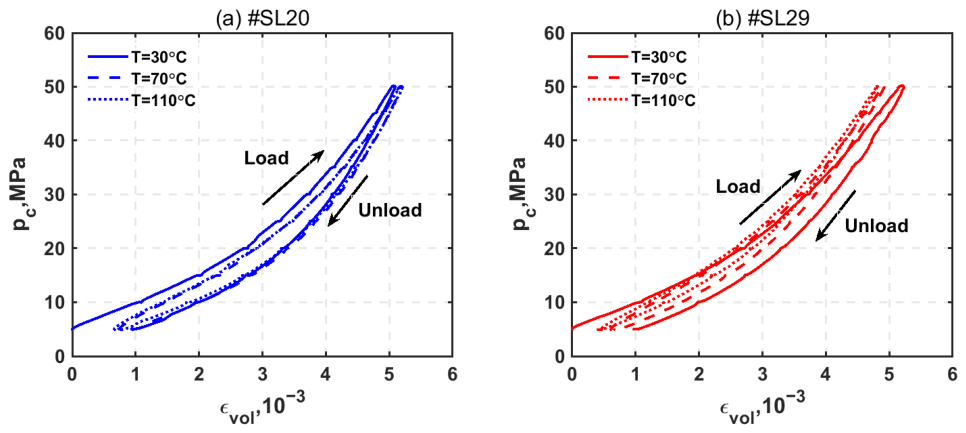
Figure 4 exhibits the relationships between volumetric strain (εvol) and applied confining pressure (pc) at three temperatures for both sandstone samples. During both hydrostatic loading and unloading processes, the entire stress–strain curves exhibit strong nonlinearity, consistent with the classical behavior first described by Brace (1965) and Walsh (1965) [27,28]. Marked hysteresis is observed between loading and unloading curves, indicating the presence of inelastic deformation. For both samples, the degree of nonlinearity and hysteresis decreases with increasing temperature. At 30 °C, volumetric strain does not fully recover to its initial value after unloading, resulting in a significant amount of irrecoverable volumetric strain when the confining pressure is unloaded back to 5 MPa. In contrast, irrecoverable volumetric strain is negligible at 70 °C and 110 °C.
Figure 4.
Volumetric strains (εvol) as a function of the confining pressure (pc) upon hydrostatic loading/unloading at three temperature levels for (a) #SL20 and (b) #SL29 sandstone.
Notably, volumetric strain at the start of each subsequent loading cycle is significantly lower than the unloading strain in the previous cycle, which is particularly pronounced for sample #SL29 in Figure 4b. The abrupt reduction in volumetric strain is directly attributed to the temperature increase between two adjacent hydrostatic cycles. Overall, volumetric strain decreases with increasing temperature, indicating thermal contraction of the rock matrix [29,30,31].
3.3. Dynamic Bulk Compressibility
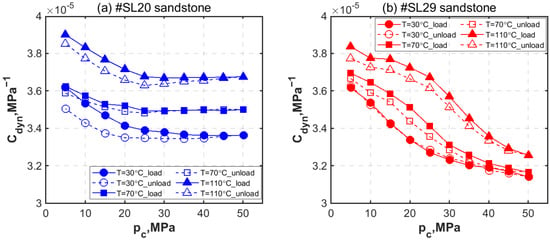
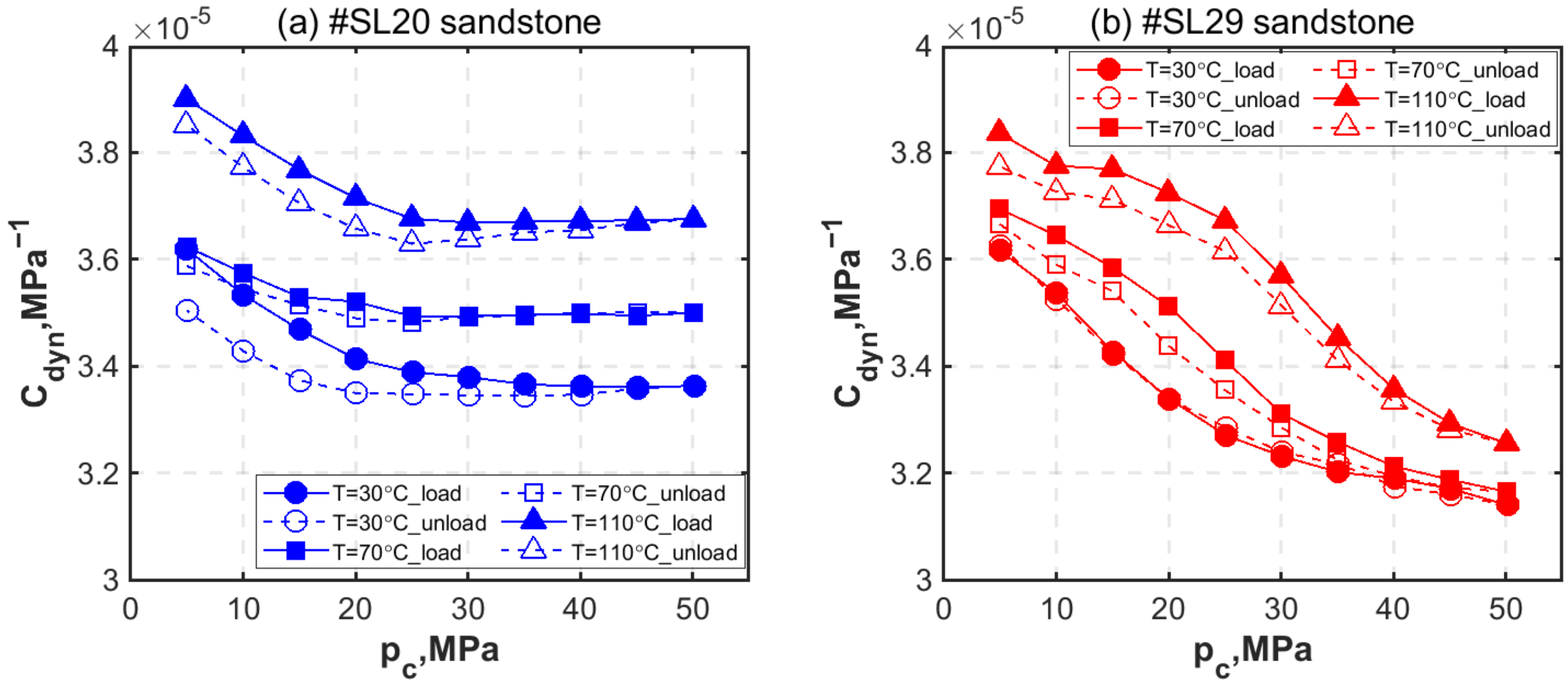
Figure 5 presents the dynamic bulk compressibility (Cdyn) as a function of confining pressure (pc) in the process of hydrostatic loading and unloading at three temperatures for both sandstone samples. For both samples, Cdyn decreases monotonically with increasing confining pressure at three temperatures. For sample #SL20 (Figure 5a), Cdyn decreases sharply at low pressures and approaches a nearly constant value above 30 MPa at each temperature. In contrast, for sample #SL29 (Figure 5b), Cdyn decreases continuously over the entire pressure range. When confining pressure increases from 5 MPa to 50 MPa, the average reduction in Cdyn is 5.4% for #SL20 and 14.2% for #SL29, respectively. Additionally, unloading Cdyn values are generally lower than loading values, indicating irreversible deformation during hydrostatic cycling, with the only exception being sample #SL29 at 30 °C.
Figure 5.
Dynamic bulk compressibility (Cdyn) as a function of the confining pressure (pc) upon hydrostatic loading/unloading at three temperature levels for (a) #SL20 and (b) #SL29 sandstone.
At a given confining pressure, Cdyn consistently increases with increasing temperature for both samples. For #SL20 (Figure 5a), the increase in Cdyn resulting from temperature elevation from 30 to 70 °C gradually increases with confining pressure. The increase in Cdyn from 70 to 110 °C remains relatively constant across the entire pressure range and is significantly larger than that observed in the lower temperature interval. For #SL29 (Figure 5b), at temperatures of 30 to 70 °C, the Cdyn initially increases at a relatively low-pressure regime and then decreases at higher pressures. Again, the temperature effect from 70 to 110 °C is more pronounced than that from 30 to 70 °C. Notably, the temperature dependence of Cdyn shows no significant difference between loading and unloading processes for either sample.
3.4. Static Bulk Compressibility
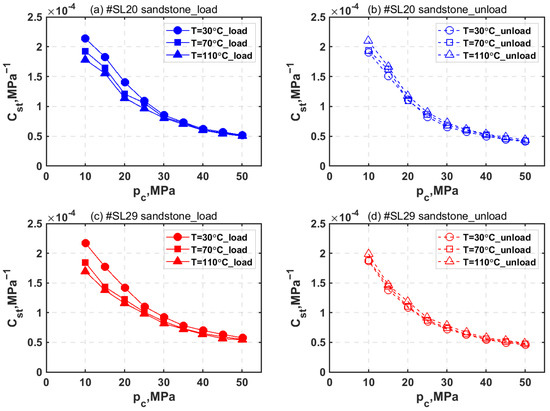
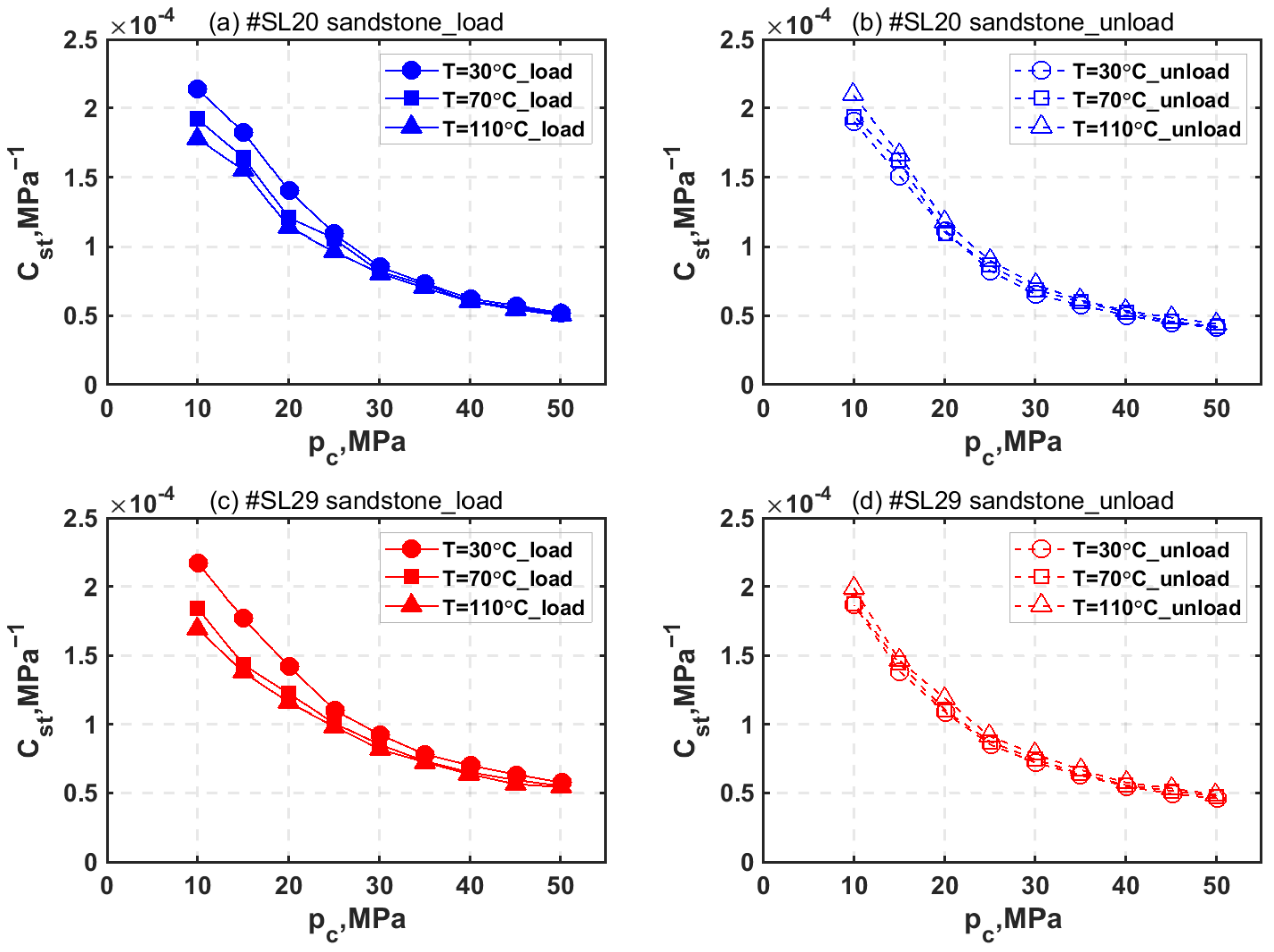
Figure 6 displays static bulk compressibility (Cst) as a function of confining pressure (pc) during hydrostatic loading and unloading cycles at three temperatures for both sandstone samples. Overall, Cst exhibits a strong dependence on confining pressure but a much weaker dependence on temperature. At all three temperatures, Cst decreases monotonically upon hydrostatic loading (Figure 6a,c) and increases upon hydrostatic unloading (Figure 6b,d) for both samples. Loading and unloading Cst values show only minor differences at equivalent confining pressures. Over the confining pressure range of 5–50 MPa, Cst decreases on average by 73.7% for sample #SL20 and 70.5% for sample #SL29, respectively.
Figure 6.
Static bulk compressibility (Cst) as a function of the confining pressure (pc) upon hydrostatic loading ((a) #SL20 and (b) #SL29) and unloading ((c) #SL20 and (d) #SL29) at three temperatures (T).
Notably, the temperature dependence of Cst is strongly dependent on whether the rock is undergoing hydrostatic loading or unloading. Upon loading, Cst generally decreases with increasing temperature for both samples, with this effect being most pronounced in the low-confining-pressure regime. The maximum Cst reduction is roughly 14% for #SL20 and 23% for #SL29. In contrast, upon hydrostatic unloading, Cst shows a slight increase with increasing temperature at equivalent confining pressures. Furthermore, the magnitude of temperature dependence upon unloading is significantly smaller than that upon hydrostatic loading.
4. Discussion
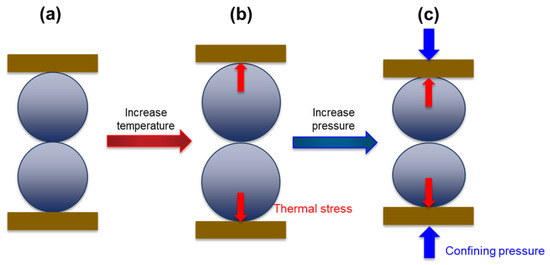
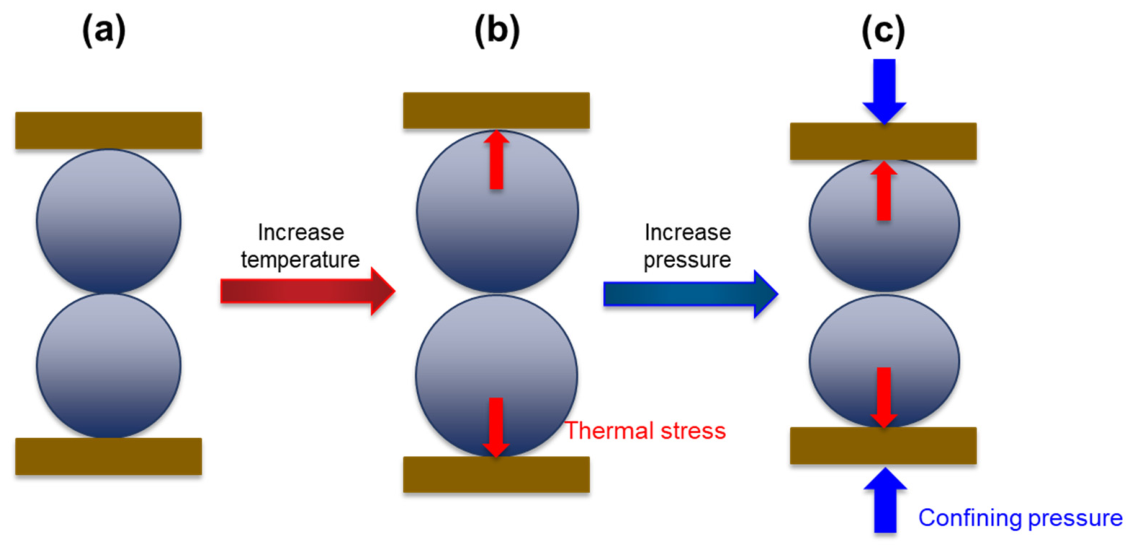
As demonstrated in Figure 5 and Figure 6, the bulk compressibility of reservoir rocks is typically characterized using either dynamic or static measurements. However, dynamic and static compressibilities exhibit distinct dependencies on confining pressure and temperature. We attempt to find the hidden mechanisms for those differences based on a two-grain schematic diagram, as shown in Figure 7.
Figure 7.
Schematic diagrams to illustrate the hidden mechanisms for the effects of increasing temperature and confining pressure on rock mechanical properties. (a) a two-grain contact model; (b) the thermal stress and thermal expansion induced by the rising temperature; (c) the interaction between the induced thermal stress and the applied confining pressure on grains. Note: red arrows denote the induced thermal stress, while blue arrows indicate the applied confining pressure in the direction of grain contact.
4.1. Effect of Temperature
Acoustic velocities of reservoir rocks vary with burial depth due to coupled increases in temperature and in situ stress [16,32]. Increasing confining pressure generally increases acoustic velocities, while increasing temperature decreases acoustic velocities [33,34,35]. As stated by Hearst and Nelson (1985) [36], the effect of temperature on the acoustic velocities is less pronounced than the effects of porosity and fluid saturation. For the air-saturated sandstone samples in this study (Figure 3), both vp and vs decrease by 3–6% over the temperature range of 30–110 °C across all confining pressures. The temperature dependence of velocities is generally attributed to changes in the compressibility of mineral grains and rock skeleton with increasing temperatures [37,38,39].
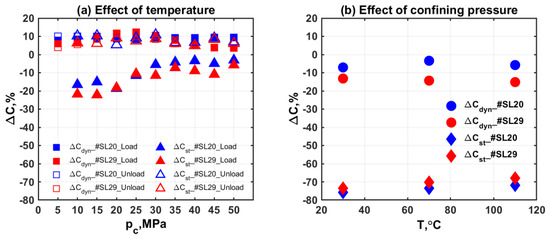
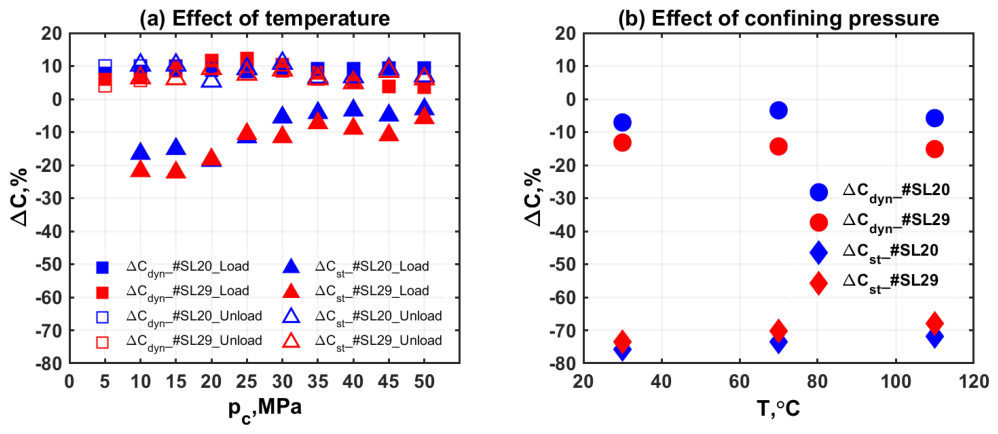
Figure 8a displays the percentage increment in dynamic bulk compressibility (ΔCdyn) when temperature is raised from 30 °C to 110 °C upon both hydrostatic loading and unloading. ΔCdyn is calculated relative to Cdyn at a temperature of 3 °C. From a dynamic perspective, rock bulk compressibility increases with temperature at all confining pressures. This behavior can be attributed to thermal softening of mineral grains or grain contacts [13,40], as schematically illustrated in Figure 7a,b.
Figure 8.
The percentage increment of dynamic (ΔCdyn) and static (ΔCst) bulk compressibility as functions of (a) the confining pressure (pc) and (b) temperature (T).
From a static aspect, changes in bulk compressibility (ΔCst) are more complicated, as shown in Figure 8a. Upon hydrostatic loading, elevated temperature tends to decrease static bulk compressibility. As shown in Figure 7, increasing temperature induces thermal expansion of the rock matrix, generating internal thermal stresses (see Figure 7b). The thermal stresses act in the opposite direction to the applied confining pressure, partially counteracting the pressure effect (see Figure 7c). In other words, thermal expansion of mineral grains reduces the net volumetric deformation for a given confining pressure increment, making the rock appear stiffer [26,29,41]. This thermal expansion effect is directly evidenced by the volumetric strain (εvol) measurements presented in Figure 4: at a constant confining pressure of 5 MPa, increasing temperature from 30 to 70 °C reduces εvol by 18.5% for sample #SL20 and 36% for sample #SL29. A further temperature increase from 70 to 110 °C results in additional εvol reductions of 23.6% for sample #SL20 and 28.8% for sample #SL29. Furthermore, the magnitude of ΔCst decreases with increasing confining pressure, indicating that thermal expansion effects become less significant as pores and cracks are closed under higher pressures.
Upon hydrostatic unloading, however, static bulk compressibility increases with temperature (Figure 8a), a trend that is qualitatively similar to that observed for dynamic bulk compressibility. Upon hydrostatic unloading, the rock matrix undergoes progressive volumetric expansion. In this case, thermally induced expansion facilitates the recovery of rock volume, resulting in increased rock compliance.
4.2. Effect of Confining Pressure
Acoustic velocities in porous rocks are primarily controlled by effective pressure and the bulk compressibility of the rock skeleton. For dry rocks in this study, the effect of pore pressure diminishes, resulting in only the confining pressure contributing to effective pressure. As shown in Figure 3, both vp and vs increase monotonically with increasing confining pressure, which is attributed to progressive pore collapse, microcrack closure, and stiffening of compliant grain contacts [42,43]. All these processes modify the rock skeleton properties and result in reduced bulk compressibility, as observed in Figure 5.
Figure 8b exhibits the percentage decrement of dynamic bulk compressibility (ΔCdyn) when confining pressure increases from 5 MPa to 50 MPa at three temperatures for both sandstone samples. ΔCdyn is calculated relative to Cdyn measured at a confining pressure of 5 MPa. Notably, although sample #SL29 is recovered from a significantly deeper burial depth, ΔCdyn is much larger than that of sample #SL20. This might be explained by the higher clay content in #SL29 (e.g., 14.7 wt.%) compared to #SL20 (e.g., 3.4 wt.%), as clay minerals are inherently more compressible than quartz and feldspar. Additionally, ΔCdyn for sample #SL29 shows a weakly positive temperature dependence, with slightly larger reductions observed at higher temperatures.
Consistent with dynamic bulk compressibility, static bulk compressibility (Cst) also decreases with an increase in confining pressure (Figure 6). Also shown in Figure 8b are the reduction percentages in ΔCst upon hydrostatic loading, calculated relative to Cst at a confining pressure of 10 MPa. ΔCst for both samples can reach as high as roughly 75%, which is significantly larger than ΔCdyn. The discrepancy arises from the fundamental difference in strain amplitude between dynamic and static tests [44,45,46,47]: dynamic tests involve microstrain-level deformations that only probe the linear elastic response, while static tests involve millistrain-level deformations that are far more sensitive to the microstructural alterations upon hydrostatic loading. Moreover, ΔCst for both samples exhibits a slight increase with temperature, which might be attributed to thermal expansion enhancing microcrack closure under increased confining pressure.
4.3. Relationship Between Static and Dynamic Bulk Compressibility
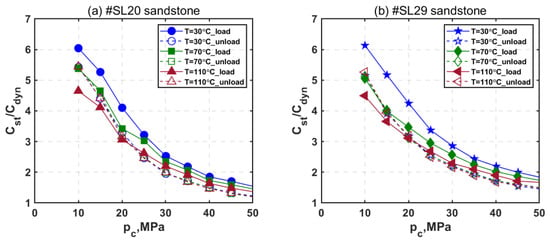
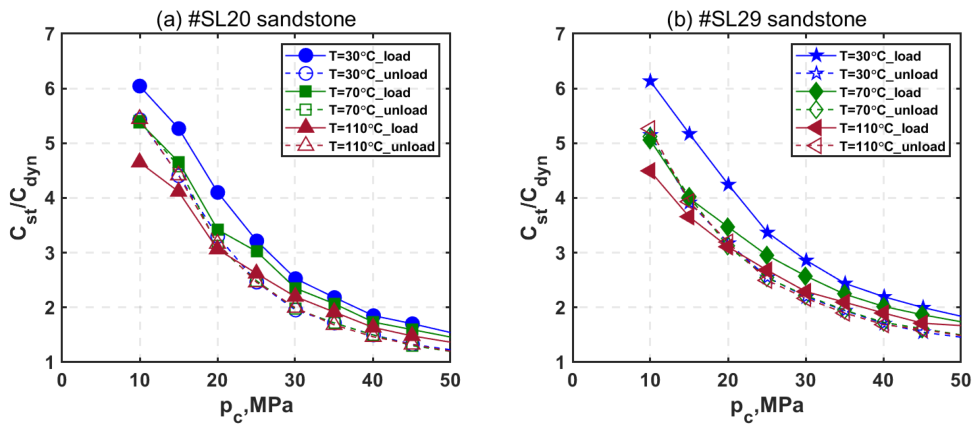
As shown in Figure 9, dynamic bulk compressibility is systematically lower than the static one for two sandstone samples. The static-to-dynamic bulk compressibility ratio (Cst/Cdyn) reaches as high as roughly 6 at low confining pressures. These observations are in excellent agreement with previous studies [48,49].
Figure 9.
The ratio of static to dynamic bulk compressibility (Cst/Cdyn) as a function of the confining pressure (pc) upon hydrostatic loading/unloading at three temperature levels for (a) #SL20 and (b) #SL29 sandstone.
The discrepancy between dynamic and static elastic properties arises from multiple fundamental factors. The primary cause is the substantial difference in strain amplitude between the two measurement methods. Dynamic tests involve elastic wave propagation with strain amplitude on the order of 10−9 to 10−6, whereas static tests typically induce strains ranging from 10−5 to 10−3 [44,45,46]. Reservoir rocks are inherently granular porous media, whose macroscopic effective mechanical properties emerge from the superposition of microscopic grain-scale and pore-scale behaviors. Consequently, microstructural alterations have a more pronounced effect on static tests, where strain amplitudes are several orders of magnitude larger [50]. This explains why rocks appear significantly more compliant in static measurements and stiffer in dynamic measurements.
Furthermore, Cst/Cdyn exhibits strong dependencies on both confining pressure and temperature (Figure 9). At each constant temperature, static bulk compressibility progressively approaches its dynamic counterpart as confining pressure increases, leading to a gradual reduction in Cst/Cdyn. In contrast, Cst/Cdyn expresses a distinct temperature dependence, particularly at low confining pressures: increasing temperature tends to reduce the discrepancy between static and dynamic compressibilities. This behavior occurs because thermal softening of mineral grains and thermal expansion effects are most pronounced at low pressures, where microcracks and grain contacts dominate the mechanical response. Notably, during hydrostatic unloading, Cst/Cdyn is primarily controlled by decreasing confining pressure, with minimal temperature dependence.
Collectively, these findings demonstrate that the coupled effects of confining pressure and temperature associated with burial depth must be explicitly considered when evaluating reservoir rock mechanical properties. To develop accurate dynamic–static correlations for in situ applications, it is essential to characterize rock thermomechanical properties under conditions that closely replicate actual reservoir environments.
4.4. Implications from the Measured Data
- (1)
- Implications for modeling pore pressure depletion during production
Conventional modeling of production-induced pore pressure depletion typically employs Biot’s poroelasticity, which assumes a linear relationship between reservoir compaction and effective stress governed by a constant bulk compressibility [5,6]. This framework inherently assumes a single-valued, path-independent rock skeleton stiffness. In contrast, our results reveal that static bulk compressibility (Cst) significantly exceeds its dynamic counterpart and exhibits pronounced loading/unloading asymmetry that is strongly temperature-dependent. During production, the continuous pore pressure decline constitutes a mechanical unloading path. Under these conditions, Cst increases with temperature, indicating enhanced rock compliance at elevated temperatures. Consequently, calibrating bulk compressibility solely based on hydrostatic loading curves will underestimate reservoir compressibility during high-temperature production. This discrepancy propagates into an underestimation of reservoir compaction for a given pressure drop [51,52].
Furthermore, the stress-path dependency of sandstone compressibility is critical. Under uniaxial strain or low lateral-to-vertical stress ratio paths (typical of reservoir depletion), the compressibility of weakly cemented sandstones can exceed hydrostatic loading values by more than a factor of two [53]. This emphasizes that neglecting unloading asymmetry and temperature effects introduces substantial errors into depletion forecasts. Additionally, reservoir compaction often involves inelastic deformation, particularly at low confining pressure. Experiments on Groningen gas field sandstones indicate that inelastic strain initiates at the onset of simulated depletion [54]. Therefore, assuming purely poroelastic behavior not only underestimates compaction but also overestimates the change in effective horizontal stress.
- (2)
- Implications for surface subsidence prediction in high-temperature reservoirs
In geothermal and high-temperature reservoirs, surface subsidence results from the superposition of pore pressure decline and thermal effects. Neglecting the temperature-dependent path dependency identified in this study might lead to quantifiable errors [55].
First, the magnitude of compaction is likely underestimated. At elevated temperatures, Cst under unloading paths exceeds that measured under loading. Consequently, models calibrated at ambient temperature or from loading curves will underestimate compaction per unit pressure drop. Given that geothermal fields can exhibit subsidence rates up to 22 mm/yr, such errors accumulate into significant long-term deformation biases [56,57,58].
Second, errors arise in coupled thermo-poroelastic simulations [57]. Advanced models demonstrate that near-wellbore pore pressure is highly sensitive to fluid temperature. The bulk compressibility is inherently stress-dependent. The prevalent use of constant compressibility in these models can lead to inaccurate stress redistribution and failure predictions. Our findings necessitate the adoption of nonlinear elastic constitutive frameworks that incorporate thermal compaction and hardening, where moduli are functions of both pressure and temperature history.
5. Conclusions
Bulk compressibility of reservoir sandstones can be characterized using either dynamic or static measurements, which often yield significantly different results. This study systematically investigates the coupled effects of confining pressure and temperature on both dynamic and static bulk compressibility of dry sandstones through cyclic hydrostatic compression tested at three temperatures: 30 °C, 70 °C, and 110 °C.
Results demonstrate that static bulk compressibility is consistently larger than the dynamically derived one for both sandstone samples across all tested pressure and temperature conditions. The static-to-dynamic bulk compressibility ratio reaches as high as roughly 6 at low pressure and temperature conditions. As confining pressure increases, static bulk compressibility decreases much more than the dynamic one, causing the static-to-dynamic bulk compressibility ratio to gradually decrease and approach unity at high pressures. The pressure dependence of bulk compressibility is attributed to progressive pore collapse, microcrack closure, and stiffening of compliant grain contacts, all of which reduce rock compressibility.
In comparison to confining pressure, temperature exerts a weaker but far more complex influence on bulk compressibility. Elevated temperature consistently increases dynamic bulk compressibility, a behavior that can be explained by thermal softening of mineral grains and grain boundaries. In contrast, the temperature dependence of static bulk compressibility is strongly asymmetric with respect to loading and unloading processes: increasing temperature decreases static bulk compressibility during hydrostatic loading but increases it during unloading.
This asymmetric temperature dependence of static bulk compressibility arises from thermal expansion of the rock matrix, which generates internal thermal stresses that act in the opposite direction to the applied confining pressure. During loading, these thermal stresses partially counteract the hydrostatic compression, making the rock appear stiffer. During unloading, however, thermal expansion facilitates volumetric recovery, making the rock appear more compliant. This thermal stress effect is most pronounced at low confining pressures, where microcracks and grain contacts dominate the mechanical response.
Collectively, these findings highlight the critical importance of considering both pressure and temperature effects when evaluating reservoir rock mechanical properties. The observed loading/unloading asymmetry in static compressibility has significant implications for accurate reservoir modeling and geomechanical design. To develop reliable dynamic–static correlations for in situ applications, it is essential to characterize rock thermomechanical properties under conditions that closely replicate actual reservoir environments.
Author Contributions
Conceptualization, Y.W. (Yuxiang Wang) and Y.W. (Yang Wang); methodology, Y.W. (Yang Wang); validation, J.R., X.D. and Y.W. (Yang Wang); formal analysis, Y.W. (Yuxiang Wang); investigation, Y.W. (Yang Wang); data curation, X.W.; writing—original draft preparation, Y.W. (Yuxiang Wang) and Y.W. (Yang Wang); writing—review and editing, Y.W. (Yuxiang Wang) and Y.W. (Yang Wang); visualization, J.R. and X.W. All authors have read and agreed to the published version of the manuscript.
Funding
This research was funded by the National Natural Science Foundation of China, grant number U24B6001.
Data Availability Statement
The data are available by contacting the corresponding author.
Acknowledgments
This work was supported by the National Natural Science Foundation of China (grant no. U24B6001), the Sinopec Key Laboratory of Rock Physics and Seismic Modeling.
Conflicts of Interest
Author Yuxiang Wang, Yang Wang and Junxing Ren was employed by the company Sinopec Geophysical Research Institute Co., Ltd. And author Xuguang Dong and Xiaoyang Wang was employed by the company Sinopec Geophysical Corporation. The remaining authors declare that the research was conducted in the absence of any commercial or financial relationships that could be construed as a potential conflict of interest.
Abbreviations
The following abbreviations are used in this manuscript:
| XRD | X-ray diffraction |
| PZT | Piezoelectric Transducer |
| pc | Confining pressure |
| T | Temperature |
| εa | Axial strain |
| εr | Radial strain |
| εvol | Volumetric strain |
| vP | P-wave velocity |
| vS | S-wave velocity |
| Cdyn | Dynamic bulk compressibility |
| Cst | Static bulk compressibility |
| ΔCdyn | Increment percent in dynamic bulk compressibility |
| ΔCst | Increment percent in static bulk compressibility |
References
- Gan, Q.; Elsworth, D.; Cai, J. Heat transfer in enhanced geothermal systems: Thermal-Hydro-Mechanical coupled modeling. In Petrophysical Characterization and Fluids Transport in Unconventional Reservoirs; Cai, J., Hu, X., Eds.; Elsevier: Amsterdam, The Netherlands, 2019; pp. 201–215. [Google Scholar] [CrossRef] [Scilit]
- Knez, D.; Khalilidermani, M.; Zamani, M.A.M. Water influence on the determination of the rock matrix bulk modulus in reservoir engineering and rock-fluid coupling projects. Energies 2023, 16, 1769. [Google Scholar] [CrossRef] [Scilit]
- Segall, P.; Fitzgerald, S.D. A note on induced stress changes in hydrocarbon and geothermal reservoirs. Tectonophysics 1998, 289, 117–128. [Google Scholar] [CrossRef] [Scilit]
- Ijeje, J.J.; Gan, Q.; Cai, J. Influence of permeability anisotropy on heat transfer and permeability evolution in geothermal reservoir. Adv. Geo-Energy Res. 2019, 3, 43–51. [Google Scholar] [CrossRef] [Scilit]
- Zimmerman, R.W. Compressibility of Sandstones, 1st ed.; Elsevier Science: New York, NY, USA, 1990; Volume 29, pp. 100–150. [Google Scholar]
- Jaeger, J.C.; Cook, N.G.W.; Zimmerman, R.W. Fundamentals of Rock Mechanics, 4th ed.; Blackwell: Oxford, UK, 2007; pp. 80–197. [Google Scholar]
- Meléndez-Martínez, J.; Schmitt, D.R. A comparative study of the anisotropic dynamic and static elastic moduli of unconventional reservoir shales: Implication for geomechanical investigations. Geophysics 2016, 81, D245–D261. [Google Scholar] [CrossRef] [Scilit]
- Wang, Y.; Han, D.H.; Li, H.; Zhao, L.; Ren, J.; Zhang, Y. A comparative study of the stress-dependence of dynamic and static moduli for sandstones. Geophysics 2020, 85, MR179–MR190. [Google Scholar] [CrossRef] [Scilit]
- Somerton, W.H.; El-Shaarani, A.H.; Mobarak, S.M. High temperature behavior of rocks associated with geothermal type reservoirs. In Proceedings of the SPE California Regional Meeting, San Francisco, CA, USA, 4–5 April 1974. [Google Scholar] [CrossRef]
- Timur, A. Temperature dependence of compressional and shear wave velocities in rocks. Geophysics 1977, 42, 950–956. [Google Scholar] [CrossRef] [Scilit]
- Jones, T.; Nur, A. Velocity and attenuation in sandstone at elevated temperatures and pressures. Geophys. Res. Lett. 1983, 10, 140–143. [Google Scholar] [CrossRef] [Scilit]
- Zimmerman, R.W.; Somerton, W.H.; King, M.S. Compressibility of porous rocks. J. Geophys. Res. 1986, 91, 12765–12777. [Google Scholar] [CrossRef] [Scilit]
- Wang, Z.; Nur, A. Effect of temperature on wave velocities in sands and sandstones with heavy hydrocarbons. SPE Reserv. Eng. 1988, 3, 158–164. [Google Scholar] [CrossRef] [Scilit]
- Liu, Z.; Du, X.; Zhu, Z.; Li, X. Wave Velocity in Sandstone and Mudstone under High Temperature and Overpressure in Yinggehai Basin. Energies 2022, 15, 2615. [Google Scholar] [CrossRef] [Scilit]
- Geng, J.H.; Zhao, L.X.; Ma, J.Q.; Zhu, J.W.; Yao, Q.L.; Gao, Z.Q.; He, Z.L. High-temperature and high-pressure ultrasonic experimental studies on elastic properties of ultra-deep carbonate reservoir rocks. Chin. J. Geophys. 2023, 66, 3959–3974. (In Chinese) [Google Scholar] [CrossRef]
- Zhang, Y.L.; Liu, L.; Du, J.G. Research progress of rock wave velocity under high temperature and high pressure. Prog. Geophys. 2023, 38, 1999–2022. [Google Scholar] [CrossRef]
- Lobree, D. Measurement of Compressibilities of Reservoir-Type Rocks at Elevated Temperatures. Master’s Thesis, University of California, Berkeley, CA, USA, 1968. [Google Scholar]
- King, M.S. Static and dynamic elastic moduli of rocks under pressure. In Proceedings of the 11th U.S. Symposium on Rock Mechanics (USRMS), Berkeley, CA, USA, 16–19 June 1969. [Google Scholar]
- Cheng, C.; Johnston, D.H. Dynamic and static moduli. Geophys. Res. Lett. 1981, 8, 39–42. [Google Scholar] [CrossRef] [Scilit]
- Araújo, R.G.S.; Sousa, J.L.A.O.; Bloch, M. Experimental investigation on the influence of temperature on the mechanical properties of reservoir rocks. Int. J. Rock Mech. Min. Sci. 1997, 34, 298.e1–298.e16. [Google Scholar] [CrossRef]
- Hettema, M.H.H.; De Pater, C.J. The poromechanical behaviour of Felser sandstone: Stress-and temperature-dependent. In Proceedings of the SPE/ISRM Rock Mechanics in Petroleum Engineering, Trondheim, Norway, 8–10 July 1998. [Google Scholar] [CrossRef]
- Hassanzadegan, A.; Blöcher, G.; Zimmermann, G.; Milsch, H. Thermoporoelastic properties of Flechtinger sandstone. Int. J. Rock Mech. Min. Sci. 2012, 49, 94–104. [Google Scholar] [CrossRef] [Scilit]
- Zhang, P.; Mishra, B.; Heasley, K.A. Experimental investigation on the influence of high pressure and high temperature on the mechanical properties of deep reservoir rocks. Rock Mech. Rock Eng. 2015, 48, 2197–2211. [Google Scholar] [CrossRef] [Scilit]
- Pei, L.; Blöcher, G.; Milsch, H.; Zimmermann, G.; Sass, I.; Huenges, E. Thermo-mechanical properties of Upper Jurassic (Malm) Carbonate rock under drained conditions. Rock Mech. Rock Eng. 2018, 51, 23–45. [Google Scholar] [CrossRef] [Scilit]
- Aydin, A. Upgraded ISRM suggested method for determining sound velocity by ultrasonic pulse transmission technique. Rock Mech. Rock Eng. 2013, 47, 255–259. [Google Scholar] [CrossRef] [Scilit]
- Hu, L.D.; Dong, X.G.; Wang, X.Y.; Wang, Y. Static and dynamic mechanical responses of organic shales under combined temperature and confining pressure conditions. Front. Earth Sci. 2025, 13, 1671172. [Google Scholar] [CrossRef] [Scilit]
- Brace, W.F. Some new measurements of linear compressibility of rocks. J. Geophys. Res. 1965, 70, 391–398. [Google Scholar] [CrossRef] [Scilit]
- Walsh, J.B. The effect of cracks on the compressibility of rock. J. Geophys. Res. 1965, 70, 381–389. [Google Scholar] [CrossRef] [Scilit]
- Masri, M.; Sibai, M.; Shao, J.F.; Mainguy, M. Experimental investigation of the effect of temperature on the mechanical behavior of Tournemire shale. Int. J. Rock Mech. Min. Sci. 2014, 70, 185–191. [Google Scholar] [CrossRef] [Scilit]
- Gabova, A.; Chekhonin, E.; Popov, Y.; Savelev, E.; Romushkevich, R.; Popov, E.; Kozlova, E. Experimental investigation of thermal expansion of organic-rich shales. Int. J. Rock Mech. Min. Sci. 2020, 132, 104398. [Google Scholar] [CrossRef] [Scilit]
- Schuster, V.; Rybacki, E.; Bonnelye, A.; Herrmann, J.; Schleicher, A.M.; Dresen, G. Experimental deformation of Opalinus Clay at elevated temperature and pressure conditions: Mechanical properties and the influence of rock fabric. Rock Mech. Rock Eng. 2021, 54, 4009–4039. [Google Scholar] [CrossRef] [Scilit]
- Zhao, L.; Wang, Y.; Liu, X.; Zhang, J.; Liu, Y.; Qin, X.; Li, K.; Geng, J. Depositional impact on the elastic characteristics of the organic shale reservoir and its seismic application: A case study of the Longmaxi-Wufeng Shale in the Fuling gas field, Sichuan Basin. Geophysics 2020, 85, B23–B33. [Google Scholar] [CrossRef] [Scilit]
- Johnston, D.H. Physical properties of shale at temperature and pressure. Geophysics 1987, 52, 1391–1401. [Google Scholar] [CrossRef] [Scilit]
- Li, H.; Zhao, L.; Han, D.H.; Sun, M.; Zhang, Y. Elastic properties of heavy oil sands: Effects of temperature, pressure, and microstructure. Geophysics 2016, 81, D453–D464. [Google Scholar] [CrossRef] [Scilit]
- Liang, S.F.; Fang, S.Z.; Wei, G.H.; Zhu, X.L.; Li, W.Y.; Ma, J.Q. Experiments on mechanical properties of siliceous sandstone after high temperature. J. Zhengzhou Univ. (Eng. Sci.) 2021, 42, 87–92. (In Chinese) [Google Scholar] [CrossRef]
- Hearst, J.; Nelson, P. Well Logging for Physical Properties, 1st ed.; Mc Graw-Hill Book Co.: New York, NY, USA, 1985; p. 576. [Google Scholar]
- Hassanzadegan, A.; Blöcher, G.; Milsch, H.; Urpi, L.; Zimmermann, G. The effects of temperature and pressure on the porosity evolution of Flechtinger sandstone. Rock Mech. Rock Eng. 2014, 47, 421–434. [Google Scholar] [CrossRef] [Scilit]
- Vernik, L. Seismic Petrophysics in Quantitative Interpretation; Society of Exploration Geophysicists: Houston, TX, USA, 2016. [Google Scholar]
- Wang, Y.; Zhao, L.; Han, D.H.; Qin, X.; Ren, J.; Wei, Q. Micro-mechanical analysis of the effects of stress cycles on the dynamic and static mechanical properties of sandstone. Int. J. Rock Mech. Min. Sci. 2021, 134, 104431. [Google Scholar] [CrossRef] [Scilit]
- Kern, H. The effect of high temperature and high confining pressure on compressional wave velocities in quartz-bearing and quartz-free igneous and metamorphic rocks. Tectonophysics 1978, 44, 185–203. [Google Scholar] [CrossRef] [Scilit]
- Rahman, R.; Bheemasetti, T.V.; Govil, T.; Sani, R. Enhancing Thermo-Mechanical Behavior of Bio-Treated Silts Under Cyclic Thermal Stresses. Geosciences 2026, 16, 48. [Google Scholar] [CrossRef] [Scilit]
- Asef, M.R.; Najibi, A.R. The effect of confining pressure on elastic wave velocities and dynamic to static Young’s modulus ratio. Geophysics 2013, 78, D135–D142. [Google Scholar] [CrossRef] [Scilit]
- Wang, Y.; Han, D.H.; Zhao, L.; Li, H.; Long, T. Static and dynamic bulk moduli of deepwater reservoir sands: Influence of pressure and fluid saturation. Lithosphere 2022, 2021, 4266697. [Google Scholar] [CrossRef] [Scilit]
- Batzle, M.L.; Han, D.H.; Hofmann, R. Fluid mobility and frequency-dependent seismic velocity—Direct measurements. Geophysics 2006, 71, N1–N9. [Google Scholar] [CrossRef] [Scilit]
- Tutuncu, A.N.; Podio, A.L.; Gregory, A.R.; Sharma, M.M. Nonlinear viscoelastic behavior of sedimentary rocks, Part I: Effect of frequency and strain amplitude. Geophysics 1998, 63, 184–194. [Google Scholar] [CrossRef] [Scilit]
- Fjær, E. Relations between static and dynamic moduli of sedimentary rocks. Geophys. Prospect. 2019, 67, 128–139. [Google Scholar] [CrossRef] [Scilit]
- Sharifi, J. Dynamic-to-static modeling. Geophysics 2022, 87, MR63–MR72. [Google Scholar] [CrossRef] [Scilit]
- Yan, F.; Han, D.H.; Chen, X.L. Simultaneous static and dynamic bulk modulus measurements under hydrostatic stress conditions and without applying strain gauge. Geophysics 2020, 85, MR191–MR199. [Google Scholar] [CrossRef] [Scilit]
- Wang, Y.; Zhao, L.; Yan, D.; Ma, L.W.; Cai, Z.J.; Zhu, B.H.; Han, D.H. Anisotropic dynamic-static elasticity correlations in lacustrine shales: Experimental insights for in situ stress estimation. Int. J. Rock Mech. Min. Sci. 2025, 193, 106182. [Google Scholar] [CrossRef] [Scilit]
- Wang, Y.; Zhao, L.X.; Han, D.H.; Wei, Q.Q.; Zhang, Y.H.; Yuan, H.M.; Geng, J.H. Experimental quantification of the evolution of the static mechanical properties of tight sedimentary rocks during increasing-amplitude load and unload cycling. Geophysics 2022, 87, MR73–MR83. [Google Scholar] [CrossRef] [Scilit]
- Braun, P.; Ghabezloo, S.; Delage, P.; Sulem, J.; Conil, N. Thermo-Poro-Elastic Behaviour of a Transversely Isotropic Shale: Thermal Expansion and Pressurization. Rock Mech. Rock Eng. 2021, 54, 359–375. [Google Scholar] [CrossRef] [Scilit]
- Ma, Y.; Gu, J.; Xu, F.; Cheng, F.; Shi, Y.; Su, X.; Zhang, S.; Dai, C. Experimental Study on Reservoir Damage Mechanisms of Depleted Gas Reservoirs Considering Variable Pressure Depletion Rates During Multi-Cycle Injection and Production. Processes 2026, 14, 1602. [Google Scholar] [CrossRef] [Scilit]
- Wang, X.; Xie, Y.; Lai, J.; Qiu, J. Characterization of rupture and failure of weakly cemented sandstone under uniaxial and triaxial compression: An experimental and DEM study. Powder Technol. 2024, 446, 120175. [Google Scholar] [CrossRef] [Scilit]
- Pijnenburg, R.P.J.; Verberne, B.A.; Hangx, S.J.T.; Spiers, C.J. Deformation behavior of sandstones from the seismogenic Groningen Gas Field: Rrole of inelastic versus elastic mechanisms. J. Geophys. Res. Solid Earth 2018, 123, 5532–5558. [Google Scholar] [CrossRef] [Scilit]
- Silveira, I.V.d.; Gomes, G. Assessment of Stress Perturbations Induced by Reservoir Loading and Their Compatibility with Reservoir-Triggered Seismicity: The Case of the Irapé Hydropower Plant, Brazil. Geosciences 2026, 16, 305. [Google Scholar] [CrossRef] [Scilit]
- Koirala, R.; Kwiatek, G.; Shirzaei, M.; Brodsky, E.; Cladouhos, T.; Swyer, M.; Goebel, T. Induced seismicity and surface deformation associated with long-term and abrupt geothermal operations in Blue Mountain, Nevada. Earth Planet. Sci. Lett. 2024, 643, 118883. [Google Scholar] [CrossRef] [Scilit]
- Settari, A.; Walters, D.A. Advances in coupled geomechanical and reservoir modeling with applications to reservoir compaction. SPE J. 2001, 6, 334–342. [Google Scholar] [CrossRef] [Scilit]
- Bromley, C.; Brockbank, K.; Glynn-Morris, T.; Rosenberg, M.; Pender, M.; O’Sullivan, M.; Currie, S. Geothermal subsidence study at Wairakei–Tauhara, New Zealand. Proc. Inst. Civ. Eng.-Geotech. Eng. 2013, 166, 211–223. [Google Scholar] [CrossRef] [Scilit]

Disclaimer/Publisher’s Note: The statements, opinions and data contained in all publications are solely those of the individual author(s) and contributor(s) and not of MDPI and/or the editor(s). MDPI and/or the editor(s) disclaim responsibility for any injury to people or property resulting from any ideas, methods, instructions or products referred to in the content. |
© 2026 by the authors. Licensee MDPI, Basel, Switzerland. This article is an open access article distributed under the terms and conditions of the Creative Commons Attribution (CC BY) license.