


Abstract
Drying in granular porous media is governed by coupled thermal and hydraulic processes that can be substantially modified by biological activity. This proof-of-concept study investigated how surface heating and fungal colonization influence the evolution of thermal conductivity (λ) and matric suction (ψ) as functions of volumetric water content in Ottawa 20/30 sand. Four treatments were examined: sterile sand at 22 °C (T1), sterile sand at 28 °C (T2), fungal-amended sand with 10% biomass and 9-day incubation (T3), and fungal-amended sand with 15% biomass and 30-day incubation (T4). Samples were instrumented to monitor , λ, and ψ during controlled evaporation using synchronized HYPROP and VARIOS measurements on the same specimen. Across all treatments, λ increased with (that is, λ declined as drying progressed), and ψ reflected the transition from hydraulically connected to disconnected pore water. Heating shortened the drying time but did not materially change the form of the λ– relationship or generate strong matric gradients in sterile sand. Low biomass (T3) produced thermal and hydraulic responses comparable to the heated sterile control (T2), indicating limited pore-scale modification at early colonization. In contrast, high biomass (T4) widened the effective saturation range, maintained low and nearly uniform ψ across depth, and exhibited the steepest mid-range λ– slope with a higher peak λ (~4 Wm−1K−1), consistent with hyphae and extracellular polymers stabilizing thin water films. A soil water retention curve (SWRC) analysis using the van Genuchten model further indicated increased water retention and delayed air entry with an increasing fungal biomass, with approximate air-entry values increasing from ~1.8 kPa (T3) to ~3.0 kPa (T4). Tests were terminated upon tensiometer cavitation rather than complete gravimetric dryness, constraining observations at very low . These results indicate that heating primarily affects the rate of drying, whereas fungal networks alter the pathway by preserving hydraulic and thermal continuity at relatively high . This behavior suggests a potential role of bio-mediated structuring in influencing near-surface thermo-hydraulic processes relevant to energy foundations, soil covers, and desiccation management in biologically active or bio-engineered soils.
1. Introduction
The movement of heat and water through soils constitutes a set of tightly coupled processes that underpin agricultural productivity, geotechnical performance, ecosystem functioning, and subsurface energy exchange [1,2]. Soil thermal conductivity (λ) governs the transfer and storage of heat in the near and deep subsurface, while soil hydraulic properties control water retention, redistribution, and evaporation. These processes are intrinsically linked through their mutual dependence on soil structure, moisture state, and temperature, and together, they regulate land–atmosphere energy fluxes, plant water availability, and the performance of engineered systems such as geothermal installations.
Classical soil physics has largely treated these relationships as predictable functions of mineral composition, porosity, and packing density, with thermal conductivity and hydraulic behavior primarily parameterized by water content [3,4]. Such formulations have been highly successful for mineral soils under controlled, isothermal laboratory conditions. However, natural soils rarely conform to these assumptions. They are biologically active [5,6,7], structurally heterogeneous systems exposed to spatially and temporally variable surface heating, where physical, thermal, and biological processes interact in complex and often nonlinear ways.
Among the biological agents in soils, fungi (saprotrophic or mycorrhizal) play a particularly important role in modifying soil structure. Filamentous fungi grow by extending hyphae, typically ranging from approximately 3.5 to 10 μm in diameter (or up to 35 μm dia. for rhizomorphic and cord-forming species), through soil pore spaces, forming extensive three-dimensional mycelial networks that can span several meters per gram of soil [8,9]. These networks restructure the pore space through multiple mechanisms: direct occupation of pore volume, physical enmeshment of mineral particles, secretion of extracellular polymeric substances (EPS), and the creation of preferential flow pathways along hyphal surfaces [10,11,12,13,14]. Beyond structural modification, fungal biomass introduces organic matter with thermal and hydraulic properties distinct from mineral constituents. Organic components generally exhibit lower λ than quartz-dominated sands, while EPS and fungal tissues can retain water through adsorption and capillary effects [15,16]. Consequently, fungal colonization has the potential to alter both heat and moisture transport pathways in soil in ways not captured by mineral-only models. Meta-analyses and experimental studies have shown that fungal and mycorrhizal activity enhances soil aggregation and modifies pore size [13,17,18]. However, most of this work has focused on mechanical stability or aggregate formation, with far less attention given to the implications for soil thermal conductivity and the dynamics of coupled thermo-hydraulic behavior.
Temperature exerts a direct influence on soil thermal and hydraulic properties through its effects on water viscosity, surface tension, and molecular diffusion [19,20]. In the temperature range typical of near-surface soils (20–30 °C), water viscosity decreases by approximately 2–3% per degree Celsius, which can increase the hydraulic conductivity and alter the drying dynamics [21]. The λ of soil–water–air systems is likewise temperature dependent, with the heat transfer efficiency influenced by phase distribution and contact resistance between soil particles.
Despite these known effects, most laboratory measurements of soil λ and water retention are conducted under isothermal conditions, implicitly assuming that thermal and hydraulic processes can be decoupled for characterization purposes. Field soils, however, are subject to diurnal and seasonal surface heating that produces vertical temperature gradients, driving coupled heat and moisture fluxes that are not often well-reflected in conventional laboratory tests. More studies are required to uncover the interaction between temperature effects and biological soil modification. While fungal growth and metabolism are known to be temperature dependent, and microbial communities respond sensitively to warming, the consequences of these biological responses for soil thermal and hydraulic transport remain largely unexplored within the soil physics and geotechnical literature.
Advances in laboratory instrumentation now allow for a more integrated assessment of soil physical behavior. The evaporation method implemented in the HYPROP system enables the simultaneous measurement of soil water retention and unsaturated hydraulic conductivity over an acceptable matric suction (ψ) range [22,23,24]. In parallel, transient line heat source techniques, as implemented in the VARIOS system, provide high-resolution measurements of λ during drying [25]. The combination of these methods offers a unique opportunity to examine coupled thermo-hydraulic behavior on the same soil specimen during the same drying process. However, to date, such integrated measurements have been applied almost exclusively to mineral soils, with very few studies (e.g., [26] considering biologically active or bio-amended systems. Studies investigating fungal effects on soil–water relations have typically focused on separate hydraulic, mechanical, or hydromechanical properties [18,27,28,29,30,31,32,33], while investigations of soil λ often neglect biological or fungal influences entirely [34]. A research gap thus remains in our understanding of how fungal networks influence the coupled evolution of λ, water retention, and ψ during drying, particularly under temperature regimes representative of surface-heated soils.
Natural soils ubiquitously contain microbial and fungal communities and are increasingly exposed to altered thermal regimes due to climate change, land-use change, and urbanization. Near-surface warming affects evaporation rates, moisture redistribution, and biological activity, with cascading impacts on soil structure, hydrology, and energy exchange. These processes are directly relevant to issues such as soil carbon feedbacks, ecosystem resilience, agricultural water management, and the performance of shallow geothermal and energy-foundation systems. Understanding how biological networks mediate heat and moisture transport is, therefore, essential for developing realistic models of near-surface soil behavior and for designing engineering solutions that operate within biologically active ground.
This study is intentionally framed as a proof-of-concept, first-step exploratory experimental investigation. The objective is not to provide statistically generalizable relationships, but to isolate and examine coupled thermo-hydraulic responses under controlled conditions using a simplified soil–fungal system. The results are, therefore, interpreted as mechanistic observations rather than definitive or broadly applicable relationships, and are intended to inform the design of future replicated and multi-variable studies.
Specifically, this study aims to (1) characterize baseline coupled thermal and hydraulic behavior of sterile Ottawa 20/30 sand at two surface temperatures (22 °C and 28 °C); (2) examine how fungal network development in sand modifies water retention and λ during drying under surface heating at 28 °C; (3) demonstrate the feasibility and limitations of simultaneous HYPROP–VARIOS measurements for biologically amended soils; and (4) identify key mechanisms and knowledge gaps to guide future systematic and replicated investigations.
2. Materials and Methods
2.1. Soil and Fungal Culture
Ottawa 20/30 sand [35] was used in this study. It was selected for its uniform mineralogy, minimal fines content, and negligible organic content to provide a non-reactive mineral matrix. The sand was oven-dried at 105 °C for 48 h and autoclaved at 121 °C for 30 min to eliminate any native microbial activity. These steps were taken to prevent contamination, such that any observed changes in soil structure or transport behavior could be attributed to the introduced fungal biomass.
The model fungus used in this study, Neurospora crassa strain ATCC 10337, was obtained as a freeze-dried sample from the American Type Culture Collection (ATCC). The freeze-dried fungal pellet was rehydrated with 1.0 mL of sterile distilled water and stirred to form a spore suspension. This suspension was then transferred to a test tube containing 5 mL of distilled water and allowed to rehydrate undisturbed at 25 °C for 2 h. Once fully rehydrated, the diluted spore suspension was poured onto a Potato Dextrose Agar (PDA) plate and incubated to grow for 5 days at 25 °C in the dark. For biomass production, actively growing hyphal fronts were harvested from the edges/margin of 7-day-old cultures using a cork borer and inoculated into 150 mL Potato Dextrose Broth (PDB) in a 250 mL Erlenmeyer flask. Cultures were incubated at 25 °C with constant orbital shaking (150 rpm) in the dark for 7 days [36,37]. The grown fungal biomass was strained from the spent media and blended using a sterile Waring immersion blender to create a fungal slurry for soil sample inoculation.
2.2. Experimental Design and Sample Preparation
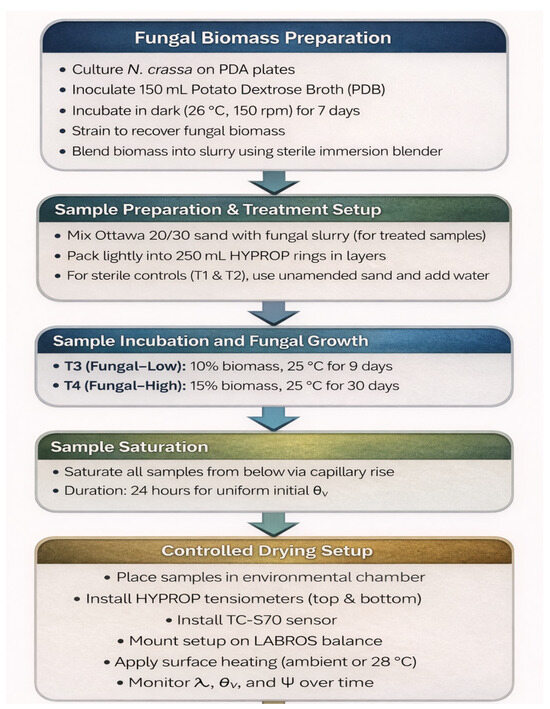
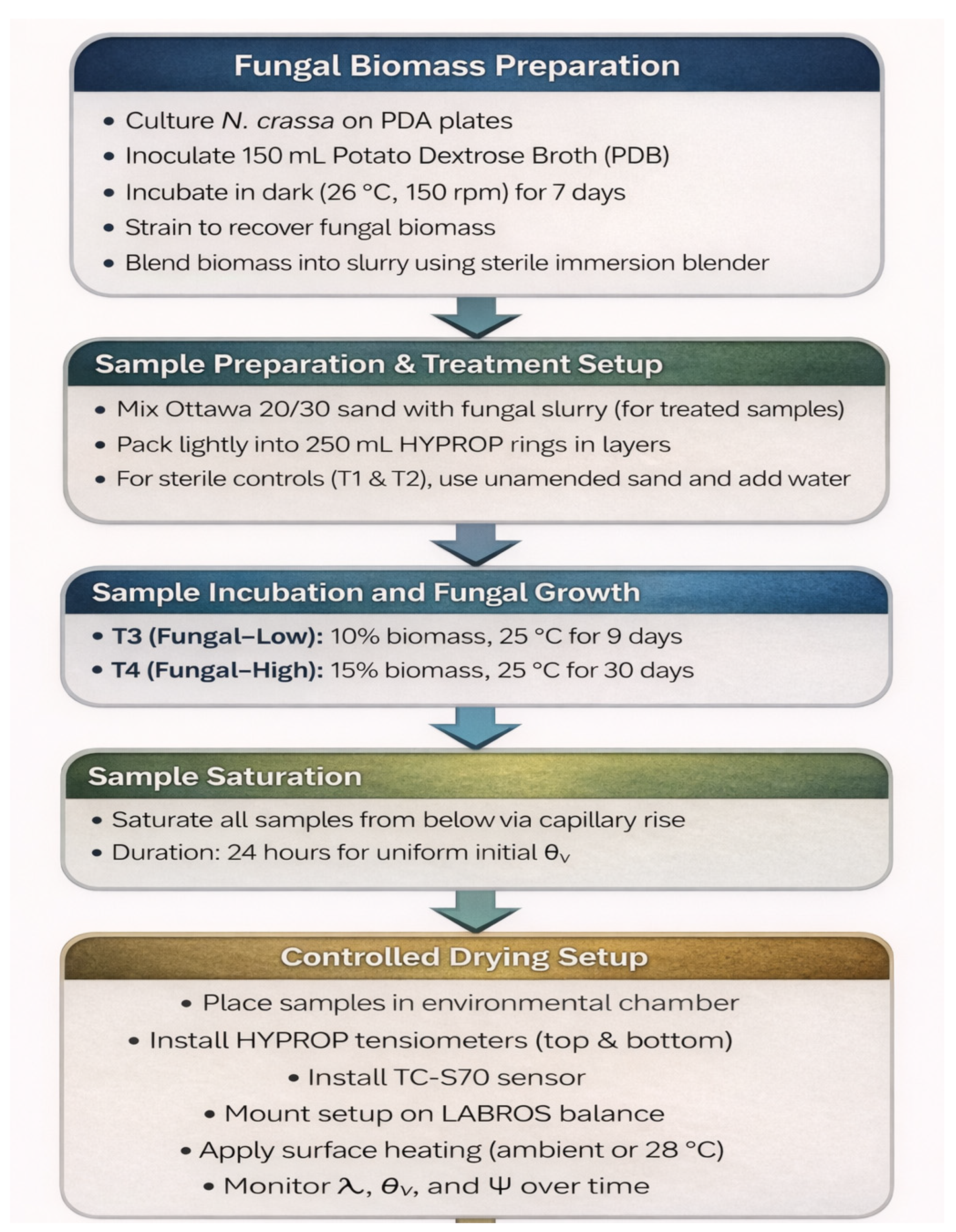
To evaluate the effects of temperature and fungal amendment on coupled thermal–hydraulic behavior, four treatments were prepared of varying fungal biomass presence, fungal development time, and surface heating temperature (Table 1, Figure 1). The treatments included two sterile controls, at ambient (22 °C) and elevated (28 °C) temperatures, and two bio-amended treatments with differing biomass concentrations and incubation periods.
Table 1.
Experimental parameters.
Figure 1.
Overview of the experimental procedure, including fungal biomass preparation, sample preparation, incubation, saturation, and the controlled drying setup.
T1—Sterile–Ambient (Control): Pure Ottawa 20/30 sand (0% biomass) was tested under ambient laboratory conditions at 22 ± 1 °C. The sample was packed at 1.72 g/cm3 bulk density into a 250 mL HYPROP ring (5 cm height × 8 cm diameter), yielding an initial sample mass of 431 g and an estimated porosity of 0.35. Packing was performed in three layers with gentle compaction.
T2—Sterile–Heated (Thermal Control): Identical sand and packing protocol were used as in T1, but the sample was tested at 28 ± 1 °C to isolate the temperature effects on λ and water retention. Sample mass and properties matched those of T1 (431 g, 1.72 g/cm3, porosity 0.35).
T3—Fungal–Low (10% biomass, 9 days): Ottawa sand was amended with 10% fresh N. crassa slurry/biomass by weight. The biomass was mixed with 376 g of sterile sand to produce a 250 mL sample (approximate total mass ~417–420 g). The introduction of fungal biomass resulted in a slight reduction in bulk density (estimated ~1.68 g/cm3) and an increase in effective void space (or apparent porosity) associated with the organic phase and developing hyphal network. The sample was incubated at 28 °C for 9 days prior to saturation and testing.
T4—Fungal–High (15% biomass, 30 days): A second bio-amended sample was prepared with 15% N. crassa biomass and incubated for 30 days. The final composition included 376 g of sterile sand and ~44 g fresh biomass, yielding a total sample mass of 420 g and a bulk density of 1.68 g/cm3. The higher biomass content and extended incubation period resulted in a more developed fungal network, increasing the effective pore volume and structural heterogeneity of the sample. The fungal network was visibly established, with extensive mycelial growth observed throughout the specimen.
These treatments were selected to span the range from abiotic to biologically active conditions, allowing for a comparison of the pure thermal effects (T1 vs. T2), biological amendment effects at fixed temperature (T2 vs. T3/T4), and evaluation of fungal network development effects via biomass level and growth time (T3 vs. T4).
All samples were prepared under sterile conditions in a biosafety cabinet. After incubation (fungal-amended samples) or packing (sterile controls), all specimens were saturated from below via capillary rise for 24 h. This was done to provide full pore saturation and uniform initial water content across samples before the drying experiments commenced. This saturation step also minimized potential hysteresis effects in subsequent water retention behavior.
2.3. Drying and Surface Heating Conditions
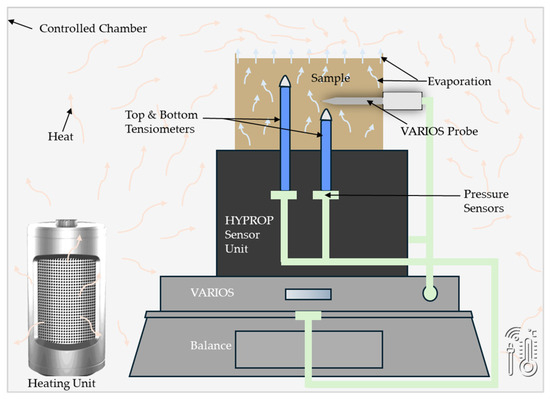
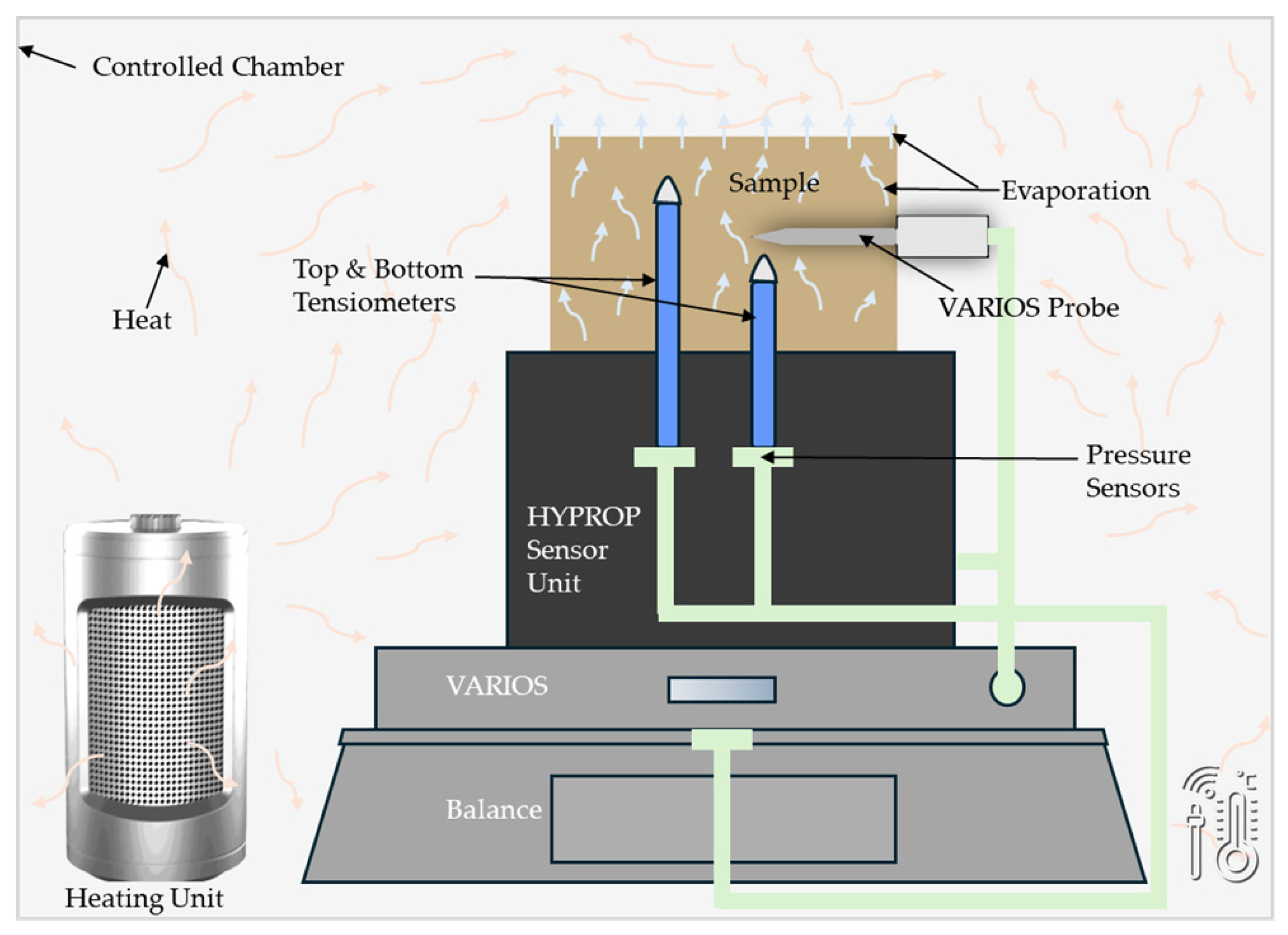
Samples were dried under controlled surface heating using an environmental chamber maintained at 22 ± 2.0 °C for the low-temperature control and 28 ± 2.0 °C for all other treatments (Figure 2). Relative humidity was held between 40 and 50% to reflect moderate evaporative demand, and the air velocity within the chamber was minimized to reduce convective variability. The 28 °C condition was chosen to reflect a moderately elevated surface temperature, consistent with real-world scenarios of sunlit surface heating or shallow subsurface warming. The biological relevance of this temperature is also tied to the optimal growth range for N. crassa [38].
Figure 2.
Schematic of HYPROP-VARIOS experimental setup within a controlled chamber.
2.4. Experimental Setup
A schematic of the experimental setup is shown in Figure 2. The setup consists of a combined HYPROP-VARIOS system placed within a controlled chamber. A VARIOS thermal probe was inserted horizontally into the sample to measure thermal conductivity alongside a HYPROP unit with two tensiometers of varying heights to measure suction. The chamber environment was subject to controlled heating using a forced-air heating unit, while temperature and humidity were monitored using an independent sensor. All measurements were recorded using LABROS software version 5.4.0 via a data acquisition system connected to the balance. The arrows in Figure 2 indicate the direction of air circulation within the chamber.
2.5. Simultaneous Measurement of Hydraulic and Thermal Properties
Soil water retention behavior was measured using the HYPROP 2 system (METER Group Inc., Pullman, WA, USA), which uses two precision mini-tensiometers embedded at the upper and lower parts of the sample (Figure 2). The instrument continuously logs matric suction (ψ, kPa) at two depths, sample weight via a laboratory balance, temperature, and relative humidity. The evaporation method captures drying behavior from near saturation to cavitation (up to ~85 kPa), yielding continuous water retention curves [22,24].
Thermal conductivity (λ, Wm−1K−1) was measured using the VARIOS system (METER Group Inc., Pullman, WA, USA) equipped with a TC-S70 dual-needle sensor, based on the transient heat pulse method described in [25]. The sensor was embedded horizontally at mid-height within each soil sample, and λ was derived from temperature response data collected at 30–60-min intervals during drying.
Figure 1 and Figure 2 present a flow chart and schematic illustration of the experimental procedure involving a controlled drying setup with an idealized HYPROP-VARIOS system (METER Group Inc., Pullman, WA, USA). However, due to technical limitations in physically coupling the separately purchased HYPROP 2 and VARIOS systems, specifically, connection incompatibilities between the control software and balance interfaces, true simultaneous measurement on a single balance was not feasible. Instead, both systems operated in parallel on the same soil sample, but on separate balances, with synchronized data streams used to align the measurements post hoc. The VARIOS system’s balance provided the master weight record, logging the sample mass continuously at hourly intervals. The HYPROP system collected ψ data from dual tensiometers at a higher frequency. For comparability, the HYPROP ψ data were interpolated to hourly intervals and matched to the VARIOS time using timestamp alignment. This adapted configuration preserved the advantages of concurrent drying on the same physical sample under identical thermal and evaporative conditions, while maintaining the ability to correlate λ, water content, and ψ throughout the drying process. The primary limitation was the reduced temporal resolution of weight data during early drying, which had minimal impact given the slow drying rate of the coarse-grained sand used in this study.
Final dry mass was determined by oven-drying all samples at 105 °C for 48 h. Since it is sandy soil, significant volume change is not expected during the wetting or drying cycle. Volumetric water content (θv) was then computed from real-time sample weight using:
where:
- is the mass at time t;
- is the oven-dry mass;
- is water density (1 g/cm3);
- Vw is the volume of water in the soil mass;
- V is the soil sample volume.
2.6. Data Collection and Analysis
Measurements were conducted continuously until upper tensiometer dropout (typically 10–14 days for Ottawa sand and much longer, 3–4 weeks, for treated samples under ambient conditions). Data collection included ψ at two depths (HYPROP 2), sample mass changes (LABROS Balance), λ at various θv values (VARIOS), and environmental conditions (temperature, humidity). Due to material and instrumentation constraints, single replicates were conducted for each treatment. As such, the results are not intended for statistical generalization, but rather to identify consistent behavioral trends under controlled conditions. The dataset is, therefore, interpreted in a comparative and mechanistic context, and should be viewed as hypothesis-generating to guide future replicated investigations. Potential sources of uncertainty identified include sensor artifacts, dry mass estimation error in bio-amended samples, and biological heterogeneity.
2.7. Soil Water Retention Curve Modeling
Soil water retention behavior was evaluated using the van Genuchten [39] model fitted to paired θv and ψ data. Suction measurements from the bottom tensiometer were used for fitting in order to minimize the excessive influence of transient suction gradients associated with surface-driven evaporation. The van Genuchten model is expressed as:
where:
- is the volumetric water content;
- is the residual water content;
- is the saturated water content;
- is the inverse air-entry parameter;
- is the pore-size distribution parameter;
- is the matric suction.
Parameter estimation was performed using nonlinear least-squares optimization. Model fitting was attempted for all treatments. However, robust and stable parameter estimation was achieved only for the fungal-amended samples (T3 and T4). The sterile samples (T1 and T2) exhibited rapid desaturation over a narrow suction range, resulting in clustered and scattered data that limited reliable parameter identification, particularly for T2. Accordingly, van Genuchten parameters are reported only for T3 and T4. For the fungal-amended samples, represents an apparent near-saturated volumetric water content, determined gravimetrically relative to the oven-dry mass of the composite sand–biomass system. As such, may include contributions from biomass-associated water and should not be interpreted strictly as mineral pore-space saturation. The inferred air-entry value is approximated as 1/α and used here for comparative purposes.
To assess parameter uncertainty, bootstrap resampling (N = 500) was applied by randomly sampling paired data points with replacement and refitting the model. The resulting parameter distributions were used to compute the median values and 95% confidence intervals.
3. Results
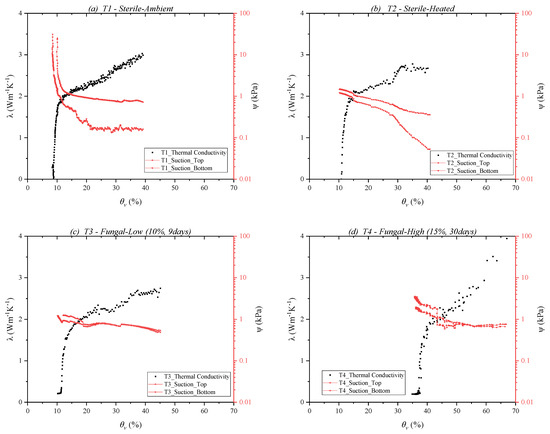
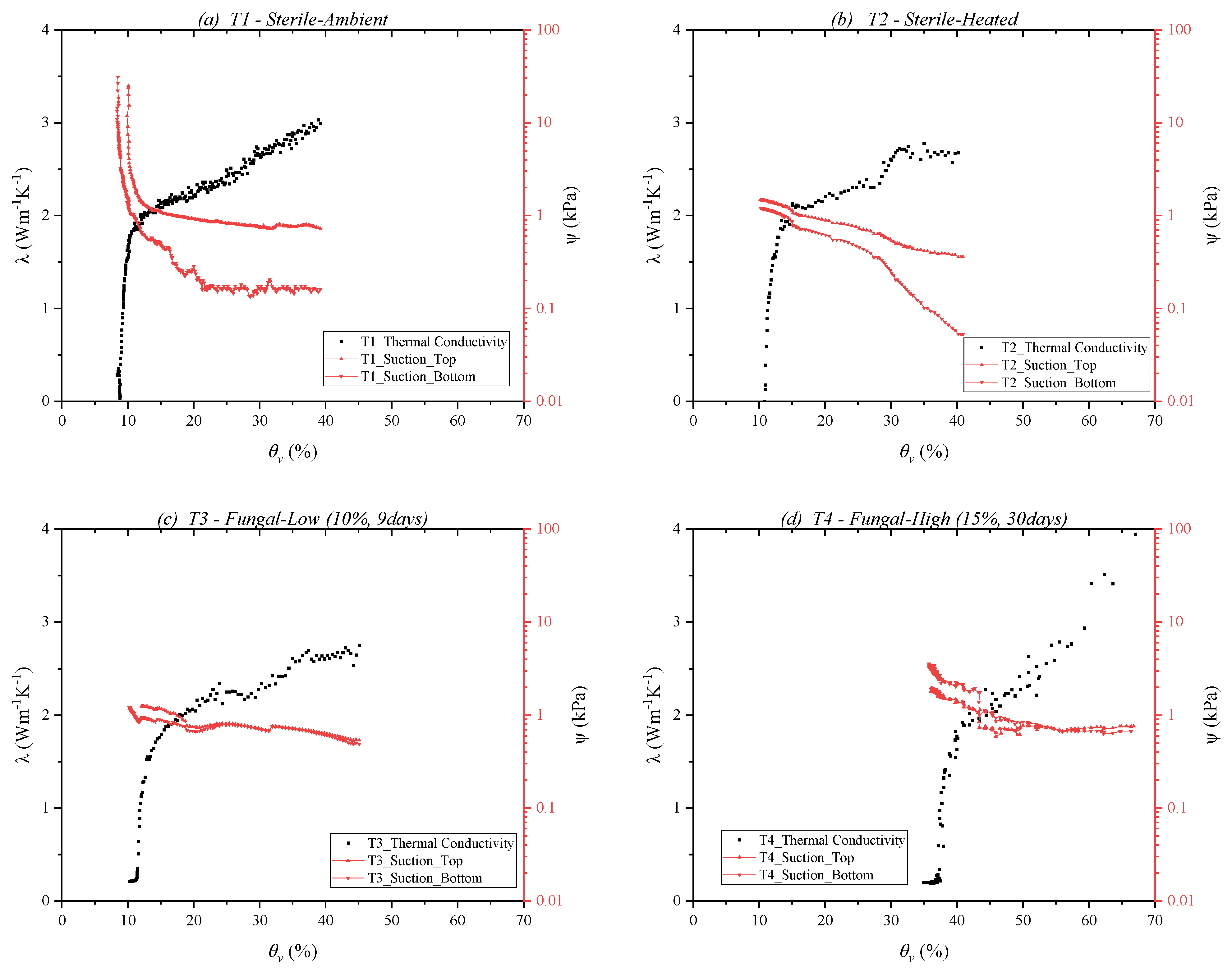
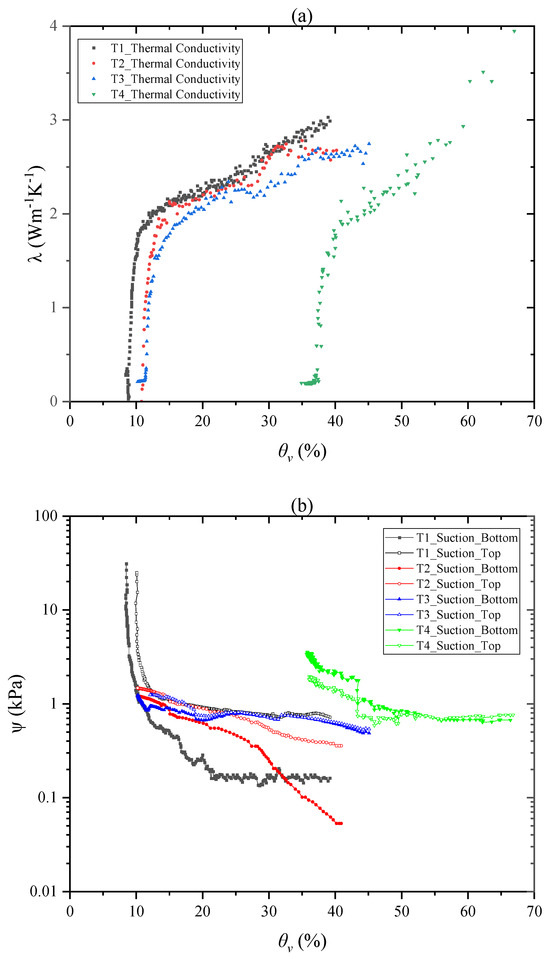
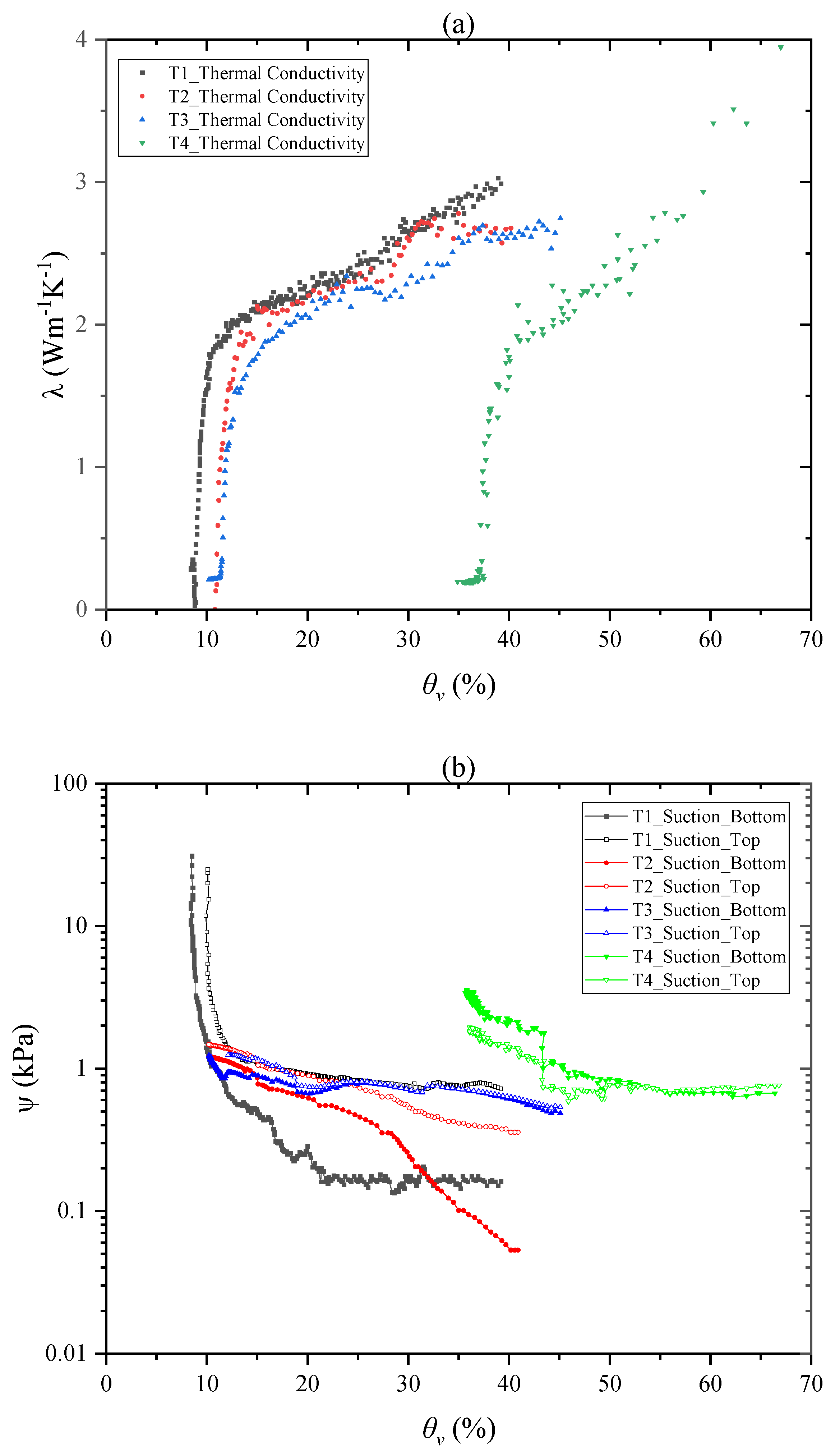
The evolution of λ and ψ with respect to θv is presented for each treatment in Figure 3a–d. λ was measured continuously during drying, while measured pore tension (i.e., ψ) was monitored at both the top and bottom sensor positions within each sample column. The λ– relationship was fit by ordinary least squares over regions, where the trend was visually linear. For completeness, a summary comparison of the λ–θv and ψ–θv trends across all treatments is provided in Figure 3a,b.
Figure 3.
Λ and matric ψ as functions of volumetric water content for the four treatments: (a) T1 sterile–ambient, (b) T2 sterile–heated, (c) T3 fungal–low biomass, and (d) T4 fungal–high biomass.
Notably, none of the experiments reached gravimetric dryness, as evidenced by the lowest recorded θv values being above zero: T1 through T3 dried only to θv ~8–12%, while T4 remained above ~35%. This behavior is attributed not to inherent moisture retention per se but is more likely the result of several interacting factors including possible limitations of the instruments, the termination of drying experiments once the tensiometers cavitated, and for treated samples, the observation that λ values approached zero with minimal change in ψ after about 6–7 days to avoid complications arising from dynamic biomass growth of N. crassa and the potential onset of perithecium (a closed, flask-shaped fungal fruiting body that produces spores) formation, which would introduce additional biological variables that are beyond the scope of this study. Tensiometer cavitation occurs when pore water tension exceeds the air entry value of the sensor (~85–100 kPa), rendering the measurement invalid. This imposes a practical cutoff for data acquisition, particularly in the low moisture regime, and explains the absence of λ and ψ values at lower θv. Such cavitation typically indicates that the capillary rise of water from the lower part of the sample was insufficient to sustain a continuous liquid phase to the tensiometer ceramic cup, and TC-S70 sensor at the respective positions in the sample, especially under progressive drying from the top. This would result in an evaporative front descending below the sensor location, decoupling the sensor from hydraulic continuity. The outcome is a steep rise in ψ, followed by signal loss, especially evident in T1 (Figure 3a). Consequently, drying was terminated not upon reaching absolute residual water content, but upon loss of sensor contact due to phase discontinuity, limiting direct comparison to fully dry states.
Despite this, all curves captured critical transitional regimes of thermal and hydraulic behavior, including the sharp rise in λ with drying and the corresponding nonlinear evolution of ψ, enabling meaningful interpretation within the observed θv window. These observations are interpreted comparatively across treatments rather than as standalone predictive relationships.
3.1. The Evolution of λ and ψ with Respect to θv
- T1—Sterile Ambient Drying
Under sterile ambient conditions, drying proceeded without imposed heating. The λ decreased monotonically with the decreasing volumetric water content . Over the interval to , λ declined from about 3.0 to 2.0 Wm−1K−1, corresponding to an average slope of approximately 0.032 Wm−1K−1 per percent within the linear portion of the curve. This behavior is consistent with the progressive replacement of water by air in the pore space and the loss of continuous water films, which reduces the number and quality of heat-conduction pathways through the soil–water–solid network. The λ– trend is close to linear over most of the measured range and steepens at the driest tail, where the measurements terminate due to the early cutoff in drying. Ψ data exhibits a clear vertical gradient between the top and bottom sensors during drying, with larger ψ values near the surface and a delayed response at depth. The top sensor shows a marginal/gradual increase from 0.7 kPa to 1.2 kPa over the range of to , while the bottom sensor maintained a ψ of ~0.18 kPa from saturation until a rapid rise was recorded up to 0.9 kPa during the transition from to . This pattern indicates an evaporative front that descends from the surface with limited replenishment from below. The relatively muted response and low apparent ψ at the bottom during late drying suggest incomplete transmission of tension, which may reflect hydraulic discontinuity at low or partial sensor decoupling from the matrix.
- T2—Sterile Heated Drying
T2 involved convective heating applied at the sample surface under sterile conditions (no fungal inoculation). The imposed thermal gradient accelerated drying relative to T1 and shifted the λ– relationship slightly toward higher water contents. Within the linear portion of the curve, the average slope was approximately 0.027 Wm−1K−1 per percent , which is similar in magnitude to T1. Peak λ values were about 2.7 Wm−1K−1, comparable to the T1 maximum of about 3.0 Wm−1K−1. This indicates that heating altered neither the overall thermal capacity nor the general trajectory of conductivity decline, but primarily reduced the duration required to reach low . Ψ patterns in T2 diverged from T1. Both top and bottom sensors recorded relatively low ψ values, generally below , with the top and bottom curves converging as drying progressed. Unlike T1, the bottom sensor for T2 displayed a smoother and more gradual incline. These behaviors suggest that convective heating promoted vapor-phase redistribution and more spatially uniform drying, which limited the strong matric tension gradients between the surface and deeper regions. The smoother ψ evolution indicates a shift from capillary-dominated drying in T1 to a regime with stronger vapor-phase flux and more uniform matric potential distribution in T2, which is typical for thermally driven evaporation. The extended coupling of the top sensor supports this interpretation. Overall, T2 reached its final moisture state in roughly four days, compared to the approximately thirteen days required for T1 (Table 2).
Table 2.
Drying periods and linear λ–θv slopes with corresponding R2 values for all treatments.
- T3—Fungal Treatment, Low Inoculum
T3 incorporated a 10% fungal inoculation followed by a 9-day incubation period before drying. The λ curve was nearly identical in form to T2. Within the linear portion of the λ– relationship, the average slope was about 0.026 Wm−1K−1 per percent , which is very close to the T2 value. The peak λ was also similar, indicating that fungal colonization at this level had minimal measurable influence on the thermal response of the soil. This outcome contrasts with our initial expectation that this amount of fungal growth would significantly alter λ by reorganizing particles, producing hyphal bridges, or modifying interparticle voids in a way that changes contact pathways either toward heat conduction or insulation. Ψ behavior in T3 exhibited a low and steady profile for both the top and bottom sensors. Both curves remained mostly below 1 kPa without the sharp tension increases observed in T1 and with slightly smoother and more uniform trends compared to T2. The absence of steep ψ rises suggests that fungal presence influenced the pore structure in a way that moderated capillary tension development. This may reflect partial hydrophobicity introduced by fungal metabolites or hyphal surfaces or a more continuous pore network that limited the formation of capillary breaks. The coupled ψ and conductivity behavior points to improved structural integration of the pore system, which may have enhanced moisture buffering and delayed the formation of strong matric gradients during drying. The T2 and T3 results indicate that convective heating dominated the drying dynamics, while low-level fungal colonization contributed secondary modifications to pore structure that affected ψ more than λ.
- T4—Fungal Treatment, High Inoculum
T4 represents the most biologically active treatment, with 15% fungal inoculum and 30 days of colonization prior to drying. Unlike T1–T3, drying initiated from a much higher initial water content . λ decreased nearly linearly from to ∼42% before the measurement cutoff. The λ– slope within this interval was the steepest among all treatments at approximately 0.082 Wm−1K−1 per percent and the highest peak λ of ~4 Wm−1K−1. This indicates a strong sensitivity of λ to small moisture changes in the biologically conditioned matrix, consistent with stabilized pore-water distributions and additional water held in hyphal networks and extracellular matrices that preserve conductive pathways at high . Ψ remained remarkably low and stable, generally just below across both sensor positions, with only a modest rise near the inflection where the λ trend starts to change. Top and bottom curves were closely aligned, similar to T3, and stayed within a narrow band throughout the observed drying window. The persistence of low, convergent ψ values implies an effective buffering effect on matric tension, plausibly mediated by hyphal bridging, fungal gels, and exudates/biopolymer-induced pore connectivity that limit capillary breaks at the surface and within the profile. The coupled low-ψ response and steep λ– slope suggests the suppression of early desaturation and preservation of thermal continuity at high , even though once vapor-phase redistribution advances beyond the biologically stabilized regime, λ drops quickly as conductive water films become discontinuous. A practical implication is that the inferred air-entry point in T4 is shifted to wetter conditions relative to T1–T3, indicating that fungal colonization significantly delays the onset of strong ψ development. While enhanced biological water retention improves moisture buffering, the net effect on thermal transport at a lower still trends toward insulation as air (and possibly hydrophobic pockets) replaces water in the pore space.
3.2. Fitted Soil Water Retention Curves
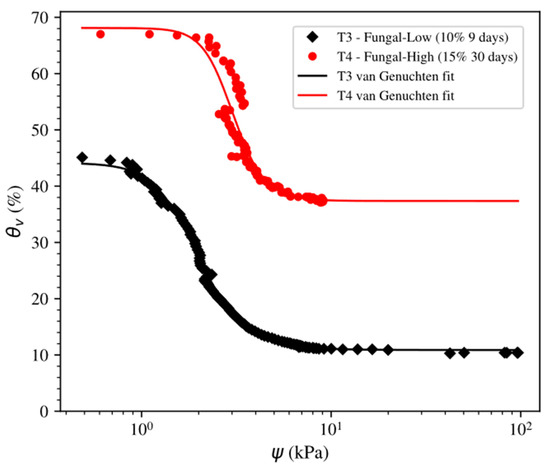
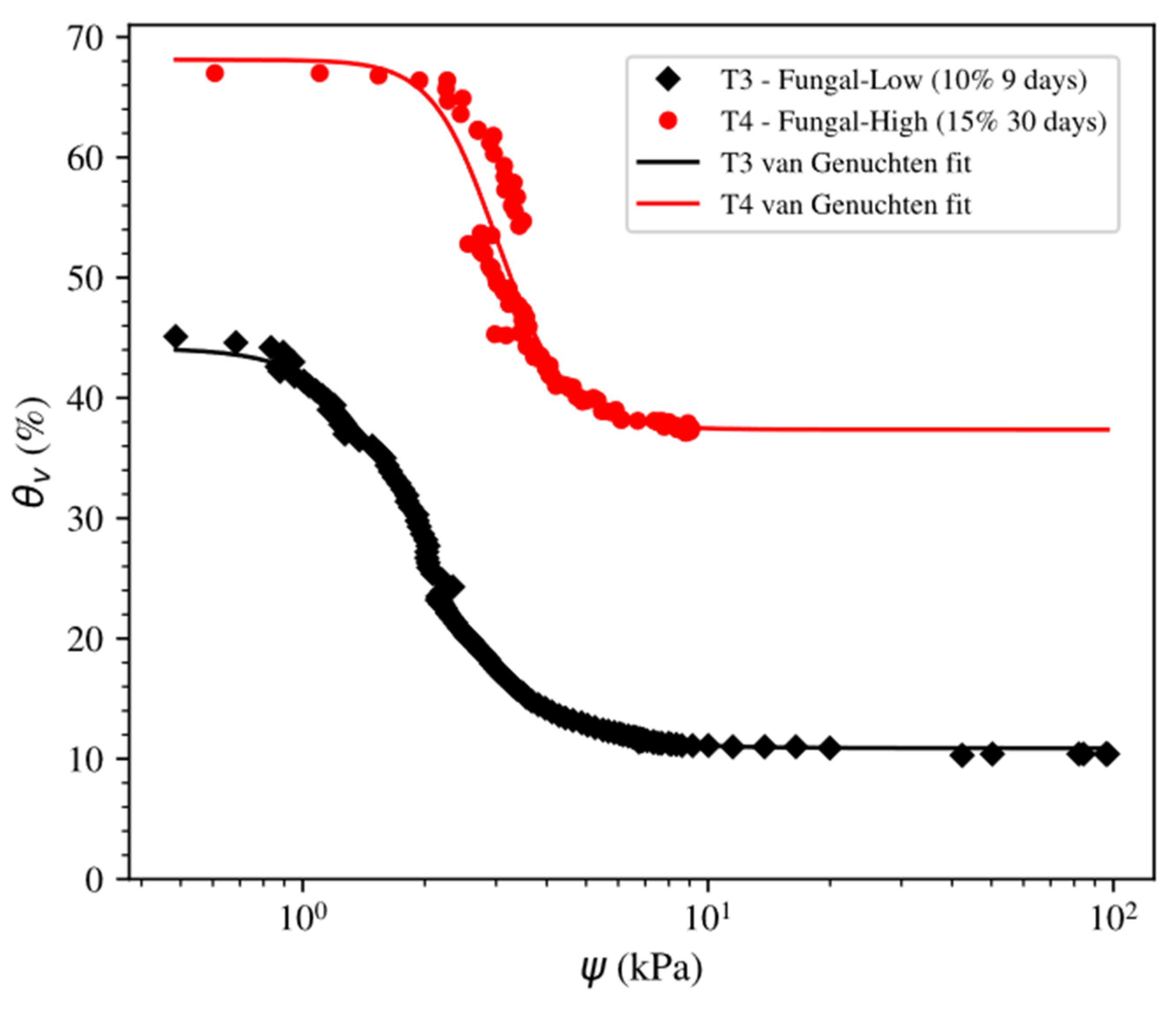
To quantitatively assess moisture retention behavior, SWRCs were fitted using the van Genuchten [39] model to paired and bottom tensiometer ψ data. Due to limited ψ range and non-equilibrium effects in the sterile treatments, reliable model fitting was not achieved for T1 and T2. Consequently, the quantitative SWRC analysis was focused on the fungal-amended treatments (T3 and T4), where the data exhibited sufficiently structured retention behavior to permit meaningful parameter estimation. The fitted SWRCs are presented in Figure 4, and the corresponding parameters are summarized in Table 3.
Figure 4.
Soil water retention curves (SWRCs) fitted using the van Genuchten model.
Table 3.
van Genuchten parameters for all treatments (95% bootstrap confidence interval in parentheses).
For T3, the van Genuchten model provided an excellent fit to the data (R2 ≈ 0.995), with θs ≈ 0.44 and θr ≈ 0.11. The fitted α value (≈0.56 kPa−1) corresponds to an approximate air-entry value, AEV ≈ 1.8 kPa, indicating relatively early desaturation compared to the higher biomass condition. On the other hand, T4 exhibited a higher apparent θs ≈ 0.69 and a lower α value (≈0.33 kPa−1), corresponding to an increased AEV of approximately 3.0 kPa. This shift indicates delayed air entry and enhanced water retention in the more extensively colonized sample. The T4 fit showed moderate agreement with the data (R2 ≈ 0.72), with a greater parameter uncertainty relative to T3, as reflected in wider bootstrap confidence intervals (Table 3).
In general, the SWRC analysis indicates a clear trend of increased water retention and delayed desaturation with increasing fungal biomass and incubation time. While the T3 fit is well-constrained, the T4 results should be interpreted with caution due to increased variability and potential structural heterogeneity associated with advanced fungal network development.
It is emphasized that the SWRC fits are used here as a comparative tool to support the interpretation of retention behavior in the fungal-amended samples, rather than as definitive parameterizations for predictive modeling.
3.3. Λ Trends Across Treatments
Across all treatments, λ declines as drying progresses, and the λ– curves reflect how thermal forcing and fungal colonization reshape the drying pathway rather than the inherent λ– relationship itself. Figure 5a compares λ– for T1 through T4. In T1, the sterile–ambient case, conductivity decreases nearly linearly from to 9%, with a relatively narrow moisture interval over which connectivity is lost. This behavior is consistent with evaporation driven primarily by atmospheric demand, with the pore structure largely unmodified. Under convective heating in T2, drying accelerates, but the form of the λ– relationship remains almost unchanged from T1. The slightly lower peak λ and similar slope indicate that heating influences the rate of water removal rather than the way conductive pathways collapse. T3, with a low fungal biomass, mirrors T2 closely. Its slope and peak conductivity remain nearly identical, showing that modest hyphal growth does not substantially alter thermal pathways. The similarity between T2 and T3 confirms that minor biological structuring exerts only a secondary influence relative to water content. In contrast, T4 displays a fundamentally different trajectory. Drying begins at , and the mid-range slope is more than double that of the other treatments. Conductivity remains high across a broad moisture range before dropping sharply once biologically stabilized water domains collapse. This expanded regime and steeper decline reflect a matrix conditioned by dense hyphal networks, gels, and extracellular polymers that maintain conductive water films at relatively high . As these films destabilize during drying, thermal connectivity is lost rapidly, producing the sharpest λ transition among all treatments.
Figure 5.
Combined plots showing respective (a) λ–θv and (b) ψ–θv relationships across all treatments, illustrating the influence of heating and fungal colonization on thermal and hydraulic connectivity during drying.
Overall, the cross-treatment comparison shows that moisture content alone does not determine conductivity evolution. Heating compresses the drying duration without meaningfully altering the connectivity loss, whereas a high fungal biomass reconstructs the pore system such that air-entry shifts to wetter conditions, thermal continuity persists deeper into the drying process, and the eventual decline in λ becomes more abrupt.
3.4. Moisture Retention and Ψ Dynamics Across Treatments
Ψ– behavior (Figure 5b) similarly divides into sterile and biologically active regimes. In T1, ψ rises sharply at the surface once falls below roughly 12%, eventually reaching cavitation, while the bottom sensor responds more slowly. This vertical gradient indicates a descending evaporative front and limited upward replenishment, ultimately producing a loss of capillary continuity at low water contents. At later stages of drying, when the water phase may become discontinuous, divergence between the upper and lower tensiometer readings likely reflects partial hydraulic decoupling and localized sensor wetting rather than a fully continuous ψ field across the specimen [40,41]. Under convective heating in T2, ψ remains below about 1 kPa at both depths, with only slight divergence during drying. This behavior is consistent with thermally enhanced vapor-phase redistribution dominating moisture transport under heated conditions, which smooths internal moisture redistribution and suppresses the formation of strong matric ψ gradients despite ongoing mass loss, even in the absence of biological activity. T3 behaves comparably to T2, maintaining low, nearly uniform ψ across depths. Slightly higher values relative to T2 may reflect minor fungal retention, but the hydraulic architecture remains similar to sterile heated drying. By contrast, T4 exhibits nearly isobaric behavior across a wide moisture interval, with both sensors remaining within approximately 1–5 kPa, despite substantial drying. This stability indicates strong moisture buffering by a dense fungal matrix that stabilizes thin films, reduces evaporative flux, and suppresses capillary break formation. The delayed onset of ψ escalation in T4 is consistent with the broadened λ– response, showing that fungal networks maintain unsaturated hydraulic connectivity across a much wider moisture range than sterile soils.
Summarily, the ψ data demonstrate that sterile soils develop strong vertical gradients and undergo early hydraulic disconnection during drying, whereas fungal colonization, particularly at a high biomass, homogenizes water potentials, suppresses tension buildup, and delays air entry. This biological stabilization of the pore system parallels the thermal behavior, reinforcing that fungal growth modulates both hydraulic and thermal continuity during drying rather than simply altering the drying rate.
4. Discussion
The results are interpreted within the context of a controlled, proof-of-concept experimental framework. Accordingly, the observed trends are discussed in terms of relative differences between treatments and plausible governing mechanisms, rather than as broadly generalizable soil behavior. Despite the limited dataset, the consistency of trends across independently measured thermal and hydraulic variables provides confidence in the observed coupled behavior within the tested conditions.
It is noted that total water potential (ψ) consists of both matric (ψm) and osmotic (ψp) components. While the present measurements primarily capture matric suction, osmotic contributions arising from fungal metabolites and extracellular compounds may influence the overall water potential in amended samples. The experimental setup does not allow separation of the components. Hence, interpretations are made in terms of effective matric behavior. In addition, it is also noteworthy that water transport in fungal systems may occur via both apoplastic and symplastic pathways. Dye-based studies suggest that much of the directional flow along hyphal networks occurs through apoplastic pathways, where water moves along the hyphal surface before equilibrating across membranes. However, the present study measures bulk thermo-hydraulic behavior and does not distinguish between these transport mechanisms. As such, the observed responses represent the integrated effects of pore-scale processes rather than specific biological transport pathways.
Across all treatments, λ declined with the decreasing volumetric water content , and ψ tracked the progression from hydraulically connected to disconnected pore water. Surface heating shortened the time to reach dry states but did not materially change the form of the λ– relationship or generate strong matric gradients. Low fungal colonization produced ψ responses comparable to the heated sterile control and an almost identical λ– curve, indicating minimal structural modification at early growth. In contrast, high biomass with extended colonization widened the effective saturation range, maintained low and nearly uniform ψ with depth, and steepened the mid-range λ– slope. These patterns are consistent with hyphae, gels, and extracellular polymers stabilizing thin water films, delaying air entry, and preserving hydraulic continuity at relatively high .
These results show that moisture content alone does not dictate the evolution of λ during drying. Thermal forcing primarily influences the rate at which drying proceeds, whereas biological structuring alters the pathway itself by widening the effective saturation range, homogenizing ψ, shifting air entry to wetter conditions, and sharpening the eventual loss of thermal connectivity. These findings suggest that biologically active near-surface soils may sustain a higher effective λ at intermediate-to-high water contents while suppressing matric gradients. Such behavior has implications for energy foundations, soil cover performance, and desiccation management in thermally stressed environments.
Fungal growth morphology and network architecture are expected to play a significant role in governing thermo-hydraulic behavior. The present study employs Neurospora crassa, which exhibits predominantly radial and non-directional hyphal expansion. In contrast, fungi forming rhizomorphs or directional networks, such as Armillaria or certain mycorrhizal species, may introduce anisotropic transport pathways and preferential flow directions. Such structural differences may influence both hydraulic continuity and thermal transport efficiency. The current results, therefore, represent a baseline for isotropic fungal systems, and future work should investigate directional fungal architectures to assess their influence on coupled transport processes.
Fungal water transport has been studied extensively in the earlier literature, particularly in the context of soil–plant interactions and hyphal physiology. Studies such as Griffin [42] and Tinker and Nye [43] highlight the role of fungal networks in facilitating water movement in porous media. Experimental investigations using dyes and isotropic tracers have demonstrated that water may be transported along hyphal surfaces and through interconnected networks. Additional studies, such as Safir et al. [44] and Querejeta et al. [45], suggest that water transport may persist even in non-viable hyphae, indicating that structural pathways rather than active biological processes may dominate. These findings provide important context for interpreting the enhanced water retention observed in the fungal-amended samples in the present study.
The present study uses uniform Ottawa sand to isolate fungal effects under controlled conditions. In soils with finer particles or broader gradation, additional mechanisms such as clay–water interactions may influence thermo-hydraulic behavior. Hence, the observed trends may differ in natural soils with more complex mineralogy and structure. Changes in bulk density and pore structure may contribute to the observed behavior, and fungal effects should be interpreted as coupled structural and biological modifications rather than purely physical changes.
Several methodological constraints shape the interpretation of these findings. Measurements ended upon tensiometer cavitation and, in bio-amended samples, prior to potential perithecium formation, limiting observations at very low water contents. The HYPROP and VARIOS systems were operated on the same specimen, with measurements coordinated using synchronized timestamps. Due to initial software constraints, a second HYPROP unit was placed on an adjacent balance to maintain full system functionality. Nonetheless, only one balance was actively measuring the specimen at any time. This configuration maintained coupled measurement while reducing mass resolution during early drying. Single replicates restrict generalizability, and biological heterogeneity may introduce additional variance. In addition, matric suction was measured only at the top and bottom of the sample, limiting the resolution of internal spatial variability. The experiments were conducted under controlled environmental conditions, and variations in relative humidity and airflow were not explored. Further, fungal growth was not monitored dynamically during the drying process. Thus, the results reflect pre-incubated structural effects rather than evolving biological activity. Nevertheless, the experiments captured the critical transitional regimes necessary for mechanistic inference. These constraints define the scope of the study and are consistent with its positioning as an initial experimental investigation rather than a comprehensive parametric analysis.
Future work should employ replicated, factorial studies that vary temperature, biomass concentration, and incubation duration. The imposed temperature conditions represent simplified thermal-loading scenarios. Future studies should investigate a wider temperature range to better capture field-relevant variability and potential threshold behavior. Direct quantification of EPS and hyphal density, integration of pore-scale imaging, and retention and contact-angle measurements would clarify the roles of hydrophobicity and film stability. Model fitting using established soil-water retention and thermal frameworks extended to include biopolymer and capillary-film effects would enable predictive parameterization of bio-mediated thermo-hydraulic behavior.
5. Conclusions
This proof-of-concept study provides initial experimental insight into how surface heating and fungal colonization jointly shape drying in a coarse mineral soil by tracking λ and matric ψ as functions of . The principal conclusions are:
- Thermal forcing compresses time, not form. Heating accelerated drying but did not materially alter the shape or slope of the λ– relationship or generate strong matric gradients in sterile sand. Higher λ consistently corresponded to higher , indicating that temperature chiefly influenced the pace of moisture removal rather than the mechanism of connectivity loss;
- Low fungal biomass exerts weak hydraulic influence and negligible thermal impact. At 10% biomass with short incubation, the λ– curve was nearly identical to the heated sterile control, and ψ remained low and smooth with depth, indicating minimal structural modification at early colonization;
- High biomass reconstructs the pore system and shifts air-entry to wetter states. At 15% biomass with extended incubation, the effective saturation range widened, λ remained elevated at a higher , and the mid-range λ– slope increased markedly. Ψ stayed low and nearly uniform across depths over a broad moisture interval. These behaviors are consistent with hyphae, gels, and extracellular polymers stabilizing thin water films, preserving hydraulic continuity at relatively high and triggering a rapid loss of thermal connectivity once biological water pathways destabilize.
These findings should be interpreted within the scope of the experimental design and serve primarily to motivate more extensive, replicated investigations.
Author Contributions
Conceptualization, E.S.; Methodology, A.D.K.; Validation, E.S. and A.B.; Formal analysis, A.D.K. and E.S.; Investigation, A.D.K.; Writing—original draft, A.D.K.; Writing—review & editing, E.S. and A.B.; Visualization, E.S.; Supervision, E.S.; Project administration, E.S. All authors have read and agreed to the published version of the manuscript.
Funding
This research received no external funding but was supported by internal start-up funds from Arizona State University.
Data Availability Statement
The data supporting the findings of this study are available within the article. Additional datasets generated and analyzed during the study are available from the corresponding author upon reasonable request.
Conflicts of Interest
The authors declare no conflict of interest.
Abbreviations
| Abbreviation | Definition |
| VARIOS | Variable Λ Analyzer |
| ASTM | American Society for Testing and Materials |
| AEV | Air-Entry Value |
| HYPROP | Hydraulic Property Analyzer |
| Λ or λ | Thermal Conductivity of the Soil [Wm−1K−1] |
| Λ–θv or λ–θv | Functional Relationship Between λ and Volumetric Water Content |
| Ψ or ψ–θv | Functional relationship Between Matric ψ and Volumetric Water Content |
| N. crassa | Neurospora crassa (model filamentous fungus) |
| PDA | Potato Dextrose Agar |
| PDB | Potato Dextrose Broth |
| Volumetric Water Content [%] (m3 water per m3 bulk soil) | |
| Ψ(or ψ) | Matric Suction (soil water potential relative to atmospheric pressure) [kPa] |
References
- Hillel, D. Environmental Soil Physics; Academic Press: San Diego, CA, USA, 1998. [Google Scholar]
- Smits, K.M.; Sakaki, T.; Limsuwat, A.; Illangasekare, T.H. Thermal Conductivity of Sands under Varying Moisture and Porosity in Drainage–Wetting Cycles. Vadose Zone J. 2010, 9, 172–180. [Google Scholar] [CrossRef] [Scilit]
- Campbell, G.S.; Calissendorff, C.; Williams, J.H. Probe for Measuring Soil Specific Heat Using A Heat-Pulse Method. Soil Sci. Soc. Am. J. 1991, 55, 291–293. [Google Scholar] [CrossRef] [Scilit]
- Lu, S.; Ren, T.; Gong, Y.; Horton, R. An Improved Model for Predicting Soil Thermal Conductivity from Water Content at Room Temperature. Soil Sci. Soc. Am. J. 2007, 71, 8–14. [Google Scholar] [CrossRef] [Scilit]
- Zhelezova, A.; Sorrentino, G.; Otim, G.I.; Rocchi, I. Soil Is Alive—How Does Soil Biota Influence Soil Mechanical Properties? A Perspective Review. In Biogeotechnics; KeAi Communications Co.: Beijing, China, 2026. [Google Scholar] [CrossRef] [Scilit]
- Senn, S.; Vion, L.; Best, M.; Kostoglou, M.; Smith, K.; Bowerman, A.L.; Melendez, D.; Ford, J.M.; Enke, R.E.; Barnard-Kubow, K.B.; et al. Soil Is Alive: Biological, Physical, and Chemical Analysis. J. Adv. Technol. Educ. 2024, 2024, 13334280. [Google Scholar] [CrossRef]
- Minami, K. Soil Is a Living Substance. In Soil Science and Plant Nutrition; Taylor and Francis Ltd.: Abingdon, UK, 2021; pp. 26–30. [Google Scholar] [CrossRef] [Scilit]
- Ritz, K.; Young, I.M. Interactions between Soil Structure and Fungi. Mycologist 2004, 18, 52–59. [Google Scholar] [CrossRef] [Scilit]
- Boddy, L.; Watkinson, S.C. Wood decomposition, higher fungi, and their role in nutrient redistribution. Botany 1995, 73, 1377–1383. [Google Scholar] [CrossRef] [Scilit]
- Boswell, G.P.; Jacobs, H.; Davidson, F.A.; Gadd, G.M.; Ritz, K. Functional Consequences of Nutrient Translocation in Mycelial Fungi. J. Theor. Biol. 2002, 217, 459–477. [Google Scholar] [CrossRef] [Scilit]
- Boswell, G.P.; Hopkins, S. Linking Hyphal Growth to Colony Dynamics: Spatially Explicit Models of Mycelia. Fungal Ecol. 2008, 1, 143–154. [Google Scholar] [CrossRef] [Scilit]
- Piotrowski, J.S.; Denich, T.; Klironomos, J.N.; Graham, J.M.; Rillig, M.C. The Effects of Arbuscular Mycorrhizas on Soil Aggregation Depend on the Interaction between Plant and Fungal Species. New Phytol. 2004, 164, 365–373. [Google Scholar] [CrossRef] [Scilit]
- Rillig, M.C.; Mummey, D.L. Mycorrhizas and Soil Structure. New Phytol. 2006, 171, 41–53. [Google Scholar] [CrossRef] [Scilit]
- Rillig, M.C. Arbuscular Mycorrhizae, Glomalin, and Soil Aggregation. Can. J. Soil Sci. 2004, 84, 355–363. [Google Scholar] [CrossRef] [Scilit]
- Abu-Hamdeh, N.H.; Reeder, R.C. Soil Thermal Conductivity Effects of Density, Moisture, Salt Concentration, and Organic Matter. Soil Sci. Soc. Am. J. 2000, 64, 1285–1290. [Google Scholar] [CrossRef] [Scilit]
- Usowicz, B. Spatial Variability of Soil Thermal Properties in Cultivated Fields. Soil Tillage Res. 1996, 39, 85–100. [Google Scholar] [CrossRef] [Scilit]
- Leifheit, E.F.; Veresoglou, S.D.; Lehmann, A.; Morris, E.K.; Rillig, M.C. Multiple Factors Influence the Role of Arbuscular Mycorrhizal Fungi in Soil Aggregation—A Meta-Analysis. Plant Soil 2014, 374, 523–537. [Google Scholar] [CrossRef] [Scilit]
- Salifu, E.; El Mountassir, G.; Minto, J.M.; Tarantino, A. Hydraulic Behaviour of Fungal Treated Sand. Geomech. Energy Environ. 2022, 30, 100258. [Google Scholar] [CrossRef] [Scilit]
- Ochsner, T.E.; Horton, R.; Ren, T. A New Perspective on Soil Thermal Properties. Soil Sci. Soc. Am. J. 2001, 65, 1641–1647. [Google Scholar] [CrossRef] [Scilit]
- Noborio, K.; McInnes, K.J.; Heilman, J.L. Two-Dimensional Model for Water, Heat, and Solute Transport in Furrow-Irrigated Soil: II. Field Evaluation. Soil Sci. Soc. Am. J. 1996, 60, 1010–1021. [Google Scholar] [CrossRef] [Scilit]
- Hopmans, J.W.; Dane, J.H. Temperature Dependence of Soil Hydraulic Properties. Soil Sci. Soc. Am. J. 1986, 50, 4–9. [Google Scholar] [CrossRef] [Scilit]
- Schindler, U.; Durner, W.; von Unold, G.; Müller, L. Evaporation Method for Measuring Unsaturated Hydraulic Properties of Soils: Extending the Measurement Range. Soil Sci. Soc. Am. J. 2010, 74, 1071–1083. [Google Scholar] [CrossRef] [Scilit]
- Peters, A.; Durner, W. Improved Estimation of Soil Water Retention Characteristics from Hydrostatic Column Experiments. Water Resour. Res. 2006, 42, 1–9. [Google Scholar] [CrossRef] [Scilit]
- Peters, A.; Durner, W. Simplified Evaporation Method for Determining Soil Hydraulic Properties. J. Hydrol. (Amst.) 2008, 356, 147–162. [Google Scholar] [CrossRef] [Scilit]
- ASTM D5334-14; Test Method for Determination of Thermal Conductivity of Soil and Rock by Thermal Needle Probe Procedure. ASTM International: West Conshohocken, PA, USA, 2022. [CrossRef] [Scilit]
- Ghosh, A.; Banerjee, A.; Brozel, V.; Salifu, E.; Das, J. Understanding the Variation of Thermal Conductivity of Sands with Bio-Cementation and Desaturation. In Proceedings of the ICBBG 2025, Tempe, AZ, USA, 18–20 May 2025. [Google Scholar] [CrossRef]
- Augé, R.M.; Stodola, A.J.W.; Tims, J.E.; Saxton, A.M. Moisture Retention Properties of a Mycorrhizal Soil. Plant Soil 2001, 230, 87–97. [Google Scholar] [CrossRef] [Scilit]
- Sivadasan, S.; Muguda, S.; Salifu, E.; Tirkolaei, H.K.; Bruno, A.W.; Gallipoli, D. Hydraulic Response of Sandy Soil to Fungi-Biopolymer Treatment. E3S Web Conf. 2025, 642, 05009. [Google Scholar] [CrossRef]
- Park, J.S.; Lin, H.; Moe, W.M.; Salifu, E. Hydraulic Properties of Sands Treated with Fungal Mycelium of Trichoderma Virens. J. Geotech. Geoenviron. Eng. 2023, 149, 04023093. [Google Scholar] [CrossRef] [Scilit]
- Salifu, E.; El Mountassir, G. Preliminary Observations of the Shear Behaviour of Fungal Treated Soil. E3S Web Conf. 2019, 92, 11017. [Google Scholar] [CrossRef] [Scilit]
- Lim, A.; Atmaja, P.C.; Rustiani, S. Bio-Mediated Soil Improvement of Loose Sand with Fungus. J. Rock Mech. Geotech. Eng. 2020, 12, 180–187. [Google Scholar] [CrossRef] [Scilit]
- Jerez Lazo, C.; Lee, N.; Tripathi, P.; Joykutty, L.; Jayachandran, K.; Lee, S.J. A Fungus-Based Soil Improvement Using Rhizopus Oryzae Inoculum. Int. J. Geo-Eng. 2024, 15, 18. [Google Scholar] [CrossRef] [Scilit]
- Lim, A.; Sunaryo, J.Y.; Wijaya, M.; Satyanaga, A.; Kristijarti, A.P. Hydraulic Characteristics and Incubation Methods for Enhancing Durability of Fungi- Mycelium Treated Silica Sand Using Rhizopus Oligosporus and Rhizopus Oryzae Combination. Biogeotechnics 2024, 2, 100066. [Google Scholar] [CrossRef] [Scilit]
- Tarnawski, V.R.; Momose, T.; Leong, W.H. Assessing the Impact of Quartz Content on the Prediction of Soil Thermal Conductivity. Géotechnique 2009, 59, 331–338. [Google Scholar] [CrossRef] [Scilit]
- ASTM C778-17; Standard Specification for Standard Sand. ASTM International: West Conshohocken, PA, USA, 2017. [CrossRef] [Scilit]
- Jacobson, D.J.; Powell, A.J.; Dettman, J.R.; Saenz, G.S.; Barton, M.M.; Hiltz, M.D.; Dvorachek, W.H.; Glass, N.L.; Taylor, J.W.; Natvig, D.O. Neurospora in Temperate Forests of Western North America. Mycologia 2004, 96, 66–74. [Google Scholar] [CrossRef] [Scilit]
- Davis, R.H.; Perkins, D.D. Neurospora: A Model of Model Microbes. Nat. Rev. Genet. 2002, 3, 397–403. [Google Scholar] [CrossRef] [Scilit]
- Galagan, J.E.; Calvo, S.E.; Borkovich, K.A.; Selker, E.U.; Read, N.D.; Jaffe, D.; FitzHugh, W.; Ma, L.-J.; Smirnov, S.; Purcell, S.; et al. The Genome Sequence of the Filamentous Fungus Neurospora Crassa. Nature 2003, 422, 859–868. [Google Scholar] [CrossRef] [Scilit]
- Van Genuchten, M.T. A Closed-Form Equation for Predicting the Hydraulic Conductivity of Unsaturated Soils. Soil Sci. Soc. Am. J. 1980, 44, 892–898. [Google Scholar] [CrossRef] [Scilit]
- Banerjee, A.; Puppala, A.J.; Hoyos, L.R.; Likos, W.J.; Patil, U.D. Resilient Modulus of Expansive Soils at High Suction Using Vapor Pressure Control. Geotech. Test. J. 2020, 43, 720–736. [Google Scholar] [CrossRef] [Scilit]
- Banerjee, A.; Puppala, A.J.; Congress, S.S.C.; Chakraborty, S.; Likos, W.J.; Hoyos, L.R. Variation of Resilient Modulus of Subgrade Soils over a Wide Range of Suction States. J. Geotech. Geoenviron. Eng. 2020, 146, 9. [Google Scholar] [CrossRef] [Scilit]
- Griffin, D.H. Fungal Physiology; Wiley: New York, NY, USA, 1981. [Google Scholar]
- Tinker, P.B.; Nye, P.H. Solute Movement in the Rhizosphere; Oxford University Press: Oxford, UK, 2000. [Google Scholar]
- Safir, G.R.; Boyer, J.S.; Gerdemann, J.W. Nutrient Status and Mycorrhizal Enhancement of Water Transport in Soybean. Plant Physiol. 1972, 49, 700–703. [Google Scholar] [CrossRef] [Scilit]
- Querejeta, J.I.; Egerton-Warburton, L.M.; Allen, M.F. Hydraulic Lift may Buffer Rhizosphere Hyphae against the Negative Effects of Severe Soil Drying in a California Oak Savanna. Plant Soil 2012, 355, 275–288. [Google Scholar] [CrossRef] [Scilit]

Disclaimer/Publisher’s Note: The statements, opinions and data contained in all publications are solely those of the individual author(s) and contributor(s) and not of MDPI and/or the editor(s). MDPI and/or the editor(s) disclaim responsibility for any injury to people or property resulting from any ideas, methods, instructions or products referred to in the content. |
© 2026 by the authors. Licensee MDPI, Basel, Switzerland. This article is an open access article distributed under the terms and conditions of the Creative Commons Attribution (CC BY) license.