
Article

Numerical Simulation Analysis of Ground-Penetrating-Radar-Based Advanced Detection Ahead of the Perfect and Irregular Tunnel Face

1
School of Resources and Safety Engineering, Chongqing University, Chongqing 400044, China
2
China Coal Technology and Engineering Group Chongqing Research Institute, Chongqing 400039, China
3
School of Civil and Ocean Engineering, Jiangsu Ocean University, Lianyungang 222005, China
*
Author to whom correspondence should be addressed.
Geosciences 2026, 16(3), 99; https://doi.org/10.3390/geosciences16030099 (registering DOI)
Submission received: 23 December 2025 / Revised: 25 February 2026 / Accepted: 25 February 2026 / Published: 27 February 2026

Abstract

When examining ground-penetrating radar (GPR)-based advanced detection ahead of the tunnel face for tunnel constructions, existing numerical forward simulations have not effectively accounted for the actual orientation of the strata and the conditions, limiting their theoretical guidance. In this study, we classify tunnel boring through strata attitudes into horizontal, vertical, positively inclined, reverse inclined, and other anomalous structures. We also consider tunnel faces with different planarity (perfectly smooth or irregular). Using the finite-difference time-domain method with a generalized perfectly matched layer, we simulated 21 forward models for GPR-based advanced detection ahead of the tunnel face. The comparative simulation results indicate that the superposition of reflections from different directions at irregular tunnel faces, lithological interfaces, complicated numerical forward models of typical target geological bodies, making it difficult to distinguish the reflection signals of target geological bodies, and the signal strength in numerical forward modeling profiles with antenna touch with tunnel face is significantly stronger than those without such touch. The flatness of the tunnel face and the close proximity between the antenna and tunnel face are the keys to obtain high-quality original data. These research findings will contribute to improving instruments, data processing, and geologic interpretation in future.

1. Introduction

Ground-penetrating radar (GPR), which is one of the most popular electromagnetic methods for advanced detection ahead of tunnel faces, can propose information about a subsurface with high resolution [1,2,3,4,5]. In theory, GPR has the advantage of precise detection and the disadvantage of short-distance detection [6]. However, in field applications, GPR is limited by the advanced detection condition ahead of the tunnel face, and it can be difficult to collect high-quality raw data, distinguish interference from irregular tunnel faces or inconsistency in the probe direction, submerge the effective signal by interference, and differentiate true and false abnormal signals [7]. Thus, the use of GPR for tunnel face advanced detection has led to poorly applied geological effects in tunnel constructions, which usually cannot provide correct data processing and accurate geological interpretation.
To improve the field performance of GPR, engineers and scholars have conducted some instrument research in recent decades. For example, some comprehensive advanced detection schemes which included GPR, tunnel seismic prediction and transient electromagnetic advanced detection were proposed [1,5,8]. The fuzzy synthetic judgement method was adopted to analyze GPR, advanced geologic drilling, tunnel seismic prediction and the transient electromagnetic method [9,10]. By integrating and fusing GPR, tunnel seismic prediction, the transient electromagnetic method, and advanced geologic drilling, the advanced detection of tunnel faces have been made some achievements [11,12,13,14]. In addition, Cui F. et al. proposed a method to identify hidden structures in mine roadways using the autoregressive and moving average power spectrum energy enveloping medium water content inversion technique for GPR advanced detection [15] and the signal processing method of time–frequency analysis based on short-time Fourier transform; a recognition method using GPR attributes and Gaussian processes were applied to advanced detection field data [16,17]. Moreover, artificial intelligence for the polygon-Yolov5s framework, convolutional neural network, and deep learning have been used in tunnel geological prediction in the last 10 years [18,19,20]. Although the above studies have involved ground-penetrating-radar-based advanced detection ahead of the tunnel face in instruments and actual applications, they did not study numerical simulation of GPR-based advanced detection.
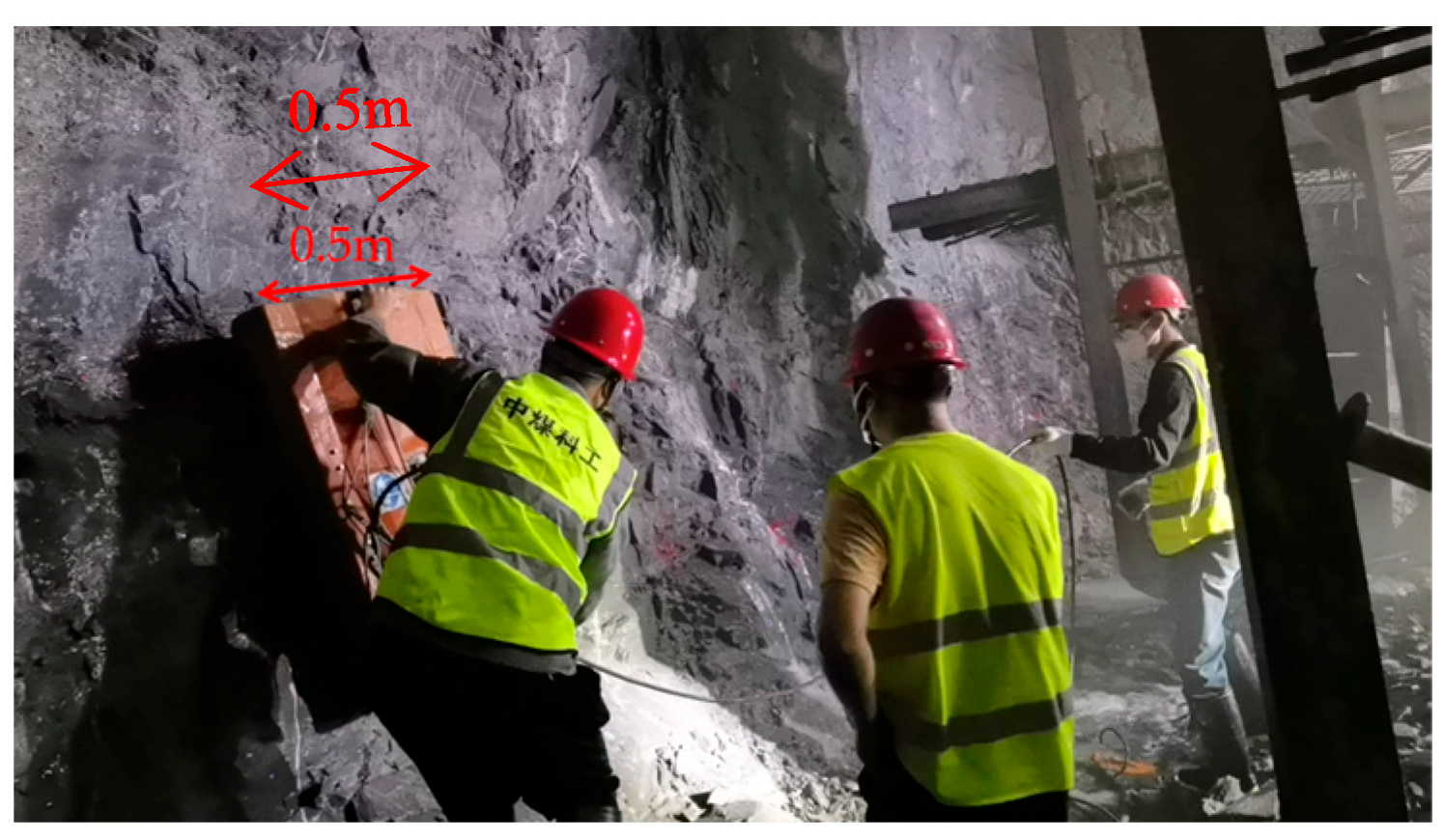
In a numerical simulation of GPR-based advanced detection, using GprMax 3.0software, Li Z. et al. [21] and Deng G. et al. [22] simulated tunnel face advanced detection models for limestone and karst caves, fault fracture zones, and water-rich zones. However, these numerical simulations of GPR-based advanced detection in tunnels and coal mines were based on ideal geologic models, which do not represent the actual geologic models of rugged tunnel faces and the complex attitudes of strata (Figure 1). Thus, the simulation results cannot provide guidance for the data acquisition, data processing, and geologic interpretation of GPR-based advanced detection.
To improve GPR-based tunnel face advanced detection, it is important to simulate realistic geologic models by classifying the attitudes of the strata and determining the conditions of rugged tunnel faces. To the best of our knowledge, the FDTD method with a generalized perfectly matched layer (GPML) has not been applied before this study. But the boundary absorption condition of the GPML has been applied numerical simulation of GPR downward detection with a perfect ground surface [23].
The rest of this paper is organized as follows: Section 2 introduces the FDTD with the GPML simulation method for modeling tunnel face advanced detection; Section 3 presents the numerical simulation data obtained using the method detailed in Section 2; Section 4 presents three actual field detections; Section 5 provides a discussion of the results; and Section 6 presents the conclusions.

2. Simulation Method

2.1. FDTD with GPML

In the simulation method, GPR-based tunnel face advanced detection is based on Maxwell’s curl equations in the time domain, which are
× E = μ H t σ m H
× H = ε E t + σ E
where E is the electric field vector (V/m), H is the magnetic field vector (A/m), ε is the dielectric permittivity (F/m), μ is the magnetic permeability (H/m), σ is the electrical conductivity (S/m), and σ m is the equivalent magnetic conductivity ( Ω /m).
Based on second-order central difference theory, we can infer three FDTD equations for the Transverse Electric (TE) wave [24,25]:
E x n + 1 ( i + 1 2 , j ) = C A ( i + 1 2 , j ) E z n ( i + 1 2 , j ) + C D C B i + 1 2 , j [ H z n + 1 2 ( i + 1 2 , j + 1 2 ) H z n + 1 2 ( i + 1 2 , j 1 2 ) ]
E y n + 1 ( i , j + 1 2 ) = C A ( i , j + 1 2 ) E y n ( i , j + 1 2 ) + C D C B ( i , j + 1 2 ) [ H z n + 1 2 ( i 1 2 , j + 1 2 ) H z n + 1 2 ( i + 1 2 , j + 1 2 ) ]
H z n + 1 2 ( i + 1 2 , j + 1 2 ) = H z n 1 2 ( i + 1 2 , j + 1 2 ) + C D [ E x n ( i + 1 2 , j + 1 ) E x n ( i + 1 2 , j ) + E y n ( i , j + 1 2 ) E y n ( i + 1 , j 1 2 ) ]
where their coefficients are as follows:
C A ( i , j ) = 1 σ ( i , j ) Δ t 2 ε ( i , j ) 1 + σ ( i , j ) Δ t 2 ε ( i , j )
C D = Δ t Δ s 1 ε 0 μ 0
C B ( i , j ) = ε 0 ε ( i , j ) + σ ( i , j ) Δ t 2
When using international units, the numerical values of the electrical and magnetic fields have large errors in the numerical calculation. Thus, we use normalized numerical values of the electrical and magnetic fields. This expression is provided as follows:
E = η ( i , j ) H
where η ( i , j ) is equal to μ ( i , j ) / ε ( i , j ) .
In general, the space step ( Δ s ) should be small at λ m i n / 20 , and the time step ( Δ t ) also must conform to follow non-equality.
Δ t Δ s 2 ( v m a x )
In this paper, the boundary absorption condition was used for the GPML. The GPML is derived from modified Maxwell’s equations in an extended coordinate system.
Based on the centered difference technique, we can infer four TDFD equations for the TE wave [26,27,28,29]:
H z x n + 1 / 2 ( i + 1 / 2 , j + 1 / 2 ) = μ / Δ t ( σ 0 * + σ x * ) / 2 μ / Δ t + ( σ 0 * + σ x * ) / 2 H z x n 1 / 2 ( i + 1 / 2 , j + 1 / 2 ) 1 ( μ / Δ t + ( σ 0 * + σ x * ) / 2 ) s x 0 ( x ) Δ x E y n ( i + 1 , j + 1 / 2 ) E y n ( i , j + 1 / 2 ) σ 0 * σ x * μ 1 μ / Δ t + ( σ 0 * + σ x * ) / 2 H z x I n ( i + 1 / 2 , j + 1 / 2 )
H z y n + 1 / 2 ( i + 1 / 2 , j + 1 / 2 ) = μ / Δ t ( σ 0 * + σ y * ) / 2 μ / Δ t + ( σ 0 * + σ y * ) / 2 H z y n 1 / 2 ( i + 1 / 2 , j + 1 / 2 ) + 1 ( μ / Δ t + ( σ 0 * + σ y * ) / 2 ) s y 0 ( y ) Δ y E x n ( i + 1 , j + 1 / 2 ) E x n ( i , j + 1 / 2 ) σ 0 * σ y * μ 1 μ / Δ t + ( σ 0 * + σ y * ) / 2 H z y I n ( i + 1 / 2 , j + 1 / 2 )
E x n 1 / 2 ( i + 1 / 2 , j + 1 / 2 ) = ε / Δ t ( σ 0 + σ y ) / 2 ε / Δ t + ( σ 0 + σ y ) / 2 E x n 1 / 2 ( i + 1 / 2 , j + 1 / 2 ) + 1 ( ε / Δ t + ( σ 0 + σ y ) / 2 ) s x 0 ( x ) Δ x H z n 1 ( i + 1 / 2 , j + 1 ) H z n 1 ( i + 1 / 2 , j ) σ 0 σ y ε 1 ε / Δ t + ( σ 0 + σ y ) / 2 E x I ( n 1 ) ( i + 1 / 2 , j + 1 / 2 )
E y n 1 / 2 ( i + 1 / 2 , j + 1 / 2 ) = ε / Δ t ( σ 0 + σ x ) / 2 ε / Δ t + ( σ 0 + σ x ) / 2 E x n 1 / 2 ( i + 1 / 2 , j + 1 / 2 ) 1 ( ε / Δ t + ( σ 0 + σ x ) / 2 ) s y 0 ( y ) Δ y H z n 1 ( i + 1 , j + 1 / 2 ) H z n 1 ( i , j + 1 / 2 ) σ 0 σ y ε 1 ε / Δ t + ( σ 0 + σ x ) / 2 E y I ( n 1 ) ( i + 1 / 2 , j + 1 / 2 )
where the equations for H z x I n , H z y I n , E x I n , and E y I n are as follows:
H z x I n i + 1 / 2 , j + 1 / 2 = H z x I n 1 i + 1 / 2 , j + 1 / 2 + Δ t H z x I ( n 1 / 2 ) ( i + 1 / 2 , j + 1 / 2 )
H z y I n i + 1 / 2 , j + 1 / 2 = H z y I n 1 i + 1 / 2 , j + 1 / 2 + Δ t H z y I ( n 1 / 2 ) ( i + 1 / 2 , j + 1 / 2 )
E x I n ( i + 1 / 2 , j + 1 / 2 ) = E x I ( n 1 ) ( i + 1 / 2 , j + 1 / 2 ) + Δ t E x I ( n 1 / 2 ) ( i + 1 / 2 , j + 1 / 2 )
E y I n ( i + 1 / 2 , j + 1 / 2 ) = E y I ( n 1 ) ( i + 1 / 2 , j + 1 / 2 ) + Δ t E y I ( n 1 / 2 ) ( i + 1 / 2 , j + 1 / 2 )
Additionally, we should examine the reflection error derived from the discrete grids. This requires the selection of suitable parameters s x 0 x , s y 0 y , σ x x , σ y y , σ m , and S m . The selection principles are as follows:
s x 0 ( x ) = 1 + S m ( x / d ) n
s y 0 ( x ) = 1 + S m ( y / d ) n
σ x ( x ) = σ m sin 2 ( π x 2 d )
σ y ( y ) = σ m sin 2 ( π y 2 d )
S m < λ min k d x 1
σ m = ε c / d 1 + S m ( 1 / 3 + 2 / π 2 ) ln R t h
ln R t h = exp 1 + S m 1 3 + 2 π 2 σ m d ε c
where d is the GPML layer number; x and y are the lengths of the main grid in the x and y directions, respectively; ln R t h is the theoretical reflection coefficient; k is determined by numerical testing, with the optimal value falling in the range of 2–5; d x is the edge length of an individual grid; and λ min is the minimum wavelength.
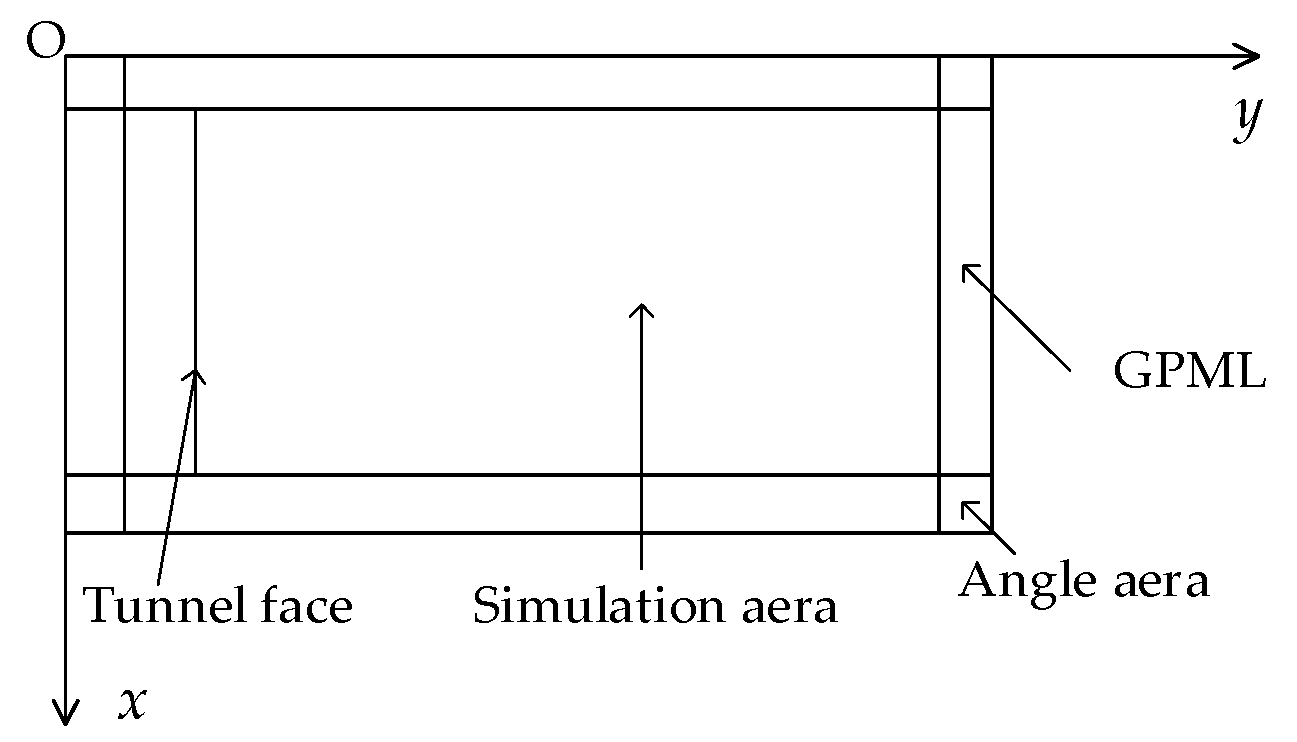
The simulated area was the B-scan image for the GPR-based advanced detection of a construction tunnel. The tunnel face, simulation area, GPML, and angle area are shown in Figure 2.
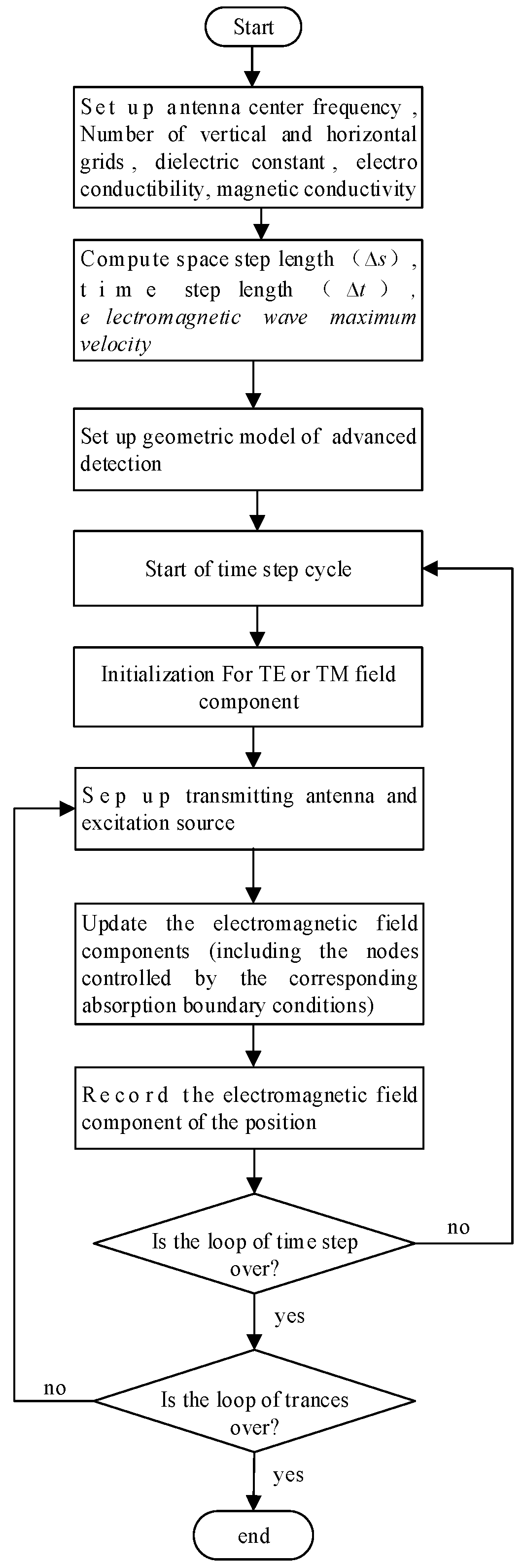
According to the above FDTD method and the boundary absorption condition of the GPML, we developed a flow chart for the FDTD algorithm simulation of GPR-based advanced detection ahead of the tunnel face for tunnel constructions (Figure 3).

2.2. Modeling of Tunnel Face Advanced Detection

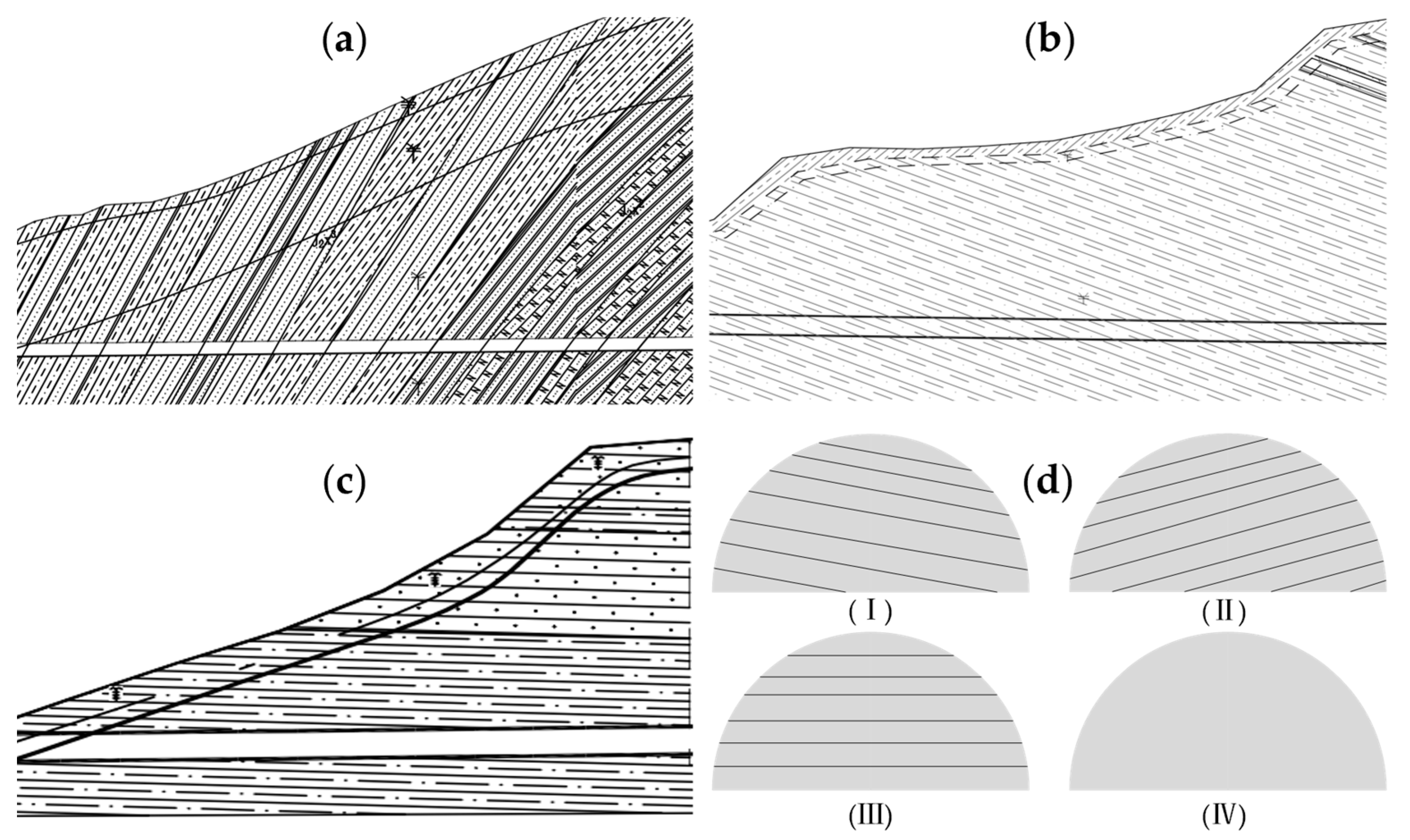
Tunnel face excavation typically occurs in one of two scenarios: excavation through an inclined stratum or excavation along an approximately horizontal stratum. The inclined stratum can be further classified as a reverse-inclined or positively inclined stratum, as shown in Figure 4a,b. The approximately horizontal stratum is shown in Figure 4c. Figure 4d shows the different stratifications of the tunnel face: (I) right-inclined, (II) left-inclined, (III) non-inclined, and (IV) a single huge thick shape (greater than the maximum height of the tunnel face) stratification.
Currently, the flatness of the tunnel face is influenced by the surrounding rock type, smooth blasting, and mechanical hazard mitigation at the face. Typically, the tunnel face exhibits irregular surfaces, as shown in Figure 1. So, the kinds of two-dimensional ground-penetrating radar survey lines show the random or semi-random polygonal line segments.
To compare all models and reduce the simulation time, we set the following parameters: the GPR antenna center frequency was 100 MHz; the number of transverse grids was 100; the number of longitudinal grids was 80. In order to consider the corresponding simulation time cost and ensure higher accuracy, the space step was λ m i n / 40 ; the time step was ∆s⁄((2×c)); and the absorption boundary was an eight-layer GPML.
Many GPR systems use amplitude pulse sources; we selected the following driving source:
f ( x ) = t 2 e α t sin ( ω 0 t )
where ω 0 is the center frequency, and α is the attenuation coefficient.
Based on the above numerical simulation method of Section 2, We coded the program for the numerical simulation using MATLAB R2022b language.

3. Numerical Simulation Results

We simulated several media: sandstone, mudstone, limestone, silt, and air (free space). The main electromagnetic parameters were ε r = 8 and σ = 0.005 S/m for sandstone; ε r = 15 and σ = 500 S/m for mudstone; ε r = 7 and σ = 0.008 S/m for limestone; ε r = 18 and σ = 800 S/m for silt; and ε r = 1 and σ = 0 S/m for air. As indicated in Figure 4 in Section 2, this section is divided into five subsections: Section 3.1—horizontal strata; Section 3.2—vertical strata; Section 3.3—positively inclined strata; Section 3.4—reverse-inclined strata; and Section 3.5—geophysical models of the other target bodies. These geophysical models have a unified geometric model (see Table 1).

3.1. Horizontal Strata

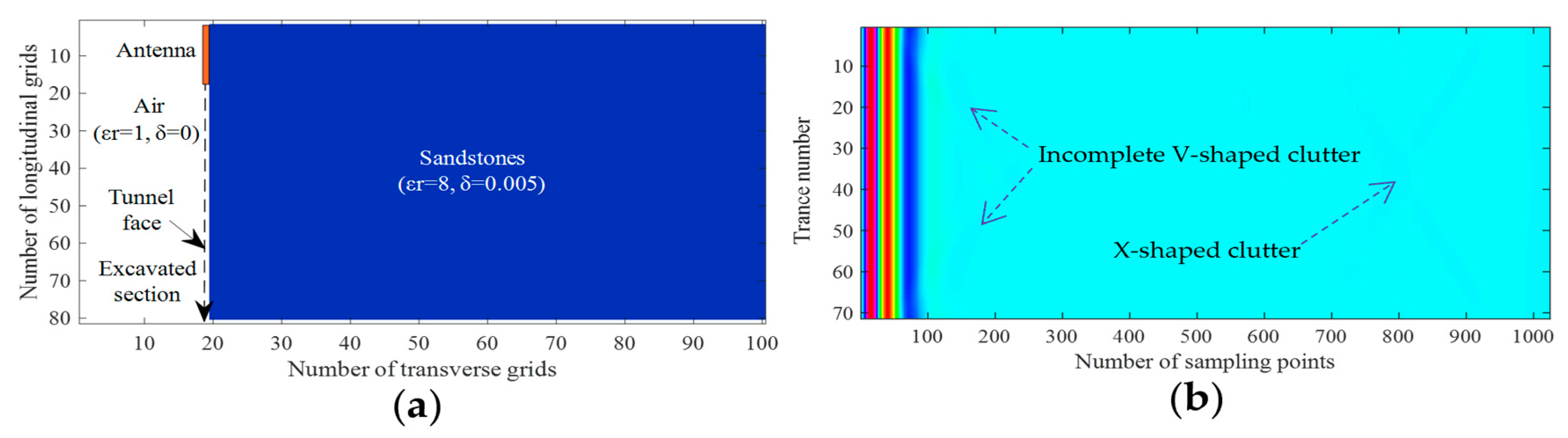
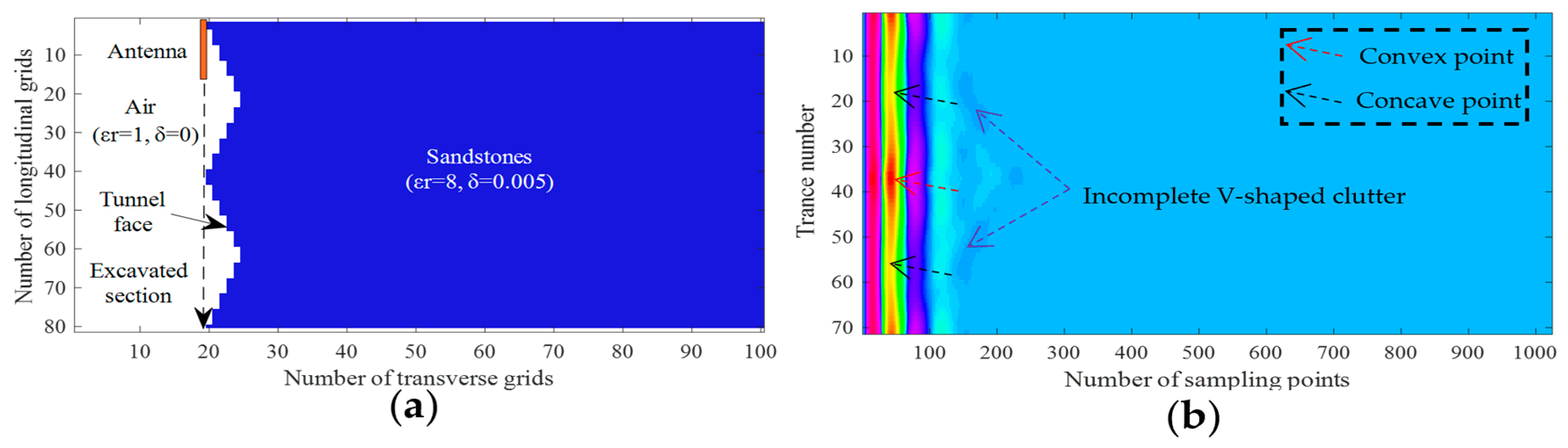
In actual tunnel constructions, the tunnel face usually consists of a thick horizontal stratum or several thin horizontal strata. When the thick stratum was only one stratum (see Figure 4c,d(IV)), we simulated two geophysical models: a perfect tunnel face and an irregular tunnel face (see Figure 5a and Figure 6a). The settings of the two models were the same except for different tunnel face.
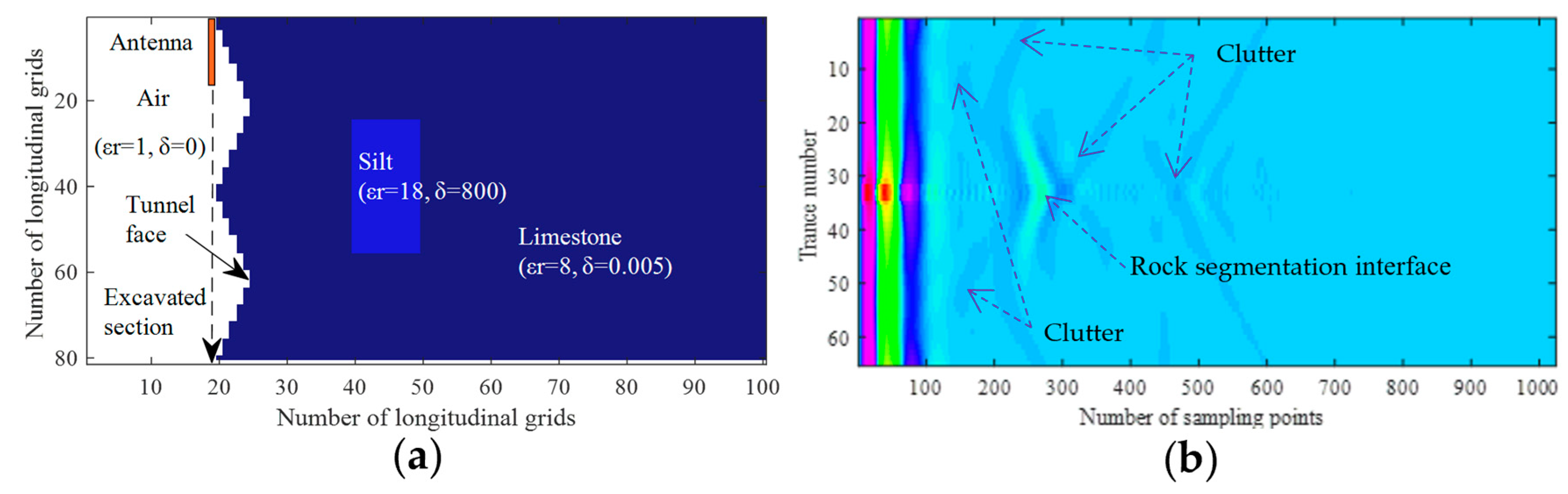
The simulation results for the two above-mentioned models are shown in Figure 5b and Figure 6b. For the perfect tunnel face, obvious X- and V-shaped clutter were derived from the boundary of GPML (Figure 5b); however, for the irregular tunnel face, only the V-shaped clutter was observed (Figure 6b). This phenomenon was attributed to coupling superimposition for the boundary of GPML and reflected wave signals from the irregular tunnel face.
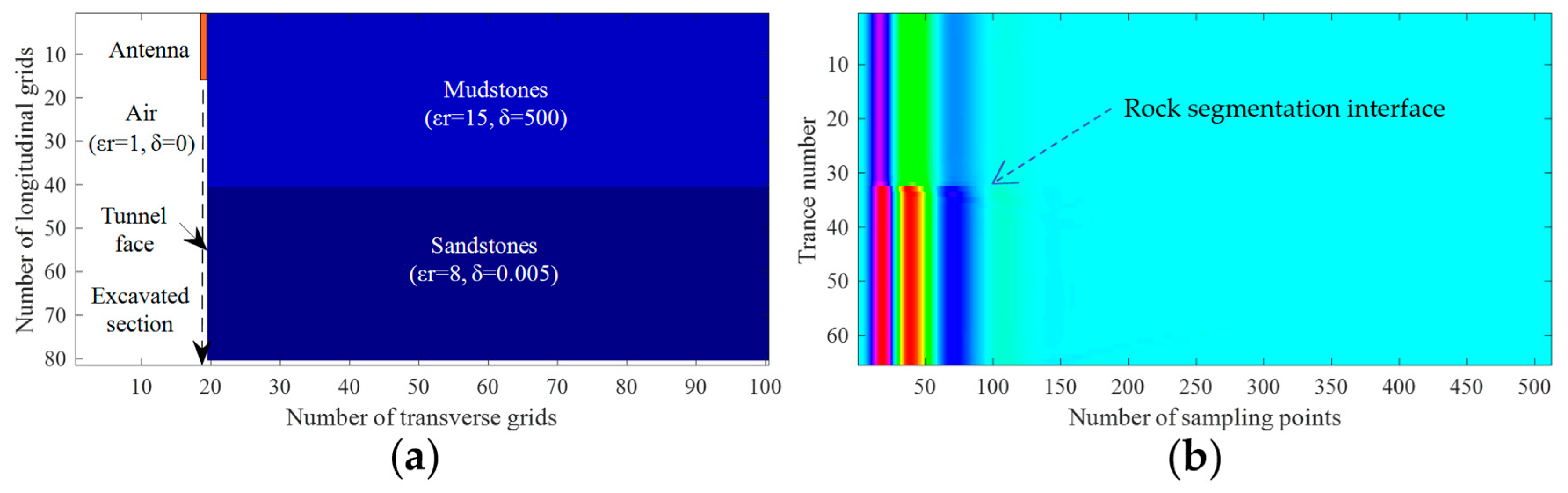
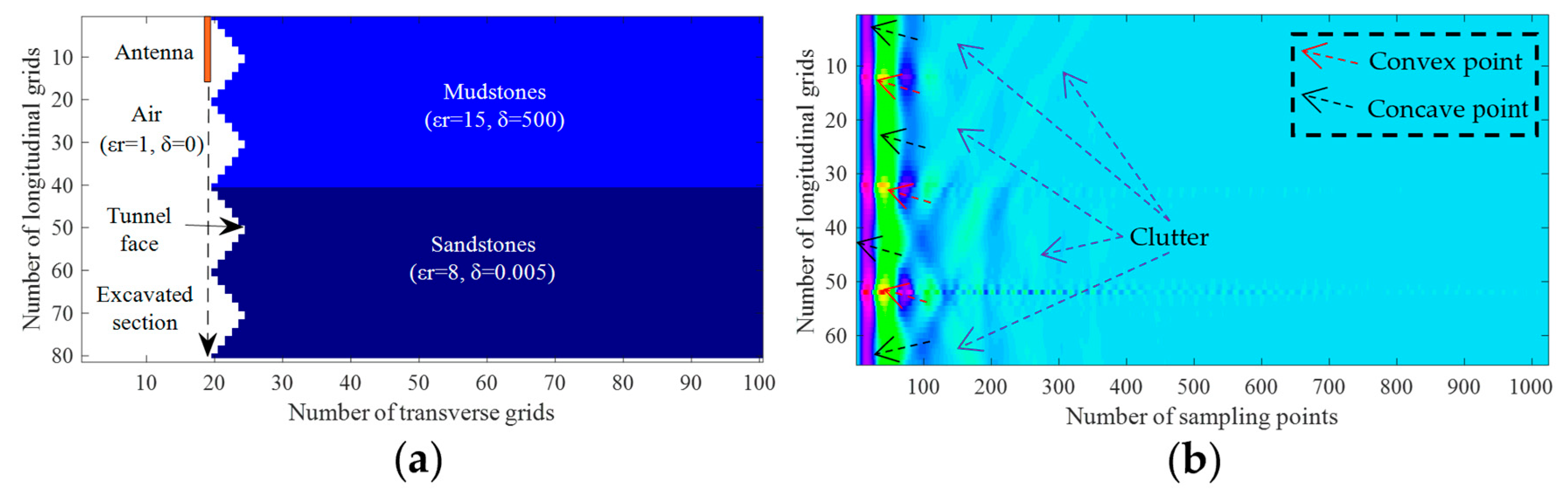
In addition to a single horizontal stratum shown in Figure 5a and Figure 6a, the tunnel face consists of several thin horizontal strata, which is a very usual situation. Thus, we still established two geophysical models (perfect and irregular tunnel faces) with two horizontal strata in this subsection (see Figure 7a and Figure 8a); the simulation results obtained using these two geophysical models are respectively shown in Figure 7b and Figure 8b.
In Figure 7a, the tunnel face is flat and close to the GPR antenna. Figure 7b clearly shows two different GPR reflection profiles, and the reflected signal is stronger in the sandstone area than in the mudstone area.
In Figure 8a, the numbers of all-convex, half-convex, and all-concave points in the edge of the simulated area are three, two, and four, respectively. The middle all-convex point is the boundary between the mudstone and sandstone strata. In Figure 8b, the convex points are apparent, whereas the concave points are not. But the two half-convex points cannot be seen because of cutting the GPML aera, and the four concave points still can be seen in their homologous locations. Thus, the boundary between the mudstone and sandstone strata can be identified by the middle all-convex point.

3.2. Vertical Strata

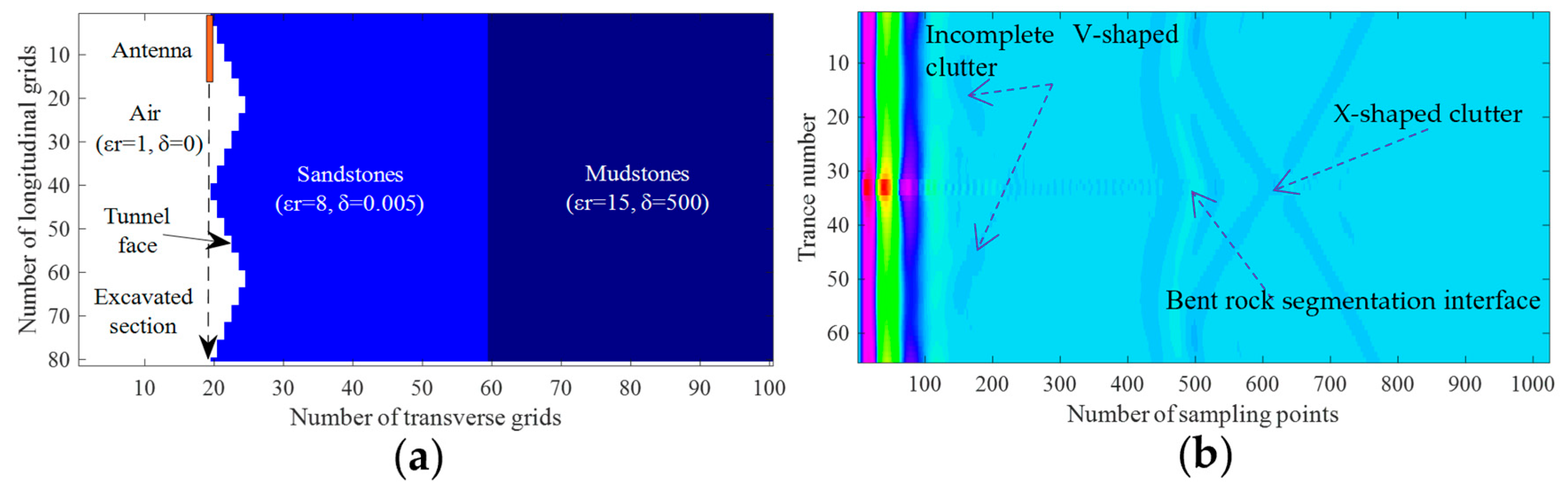
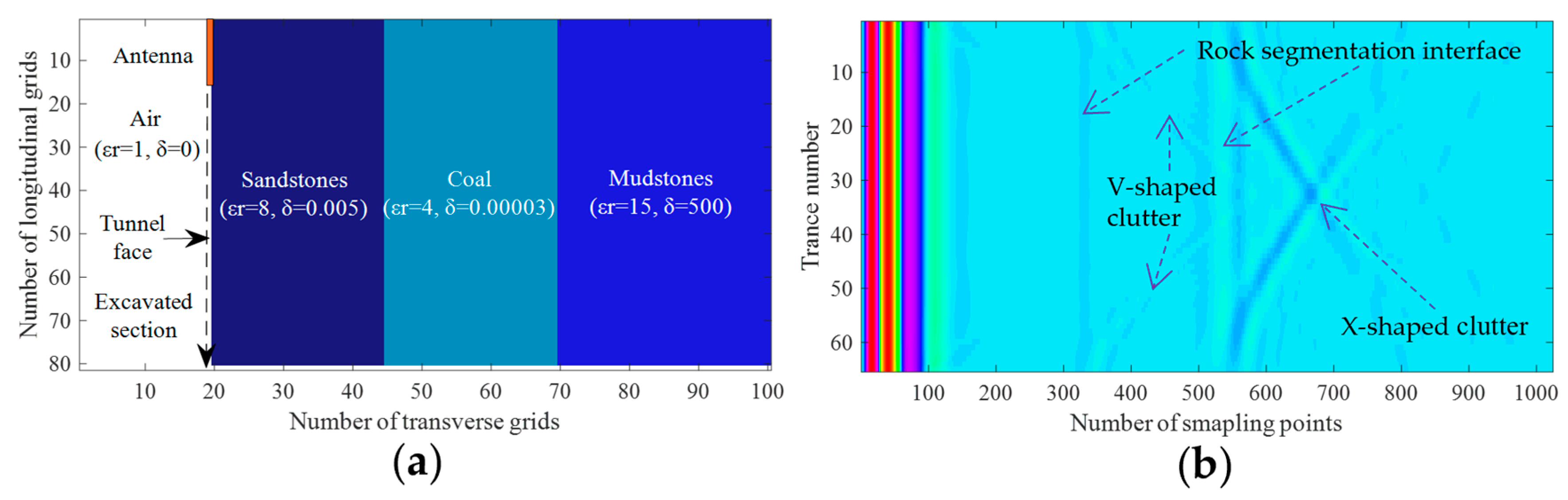
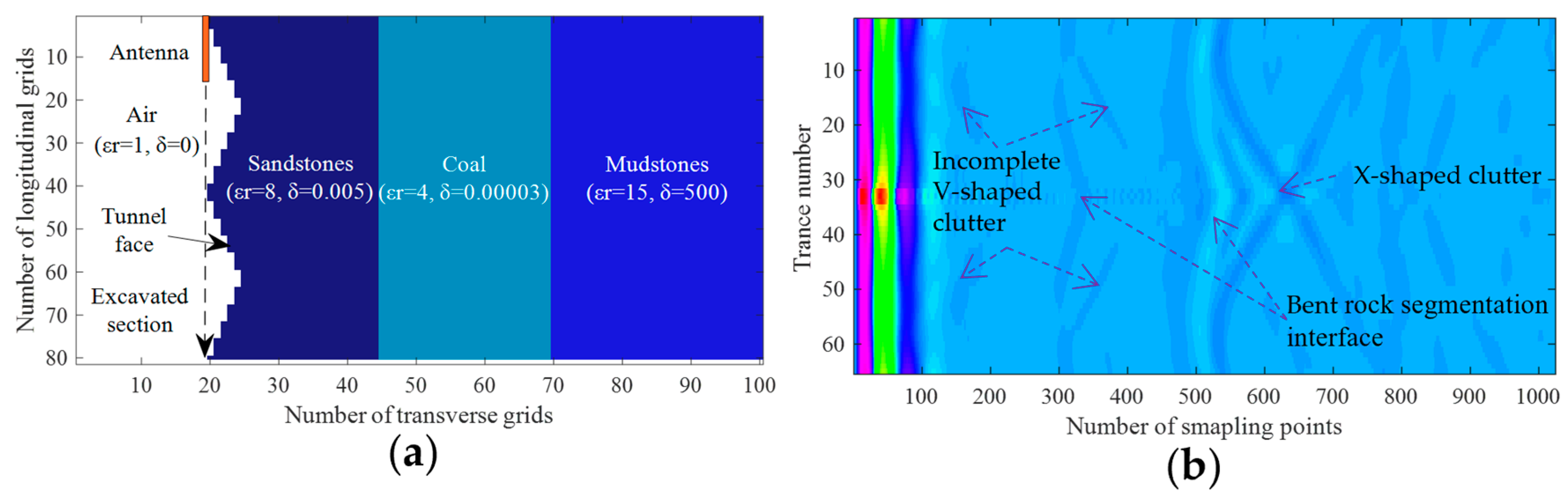
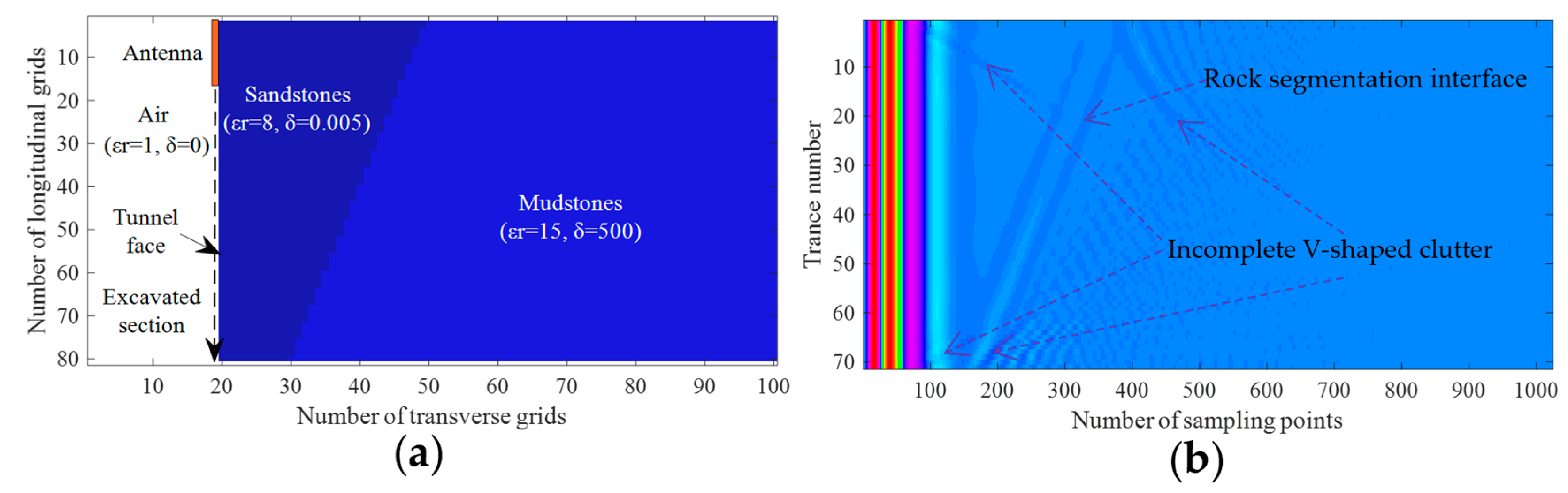
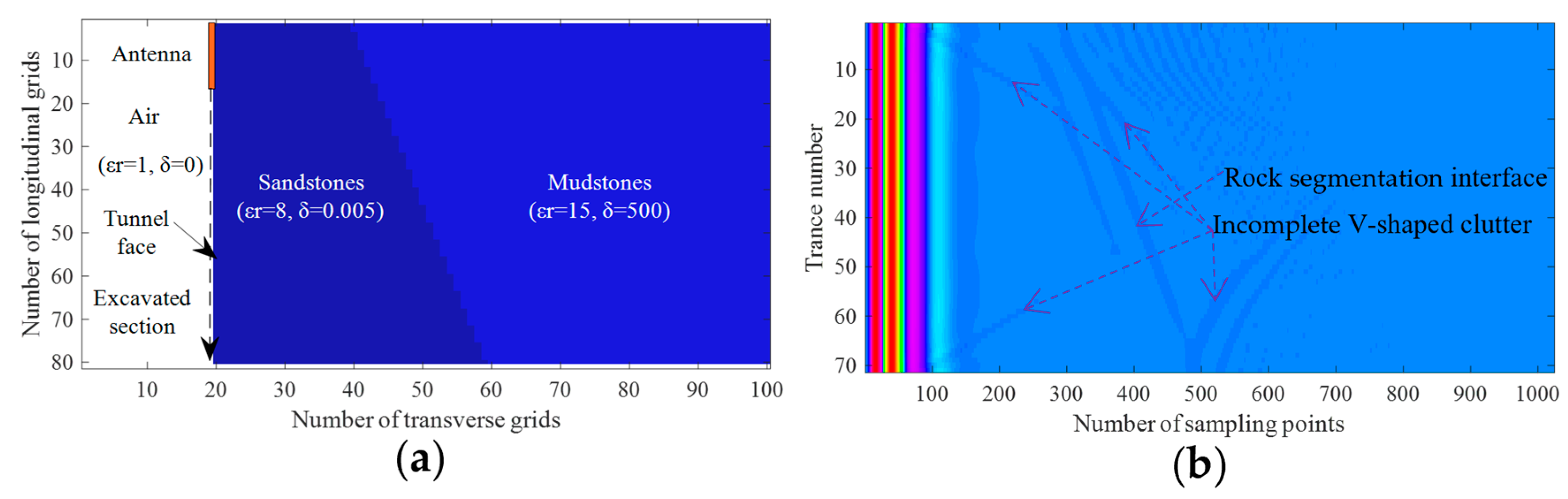
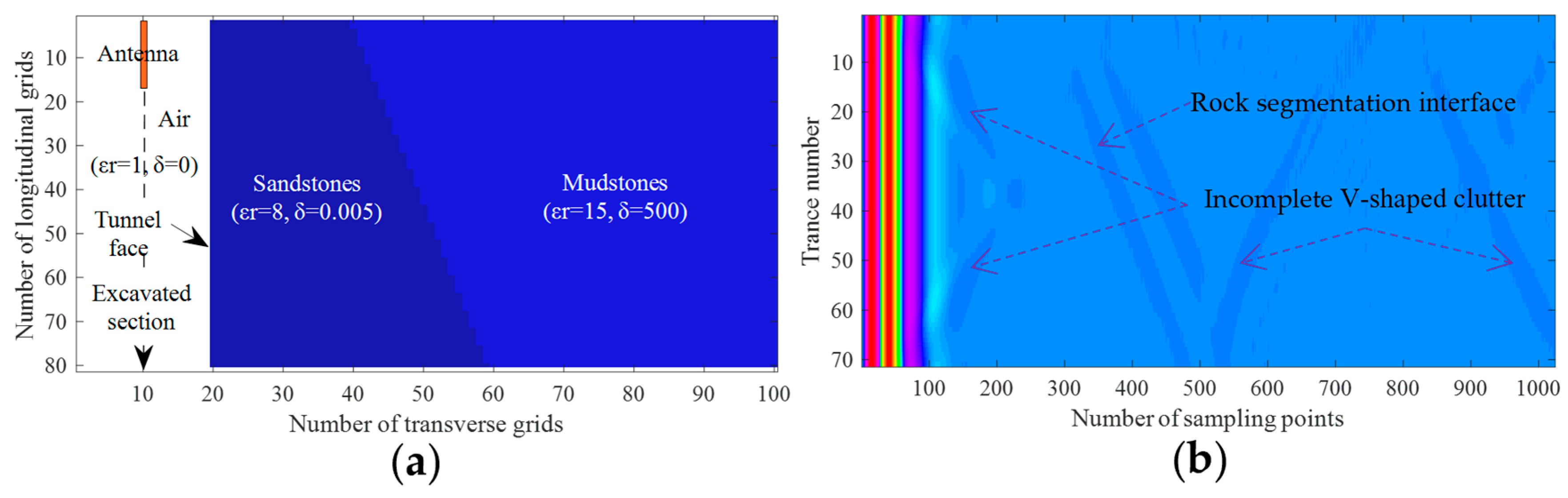
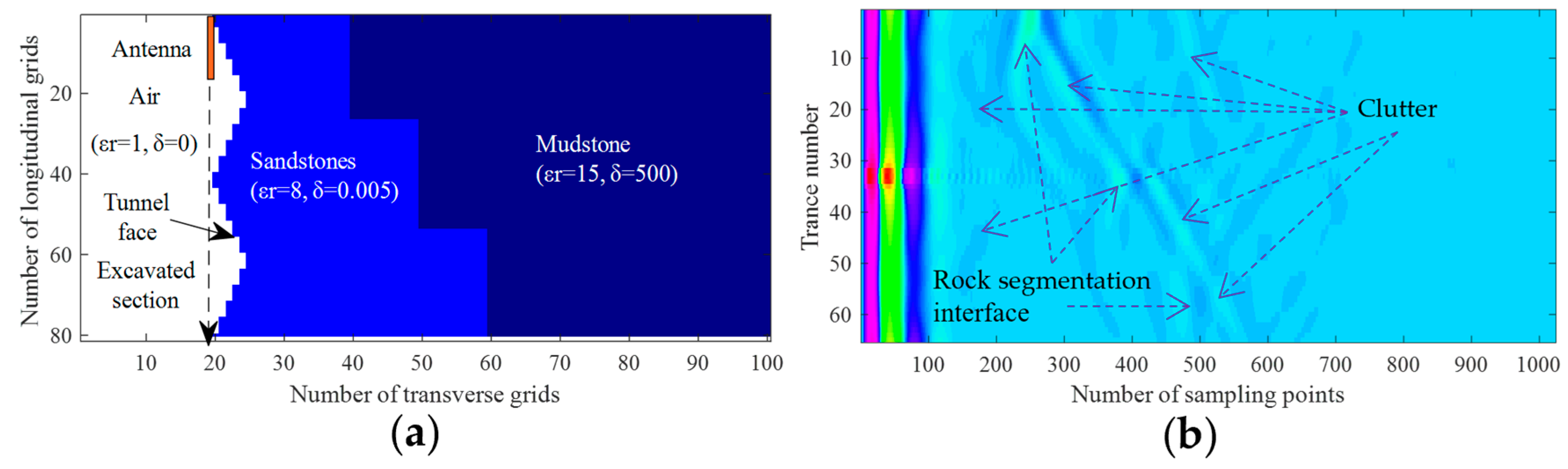
In actual tunnel constructions, the tunnel face occasionally consists of several vertical strata. In this subsection, we simulated four geophysical models with perfect and irregular tunnel faces (Figure 9a, Figure 10a, Figure 11a and Figure 12a). The electromagnetic parameters were the same for each model. Figure 9a shows the model of two vertical strata with a perfect tunnel face; Figure 10a shows the model of two vertical strata with an irregular tunnel face; Figure 11a shows the model of three vertical strata with a perfect tunnel face; and Figure 12a shows the model of three vertical strata with an irregular tunnel face.
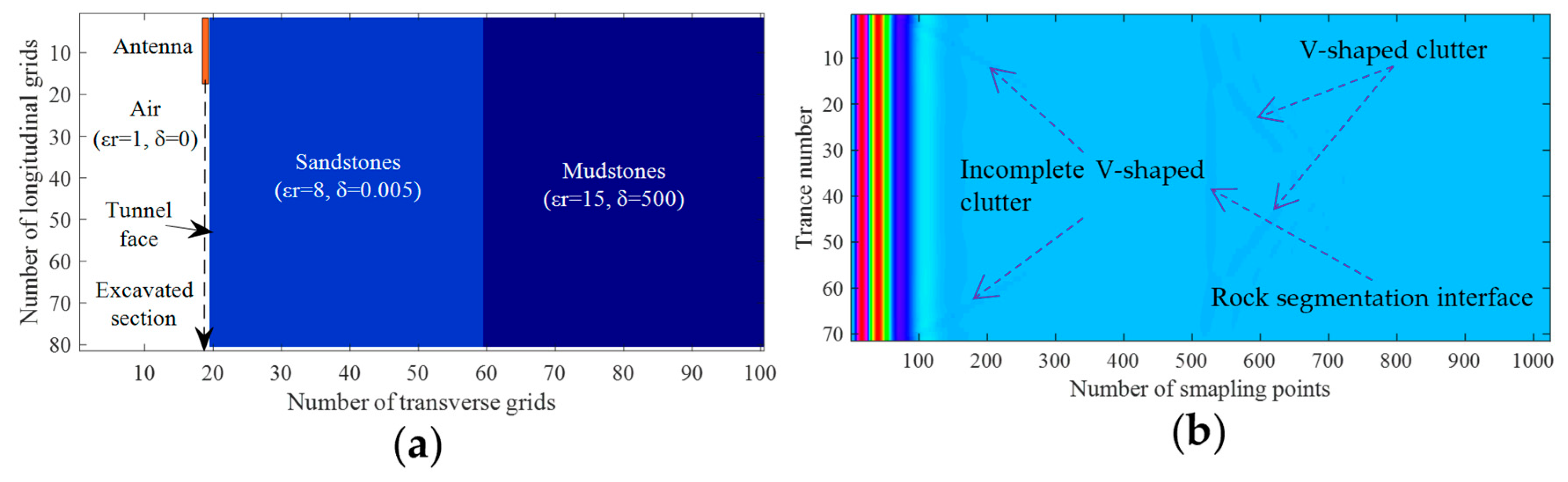
Figure 9b shows a straight reflective interface between the sandstone and mudstone strata with a V-shaped clutter and nearby the perfect tunnel face with an incomplete V-shaped clutter. Figure 10b shows a bent reflective interface between the sandstone and mudstone strata with an X-shaped clutter and nearby the irregular tunnel face with an incomplete V-shaped clutter. Moreover, we still can determine that when the irregular tunnel face is convex or concave, the corresponding reflective interface between the sandstone and mudstone strata show concave or convex.
We added a coal layer stratum to the models, shown in Figure 9a and Figure 10a, resulting in the models depicted in Figure 11a and Figure 12a. In Figure 11b, we can see two straight reflective interfaces between the sandstone and coal, coal and mudstone strata with a V-shaped clutter, an X-shaped clutter, and other some clutter. Moreover, the perfect tunnel face nearby and the reflective interface between the sandstone and coal strata show an incomplete V-shaped clutter and a V-shaped clutter, respectively; nearby, the reflective interface between the coal and mudstone strata shows an X-shaped clutter. In Figure 12b, we can see two bent reflective interfaces between the sandstone and coal, coal and mudstone strata with an incomplete V-shaped clutter, an X-shaped clutter, and other some clutter. Moreover, the irregular tunnel face nearby and the reflective interface between the sandstone and coal strata each show one incomplete V-shaped clutter; the reflective interface nearby between the coal and mudstone strata shows an X-shaped clutter.

3.3. Positively Inclined Strata

For GPR-based tunnel face advanced detection of positively inclined strata, we usually encounter positively inclined strata. Inclined strata are usually classified as positively inclined strata and reverse-inclined strata. According to engineering practice, we define positively inclined strata as those inclined in the excavation direction of the tunnel face.
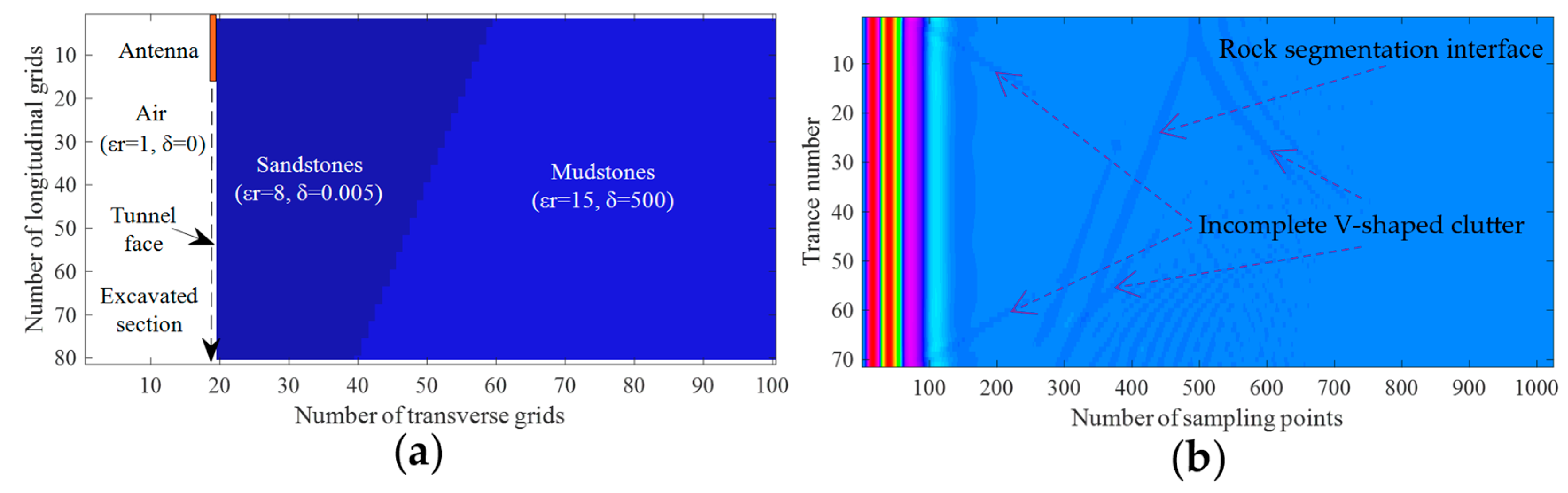
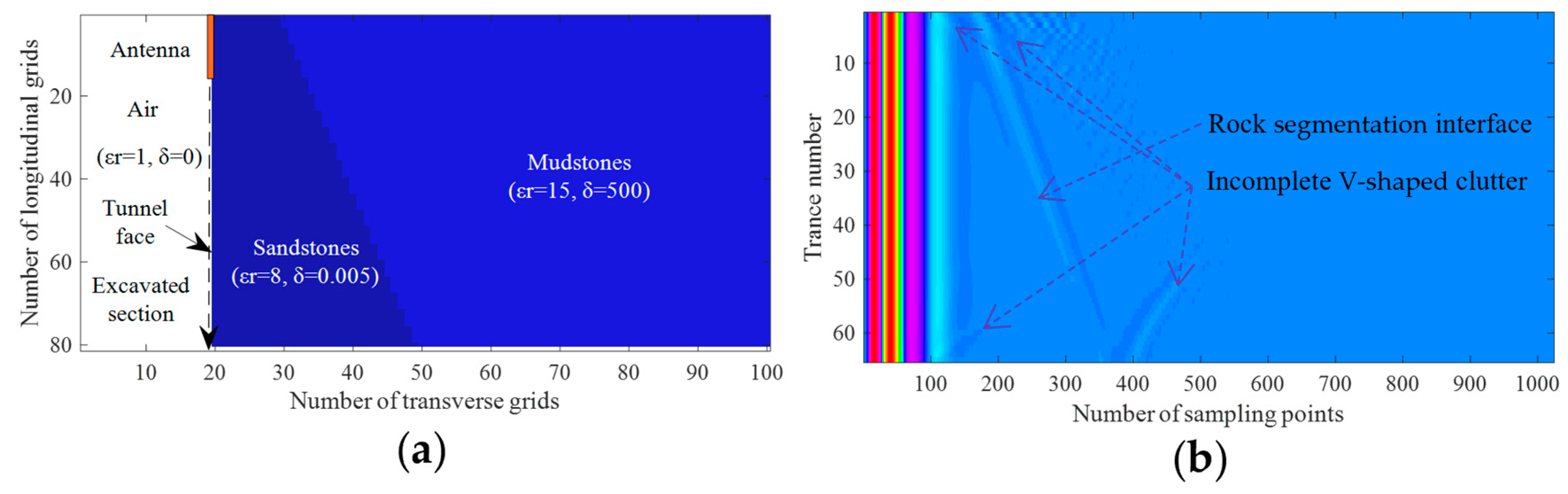
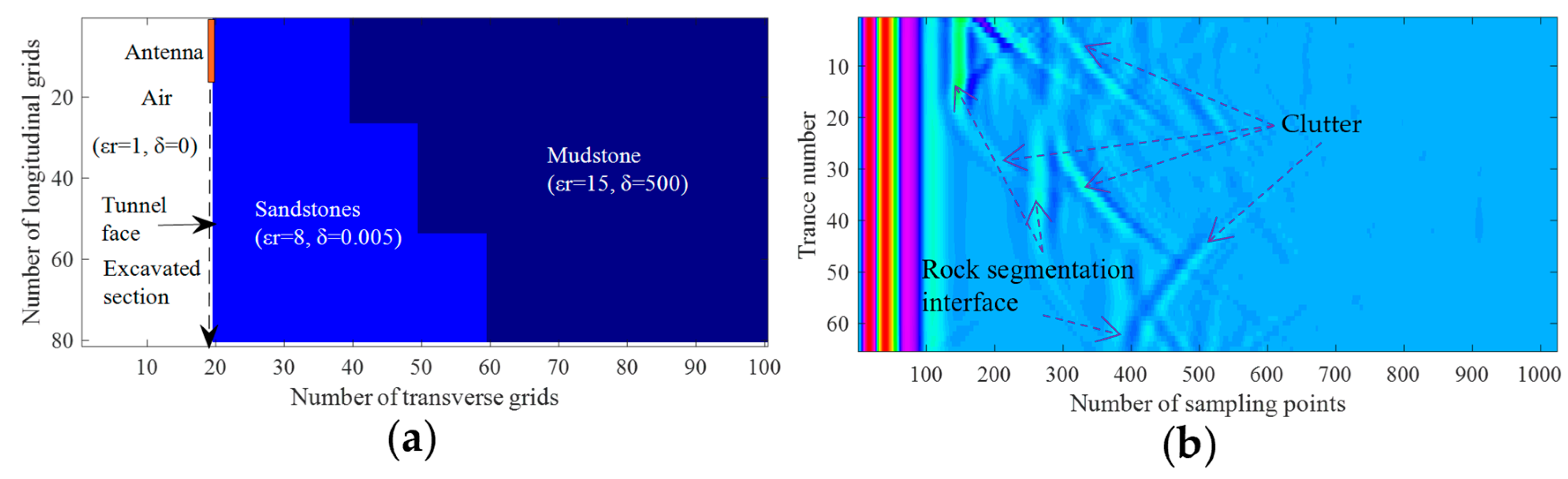
We used two positively inclined strata to simulate a rock segmentation interface. Two types of tunnel faces were simulated: perfect and irregular (see Figure 13a, Figure 14a and Figure 15a). The electromagnetic parameters were the same for each model. Figure 13a shows the model of the 10-grid minimum distance near the rock segmentation interface for a perfect tunnel face. Figure 14a shows the model of the 20-grid minimum distance far from the rock segmentation interface for a perfect tunnel face. Based on Figure 14a, Figure 15a shows the model of the 20-grid minimum distance far from the rock segmentation interface for an irregular tunnel face.
In Figure 13b, we can see a positively inclined reflective interface between the sandstone and mudstone strata, with a heteromorphic incomplete V-shaped clutter and some other clutter. At the same time, the tunnel face nearby features an incomplete V-shaped clutter.
In Figure 14b, we can see the 20-grid minimum distance far positively inclined reflective interface between the sandstone and mudstone strata, with a heteromorphic incomplete V-shaped clutter and some other clutter. The tunnel face nearby features an incomplete V-shaped clutter.
In Figure 15b, we can see a bent positively inclined reflective interface between the sandstone and mudstone strata along with a reverse-inclined clutter and some other clutter. At the same time, the reflective interface nearby for the irregular tunnel face between the air and sandstone strata shows an incomplete V-shaped clutter.

3.4. Reverse-Inclined Strata

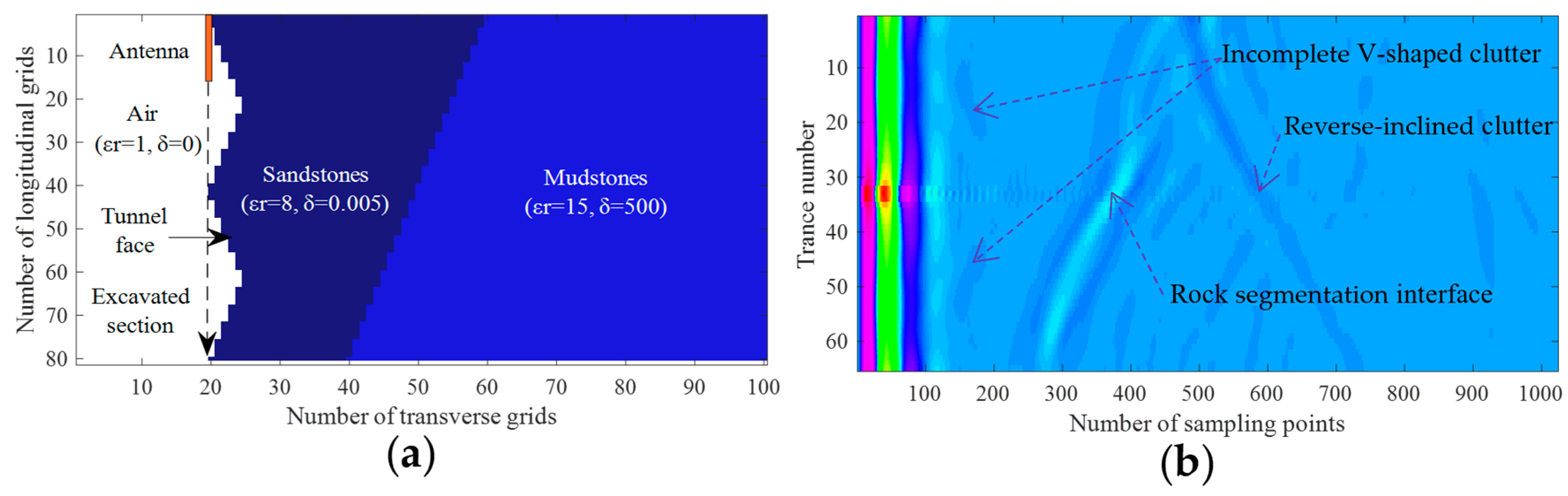
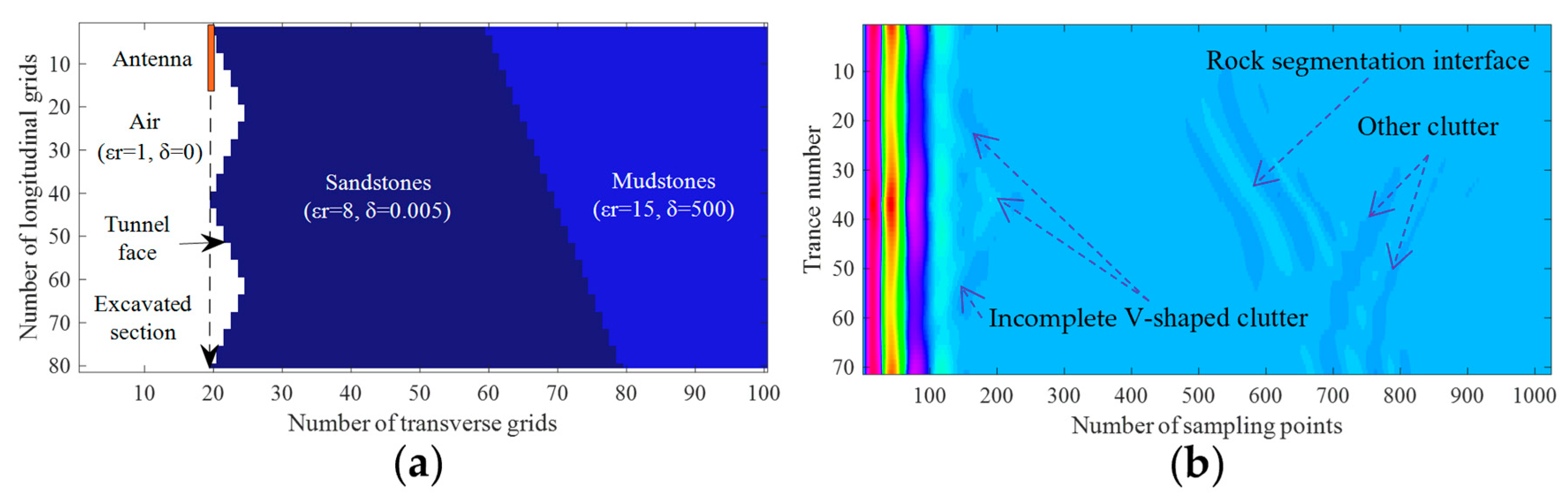
Sometimes, GPR-based tunnel face advanced detection encounters reverse-inclined strata. For this case, we used two reverse-inclined strata to simulate the rock segmentation interfaces of a perfect tunnel face in contact with the GPR antenna, a perfect tunnel face where the GPR antenna does not contact the tunnel face, and an irregular tunnel face (Figure 16a, Figure 17a, Figure 18a and Figure 19a). The electromagnetic parameters were the same as those for the models described in Section 3.3. Figure 16a shows the model of the 10-grid minimum distance near the rock segmentation interface for a perfect tunnel face. Figure 17a shows the model of the 20-grid minimum distance far from the rock segmentation interface for a perfect tunnel face. Based on Figure 17a, Figure 18a shows the model of the 20-grid minimum distance far from the rock segmentation interface for a non-attaching tunnel face of the GPR antenna. Figure 19a shows the model of the 20-grid minimum distance far from the rock segmentation interface for an irregular tunnel face.
In Figure 16b, we can see a nearly reverse-inclined reflective interface between the sandstone and mudstone strata, along with a heteromorphic incomplete V-shaped clutter and other some clutter. At the same time, the reflective interface of the tunnel face shows an incomplete V-shaped clutter.
In Figure 17b, we can see a far reverse-inclined reflective interface between the sandstone and mudstone strata, along with two heteromorphic incomplete V-shaped clutter and other some clutter. At the same time, the reflective interface of the tunnel face shows an incomplete V-shaped clutter.
In Figure 18a, the distance is 10 grids from the GPR antenna to the tunnel face. In Figure 18b, we can see the same features as in Figure 17b; however, the relevant clutter is more obvious than the attaching tunnel face for the GPR antenna in Figure 17b.
We also simulated a far (the 40-grid minimum distance of reverse-inclined strata to an irregular tunnel face) rock segmentation interface for an irregular tunnel face (Figure 19a). In Figure 19b, we can see a bent reverse-inclined reflective interface between the sandstone and mudstone strata, along with some clutter. At the same time, we observe a reflective interface of the tunnel face with two incomplete V-shaped clutters.

3.5. Geophysical Models for the Other Target Bodies

In addition to the stable and complete strata discussed in Section 3.1, Section 3.2, Section 3.3 and Section 3.4, many anomalous bodies exist in actual tunnel constructions, including faults, broken belts, circular and rectangular silt-filled karst caves, and so on. The electromagnetic parameters of these models were the same as in the previously discussed models.
In the model shown in Figure 20a, a step-shaped interface approximates a broken fault belt with a perfect tunnel face. In Figure 20b, we can see the corresponding step-shaped reflective interface between the sandstone and mudstone strata, along with some reflected and diffracted clutter. Figure 21 shows the situation of a broken fault belt with an irregular tunnel face. In Figure 21b, the step-shaped reflective interface is still distinct, but the interface of the irregular tunnel face is indistinct. Meanwhile, the step-shaped reflective interface clutter nearby shows a reverse-inclined dotted line, and the interface of the irregular tunnel face nearby shows an incomplete V-shaped clutter.
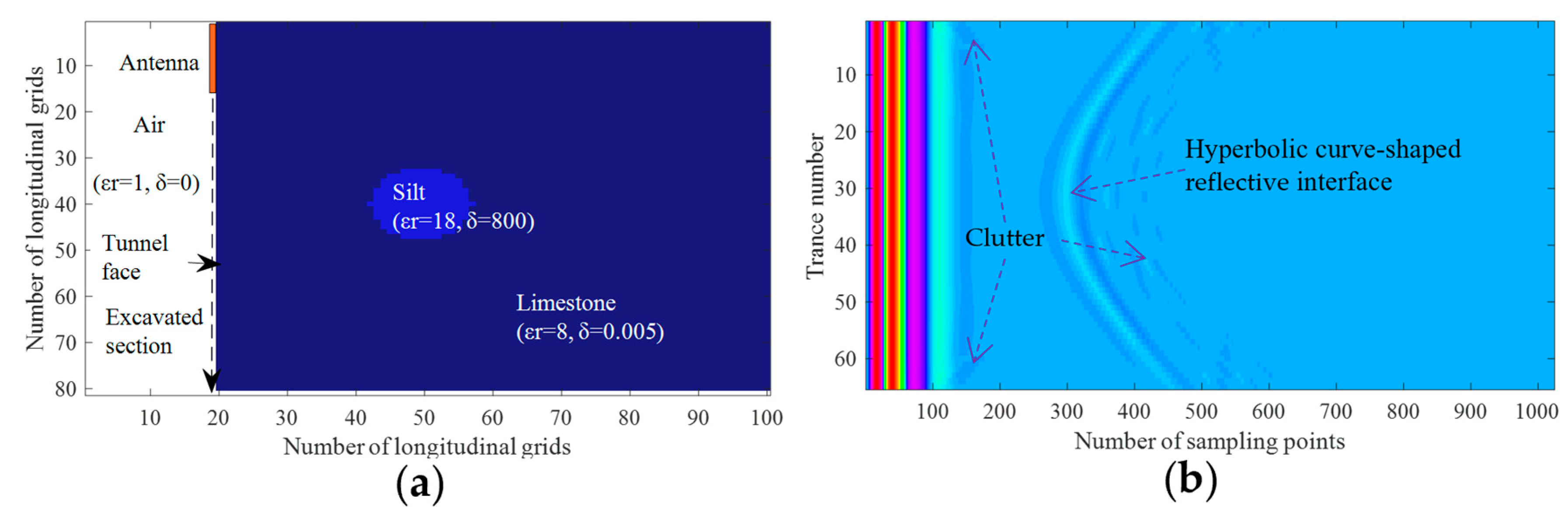
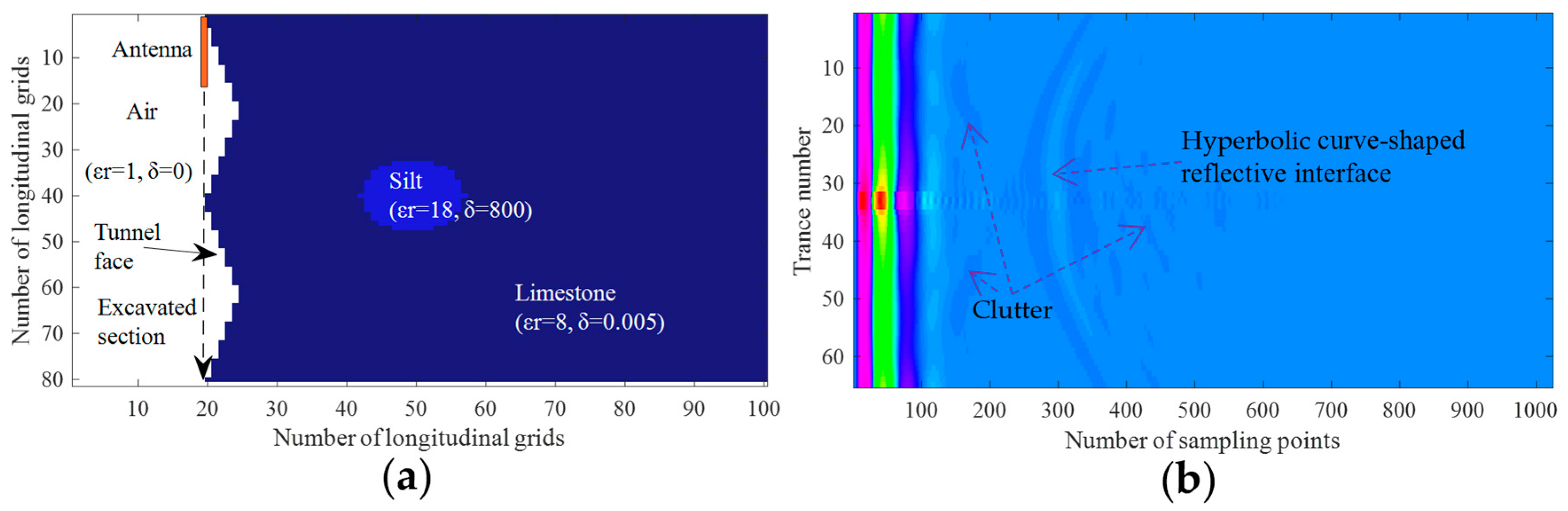
Figure 22 and Figure 23 represent circular silt-filled karst caves with perfect and irregular tunnel faces, respectively. In Figure 22b, we can see a hyperbolic curve-shaped reflective interface, with the irregular tunnel face nearby showing an incomplete clutter and other some clutter. But the hyperbolic curve-shaped reflective interface in Figure 23b is more oblate than that in Figure 22b, and the nearby irregular tunnel face shown in Figure 23b has more clutter.
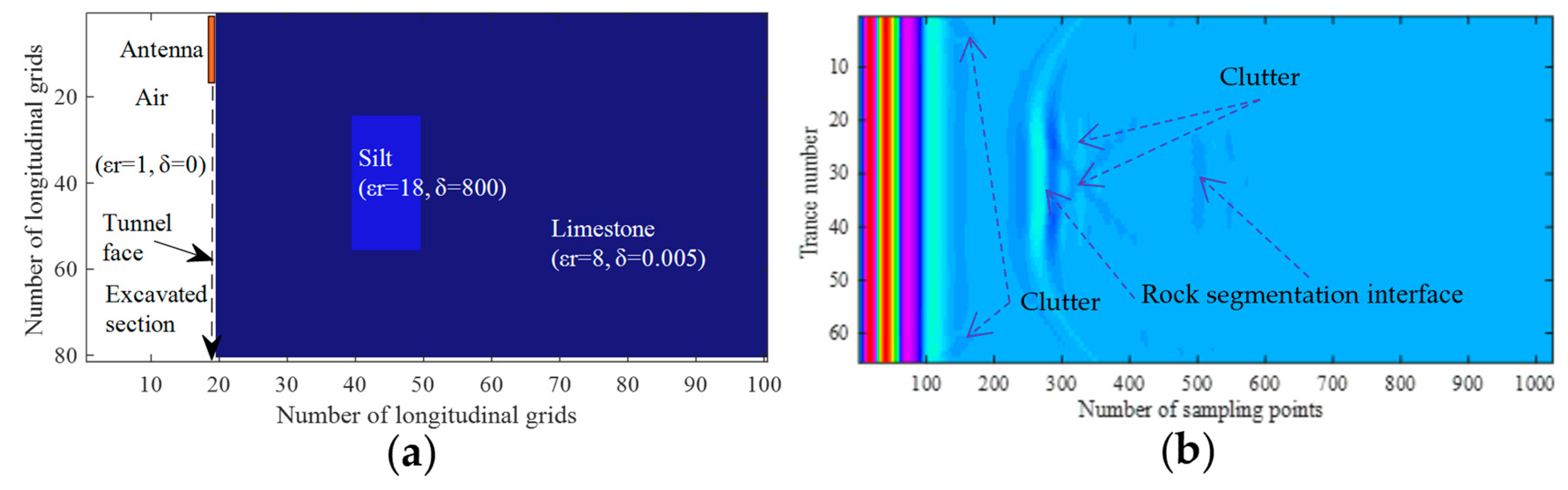
Figure 24 and Figure 25 show the models and simulation results for rectangular silt-filled karst caves with perfect and irregular tunnel faces, respectively. In Figure 24b, we can see two reflective interfaces: one shaped like a square bracket and the other one like a straight line, right at the edge of the rectangular karst cave. Meanwhile, X-shaped clutter is observed to the left of the straight line-shaped reflective interface, while nearby, the perfect tunnel face shows an incomplete V-shaped clutter. In contrast, the square bracket-shaped reflective interface in Figure 24b appears as a V-shaped reflective interface in Figure 25b, while the straight line-shaped reflective interface has changed to a small X-shaped clutter in Figure 25b.

4. Confirmation of Actual Field Detections

In order to prove otherness between the above forward numerical simulation results and homologous actual field detection results, we selected three typical actual advanced detections in the field—irregular tunnel face, perfect tunnel face, and non-attaching tunnel face—for the GPR antenna, and we deeply analyzed the effects of actual detections. These actual field detections all used instruments of SIR-20 GPR and screened antennas of 100 MHz center frequency, and the trigger method was continuous time trigger.

4.1. Advanced Detection Ahead of Irregular Tunnel Face

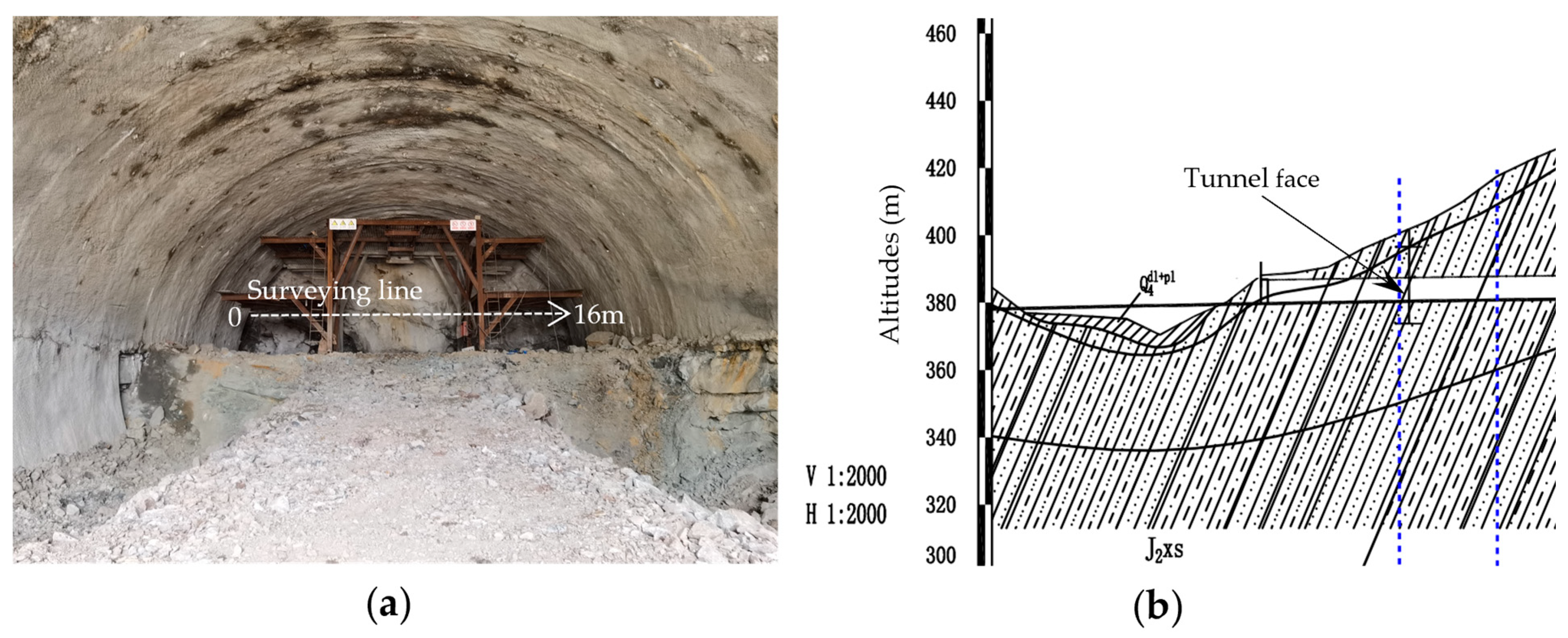
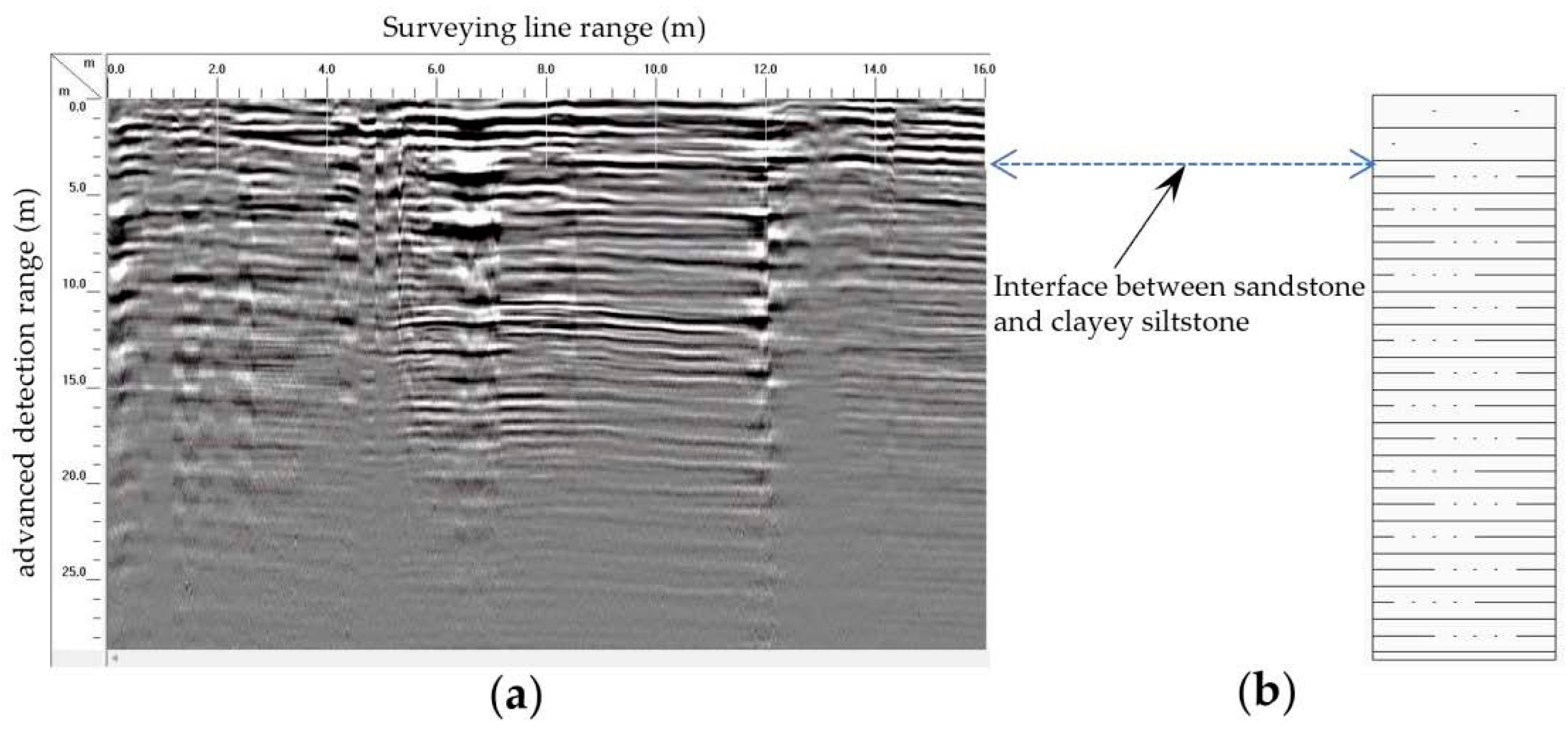
During the excavation of tunnel faces, many tunnel faces are usually irregular except for the mechanical excavation of soft rock. Now, take for instance the actual advanced detection of the Lei Yingpu Tunnel for the import left line LK68+664 tunnel face in Sichuan province, China. In Figure 26a, the tunnel face is very irregular such that the maximum difference from the concave point to convex point is more than 1.0 m, the GPR survey line is a horizontal line from the left-side wall to right-side wall, the detection direction is in the middle ahead of the tunnel face, and the GPR antenna is attached to the tunnel face; in Figure 26b, from the above relevant definition, tarata within the advanced detection range is a representative positively inclined stratum, which is made up primarily of sandstone and siltstone.
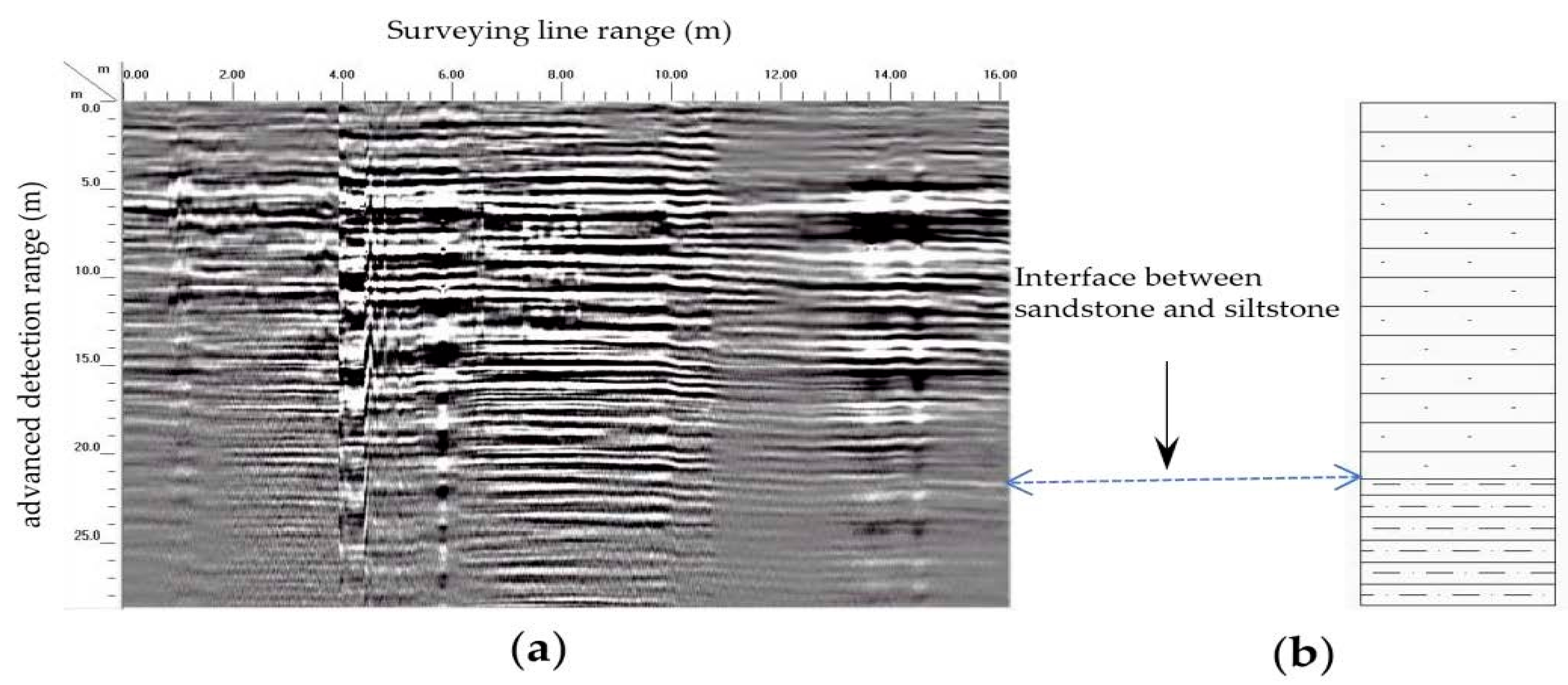
From Figure 27a showing the original profile of GPR advanced detection, we can see three positions of non-continuous phase transition and these non-continuous transitions through the entire time window. Through these non-continuous phase transitions that provide relevant data processing and geological interpretation, we can find a relevant strong phase transition 21 m ahead of the tunnel face, which comes from the interface between sandstone and silty siltstone. Finally, the tunnel face excavation verified the interface between sandstone and silty siltstone, as shown in Figure 27b.

4.2. Advanced Detection Ahead of Perfect Tunnel Face

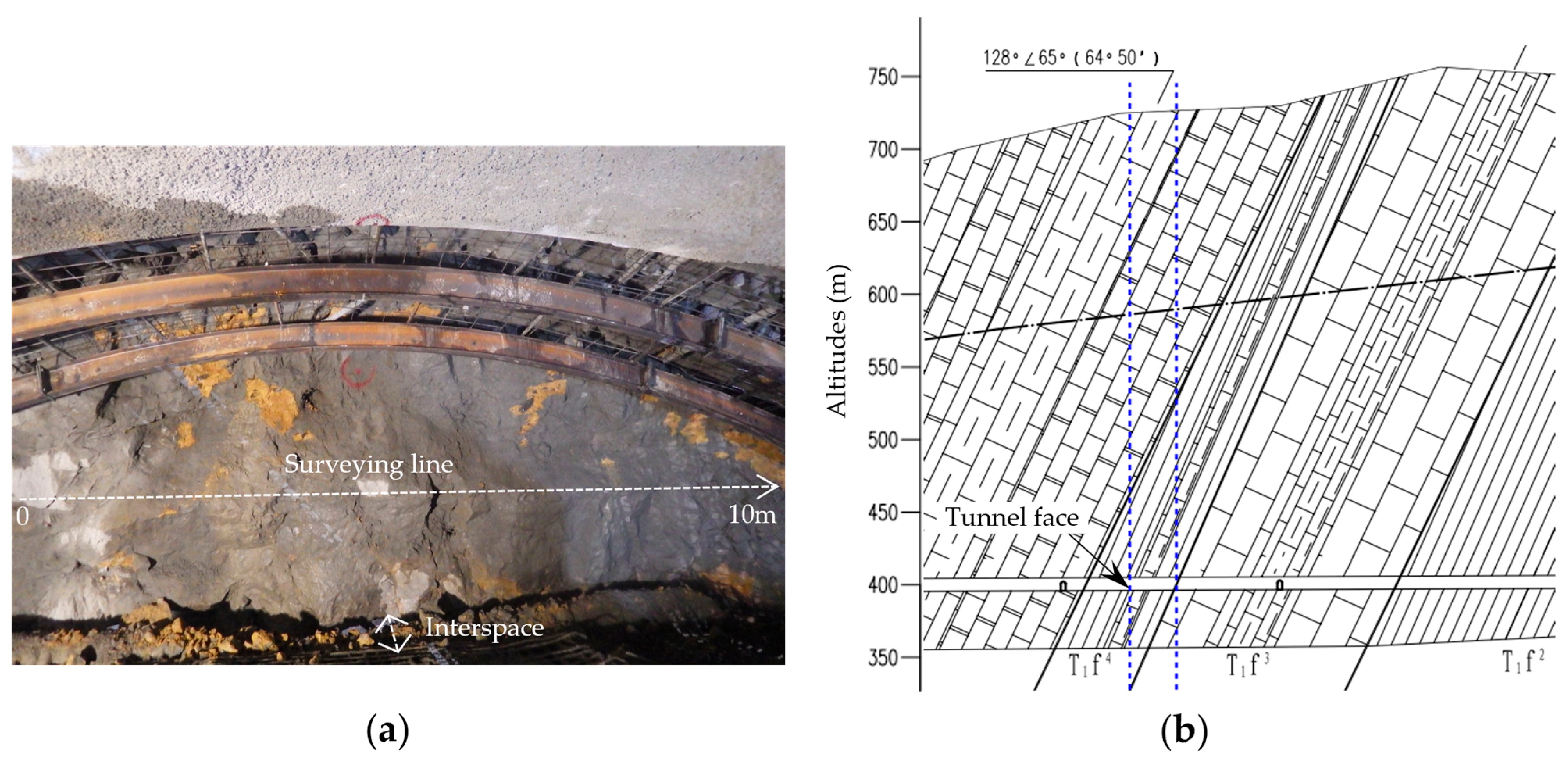
If effect of smooth surface blasting and risk mitigation for a tunnel face are all good, we can acquire a smooth tunnel face that also approximates a perfect tunnel face. Now, take for instance the actual advanced detection of the Lei Yingpu Tunnel for the import right line RK68+635 tunnel face in Sichuan province, China. In Figure 28a, the tunnel face is relatively smooth such that the maximum difference from the concave point to convex point is more than 0.1 m, the GPR survey line is a horizontal line from the left-side wall to right-side wall, the detection direction is in the middle ahead of the tunnel face, and the GPR antenna is attached to the tunnel face; in Figure 28b, from the above relevant definition, tarata within the advanced detection range is also a representative positively inclined stratum, which also is made up primarily of sandstone and siltstone.
In Figure 29a showing the original profile of GPR advanced detection, we can see that all non-continuous transitions are not measured through the entire time window, and the strongest phase transition is 4 m ahead of the tunnel face, which comes from the interface between sandstone and silty siltstone, except for the phase transition of the directive wave. Lastly, the tunnel face excavation also verified the interface between sandstone and silty siltstone, as shown in Figure 29b.

4.3. Non-Attaching Tunnel Face for the GPR Antenna

Now, take for instance the actual advanced detection of the Lei Yingpu Tunnel for the import left line LK68+664 tunnel face. As seen in Figure 26a, the tunnel face is very irregular such that the maximum difference from the concave point to convex point is more than 1.0 m, the GPR survey line is a horizontal line from the left-side wall to right-side wall, the detection direction is in the middle ahead of the tunnel face, and the GPR antenna is attached the tunnel face; in Figure 26b, from the above relevant definition, tarata within the advanced detection range is a representative positively inclined stratum, which is made up primarily of sandstone and siltstone.
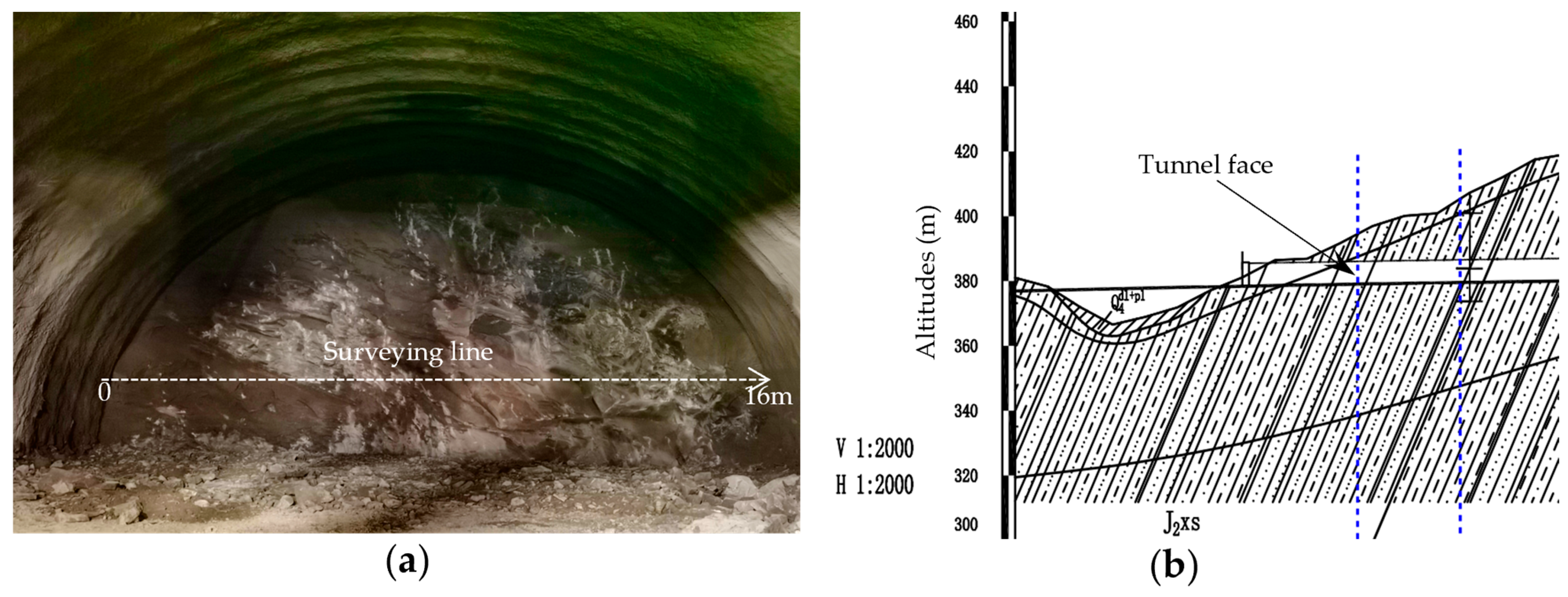
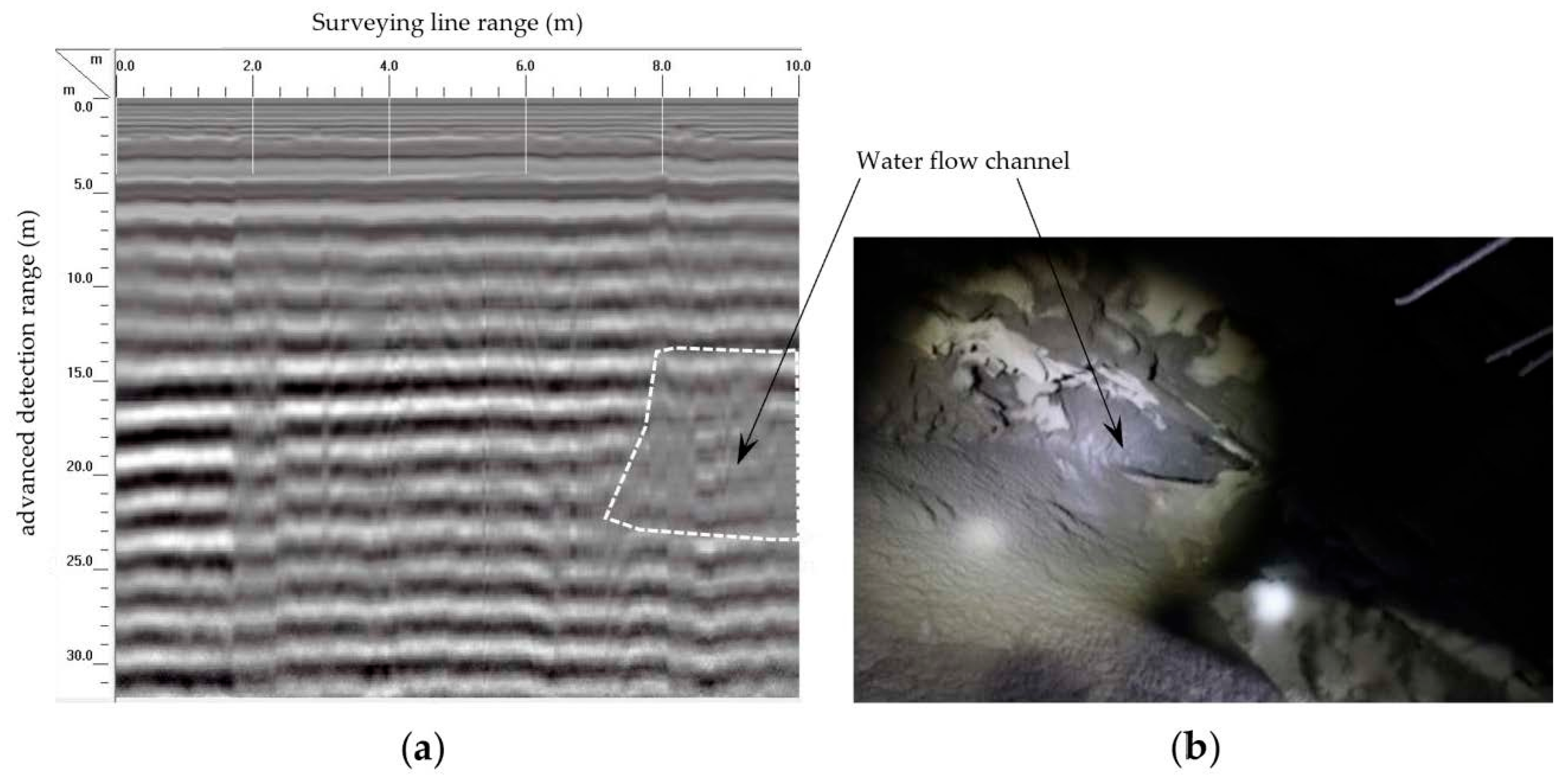
When performing GPR advanced detection ahead of the tunnel face on the excavation trolley, the interspace from excavation trolley to tunnel face always has 0.5–1.0 m ranges. So, the GPR antenna does not attach to the tunnel face. Now, take for instance the actual advanced detection of the three-way Huayingshan Tunnel for the import right line RK25+206 tunnel face in Chongqing municipality province, China. As seen in Figure 30a, the GPR antenna keeps about 0.8 m of interspace away from the tunnel face, the GPR survey line is a horizontal line from the left side to right side, the detection direction is a 30-degree tilt ahead of the tunnel face; in Figure 30b, with the above relevant definition, tarata within the advanced detection range is also a representative positively inclined limestone stratum.
From Figure 31a showing the original profile of GPR advanced detection, we can see the continuity of all phase transitions is very great, but it has a low reflectance energy area on the right center profile of the GPR, and the abnormity is located 12.24 m in the middle ahead of the tunnel face of its 8–10 m survey line by computing. Moreover, we infer that it is a water flow channel. Finally, the tunnel face excavation verified the abnormity, as shown in Figure 31b.

5. Discussion

5.1. Simulation Results for Horizontal Strata

In Section 3.1, we simulated four geophysical models: a single horizontal stratum with a perfect and an irregular tunnel face and two horizontal strata with a perfect and an irregular tunnel face. Horizontal or approximately horizontal strata are very common in tunnel constructions.
When simulating a single stratum, we observed reflected clutter from the boundaries of the simulation area, indicating that the GPML did not achieve complete absorption in the absorbing layers. Although all relevant electromagnetic parameters satisfied the absorption condition of the GPML, numerical dispersion and calculation errors still occurred. Additionally, multiple diffuse reflections from the irregular tunnel face overlapped with the reflected waves from the simulation area boundaries, further complicating the results.
Regarding simulating two horizontal strata, when the tunnel face was perfect, we observed a sudden change in the rock segmentation interface. In contrast, when the tunnel face was irregular, we did not see a sudden change in the rock segmentation interface; meanwhile, the reflected signal of the most convex point was the strongest, whereas the reflected signal of the most concave point was the weakest. Moreover, stabilizing the strong interference signals resulted in a bright band in the B-scan profile, which was the same as for the stable interference signal in the excavated space for tunnel constructions.

5.2. Simulation Results for Vertical Strata

In Section 3.2, we simulated four geophysical models: two vertical strata with a perfect and an irregular tunnel face and three vertical strata with a perfect and an irregular tunnel face. Vertical and approximately vertical strata were also sometimes encountered in tunnel constructions.
When simulating two vertical strata, reflected waves propagated from the boundaries of the simulation area, the tunnel face, and the rock segmentation interface. However, reflected waves from only the rock segmentation interface are needed. For the perfect tunnel face, we can see a straight reflective interface between the sandstone and mudstone strata with a V-shaped clutter, and the tunnel face nearby has an incomplete V-shaped clutter. And all clutters just have two V-shaped clutters. For the irregular tunnel face, a straight segmentation interface was transformed into a curved interface due to overlay influence of the irregular tunnel face. When the GPR antennas moved along the connecting line—the most convex points on the irregular tunnel face—the most convex points of the irregular tunnel face corresponded to the most concave points of the rock segmentation interface and vice versa—the most concave points of the irregular tunnel face corresponded to the most convex points of the rock segmentation interface.
When simulating three vertical strata, the simulated profile of the rock segmentation interface was analogous to that in the simulations of two vertical strata; however, more than one rock segmentation reflected interface was observed.

5.3. Simulation Results for Positively Inclined Strata

In Section 3.3, we simulated three geophysical models: two models of positively inclined strata with a perfect tunnel face and one model of positively inclined strata with an irregular tunnel face. Positively inclined strata are very common in tunnel constructions.
When simulating two vertical strata with both perfect and irregular tunnel faces, we observed reflected waves near the tunnel faces and along the rock segmentation interface. These waves originated from the boundaries of the simulation area. Additionally, we identified a consistent pattern: the irregular tunnel face altered the shape of the rock segmentation interface, making it amorphous. The straight segmentation interface transformed into a curved interface due to the irregular tunnel face. When the GPR antennas moved along the line connecting the most convex points on the tunnel face, the most convex points of the tunnel face corresponded to the most concave points of the rock segmentation interface, while the most concave points of the tunnel face corresponded to the most convex points of the rock segmentation interface.
Based on the model of a relatively far positively inclined stratum with an irregular tunnel face, we observed a key difference compared to a perfect tunnel face: the reflected interface of the far positively inclined rock segmentation face was curved rather than straight. Additionally, we identified a consistent pattern: the most convex points on the rock segmentation face become the most concave points and vice versa—the most concave points become the most convex points. Middle points of the rock segmentation face remained unchanged. High intermediate points of the rock segmentation face underwent slight concave deformation, while low intermediate points of the rock segmentation face showed slight convex deformation.
Why do these phenomena occur? They can be explained using the law of two-way travel time in consideration of the average electromagnetic wave velocity, which governs wave propagation and reflection behavior in the medium.
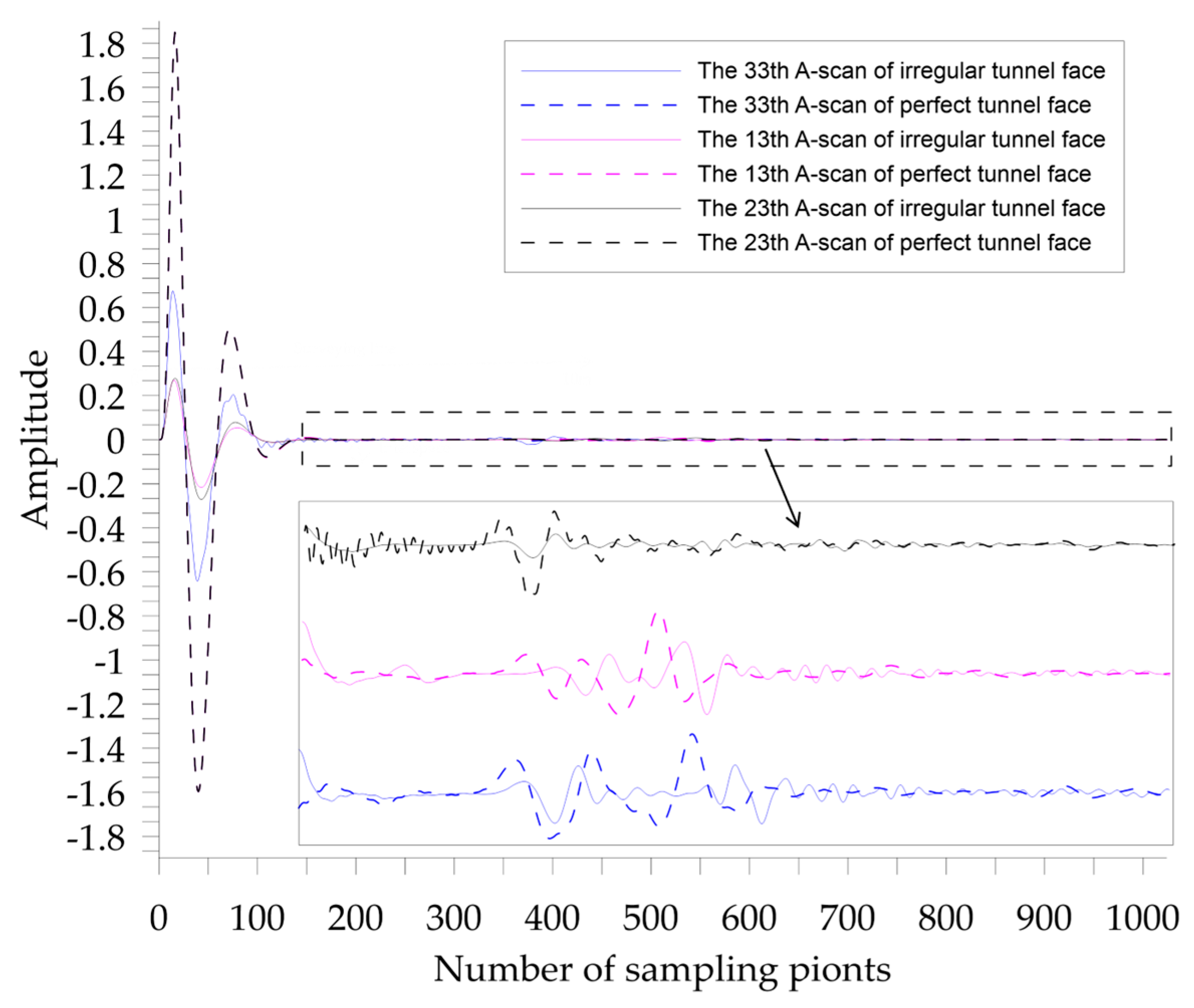
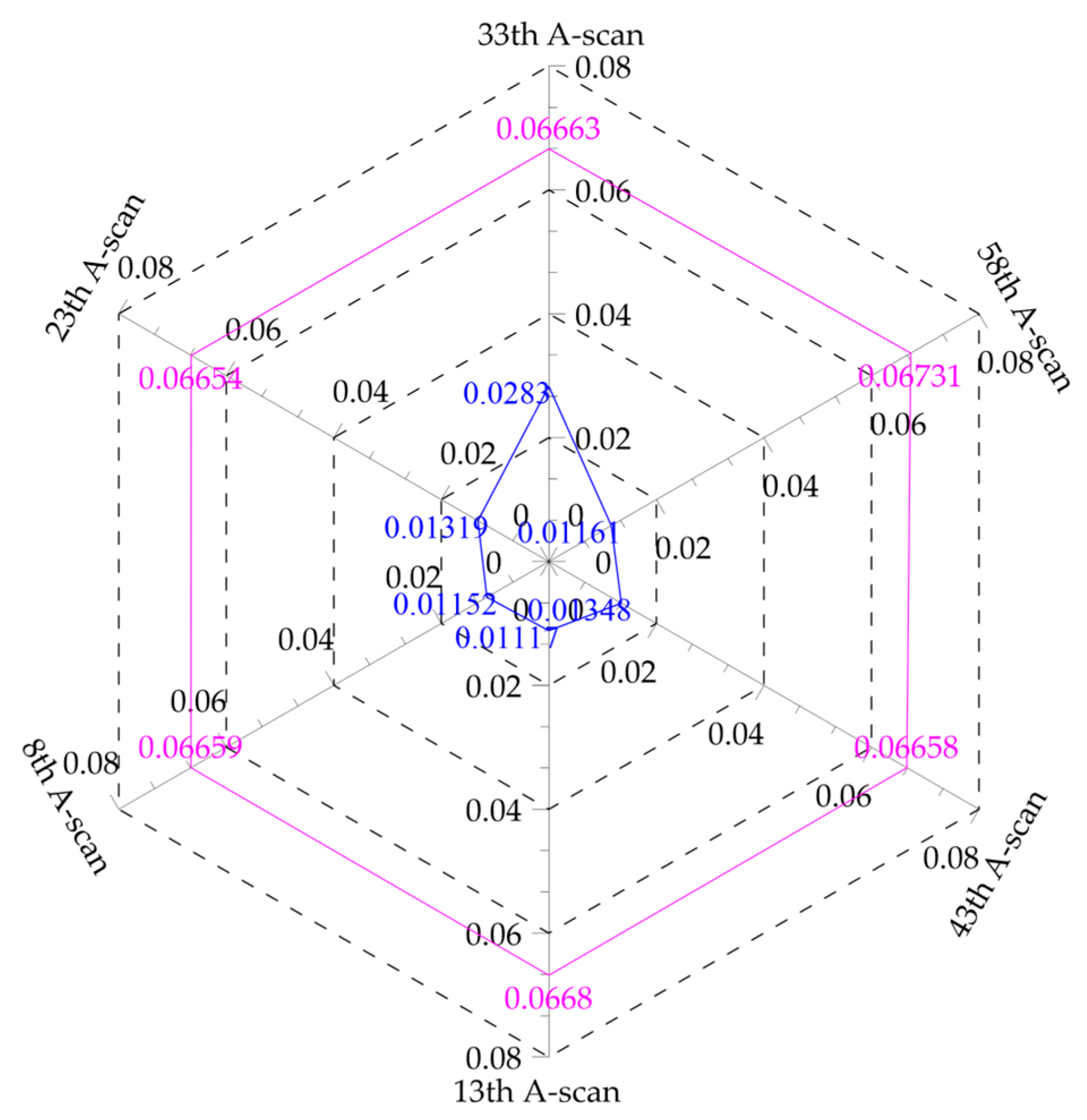
From the perspective of signal strength, the maximum amplitudes for the perfect tunnel face were larger than those for the irregular tunnel face (Figure 32). Meanwhile, the average amplitude of the pivotal A-scan was larger for the perfect tunnel face than for the irregular tunnel face (Figure 33), demonstrating that the tunnel face should be smooth.

5.4. Simulation Results of Reverse-Inclined Strata

In Section 3.4, we simulated four geophysical models: two reverse-inclined strata with the GPR antenna touching a perfect tunnel face; one reverse-inclined stratum with the antenna not touching a perfect tunnel face; and one reverse-inclined stratum with an irregular tunnel face. Reverse-inclined strata are common in tunnel constructions.
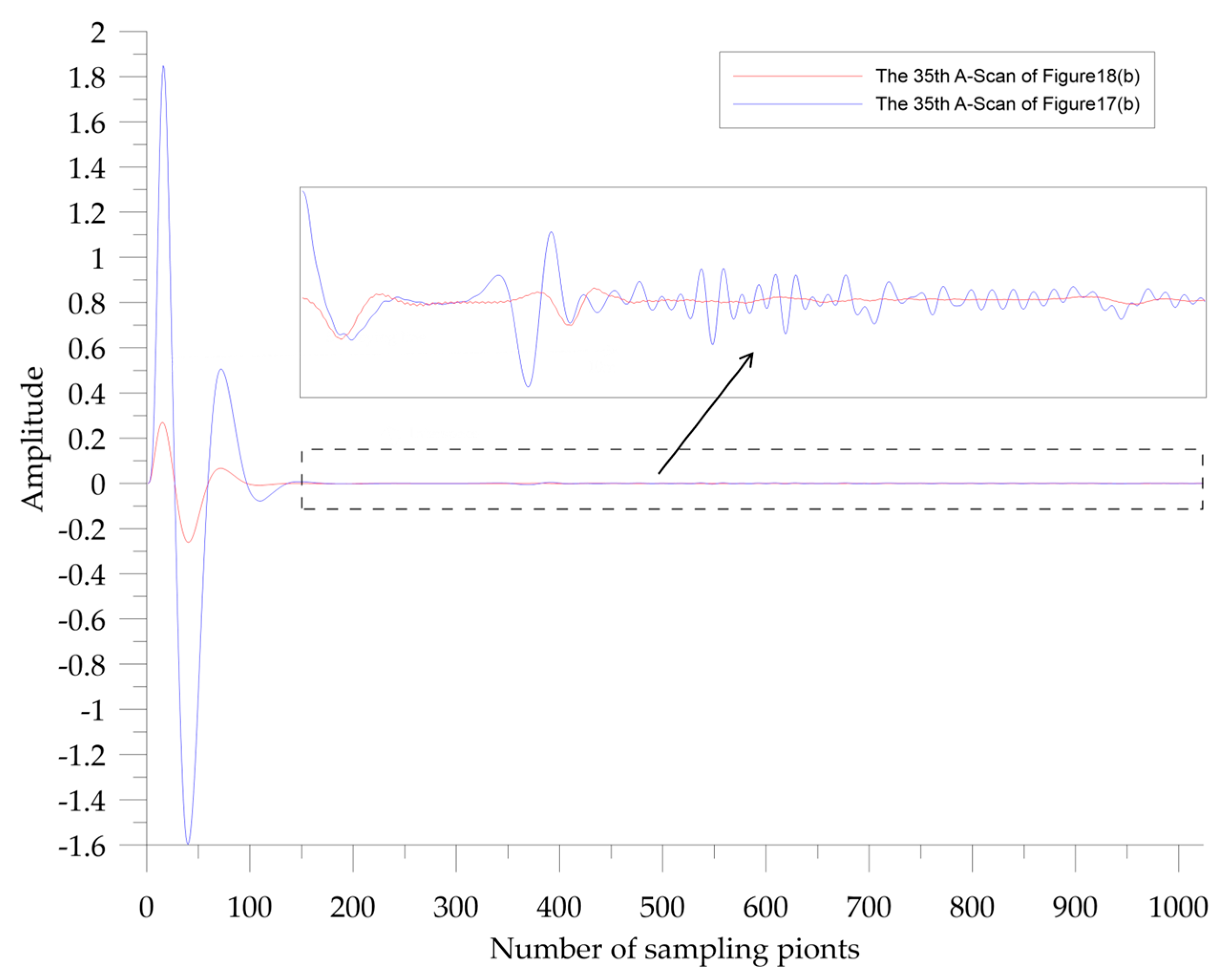
From the perspective of signal strength, the maximum amplitudes were larger for the perfect tunnel face than for the irregular tunnel face (Figure 34). Moreover, the average amplitude of the pivotal A-scan was larger for the perfect tunnel face than for the irregular tunnel face (Table 1). The maximum amplitude and mean amplitude were respectively 6.852 and 6.281 stronger when the antenna touched the tunnel face than when the antenna did not touch the tunnel face (Table 2), demonstrating that the GPR antenna should touch the tunnel face.

5.5. Simulation Results for Other Target Bodies

In Section 3.5, we simulated six geophysical models: two broken fault belts, two circular silt-filled karst caves, and two rectangular silt-filled karst caves with both perfect and irregular tunnel faces. These geologic anomalies are common in tunnel constructions.
With these six simulated results, we can see that the orthogonal zig-zag boundary of these six geophysical models is the main reason for making simulation distortion, except for the boundary of simulated areas and the irregular tunnel face. Moreover, we can find that diffracted interference waves come from the orthogonal zig-zag boundary in the fault broken belt and the orthogonal zig-zag boundary circular karst cave simulated results. In addition, we still can find concurrences of the three factors: the boundary of the orthogonal zig-zag of simulated target bodies, the boundary of the simulated area boundary, and the boundary of the irregular tunnel face make simulated results more complex.

5.6. Overview of the Discussion

In Section 3.1, Section 3.2, Section 3.3, Section 3.4 and Section 3.5, we simulated a total of 21 geophysical models of GPR-based tunnel face advanced detection (Table 3).
The simulation results obtained using these 21 geophysical models provide guidance for the data acquisition, data processing, and geologic interpretation for GPR-based tunnel face advanced detection. It is worth noting that the models of horizontal strata included the status of only one stratum.
Although the simulation method of FDTD with GPML achieved good simulation results for GPR-based advanced detection at 100 MHz, the simulation area was smaller than the actual area of ground-penetrating-radar-based advanced detection ahead of the tunnel face. Simulating the actual area would require a simulation time of several hours for one geophysical model. However, this did not affect the features of the simulated results.

6. Conclusions

Studying GPR-based tunnel face advanced detection based on the FDTD-GPML method has significance for preventing geologic disasters, reducing accidents, minimizing tunnel constructions without sufficient geologic information, and ensuring the safe and efficient production of tunnel constructions. In this study, we used the FDTD-GPML method to simulate the GPR-based tunnel face advanced detection. The conclusions are summarized as follows:
Based on the attitude features of the strata for the tunnel construction, forward modeling was classified into several categories: horizontal strata, vertical strata, positively inclined strata, reverse-inclined strata, and other abnormal target bodies (e.g., broken fault belts and silt-filled karst caves). We simulated GPR-based tunnel face advanced detection using 21 geophysical models. These models allowed us to evaluate the effects of irregular tunnel faces and the distance of the antenna from the tunnel face on the advanced detection ability, providing guidance for physical forward models.
We applied the FDTD-GPML method to simulate GPR-based tunnel face advanced detection and achieved good numerical simulation performance.
Based on the systemic analysis of the advanced detection simulation results from 21 geophysical models, we revealed the characteristics of the GPR profile images for perfect and irregular tunnel faces. The results can greatly improve the quality of data collection and processing along with the technical level of geologic interpretation. In particular, the forward simulations with different distances of the antenna from the tunnel face and different tunnel faces (perfectly smooth vs. irregular) and their interpretation have important application significance. Their interpretation explains why the GPR antenna should be as close to the detection line as possible; when the tunnel face is irregular, the GPR profile image is discontinuous over the in-phase axis, and the waveform is cluttered.
If the irregular tunnel face is inerratic, we can also process the GPR data similar to terrain correction, as demonstrated by the simulation results shown in Figure 8, Figure 10, Figure 12, Figure 15, Figure 19, Figure 21 and Figure 25. But when we are doing terrain correction, we should note whether GPR antenna should be positioned along with the actual curved line or the straight lines on the irregular tunnel face.
Based on the actual advanced detections that are an irregular tunnel face, an approximate perfect tunnel face, and a non-attaching tunnel face for the GPR antenna, we also verified the otherness between the forward numerical simulation results and homologous field actual detection results.
In this study, we used the FDTD-GPML method to simulate 21 forward models of GPR-based tunnel face advanced detection. The results provide theoretical guidance for data acquisition, data processing, and geologic interpretation. However, the simulated area in this study was smaller than the actual area of ground-penetrating-radar-based advanced detection ahead of the tunnel face. In addition, the effect of the distance of the GPR antenna from the tunnel face was not studied for the irregular tunnel face. Therefore, the FDTD-GPML method needs to be evaluated with real geometric size models (e.g., 12 m × 30 m for two-lane tunnels and 15 m × 30 m for three-lane tunnels) and with more complex forward models in the future.

Author Contributions

H.L.: Conceptualization, Methodology, Investigation, Writing; Y.W.: Validation, Supervision, Funding acquisition; L.D.: Validation, Writing—review and editing. All authors have read and agreed to the published version of the manuscript.

Funding

This research was funded the National Key R&D Program of China 2018YFC0807805, Chongqing Transportation Science and Technology Plan Project CQJT-CZKJ2023-29.

Data Availability Statement

The data associated with the present study will be available upon request from the corresponding authors.

Acknowledgments

This research was supported by a grant from Chongqing University and the China Coal Technology and Engineering Group Chongqing Research Institute.

Conflicts of Interest

The authors declare that they have no known competing financial interests or personal relationships that could have appeared to influence the work reported in this paper.

References

  1. Li, S.; Liu, B.; Xu, X.; Nie, L.; Liu, Z.; Song, J.; Sun, H.; Chen, L.; Fan, K. An overview of Ahead Geological Prospecting in Tunneling. Tunn. Undergr. Space Technol. 2017, 63, 69–94. [Google Scholar] [CrossRef]
  2. Ghezzi, A.; Schettino, A.; Pierantoni, P.P.; Conyers, L.; Tassi, L.; Vigliotti, L.; Schettino, E.; Melfi, M.; Gorrini, M.E.; Boila, P. Reconstruction of a Segment of the UNESCO World Heritage Hadrian’s Villa Tunnel Network by Integrated GPR, Magnetic–Paleomagnetic, and Electric Resistivity Prospections. Remote Sens. 2019, 11, 1739. [Google Scholar] [CrossRef]
  3. Yang, J.; Ma, Q.; Xiao, H.; Wei, X.; Yan, F.; Zhang, W.; Chen, J.; Xiao, Z.; Wang, G. Multi-Means Comprehensive Forecasting Technology for Water Inrush in Long Tunnels. Appl. Sci. 2025, 15, 3332. [Google Scholar] [CrossRef]
  4. Li, C.; Wang, H.; Wang, Y.; Wang, L.; Yang, X.; Wan, X. Recognition of Tunnel Fracture Zones in Seismic Waves and Ground-Penetrating Radar Data. Appl. Sci. 2024, 14, 1282. [Google Scholar] [CrossRef]
  5. Li, J.; Cao, D.; Xiao, T.; Wang, C. Utility Tunnel Settlement Monitoring Using Distributed Fiber Optic and Ground Penetrating Radar Technologies. Sensors 2025, 25, 6964. [Google Scholar] [CrossRef] [PubMed]
  6. Zhang, S.; Zhang, L.; He, W.; Ling, T.; Deng, Z.; Fu, G. Three-Dimensional Quantitative Recognition of Filler Materials Ahead of a Tunnel Face via Time-Energy Density Analysis of Wavelet Transforms. Minerals 2022, 12, 234. [Google Scholar] [CrossRef]
  7. Lu, G.; Ma, Y.; Zhang, Q.; Wang, J.; Du, L.; Hao, G. Research on Tunnel Boring Machine Tunnel Water Disaster Detection and Radar Echo Signal Processing. Buildings 2024, 14, 1737. [Google Scholar] [CrossRef]
  8. Huang, C.-F.; Zhang, S.-L.; Wu, S.-C.; Gao, Y.-T. Research and Application of a Comprehensive Forecasting System for Tunnels in Water-Bearing Fault Fracture Zones: A Case Study. Arab. J. Geosci. 2022, 15, 171. [Google Scholar] [CrossRef]
  9. Zang, C.W.; Huang, H.W.; Zhang, Z.X. Forecasting the Strata Condition of a Long Road Tunnel by Using Fuzzy Synthetic Judgment. Int. J. Rock Mech. Min. Sci. 2004, 41, 267–272. [Google Scholar] [CrossRef]
  10. Ding, Y.; Yang, B.; Xu, G.; Wang, X. Improved Dempster–Shafer Evidence Theory for Tunnel Water Inrush Risk Analysis Based on Fuzzy Identification Factors of Multi-Source Geophysical Data. Remote. Sens. 2022, 14, 6178. [Google Scholar] [CrossRef]
  11. Li, S.C.; Zhou, Z.Q.; Ye, Z.H.; Li, L.P.; Zhang, Q.Q.; Xu, Z.H. Comprehensive Geophysical Prediction and Treatment Measures of Karst Caves in Deep Buried Tunnel. J. Appl. Geophys. 2015, 116, 247–257. [Google Scholar] [CrossRef]
  12. Li, S.; Song, J.; Zhang, J.; Wang, C.; Liu, B.; Liu, F.; Ma, S.; Nie, L. A New Comprehensive Geological Prediction Method Based on Constrained Inversion and Integrated Interpretation for Water-Bearing Tunnel Structures. Eur. J. Environ. Civ. Eng. 2017, 21, 1441–1465. [Google Scholar] [CrossRef]
  13. Bu, L.; Li, S.; Shi, S.; Li, L.; Zhao, Y.; Zhou, Z.; Nie, L.; Sun, H. Application of the Comprehensive Forecast System for Water-Bearing Structures in A Karst Tunnel: A Case Study. Bull. Eng. Geol. Environ. 2019, 78, 357–373. [Google Scholar] [CrossRef]
  14. Lan, R.; Liu, Z.; Liu, M.; Guan, Q.; Yan, Y.; Sun, H.; Zhou, D. Detection of Karst Caves During Tunnel Construction Using Ground-Penetrating Radar and Advanced Drilling: A Case Study in Guangxi Province, China. Near Surf. Geophys. 2022, 20, 265–278. [Google Scholar] [CrossRef]
  15. Cui, F.; Wang, R.; Chen, B.; Zeng, L.; Chen, Y. Application Research of Autoregressive and Moving Average Power Spectrum in Mine Ground-Penetrating Radar Structure Detection Data Analysis. Geophys. Prospect. 2023, 71, 1743–1755. [Google Scholar]
  16. Liu, M.; Liu, Z.; Zhou, D.; Lan, R.; Wu, H. Recognition Method of Typical Anomalies during Karst Tunnel Construction Using GPR Attributes and Gaussian processes. Arab. J. Geosci. 2020, 13, 1–13. [Google Scholar] [CrossRef]
  17. Zhang, S.; He, W.; Cao, F.; Hong, L. Time-Frequency Analysis of GPR Simulation Signals for Tunnel Cavern Fillings Based on Short-Time Fourier Transform. In Proceedings of the 17th Biennial International Conference on Engineering, Science, Construction, and Operations in Challenging Environments (Earth and Space), Miami, FL, USA, 19–23 April 2021; pp. 572–581. [Google Scholar]
  18. He, Y.Y.; Li, B.Q.; Guo, Y.S.; Wang, T.N.; Zhu, Y. An Interpretation Model of GPR Point Data in Tunnel Geological Prediction. In Proceedings of the 8th International Conference on Graphic and Image Processing (ICGIP); SPIE: Bellingham, WA, USA, 2017; pp. 102252J-1–102252J-6. [Google Scholar]
  19. Yang, T.-W.; Li, J.-H.; Cao, Y.-H.; Xiong, B.; Wei, L.-Y. Deep Learning-based Tunnel Advance Geological Forecast for Polygon Targets via Regional GPR Data. Appl. Geophys. 2025, 22, 973–987,1492. [Google Scholar] [CrossRef]
  20. Li, C.; Zhang, S.; Li, T.; Yang, G.; Chen, W.; Xiao, H.; Li, S. A Preliminary Study on Intelligent Interpretation of GPR Advance Prediction in Karst Tunnel. In Proceedings of the 3rd International Conference on Geosynthetics and Environmental Engineering, ICGEE; Springer: Berlin/Heidelberg, Germany, 2025; Volume 2026, pp. 347–364. [Google Scholar]
  21. Li, Z.; Zheng, Z.; Gao, J.; Lian, H.; Yu, S.; Yuan, K. Numerical Simulation of GPR and Application Examples for Tunnel Geological Advanced Prediction. Chin. Zhongzhou Coal 2016, 7, 143–147. [Google Scholar]
  22. Deng, G.; Wang, Q.; Liao, J.; Zhou, Y. Forward Modeling and Advanced Detection of Radar in Adverse Geological Phenomena Tunnel. Chin. Geophys. Geochem. Explor. 2015, 39, 651–656. [Google Scholar]
  23. Yang, T.; Li, H.; Zhang, H. Forward Modeling of GPML Absorbing Boundary Conditions in GPR Simulation. Chin. J. Comput. Phys. 2014, 31, 200–206. [Google Scholar]
  24. Kane, Y. Numerical Solution of Initial Boundary Value Problems Involving Maxwell’s Equations in Isotropic Media. IEEE Trans. Antennas Propag. 1966, 14, 302–307. [Google Scholar] [CrossRef]
  25. Berenger, J.P. A Perfectly Matched Layer for the Absorption of Electromagnetic Waves. J. Comput. Phys. 1994, 114, 185–200. [Google Scholar] [CrossRef]
  26. Fang, J.; Wu, Z. Generalized Perfectly Matched Layer-an Extension of Berenger’s Perfectly Matched Layer Boundary Condition. IEEE Microw. Guid. Wave Lett. 1995, 5, 451–453. [Google Scholar] [CrossRef]
  27. Fang, J.; Wu, Z. Generalized Perfectly Matched Layer for the Absorption of Propagating and Evanescent Waves in Lossless and Lossy Media. IEEE Trans. Microw. Theory Tech. 1996, 44, 2216–2222. [Google Scholar] [CrossRef]
  28. Zhao, L.; Cangellaris, A.C. GT-PML: Generalized Theory of Perfectly Matched Layers and Its Application to the Reflectionless Truncation of Finite-Difference Time-Domain Grids. IEEE Trans. Microw. Theory Tech. 1996, 44, 2555–2563. [Google Scholar] [CrossRef]
  29. Zhao, A.P. Generalized-Material-Independent PML Absorbers Used for the FDTD Simulation of Electromagnetic Waves in 3-D Arbitrary Anisotropic Dielectric and Magnetic Media. IEEE Trans. Microw. Theory Tech. 1998, 46, 1511–1513. [Google Scholar] [CrossRef]
Figure 1. Image showing the field conditions for GPR-based irregular tunnel face.
Geosciences 16 00099 g001
Figure 2. Simulation area for GPR-based tunnel face advanced detection.
Geosciences 16 00099 g002
Figure 3. Flow chart of the FDTD algorithm.
Geosciences 16 00099 g003
Figure 4. Common types of strata and attitude of strata on the tunnel face: (a) positively inclined strata, (b) reverse-inclined strata, (c) approximately horizontal strata, (d) classification of the exposed tunnel face.
Geosciences 16 00099 g004
Figure 5. Geophysical model of one stratum for a perfect tunnel face (a) and corresponding simulation results (b) for GPR-based tunnel face advanced detection.
Geosciences 16 00099 g005
Figure 6. Geophysical model of one stratum for an irregular tunnel face (a) and corresponding simulation results (b) for GPR-based tunnel face advanced detection.
Geosciences 16 00099 g006
Figure 7. Geophysical model of two horizontal strata for a perfect tunnel face (a) and corresponding simulation results (b) for GPR-based tunnel face advanced detection.
Geosciences 16 00099 g007
Figure 8. Geophysical model of two horizontal strata for an irregular tunnel face (a) and corresponding simulation results (b) for GPR-based tunnel face advanced detection.
Geosciences 16 00099 g008
Figure 9. Geophysical model of two vertical strata for a perfect tunnel face (a) and corresponding simulation results (b) for GPR-based tunnel face advanced detection.
Geosciences 16 00099 g009
Figure 10. Geophysical model of two vertical strata for an irregular tunnel face (a) and corresponding simulation results (b) for GPR-based tunnel face advanced detection.
Geosciences 16 00099 g010
Figure 11. Geophysical model of three vertical strata for a perfect tunnel face (a) and corresponding simulation results (b) for GPR-based tunnel face advanced detection.
Geosciences 16 00099 g011
Figure 12. Geophysical model of three vertical strata for an irregular tunnel face (a) and corresponding simulation results (b) for GPR-based tunnel face advanced detection.
Geosciences 16 00099 g012
Figure 13. Geophysical model of the 10-grid minimum distance near positively inclined strata with a perfect tunnel face (a) and corresponding simulation results (b) for GPR-based tunnel face advanced detection.
Geosciences 16 00099 g013
Figure 14. Geophysical model of the 20-grid minimum distance far positively inclined strata with a perfect tunnel face (a) and corresponding simulation results (b) for GPR-based tunnel face advanced detection.
Geosciences 16 00099 g014
Figure 15. Geophysical model of the 20-grid minimum distance far positively inclined strata with an irregular tunnel face (a) and corresponding simulation results (b) for GPR-based tunnel face advanced detection.
Geosciences 16 00099 g015
Figure 16. Geophysical model of the 10-grid minimum distance near reverse-inclined strata with a perfect tunnel face (a) and corresponding simulation results (b) for GPR-based tunnel face advanced detection.
Geosciences 16 00099 g016
Figure 17. Geophysical model of the 20-grid minimum distance far reverse-inclined strata with a perfect tunnel face (a) and corresponding simulation results (b) for GPR-based tunnel face advanced detection.
Geosciences 16 00099 g017
Figure 18. Based on Figure 20a, geophysical model of a non-attaching tunnel face for the GPR antenna with a perfect tunnel face (a) and corresponding simulation results (b) for GPR-based tunnel face advanced detection.
Geosciences 16 00099 g018
Figure 19. Geophysical model of the 40-grid minimum distance far reverse-inclined strata with an irregular tunnel face (a) and corresponding simulation results (b) for GPR-based tunnel face advanced detection.
Geosciences 16 00099 g019
Figure 20. Geophysical model of a broken fault belt with a perfect tunnel face (a) and corresponding simulation results (b) for GPR-based tunnel face advanced detection.
Geosciences 16 00099 g020
Figure 21. Geophysical model of a broken fault belt with an irregular tunnel face (a) and corresponding simulation results (b) for GPR-based tunnel face advanced detection.
Geosciences 16 00099 g021
Figure 22. Geophysical model of a circular silt-filled karst cave with a perfect tunnel face (a) and corresponding simulation results (b) for GPR-based tunnel face advanced detection.
Geosciences 16 00099 g022
Figure 23. Geophysical model of a circular silt-filled karst cave with an irregular tunnel face (a) and corresponding simulation results (b) for GPR-based tunnel face advanced detection.
Geosciences 16 00099 g023
Figure 24. Geophysical model of a rectangular silt-filled karst cave with a perfect tunnel face (a) and corresponding simulation results (b) for GPR-based tunnel face advanced detection.
Geosciences 16 00099 g024
Figure 25. Geophysical model of a rectangular silt-filled karst cave with an irregular tunnel face (a) and corresponding simulation results (b) for GPR-based tunnel face advanced detection.
Geosciences 16 00099 g025
Figure 26. Photograph of irregular tunnel face (a) on LK68+664 in the Lei Yingpu Tunnel and corresponding geological longitudinal section (b) for Lei Yingpu Tunnel left line of import.
Geosciences 16 00099 g026
Figure 27. Actual field detection results of Figure 26. Original profile of GPR advanced detection (a) for Figure 26 and corresponding Verification of geologic column (b) after excavation.
Geosciences 16 00099 g027
Figure 28. Photograph of perfect tunnel face (a) on RK68+635 in the Lei Yingpu Tunnel and corresponding geological longitudinal section (b) for Lei Yingpu Tunnel right line of import.
Geosciences 16 00099 g028
Figure 29. Actual field detection results of original profile of GPR advanced detection (a) for Figure 28 and corresponding verification of geologic column (b) after excavation.
Geosciences 16 00099 g029
Figure 30. Photograph of non-attaching tunnel face (a) for the GPR antenna on RK25+206 in the Hua Yingshan Tunnel and corresponding geological longitudinal section (b) for Hua Yingshan Tunnel right line of import.
Geosciences 16 00099 g030
Figure 31. Original profile of GPR advanced detection (a) for Figure 30 and corresponding photograph of tunnel face (b) after excavation.
Geosciences 16 00099 g031
Figure 32. Single A-scan oscillographs corresponding to the simulation results for the perfect and irregular tunnel faces from Figure 14b and Figure 15b.
Geosciences 16 00099 g032
Figure 33. Radar graph of average amplitude statistical value depicting the simulation results obtained from the geophysical models with perfect and irregular tunnel faces from the 8th, 13th, 23th, 33th, 43th, and 58th A-scans corresponding to Figure 14b and Figure 15b.
Geosciences 16 00099 g033
Figure 34. Comparison of the oscillographs of the 35th A-scans corresponding to Figure 17b and Figure 18b.
Geosciences 16 00099 g034
Table 1. Simulated geometric mode of 100 MHz.
Number of dx and dy for MeshQuadrate Mesh Spacing (m)Simulated Predicted Length (m)Simulated Tunnel Face Width (m)Simulated Area (m2)
80 and 1000.07497.49485.995844.9373
Table 2. Comparison of maximum and mean amplitudes for the 35rd A-scans corresponding to Figure 17b and Figure 18b.
Amplitude (Statistical Value)Maximum AmplitudeMean Amplitude
Antenna touching the tunnel face1.8490.067
Antenna not touching the tunnel face0.2700.011
Ratio6.85206.281
Table 3. Summary of simulated geophysical models.
Geophysical ModelsPerfect Tunnel FaceIrregular Tunnel FaceNumber of Models
Horizontal strata224
Vertical strata224
Positively inclined strata213
Reverse-inclined strata314
The other target bodies336
Disclaimer/Publisher’s Note: The statements, opinions and data contained in all publications are solely those of the individual author(s) and contributor(s) and not of MDPI and/or the editor(s). MDPI and/or the editor(s) disclaim responsibility for any injury to people or property resulting from any ideas, methods, instructions or products referred to in the content.