


Abstract
Rapid slip along discontinuities in deep coal–rock systems releases stored energy and generates transient loading that may trigger coal bursts. This review compares intra-coal, coal–rock interface, and fault-zone slip using evidence from laboratory experiments, physical models, numerical simulations, and field observations. The comparison accounts for scale, boundary conditions, parameter calibration, and field validation. The Mohr–Coulomb criterion identifies the onset of shear failure but not the transition to unstable slip, which depends on post-peak weakening, rate dependence, contact history, and loading-system stiffness. Hazard attribution cannot rely on source energy alone. Fracture energy and frictional dissipation occur at the source, whereas only part of the radiated energy reaches a roadway after attenuation and scattering. Microseismic activity near a fault does not establish fault slip without independent evidence from a compatible source mechanism, fault displacement, or stress change. The source–path–roadway framework distinguishes source-region destressing, propagation-path modification, and roadway protection. Parameter transfer among specimen, model, and mine scales remains poorly calibrated. Most mine-scale evidence is drawn from Chinese coal mines. Prospective tests across multiple mines are needed to determine whether measurable friction and energy parameters can improve field warning and control.
1. Introduction
1.1. Research Background and Engineering Significance
1.1.1. Coal-Burst Hazards in Deep Coal Mining
As coal extraction in China moves to greater depths, coal–rock masses are subjected to increasingly complex combinations of in situ, tectonic, and mining-induced stresses. High in situ stress increases the stored energy in the surrounding rock, while mining continually alters local boundary conditions and stress paths, increasing the likelihood of sudden instability. Coal burst is a characteristic dynamic hazard of this deep, complex stress environment. Its development is not governed by coal–rock strength or any single stress index, but by the interaction of material properties, geological structure, mine geometry, and disturbance loading [1,2]. A coal burst can fracture the coal–rock mass and release substantial energy within a very short time, producing intense vibration, ejection of coal and rock, severe roadway deformation, and support damage, with direct consequences for personnel and equipment.
China has progressively refined its coal-burst prevention and control system, yet deeper extraction, high-intensity production, and the concentration of capacity in large mines pose new engineering problems. Statistics identify 177 coal-burst-prone mines, with production capacity concentrated mainly in Shanxi, Shaanxi, Inner Mongolia, and Xinjiang [3]. Comparable prevention experience remains limited in some newly built or modern large mines. Complex geology and severe potential consequences also leave little room for trial-and-error adjustment. Under these conditions, reliance on post-event experience is inadequate. Prevention increasingly needs to combine hazard-source identification, zoning, and control throughout mining, so that intervention occurs before rather than after a damaging event [4].
Compression-induced coal instability, hard-roof failure, and fault slip can each generate dynamic loading, and more than one source may operate in the same mine. Faults, parting interfaces, and coal–rock contacts redirect mining-induced stress. Roof movement and goaf evolution also change the normal constraint and shear loading on these surfaces. If a weak discontinuity changes from stable load bearing or quasi-static slip to rapid unstable slip, the released energy and stress waves may disturb an already highly stressed roadway and trigger further energy release. This sequence couples discontinuity instability, propagation of dynamic disturbance, and energy release from the surrounding rock [1,5,6,7]. Within it, dynamic slip links mining-induced stress redistribution and geological-structure reactivation to coal-burst manifestation.
1.1.2. Engineering Hazards Associated with Fault-Reactivation-Induced Dynamic Slip
Across structural scales, dynamic slip may develop within coal shear zones, at coal–rock contacts, or along interfaces in coal-parting-coal composites. At the engineering scale, slip appears as local reactivation or large displacement of a fault zone. These forms differ in geometry, loading, and energy source and need not constitute a continuous evolutionary sequence. Each nevertheless involves changes in discontinuity strength, local fracture growth, and release of stored energy. Numerical studies of mining-induced fault slip show that mining depth, fault friction, and the position of the fault relative to the working face affect shear displacement, slip rate, and seismic-energy release [6]. Studies of coal-parting-coal composites indicate that interfacial slip and internal crack growth interact to control the overall instability mode [7].
At the engineering scale, case studies and model investigations indicate that fault-slip-induced coal bursts can affect large areas, involve a complex hazard chain, and exhibit inconsistent precursors. At the 25,110-working face of the Yuejin Coal Mine, large-scale movement of an extremely thick hard roof cut by faults combined high abutment stress near the fault with dynamic loading from roof rupture. Before several representative events, both microseismic energy and event frequency decreased, producing marked seismic quiescence [8]. Physical similarity modeling and numerical analysis further showed different stress, displacement, and energy evolution in the hanging wall and footwall, with local concentration of dynamic failure in the floor [9]. Physical model tests reproduced boundary-energy transfer and roadway response during transient fault slip. Under the tested conditions, slip reconfigured the mining-area stress field and directly loaded the roadway surrounding the rock and support system [10].
The abrupt, nonlinear character of fault slip complicates monitoring and early warning. Field microseismic observations and friction experiments indicate that small, identifiable stick-slip events may become less frequent before a high-energy fault-induced event, even as stress drop, displacement, and energy release per event increase. Precursory information can therefore weaken as event severity rises [5]. Other reported anomalies include changes in acoustic-emission energy and b-value during coal–rock instability [7,11] and localized responses in displacement, stress, and energy fields [9]. Their expression varies with fault scale, source location, monitoring performance, and evolutionary stage. No single indicator or fixed threshold provides a generally valid diagnosis.
1.1.3. Relevance of Dynamic-Slip Mechanisms to Mine Safety
Dynamic slip in coal–rock systems connects instability of weak discontinuities with propagation of dynamic disturbance and roadway response. Intra-coal slip, coal–rock interface slip, and fault-zone slip differ in location, affected area, and energy scale. All three, however, involve a change in stress on a potential slip surface, loss of shear resistance, and possible post-peak instability. Their preparation and evolution reflect coal–rock properties and fracture development as well as fault geometry, mining-induced stress paths, and face advance. Neither static-stress concentration nor an external disturbance alone explains the complete process. The review therefore follows the hazard chain from source-region instability to dynamic-load propagation and roadway response, using that chain to organize mechanisms, governing factors, research methods, assessment, and mitigation.
Controlling dynamic slip begins with identifying where the hazard chain can be interrupted. At the source, this requires the conditions for unstable slip along faults, coal–rock interfaces, or shear zones within coal to be established. Propagation analysis then estimates how released energy and stress waves attenuate before reaching an excavation, while roadway analysis examines the response of highly stressed surrounding rock and support. Physical experiments reproduce selected processes under controlled boundaries; numerical models test geometry and loading scenarios; theoretical analysis provides stability relations. Monitoring and warning are useful only when their outputs lead to a defined intervention and when post-treatment observations test its effect. Figure 1 locates these control points within the source–path–roadway chain.
Figure 1.
Source–path–roadway hazard chain and corresponding monitoring and control modules. The upper dashed frame encloses the hazard evolution processes, while the lower dashed frame encloses the corresponding monitoring and control modules.
1.2. Current State of Research
1.2.1. Advances in the Fundamental Theory of Coal–Rock Shear Slip
Research on dynamic slip has progressed from comparing resolved shear traction with frictional strength to analyzing nucleation, acceleration, and rupture. Sainoki et al. [6] showed that mining depth, fault friction, and fault position affected modeled displacement, seismic moment, and energy release. Wang et al. [1] linked simulated acceleration to evolving normal and shear stress and structural potential energy, while Cai et al. [12] distinguished progressive mining-induced reactivation from vibration-triggered slip. These studies identify stress path, frictional weakening, geometry, and loading rate as interacting controls. Their parameters nevertheless require scale-aware calibration because laboratory discontinuities, numerical contacts, and natural fault zones differ in roughness, infill, heterogeneity, and loading history [6,12,13,14].
1.2.2. Occurrence and Hazard Evolution of Slip-Induced Coal Bursts
Case studies support coupled static–dynamic pathways, but the initiating source and precursor pattern vary. At Yuejin Coal Mine, a faulted thick hard roof supplied dynamic disturbance against a high-stress background [8,9]. Lu et al. [5] found that identifiable small stick-slip events could decrease before high-energy events, whereas Cao et al. [15] modeled rapid changes in particle velocity, support stress, and strain-energy density after fault-slip loading. Studies of mining direction, source location, and post-slip redistribution further show that the hanging-wall or footwall effect depends on fault geometry, face position, and extraction sequence [16,17,18]. Reported influence distances and stage boundaries are therefore case specific rather than universal thresholds.
1.2.3. Mechanical Behavior and Interfacial Instability of Coal–Rock Composites
At smaller scales, intra-coal slip may occur along fractures, whereas coal–rock interface slip develops at lithological contacts or along interfaces in coal-parting-coal specimens. Liu et al. [7] separated interfacial slip from internal fracture and showed that inclination, shear stress, and friction govern slip, while tensile concentration and crack coalescence promote whole-specimen failure. Stress drop, kinetic-energy increase, acoustic-emission changes, and b-value variation appear in both laboratory and mine observations [5,7,11,17]. These similarities support comparison of instability stages, not equivalence of energy scale or mechanism. Cross-scale interpretation must retain specimen geometry, normal boundary conditions, moisture, loading rate, fault architecture, roof movement, and mining-induced stress as explicit limits.
1.2.4. Advances in Methods for Studying Dynamic Slip
Because no single method resolves the complete source–path–roadway process, continuum models are useful for mine-scale stress redistribution but may simplify roughness, slip weakening, and fracture growth [6]. Discrete-element models resolve contact slip and cracking more directly, as illustrated by coupled source, wave-propagation, and roadway simulations [19]. Physical experiments constrain stress–slip behavior and reproduce transient loading under controlled boundaries [5,10], while field microseismic observations test source location, temporal evolution, and engineering consequence [11,17]. These evidence types are complementary only when contact parameters, similitude relations, measured outputs, and field uncertainties are linked explicitly [2,4,10].
1.2.5. Monitoring, Early Warning, and Hazard Mitigation
Monitoring studies combine microseismic location, energy, frequency, b-value, acoustic emission, electromagnetic response, and local stress to track stress accumulation and structural reactivation [4,5,7,8,9,11,17]. None of these indicators uniquely identifies fault slip, and their thresholds depend on network accuracy, catalog completeness, background noise, and analysis window. Engineering measures include face-layout adjustment [16], borehole or hydraulic destressing [20,21,22,23,24,25], presplitting blasting [26], and yielding energy-absorbing support [27,28]. Because these measures act on different links in the hazard chain, effectiveness should be evaluated separately for source activity, propagation, and roadway response rather than inferred from a single monitoring change [3,4,13].
1.3. Limitations of Existing Research
Across the reviewed literature, transfer between structural scales remains weakly constrained. Laboratory and numerical variables are also calibrated inconsistently against field observations, which complicates both source attribution and the interpretation of hazard indicators. A related problem is that an indicator is not always tied to the control action it is intended to trigger. Section 1.3.1, Section 1.3.2 and Section 1.3.3 examine these limitations at the relevant mechanism and decision stages.
1.3.1. Scale and Mechanism Boundaries
Intra-coal slip, coal–rock interface slip, and fault-zone slip differ in scale, boundary condition, stress path, and available energy. Coal-parting-coal tests resolve local interface displacement and crack growth [7], whereas fault studies address overburden movement, mine-scale stress redistribution, and mining-induced seismicity [1,2,3,4,5,6,7,8,9,10,12]. Material strength and interface friction act locally; fault geometry, in situ stress, face advance, and goaf evolution influence larger parts of the process [29,30,31,32,33,34,35,36,37,38,39]. Transfer is defensible only when the controlled mechanism, normalization, and omitted field-scale features are stated.
1.3.2. Evidence Calibration and Source Attribution
Laboratory tests provide controlled stress–slip relations, numerical models extend geometry and time, and field monitoring observes mine response [10,32,40,41,42,43,44,45,46,47,48,49,50,51,52,53,54,55,56,57,58,59,60]. Their outputs are not equivalent. Contact parameters, damping, friction laws, source energy, and sensor measures require explicit calibration and uncertainty bounds. Field attribution is also incomplete when an event is assigned to a fault from proximity alone. Location error, source mechanism, fault displacement or stress, and alternative roof, pillar, blast, or equipment sources must be considered together.
1.3.3. Assessment-to-Control Validation
Assessment draws on background geology, fault state, source activity, propagation, and roadway response, although these quantities describe different stages of the hazard chain [50,55,56,57,58,59,60,61,62,63,64,65,66,67,68,69,70,71,72]. A single combined score can hide whether an intervention needs to target the source, the propagation path, or the roadway. Few studies verify monitoring and mitigation together, from a change in fault state through received loading to support response. Reliable thresholds and treatment effects require independent observation periods, comparable conditions before and after treatment, and checks for migration of the hazard.
1.4. Scope and Structure of This Review
Within deep-mining settings, the review examines three forms of discontinuity instability associated with coal bursts: intra-coal slip, coal–rock interface slip, and fault-zone slip. The synthesis follows a hazard chain from source-region instability, through dynamic-load propagation, to engineering response. Geological structure and mining activity alter the stress state of a weak discontinuity; frictional weakening and fracture coalescence may then initiate and accelerate slip. Released energy and stress waves propagate through the surrounding rock and may load an already highly stressed roadway and its support system, producing coal-burst damage, deformation, or support failure.
Throughout this review, dynamic slip in coal–rock systems means rapid shear displacement along a fracture in coal, a coal–rock interface, or a fault zone. Tensile cracking, acoustic-emission activity, microseismicity, and burst damage are treated as contextual or indirect evidence unless they are accompanied by relative shear displacement, a compatible stress drop or source mechanism, or another independent indicator of slip. Coal burst is used for the mining hazard in which rapid energy release damages a coal-bearing roadway; coal-burst is used only as an adjective. Rockburst is retained only when discussing cited hard-rock literature or the explicit distinction between hard-rock and coal-mine hazards. Coal-and-gas outbursts and water inrush are outside the scope. Studies from other excavation settings are used only when they provide transferable evidence on friction, rupture energy, wave propagation, or assessment methods.
The scope is intentionally narrower than the broader literature on coal bursts or mining-induced seismicity. The primary unit of analysis is a slipping discontinuity within a deep coal–rock system and the associated sequence from source instability through dynamic loading to roadway response. The review therefore addresses intra-coal slip, coal–rock interface slip, and mining-induced fault-zone slip; it does not attempt to review every coal-burst mechanism.
Most mine-scale observations in the corpus come from Chinese coal mines. Non-Chinese studies contribute mainly transferable evidence on rock friction, mining-induced seismicity, and hard-rock excavation. The conclusions accordingly distinguish mechanisms supported across methods and settings from engineering observations based largely on Chinese cases and from hypotheses awaiting validation elsewhere. Mine-specific thresholds and reported mitigation effects are not treated as universally transferable.
1.5. Literature Search, Purposive Selection, and Evidence Synthesis
This article uses a purposive narrative selection rather than a systematic review or meta-analysis. Sources were identified through the Web of Science Core Collection and China National Knowledge Infrastructure (CNKI), supplemented by reference-list tracing from relevant reviews and primary studies. The selection focused on engineering studies published from 2010 through September 2026. Earlier foundational studies were retained only where they were needed to define frictional-instability theory or constitutive relations. The purpose was to assemble representative mechanistic, experimental, numerical, and field evidence, not an exhaustive set of eligible records.
The selection combined three concept blocks: hazards (coal burst, rockburst, or mining-induced seismicity), slip processes (fault slip, fault reactivation, dynamic slip, stick-slip, or interfacial slip), and systems (coal, coal–rock, or mine). Method and application terms covered experiments, numerical modeling, monitoring, warning, assessment, destressing, and support. English terms were used in Web of Science and concept-equivalent Chinese terms in CNKI. Exact query histories, execution dates, retrieved and deduplicated counts, and exclusion logs were not archived prospectively. The corpus is therefore reported as a purposive narrative selection rather than a reproducible systematic search. Record-level screening roles, disagreements, and adjudication were not prospectively logged; no formally documented dual-reviewer systematic screening protocol or adjudication count is therefore reported.
Sources were retained when they provided direct evidence or transferable mechanical information on intra-coal slip, coal–rock interface slip, mining-induced fault-zone activation, slip-generated loading, or assessment and mitigation of associated coal-burst hazards. Studies centered on generic roof failure, gas outburst, water inrush, hard-rock rockburst, or induced seismicity were used only when they informed frictional slip, rupture-energy transmission, source discrimination, or dynamic support demand. Each cited source was coded descriptively by slip class, evidence type, phenomenon scale, evidence-acquisition scale, loading and boundary conditions, measured or simulated quantities, calibration, field validation, and transfer limits. Supplementary Data S1 provides the review-scope record, a one-record-per-source evidence matrix, a coding guide, and a figure evidence map.
Evidence strength and transferability were treated as separate attributes. Evidence was described as strong when the claimed process was measured directly or independently corroborated and the relevant measurement or model was calibrated. Evidence was described as limited when it depended on an indirect proxy, a single method or case, uncalibrated output, or lacked independent validation. Direct evidence refers to a measured process or variable, whereas inferred evidence relies on proxies, inversion, or model-assisted interpretation. Transferable evidence reports the governing variables, boundaries, normalization, and uncertainty sufficiently to assess use beyond the original setting; it does not imply that numerical thresholds transfer without recalibration. These categories organize the synthesis and are not formal risk-of-bias scores.
1.6. Positioning Relative to Existing Reviews
Existing reviews overlap only partly: some focus on fault-structure instability or fault-slip-induced coal bursts [1,13], whereas others examine rockburst experiments and theories [2], coal-burst status and prevention in China [3,4], or international coal-burst mechanisms, contributing factors, and research gaps [14]. The present review instead compares intra-coal slip, coal–rock interface slip, and fault-zone slip within one source–path–roadway framework, while retaining the different evidence and transfer limits of each scale.
The three slip classes are treated as separate but comparable discontinuity-instability problems. Each is related to its loading and boundary conditions, measurable quantities, evidence source, and engineering interpretation. Following the hazard pathway from source-region instability to propagated loading and roadway response then reveals where cross-scale transfer is defensible and where the evidence remains insufficient.
2. Fundamental Theory and Characteristics of Dynamic Slip in Coal–Rock Systems
2.1. Definition and Classification of Dynamic Slip
Dynamic slip in coal–rock systems is rapid relative displacement along a fracture within coal, a coal–rock interface, or a fault-zone discontinuity, accompanied by frictional weakening and rapid energy release. Compared with quasi-static shear failure, it involves an abrupt increase in slip rate and short-duration energy release, often under combined static and transient loading. Microseismic anomalies, acoustic emission, cracking, block ejection, and burst-type roadway damage may accompany this process, but none identifies shear slip by itself [73,74,75]. Pan et al. [73] related coal bursts to the accumulation and abrupt release of elastic energy in coal–rock masses. He et al. [74] combined static-stress analysis with microseismic estimates of dynamic loading to assess and predict coal-burst risk. Wang et al. [75] attributed fault-induced coal bursts to high static loading in a fault coal pillar combined with dynamic loading from fault reactivation. Based on host discontinuity and structural scale, this review distinguishes intra-coal slip, coal–rock interface slip, and fault-zone slip.
2.1.1. Intra-Coal Slip
Intra-coal slip commonly develops along bedding, joints, fractures, or weakly cemented surfaces when mining disturbance changes their normal and shear loading under high in situ stress. Pre-existing fractures may then close or reopen, propagate, coalesce, and undergo shear displacement. Although the SHPB-GAS experiments of Kong et al. [76] did not measure slip directly, they showed that the dynamic strength and failure strain of gas-bearing coal increased with confining pressure and impact load but decreased with axial static load and gas pressure. Axial tensile fracture dominated under the tested combined loading. Dynamic Brazilian tests likewise showed that bedding angle affected crack-initiation time, propagation path, and acoustic-emission energy [77]. These studies constrain the loading and fracture conditions associated with intra-coal instability, but neither provides direct evidence of relative shear displacement along bedding or fractures. Slip attribution therefore requires displacement or stress-drop observations in addition to fracture and acoustic-emission signals.
2.1.2. Coal–Rock Interface Slip
Coal–rock interface slip is relative displacement accompanied by frictional weakening or local instability at contacts between coal and roof or floor strata, or between different lithologies in a composite specimen. Compared with intra-coal slip, it is more directly controlled by interface geometry, inclination, roughness, normal stress, shear stress, and transient normal-load fluctuations [29,30,78,79]. Gu et al. [29] found that increasing interface inclination reduced peak strength and elastic modulus and shifted failure from matrix splitting toward interfacial slip; the acoustic-emission rise-time-to-amplitude ratio (RA) increased, whereas average frequency (AF, counts divided by duration) decreased. Zhu et al. [30] found that joint roughness, shear rate, and normal stress jointly affected peak shear strength and acoustic-emission response in intermittently jointed rock, showing that roughness cannot be interpreted independently of boundary and loading conditions. Fu et al. [78] found that increasing dip angle shifted damage toward interfacial slip and generally reduced cumulative and peak acoustic-emission energy. Zhang et al. [79] showed that dynamic normal-load amplitude and frequency modified joint shear-strength parameters and developed a criterion for these conditions. A temporary reduction in normal constraint may lower interfacial resistance and facilitate slip. These specimen-scale results identify plausible mechanisms but do not define universal mine-scale thresholds.
2.1.3. Large-Scale Slip Along Fault Zones
Fault-zone slip occurs on a fault surface or within its damage zone and interacts with adjacent coal pillars, roof, floor, and roadways. Mining-induced stress concentration, frictional weakening, damage-zone deformation, and release of stored energy are potential controls. In a numerical model, Wang et al. [80] calculated nonuniform normal stress, shear stress, and potential-energy distributions along a fault and used their evolution to interpret simulated slip. Song et al. [81] combined high-resolution microseismic monitoring, moment-tensor inversion, and three-dimensional numerical modeling to relate progressive fault reactivation and asymmetric subsidence to evolving differential stress during mining. Physical models developed by Jiang et al. [10], and later fault-slip roadway tests reported by Kang et al. [32] and Wang et al. [75], reproduced rapid changes in roadway stress and deformation following imposed fault displacement. Ding et al. [82] further modeled wave propagation, energy distribution, and force-chain changes within a fault damage zone. The evidence is consistent with growth from local slip to larger-scale instability, but direct observations of fault state are still needed for field confirmation.
The classification boundary is defined by the host discontinuity and the structural scale of relative displacement, not by specimen or model dimensions. Intra-coal slip is hosted by fractures or weak planes within coal; coal–rock interface slip occurs at a lithological contact; and fault-zone slip involves a mapped fault surface or its damage zone within the mine-scale stress field. Evidence-acquisition scale is a separate coordinate, comprising laboratory specimens, physical similarity models, numerical domains, and field observations. Table 1 therefore reports the phenomenon scale and acquisition scale in separate columns.
Table 1.
Cross-scale comparison of dynamic-slip classes, evidence fields, and transferability boundaries.
The dimensions in Table 1 describe where evidence was acquired and do not define thresholds between slip classes. Effective normal stress, resolved shear stress, slip displacement, slip rate, stiffness, stress drop, and energy remain useful descriptors across scales. Their numerical values depend on geometry, loading-system stiffness, drainage or moisture state, contact area, constitutive assumptions, and measurement bandwidth. Specimen criteria, model contact parameters, and case-specific fault influence distances therefore require explicit calibration and independent field validation before engineering transfer.
2.2. Fundamental Mechanics of Dynamic Slip
The Mohr–Coulomb criterion shows when the resolved shear stress reaches the available resistance on a discontinuity, it does not show whether later sliding remains stable or accelerates. That question requires a friction-evolution law and comparison between frictional weakening and the stiffness of the loading system. Mining can increase shear stress or reduce normal constraint, while a transient disturbance may initiate local slip. The later response depends on how resistance changes with displacement, velocity, contact history, and time.
2.2.1. Mohr–Coulomb Slip-Failure Criterion
The Mohr–Coulomb criterion is widely used to assess whether the resolved shear stress on a fracture, coal–rock interface, or fault surface reaches the available shear strength [16]:
where τ is the shear stress at incipient failure on the discontinuity, σ′n is the effective normal stress, σn is the total normal stress, u is pore pressure, c is cohesion, and φ is the friction angle. Compression is taken as positive for σn and σ′n. For dry tests that do not impose pore pressure, u is taken as zero; saturated tests and field applications must report or estimate u.
τ = c + σ′n tan φ; σ′n = σn − u
For faults and bedding planes containing weak infill or weathered material, effective normal stress and friction may contribute more to available resistance than cohesion. Zhao et al. [31] combined slip tendency with an assumed friction coefficient to estimate proximity to instability. Recent experiments and simulations showed that fault dip changes relative displacement, stress evolution, and failure pattern; normal- and reverse-fault responses also vary with the in situ stress condition [83]. Photoelastic tests by Wang et al. [84] directly recorded changes in local stress and frictional instability with asperity angle, asperity number, and loading–unloading history. Moment-tensor inversion and forward modeling by Song et al. [85] identified a strong shear component in a high-energy event near a fault and constrained a possible slip direction. These observations support a shear-failure interpretation, but they do not establish constitutive evolution after initiation or prove slip on a particular fault. Mohr–Coulomb analysis is used here only as an initiation envelope.
2.2.2. Superposition of Static and Dynamic Loads
Dynamic slip rarely results from static or transient loading alone; transient disturbance is commonly superimposed on a highly stressed system. Variable-stiffness tests on coal–rock combinations by Li et al. [86] showed that loading-system stiffness affected the post-peak stress drop, failure duration, and pattern of energy release. These results distinguish a highly stressed state from an unstable response, although the specimen-scale relation still requires calibration before it is transferred to fault-zone slip. Transient disturbance can then shift an already critical system toward instability, especially near faults. Laboratory and numerical analyses show that incident stress waves can trigger rapid fault slip, while faults also modify wave transmission and dissipate frictional energy under high initial stress [87,88]. Time-dependent moment-tensor analysis further indicates that mining-induced seismic sources produce complex wavefields that alter both peak particle velocity and the magnitude and orientation of principal stresses [89]. For tensile sources, goaf geometry and material heterogeneity can redirect the wavefield and locally amplify particle velocity near a working face [90]. Mining-induced seismic events may also trigger one another: aftershock-cascade analysis has identified spatiotemporal clustering and non-local triggering among high-energy events [91]. These results support cumulative and transmissive disturbance, but they do not establish a universal triggering sequence across mines.
2.2.3. Slip-Weakening, Rate-and-State Friction, and Stick-Slip Instability
Stick-slip behavior results from the interaction between an evolving friction law and the elastic loading system. In a slip-weakening representation, shear resistance decreases from peak to residual strength over a critical slip distance. This distance describes the displacement required for the contact population or weakening zone to evolve. It is not a universal constant independent of surface preparation, normal stress, gouge, moisture, and scale. A larger strength drop or a shorter weakening distance produces a steeper post-peak decline. Sliding becomes unstable when the effective loading stiffness is lower than the magnitude of this frictional weakening stiffness. Coal and rock-joint experiments that record stress drops, displacement and acoustic-emission activity [92,93,94,95] are consistent with this competition, although the corresponding parameters remain apparatus and material dependent.
Rate-and-state friction extends this description by making friction dependent on slip velocity and an evolving state variable that represents contact age and recent sliding history. Dieterich [96] showed in direct-shear tests on granodiorite that time, displacement, and velocity jointly controlled friction. The experiments related frictional healing during stationary contact and displacement weakening after renewed slip to changes in the contact population. Ruina [97] formalized this behavior for an ideal one-state spring-slider system: steady sliding is stable above a critical system stiffness and unstable below it. At steady state, velocity strengthening favors stable sliding, whereas velocity weakening permits instability only when the loading system is sufficiently compliant.
Coal-specific validation of these relations remains limited. Fan et al. [98] obtained rate-and-state parameters from velocity-step tests on simulated bituminous-coal gouge and observed condition-dependent transitions from velocity strengthening to velocity weakening; a slide-hold-slide test indicated minor time-dependent healing under the tested conditions. Liu et al. [99] inverted a, b, and Dc from velocity-step tests on simulated shale-coal gouges and showed that coal content, pore-fluid condition, loading path, and displacement history altered the frictional response. Samples tested under in situ stress, pore-water-pressure, and temperature conditions were predominantly velocity strengthening, whereas dry or gas-saturated 50:50 gouges could become velocity weakening or exhibit stick-slip. The resulting parameters apply to reconstituted gouges at low imposed sliding velocities relevant to rupture nucleation; they do not calibrate intact coal discontinuities, natural coal–rock interfaces, or mine-scale faults.
The stiffness condition also helps explain nucleation because the effective elastic stiffness decreases as the slipping region grows along a spatially extended discontinuity. Local slip may remain quasi-static while the active region is smaller than a critical nucleation region, then accelerate when frictional weakening exceeds elastic restraint. Its characteristic dimension depends on effective normal stress, elastic properties, velocity dependence, critical slip distance, geometry, and boundary conditions [96,97]. Excavation can change both the applied stress and the stiffness of the surrounding coal–rock system, while a dynamic pulse can perturb normal stress and slip rate. The same discontinuity may therefore creep under one combination of state and stiffness but rupture dynamically after further mining-induced unloading, damage, or disturbance.
2.2.4. Time-Dependent Evolution of Fault Damage Zones
The mechanical state of a discontinuity can evolve during the interval between mining disturbances. Contact aging may restore frictional strength, whereas distributed deformation within a fractured damage zone may relax differential stress and alter the effective stiffness that loads the principal slip surface. Talukdar and Sone [100] combined borehole-caliper, sonic-velocity, and in situ stress observations from the Chelungpu fault system. They inferred time-dependent bulk deformation and possible stress relaxation within a highly fractured damage zone. This tectonic case does not establish the rate or magnitude of relaxation around a coal-mine fault. It nevertheless shows why a fault zone should not be represented as a time-invariant elastic layer when successive excavations repeatedly change its stress and damage state. Application to coal mines requires a calibrated relaxation time, direct displacement or stress observations, and separation of stress relaxation from frictional healing.
The Mohr–Coulomb envelope identifies when shear failure becomes possible, but it does not determine the subsequent motion. Slip-weakening and rate-and-state friction describe changes in resistance; comparison with system stiffness indicates whether sliding can accelerate. Before a later disturbance, frictional healing and damage-zone relaxation may have changed the initial state. Mining then perturbs that state through static and transient loading. Estimating whether the resulting disturbance damages an excavation requires a separate source–path–roadway analysis.
2.3. Manifestations of Coal Bursts Induced by Dynamic Slip
Dynamic slip may be accompanied by changes in seismicity within a structural zone, transient vibration, and roadway damage. Spatial association is not source attribution, however. An event near a fault may arise from fault slip, hard-roof fracture, coal or pillar failure, goaf caving, or blasting. Case evidence is therefore assessed against location uncertainty, migration along the structure, source mechanism, concurrent stress or displacement change, consistency between the radiation path and damage, and plausible competing sources.
2.3.1. Distribution of Microseismic Activity near Faults
Microseismic activity is not distributed uniformly along a fault and varies with mine geometry, tectonic stress, roof movement, monitoring coverage, and the stage of structural reactivation. At Jining No. 2 Coal Mine, Guo et al. [101] observed mainly low-energy events near the face and roadway rather than a continuous concentration along the Balipu fault. Event counts increased as the face approached the structure, but the combined evidence indicated that the disturbance was insufficient to activate the fault. For a gently dipping seam beneath a hard roof, Cui et al. [102] reported successive low-frequency/high-energy, low-frequency/low-energy, and high-frequency/high-energy stages during fault crossing. They interpreted fault-activation and fault–coal-pillar event types using microseismic, support-pressure, borehole, and numerical evidence. The difference between these cases shows why neither event proximity nor a rise in event count is sufficient to demonstrate fault slip.
Stronger attribution combines source-location uncertainty relative to the mapped damage zone, migration along the structure, source-mechanism or first-motion information, concurrent stress or displacement change, and consistency between the inferred radiation path and observed damage. Blasts, roof breaks, and coal or pillar failures should be screened as alternatives. Spatiotemporal forecasting of microseismic events [103] and temporal-spatial precursor analysis using event distribution and parameter evolution [104] can track hazardous-zone migration, but do not by themselves establish a fault-slip source.
2.3.2. Intensity and Spatial Extent of Coal-Burst Manifestation
In a discontinuum model of a longwall face approaching and crossing a large fault, Wei et al. [105] reported microseismic energy below approximately 4 × 10⁵ J per 5 m of face advance while the face was distant from the fault. As the modeled fault distance decreased from 50 to 5 m, energy increased from 2.89 × 10⁵ to 1.44 × 10⁶ J. Abutment stress and maximum strain-energy density also changed markedly at approximately 20 m from the fault. These values demonstrate strong near-fault non-linearity within that model; they are not transferable distance or energy thresholds for other mines.
The affected area also depends on how slip is distributed over the rupture surface. Using the Brune and k2 source models, Chen et al. [106] inverted source parameters and slip distribution for coal-burst events at Qianqiu Coal Mine and associated severe damage with areas of larger inferred slip. Lyu et al. [107] examined faults containing restraining structures and proposed that such structures initially inhibit displacement but may later concentrate energy as they fail. Zhang et al. [108] linked instability of fault coal pillars beneath extremely thick overburden to both local mining disturbance and regional load transfer. These studies identify plausible spatial controls, but source inversion, structural interpretation, and damage mapping carry different uncertainties and should be evaluated independently.
2.3.3. Effects of Mining Direction on Hazard Manifestation
The model of Wei et al. [105] shows how face-advance direction changes the loading path as a longwall face approaches and crosses a fault. Stress and strain energy accumulated before pronounced simulated slip and decreased locally afterwards. For the No. 8302 face at Xinjulong Coal Mine, Bian et al. [109] reported increased reactivation risk within 30 m of a normal fault and a non-monotonic relation between advance rate and peak surrounding-rock stress. Both distances and rate effects are specific to their geological and modeling conditions.
Field observations and models suggest that fault-crossing direction influences the position of high-energy events, surrounding-rock vibration, and damage [16,17,31]. The direction and magnitude of this influence remain conditional on fault type and dip, stress orientation, extraction geometry, face-to-fault distance, goaf evolution, and monitoring coverage; they should not be reported as universal hanging-wall or footwall rules.
2.4. Summary
The three slip domains differ in scale and host discontinuity, although their initiation can all be examined with a Mohr–Coulomb envelope. Later stability depends on frictional evolution, contact history, critical slip distance, and loading-system stiffness. Proximity of a microseismic event to a fault does not establish fault slip; source characteristics, displacement or stress change, propagation, damage, and competing sources must be considered together. Figure 2 locates these mechanism distinctions within the source–path–roadway framework. Transfer across scales remains limited by the absence of validated parameter conversions and by uncertain links between microseismic signatures and particular stages of slip.
Figure 2.
Conceptual framework for dynamic slip in deep coal–rock systems.
3. Factors Governing Dynamic Slip in Coal–Rock Systems
Dynamic slip arises from the interaction of energy stored in the coal–rock mass, strength evolution along a discontinuity, and mining-induced changes in stress. Fault slip may release structural strain energy directly or trigger failure near the working face or roadway as stress waves propagate and redistribute stress [1,110]. A coal–rock mass under high static load is especially susceptible when slip-generated dynamic loading drives the system beyond its instability threshold [35,111].
On a fault plane, mining changes both resolved shear stress and effective normal stress while modifying the resistance provided by gouge, weak interlayers, and asperities. A locally locked segment may undergo small stable slips before larger instability, although this sequence is not inevitable. Shear-strain energy released at the fault and stress concentrations near the face provide two possible links between fault activity and coal-burst damage [31,34].
3.1. Effects of Coal–Rock Material Properties
3.1.1. Coal–Rock Strength and Mechanical Parameters
Strength, elastic modulus, and post-peak softening control different aspects of load bearing and recoverable energy storage in a coal–rock mass. Weak coal may fail earlier under mining-induced loading. Strong, stiff material with a pronounced post-peak drop can store more elastic energy before failure [33,111]. Peak strength alone consequently does not characterize dynamic-instability potential; stiffness, weakening rate, and the mode of energy dissipation also affect the response.
Composite behavior reflects both the weakest constituent and the restraint imposed by adjacent layers. Ma et al. [33] showed numerically that peak stress and elastic modulus in inclined rock–coal–rock composites decreased as coal-layer thickness increased, whereas confining pressure increased peak stress and changed failure patterns; cracking remained concentrated in the coal under low confinement. Tests by Chen et al. [112] across several coal–rock proportions and configurations generally placed composite strength and elastic modulus between those of the constituent materials and again showed control by the weaker component. Coal-only properties therefore do not fully represent the shared load-bearing response of roof, seam, and floor.
The mechanical response also depends on gas condition, interface integrity, and confinement; in gas-bearing rock–coal–rock specimens, gas weakened the interface and advanced coal yielding, shortening elastic energy storage in the rock [113]. Even where coal and rock had similar strengths, interface geometry still controlled crack initiation and propagation [38]. Meaningful comparisons should therefore specify confinement, gas pressure or content, and interface condition. The effects of height ratio and stacking sequence are considered in Section 3.1.3.
Cyclic dynamic tests on soft-rock-coal composites representing a roof-residual-pillar configuration provide further evidence of constituent effects. Wang et al. [36] found that increasing the rock proportion generally raised peak strength, elastic modulus, and energy density, while reducing coal damage and several acoustic-emission measures. These trends are specific to the tested geometry and loading path and should not be treated as direct field-scale relationships.
Burst proneness describes a material tendency to store and release energy abruptly, not field risk on its own. Strong, stiff coal–rock with pronounced brittle softening may store more releasable energy under high stress [111], but an engineering-scale event also requires disturbance, discontinuity, and boundary conditions sufficient to drive the system beyond stability.
3.1.2. Internal Fractures and Discontinuity Development
Fractures, bedding, and weak discontinuities reduce bulk strength, stiffness, and wave impedance while providing potential paths for shear slip. Greater connectivity or favorable alignment with principal stress divides the load-bearing skeleton into blocks and concentrates stress at crack tips and rock bridges. In rock–coal–rock composites, coal-layer thickness and confinement control whether microcracking remains concentrated in coal or develops across the composite [33].
Cyclic dynamic tests on bedded coal–rock specimens show that bedding angle affects dynamic strength, elastic modulus, energy absorption, wave transmission, and damage morphology. Specimens with bedding near 45° developed pronounced interlayer cracking and spalling in the tested configuration [114]. That angle depends on specimen geometry, loading direction, and material properties and cannot be used as a field threshold. Fracture assessment instead needs the orientation, scale, and connectivity of discontinuities to be related to the direction of wave propagation.
Stress waves and other transient disturbances can alter interfacial friction by changing normal and tangential tractions. Wave-impedance contrast, layer thickness, incidence angle, and reflected waves govern the local stress path. Under dynamic normal loading, Zhang et al. [79] showed that load amplitude and frequency modify joint shear-strength parameters. A transient reduction in normal constraint during sustained shear may therefore facilitate slip, although the laboratory criterion requires mine-scale validation.
Cyclic dynamic loading promotes interaction between pre-existing and newly formed fractures in soft-rock–coal composites. Most acoustic-emission activity arose from coal damage, whereas increasing the rock proportion shifted damage toward the rock and reduced both acoustic-emission count and absolute energy [36]. Abrupt b-value fluctuations accompanied the cyclic failure stages. Coupled static–dynamic tests likewise showed strain-energy localization at the first damaged region and episodic acoustic-emission release under repeated disturbance [37]. Early deformation dissipates energy through compaction and frictional sliding, whereas crack coalescence rapidly reduces stiffness and load-bearing capacity.
3.1.3. Height Ratio and Configuration of Coal–Rock Composites
By changing material volume, confinement length, and deformation compatibility, height ratio alters the strength and failure mode of coal–rock composites. Ma et al. [33] found that increasing inclined coal-layer thickness reduced peak stress and elastic modulus, whereas greater confinement increased peak stress and altered failure patterns. Tests on gas-bearing specimens showed similar reductions in strength and elastic modulus as coal height increased, together with a shift in coal damage from brittle to more ductile behavior. Gas-induced interface weakening advanced plastic deformation in coal and curtailed elastic energy storage in the rock, changing energy transfer between the constituents [113].
Stacking sequence changes the load-transfer path, number of interfaces, and location of stress concentration. Coal–rock, rock–coal, and rock–coal–rock specimens differ in end restraint, interface effects, and energy-transfer direction. Increasing the rock fraction and stiffness generally raises composite modulus and pre-peak energy storage, but failure remains controlled by the coal or a weak interface [112]. Height ratio and interface geometry can alter crack initiation and propagation even when constituent strengths are similar [38].
Height ratio and stacking sequence influence equivalent stiffness, energy storage, lateral confinement of coal, interface normal stress, wave transmission, and relative interface displacement. At mine scale, seam thickness, roof and floor lithology, partings, and the number of interfaces modify these effects. Relations derived from regular small specimens cannot be extrapolated directly to a mine.
3.2. Geological and Structural Factors
3.2.1. Fault Geometry and Mechanical Properties
Fault strike and dip determine how the regional stress tensor resolves into normal and shear traction on a fault surface. An increase in shear traction or a decrease in effective normal stress generally moves the fault closer to frictional instability. Mining-induced unloading and abutment-stress migration then modify the tractions on both walls and may reactivate an initially stable fault [1]. In high-stress structural zones, mining may also rotate principal stresses and redistribute elastic strain energy [110].
At the fault-zone scale, slip-tendency analysis, numerical modeling, and microseismic monitoring can be combined to delineate where mining and fault response interact. Zhao et al. [31] applied this approach, whereas Yan et al. [115] characterized three-dimensional fault complexity using curvature, spatial intersections, and stress concentration. Their results associated fault proximity with increasing structural complexity and showed that high-energy microseismic events tended to cluster near fault intersections. These associations remain conditional on monitoring coverage and source attribution.
The response to mining-induced loading depends on fault sense: thrust-fault slip can couple with roof bending, rupture, and overburden movement, allowing local displacement to evolve into combined fault-roof instability [116]. For normal faults in deep, thick seams, modeled reactivation varies with dip, advance rate, and face-to-fault distance [109]. In a physical model, rapid boundary unloading reproduced transient fault displacement and associated changes in roadway deformation, stress, and support reaction [10]. The test shows that fault-released elastic energy can impose dynamic demand on a roadway, although its magnitude remains model-specific.
3.2.2. Fault-Zone Roughness and Interlayer Properties
Asperity interlocking raises peak shear strength, but fracture of the asperities can produce a pronounced stress drop. In biaxial step-loading tests on unfilled rock faults, Fryer et al. [117] observed more frequent instability, higher slip velocities, larger stress drops, and a greater proportion of large acoustic-emission events on smoother surfaces. Roughness-generated stress barriers may also arrest rupture locally. Roughness thus influences initiation resistance, rupture extent, and microseismic response through more than one mechanism.
Cumulative slip changes the influence of roughness; in a sawtooth-fault physical model, Kang et al. [32] generated rapid fault displacement and recorded the resulting dynamic roadway load. Repeated shearing can wear asperities and reduce frictional strength, whereas brittle failure of intact asperities may release more energy after a higher peak load.
Fault gouge, partings, and weak interlayers alter cohesion, friction coefficient, shear stiffness, and drainage. Cyclic-impact tests on bedded coal–rock specimens show that discontinuity orientation affects crack type and energy absorption [114]. Dynamic normal-load amplitude and frequency also modify joint shear-strength parameters [79]. A weak interlayer may dissipate energy through plastic deformation or permit greater slip because of its low shear strength. Its net effect depends on thickness, moisture, and normal constraint.
3.2.3. In Situ and Mining-Induced Stress Fields
As the initial condition for fault activity, in situ stress governs both proximity to failure and the elastic energy available for storage; both generally increase with mining depth [111]. Tectonic stress also loads the two fault walls unevenly, so that a small mining-induced increment may trigger reactivation in an already highly stressed zone. The case analyzed by Bai et al. [110] indicates that fault reactivation, stress-field rotation, and energy release caused by mining-induced unloading are central processes in fault-induced coal bursts under high-stress conditions.
Li and Gao [34] used shear-strain energy to analyze mining-induced fault slip and found stronger concentrations near the excavation as the face approached the fault. Slip releases energy from the source region but can create new concentrations near the face, fault tips, or remaining locked segments. A reduction in total modeled energy therefore does not imply that risk decreases everywhere.
Excavation creates unloading and abutment-stress zones before fault slip redistributes stress in the surrounding rock, making mining-induced stress path dependent [1]. Field results indicate that the response can cross the fault and extend beyond the immediate source area [31]. Stability depends on the loading–unloading history and face advance, not only on stress at one instant. Section 3.3.3 examines the additional influence of goaf collapse and overburden movement.
3.3. Effects of Mining Disturbance
3.3.1. Face Advance Direction and Distance to the Fault
Hanging-wall and footwall mining cannot be ranked independently of fault sense and dip, resolved stress, face orientation, advance direction, and goaf geometry. These variables change the normal constraint and shear-traction path on the fault. Kong et al. [16] directly compared matched hanging-wall and footwall scenarios for a 60° normal fault and obtained a stronger slip-related response in the footwall case. Li and Gao [34] reported the same direction of contrast for a simplified reverse-thrust-fault model. The agreement is conditional rather than universal because the two studies used different fault types, stress ratios, and model formulations.
Case histories can confound wall position with mining stage: Feng et al. [17] followed a face from the hanging wall across a fault into the footwall, so the reported energy increase also reflected changing fault distance and goaf evolution. Tai et al. [118] examined footwall mining near a 60° normal fault without a matched hanging-wall case. Together with the matched models of Kong et al. [16] and Li and Gao [34], these studies show that wall-dependent responses can be compared only when fault sense and dip, stress state, extraction geometry, and mining stage are comparable.
A fixed safe distance cannot represent faults with different geometries and mining conditions. Kang et al. [32] showed that a roadway close to its critical static state could experience rapid fault slip after a small change in the loading–unloading path. A more defensible engineering assessment combines source-energy level, event rate, b-value, stress change, slip tendency, and their temporal evolution. Face-to-fault distance remains relevant, but it is not sufficient as the sole decision variable.
3.3.2. Advance Rate and Mining Depth
Advance rate controls how quickly mining-induced stress, overburden rupture, and fault loading evolve relative to fracture growth and energy dissipation. For a normal fault in a deep, thick coal seam, the modeled peak surrounding-rock stress and reactivation tendency varied nonmonotonically with advance rate [109]. An intermediate rate was comparatively favorable under those conditions, but the result depended on fault type, mine layout, and model parameters. It should not be converted directly into a general operational rate.
Mining depth raises the background in situ stress and the amount of elastic energy that may be stored in the surrounding rock. Greater depth can bring a roadway-fault system closer to dynamic instability, although it does not determine the hazard by itself [111]. In a high-stress fault setting, mining-induced unloading and rotation of the principal stresses may shift a fault from locking toward slip and superimpose fault-generated dynamic loading on high static stress near the face [110]. The critical advance rate and fault distance must be evaluated against the local stress field and fault state.
Cyclic-loading experiments offer an analog, rather than a direct representation, of how disturbance frequency interacts with energy accumulation and composite failure. Acoustic-emission energy was released episodically as instability developed in soft-rock-coal specimens [36]. Quasi-static loading with intermittent disturbance also changed the sequence of energy accumulation and release and altered the final failure mode [37]. These results do not reproduce field advance rate. They indicate that operational rate cannot be separated from stress increment per unit time, disturbance frequency, energy dissipation, mining depth, or distance to a fault.
3.3.3. Effects of Goaf Collapse on Fault Stress
Goaf formation changes the roof from a continuous load-bearing structure to one that bends, fractures, and caves, thereby reorganizing stress transfer. Although the goaf interior is largely unloaded, stress can concentrate at its margins and ahead of the face. If a fault intersects this influence zone, overburden movement continuously changes normal constraint and shear stress on the fault. Liu et al. [39] identified caving mode and the evolving stress field as controls on reactivation.
Near thrust faults, roof failure, and fault slip may reinforce one another because loss of seam support permits roof bending and rotation, altering tractions on the two fault walls. Fault displacement can then disrupt roof continuity and enlarge fractures and bedding separations [116]. Coal-mine physical models further recorded rapid changes in roadway stress, deformation, and support force following imposed fault displacement [10].
Goaf development unloads part of the overburden but also introduces disturbance through roof breakage and migration of abutment stress [111]. Stress waves generated by fault displacement may subsequently load the working face and roadway [1]. Interpretation depends on collapse height and key-strata condition, as well as residual pillars and the position of the fault relative to the goaf boundary. Treating goaf formation as uniformly beneficial would overlook these competing effects.
3.4. Summary
The factors reviewed in this chapter act at different stages of dynamic slip. Material strength, stiffness, fractures, and composite geometry set the capacity for load bearing and energy storage. Fault geometry, surface condition, infill, and stress state govern locking and resistance, whereas face advance, depth, and goaf evolution change the applied normal and shear loading. Simplified boundaries and non-comparable indices still limit the evidence [31,33,34,35,36,37,38,113,115,117]. Figure 3 presents conditional routes to slip and roadway damage rather than assigning universal weights to these factors.
Figure 3.
Material, structural, and mining factors governing dynamic slip in coal–rock systems.
4. Methods for Investigating Dynamic Slip in Coal–Rock Systems
Physical experiments, numerical models, and theoretical analyses do not provide interchangeable evidence on dynamic slip. Experiments measure selected deformation, rupture, and energy processes under controlled conditions. Models extend the spatial and temporal range, but their results remain conditional on constitutive assumptions and calibration. Theory isolates stability relations that can be tested against either type of evidence. None of these approaches alone reproduces the complete sequence from stress accumulation to roadway response. Large fault-roadway models [10,32,43], coupled static–dynamic analyses [12,110], fault-crossing simulations [16,48,49,50,51,52], and time-dependent interface-friction models [53,54] address different parts of that sequence.
4.1. Physical Experimental Methods
The experiments reviewed here operate at three distinct scales. Coal–rock composite loading examines material contrast, interface inclination, and stress path. Direct shear isolates friction, dilation, stress drop, and stick-slip under a specified normal boundary. Fault-roadway similarity models reproduce selected geometries and event sequences at an engineering-model scale [29,30,32,41,42,113,117,119,120]. Their purpose is to constrain particular mechanisms and parameters, not to reproduce a complete field rock mass in one experiment.
Field and laboratory structures are linked through measurable descriptors, not geometric similarity alone. Relevant field observations include discontinuity orientation, spacing, persistence, connectivity, roughness, aperture, infill or gouge, damage-zone width, and block size relative to the excavation and stress field. A laboratory test can preserve only selected features, such as interface orientation, material contrast, roughness, gouge, stress path, or normal stiffness. Small specimens cannot reproduce network connectivity and damage-zone width simultaneously. They constrain local stress–slip behavior, whereas similarity models and field monitoring examine larger-scale geometry and event sequence. Table 1 identifies the evidence needed before laboratory results are used in mine-scale interpretation.
4.1.1. Coal–Rock Composite Tests Under Uniaxial and Triaxial Loading
Coal–rock composite tests examine when an interface changes from compatible deformation to relative slip. Yu et al. [121] found that inclination and confining pressure jointly affected yielding, energy dissipation, and crack growth. Failure combined oblique shear and tension under their test conditions. In true-triaxial loading–unloading tests, Peng et al. [122] reported lower specimen strength and a shift from mixed tensile-shear failure toward shear and overall slip as inclination increased. Pronounced slip occurred at 40° during unloading in that test series, but the angle is not a universal threshold. Mixed tensile-shear cracking in these tests describes specimen damage; it is classified as interface slip only where relative displacement or a compatible shear-localization pattern is reported.
Interface inclination interacts with water state, interface integrity, and coal–rock strength contrast. Gu et al. [29] observed a transition from matrix splitting to interfacial slip as inclination increased, accompanied by lower peak strength and elastic modulus. Li et al. [123] mapped deformation localization during crack initiation, propagation, and interfacial slip in limestone-coal specimens. Zhang et al. [119] showed that water altered composite strength and interface failure, while Chen et al. [120] linked instability to nonuniform deformation and crack coalescence near the interface. Comparisons across these tests are meaningful only when inclination and normal constraint are reported together with moisture, strength ratio, and interface preparation.
The relevance of composite-test parameters to mining-induced slip depends on the imposed stress path; during unidirectional unloading, Xiao et al. [124] observed strength loss, post-peak softening, and staged changes in acoustic-emission activity. Ding et al. [125] combined axial loading with one-sided radial unloading in gas-bearing coal–rock and showed that unloading rate, gas pressure, and initial confinement jointly influenced shear-zone geometry, fragment size, and acoustic-emission pulses. Ding et al. [126] compared two- and three-dimensional roadway stress states, distinguishing shear-dominated failure near constrained boundaries from coupled tensile-shear failure near a free surface. These tests are most useful when they relate stress path to interface displacement, energy redistribution, and failure mode rather than reporting peak strength alone. Cross-study comparisons should also specify machine stiffness, control mode, and end restraint.
4.1.2. Direct-Shear Tests and Observation of Stick-Slip Behavior
Direct-shear tests isolate frictional slip on a prescribed discontinuity rather than the overall failure of a composite. Their interpretation begins with the normal boundary condition. Under constant normal load or stress (CNL), normal stress remains approximately fixed during dilation. Under constant normal stiffness (CNS), restrained dilation raises normal stress according to the imposed stiffness and may change peak resistance, residual resistance, and the onset of unstable stress drops. Results from CNL and CNS tests therefore represent different stress paths and cannot be pooled directly [127]. Time-varying normal loading forms another boundary class because its amplitude, frequency, and phase affect contact renewal and slip timing [40,94,95].
Roughness controls the balance among asperity interlocking, dilation, asperity breakage, and frictional weakening. Zhu et al. [30] showed that roughness interacted with shear rate and normal stress to change peak shear strength and acoustic-emission evolution in jointed rock. Tang et al. [41] varied normal stress and sawtooth angle in mortar-rock direct shear, while Liu et al. [42] recorded repeated interlayer slips in coal-parting-coal structures. These results cannot be compared from peak friction alone. The effective shearing area decreases as the halves lose overlap, and the nominal stress must be corrected accordingly. Moisture, gouge thickness and composition, interface preparation, lithology, anisotropy, specimen size, and accumulated slip also alter the contact state and post-peak response [5,30,41,42,119,127].
Identifying stick-slip requires shear stress and slip rate to be synchronized with normal stress, normal and shear displacement, and loading-system stiffness. Interpretation also depends on the controlled normal boundary, machine compliance, loading history, contact area, surface condition, gouge or moisture state, sampling rate, and repeatability [40,41,42,43,44,45,127]. Acoustic-emission or electromagnetic signals need to be aligned with individual stress drops. Event counts or peak friction alone cannot distinguish material instability from oscillation introduced by the apparatus or boundary control.
4.1.3. Development and Application of Combined Static–Dynamic Loading Systems
Combined static–dynamic systems increasingly place source-region slip and roadway response within one loading frame. Peng et al. [43] developed a multifunctional physical-simulation system that integrates true-triaxial loading, shear disturbance, specimen transfer, and multisensor acquisition. The system reproduces free-surface burst failure and shear disturbance under a controlled static-stress background, while infrared, acoustic-emission, and electromagnetic measurements track rupture and energy release.
For fault-slip-induced coal-burst studies, Kang et al. [32] developed a large-scale, three-directional six-face loading system. Low-strength brittle analog materials, stored boundary energy, and rapid unloading were used to reproduce transient displacement of a rough model fault and the response of a model roadway. Jiang et al. [10] developed a related system for simultaneous observation of fault slip, stress-wave propagation, and roadway response. The value of these systems lies in controlled process observation rather than direct prediction of mine-scale energy or displacement. Reliable interpretation requires documented frame stiffness, independent boundary control, repeatable triggering, similitude criteria, and synchronized sensor clocks.
Similarity requirements become overconstrained because the relevant mechanical quantities do not share the same dimensions or constitutive dependencies. For a normal-gravity model, choosing the length ratio Cl and density ratio Cρ fixes the stress ratio as Cσ = CρCl; dimensionless quantities such as friction coefficient and Poisson’s ratio should, in principle, retain unit similarity ratios [128]. Fracture energy introduces another length factor, CG = CσCl, while dynamic similitude also links elastic modulus and density to wave speed and model length to time. Fracture experiments are particularly sensitive to scale: conventional dimensional invariance can fail when cracking and inelastic process zones do not scale geometrically, and a single reduced-scale test may not reproduce the full-scale fracture response [129]. An analog material that matches compressive strength can therefore retain an incorrect fracture energy, wave speed, or post-peak weakening rate.
Dimensionless quantities do not remove this difficulty. Friction coefficient and Poisson’s ratio should ideally be preserved, but the mixture proportions and surface preparation used to match strength can also change roughness, dilation, and residual friction. Brittleness is a derived response index rather than an independently scalable property, and frame or actuator compliance changes the effective loading stiffness that controls instability. The large fault-roadway models reviewed here [10,32,75] reproduce the sequence of fault motion, wave transmission, and roadway response under controlled boundaries, but their slip amplitude, released energy, and event duration cannot be read as direct mine-scale predictions unless the corresponding similitude relations are satisfied and checked against field measurements.
Physical models are therefore strongest for mechanism testing and relative comparison between matched scenarios. Quantitative transfer requires separate calibration of source variables, propagation variables, and roadway response, together with a clear statement of which similitude conditions were intentionally relaxed.
4.1.4. Multi-Parameter Monitoring Using Acoustic Emission and Charge Signals
Multi-parameter monitoring is intended to resolve successive stages of the process, including crack initiation, interfacial slip, stress-wave propagation, and macroscopic response, rather than simply to increase the number of sensors. Zhao and Jiang [44] measured acoustic-emission and thermal infrared responses throughout uniaxial and cyclic loading of bump-prone coal and identified precursor changes before failure. These laboratory signals provide stage-level evidence, but acoustic-emission energy cannot be converted directly into mine-scale microseismic energy. Wang et al. [45] related electromagnetic radiation to applied load, deformation, and fracture strength in coal–rock specimens and verified field applications for mine-pressure distribution and destressing assessment. Electromagnetic anomalies should therefore be interpreted together with mechanical loading and acoustic observations, while excluding equipment interference and changes in water content.
Moving beyond event counts, Ding et al. [46] extracted Mel-frequency cepstral coefficient features from acoustic-emission waveforms and combined them with a back-propagation neural network to classify coal–rock material and stress state. Ding et al. [47] identified abundant acoustic-emission activity and energy release during the meta-instability stage of graded loading in precracked coal. Dynamic-slip experiments should retain raw waveforms, trigger times, and loading-control records so that high-energy acoustic-emission clusters and electromagnetic pulses can be aligned with measured stress drops and slip acceleration.
At minimum, a multi-source experiment needs load-displacement response, relative fault displacement, acoustic emission, and high-speed imaging. Electromagnetic or charge signals, infrared measurements, and full-field strain can supplement these measurements where their response is understood. Sensor clocks require synchronization, with delays corrected and saturation intervals identified before interpretation. Agreement among independent channels can establish the sequence from slip acceleration and acoustic-emission activity to stress-wave arrival and roadway-surface damage. That sequence remains conditional on the imposed boundaries and sensor response.
4.2. Numerical Modeling Methods
Numerical methods are compared here according to the processes and observables they resolve, rather than by software. Continuum models are efficient for mine-scale stress redistribution, excavation sequence, and support response, but fault opening, slip, and post-peak weakening must be represented through an interface or constitutive law. Discrete-element models represent contact opening, block motion, fracture coalescence, and slip-generated waves more explicitly, at the cost of greater sensitivity to contact calibration, discretization, damping, and numerical scale. Prescribed-interface or slip-weakening formulations occupy an intermediate position: they retain a regional continuum while resolving resistance loss along a defined discontinuity. The research question and required observable field should therefore determine the method [6,12,16,19,48,49,50,51,52,105,110]. Agreement between programs does not establish mechanical equivalence when the fault representations differ.
4.2.1. Continuum-Based Numerical Modeling
Continuum methods efficiently represent regional stress fields, excavation disturbance, and support interaction [48]. Kong et al. [16] used FLAC3D to relate face advance, fault-zone slip, and roadway response and proposed associated energy criteria. Cai et al. [12] modeled the combined action of mining-induced static loading and dynamic loading from fault slip, highlighting load transfer through a fault-bounded coal pillar. Transparent analyses of mining-induced stress fields provide complementary evidence on how faults reorganize regional loading [130]. Continuum models are therefore well suited to sensitivity analyses of mining sequence, fault dip, coal-pillar width, and tectonic stress, provided that fault behavior and dynamic attenuation are independently calibrated.
Continuum-model transferability depends strongly on how the fault is represented. Bai et al. [110] analyzed mining-induced fault slip under high-stress conditions, using a Coulomb slip criterion and dynamic-response indicators to describe fault reactivation and coal-mass failure. For roadway coal-burst events beneath ultra-thick overburden, Hao et al. [49] used mechanical and numerical models to examine the relationships among overburden structure, mining disturbance, and roadway response. Li and Gao [50] evaluated changes in shear strain energy caused by coseismic fault slip during deep longwall mining and related post-slip energy transfer to hazardous zones near the working face. Continuum methods can represent regional stress redistribution and roadway-scale energy response, but crack branching, block ejection, and discontinuous contact generally require equivalent plasticity or damage formulations.
Model calibration is commonly hierarchical: in situ stress, lithology, mine geometry, and excavation sequence constrain the background field, followed by laboratory strength, interface stiffness, and weakening behavior. Independent validation should use observations not employed in tuning, such as fault displacement, source location and energy trend, wave arrival, support load, or mapped damage. Numerical convergence, plastic-zone shape, or agreement with a calibration dataset alone does not validate a slip mechanism.
4.2.2. Advantages of Discrete-Element Modeling for Slip Instability
Discrete-element methods explicitly represent interfacial cracking, contact slip, block rotation, and fracture coalescence. UDEC, 3DEC, and particle-flow models can track discontinuity motion and have been used to examine fault rupture, seismic-source development, and stress-wave radiation [48]. Unlike continuum formulations in which damage is represented through a constitutive law, discrete models generate fracture paths through bond breakage and frictional contact. They can therefore quantify fracture events, slip velocity, dissipated energy, and block motion, although these outputs remain sensitive to contact calibration and numerical scale.
The explanatory value of a discrete-element model depends on how its contact parameters are calibrated. Peak composite strength cannot uniquely constrain normal and shear stiffness, bond strength, friction angle, and fracture energy. A better-constrained calibration also uses stress–strain curves, crack types, acoustic-emission event counts, and post-peak weakening. Li et al. [51] mapped three-dimensional displacement, strain, shear bands, and localized failure in burst-prone coal using X-ray computed tomography and digital volume correlation. These fields allow experimental localization zones to be compared with their modeled counterparts. Acoustic-emission concentration and crack evolution during the meta-instability stage [47] provide a separate test of the transition from distributed cracking to localized shear-slip failure.
Engineering-scale discrete-element models require explicit reporting of block or particle size, contact regularization, time step, damping, and absorbing boundaries. Coarse discretization can exaggerate roughness, while excessive damping suppresses particle velocity and high-frequency energy. Dynamic models should satisfy energy balance, reproduce observations not used for calibration, and be checked against a regional stress solution where appropriate [12,16].
4.2.3. Models Incorporating Discontinuity Slip Weakening
Slip-weakening models replace constant friction with a resistance that decreases from peak strength τp to residual strength τr over a critical slip distance Dc. For a linear law, the weakening stiffness has magnitude kw = (τp − τr)/Dc. The associated fracture energy is Gf = 0.5(τp − τr)Dc per unit rupture area. These quantities separate the initiation threshold, post-peak rate of strength loss, and energy required for rupture growth. They should be calibrated from complete stress–slip curves or energy-consistent source data rather than assigned from one peak friction value [5,30,40,131].
The parameters in a slip-weakening law are coupled. With residual strength fixed, increasing τp delays initiation and enlarges the possible stress drop. A higher τr reduces driving stress and breakdown work. Increasing Dc gives gentler weakening but raises Gf and the characteristic nucleation scale for a fixed stress drop. Instability is controlled by the competition between kw and effective loading-system stiffness rather than either parameter alone; effective normal stress and CNS feedback also change peak and residual resistance [92,127]. Parametric analyses need to distinguish independent inputs from derived quantities and to test interactions among strength drop, Dc, and system stiffness.
A model cannot be evaluated from one peak value. The comparison needs the complete pre-peak and post-peak curve, slip acceleration, stress-drop sequence, nucleation location, rupture extent, energy balance, wave spectrum, and spatial damage. Parameter ranges also need to reflect measurement uncertainty and be tested against observations not used for calibration. Table 2 summarizes the minimum inputs and expected response directions for a slip-weakening sensitivity analysis, treating normal and loading stiffness as boundary controls rather than intrinsic friction parameters. In Table 2, KL denotes the effective loading-system stiffness, Kn the normal stiffness, μp and μr the peak and residual friction coefficients, respectively, and τ0 the initial shear stress.
Table 2.
Quantitative relations, expected responses, and calibration limits in slip-weakening sensitivity analysis.
For method selection, a continuum formulation is most defensible when the target is the regional stress field, excavation interaction, or support demand. A discrete formulation is preferable when crack growth, block rearrangement, or contact slip is the target. A prescribed slip-weakening interface is appropriate when the rupture path is known and the post-peak resistance law can be calibrated. Coupled use strengthens inference only when the methods share measurable outputs and are tested against observations not used in calibration; increasing model complexity does not compensate for an unverified fault law.
4.3. Theoretical Methods
Theoretical models convert experimental and numerical observations into testable critical relations. In doing so, they can distinguish the energy-storing medium from the slipping discontinuity, loading system, and exposed roadway. Roadway models address instability at the target, slip criteria describe initiation at the source, and stick-slip or viscoelastic-brittle models represent abrupt transitions associated with post-peak weakening and time-dependent friction [12,51,53,54]. A reduced model may be appropriate for interfacial-slip initiation or material failure, but its boundary conditions and domain of validity need to be explicit.
4.3.1. Mechanical Models of Slip and Roadway Surrounding-Rock Response
The analysis by Ding et al. [126] illustrates why a roadway model must define its mechanical units and boundary conditions: the authors related strength and energy release to stress differences among deep roadway rock, shallow coal, and coal–rock composites. Their model distinguished instability near a free surface from failure in a more confined zone. Cai et al. [12] represented the coal between a fault and goaf as a fault coal pillar and analyzed static loading, pillar damage, and fault-generated disturbance. Hao et al. [49] linked movement of ultra-thick overburden to local roadway response.
Representing roadway surrounding rock as a uniform elastic ring is generally inadequate for a slip-induced coal burst. More complete models distinguish highly stressed load-bearing zones, near-roadway crushed or plastic zones, potential slip surfaces, and support constraints, while accounting for the direction and duration of incident dynamic loading. Pan and Wang’s disturbance-response instability framework separates control, disturbance, and response variables [53]. In a fault-slip setting, mining-induced static stress and surrounding-rock strength act as control variables; dynamic loading from slip acts as the disturbance; and displacement, plastic-zone growth, and energy release define the roadway response. This mapping clarifies the model structure but still requires site-specific parameterization.
To remain testable, theoretical-model outputs should correspond to measurable field quantities. Background static stress can be compared with borehole measurements or independently calibrated regional models. Dynamic input can be expressed through source energy, peak particle velocity, or stress-wave amplitude. Roadway response can be evaluated using deformation, support load, and failure depth. Defining observables separately for the source region, propagation path, and target roadway improves engineering testability.
4.3.2. Development and Refinement of Slip-Instability Criteria
A slip criterion must distinguish fault motion from a coal burst in an exposed roadway. Kong et al. [16] proposed a criterion linking mining-induced fault slip and energy change. Cai et al. [12] incorporated static stress, fault-coal-pillar damage, and fault-generated dynamic loading, while Bai et al. [110] compared modeled fault activity, dynamic response, and hazard-zone evolution. The Coulomb condition can indicate that shear resistance has been exceeded, but it cannot determine whether the released energy will propagate to a roadway and exceed the resistance of the surrounding rock and support.
Stiffness and energy conditions address different parts of the instability problem. Slip may become unstable when loading-system stiffness falls below the magnitude of post-peak weakening stiffness. A coal burst additionally requires the load reaching the roadway, after propagation and attenuation, to exceed the energy-dissipation and residual load-bearing capacity of the surrounding rock-support system. Li and Gao [50] characterized spatial energy migration through changes in shear-strain energy during coseismic fault slip. Li et al. [51] mapped heterogeneous strain localization and elastic deformation energy in burst-prone coal, while Pan and Wang [53] formulated complementary stress and energy conditions within a disturbance-response framework. The studies support a coupled criterion, but not a universal threshold.
These considerations support a three-level assessment in which source-region initiation is evaluated from shear stress, available strength, and slip acceleration. The second level estimates the load reaching the target from source size, released energy, radiation pattern, propagation distance, and attenuation. The third level assesses roadway response from the combined static and dynamic loading, deformation localization, support behavior, and residual load-bearing capacity. Each threshold requires independent calibration and an uncertainty range; values fitted to one mine should not be treated as universal constants.
4.3.3. Stick-Slip and Viscoelastic-Brittle Catastrophe Models
Stick-slip and viscoelastic-brittle models represent time dependence, post-peak weakening, and abrupt transitions. Cai et al. [12] used stick-slip and viscoelastic-brittle elements to connect gradual deformation, coal-pillar failure, and fault instability. Tao et al. [54] used a spring-block model coupled with rate-and-state friction to show how shear stiffness and cyclic normal stress produce asymmetric shear response, large slip-velocity variations, and stick-slip-like behavior. Such formulations can represent slow energy accumulation followed by rapid slip, but only within their calibrated boundary and time scales.
Experimental constraints on both pre- and post-peak behavior are needed before these models can be evaluated. Rough-interface tests by Zhu et al. [30] constrain the combined effects of roughness, rate, and normal stress on shear behavior and acoustic emission. Tests across interface inclinations by Zhao et al. [132] constrain the partition of elastic and dissipated energy. The acoustic-emission response and energy evolution of precracked coal reported by Ding et al. [47] provide an additional test of whether a model captures the abrupt transition. A model fitted only to the pre-peak curve cannot represent stick-slip reliably if it omits post-peak stress drop, slip velocity, and energy dissipation.
Extensions may couple interface state variables, loading-system stiffness, viscous relaxation time, and brittle-damage variables, with stability boundaries obtained from bifurcation or catastrophe conditions. Predicted critical slip, stress drop, recurrence interval, and energy-release rate can then be compared with direct-shear and combined static–dynamic tests. The aim is not a unique closed-form solution, but identification of parameter changes that shift the system from quasi-static slip to dynamic instability.
4.4. Summary
Each method addresses a different scale and observation target. Composite and direct-shear tests constrain local strength, frictional weakening, stress drop, and acoustic-emission response [29,30,40,41,42,54,119,120,121,122,123,124,125,126,132]. Large physical models examine fault slip, wave propagation, and roadway response [10,32,43]. Continuum and discrete models extend geometry and time through non-equivalent fault representations and contact parameters. Extrapolation depends on transparent reporting of discretization, damping, boundaries, energy balance, and uncertainty, followed by independent field validation. Figure 4 links the evidence types through that calibration chain.
Figure 4.
Scale, observables, and calibration roles of experimental, numerical, theoretical, and field evidence.
5. Hazard Assessment for Coal Bursts Induced by Dynamic Slip
Hazard indicators describe different physical stages and should not be added without first defining what each one represents. Geology and material properties are most useful for pre-mining zoning. Changes in fault displacement, stress, and microseismicity track the source state, whereas propagation controls the load received by a roadway. Surrounding-rock and support responses record the consequence. As a face advances, assessment needs to update both the dominant source and the stage at which intervention is possible.
5.1. Comparison of Existing Assessment Methods
Assessment methods differ in the object they predict as well as in input stability, update frequency, and validation requirements. Geological-mechanical approaches describe persistent background conditions. Energy-based approaches relate storage and rupture to propagation and target demand, whereas microseismic methods update source activity. Integrated, probabilistic, and machine-learning models produce decision indices or event probabilities. Comparison among these outputs is meaningful only when the prediction target, time window, calibration data, and validation criterion are stated.
For pre-mining screening and spatial zoning, Rong et al. [133] combined coal–rock mechanical properties, in situ stress, and residual releasable energy in a coal-burst criterion. Małkowski and Niedbalski [134] combined rock and rock-mass burst propensity, the locations of stress and elastic-energy concentration, and the effects of mining tremors in a comprehensive geomechanical assessment. Wang et al. [135] applied catastrophe theory to the transition from stable roadway equilibrium to instability. These approaches use relatively stable parameters and can support mine design and preliminary zoning near faults. Their assumptions of continuity, homogeneity, or ideal boundaries, however, limit their ability to represent abrupt slip-on rough faults, directional radiation, and short-term changes during mining.
Integrated indices, probabilistic models, and machine-learning methods combine multiple variables into hazard classes or probabilities. Zhang et al. [136] combined a least-squares fuzzy analytic hierarchy process with the Criteria Importance Through Intercriteria Correlation weighting method (LS-FAHP-CRITIC). Agrawal et al. [137] represented uncertainty in a probabilistic multi-hazard framework. Li et al. [138] modeled nonlinear relations between indicators and coal-burst classes using ensemble learning. Shi et al. [139] combined system dynamics (SD), the Systems-Theoretic Accident Model and Processes (STAMP), and the Decision-Making Trial and Evaluation Laboratory (DEMATEL) to analyze accident causation and control pathways. These approaches differ in transparency, uncertainty treatment, and capacity for nonlinear relationships. Their validity still depends on representative samples, independent labels, and control of correlated inputs. A model trained on labels derived from the same indices may only reproduce the original classification rule.
Dynamic evaluation uses continuous microseismic, velocity, and spectral observations to update static hazard zoning. Dou et al. [56] combined bursting strain energy with time-space-magnitude independent and compound microseismic indices and weighted scoring to quantify short-term risk. Zhang et al. [57] combined the microseismic-activity S index, total fracture area A(t), standardized average-magnitude anomaly Z, b-value, microseismic entropy, and dominant frequency at Zhaolou Coal Mine. Coordinated changes in several parameters described the transition from dispersed cracking to localized instability more clearly than energy or event count alone. The sign and threshold of each anomaly nevertheless depend on the time window, network coverage, magnitude of completeness, and available event labels, so indicator combinations require mine-specific recalibration.
Higher temporal resolution imposes greater demands on calibration and data quality. Geological-mechanical zoning is interpretable but cannot resolve short-term activity. Microseismic and time-series methods update rapidly, although their outputs depend on network geometry, velocity correction, event labels, and source confirmation. Integrated indices are convenient for operation, but correlated inputs and fixed weights can obscure why a score is high. A defensible workflow uses geological-mechanical information as a prior, updates it with dynamic observations, and validates the result against independent roadway or intervention evidence. Table 3 summarizes the prediction target, calibration requirement, uncertainty, output, and present validation level of the main method classes.
Table 3.
Comparison of hazard-assessment methods for dynamic-slip-related coal bursts.
5.2. Assessment Based on Energy-Dissipation and Release Indices
Energy comparisons are difficult because the reviewed studies do not use a common system boundary. In a slip-weakening fault model, Khademian et al. [140] expressed the source balance in terms of initial strain energy and external work, residual strain energy, inelastic work, and radiated energy; the inelastic work was further separated into fracture energy and residual-friction dissipation. Adapting that source-level bookkeeping to the terms used here gives Equation (2):
ΔUs + Wext = Ef + Efric + Erad +Ek + Eother
Here, ΔUs is the decrease in recoverable source strain energy, Wext is external work during rupture, and Ef, Efric, Erad, Ek, and Eother denote fracture energy, frictional dissipation, radiated seismic energy, transient kinetic energy, and unresolved losses, respectively. Breakdown work is a broader weakening-related quantity and should not be treated as synonymous with Ef [141]. Neither fracture energy nor breakdown work should be conflated with frictional dissipation or radiated energy. These terms are transferable to source-level accounting, but numerical values reported for earthquake faults are not directly transferable to coal-mine faults. Source energy is a broad estimate of the energy available for release, not an additional term to be added to these components. Acoustic-emission or microseismic energy represents only a sensor- and inversion-dependent estimate of part of Erad [44,58,59].
Erec = TpathErad; Erec + ΔUr = Edam + Esup + Eej + Eother,r
Equation (3) extends the accounting boundary from the source to the roadway; it is a conceptual boundary definition for the mining problem rather than an empirically calibrated transfer law. In this equation, Tpath is a path-specific transfer factor, Erec is the dynamic energy reaching the roadway, and ΔUr is local strain energy released as the roadway system responds. Edam, Esup, Eej, and Eother,r denote damage and plastic dissipation in the surrounding rock, support absorption, ejection or target-region kinetic energy, and remaining losses. Every comparison requires a common spatial boundary, time window, denominator, and sign convention.
Energy values from different scales are not directly comparable without a common system boundary and denominator. Material tests often report elastic or dissipated energy per specimen volume or mass [121,132]. Fault studies may instead use fracture energy per rupture area, while mine studies report inverted radiated energy, peak particle velocity, or roadway response [50,59,75]. Even after Sagy et al. [131] normalized fracture energy per unit slip and fault area by normal stress, a heterogeneity effect remained. Most coal-mine studies do not report normal stress, slip, rupture area, stress drop, and received loading in the same case. Pooling their numerical values would be misleading. Comparative work needs this minimum set and an independent subset of observations for validation.
Of the energy released at a source, only the radiated portion enters the propagation path. Laboratory measurements show that coal bedding can cause direction-dependent signal delay and amplitude attenuation [58]. At mine scale, geometric spreading, intrinsic attenuation, scattering, interfaces, goaf geometry, and source directivity modify the energy that reaches a roadway [59,90]. This received energy should be expressed as time-integrated energy flux or energy per target area, together with source distance and propagation direction. A source with the same inverted seismic energy can impose different dynamic demands along different paths, so a single mine-wide attenuation coefficient may be inadequate.
Roadway damage reflects the interaction of incident dynamic demand, the pre-existing static state, and residual capacity of the rock-support system. One fault-roadway model attributed 30% of locally released roadway strain energy to sliding friction and 5.6% to impact kinetic energy [75]. These case-specific fractions are not transferable. They illustrate why source energy, propagation loss, received loading, local energy release, and support absorption require separate boundaries and compatible normalization.
5.3. Integrated Multi-Factor Assessment Frameworks
An integrated assessment remains interpretable only when each variable is assigned to the physical level it represents. Mining depth, tectonic stress, fault geometry, face-to-fault distance, coal-pillar width, key-stratum structure, and burst proneness describe the background setting. Fault displacement and stress, abutment stress, wave-velocity change, and microseismic migration describe the evolving state. Event rate, b-value, fracture-area growth, entropy, and spectral shift may indicate a trigger, but they do not all provide independent evidence. Source mechanism, radiation direction, distance, and attenuation characterize propagation. Roadway deformation, drilling response, support load, component damage, and coal-burst manifestation record the engineering consequence. Keeping these levels separate reduces double weighting and prevents static variables from masking short-term anomalies.
A practical assessment begins with pre-mining zoning and is updated as mining proceeds. Geological and mechanical conditions define the initial zones; fault activity, microseismicity, and stress observations modify the estimate. After a high-energy event, propagation and roadway response determine whether it produced an engineering hazard. Fixed weights are transparent but do not follow changes in mining stage. Combined weights require controls for correlated indicators, while probabilistic models can express uncertainty. Machine learning can represent nonlinear and time-dependent relations only when the main drivers and event labels remain interpretable.
Physics-based constraints can reduce the sensitivity of data-driven models to sample size and distribution. Li et al. [51] used X-ray computed tomography, image segmentation, and digital volume correlation to obtain process-based three-dimensional damage, displacement, strain, and energy fields. Cui et al. [142] combined b-value, a-value, A(b), seismic quiescence, ΔF, S, and H(t) in a Bayesian long short-term memory (Bayes-LSTM) model and reported 84.8% test-set accuracy. The first approach provides process-based spatial features, whereas the second illustrates multivariate time-series prediction. Overall accuracy is insufficient for deployment. Studies should also report high-hazard recall, false-negative and false-positive rates, lead time, and performance on independent periods or working faces.
The value of an assessment depends on separating fault slip from other high-energy processes in its labels. Thick-roof rupture, coal-pillar failure, and fault reactivation can produce overlapping microseismic signatures. A fault-specific label should consider source position relative to the fault, source mechanism, concurrent fault displacement or stress change, and radiation toward the threatened roadway. When evidence is incomplete, the output should describe elevated dynamic hazard in a fault-affected zone rather than confirmed rapid fault slip. This distinction also guides intervention: source-region instability calls for loading adjustment or destressing, strong propagated loading calls for path control, and roadway vulnerability calls for energy-absorbing support.
5.4. Engineering Applications and Method Validation
Reliable source attribution is the first test of engineering validation; Zhang et al. [60] combined field displacement monitoring of the F16 thrust fault with physical and numerical analyses and identified mining-induced segmented fault slip. Direct displacement observation is stronger evidence of local fault activity than event proximity alone. A displacement-monitoring array still samples only part of a heterogeneous fault zone and remains sensitive to installation position, range, and long-term drift. Its readings cannot define a universal threshold.
Numerical and physical models resolve parts of the slip process that are difficult to observe continuously underground. Kong et al. [16] simulated stress redistribution, fault slip, and coal-burst evolution as a face crossed a fault. Kang et al. [32] reproduced transient slip of a rough fault and subsequent roadway damage; Jiang et al. [10] developed a system for synchronized observation of slip, stress waves, and roadway response. These models permit controlled changes in roughness, stress path, and roadway position. Their energy and time scales, however, depend on similitude, model material, boundary stiffness, and loading rate. Independent field observations are required for validation rather than qualitative confirmation alone.
Comparisons before and after intervention can test whether an assessment has decision value. For a working face in the footwall of a normal fault, Tai et al. [118] delineated the fault-affected zone from stress, overburden movement, and energy evolution, and conducted field validation using coal-pillar control and borehole destressing. In a triangular coal pillar intersected by faults, Guo et al. [143] examined the combined effects of fault-induced stress transfer, tectonic-stress superposition, and pillar width on high static loading and energy accumulation. Pan et al. [144] summarized coal-burst occurrence and category-specific prevention in Shaanxi mines, showing that hazards dominated by thick hard roofs, coal pillars, or geological structures require different assessment priorities and mitigation paths.
A hazard level describes the magnitude of risk, whereas measure selection also depends on the controlling factor and its position in the hazard chain. Table 4 compares representative field cases by evidence chain, assessment result, and validation limitation.
Table 4.
Comparative evidence from representative field cases.
Engineering validation is strongest when independent evidence covers several stages. Before treatment, predicted high-risk zones need comparison with later monitoring or manifestations rather than retrospective fitting to known events. Post-treatment evaluation has to distinguish changes in the source, propagated loading, and roadway response. A fall in microseismic frequency alone does not establish reduced fault-slip hazard. Warning performance is better described by detections, missed events, false alarms, and lead time, with blasting, sensor changes, and monitoring interruptions documented. Application at another mine also requires recalibration of wave velocity, attenuation, background activity, and coal–rock parameters.
5.5. Summary
Hazard assessment is more interpretable when it separates the pre-instability setting, source slip, propagated loading, and roadway response. Geological-mechanical, energy, microseismic, fault-state, probabilistic, and machine-learning methods observe different parts of this chain [50,52,55,56,57,58,59]. Scale transfer, uncertain event labels, correlated inputs, and limited independent validation constrain their integration [10,16,32,51,56,57,60,118,140,143,144]. Figure 5 therefore reports source activity, propagated demand, and roadway vulnerability separately and requires testing on independent periods, working faces, or matched intervention cases.
Figure 5.
Layered hazard-assessment framework linking source conditions, propagated loading, and roadway response.
6. Monitoring, Early Warning, and Mitigation of Hazards Induced by Dynamic Slip
Monitoring, warning, mitigation, and post-treatment verification form a closed loop only when each stage has a defined input and output. Monitoring locates activity and describes changes in structural state. Warning converts those observations into a location, time window, hazard level, controlling factor, and confidence. The selected measure then acts on energy storage at the source, loading along the propagation path, or roadway vulnerability. Independent observations after treatment are needed to determine whether risk fell or moved elsewhere. Without these links, an intervention may not match the hazard location, and migration can remain undetected.
6.1. Advances in Dynamic-Slip Monitoring
Monitoring now extends beyond event counting to quality-controlled location and multi-source identification. Fault displacement and stress are relatively direct but spatially local indicators of source activity [60]. Microseismic, velocity, spectral, and event-population measures cover a larger volume, although their physical interpretations are less specific [44,56,57,61,101,102,140]. Roadway deformation and support load record consequences rather than source type. Table 5 compares the physical meaning, monitoring scale and update interval, main uncertainty, and conditions for use of these indicators; their evidence status is recorded in Supplementary Data S1.
Table 5.
Physical meaning, monitoring scale, uncertainty, and use conditions of monitoring and response indicators.
6.1.1. Microseismic Monitoring and Source Location
A microseismic workflow begins by separating mining-induced seismicity from blasting, impacts, and mechanical noise [61]. Arrival picking, velocity-model correction, and source-location inversion follow [63]. Once the catalog has been quality controlled, b-value, entropy, dominant frequency, Z-value, and S-value can be used to track spatiotemporal change [57], and machine-learning models can convert several features into short-term risk estimates [65,140]. For fault-related hazards, source position relative to the fault, inferred mechanism, and migration direction are more informative than event count. Reactivation still requires corroboration from fault displacement, stress, or another independent observation.
Source-location uncertainty is governed mainly by network geometry, the velocity model, and arrival-time picking. Vertical uncertainty increases when sensors lie along one roadway or when events occur outside the network. Layered strata, goaf, and fault damage zones add velocity heterogeneity and anisotropy. Event misclassification also contaminates frequency, energy, b-value, and clustering metrics. Duan et al. [61] used random forest, support-vector, deep convolutional, and residual neural-network classifiers to distinguish spatially clustered coal-mine seismic events from unwanted signals, and showed that classifier performance should be recalibrated as mining conditions change. A defensible workflow should classify signal quality, pick arrivals, correct the velocity model, invert location, and report valid-station count, travel-time residuals, and location uncertainty.
A map of discrete event locations is insufficient for fault-slip monitoring. More diagnostic outputs include each source’s distance from the mapped fault plane, migration along strike and dip, the proportion of shear-type mechanisms, cumulative seismic moment, and concurrent fault-displacement or stress changes. If location error approaches the width of the damage zone, results should be expressed as a probability of association with the fault zone rather than a definitive source location on the fault plane. Calibration blasts at known positions and periodic velocity-model updates are needed as the goaf expands.
6.1.2. Acoustic-Emission and Electromagnetic/Charge-Signal Monitoring
Acoustic emission records high-frequency elastic waves generated by microcrack growth and interfacial friction and is therefore useful for laboratory observation of compaction, elastic deformation, and accelerated cracking. Zhao and Jiang [44] monitored acoustic emission, thermal infrared radiation, stress, and strain during bump-prone coal failure and identified load-dependent precursor points. This establishes specimen-scale precursor evidence, not an absolute conversion between laboratory acoustic-emission energy and mine microseismic energy. Counts, energy values, and threshold stress ratios from specimens should not be transferred directly underground.
Electromagnetic radiation and charge induction may reflect charge separation, frictional electrification, and non-uniform deformation near crack tips. Underground cables, variable-frequency drives, mining machinery, and communication systems also produce strong interference. Moisture, electrical conductivity, and sensor coupling further affect signal amplitude. Because quantitative field evidence specific to fault slip remains limited, electromagnetic and charge signals should be treated as supplementary observations. Interpretation should focus on change from local background, anomaly duration, and temporal correspondence with acoustic emission, microseismicity, stress, and displacement rather than on a universal absolute threshold.
6.1.3. Multi-Source Monitoring and Data Fusion
Multi-source fusion is useful when it connects observations from different stages of the hazard chain rather than merely enlarging the feature set. Microseismic data describe mine-scale rupture and radiated energy. Acoustic emission resolves local cracking, while stress and fault displacement record local loading. Roadway deformation and support load describe the consequence. Dong et al. [62] combined velocity-field changes with spatial b-values to identify stress and structural anomalies in a backfilled mine. Transfer of this approach to a faulted coal mine requires recalibration for lithology, network geometry, and mining method.
At mine scale, Dou et al. [56] combined bursting-strain-energy and time-space-magnitude indices with R-value weighting, calibrated the system on historical microseismic data, and then applied it to a subsequent working face. Fusion can occur at three levels. Data-level processing aligns time, coordinates, and quality control; feature-level processing derives displacement rate, stress increment, event energy, b-value, velocity anomaly, and support response; decision-level fusion weights the reliability of each system. Indicators derived from the same event catalog are correlated features, not independent evidence, and require checks for redundancy and double weighting. Independent fault-displacement, stress, and support measurements improve specificity. A practical output should report source location and uncertainty, fault-state change, rupture and energy evolution, and roadway response.
6.2. Early-Warning Methods for Dynamic Slip
An early-warning model can guide action only if its processing chain ends in a defined decision. In a microseismic workflow, signal classification, P-wave arrival picking, and source location establish the event catalog. Fault displacement, stress, wave velocity, spectrum, and multivariate anomalies then describe changes in state. Threshold-based or data-driven models need to report location, warning window, hazard level, controlling factors, and confidence [57,63,64,65,66]. Because error propagates between stages, warning output requires verification against fault-state evidence and roadway response.
6.2.1. High-Resolution Source Location Using P-Wave Arrival Picking
P-wave onset picking is a major source of location error in microseismic processing. Short-term-to-long-term average ratios, Akaike information criteria, energy ratios, and higher-order statistics are computationally efficient and physically interpretable, but their parameters depend on noise. Weak signals, waveform distortion, and overlapping events can move the characteristic-function extremum away from the true onset. Manual review can improve accuracy but is difficult to sustain during continuous, high-volume monitoring. Event-location uncertainty therefore needs to include the uncertainty in the picked arrival.
As an automated alternative for P-wave arrival detection, Qin et al. [63] trained a deep-learning first-arrival picker on data from Zhaozhuang Coal Mine and reported a mean test error of approximately 6.34 ms. Cross-mine testing retained a high F1 score for data with the same sampling rate and high signal-to-noise ratio, but performance declined when sampling and noise conditions changed. Transferability therefore depends on sampling rate, preprocessing, sensor response, and noise distribution as well as network architecture.
Pick uncertainty, network geometry, and the velocity model jointly control location accuracy. Millisecond-scale timing errors can produce much larger spatial errors under unfavorable geometry. Locations are most informative when reported with valid-station count, travel-time residuals, and an error ellipsoid or confidence interval. Cross-mine deployment also requires harmonized sampling and preprocessing, limited calibration on target-mine data, and testing against blasts at known coordinates. Association with a fault is meaningful when location uncertainty is much smaller than the affected zone; if the scales are comparable, attribution can only be probabilistic.
6.2.2. Multi-Parameter Early-Warning Models
A multi-parameter warning model is meaningful only when three elements are aligned: the prior hazard description, time-varying features, and the event label. Faults, pillars, thick hard roofs, and high-stress zones define the prior. Energy, frequency, displacement, stress, wave velocity, and spectrum provide dynamic features. The label must distinguish a high-energy event from roadway damage or a fault-slip-induced coal burst. Temporal window, spatial domain, and physical meaning need to remain consistent across the three elements.
Multi-parameter models differ in how directly their indicators relate to physical processes. Zhang et al. [57] used S, total fracture area A(t), Z, b-value, microseismic entropy, and dominant frequency to describe a transition from dispersed to concentrated rupture activity at Zhaolou Coal Mine. Tian et al. [64] integrated microseismic and other warning information through weighted decision analysis, whereas Li et al. [65] combined event classification, class balancing, and ensemble learning in a 24 h coal-burst warning model; these approaches represent mechanism-informed feature combination, rule-based fusion, and data-driven classification, respectively. Rule-based models are transparent, whereas machine learning can represent nonlinear relations. Both require independent labels and controls for redundant variables derived from the same microseismic catalog.
An early-warning model for fault-slip-induced coal bursts also needs evidence that links an event to a fault. Useful observations include migration along the fault-affected zone, accelerating fault displacement or stress change, a higher proportion of shear-type sources, and radiation toward a threatened roadway. Their agreement makes fault attribution more reliable. Increased high-energy activity near a fault indicates greater dynamic hazard in a structurally affected zone, but it does not by itself prove rapid fault slip.
6.2.3. Determination of Early-Warning Thresholds
A warning threshold is conditional on its indicator definition, statistical window, background activity, and decision objective. Dou et al. [56] estimated critical values and weights for several microseismic indices from mine-specific historical data. Zhang et al. [57] used |Z| > 2 together with coordinated changes in S, A(t), b-value, entropy, and dominant frequency at Zhaolou Coal Mine. Crossing one threshold provides only partial evidence. Its interpretation also depends on anomaly direction, duration, spatial location, and the calibration data from the mine concerned.
Threshold calibration begins with a background distribution of valid events and a defined decision objective. Normal activity is characterized above the magnitude of completeness, with blasting, periodic weighting, maintenance, and destressing labeled separately. Fixed, quantile-based, and trend thresholds can then be tested on independent periods. Spatial priors and intervention costs may be incorporated into tiered decisions. Li et al. [65] defined a 24 h target, showing that calibration must match the prediction window. Di et al. [66] fused microseismic, acoustic-emission, and electromagnetic-radiation precursors with long short-term memory and convolutional neural networks to estimate a risk coefficient and tested its response to rock-burst risk in the field. Detection rate, false-negative and false-positive rates, and lead time are more informative than training accuracy alone.
Near faults, spatial priors may change the level at which a dynamic indicator triggers action. Coincident source clustering, fault-displacement or stress anomalies, and shear-type mechanisms may justify escalation at a lower activity or energy threshold, whereas events far from the fault or coincident with blasting require stronger evidence. Low thresholds increase shutdowns and warning fatigue; high thresholds risk missing rapid slip. Events used to update the background distribution must be separated from those used to evaluate warning performance, or performance will be biased upward.
6.3. Mitigation of Hazards Induced by Dynamic Slip
The position of a measure in the hazard chain determines both its classification and the evidence needed to evaluate it. Source-region measures act on stored energy or instability potential. Propagation-path measures alter transmitted loading, whereas roadway measures increase load-bearing, deformation, or energy-absorption capacity. Some techniques influence more than one level, but source, path, and roadway effects still require separate indicators [20,21,22,23,24,25,26,27,28,67,68,143,144].
6.3.1. Source-Region Control and Destressing
Source-region destressing aims to reduce stored energy, move a stress concentration away from an excavation, or limit the scale of unstable roof or coal failure. Large-diameter boreholes create fractured and yielded zones whose development varies with diameter, depth, spacing, confinement, and coal failure characteristics [20]. Completion of drilling does not demonstrate destressing. Coalescence of the yielded zone and transfer of stress need verification through independent stress observations, microseismic migration, event-energy distribution, drilling response, and roadway deformation.
Hydraulic fracturing primarily reduces a roof-controlled source by segmenting thick hard strata and limiting the span of a major rupture. Field studies have evaluated changes in roof structure, abutment stress, disturbance stress, hazard-zone extent, microseismic activity, and roadway response [22,23,24,25]. This evidence supports fracturing for roof-dominated coal bursts, but it does not by itself demonstrate improved fault stability. Near a fault, fracture connection and injection-induced pore pressure must be evaluated because both can change effective normal stress.
Presplitting blasting defines the position and scale of roof breakage in advance and differs in this respect from hydraulic fracturing. Wojtecki et al. [26] evaluated long-hole destress blasting in a Polish hard-coal mine using seismic source parameters of induced tremors, while noting that performance varies with geology and blast design. Blasting also introduces an intentional dynamic source. Charge, timing, target layer, and distance to a critically stressed fault therefore belong in monitoring exclusion windows and source classification. Before–after changes provide a stronger performance test than crack formation alone.
6.3.2. Propagation-Path and Fault-Zone Control
Propagation-path control seeks to reduce or redirect dynamic loading after source release but before it reaches a roadway. Hydraulic slotting can create a low-strength zone that transfers the static stress peak and attenuates transmitted loading [21]. Jiang et al. [67] used theoretical analysis and impact-disturbance tests to show that roof-cutting pre-splitting surfaces reduce transmitted wave energy through angle-dependent reflection, tangential plastic deformation, and sliding. These observations demonstrate path attenuation under controlled and case-specific conditions, not a direct reduction in fault-slip probability.
Fault-zone and mine-layout measures affect both source loading and propagation because face direction, advance rate, pillar width, panel geometry, and adjacent goaf alter the stress path and stored energy [68,143,144]. Grouting may fill fractures and increase local cohesion and stiffness, but injection pressure, increased stiffness, or stored energy can also change fault stability. Because no direct before–after fault-slip coal-burst case was identified, grouting remains a mechanism-based option that requires explicit field validation.
Path-control performance requires measurements on both sides of the treated zone. Stress change, fault activity, and incident-wave characteristics describe the source side; received dynamic stress or energy flux, peak particle velocity, support load, and roadway damage describe the target side. A decline in source-region event count does not establish attenuation along the path. Reduced roadway deformation is also ambiguous unless changes at the source, path, and support are separated. Comparison requires a common time base and matched operating conditions.
6.3.3. Roadway Support and Vulnerability Reduction
Because roadway support acts on consequence rather than source probability, it cannot prevent fault slip but can reduce damage after dynamic loading reaches the excavation. The design problem has two distinct sides. Dynamic demand is described by the incident direction, peak force or stress, impulse, duration, frequency content, and received energy. Support capacity is described by peak load, allowable displacement, energy absorption, connection strength, residual load, and the capacity that remains after an event [27,28]. Demand and capacity should not be reported as if they were the same quantity.
A defensible demand-capacity check keeps load and energy comparisons separate. Peak-load capacity is compared with a compatible estimate of peak demand; absorbed-energy capacity is compared with incident energy over the same target area and time interval. High ultimate load does not compensate for insufficient deformation or connection capacity. Conversely, excessive yielding may reduce the residual capacity needed to sustain static loading. Capacity-to-demand ratios are interpretable only when the system boundary, loading direction, and dynamic test conditions are specified.
System design should combine shallow reinforcement, deep anchorage, controlled yielding, surface retention, and reliable connections according to the expected loading direction. Xu et al. [27] separated vibration initiation, stress-wave response, and stress adjustment in an anchor-cable model, while Song et al. [28] compared displacement, plastic-zone development, and energy distribution among support schemes. These studies clarify mechanisms but do not supply universal capacities. Field validation should report support load and displacement, component damage, absorbed energy where measurable, roadway convergence, and residual bearing capacity together with the incident demand.
6.4. Performance and Limitations of Existing Mitigation Technologies
Mitigation performance has to be resolved at the source, along the propagation path, at the roadway, and in production. Fault stress, displacement, and source activity describe the first level. Peak particle velocity, dynamic stress, or received energy describe propagation, while support load, deformation, and damage describe roadway response. Stoppage time and recovery cost provide operational measures. Before–after comparisons require comparable mining and monitoring conditions and a check for migration beyond the treated zone.
A closed loop exists only when assessment changes production controls and the consequences of those changes are measured. Wang et al. [69] integrated three-dimensional geology, mining-induced stress, overburden monitoring, risk prediction, support control, and shearer-speed adjustment. Qi et al. [70] linked pressure or risk levels to faster advance, slower advance, or shutdown and combined geological, monitoring, production, and historical data. Qin et al. [71] organized intelligent prevention around risk control, monitoring and warning, equipment interlocks, and management of hazardous areas. These architectures can translate warning into action, but their reliability still depends on data quality, interpretable decisions, communication stability, manual override, and fail-safe behavior.
In deep mines, Pan et al. [72] addressed greater treatment uncertainty by emphasizing large-diameter, high-density, repeated destressing with controlled advance and proposing source-region regulation, local targeted treatment, compliance criteria, and intelligent control. Completing construction does not demonstrate that the destressing target was achieved. Compliance must be quantified, and stress recovery or migration beyond the treated zone must be monitored. Destressing can move high stress deeper or laterally; support reduces consequences but does not remove a seismic source; and fault reinforcement may change local stiffness. Measures should therefore be coordinated and adjusted using post-treatment observations.
Four evidence gaps continue to limit mitigation practice. Controlled field studies rarely isolate fault-generated dynamic loading from hard-roof, coal-pillar, or high-static-stress effects. Performance is also often judged from microseismic frequency or roadway deformation alone, without measuring fault state, propagated loading, and support response together. Thresholds, models, and construction parameters transfer poorly between mines, while long-term stress recovery and recurrence remain inadequately characterized. Intelligent systems add operational concerns that are seldom quantified, including false-alarm costs, communication failure, fail-safe design, and allocation of human responsibility.
6.5. Summary
Monitoring, warning, and mitigation support different decisions and rest on evidence of unequal strength. Direct fault measurements and quality-controlled microseismic catalogs contribute to source identification, while arrival picking, velocity imaging, and multi-parameter models refine location and warning [56,57,58,59,60,61,62,63,64,65,66]. Borehole and hydraulic destressing, presplitting blasting, layout adjustment, and energy-absorbing support act at the source, along the path, or at the roadway [20,21,22,23,24,25,26,27,28,67,68,143,144]. Figure 6 connects each action to post-treatment verification. Closing the loop requires all observations to share a spatial and temporal reference so that source uncertainty, propagated loading, roadway response, treatment, and hazard migration can be compared.
Figure 6.
Closed-loop framework for monitoring, warning, mitigation, and post-treatment verification.
7. Conclusions and Outlook
7.1. Principal Conclusions
The reviewed evidence supports three forms of dynamic slip: intra-coal slip, coal–rock interface slip, and fault-zone slip. They involve changes in stress, loss of shear resistance, slip acceleration, and energy release, but differ in host discontinuity, scale, boundary condition, and available energy. Transfer from one form to another requires an explicit argument about scale and parameter equivalence [1,5,10,12,16].
The Mohr–Coulomb criterion identifies when shear failure becomes possible but not whether slip remains stable. Subsequent instability depends on frictional weakening, velocity dependence, contact history, critical slip distance, and the balance between weakening and loading-system stiffness [92,93,94,95,96,97,100]. Source energy must also be distinguished from frictional and fracture dissipation, radiated energy, propagation loss, and the load received by the roadway [50,59,75,90,131,132].
Laboratory tests constrain local strength, friction, and post-peak behavior. Physical and numerical models examine geometry, stress redistribution, rupture, and wave transfer, whereas field observations provide the strongest test of source attribution and engineering consequence [10,16,32,40,41,42,43,44,45,46,47,48,49,50,51,52,53,54,55,56,57,58,59,60]. Calibration between these evidence levels remains weak. A microseismic event near a fault cannot be assigned to fault slip unless location uncertainty and plausible roof, pillar, blast, or equipment sources have been considered.
Engineering assessment is most useful when it separates the pre-instability setting, current fault state, source event, propagated loading, and roadway response. Mitigation likewise distinguishes control at the source from path modification and roadway protection, with a separate performance measure at each level. Most mine-scale evidence comes from Chinese coal mines. Until independent tests are available from other mines and geological settings, reported thresholds and treatment effects remain site specific [20,21,22,23,24,25,26,27,28,50,55,56,57,58,59,60,68,118,140,143,144].
7.2. Future Research Directions
Cross-scale calibration now hinges on a direct test: can laboratory friction, critical slip distance, stress drop, and fracture energy predict mine-scale slip, radiated seismic energy, and roadway response? Such tests need to identify which quantities transfer directly, which require normalization, and which remain scale specific.
Reliable source attribution requires location uncertainty, moment tensor or source type, fault displacement and stress, and roadway response to be placed on one time base. The relevant test is whether these observations distinguish fault slip from roof rupture, pillar failure, blasting, and equipment noise before the outcome is known.
A quantitative source–path–roadway model requires an explicit energy balance and compatible measures of demand and capacity. The minimum record includes normal stress, slip, rupture size, stress drop, propagation distance and direction, received loading, support displacement, absorbed energy, and residual capacity. Observations reserved for validation must remain separate from those used to tune the parameters.
Transferability of warning and mitigation methods can be established only through prospective testing across working faces and mines. Thresholds, warning windows, event labels, false alarms, missed events, intervention criteria, and control periods need to be defined before the test begins. Before–after monitoring can then determine whether treatment reduced the source, altered propagation, increased roadway capacity, or shifted the hazard elsewhere.
Supplementary Materials
The following supporting information can be downloaded at https://www.mdpi.com/article/10.3390/geosciences16100396/s1: Supplementary Data S1, containing the review-scope record, study-level evidence matrix, coding guide, and figure evidence map.
Author Contributions
Conceptualization, L.W. and D.Z.; methodology, L.W. and D.Z.; investigation, L.W. and M.W.; data curation, L.W. and M.W.; writing—original draft preparation, L.W.; writing—review and editing, D.Z., M.W., and D.W.; visualization, L.W. and M.W.; supervision, D.Z. and D.W.; project administration, L.W.; funding acquisition, L.W. All authors have read and agreed to the published version of the manuscript.
Funding
This research was funded by the National Natural Science Foundation of China, grant number 41702169, and the China Postdoctoral Science Foundation, grant number 2019M662013.
Data Availability Statement
Supplementary Data S1 provides the review-scope record, the coded study-level evidence matrix, the coding guide, and the figure evidence map supporting this synthesis. The matrix contains bibliographic and descriptive evidence classifications derived from the cited publications; no new experimental or field data were generated. A reproducible database-specific search log is not available for the reasons stated in Section 1.5.
Conflicts of Interest
The authors declare no conflicts of interest.
References
- Wang, H.; Wang, Q.; Shi, R.; Jiang, Y.; Tian, Z. Research progress on the multi-physics mutual feedback mechanism between coal burst and fault structural instability in coal mines. J. China Coal Soc. 2022, 47, 762–790. (In Chinese) [Google Scholar] [CrossRef]
- He, M.; Cheng, T.; Qiao, Y.; Li, H. A review of rockburst: Experiments, theories, and simulations. J. Rock Mech. Geotech. Eng. 2023, 15, 1312–1353. [Google Scholar] [CrossRef] [Scilit]
- Qi, Q.; Gui, L.; Li, H.; Zhao, S.; Zheng, J.; Zhang, X.; Wang, X.; Wang, S.; Han, J.; Ouyang, Z.; et al. Current situation, problems and thoughts on coal burst in China’s coal mines. J. China Coal Soc. 2026, 51, 255–273. (In Chinese) [Google Scholar] [CrossRef]
- Dou, L.; Tian, X.; Cao, A.; Gong, S.; He, H.; He, J.; Cai, W.; Li, X. Current status and problems of coal burst prevention and control in China’s coal mines. J. China Coal Soc. 2022, 47, 152–171. (In Chinese) [Google Scholar] [CrossRef]
- Lu, C.P.; Liu, Y.; Zhang, N.; Zhao, T.B.; Wang, H.-Y. In-situ and experimental investigations of rockburst precursor and prevention induced by fault slip. Int. J. Rock Mech. Min. Sci. 2018, 108, 86–95. [Google Scholar] [CrossRef] [Scilit]
- Sainoki, A.; Mitri, H.S. Dynamic behaviour of mining-induced fault slip. Int. J. Rock Mech. Min. Sci. 2014, 66, 19–29. [Google Scholar] [CrossRef] [Scilit]
- Liu, Y.; Lu, C.P.; Zhang, H.; Wang, H.Y. Numerical investigation of slip and fracture instability mechanism of coal-rock parting-coal structure (CRCS). J. Struct. Geol. 2019, 118, 265–278. [Google Scholar] [CrossRef] [Scilit]
- Lu, J.; Jiang, Y.; Li, S.; Ren, S.; Jiang, W.; Zhang, Z. Characteristics and mechanism of fault induction under extremely thick hard roof conditions. J. China Coal Soc. 2014, 39, 1961–1969. (In Chinese) [Google Scholar] [CrossRef]
- Zhang, K.; He, M.; Jiang, Y. Research on the mechanism of roadway coal burst induced by fault slip activation. Coal Sci. Technol. 2017, 45, 12–20. (In Chinese) [Google Scholar] [CrossRef]
- Jiang, B.; Wu, K.; Wang, Q.; Kang, H.; Zhang, B.; Zhang, Z.; Chen, C. Development of physical model test system for fault-slip induced rockburst in underground coal mining. J. Rock Mech. Geotech. Eng. 2025, 17, 2227–2238. [Google Scholar] [CrossRef] [Scilit]
- Cheng, G.; Li, L.; Zhu, W.; Yang, T.; Tang, C.; Zheng, Y.; Wang, Y. Microseismic investigation of mining-induced brittle fault activation in a Chinese coal mine. Int. J. Rock Mech. Min. Sci. 2019, 123, 104096. [Google Scholar] [CrossRef] [Scilit]
- Cai, W.; Dou, L.; Si, G.; Hu, Y. Fault-Induced Coal Burst Mechanism under Mining-Induced Static and Dynamic Stresses. Engineering 2021, 7, 687–700. [Google Scholar] [CrossRef] [Scilit]
- Li, P.; Cai, M.; Guo, Q.; Lu, X.; Yan, B. Research status and development trends of fault-slip-induced coal burst in coal mines. J. Harbin Inst. Technol. 2018, 50, 1–17. (In Chinese) [Google Scholar] [CrossRef]
- Zhang, C.; Canbulat, I.; Hebblewhite, B.; Ward, C.R. Assessing coal burst phenomena in mining and insights into directions for future research. Int. J. Coal Geol. 2017, 179, 28–44. [Google Scholar] [CrossRef] [Scilit]
- Cao, M.; Wang, T.; Li, K. A Numerical Analysis of Coal Burst Potential After the Release of the Fault-Slip Energy. Rock Mech. Rock Eng. 2023, 56, 3317–3337. [Google Scholar] [CrossRef] [Scilit]
- Kong, P.; Wang, C.; Xing, L.; Min, L.; He, J. Study on the fault slip rule and the rockburst mechanism induced by mining the panel through fault. Geomech. Geophys. Geo-Energy Geo-Resour. 2023, 9, 163. [Google Scholar] [CrossRef] [Scilit]
- Feng, X.; Yue, W.; Zhao, X.; Wang, D.; Liu, Q.; Ding, Z. Evolution law and risk analysis of fault-slip burst in coal mine based on microseismic monitoring. Environ. Earth Sci. 2025, 84, 59. [Google Scholar] [CrossRef] [Scilit]
- Li, Y. Spatial Distribution of Strain Energy Changes Due to Mining-induced Fault Coseismic Slip: Insights from a Rockburst at the Yuejin Coal Mine, China. Rock Mech. Rock Eng. 2025, 58, 1693–1706. [Google Scholar] [CrossRef] [Scilit]
- Gao, F.; Kang, H.; Li, J. Numerical simulation of fault-slip rockbursts using the distinct element method. Tunn. Undergr. Space Technol. 2021, 110, 103805. [Google Scholar] [CrossRef] [Scilit]
- Gong, F.; He, Z.; Si, X. Experimental study on revealing the mechanism of rockburst prevention by drilling pressure relief: Status-of-the-art and prospects. Geomat. Nat. Hazards Risk 2022, 13, 2442–2470. [Google Scholar] [CrossRef] [Scilit]
- Hu, Q.; Zhang, Y.; Huang, Z.; Li, Q.; Wang, H.; Hu, Z. Coal-rock dynamic disaster prevention mechanism based on the dual loads of dynamic barrier and static pressure relief by hydraulic slotting. ACS Omega 2023, 8, 7639–7647. [Google Scholar] [CrossRef] [Scilit] [PubMed]
- He, H.; Dou, L.; Fan, J.; Du, T.; Sun, X. Deep-hole directional fracturing of thick hard roof for rockburst prevention. Tunn. Undergr. Space Technol. 2012, 32, 34–43. [Google Scholar] [CrossRef] [Scilit]
- Sun, Y.; Fu, Y.; Wang, T. Field application of directional hydraulic fracturing technology for controlling thick hard roof: A case study. Arab. J. Geosci. 2021, 14, 438. [Google Scholar] [CrossRef] [Scilit]
- Lv, H.; Cheng, Z.; Xie, F.; Pan, J.; Liu, F. Study on hydraulic fracturing prevention and control of rock burst in roof of deep extra-thick coal seam roadway group. Sci. Rep. 2024, 14, 29537. [Google Scholar] [CrossRef] [Scilit] [PubMed]
- Yang, S.; Bian, J.; Liu, A.; Li, X.; Li, F.; Ma, X.; Gong, S. Comparative study on the prevention and control effects of rockburst between hydraulic fracturing sections and blank sections. Sensors 2024, 24, 7281. [Google Scholar] [CrossRef] [Scilit] [PubMed]
- Wojtecki, Ł.; Mendecki, M.J.; Zuberek, W.M. Determination of destress blasting effectiveness using seismic source parameters. Rock Mech. Rock Eng. 2017, 50, 3233–3244. [Google Scholar] [CrossRef] [Scilit]
- Xu, D.; Gao, M.; Yu, X. Dynamic response characteristics of roadway surrounding rock and the support system and rock burst prevention technology for coal mines. Energies 2022, 15, 8662. [Google Scholar] [CrossRef] [Scilit]
- Song, Y.; Fan, J.; An, D.; Xv, H.; Wang, T. Study on surrounding rock control performance of pile-anchored energy-absorbing hydraulic support in rockburst roadways of kilometer-deep mines. Results Eng. 2025, 29, 108430. [Google Scholar] [CrossRef] [Scilit]
- Gu, X.; Guo, W.; Zhang, C.; Zhang, X.; Guo, C.; Wang, C. Effect of interfacial angle on the mechanical behaviour and acoustic emission characteristics of coal-rock composite specimens. J. Mater. Res. Technol. 2022, 21, 1933–1943. [Google Scholar] [CrossRef] [Scilit]
- Zhu, Y.; Wang, G.; Li, A.; Chen, H.; Liu, T.; Guan, H. Effects of joint roughness, shear rate, and normal stress on shear behavior and acoustic emission characteristics in two parallel coplanar intermittently jointed rock: An experimental study. Rock Mech. Rock Eng. 2023, 56, 1289–1303. [Google Scholar] [CrossRef] [Scilit]
- Zhao, H.; Zhang, B.; Zhang, C.; Ji, D. Mining-induced fault slip assessment model and instability range determination method. Coal Geol. Explor. 2025, 53, 23–33. (In Chinese) [Google Scholar] [CrossRef]
- Kang, H.; Gao, F.; Wang, X.; Bai, J.; Wang, Q.; Zhang, C.; Wang, X.; Yang, L.; Lou, J.; Li, Y.; et al. Development and experimental verification of coal mine roadway fault-slip-induced coal burst test system. J. China Coal Soc. 2024, 49, 3701–3710. (In Chinese) [Google Scholar] [CrossRef]
- Ma, B.; Wang, F.; Liu, H.; Yin, D.; Xia, Z. Mechanical properties of rock–coal–rock composites at different inclined coal seam thicknesses. Front. Phys. 2022, 9, 806055. [Google Scholar] [CrossRef] [Scilit]
- Li, Y.; Gao, X. Shear strain energy related to mining induced fault slip and its implications for rockbursts. Sci. Rep. 2025, 15, 15168. [Google Scholar] [CrossRef] [Scilit] [PubMed]
- Kong, P.; Liu, R.; Xing, L.; Li, Z.; Xu, C.; Zhang, Z. Study on the dynamic response and the hazard of rock burst under the influence of fault slip. Front. Earth Sci. 2023, 10, 1034332. [Google Scholar] [CrossRef] [Scilit]
- Wang, D.; Jiang, Y.; Liang, B.; Wen, Z.; Wang, J. Experimental study on failure mechanism of soft rock-coal bodies in abandoned mines under cyclic dynamic loading. Rock Mech. Bull. 2024, 3, 100145. [Google Scholar] [CrossRef] [Scilit]
- Jing, S.; Wen, Z.; Jiang, Y.; Wen, J.; Du, W. Mechanical behaviors and failure characteristics of coal-rock combination under quasi-static and dynamic disturbance loading: A case based on a new equipment. Geomech. Geophys. Geo-Energy Geo-Resour. 2024, 10, 2. [Google Scholar] [CrossRef] [Scilit]
- Tian, M.; Zhang, A.; Yin, D.; Xiao, H.; Han, L.; Liu, Z. Research on mechanical characteristics and failure mechanism of coal-rock combined bodies with equal strength. KSCE J. Civ. Eng. 2024, 28, 4678–4691. [Google Scholar] [CrossRef] [Scilit]
- Liu, D.; Zhang, Z.; Yin, L.; Xu, L.; Ge, L.; Zhao, Y.; Tong, X.; Liu, N. Fault reactivation controlled by overlying strata in underground mining. AIP Adv. 2025, 15, 105213. [Google Scholar] [CrossRef] [Scilit]
- Guo, J.; Yu, L.; Wen, Z.; Feng, G.; Bai, J.; Wen, X.; Qi, T.; Qian, R.; Zhu, L.; Guo, X.; et al. Mechanical and acoustic emission characteristics of coal-like rock specimens under static direct shear and dynamic normal load. Materials 2022, 15, 6546. [Google Scholar] [CrossRef] [Scilit] [PubMed]
- Tang, W.; Lin, H.; Chen, Y.; Feng, J.; Hu, H. Mechanical characteristics and acoustic emission characteristics of mortar-rock binary medium. Buildings 2022, 12, 665. [Google Scholar] [CrossRef] [Scilit]
- Liu, Y.; Wang, J.; Lu, C.; Wang, C.; Xie, H.D.; Yan, X.-Y. Research on instability characteristics and precursory effect of coal-rock parting-coal structures. Sci. Rep. 2022, 12, 12091. [Google Scholar] [CrossRef] [Scilit] [PubMed]
- Peng, S.; Xu, Q.; Xu, J.; Cheng, L.; Zhou, B.; Yang, Y.; Jiao, F. Development and application of deep coal burst multifunctional physical simulation test system. J. China Coal Soc. 2024, 49, 4417–4428. (In Chinese) [Google Scholar] [CrossRef]
- Zhao, Y.; Jiang, Y. Acoustic emission and thermal infrared precursors associated with bump-prone coal failure. Int. J. Coal Geol. 2010, 83, 11–20, Erratum in Int. J. Coal Geol. 2010, 83, 494. [Google Scholar] [CrossRef] [Scilit]
- Wang, E.; He, X.; Liu, X.; Xu, W. Comprehensive monitoring technique based on electromagnetic radiation and its applications to mine pressure. Saf. Sci. 2012, 50, 885–893. [Google Scholar] [CrossRef] [Scilit]
- Ding, Z.W.; Li, X.F.; Huang, X.; Wang, M.B.; Tang, Q.B.; Jia, J.D. Feature extraction, recognition, and classification of acoustic emission waveform signal of coal rock sample under uniaxial compression. Int. J. Rock Mech. Min. Sci. 2022, 160, 105262. [Google Scholar] [CrossRef] [Scilit]
- Ding, Z.; Feng, X.; Wang, E.; Wei, Q.; Zhao, X.; Hu, Q. Acoustic emission response and evolution of precracked coal in the meta-instability stage under graded loading. Eng. Geol. 2023, 312, 106930. [Google Scholar] [CrossRef] [Scilit]
- Wang, J.; Apel, D.B.; Pu, Y.; Hall, R.; Wei, C.; Sepehri, M. Numerical modeling for rockbursts: A state-of-the-art review. J. Rock Mech. Geotech. Eng. 2021, 13, 457–478. [Google Scholar] [CrossRef] [Scilit]
- Hao, Z.; Sun, G.; Zhang, G. Mechanism and inducing factors of rockburst events of roadways under ultrathick strata. Front. Earth Sci. 2022, 10, 860929. [Google Scholar] [CrossRef] [Scilit]
- Li, Y.; Gao, X. Assessment of variations in shear strain energy induced by fault coseismic slip in deep longwall mining. Int. J. Coal Sci. Technol. 2025, 12, 3. [Google Scholar] [CrossRef] [Scilit]
- Li, X.; Li, H.; Zhang, X.; Yuan, H.; Li, X.; Shi, C.; Zheng, J.; Yang, G.; Zhang, L.; Lei, G. Damage evolution of coal with a strong bursting liability and 3D measurement method for elastic deformation energy distribution. Theor. Appl. Fract. Mech. 2024, 133, 104534. [Google Scholar] [CrossRef] [Scilit]
- Xuan, Z.; Cheng, Z.; Li, C.; Fan, C.; Qin, H.; Li, W.; Guo, K.; Chen, H.; Xie, Y.; Yang, L. Energy evolution mechanism during rockburst development in structures of surrounding rocks of deep rockburst-prone roadways in coal mines. Front. Energy Res. 2023, 11, 1283079. [Google Scholar] [CrossRef] [Scilit]
- Pan, Y.; Wang, A. Disturbance response instability theory of rock bursts in coal mines and its application. Geohazard Mech. 2023, 1, 1–17. [Google Scholar] [CrossRef] [Scilit]
- Tao, K.; Dang, W.; Konietzky, H.; Pan, Y.; Liu, Y. Frictional sliding behavior of rock joints under cyclic normal stress: Insight from spring-block model coupled with rate and state friction framework. Tribol. Int. 2026, 214, 111163. [Google Scholar] [CrossRef] [Scilit]
- Mark, C.; Gauna, M. Evaluating the risk of coal bursts in underground coal mines. Int. J. Min. Sci. Technol. 2016, 26, 47–52. [Google Scholar] [CrossRef] [Scilit]
- Dou, L.; Cai, W.; Cao, A.; Guo, W. Comprehensive early warning of rock burst utilizing microseismic multi-parameter indices. Int. J. Min. Sci. Technol. 2018, 28, 767–774. [Google Scholar] [CrossRef] [Scilit]
- Zhang, H.; Liang, L.; Lin, N.; Zhang, S.; Cui, M.M.; Yang, Z.G. Microseismic comprehensive evaluation method for coal burst: A case study in the Zhaolou Coal Mine. Sci. Rep. 2024, 14, 15588. [Google Scholar] [CrossRef] [Scilit] [PubMed]
- Li, C.; Liu, J.; Wang, C.; Li, J.; Zhang, H. Spectrum characteristics analysis of microseismic signals transmitting between coal bedding. Saf. Sci. 2012, 50, 761–767. [Google Scholar] [CrossRef] [Scilit]
- Liu, Y.; Cao, A.; Wang, S.; Yang, Y.; Guo, W.; Xue, C.; Li, X. Attenuation characteristics analysis of seismic energy and its application to risk assessment in underground coal mines. Geomat. Nat. Hazards Risk 2022, 13, 1014–1042. [Google Scholar] [CrossRef] [Scilit]
- Zhang, N.; Zhang, Z.-X.; Ouyang, Z.; Liu, Y.; Li, Y.; Xu, Q.; Liu, J.; Shi, Q. Mechanism of coalburst triggered by thrust fault slipping based on field monitoring, indoor experiments and numerical simulation. Bull. Eng. Geol. Environ. 2026, 85, 638. [Google Scholar] [CrossRef] [Scilit]
- Duan, Y.; Shen, Y.; Canbulat, I.; Luo, X.; Si, G. Classification of clustered microseismic events in a coal mine using machine learning. J. Rock Mech. Geotech. Eng. 2021, 13, 1256–1273. [Google Scholar] [CrossRef] [Scilit]
- Dong, L.; Zhang, Y.; Chen, Z.; Kou, Y.; Pei, Z. Dynamic stress characterization and instability-risk identification using multisource acoustic signals in cut-and-fill stopes. Sci. Rep. 2024, 14, 16499. [Google Scholar] [CrossRef] [Scilit] [PubMed]
- Qin, K.; Deng, Z.; Li, X.; Lian, Z.; Ye, J. High-precision coal mine microseismic P-wave arrival picking via physics-constrained deep learning. Sensors 2025, 25, 7103. [Google Scholar] [CrossRef] [Scilit] [PubMed]
- Tian, J.; Chen, D.; Liu, Z.; Sun, W. Microseismic dynamic response and multi-source warning during rockburst monitoring based on weight decision analysis. Int. J. Environ. Res. Public Health 2022, 19, 15698. [Google Scholar] [CrossRef] [Scilit] [PubMed]
- Li, Z.; Qiao, D.; Yang, T.; Wang, J.; Chen, H. Event recognition technology and short-term rockburst early-warning model based on microseismic monitoring and ensemble learning. Sci. Rep. 2025, 15, 18674. [Google Scholar] [CrossRef] [Scilit] [PubMed]
- Di, Y.; Wang, E.; Li, Z.; Liu, X.; Huang, T.; Yao, J. Comprehensive early warning method of microseismic, acoustic emission, and electromagnetic radiation signals of rock burst based on deep learning. Int. J. Rock Mech. Min. Sci. 2023, 170, 105519. [Google Scholar] [CrossRef] [Scilit]
- Jiang, J.; Wang, J.; Sang, B.; Yu, G.; Ma, L.; Zhang, T.; Liang, W.; Chang, Y.; He, M. Stress wave attenuation by roof-cutting pre-splitting in deep coal mine roadways: Mechanism and experimental validation. Int. J. Min. Sci. Technol. 2026, in press. [Google Scholar] [CrossRef] [Scilit]
- Qi, Q.; Ma, S.; Sun, X.; Zhao, S.; Li, Y.; Li, H.; Yu, B.; Pan, P.; Wang, S.; Li, H.; et al. Theoretical and technical framework of coal burst prevention and control in coal mines. J. China Coal Soc. 2023, 48, 1861–1874. (In Chinese) [Google Scholar] [CrossRef]
- Wang, G.; Pan, Y.; Zhao, S.; Pang, Y.; He, Y.; Wei, W. How to achieve safe, efficient and intelligent mining of coal burst coal seams. Coal Sci. Technol. 2024, 52, 1–14. (In Chinese) [Google Scholar] [CrossRef]
- Qi, H.; Xia, Y.; Zhi, B.; Qin, Z.; Cheng, J.; Wang, K.; Wang, S.; Wang, B.; Yang, G. Engineering application and demonstration of intelligent mining control technology for rockburst coal seam. Coal Sci. Technol. 2024, 52, 112–124. (In Chinese) [Google Scholar] [CrossRef]
- Qin, Z.; Li, W.; Feng, M.; Wang, Y.; Hu, B. Coal burst prevention and control intelligent system architecture and key technologies. Coal Sci. Technol. 2022, 50, 1–7. (In Chinese) [Google Scholar] [CrossRef]
- Pan, J.; Xia, Y.; Wang, S.; Ma, W.; Zhang, C.; Wang, B. China deep coal burst prevention and control engineering technical problems and development directions. J. China Coal Soc. 2024, 49, 1291–1302. (In Chinese) [Google Scholar] [CrossRef]
- Pan, Y.; Song, Y.; Luo, H.; Xiao, Y. Coalbursts in China: Theory, practice and management. J. Rock Mech. Geotech. Eng. 2024, 16, 1–25. [Google Scholar] [CrossRef] [Scilit]
- He, J.; Dou, L.; Gong, S.; Li, J.; Ma, Z. Rock burst assessment and prediction by dynamic and static stress analysis based on micro-seismic monitoring. Int. J. Rock Mech. Min. Sci. 2017, 93, 46–53. [Google Scholar] [CrossRef] [Scilit]
- Wang, X.; Kang, H.; Gao, F.; Wang, X.; Bai, J.; Yang, L.; Yuan, G.; Li, J. Test and simulation research on fault slip-induced roadway impact. J. China Coal Soc. 2025, 50, 3843–3856. (In Chinese) [Google Scholar] [CrossRef]
- Kong, X.; Wang, E.; Li, S.; Lin, H.; Zhang, Z.; Ju, Y. Dynamic mechanical characteristics and fracture mechanism of gas-bearing coal based on SHPB experiments. Theor. Appl. Fract. Mech. 2020, 105, 102395. [Google Scholar] [CrossRef] [Scilit]
- Li, J.; Zhao, J.; Wang, H.; Liu, K.; Zhang, Q. Fracturing behaviours and AE signatures of anisotropic coal in dynamic Brazilian tests. Eng. Fract. Mech. 2021, 252, 107817. [Google Scholar] [CrossRef] [Scilit]
- Fu, Y.; He, Y.; Li, C. Failure and acoustic emissions of coal–rock combinations with different dip angles in the Shaqu No. 1 Coal Mine. Adv. Civ. Eng. 2023, 2023, 9969802. [Google Scholar] [CrossRef] [Scilit]
- Zhang, Q.; Gu, Q.; Li, S.; Wang, H.; Han, G. A shear strength criterion of rock joints under dynamic normal load. Int. J. Rock Mech. Min. Sci. 2025, 186, 106002. [Google Scholar] [CrossRef] [Scilit]
- Wang, H.; Shi, R.; Song, J.; Tian, Z.; Deng, D.; Jiang, Y. Mechanical model for the calculation of stress distribution on fault surface during the underground coal seam mining. Int. J. Rock Mech. Min. Sci. 2021, 144, 104765. [Google Scholar] [CrossRef] [Scilit]
- Song, J.; Lu, C.; Wang, A.; Wang, L.; Zang, A.; Vavryčuk, V.; Song, C.; Elsworth, D.; Zhang, X. Geophysical observations and numerical modeling constrain mining-induced subsidence and fault reactivation: A case study. Int. J. Rock Mech. Min. Sci. 2026, 204, 106565. [Google Scholar] [CrossRef] [Scilit]
- Ding, Z.; Feng, X.; Wang, E. Fault slip and seismic source response characteristics under induced stress wave. Eng. Fail. Anal. 2024, 166, 108899. [Google Scholar] [CrossRef] [Scilit]
- Wang, H.; Wang, Q.; Jiang, Y.; Li, T.; Xue, P. Fault-induced coal bursts in underground coal mines: Experimental and numerical investigations. J. Rock Mech. Geotech. Eng. 2025, in press. [Google Scholar] [CrossRef] [Scilit]
- Wang, D.; Li, J.; Zou, C.; Wang, Z.; Zhao, J. The influence of morphology and the loading-unloading process on discontinuity stress states observed via photoelastic technique and its inspiration to induced seismicity. Int. J. Rock Mech. Min. Sci. 2024, 182, 105893. [Google Scholar] [CrossRef] [Scilit]
- Song, J.; Lu, C.; Zang, A.; Elsworth, D.; Zhang, X.; Qi, Q.; Song, C. Moment tensor inversion of mining-induced seismic events and forward modeling of critical fault slip to prevent rockbursts. J. Rock Mech. Geotech. Eng. 2025, 17, 2987–3000. [Google Scholar] [CrossRef] [Scilit]
- Li, Z.; Zhao, G.; Cheng, X.; Qing, Z.; Meng, X.; Wu, X. Influence of loading system stiffness on failure mode and energy evolution law of coal-rock combination. Eng. Fail. Anal. 2026, 185, 110427. [Google Scholar] [CrossRef] [Scilit]
- Zhu, G.A.; Dou, L.M.; Liu, Y.; Su, Z.G.; Li, H.; Kong, Y.; Li, Z.L. Dynamic behavior of fault slip induced by stress waves. Shock Vib. 2016, 2016, 4386836. [Google Scholar] [CrossRef] [Scilit]
- Zhang, N.; Zhang, Z.; Shan, R.; Qi, Q.; Zhao, S.; Guo, Y.; Li, Y. Effect of stress waves on fault slip using photoelastic analysis and numerical simulation. Int. J. Rock Mech. Min. Sci. 2025, 186, 106026. [Google Scholar] [CrossRef] [Scilit]
- Chen, F.; Liang, Z.; Li, L.; Cao, A.; Song, W.; Zhang, Z. Numerical investigation of dynamic disturbance process induced by a mining tremor based on time-dependent moment tensor. Int. J. Rock Mech. Min. Sci. 2024, 184, 105953. [Google Scholar] [CrossRef] [Scilit]
- Chen, F.; Liang, Z.; Cao, A. Numerical investigation of seismic wavefield characteristics induced by a tensile source in a heterogeneous mining environment. Int. J. Rock Mech. Min. Sci. 2023, 170, 105549. [Google Scholar] [CrossRef] [Scilit]
- Li, X.; Si, G.; Cao, W.; Cai, W.; Oh, J.; Canbulat, I. A sequence of seismic event triggering in longwall coal mines based on the aftershock cascade theory. Int. J. Rock Mech. Min. Sci. 2024, 182, 105883. [Google Scholar] [CrossRef] [Scilit]
- Zhang, Z.; Yang, G.; Lü, Y.; Chen, Y.; Yang, C.; Zheng, J. Theoretical study on the mechanism of stick-slip instability occurrence on deep coal-rock structure. Front. Earth Sci. 2024, 12, 1395882. [Google Scholar] [CrossRef] [Scilit]
- Matcharashvili, T.; Chelidze, T.; Zhukova, N.; Mepharidze, E. Investigation of acoustic emission accompanying stick-slip movement of rock samples at different stiffnesses of spring–block system. Tribol. Int. 2011, 44, 811–819. [Google Scholar] [CrossRef] [Scilit]
- Dang, W.; Tao, K.; Chen, X. Frictional behavior of planar and rough granite fractures subjected to normal load oscillations of different amplitudes. J. Rock Mech. Geotech. Eng. 2022, 14, 746–756. [Google Scholar] [CrossRef] [Scilit]
- Zhu, Q.; Yin, Q.; Tao, Z.; Yin, Z.; Jing, H.; Meng, B.; He, M.; Wu, S.; Wu, J. Shearing characteristics and instability mechanisms of rough rock joints under cyclic normal loading conditions. J. Rock Mech. Geotech. Eng. 2025, 17, 2810–2828. [Google Scholar] [CrossRef] [Scilit]
- Dieterich, J.H. Modeling of rock friction: 1. Experimental results and constitutive equations. J. Geophys. Res. 1979, 84, 2161–2168. [Google Scholar] [CrossRef] [Scilit]
- Ruina, A. Slip instability and state variable friction laws. J. Geophys. Res. 1983, 88, 10359–10370. [Google Scholar] [CrossRef] [Scilit]
- Fan, C.; Liu, J.; Hunfeld, L.B.; Spiers, C.J. Frictional slip weakening and shear-enhanced crystallinity in simulated coal fault gouges at slow slip rates. Solid Earth 2020, 11, 1399–1422. [Google Scholar] [CrossRef] [Scilit]
- Liu, J.; Hunfeld, L.B.; Niemeijer, A.R.; Spiers, C.J. Frictional properties of simulated shale-coal fault gouges: Implications for induced seismicity in source rocks below Europe’s largest gas field. Int. J. Coal Geol. 2020, 226, 103499. [Google Scholar] [CrossRef] [Scilit]
- Talukdar, M.; Sone, H. Time-dependent deformation in the damage zone of the Chelungpu fault system and potential stress relaxation. Geophys. Res. Lett. 2024, 51, e2023GL106237. [Google Scholar] [CrossRef] [Scilit]
- Guo, W.; Zhang, Y.; Gu, X.; Gong, X.; Guo, C.; Guo, W.; Zhang, Q.; Zhang, L. Microseismic activity patterns and control methods in extremely large fault structural areas under the influence of large-scale mining. Coal Sci. Technol. 2024, 52, 260–272. (In Chinese) [Google Scholar] [CrossRef]
- Cui, F.; Lu, C.; Wang, H.; Jia, C. Spatial and temporal evolution rules and induction mechanism of hard roof fault reactivation microseismic in gently sloping coal seams. J. Min. Strat. Control Eng. 2024, 6, 033036. (In Chinese) [Google Scholar] [CrossRef]
- Chen, J.; Zhu, C.; Du, J.; Pu, Y.; Pan, P.-Z.; Bai, J.; Qi, Q. A quantitative pre-warning for coal burst hazardous zones in a deep coal mine based on the spatio-temporal forecast of microseismic events. Process Saf. Environ. Prot. 2022, 159, 1105–1112. [Google Scholar] [CrossRef] [Scilit]
- Li, Z.; He, S.; Song, D.; He, X.; Dou, L.; Chen, J.; Liu, X.; Feng, P. Microseismic temporal-spatial precursory characteristics and early warning method of rockburst in steeply inclined and extremely thick coal seam. Energies 2021, 14, 1186. [Google Scholar] [CrossRef] [Scilit]
- Wei, C.; Zhang, C.; Canbulat, I.; Huang, W. Numerical investigation into impacts of major fault on coal burst in longwall mining: A case study. Int. J. Rock Mech. Min. Sci. 2021, 147, 104907. [Google Scholar] [CrossRef] [Scilit]
- Chen, D.; Wang, E.-Y.; Li, N. Rupture process assessment of rock bursts in a coal mine: Inversion of source parameters and the slip distribution on the rupture surface. Eng. Fail. Anal. 2021, 130, 105741. [Google Scholar] [CrossRef] [Scilit]
- Lyu, J.; Han, W.; Yang, T.; Peng, Y.; Pan, Y.; Dai, L.; Wang, X.; Li, Z. Fault activation and energy accumulation in anti-slip structures under mining disturbance. J. Rock Mech. Geotech. Eng. 2026, 18, 5057–5075. [Google Scholar] [CrossRef] [Scilit]
- Zhang, X.; Zhu, S.; Liu, J.; Jiang, F.; Li, S.; Zhou, T.; Kong, Z.; Qu, X. Linkage instability mechanism of composite structure of super-thick topsoil and sawtooth fault coal pillar. Chin. J. Rock Mech. Eng. 2025, 44, 2391–2407. (In Chinese) [Google Scholar] [CrossRef] [Scilit]
- Bian, H.; Zhao, Y.; Wang, Y.; Zhao, L.; Yang, Z.; Hao, J. Research on the influence of mining speed on positive fault reactivation characteristics of deep thick coal seams. J. Min. Sci. Technol. 2025, 10, 500–510. (In Chinese) [Google Scholar] [CrossRef]
- Bai, J.; Dou, L.; Li, J.; Zhou, K.; Cao, J.; Kan, J. Mechanism of coal burst triggered by mining-induced fault slip under high-stress conditions: A case study. Front. Earth Sci. 2022, 10, 884974. [Google Scholar] [CrossRef] [Scilit]
- Tan, Y.; Zhang, X.; Xiao, Z.; Fan, D.; Yin, Y.; Chen, Y.; Liu, X. Main controlling factors and disaster-precipitating mechanism of coal burst. J. China Coal Soc. 2024, 49, 367–379. (In Chinese) [Google Scholar] [CrossRef]
- Chen, G.; Li, T.; Yang, L.; Zhang, G.; Li, J.; Dong, H. Mechanical properties and failure mechanisms of composites with different coal-rock proportions and combination methods. J. Min. Strat. Control Eng. 2021, 3, 023522. (In Chinese) [Google Scholar] [CrossRef]
- Guo, P.; Yang, K.; Li, J.; Chi, X.; Liu, W.; Wang, C.; Wu, X. Mechanical properties and energy migration mechanisms of coal-rock composite with different height ratios under gas-containing conditions. J. Mater. Res. Technol. 2025, 36, 7996–8006. [Google Scholar] [CrossRef] [Scilit]
- Luo, N.; Suo, Y.; Zhang, H.; Chai, Y.; Zhai, C.; Qu, Z.; Bai, G. Research on dynamic behavior and failure rules of cyclic shock bedding coal-rock. Explos. Shock Waves 2023, 43, 043102. (In Chinese) [Google Scholar] [CrossRef]
- Yan, J.; Liu, Z.; Yang, H.; Wu, M.; Zhang, Y.; Zhou, D.; Li, P.; Liu, W. Mining response law of three-dimensional complexity of working face fault in coal mining. J. Min. Strat. Control Eng. 2025, 7, 053522. (In Chinese) [Google Scholar] [CrossRef]
- Shi, R.; Zhu, Z.; Wang, H. Research on the instability mechanism of roof overburden induced by thrust fault slip under the influence of mining. J. Min. Sci. Technol. 2025, 10, 1121–1129. (In Chinese) [Google Scholar] [CrossRef]
- Fryer, B.; Giorgetti, C.; Passelègue, F.; Momeni, S.; Lecampion, B.; Violay, M. The influence of roughness on experimental fault mechanical behavior and associated microseismicity. J. Geophys. Res. Solid Earth 2022, 127, e2022JB025113. [Google Scholar] [CrossRef] [Scilit] [PubMed]
- Tai, L.; Li, C.; Gu, S.; Yu, X.; Xu, Z.; Sun, L. Research on dynamic response characteristics of normal fault footwall working face and rock burst prevention technology under the influence of the gob area. Sci. Rep. 2023, 13, 18676. [Google Scholar] [CrossRef] [Scilit] [PubMed]
- Zhang, Z.N.; Chi, X.L.; Yang, K.; Lyu, X.; Fu, Q.; Wang, Y. Water-bearing effect on mechanical properties and interface failure mode of coal-rock combination samples. Energy Explor. Exploit. 2023, 41, 1252–1269. [Google Scholar] [CrossRef] [Scilit]
- Chen, G.; Zhang, J.; Li, T.; Wang, C.; Tang, W.; Wang, E. Coal-rock combined body failure mechanism based on crack distribution characteristics. Acta Geodyn. Geomater. 2024, 21, 15–25. [Google Scholar] [CrossRef] [Scilit]
- Yu, Y.; Liu, J.; Yang, Y.; Wang, P.; Wang, Z.; Song, Z.; Liu, J.; Zhao, S. Failure energy evolution of coal-rock combination with different inclinations. Sci. Rep. 2022, 12, 19455. [Google Scholar] [CrossRef] [Scilit] [PubMed]
- Peng, Y.; Li, Y.; Yu, H.; Han, P.; Zhu, C.; He, M. Research on the mechanical properties of coal-rock with different inclination angle combinations based on true triaxial unloading test. J. Min. Strat. Control Eng. 2024, 6, 023037. (In Chinese) [Google Scholar] [CrossRef]
- Li, F.; Ding, Y.; Zhang, Z.; Zhang, Z.; Xuan, Z.; Song, Q. Experimental study on the effects of interface dip angle on deformation failure of combined limestone-coal specimens. Sci. Rep. 2023, 13, 18999. [Google Scholar] [CrossRef] [Scilit] [PubMed]
- Xiao, X.; Liu, H.; Ding, X.; Xu, J.; Fan, Y. Mechanical properties and acoustic emission evolution rules of combined coal-rock under unidirectional unloading conditions. Coal Sci. Technol. 2023, 51, 71–83. (In Chinese) [Google Scholar] [CrossRef]
- Ding, X.; Gao, Z.; Xiao, X.; Fan, Y.; Wang, A.; Wu, D.; Pan, Y. Experimental study on mechanical properties and acoustic emission of gas-containing coal-rock under single-sided unloading path. J. China Coal Soc. 2023, 48, 2194–2206. (In Chinese) [Google Scholar] [CrossRef]
- Ding, K.; Gu, Q.; Wang, L.; Guo, J. Instability mechanism and energy release characteristics of coal mass in deep tunnels. J. China Coal Soc. 2024, 49, 3759–3780. (In Chinese) [Google Scholar] [CrossRef]
- Thirukumaran, S.; Indraratna, B. A review of shear strength models for rock joints subjected to constant normal stiffness. J. Rock Mech. Geotech. Eng. 2016, 8, 405–414. [Google Scholar] [CrossRef] [Scilit]
- Ning, Z.; Li, J.; Wang, H.; Li, Z.; Zhuang, D.; Xu, W.; Zambrano-Narvaez, G.; Zhan, L.; Chen, Y. Application of physical model test in underground engineering: A review of methods and technologies. Transp. Geotech. 2025, 52, 101594. [Google Scholar] [CrossRef] [Scilit]
- Davey, K.; Darvizeh, R.; Zhang, J. Finite similitude in fracture mechanics. Eng. Fract. Mech. 2021, 245, 107573. [Google Scholar] [CrossRef] [Scilit]
- Dai, B.; Ju, Y.; Wan, C.; Ren, Z. Preliminary study on transparent analytical method for continuous evolution of surrounding rock mining-induced stress field with faults. J. Min. Strat. Control Eng. 2025, 7, 023044. (In Chinese) [Google Scholar] [CrossRef]
- Sagy, A.; Lyakhovsky, V.; Morad, D.; Hatzor, Y.H.; Kurzon, I. Impact of fault heterogeneity on fracture energy. Geophys. Res. Lett. 2025, 52, e2025GL117272. [Google Scholar] [CrossRef] [Scilit]
- Zhao, P.; Jin, Q.; Li, S.; Lin, H.; Zhuo, R.; Lei, W.; Ma, X.; Yuan, X. Evolution of static fracture mechanics and energy dissipation characteristics of composites based on different interface angles. Sci. Rep. 2025, 15, 5147. [Google Scholar] [CrossRef] [Scilit] [PubMed]
- Rong, H.; Li, N.; Chen, C.; Wang, Y.; Wei, S.; Li, J.; Li, M. A method for assessing the risk of rockburst based on coal-rock mechanical properties and in-situ ground stress. Sci. Rep. 2024, 14, 26073. [Google Scholar] [CrossRef] [Scilit] [PubMed]
- Małkowski, P.; Niedbalski, Z. A comprehensive geomechanical method for the assessment of rockburst hazards in underground mining. Int. J. Min. Sci. Technol. 2020, 30, 345–355. [Google Scholar] [CrossRef] [Scilit]
- Wang, P.; Gu, S.; Wei, S. Roadway rock burst prediction based on catastrophe theory. Sci. Rep. 2024, 14, 7321. [Google Scholar] [CrossRef] [Scilit] [PubMed]
- Zhang, J.; Cheng, X.; Qiao, W.; Lv, W.; He, H.; Dou, L.; Hou, T.; Tang, Z.; Meng, X.; Song, S. Risk assessment of rockburst with a LS-FAHP-CRITIC method: A case in Gaojiapu Coal Mine, North of China. Geofluids 2022, 2020, 7275050. [Google Scholar] [CrossRef] [Scilit]
- Agrawal, H.; Durucan, S.; Cao, W.; Korre, A.; Shi, J.Q. Rockburst and gas outburst forecasting using a probabilistic risk assessment framework in longwall top coal caving faces. Rock Mech. Rock Eng. 2023, 56, 6929–6958. [Google Scholar] [CrossRef] [Scilit]
- Li, D.; Liu, Z.; Armaghani, D.J.; Xiao, P.; Zhou, J. Novel ensemble intelligence methodologies for rockburst assessment in complex and variable environments. Sci. Rep. 2022, 12, 1844. [Google Scholar] [CrossRef] [Scilit] [PubMed]
- Shi, J.; Wang, S.; Shao, J. Mechanism and early warning of coal mine rockburst accident based on SD-STAMP-DEMATEL. Heliyon 2024, 10, e26344. [Google Scholar] [CrossRef] [Scilit] [PubMed]
- Khademian, Z.; Nakagawa, M.; Ozbay, U. Numerical study on earthquake energy partitioning: Relationships among radiated energy, seismic moment, and stress drop. J. Geophys. Res. Solid Earth 2020, 125, e2019JB017308. [Google Scholar] [CrossRef] [Scilit]
- Cocco, M.; Aretusini, S.; Cornelio, C.; Nielsen, S.B.; Spagnuolo, E.; Tinti, E.; Di Toro, G. Fracture energy and breakdown work during earthquakes. Annu. Rev. Earth Planet. Sci. 2023, 51, 217–252. [Google Scholar] [CrossRef] [Scilit]
- Cui, F.; He, S.; Luo, Z.; Zong, C.; Li, H.; Ma, L.; Zhao, Z.; Yang, X. Research on coal burst multi-index early warning based on the integration of Bayesian optimization algorithm and machine learning. J. China Coal Soc. 2025, 50, 297–313. (In Chinese) [Google Scholar] [CrossRef]
- Guo, W.; Ma, X.; Wen, Y.; Cao, X. Stress evolution and rock burst prevention in triangle coal pillars under the influence of penetrating faults: A case study. Appl. Sci. 2024, 14, 8585. [Google Scholar] [CrossRef] [Scilit]
- Pan, J.; Liu, S.; Ma, W.; Xia, Y.; Wang, S.; Feng, M. Occurrence rules and classification of coal burst prevention and control in Shaanxi coal mines. Coal Sci. Technol. 2024, 52, 95–105. (In Chinese) [Google Scholar] [CrossRef]
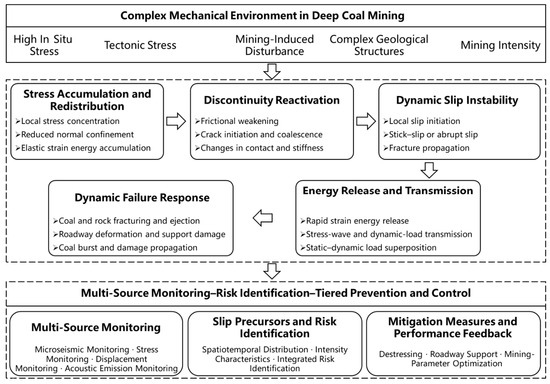
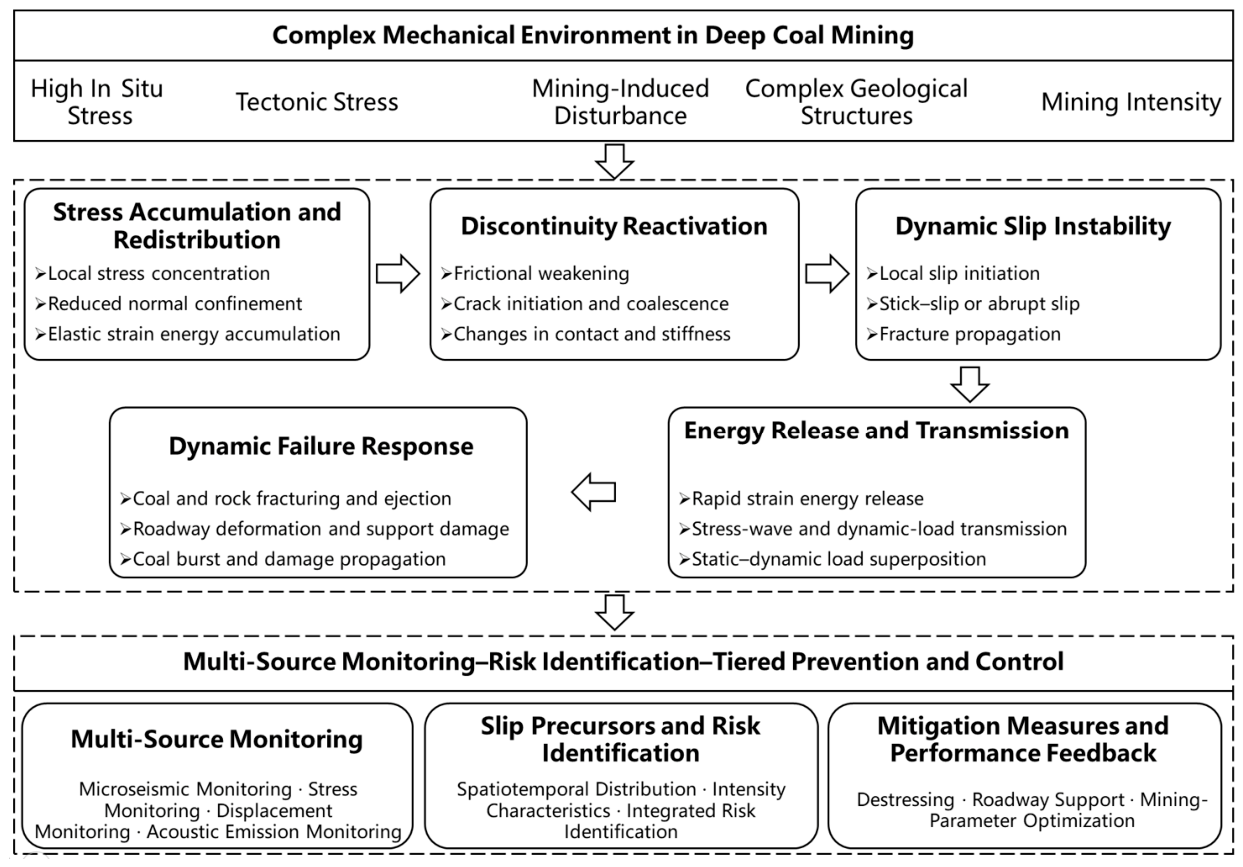
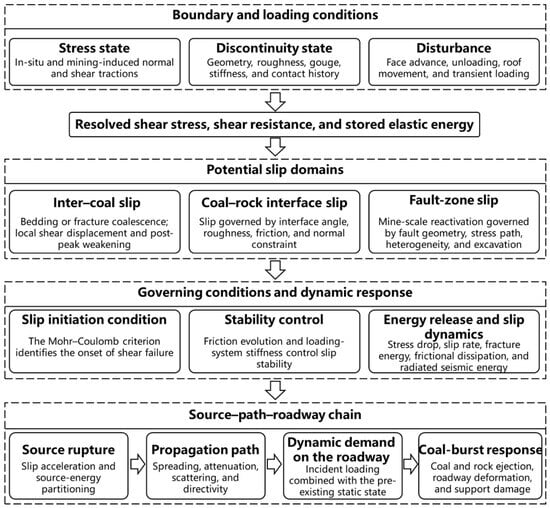
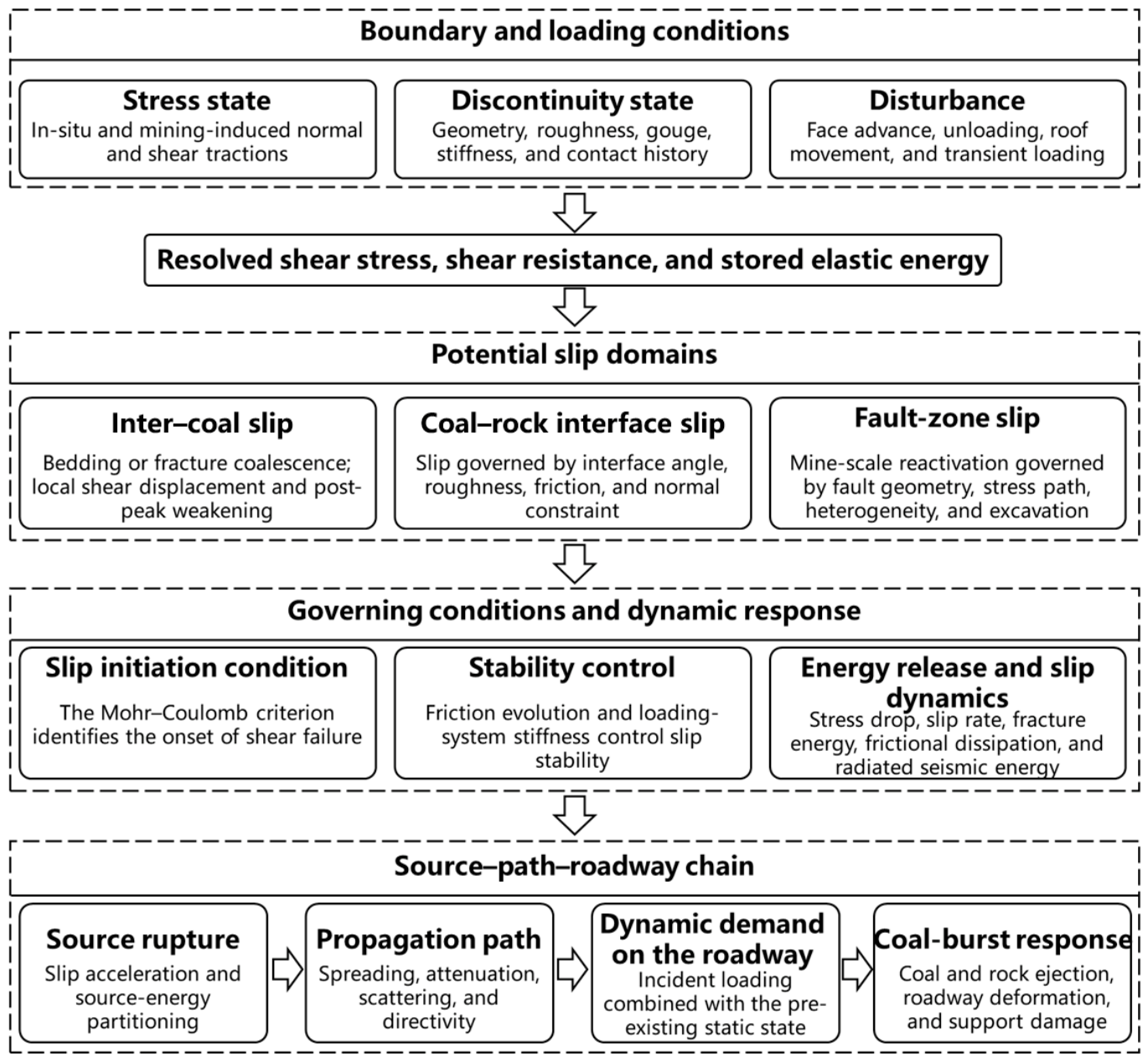
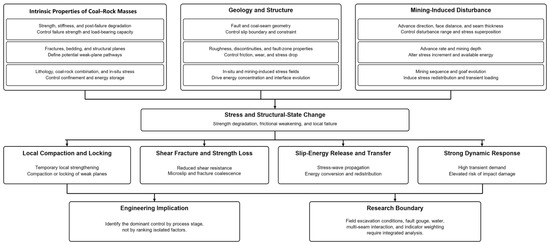
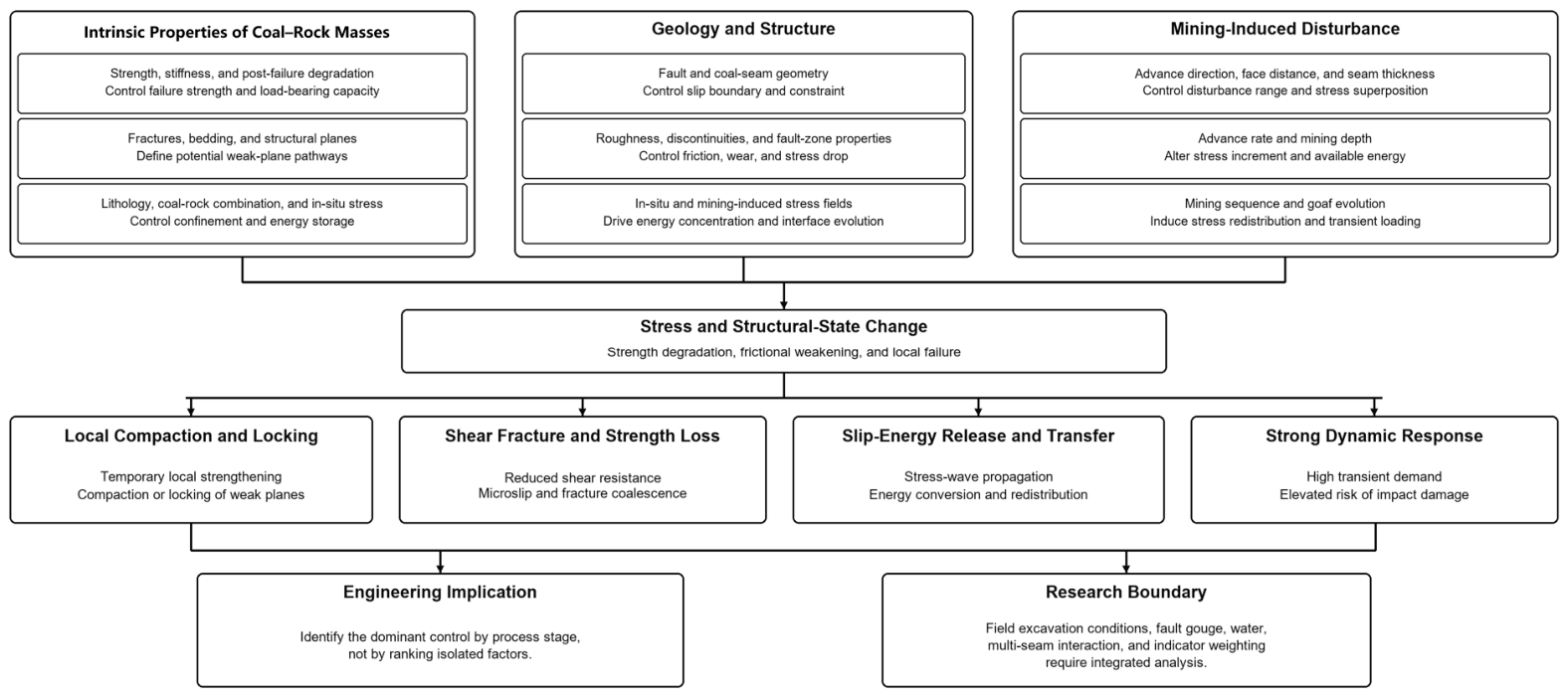
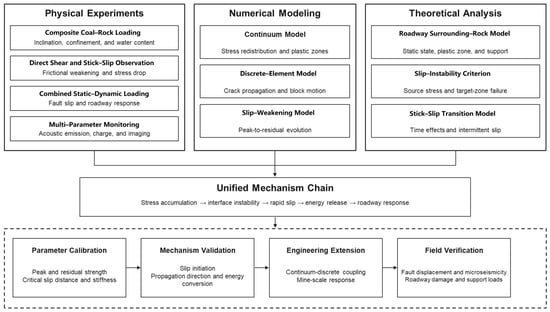
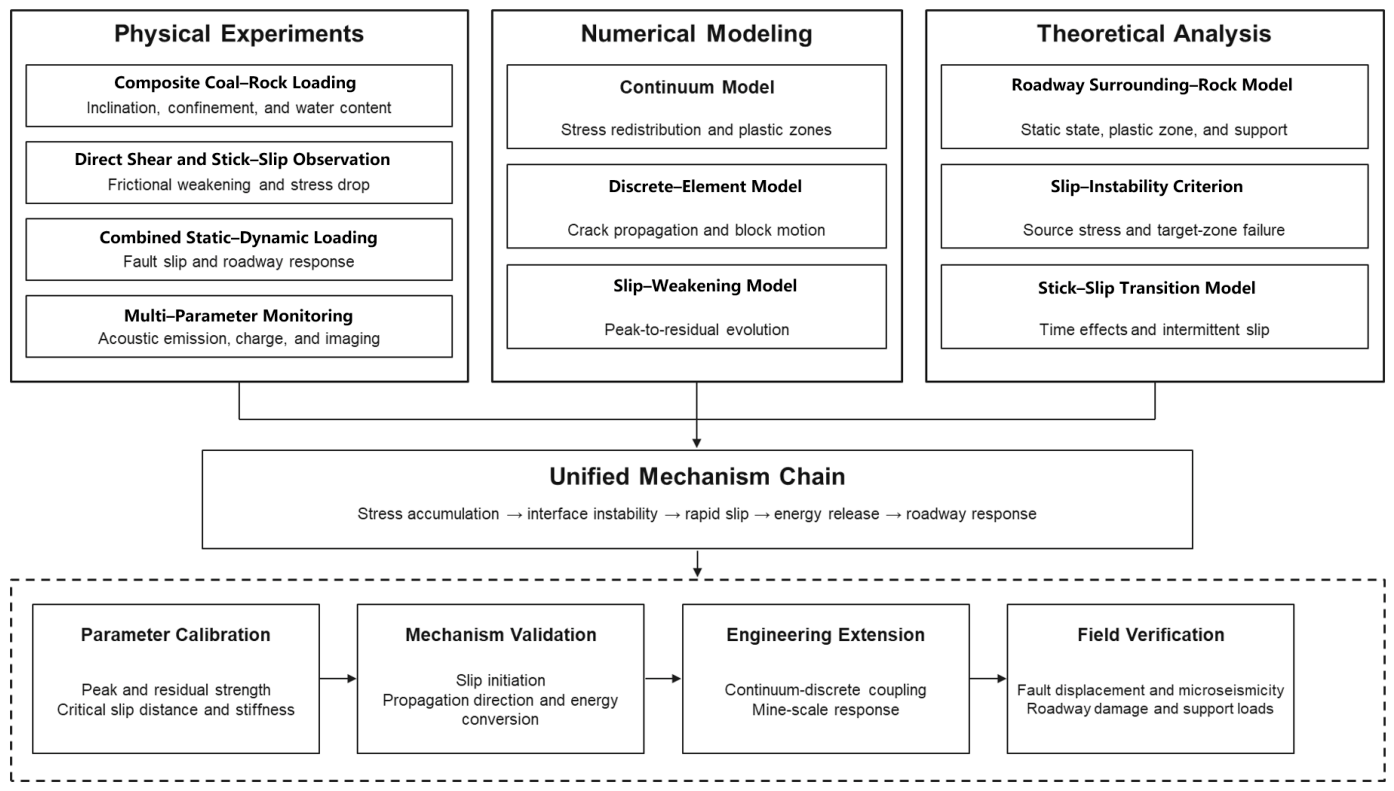
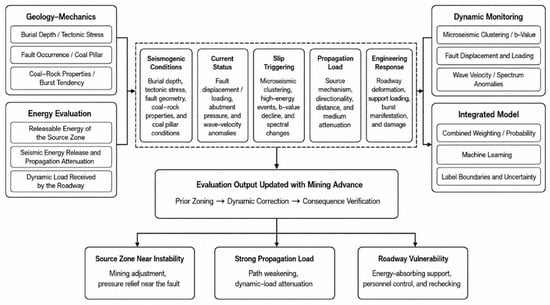
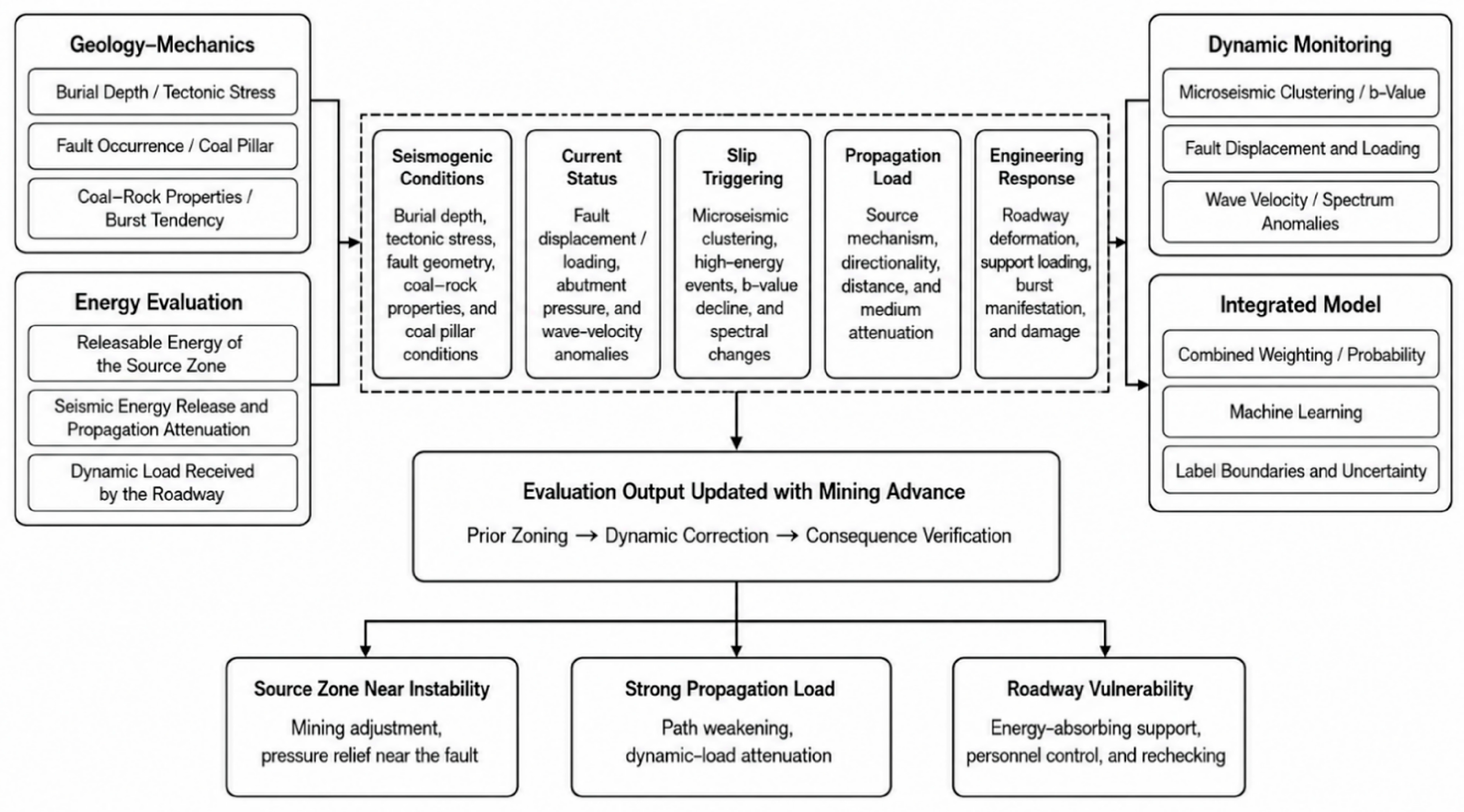
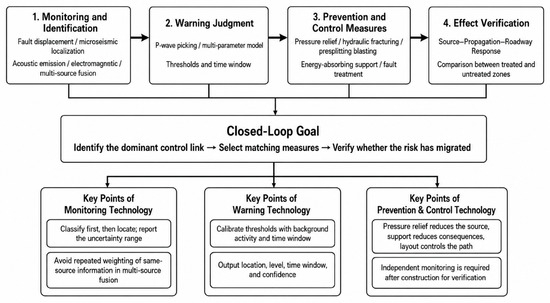
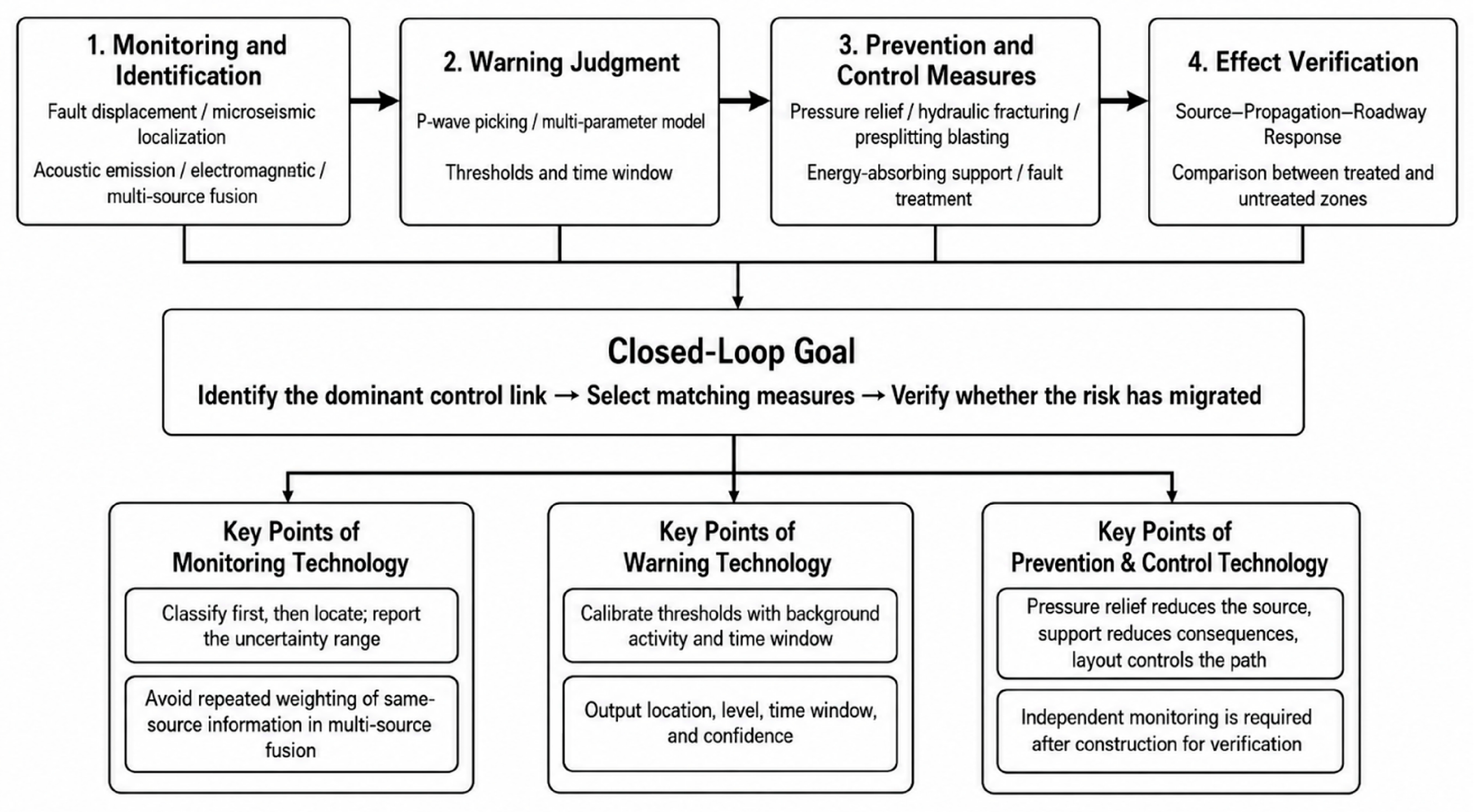

Disclaimer/Publisher’s Note: The statements, opinions and data contained in all publications are solely those of the individual author(s) and contributor(s) and not of MDPI and/or the editor(s). MDPI and/or the editor(s) disclaim responsibility for any injury to people or property resulting from any ideas, methods, instructions or products referred to in the content. |
© 2026 by the authors. Licensee MDPI, Basel, Switzerland. This article is an open access article distributed under the terms and conditions of the Creative Commons Attribution (CC BY) license.