You are currently viewing a new version of our website. To view the old version click .

Geosciences, Volume 12, Issue 1

January 2022 - 45 articles

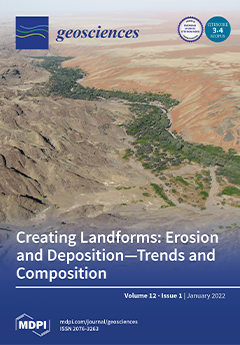
Cover Story: Landform series and their sedimentary deposits are the result of aeolian, mass wasting, cryogenic, fluvial, coastal–marine and lacustrine processes. The mapping of landforms and illustrating the trends and composition of their sedimentary deposits are tools to describe and numerically constrain the land-forming processes and the physical–chemical regime of formation (Eh and pH). Climate zonation and crustal maturity are the exogenous and endogenous “drivers”. This approach bridges the gap between a review and a hybrid manual fed by data generated by field work devoted to applied geosciences in extractive and environmental geology (“E & E issue”). View this paper.
  • Issues are regarded as officially published after their release is announced to the table of contents alert mailing list .
  • You may sign up for email alerts to receive table of contents of newly released issues.
  • PDF is the official format for papers published in both, html and pdf forms. To view the papers in pdf format, click on the "PDF Full-text" link, and use the free Adobe Reader to open them.

Articles (45)

  • Article
  • Open Access
6 Citations
2,827 Views
17 Pages

Past earthquakes have highlighted the seismic vulnerability of prefabricated industrial sheds typical of past Italian building practices. Such buildings typically exhibited rigid collapse mechanisms due to the absence of rigid links between columns,...

  • Article
  • Open Access
7 Citations
9,235 Views
59 Pages

In this study, six basic Quaternary landform series (LFS) and their sedimentary deposits (LFS1 aeolian, LFS 2.1 to 2.2 mass wasting, LFS 3 cryogenic-glacial, LFS 4.1 to 4.6 fluvial, LFS 5.1 to 5.2 coastal-marine, LFS 6.1 to 6.3 lacustrine) are subdiv...

  • Review
  • Open Access
7 Citations
4,188 Views
23 Pages

The origin of the man on Earth is directly associated with the determination of directions of the flow distribution of the ancient man dispersal to adjacent territories. In such studies, mainly landscape and climatological changes are traditionally c...

  • Article
  • Open Access
20 Citations
5,204 Views
24 Pages

Planktonic foraminifera are one of the most stratigraphically important groups of organisms for the Cretaceous system. However, standard foraminiferal zonations based mostly on species from the Tethyan bioprovince are hardly applicable in temperate r...

  • Article
  • Open Access
6 Citations
4,164 Views
31 Pages

Geochemistry of Sub-Depositional Environments in Estuarine Sediments: Development of an Approach to Predict Palaeo-Environments from Holocene Cores

  • Dahiru D. Muhammed,
  • Naboth Simon,
  • James E. P. Utley,
  • Iris T. E. Verhagen,
  • Robert A. Duller,
  • Joshua Griffiths,
  • Luke J. Wooldridge and
  • Richard H. Worden

In the quest to use modern analogues to understand clay mineral distribution patterns to better predict clay mineral occurrence in ancient and deeply buried sandstones, it has been necessary to define palaeo sub-environments from cores through modern...

  • Article
  • Open Access
22 Citations
4,323 Views
18 Pages

Well placement in a given geological setting for a fractured geothermal reservoir is necessary for enhanced geothermal operations. High computational cost associated with the framework of fully coupled thermo-hydraulic-mechanical (THM) processes in a...

  • Article
  • Open Access
2 Citations
3,937 Views
28 Pages

Wildfires and Monsoons: Cryptic Drivers for Highly Variable Provenance Signals within a Carboniferous Fluvial System

  • Bébhinn Anders,
  • Shane Tyrrell,
  • David Chew,
  • Gary O’Sullivan,
  • Chris Mark,
  • John Graham,
  • Eszter Badenszki and
  • John Murray

Sediment delivery and supply are explicitly controlled by variations in broad-scale processes such as climate, tectonics and eustasy. These in turn influence fluvial processes and hinterland evolution. A bespoke multi-proxy approach (integrating apat...

  • Article
  • Open Access
4 Citations
3,443 Views
13 Pages

The geoPebble System: Design and Implementation of a Wireless Sensor Network of GPS-Enabled Seismic Sensors for the Study of Glaciers and Ice Sheets

  • Sridhar Anandakrishnan,
  • Sven G. Bilén,
  • Julio V. Urbina,
  • Randall G. Bock,
  • Peter G. Burkett and
  • Joseph P. Portelli

The geoPebble system is a network of wirelessly interconnected seismic and GPS sensor nodes with geophysical sensing capabilities for the study of ice sheets in Antarctica and Greenland, as well as mountain glaciers. We describe our design methodolog...

  • Article
  • Open Access
15 Citations
4,801 Views
12 Pages

Landslide Susceptibility Analysis by Applying TRIGRS to a Reliable Geotechnical Slope Model

  • Mariantonietta Ciurleo,
  • Settimio Ferlisi,
  • Vito Foresta,
  • Maria Clorinda Mandaglio and
  • Nicola Moraci

This paper presents the results of a research aimed at analysing the susceptibility to shallow landslides of a study area in the Calabria region (Southern Italy). These shallow landslides, which in some cases evolve as debris flows, periodically affe...

  • Article
  • Open Access
11 Citations
4,068 Views
18 Pages

Along the Baltic coastline of Germany, drifting vegetation and beach cast create overlays at the otherwise sandy or stony beaches. These overlays influence the morphodynamics and structures of the beaches. To better understand the influence of these...

of 5

Get Alerted

Add your email address to receive forthcoming issues of this journal.

XFacebookLinkedIn
Geosciences - ISSN 2076-3263