


Simple Summary
Roughage quality affects ruminant health and production. Sugarcane and elephant grass are two common C4 plants in Guangxi, China, with different water-soluble carbohydrate (WSC) contents. This study compared sugarcane silage (WSS) and elephant grass silage (EGS) in buffaloes. WSS had better fermentation quality and a higher abundance of potential probiotics, but lower dry matter and organic matter digestibility. In contrast, EGS showed higher nutrient digestibility and lower feed conversion rate, though it contained potentially harmful bacteria. These findings provide a scientific basis for selecting C4 roughage with different WSC contents to improve feed utilization in buffaloes.
Abstract
Water-soluble carbohydrate (WSC) is the key to producing quality forage silage and an important energy source for ruminants. The aim of this study was to investigate the effect of different silages used as roughage sources [whole-plant sugarcane silage (WSS) vs. elephant grass silage (EGS)] with varying levels of WSC on silage quality, buffalo growth performance, apparent digestibility, rumen fermentation, and microbial communities. Sixteen healthy male crossbred buffaloes were randomly divided into two treatment groups, with eight buffaloes/treatment. One group was fed whole-plant sugarcane silage, and the other group was fed elephant grass silage. Compared with EGS, WSS had higher WSC, lactic acid, and ethanol, but lower pH, ammonia nitrogen, propionic acid, and butyric acid (BA) contents (p < 0.05). Potential probiotics (e.g., Lactiplantibacillus and Hanseniaspora) were more abundant in WSS than in EGS (p < 0.05). Moreover, the feed conversion rate was higher in HWS (p < 0.05). However, rumen fermentation parameters were unaffected by diet (p > 0.05). Moreover, feeding WSS had lower dry matter digestibility (DMD), organic matter digestibility (OMD), and lower acid detergent fiber digestibility (ADFD) (p < 0.05). After WSS feeding, ruminal Treponema_2 was strongly associated with DMD, OMD, and ADFD (p < 0.05), and also showed positive correlations with BA and PA contents in WSS (p < 0.05). Additionally, rumen Ruminiclostridium_5 and Pseudozyma was associated with DMD and ADFD after being fed EGS (p > 0.05), respectively, but the Pseudozyma was associated with BA (p < 0.05) and Clostridium_sensu_stricto_11 (p > 0.05) in EGS. Our findings indicated that WSS exhibited superior fermentation quality and harbored potential beneficial microbes, whereas EGS showed higher apparent nutrient digestibility in buffalo but also contained undesirable bacteria (e.g., Clostridium_sensu_stricto_11). Future research should investigate the long-term effects of WSS feeding on buffalo health, immunity, and production performance, as well as its impact on rumen microbiota stability, to fully assess its potential as a safe and sustainable roughage source.
1. Introduction
Water buffaloes (Bubalus bubalis) efficiently utilize fibrous feeds [1]. China has the third largest number of water buffalo in the world, with approximately 23 million, and Guangxi, China, is the province with the largest number of water buffalo [2]. Guangxi’s climate is mainly subtropical monsoon, which is very suitable for the planting or growth of C4 forage [3]. Sugarcane (Saccharum officinarum L.) is widely cultivated as a cash crop in Guangxi, China, with a yield exceeding 70 million tons, primarily used for sugar production [4]. However, due to factors such as management methods and climate conditions, some sugarcane is of lower quality and unsuitable for sugar production [5]. This type of sugarcane can be considered for development as animal feed to achieve resource utilization [6]. Elephant grass (Pennisetum purpureum) is also widely distributed in Guangxi [4] and is a low-cost roughage. Silage is a common method for producing high-quality roughage in livestock, and its quality is significantly affected by the water-soluble carbohydrate (WSC) content of the raw materials. Sugarcane is rich in WSC, whereas elephant grass is low in WSC. Cavali et al. [7] compared the natural silage fermentation quality of sugarcane and elephant grass in a preliminary study and found that sugarcane silage had high WSCs, lactic acid (LA), or acetic acid (AA), low fiber content, and no butyric acid (BA), whereas elephant grass silage with low WSC content had propionic acid (PA), butyric acid (BA), low ethanol content and dry matter (DM) digestibility. However, it is not clear what the difference is in the silage quality between elephant grass and the low-quality sugarcane in Guangxi after ensiling. In addition, the core communities of bacteria and fungi need to be analyzed to identify the taxa causing differences in quality between the two silages, which will serve as a reference for the subsequent regulation of silage quality [8]. A recent study has shown that microorganisms (e.g., Lactobacillus) and metabolites (e.g., PA and BA) in silage have a positive impact on the metabolites and microorganisms present in the rumen [9].
Carbohydrates are the main source of energy in ruminants, and forage silages with differences in WSC content will have different effects when fed to ruminants. For example, forage silage with low-WSC content (e.g., elephant grass) can promote rumen microbial activity and enhance cellulose digestibility [10,11,12]. Compared with forage silage with low WSC content, forage silage with high WSC content may also increase palatability and nutrient digestibility, thereby improving intake and daily gain in ruminants. However, an increase in WSC content in forage silage leads to a decrease in rumen pH, which in turn reduces the activity of fiber-degrading bacteria and the rate of fiber degradation [13,14,15]. As a result, the residence time of chyme in the rumen increases, and animal feed intake is ultimately inhibited [16,17]. Moreover, forage silage with high WSC content can promote the synthesis of microbial protein and decrease ruminal NH3-N [18]. In addition, forage silage with high WSC content can increase the production of ruminal volatile fatty acids (VFAs), such as propionic acid (PA) [10,19]. Water buffalo, which play a vital role in agricultural production, have their production performance and health directly influenced by nutritional management [20]; however, the application of high-WSC roughage in their diet remains limited due to a lack of systematic data, restricting its broader use in practical farming.
Thus, the aim of the study was to compare the differences in C4 forage (elephant grass vs. sugarcane) silage quality based on low and high WSC contents and assess the effects of the differences in silage quality on growth performance, apparent nutrient digestibility, rumen fermentation, and the microbial community structure of buffaloes. We hypothesized that silage produced from the high-WSC forage sugarcane would have high WSC content, superior fermentation quality, and would be enriched in beneficial bacteria. Thus, when fed to buffaloes, this silage could improve growth performance, regulate the ruminal microbial community to reduce NH3-N, and enhance nutrient digestibility and rumen VFAs production.
2. Materials and Methods
2.1. Silage Preparation
In this experiment, the silage materials were harvested from the forage breeding farm of the Fusui Experimental Base of Guangxi University. The silage materials consisted of whole-plant sugarcane (Guitang No. 34) and elephant grass (Guimu No. 1) harvested at their mature growth stages. Fresh plant samples were crushed to 1–2 cm using a grinder (Model zfd5570, Zheng Feng Machinery Company, Jining, China) and then silaged using the wrapping method of Coblentz and Akins [21]. Chemical composition of the fresh elephant grass and whole-plant sugarcane is shown in Table 1. Ensiled at ambient temperature (24–30 °C) for 55 d, the silages were used to feed water buffaloes. A silage sample (20 g) was added to 180 mL of Ringer’s solution, mixed, and allowed to stand for 30 min at 4 °C. It was then filtered with double-layer gauze, and the filtrate was used to determine microbial communities and fermentation parameters.
Table 1.
Chemical composition of fresh elephant grass and whole-plant sugarcane.
2.2. Experimental Design
This study was conducted at the Guangxi Wokun Animal Husbandry Co., Ltd. (Nanning, China). Sixteen crossbred male water buffaloes (Age = 20 ± 2 months, weight = 527.4 ± 34.2 kg, mean ± SD) from the same farm were used in the experiment and were allocated into two groups. The control group was fed the basic diet supplemented with 50% elephant grass silage with low WSC content (LWE, n = 8), and the treatment group was fed the basic diet supplemented with 50% sugarcane silage with high WSC content (HWS, n = 8). Diet ingredients and nutrient levels are shown in Table 2.
Table 2.
Ingredients and chemical composition of experimental diets for water buffaloes based on 50% elephant grass silage (LWE) or 50% whole-plant sugarcane silage (HWS) (g/kg, on DM basis).
The buffaloes were raised in sheds and fed each day at 0800 and 1600 during the experiment, with free access to food and water. The experiment lasted 46 d, consisting of 6 d of adaptation to the diet, followed by 40 d of experiment. Before and at the end of the experiment, all the buffaloes were weighed, and the live weights were used to calculate the daily body gain in weight. During the last 7 d of the experimental period, the dry matter intake (DMI) of each water buffalo was recorded daily. The feed conversion rate (FCR) was calculated as DMI divided by the average daily gain (ADG).
At the end of the experimental period, fresh fecal samples (200 g wet weight each) were collected from the rectum at 0800 and 1600 on 42 d, 43 d, 44 d, 45d, and 46, respectively. Samples from each animal were pooled for nutrient digestibility determination. Feed samples were collected daily during this period and stored at −20 °C for subsequent analysis. Apparent whole digestive tract nutrient digestibility was calculated using acid-insoluble ash as an internal standard, based on the concentration of acid-insoluble ash in the diet and feces.
Before the morning feeding on the last day of the experiment, seven water buffaloes were selected from each group for rumen fluid collection. Rumen fluid was collected by an oral stomach tube according to the method of Shen et al. [22]. The first 20 mL of rumen fluid was discarded, and then, 100 mL was extracted and divided into two parts: one part was frozen at –80 °C for determination of rumen microbial communities, and the other part was frozen at –20 °C for determination of NH3-N and VFAs, respectively. The pH was measured immediately.
2.3. Chemical Analysis
Samples (200 g) of forage silage, feed, and faces were analyzed for DM according to method 942.04 of AOAC [23]. After determination of DM, the samples were crushed with a grinder until they passed through a 40-mesh sieve and then used for determination of chemical composition and gross energy. Crude protein (CP) was determined using a Gerhardt fully automatic Kjeldahl nitrogen analyzer (method 988.05; K-375, Buchi, Uster, Switzerland) [23]. The method for determining crude ash is to ignite it in a muffle furnace at 550 °C for 4 h. The method for AIA is to treat the crude ash with hydrochloric acid and then ignite it again to constant weight. Water-soluble carbohydrates (WSCs) were determined using a sulfuric acid–anthrone colorimetric method [24]. Neutral detergent fiber (NDF) and acid detergent fiber (ADF) were determined by an Ankom-Fibre analyser 200i (ANKOM-Technology, Fairport, NY, USA) according to the method of Van Soest et al., with heat-stable alpha-amylase and sodium sulfite used in the NDF procedure [25]. Hemicellulose was calculated as the difference between NDF and ADF. Gross energy (GE) was determined using a Sundy SDC5015 oxygen bomb calorimeter (Hunan Sande Science and Technology Co., Ltd., Changsha, China). The following equation was used to calculate dry matter (DM) digestibility:
DM digestibility (%) = 100 − 100 × (AIAdiet/AIAfeces).
Apparent digestibility of other nutrients was then computed using the following equation:
Apparent nutrient digestibility (%) = 100 − (AIAdiet/AIAfaces) × (Nutrientfaces/Nutrientdiet) × 100
In which Nutrientdiet and Nutrientfaces represent the OM, CP, NDF, ADF, and GE concentrations in the diet and feces, respectively (on a DM basis).
According to the methods described by Gu et al. [8], the filtrates from silage were serially diluted for microbial counts (from 10–1 to 10–6). Lactic acid bacteria (LAB) were grown on De Man, Rogosa, and Sharpe agar (MRS, Beijing Land Bridge Technology, Beijing, China) and incubated at 35 °C for 48 h in an anaerobic incubator. Yeasts and molds were counted on potato dextrose agar (Beijing Land Bridge Technology) at 25 °C for 72 h. The number of enterobacteria (EB) was counted on violet-red bile agar (Beijing Land Bridge Technology) at 37 °C for 48 h.
2.4. Fermentation Index
The pH of the silage samples and rumen fluid was measured using a pH meter (Model DELTA 320, Mettler-Toledo Instrument Co. Ltd., Shanghai, China). The NH3-N in silage samples and rumen fluid was determined by a phenol–hypochlorite reaction method [26]. Volatile fatty acids (AA, PA, and BA) of silage samples and rumen fluid were determined using an Agilent-7890A gas chromatograph equipped with an HP-INNOwax capillary column (30.0 m × 0.320 µm × 0.50 µm, Agilent Technologies, Santa Clara, CA, USA) and a flame ionization detector. Briefly, at the time of sample injection, the injection volume was 1 µL, nitrogen was used as the carrier gas, and the temperature was increased from 60 °C to 200 °C at a rate of 20 °C/min, and then held at 200 °C for 3 min. The inlet and detector temperatures were 250 °C and 300 °C, respectively, and the split ratio was 10:1. The flow rate of hydrogen carrier gas was 25 mL/min.
2.5. DNA Extraction
The total DNA of each silage sample (20 g) and ruminal fluid sample (20 g) was extracted using an E.Z.N.A.® Stool DNA Kit (Omega Biotek, Norcross, GA, USA) according to the manufacturer’s instructions. The integrity of extracted DNA was checked by 1% agarose gel electrophoresis, and DNA concentration and purity were determined with a NanoDrop 2000 UV-vis spectrophotometer (Thermo Scientific, Wilmington, DE, USA).
2.6. High-Throughput Sequencing
The extracted microbial DNA was sent to Shanghai Lingen Biotechnology Co., Ltd. (Shanghai, China) for 16S rRNA and ITS1 gene amplification. For the bacterial community, the V3-V4 region of the 16S rRNA gene was amplified using the universal bacterial primers 341F (CCTAYGGGRBGCASCAG) and 806R (GGACTACHVGGGTWTCTAAT). For the fungal community, the primers ITS5-1737F (GGAAGTAAAAGTCGTAACAAGG) and ITS2-2043R (GCTGCGTTCTTCATCGATGC) were used to amplify the fungal ITS1 region. The PCR products were mixed in equimolar ratio and purified by using a QIAquick Gel Extraction Kit (Qiagen, Dusseldorf, Germany). All PCR mixtures contained 15 μL of Phusion High-Fidelity PCR Master Mix (Thermo Fisher, Waltham, MA, USA), 0.2 μM primers, and 10 ng of genomic DNA template. The first denaturation was performed at 98 °C for 1 min, followed by 30 cycles at 98 °C (10 s), 50 °C (30 s), and 72 °C (30 s), and then finally maintained at 72 °C for 5 min. The sequence library was constructed with a TruSeq® DNA PCR-Free Sample Preparation Kit (Illumina Inc., San Diego, CA, USA), and sequencing was performed using the Illumina NovaSeq 6000 platform (Illumina Inc., San Diego, CA, USA).
2.7. Analysis of Microbial Diversity
Uparse software (v7.0.1001, http://drive5.com/uparse/, accessed on 5 May 2024) was used to cluster sequences of valid sample data at 97% similarity to form operational taxonomic units (OTUs) [27]. The Silva (http://www.arb-silva.de/, accessed on 10 May 2024) and UNITE databases (https://unite.ut.ee/, accessed on 12 May 2024) were used to annotate the bacterial and fungal sequencing data, respectively, to obtain taxonomic information and calculate the community composition of each sample at each taxonomic level (i.e., kingdom, phylum, class, order, family, genus, and species). The alpha diversity indices, observed species, Shannon’s, and Simpson’s, were calculated using Qiime 2 software (v2024.10) [28]. Linear discriminant analysis effect size (LEfSe) software (v1.0) was employed to compare differences in bacterial and fungal communities between groups [8]. The key microbial taxa were selected for Spearman correlation analysis with rumen fermentation parameters based on the LEfSe analysis. The microbial community structure, alpha diversity, and the correlation matrix between key microbial taxa and rumen fermentation parameters were drawn using the “ggpolt2” package in RStudio (v4.0.3) [28].
2.8. Statistical Analyses
Data were analyzed with SPSS 19.0 (SPSS Inc., Chicago, IL, USA), and Student’s t-test was used to identify significant differences between treatment means, with p < 0.05 considered significant and 0.05 ≤ p < 0.10 indicating a tendency.
3. Results
3.1. Chemical Composition and Fermentation Quality of Silage
The CP and WSC contents in WSS were significantly higher than those in EGS (p < 0.05; Table 3), whereas the DM content was significantly lower in WSS (p < 0.05). The NDF, ADF, and hemicellulose contents were not significantly different between WSS and EGS (p > 0.05). In addition, EB counts in WSS were significantly higher than those in EGS (p < 0.05), but yeast counts in WSS were significantly lower than those in EGS (p < 0.05), although those counts were less than 4.0 log colony-forming units (CFU)/g fresh matter (FM). The pH, PA, and BA contents were significantly higher in EGS (p < 0.05), while LA and ethanol contents were significantly lower in EGS (p < 0.05).
Table 3.
Chemical composition and fermentation quality of elephant grass silage (EGS) and whole-plant sugarcane silage (WSS).
3.2. Alpha Diversity of Silage Microbial Communities
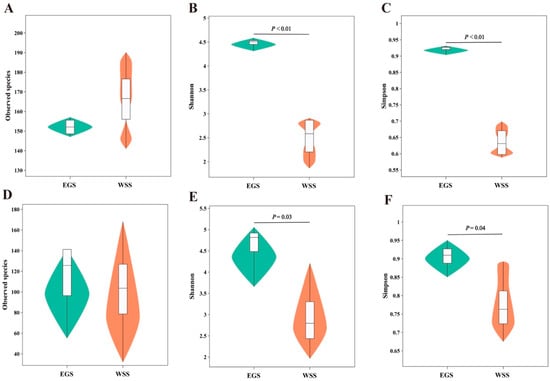
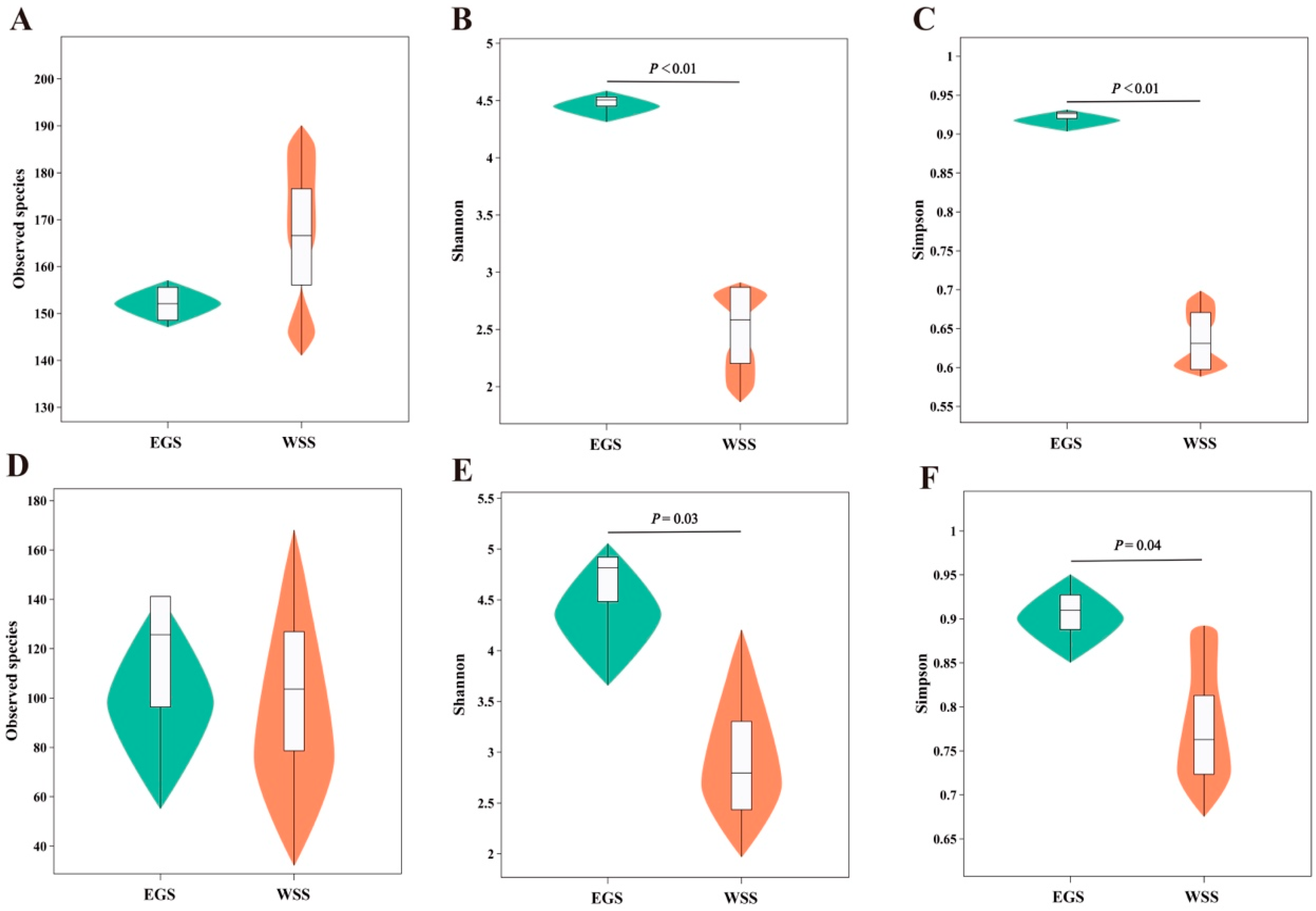
Bacterial and fungal alpha diversity indices are shown Figure 1. The observed species of the silage bacteria (Figure 1A) and fungi (Figure 1D) were not significantly different between EGS and WSS. However, the Shannon and Simpson indices of silage bacteria (Figure 1B,C) and fungi (Figure 1E,F) were significantly higher in EGS than in WSS (p < 0.05). Moreover, the library coverage of bacteria and fungi in all samples from the two silages was greater than 99% (Table S1).
Figure 1.
Alpha diversity indices of (A–C) bacterial and (D–F) fungal communities in elephant grass silage (EGS) and whole-plant sugarcane silage (WSS). The central box indicates the interquartile range; the thin black line represents the 95% confidence interval; the black horizontal line within each box is the median; and the outer shape indicates the density of the data distribution. p < 0.05 is considered statistically significant.
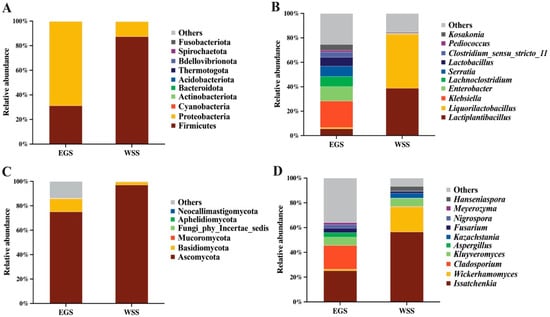
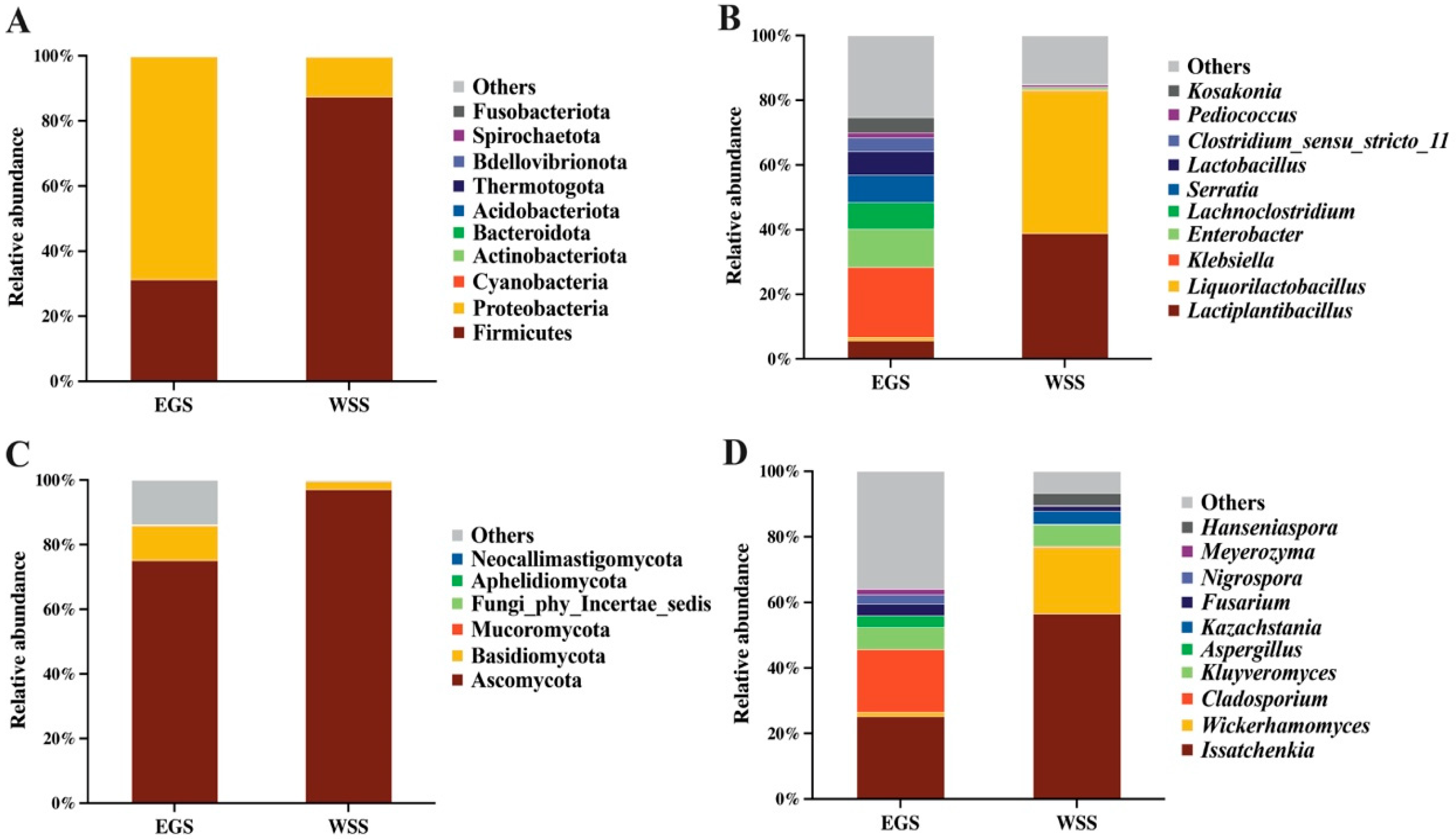
The relative abundances of phyla and genera of silage bacteria are shown in Figure 2A,B. The two most abundant phyla in both groups were Firmicutes (EGS = 31.22%, WSS = 87.37%) and Proteobacteria (EGS = 68.56%, WSS = 12.22%) (Figure 2A). The two most abundant genera in EGS were Klebsiella (21.68%) and Enterobacter (11.88%), whereas in WSS, Lactiplantibacillus (38.78%) and Liquorilactobacillus (44.24%) were the two most abundant genera (Figure 2B). The relative abundances of phyla and genera of silage fungi are shown in Figure 2C,D. The two most abundant phyla in both groups were Ascomycota (EGS = 75.12%, WSS = 97.04%) and Basidiomycota (EGS = 10.79%, WSS = 2.55%) (Figure 2C). The two most abundant genera in EGS were Issatchenkia (29.21%) and Cladosporium (19.15%), whereas in WSS, Issatchenkia (56.54%) and Wickerhamomyces (20.30%) were the two most abundant genera (Figure 2D).
Figure 2.
Relative abundances of bacterial (A,B) and fungal (C,D) phyla and genera of elephant grass silage (EGS) and whole-plant sugarcane silage (WSS).
3.3. Analysis of Variation in Silage Bacteria and Fungi
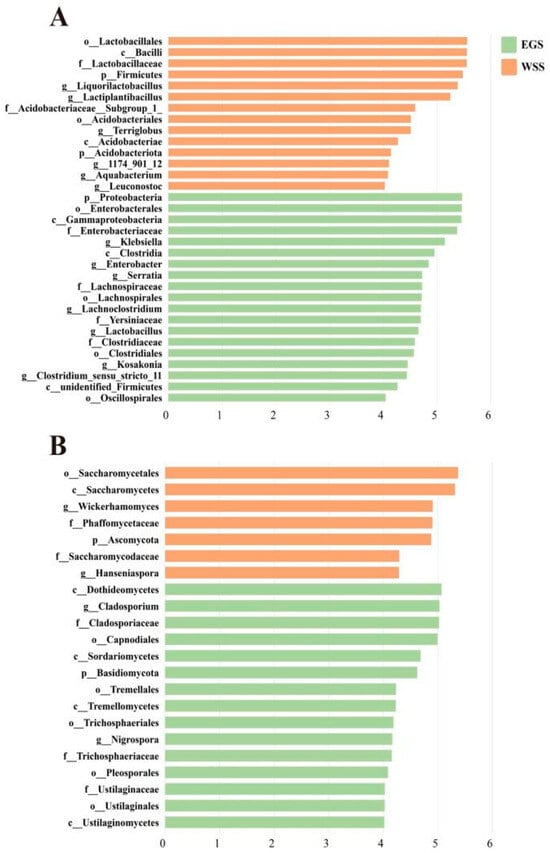
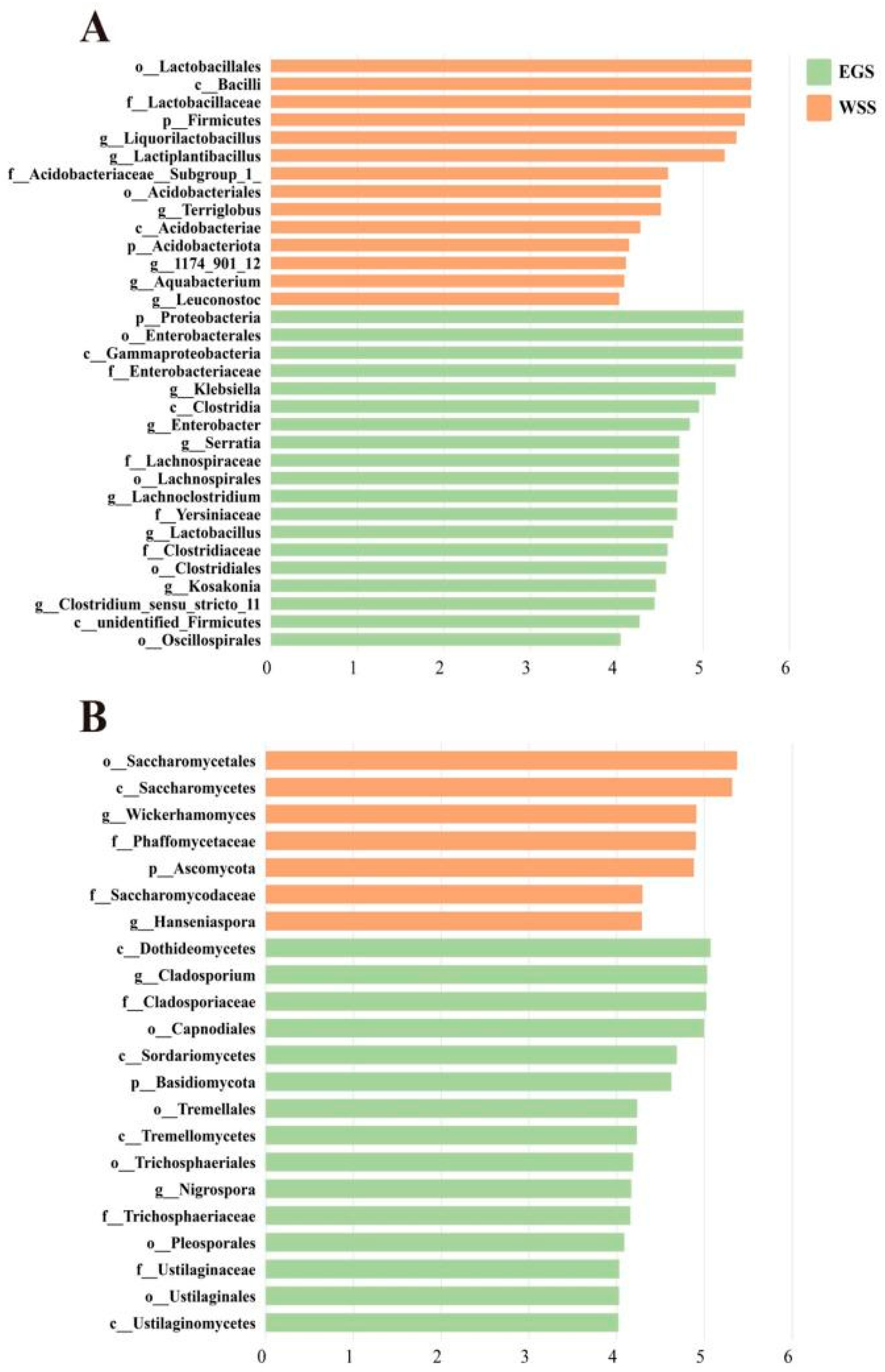
Differences in the bacterial and fungal communities between silages were analyzed using the LEfSe method (Figure 3A,B). The bacterial and fungal taxa with an LDA score > 4 were defined as unique. For bacteria, Lactobacillus, Kosakonia, Serratia, Klebsiella, Enterobacter, Clostridium_sensu_stricto_11, and Lachnoclostridium were more important in EGS than in WSS (Figure 3A), whereas Leuconostoc, Aquabacterium, Lactiplantibacillus, Liquorilactobacillus, and Terriglobus, and 1174_901_12 were more important in WSS than in EGS (Figure 3A). For fungi, Nigrospora and Cladosporium were more important in EGS than in WSS, whereas Hanseniaspora and Wickerhamomyces were more important in WSS than in EGS (Figure 3B).
Figure 3.
Linear discriminant analysis (LDA) effect size (LEfSe) analysis of significantly different taxa of (A) bacteria and (B) fungi in elephant grass silage (EGS) and whole-plant sugarcane silage (WSS). Taxa are ranked by LDA score.
3.4. Feed Intake, Animal Performance, Apparent Nutrient Digestibility, and Rumen Fermentation
The ADG in LWE was higher than that in HWS, with no significant difference (p > 0.05; Table 4). The DMI in LWE was significantly higher than that in HWS (p < 0.05). While, the FCR were significantly higher in HWS than that in LWE (p < 0.05). The DM digestibility (DMD), OM digestibility (OMD), and ADF digestibility (ADFD) were significantly lower in HWS (p < 0.05). The digestibility of CP, NDF, and GE were not significantly different between HWS and LWE (p > 0.05). Ruminal pH and NH3-N, AA, PA, and BA contents were also not significantly different (p > 0.05) between LWE and HWS.
Table 4.
Effects of fed elephant grass silage (LWE) and whole-plant sugarcane silage (HWS) on growth performance, apparent nutrient digestibility, and rumen fermentation of buffaloes.
3.5. Rumen Microbial Diversity and Community
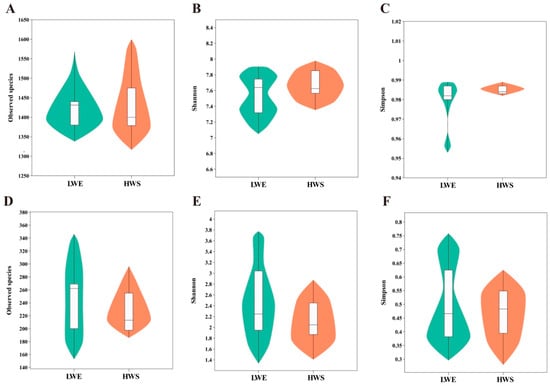
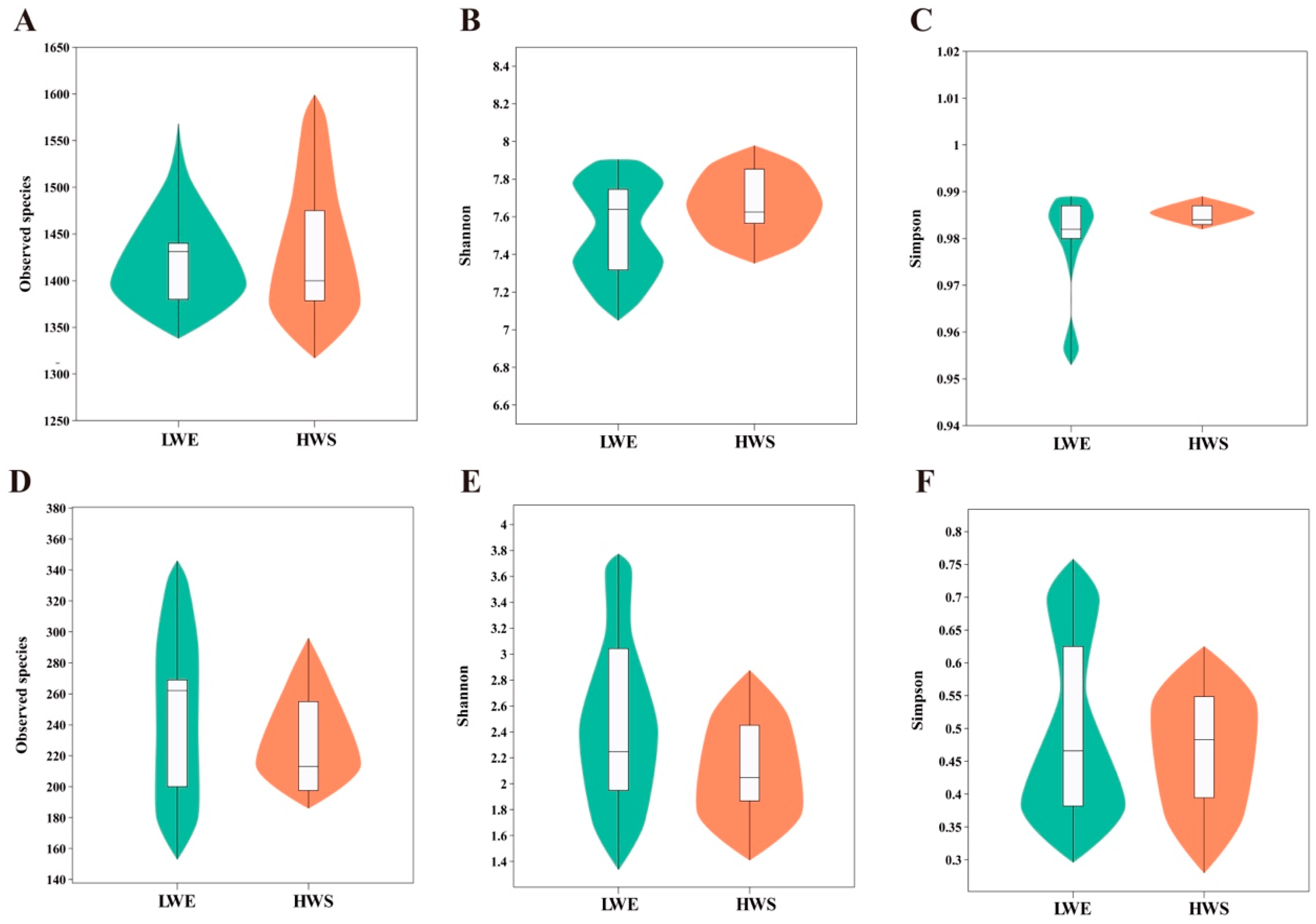
The alpha diversity indices of bacteria (Figure 4A–C) and fungi (Figure 4D–F) of number of observed species, Shannon’s, and Simpson’s in rumen fluid were not significantly different (p > 0.05) between LWE and HWS. The library coverage of bacteria and fungi in all samples from the two groups was greater than 99% (Table S2).
Figure 4.
Alpha diversity indices of (A–C) bacterial and (D–F) fungal communities in the ruminal fluid of water buffaloes fed diets containing elephant grass silage with low WSC content (LWE) or whole-plant sugarcane silage with high WSC content (HWS). The central box indicates the interquartile range; the thin black line represents the 95% confidence interval; the black horizontal line within each box is the median; and the outer shape indicates the density of the data distribution.
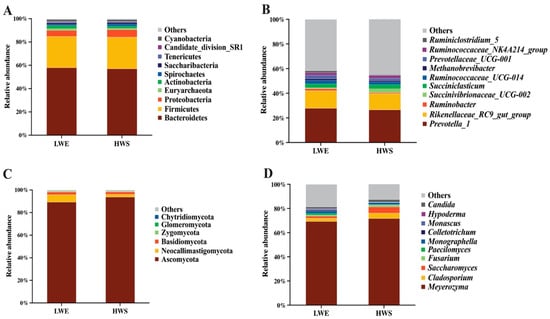
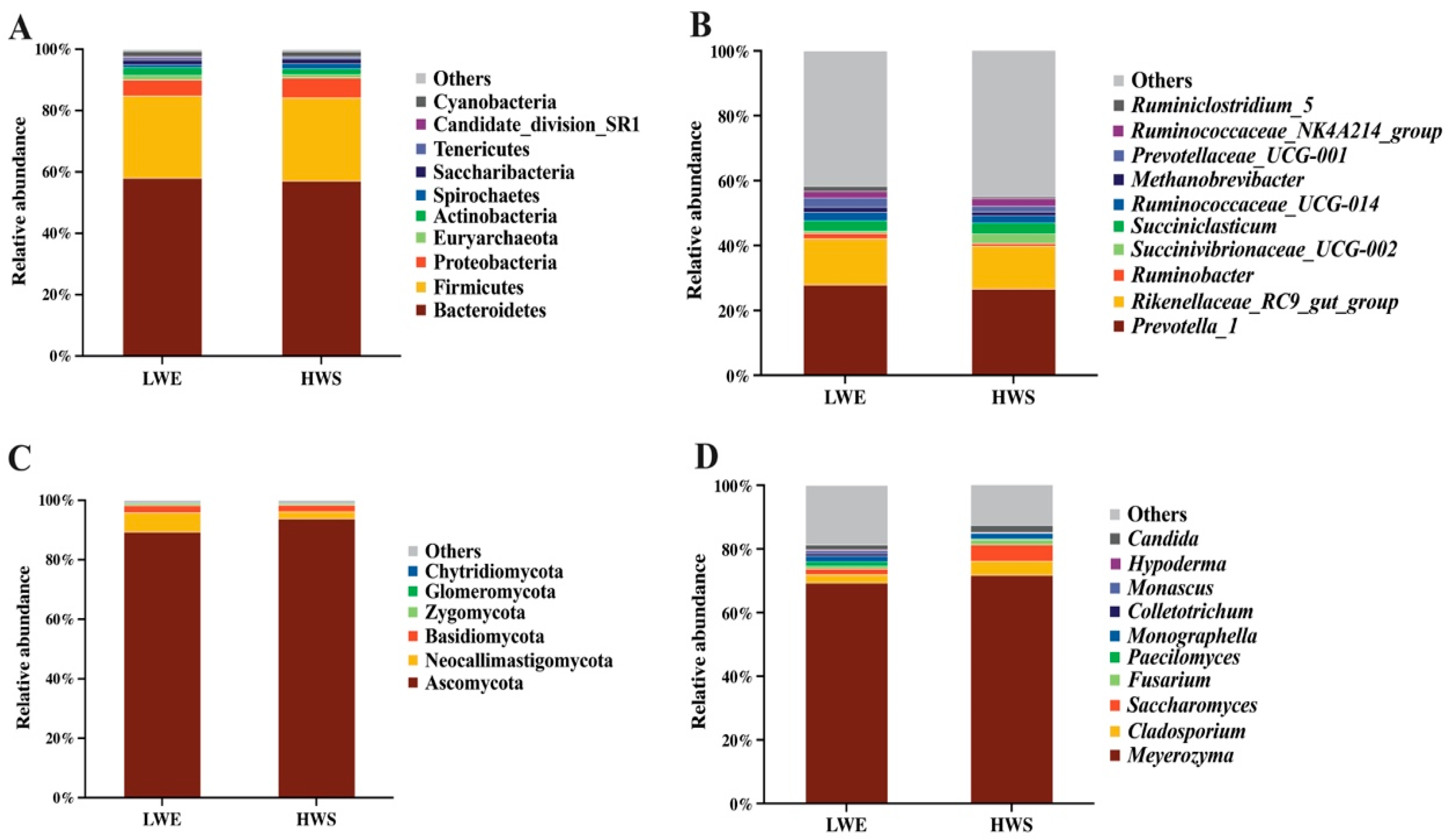
The relative abundances of phyla and genera of bacteria in rumen fluid are shown in Figure 5A,B. In general, feeding forage silage with different WSC content had limited effects on the 10 most abundant phyla and genera of the bacterial community in rumen fluid. The three most abundant phyla were similar in both groups, which were Bacteroidetes (LWE = 57.97%, HWS = 57.07%), Firmicutes (LWE = 26.87%, HWS = 27.19%), and Proteobacteria (LWE = 5.14%, HWS = 6.39%) (Figure 5A). The three most abundant genera were Prevotella 1 (LWE = 26.89%, HWS = 26.63%), Rikenellaceae RC9 gut group (LWE = 14.29%, HWS = 13.26%), and Succiniclasticum (LWE = 3.18%, HWS = 3.38%) (Figure 5B).
Figure 5.
Relative abundances of bacterial (A,B) and fungal (C,D) phyla and genera in the ruminal fluid of water buffaloes fed diets containing elephant grass silage with low WSC content (LWE) or whole-plant sugarcane silage with high WSC content (HWS).
The relative abundances of phyla and genera of fungi in rumen fluid are shown in Figure 5C,D. Feeding forage silage with different WSC content also had limited effects on the 10 most abundant phyla and genera of the fungal community in rumen fluid. The most common phyla in both groups were Ascomycota (LWE = 89.30%, HWS = 93.76%), Neocallimastigomycota (LWE = 6.61%, HWS = 2.51%), and Basidiomycota (LWE = 2.36%, HWS = 2.12%) (Figure 5C). The five most abundant genera were Meyerozyma (LWE = 69.27%, HWS = 71.71%), Cladosporium (LWE = 2.70%, HWS = 4.51%), Saccharomyces (LWE = 1.75%, HWS = 5.09%), Monographella (LWE = 1.84%, HWS = 1.70%), and Candida (LWE = 1.43%, HWS = 2.16%) (Figure 5D).
3.6. Analysis of Variation in Rumen Bacteria and Fungi
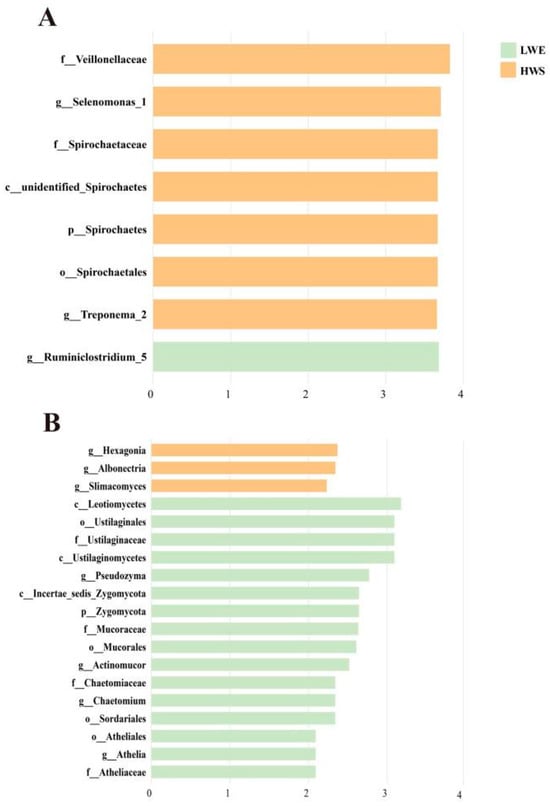
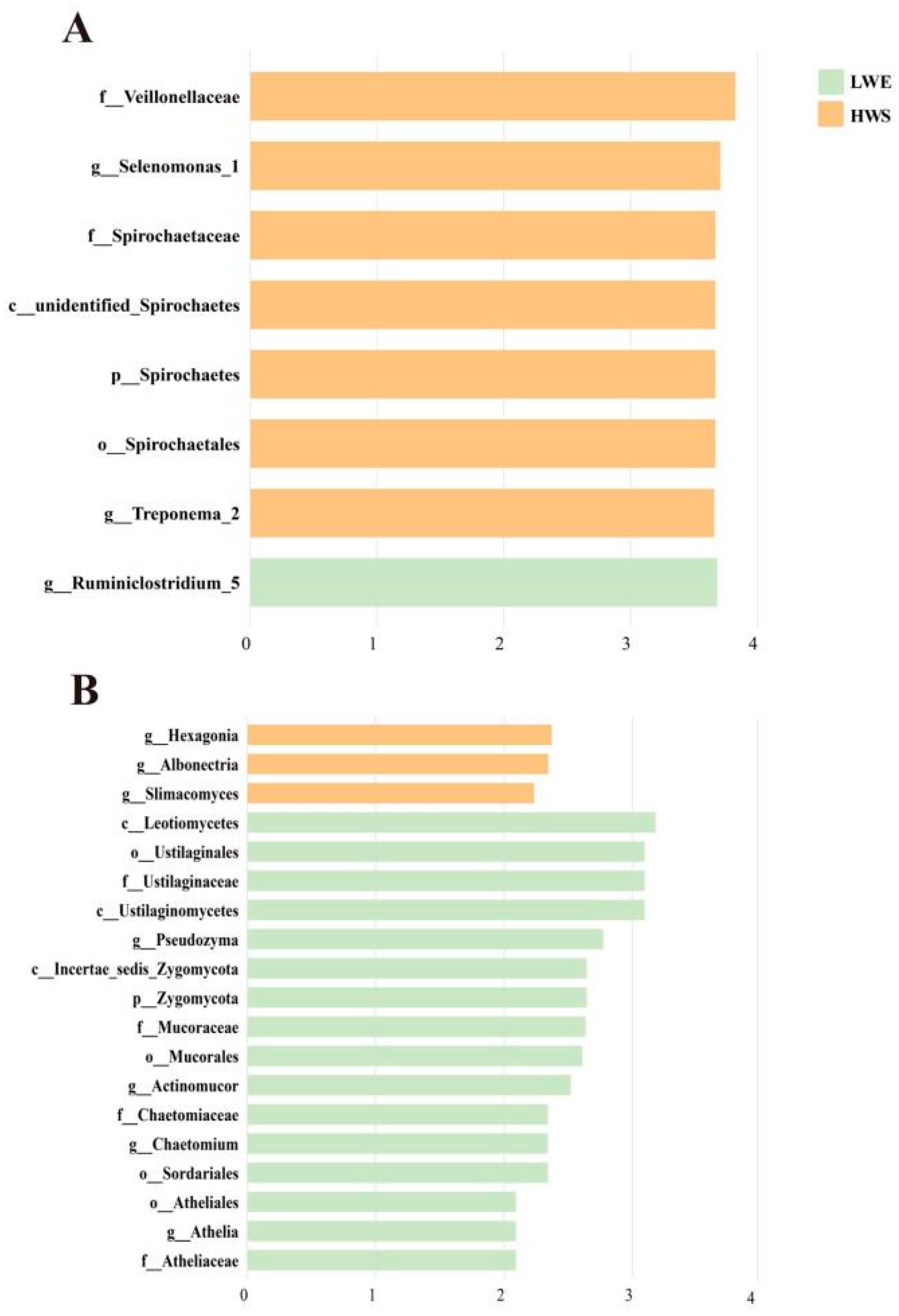
To better understand the dominance of specific bacteria within the two silages, we used LEfSe analysis (Figure 6A). Bacteria with an LDA score > 3 were defined as unique. The genus Ruminiclostridium_5 (p = 0.03) was significantly enriched in LWE, whereas the genera Treponema_2 (p < 0.01) and Selenomonas_1 (p < 0.01) were significantly enriched in HWS, and these bacterial genera had a significant effect on sample grouping.
Figure 6.
Linear discriminant analysis (LDA) effect size (LEfSe) analysis of significantly different taxa of ruminal (A) bacteria and (B) fungi in the ruminal fluid of water buffaloes fed diets containing elephant grass silage with low WSC content (LWE) or whole-plant sugarcane silage with high WSC content (HWS). Taxa are ranked by LDA score.
The dominance of specific fungi within the two silages was also explored by using LEfSe analysis (Figure 6B). Fungi with an LDA score > 2 were defined as unique. The genera Athelia (p < 0.01), Chaetomium (p = 0.05), Actinomucor (p < 0.01), and Pseudozyma (p = 0.03) were significantly enriched in LWE, whereas Slimacomyces (p = 0.01), Albonectria (p = 0.02), and Hexagonia (p = 0.03) were significantly enriched in HWS, and these fungal genera had a significant effect on sample grouping.
3.7. Mantel Correlation Analysis
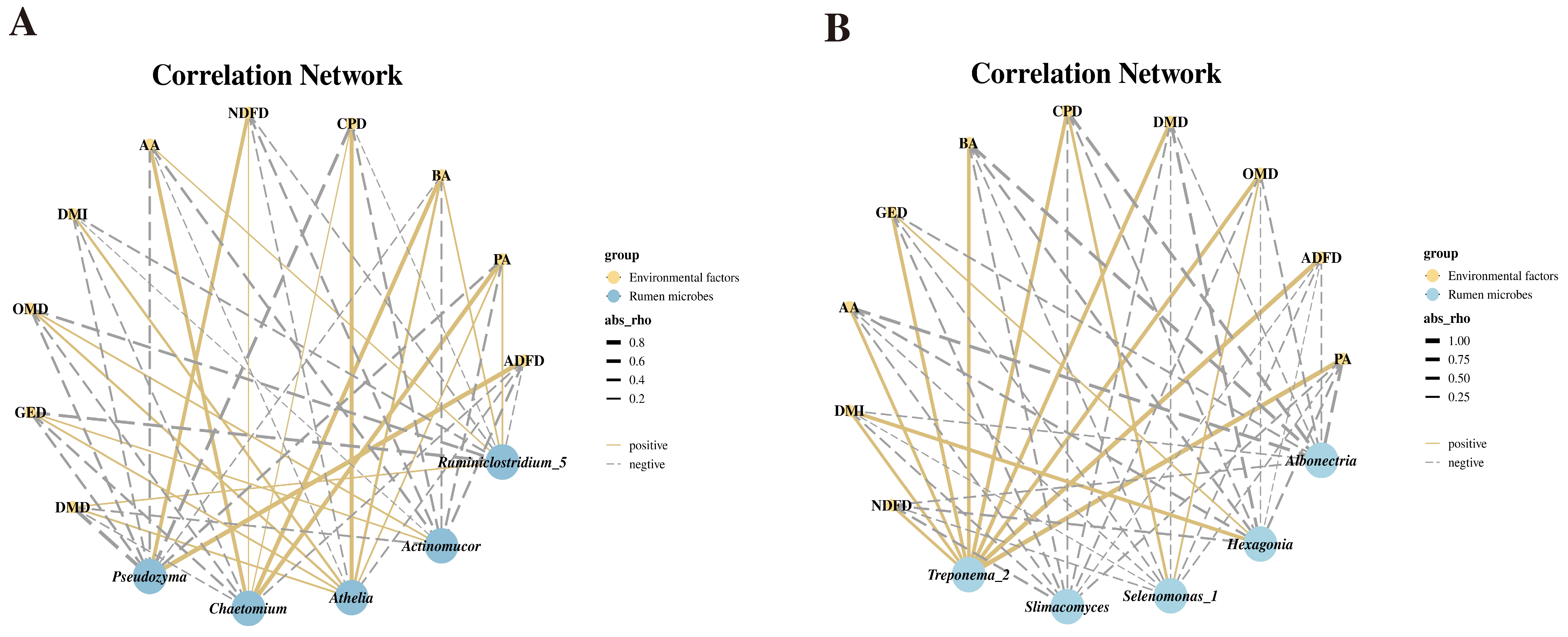
Mantel analysis shows the correlation between biomarker microbial taxa and DMI, rumen fermentation parameters, and apparent digestibility of various nutrients is presented in Figure 7A,B. In LWE, only Pseudozyma was strongly positive correlated with NDFD (p > 0.05), and in ADFD (p > 0.05), Ruminiclostridium_5 was strongly positive correlated with DMD (p > 0.05) (Figure 7A). In HWS, Treponema_2 was strongly positive correlated with ruminal AA (p < 0.05), PA (p < 0.01), BA contents (p < 0.05), DMD (p < 0.01), CPD (p < 0.01), ADFD (p < 0.01), and GED (p < 0.01). Treponema_2 and Selenomonas_1 were strongly positive correlated with OMD (p < 0.01) (Figure 7B).
Figure 7.
Correlations between key bacterial and fungal taxa in the rumen and ruminal fermentation parameters and apparent nutrient digestibility in LWE (A) and HWS (B). LWE, water buffaloes fed diets containing elephant grass silage; HWS, water buffaloes fed diets containing whole-plant sugarcane silage; AA, acetic acid; PA, propionic acid; BA, butyric acid; DMI, dry matter intake; DMD, dry matter digestibility; CPD, crude protein digestibility; NDFD, neutral detergent fiber digestibility; ADFD, acid detergent fiber digestibility, OMD, organic matter digestibility; GED, gross energy digestibility.
3.8. Correlation Analysis Between Key Rumen Microbial and Metabolites and Key Microbial in Silage
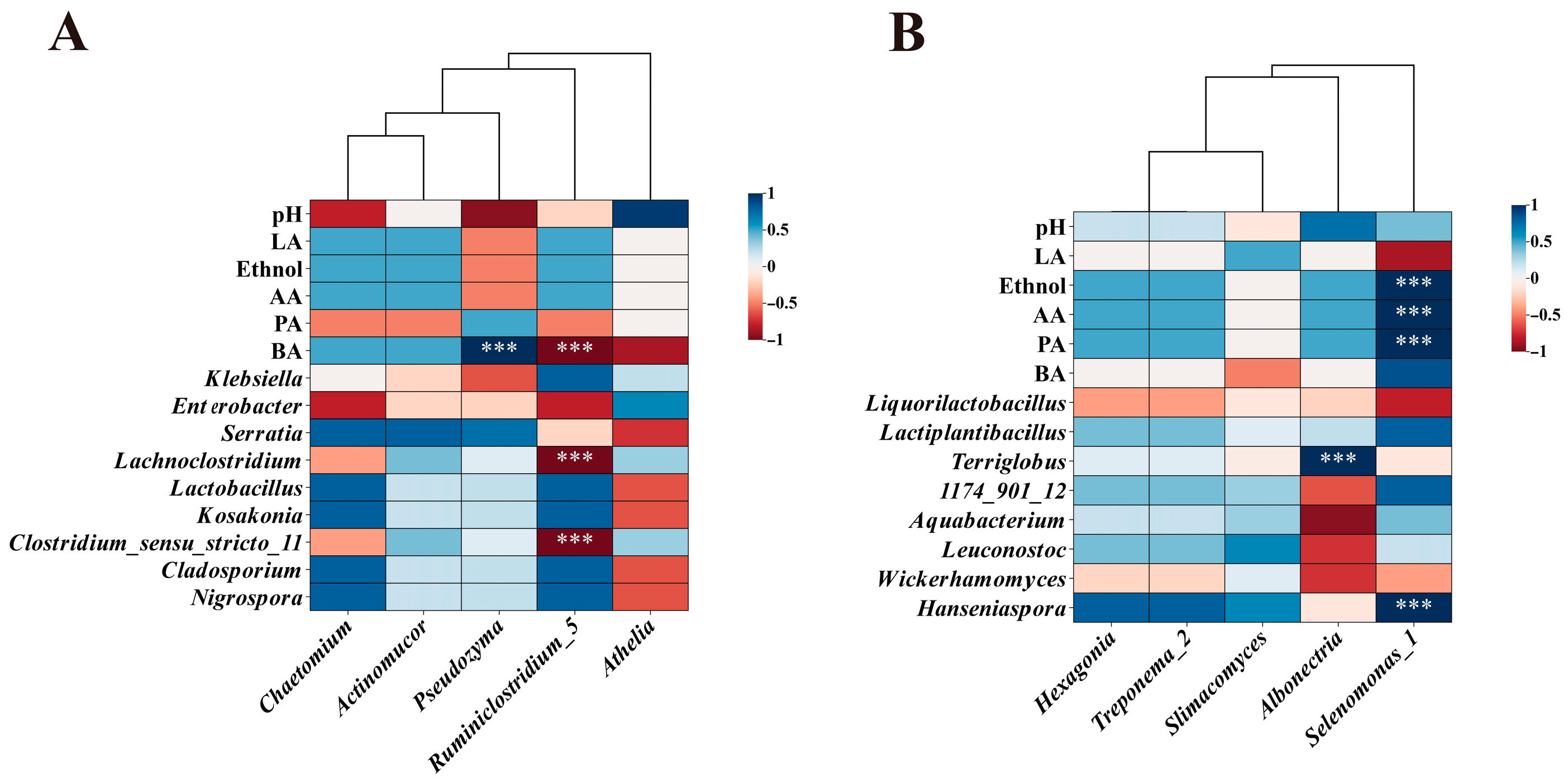
A Spearman correlation matrix between mean abundances of key bacterial and fungal taxa in the rumen and key bacterial and fungal taxa and metabolites in the silage is presented in Figure 8A,B. In LWE, Ruminal Pseudozyma was negative correlated with pH (p > 0.05), LA (p > 0.05), ethanol (p > 0.05), AA contents (p > 0.05), Klebsiella (p > 0.05) and Enterobacter (p > 0.05) in silage, but it was positive correlated with PA (p > 0.05), BA contents (p < 0.01), Serratia (p > 0.05), Lachnoclostridium (p > 0.05), Lactobacillus (p > 0.05), Kosakonia (p > 0.05), Clostridium_sensu_stricto_11 (p > 0.05), Cladosporium (p > 0.05), and Nigrospora (p > 0.05) in silage (Figure 8A). In HWS, Ruminal Treponema_2 was negative correlated with Liquorilactobacillus (p > 0.05) and Wickerhamomyces (p > 0.05) in silage, but it was strongly positive correlated with ethnol (p > 0.05), AA (p > 0.05), PA contents (p > 0.05), Lactiplantibacillus (p > 0.05), Terriglobus (p > 0.05), 1174_901_12 (p > 0.05), Aquabacterium (p > 0.05), Leuconostoc (p > 0.05), and Hanseniaspora (p > 0.05) in silage (Figure 8B). Selenomonas_1 was negative correlated with LA content (p > 0.05), Liquorilactobacillus (p > 0.05) and Wickerhamomyces (p > 0.05) in silage, but it was strongly positive correlated with ethnol (p < 0.01), AA (p < 0.01), PA (p < 0.01), BA contents (p > 0.05), Lactiplantibacillus (p > 0.05), 1174_901_12 (p > 0.05), Aquabacterium (p > 0.05), Leuconostoc (p > 0.05), and Hanseniaspora (p < 0.01) in silage (Figure 8B).
Figure 8.
Correlation between key rumen bacterial and fungal taxa in LWE (A) and HWS (B) and biomarker microorganisms and metabolites in EGS and WSS, respectively. LWE, water buffaloes fed diets containing elephant grass silage; HWS, water buffaloes fed diets whole-plant sugarcane silage; AA, acetic acid; PA, propionic acid; BA, butyric acid. Blue indicates a perfect negative correlation, while red indicates a perfect positive correlation. *** p < 0.001.
4. Discussion
4.1. Fermentation Quality of Silage
Assessing the chemical composition of silage is the most fundamental and crucial step in the entire silage quality evaluation system [29]. In this study, WSS had significantly higher WSC and CP contents than those of EGS. These results were mainly due to the higher WSC and CP contents in fresh whole-plant sugarcane than in elephant grass (Table S1). However, Cavali et al. [7] reported that compared with sugarcane silage, CP and WSC contents were higher in elephant grass silages, whether with or without bacterial inoculant, which might be due to differences in forage varieties, harvesting time, growing environment, and management, and so on. Similar results are reported by Cavali et al. [7], EGS also had higher DM content in this study. This result is also attributed to the higher DM content in fresh elephant grass (Table S1). Structural carbohydrates affect animal digestion, utilization, and production performance [28]. Compared with EGS, WSS had higher EB and lower yeast counts in this study. The reason why EB were enriched in WSS might be because of some acid-resistant species of EB [30]. The reason for the decrease in number of yeasts might be because the pH of WSS was 3.39, which is not the optimal pH range (i.e., 4–6) for yeast growth [31], thus limiting its proliferation. Notably, both EB and yeasts are considered undesirable microorganisms in silage. However, the counts of EB and yeasts were all less than 4 log10 CFU/g FM in the two silages. Studies have pointed that keeping the counts of yeast and EB at 4 log10 CFU/g FM or below helps ensure the fermentation quality of silage [32,33].
Silage pH is one of the important indicators of silage quality. In the present study, the pH in WSS was lower than that in EGS. This result is mainly because the whole sugarcane plant provides more sugar substrates for lactic acid bacteria to produce LA and thus lowering the pH [34]. That is why LA content was higher in WSS than in EGS (Table 2). LA can effectively inhibit the growth of harmful microorganisms in silage under anaerobic conditions [35]. Consistent with previous studies on sugarcane silage [36,37], this study also found higher ethanol content in WSS. This result is mainly because yeasts can use the residual WSC in sugarcane to produce ethanol. Compared with LA, PA can effectively inhibit the growth of harmful bacteria under aerobic fermentation [38]. In this study, the PA content, as well as the BA content, was higher in EGS than in WSS. However, an increase in BA content in silage may stimulate the growth of unfavorable microorganisms and decrease silage quality [39]. The NH3-N content mainly reflects the degree of protein decomposition in silage by microorganisms [40]. In present study, the NH3-N content was higher in EGS than in WSS, likely due to the presence of protein-decomposing bacteria, such as EB, in silage [41].
4.2. Microbial Communities of Silage
The Shannon and Simpson indices represent the richness and evenness, respectively, microbial communities. In this study, Shannon and Simpson indices of bacteria were lower in WSS than in EGS. These results are possibly due to the lower pH in WSS than in EGS, which limited the growth of acid-intolerant bacteria. In the present study, the dominant phyla of bacteria were Firmicutes and Proteobacteria in both WSS and EGS. Similar results are also found in elephant grass silage and other high-WSC content forage silages [8,28]. Firmicutes and Proteobacteria can degrade complex organic compounds under anaerobic conditions, including proteins and cellulose [42,43]. According to Keshri et al. [32,44], low pH under anaerobic conditions favors the reproduction of Firmicutes species. Thus, in this study, the relative abundance of Firmicutes was higher in WSS than in EGS, with abundance exceeding 80%. Klebsiella and Enterobacter were dominant genera in EGS. Similarly, Klebsiella and Enterobacter are the dominant bacterial genera in natural elephant grass silage [45,46] and wilted elephant grass [47], respectively. However, similar results are not found in other natural elephant grasses, perhaps because of differences in varieties [48]. Both Klebsiella and Enterobacter are in the family Enterobacteriaceae, which breaks down lactic acid to produce other substances and includes harmful bacteria in silage [49]. In WSS, the dominant genera were Lactiplantibacillus and Liquorilactobacillus. Lactiplantibacillus is also the dominant bacterial genera in Caragana korshinskii silage and Triticale silage [50,51]. However, there are few reports on Liquorilactobacillus in silage. Notably, species of lactic acid bacteria in Lactiplantibacillus and Liquorilactobacillus can decompose and utilize the sugar in sugarcane to produce lactic acid under anaerobic conditions [52]. Furthermore, in this study, LEfSe analysis showed that genera from Clostridiaceae (Clostridium_sensu_stricto_11) and Enterobacteriaceae (Kosakonia, Serratia, Klebsiella, Enterobacter) were more likely to proliferate in EGS, while in WSS, genera from Lactobacillaceae (Leuconostoc, Lactiplantibacillus, and Liquorilactobacillus) were more likely to proliferate. Generally, Clostridiaceae and Enterobacteriaceae are the main families that lead to poor silage quality. The possible reason is that the environment is suitable for the proliferation of those genera of bacteria in EGS (silage pH > 5.0). By contrast, Lactobacillaceae, containing lactic acid bacteria, is one of the key bacterial groups in producing high-quality fermented feed. The reason is that sugarcane can increase the WSC content for lactic acid bacteria to produce LA, creating an acidic environment and promoting their growth.
In this study, the Shannon and Simpson indices of fungi were lower in WSS than in EGS. These results might also be because of lower pH in WSS than in EGS, which limited the growth of acid-intolerant fungi. However, Ascomycota and Basidiomycota were the dominant fungal phyla in both WSS and EGS. Similar results are also found in elephant grass silage and other high-WSC content forage silages [8,28,48,53]. At the genus level, Issatchenkia was the dominant genus in both silages in this study, and consistent with this result, Guan et al. [54] and Liu et al. [55] found that Issatchenkia was the most abundant genus in Napier grass silage and barley silage, respectively. However, Liu et al. [55] report that Issatchenkia is the main yeast that causes aerobic spoilage. The second most dominant genus in EGS was Cladosporium. Cladosporium can produce mycotoxins, leading to reduced silage quality [56]. Consistent with the results of this study, Wickerhamomyces was the second most dominant genus in high-WSC sugarcane silage [8]. Some species of Wickerhamomyces secrete mycotoxins that have bactericidal effects [57]. In addition, LEfSe analysis showed that species of mycotoxin-producing fungi (Nigrospora and Cladosporium) were more likely to reproduce in EGS [55,58]. This result might be because the silage pH (>5.0) in EGS is suitable for growth of these fungi. However, in WSS, genera of fungi with antimicrobial properties (Hanseniaspora and Wickerhamomyces) were more likely to reproduce [57,59], which might be because sugarcane provided a rich source of WSCs for their growth. Astuti et al. [60] pointed out that Hanseniaspora has the potential for probiotic applications, including improving the nutritional value and sensory properties of fermentation substrates.
4.3. Rumen Fermentation and Growth Performance
In this study, the rumen fermentation parameters of pH and NH3-N, AA, PA, and BA contents were not different between LWE and HWS. Moreover, in the present study, whether the diet was WSS- or EGS-based had no significant effects on DMI. Suong et al. [61] also found that fermentation parameters and DMI were not affected after feeding on black cane silage and Napier grass silage. These results may be due to the fact that buffalo can efficiently process a wide range of forage silages. The FCR was higher in HWS. However, previous studies have shown that increasing dietary non-fiber carbohydrates can improve FCR in growing buffaloes [62]. In contrast, the present study found that feeding high-WSC silage to adult buffaloes led to an increase in FCR. This discrepancy may be attributed to differences in sugar composition and animal physiological stage. Notably, adult late-stage buffaloes (520–550 kg) exhibit a high FCR, largely because energy intake is prioritized for maintenance, constraining weight gain potential [63,64]. Accordingly, FCR were high in both the LWE and HWS groups. In addition, the DMD and OMD were lower in HWS. This may be that the low pH of WSS inhibits the microorganisms involved in nutrient digestibility in the rumen (e.g., fiber-degrading bacteria) [65]. However, previous studies have reported that lactating dairy cows or Holstein heifers fed diets based on high-WSC forage (e.g., early-harvested perennial ryegrass silage, and sweet sorghum silage) silage had higher DMD and OMD [14,66]. This discrepancy may be due to differences in forage varieties and animal species. Moreover, the low silage pH of WSS may also have inhibited specific fiber-degrading bacteria in the rumen (e.g., Ruminococcus albus and Fibrobacter succinogenes), which explains why ADFD was lower in HWS. While, this may be due to differences in forage varieties, Benchaar et al. [67] found that ruminants had higher ADFD after being fed diets based on high-WSC forage silage (e.g., red clover silage and sweet sorghum silage). Notably, although CPD, NDFD, and GED were higher in the LWE than in the HWS, the difference was not significant. This may still be related to the inhibitory effect of the enriched metabolites (e.g., ethanol) and competitive microorganisms in WSS on relevant functional rumen microorganisms.
4.4. Microbial Diversity and Community Structure of the Buffalo Rumen
In the present study, the dominant bacterial phyla in the rumen of buffaloes fed forage silage with either low or high WSCs content were Bacteroidetes, Firmicutes, and Proteobacteria. Similar results are also found in the rumen bacterial communities of cattle and buffaloes [68,69]. In addition, in this experiment, the dominant bacterial genera in the rumen of buffaloes fed forage silage of either low or high WSCs content were Prevotella 1, the Rikenellaceae RC9 gut group, and Succiniclasticum. Similarly, Prevotella is the dominant genus in the rumen of buffalo in another study [70]. Ruminal Prevotella spp. generally ferment hemicellulose, starch, protein, peptides, and pectin into succinate, propionate, and acetate [71,72]. The Rikenellaceae RC9 gut group is the most abundant group also found in cattle [73]. This genus is involved in fiber degradation [74]. The genus Succiniclasticum is a constituent among the core rumen microflora, capable of converting succinate into propionate [75,76]. Ruminiclostridium_5 was enriched in LWE. Ruminiclostridium species are recognized for their capacity to degrade complex plant fibers, including cellulose and hemicellulose, via cellulosomal multi-enzyme complexes [77]. Moreover, the Mantel test showed positive correlations between Ruminiclostridium_5 and DMD. This may explain why higher nutrient digestibility (e.g., DMD) was observed in the LWE group. Moreover, the relative abundances of Treponema_2 were higher in HWS than in LWE. Treponema_2 are cellulolytic bacteria [78] and it is positively correlated with AA, PA, and BA contents in the rumen [79]. The Mantel test showed positive correlations between Treponema_2 and the AA, PA, and BA contents. However, this genus may represent low-abundance bacteria, as the AA, PA, and BA contents in the HWS did not increase significantly (Table 3). The Mantel test showed a positive correlation between Treponema_2 and DMD and OMD. Moreover, McLoughlin et al. (2020) have pointed that Treponema_2 exhibited significant negative associations with ADG [80]. This may be why the ADG was lower in HWS. Selenomonas_1 was also higher in HWS. Rumen Selenomonas_1 is closely related to fiber digestion, and mainly produces PA [81]. Since this bacterium is also a low-abundance rumen bacterium, the PA content did not change significantly. However, there was a positive correlation between Treponema_2 and OMD. Notably, Treponema_2 and Selenomonas_1 in the rumen is positively correlated with the vast majority of metabolites (e.g., ethanol, AA, and PA) and biomarker bacteria (e.g., Lactiplantibacillus) in WSS. Meanwhile, Treponema_2 in the rumen was positively correlated with the majority of silage biomarker microorganisms in WSS. This suggests that metabolites and biomarker bacteria in WSS may promote nutrient degradation by modulating key bacteria in the rumen, but without affecting the production of short-chain fatty acids in the rumen.
In this study, the dominant fungal phyla in the rumen of buffaloes were Ascomycota, Neocallimastigomycota, and Basidiomycota in both LWE and HWS. The same phyla are also found in the rumen of Simmental crossbreed bulls [82]. However, the relative abundance of the phylum Ascomycota was higher in HWS than in LWE (93.76% vs. 89.30%). Ascomycetes are a large group of fungi that are important drivers of nutrient cycling and are involved in lignin and keratin degradation [83,84]. The dominant fungal genus in this study was Meyerozyma, which is consistent with previous findings [82]. Kuo et al. [85] note that Meyerozyma sp. can secrete glycosidases, hydrolases, or specific cellulases. Moreover, some species of Meyerozyma yeast are potential probiotic strains [86,87]. The abundance of some other yeasts such as Saccharomyces was also higher in HWS than in LWE. Saccharomyces is also considered a probiotic, especially S. cerevisiae, which can effectively improve nutrient digestibility (e.g., DMD, OMD) [88]. However, the presence of yeast Saccharomyces sp. (e.g., S. cerevisiae) may reduce the activity of fibrolytic and amylolytic enzymes by modifying the abundance of the protozoan genera Diplodinium and Dasytricha in the rumen of sheep [89]. This may also be the reason why HWS has a lower DMD, OMD, and ADFD (Table 3). In addition, a low-abundance yeast, Pseudozyma, belonging to Basidiomycota, was higher in LWE. Studies have shown that some strains of the Pseudozyma can produce highly active xylanase [90,91]. Moreover, Mantel analysis also showed a positive correlation between Pseudozyma and ADFD. This may be a reason why LWE has a higher ADFD (Table 3). Meanwhile, the BA and the vast majority of biomarker microorganisms (e.g., Clostridium_sensu_stricto_11) in EGS also showed a positive correlation with Pseudozyma. This suggests that biomarker microorganisms and their metabolites in EGS may promote nutrient degradation by modulating key fungi in the rumen. However, most of silage biomarker microorganisms in EGS belong to Clostridiaceae or Enterobacteriaceae, which are potentially pathogenic bacteria that may threaten the health of animals.
5. Conclusions
In conclusion, compared with EGS, WSS had higher WSC, LA and ethanol contents, but lower pH, ammonia nitrogen, PA, and BA contents. Meanwhile, the potential beneficial microbial taxa (e.g., Lactiplantibacillus and Hanseniaspora) were more likely to proliferate in WSS, whereas undesirable microbes (e.g., Enterobacter) were more likely to grow in EGS. Moreover, the FCR was lower in LWE. However, no significant differences in rumen fermentation or dominant microbial communities were found between LWE and HWS. Notably, the HWS group showed lower apparent digestibility of DM, OM, and ADF, yet the low-abundance key microbes Treponema_2 and Selenomonas_1 in HWS were closely related to DM and ADF digestibility, as well as to these potential beneficial microbial taxa and organic acids in WSS. In contrast, in LWE, Ruminiclostridium_5 and Pseudozyma were associated with DMD and ADFD, respectively, while Pseudozyma was also linked to the pathogenic Clostridium_sensu_stricto_11 and its metabolite BA in EGS. In summary, although EGS resulted in higher nutrient digestibility in buffalo, it also contained potentially harmful bacteria; conversely, WSS had better fermentation quality and potential beneficial microbes but lower digestibility. Both advantages and limitations should be considered in practice.
Supplementary Materials
The following supporting information can be downloaded at https://www.mdpi.com/article/10.3390/ani16081233/s1: Table S1: Library coverage of bacteria and fungi in elephant grass silage (EGS) and whole-plant sugarcane silage (WSS); Table S2: Library coverage of bacteria and fungi in rumen.
Author Contributions
Conceptualization, Q.G., J.W. and J.Z.; methodology, Q.G., J.W. and J.Z.; software, Q.G. and J.W.; validation, Q.G., B.L. and X.C.; formal analysis, Q.G. and Z.Y.; investigation, J.W., Q.Y. (Qiuxiang Ye), C.W. and X.G.; resources, B.L. and G.Q.; data curation, J.W., Q.Y. (Qi Yan), Y.T., Q.T. and X.C.; writing—original draft preparation, Q.G.; writing—review and editing, Q.G., J.W., G.Q. and C.Z.; visualization, Q.G.; supervision, G.Q. and C.Z.; project administration, G.Q. and C.Z.; funding acquisition, G.Q. and C.Z. All authors have read and agreed to the published version of the manuscript.
Funding
This work was supported by the National Key Research and Development Program of China [grant number 2022YFD1300602], the National Natural Science Foundation of China [grant numbers 31860661 and 312360851], and the Innovation Project of Guangxi Graduate Education [grant number YCBZ2023050].
Institutional Review Board Statement
The animal care protocol involved in this experiment was approved by the Animal Ethics Committee of Guangxi University, China (Protocol no. Gxu-2022-208, 24 June 2022), and all the experimental procedures in this study were performed in accordance with the guidelines for animal research.
Informed Consent Statement
Not applicable.
Data Availability Statement
Bacterial and fungal raw sequencing data of the silage samples have been deposited in the NCBI (https://www.ncbi.nlm.nih.gov/, accessed on 30 July 2024) BioProject database with accession numbers PRJNA 1289997 and PRJNA1289998, respectively, and those of the ruminal fluid samples also have been deposited with accession numbers PRJNA1141254 and PRJNA1141256, respectively.
Acknowledgments
Thanks goes to all the researchers in our laboratories for their dedication and hard work.
Conflicts of Interest
The authors declare no conflicts of interest.
Abbreviations
The following abbreviations are used in this manuscript:
| DM | Dry matter |
| FM | Fresh matter |
| CP | Crude protein |
| WSC | Water-soluble carbohydrates |
| OM | Organic matter |
| NDF | Neutral detergent fiber |
| ADF | Acid detergent fiber |
| CFU | Colony-forming units |
| LAB | Lactic acid bacteria |
| EB | enterobacteria |
| LA | Lactic acid |
| AA | Acetic acid |
| PA | Propionic acid |
| BA | Butyric acid |
| GE | Gross energy |
| BW | Body weight |
| ADG | Average daily gain |
| DMI | Dry matter intake |
| FCR | Feed conversion rate |
| DMD | Dry matter digestibility |
| CPD | Crude protein digestibility |
| NDFD | Neutral detergent fiber digestibility |
| ADFD | Acid detergent fiber digestibility |
| OMD | Organic matter digestibility |
| GED | Gross energy digestibility. |
| DNA | Deoxyribonucleic acid |
| RNA | Ribonucleic acid |
| OTU | Operational taxonomic units |
| LEfSe | Linear discriminant analysis effect size |
| SEM | Standard error of the mean |
References
- Bülbül, T. Energy and Nutrient Requirements of Buffaloes. Kocatepe Vet. J. 2010, 3, 55–64. Available online: http://hdl.handle.net/11630/2264 (accessed on 16 July 2025).
- Huang, M.; Yin, Y.; Shi, K.; Zhang, H.; Cao, X.; Song, X. Neospora caninum Seroprevalence in Water Buffaloes in Guangxi, China. Anim. Biotechnol. 2023, 34, 3274–3279. [Google Scholar] [CrossRef] [Scilit] [PubMed]
- Zhang, W.; Shao, J.; Huang, K.; Chen, L.; Niu, G.; Wei, B.; Huang, G. Optimizing Soil Fertility in Southern China: A Review of Sugarcane Intercropping Strategies. Front. Agric. Sci. Eng. 2025, 12, 583–595. [Google Scholar] [CrossRef] [Scilit]
- Xie, Y.; Qiu, Y.; He, T.; Chen, X.; Wu, Q.; Chen, R.; Chen, N. Coupling Coordination of Green Sugarcane Production and Comprehensive Social Development in Chinese Sugar Industry. Sugar Tech 2024, 26, 1134–1146. [Google Scholar] [CrossRef] [Scilit]
- Li, Y.; Zhang, B.; Song, X.; Liang, Q.; Verma, K.K.; Li, D. Development of Sugar Industry in China: R&D Priorities for Sustainable Sugarcane Production. Sugar Tech 2024, 26, 972–981. [Google Scholar] [CrossRef] [Scilit]
- Sugimoto, A.; Terajima, Y.; Terauchi, T.; Ponragdee, W.; Ohara, S.; Tagane, S.; Sansayawichai, T.; Ishida, T.; Ando, S.; Matsuoka, M. Developing New Types of Sugarcane by Hybridization between Commercial Sugarcane Cultivars and Wild Relatives. In Plant Genetic Resources for Food and Agriculture in Asia and the Pacific: Impacts and Future Directions; FAO Regional Office for Asia and the Pacific: Bangkok, Thailand, 2012; p. 11. [Google Scholar]
- Cavali, J.; Pereira, O.G.; Valadares Filho, S.C.; Porto, M.O.; Fernandes, F.E.P. Mixed Sugarcane and Elephant Grass Silages with or Without Bacterial Inoculant. Rev. Bras. Zootec. 2010, 39, 462–470. [Google Scholar] [CrossRef] [Scilit]
- Gu, Q.; Zhang, J.; Lin, B.; Ding, H.; Yan, Q.; Wei, C.; Yao, Y.; Wang, R.; Zou, C. Effects and Function of Citric Acid on Fermentation Quality and Microbial Community in Sugarcane Tops Silage with High and Low Water-Soluble Carbohydrate Content. BMC Plant Biol. 2025, 25, 99. [Google Scholar] [CrossRef] [Scilit]
- Ma, N.; Han, L.; Hou, S.; Gui, L.; Yuan, Z.; Sun, S.; Wang, Z.; Yang, B.; Yang, C. The Effects of Different Silage Types on Rumen Bacteria and Metabolites in Tibetan Sheep. Microbiome 2025, 14, 9. [Google Scholar] [CrossRef] [Scilit]
- Brunette, T.; Baurhoo, B.; Mustafa, A. Effects of Replacing Grass Silage with Forage Pearl Millet Silage on Milk Yield, Nutrient Digestion, and Ruminal Fermentation of Lactating Dairy Cows. J. Dairy Sci. 2016, 99, 269–279. [Google Scholar] [CrossRef] [Scilit]
- Iqbal, M.W.; Zhang, Q.; Yang, Y.; Zou, C.; Li, L.; Liang, X.; Wei, S.; Lin, B. Ruminal Fermentation and Microbial Community Differently Influenced by Four Typical Subtropical Forages In Vitro. Anim. Nutr. 2018, 4, 100–108. [Google Scholar] [CrossRef] [Scilit]
- Soares, L.F.P.; Guim, A.; De Mello, A.C.L.; De Andrade Ferreira, M.; De Carvalho, F.F.R.; De Lima Silva, J.; De Melo Vasco, A.C.C.; Da Silva, T.G.P.; Neves, M.L.M.W. Dwarf and Tall Elephant Grass Silages: Intake, Nutrient Digestibility, Nitrogen Balance, Ruminal Fermentation, and Ingestive Behavior in Sheep. Trop. Anim. Health Prod. 2023, 55, 93. [Google Scholar] [CrossRef] [Scilit]
- Wang, S.; Guo, X.; Guo, F.; Wang, Y.; Dong, M.; Wang, J. Effects of Substituting Sweet Sorghum for Corn Silage in the Diet on the Growth Performance, Meat Quality, and Rumen Microorganisms of Boer Goats in China. Animals 2025, 15, 1492. [Google Scholar] [CrossRef] [Scilit] [PubMed]
- Zhang, S.; Sun, A.; Wang, J.; Lu, S.; Chaudhry, A.S.; Tarla, D.; Khanaki, H.; Raja, I.H. Effects of Sweet and Forge Sorghum Silages Compared to Maize Silage Without Additional Grain Supplement on Lactation Performance and Digestibility of Lactating Dairy Cows. Animals 2024, 14, 1702. [Google Scholar] [CrossRef] [Scilit] [PubMed]
- Wei, Z.; Sun, H.; Xie, X.; Xue, M.; Valencak, T.G.; Liu, J. The Effects of Non-Fiber Carbohydrate Content and Forage Type on Rumen Microbiome of Dairy Cows. Animals 2021, 11, 3519. [Google Scholar] [CrossRef] [Scilit] [PubMed]
- Benchaar, C.; Hassanat, F.; Gervais, R.; Chouinard, P.Y.; Petit, H.V.; Massé, D.I. Methane Production, Digestion, Ruminal Fermentation, Nitrogen Balance, and Milk Production of Cows Fed Corn Silage- or Barley Silage-Based Diets. J. Dairy Sci. 2014, 97, 961–974. [Google Scholar] [CrossRef] [Scilit]
- da Silva, L.D.; Pereira, O.G.; da Silva, T.C.; Valadares Filho, S.C. Effects of Silage Crop and Dietary Crude Protein Levels on Digestibility, Ruminal Fermentation, Nitrogen Use Efficiency, and Performance of Finishing Beef Cattle. Anim. Feed Sci. Technol. 2016, 220, 22–33. [Google Scholar] [CrossRef] [Scilit]
- Rezaei, J.; Fazaeli, H.; Rouzbehan, Y.; Zahedifar, M. Effects of Dietary Substitution of Maize Silage by Amaranth Silage on Feed Intake, Digestibility, Microbial Nitrogen, Blood Parameters, Milk Production and Nitrogen Retention in Lactating Holstein Cows. Anim. Feed Sci. Technol. 2015, 202, 23–34. [Google Scholar] [CrossRef] [Scilit]
- Zhang, X.; Li, C.; Yi, X.; Yu, W.; Chen, T.; Gao, B.; Gilbert, R.G. Subtle Structural Variations of Resistant Starch from Whole Cooked Rice Significantly Impact Metabolic Outputs of Gut Microbiota. Carbohydr. Polym. 2024, 329, 121779. [Google Scholar] [CrossRef] [Scilit]
- Sarwar, M.; Khan, M.A.; Nisa, M.; Bhatti, S.A.; Shahzad, M.A. Nutritional Management for Buffalo Production. Asian-Australas. J. Anim. Sci. 2009, 22, 1060–1068. [Google Scholar] [CrossRef] [Scilit]
- Coblentz, W.K.; Akins, M.S. Silage Review: Recent Advances and Future Technologies for Baled Silages. J. Dairy Sci. 2018, 101, 4075–4092. [Google Scholar] [CrossRef] [Scilit]
- Shen, J.S.; Wang, Y.M.; Chai, Z.; Song, L.J.; Liu, J.X. Insertion Depth of Oral Stomach Tubes May Affect the Fermentation Parameters of Ruminal Fluid Collected in Dairy Cows. J. Dairy Sci. 2012, 95, 5978–5984. [Google Scholar] [CrossRef] [Scilit]
- Association of Officiating Analytical Chemists (AOAC). Official Method of Analysis, 18th ed.; Method 935.29 and 990.03; AOAC: Washington, DC, USA, 2006. [Google Scholar]
- Leng, F.; Zhang, X.; Sun, S.; Jing, Y.; Wang, F.; Wei, Q.; Wang, X. A Rapid and Sensitive Method for Determination of Trace Amounts of Glucose by Anthrone-Sulfuric Acid Method. Arab. J. Chem. 2016, 9, S1604–S1607. [Google Scholar]
- Van Soest, P.J.; Robertson, J.B.; Lewis, B.A. Methods for Dietary Fiber, Neutral Detergent Fiber, and Nonstarch Polysaccharides in Relation to Animal Nutrition. J. Dairy Sci. 1991, 74, 3583–3597. [Google Scholar] [CrossRef] [Scilit] [PubMed]
- Broderick, G.A.; Kang, J.H. Automated Simultaneous Determination of Ammonia and Total Amino Acids in Ruminal Fluid and In Vitro Media. J. Dairy Sci. 1980, 63, 64–75. [Google Scholar] [CrossRef] [Scilit] [PubMed]
- Edgar, R.C. UPARSE: Highly Accurate OTU Sequences from Microbial Amplicon Reads. Nat. Methods 2013, 10, 996–998. [Google Scholar] [CrossRef] [Scilit]
- Ding, H.; Zou, C.; Yan, Q.; Zhang, N.; Gu, Q.; Tang, Q.; Lin, B. Regional Variations in Epiphytic Microbiota Influence Fermentation Quality, Microbial Communities, and Aerobic Stability of Napier Grass Silage. Anim. Nutr. 2024, 1, e16. [Google Scholar] [CrossRef] [Scilit]
- Kung, L., Jr.; Shaver, R.D.; Grant, R.J.; Schmidt, R.J. Silage Review: Interpretation of Chemical, Microbial, and Organoleptic Components of Silages. J. Dairy Sci. 2018, 101, 4020–4033. [Google Scholar] [CrossRef] [Scilit]
- Guan, Q.; Xu, T.; Huang, T.; Peng, F.; Huang, J.; Liu, Z.; Peng, Z.; Xie, M. The Microbial Succession and Their Correlation with the Dynamics of Flavor Compounds Involved in the Natural Fermentation of Suansun, a Traditional Chinese Fermented Bamboo Shoots. Food Res. Int. 2022, 162, 111216. [Google Scholar] [CrossRef] [Scilit]
- Carsanba, E.; Oliveira, C.; Pintado, M. Fermentation Strategies for Production of Pharmaceutical Terpenoids in Engineered Yeast. Pharmaceuticals 2021, 14, 295. [Google Scholar] [CrossRef] [Scilit]
- McDonald, P.; Henderson, A.R.; Heron, S.J.E. The Biochemistry of Silage, 2nd ed.; Chalcombe Publications: Marlow, UK, 1991; p. 340. [Google Scholar]
- Kung, L.; Stokes, M.R.; Lin, C.J. Silage Additives. In Silage Science and Technology; Wiley Online Library: Hoboken, NJ, USA, 2003; Volume 42, pp. 305–360. [Google Scholar]
- Gonda, H.L.; Nikodinoska, I.; Le Cocq, K. Efficacy of Six Lactic Acid Bacteria Strains as Silage Inoculants in Forages with Different Dry Matter and Water-soluble Carbohydrate Content. Grass Forage Sci. 2023, 78, 636–647. [Google Scholar] [CrossRef] [Scilit]
- Chauhan, N.; Kumari, N.; Mani, V.; Pradhan, D.; Gowane, G.R.; Kumar, S. Effects of Lactiplantibacillus plantarum, Limosilactobacillus fermentum, and Propionic Acid on the Fermentation Process of Sugarcane Tops Silages along with Variations in pH, Yeast and Mould Count after Aerobic Exposure. Waste Biomass Valorization 2024, 15, 2215–2230. [Google Scholar] [CrossRef] [Scilit]
- Gomes, A.L.M.; Bueno, A.V.I.; Osmari, M.P.; Machado, J.; Nussio, L.G.; Jobim, C.C. Effects of Obligate Heterofermentative Lactic Acid Bacteria Alone or in Combination on the Conservation of Sugarcane Silage. Front. Microbiol. 2021, 12, 643879. [Google Scholar] [CrossRef] [Scilit] [PubMed]
- de Moura Zanine, A.; de Sene, O.A.; de Jesus Ferreira, D.; Parente, H.N.; de Oliveira Maia Parente, M.; Pinho, R.M.A.; Santos, E.M.; Nascimento, T.V.C.; de Oliveira Lima, A.G.V.; Perazzo, A.F.; et al. Fermentative Profile, Losses and Chemical Composition of Silage Soybean Genotypes Amended with Sugarcane Levels. Sci. Rep. 2020, 10, 21064. [Google Scholar] [CrossRef] [Scilit] [PubMed]
- Zhao, M.; Guo, G.; Wang, Z.; Du, S.; Sun, L.; Bao, J.; Hao, J. Lactobacillus plantarum and Propionic Acid Improve the Fermentation Quality of High-Moisture Amaranth Silage by Altering the Microbial Community Composition. Front. Microbiol. 2022, 13, 1066641. [Google Scholar] [CrossRef] [Scilit] [PubMed]
- Wróbel, B.; Nowak, J.; Fabiszewska, A.; Paszkiewicz-Jasińska, A.; Przystupa, W. Dry Matter Losses in Silages Resulting from Epiphytic Microbiota Activity—A Comprehensive Study. Agronomy 2023, 13, 450. [Google Scholar] [CrossRef] [Scilit]
- Sun, L.; Chen, Y.; Xue, Y.; Xiao, Y.; Te, R.; Wu, X.; Na, N.; Wu, M.; Qili, M.; Zhao, Y. Community Synergy of Lactic Acid Bacteria and Cleaner Fermentation of Oat Silage Prepared with a Multispecies Microbial Inoculant. Microbiol. Spectr. 2023, 11, e00705-23. [Google Scholar] [CrossRef] [Scilit]
- Sa, D.W.; Lu, Q.; Wang, Z.; Ge, G.; Sun, L.; Jia, Y. The Potential and Effects of Saline-Alkali Alfalfa Microbiota under Salt Stress on the Fermentation Quality and Microbial. BMC Microbiol. 2021, 21, 149. [Google Scholar] [CrossRef] [Scilit]
- Romero, J.J.; Zhao, Y.; Balseca-Paredes, M.A.; Tiezzi, F.; Gutierrez-Rodriguez, E.; Castillo, M.S. Gutierrez-Rodriguez Laboratory Silo Type and Inoculation Effects on Nutritional Composition, Fermentation, and Bacterial and Fungal Communities of Oat Silage. J. Dairy Sci. 2017, 100, 1812–1828. [Google Scholar] [CrossRef] [Scilit]
- Ma, S.; Huang, G.; Fang, C.; Sun, X.; Han, L.; He, X. Bacterial Community Succession During Pig Manure and Wheat Straw Aerobic Composting Covered with a Semi-Permeable Membrane under Slight Positive Pressure. Bioresour. Technol. 2018, 259, 221–227. [Google Scholar] [CrossRef] [Scilit]
- Keshri, J.; Chen, Y.; Pinto, R.; Kroupitski, Y.; Weinberg, Z.G.; Sela Saldinger, S. Microbiome Dynamics during Ensiling of Corn with and without Lactobacillus plantarum Inoculant. Appl. Microbiol. Biotechnol. 2018, 102, 4025–4037. [Google Scholar] [CrossRef] [Scilit]
- Xie, H.; Yang, C.; Zeng, F.; Luo, X.; Li, Z.; Pan, Y.; Guo, Y.; Peng, L.; Liang, L.; Li, J.; et al. Silage Making of Napier Grass and Sugarcane Top at Different Proportions: Evolution of Natural Fermentation Characteristics, Chemical Composition, and Microbiological Profile. Fermentation 2024, 10, 525. [Google Scholar] [CrossRef] [Scilit]
- Jaipolsaen, N.; Sangsritavong, S.; Uengwetwanit, T.; Angthong, P.; Plengvidhya, V.; Rungrassamee, W.; Yammuenart, S. Comparison of the Effects of Microbial Inoculants on Fermentation Quality and Microbiota in Napier Grass (Pennisetum purpureum) and Corn (Zea mays L.) Silage. Front. Microbiol. 2022, 12, 784535. [Google Scholar] [CrossRef] [Scilit] [PubMed]
- Yin, X.; Zhang, J.; Tian, J. Effects of Re-Ensiling on the Fermentation Quality and Microbial Community of Napier Grass (Pennisetum purpureum) Silage. J. Sci. Food Agric. 2021, 101, 5028–5037. [Google Scholar] [CrossRef] [Scilit] [PubMed]
- Chen, D.; Zhang, Y.; Zheng, M.; Zhou, Y.; Gao, L.; Zhou, W.; Xu, W.; Wang, M. Improving the Quality of Napier Grass Silage with Pyroligneous Acid: Fermentation, Aerobic Stability, and Microbial Communities. Front. Microbiol. 2022, 13, 1034198. [Google Scholar] [CrossRef] [Scilit] [PubMed]
- Santos, A.O.; Avila, C.L.S.; Pinto, J.C.; Carvalho, B.F.; Dias, D.R. Fermentative Profile and Bacterial Diversity of Corn Silages Inoculated with New Tropical Lactic Acid Bacteria. J. Appl. Microbiol. 2015, 119, 961–970. [Google Scholar] [CrossRef] [Scilit] [PubMed]
- Wu, B.; Nie, H.; Ai, J.; Li, T.; Qin, W.; Hu, Z.; Siqin, T.; Wu, T.; Wang, C. Fermentation Quality, Aerobic Stability, and Microbiome Structure and Function of Caragana korshinskii Silage Inoculated with/without Lactobacillus rhamnosus or Lactobacillus buchneri. Front. Sustain. Food Syst. 2023, 7, 1255936. [Google Scholar] [CrossRef] [Scilit]
- Gao, R.; Wang, G.; Liu, Y.; Wu, B.; Jia, C.; Yu, Z. Effect of Harvest Maturity and Lactiplantibacillus plantarum Inoculant on Dynamics of Fermentation Characteristics and Bacterial and Fungal Community of Triticale Silage. Agriculture 2024, 14, 1707. [Google Scholar] [CrossRef] [Scilit]
- Nishioka, H.; Hata, M.; Ohno, T.; Iwahashi, H. Diversity of Lactic Acid Bacteria Involved in the Fermentation of Awa-bancha. Microbes Environ. 2021, 36, ME21029. [Google Scholar] [CrossRef] [Scilit]
- Vu, V.H.; Li, X.; Wang, M.; Liu, R.; Zhang, G.; Liu, W.; Xia, B. Dynamics of Fungal Community During Silage Fermentation of Elephant Grass (Pennisetum purpureum) Produced in Northern Vietnam. Asian-Australas. J. Anim. Sci. 2019, 32, 996–1006. [Google Scholar] [CrossRef] [Scilit]
- Guan, H.; Zhang, X.; Shuai, Y.; Ran, Q.; Yan, Y.; Wang, X.; Li, D.; Cai, Y. The Microbiome and Metabolome of Napier Grass Silages Prepared with Screened Lactic Acid Bacteria During Ensiling and Aerobic Exposure. Anim. Feed Sci. Technol. 2020, 269, 114673. [Google Scholar] [CrossRef] [Scilit]
- Liu, B.; Dong, C.; Yang, Z.; Huan, H.; Gu, H.; Xu, N. Impact of Molasses and Microbial Inoculants on Fermentation Quality, Aerobic Stability, and Bacterial and Fungal Microbiomes of Barley Silage. Sci. Rep. 2020, 10, 5342. [Google Scholar] [CrossRef] [Scilit]
- Huang, R.; Meng, C.; Zhang, F.; Wang, T.; Zhang, Y.; Li, X.; Chen, Y. Effect of Intrinsic Tannins on the Fermentation Quality and Associated with the Bacterial and Fungal Community of Sainfoin Silage. Microorganisms 2022, 10, 844. [Google Scholar] [CrossRef] [Scilit] [PubMed]
- Godana, E.A.; Zhang, H.; Sefu Edo, G.; Yang, Q.; Zhang, X.; Zhao, L.; Wang, K.; Ngea, G.L.N. Wickerhamomyces anomalus: A Promising Yeast for Controlling Mold Growth and Diverse Biotechnological Applications. Trends Food Sci. Technol. 2024, 149, 104649. [Google Scholar] [CrossRef] [Scilit]
- Wilson, M.E.; Diener, U.L.; Davis, N.D. A Toxic Metabolite of Nigrospora oryzae (berk and Br.) Petch. Mycopathologia 1986, 93, 167–170. [Google Scholar] [CrossRef] [Scilit] [PubMed]
- van Wyk, N.; Pickerill, I.S.; Badura, J.; von Wallbrunn, C. Exploring Future Applications of the Apiculate Yeast Hanseniaspora. Crit. Rev. Biotechnol. 2024, 44, 364–379. [Google Scholar] [CrossRef] [Scilit] [PubMed]
- Astuti, R.I.; Prastya, M.E.; Wulan, R.; Anam, K.; Meryandini, A. Current Trends and Future Perspective of Probiotic Yeasts Research in Indonesia. FEMS Yeast Res. 2023, 23, foad013. [Google Scholar] [CrossRef] [Scilit]
- Suong, N.T.M.; Paengkoum, P.; Paengkoum, S.; Schonewille, J.T.; Purba, R.A.P. Growth Performance, Blood Biochemical Indices, Rumen Bacterial Community, and Carcass Characteristics in Goats Fed Anthocyanin-Rich Black Cane Silage. Front. Vet. Sci. 2022, 9, 880838. [Google Scholar] [CrossRef] [Scilit]
- Lima, D.O.; Magalhães, A.L.R.; de Lima, D.M.; de Carvalho, F.F.R.; Neves, M.; da Silva, M.V.G.; Pessoa, R.A.S. Dry Sugarcane Yeast and Urea Could Replace Soybean Meal in the Diet of Buffalo Heifers. S. Afr. J. Anim. Sci. 2022, 52, 142–147. Available online: https://hdl.handle.net/10520/ejc-sajas_v52_n2_a3 (accessed on 18 July 2025).
- Liang, J.B.; Young, B.A. Comparative Energetic Efficiencies of Male Malaysian Cattle and Buffalo. Livest. Prod. Sci. 1995, 41, 19–27. [Google Scholar] [CrossRef] [Scilit]
- Paul, S.S.; Patil, N.V. Energy and Protein Requirements of Growing Nili-Ravi Buffalo Heifers in Tropical Environment. J. Sci. Food Agric. 2007, 87, 2286–2293. [Google Scholar] [CrossRef] [Scilit]
- Russell, J.B.; Wilson, D.B. Why Are Ruminal Cellulolytic Bacteria Unable to Digest Cellulose at Low pH? J. Dairy Sci. 1996, 79, 1503–1509. [Google Scholar] [CrossRef] [Scilit] [PubMed]
- Parnian-Khajehdizaj, F.; Noel, S.J.; Johansen, M.; Weisbjerg, M.R.; Hellwing, A.L.F.; Højberg, O.; Hall, M.B.; Lund, P. Methane Emission, Nutrient Digestibility, and Rumen Microbiota in Holstein Heifers Fed 14 Different Grass or Clover Silages as the Sole Feed. J. Dairy Sci. 2023, 106, 4072–4091. [Google Scholar] [CrossRef] [Scilit] [PubMed]
- Benchaar, C.; Hassanat, F.; Martineau, R.; Gervais, R. Linseed Oil Supplementation to Dairy Cows Fed Diets Based on Red Clover Silage or Corn Silage: Effects on Methane Production, Rumen Fermentation, Nutrient Digestibility, N Balance, and Milk Production. J. Dairy Sci. 2015, 98, 7993–8008. [Google Scholar] [CrossRef] [Scilit] [PubMed]
- Lin, B.; Henderson, G.; Zou, C.; Cox, F.; Liang, X.; Janssen, P.H. Characterization of the Rumen Microbial Community Composition of Buffalo Breeds Consuming Diets Typical of Dairy Production Systems in Southern China. Anim. Feed Sci. Technol. 2015, 207, 75–84. [Google Scholar] [CrossRef] [Scilit]
- Li, M.; Penner, G.B.; Hernandez-Sanabria, E.; Oba, M.; Guan, L.L. Effects of Sampling Location and Time, and Host Animal on Assessment of Bacterial Diversity and Fermentation Parameters in the Bovine Rumen. J. Appl. Microbiol. 2009, 107, 1924–1934. [Google Scholar] [CrossRef] [Scilit] [PubMed]
- Zou, C.; Gu, Q.; Zhou, X.; Xia, Z.; Muhammad, W.I.; Tang, Q.; Liang, M.; Lin, B. Ruminal Microbiota Composition Associated with Ruminal Fermentation Parameters and Milk Yield in Lactating Buffalo in Guangxi, China—A Preliminary Study. J. Anim. Physiol. Anim. Nutr. 2019, 103, 1374–1379. [Google Scholar] [CrossRef] [Scilit]
- Carberry, C.A.; Waters, S.M.; Kenny, D.A.; Han, S.; McCabe, M.S. Effect of Phenotypic Residual Feed Intake and Dietary Forage Content on the Rumen Microbial Community of Beef Cattle. Appl. Environ. Microbiol. 2012, 78, 4949–4958. [Google Scholar] [CrossRef] [Scilit]
- Wang, H.; Chen, B.; He, Y.; Li, H.; Wu, F.; Qiu, Q.; Niu, W.; Gao, Z.; Su, H. Rumen Fermentation, Intramuscular Fat Fatty Acid Profiles and Related Rumen Bacterial Populations of Holstein Bulls Fed Diets with Different Energy Levels. Appl. Microbiol. Biotechnol. 2019, 103, 4931–4942. [Google Scholar] [CrossRef] [Scilit]
- Daghio, M.; Mannelli, F.; Ciucci, F.; Buccioni, A.; Cappucci, A.; Casarosa, L.; Serra, A.; Conte, G.; Viti, C.; McAmmond, B.M.; et al. Correlation of Breed, Growth Performance, and Rumen Microbiota in Two Rustic Cattle Breeds Reared under Different Conditions. Front. Microbiol. 2021, 12, 652031. [Google Scholar] [CrossRef] [Scilit]
- Qiu, Q.; Sun, H.; Gao, C.; Rahman, M.A.U.; Cao, B. Digestive Ability, Physiological Characteristics, and Rumen Bacterial Community of Holstein Finishing Steers in Response to Three Nutrient Density Diets as Fattening Phases Advanced. Microorganisms 2020, 8, 335. [Google Scholar] [CrossRef] [Scilit]
- Petri, R.M.; McAllister, T.A.; Vahmani, P.; Yang, H.E.; Dugan, M.E.R. Changes in Rumen Microbial Profiles and Subcutaneous Fat Composition when Feeding Extruded Flaxseed Mixed with or Before Hay. Front. Microbiol. 2018, 9, 1055. [Google Scholar] [CrossRef] [Scilit] [PubMed]
- Hook, S.E.; Steele, M.A.; Northwood, K.S.; Dijkstra, J.; France, J.; Wright, A.D.G. Wright Impact of Subacute Ruminal Acidosis (SARA) Adaptation and Recovery on the Density and Diversity of Bacteria in the Rumen of Dairy Cows. FEMS Microbiol. Ecol. 2011, 78, 275–284. [Google Scholar] [CrossRef] [Scilit] [PubMed]
- You, M.; Zhao, Q.; Liu, Y.; Zhang, W.; Shen, Z.; Ren, Z.; Xu, C. Insights into Lignocellulose Degradation: Comparative Genomics of Anaerobic and Cellulolytic Ruminiclostridium-Type Species. Front. Microbiol. 2023, 14, 1288286. [Google Scholar] [CrossRef] [Scilit] [PubMed]
- Stanton, T.B.; Canale-Parola, E. Treponema bryantii sp. Nov., a Rumen Spirochete That Interacts with Cellulolytic Bacteria. Arch. Microbiol. 1980, 127, 145–156. [Google Scholar] [CrossRef] [Scilit] [PubMed]
- Zhang, N.; Teng, Z.; Li, P.; Fu, T.; Lian, H.; Wang, L.; Gao, T. Oscillating Dietary Crude Protein Concentrations Increase N Retention of Calves by Affecting Urea-N Recycling and Nitrogen Metabolism of Rumen Bacteria and Epithelium. PLoS ONE 2021, 16, e0257417. [Google Scholar] [CrossRef] [Scilit]
- McLoughlin, S.; Spillane, C.; Claffey, N.; Smith, P.E.; O’Rourke, T.; Diskin, M.G.; Waters, S.M. Rumen Microbiome Composition Is Altered in Sheep Divergent in Feed Efficiency. Front. Microbiol. 2020, 11, 1981. [Google Scholar] [CrossRef] [Scilit]
- Sato, Y.; Tominaga, K.; Aoki, H.; Murayama, M.; Oishi, K.; Hirooka, H.; Yoshida, T.; Kumagai, H. Calcium Salts of Long-Chain Fatty Acids from Linseed Oil Decrease Methane Production by Altering the Rumen Microbiome In Vitro. PLoS ONE 2020, 15, e0242158. [Google Scholar] [CrossRef] [Scilit]
- Tong, Y.; Yan, C.; Wu, J.; Guo, W.; Yang, Z.; Wang, H.; Liu, H.; Gao, Y.; Sun, M. The Effect of Combining Millet and Corn Straw as Source Forage for Beef Cattle Diets on Ruminal Degradability and Fungal Community. Animals 2023, 13, 548. [Google Scholar] [CrossRef] [Scilit]
- Challacombe, J.F.; Kuske, C.R.; Hesse, C.N.; Bramer, L.M.; McCue, L.A.; Lipton, M.; Purvine, S.; Nicora, C.; Gallegos-Graves, L.V.; Porras-Alfaro, A. Genomes and Secretomes of Ascomycota Fungi Reveal Diverse Functions in Plant Biomass Decomposition and Pathogenesis. BMC Genom. 2019, 20, 976. [Google Scholar] [CrossRef] [Scilit]
- Wu, Y.; Jiao, C.; Diao, Q.; Tu, Y. Effect of Dietary and Age Changes on Ruminal Microbial Diversity in Holstein Calves. Microorganisms 2023, 12, 12. [Google Scholar] [CrossRef] [Scilit]
- Kuo, H.; Zeng, J.; Wang, P.; Chen, W. A Novel Exo-Glucanase Explored from a Meyerozyma sp. Fungal Strain. Biotechnol. Lett. 2015, 37, 1873–1880. [Google Scholar] [CrossRef]
- Shruthi, B.; Deepa, N.; Somashekaraiah, R.; Adithi, G.; Divyashree, S. Exploring Biotechnological and Functional Characteristics of Probiotic Yeasts: A review. Biotechnol. Rep. 2022, 34, e00716. [Google Scholar] [CrossRef] [Scilit] [PubMed]
- Mo, X.; Zhou, M.; Li, Y.; Yu, L.; Bai, H.; Shen, P.; Zhou, X.; Zhu, H.; Sun, H.; Bu, R. Safety Assessment of a Novel Marine Multi-Stress-Tolerant Yeast Meyerozyma guilliermondii GXDK6 According to Phenotype and Whole Genome-Sequencing Analysis. Food Sci. Hum. Wellness 2024, 13, 2048–2059. [Google Scholar] [CrossRef] [Scilit]
- Garber, A.; Hastie, P.M.; Farci, V.; Bulmer, L.; Alzahal, O.; Murray, J.M.D. The Effect of Supplementing Pony Diets with Yeast on 1. In Vivo and In Vitro Digestibility, Faecal pH and Particle Size. Animal 2020, 14, 2481–2492. [Google Scholar] [CrossRef] [Scilit] [PubMed]
- Majewska, M.P.; Miltko, R.; Bełżecki, G.; Kowalik, B. Population of Protozoa and Carbohydrate-Digesting Enzymes in the Rumen of Sheep Fed a Diet Supplemented with Yeast Saccharomyces Cerevisiae. Small Rumin. Res. 2021, 205, 106544. [Google Scholar] [CrossRef] [Scilit]
- Botto, E.; Gioia, L.; del Pilar Menéndez, M.; Rodríguez, P. Pseudozyma sp. Isolation from Eucalyptus Leaves and Its Hydrolytic Activity over Xylan. Biocatal. Agric. Biotechnol. 2019, 21, 101282. [Google Scholar] [CrossRef] [Scilit]
- Mhetras, N.; Liddell, S.; Gokhale, D. Purification and Characterization of an Extracellular β-Xylosidase from Pseudozyma hubeiensis NCIM 3574 (PhXyl), an Unexplored Yeast. AMB Express 2016, 6, 73. [Google Scholar] [CrossRef] [Scilit]

Disclaimer/Publisher’s Note: The statements, opinions and data contained in all publications are solely those of the individual author(s) and contributor(s) and not of MDPI and/or the editor(s). MDPI and/or the editor(s) disclaim responsibility for any injury to people or property resulting from any ideas, methods, instructions or products referred to in the content. |
© 2026 by the authors. Licensee MDPI, Basel, Switzerland. This article is an open access article distributed under the terms and conditions of the Creative Commons Attribution (CC BY) license.