


Simple Summary
This study explores the fatty acid composition of red king crab meat from the Barents Sea. Male crabs exhibit lower fatty acid levels than females, likely due to physiological, behavioral, or activity-related factors. Cooking impacts the meat differently depending on crab sex, with males showing a significant improvement in fatty acid content after cooking, and females displaying less pronounced but still significant changes. These variations may be due to differences in tissue structure between sexes. Although overall fatty acid levels in red king crab meat are lower than in other crabs, the product generally maintains a more balanced ratio of polyunsaturated fatty acids to saturated fatty acids, resulting in favorable nutritional indices. Consequently, red king crab meat emerges as a highly nutritious option suitable for a healthy diet.
Abstract
Previous studies have reported the fatty acid composition of red king crab (Paralithodes camtschaticus) meat; however, no comparative analyses have simultaneously investigated raw (RM) and cooked meat (CM). This study addresses this gap by employing gas–liquid chromatography to analyze the fatty acid profiles of RM and CM from red king crabs from the coastal Barents Sea, Russia. Both products exhibited significant sex-specific differences, with females containing higher levels of fatty acids in their meat than males. Furthermore, males displayed greater dissimilarity between RM and CM compared to females. While nutritional indices were comparable between male and female RM and CM, the cooking process resulted in improved nutritional indices in CM relative to RM. Moreover, the red king crab meat exhibited superior nutritional indices compared to those reported for other, primarily southern, crab species, reflecting a higher polyunsaturated to saturated fatty acid ratio in both RM and CM. Comparisons with the existing literature revealed variability in red king crab meat fatty acid levels across geographical locations and years, suggesting that spatial variations in diet and temporal fluctuations in feeding habits may influence meat quality. Our findings confirm the high nutritional value of red king crab meat, a finding of relevance to both scientific and consumer audiences.
Keywords:
fatty acids; red king crab; raw meat; cooked meat; comparisons; nutrition indices; Barents Sea 1. Introduction
The global demand for safe, high-quality protein sources is escalating in response to increasing human population numbers [1,2,3]. Aquatic organisms, including fish and other edible aquatic species, are recognized for their superior nutritional value and widespread consumption as a high-quality food source [4,5]. Within this group, crustaceans hold significant commercial value, commanding premium prices in both domestic and international markets [6,7]. Crabs represent an important component of global food sector in terms of economic value and market demand [8,9], ranking third in global crustacean production, after shrimps and lobsters [10]. The unique textural properties, distinctive taste, and flavor profile of crab meat contribute to its popularity as a premium seafood item in restaurants worldwide [11,12]. Furthermore, crab meat possesses notable nutritional benefits, characterized by high concentrations of digestible protein, essential amino acids, free amino acids, and essential fatty acids [10,13].
The Barents Sea is one of the world’s most productive ocean regions [14,15], featuring large fish stocks and promising aquaculture potential, with large fish stocks [16,17,18]. However, it lacks native commercially important crab species [19,20]. To create a new fishery resource, the red king crab (Paralithodes camtschaticus) was introduced in the 1960s [19]. This species quickly established a self-sustaining population in the coastal area. Since 1994, Russian and Norwegian specialists have monitored this population, developing a management regime that led to commercially viable abundances [19]. Consequently, commercial fisheries for the red king crab were opened in Norwegian waters in 2002 and in Russian waters in 2004 [21,22].
The introduction of the red king into the Barents Sea has established it as a significant ecosystem component, stimulating considerable scientific interest in its biology and ecology [19]. Research efforts have encompassed its distribution and migratory patterns [23,24,25,26], molting and growth dynamics [27,28], feeding habits and trophic interactions [29,30,31,32], behavioral ecology [33], reproductive biology [34,35,36], and symbiotic relationships [21,37].
The primary motivation for fishing red king crabs is their meat, which is considered a delicacy due to its high content of amino acids, such as tyrosine, histidine, arginine, tryptophan, and cysteine, as well as its low cholesterol levels [38]. The market value of red king crab meat ranges from $175 to $220 USD, driven by its appealing attributes and fluctuations in crab stocks and landings in native areas, leading to a supply deficit in global markets [39,40]. In the Barents Sea, biochemical studies conducted in recent years have provided new insights into the hormonal regulation of basic physiological processes of red king crabs and the nutritional quality of the crab meat and by-products [41,42,43,44]. Specifically, studies have reported variations in fatty acids in the raw leg meat of red king crabs in terms of both absolute and percentage content [41]. Norwegian authors have also studied the fatty acid content in the cooked meat, reporting data on the percentage content [42] and absolute content [44] for adult male crabs, as well as absolute content in juvenile male crabs [44].
Despite ongoing research, significant knowledge gaps continue to exist regarding the fatty acid composition of red king crabs in the context of human nutrition and food science applications. Notably, no comparative studies have been conducted that simultaneously analyze raw and cooked meat from the same specimens. Such comparisons are essential to determine whether consumers are receiving the expected polyunsaturated fats or if thermal processing results in degradation of these nutrients. Additionally, comparative analyses of fatty acid composition between male and female crabs are limited [41], obscuring potential sex-specific responses to cooking. Furthermore, nutrition quality indices, such as atherogenicity and thrombogenicity indices, based on the fatty acid composition of red king crabs from Russian Barents Sea waters, have yet to be reported, thereby hindering evidence-based dietary recommendations for this commercially significant species.
The aim of the present study was to compare the fatty acid profiles of raw and cooked meat of red king crabs from the Barents Sea and report nutritional indices of these products.
2. Materials and Methods
2.1. Collection Procedures
Red king crabs were collected in Dalnezelenetskaya Bay, located on the eastern Kola Peninsula coast [45,46], during underwater surveys employing standardized diving transects at depths ranging from 6 to 43 m in July 2021. Once the crabs were collected, they were transported to a coastal laboratory, where they underwent examination for sex, biometric parameters, and weight.
The sex of each crab was visually identified based on the morphology of the abdomen. Measurements of size were obtained using vernier calipers, measuring carapace length as the greatest straight-line distance from the posterior margin of the right eye orbit to the medial posterior margin of the carapace [47]. Crab weights were determined with an electronic balance. All collected crabs were mature specimens, with carapace lengths exceeding 90 mm [28,35].
Following the biometric assessments, specimens (n = 84) were processed by labeling one leg on the right side of each crab. Crabs were euthanized using a mechanical method: a scalpel was employed to swiftly sever the central nervous system. The crabs were then divided into two clusters, each consisting of three walking legs and one claw assembled at the shoulder joint. Raw meat samples were obtained from the merus of the third walking leg by carefully removing the shell with scissors, yielding samples weighing between 10 and 30 g. The opposing cluster was rinsed with cooled running water for 15 min to eliminate free body fluids. Subsequently, the clusters were drained for 30 min and then placed in an enameled pan to be cooked by immersing them in water at 95 °C for 15 min. Afterwards, the clusters were cooled in cold water containing 3.5% NaCl for 30 min. Meat samples from the cooked clusters were also taken from the merus. The boiling method used in our study (salt water, 15 min) reflects standard consumer cooking practices, making our results directly applicable to the fatty acid composition of cooked crabs as typically consumed. Both raw and cooked meat samples were placed in labeled plastic bags and frozen. These frozen samples were then delivered to the laboratory at the Institute of Physiology of Natural Adaptations (Federal Center for Integrated Arctic Research, Arkhangelsk) for fatty acid analysis.
2.2. Fatty Acid Assay
Lipid extraction was performed using a modified Folch et al. method [48]. A 0.3–0.5 g homogenized sample was added to a 100 mL glass flask containing 10 mL of a chloroform:methanol (2:1) extraction mixture and a chloroform solution of nonadecanoic acid (C19:0) (0.2 mg C19:0). The mixture was homogenized for 30 min and incubated at 25 °C for 10–12 h for lipid extraction. The solution was filtered, and additional chloroform:methanol was added to achieve a final volume of 15 mL. Three mL of a 0.74% aqueous CaCl2 solution was added, and the mixture was refrigerated for 12 h to allow phase separation. The upper, aqueous phase (containing water-soluble impurities) was removed via Pasteur pipette, and the lower, chloroform phase was retained for further analysis. After adding 0.5–1.0 mL methanol, the chloroform phase was evaporated to dryness under vacuum. The residue was dissolved in 0.2 mL of chloroform:methanol and mixed for 5 min. Two mL of a 1.5% solution of H2SO4 in methanol was added, and the mixture was incubated at 90 °C for 30 min in a water bath. The sample was transferred to a 10 mL tube, 0.8 mL of distilled water was added, and the mixture was incubated at ambient temperature for 2–4 h to allow phase separation. The upper phase was transferred to a 2 mL vial and evaporated under vacuum. Finally, 200 µL of the sample was transferred to a gas chromatography vial for analysis. Fatty acid methyl esters were analyzed using an Agilent 7890A gas chromatograph (Agilent Technologies, Santa Clara, CA, USA) equipped with a flame ionization detector. Separation of the esters was achieved using a 60 m × 0.25 mm × 0.15 μm capillary column, Agilent DB-23. Nitrogen served as the carrier gas at a flow rate of 1 mL min−1. Both the injection port and the flame ionization detector were maintained at a temperature of 250 °C. Fatty acids were identified by comparing retention times with those of authentic standards (Supelco 37 FAME C4-C24) using Agilent ChemStation B.03.01 software. Fatty acid concentrations were expressed as μg g−1 wet mass of tissue.
To evaluate the nutritional quality of the fatty acids in terms of their potential for preventing cardiovascular disease, the atherogenic (AI), thrombogenic (TI), and hypocholesterolemic/hypercholesterolemic (h/H) indices were calculated, following the formulas described by Chen and Liu [49]:
where ∑MUFA—total monounsaturated fatty acids, ∑PUFA—total polyunsaturated fatty acids, n3—omega-3 PUFA, and n6—omega-6 PUFA.
2.3. Data Analysis
Carapace lengths and weights in male and female crabs were compared using a non-parametric Kruskal–Wallis test because the data had non-normal distribution. To visualize the fatty acid patterns in red king crabs, Principal Component Analysis (PCA) was used. Initially, the fatty acid data were compared between males and females using a multivariate PERMANOVA based on the Bray–Curtis dissimilarity index with 9999 permutations. Differences in individual fatty acid concentrations were assessed using the Kruskal–Wallis test (KWT), as the data did not pass the Shapiro–Wilk test for normal distribution for most fatty acids. Based on the results obtained from the preliminary tests, the fatty acid profiles were then compared for males and females separately using both PERMANOVA and the paired samples Wilcoxon test for non-normally distributed data. To address the increased Type I error risk from multiple comparisons, false discovery rate correction was applied to p-values from the Wilcoxon tests.
Data are presented as means ± SE (standard error).
3. Results
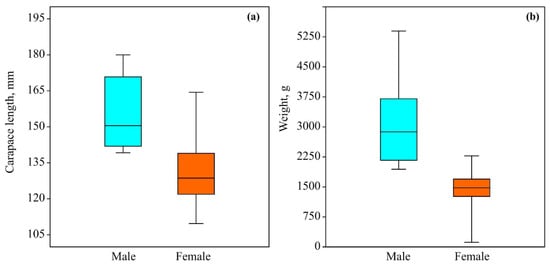
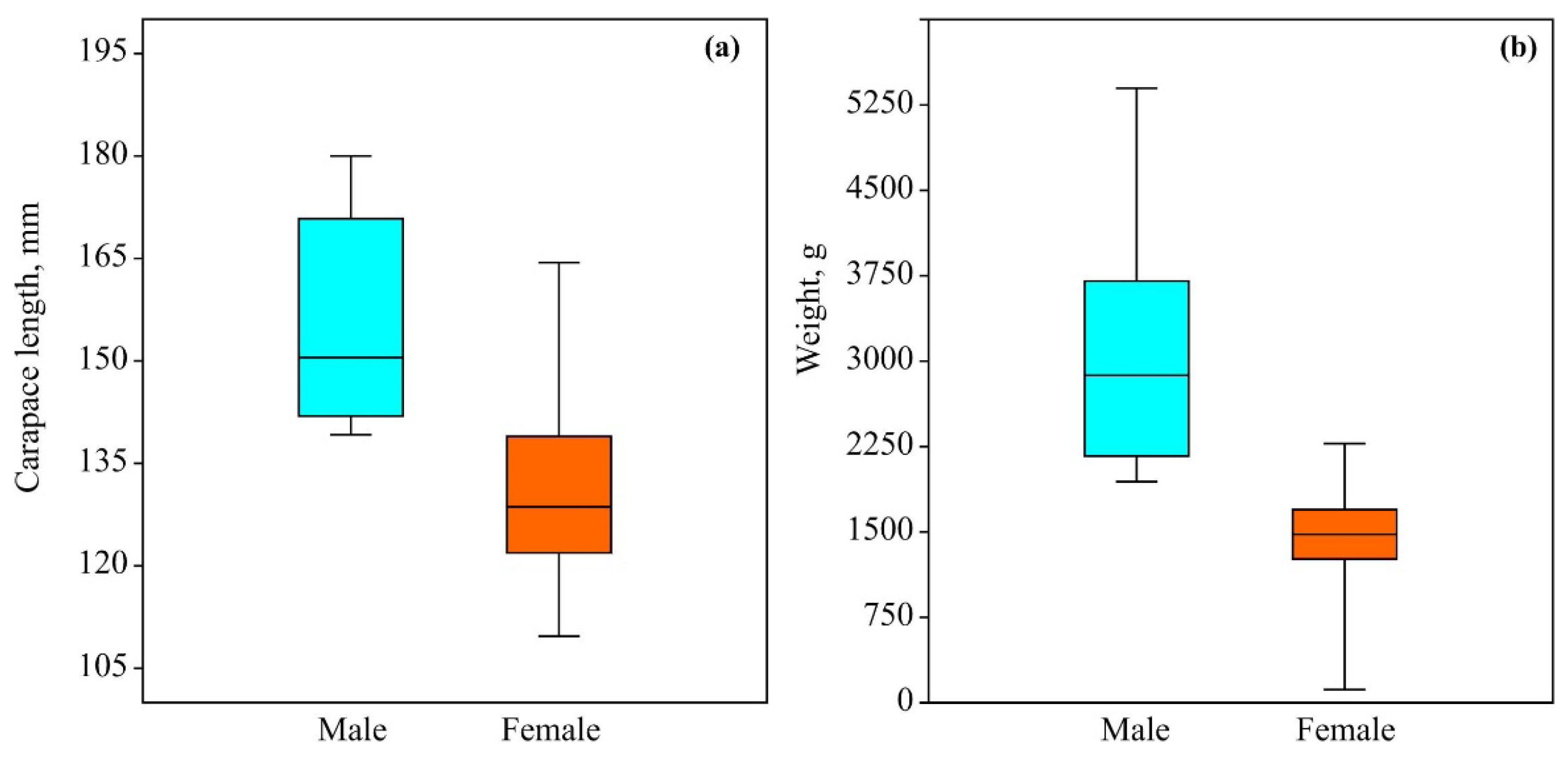
Our sample size included 84 red king crabs: 16 males and 68 females. Male crabs attained a larger carapace length (df = 1, H = 26.81, p < 0.001) and were heavier (df = 1, H = 35.92, p < 0.001) than female crabs (Figure 1).
Figure 1.
Mean carapace length (a) and weight (b) of red king crabs collected in Dalnezelenetskaya Bay, Barents Sea, in summer 2021.
A total of 43 fatty acids were detected in the raw and cooked meat of the red king crab (Table 1 and Table 2), with palmitic (C16:0) and stearic acids (C18:0) being the most prevalent saturated fatty acids (SFA), oleic (C18:1n9C) and palmitoleic acids (C16:1C) dominating among monounsaturated fatty acids, and eicosapentaenoic acid (EPA, C20:5n3), docosahexaenoic acid (DHA, C22:6n3), and arachidonic acid (C20:4n6) prevailing among polyunsaturated fatty acids (PUFA).
Table 1.
Fatty acid composition in raw and cooked meat of male red king crabs (μg g−1) from Dalnezelenetskaya Bay, Barents Sea, in summer 2021.
Table 2.
Fatty acid composition in raw and cooked meat of female red king crabs (μg g−1) from Dalnezelenetskaya Bay, Barents Sea, in summer 2021.
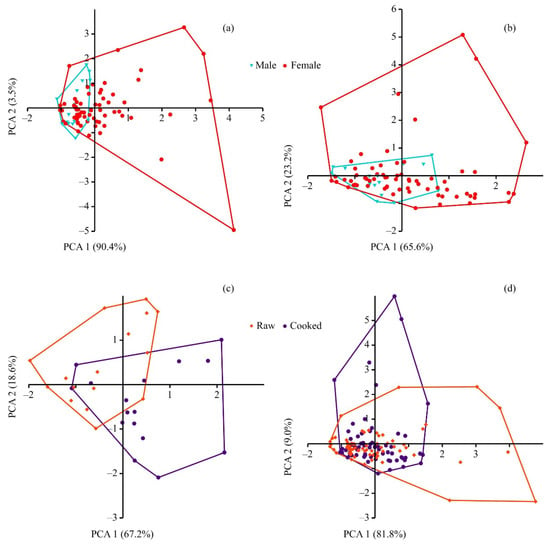
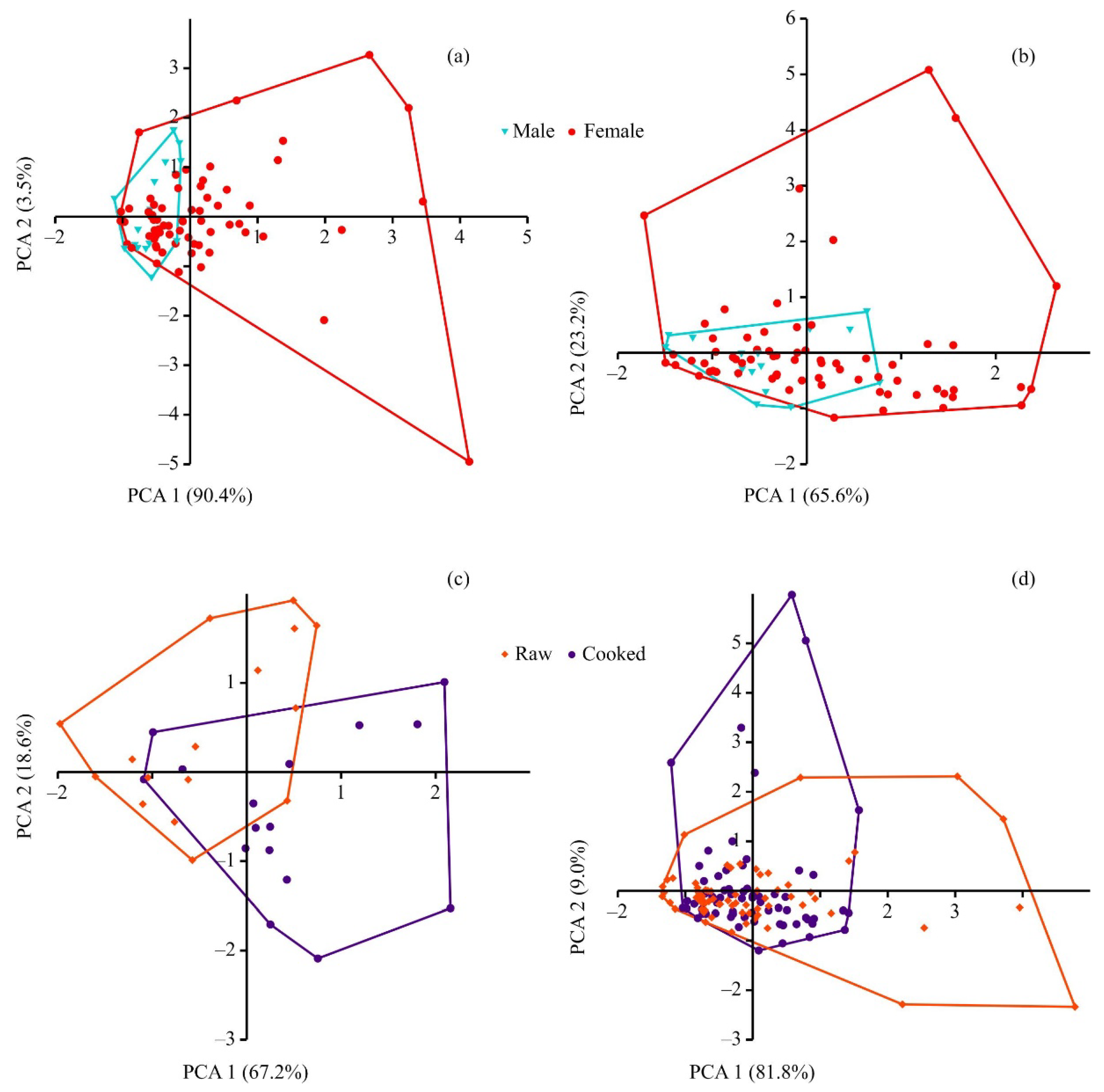
The PCA applied to the data describing the fatty acid content in raw meat showed a separation between male and female crabs (Figure 2a).
Figure 2.
PCA plots based on a Bray–Curtis similarity matrix for fatty acid profiles of red king crab meat in Dalnezelenetskaya Bay, Barents Sea, in summer 2021. (a) Raw meat, male vs. female; (b) cooked meat, male vs. female; (c) male, raw vs. cooked meat; (d) female, raw vs. cooked meat.
The first axis explained 90.4% of the total variation and was positively scaled with most fatty acids; the highest correlations were found for C20:5n3, C16:0, and C18:1n9C. Despite the overlapping distributions of male and female profiles in the left side of the plot, approximately 46% of female profiles had positive PCA scores (right side), which resulted in significant differences between males and females (PERMANOVA, df = 1, H = 6.85, p = 0.005). According to the Bray–Curtis coefficient, the degree of dissimilarity between males and females was 23.64%. In the case of cooked meat, PCA also indicated a separation between males and females, with Axes 1 and 2 accounting for 65.56% and 23.23%, respectively (Figure 2b). The content of C20:5n3 had the highest correlation with both axes, but it was positive for Axis 1 and negative for Axis 2. There was a notable overlap in the distribution of fatty acid data, leading to an insignificant difference between males and females (PERMANOVA, df = 1, F = 2.90, p = 0.056) at a dissimilarity level of 17.64%. Comparisons conducted for individual fatty acids confirm the results of the PCA. For raw meat, 21 of the 43 fatty acids found in crabmeat showed significant differences in content, with higher values being registered in females, which also resulted in a significantly higher total content in females (6323 ± 375 vs. 4339 ± 249 μg g−1). For cooked meat, the total content was also higher in females but with no significant differences (5920 ± 197 vs. 5157 ± 291 μg g−1), and the number of significantly different individual fatty acids was 10.
The PCA conducted for male crabs separated the data for raw and cooked meat mainly along the first axis, which explained 67.18% of the variation (Figure 2c) and had the highest positive correlations with C20:5n3, C16:0, C22:6n3, and C18:1n9C. The second axis explained 18.64% of the total variation and had the highest positive correlations with C20:4n6, C16:0, C18:0, and C18:1n9C. Thus, most profiles of raw meat had negative PC1 and PC2 scores, while cooked meat profiles had positive scores. PERMANOVA showed significant differences (df = 1, F = 4.10, p = 0.021) with a dissimilarity level of 17.64%. Paired Wilcoxon tests indicated significant differences for four fatty acids, including eicosapentaenoic acid, with a higher content in cooked meat. SFA and MUFA contents were similar, whereas polyunsaturated fatty acid (PUFA) and omega-3 (but not omega-6) contents were higher in the cooked meat (Table 1).
In the case of female crabs, PCA showed that the first axis accounted for 81.76% of the total variation (Figure 2d) and positively correlated with EPA content, while the second axis, explaining 8.98% of the variation, was negatively scaled with EPA content. Most stations overlapped, which resulted in a dissimilarity level of 22.03% between raw and cooked meat. Nevertheless, differences between the fatty acid profiles were significant (PERMANOVA, df = 1, F = 4.09, p = 0.022). Further analysis indicated significant differences with regard to 18 fatty acids (Table 2), with higher values in raw meat detected for some prevalent fatty acids, including C18:0, C20:1n9, C20:2n6, and C20:4n6. At the same time, the contents of SFA, MUFA, and PUFA, as well as the total content, were similar in raw and cooked meat derived from females. Significant differences were detected for the omega-6 content (Table 2).
Nutrition indices did not differ significantly between males and females for either raw or cooked meat (p > 0.05). The n-3/n-6 ratio was also similar in males and females. Further comparisons showed significant differences between raw and cooked meat derived from males (Table 1) in the case of the TI (0.19 vs. 0.16) and the PUFA/SFA ratio (1.89 vs. 2.04). Regarding females, significant differences were found for the AI (raw vs. cooked meat, 0.29 vs. 0.34), the h/H ratio (4.01 vs. 3.40), the PUFA/SFA ratio (2.03 vs. 1.88), and the n-3/n-6 ratio (3.57 vs. 4.80) (Table 2).
4. Discussion
We found that male red king crabs had greater size and weight compared to female crabs, reflecting sexual dimorphism in this species. Males allocate more energy towards somatic growth, while females invest more energy in gonad growth, egg development, and protection of egg masses during the extended 11.5-month embryogenesis and larval release period [19,35].
Previous studies conducted in Norwegian waters have reported that the contents of omega-6, omega-3, PUFA, EPA + DHA, and total fatty acids in cooked red king crab male meat were 500, 1930, 2430, 1870, and 4800 μg g−1, respectively [42]. These levels were lower than those found in the present study, which may be attributed to differences in the feeding habits of the crabs [29,30,50], seasonal variations in crab physiology, and/or variations in the thermal regimes of the coastal waters of Norway [51] and Russia [52].
Our biochemical assays revealed significant differences in fatty acid profiles between male and female crabs. This result may be attributed to variations in the feeding habits of males and females. Most male crabs appear to migrate from deeper water locations to the shallow water area of Dalnezelenetskaya Bay, possibly seeking more favorable feeding conditions [19]. In contrast, stationary female crabs residing in the coastal sites have the opportunity to accumulate more fatty acids in their organs and meat. The recent warming trend in the coastal Barents Sea [15,53] is responsible for increased production and biomass of benthic animals [18], which serve as food sources for red king crabs [29,30]. Furthermore, male crabs have larger legs than females [35], which reflects not only their higher energy allocation to growth but also the heavier load and more frequent use of leg muscles during migration. This may contribute to lower fat content and, consequently, lower fatty acid levels in male muscle tissues. Significant sex-based variations in the biochemical composition, including fatty acid profiles, have been reported in various crab species from different regions, such as the long-eyed swimming crab Podophthalmus vigil from India [54], the blue crab Callinectes sapidus from the eastern Mediterranean Sea [55,56], the swimming crab Portunus segnis from Tunisia [57], the Chinese mitten crab Eriocheir sinensis from China [58] and Poland [59], and the warty crab Eriphia verrucosa from the southeastern Black Sea [60]. In most cases, the female edible parts have been found to contain higher contents of fatty acids compared to the males, which is consistent with the findings of the present study.
We observed a predominance of PUFA in the red king crab meat samples, followed by SFA and MUFA. This pattern, characterized by higher PUFA content, aligns with findings in other shellfish species [61,62], although the specific fatty acid levels can vary significantly between species. For instance, our measurements of these fatty acid families for the raw meat of female red king crabs were 3431, 1706, and 1186 μg g−1, which are higher than those found in the raw meat of the Atlantic spider crab, Maja brachydactyla, from Portugal (1050, 420, 470 μg g−1, [63]) and the blue swimming crab, Portunus segnis, from Tunisia (329, 300, 206 μg g−1, [57]).
Male red king crabs exhibited lower levels of PUFA, SFA, and MUFA in their raw meat (2253, 1254, and 832 μg g−1) compared to the European edible crab, Cancer pagurus, from the Scottish coast (19,320, 18,360, and 30,340 μg g−1, [64]) and the coconut crab, Birgus latro, from Okinawa, southwest Japan (415,700, 244,000, and 266,200 μg g−1, [65]). Additionally, the raw and cooked meat of male red king crabs contained lower amounts of EPA, DHA, palmitic, and oleic acids (raw meat: 1125, 575, 737, and 598 μg g−1; cooked meat: 1486, 694, 856, and 696 μg g−1) compared to southern king crabs, Lithodes santolla, from the southwestern Atlantic, San Jorge Gulf (raw meat: 1200, 774, 1110, and 1530 μg g−1; cooked meat: 1660, 1030, 1170, and 1680 μg g−1; [66]). Conversely, the raw meat of male red king crabs had similar contents of PUFA, SFA, and MUFA to those found in the grey swimming crab, Liocarcinus vernalis, from the central Adriatic Sea (2916, 1185, and 1138 μg g−1, [67]), but exceeded the levels reported for the Chinese mitten crab, Eriocheir sinensis, from the Odra Estuary (1431, 961, and 1208 μg g−1, [59]). These variations in fatty acid profiles can be attributed to the different physiologies of these crab species, which reflect their adaptations to distinct habitat conditions [68,69] and food preferences [70,71,72]. Our study revealed significant differences in the fatty acid profiles between raw and cooked meat, with these differences being more pronounced in males. This finding likely reflects differences in muscle structure between the more active male crabs and the more stationary female red king crabs [19,73]. We observed increases in the contents of important fatty acids in males after cooking, including EPA (32%), DHA (21%), PUFA (24%), and total fatty acids (19%). Similar findings have been reported for other crab species. For example, cooked claw meat of Carcinus maenas contained 29% higher EPA and 37% higher DHA levels than raw meat [74]. In Lithodes santolla, higher increases of 38% and 33% for EPA and DHA, respectively, were found in cooked meat compared to raw meat [66]. These increases in fatty acid concentrations can be attributed to multiple interconnected mechanisms. First, the heating process induces substantial water loss from muscle tissue, concentrating the absolute quantity of fatty acids in the remaining dry matter without necessarily increasing their total mass [75]. Second, thermal denaturation of muscle proteins disrupts the protein matrix, simultaneously releasing occluded lipids and reducing protein mass, thereby increasing the proportional contribution of fatty acids to total tissue composition [76]. Third, the leaching of water-soluble components, including amino acids, nucleotides, and carbohydrates, further concentrates the lipid fraction relative to other tissue constituents. Additional increases in polyunsaturated fatty acid content may result from enhanced extraction of phospholipids during thermal processing. Phospholipids, which preferentially contain long-chain PUFAs at the sn-2 position of the glycerol backbone [77], become more accessible to analytical extraction procedures following protein denaturation. However, this pattern of increased fatty acid concentrations is not universal across crustacean species or cooking conditions. Notably, boiled meat of Cancer pagurus demonstrated substantially lower fatty acid contents than raw meat, with reductions of 31% for SFA and PUFA, and 45% for MUFA and DHA [64]. This divergent response is likely attributable to the higher cooking temperature employed (105 °C versus 95 °C in our study), which promotes oxidative degradation and loss of thermolabile long-chain fatty acids [66].
Omega-3 and omega-6 fatty acids are not interconvertible in the human body [78] and are important components of practically all cell membranes [79,80]. While cellular proteins are genetically determined, the PUFA composition of cell membranes is, to a great extent, dependent on dietary intake [81]. The fat in land animal meats, such as beef, lamb, and pork, as well as some tropical oils, like coconut oil, contain high levels of saturated fat [82]. In contrast, fatty fish and shellfish are rich sources of the “good” omega-3 fats [83,84].
Increasing evidence from animal and in vitro studies indicates that the long-chain omega-3 PUFAs, especially EPA and DHA, present in fatty fish, fish oils, and shellfish products can reduce the risk of cardiovascular diseases and inhibit carcinogenesis [85,86,87]. Furthermore, the consumption of seafood products and by-products containing PUFAs has been shown to have other positive effects on human health, such as antidepressant [88], anti-diabetic [85], antihyperglycemic [89], antimicrobial [90], antioxidant [91], anti-rheumatic [92], and immunomodulatory properties [93]. However, different marine products can vary considerably in terms of dietary benefits due to different proportions of SFA, MUFA, and PUFA. To evaluate the quality of these products, nutritional indices have been widely used. In particular, a PUFA/SFA ratio exceeding 0.45, an n-3/n-6 ratio higher than 4, an AI lower than 1, and a TI lower than 0.5 are considered indicators of high-quality products. Additionally, higher estimates for the h/H index are deemed better than lower values [49], and an ideal n-3/n-6 ratio is established at 4:1 [94].
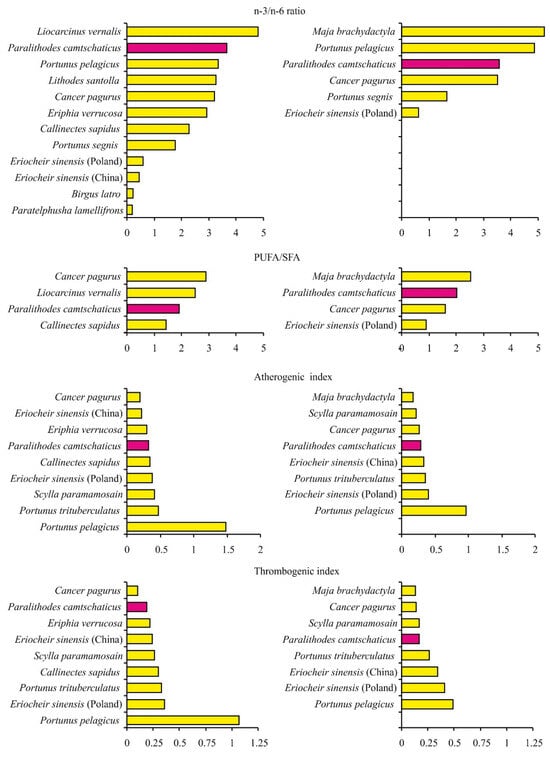
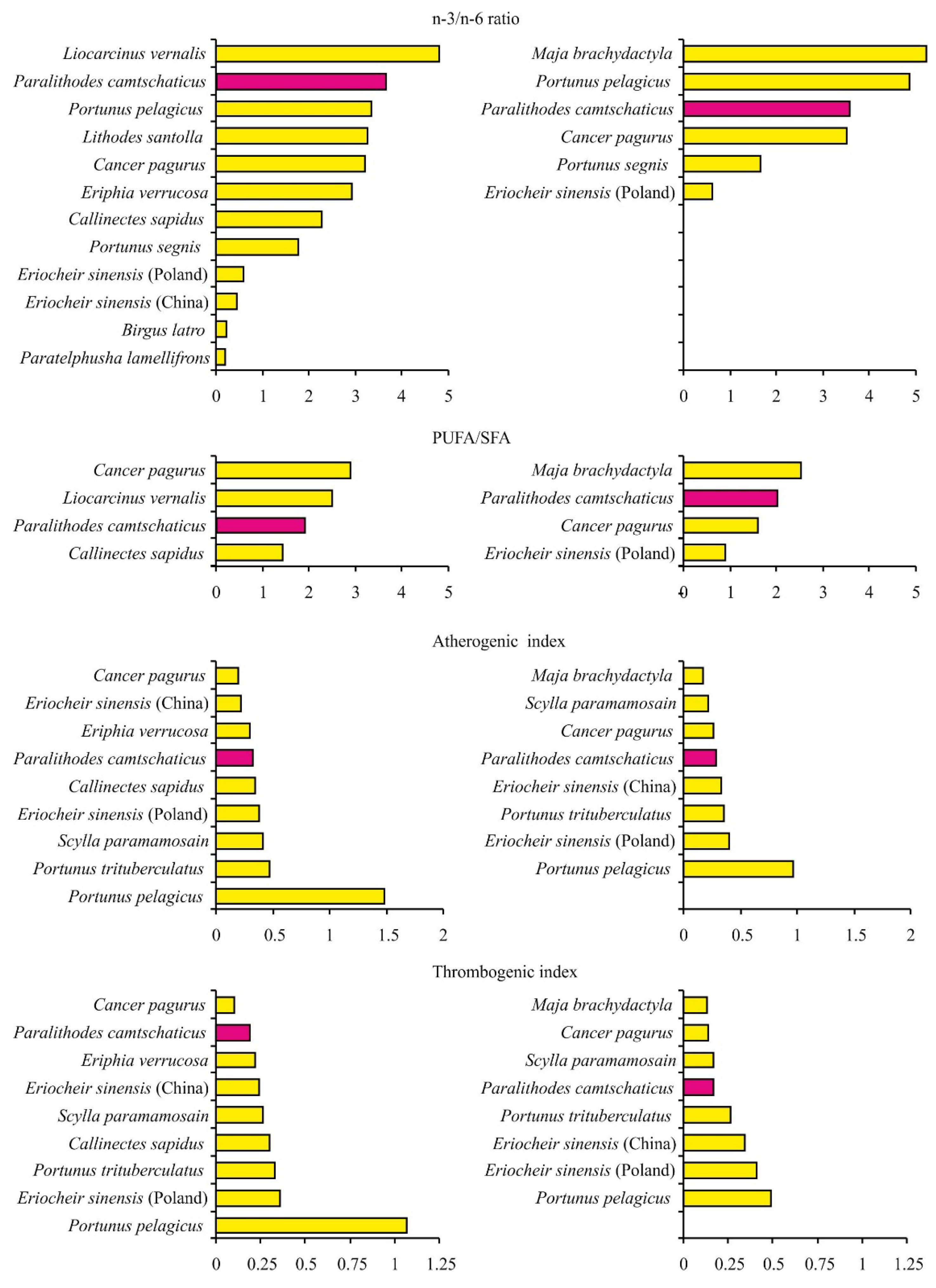
The calculated nutrition indices of red king crab meat are within the limits established for healthy diets. Moreover, these indices are often more beneficial than those reported for other crab species, predominantly those inhabiting warmer locations, such as Callinectes sapidus, Eriocheir sinensis, Portunus pelagicus, and Scylla paramamosain, due to the higher levels of PUFAs in red king crabs (Figure 3).
Figure 3.
Variations in nutritional indices calculated for raw meat of different crab species [56,57,59,63,65,66,67,70,71,95,96,97,98,99,100]. Left side—males; right side—females.
This is likely due to the adaptations of poikilothermic organisms to colder environments, which involve modulating the lipid composition of their membranes to maintain a relatively constant membrane fluidity, including alterations in the degree of fatty acid unsaturation, chain length, and the proportion of branched-chain fatty acids [101].
Thus, the high concentrations of DHA and EPA, coupled with an n-3/n-6 ratio close to the recommended value, highlight the nutritional importance of red king crab meat. It plays a significant role in human diets and can help prevent cardiovascular diseases and undesirable inflammatory processes.
5. Conclusions
Our study provides novel insights into the fatty acid composition of the meat derived from red king crabs inhabiting the Barents Sea. We found that the fatty acid content in the meat from males is lower than that recorded in females, probably due to differences in the physiology, behavior, and/or activity between males and females. The cooking procedure has different effects on the meat, depending on crab sex. There is a significant improvement recorded for male meat, and less expressed, but still significant, changes for female meat, which also likely reflects differences in the tissue structure between males and females. Despite the lower overall fatty acid levels in red king crab meat compared to other crabs, this product in many cases has a more balanced ratio of PUFA to SFA contents, resulting in better nutritional indices, making the red king crab meat an excellent product for a healthy diet. Further research is needed to reveal the underlying mechanisms for the patterns established in the current study.
Author Contributions
Conceptualization, A.G.D. and F.A.B.; data curation, F.A.B., A.G.D., O.S.V. and V.G.D.; validation, A.G.D., O.S.V., F.A.B., and N.F.B.; formal analysis, F.A.B., O.S.V., N.F.B. and A.G.D.; methodology, F.A.B., A.G.D., O.S.V. and N.F.B.; software, V.G.D. and A.G.D.; visualization, V.G.D.; project administration, V.G.D. and A.G.D.; writing—original draft, A.G.D., V.G.D. and F.A.B.; writing—review and editing, V.G.D., A.G.D., N.F.B., O.S.V. and F.A.B. All authors have read and agreed to the published version of the manuscript.
Funding
This study was funded by the Ministry of Science and Higher Education of the Russian Federation.
Institutional Review Board Statement
This study was approved by the Institutional Review of Murmansk Marine Biological Institute RAS (No. 188/1252/14, 19 December 2023).
Informed Consent Statement
Not applicable.
Data Availability Statement
The original contributions presented in this study are included in the article. Further inquiries can be directed to the corresponding authors.
Conflicts of Interest
The authors declare no conflicts of interest.
References
- Cleland, J. World population growth; past, present and future. Environ. Resour. Econ. 2013, 55, 543–554. [Google Scholar] [CrossRef] [Scilit]
- Henchion, M.; Hayes, M.; Mullen, A.M.; Fenelon, M.; Tiwari, B. Future protein supply and demand: Strategies and factors influencing a sustainable equilibrium. Foods 2017, 6, 53. [Google Scholar] [CrossRef] [Scilit] [PubMed]
- Kim, S.W.; Less, J.F.; Wang, L.; Yan, T.; Kiron, V.; Kaushik, S.J.; Lei, X.G. Meeting global feed protein demand: Challenge, opportunity, and strategy. Annu. Rev. Anim. Biosci. 2019, 7, 221–243. [Google Scholar] [CrossRef] [Scilit] [PubMed]
- Pal, J.; Shukla, B.N.; Maurya, A.K.; Verma, H.O.; Pandey, G.; Amitha, A. A review on role of fish in human nutrition with special emphasis to essential fatty acid. Int. J. Fish. Aquat. Stud. 2018, 6, 427–430. [Google Scholar]
- Balami, S.; Sharma, A.; Karn, R. Significance of nutritional value of fish for human health. Malays. J. Halal Res. 2019, 2, 32–34. [Google Scholar] [CrossRef] [Scilit]
- Bondad-Reantaso, M.G.; Subasinghe, R.P.; Josupeit, H.; Cai, J.; Zhou, X. The role of crustacean fisheries and aquaculture in global food security: Past, present and future. J. Invertebr. Pathol. 2012, 110, 158–165. [Google Scholar] [CrossRef] [Scilit]
- Behringer, D.C.; Duermit-Moreau, E. Crustaceans, One Health and the changing ocean. J. Invertebr. Pathol. 2021, 186, 107500. [Google Scholar] [CrossRef] [Scilit]
- Rana, S. Multiformity and economic importance of true Brachyuran crabs. Edelweiss Appl. Sci. Technol. 2018, 2, 253–259. [Google Scholar] [CrossRef] [Scilit]
- Weis, J.S. Walking Sideways: The Remarkable World of Crabs; Cornell University Press: Ithaca, NY, USA, 2012. [Google Scholar]
- Nanda, P.K.; Das, A.K.; Dandapat, P.; Dhar, P.; Bandyopadhyay, S.; Dib, A.L.; Lorenzo, J.M.; Gagaoua, M. Nutritional aspects, flavour profile and health benefits of crab meat-based novel food products and valorisation of processing waste to wealth: A review. Trends Food Sci. Technol. 2021, 112, 252–267. [Google Scholar] [CrossRef] [Scilit]
- Feltault, K. Trading quality, producing value: Crabmeat, HACCP, and global seafood trade. In Food Chains: From Farmyard to Shopping Cart; Belasco, W., Horowitz, R., Eds.; University of Pennsylvania Press: Philadelphia, PA, USA, 2009; pp. 62–83. [Google Scholar]
- Ahdiati, L.; Cahyadinata, I.; Sumantri, B. Analysis of consumer loyalty for mud crabs (Scylla serrata) at Sembam Fish Marola restaurants in Bengkulu city. J. Agric. Socio Econ. Bus. 2024, 6, 131–140. [Google Scholar]
- Moghal, M.M.; Pradhan, V.; Ladniya, V. Studies on crabs (Brachyura): A review. J. Adv. Sci. Res. 2015, 6, 1–12. [Google Scholar]
- Wassmann, P.; Reigstad, M.; Haug, T.; Rudels, B.; Carroll, M.L.; Hop, H.; Gabrielsen, G.W.; Falk-Petersen, S.; Denisenko, S.G.; Arashkevich, E.; et al. Food webs and carbon flux in the Barents Sea. Progr. Oceanogr. 2006, 71, 232–287. [Google Scholar] [CrossRef] [Scilit]
- Dvoretsky, A.G.; Dvoretsky, V.G. Fluctuations of net primary production along a standard transect in the Barents Sea and their relationships with environmental factors. Environ. Res. 2026, 288, 123177. [Google Scholar] [CrossRef] [Scilit] [PubMed]
- Haug, T.; Bogstad, B.; Chierici, M.; Gjøsæter, H.; Hallfredsson, E.H.; Høines, Å.S.; Hoel, A.H.; Ingvaldsen, R.B.; Jørgensen, L.L.; Knutsen, T.; et al. Future harvest of living resources in the Arctic Ocean north of the Nordic and Barents Seas: A review of possibilities and constraints. Fish. Res. 2017, 188, 38–57. [Google Scholar] [CrossRef] [Scilit]
- Pecherskih, M.Y.; Kravets, P.P. Prospects of mussel mariculture in the Barents Sea. In Problems of the Arctic Region: Abstracts of the XVIII International Scientific Conference for Students and Post-Graduates; Cherniakov, S.M., Shapovalova, Y.A., Eds.; Polar Geophysical Institute: Murmansk, Russia, 15 May 2019; pp. 23–24. [Google Scholar]
- Dvoretsky, A.G.; Dvoretsky, V.G. Filling knowledge gaps in Arctic marine biodiversity: Environment, plankton, and benthos of Franz Josef Land, Barents Sea. Ocean Coast. Manag. 2024, 249, 106987. [Google Scholar] [CrossRef] [Scilit]
- Kuzmin, S.A.; Gudimova, E.N. Introduction of the Kamchatka (Red King) Crab in the Barents Sea. Peculiarities of Biology, Perspectives of Fishery; Kola Science Centre RAS Press: Apatity, Russia, 2002. (In Russian) [Google Scholar]
- Kuznetsov, V.V. The Biology of Abundant and the Most Common Species of Crustaceans in the Barents and White Seas; Nauka: Moscow, Russia, 1964. (In Russian) [Google Scholar]
- Dvoretsky, A.G.; Dvoretsky, V.G. Epibionts of an introduced king crab in the Barents Sea: A second five-year study. Diversity 2023, 15, 29. [Google Scholar] [CrossRef] [Scilit]
- Dvoretsky, A.G.; Dvoretsky, V.G. Stock dynamics of female red king crab in a small bay of the Barents Sea in relation to environmental factors. Animals 2025, 15, 99. [Google Scholar] [CrossRef] [Scilit]
- Talberg, N.B. Comparative characteristics in the red king crab migration pattern in the shallows of the Barents and Okhotsk Sea. Coast. Hydrobiol. Investig. VNIRO Proc. 2005, 142, 91–101. (In Russian) [Google Scholar]
- Sokolov, V.I.; Milyutin, D.M. Distribution, size-sex composition, and reserves of the red king crab (Paralithodes camtschaticus) in the upper sublittoral of the Kola Peninsula (the Barents Sea). Zool. Zhurn 2006, 85, 158–171. (In Russian) [Google Scholar]
- Dvoretsky, A.G.; Dvoretsky, V.G. Ecology and distribution of red king crab larvae in the Barents Sea: A review. Water 2022, 14, 2328. [Google Scholar] [CrossRef] [Scilit]
- Pavlova, L.V.; Zuyev, Y.A. The red king crab (Paralithodes camtschaticus) in Kola Bay: Distribution, population and size/age structure changes from 2006 to 2008. Rybn. Khoz 2010, 6, 66–69. (In Russian) [Google Scholar]
- Dvoretsky, A.G.; Dvoretsky, V.G. Limb autotomy patterns in Paralithodes camtschaticus (Tilesius, 1815), an invasive crab, in the coastal Barents Sea. J. Exp. Mar. Biol. Ecol. 2009, 377, 20–27. [Google Scholar] [CrossRef] [Scilit]
- Dvoretsky, A.G.; Dvoretsky, V.G. Size-at-age of juvenile red king crab (Paralithodes camtschaticus) in the coastal Barents Sea. Cah. Biol. Mar. 2014, 55, 43–48. [Google Scholar]
- Pavlova, L.V. Red king crab trophic relations and its influence on bottom biocenoses. In Biology and Physiology of the Red King Crab from the Coastal Zone of the Barents Sea; Matishov, G.G., Ed.; Kola Science Centre RAS Press: Apatity, Russia, 2008; pp. 77–104. (In Russian) [Google Scholar]
- Pavlova, L.V. Nutrition. In Marine Ecosystems and Communities in the Conditions of Current Climate Changes; Matishov, G.G., Ed.; Renome: St. Petersburg, Russia, 2014; pp. 177–197. (In Russian) [Google Scholar]
- Falk-Petersen, J.; Renaud, P.; Anisimova, N. Establishment and ecosystem effects of the alien invasive red king crab (Paralithodes camtschaticus) in the Barents Sea—A review. ICES J. Mar. Sci. 2011, 68, 479–488. [Google Scholar] [CrossRef] [Scilit]
- Pavlova, L.V.; Zuyev, Y.A.; Dvoretsky, A.G. Shallow-water benthic communities on soft bottoms of a sub-Arctic fjord (Southern Barents Sea, Russia) along a gradient of ecological factors. Diversity 2023, 15, 84. [Google Scholar] [CrossRef] [Scilit]
- Pereladov, M.V. Some aspects of distribution and behavior of red king crab (Paralithodes camtschaticus) in the Barents Sea shallow coastal water. Coast. Hydrobiol. Investig. VNIRO Proc. 2003, 142, 103–119. (In Russian) [Google Scholar]
- Matyushkin, V.B. Reproductive parameters of female red king crab (Paralithodes camtschaticus, Tilesius) in the Ura inlet of the Barents Sea. Coast. Hydrobiol. Investig. VNIRO Proc. 2005, 144, 212–221. (In Russian) [Google Scholar]
- Dvoretsky, A.G.; Dvoretsky, V.G. Size at maturity of female red king crab, Paralithodes camtschaticus, from the coastal zone of Kola Peninsula (southern Barents Sea). Cah. Biol. Mar. 2015, 56, 49–54. [Google Scholar]
- Matyushkin, V.B. Determination of spawning periods by stages of embryo development in the red king crab Paralithodes camtschaticus female deposits. Coast. Hydrobiol. Investig. VNIRO Proc. 2016, 161, 27–37. (In Russian) [Google Scholar]
- Dvoretsky, A.G.; Dvoretsky, V.G. Epibiotic communities of common crab species in the coastal Barents Sea: Biodiversity and infestation patterns. Diversity 2022, 14, 6. [Google Scholar] [CrossRef] [Scilit]
- Kizevetter, I.V. Catching and Processing of Commercial Crustaceans from the Seas of the Far East; Primizdat: Vladivostok, Russia, 1962. (In Russian) [Google Scholar]
- Otto, R.S. History of king crab fisheries with special reference to the North Pacific Ocean: Development, maturity, and senescence. In King Crabs of the World: Biology and Fisheries Management; Stevens, B.G., Ed.; CRC Press and Taylor and Francis Group: Boca Raton, FL, USA, 2014; pp. 81–138. [Google Scholar]
- Belov, A. Crab harvesting, sustainability issues, and international trade: Insights from Russia. World 2024, 5, 293–312. [Google Scholar] [CrossRef] [Scilit]
- Dvoretsky, A.G.; Bichkaeva, F.A.; Baranova, N.F.; Dvoretsky, V.G. Fatty acid composition of the Barents Sea red king crab (Paralithodes camtschaticus) leg meat. J. Food Compos. Anal. 2021, 98, 103826. [Google Scholar] [CrossRef] [Scilit]
- Lian, F.; Siikavuopio, S.I.; Harrison, S.M.; Vang, B.; Brunton, N.P.; Esaiassen, M.; Lorentzen, G. Fatty acid profile of cooked leg meat and raw hepatopancreas of red king crab (Paralithodes camtschaticus) during three-month live holding without feeding at 5 and 10 °C. J. Food Compos. Anal. 2022, 105, 104206. [Google Scholar] [CrossRef] [Scilit]
- Reksten, A.M.; Wiech, M.; Aakre, I.; Markhus, M.W.; Nøstbakken, O.J.; Hannisdal, R.; Madsen, L.; Dahl, L. Exploring the nutrient composition of various shellfish available in Norway and their role in providing key nutrients. J. Food Compos. Anal. 2024, 128, 106003. [Google Scholar] [CrossRef] [Scilit]
- Lorentzen, G.; Samuelsen, T.A.; Hustad, A.; Thesslund, T.; Lian, F.; Rotabakk, B.T.; Skipnes, D.; Siikavuopio, S.I. Morphology, processing attributes, fatty acid, and amino acid composition in cooked leg meat and raw hepatopancreas of juvenile male red king crab (Paralithodes camtschaticus) after 12 months of live holding. J. Food Compos. Anal. 2024, 132, 106310. [Google Scholar] [CrossRef] [Scilit]
- Evseeva, O.Y.; Ishkulova, T.G.; Dvoretsky, A.G. Environmental drivers of an intertidal bryozoan community in the Barents Sea: A case study. Animals 2022, 12, 552. [Google Scholar] [CrossRef] [Scilit]
- Evseeva, O.Y.; Dvoretsky, A.G. Littoral bryozoan communities in the high Arctic: A latitudinal comparison. Sci. Nat. 2026, 113, 4. [Google Scholar] [CrossRef] [Scilit]
- Donaldson, W.E.; Byersdorfer, S.E. Biological Field Techniques for Lithodid Crabs. Fairbanks, Alaska Sea Grant College Program; University of Alaska: Fairbanks, AK, USA, 2005. [Google Scholar]
- Folch, J.; Less, M.; Sloane-Stanley, G.H. A simple method for the isolation and purification of total lipids from animal tissues. J. Biol. Chem. 1957, 226, 497–509. [Google Scholar] [CrossRef] [Scilit]
- Chen, J.; Liu, H. Nutritional indices for assessing fatty acids: A mini-review. Int. J. Mol. Sci. 2020, 21, 5695. [Google Scholar] [CrossRef] [Scilit]
- Holte, B.; Oug, E.; Cochrane, S. Depth-related benthic macrofaunal biodiversity patterns in three undisturbed North Norwegian fjords. Sarsia 2004, 89, 91–101. [Google Scholar] [CrossRef] [Scilit]
- Aksnes, D.L.; Dupont, N.; Staby, A.; Fiksen, Ø.; Kaartvedt, S.; Aure, J. Coastal water darkening and implications for mesopelagic regime shifts in Norwegian fjords. Mar. Ecol. Prog. Ser. 2009, 387, 39–49. [Google Scholar] [CrossRef] [Scilit]
- Karsakov, A.L.; Trofimov, A.G.; Anciferov, M.Y.; Ivshin, V.A.; Gubanishchev, M.A. 120 Years of Oceanographic Observations Along the Kola Section; PINRO: Murmansk, Russia, 2022. (In Russian) [Google Scholar]
- Alexeev, V.A.; Walsh, J.E.; Ivanov, V.V.; Semenov, V.A.; Smirnov, A.V. Warming in the Nordic Seas, North Atlantic storms and thinning Arctic sea ice. Environ. Res. Lett. 2017, 12, 084011. [Google Scholar] [CrossRef] [Scilit]
- Soundarapandian, P.; Varadharajan, D.; Jaganathan, K.; Ravichandran, S. Fatty acid composition in long-eyed swimming crab Podophthalmus vigil (Fabricius). J. Nutr. Food Sci. 2015, 5, 361. [Google Scholar]
- Ayas, D. The effects of season and sex on the nutritional quality of muscle types of blue crab Callinectes sapidus and swimming crab Portunus segnis. Nat. Eng. Sci. 2016, 1, 1–14. [Google Scholar] [CrossRef] [Scilit]
- Khamassi, F.; Rjiba Bahri, W.; Mnari Bhouri, A.; Chaffai, A.; Soufi Kechaou, E.; Ghanem, R.; Ben Souissi, J. Biochemical composition, nutritional value and socio-economic impacts of the invasive crab Callinectes sapidus Rathbun, 1896 in the central Mediterranean Sea. Mediterr. Mar. Sci. 2022, 23, 650–663. [Google Scholar] [CrossRef] [Scilit]
- Bejaoui, S.; Ghribi, F.; Hatira, S.; Chetoui, I.; Rebah, I.; Cafsi, M.H.E. First investigation in the biochemical analysis of the invasive crab Portunus segnis from Tunisian waters. J. Am. Oil Chem. Soc. 2017, 94, 673–682. [Google Scholar] [CrossRef] [Scilit]
- Wang, Y.; Li, J.; Wang, S.; Sun, B.; Xiong, L.; Cheng, Y. Composition and nutritional qualities of edible tissues of Chinese mitten crab (Eriocheir sinensis) from Ya Lake over different months. J. Food Compos. Anal. 2022, 105, 104199. [Google Scholar] [CrossRef] [Scilit]
- Czerniejewski, P.; Bienkiewicz, G.; Tokarczyk, G. Nutritional quality and fatty acids composition of invasive Chinese mitten crab from Odra estuary (Baltic Basin). Foods 2023, 12, 3088. [Google Scholar] [CrossRef] [Scilit]
- Tufan, B. Changes in the biochemical and fatty acid composition of different body parts of warty crab (Eriphia verrucosa, Forsskål, 1775) caught from the southeastern Black Sea and their relationship to seasons and sex. Turk. J. Fish. Aquat. Sci. 2023, 23, TRJFAS22160. [Google Scholar] [CrossRef] [Scilit]
- Bo-Young, J.; Soo-Kyung, M.; Woo-Geon, J. Fatty acid composition of 35 species of marine invertebrates. Fish. Aquat. Sci. 1998, 1, 232–241. [Google Scholar]
- Passi, S.; Cataudella, S.; Di Marco, P.; De Simone, F.; Rastrelli, L. Fatty acid composition and antioxidant levels in muscle tissue of different Mediterranean marine species of fish and shellfish. J. Agric. Food Chem. 2002, 50, 7314–7322. [Google Scholar] [CrossRef] [Scilit]
- Marques, A.; Teixeira, B.; Barrento, S.; Anacleto, P.; Carvalho, M.L.; Nunes, M.L. Chemical composition of Atlantic spider crab Maja brachydactyla: Human health implications. J. Food Compos. Anal. 2010, 23, 230–237. [Google Scholar] [CrossRef] [Scilit]
- Maulvault, A.L.; Anacleto, P.; Lourenço, H.M.; Carvalho, M.L.; Nunes, M.L.; Marques, A. Nutritional quality and safety of cooked edible crab (Cancer pagurus). Food Chem. 2012, 133, 277–283. [Google Scholar] [CrossRef] [Scilit] [PubMed]
- Sato, T.; Ohgami, S.I.; Kaneniwa, M. Seasonal variations in free amino acids, nucleotide-related compounds, and fatty acids and meat yield of the coconut crab Birgus latro. Fish. Sci. 2015, 81, 959–970. [Google Scholar] [CrossRef] [Scilit]
- Risso, S.J.; Carelli, A.A. Nutrient composition of raw and cooked meat of male southern king crab (Lithodes santolla Molina, 1782). J. Aquat. Food Prod. Technol. 2012, 21, 433–444. [Google Scholar] [CrossRef] [Scilit]
- Balzano, M.; Pacetti, D.; Lucci, P.; Fiorini, D.; Frega, N.G. Bioactive fatty acids in mantis shrimp, crab and caramote prawn: Their content and distribution among the main lipid classes. J. Food Compos. Anal. 2017, 59, 88–94. [Google Scholar] [CrossRef] [Scilit]
- Saito, H. Characteristics of fatty acid composition of the deep-sea vent crab, Shinkaia crosnieri Baba and Williams. Lipids 2011, 46, 723–740. [Google Scholar] [CrossRef] [Scilit]
- Viña-Trillos, N.; Urzúa, Á. Comparison of lipids and fatty acids among tissues of two semiterrestrial crabs reveals ecophysiological adaptations in changing coastal environments. Comp. Biochem. Physiol. A 2021, 259, 111012. [Google Scholar] [CrossRef] [Scilit]
- Barrento, S.; Marques, A.; Teixeira, B.; Anacleto, P.; Vaz-Pires, P.; Nunes, M.L. Effect of season on the chemical composition and nutritional quality of the edible crab Cancer pagurus. J. Agric. Food Chem. 2009, 57, 10814–10824. [Google Scholar] [CrossRef] [Scilit]
- Barrento, S.; Marques, A.; Teixeira, B.; Mendes, R.; Bandarra, N.; Vaz-Pires, P.; Nunes, M.L. Chemical composition, cholesterol, fatty acid and amino acid in two populations of brown crab Cancer pagurus: Ecological and human health implications. J. Food Compost. Anal. 2010, 23, 716–725. [Google Scholar] [CrossRef] [Scilit]
- Stumpp, M.; Saborowski, R.; Jungblut, S.; Liu, H.C.; Hagen, W. Dietary preferences of brachyuran crabs from Taiwan for marine or terrestrial food sources: Evidence based on fatty acid trophic markers. Front. Zool 2021, 18, 26. [Google Scholar] [CrossRef] [Scilit]
- Morado, F.J.; Shavey, C.A.; Ryazanova, T.; White, V.C. Diseases of king crabs and other anomalies. In King Crabs of the World: Biology and Fisheries Management; Stevens, B.G., Ed.; CRC Press and Taylor and Francis Group: Boca Raton, FL, USA, 2014; pp. 139–210. [Google Scholar]
- Skonberg, D.I.; Perkins, B.L. Nutrient composition of green crab (Carcinus maenus) leg meat and claw meat. Food Chem. 2002, 77, 401–404. [Google Scholar] [CrossRef] [Scilit]
- Gandemer, G. Lipids in muscles and adipose tissues, changes during processing and sensory properties of meat products. Meat Sci. 2002, 62, 309–321. [Google Scholar] [CrossRef] [Scilit] [PubMed]
- Bischof, J.C.; He, X. Thermal stability of proteins. Ann. N. Y. Acad. Sci. 2006, 1066, 12–33. [Google Scholar] [CrossRef] [Scilit] [PubMed]
- Padley, F.B.; Gunstone, F.D.; Harwood, J.L. Occurrence and characteristics of oils and fats. Marine oils: Fish and whale oils. In The Lipid Handbook; Gunstone, F.D., Harwood, J.L., Padley, F.B., Eds.; Chapman and Hall: London, UK, 1994; pp. 167–183. [Google Scholar]
- Hulbert, A.J. The under-appreciated fats of life: The two types of polyunsaturated fats. J. Exp. Biol. 2021, 224, jeb232538. [Google Scholar] [CrossRef] [Scilit]
- Pamplona, R.; Costantini, D. Molecular and structural antioxidant defenses against oxidative stress in animals. Am. J. Physiol. Regul. Integr. Comp. Physiol. 2011, 301, R843–R863. [Google Scholar] [CrossRef] [Scilit]
- Alagawany, M.; Elnesr, S.S.; Farag, M.R.; El-Sabrout, K.; Alqaisi, O.; Dawood, M.A.; Soomro, H.; Abdelnour, S.A. Nutritional significance and health benefits of omega-3, -6 and -9 fatty acids in animals. Anim. Biotechnol. 2022, 33, 1678–1690. [Google Scholar] [CrossRef] [Scilit]
- Patel, A.; Karageorgou, D.; Rova, E.; Katapodis, P.; Rova, U.; Christakopoulos, P.; Matsakas, L. An overview of potential oleaginous microorganisms and their role in biodiesel and omega-3 fatty acid-based industries. Microorganisms 2020, 8, 434. [Google Scholar] [CrossRef] [Scilit]
- Meijaard, E.; Abrams, J.F.; Slavin, J.L.; Sheil, D. Dietary fats, human nutrition and the environment: Balance and sustainability. Front. Nutr. 2022, 9, 878644. [Google Scholar] [CrossRef] [Scilit]
- Mesa, M.D.; Gil, F.; Olmedo, P.; Gil, A. Nutritional importance of selected fresh fishes, shrimps and mollusks to meet compliance with nutritional guidelines of n-3 LC-PUFA intake in Spain. Nutrients 2021, 13, 465. [Google Scholar] [CrossRef] [Scilit]
- Moruf, R.O.; Ogunbambo, M.M.; Taiwo, M.A.; Afolayan, O.A. Marine bivalves as a dietary source of high-quality lipid: A review with special reference to natural n-3 long chain polyunsaturated fatty acids. Bull. Univ. Agric. Sci. Vet. Med. Cluj-Napoca Food Sci. Technol. 2021, 78, 11–18. [Google Scholar] [CrossRef] [Scilit] [PubMed]
- D’Angelo, S.; Motti, M.L.; Meccariello, R. ω-3 and ω-6 polyunsaturated fatty acids, obesity and cancer. Nutrients 2020, 12, 2751. [Google Scholar] [CrossRef] [Scilit] [PubMed]
- Kapoor, B.; Kapoor, D.; Gautam, S.; Singh, R.; Bhardwaj, S. Dietary polyunsaturated fatty acids (PUFAs): Uses and potential health benefits. Curr. Nutr. Rep. 2021, 10, 232–242. [Google Scholar] [CrossRef] [Scilit] [PubMed]
- Rodriguez, D.; Lavie, C.J.; Elagizi, A.; Milani, R.V. Update on omega-3 polyunsaturated fatty acids on cardiovascular health. Nutrients 2022, 14, 5146. [Google Scholar] [CrossRef] [Scilit]
- Kalkman, H.O.; Hersberger, M.; Walitza, S.; Berger, G.E. Disentangling the molecular mechanisms of the antidepressant activity of omega-3 polyunsaturated fatty acid: A comprehensive review of the literature. Int. J. Mol. Sci. 2021, 22, 4393. [Google Scholar] [CrossRef] [Scilit]
- Kang, B.; Skonberg, D.I.; Myracle, A.D. Anti-hyperglycemic effects of green crab hydrolysates derived by commercially available enzymes. Foods 2020, 9, 258. [Google Scholar] [CrossRef] [Scilit]
- Casillas-Vargas, G.; Ocasio-Malavé, C.; Medina, S.; Morales-Guzmán, C.; Del Valle, R.G.; Carballeira, N.M.; Sanabria-Ríos, D.J. Antibacterial fatty acids: An update of possible mechanisms of action and implications in the development of the next-generation of antibacterial agents. Prog. Lipid Res. 2021, 82, 101093. [Google Scholar] [CrossRef] [Scilit]
- Djuricic, I.; Calder, P.C. Beneficial outcomes of omega-6 and omega-3 polyunsaturated fatty acids on human health: An update for 2021. Nutrients 2021, 13, 2421. [Google Scholar] [CrossRef] [Scilit]
- Valner, A.; Müller, R.; Kull, M.; Põlluste, K.; Lember, M.; Kallikorm, R. Does dietary polyunsaturated fatty acid intake associate with bone mineral density and limb structural changes in early rheumatoid arthritis? Nutr. Metabol. Insights 2023, 16, 11786388231176169. [Google Scholar] [CrossRef] [Scilit]
- Coniglio, S.; Shumskaya, M.; Vassiliou, E. Unsaturated fatty acids and their immunomodulatory properties. Biology 2023, 12, 279. [Google Scholar] [CrossRef] [Scilit]
- HMSO. Nutritional Aspects of Cardiovascular Disease: Report on Health and Social Subjects; Committee of Medical Aspects of Food Policy, 46; U.K. Department of Health: London, UK, 1994; 186p.
- Bayrakli, B. Monthly variations in proximate composition, fatty acid quality and amino acid score of warty crab, Eriphia verrucosa (Forsskal, 1775) from the Southern Coast of Black Sea, Turkey. Pak. J. Zool. 2021, 53, 1729–1741. [Google Scholar] [CrossRef] [Scilit]
- Chen, D.W.; Zhang, M.; Shrestha, S. Compositional characteristics and nutritional quality of Chinese mitten crab (Eriocheir sinensis). Food Chem. 2007, 103, 1343–1349. [Google Scholar] [CrossRef] [Scilit]
- Kuley, E.; Özoğul, F.; Özogul, Y.; Olgunoglu, A.I. Comparison of fatty acid and proximate compositions of the body and claw of male and female blue crabs (Callinectes sapidus) from different regions of the Mediterranean coast. Int. J. Food Sci. Nutr. 2008, 59, 573–580. [Google Scholar] [CrossRef] [Scilit] [PubMed]
- Jiang, K.J.; Zhang, F.Y.; Pi, Y.; Jiang, L.L.; Yu, Z.L.; Zhang, D.; Sun, M.M.; Gao, L.J.; Qiao, Z.G.; Ma, L.B. Amino acid, fatty acid, and metal compositions in edible parts of three cultured economic crabs: Scylla paramamosain, Portunus trituberculatus, and Eriocheir sinensis. J. Aquat. Food Prod. Technol. 2014, 23, 73–86. [Google Scholar] [CrossRef] [Scilit]
- Javaheri Baboli, M.; Velayatzadeh, M.; Roomiani, L.; Khoramabadi, A. Effect of sex and tissue on fatty acid composition in the meat of blue swimming crab (Portunus pelagicus) from the Persian Gulf, Iran. Iran. J. Fish. Sci. 2016, 15, 818–826. [Google Scholar]
- Islam, M.D.B.; Sarkar, M.D.M.; Rahman, M.D.R.; Khan, M.; Afroze, M.; Hasan, A.; Sarkar, S.U. Fatty acid profile of freshwater crab (Paratelphusa lamellifrons) from Padma River of Rajshahi City, Bangladesh. J. Nutr. Food Sci. 2017, 7, 2. [Google Scholar] [CrossRef]
- Harayama, T.; Antonny, B. Beyond fluidity: The role of lipid unsaturation in membrane function. Cold Spring Harb. Perspect. Biol. 2023, 15, a041409. [Google Scholar] [CrossRef] [Scilit]

Disclaimer/Publisher’s Note: The statements, opinions and data contained in all publications are solely those of the individual author(s) and contributor(s) and not of MDPI and/or the editor(s). MDPI and/or the editor(s) disclaim responsibility for any injury to people or property resulting from any ideas, methods, instructions or products referred to in the content. |
© 2026 by the authors. Licensee MDPI, Basel, Switzerland. This article is an open access article distributed under the terms and conditions of the Creative Commons Attribution (CC BY) license.