


Simple Summary
Managing dog populations is important for animal welfare and disease control. In many resource-limited countries, large numbers of dogs roam freely and cause many challenges. Unfortunately, it is difficult to surgically sterilize these animals in such settings. This study explored how communities of Zanzibar and Mauritius view dog fertility control and whether they would use an alternative contraception method, a hypothetical fertility control vaccine (immunocontraceptive). Results from surveys demonstrated that while communities were highly aware of sterilization (up to 76.1% of dog owners in Zanzibar and 84.2% in Mauritius), they were not implementing it because among respondents who indicated that they did not want their dogs to have puppies, only 12.1% of dogs were sterilized in Zanzibar, compared with 56.9% sterilized in Mauritius. Participants also indicated that they would use a fertility control vaccine if concerns regarding its safety were addressed. Overall, these findings from this study show that dog population management should be adapted to the needs of the community rather than using a universal approach. A fertility control vaccine could also complement existing dog population management methods, thereby stabilizing dog population numbers and potentially improving animal welfare and disease control.
Abstract
Large free-roaming dog populations in low- and middle-income countries (LMICs) present significant challenges for animal welfare and disease control, highlighting the need for effective dog population management (DPM). Immunocontraceptive vaccines (IVs) theoretically offer a humane, cost-effective alternative to surgical sterilization in resource-limited settings. The success of such interventions depends both on biological efficacy and community acceptance. Knowledge, attitudes and practices (KAP) surveys were conducted among dog owners in Zanzibar (n = 414) and Mauritius (n = 587) to assess community perceptions of dog fertility control and potential IV usage. Both islands exhibited large free-roaming dog populations and high fertility control awareness (76.1% in Zanzibar and 84.2% in Mauritius), but acceptance of fertility control differed significantly. Sterilization participation among respondents who did not want puppies was lower in Zanzibar compared to Mauritius (12.1% vs. 56.9%). Willingness to use IVs was 57.5% in Zanzibar and 21.7% in Mauritius, with limited knowledge and safety concerns as the main barriers. Our findings suggest IVs could provide a socially acceptable alternative to surgical sterilization where conventional DPM strategies are impractical or unsustainable. Island comparisons highlight the importance of context-specific DPM strategies rather than standardized approaches, aiding policymakers and stakeholders in providing DPM that balances public acceptance, animal welfare and disease prevention.
1. Introduction
For the past 15,000 years, domestic dogs (Canis lupus familiaris) and humans have maintained mutually beneficial relationships whereby dogs fulfil the roles of companions, security animals and service animals (i.e., herding or farming) [1]. Dogs have journeyed with humans to all parts of the world [2], earning the description “man’s best friend”. At present, the global dog population size is estimated to be approximately 700 million [1]. Domestic dogs represent a mix of several sub-populations due to the varying relationships they have with humans. They can be classified as owned (confined, fully or partially free-roaming), community-owned, unowned or feral [3]. Free-roaming dogs therefore include both unrestricted owned and unowned dogs. Dogs move between sub-populations, with several pathways contributing to the growth of free-roaming dog populations. Global estimates suggest that more than 75% of dogs are free-roaming [1]. These distinct sub-populations exhibit different movements and behavior, fertility and survival rates as well as being treated differently by the humans they associate with [4].
While dogs have been shown to contribute positively to human societies and ecosystems (i.e., interactions with other animals and positive competition for food resources [5]), large free-roaming populations pose significant challenges for public health, animal welfare and the environment. Dogs are the primary reservoir of rabies, causing a modeled global estimate of 59,000 (95% confidence interval: 25–159,000) human fatalities annually, of which 99% result from dog-mediated transmission, although a lack of adequate surveillance systems suggests that these human and animal rabies numbers could be underestimated [6]. Other canine zoonoses include leptospirosis, echinococcosis (hydatid disease), Chagas disease, toxocariasis and leishmaniasis [3,7]. Additionally, dogs can also transmit pathogens such as canine distemper virus and parvovirus to other wild carnivores [8].
High-density free-roaming dog populations affect more than public health. This is evidenced by the fact that they are often associated with poor welfare outcomes, including malnutrition, disease, parasitism, abuse and high mortality, while also negatively impacting biodiversity and public safety [3]. To this end, where dogs are identified as a source of public health problems, governments are often prompted to eradicate them in a variety of ways, often neglecting animal welfare.
Dog population management (DPM) is a multifaceted concept that aims to enhance the health and welfare of free-roaming dogs to reduce the issues that they create and reduce dog population size [9]. DPM can be used for a variety of economic, public health, safety and animal welfare reasons, including the reduction in human bite injuries, secondary infections or fatalities, as well as the reduction in rabies and other zoonotic disease transmission [3,9]. DPM also helps reduce noise pollution, environmental fecal contamination and traffic accidents. In addition, it can limit negative publicity aimed at governments and mitigate the adverse effects that free-roaming dog populations have on tourism [9]. According to the International Companion Animal Management (ICAM) Coalition, effective DPM requires understanding local dog population dynamics and factors contributing toward the increase of free-roaming dogs. DPM interventions should aim to address the source of and factors contributing to the increase of free-roaming dogs so that context-specific solutions that manage dog population turnover can be selected, including interventions such as responsible dog ownership, fertility control, vaccination and habitat management [10]. As a result, depending on the circumstances, DPM programs may have multiple objectives, some of which may or may not involve permanently decreasing the number of dogs in a population [3,9].
Among the various strategies used in DPM, surgical sterilization is most commonly implemented through catch-neuter-vaccinate-return (CNVR) programs, which combine rabies vaccination and surgical sterilization to regulate dog populations in both urban and rural regions. This method has been carried out in several countries such as Italy, India, Bangladesh, Zanzibar (Tanzania), Mauritius and Brazil [3]. Although surgical sterilization is more socially acceptable than culling, its practical application in free-roaming dog populations in most countries remains challenging. Short-term complications include hemorrhage of the ovarian or uterine pedicle, passage of bloody vulvar discharge, infection of the incision and peritonitis [11], while long-term complications include ovarian remnant syndrome, ligation of a ureter, granuloma of the uterine or ovarian pedicle and renal dysfunction [12]. Unfortunately, during CNVR programs, long-term medical care is not provided after surgery, and thus dogs may suffer complications without any medical attention. Additionally, some owners are against surgical sterilization of dogs due to religious beliefs or misconceptions that the method of contraception alters behavior [3]. Furthermore, CNVR programs are often not government-funded, which raises questions about their long-term sustainability in rural settings since such campaigns are expensive (i.e., require skilled personnel, clinical facilities and regulated medications) [3,9]. As a result, surgical sterilization is often not practical for free-roaming dog populations in resource-limited areas, necessitating the use of alternate approaches. Few CNVR programs have effectively monitored their impact on dog population size, leading to limited reports on their effectiveness, while some reports have shown that DPM is not always achieved or maintained [9].
Given these reservations, the lack of impactful and sustainable dog population interventions suggests that there is a great need for non-surgical population control methods in free-roaming dog populations. To this end, the usage of an immunocontraceptive vaccine (IV) can offer a non-surgical DPM strategy for free-roaming dogs in low- and middle-income countries. These IVs generate antibodies against reproductive hormones in order to cause infertility [13]. This non-surgical method of contraception is founded on active immunity against “self-antigens” such as gonadotropin-releasing hormone (GnRH), luteinizing hormone (LH), follicle-stimulating hormone (FSH) or zona pellucida (ZP) [14]. An effective IV should be reliable, easy to administer, safe, affordable, have high target specificity, provide a temporary but long-term immune response, lack endocrine or metabolic side effects, not require any insertion of an implant or device introduced in any surgical fashion and be compatible with disease control efforts [15]. To this end, research is still ongoing to identify and develop suitable vaccine constructs that demonstrate optimal efficacy and safety profiles, but no IV for routine use in dogs is commercially available.
Zanzibar and Mauritius represent two distinct island settings where free-roaming dog populations pose persistent dog management challenges. Zanzibar, an autonomous region of the United Republic of Tanzania, has documented canine rabies on the main island of the archipelago, Unguja Island, since 1921. Although reported to have been eliminated for a number of decades, rabies was apparently reintroduced to Unguja in 1991 and then to Pemba Island in 1998, leading to the re-establishment of endemic transmission throughout the archipelago [16]. Despite sustained mass dog vaccination (MDV) campaigns and strengthened surveillance systems, dog-mediated rabies remains a public health concern, exacerbated by limited resources and the difficulty of achieving and maintaining the recommended 70% vaccination coverage in areas with large free-roaming dog populations [17,18,19]. Integrating DPM strategies into rabies elimination efforts may therefore be critical to achieving long-term control.
Mauritius, in contrast, has been reported to be rabies-free since 1981 [20] but continues to face considerable challenges with animal welfare, public safety and environmental impacts related to free-roaming dog overpopulation [21,22]. While various DPM strategies have been implemented, including culling, sheltering and sterilization campaigns, these approaches have been costly, resource-intensive, often short-lived and insufficient to achieve sustained population control [22]. Hormonal contraceptives are available throughout the country but are associated with significant side effects and financial barriers for dog owners [23].
Understanding community knowledge, attitudes and practices (KAP) is essential for implementing ethical and sustainable DPM strategies that are accepted by communities. However, despite ongoing DPM initiatives at varying intensities in both settings, there is a lack of peer-reviewed data evaluating community perceptions, acceptance and practices related to fertility control interventions, particularly non-surgical options. This study therefore aimed to assess community perceptions (i.e., knowledge, experiences and attitudes) regarding DPM and fertility control in Zanzibar and Mauritius, with a particular focus on the potential acceptability of a hypothetical immunocontraceptive vaccine as part of a future DPM program.
2. Materials and Methods
2.1. Study Location and Sample Size Determination
Unguja Island (also known as Zanzibar Island, situated off the east coast of Africa, with a human population of 1,889,773 [24]) is a rabies-endemic area. In response to the laboratory confirmation of rabies on the island in 2016, GARC, Rabies Alliance and the Department of Livestock Development implemented a mass dog vaccination program from 2017 onwards [19]. While these vaccination campaigns have had a positive impact on the public health risk of rabies (with the number of laboratory-confirmed rabies cases decreasing year-on-year), there has been very little effort to address dog population turnover on the island in a resource-considerate manner [25]. Given the current lack of widespread fertility control for dogs in Zanzibar, this target site was selected on the premise that the island could possibly benefit from the future implementation of a DPM intervention such as an immunocontraceptive vaccine.
In contrast, Mauritius, located in the southwestern Indian Ocean, with a human population size of 1,235,260 [26] is one of the few countries that has been reported to be rabies-free since 1981 [20]. However, this rabies-free status does not eliminate the challenges related to DPM, as the country continues to struggle with high dog populations that exceed the country’s ability to provide care and shelter [21].
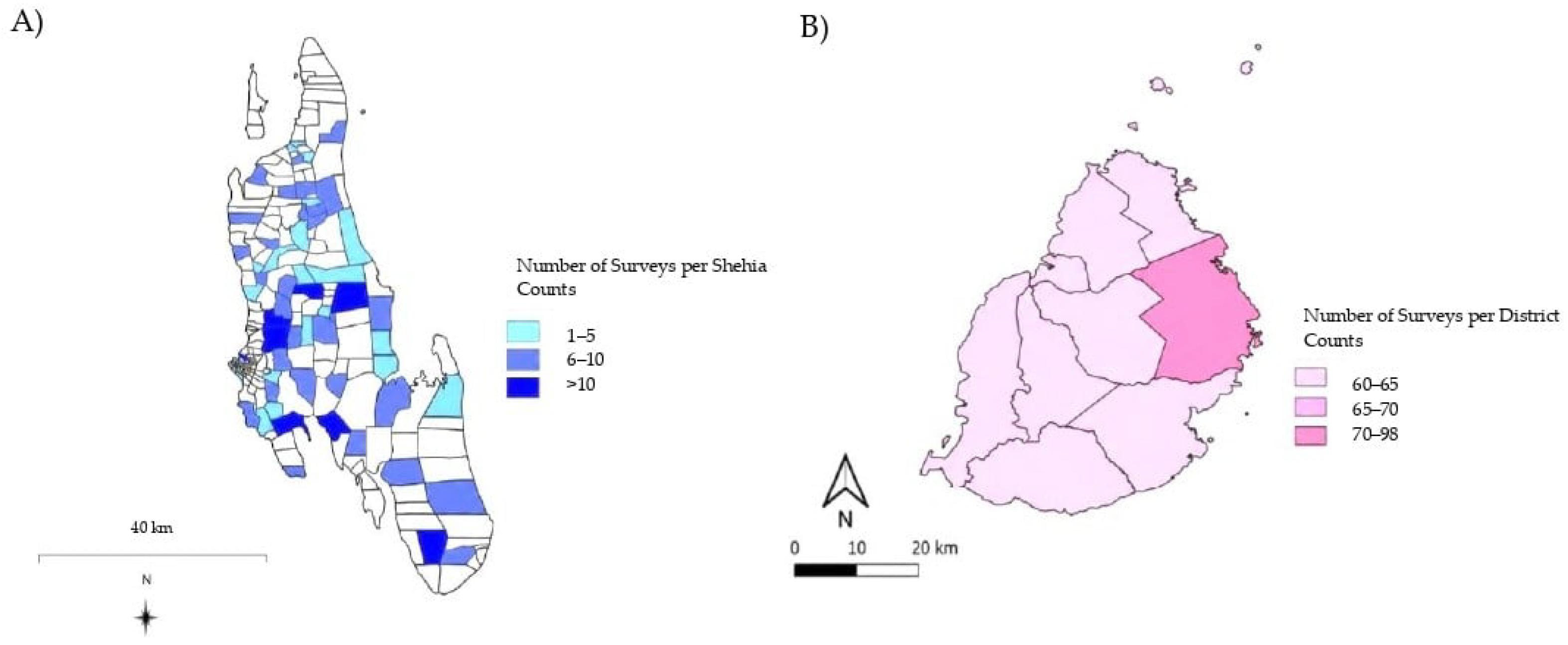
Target sample sizes for both Zanzibar and Mauritius were determined using an online sample size calculator (https://www.calculator.net/sample-size-calculator.html, accessed on 1 August 2023 for the Zanzibar investigation and 1 November 2024 for the Mauritius investigation). A 95% confidence level was assumed, together with a 4% margin of error and a conservative 50% response distribution due to the lack of prior baseline data on dog fertility control awareness in either region. A total of 414 surveys from Zanzibar and 587 surveys from Mauritius were collected via convenience and intercept sampling. The surveys were distributed among the seven districts of Zanzibar (i.e., North A, North B, Central, South, Urban, West A and West B) and the nine districts of Mauritius (Grand Port, Port Louis, Pamplemousses, Riviére de Rempart, Flacq, Savanne, Black River, Plaines Wilhems and Moka) (Figure 1).
Figure 1.
(A) Map displaying the distribution of surveys collected per shehia across Zanzibar. (B) Map displaying distribution of surveys collected per district across Mauritius. Both maps were generated using QGIS (Quantum Geographic Information System) version 3.40.4 Bratislava.
For Zanzibar, shehias were first visualized across the island. Secondly, the human population densities per km2 were determined and combined with estimated dog population ratios provided by GARC (Supplementary Material (S1)). Finally, included shehias were selected based on high known human populations, high known dog populations and geographical distribution. The shehias were selected to ensure that an even distribution of surveys across the island was maintained. Notably, after the initial shehias were selected, not all shehias provided adequate numbers of viable surveys with dog owners. Therefore, additional shehias were surveyed in order to still reach the required number of surveys per district as represented on Table S1.2 (Supplementary Material (S1)). Unfortunately, Mauritius did not have data on estimated dog population ratios, so surveys were collected evenly across each of the districts. A greater proportion of surveys were collected in the Flacq district compared to other districts due to a logistical miscommunication between the surveyor teams and the Ministry of Agro-Industry and Food Security. However, Flacq is socio-demographically comparable to the other districts, and thus the findings are still considered to be equally representative. For respondents, the district’s town or village was also recorded for rural and urban region determination. Locations of towns and villages can be found in Supplementary Material (S1). Because non-probability sampling was employed, the calculated margin of error serves solely as a sample-size heuristic, and findings reflect the surveyed respondents rather than being statistically generalized to the entire national population.
2.2. Study Design and Survey Implementation
For this cross-sectional study, a KAP survey was designed to determine the perceptions of dog owners, community dog caretakers and respondents who do both. Respondents were asked to provide their perceptions on fertility control for dogs and whether they would use alternative methods, such as an injectable vaccine to temporarily prevent their dogs from having puppies. No detail regarding the vaccine’s mechanism of action, efficacy, duration or benefits was given. The responses therefore highlight respondents’ initial perceptions and existing knowledge of fertility control, while also identifying their current willingness to consider using a hypothetical IV as a potential DPM initiative. Although community care takers were considered as part of the larger dataset, only dog owners were included in the analysis since they made up the majority of respondents and are the main decision-makers having direct influence on how their dogs are managed and taken care of.
The survey followed a similar design for both Zanzibar and Mauritius with minor alterations relevant to each island (Supplementary Material (S2)). The questionnaire was developed in English and professionally translated into Swahili for respondents in Zanzibar, while specific questions were translated into Creole French where needed to ensure comprehension in Mauritius. The final questionnaire was administered using Google Forms. For this study, the Lyssavirus Research Laboratory collaborated with the Zanzibar Livestock Research Institute (ZALIRI, part of the Revolutionary Government of Zanzibar’s Department of Livestock Development) and the Mauritian Ministry of Agro-Industry and Food Security, Livestock and Veterinary Division, who provided surveyors to assist in conducting the survey.
Prior to data collection, surveyors were trained in a pre-survey workshop where they were briefed on the project’s objectives, respondent selection criteria (i.e., respondents must be at least 18 years of age, complete an informed consent form and indicate willingness to participate, with a single survey per household), how to use the online questionnaire, how to interview people (e.g., ensure that the questionnaire is not answered in groups) and how to capture the data. This also ensured that the surveyors could confirm that translations of the questionnaire were correct in terms of both intended meaning and comprehension.
The designed questionnaire was pre-tested in different shehias in Zanzibar (n = 10) on 23 November 2023 and in different towns in Mauritius (n = 10) on 4 February 2025. Shortcomings in the questionnaire were identified and addressed before the commencement of this study. The study period in Zanzibar ran between January and February 2024 and in Mauritius from 4 February to 15 June 2025. During this time, the trained surveyors walked through populated areas within the districts of Zanzibar and Mauritius. Available male and female respondents were approached based on their proximity and willingness to participate in face-to-face interviews. Interviews were conducted in a language understood by the respondents, with an explanation provided about this study’s purpose, anonymity and participants’ right to withdraw at any point without penalty. Only respondents who provided written consent were interviewed. Surveyors read each question aloud and recorded verbal responses directly into the Google Form, enabling real-time data tracking. Individuals who did not wish to participate were omitted from this study and not included in the investigation. Survey submissions were monitored daily.
2.3. Data Analysis
Data collected from each questionnaire was captured in Microsoft Excel, filtered and checked for completeness before a descriptive analysis was conducted for the entire dataset. After the socio-demographic characteristics had been summarized, a descriptive analysis of the profile of owned dogs, the general perception of people on dog ownership, rabies vaccination, sterilization and fertility control practices, the use of an immunocontraceptive vaccine and available hormonal contraceptives (Mauritius only) was conducted. Additionally, univariable logistic regression analysis was used to calculate the odds ratios (ORs) and the corresponding 95% confidence intervals (CIs) for the various socio-demographic characteristics. Thereafter, a forward stepwise logistic regression analysis was undertaken as described elsewhere [27,28]. To assess confounding effects, predictor variables that were not selected for the final logistic regression model were added, and if the coefficient of the predictor variables changed by more than 25%, the additional variable was deemed to have a confounding effect. No such confounders were, however, detected in this study. Lastly, adjusted ORs (aORs) and their corresponding 95% CIs were derived from the final multivariate logistic regression model.
3. Results
3.1. Socio-Demographic Characteristics
In Zanzibar, 414 respondents were included in this study. Of those, 90.8% (n = 376) were male and the mean age of the surveyed respondents was 32 years (min: 18 years and max: 93 years). Furthermore, 54.6% (n = 226) were married, 91.5% (n = 379) were Islamic and 59.7% (n = 247) had a secondary education background. The households surveyed in this study had an average of 4.8 members (min: one member and max: 20 members) (Table 1).
Table 1.
Socio-demographic characteristics for all respondents: Zanzibar and Mauritius.
In Mauritius, 587 respondents were included in this study. Of those, 65.1% (n = 382) were male and the mean age of the surveyed respondents was 44 years (min: 18 years and max: 80 years). Of the 587 respondents, 78.02% (n = 458) were married, 71.6% (n = 420) were Hindu and 46.2% (n = 271) had a secondary education background. The households surveyed in this study had an average of 3.9 members (min: one member and max: 25 members) (Table 1).
3.2. Owned Dog Population Demographics
In Zanzibar, 393 of the 414 respondents owned a total of 1267 dogs. Of those dogs, 52.6% (n = 667) were male, with 30.1% (n = 381) of the dog population being between 25 and 36 months of age (Table 2).
Table 2.
Characteristics (gender and age) of dogs owned by respondents: Zanzibar and Mauritius.
In Mauritius, 543 of the 587 respondents owned a total of 1033 dogs. Of those dogs, 63% (n = 648) were male, with 57.5% (n = 594) of the dog population being 37 months or older (Table 2).
3.3. Dog Ownership and Vaccination Practices
Of the 393 respondents who owned dogs in Zanzibar, each respondent owned 3.73 dogs on average (min: one dog and max: 30 dogs). Of the respondents surveyed in this study, 83.5% (n = 328) kept dogs mainly for security purposes, while 80.7% (n = 317) of the respondents reported that their dogs had some access to roaming within the community (170 respondents reported their dogs had limited external access and 147 respondents reported that their dogs could roam freely). Furthermore, 86.5% (n = 340) of the respondents who owned dogs stated that their dogs had been vaccinated against rabies previously, with 87.9% (n = 299) of those respondents stating that the vaccination had occurred within the last year (Table 3).
Table 3.
Dog ownership and rabies vaccination practices: Zanzibar and Mauritius.
Of the 543 respondents who owned dogs in Mauritius, each respondent owned 1.91 dogs on average (min: one dog and max: 13 dogs). Of the respondents surveyed in this study, 83.8% (n = 455) kept dogs mainly for companionship, while 81.03% (n = 440) of the respondents reported that their dogs had some access to roaming within the community (277 respondents reported their dogs had limited external access and 163 respondents reported that their dogs could roam freely). Regarding rabies vaccination practices, 1.3% (n = 7) of the respondents who owned dogs stated that they had vaccinated their dogs against rabies, with 36.5% (n = 198) having vaccinated their dogs against other diseases (Table 3).
3.4. Sterilization and Fertility Control Practices
Of the 393 respondents who owned dogs in Zanzibar, 76.1% (n = 299) were aware of sterilization, but 74.6% (n = 293) of those respondents still wanted their dogs to reproduce for reasons such as hunting (28.4%, n = 83), security (30.5%, n = 89) and breeding stock or sale (26.7%, n = 78) purposes. Of the 293 respondents who wanted to have puppies and nine respondents who were unsure about having puppies, 96.7% (n = 292) said that they would have their dogs sterilized in the future. Among respondents who owned dogs but who did not want puppies (n = 91), only 12.1% (n = 11) of those respondents’ dog had been sterilized (Table 4).
Table 4.
Sterilization and fertility control practices: Zanzibar and Mauritius.
The multivariable regression analysis demonstrated that the predictor variable ‘age’ was statistically associated with people “knowing that a dog can be prevented from having puppies” in Zanzibar. Respondents aged between 50 and 59 had approximately 19% lower odds of knowing that a dog can be prevented from having puppies compared to respondents aged between 18 and 29 (aOR: 0.8121, 95% CI: 0.6836–0.9649) (Supplementary Material (S3)—Table S3.1). Furthermore, the multivariable regression analysis demonstrated that the predictor variable ‘age’ was statistically associated with people having their dogs sterilized in Zanzibar. Respondents aged between 30 and 39 had 19.4% higher odds of having their dogs sterilized compared to respondents aged between 18 and 29 (aOR: 1.1937, 95% CI: 1.0397–1.3705) (Supplementary Material (S3)—Table S3.3).
Of the 543 respondents who owned dogs in Mauritius, 84.2% (n = 457) were aware of sterilization. Furthermore, 88.4% (n = 480) of the respondents who owned dogs reported that they did not want their dogs to reproduce (Table 4), with 56.9% (n =273) having already sterilized their dogs and 61.5% (n =168) of these sterilizations being done by a private animal clinic. Of the 63 respondents who were in favor of their dogs reproducing (26 of whom wanted their dogs to have puppies and 37 who were unsure), 55.6% indicated that they would have their dogs sterilized in the future. Among those hesitant to sterilize, the main reasons were perceived high cost (32.2%, n = 28) and the belief that dogs should not be prevented from reproducing (21.8%, n = 19).
In contrast to Zanzibar, the multivariable logistic regression demonstrated that “knowing that a dog can be prevented from having puppies” was statistically associated with the predictor variable of “setting” in Mauritius. Compared to the respondents who lived in urban areas, respondents who lived in rural areas had 84% lower odds of knowing about sterilization (aOR = 0.16, 95% CI: 0.098–0.276) (Supplementary Material (S3)—Table S3.2). Furthermore, the multivariable logistic regression demonstrated that “having at least one sterilized dog” was statistically associated with predictor variable “setting”. Respondents who lived in rural areas had 92% higher odds of having sterilized at least one of their dogs compared to respondents who lived in urban areas (aOR = 1.92, 95% CI: 1.27–2.91) (Supplementary Material (S3)—Table S3.4).
3.5. Perception of Dog Owners About Immunocontraceptive Vaccine
Of the 393 respondents who owned dogs in Zanzibar, 57.5% (n = 226) reported that they would be willing to use an IV as a dog population management intervention. Among the respondents unwilling to use an IV (n = 167), 46.7% (n = 78) of the respondents wanted puppies, and 17.4% (n = 29) did not know enough about the IV. Of the respondents opposing IV use, 13.8% (n = 23) stated they would still not consider it even if the effects were temporary, whereas 43.1% (n = 72) indicated that they would require more information first (Table 5).
Table 5.
Perceptions dog owners have toward immunocontraceptive vaccines (IV): Zanzibar and Mauritius.
Of the 543 respondents who owned dogs in Mauritius, 78.6% (n = 427) reported that they would not use currently available hormonal contraceptives, primarily due to concerns about side effects (51.3%, n = 219) or a preference for permanent fertility control (47.5%, n = 203). Of the 543 respondents who owned dogs, 56.9% (n = 309) indicated that they would not be willing to use an IV and 21.2% (n = 115) were unsure. Of the 425 respondents who were unwilling to use an IV or were unsure about its use, 45.8% (n = 194) felt they did not know enough about the IV, 37.3% (n = 158) were unsure about its safety and 26.7% (n = 113) were concerned about potential harm to the dog (Table 5). Of those respondents, 11.3% (n = 48) stated they would reconsider the use of an IV if the effects were temporary, whereas 22.4% (n = 95) indicated that they would require more information first (Table 5).
The multivariable regression analysis demonstrated that the predictor variable ‘marital status’ was statistically associated with people being willing to use an immunocontraceptive in Zanzibar. Widowed respondents were 27.9% less likely to use an injectable contraceptive compared to unmarried respondents (aOR: 0.7214, 95% CI: 0.5397–0.9643) (Supplementary Material (S3)—Table S3.5). In contrast, in Mauritius, the multivariable logistic regression demonstrated that “possibly using a newly developed immunocontraceptive vaccine” was statistically associated with the “setting” variable. Respondents who lived in rural areas had twice the odds of being willing (aOR = 2.02, 95% CI: 1.40–2.90) to use the newly developed IV compared to respondents who lived in urban areas (Supplementary Material (S3)—Table S3.6).
4. Discussion
Effective dog population management not only depends on effective control measures but also on community acceptance of such interventions. This study used KAP surveys in Zanzibar and Mauritius to evaluate community perceptions of current and emerging fertility control strategies, including the concept of an immunocontraceptive vaccine. While we hypothesized that dog owners on both islands had a desire to control free-roaming dog populations to improve animal welfare and stabilize dog population dynamics, the results of this study varied greatly between the two study sites. The combined experiences of the two islands demonstrate the need for socially acceptable, economical and sustainable fertility control methods as well as a significant difference in how communities perceive current and emerging (i.e., IV) fertility control options.
In rabies-endemic countries like Zanzibar, eliminating rabies is a public health priority and can be achieved through strategic and sustained mass dog vaccination [29]. Humane DPM efforts can, in fact, support vaccination campaigns through the stabilization and the eventual decrease of dog population numbers. In turn, this could ensure that the required rabies vaccination coverage of 70% can be achieved and maintained [9,30]. However, for these DPM efforts to be effective, advocacy is vital. With this in mind, World Animal Protection (WAP) implemented the ‘Red Collar’ campaign in collaboration with the government of Zanzibar between 2011 and 2016. The initiative, which used targeted awareness campaigns, focused on dog welfare and the inhumane nature of culling. After the campaign had concluded in 2016, inhumane dog culling had decreased and humane rabies control was widely practiced in Zanzibar [31].
Similar to the findings of Omar et al. (2023), who reported that 93% of the respondents had their dogs vaccinated during the annual vaccination campaign in 2022, our study showed that 86.5% of dog owners surveyed reported that they had their dogs regularly vaccinated against rabies [28]. These findings seem to indicate that community involvement and awareness of rabies vaccination efforts were sustained after the ‘Red Collar’ campaign, highlighting that a high level of community participation in rabies vaccination campaigns has been maintained over time.
While practices with regard to rabies elimination were high in Zanzibar, the same could not be said for dog sterilization. In our study, 76.1% of respondents surveyed in Zanzibar knew about sterilization, but only 12.1% of the respondents who did not want their dogs to have puppies had them sterilized. These results suggest that although the ‘Red Collar‘ campaign may have increased awareness of sterilization [32], it did not result in the widespread adoption of the practice. These findings could explain why small-scale CNVR initiatives run by organizations like Spay Sisters [33] and the Zanzibar Animal Care [32] observe minimal engagement from the community (i.e., 12.1%).
The hesitancy toward sterilization in Zanzibar observed in this study could be explained by the dog ownership requirements of the surveyed respondents, with participants utilizing their dogs for security (83.5%) and hunting (21.4%) rather than emphasizing companionship. Similar findings have been reported in Nigeria, where, although rabies vaccination rates were high (76.9%), awareness of contraceptive methods was low (23.6%), and the majority (47.8%) of dogs were utilized for security [34]. These findings suggest that the functional use of dogs is likely to influence owner management practices and consequently the implementation of DPM efforts. In addition, the community perception of free-roaming dogs could also contribute toward a reluctance to have the dogs sterilized. The respondents included in our study did not consider free-roaming dogs a problem—especially as most dog owners grant their dogs access to areas outside the household (80.7%).
Despite the low reported uptake of conventional dog sterilization in Zanzibar, it was encouraging that the majority (58%) of respondents who owned dogs indicated that they would use a hypothetical IV to induce temporary infertility. Most of the hesitation about the use of an IV was mainly due to a lack of knowledge about the IV (17.4%), its safety (8.38%) and any potential side effects (5.99%). These limitations could be solved through education to address misconceptions and improve awareness. Thus, education efforts should not only address these uncertainties but also be used to improve awareness of animal welfare (i.e., increasing care for community dogs). Promoting responsible dog ownership may be particularly important, as studies have shown that positive human-dog relationships are closely related to improved animal welfare [9,35]. Through responsible dog ownership, the human-dog relationship is strengthened, resulting in improved dog livelihoods that support the “Five Domains of Animal Welfare” (environment, nutrition, physical health, behavior and mental state) [36,37]. Responsible dog ownership also encourages community engagement, leading to more sustainable and effective DPM interventions, thus emphasizing the need for community involvement and stakeholder engagement in DPM initiatives [38].
In Zanzibar, the current MDV campaigns could serve as a valuable foundation for initiating DPM interventions. Countries such as Sri Lanka, Thailand and India have reported that catch-neuter-vaccinate-return (CNVR) campaigns have been successful at fostering community acceptance of sterilization and rabies vaccination as well as demonstrating positive human-dog relations and improved animal welfare [39,40,41]. Since rabies vaccination campaigns have proved to be successful in Zanzibar, leveraging the existing networks, infrastructure, legislation and social support can reduce costs and accelerate the implementation of a DPM program [42].
On the other hand, Mauritius has a longer documented history of implementing fertility control programs aimed at managing free-roaming dog populations. A 2013 island-wide survey by Humane World for Animals (formerly known as Humane Society International, HSI) with local partners like PAWS revealed that Mauritius has long struggled with overpopulation of free-roaming dogs, with an estimated 246,000 owned dogs and 55,000–60,000 free-roaming dogs (1 dog for every 20 residents) [22]. Previous government-led campaigns (2007–2010) were expensive, caused negative public sentiment and failed to sustain population numbers. The government of Mauritius responded by moving toward humane DPM with free mass sterilization [43] and CNVR programs in partnership with HSI, PAWS and private veterinary clinics. Nevertheless, these efforts remain resource-intensive and insufficient to curb population growth [22]. Hormonal contraceptives (injectable and oral) are also privately available, but they are costly and associated with notable side effects, limiting widespread uptake. Despite ongoing initiatives, a sustainable, affordable and scalable long-term solution is still required, and there is still a significant gap in the understanding of how the community views current and alternative fertility control approaches.
Unlike Zanzibar, dog sterilization practices were considerably more common in Mauritius, with 56.9% of dog owners reporting that they had sterilized their dogs. This greater uptake may reflect differences in dog ownership practices and perceptions between the two study locations. Since a higher proportion of dogs in Mauritius live beyond 37 months of age (57.5%) and most dog owners keep dogs for companionship (83.8%), this can possibly suggest that dogs might experience better welfare compared to Zanzibar, where dogs are more commonly kept for functional purposes; however, more research is required to validate this. It should be noted that barriers to or misconceptions surrounding sterilization were also observed in Mauritius, principally the belief that surgical sterilization is expensive (32.2%). In reality, while this can be the case at private veterinary practices, during the time of this study, CNVR programs run by the Mauritius Society for Animal Welfare (MSAW) and subsidized by the Mauritian government were provided free to the community [43]. These findings suggest that there is a lack of awareness regarding existing sterilization initiatives, which may limit community participation. Thus, further education or awareness initiatives could prove valuable to inform communities of their available fertility control options and increase community participation. Notably, in contrast to Zanzibar, the community felt that free-roaming dogs were a problem and had to be controlled through CNVR programs (86.0%). This difference in community perception may also contribute to the greater acceptance and uptake of sterilization in Mauritius, as the community recognizes the concerns that free-roaming dogs pose and may be more supportive toward DPM.
Unfortunately, in Mauritius, the composition of the free-roaming dog population is not well understood, with the assumption that owned dogs, community-owned dogs (often called “beach dogs”) and unowned dogs contribute toward the free-roaming dog population across the island. In order to enhance identification and traceability of dogs and encourage responsible ownership, dog owners are now mandated by Mauritius’ Animal Welfare Act (Section 31) to microchip and register their dogs with MSAW. This provision was declared into effect from 1 October 2025 and included a prescribed registration fee [44]. This legislative requirement attempts to improve management of owned dogs and discourage abandonment. However, failure to comply can result in substantial fines for dog owners. As such, several stakeholders have criticized the mode of deployment of microchipping and the related expenses per animal, as well as the fine system, because of their potential to limit dog owner compliance, perhaps leading to greater abandonment or under-registration if owners cannot pay or access services [44]. MSAW still provides updates on active mobile and regional sterilization campaigns, dog microchipping and registration through its social media channels. Notably, sustained community participation and transparency in monitoring are essential, as the success of this DPM initiative relies on public cooperation and trust [42]. The fact that this initiative only targets owned dogs and would appear to no longer be subsidized by the Mauritian government raises concerns about its long-term impact. Involvement of governmental veterinary services, securing sustained governmental funding and targeting free-roaming unowned dogs during future sterilization campaigns will ensure a sustained impact and ensure that the latest policy is not contributing to the abandonment of dogs thereby hindering their sterilization efforts.
Given that some Mauritians already utilize hormonal contraceptives (21.4%) for their dogs, we hypothesized that there might be interest in using the newly developed IV. However, due to concerns and misconceptions regarding the safety of the current hormonal contraceptive (51.3%) and the IV (37.3%), hesitancy to use both hormonal contraceptive methods was high, with only 21.7% of respondents willing to use the IV. These findings suggest that familiarity with hormonal contraceptives alone is insufficient to encourage acceptance of non-conventional fertility control methods if misconceptions regarding their safety persist. As in Zanzibar, these concerns could be addressed through targeted education and awareness campaigns aimed at improving knowledge of fertility control options. Notably, the multivariable logistic regression demonstrated that respondents living in rural areas had 84% lower odds of knowing about sterilization (aOR = 0.16, 95% CI: 0.098–0.276) but were twice times as likely (aOR = 2.02, 95% CI: 1.40–2.90) to use a hypothetical IV compared to respondents who lived in urban areas. Given that rural areas often have limited access to veterinary services or infrastructure required for surgical sterilization, addressing the misconceptions and lack of knowledge surrounding sterilization may be important to potentially influence the awareness and acceptance of using an IV as a method of fertility control.
Recognizing the high costs associated with long-term CNVR programs, which may lead to a lack of long-term sustainability and overall impact, the potential introduction of such a hypothetical IV as an adjunct or replacement can be considered for future DPM interventions. The high level of community support for fertility control in Mauritius provides a valuable platform for introducing an IV, with existing programs serving as opportunities to provide education on its hypothesized advantages, such as an increased safety profile and lower costs. However, due to the higher acceptance of fertility control in Mauritius compared with Zanzibar, the government and NGOs can support the initiative, as community participation would not be as limited as in Zanzibar. Notably, this study aimed to explore community perceptions and willingness to utilize a hypothetical IV as a potential DPM initiative before further product development and evaluation. Future research is still required to establish the safety, scalability, cost-effectiveness and efficacy of such a vaccine through field evaluation. Overall, these findings highlight that although an IV may benefit both Mauritius and Zanzibar, implementation strategies should be tailored to the unique challenges and community perceptions of each setting.
5. Conclusions
This study is the first to evaluate knowledge, attitudes and practices surrounding fertility control in the communities of Zanzibar and Mauritius. Given that animal welfare should remain a priority for any DPM initiative, understanding existing perceptions and community needs is essential for developing context-appropriate and socially acceptable initiatives. By conducting KAP surveys in both regions, we were able to evaluate, for the first time, the level of pre-existing knowledge and needs regarding dog fertility control in these communities. At present, both Zanzibar and Mauritius are still in the initial stages of strengthening animal welfare before the initiation of a DPM intervention.
Notably, with low sterilization rates, as observed especially in Zanzibar, combined with free-roaming opportunities, as seen in both regions, dogs will breed indiscriminately if there are no DPM interventions. With the results of this study indicating a low uptake of conventional sterilization, alternative approaches would be required. To this end, an IV could be considered as an alternative or complementary DPM strategy. An IV is hypothesized to be more cost-effective for NGOs and governments to support, especially since it should be less resource-intensive to administer, promote animal welfare and avoid some of the negative side effects of surgical sterilization.
This study was also the first to introduce the concept of an IV to these communities. Despite the theoretical benefits of an IV in resource-limited countries aiming to control or reduce free-roaming dog populations, communities may not yet fully accept it, given that the concept would be largely foreign if not accompanied by an extensive information and education campaign. In this regard, both islands could benefit from education initiatives about animal welfare, including the importance and benefits of responsible dog ownership and the potential benefits an IV could offer to the communities if accepted. Addressing misconceptions present in both Zanzibar and Mauritius can shift community perspectives and holistically improve animal welfare should either island consider adopting an IV as a DPM intervention. We remain positive that innovative and new methods, which include IVs, are essential to the progress of dog fertility control and animal welfare and would provide invaluable support for the prevention and elimination of dog-mediated rabies.
Supplementary Materials
The following supporting information can be downloaded at https://www.mdpi.com/article/10.3390/ani16233798/s1. Supplementary Material S1: Distribution of collected surveys by shehia or town in Zanzibar and Mauritius in each respective district; Supplementary Material S2: Questionnaire used during the KAP survey in Zanzibar and Mauritius; Supplementary Material S3: Supplementary tables derived from the data collected in this study.
Author Contributions
Conceptualization, S.B., N.W., L.N. and A.C.; methodology, S.B., N.W. and A.C.; formal analysis, A.C. and S.B.; investigation, S.B., K.N.O. and H.B.; resources, K.N.O., T.S.S., C.G., I.M., P.B. and H.B.; project administration, N.W., K.N.O. and H.B.; data curation, A.C. and S.B.; writing—original draft preparation, S.B.; writing—review and editing, S.B., N.W., A.C., K.N.O., H.B., T.S.S., C.G., I.M., P.B. and L.N.; supervision, N.W. and L.N. All authors have read and agreed to the published version of the manuscript.
Funding
This research received no external funding.
Institutional Review Board Statement
Permission to conduct the research was granted by the Zanzibar Livestock Research Institute (Ethical permission number: ZLR23ET02/2023, Ref. No: LA.49/141Nol 1, Approved on 1 November 2023) and the Ministry of Agro-Industry and Food Security Livestock and Veterinary Services-Réduit, 2024 (Approved on 1 October 2024). The Faculty of Natural and Agricultural Sciences (University of Pretoria) approved the analysis of the data in this study NAS075/2023 (Approved on 29 November 2023) and NAS277/2024 (Approved on 5 November 2024).
Informed Consent Statement
Informed written consent was obtained from all subjects involved in this study.
Data Availability Statement
The survey data file is available from Open Science Framework database: https://osf.io/xhetq/overview (Accessed on: 4 October 2026).
Conflicts of Interest
The authors declare no conflicts of interest.
Abbreviations
The following abbreviations are used in this manuscript:
| CNVR | Catch-neuter-vaccinate-return |
| DPM | Dog population management |
| GARC | Global Alliance for Rabies Control |
| HSI | Humane Society International |
| ICAM | International Companion Animal Management |
| IV | Immunocontraceptive vaccine |
| KAP | Knowledge, Attitude and Practices |
| LMIC | Low- and middle-income country |
| MDV | Mass dog vaccination |
| MSAW | Mauritian Society for Animal Welfare |
| WAP | World Animal Protection |
| ZALIRI | Zanzibar Livestock Research Institute |
References
- Hughes, J.; Macdonald, D.W. A review of the interactions between free-roaming domestic dogs and wildlife. Biol. Conserv. 2013, 157, 341–351. [Google Scholar] [CrossRef] [Scilit]
- Hampson, K.; Dobson, A.; Kaare, M.; Dushoff, J.; Magoto, M.; Sindoya, E.; Cleaveland, S. Rabies exposures, post-exposure prophylaxis and deaths in a region of endemic canine rabies. PLoS Neglected Trop. Dis. 2008, 2, e339. [Google Scholar] [CrossRef] [Scilit]
- Smith, L.M.; Hartmann, S.; Munteanu, A.M.; Dalla Villa, P.; Quinnell, R.J.; Collins, L.M. The effectiveness of dog population management: A systematic review. Animals 2019, 9, 1020. [Google Scholar] [CrossRef] [Scilit]
- Hiby, E.F.; Hiby, L.R. Dog Population Management; Cambridge University Press: Cambridge, UK; New York, NY, USA, 2017; pp. 385–403. [Google Scholar]
- Vanak, A.T.; Gompper, M.E. Dogs Canis familiaris as carnivores: Their role and function in intraguild competition. Mammal. Rev. 2009, 39, 265–283. [Google Scholar] [CrossRef] [Scilit]
- Hampson, K.; Coudeville, L.; Lembo, T.; Sambo, M.; Kieffer, A.; Attlan, M.; Barrat, J.; Blanton, J.D.; Briggs, D.J.; Cleaveland, S.; et al. Estimating the global burden of endemic canine rabies. PLoS Neglected Trop. Dis. 2015, 9, e0003709. [Google Scholar] [CrossRef] [Scilit]
- Maudlin, I.; Eisler, M.C.; Welburn, S.C. Neglected and endemic zoonoses. Philos. Trans. R. Soc. B Biol. Sci. 2009, 364, 2777–2787. [Google Scholar] [CrossRef] [Scilit]
- Kuo, T.-H.; Chang, G.-M.; Yu, P.-H.; Chen, W.-H.; Yen, S.-C. The difference in roaming behavior between owned and unowned dogs in a satoyama landscape area. Appl. Anim. Behav. Sci. 2025, 283, 106521. [Google Scholar] [CrossRef] [Scilit]
- Taylor, L.H.; Wallace, R.M.; Balaram, D.; Lindenmayer, J.M.; Eckery, D.C.; Mutonono-Watkiss, B.; Parravani, E.; Nel, L.H. The role of dog population management in rabies elimination—A review of current approaches and future opportunities. Front. Vet. Sci. 2017, 4, 109. [Google Scholar] [CrossRef] [Scilit]
- ICAM. Dog Population Managment for Sustainable Development. Available online: https://www.icam-coalition.org/wp-content/uploads/2022/10/DPM-and-SDGs-report-2022.pdf (accessed on 1 February 2026).
- Tesfaye, H.; Kasa, A. Surgical approaches to ovariohysterectomy in the bitch: A review. Clin. Case Rep. Stud. BioRes Sci. Publ. 2023, 3, 1–11. [Google Scholar] [CrossRef] [Scilit]
- Root Kustritz, M. Effects of surgical sterilization on canine and feline health and on society. Reprod. Domest. Anim. 2012, 47, 214–222. [Google Scholar] [CrossRef] [Scilit]
- Talwar, G.; Gaur, A. Recent developments in immunocontraception. Am. J. Obstet. Gynecol. 1987, 157, 1075–1078. [Google Scholar] [CrossRef] [Scilit]
- Rhodes, L. New approaches to non-surgical sterilization for dogs and cats: Opportunities and challenges. Reprod. Domest. Anim. 2017, 52, 327–331. [Google Scholar] [CrossRef] [Scilit]
- Massei, G.; Miller, L.A. Nonsurgical fertility control for managing free-roaming dog populations: A review of products and criteria for field applications. Theriogenology 2013, 80, 829–838. [Google Scholar] [CrossRef] [Scilit]
- Mudoga, E.; Souza, N.d.; Kennedy, M. Animal Welfare Through an African Lens: A multi-Sectorial Approach to Rabies Control and Elimination. 2014. Available online: https://www.google.com/url?sa=t&source=web&rct=j&opi=89978449&url=https://www.cabidigitallibrary.org/doi/pdf/10.5555/20163267772&ved=2ahUKEwjv5LbxwqSYAxX6ZvUHHXnVOcoQFnoECB4QAQ&usg=AOvVaw3da7jT-tOEdVJER1BkZaAE (accessed on 23 November 2026).
- Moh’d, A.Z.; Coetzer, A.; Malan, A.J.; Scott, T.P.; Ramadhan, R.J.; Wright, N.; Nel, L.H. Investigating the impact that diagnostic screening with lateral flow devices had on the rabies surveillance program in Zanzibar, Tanzania. Microorganisms 2024, 12, 1314. [Google Scholar] [CrossRef] [Scilit]
- Mpolya, E.A.; Lembo, T.; Lushasi, K.; Mancy, R.; Mbunda, E.M.; Makungu, S.; Maziku, M.; Sikana, L.; Jaswant, G.; Townsend, S.; et al. Toward elimination of dog-mediated human rabies: Experiences from implementing a large-scale demonstration project in southern Tanzania. Front. Vet. Sci. 2017, 4, 21. [Google Scholar] [CrossRef] [Scilit]
- Coetzer, A.; Scott, T.P.; Noor, K.; Gwenhure, L.F.; Nel, L.H. A novel integrated and labile eHealth system for monitoring dog rabies vaccination campaigns. Vaccines 2019, 7, 108. [Google Scholar] [CrossRef] [Scilit]
- Acha, P.; Arambulo, P., III. Rabies in the tropics—History and current status. In Rabies in the Tropics; Springer: Berlin/Heidelberg, Germany, 1985; pp. 343–359. [Google Scholar] [CrossRef] [Scilit]
- Smitsman, A.; Martens, P.; Soeters, K.; Barnes, K. Stray Dogs Mauritius. Available online: https://www.animalwise.info/wp-content/uploads/2022/06/Streetdogs-Mauritius.pdf (accessed on 17 September 2025).
- Boone, J.D. Baseline Surveys in Mauritius for Street Dog Management; Volume Project Report, Ver 2; Humane Society International: Washington, DC, 2014; p. 21. [Google Scholar]
- Kutzler, M.; Wood, A. Non-surgical methods of contraception and sterilization. Theriogenology 2006, 66, 514–525. [Google Scholar] [CrossRef] [Scilit]
- The United Republic of Tanzania (URT), Ministry of Finance and Planning, Tanzania National Bureau of Statistics and President’s Office - Finance and Planning, Office of the Chief Government Statistician, Zanzibar. The 2022 Population and Housing Census: Administrative Units Population Distribution Report; Zanzibar, Tanzania, December 2022. [Google Scholar]
- Coetzer, A. Towards Freedom from Canine-Mediated Rabies in Zanzibar: Island-Wide Strategic Dog Vaccination. Available online: https://rabiesalliance.org/news/towards-freedom-canine-mediated-rabies-zanzibar-island-wide-strategic-dog-vaccination (accessed on 11 June 2026).
- Statistics Mauritius. The 2022 Population and Housing Census: Administrative Units Population Distribution Report; Statistics Mauritius: Port Louis, Mauritius, 2022.
- Spargo, R.M.; Coetzer, A.; Makuvadze, F.T.; Chikerema, S.M.; Chiwerere, V.; Bhara, E.; Nel, L.H. Knowledge, attitudes and practices towards rabies: A survey of the general population residing in the Harare Metropolitan Province of Zimbabwe. PLoS ONE 2021, 16, e0246103. [Google Scholar] [CrossRef] [Scilit]
- Omar, K.N.; Coetzer, A.; Hamdu, M.; Malan, A.J.; Moh’d, A.Z.; Suleiman, T.S.; Nel, L.H. The use of dog collars offers significant benefits to rabies vaccination campaigns: The case of Zanzibar, Tanzania. Trop. Med. Infect. Dis. 2023, 8, 421. [Google Scholar] [CrossRef] [Scilit]
- Conan, A.; Akerele, O.; Simpson, G.; Reininghaus, B.; Van Rooyen, J.; Knobel, D. Population dynamics of owned, free-roaming dogs: Implications for rabies control. PLoS Neglected Trop. Dis. 2015, 9, e0004177. [Google Scholar] [CrossRef] [Scilit]
- Hiby, E.; Kc, P.; Brum, E.; Hampson, K. The humane management of dog populations and the contribution to rabies elimination. In One Health for Dog-Mediated Rabies Elimination in Asia: A Collection of Local Experiences; CABI GB: Wallingford, UK, 2023; pp. 174–190. [Google Scholar]
- Hiby, E.; Tasker, L. Qualitative evaluation of the five-year ‘red collar’ campaign to end inhumane culling of dogs as a method of rabies control. Vet. Sci. 2018, 5, 18. [Google Scholar] [CrossRef] [Scilit]
- Kickhöfel, S. Saving Animals in Zanzibar. Available online: https://www.worldwide-vets.org/post/saving-animals-on-zanzibar (accessed on 17 September 2025).
- Zacare. Volunteering for Homeless Street Cats and Dogs, Making the Difference Together. Available online: https://zanzibaranimalcare.com/volunteering-campaign/ (accessed on 17 October 2025).
- Njoga, U.J.; Ajibo, F.E.; Njoga, E.O. The use of contraceptives for control of stray dog population and spread of rabies virus in Nigeria. Anim. Res. Int. 2020, 17, 3809–3820. [Google Scholar]
- Eckman, H.; Hiby, E. The role of human behaviour change in companion animal management: A case study of Praia de Faro, Portugal. Hum.-Anim. Interact. 2024, 12. [Google Scholar] [CrossRef] [Scilit]
- Mellor, D.J.; Beausoleil, N.J.; Littlewood, K.E.; McLean, A.N.; McGreevy, P.D.; Jones, B.; Wilkins, C. The 2020 five domains model: Including human–animal interactions in assessments of animal welfare. Animals 2020, 10, 1870. [Google Scholar] [CrossRef] [Scilit]
- Mellor, D.J. Updating animal welfare thinking: Moving beyond the “Five Freedoms” towards “a Life Worth Living”. Animals 2016, 6, 21. [Google Scholar] [CrossRef] [Scilit]
- Ghimire, R.; Mohanty, P.; Hiby, E.; Larkins, A.; Dürr, S.; Hartnack, S. Socio-economic assessment of dog population management systems: A scoping review. Front. Vet. Sci. 2025, 12, 1519913. [Google Scholar] [CrossRef] [Scilit]
- Hiby, E.; Rungpatana, T.; Izydorczyk, A.; Benka, V.; Rooney, C. The impact of Catch-Neuter-Vaccinate-Return (CNVR) on Greater Bangkok residents’ attitudes and behaviours towards free-roaming dogs. Animals 2025, 15, 1274. [Google Scholar] [CrossRef] [Scilit]
- Smith, L.M.; Kartal, T.; Rawat, S.; Chaudhari, A.; Kumar, A.; Pandey, R.K.; Quinnell, R.J.; Collins, L.M. Changes in free-roaming dog population demographics and health associated with a catch-neuter-vaccinate-release program in Jamshedpur, India. PLoS ONE 2025, 20, e0317636. [Google Scholar] [CrossRef] [Scilit]
- Jayasundara, V.K.; Khatibi, A.; Tham, J.; Pallewatte, A. Determination of CNVR (Catch–Neuter–Vaccinate-Release) Model Effect: Stray Dog Population Management, Public Nuisance and Dog Abuse in Sri Lanka; Indian Veterinary Association: Chennai, India, 2023; Volume 100, pp. 07–15. [Google Scholar]
- ICAM. Humane Dog Population Managment Guidance. Available online: https://www.icam-coalition.org/download/humane-dog-population-management-guidance (accessed on 14 September 2025).
- MSAW. Free Mass Sterilisation. Available online: https://www.msaw-mu.org/en/about_us.php?id=15 (accessed on 13 September 2025).
- Mauricien, L. Mandatory Microchipping and Registration of Dogs: Hasty Decision Criticized. Available online: https://www.lemauricien.com/actualites/societe/micropucage-et-enregistrement-des-chiens-obligatoires-decision-precipitee-decriee/686584 (accessed on 4 March 2026).

Disclaimer/Publisher’s Note: The statements, opinions and data contained in all publications are solely those of the individual author(s) and contributor(s) and not of MDPI and/or the editor(s). MDPI and/or the editor(s) disclaim responsibility for any injury to people or property resulting from any ideas, methods, instructions or products referred to in the content. |
© 2026 by the authors. Licensee MDPI, Basel, Switzerland. This article is an open access article distributed under the terms and conditions of the Creative Commons Attribution (CC BY) license.