


Simple Summary
Blood tests can reveal health problems in piglets before they become visible, but veterinarians need to know which values are normal for healthy piglets of a given age. Such values are scarce for newborn piglets. We took blood from piglets on three commercial farms at one and 21 days of age and calculated the normal ranges for 19 blood measurements. The ranges differed between the two ages and, to some extent, between farms, whereas the sex of the piglet and the breed combination of the mother had little influence. These ranges can help veterinarians and farmers to recognise sick piglets earlier.
Abstract
Reference intervals (RIs) for haematological and biochemical parameters in neonatal piglets remain insufficiently characterised, particularly regarding the influence of farm conditions, sex and dam genotype. This study aimed to establish age-specific RIs for 19 blood parameters in one- and 21-day-old piglets and to investigate the associations of these factors and litter-level variability with the measured parameters. Blood samples were collected from piglets on three commercial farms on days 1 (n = 572) and 21 (n = 487) of life. RIs were calculated using a non-parametric method (2.5th–97.5th percentiles), with 90% confidence intervals. Differences between groups were evaluated using non-parametric tests and two-way analysis of variance based on litter means, while intraclass correlation coefficients (ICCs) were estimated to assess litter-related variability. Age-specific RIs were established for all 19 parameters, with notable differences in several haematological and biochemical profiles between sampling ages (RIs for leukocytes, erythrocytes, haemoglobin and total protein were 4.43–20.30 and 5.12–24.01 × 10⁹/L, 2.41–5.92 and 3.52–7.64 × 10¹²/L, 40.75–105.85 and 43.04–145.45 g/L, and 39.00–76.68 and 45.36–89.42 g/L on days 1 and 21, respectively). Farm was significantly associated with 12 parameters on day 1 and 13 on day 21, whereas sex showed no significant association. Dam genotype affected alanine aminotransferase on day 21 and, marginally, aspartate aminotransferase on day 1 (p = 0.0495), and no farm × genotype interaction was detected. ICC values were ≥0.30 for five parameters at each age. These findings provide population-specific RIs for neonatal piglets and highlight the importance of considering age, farm conditions, litter effects and analytical platform when interpreting laboratory results in commercial pig production.
1. Introduction
The neonatal period is characterised by rapid growth and profound physiological and metabolic changes in piglets, which are reflected in considerable age-related variability in clinical and clinicopathological parameters. During the first weeks of life, piglets undergo intensive maturation and functional adaptation of various organ systems. Changes in digestive function, including the postnatal maturation of exocrine pancreatic activity, illustrate the dynamic nature of this developmental period [1]. Nutritional requirements also change rapidly, particularly for iron, which is essential for supporting the increased metabolic demands of growth. Consequently, the first month of life is a particularly sensitive period in which physiological adaptation, nutritional status and environmental conditions may substantially influence laboratory findings [2].
Several perinatal and maternal factors may contribute to differences in the physiological status and development of neonatal piglets. Birth weight, birth order and neonatal asphyxia can affect colostrum intake, passive transfer of immunity and subsequent growth [3]. Litter size, in turn, influences both mean birth weight and within-litter variability, as larger litters generally contain a greater proportion of low-birth-weight piglets. These animals may have greater difficulty in obtaining sufficient colostrum, which can increase pre-weaning mortality [4]. Such differences in early-life conditions may also contribute to variability in haematological and biochemical blood parameters.
Haematological and biochemical analyses provide valuable information on the physiological, metabolic and health status of animals and may support the early detection of nutritional deficiencies and subclinical disorders. However, the interpretation of these parameters requires consideration of several sources of biological variability. Previous studies in pigs have shown that biochemical blood parameters may vary with breed, parity and sampling time [5]. Differences in haematological and biochemical profiles have also been reported among production categories of healthy commercial pigs, which highlights the need for reference intervals appropriate to the population under investigation [6]. In commercial production systems, where animal health and welfare are closely associated with productivity and production efficiency, reliable laboratory indicators may be a useful complementary tool for health monitoring [7].
Despite their diagnostic potential, haematological and biochemical analyses are not yet widely incorporated into routine pig production practice. The factors that limit their practical application include the lack of population-specific reference intervals, the relatively high cost of laboratory analyses in relation to the economic value of individual animals, and doubts about the practical significance of the information obtained [8]. Furthermore, inadequate blood sampling procedures and handling-related stress may influence laboratory results and compromise their reliability. These limitations emphasise the importance of standardised sampling procedures and of reference intervals established for clearly defined animal populations and production conditions. In this context, farm-related differences should also be considered, as farms may vary in management practices, environmental conditions, health status and production performance. Such variability has been documented in commercial pig production in Serbia, where differences in litter size and pre-weaning piglet mortality were reported among farms [9].
Age is particularly important when interpreting laboratory findings in neonatal animals. Physiological and metabolic changes during early development mean that blood parameter values in newborn animals may differ substantially from those of adults or older production categories [10]. This is especially relevant for iron metabolism in piglets, as iron deficiency is one of the most common nutritional problems of the neonatal period: owing to rapid growth and increasing iron requirements, piglets cannot obtain sufficient iron from sow’s milk alone [11]. Age-specific reference intervals are therefore essential, because applying values derived from older pigs may lead to misinterpretation of laboratory findings and inappropriate clinical decisions [11]. Reliable assessment of the physiological status of neonatal piglets thus requires reference intervals that take into account the substantial changes occurring between different stages of early postnatal development.
In addition to age, sex, maternal genetic background and farm conditions may be important sources of variation in blood parameters. However, their associations with haematological and biochemical profiles in neonatal piglets have not been sufficiently investigated, and the extent to which these factors contribute to variability at different postnatal ages remains poorly characterised. Establishing reference intervals while taking these potential sources of variation into account could improve the interpretation of laboratory findings and provide a more appropriate basis for their use in clinical and production settings.
Preliminary reference values for haematological, biochemical and endocrine blood parameters in one- and 21-day-old piglets have been published previously [12]. That investigation, however, was conducted on animals from a single farm and did not assess the associations of farm, sex and dam genotype with the investigated parameters or their potential interactions. The present study builds on this work by including a larger population of piglets from three commercial farms and by applying a non-parametric approach to the establishment of reference intervals. It also considers farm, sex and dam genotype as potential sources of variation and evaluates the contribution of litter-level variability, in order to provide a broader characterisation of blood parameter distributions in neonatal piglets under commercial production conditions.
Therefore, the primary objective of this study was to establish reference intervals for 19 haematological and biochemical blood parameters in one- and 21-day-old piglets from three commercial farms. The secondary objectives were to investigate the associations of farm, sex and dam genotype with these parameters, to assess the extent of litter-level variability, and to compare the established reference intervals with previously published values. In this way, the study aims to contribute to a more accurate interpretation of laboratory findings and to provide population-specific reference intervals that may support the clinical assessment and health monitoring of neonatal piglets.
2. Materials and Methods
2.1. Animals and Housing
The study included 572 piglets sampled on day 1 and 487 piglets sampled on day 21, originating from three commercial pig farms. Blood was collected from the same piglets at both ages. The piglets were born to sows of two genotypes: F1 Landrace × Large White (301) and F1 Large White × Landrace (103). The sows were of different parities, with litter sizes (total number of piglets born, liveborn and stillborn) ranging from 8 to 22 piglets (mean 13.9). Piglets of both sexes were included. The sows were inseminated with boars of the Large White, Landrace, Pietrain and Duroc breeds (19 boars). On Farms 2 and 3 all piglets were sired by Large White boars, and on Farm 1 by boars of all four breeds. The sows whose piglets were included in the trial showed no clinical signs of any disease, whereas serological testing of the health status of the animals was not performed as part of this study. F1 animals were included in the sample because they are the category most commonly raised commercially in practice, owing to their high growth rate, high fertility, good resistance, good adaptive ability and high carcass meat percentage. The mean birth weight of the piglets was 1.49 ± 0.34 kg (range 0.46–2.63 kg). The piglets from Farm 1 were also used in the study by Cincović et al. [12].
The sows had at least two farrowings and were in appropriate body condition during gestation and throughout the trial. Piglets of primiparous sows were not included in the trial because of possible difficult farrowing, a higher number of stillborn piglets, smaller litters, a less pronounced maternal instinct, higher susceptibility to stress, insufficiently developed mammary tissue and lower milk production. All piglets included in sampling were healthy, with normal skin colour, appropriate condition and vitality, and without skin lesions, diarrhoea, coughing, tail biting or lameness. Litters in which piglets with health problems were present were not included in the data analysis.
On all three farms, the sows were fed according to the same feeding model and kept in climate-controlled farrowing houses, in individual farrowing pens with a sow-restraining crate and a heat source for the piglets. Piglets were not cross-fostered, and piglets from different litters were not mixed. All piglets stayed with their biological mother, in order to reduce stress and to avoid the risks of acceptance by a foster sow, impaired milk intake, disturbed establishment of the litter hierarchy and infections due to mixing. Sows with more than 16 piglets reared 82% of them (217 of 264; Supplementary Table S1). Piglets weighing less than 800 g were not culled.
Microclimatic conditions in the farrowing houses were similar on all three farms (pen temperature 22.1–22.9 °C, relative humidity 47–54%).
Preventive programmes followed the routine veterinary protocol of each farm and differed in detail between farms; they were carried out by the farm veterinarian in accordance with good veterinary practice, with the aim of preserving the health of the piglets and their readiness for the continuation of the production cycle. Common to all farms were the sampling protocol, the preparation, dose and day of iron administration (Anemin, 1 mL 72 h after birth), the feeding model of the sows and the microclimatic conditions.
2.2. Blood Sampling and Laboratory Analysis
Blood was collected from the piglets on days 1 and 21 of life, during the winter period, in order to reduce the influence of seasonal variation in outdoor temperature on the results and to facilitate maintaining microclimatic conditions in the building within an appropriate production range. The day of birth was considered day 0, and the first day of life begins at the start of the following day; the time of birth was recorded for each piglet. Sampling was performed in the morning (from 06:00), before the sows were fed, following the same protocol on all three farms, to reduce the influence of pre-analytical factors on the results of laboratory analyses [13]. In piglets aged 1 day, sampling was performed before the administration of an iron preparation, which was applied 72 h after birth, whereas the piglets sampled on day 21 of life had previously received the iron preparation in the stated period (a single intramuscular dose of 1 mL of Anemin, an iron(III)-hydroxide dextran complex containing 200 mg Fe/mL; Krka, Slovenia, i.e., 200 mg of elemental iron, on day 3) and the vaccines from the routine protocol of the farm. Piglets sampled on day 1 had not received any other medication or undergone any therapy. The piglets belonged to the control group of the trial and were not treated with a skin absorbent for drying the skin immediately after birth. By the second sampling, the number of available piglets had decreased from 572 to 487 owing to mortality, the causes of which were not recorded. Thus, 572 piglets were included on day 1 and 487 on day 21.
Blood was collected from the external jugular vein (v. jugularis externa; regio colli lateralis), and the piglets were held in dorsal recumbency during sampling. The piglets were held by an assistant, following the instructions of the person collecting the blood, in order to minimise the stress and the strain on the piglet. Blood was collected by a farm veterinarian experienced in blood sampling of piglets. Sampling of one piglet took 1–2 min, counted from catching the piglet. About 2 mL of blood was collected into 3 mL vacuum tubes containing the anticoagulant EDTA (PUTH Vacumine; Chengdu Puth Medical Plastics Packaging Co., Ltd., Chengdu, China). After sampling, the piglets were returned to the pen with the sow (biological mother), which accepted them; there was no bleeding or impairment of health, and within a few minutes the piglets returned to normal behaviour. The samples were delivered to the laboratory in insulated transport boxes, keeping the temperature low, and the analysis was performed on the same day on which the samples arrived from the farm. Blood was sampled from all piglets of the litter present at the time of sampling; in some piglets the samples coagulated and were not analysed, most frequently on Farm 1 (the cause was not established). The analysis was performed at the Laboratory of Pathological Physiology, Department of Veterinary Medicine, Faculty of Agriculture, Novi Sad. Haematological analyses were performed on a Nihon Kohden analyser (Nihon Kohden Corporation, Tokyo, Japan), with software intended for the analysis of porcine blood counts, which determined the standard complete blood count. Biochemical parameters were determined on a Chemray-Rayto analyser (Rayto Life and Analytical Sciences Co., Ltd., Shenzhen, China), using standard kits from the manufacturer BioSystems S.A. (Barcelona, Spain).. The laboratory had validated all biochemical methods for use with EDTA plasma. In addition, internal quality control was performed throughout the study using BioSystems reagents, and no significant deviations were detected according to the six sigma rules.
Processing of the blood samples yielded the following haematological and biochemical parameters: leukocytes (WBC), erythrocytes (RBC), haemoglobin (HGB), haematocrit (HCT), mean corpuscular volume (MCV), mean corpuscular haemoglobin (MCH), mean corpuscular haemoglobin concentration (MCHC), aspartate aminotransferase (AST), triglycerides (Tryg), cholesterol (Chol), alanine aminotransferase (ALT), glucose, total protein (TP), urea, α-amylase (AlAm), albumin (Alb), globulin (Glob), lipase and total bilirubin (BTCC).
2.3. Statistical Analysis
Descriptive statistics were calculated for each haematological and biochemical parameter, separately for sampling on days 1 and 21. The differences between the two ages were not formally tested, because the aim of the study was to establish separate reference intervals for each age; the comparison of medians is therefore only descriptive.
Statistical detection of isolated extreme values for individual parameters was not applied as an additional step for excluding data. This methodological choice is based on the recommendation of Perri et al. [8], who state that statistical detection of outliers is not advisable in the analysis of reference intervals, since values originating from an asymmetric, non-Gaussian distribution may be wrongly flagged as outliers, referring to the ASVCP guidelines [14]. Since the non-parametric method sets the limits of the reference interval by trimming the most extreme values (the 2.5th and 97.5th percentiles), the effect of any isolated extreme values on the final reference interval is inherently limited, so additional statistical detection of outliers was considered unnecessary.
The number of piglets included in the analysis was the same for most parameters (N = 572 on day 1 and N = 487 on day 21). The exceptions were RBC, HGB, HCT, MCH and MCHC, for which N = 567 (day 1) and N = 483 (day 21), owing to invalid erythrocyte data in 5 and 4 piglets, respectively; this did not constitute exclusion of statistically extreme values. The total samples (N = 572 and N = 487) meet the ASVCP recommendation of at least 120 reference individuals for the non-parametric determination of reference intervals [14]. The exception is the intervals for Farm 1 (N = 81–82) in Table 4, which should be interpreted as indicative.
Normality of distribution was tested by the Shapiro–Wilk test separately for each parameter and sampling day. The distribution deviated significantly from normal (p < 0.05) for all 19 parameters on day 1 and for 18 of 19 parameters on day 21; only globulins on day 21 did not deviate significantly from a normal distribution (p = 0.168), their mean and median being almost equal. Given that the distribution deviated from normal in 37 of the total of 38 tests, the non-parametric approach was applied consistently to all parameters and both days, for comparability of results. Reference intervals were calculated as the 2.5th and 97.5th percentiles, with a 90% confidence interval for the lower and upper limits. Because piglets from the same litter are not independent, the precision of the reference limits was estimated in two ways: by the standard bootstrap (individual piglets are resampled) and by the cluster bootstrap (whole litters are resampled with replacement, 1000 replicates), in which the litter is the sampling unit. Differences in the values of the parameters between sexes and between dam genotypes were tested by the Mann–Whitney U test, and differences between farms by the Kruskal–Wallis test. This approach is in line with the findings of a simulation study showing that normality tests have limited reliability in detecting deviations from a normal distribution, for which reason a non-parametric approach to calculating reference intervals is recommended regardless of the shape of the distribution [15].
The effects of farm, dam genotype and their interaction were examined by two-way ANOVA (Farm × Dam genotype) on mean values of the parameters per litter, in order to account for the dependence of measurements in piglets from the same litter [16]; the litter was thus the statistical unit (62 litters). The model had the form Y = μ + Farm + Dam genotype + Farm × Dam genotype + ε.
As a sensitivity analysis, a linear mixed model on individual piglet data (fixed effects: farm and dam genotype; random effect: litter nested within farm and genotype) was fitted in Statistica 14 (Variance Components and Mixed Model ANOVA; additive model; error degrees of freedom by the Satterthwaite method).
Normality of the residuals of the ANOVA was checked by the Shapiro–Wilk test separately for each parameter and sampling day. The intraclass correlation coefficient (ICC), which expresses the proportion of the total variance attributable to differences between litters (dams), was estimated at the level of individual piglets using the Variance Components module, by the REML (restricted maximum likelihood) method, with group (the farm × dam genotype combination) as a fixed factor and dam (litter) as a random factor: ICC = σ2(litter)/(σ2(litter) + σ2(error)). Estimation of variance components and ICC from a model with random effects is a common approach for separating the sources of variability of blood biomarkers at the herd and individual level [17].
Data were processed using Statistica software (version 14.0.0.15; TIBCO Software Inc., Palo Alto, CA, USA) [18]. Histograms were produced in the same program, with equal intervals for both sampling days.
2.4. Ethical Approval
The study was conducted within the trial “Values of production traits, haematological parameters and body temperature of piglets treated with a skin absorbent for the prevention of hypothermia on different farms”, which was approved by the Veterinary Directorate of the Ministry of Agriculture, Forestry and Water Management of the Republic of Serbia (Decision No. 323-07-00245/2022-05/1 of 9 February 2022), with the expert opinion of the Ethics Committee.
3. Results
3.1. Reference Intervals for Haematological and Biochemical Parameters
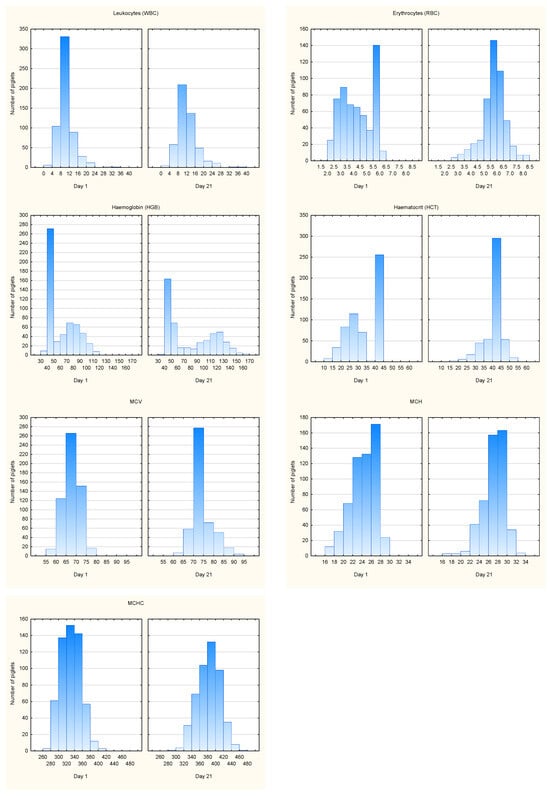
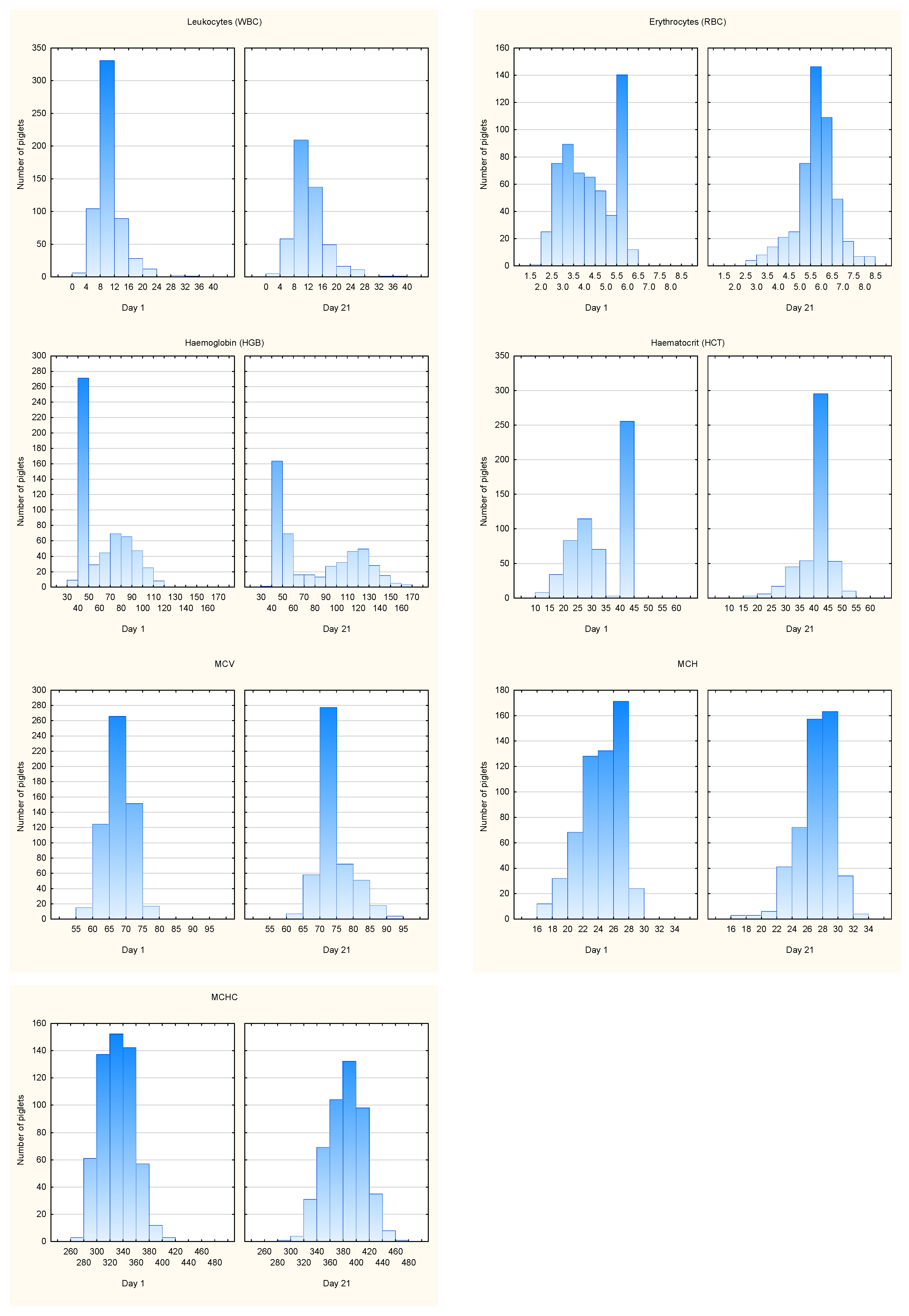
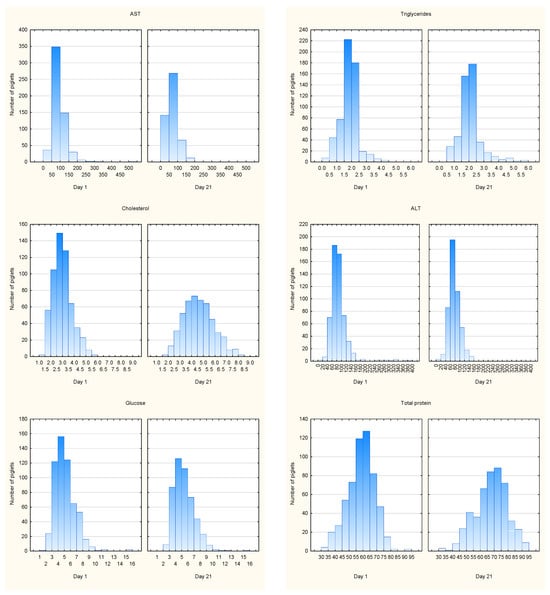
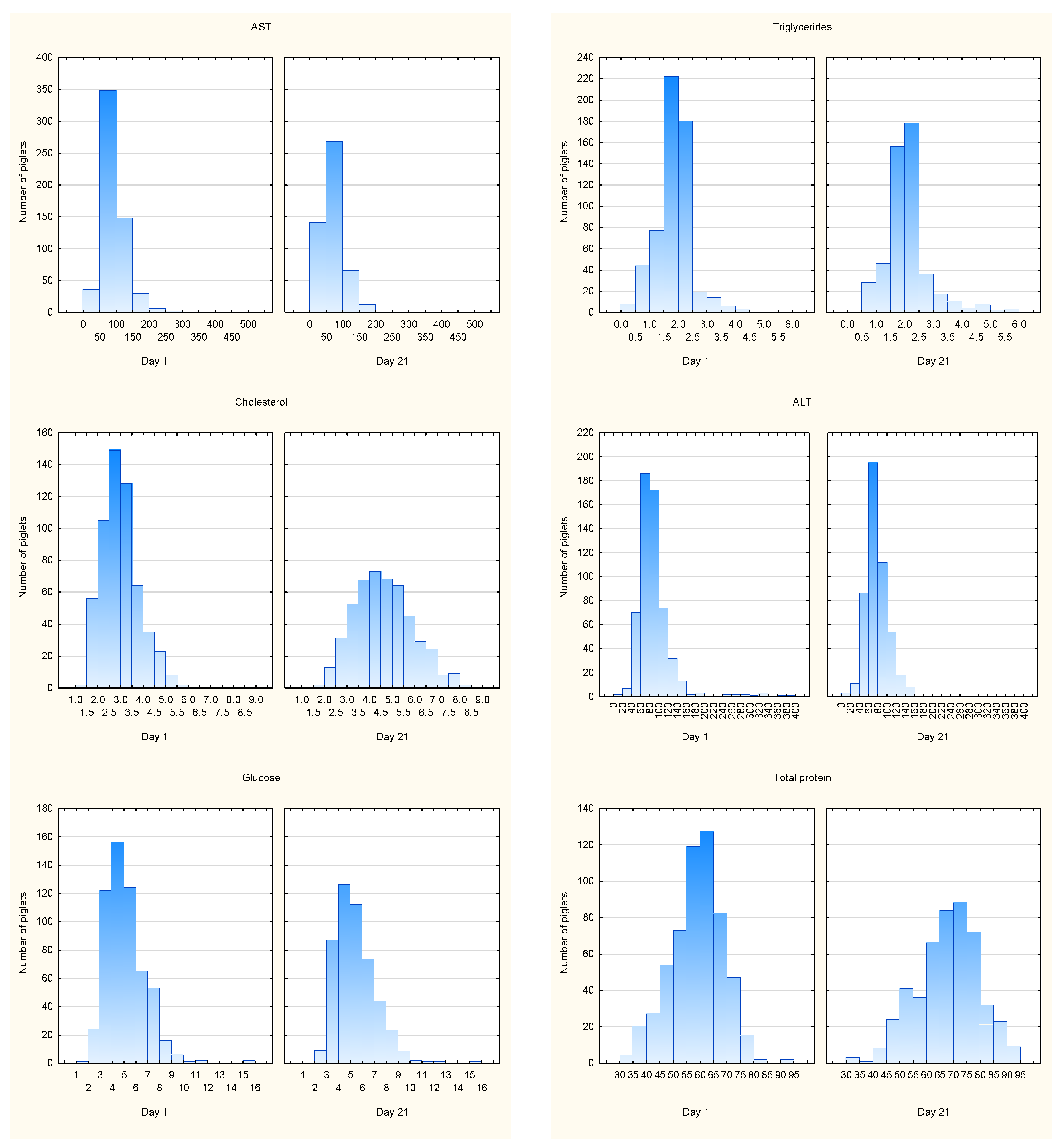
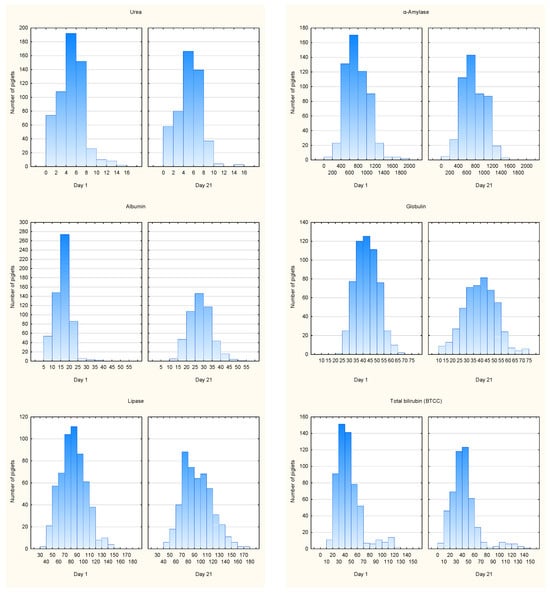
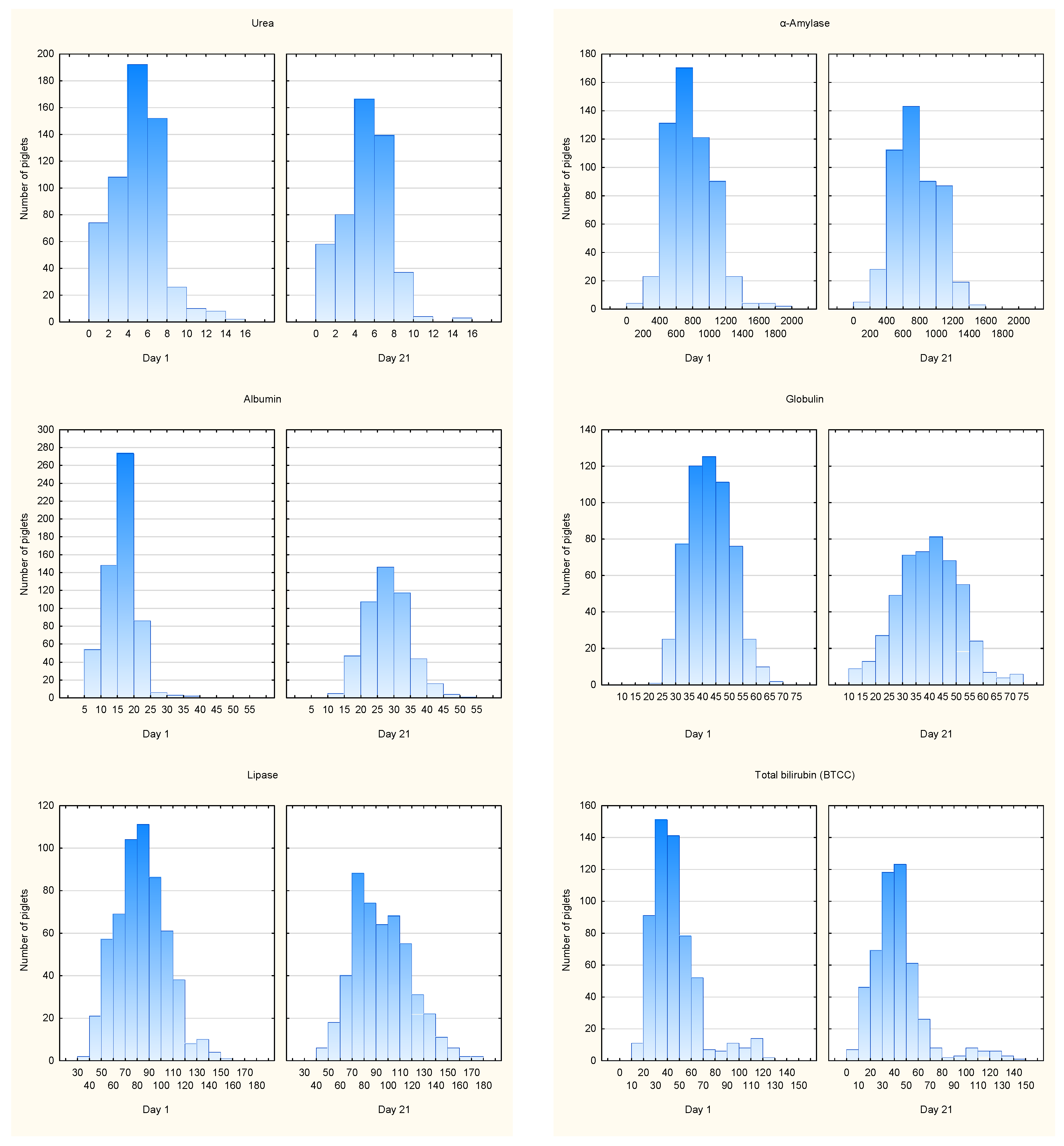
Reference intervals for the 19 parameters examined, separately for days 1 and 21 of life, are presented in Table 1 and Table 2, together with the mean, standard deviation, median, range of values and the 90% confidence interval of the reference interval limits. The distributions of the values of all 19 parameters examined, separately for days 1 and 21, are shown as histograms in Figure 1, Figure 2 and Figure 3: haematological parameters (WBC, RBC, HGB, HCT, MCV, MCH, MCHC) in Figure 1, and biochemical parameters in Figure 2 (AST, triglycerides, cholesterol, ALT, glucose, total protein) and 3 (urea, AlAm, albumin, globulin, lipase, BTCC). The parameters are listed in the same order as in Table 1 and Table 2; for each parameter, day 1 (left panel) and day 21 of life (right panel) are shown. The shape of the distributions indicates deviation of most parameters from a normal distribution, in agreement with the results of the Shapiro–Wilk test. Histograms (Figure 1, Figure 2 and Figure 3) show the shape and symmetry of the distributions, which supported the choice of non-parametric reference intervals; numerical values of the intervals are given in Table 1 and Table 2. The confidence intervals of the reference limits obtained by the cluster bootstrap (litter as the sampling unit) were wider than the standard ones, especially for parameters with a high ICC (Supplementary Table S2); the reference limits themselves did not depend on the method of estimation.
Table 1.
Reference intervals for haematological and biochemical parameters in piglets—day 1 of life.
Table 2.
Reference intervals for haematological and biochemical parameters in piglets—day 21 of life.
Figure 1.
Histograms of haematological blood parameters in piglets (WBC, RBC, HGB, HCT, MCV, MCH, MCHC).
Figure 2.
Histograms of biochemical blood parameters in piglets (AST, triglycerides, cholesterol, ALT, glucose, total protein).
Figure 3.
Histograms of biochemical blood parameters in piglets (urea, α-amylase, albumin, globulin, lipase, BTCC).
The medians of several parameters differed between days 1 and 21. The erythrocyte parameters showed the largest shift: the median RBC increased from 4.20 to 5.88 × 10¹²/L, HGB from 51.30 to 65.53 g/L, HCT from 32.40 to 43.02%, and MCV from 68.42 to 73.7 fL, which corresponds to the maturation of erythropoiesis and the gradual change in erythrocyte parameters during the early postnatal period. The median WBC was higher on day 21 (from 10.04 to 11.80 × 10⁹/L), in line with the maturation of the immune system during the first three weeks of life. The median albumin increased from 16.70 to 27.90 g/L, whereas globulins decreased slightly (from 42.31 to 40.09 g/L), a change that may be consistent with the gradual shift in the ratio of passively transferred and endogenously synthesised protein fractions. Among the hepatic and metabolic parameters, the median AST decreased (from 87.48 to 61.81 U/L) and that of cholesterol increased (from 2.91 to 4.58 mmol/L), which may reflect the change in the composition of the diet and the maturation of lipid metabolism.
For some parameters the mean and the median differ considerably—for example, glucose on day 1 ( = 5.19 mmol/L vs. a median of 4.91 mmol/L) and AST on day 1 ( = 96.28 U/L vs. a median of 87.48 U/L, with a recorded maximum of 1642 U/L) –which indicates pronounced positive skewness of the distribution of these parameters (Table 1 and Table 2).
Blood was sampled in the morning of the day after birth on all farms, whereas the time of birth varied: the proportion of piglets born after 14:00 was 7%, 28% and 40% on Farms 1, 2 and 3, respectively.
3.2. Differences in Blood Parameters According to Sex, Farm and Dam Genotype
The analysis of differences in the parameters examined according to sex, farm and dam genotype showed that sex was not statistically significantly associated with any of the 19 parameters analysed, on either day 1 or day 21 of life (p > 0.05). By the Kruskal–Wallis test, differences between farms were found for 18 of 19 parameters on day 1 and for 15 of 19 parameters on day 21. On day 1, a statistically significant difference between farms was not found only for globulin concentration (p = 0.058). On day 21, no statistically significant difference between farms was found for leukocytes (p = 0.735), triglycerides (p = 0.064), globulins (p = 0.349) and lipase (p = 0.943).
The values of the parameters differed between piglets of sows of the two genotypes for fewer parameters than between farms. According to the Mann–Whitney test, a difference was found for 2 parameters on day 1 (MCHC and globulins) and 4 parameters on day 21 (cholesterol, ALT, total protein and globulins).
3.3. Effects of Farm and Dam Genotype at the Litter Level, ICC and Reference Intervals Specific to Farm and Dam Genotype
In the two-way ANOVA on litter means (Table 3; F values, degrees of freedom and partial η2 are given in Supplementary Table S3), the farm effect was significant for 12 of 19 parameters on day 1 and 13 of 19 parameters on day 21. The smaller number of significant findings than with the Kruskal–Wallis test (18 and 15 parameters) is expected, because the ANOVA uses the litter rather than the individual piglet as the unit of analysis and thus takes into account that piglets from the same litter are mutually dependent; the results of the two approaches are therefore complementary rather than contradictory. The farm effect on day 1 was not significant for WBC, MCHC, AST, triglycerides, ALT, total protein and globulins, and on day 21 for WBC, triglycerides, cholesterol, total protein, globulins and lipase.
Table 3.
Differences according to farm, dam genotype and their interaction (two-way ANOVA on litter means; exact p-values) and intraclass correlation coefficient (ICC; REML).
Reference intervals for all 19 parameters by farm, which take into account the differences between farms, are presented in Table 4. The difference between dam genotypes was statistically significant for 2 of 38 parameter–age combinations: ALT on day 21 (p = 0.010) and, marginally, AST on day 1 (p = 0.0495). This is fewer than with the simple test (Mann–Whitney), which is expected, because the ANOVA uses the litter as the unit of analysis and simultaneously accounts for farm.
Table 4.
Reference intervals for haematological and biochemical parameters by farm (days 1 and 21).
A statistically significant interaction between farm and dam genotype was not found for any parameter, on either day 1 or day 21.
The values of the intraclass correlation coefficient (ICC), estimated at the level of individual piglets, covered a wide range among the parameters and ages of the piglets. They ranged from 0.009 (BTCC) to 0.563 (MCHC) on day 1 of life, and from 0.003 (WBC) to 0.450 (MCV) on day 21. ICC values ≥ 0.30 were recorded for 5 parameters on day 1 (MCV, MCHC, total protein, globulins and lipase) and for 5 parameters on day 21 (MCV, MCHC, AST, cholesterol and total protein). These results indicate that the proportion of the total variance originating from differences between litters differed among the parameters examined. Since the applied model does not allow separation of dam and litter effects, ICC values cannot be attributed exclusively to differences between dams. Reference intervals determined separately by farm and dam genotype are shown in Table 4 (by farm) and Supplementary Table S4 (by dam genotype).
3.4. Comparison with Published Reference Intervals
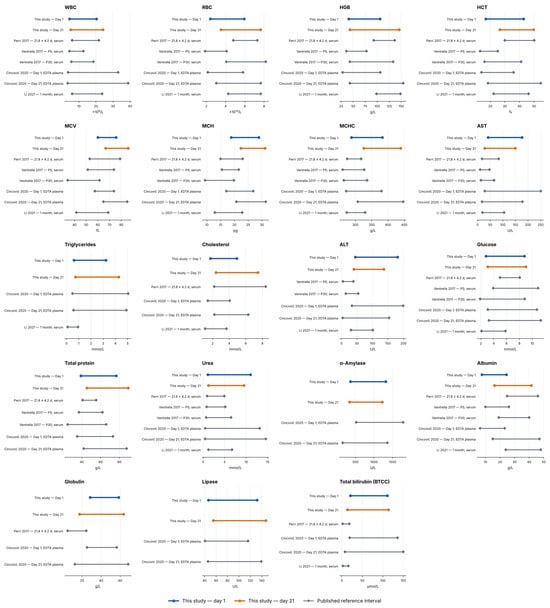
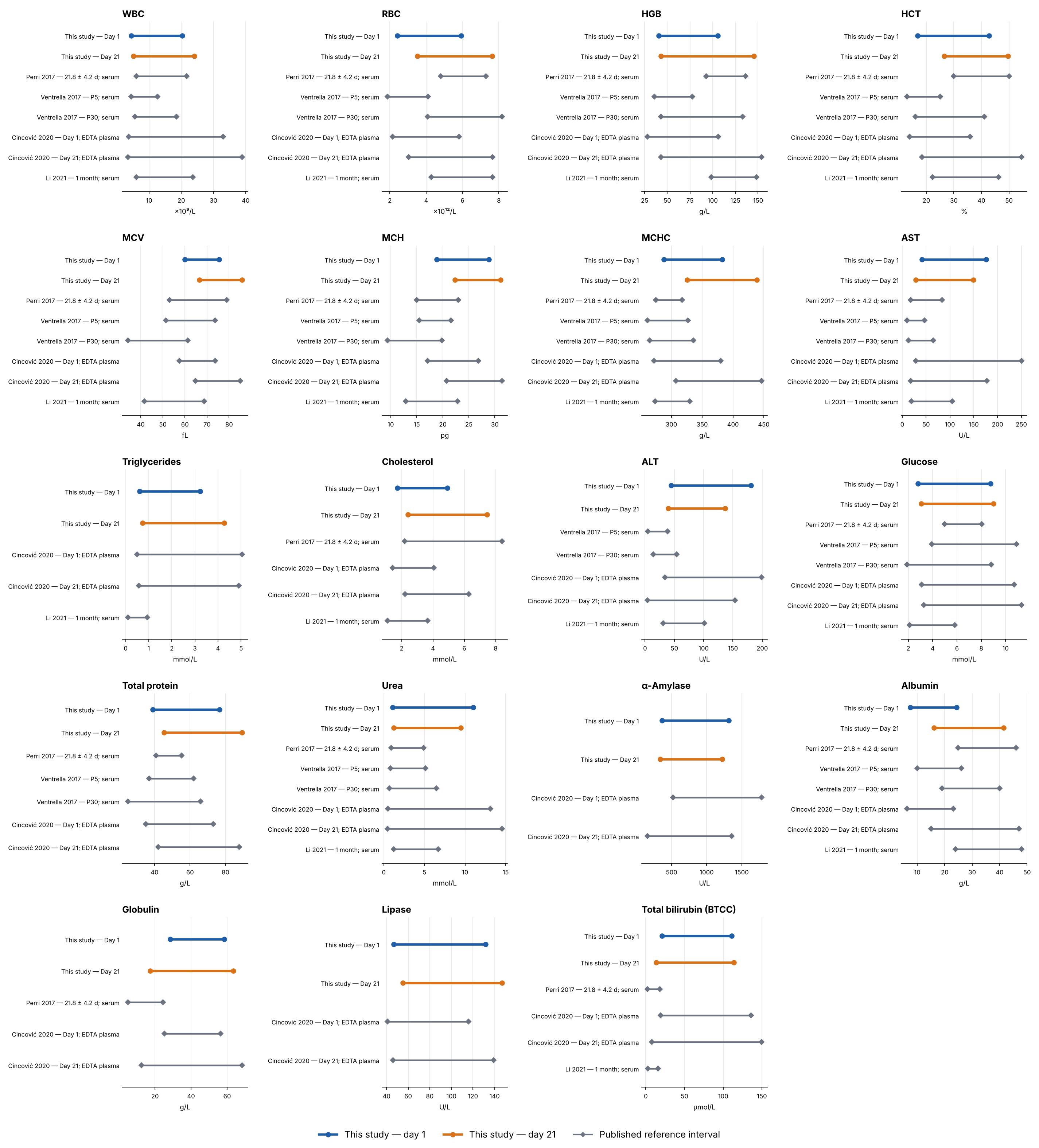
The reference intervals obtained in this study are compared in Figure 4 with those published previously [8,11,12,19]. The intervals presented should be understood as ranges within which values of healthy piglets of a given age are expected on farms comparable with those examined; they are not universal limits.
Figure 4.
Comparison of the reference intervals obtained in this study (days 1 and 21) with reference intervals reported in the literature: Perri et al., 2017 [8]; Ventrella et al., 2017 [11]; Li et al., 2021 [19]; Cincović et al., 2020 [12]. Horizontal segments indicate the lower and upper reference limits; for Cincović et al. [12] the range is minimum–maximum.
4. Discussion
4.1. Differences Between Ages
The medians of RBC, HGB, HCT and MCV were higher on day 21 than on day 1. The increase in RBC, HGB and HCT agrees with the findings of Ventrella et al. [11], who also recorded a significant increase in these parameters between five and thirty days of age and explained it by intensified erythropoiesis in the early postnatal period; for MCV, in contrast to the present study, they found a decreasing trend, which indicates that the change in erythrocyte size during early postnatal development is not necessarily uniform among different populations and rearing conditions. Similarly to the thirty-day-old animals (P30) in that study, the piglets in the present study received the usual single iron injection within the first 72 h of life. Since the time relationship between iron administration and both sampling ages is similar in both studies, the increase in RBC, HGB and HCT probably reflects, in both cases, a combined effect of age and iron supplementation that is difficult to separate. The importance of iron supplementation for the haematological parameters of suckling piglets has also been confirmed in more recent work: in piglets without supplementation, HGB remained low during 21 days (47–63 g/L), whereas a single intramuscular iron injection on day 3 of life led to considerably higher HGB, RBC and HCT values [20]. The comparison of days 1 and 21 should nevertheless be interpreted with caution. The samples were taken from the same piglets, but the number of available animals decreased by day 21, so the sample on day 21 is not completely identical to that on day 1; the differences between the two samplings may therefore partly reflect a changed composition of the sample and not only the effect of age and iron supplementation. Losses of piglets during lactation are common in modern production: an estimated 15–20% of born piglets die during farrowing and early lactation, and pre-weaning mortality in individual studies is about 11–16% [21,22]. This is a multifactorial phenomenon influenced by litter size, birth weight, farrowing duration and colostrum intake, so the cause of an individual death is difficult to establish [4,21,22].
The same direction of change in all erythrocyte parameters was also reported previously [12]. The MCH value on day 1 (median 24.62 pg) is somewhat higher than the values reported for one-day-old piglets by Egeli et al. [23] (21.2 ± 2.0 pg) and Cincović et al. [12] (20.9–21.7 pg). The lower MCV and MCH values in pigs younger than one year compared with older animals [24] support the notion that erythrocyte indices increase with age.
The increase in erythrocyte count during the first three weeks of life can be associated with intensive growth, accompanied by increases in body mass, blood volume and erythropoietic activity, and thus by higher iron requirements. The iron requirements of rapidly growing piglets cannot be fully met by the limited iron stores present in the liver at birth and the relatively low iron content of sow’s milk [25]. This problem is particularly pronounced in modern genotypes, selected for higher growth and body mass, which is accompanied by increased blood volume and more intensive erythropoiesis. If iron preparations are not administered, iron deficiency can develop within a few days of birth, regardless of genotype and farm management, as a result of the interaction of several factors—insufficient iron stores at birth, increased demands due to rapid growth, limited exogenous supply and an immature absorption system [2].
Albumin almost doubled between days 1 and 21 (16.70→27.90 g/L), a change consistent with the gradual maturation of hepatic synthetic function, although the increase in albumin concentration cannot be attributed exclusively to functional maturation of the liver. Globulins decreased slightly (42.31→40.09 g/L); this may be due to the gradual change in the ratio of passively transferred (colostral) and endogenously synthesised protein fractions. AST decreased (87.48→61.81 U/L) and cholesterol increased (2.91→4.58 mmol/L), changes that accompany the change in the composition of the diet—the transition to milk richer in fat—and the maturation of lipid metabolism; the same direction of change for both parameters was also reported previously [12]. The same direction of change in albumin (increase), globulins (slight decrease) and AST (decrease) between days 9 and 21 of life was also recorded in the control group of piglets studied by Sheptukha and Masiuk [26], where the albumin concentration (27.2 g/L) and AST activity (55.7 U/L) on day 21 were close to the values in the present study. Unlike albumin, AST is not a specific marker of hepatic function, so its change during the early postnatal period cannot be interpreted exclusively as a reflection of liver maturation, but may reflect changes in different tissues and metabolic processes characteristic of this period. High AST and ALT values in the first days of life, with a rapid decrease by day 7, have also been described in suckling piglets, and the authors link them to the immature state of hepatocytes after birth [27], which is consistent with the lower AST and ALT values on day 21 than on day 1 in this study. The magnitude and consistency of these changes across all parameters examined further support the justification for calculating reference intervals separately by age, in line with the recommendation [8] that the reference intervals of suckling piglets should not be pooled with those of older categories, because of the physiological changes during early development, such as bone development and the maturation of metabolism. Haematological profiles of pigs also differ by age [28].
Globulins were an exception to the general pattern, as the only parameter without a statistically significant difference between farms at both ages (Kruskal–Wallis p = 0.058 on day 1 and p = 0.349 on day 21). Neither farm nor dam genotype, nor their interaction, was significant for globulin concentration on day 1 in the two-way ANOVA at the litter level, and this finding was accompanied by a relatively high ICC (0.344 on day 1), which indicates that piglets from the same litter are similar to each other, while litters differ among themselves. The immunoglobulin content of sow colostrum depends on genotype, parity, health status, nutrition and housing conditions, with high variability between individual sows and studies, and the immunoglobulin concentration in colostrum correlates with their concentration in piglet blood [29]. Therefore, differences in the quality and composition of colostrum, as well as in the success of the transfer of maternal immunoglobulins, may explain differences among litters [4].
A related finding is the pronounced increase in the albumin to globulin ratio (A/G) between days 1 and 21 (0.39→0.70), the result of a considerably faster increase in albumin relative to the slight decrease in globulins—a change that probably reflects the transition from a colostrum-dominated protein profile (low albumin due to immature hepatic function at birth) to a profile reflecting the maturation of the piglet’s own protein synthesis in the liver.
4.2. Comparison with Previous Studies
The reference intervals established in this study do not differ substantially from the ranges reported in comparative studies (Figure 4). When all studies are considered together, neither the minimum and maximum values nor the overall range of the results indicate any specific outliers. Age, however, has a significant influence on the results, so reference intervals established for different age groups cannot be directly compared. Differences also arise depending on whether serum or plasma samples were used, and results obtained from plasma samples cannot be directly compared with reference values derived from serum. All of the above is consistent with the established principles for the de novo establishment of reference intervals [14].
Compared with the intervals reported by Ventrella et al. [11], good agreement was found for MCV, total protein and glucose, both for day 1 versus five-day-old piglets (P5) and for day 21 versus the P30 group. A more pronounced difference was recorded for haematocrit, for which a wider and higher range of values was obtained in this study—the reference interval on day 1 is 16.86–42.77%, versus the range of 13–25% reported for the P5 group by Ventrella et al. [11]. A potential explanation for this difference may lie in the analyser used (Nihon Kohden vs. ADVIA 2120), as well as in the characteristics of the sample population. Differences arising from different analytical approaches are a general methodological problem when comparing reference intervals between laboratories [8].
The most striking difference concerns the liver enzymes: AST and ALT in the present study were two to four times higher than reported by Ventrella et al. [11] at both ages (the AST reference interval on day 1 was 41.11–175.91 U/L, versus 10–47 U/L in P5 animals). Such a pronounced difference exceeds what could be expected from biological variability alone and may result from differences in analytical methodology, including differences between analysers and calibration systems, although the contribution of population and other biological factors cannot be excluded. This finding indicates limited transferability of reference intervals for liver enzymes between laboratories and populations, in line with the general recommendation of the ASVCP guidelines that reference intervals, whenever possible, should be established in the same laboratory and the same population in which they will be applied [14].
In adult, sexually mature pigs, the AST reference interval is 13–94 U/L [24], which is lower than both limits obtained in piglets in this study (41.11–175.91 U/L on day 1); this is consistent with the expected age differences, but may also reflect different analytical platforms (ADVIA 2120 and Cobas c501).
WBC values were similar to those reported by Ventrella et al. [11], although the upper limit in this study is somewhat higher. Regarding protein status, newborn piglets may have a low albumin concentration, which was significantly higher in thirty-day-old animals, whereas the total protein concentration did not differ significantly between the groups; the increase in albumin was accompanied by a progressive decrease in the share of the globulin fraction [11], a pattern fully consistent with the results of this study.
Compared with the reference intervals established by Perri et al. [8] in piglets shortly before weaning (mean age 21.8 ± 4.2 days), relatively good agreement was found for the white blood cell count, whose reference interval in this study was 5.12–24.01 × 10⁹/L versus 6.0–21.7 × 10⁹/L reported by those authors. The lower limit of the RBC reference interval was lower in this study (3.52–7.64 vs. 4.8–7.3 × 10¹²/L), while a considerably wider interval was found for haemoglobin (HGB), primarily owing to a markedly lower limit (43.04–145.45 vs. 93.0–136.0 g/L). In contrast, the reference intervals for haematocrit (HCT) were relatively similar (26.47–49.60% vs. 30–50%). Higher MCV values were also found in this study, and the differences in MCH and MCHC were particularly pronounced.
The observed deviations in the reference intervals for HGB, HCT, MCH and MCHC can be partly explained by different criteria for including animals in the reference population. Unlike the approach applied by Perri et al. [8], piglets with an HGB concentration ≤ 90 g/L were not excluded from the analysis in this study. The resulting reference intervals therefore cover a wider variability of the studied population, including individuals with lower haemoglobin values who, according to the criterion applied in that study, would not have been included in the reference population. This methodological difference could have contributed to the lower limit of the HGB reference interval, as well as to differences in some erythrocyte indices. The difference between farms in HGB, HCT and MCH, established in this study at both ages by the Kruskal–Wallis test (p < 0.001 for HGB and HCT at both ages) and, for HGB, HCT and MCH, by the two-way ANOVA presented in Table 3, also contributes. A narrower HGB reference range (98.50–148.30 g/L) was also obtained by Li et al. [19], which is consistent with the results of Perri et al. [8]; the same authors also obtained considerably lower reference values for MCV, MCH and MCHC, as well as lower values of AST, glucose and cholesterol than in this study. Compared with both Perri et al. [8] and Li et al. [19], the present study shows a consistent pattern of higher MCV, MCH and MCHC values, recurring simultaneously in all three interrelated erythrocyte indices, as well as higher total protein and cholesterol. Similar differences in haematological and biochemical parameters between different categories of commercial pigs were described by Zhang et al. [6], who pointed out the importance of age and other population characteristics in defining reference intervals. Taking into account these studies and the pronounced farm effect found here, it can be assumed that reference values of haematological and biochemical parameters are not universal for all pig populations, and that their interpretation should be related to age, animal characteristics and production conditions. In a study of farms with and without PRRSV, PCV2 and hepatitis E virus, age and the presence of viruses changed the haematological parameters of pigs (e.g., PRRSV lowered MCV and HCT and increased WBC), so the authors concluded that the analyser, age and health history should be taken into account when interpreting haematological findings [28].
Reference intervals have likewise been reported to differ considerably from the published values of other studies, and breed, age, rearing conditions and health status should be taken into account when interpreting haematological data [30]; this further supports the establishment of reference intervals specific to the population and age examined in this study.
4.3. Sex
No statistically significant difference between sexes was detected for any of the 19 parameters examined, on either day 1 or day 21, which is consistent with the findings of Li et al. [19] in one-month-old piglets, who also found no sex differences for most parameters—the only exception in their study was triglycerides, for which the sex difference was statistically significant, a finding not confirmed by the data of this study (p = 0.3114 on day 1; p = 0.8070 on day 21). The absence of a statistically significant difference does not prove that a sex-related difference does not exist; it only means that none was detected in this sample, at this sample size and at this significance level, and a smaller, clinically more subtle effect of sex cannot be excluded by this design. In contrast, significant sex differences in 11 of 45 parameters examined (including WBC, RBC, HGB, MCV and MCH) were found in pigs aged three to six months [31]. The agreement of our findings in suckling piglets with those of Li et al. [19], as opposed to the more pronounced sexual dimorphism recorded in older animals [31], suggests that sex differences in haematological parameters of pigs may become more pronounced during growth, potentially in connection with the development of sexual maturity. However, this assumption should be interpreted with caution, since differences between studies may also be related to other factors, including age and physiological status of the animals, housing conditions and methodological differences. This assumption is also indirectly supported by a study conducted exclusively on female pigs aged three to four months, whose authors explicitly note that the animals were not yet sexually mature at the time of sampling, referring to the known effect of sex hormones on erythropoiesis [30,32]. Taken together, these findings suggest that sexual dimorphism in haematological parameters of pigs is probably not pronounced before sexual maturity. At the ages examined (days 1 and 21) no influence of sex was detected; this should not be extrapolated to later stages of development, when differences between sexes may become more pronounced.
Total bilirubin concentrations in piglets (21.05–110.8 µmol/L on day 1) are considerably higher than the values reported for adult domestic pigs (0–0.4 mg/dL, i.e., about 0–6.8 µmol/L) [24], which indicates that the intervals of adult animals cannot be adopted for piglets.
4.4. Differences According to Farm and Dam Genotype
In contrast to farm, dam genotype showed a statistically significant effect for only two parameter–age combinations: ALT on day 21 (p = 0.010) and, marginally, AST on day 1 (p = 0.0495). Given that 38 combinations of parameter and age were tested, these two findings at the level of p < 0.05, one of them borderline, should be interpreted with caution. It is worth noting that the simpler Mann–Whitney test suggested a significant difference between dam genotypes also in MCHC and globulins on day 1, as well as in cholesterol, ALT, total protein and globulins on day 21.
A substantial proportion of the variability of blood parameters attributable to the herd environment has also been recorded in other species; in Holstein cows in early lactation, 17–46% of the variability of blood metabolites was associated with the combination of herd and diet [17]. Such a finding may also reflect differences in conditions and management among farms, which also affect production indicators of piglets such as litter size and pre-weaning mortality [9], as well as factors affecting piglet survival and health that differ between farms and production systems [22]. The significant association of farm with most of the parameters examined in this study is consistent with this pattern. Differences among farms and housing systems in the haematological parameters of pigs have been explained by the level of movement, diet and genotype [33], and a possible seasonal influence on blood haemoglobin concentration has been described in piglets [34]; sampling in this study was performed during the winter period.
Because the method of iron administration (parenteral, oral or combined) significantly affected HGB, HCT and RBC on day 21 in a previous study [20], differences in the supplementation protocol among farms may contribute to the observed farm effect on erythrocyte parameters. The interaction of farm and dam genotype was not statistically significant for any parameter (Table 3), so in this study there is no basis for claiming that the association of dam genotype with parameter values differs among farms; the number of litters per farm × dam genotype combination (5–15), however, limits the statistical power to detect an interaction.
The relatively limited influence of dam genotype in this study can be viewed in the context of earlier findings that genetic and other individual factors may affect the values of blood biochemical parameters. Some biochemical parameters in pigs have been shown to differ depending on genotype, but also on other factors, including reproductive status and time of sampling [5]. In this study, differences according to dam genotype were considerably less pronounced than differences between farms, which suggests that environmental conditions and the specificities of the production system are potentially more important sources of variability for most of the parameters examined.
In addition to farm and dam genotype, litter was also a significant source of variability. High ICC values for some parameters may reflect factors shared by piglets from the same litter, such as litter size, birth weight and colostrum intake [4,21]. Piglets with intrauterine growth restriction (low birth weight) differed from piglets of normal body weight in erythrocyte and leukocyte parameters as early as 72 h after birth [35], whereas in one-day-old piglets litter size did not significantly affect RBC, HGB and HCT [36]. Larger litters are associated with greater variability of birth weight, and piglets of low birth weight differ in some biochemical parameters (e.g., lower glucose on day 1) [4,37]. For total protein and globulins on day 1, whose concentrations depend on the transfer of colostral immunoglobulins, such an explanation is particularly likely, but it was not directly examined in this study, because colostrum intake was not measured.
Although all piglets were classified as one-day-old, their exact age at sampling differed. Blood was collected at the beginning of the morning shift on the day after birth on all farms, while the time of birth varied; on Farm 3, 40% of piglets were born after 14:00 (compared with 28% on Farm 2 and 7% on Farm 1), so that they were sampled at a younger age than piglets born earlier in the day. Because the first hours after birth are characterised by rapid changes in colostrum intake, absorption of immunoglobulins and energy metabolism, this difference in age may have contributed to the differences between farms, possibly for total protein, globulins, albumin and glucose. Vaccination of piglets against PRRS, PCV2 and M. hyopneumoniae on days 14–16 may also have influenced WBC and globulin values on day 21.
4.5. Limitations
The study covers only days 1 and 21 of life and not the peri-weaning period (about 4 weeks of age or immediately before weaning), when the balance between declining maternal immunity and the development of the piglet’s own immune response changes (the so-called immunity gap). The timing of this gap may differ between herds and housing systems. The intervals presented therefore apply only to the two ages examined and should not be extended to the entire suckling period or used for planning vaccination without taking herd conditions into account.
The study was carried out under commercial conditions rather than on an experimental farm, so health protocols, feeding and housing could not be completely equalised. This limits control over sources of variability but increases the applicability of the intervals in practice, for which they are intended. The differences between farms, which we found for most parameters, probably partly reflect these very differences. Colostrum intake was not measured, and the exact age at sampling (in hours) was not standardised. The effect of the paternal breed was not tested separately, as it cannot be separated from the effects of farm and litter.
The use of litter means does not take into account variability among piglets within a litter (partly reflected by the ICC) and gives equal weight to litters of different size, which may reduce power and bias estimates when litter sizes differ. A mixed model on piglet-level data confirmed farm as the main source of variability and gave consistent conclusions regarding dam genotype, which was significant for no more than two parameters in total (ALT on day 21 in both analyses; AST on day 1, marginally, only in the litter-mean ANOVA; BTCC on day 1 only in the mixed model; Supplementary Table S5). The limits of parameters with a high ICC (MCV, MCHC, total protein, globulins, lipase) are determined less precisely than the standard confidence intervals indicate, because part of the variability originates from differences between litters (Supplementary Table S2).
The use of EDTA represents a limitation of the present study. EDTA chelates a proportion of the copper required for the formation of the protein–copper complex, potentially reducing the intensity of the reaction and resulting in falsely lower total protein concentrations. Studies conducted in the same laboratory have demonstrated that EDTA resulted in a 5.8% decrease in total protein concentrations compared with serum samples [38]. Nevertheless, this is not a straightforward reaction in which each EDTA molecule automatically sequesters one copper molecule that would otherwise be available to proteins. The outcome depends on the equilibrium of complex formation and the composition of the reagents used [39]. The implementation of analytical validation and internal quality control procedures throughout the study helps prevent the generation of implausible results. Furthermore, comparison of our reference intervals with those reported by other researchers revealed no substantial discrepancies in the ranges of values. EDTA binds divalent cations and may interfere with metal-dependent analytical methods (e.g., total protein, α-amylase, and potentially lipase assays), as well as with other laboratory assays. Therefore, the reference intervals established in the present study are specific to EDTA plasma and the analytical platform employed and should not be directly extrapolated to serum samples.
5. Conclusions
Non-parametric reference intervals for 19 haematological and biochemical parameters were established for piglets on days 1 and 21 of life from three commercial farms. At the ages examined, farm and litter, rather than sex or dam genotype, were the main sources of variability; the intervals should therefore be applied with regard to age, farm conditions and analytical platform (EDTA plasma), and where conditions differ, farm-specific intervals are preferable (Table 4). The intervals are a practical basis for the early recognition of deviations in piglets under commercial conditions; they do not cover the peri-weaning period, and their transfer to other populations should be verified.
Supplementary Materials
The following supporting information can be downloaded at: https://www.mdpi.com/article/10.3390/ani16233797/s1, Table S1: Characteristics of the 62 litters included in the study: total number of piglets born, piglets included in the analysis on days 1 and 21, piglets reared until day 28, and the start and end of farrowing; Table S2: Reference intervals with 90% confidence intervals of the reference limits estimated by the standard bootstrap (piglets resampled) and by the cluster bootstrap (litters resampled; 1000 replicates); Table S3: Two-way ANOVA (farm × dam genotype) on litter means: F statistics, degrees of freedom, exact p-values and partial η2 (effect size); Table S4: Reference intervals for haematological and biochemical parameters by dam genotype (days 1 and 21); Table S5: Linear mixed model on individual piglet data (sensitivity analysis): p-values for the fixed effects of farm and dam genotype.
Author Contributions
Conceptualization, M.M., I.R. and M.P.H.; Methodology, M.M., I.R., M.C. and M.P.H.; Formal analysis, M.M.; Investigation, M.M., M.C. and D.B.; Writing—original draft, M.M.; Writing—review & editing, M.M. All authors have read and agreed to the published version of the manuscript.
Funding
This research was funded by the Ministry of Science, Technological Development and Innovation, grant numbers 451-03-34/2026-03/200117 and 451-03-33/2026-03/200117 of 5 February 2026.
Institutional Review Board Statement
The study was approved by the Veterinary Directorate of the Ministry of Agriculture, Forestry and Water Management of the Republic of Serbia (Decision No. 323-07-00245/2022-05/1 of 9 February 2022), with the expert opinion of the Ethics Committee.
Informed Consent Statement
Not applicable.
Data Availability Statement
The data used in this study are available from the corresponding author upon reasonable request.
Acknowledgments
AI tools were used to edit the text and format it in accordance with the journal’s guidelines (Claude Sonnet 5.5, Anthropic, San Francisco, CA, USA).
Conflicts of Interest
The authors declare no conflicts of interest.
References
- Arévalo Sureda, E.; Pierzynowska, K.; Weström, B.; Sangild, P.T.; Thymann, T. Exocrine pancreatic maturation in pre-term and term piglets supplemented with bovine colostrum. Front. Nutr. 2021, 8, 687056. [Google Scholar] [CrossRef] [Scilit] [PubMed]
- Starzyński, R.R.; Laarakkers, C.M.M.; Tjalsma, H.; Swinkels, D.W.; Pieszka, M.; Styś, A.; Mickiewicz, M.; Lipiński, P. Iron supplementation in suckling piglets: How to correct iron deficiency anemia without affecting plasma hepcidin levels. PLoS ONE 2013, 8, e64022. [Google Scholar] [CrossRef] [Scilit] [PubMed]
- Vodolazska, D.; Feyera, T.; Lauridsen, C. The impact of birth weight, birth order, birth asphyxia, and colostrum intake per se on growth and immunity of the suckling piglets. Sci. Rep. 2023, 13, 8057. [Google Scholar] [CrossRef] [Scilit] [PubMed]
- Buthelezi, N.L.; Mtileni, B.; Nephawe, K.A.; Idowu, P.A.; Modiba, M.C.; Mpedi, H.; Mpofu, T.J. The impact of parity, litter size and birth weight variations within a litter on piglet pre-weaning performance. Czech J. Anim. Sci. 2024, 69, 255–268. [Google Scholar] [CrossRef] [Scilit]
- Lingaas, F.; Brun, E.; Havre, G.; Frøslie, A.; Aarskaug, T.; Vangen, O. Biochemical blood parameters in pigs: 1. Repeatability and effects of breed, litter number and sampling time. J. Anim. Breed. Genet. 1992, 109, 221–230. [Google Scholar] [CrossRef] [Scilit]
- Zhang, S.; Yu, B.; Liu, Q.; Zhang, Y.; Zhu, M.; Shi, L.; Chen, H. Assessment of hematologic and biochemical parameters for healthy commercial pigs in China. Animals 2022, 12, 2464. [Google Scholar] [CrossRef] [Scilit] [PubMed]
- Racewicz, P.; Ludwiczak, A.; Skrzypczak, E.; Składanowska-Baryza, J.; Biesiada, H.; Nowak, T.; Nowaczewski, S.; Zaborowicz, M.; Stanisz, M.; Ślósarz, P. Welfare health and productivity in commercial pig herds. Animals 2021, 11, 1176. [Google Scholar] [CrossRef] [Scilit] [PubMed]
- Perri, A.M.; O’Sullivan, T.L.; Harding, J.C.S.; Wood, R.D.; Friendship, R.M. Hematology and biochemistry reference intervals for Ontario commercial nursing pigs close to the time of weaning. Can. Vet. J. 2017, 58, 371–376. [Google Scholar] [PubMed]
- Davidov, I.; Stevančević, O.; Božić, A.; Galfi Vukomanović, A.; Davidov, N. Performance comparisons across pig farms. Biotechnol. Anim. Husb. 2024, 40, 131–140. [Google Scholar] [CrossRef] [Scilit]
- Thorn, C.E. Hematology of the Pig. In Schalm’s Veterinary Hematology, 6th ed.; Weiss, D.J., Wardrop, K.J., Eds.; Wiley-Blackwell: Ames, IA, USA, 2010; pp. 843–851. [Google Scholar] [CrossRef] [Scilit]
- Ventrella, D.; Dondi, F.; Barone, F.; Serafini, F.; Elmi, A.; Giunti, M.; Romagnoli, N.; Forni, M.; Bacci, M.L. The biomedical piglet: Establishing reference intervals for haematology and clinical chemistry parameters of two age groups with and without iron supplementation. BMC Vet. Res. 2017, 13, 21. [Google Scholar] [CrossRef] [Scilit] [PubMed]
- Cincović, M.; Mirkov, M.; Radović, I.; Belić, B.; Lakić, I. Reference values of hematological, biochemical and endocrinological parameters in the blood of piglets aged 1 and 21 days. Contemp. Agric. 2020, 69, 34–40. [Google Scholar] [CrossRef] [Scilit]
- Humann-Ziehank, E.; Ganter, M. Pre-analytical factors affecting the results of laboratory blood analyses in farm animal veterinary diagnostics. Animal 2012, 6, 1115–1123. [Google Scholar] [CrossRef] [Scilit] [PubMed]
- Friedrichs, K.R.; Harr, K.E.; Freeman, K.P.; Szladovits, B.; Walton, R.M.; Barnhart, K.F.; Blanco-Chavez, J.; American Society for Veterinary Clinical Pathology (ASVCP). ASVCP reference interval guidelines: Determination of de novo reference intervals in veterinary species and other related topics. Vet. Clin. Pathol. 2012, 41, 441–453. [Google Scholar] [CrossRef] [Scilit] [PubMed]
- Le Boedec, K. Sensitivity and specificity of normality tests and consequences on reference interval accuracy at small sample size: A computer-simulation study. Vet. Clin. Pathol. 2016, 45, 648–656. [Google Scholar] [CrossRef] [Scilit] [PubMed]
- Duchateau, L.; Jansen, P.; Rowlands, G.J. Linear Mixed Model: An Introduction with Applications in Veterinary Research; ILRI: Nairobi, Kenya, 1998. [Google Scholar]
- Krogh, M.A.; Hostens, M.; Salavati, M.; Grelet, C.; Sørensen, M.T.; Wathes, D.C.; Ferris, C.P.; Marchitelli, C.; Signorelli, F.; Napolitano, F.; et al. Between- and within-herd variation in blood and milk biomarkers in Holstein cows in early lactation. Animal 2020, 14, 1067–1075. [Google Scholar] [CrossRef] [Scilit] [PubMed]
- TIBCO Software Inc. Statistica (Data Science Workbench), version 14.0.0.15; TIBCO Software Inc.: Palo Alto, CA, USA, 2020. [Google Scholar]
- Li, C.; Wang, F.; Li, R.; Ishfaq, M.; Chen, H.; Liu, F.; Liu, Y. Hematologic and biochemical reference intervals for 1-month-old specific-pathogen-free Landrace pigs. Vet. Clin. Pathol. 2021, 50, 76–80. [Google Scholar] [CrossRef] [Scilit] [PubMed]
- Meng, Q.; Wu, Q.; Zhou, Q.; Tang, J.; Zhuo, Y.; Fang, Z.; Lin, Y.; Xu, S.; Feng, B.; Hua, L.; et al. Impact of iron supplementation on growth performance, iron homeostasis and redox balance of suckling piglets. Animals 2025, 15, 924. [Google Scholar] [CrossRef] [Scilit] [PubMed]
- van den Bosch, M.; van de Linde, I.B.; Kemp, B.; van den Brand, H. Disentangling litter size and farrowing duration effects on piglet stillbirth, acid–base blood parameters and pre-weaning mortality. Front. Vet. Sci. 2022, 9, 836202. [Google Scholar] [CrossRef] [Scilit] [PubMed]
- Will, K.J.; Magalhaes, E.S.; Moura, C.A.A.; Trevisan, G.; Silva, G.S.; Mellagi, A.P.G.; Ulguim, R.R.; Bortolozzo, F.P.; Linhares, D.C.L. Risk factors associated with piglet pre-weaning mortality in a Midwestern U.S. swine production system from 2020 to 2022. Prev. Vet. Med. 2024, 232, 106316. [Google Scholar] [CrossRef] [Scilit] [PubMed]
- Egeli, A.K.; Framstad, T.; Morberg, H. Clinical biochemistry, haematology and body weight in piglets. Acta Vet. Scand. 1998, 39, 381–393. [Google Scholar] [CrossRef] [Scilit] [PubMed]
- Schaefer, D.M.W.; Videla, R.; Smith, J.S.; Mulon, P.-Y.; Flatland, B.; Zhu, X. Hematology and clinical biochemistry reference intervals for companion pigs using the ADVIA 2120 and Cobas c501. PeerJ 2025, 13, e18968. [Google Scholar] [CrossRef] [Scilit] [PubMed]
- Csapó, J.; Martin, T.G.; Csapó-Kiss, Z.S.; Házas, Z. Protein, fats, vitamin and mineral concentrations in porcine colostrum and milk from parturition to 60 days. Int. Dairy J. 1996, 6, 881–902. [Google Scholar] [CrossRef] [Scilit]
- Sheptukha, O.A.; Masiuk, D.M. Biochemical blood parameters of piglets under the influence of an isotonic protein solution. Anim. Biol. 2025, 27, 77–84. [Google Scholar] [CrossRef] [Scilit]
- Yosi, F.; Hartinger, K.; Lerch, F.; Vötterl, J.C.; Koger, S.; Sharma, S.; Verhovsek, D.; Metzler-Zebeli, B.U. Age-related evolution of serum biochemistry and intestinal fatty acid signaling, innate immune response, and barrier function in suckling and newly weaned piglets. J. Anim. Sci. 2025, 103, skaf313. [Google Scholar] [CrossRef] [Scilit] [PubMed]
- Golinar Oven, I.; Nemec Svete, A.; Hajdinjak, M.; Plut, J.; Štukelj, M. Haematological profiles of pigs of different age in relation to the presence or absence of porcine reproductive and respiratory virus, porcine circovirus type 2 and hepatitis E virus. Ital. J. Anim. Sci. 2022, 21, 1287–1296. [Google Scholar] [CrossRef] [Scilit]
- Szabó, C.; Ortega, A.D.S.V.; Lugata, J.K.; Czeglédi, L.; Csernus, B.; Gulyás, G.; Kovács, B.; Pál, K.; Pusztahelyi, T.; Kasza, R.; et al. Factors affecting the Ig content of sow’s colostrum: A systematic review and meta-analysis. Agriculture 2025, 15, 641. [Google Scholar] [CrossRef] [Scilit]
- Præstegaard, K.F.; Winther-Larsen, A.; Kousholt, B.S. Hematological reference intervals for Danish crossbred Landrace Yorkshire Duroc (LYD) pigs used in biomedical research. Acta Vet. Scand. 2025, 67, 11. [Google Scholar] [CrossRef] [Scilit] [PubMed]
- Meissner, F.G.; Dinkelaker, J.; Maier, A.A.; Pooth, J.-S.; Costa Galbas, M.; Schön, M.; Boll, D.; Trummer, G.; Benk, C.; Haberstroh, J.; et al. Hematologic and biochemical reference values for anesthetized juvenile German crossbred farm pigs. Sci. Rep. 2024, 14, 26768. [Google Scholar] [CrossRef] [Scilit] [PubMed]
- Warren, A.M.; Grossmann, M. Haematological actions of androgens. Best Pract. Res. Clin. Endocrinol. Metab. 2022, 36, 101653. [Google Scholar] [CrossRef] [Scilit] [PubMed]
- Golinar Oven, I.; Plut, J.; Hajdinjak, M.; Šteferl, T.; Nadlučnik, E.; Štukelj, M. Hematological parameters of pigs in different housing systems in Slovenia. J. Swine Health Prod. 2025, 33, 56–61. [Google Scholar] [CrossRef] [Scilit]
- Fjelkner, J.; Sannö, A.; Emanuelson, U. Iron status in piglets at three days of age and at weaning and possible seasonal effects on the blood haemoglobin levels in a Swedish outdoor pig-producing farm. Acta Vet. Scand. 2024, 66, 13. [Google Scholar] [CrossRef] [Scilit] [PubMed]
- Ayala, L.; Sánchez, C.J.; Hernández, F.; Madrid, J.; López, M.J.; Martínez-Miró, S. A comparison of haematological and biochemical profiles between intrauterine growth restriction and normal piglets at 72 hours postpartum. Animals 2023, 13, 3540. [Google Scholar] [CrossRef] [Scilit] [PubMed]
- Kopeć, Z.; Mazgaj, R.; Starzyński, R.R.; Wang, X.; Opiela, J.; Smorąg, Z.; Gajda, B.; Nicpoń, J.; Lenartowicz, M.; Ogłuszka, M.; et al. Impact of litter size on the hematological and iron status of gilts, sows and newborn piglets: A comparative study of domestic pigs and wild boars. BMC Vet. Res. 2024, 20, 64. [Google Scholar] [CrossRef] [Scilit] [PubMed]
- Ekert Kabalin, A.; Balenović, T.; Šperanda, M.; Milinković-Tur, S.; Štoković, I.; Menčik, S.; Maurić, M.; Pavičić, Ž. Serum biochemical parameters in suckling piglets with low and average birth mass. Vet. Arh. 2017, 87, 171–184. [Google Scholar]
- Belić, B.; Cincović, M.R.; Došenović, M.; Stojanović, D.; Kovačević, Z. The effects of different anticoagulants on biochemical parameters in blood of dairy cows. Vet. Glas. 2015, 69, 13–20. (In Serbian) [Google Scholar] [CrossRef] [Scilit]
- Kalaria, T.; Ford, C.; Gama, R. Managing ethylenediaminetetraacetic acid (EDTA) interference in EDTA contaminated samples—Selectivity in reporting analytes. Ann. Clin. Biochem. 2023, 60, 92–99. [Google Scholar] [CrossRef] [Scilit] [PubMed]

Disclaimer/Publisher’s Note: The statements, opinions and data contained in all publications are solely those of the individual author(s) and contributor(s) and not of MDPI and/or the editor(s). MDPI and/or the editor(s) disclaim responsibility for any injury to people or property resulting from any ideas, methods, instructions or products referred to in the content. |
© 2026 by the authors. Licensee MDPI, Basel, Switzerland. This article is an open access article distributed under the terms and conditions of the Creative Commons Attribution (CC BY) license.