


Simple Summary
Urine patches from dairy cows are a major contributor of nitrogen losses to the environment in New Zealand grazing systems, so understanding how cows urinate can assist in mitigating environmental pollution. In this pilot study, we used lightweight, non-invasive acoustic sensors to record the urination behaviour of dairy cows grazing standard and diverse pasture farmlets under contemporary or regenerative management. We found no obvious differences in cows’ urination frequency, urination volume per event and daily urine between pasture farmlets. The nitrogen concentration of spot urine samples was also similar between farmlets, although they considerably varied among the individual cows. Because this pilot study was conducted over a short period in spring, further studies across seasons and multiple urine collections are essential to better understand dairy cows’ urination patterns and their impacts on nitrogen losses.
Abstract
Urinary nitrogen (UN) is the primary source of nitrogen (N) leaching from dairy grazing systems in New Zealand (NZ). This pilot study aimed to evaluate the urination behaviour of dairy cows grazing on three different pasture farmlets: standard pasture under contemporary management (Std-Con), diverse pasture under regenerative management (Div-Reg), and diverse pasture under contemporary management (Div-Con), with each pasture farmlet represented by a single farmlet. The study took place on Massey University Dairy Farm 1 in Palmerston North, NZ, during spring 2024. There were 30, 24, and 24 cows in Std-Con, Div-Reg, and Div-Con farmlets, respectively, corresponding to stocking rates of 2.5, 2.0, and 2.0 cows per ha. Cows were milked once daily and rotationally grazed on pasture without supplementation during the trial period. The concentrations of UN, ammonia and uric acid in spot urine samples of the individual cows were measured on the first day of the trial, whereas urination frequency and volume were monitored continuously over 4 consecutive days from 21 to 24 October using lightweight, non-invasive acoustic sensors on 77 cows. The results indicated that cows had an average of 12.64 ± 2.97 urination events within a 24 h period, with an average urination volume of 3.04 ± 0.09 L/event across the three farmlets. The results from one-spot urine samples indicated that the observed mean UN concentration was 0.27%, with values ranging from 0.26% to 0.28% across the three monitored farmlets. While this pilot study provides preliminary information on the urination behaviour of dairy cows grazing under different pasture farmlets in spring, further studies across seasons and multiple urine collections are essential to better understand dairy cows’ urination characteristics and their implications for environmental N losses.
1. Introduction
Urinary excretion from dairy cows is the primary source of nitrogen (N) loss from grazed pastoral systems in New Zealand (NZ) [1], representing a key pathway for nitrous oxide (N2O) emissions, a potent greenhouse gas [2,3], and for nitrate (NO3-) leaching into ground and surface water systems [4,5]. On average, an individual dairy cow urine patch (0.19–0.49 m2) [6] results in an average localised N loading rate of approximately 613 kg N ha−1 [7], with loading rates ranging from 200 to 2000 kg N ha−1 depending on the season, forage type and quality [6,7]. The predominant N-containing component in the urine patch is urea [8], which is quickly converted to ammoniacal forms [ammonium and carbon dioxide (CO2)] within a few days via the action of urease enzymes [8]. This process temporarily increases soil pH due to the release of hydroxide ions (OH˗) during the hydrolysis of urea in urine [9], which can lead to a high risk of N loss as ammonia (NH3) through volatilisation. Moreover, ammonium is then oxidised to NO3- by nitrifying bacteria in soil through the nitrification process [6,10]. Nitrate is highly water soluble and readily available for plant uptake; however, it also creates a high risk of NO3- leaching during periods of high rainfall and/or if the deposited NO3- exceeds plant uptake demand, which commonly happens in grazing systems [6], with only 41% of urinary N (UN) excretion being taken up by pasture plant species [7]. As a result, the surplus NO3- is susceptible to loss as NO3- leaching through the root zone, causing water contamination or loss as gaseous emissions such as N2O. Therefore, managing UN deposited on pasture-based grazing systems is a priority for reducing the risk of N losses, highlighting the importance of estimating UN output patterns, particularly in diverse pastures or multi-species pastures, where swards contain multiple species, e.g., grasses, legumes and forbs, where data remain limited.
Regenerative agriculture (RA) is an approach to farming that aims to enhance soil health and ecosystem biodiversity while mitigating environmental impacts and maintaining agricultural productivity [11]. Alternative forages and grazing practices, as part of RA [11], have been proposed as potential approaches to mitigate N losses from livestock grazing systems, as the N leaching loss rate may be influenced by pasture species [12,13]. Previous studies have examined the use of Italian ryegrass (Lolium multiflorum Lam.) in grazing systems to reduce NO3- leaching loss from urine patches [12,14], and have reported a 24–54% reduction when compared to swards of perennial ryegrass (Lolium perenne L.) and white clover (Trifolium repens L.) [12]. This difference is hypothesised to reflect the greater ability of Italian ryegrass roots to uptake N [15] compared to perennial ryegrass [13,14] and tall fescue (Lolium arundinaceum Schreb.) [12]. More recently, grazing studies have assessed the incorporation of diverse pasture species, such as plantain (Plantago lanceolata L.) and/or chicory (Cichorium intybus L.), into perennial ryegrass/white clover pastures. These studies have reported reductions in UN excretion of approximately 30% [16,17] and up to 38% when these species comprise 40% of the pasture swards [18]. The inclusion of forbs into perennial ryegrass/white clover pastures may offer an approach to reducing N losses in grazing systems by altering pasture composition [19] and modifying animal urine characteristics, including reducing UN concentration and increasing urination frequency and volume [20]. In grazing systems, RA is not only about pasture diversity but also encompasses multiple management approaches, such as grazing management (e.g., rotational grazing, post-grazing residuals) and reduced chemical applications [11]. Although recent studies have provided important insights about UN dynamics in dairy cows offered pasture-based and/or alternative forages, both under controlled indoor conditions [18,21] and grazing systems [22], there remains limited knowledge about the urination behaviour of grazing dairy cows under regenerative pasture management, as changes in pasture management may influence pasture characteristics (e.g., composition, water content and nutritive value) [23,24], which may consequently influence animal urination behaviour.
In grazing studies, urine volume per urination event and total daily urine volume are rarely measured, reflecting the high labour requirements, issues of scale, and associated costs [7]. Lightweight, non-invasive acoustic sensor technology has recently been validated to detect the urination characteristics of grazing dairy cows [25,26]. These sensors assist in determining the duration, time, and flow of urination events from grazing cows and provide a non-invasive opportunity to assess the potential loss of UN from individual cows in pasture-based systems [25,27]. Therefore, the objectives of the current study were to: (i) characterise the urination behaviour of dairy cows grazing NZ standard pasture (perennial ryegrass/white clover) and hyper-diverse pasture (comprising 18 different pasture species), and (ii) to evaluate whether the three farmlets differed in urination behaviour and spot urine composition, particularly UN concentration.
2. Materials and Methods
2.1. Study Site and Design
This pilot study was conducted at Massey University Dairy Farm 1, Palmerston North, New Zealand (40°38′05.1″ S, 176°01′38″ E), as part of the 7-year Whenua Haumanu programme, a partnership between Massey University and the Ministry for Primary Industries (MPI) that began in April 2022. The study was conducted during spring from 21 to 27 October 2024 using 78 lactating cows previously enrolled in three pasture system farmlets, in which cows had been rotationally grazing paddocks within their respective farmlet since June 2024. The study was approved by the Massey University Animal Ethics Committee, protocol number 24/31, approved in August 2024.
2.2. Pasture Treatments and Animal Arrangement
Approximately 36 ha of pasture was subdivided into three pasture treatments. Each treatment was designed as a separate farmlet and represented by one farmlet per pasture treatment, consisting of 12 paddocks, ranging from 0.63 to 1.22 ha/paddock. Three sown pasture farmlets were as follows: standard pasture under contemporary management (Std-Con), diverse pasture under regenerative management (Div-Reg), and diverse pasture under contemporary management (Div-Con). A standard pasture under regenerative management was not included in the overall project due to cost constraints and to reflect practices of regenerative farming at the time that the overall project commenced (in April 2022). The standard pasture comprised a traditional mix of perennial ryegrass, white clover, and red clover (Trifolium pratense L.), while diverse pasture treatments comprised 18 different pasture plants, containing the standard pasture species and additional grasses. The details for pasture species, cultivars and sowing rate for standard farmlet (Std-Con) and diverse pasture farmlets (Div-Reg and Div-Con) are presented in Table 1.
Table 1.
Pasture species, common names, cultivars and seeding rates used to establish the standard and diverse pasture farmlets in April 2022.
2.3. General Management
Across the whole project, contemporary management is described as having lower post-grazing residuals, following the DairyNZ best-practice grazing guidelines [28], and utilises mineral/synthetic fertiliser and chemicals applied as required, whereas regenerative management is described as having longer rest periods between grazing intervals, higher post-grazing residuals, and minimal or no mineral/synthetic fertiliser or chemical sprays applied to paddocks. Each farmlet was managed as a separate system, where cows were grazed within their respective farmlets, only fed supplements harvested within that farmlet, and milk production was measured from individual farmlets. Cows were milked once daily at ~0730 h, and milk yield was automatically recorded by in-line milk volume meters (DeLaval Alpro Herd Management System, DeLaval, Tumba, Sweden). All cows had ad libitum access to water via in-paddock water troughs. For the spring management period, when this pilot study was conducted, the detail managements, including rotational length, targeted post-grazing residuals and fertiliser applied rate, are shown in Table 2.
Table 2.
Management rules, including farmlet area, stocking rate, number of cows, rotation length, grazing residuals and nitrogen (N) fertiliser application rates of three pasture farmlets (standard pastures under contemporary management Std-Con; diverse pastures under regenerative management Div-Reg; diverse pastures under contemporary management Div-Con), at Dairy Farm 1 in Spring 2024 as well as animal parameters, including age, body condition score, breeding worth and live weight, for farmlet herds.
2.4. Animals
Cows were randomly allocated to three farmlets before the commencement of lactation in June, with allocation balanced across the three farmlets for age, body condition score (BCS), breed, and breeding worth (BW). The averages for cow age, BCS, BW and body live weight (LW) within each farmlet are presented in Table 2. There were 30 cows in the farmlet Std-Con, comprising 10 Holstein Friesian (HF), 10 Jersey (J), and 10 Crossbred (HF × J) cows. Farmlet Div-Reg consisted of 24 cows, comprising 7 HF, 8 J and 9 HF × J, and farmlet Div-Con consisted of 24 cows, comprising 7 HF, 8 J and 9 HF × J.
2.5. Acoustic Sensor Technology
The acoustic sensors (Olympus WS-853 digital voice recorder, OM Digital Solutions Corporation, Tokyo, Japan) were provided by the Bioeconomy Science Institute (Ruakura Research Centre, Hamilton, New Zealand) and were deployed as described by Shorten and Welten [25]. The sensor was attached using a Velcro strap to the rear left leg positioned close to the hock of each cow. Briefly, the sensor microphone recorded acoustic signals associated with urination, which were subsequently processed to identify single urination events and estimate urine volume based on characteristic acoustic patterns, as previously described by Shorten and Welten [25,29]. The sensor (approximately 200 g) was attached to each cow at 1430 h on 21 October and removed at 0830 h on 27 October. However, the data in this study are presented from the 21st to the 24th. More than 70% of the sensors had depleted their batteries by the 25th, resulting in incomplete data for the remaining dates of the trial.
2.6. Climate Conditions at the Research Site
A weather station was installed at the research farm to record temperature, rainfall, and wind speed to detect the effects of environmental noise. The average air temperature at the farmlet during the 4-day experimental period was 14.9 °C, with an average minimum temperature of 9.1 °C and maximum temperature of 19.9 °C (Table 3). There was no rainfall during the entire study period. Relative humidity during this study was around 80%, and wind speed was low (<7 m/s) in the first three days but was high (>9 m/s) on the last day of the study.
Table 3.
Summary of climatic conditions at Dairy Farm 1 during the urine sensor measurement from 21 to 24 October 2024.
2.7. Measurements
Cows were grazed in paddocks within their respective farmlets, which were manually subdivided into four or five daily grazing allocations, depending on pre-grazing pasture biomass, paddock area, targeted post-grazing residuals and stocking rate. Fresh pasture samples of the individual grazing allocations were collected daily before grazing, over the 4-day sampling period. Pasture samples were collected by hand-plucking (~30 random plucks) to determine botanical composition and nutritive values of the pasture. Briefly, each sample was mixed thoroughly and divided into two subsamples. The first subsample (approximately 100 g fresh weight) was manually separated into forbs, legumes, grasses, weeds and dead materials, and dried at 70 °C for 48 h in a forced-air oven to determine botanical composition on a dry matter (DM) basis. The remaining subsamples were dried at 60 °C for 48 h in a forced-air oven, ground (Wiley Mill, Swedesboro, NJ, USA) to pass a 1 mm mesh screen for chemical analysis. The tissue analyses (P, K, Mg, Ca, S, Na, Fe, Mn, Zn, Cu, B, Mo, Co, Se) and nutritive value analyses were conducted by a commercial laboratory (R J Hill Laboratories, Hamilton, New Zealand) using wet chemistry methods to determine crude protein (CP), crude fat (CF), organic matter (OM), acid detergent fibre (ADF), neutral detergent fibre (NDF), non-structural carbohydrates (NSCs), OM digestibility, and metabolisable energy (ME).
Spot urine samples of individual cows were collected on the first date of this study (1300 h on 21 October 2024) immediately prior to sensor attachment to the cows, after the cows had grazed in their respective farmlet for 3–4 h. Samples from cows were treated as replicate samples for each farmlet. Urine was collected using manual stimulation of the vulva to collect middle-stream urine as outlined in the method of Boudra, et al. [30] and immediately placed in the chilled storage bins on ice. Briefly, urine samples were then separated into two subsample tubes. The first tube, containing ~10 mL of urine, was stabilised through the addition of 3M concentrated sulfuric acid to pH < 4.0 to prevent volatilisation, whereas the second sample tube (~40 mL) was kept as a blank without the addition of any acid. Both subsamples were then frozen at −20 °C prior to analysis. The urine samples were subsequently analysed for concentrations of UN (Dumas method, AOAC 968.06) [31], creatinine (enzymatic method), uric acid (uricase method), and ammonia (colourimetric method) at a certified laboratory (Nutrition Laboratory, Massey University, Palmerston North, New Zealand).
Water intake measurement was estimated using the smaXtex algorithm as individual cows had previously received a smaXtec bolus (smaXtec Animal Care GmbH, Graz, Austria), which naturally settles in the reticulum. The bolus captures internal body measurements, including rumen temperature, rumination activities, rumen pH, water intake and drinking cycles [32]. As this study focused on urination behaviour, only the water intake from this sensor was utilised.
2.8. Data Cleaning
The acoustic sensor recorded every urination event with date, time, and urination volume for each event. The times when cows moved out from their paddocks for milking were manually recorded and removed from subsequent urination data analysis. Cows were milked once daily in the mornings, between approximately 0700 h and 0900 h, and urination data for this time period were excluded from the analysis to avoid potential interference among cows. Data were also excluded when wind speed exceeded 7 m/s and on days when battery failure resulted in incomplete data (25 and 26 October). On average, 9.3; 9.6 and 8.3% of time per 24 h were excluded per cow in farmlets Std-Con, Div-Reg and Div-Con, respectively.
Urination events from the same cow occurring within a 5 min interval were assessed as potentially representing a single urination event. Therefore, when two or more consecutive urination events from the same cow occurred within the 5 min interval, their urine volumes were summed. If the summed volume was less than the maximum individual urine volume observed across the entire dataset (16.6 L), their volumes were combined and treated as a single urination event. On the other hand, if the summed value of those events exceeded this maximum (>16.6 L), only the event with the greatest volume was retained as the true volume. After data processing, approximately 13% of the original urination events were combined, and no summed urine volumes exceeded the maximum observed individual urine volume of 16.6 L.
Urinations were classified into morning and afternoon events, with morning events occurring between 00:00 and 11:59, while afternoon events occurred between 12:00 and 23:59. Initially, sensors were fitted on 78 cows; however, data from 1 cow in the Std-Con farmlet were excluded due to the failure of the sensor. As a result, a total of 77 cows wearing the sensor were eligible for determining urination behaviour. The numbers of sensor and total urination events observed for each farmlet throughout the trial from 21st to 26th are presented in Table 4. As discussed earlier, more than 70% of the attached sensors had depleted their batteries on the 25th. Thus, the data in this study are presented from the 21st to the 24th, with a total of 2371 urination events over the 4-day study (Table 4).
Table 4.
Total number of sensors and urination events recorded for cows grazing three pasture farmlet (standard pastures under contemporary management Std-Con; diverse pastures under regenerative management Div-Reg; diverse pastures under contemporary management Div-Con) for each day during the urine sensor measurement period from 21 to 26 October 2024.
2.9. Calculation
Dry matter intake for individual cows was estimated based on back-calculated animal energy requirements for dairy cows and feed ME, as described by Holmes, et al. [33] and ARC [34].
Urine volume was calculated over an average 24 h period. To obtain this, the minimum and maximum time_dt functions in SAS 9.4 (Institute Inc., Cary, NC, USA) were used to determine the start and finish times that the sensors recorded for each cow. The total hours and total urine volume recorded for each cow over the entire trial were then determined. Subsequently, daily urine volume and urination frequency were standardised to a 24 h period. Data from 77 cows recorded over the 4-day period of the study showed that there was no cow (sensor) recorded for less than 24 h.
2.10. Statistical Analysis
All statistical analyses were conducted using SAS version 9.4 (Institute Inc., Cary, NC, USA). Urine components from urine spot samples collected on the first date of the trial were summarised using PROC MEANS to calculate the mean and standard deviation for each farmlet. The sample sizes were 30, 24, and 24 cows in farmlet Std-Con, Div-Reg, and Div-Con, respectively.
Urine variables involving repeated urination events, including urine volume per event, urine volume for morning and afternoon periods, and time between urine events obtained from the sensor recorders, were analysed using a linear mixed model (PROC MIXED). Farmlet, breed, day, and time of day (AM or PM) were included as fixed effects, with cow LW fitted as a covariate. Cow was included as a random effect to account for individual variation among cows. The full model used was as follows:
where Yijklmn is the urine response variable, μ is the overall mean, Fi is the fixed effect of farmlet (i = 3), Bk is the fixed effect of breed (k = 3), Dm is the fixed effect of day (m = 4), Tn is the fixed effect of time of day (AM or PM), LWl is the effect of cow LW, which was fitted as the covariate, FBik is the interaction by farmlet and breed, FDim is the interaction by farmlet and day, FTin is the interaction by farmlet and time of day, and eijklmn is the residual error term. Least square means were estimated for the main effects and their interactions, with pairwise comparisons performed using Tukey’s adjustment. Differences between farmlets were considered significant at p < 0.05. The diurnal variation in urine volume per event and time difference between events was obtained using a 4 h smoothing average. All calculations were performed in SAS version 9.4 (Institute Inc., Cary, NC, USA), and plots were generated using R Studio version 4.4.2 (R Foundation for Statistical Computing, Vienna, Austria).
Yijklmn = μ + Fi + Bk + Dm + Tn + LWl + FBik + FDim + FTin + Cj + eijklmn
3. Results
3.1. Pasture Botanical Composition and Nutritive Values
The proportion of grasses was similar across the three farmlets, accounting for approximately 40% of the pasture composition (Table 5). The Std-Con farmlet was characterised by a greater proportion of legumes, whereas Div-Reg and Div-Con farmlets contained a greater proportion of forbs, accounting for 26–27% of the pasture composition. Forbs (chicory and plantain) were also present in the Std-Con farmlet, accounting for approximately 18%, with plantain making up nearly 15%. In terms of pasture nutritive values, OM, DOMD and ME were similar across the three farmlets. The Div-Con farmlet had a numerically greater CP content (20.5%), whereas CP content in Std-Con and Div-Reg farmlets was approximately 17.5%. Neutral detergent fibre content was numerically lower in Div-Con (33.8%), whereas mineral contents, including sulphur, calcium, magnesium and sodium, were numerically greater in this farmlet compared to Std-Con and Div-Reg farmlets (Table 5).
Table 5.
Description summary of pasture botanical composition and nutritive values over 4-day trial of three pasture farmlets (standard pastures under contemporary management Std-Con; diverse pastures under regenerative Div-Reg; diverse pastures under contemporary management Div-Con) at Dairy Farm 1.
3.2. Urination Characteristics from Spot Urine Samples
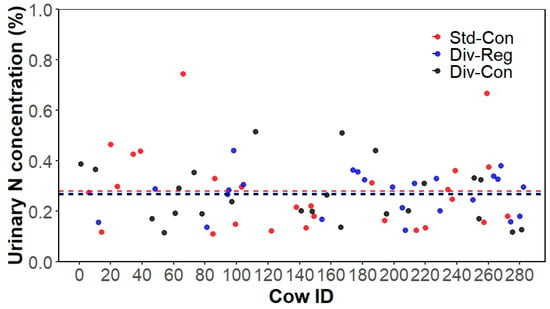
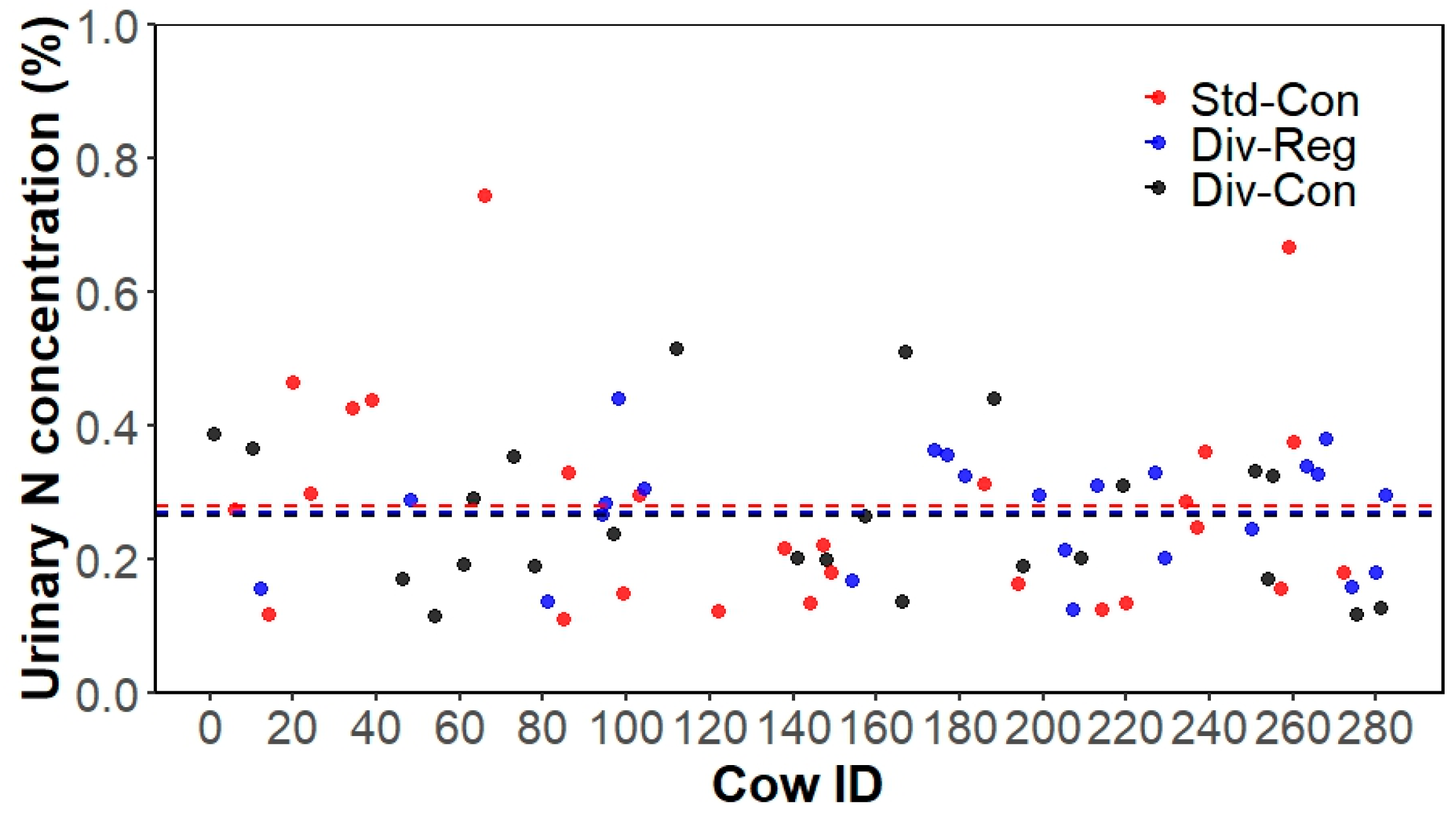
Urine compositions, including UN concentration, creatinine, uric acid and NH3, obtained from the spot urine samples were similar between cows grazing the three farmlets. The observed mean UN concentration was 0.27%, with values ranging from 0.26% to 0.28% across the three monitored farmlets (Table 6), and there was a variation in UN concentrations between the individual cows in all three farmlets (Figure 1).
Table 6.
Means and standard deviation of urine compositions of spot urine samples from individual cows grazing three pasture farmlets (standard pastures under contemporary management Std-Con; diverse pastures under regenerative management Div-Reg; diverse pastures under contemporary management Div-Con) collected on the first day (21 October 2024) of the 4-day trial.
Figure 1.
Urinary nitrogen (N) concentration (%) in spot urine samples from individual cows (Cow ID) within each farmlet. Each dot represents an individual cow, and dashed lines represent the mean for each farmlet. Std-Con (red dots and red dashed lines): standard pasture under contemporary management; Div-Reg (blue dots and blue dashed lines): diverse pasture under regenerative management; and Div-Con (black dots and black dashed lines): diverse pasture under contemporary management.
3.3. Urination Volume and Frequency
Daily urination frequency and volume were similar across the three monitored farmlets (Table 7). The average number of urination events was 12.64 ± 2.97 urinations per cow within 24 h, with an average urination volume of 3.04 ± 0.09 L per event (Table 7). Within the farmlets, urination volume was significantly greater in the morning (AM) compared to the afternoon (PM). Across all farmlets, urine volume was on average 27% greater during morning events compared with afternoon events (3.52 L vs. 2.56 L, p < 0.001).
Table 7.
Urination frequency per 24 h, urine volume per event and urine volume per 24 h, and time between urination events of dairy cows grazing three pasture farmlets (standard pastures under contemporary management Std-Con; diverse pastures under regenerative management Div-Reg; diverse pastures under contemporary management Div-Con).
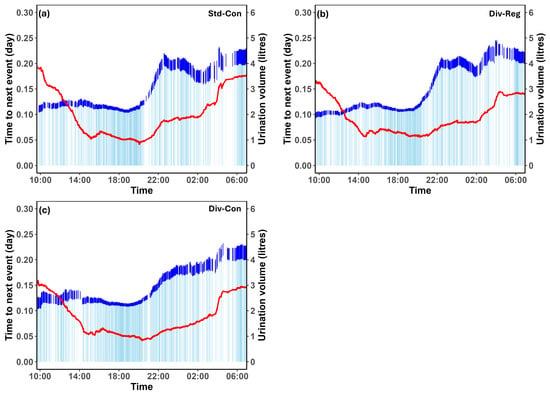
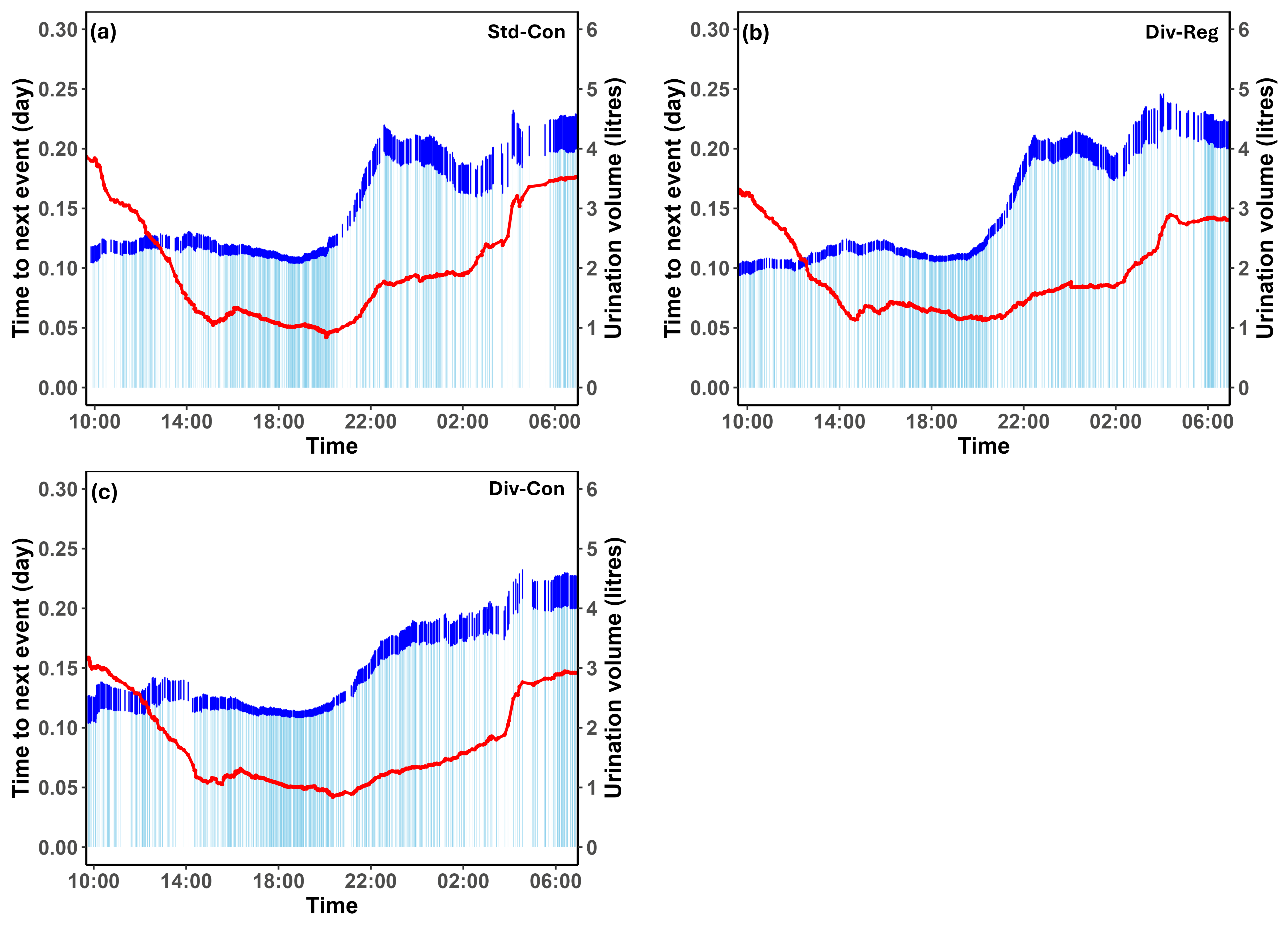
Urine volume per event showed a similar pattern between the three farmlets, which fluctuated from low-volume events during the afternoon to high-volume events during the night and early morning (Figure 2). The time interval between urination events of the cows within the three farmlets exhibited a similar pattern to urine volume, which fluctuated from longer intervals around midday to short intervals at night (Figure 2). The average time between urination events across the three farmlets was approximately 144 min, with the mean values across the three farmlets ranging from 134 to 157 min (Table 7). Within the farmlets, the interval between two urination events was longer in the morning than in the afternoon (p < 0.05). However, no significant differences were observed among farmlets at the same time of day (AM or PM) (p > 0.05) (Table 7).
Figure 2.
The dynamic temporal changes in urination volume (L/event) and time to next urination event for cows grazing in (a) standard pasture under contemporary management (Std-Con), (b) diverse pasture under regenerative management (Div-Reg) and (c) diverse pasture under contemporary management (Div-Con). The solid red lines denote a 4 h smoothing average of time to next event (day), while the sky columns denote a 4 h smoothing average of urine volume per event (L) and the blue bars denote standard error means of urination volume.
4. Discussion
To our knowledge, this is the first pilot study to examine the urination behaviour of dairy cows grazing under both contemporary and regenerative management at a farmlet-level study in NZ. The results of the current study indicate that daily urination frequency and volume were similar across the three monitored farmlets. The observed mean UN concentration was 0.27%, with values ranging from 0.26% to 0.28% across the three monitored farmlets. In the present study, the regenerative management comprised multiple concurrent changes, including reduced stocking rate, lower N fertiliser input, higher post-grazing residuals, and longer grazing rotations (as detailed in Table 2), reflecting a whole management system. Therefore, regenerative management was described as the combined effect of the overall management system rather than being attributed to any single management practice.
4.1. Urination Frequency and Volume
The average daily number of urination events for dairy cows observed in the current study (12.64 events/d) was consistent with some previous grazing studies reporting ~12 events/d [25] and ~ 12.3 to 14.1 events/d [21]. Similarly, the average urine volume per urination event (3.04 L) was in agreement with previously reported averages of 3.0 to 3.5 L [16] and an average of 3.1 L for dairy cows grazing in spring [16,35]. However, a feature of the current study was a high variation in both urine volume (0.7 to 16.6 L/event) and urination frequency (5.7 to 19.6 events/24 h), compared to narrow ranges reported previously [36]. In grazing systems, the risk of N leaching in grazing systems is influenced by urination volume and N concentration in each urination event [37,38], together with the capacity of pasture plants to uptake the N from the urine patch [39,40]. Previous studies have also reported that pasture species have different capacities to capture deposited N from urine patches, which was greater in plantain compared to standard perennial ryegrass/white clover pastures [4,39]. These findings indicate that incorporating plantain into pasture swards may have the potential to reduce the risk of N leaching [41,42]. However, the current study did not directly quantify UN loading at the paddock scale and measure N leaching, which cannot be confirmed from our findings regarding potential environmental benefits.
In the current study, cows grazing in diverse pasture farmlets (Div-Reg and Div-Con) had numerically greater urination volume (9.4–16.5%) than those grazing Std-Con. We hypothesise that the greater urine volume may be attributed to the incorporation of plantain and chicory in diverse pasture farmlets, which have been previously reported to increase herbage water intake while reducing water consumption from water troughs [16,20]. In the current study, we also found that cows grazing the Std-Con farmlet consumed more water, as estimated from internal bolus, than cows grazing diverse pasture farmlets (Div-Reg and Div-Con), averaging 42.3 ± 0.7 L/cow compared with 36.3 ± 0.9 and 37.5 ± 0.9 L/cow for cows grazing Div-Reg and Div-Con farmlets, respectively (p < 0.001). Increased urine output has important implications for N excretion dynamics in grazing systems, as greater dilution of UN may reduce the concentration of N per urination event [37,43]. Previous studies have reported that urine dilution may potentially reduce the risk of N losses to the environment [43,44]. However, in the current study, urination volume, both per urination event and over a 24 h period, was similar among the three farmlets, which was assumed to be due to the presence of plantain in the Std-Con farmlet paddocks, probably due to plants invading the pasture. The forb proportion in the Std-Con paddocks during the study period was generally greater than those collected throughout the whole lactation period, which averaged 6% (unpublished data). Also, in the current study, cows were allocated ¼ of their grazed paddock per day, meaning that over 4 days, they would have grazed in a maximum of two different paddocks within their treatment farmlet.
In the current study, cows in all three farmlets urinated more frequently during the afternoon and nighttime, whereas urination volume per event was greater in the early morning (Figure 2). Urination behaviour and changes in UN excretion are important factors for the development of management strategies to reduce pasture N excretion and minimise the potential risk of environmental N losses [45,46]. For example, a previous study reported daily UN deposited on a pasture system was reduced by 25% when cows were removed from the paddocks for 6 h, indicating potential to mitigate N losses to pasture paddocks [27]. Similarly, total urine excretion captured from pasture paddocks decreased from 85% to 56% when cows were allowed to access pasture for 8 h after milking and were confined to a stand-off pad covered by a woodchip surface for the remainder of the day [47]. However, these control methods would greatly increase production costs and may compromise animal welfare [48,49]. Therefore, previous studies reported that the approach of using diverse pasture species could reduce N excretion from pastoral systems while mitigating potential adverse effects on animal welfare [44,50].
4.2. Urinary Nitrogen Concentrations in Spot Urine Samples
Mean UN concentrations were similar across the three monitored farmlets, ranging between 0.26 and 0.28%. However, there was substantial variation between individual cows (Figure 1). This is in agreement with previous studies, which report a mean total N of 0.68% in a range from 0.21 to 1.22% [51] and a mean of UN concentration of 0.71% in a range from 0.02 to 1.52% [35]. These variations were largely driven by water intake and, hence, urine dilution, which substantially differed between individual cows [52,53]. Additionally, the similarity in UN concentrations observed in the current may have been partly associated with the presence of forbs (plantain and chicory) in the Std-Con paddocks (as discussed above). These species have previously been reported as potential pasture plants for reducing N excretion in dairy cows [21,54].
Urinary N concentration varied within and among days [45,55]; however, in a previous study, the greatest UN concentration was observed in samples collected 3 h after cows began grazing pasture [46]. In the current study, spot urine samples were collected at 1330 h, approximately 3–4 h after morning milking, and had a mean UN concentration of 0.27% (~2.7 g/L), which is consistent with the range of 1–20 g N/L [7] and a range of 2–10 g N/L [27]. However, it is lower than the result of 5.5 g N/L reported in an earlier grazing study [16], which is probably due to the lower CP intake in the current trial (17.2–20.5% vs. 23% CP) [16]. In addition to temporal fluctuations, UN concentrations in the current study varied among the individual cows within each farmlet, aligning with previous reports [51,56], which was attributed to the substantial differences in hydration status and water consumption of the individual animals [51]. Although this pilot study provides preliminary information on urination behaviour, particularly urination volume and frequency, throughout 24 h for dairy cows grazing under different pasture-based farming conditions in spring, a limitation was that UN concentrations were obtained from spot urine samples collected on the first day of the 4-day trial. Because the urination behaviours of dairy cows are dependent on various factors, including dietary supply [57,58], management [27,35], breed [59], and grazing seasons [35,55], data from multiple events, multiple days and across the season are recommended for future studies to achieve a more comprehensive assessment of UN dynamics in grazing dairy cows.
4.3. Limitations of the Study
This study provides a useful investigation of the urination frequency and volume of dairy cows grazing under three contrasting pasture management farmlets. The primary limitation of this study was the lack of independent farmlet-level replication. Consequently, a general treatment effect of Std-Con, Div-Reg and Div-Con cannot be estimated. Therefore, these findings are presented as a description of the urination behaviour of dairy cows grazing three different unreplicated pasture farmlets. We acknowledge the lack of a fourth pasture farmlet, standard pastures under regenerative management; therefore, conclusions are based on farmlet effects, not pasture type or management system effects. During the period in which this trial was conducted, the paddocks in Std-Con also contained forbs, particularly plantain, which has been reported to reduce UN concentration [16,60] and increase urination frequency [16,61]. The periods associated with high wind speed and milking were excluded from the data analysis, which consequently did not provide continuous 24 h urination data; however, the effect of this data removal was similar across all cows from all farmlet treatments. Farmlet management in this study comprised multiple concurrent changes; therefore, the overall findings are not attributed solely to the incorporation of diverse pasture species or management practices. Instead, it represents the whole system of a farmlet, incorporating multiple simultaneous differences in management and pasture diversity. Furthermore, the observations of the three farmlets were obtained over a short period during spring; data across the season are recommended to evaluate a more comprehensive assessment of urination behaviour and UN excretion in grazing systems.
5. Conclusions
The findings from this pilot study describe the urination behaviour, particularly urination frequency and volume, of dairy cows grazing three contrasting pasture farmlets over a 4-day period in spring. This study showed that cows urinated on average ~12.64 times per day, with an average of ~3.04 L per event, and urination volume was greater in morning than in afternoon events across the three farmlets. The observed mean UN concentration was 0.27%, with values ranging from 0.26% to 0.28% across the three monitored farmlets, and there was high variability in urination frequency and volume throughout the day. A limitation of this study was that some Std-Con paddocks, where cows in this group were grazed during this trial, contained forbs (particularly plantain) due to the natural invasion of pasture species over time that may contribute to reduced differences between the farmlets. Urinary N concentration was obtained from a spot sample collected on the first day of the 4-day trial in spring, which limits its temporal representativeness. To obtain a more comprehensive assessment of UN excretion in grazing systems, data from multiple events, multiple days and across the season are recommended.
Author Contributions
Conceptualization, N.T.M. and N.W.S.; methodology, N.T.M., N.W.S., D.J.D., A.A., L.L.B., S.S.W. and A.D.C.; formal analysis, N.T.M. and N.W.S.; investigation, N.T.M.; writing—original draft preparation, N.T.M.; writing—review and editing, N.T.M., N.W.S., D.J.D., A.A., L.L.B., S.S.W. and A.D.C.; visualization, N.T.M., N.W.S., D.J.D., A.A., L.L.B., S.S.W. and A.D.C.; supervision, N.W.S., D.J.D., A.A., L.L.B., S.S.W. and A.D.C.; project administration, N.W.S.; funding acquisition, D.J.D. and L.L.B. All authors have read and agreed to the published version of the manuscript.
Funding
This research was funded by the Ministry for Primary Industry (MPI) through the Whenua Haumanu programme—a partnership between Massey University and the MPI through the Sustainable Food and Fibre Futures fund, grant number SPFF 21050. Programme delivery partners include Lincoln University, AgResearch, Manaaki Whenua and the Riddet Institute.
Institutional Review Board Statement
The study was approved by the Massey University Animal Ethics Committee, protocol number 24/31, approved in August 2024.
Informed Consent Statement
The animals included in the study are owned by the university so informed consent is not specifically required.
Data Availability Statement
The data that support the findings of this study are available from the corresponding authors upon request.
Acknowledgments
The authors sincerely thank Whenua Haumanu Dairy Farm 1 manager and staff for their support in providing research facilities, managing pasture and animals. We are also grateful to the Whenua Haumanu technician team and postgraduate students for their assistance in data collection. ADC and SSW were supported through the T. R. Ellett Agricultural Research Trust. We gratefully acknowledge Paul Shorten, Brendon Welten, Frankie Huddart and Trevor Watson from the Bioeconomy Science Institute for urine sensor deployment and data analysis support.
Conflicts of Interest
The authors declare no conflicts of interest.
Abbreviations
The following abbreviations are used in this manuscript:
| Std-Con | Standard pasture under contemporary management |
| Div-Reg | Diverse pasture under regenerative management |
| Div-Con | Diverse pasture under contemporary management |
| UN | Urinary nitrogen |
References
- Ministry for Primary Industries. Refining Estimates of Nitrogen Leaching for the New Zealand Agricultural Greenhouse Gas Inventory; MPI Technical Paper No. 2022/05; Ministry for Primary Industries: Wellington, New Zealand, 2021. Available online: https://www.mpi.govt.nz/dmsdocument/50431/direct (accessed on 1 November 2026).
- Singh, B.P.; Mehra, P.; Fang, Y.; Dougherty, W.; Saggar, S. Nitrous oxide emissions from cow urine patches in an intensively managed grassland: Influence of nitrogen loading under contrasting soil moisture. Sci. Total Environ. 2021, 757, 143790. [Google Scholar] [CrossRef] [Scilit] [PubMed]
- Cai, Y.; Chang, S.X.; Cheng, Y. Greenhouse gas emissions from excreta patches of grazing animals and their mitigation strategies. Earth-Sci. Rev. 2017, 171, 44–57. [Google Scholar] [CrossRef] [Scilit]
- Talbot, W.D.; Malcolm, B.J.; Cameron, K.C.; Di, H.J.; Whitehead, D. Effect of timing of cattle urine deposition and pasture composition on nitrogen leaching losses. Soil Use Manag. 2021, 37, 723–735. [Google Scholar] [CrossRef] [Scilit]
- Beale, N.; Talbot, W.; Cameron, K.; Di, H.; Narbey, R. Measurement of nitrate leaching losses from lysimeters on a dairy farm following conversion from forestry. N. Z. J. Agric. Res. 2021, 66, 25–43. [Google Scholar] [CrossRef] [Scilit]
- Bolan, N.S.; Saggar, S.; Luo, J.; Bhandral, R.; Singh, J. Gaseous emissions of nitrogen from grazed pastures: Processes, Measurements and Modelling, Environmental implications, and Mitigation. Adv. Agron. 2004, 84, 37–120. [Google Scholar] [CrossRef] [Scilit]
- Selbie, D.R.; Buckthought, L.E.; Shepherd, M.A. The challenge of the urine patch for managing nitrogen in grazed pasture systems. Adv. Agron. 2015, 129, 229–292. [Google Scholar] [CrossRef] [Scilit]
- Bristow, A.W.; Whitehead, D.C.; Cockburn, J.E. Nitrogenous constituents in the urine of cattle, sheep and goats. J. Sci. Food Agric. 1992, 59, 387–394. [Google Scholar] [CrossRef] [Scilit]
- Somda, Z.C.; Powell, J.M.; Bationo, A. Soil pH and nitrogen changes following cattle and sheep urine deposition. Commun. Soil Sci. Plant Anal. 1997, 28, 1253–1268. [Google Scholar] [CrossRef] [Scilit]
- Prosser, J.I. Chapter 15—The Ecology of Nitrifying Bacteria. In Biology of the Nitrogen Cycle; Bothe, H., Ferguson, S.J., Newton, W.E., Eds.; Elsevier: Amsterdam, The Netherlands, 2007; pp. 223–243. [Google Scholar]
- Grelet, G.; Lang, S.; Merfield, C.; Calhoun, N.; Robson-Williams, M.; Horrocks, A.; Dewes, A.; Clifford, A.; Stevenson, B.; Saunders, C.M. Regenerative Agriculture in Aotearoa New Zealand–Research Pathways to Build Science-Based Evidence and National Narratives; White paper prepared for Our Land and Water National Science Challenge and the NEXT Foundation; Manaaki Whenua—Landcare Research: Lincoln, New Zealand, 2021; p. 59. Available online: https://www.landcareresearch.co.nz/discover-our-research/climate-change/soil-and-ecosystem-health/regenerative-agriculture-in-new-zealand/regenerative-agriculture-white-paper-sets-out-pressing-research-priorities (accessed on 1 November 2026).
- Malcolm, B.; Cameron, K.; Di, H.; Edwards, G.; Moir, J. The effect of four different pasture species compositions on nitrate leaching losses under high N loading. Soil Use Manag. 2014, 30, 58–68. [Google Scholar] [CrossRef] [Scilit]
- Moir, J.; Edwards, G.; Berry, L. Nitrogen uptake and leaching loss of thirteen temperate grass species under high N loading. Grass Forage Sci. 2013, 68, 313–325. [Google Scholar] [CrossRef] [Scilit]
- Woods, R.R.; Cameron, K.C.; Edwards, G.R.; Di, H.J.; Clough, T.J. Reducing nitrogen leaching losses in grazed dairy systems using an Italian ryegrass-plantain-white clover forage mix. Grass Forage Sci. 2018, 73, 878–887. [Google Scholar] [CrossRef] [Scilit]
- Maxwell, T.M.; McLenaghen, R.D.; Edwards, G.R.; Di, H.J.; Cameron, K.C. Italian ryegrass swards reduce N leaching via greater N uptake and lower drainage over perennial ryegrass cultivars varying in cool season growth rates. N. Z. J. Agric. Res. 2019, 62, 69–82. [Google Scholar] [CrossRef] [Scilit]
- Nguyen, T.T.; Navarrete, S.; Horne, D.; Donaghy, D.; Bryant, R.H.; Kemp, P. Dairy cows grazing plantain-based pastures have increased urine patches and reduced urine N concentration that potentially decreases N leaching from a pastoral system. Animals 2023, 13, 528. [Google Scholar] [CrossRef] [Scilit] [PubMed]
- Minogue, C.T.; Boland, T.M.; Etxeberria, I.; Walsh, N.A.; Fahey, A.G.; Dineen, M.; McKay, Z.C. The effect of including plantain (Plantago lanceolata L.) in perennial ryegrass and white clover pastures on milk production and nitrogen excretion of dairy cows throughout the grazing season. J. Dairy Sci. 2025, 108, 8529–8547. [Google Scholar] [CrossRef] [Scilit] [PubMed]
- Minneé, E.M.K.; Waghorn, G.C.; Lee, J.M.; Clark, C.E.F. Including chicory or plantain in a perennial ryegrass/white clover-based diet of dairy cattle in late lactation: Feed intake, milk production and rumen digestion. Anim. Feed Sci. Technol. 2017, 227, 52–61. [Google Scholar] [CrossRef] [Scilit]
- Baker, S.; Lynch, M.B.; Godwin, F.; Boland, T.M.; Evans, A.C.O.; Murphy, P.N.C.; Kelly, A.K.; Sheridan, H. A comparison of the nutritive value of perennial ryegrass, perennial ryegrass and white clover and multispecies-based farmlet systems. Grassl. Res. 2023, 2, 129–139. [Google Scholar] [CrossRef] [Scilit]
- Mangwe, M.; Bryant, R. Partial replacement of ryegrass and clover herbage with chicory alters urination behaviour and soil nitrogen loading of grazing dairy cows. J. N. Z. Grassl. 2022, 83, 179–188. [Google Scholar] [CrossRef] [Scilit]
- Minnée, E.; Leach, C.; Dalley, D. Substituting a pasture-based diet with plantain (Plantago lanceolata) reduces nitrogen excreted in urine from dairy cows in late lactation. Livest. Sci. 2020, 239, 104093. [Google Scholar] [CrossRef] [Scilit]
- Box, L.A.; Welten, B.; Coles, H.; Minnée, E.; Shorten, P. Varying plantain content in temperate ryegrass-white clover pastures affects urinary-nitrogen excretion of non-lactating dairy cows. Sci. Total Environ. 2023, 862, 160847. [Google Scholar] [CrossRef] [Scilit] [PubMed]
- Box, L.A.; Edwards, G.R.; Bryant, R.H. Diurnal changes in the nutritive composition of four forage species at high and low N fertiliser. J. N. Z. Grassl. 2017, 79, 111–118. [Google Scholar] [CrossRef] [Scilit]
- Kumara, S.N.; Parkinson, T.J.; Laven, R.; Donaghy, D.J. The Influence of Rotational Length, along with Pre- and Post-Grazing Measures on Nutritional Composition of Pasture during Winter and Spring on New Zealand Dairy Farms. Animals 2022, 12, 1934. [Google Scholar] [CrossRef] [Scilit] [PubMed]
- Shorten, P.R.; Welten, B.G. An acoustic sensor technology to detect urine excretion. Biosyst. Eng. 2022, 214, 90–106. [Google Scholar] [CrossRef] [Scilit]
- Shorten, P.R.; Welten, B.G. Assessment of a non-invasive acoustic sensor for detecting cattle urination events. Biosyst. Eng. 2021, 207, 177–187. [Google Scholar] [CrossRef] [Scilit]
- Shepherd, M.; Shorten, P.; Costall, D.; Macdonald, K. Evaluation of urine excretion from dairy cows under two farm systems using urine sensors. Agric. Ecosyst. Environ. 2017, 236, 285–294. [Google Scholar] [CrossRef] [Scilit]
- Dairy, N.Z. Fundamentals. Available online: https://www.dairynz.co.nz/feed/fundamentals/?page=2 (accessed on 1 June 2026).
- Shorten, P.R.; Welten, B.G. Acoustic sensor determination of repeatable cow urinations traits in winter and spring. Comput. Electron. Agric. 2022, 196, 106846. [Google Scholar] [CrossRef] [Scilit]
- Boudra, H.; Noziere, P.; Cantalapiedra-Hijar, G.; Traïkia, M.; Martin, J.-F.; Pétéra, M.; Lagree, M.; Doreau, M.; Morgavi, D. Spot urine collection: A valid alternative to total urine collection for metabolomic studies in dairy cattle. J. Dairy Sci. 2022, 105, 301–312. [Google Scholar] [CrossRef] [Scilit] [PubMed]
- AOAC Official Method 968.06 Protein (Crude) in Animal Feed: Dumas Method. In Official Methods of Analysis of AOAC INTERNATIONAL; Oxford University Press: Oxford, UK, 2023; ISBN 9780197610138. Available online: https://doi.org/10.1093/9780197610145.003.1396 (accessed on 15 November 2026). [CrossRef] [Scilit]
- SmaXtec. Smaxtec Classic Bolus. Available online: https://www.smaxtec.com/en/system/hardware/ (accessed on 1 November 2026).
- Holmes, C.; Brookes, I.; Garrick, D.; MacKenzie, D.; Parkinson, T.; Wilson, G. Chapter 14 Nutrition: Quantitative requirements of dairy cattle. In Milk Production from Pasture Principles and Practices; Massey University: Turitea, New Zealand, 2002; pp. 235–242. [Google Scholar]
- ARC. Agricultural Research Council. The Nutrient Requirements of Ruminant Livestock; Commonwealth Agricultural Bureaux: Farnham Royal, UK, 1980.
- Ahmed, A.; Sohi, R.; Roohi, R.; Jois, M.; Raedts, P.; Aarons, S.R. Spatially and temporally variable urinary N loads deposited by lactating cows on a grazing system dairy farm. J. Environ. Manag. 2018, 215, 166–176. [Google Scholar] [CrossRef] [Scilit] [PubMed]
- Edwards, G.; Bryant, R.; Smith, N.; Hague, H.; Ferris, A.; Farrell, L.J. Milk production and urination behaviour of dairy cows grazing diverse and simple pasture. In Proceedings of the New Zealand Society of Animal Production, Dunedin, 07/2015; New Zealand Society of Animal Production: Hamilton, New Zealand, 2015; pp. 79–83. [Google Scholar]
- Adams, C.; Kok, J.; Amer, P.; Beukes, P.C. A urine patch model for evaluating management strategies for reducing nitrogen leaching from pasture-based dairy farms. Nutr. Cycl. Agroecosyst. 2025, 131, 289–305. [Google Scholar] [CrossRef] [Scilit]
- Li, F.Y.; Betteridge, K.; Cichota, R.; Hoogendoorn, C.J.; Jolly, B.H. Effects of nitrogen load variation in animal urination events on nitrogen leaching from grazed pasture. Agric. Ecosyst. Environ. 2012, 159, 81–89. [Google Scholar] [CrossRef] [Scilit]
- Shepherd, M.; Carlson, B. Urine patch size and nitrogen load: Effects on nitrogen uptake from the urine patch in plantain and ryegrass/white clover pastures. J. N. Z. Grassl. 2018, 80, 195–200. [Google Scholar] [CrossRef] [Scilit]
- Healy, M.; Egan, M.; Hearn, C.; Burchill, W.; Lynch, M.B.; Buckley, F.; O’Donovan, M. Nitrogen losses from perennial ryegrass and plantain monoculture swards following seasonal applications of dairy cow urine: A lysimeter study. Agric. Ecosyst. Environ. 2026, 398, 110106. [Google Scholar] [CrossRef] [Scilit]
- Carlton, A.J.; Cameron, K.C.; Di, H.J.; Edwards, G.R.; Clough, T.J. Nitrate leaching losses are lower from ryegrass/white clover forages containing plantain than from ryegrass/white clover forages under different irrigation. N. Z. J. Agric. Res. 2019, 62, 150–172. [Google Scholar] [CrossRef] [Scilit]
- Egan, A.; Moloney, T.; Murphy, J.B.; Forrestal, P.J. Ribwort plantain inclusion reduces nitrate leaching from grass-clover swards; A multi-year five soil study. Agric. Ecosyst. Environ. 2025, 380, 109376. [Google Scholar] [CrossRef] [Scilit]
- Eme, P.E.; Roche, J.R. Invited review: Cows grazing pastures containing narrow-leaved plantain have lower urine N concentrations-Implications for nitrate leaching. J. Dairy Sci. 2025, 108, 7876–7895. [Google Scholar] [CrossRef] [Scilit] [PubMed]
- Navarrete, S.; Rodriguez, M.; Horne, D.; Hanly, J.; Hedley, M.; Kemp, P. Nitrogen excretion by dairy cows grazing plantain (Plantago lanceolata) based pastures during the lactating season. Animals 2022, 12, 469. [Google Scholar] [CrossRef] [Scilit] [PubMed]
- Beltran, I.E.; Gregorini, P.; Daza, J.; Balocchi, O.A.; Morales, A.; Pulido, R.G. Diurnal concentration of urinary nitrogen and rumen ammonia are modified by timing and mass of herbage allocation. Animals 2019, 9, 961. [Google Scholar] [CrossRef] [Scilit] [PubMed]
- Cosgrove, G.; Jonker, A.; Lowe, K.; Taylor, P.; Pacheco, D. Diurnal variation in urine nitrogen and creatinine concentrations from lactating cows grazing ryegrass-dominant pasture in autumn and late spring–summer. Anim. Prod. Sci. 2017, 57, 1297–1304. [Google Scholar] [CrossRef] [Scilit]
- Clark, C.; McLeod, K.; Glassey, C.; Gregorini, P.; Costall, D.; Betteridge, K.; Jago, J. Capturing urine while maintaining pasture intake, milk production, and animal welfare of dairy cows in early and late lactation. J. Dairy Sci. 2010, 93, 2280–2286. [Google Scholar] [CrossRef] [Scilit] [PubMed]
- O’Connor, C.; Dowling, S.; Cave, V.; Webster, J. Cow lying behaviour and bedding quality changes during five weeks on a stand-off pad. Animals 2019, 9, 257. [Google Scholar] [CrossRef] [Scilit] [PubMed]
- Schütz, K.; Cave, V.; Cox, N.; Huddart, F.; Tucker, C. Effects of 3 surface types on dairy cattle behavior, preference, and hygiene. J. Dairy Sci. 2019, 102, 1530–1541. [Google Scholar] [CrossRef] [Scilit] [PubMed]
- Nguyen, T.T.; Navarrete, S.; Horne, D.J.; Donaghy, D.J.; Kemp, P.D. Incorporating plantain with perennial ryegrass-white clover in a dairy grazing system: Dry matter yield, botanical composition, and nutritive value response to sowing rate, plantain content and season. Agronomy 2022, 12, 2789. [Google Scholar] [CrossRef] [Scilit]
- Magro, S.; Kreuzer, M.; Niero, G.; Penasa, M.; Visentin, E.; Guerra, A.; Chiarin, E.; Renzi, M.; Simoni, M.; Righi, F.; et al. Reference intervals and variability of urinary traits in lactating Holstein cows. J. Dairy Sci. 2026, 109, 11056–11070. [Google Scholar] [CrossRef] [Scilit] [PubMed]
- Appuhamy, J.A.D.R.N.; Wagner-Riddle, C.; Casper, D.P.; France, J.; Kebreab, E. Quantifying body water kinetics and fecal and urinary water output from lactating Holstein dairy cows. J. Dairy Sci. 2014, 97, 6177–6195. [Google Scholar] [CrossRef] [Scilit] [PubMed]
- Meyer, U.; Everinghoff, M.; Gädeken, D.; Flachowsky, G. Investigations on the water intake of lactating dairy cows. Livest. Prod. Sci. 2004, 90, 117–121. [Google Scholar] [CrossRef]
- Eady, C.; Conner, A.J.; Rowarth, J.S.; Coles, G.D.; Deighton, M.H.; Moot, D.J. An examination of the ability of plantain (Plantago lanceolata L.) to mitigate nitrogen leaching from pasture systems. N. Z. J. Agric. Res. 2025, 68, 130–157. [Google Scholar] [CrossRef] [Scilit]
- Shorten, P.; DeVantier, B.; Welten, B. Urine sensor-based determination of repeatable cow urination traits in autumn, winter and spring. Sci. Total Environ. 2022, 818, 151681. [Google Scholar] [CrossRef] [Scilit] [PubMed]
- Yang, C.T.; Ferris, C.P.; Yan, T. Effects of dietary crude protein concentration on animal performance and nitrogen utilisation efficiency at different stages of lactation in Holstein-Friesian dairy cows. Animal 2022, 16, 100562. [Google Scholar] [CrossRef] [Scilit] [PubMed]
- Pacheco, D.; Glassey, C.; Thomas, C.; Ledgard, S.F.; Box, L.A.; Welten, B.G.; Shorten, P.R. Relationships between dietary factors and nitrogen partitioning to milk and urine in temperate grazing dairy cattle. N. Z. J. Agric. Res. 2024, 67, 314–327. [Google Scholar] [CrossRef] [Scilit]
- Bougouin, A.; Hristov, A.; Dijkstra, J.; Aguerre, M.; Ahvenjärvi, S.; Arndt, C.; Bannink, A.; Bayat, A.-R.; Benchaar, C.; Boland, T. Prediction of nitrogen excretion from data on dairy cows fed a wide range of diets compiled in an intercontinental database: A meta-analysis. J. Dairy Sci. 2022, 105, 7462–7481. [Google Scholar] [CrossRef] [Scilit] [PubMed]
- Correa-Luna, M.; Donaghy, D.; Kemp, P.; Schutz, M.; López-Villalobos, N. Nitrogen use efficiency and excretion in grazing cows with high and low milk urea nitrogen breeding values. Sustainability 2021, 13, 9827. [Google Scholar] [CrossRef] [Scilit]
- Nguyen, T.T.; Navarrete, S.; Horne, D.; Donaghy, D.; Kemp, P. Milk production and nitrogen excretion of grazed dairy cows in response to plantain (Plantago lanceolata) content and lactation season. Anim. Biosci. 2025, 38, 67–76. [Google Scholar] [CrossRef] [Scilit] [PubMed]
- Box, L.A.; Edwards, G.R.; Bryant, R.H. Milk production and urinary nitrogen excretion of dairy cows grazing plantain in early and late lactation. N. Z. J. Agric. Res. 2017, 60, 470–482. [Google Scholar] [CrossRef] [Scilit]

Disclaimer/Publisher’s Note: The statements, opinions and data contained in all publications are solely those of the individual author(s) and contributor(s) and not of MDPI and/or the editor(s). MDPI and/or the editor(s) disclaim responsibility for any injury to people or property resulting from any ideas, methods, instructions or products referred to in the content. |
© 2026 by the authors. Licensee MDPI, Basel, Switzerland. This article is an open access article distributed under the terms and conditions of the Creative Commons Attribution (CC BY) license.