


Simple Summary
Cryopreservation of bull semen enables the long-term preservation and distribution of valuable genetic resources, but the freezing and thawing process can damage sperm cells. We evaluated two plant-derived antioxidant compounds, baicalein and neohesperidin dihydrochalcone, alone and in combination, to improve the quality of frozen–thawed semen from Qinchuan bulls. Both compounds improved sperm motility, membrane integrity, energy metabolism and antioxidant capacity after thawing. The combined treatment showed higher total motility, plasma membrane integrity, and acrosome integrity than either single treatment. Untargeted metabolomics of semen supernatant revealed treatment-associated alterations in metabolic pathways. These findings suggest that baicalein and neohesperidin dihydrochalcone may be useful additives for improving bull semen preservation and supporting the use of valuable Qinchuan cattle genetic resources.
Abstract
Oxidative stress during cryopreservation compromises post-thaw sperm quality in bulls. This study evaluated the effects of baicalein (BAI), neohesperidin dihydrochalcone (NHDC) and their combined supplementation on Qinchuan bull sperm cryopreservation and the associated metabolic responses. Concentration screening identified 40 μg/mL BAI and 30 μg/mL NHDC for subsequent experiments. Compared with the control, BAI, NHDC and BAI + NHDC increased post-thaw sperm motility, plasma membrane integrity, acrosome integrity, adenosine triphosphate (ATP) content and mitochondrial membrane potential (MMP). The supplemented groups also showed lower reactive oxygen species (ROS) and malondialdehyde (MDA) levels; higher activities of superoxide dismutase (SOD), catalase (CAT), and glutathione peroxidase (GSH-Px); and higher total antioxidant capacity (T-AOC). The combined treatment showed higher total motility, plasma membrane integrity, and acrosome integrity than either single treatment. Untargeted metabolomics identified 96, 123 and 197 differential metabolites in the BAI, NHDC and BAI + NHDC groups, respectively. Differential metabolites from all three treatments were enriched in lipid-related pathways, including glycerophospholipid metabolism and linoleic acid metabolism. Metabolites identified in the BAI + NHDC group were additionally enriched in nucleotide metabolism, purine metabolism, and ubiquinone-related pathways. BAI × NHDC interaction analysis identified 200 metabolites showing non-additive responses, with enrichment in lipid-related pathways, including glycerophospholipid metabolism and linoleic acid metabolism. Together, BAI and NHDC improved post-thaw sperm quality in Qinchuan bulls, accompanied by changes in oxidative status, mitochondrial function, and lipid- and energy-related metabolites.
1. Introduction
Artificial insemination is widely used in cattle breeding, and semen cryopreservation is essential for the long-term storage and distribution of superior genetic resources. However, the freeze–thaw process can reduce sperm motility, plasma membrane integrity, acrosome integrity and mitochondrial function, thereby impairing post-thaw sperm quality [1,2]. These impairments are mainly associated with cold shock, osmotic stress, ice crystal formation and oxidative stress during cryopreservation [3]. Therefore, improving antioxidant protection in semen extenders remains an important strategy to protect post-thaw sperm quality.
Oxidative stress is a major cause of sperm cryodamage. Bull sperm membranes are rich in polyunsaturated fatty acids and highly susceptible to lipid peroxidation, while sperm possess limited endogenous antioxidant capacity [4,5]. Excessive reactive oxygen species (ROS) can damage membrane lipids, proteins and mitochondrial function, leading to reduced motility and structural integrity after thawing [6,7]. Accordingly, various antioxidant additives have been evaluated in semen extenders to reduce oxidative injury and maintain sperm function during cryopreservation. In recent years, plant-derived antioxidants have also been tested in semen freezing extenders, including resveratrol [8], lycopene [9], quercetin [10], curcumin [11] and rosemary extract [12].
Baicalein (BAI) is a flavone compound with antioxidant, anti-inflammatory and mitochondrial protective properties. Previous studies have shown that BAI can reduce oxidative injury and improve cell survival under stress conditions [13]. Neohesperidin dihydrochalcone (NHDC) is a citrus-derived dihydrochalcone compound with free-radical-scavenging and antioxidant activities [14,15]. Although BAI and NHDC differ in chemical structure and source, both have antioxidant potential and may protect sperm against freeze–thaw-induced oxidative damage. Combined antioxidant supplementation can provide complementary protection by targeting different oxidative pathways, and has been shown to improve post-thaw semen quality [16,17]. However, the effects of BAI and NHDC, alone or in combination, have not been fully evaluated in bull semen cryopreservation.
In addition to conventional sperm quality indicators, metabolomic analysis provides a useful approach to characterize metabolic changes associated with sperm cryodamage and extender supplementation [18,19]. Changes in lipid metabolism, amino acid metabolism, nucleotide metabolism and energy-related pathways may reflect alterations in membrane stability, oxidative status and mitochondrial function after thawing [20,21]. Therefore, metabolomics can help determine whether antioxidant supplementation alters the metabolic environment of post-thaw semen and whether combined additives induce responses different from those caused by single additives.
The objective of this study was to evaluate the effects of BAI, NHDC and BAI + NHDC on post-thaw sperm quality in Qinchuan bulls. Sperm motility, plasma membrane integrity, acrosome integrity, adenosine triphosphate (ATP) content, mitochondrial membrane potential (MMP), oxidative status and antioxidant capacity were assessed. Untargeted metabolomics was further used to characterize metabolic changes in post-thaw semen supernatant and to explore the non-additive metabolic response associated with combined BAI and NHDC supplementation.
2. Materials and Methods
2.1. Ethics Statement
All experimental procedures were approved by the Experimental Animal Center of Northwest A&F University (NWAFUCAST2018-168).
2.2. Semen Collection and Quality Assessment
Semen was collected from six healthy Qinchuan bulls aged 3–5 years at the National Beef Cattle Improvement Center of Northwest A&F University, Yangling, Shaanxi, China. Bulls were maintained under the same feeding and management conditions and had normal reproductive performance. Semen was collected twice weekly using an artificial vagina.
Total motility, sperm concentration, and morphology were assessed immediately after collection using the SQA-Vb analyzer (MES, Encino, CA, USA). Only ejaculates with total motility ≥ 70%, sperm concentration ≥ 6 × 10⁸ sperm/mL and abnormal sperm morphology ≤ 15% were used [22].
2.3. Additive Treatments
Three independent experiments were conducted using separate semen collection and pooling batches to determine the effective concentrations of BAI (Jskchem, Shanghai, China) and NHDC (Jskchem, Shanghai, China) and to evaluate their combined effects on post-thaw sperm quality. In Experiment 1, BAI was added to the semen diluent at final concentrations of 0, 20, 40, 60, and 80 μg/mL. In Experiment 2, NHDC was added at 0, 10, 20, 30, and 40 μg/mL. Based on the screening results, 40 μg/mL BAI and 30 μg/mL NHDC were selected for subsequent experiments. In Experiment 3, four treatments were established: control (CON), BAI (40 μg/mL), NHDC (30 μg/mL), and BAI + NHDC (40 μg/mL BAI and 30 μg/mL NHDC). BAI was dissolved in dimethyl sulfoxide (DMSO), whereas NHDC was dissolved in water. DMSO concentrations were matched across groups within Experiments 1 and 3 (≤ 0.5%, v/v); no DMSO was added in Experiment 2.
For each experiment, semen collected from the six bulls was pooled and divided among the corresponding treatment groups, which were supplemented and cryopreserved separately. This entire collection, pooling, treatment, and cryopreservation procedure was performed on six separate occasions, providing six pooled-semen batch replicates per treatment (n = 6).
2.4. Semen Freezing and Thawing
Fresh semen was diluted using a one-step dilution method by mixing with preheated (37 °C) semen diluent (IMV, Optidyl, 020996, L’Aigle, France) to achieve a final sperm concentration of 5 × 10⁷/mL. The diluted semen was equilibrated at 4 °C for 4 h, loaded into 0.25 mL straws, sealed, and frozen in liquid nitrogen vapor. The straws were placed 5 cm above the surface of liquid nitrogen for 15 min and then plunged into liquid nitrogen for storage. After at least 7 d of storage, the straws were thawed in a 37 °C water bath for 30 s and immediately subjected to post-thaw evaluation. Post-thaw total motility, progressive motility, and instrument-reported velocity (μm/s) were assessed using the SQA-Vb analyzer.
2.5. Assessment of Plasma Membrane and Acrosome Integrity
Plasma membrane integrity was assessed using the hypo-osmotic swelling test [23]. The hypo-osmotic solution contained 0.6756 g fructose and 0.3676 g glucose in 50 mL double-distilled water, and its osmolarity was experimentally measured as 150 mOsm/L. Thawed semen (100 μL) was mixed with 1 mL hypo-osmotic solution and incubated at 25 °C for 30 min. Sperm with curled or swollen tails were considered membrane-intact. At least 100 sperm cells were counted per sample, without correction for baseline tail coiling in iso-osmotic medium.
Acrosome integrity was assessed using fluorescein isothiocyanate-conjugated peanut agglutinin (FITC-PNA) staining. Semen smears were air-dried, fixed in anhydrous methanol for 10 min, stained with FITC-PNA at 37 °C for 30 min in the dark, washed with phosphate-buffered saline and observed under a fluorescence microscope. Sperm with uniform green fluorescence in the acrosomal region were classified as acrosome-intact. At least 100 sperm cells were counted per sample. Illustrations of acrosome and plasma membrane integrity are provided in Figure S1.
2.6. Determination of ATP Content and MMP
ATP content was measured spectrophotometrically using a commercial ATP assay kit (Solarbio, Beijing, China). MMP was assessed using a JC-1 assay kit (Beyotime, Shanghai, China). Red and green fluorescence intensities were measured using a multimode microplate reader (Infinite M200 PRO; Tecan, Männedorf, Switzerland), and MMP was expressed as the red/green fluorescence ratio. Equal volumes of thawed semen were washed, and the resulting sperm pellets were processed using the same volume of extraction buffer. Assays were performed according to the manufacturers’ instructions.
2.7. Assessment of Oxidative Status and Antioxidant Capacity
Post-thaw oxidative status and antioxidant capacity were evaluated using commercial assay kits (Solarbio, Beijing, China). ROS was assessed using the 2′,7′-dichlorodihydrofluorescein diacetate (DCFH-DA) fluorescent probe, with fluorescence measured using a multimode microplate reader (Infinite M200 PRO; Tecan, Männedorf, Switzerland). malondialdehyde (MDA), superoxide dismutase (SOD), catalase (CAT), glutathione peroxidase (GSH-Px), and total antioxidant capacity (T-AOC) were measured spectrophotometrically in washed sperm lysates. All assays were performed and results calculated according to the manufacturers’ instructions.
2.8. Untargeted Metabolomic Analysis
For metabolomic analysis, thawed semen samples from the CON, BAI, NHDC, and BAI + NHDC groups were centrifuged at 3000× g for 15 min at 4 °C to remove spermatozoa, and the resulting semen supernatant was collected and stored at −80 °C. Six semen supernatant samples per group, each obtained from a separate collection and cryopreservation batch, were analyzed (n = 6).
After thawing on ice and vortexing for 10 s, 100 μL semen supernatant was mixed with 100 μL internal-standard extraction solution (acetonitrile:methanol = 1:4, v/v), vortexed for 3 min, and centrifuged at 12,000× g for 10 min at 4 °C. A 150-μL aliquot of the supernatant was held at −20 °C for 30 min and centrifuged again at 12,000× g for 3 min at 4 °C; 120 μL was transferred for liquid chromatography–mass spectrometry (LC–MS) analysis. Equal aliquots of all samples were pooled to prepare quality-control samples. Chromatographic separation was performed using a Vanquish ultrahigh-performance liquid chromatography system coupled to a Q Exactive HF-X mass spectrometer (Thermo Scientific, Waltham, MA, USA) and an ACQUITY Premier HSS T3 column (1.8 μm, 2.1 × 100 mm; Waters Corporation, Milford, MA, USA). The mobile phases were 0.1% formic acid in water (A) and 0.1% formic acid in acetonitrile (B); the column temperature was 40 °C, the flow rate was 0.4 mL/min, and the injection volume was 3 μL. Data were acquired in positive and negative electrospray ionization modes over m/z 70–1000 at an MS1 resolution of 60,000, with spray voltages of 3.8 and 3.4 kV, respectively, and stepped collision energies of 30, 40, and 50 V. Raw files were converted to mzML format using ProteoWizard v3.0.7414 and processed in XCMS for peak extraction, alignment, and retention-time correction. Features missing from more than 50% of samples within a group were removed; remaining missing values were imputed using K-nearest neighbors or one-fifth of the minimum value according to the proportion of missingness, and peak areas were corrected by support vector regression. Metabolites were annotated by accurate-mass, retention-time, and MS/MS spectral matching, using mass tolerances of 25 ppm (MS1) and 50 ppm (MS2), a retention-time matching tolerance of 6 s, a minimum MS/MS match score of 0.3, and a minimum composite score of 0.5. According to the Metabolomics Standards Initiative (MSI), annotations supported by MS/MS library matching, without confirmation using authentic standards under the same analytical conditions, were classified as level 2 (putatively annotated compounds).
No targeted exclusion of BAI, NHDC, or features potentially corresponding to their isomers or adducts was performed during metabolomic data processing. Principal component analysis (PCA) was performed after log2 transformation and zero-centering. Partial least-squares discriminant analysis (PLS-DA) was conducted after log2 transformation and unit-variance scaling using MetaboAnalystR v1.0.1, and model robustness was evaluated by 200 permutation tests. Differential metabolites were selected using variable importance in projection (VIP) > 1, false discovery rate (FDR) < 0.05, and |log2FC| ≥ 1, followed by annotation using the Kyoto Encyclopedia of Genes and Genomes (KEGG) Compound database. KEGG pathway enrichment was performed using a one-sided hypergeometric test, with all detected metabolites successfully mapped to KEGG used as the background set. Pathways were ranked according to unadjusted p values, with p < 0.05 used as an exploratory enrichment threshold. No multiple-testing correction was applied to the pathway enrichment p values.
2.9. BAI × NHDC Interaction Analysis
A two-way analysis of variance (ANOVA) was performed for each metabolite, with BAI, NHDC, and BAI × NHDC as fixed factors. The interaction effect was calculated as follows:
Interaction effect = mean (BAI + NHDC) − mean (BAI) − mean (NHDC) + mean (CON).
p values for the interaction term were adjusted using the Benjamini–Hochberg FDR method. Metabolites with an FDR-adjusted interaction p < 0.05 were retained as interaction-associated metabolites. Those with positive interaction effects were classified as positive non-additive metabolites, whereas those with negative interaction effects were classified as negative non-additive metabolites. The interaction analysis was performed using log2-transformed metabolite intensities.
2.10. Statistical Analysis
Sperm quality and biochemical data from each experiment were analyzed separately using one-way ANOVA followed by Duncan’s multiple range test in SPSS v27.0. Homogeneity of variance was assessed using Levene’s test. Results are presented as mean ± standard deviation (SD). p < 0.05 was considered significant, and different lowercase letters within the same column indicate significant differences among treatments.
3. Results
3.1. Effects of BAI, NHDC, and BAI + NHDC on Post-Thaw Sperm Motility
The effects of BAI and NHDC treatments on the motion characteristics of frozen–thawed bull sperm are presented in Table 1. Compared with the control group, BAI treatment significantly increased total motility, progressive motility, and sperm velocity (p < 0.05), with the highest values observed at 40 μg/mL BAI. Similarly, NHDC treatment significantly enhanced sperm motion characteristics compared with the control group (p < 0.05). Among the tested concentrations, 30 μg/mL NHDC showed the most pronounced effect.
Table 1.
Effects of BAI, NHDC, and BAI + NHDC on Post-Thaw Sperm Motility Parameters.
Based on the most effective concentrations identified above, the combined effects of BAI and NHDC were further evaluated. Compared with the control group, BAI, NHDC, and BAI + NHDC treatments significantly improved total motility and progressive motility (p < 0.05). Progressive motility did not differ significantly among the three supplemented groups. The combined group showed significantly higher total motility than either single treatment, whereas sperm velocity did not differ significantly from NHDC alone.
3.2. Post-Thaw Structural Integrity and Mitochondrial Function
The effects of BAI, NHDC, and their combination on post-thaw sperm structural integrity and mitochondrial function are shown in Table 2. Compared with the control group, BAI treatment significantly improved plasma membrane integrity, acrosome integrity, ATP content, and MMP of frozen–thawed spermatozoa (p < 0.05). Among the tested concentrations, 40 μg/mL BAI exhibited the most pronounced protective effect. Similarly, NHDC treatment significantly enhanced sperm structural integrity and mitochondrial function compared with the control group (p < 0.05). ATP content did not differ significantly among the NHDC-supplemented groups.
Table 2.
Effects of BAI, NHDC and BAI + NHDC on post-thaw structural integrity and mitochondrial function.
Based on the most effective concentrations identified above, the effects of combined BAI and NHDC treatment were further evaluated. Compared with the control group, BAI, NHDC, and BAI + NHDC treatments significantly increased membrane integrity, acrosome integrity, ATP content, and MMP (p < 0.05). The BAI + NHDC group showed significantly higher plasma membrane integrity and acrosome integrity than the NHDC group, whereas ATP content and MMP did not differ significantly from NHDC alone.
3.3. Post-Thaw Oxidative Status and Antioxidant Capacity
The effects of BAI, NHDC, and their combination on oxidative status and antioxidant capacity of post-thaw spermatozoa are presented in Table 3. Compared with the control group, BAI and NHDC treatments significantly reduced relative ROS and MDA levels while enhancing the activities of antioxidant enzymes, including SOD, CAT, and GSH-Px, as well as T-AOC (p < 0.05). Among the tested concentrations, 40 μg/mL BAI and 30 μg/mL NHDC exhibited the strongest antioxidant effects, which were consistent with the most effective concentrations identified in previous experiments.
Table 3.
Effects of BAI, NHDC and BAI + NHDC on post-thaw oxidative status and antioxidant capacity.
Furthermore, the combined treatment of BAI and NHDC produced a greater improvement in antioxidant capacity compared with individual treatments. The BAI + NHDC group showed the lowest ROS and MDA levels and the highest antioxidant enzyme activities and T-AOC among all groups (p < 0.05), indicating that the combined treatment effectively alleviated oxidative stress and enhanced the antioxidant defense system of frozen–thawed spermatozoa.
3.4. Overview of Metabolomic Profiles
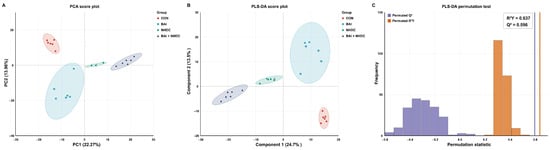
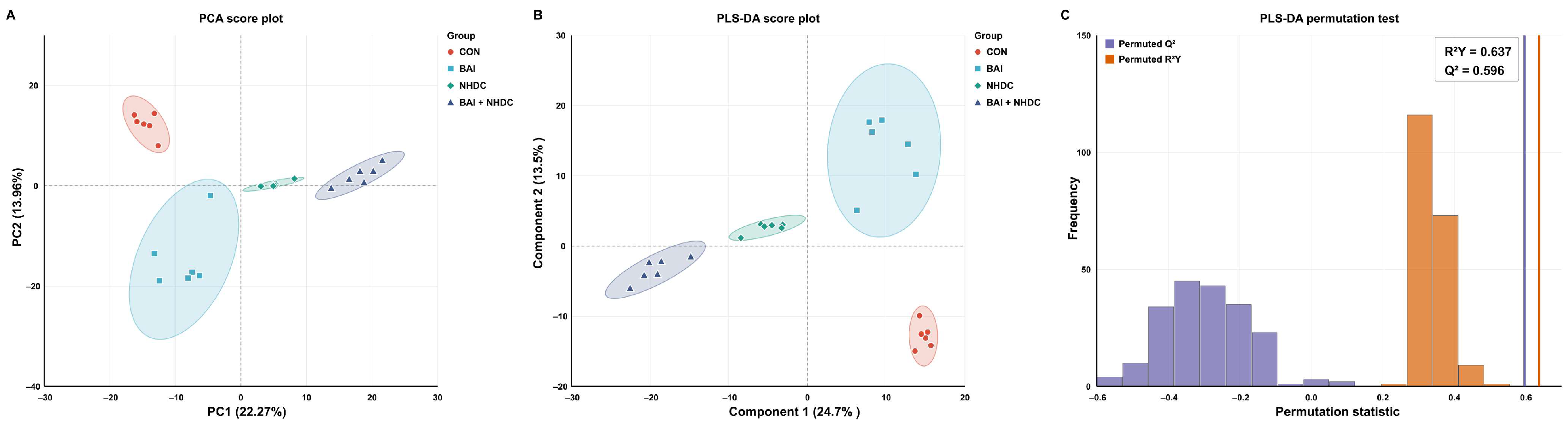
Metabolomic profiles of post-thaw semen supernatant are shown in Figure 1. PCA indicated separation among the CON, BAI, NHDC and BAI + NHDC groups (PC1 = 22.27%, PC2 = 13.96%; Figure 1A). PLS-DA further showed separation among the four groups (Figure 1B). The model yielded R2Y = 0.637 and Q2 = 0.596, and permutation testing supported the robustness of the model (Figure 1C).
Figure 1.
Multivariate analysis of post-thaw semen supernatant metabolomic profiles. (A) PCA score plot. (B) PLS-DA score plot. (C) PLS-DA permutation test.
3.5. Differential Metabolites and Enriched Pathways
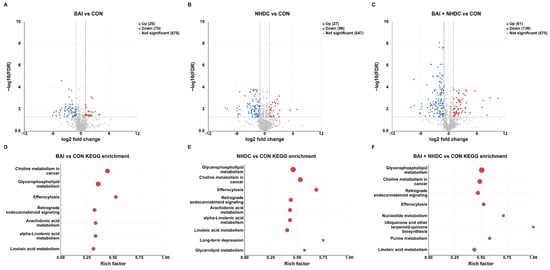
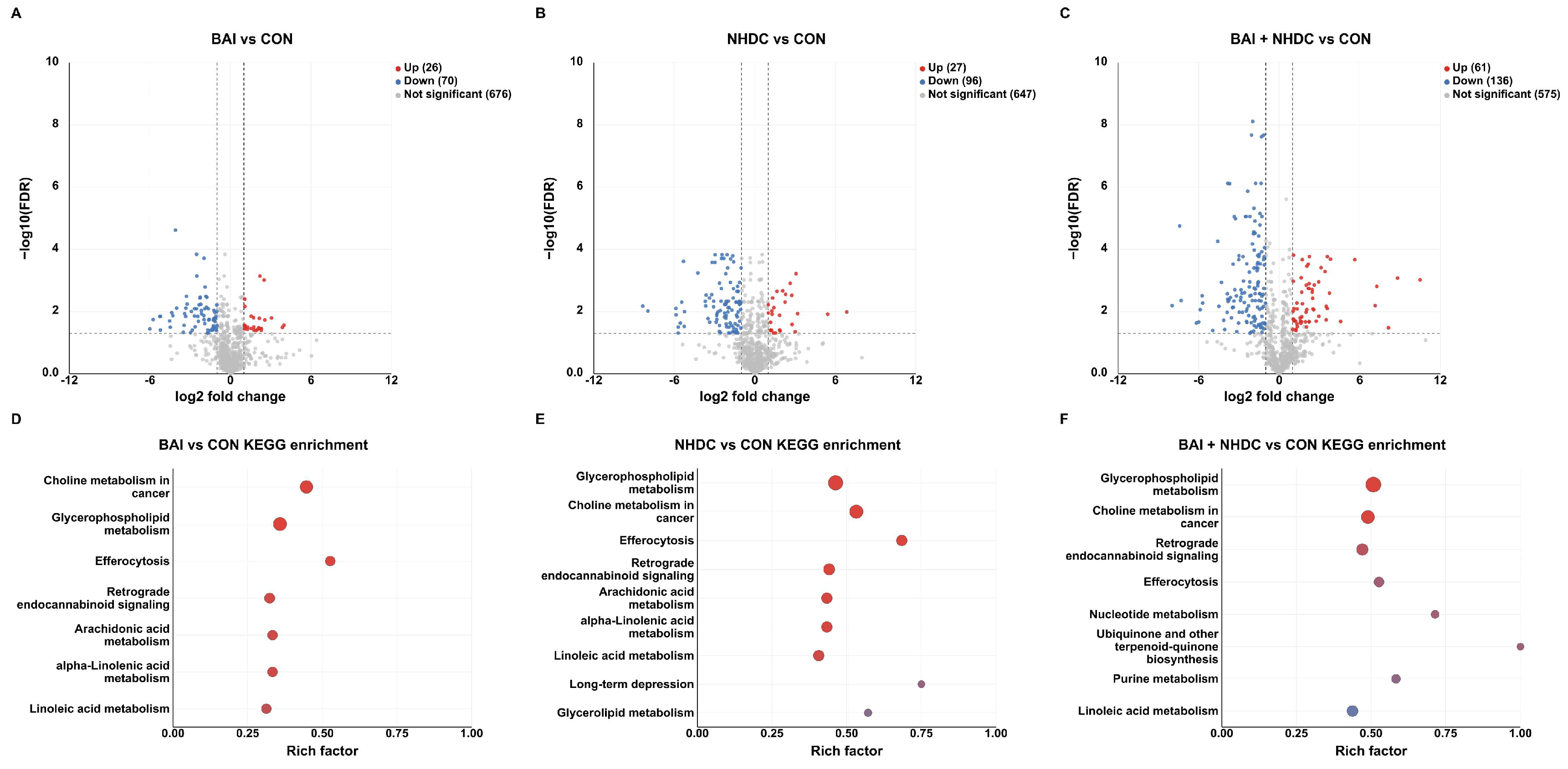
Differential metabolites and enriched pathways are shown in Figure 2. Compared with CON, 96 differential metabolites were identified in the BAI group, including 26 up-regulated and 70 down-regulated metabolites (Figure 2A). In the NHDC group, 123 differential metabolites were identified, including 27 up-regulated and 96 down-regulated metabolites (Figure 2B). In the BAI + NHDC group, 197 differential metabolites were identified, including 61 up-regulated and 136 down-regulated metabolites (Figure 2C). KEGG enrichment analysis identified 7, 9 and 8 enriched pathways in the BAI, NHDC and BAI + NHDC groups, respectively (Figure 2D–F). The top 20 differential metabolites in BAI vs. CON, NHDC vs. CON, and BAI + NHDC vs. CON are summarized in Supplementary Tables S1–S3, respectively.
Figure 2.
Differential metabolites and KEGG pathway enrichment in the BAI, NHDC and BAI + NHDC groups compared with CON. (A–C) Volcano plots of BAI vs. CON, NHDC vs. CON and BAI + NHDC vs. CON, respectively. (D–F) KEGG enrichment bubble plots of the corresponding differential metabolites.
3.6. Shared Differential Metabolites Among the Three Comparisons
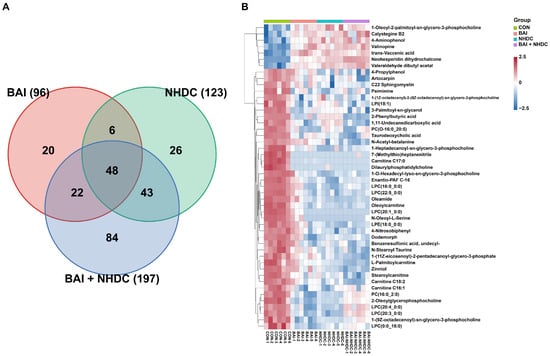
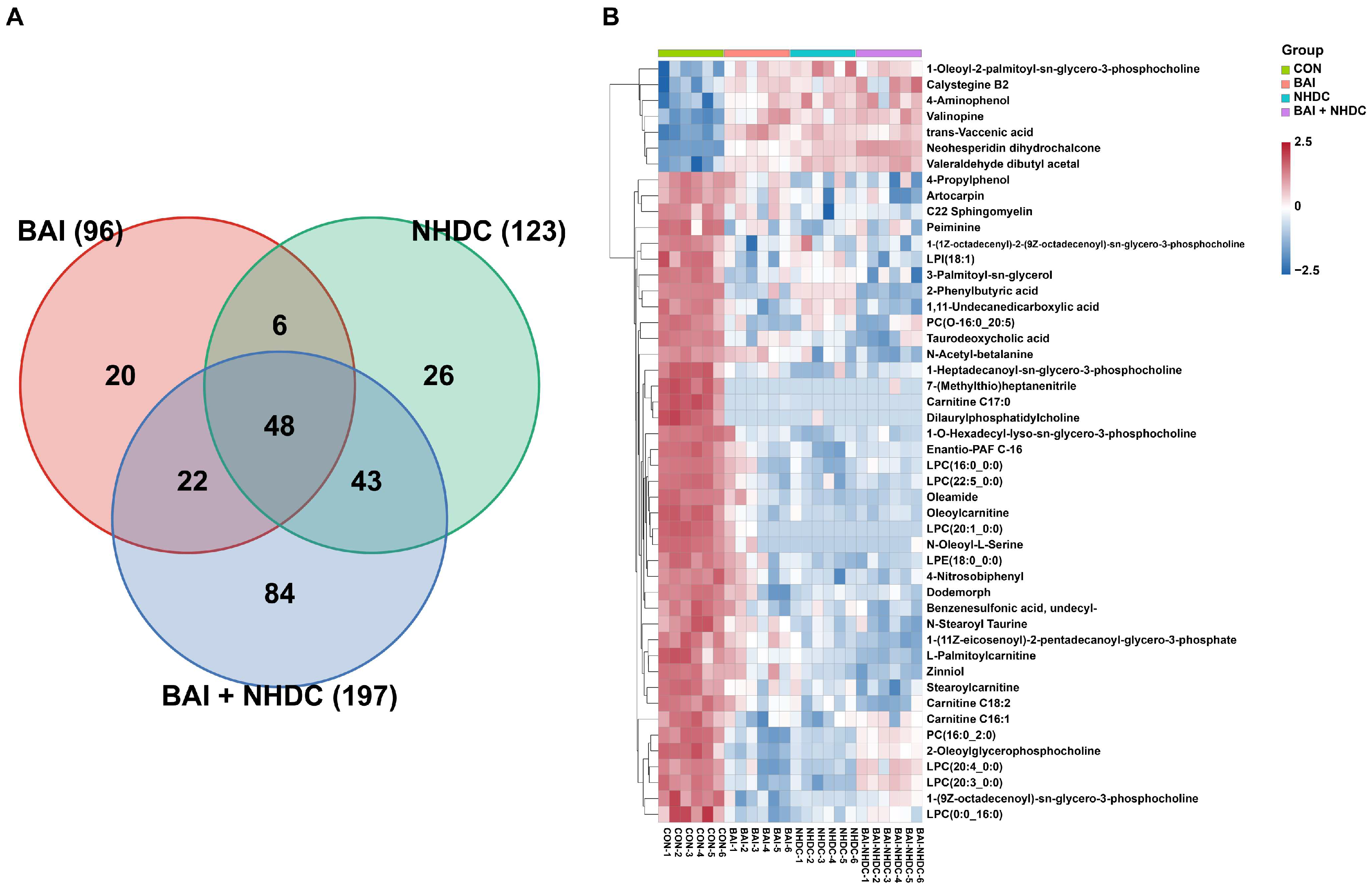
Shared differential metabolites are shown in Figure 3. A total of 48 metabolites were shared among BAI vs. CON, NHDC vs. CON and BAI + NHDC vs. CON (Figure 3A). Most shared metabolites showed the same direction of change across the three treatment groups. These shared metabolites showed distinct abundance patterns across the four groups and included multiple metabolite classes, including organic acids and derivatives, lipids and lipid-like molecules, organic nitrogen compounds and organoheterocyclic compounds (Figure 3B). The 48 shared differential metabolites and their directions of change are listed in Supplementary Table S4.
Figure 3.
Shared differential metabolites among BAI, NHDC and BAI + NHDC treatments. (A) Venn diagram of differential metabolites in BAI vs. CON, NHDC vs. CON and BAI + NHDC vs. CON. (B) Heatmap of the 48 shared differential metabolites.
3.7. BAI × NHDC Interaction-Associated Metabolites
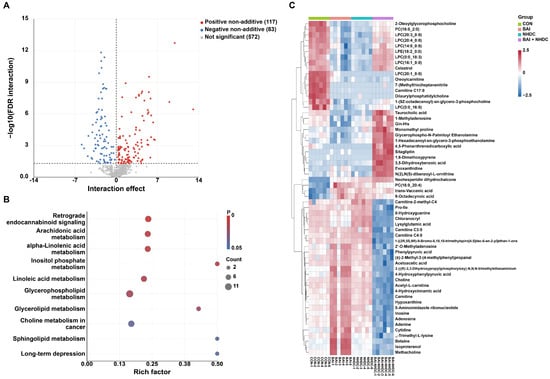
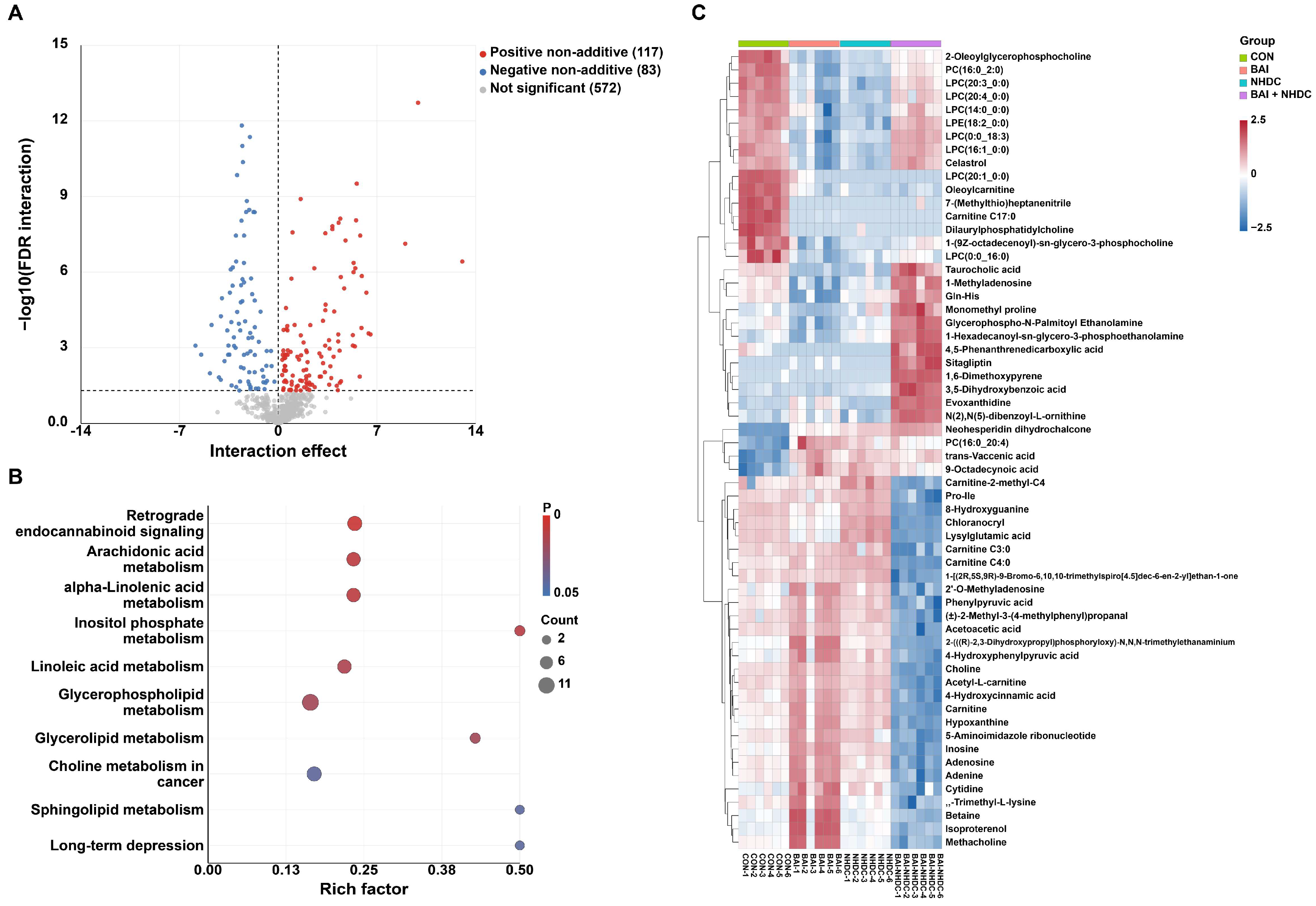
BAI × NHDC interaction-associated metabolites are shown in Figure 4. A total of 200 metabolites were retained as BAI × NHDC interaction-associated metabolites, including 117 positive non-additive and 83 negative non-additive metabolites (Figure 4A). KEGG enrichment analysis showed that these metabolites were mainly enriched in glycerophospholipid metabolism, linoleic acid metabolism, α-linolenic acid metabolism, arachidonic acid metabolism, retrograde endocannabinoid signaling and inositol phosphate metabolism (Figure 4B). The interaction-associated metabolites showed distinct abundance patterns across the four groups (Figure 4C). The top 20 BAI × NHDC interaction-associated metabolites and their statistical results are presented in Supplementary Table S5.
Figure 4.
BAI × NHDC interaction-associated metabolites. (A) Volcano plot of BAI × NHDC interaction-associated metabolites. (B) KEGG enrichment bubble plot of interaction-associated metabolites. (C) Heatmap of interaction-associated metabolites.
4. Discussion
Semen cryopreservation exposes sperm to multiple stressors, including cold shock, ice crystal formation, osmotic fluctuation, and oxidative stress [3,24,25]. Among these, oxidative stress is an important cause of reduced post-thaw sperm quality [26]. The freeze–thaw process induces ROS accumulation, disrupts redox balance and damages the sperm plasma membrane, acrosome and mitochondria [27]. In the present study, BAI, NHDC and BAI + NHDC improved post-thaw motility, plasma membrane integrity, acrosome integrity, ATP content and MMP in Qinchuan bull sperm. They also reduced ROS and MDA levels and increased T-AOC, SOD, CAT and GSH-Px activities. These results indicate that BAI and NHDC enhanced antioxidant defense in post-thaw sperm and that the combination provided greater antioxidant protection. Control differences among the three independent experiments may reflect batch-to-batch variation in semen quality and cryopreservation response, potentially influenced by seasonal factors [28]. Furthermore, total motility increased more than progressive motility, suggesting a contribution from non-progressive motility.
This protection was associated with reduced oxidative damage. The sperm plasma and acrosomal membranes are rich in polyunsaturated fatty acids and are highly sensitive to oxidative stress [29]. Excess ROS can induce lipid peroxidation and impair membrane integrity and fluidity [30]. Mitochondria are the main sites of ATP synthesis, and mitochondrial damage can further promote ROS generation [31]. BAI, with its vicinal trihydroxyl flavone structure, efficiently scavenges hydroxyl and peroxyl radicals, thereby limiting ROS accumulation and alleviating oxidative damage [32]. NHDC, as a dihydrochalcone compound, also has strong radical-scavenging activity and can improve antioxidant capacity [33,34]. Their antioxidant effects may also involve direct radical scavenging and protection of endogenous antioxidant enzymes from oxidative inactivation. In the present study, BAI and NHDC each exhibited substantial antioxidant capacity, protecting sperm membrane architecture and mitochondrial status through enhanced antioxidant defense and reduced lipid peroxidation, consistent with previous reports [13]. The reduced benefits at higher concentrations may reflect a concentration-dependent balance between antioxidant protection and adverse effects on sperm function. Pro-oxidant activity and mitochondrial disturbances have been reported for several polyphenols in human spermatozoa [35], although these mechanisms were not directly established in the present study. However, direct contributions of BAI and NHDC to the colorimetric assay readouts cannot be excluded in the absence of cell-free controls.
Metabolomic analysis provided further insight into these phenotypic changes. Differential metabolites from the three treatments were consistently enriched in glycerophospholipid and linoleic acid metabolism, while BAI and NHDC also showed enrichment of α-linolenic acid and arachidonic acid metabolism. These pathways involve membrane phospholipid remodeling and unsaturated fatty acid metabolism, processes relevant to sperm membrane stability and lipid peroxidation [36,37]. These metabolic changes were consistent with the higher plasma membrane and acrosome integrity and lower MDA levels observed in the treatment groups. However, KEGG categories such as “Choline metabolism in cancer,” “Efferocytosis,” and “Long-term depression” mainly reflect shared lipid-related metabolite annotations and do not indicate the occurrence of these biological processes in spermatozoa.
The treatment groups also showed distinct metabolic responses. The NHDC group was specifically enriched in glycerolipid metabolism, suggesting alterations in lipid turnover and membrane lipid precursor availability [38]. In contrast, the BAI + NHDC group was specifically enriched in nucleotide metabolism, purine metabolism, and ubiquinone and other terpenoid–quinone biosynthesis. These pathways are closely associated with nucleotide turnover, mitochondrial energy metabolism, and electron transport [39,40], which may be related to the changes in ATP content and mitochondrial function observed after treatment.
The analysis of the 48 shared differential metabolites indicated a common core metabolic response among the three treatment groups. These metabolites were mainly associated with membrane phospholipid turnover and fatty acid-related energy metabolism. Their concordant changes suggest that BAI and NHDC reduced the accumulation of products related to membrane phospholipid degradation, lipid release, or oxidative membrane injury after freezing and thawing [41]. These metabolic alterations were consistent with the higher plasma membrane and acrosome integrity and lower MDA levels observed in the treatment groups.
The BAI × NHDC interaction analysis further demonstrated that the combined treatment induced non-additive metabolic responses. The interaction-associated metabolites were enriched in lipid-related pathways, including glycerophospholipid metabolism and linoleic acid metabolism. At the metabolite level, acylcarnitines and purine-related metabolites, including inosine and hypoxanthine, showed non-additive responses. Acylcarnitines are important intermediates in mitochondrial fatty acid transport and energy metabolism [42]. The altered acylcarnitine profile suggests that the combined treatment may influence mitochondrial substrate utilization after thawing [43]. In addition, changes in purine-related metabolites, including inosine and hypoxanthine, may reflect alterations in nucleotide turnover and energy metabolism [44]. Changes in choline and lysophospholipid-related metabolites indicate that BAI + NHDC may also regulate membrane lipid remodeling processes [41,45].
Overall, the improvements in post-thaw sperm quality following BAI and NHDC supplementation were accompanied by changes in oxidative status, mitochondrial function, and lipid- and energy-related metabolites. The combined treatment was associated with non-additive changes in acylcarnitine-, purine-, and membrane lipid-related metabolites. These findings suggest that BAI and NHDC may improve post-thaw sperm quality through antioxidant effects and changes in lipid- and energy-related metabolism, providing a rationale for further optimization of bull semen freezing extenders. Untargeted metabolomics was exploratory, and the absence of a cell-free extender control prevented separation of extender- and additive-derived contributions from sperm-associated changes. The higher number of differential metabolites in the BAI + NHDC group may partly reflect additive-derived signals and does not, by itself, demonstrate stronger regulation of endogenous sperm metabolism. DNA integrity, capacitation status, fertilization capacity, and fertility were not assessed in this study. Therefore, targeted and functional validation will be carried out in future studies to determine the roles of the key metabolite annotations and their biological relevance.
5. Conclusions
In conclusion, BAI, NHDC, and their combination improved the post-thaw quality of Qinchuan bull sperm. The supplemented groups showed higher plasma membrane integrity, acrosome integrity, ATP content, and MMP, together with higher antioxidant enzyme activities and T-AOC. The combined treatment showed higher total motility, plasma membrane integrity, and acrosome integrity than either single treatment. Metabolomic results suggest that these effects were associated with reduced oxidative stress, maintained mitochondrial function, and changes in lipid- and energy-related metabolism. The non-additive metabolic response induced by the combined treatment suggests that BAI + NHDC interacted at the metabolic level during cryopreservation.
Supplementary Materials
The following supporting information can be downloaded at: https://www.mdpi.com/article/10.3390/ani16203210/s1, Table S1: Top 20 differential metabolites in BAI vs. CON; Table S2: Top 20 differential metabolites in NHDC vs. CON; Table S3: Top 20 differential metabolites in BAI + NHDC vs. CON; Table S4: The 48 shared differential metabolites; Table S5: Top 20 BAI × NHDC interaction-associated metabolites; Figure S1. Diagram of acrosome integrity and plasma membrane integrity. A. Illustrative images of acrosome integrity assessment using FITC-PNA staining. S1 indicates sperm with intact acrosomes, and S2 indicates sperm with damaged or incomplete acrosomes. B. Illustrative image of plasma membrane integrity assessment using the hypo-osmotic swelling test (HOST). Horizontal and vertical arrows indicate sperm classified as having intact and damaged plasma membranes, respectively.
Author Contributions
B.Y.: Writing—original draft, Writing—review and editing, Data curation, Visualization, Methodology, Formal analysis. Z.Z.: Writing—original draft, Data curation, Investigation. S.G.: Formal analysis. R.Z.: Investigation. L.Z.: Project administration, Resources. W.Y.: Conceptualization, Supervision, Funding acquisition, Writing—review and editing. All authors have read and agreed to the published version of the manuscript.
Funding
This work was supported by the Shenzhen Science and Technology Program, China (Grant Nos. JCYJ20230807111502006 and JCYJ20240813152008011); the Key Core Technology Research Project of the Shaanxi Provincial Key Research and Development Program, China (Grant No. 2024NC2-GJHX-20); the National Beef Cattle and Yak Industry Technology System Construction Program, China (Grant No. CARS-36); and the Key Scientific Research Project of the Shaanxi Provincial Department of Education, China (Grant No. 24JS060).
Institutional Review Board Statement
The animal study protocol was approved by the Experimental Animal Center of Northwest A&F University (protocol code: NWAFUCAST2018-168 and date of approval: 20 September 2018).
Informed Consent Statement
Not applicable.
Data Availability Statement
The raw metabolomics data generated in this study have been deposited in the OMIX repository at the National Genomics Data Center (NGDC) under accession number OMIX021547. Other data supporting the conclusions of this study are available from the authors upon request.
Acknowledgments
We would like to thank the National Beef Cattle Improvement Center of Northwest A&F University for providing the experimental materials.
Conflicts of Interest
The authors declare no conflicts of interest.
Abbreviations
The following abbreviations are used in this manuscript:
| BAI | baicalein |
| NHDC | neohesperidin dihydrochalcone |
| ROS | reactive oxygen species |
| MDA | malondialdehyde |
| SOD | superoxide dismutase |
| CAT | catalase |
| GSH-Px | glutathione peroxidase |
| T-AOC | total antioxidant capacity |
| ATP | adenosine triphosphate |
| MMP | mitochondrial membrane potential |
| KEGG | Kyoto Encyclopedia of Genes and Genomes |
References
- Min, C.-G.; Ma, X.; Wang, Y.-C.; Zhong, C.-K.; Yuan, C.; Zhang, K.-Y.; Zhan, C.-L.; Hou, S.-K.; Wang, X.-H.; Wang, J.; et al. The Effects of Repeated Freezing and Thawing on Bovine Sperm Morphometry and Function. Cryobiology 2024, 115, 104892. [Google Scholar] [CrossRef] [Scilit]
- Zhang, B.; Wang, Y.; Wu, C.; Qiu, S.; Chen, X.; Cai, B.; Xie, H. Freeze-Thawing Impairs the Motility, Plasma Membrane Integrity and Mitochondria Function of Boar Spermatozoa through Generating Excessive ROS. BMC Vet. Res. 2021, 17, 127. [Google Scholar] [CrossRef] [Scilit]
- Amidi, F.; Pazhohan, A.; Shabani Nashtaei, M.; Khodarahmian, M.; Nekoonam, S. The Role of Antioxidants in Sperm Freezing: A Review. Cell Tissue Bank. 2016, 17, 745–756. [Google Scholar] [CrossRef] [Scilit]
- Aitken, R.J.; Gibb, Z.; Baker, M.A.; Drevet, J.; Gharagozloo, P. Causes and Consequences of Oxidative Stress in Spermatozoa. Reprod. Fertil. Dev. 2015, 28, 1–10. [Google Scholar] [CrossRef] [Scilit]
- Fleming, S.D.; Thomson, L.K. The Oxidative Stress of Human Sperm Cryopreservation. Antioxidants 2025, 14, 402. [Google Scholar] [CrossRef] [Scilit]
- O’Connell, M.; McClure, N.; Lewis, S.E.M. The Effects of Cryopreservation on Sperm Morphology, Motility and Mitochondrial Function. Hum. Reprod. 2002, 17, 704–709. [Google Scholar] [CrossRef] [Scilit]
- Upadhyay, V.R.; Ramesh, V.; Dewry, R.K.; Kumar, G.; Raval, K.; Patoliya, P. Implications of Cryopreservation on Structural and Functional Attributes of Bovine Spermatozoa: An Overview. Andrologia 2021, 53, e14154. [Google Scholar] [CrossRef] [Scilit]
- Assunção, C.M.; Mendes, V.R.A.; Brandão, F.Z.; Batista, R.I.T.P.; Souza, E.D.; de Carvalho, B.C.; Quintão, C.C.R.; Raposo, N.R.B.; Camargo, L.S.A. Effects of Resveratrol in Bull Semen Extender on Post-Thaw Sperm Quality and Capacity for Fertilization and Embryo Development. Anim. Reprod. Sci. 2021, 226, 106697. [Google Scholar] [CrossRef] [Scilit]
- Bucak, M.N.; Ataman, M.B.; Başpınar, N.; Uysal, O.; Taşpınar, M.; Bilgili, A.; Öztürk, C.; Güngör, Ş.; İnanç, M.E.; Akal, E. Lycopene and Resveratrol Improve Post-Thaw Bull Sperm Parameters: Sperm Motility, Mitochondrial Activity and DNA Integrity. Andrologia 2015, 47, 545–552. [Google Scholar] [CrossRef] [Scilit]
- El-Khawagah, A.R.M.; Kandiel, M.M.M.; Samir, H. Effect of Quercetin Supplementation in Extender on Sperm Kinematics, Extracellular Enzymes Release, and Oxidative Stress of Egyptian Buffalo Bulls Frozen-Thawed Semen. Front. Vet. Sci. 2020, 7, 604460. [Google Scholar] [CrossRef] [Scilit]
- Gupta, S.; Kumar, A.; Mahajan, A.; Sharma, P.; Sachan, V.; Aggrawal, J.; Yadav, S.; Saxena, A.; Kumar Swain, D. Curcumin in a Tris-Based Semen Extender Improves Cryosurvival of Hariana Bull Spermatozoa. Andrologia 2022, 54, e14255. [Google Scholar] [CrossRef] [Scilit]
- Motlagh, M.K.; Sharafi, M.; Zhandi, M.; Mohammadi-Sangcheshmeh, A.; Shakeri, M.; Soleimani, M.; Zeinoaldini, S. Antioxidant Effect of Rosemary (Rosmarinus officinalis L.) Extract in Soybean Lecithin-Based Semen Extender Following Freeze-Thawing Process of Ram Sperm. Cryobiology 2014, 69, 217–222. [Google Scholar] [CrossRef] [Scilit]
- Avdatek, F.; Güngör, Ş.; Gülhan, M.F.; İnanç, M.E.; Olğaç, K.T.; Denk, B.; Yeni, D.; Taşdemir, U. Cryopreservation of Ram Semen: Baicalein Efficiency on Oxidative Stress, Chromatin Integrity, Viability and Motility Post Thaw. Front. Vet. Sci. 2024, 11, 1394273. [Google Scholar] [CrossRef] [Scilit]
- Choi, S.; Yu, S.; Lee, J.; Kim, W. Effects of Neohesperidin Dihydrochalcone (NHDC) on Oxidative Phosphorylation, Cytokine Production, and Lipid Deposition. Foods 2021, 10, 1408. [Google Scholar] [CrossRef] [Scilit]
- Su, C.; Xia, X.; Shi, Q.; Song, X.; Fu, J.; Xiao, C.; Chen, H.; Lu, B.; Sun, Z.; Wu, S.; et al. Neohesperidin Dihydrochalcone versus CCl4-Induced Hepatic Injury through Different Mechanisms: The Implication of Free Radical Scavenging and Nrf2 Activation. J. Agric. Food Chem. 2015, 63, 5468–5475. [Google Scholar] [CrossRef] [Scilit]
- Mohammadi, T.; Hosseinchi Gharehaghaj, M.; Alaei Novin, A. Effects of Apigenin and Trans-Ferulic Acid on Microscopic and Oxidative Stress Parameters in the Semen of Water Buffalo Bulls during Cryopreservation. Cryobiology 2024, 115, 104868. [Google Scholar] [CrossRef] [Scilit]
- Olfati Karaji, R.; Daghigh Kia, H.; Ashrafi, I. Effects of in Combination Antioxidant Supplementation on Microscopic and Oxidative Parameters of Freeze–Thaw Bull Sperm. Cell Tissue Bank. 2014, 15, 461–470. [Google Scholar] [CrossRef] [Scilit]
- Courant, F.; Antignac, J.-P.; Monteau, F.; Le Bizec, B. Metabolomics as a Potential New Approach for Investigating Human Reproductive Disorders. J. Proteome Res. 2013, 12, 2914–2920. [Google Scholar] [CrossRef] [Scilit]
- Yang, B.; Liu, L.; Wang, N.; Zhou, Z.; Zhang, Z.; Li, Y.; Zan, L.; Yang, W. L-Glutamine Supplementation Improves the In Vitro Qualitative Parameters of Cryopreserved Qinchuan Bull Sperm. Animals 2025, 15, 3052. [Google Scholar] [CrossRef] [Scilit]
- Elisa, G.; Gianfranco, G.; Beatrice, M.; Diego, B.; Anna, D.; Veronica, V.; Elena, F.M.; Lucio, Z. Evaluation of Metabolomic Profiling and Oxidative Stress Markers of Bull Seminal Plasma and Their Relationship with Sperm Motility before and after Thawing. Anim. Reprod. Sci. 2022, 247, 107107. [Google Scholar] [CrossRef] [Scilit]
- Moraes, C.R.; Meyers, S. The Sperm Mitochondrion: Organelle of Many Functions. Anim. Reprod. Sci. 2018, 194, 71–80. [Google Scholar] [CrossRef] [Scilit]
- Wang, M.; Wu, S.; Yang, B.; Ye, M.; Tan, J.; Zan, L.; Yang, W. Grape Seed Proanthocyanidins Improve the Quality of Fresh and Cryopreserved Semen in Bulls. Animals 2023, 13, 2781. [Google Scholar] [CrossRef] [Scilit]
- Zhao, J.; Meng, P.; Jin, M.; Ma, X.; Ma, H.; Yang, H.; Chen, Y.; Zhang, J.; Zhang, Y.; Luo, Y.; et al. Combined Addition of L-Carnitine and L-Proline Improves Cryopreservation of Dairy Goat Semen. Anim. Reprod. Sci. 2023, 257, 107325. [Google Scholar] [CrossRef] [Scilit]
- Góngora, A.; Holt, W.V.; Gosálvez, J. Sperm Human Biobanking: An Overview. Arch. Med. Res. 2024, 55, 103130. [Google Scholar] [CrossRef] [Scilit]
- Meyers, S.A. Spermatozoal Response to Osmotic Stress. Anim. Reprod. Sci. 2005, 89, 57–64. [Google Scholar] [CrossRef] [Scilit]
- Bansal, A.K.; Bilaspuri, G.S. Impacts of Oxidative Stress and Antioxidants on Semen Functions. Vet. Med. Int. 2011, 2011, 686137. [Google Scholar] [CrossRef] [Scilit]
- Zhang, L.; Sun, Y.; Jiang, C.; Sohail, T.; Sun, X.; Wang, J.; Li, Y. Damage to Mitochondria During the Cryopreservation, Causing ROS Leakage, Leading to Oxidative Stress and Decreased Quality of Ram Sperm. Reprod. Domest. Anim. 2024, 59, e14737. [Google Scholar] [CrossRef] [Scilit]
- Fuerst-Waltl, B.; Schwarzenbacher, H.; Perner, C.; Sölkner, J. Effects of Age and Environmental Factors on Semen Production and Semen Quality of Austrian Simmental Bulls. Anim. Reprod. Sci. 2006, 95, 27–37. [Google Scholar] [CrossRef] [Scilit]
- Aitken, R.J.; Baker, M.A. Oxidative Stress, Sperm Survival and Fertility Control. Mol. Cell. Endocrinol. 2006, 250, 66–69. [Google Scholar] [CrossRef] [Scilit]
- Nowicka-Bauer, K.; Nixon, B. Molecular Changes Induced by Oxidative Stress That Impair Human Sperm Motility. Antioxidants 2020, 9, 134. [Google Scholar] [CrossRef] [Scilit]
- Venditti, P.; Di Stefano, L.; Di Meo, S. Mitochondrial Metabolism of Reactive Oxygen Species. Mitochondrion 2013, 13, 71–82. [Google Scholar] [CrossRef] [Scilit]
- Ren, H.; Feng, J.; Hong, M.; Liu, Z.; Muyey, D.M.; Zhang, Y.; Xu, Z.; Tan, Y.; Ren, F.; Chang, J.; et al. Baicalein Attenuates Oxidative Damage in Mice Haematopoietic Cells through Regulation of PDGFRβ. Mol. Cell. Probes 2024, 76, 101966. [Google Scholar] [CrossRef] [Scilit]
- Choi, J.-M.; Yoon, B.-S.; Lee, S.-K.; Hwang, J.-K.; Ryang, R. Antioxidant Properties of Neohesperidin Dihydrochalcone: Inhibition of Hypochlorous Acid-Induced DNA Strand Breakage, Protein Degradation, and Cell Death. Biol. Pharm. Bull. 2007, 30, 324–330. [Google Scholar] [CrossRef] [Scilit]
- Hu, L.; Li, L.; Xu, D.; Xia, X.; Pi, R.; Xu, D.; Wang, W.; Du, H.; Song, E.; Song, Y. Protective Effects of Neohesperidin Dihydrochalcone against Carbon Tetrachloride-Induced Oxidative Damage In Vivo and In Vitro. Chem.-Biol. Interact. 2014, 213, 51–59. [Google Scholar] [CrossRef] [Scilit]
- Aitken, R.J.; Muscio, L.; Whiting, S.; Connaughton, H.S.; Fraser, B.A.; Nixon, B.; Smith, N.D.; De Iuliis, G.N. Analysis of the Effects of Polyphenols on Human Spermatozoa Reveals Unexpected Impacts on Mitochondrial Membrane Potential, Oxidative Stress and DNA Integrity; Implications for Assisted Reproductive Technology. Biochem. Pharmacol. 2016, 121, 78–96. [Google Scholar] [CrossRef] [Scilit]
- Aitken, R.J.; Wingate, J.K.; De Iuliis, G.N.; Koppers, A.J.; McLaughlin, E.A. Cis-Unsaturated Fatty Acids Stimulate Reactive Oxygen Species Generation and Lipid Peroxidation in Human Spermatozoa. J. Clin. Endocrinol. Metab. 2006, 91, 4154–4163. [Google Scholar] [CrossRef] [Scilit]
- Hishikawa, D.; Hashidate, T.; Shimizu, T.; Shindou, H. Diversity and Function of Membrane Glycerophospholipids Generated by the Remodeling Pathway in Mammalian Cells. J. Lipid Res. 2014, 55, 799–807. [Google Scholar] [CrossRef] [Scilit]
- Longobardi, V.; Kosior, M.A.; Pagano, N.; Fatone, G.; Staropoli, A.; Vassetti, A.; Vinale, F.; Campanile, G.; Gasparrini, B. Changes in Bull Semen Metabolome in Relation to Cryopreservation and Fertility. Animals 2020, 10, 1065. [Google Scholar] [CrossRef] [Scilit]
- Wang, L. Mitochondrial Purine and Pyrimidine Metabolism and Beyond. Nucleosides Nucleotides Nucleic Acids 2016, 35, 578–594. [Google Scholar] [CrossRef] [Scilit]
- Wang, Y.; Hekimi, S. Molecular Genetics of Ubiquinone Biosynthesis in Animals. Crit. Rev. Biochem. Mol. Biol. 2013, 48, 69–88. [Google Scholar] [CrossRef] [Scilit]
- Maldjian, A.; Pizzi, F.; Gliozzi, T.; Cerolini, S.; Penny, P.; Noble, R. Changes in Sperm Quality and Lipid Composition during Cryopreservation of Boar Semen. Theriogenology 2005, 63, 411–421. [Google Scholar] [CrossRef] [Scilit]
- Dambrova, M.; Makrecka-Kuka, M.; Kuka, J.; Vilskersts, R.; Nordberg, D.; Attwood, M.M.; Smesny, S.; Sen, Z.D.; Guo, A.C.; Oler, E.; et al. Acylcarnitines: Nomenclature, Biomarkers, Therapeutic Potential, Drug Targets, and Clinical Trials. Pharmacol. Rev. 2022, 74, 506–551. [Google Scholar] [CrossRef] [Scilit]
- Gonzalez, M.; Prashar, T.; Connaughton, H.; Barry, M.; Robker, R.; Rose, R. Restoring Sperm Quality Post-Cryopreservation Using Mitochondrial-Targeted Compounds. Antioxidants 2022, 11, 1808. [Google Scholar] [CrossRef] [Scilit]
- Ruiz-Pesini, E.; Díez-Sánchez, C.; López-Pérez, M.J.; Enríquez, J.A. The Role of the Mitochondrion in Sperm Function: Is There a Place for Oxidative Phosphorylation or Is This a Purely Glycolytic Process? Curr. Top. Dev. Biol. 2007, 77, 3–19. [Google Scholar] [CrossRef] [Scilit]
- Mocé, E.; Blanch, E.; Tomás, C.; Graham, J. Use of Cholesterol in Sperm Cryopreservation: Present Moment and Perspectives to Future. Reprod. Domest. Anim. 2010, 45, 57–66. [Google Scholar] [CrossRef] [Scilit]

Disclaimer/Publisher’s Note: The statements, opinions and data contained in all publications are solely those of the individual author(s) and contributor(s) and not of MDPI and/or the editor(s). MDPI and/or the editor(s) disclaim responsibility for any injury to people or property resulting from any ideas, methods, instructions or products referred to in the content. |
© 2026 by the authors. Licensee MDPI, Basel, Switzerland. This article is an open access article distributed under the terms and conditions of the Creative Commons Attribution (CC BY) license.