You are currently viewing a new version of our website. To view the old version click .

Animals, Volume 13, Issue 12

June-2 2023 - 159 articles

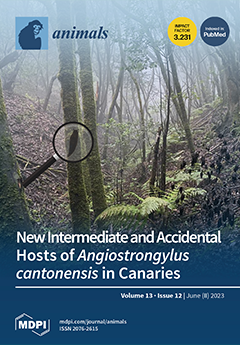
Cover Story: The rat lungworm, Angiostrongylus cantonensis, is an emerging zoonotic parasite, and the primary etiological agent causing eosinophilic meningitis. In the Canary Islands (Spain), it was first discovered parasitizing Rattus rattus on the island of Tenerife. The present study confirms the spread to other islands, including La Gomera and Gran Canaria. In addition to being detected in the definitive host R. rattus, it was also detected in the accidental hosts Mus musculus and Felis catus; and in four terrestrial gastropod species, Limacus flavus, Milax gagates, Insulivitrina emmersoni, and Insulivitrina oromii, as intermediate hosts. This study reinforces the expansion character of A. cantonensis and highlights the importance of knowledge about sentinel species for identifying new transmission locations that help prevent and control the transmission of the parasite. View this paper
  • Issues are regarded as officially published after their release is announced to the table of contents alert mailing list .
  • You may sign up for email alerts to receive table of contents of newly released issues.
  • PDF is the official format for papers published in both, html and pdf forms. To view the papers in pdf format, click on the "PDF Full-text" link, and use the free Adobe Reader to open them.

Articles (159)

  • Article
  • Open Access
5 Citations
3,383 Views
20 Pages

Automatic Penaeus Monodon Larvae Counting via Equal Keypoint Regression with Smartphones

  • Ximing Li,
  • Ruixiang Liu,
  • Zhe Wang,
  • Guotai Zheng,
  • Junlin Lv,
  • Lanfen Fan,
  • Yubin Guo and
  • Yuefang Gao

20 June 2023

Today, large-scale Penaeus monodon farms no longer incubate eggs but instead purchase larvae from large-scale hatcheries for rearing. The accurate counting of tens of thousands of larvae in these transactions is a challenging task due to the small si...

  • Article
  • Open Access
7 Citations
2,604 Views
21 Pages

Risk Assessment Model System for Aquatic Animal Introduction Based on Analytic Hierarchy Process (AHP)

  • Xuxin Zhang,
  • Hehe Du,
  • Zhouzhou Zhao,
  • Ying Wu,
  • Zhenjie Cao,
  • Yongcan Zhou and
  • Yun Sun

19 June 2023

The spread of invasive species (IS) has the potential to upset ecosystem balances. In extreme cases, this can hinder economical utilization of both aquatic (fisheries) and terrestrial (agricultural) systems. As a result, many countries regard risk as...

  • Article
  • Open Access
6 Citations
2,511 Views
14 Pages

Nest-Site Features and Breeding Ecology of Chestnut-Vented Nuthatch Sitta nagaensis in Southwestern China

  • Ruixin Mo,
  • Yu Li,
  • Qingmiao Yuan,
  • Mingyun He,
  • Xianyin Xu,
  • Guangjian Chen,
  • Wenwen Zhang and
  • Yubao Duan

19 June 2023

The breeding ecology of birds is the cornerstone of bird life-history theory, and breeding success directly affects the survival and development of populations. We studied the breeding ecology of a secondary cavity-nesting bird, the chestnut-vented n...

  • Article
  • Open Access
6 Citations
2,856 Views
12 Pages

CRABP2 Promotes the Proliferation of Dermal Papilla Cells via the Wnt/β-Catenin Pathway

  • Mingliang He,
  • Xiaoyang Lv,
  • Xiukai Cao,
  • Zehu Yuan,
  • Kai Quan,
  • Tesfaye Getachew,
  • Joram M. Mwacharo,
  • Aynalem Haile,
  • Yutao Li and
  • Shanhe Wang
  • + 1 author

19 June 2023

In our previous study of Hu sheep hair follicles, we found that CRABP2 was highly expressed in DPCs, which suggested that CRABP2 may influence the number of DPCs. In the present study, we aimed to understand the effect of CRABP2 in Hu sheep dermal pa...

  • Article
  • Open Access
7 Citations
5,390 Views
20 Pages

19 June 2023

Brachycephalic breeds have increased in popularity despite growing awareness of their predisposition to a wide range of conformation-related diseases. The extreme facial conformation of many popular brachycephalic breeds compromises their ocular surf...

  • Review
  • Open Access
18 Citations
3,640 Views
17 Pages

Universal Tick Vaccines: Candidates and Remaining Challenges

  • Luís Fernando Parizi,
  • Naftaly Wang’ombe Githaka,
  • Carlos Logullo,
  • Jinlin Zhou,
  • Misao Onuma,
  • Carlos Termignoni and
  • Itabajara da Silva Vaz

19 June 2023

Recent advancements in molecular biology, particularly regarding massively parallel sequencing technologies, have enabled scientists to gain more insight into the physiology of ticks. While there has been progress in identifying tick proteins and the...

  • Article
  • Open Access
4 Citations
2,584 Views
10 Pages

Human–Animal Interactions in Dairy Goats

  • Francesca Carnovale,
  • Giovanni Marcone,
  • Francesco Serrapica,
  • Claudia Lambiase,
  • Emilio Sabia,
  • David Arney and
  • Giuseppe De Rosa

19 June 2023

It is widely assumed that the quality of human–animal interactions may have a strong impact on animals’ living conditions and is fundamental to improving farm animal welfare. This work aims to evaluate the effectiveness of methods for ass...

  • Article
  • Open Access
4 Citations
3,044 Views
16 Pages

Microbial Profiling of Amniotic Fluid, Umbilical Blood and Placenta of the Foaling Mare

  • Elisabeth Hemberg,
  • Adnan Niazi,
  • Yongzhi Guo,
  • Viktória J. Debnár,
  • Boglarka Vincze,
  • Jane M. Morrell and
  • Gabriella Kútvölgyi

18 June 2023

The presence of a microbiome/microbiota in the placenta is hotly debated. In previous studies, the presence of bacteria in equine amniotic fluid and umbilical blood was independent of foal health. The objective of the present study was to determine i...

  • Article
  • Open Access
2 Citations
3,201 Views
11 Pages

18 June 2023

Radial extracorporeal shock wave therapy (rESWT) is increasingly being used to treat musculoskeletal injuries in horses. The aim of this study was to assess the influence of rESWT on the skin surface temperature of the longissimus dorsi muscle in cli...

  • Article
  • Open Access
9 Citations
4,071 Views
14 Pages

18 June 2023

The red imported fire ant (Solenopsis invicta Buren) is a highly adaptable invasive species that can nest and reproduce in different habitat soils. We aimed to explore the adaptability of red imported fire ants in different habitats by analyzing chan...

of 16

Get Alerted

Add your email address to receive forthcoming issues of this journal.

XFacebookLinkedIn
Animals - ISSN 2076-2615