Review

How Does Woodland Use Affect the Multifunctionality of Soil Ecosystems?


1
College of Forestry, Southwest Forestry University, Kunming 650224, China
2
College of Agriculture and Forestry Science and Technology, Yuxi Vocational College of Agriculture, Yuxi 653100, China
*
Author to whom correspondence should be addressed.
Microorganisms 2026, 14(3), 685; https://doi.org/10.3390/microorganisms14030685

Submission received: 23 January 2026 / Revised: 2 March 2026 / Accepted: 14 March 2026 / Published: 18 March 2026
(This article belongs to the Section Plant Microbe Interactions)

Abstract

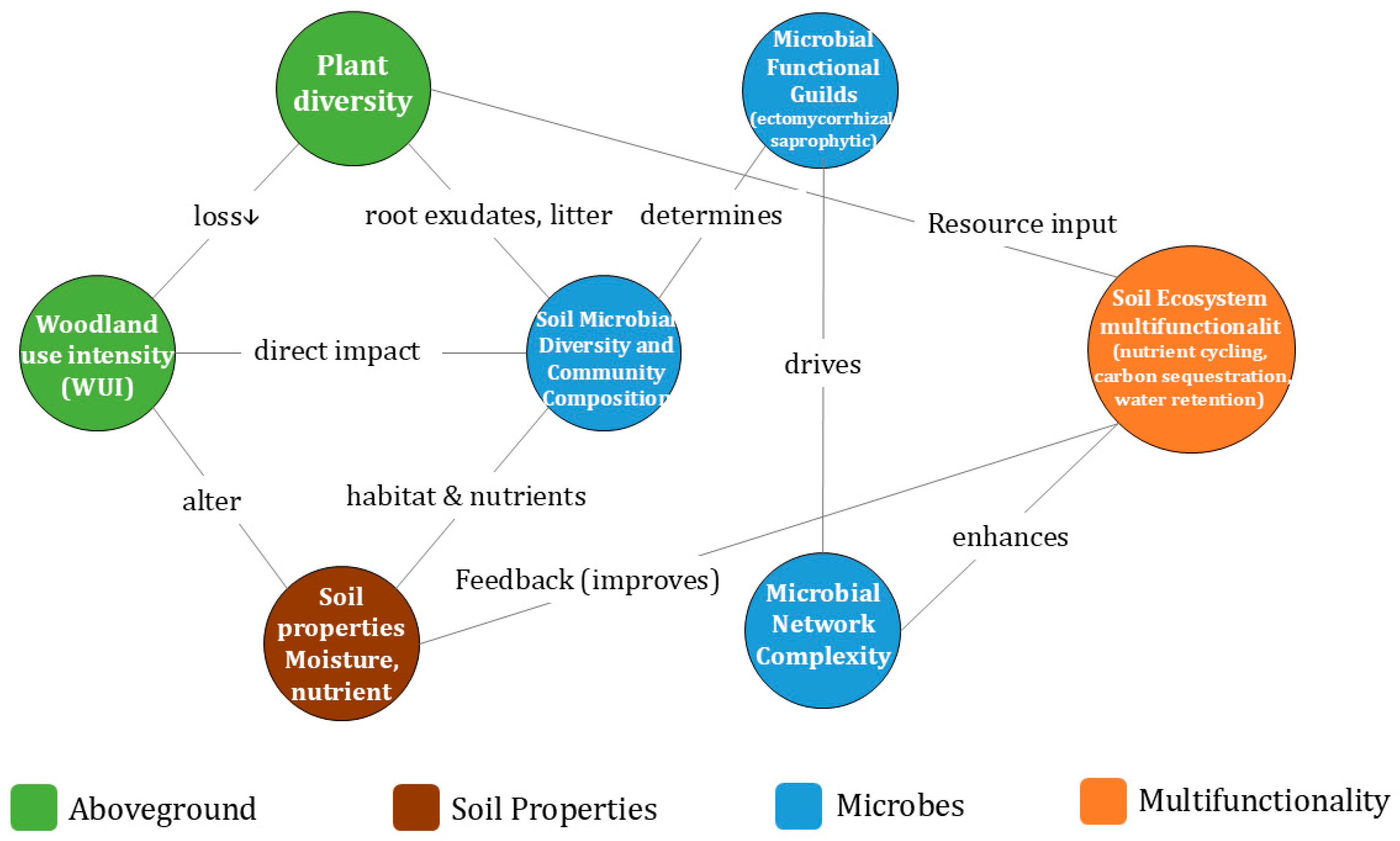
Humans have made tremendous efforts to explore how biodiversity changes affect ecosystem processes and human well-being. It has been found that, in addition to biodiversity, various drivers of global change also play significant roles in ecosystem functioning. Land use is a key driver of global change, yet research on land use intensity has predominantly focused on agricultural and grassland ecosystems. There remains limited understanding of how land use intensity alters the relationships among biodiversity, ecosystem functions, and multifunctionality, particularly in forest ecosystems. This paper reviews recent advances in research on soil ecosystem multifunctionality, covering the effects of woodland use intensity, above- and belowground biodiversity, microbial diversity, and biotic interactions, as well as abiotic drivers. Through a comprehensive analysis of the integrated impacts of biodiversity, biotic interactions, and abiotic factors on soil ecosystem multifunctionality, the necessity of enhancing microbial research and its application in ecosystems is emphasized, providing a theoretical basis for forest management.
Keywords: woodland use intensity; plant diversity; soil microbial communities; soil ecosystem multifunctionality woodland use intensity; plant diversity; soil microbial communities; soil ecosystem multifunctionality