


Abstract
Carbapenemase-producing Pseudomonas aeruginosa and Klebsiella pneumoniae are a leading cause of difficult-to-treat infections in the Gulf Cooperation Council (GCC) region, yet the contribution of the three principal carbapenemase gene families (blaOXA-48, blaNDM, and blaIMP) is often assumed to be uniform across neighboring countries. This mini-review synthesizes facility-level, national, and genomic surveillance data from the United Arab Emirates (UAE), Qatar, Oman, Kuwait, Bahrain, and Saudi Arabia, anchored by a recent cohort from University Hospital Sharjah, UAE. blaOXA-48-like genes were the most frequently reported family regionally (51.7% in a 720-genome Arabian Peninsula study), but this dominance was not universal: OXA-181 predominated in Kuwaiti ICU isolates (89.3%), blaNDM-1 co-occurred in 95.8% of a small Bahraini series, and UAE national surveillance (2010–2021) found blaOXA-48 rarely, in contrast to 65–67% at Sharjah. Saudi data showed a comparable regional gradient, and the dominant determinant shifted over time in Oman and Kuwait. High-risk clones, including hypervirulent ST383, circulated across countries, while carbapenemase-positive P. aeruginosa carried mainly VIM- and GES-type enzymes. Heterogeneity, at the facility and country levels, is the defining feature of GCC carbapenemase epidemiology; acute-care laboratories therefore need molecular panels covering blaOXA-48-like, blaNDM, blaVIM, blaIMP, and blaKPC, and facility-level antibiograms warrant at least annual review.
1. Introduction
Carbapenem-resistant Pseudomonas aeruginosa and Klebsiella pneumoniae are pathogens designated as critical-priority by the World Health Organization, reflecting both their clinical severity and the scarcity of remaining therapeutic options [1,2]. Resistance to carbapenems in these organisms is most commonly mediated by acquired carbapenemase enzymes, principally the class D oxacillinase blaOXA-48 and its variants and the class B metallo-β-lactamases blaNDM and blaIMP, each encoded on mobile genetic elements capable of rapid horizontal spread within and between species [3,4].
The six GCC countries (Saudi Arabia, the United Arab Emirates, Oman, Qatar, Kuwait, and Bahrain) share close geographic proximity, extensive labor migration, and substantial cross-border patient referral and repatriation, all of which are recognized drivers of regional pathogen and resistance-gene dissemination [5,6]. The wider Middle East is now characterized as endemic for carbapenemase-producing Enterobacterales (CPE), principally OXA-48-like and NDM-like enzymes, with international patient movement and conflict-related displacement identified as further routes of spread [7,8]. It is therefore tempting to treat carbapenemase epidemiology as broadly uniform across the region. However, published data assembled from individual national and facility-level studies suggest a more heterogeneous picture, with country- and even hospital-level differences in which gene family predominates.
A recent facility-level study from University Hospital Sharjah, UAE, reported blaOXA-48 as the most prevalent carbapenemase gene among 100 multidrug-resistant P. aeruginosa and K. pneumoniae isolates, detected in 66.7% and 65.5% of isolates, respectively, with blaIMP and blaNDM detected at lower but non-negligible frequencies and frequent multi-gene co-occurrence [9]. This mini-review situates the Sharjah cohort within the broader landscape of comparable studies from across the GCC region to examine whether blaOXA-48 dominance, multi-gene co-occurrence, and associated high-risk clones are consistent regional features or reflect substantial local heterogeneity with direct implications for empiric therapy and surveillance policy.
2. Scope and Methods
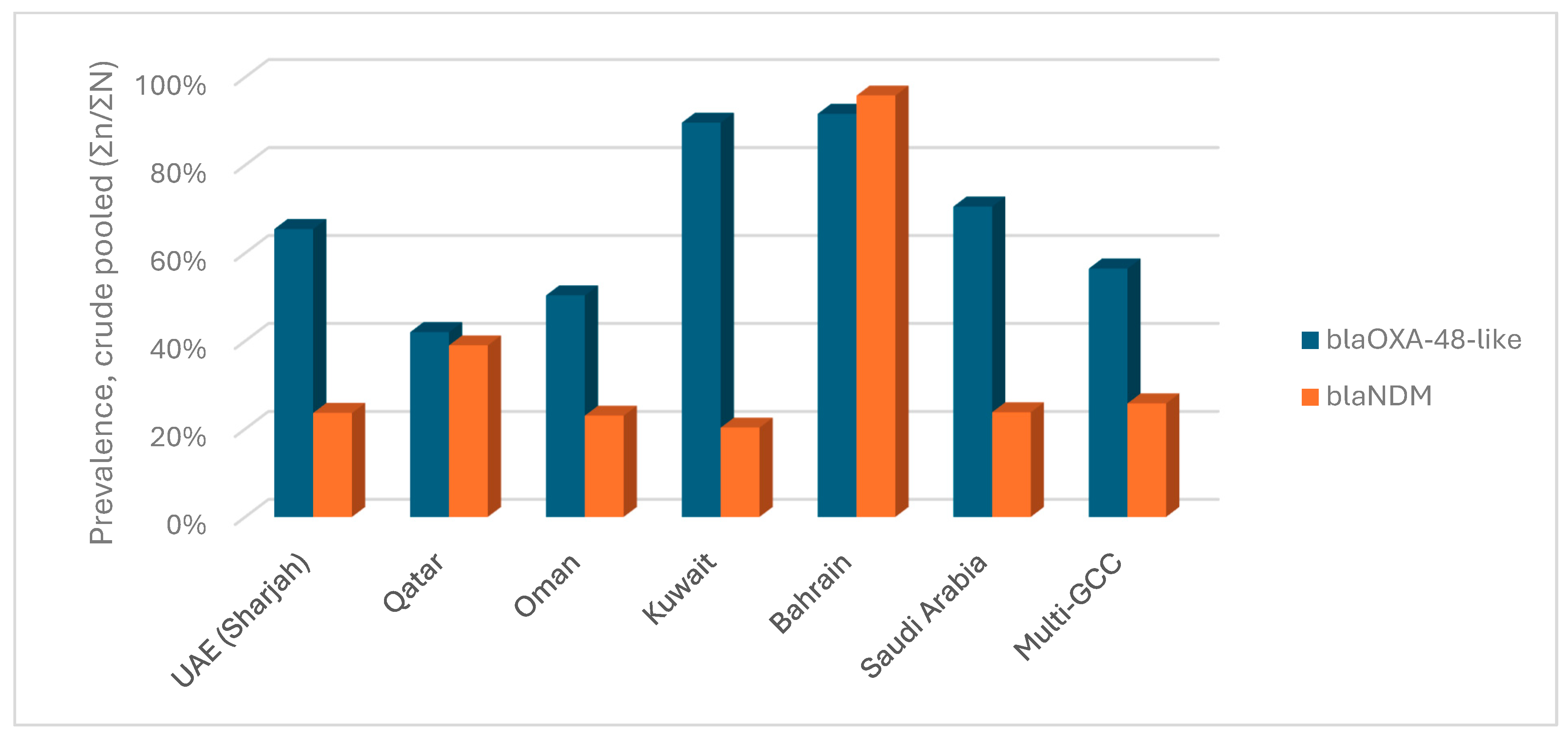
This is a narrative mini-review rather than a systematic review or meta-analysis; no formal risk-of-bias assessment was performed, and reported prevalence figures are reproduced as published without re-analysis of primary data; study-level values are plotted in Figure 1. Random-effects (Figure 2) and crude (Figure 3) pooled estimates are presented as descriptive visual summaries only, with heterogeneity reported alongside each random-effects estimate. Because the contributing studies differ substantially in isolate source, selection criteria and denominator basis (Table 1), between-study heterogeneity is considerable (I2 = 87–93%), and these pooled figures should not be interpreted as epidemiological prevalence rates for the GCC region or for any member state. For the same reason, no comparison between pooled estimates is advanced here as a quantitative finding: the pooled figures are presented to display the spread of reported values and the weight of evidence behind each gene family, and every comparative claim made in this review rests on the study-level data in Table 1 rather than on the pooled summaries. Figure 2 is restricted to clinical carbapenem-resistant and multidrug-resistant collections, excluding carriage, genomic and animal datasets and the Sharjah cohort, so that unlike denominators are not combined. Within that restriction the contributing studies nonetheless differ by care setting (intensive care versus general wards) and by patient population, and the number of studies per gene family is too small to support stratified pooling by setting, age group or collection period; contrasts of that kind are therefore presented narratively in Section 4.3 and Section 4.4, where the paediatric carriage and adult clinical datasets from Qatar and the successive Kuwaiti collections are compared directly, rather than as subgroup estimates. The relevant literature was identified using the Leapspace literature-discovery platform, with searches directed at carbapenemase gene epidemiology in GCC member states and conducted in September 2026. Candidate records were exported in batches and screened against the criteria below. After removal of duplicates across exports, 184 unique records were screened at the title and abstract levels. Eligible studies were peer-reviewed reports published in 2011–2026 describing phenotypic or molecular detection of blaOXA-48, blaNDM, and/or blaIMP carbapenemase genes in clinical or surveillance isolates of P. aeruginosa and/or K. pneumoniae from GCC member states; retained sources were restricted to Scopus-indexed journals. Studies were eligible for the comparative tables if they reported gene-level carbapenemase detection by molecular or genotypic methods (PCR, sequencing, or whole-genome sequencing) in P. aeruginosa or K. pneumoniae from one or more GCC states, with an extractable numerator and denominator; studies without extractable gene prevalence are discussed in the text but not tabulated. No minimum isolate number was imposed, since a size threshold would have removed the only available data for several countries: the smallest tabulated study comprises 14 carbapenem-resistant isolates, and each study’s denominator is reported in Table 1 so that readers can weight the estimates accordingly. Both clinical and screening or carriage collections were eligible, and the basis of each denominator (clinical isolates, colonization screening, carbapenemase-positive isolates only, or public genome collections) is stated per study in Table 1, since these bases are not interchangeable. Where several studies were available for one country, the most recent facility-level or national surveillance study was tabulated, supplemented by a large multi-country genomic surveillance study and a global systematic review for external context [9,10,11,12,13,14,15,16,17,18]. Studies confined to organisms other than P. aeruginosa or K. pneumoniae were excluded, as were studies whose isolates were collected wholly before 2009 where a more recent dataset was available for the same country. Collection periods are reported in Table 1 where the source study specified them; several sources report publication year only. Pre-2009 publications are cited for enzyme biology and historical context, not for prevalence estimates. The Sharjah cohort serves as the review’s point of departure rather than as a regional estimate. It is a single-facility dataset of 100 multidrug-resistant isolates whose divergence from UAE national surveillance prompted the review’s central question about within-country heterogeneity; its value here is as the observation that motivates the comparison, not as a measure of regional prevalence. Two of the present authors co-authored that study [9]. To guard against over-weighting it, the cohort is excluded from the pooled prevalence estimates presented in Figure 2; it is reported throughout as one facility-level observation alongside the larger national, multi-country and genomic datasets, which carry substantially greater denominators; and its contrast with the low national UAE figures is presented as evidence of heterogeneity rather than as a correction to those figures. Given the narrative scope, coverage should be regarded as representative rather than exhaustive.
Table 1.
Comparative summary of carbapenemase gene prevalence in P. aeruginosa, K. pneumoniae, and other Enterobacterales isolates across GCC countries. CPE, carbapenemase-producing Enterobacterales; CR, carbapenem-resistant; CRE, carbapenem-resistant Enterobacterales; CRKP, carbapenem-resistant K. pneumoniae; CVC, central venous catheter; ESBL, extended-spectrum β-lactamase; ICU, intensive care unit; MBL, metallo-β-lactamase; MDR, multidrug-resistant; XDR, extensively drug-resistant. Values are n/N (%) where counts were reported, otherwise percentages as published. Rows are grouped by pathogen and country and ordered by publication year within each country. Case reports and studies without extractable gene prevalence [19,20,21,22] are discussed in the text but not tabulated.
Figure 1.
Reported blaOXA-48 and blaNDM prevalence across Gulf Cooperation Council settings. Each marker is one study setting, not a country-level national average, and shows the prevalence reported in that study alone. Markers are unweighted, so settings resting on small denominators (for example Bahrain, n = 24) are plotted identically to much larger national and multi-country datasets; denominators are given in Table 1 and should be consulted alongside this plot. The diagonal marks equal prevalence. Color denotes regime, as labeled in the legend: dual-high (both ≥50%, green), otherwise blaNDM-dominant (blue) or blaOXA-48-dominant (orange); no setting fell in the low regime (both <25%). Axes are independent prevalences, so values may exceed 100% combined. Ten of eleven settings are plotted; one study [21] lacked a denominator. Values are as published, not pooled.
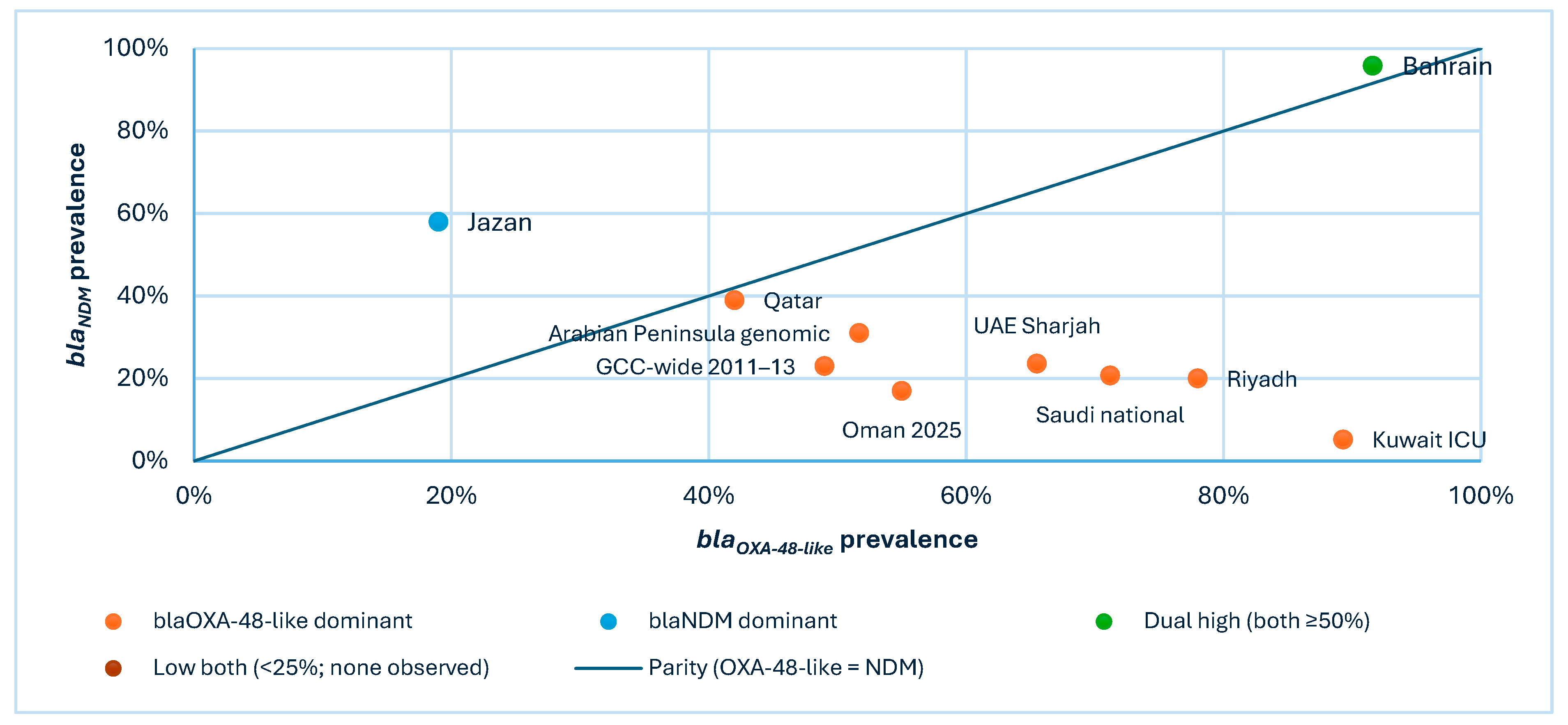
Figure 2.
Random-effects pooled prevalence of carbapenemase gene families among clinical carbapenem-resistant and multidrug-resistant isolates in GCC studies. Squares are pooled estimates, lines their 95% confidence intervals (logit-transformed proportions, DerSimonian–Laird τ2, 0.5 continuity correction). k, contributing studies (k = 1 rows are single-study); I2, between-study heterogeneity. Co-producers count under each gene carried. Carriage, genomic, animal and Sharjah [9] collections are excluded. Heterogeneity is considerable throughout (I2 = 87–93%), so these estimates summarize a heterogeneous evidence base rather than regional central values.
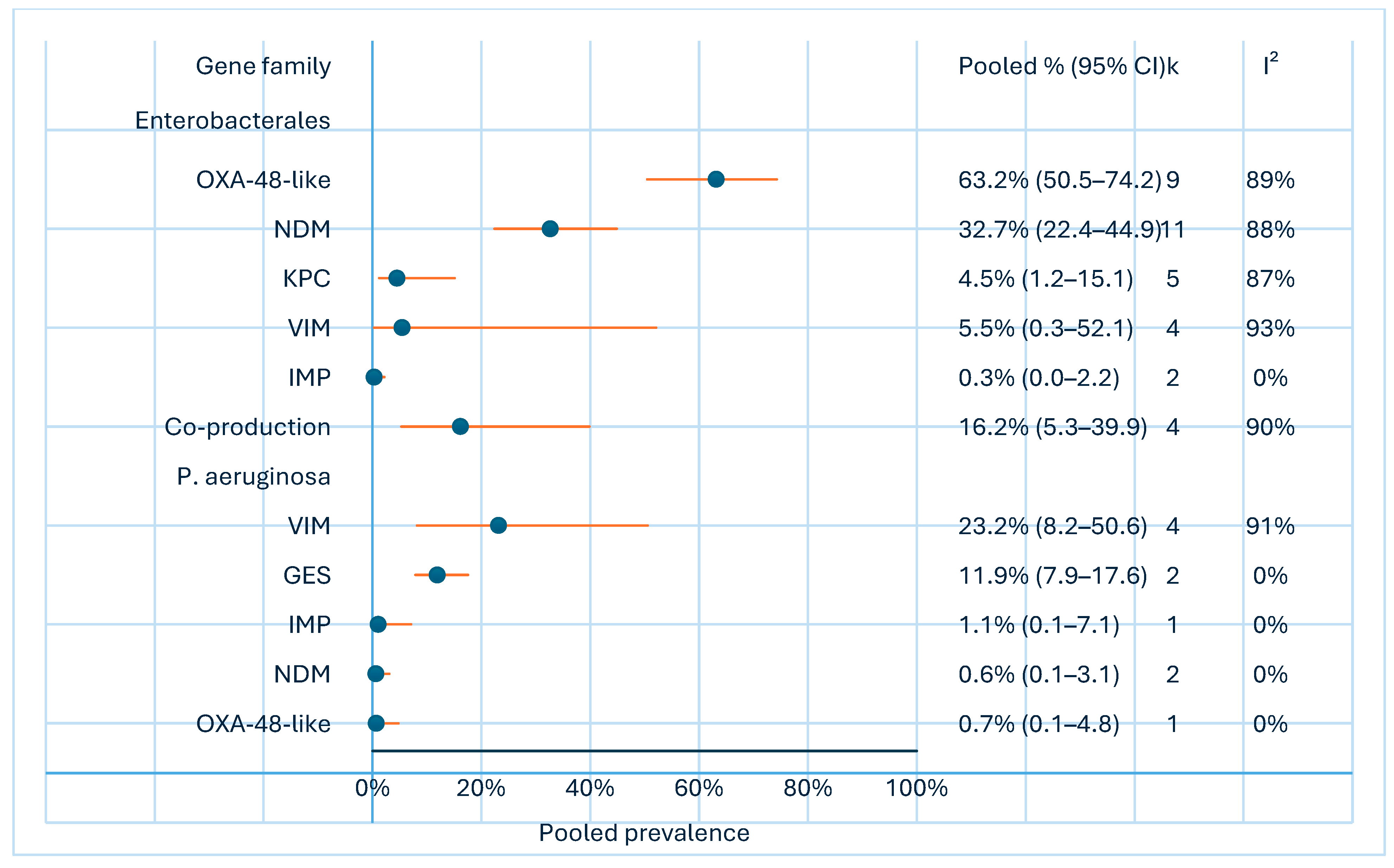
Figure 3.
Crude pooled prevalence (Σn/ΣN across studies) of blaOXA-48-like and blaNDM among carbapenem-resistant and multidrug-resistant Enterobacterales, by country. Bar labels give positive isolates over isolates tested. The UAE bar is a single Sharjah study, Bahrain rests on 24 isolates, and Kuwait denominators differ between genes. Estimates are unweighted, without confidence intervals; see Figure 2.
3. Biological Background of the Three Carbapenemase Gene Families
blaOXA-48 is a class D serine β-lactamase first described in a Turkish K. pneumoniae isolate in 2001; it hydrolyzes carbapenems weakly relative to true metallo-β-lactamases (MBLs) and has little activity against extended-spectrum cephalosporins, a combination that frequently causes it to evade routine phenotypic susceptibility testing and contributes to its underrecognition where molecular confirmation is unavailable [35,36]. blaIMP, a class B metallo-β-lactamase requiring zinc for catalytic activity, was first reported in Japan in the 1990s and, like other class B enzymes, hydrolyzes nearly all β-lactams except monobactams [37]. blaIMP and blaVIM genes are typically carried as gene cassettes within class 1 integrons, frequently alongside aminoglycoside and other resistance determinants; association of the integron with a plasmid or transposon permits onward transfer between strains, and P. aeruginosa is the principal host in which both families are encountered clinically [37,38]. Most blaIMP variants show restricted geographical distributions, blaIMP-1 and blaIMP-7 being the notable exceptions, and blaIMP-1, blaIMP-4, blaIMP-7, blaIMP-8 and blaIMP-13 have reached global endemicity [38,39]. Within the Gulf, variant-level reporting is sparse: blaIMP-7 has been characterized in carbapenem-resistant P. aeruginosa from Saudi Arabia alongside several blaVIM variants [40], and across the Arabian Peninsula blaIMP and blaVIM are reported infrequently overall and predominantly in P. aeruginosa rather than in Enterobacterales [34]. This scarcity of variant-level data is itself a gap in the regional evidence base, since most GCC studies report blaIMP only at the gene-family level, as the studies compiled here do. blaNDM was first identified in 2008 in a patient of Indian descent treated in Sweden and has since disseminated globally on plasmids that frequently co-carry additional resistance determinants, compounding the multidrug-resistant phenotype of NDM-positive isolates [41]. All three gene families are mobilized principally via plasmids and transposons, enabling both intraspecies and interspecies transfer and complicating containment once introduced into a healthcare facility [3,25]. Dissemination of blaOXA-48 has been linked in particular to a self-transferable 62 kb IncL/M plasmid that moves efficiently between Enterobacterales species [42]. The regional data reviewed below show how directly these vehicles, rather than clonal expansion alone, drive the variant turnover documented in Section 4.4. The temporary rise in VIM-4 in Kuwait was attributed to horizontal transfer of a shared In416 class 1 integron carried on an approximately 165 kb IncA/C plasmid among largely unrelated strains [43]; IncX3 plasmids recovered across the UAE carried blaNDM-1, blaNDM-4, blaNDM-5, blaNDM-7, blaOXA-181 or blaKPC-2, with phylogenies clustering by carbapenemase gene rather than by country of origin [27]; the same IncL/M vehicle underlies blaOXA-48 spread in Omani isolates [36]; and the double-carbapenemase producers reported from three GCC states carried their determinants on five different plasmid groups across five sequence types, indicating repeated independent acquisition rather than dissemination of one co-producing lineage [44]. Convergence of resistance and virulence on a single replicon is documented regionally as well, in the Qatari ST383 isolates carrying blaNDM-5 on a hybrid IncHI1B plasmid that also encodes rmpA, rmpA2 and aerobactin [17], a pattern that recent global analyses place alongside IncL fusion plasmids as a principal route for multiple-carbapenemase convergence [45]. Turnover of the dominant determinant within a country is therefore better understood as turnover of mobile elements than of clones. Reported mortality in carbapenemase-producing infections has ranged from 18% to 67% for metallo-β-lactamase producers and 50% or higher for K. pneumoniae carbapenemase (KPC) producers, underlining the clinical cost of unrecognized carriage [4]. Two further determinants recur in the regional data reviewed below: the Verona integron-encoded metallo-β-lactamase (VIM), a class B enzyme with a hydrolytic spectrum similar to IMP, and the OXA-48-like variants OXA-181 and OXA-232, which differ from OXA-48 by only a few amino acid substitutions and share a broadly similar carbapenem-hydrolyzing profile [35,37].
4. Comparative Regional Findings
Table 1 summarizes carbapenemase gene prevalence and notable epidemiological features reported from the UAE, Qatar, Oman, Kuwait, Bahrain, Saudi Arabia, a historical GCC-wide baseline, and a large multi-country genomic surveillance study. Table 1 is ordered by country; the sections below are grouped by pattern. Figure 1 plots the reported OXA-48 and NDM prevalence for each setting, illustrating the range of gene-family regimes across the region, and Figure 3 aggregates the same determinants by country to show how far each country’s estimate rests on a single study or a small denominator.
4.1. Regional Baseline
An early multi-country study characterizing carbapenemase-producing E. coli and K. pneumoniae across all six GCC states (isolates collected 2011–2013) found blaOXA-48 in 49% and blaNDM in 23% of carbapenem-non-susceptible isolates, with OXA-48/NDM co-production identified exclusively among Saudi Arabian isolates in that dataset [18]. This early baseline established the pattern of OXA-48 regional dominance that subsequent, more recent studies have generally, though not universally, continued to reflect. A parallel survey of 95 carbapenem-resistant P. aeruginosa isolates from hospitals across the six GCC states showed a different gene profile: blaVIM-type genes were the most prevalent carbapenemase determinant (37/95, 39%), blaIMP was found in a single UAE isolate, and high-risk clones predominated [34].
A large-scale genomic surveillance study analyzing 720 publicly available K. pneumoniae genomes from six GCC countries collected between 2011 and 2020 found blaOXA-48-like genes in 51.7% of isolates and blaNDM-1 in 31%, with 11% co-producing both [12]. This study also mapped high-risk clone distribution by sequence type (ST): ST14 predominated in Saudi Arabia and the UAE, ST231 in Oman and Kuwait, ST147 across Qatar, Oman, and the UAE, and the internationally recognized epidemic clone ST11 across four countries, indicating both country-specific clonal expansion and substantial cross-border circulation of shared high-risk lineages [12].
4.2. Intra-Country Variation
Within the UAE alone, reported carbapenemase gene distributions vary considerably by data source. The Sharjah facility-level cohort found blaOXA-48 to be dominant in both organisms (66.7% in P. aeruginosa, 65.5% in K. pneumoniae) [9]. By contrast, a national retrospective analysis of more than 14,500 carbapenem-resistant Enterobacterales (CRE) isolates collected between 2010 and 2021 found K. pneumoniae responsible for nearly half of all CRE cases nationally, with blaNDM and blaIMP frequently detected but blaOXA-48 notably rare [16]. This discrepancy within a single country (high facility-level OXA-48 prevalence in Sharjah against its rarity nationally and among Abu Dhabi bloodstream isolates, described below) is one of the clearest illustrations in this review that country-level or even multi-facility summaries can mask substantial local variation. The Sharjah P. aeruginosa findings are the most divergent: blaOXA-48 (66.7%) and blaIMP (44.4%) were common there, whereas blaOXA-48-like and blaIMP genes were rare among carbapenem-resistant P. aeruginosa elsewhere in the region [33,34]. Because the Sharjah cohort was selected on an MDR phenotype and genotyped by targeted PCR, these findings warrant confirmation by sequencing before being taken as evidence of true local divergence. The limitation is specific: targeted PCR establishes that a gene-family amplicon is present, but it cannot resolve which variant is carried, cannot distinguish an intact gene from a truncated or otherwise non-functional fragment, and cannot establish that the determinant is expressed. Given how far this result sits from the VIM- and GES-predominant picture reported for carbapenem-resistant P. aeruginosa elsewhere in the region [32,33,34], misclassification cannot be excluded as an explanation. Until whole-genome sequencing of that collection is available, the Sharjah P. aeruginosa result is best read as a signal requiring confirmation rather than as an established regional exception, and it is reported on that basis throughout this review.
Saudi Arabia is represented by a longer series of facility-level studies than most other GCC states. A six-month survey of 60 carbapenem-non-susceptible inpatient K. pneumoniae isolates in Riyadh (2011) found blaOXA-48 in 78% and blaNDM-1 in 20%, with blaVIM in a single isolate and neither blaKPC nor blaIMP detected, establishing OXA-48 dominance in the central region early [30]. A subsequent genomic analysis of 29 NDM- and OXA-48-positive carbapenem-resistant K. pneumoniae isolates from a tertiary hospital in Jeddah found ST14 in 55% of isolates and three-gene co-carriage of blaOXA-48, blaNDM, and blaCTX-M-15 in 41.3% (12 of 29), alongside colistin resistance in 34.4% [31]. More recently, a cross-sectional study at a secondary-care hospital in the Jazan region identified 26 carbapenem-resistant Enterobacterales among 260 Enterobacterales isolates (10.0%), of which K. pneumoniae accounted for 81%; in contrast to the earlier Riyadh data, blaNDM predominated (58%), with blaOXA-48 alone in 19% and blaOXA-48/blaNDM co-carriage in 23%, and central venous catheter use, urinary catheterization, and intensive care unit (ICU) admission were each associated with carbapenem resistance [14]. A national multicenter study spanning thirteen Ministry of Health tertiary-care hospitals across five Saudi regions places these facility-level contrasts in a wider frame: among 519 carbapenem-resistant isolates, blaOXA-48 was detected in 71.2%, blaNDM-1 in 20.7%, and both genes together in 8.0%, with a clear geographic gradient (blaOXA-48 reaching 77% in the central and eastern regions, blaNDM 27% in the northern region, and dual carriage 14% in the western region) [10]. A separate two-hospital study in Jeddah similarly reported blaOXA-48 predominance in the western region alongside rising CRE prevalence across consecutive years [21]. Saudi Arabia therefore displays the same intra-country divergence documented above for the UAE, though the national data suggest that the apparent conflict between OXA-48-dominant and NDM-dominant facility reports reflects a regional gradient in gene distribution rather than irreconcilable findings.
P. aeruginosa follows a different pattern again: in a nationally representative Saudi survey, 143 of 635 isolates (22.5%) were resistant to both imipenem and meropenem, mainly through porin loss and efflux overexpression, and only 18.2% of these resistant isolates carried a carbapenemase gene, predominantly blaGES (69.2%) and blaVIM (23.1%), with blaNDM and blaOXA-48-like genes each at 3.9% [33]. A hospital series from Makkah similarly found blaVIM in 11 and blaGES in 3 of 35 carbapenem-resistant P. aeruginosa isolates, with about one-third belonging to the high-risk clones ST235 and ST654 [32].
4.3. Departures from OXA-48 Dominance
In contrast to most other GCC data summarized here, a study of ICU patients across two Kuwaiti hospitals found the OXA-181 variant, rather than OXA-48 itself, to be overwhelmingly dominant among carbapenemase-producing Enterobacterales (89.3% of carbapenemase-positive isolates), with blaOXA-48, blaKPC-2, blaVIM-1, and blaNDM-5 each detected at single-digit percentages [11]. This atypical variant-level dominance underscores that even within the same broad OXA-48-like gene family, the specific circulating variant can differ substantially by country.
In Qatar, OXA-48-like dominance is marginal even among adult clinical isolates: a genomic surveillance study of 100 carbapenem-resistant Klebsiella isolates found blaOXA-48-like genes (including OXA-48, OXA-232, and OXA-181 variants) in 42% of isolates and blaNDM-1 in 39%, with sequence types ST147, ST231, and ST11 predominating; notably, 15 isolates carried no carbapenemase gene, their resistance instead being attributed to CTX-M enzymes combined with OmpK35/OmpK36 porin mutations [17]. Of particular concern, this study identified an emerging cluster of hypervirulent, carbapenem-resistant K. pneumoniae ST383 isolates (n = 4), three of which co-carried blaNDM-5 and blaOXA-48, with blaNDM-5 located on a hybrid IncHI1B plasmid that also carried the virulence genes rmpA, rmpA2, and aerobactin, representing convergence of resistance and virulence determinants within a single high-risk clone [17].
Pediatric carriage data from Qatar diverge from the adult clinical picture in the same country. Whole-genome sequencing of 72 carbapenemase-producing Enterobacterales isolates from 61 fecal carriers at a tertiary pediatric hospital over three years identified NDM-type enzymes in 52.6% and OXA-48-type in 47.4% of the 78 carbapenemases characterized, with NDM-5 the single commonest variant (30.8%), followed by NDM-1 and OXA-181 (19.2% each) [26]. This NDM-predominant profile contrasts with the OXA-48-like predominance reported among adult clinical isolates in Qatar [17] and carried clear therapeutic weight: 23 NDM producers exhibited difficult-to-treat resistance, compared with only two OXA-48 producers. The same study also illustrates that importation and local expansion operate simultaneously rather than as alternatives. Recent travel to CPE-endemic countries was documented for 57.4% of patients and quarterly carriage incidence fell more than six-fold after Qatar introduced COVID-19-related international travel restrictions, both consistent with repeated external introduction; yet all nine blaOXA-48-type-positive E. coli ST38 isolates came from patients with no international travel history, and the authors attribute these to local expansion of an ST38 clone carrying blaOXA-244 within healthcare settings [26].
A study of 24 carbapenem-resistant K. pneumoniae isolates from a major Bahraini hospital found both blaNDM-1 (95.8%) and blaOXA-48 (91.6%) at very high prevalence, with extensive co-occurrence of both genes alongside qnrS and additional OXA-type genes; 75% of isolates also showed colistin resistance, indicating an advanced multidrug-resistant phenotype with substantially narrowed treatment options [15]. Because this is a single-hospital series of 24 isolates and the only molecular study available from Bahrain, these findings should be regarded as preliminary and may not represent the national picture.
4.4. Temporal Trends
The most recent Omani data come from a 2025 evaluation of phenotypic and molecular carbapenemase detection methods in K. pneumoniae isolates (n = 117). OXA-48-like enzymes were the most common target detected, followed by KPC and NDM, consistent with regional OXA-48 dominance. This distribution should not be read as a population prevalence estimate, however, because isolates in a diagnostic-accuracy study are typically selected to represent the target enzymes. The study also demonstrated that several rapid phenotypic assays (temocillin screening, immunochromatographic testing, and OXA-48-specific disc tests) performed with high sensitivity and specificity in this setting [13].
Earlier Omani reports provide the regional baseline for both gene families. The first description of NDM-1 in the Arabian Peninsula came from two clonally unrelated carbapenem-resistant K. pneumoniae isolates in Oman, of sequence types ST14 and ST340, each carrying blaNDM-1 on a 170 kb plasmid of a different incompatibility group [19]. A subsequent hospital surveillance series of 22 carbapenem-resistant Enterobacterales from Muscat identified 11 NDM-1, five OXA-48, and one isolate co-producing NDM-1 and OXA-181, with all carbapenemase genes plasmid-borne and blaOXA-48 typically carried on a self-conjugative 62.5 kb IncL/M plasmid [27]. The shift from NDM-1 predominance in these early collections to OXA-48-like predominance in the 2025 series discussed above indicates that temporal as well as geographic comparisons are required when interpreting single-country data.
Earlier Kuwaiti data describe a different and shifting picture. Among 14 carbapenem-resistant Enterobacterales collected between 2009 and 2011, all were metallo-β-lactamase producers, with VIM-4 in 11 and NDM-1 in three K. pneumoniae isolates [28]; subsequent analysis attributed this VIM-4 cluster to horizontal transfer of a shared In416 integron on an approximately 165 kb IncA/C plasmid among largely clonally unrelated strains, producing a substantial but temporary rise in VIM producers [43]. By 2014, surveillance of 764 Enterobacterales isolates across four government hospitals found 61 (8%) to be carbapenem-resistant, of which 34.4% were NDM-1 producers, predominantly K. pneumoniae, with 28.6% mortality and colistin susceptibility retained in 90% [29]. Read alongside the later OXA-181-dominant ICU data [11], these studies indicate successive turnover of the dominant carbapenemase determinant within a single country across roughly a decade.
In the UAE, longitudinal data add temporal depth to the intra-country contrasts described in Section 4.2. Among 28 carbapenem-non-susceptible Enterobacterales collected in 2009–2011, seven were NDM-1 producers spanning four genera, with blaNDM-1 carried on IncA/C, IncHI1b, IncX3, or untypable plasmids [23], and a VIM-4-producing Enterobacter cloacae was identified separately in Abu Dhabi over the same period [20]. A bloodstream-infection study of 230 E. coli and K. pneumoniae isolates from Abu Dhabi in 2011–2012 detected blaOXA-48 in only four isolates (approximately 4% of ESBL-producing and under 1% of non-ESBL-producing bacteremia isolates), aligning with the low national OXA-48 estimates rather than the high Sharjah facility figures [24]. Plasmid-level surveillance of 295 carbapenemase-producing Enterobacterales collected in 2009–2014 found IncX3 plasmids in 10.2%, carrying blaNDM-1, blaNDM-4, blaNDM-5, blaNDM-7, blaOXA-181, or blaKPC-2, with phylogenies clustering by carbapenemase gene rather than by country of origin [25]. Saudi temporal data are interpreted alongside the national geographic gradient in Section 4.2; Qatar and Bahrain lack comparable longitudinal series.
5. Cross-Regional Synthesis
Four patterns emerge from this comparison. First, blaOXA-48-like genes are the most consistently reported carbapenemase family across the GCC region, aligning with the 51.7% prevalence among 720 genomes reported in the largest available genomic dataset [12] and with the random-effects pooled estimate across studies reviewed here (Figure 2) and with facility-level findings from the UAE [9] and, with the caveat that its isolates were selected for diagnostic evaluation, Oman [13]. Because the pooled summaries in Figure 2 and Figure 3 combine studies with different denominator bases, between-study heterogeneity is high (I2 = 87–93%); these summaries are descriptive only and should not be read as regional prevalence rates. Second, this dominance is not absolute: Kuwait’s ICU data are dominated by the OXA-181 variant rather than OXA-48 itself [11], pediatric carriage isolates in Qatar are NDM-predominant despite OXA-48-like predominance among adult clinical isolates [17,26], and a single small Bahraini series (n = 24) shows near-equal, tightly co-occurring blaNDM-1 and blaOXA-48 prevalence [15]. That Bahraini observation comes from one hospital and 24 isolates, and is the only molecular dataset available from the country; it is reported here as an isolated facility-level observation and carries far less weight than the national Saudi series or the 720-genome multi-country collection, and it is shown with its denominator in Table 1 and Figure 1 and Figure 3 for that reason. Together these contrasts indicate that neighboring countries, and even neighboring gene variants within the same family, can diverge substantially. Heterogeneity also runs by organism: among carbapenemase-positive P. aeruginosa, VIM and GES rather than OXA-48-like or NDM enzymes predominate [33,34]. Of the three gene families named in the title, blaIMP is by some distance the least represented in the regional evidence. It was absent from several GCC collections entirely, appeared at the single-isolate level in the multi-country P. aeruginosa survey [34] and the Riyadh series [30], and was reported at appreciable frequency only in the Sharjah P. aeruginosa cohort (44.4%) [9] and in UAE national surveillance [16]. Where it is reported, it is almost always reported at the gene-family level, with blaIMP-7 in Saudi P. aeruginosa being the rare variant-level exception [40], so blaIMP cannot be characterized here in the same detail as blaOXA-48-like or blaNDM. It is retained as a target family because it is one of the three genes assayed in the Sharjah cohort that prompted this review, because it is reported predominantly in P. aeruginosa and so bears on the organism-level contrast described above, and because diagnostic panels must still cover it; its scarcity in the regional literature is itself one of the findings of this review rather than a reason to omit it. Third, and most striking for surveillance planning, prevalence estimates can vary as much within a single country as between countries: the UAE alone spans facility-level OXA-48 dominance in Sharjah [9], low OXA-48 prevalence among Abu Dhabi bloodstream isolates [24], and OXA-48 rarity nationally [16], while Saudi Arabia shows a comparable regional gradient, from OXA-48 dominance in the central and eastern regions to NDM predominance in Jazan [10,14]. Fourth, the dominant determinant has shifted over time within individual countries: early Omani collections were NDM-1-predominant before OXA-48-like enzymes came to dominate [13,27], and Kuwait moved from VIM-4 and NDM-1 toward OXA-181 over roughly a decade [11,28,29].
High-risk clone data add a further layer (Table 2): ST14, ST147, ST231, and ST11 were each identified across multiple GCC countries [12], and Qatar’s emerging hypervirulent ST383 lineage [17] illustrates that convergence of resistance and virulence is already an established regional concern rather than a theoretical one. Co-production of two carbapenemases is likewise documented across the peninsula: seven double-carbapenemase-producing K. pneumoniae isolates from the UAE, Oman, and Saudi Arabia carried their determinants on IncHI1b, IncColE, IncL/M, IncX3, and IncFIb/FII plasmids across sequence types ST14, ST307, ST1318, ST11, and ST152, comprising three clonally related ST14 isolates, one ST307 and one ST1318 isolate from the UAE, one ST11 isolate from Oman, and one ST152 isolate from Saudi Arabia, indicating that co-production arises through multiple independent plasmid acquisitions rather than clonal spread of a single co-producing lineage [44].
Table 2.
High-risk Klebsiella pneumoniae sequence types reported across Gulf Cooperation Council countries, with the carbapenemase determinants and notable features reported for each. XDR, extensively drug-resistant. Note: ST101 is listed for global comparative context only. It is one of the principal global dissemination lineages for dual- and multiple-carbapenemase-producing K. pneumoniae [45], but no GCC report of it was identified among the studies reviewed here; it is retained so that its absence from the regional data is stated explicitly rather than left unaddressed.
A recent systematic review of dual- and multiple-carbapenemase-producing K. pneumoniae identified ST147, ST101, and ST11 as the principal global dissemination lineages, alongside IncL fusion plasmids and co-occurring resistance and virulence markers [45], placing the 11% regional co-production estimate [12] within a wider global trajectory.
The regional gene-level picture can also be set against global phenotypic data, with the caveat that the two measures are not directly comparable: the estimates below describe carbapenem resistance in P. aeruginosa rather than carbapenemase gene carriage. A 2014–2024 systematic review and meta-analysis of carbapenem-resistant P. aeruginosa across 39 countries reported an overall pooled prevalence of 34.7%, with considerable heterogeneity by country and region and Saudi Arabia specifically reported at the lower end of the global range (13.9%) in that dataset [46], reinforcing that Middle East and North Africa (MENA)/GCC carbapenem resistance, while high, is not uniformly the highest globally and that country-level context matters more than regional averages.
6. Clinical and Public Health Implications
The heterogeneity documented here has direct implications for both empiric antimicrobial selection and infection control. Because blaOXA-48 is poorly detected by many routine phenotypic susceptibility panels owing to its weak carbapenem hydrolysis [35,36], facilities relying solely on phenotypic testing in OXA-48-endemic settings risk under-detecting carbapenemase producers. Facilities in NDM- or VIM-dominant settings face a different diagnostic profile, in which serine β-lactamase inhibitors such as avibactam are ineffective against MBLs and MBL-active options are therefore required. The current IDSA guidance regards either aztreonam–avibactam or ceftazidime–avibactam combined with aztreonam as reasonable for NDM producers, with a slight preference for aztreonam–avibactam following its regulatory approval, and cefiderocol as a further option [47]. For OXA-48-like producers, the same guidance prefers ceftazidime–avibactam, with aztreonam–avibactam and cefiderocol as alternatives, and does not suggest meropenem–vaborbactam or imipenem–relebactam even when isolates test susceptible in vitro, because vaborbactam and relebactam inhibit OXA-48-like enzymes poorly [47]. A two-year Saudi tertiary-hospital series illustrates how sharply this diagnostic distinction translates into treatment options: ceftazidime–avibactam resistance was recorded in 1.9% of blaOXA-48 producers but in all blaNDM producers tested and 91.7% of dual blaOXA-48/blaNDM co-producers, with colistin resistance reaching 38.1% among co-producers [22]. A small case series from the same country is consistent with this pattern, although it is too limited to support inference beyond illustration. Of six patients with carbapenem-resistant infections treated with ceftazidime–avibactam after failure of prior regimens, five achieved clinical and microbiological cure, whereas the single NDM-associated isolate was ceftazidime–avibactam-resistant [48]; with six patients and no comparator group, this report is best read as corroborating the mechanism rather than quantifying treatment effect. The documented cross-border circulation of high-risk clones such as ST11, ST14, and ST147 [12] supports continued regional collaboration on molecular surveillance and antimicrobial stewardship, rather than reliance on any single country’s data to infer regional risk. Given the within-country heterogeneity demonstrated in the UAE alone [9,16,24], individual healthcare facilities should be cautious about extrapolating from national or regional surveillance summaries and should prioritize maintaining their own periodically updated molecular and phenotypic antibiograms.
Translating these observations into practice requires specific control measures rather than general vigilance. Four are directly supported by the epidemiology reviewed here. First, rapid molecular carbapenemase assays that distinguish OXA-48-like from NDM, VIM, and IMP determinants should be available on site or through a regional reference pathway, so that MBL-directed versus serine-carbapenemase-directed therapy can be chosen within hours rather than days—a distinction that the phenotypic under-detection of OXA-48 makes unreliable to infer from susceptibility panels alone [35]. The choice of assay matters particularly for P. aeruginosa in this region. GES-type enzymes were the commonest carbapenemase determinant among carbapenemase-positive P. aeruginosa in the Saudi national survey (69.2%), ahead of VIM (23.1%), with blaNDM and blaOXA-48-like genes at 3.9% each [33], and GES was also recovered in the Makkah series [32]. Several widely used rapid molecular and immunochromatographic carbapenemase panels, however, target only the five classical families (KPC, NDM, VIM, IMP and OXA-48-like) and do not detect GES. A facility relying on such a panel where GES circulates will return carbapenemase-negative results for isolates that in fact carry a class A carbapenemase and may then misattribute that resistance to porin loss or efflux, which are themselves common in P. aeruginosa [33]. Where carbapenem-resistant P. aeruginosa is frequent, the panel should therefore either include GES or be paired with a phenotypic confirmatory test, and carbapenemase-negative resistant isolates should prompt sequencing rather than default mechanistic attribution. Second, active rectal screening for carbapenemase-producing Enterobacterales on ICU admission, and on transfer from facilities or countries with documented OXA-48-like or NDM circulation, is warranted given that carriage reservoirs can differ in gene composition from the clinical isolates seen in the same setting, as the NDM-predominant pediatric carriage isolates in Qatar demonstrate [26]. Third, colonized and infected patients should be managed under contact precautions with dedicated equipment and, where bed capacity allows, cohorting. Fourth, gene-level results should feed a shared regional surveillance mechanism rather than remaining facility-internal, so that movement of the high-risk clones documented across multiple GCC states [12] is detected prospectively. These measures align with CDC guidance for carbapenemase-producing organisms, which recommends rectal-swab screening and pre-emptive isolation for patients with a recent overnight admission or invasive procedure abroad, inter-facility notification on transfer, and regional surveillance to establish local carbapenemase prevalence [49].
7. Limitations
This mini-review has several limitations inherent to its narrative scope. It is not a systematic review; study identification was targeted rather than exhaustive, no formal quality appraisal or risk-of-bias assessment was performed, and publication bias toward higher-prevalence or more novel findings cannot be excluded. Included studies differ substantially in design (facility-level clinical isolates, ICU colonization screening, and public genomic databases), sample size, time period, and molecular methodology, limiting direct quantitative comparability of the prevalence figures presented in Table 1. Coverage remains uneven: Bahrain is represented by a single available study and Qatar by two, whereas the UAE, Oman, Kuwait, and Saudi Arabia draw on several. A number of the studies included report isolates collected more than a decade ago and are retained for temporal comparison rather than as current estimates. Finally, this review focuses specifically on blaOXA-48, blaNDM, and blaIMP; other clinically relevant carbapenemases, including blaKPC and blaVIM, are discussed only where reported alongside these three targets and were not systematically reviewed in their own right. Coverage of the three target families is itself unequal: blaIMP is reported far less often than blaOXA-48-like and blaNDM across the GCC datasets reviewed, is encountered mainly in P. aeruginosa, and is almost always reported at the gene-family level without variant resolution, so the depth of discussion it receives here is constrained by the available evidence rather than by the review’s scope. This review is also confined to human clinical and surveillance isolates. The mobile elements described in Section 3 do not respect host boundaries, and carbapenemase determinants are reported from animal, food and environmental compartments elsewhere; a One Health appraisal of regional carbapenemase epidemiology was outside the scope set here, and the GCC literature identified for this review contained too few non-clinical datasets to support one. We regard this as a priority gap for future regional work rather than a settled boundary of the problem. In addition, carbapenem resistance in P. aeruginosa is frequently non-enzymatic; in a Saudi national survey, porin loss and efflux overexpression accounted for most resistance and only 18.2% of resistant isolates carried a carbapenemase gene [33], so carbapenemase gene prevalence understates the overall resistance burden in this species.
8. Conclusions
Carbapenemase gene epidemiology across the GCC region shows blaOXA-48-like genes as the most frequently reported determinant overall but with substantial country-level and even facility-level heterogeneity, exemplified most clearly by divergent findings within the UAE itself. The dominant determinant has also changed over time within individual countries, so older surveillance data may not reflect current risk. High-risk clones circulate across national borders, and the region has already documented an emerging hypervirulent, carbapenem-resistant lineage. These findings argue against treating GCC carbapenemase epidemiology as homogeneous. Three specific measures follow. First, laboratories serving GCC acute-care facilities should be able to detect, at minimum, blaOXA-48-like, blaNDM, blaVIM, blaIMP, and blaKPC, since this panel spans the determinants actually reported across the region, including the VIM-predominant P. aeruginosa picture and the OXA-181 variant that a blaOXA-48-specific assay may miss. Second, facility antibiograms should be reviewed at least annually, and molecular surveillance summaries no less often, given that the dominant determinant has shifted within a single country over roughly a decade and that phenotypic panels alone under-detect OXA-48-like producers. Third, gene-level results and high-risk clone assignments should be shared through a regional mechanism so that cross-border clone movement informs empiric therapy prospectively rather than being reconstructed after the fact.
Author Contributions
Conceptualization, S.E.R.M.; literature search and data curation, S.M.A.; writing—original draft preparation, S.E.R.M.; writing—review and editing, S.E.R.M. and S.M.A. All authors have read and agreed to the published version of the manuscript.
Funding
This research received no external funding.
Institutional Review Board Statement
Not applicable. This review synthesizes previously published data and involved no new studies on humans or animals.
Informed Consent Statement
Not applicable.
Data Availability Statement
No new primary data were generated for this review; all prevalence figures are drawn from the cited published sources. The values extracted from those sources were compiled into a structured dataset during preparation of this manuscript, comprising the per-study extraction table, a harmonized dataset with Wilson 95% confidence intervals, the random-effects pooled estimates shown in Figure 2, the per-setting values underlying Figure 1, and a record of which screened references were included or excluded. This compilation is available from the corresponding author on reasonable request.
Conflicts of Interest
Both authors co-authored the University Hospital Sharjah study cited as reference [9], which is discussed in this review; this is declared as a non-financial conflict of interest, and the steps taken to avoid over-weighting that study are described in Section 2. The authors declare no financial conflicts of interest.
References
- Tacconelli, E.; Carrara, E.; Savoldi, A.; Harbarth, S.; Mendelson, M.; Monnet, D.L.; Pulcini, C.; Kahlmeter, G.; Kluytmans, J.; Carmeli, Y.; et al. Discovery, research, and development of new antibiotics: The WHO priority list of antibiotic-resistant bacteria and tuberculosis. Lancet Infect. Dis. 2018, 18, 318–327. [Google Scholar] [CrossRef] [Scilit] [PubMed]
- World Health Organization. WHO Bacterial Priority Pathogens List, 2024: Bacterial Pathogens of Public Health Importance to Guide Research, Development and Strategies to Prevent and Control Antimicrobial Resistance; WHO: Geneva, Switzerland, 2024; Available online: https://www.who.int/publications/i/item/9789240093461 (accessed on 24 September 2026).
- Nordmann, P.; Naas, T.; Poirel, L. Global spread of carbapenemase-producing Enterobacteriaceae. Emerg. Infect. Dis. 2011, 17, 1791–1798. [Google Scholar] [CrossRef] [Scilit] [PubMed]
- Nordmann, P.; Dortet, L.; Poirel, L. Carbapenem resistance in Enterobacteriaceae: Here is the storm! Trends Mol. Med. 2012, 18, 263–272. [Google Scholar] [CrossRef] [Scilit] [PubMed]
- Balkhy, H.H.; Assiri, A.M.; Al Mousa, H.; Al-Abri, S.S.; Al-Katheeri, H.; Alansari, H.; Abdulrazzaq, N.M.; Aidara-Kane, A.; Pittet, D. The strategic plan for combating antimicrobial resistance in Gulf Cooperation Council States. J. Infect. Public Health 2016, 9, 375–385. [Google Scholar] [CrossRef] [Scilit] [PubMed]
- Sonnevend, A.; Ghazawi, A.A.; Hashmey, R.; Jamal, W.Y.; Rotimi, V.O.; Shibl, A.M.; Al-Jardani, A.; Al-Abri, S.S.; Tariq, W.U.Z.; Weber, S.; et al. Characterization of carbapenem-resistant Enterobacteriaceae with high rate of autochthonous transmission in the Arabian Peninsula. PLoS ONE 2015, 10, e0131372. [Google Scholar] [CrossRef] [Scilit] [PubMed]
- Touati, A.; Mairi, A. Epidemiology of carbapenemase-producing Enterobacterales in the Middle East: A systematic review. Expert Rev. Anti-Infect. Ther. 2020, 18, 241–250. [Google Scholar] [CrossRef] [Scilit] [PubMed]
- Zowawi, H.M.; Balkhy, H.H.; Walsh, T.R.; Paterson, D.L. β-Lactamase production in key gram-negative pathogen isolates from the Arabian Peninsula. Clin. Microbiol. Rev. 2013, 26, 361–380. [Google Scholar] [CrossRef] [Scilit] [PubMed]
- El Sharief, H.; Ali, S.M.; Mohamed, S.; Abbas, N.; Maher, M.; Kumar, P.; Elnour, S. Prevalence of carbapenemase genes blaOXA-48, blaNDM, and blaIMP in multidrug resistant Pseudomonas aeruginosa and Klebsiella pneumoniae clinical isolates from University Hospital Sharjah, UAE. Int. J. Biomed. 2025, 15, 731–735. [Google Scholar] [CrossRef] [Scilit]
- Al-Abdely, H.; AlHababi, R.; Dada, H.M.; Roushdy, H.; Alanazi, M.M.; Alessa, A.A.; Gad, N.M.; Alasmari, A.M.; Radwan, E.E.; Al-Dughmani, H.; et al. Molecular characterization of carbapenem-resistant Enterobacterales in thirteen tertiary care hospitals in Saudi Arabia. Ann. Saudi Med. 2021, 41, 63–70. [Google Scholar] [CrossRef] [Scilit] [PubMed]
- Al Fadhli, A.H.; Jamal, W.Y.; Rotimi, V.O. Prevalence of carbapenem-resistant Enterobacteriaceae and emergence of high rectal colonization rates of blaOXA-181-positive isolates in patients admitted to two major hospital intensive care units in Kuwait. PLoS ONE 2020, 15, e0241971. [Google Scholar] [CrossRef] [Scilit] [PubMed]
- Al Fadhli, A.H.; Mouftah, S.F.; Jamal, W.Y.; Rotimi, V.O.; Ghazawi, A.A. Cracking the code: Unveiling the diversity of carbapenem-resistant Klebsiella pneumoniae clones in the Arabian Peninsula through genomic surveillance. Antibiotics 2023, 12, 1081. [Google Scholar] [CrossRef] [Scilit] [PubMed]
- Al Rujaibi, A.; Al Jabri, Z.; Al Jardani, A.; Al Rashdi, A.; Al Mamari, A.; Al Sumri, S.; Sami, H.; Al Muharrmi, Z.; Rizvi, M. Assessment of phenotypic tools for detection of OXA-48, KPC, and NDM in Klebsiella pneumoniae in Oman. Diagnostics 2025, 15, 949. [Google Scholar] [CrossRef] [Scilit] [PubMed]
- Alshafie, H.; Tarannum, F.; Ayyashi, M.; Yaqoub, N.; Hazazi, M.; Masmali, S.; Dommeti, D.P.; Babgi, H. Prevalence and molecular typing of carbapenem-resistant Enterobacterales in a secondary-care hospital in Jazan region, Saudi Arabia. New Microbes New Infect. 2026, 73, 101825. [Google Scholar] [CrossRef] [Scilit] [PubMed]
- Shahid, M.; Ahmad, N.; Saeed, N.K.; Shadab, M.; Joji, R.M.; Al-Mahmeed, A.; Bindayna, K.M.; Tabbara, K.S.; Dar, F.K. Clinical carbapenem-resistant Klebsiella pneumoniae isolates simultaneously harboring blaNDM-1, blaOXA types and qnrS genes from the Kingdom of Bahrain: Resistance profile and genetic environment. Front. Cell. Infect. Microbiol. 2022, 12, 1033305. [Google Scholar] [CrossRef] [Scilit] [PubMed]
- Thomsen, J.; Abdulrazzaq, N.M.; The UAE AMR Surveillance Consortium; Everett, D.B.; Menezes, G.A.; Senok, A.; Ayoub Moubareck, C. Carbapenem resistant Enterobacterales in the United Arab Emirates: A retrospective analysis from 2010 to 2021. Front. Public Health 2023, 11, 1244482. [Google Scholar] [CrossRef] [Scilit] [PubMed]
- Tsui, C.K.-M.; Ben Abid, F.; Al Ismail, K.; McElheny, C.L.; Al Maslamani, M.; Omrani, A.S.; Doi, Y. Genomic epidemiology of carbapenem-resistant Klebsiella in Qatar: Emergence and dissemination of hypervirulent Klebsiella pneumoniae sequence type 383 strains. Antimicrob. Agents Chemother. 2023, 67, e00030-23. [Google Scholar] [CrossRef] [Scilit] [PubMed]
- Zowawi, H.M.; Sartor, A.L.; Balkhy, H.H.; Walsh, T.R.; Al Johani, S.M.; AlJindan, R.Y.; Alfaresi, M.; Ibrahim, E.; Al-Jardani, A.; Al-Abri, S.S.; et al. Molecular characterization of carbapenemase-producing Escherichia coli and Klebsiella pneumoniae in the countries of the Gulf Cooperation Council: Dominance of OXA-48 and NDM producers. Antimicrob. Agents Chemother. 2014, 58, 3085–3090. [Google Scholar] [CrossRef] [Scilit] [PubMed]
- Poirel, L.; Al Maskari, Z.; Al Rashdi, F.; Bernabeu, S.; Nordmann, P. NDM-1-producing Klebsiella pneumoniae isolated in the Sultanate of Oman. J. Antimicrob. Chemother. 2011, 66, 304–306. [Google Scholar] [CrossRef] [Scilit] [PubMed]
- Sonnevend, A.; Ghazawi, A.A.; Yahfoufi, N.; Al-Baloushi, A.E.; Hashmey, R.; Mathew, M. VIM-4 carbapenemase-producing Enterobacter cloacae in the United Arab Emirates. Clin. Microbiol. Infect. 2012, 18, E494–E496. [Google Scholar] [CrossRef] [Scilit] [PubMed]
- Taha, R.; Mowallad, A.; Mufti, A.; Althaqafi, A.; Jiman-Fatani, A.A.; El-Hossary, D.; Ossenkopp, J.; AlhajHussein, B.; Kaaki, M.; Jawi, N.; et al. Prevalence of carbapenem-resistant Enterobacteriaceae in western Saudi Arabia and increasing trends in the antimicrobial resistance of Enterobacteriaceae. Cureus 2023, 15, e35050. [Google Scholar] [CrossRef] [Scilit] [PubMed]
- Alharbi, S.R.; Alzamil, L. Epidemiology and carbapenemase gene distribution among carbapenem-resistant Enterobacterales: A two-year retrospective study in a Saudi tertiary hospital. BMC Microbiol. 2026, 26, 156. [Google Scholar] [CrossRef] [Scilit] [PubMed]
- Sonnevend, A.; Al-Baloushi, A.E.; Ghazawi, A.A.; Hashmey, R.; Girgis, S.; Hamadeh, M.B.; Al Haj, M.; Pal, T. Emergence and spread of NDM-1 producer Enterobacteriaceae with contribution of IncX3 plasmids in the United Arab Emirates. J. Med. Microbiol. 2013, 62, 1044–1050. [Google Scholar] [CrossRef] [Scilit] [PubMed]
- Ahn, C.; Butt, A.A.; Rivera, J.I.; Yaqoob, M.; Hag, S.; Khalil, A.; Pitout, M.; Doi, Y. OXA-48-producing Enterobacteriaceae causing bacteremia, United Arab Emirates. Int. J. Infect. Dis. 2015, 30, 36–37. [Google Scholar] [CrossRef] [Scilit] [PubMed]
- Mouftah, S.F.; Pál, T.; Darwish, D.; Ghazawi, A.A.; Villa, L.; Carattoli, A.; Sonnevend, Á. Epidemic IncX3 plasmids spreading carbapenemase genes in the United Arab Emirates and worldwide. Infect. Drug Resist. 2019, 12, 1729–1742. [Google Scholar] [CrossRef] [Scilit] [PubMed]
- Pérez-López, A.; Sundararaju, S.; Tsui, C.K.-M.; Al-Mana, H.; Hasan, M.R.; Suleiman, M.; Al Maslamani, E.; Imam, O.; Roscoe, D.; Tang, P. Fecal carriage and molecular characterization of carbapenemase-producing Enterobacterales in the pediatric population in Qatar. Microbiol. Spectr. 2021, 9, e01122-21. [Google Scholar] [CrossRef] [Scilit] [PubMed]
- Dortet, L.; Poirel, L.; Al Yaqoubi, F.; Nordmann, P. NDM-1, OXA-48 and OXA-181 carbapenemase-producing Enterobacteriaceae in Sultanate of Oman. Clin. Microbiol. Infect. 2012, 18, E144–E148. [Google Scholar] [CrossRef] [Scilit] [PubMed]
- Jamal, W.Y.; Rotimi, V.O.; Albert, M.J.; Khodakhast, F.; Nordmann, P.; Poirel, L. High prevalence of VIM-4 and NDM-1 metallo-β-lactamase among carbapenem-resistant Enterobacteriaceae. J. Med. Microbiol. 2013, 62, 1239–1244. [Google Scholar] [CrossRef] [Scilit] [PubMed]
- Jamal, W.Y.; Albert, M.J.; Rotimi, V.O. High prevalence of New Delhi metallo-β-lactamase-1 (NDM-1) producers among carbapenem-resistant Enterobacteriaceae in Kuwait. PLoS ONE 2016, 11, e0152638. [Google Scholar] [CrossRef] [Scilit] [PubMed]
- Shibl, A.M.; Al-Agamy, M.; Memish, Z.; Senok, A.; Khader, S.A.; Assiri, A.M. The emergence of OXA-48- and NDM-1-positive Klebsiella pneumoniae in Riyadh, Saudi Arabia. Int. J. Infect. Dis. 2013, 17, e1130–e1133. [Google Scholar] [CrossRef] [Scilit] [PubMed]
- Al-Zahrani, I.A.; Aljabri, A.; Alhazmi, W.A. Genomic analysis of extensively drug resistant (XDR) Klebsiella pneumoniae high-risk clone ST14 co-harboring blaNDM and blaOXA-48 recovered from Saudi Arabia. J. Infect. Public Health 2024, 17, 669–675. [Google Scholar] [CrossRef] [Scilit] [PubMed]
- Al-Zahrani, I.A.; Al-Ahmadi, B.M. Dissemination of VIM-producing Pseudomonas aeruginosa associated with high-risk clone ST654 in a tertiary and quaternary hospital in Makkah, Saudi Arabia. J. Chemother. 2021, 33, 12–20. [Google Scholar] [CrossRef] [Scilit] [PubMed]
- Doumith, M.; Alhassinah, S.; Alswaji, A.; Alzayer, M.; Alrashidi, E.; Okdah, L.; Aljohani, S.; NGHA AMR Surveillance Group; Balkhy, H.H.; Alghoribi, M.F. Genomic characterization of carbapenem-non-susceptible Pseudomonas aeruginosa clinical isolates from Saudi Arabia revealed a global dissemination of GES-5-producing ST235 and VIM-2-producing ST233 sub-lineages. Front. Microbiol. 2022, 12, 765113. [Google Scholar] [CrossRef] [Scilit] [PubMed]
- Zowawi, H.M.; Syrmis, M.W.; Kidd, T.J.; Balkhy, H.H.; Walsh, T.R.; Al Johani, S.M.; Al Jindan, R.Y.; Alfaresi, M.; Ibrahim, E.; Al-Jardani, A.; et al. Identification of carbapenem-resistant Pseudomonas aeruginosa in selected hospitals of the Gulf Cooperation Council States: Dominance of high-risk clones in the region. J. Med. Microbiol. 2018, 67, 846–853. [Google Scholar] [CrossRef] [Scilit] [PubMed]
- Boyd, S.E.; Holmes, A.; Peck, R.; Livermore, D.M.; Hope, W. OXA-48-like β-lactamases: Global epidemiology, treatment options, and development pipeline. Antimicrob. Agents Chemother. 2022, 66, e0021622. [Google Scholar] [CrossRef] [Scilit] [PubMed]
- Poirel, L.; Héritier, C.; Tolün, V.; Nordmann, P. Emergence of oxacillinase-mediated resistance to imipenem in Klebsiella pneumoniae. Antimicrob. Agents Chemother. 2004, 48, 15–22. [Google Scholar] [CrossRef] [Scilit] [PubMed]
- Walsh, T.R.; Toleman, M.A.; Poirel, L.; Nordmann, P. Metallo-β-lactamases: The quiet before the storm? Clin. Microbiol. Rev. 2005, 18, 306–325. [Google Scholar] [CrossRef] [Scilit] [PubMed]
- McCarthy, K.L.; Jennison, A.; Wailan, A.M.; Paterson, D.L. Draft genome sequence of an IMP-7-producing Pseudomonas aeruginosa bloodstream infection isolate from Australia. Genome Announc. 2017, 5, e00596-17. [Google Scholar] [CrossRef] [Scilit] [PubMed]
- Vezina, B.; Morampalli, B.R.; Nguyen, H.-A.; Gomez-Simmonds, A.; Peleg, A.Y.; Macesic, N. The rise and global spread of IMP carbapenemases (1996–2023): A genomic epidemiology study. Nat. Commun. 2026, 17, 183. [Google Scholar] [CrossRef] [Scilit] [PubMed]
- Al-Agamy, M.H.; Jeannot, K.; El-Mahdy, T.S.; Shibl, A.M.; Kattan, W.; Plesiat, P.; Courvalin, P. Diversity of molecular mechanisms conferring carbapenem resistance to Pseudomonas aeruginosa isolates from Saudi Arabia. Can. J. Infect. Dis. Med. Microbiol. 2016, 2016, 4379686. [Google Scholar] [CrossRef] [Scilit] [PubMed]
- Yong, D.; Toleman, M.A.; Giske, C.G. Characterization of a new metallo-β-lactamase gene, blaNDM-1, and a novel erythromycin esterase gene carried on a unique genetic structure in Klebsiella pneumoniae sequence type 14 from India. Antimicrob. Agents Chemother. 2009, 53, 5046–5054. [Google Scholar] [CrossRef] [Scilit] [PubMed]
- Poirel, L.; Potron, A.; Nordmann, P. OXA-48-like carbapenemases: The phantom menace. J. Antimicrob. Chemother. 2012, 67, 1597–1606. [Google Scholar] [CrossRef] [Scilit] [PubMed]
- Sonnevend, Á.; Yahfoufi, N.; Ghazawi, A.A. Contribution of horizontal gene transfer to the emergence of VIM-4 carbapenemase producer Enterobacteriaceae in Kuwait. Infect. Drug Resist. 2017, 10, 469–478. [Google Scholar] [CrossRef] [Scilit] [PubMed]
- Al-Baloushi, A.E.; Pál, T.; Ghazawi, A.A.; Sonnevend, A. Genetic support of carbapenemases in double carbapenemase producer Klebsiella pneumoniae isolated in the Arabian Peninsula. Acta Microbiol. Immunol. Hung. 2018, 65, 135–150. [Google Scholar] [CrossRef] [Scilit] [PubMed]
- Djurayeva, Z.B.; Nuruzova, Z.A.; Das, S.; Nazirov, S.; Bhattacharjee, S. Global epidemiology, genomic evolution, and clinical implications of dual- and multiple-carbapenemase-producing Klebsiella pneumoniae: A systematic qualitative review. Indian J. Med. Microbiol. 2026, 63, 101180. [Google Scholar] [CrossRef] [Scilit] [PubMed]
- Ramatla, T.; Nkhebenyane, J.; Lekota, K.E.; Thekisoe, O.; Monyama, M.; Achilonu, C.C.; Khasapane, G. Global prevalence and antibiotic resistance profiles of carbapenem-resistant Pseudomonas aeruginosa reported from 2014 to 2024: A systematic review and meta-analysis. Front. Microbiol. 2025, 16, 1599070. [Google Scholar] [CrossRef] [Scilit] [PubMed]
- Tamma, P.D.; Bonomo, R.A.; Heil, E.L.; Justo, J.A.; Satlin, M.J.; Mathers, A.J. Infectious Diseases Society of America 2026 guidance on the treatment of antimicrobial-resistant Gram-negative infections. Clin. Infect. Dis. 2026, ciag481, Online ahead of print. [Google Scholar] [CrossRef] [Scilit] [PubMed]
- Algwizani, A.; Alzunitan, M.; Alharbi, A.; Alsaedy, A.; Aljohani, S.; Alalwan, B.; Gramish, J.; Alothman, A. Experience with ceftazidime–avibactam treatment in a tertiary care center in Saudi Arabia. J. Infect. Public Health 2018, 11, 793–795. [Google Scholar] [CrossRef] [Scilit] [PubMed]
- Centers for Disease Control and Prevention. Carbapenem-Resistant Enterobacterales (CRE) Infection Control; CDC: Atlanta, GA, USA, 2025. Available online: https://www.cdc.gov/cre/hcp/infection-control/index.html (accessed on 28 September 2026).

Disclaimer/Publisher’s Note: The statements, opinions and data contained in all publications are solely those of the individual author(s) and contributor(s) and not of MDPI and/or the editor(s). MDPI and/or the editor(s) disclaim responsibility for any injury to people or property resulting from any ideas, methods, instructions or products referred to in the content. |
© 2026 by the authors. Licensee MDPI, Basel, Switzerland. This article is an open access article distributed under the terms and conditions of the Creative Commons Attribution (CC BY) license.