


Abstract
Background: Pertussis has reemerged in several countries, including Mexico. Limited information is available on the demographic and clinical-epidemiological factors associated with Bordetella pertussis infection. Objective: To identify demographic and clinical-epidemiological factors associated with Bordetella pertussis RT-qPCR positivity among probable pertussis cases in the Mexican Social Security Institute (IMSS) surveillance system. Materials and Methods: A nationwide retrospective analytical cross-sectional study was conducted. Probable pertussis cases with a valid RT-qPCR result between January 2024 and 31 July 2025 were included. The distribution of cases was described, and overall positivity as well as positivity according to demographic, temporal, and geographic characteristics were estimated. Bivariate analysis and unconditional binary logistic regression were performed to estimate odds ratios (ORs), adjusted odds ratios (aORs), and 95% confidence intervals (95% CIs) for factors associated with RT-qPCR positivity among probable pertussis cases. Results: A total of 2153 probable pertussis cases were included, of whom 266 tested positive for Bordetella pertussis (overall positivity: 12.4%). Infants younger than one year accounted for 55.3% of positive cases. In the multivariable analysis, infants younger than one year had higher odds of RT-qPCR positivity than those aged 15–24 years (aOR = 2.12; 95% CI: 1.20–3.77). An association with summer symptom onset was also observed in the primary analysis; however, this finding was not consistently statistically significant across the restricted observation periods Conclusions: Among probable pertussis cases evaluated through the IMSS surveillance system during 2024–2025, RT-qPCR positivity was particularly concentrated among infants younger than one year. These findings highlight the importance of strengthening epidemiological and laboratory surveillance, particularly among infants, to support timely case detection and public health interventions.
1. Introduction
Pertussis is an infectious disease caused by Bordetella pertussis, a Gram-negative coccobacillus for which humans are the only known reservoir, and which is transmitted through the respiratory route [1]. After an incubation period of 4–21 days, patients develop symptoms of an upper respiratory tract infection. Unvaccinated children, adolescents, and adults constitute the main sources of transmission [2]. Diagnosis is frequently delayed or missed because the clinical presentation is often nonspecific or atypical, with catarrhal symptoms resembling those of viral upper respiratory tract infections [3]. In recent years, a resurgence of pertussis has been observed, for which several contributing factors have been proposed: (1) increased awareness of the disease and improved laboratory detection; (2) failure to achieve adequate vaccination coverage; (3) an increase in susceptible populations; (4) waning immunity among adolescents and adults; (5) limitations in the induction of immune responses by both types of vaccines; and (6) genetic and adaptive changes in Bordetella pertussis [4,5]. During the COVID-19 pandemic in Mexico, a substantial decrease in the reporting of diseases under epidemiological surveillance, including pertussis, was observed [6]. In addition, reductions in vaccination coverage and disruptions to immunization campaigns during this period contributed to the accumulation of susceptible populations and the subsequent increase in cases observed in several countries [7,8].
The Pan American Health Organization (PAHO) reported an increase in pertussis cases in several countries in the Region of the Americas beginning in 2024 compared with 2023, associated with the decline in vaccination coverage observed mainly during the COVID-19 pandemic [9].
In Mexico, the surveillance system for pertussis and pertussis-like syndrome is designed to achieve greater sensitivity in syndromic diagnosis to identify cases that may be masked by other clinical diagnoses, such as bronchiolitis, bronchitis, pneumonia, bronchopneumonia, laryngotracheitis, laryngotracheobronchitis, and, less frequently, bronchial asthma and foreign bodies in the respiratory tract [10]. The surveillance system is based on standardized operational case definitions that apply to all public and private healthcare facilities in the country, and laboratory diagnosis is performed using culture and polymerase chain reaction (PCR) [11].
Pertussis is currently recognized as an important global public health problem, with a resurgence of cases observed in several countries following the period of low circulation recorded during the COVID-19 pandemic. In Mexico, the Ministry of Health, through the National Committee for Epidemiological Surveillance (CONAVE), recently issued an epidemiological alert in response to the increase in pertussis cases in the country [11]. This phenomenon has occurred in the context of low pertussis vaccination coverage reported in recent years [12]. Furthermore, the National Epidemiological Surveillance System detected an increase in cases during the first quarter of 2025. This increase is particularly relevant given the high case-fatality rates observed, considering that pertussis is a vaccine-preventable disease [11].
Therefore, this study aimed to identify demographic and clinical-epidemiological factors associated with Bordetella pertussis RT-qPCR positivity among probable pertussis cases included in the Mexican Social Security Institute (IMSS) surveillance system from January 2024 through 31 July 2025, as well as to describe the epidemiological distribution of laboratory-confirmed cases and estimate RT-qPCR positivity by state. These findings provide epidemiological information on the distribution of laboratory-confirmed pertussis and the characteristics associated with RT-qPCR positivity among probable cases evaluated through the IMSS surveillance system.
2. Materials and Methods
2.1. Study Overview
We conducted a retrospective analytical cross-sectional study using laboratory-based surveillance data from probable pertussis cases evaluated within the Mexican Social Security Institute (IMSS) surveillance system. A test-negative analytical approach was used to compare probable cases with positive and negative RT-qPCR results. The estimated odds ratios therefore represent associations with RT-qPCR positivity among probable cases undergoing laboratory testing, rather than the risk of infection in the general population.
Data were obtained from the information system of the IMSS Central Epidemiology Laboratory, which is authorized for the molecular diagnosis of pertussis by the Institute of Epidemiological Diagnosis and Reference (InDRE), Mexico’s national reference laboratory [10].
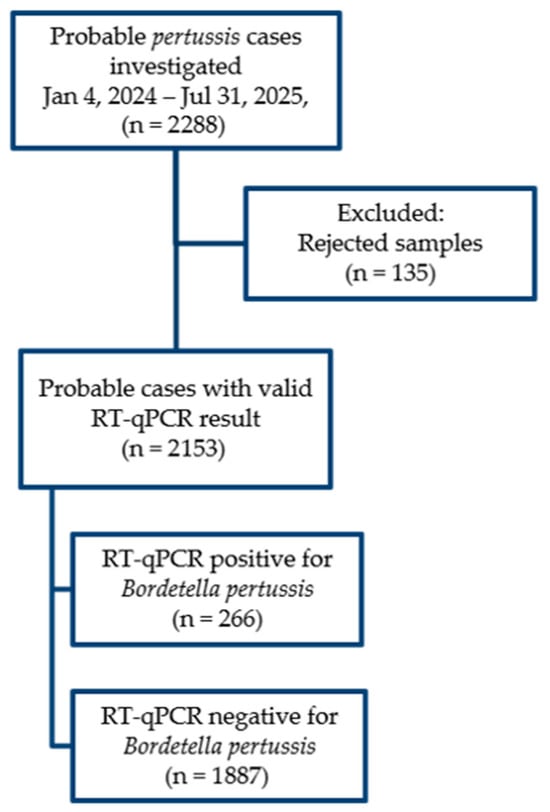
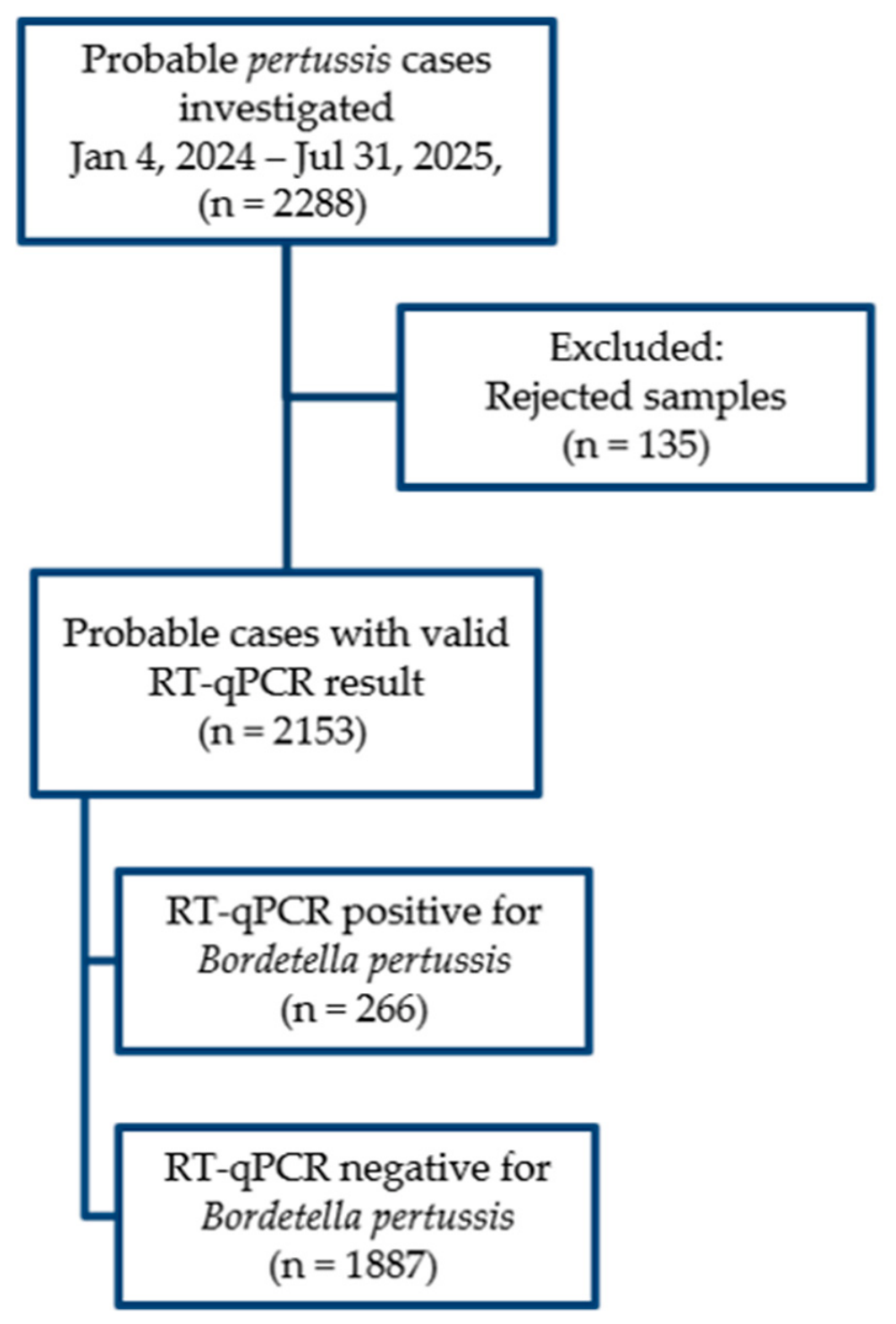
Records of probable pertussis cases whose specimens were received at the IMSS Central Epidemiology Laboratory for molecular diagnosis by real-time quantitative polymerase chain reaction (RT-qPCR) between 4 January 2024, and 31 July 2025, were analyzed. The study inclusion period was defined according to the date of specimen receipt, whereas the temporal distribution of cases was analyzed according to the date of symptom onset, which could precede specimen receipt. Of the 2288 specimens initially registered, 135 were excluded because they had been classified as rejected by the laboratory. The analytical database did not contain information on the specific reasons for specimen rejection; although the sample processing laboratory adheres to the acceptance and rejection criteria for biological samples in accordance with the guidelines set by the health authority [10]. Therefore, only the 2153 specimens with valid RT-qPCR results were included in the analysis. The information collected included demographic and clinical-epidemiological variables, such as age, sex, state of residence, date of symptom onset, type of care, and laboratory result. Included patients met the current operational case definitions issued by CONAVE [10]. A probable pertussis case was defined as any person with paroxysmal cough lasting seven or more days and at least one of the following signs or symptoms: coughing fits, cyanotic cough, emetizing cough, apnea, or inspiratory stridor. In infants younger than six months, a probable case was defined as cough with apnea or cyanosis, regardless of the duration of symptoms.
All records with a valid RT-qPCR result were included in the analysis. Individuals were classified as RT-qPCR-positive or RT-qPCR-negative according to their laboratory results. Both groups comprised individuals who met the same operational definition of a probable pertussis case and originated from the same surveillance population. An analytical cross-sectional approach was used to identify demographic, geographic, and clinical-epidemiological characteristics associated with Bordetella pertussis RT-qPCR positivity among probable pertussis cases.
For analytical purposes, the data were stratified by geographic region according to the patient’s state of residence: North Pacific (Baja California, Baja California Sur, Nayarit, Sinaloa and Sonora); Border (Chihuahua, Coahuila, Nuevo León and Tamaulipas); Central Pacific (Colima, Jalisco and Michoacán); North Central (Aguascalientes, Durango, Guanajuato, Querétaro, San Luis Potosí and Zacatecas); Central (Hidalgo, Tlaxcala and Veracruz); Central Metropolitan Area (Mexico City and the State of Mexico); South Pacific (Guerrero, Morelos, Oaxaca and Puebla); and Peninsula (Campeche, Chiapas, Quintana Roo, Tabasco and Yucatán) [12]. For temporal analysis, the month and season of onset were derived from the date of symptom onset. Seasons were categorized as spring (March–May), summer (June–August), autumn (September–November), and winter (December–February).
2.2. Multiplex Real-Time PCR for Bordetella Species Identification
Genomic DNA was extracted from clinical specimens using the QIAamp DNA Blood Mini Kit (QIAGEN, Hilden, Germany) according to the manufacturer’s instructions. Species-specific multiplex real-time PCR (RT-qPCR) targeting IS481, hIS1001, pIS1001, and ptxS1 was performed for the identification of Bordetella species. Primer and probe sequences, reaction conditions, and target concentrations are provided in Supplementary Table S1.
Amplification and detection were performed using TaqMan® Gene Expression Master Mix (Thermo Fisher Scientific, Waltham, MA, USA) on a QuantStudio 5 Real-Time PCR System (Applied Biosystems, Waltham, MA, USA).
Interpretation of results was based on the multiplex real-time PCR algorithm described by Tatti et al. [13], allowing differentiation of Bordetella pertussis, Bordetella parapertussis, and Bordetella holmesii. Amplification detected before cycle 35 was considered positive.
2.3. Statistical Analysis
The database was exported to Microsoft Excel for Microsoft 365 (Microsoft Corporation, Redmond, WA, USA) and analyzed using Stata Statistical Software, Release 14 (StataCorp, College Station, TX, USA).
Categorical variables were described using absolute frequencies and percentages. Measures of central tendency and dispersion were calculated for continuous variables. For the descriptive analysis, age was categorized into five-year age groups, except for infants younger than one year and individuals aged 75 years or older. For the analysis of associated factors, age was further categorized into six groups (<1, 1–4, 5–14, 15–24, 25–44, and ≥45 years) to obtain more stable estimates in the logistic regression model.
Overall cumulative positivity and positivity stratified by sex, age group, state, geographic region, and month and year of symptom onset were estimated. Positivity was calculated as the number of probable cases testing positive for Bordetella pertussis by RT-qPCR divided by the total number of probable cases with a valid RT-qPCR result in each stratum, expressed as a percentage.
To identify factors associated with Bordetella pertussis RT-qPCR positivity among probable pertussis cases, a bivariate analysis was performed by calculating odds ratios (ORs) and 95% confidence intervals (95% CIs). Sex, age group categorized into six groups, geographic region, season of symptom onset, and type of care were evaluated.
Subsequently, multivariable analysis was performed using unconditional binary logistic regression to estimate adjusted odds ratios (aORs) and 95% confidence intervals (95% CIs). The multivariable model included variables selected based on their epidemiological relevance and the results of the bivariate analysis. Model goodness of fit was assessed using the Hosmer–Lemeshow test. A p value <0.05 was considered statistically significant. The estimated ORs and aORs represent the odds of RT-qPCR positivity among probable pertussis cases included in the surveillance system and should not be interpreted as measures of infection risk in the general population.
Variables were selected for the multivariable logistic regression model based on epidemiological relevance, potential confounding, and findings from the bivariate analyses. The primary model included sex, age group, and season of symptom onset. The robustness of the age-related findings was assessed by repeating the multivariable analysis using the 25–44-year age group as an alternative reference category.
Multicollinearity was assessed using variance inflation factors (VIFs), with values below 5 considered acceptable. Model discrimination was evaluated using the area under the receiver operating characteristic curve (AUC).
As an additional sensitivity analysis, a multivariable logistic regression model was fitted, including geographic region alongside sex, age group, and season of symptom onset. Geographic region was included as a categorical variable, using the Central Metropolitan Area as the reference category. The adjusted estimates were compared with those from the primary model to assess the influence of geographic region on the observed associations. Model fit was compared using a likelihood ratio test.
During the preparation of this manuscript, the authors used ChatGPT 5 for the purposes of Graphical Abstract generation. The authors have reviewed and edited the output and take full responsibility for the content of this publication.
3. Results
A total of 2153 probable pertussis cases with a valid RT-qPCR result were included, of which 266 tested positive for Bordetella pertussis and 1887 tested negative (Figure 1).
Figure 1.
Flowchart of probable pertussis cases included in the study, IMSS surveillance system, Mexico, 4 January 2024–31 July 2025.
The mean age was 16.7 years (SD: 20.3), and the median age was 5 years (IQR: 0–32). Of the total, 1144 (53.1%) were female and 1009 (46.9%) were male. Bordetella pertussis-positive cases had a lower median age than negative cases [0 years (IQR: 0–14) vs. 7 years (IQR: 0–33); p < 0.001]. Infants younger than one year accounted for 55.3% of positive cases, compared with 28.7% of negative cases. The sex distribution was similar between the two groups (p = 0.458). Differences in case distribution were observed according to geographic region (p = 0.003), season of symptom onset (p = 0.002), and type of care (p < 0.001). Among positive cases, 69.9% required hospital care, compared with 37.8% of negative cases (Table 1).
Table 1.
Demographic and epidemiological characteristics of probable pertussis cases according to Bordetella pertussis RT-qPCR result, IMSS, Mexico, 2024–2025.
Overall Bordetella pertussis positivity was 12.4% (266/2153). Positivity was 12.8% among females and 11.8% among males. By age group, the highest positivity was observed among infants younger than one year (21.3%), followed by those aged 15–19 years (19.5%) and 65–69 years (18.5%). Positivity by age group and sex is presented in Supplementary Table S2.
3.1. Temporal and Geographic Distribution
Although the study inclusion period began on 4 January 2024, based on specimen submission dates, some patients had experienced symptom onset in December 2023. Therefore, the temporal distribution of laboratory-confirmed cases was analyzed according to the date of symptom onset, covering December 2023 through July 2025. The highest monthly number of positive cases was recorded in February 2025 (n = 43), followed by March (n = 40) and January (n = 36). Between January and July 2025, 183 cases were identified, compared with 82 cases during all of 2024, indicating a substantial increase in the number of cases identified in early 2025. From April 2025 onward, an overall decrease in the number of positive cases was observed.
The temporal distribution differed across geographic regions. During 2024, positive cases were observed predominantly in the North Pacific and Central Pacific regions, whereas an increase was recorded across several regions during 2025. Over the entire study period, the Central Metropolitan Area accounted for the largest number of positive cases (n = 74), followed by the North Pacific and Central Pacific regions, with 41 cases each: Border (n = 36), South Pacific (n = 24), North Central (n = 18), Central (n = 17), and Peninsula (n = 15). The distribution of positive cases by geographic region, state, and month and year of symptom onset is presented in Supplementary Table S3.
The analyzed dataset did not include records of probable cases from Aguascalientes, Chihuahua, Tlaxcala, or Yucatán because no specimens from these states were received at the IMSS Central Epidemiology Laboratory during the study period.
Bordetella pertussis-positive cases were identified in 25 of the 28 states represented in the dataset. Mexico City accounted for the largest number of cases (n = 45), followed by Jalisco (n = 32), the State of Mexico (n = 29), and Baja California (n = 28). Cumulative positivity varied geographically; by region, the highest positivity was observed in the North Pacific region (19.7%), followed by Central Pacific (15.9%) and Border (14.2%), whereas the lowest was observed in the Peninsula region (7.6%). By state, Baja California and Chiapas had the highest cumulative positivity (33.3% in both); however, in Baja California this corresponded to 28 positive cases among 84 probable cases studied, whereas in Chiapas it corresponded to three of nine. Querétaro had a positivity of 22.2%, based on two positive cases among nine probable cases studied. These estimates should be interpreted considering the small number of probable cases studied in some states. Cumulative positivity by state is presented in Table 2, and its distribution by geographic region, state, and month and year of symptom onset is presented in Supplementary Table S4.
Table 2.
Bordetella pertussis RT-qPCR positivity by state among probable pertussis cases, IMSS, Mexico, 2024–2025.
State-level RT-qPCR positivity estimates should be interpreted cautiously because of the substantial differences in the number of probable cases tested across states. For example, although Baja California and Chiapas both had a positivity of 33.3%, the estimates were based on 28 of 84 and 3 of 9 tested cases, respectively, resulting in markedly different confidence interval widths. Similarly, Querétaro had a positivity of 22.2% based on only 2 of 9 tested cases. These findings highlight the uncertainty associated with estimates derived from small denominators and should not be interpreted as differences in the underlying burden of pertussis (See Table S4).
3.2. Factors Associated with Bordetella pertussis Infection
In the bivariate analysis, overall associations were observed between Bordetella pertussis infection and age group, geographic region, season of symptom onset, and type of care, whereas no association was observed with sex (Table 3). Infants younger than one year had higher odds of infection than those aged 15–24 years (OR = 2.08; 95% CI: 1.18–3.67; p = 0.012). In the geographic analysis, the North Pacific region had higher odds of infection than the Central Metropolitan Area (OR = 1.94; 95% CI: 1.28–2.95; p = 0.002). Using the 25–44-year age group as an alternative reference category did not change the overall model results; infants younger than one year remained significantly associated with RT-qPCR positivity (aOR = 3.88; 95% CI: 2.59–5.81; p < 0.001).
Table 3.
Factors associated with Bordetella pertussis infection among probable pertussis cases, IMSS, Mexico, 2024–2025.
Hospitalization status was evaluated as a clinical and healthcare-related characteristic of probable pertussis cases, rather than as a potential determinant of infection. Its association with RT-qPCR positivity was assessed only in the bivariate analysis and was not included in the multivariable model because hospitalization may reflect disease severity, age, and healthcare-related decisions.
An additional multivariable logistic regression model was fitted including geographic region alongside sex, age group, and season of symptom onset. None of the geographic regions showed a statistically significant association with RT-qPCR positivity after adjustment. The inclusion of geographic region did not significantly improve overall model fit (likelihood ratio test, χ2 = 5.76; 7 degrees of freedom; p = 0.568). The main associations remained relatively stable, including age younger than one year (aOR = 1.95; 95% CI: 1.10–3.48) and summer symptom onset (aOR = 2.65; 95% CI: 1.50–4.69). Complete results are presented in Supplementary Table S5.
Multicollinearity assessment showed VIF values ranging from 1.04 to 4.32, with no values exceeding the predefined threshold of 5. The multivariable logistic regression model demonstrated modest discriminatory ability, with an area under the receiver operating characteristic curve (AUC) of 0.677.
Regarding season of symptom onset, probable cases with symptom onset during winter had higher odds of infection than those with onset during autumn (OR = 1.72; 95% CI: 1.03–2.90; p = 0.039), as did cases with symptom onset during summer (OR = 2.12; 95% CI: 1.22–3.67; p = 0.008). Hospitalized cases had higher odds of infection than those receiving outpatient care (OR = 3.82; 95% CI: 2.89–5.04; p < 0.001).
In the multivariable analysis, adjusted for sex, age group, and season of symptom onset, infants younger than one year had higher odds of Bordetella pertussis RT-qPCR positivity than those aged 15–24 years (aOR = 2.12; 95% CI: 1.20–3.77; p = 0.010). The remaining age groups did not differ significantly from the reference group.
Regarding season of symptom onset, probable cases with symptom onset during winter had higher odds of RT-qPCR positivity than those with onset during autumn (aOR = 1.88; 95% CI: 1.11–3.18; p = 0.019), whereas those with onset during summer had 2.64 times the odds of RT-qPCR positivity (aOR = 2.64; 95% CI: 1.51–4.63; p = 0.001). No statistically significant association was observed for spring. Sex was also not independently associated with RT-qPCR positivity (aOR for males = 0.79; 95% CI: 0.60–1.03; p = 0.081) (Table 3).
Given the incomplete seasonal coverage in 2025, additional sensitivity analyses were conducted using two observation periods: December 2023–November 2024 and September 2024–July 2025. The association between summer symptom onset and RT-qPCR positivity varied across these periods. Compared with autumn, the adjusted odds ratio for summer was 3.82 (95% CI: 2.04–7.15) in the first period and 1.83 (95% CI: 0.93–3.61) in the second period. These findings suggest that the observed seasonal associations may be influenced by differences in epidemic timing and observation periods.
The model showed adequate goodness of fit according to the Hosmer–Lemeshow test (χ2 = 4.83; p = 0.776).
4. Discussion
In this retrospective analytical cross-sectional study, we examined the epidemiological distribution of Bordetella pertussis RT-qPCR positivity and associated demographic and clinical-epidemiological characteristics among probable pertussis cases evaluated through the IMSS surveillance system during 2024 and the first seven months of 2025.
Overall positivity was 12.4%, with differences according to age, temporal distribution, and geographic distribution. Three findings were particularly notable: the concentration of positive cases among infants younger than one year, the increase in the number of probable cases tested, and RT-qPCR-positive cases during the first months of 2025, without a comparable increase in overall positivity. The association between summer symptom onset and RT-qPCR positivity should be interpreted cautiously because seasonal coverage was unequal and the observation period overlapped with changes in epidemic activity. Although the sensitivity analyses showed a positive association in both restricted periods, statistical significance was observed only in the December 2023–November 2024 analysis. These findings suggest that the observed association may partly reflect epidemic timing rather than an independent seasonal effect. Although the study covered the complete calendar year of 2024, data for 2025 were available only through July, resulting in unequal seasonal representation. Furthermore, the increase in laboratory-confirmed cases during early 2025 may have contributed to the associations observed between season of symptom onset and RT-qPCR positivity. Sensitivity analyses showed that the association for summer varied across observation periods, suggesting that the findings may reflect epidemic timing and differences in surveillance coverage rather than an independent seasonal pattern.
The age distribution showed a clear concentration among infants. Infants younger than one year accounted for 55.3% of all positive cases and had the highest positivity (21.3%); moreover, after adjustment for sex and season of symptom onset, they had approximately twice the odds of Bordetella pertussis infection compared with those aged 15–24 years. This pattern is consistent with the epidemiology described internationally, in which infants continue to represent one of the most affected groups, even though an increase in cases among adolescents and adults has been observed in recent years. A review of recent trends found that, during 2023–2024, infants younger than one year had the highest incidence rates in most of the European countries evaluated [14]. Similarly, during the resurgence of pertussis in Brazil in 2024, infants younger than one year continued to be recognized as a group particularly vulnerable to severe disease and hospitalization [15].
This vulnerability is particularly relevant during the first months of life, when the primary vaccination series has not yet been initiated or completed and protection depends largely on maternal antibodies transferred during pregnancy [16]. In Mexico, documented gaps in vaccination coverage also exist. Using data from the 2021–2023 ENSANUT Continua, Mongua-Rodríguez et al. estimated 68.9% coverage for the third dose of polio/DPT vaccine among children younger than five years, below the 95% target; only 45.6% of children aged 12–23 months and 32.4% of those aged 24–35 months had a complete vaccination schedule for their age [12]. Although these gaps are a relevant component of the national epidemiological context, individual vaccination history was not available in the present study; therefore, its relationship with Bordetella pertussis infection among the cases studied could not be established.
Studies conducted specifically during the 2024–2025 outbreak in Mexico provide additional evidence in this regard. Silva-Dirzo et al. documented maternal Tdap vaccination coverage of 35.7% and found that 56.6% of the children evaluated had an incomplete vaccination schedule for their age [7]. Likewise, a multicenter study of 59 pediatric pertussis cases during the Mexican outbreak found maternal Tdap vaccination coverage of 27.1% and highlighted the importance of maternal immunization in preventing severe disease in infants [17]. Although our study did not include individual information on vaccination history and therefore does not allow us to assess the relationship between vaccination status and Bordetella pertussis infection, these findings indicate persistent gaps in maternal and childhood vaccination in the context of the Mexican outbreak and underscore the importance of timely vaccination during pregnancy and childhood.
The temporal distribution of cases should be interpreted within the context of the pertussis resurgence observed during 2024–2025. In our study population, 82 positive cases were identified during 2024 and 183 between January and July 2025, with the highest monthly number recorded in February 2025. This increase occurred during a period of rising pertussis activity in several countries following the period of low circulation observed during the COVID-19 pandemic. In Brazil, for example, 7438 cases were reported in 2024 compared with 216 in 2023, and hospitalizations increased 3.1-fold [15]. In the United States, pertussis notifications increased substantially in 2024 compared with 2023 and returned to levels similar to or higher than those observed before the pandemic [18]. A recent review of diphtheria and pertussis outbreaks in the Americas also identified a marked increase in pertussis during 2024 and noted, among the concurrent factors, gaps in childhood, maternal, and booster vaccination, as well as differences in surveillance systems [19].
However, this resurgence should not be attributed exclusively to low vaccination coverage. The literature suggests a multifactorial phenomenon involving the accumulation of susceptible individuals following reduced circulation during the pandemic, waning immunity over time, characteristics of acellular vaccines, and the epidemic cycles inherent to pertussis. Among the socially insured population in Mexico, an analysis of IMSS epidemiological surveillance data from 1992 to 2011 documented epidemic cycles at three- to five-year intervals, indicating that periodic fluctuations in disease occurrence predated the current resurgence [20]. Outbreaks have also been reported in populations with high vaccination coverage, highlighting the complexity of Bordetella pertussis transmission dynamics. Therefore, our findings should be interpreted within a period of epidemic resurgence in which multiple determinants likely converged [21].
Season of symptom onset was another factor that remained associated with infection in the multivariable model. Compared with autumn, probable cases with symptom onset during winter had 1.88 times the odds of Bordetella pertussis infection, whereas those with onset during summer had 2.64 times the odds. In Mexico, an analysis of pertussis dynamics between 1985 and 2007 identified seasonal variation in transmission, with an average peak in December and a minimum in June; however, no consistent reduction in transmission during summer was observed, and epidemics were not synchronized across states [22]. Similarly, in a study conducted in Iran, laboratory-confirmed cases showed a seasonal pattern that differed from that of clinically suspected cases, with the highest incidence of confirmed cases occurring during summer [23]. In this context, the associations observed in our study for both winter and summer may be related to seasonality and to the particular dynamics of the 2024–2025 epidemic period. Therefore, these findings should not be interpreted as evidence that circulation was restricted to specific seasons; rather, they underscore the importance of maintaining clinical suspicion and epidemiological surveillance throughout the year.
Geographic heterogeneity was also observed. The Central Metropolitan Area, comprising Mexico City and the State of Mexico, accounted for the largest absolute number of positive cases, whereas the North Pacific region had the highest cumulative positivity. At the state level, Mexico City recorded the largest number of positive cases, followed by Jalisco, the State of Mexico, and Baja California. This pattern showed some similarities to national reports from the epidemic period, in which several states in central and northern Mexico were among those reporting the highest numbers of confirmed pertussis cases [24].
However, interpreting these differences requires distinguishing between the absolute number of cases and positivity. Baja California and Chiapas both had a cumulative positivity of 33.3%; however, in Baja California this corresponded to 28 positive cases among 84 probable cases studied, whereas in Chiapas it corresponded to three positive cases among nine. Querétaro likewise had a positivity of 22.2%, based on two positive cases among nine probable cases. Consequently, estimates based on small denominators are less precise and should not be considered in isolation as evidence of a greater disease burden. The same applies to some monthly estimates by state and region, in which the small number of cases studied resulted in extreme values of 0% or 100%. To describe geographic differences over the entire study period, cumulative positivity provides a more stable measure than these isolated monthly fluctuations.
The source of the specimens imposes an additional limitation on geographic comparisons. Aguascalientes, Chihuahua, Tlaxcala, and Yucatán were not represented because no specimens from these states were received at the IMSS Central Epidemiology Laboratory during the study period. This absence does not imply that Bordetella pertussis was not circulating in these states. National reports documented cases in some states that were not represented in our dataset, including Aguascalientes and Chihuahua [11]. Consequently, the geographic distribution described here reflects the probable cases studied through this component of IMSS laboratory-based surveillance and should not be directly extrapolated to the entire Mexican population.
Regarding type of care, hospitalized cases had 3.82 times the odds of Bordetella pertussis RT-qPCR positivity compared with those receiving outpatient care in the bivariate analysis. This association may reflect differences in clinical severity and healthcare utilization, particularly among infants. The 2024–2025 Mexican multicenter study documented severe pediatric cases, including admission to intensive care and the need for intubation [17], while a substantial increase in hospitalizations was also reported during the resurgence in Brazil [15]. However, in our data, type of care was closely related to age and may represent a consequence of clinical presentation or disease severity rather than a factor preceding infection. It was therefore not included in the main multivariable model, and the observed OR should not be interpreted as indicating that hospitalization is a risk factor for acquiring Bordetella pertussis infection.
Sex, in contrast, showed no independent association. Although females accounted for 55.3% of positive cases, positivity was similar between females and males, and the difference did not reach statistical significance. A slight predominance among females was also reported during the 2024 resurgence in Brazil, although sex was not a central feature of the epidemiological pattern observed [15]. Our findings therefore suggest that, among the probable cases analyzed, age and temporal factors were more relevant than sex in explaining differences in positivity.
Among the main strengths of this study are the size of the study population, comprising 2153 probable cases, their geographic distribution across different regions of the country, and the use of RT-qPCR performed at a laboratory whose technical competence for pertussis diagnosis is recognized by InDRE, Mexico’s national reference laboratory [10]. In addition, all participants met the same operational definition of a probable pertussis case, allowing comparison of probable cases with positive and negative Bordetella pertussis results within a population defined using homogeneous clinical and epidemiological criteria.
The study limitations were primarily related to its retrospective analytical cross-sectional design and the nature of the data source. Both RT-qPCR-positive and RT-qPCR-negative individuals were selected from probable pertussis cases who underwent laboratory testing. Therefore, the estimated odds ratios represent associations with RT-qPCR positivity among probable cases rather than the risk of Bordetella pertussis infection in the general population. An important limitation was the lack of individual-level information on the interval between symptom onset and specimen collection, antibiotic use before sampling, vaccination history, specimen type, and detailed clinical symptoms. These factors may influence RT-qPCR sensitivity, the likelihood of undergoing laboratory testing, and the probability of obtaining a positive result. Consequently, we were unable to assess their potential confounding effects on the observed associations between demographic and epidemiological characteristics and RT-qPCR positivity.
In addition, the age of infants younger than one year was not available at a level of detail that allowed differences by month of age to be analyzed. The study population consisted exclusively of probable cases whose specimens were processed at the IMSS Central Epidemiology Laboratory, which is recognized by InDRE for its technical competence in pertussis diagnosis. Consequently, the observed positivity does not represent an estimate of incidence or prevalence in the population. Differences in healthcare-seeking behavior, clinical presentation, and access to laboratory testing may have influenced the selection of individuals included in the surveillance system. Geographic comparisons were limited by substantial differences in the number of probable cases tested across states, resulting in imprecise positivity estimates in states with small denominators. Four states had no specimens represented in the analytical dataset. Furthermore, the study included only specimens processed at the IMSS Central Epidemiology Laboratory and may not have captured all pertussis testing performed within the IMSS network. Consequently, the observed geographic distribution and state-level positivity estimates cannot be considered representative of the overall burden of pertussis across Mexico. Because the analysis did not include a population-based denominator for the IMSS-covered population or complete national surveillance data, it was not possible to estimate population incidence or independently establish the magnitude of a nationwide pertussis resurgence. The observed increase in positive cases should therefore be interpreted within the context of specimen submission, testing volume, and surveillance activity.
The incomplete observation period in 2025 and the temporal overlap between seasonal categories and epidemic activity limited our ability to distinguish independent seasonal effects from changes in pertussis circulation over time.
5. Conclusions
Overall, the findings describe the epidemiological distribution of laboratory-confirmed pertussis among probable cases evaluated through the IMSS surveillance system during 2024–2025, including an increase in the number of specimens tested and RT-qPCR-positive cases during early 2025. These findings underscore the importance of maintaining sensitive epidemiological and laboratory surveillance, particularly among infants younger than one year, to support timely case detection and identify changes in Bordetella pertussis circulation. However, because individual vaccination histories were unavailable, this study cannot assess the relationship between vaccination status and RT-qPCR positivity.
Supplementary Materials
The following supporting information can be downloaded at https://www.mdpi.com/article/10.3390/microorganisms14112469/s1, Table S1. Primer and probe sequences used in the multiplex real-time PCR assay for Bordetella species identification. Table S2. Bordetella pertussis RT-qPCR positivity by age group and sex among probable pertussis cases, IMSS, Mexico, 2024–2025. Table S3. Distribution of Bordetella pertussis RT-qPCR-positive cases by geographic region, state, and month of symptom onset (December 2023–July 2025), among probable pertussis cases with specimens received from January 2024 to July 2025, IMSS. Table S4. Bordetella pertussis RT-qPCR positivity by geographic region, state, and month of symptom onset (December 2023–July 2025), among probable pertussis cases with specimens received from January 2024 to July 2025, IMSS, Mexico. Table S5. Multivariable logistic regression analysis of factors associated with Bordetella pertussis RT-qPCR positivity, additionally adjusted for geographic region, IMSS, Mexico, 2024–2025.
Author Contributions
Conceptualization, D.A.C.G., P.F.H.B. and A.K.R.U.; methodology, D.A.C.G., L.A.N., C.E.S.T., J.E.A.Y., Y.-M.A.H. and B.M.M.; validation, J.E.A.Y., B.M.M.; formal analysis, P.F.H.B. and L.A.N.; investigation, A.V.P., Ó.C.O. and G.V.A.; resources, C.E.S.T., J.E.A.Y., Y.-M.A.H. and B.M.M.; data curation, L.A.N.; writing—original draft preparation, D.A.C.G., P.F.H.B., A.V.P., J.E.A.Y. and C.E.S.T.; writing—review and editing, A.K.R.U., L.J.B. and A.V.P.; supervision, C.E.S.T. and D.A.C.G.; project administration, D.A.C.G. and L.A.N. All authors have read and agreed to the published version of the manuscript.
Funding
This research received no external funding.
Institutional Review Board Statement
The study was conducted in accordance with the principles of the Declaration of Helsinki and current national regulations governing health research. The study was based on secondary analysis of data collected as part of routine epidemiological surveillance activities, with no direct intervention involving participants; therefore, informed consent was not required. The database was accessed for research purposes on 29 August 2025. Prior to analysis, variables containing personal identifying information were removed; therefore, the database used for analysis contained no personal identifiers that could be used to identify individual participants. The protocol was reviewed and approved by IMSS Local Health Research Committee No. 3605 on 26 July 2025, under registration number R-2025-3605-010.
Informed Consent Statement
Not applicable.
Data Availability Statement
The original data presented in the study are openly available in the Figshare repository at https://doi.org/10.6084/m9.figshare.33991072.
Acknowledgments
The researchers thank the staff who carried out epidemiological surveillance activities. During the preparation of this manuscript, the authors used ChatGPT 5 for the purposes of Graphical Abstract generation. The authors have reviewed and edited the output and take full responsibility for the content of this publication.
Conflicts of Interest
The authors declare no conflicts of interest.
Abbreviations
The following abbreviations are used in this manuscript:
| COVID-19 | Coronavirus Disease 2019 |
| CONAVE | National Committee for Epidemiological Surveillance |
| InDRE | Institute of Epidemiological Diagnosis and Reference |
| IMSS | Mexican Social Security Institute |
| PAHO | Pan American Health Organization |
| RT-qPCR | Real-time quantitative polymerase chain reaction |
References
- Decker, M.D.; Edwards, K.M. Pertussis (whooping cough). J. Infect. Dis. 2021, 224, S310–S320. [Google Scholar] [CrossRef] [Scilit] [PubMed]
- McFarlin, A. What to do when babies turn blue. Emerg. Med. Clin. N. Am. 2018, 36, 335–347. [Google Scholar] [CrossRef] [Scilit] [PubMed]
- Tos Ferina. Manual de Vacunas En Línea de La AEP. En: Comité Asesor de Vacunas (CAV-AEP). 2022. Available online: http://vacunasaep.org/documentos/manual/cap-39.CAV (accessed on 16 September 2026).
- Domenech de Cellès, M.; Magpantay, F.M.; King, A.A.; Rohani, P. The pertussis enigma: Reconciling epidemiology, immunology and evolution. Proc. Biol. Sci. 2016, 283, 20152309. [Google Scholar] [CrossRef] [Scilit] [PubMed]
- Bart, M.J.; Harris, S.R.; Advani, A.; Arakawa, Y.; Bottero, D.; Bouchez, V.; Cassiday, P.K.; Chiang, C.-S.; Dalby, T.; Fry, N.K.; et al. Global population structure and evolution of Bordetella pertussis and their relationship with vaccination. mBio 2014, 5, e01074. [Google Scholar] [CrossRef] [Scilit] [PubMed]
- Delgado-Juárez, G.C.; Bernal-Silva, S.; Méndez-González, K.J.; Contreras-Ibáñez, C.C.; Comas-García, A. Impact of the Covid-19 pandemic on the epidemiological weekly report surveillance system of Mexico. Salud Publica Mex. 2024, 66, 831–841. [Google Scholar] [CrossRef] [Scilit] [PubMed]
- Silva Dirzo, M.; Castillo Bejarano, J.I.; Ortega Riosvelasco, F.; Pérez Campos, I.S.; Galán García, E.; Reyes Velázquez, S.; Nogales, R.A.; Pérez, R.G.; Casillas, M.C.C.; Rivera, L.G.; et al. Factores de riesgo asociados a la cobertura de vacunación materno infantil contra tos ferina en México. Rev. Panam. Salud Publica 2025, 49, e136. [Google Scholar] [CrossRef] [Scilit] [PubMed]
- Bricks, L.F.; Vargas-Zambrano, J.C.; Macina, D. Epidemiology of pertussis after the COVID-19 pandemic: Analysis of the factors involved in the resurgence of the disease in high-, middle-, and low-income countries. Vaccines 2024, 12, 1346. [Google Scholar] [CrossRef] [Scilit] [PubMed]
- Organización Panamericana de la Salud. Alerta Epidemiológica: Tos Ferina (coqueluche) En La Región de Las Américas [Internet]; OPS: Washington, DC, USA, 2024; Available online: https://www.paho.org/sites/default/files/2024-07/2024-jul-22-phe-alerta-eidemiologica-pertussis-esp-final2.pdf (accessed on 16 September 2026).
- Dirección General de Epidemiología. Manual de Procedimientos Estandarizados Para La Vigilancia Epidemiológica de Las Enfermedades Prevenibles Por Vacunación [Internet]; Secretaría de Salud: Ciudad de México, Mexico, 2018. Available online: https://www.gob.mx/salud/documentos/manuales-para-la-vigilancia-epidemiologica-102563 (accessed on 16 September 2026).
- Comité Nacional para la Vigilancia Epidemiológica (CONAVE). CONAVE/01/2025/Aumento de casos de tos ferina en México. In Aviso Epidemiológico [Internet]; Secretaría de Salud: Ciudad de México, Mexico, 2025. Available online: https://www.gob.mx/salud/documentos/aviso-epidemiologico-por-aumento-de-casos-de-tos-ferina-en-mexico (accessed on 16 September 2026).
- Mongua-Rodríguez, N.; Delgado-Sánchez, G.; Ferreira-Guerrero, E.; Ferreyra-Reyes, L.; Martínez-Hernández, M.; Canizales-Quintero, S.; NTéllez-Vázquez, A.; García-García, L. Vacunación en menores de cinco años. Salud Publica Mex. 2024, 66, 368–380. [Google Scholar] [CrossRef] [Scilit] [PubMed]
- Tatti, K.M.; Sparks, K.N.; Boney, K.O.; Tondella, M.L. Novel multitarget real-time PCR assay for rapid detection of Bordetella species in clinical specimens. J. Clin. Microbiol. 2011, 49, 4059–4066. [Google Scholar] [CrossRef] [Scilit] [PubMed]
- Wang, S.; Zhang, S.; Liu, J. Resurgence of pertussis: Epidemiological trends, contributing factors, challenges, and recommendations for vaccination and surveillance. Hum. Vaccin Immunother. 2025, 21, 2513729. [Google Scholar] [CrossRef] [Scilit] [PubMed]
- Sansone, N.M.S.; Boschiero, M.N.; Marson, F.A.L. The 2024 resurgence of Bordetella pertussis in Brazil and a decade-long epidemiological overview. Front Public Health 2025, 13, 1549735. [Google Scholar] [CrossRef] [Scilit] [PubMed]
- Parikh, J.; Hoare, I.; Izurieta, R. Evaluating the relationship between the introduction of the acellular pertussis vaccine and whooping cough resurgence in the United States. Vaccines 2025, 13, 841. [Google Scholar] [CrossRef] [Scilit] [PubMed]
- Dirzo, M.S.; Bejarano, J.I.C.; Casillas, M.C.C.; Rivera, L.G.; Barrera, C.D.; Carrillo, Y.H.S.; Nogales, R.A.; Bustamante, M.E.M.; Vargas, A.J.C.; Saldaña, D.C.; et al. Unraveling the pertussis outbreak in Mexico: Insights from a multicenter 2024–2025 study. Pediatr. Infect. Dis. J. 2026, 45, e14–e17. [Google Scholar] [CrossRef] [Scilit] [PubMed]
- Centers for Disease Control and Prevention. Pertussis Surveillance and Reporting [Internet]; CDC: Atlanta, GA, USA, 2024. Available online: https://www.cdc.gov/pertussis/php/surveillance/index.html (accessed on 16 September 2026).
- Jean Baptiste, A.E.; Sciarratta, C.N.; Contreras, M.; Hertlein, C.; Pacis, C.L.; Salas, D.; Velandia, M. Diphtheria and pertussis outbreaks in the Americas: A scoping review of epidemiology, vaccination trends and control strategies, 2013–2024. BMJ Public Health 2026, 4, e004252. [Google Scholar] [CrossRef] [Scilit] [PubMed]
- Pérez Pérez, G.F.; Rojas Mendoza, T.; Cabrera Gaytán, D.A.; Grajales Muñiz, C. Panorama epidemiológico de la tos ferina: 19 años de estudio epidemiológico en el Instituto Mexicano del Seguro Social. Rev. Med. Inst. Mex. Seguro Soc. 2015, 53, 164–170. [Google Scholar] [PubMed]
- Liu, Y.; Yu, D.; Wang, K.; Ye, Q. Global resurgence of pertussis: A perspective from China. J. Infect. 2024, 89, 106289. [Google Scholar] [CrossRef] [Scilit] [PubMed]
- Mahmud, A.S.; Metcalf, C.J.E.; Grenfell, B.T. Comparative dynamics, seasonality in transmission, and predictability of childhood infections in Mexico. Epidemiol. Infect. 2017, 145, 607–625. [Google Scholar] [CrossRef] [Scilit] [PubMed]
- Ghorbani, G.R.; Zahraei, S.M.; Moosazadeh, M.; Afshari, M.; Doosti, F. Comparing seasonal pattern of laboratory confirmed cases of pertussis with clinically suspected cases. Osong Public Health Res. Perspect. 2016, 7, 131–137. [Google Scholar] [CrossRef] [Scilit] [PubMed]
- Comité Nacional para la Vigilancia Epidemiológica (CONAVE). CONAVE/03/2025/Tos Ferina. In Aviso Epidemiológico [Internet]; Secretaría de Salud: Ciudad de México, Mexico, 2025. Available online: https://www.gob.mx/salud/documentos/aviso-epidemiologico-por-aumento-de-casos-de-tos-ferina-en-mexico-abril-2025 (accessed on 16 September 2026).

Disclaimer/Publisher’s Note: The statements, opinions and data contained in all publications are solely those of the individual author(s) and contributor(s) and not of MDPI and/or the editor(s). MDPI and/or the editor(s) disclaim responsibility for any injury to people or property resulting from any ideas, methods, instructions or products referred to in the content. |
© 2026 by the authors. Licensee MDPI, Basel, Switzerland. This article is an open access article distributed under the terms and conditions of the Creative Commons Attribution (CC BY) license.