


Abstract
This study aimed to characterize the population structure, predicted antimicrobial resistance gene profiles, and virulence gene repertoire of Group B Streptococcus (GBS) in Zhejiang Province, China, using whole-genome sequencing (WGS). Forty GBS isolates from clinical specimens underwent WGS, multilocus sequence typing (MLST), cgMLST-based phylogenetic analysis, and systematic in silico annotation of predicted antimicrobial resistance and virulence genes. Seven capsular serotypes were identified, with serotype V being predominant. Fifteen sequence types (STs) were detected, including two novel STs (ST2662 and ST2663). Thirteen STs were grouped into eight clonal complexes (CCs), while two STs remained unassigned to any CC. CC19 (11/40, 27.5%) and CC327 (10/40, 25.0%) were the predominant CCs, with CC327 comprising the distinctive ST529-CC327-V clone. Eighteen predicted antimicrobial resistance genes were identified, including genes predicted to confer resistance to macrolide (ermB 60.0%, mefA 37.5%), tetracycline (tetM 47.5%, tetO 42.5%), aminoglycoside (aph(3′)-IIIa 25.0%), and lincosamide (lsaE 30.0%, lnuB 30.0%). All isolates carried multiple predicted virulence genes, with universal carriage of adhesion genes fbsA and fbsB, and the invasion genes cylE, hylB, and cfb. These findings reveal a genetically diverse GBS population with distinctive clonal architecture and high carriage of predicted antimicrobial resistance genes in Zhejiang Province, underscoring the need for continued genomic surveillance to inform region-specific antibiotic stewardship and vaccine development.
1. Introduction
Group B Streptococcus (GBS), also known as S. agalactiae, is an important perinatal pathogen and a leading cause of neonatal sepsis, pneumonia, and meningitis in neonates, as well as endometritis, chorioamnionitis, puerperal sepsis, and urinary tract infections in pregnant and postpartum women [1]. In recent years, the detection rate of adult GBS infections has increased steadily, posing a substantial health threat to immunocompromised individuals and elderly populations worldwide [2,3]. These infections manifest as a broad clinical spectrum, including urogenital, bloodstream, and skin and soft-tissue infections, and are complicated by substantial genetic heterogeneity among strains, challenging clinical prevention and antimicrobial management [4,5].
Previous studies have predominantly focused on GBS isolates from vaginal specimens of pregnant women, with major attention paid to molecular characteristics related to vertical mother-to-child transmission [6,7]. However, genomic data from non-pregnant populations, male patients, and non-genital clinical specimens (such as urine and blood) remain scarce. This gap in understanding has limited region-specific insights into clinical GBS infection characteristics in diverse patient groups.
Given the above research gaps, we performed a retrospective genomic analysis of 40 clinical GBS isolates from multiple hospitals in Zhejiang Province, encompassing non-pregnant adults, male individuals, and elderly patients, as well as diverse clinical specimen types including urine and blood. Whole-genome sequencing was used to describe the genomic profiles of these isolates. This study sought to describe the distribution of sequence types (STs), clonal complexes (CCs), and serotypes, and to profile the carriage of predicted virulence factors and antimicrobial resistance genes. The findings may contribute to a better understanding of regional GBS population structure and predicted antimicrobial resistance and virulence gene patterns, informing clinical antibiotic stewardship and highlighting priorities for future surveillance in this region.
2. Materials and Methods
2.1. Bacterial Isolates and DNA Preparation
A total of 40 non-duplicate clinical isolates suspected to be GBS were collected from sentinel hospitals across Zhejiang Province between March 2024 and November 2025. The data were kept in the Zhejiang Provincial Intelligent Preservation Platform for Pathogenic Microorganism Specimen Bank and Culture (Virus) Collection System. At the time of original isolation, strains were streaked onto blood agar plates without any supplements or selective antibiotics (CHROMagar, Shanghai, China), incubated at 37 °C for 18 h under 5% CO2, and purified by subculture. Species identification was confirmed by matrix-assisted laser desorption/ionization time-of-flight mass spectrometry (MALDI-TOF MS; Bruker Corporation, Karlsruhe, Germany). Genomic DNA was subsequently extracted, archived at −80 °C, and used retrospectively in the present study for whole-genome sequencing.
2.2. Genome Sequencing and Assembly
Genomic DNA of all Streptococcus agalactiae isolates was extracted using the QIAamp DNA Mini Kit (Qiagen, Hilden, Germany) following the manufacturer’s instructions. DNA concentration and purity were assessed by spectrophotometry (NanoDrop, Thermo Fisher Scientific, Waltham, MA, USA); samples with an A260/A280 ratio of 1.8 to 2.0 were used for whole-genome sequencing.
Whole-genome sequencing was performed by using MGIEasy FS DNA Library Prep Set V2.0 on the MGISEQ-2000RS platform (MGI Tech Co., Ltd., Shenzhen, China), generating 150-bp paired-end reads with an average coverage depth exceeding 100×. For data processing, the reads quality was analyzed with FastQC v0.12.1 (https://github.com/s-andrews/FastQC, accessed on 15 May 2026) and processed using Trimmomatic v0.39 (https://github.com/timflutre/trimmomatic, accessed on 20 May 2026) to eliminate low-quality sequence ends and sequencing adapter contamination. Reads after quality control were used for species identification using Kraken2 v2.1.6 (https://github.com/DerrickWood/kraken2, accessed on 9 June 2026) and for de novo assembly using Unicycler v0.4.8 (https://github.com/rrwick/Unicycler, accessed on 14 June 2026). The quality of the de novo assemblies was assessed using QUAST v5.2.0 (https://github.com/ablab/quast, accessed on 21 June 2026), and high-quality genomes (completeness > 95%, contamination < 5%) were retained for downstream analyses. Genome assembly quality statistics were provided as Supplementary Table S1.
2.3. In Silico Analysis
Reference sequences representing the ten serotypes (Ia-IX) against the capsular polysaccharide were obtained according to the previous study [8], then alignment-based calling of serotypes was done using BLASTn between the reference sequences and sequences of 40 isolated strains. A minimum nucleotide identity of 95% across the 90% of the reference serotype length was required for making a serotype call, and assignments below these thresholds were reported as non-typeable (NT).
The multilocus sequence typing (MLST) of the genomes was screened against the seven housekeeping gene loci of S. agalactiae, including adhP, atr, glcK, glnA, pheS, sdhA, tkt by querying the assembled genomes against the PubMLST S. agalactiae database (https://pubmlst.org/sagalactiae, accessed on 5 September 2026) to assign sequence types (STs), and clonal complexes (CCs) were determined according to the database definitions, in which STs are grouped into a CC when they share at least 6 of the 7 MLST alleles with at least one other member of the group.
Predicted antimicrobial resistance (AMR) genes were annotated by aligning genomic sequences against the Comprehensive Antibiotic Resistance Database (CARD; https://card.mcmaster.ca, accessed on 9 June 2026) using Resistance Gene Identifier (RGI) software (version 5.1.0). Matches were processed as ≥95% identity and ≥80% coverage. Virulence factors were predicted by BLAST v.2.17.0 analysis of genomic sequences against the Virulence Factor Database (VFDB, accessed on 9 June 2026). Predicted virulence factors were retained if they exhibited ≥75% sequence identity and ≥85% coverage with an E-value < 1 × 10⁻⁵.
For phylogenetic analysis, a total of 40 isolates from the present study and 70 reference sequences representing different lineages (retrieved from the NCBI GenBank database on 15 April 2026, country of origin, serotype, ST and CC are listed in Supplementary Table S2) were included. During the selection process, strains with complete information were preferred (with high-quality drafts accepted where no complete genome was available for a lineage). Subsequently, genomes were selected to span the major human-associated clonal complexes to include isolates from different countries (with Asian/Chinese isolates preferentially retained), and to represent distinct STs. To avoid over-representation of heavily sampled lineages, no more than five genomes were included per sequence type, with genomes otherwise randomly selected within each clonal complex from among those meeting the above criteria. Comprehensive genome analysis was conducted using cgMLST (core genome multilocus sequence typing) Target Definer module of Ridom© SeqSphere+ software v5.0.2 (Ridom GmbH, Münster, Germany) containing 1770 targets according to the software instruction. Allele calling was performed for all 110 genomes. For each pair of genomes, the allele distance was calculated as the number of the 1770 loci at which the two genomes carried different alleles (allelic mismatches),loci lacking an allele call in both genomes of a pair were handled by pairwise deletion, the single missing locus was ignored in the corresponding pairwise distance calculation.
The remaining strains were used to construct a phylogenetic tree using the neighbor-joining (NJ) algorithm in SeqSphere+ software. As NJ is a distance-based method operating on the allele-distance matrix rather than on a nucleotide sequence alignment, no nucleotide substitution model was applied; the distance metric described above (number of differing cgMLST alleles) is the corresponding parameter. Branch support was not calculated, and the tree was treated as unrooted.
2.4. Statistical Analysis
Given the modest sample size (n = 40) and uneven distribution across subgroups, no formal statistical inference was performed. All subgroup observations, including comparisons between ST19 and ST529, are presented as descriptive frequencies and percentages only. No p-values were calculated.
2.5. Heatmap Construction and Hierarchical Clustering
Predicted antimicrobial resistance and virulence gene profiles were converted into a binary presence/absence matrix, with gene presence coded as 1 and absence as 0 (Table S3). Missing values were treated as absence, and no additional normalization or scaling was applied. Hierarchical clustering was performed using Euclidean distance and complete-linkage agglomeration. Predicted virulence and antimicrobial resistance genes were separated into two functional groups and clustered independently within each group. Isolates were grouped according to ST, CC, or serotype, depending on the corresponding heatmap, and hierarchical clustering was performed within each group. Heatmaps were generated in R v4.4.1 using the ComplexHeatmap package, with color mapping implemented using the circlize package.
3. Results
3.1. Clinical Distribution of GBS Isolates
This retrospective study included 40 non-duplicate clinical GBS isolates originally recovered from multiple sentinel hospitals across Zhejiang Province between March 2024 and November 2025. As summarized in Table 1, the isolates were obtained from 28 (70.0%) female and 12 (30.0%) male patients. By age group, 13 (32.5%) isolates were from patients aged 18–39 years, 12 (30.0%) from 40–59 years, 13 (32.5%) from ≥60 years, and 2 (5.0%) from 0–17 years. Urine was the predominant specimen type (17/40, 42.5%), followed by secretion (14/40, 35.0%), blood (5/40, 12.5%), and tissue fluid (1/40, 2.5%). The specimen source was not recorded for 3 isolates (7.5%) due to incomplete clinical documentation. The clinical metadata was provided as Supplementary Table S4.
Table 1.
Demographic and clinical characteristics of 40 GBS isolates.
3.2. Population Structure: Serotypes, STs, and CCs
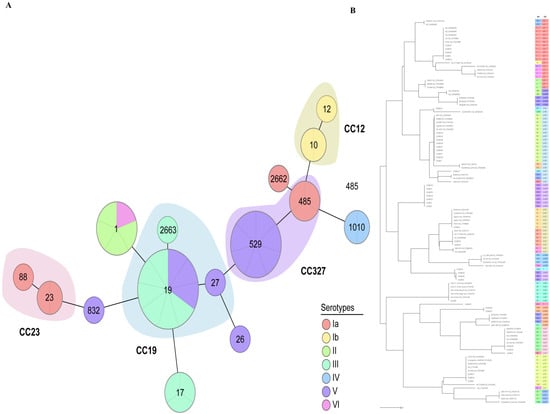
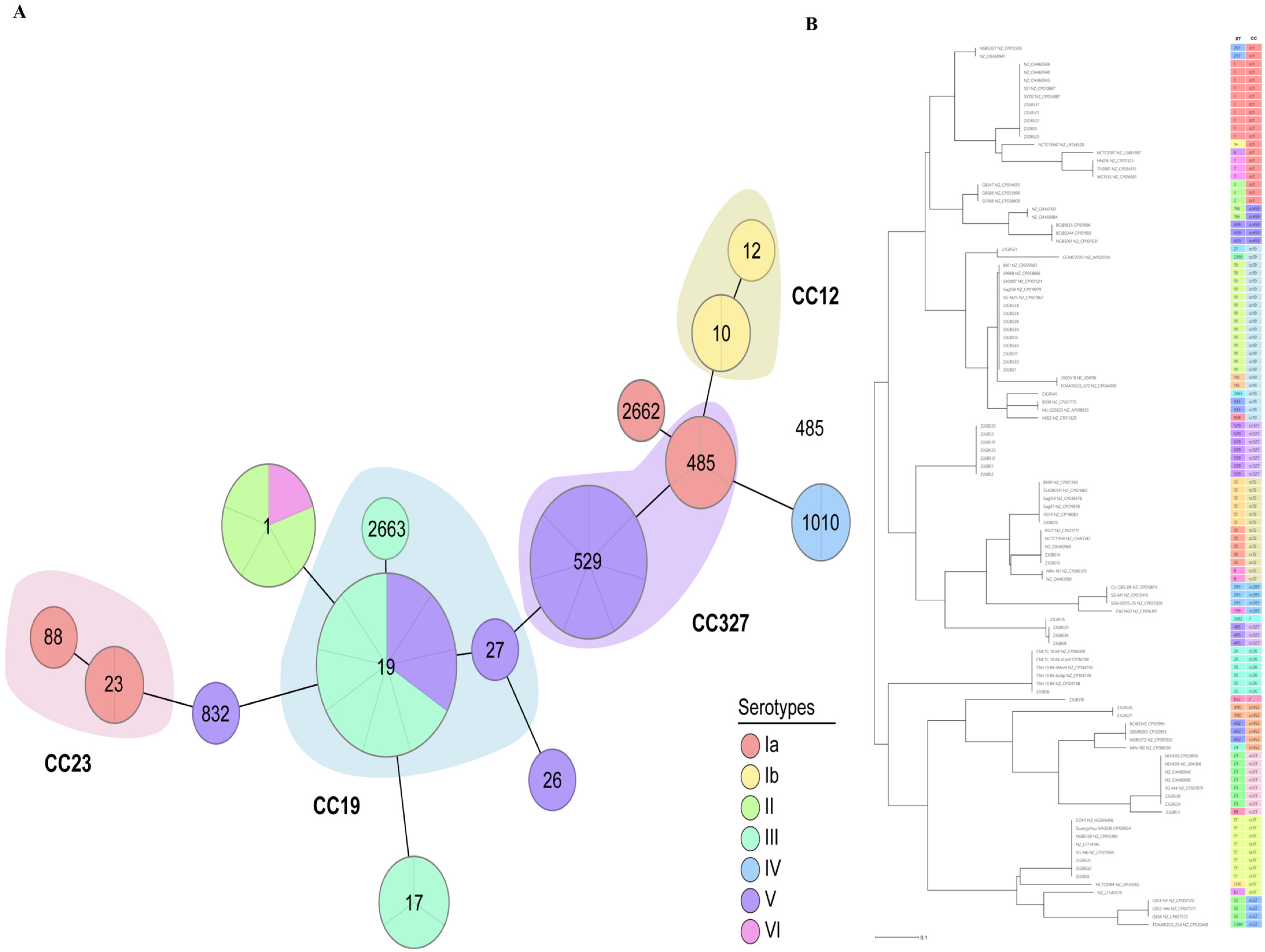
The 40 isolates were assigned to seven capsular serotypes. Serotype V was the most prevalent (13/40, 32.5%), followed by III (10/40, 25.0%), Ia (7/40, 17.5%), II (4/40, 10.0%), Ib (3/40, 7.5%), IV (2/40, 5.0%), and VI (1/40, 2.5%) (Table 2). Multilocus sequence typing identified 13 STs among 38 isolates. For the remaining two isolates that were initially untypeable, we submitted them to PubMLST S. agalactiae database, where they were assigned as two novel sequence types, ST2662 and ST2663. Thus, all 40 isolates were assigned to 15 STs in total (Table 3). ST19 was the most prevalent (9/40, 22.5%), followed by ST529 (7/40, 17.5%), ST1 (5/40, 12.5%), and ST17 and ST485 (3/40 each, 7.5%). Minimum spanning tree analysis grouped the 40 isolates into eight CCs, with two STs remaining unassigned to any CC (Figure 1A, Table 3). CC19 was the predominant complex, comprising 11 isolates (27.5%), followed by CC327 with 10 isolates (25.0%). Notably, all seven ST529 isolates were assigned exclusively to CC327 and uniformly carried serotype V, the most prevalent serotype–ST combination in this study. To contextualize the genetic diversity of the clinical isolates, a neighbor-joining phylogenetic tree was constructed based on cgMLST allelic profiles of the 40 study isolates together with 70 reference strains retrieved from the NCBI GenBank database (Figure 1B). The 110 strains were divided into two major lineages, with the clinical isolates distributed across both branches.
Table 2.
Serotype distribution of 40 GBS isolates by clinical source.
Table 3.
Multilocus sequence typing and clonal complex distribution of 40 GBS isolates.
Figure 1.
Population structure and phylogenetic relationships of clinical GBS isolates. (A) Minimum spanning tree of 40 ST-typed isolates. The numbers in the circle stand for the ST (Sequence type), the colors in the circle stand for the serotype, the shadow color stands for the CC (Clonal complex). (B) Neighbor-joining phylogenetic tree of 40 clinical isolates and 70 reference strains based on cgMLST allelic profiles containing 1770 targets. ST, Sequence type; CC, Clonal complex.
3.3. Predicted Antimicrobial Resistance Genes
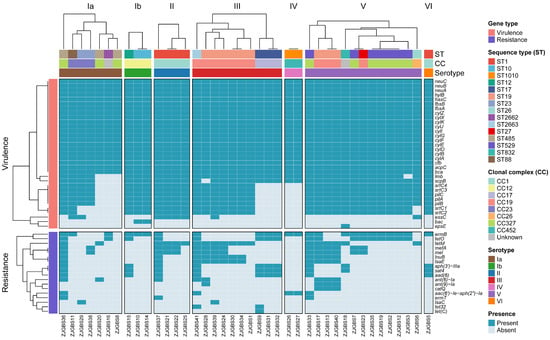
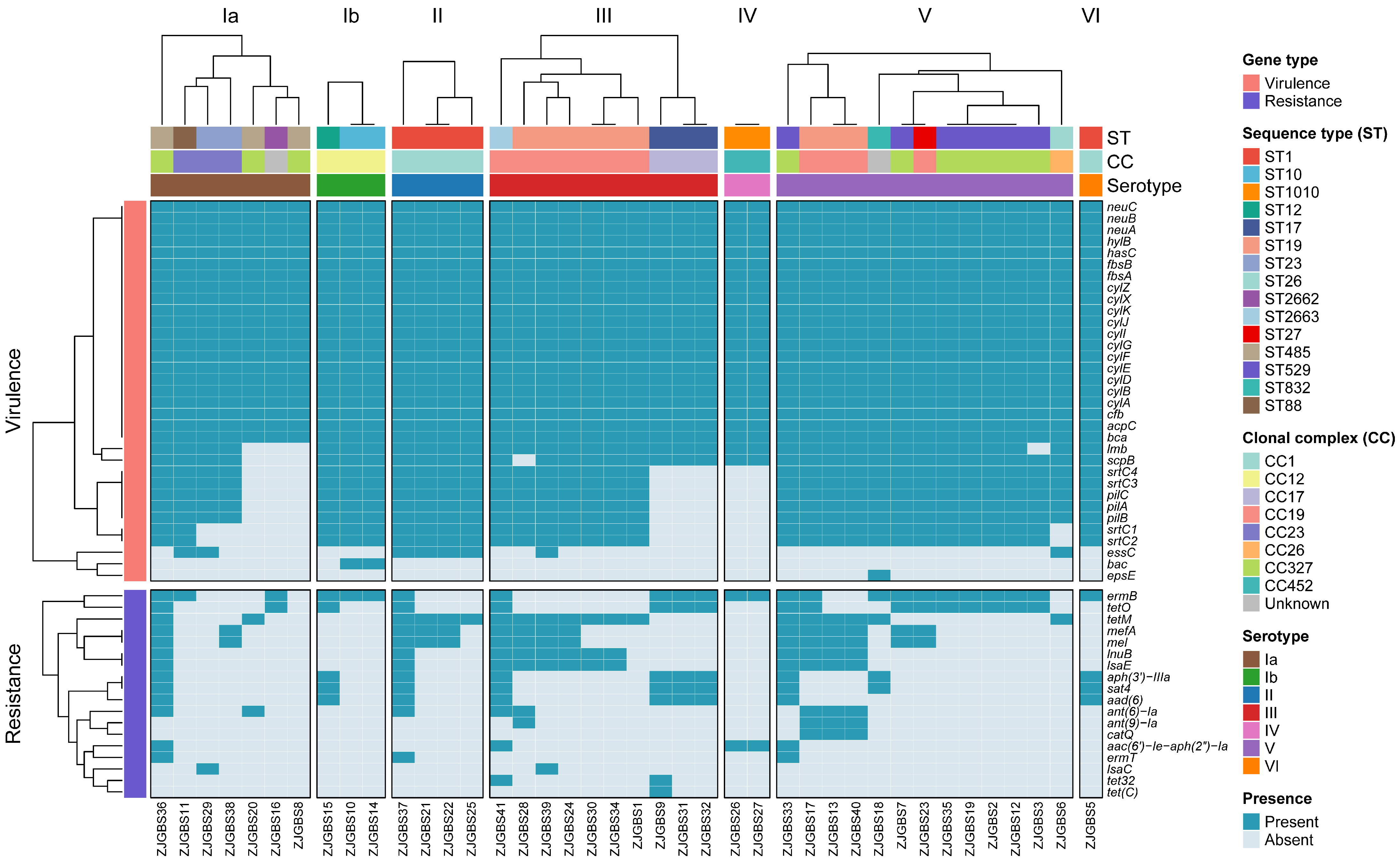
Predicted antimicrobial resistance genes were screened in all 40 GBS isolates. A total of 18 predicted resistance determinants were identified, including those conferring resistance to aminoglycosides [aac(6′)-Ie-aph(2″)-Ia, aad(6), ant(6)-Ia, ant(9)-Ia, and aph(3′)-IIIa], macrolides (ermB, ermT, mefA, and mel), tetracyclines (tetO, tetM, tet32, and tet(C)), phenicols (catQ) and lincosamides (lsaC, lnuB, and lsaE), and streptothricin (sat4) (Figure 2). Among predicted macrolide resistance genes, ermB was the most prevalent (24/40, 60.0%), followed by mefA and mel (15/40 each, 37.5%). Predicted tetracycline resistance genes tetM and tetO were detected in 19 (47.5%) and 17 (42.5%) isolates, respectively, whereas tet32 and tet(C) were less common. The predicted aminoglycoside resistance genes aph(3′)-IIIa, aad(6), and ant(6)-Ia were identified in 10 (25.0%), 9 (22.5%), and 8 (20.0%) isolates, respectively; the predicted lincosamide resistance genes lsaE and lnuB were each found in 12 isolates (30.0%); and sat4, which confers resistance to streptothricin, was present in 8 (20.0%).
Figure 2.
Distribution and prevalence of predicted antimicrobial resistance and virulence genes among 40 GBS isolates.
Hierarchical clustering based on predicted resistance gene profiles revealed distinct genotypic patterns that varied by serotype, ST, and CC. ST19 and ST529, the two most common sequence types, showed distinct resistance gene carriage patterns: ST19 isolates frequently carried tetM (100.0%, 9/9), lnuB (88.9%, 8/9), and lsaE (88.9%, 8/9) but rarely carried ermB or tetO (11.1%, 1/9 each), whereas ST529 isolates frequently carried ermB and tetO (100.0%, 7/7) but rarely carried tetM, lnuB, or lsaE (14.3%, 1/7 each). These differences are presented descriptively because of the small subgroup sizes. CC17 exhibited co-carriage of ermB, tetO, and the aminoglycoside resistance gene cluster aph(3′)-IIIa/sat4/aad(6) at 100.0% (3/3), a descriptive observation in this small lineage. Serotype V showed the highest rates of ermB (76.9%, 10/13) and tetO (69.2%, 9/13) and also carried ant(6)-Ia, ant(9)-Ia, and catQ, whereas serotype III carried tetM (70.0%, 7/10), lnuB (60.0%, 6/10), and lsaE (60.0%, 6/10), and serotype II harbored tetM at 100.0% (4/4), a descriptive observation given the small sample size.
3.4. Distribution of Predicted Virulence Genes
All virulence gene data reported in this section are based on in silico presence/absence annotation and do not include locus-level validation or mutation screening within genes; they therefore represent predicted genomic potential rather than confirmed functional activity. Based on whole-genome sequencing, systematic annotation and distribution analysis of predicted virulence genes were performed across 40 GBS isolates. As shown in Figure 2, the tested strains harbored multiple classes of genes predicted to encode virulence factors associated with adhesion, invasion, and immune evasion, with a high overall carriage rate. Notably, the genes fbsA and fbsB, predicted to encode fibrinogen-binding proteins, were each present in all 40 isolates (100.0%). The genes scpB and lmb, predicted to encode C5a peptidase and laminin-binding protein, respectively, were each detected at carriage rates of 90.0% (36/40). The genes pilA, pilB, and pilC, predicted to encode pilus structural proteins, were each detected at carriage rates of 80.0% (32/40). The genes cylE, hylB, bca, and cfb, predicted to encode β-hemolysin/cytolysin, hyaluronate lyase, alpha-C protein, and CAMP factor, respectively, were present in all isolates. Additionally, the sialic acid biosynthesis genes neuA, neuB, and neuC, which are predicted to contribute to capsular sialylation, were detected in 100% of the isolates. Hierarchical clustering of virulence gene profiles partitioned the isolates into distinct genotypic patterns consistent with their serotype, ST, and CC designations. The bac gene, predicted to encode β-C protein (Bac), was present only in ST10-CC12-Ib isolates (2/2, 100.0%). ST1-CC1-II strains universally harbored the essC gene (100%, 4/4). No hits were obtained for the generic markers srtC1/C2/C3/C4, pilA/B/C, and essC in ST17-CC17 (n = 3) and ST1010-CC452 (n = 2) isolates.
4. Discussion
This retrospective genomic study of 40 clinical GBS isolates from Zhejiang Province revealed a population dominated by capsular serotype V, with CC19 and CC327 as the predominant clonal complexes. The isolates carried a substantial burden of predicted antimicrobial resistance determinants, particularly genes predicted to confer macrolide and tetracycline resistance, and showed near-universal carriage of virulence factors mediating adhesion, invasion, and immune evasion. These findings contribute to a growing body of evidence that clinical GBS populations in eastern China are genetically diverse, genotypically enriched for predicted antimicrobial resistance, and harbor diverse virulence determinants.
The demographic and clinical profile of the isolates in this study, encompassing non-pregnant adults, male patients, and elderly individuals, with urine and non-genital secretions as predominant sources, reflects an expanding host and clinical spectrum beyond the traditional obstetric and neonatal contexts. Invasive GBS disease among non-pregnant adults, particularly those aged ≥65 years or with immunocompromising conditions, has risen substantially in North America and Europe over the past two decades [9,10,11]. The high proportion of elderly patients (32.5%) and the recovery of isolates from blood and tissue fluid in the present cohort are consistent with this global epidemiological shift, underscoring the need to broaden genomic surveillance beyond perinatal populations.
GBS is classified into 10 distinct capsular polysaccharide-based serotypes, and serotypes Ia, Ib, II, III, and V represent the predominant circulating strains, collectively accounting for more than 90% of clinical isolates [12]. In the present study, capsular serotype V was the most prevalent type (32.5%), followed by serotypes III (25.0%) and Ia (17.5%). Serotype V has been identified as one of the most frequent serotypes in invasive adult disease, accounting for a prominent proportion of urogenital tract infections and skin and soft-tissue infections, and is often associated with CC1 and CC19 lineages [13]. In contrast, serotype III demonstrates the highest pathogenicity and is the leading causative agent of neonatal meningitis [14]. The co-dominance of III and V in the present cohort suggests that the circulating GBS population in Zhejiang retains virulent lineages capable of causing both neonatal and adult invasive infections.
MLST defines sequence types as the standardized molecular classification scheme for GBS. To date, over 2600 distinct STs have been identified worldwide (https://pubmlst.org/sagalactiae, accessed on 5 September 2026), which are closely linked to capsular serotypes, clonal complexes, virulence determinants, and antimicrobial resistance profiles [15,16], establishing MLST as a cornerstone for epidemiological surveillance and infection source tracking. ST distribution exhibits marked geographic heterogeneity. In Europe, ST19, ST23, and ST1 represent the predominant lineages [17], whereas ST283, ST1, and ST17 are the most frequently encountered types in Thailand, a Southeast Asian nation [18]. Similarly, ST23, ST17, ST10, and ST1 constitute the dominant clones in East African countries [19]. In the present study, MLST analysis identified ST19 as the most common sequence type (22.5%), which is consistent with its global prominence in both maternal and adult invasive GBS collections [20,21]. However, the most distinctive feature of the present population was the exclusive clustering of all ST529 isolates within CC327 and their uniform association with serotype V. This ST529–CC327–V combination represented the single most common serotype–ST association in our cohort. A recent WGS study of clindamycin-resistant GBS from Qingdao, Shandong Province, similarly identified V–ST529–CC327 as the predominant lineage, suggesting that this clone may be enriched in coastal areas of Shandong; however, further multicenter studies across eastern coastal China are needed to confirm regional distribution patterns [22]. The phylogenetic inclusion of 70 reference strains revealed that the 40 clinical isolates were distributed across both major GBS lineages, indicating substantial genetic diversity rather than clonal expansion of a single epidemic strain.
While these 40 isolates exhibited substantial phylogenetic diversity, their predicted antimicrobial resistance gene profiles revealed additional clinically relevant patterns. However, as phenotypic antimicrobial susceptibility testing was not performed, all resistance data below reflect genomic predictions rather than confirmed phenotypic resistance. Clinically, GBS remains universally susceptible to penicillin, which continues to serve as the first-line agent for both treatment and prophylaxis [23]. Consistent with established clinical patterns, no predicted penicillin-associated resistance genes were identified in our isolates; however, this does not confirm phenotypic susceptibility, as β-lactam resistance may also arise from penicillin-binding protein mutations or other mechanisms beyond resistance gene detection. Individuals with penicillin allergy must rely on alternative agents such as lincosamides, and the phenotypic resistance burden reported in recent surveillance for these substitutes has become increasingly concerning. Recent studies have demonstrated that resistance to macrolides, lincosamides, and tetracyclines among GBS isolates is rising markedly. European studies report erythromycin and clindamycin resistance at 15–40% (~30%) in pregnant women [24,25], while North America shows higher rates (50.7% and 38.4–43.2%, respectively) [9,26]. China faces a difficult situation, with erythromycin resistance reaching 63% among pregnant women—nearly three times the global average [24]. Broader surveillance of Chinese GBS isolates, predominantly from infant disease cases, further indicates clindamycin and tetracycline resistance exceeding 73% and 98%, respectively [27]. Genomic screening for predicted resistance determinants revealed a high prevalence of macrolide and tetracycline resistance genes. In the present study, the ermB gene, which encodes a ribosomal methylase associated with ribosomal methylation-mediated macrolide–lincosamide–streptogramin B resistance, was detected in 60.0% of isolates. It should be emphasized that the presence of resistance genes indicates genomic potential rather than confirmed phenotypic resistance, as macrolide resistance may also result from mutations in 23S rRNA not assessed here. This carriage rate is intermediate between 70.5% in non-pregnant adults from Shandong [28] and 37.5% in pregnant women from Guangzhou [20], but higher than 54.2% in a Bulgarian nationwide collection [29]. Predicted tetracycline resistance genes tetM and tetO were present in 47.5% and 42.5% of isolates, respectively, comparable to the 46.0% tetM carriage in Shandong and 61.1% in Guangzhou [20,28]. Hierarchical clustering revealed descriptive patterns of predicted resistance gene carriage that varied among STs: ST19 carried tetM, lnuB, and lsaE at high rates (100%, 88.9%, 88.9%) but rarely ermB/tetO (11.1%), whereas ST529 showed the inverse pattern (100% ermB/tetO, 14.3% tetM). Because of the small subgroup sizes, these differences were not formally tested. This dichotomy is consistent with distinct evolutionary pathways hypothesized in previous studies: ST19 potentially acquiring resistance via conjugative transposons of the Tn916 family carrying tetM [30,31], and ST529 via integrative conjugative elements (ICEs) harboring ermB and tetO [22,32]. However, as no mobile genetic element analysis was performed in this study, these proposed mechanisms remain speculative at this stage and require further experimental validation. CC17 exhibited co-carriage of ermB, tetO, and the aminoglycoside resistance gene cluster aph(3′)-IIIa/sat4/aad(6) at 100.0% (3/3), a comprehensive predicted multidrug resistance gene combination characteristic of the hypervirulent CC17 lineage frequently associated with invasive disease [33]. The high co-carriage of lnuB and lsaE in ST19 (88.9% each) suggests substantial genetic potential for clindamycin resistance, which may limit therapeutic options for penicillin-allergic patients should phenotypic resistance be confirmed [34].
The high overall carriage of predicted virulence-associated genes in this cohort is consistent with the diverse genetic repertoire reported in GBS. The universal presence of fbsA and fbsB parallels their reported association with fibrinogen-binding [35]. The high carriage of scpB and lmb (90.0%, 36/40 each) reflects their common genomic occurrence in GBS; in previous work, lmb has been associated with laminin-binding and endothelial invasion [36], and scpB with C5a peptidase activity that may dampen neutrophil recruitment [37]. Notably, cylE and hylB were universally present; these genes are predicted to encode β-hemolysin/cytolysin and hyaluronidase, respectively, which have been implicated in membrane disruption and extracellular matrix degradation [38,39]. The bac gene was present only in ST10-CC12-Ib isolates (2/2), a descriptive observation given the small sample size. This is consistent with previous reports that bac is predominantly associated with serotype Ib; Kong et al. [40] detected Bac in 97% of serotype Ib strains but rarely in other serotypes. The essC gene was present in all ST1-CC1-II isolates (4/4). Previous studies have identified essC as the ATPase driver of the type VII secretion system (T7SS) in GBS [41]. No hits were obtained for the generic markers srtC1/C2/C3/C4, pilA/B/C, and essC in ST17-CC17 (n = 3) and ST1010-CC452 (n = 2) isolates. It should be emphasized that all virulence gene data reported herein represent genomic predictions based on in silico annotation against the Virulence Factor Database; locus integrity checks, mutation screening, phenotypic expression, and functional assays were not performed in this study. Consequently, the presence of a given gene does not imply its functional contribution in these isolates. Moreover, the analysis of ST1 and ST17 lineages relied on generic gene screening and did not constitute dedicated PI-1/PI-2a/PI-2b locus typing or full T7SS operon validation; therefore, the presence of essC alone cannot be interpreted as evidence for a functional T7SS, and the absence of generic pilA/B/C markers should not be considered definitive evidence for the lack of pili in these lineages, particularly given prior reports of high PI-2b carriage in CC17 isolates from a similar region [33].
Several limitations should be acknowledged. This retrospective study used archived genomic DNA without preserved original strains, precluding phenotypic validation of antimicrobial susceptibility or virulence expression. The modest sample size (n = 40) and single-province origin limit the precision of subgroup comparisons and preclude formal statistical inference, as well as limiting broader geographic generalizability. The cross-sectional design also precludes assessment of temporal trends. Despite these constraints, the genomic data provide a meaningful snapshot of regional GBS population structure.
5. Conclusions
This study describes a genetically diverse GBS population in Zhejiang Province characterized by the prominence of serotype V, the predominance of CC19 followed by CC327, the distinctive ST529–CC327–V clone, and high carriage of predicted macrolide/tetracycline resistance genes and conserved virulence determinants. These findings underscore the importance of ongoing, region-specific genomic surveillance to inform empirical antibiotic stewardship, track the emergence of high-risk clones, and help inform vaccine candidate selection in adult and elderly populations.
Supplementary Materials
The following supporting information can be downloaded at: https://www.mdpi.com/article/10.3390/microorganisms14102284/s1, Table S1: Overview of genome assembly quality statistics. Table S2: Metadata for the 70 publicly available GBS genomes analyzed in this study. Table S3: Binary presence matrix of antimicrobial resistance and virulence genes of 40 GBS isolates. Table S4: The clinical metadata of 40 GBS isolates.
Author Contributions
Conceptualization, Z.Y. and W.H.; methodology, Z.J.; software, X.G. and L.W.; validation, W.Y. and L.W.; formal analysis, Z.Y.; investigation, L.W.; resources, B.W.; data curation, Z.J.; writing—original draft preparation, Z.Y.; writing—review and editing, W.H.; visualization, Z.Y.; supervision, B.W.; project administration, B.W.; funding acquisition, G.S. All authors have read and agreed to the published version of the manuscript.
Funding
This work was funded by National Key Research and Development Program of China (China National Center for Biotechnology Development, 2023YFC2605104 and 2023YFC2605100), the Zhejiang Province Vanguard Goose-Leading Initiative (Zhejiang Provincial Department of Science and Technology, 2024C03216); the Planned Science and Technology Project of Traditional Chinese Medicine of Zhejiang Province of China (Zhejiang Traditional Chinese Medicine Administration, 2023ZL352) and Medical Science and Technology Program of Zhejiang Province (Medical Science and Technology Program of Zhejiang Province, 2024KY894).
Institutional Review Board Statement
The study was conducted in accordance with the Declaration of Helsinki. Ethical review and approval were waived for this study by the Ethics Committee of Zhejiang Provincial Center for Disease Control and Prevention, because the study met the criteria for exemption from ethical review: (i) it involved no sensitive information and no directly identifying data; (ii) it posed no potential harm to the physical, psychological, or social rights or interests of the subjects; (iii) it used legally obtained public data (publicly available genome datasets for comparative analysis) and anonymized information data only; (iv) it was based on bacterial isolates recovered from routine clinical specimens together with fully anonymized clinical metadata, with no additional sampling and no intervention beyond routine care; and (v) the results are used solely for academic communication. The Ethics Committee of the authors’ institution reviewed the study and confirmed that it carried no ethical risk and therefore granted an exemption from ethical review.
Informed Consent Statement
Patient consent was waived because this was a retrospective study using bacterial isolates recovered from routine diagnostic specimens and anonymized information data; no additional specimens were collected, no intervention was performed, no patient was contacted, and no individual could be identified from the anonymized data. Written informed consent was therefore not required and could not practicably be obtained.
Data Availability Statement
Data are deposited in the National Center for Biotechnology Information (NCBI) BioProject database under accession number PRJNA1517324 (https://www.ncbi.nlm.nih.gov/bioproject/1517324, accessed on 24 August 2026).
Conflicts of Interest
The authors declare no conflicts of interest.
References
- Puopolo, K.M. Group B streptococcal disease. N. Engl. J. Med. 2026, 394, 896–905. [Google Scholar] [CrossRef] [Scilit] [PubMed]
- Li, Y.; Yang, W.; Li, Y.; Hua, K.; Zhao, Y.; Wang, T.; Liu, L.; Liu, Y.; Wang, Y.; Liu, W.; et al. The increasing burden of group B Streptococcus from 2013 to 2023: A retrospective cohort study in Beijing, China. Microbiol. Spectr. 2025, 13, e0226624. [Google Scholar] [CrossRef] [Scilit] [PubMed]
- Baldan, R.; Droz, S.; Casanova, C.; Knabben, L.; Huang, D.J.; Brülisauer, C.; Kind, A.B.; Krause, E.; Mauerer, S.; Spellerberg, B.; et al. Group b streptococcal colonization in elderly women. BMC Infect. Dis. 2021, 21, 408. [Google Scholar] [CrossRef] [Scilit] [PubMed]
- Perez, V.P.; Torini, L.R.; Manieri, F.Z.; de Queiroz, S.B.; de Brito Gomes, J.I.A.; Santos Filho, L.; Campana, E.H.; de Oliveira, C.J.B.; Sousa, E.S.S.; Camargo, I.L.B.C. Genomic diversity, virulome, and resistome of Streptococcus agalactiae in northeastern brazil: Are multi-host adapted strains rising? Pathogens 2025, 14, 292. [Google Scholar] [CrossRef] [Scilit] [PubMed]
- Pell, M.E.; Blankenship, H.M.; Gaddy, J.A.; Davies, H.D.; Manning, S.D. Genomic adaptation in group B Streptococcus following intrapartum antibiotic prophylaxis and childbirth. mBio 2026, 17, e0396625. [Google Scholar] [CrossRef] [Scilit] [PubMed]
- Mai, W.; Wang, H.; Meng, Q.; Zhang, J.; Gong, X.; Zhuo, Z.; Sui, J.; He, X.; Wang, Y.; Li, J.; et al. Molecular epidemiology and antibiotic resistance of group B Streptococcus in pregnant women and neonates from Haikou, China: Implications for vaccine development and antimicrobial stewardship. Front. Cell. Infect. Microbiol. 2025, 15, 1655649. [Google Scholar] [CrossRef] [Scilit] [PubMed]
- Villa, L.; Fernández-Colomer, B.; Fernández, J.; Adánez, J.; Acebes, C.; Junco, M.; Vazquez, F. Assessing the accuracy of a novel algorithm for group B Streptococcus detection in pregnant women and its impact on early-onset neonatal group B streptococcal infections. Clin. Microbiol. Infect. 2025, 31, 1679–1683. [Google Scholar] [CrossRef] [Scilit] [PubMed]
- Sheppard, A.E.; Vaughan, A.; Jones, N.; Turner, P.; Turner, C.; Efstratiou, A.; Patel, D.; Modernising, M.M.I.G.; Walker, A.S.; Berkley, J.A.; et al. Capsular typing method for Streptococcus agalactiae using whole-genome sequence data. J. Clin. Microbiol. 2016, 54, 1388–1390. [Google Scholar] [CrossRef] [Scilit] [PubMed]
- Francois Watkins, L.K.; McGee, L.; Schrag, S.J.; Beall, B.; Jain, J.H.; Pondo, T.; Farley, M.M.; Harrison, L.H.; Zansky, S.M.; Baumbach, J.; et al. Epidemiology of invasive group B streptococcal infections among nonpregnant adults in the United States, 2008–2016. JAMA Intern. Med. 2019, 179, 479–488. [Google Scholar] [CrossRef] [Scilit] [PubMed]
- Graux, E.; Hites, M.; Martiny, D.; Maillart, E.; Delforge, M.; Melin, P.; Dauby, N. Invasive group B Streptococcus among non-pregnant adults in Brussels-capital region, 2005–2019. Eur. J. Clin. Microbiol. Infect. Dis. 2021, 40, 515–523. [Google Scholar] [CrossRef] [Scilit] [PubMed]
- Navarro-Torné, A.; Curcio, D.; Moïsi, J.C.; Jodar, L. Burden of invasive group B Streptococcus disease in non-pregnant adults: A systematic review and meta-analysis. PLoS ONE 2021, 16, e0258030. [Google Scholar] [CrossRef] [Scilit] [PubMed]
- Le Doare, K.; Heath, P.T. An overview of global GBS epidemiology. Vaccine 2013, 31, D7–D12. [Google Scholar] [CrossRef] [Scilit] [PubMed]
- Founou, L.L.; Khan, U.B.; Medugu, N.; Pinto, T.C.A.; Darboe, S.; Chendi, Z.; Founou, R.C.; To, K.; Jamrozy, D.; Karampatsas, K.; et al. Molecular epidemiology of Streptococcus agalactiae in non-pregnant populations: A systematic review. Microb. Genom. 2023, 9, 1140. [Google Scholar] [CrossRef] [Scilit] [PubMed]
- Madrid, L.; Seale, A.C.; Kohli-Lynch, M.; Edmond, K.M.; Lawn, J.E.; Heath, P.T.; Madhi, S.A.; Baker, C.J.; Bartlett, L.; Cutland, C.; et al. Infant group B streptococcal disease incidence and serotypes worldwide: Systematic review and meta-analyses. Clin. Infect. Dis. 2017, 65, S160–S172. [Google Scholar] [CrossRef] [Scilit] [PubMed]
- Jolley, K.A.; Maiden, M.C.J. BIGSdb: Scalable analysis of bacterial genome variation at the population level. BMC Bioinform. 2010, 11, 595. [Google Scholar] [CrossRef] [Scilit] [PubMed]
- Jones, N.; Bohnsack, J.F.; Takahashi, S.; Oliver, K.A.; Chan, M.; Kunst, F.; Glaser, P.; Rusniok, C.; Crook, D.W.M.; Harding, R.M.; et al. Multilocus sequence typing system for group B Streptococcus. J. Clin. Microbiol. 2003, 41, 2530–2536. [Google Scholar] [CrossRef] [Scilit] [PubMed]
- Lohrmann, F.; Efstratiou, A.; Sørensen, U.B.S.; Creti, R.; Decheva, A.; Křížová, P.; Kozáková, J.; Rodriguez-Granger, J.; De La Rosa Fraile, M.; Margarit, I.; et al. Maternal Streptococcus agalactiae colonization in Europe: Data from the multi-center DEVANI study. Infection 2025, 53, 373–381. [Google Scholar] [CrossRef] [Scilit] [PubMed]
- Ouancharee, W.; Kerdsin, A.; Van Doan, H.; Chitmanat, C.; Faksri, K.; Lulitanond, A.; Chanawong, A.; Charoensri, N. Predomination of hypervirulent ST283 and genetic diversity of levofloxacin resistance in multidrug-resistant, hypervirulent Streptococcus agalactiae in Thailand. J. Med. Microbiol. 2025, 74, 1970. [Google Scholar] [CrossRef] [Scilit] [PubMed]
- Huber, C.A.; McOdimba, F.; Pflueger, V.; Daubenberger, C.A.; Revathi, G. Characterization of invasive and colonizing isolates of Streptococcus agalactiae in East African adults. J. Clin. Microbiol. 2011, 49, 3652–3655. [Google Scholar] [CrossRef] [Scilit] [PubMed][Green Version]
- Ling, Y.; Deng, Y.; Zhang, P.; Yuan, K.; Ye, L.; Zhang, X.; Chen, X.; Cui, S.; Liu, J.; Zhao, Y. Serotype distribution, antibiotic resistance characteristics, and virulence factor analysis of group B Streptococcus isolates in Guangzhou based on whole-genome sequencing. Infect. Drug Resist. 2026, 19, 549193. [Google Scholar] [CrossRef] [Scilit] [PubMed]
- Bob-Manuel, M.; McGee, L.; Igunma, J.A.; Alex-Wele, M.A.; Obunge, O.K.; Wariso, K.T. Whole genome sequence based capsular typing and antimicrobial resistance prediction of group B streptococcal isolates from colonized pregnant women in Nigeria. BMC Genom. 2021, 22, 627. [Google Scholar] [CrossRef] [Scilit] [PubMed]
- Yu, M.; Yu, T.; Yu, S.; Li, L.; Chen, S.; Wang, Y.; Wang, K. Drug-resistant genes, virulence characteristics, and molecular typing of clindamycin-resistant Streptococcus agalactiae in late pregnancy. Front. Cell. Infect. Microbiol. 2026, 15, 1721174. [Google Scholar] [CrossRef] [Scilit] [PubMed]
- Verani, J.R.; McGee, L.; Schrag, S.J.; Division of Bacterial Diseases, N.C.F.I. Prevention of perinatal group B streptococcal disease--revised guidelines from CDC, 2010. MMWR. Recomm. Rep. Morb. Mortal. Wkly. Report. Recomm. Rep. 2010, 59, 1–36. [Google Scholar]
- Bostanghadiri, N.; Narimisa, N.; Kouhzad, M.; Nourollahi, D.; Shafiezadeh, A.; Navidifar, T. Global antimicrobial resistance trends in group B Streptococcus isolates from pregnant women: Systematic review and meta-analysis. Microbiologyopen 2025, 14, e70087. [Google Scholar] [CrossRef] [Scilit] [PubMed]
- Creti, R.; Imperi, M.; Gherardi, G.; Alfarone, G.; Marani, I.; Vocale, C.; Berardi, A.; Truocchio, S.; Miselli, F. Group B Streptococcus (GBS) carriage in pregnant women: Possible emergence of rare serotypes and antibiotic resistance in neonatal disease. Microorganisms 2025, 13, 1496. [Google Scholar] [CrossRef] [Scilit] [PubMed]
- Back, E.E.; O’Grady, E.J.; Back, J.D. High rates of perinatal group B Streptococcus clindamycin and erythromycin resistance in an upstate New York hospital. Antimicrob. Agents. Chemother. 2012, 56, 739–742. [Google Scholar] [CrossRef] [Scilit] [PubMed]
- Ding, Y.J.; Wang, Y.J.; Hsia, Y.F.; Russell, N.; Heath, P.T. Systematic review and meta-analyses of incidence for group B Streptococcus disease in infants and antimicrobial resistance. China. Emerg. Infect. Dis. 2020, 26, 2651–2659. [Google Scholar] [CrossRef] [Scilit] [PubMed]
- Gong, X.; Jin, Y.; Han, X.; Jiang, X.; Miao, B.; Meng, S.; Zhang, J.; Zhou, H.; Zheng, H.; Feng, J.; et al. Genomic characterization and resistance features of Streptococcus agalactiae isolated from non-pregnant adults in Shandong, China. J. Glob. Antimicrob. Resist. 2024, 38, 146–153. [Google Scholar] [CrossRef] [Scilit] [PubMed]
- Boyanov, V.S.; Alexandrova, A.S.; Hristova, P.M.; Hitkova, H.Y.; Gergova, R.T. Antibiotic resistance and serotypes distribution in Streptococcus agalactiae bulgarian clinical isolates during the years of 2021–2024. Pol. J. Microbiol. 2024, 73, 505–514. [Google Scholar] [CrossRef] [Scilit] [PubMed]
- Gao, K.; Gao, C.; Huang, L.; Guan, X.; Ji, W.; Chang, C.; McIver, D.J.; Deng, Q.; Zhong, H.; Xie, Y.; et al. Predominance of III / ST19 and IB/ST10 lineages with high multidrug resistance in fluoroquinolone-resistant group B streptococci isolates in which a new integrative and conjugative element was identified. Front. Microbiol. 2021, 11, 9. [Google Scholar] [CrossRef] [Scilit] [PubMed]
- Fischer, A.; Liljander, A.; Kaspar, H.; Muriuki, C.; Fuxelius, H.; Bongcam-Rudloff, E.; de Villiers, E.P.; Huber, C.A.; Frey, J.; Daubenberger, C.; et al. Camel Streptococcus agalactiae populations are associated with specific disease complexes and acquired the tetracycline resistance gene tetm via a tn 916 -like element. Vet. Res. 2013, 44, 10. [Google Scholar] [CrossRef] [Scilit] [PubMed][Green Version]
- Zhou, K.; Xie, L.; Han, L.; Guo, X.; Wang, Y.; Sun, J. ICES ag 37, a novel integrative and conjugative element carrying antimicrobial resistance genes and potential virulence factors in Streptococcus agalactiae. Front. Microbiol. 2017, 8, 7. [Google Scholar] [CrossRef] [Scilit] [PubMed]
- Campisi, E.; Rosini, R.; Ji, W.; Guidotti, S.; Rojas-Lopez, M.; Geng, G.; Deng, Q.; Zhong, H.; Wang, W.; Liu, H.; et al. Genomic analysis reveals multi-drug resistance clusters in group B Streptococcus CC17 hypervirulent isolates causing neonatal invasive disease in southern mainland China. Front. Microbiol. 2016, 7, 11. [Google Scholar] [CrossRef] [Scilit] [PubMed]
- Wu, C.; Lin, J.; Chen, M.; Huang, Y.; Zhang, Y. Prevalence and genetic characteristics of lincosamide resistance genes lsa(e) and lnu(b) in group B Streptococcus from southern China. Microb. Genom. 2025, 11, 9. [Google Scholar] [CrossRef] [Scilit] [PubMed]
- Rosenau, A.; Martins, K.; Amor, S.; Gannier, F.; Lanotte, P.; van der Mee-Marquet, N.; Mereghetti, L.; Quentin, R. Evaluation of the ability of Streptococcus agalactiae strains isolated from genital and neonatal specimens to bind to human fibrinogen and correlation with characteristics of the fbsa and fbsb genes. Infect. Immun. 2007, 75, 1310–1317. [Google Scholar] [CrossRef] [Scilit] [PubMed]
- Tenenbaum, T.; Spellerberg, B.; Adam, R.; Vogel, M.; Kim, K.S.; Schroten, H. Streptococcus agalactiae invasion of human brain microvascular endothelial cells is promoted by the laminin-binding protein lmb. Microbes Infect. 2007, 9, 714–720. [Google Scholar] [CrossRef] [Scilit] [PubMed]
- McCabe, S.; Bjanes, E.; Hendriks, A.; Wang, Z.; van Sorge, N.M.; Pill-Pepe, L.; Bautista, L.; Chu, E.; Codee, J.D.C.; Fairman, J.; et al. The group A streptococcal vaccine candidate VAX-a1 protects against group B Streptococcus infection via cross-reactive IgG targeting virulence factor c5a peptidase. Vaccines 2023, 11, 1811. [Google Scholar] [CrossRef] [Scilit] [PubMed]
- Randis, T.M.; Gelber, S.E.; Hooven, T.A.; Abellar, R.G.; Akabas, L.H.; Lewis, E.L.; Walker, L.B.; Byland, L.M.; Nizet, V.; Ratner, A.J. Group B Streptococcus β-hemolysin/cytolysin breaches maternal-fetal barriers to cause preterm birth and intrauterine fetal demise in vivo. J. Infect. Dis. 2014, 210, 265–273. [Google Scholar] [CrossRef] [Scilit] [PubMed]
- Coleman, M.; Armistead, B.; Orvis, A.; Quach, P.; Brokaw, A.; Gendrin, C.; Sharma, K.; Ogle, J.; Merillat, S.; Dacanay, M.; et al. Hyaluronidase impairs neutrophil function and promotes group B Streptococcus invasion and preterm labor in nonhuman primates. mBio 2021, 12, 18. [Google Scholar] [CrossRef] [Scilit] [PubMed]
- Kong, F.; Gowan, S.; Martin, D.; James, G.; Gilbert, G.L. Molecular profiles of group B streptococci recovered from neonates with and without invasive disease. J. Med. Microbiol. 2006, 55, 551–553. [Google Scholar]
- Spencer, B.L.; Patras, K.A.; Mishra, N.N.; Ha, L.; Gao, P.; Alqarzaee, A.A.; Hymes, S.R.; Kolar, S.L.; Döhrmann, S.; Rádis-Baptista, G.; et al. A type VII secretion system in Group B Streptococcus mediates cytotoxicity and virulence. PLoS Pathog. 2021, 17, e1010121. [Google Scholar] [CrossRef] [Scilit] [PubMed]

Disclaimer/Publisher’s Note: The statements, opinions and data contained in all publications are solely those of the individual author(s) and contributor(s) and not of MDPI and/or the editor(s). MDPI and/or the editor(s) disclaim responsibility for any injury to people or property resulting from any ideas, methods, instructions or products referred to in the content. |
© 2026 by the authors. Licensee MDPI, Basel, Switzerland. This article is an open access article distributed under the terms and conditions of the Creative Commons Attribution (CC BY) license.