


Abstract
Salmonella is a major foodborne pathogen, and its increasing antimicrobial resistance poses a significant public health challenge. In this study, we conducted a comprehensive genomic epidemiological investigation of Salmonella isolates recovered from meat products across multiple provinces in China. A total of 141 isolates were collected and subjected to antimicrobial susceptibility testing and whole-genome sequencing. Core genome MLST and hierarchical clustering (HierCC) were performed using EnteroBase, while SNP phylogeny and phylodynamic analyses were conducted to characterize the evolutionary dynamics of Salmonella populations. The predominant serovars were Enteritidis and Infantis, with a high proportion of multidrug-resistant isolates. Potentially transferable plasmids carrying ARGs, such as blaCTX-M, qnrS1, sul2, and mcr-1.1, were frequently detected, indicating a risk of horizontal transfer during transmission. Genomic epidemiological investigation of our sequenced strains and their associated cgMLST HierCC clusters revealed both persistent Salmonella lineages, such as Enteritidis HC50-87 and Agona HC20-419, and emerging China-specific lineages, including Enteritidis HC20-10145 and Typhimurium HC50-2304. The estimated divergence times of these lineages mostly dated to the late mid-20th century, coinciding with the intensification of poultry farming in China. These findings highlight the power of genomic epidemiology in uncovering antimicrobial resistance patterns and transmission dynamics, underscoring the need for strengthened Salmonella surveillance.
1. Introduction
Salmonella has been identified as one of the leading causes of foodborne illnesses and is commonly found in animal-based foods, such as pork and poultry [1]. The advent of modern antibiotics has led to a gradual escalation in antibiotic resistance among Salmonella, particularly with the emergence of multidrug-resistant strains in meat, which has emerged as a substantial public health concern [2].
In recent years, a growing body of research from China has investigated the prevalence of Salmonella in retail markets. The majority of these studies have focused primarily on the antibiotic resistance and genotype diversity of Salmonella from livestock products [3]. The prevalence of Salmonella contamination has been observed to occur predominantly in retail markets. According to relevant domestic surveys, the contamination rate of Salmonella in retail markets in some regions of China has been investigated. For example, a study in Shanghai’s retail markets reported notably high Salmonella detection rates in pork (46.5%) and chicken (59.8%), while the rate in beef was substantially lower at 13.7% [4]. A high prevalence of Salmonella from chicken samples was reported in wholesale markets in Tianjin, China [5]. Furthermore, a study conducted in Jiangsu, China, reported the occurrence of Salmonella transmission from breeder chicken farms to commercial chicken farms, indicating the potential for vertical transmission within poultry populations [6]. The findings of these studies suggest that the contamination and transmission pathways of Salmonella in retail markets are intricate. Consequently, a comprehensive understanding of the genetic diversity, antibiotic resistance, and transmission pathways of Salmonella is essential for informing effective public health prevention and control strategies.
Whole-genome sequencing (WGS) has been demonstrated to facilitate the identification of various genetic elements associated with Salmonella, including its serovar, resistance genes, and virulence genes [7]. It also enables precise identification of genetic variations within the bacterial isolates, allowing more effective tracing of the origin and transmission routes of Salmonella [8]. The development and optimization of WGS have led to the widespread use of cgMLST (core genome multilocus sequence typing) and SNP (single-nucleotide polymorphism) methods in traceability studies of foodborne pathogens [9], providing improved insight into the population structure and epidemiological characteristics of bacterial isolates [10]. These methods also enable effective comparison of genomic data with public databases such as EnteroBase [11] and NCBI Pathogen Detection [12].
With the widespread application of WGS in foodborne pathogen investigation in China, an increasing number of studies have examined the prevalence, antimicrobial resistance, and genotype diversity of Salmonella isolates recovered from retail meats in various provinces, such as Zhejiang [13], Hebei [14], Sichuan [15], Shanxi [16], and Shandong [17]. These studies employed WGS with cgMLST or SNP analysis to ascertain the genetic heterogeneity of strains from disparate sources. The findings indicated a high degree of genetic variability among the Salmonella population in China. However, the phylogenetic relationships and the potential transmission pathways of Salmonella across different regions of China have been less frequently investigated in the context of global surveillance frameworks. Molecular source tracing based on global genomic big data facilitates accurate source tracking of Salmonella. Specifically, phylodynamic analysis, which integrates evolutionary and temporal information, has been increasingly employed to infer the transmission routes of Salmonella during its global spread [18,19] and to trace the dissemination of antimicrobial-resistant Salmonella populations driven by the acquisition of plasmid-mediated antimicrobial resistance [20,21].
The objective of this study is to conduct a systematic analysis of the isolation, genetic characteristics, and phylogenetic relationships of Salmonella from meat products across different regions of China and to investigate potential transmission sources and epidemic trends, thereby providing a theoretical basis to enhance pathogen surveillance and inform targeted prevention and control strategies.
2. Materials and Methods
2.1. Sample Collection
To ensure geographical representativeness across China, chicken samples were purchased from cold chain-transported, vacuum-sealed products originating from various provinces, including Guangdong (n = 54), Fujian (n = 26), Jiangsu (n = 16), Shandong (n = 16), Beijing (n = 11), Hebei (n = 10), Henan (n = 7), Liaoning (n = 3), and Anhui (n = 2), collected throughout all seasons between 2022 and 2023. Additionally, various fresh (non-packaged) meat and environmental samples were obtained from local wet markets in Guangzhou, Guangdong, including chicken (n = 19), pork (n = 12), surface swabs from meat cutting tables (n = 27), and wastewater (n = 21) from designated sampling sites from winter 2022 to spring 2023, for Salmonella detection and isolation. All samples were promptly transported to the laboratory and stored at 2–8 °C until analysis.
2.2. Isolation and Identification of Salmonella
Salmonella screening and isolation were performed according to the U.S. Food and Drug Administration (FDA) Bacteriological Analytical Manual (BAM) [22]. For pre-enrichment, each meat sample (25 g) was placed in 225 mL of Buffered Peptone Water (BPW, Hope Bio-technology Co., Ltd., Qingdao, China) and incubated at 37 °C overnight. Wastewater (10 mL) was mixed with 90 mL BPW, and surface swabs were placed in 100 mL BPW; these were also incubated at 37 °C overnight. Subsequently, 1 mL of the pre-enrichment culture was transferred into 10 mL of Rappaport-Vassiliadis (RV, Hope Bio-technology Co., Ltd., Qingdao, China) broth and incubated at 42 °C for 24 h. The enriched cultures were streaked onto Xylose Lysine Deoxycholate (XLD, Hope Bio-technology Co., Ltd., Qingdao, China) agar plates and incubated at 37 °C for 24 h for Salmonella detection. Positive colonies were purified by repeated streaking until pure isolates were obtained. The purified strains were preserved in Tryptic Soy Broth (TSB, Hope Bio-technology Co., Ltd., Qingdao, China) supplemented with 20% glycerol and stored at −80 °C until further use. In addition, Salmonella in meat samples was enumerated using the three-tube most probable number (MPN) method [23,24].
Genomic DNA was extracted from the purified Salmonella isolates using the Ezup Bacterial Genomic DNA Extraction Kit (Sangon Biotech, Shanghai, China). Preliminary identification of Salmonella was conducted by polymerase chain reaction (PCR) targeting the invA gene of Salmonella spp. [25].
2.3. Antimicrobial Susceptibility Testing
Antimicrobial susceptibility testing of the Salmonella isolates was evaluated using the broth dilution method. The resistance of the strains was assessed by determining the minimum inhibitory concentration (MIC). The MICs of 11 antimicrobial agents, including ampicillin (AMP), cefotaxime (CTX), ceftazidime (CAZ), cefoxitin (FOX), chloramphenicol (CHL), nalidixic acid (NAL), tetracycline (TET), colistin (CT), sulfamethoxazole (SUL), amikacin (AMI), and gentamicin (GEN) were determined, and the results were interpreted according to Clinical and Laboratory Standards Institute guidelines [26]. Escherichia coli ATCC 25922 was used as a quality control strain. Isolates showing resistance to at least three classes of antimicrobials were defined as multidrug resistance (MDR) [27].
2.4. Whole-Genome Sequencing and Bioinformatics Analysis
Whole-genome sequencing of the Salmonella isolates was performed in PE150 (paired ends mode, with 150 bp read length) using an Illumina NovaSeq 6000 (Illumina, San Diego, CA, USA). The sequencing reads were trimmed using Trimmomatic v0.39 [28] to remove adapter sequences and low-quality bases. Genomes were assembled with SPAdes v3.15 [29] and annotated with Prokka v1.14.6 [30]. The completeness and level of contamination of the assembled genomes were evaluated using CheckM v1.2.4 [31] with default parameters. Antimicrobial resistance genes (ARGs) were identified using ResFinder v4.0 [32] with an identity threshold of 90% and a minimum coverage of 80%. Plasmid typing was performed using the mob_typer function in MOB-suite v3.1.8 [33], with identity and coverage thresholds set at 85% and 60%, respectively. Pan-genome analysis was performed using Roary v3.13.0 [34]. A maximum likelihood phylogenetic tree was then constructed based on the core genome alignment using IQ-TREE v2.2.5 [35], and the resulting tree was visualized with TVBOT v2.6.0 [36]. Accession numbers for all genomes included in the analyses are provided in Table S1.
2.5. cgMLST and Hierarchical Clustering Analyses
A total of 141 Salmonella isolates were uploaded to the EnteroBase platform [37], where core genome multilocus sequence typing (cgMLST) and hierarchical clustering (HierCC) analyses [38] were performed using built-in algorithms. Based on cgMLST allelic profiles, HierCC grouped the isolates at various hierarchical levels according to allele differences, such as HC20 and HC50. Each HC level represents the maximum number of allele differences allowed within a cluster, enabling the formation of genetically related groups. To identify genetically related isolates of the Salmonella strains isolated in this study, the “Search Strains” function in EnteroBase was used to retrieve all genomes assigned to the same HC20 or HC50 clusters as of July 2024. In addition, the serovars and multilocus sequence types (MLSTs) of the isolates were obtained from the EnteroBase platform.
2.6. Selection of Representative Isolates from HierCC Clusters
Metadata of genomes belonging to the same HC20 or HC50 clusters were filtered to remove redundant isolates. Data processing was conducted using custom Python scripts. Isolates with incomplete metadata (e.g., missing country of origin, collection year, or BioSample accession) were excluded. Redundant isolates belonging to the same HC2 cluster were removed, since these were considered highly clonal. Within each HC2 cluster, only one isolate from the same country and collection year was retained. This strategy ensured the selection of representative and diverse isolates within each HC20 or HC50 cluster. Whole-genome sequencing data of the selected isolates were downloaded from the NCBI database using SRA Toolkit v3.0.7 based on their BioSample accessions (Table S2).
2.7. Phylogenetic Analysis of HierCC Clusters
Phylogenetic analysis was conducted using the selected representative isolates from each HC20 or HC50 cluster. Core single-nucleotide polymorphism (SNP) alignments were generated with Snippy v4.6.0 (https://github.com/tseemann/snippy (accessed on 1 May 2024)), using a genome from the same cluster as the reference. The resulting core SNP alignments were used to construct maximum likelihood (ML) phylogenetic trees using IQ-TREE v2.2.5 [35] with 1000 bootstrap replicates to assess branch support.
2.8. Temporal Signal Assessment and Phylodynamic Analysis
HC20 or HC50 associated with our isolates were chosen based on their suitability for phylodynamic analysis. The ML phylogenetic tree generated by IQ-TREE was imported into TempEst v1.5.3 [39], together with the collection years of the isolates, to assess the temporal signal of the HierCC clusters. Five isolates with residuals greater than 2 standard deviations from the regression line were considered temporal outliers and excluded. Temporal signal was assessed using root-to-tip regression analysis, applying a correlation coefficient (R2) threshold of 0.4 to indicate the presence of a temporal signal [19]. Phylodynamic analysis and ancestral sequence reconstruction were performed using TreeTime v0.11.1 [40]. The “coalescent skyline” option was applied to estimate changes in effective population size over time using a coalescent skyline model. Additionally, root-to-tip regression was performed to evaluate the molecular clock signal and estimate nucleotide substitution rates.
2.9. Statistical Analysis
Antibiotic resistance was encoded as 1 (resistant) and 0 (susceptible and intermediate), and the presence of ARGs was encoded as 1 (present) and 0 (absent). Correlations between binary phenotypic and genotypic variables were calculated using the Pearson correlation for binary data (Phi coefficient) with p-values computed via scipy.stats.pearsonr in Python v3.12.4. Associations with p < 0.05 were considered statistically significant. A Phi coefficient threshold of | Phi | > 0.4 was used to define strong correlations between binary phenotypic and genotypic variables [41].
3. Results
3.1. Isolation and Source Distribution of Salmonella Strains
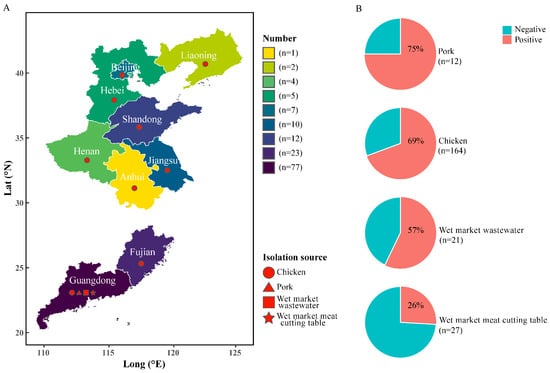
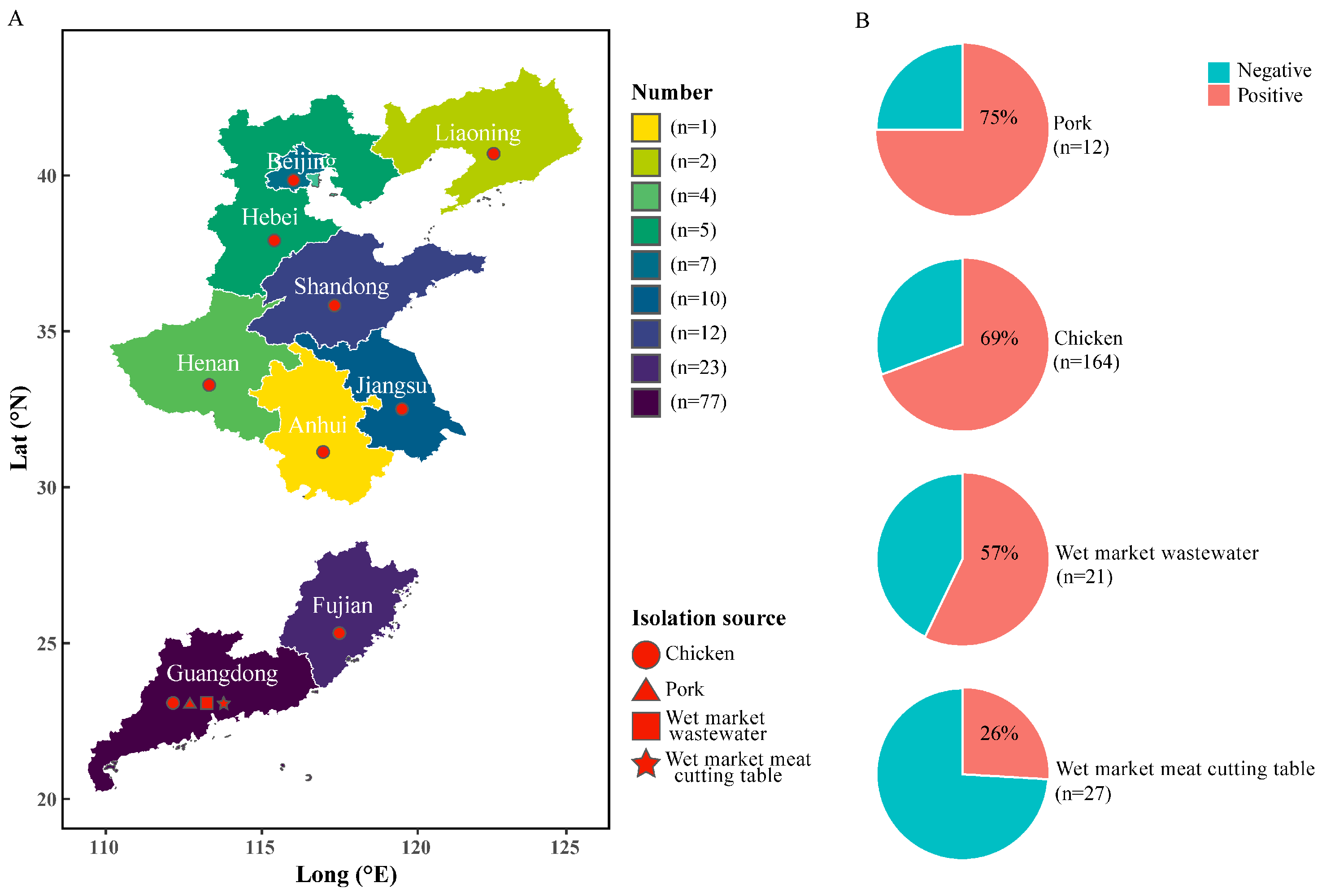
From 2022 to 2023, this study isolated a total of 141 Salmonella strains (Table S1) across nine provinces in China, including 77 from Guangdong, 23 from Fujian, 12 from Shandong, 10 from Jiangsu, 7 from Beijing, 5 from Hebei, 4 from Henan, 2 from Liaoning, and 1 from Anhui (Figure 1). Of these strains, 113 were isolated from chicken samples, including 106 from packaged chicken collected across various provinces and 7 from fresh chicken meat collected at wet markets in Guangzhou. The remaining strains came from pork (9 strains), meat cutting tables (7 strains), and wastewater (12 strains) samples collected from local wet markets in Guangzhou, Guangdong. The overall detection rate was 75% in pork samples (9/12), 69% in chicken samples (113/164), 57% in wet market wastewater samples (12/21), and 26% in wet market meat cutting table samples (7/27). Of the 122 positive meat samples, 66 (54.1%) had a contamination level of 0–10 MPN/g, while 32 (26.2%) had a contamination of 10–100 MPN/g. Additionally, 24 (19.7%) samples had a contamination level exceeding 100 MPN/g (Table S3).
Figure 1.
Source distribution and detection rates of Salmonella isolates. (A) Geographic source distribution of Salmonella isolates collected from nine provinces in China from 2022 to 2023. (B) Detection rates of Salmonella in different sample sources, including chicken, pork, wastewater, and meat cutting tables. n indicates the number of samples tested for each source.
3.2. Distribution of Salmonella Serovars and MLST
The distribution of serovars and MLST of the Salmonella isolates is shown in Table 1. In total, 19 serovars were identified among the 141 Salmonella strains (Table S1). Salmonella Enteritidis and Salmonella Infantis were the two most predominant serovars, accounting for 37.6% (n = 53) and 14.9% (n = 21) of the total strains, respectively. Other detected serovars included London (n = 13), Kentucky (n = 11), Rissen (n = 11), Indiana (n = 6), Agona (n = 4), Typhimurium (n = 4), 1,4,[5],12:i:- (n = 3), Newport (n = 3), Thompson (n = 3), I B:e,h:- (n = 2), Corvallis (n = 1), Goldcoast (n = 1), Mbandaka (n = 1), Muenster (n = 1), Schwarzengrund (n = 1), Stanley (n = 1), and Weltevreden (n = 1).
Table 1.
Distribution of Salmonella serovars and MLST.
Furthermore, S. Enteritidis and S. Infantis, both originating from chicken meat samples, were predominantly isolated from the Guangdong and Fujian provinces. In contrast, S. London and S. Rissen were isolated across all four sample types. A total of 21 MLST types were identified among the 141 Salmonella strains. Of these, S. Enteritidis was classified into two sequence types, ST11 and ST10481, while S. Kentucky was classified into ST198 and ST10418. The remaining serovars were each assigned to a single sequence type.
3.3. Antimicrobial Resistance and ARG Profiles in Salmonella
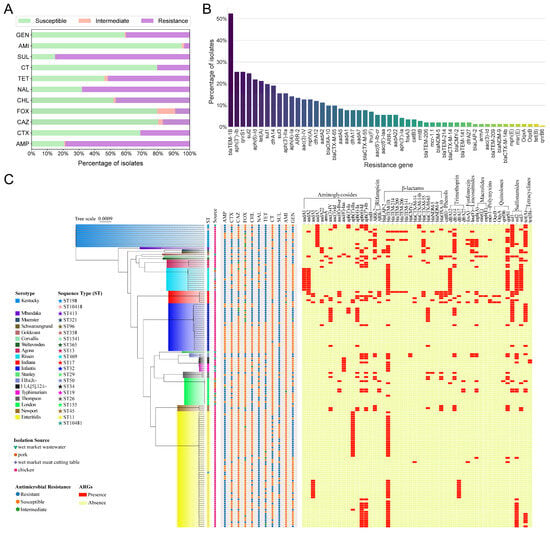
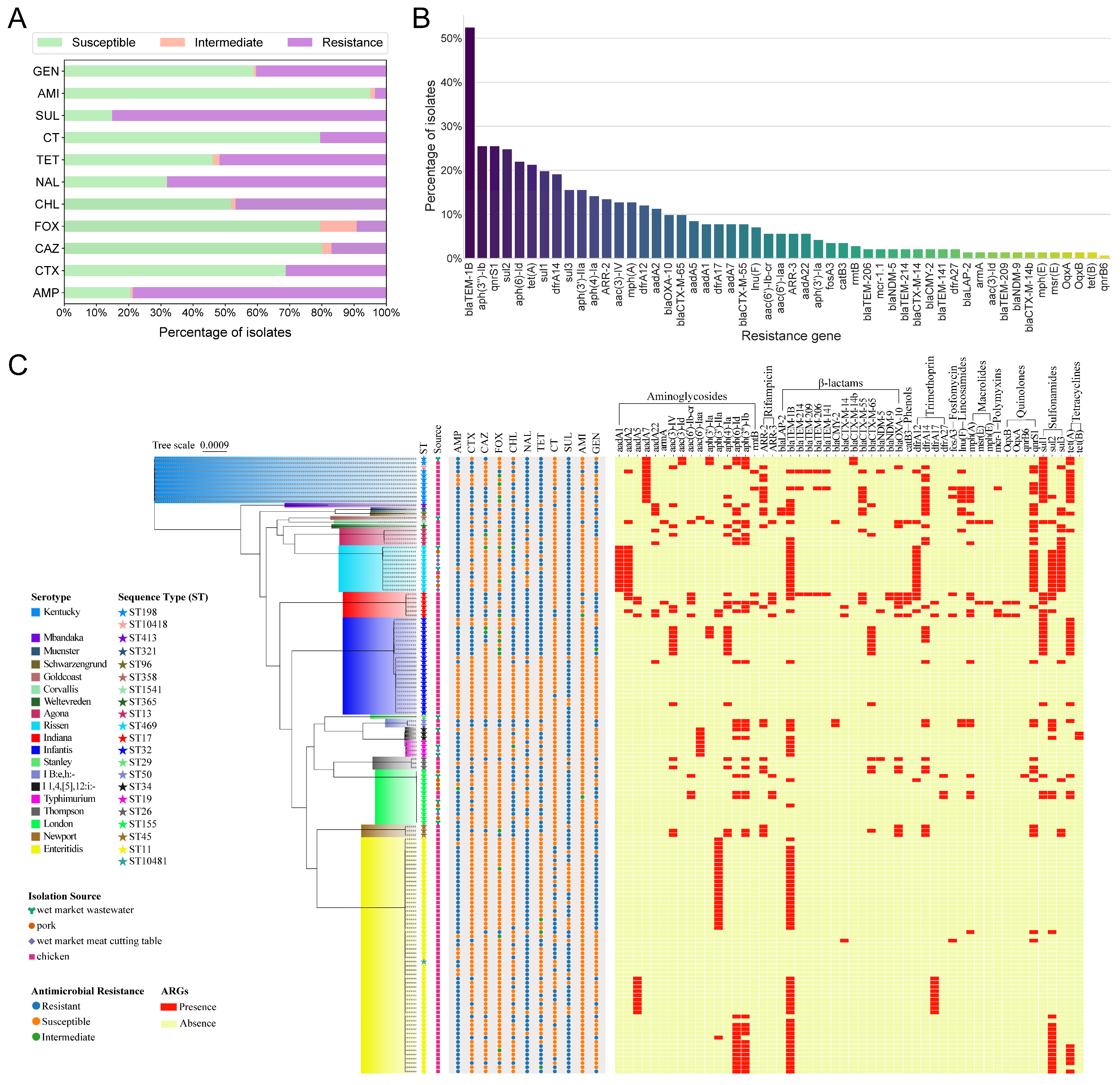
The results of antimicrobial susceptibility testing (Table S4) revealed that the Salmonella isolates exhibited the highest resistance to sulfamethoxazole (SUL) and ampicillin (AMP), with resistant strains accounting for approximately 85.1% and 78.7% of the total, respectively (Figure 2A). In contrast, the isolates demonstrated the greatest susceptibility to amikacin, with about 95.0% of strains remaining sensitive. Additionally, the isolates showed relatively high sensitivity to cephalosporin antibiotics, with approximately 68.8%, 80.1%, and 79.4% of strains being sensitive to cefotaxime (CTX), ceftazidime (CAZ), and cefoxitin (FOX), respectively (Figure 2A).
Figure 2.
Antimicrobial resistance and resistance gene profiles in Salmonella isolates. (A) Percentage of Salmonella isolates exhibiting resistance to 11 Antibiotics. (B) Prevalence of antimicrobial resistance genes in Salmonella isolates. (C) Antimicrobial resistance and the presence of resistance genes across different Salmonella serovars. The phylogenetic tree was constructed based on core gene alignments generated by Roary. AMP: ampicillin, CTX: cefotaxime, CAZ: ceftazidime, FOX: cefoxitin, CHL: chloramphenicol, NAL: nalidixic acid, TET: tetracycline, CT: colistin, SUL: sulfamethoxazole, AMI: amikacin, and GEN: gentamicin.
Additionally, this study analyzed the antimicrobial resistance gene profiles of all isolates based on whole-genome sequencing data (Figure 2B and Table S5). A total of 52 different resistance genes were identified. Among β-lactamase genes, blaTEM-1B was the most prevalent, accounting for 52.5%. For aminoglycoside resistance genes, aph(3′)-Ib accounted for the highest percentage at 25.5%. Two rifamycin-like resistance genes, ARR-2 and ARR-3, were present at percentages of approximately 13.5% and 5.7%, respectively. Among the four methicillin-like resistance genes, dfrA14 was the most common, comprising 19.1%. The macrolide resistance gene mph(A) had a prevalence of 12.8%. For quinolones, sulfonamides, and tetracyclines, the most frequently detected genes were qnrS1 (25.5%), sul2 (24.8%), and tet(A) (21.3%), respectively. Additionally, one resistance gene was identified for each of the following antimicrobial classes: caB3 (phenicols), fosA3 (fosfomycins), lun(F) (lincosamides), and mcr-1.1 (polymyxins).
Analysis of antimicrobial resistance and the presence of resistance genes across various Salmonella serovars revealed that most isolates exhibited multidrug resistance (Figure 2C). Interestingly, six S. Indiana isolates exhibited consistent resistance to six antibiotics: ampicillin, cefotaxime, chloramphenicol, nalidixic acid, tetracycline, and sulfamethoxazole. These S. Indiana isolates also carried a wide variety of resistance genes. Eleven isolates of S. Kentucky were resistant to nalidixic acid, tetracycline, and sulfamethoxazole, with all strains harboring the aadA7 and sul1 resistance genes. S. Enteritidis strains displayed higher resistance rates to ampicillin and nalidixic acid but exhibited low resistance gene diversity, predominantly carrying aph(3′)-IIa and blaTEM-1B. More than half of the S. Infantis strains were susceptible to ten antibiotics, with the exception of sulfamethoxazole, and some did not carry any resistance genes. Furthermore, all S. Rissen isolates, collected from multiple sources, consistently carried aadA1, aadA2, blaTEM-1B, dfrA12, and sul3 resistance genes.
Correlation analysis between phenotypic resistance and ARGs revealed several strong and statistically significant associations (|Phi| > 0.4, p < 0.05) (Table S6). The strongest was rmtB with amikacin resistance (Phi = 0.89, p < 0.001). Several blaTEM variants, mph(E), msr(E), and armA also correlated with amikacin resistance (Phi = 0.63–0.77, p < 0.001). blaCTX-M-55 showed strong associations with ceftazidime and cefotaxime resistance (Phi = 0.43–0.57, p < 0.001), while blaNDM-5 and blaCMY-2 correlated with cefoxitin resistance (Phi = 0.46, p < 0.001). Additional significant correlations (Phi > 0.4, p < 0.001) were found between tet(A) and tetracycline, sul1 with tetracycline and cefotaxime, aph(3′)-IIa with gentamicin, and blaTEM-1B with ampicillin.
3.4. Identification of Plasmids in the Salmonella Isolates
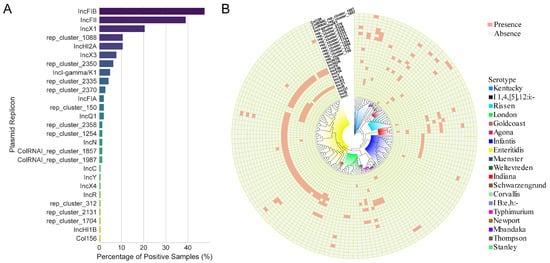
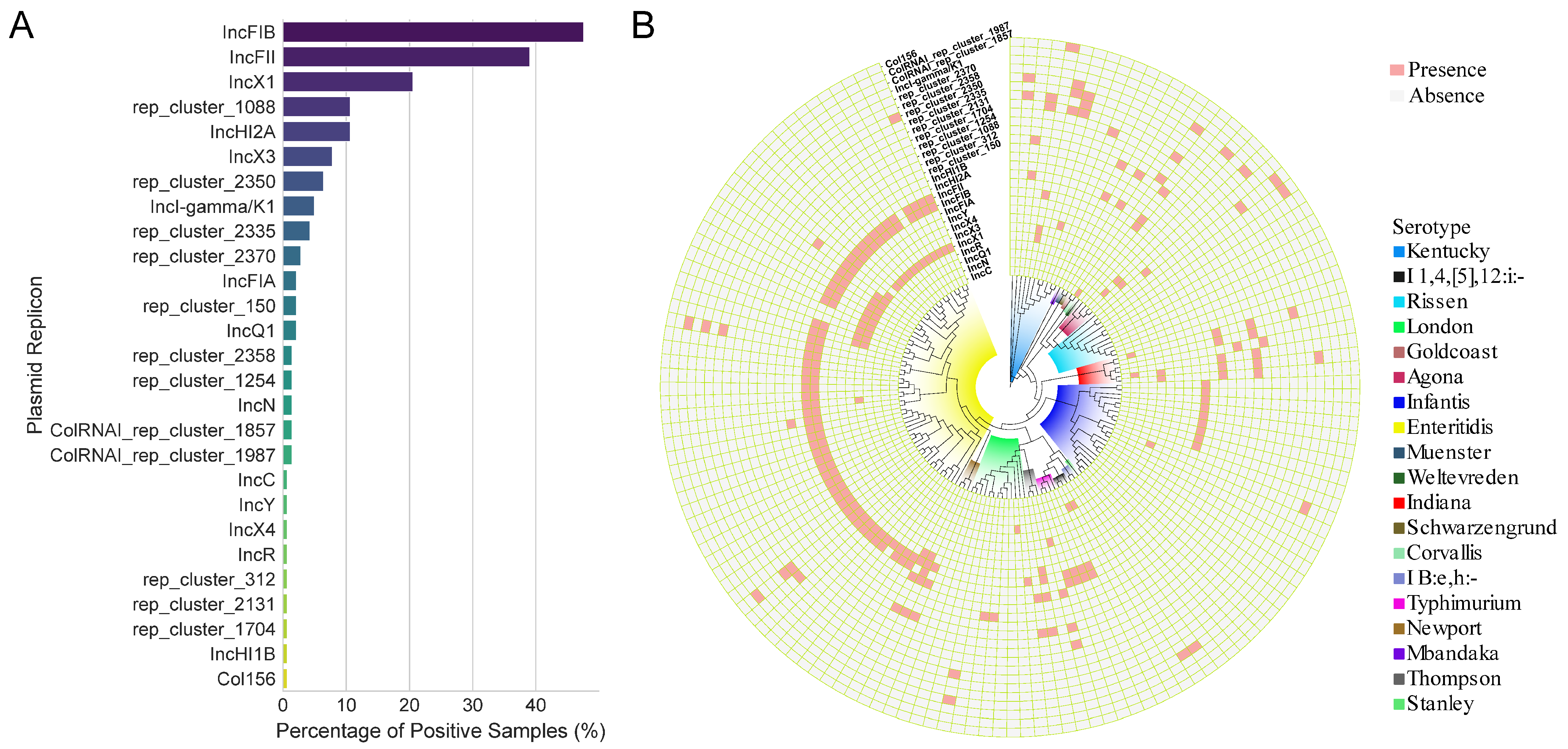
Whole-genome sequences of 141 Salmonella strains were analyzed to identify plasmids and assess their carriage within the isolates (Figure 3A and Table S7). The assembled genomes were evaluated using CheckM to confirm completeness and the absence of contamination (Table S8). A total of 27 plasmids with identified replicon types were detected. The three most frequent replicon types were IncFIB, IncFII, and IncX1, accounting for 47.5%, 39.0%, and 20.6% of the strains, respectively. The presence of plasmids of different Salmonella serovars was analyzed (Figure 3B). The results showed that the three replicon types, IncFIB, IncFII, and IncX1, were predominantly present in S. Enteritidis strains. In addition, the IncFIB plasmid was detected in nine of the 23 S. Infantis strains. The IncFIB and IncFII plasmids were identified in all four S. Typhimurium strains. Interestingly, no plasmid replicon types were detected in the S. Rissen strains.
Figure 3.
The identification of plasmid replicon types in Salmonella isolates. (A) Percentage of plasmid replicon types identified in Salmonella isolates. (B) Presence of plasmid replicon types across different Salmonella serovars.
3.5. Characterization of ARG-Containing Plasmids and Mobility Prediction
To investigate whether antimicrobial resistance genes in different Salmonella serovars were plasmid-borne and to predict their mobility, plasmid prediction was performed using MOB-suite, which characterized the associated relaxase types, mating pair formation (MPF) systems, and origins of transfer (oriT) potentially involved in plasmid-mediated transfer. As shown in Table 2, plasmid-associated ARGs were identified within the predicted plasmid replicon sequences of eight Salmonella serovars.
Table 2.
Plasmid replicon types, associated ARGs, and predicted mobility in Salmonella isolates.
Among these plasmids, only one relaxase type (MOBP) and three conjugative systems (MPF_F, MPF_T, and MPF_I) were present. Two types of origins of transfer, MOBP and MOBF, were also detected. In S. Enteritidis, ARGs were distributed across four plasmid replicon types (IncX1, IncX3, IncFIB, and IncFII), most of which were classified as conjugative or mobilizable plasmids. Notably, the mcr-1.1 gene was identified on a conjugative IncX4 plasmid in one S. Kentucky isolate. Additionally, the qnrS1 gene was detected on mobilizable plasmids in one S. Agona isolate and one S. Corvallis isolate. For S. London, S. Indiana, and S. 1,4,[5],12:i:-, although ARGs were identified within replicon-predicted plasmid sequences, no relaxase, MPF system, nor oriT were detected.
3.6. Estimation of Divergence Times for cgMLST HierCC Clusters of Salmonella Isolates
To investigate the evolutionary relationships and transmission routes of Salmonella isolates from different regions of China, 11 HC20 and 15 HC50 clusters associated with our strains were selected based on their suitability for phylodynamic analysis to infer divergence times of related isolates (Table 3). As shown in Table 3, a majority of the analyzed cgMLST HierCC clusters (19/26) exhibited an R2 ≥ 0.4, indicating a strong temporal signal. Seven clusters fell below the 0.4 threshold (e.g., S. Enteritidis HC20-374, S. Infantis HC50-36, and S. London HC50-37), suggesting weak or absent temporal structure for those lineages. These results demonstrated that most selected clusters possessed a sufficient temporal signal to support reliable estimation of divergence time.
Table 3.
HierCC clustering of Salmonella isolates and estimation of divergence times.
Among all clusters, S. Typhimurium HC50-2304 demonstrated a strong temporal signal, with an R2 as high as 0.90. S. Weltevreden HC50-314 exhibited the earliest estimated divergence time, with an inferred MRCA in 1897 and a corresponding R2 value of 0.63. The latest inferred MRCA across all clusters was observed in S. Infantis HC20-343, dated to 2008, with an R2 of 0.73. In the 16 cgMLST HierCC clusters with strong temporal signals (R2 ≥ 0.4), five clusters—Enteritidis HC50-87 and HC20-87, Agona HC20-419 and HC50-29, and Muenster (HC50-47)—were estimated to have diverged in the mid-20th century (1940–1969), reflecting long-standing and persistent Salmonella lineages. The largest group, comprising eight clusters of diverse serovars, including Kentucky, Rissen, Indiana, Typhimurium, 1,4,[5],12:i:-, Newport, Thompson, and Corvallis, was estimated to have emerged during the late 20th century (1970–1999), suggesting extensive diversification of Salmonella lineages during this period. Finally, three clusters (Enteritidis HC20-7228, HC20-10145, and Infantis HC20-343) showed more recent divergence in the early 21st century (2000 onward), suggesting ongoing expansion and recent emergence of these lineages.
3.7. Phylodynamic Analysis for cgMLST HierCC Clusters of Salmonella Isolates
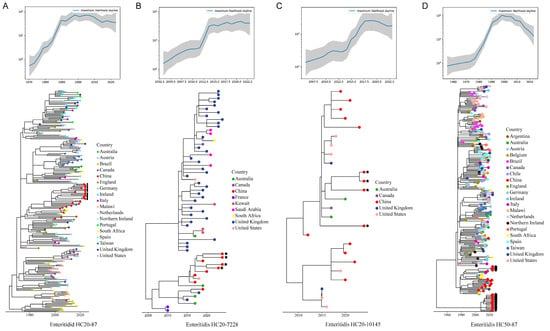
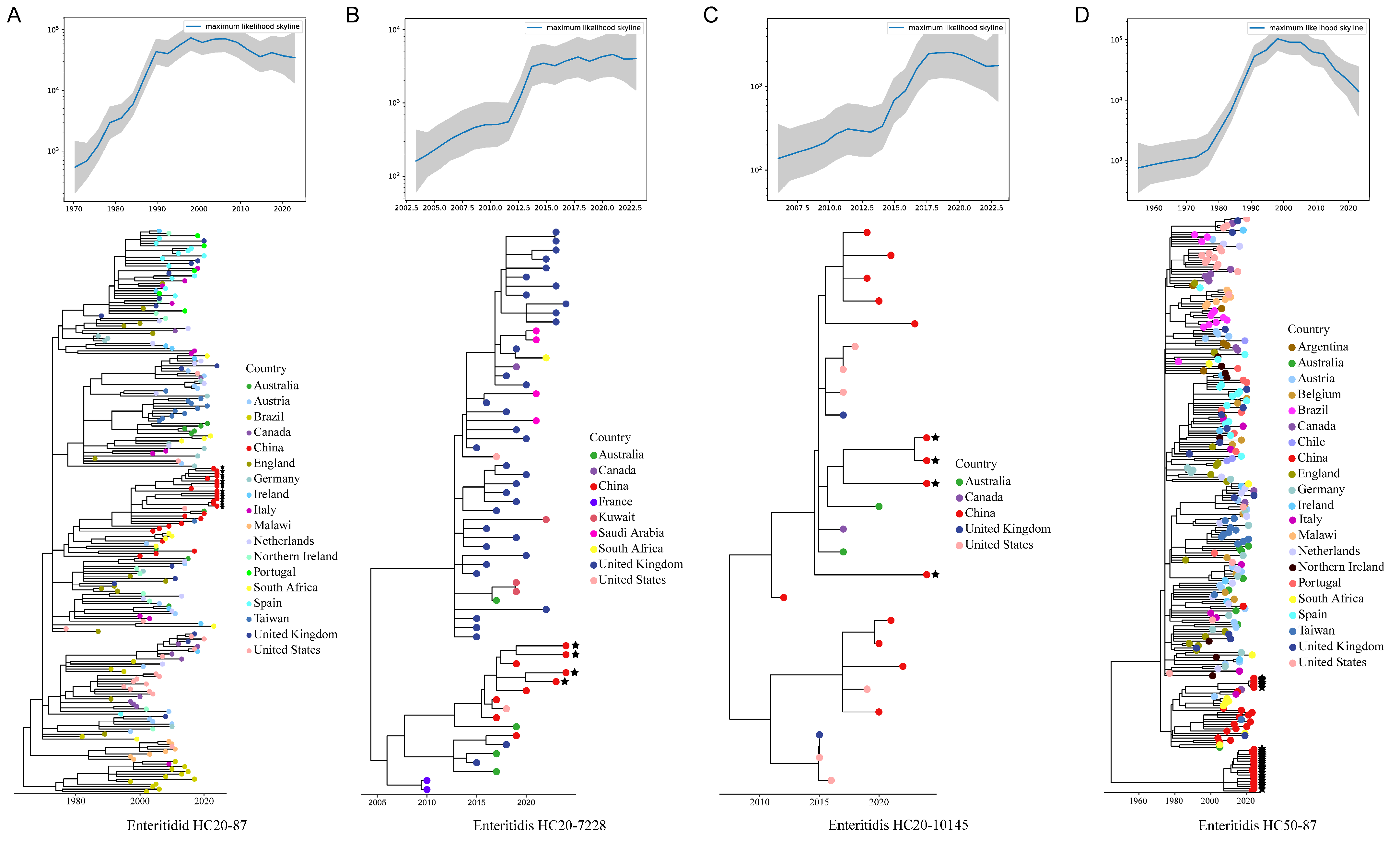
Phylodynamic analysis was conducted on the selected HC20/HC50 clusters to investigate the evolutionary relationships and transmission dynamics of Salmonella isolates examined in this study. As shown in Figure 4A, 14 sequenced S. Enteritidis isolates clustered within HC20-87, which diverged around 1963 (R2 = 0.68; Table 3). The effective population size of this lineage increased from 1970 to 2000 and stabilized thereafter. Interestingly, all Chinese strains fell within a single clade, comprising sequenced isolates from various provinces, including Guangdong, Shandong, Hebei, Jiangsu, Beijing, and Fujian. These were phylogenetically related to several strains from South Africa, Malawi, and Australia. Four sequenced S. Enteritidis isolates (from Guangdong and Liaoning) clustered within the HC20-7228 cluster (Figure 4B), which diverged into two major clades predominantly composed of isolates from China and the UK, with an MRCA estimated around 2005 (R2 = 0.74; Table 3). Its effective population size increased from 2002 and stabilized after 2015. The phylogeny of this cluster further revealed that the sequenced strains shared recent common ancestry with a US isolate from 2017. Another associated S. Enteritidis cluster, HC20-10145 (Figure 4C), was estimated to have diverged around 2004 (R2 = 0.78; Table 3), with an increasing trend in effective population size until 2017. This cluster comprised relatively few strains, most of which were from China. The sequenced strains (from Henan, Beijing, and Guangdong) shared recent common ancestry with strains from other regions of China, Australia, the UK, and the US. Notably, all the aforementioned S. Enteritidis clusters were nested within the broader HC50-87 cluster (Figure 4D), which diverged around 1952 (R2 = 0.67; Table 3). Additionally, the HC50-87 cluster also included HC20-5389, which comprised 19 additional sequenced strains from this study (mostly from Fujian, Guangdong, and Beijing) and other isolates predominantly of Chinese origin.
Figure 4.
Ancestral sequence reconstruction and effective population size dynamics of (A) S. Entertidis HC20-87, (B) S. Entertidis HC20-7228, (C) S. Entertidis HC20-10145, and (D) S. Entertidis HC50-87. Red circles with star symbols indicate isolates from this study.
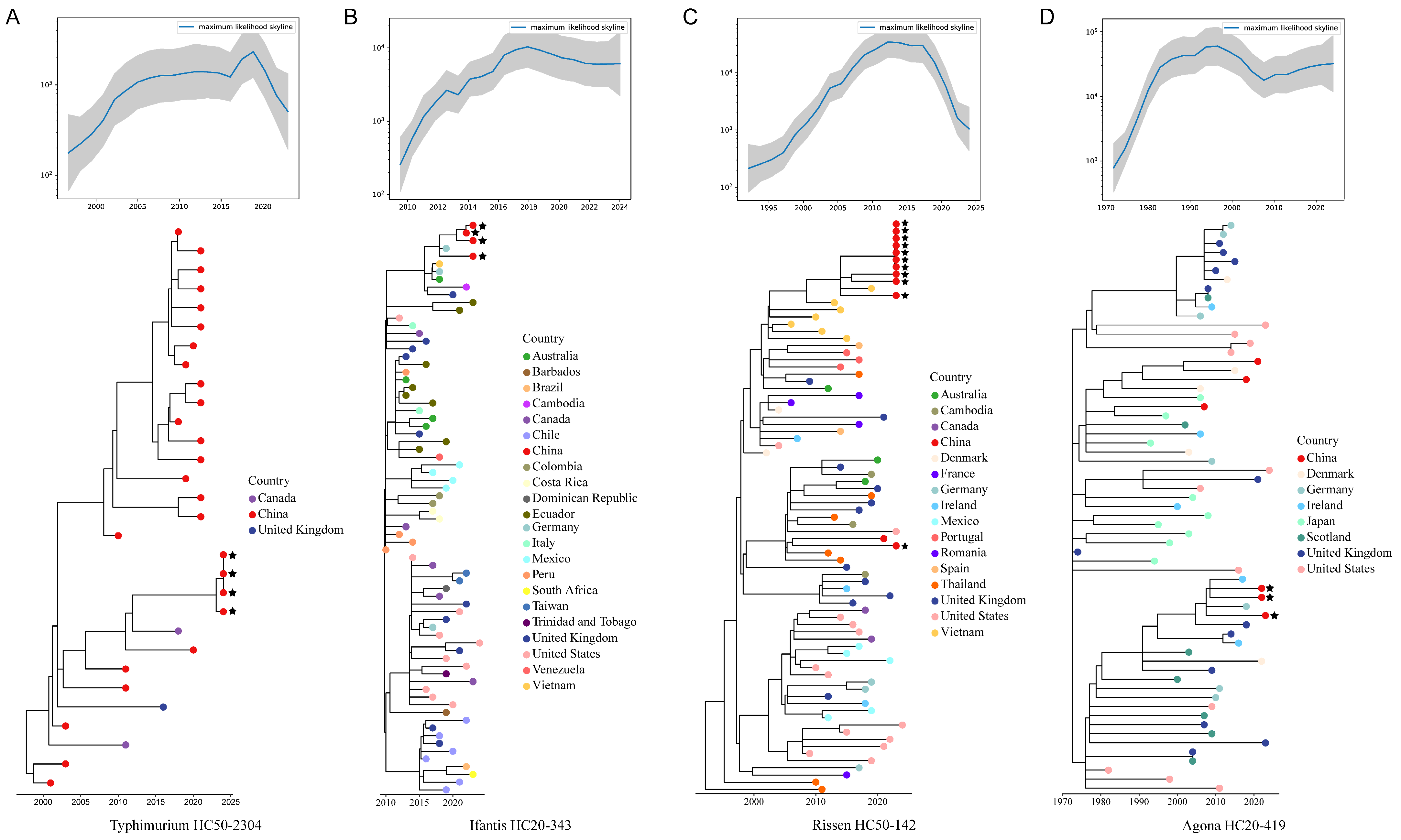
Four sequenced S. Typhimurium isolates (all from Guangdong) clustered within HC50-2304, which exhibited the strongest temporal signal among all clusters (R2 = 0.90; Table 3). Despite clustering at the HC50 level, this group contains few isolates in the database, nearly all originating from China. As shown in Figure 5A, these strains shared recent common ancestry with three isolates from Canada and the UK. HC50-2304 likely represents a recently emerged, China-specific lineage, post-2000, and warrants further investigation.
Figure 5.
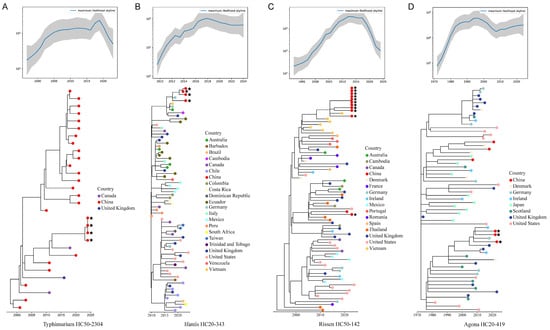
Ancestral sequence reconstruction and effective population size dynamics of (A) S. Typhimurium HC50-2304, (B) S. Infantis HC20-343, (C) S. Rissen HC50-142, and (D) S. Agona HC20-419. Red circles with star symbols indicate isolates from this study.
Among all HierCC clusters, S. Infantis HC20-343 exhibited the most recent divergence time, estimated around 2008 (R2 = 0.73; Table 3). Four strains from this study (from Guangdong and Jiangsu) clustered within the same evolutionary branch, closely related to a German isolate from 2019 (Figure 5B). Notably, these four were the only Chinese strains presented in the HC20-343 phylogeny.
All 11 sequenced S. Rissen isolates (all from Guangdong) belonged to the HC50-142 cluster, which diverged around 1983 (R2 = 0.68; Table 3). As shown in Figure 5C, the effective population size of this cluster has declined since 2015. Ten of the sequenced strains clustered within the same evolutionary branch and shared recent common ancestry with isolates from Vietnam, while the remaining strain was more closely related to a 2011 isolate from Thailand.
Three sequenced S. Agona isolates from this study (all from Guangdong) clustered within HC20-419, which diverged around 1967 (R2 = 0.77; Table 3). As shown in Figure 5D, this cluster experienced rapid population expansion in the late 20th century, stabilizing around 2005. The sequenced strains were closely related to isolates from Ireland (2010) and Germany (2015), forming a clade primarily composed of isolates from European countries. The HC20-419 strains, together with another S. Agona strain belonging to HC20-375395, were nested within HC50-29, with an estimated divergence time of 1942 (R2 = 0.64; Table 3).
Other associated HierCC clusters with strong temporal signals (R2 > 0.6) included S. Schwarzengrund HC50-54 (MRCA = 1936, R2 = 0.72) and S. Weltevreden HC50-314 (MRCA = 1897, R2 = 0.54). Each of these clusters contained only one isolate from this study and included isolates from multiple countries (Table S2), suggesting broader geographic distribution. Both clusters exhibited older divergence times, indicating they may represent long-established global lineages.
4. Discussion
Our study highlights the prevalence, antimicrobial resistance, and dissemination of circulating Salmonella serovars in meat products in China. To build on these findings, systematic, multi-year surveillance across diverse food matrices and regions is needed to better capture geographic variation and transmission pathways. Monitoring emerging lineages of Salmonella is essential due to their potential multidrug resistance and public health impact. Strengthening integrated One Health approaches that link human, animal, livestock products, and environmental surveillance is crucial to further curb the spread of Salmonella and antimicrobial resistance and to better inform food safety policies.
The dissemination and prevalence of major Salmonella serovars remain a significant public health and food safety concern globally. In China, S. Enteritidis and S. Typhimurium have historically been the most prevalent serovars. Wang et al. [42] reported the isolation of over 30,000 Salmonella strains across China from 2006 to 2019, including more than 20,000 from human clinical samples, with S. Enteritidis and S. Typhimurium identified as the predominant serovars. In the present study, chicken samples collected from multiple regions in China from 2022 to 2023 revealed S. Enteritidis and S. Infantis as the dominant serovars. This finding was consistent with the report by Zhao et al. [43], who investigated the prevalence of Salmonella in broiler farms, slaughterhouses, and markets in Shandong Province of China in 2022. These results indicated that, while S. Enteritidis remains a predominant serovar, S. Infantis is increasingly prevalent, particularly among poultry-derived isolates in China.
The Salmonella isolated in this study exhibited high resistance rates to sulfamethoxazole (~85%) and ampicillin (~79%) (Figure 2A), consistent with the findings of Zhao et al. [43]. Notably, discrepancies were observed between the results of antimicrobial susceptibility testing and the presence of corresponding antimicrobial resistance genes. For instance, while most isolates were phenotypically resistant to sulfamethoxazole, not all harbored known sulfonamide resistance genes (e.g., sul1, sul2, or sul3). This suggests that antimicrobial resistance is influenced by factors beyond the presence of currently recognized resistance genes. Schrader et al. [44] described this discrepancy as phenotypic resistance, which is often associated with bacterial states such as tolerance, persistence, or heteroresistance. Balaban et al. [45] suggested that this phenomenon may be related to the metabolic state of the bacterial cells. These findings highlight the importance of considering both genotypic and phenotypic mechanisms when investigating antimicrobial resistance.
Three plasmid replicon types, IncFIB, IncFII, and IncX1, were the most frequently detected, predominantly among S. Enteritidis isolates. These plasmids carried multiple clinically relevant ARGs such as blaTEM-1B, sul2, tet(A), and qnrS1. Notably, mobility prediction indicated that many of these plasmids were either conjugative or mobilizable (Table 2), suggesting a significant risk for the horizontal dissemination of antimicrobial resistance. These findings are consistent with previous reports [46,47,48] about the prevalence and resistance profiles of Salmonella isolates from meat products across various regions of China, in which IncFIB, IncFII, and IncX1 plasmids were frequently identified as key carriers of antimicrobial resistance determinants.
Plasmids can be classified as conjugative, mobilizable, or non-mobilizable based on the presence of key mobility determinants—relaxase, mating pair formation (MPF) systems, and origin of transfer (oriT)—which are critical for mediating plasmid transfer [33]. Most conjugative plasmids in our dataset encoded all essential components required for autonomous plasmid transfer between bacterial cells. For example, the IncX1, IncX3, IncFIB, and IncFII plasmids identified in S. Enteritidis were predominantly classified as conjugative (Table 2). In contrast, strains identified with mobilizable plasmids, such as S. Corvallis and S. Agona, lacked MPF components and thus require a co-resident conjugative plasmid to mediate their transfer via the MPF-encoded channel [49]. In our study, plasmids in S. Indiana, S. 1,4,[5],12:i:-, and S. London were classified as non-mobilizable, suggesting a lack of essential components for conjugative transfer. Notably, colistin resistance genes of the mcr family were identified in colistin-resistant S. Kentucky and S. Indiana isolates (Figure 2C). In S. Kentucky, the mcr-1.1 gene was located on a conjugative IncX4 plasmid (Table 2). The presence of mcr-1-bearing IncX4 plasmids has also been reported in other Salmonella serovars, including S. Typhimurium [50] and S. Infantis [51], raising serious concern due to their role in promoting the spread of resistance to colistin and other antimicrobials. Among two S. Indiana isolates harboring mcr-1.1, the gene was located on predicted plasmid sequences; however, the replicon types of these plasmids could not be determined. Notably, mcr-1-carrying plasmids have also been identified in S. Indiana isolates from retail chicken meats [52] and poultry slaughterhouses [53] in China. These findings suggest that conjugative or mobilizable plasmids harboring clinically relevant ARGs in Salmonella isolates are circulating across various regions of China. This underscores the need for further investigation and enhanced surveillance of such plasmids to better understand the horizontal transmission of resistance genes.
In our study, the sequenced strains were initially analyzed using cgMLST typing and HierCC clustering to identify closely related isolates from the database. A core SNP-based phylogenetic tree was then constructed to infer transmission routes, while divergence times and the most recent common ancestor of each HierCC cluster were estimated through phylodynamic analysis. Interestingly, the majority of identified clusters exhibited divergence in the late 20th century (Table 3), likely coinciding with the rise of industrialized poultry farming in China. Although China has a long agricultural history, farming was predominantly small-scale and backyard-based until the late 1970s [54]. The onset of industrialization prompted a rapid transition to intensive, large-scale poultry production, a development that has been linked to the global dissemination of Salmonella [19].
Specifically, the most prevalent Salmonella population identified in this study, S. Enteritidis HC50-87 (Figure 4D), represents a historically persistent population (MRCA = 1952) that has spread globally. Our results further revealed several emerging localized S. Enteritidis populations in China, including HC20-7228 and HC20-10145 (Figure 4B,C), with divergence times after 2000. S. Enteritidis HC50-87 is a subpopulation of ST11, which is currently the most common genotype associated with S. Enteritidis isolates. This lineage has been reported to carry IncX1, IncFIB, and IncFII plasmids linked to MDR, including clinically relevant ARGs such as blaCTX-M and dfrA17 [55], both of which were also detected in this study. S. Agona HC20-419 (Figure 5D) also appears to be a persistent population (MRCA = 1967), predominantly composed of isolates from European countries, particularly the United Kingdom [56]. The S. Agona HC20-419 strains identified in this study warrant special attention, as they were found to be multidrug-resistant, carrying plasmids harboring multiple ARGs, including blaCTX-M, qnrS1, sul3, and tet(A)—potentially acquired through horizontal gene transfer during transmission [57].
S. Typhimurium HC50-2304 (Figure 5A) is a newly expanding population that diverged around 2000 and appears to be specifically associated with isolates from China. In addition to the Guangdong isolates collected in this study, it also included strains from multiple provinces, such as Shanghai, Zhejiang, and Shanxi. S. Infantis HC20-343 (Figure 5B) is another newly emerged lineage (MRCA = 2008) that warrants attention. Although HC20-343 isolates were widespread globally, only four strains from China were identified—all of which were collected in this study from Guangdong and Jiangsu. Notably, the four isolates all carried a pESI-like plasmid (Tables S5 and S7), which has raised increasing global concern due to its carriage of multiple clinically relevant ARGs, including blaCTX-M, aph(3′)-Ia, dfrA14, floR, sul1, and tet(A) [58]. These emerging lineages warrant further attention due to their geographic spread and potential public health relevance.
Apart from chicken meat, S. Rissen HC50-142 (Figure 5C) was frequently detected in pork products and meat cutting tables from wet markets in Guangzhou, China. S. Rissen is one of the important Salmonella serovars linked with swine products in numerous countries and is commonly associated with food contamination along the swine production chain. A recent study has reported the widespread dissemination of antimicrobial resistance in S. Rissen in China [59]. Strains classified as S. Weltevreden HC50-314 shared a recent common ancestor with Philippine strains (Table S2). This aligns with findings by Li et al. [60], who reported strong phylogenetic relatedness between S. Weltevreden strains from southern coastal China and Southeast Asia. In recent years, S. Weltevreden has attracted increasing attention in South and Southeast Asia, particularly due to its association with zoonotic infections via contaminated seafood [61,62].
The observed temporal patterns highlight the robustness of our phylodynamic framework in capturing both the historical persistence and recent emergence of Salmonella populations. However, strains classified as S. Infantis HC50-36, S. London HC50-37, and S. Goldcoast HC20-13193 exhibited weak temporal signals, likely due to the under-representativeness of collected isolates over their extended evolutionary histories. These findings underscore the need for sustained and coordinated efforts to enhance surveillance strategies for Salmonella and other pathogenic bacteria.
Several limitations of this study should be acknowledged. First, the origin of the samples was heterogeneous in both location and source, which may partially bias the observed prevalence of Salmonella serovars across China. Second, the two-year sampling period may not fully capture seasonal or annual variations in Salmonella prevalence, limiting the ability to generalize the findings over longer time scales. Finally, the reliance on short-read sequencing may limit the resolution of certain plasmids or mobile genetic elements carrying antimicrobial resistance genes, as these regions may not be fully sequenced.
5. Conclusions
This study provides a comprehensive overview of Salmonella prevalence, antimicrobial resistance, plasmid carriage, and evolutionary dynamics across multiple provinces in China. S. Enteritidis and S. Infantis were the dominant serovars among the collected isolates, with high rates of resistance to sulfamethoxazole and ampicillin. Conjugative and mobilizable plasmids carrying clinically relevant ARGs, including blaCTX-M, qnrS1, sul2, and mcr-1.1, were frequently detected, highlighting the risk of horizontal gene transfer. Phylodynamic analysis revealed both historically persistent and recently emerging Salmonella lineages, emphasizing the need for continued surveillance. These findings underscore the importance of integrated monitoring and targeted interventions to control the dissemination of Salmonella and multidrug resistance.
Supplementary Materials
The following supporting information can be downloaded at: https://www.mdpi.com/article/10.3390/microorganisms14010191/s1, Table S1: Accession numbers of sequenced Salmonella isolates; Table S2: Accession numbers of publicly available Salmonella isolates analyzed; Table S3: MPN of Salmonella isolates; Table S4: Antimicrobial resistance of Salmonella isolates; Table S5: Antimicrobial resistance genes of Salmonella isolates; Table S6: Correlations between antibiotic resistance phenotypes and antimicrobial resistance genes; Table S7: Plasmid replicon types of Salmonella isolates. Table S8: Completeness and contamination assessment of assembled Salmonella genomes.
Author Contributions
Conceptualization, S.L., H.Z. and Q.L.; Data curation, W.Y. and Y.Y.; Formal analysis, S.L., W.Y. and Y.Y.; Funding acquisition, S.L. and H.Z.; Investigation, W.Y., Y.Y., T.Z., J.J., M.C. and Y.Z.; Methodology, S.L., Y.Y., H.Z. and Q.L.; Project administration, S.L. and H.Z.; Resources, H.Z. and Q.L.; Software, S.L., W.Y. and Y.Y.; Supervision, S.L. and H.Z.; Visualization, S.L., W.Y. and Y.Y.; Writing—original draft, S.L., W.Y. and Y.Y.; Writing—review and editing, S.L., H.Z. and Q.L. All authors have read and agreed to the published version of the manuscript.
Funding
This research was funded by the National Natural Science Foundation of China, grant number 32202186, and the Natural Science Foundation of Guangdong Province, China, grant numbers 2024A1515012086 and 2025A1515012134.
Institutional Review Board Statement
Not applicable.
Informed Consent Statement
Not applicable.
Data Availability Statement
The original contributions presented in this study are included in the article and Supplementary Materials. Further inquiries can be directed to the corresponding authors.
Conflicts of Interest
The authors declare no conflicts of interest.
References
- Ferrari, R.G.; Rosario, D.K.; Cunha-Neto, A.; Mano, S.B.; Figueiredo, E.E.; Conte-Junior, C.A. Worldwide epidemiology of Salmonella serovars in animal-based foods: A meta-analysis. Appl. Environ. Microbiol. 2019, 85, e00591-19. [Google Scholar] [CrossRef] [Scilit]
- Aslam, M.; Checkley, S.; Avery, B.; Chalmers, G.; Bohaychuk, V.; Gensler, G.; Reid-Smith, R.; Boerlin, P. Phenotypic and genetic characterization of antimicrobial resistance in Salmonella serovars isolated from retail meats in Alberta, Canada. Food Microbiol. 2012, 32, 110–117. [Google Scholar] [CrossRef] [Scilit]
- Zhong, S.; Feng, S.; Li, J.; Zhou, Q.; Chen, Z.; Xu, L.; Liu, F.; Ma, C.; Hu, S.; Pan, Y. Investigation on Serotype, Drug Resistance and Drug Resistance Gene of Salmonella in Livestock and Poultry Products of Guangxi. China Anim. Husb. Vet. Med. 2018, 45, 770–780. [Google Scholar] [CrossRef]
- Li, Q.; Fan, Y.; Song, M.; Qin, F.; Liu, H.; Yang, M. Monitoring results of Listeria monocytogenes and Salmonella in fresh meat samples at retail in Shanghai city. J. Food Saf. Qual. 2020, 11, 9016–9020. [Google Scholar] [CrossRef]
- Wang, X.; Zhao, C.; Kang, Q.; Du, T.; Li, P.; Du, X.; Wang, S. Study on the gene typing of Salmonella from chickens in Tianjin. J. Food Saf. Qual. 2022, 13, 4487–4493. [Google Scholar] [CrossRef]
- Fu, H.; Liu, L.; Yao, Z.; Wang, Y. Isolation, identification and characterization of Salmonella from a parental breeder farm of white broiler and its commercial chickens in northern Jiangsu. Microbiol. China 2020, 47, 4105–4112. [Google Scholar] [CrossRef]
- Pornsukarom, S.; Van Vliet, A.H.; Thakur, S. Whole genome sequencing analysis of multiple Salmonella serovars provides insights into phylogenetic relatedness, antimicrobial resistance, and virulence markers across humans, food animals and agriculture environmental sources. BMC Genom. 2018, 19, 801. [Google Scholar] [CrossRef] [Scilit]
- Deng, X.; den Bakker, H.C.; Hendriksen, R.S. Genomic Epidemiology: Whole-Genome-Sequencing-Powered Surveillance and Outbreak Investigation of Foodborne Bacterial Pathogens. Annu. Rev. Food Sci. Technol. 2016, 7, 353–374. [Google Scholar] [CrossRef] [Scilit]
- Jagadeesan, B.; Gerner-Smidt, P.; Allard, M.W.; Leuillet, S.; Winkler, A.; Xiao, Y.; Chaffron, S.; Van Der Vossen, J.; Tang, S.; Katase, M. The use of next generation sequencing for improving food safety: Translation into practice. Food Microbiol. 2019, 79, 96–115. [Google Scholar] [CrossRef] [Scilit]
- Zhou, Z.; Alikhan, N.F.; Sergeant, M.J.; Luhmann, N.; Vaz, C.; Francisco, A.P.; Carriço, J.A.; Achtman, M. GrapeTree: Visualization of core genomic relationships among 100,000 bacterial pathogens. Genome Res. 2018, 28, 1395–1404. [Google Scholar] [CrossRef] [Scilit]
- Dyer, N.P.; Päuker, B.; Baxter, L.; Gupta, A.; Bunk, B.; Overmann, J.; Diricks, M.; Dreyer, V.; Niemann, S.; Holt, K.E. EnteroBase in 2025: Exploring the genomic epidemiology of bacterial pathogens. Nucleic Acids Res. 2025, 53, D757–D762. [Google Scholar] [CrossRef] [Scilit]
- Sayers, E.W.; Beck, J.; Bolton, E.E.; Bourexis, D.; Brister, J.R.; Canese, K.; Comeau, D.C.; Funk, K.; Kim, S.; Klimke, W. Database resources of the national center for biotechnology information. Nucleic Acids Res. 2021, 49, D10–D17. [Google Scholar] [CrossRef] [Scilit] [PubMed]
- Tang, B.; Elbediwi, M.; Nambiar, R.B.; Yang, H.; Lin, J.; Yue, M. Genomic Characterization of Antimicrobial-Resistant Salmonella enterica in Duck, Chicken, and Pig Farms and Retail Markets in Eastern China. Microbiol. Spectr. 2022, 10, e01257-22. [Google Scholar] [CrossRef] [Scilit] [PubMed]
- Wang, Z.; Zhang, J.; Liu, S.; Zhang, Y.; Chen, C.; Xu, M.; Zhu, Y.; Chen, B.; Zhou, W.; Cui, S. Prevalence, antimicrobial resistance, and genotype diversity of Salmonella isolates recovered from retail meat in Hebei Province, China. Int. J. Food Microbiol. 2022, 364, 109515. [Google Scholar] [CrossRef] [Scilit] [PubMed]
- Zeng, H.; Yang, D.; Huang, N.; Li, Y.; Chen, J.; Yu, Z.; Tang, J.; Jiang, Z. Prevalence and Antimicrobial Susceptibility of Salmonella in Retail Meat Collected from Different Markets in Sichuan, China. Pathogens 2025, 14, 222. [Google Scholar] [CrossRef] [Scilit]
- Sheng, H.; Suo, J.; Dai, J.; Wang, S.; Li, M.; Su, L.; Cao, M.; Cao, Y.; Chen, J.; Cui, S. Prevalence, antibiotic susceptibility and genomic analysis of Salmonella from retail meats in Shaanxi, China. Int. J. Food Microbiol. 2023, 403, 110305. [Google Scholar] [CrossRef] [Scilit]
- Zhang, H.; Zhou, G.; Yang, C.; Nychas, G.-J.E.; Zhang, Y.; Mao, Y. The prevalence, distribution, and diversity of Salmonella isolated from pork slaughtering processors and retail outlets in the Shandong Province of China. Meat Sci. 2025, 221, 109734. [Google Scholar] [CrossRef] [Scilit]
- Li, H.; Wu, Y.; Feng, D.; Jiang, Q.; Li, S.; Rong, J.; Zhong, L.; Methner, U.; Baxter, L.; Ott, S. Centralized industrialization of pork in Europe and America contributes to the global spread of Salmonella enterica. Nat. Food 2024, 5, 413–422. [Google Scholar] [CrossRef] [Scilit]
- Li, S.; He, Y.; Mann, D.A.; Deng, X. Global spread of Salmonella Enteritidis via centralized sourcing and international trade of poultry breeding stocks. Nat. Commun. 2021, 12, 5109. [Google Scholar] [CrossRef] [Scilit]
- Guzinski, J.; Potter, J.; Tang, Y.; Davies, R.; Teale, C.; Petrovska, L. Geographical and temporal distribution of multidrug-resistant Salmonella Infantis in Europe and the Americas. Front. Microbiol. 2024, 14, 1244533. [Google Scholar] [CrossRef] [Scilit]
- Wong, V.K.; Baker, S.; Pickard, D.J.; Parkhill, J.; Page, A.J.; Feasey, N.A.; Kingsley, R.A.; Thomson, N.R.; Keane, J.A.; Weill, F.-X. Phylogeographical analysis of the dominant multidrug-resistant H58 clade of Salmonella Typhi identifies inter-and intracontinental transmission events. Nat. Genet. 2015, 47, 632–639. [Google Scholar] [CrossRef] [Scilit]
- Andrews, W.H.; Wang, H.; Jacobson, A.; Hammack, T.; U.S. Food and Drug Administration. Bacteriological analytical manual (BAM) Chapter 5: Salmonella. In Bacteriological Analytical Manual; U.S. Food and Drug Administration: Silver Spring, MD, USA, 2018; pp. 1–25. [Google Scholar]
- USDA. Most Probable Number Procedure and Tables. Available online: https://www.fsis.usda.gov/sites/default/files/media_file/2021-03/MLG-Appendix-2.pdf (accessed on 1 May 2024).
- FDA. BAM Appendix 2: Most Probable Number from Serial Dilutions. Available online: https://www.fda.gov/food/laboratory-methods-food/bam-appendix-2-most-probable-number-serial-dilutions (accessed on 1 May 2024).
- Rahn, K.; De Grandis, S.; Clarke, R.; McEwen, S.; Galan, J.; Ginocchio, C.; Curtiss Iii, R.; Gyles, C. Amplification of an invA gene sequence of Salmonella typhimurium by polymerase chain reaction as a specific method of detection of Salmonella. Mol. Cell. Probes 1992, 6, 271–279. [Google Scholar] [CrossRef] [Scilit]
- Weinstein, M.P.; Limbago, B.; Patel, J.; Mathers, A.; Campeau, S.; Mazzulli, T.; Eliopoulos, G.; Patel, R.; Galas, M.; Richter, S. M100 performance standards for antimicrobial susceptibility testing. Clin. Lab. Stand. Inst. 2018, 27, 210–214. [Google Scholar]
- Magiorakos, A.-P.; Srinivasan, A.; Carey, R.B.; Carmeli, Y.; Falagas, M.; Giske, C.; Harbarth, S.; Hindler, J.; Kahlmeter, G.; Olsson-Liljequist, B. Multidrug-resistant, extensively drug-resistant and pandrug-resistant bacteria: An international expert proposal for interim standard definitions for acquired resistance. Clin. Microbiol. Infect. 2012, 18, 268–281. [Google Scholar] [CrossRef] [Scilit]
- Bolger, A.M.; Lohse, M.; Usadel, B. Trimmomatic: A flexible trimmer for Illumina sequence data. Bioinformatics 2014, 30, 2114–2120. [Google Scholar] [CrossRef] [Scilit] [PubMed]
- Bankevich, A.; Nurk, S.; Antipov, D.; Gurevich, A.A.; Dvorkin, M.; Kulikov, A.S.; Lesin, V.M.; Nikolenko, S.I.; Pham, S.; Prjibelski, A.D. SPAdes: A new genome assembly algorithm and its applications to single-cell sequencing. J. Comput. Biol. 2012, 19, 455–477. [Google Scholar] [CrossRef] [Scilit] [PubMed]
- Seemann, T. Prokka: Rapid prokaryotic genome annotation. Bioinformatics 2014, 30, 2068–2069. [Google Scholar] [CrossRef] [Scilit]
- Parks, D.H.; Imelfort, M.; Skennerton, C.T.; Hugenholtz, P.; Tyson, G.W. CheckM: Assessing the quality of microbial genomes recovered from isolates, single cells, and metagenomes. Genome Res. 2015, 25, 1043–1055. [Google Scholar] [CrossRef] [Scilit]
- Bortolaia, V.; Kaas, R.S.; Ruppe, E.; Roberts, M.C.; Schwarz, S.; Cattoir, V.; Philippon, A.; Allesoe, R.L.; Rebelo, A.R.; Florensa, A.F. ResFinder 4.0 for predictions of phenotypes from genotypes. J. Antimicrob. Chemother. 2020, 75, 3491–3500. [Google Scholar] [CrossRef] [Scilit]
- Robertson, J.; Nash, J.H. MOB-suite: Software tools for clustering, reconstruction and typing of plasmids from draft assemblies. Microb. Genom. 2018, 4, e000206. [Google Scholar] [CrossRef] [Scilit] [PubMed]
- Page, A.J.; Cummins, C.A.; Hunt, M.; Wong, V.K.; Reuter, S.; Holden, M.T.; Fookes, M.; Falush, D.; Keane, J.A.; Parkhill, J. Roary: Rapid large-scale prokaryote pan genome analysis. Bioinformatics 2015, 31, 3691–3693. [Google Scholar] [CrossRef] [Scilit]
- Minh, B.Q.; Schmidt, H.A.; Chernomor, O.; Schrempf, D.; Woodhams, M.D.; Von Haeseler, A.; Lanfear, R. IQ-TREE 2: New models and efficient methods for phylogenetic inference in the genomic era. Mol. Biol. Evol. 2020, 37, 1530–1534, Erratum in Mol. Biol. Evol. 2020, 37, 2461. [Google Scholar] [CrossRef] [Scilit]
- Xie, J.; Chen, Y.; Cai, G.; Cai, R.; Hu, Z.; Wang, H. Tree Visualization by One Table (tvBOT): A web application for visualizing, modifying and annotating phylogenetic trees. Nucleic Acids Res. 2023, 51, W587–W592. [Google Scholar] [CrossRef] [Scilit] [PubMed]
- Zhou, Z.; Alikhan, N.-F.; Mohamed, K.; Fan, Y.; Achtman, M.; Brown, D.; Chattaway, M.; Dallman, T.; Delahay, R.; Kornschober, C. The EnteroBase user’s guide, with case studies on Salmonella transmissions, Yersinia pestis phylogeny, and Escherichia core genomic diversity. Genome Res. 2020, 30, 138–152. [Google Scholar] [CrossRef] [Scilit]
- Zhou, Z.; Charlesworth, J.; Achtman, M. HierCC: A multi-level clustering scheme for population assignments based on core genome MLST. Bioinformatics 2021, 37, 3645–3646. [Google Scholar] [CrossRef] [Scilit]
- Rambaut, A.; Lam, T.T.; Max Carvalho, L.; Pybus, O.G. Exploring the temporal structure of heterochronous sequences using TempEst (formerly Path-O-Gen). Virus Evol. 2016, 2, vew007. [Google Scholar] [CrossRef] [Scilit] [PubMed]
- Sagulenko, P.; Puller, V.; Neher, R.A. TreeTime: Maximum-likelihood phylodynamic analysis. Virus Evol. 2018, 4, vex042. [Google Scholar] [CrossRef] [Scilit]
- Akoglu, H. User’s guide to correlation coefficients. Turk. J. Emerg. Med. 2018, 18, 91–93. [Google Scholar] [CrossRef] [Scilit]
- Wang, Y.; Liu, Y.; Lyu, N.; Li, Z.; Ma, S.; Cao, D.; Pan, Y.; Hu, Y.; Huang, H.; Gao, G.F. The temporal dynamics of antimicrobial-resistant Salmonella enterica and predominant serovars in China. Natl. Sci. Rev. 2023, 10, nwac269. [Google Scholar] [CrossRef] [Scilit] [PubMed]
- Zhao, L.; Liu, G.; Tang, W.; Song, X.; Zhao, X.; Wang, C.; Li, Y.; Zou, M. Antimicrobial resistance and genomic characteristics of Salmonella from broilers in Shandong Province. Front. Vet. Sci. 2023, 10, 1292401. [Google Scholar] [CrossRef] [Scilit]
- Schrader, S.M.; Vaubourgeix, J.; Nathan, C. Biology of antimicrobial resistance and approaches to combat it. Sci. Transl. Med. 2020, 12, eaaz6992. [Google Scholar] [CrossRef] [Scilit]
- Balaban, N.Q.; Helaine, S.; Lewis, K.; Ackermann, M.; Aldridge, B.; Andersson, D.I.; Brynildsen, M.P.; Bumann, D.; Camilli, A.; Collins, J.J. Definitions and guidelines for research on antibiotic persistence. Nat. Rev. Microbiol. 2019, 17, 441–448, Erratum in Nat. Rev. Microbiol. 2019, 17, 460. [Google Scholar] [CrossRef] [Scilit]
- Li, Y.; Kang, X.; Ed-Dra, A.; Zhou, X.; Jia, C.; Müller, A.; Liu, Y.; Kehrenberg, C.; Yue, M. Genome-based assessment of antimicrobial resistance and virulence potential of isolates of non-pullorum/gallinarum Salmonella serovars recovered from dead poultry in China. Microbiol. Spectr. 2022, 10, e00965-22. [Google Scholar] [CrossRef] [Scilit]
- Liu, Y.; Jiang, J.; Ed-Dra, A.; Li, X.; Peng, X.; Xia, L.; Guo, Q.; Yao, G.; Yue, M. Prevalence and genomic investigation of Salmonella isolates recovered from animal food-chain in Xinjiang, China. Food Res. Int. 2021, 142, 110198. [Google Scholar] [CrossRef] [Scilit] [PubMed]
- Lyu, N.; Feng, Y.; Pan, Y.; Huang, H.; Liu, Y.; Xue, C.; Zhu, B.; Hu, Y. Genomic characterization of Salmonella enterica isolates from retail meat in Beijing, China. Front. Microbiol. 2021, 12, 636332. [Google Scholar] [CrossRef] [Scilit]
- Waldor, M.K. Mobilizable genomic islands: Going mobile with oriT mimicry. Mol. Microbiol. 2010, 78, 537–540. [Google Scholar] [CrossRef] [Scilit] [PubMed]
- Li, L.; Wan, X.; Olsen, R.H.; Xiao, J.; Wang, C.; Xu, X.; Meng, H.; Shi, L. Genomic Characterization of mcr-1-Carrying Foodborne Salmonella enterica serovar Typhimurium and Identification of a Transferable Plasmid Carrying mcr-1, bla CTX-M-14, qnrS2, and oqxAB Genes from Ready-to-Eat Pork Product in China. Front. Microbiol. 2022, 13, 903268. [Google Scholar] [CrossRef] [Scilit]
- Casagrande Proietti, P.; Musa, L.; Stefanetti, V.; Orsini, M.; Toppi, V.; Branciari, R.; Blasi, F.; Magistrali, C.F.; Capomaccio, S.; Kika, T.S. mcr-1-mediated colistin resistance and genomic characterization of antimicrobial resistance in ESBL-producing Salmonella infantis strains from a broiler meat production chain in Italy. Antibiotics 2022, 11, 728. [Google Scholar] [CrossRef] [Scilit]
- Hu, Y.; He, Y.; Nguyen, S.V.; Liu, C.; Liu, C.; Gan, X.; Wang, W.; Dong, Y.; Xu, J.; Li, F. Antimicrobial resistance of Salmonella Indiana from retail chickens in China and emergence of an mcr-1-harboring isolate with concurrent resistance to ciprofloxacin, cefotaxime, and colistin. Front. Microbiol. 2022, 13, 955827. [Google Scholar] [CrossRef] [Scilit] [PubMed]
- Wang, J.; Li, X.; Li, J.; Hurley, D.; Bai, X.; Yu, Z.; Cao, Y.; Wall, E.; Fanning, S.; Bai, L. Complete genetic analysis of a Salmonella enterica serovar Indiana isolate accompanying four plasmids carrying mcr-1, ESBL and other resistance genes in China. Vet. Microbiol. 2017, 210, 142–146. [Google Scholar] [CrossRef] [Scilit]
- Hu, Y.; Cheng, H.; Tao, S. Environmental and human health challenges of industrial livestock and poultry farming in China and their mitigation. Environ. Int. 2017, 107, 111–130. [Google Scholar] [CrossRef] [Scilit]
- Liu, J.; Hou, Y.; Zhao, L.; Chen, G.; Chen, J.; Zhao, Q.; Ye, L.; Cui, S.; Wang, C. Antimicrobial resistance and the genomic epidemiology of multidrug-resistant Salmonella enterica serovar Enteritidis ST11 in China. Front. Biosci. Landmark 2024, 29, 112. [Google Scholar] [CrossRef] [Scilit] [PubMed]
- Waters, E.V.; Lee, W.W.; Ismail Ahmed, A.; Chattaway, M.-A.; Langridge, G.C. From acute to persistent infection: Revealing phylogenomic variations in Salmonella Agona. PLoS Pathog. 2024, 20, e1012679. [Google Scholar] [CrossRef] [Scilit] [PubMed]
- Liao, Y.-S.; Hong, Y.-P.; Chen, B.-H.; Wang, Y.-W.; Teng, R.-H.; Chien, Y.-C.; Liang, S.-Y.; Wei, H.L.; Chang, J.-H.; Yang, M.-H. Clonal expansion of chromosome-borne CTX-M-55 extended-spectrum β-lactamase-producing Salmonella enterica serovar Agona, Taiwan. Microbiol. Spectr. 2025, 13, e02979-24. [Google Scholar] [CrossRef] [Scilit] [PubMed]
- Kürekci, C.; Sahin, S.; Iwan, E.; Kwit, R.; Bomba, A.; Wasyl, D. Whole-genome sequence analysis of Salmonella Infantis isolated from raw chicken meat samples and insights into pESI-like megaplasmid. Int. J. Food Microbiol. 2021, 337, 108956. [Google Scholar] [CrossRef] [Scilit]
- Xu, X.; Biswas, S.; Gu, G.; Elbediwi, M.; Li, Y.; Yue, M. Characterization of multidrug resistance patterns of emerging Salmonella enterica serovar Rissen along the food chain in China. Antibiotics 2020, 9, 660. [Google Scholar] [CrossRef] [Scilit]
- Li, B.; Yang, X.; Tan, H.; Ke, B.; He, D.; Wang, H.; Chen, Q.; Ke, C.; Zhang, Y. Whole genome sequencing analysis of Salmonella enterica serovar Weltevreden isolated from human stool and contaminated food samples collected from the Southern coastal area of China. Int. J. Food Microbiol. 2018, 266, 317–323. [Google Scholar] [CrossRef] [Scilit]
- Ponce, E.; Khan, A.A.; Cheng, C.-M.; Summage-West, C.; Cerniglia, C.E. Prevalence and characterization of Salmonella enterica serovar Weltevreden from imported seafood. Food Microbiol. 2008, 25, 29–35. [Google Scholar] [CrossRef] [Scilit]
- Zhang, J.; Peng, Z.; Chen, K.; Zhan, Z.; Shen, H.; Feng, S.; Gou, H.; Qu, X.; Ziemann, M.; Layton, D.S. Genomic characterization of Salmonella enterica serovar Weltevreden associated with human diarrhea. Microbiol. Spectr. 2023, 11, e03542-22. [Google Scholar] [CrossRef] [Scilit]

Disclaimer/Publisher’s Note: The statements, opinions and data contained in all publications are solely those of the individual author(s) and contributor(s) and not of MDPI and/or the editor(s). MDPI and/or the editor(s) disclaim responsibility for any injury to people or property resulting from any ideas, methods, instructions or products referred to in the content. |
© 2026 by the authors. Licensee MDPI, Basel, Switzerland. This article is an open access article distributed under the terms and conditions of the Creative Commons Attribution (CC BY) license.