


Abstract
Mpox virus (MPXV) Clade I has historically been confined to sporadic zoonotic outbreaks in Central Africa. In 2023, a novel Clade I lineage (designated Clade Ib) emerged, exhibiting sustained human-to-human transmission. Emerging evidence suggests that the epidemiological and clinical profile of Clade Ib differs between endemic African settings and non-endemic contexts, with implications for surveillance, diagnosis, and clinical management. This narrative review synthesizes current evidence on this divergence, drawing on 54 eligible studies identified through targeted PubMed searches supplemented by institutional surveillance sources covering September 2023 to 16 August 2026. Age and sex distribution and route of transmission vary widely and dynamically across African outbreaks, whereas non-African cases remain almost uniformly adult and linked to sexual networks among men who have sex with men (MSM), with anogenital disease and proctitis increasingly reported over time. Case burden remains higher in Africa, and case-fatality estimates are markedly lower than those of Clade Ia. However, several differences, including those in hospitalization and mortality, are confounded by different case identification methods between hospital-based African cohorts and population-based non-African surveillance, and data on pregnancy, pediatric disease, and infection in immunocompromised patients remain almost entirely absent outside Africa.
1. Introduction
1.1. Taxonomy and Historical Epidemiology
Monkeypox virus (MPXV) is a double-stranded DNA virus that belongs to the genus Orthopoxvirus, family Poxviridae, which also includes variola virus, the causative agent of smallpox. The species is classified in two genetically and geographically distinct clades: Clade I, previously termed the Congo Basin clade that is endemic in central Africa, and Clade II, the West African clade. After the 2022 global MPXV outbreak, the World Health Organization (WHO) revised the clade nomenclature in order to reduce geographical labels, with further distinctions of each clade into two lineages: Ia, Ib, IIa, IIb. The disease itself was renamed from “monkeypox” to “mpox” [1].
MPXV was first identified in 1958 in monkeys held for research in Denmark, giving rise to the name “monkeypox”, although rodents are now considered the main natural reservoirs. The first documented human case was reported in 1970 in a 9-month-old child in the Democratic Republic of Congo (DRC).
Clade I is associated with more severe disease than Clade II and with endemic transmission driven by zoonotic spillover—and sometimes limited human-to-human transmission—in DRC and other central African countries. Cases in central Africa are now rising due to the waning population-level immunity after the cessation of routine smallpox vaccination [1,2].
Clade II experienced a significant circulation increase in 2017 in Nigeria, and the resulting Clade IIb caused the 2022 global MPXV outbreak, spreading through sexual contact between MSM and leading the WHO to declare its first mpox-related Public Health Emergency of International Concern (PHEIC) in July 2022 [1].
1.2. Emergence of Clade Ib
In September 2023, a novel Clade I lineage—subsequently designated Clade Ib—was identified in South Kivu province, eastern DRC. Genomic sequencing revealed mutations associated with APOBEC3, a human enzyme involved in innate immunity that can introduce mutations into viral genetic material, demonstrating sustained human transmission rather than independent zoonotic spillover and distinguishing Clade Ib from previously characterized Clade I outbreaks [3,4,5]. Clade Ib spread from DRC to neighboring countries such as Burundi [6], Kenya [7], Zambia [8], and Madagascar [9]. Subsequently, multiple cases were detected outside African countries, initially as imported cases from endemic areas and then as locally transmitted infections, leading the WHO to declare a PHEIC in August 2024 for the multi-country mpox outbreak driven by Clade Ib, for the second time since 2022 [10]. PHEIC was terminated on 5 September 2025, but active transmission and new case introductions continue to be reported during 2026 [11].
1.3. Rationale, Objectives, and Scope
Accumulating evidence suggests that the epidemiological and clinical profile of Clade Ib differs between African outbreak settings and non-endemic areas, where the virus has been imported or has established local transmission. To date, no study has been designed to compare these settings: our narrative review aims to synthesize the available evidence from heterogeneous populations, contexts, and study designs.
2. Methods
A targeted literature search was conducted on PubMed, supplemented by medRxiv and institutional surveillance sources (WHO, European Centre for Disease Prevention and Control [ECDC], Africa Centre for Disease Control and Prevention), covering the period from September 2023 (emergence of Clade Ib) to 16 August 2026, the date on which the last search was executed; all searches were completed before submission.
Search strings combined disease and lineage terms with thematic and geographical qualifiers, using both MeSH terms and free-text fields. The main string was: (“Mpox”[Title/Abstract] OR “Monkeypox”[MeSH]) AND (“Clade Ib”[Title/Abstract] OR “clade 1b”[Title/Abstract] OR “subclade Ib”[Title/Abstract] OR “subclade 1b”[Title/Abstract] OR “lineage Ib”[Title/Abstract] OR “lineage 1b”[Title/Abstract] OR “Ib/2023”[Title/Abstract]) AND (“epidemiology”[MeSH] OR “clinical”[Title/Abstract] OR “transmission”[MeSH] OR “case report”[Title/Abstract]), complemented by country and region-specific searches to ensure geographical coverage of both African and non-African settings. Records were screened at title and abstract level by one author, with full-text retrieval whenever eligibility could not be determined from the abstract; the most frequent reason for exclusion at full-text stage was the reporting of Clade I without subclade attribution or of Clade Ia/II. All included records, all full-text exclusions, and all extracted data items were subsequently reviewed by another author, and discrepancies were resolved by discussion among the authors; screening was not performed independently and in duplicate, and no inter-rater agreement statistic is therefore reported. The search and selection process is reported in accordance with the applicable items of the PRISMA 2020 (https://www.prisma-statement.org/prisma-2020, accessed on 2 November 2026) statement, although the review is narrative in design and no risk-of-bias assessment or quantitative synthesis was undertaken. Duplicate records retrieved from multiple sources were removed. Where several publications reported on the same underlying cohort or outbreak—most notably the Kamituga (South Kivu) cohort and the pooled pregnancy cohort, which incorporates participants from separate prospective studies also cited individually—these were retained as distinct sources describing different outcomes, but their overlap is acknowledged, and no data were pooled or double-counted across publications.
The final study number meeting the eligibility criteria is 54 (Table S1), although there is a substantial difference between African countries and non-endemic areas in study number (respectively 30 versus 21, with 3 studies spanning both settings) and type, with the latter category composed primarily of isolated case reports or series. Therefore, within the African subset, sample size per study varies widely, ranging from single case reports to surveillance-based cohorts including hundreds to thousands of participants. Overall, 23 observational studies and 22 case series or case reports were included. Nine institutional surveillance reports with original data were incorporated to address geographical areas not covered by peer-reviewed literature. Two preprint articles were included, and before submission we checked whether peer-reviewed versions had become available. Review articles randomized controlled trials and meta-analyses were excluded.
Aggregate surveillance figures are reported as published, without pooling, standardization, or meta-analysis; case definitions, geographical scope and reporting windows differ between sources, and such figures are consequently not directly comparable. For each clinical and epidemiological feature compared between African and non-African settings, evidence was qualitatively appraised using an author-defined framework based on data availability, methodological comparability, number of supporting sources and sample size. No validated instrument was applied in the absence of any head-to-head study. Features were classified as showing a consistent, suggestive, inconclusive, not comparable, or not determinable difference, based on these criteria; assessment was by author consensus and was intended as a qualitative aid rather than a formal measure of evidence certainty.
3. Virological and Genomic Distinctions of Clade Ib
3.1. Genome Architecture
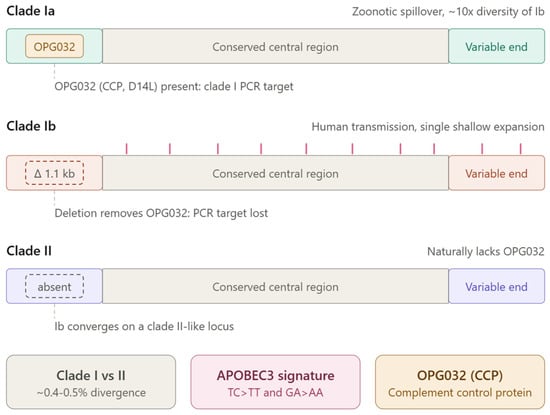
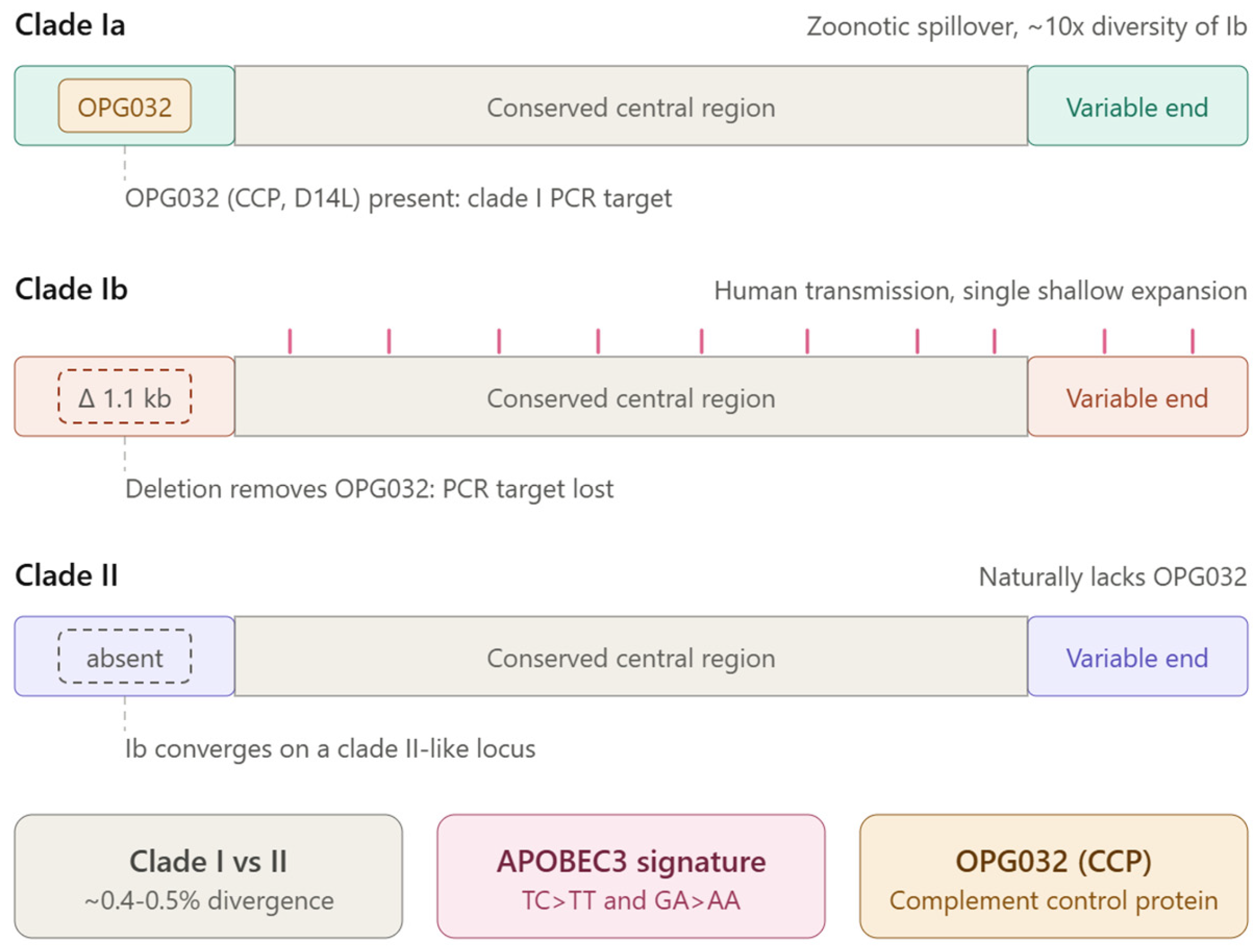
MPXV genome has a conserved central region and two variable terminal regions containing the inverted terminal repeats. The terminal regions tolerate deletions, duplications, and rearrangements, and both the lineage-defining change of Clade Ib and the diagnostic failures it produced map there [2,12]. Clade I and Clade II genomes differ by approximately 0.4–0.5% in non-repetitive regions [1].
3.2. APOBEC3 Editing as Evidence of Sustained Human Transmission
Replication of MPXV in human cells exposes the viral genome to APOBEC3 cytidine deaminases, which generate a characteristic dinucleotide-context signature (TC>TT and GA>AA) not seen in genomes from the animal reservoir; the proportion of such mutations therefore distinguishes sustained human transmission from repeated spillover [2]. In the original Kamituga cluster, five of nine reconstructed mutations were APOBEC3-compatible, a proportion incompatible with rodent-borne evolution (binomial probability 0.0003), and molecular clock analysis placed the most recent common ancestor in mid-September 2023 [2]. Larger datasets have reproduced this finding: APOBEC3-type changes accounted for 28 of 35 mutations on internal branches and 55 of 82 unique mutations in 58 genomes from South Kivu, and for 73.8% of mutations in 98 genomes from Burundi. Both studies resolved at least three distinct Clade Ib clusters, indicating multiple parallel transmission chains and, in Burundi, either repeated introductions from South Kivu or cryptic circulation preceding case detection [13,14].
APOBEC3 enrichment marks human transmission rather than Clade Ib specifically: contemporaneous Kinshasa outbreaks of subclade Ia and Clade Ib showed comparable proportions of APOBEC3-driven mutations (68% and 72%, respectively), and a new subclade Ia lineage sustained by human-to-human transmission has been characterized [4]. Clade Ia nonetheless retains approximately ten-fold greater genomic diversity than Clade Ib, consistent with maintenance by repeated zoonotic introductions, whereas Clade Ib forms a single shallow expansion from a recent common ancestor [1,15].
3.3. The OPG032 Deletion
Clade Ib is distinguished from Clade Ia by a deletion of approximately 1.1 kb in the left terminal region that removes OPG032 (Figure 1), which encodes the viral complement control protein (CCP), also designated D14L or MOPICE [1,2,12]. The deletion has been stable in outbreak genomes; no further rearrangement was detected among 98 Burundian sequences [14].
Figure 1.
Structural composition of different MPXV clades and subclades. Created by the authors based on references [2,4,12,13,14,16,17].
CCP inhibits complement activation and is an immunomodulatory virulence factor of Congo Basin MPXV: its deletion from a Congo Basin isolate reduced morbidity and mortality in the prairie dog model, although its insertion into a West African isolate did not reproduce the Congo Basin phenotype, and gene-replacement approaches have so far failed to identify the viral genes responsible for clade-level virulence differences [16,17]. Clade II viruses naturally lack this gene, so Clade Ib converges on a Clade II-like genotype at this locus, and the deletion has been proposed to contribute to the comparatively low case fatality of Clade Ib outbreaks, although it remains a candidate mechanism for which causal evidence is lacking, since no in vivo head-to-head comparison of Clade Ia and Clade Ib has been performed [13]. Its diagnostic consequence, by contrast, is unambiguous: the deletion removes the target of the most commonly used Clade I-specific real-time polymerase chain reaction (PCR) [2,12].
3.4. Phenotype and Ongoing Evolution
Comparative in vivo data remain limited and do not yet include a head-to-head comparison of Clade Ia and Clade Ib. In the CAST/EiJ mouse model, a Clade Ib isolate was markedly more virulent than Clade IIb: intranasal inoculation with 105 and 106 pfu was uniformly lethal within 7–11 days and was associated with approximately 25% body weight loss and efficient dissemination to internal organs, whereas Clade IIb caused no mortality at 105 pfu and only low mortality at a higher inoculum. These findings are consistent with the historical Clade I over Clade II virulence hierarchy, but they rest on single isolates in one mouse model and cannot be extrapolated to human disease, in which reported Clade Ib case fatality has generally been below 1% [1,18].
In February 2026, the WHO reported two infections with a recombinant virus carrying genomic elements of both Clade Ib and Clade IIb. One patient in India developed symptoms in September 2025; the genome was initially classified as Clade II and later reclassified. One patient in the United Kingdom was identified in a traveler who had returned in October 2025; initial qPCR typing assigned the virus to Clade Ib, and whole-genome sequencing showed the recombinant structure in December 2025. Neither patient developed severe disease, and no secondary cases were identified, so these two cases carry no demonstrated epidemiological or clinical implications and no inference about the phenotype of recombinant viruses can be drawn from them; their significance is diagnostic, in that the WHO noted that clade-differentiating PCR alone may not reliably identify such viruses [19].
4. Epidemiology in African Settings
4.1. General Epidemiology
As reported above, Clade Ib was first identified in September 2023 in the Kamituga region, South Kivu province, in eastern DRC [3]. Simultaneously, surveillance studies identified co-circulation of Clade Ib alongside Clade Ia lineage in Kinshasa province, indicating parallel diversification fronts within the same country [4,15,20,21,22]. Marziano et al. described sustained human-to-human transmission in South Kivu with R0 of 0.96–1.27, above the epidemic threshold [23], so Clade Ib later spread to other DRC regions [24,25], Burundi [26], Uganda [27], Kenya [7], Zambia [8], and Madagascar [9].
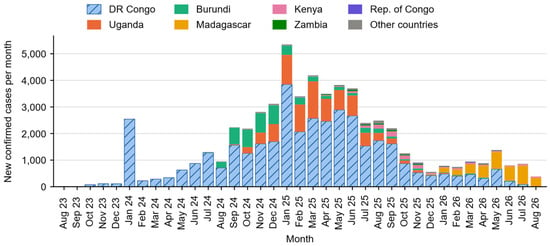
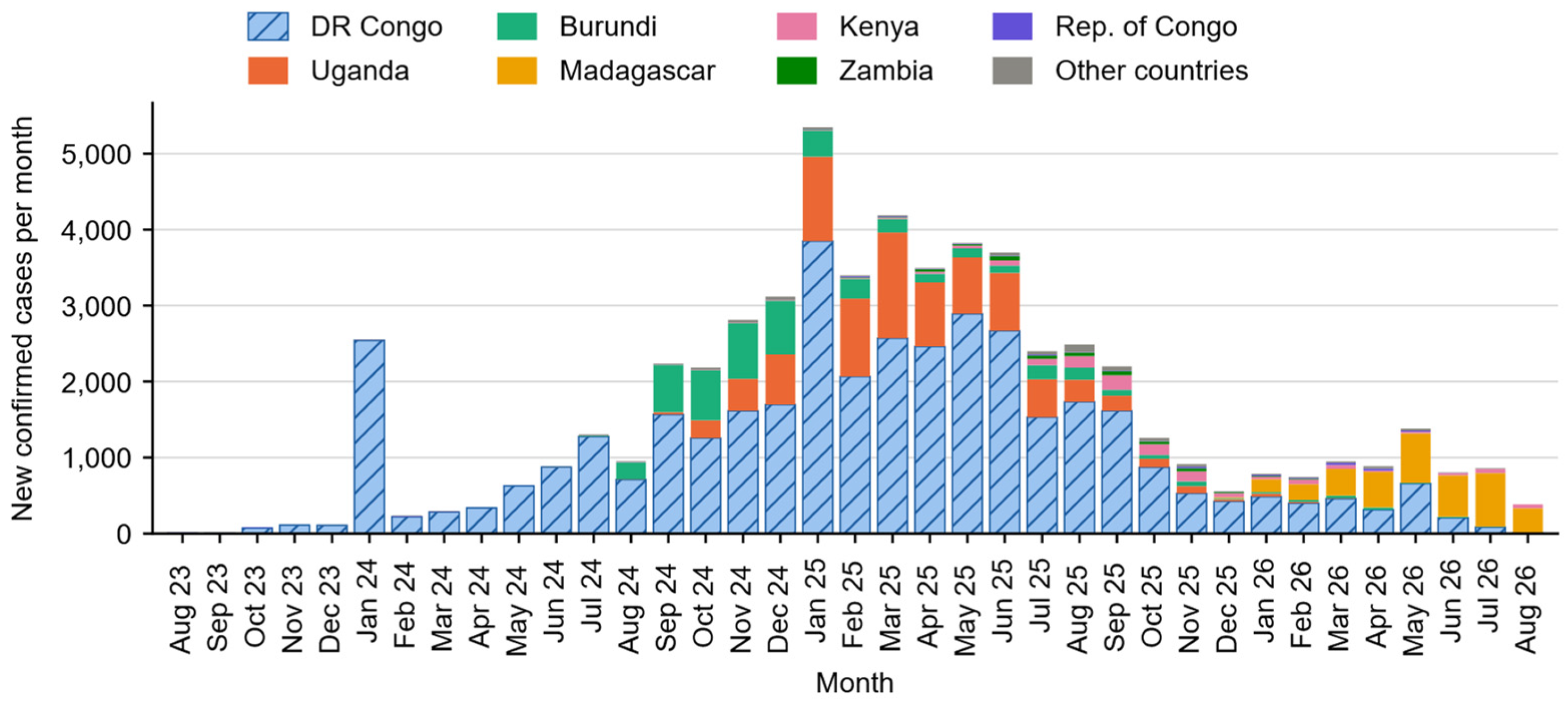
Since January 2024, a total of 38,830 mpox cases has been reported in the DRC and 58,093 across African countries with documented Clade Ib circulation. Since 2023, cases in DRC have steadily increased, reaching a plateau of about 2500 cases per week at the end of 2024/beginning of 2025, and approximately 600–700 new cases per week were reported at the latest data cut-off; however, cases reported in the DRC specifically are known to be a mix of Clade Ia and Clade Ib MPXV, whereas Clade Ib is the only subclade documented in the other contributing countries, since subclade attribution is not available in routine surveillance and sequencing coverage across the African region is approximately 8% [28]. A laboratory-confirmed Clade Ib case count cannot therefore be derived for the African region, and the aggregate WHO counts are the only region-wide figures available. Also, the other African countries reached a plateau of approximately 300–400 cases per week in early 2025, followed by a subsequent decline in incidence (Figure 2) [29,30]. Despite the general decline in incidence, during 2026 case numbers increased in Madagascar, which represents the major ongoing outbreak in the African region with 2921 confirmed cases and a case fatality rate (CFR) of 0.62% [9,11]. The isolated January 2024 peak visible in Figure 2 reflects retrospective reconciliation of previously unreported cases rather than a true epidemic surge [29].
Figure 2.
Monthly confirmed mpox cases in African countries with Clade Ib circulation, by country, August 2023 to August 2026. Authors’ elaboration based on WHO data. Source: 2022–26 Mpox Outbreak: Global Trends. Geneva: World Health Organization; 2026 (https://worldhealthorg.shinyapps.io/mpx_global/, weekly WHO African Region dataset, access date, 16 August 2026) [29]. License: CC BY-NC-SA 3.0 IGO. Weekly counts were aggregated by month; countries without documented Clade Ib circulation were excluded, and countries contributing fewer cases were grouped as “Other countries”. Cases reported in the DRC specifically are known to be a mix of Clade Ia and Clade Ib MPXV; a laboratory-confirmed Clade Ib case count cannot therefore be derived for the African region.
4.2. Transmission Patterns
Transmission patterns have varied across African outbreaks [18,31]. In the original Kamituga cohort, composed predominantly of adults, sexual contact was the main route of transmission [3,32], but other larger surveillance-based studies in Uvira (also in eastern DRC) revealed that community transmission was the predominant mode of spread [33], reflecting the lower median age of confirmed cases. Indeed, both sexual and household contacts are possible routes of transmission, as demonstrated by serological investigation in South Kivu [13,34], and the dominant transmission route of Clade Ib can shift over time and across different age groups within a certain outbreak [35]. The role of sex workers is crucial for amplifying MPXV transmission, considering that serological evidence for past MPXV infection was found in 18% of sex workers and 17% of visitors by Masirika et al. [36,37]. The role of household transmission was described by Kamadjeu et al., whose findings estimated an overall R0 of 0.30, higher in children below 15 years of age, suggesting that intrahousehold transmission alone was unlikely to sustain community-wide spread [38,39].
The incubation period also varied depending on the route of transmission: a dedicated analysis found that it was shorter following sexual exposure (median of 10.3 days) compared with non-sexual or community-based exposure (median of 13.6 days), and that incubation periods lengthened over the course of the outbreak in parallel with the shift from sexual to non-sexual transmission [40].
5. Epidemiology in Non-Endemic Regions
5.1. General Epidemiology
The first case of Clade Ib reported outside the African continent was a returning traveler in Sweden, August 2024 [41,42,43]. After that, multiple countries reported imported cases of travelers from Africa [44,45,46,47,48,49,50,51,52]. Finally, during the following months, countries documented autochthonous (locally acquired) transmission, with Spain being the first to report human-to-human transmission outside Africa and not related to travel [53,54,55]. Nosocomial transmission was also reported, first in Ireland between August and October 2025, while between December 2025 and March 2026, Bartel et al. reported many cases across the MSM community in Germany [56,57].
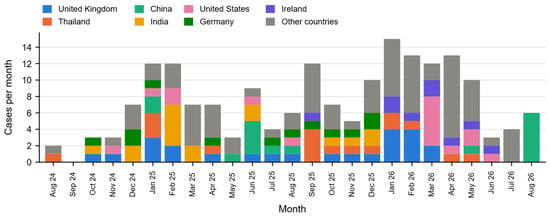
Since August 2024, 1298 cases of MPXV Clade Ib outside Africa have been reported according to WHO data, with Spain accounting for the highest cumulative number (239 cases). As of the WHO situation report published on 31 July 2026 [11], cumulative Clade Ib case counts remained led by Spain, Germany (115), the United Kingdom (91), France (90), and Portugal (81); notably, Portugal accounted for 60 of its 81 cumulative cases within the six weeks preceding the report, indicating a recent and substantial acceleration of transmission in that country [58,59]. In most European and American countries, the WHO reports locally acquired Clade Ib infections, that is, confirmed cases for which no link to travel to an affected area could be identified, whereas few countries reported occasional cases linked to travel only, such as China, Austria, Denmark, Chile, Hungary, and Ghana. In the last 12 months, 829 cases have been described outside Africa, with 18 countries involved, and June 2026 alone accounting for 129 cases, the highest monthly total recorded to date, indicating an accelerating rather than declining trend, in contrast with the generally declining trajectory observed across African settings (Figure 3) [29,59].
Figure 3.
Monthly travel-associated introductions of MPXV Clade I detected outside Africa and their directly linked contacts, by country of detection, August 2024 to August 2026. Authors’ elaboration based on WHO data. Source: 2022–26 Mpox Outbreak: Global Trends. Geneva: World Health Organization; 2026 (https://worldhealthorg.shinyapps.io/mpx_global/, imported clade I cases dataset, access date, 16 August 2026) [29]. License: CC BY-NC-SA 3.0 IGO. Cases arising in autochthonous clusters are not included, so the figure under-represents countries with established local transmission; the cumulative country totals given in Section 5.1 derive from a different source and are not comparable with this figure.
5.2. Transmission Patterns
Unlike the shift from sexual to non-sexual transmission documented in the African context, to date a comparable shift has not been documented in non-endemic regions, where sexual transmission remains the main route for human-to-human spread [58,60]. In the most recent clusters—Northern Ireland, June 2026, and Berlin, 2025–2026—most confirmed cases reported no history of travel outside Ireland or Germany, respectively, indicating local transmission within MSM sexual networks rather than through the community or household pathways observed in parts of Africa [57,61]. The sexual route of transmission among the MSM community reflects how 99% of Clade I cases reported outside Africa occurred in adults, of whom 97% were male and 89% specifically among MSM [11,29,62].
Although sexual transmission has predominated in non-African settings, isolated instances of household transmission have also been documented since the earliest phase of the outbreak: by January 2025, Germany had reported three household contacts, including two children, infected following exposure to a travel-associated index case, and Belgium had reported one similar pediatric household transmission event [63]. Environmental contamination studies suggest that potentially infectious fomites may contribute to transmission [64,65], but there remains insufficient evidence that airborne or environmental contamination represents an important route of secondary transmission in healthcare settings [65,66]. To date, no studies on incubation period outside Africa have been identified across the available literature.
6. Comparative Clinical Presentation
6.1. Clinical Presentation and Complications
According to available literature, in the African context, MPXV Clade Ib lesion distribution differs from the classical description of Clade Ia disease, which is a general papulopustular rash on multiple body sites [67]. In contrast, early descriptions of Clade Ib disease in the Kamituga region reported predominantly genital lesions, with lower overall disease severity, similar to the clinical pattern observed with Clade IIb [68]. Active skin lesions were present in 97% of cases—of which 88% were preceded by prodromal symptoms—mucosal lesions in 82% and lymphadenopathy, predominantly cervical, in 73–89% across independent reports from the same outbreak [67,68,69].
Genitourinary and cutaneous complications were documented in 57% and 41% of hospitalized patients, respectively, including one reported case of Fournier’s gangrene [67]. Genomic sequencing of lesion swabs from hospitalized patients in eastern DRC identified bacteria associated with skin and soft-tissue infection in 10 of 19 samples (53%), frequently carrying antimicrobial resistance genes, whereas varicella-zoster virus and herpes simplex virus-2 were the most frequent viral coinfections [70]. A prospective cohort study in Uganda reports that, among 80 patients with purulent lesions, 43.8% had a polymicrobial and predominantly multidrug-resistant Gram-negative bacilli infection [71]. These findings indicate that, in resource-limited hospital settings, disease burden may derive from secondary bacterial and viral pathogens rather than MPXV infection alone, a problem that has been less frequently described in non-African contexts. Ocular complications have been described and consist mainly of keratitis, in one case successfully treated with Cidofovir eye drops [72].
Whereas African cohort studies typically report systematic descriptions of symptoms, complications, and frequencies, the clinical features described in non-African settings are often limited to small case reports and series, often those relative to the first imported case in a certain country. Overall, the clinical picture outside Africa remains predominantly generalized, as most individual case reports describe skin lesions distributed across the arms, face, trunk, and chest [52,54]. Although the clinical picture of Clade Ib infection in non-endemic contexts had been described as mild, in June 2026 patients infected during a rapidly developing cluster in Northern Ireland were characterized by severe proctitis, a finding not described in earlier European case series [61]. Continued clinical characterization of non-African clusters is therefore warranted to establish whether such presentations are exceptional or represent an under-recognized component of the clinical spectrum.
6.2. Disease Severity and Fatality Rate
Before the detection of Clade Ib, CFR for Clade I in African settings has ranged between 10.6% and 2.9% among suspected cases in different reporting periods. Notably, these historical aggregate figures combine pediatric and adult cases; stratified data from Clade Ia-affected areas indicate a much higher median case-fatality rate in children (5.9%) than in adults (2.7%) [18,23,67,73]. Clade Ib estimates are considerably lower: CFR for Clade Ib infection has consistently stayed below 1% in the South Kivu cohort. A surveillance-based study comparing “newly affected” (Clade Ib) and “endemic” (Clade Ia) regions of the DRC found, respectively, a case-fatality rate of 0.6–0.7% versus 2.7–5.9% [18]. Confirmatory findings were reported by the analysis of the Uvira cohort, which described a CFR of 0.7% for Clade Ib, rising to 3.9% among infants under one year of age [33]. In Kenya, a country with exclusive Clade Ib circulation—so that this estimate is attributable to Clade Ib without the subclade ambiguity affecting the DRC figures—one death was reported among 48 confirmed cases (approximately CFR of 2.1%), notably occurring in a patient with concurrent Human Immunodeficiency Virus (HIV) infection, in an outbreak in which 23% of cases were HIV positive [7].
Regarding disease severity in non-endemic areas, case reports described no hospitalization, but among 29 Clade Ib cases reported to ECDC before October 2025 [63], seven (24.1%) were hospitalized. Larger surveillance studies in the European Union indicate that 13–14% of confirmed Clade I cases—the vast majority composed of subclade Ib—have required hospitalization, compared with a hospitalization rate of 8% for Clade II in the same period [59]. Vaccination status was recorded for a subset of reported cases, of whom 23% had received two vaccine doses before infection [59,74]. No estimate of vaccine effectiveness can be derived from this proportion, since no unvaccinated comparator group is defined and the product administered, the schedule, and the interval between vaccination and exposure were not reported. However, outside the African continent, no deaths attributable to Clade Ib infection had been reported in the most recent surveillance update available despite several hundred confirmed cases [59].
7. Populations at Increased Risk
7.1. Pediatric and Neonatal Mpox
In the Kabare Territory (South Kivu province) pediatric cohort, lesion distribution among children aged 0–5 years was more diffuse than in adults, involving the head, face, neck, trunk, limbs, palms, and oral cavity [75]. A two-week-old neonate in Uganda presented with high fever followed by a vesicular rash spreading cephalocaudally to involve the palms and soles, in the absence of any identified exposure history and with a negative maternal PCR test; the infant was managed supportively with emollients, antipyretics, prophylactic antibiotics, and was discharged after 11 days [76].
A small number of pediatric cases have also been documented outside Africa, exclusively as secondary household transmission events. They were asymptomatic or had mild symptoms and received the MPXV vaccine after exposure, with clinical healing [54]. These cases were identified through contact tracing of adult index cases rather than through the active case finding that characterizes pediatric surveillance in African settings, so the pediatric case counts in the two contexts are not quantitatively comparable. As reported above, infection in children is characterized by higher mortality in Africa, while only a limited number of cases have been reported outside the continent.
7.2. Pregnancy, Vertical Transmission, and Maternal-Fetal Outcomes
Evidence on MPXV infection in pregnancy comes from two distinct bodies of data. The first concerns Clade I infection not stratified by subclade and derives from three prospective cohorts and one randomized controlled trial conducted across some African regions between December 2022 and June 2025, a period beginning before Clade Ib was first detected in September 2023 and in a country where both subclades circulate; the proportion of Clade Ib infections among the participants is not reported [77,78,79]. Among 89 pregnant women with confirmed MPXV, no maternal deaths occurred, but among the 69 women with known final pregnancy outcomes (not lost to follow-up), adverse pregnancy outcomes occurred in 51%, including fetal loss in 45%. Of 38 live births, four neonates had congenital mpox lesions and one infant died within hours of birth. The second body of evidence is Clade Ib-specific and consists of a study on three vertical MPXV transmission cases, with spontaneous abortion and early neonatal death, cases in which MPXV DNA was detected in both a placental swab and a neonatal oropharyngeal swab; this is case-level evidence that vertical transmission and adverse outcomes can occur with Clade Ib, but no risk estimate for Clade Ib in pregnancy can be derived from it [80].
No studies on Clade Ib maternal infection or vertical transmission were found in non-African contexts.
7.3. HIV Coinfection and Immunocompromised Hosts
The proportion of Clade Ib cases with HIV coinfection has varied in African cohorts, from 1.8% in Uvira [33] to 23% in the Kenyan outbreak [7]. Individual case reports illustrate the potential severity of mpox in the context of advanced immunosuppression. A 45-year-old woman in Uganda with WHO clinical stage 3 HIV disease and active tuberculosis died from mpox-associated sepsis within two days of hospital admission [81]. A further report from Uganda described a 30-year-old man with advanced HIV disease (CD4 count 55 cells/µL) and genomically confirmed Clade Ib infection, complicated by multidrug-resistant bacterial superinfection of the lesions and periocular involvement, who recovered after four weeks of inpatient care [82]. Similarly, a 38-year-old immunocompromised South African man presented with an extensive, painful generalized rash and systemic symptoms requiring treatment with tecovirimat [83]. In a prospective cohort of 155 hospitalized adults in Uganda, higher lesion viral burden was associated with markers of systemic inflammation but did not differ significantly according to HIV status. Instead, HIV-positive patients showed greater hematological vulnerability, including anemia and altered myeloid profiles, highlighting the potential contribution of HIV-associated immune dysfunction to severe disease [71]. Consistent with the broader pooled pregnancy cohort findings described above, positive HIV status was independently associated with adverse pregnancy outcomes among mpox-affected women in the DRC (risk ratio 2.0, 95% CI 1.4–2.9; p = 0.0002) [77].
No cases of Clade Ib-HIV coinfection are described outside the African context.
8. Diagnostics
8.1. Specimen Selection
WHO interim guidance identifies lesion material (swabs of the lesion surface or exudate, or lesion crusts) as the specimen of choice, ideally from lesions at different body sites; oropharyngeal swabs are an alternative when no lesion is accessible but give less sensitive results [84]. Where transmission is sexual, lesions are frequently anogenital and may be few, and presentations dominated by proctitis with minimal cutaneous involvement have been described, as in the Northern Ireland cluster [61]; anorectal and genital sampling may be important when clinically indicated, and a negative skin lesion swab might not exclude infection. In African community and household transmission settings, while the disseminated rash makes lesion sampling straightforward, the limiting factor may be access to testing.
8.2. Molecular Detection and Clade Typing
Real-time PCR remains the diagnostic reference method. The WHO recommends a tiered approach in which a generic orthopoxvirus or MPXV assay directed at a conserved target is used for diagnosis, followed by clade-specific assays or sequencing for confirmation and epidemiological investigation [84]. Clade Ib showed why that order matters: the commonly used Clade I-specific assay of Li et al. targets the C3L/OPG032 region, which Clade Ib has deleted, so Clade Ib specimens test MPXV-positive but Clade I-negative and are misassigned to Clade II or left unclassified [1,2,85]. Laboratories that used this Clade I-specific assay as the primary test, without a generic orthopoxvirus or MPXV assay, might have missed the lineage entirely.
A Clade Ib-specific TaqMan assay was developed and evaluated on 92 samples from the South Kivu outbreak, restoring lineage-level discrimination [86]. More generally, clade discrimination has been moved from the variable genome termini to conserved essential genes: a multiplex assay built on three essential genes, OPG084 (MPXV species), OPG125 (orthopoxvirus detection plus a Clade I-specific single-nucleotide polymorphism) and OPG130 (Clade II), achieved limits of detection of 3 and 9 copies per reaction for the Clade I and Clade II analytes. Accuracy, sensitivity, and specificity were 100% for the Orthopoxvirus, MPXV, and Clade I analytes, and 98.9%, 96.7%, and 100% for the Clade II analyte. The assay identified the first travel-associated Clade I case in the United States [12]. The same work documented a 600-bp deletion affecting both copies of OPG002/G2R, underlining that terminal-region targets are intrinsically vulnerable to dropout [12]. As of September 2026, multiple mpox in vitro diagnostics have been listed under the WHO Emergency Use Listing procedure, all of them nucleic acid amplification tests; no antigen-based test has been listed [87].
8.3. Antigen-Based Rapid Diagnostic Tests
The need for decentralized testing has made antigen rapid diagnostic tests (RDTs) attractive, but current performance does not support their use as stand-alone diagnostics. In a multicenter prospective study of 641 participants with suspected mpox at 16 sites in DRC and Uganda, a lateral-flow antigen test showed an overall sensitivity of 70.4% (95% CI 65.9–74.6) and specificity of 89.3% (95% CI 84.6–92.7), with marked between-country sensitivity variation (81.9% in Uganda versus 55.1% in DRC) [88]. This between-country difference may reflect lesion stage at sampling, specimen site, or the type of patients reaching care, none of which the study analyzed separately. A comparative evaluation of five antigen RDTs on 190 lesion swabs from Kinshasa found sensitivities of 39.2–77.3%, the best-performing assay reaching 77.3% (95% CI 68.0–84.5) sensitivity and 93.5% (95% CI 86.6–97.0) specificity; the authors concluded that a positive result may support confirmation in high-prevalence settings but that a negative result cannot exclude infection [89]. The WHO has not recommended antigen RDTs for clinical management or surveillance [84].
8.4. Serology
Serological testing has no role in the diagnosis of acute infection: orthopoxvirus antibodies cross-react extensively, cannot be reliably separated from vaccine-induced responses, and WHO restricts such testing to reference laboratories [84]. Its value is epidemiological: serosurveys in South Kivu provided evidence of Clade Ib exposure among sex workers and within households that PCR-based case finding had not captured [13].
8.5. Sequencing
Whole-genome or targeted sequencing is required for lineage assignment, for detecting APOBEC3 signatures, and for monitoring the genomic changes that may compromise assays [84]. The WHO has stated that clade-differentiating PCR alone may not reliably identify recombinant MPXV, for which sequencing is likely to be required [19]. Genomic capacity in Africa has expanded substantially, with more than 3000 genomes generated across 23 countries and a sequencing rate of about 8% [28]. Amplicon-based partial-genome approaches have been developed to recover lineage-informative sequence from specimens with low viral loads [90].
8.6. Testing Capacity
In DRC, only about 18% of suspected cases were tested in 2024, and across 28 African Union Member States between July 2024 and July 2025, 100,375 (61.4%) of 163,399 suspected cases were tested, yielding 42,270 confirmed cases (42.1% positivity) [28]. Where only a minority of suspected cases are tested, the confirmed cases tend to be the more severe ones: this inflates African case-fatality estimates and is a further reason why they cannot be compared directly with non-African figures. Decentralization has improved this markedly; laboratories in DRC increased from 2 to 28, and Burundi expanded from a single central laboratory to 56 sites, with turnaround times falling from 7–10 days to 2–4 h, although progress has been repeatedly interrupted by armed conflict and funding withdrawal [28].
9. Discussion
9.1. Current Evidence of Epidemiological and Clinical Differences Between African and Non-Endemic Contexts
MPXV Clade Ib infection has some epidemiological and clinical differences between African countries and non-endemic contexts, but only three features (age distribution, sex distribution, and community transmission) show a distinction that is well-supported by the available evidence (Table 1).
Table 1.
Direct comparison of epidemiological and clinical features of MPXV Clade Ib infection in African and non-African settings.
Surveillance data indicate about a 14-fold difference in weekly case burden, and this gap has not narrowed over time: African case counts, although declining from their 2024–2025 peak, remain higher than the persistent but modest flow of imported and secondary cases recorded outside the continent. Second, transmission routes in Africa are dynamic and geographically heterogeneous, shifting between sexual and non-sexual transmission and affecting both adults and children depending on the predominant transmission setting; by contrast, transmission outside Africa has remained mainly related to sexual MSM networks, with only isolated instances of household transmission and no community transmission.
In terms of clinical presentation, lesion distribution and complication profile are related to the way of transmission. The adult, sexually-transmitted phenotype—anogenital-predominant, less generalized severity—is described in all non-African case series; by contrast, the pediatric, community-transmitted phenotype documented in Uvira and Kabare Territory is characterized by a more diffuse lesion distribution and higher severity in children, with no equivalent reported outside Africa. Complications like bacterial superinfection have been documented only in African hospital-based cohorts, with the exception of the severe proctitis cluster in Northern Ireland: whether this reflects a difference in complication frequency or a difference in clinical documentation between hospital-based African cohorts and population-based non-African cases cannot be determined from the literature reviewed.
Clade Ib CFR from African cohorts (0.6–0.7%) is lower than historical Clade I estimates cited in the literature (up to 10%). Hospitalization rates for Clade Ib infection cannot be directly compared between African and non-African settings, as the former data are largely derived from hospital-based populations, and the direction of any true difference in mortality cannot be determined from the available evidence. Immunosuppression is a plausible risk factor for severe Clade Ib disease, consistent with the fatal and severe cases reported in patients with advanced HIV disease; a single death, however, permits no conclusion about its magnitude or about any difference between settings.
The deletion in the OPG032 gene has been proposed as a possible contributor to the comparatively low case fatality observed with Clade Ib, although the evidence for a causal effect on clinical severity remains indirect and differences in case mix and ascertainment remain an equally plausible explanation. At the same time, this deletion creates a diagnostic vulnerability that can lead to Clade Ib specimens being misclassified as Clade II or left unassigned, thereby limiting the reliability of case detection and potentially affecting the validity of some of the comparisons presented in this review.
Finally, the available evidence on populations at increased risk is almost entirely from African data. No published case of Clade Ib infection in a pregnant or immunocompromised individual outside Africa was identified in our search, an asymmetry that likely reflects the near-exclusive occurrence of non-African cases in adult MSM populations.
9.2. Gaps in Literature and Research Priorities
Several methodological gaps limit the strength of the comparisons drawn in this review and should guide future research priorities. First, the absence of head-to-head comparative study designs: all comparisons presented are indirect, with data from studies that differ in setting, design, and population. Underrepresentation of HIV, pregnancy, and pediatric data in non-endemic settings limits the comparison across those subpopulations. A lack of longitudinal studies outside Africa makes it difficult to establish whether the sexual pattern observed to date in non-African settings will persist or similarly evolve over time. The contribution of immunosuppression to severe outcomes in Clade Ib infection is a further priority, given that the few reported deaths have occurred in patients with advanced HIV disease. Finally, some of the largest African datasets span the period before and after Clade Ib’s emergence and refer to “Clade I” rather than disaggregated by sublineage, causing clade-level ambiguity in some analyses.
The PALM007 trial found that tecovirimat did not significantly shorten lesion resolution or viral clearance in patients with Clade I mpox. Evidence remains limited for Clade Ib, particularly outside Africa and in pregnant, pediatric, and immunocompromised patients, highlighting the need for further randomized trials and optimized supportive care [78].
Further research into vaccination strategies for prevention is urgently needed. The differences in transmission patterns observed across settings suggest that vaccination strategies may need to be tailored to local epidemiological and temporal characteristics. Modelling suggests vaccination impact in Africa is highly context- and timing-dependent: sex-worker-targeted Modified vaccinia Ankara (MVA)-BN vaccination could have averted up to 91% of infections in early-detected South Kivu but only 35% in the later-detected Burundi outbreak, with single-dose regimens outperforming two-dose strategies [91,92].
10. Conclusions
MPXV Clade Ib does not present a single clinical and epidemiological picture. Rather, the evidence supports a model in which transmission route and setting may be important contributors to demographic profile, clinical phenotype and disease severity, both within Africa and non-endemic regions. Almost three years after the first detection of Clade Ib in September 2023, sustained and Clade-disaggregated data collection, particularly outside Africa, will be essential to determine whether the patterns described in this review remain stable or continue to evolve.
Supplementary Materials
The following supporting information can be downloaded at: https://www.mdpi.com/article/10.3390/pathogens15111158/s1, Table S1. Characteristics and main findings of the studies and surveillance reports included in the review (n = 54).
Author Contributions
Conceptualization, S.A. and A.G.; methodology, A.G.; investigation, A.R., A.P., G.C. and M.B.; data curation, A.R., M.B., G.C. and A.P.; writing—original draft preparation and writing, A.R. and M.B.; supervision, S.A. and A.G. All authors have read and agreed to the published version of the manuscript.
Funding
This research received no external funding.
Institutional Review Board Statement
Not applicable.
Informed Consent Statement
Not applicable.
Data Availability Statement
No new data were created or analyzed in this study. Data sharing is not applicable to this article.
Conflicts of Interest
The authors declare no conflicts of interest. In particular, no author has any financial or non-financial relationship with the manufacturers of the MVA-BN vaccine, of tecovirimat, or of any of the mpox diagnostic assays discussed in this review, and no author was involved in the PALM007 trial or in the evaluation of any of the diagnostic tests cited.
Abbreviations
The following abbreviations are used in this manuscript:
| MPXV | Mpox virus |
| WHO | World Health Organization |
| DRC | Democratic Republic of Congo |
| MSM | Men who have sex with men |
| PHEIC | Public Health Emergency of International Concern |
| ECDC | European Centre for Disease Prevention and Control |
| CCP | Viral Complement Control Protein |
| CFR | Case Fatality Rate |
| HIV | Human Immunodeficiency Virus |
| PCR | Polymerase Chain Reaction |
| RDTs | Rapid Diagnostic Tests |
| EU | European Union |
| MVA-BN | Modified vaccinia Ankara |
References
- Satheshkumar, P.S.; Gigante, C.M.; Mbala-Kingebeni, P.; Nakazawa, Y.; Anderson, M.; Balinandi, S.; Mulei, S.; Fuller, J.; McQuiston, J.H.; McCollum, A.M.; et al. Emergence of Clade Ib Monkeypox Virus—Current State of Evidence. Emerg. Infect. Dis. 2025, 31, 1516–1525. [Google Scholar] [CrossRef] [Scilit] [PubMed]
- Gómez-Pérez, G.P.; Sam, S.O.O.; Ndembi, N.; Rinke de Wit, T.F. Mpox after COVID-19 in Africa: Different Epidemic, Similar Challenges. J. Public Health Afr. 2025, 16, 874. [Google Scholar] [CrossRef] [Scilit] [PubMed]
- Vakaniaki, E.H.; Kacita, C.; Kinganda-Lusamaki, E.; O’Toole, Á.; Wawina-Bokalanga, T.; Mukadi-Bamuleka, D.; Amuri-Aziza, A.; Malyamungu-Bubala, N.; Mweshi-Kumbana, F.; Mutimbwa-Mambo, L.; et al. Sustained Human Outbreak of a New MPXV Clade I Lineage in Eastern Democratic Republic of the Congo. Nat. Med. 2024, 30, 2791–2795. [Google Scholar] [CrossRef] [Scilit] [PubMed]
- Wawina-Bokalanga, T.; Merritt, S.; Kinganda-Lusamaki, E.; Jansen, D.; Halbrook, M.; O’Toole, Á.; Pukuta-Simbu, E.; Hasivirwe Vakaniaki, E.; Ola-Mpumbe, R.; Kwete-Mbokama, P.; et al. Epidemiology and Phylogenomic Characterisation of Two Distinct Mpox Outbreaks in Kinshasa, DR Congo, Involving a New Subclade Ia Lineage: A Retrospective, Observational Study. Lancet 2025, 406, 63–75. [Google Scholar] [CrossRef] [Scilit] [PubMed]
- Masirika, L.M.; Udahemuka, J.C.; Schuele, L.; Nieuwenhuijse, D.F.; Ndishimye, P.; Boter, M.; Mbiribindi, J.B.; Kacita, C.; Lang, T.; Gortázar, C.; et al. Mapping and Sequencing of Cases from an Ongoing Outbreak of Clade Ib Monkeypox Virus in South Kivu, Eastern Democratic Republic of the Congo between September 2023 to June 2024. medRxiv 2024. [Google Scholar] [CrossRef] [Scilit]
- Nizigiyimana, A.; Ndikumwenayo, F.; Houben, S. Epidemiological Analysis of Confirmed Mpox Cases, Burundi, 3 July to 9 September 2024. Euro Surveill. 2024, 29, 2400647. [Google Scholar] [CrossRef] [Scilit] [PubMed]
- Mutuku, P.; Abade, A.; Owiny, M.; Irura, Z.; Roba, A.; Limo, H.; Herman-Roloff, A.; Lucchi, N.; Bowen, N.; Fidhow, A.; et al. Clade Ib Mpox Outbreak—Kenya, July 2024–February 2025. MMWR Morb. Mortal. Wkly. Rep. 2025, 74, 379. [Google Scholar] [CrossRef] [Scilit] [PubMed]
- Chipoya, M.; Sialubanje, C.; Ngulube, D.; Kapin’a, M.; Chikuluma, J.; Mambo, C.; Mwangilwa, K.; Simwaba, D.; Banda, D.; Sinyange, N.; et al. The First Mpox Case in Zambia: A Case Report. J. Med. Case Rep. 2025, 19, 571. [Google Scholar] [CrossRef] [Scilit] [PubMed]
- Raharinosy, V.; Ramiarimanana, M.B.; Andriamandimby, S.F.; Razanadrakoto, I.I.; Razanajatovo, I.; Razanajatovo, N.; Razafindratsimandresy, R.; Dia, N.; Faye, M.; Zapelloni, F.; et al. Emergence of Human Monkeypox Virus Clade Ib in Madagascar: First Genomic Evidence of Introduction and Local Transmission. Virol. J. 2026, 23, 159. [Google Scholar] [CrossRef] [Scilit] [PubMed]
- World Health Organization (WHO). WHO Director-General Declares Mpox Outbreak a Public Health Emergency of International Concern; WHO: Geneva, Switzerland, 2024; Available online: https://www.who.int/europe/news/item/16-08-2024-who-director-general-declares-mpox-outbreak-a-public-health-emergency-of-international-concern (accessed on 16 August 2026).
- World Health Organization. Multi-Country Outbreak of Mpox, External Situation Report #68—31 July 2026. Available online: https://www.who.int/publications/m/item/multi-country-outbreak-of-mpox--external-situation-report--68---31-july-2026 (accessed on 16 August 2026).
- Probert, W.S.; Espinosa, A.; Hacker, J.K. Clade I or Clade II? Targeting Essential Viral Genes to Differentiate Monkeypox Virus Clades by Multiplex Real-Time PCR. Front. Public Health 2025, 13, 1626030. [Google Scholar] [CrossRef] [Scilit] [PubMed]
- Masirika, L.M.; Udahemuka, J.C.; Schuele, L.; Nieuwenhuijse, D.F.; Ndishimye, P.; Boter, M.; Mbiribindi, J.B.; Kacita, C.; Lang, T.; Gortázar, C.; et al. Epidemiological and Genomic Evolution of the Ongoing Outbreak of Clade Ib Mpox Virus in the Eastern Democratic Republic of the Congo. Nat. Med. 2025, 31, 1459–1463. [Google Scholar] [CrossRef] [Scilit] [PubMed]
- Nzoyikorera, N.; Schuele, L.; Nieuwenhuijse, D.F.; Nduwimana, C.; Ihorimbere, T.; Niyomwungere, D.; Cassidy, H.; Boter, M.; Nibogora, C.; Ndihokubwayo, A.; et al. Genomic Monitoring and Tracking of Mpox Virus Clade Ib in Burundi between July to September 2024. Commun. Med. 2025, 5, 494. [Google Scholar] [CrossRef] [Scilit] [PubMed]
- Kinganda-Lusamaki, E.; Amuri-Aziza, A.; Fernandez-Nuñez, N.; Makangara-Cigolo, J.-C.; Pratt, C.; Vakaniaki, E.H.; Hoff, N.A.; Luakanda-Ndelemo, G.; Akil-Bandali, P.; Nundu, S.S.; et al. Clade I Mpox Virus Genomic Diversity in the Democratic Republic of the Congo, 2018–2024: Predominance of Zoonotic Transmission. Cell 2025, 188, 4–14.e6. [Google Scholar] [CrossRef] [Scilit] [PubMed]
- Hudson, P.N.; Self, J.; Weiss, S.; Braden, Z.; Xiao, Y.; Girgis, N.M.; Emerson, G.; Hughes, C.; Sammons, S.A.; Isaacs, S.N.; et al. Elucidating the Role of the Complement Control Protein in Monkeypox Pathogenicity. PLoS ONE 2012, 7, e35086. [Google Scholar] [CrossRef] [Scilit] [PubMed]
- Unanue, A.R.; Martín, R.; Sánchez, C.; Alonso-Sánchez, I.; Moraga-Quintanilla, A.; Fernandez del Ama, L.; Sánchez-Cordón, P.J.; Alcamí, A.; Hernáez, B. Enhanced Virulence of Mpox Virus Clade Ib over Clade IIb in the CAST/EiJ Mouse Model. Commun. Biol. 2026, 9, 406. [Google Scholar] [CrossRef] [Scilit] [PubMed]
- Malembi, E.; Escrig-Sarreta, R.; Ntumba, J.; Beiras, C.G.; Shongo, R.; Bengehya, J.; Nselaka, C.; Pukuta, E.; Mukadi-Bamuleka, D.; Mulopo-Mukanya, N.; et al. Clinical Presentation and Epidemiological Assessment of Confirmed Human Mpox Cases in DR Congo: A Surveillance-Based Observational Study. Lancet 2025, 405, 1666–1675. [Google Scholar] [CrossRef] [Scilit] [PubMed]
- WHO. Mpox: Recombinant Virus with Genomic Elements of Clades Ib and IIb—Global. Available online: https://www.who.int/emergencies/disease-outbreak-news/item/2026-DON595 (accessed on 16 August 2026).
- Yinda, C.K.; Koukouikila-Koussounda, F.; Mayengue, P.I.; Elenga, R.G.; Greene, B.; Ochwoto, M.; Indolo, G.D.; Mavoungou, Y.V.T.; Boussam, D.A.E.; Ampiri, B.R.V.; et al. Genetic Sequencing Analysis of Monkeypox Virus Clade I in Republic of the Congo: A Cross-Sectional, Descriptive Study. Lancet 2024, 404, 1815–1822. [Google Scholar] [CrossRef] [Scilit] [PubMed]
- Wawina-Bokalanga, T.; Akil-Bandali, P.; Kinganda-Lusamaki, E.; Lokilo, E.; Jansen, D.; Amuri-Aziza, A.; Makangara-Cigolo, J.C.; Pukuta-Simbu, E.; Ola-Mpumbe, R.; Muyembe, M.; et al. Co-Circulation of Monkeypox Virus Subclades Ia and Ib in Kinshasa Province, Democratic Republic of the Congo, July to August 2024. Euro Surveill. 2024, 29, 2400592. [Google Scholar] [CrossRef] [Scilit] [PubMed]
- Eurosurveillance Editorial Team. Addendum for Euro Surveill. Euro Surveill. 2024, 29, 240906. [Google Scholar] [CrossRef] [Scilit] [PubMed]
- Marziano, V.; Guzzetta, G.; Longini, I.; Merler, S. Epidemiologic Quantities for Monkeypox Virus Clade I from Historical Data with Implications for Current Outbreaks, Democratic Republic of the Congo. Emerg. Infect. Dis. 2024, 30, 2042–2046. [Google Scholar] [CrossRef] [Scilit] [PubMed]
- Mukadi-Bamuleka, D.; Kinganda-Lusamaki, E.; Mulopo-Mukanya, N.; Amuri-Aziza, A.; O’Toole, Á.; Merritt, S.; Modadra-Madakpa, B.; Mutombo-Ndongala, G.; Vakaniaki, E.H.; Kacita, C.; et al. First Imported Cases of MPXV Clade Ib from Goma, Democratic Republic of the Congo. Commun. Med. 2025, 5, 496. [Google Scholar] [CrossRef] [Scilit] [PubMed]
- Kasongo-Mulenda, F.; Lundi-Kizela, S.; Kalonji-Tshilomba, S.; Nsambayi-Lukusa, D.; Iteke, M.; Nkwembe-Mpileng, R.; Muswibwe, A.; Matondo-Kuamfumu, M.; Makaka, A.; Bulabula-Penge, J.; et al. Clade Ib Mpox in the Democratic Republic of the Congo (DRC): Clinical and Virological Report of the First Case in Kinshasa, the Capital City. Viruses 2025, 17, 1327. [Google Scholar] [CrossRef] [Scilit] [PubMed]
- Nzoyikorera, N.; Nduwimana, C.; Schuele, L.; Nieuwenhuijse, D.F.; Koopmans, M.; Otani, S.; Aarestrup, F.M.; Ihorimbere, T.; Niyomwungere, D.; Ndihokubwayo, A.; et al. Monkeypox Clade Ib Virus Introduction into Burundi: First Findings, July to Mid-August 2024. Euro Surveill. 2024, 29, 2400666. [Google Scholar] [CrossRef] [Scilit] [PubMed]
- Bbosa, N.; Nabirye, S.E.; Namagembe, H.S.; Kiiza, R.; Ssekagiri, A.; Munyagwa, M.; Bwambale, A.; Bagonza, S.; Bosa, H.K.; Downing, R.; et al. Case Reports of Human Monkeypox Virus Infections, Uganda, 2024. Emerg. Infect. Dis. 2025, 31, 144–148. [Google Scholar] [CrossRef] [Scilit] [PubMed]
- Atrah, Y.S.; Gumede, N.; Nyombe, J.; Dereje, N.; Cho, W.N.; Mercy, K.; Muteba, M.; Nkakulu Luzolo, J.; Ntumba-Tshitenge, O.; Kimema, P.; et al. Decentralizing Testing Capacity of Mpox in Africa: A Narrative Review. Lancet Reg. Health Afr. 2026, 5, 100046. [Google Scholar] [CrossRef] [Scilit] [PubMed]
- World Health Organization. 2022-26 Mpox Outbreak: Global Trends; World Health Organization: Geneva, Switzerland, 2026; Available online: https://worldhealthorg.shinyapps.io/mpx_global/ (accessed on 16 August 2026).
- Africa CDC. Africa CDC Epidemic Intelligence Weekly Report. August 2024. Available online: https://africacdc.org/download/africa-cdc-weekly-event-based-surveillance-report-august-2024/ (accessed on 16 August 2026).
- Reliefweb. La Variole Simienne (Monkeypox) En République Démocratique Du Congo Evaluation de La Situation Rapport de Mission Conjointe. Available online: https://reliefweb.int/report/democratic-republic-congo/la-variole-simienne-monkeypox-en-republique-democratique-du-congo-evaluation-de-la-situation-rapport-de-mission-conjointe-22-novembre-12-decembre-2023 (accessed on 16 August 2026).
- European Centre for Disease Prevention and Control (ECDC). Risk Assessment for the EU/EEA of the Mpox Epidemic Caused by Monkeypox Virus Clade I in Affected African Countries; ECDC: Stockholm, Sweden, 2024; Available online: https://www.ecdc.europa.eu/en/publications-data/risk-assessment-mpox-epidemic-monkeypox-virus-clade-i-africa (accessed on 16 August 2026).
- Bugeme, P.M.; Bugale, P.K.; Mukika, T.F. Community Transmission of Mpox Clade Ib Not Driven through Sexual Exposures, Uvira, Eastern Democratic Republic of the Congo, June to October 2024. Euro Surveill. 2025, 30, 2500280. [Google Scholar] [CrossRef] [Scilit] [PubMed]
- Masirika, L.M.; Zaeck, L.M.; Ndishimye, P. Serological Evidence of Clade Ib Mpox Transmission by Sex Workers and within Household in South Kivu, DRC. Nat. Commun. 2025, 16, 7056. [Google Scholar] [CrossRef] [Scilit] [PubMed]
- Miura, F.; Leung, K.Y.; Xiridou, M. Dynamic Shift in the Dominant Transmission Route of Clade Ib Monkeypox Virus across Networks with Sexual and Nonsexual Contacts. Sci. Adv. 2026, 12, eaec1931. [Google Scholar] [CrossRef] [Scilit] [PubMed]
- Adebisi, Y.A.; Ezema, S.M.; Bolarinwa, O.; Bassey, A.E.; Ogunkola, I.O. Sex Workers and the Mpox Response in Africa. J. Infect. Dis. 2024, 230, 786–788. [Google Scholar] [CrossRef] [Scilit] [PubMed]
- Masirika, L.M.; Udahemuka, J.C.; Schuele, L. Ongoing Mpox Outbreak in Kamituga, South Kivu Province, Associated with Monkeypox Virus of a Novel Clade I Sublineage, Democratic Republic of the Congo, 2024. Euro Surveill. 2024, 29, 2400106. [Google Scholar] [CrossRef] [Scilit] [PubMed]
- Kamadjeu, R.; Nsengimana, F.; Nimpagaritse, M. Characterising Household Transmission Dynamics of Clade Ib Mpox in Burundi: A Prospective Cohort Study. Lancet Infect. Dis. 2026, 26, 182–189. [Google Scholar] [CrossRef] [Scilit] [PubMed]
- Jin, S.; Asakura, T.R.; Murayama, H.; Jung, S.M.; Niyukuri, D.; Nyandwi, J.; Nkengurutse, L.; Kamatari, O.; Lim, J.T.; Endo, A.; et al. Disentangling Temporal Trends of Clade Ib Monkeypox Virus Transmission in Burundi. J. Infect. Dis. 2026, 233, e140–e144. [Google Scholar] [CrossRef] [Scilit] [PubMed]
- Perez-Saez, J.; Bugeme, P.M.; O’Driscoll, M. The Incubation Periods of Mpox Virus Clade Ib. Ann. Intern. Med. 2026, 179, 207–215. [Google Scholar] [CrossRef] [Scilit] [PubMed]
- Treutiger, C.J.; Filén, F.; Rehn, M. First Case of Mpox with Monkeypox Virus Clade Ib Outside Africa in a Returning Traveller, Sweden, August 2024: Public Health Measures. Euro Surveill. 2024, 29, 2400740. [Google Scholar] [CrossRef] [Scilit] [PubMed]
- World Health Organization (WHO). Disease Outbreak News-Mpox-Sweden; WHO: Geneva, Switzerland, 2024; Available online: https://www.who.int/emergencies/disease-outbreak-news/item/2024-DON531 (accessed on 16 August 2026).
- Branda, F.; Ceccarelli, G.; Ciccozzi, M.; Scarpa, F. First Cases of Mpox Clade I Outside of Africa: Genetic Insights on Its Evolution. Infect. Dis. 2024, 56, 1003–1005. [Google Scholar] [CrossRef] [Scilit] [PubMed]
- Asakura, T.R.; Jung, S.M.; Jin, S.; Hu, G.; Endo, A.; Dickens, B.L. Characterising Global Risk Profiles of Mpox Clade Ib Importation. J. Travel. Med. 2024, 31, taae136. [Google Scholar] [CrossRef] [Scilit] [PubMed]
- Shah, A.A.; Inzoungou-Massanga, C.; Awokoya, M.; I’Anson, J.; Rees, C.; Bray, N.; Halford, F.; Byers, C.; McManus, O.; MacDonald, N.; et al. Operationalisation and Findings of a First Few X (FFX) Investigation of Early Mpox Clade Ib Cases and Their Close Contacts in the United Kingdom. Public Health 2026, 256, 106291. [Google Scholar] [CrossRef] [Scilit] [PubMed]
- de Jong, R.; Schauer, J.; Kossow, A.; Scharkus, S.; Jurke, A. Response of the German Public Health Service to the First Imported Mpox Clade Ib Case in Germany, October 2024. Euro Surveill. 2024, 29, 2400743. [Google Scholar] [CrossRef] [Scilit] [PubMed]
- Sun, J.; Zhou, L.; Wu, B.; Chen, Z.; He, Y.; Wang, X.; Lu, J.; Li, D.; Zhao, L.; Guo, X.; et al. Characteristics of the First Confirmed Case of Human Infection with Mpox Virus Clade Ib in China. Nat. Commun. 2025, 16, 4888. [Google Scholar] [CrossRef] [Scilit] [PubMed]
- Levy, V.; Branzuela, A.; Hsieh, K.; Getabecha, S.; Berumen, R.; Saadeh, K.; Snyder, R.E.; Marek, G.; Dodson, D.; Newman, A.; et al. First Clade Ib Monkeypox Virus Infection Reported in the Americas—California, November 2024. MMWR Morb. Mortal. Wkly. Rep. 2025, 74, 44–49. [Google Scholar] [CrossRef] [Scilit] [PubMed]
- Pan, W.; Ge, R.; Zhu, G.; Tian, Y.; Yan, Y.; Fu, X.; Jiang, W.; Zhong, D.; Chen, Z. The First Reported Case of Monkeypox Virus Clade Ib Infection in China-Clinical Presentation and Epidemiologic Implications. Int. J. Infect. Dis. 2025, 155, 107881. [Google Scholar] [CrossRef] [Scilit] [PubMed]
- Srithammavong, D.; Srihawan, C.; Kittiyaowamarn, R.; Suphanchaimat, R.; Yingyong, T.; Bunyakitikorn, W. Case Report of Clade Ib Monkeypox Virus Infection Linked to Travel to Democratic Republic of the Congo, Thailand, 2024. Emerg. Infect. Dis. 2025, 31, 1600–1603. [Google Scholar] [CrossRef] [Scilit] [PubMed]
- Chan, M.; Audet, J.; Prévost, J.; Soriano, K.; Doan, K.; Garnett, L.; Deschambault, Y.; Medina, S.; Stefopulos, M.; Paul, J.; et al. Molecular Detection and Isolation of Clade Ib Monkeypox Virus, Canada, November 2024. Euro Surveill. 2025, 30, 2500402. [Google Scholar] [CrossRef] [Scilit] [PubMed]
- Sahay, R.R.; Shete, A.M.; Khurana, J.; Jain, R.; Chenayil, S.; Yadav, S.; Majumdar, T.; Rani, S.; Vijay, N.; Patil, D.Y.; et al. The Evolving Landscape of Mpox: Clinical and Genomic Insights into Clade Ib Emergence in India. Virology 2026, 617, 110800. [Google Scholar] [CrossRef] [Scilit] [PubMed]
- Pérez-García, J.A.; Dans-Vilan, L.; Montero-Morales, L.; Culebras, E.; Fernández-Castelao, S.; Miguel-Benito, Á.; Puerta-López, T.; Delgado-Iribarren García-Campero, A. First Case of Mpox Clade Ib Transmitted from Human-to-Human Outside the African Continent and Not Linked to Travel. Int. J. Infect. Dis. 2026, 163, 108224. [Google Scholar] [CrossRef] [Scilit] [PubMed]
- Alvi, M.I.; Kliner, M.; Welfare, W.; Gordon, N.C.; Thomas, S.; Padfield, S.; Emmett, H.E.; Heinsbroek, E.; Hughes, G.J.; Groves, N.; et al. Case Series of the First Five Human Infections with Monkeypox Virus Clade Ib and Report on the Public Health Response, United Kingdom, October to November 2024. Euro Surveill. 2025, 30, 2500131. [Google Scholar] [CrossRef] [Scilit] [PubMed]
- Elsinga, J.; van de Ven, C.; de Vries, A.; Coppoolse, H.; Petrignani, M.; van Cleef, B.; van Markus, R.; Carpay, N.; van Ewijk, C.E.; Rebers, S.; et al. First Detection and Autochthonous Transmission of Monkeypox (MPXV) Clade Ib Virus Infection in the Netherlands. Euro Surveill. 2026, 31, 2500958. [Google Scholar] [CrossRef] [Scilit] [PubMed]
- McLoughlin, M.; Fahey, L.; Carr, M. Nosocomial Transmission in a Monkeypox Virus Clade Ib Outbreak, Ireland, August to October 2025. Euro Surveill. 2025, 30, 2500926. [Google Scholar] [CrossRef] [Scilit] [PubMed]
- Bartel, A.; Jansen, K.; Boberg, R.; Bitzegeio, J.; Brinkmann, A.; Schrick, L.; Lachmann, R.; Sagebiel, D.; Nitsche, A.; Ruscher, C.; et al. Rapid Spread of MPXV Clade Ib with High Genetic Relatedness among Men Who Have Sex with Men, Berlin, Germany, Week 50 2025 up to Week 10 2026. Euro Surveill. 2026, 31, 2600235. [Google Scholar] [CrossRef] [Scilit] [PubMed]
- Karagiannis, I.; Pires, J.; Akhmetniyaz, P.; le Polain de Waroux, O.; Hoorelbeke, B.; Gagnière, B.; Jansen, K.; Tsiara, C.; Igoe, D.; Campitiello, M.R.; et al. Epidemiology and Characteristics of Cases with Monkeypox Virus Clade I in the WHO European Region, 2024 to 2025. Euro Surveill. 2026, 31, 2500955. [Google Scholar] [CrossRef] [Scilit] [PubMed]
- European Centre for Disease Prevention and Control. Communicable Disease Threats Report, 11–17 July 2026, Week 29. Available online: https://www.ecdc.europa.eu/en/publications-data/communicable-disease-threats-report-11-17-july-2026-week-29 (accessed on 16 August 2026).
- Tang, E.C.; Haw, M.; Kulkarni, S.; Johnson, E.; Gigante, C.M.; Balanji, N.; Berumen, R.; Cash-Goldwasser, S.; Chevinsky, J.R.; Espinosa, A.; et al. Detection of Community Transmission of Clade Ib Mpox Virus in the United States. NEJM Evid. 2026, 5, EVIDpha2500319. [Google Scholar] [CrossRef] [Scilit] [PubMed]
- Harrison, A.; Burns, C.; Magee, C.; Sloan, M.; Murphy, J.; McCartney, L.; Middleton, M.; McCarty, E.; Walker, E.; White, J.; et al. A Rapidly Developing Outbreak of Clade Ib Mpox among Gay, Bisexual and Other Men Who Have Sex with Men Associated with Severe Proctitis, Northern Ireland, June 2026. Euro Surveill. 2026, 31, 2600604. [Google Scholar] [CrossRef] [Scilit] [PubMed]
- European Centre for Disease Prevention and Control. Mpox Worldwide Overview. Available online: https://www.ecdc.europa.eu/en/mpox-worldwide-overview? (accessed on 16 August 2026).
- European Centre for Disease Prevention and Control (ECDC). Threat Assessment Brief: Detection of Autochthonous Transmission of Monkeypox Virus Clade Ib in the EU/EEA; ECDC: Stockholm, Sweden, 2025; Available online: https://www.ecdc.europa.eu/sites/default/files/documents/mpox-TAB-October-2025.pdf (accessed on 16 August 2026).
- Wendel, A.F.; Mattner, F.; Peter, D.; Krakau, M.; Gruell, H.; Nitsche, A.; Michel, J. In-Hospital Environmental Surface and Air Contamination by Monkeypox Virus Clade Ib in Germany. J. Hosp. Infect. 2026, 168, 64–69. [Google Scholar] [CrossRef] [Scilit] [PubMed]
- Atkinson, B.; Gould, S.; Nicholls, I. Air and Surface Sampling for Clade Ib Monkeypox Virus in United Kingdom Hospitals, 2024 to 2025. Euro Surveill. 2025, 30, 2500288. [Google Scholar] [CrossRef] [Scilit] [PubMed]
- Decousser, J.W.; Keita-Perse, O.; Aho Glele, L.S. Transmission Pathways and Personal Protective Equipment Requirement for Mpox Clade Ib Lineage: Nothing New on this Front. J. Hosp. Infect. 2025, 156, 125–127. [Google Scholar] [CrossRef] [Scilit] [PubMed]
- Brosius, I.; Vakaniaki, E.H.; Mukari, G.; Munganga, P.; Tshomba, J.C.; De Vos, E.; Bangwen, E.; Mujula, Y.; Tsoumanis, A.; Van Dijck, C.; et al. Epidemiological and Clinical Features of Mpox during the Clade Ib Outbreak in South Kivu, Democratic Republic of the Congo: A Prospective Cohort Study. Lancet 2025, 405, 547–559. [Google Scholar] [CrossRef] [Scilit] [PubMed]
- Mambo, L.M.; Ngaboyeka, G.A.; Lurhangire, E.O.; Bisimwa, A.M.; Namegabe, M.M.; Balaluka, G.B.; Hermans, M.P.; Mwene-Batu, P. Epidemiological Profile and Transmission of Mpox in the Kamituga Health Zone of South Kivu, Democratic Republic of Congo: A Cross-Sectional Prospective Study. BMC Infect. Dis. 2025, 25, 1712. [Google Scholar] [CrossRef] [Scilit] [PubMed]
- Cibenda, R.L.; Ngongo, P.T.; Katabana, D.M.; Katchunga, P.B. Clinical Characteristics and Outcome of MPOX Patients Admitted to the Bukavu University Clinics in the Democratic Republic of Congo from July to December 2024: Open Cohort Study. J. Trop. Med. 2025, 2025, 9981208. [Google Scholar] [CrossRef] [Scilit] [PubMed]
- Schuele, L.; Masirika, L.M.; Cassidy, H.; Siangoli, F.B.; Mbiribindi, J.B.; Ndishimye, P.; Aarestrup, F.M.; Koopmans, M.; Oude Munnink, B.B.; Molenkamp, R. Metagenomic Sequencing of Mpox Virus Clade Ib Lesions Identifies Possible Bacterial and Viral Co-Infections in Hospitalized Patients in Eastern DRC. Microbiol. Spectr. 2025, 13, e0051225. [Google Scholar] [CrossRef] [Scilit] [PubMed]
- Serwanga, J.; Kaweesa, R.E.; Odoch, G.; Nairuba, B.; Mukisa, D.; Tumusiime, R.A.; Nambi, R.P.; Ntabadde, A.D.; Ankunda, V.; Lutalo, T.; et al. Lesion Viral Burden, Multidrug-Resistant Superinfection, and HIV-Associated Haematological Vulnerability in Hospitalised Clade Ib Mpox: A Prospective Cohort Study in Uganda. EBioMedicine 2026, 131, 106409. [Google Scholar] [CrossRef] [Scilit] [PubMed]
- Otiti-Sengeri, J.; Mugisha, D.; Ngoma, D.B.; Lusobya, R.C.; Atukunda, I.; Colebunders, R. Patient with Longstanding Mpox Keratitis Successfully Treated with Topical Cidofovir 0.5% Eye Drops: A Case Report. BMC Ophthalmol. 2026, 26, 286. [Google Scholar] [CrossRef] [Scilit] [PubMed]
- Spasenoska, D.; Araya, N.; de Swart, M.; Henschke, N.; Harriss, E.; Tam, G.; Patrick-Nwosu, A.; Moetlediwa, M.; Ndlovu, M.; Ntamo, Y.; et al. Evidence on Mpox Clade Ia and Clade Ib: A Rapid Research Needs Appraisal. Int. J. Infect. Dis. 2026, 164, 108348. [Google Scholar] [CrossRef] [Scilit] [PubMed]
- European Centre for Disease Prevention and Control. Surveillance of Mpox in the European Union/European Economic Area (EU/EEA)—Monthly Report. Available online: https://mpox-monthly.ecdc.europa.eu/ (accessed on 16 August 2026).
- Flores Girón, L.; Sganzerla Martinez, G.; Daniel, B.N.; Bisimwa, A.K.; Pacific, N.; Martin, G.A.; Kabwana, J.C.A.; Kumar, A.; Toloue Ostadgavahi, A.; Dutt, M.; et al. Case Presentation of Patients Hospitalised with Mpox (Subclade Ib/2023sh) Including Children, Adolescents, and Adults in South Kivu, Democratic Republic of the Congo: An Observational Cohort Study. Lancet Infect. Dis. 2026, 26, 590–600. [Google Scholar] [CrossRef] [Scilit] [PubMed]
- Ngobi, M.D.; Amaniyo, L.; Kembabazi, E.; Aine, A.; Mukunya, D.; Konduri, V.; Atuhaire, P.; Kitaka, S.B.; Musiime, V. A 2-Week Old Infant with Mpox in Uganda: A Case Report. J. Med. Case Rep. 2025, 19, 485. [Google Scholar] [CrossRef] [Scilit] [PubMed]
- Vakaniaki, E.H.; Barhishindi, I.; Mubiala, A.; Malembaka, E.B.; Braunack-Mayer, L.; Nganga, B.; Sabiti Nundu, S.; Brosius, I.; Bracke, S.; Bangwen, E.; et al. Maternal and Neonatal Outcomes after Infection with Monkeypox Virus Clade I during Pregnancy in DR Congo: A Pooled, Prospective Cohort Study. Lancet 2026, 407, 256–266. [Google Scholar] [CrossRef] [Scilit] [PubMed]
- The PALM007 Writing Group. Tecovirimat for Clade I MPXV Infection in the Democratic Republic of Congo. N. Engl. J. Med. 2025, 392, 1484–1496. [Google Scholar] [CrossRef] [Scilit] [PubMed]
- Schwartz, D.A. High Rates of Miscarriage and Stillbirth among Pregnant Women with Clade I Mpox (Monkeypox) Are Confirmed during 2023–2024 DR Congo Outbreak in South Kivu Province. Viruses 2024, 16, 1123. [Google Scholar] [CrossRef] [Scilit] [PubMed]
- Vakaniaki, E.H.; Kuispond, N.-R.S.; Hirata, Y.; Bangwen, E.; Brosius, I.; Kinganda-Lusamaki, E.; Ozono, S.; Katano, H.; Ndunge, L.G.; Mulopo-Mukanya, N.; et al. Three Cases of Vertical Transmission of Clade Ib Mpox Virus. N. Engl. J. Med. 2025, 392, 2385–2387. [Google Scholar] [CrossRef] [Scilit] [PubMed]
- Bakamutumaho, B.; Cummings, M.J.; Jacob, S.T.; Wamala, J.F.; Nsereko, C.; Obuku, A.; Sendagire, H.; Sabiiti, W.; Nsubuga, J.B.; Kirenga, B.J.; et al. Mpox, HIV, and a Compounding Sepsis Crisis in Africa. Am. J. Trop. Med. Hyg. 2025, 113, 581–583. [Google Scholar] [CrossRef] [Scilit] [PubMed]
- Kaweesa, R.E.; Nairuba, B.; Odoch, G.; Tumusiime, R.A.; Mukisa, D.; Ntabadde, A.D.; Ankunda, V.; Kaleebu, P.; Nsereko, C.; Serwanga, J. Severe Clade I (Subclade Ib) Mpox in Advanced HIV Complicated by Multidrug-Resistant Bacterial Superinfection and Ocular Involvement: A Case Report from Uganda. Trop. Med. Health 2026, 54, 148. [Google Scholar] [CrossRef] [Scilit] [PubMed]
- John, P.A.; Matikane, O.; Mphahlele, M.; Makumbi, B.B. Severe Mpox in an Immunocompromised, Non-Traveller South African Male. S. Afr. J. Infect. Dis. 2026, 41, 814. [Google Scholar] [CrossRef] [Scilit] [PubMed]
- WHO. Diagnostic Testing for the Monkeypox Virus (MPXV): Interim Guidance. 10 May 2024. Available online: https://www.who.int/publications/i/item/WHO-MPX-Laboratory-2024.1 (accessed on 16 August 2026).
- Li, Y.; Zhao, H.; Wilkins, K.; Hughes, C.; Damon, I.K. Real-Time PCR Assays for the Specific Detection of Monkeypox Virus West African and Congo Basin Strain DNA. J. Virol. Methods 2010, 169, 223–227. [Google Scholar] [CrossRef] [Scilit] [PubMed]
- Schuele, L.; Masirika, L.M.; Udahemuka, J.C.; Siangoli, F.B.; Mbiribindi, J.B.; Ndishimye, P.; Aarestrup, F.M.; Koopmans, M.; Oude Munnink, B.B.; Molenkamp, R.; et al. Real-Time PCR Assay to Detect the Novel Clade Ib Monkeypox Virus, September 2023 to May 2024. Euro Surveill. 2024, 29, 2400486. [Google Scholar] [CrossRef] [Scilit] [PubMed]
- WHO. Mpox Disease PHEIC—Emergency Use Listing Procedure (EUL) for IVDs. Available online: https://extranet.who.int/prequal/vitro-diagnostics/mpox-disease-pheic-emergency-use-listing-procedure-eul-ivds (accessed on 16 August 2026).
- Bakamutumaho, B.; Mwenebitu, D.L.; Muttamba, W.; Ampeire, I.; Bosa, H.K.; Bahizire, E.; Bisimwa, B.C.; Obuku, A.; Wayengera, M.; Sandeman, A.; et al. Field Evaluation of a Rapid Antigen Test for Mpox in the Democratic Republic of the Congo and Uganda: A Multicentre, Prospective, Diagnostic Accuracy Study. Lancet Infect. Dis. 2026, 26, 260–269. [Google Scholar] [CrossRef] [Scilit] [PubMed]
- Kavunga-Membo, H.; Chi, H.F.; Emperador, D.M.; Mirimo, H.; Ishara-Nshombo, E.; Mukoka, M.; Lumembe, R.; Otieno, M.; Muloki, M.; Makangara-Cigolo, J.-C.; et al. Performance of Five Mpox Antigen-Based Rapid Diagnostic Tests Tested on Lesion Swabs from Patients with Suspected Mpox from the Kinshasa Province of DR Congo: A Diagnostic Accuracy Study. Lancet Infect. Dis. 2026, 26, 906–914. [Google Scholar] [CrossRef] [Scilit] [PubMed]
- Deng, J.; McGrath, D.; Wilkins, K.; Haddock, L.A.; Davidson, W.; Rabeneck, D.B.; Madden, J.; Wicker, V.; Amuri-Aziza, A.; Wawina-Bokalanga, T.; et al. Monkeypox Virus Partial-Genome Amplicon Sequencing for Improvement of Genomic Surveillance during Mpox Outbreaks. Emerg. Infect. Dis. 2025, 31, 2128–2137. [Google Scholar] [CrossRef] [Scilit] [PubMed]
- Clarke, J.; Semukunzi, H.; Faustini, S.E.; Heaney, J.L.J.; Kwok, H.F.; Uwimana, J.M.V.; Gokani, K.; Rukundo, G.; Musaby-imana, J.P.; Ingabire, P.; et al. Combined ELISA for Infection-Induced and Vaccine-Induced Mpox Antibodies during the Clade Ib Outbreak in Rwanda: An Observational, Cross-Sectional, Clinical Validation Study. Lancet Infect. Dis. 2026, 26, 581–589. [Google Scholar] [CrossRef] [Scilit] [PubMed]
- McCabe, R.; Knock, E.; Halliday, A.; Cox, V.M.; Olivera Mesa, D.; Chopra, K.; Ajong, B.; Bizimana, J.-C.; Kalonji, T.; Kamatari, O.; et al. Epidemiological Characteristics and Vaccination Impact Scenario Modelling of Concurrent Clade I Mpox Outbreaks in the Democratic Republic of the Congo and Burundi. medRxiv 2026. [Google Scholar] [CrossRef] [Scilit]

Disclaimer/Publisher’s Note: The statements, opinions and data contained in all publications are solely those of the individual author(s) and contributor(s) and not of MDPI and/or the editor(s). MDPI and/or the editor(s) disclaim responsibility for any injury to people or property resulting from any ideas, methods, instructions or products referred to in the content. |
© 2026 by the authors. Licensee MDPI, Basel, Switzerland. This article is an open access article distributed under the terms and conditions of the Creative Commons Attribution (CC BY) license.