


Abstract
This study explores how parallel philological editions can serve as instruments for safeguarding endangered literary heritage through the preservation and transmission of Arbëresh—a historical dialect classified by the UNESCO Atlas of the World’s Languages in Danger as “definitely endangered”. Preserved for more than six centuries by Albanian communities that settled in Southern Italy following the migrations of the late Middle Ages, Arbëresh represents an early historical form of Albanian and a significant component of Albanian linguistic and cultural heritage. By approaching this literary corpus as endangered cultural heritage, the article utilizes the 1956 parallel edition of Jeronim De Rada’s The Songs of Milosao (Këngët e Milosaos, 1836) by philologist Jup Kastrati as a primary case study. This work represents a unique case due to its extensive history of critical reproductions and scholarly analyses while concurrently serving as a generalizing model that illustrates the broader reception history of Arbëresh literature within the mother country. By examining the first critical edition of this work, the paper aims to highlight Kastrati’s balanced approach. Through the practice of a parallel edition—juxtaposing the original Arbëresh text in one column with its modern Albanian adaptation opposite—he effectively preserves the linguistic authenticity of the source text while ensuring its accessibility for contemporary audiences, thereby conceptualizing philological intervention as a process of cultural mediation between past and present. Methodologically, the research adopts a comparative and historical-philological framework, analyzing the strategies of transliteration and textual adaptation. This model not only expands the reception range of the work, but also contributes to the preservation of Arbëresh literary heritage, ensuring the communicative continuity of this tradition across contemporary generations. To fully reconstruct the academic and cultural context of the scholar’s undertaking, the analysis also draws on family archival materials and unpublished manuscripts. Finally, the study argues that parallel philological editions are not merely editorial instruments but effective mechanisms for the preservation and transmission of endangered-language and literary heritage, enabling access to historical linguistic forms while ensuring their intelligibility for contemporary readers.
1. Introduction
Seventy years ago, in 1956, readers in Albania were introduced for the first time to the complete edition of Jeronim De Rada’s The Songs of Milosao (henceforth Milosao), a work that stands today as a foundational monument of the Arbëresh literary tradition and an important witness to an earlier stage of Albanian language development. The first version had been published in Naples in 1836, simultaneously in Arbëresh and Italian. De Rada belongs to the historical diaspora of the Arbëresh of Italy (Albanians who left their homeland between the fifteenth and eighteenth centuries and who, even after six centuries, have preserved their language and traditions, while actively contributing to national thought). He is widely regarded as a pioneer of the Albanian National Renaissance and as an innovator of Albanian literature, which, through Milosao, began to develop in parallel with its European counterparts.
The edition published in Albania, prepared through the transliteration and adaptation into Albanian by the scholar Jup Kastrati, represented a contribution of historical significance toward filling the gap in the comprehensive knowledge of this masterpiece. This event, which coincided with the 120th anniversary of the first publication, was nevertheless delayed for the Albanian context, especially considering that the figure of Jeronim De Rada had already been recognized in his homeland during his lifetime. Paradoxically, however, for several decades, the high level of appreciation for the work did not develop in parallel with its in-depth interpretation, complete publication, and broader dissemination through concrete reception in Albanian cultural space. Written Albanian was known only to a limited circle of scholars and patriots, and as a result, the reception of this work remained restricted, despite efforts by various researchers to highlight its value and influence. In effect, the author’s name resonated more widely than his work itself.
In contrast to the situation in Albania, the reception of the poem in literary circles in Italy and across Europe was considerably broader. This was largely due to the fact that the work was consistently published and republished alongside its Italian translation by the author himself. The Italian version mitigated the risk of an almost aesthetic rejection of the Arbëresh text, as the parallel version served not only foreign readers and scholars, but also Albanian researchers who engaged with the work. In other words, the rapid circulation and integration of the work into European literary discourse was made possible by its bilingual form, a practice initiated by De Rada and later followed by other Arbëresh authors (Altimari 2009).
The reception of the original Arbëresh version of Milosao, beyond the immediate cultural sphere of the Arbëresh community, was severely limited and remains so to this day. Indeed, in his scholarly study on the dialectal dimensions of De Rada’s works, Belluscio (2008) highlights the linguistic difficulties this text presents even within the Arbëresh area itself. Although the Albanian dialects spoken across the Arbëresh settlements in Italy constitute a closely related group, linguistic variations persist among them, even between geographically adjacent villages. This stems from a fact widely recognized by scholars: the Arbëresh settlements were populated by migrants originating from diverse Albanian regions, who, upon settling in shared localities, gradually formed distinct dialectal units within their respective territories. Consequently, a reader approaching Milosao in its original form must be thoroughly acquainted with the specific dialect of Macchia Albanese (San Demetrio Corone) in order to comprehend the work and fully appreciate its aesthetic value.
The distance that separates the linguistic texture of Milosao from the interpretative horizon of the contemporary reader cannot be understood merely as a question of difficulty. Rather, it signals a deeper disjunction between two historically distant linguistic systems, whose codes no longer overlap in a transparent way. In this sense, the challenge is not limited to comprehension at the lexical or syntactic level; it extends to the very conditions under which the text can be experienced as literature. The reader is thus placed in a position that requires mediation, not simply explanation.
Finally, it is important to note that the UNESCO Atlas of the World’s Languages in Danger (Moseley 2010) classifies Arbëresh as “definitely endangered”, emphasizing the critical need to preserve its linguistic and cultural heritage. This study argues that a dual-language approach—presenting both the original Arbëresh text and modern Albanian adaptation—offers a particularly productive way to balance the preservation of linguistic authenticity with accessibility. This approach bridges the historical richness of the Arbëresh language and the clarity of modern Albanian, ensuring the preservation of its literary heritage while deepening the connection between contemporary readers and this tradition. While a broader investigation into textological adaptation and linguistic sustainability regarding this masterpiece is forthcoming in a Brill volume (Lila 2026), the present article shifts the focus specifically toward Kastrati’s (1956) parallel edition as a distinct model of cultural mediation. Our aim is not to determine which is the best and most comprehensive model of a critical edition of this work throughout its history of reproductions, but rather to highlight a suitable model that facilitates the communication of written Arbëresh literature with contemporary readers. Guided by this perspective, analyzing the case of Milosao also serves as evidence of a broader pattern across all literature produced in the Arbëresh domain; for, as Jup Kastrati notes, citing Eqrem Çabej, ‘what applies to the transcription of De Rada’s works applies, generally, also to the Albanian texts of the Arbëresh of Italy’ (Kastrati 2003b, p. 14).
To situate Kastrati’s contribution within the broader editorial tradition of Milosao, it is first necessary to examine the earlier forms through which the work circulated in Albania. Individual songs (kangjelje) of Milosao were published by various Albanian intellectuals and scholars: Luigj Gurakuqi published one song (Gurakuqi 1905); Llambi Gjergjua, two songs (Gjergua 1929); Eqrem Çabej, three songs (Çabej 1936); Izet Bebeziqi, nine songs (Bebeziqi 1936); Namik Resuli, 18 songs (Resuli 1941); Aleksandër Xhuvani, seven songs (Xhuvani 1946); and Ziaudin Kodra, 15 songs (Kodra 1952). Primarily, these songs were published in two main sources: in school textbooks for primary and secondary education, and within the pages of the Albanian periodical press.
Until the publication of the complete work by Kastrati, two main forms of reproduction of the work existed. The first, both in chronological order and in the frequency of use, is the form of adaptation that intervenes in the graphemic, lexical, and syntactic aspects of the original version; the text was even adapted into contemporary Gheg, although Arbëresh as a dialectal form is closer to the Tosk dialect. In some cases, adaptations were realized by translating the Italian variant of the work, and in other instances, the verses of Milosao were converted into prose during adaptation, which created a significant distance from the authentic De Radian text. This form of reproduction is oriented by overemphasizing the communicative aspect of the work for the modern reader—especially school students—while relegating De Radian poetics to a secondary role.
The second form, conversely, prioritized the preservation of the original text, utilizing transliteration as a method. In this case, the text was presented in Arbëresh, being regarded as a literary monument, but with minimal interventions that did not always manage to reflect the phonetic nuances of Arbëresh Albanian. This approach guaranteed loyalty to the original but significantly limited accessibility for the contemporary reader.
With regard to this second form, a clarification is warranted. With the exception of De Rada’s critical edition of Milosao (De Rada 2005, 2017)—edited by Altimari, which also provides digital reproductions of the original texts and manuscripts—all other editions that claim to present De Rada’s original text in fact offer a transliterated version, that is, one involving interventions in the graphic code.
In this study, the term “authentic text” is used to define De Rada’s linguistic and poetic text, as opposed to its adaptation into contemporary Albanian. This term does not imply a diplomatic or photographic reproduction of the original graphic form. As the philologist Contini (1990) argues, the publication of a historical text requires a sharp distinction between what must be preserved as a graphic sign indicative of a “specific linguistic substance” and what must be transformed as a simple graphic variant. Given that the graphic system used by De Rada belongs to a different historical context, transliterating it into a contemporary graphic system does not, in itself, constitute a change in the text’s linguistic identity. Therefore, the relevant distinction does not lie between an untouched original and a redacted text, but rather between interventions that alter the linguistic substance of the work and those that merely facilitate its graphic presentation and readability.
Between these two contrasting approaches to presenting the work, each accompanied by its respective advantages and limitations, the scholar Jup Kastrati develops a distinct synthetic editorial model that addresses the limitations of both. Drawing on previous contributions without being constrained by them, he seeks to preserve the authenticity of the De Radian work while keeping it accessible to the contemporary reader.
The tension between preserving the historical and linguistic integrity of a text and ensuring its accessibility to later readers has long been recognized within textual scholarship (Shepard 1931; McGann 1983; Tanselle 1989; Rico 2022). In the case of Arbëresh literature, this issue acquires particular significance, since the linguistic features that constitute an essential part of its historical value may simultaneously limit its reception beyond specialized circles. This tension also raises a broader question concerning the function of a critical edition. As Peter L. Shillingsburg argues, there is no single correct method of scholarly editing: editorial methods are shaped by the interests and purposes that guide an edition (Shillingsburg 2022). From this perspective, editions may be oriented toward different horizons of use: some primarily serve specialized readers who require direct access to the historical text and its textual evidence, while others may seek to extend a work’s reception by making it accessible to readers beyond the specialist community. These orientations need not be mutually exclusive, and it is precisely at this intersection that Kastrati’s 1956 edition becomes significant: its parallel format addresses the need to preserve the historical linguistic text while simultaneously opening it to a broader contemporary readership.
Beyond its philological dimension, this study approaches the 1956 edition of Milosao as a case of linguistic mediation. It argues that the parallel presentation of the original Arbëresh text and its adaptation into modern Albanian provided a means of preserving the historical linguistic form of the work while making it accessible to a wider readership. Viewed from a contemporary perspective, this editorial practice offers a model that can be reconsidered for the transmission and preservation of Arbëresh literary heritage, allowing historical linguistic forms to remain accessible to new generations without replacing the original text.
2. The Debate on the Adaptation of Works Written in Arbëresh
One of the primary debates—and simultaneously, one of the greatest dilemmas—that continues to accompany the critical edition of De Rada’s creative output and Arbëresh literary production in general, is related to the question: Should a work written in Arbëresh be adapted to contemporary Albanian, or should it be published solely in its original language, given that Arbëresh represents a historical linguistic variety of Medieval Albanian? The positions are different, and so are the arguments for and against this process.
This debate began as early as 1938, when Namik Resuli, in the polemical writing “Komente të Milossave” in the newspaper Drita, criticized the adaptation that the scholar Izet Bebeziqi had made to ten songs of the work, which, according to Resuli, were more of a translation than a presentation of the authentic text of De Rada (Resuli 1938). Resuli defended the view of presenting the original form of the text, seeing it as a literary monument. For his part, the scholar Izet Bebeziqi responded, defending his work through detailed arguments and supporting, in general, the method of adaptation and the utilization of intercultural sources for the knowledge and reception of De Rada’s work (Bebeziqi 1938).
This public debate, over the years, seemed to remain in silence, but was reignited again after the 90s, when the communist system in Albania fell. There was a marked tendency of nihilism and undoing toward almost all the scientific contributions obtained during the nearly 50-year reign of this political system. Prejudice was practiced without a discerning criterion for “separating the wheat from the chaff”, but all the philologists who had dealt with the work were unified as “text deformers” and as a “flawed model of conveying Arbëresh literature” in our country (Berisha 2008). In this way, the debate over the treatment of the Arbëresh text remains inseparable from the question of how its historical linguistic form may be transmitted to contemporary readers without severing the connection between the original text and its reception.
The difficulty of the language of the work, which stands at the core of the debate, creates what Wolfgang Iser identifies as a communicative “gap” (Leerstelle) (Iser 1978). According to Iser, every literary text contains indeterminate spaces that require the activation of the reader to be filled. In the case of Milosao, this linguistic and historical distance is so deep that the text remains closed without a “mediator” to help in the concretization of the meaning for the modern reader. Although, at most, it is two centuries that separate us from the language of De Rada, again according to the scholar Vehbiu (2021), “we can no longer approach it without the arsenal that philologists, critics, and linguists have prepared; because time and history have locked the great poet’s word in a cage; or even worse, in an aquarium, where we cannot enter except with complicated diving equipment. We can no longer approach it, and the Arbëresh themselves cannot either. Due to the circumstances, it seems as if the poet locked his verses with a padlock and then threw the key into the sea.”
On the other hand, different scholars see as a still debatable issue the consideration of Arbëresh as a strictly Albanian dialect. It is seen more than as a dialect, as a “sui generis product of a socio-linguistic circumstance as extraordinary as it is artificial, where a large number of Albanian-speaking displaced and re-displaced persons from the Balkans found themselves, after crossing the Adriatic and Ionian seas towards Southern Italy” (Vehbiu 2020).
At the core of each assertion stands as the subject of the debate the language of the work, because both in the case of one side of the debate, which promotes its preservation through the publication of the works in the original, and also in the case of the other side, which overemphasizes the communication of the work with the present-day reader, they go towards the same vortex, although they move in two opposite currents. And both sides of the debate are united by one point, which they see as undeniable, precisely the difficulty of the language in De Rada’s work. This difficulty is universally accepted because the cultural universe where De Rada’s work was conceived and published is not the same as the contemporary cultural universe of the receiving environment.
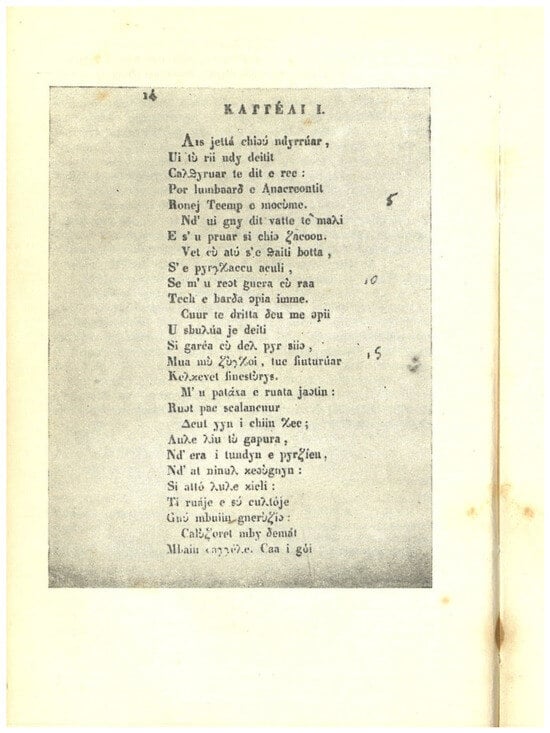
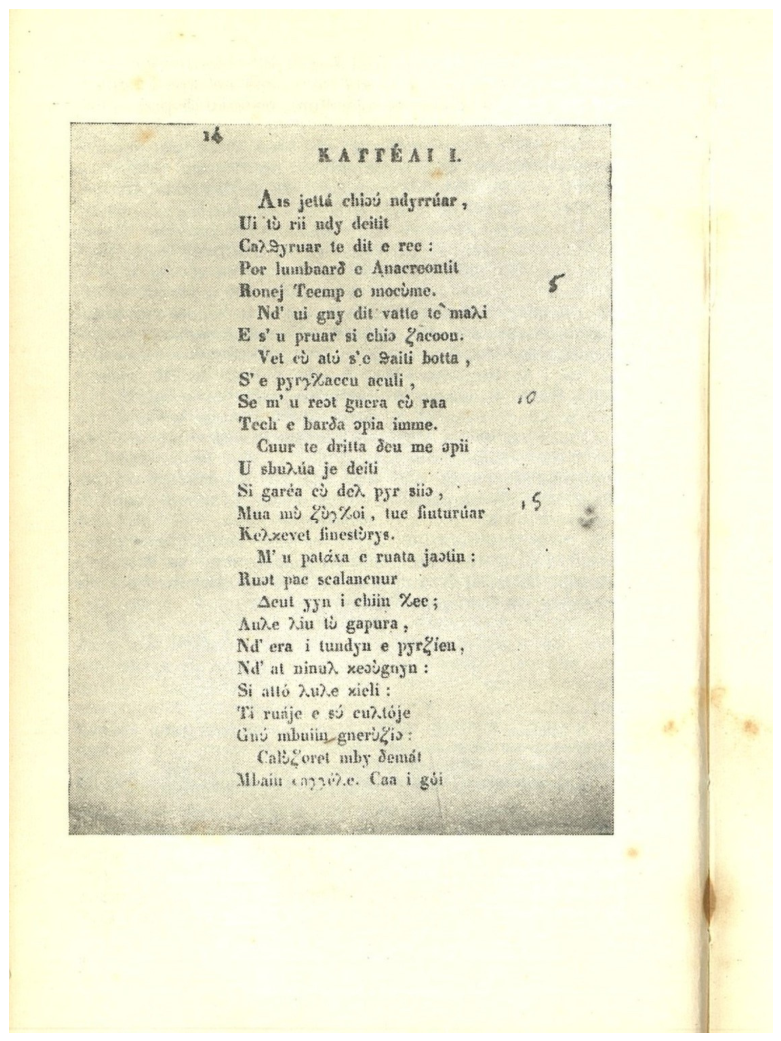
In this situation, as Hamiti (2014, p. 432) observes, the Albanian reader is found in front of a choice: either to learn Arbëresh to enter the world of the original text, or to accept the adaptation into standard Albanian, losing a part of the original value. This dilemma shows that none of the extreme solutions is fully sufficient. The linguistic and graphic complexity of De Rada’s original text can be seen in Figure 1, which reproduces the first canto of The Songs of Milosao in its original Arbëresh form. The difficulties of knowing the language of the work compromise the chain of communication with the readers, because literature in the first place is language, which is written to communicate a set of certain messages. According to the theories of reception, literary communication is explained through a visual approach, where according to Abrams, it can be approximated with the basic model of the delineation of a triangle in which the work occupies the center of the inner space of the triangle, and the three vertices correspond to the world (the reality present and shaped in the work), the author, and the reader (Compagnon 1998). This fundamental coexistence is also highlighted by Jauss (2001), who emphasizes: “Since the dialogical relationship between literature and the reader—which can be understood either as a link between communication and the recipient, or as a relationship between stimulus and response—decisively conditions the literary work in its artistic features, as in its historicity, there exists the possibility to establish upon it the connection of literary works in the space of the history of literature.”
Figure 1.
Original text of the first canto of the poem The Songs of Milosao. Source: De Rada (1836). Poesie albanesi del secolo XV: Canti di Milosao, figlio del despota di Scutari. Tipografia “Guttenberg”.
At this point, a model of cultural mediation becomes necessary—one that neither confines the text within a limited circle of specialists nor detaches it from its original linguistic and stylistic structure. Such a solution can be seen in the model followed by Jup Kastrati, who proposes the parallel presentation of the text: on one side, the transliterated variant in accordance with the original pronunciation, and on the other, the variant adapted into contemporary Albanian. In this way, the connection with the linguistic structure of the author is preserved, while simultaneously, the path for a wider reception is opened.
3. Contexts and Challenges in Jup Kastrati’s Reconstruction of Milosao
To clarify the role played by the scholar Jup Kastrati in bringing Kangët e Milosaut to the attention of readers in Albania, it is necessary to outline the historical, institutional, and material conditions under which his editorial work was carried out. These conditions are not considered here as factors that determined or directed his methodological choices, nor are they taken, in themselves, as indicators of the scholarly quality of the edition. Rather, they describe the circumstances in which Kastrati undertook the reconstruction of Milosao and help to clarify the nature of the challenges he faced.
After the Second World War and the establishment of the communist regime in Albania, state policies were formulated on the basis of a symbiosis of two ideologies: Marxism–Leninism and traditional nationalism. This essentially incompatible symbiosis was reflected in the Albanian state’s relations with the Arbëreshë of Italy, as the state sought to foster within this community a dual identity, both ethnic and ideological (Boçi 2022). Within this framework, considerable emphasis was placed on the national narrative, which was seen as particularly embodied in the figure of Jeronim De Rada, one of the most important figures of the Albanian National Renaissance and one of the major authors of Arbëresh literature.
The Albanian state showed considerable interest in the figure of De Rada. Thus, during the first official expedition to the Arbëresh settlements of Calabria, conducted by the Albanian Legation in 1950, its representatives reportedly met De Rada’s grandson and traced a substantial number of the writer’s manuscripts and correspondence (AMEPJ 1950). Two years later, in 1952, the Albanian state succeeded in negotiating the purchase of these manuscripts.
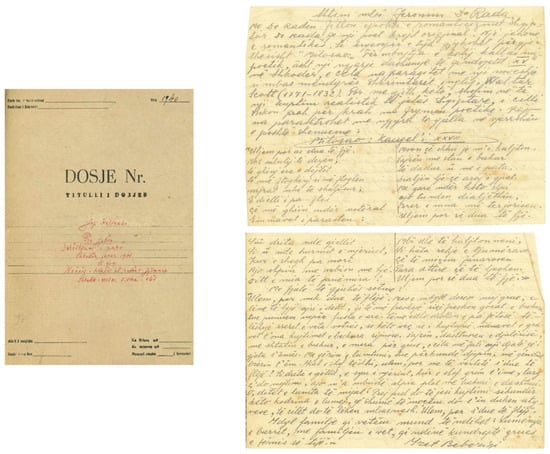
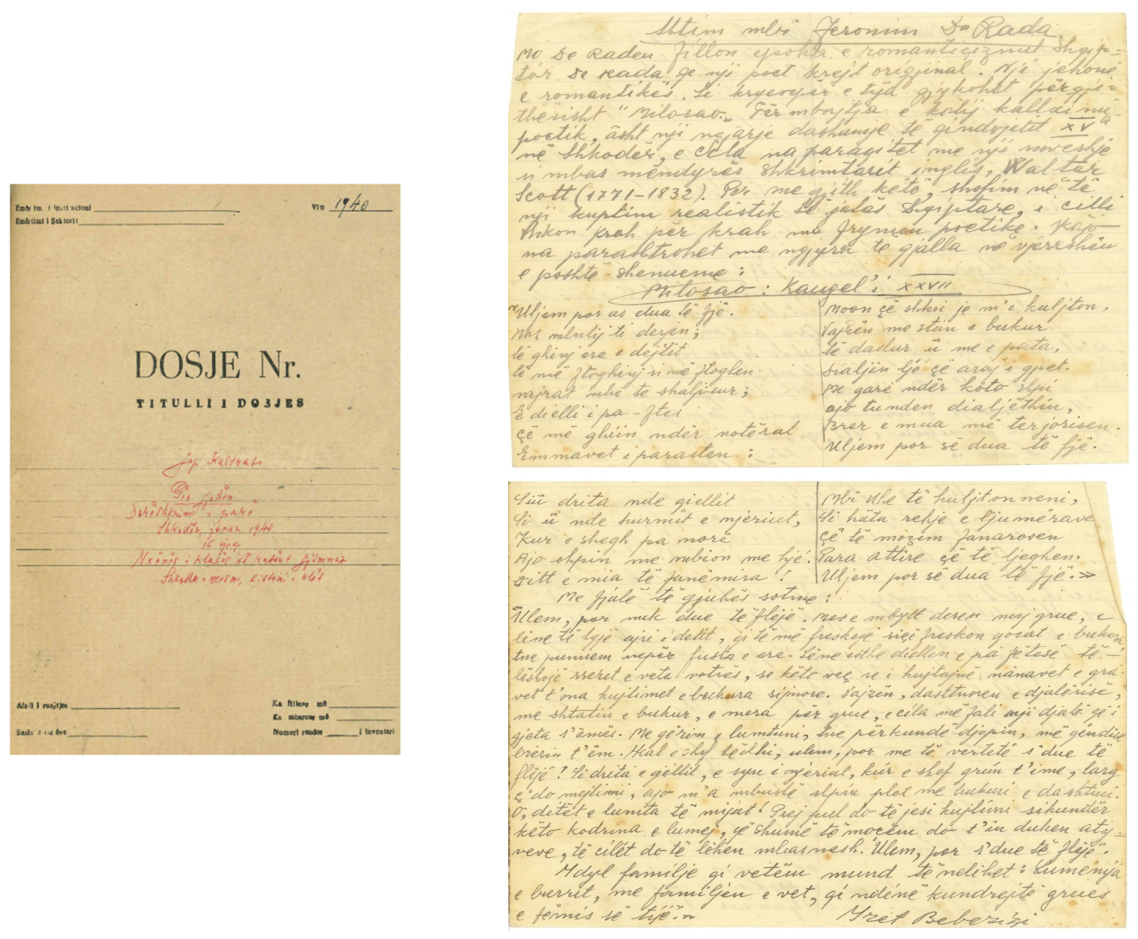
Kastrati’s engagement with De Rada and his acquaintance with Milosao, however, predated the period in which the Albanian state became institutionally involved in the study of the Arbëresh world. This institutional engagement eventually included the acquisition of Jeronim De Rada’s archive, which contained, among the author’s manuscripts and other materials, copies of Këngët e Milosaos (AQSH 1952). The evidence from Kastrati’s personal archive indicates that his work on Milosao had begun as early as 1940, when he was sixteen years old and a student at the Classical Lyceum of Shkodër. This early engagement is documented in facsimiles of his handwritten notes preserved in the family archive, including a file dated March 1941. The notes show that at this stage, Kastrati was already systematically cataloguing De Rada’s works, recording relevant bibliographical information and adding comments on their content and particular features. Several pages of the file are devoted specifically to notes on Milosao, including Canzone XXVII. A facsimile of these notes is reproduced in Figure 2 (Kastrati 1941).
Figure 2.
Facsimiles of Jup Kastrati’s handwritten notes on Milosao from the Kastrati Family Archive (March 1941), documenting his early scholarly engagement with De Rada’s poem at the age of sixteen. Reprinted with permission of the Kastrati Family Archive.
In 1952, following several years of research, Kastrati intensified his work on Milosao. This information is documented in an official report submitted to the Academy of Sciences, in which Prof. Dhora Lloja, Director of the Higher Pedagogical Institute in Shkodër, citing the researcher himself as her source, states: “Jup Kastrati has been engaged with De Rada since 1952” (Lloja 1979).
The acquaintance, study, and familiarization with De Rada’s language and worldview, followed by the preparation of the work’s publication, was a work process that took place under circumstances that are inconceivable for the contemporary researcher. Prof. Dhora Lloja, in the aforementioned report addressed to the Academy of Sciences of Albania regarding Jup Kastrati’s work on De Rada’s oeuvre, would provide, among other things, some details on the tools and conditions under which the researcher worked: “He has copied all the materials found by hand, because in our country, a qualified service with Xerox, photocopying, and microfilming for scientific workers is lacking. One can imagine how much time was lost in this material work for this De Radian; but he has overcome this not insignificant difficulty with love for the subject, with zeal and passion, with perseverance and patience, bringing it to completion” (Lloja 1979).
After copying by hand and preparing the critical edition, due to the specifics of the language of the work, he also undertook the typing of the material, which implies the dedication of an immeasurable amount of physical time. The entire process of adaptation into Albanian, transliteration, analysis, commentary, the drafting of the explanatory glossary, the study of De Rada’s alphabet, and in general, the entire preparation of the critical edition of the work was realized at a time when there was no proper study of Arbëresh dialects. Furthermore, the bibliographic information on De Rada in Albania was also deficient, which complicated Kastrati’s work. It was precisely amidst these absences that he worked persistently to outline the complete form of Milosao.
This reconstruction of De Rada’s work resulted in the first complete publication of Milosao in another Albanian cultural center, specifically Prishtina, where the “Rilindja” publishing house selected Kastrati’s version for publication in 1965 (Kastrati 1965), although the work was reproduced by other scholars in later years. The 1965 Prishtina edition reproduced the same editorial version prepared by Kastrati for the 1956 Albanian edition, retaining the same textual presentation and editorial apparatus; the principal addition was a new preface by Din Mehmeti. It therefore represents not a substantially revised editorial version, but the subsequent circulation of the same form of Kastrati’s edition in a different Albanian readership context.
According to the scholars Bytyçi and Krasniqi (2015), the impact of the publication of this work in Kosovo was considerable, to the extent that “the characters of De Rada’s work became very popular, especially Rina, the poem’s principal female character; a name that in Kosovo became so common (…)” [1]. Similarly, scholar Agim Vinca describes how the work was received when he was a student in Prishtina and emphasizes that through Jup Kastrati’s transliteration and adaptation into contemporary Albanian, Albanian readers were also able to appreciate this masterpiece of Albanian literature from an aesthetic perspective (Vinca 2024). In these circumstances, Kastrati’s edition is also significant from a historical perspective, as it marks the moment when Albanian readers were introduced to De Rada’s complete work.
4. Textual Reconstruction as Linguistic Mediation and Language Preservation
In Kastrati’s (1956) edition, the relationship with De Rada’s text is established through two forms of its presentation: the transliterated text and the text adapted into the Albanian of the time. Both of these forms maintain a direct relationship with the first version of the De Radian edition published in 1836, but they fulfil different functions in the process of transmitting the work. The transliterated text aims to preserve, as closely as possible, the linguistic and graphic structure of De Rada’s text, whereas the adapted text intervenes in those elements that may make comprehension more difficult for the contemporary reader. Through a comparison of several representative cases between the 1836 version and Kastrati’s edition, the following discussion examines the way in which these two levels of presentation simultaneously achieve the preservation of the distinctive features of the historical text and its rapprochement with the reader of the period in which the edition was published.
4.1. The Editorial Structure of Kastrati’s Edition
In his discussion of the nature and responsibilities of scholarly editing, Peter L. Shillingsburg identifies two fundamental requirements for the work of the editor. First, the editor must determine and evaluate everything that can be known about a work before deciding how it should be edited. Second, on the basis of this information, the editor must make clear to the reader which text is being presented, why it has been selected or constructed in a particular form, and how and why it has been altered, in cases where changes have been made (Shillingsburg 2022). The ways in which these requirements are fulfilled may vary, but they must be applied in a systematic and consistent manner.
Jup Kastrati’s edition of Milosao, prepared in 1956, presents a case in which editorial procedures are documented through the organization of the volume and the materials accompanying the text. The edition consists of 204 pages, of which 4 are devoted to the Preface, 28 to the introductory study “Kangët e Milosaut”, 67 to the presentation of the original text through its transliteration and adaptation, while 98 pages comprise materials on De Rada’s alphabet and linguistic commentary in the fields of phonetics, lexicon, morphology, and syntax. These materials may be considered the main components of the scholarly documentation and commentary accompanying the edition, without restricting the term to the narrower meaning of critical apparatus. They fulfil different functions within the editorial structure and are distributed throughout the introductory and concluding sections of the volume.
Thus, the work “reproduced” by Kastrati does not burden the text of the poem; that is, it does not include footnotes at the bottom of each page, but is instead organized into four main sections, two of which are placed at the beginning and the other two at the end, that is, after the presentation of the De Radian work. More specifically, they are presented according to the following division:
The introductory study, in which the scholar presents the paratextual framework of the work, organizing it around two main sections: “Parathanje” and “Kangët e Milosaut”.
- In “Parathanje” (“Preface”, pp. 7–9), several pieces of information concerning the variants of Milosao are presented in panoramic form, together with the scholarly and methodological basis that guided the scholar in his work, thus providing the rationale for his editorial choices and solutions. In this section, the bibliographical references that served as sources of information for the edition are also mentioned, while a list of the partial editions previously made of Milosao is provided.
Thus, the author explains why he followed this method of parallel presentation of the text, stating: “In order to remain as faithful as possible to the text, transliteration rather than transcription was preferred, the former being understood as the reproduction of the letter without taking into consideration the sound it represents. The transliteration was made from the first edition of Kangët e Milosaut, the original text of 1836, a work which is now very rare. Printing errors that had inadvertently slipped into the author’s text were indicated below the respective kangjele.
In order for the reader to gain a good understanding of the poem as a whole and to fully appreciate this lyric novel—unique in our literature—it was considered appropriate to adapt it into contemporary speech, based on the Tosk dialect, since, as is known, the Arbëresh dialect is, to a considerable extent, close to that of southern Albania. In doing so, care was taken to make the adaptation as poetic as possible, so as to preserve the poet’s spirit and the distinctive rhythm of De Rada’s poetry. Wherever possible, the ellipsis was also retained, since, as Tommaseo rightly points out, this syntactic figure is necessary in poetry. Likewise, for the most part, De Rada’s concise style and vocabulary were also preserved“ (Kastrati 1956).
- 2.
- The section “Hyrje: Kangët e Milosaut” (“Introduction: The Songs of Milosao”), the history of the creation of the work is presented in detail, together with a physical description of De Rada’s work, both in formal and substantive terms. The historical framework in which Milosao was conceived is accompanied by information provided by De Rada himself in his “Autobiography” concerning this important moment in his life. The specific features of each edition of Milosao are then discussed. Over a period of forty years, the work was revised several times by its author, resulting in three editions. After making a comparative approach among them, the scholar analyzes the first version of the poem, clarifying for the reader, for each song, not only its subject matter but also its poetic and stylistic features, as well as the beauty of the imagery and artistic ideas conveyed by each one. The introductory study extends from pages 11 to 37 and discusses all principal aspects of the poem, as the scholar attempts to provide every reader with “keys to reading” the work.
In this section, we find elements of textual and historical-literary commentary, in which the author offers an objective critical assessment of the work and also highlights the reception it received in the critical circles of the time. His position as a literary critic is based on the elements of the text; he neither overestimates nor criticizes De Rada, but presents the characteristics of the style and of the poem as a whole, with its shortcomings and achievements, without a tendency toward erudition. In this sense, the scholar’s approach and analysis offers a critical view in the fullest sense of the term, without the excessive praise and “sugar-coating” that might have been expected, or that had commonly occurred, up to that time.
On the one hand, he highlights a number of anomalies and difficulties in the work, but these are consistently accompanied by explanations of the reasons for their occurrence, while De Rada’s creative vision and talent in opening the way toward a genuine artistic tradition in Albanian literature are also acknowledged. Moreover, from the perspective of quality, Kastrati identifies this author’s poetry as the highest point of his literary achievements in comparison with the other genres or the numerous fields of De Rada’s activity.
- 3.
- “Notes on De Rada’s Alphabet” (“Shënime mbi alfabetin e De Radës”) is placed in the concluding part of the editorial apparatus, after the presentation of the poem, and provides extended information for the specialized reader. This section explains De Rada’s alphabetic code and the principles for reading his language in the present day while also offering valuable information for understanding certain features of Arbëresh speech more generally.
- 4.
- “Linguistic Commentary” (“Komente gjuhësore”) is the concluding scholarly chapter, in which the scholar clarifies the meaning of each kangjele, providing detailed explanations of obscure words in the text, such as borrowings, barbarisms, historicisms, neologisms, and other words belonging to the passive vocabulary that had long since fallen out of use. In addition to the philological explanation of the words, information is also provided about events, persons, and circumstances connected with the context in which these words are used.
All of these elements constitute the editorial and critical apparatus accompanying Kastrati’s edition of Milosao, providing, in an argued manner, the linguistic and philological information employed in the reconstruction and presentation of the work.
Furthermore, the presentation of the thirty kangë of Milosao in two columns, with the left-hand column presenting a transliterated version of De Rada’s text, with intervention limited to the graphic code, and the right-hand column presenting the adaptation into contemporary Albanian, in which different interventions have been made at the phonetic, lexical, and syntactic levels, enables the adapted text to be directly compared with De Rada’s original text placed alongside it. In this way, the reader can not only undertake two parallel readings, but also examine for themselves each graphic, lexical, or syntactic solution introduced by the scholar in the adaptation. Any linguistic element that may have been lost or added to the text can be identified through this form of presentation.
The reconstruction of Milosao required not only philological precision but also a balanced methodological approach that would mediate between textual authenticity and contemporary readability. Faced with the existence of several versions of the work, an unstable alphabetic system, archaic lexical structures, and syntactic complexities, Jup Kastrati constructed an editorial model aimed at preserving the linguistic and poetic specificity of De Rada’s work while simultaneously expanding its accessibility for the modern reader. The following sections examine the main methodological strategies through which this process of textual reconstruction was realized.
4.2. Establishing the “Authoritative Text”
The Songs of Milosao does not have a single published version, but several, because De Rada reworked this “lyrical novel” from time to time and, during his lifetime, published it in three different editions, printed respectively in 1836, 1847, and 1873. It should be noted that each of these editions has its own specifics. The author’s interventions in reworking the work affect all levels of the text, except for the main plotline of the poem. The greatest differences are found between the first edition (1836), which contains 30 songs, and the second edition (1847), which contains 37 songs. Besides the addition of new songs and the alteration of some previous ones, this reworked version of the work was also assigned fictitious dates at the beginning of each song (kangjele), which were created by the author so that the work would truly appear as a “lyrical diary of the 15th century”, in accordance with the title. The first song begins on 27 June 1405, and ends in the last song on 7 May 1418. In reality, this innovation was harmful according to the scholar Namik Resuli, because “at times these dates contradict what is said and described in the songs” (Resuli 1941).
Likewise, the third edition also contains 37 songs and generally the content is that of the second edition, except that the paper and format are of poor quality and contain printing errors. However, according to the data presented by the scholar Jup Kastrati, even between these editions, “there are some small changes, here and there in various songs. On the other hand, the dates placed above the cantos also differ: in this edition, the event begins in 1405 and ends in 1423. This third edition also has some flaws regarding the alphabet (…)” (Kastrati 1956).
Professor Jup Kastrati examined all three of these editions with attention and, after highlighting the specifics of each version—presenting their commonalities and differences in the form of a comparative study (in the introduction to the publication of Milosao)—he selected the first variant for adaptation into contemporary Albanian. His reasoning was that this was the highest quality version of the work, written in a burst of inspiration, with fine sensitivity and striking originality. It was the version that marked the genesis of the work and gave the author his great fame in Italo-Albanian and European circles.
In his work Studies on De Rada, when discussing the criteria according to which De Rada’s works in general may be edited today, particularly in cases where we are constrained to present only one representative version of the author’s text, Kastrati proposes, as a general rule, referring to the latest published version, since it is assumed that the final version represents the author’s evolution and his progress. However, when it comes to the different versions of Milosao, he regards it as an exceptional case, because he observes: “In the editions of 1836, 1847, and 1873. The last edition is weaker than the first two. All three editions were published during De Rada’s lifetime. It is known that, in 1840, De Rada republished Milosao, but censorship suppressed it. This should be regarded as the second edition, while the 1847 edition should be regarded as the third edition and the 1873 edition as the fourth edition. De Rada does not count the edition suppressed by censorship; therefore, he calls the 1847 edition the second edition, and the 1873 edition the third edition.” The first edition has been regarded by many scholars as the representative form of Milosao, since the revisions subsequently made by De Rada, which were published as different versions, have often been criticized for excessive linguistic interventions. According to Gualtieri, excessive linguistic revision contributed to the impairment of the work from both an artistic and a linguistic point of view (Gualtieri 1930).
For these reasons, Kastrati adapted the first version of Milosao (1836). This choice aligns with the principles of Gianfranco Contini’s modern ecdotics, which considers the critical edition not as a passive reflection, but as a “working hypothesis” (un’ipotesi di lavoro). According to him, the philologist, through the selection of variants and the form of presentation, makes critical decisions aimed at keeping the text alive within the history of literature (Contini 1990). Kastrati was also constrained by an unfavorable external circumstance, given that the physical copy he possessed was missing two songs: specifically, Canto XII, regarding which the researcher clarifies: “The twelfth canto is missing from the first edition. We have taken it from the second—therefore, there is some difference in the writing” (Kastrati 1956, p. 143). Likewise, the song “Valjim’ i Arkiopulit” was also taken from the second edition, since it was missing from the first. Thus, the thirty songs of the work were reproduced in Arbëresh, juxtaposed with the variant of their adaptation to the graphemic and lexical system of present-day Albanian.
Regardless of his work, Kastrati believed that the publication of only one version of the work was not sufficient; rather, all editions had to be presented in their entirety, as only in this way could the De Radian corpus be fully represented. He affirmed this from time to time in his correspondence with scholars and colleagues, but also during the commemorations of the 100th anniversary of De Rada’s death, where he would reiterate the need for a comprehensive understanding of the versions of this author’s works in general: “I believe that all conditions have matured to begin drafting a Corpus Scriptorum of all the complete works, Opera Omnia of Jeronim De Rada, with strict scientific criteria” (Kastrati 2003a, p. 121). He expresses this idea even more clearly in another book, where he emphasizes: “To solve the problem in several aspects of Albanian textology, De Rada’s work must be presented with the editions, re-editions, reprints, first hand, second hand, third hand, and so on” (Kastrati 2003b, p. 14).
4.3. Transliteration and Alphabetic Reconstruction
The linguistic variant in which Jeronim De Rada’s work is written constitutes the fundamental difficulty for its reception. Milosao is based primarily on the dialect of the poet’s birthplace, representing a form of the Arbëresh dialect that is archaic in many aspects and preserves the characteristics of medieval Albanian. Beyond the aspect of archaism, the state of written Albanian in general during De Rada’s time must also be considered. Albanian lacked a unified writing system, both in terms of the alphabet used and in its normative form—that is, in orthographic and grammatical regularizations. Viewed within the context of its time, Milosao represents a major achievement, not only literary but also linguistic, as the poet had to simultaneously give the spoken language a written form and an artistic mantle. He aimed to elevate his dialect—this form that had remained uncultivated in writing and neglected for centuries—to the heights of a literary language.
Over time, Arbëresh as a language, besides preserving the features of medieval Albanian, has—like any other language—acquired evolutionary traits developed according to the nature and linguistic laws of the settlements where the Arbëresh established themselves. On the other hand, the Albanian of the mother trunk itself has been in constant evolution. Evolution in different directions has resulted in the coexistence of forms with different typologies, genealogies, and chronologies within the same linguistic structure. Any researcher who undertakes to familiarize De Rada’s work with the contemporary reader must possess a deep knowledge of this evolutionary process of the language and must absorb all the phonemic, graphemic, morphological, lexical, and syntactic features of Arbëresh, and particularly of De Rada’s language. The transliteration and adaptation of the work into modern Albanian implies the accurate interpretation of the poetic text on a multi-layered level, starting from De Rada’s alphabetic system and extending to the lexical one.
The alphabetic system is the first encounter with the work, which complicates reading with today’s linguistic code. This is due to the fact that, “initially, De Rada limited himself to adapting the Italian alphabetic model to write Arbëresh, but later complemented it with Greek letters to express the specific phonemes of Albanian that Italian does not possess. The result was a mixture of Greek and Latin letters which, although it could be justified by the theories of the time regarding a close ancestral link between Albanian and Greek and by the scholar’s intellectual curiosity, did not aid the circulation and spread of that alphabet (…)” (De Rada 2014).
In the beginnings of his literary creation, De Rada mainly followed the tracks of the Arbëresh alphabetic tradition of writing, which, although it did not have a single form but varied according to authors, still had at its core the Latin alphabet, supplemented with Greek graphemes for certain sounds. Later, the poet shifts from a graphic system based on the Italian alphabet to other mixed Greco-Latin systems. Thus, his alphabet is in constant change and remains unstable even from one version of Milosao to another. Meanwhile, Jup Kastrati, being a linguist himself, after studying the entire corpus of De Rada’s works, reached the conclusion that De Rada’s alphabetic system, during the seventy years of his literary creation and his research-scientific and publishing activity, changed seven or eight times. De Rada’s written Albanian, in the period from the composition of his first poem, Premilosao (1833–1834), until his last work published during his lifetime, Testamenti politik (1902), underwent numerous changes in the graphics of the poet’s publications (Kastrati 1979, pp. 3–4).
In the first edition of Milosao (1836), the edition to which Kastrati referred for adaptation, De Rada explains the path he followed for drafting the alphabet. Through arguments for each sound used, he shows that his alphabet is based on Latin letters, mixed with some Greek letters. The philological processing of such an alphabetic system was the fundamental challenge—a challenge that, thanks to persistent work, Professor Kastrati successfully tackled. Initially, he analyzed De Rada’s alphabetic code, explaining the phonetic value of each letter.
He presented the entire fund of De Radian graphemes, as well as their combinations, in a systematized manner in “Notes on De Rada’s Alphabet”, which is attached to the critical edition, specifically on pages 106–111. Here, data are presented regarding the methodological path of the transliteration process followed by the scholar, and simultaneously, the reader is oriented toward De Rada’s original text, understanding the phonetic form of each grapheme. For this reason, the explanation is supplemented with relevant examples from the authentic text. Additionally, on the first page of the critical edition of Milosao, the first song of the poem is presented as a facsimile with De Rada’s untouched alphabet, so that the reader can form a clear image of the authentic text.
During the analysis of De Rada’s alphabetic system, Kastrati also highlights some of the errors and anomalies that exist in the interpretations of certain sounds made by previous scholars who have dealt with the work. These interventions are not made in the form of polemics or the underestimation of previous work, but as scientific counterarguments aimed at the right solution for the proper reading of the letters. Such interventions are noted in the interpretation of the letters gk = gj, kj = q, x = q, l = ll, etc., which are considered inaccurate phonetic interpretations by the scholar, who, after listing the reasons for the inaccuracies, presents the correct form. During his explanations of De Rada’s alphabetic system, the scholar, in many cases, also presents the evolution or transformation of certain letters by De Rada himself, which are replaced in the other versions of Milosao. According to him, the main philological issue that he must resolve is the question of whether he should transliterate or transcribe the text. By the former, he means the process of adapting De Rada’s graphemes to those of contemporary Albanian, and by the latter, the adaptation of pronunciation as well. He prefers to carry out only the process of transliteration, reproducing De Rada’s text using the contemporary Albanian alphabet.
Recognizing the characteristics of De Rada’s speech, he preserved the quantity of stressed syllables, marking long vowels with doubled vowels, for example: “lumbaardh e Anakreontit”, “Kuur vaiza e ngroghët”, “më kësheen të pieksurith”, etc. Likewise, in order not to produce misunderstandings for the contemporary reader, he removed the nasal accent from the text, since today this accent is identified with the feature of nasality, a feature that does not exist in Arbëresh varieties of speech. These explanations are provided by the author himself in the editorial apparatus, while in other cases, throughout the transliteration of the work, he attempted to maintain a high degree of fidelity to the original text, following the principle of rendering only the graphic form, and not the pronunciation of the sounds.
4.4. Lexical Mediation and Modern Accessibility
The lexical system of De Rada’s work is another aspect in which Kastrati had to intervene in the right-hand column, where the adaptation to contemporary Albanian is presented. In the first version of Milosao, there are many words in archaic Albanian form, which are mixed with elements from other languages, such as: Grecisms, Italianisms, Slavisms, etc., which is a specific feature of Arbëresh dialects in general. Based on these linguistic traits, the scholar Ardian Vehbiu considers Arbëresh as “a Byzantine Albanian, culturally organized around the Greek rite, in a geographical space surrounded by Catholic Italians” (Vehbiu 2020).
The predominance of Grecisms on the lexical level has also been emphasized by the scholar Arshi Pipa in the work Jeronim De Rada (Pipa 2013). Through the examination of the linguistic aspect in the work Milosao, he analyzes, among other levels, the lexical fund of the poem. According to this scholar, the text of the first version contains 704 words, of which 14% are borrowings from modern Greek. “The presence of so many words from modern Greek in a poem written in the dialect of Macchia in 1836 reaffirms once again that the ancestors of those who populated the Greek Sila […] came from Epirus and from Greece.” On the contrary, he continues, “borrowings from the Calabrian dialect and some from the Neapolitan dialect amount to less than 5% of the lexicon” (Pipa 2013).
This density of borrowed or even “invented” lexical elements is a normal process, as Arbëresh separated from the mother-tongue trunk as early as the 15th century, and linguistic purification cannot be expected at this chronological distance, especially when a language is under the constant pressure of assimilation. In addition, as the scholar Eqrem Çabej has emphasized, the Albanian language is rich in terminology of certain spheres, but lacks the necessary wealth regarding abstract lexicon (Çabej 1977).
In writing his first work, Milosao, Jeronim De Rada did an immense amount of work to revitalize old and forgotten Albanian words used in the Arbëresh dialect. These words, expressions, and syntactic constructions that preserve the characteristics of medieval Albanian undoubtedly constitute a precious contribution to scientific research in the field of the history of Albanian; however, the fact cannot be denied that from the perspective of the work’s reception in today’s times, they mark a threshold that must be crossed. To cross this threshold, Jup Kastrati intervened in the parallel version of the verses, adapted according to contemporary Albanian. This version consists of a normative systematization of the text, adapting, in addition to the alphabetic aspect, also the author’s linguistic and dialectal variation, with the aim of providing a fluent reading for mass readers. In this context, it should be recalled that in 1956, Albanian had not yet been standardized, and dialects and subdialects of Albanian were used in the written tradition. The scholar Kastrati could have adapted it more simply into his own dialectal form, that is, into Gheg, which had also been done by other scholars before him, but he chose the linguistic variation that brought it closer to the De Radian style.
The lexical aspect is closely linked to the act of communication and, as such, makes the investigation of the meaning and semantic nuance of the word impenetrable if the reader does not know the referent or fails to decipher the code that signifies a certain sememe. For this reason, in the parallel version of the text adapted according to today’s Albanian, the scholar intervenes in the replacement of lexical units, which avoids a lack of recognition, misunderstandings, and difficulties in perceiving the verse of the Arbëresh poet. With the aim of synchronizing the work with today’s cultural system, during the adaptation, the scholar Kastrati intervened on the lexical level in cases such as:
- By replacing Italianisms, for example: akuli = shgjeta, finestrës = dritares, sufit = tavan, mai = kurrë, çaula = sorrë, etc.
- By replacing Grecisms, such as: anankasii = nxitim, gavnare = madhështore, parkalès = lutje, sirk = mëndafsh, skemantilj = shami dore, gorien = hora, shesh, parkalidhe = çilkore, haraksur = zbardhur, karpissur = pjekur, etc.
- By replacing neologisms created by the author, or archaic Albanian words which, not having been part of the active vocabulary for many centuries, seem unknown or produce misunderstanding with today’s code of Albanian, such as: Ggnryzit—njerëzit, door—dorë, kopiliet—vashat, dëthinjazëmër—magjepsje, etc.
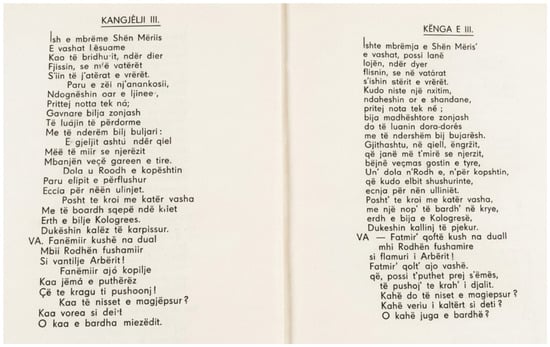
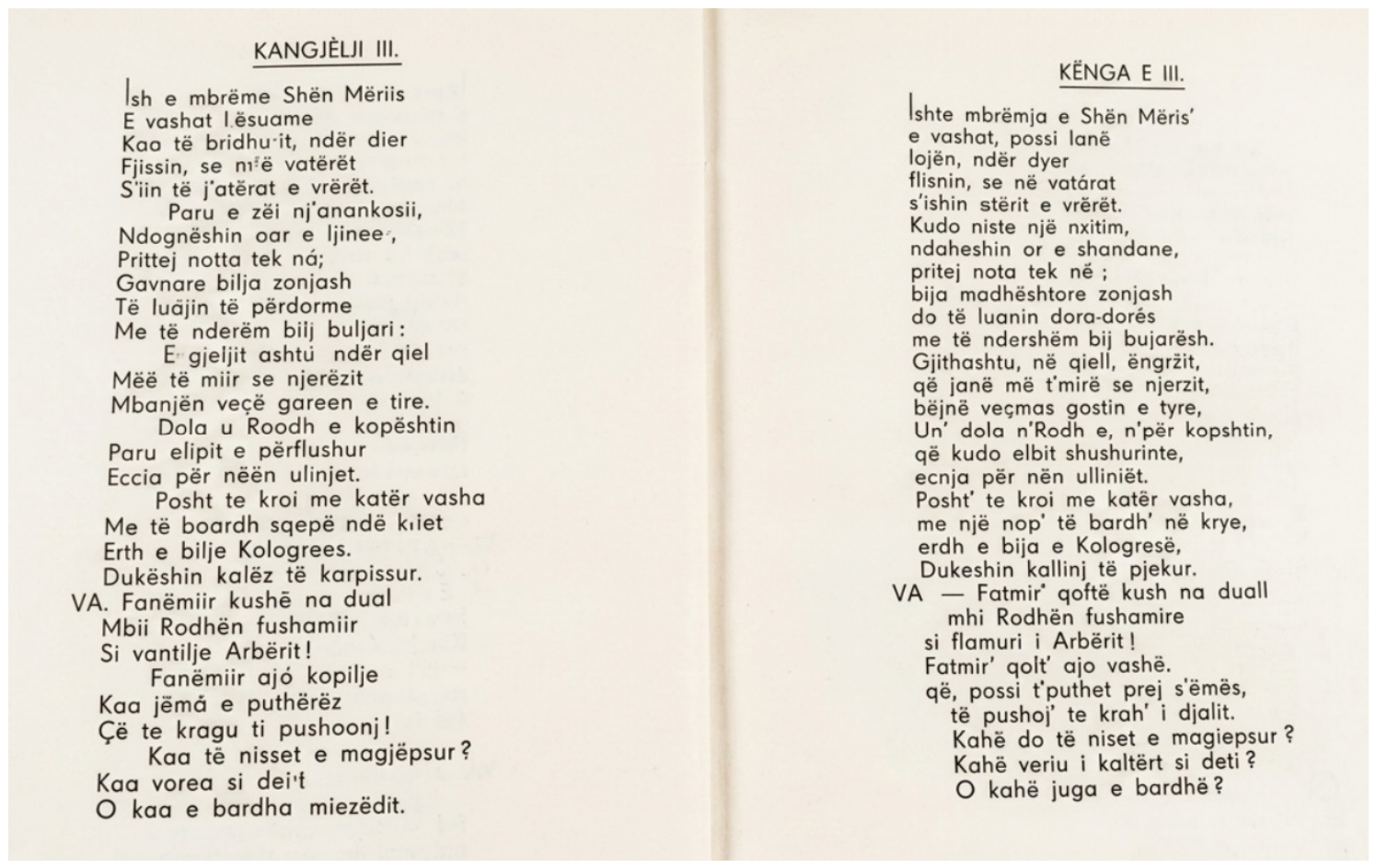
These typologies of interventions have been applied throughout the entire adapted text, and this constitutes an aid to the actualization of the work, which in this form circulated widely among readers. Unlike adaptations that would be made later, which would transform the De Radian text with the aim of making it more poetic and attractive to today’s reader, the scholar Kastrati limited himself only to linguistic retouching and primarily updates on the semantic, and rarely, syntactic levels. He did not recreate it; he did not remove nor add words or phrases that were not in the source text. An illustrative fragment from the third song, showing these lexical and linguistic interventions in the parallel presentation, is reproduced in Figure 3. The left column preserves De Rada’s original Arbëresh text, while the right column presents Kastrati’s adaptation into contemporary Albanian.
Figure 3.
Parallel presentation of the third song of Milosao: the original Arbëresh text in the left column and Kastrati’s adaptation into contemporary Albanian in the right column. Source: Këngët e Milosaos, prepared by Jup Kastrati.
The parallel presentation makes the nature of these interventions directly observable. The example from the third song shows that Kastrati’s adaptation was not limited to the replacement of isolated lexical items. Alongside lexical substitutions, such as karpissur → pjekur, vantilje → flamur, and kalëz → kallinj, the adapted column also regularizes or expands forms that may hinder immediate comprehension, as in Ish e mbrëme Shën Mëris → Ishte mbrëmja e Shën Mëris’. At the same time, the original form remains visible in the parallel column. The layout therefore makes the editorial mediation itself transparent: the reader can distinguish the historical form from its contemporary equivalent and observe the extent of the intervention without losing access to the source text.
In order to concretize the type and nature of the adaptation of words, as well as to clarify for the reader the lexical system of De Rada, the scholar structured all the data concerning the semantic analysis, as well as the etymology of the words, in the chapter at the end of the book, “Linguistic Comments”. Considering the nature of the selection of the words used to replace lexical units that are incomprehensible to the general reader, it becomes apparent that the scholar Kastrati combines several approaches to word meaning, relying primarily on contextual analysis, where the meaning of a lexical unit is evaluated in close relation to its immediate textual environment and literary function. At the basis of this analysis, the word is not considered simply as an isolated unit, nor is its equivalent sought in a formulaic manner; rather, the broader textual environment and literary function are taken into consideration, with the aim of coming as close as possible to De Rada’s poetic oeuvre.
The Linguistic Comments constitute an important chapter for the study of De Rada’s lexicon, because the scholar did not limit himself to the usual practice of critical editions, in which an explanatory glossary is provided for the replaced words, but went further, bringing to light the semantic, etymological, and contextual dimensions of the equivalents used.
In “Linguistic Comments”, a special place is also occupied by the explanation of the grammatical features of Arbëresh dialects, which creates a comprehensive mirror for penetrating the most subtle corners of meaning. To realize this research chapter, he made a synthesis of all previous explanations, which he himself emphasizes: “Regarding the linguistic comment, it was seen as necessary for it to be as complete as possible. For this reason—by comparing them with one another—the notes of others who partially reproduced De Rada were utilized. The greatest help was found in Gustav Meyer’s ‘Etymological Dictionary,’ in De Rada’s own ‘Dictionary of Rhapsodies’ published in ‘Fiamuri Arbërit,’ and the translations of ‘The Songs of Milosao’ into Italian by the author and later by Marchiano and Gualtieri, which clarified the obscure points of the poem” (Kastrati 1956).
All of these sources are organized in the “Linguistic Comments” section and are supplemented by many findings and analyses of the scholar Kastrati himself. By the nature of the explanation, the so-called “linguistic comments” transcend the linguistic sphere, as they also touch upon the historical, literary, and ethnographic spheres, thus taking on the full form of philological comments.
4.5. Syntax, Style, and Poetic Rhythm in Kastrati’s Adaptation
As on the lexical level, interventions were also made by Kastrati on the syntactic level, always in the column of the adapted text. These interventions were seen as unavoidable by the scholar because De Rada often uses certain syntactic constructions that are not in the nature of Albanian, nor in that of the Arbëresh dialect of Calabria, nor in Italian. This difficulty is multiplied by the lack of a certain regularity in the interconnection between the songs and by the careless use of punctuation marks, without a coherent orthography and with a language that is often incomprehensible.
Furthermore, Milosao does not have a literary genre to which it can be linked, as it contains features of both lyricism and narrative, which makes it difficult to determine the exact syntactic boundaries.
The scholar Kastrati identified these difficulties right in the introduction to the work, stating: “The Arbëresh dialect, for those who have not dealt with it, is difficult. On the other hand, the fragmentarity of the work, the lack of organic connection between the various songs—the conciseness of the style, the dense poetry, the laconism of expression, the brevity of thought, the author’s intentional obscurity, the Pindaric flights and elliptical sentences, make it even more difficult to enjoy this erotic diary. But when you enter the work, when you live with the poet in his moments, when you embody him, you cannot bear to let it out of your hand” (Kastrati 1956).
The scholar did not violate or intervene in the word combinations and the internal rhythm of De Rada, because he was aware of the determining role of syntactic elements in preserving the De Radian style. Only in cases where semantic ambiguities are created, the scholar intervened, illuminating the archaic elements. Such syntactic interventions were made in the exchange of the positioning of grammatical categories within the sentence, which clarify the semantic aspect of the verse; for example, when the adjective is placed before the noun Me të ljodhëta të biljat, the scholar adapts it to the order of Albanian, doing the opposite: me të bijat e lodhura; or the syncopated verb forms presented by De Rada are presented in full by the scholar, in many cases shifting the particles or other elements of the phrase according to today’s order, with the aim of conveying the verse’s meaning more clearly: Ish e mbrëme Shën Mërlis/E vashat lësuame = Ishte mbrëmja e Shën Mëris’/e vashat passi lanë; or in cases where the verse produces misunderstanding: Dreq rahjet e deitit = Kundrejt kodrave dhe detit.
After an observation of De Rada’s poetics, Prof. Kastrati underlined the importance of preserving the ellipsis, as he considered it an important element for penetrating the syntactic meaning and the rhythm of the De Radian verse. Therefore, during the adaptation into today’s language, he completely avoided intervening in these elements of the text.
Another difficulty in adapting the work to today’s Albanian was the preservation of the metric system used by De Rada. As Kastrati himself analyzes: “Of scientific interest to us are some data of the syllabo-tonic system of Arbëresh poetry. To understand De Rada’s metrics, we must be clear about the metrics of our folk poetry and, specifically, that of Arbëresh folk poetry. Whatever debates have taken place, today it is clear that our folk poetry, as well as the Arbëresh one, in a pronounced way preserves signs of the early syllabo-tonic metric system (…) De Rada’s poetic verses are syllabo-tonic verses, although not solely of this system. They give the impression of an intermediate, transitional phase from an old system (syllabo-tonic) to a new one (syllabic), and for this reason, they present elements from both systems. However, the elements of the syllabo-tonic system remain at the base. De Rada’s metrics are very regular, with quite specific norms that can and should be studied in their entirety” (Kastrati 1979, pp. 5–6). With full awareness not to touch the metric system, the scholar did not intervene even in cases of incorrect syntactic constructions when these were linked to the melodic harmony of the verses. All syntactic figures, such as inversion, repetition, anaphora, epiphora, antithesis, and numerous enumerations, appear untouched in the version adapted to today’s Albanian by the scholar Kastrati. Meanwhile, the number of syllables has also been respected and carefully adapted in the reproduction version, although in many cases, it was impossible due to the replacement of incomprehensible words, such as foreign words and barbarisms.
Likewise, he remained faithful to De Rada’s punctuation system, although today’s punctuation rules are not applied in the text. Viewing them as signifying elements of thought and taking into account the fact that regarding punctuation matters there were no unique rules at the time of Milosao’s writing, the scholar fully respects the punctuation used by De Rada, conveying it rigorously in accordance with the original.
5. Conclusions
The analysis of Jup Kastrati’s 1956 edition of The Songs of Milosao demonstrates that the relationship between textual authenticity and contemporary accessibility need not necessarily be constructed as an oppositional one. In the case of endangered literary heritage, such as the Arbëresh tradition, preserving the historical linguistic form of a work and transmitting it to new readers do not constitute incompatible objectives. They can be integrated within the same editorial practice, provided that intervention is reasoned, differentiated, and controlled by the linguistic and poetic features of the source text.
The significance of Kastrati’s edition lies precisely in the fact that it does not resolve the problem of accessibility by replacing the original text with an adapted version. Its parallel structure preserves the transliterated text alongside the adapted version, thereby providing readers, on the one hand, with direct access to De Rada’s linguistic substance and, on the other hand, with a contemporary pathway toward the work. The two versions thus perform complementary rather than interchangeable functions: one safeguards the historical identity of the text, while the other preserves its communicative potential. Their juxtaposition also makes the editorial intervention visible, allowing readers to follow and assess the relationship between the source text and its adaptation.
The analysis also shows that Kastrati’s intervention in the column adapted into contemporary Albanian is guided by a principle of selective mediation. He intervenes where historical linguistic distance obstructs comprehension, particularly at the lexical level, and to a more limited extent, at the syntactic level, while avoiding alterations to those elements that constitute De Rada’s poetic identity. Ellipsis, syntactic figures, rhythm, metrical organization, and other stylistic features are not treated as obstacles to be modernized, but as components of the text to be preserved. Adaptation, in this way, does not become a form of rewriting, but functions as a controlled form of mediation whose boundaries are determined by the linguistic and aesthetic structure of the work.
This principle becomes particularly evident in the treatment of the lexicon and in the chapter Linguistic Comments. The latter extends the function of the edition beyond the simple provision of equivalents, reconstructing the semantic, etymological, grammatical, historical, and contextual dimensions necessary for understanding De Rada’s language. In this respect, Kastrati’s work demonstrates that accessibility cannot be reduced to lexical modernization. To make a historical text accessible also means, as much as possible, reconstructing the linguistic and cultural conditions through which its meanings become perceptible. The philologist thus operates not only between two linguistic forms, but between two historical horizons of reading.
The case of Milosao therefore suggests a broader principle for the preservation of endangered literary heritage: a text is not fully preserved merely when its linguistic form is faithfully reproduced; it is preserved when the conditions for its continued reading and transmission are also maintained. In literary traditions whose historical language has become significantly distant from contemporary readers, and even from members of the communities that have inherited it, accessibility becomes part of the preservation process itself. Parallel editions offer a way of achieving this without sacrificing the source text in the name of modernization.
Nevertheless, Kastrati’s edition should not be regarded as a substitute for comprehensive critical editions documenting the full textual history of Milosao. Kastrati’s own insistence on the need to present all versions of De Rada’s works demonstrates that the parallel edition responds to a specific editorial and communicative purpose rather than constituting a definitive solution to the problems of textual criticism. Its significance lies elsewhere: in demonstrating that philological rigor can be combined with a conscious attention to reception and transmission.
In this sense, the 1956 edition of Milosao can be understood as an early and particularly significant example of philological mediation as a practice of heritage preservation. Its value lies not only in the fact that it made De Rada’s work accessible to Albanian readers, but also in the editorial balance through which it achieved this: the historical text was neither isolated in the name of authenticity nor absorbed into contemporary language in the name of accessibility. The two were placed in dialogue. It is precisely this coexistence—preservation without isolation and accessibility without replacement—that makes Kastrati’s model also relevant to the contemporary transmission of Arbëresh literary heritage.
Funding
This publication was funded by Albanian University.
Data Availability Statement
No new data were created or analyzed in this study. Data sharing is not applicable to this article.
Conflicts of Interest
The author declares no conflict of interest.
References
- Altimari, Francesco. 2009. L’autotraduzione nelle opere letterarie italo-albanesi: Il caso di Girolamo De Rada. In Albanie. Traduzione, tradizione: La traduzione dalle varianti linguistiche alle varianti culturali. Rome: Bulzoni Editore, pp. 71–85. [Google Scholar]
- AMEPJ (Archive of the Ministry of Europe and Foreign Affairs of Albania). 1950. Document Title/Description. Tirana: AMEPJ, Archival Fund/Class D. B/VII-9, f. 4. Unpublished manuscript. [Google Scholar]
- AQSH (Central State Archive of Albania). 1952. Jeronim De Rada Collection. Tirana: AQSH, Fond 24, File 54/2. Unpublished Archival Material. [Google Scholar]
- Bebeziqi, Izet. 1936. Kangjelje nga Këngët e Milosaos. In Anthologi shqipe. Tiranë: Shtëpia Botonjëse “Kristo Luarasi”, vol. 2, pp. 95–119. [Google Scholar]
- Bebeziqi, Izet. 1938. Një përgjigje Zotni dr. Namik Resulit rreth “Komente” të “Milossave”. Drita 3. [Google Scholar]
- Belluscio, Giovanni. 2008. De Rada dialettologo: Spigolature dialettologiche in alcune sue pubblicazioni. In Atti del Convegno “I Centenario della morte di Girolamo De Rada”. Edited by Francesco Altimari. Taverna: Centro Editoriale e Librario dell’Università della Calabria, pp. 57–75. [Google Scholar]
- Berisha, Anton Nikë. 2008. Interpretime të letërsisë së arbëreshëve të Italisë. Cosenza: Luigi Pellegrini Editore. [Google Scholar]
- Boçi, Sonila. 2022. Marrëdhëniet e Tiranës zyrtare me komunitetin arbëresh të Italisë: Një rast studimor mbi nacional-komunizmin shqiptar. In Arbëreshët në fokusin e shtetit shqiptar: Rasti i arbëreshëve të Italisë dhe arbneshëve të Zarës në Kroaci (Aktet e Konferencës Shkencore, Tiranë, më 17 nëntor 2021). Tirana: QSPA, pp. 35–51. [Google Scholar]
- Bytyçi, Sali, and Kosovare Krasniqi. 2015. Botimi, receptimi dhe studimi i kryeveprës së De Radës “Këngët e Milosaos” në Kosovë. In Letërsia dhe Kultura arbëreshe (Jeronim De Rada në 200-vjetorin e lindjes). Elbasan: Universiteti “Aleksandër Xhuvani”, Fakulteti i Shkencave Humane, pp. 232–35. [Google Scholar]
- Compagnon, Antoine. 1998. Le démon de la théorie: Littérature et sens commun. Paris: Éditions du Seuil. [Google Scholar]
- Contini, Gianfranco. 1990. Breviario di ecdotica. Turin: Einaudi. [Google Scholar]
- Çabej, Eqrem. 1936. Kangjelje nga Këngët e Milosaos. In Elemente të gjuhësisë e të literaturës shqipe. Tiranë: Ministria e Arsimit. [Google Scholar]
- Çabej, Eqrem. 1977. Tekstet e vjetra shqip dhe disa kritere rreth botimit të tyre. In Studime Gjuhësore VI. Prishtinë: Rilindja, pp. 302–315, Originally published in Buletin i Shkencave Shoqërore, 1959, No. 2. [Google Scholar]
- De Rada, Girolamo. 1836. Poesie albanesi del secolo XV: Canti di Milosao, figlio del despota di Scutari. Arad: Tipografia “Guttenberg”. [Google Scholar]
- De Rada, Girolamo. 2005. Opera omnia I: I canti premilosaici. Edited and Translated by Francesco Altimari. Soveria Mannelli: Rubbettino. [Google Scholar]
- De Rada, Girolamo. 2014. Vepra letrare. Edited and Translated by Francesco Altimari. Tirana: Ministria e Kulturës Shqipërie Shqipërisë & Ministria e Kulturës Kosovëe Kosovës. [Google Scholar]
- De Rada, Girolamo. 2017. Opera omnia II: Canti di Milosao. Edited and Translated by Francesco Altimari. Soveria Mannelli: Rubbettino. [Google Scholar]
- Gjergua, Llambi. 1929. Dy kangjelje nga Këngët e Milosaos. Dielli, April 23.
- Gualtieri, V. G. 1930. Girolamo De Rada: L’uomo, il clima storico-letterario, l’opera, caratteri romantici dell’opera. Tirana: R. Sandron. [Google Scholar]
- Gurakuqi, Luigj (Lekë Gruda). 1905. Kangjelë nga Këngët e Milosaos. Albania 9: 43–45. [Google Scholar]
- Hamiti, Sabri. 2014. Jeronim De Rada: Milosao, 1836. Studime 21. Prishtinë: Akademia of Shkencave dhe Arteve të Kosovës (ASHAK). [Google Scholar]
- Iser, Wolfgang. 1978. The Act of Reading: A Theory of Aesthetic Response. Baltimore: Johns Hopkins University Press. [Google Scholar]
- Jauss, Hans Robert. 2001. Perché la storia della letteratura? Napoli: Guida Editori. [Google Scholar]
- Kastrati, Jup. 1941. Notes on the Poem “Këngët e Milosaos”. Shkodër: Jup Kastrati Family Archive, Unpublished archival notes, March 1941. [Google Scholar]
- Kastrati, Jup, ed. and trans. 1956. Kangët e Milosaos: Bir i sundimtarit të Shkodrës. Poezi shqipe të shekullit XV. Girolamo De Rada. Tirana: Ndërmarrja Shtetërore e Botimeve. [Google Scholar]
- Kastrati, Jup, ed. 1965. Kangë të Milosaut, bir i sundimtarit të Shkodrës: Poezi shqipe e shekullit XV. nga J. De Rada. Pristina: Enti i Teksteve i Republikës së Serbisë—Reparti në Prishtinë. [Google Scholar]
- Kastrati, Jup. 1979. Hyrje në disa çështje të studimeve deradiane. Shkodër: Jup Kastrati Family Archive, p. 10, Unpublished archival notes. [Google Scholar]
- Kastrati, Jup. 2003a. Mendimi letrar për Jeronim De Radën. In De Radës në 100-vjetorin e vdekjes: Përmbledhja e studimeve. Tiranë: Akademia e Shkencave e Republikës së Shqipërisë. [Google Scholar]
- Kastrati, Jup. 2003b. Studime për De Radën. Bronx: Gjonlekaj Publishing Company. [Google Scholar]
- Kodra, Ziaudin. 1952. Kangjelje nga Këngët e Milosaos. In Letërsia e vjetër shqipe dhe arbëreshe. Tiranë: Ministria e Arsimit, pp. 124–37. [Google Scholar]
- Lila, Jolanda. 2026. On the adaptation of Arbëresh to today’s Albanian literary texts: The case of Milosao by Gerolamo De Rada. In Endangered Languages in Global Diasporas: Case Studies in Linguistic Sustainability and Connectivity (Endangered Languages Yearbook). Edited by Rosanna Woensdregt. Leiden: Brill, vol. 3. [Google Scholar]
- Lloja, Dhora. 1979. Përgatitja për botim e veprave historike, filologjike dhe publicistike të Jeronim De Radës nga Jup Kastrati. Shkodër: Jup Kastrati Private Archive, Unpublished report. [Google Scholar]
- McGann, Jerome J. 1983. A Critique of Modern Textual Criticism. Chicago: University of Chicago Press. [Google Scholar]
- Moseley, Christopher, ed. 2010. Atlas of the World’s Languages in Danger, 3rd ed. Paris: UNESCO Publishing. [Google Scholar]
- Pipa, Arshi. 2013. Jeronim De Rada: Triologjia Albanica. Tirana: Botimet Princi. [Google Scholar]
- Resuli, Namik. 1938. Komente të Milosaave. Drita, February 28.
- Resuli, Namik. 1941. Jeronim De Rada (1814–1903). In Shkrimtarë shqiptarë (Pjesa e parë, 1462–1878). Tiranë: Ministria e Arsimit. [Google Scholar]
- Rico, Francisco. 2022. Gli orizzonti dell’ecdotica: Autori, testi, lettori. Rome: Carocci. [Google Scholar]
- Shepard, William Pierce. 1931. Recent theories of textual criticism. Modern Philology 28: 129–41. [Google Scholar] [CrossRef] [Scilit]
- Shillingsburg, Peter L. 2022. What is scholarly editing? Textual Cultures 15: 33–45. [Google Scholar] [CrossRef] [Scilit]
- Tanselle, G. Thomas. 1989. A Rationale of Textual Criticism. Philadelphia: University of Pennsylvania Press. [Google Scholar]
- Vehbiu, Ardian. 2020. Arbëreshët—Çështje të hapura. Peizazhe të fjalës, August 8. Available online: https://peizazhe.com/2020/08/08/arbereshet-ceshtje-te-hapura/ (accessed on 15 May 2025).
- Vehbiu, Ardian. 2021. Nga filologu te lexuesi. Peizazhe të fjalës, April 15. Available online: https://peizazhe.com/2014/06/26/nga-filologu-te-lexuesi/ (accessed on 22 April 2023).
- Vinca, Agim. 2024. Si e zbuluam Jeronim de Radën ne studentët e Prishtinës. ExLibris, April 27. Available online: https://exlibris.al/agim-vinca-si-e-zbuluam-jeronim-de-raden-ne-studentet-e-prishtines/ (accessed on 17 January 2025).
- Xhuvani, Aleksandër. 1946. Kangjelje nga Këngët e Milosaos. In Antologji e klasës së III-të të shkollës së mesme. Tiranë: Ministria e Arsimit, pp. 65–68. [Google Scholar]
Disclaimer/Publisher’s Note: The statements, opinions and data contained in all publications are solely those of the individual author(s) and contributor(s) and not of MDPI and/or the editor(s). MDPI and/or the editor(s) disclaim responsibility for any injury to people or property resulting from any ideas, methods, instructions or products referred to in the content. |
© 2026 by the author. Licensee MDPI, Basel, Switzerland. This article is an open access article distributed under the terms and conditions of the Creative Commons Attribution (CC BY) license.