


Abstract
In this article, I explore some elements of the varied career of Julien Poydras of False River, Louisiana (1746–1824): poet, plantation owner, politician and defender of Roman law practices relating to the Mississippi. These elements have in common a particular relation to the bank of the river. Drawing on the history of the French term ‘riverain’—literally dweller of the riverbank, but eventually coming to mean something more like ‘resident’—I ask how the view from Poydras’s riverbank illuminates questions of settlement and the violent history of enslavement in colonial Louisiana.
This is a story about geomorphology: about rivers and their sediment, about lakes that form from a river’s meander, and riverbanks that grow as the water moves. It is also a story about the ways that people live through environmental and historical change. And above all, it is a story about the movements of people, and especially the forced migration of enslaved people brought from West Africa to the banks of the Mississippi. Drawing those stories together is the journey of one Julien de Lallande Poydras (1746–1824), who over the course of a lifetime inhabited a variety of identities and forms of writing, all of which clung to the banks of the big river.1
Born in western France, near Nantes, Poydras served in the French Navy, was captured by the British in 1760, but escaped on a ship to Saint-Domingue and then to Louisiana in 1768, a point at which the province was under Spanish rule. Poydras was a merchant all his Louisiana life. In his early years, he worked as what Anglophone biographies term a peddler.2 In the 1770s, as he got wealthier, he established stores in Pointe Coupee parish, about halfway between New Orleans and Natchez. By the 1780s, he was investing in both land and the enslaved people who would work it. Poydras ran plantations producing cotton and sugar in Pointe Coupee, along a body of water named False River: an oxbow lake, formed in 1722 as the Mississippi made a new channel and cut off a meander. After Thomas Jefferson’s 1803 Louisiana Purchase, when France sold a great swathe of North America to the new United States, Poydras served as a US delegate during the territorial period, and, after statehood in 1812, in the Louisiana State Senate. He died on his plantation at Pointe Coupee.3
Following the field-changing work of Gwendolyn Midlo Hall, Poydras is perhaps best known for what happened on one of his Pointe Coupee plantations in 1795, when enslaved people joined with others—including free people of colour and anti-slavery whites—in a conspiracy to gain their freedom. This Pointe Coupee conspiracy was part of what Hall calls an ‘internationalist, revolutionary effervescence’ that, four years after 1791 and the start of the Haitian Revolution, washed ‘along the waterways’ of Louisiana (Midlo Hall 1992, p. 347). The depositions made as part of the subsequent trials form an important and disturbing historical record. In this article, I will draw on some fragments from those depositions to disrupt the voice of Poydras himself.
This article shows how in Poydras’s work as poet and politician a seemingly minor rhetorical detail comes to intersect with legal and political structures that shape the history of Louisiana. My argument turns around something literally narrow but with wide significance: the riverbank. Poydras writes about riverbanks at two very different stages in his life in two very different ways: in clumsy poetry in his early years in Spanish Louisiana, and, during his years as a US delegate, in pamphlets forming part of a dispute central to the legal and environmental history of Louisiana.
This story takes place within a particular environmental context. Poydras’s resonantly named False River was an oxbow lake, formed by the changes in the eighteenth-century Mississippi Delta. For the French, the movements of the Mississippi Delta made it unsettlingly difficult to distinguish between dry land and the river, or between a riverbank and the river that was continually rising and falling. Yet the settlement they planned depended on drying out the delta, and so the construction of levees was central to their colonial ambitions. The term levee comes from a vocabulary used along the Loire River in western France, but the technique’s implementation in the Mississippi Delta owed everything to imperial practices. The building of the levees started in 1720, and was entangled with the trade in enslaved Africans, whom the French had first brought to the region in 1719 and who provided the labour force for levee construction. Adam Mandelman’s account of the Mississippi shows how the levee system represented the meeting point of the property of land and the property of people (Mandelman 2020, p. 19). If Poydras’s oxbow lake formed a ‘false river,’ we could say that the levee formed a false riverbank that was central to the French colonial project.
The riverbank might seem to be only a picturesque detail. But the history of riverbanks cracks open some large histories. In French, one word for the riverbank is the ‘rive,’ and the person who dwells along the bank is thus the riverain. The term is in use in the sixteenth century, but in the seventeenth century becomes more common as the riverbank becomes an object of new legal and political scrutiny, after the French statesman Jean-Baptiste Colbert’s 1669 Ordonnance des eaux et des forêts, a law which regulated the environmental rights and responsibilities of those living in or along the edge of forests or rivers, at this stage both demarcated as ‘riverains.’ The term shifts as it meanders through French history; today, it is used to describe the resident of a particular area, that is, someone understood to have a right to live along a particular stretch or street, often distinguished from someone who does not have that right.
In 2014, a moment when France was scapegoating Romani travellers (known as ‘Roms’), the sociologist Éric Fassin argued that the sedentary ‘riverain’ had become an emblematic political figure of the 2000s, often set in opposition to the errant ‘Rom’ and indeed in political discourse needing to be protected from them. In France today, the national ‘republican’ tradition, representing the uneven sedimentation of revolutionary ideals of equality and universalism, is officially, theoretically, blind to racial difference; in practice, however, racial inequality is rife, and it is sustained by discourses—like that of the ‘riverain’—that might not immediately appear to be racialized for those unfamiliar with the French political context (Chabal 2015). Fassin describes the opposition between ‘riverain’ and ‘Rom,’ tracing the boundary between an us and a them, as a municipal politics of race (Fassin 2014, pp. 7–70).
This racialized rhetoric of the ‘riverain’ underwrites my interest in Poydras’s riverbanks. In what follows, via Poydras’s varied writings, I trace the relation between riverbanks and an eighteenth-century rhetoric of residency and property, taking Fassin’s proposition seriously and exploring the racialized life of the riverbank. The material history of the Mississippi in this period has been extensively studied.4 In contrast, my interest is in the metaphorical worlds that materiality generated. In taking ‘false river’ as a figure for a larger untruth underwriting the French colonial settlement, I want to acknowledge the material damage wrought by the legal fiction that one human can be the property of another.
1. Part One: Poetry, 1777
In 1777, Poydras published the first literary work in French to be published in North America.5 It is a curiously unheralded literary first, and its tardiness tells us something about print culture in the French Atlantic world. The French were slow to print in the Americas. The Spanish had brought a printing press to Mexico in 1539, early in their colonial project; the first Anglophone printing in the Americas is the famous Bay Psalm Book of 1640. But the printing press formed no part of Francophone colonial life until the 1770s, when the French had given up North America to the British and Spanish: ironically, the first French printing in the Americas happened only under non-French government. The first Francophone text printed in the Americas is a broadside printed by one Denis Braud in 1764, which explains to Francophone Louisiana that, by virtue of the treaty of Fontainebleau some eighteen months before, they are now governed by Spain.6
Poydras made his literary debut under the Spanish governor of Louisiana Bernardo de Gálvez, who was markedly more supportive of print culture than his predecessors had been. In 1777, Gálvez appointed Antoine Boudousquié as the printer of public notices, and in that same year Boudousquié published six pieces: four official pronouncements and two poems by Poydras. Poydras’s poems of that year are occasional pieces, dedicated to the governor: an Épitre or epistle to Gálvez and a poem entitled Le dieu et les nayades du fleuve saint Louis [The God and the Naiads of the St Louis River]; the Saint Louis was the contemporary French name for the river we now call the Mississippi. In 1779, two years later, another poem appeared, also for Gálvez; this poem describes the Spanish taking of Baton Rouge in a battle against the British.7
To stay within the river vocabulary, we might say that this poetry is sludge, carrying the cultural sediment of tired literary commonplaces. But we do not read the literature of the past only for its purified aesthetic value. Poydras’s sludgy commonplaces are sociologically and historically revealing, and they allow us to sound the depths of a textual culture in the rapidly changing colony. Sylvain Menant’s work on the tediousness of French eighteenth-century poetry notes that the period produced verse as a habitual accompaniment to texts of all kinds: La Condamine’s account of the Amazon, for example, also featured companion verse. In schools, poetry was produced by pupils for occasions—royal weddings or battles—and poetry was also used as the key vehicle for instruction in mythology (Menant 1981). Poetry could be a way to make sense of events: the French colonial officer Jean-François-Benjamin Dumont de Montigny wrote a chaotic and lengthy poem, which did not make it into print, recounting the establishment of the French colony and the Natchez rebellion of 1729.8
Poydras’s verse reveals a poetic predilection for riverbanks. In that he draws on a venerable French poetic tradition. One starting point for the history of French lyric poetry is on the riverbank in the mid sixteenth century, when a group of poets who called themselves the Pléiade began to write about their loves and staged themselves doing so on the banks of their local rivers. In such writing, as Louisa Mackenzie has shown, the river figures the province, understood in necessary dialectic with a new sense of nation (Mackenzie 2011, pp. 51–52). By the seventeenth century, with provincial locality no longer modish and a newly centralizing nation on the ascendant, the riverbank falls out of poetic fashion. In this regard, we could say that Poydras is some two hundred years out of date; but we could also say that in his work we see how a culturally familiar rhetoric of regionality takes on new life in the era of colonial settlement and contestation. Tellingly, the two poems of 1777 both rhyme ‘province’ with ‘prince’ in their French address to the Spanish governor, recasting Louisiana as a unit in a Spanish empire.
Poydras’s Epistle to Galvez draws on a classicizing river rhetoric to craft a new form of transnational address. Gálvez follows the Graces; he walks on a floral path; it is the Zephirs who have blown Gálvez ‘onto these banks’ [sur ces bords]. At his birth, claims the narrator, ‘Already the Sylphs, on these banks, announced your virtues to the fearful naiads, the nymphs listening in’ [Deja les Sylphes, sur ces rives/annoncent tes vertus, aux Nayades craintives:/les Nymphes, les Sylvains viennent les écouter]. The narrator speaks from the banks of the Mississippi and wonders about what the gods, ‘on the banks of the Permessus’ (the river sacred to Apollo, god of poets) had in store for governor Gálvez in his infancy. Mercury declares the child good for arms and politics; Minerva promises to guide him and strengthen him; Apollo and Bacchus argue about who will teach him to drink. The casting of past prophecy makes the Spanish acquisition of Louisiana seamlessly inevitable. Already, writes the narrator, Gálvez has distinguished himself by defeating the Portuguese, the ‘Moors’ and the Apache Indians. The narrator could go on, he concludes (and he does, at some length), but his ‘novice pen’ must cede to others. This poem is clearly destined to be the opening round of what Poydras hopes will be an onslaught of praise.
It is important to think about this poetry as a form of gift: it is not always perfect in itself, but it is the thought that counts. In printing this praise, Poydras is not competing with other poets. His somewhat clumsy classicizing serves chiefly to tell Gálvez that Poydras is a man of culture like him. (We can see Poydras’s education in his metrics: his versification follows the highest French poetic form by using the traditionally elevated twelve-syllable alexandrine line. In comparison, Dumont de Montigny’s poem has much clumsier versification.) In drawing together the Permessus and the Mississippi, Poydras makes the American river part of a European heritage network; in praising Gálvez, Poydras also positions himself as a figure useful to the new colonial configuration. This is the poetry of the colonial aspirant, and the language of the riverbank frames the larger colonial project.
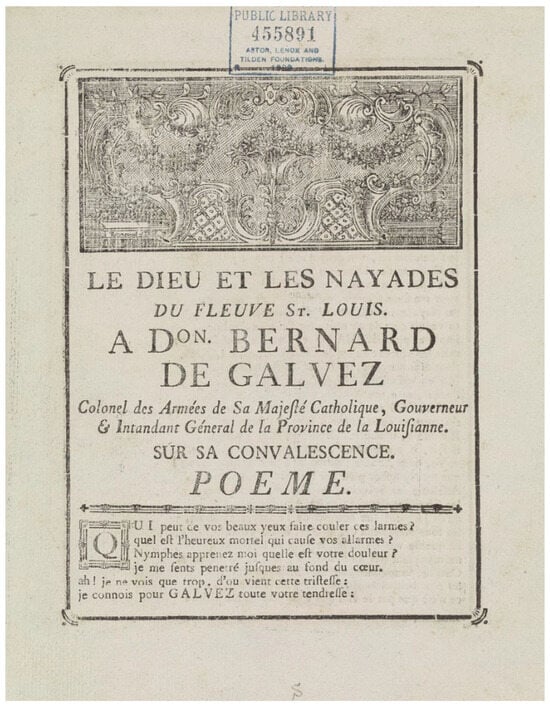
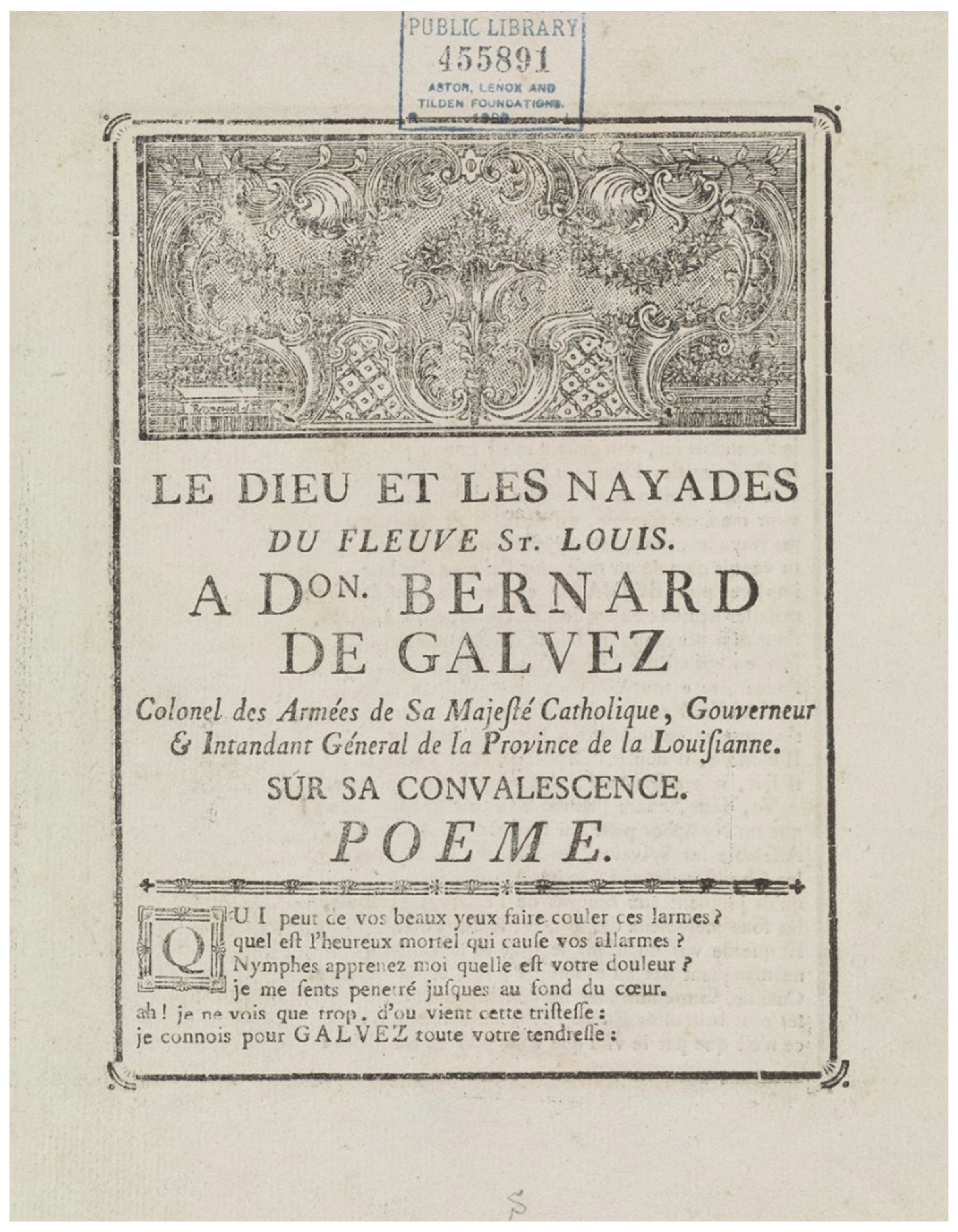
The riverbank returns, of course, in the poem on river divinities, The God and the Naiads of the St Louis (Figure 1). This poem is once more dedicated to Gálvez, who has been ill; the poem is subtitled ‘on his convalescence.’ The poem is narrated—as lots of awkward early modern praise poetry was—by the river god in his ‘damp reeds’ [moites roseaux]. The god opens by questioning the weeping nymphs, and admits that he, too, is worried for Gálvez. He has just come from the banks of the Permessus, where he has been consulting the gods on what to do. The river wants to consult a figure described as the son of Apollo: this is Asclepius, the ancient Greek god of medicine and healing. In an audacious double prosopopoeia (in which Poydras writes the voice of the river narrating the voice of the god), Asclepius tells the river that he is not the only one to be inquiring after ‘BERNARD’: the happy subjects of ‘Charles’ (the Spanish king) and ‘Louis’ (the French) have also been asking.
Figure 1.
Julian Poydras, ‘Le dieu et les nayades du fleuve St. Louis. A Don. Bernard de Galvez colonel des armées de Sa Majesté Catholique, gouverneur & intandant [sic] géneral de la province de la Louisianne. Sur sa convalescence. Poeme.’ New York Public Library Digital Collections. Rare Book Division, The New York Public Library. https://digitalcollections.nypl.org/items/6c4a0ff0-27d0-0132-251a-58d385a7bbd0 (accessed on 25 May 2026).
Once again, the river fiction allows Poydras to find a form in which the moment of imperial transition can be celebrated. These multilingual prayers are answered in Permessus, and Asclepius tells the river that Gálvez will soon be back to health, able to console and feed orphans and widows, bringing abundance and peace. Asclepius tells the river to spread the good news with the help of the nymphs. He continues at some length, instructing the river quite how to celebrate the news: for example, to invite Pan and the Sylphides to dance ‘on the banks of your crystal waves’ [sur les bords de vos ondes Limpides]. The river is thrilled and sets about his celebratory tasks. In italics at the end, as though to restore order after this pagan romp, comes a prayer to the Christian god to grant joy and health to the governor.
Two years later, the third poem (La prise du morne de Baton Rouge) tackles the 1779 battle of Baton Rouge, a brief siege in the Anglo-Spanish War, part of the larger American Revolutionary War: Baton Rouge was the second post to fall to the Spanish, led by Gálvez. Perhaps surprisingly for a poem celebrating a military victory, the poem is once again in the voice of the god of the river. Significantly, where the earlier poems had named the river the Saint Louis, in the style of the French colony, here the river is the ‘god of the Mississippi,’ following the name the Spanish used for the waterway. The god is sleeping when he is woken by a thunderous noise. He asks who dares to trouble the peace of his ‘happy banks’ [heureux Rivage] where his ‘settlers’ [habitants] see their days ‘flow’ [couler] without worry. His settlers have been happy and peaceful; they lived on the fruits of the river and its banks as in the golden age, ‘In the bosom of my Waters they found fish/In the woods they found game, and took reeds for their houses’ [Dans le sein de mes Eaux, ils trouvoient les Poissons, / Le Gibier dans les Bois, les Roseaux pour Maisons.] The river boasts that his people live well ‘under my happy Empire.’
The river sends a nymph to see what the commotion is. She comes back from the battle to report that the victorious Gálvez is a godlike hero, overseeing an intrepid militia of engineers, building bastions, ditches, parapets and trenches. In a gesture that has perhaps earned the poem some minor longevity, the nymph praises the ‘Gens de couleur’, the troops of free men of colour who fought on the side of the Spanish against the British. A copy of the poem was enclosed in a 1970s sculpted frieze of the battle of Baton Rouge, the ‘Marche de Galvez,’ made by the African-American artist Frank Hayden, now in front of a municipal building in Baton Rouge.
The nymphs and tritons are thrilled to hear the news of the Spanish victory. It will bring about the renewal of their riverbanks, and ‘the wild thorns’ [l’Epine sauvage] (i.e., the British) will no longer encumber their fertile banks [fécond Rivage]. The banks of the river will now be properly cultivated by ‘diligent planters’ [diligens colons] (which is to say, in plantations). The god promises he will tell the river to moderate its course in honour of the victor. The poem concludes in riverine celebration: all is joy ‘in the watery empire’ [en l’empire des Eaux].
Poydras’s insistent classicizing is certainly part of a period aesthetic in which the neoclassical acts as a sort of purifying filter central to the cultural work of racialization. (The neoclassical is everywhere in Louisiana of this period: witness the uptown neoclassical New Orleans streets named for the muses, laid out in 1810 by the city planner Barthélemy Lafon, who also gave the name ‘Nayades’ [naiads] to the street now known as St Charles Avenue.) A now substantial body of work describes the racialization of neoclassicism in the antebellum United States. The architectural historian Louis Nelson argues that it is no accident that Thomas Jefferson’s Rotunda at the University of Virginia was where a march of white supremacists took place in 2017, because ‘the use of classical buildings to reify white supremacy has a centuries-old architectural history.’ Nelson argues that the neoclassical, with its celebration of democratic ideals and its obfuscation of the exclusions on which those ideals are built, ‘had for generations communicated to young white men the stability of their privileged place in the American story’ (Nelson 2024, p. 316). In Poydras’s poetry, the privileged place of the classicized riverbank communicates to the governor and to the Creole elite that Poydras is one of them. The riverbank regionalism of sixteenth century French poetry had signified a way for poets to speak from their locality to the king and a newly configured nation; two hundred years on and on the shores of a very different river, Poydras draws on the language of riverbanks to assert a new kind of national project built on a plantation economy. The language of the riverbank is central to the poetics of colonial settlement.
2. Part Two: The Voices of Pointe Coupee, 1795
In the previous section, we heard from a river. Poydras’s poetic work is notable in its use of the rhetorical figure of prosopopoeia, a device in which a nonhuman or inanimate figure is made to speak. The speaking rivers and nymphs of his work are part of a familiar early modern repertoire of praise poetry, in which even the elements can be made to voice the glory of the addressee. At its best, prosopopoeia has a sort of aesthetic and ethical generosity to it; in recent ecotheory, for example, prosopopoeia is put to new purpose as rivers are made to speak so that we might understand their liveness and thus their needs (see, for recent examples, Scott 2025, pp. 134–52; Morizot and Husky 2024, pp. 204–9). Yet prosopopoeia can also function as a kind of constraint, a form of ventriloquization or an appropriation of voice. In Poydras’s work, the river is allowed to speak, but the enslaved person is silent.
In this brief section, interrupting two explorations of Poydras’s voice, I try to listen to the voices of those enslaved on Poydras’s plantation. These voices have been much studied for the connections they make between the revolutions in France and in Cap-François (Saint-Domingue), for example, and for the way in which they claim or skirt the language of revolution in describing their own actions. Here, I want to hear what they have to say about the riverbank.
The trials of the 1795 Pointe Coupee conspirators drew on a number of depositions of the arrested, now digitized and searchable via the Louisiana Slave Conspiracies website.9 The conspirators had planned to set fire to a shed on the estate of Poydras; they planned then to ambush the whites who would come to put the fire out, and aimed to travel from plantation to plantation, killing masters and gathering enslaved people together to join in revolt. Fifty-seven slaves and three whites were convicted of this plot. Twenty-three slaves were eventually hung (executed by a black executioner, a freed slave named Louis Congo), and then decapitated, their heads posted along the Mississippi River as a warning to future plotters.10 As Walter Johnson writes of a similar punishment in the region in 1811, ‘the mutilated bodies of the insurgents were meant to mark the boundary between [Saint-Domingue’s] revolutionary history and that of the Mississippi Valley’ (Johnson 2013, p. 22). One man drowned himself after the interrogation to escape that fate (Midlo Hall 1992, p. 322). Other conspirators were sentenced to hard labour in other colonies.
We have seen how enslaved Africans laboured building levees along the Mississippi. They also piloted ships along the river, drawing on the navigational skills many had learned on the Senegal and Gambia rivers. But in her reading of the colonial-era Mississippi and its bayous, Dorothy Zeisler-Vralsted notes also that the enslaved often also enacted ‘a different kind of kinship with the river’s environs’ (Zeisler-Vralsted 2023, p. 31). Getting to know the river could be central to a form of freedom, whether that be the escape to live in independent communities (a practice known as marronage) or just a moment away from the master’s oversight.
So while the Pointe Coupee records are part of a culture of work and punishment revolving around the Mississippi River, they also give glimpses of other waters. The words that arise from the depositions are of course problematically strained and constrained. Sophie White’s work on eighteenth-century testimony by enslaved Africans in Louisiana describes how the possibilities of that testimony are fenced in by the terms of the Code Noir of 1724, the French jurisdiction that managed the business of slavery. But White notes, too, that such testimonies sometimes veer off subject into things ‘seemingly extraneous,’ moments she describes as ‘deeply revealing and very often riveting’ (White 2019, p. 2).11 Historians use the metaphor ‘reading against the grain’ to describe how they look to glean evidence of presences that would otherwise be absent from the archive. We might call these fragments from the 1795 Mississippi a form of reading against the flow.
The 1795 depositions revolve around the cypress swamp, ‘la ciprière,’ where the conspirators were alleged to have met. One Louis, enslaved by Pierre Goudeau, recounts his meetings with the Poydras slaves, and reports that ‘the plot was made in the cypress swamp,’ [le complot était fait à la ciprière].12 Grand Charles, enslaved by Poydras, reports further that conspiracy meetings were held ‘on the path leading from False River to the bridge’ [dans le chemain de la fausse riviere au pont].13 Scholarly work posits swamps as central to histories of Black resistance (Diouf 2014; Nevius 2020). If the story of the riverbank is both material and metaphorical, so too is that of the cypress swamp. In these seemingly inhospitable wetlands, those resisting enslavement—known as maroons—were nonetheless sometimes able to take refuge, often drawing on their skilled knowledge of wetland environments. The histories of marronage show that places like the ‘ciprière’ were important spaces of resistance, even if in this instance that resistance was soon crushed.
The depositions also give glimpses of the presence of the river and the world beyond it in the lives of the enslaved. Louis Bordelon, an unmarried Creole man of 40 who was enslaved on the Poydras estate, describes in his declaration of 9 May 1795 how, along with Joseph Mina, also enslaved by Poydras, ‘they ran away as marrons, but two days later he was caught two leagues from the other side of the river by Frédéric Riché’ [ils sont parti tous les deux marrons et que deux jours après il avait été ratrappé a deux lieux de l’autre bord du fleuve par le Sr Frédéric Riché] (OAPC 1795, p. 38). (This Riché was the brother of a neighbouring estate owner, Louis Riché.) Louis was brought back to be questioned and was sentenced to hang.
Another Louis, a married Caraba man of 35 enslaved by Pierre Goudeau, was questioned about his dealings with the Poydras conspirators on 8 May 1795. In his response, we have a brief glimpse of the quotidian, small-scale riverbank life that can filter up even in such an archive. Here, the riverbank is not a place to be sold as property or the site of economic progress, but, briefly, a space of snatched pleasure. For an instant, Louis is a man recounting a spring day off the master’s clock; he describes how he heard the news of the plot ‘coming from fishing on the other side of the river’ [venait de pécher de l’autre bord du fleuve] […] ‘one day in Easter week’ [un jour de la semaine sainte]. Louis’s statement is no pastoral idyll: it goes on to detail how an Ibo man named L’Eveillé, enslaved by Poydras, told him ‘that soon we were going to attack the whites’ [qu’on devait bientôt frapper sur les blancs] (OAPC 1795, p. 9). This testimony sent L’Eveillé to hang, while Louis himself was flogged. We must not make too much of these counterflow moments. And yet, fleetingly, they provide an alternative geography, some sight of a land on the other side of the stream from Poydras’s false river.
3. Part Three: The Legal Riverbank, 1810
I return now to Poydras’s understanding of the riverbank. Some decades on from his poetry, after the crushing of the conspiracy, he is still writing about the river. A letter of 1803 to Pierre Clément de Laussat, the last French colonial administrator of New Orleans, insists on the centrality of the Mississippi’s movements to life in the colony: ‘the annual rising of the river,’ writes Poydras, ‘spreads abundance and fertility.’14 But the movement of the waters also presented a legal challenge to a province rapidly moving between systems of governance: an Indigenous world taken as a French colony that became Spanish before briefly returning to French rule, and then fell under the jurisdiction of the new United States.
In the movements between these jurisdictions, the river’s movements are crucial. A whole legal tradition emerges from the history of river movements. The shifting banks of the Tiber, prone to alluvial deposit, prompted Roman law’s sophisticated reflection on riparian property; in late medieval France, images and models produced as part of property lawsuits were known as ‘tibériades,’ after Bartolo da Sassoferrato, the medieval jurist who used such images in his De fluminibus seu tiberiadis of 1355, written on behalf of the riverains of the Tiber (Pelletier 2007, p. 1523). In the movement from the Roman law jurisdictions of the French and Spanish colonial structure to the case law approach of the new United States, part of the New Orleans riverbank became a flashpoint for competing understandings of property law.
The contested area was the shifting ground on the edge of the river known as the batture. From the colonial period on, some maps of the Mississippi riverbank show the alluvial land between the water and the levee marked as ‘batture,’ from the French battre, to beat. This is the deposit of sediment created by the movement of the river, and the term is still used in New Orleans today. Some of the land made by this sedimentation is in effect a natural levee, forming the ground where the city was built (Kelman 2003, p. 20). But in southern Louisiana the wet and the dry are hard to separate. The batture was sometimes dry, sometimes wet: dry when the river was low, covered with water when the river was at its highest, sometimes available for use, sometimes not. Cecilia Chen writes of the mapping of waters that, thanks to fluctuations and sedimentation, ‘the shoreline confidently represented on many maps is a kind of fiction’ (Chen 2013, p. 284). The batture was just such a fiction—a false riverbank—but like many fictions, it was an enabling one.
Throughout the colonial period, the batture had been considered public land. Local residents—the riverains—used its silt to build up their levees (Kelman 2003, p. 27). But immediately after the Louisiana Purchase, with new American legal systems and new ways of imagining property, the batture became the site of an extended battle that disputed the nature of this land and its ownership. It was variously considered to be the domain of private citizens, of the city, or of the United States. The battle’s multiple sedimentations of legal systems raged for decades, and Poydras played a key role in it. With a grateful nod to Ari Kelman’s work on the New Orleans waterfront, I will give an account of the battle before turning to Poydras’s part in it.
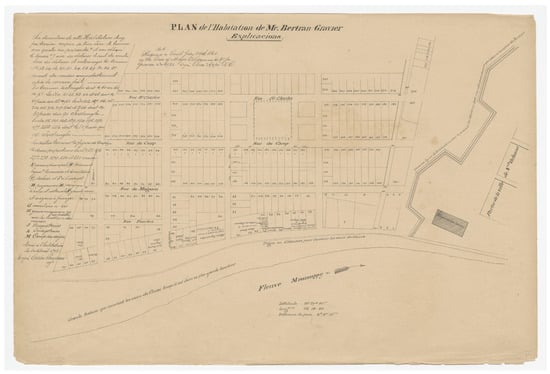
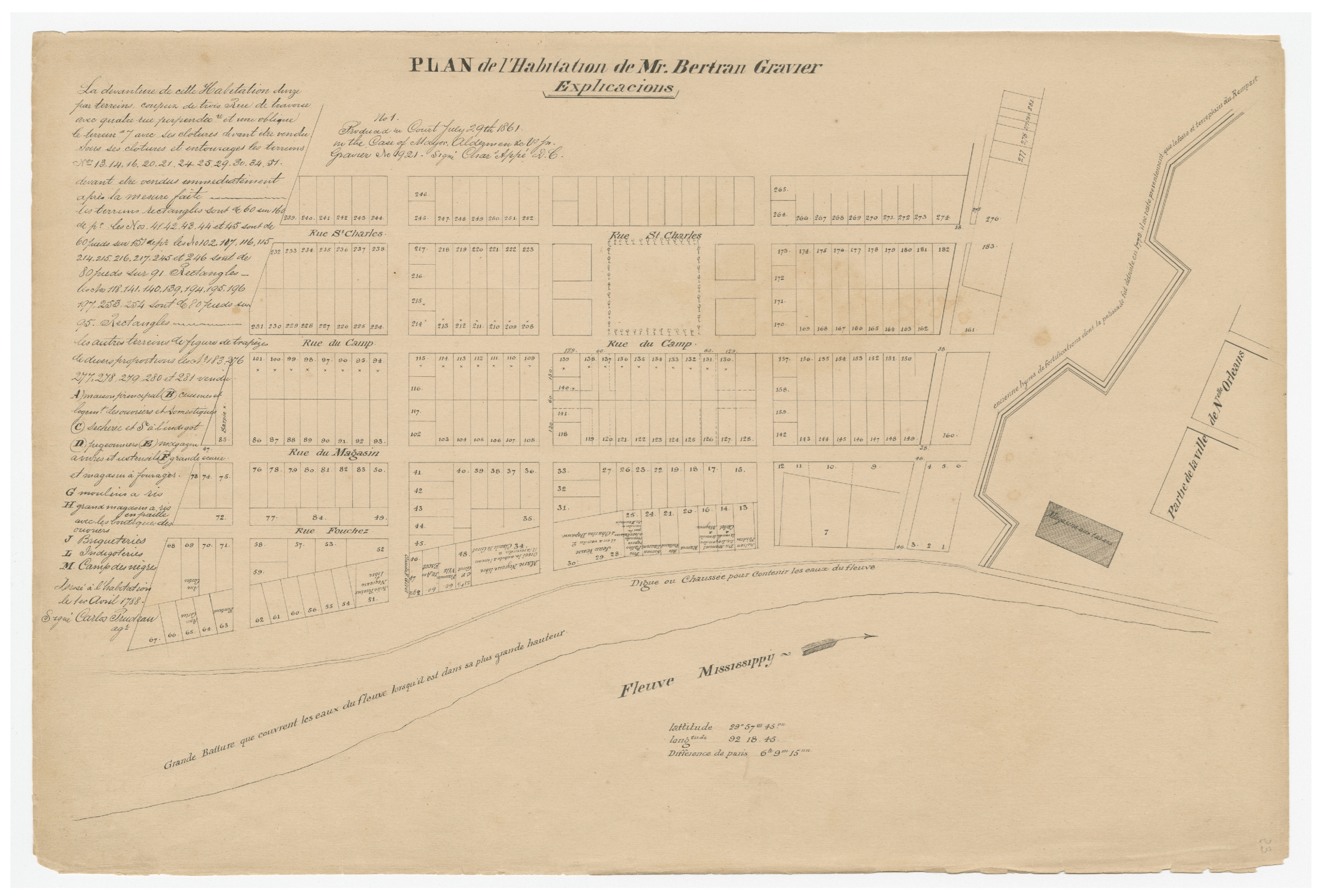
The batture fronted the district known as the Faubourg Ste Marie, which in the first part of the colonial period was owned by the Jesuits. In 1763, when the Jesuits were expelled from France and the French colonies, the land was sold on, and in 1785 came to one Bertrand Gravier, who had a plantation there (Figure 2). Gravier sold some of the lots to others, but after his death in 1797 the remaining lots went to his brother Jean. Jean Gravier, writes Kelman, looked at the growing batture and ‘saw profit potential in the silt’ (Kelman 2003, p. 23). But this was tricky, because he did not own the lots fronting the river. So he built a levee separating the batture from the bits of land his brother had sold, claiming the batture had not been included in the sale (Kelman 2003, p. 24). It was only when Gravier intervened to stop others using the reclaimed land that this became a problem.
Figure 2.
Plan de l’Habitation de Mr. Bertran Gravier. A nineteenth-century copy of a 1788 survey showing Gravier’s properties and the batture in front. Historic New Orleans Collection, L. Kemper and Leila Moore Williams Founders Collection, 1966.33.23.
New Orleans opinion was divided between two versions of history and two views of the batture: in the new American tradition, the reclaimed land could be used as private property, but in the French and Spanish tradition deriving from Roman law, it was imagined as open waterfront for common use. Kelman gives a compelling description of the diversity of city life on the riverfront, which was frequented by all: the rich, the poor, those strolling leisurely, those working, the white and the Black. After a major city fire in 1794, as newly homeless residents looked to build structures on the riverbanks, the question became particularly heated (Kelman 2003, p. 30). The privatization of the batture disrupted Louisiana’s familiar understanding of common land.
The riverbank is but a detail in a wider landscape, and this might have stayed a local issue. But in 1803 the Louisiana Purchase changed everything, especially the legal systems. The key player in the battle of the batture was the American jurist Edward Livingston, who arrived from New York, bringing with him a new way to imagine property.15 Livingston and Gravier filed suit against the city in 1805. For the city, the lawyers of what had been French Louisiana made the case for what Roman law calls a riparian servitude, guaranteeing the public right to use the batture and its alluvium; they called on witnesses to testify that usage had been thus ‘for as long as they remembered.’ In such accounts, the period of early French settlement counted as ancient history, with no Indigenous prehistory imaginable (Kelman 2003, p. 29).
But the now American court ruled for Gravier and Livingston, and Livingston immediately went to work to improve his batture, looking to stabilize its distinction between the wet and the dry, and to build a private port and canal using enslaved labour. The city was enraged. Livingston’s workers were turned back by protesters each day. Livingston shifted tactics and brought in white workers, ‘hopeful,’ writes Kelman, ‘that racial allegiances might trump special politics’ (Kelman 2003, p. 32). On Livingston’s side, William C.C. Claiborne, the territorial governor, weighed in; on the city’s, President Thomas Jefferson, who had big plans for an open Mississippi as part of his plans for American expansion into the Southwest (Kelman 2003, pp. 33–35; Seelye 1991).
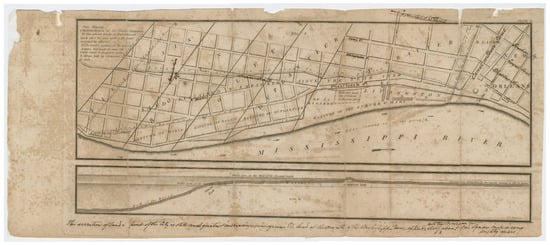
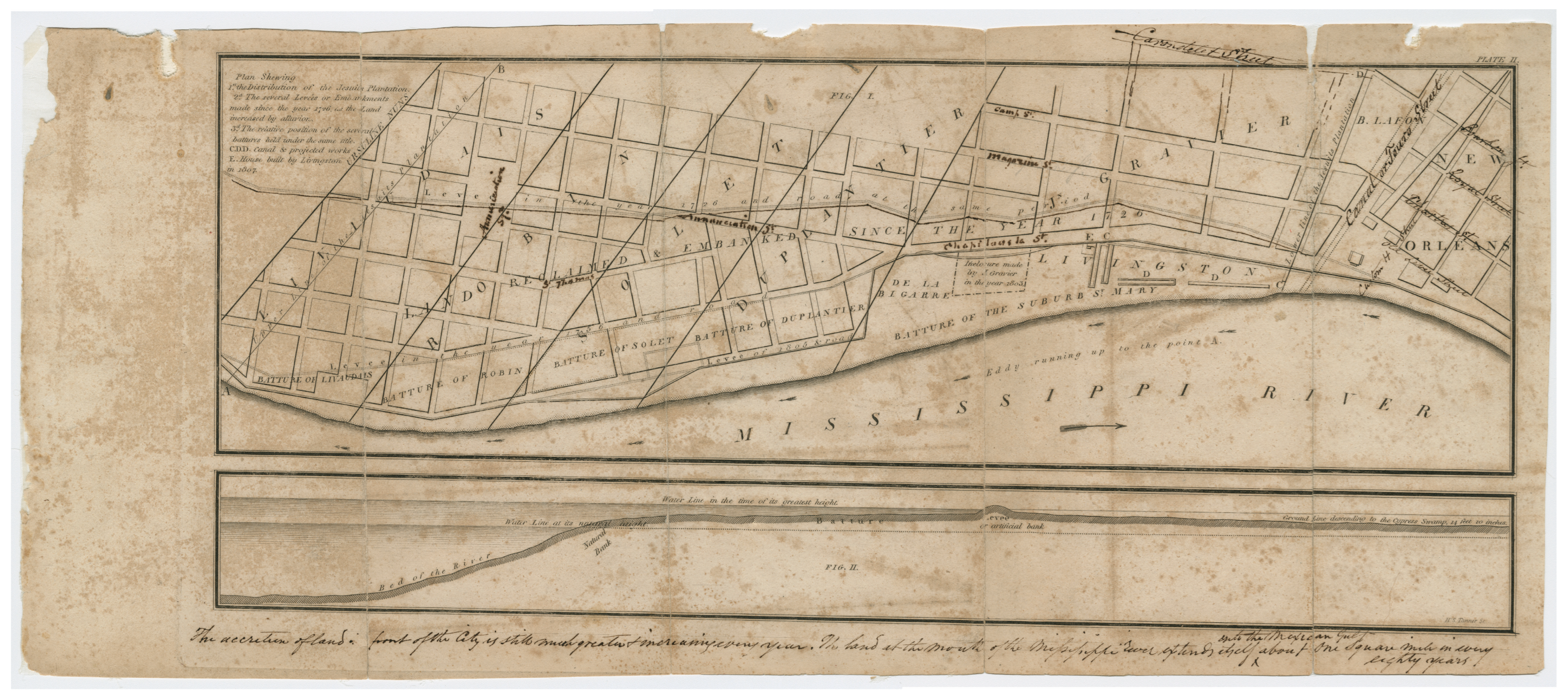
In 1807, the legal clash shifted ground, also moving to the realm of print. On both sides of the question, the lawyers published their thoughts. For the city, the French lawyers fitted the argument into a larger concern about the Americans’ inability to understand Louisiana’s civil law heritage and to understand the mighty river, which changed so often that it made private property hard to define. The American Livingston argued that he, entrepreneurially, was set to transform useless land into an economic resource (Kelman 2003, pp. 40–41). The riverfront had been reimagined (Figure 3).
Figure 3.
Henry Schenk Tanner, engraver. Plan shewing (sic) the distribution of the Jesuits Plantation, the levees, and the batture, c. 1810. Historic New Orleans Collection, 1981.226 i, ii.
Julien Poydras had come a long way from his early settlement years and was now serving as a territorial representative to Congress.16 He also owned land that fronted the river in this part of the city, building what is still today Poydras St on it. Livingston’s plans would block his use of the river. (We might say that he wanted to keep the batture open to the public for private reasons.) Poydras joined the fray, giving a speech on the riverbanks in 1807, and another in the House of Representatives, both published as pamphlets, two in 1809 and another in 1810. In these pamphlets, Poydras writes in florid English (it is unclear if he used a translator) and he is published not in New Orleans but in Washington. Yet the French view of the riverbank is still central to his view of the world.
In the pamphlets, the rhetoric of the riverbank is not mere ornamentation, but central to Poydras’s riparian politics. In 1809, his first pamphlet, A Defence of the Right of the Public to the batture of New Orleans, gives ‘a lucid and precise idea of the Mississippi and its course; of the rights and customs of its inhabitants, and their mode of proceeding in the management of their estates situated on its banks’ (Poydras 1809a, p. 7). A great bulk of this pamphlet gives a long account of how the ‘impetuous’ ‘irregular’ and ‘torturous’ river shapes ‘successive accumulations that have been left on its margins’ (Poydras 1809a, p. 8). The language is both legalistic and affectively sedimented. The argument is pitched around the question of ownership, and Poydras’s deployment of a rhetoric of the public eddies towards the ‘rights of the river-proprietors’ (Poydras 1809a, Preface, also p. 7). A second pamphlet of the same year continues this concern (Poydras 1809b). Poydras contends that ‘the river-proprietors alone […] are the only individuals liable to sustain loss and injury by the washing of the river,’ that is, by its washing away of land (Poydras 1809a, p. 9).
Throughout Poydras’s pamphlets, the question of ownership of land is stitched together with the question of the ownership of people. The pamphlets reveal white Louisiana’s deeply racialized understanding of the notion of ‘public.’ Poydras’s argument delineates who might be considered part of the public and who is beyond it: on the batture, he writes, ‘any negro could and can still, if no inconvenience accrues to the public, land […] all the driftwood he can seize’ (Poydras 1809a, p. 15, my emphasis). Elsewhere, Poydras considers what makes the conveyance of property valid, specifying that these stipulations apply to ‘all sales of real estate or of slaves’ (Poydras 1809a, p. 6). Arguing that Gravier cannot have sold the batture to Livingston because, as common land, it was not able to be sold, Poydras amplifies this legal defence with a cultural one, mocking the idea that any Frenchman would sell to this ‘stranger, whom you do not know, who has not an acre of land in this territory’ (Poydras 1809b, p. 11). Poydras continues: ‘The batture belongs to the public, as far as my knowledge and that of the most ancient persons, born in the country reaches; it is always covered with water for six months in the year; it is in fact the bed of the river itself’ (Poydras 1809b, p. 11). He concludes by upping the ethical stakes: ‘You never can have the smallest pretention to it; and how can you dispose of a thing that is not your own, and that never can be yours? Should I sanction this sale, I render myself the accomplice of an unjustifiable action’ (Poydras 1809b, p. 12). It is impossible to read this without the current eddying back to erode Poydras’s other kinds of ownership.
The following year, Poydras’s 1810 Washington speech repeats these points but, this time, playing to his audience, performs a new Americanness. Poydras speaks for the batture not only in his own name, ‘but in the name of the sovereign people of America, to whom it now belongs, and to whom it ever must belong’ (Poydras 1810). In this account, the ‘legitimate and sovereign right’ to this land must be defended: ‘The right of sovereignty in the sea shore, the ports of towns, rivers, and their banks, is an inalienable right vested in the United States’ (Poydras 1810, p. 10). Poydras is clearly interested in deploying a new American (Jeffersonian) language: he calls for ‘the political happiness of man’ Poydras 1809a, p. 4). This American rhetoric also drags with it the familiar sediment of slavery. Poydras claims that Livingston’s suit treats Americans—that is to say, river proprietors—as ‘slaves, but what is worse, as tormented and plundered slaves’ (Poydras 1810, p. 12). The violent history of enslavement is pushed underwater by the rhetorical current of the pamphlets.
Poydras’s writing on the batture, then, certainly carries with it the sediment of the legacy of Pointe Coupee. But it also carries a rhetorical silt familiar from his earlier poetic work. The leaflets bear the trace of Poydras’s 1770s classicizing. He mock-praises Livingston for his fine speech with a riparian rhetoric: ‘It is a master piece of duplicity. Its style is natural and flowing, like the limpid water of a gentle stream’ (Poydras 1810, p. 4); he also compares Livingston’s speech to the melodious voice of sirens, and the current which dashes us against the rocks of Scylla. This characterization of rhetoric as a stream flows from the vastly influential Roman rhetor and jurist Quintilian, who often made the comparison between a river and a style of speech. For Quintilian, differences in oratorical style can be thought of in terms of differences in rivers: the ‘middle manner,’ for example, is marked by a gentle flow, ‘like a gentle river, clear but shaded by green banks on either side,’ as distinguished from a thundering eloquence that would destroy opponents that is like ‘a river that can roll rocks along’ (Russell 2001, p. 315). I am not suggesting that Poydras was directly a student of Roman rhetoric; this simile abounds in early modern writing (Ibbett 2008). Like Roman law, like versified mythologizing, it was part of the textual environment within which Poydras operated. But Poydras’s pamphlets also show him to be building something new out of the textual silt which he had inherited. Drawing on the multiple discursive resources of the riverbank, and on his own social and rhetorical mobility, the former French peddler weighs in on a new American debate.
The batture case ran on for decades, until Livingston’s death in 1836. It did not flow peacefully, but Livingston eventually agreed to a compromise with the city that left the banks as public property. As time went by and sediment built up, the riverbanks doubled in size over the course of the nineteenth century and were built on by the city (Kelman 2003, p. 44).
4. Conclusions: Sediment and Reading the Past
Poydras’s writing, poetry and pamphlets alike, is a footnote from the historical riverbank, a curious case study of a moment of large-scale historical change. But the riverbank, as I hope to have shown, is nonetheless a place from which we can see large and complicated histories. The story of the riverain is (in the eighteenth or twenty-first centuries) a story about access (including access to the education that produces even clumsy poetry), about ownership, and about the rights to live in a particular place, or to live free. It is also, then, a story about race.
To take environments seriously means, though, attending not only to human stories and human agency, but also to their embedding in a wider landscape. The batture story shows that sedimentation, both material and metaphorical, has a history, or what t Giacomo Parrinello and G. Mathias Kondolf call ‘a social life’ (Parrinello and Kondolf 2021). In an essay entitled ‘Black matter lives,’ architectural theorist Matthieu Duperrex, a poet of sediment and an activist opposed to engineering projects that seek to erase it, writes that the Mississippi Delta’s sediment is a form of witnessing, featuring ‘the ages of the Earth suspended in water’ (Duperrex 2016, p. 64). But we could also say that sediment figures historical process itself. It accrues, it clings, it brings about both loss and gain, it is multiply contested. Stephanie LeMenager suggests that, metaphorically, ‘sediment suggests ungainly—dirty—form […] dregs, which can be a social category’ (LeMenager 2017). In reading Poydras’s rivers, I mean not to centre him as an agentic hero, even though he certainly does his best to put his own case forward. Rather, I seek to pay attention to the sedimented histories that make up his riverbanks and to attend to the ‘dirty’ histories that are pushed aside by neoclassical rhetoric. Some forms of dealing with sediment, described elsewhere in this special issue, draw on engineering skills; others draw on the resources of literary detail to let us see and tell these long silted-up histories, and to put them to the service of environmental and racial justice. I hope in the narrowest and muddiest of ways my view from the riverbank speaks to those needs.
Funding
Funded by an Arts and Humanities Research Council/UKRI grant, PI Camille Mathieu: Aqueous Territory: Learning from Louisiana’s Colonial Histories and Watery Extremes AH/W002752/1.
Data Availability Statement
No new data were created or analyzed in this study. Data sharing is not applicable.
Conflicts of Interest
The authors declare no conflict of interest.
Notes
| 1 | Biographical elements are drawn from Costello (2001). |
| 2 | It is not always clear what form of mobile mercantile identity this designates: in French, the ‘pacotilleur’ [peddler] travelled seasonally to colonies with goods but otherwise was not established there. On this and related terms, see Pritchard (2004, p. 95). For a larger history of mobility and merchant capital in the Mississippi Valley, see Johnson (2013). |
| 3 | In some quarters he is still regarded as a philanthropist: the Poydras Home retirement community in New Orleans began life as a ‘Female Asylum’ for orphans founded by Poydras. |
| 4 | See Mandelman (2020); Morris (2017). |
| 5 | There is very little written on Poydras’s poetry: I have found only Tinker (1933) who identifies Poydras as the author of these poems and describes them as ‘merely quaint and amusing,’(Tinker 1933, p. 10). |
| 6 | On the print environment and Poydras’s place in it, see Jumonville (1989, pp. xxiv–xxi). |
| 7 | Epître à Don Bernard de Galvez (New Orleans: Boudousquie, 1777); Le Dieu et les nayades (New Orleans: Boudousquie, 1777) (both digitized by the New York Public Library); La prise du morne de Baton Rouge, original ms in Tulane Library, French version accessible online at http://french.centenary.edu/poydras.htm (accessed on 25 August 2026), English translation as ‘The Capture of the Bluff of Baton Rouge,’ trans. Pearl Mary Segura, Louisiana History: The Journal of the Louisiana Historical Association 1976 (17: 2): 203–209. All references to the poems in this article from these French editions, all translations my own. |
| 8 | I have consulted Dumont’s manuscript in the Bibliothèque de l’Arsénal: Poème en vers touchant l’établissement de la province de Louisiana, BnF Ms-3459. There is another version in the Library of Congress. |
| 9 | https://lsc.berkeley.edu/content/louisiana-slave-conspiracies (accessed on 13 February 2026). |
| 10 | On Louis Congo, see Dawdy (2006). |
| 11 | On this question see also White and Burnard (2020), especially their introduction, pp. 1–14. |
| 12 | All these archival fragments come from the Original Acts of Pointe Coupee parish, accessed via the LSC database; I give the archive call numbers for reference too (OAPC 1795, p. 8, May 8). |
| 13 | (Grand) Charles (Poydras), declaration of May 12 (OAPC 1795, p. 129). |
| 14 | Julien Poydras, letter to Pierre Clément de Laussat, 22 July 1803. Original in HNOC, MSS 125.230. Translated as ‘Letter on Lower Louisiana’ (Eshelman-Lee, 2004, pp. 99–112). |
| 15 | Livingston’s family were distinguished riverains of the Hudson River, a crucial avenue of the US economy but a river that moved in very different ways from the Mississippi Delta. On the early Hudson, see Shannon (2013, pp. 67–84). |
| 16 | On Poydras’s political career, see Zink (1968). |
References
- Chabal, Émile. 2015. A Divided Republic: Nation, State and Citizenship in Contemporary France. Cambridge: Cambridge University Press. [Google Scholar]
- Chen, Cecilia. 2013. Mapping Waters: Thinking with Watery Places. In Thinking with Water. Edited by Cecilia Chen, Janine MacLeod and Astrida Neimanis. Montreal: McGill-Queen’s University Press, pp. 274–98. [Google Scholar]
- Costello, Brian J. 2001. The Life, Family and Legacy of Julien Poydras. Louisiana: John and Noelie Laurent Ewing. [Google Scholar]
- Dawdy, Shannon Lee. 2006. The Burden of Louis Congo and the Evolution of Savagery in Louisiana. In Discipline and the Other Body: Correction, Corporeality, Colonialism. Edited by Steven Pierce and Anupama Rao. Durham: Duke University Press, pp. 61–90. [Google Scholar]
- Diouf, Sylvaine. 2014. Slavery’s Exiles. New York: New York University Press. [Google Scholar]
- Duperrex, Matthieu. 2016. Black matter lives. Les sediments, témoins méconnus de la territorialité des Modernes. Le Philotope 12: 59–69. [Google Scholar]
- Eshelman-Lee, Julie. 2004. Selected Writings of Julien Poydras. Fort Collins: Creole West Publications. [Google Scholar]
- Fassin, Éric. 2014. La ‘question rom’. In Roms et riverains. Une politique municipale de la race. Edited by Éric Fassin, Carine Fouteau, Serge Guichard and Aurélie Windels. Paris: La Fabrique, pp. 7–70. [Google Scholar]
- Ibbett, Katherine. 2008. Productive Perfection: The Trope of the River in Political Writing. Studies in Early Modern France 12: 45–58. [Google Scholar]
- Johnson, Walter. 2013. River of Dark Dreams: Slavery and Empire in the Cotton Kingdom. Cambridge, MA: Harvard University Press. [Google Scholar]
- Jumonville, Florence M. 1989. Bibliography of New Orleans Imprints 1764–1864. New Orleans: Historic New Orleans Collection. [Google Scholar]
- Kelman, Ari. 2003. A River and Its City: The Nature of Landscape in New Orleans. Berkeley: University of California Press. [Google Scholar]
- LeMenager, Stephanie. 2017. Sediment. In Veer Ecology: A Companion for Environmental Thinking. Edited by Jeffrey Jerome Cohen and Lowell Duckert. Minneapolis: University of Minnesota Press, pp. 168–82. [Google Scholar]
- Mackenzie, Louisa. 2011. The Poetry of Place: Lyric, Landscape, and Ideology in Renaissance France. Toronto: University of Toronto Press. [Google Scholar]
- Mandelman, Adam. 2020. The Place with No Edge: An Intimate History of People, Technology, and the Mississippi River Delta. Baton Rouge: Louisiana State University Press. [Google Scholar]
- Menant, Sylvain. 1981. La Chute d’Icare. La crise de la poésie française, 1700–1750. Geneva: Droz. [Google Scholar]
- Midlo Hall, Gwendolyn. 1992. Africans in Colonial Louisiana: The Development of Afro-Creole Culture in the Eighteenth Century. Baton Rouge: Louisiana State University Press. [Google Scholar]
- Morizot, Baptiste, and Suzanne Husky. 2024. Rendre l’eau à la Terre. Alliances dans les rivières face au chaos climatique. Arles: Actes Sud. [Google Scholar]
- Morris, Christopher. 2017. The Big Muddy: An Environmental History of the Mississippi and its Peoples from Hernando de Soto to Hurricane Katrina. New York: Oxford University Press. [Google Scholar]
- Nelson, Louis. 2024. Neoclassicism, Race, and Statecraft across the Atlantic World. Journal of the Society of Architectural Historians 83: 316–39. [Google Scholar] [CrossRef] [Scilit]
- Nevius, Marcus P. 2020. City of Refuge: Slavery and Petit Marronage in the Great Dismal Swamp, 1763–1856. Athens: University of Georgia Press. [Google Scholar]
- Original Acts, Pointe Coupee Parish. 1795. OAPC 1795-A (No. 1880-1880). Available online: https://lsc.berkeley.edu/archive/oapc-1795-no-1880-1880-0 (accessed on 25 August 2026).
- Parrinello, Giacomo, and G. Mathias Kondolf. 2021. The Social Life of Sediment. Water History 13: 1–12. [Google Scholar] [CrossRef] [Scilit]
- Pelletier, Monique. 2007. Representations of Territory by Painters, Engineers, and Land Surveyors in France during the Renaissance. In Cartography in the European Renaissance. Edited by David Woodward. Volume 3:1 of the Chicago History of Cartography. Chicago: Chicago University Press, pp. 1522–37. [Google Scholar]
- Poydras, Julien. 1809a. A Defence of the Right of the Public to the Batture of New Orleans. Washington, DC: Printed for the author. [Google Scholar]
- Poydras, Julien. 1809b. Further Observations in Support of the Right of the Public to the Batture of New Orleans, or Port of St. Mary. Washington, DC: A. and C. Way. [Google Scholar]
- Poydras, Julien. 1810. Speech of Julien Poydras, Esq., the Delegate from the Territory of Orleans in Support of the Right of the Public to the Batture in Front of the Suburb St. Mary. Washington, DC: A. and C. Way. [Google Scholar]
- Pritchard, James. 2004. In Search of Empire: The French in the Americas. Cambridge: Cambridge University Press. [Google Scholar]
- Russell, Donald A., ed. and trans. 2001. Quintilian, The Orator’s Education. 5 vols. Cambridge, MA: Harvard University Press. [Google Scholar]
- Scott, James. 2025. In Praise of Floods: The Untamed River and the Life it Brings. New Haven: Yale University Press. [Google Scholar]
- Seelye, John. 1991. Beautiful Machine: Rivers and the Republican Plan. New York: Oxford University Press. [Google Scholar]
- Shannon, Timothy J. 2013. Avenue of Empire: The Hudson Valley in an Atlantic Context. In Worlds of the Seventeenth-Century Hudson Valley. Edited by Jaap Jacobs and L. H. Rope. Albany: SUNY Press, pp. 67–84. [Google Scholar]
- Tinker, Edward Larocque. 1933. Louisiana’s Earliest Poet: Julien Poydras & the Paeans to Gálvez. New York: The New York Public Library. [Google Scholar]
- White, Sophie. 2019. Voices of the Enslaved: Love, Labor, and Longing in French Louisiana. Williamsburg: Omohundro Institute. [Google Scholar]
- White, Sophie, and Trevor Burnard, eds. 2020. Hearing Enslaved Voices: African and Indian Slave Testimony in British and French America, 1700–1748. London: Routledge. [Google Scholar]
- Zeisler-Vralsted, Dorothy. 2023. African Americans and the Mississippi River: Race, History, and the Environment. London: Routledge. [Google Scholar]
- Zink, Frances Pirotte. 1968. Julien Poydras: Statesman, Philanthropist, Educator. Southwestern Studies: Humanities Series no 1; Lafayette: University of Southwestern Louisiana. [Google Scholar]
Disclaimer/Publisher’s Note: The statements, opinions and data contained in all publications are solely those of the individual author(s) and contributor(s) and not of MDPI and/or the editor(s). MDPI and/or the editor(s) disclaim responsibility for any injury to people or property resulting from any ideas, methods, instructions or products referred to in the content. |
© 2026 by the author. Licensee MDPI, Basel, Switzerland. This article is an open access article distributed under the terms and conditions of the Creative Commons Attribution (CC BY) license.