1. Introduction
At present, China is at a critical stage of cultural revitalization, and the national strategy of “cultural confidence” highlights the importance of further exploring and promoting the contemporary value of traditional Chinese culture (
Wang et al. 2025, p. 561). Animation has become an important medium for conveying national culture and showcasing national aesthetics (
Hao 2025, p. 26). Nonetheless, in the process of globalization, Chinese animation was for a considerable period deeply influenced by Western and Japanese animation, and simple imitation weakened its national characteristics. In response to this challenge, returning to traditional cultural resources has gradually become an important way for Chinese animation to reassert its cultural distinctiveness. In recent years, Chinese animation has increasingly turned to traditional culture in its effort to develop a distinctive national style. However, some Chinese animated works place excessive emphasis on form while giving less attention to content and cultural connotations (
Li et al. 2024, p. 76). Traditional cultural elements are often reduced to decorative features that fail to convey deeper philosophical or aesthetic significance (
Liu 2025;
Wu and Wang 2020;
Yang 2024), resulting in a simplified expressive style that may weaken audiences’ emotional resonance and cultural recognition (
Fan and Feng 2021;
Li et al. 2024).
Chan culture has been revitalized through its engagement with contemporary consciousness and market mechanisms, evolving into new forms that align with modern culture and art, and gaining wide cultural recognition in global animation (
Dai and Wang 2022, pp. 110–11). Chan culture has played a vital role in Chinese animation’s exploration of a national style (
Peng and Zhang 2025, p. 119). Its philosophical and aesthetic thoughts such as impermanence, enlightenment, and non-duality can resonate with and evoke cultural identification among both historical and contemporary audiences (
Yuan 2019). It can be found not only in earlier classic animated works, but also in a number of contemporary Chinese animated works since 2015 (
Peng and Zhang 2025). For example, early animated classics like
Feelings of Mountains and Waters,
Three Monks, and
The Shepherd’s Flute; contemporary animated films such as
Monkey King: Hero is Back, White Snake: Origin,
Big Fish & Begonia, and
Ne Zha: Birth of the Demon; independent animations represented by Ye Youtian’s “poetic animation”; and popular web animation shorts like
Little Monk, beloved by young audiences, have all explored and reimagined Chan culture to varying degrees. These animations convey Chan Buddhist thought in an implicit way through narrative, visual, and auditory expression, providing the possibility for viewers to generate emotional resonance and understand the meaning during the viewing process (
Yuan 2019).
Existing research on Chinese animation and Chan aesthetics mainly focuses on five aspects: (1) the expression of Chan aesthetics and philosophy in different animations (
Dai and Wang 2022;
Fang et al. 2026;
Liu and Zou 2024;
Peng and Zhang 2025;
Yuan and Qiu 2024;
Yin et al. 2024;
Yuan 2021); (2) the integration of digital media technology with Chan aesthetic thought (
Huang 2021); (3) comparisons between Chan aesthetic animations from different countries (
Hao et al. 2022;
Yuan 2019); (4) the possible aesthetic experiences of audiences (
Ma 2020); and (5) suggestions for promoting the development of Chan aesthetics in Chinese animation (
Yuan 2019). However, existing studies still have some limitations from the perspective of communication studies, especially in that they overlook the important role of audiences in the communication of traditional culture. Specifically, although existing studies have examined the symbolic representation of Chan aesthetics in Chinese animation, limited attention has been paid to audiences’ reception of these meanings (
Fang et al. 2026).
Li et al. (
2024) pointed out that audience emotions are a key consideration for designers, while
Jiang (
2024) noted that audience research, such as audience engagement and psychology, remains a critical gap. Additionally, research on suggestions for promoting the development of Chan aesthetics in animation from an audience perspective remains insufficient. Therefore, studies that connect the representation of Chan aesthetics in Chinese animation with audiences’ reception, including emotional responses, cultural identification, and expectations for its future development, remain limited.
To address this gap, this study has two main objectives:
Objective 1: To develop a semiotic–reception framework that connects the representation of Chan aesthetics with audience reception, including emotional response, cultural identification, and expectations for future development.
Objective 2: To demonstrate the applicability of the proposed framework through the illustrative example of White Snake: Origin (2019).
White Snake: Origin (2019) is a well-known contemporary Chinese animated film adapted from a traditional Chinese legend, retaining strong Chinese cultural and aesthetic characteristics. It was selected as the illustrative case based on two main considerations.
First, existing studies have identified presentations of Chan aesthetics and philosophical thought in a range of contemporary Chinese animated films. Although films such as Ne Zha, Monkey King: Hero Is Back, and Big Fish & Begonia also contain such presentations, White Snake: Origin provides a relatively concentrated presentation of Chan aesthetics and philosophical ideas, which are conveyed directly or indirectly through visual imagery, sound, and narrative. For example, the film constructs the changing relations between human and demon, immortal and monster, and good and evil through characterization and intense narrative conflicts. These relations can be interpreted in relation to the Chan Buddhist idea of non-duality. An ethereal sense of emptiness is articulated through scene elements and blank space (liu bai). Poetic lyrics about life as a fleeting dream may evoke ideas of impermanence and non-attachment.
Second, the film has achieved substantial audience recognition among contemporary Chinese animated films and has a rating of 7.8 on Douban. Its broad audience base also makes it particularly suitable for considering audience reception.
Therefore, it is a suitable illustrative case for demonstrating the application of the conceptual framework to Chan aesthetics and audience reception.
In this way, the study contributes theoretically by developing an integrated semiotic–reception framework, and practically by providing a foundation for future research on Chan aesthetics in Chinese animation.
2. Literature Review
2.1. Chan Aesthetics and Chinese Animation
Recent scholarship has increasingly examined the relationship between Chan aesthetics and Chinese animation, particularly in the context of the revival of Chinese animation and its renewed engagement with traditional culture. Existing studies have shown that Chan aesthetics is not confined to early classical works, but continues to shape both contemporary animated films and experimental or poetic animation in different ways.
One important line of research focuses on the overall embodiment of Chan aesthetics in Chinese animation and its role in the reconstruction of traditional cultural expression. Studies in this line generally regard Chan aesthetics as an important source of national artistic identity, emphasizing its influence on narrative themes, symbolic imagery, visual atmosphere, and aesthetic orientation. For example,
Peng and Zhang (
2025) examine the integration of Chan aesthetics into Chinese animation across different historical periods and argue that it contributes not only to artistic expression, but also to the continuing development of national style. Similarly,
Dai and Wang (
2022) discuss how Chan aesthetics has become an important aesthetic paradigm in Chinese animation, particularly through dimensions such as emptiness and artistic realm. Earlier studies on classical and ink-wash animation likewise point to the influence of Chan aesthetics on works such as
Feelings of Mountains and Waters,
Three Monks, and
The Shepherd’s Flute (
Zheng 2021).
Fang et al. (
2026) examine the presentation of Chan aesthetics and philosophical thought in Chinese animation across different historical periods through visual, auditory, and narrative structures.
A second group of studies pays particular attention to “poetic animation” and the role of digital or modern media technology in the presentation of Chan aesthetics.
Huang (
2021) explores the fusion of Chan thought and digital media technology in “poetic animation”, while
Yuan (
2021) similarly examines the digital visual expression of Chan aesthetics in this form. These studies are valuable in showing that Chan aesthetics is not only preserved through traditional forms, but also rearticulated through contemporary media technologies. At the same time, they mainly concentrate on creative methods, formal innovation, and technical mediation, with less attention to how such expressions are received and interpreted by audiences.
A further group of studies examines specific Chan aesthetics dimensions or individual animation cases.
Yuan (
2019) systematizes five major Chan dimensions in animation—impermanence, enlightenment, emptiness, non-duality, and not “established upon words and letters”—thus providing an important conceptual basis for later discussion. More recent studies narrow the focus to particular concepts or works.
Yuan and Qiu (
2024), for instance, analyze impermanence in
The Return of the Great Sage, while
Liu and Zhou (
2024) discuss the visual embodiment of Chan aesthetics in
A Story from Zen Koan.
Yin et al. (
2024) further explore the expression of Chan aesthetics in recent Chinese animated films. These studies enrich understanding of how Chan aesthetics may be expressed through concrete motifs, themes, and visual structure, but they also tend to remain limited to single concepts or single cases.
In addition, some studies have extended the discussion beyond the Chinese context through comparative perspectives.
Hao et al. (
2022), for example, compare Korean and Chinese Chan animations through
Oseam and
Feelings of Mountains and Waters, highlighting the shared and differentiated aesthetic features of Chan-inspired animation across national contexts. Such comparative work broadens the scope of Chan aesthetics research, but its main concern still lies in aesthetic comparison rather than in the communicative process through which meanings are received and negotiated by audiences.
Overall, many studies identify Chan elements in images, themes, and narrative structures, but they do not adequately explain how these elements become meaningful in the process of audience reception. These limitations indicate that the current literature has not yet fully explained the relationship between the representation of Chan aesthetics in animation and the audience’s reception of that representation. What remains underdeveloped is a framework that can connect textual meaning construction with audience interpretation and response. For this reason, a new conceptualization is needed. By integrating Barthes’ semiotic theory with Reception Aesthetics, the present study proposes a more coherent framework for examining both how Chan aesthetics is constructed in Chinese animation and how it is perceived, interpreted, and responded to by audiences.
2.2. Animation and Film Philosophy
Animation and film are both forms of art (
Sun 2020). Although the relationship between film and philosophy has been widely discussed, animation has received comparatively limited attention within philosophy. Therefore, film philosophy provides a useful basis for considering the relationship between animation and philosophical thinking.
Film philosophy examines the relationship between cinema and philosophical thinking. Contemporary debates have moved beyond the question of whether films can simply illustrate philosophical ideas to ask whether and how cinema itself can contribute to philosophy (
de Roo 2026). Within this debate, stronger positions argue that films can make independent philosophical contributions through specifically cinematic means, while more cautious positions question whether films possess the generality and explicitness required for philosophical argument (
McClelland 2011).
de Roo (
2026) describes film philosophy as a field containing different degrees of engagement, ranging from weak to moderate and bold positions.
McClelland (
2011) offers a moderate account through his “Socratic Model.” Rather than treating film as either a passive illustration of philosophy or an autonomous philosopher, he argues that film can present philosophically significant situations and prompt audiences to interpret, reflect, and develop philosophical understanding.
Distinct from live-action cinema, animation is characterized by the movement or change in created images in recorded time (
Wells 2011). This movement or change is constructed through a sequential series of still images, or frames, displayed over discrete units of time (
Wells 2011). Animation therefore differs from the filmed image in that each frame can be independently created, allowing greater freedom in the construction of movement, time, space, and form (
Parry 2024). These animation-specific properties are manifested through aesthetic forms. As an audiovisual art form, animation constructs meaning primarily through visual, auditory, and narrative-structural dimensions. The visual dimension includes character and background design, composition, color, line, and movement; the auditory dimension includes dialogue, sound effects, and musical scores; and the narrative-structural dimension includes linear, cyclical, episodic, and thematic forms (
Furniss 2014). These aesthetic forms not only shape audiences’ aesthetic experience (
Furniss 2014), but can also participate in the construction of philosophical meaning (
McClelland 2011;
de Roo 2026).
Based on the discussion of film philosophy and animation, this study focuses on the distinctive properties of animation and their manifestation through visual, auditory, and narrative forms, to consider how these animation-specific forms participate in the construction of Chan Buddhist philosophical and aesthetic meanings and engage viewers in the process of meaning construction.
2.3. Roland Barthes’ Semiotic Theory
Semiotics is one of the seven communication traditions identified by Robert T. Craig within communication theory (
Putri et al. 2022). One well-known theory is Roland Barthes’ semiotic theory (
Putri et al. 2022). It examines how meaning is produced through signs in cultural texts. It distinguishes denotation and connotation within the first-order sign system, and defines myth as a second-order sign system in which an existing sign becomes a new signifier that conveys naturalized ideological meaning (
Barthes 1972). Specifically, denotation refers to the direct, literal, and objective meaning of a sign, which may take the form of a word, image, sound, or symbol (
Jadou and Al Ghabra 2021). Connotation means that the formed denotative sign can become a new signifier, constructing an additional layer of meaning. The meaning is no longer merely literal, but is shaped by social, cultural, and emotional contexts (
Parasdya et al. 2025). Barthes’ theory states that myth emerges as a further development of connotative meaning, evolving into a representation of ideology that is normalized and perceived as natural within society (
Jadou and Al Ghabra 2021). It is a useful framework for examining how media texts communicate cultural meaning and social beliefs. This theoretical framework has become foundational in visual culture studies and has been widely applied in the literature, photography (
Herry et al. 2024), architecture, advertising (
Herry et al. 2024), film, animation (
Tanzil and Andriano 2023) and other research fields. However, the application of this theory to the analysis of traditional Chinese aesthetics in Chinese animation remains a research gap.
In film and animation, meaning is often constructed not through isolated signs alone. Some studies focus on analyzing narrative plots in film. For example,
Tanzil and Andriano (
2023) explored the narrative construction of family relationships in the film
Turning Red.
Tawakkal et al. (
2021) explored the construction of trust and moral values in the film. Chan philosophy is often subtly conveyed to the public through animated narratives.
Some studies have analyzed the common meanings represented by a series of visual elements in film.
Korpas et al. (
2025) investigate how scenic composition elements such as setting, costume, makeup, and camera angles communicate deeper meanings.
Mahalingam and Daniel (
2024) show that animation constructs meaning through a comprehensive semiotic system that includes color, visual composition, scene layout, character design, movement, and narrative structure, which together generate layered connotations and cultural meanings.
Chan aesthetics in animation is often represented by a series of components, including visual, verbal, auditory elements and narrative structure. Therefore, it is appropriate to use Barthes’ semiotics to analyze the meaning construction of Chan aesthetics in animation.
2.4. Reception Aesthetics Theory
Reception theory, also called reception aesthetics or reader-response theory, originated in Germany at the end of the 1960s. The theory marks a shift from earlier author-centered and text-centered approaches to a reader-centered perspective, and explores the readers’ understanding, acceptance and response to works. It emphasizes the active role of readers in the reception of works, the creativity of reading, and the subjectivity of reception. The meaning of a text is defined by its readers’ reception: readers, rather than authors, make meaning (
Holub 2013). Hans Robert Jauss and Wolfgang Iser are two important representatives of this theory. Iser pays more attention to the aesthetic response to literary works and the role of readers, while Jauss emphasizes the connection between text interpretation and historical and cultural contexts.
Jauss introduced the core concept of “horizon of expectation”. He believes that reception and understanding occur only when a reader’s horizon of expectation interacts with the text. In other words, readers’ pre-existing knowledge, values, and cultural backgrounds shape their anticipation of a text (
Chen 2024;
Yang and Zhu 2024). Subsequently, in
The Act of Reading (1978), Iser proposed concepts such as “gaps”, “blanks” and “indeterminacy”, pointing out that the “gaps” or “blanks” in the text need to be filled by readers during the reading process to actively construct meaning. In
Aesthetic Experience and Literary Hermeneutics (1982), Jauss developed the concept of aesthetic experience, which consists of catharsis, aisthesis, and poiesis (
Buck 2020).
This theory was initially applied in the field of literature, but it has gradually been extended to a wider range of cultural and media-related fields, including translation, art, film, and animation as forms of communication. For example,
Li (
2023) conducted a study on Hayao Miyazaki’s animated films from the perspective of reception aesthetics, to explore the creative principles of animated films centered on the audience and verify the consistency between Miyazaki’s creative characteristics and these principles. However, it mainly uses text analysis and lacks empirical research on the audience.
Tong et al. (
2025) applied reception aesthetics to Cantonese animation audiences, showing that viewers’ horizon of expectations and the text’s appeal structure shape their active interpretation of Chinese dragon culture and contribute to the construction of cultural identity through emotional, cognitive, and communicative dimensions.
Chen (
2024) takes the animated short film
A Dog Under Bridge as a case study, combining the traditional Chinese notion of “reclusion” (
yin yi) with audiences’ emotional resonance and cultural associations evoked by metaphorical narration and an open textual structure. The study suggests that reception aesthetics can integrate with traditional thought to provide theoretical support for research on animation narrative, audience understanding, and meaning generation.
Although this theory has been applied in animation studies, its application to audience reception analysis in the context of Chinese animation and traditional aesthetics remains limited. Chan aesthetics differs from other specific cultural traditions in that it possesses a certain degree of abstraction. Audience reception of this abstract cultural form is consequently more complex, encompassing various aspects such as emotional response, cultural interpretation, meaning construction, and the resulting sense of cultural identity. Since these aspects are precisely what the theory addresses, it is particularly well-suited for exploring audience reception of Chan aesthetics in Chinese animation.
3. Conceptual Framework
This section develops the conceptual framework through three interconnected parts. The first explains the articulation of Chan aesthetics through animated form. The second explains emotional response and cultural identification within the process of audience reception. The third integrates these two dimensions to develop a conceptual framework combining Barthes’ semiotic theory and Reception Aesthetics. The proposed framework is subsequently illustrated through White Snake: Origin (2019) as a hypothetical application.
3.1. Chan Aesthetics and Textual Meaning Construction
Chan Buddhism has its roots in Indian Buddhism and was introduced into China during the Northern and Southern Dynasties. It is characterized by emphases on a special transmission outside the scriptures, “not established upon words and letters”, directly pointing to the human mind, and seeing one’s nature and becoming Buddha (
Hershock 2023). As it developed further in China, it gradually generated a range of aesthetic ideas and eventually gave rise to Chan aesthetics (
Yuan 2019). Although scholars have defined Chan aesthetics in slightly different ways, they generally share a common emphasis on its philosophical and aesthetic dimensions.
Yuan (
2019), for example, regards Chan aesthetics as an aesthetic thought that emerged and developed under the influence of Chan Buddhism.
Peng and Zhang (
2025) further conceptualize Chan aesthetics in Chinese animation as a philosophical and aesthetic framework rooted in Chan Buddhism. In this study, Chan aesthetics is understood as a form of philosophical and aesthetic thought, with a particular focus on five key dimensions that frequently appear in Chan-inspired artistic expression in Chinese animation: impermanence, non-duality, enlightenment, emptiness, and “not established upon words and letters”. However, these dimensions are not treated as fixed philosophical categories that can be directly translated into or mapped onto isolated audiovisual signs. Rather, they serve as interpretive orientations for examining how animated form and narrative organization participate in the articulation of Chan-related meanings.
In Chan aesthetics, impermanence (
wu chang, 无常) refers to the view that all things are subject to change and that no form of existence remains fixed or permanent. It is not only a recognition of transience, but also a way of confronting life without clinging to what is unstable and passing (
Yuan and Qiu 2024). In this sense, impermanence is closely related to non-dwelling or non-attachment (
wu zhi, 无执), which means not becoming fixated on external forms, desires, or outcomes. In animation, impermanence and non-attachment may be articulated through changes in visual form, space, and temporal progression. These changes do not simply illustrate philosophical ideas; their unfolding over time can make instability, transience, and release perceptible. Spatial transitions, the movement and transformation of visual elements over time, and sound can further shape the perception of transience, while dialogue may make change and letting go more explicit.
Non-duality
(bu er, 不二) refers to an understanding that goes beyond fixed binary oppositions. It suggests that apparently opposed terms, such as form and emptiness or existence and non-existence, are not absolutely separate, but arise in relation to one another. In this sense, non-duality does not deny difference but resists fixation on rigid conceptual divisions. In animation, the idea of non-duality may be expressed through the changing relations between opposites, especially among characters and within moral and narrative conflicts (
Peng and Zhang 2025). Its meaning may emerge through transitions between contrasting visual elements and forms, shifts between opposed states, and temporal reconfiguration, which make apparently fixed boundaries unstable and transformable rather than absolute.
Enlightenment (
wu, 悟) refers to an inner awakening through which one comes to recognize one’s true nature. It is not primarily achieved through doctrinal learning or rational analysis, but through intuitive realization and direct experience (
Hershock 2023). Enlightenment is often understood as a process that can be explained through three stages: first, seeing mountains as mountains and waters as waters; second, seeing mountains as no longer mountains and waters as no longer waters; and third, returning to see mountains and waters once again as they are (
Jian and Yi 2024). This process suggests a movement from immediate and unreflective perception, through negation and inner conflict, toward a more integrated and reflective state of understanding (
Garfield and Priest 2009). In animation, enlightenment may therefore be understood as an aesthetic process of inner awakening, perceptual transformation, and sensuous transcendence. Its meaning may emerge through the character’s psychological and behavioral transformation, expressed through changes in bodily form, exaggerated movement, and the externalization of inner states, together with shifts in sound, making the process from confusion to insight perceptible.
The emptiness (
kong, 空) emphasized in Chan Buddhism is not nothingness or a denial of conventional existence, but a way of being that transcends attachment to inherent existence. It is an understanding of the relational nature of all phenomena and lived experience (
Hershock 2023). Within aesthetic expression, emptiness is often associated with stillness, remoteness, simplicity, and spaciousness, and it gives rise to openness, inward contemplation, and imaginative extension (
Zhang 2021). In animation, emptiness may be understood as an aesthetic form that transforms visible form into suggestive absence and experiential resonance. Its meaning may emerge through the use of visual forms such as leaving blank space (
liu bai, 留白), minimalist composition, subdued colour, and the interplay of the real and the void (
xu shi xiang sheng, 虚实相生) (
Mao 2019), together with slow movement, temporal extension, a gentle rhythm and music. Together, these forms make emptiness perceptible as a spatial and temporal experience rather than a static visual symbol.
“Not established upon words and letters” (
bu li wen zi, 不立文字) refers to the idea that genuine realization does not depend on textual, linguistic, or rational thinking, but arises through direct, intuitive, and experiential insight (
Hershock 2023). In Chan thought, language is limited and may even become an obstacle to true realization (
Hershock 2023). In animation, it may be understood as an aesthetic tendency that privileges audiovisual evocation over verbal explanation. Its meaning may emerge through the temporal interplay of visual elements, auditory elements such as background music and sound effects, and narrative structure, allowing philosophical meaning to be perceived and experienced rather than explicitly stated through language.
Overall, Chan aesthetics in Chinese animation is not merely a set of philosophical ideas represented through particular themes or isolated signs. Its meanings are articulated through movement, transformation, temporality, spatial construction, and the interaction of audiovisual and narrative forms.
3.2. Audience Emotional Response and Cultural Identification
Emotional response in media reception refers to the affective reactions that develop when audiences engage with media objects, events, and situations (
Wirth and Schramm 2005). Whether it is a film, TV program, music, video or electronic game, emotions are usually regarded as the core of media entertainment (
Li et al. 2024). It is considered the emotional outcome resulting from the interaction between audience and media content during the viewing process (
Li et al. 2024). In this study, it refers to the affective and aesthetic reactions that audiences may develop when engaging with Chan aesthetics in Chinese animation. As an important dimension of audience reception, such emotional responses may provide an affective basis for cultural identification, as audiences who are emotionally and aesthetically engaged with the text may further develop a sense of connection with cultural meanings and values.
Cultural identification is defined as an internal state characterized by a feeling of belonging to a culture and a desire to be recognized and accepted by it (
Chen and Pan 2002). Unlike cultural identity, which concerns the positioning of an individual within a cultural map, cultural identification emphasizes an internal sense of attachment and belonging (
Chen and Pan 2002). In this study, cultural identification is understood as a sense of cultural connection or resonance rather than identity in the sense of fixed social categorization.
From the perspective of reception aesthetics, emotional response and cultural identification do not arise automatically from the text itself, but are gradually formed through the interaction between the audience and the text. Wolfgang Iser’s concept of the Appellstruktur (“appealing structure”) points out that a text does not present its meaning in a fully closed and complete form. Instead, it contains indeterminacies and unarticulated spaces that invite readers or viewers to participate in the realization of meaning (
Holub 2013).
At the same time, Jauss proposes the concept of “the horizon of expectations”, which further explains why emotional and interpretive responses may vary across audiences. In this study, viewers may approach an animated text with prior cultural knowledge, aesthetic habits, viewing experiences, and value orientations. These factors may shape how they perceive and interpret Chan aesthetics.
Jauss further proposes the concept of “aesthetic experience”. Jauss believes the essence of “aesthetic experience” is “pleasure” (Genuss), and distinguishes the three fundamental categories of aesthetic pleasure: poiesis, aisthesis, and catharsis (
Holub 2013). Poiesis refers to the productive side of aesthetic experience and the pleasure stems from the application of one’s own creative abilities. Aisthesis is defined as aesthetic perception and refers to the receptive side of aesthetic experience. Catharsis is regarded as the communicative component between art and recipient, and is defined by Jauss as the liberation and elevation of the recipient’s spirit (
Holub 2013). In this study, at the level of aisthesis, audiences may encounter Chan aesthetics through aesthetic perception. In terms of poiesis, they may not merely receive these elements passively, but actively participate in meaning construction by relating them to their own cultural knowledge, personal experiences, and interpretive expectations. Catharsis highlights that such engagement may deepen into emotional resonance and reflective response, enabling audiences to move beyond perception toward a more meaningful understanding of the values and cultural significance embodied in Chan aesthetics.
Thus, the reception of Chan aesthetics in Chinese animation can be conceptualized as a dynamic process in which audience perception, meaning construction, and emotional engagement may jointly contribute to the formation of cultural identification.
3.3. Proposed Conceptual Framework
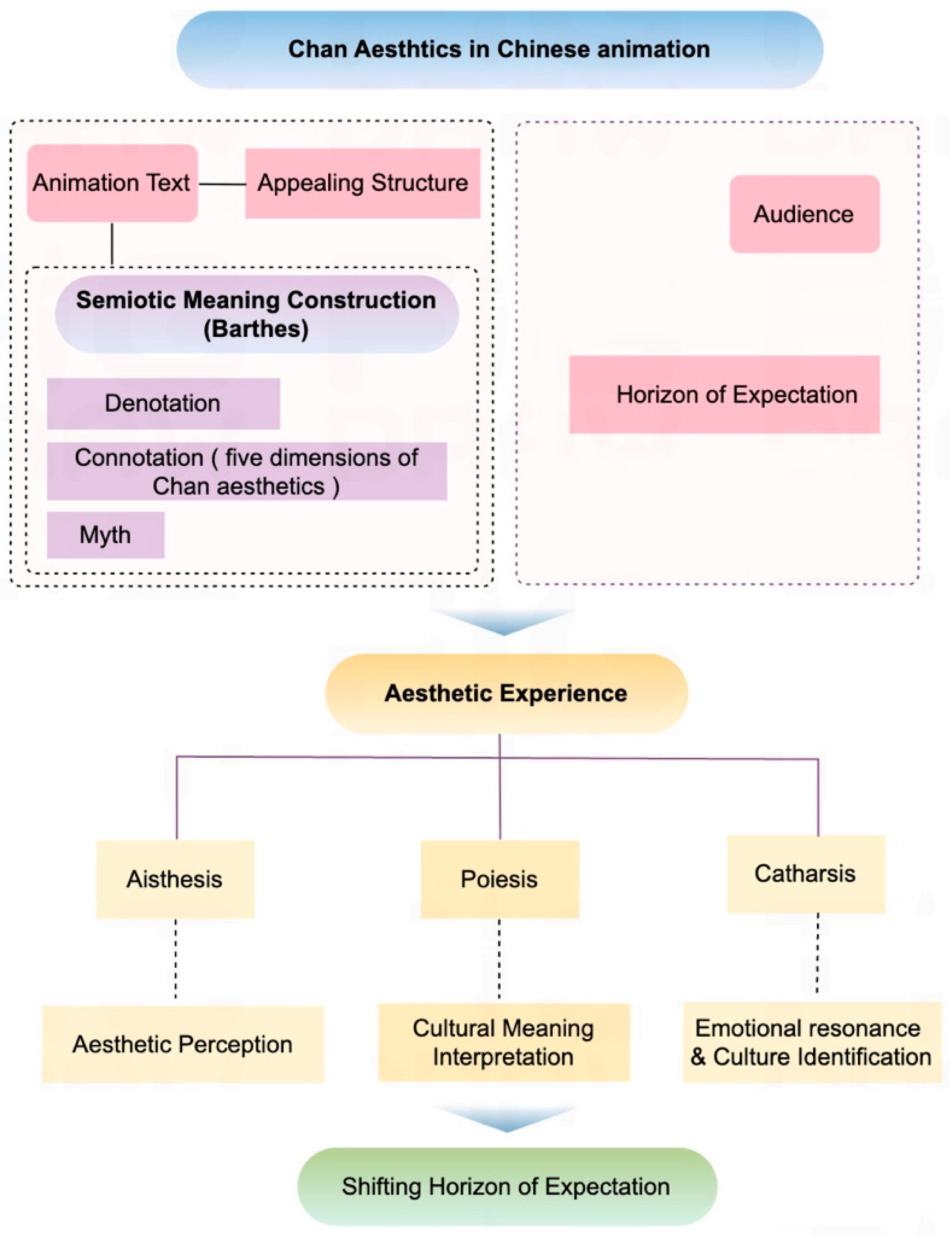
Figure 1 illustrates the conceptual framework proposed in this study. The framework is developed to explain how Chan aesthetics is represented in Chinese animation and how audiences may perceive, interpret, and respond to such meanings. By integrating Barthes’ semiotic theory with Reception Aesthetics, the framework links textual meaning construction with audience reception, thereby addressing the first objective of this study.
At the textual level, the framework draws on Barthes’ semiotic theory to explain how Chan aesthetic meanings are articulated through visual, auditory, and narrative forms at denotation, connotation, and myth levels. In the proposed framework, the connotative level is especially important, since it is through this level that the five dimensions of Chan aesthetics are articulated in Chinese animation. The mythic level is also particularly important because it helps explain how historically and culturally shaped Chan-related meanings may be rearticulated and naturalized as seemingly self-evident expressions of Chinese culture and aesthetics in contemporary Chinese animation.
At the reception level, the framework highlights the interaction between the animation text and the audience. The animation text, shaped by its appealing structure and meaning articulation, invites audience participation, while viewers engage with the work through their own horizon of expectation. In this process, audiences may first encounter denotative meanings through visual, auditory, and narrative forms. Connotative meanings are interpreted according to viewers’ cultural knowledge, aesthetic background, and personal experience. Myth may operate when historically and culturally shaped Chan philosophical and aesthetic meanings are perceived by viewers as natural or seemingly self-evident expressions of Chinese culture and aesthetics.
The interaction between these two dimensions gives rise to aesthetic experience, which occupies the central position in the framework. In the proposed framework, aesthetic experience is understood through the interrelated dimensions of aisthesis, poiesis, and catharsis, which together reflect the audience’s possible aesthetic perception, cultural interpretation and identification, and emotional resonance with the representation of Chan aesthetics. In this sense, these aspects are not treated as isolated stages, but as interconnected aspects of the same reception process.
After engaging with existing Chinese animations, audiences may develop a shifting horizon of expectation and form different views on how Chan aesthetics could be further integrated into future Chinese animation. Such views may involve expectations regarding visual representation, narrative expression and cross-cultural communication in future works.
Therefore, the proposed conceptual framework outlines the relationships among the representation of Chan aesthetics in animation, audience emotional response and cultural meaning construction, and audience expectation for its future development. It thereby provides a theoretical basis for understanding the further integration of Chan aesthetics into Chinese animation from the audience’s perspective.
4. Illustrative Application: White Snake: Origin
This section illustrates how the proposed semiotic–reception framework can be applied to a Chinese animated film. As this is a conceptual rather than empirical study, the following analysis demonstrates a theoretical application of the framework rather than empirically observed audience responses. Taking White Snake: Origin (2019) as an example, this section shows how Barthes’ three levels of signification—denotation, connotation, and myth—can be connected with reception aesthetics, especially horizon of expectations, appealing structure, and Jauss’s three dimensions of aesthetic experience: aisthesis, poiesis, and catharsis.
At the level of denotation, the illustrative analysis focuses on several selected sequences in the film. In the river and landscape sequences, misty mountains surround a small boat drifting slowly forward across open water, while mist curls and reflections and light gradually shift as the scene progresses. The sounds of water, wind, bells, and singing interweave with these changes, including the lyric “Why ask about the fleeting emotions of life?” (he xu wen fu sheng qing, 何须问浮生情) and A Xuan’s line “Life is impermanent” (ren sheng wu chang, 人生无常). In the Jade Workshop and final battle sequences, the owner of the Jade Workshop shifts between a human face and a fox face, A Xuan grows a tail and moves at an exaggerated speed, the dog suddenly becomes able to speak, and Xiao Bai’s body gradually transforms into a gigantic serpentine form. These changes are directly presented through bodily transformation, exaggerated movement, spatial transition, and continuous action. These animation-specific forms constitute the perceptible level of the film and are closely related to aisthesis, or the viewer’s aesthetic perception.
At the connotative level, these sequences may articulate Chan philosophical and aesthetic meanings. In the river and landscape sequences, the misty mountains, flowing water, open spaces and blank space (liubai) create an open and fluid visual field. The slow movement of the boat, the curling mist, and the gradual shifts in reflections and light construct space as a changing temporal experience rather than a static background. These animation-specific forms create a dynamic relation between movement, atmosphere, and spatial openness, producing a sense of spaciousness that gives perceptible form to the Chan aesthetic of emptiness. The sounds of water, wind, singing, and bells further shape this poetic atmosphere through rhythm and reverberation, allowing Chan aesthetics to be articulated without relying on explicit explanation. Within this audiovisual organization, the lyric implicitly conveys letting go and A Xuan’s response makes this idea more explicit. In this way, movement, sound, and verbal expression work together to articulate impermanence and non-attachment. In the Jade Workshop and final battle sequences, multiple characters’ bodily transformations, exaggerated movement, and shifts in spatial position destabilize apparently stable identities and relationships. As bodies change shape, positions shift, and relations are reorganized over time, oppositions such as human and non-human, good and evil, and friend and enemy are presented as unstable and transformable rather than fixed, giving perceptible form to the Chan Buddhist idea of non-duality.
The viewer’s interpretation of these implied meanings corresponds to poiesis, or the viewer’s productive participation in meaning-making. Viewers may produce different levels of meaning according to their cultural knowledge, aesthetic background, and horizon of expectations. Some viewers may connect the film’s narrative and audiovisual forms with Chan philosophy and aesthetics, such as impermanence, non-duality, and emptiness. Others may interpret the film in their own words, such as seeing it as a story about looking beyond appearances and fixed labels. Although they may not name specific Chan concepts, their interpretations may still convey meanings similar to Chan-related ideas. Still others may remain closer to the surface meaning of the story, understanding it mainly as a fantasy romance about love, conflict, and sacrifice. Nevertheless, the film’s appeal structure still invites viewers to engage in self-interpretation, allowing them to relate its characters, images, and atmosphere to their own experiences.
Catharsis becomes important when these connotative meanings are emotionally experienced. Viewers may perceive a sense of emptiness, stillness, and distance through the film’s visual use of open space and atmospheric blankness. Narratively, they may project themselves onto the characters’ experiences and develop identification with the characters’ actions, emotional choices, and the cultural meanings embedded in them. In this process, viewers may generate emotional resonance, release, or reflection on their own relationships and life experiences.
At the mythic level, myth naturalizes historically and culturally shaped meanings, making them appear natural or self-evident. In White Snake: Origin, flowing water, mist, blank space, and changing light, together with the movement from opposition to recognition, from fixed identity to change, and from surface judgment to emotional understanding may naturalize Chan-related ideas such as emptiness, impermanence, non-attachment, and non-duality. These ideas are therefore communicated not as explicit religious doctrine, but through a popular story and a recognizably Chinese cultural and aesthetic setting. In this process, a historically complex religious and philosophical tradition may be naturalized as a seemingly self-evident part of Chinese culture and aesthetics. Such naturalization may also support cultural recognition or cultural identity, while obscuring the historical and religious contingency of these meanings.
After engaging with the film, viewers’ existing horizon of expectations may be reshaped, leading them to develop new expectations. Understanding possible audience expectations can help creators further promote the integration of Chan aesthetics into animation.
Overall, this illustrative case shows how the semiotic–reception framework works as an integrated model. Denotative meanings are first encountered through aisthesis in visual, auditory, and narrative forms, together with animation-specific properties such as movement, transformation, spatial construction, and temporality. Connotative meanings emerge through poiesis, as viewers interpret these representations according to their cultural knowledge, aesthetic background, and horizon of expectations. Mythic meanings emerge through the naturalization of Chan meanings, while catharsis reflects the emotional and reflective responses that may accompany viewers’ reception of these meanings.
5. Discussion
The proposed framework understands Chan aesthetics in Chinese animation as a dynamic process rather than a fixed cultural content embedded in the text. It brings together two closely related dimensions: textual meaning construction and audience reception. At the textual level, Chan aesthetic meanings are articulated through the visual, auditory, and narrative forms of animation at the denotation, connotation, and myth levels. At the reception level, such meanings are realized through the interaction between the animation text and the audience’s horizon of expectation. In this sense, Chan aesthetics in Chinese animation is not only a matter of representation, but also of how audiences may perceive, interpret, and respond to such meanings, and how these responses may further shape expectations toward its future integration into animation.
The theoretical significance of this framework lies in its integration of Barthes’ semiotic theory and Reception Aesthetics into a single analytical model, while also situating animation within a broader film-philosophical perspective. Animation is not treated simply as a neutral medium for conveying pre-existing philosophical ideas; its formal properties may participate in the articulation of Chan philosophical and aesthetic meanings while inviting viewers to interpret and reflect on these meanings. Chan concepts are not treated as fixed categories that can be directly mapped onto individual audiovisual signs, but as interpretive orientations whose meanings emerge through audiovisual and narrative forms within specific cultural contexts. Barthes’ concept of myth further explains how historically and culturally shaped Chan meanings may be naturalized as seemingly self-evident expressions of Chinese culture and aesthetics. In this way, the framework provides a more critical and audience-centered theoretical basis for examining the representation and reception of Chan aesthetics in Chinese animation.
From a practical perspective, the framework suggests that the integration of Chan aesthetics into Chinese animation should not remain at the level of surface symbolism or stylistic imitation. Visual motifs alone do not necessarily generate philosophical meaning. Rather, Chan-related meanings may be articulated through the interaction of visual, auditory, and narrative forms. The framework also highlights the importance of audience reception for future animation creation. Since viewers may approach expressions of Chan aesthetics with different horizons of expectation, creators need to consider how visual representation, narrative design, emotional appeal, and cultural intelligibility may shape reception outcomes. In this sense, audience responses and changing horizons of expectations may provide an audience-informed basis for the further integration of Chan aesthetics into animated works, making the framework practically relevant to animation creation.
6. Future Research Directions
As a conceptual framework, the present model still requires empirical research to examine how Chan aesthetics is represented in Chinese animation and how it shapes audiences’ emotional responses and cultural identification in actual contexts. Future studies are therefore needed to examine, refine, and further develop the explanatory value of this framework.
First, qualitative content analysis and semi-structured in-depth interviews may be particularly useful for examining both the representation of Chan aesthetics in Chinese animation and the audience reception process. Such methods would help connect textual construction with viewers’ emotional responses, interpretive practices, and cultural identification.
Second, future studies should involve Chinese animated works from different periods and categories, including commercial animated film, art animation, and web animation. Chan aesthetics may be expressed differently across diverse historical contexts, artistic forms, and production environments. A more comprehensive sample would help deepen understanding of how Chan aesthetics is represented in Chinese animation.
Third, future research may further explore audience reception in more specific Chinese contexts. Factors such as age, educational background, media experience, and familiarity with traditional cultural ideas may influence the ways meanings embedded in animation are perceived and interpreted. Attention to these contextual factors may provide deeper insight into the resonance of Chan aesthetics among contemporary audiences and the formation of aesthetic meanings in the reception process.
Finally, future studies may also extend this framework to broader cultural and animation contexts to test its wider applicability. Such research would help examine whether this integrated framework can also be used to understand the representation and reception of traditional aesthetic ideas in animation beyond the specific case of Chan aesthetics.
7. Conclusions
This study develops a conceptual framework for investigating Chan aesthetics in Chinese animation from the dual perspectives of textual meaning construction and audience reception. By bringing semiotics and reception aesthetics into one analytical structure, the study suggests that Chan aesthetics in animation should not be understood merely as a visual style or cultural ornament, but as meanings articulated through animated form and interpreted through audience engagement. In this sense, the framework moves discussion beyond textual representation alone and highlights the role of audience engagement in the communication of traditional philosophy and aesthetics.
The study contributes to communication and media research by offering an integrated perspective for understanding the relationship between animated texts and audience reception, including aesthetic experience, emotional response, and cultural identification. It also provides a useful basis for future empirical research on Chinese animation, especially studies concerned with whether and to what extent symbolic expressions of traditional culture can generate resonance among contemporary audiences. In practical terms, the framework may also offer insights for animation creators seeking to communicate traditional culture and aesthetics in ways that are more meaningful and engaging for present-day viewers.