


Abstract
Despite persistent inequalities and severe resource constraints in South Africa’s education system, some rural public schools continue to achieve strong academic results. This study investigates how curriculum accessibility and pedagogical strategies influence academic performance in public senior secondary schools in the Amathole West Education District in the Eastern Cape Province. Drawing on Freire’s Pedagogy of the Oppressed, the study examines how teachers negotiate structural inequalities through adaptive pedagogical practices. A qualitative research design was used that involved in-depth interviews with teachers, principals, and education officials. The findings reveal that collaborative learning, scaffolding, inquiry-based teaching, and informal resource sharing practices play a critical role in sustaining academic success in resource-constrained contexts. The study argues that teacher agency and community participation function as important mechanisms that mitigate structural inequalities in rural schooling. The paper contributes to debates on educational inequality and sustainable development by demonstrating how localized pedagogical strategies can support academic success in marginalized schooling environments.
1. Introduction
Ensuring equitable access to quality education remains a persistent challenge in many developing countries, particularly within rural schooling contexts. In South Africa, despite significant policy reforms since the end of apartheid, substantial inequalities continue to shape the distribution of educational resources and learning opportunities. Research consistently shows that learners attending rural public schools experience multiple structural disadvantages, including textbook shortages, limited infrastructure, overcrowded classrooms, and restricted access to qualified teachers (Spaull 2013; Fleisch 2008). These conditions contribute to persistent disparities in academic performance between rural and urban schools.
The historical legacy of apartheid continues to influence the contemporary structure of South Africa’s education system. Policies such as the Bantu Education Act of 1953 institutionalised unequal resource allocation and established racial and spatial inequalities in schooling. Although democratic reforms since 1994 have sought to transform the education system through policies such as the South African Schools Act of 1996, inequalities in the distribution of educational resources remain deeply embedded, particularly in rural provinces such as the Eastern Cape (Sayed and Ahmed 2015). Rural schools often operate under conditions characterised by poverty, geographical isolation, and limited educational infrastructure, significantly constraining the quality of teaching and learning.
Within the Eastern Cape Province, many rural public schools face severe resource constraints, including inadequate learning materials, poorly maintained infrastructure, and limited access to technological resources (Mpahla and Okeke 2015). Learners in these contexts often confront additional socioeconomic challenges, such as food insecurity, transportation difficulties, and exposure to community violence, all of which negatively affect educational outcomes. Spaull (2013) argues that educational inequality in South Africa remains strongly correlated with socioeconomic status and geographic location, reinforcing cycles of disadvantage for learners in rural communities.
However, despite these structural challenges, some rural public schools continue to produce relatively strong academic outcomes, including high pass rates in examinations of the National Senior Certificate. This raises an important sociological question regarding how certain under-resourced schools manage to sustain academic success despite limited material resources. Although existing research has extensively documented the structural inequalities affecting rural schools, less attention has been given to the ways in which teachers and school communities actively negotiate these constraints through innovative pedagogical strategies and collaborative practices.
Curriculum accessibility and pedagogical strategies play a critical role in shaping learners’ academic experiences and outcomes. Access to curriculum content extends beyond the mere availability of textbooks and learning materials to include the pedagogical approaches through which teachers facilitate knowledge acquisition, critical engagement, and meaningful learning. In contexts where material resources are limited, teachers often adopt adaptive teaching practices that promote collaborative learning, critical thinking, and participation of learners. These strategies may serve as important mechanisms through which teachers mitigate structural inequalities and support learner achievement.
Drawing on Freire’s (1970) critical pedagogy, education can be understood as both a site of social reproduction and a potential space for transformation. Freire (1970) suggested that dialogical and participatory forms of teaching enable learners to develop critical consciousness and actively engage with their social realities. Within rural schooling contexts, such pedagogical approaches can enable teachers and learners to challenge structural constraints and create alternative pathways for academic success.
Against this backdrop, this study investigates how curriculum accessibility and pedagogical strategies influence academic performance in public senior secondary schools in the Amathole West Education District of the Eastern Cape Province, South Africa. Specifically, it examines how teachers in under-resourced rural schools employ adaptive, context-responsive pedagogical practices to sustain learner engagement and academic achievement. By analysing the interaction between structural constraints, teacher agency, and pedagogical innovation, the article contributes to ongoing debates in the sociology of education on educational inequality, rural schooling, and sustainable development in South Africa.
The study is guided by a central analytical proposition that although structural inequalities continue to shape educational opportunities as emphasised in Bourdieu’s (1977) theory of social reproduction, teacher agency and dialogical, learner-centred pedagogies can mediate these constraints and open spaces for transformation, according to Freire’s (1970) critical pedagogy. In this sense, the study does not seek to test formal hypotheses but rather to examine how these competing dynamics of reproduction and transformation are negotiated in everyday classroom practice within rural schooling contexts.
1.1. Review of the Literature
Access to quality curriculum content remains a central issue in global debates on educational equality. Education systems across the world continue to struggle to ensure that all learners have equitable access to teaching and learning resources, qualified educators, and supportive learning environments. Research from Kenya shows that rural education access is constrained by inadequate classrooms, libraries, laboratories, sanitation facilities, teacher shortages, long travelling distances, poverty and gendered cultural expectations (Wanjala et al. 2025). Similarly, in Ghana, Buabeng and Amo-Darko (2024) argue that rural learners continue to experience limited access to textbooks, trained teachers, adequate infrastructure, and digital resources, which widens the gap between rural and urban educational outcomes. These patterns are not isolated but reflect a broader trend across many developing countries, where rural schools experience persistent disadvantages in terms of infrastructure, teacher capacity, and access to learning materials. Consistently, such structural inequalities profoundly shape the quality of education and undermine the academic performance of learners in marginalized communities.
Within the South African context, educational inequality is deeply rooted in the historical legacy of apartheid. The apartheid education system institutionalised unequal access to resources through policies such as the Bantu Education Act of 1953, which deliberately underfunded schools serving black communities while privileging white schools. Although the democratic government introduced significant reforms after 1994 to transform the education system and promote equity, structural inequalities in schooling continue to persist (Sayed and Ahmed 2015; Spaull 2013). These inequalities are particularly visible in rural areas, where schools often operate under severe resource constraints, thereby undermining efforts to achieve equitable educational outcomes.
Research on South African schooling consistently highlights the relationship between socioeconomic inequalities and educational outcomes. Spaull (2013) argues that South Africa has one of the most unequal education systems in the world, with the academic performance of learners strongly influenced by their socioeconomic background and geographic location. Similarly, Fleisch (2008) notes that schools located in disadvantaged communities frequently experience shortages of qualified teachers, limited access to learning materials, and inadequate infrastructure, all of which negatively affect the quality of teaching and learning. Amiri et al. (2025) indicated that socioeconomic disparities affect curriculum implementation through funding gaps, teacher shortages, poor infrastructure, overcrowded classrooms, and unequal access to digital learning tools. Furthermore, these global patterns stated by Amiri et al. (2025) demonstrate that equitable access to curriculum content must be accompanied by effective pedagogical strategies if rural learners are to achieve improved academic outcomes.
Rural schools are particularly vulnerable to these structural inequalities. Studies have shown that many rural public schools lack essential educational resources, including textbooks, laboratories, libraries, and technological infrastructure (Du Plessis and Mestry 2019; Mpahla and Okeke 2015). This pattern is not unique to South Africa; global research shows that rural schools in low- and middle-income contexts often lack basic learning materials, functional infrastructure, and access to digital resources, thus constraining both teaching and learning processes (UNESCO 2023; World Bank 2018). Castro et al. (2025) confirm that rural schools across Latin America, Asia, and Europe face persistent gaps in digital access, infrastructure, and technological resources, and that these gaps are consistently associated with widening disparities between rural and urban educational outcomes. In addition to material deprivation, rural schools face persistent challenges in attracting and retaining qualified teachers due to geographic isolation, limited opportunities for professional development, and unfavourable working conditions. These factors contribute to high teacher turnover and uneven instructional quality, further disadvantaging learners in rural settings (Cox and Mullen 2023; UNESCO 2023).
A study in sub-Saharan Africa similarly highlights how shortages of skilled teachers and inadequate support systems weaken curriculum implementation and reduce learner achievement in rural schools (Wanjala et al. 2025; Buabeng and Amo-Darko 2024). Collectively, these structural and human resource constraints reinforce persistent disparities in academic performance between rural and urban schools, underscoring the need for targeted policy interventions that integrate equitable resource allocation with context-responsive pedagogical strategies.
Beyond material constraints, scholars have also emphasised the role of curriculum access in shaping learners’ educational experiences. Lumadi (2020) argues that equitable access to curriculum content is fundamental to promoting social cohesion and educational justice. Access to curriculum content extends beyond the availability of textbooks and teaching materials; it also involves the pedagogical processes through which knowledge is transmitted and constructed in the classroom. When learners are unable to access the curriculum effectively due to resource limitations or inappropriate teaching methods, their opportunities for academic success become significantly constrained. Pedagogical strategies, therefore, play a critical role in mediating the relationship between structural inequalities and learning outcomes. Mdodana-Zide (2023) suggested that learner-centred teaching approaches, including collaborative learning, scaffolding, and inquiry-based instruction, can enhance learner engagement and critical thinking, particularly in resource-constrained contexts. Such approaches encourage active participation and allow learners to construct knowledge through interaction, dialogue, and problem-solving.
Within the sociology of education, scholars such as Lubisi and Nekhwevha (2024) have long debated whether education systems primarily reproduce existing social inequalities or serve as mechanisms for social transformation. Structural perspectives emphasize the role of education in reproducing social inequalities through unequal access to resources and opportunities. However, other scholars highlight the role of teacher agency and community involvement in mitigating these structural constraints. Baroudi and Abi Haidar (2025) argue that teachers play a critical role in translating policy frameworks into practical classroom strategies, often adapting prescribed approaches to suit contextual constraints. This pattern of adaptive teacher agency is consistent with findings from rural schools in Chile, where teachers similarly sought to repurpose available resources and develop context-responsive practices to sustain learning despite infrastructural limitations (Castro et al. 2025). Teachers who work in disadvantaged environments often develop innovative pedagogical practices to compensate for limited resources and support learner achievement. In rural school settings, teachers often adopt adaptive strategies such as peer teaching, collaborative learning, and resource-sharing practices to sustain teaching and learning despite structural limitations. These practices demonstrate how teachers exercise professional agency to create meaningful learning opportunities for learners. Such strategies can also foster supportive learning environments that promote learner engagement and academic resilience.
Despite the growing body of research on educational inequality in South Africa, much of the literature has focused mainly on structural constraints affecting rural schools, such as resource shortages and infrastructural limitations. While these studies provide valuable information on the challenges facing rural education, relatively little attention has been given to how some under-resourced schools continue to achieve strong academic results despite these challenges. In particular, there is limited research that examines how teacher pedagogical strategies and local school practices contribute to academic success in rural school settings. Therefore, this study seeks to address this gap by examining how curriculum accessibility and pedagogical strategies influence academic performance in public senior secondary schools in the Amathole West Education District in the Eastern Cape Province, South Africa. By exploring the ways in which teachers and school communities negotiate structural constraints through adaptive teaching practices, the study contributes to ongoing debates in the sociology of education regarding educational inequality, teacher agency, and sustainable development in rural schooling environments.
1.2. Theoretical Framework
This study is informed by Paulo Freire’s critical pedagogy, particularly the ideas presented in Pedagogy of the Oppressed (Freire 1970). Freire’s work provides a critical sociological lens for understanding how education can function both as a mechanism to reproduce social inequalities and as a tool for social transformation. In the context of rural education in South Africa, Freire’s theoretical framework is particularly relevant because it highlights how marginalized communities can challenge structural inequalities through participatory and dialogical forms of education. Freire (1970) critiques what he refers to as the ‘banking model’ of education, in which teachers act as the sole holders of knowledge while learners passively receive information. This model reinforces the hierarchical relationships between teachers and learners and limits the ability of learners to critically engage with their social realities. On the contrary, Freire (1970) proposes a problem-posing model of education, where teaching and learning occur through dialogue, reflection, and active participation. Within this approach, learners are encouraged to question existing social structures and develop a critical awareness of the conditions that shape their lives.
Freire’s (1970) framework is grounded in three key concepts: conscientisation, dialogue, and praxis, which together form the foundation of transformative education. Conscientisation, or critical consciousness, refers to the process through which individuals become aware of the social, political, and economic forces that shape their lives. Through education, learners develop the capacity to critically analyse inequality and oppression in their communities. In rural schooling contexts, conscientisation enables learners to recognise how structural inequalities, such as unequal distribution of resources, poverty, and historical marginalization, affect their educational experiences (Freire 1970).
Dialogue is central to Freire’s (1970) pedagogical philosophy. Freire (1970) stresses that education should be a collaborative process in which teachers and learners engage in mutual learning through discussion and shared inquiry. Rather than viewing learners as passive recipients of knowledge. Dialogical pedagogy recognises them as active participants in the learning process. This form of teaching encourages interaction, cooperation, and collective problem-solving, which are particularly important in resource-constrained educational environments. The third concept, praxis, refers to the integration of reflection and action in the pursuit of social change. According to Freire (1970), meaningful education must go beyond theoretical understanding to practical engagement with real-world challenges. In educational settings, praxis involves applying knowledge to transform social realities and address structural inequalities.
In the context of rural public schools in the Eastern Cape province, South Africa, Freire’s (1970) theoretical framework provides an important lens to understand how teachers and learners negotiate structural constraints. Rural public schools often operate in conditions characterised by limited resources, infrastructure challenges, and socioeconomic disadvantage (Preston et al. 2013). However, Freire’s (1970) framework suggests that education within these contexts can still foster empowerment and transformation when pedagogical practices encourage dialogue, participation, and critical thinking. Teachers in rural public schools with limited resources often adopt learner-centred pedagogical strategies, such as collaborative learning, peer teaching, and inquiry-based instruction, which align with Freire’s dialogical approach to education (Westbrook 2013). These teaching practices create opportunities for learners to actively engage in knowledge, support each other in the learning process, and develop critical thinking skills. By encouraging participation and collective learning, such pedagogical approaches challenge the traditional hierarchical structure of schooling and promote more inclusive forms of knowledge production.
Furthermore, Freire’s (1970) emphasis on praxis highlights the role of teacher agency in transforming educational practices within constrained environments. Teachers working in rural schools frequently adapt their teaching strategies to compensate for limited resources, using locally available materials, peer learning, and collaborative classroom practices to facilitate curriculum access. These adaptive strategies illustrate how educators actively negotiate structural inequalities while striving to create meaningful learning opportunities for their learners.
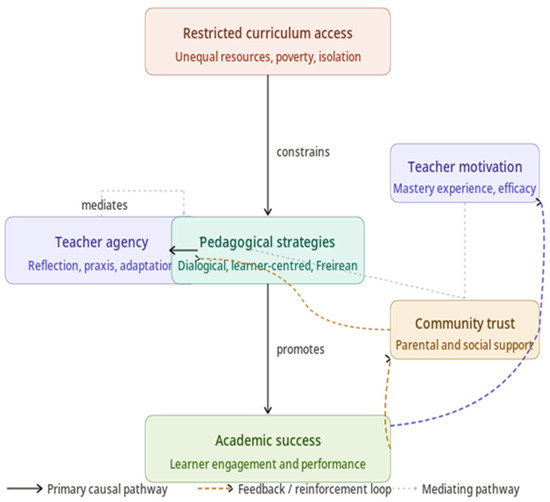
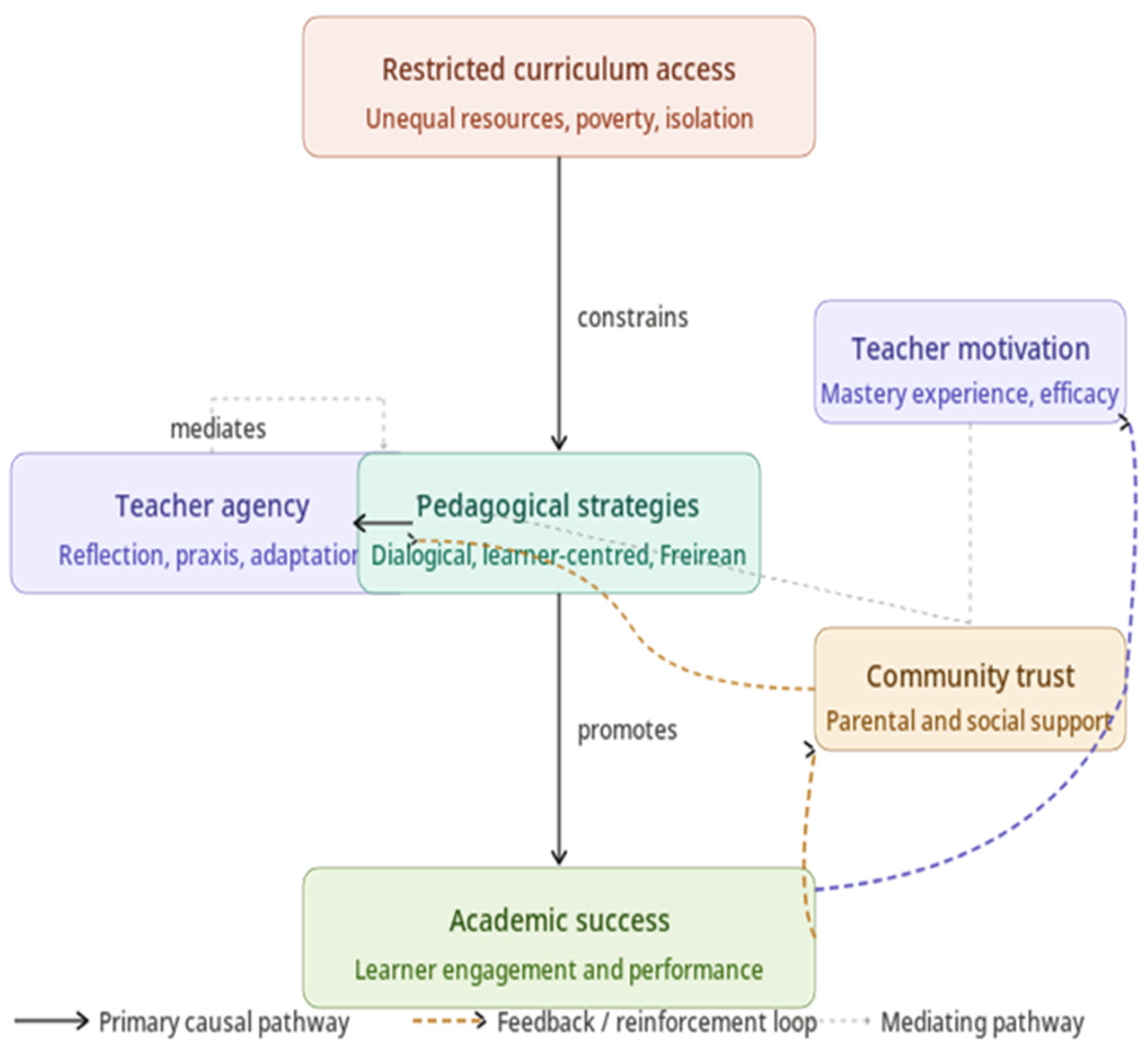
Freire’s (1970) critical pedagogy provides a valuable framework for analysing how curriculum accessibility and pedagogical strategies shape academic outcomes in rural schooling contexts. By foregrounding dialogue, participation, and critical reflection, this perspective emphasises the potential of education to function simultaneously as a site of both reproduction and transformation. Central to this argument is Freire’s emphasis on dialogical and participatory pedagogies, which position learners as active agents in the co-construction of knowledge. Complementing this perspective, Vygotsky and Cole’s (1978) concept of the Zone of Proximal Development offers a cognitive foundation for understanding how peer teaching and scaffolding facilitate learning through social interaction. This is particularly relevant in rural contexts, where large class sizes, multigrade teaching, and limited resources render collaborative learning not merely a pedagogical choice, but a structural necessity. Bringing these perspectives into dialogue, this study examines how teachers operate within structurally constrained environments while simultaneously enacting pedagogical practices that mediate and challenge these inequalities. The theoretical model presented below, therefore, illustrates how teacher agency, together with dialogical and learner-centred pedagogical strategies, functions as a mediating mechanism capable of transforming learning experiences and improving academic outcomes.
Although this study adopts a qualitative approach, it is conceptually structured around a dynamic set of interacting variables. The above theoretical model illustrates that access to curriculum content and pedagogical strategies function as primary explanatory factors influencing academic performance. However, the present study departs from linear models by positioning teacher agency not merely as a conduit for delivering strategies, but as a genuine mediating mechanism, one that is itself shaped and sustained by the outcomes it helps to produce. Grounded in Freire’s (1970) critical pedagogy, the model foregrounds dialogical, participatory, and context-responsive teaching practices as central to transforming learning experiences in resource-constrained environments.
Critically, the theoretical model acknowledges that the relationship between structural constraints, pedagogical practices, and academic outcomes is not unidirectional. Drawing on Bandura and Walters’s (1977) social cognitive theory, teacher self-efficacy and, by extension, teachers’ motivation and commitment to their professional practice are strengthened most powerfully through what Bandura terms “mastery experiences”. Genuine encounters with success that update teachers’ beliefs about their own capabilities (Ryan and Hendry 2023). In rural school contexts, where material conditions routinely undermine professional confidence, evidence of learner progress and engagement functions as precisely this kind of mastery experience. When teachers witness academic improvement, even incremental improvement, this reinforces their belief in the value of their adaptive strategies and sustains the motivation to continue innovating in the face of resource constraints. This dynamic constitutes a reciprocal feedback loop. Teacher self-efficacy shapes the quality of classroom engagement, which in turn shapes learner motivation and academic outcomes, which then re-shapes teacher self-efficacy, a process that unfolds iteratively over time rather than as a linear sequence of inputs and outputs (Kupers et al. 2023).
The theoretical model further recognises that academic success strengthens community trust and parental involvement, which themselves feed back into the social support structures that sustain teaching and learning. Social capital embedded in school-community relationships contributes to poverty reduction and positively impacts schools and learners, particularly in deprived communities where formal resource channels are limited and where social capital itself is developed and reinforced through sustained positive outcomes within those communities. In the schools examined in this study, community engagement was not simply a prerequisite for academic success; it was also a consequence. Communities that observe their children achieving become more invested in supporting the school, which deepens the social capital networks that Coleman (1988) and Putnam (2000) identify as critical to educational functioning. This dynamic is consistent with research on school-community partnerships in rural South African schools, which confirms that these partnerships are a critical nexus to advance quality education and maximising learning outcomes, a process that is cumulative and self-reinforcing rather than static (Mkhize and Hungwe 2022; Romanowski 2022).
The theoretical model presented in Figure 1 goes beyond a linear model of educational disadvantage and outcome to capture the dynamic and recursive nature of teaching and learning in rural public schools. Rather than treating restricted curriculum access as a fixed barrier and academic success as a distant endpoint, the framework foregrounds teacher agency and dialogical pedagogical strategies as active mediating forces capable of transforming the conditions of learning even within structurally constrained environments. Grounded in Freire’s (1970) critical pedagogy, the theoretical model recognises that education is neither a passive transmission of knowledge nor a simple product of material resources, but a relational and political process shaped by the reflective decisions of teachers, the participatory engagement of learners, and the collective investment of school communities.
Figure 1.
Theoretical model illustrating the dynamic relationships among structural constraints, curriculum access, teacher agency, pedagogical strategies, and academic success in rural public schools.
Critically, the theoretical model acknowledges that this process is self-reinforcing. Academic success does not merely conclude the cycle, it re-enters it. When learners achieve, teachers experience what Bandura and Walters (1977) term mastery experiences that deepen professional self-efficacy and sustain the motivation to continue innovating in the face of resource constraints (Ryan and Hendry 2023). When communities witness the academic progress of their children, social trust is deepened, and parental involvement strengthened, generating the forms of social capital that Coleman (1988) and Putnam (2000) identify as essential to school functioning in contexts of material scarcity. These feedback dynamics mean that even modest improvements in academic outcomes can produce compounding enabling conditions for future teaching and learning.
However, the theoretical model is equally clear on what teacher agency and community solidarity cannot accomplish alone. The feedback loops it depicts operate within, not in place of a structural context characterised by persistent inequality, historical marginalisation, and systemic under-resourcing. Adaptive pedagogy can mediate these constraints; it cannot dissolve them. The redistribution of educational resources, the strengthening of rural teacher support systems, and sustained state investment in rural schooling infrastructure remain non-negotiable conditions for genuine educational equity (Sayed and Ahmed 2015; Fraser 2009). The theoretical model is therefore not a celebration of what teachers manage to achieve despite deprivation, but an analytical map of how transformation is possible within constraint and an argument for why removing those constraints remains an urgent and unfinished obligation of the post-apartheid state.
2. Materials and Methods
This study adopted a qualitative research approach to explore how curriculum accessibility and pedagogical strategies influence academic performance in rural public senior secondary schools in the Amathole West Education District of the Eastern Cape Province, South Africa. The study was carried out in five rural public secondary schools identified as under-resourced but showing relatively strong academic performance. A purposive sampling strategy was used to select both participating schools and research participants. Schools were deliberately selected based on their relatively strong and consistent academic performance despite being located in under-resourced rural contexts. This criterion ensured that the study focused on schools that demonstrated resilience and effective teaching practices under structural constraints. The sample consisted of 35 teachers, five school principals, five members of the school management team (SMT), and two Department of Education officials, providing multiple perspectives on teaching practices and curriculum access in rural schools.
Teachers were purposively selected based on the academic performance of the subjects they teach, specifically focusing on those associated with consistently strong pass rates. In this study, ‘strong pass rates’ were operationalised as subject results that were consistently above the district’s average pass rate and aligned with the overall high-performance trends of the selected schools, which historically achieved pass rates ranging between approximately 85% and 100% in Grade 12 examinations. These performance indicators were established through school-level academic records and district performance reports. The selection criterion was intended to identify teachers whose instructional practices were associated with relatively high learner achievement within resource-constrained rural contexts.
In addition, a school principal and an SMT member were selected from each school, while two officials from the Department of Education within the district were included to provide broader institutional insights. Although data was collected from multiple stakeholders (teachers, school principals, SMT members, and Department of Education officials), this article focuses specifically on the teachers’ perspectives, as they are directly involved in classroom pedagogical practices. The analysis of additional stakeholder data forms part of a broader study and will be reported in subsequent publications.
Data were collected through semi-structured in-depth interviews, which allowed participants to discuss their experiences with curriculum access, teaching strategies, and factors influencing learner performance. The interviews were recorded with the consent of the participants and later transcribed for analysis. Ethical approval was obtained from the relevant institutional authorities, and the participants were informed about the purpose of the study, voluntary participation, and confidentiality. Pseudonyms were used to protect the identities of the participants. Data were analysed using a thematic analysis approach, guided by the Braun and Clarke (2006) six-phase framework. This approach was considered appropriate for identifying, analysing, and interpreting patterns within qualitative data related to pedagogical practices and curriculum access. The themes were reviewed and refined to ensure internal coherence and consistency with the data set and then clearly defined and named to guide the presentation of the findings.
We adopted a reflexive stance throughout the study, acknowledging our position as scholars in the field of sociology of education. Reflexivity is a critical component of qualitative research, as it enables the researchers to critically examine how their positionality may influence the research process and interpretation of data (Denzin and Lincoln 2011). We do not have a high school teaching background and have no prior professional or personal affiliation with participating schools or the Amathole West Education District. This positional distance allowed for a degree of analytical neutrality, but also required careful attention to the contextual realities of rural schooling.
Continuous reflection was undertaken to minimise interpretative bias and ensure that the findings remained grounded in the perspectives of the participants rather than preconceived assumptions. While the study focused on relatively high-performing rural schools, it did not systematically compare schools with differing levels of performance or teacher profiles. Similarly, although efforts were made to capture diverse perspectives, the study did not explicitly pursue negative or discrepant cases. These limitations are acknowledged and present important opportunities for future research to strengthen comparative and analytical depth.
Trustworthiness and Rigor
To ensure the trustworthiness and rigor of the study, several strategies were used. Credibility was enhanced through a prolonged engagement with participants and the inclusion of verbatim quotations to support the findings. Dependability was ensured by maintaining a clear audit trail of data collection and analysis processes. Confirmability was addressed through ongoing reflexive engagement, whereby the researcher critically reflected on their positionality and potential biases during data interpretation. Transferability was supported by detailed descriptions of the research context and participants. Additionally, peer debriefing was conducted to review emerging themes and strengthen the consistency and credibility of the analysis.
Although peer debriefing was used to improve the credibility and consistency of the analysis, member checking was not formally conducted in this study. The decision not to implement member checking was informed by practical constraints, including the limited availability of participants and the geographical dispersion of the research sites. However, efforts were made to ensure that the perspectives of the participants were accurately represented through the use of verbatim quotations and a careful iterative engagement with the data during analysis. This limitation is acknowledged and suggests an opportunity for future research to incorporate member validation to further strengthen the credibility of findings.
3. Results
The findings of this study reveal a multifaceted relationship between curriculum accessibility, innovative pedagogical strategies, and academic performance in under-resourced rural public schools in the Amathole West Education District. In the following, in this section, three key themes that emerged from the data will be discussed.
3.1. Curriculum Access as a Social Justice Issue
Participants reported persistent disparities in the availability of prescribed learning materials, especially in gateway subjects such as mathematics and physical sciences. Teachers shared similar insights about strategizing their teaching around limited resources by using teacher-developed resources and photocopying to compensate for inadequate textbooks. Teachers indicated these strategies in schools, highlighting that they used to photocopy and share with learners some of the materials to which they had access. Below are the interview excerpts:
‘What I usually do is photocopy notes for them and even share notes on WhatsApp for those who have smartphones. I do this because there is a lack of textbooks, so I have to write a summary and then share these notes with my learners.’
This excerpt demonstrates how teachers attempt to compensate for the shortage of prescribed textbooks and learning materials by producing simplified summaries and distributing them on both printed and digital platforms. Such strategies reflect the adaptive responses of teachers to structural resource constraints within rural schools.
‘I photocopy books and pamphlets so that I can give summarised notes to learners, as the chalkboard summary also takes time.’
This response further illustrates the practical challenges that teachers face in delivering curriculum content efficiently when adequate teaching resources are unavailable. Reliance on photocopied materials reflects an attempt to save instructional time while ensuring that learners still have access to essential content.
‘In the case of experiments, since we do not have science laboratories, we make use of verified YouTube videos that are related to the content under study. We screen them so that learners can see how it is done if we are not able to perform the actual practical tasks due to a lack of resources.’
This account highlights how the absence of science laboratories limits experiential learning and forces teachers to simulate practical engagement through technology. Although verified YouTube videos provide some exposure to experimental procedures, they cannot fully replace hands-on participation, which is central to meaningful science learning. This demonstrates how rural learners may be formally exposed to the same curriculum as their urban counterparts, but their actual learning experiences remain unequal. Therefore, the excerpts reflect a deeper structural contradiction in education: equality in curriculum policy does not necessarily translate into equality in curriculum access or learning opportunity. Sociologically, this can be interpreted as a form of institutional reproduction of inequality, where schools serving poor communities are expected to produce similar results despite lacking the material conditions necessary for effective teaching and learning (Lubisi and Nekhwevha 2024).
Together, these excerpts show that teachers are not passive victims of deprivation; rather, they actively develop coping mechanisms to sustain teaching and learning. However, these strategies should not obscure the structural nature of the problem. The need to rely on photocopies, WhatsApp notes, and YouTube demonstrations reflects broader inequalities in the distribution of educational resources between schools. Thus, teacher innovation emerges as a compensatory response to systemic neglect, but it cannot fully substitute for equitable access to textbooks, laboratories, and other essential curriculum resources. Therefore, these findings underscore the importance of interpreting pedagogical adaptation within the wider context of rural educational inequality, state under-provision, and social injustice.
3.2. Innovative Pedagogical Strategies in Adverse Contexts
The data collected indicated that teachers used learner-centred methods such as scaffolding through group discussions, collaborative learning, and inquiry-based teaching approaches. These methods not only compensated for limited resources but also improved critical thinking and active participation, aligning with Freire’s dialogical model. Pedagogy became a form of resistance against structural marginalization. The following are excerpts from the interviews, beginning with the teacher’s responses.
‘… another method that I use is peer teaching, I make sure that my learners can teach each other. For example, if I have a very similar topic in grade 12 and grade 11, I will use that. I would take my grade 12 to grade 11 to help them explain the topic.’
This excerpt demonstrates how teachers create opportunities for collaborative knowledge sharing between learners. By allowing senior learners to assist junior learners, the teacher not only reinforces the understanding of grade 12 learners but also enhances comprehension among grade 11 learners. Such practices align with Vygotsky’s concept of the Zone of Proximal Development, which suggests that learners develop a deeper understanding when they interact with more knowledgeable peers who can guide them through complex concepts (Vygotsky and Cole 1978). In this way, peer teaching becomes a pedagogical strategy that facilitates cognitive development through social interaction.
The participants also emphasised the importance of scaffolding strategies that allow learners to support each other during the learning process.
‘I use scaffolding, which is a method in which you use a learner or other learners to teach each other. There are always learners who understand the concepts or content of the module faster than others. I have also noticed that learners grasp information faster when they get it from their peers.’
This response highlights how teachers intentionally use the diverse levels of understanding of learners as a resource for learning. By allowing learners who grasp concepts more quickly to assist their peers, teachers create an interactive and supportive learning environment. This approach resonates with Bandura’s theory of social learning (1977), which posits that individuals learn through observation, imitation, and interaction with others (Bandura and Walters 1977). When learners observe that their peers successfully explain or solve problems, they are more likely to replicate those behaviors, thus strengthening their own understanding of the subject matter.
In addition to peer teaching and scaffolding, the participants also described the use of collaborative assessment practices that promote teamwork and shared problem-solving.
‘I do group assessments to promote teamwork, and it helps to increase the scores of those who struggle to work alone.’
This excerpt suggests that collaboration extends beyond instructional strategies to include assessment practices. Group assessments provide learners with opportunities to engage collectively with academic tasks, allowing them to share ideas, clarify misunderstandings, and support each other during the learning process. Such practices reflect Freire’s (1970) dialogical pedagogy, which emphasises the importance of interaction, dialogue, and collective participation in the production of knowledge. Rather than viewing learning as a passive process in which knowledge is transmitted from teacher to learner, dialogical pedagogy encourages learners to actively construct knowledge through discussion and collaboration.
The participants also highlighted the role of inquiry-based learning in promoting critical thinking and independent problem-solving skills among learners.
‘I encourage inquiry-based learning. This approach helps learners to become critical thinkers.’
This statement reflects a pedagogical orientation that encourages learners to question, investigate, and analyse information rather than simply memorising content. Inquiry-based learning fosters critical thinking by allowing learners to explore problems, formulate questions, and develop solutions through investigation. Such approaches are consistent with Freire’s notion of critical pedagogy, which emphasizes the development of critical consciousness of learners and their ability to analyse social realities (Freire 1970).
Within the South African context, these findings are particularly significant given the structural inequalities that continue to shape school environments. Scholars such as Fleisch (2008) and Spaull (2013) argue that many schools serving disadvantaged communities face persistent challenges related to resource shortages, overcrowded classrooms, and limited teaching materials. In such contexts, learner-centred pedagogical strategies become important mechanisms through which teachers attempt to sustain effective teaching and learning processes despite structural constraints.
‘Inquiry-based learning is one of the teaching methods that fits all content, and I use it often. Increases engagement in a classroom and greater understanding of the content.’
Together, these findings demonstrate that teachers actively employ collaborative and inquiry-based pedagogical strategies to enhance the engagement of learners and academic understanding. By encouraging peer teaching, scaffolding, group assessments, and inquiry-based learning, teachers create opportunities for learners to actively participate in the learning process. However, while such strategies contribute to better student engagement, they should not obscure the structural inequalities that shape educational experiences in rural schools. Addressing these inequalities requires not only pedagogical innovation but also systemic interventions aimed at ensuring equitable access to educational resources.
3.3. Academic Performance as a Product of Pedagogical Agency and Structural Negotiation
This theme frames academic performance not as a mere outcome of individual learner effort or school rankings, but as the product of strategic negotiations between teacher agency, learner motivation, and systemic constraints. It reflects how educators in under-resourced rural schools actively rework pedagogical methods and mobilize social support to produce academic success. The following are excerpts from the interviews, starting with that of the teacher on quality education:
‘The quality of education is largely determined by the level of motivation that learners and teachers have. Everyone, parents and the community at large. When no one wants to let their guard down.’
This excerpt highlights the importance of collective motivation and shared responsibility among stakeholders in the schooling process. Participants emphasised that educational success depends not only on teachers and learners, but also on the active participation of parents and the wider community. These perspectives reflect the importance of collaborative social networks in supporting teaching and learning processes. Within rural schooling contexts, where material resources are often limited, the commitment and motivation of stakeholders can serve as a form of social capital that sustains educational practices. According to Coleman, social capital embedded in relationships between parents, teachers, and communities facilitates the creation of supportive environments that improve learners’ educational outcomes (Coleman 1988).
This emphasis on collective engagement was also reflected in the descriptions of school policies by the participants that intentionally promote collaboration between different stakeholders.
‘Our school policy involves parents in everything we do. We are united as teachers and learners, parents, and school management. This unity enables us to provide quality education because of the support we give each other.’
This response illustrates how institutional practices within the school encourage active parental and community involvement in educational activities. The emphasis on unity between teachers, parents, learners, and school management demonstrates the presence of strong relational networks that support school functioning. From a sociological perspective, such networks can be understood through social capital theory, which posits that relationships characterised by trust, cooperation, and shared norms contribute to improved educational outcomes (Putnam 2000). When schools foster collaborative partnerships with families and communities, they are able to mobilise additional support systems that strengthen the learning environment. In rural contexts, where schools often operate under conditions of resource scarcity, these forms of social capital become particularly significant in the maintenance of educational quality.
The importance of collective support structures is further emphasised in participants’ reflections on how teachers cope with the pressures associated with resource constraints.
‘In our school, we understand that we are responsible for building future leaders of this country; therefore, it is impossible to do that alone. Some days we feel overwhelmed due to a lack of resources. However, we get through those days because we know that we are not alone.’
This account highlights the emotional and professional challenges that teachers face when working in under-resourced school environments. The feeling of being overwhelmed due to limited resources reflects the structural inequalities that continue to shape schooling experiences in many rural communities. However, the emphasis on collective resilience demonstrates how support from colleagues, parents, and the broader school community can mitigate these challenges. From a social justice perspective, this finding underscores the broader structural inequalities within the education system, where schools in disadvantaged communities must rely heavily on collective commitment and solidarity to compensate for inadequate material support. As Fraser (2009) argues, achieving educational justice requires not only recognition and participation but also equitable redistribution of resources to ensure that all learners have fair opportunities to succeed.
Furthermore, the statement about being responsible for ‘building future leaders’ underlines that teaching is not only an individual endeavor but a collective mission. This reinforces the idea that, in the face of resource limitations and overwhelming circumstances, a team approach is essential to sustain the quality of education and achieve long-term goals. Research on the extent of collaborative school improvement practices by teachers related to learners’ academic achievement suggests that schools with higher levels of teacher collegiality achieved higher scores (Shah 2012). When teachers work together, they share ideas, strategies, and resources to help each other improve their craft. In addition, teamwork helps create a positive school culture where teachers feel supported and encouraged. As a result, they are more likely to be motivated to do their best work and provide the best possible education to their learners. In summary, teamwork or collegiality among teachers is necessary in an era of continuous change, improvement, and uncertainty.
4. Discussion
The findings of this study support the central proposition that teacher agency and adaptive pedagogical strategies function as critical mediating mechanisms between structural inequalities and academic performance in the Amathole West Education District. However, it is important to acknowledge that these findings are drawn from relatively high-performing rural schools and therefore reflect the experiences of outlier schools that have managed to achieve success despite systemic constraints. While previous research has predominantly emphasised the structural challenges facing rural schools, the findings of this study extend this body of work by foregrounding the role of teacher agency, adaptive pedagogical strategies, and community collaboration in mediating these constraints.
First, the study confirms that access to curriculum content remains a significant structural challenge in rural schooling contexts. Participants reported persistent shortages of textbooks, laboratories, and subject-specific learning resources, particularly in gateway subjects such as Mathematics and Physical Sciences. These findings are consistent with existing scholarship on educational inequality in South Africa. For instance, Spaull (2013) and Fleisch (2008) argue that schools located in disadvantaged communities frequently experience severe resource shortages that undermine the quality of teaching and learning. Similarly, Du Plessis and Mestry (2019) contend that rural schools often operate within contexts characterised by infrastructural limitations, geographic isolation, and restricted access to essential educational resources.
However, the findings also reveal that teachers actively attempt to mitigate these resource constraints through adaptive pedagogical strategies, including photocopying materials, sharing notes on digital platforms such as WhatsApp, and using online educational resources such as YouTube to simulate practical learning experiences. These practices demonstrate that teachers are not merely passive actors within structurally disadvantaged environments; rather, they actively engage in pedagogical improvisation to sustain teaching and learning. From a sociological perspective, these practices reflect the negotiation between structural constraints and individual agency within educational institutions.
Secondly, the study highlights the importance of learner-centred pedagogical strategies to support academic engagement and understanding. Teachers reported using approaches such as peer teaching, scaffolding, collaborative learning, and inquiry-based instruction to encourage the participation of learners. These findings align with research suggesting that learner-centred teaching methods can enhance critical thinking, engagement, and conceptual understanding, particularly in resource-constrained contexts (Mdodana-Zide 2023).
These innovative pedagogical practices can also be interpreted through Freire’s critical pedagogy, which emphasises dialogical and participatory forms of education. Freire (1970) argues that meaningful learning occurs when learners actively engage with knowledge through dialogue and critical reflection rather than passively receiving information. In rural schooling contexts examined in this study, collaborative learning and peer teaching create opportunities for learners to engage in collective knowledge construction, thus challenging the traditional hierarchical ‘banking model’ of education.
The findings further demonstrate that academic performance in rural schools is shaped not only by material resources but also by social relationships and collective commitment within the school community. Participants highlighted the importance of teacher collaboration, parental involvement, and community support in sustaining educational success. These social dynamics can be understood through the lens of social capital theory, which suggests that networks of trust, cooperation, and shared norms can support educational achievement (Putnam 2000; Coleman 1988). In contexts where material resources are limited, strong social relationships within the school community can serve as an important mechanism for maintaining educational practices.
Furthermore, the emphasis placed by participants on collective responsibility for learner success reflects the broader sociological understanding of education as a socially embedded process. Teachers, learners, parents, and school leaders all contribute to shaping the educational environment in which learning occurs. In rural schools where formal resources are scarce, these collaborative relationships become particularly important in maintaining school functioning and supporting learner motivation.
The findings also support Freire’s notion of praxis, which emphasises the integration of reflection and action to address social inequalities. Teachers in the study demonstrated practice by reflecting on the limitations of their school settings and actively adapting their pedagogical practices to respond to these challenges. By adopting collaborative teaching strategies, encouraging learner participation, and mobilising available resources, teachers contribute to transforming classroom practices within structurally constrained contexts.
While the adaptive pedagogical practices documented in this study are commendable, a critical sociological reading demands that they not be celebrated uncritically. There is a growing body of scholarly work that cautions against interpreting teacher innovation in under-resourced settings as evidence that schools can adequately compensate for systemic neglect. Sayed and Ahmed (2015) argue that when teacher-level adaptations become the primary response to structural resource deficits, they risk obscuring the state’s obligation to ensure equitable distribution of educational resources across schools. In other words, the very ingenuity of teachers and their ability to photocopy notes, share materials via WhatsApp, or simulate laboratory experiments through YouTube can paradoxically be invoked to justify the continued under-resourcing of rural schools by suggesting that teachers are already managing. This is what some scholars refer to as the normalisation of deprivation, where coping becomes a substitute for justice rather than a response to injustice.
This tension is particularly visible in the South African context. South Africa’s education system has historically been characterised by persistent shortages of infrastructural, financial, and human resources, which have continually derailed the success of curriculum reforms and further entrenched inequalities in rural schooling environments. Post-apartheid policies have sought to dismantle these inequalities, but curriculum policies have continued to stratify learners along historical lines, effectively depriving students in rural schools of their right to quality education and epistemological justice, which Bourdieu (1977) characterised as a form of symbolic violence in which denying students resources amounts to depriving them of meaningful participation in socioeconomic and political spaces (Ngobeni et al. 2023). Against this backdrop, framing teacher improvisation as pedagogical innovation without simultaneously naming the structural conditions that necessitate such improvisation risks producing a deficit-reversed narrative that celebrates resilience while leaving inequality intact.
Fraser’s (2009) tripartite framework of redistribution, recognition, and representation offers a useful analytical lens here. Social justice in education, understood through Fraser’s framework, requires not only recognition of the identities and experiences of marginalised communities, but also equitable redistribution of resources to the historically disadvantaged and meaningful representation of excluded groups in governance and policy formulation. The findings of this study reveal that, while recognition and participation are being enacted by teachers acknowledging learners’ realities, communities collaborating with schools, the redistribution dimension remains structurally absent. Rural schools in the Amathole West District continue to function without adequate textbooks, laboratories, and technological infrastructure, despite three decades of post-apartheid reform. Teacher creativity cannot redress this gap; it can only partially and temporarily mitigate it. As research on South African inclusive education policy has shown, when policies acknowledge diverse needs but fail to provide adequate funding for infrastructure and support services, they create a disjuncture between recognition and redistribution, affirming learners symbolically while abandoning them materially (Sayed et al. 2020).
Furthermore, teacher accountability literature in the South African context points to the additional burden that under-resourcing places on educators who are nonetheless held responsible for curriculum delivery outcomes. In South Africa, teachers in poor rural areas are frequently held accountable for implementing a national curriculum designed for well-resourced monograde classrooms, while managing large multigrade classes and often lacking subject-specific qualifications, a structural mismatch that fundamentally undermines educational equity. When teachers in this study describe feeling “overwhelmed due to a lack of resources” but persisting because of collective commitment, this should be read not only as an expression of professional agency and solidarity, but also as evidence of a structural burden that the state has displaced onto teachers and communities. The emotional labour and professional resilience described by participants are, in this sense, responses to a failure of redistribution, not alternatives to it (Ehren and Hwa 2025).
This is not to diminish the significance of teacher agency or community solidarity. Rather, it is to insist, following Freire (1970), that genuine praxis cannot stop at pedagogical innovation within unjust conditions, it must also involve naming those conditions for what they are and demanding their transformation. As Mdodana-Zide (2023) concludes in a parallel study of pedagogical strategies in under-resourced rural South African schools, customised teacher professional development and sustainable funding models for rural school development must be established to improve instruction and learning standards, approaches that require sustained state intervention rather than teacher improvisation alone. Therefore, the present study argues that teacher agency and adaptive pedagogy, while critical, must be understood as necessary but insufficient conditions for educational equity. Systemic transformation through targeted policy interventions that guarantee equitable resource allocation, adequate infrastructure, and sustained professional support for rural teachers remains the irreducible responsibility of the state (Mdodana-Zide 2023). It is with this dual understanding of schools as sites of both structural constraints and meaningful agency that the present study contributes to ongoing debates on educational inequality and sustainable development in rural South Africa.
5. Conclusions
This study examined how curriculum accessibility and pedagogical strategies influence academic performance in rural public senior secondary schools in the Amathole West Education District of the Eastern Cape province, South Africa. The study was carried out in a specific rural district and focused primarily on relatively high-performing schools. That can limit the generalisability of the findings to other contexts. Furthermore, the study relied on qualitative data, which, although rich in depth, do not allow statistical generalisation. The cross-sectional nature of the study also limits the ability to assess long-term impacts of identified pedagogical strategies.
The findings demonstrate that although rural schools operate under conditions characterised by structural inequalities, limited resources, and infrastructure limitations, they are not just educational disadvantage sites. Instead, these schools also function as spaces where teachers and communities actively negotiate these challenges to sustain meaningful teaching and learning. The study shows that limited access to curriculum resources remains a significant challenge in rural schools, particularly in subjects that require specialised learning materials, such as mathematics and physical sciences. Shortages in textbooks, laboratories, and technological infrastructure continue to constrain effective curriculum delivery. These findings reaffirm the existing research on educational inequality in South Africa, which highlights how resource disparities continue to shape educational opportunities in schools.
However, the findings also reveal that teacher agency and pedagogical innovation play a crucial role in mediating these structural constraints. Teachers in the participating schools used a variety of adaptive teaching strategies, including collaborative learning, scaffolding, peer teaching, and inquiry-based learning, to promote learner engagement and understanding. These practices demonstrate how teachers respond actively to resource limitations by creating alternative pathways for curriculum access and knowledge construction. The findings also highlight the importance of collective commitment and social support networks within rural school communities. Collaboration among teachers, parental involvement, and learner motivation were identified as critical factors that contribute to academic success. In contexts where material resources are scarce, these forms of social capital become essential for the maintenance of effective teaching and learning environments.
From a theoretical perspective, the study contributes to the sociology of education by demonstrating how Freire’s (1970) critical pedagogy provides a useful framework for understanding teaching practices in marginalized school settings. The emphasis on dialogue, participation, and praxis illustrates how education can function as both a site of structural constraint and a space for transformation. The adaptive teaching practices of teachers reflect Freire’s (1970) vision of education as a process that encourages critical participation, collective learning, and the empowerment of learners. Effective teaching strategies are highly context-dependent and must be adapted to local realities to support meaningful learning outcomes (Baroudi and Abi Haidar 2025).
The study also has important policy implications. While teacher innovation and community support can partially mitigate the effects of structural inequalities, these strategies cannot fully compensate for the systemic under-resourcing of rural schools. Therefore, addressing educational inequality requires sustained policy interventions aimed at improving the equitable distribution of educational resources, strengthening teacher support systems, and enhancing infrastructure in rural school settings.
Finally, this study highlights the need for more research on rural education and teacher agency in disadvantaged settings. Future studies could explore how similar pedagogical strategies operate in other rural provinces, examine the long-term impact of collaborative teaching practices on learner outcomes, and investigate how educational policies can better support teachers working in resource-constrained environments. Building on these suggestions for future research, several important directions for future research emerge. Comparative studies are also needed to examine the differences between rural schools with varying levels of academic performance, including high-performing and low-performing schools. Such comparative approaches would provide deeper insight into how pedagogical strategies operate in different institutional and resource contexts.
Future research could incorporate mixed-methods approaches by integrating quantitative data, such as academic results of learners, to triangulate qualitative findings and strengthen the robustness of the analysis. This would allow for a more comprehensive understanding of the relationship between curriculum access, pedagogical practices, and academic results. Lastly, longitudinal studies are necessary to explore the long-term impact of identified pedagogical strategies on learner performance, engagement, and educational trajectories over time. Such research would provide critical insight into whether these adaptive strategies produce sustained academic benefits or only short-term improvements. These future research directions are essential for advancing a more nuanced and contextually grounded understanding of how equitable access to curriculum and pedagogical innovation can contribute to sustainable academic success in rural school environments.
The study confirms that, while structural inequalities remain significant, pedagogical strategies based on teacher agency and context-responsiveness can partially mitigate their impact on learner outcomes. In this regard, the findings underscore the importance of recognising rural schools not only as sites of disadvantage but also as spaces of resilience, innovation, and collective agency, where academic success is actively sustained despite structural inequalities.
Author Contributions
Conceptualization, A.K.; Methodology, A.K.; Validation, A.K.; Formal analysis, A.K.; Investigation, A.K.; Data curation, A.K.; Writing—original draft, A.K.; Writing—review & editing, A.K. and F.H.N.; Supervision, F.H.N.; Project administration, A.K. All authors have read and agreed to the published version of the manuscript.
Funding
This research received no external funding.
Institutional Review Board Statement
The study was approved by the University of Fort Hare Research Ethics Committee and the Research Ethics Committee of the Department of Education in the Eastern Cape province before it began (Approval number NEK011SLUB01 14 October 2022).
Informed Consent Statement
Informed consent was obtained from all subjects involved in the study.
Data Availability Statement
Data is available on request from the authors.
Acknowledgments
We would like to express our appreciation to all the research participants for their support in providing information that made this project successful.
Conflicts of Interest
The authors declare no conflict of interest.
References
- Amiri, Sayed M. H., Mainul M. Islam, and Naznin Akter. 2025. Effective teaching strategies: A deep dive into pedagogy. International Journal of Science and Research Archive 15: 835–49. [Google Scholar] [CrossRef] [Scilit]
- Bandura, Albert, and Richard H. Walters. 1977. Social Learning Theory. Englewood Cliffs: Prentice-Hall. [Google Scholar]
- Baroudi, Sandra, and Hounaida Abi Haidar. 2025. Sustainability in the United Arab Emirates secondary schools: A policy practice analysis. Sustainability 17: 3129. [Google Scholar] [CrossRef] [Scilit]
- Bourdieu, Pierre. 1977. Cultural reproduction and social reproduction. In Power and Ideology in Education. Edited by Jerome Karabel and Albert H. Halsey. New York: Oxford University Press, pp. 487–511. [Google Scholar]
- Braun, Virginia, and Victoria Clarke. 2006. Using thematic analysis in psychology. Qualitative Research in Psychology 3: 77–101. [Google Scholar] [CrossRef] [Scilit]
- Buabeng, Isaac, and Bridget Amo-Darko. 2024. Bridging the gap: Enhancing equitable access to quality education for marginalized communities in Ghana. American Journal of Educational Research 12: 427–38. [Google Scholar] [CrossRef] [Scilit]
- Castro, Angela, Brayan Díaz, Cristhian Aguilera, Montserrat Prat, and David Chávez-Herting. 2025. Identifying rural elementary teachers’ perception challenges and opportunities in integrating artificial intelligence in teaching practices. Sustainability 17: 2748. [Google Scholar] [CrossRef] [Scilit]
- Coleman, James S. 1988. Social capital in the creation of human capital. American Journal of Sociology 94: S95–S120. [Google Scholar] [CrossRef] [Scilit] [PubMed]
- Cox, Judy S., and Carol A. Mullen. 2023. Impacting student achievement: Principals’ instructional leadership practice in two Title I rural schools. Journal of School Leadership 33: 3–25. [Google Scholar] [CrossRef] [Scilit]
- Denzin, Norman K., and Yvonna S. Lincoln. 2011. The SAGE Handbook of Qualitative Research. Thousand Oaks: Sage. [Google Scholar]
- Du Plessis, Pierre, and Raj Mestry. 2019. Teachers for rural schools: A challenge for South Africa. South African Journal of Education 39: 1–9. [Google Scholar] [CrossRef] [Scilit]
- Ehren, Melanie, and Yue-Yi Hwa. 2025. The multilevel context of teacher accountability: Findings from low- and high-performing schools in South Africa. Teaching and Teacher Education 163: 105076. [Google Scholar] [CrossRef] [Scilit]
- Fleisch, Brahm. 2008. Primary Education in Crisis: Why South African Schoolchildren Underachieve in Reading and Mathematics. Cape Town: Juta. [Google Scholar]
- Fraser, Nancy. 2009. Scales of Justice: Reimagining Political Space in a Globalizing World. New York: Columbia University Press. [Google Scholar]
- Freire, Paulo. 1970. Pedagogy of the Oppressed. New York: Continuum. [Google Scholar]
- Kupers, Elisa, Judith Loopers, Casper Albers, Alianne Bakker, and Alexander Minnaert. 2023. Links between teacher self-efficacy, need-supportive teaching, and student intrinsic motivation. Frontiers in Psychology 14: 1159108. [Google Scholar] [CrossRef] [Scilit] [PubMed]
- Lubisi, Anathi, and Fhulu H. Nekhwevha. 2024. Effects of family background on poor academic performance of Grade 12 learners. International Journal of Social Science Research and Review 7: 270–77. [Google Scholar]
- Lumadi, Mutendwahothe W. 2020. Fostering an equitable curriculum for all: A social cohesion lens. Education as Change 24: 1–20. [Google Scholar] [CrossRef] [Scilit] [PubMed]
- Mdodana-Zide, Lulama. 2023. Teacher’s pedagogical strategies in under-resourced rural schools in South Africa. E-Journal of Humanities, Arts and Social Sciences 4: 20–31. [Google Scholar] [CrossRef] [Scilit]
- Mkhize, Themba R., and Joseph P. Hungwe. 2022. All Hands on Deck! School-community partnerships as a nexus for resource mobilisation in South African rural schools. Education Research International 2022: 5286467. [Google Scholar] [CrossRef] [Scilit]
- Mpahla, N. E., and Chinedu Okeke. 2015. The rurality of continuing professional teacher development. Studies of Tribes and Tribals 13: 22–33. [Google Scholar] [CrossRef] [Scilit]
- Ngobeni, Norah R., Mackenzie I. Chibambo, and Joseph J. Divala. 2023. Curriculum transformations in South Africa: Poverty and inequalities in schools and society. Frontiers in Education 8: 1132167. [Google Scholar] [CrossRef] [Scilit]
- Preston, Jane P., Brittany A. Jakubiec, and Robin Kooymans. 2013. Common challenges faced by rural principals. The Rural Educator 35: 1. [Google Scholar] [CrossRef] [Scilit]
- Putnam, Robert D. 2000. Bowling Alone: The Collapse and Revival of American Community. New York: Simon & Schuster. [Google Scholar]
- Romanowski, Michael H. 2022. Using social capital to develop South African principals and schools. Prospects 52: 405–20. [Google Scholar] [CrossRef] [Scilit]
- Ryan, Mary, and Graham D. Hendry. 2023. Sources of teacher efficacy in teaching reading: Success, sharing, and support. The Australian Journal of Language and Literacy 46: 1–14. [Google Scholar] [CrossRef] [Scilit]
- Sayed, Yusuf, and Rashid Ahmed. 2015. Education quality and teaching in the post-2015 agenda. International Journal of Educational Development 40: 330–38. [Google Scholar] [CrossRef] [Scilit]
- Sayed, Yusuf, Shireen Motala, David Carel, and Rashid Ahmed. 2020. School governance and funding policy in South Africa: Towards social justice and equity in education policy. South African Journal of Education 40: 1–12. [Google Scholar] [CrossRef] [Scilit]
- Shah, Madiha. 2012. The importance of teacher collegiality in schools—A literature review. Procedia-Social and Behavioral Sciences 46: 1242–46. [Google Scholar] [CrossRef] [Scilit]
- Spaull, Nicholas. 2013. Poverty and privilege: Primary school inequality in South Africa. International Journal of Educational Development 33: 436–47. [Google Scholar] [CrossRef] [Scilit]
- UNESCO. 2023. Global Education Monitoring Report 2023: Technology in Education—A Tool on Whose Terms? Paris: UNESCO. [Google Scholar]
- Vygotsky, Lev S., and Michael Cole. 1978. Mind in Society: Development of Higher Psychological Processes. Cambridge: Harvard University Press. [Google Scholar]
- Wanjala, Otieno, Kamau Mwangi, and Baraka Chege. 2025. Strategies for promoting social justice in rural educational access. Journal Social Humanity Perspective 3: 167–79. [Google Scholar] [CrossRef] [Scilit] [PubMed]
- Westbrook, Jo. 2013. Pedagogy, Curriculum, Teaching Practices and Teacher Education in Developing Countries. London: Education Rigorous Literature Review. [Google Scholar]
- World Bank. 2018. World Development Report 2018: Learning to Realize Education’s Promise. Washington: World Bank. [Google Scholar] [CrossRef] [Scilit]
Disclaimer/Publisher’s Note: The statements, opinions and data contained in all publications are solely those of the individual author(s) and contributor(s) and not of MDPI and/or the editor(s). MDPI and/or the editor(s) disclaim responsibility for any injury to people or property resulting from any ideas, methods, instructions or products referred to in the content. |
© 2026 by the authors. Licensee MDPI, Basel, Switzerland. This article is an open access article distributed under the terms and conditions of the Creative Commons Attribution (CC BY) license.