


Abstract
Ethical conflicts are an inherent—yet often invisible—dimension of occupational therapy practice. Most available evidence remains qualitative or conceptual, and the empirical articulation of ethical conflicts in Spain is still limited. This study examines the nature, distribution, co-occurrence patterns, and meanings of ethical conflicts reported by occupational therapists in Spain. A concurrent convergent mixed-methods design was used. From a broader national sample of 596 valid responses, the analytical sample consisted of 160 practitioners (84.4% women, reflecting the gender composition of the profession in Spain) who reported having experienced ethical conflicts and provided open-text information. Data were collected via an online questionnaire combining closed items and open-ended narratives. Quantitative analyses included descriptive statistics and Jaccard-based co-occurrence estimates derived from a non-mutually exclusive thematic coding matrix. Narratives were analyzed inductively with a descriptive phenomenological orientation (Giorgi), using thematic procedures as an analytic scaffold (Braun and Clarke). Findings were integrated through joint displays and meta-inference. The most frequently selected primary conflict categories concerned professional competence and practice (19.4%), relationships with family members/caregivers (14.4%), and the user–therapist relationship (12.5%). Co-occurrence analysis indicated that conflicts rarely occurred in isolation and tended to cluster across relational, structural, and professional domains. Integration of quantitative patterns and narrative meanings supported a preliminary interpretive three-dimensional framework (relational, structural, professional) for understanding ethical tensions in practice. Across narratives, participants described experiences interpreted as consistent with moral distress, economic and workload pressures, limited professional recognition, and normative gaps. Ethical conflicts in occupational therapy practice in Spain are best understood as recurrent, situated tensions shaped by relational dynamics and organizational conditions, rather than isolated dilemmas. Supporting moral agency requires organizational supports, spaces for collective ethical deliberation, and context-sensitive ethics education.
1. Introduction
Occupational therapy is practiced at the intersection of three demanding domains: a normative commitment to users’ well-being, participation, and occupational justice; the technical complexity of clinical reasoning; and the organizational pressures that pervade contemporary health and social services (Goulet and Drolet 2017; Taff et al. 2014). Within this configuration, ethical principles such as autonomy, beneficence, justice, and professional integrity are recurrently strained by the contingencies of everyday practice. Ethical conflicts have therefore been recognized as inherent to—though often invisible in—the profession (Bushby et al. 2015; Durocher et al. 2016; Durocher and Kinsella 2021).
The international literature on ethics in rehabilitation has increasingly questioned the dominance of the classical dilemma as the prototypical unit of moral analysis. Empirical work consistently shows that occupational therapists rarely face exceptional, abstract choices between mutually exclusive courses of action. Instead, they navigate persistent tensions linked to structural constraints, institutional pressures, interprofessional hierarchies, and family or cultural demands that limit their capacity to act in accordance with professional judgment (Beauchemin et al. 2022; Drolet et al. 2020; Durocher and Kinsella 2021). These experiences have been variously conceptualized as moral distress, occupational alienation, or conflicts of loyalty—phenomena that compromise practitioners’ moral integrity and occupational well-being (Tinkham et al. 2021).
Interpreting this evidence requires conceptual precision, since the literature, professional discourse, and Spanish-language occupational therapy ethics scholarship often use overlapping terms with distinct ethical meanings (Laborda-Soriano et al. 2024). Following Beauchemin et al. (2022) and Drolet et al. (2023), four categories can be analytically separated. An ethical issue or ethical problem is any situation that compromises—or threatens to compromise—respect for one or more values considered legitimate within a given professional context. An ethical tension refers to sustained friction among values, duties, or responsibilities that coexist within a concrete situation, without necessarily entailing a binary choice between mutually exclusive options; this notion aligns with non-idealized approaches that situate moral analysis within real conditions of practice. An ethical dilemma, in the strict sense, involves choosing between two or more incompatible courses of action, each supported by plausible moral reasons, such that any choice transgresses at least one relevant value (VanderKaay et al. 2019). Finally, moral distress arises when professionals can identify the ethically appropriate course of action but face external constraints—organizational, regulatory, or financial—that prevent them from acting on that judgment, generating cumulative emotional and professional consequences (Tinkham et al. 2021). This typology is not merely descriptive: each category implies different analytical units, different sources of conflict, and, critically, different forms of intervention.
Empirical research has progressively shifted the locus of ethical conflict away from the dyadic therapist–user relationship and toward a broader web of relational, organizational, and sociopolitical factors. Studies in both private and public settings document how productivity pressures, performance indicators, and economic efficiency criteria collide with quality of care and person-centered values (Babic 2016; Durocher and Kinsella 2021; Goulet and Drolet 2017). Negotiating user autonomy in contexts of dependency, risk, or cognitive impairment likewise generates complex tensions among self-determination, beneficence, and non-maleficence (Blackburn et al. 2018). Yet, despite the conceptual maturity of this field, three specific empirical limitations persist that justify a methodologically integrated approach. First, the evidence base is dominated by exploratory qualitative or conceptual designs, which offer rich descriptions of ethical tensions but rarely provide distributional estimates of conflict categories across professional populations (Durocher and Kinsella 2021; Goulet and Drolet 2017). Second, although co-occurrence between conflict types has been repeatedly signalled in rehabilitation ethics, few occupational therapy studies have formally quantified these associations or examined their structuring role in everyday practice (Durocher et al. 2016; Drolet et al. 2020). Third, while mixed-methods designs are increasingly advocated in applied ethics and rehabilitation research, their use for ethical conflicts in occupational therapy remains rare, and meta-inferential integration—rather than the mere juxtaposition of strands—is largely absent (Beauchemin et al. 2022; Drolet et al. 2023). A convergent mixed-methods design is therefore not merely complementary but methodologically necessary to capture both distributional patterns and practitioners’ situated meanings.
Conceptually, this study is anchored in the framework of situated ethics, which conceives ethical action as embedded in concrete relational, institutional, and political conditions rather than as the application of abstract principles (Beauchemin et al. 2022; Durocher and Kinsella 2021; Hudon et al. 2014). Within this overarching framework, we mobilize three complementary analytical lenses: relational ethics to interpret tensions involving users, families, and caregivers (Blackburn et al. 2018); organizational ethics to interpret tensions linked to institutional, managerial, and resource constraints (Drolet et al. 2020; Goulet and Drolet 2017); and moral distress as an interpretive category applied to narratives—rather than a formally measured construct—to describe experiences in which practitioners perceive the ethically appropriate course of action yet face sustained external constraints (Tinkham et al. 2021).
The Spanish context offers a contextually distinctive case in which to address these gaps. Occupational therapy in Spain operates primarily within a decentralized public healthcare system, alongside a wide network of social and sociosanitary services managed by public, publicly funded, and private entities (Barrios Fernández and Cantero Garlito 2019). This configuration—coexistence of regional health services, a heterogeneous sociosanitary sector, and comparatively recent professional regulatory recognition—makes structural and organizational determinants of ethical conflict particularly salient. While this specificity limits direct statistical generalization, it provides analytical leverage for examining how decentralization, regulatory fragmentation, and hybrid public–private service organization shape ethical conflict in ways that may resonate with other European systems facing similar pressures (Beauchemin et al. 2022). Available analyses point to inadequate staffing ratios, precarious employment conditions, limited institutional recognition of the profession, and ambiguity in role delineation, all of which are likely to intensify ethical conflict in everyday practice (Escudero-Escudero et al. 2020; FEARP 2023). Although recent Spanish empirical work has begun to examine ethical conflicts and occupational therapists’ knowledge of professional ethical codes (Emeric-Méaulle et al. 2026), production on the topic remains limited, fragmented, and methodologically narrow, particularly regarding integrative mixed-methods evidence and the co-occurrence of conflict categories (Emeric-Méaulle et al. 2025).
Building on these gaps, the present study analyzes the nature, frequency, association patterns, and meanings of ethical conflicts experienced by occupational therapists in Spain. Specifically, three hierarchically ordered objectives are pursued: (a) a descriptive objective, to characterize the distribution and relative frequency of ethical conflict categories in everyday practice (quantitative strand); (b) an exploratory objective, to identify co-occurrence patterns among conflict categories and to describe the values, tensions, and meanings that practitioners attribute to these experiences (quantitative and qualitative strands); and (c) an integrative objective, to derive—through joint-display meta-inference—a preliminary, contextually grounded interpretive framework for understanding ethical conflicts in occupational therapy practice (mixed strand). The corresponding research questions are as follows: RQ1 (QUAN) How are categories of ethical conflict distributed and how do they co-occur in everyday Spanish occupational therapy practice? RQ2 (QUAL) What values, tensions, and meanings do practitioners attribute to these conflicts? RQ3 (MIXED) How do quantitative patterns and qualitative meanings jointly inform a situated, exploratory framework of ethical conflict in occupational therapy?
2. Materials and Methods
2.1. Study Design
We employed a concurrent convergent mixed-methods design (Creswell and Plano Clark 2018) to examine, in an integrated manner, the frequency, articulation, and meanings of ethical conflicts in occupational therapy practice. Quantitative and qualitative components were collected simultaneously, analyzed independently, and integrated through a meta-inference process that compared, complemented, and contrasted the findings (Mertens 2023; Tariq and Woodman 2013). Reporting of the mixed-methods design was informed by the Good Reporting of A Mixed Methods Study (GRAMMS) criteria proposed by O’Cathain et al. (2008). The rationale for this design was twofold. First, the dominance of qualitative and conceptual work in the literature has produced rich descriptions of ethical tensions but limited distributional information. Second, ethical conflicts are both patterned and situated phenomena: they require quantitative procedures capable of describing prevalence and association, and qualitative procedures capable of interpreting the meanings, values, and contextual constraints embedded in practitioners’ narratives. The study was therefore designed around the three aligned research questions presented in Section 1 (RQ1–RQ3), each addressed by a different methodological strand: the quantitative strand addressed RQ1 (distribution and co-occurrence of conflict categories), the qualitative strand addressed RQ2 (meanings, values, and contextual conditions), and the mixed-methods integration addressed RQ3 (joint construction of a preliminary interpretive framework).
2.2. Participants and Recruitment
The target population consisted of licensed occupational therapists actively practicing in Spain. Inclusion criteria were: (a) holding a university degree in Occupational Therapy (Diploma or Bachelor’s/Graduate degree), (b) currently practicing occupational therapy in Spain, and (c) being 65 years of age or younger. The upper age limit was established to focus the study on practitioners within the ordinary active working-age range in Spain, while recognizing that some professionals may continue working beyond this threshold. No minimum professional experience threshold was established; practicing occupational therapists were eligible for inclusion because the study aimed to capture ethical conflicts encountered across different career stages and practice contexts.
The sample size was estimated using the total number of registered occupational therapists in Spain (n = 6782) as of December 2021 (INE 2022). An a priori calculation for a finite population, assuming a 95% confidence level and a 5% margin of error, indicated a minimum required sample of 364 participants. A total of 622 responses were received. After data screening and cleaning, 26 responses were excluded due to incomplete submissions, duplicate entries, and/or failure to meet inclusion criteria, resulting in a final sample of 596 valid questionnaires. These responses were obtained from the same national survey of occupational therapists in Spain that also informed a separate study on therapists’ knowledge of the professional code of ethics (Emeric-Méaulle et al. 2026); the present article draws on distinct items and addresses different research questions (the nature, distribution, co-occurrence, and meanings of ethical conflicts), and the two analyses do not share outcome variables.
A non-probabilistic convenience sampling strategy, combined with a snowball technique, was used through collaboration with regional professional associations, occupational therapy networks, and social media. This strategy enabled broad and heterogeneous participation across autonomous communities and practice settings. Throughout data collection, response distribution was monitored to identify underrepresented regions and practice settings, and dissemination was reinforced through targeted outreach via the same professional channels. Although this procedure increased reach, snowball recruitment may have favored socially or professionally connected networks; this limitation was mitigated, though not eliminated, by diversifying recruitment channels and explicitly inviting participation from therapists working in different areas of practice, institutional settings, and regions.
For analyses focused specifically on ethical conflicts, respondents were subsequently differentiated according to their answers in the questionnaire. Within the final sample, a subset of participants reported having experienced ethical conflicts in professional practice, and within this group, 160 participants explicitly indicated one or more types of ethical conflict using the questionnaire categories and provided open-text information (Table 1). Narrative depth varied across responses, ranging from brief descriptions to more developed accounts. All 160 cases were retained for descriptive categorization and multi-label thematic coding when the available information permitted coding. More developed narratives were used preferentially as illustrative excerpts in the qualitative presentation.
Table 1.
Sociodemographic and professional characteristics of the analytical sample (n = 160).
2.3. Data Collection and Instrument
Data were collected through a self-administered online questionnaire designed for this study. The instrument combined closed-ended items and open-ended prompts, capturing both structured information and experiential narratives. In the closed section, respondents identified and classified the ethical conflict described from a set of predefined categories developed from the literature (Bushby et al. 2015; Drolet et al. 2020; Durocher and Kinsella 2021). In the open section, respondents were invited to describe, in their own words, a specific situation involving an ethical conflict, including its context, the actors involved, the values or duties in tension, and the response adopted or considered. The questionnaire was reviewed by a panel of seven expert occupational therapists selected for their clinical, academic, professional, and ethics-related experience, including professionals involved in ethics teaching, professional regulation, and practice in different service settings. The review focused on item relevance, semantic clarity, conceptual coherence, and the adequacy of the response categories; expert comments were discussed by the research team and incorporated into a revised version of the questionnaire before data collection.
Prior to participation, respondents received detailed information about the aims of the study, the voluntary nature of participation, data confidentiality, and the right to withdraw at any time without consequences. Informed consent was obtained electronically through explicit agreement before accessing the questionnaire. To ensure data quality, one response per device was permitted, and questionnaire completeness was reviewed systematically before analysis.
2.4. Quantitative Analysis
The quantitative component combined descriptive and associative procedures. For descriptive purposes, each response was assigned one primary conflict category (Matrix A), and absolute frequencies, relative frequencies, and percentages were calculated. For associative purposes, a separate non-mutually exclusive multi-label thematic coding matrix was constructed (Matrix B), allowing a single narrative to be assigned more than one conflict code when appropriate. Pairwise associations were examined through this co-occurrence matrix using Jaccard coefficients (J), defined as J(A,B) = |A ∩ B|/|A ∪ B|, with values ranging from 0 to 1. A pre-specified inclusion threshold of J ≥ 0.45 was used for reporting in the main table; values below this threshold are reported only when their conceptual relevance warranted comparison. Intermediate analytical clusters and the three-dimensional framework reported in the Results were developed through integration of descriptive frequencies, thematic co-occurrence patterns, and qualitative interpretation, as specified in Section 2.6. Analyses were conducted in IBM SPSS Statistics v.29.
2.5. Qualitative Analysis
The qualitative component combined two complementary analytical procedures within a qualitative descriptive orientation. This combination was adopted pragmatically, while preserving the distinction between phenomenological description and thematic organisation. Giorgi’s (1997, 2012) descriptive phenomenological method was used to approach participants’ lived experiences through repeated readings of the narratives, the identification of meaning units, and their transformation into an analytical language sensitive to ethical values, moral tensions, and contextual conditions. Complementarily, Braun and Clarke’s (2019) reflexive thematic analysis was used to organise these meaning units into codes and themes through an iterative process of comparison. This approach allowed both emergent meanings and literature-informed elements to be integrated.
The conceptual typology presented in the theoretical framework—ethical issues, ethical tensions, ethical dilemmas, and moral distress—was used as a flexible analytical guide, rather than as a closed coding system. Coding was performed by the first author and independently audited by the second and third authors. The audit was not intended to establish intercoder reliability, but to support reflexive dialogue, challenge premature interpretations, and enhance analytic transparency. Disagreements were discussed until interpretive agreement was reached. A thematic codebook and reflexive memos were maintained throughout the process, and analyses were supported by ATLAS.ti v.23.
Reflexive memos were used to make explicit the authors’ disciplinary positioning: two authors are occupational therapists with clinical experience in mental health and dependency care, and one is involved in occupational therapy ethics teaching. This positioning was considered an analytical resource, while also being critically examined as a possible source of interpretive bias. Analytic sufficiency was monitored iteratively using the principle of information power (Malterud et al. 2016), considering the focused aim of the study, the specificity of the sample, and the richness of the narratives. We recognise that the authors’ proximity to the field may have sensitised the analysis toward organisational and hierarchical interpretations of ethical conflict; the independent cross-audit was used to identify and question such inclinations, although it cannot fully neutralise them. Because the questionnaire was anonymous, member checking with participants was not undertaken, and the interpretations reported here therefore remain those of the research team.
2.6. Mixed-Methods Integration
The two components were integrated through joint displays organizing quantitative patterns alongside corresponding narrative excerpts and themes (Guetterman et al. 2015). Integration proceeded in three steps: (1) mapping quantitative outputs (category frequency and Jaccard co-occurrence) to their corresponding qualitative themes; (2) examining each mapped pair for convergence, complementarity, or divergence; and (3) drawing meta-inferences only when both strands contributed substantively, while retaining divergent cases as analytically informative rather than reconciling them away. Intermediate analytical clusters were used as a bridge between the categorical results and the final interpretive framework; they should not be read as latent dimensions or as direct products of a statistical factor solution. The three-dimensional framework presented in Section 3 (Results) was not derived from a statistical or latent factor solution; rather, it was developed through mixed-methods integration of descriptive frequencies, thematic co-occurrence patterns, and qualitative interpretation.
2.7. Ethical Considerations
The study was conducted in accordance with the Declaration of Helsinki (World Medical Association, 2013), Spanish Organic Law 3/2018 on the Protection of Personal Data and Guarantee of Digital Rights (Organic Law 3/2018 2018), and Regulation (EU) 2016/679, the General Data Protection Regulation (European Union 2016). Ethical approval was granted by the Research Ethics Committee of the Autonomous Community of Aragon (CEICA; approval code PI21/269; date of approval: 3 June 2021). Data were treated confidentially, analyzed exclusively in aggregate form, and managed in such a way as to preclude individual identification. Participation was voluntary and based on informed consent obtained electronically before accessing the questionnaire; respondents were informed of the aims of the study and of their right to withdraw before submission. The questionnaire was anonymous and did not collect directly identifying data. Verbatim quotations reproduced in this article were drawn from open-ended responses provided under these conditions and are identified only by neutral participant codes; any incidental references to specific settings or persons were removed to protect anonymity. Given the anonymous, cross-sectional, and self-administered nature of the questionnaire, no individual follow-up or distress-monitoring protocol was implemented; this is acknowledged as a limitation in Section 4.6.
3. Results
The analytical sample comprised 160 valid responses in which participants reported ethical conflicts and provided open-text information. Narrative depth varied across responses, from brief descriptions to more developed accounts. Narratives spanned a wide range of practice settings—hospital services, community-based care, mental health, geriatrics, education, and institutional management—and consistently portrayed everyday situations in which ethical principles collided with organizational, economic, or cultural realities.
3.1. Distribution of Ethical Conflict Categories
Initial open coding produced 19 categories that were grouped into eight conceptually coherent clusters plus a residual category; the eight substantive clusters together accounted for approximately 89% of the cases (Table 2). The most prevalent category was professional competence and practice (n = 31; 19.4%), followed by relationship with family members/caregivers (n = 23; 14.4%), the user–therapist relationship (n = 20; 12.5%), and relationships with other professionals or staff (n = 18; 11.3%).
Table 2.
Frequency distribution of ethical conflict categories (n = 160).
Two narratives illustrate the recurring structural undertone of these figures:
“I must see more patients than I can manage with quality, but if I refuse, they threaten to transfer me to another unit.”(P14)
“We are asked to do more with fewer staff; the outcome matters less than billing.”(P31)
Both excerpts capture a tension that recurred across narratives: the contradiction between an ethics of care and an ethics of institutional efficiency.
3.2. Co-Occurrence Patterns Among Conflict Categories
Jaccard coefficients identified eight associations meeting or approaching the pre-specified threshold of J ≥ 0.45 (Table 3). The strongest associations clustered around two axes: a relational axis linking conflicts involving users, family members, and caregivers; and a structural axis linking professional competence with institutional and resource-related constraints.
Table 3.
Main co-occurrence coefficients between ethical conflict categories.
3.3. Intermediate Analytical Clusters: Joint Displays
Joint display integration was used to organize categories into intermediate analytical clusters (Table 4) by combining descriptive frequencies, co-occurrence patterns, and qualitative themes. These clusters functioned as an integrative bridge between the coded categories and the final three-dimensional interpretive framework. They were not treated as latent dimensions or as a direct statistical structure. On conceptual grounds and after thematic validation, categories were first organized into four intermediate clusters: professional and competence, relational (user/family), organizational and hierarchical, and information and communication. The information and communication cluster was then interpreted as a transversal cluster that informed both relational and professional dimensions in the final framework.
Table 4.
Intermediate analytical clusters of ethical conflict and integration with qualitative themes.
The prominence of the relational (27.5%) and organizational–hierarchical (26.3%) clusters suggests that professional ethics is not configured only as an individual exercise of moral deliberation, but also as a situated process of negotiation among interdependent actors operating within hierarchical, organizational, and normative frameworks. One participant captures this with particular clarity:
“The physician decides the therapy goals without consulting us, even when the patient’s progress indicates otherwise.”(P33)
“When you question a medical or institutional order, it is interpreted as disloyalty. Sometimes you remain silent for fear of reprisals.”(P104)
These statements may be interpreted as examples of hierarchical moral conflict: a phenomenon in which institutional obedience prevails over individual ethical judgment, generating feelings of powerlessness and emotional exhaustion.
3.3.1. Conflicts Surrounding User and Family Autonomy
Conflicts concerning user autonomy and family involvement accounted for the relational cluster (27.5% of the narratives); communicative-ethics conflicts around information and informed consent were analyzed separately as a transversal cluster (see Section 3.3.4). The recurring core was the tension between the user’s self-determination and the cultural or family norms restricting it.
“The family decides for the person without taking their wishes into account, and the centre allows it.”(P41)
“Muslim family. They did not allow me to speak directly with the female patient.”(P52)
Such excerpts illustrate how autonomy and beneficence may collide when intersecting with cultural traditions or religious beliefs, requiring practitioners to balance cultural sensitivity with the defense of the user’s right to decide. In contexts of disability or cognitive impairment, the problem becomes more acute:
“The consent is signed by the family without the user understanding what they are agreeing to.”(P90)
“I cannot guarantee that the patient truly understands what is being proposed; the family pressures us to begin treatment.”(P63)
The strong co-occurrence between conflicts involving family members/caregivers and the user–therapist relationship (J = 0.74) suggests that the family acts ambivalently in the moral economy of practice—simultaneously a source of support and a source of conflict. Practitioners experience this duality as a space of emotional negotiation in which the “user’s best interest” is continuously redefined.
3.3.2. Professional Competence and Conditions of Practice
Professional competence accounted for 19.4% of the conflicts as a primary category (20.0% at the intermediate-cluster level, once the reassigned principles-of-practice narrative is included; see Table 4). Most narratives describe situations in which a lack of resources, training, or institutional support compromises the quality of intervention:
“I work with complex patients without specific training or technical support.”(P9)
“The centre lacks basic materials. I have to improvise with what is available.”(P27)
“I cannot meet ethical standards if I am required to prioritize productivity over quality.”(P18)
These accounts indicate that competence is not only an individual attribute but also a relational and structural construct, mediated by available resources, workload, and management policies. This interpretation is consistent with the co-occurrence between professional competence and institutional constraints (J = 0.68), suggesting that structural conditions are relevant to the experience of ethical conflict.
3.3.3. Interprofessional Relationships and Workplace Hierarchies
A total of 26.3% of the narratives addressed conflicts in relationships with colleagues, supervisors, and other disciplines, and consistently exposed power asymmetries, lack of recognition of the occupational therapist’s role, and institutional practices that inhibit professional autonomy:
“The occupational therapist has no voice in clinical meetings. Decisions are made without consulting us.”(P99)
“The medical team considers our intervention to be something secondary.”(P67)
“If you propose an alternative therapeutic approach, it is interpreted as a challenge.”(P105)
These accounts reveal a conflict of professional legitimacy in which ethics is enacted at the boundary between subordination and agency. The co-occurrence between conflicts involving other professionals and supervisors (J = 0.62) suggests a strong link between hierarchical position and moral conflict—a link that may generate ethical stress and erode professional meaning.
3.3.4. Confidentiality and Informed Consent
Confidentiality (10%) and informed consent (6.3%) jointly constituted a transversal information and communication cluster (16.3%). Practitioners reported institutional pressures to share information with family members or with other team members in the absence of the user’s explicit authorization:
“I am asked to inform the family about the user’s progress without their consent.”(P79)
“Clinical reports are shared across the network without guaranteeing privacy.”(P124)
These conflicts arise at the intersection between the demands of interdisciplinary coordination and the principles of confidentiality. The moderate association between confidentiality and informed consent (J = 0.55) supports treating them as a transversal communicative ethics cluster centered on transparency and respect for the user’s dignity, rather than as an independent fourth dimension of the final framework.
3.3.5. Institutional Constraints and Moral Burden
Beyond the discrete clusters reported in Table 4, institutional constraints emerged as a cross-cutting concern that drew on both the organizational–hierarchical cluster and the mixed/emerging themes, rather than constituting a separate cluster of its own. A recurrent subset of narratives described experiences of institutional pressure, cutbacks, work overload, and the absence of ethical support. Practitioners reported that management policies and performance indicators transform ethical values into productivity goals:
“We are forced to discharge patients because of lack of places, not because the patient has completed their process.”(P115)
“There is no space to discuss ethical dilemmas; everything depends on the manager’s criteria.”(P128)
These excerpts reflect a moral decontextualization of practice in which ethical deliberation is progressively displaced by the mechanical application of administrative protocols. Co-occurrence analysis shows that institutional conflict rarely appears in isolation: it systematically clusters with conflicts about competence, with relational tensions involving users and family members, and with practitioners’ own emotional distress. Organizational constraints thus operate as a structuring axis of ethical tension, cutting across the dimensions of practice and limiting the moral agency of practitioners in their everyday work.
3.4. Emerging Themes
Reflexive thematic analysis identified four emerging themes that added nuance to the categorical framework. First, narratives described economic pressures and job insecurity directly shaping clinical decisions, with productivity criteria conditioning the organization and continuity of interventions:
“We are required to maintain productivity indicators even when the user does not improve.”(P140)
Second, narratives reported a lack of professional recognition, particularly in hierarchical settings, and consequent constraints on clinical autonomy:
“The occupational therapist has no autonomy to decide even on the continuity of treatment.”(P101)
Third, narratives described moral and emotional exhaustion linked to the difficulty of acting in accordance with one’s own professional judgment under persistent organizational constraints—an exhaustion described as a cumulative effect of unresolved conflict:
“I know what I should do, but the system does not allow me to do it.”(P132)
Fourth, narratives revealed regulatory gaps and the absence of institutional ethical support: practice settings in which there are no specific protocols or formal spaces for deliberation or supervision, leaving ethical decision making to individual conscience:
“There are no protocols or ethical supervision; each person acts according to their own conscience.”(P148)
3.5. A Preliminary Three-Dimensional Interpretive Framework of Professional Ethics
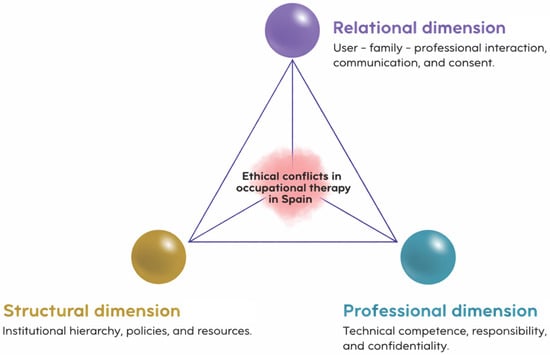
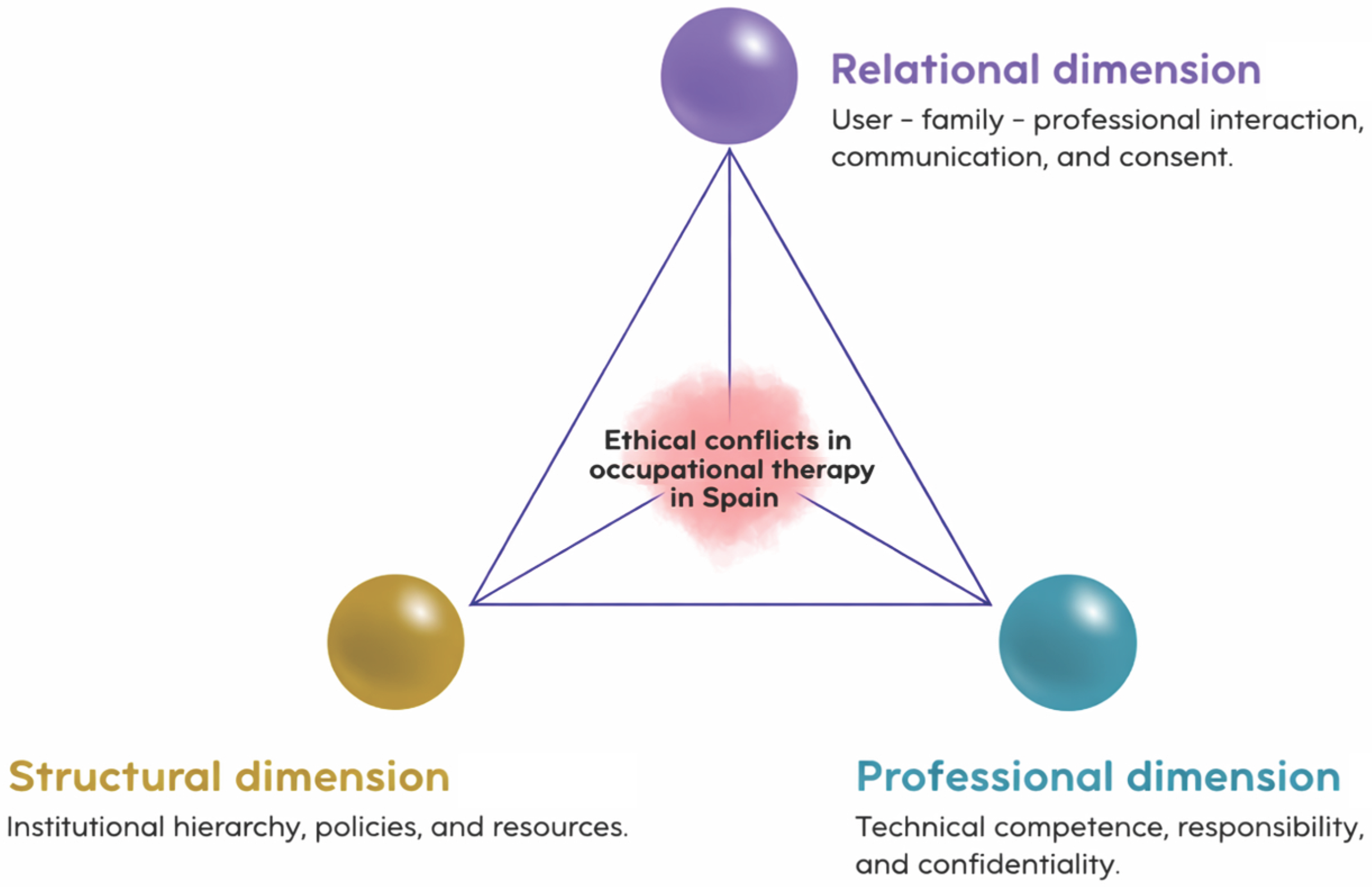
Integration of frequency patterns, co-occurrence findings, and qualitative themes supported a preliminary three-dimensional interpretive framework of professional ethics in occupational therapy (Figure 1). The relational dimension grouped conflicts arising in interactions among users, family members, and professionals, including processes of communication, shared decision making, and informed consent. The structural dimension captured organizational factors—institutional hierarchies, management policies, resource availability, and working conditions. The professional dimension grouped conflicts related to technical competence, professional responsibility, confidentiality, and the conditions required to act in accordance with professional standards. The intermediate information and communication cluster was therefore incorporated transversally into the relational and professional dimensions, rather than treated as a fourth dimension. The choice of three dimensions is not merely empirical but is conceptually consistent with socio-ecological approaches that distinguish micro-, meso-, and macro-levels of influence on ethical action (Bronfenbrenner 1979), and which have been applied to the analysis of moral distress as a phenomenon shaped simultaneously at individual, professional, and systemic levels. In this reading, the relational dimension corresponds to the micro-level of interpersonal interaction, the professional dimension to the meso-level of professional roles, competence, and disciplinary standards, and the structural dimension to the macro-level of organizational and policy conditions. This correspondence offers a conceptual rationale for a tripartite rather than a bipartite or four-dimensional structure, while remaining open to refinement in further research.
Figure 1.
An integrative and preliminary three-dimensional framework for understanding ethical conflicts in occupational therapy practice.
The three dimensions do not operate in isolation. Their intersection identifies the conflicts with the greatest integrative complexity—those in which relational, structural, and professional tensions converge simultaneously—not necessarily the conflicts with the greatest frequency. In the multi-label thematic matrix, 11 of 160 narratives (6.9%) were coded across all three dimensions. This pattern suggests that ethics in occupational therapy is configured as a dynamic process of ongoing adjustment among professional values, contextual demands, and interpersonal relationships, as one participant succinctly expressed:
“Acting ethically often means going against the current of the institution.”(P151)
To make the integration process transparent, Table 5 presents illustrative joint-display examples of the integration outcomes (convergence, complementarity, and divergence) that informed the construction of the preliminary three-dimensional framework. These examples connect specific quantitative results (frequencies and Jaccard coefficients) with their corresponding qualitative themes and the meta-inferences they jointly supported.
Table 5.
Joint-display: illustrative examples of integration outcomes between quantitative patterns and qualitative meanings.
4. Discussion
This mixed-methods study advances a situated understanding of ethical conflicts in occupational therapy practice in Spain. The findings suggest that these conflicts do not appear as exceptional events or isolated dilemmas but as persistent ethical tensions embedded in specific relational, organizational, and professional contexts that recurrently permeate everyday practice. This characterization is consistent with the international literature on rehabilitation ethics, which has called into question the centrality of the classical dilemma as the principal unit of moral analysis and has proposed approaches that recognize the relational, organizational, and political complexity of professional practice (Durocher and Kinsella 2021; Goulet and Drolet 2017).
Addressing RQ3—how quantitative patterns and qualitative meanings jointly inform a situated, exploratory framework of ethical conflict—required integration of the distributional and co-occurrence findings from the quantitative strand with the interpretive meanings derived from the qualitative analysis. The Jaccard-based co-occurrence analysis revealed that conflicts cluster significantly across relational, structural, and professional domains, rarely occurring in isolation; simultaneously, the thematic analysis of practitioners’ narratives articulated the values, institutional pressures, and forms of powerlessness embedded within each domain. This integration generated an interpretive framework organized around three dimensions (relational, structural, and professional) that are neither theoretically imposed nor statistically isolated, but grounded in both the patterns of practitioners’ reported experiences and the situated meanings they articulated. As the following subsections develop, this framework provides an alternative to purely dilemma-centered ethics, one better aligned with the non-idealized conditions of occupational therapy practice in Spain.
4.1. From Ethical Dilemmas to Structural Ethical Tensions
A central contribution of this study is that the findings suggest that most ethical conflicts described by participants correspond to ethical problems and ethical tensions rather than to dilemmas in the strict sense. This distinction matters analytically: dilemmas—choices between mutually exclusive courses of action supported by plausible moral reasons—represent only a limited portion of practitioners’ everyday moral experience (Bushby et al. 2015; Durocher and Kinsella 2021; VanderKaay et al. 2019). Consistent with this body of work, our participants more frequently reported prolonged frictions among professional values, institutional obligations, and relational expectations that admitted no clear or definitive resolution (Drolet and Sauvageau 2016; Goulet and Drolet 2017).
These tensions correspond to what has been described as a non-idealized ethics of practice: an ethics enacted under organizational constraints, power inequalities, and structural conditions that delimit the room for moral action (Beauchemin et al. 2022; Drolet et al. 2020). The predominance of such tensions is closely linked to ethical uncertainty and moral distress, rather than to deliberative resolution of discrete dilemmas (Drolet et al. 2023; Tinkham et al. 2021). Our findings reinforce the case for shifting the analytical focus from the classical dilemma toward frameworks capable of capturing the relational and political complexity of practice. As Hudon et al. (2014) argue, professional ethics in rehabilitation cannot be understood solely as the application of abstract principles; it requires analytical tools attuned to the conditions in which professional practice actually unfolds. In this sense, our results support a conception of ethics as situated practice, in which moral decisions are continuously negotiated within structural frameworks that constrain individual agency.
4.2. Moral Distress as a Recurrent Experience
The predominance of narratives expressing frustration, powerlessness, and persistent conflict suggests that several conflicts can be interpreted as reflecting moral distress—situations in which practitioners can identify the ethically appropriate course of action but face sustained external constraints that prevent them from acting on it. Because this phenomenon was not assessed through a standardized scale, this interpretation should be understood as an analytically grounded reading of the narratives rather than as a formally measured construct. As several authors have argued, it is not simply an immediate emotional reaction but a cumulative process intensified by the repetition of ethically problematic situations without structural resolution (Drolet et al. 2023; Tinkham et al. 2021).
Our findings also support the contention that moral distress should be understood as a relational and contextual phenomenon, intimately linked to the organizational conditions in which practice occurs (Drolet and Sauvageau 2016; Durocher et al. 2017). Reducing it to individual factors obscures its function as an indicator of structural ethical misalignments, particularly in environments characterized by rigid hierarchies, productivity pressures, and the scarcity of formal spaces for ethical deliberation (Beauchemin et al. 2022; Drolet et al. 2020). Many of the situations described by participants developed in contexts of regulatory gaps and limited institutional ethical support, forcing practitioners to assume individually ethical responsibilities that exceeded their actual room for action—a pattern that recent research has conceptualized as professional moral vulnerability (Beauchemin et al. 2022; Drolet et al. 2020).
The displacement of ethical deliberation and responsibility to the individual level, evident throughout our narratives, may contribute to normalizing moral distress as an inherent part of professional practice and to obscuring its political and institutional dimension (Durocher and Kinsella 2021). This dynamic has particular salience in the Spanish context, where occupational therapy practice is predominantly embedded in public and publicly funded private services with strong dependence on administrative and organizational decisions made at multiple levels of management. In such settings, practitioners operate under efficiency criteria, restricted intervention timeframes, and pressure on service provision—all of which reduce the margins of professional autonomy and limit the availability of formal spaces for deliberation. Previous research has warned that, in such contexts, this distress tends to accumulate, with detrimental effects on practitioners’ well-being and on the ethical quality of care (Goulet and Drolet 2017; VanderKaay et al. 2019). Addressing this requires reframing moral distress not only as an individual experience, but also as an ethical–organizational problem whose understanding and management may require critical interventions on the structural conditions of practice.
4.3. Professional Competence as an Ethical–Organizational Problem
The high prevalence of conflicts related to competence and professional practice constitutes a further contribution. Far from indicating an individual deficit in knowledge or training, our findings suggest that competence is more usefully read as an ethical problem of an organizational and relational nature, deeply shaped by the structural conditions of practice. Difficulties in working in accordance with professional standards were associated with time constraints, high caseloads, productivity demands, and hierarchical decision-making frameworks, thereby shifting the question of competence from the individual to the institutional level.
This reading aligns with prior work showing how economic and organizational demands interfere with the quality of practice and generate persistent ethical tensions. In private practice, Babic (2016) showed that dependence on productivity and financial viability criteria can conflict with ethically appropriate intervention; complementary studies have shown that financial and organizational pressures increase the risk of conflicts of interest and erode professional values such as integrity, justice, and clinical responsibility (Drolet and Sauvageau 2016; Drolet et al. 2021; Goulet and Drolet 2017). Our results extend these observations to predominantly public or publicly funded settings, showing that, even in these contexts, professional competence is strained by management policies, insufficient staffing, and efficiency demands. Competence thus emerges not only as a technical matter but as a space of ethical friction in which professional responsibilities, institutional expectations, and structural constraints converge to shape the practitioner’s actual room for action (Beauchemin et al. 2022; Durocher et al. 2017; Goulet and Drolet 2017).
4.4. Relational Dimension and the Negotiation of Autonomy
The high prevalence of conflicts in the relational dimension—particularly in interactions with users and family members—highlights the moral complexity of negotiating autonomy under conditions of dependency, vulnerability, and shared decision making. These situations were not isolated disagreements but persistent tensions among the user’s will, family expectations, and the practitioner’s professional responsibilities. The findings reinforce approaches that conceive autonomy in rehabilitation not as an exclusively individual attribute, but as a relational and situated process constructed and renegotiated within interdependent relationships (Blackburn et al. 2018; Drolet and Sauvageau 2016).
The associations identified between user–therapist and family/caregiver categories provide further evidence of the family’s ambivalent role in the moral economy of practice: simultaneously a source of support and a source of conflict. This pattern is consistent with previous research on how rehabilitation professionals are required to mediate among values in tension—particularly when family decisions diverge from clinical judgment or from the user’s expressed preferences (Blackburn et al. 2018; Durocher et al. 2017). Our findings extend that line of work by showing that such mediation does not occur in a vacuum: it unfolds in organizational contexts where margins for ethical deliberation and institutional support are narrow. In the absence of clear normative frameworks and formal ethical support mechanisms, relational mediation can become a sustained source of distress and moral burden (Beauchemin et al. 2022; Drolet et al. 2021). The relational conflicts identified thus reflect not only the complexity of care relationships but also the need to understand the ethics of practice as an intrinsically relational and structural phenomenon, in which the negotiation of autonomy is shaped by contextual factors that exceed the immediate clinical interaction.
4.5. Implications for Practice, Education, and Policy
Three implications follow, within the limits of the exploratory and context-specific nature of the findings. First, at the level of practice, the findings support the development of formal spaces for ethical deliberation—case-based ethics rounds, peer-supervision groups, ethics consultation services—integrated into ordinary working time rather than added on top of it. Without such spaces, ethical responsibility may remain privatized in the conscience of the individual practitioner, and moral distress may accumulate. Second, at the level of education, undergraduate and continuing education in ethics could move beyond the principlist framework that still organizes much of the curriculum. Context-sensitive ethics education should make explicit use of structural ethical tensions, moral distress, and conflicts of loyalty as analytical categories, and should incorporate situated case analysis drawn from Spanish practice and from the legal, deontological, and professional frameworks systematized in Spanish occupational therapy ethics literature (Laborda-Soriano et al. 2024). Third, at the level of policy, the findings suggest that organizational variables—staffing ratios, caseloads, productivity indicators, mechanisms of recognition of the occupational therapy role within multidisciplinary teams—should be considered ethically relevant variables, since they directly affect the conditions under which moral agency is possible. Sustaining the ethical quality of care may therefore require policy levers that act on these conditions, not only on the individual virtues of the practitioner. In Spain’s multilevel system, the relevant agents of change are necessarily distributed: professional bodies, including the national council of occupational therapy, regional professional colleges, and the corresponding scientific society; universities and continuing professional development providers; regional health and social-care authorities responsible for staffing and service organization; and individual service managers all hold complementary levers over the conditions in which moral agency is exercised.
4.6. Strengths and Limitations
The main strength of the study is its integrative design: a convergent mixed-methods approach, reported in line with GRAMMS principles, combined with explicit joint-display integration permits empirical patterns to be linked to situated meanings, addressing a methodological gap recurrently identified in the literature. The use of a wide and heterogeneous national sample, the deployment of co-occurrence analysis alongside reflexive thematic analysis, and the explicit treatment of researcher reflexivity strengthen the interpretive credibility of the findings.
Several limitations should be acknowledged. First, the use of non-probability, snowball, voluntary, and online recruitment limits the statistical generalizability of the findings to the entire population of occupational therapists in Spain and may have produced self-selection bias, attracting participants especially sensitized to ethical issues or with more intense experiences of conflict. Nevertheless, the diversity of practice contexts represented enhances the transferability of the results to comparable professional settings (Denzin and Lincoln 2012). Second, the upper age criterion may have excluded professionals working beyond the ordinary active working-age range, whose experiences could differ from those represented here. Third, the quantitative data rely on self-reports, which may introduce biases linked to social desirability or to the heterogeneous use of ethical terminology in practice (Beauchemin et al. 2022). Fourth, the cross-sectional design precludes the analysis of how ethical conflicts and moral distress evolve over time. Fifth, although reflexivity was systematically considered, the disciplinary proximity of the authors to the field is itself an interpretive condition and not a neutral standpoint. Sixth, the analysis did not examine whether the type or frequency of ethical conflicts varied by gender, autonomous community, type of service (public, publicly funded, private, or third sector), or years of professional experience; given the marked feminization of the profession (84.4% of the sample were women) and the structural heterogeneity of the Spanish system, these intra-sample differences constitute a relevant avenue that the present design does not address. Seventh, because the questionnaire was anonymous, cross-sectional, and self-administered, no individual distress-monitoring protocol or member-checking procedure was implemented, which may limit both participant safeguarding in relation to emotionally demanding narratives and the communicative validation of the interpretations.
4.7. Future Research Directions
Three lines of future research follow naturally from these limitations. First, longitudinal studies are needed to examine the evolution of ethical tensions and moral distress and their cumulative effects on professional well-being and clinical decision making. Second, intervention studies should design and evaluate organizational and educational programs aimed at strengthening collective ethical deliberation, moral agency, and professional recognition, particularly in contexts marked by strong structural constraints. Third, comparative work across European contexts—and across public, publicly funded, and private practice settings—would help clarify which dimensions of the preliminary three-dimensional interpretive framework are robust across institutional configurations and which are specific to particular policy and organizational regimes. Pursued together, these lines of inquiry would help move the framework proposed here from a preliminary, context-grounded interpretation toward a more robust and transferable account of ethical conflict in occupational therapy.
5. Conclusions
This study advances the understanding of ethical conflicts in occupational therapy practice in Spain as predominantly situated, persistent, and structurally conditioned phenomena, rather than as isolated clinical dilemmas or discrete moral decisions. These conflicts emerge at the intersection of relational, professional, and organizational dimensions and frequently take the form of sustained ethical tensions and experiences interpreted as consistent with moral distress linked to professional competence, the negotiation of autonomy under vulnerability, interprofessional relationships, and institutional constraints.
By integrating the frequency, co-occurrence patterns, and lived meanings of ethical conflicts, the study offers a preliminary, empirically informed, contextually grounded interpretive framework of professional ethics in occupational therapy. This framework renders visible the ethical complexity of practice beyond abstract normative frameworks and situates moral deliberation within the actual contexts in which practice unfolds. Further validation across professional, organizational, and national contexts is required before treating the framework as a robust or generalizable structure.
Taken together, the findings support a reconceptualization of professional ethics not only as an individual competence, but also as a collective and organizationally situated responsibility that requires institutional support, formal spaces for ethical deliberation, context-sensitive ethics education, and organizational policies responsive to the complexity of care. Advancing in this direction may help sustain the moral agency of occupational therapists, reduce the risk of chronic ethical distress, and promote professionally and ethically sustainable practices across the diverse fields in which the profession intervenes.
Author Contributions
Conceptualization, D.E.-M. and P.A.C.-G.; methodology, D.E.-M.; formal analysis, D.E.-M. and A.A.L.-S.; investigation, D.E.-M., P.A.C.-G. and A.A.L.-S.; resources, D.E.-M.; data curation, D.E.-M.; writing—original draft preparation, D.E.-M.; writing—review and editing, P.A.C.-G. and A.A.L.-S.; visualization, D.E.-M.; supervision, P.A.C.-G.; project administration, D.E.-M.; funding acquisition, A.A.L.-S. All authors have read and agreed to the published version of the manuscript.
Funding
The study was conducted with the support of a grant awarded by the Professional Association of Occupational Therapists of Extremadura (COPTOEX) in its 2021 call, whose contribution made the execution of the project possible.
Institutional Review Board Statement
The study was conducted in accordance with the Declaration of Helsinki and approved by the Research Ethics Committee of the Autonomous Community of Aragon (CEICA), approval code PI21/269, date of approval 3 June 2021. The study complied with Spanish Organic Law 3/2018 and Regulation (EU) 2016/679.
Informed Consent Statement
Informed consent was obtained from all subjects involved in the study.
Data Availability Statement
The anonymized datasets supporting the conclusions of this article are available from the corresponding author upon reasonable request.
Acknowledgments
The authors thank the Professional Council of Occupational Therapists of Extremadura (COPTOEX) for its financial and logistical support; the panel of expert occupational therapists who contributed to the validation of the questionnaire; and the practitioners who participated voluntarily, sharing their time and professional experience.
Conflicts of Interest
The authors declare no conflicts of interest.
References
- Babic, Antonia. 2016. Ethical Dilemmas Experienced by Occupational Therapists Working in Private Practice. Master’s thesis, The University of Sydney, Sydney, Australia. [Google Scholar]
- Barrios Fernández, Sabina, and Pablo A. Cantero Garlito. 2019. Situación actual de la terapia ocupacional en la sanidad pública española. Revista Electrónica de Terapia Ocupacional Galicia, TOG 16: 123–28. [Google Scholar]
- Beauchemin, Élie, Louis Pierre Côté, Marie-Josée Drolet, and Bryn Williams-Jones. 2022. Conceptualising ethical issues in the conduct of research: Results from a critical and systematic literature review. Journal of Academic Ethics 20: 335–58. [Google Scholar] [CrossRef] [Scilit]
- Blackburn, Emilie, Evelyne Durocher, Debbie Feldman, Anne Hudon, Maude Laliberté, Barbara Mazer, and Matthew Hunt. 2018. Supporting, promoting, respecting and advocating: A scoping study of rehabilitation professionals’ responses to patient autonomy. Canadian Journal of Bioethics 1: 22–34. [Google Scholar] [CrossRef] [Scilit]
- Braun, Virginia, and Victoria Clarke. 2019. Reflecting on reflexive thematic analysis. Qualitative Research in Sport, Exercise and Health 11: 589–97. [Google Scholar] [CrossRef] [Scilit]
- Bronfenbrenner, Urie. 1979. The Ecology of Human Development: Experiments by Nature and Design. Cambridge: Harvard University Press. [Google Scholar]
- Bushby, Kathryn, Jody Chan, Shawna Druif, Kim Ho, and Elizabeth Anne Kinsella. 2015. Ethical tensions in occupational therapy practice: A scoping review. British Journal of Occupational Therapy 78: 212–21. [Google Scholar] [CrossRef] [Scilit]
- Creswell, John W., and Vicki L. Plano Clark. 2018. Designing and Conducting Mixed Methods Research, 3rd ed. Thousand Oaks: SAGE. [Google Scholar]
- Denzin, Norman K., and Yvonna S. Lincoln. 2012. El campo de la investigación cualitativa. Barcelona: Gedisa. [Google Scholar]
- Drolet, Marie-Josée, and Anick Sauvageau. 2016. Developing professional values: Perceptions of francophone occupational therapists in Quebec, Canada. Scandinavian Journal of Occupational Therapy 23: 286–96. [Google Scholar] [CrossRef] [Scilit] [PubMed]
- Drolet, Marie-Josée, Eugénie Rose-Derouin, Julie-Claude Leblanc, Mélanie Ruest, and Bryn Williams-Jones. 2023. Ethical issues in research: Perceptions of researchers, research ethics board members and research ethics experts. Journal of Academic Ethics 21: 269–92. [Google Scholar] [CrossRef] [Scilit] [PubMed]
- Drolet, Marie-Josée, Karoline Girard, and Rébecca Gaudet. 2020. Ethical issues in occupational therapy education: Inequities in university departments. Canadian Journal of Bioethics 3: 22–36. [Google Scholar] [CrossRef] [Scilit]
- Drolet, Marie-Josée, Karoline Girard, and Rébecca Gaudet. 2021. Les enjeux éthiques de l’enseignement en ergothérapie: Des pistes de solutions. Canadian Journal of Bioethics 4: 29–46. [Google Scholar] [CrossRef] [Scilit]
- Durocher, Evelyne, and Elizabeth Anne Kinsella. 2021. Ethical tensions in occupational therapy practice: Conflicts and competing allegiances. Canadian Journal of Occupational Therapy 88: 244–53. [Google Scholar] [CrossRef] [Scilit] [PubMed]
- Durocher, Evelyne, Elizabeth Anne Kinsella, Lisa McCorquodale, and Shanon Phelan. 2016. Ethical tensions related to systemic constraints: Occupational alienation in occupational therapy practice. OTJR: Occupation, Participation and Health 36: 216–26. [Google Scholar] [CrossRef] [Scilit] [PubMed]
- Durocher, Evelyne, Ryoa Chung, Christiane Rochon, Jean-Hugues Henrys, Catherine Olivier, and Matthew Hunt. 2017. Ethical questions identified in a study of local and expatriate responders’ perspectives of vulnerability in the 2010 Haiti earthquake. Journal of Medical Ethics 43: 613–17. [Google Scholar] [CrossRef] [Scilit] [PubMed]
- Emeric-Méaulle, Daniel, Pablo A. Cantero-Garlito, and Ana A. Laborda-Soriano. 2025. From punishment to purpose: Occupational therapy and ethical challenges in the Spanish prison system. Societies 15: 310. [Google Scholar] [CrossRef] [Scilit]
- Emeric-Méaulle, Daniel, Pablo A. Cantero-Garlito, and Ana A. Laborda-Soriano. 2026. Ethical conflicts and knowledge of the code of ethics among occupational therapists in Spain. Healthcare 14: 367. [Google Scholar] [CrossRef] [Scilit] [PubMed]
- Escudero-Escudero, Ana C., Antonio Segura-Fragoso, and Pablo A. Cantero-Garlito. 2020. Burnout syndrome in occupational therapists in Spain: Prevalence and risk factors. International Journal of Environmental Research and Public Health 17: 3164. [Google Scholar] [CrossRef] [Scilit] [PubMed]
- European Union. 2016. Regulation (EU) 2016/679 of the European Parliament and of the Council of 27 April 2016 on the protection of natural persons with regard to the processing of personal data and on the free movement of such data, and repealing Directive 95/46/EC. Official Journal of the European Union L 119: 1–88. Available online: https://eur-lex.europa.eu/eli/reg/2016/679/oj (accessed on 22 June 2026).
- FEARP. 2023. Terapia ocupacional y rehabilitación psicosocial: Estudio descriptivo de la situación actual en España. Revista Terapia Ocupacional Galicia, TOG 20: 19–28. [Google Scholar]
- Giorgi, Amedeo. 1997. The theory, practice, and evaluation of the phenomenological method as a qualitative research procedure. Journal of Phenomenological Psychology 28: 235–60. [Google Scholar] [CrossRef] [Scilit]
- Giorgi, Amedeo. 2012. The Descriptive Phenomenological Method in Psychology: A Modified Husserlian Approach. Pittsburgh: Duquesne University Press. [Google Scholar]
- Goulet, Marie, and Marie-Josée Drolet. 2017. Les enjeux éthiques de la pratique privée de l’ergothérapie: Perceptions d’ergothérapeutes. BioéthiqueOnline 6: 1–14. [Google Scholar] [CrossRef] [Scilit]
- Guetterman, Timothy C., Michael D. Fetters, and John W. Creswell. 2015. Integrating quantitative and qualitative results in health science mixed methods research through joint displays. Annals of Family Medicine 13: 554–61. [Google Scholar] [CrossRef] [Scilit] [PubMed]
- Hudon, Anne, Maude Laliberté, Matthew Hunt, Vickie Sonier, Bryn Williams-Jones, Barbara Mazer, Valérie Badro, and Debbie Ehrmann Feldman. 2014. What place for ethics? An overview of ethics teaching in occupational therapy and physiotherapy programs in Canada. Disability and Rehabilitation 36: 775–80. [Google Scholar] [CrossRef] [Scilit] [PubMed]
- Instituto Nacional de Estadística (INE). 2022. Estadística de Profesionales Sanitarios Colegiados: Año 2021. Madrid: Instituto Nacional de Estadística. Available online: https://www.ine.es/prensa/epsc_2021.pdf (accessed on 31 May 2026).
- Laborda-Soriano, Ana A., Daniel Emeric-Méaulle, and Pablo A. Cantero-Garlito. 2024. Ética en terapia ocupacional. Madrid: Editorial Síntesis. [Google Scholar]
- Malterud, Kirsti, Volkert Dirk Siersma, and Ann Dorrit Guassora. 2016. Sample size in qualitative interview studies: Guided by information power. Qualitative Health Research 26: 1753–60. [Google Scholar] [CrossRef] [Scilit] [PubMed]
- Mertens, Donna M. 2023. Mixed Methods Research: Research Methods. London: Bloomsbury. [Google Scholar]
- O’Cathain, Alicia, Elizabeth Murphy, and Jon Nicholl. 2008. The quality of mixed methods studies in health services research. Journal of Health Services Research & Policy 13: 92–98. [Google Scholar] [CrossRef] [Scilit] [PubMed]
- Organic Law 3/2018, of December 5, on the Protection of Personal Data and Guarantee of Digital Rights. 2018. Boletín Oficial del Estado. No. 294. December 6. Available online: https://www.boe.es/eli/es/lo/2018/12/05/3/con (accessed on 22 June 2026).
- Taff, Steven D., Parul Bakhshi, and Ganesh M. Babulal. 2014. The Accountability–Well-Being–Ethics framework: A new philosophical foundation for occupational therapy. Canadian Journal of Occupational Therapy 81: 320–29. [Google Scholar] [CrossRef] [Scilit] [PubMed]
- Tariq, Shema, and Jenny Woodman. 2013. Using mixed methods in health research. JRSM Short Reports 4: 1–8. [Google Scholar] [CrossRef] [Scilit]
- Tinkham, Leah, Kyndel B. Guyton, Emily Z. Eddy, and Kimberly S. Erler. 2021. Moral distress among occupational therapy practitioners caring for clients with traumatic brain injury. Annals of International Occupational Therapy 4: e184–e190. [Google Scholar] [CrossRef] [Scilit]
- VanderKaay, Sandra, Bonny Jung, Lori Letts, and Sandra E. Moll. 2019. Continuing competency in ethical decision making: An interpretive description of occupational therapists’ perspectives. Canadian Journal of Occupational Therapy 86: 209–19. [Google Scholar] [CrossRef] [Scilit] [PubMed]

Disclaimer/Publisher’s Note: The statements, opinions and data contained in all publications are solely those of the individual author(s) and contributor(s) and not of MDPI and/or the editor(s). MDPI and/or the editor(s) disclaim responsibility for any injury to people or property resulting from any ideas, methods, instructions or products referred to in the content. |
© 2026 by the authors. Licensee MDPI, Basel, Switzerland. This article is an open access article distributed under the terms and conditions of the Creative Commons Attribution (CC BY) license.