


Abstract
Workplace productivity fundamentally involves group processes where vertical authorities interact with lateral peer relationships, involving various types of resources. Leveraging theoretical arguments from self-determination, social exchange, and justice perspectives, we argue that different types of support matter for cultivating workers’ job motivation and their engagement in extra-role behaviors in the workplace. We investigate how workers’ perceptions of managers and coworkers, regarding their instrumental support (aid for job tasks) and relational support (fairness in decision-making and treatment) contribute to increased motivation, which in turn leads to more reciprocal behaviors like making suggestions, helping coworkers, and volunteering for extra work. Our distinctive approach, involving both types of support from both sources, extends work that concentrates on just one type or source. We draw on survey data from 2062 workers across various occupations. Path analytic results largely confirm the hypothesized positive effects of support from authorities and coworkers on job motivation and extra-role behaviors, and show the extent to which job motivation mediates the effects of the types and sources of support. Nuanced results regard which type and source of support influence which type of extra-role behavior. We conclude by noting that our dual-process approach to workplace group processes may be useful for fostering overall productivity.
1. Introduction
The successful functioning of any organization relies on coordinated group processes across authority and peer relationships, leveraging a variety of resources. These dynamics serve the organization’s primary goals of productivity and profitability, often through the engagement and retention of workers (e.g., Christian et al. 2011). Extensive scholarship has suggested that one means to ensure such effective organizational functioning is to encourage worker job motivation and engagement in extra-role behaviors. Job motivation broadly refers to the extent to which one engages in work activities with willingness and volition and is essential to a range of work outcomes, including productivity, performance, well-being, and satisfaction (e.g., Deci et al. 2017; Kanfer et al. 2017; Ryan and Deci 2022). Enactment of extra-role behaviors, also known as organizational citizenship behavior (OCB; Organ 1988), refers to worker engagement in beneficial behaviors in the workplace that go above and beyond specific role requirements.
Because of their positive outcomes for organizations, much scholarship examines factors that enhance (or diminish) worker job motivation and likelihood to engaging in extra-role behaviors. Reviews of antecedents and consequences of job motivation (Deci et al. 2017; Ryan and Deci 2022) and OCB (e.g., Azmi et al. 2016; Kataria et al. 2013; Organ et al. 2006) highlight an extensive array of individual factors (e.g., attitudes, dispositions, motivations) as well as contextual factors (e.g., task demands, social relationships) that inspire motivation and encourage OCB. Of course, no study covers all these factors, and ours is no different. Yet, distinctively, here we emphasize underlying group processes, i.e., the perceived nature and dynamics of interactions between workers and their authorities, as well as their peers, as critical to motivating workers in their jobs and their enactment of extra-role behaviors.
In so doing, the novelty of our study is in integrating arguments from self-determination theory (Deci et al. 2017; Ryan and Deci 2022), social exchange (Blau 1964; Emerson 1962, 1976), and justice approaches (Eissa et al. 2024; Tyler 2006; Tyler and Blader 2013). We rely on reciprocity (Gouldner 1960), derived from the exchange perspectives, as a key mechanism connecting support to extra-role behaviors. We propose that workers may receive two distinct types of support—instrumental and relational—from authorities and coworkers. The former refers to the provision of resources to help workers get their jobs done effectively and the latter to behaviors ensuring workers feel they are valued members of the group. Such support emanates from both authorities and coworkers, yet rarely are both sources scrutinized together.
We argue that the nature of support from authorities and coworkers positively affects individuals’ job motivation by fulfilling needs for competence, relatedness to others, and autonomy. We emphasize how the implied reciprocity in both vertical and lateral relationships encourages workers to respond to that support by engagement in extra-role behaviors like lending support to a coworker or volunteering for extra work. Our study is among the first to simultaneously consider the type and source of support in effecting exchanges for extra-role behaviors.
Moreover, we uniquely interrogate job motivation as a mediator between workplace factors and OCB. In contrast to job satisfaction (a worker’s affective response to their employment), which is often examined as a mediating mechanism, job motivation represents a worker’s more cognitive orientation toward their employment. Such motivation signals how much effort workers are likely to invest in their job, including the sharing of their knowledge and skills with others even if not part of their job requirements. Our study thus offers unique insights into the impact of complex workplace dynamics on OCB and the downstream consequences for organizational functioning.
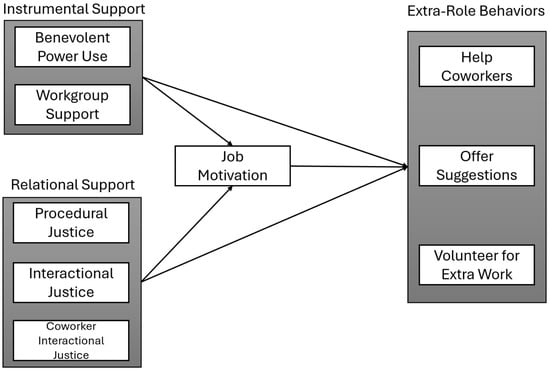
We first conceptualize the nature of instrumental and relational support in the workplace from each source, authorities and coworkers. Drawing from self-determination theory, we contend that instrumental and relational support meet fundamental worker needs and thus are likely to enhance job motivation. We then draw from social exchange and justice frameworks to theorize why the type and source of support increases participation in extra-role behaviors. Our argument concludes with consideration of how job motivation affects such OCB and mediates the effects of support from different sources. Figure 1 illustrates our conceptual model. We use data from a survey of employed adults (N = 2062) to examine the proposed direct and indirect effects of authorities’ and coworkers’ instrumental and relational support in the workplace.
Figure 1.
Conceptual model of the effects of instrumental and relational support on job motivation and extra-role behaviors contextualized by respondent, authority, and organizational characteristics.
2. Background
2.1. Sources and Types of Support in the Workplace
In hierarchical workplaces, workers usually have two core relationships. One is vertical with their authority, a direct manager or supervisor to whom they report and are responsible. Importantly, the authority controls resources like materials, training, and performance evaluations that the worker needs to succeed. As such, the worker depends on the authority. Although the authority also depends on workers’ performance to ensure productivity and meet organizational goals, in most organizations, the worker’s dependence on the authority is greater, creating a power imbalance (see Emerson 1962). The second set of relationships involves coworkers within workgroups who must often coordinate their work activities. Usually, these relationships are lateral and, unlike authority/worker relationships, tend to involve equal power and more frequent interactions than those unfolding with authorities. Support from authorities or coworkers can be considered job resources that facilitate work performance and personal functioning at work (Bakker and Demerouti 2007). Not only is support from authorities conceptually and empirically distinct from that of coworkers (Luchman and González-Morales 2013), different types of support—instrumental or relational—from each source exist.
Instrumental support generally pertains to the provision of resources, both tangible and intangible (Foa and Foa 2012), to ensure workers have what is necessary to perform their jobs well. Authorities show instrumental support for workers through their provision of tangible resources such as equipment, space, and pay, as well as less tangible resources like knowledge, training opportunities, and mentoring. For coworkers, instrumental support may also be tangible, such as the sharing of equipment or space, but also intangible as represented by sharing knowledge or contributing to skills development.
Relational support, in contrast, typically entails the provision of nontangible social resources that carry implications for identity, status, or feelings related to esteem needs (Cropanzano et al. 2017). Relational support emphasizes actions that enhance the quality of relationships (not the work product per se) and that ensure worker well-being and esteem as members of the workgroup. Generally, identity-based approaches (e.g., Tyler 2006; Tyler and Blader 2013) to workplace dynamics emphasize relational support. Authorities demonstrate relational support in at least two ways. First, such support is conveyed in fair decision-making when authorities allow workers to voice opinions on decisions that affect them and use accurate, unbiased information as the basis for decisions (Leventhal et al. 1980). Such actions represent procedural justice in decision-making. Second, authorities provide relational support through interactionally just treatment of workers by conveying respect, dignity, and kindness in routine interactions (Bies 2015). For coworkers, the same interactionally just treatment signals relational support.
Our study uniquely considers the impact of both authority and coworker instrumental and relational support on workplace outcomes central to positive organizational functioning: workers’ job motivation and their extra-role behaviors (i.e., forms of organizational citizenship behaviors, e.g., Organ et al. 2006). In what follows, we first delve into how the source and type of support affect workers’ motivation at work, drawing upon self-determination theory (Deci et al. 2017). We then interrogate the influence of instrumental support via social exchange (e.g., Blau 1964; Emerson 1976) and of relational support via identity processes (e.g., Tyler 2006; Tyler and Blader 2013) on workers’ willingness to perform tasks beyond their routine responsibilities. We rely on a key mechanism, reciprocity (Gouldner 1960), to produce a novel theoretical merging of these separate pathways. Additionally, we consider how job motivation mediates between the supportive actions of workplace authorities and colleagues and those extra-role behaviors.
2.2. How Type and Source of Support Influence Job Motivation
Worker job motivation is essential to a range of work outcomes, including productivity, performance, well-being, and satisfaction (e.g., Deci et al. 2017; Kanfer et al. 2017). Generally, work motivation involves an individual’s allocation of energy and attention to achieve a job goal (task completion, skill improvement) (Kanfer et al. 2017) and, as such, represents a forward-looking cognitive orientation toward work. Self-determination theory (Deci et al. 2017) proposes that workers have core needs for competence (feeling skilled and effective at tasks), meaningful relationships with others, and autonomy or self-determination (having agency over job activities). When these needs are met, workers become more motivated, and this motivation boosts performance and well-being.
Indeed, findings from a meta-analysis of 119 distinct samples (Van den Broeck et al. 2016) show that meeting these fundamental worker needs enhances worker motivation and well-being, independently from external incentives such as pay. The motivation generated by needs satisfaction also appears to have a strong relationship with job performance across various studies, regardless of the presence of incentives or other external motivating factors (Cerasoli et al. 2014; Kuvaas 2009; though see Grant et al. (2011) for patterns contingent upon worker autonomy).
Instrumental and relational support from authorities and coworkers, as we conceptualize them, help to fulfill many of the needs identified by self-determination theory and, thus, should impact worker motivation. Research on transformational leadership substantiates the relationship between these types of support and worker motivation (Bass 1998; Van den Broeck and Slemp 2023). Transformational leaders provide resources (like autonomy, feedback, and developmental opportunities) that ensure fulfilment of needs, thereby ensuring work engagement (Breevaart et al. 2014). Additionally, transformational leaders inspire workers to be creative (Shin and Zhou 2003), which engenders intrinsic interest in the tasks. This pattern resonates with the provision of instrumental support, ensuring workers have what they need to demonstrate their competence and effectiveness in their tasks. Such support likely enhances motivation.
Transformational leaders also take a genuine interest in the needs and feelings of followers (Van den Broeck and Slemp 2023), which is akin to relational support. Such support by authorities—such as through demonstrations of procedural and interactional justice—is a means to fulfill the need for meaningful relationships and thus should enhance worker motivation. Indeed, Rupp et al. (2014) find that workers who perceive that they are being treated fairly tend to reciprocate by working harder. Likewise, Kim and Beehr (2020) show that procedural justice by authorities enhances workers’ feelings of empowerment and worth, which ultimately results in increased work effort. To the extent that authorities, through their actions, represent the organization in the minds of workers, those actions positively impact workers’ perceptions of the organization as well (Kim and Beehr 2020).
Combining both types of support potentially fulfills the need for autonomy, a key consideration in how authorities increase the motivation of their workers (see Van den Broeck and Slemp 2023). Instrumental support provides workers with what they need to perform their jobs, while relational support involving justice signals trust from authorities (De Cremer et al. 2006; Van der Toorn et al. 2011), giving workers confidence to act independently. Thus, consistent with self-determination theory, to the extent that both instrumental and relational support from authorities satisfy workers’ needs, they should cultivate job motivation. Moreover, when workers display job motivation, they reciprocate the support of authorities fulfilling their needs.
Beyond authorities, coworkers’ support in the workplace also meets workers’ needs and thus should contribute to worker motivation. Lorincová et al. (2019) demonstrate that coworker behaviors that create a positive atmosphere in the workplace and within a specific work team, fulfilling the need for meaningful relationships, positively affects worker motivation. Similarly, when coworkers inspire creativity in each other, workers’ confidence in their own tasks increases (Zhou 2003), fulfilling the need for a sense of competence. To the extent that individuals perceive high-quality coworker relationships and support, i.e., relational support, they feel more connected and express greater motivation at work (Gagné and Deci 2005; Hon 2012), as well as feeling greater autonomy and effectiveness (Ryan et al. 1994). Support (of any kind) from peers enhances work engagement generally and reduces voluntary withdrawal from the organization (Liu et al. 2011). As with authorities, workers reciprocate the support from coworkers that allows needs satisfaction with motivation to take on their jobs and perform their tasks well. We hypothesize that:
Hypothesis 1:
Authorities’ and coworkers’ provision of instrumental and relational support is positively related to workers’ job motivation.
2.3. How Type and Source of Support Influence Engagement in Extra-Role Behaviors
In the workplace, instrumental and relational support may engender reciprocation toward the authorities and coworkers that provide such support. We focus on reciprocation in the form of behavioral responses, like those represented by organizational citizenship behavior (OCB) (Organ et al. 2006). Such behavior encompasses “individual behavior that is discretionary, not directly or explicitly recognized by the formal reward system, and that in the aggregate promotes the effective functioning of the organization” (Organ et al. 2006, p. 8). Moorman and Byrne (2005, p. 359) specifically cast OCB as a reciprocating response of extra role tasks by workers “beyond the formal pay system.” While there are multiple dimensions to OCB (Organ et al. 2006), we focus on a few that represent enactment of work behaviors over and above assigned tasks. These “extra-role behaviors” involve helping (i.e., help coworkers, do extra work) and individual initiative (i.e., make suggestions).
Generally, repeated exchange of resources between two parties, like an authority and worker, creates mutual obligations (Blau 1964; Emerson 1976) and engenders beneficial consequences (Bari et al. 2023; Cropanzano and Mitchell 2005). Even if the parties occupy different power positions, like in a hierarchical structure, beneficial outcomes emerge owing to the principle of reciprocity. Often intrinsically motivated, the reciprocation of benefits contributes to the maintenance of healthy relationships between people (Cropanzano and Mitchell 2005; Gouldner 1960; Moorman and Byrne 2005). While exchange approaches usually focus on the reciprocation of tangible benefits (e.g., money, goods, services), reciprocation can also involve intangible benefits. For example, Hegtvedt et al. (2022) finds that when workers perceive their authorities to use their power to benefit them, they are more likely to trust in and legitimize their authority, thus offering intangible resources in return for the resources authorities have bestowed.
With authorities, instrumental support is often represented as the overarching exchange of resources in the workplace (Bari et al. 2023; Cropanzano and Mitchell 2005), i.e., authorities provide resources for workers who labor for wages. Resources for workers stem, in part, from how authorities choose to use their power, whether coercively or benevolently. While coercive power may resemble abusive supervision and its negative effects (e.g., Zhang and Liao 2015), benevolent power emphasizes how authorities use resources and opportunities to help all employees grow professionally, improve their job performance, and meet the organization’s collective goals (Hegtvedt and Johnson 2009; Hegtvedt et al. 2022).
Lavelle and colleagues (Lavelle et al. 2007, 2009) argue that workers hold distinct social exchange relationships with each “referent” or actor in the workplace, such as authorities or coworkers. Their target similarity model proposes that when workers are in high-quality social exchange relationships with an actor or entity, the worker feels a sense of reciprocity and is motivated to perform similar types of behaviors in return. Termed homeomorphic reciprocity, reciprocated responses should be of the same ilk as their antecedents. For our purposes, then, instrumental support should elicit extra-role behavior illustrating job-related action beneficial to the source of support and relational support should encourage behaviors reinforcing the originating social relationship.
When authorities provide instrumental support that helps workers do their work, they elicit an obligation for workers to reciprocate such help (Schnake et al. 1995). An authority’s instrumental support, moreover, reduces uncertainty for workers about how they should go about doing their jobs, which may increase willingness to reciprocate. Findings from a reanalysis of data from Podsakoff et al. (1996), as offered in Organ et al. (2006), indeed show that authorities’ instrumentally supportive behaviors enhance helping OCB.
Relational support, conveyed by enactment of procedurally and interactionally just behaviors, communicate to individual workers their value to the group thereby increasing their felt esteem (e.g., Tyler 2006; Tyler and Blader 2013). When workers’ interactions with authorities involve such just behavior, they are likely to reciprocate by increasing their identification with the group and gradually linking the group’s interests and esteem with their own (Moorman and Byrne 2005). The joining of interests and feelings of belonging contributes to motivating workers to perform their duties for the benefit of the group. In effect, though often seen as contrasting viewpoints, both exchange- and identity-based approaches to workplace support from authorities rely on the idea that supported workers are likely to reciprocate support either directly (through exchanging material resources) or indirectly (through identity, which involves exchanging social resources) (see Graso et al. 2020).
Many studies show the positive effects of procedural justice (e.g., Hillebrandt and Barclay 2022; Moorman et al. 1998) and interactional justice (e.g., Kyei-Poku 2014; Moorman 1991; Williams et al. 2002) on OCB (see also Colquitt et al. 2013; Eissa et al. 2024; Moorman and Byrne 2005 for reviews). Moorman et al. (1998), moreover, demonstrate that perceived organizational support mediates the effects of procedural justice on worker’s extra-role behaviors, signaling the importance of the sense of support. Findings from Lilly (2015) regarding how authority behaviors focused on people, characterized by procedural and interactional justice, matter for OCB toward the organization reinforce these patterns. Adjacent work likewise stresses the importance of the procedural justice “climate” emerging from authorities’ relational behaviors (captured, for example, by their ethical or transformative leadership styles) for the likelihood of OCB enactment toward the unit (Shin et al. 2015).
To the extent that workers perceive that their authorities provide resources to facilitate their tasks and treat them fairly, both in decision making and interpersonal dynamics, they are likely to reciprocate by performing extra-role behaviors. Thus, we propose:
Hypothesis 2:
Authorities’ provision of instrumental and relational support is positively related to workers’ engagement in extra-role behaviors.
Although there are some distinctions between the consequences of perceived authority support compared to coworker support (Bishop et al. 2000), we anticipate that workers are likely to respond to the support provided by coworkers by reciprocating with similar behaviors. Findings from a meta-analysis (Chiaburu and Harrison 2008) confirm that coworker support, including instrumental behaviors like task-directed helping and coworker mentoring, positively affect extra role behaviors directed at individuals, (e.g., helping a coworker). Regarding relational support, Moorman and Byrne (2005) argue that just treatment from coworkers engenders feelings of obligation to the welfare of their workgroup and thus stimulates OCB that is “beneficial to coworkers” (p. 375). Lyons and Scott (2012) confirm this pattern with findings demonstrating that food service workers who were helpful to their peers were then themselves helped when coworkers shared knowledge or provided suggestions. In effect, to the extent that coworkers contribute to helping to meet workers’ needs, homeomorphic reciprocity unfolds in the coworker relationship. Thus:
Hypothesis 3:
Coworkers’ provision of instrumental and relational support is positively related to workers’ engagement in extra-role behaviors.
Kim and Beehr (2020) note that authorities represent the organization and thus workers may be more compelled to reciprocate the support they provide owing to the greater stakes involved in the relationship. If so, then we would expect that the effects of authorities instrumental and relational support on workers’ enactment of extra-role behaviors would be stronger than that of coworkers. Yet, because of the potential for more frequent lateral interactions with coworkers than vertical interactions with authorities, the support from coworkers could be more pivotal in individuals’ decisions to engage in extra-role behaviors. Additionally, the impact of the source and type of support may depend upon the nature of the extra-role behaviors. Support from coworkers may have greater influence on helping coworkers whereas authorities’ support may affect behaviors such as making suggestions and volunteering for extra work.
2.4. Job Motivation and Engagement in Extra-Role Behaviors
Considering the range of OCB, we anticipate that job motivation is likely to affect enactment of extra-role behaviors. Workers motivated to do well are likely to work efficiently and thus devote extra energy to pursue activities outside of their job descriptions. Foss et al. (2009) show that work motivation increases the likelihood of sharing knowledge in the workplace. Relatedly, work engagement, which includes a motivational element toward allocating resources toward work role tasks, generally affects “contextual performance,” (i.e., activities not formally required of a job, like extra-role behaviors) (Christian et al. 2011). Thus, we predict:
Hypothesis 4:
Workers’ job motivation is positively related to their engagement in extra-role behaviors.
The process by which authority and coworker support, both instrumental and relational, shape job motivation is akin to direct experiences related to developing cognitions or attitudes (see Fiske and Taylor 2021). In this case, job motivation is both a forward-looking and energizing cognition about how to approach job demands. This conceptualization of motivation aligns with the Theory of Planned Behavior (TPB), which similarly argues that intention to act is the most immediate factor influencing behavior (Ajzen 1991; Bosnjak et al. 2022). In such theorizing, intentions are broadly described as “indications of how hard people are willing to try, of how much effort they plan to exert, in order to perform the behavior” (Ajzen 1991, p. 181). Just as job motivation in our arguments depends on specific factors, in TPB, intentions are influenced by particular antecedents, such as attitudes toward the behavior, subjective norms, and perceived behavioral control, which precede behavioral intention. Collectively, these antecedents define the context for the behavior.
Our “context” is circumscribed to the types and sources of support that workers experience. We have already argued that instrumental and relational support positively affect job motivation, but they do not mechanically trigger extra-role behaviors. They do so, in part, by signaling attitudes toward work by others and subjective norms for behavior (e.g., support each other), and fulfilling needs for the autonomy inherent in perceived control in the workplace. Thus, perceptions of workplace support fuel workers’ intentions, which, in turn, translate into discretionary actions. In other words, this motivation is likely to stimulate the homeomorphic reciprocity described by Lavelle et al. (2007, 2009). Given that strongly held cognitions, shaped through direct experiences, are likely to drive behaviors (see Fiske and Taylor 2021), we suspect that job motivation will mediate some of the impact of type and source of support on extra-role behaviors.
Hypothesis 5:
Instrumental and relational support from authorities and coworkers will be indirectly and positively related to engagement in extra-role behaviors through job motivation.
3. Methods
A survey of employed adults (N = 2062), representing a cross-section of the demographics of the U.S., provided data to examine the role of instrumental and relational support by managers and coworkers on individual worker job motivation and OCBs. The Survey Research Lab at a major university executed the data collection during fall 2022 in partnership with Marketing Systems Group, which maintains a large, diverse sampling frame that reflects national Census data regarding gender, age, race, and geography. The survey examines how workers perceive their managers and coworkers and their assessments of their own workplace behaviors. The survey took approximately 20–25 min to complete.
3.1. Respondents
Table 1 provides information on respondents’ characteristics. Screening questions ensured that all respondents were full-time, not self-employed, workers who had resided in the U.S. for at least 10 years. The sample consists of 1123 women (54.7%), 930 men (45.3%), and 9 others (0.44%). Additionally, the sample had an average age of 41.21 (σ = 11.05). Although most respondents (60%) reported “white” as their racial/ethnic category, we over-sampled black respondents (27%). Of the four levels of education, about 15 percent of the respondents reported high school degree or less, 34 percent of respondents indicated some college or technical training, nearly 30 percent claimed a college degree, and 21.5 percent an advanced degree. Occupations in the sample varied, with professionals comprising 35.21 percent and office workers 15.81 percent. Service workers, laborers, and sales workers account for 7.95, 6.55, and 6.35 percent, respectively, while skilled trades, technicians, and public officials make up the remaining share. The modal income category level was $25,000–$50,000.
Table 1.
Univariate Statistics.
3.2. Measures
For concepts measured with multiple items, we added and averaged scale items. Table 1 presents the means and standard deviations for the independent support variables and the dependent variables concerning worker job motivation and extra-role behaviors.
3.2.1. Independent Variables
Benevolent Power Use: To instantiate instrumental authority support, benevolent power use involves four indicators (adapted from Hegtvedt et al. 2022), each beginning with the stem “Thinking about your experiences, to what extent does your manager…” Respondents indicated on a 1 (not at all) to 7 (a great deal) point scale their assessments of the extent that their managers: (1) “provide resources to enhance your job performance;” (2) “provide opportunities for your professional growth;” (3) “use his/her power to help you solve problems in your work;” and (4) “go out of his/her way to help you do your job.” The alpha reliability for the scale of these items is 0.93.
Procedural Justice: To capture authority relational support, we use indicators of perceived justice. To measure procedural justice, we asked two sets of questions (Colquitt 2001), with responses ranging from 1 = not at all to 7 = a great deal. One set of three indicators began, “Considering how your manager makes decisions that affect you and your coworkers, to what extent have you…:” “been able to express your views prior to decisions,” “had influence over the outcomes of the decisions;” and “seen that all people affected by decisions are represented.” The second set of five questions asked: “When your manager makes decisions that affect you and your coworkers, to what extent are those decisions:” “applied consistently across people;” “free of bias;” “based on accurate information;” “reflective of ethical or moral standards;” and “open to corrections or challenges.” The alpha reliability for this eight-item scale is 0.95.
Authority Interactional Justice: Two items instantiate interactional justice, with responses ranging from 1 = not at all to 7 = a great deal. We asked, “Thinking about your manager’s behaviors, to what extent does he/she…” (1) “treat you with respect and dignity” (Colquitt 2001); and (2) “treat you with kindness and consideration” (Moorman 1991). The Pearson correlation coefficient for the relationship between these two indicators is 0.91.
Workgroup Support: For coworker instrumental support, we focus on support from the workgroup using a single indicator from Narisada and Schieman (2022). On an agreement scale (where 1 = strongly disagree and 7 = strongly agree), respondents assessed whether they have “the support of members of my work group that I need to do my job well.”
Coworker Interactional Justice: For relational support, the coworker interactional justice scale parallels that of the manager, with the stem: “Thinking about your coworkers’ behaviors in general, to what extent do they…” The bivariate correlation between treatment “with respect and dignity” and “with kindness and consideration” is 0.88.
3.2.2. Dependent Variables
Job Motivation: We measure job motivation (Richmond 1990) by asking, “To what extent are you unmotivated or motivated in your current job?” The responses range from 1 = very unmotivated to 7 = very motivated).
Extra-Role Behaviors: For extra-role behaviors, we adapt items from the 10-item Short Version of the Organizational Citizenship Behavior Checklist (Spector et al. 2010). Respondents report how much from 1 = not at all to 7 = a great deal that they: (1) “offer suggestions to improve how work is done;” (2) “share job knowledge with or help a coworker learn new skills;” and (3) “volunteer for extra work assignments.”
3.2.3. Controls
Organizational Controls: We control for several features of the respondents’ work environment and their demographic characteristics. Three work context controls bear upon needs identified by Self Determination Theory (Deci et al. 2017). To determine pay equity, respondents were asked, from 1 = not at all to 7 = a great deal, “thinking about the pay you receive from your work, to what extent does it reflect” both “the effort you put into your work” and “what you have contributed to your organization.” The Pearson’s correlation coefficient for these two items is 0.91. Additionally, respondents indicated the extent to which they experienced work overload and job autonomy. The former is in response to the question, “In general, thinking about your work, how often do you feel that you are expected to do things that go beyond your job description or usual duties? (1 = never, 2 = rarely, 3 = sometimes, 4 = usually, 5 = always). And we captured job autonomy by asking for respondents’ agreement that in their current job “I can decide how I do my job,” with responses ranging from 1 = strongly disagree to 7 = strongly agree.
Manager and Organization Controls: Respondents characterized their workplace by describing their manager and organization. We code manager gender as 0 = man and 1 = woman and manager race as 0 = non-white and 1 = white. In reporting the approximate size of their organization, respondents selected one of the following categories: 1 = less than 20; 2 = 21–50; 3 = 51–500; 4 = 501–1500; 5 = more than 1500.
Demographic Controls: We include respondent demographic characteristics as controls. We code respondent gender and race as we did for the characteristics of the manager. We include respondents’ age in years. For highest level of completed education, respondents selected the most appropriate category: 1 = less than high school, high school graduate/GED (referent); 2 = some college or associate degree or technical training; 3 = bachelor’s degree; 4 = Master’s degree or professional school degree (e.g., MD, JD, DVM, DDS) or Doctorate degree. Income consisted of eight categories: 1 = less than $25,000; 2 = $25,001–$50,000; 3 = $50,001–$75,000; 4 = $75,001–$100,000; 5 = $100,001–$150,000; 6 = $150,001–$200,000; 7 = $200,001–$250,000; and 8 = more than $250,001.
3.3. Analysis
As previously noted, Table 1 provides information on univariate statistics. To test our hypotheses regarding the relationships between managerial and coworker support and worker job motivation and extra-role behaviors, we employed OLS regression (available in Supplemental Files) and path analysis (via STATA 18). The OLS analysis focuses on the effects of support factors on job motivation and then on each of the three extra-role behaviors. Path analysis allows assessment of how the support factors affect worker motivation and extra-role behaviors directly and their indirect effects on extra-role behaviors as mediated by job motivation. We utilize maximum likelihood estimation with missing values and only use observed variables. We assess model fit using RMSEA, CFI, TLI, and SRMR. Model fit for our path analyses was excellent (see Supplemental Files for full results).
4. Results
4.1. Univariate Analyses
Before examining the direct and indirect relationships in our model, we review the univariate statistics in Table 1. On average, workers perceive high levels of support at work, especially relational support. Respondents indicated the highest interactional justice from coworkers (M = 5.89, SD = 1.19) and authorities (M = 5.79, SD = 1.46), suggesting that fair treatment in interpersonal interactions is common. Instrumental support was also notable, with workgroup support (M = 5.53, SD = 1.43) slightly exceeding authorities’ benevolent power use (M = 5.03, SD = 1.59). Regarding outcomes, workers reported moderate job motivation levels (M = 4.81, SD = 1.54). For extra-role behaviors, engagement varied; helping coworkers (M = 5.49, SD = 1.41) and offering suggestions (M = 5.27, SD = 1.47) occurred more often than volunteering for extra work (M = 4.36, SD = 1.84), possibly due to the higher discretionary effort or personal cost involved in the latter.
4.2. Path Analyses
Findings pertaining to Hypothesis 1, which posits that support from authorities and coworkers impacts job motivation, are mixed. Path analyses in Table 2 reveal that job motivation is most consistently influenced by instrumental support and the procedural elements of relational support. Authority benevolent power use, indicating instrumental support, has the strongest positive effect on motivation (B = 0.21, SE = 0.03, p < 0.001), and authority procedural justice also significantly influences motivation (B = 0.19, SE = 0.04, p < 0.001). Likewise, coworker instrumental support, operationalized through perceived workgroup support, predicts higher motivation (B = 0.18, SE = 0.03, p < 0.001). In contrast, neither authority nor coworker interactional justice supports Hypothesis 1. Authority interactional support slightly reduces motivation (B = −0.07, SE = 0.03, p = 0.01), while coworker interactional justice shows no significant link. Supporting the idea that work-related needs matter for motivation, controls such as pay fairness (B = 0.21, SE = 0.02, p < 0.001) and job autonomy (B = 0.17, SE = 0.02, p < 0.001) are strongly associated with higher motivation. In contrast, organizational size (B = −0.06, SE = −0.02, p < 0.001) shows a small negative relation. Overall, these results offer some support for Hypothesis 1, that work-related motivation depends on both authority-based instrumental support and procedural justice and, to a lesser extent, on coworkers’ instrumental assistance.
Table 2.
Path analysis results for the effects of instrumental and relational support on job motivation and extra-role behaviors (N = 2062).
Regarding extra-role behaviors, we examined how various forms of authority and coworker support influence three specific behaviors: helping coworkers, suggesting workplace improvements, and volunteering for extra tasks. Concerning Hypothesis 2 regarding the positive impact of authority support on extra-role behaviors, the path analyses reveal that authority support affects different behaviors in distinct ways. Instrumental support from authorities consistently influences all three types of extra-role behaviors. Benevolent power use predicts higher levels of helping coworkers (B = 0.11, SE = 0.03, p < 0.001), more suggestions (B = 0.10, SE = 0.03, p = 0.002), and increased volunteering (B = 0.28, SE = 0.04, p < 0.001). Authorities who practice more procedural justice see increases in helping coworkers (B = 0.08, SE = 0.04, p = 0.048) and offering suggestions (B = 0.15, SE = 0.04, p < 0.001), but not in volunteering. Additionally, the absence of significant direct effects for procedural justice on helping coworkers and the lack of significant findings for interactional justice suggest that relational support from authorities plays a smaller role in shaping these discretionary behaviors compared to instrumental support.
Hypothesis 3 predicts the impact of coworker support on extra-role behaviors. A pattern of findings like that for authority support emerges. Coworker instrumental support predicts all three types of extra-role behaviors: helping (B = 0.19, SE = 0.03, p < 0.001), suggestion-giving (B = 0.19, SE = 0.03, p < 0.001), and volunteering (B = 0.13, SE = 0.04, p = 0.002). Just as with procedural justice from authorities, coworker interactional justice strongly predicts both helping (B = 0.17, SE = 0.03, p < 0.001) and suggesting (B = 0.10, SE = 0.04, p = 0.007), but does not predict volunteering for extra tasks. Overall, the path analysis results for authority and coworker support largely confirm Hypotheses 2 and 3, highlighting that instrumental support is most important, while relational support may not directly lead to volunteering for extra work, it does indirectly influence extra role behaviors.
Several control variables show significant associations with the extra-role behaviors. For all three behaviors, pay fairness, job autonomy, and work overload lead to positive effects. When helping others, workload (B = 0.23, SE = 0.02, p < 0.001) is the strongest predictor, followed by autonomy (B = 0.10, SE = 0.02, p < 0.001), then pay fairness (B = 0.08, SE = 0.02, p < 0.001). For offering suggestions, workload (B = 0.19, SE = 0.03, p < 0.001) and autonomy (B = 0.15, SE = 0.02, p < 0.001) similarly predict outcomes, with pay fairness (B = 0.05, SE = 0.02, p = 0.002) less influential. In volunteering for extra tasks, workload (B = 0.26, SE = 0.03, p < 0.001) remains the most important, but pay fairness (B = 0.14, SE = 0.02, p < 0.001) and autonomy (B = 0.14, SE = 0.03, p < 0.001) are equally significant. Among demographic variables, only respondents’ age and race matter, with both positively associated with volunteering. Being white has a significant total effect compared to non-white workers (B = 0.21, SE = 0.08, p = 0.013), and older workers are more likely to volunteer extra work (B = 0.01, SE = 0.00, p = 0.028). Factors like organizational size and manager race are not significant.
The path analyses also reveal several important findings related to the role of job motivation, support, and extra-role behaviors. Our results confirm Hypothesis 4 that job motivation is a consistent and strong predictor of all three extra-role behaviors. The analyses show that motivation predicts helping (B = 0.15, SE = 0.02, p < 0.001), suggestion-giving (B = 0.14, SE = 0.03, p < 0.001), and especially volunteering for extra work (B = 0.43, SE = 0.03, p < 0.001).
Our model also reveals that job motivation is a crucial pathway connecting both authority and coworker support to extra-role behaviors. Although modest, the indirect effects of benevolent power use (B = 0.03, SE = 0.01, p < 0.001), procedural justice (B = 0.03, SE = 0.01, p < 0.001), and workgroup support (B = 0.03, SE = 0.01, p < 0.001) on helping coworkers are meaningful. As illustrated in Table 2, suggestion-giving shows a similar, albeit weaker, pattern of indirect effects through motivation for both instrumental and relational authority support and coworker instrumental support. Volunteering for extra work provides strong evidence of motivational mediation, with the indirect effects of benevolent power and workgroup support (approximately 0.09 and 0.08) exceeding many direct support effects.
5. Discussion
Our study investigates the impact of both authority and coworker instrumental and relational support on workplace concerns central to positive organizational functioning: workers’ job motivation and their extra-role behaviors (i.e., forms of organizational citizenship behavior, e.g., Organ et al. 2006). We investigate how sources of support inspire job motivation via meeting worker needs as suggested by self-determination theory (Deci et al. 2017). We pay particular attention to the influence of instrumental support via social exchange (e.g., Blau 1964; Emerson 1976) and relational support via identity processes (e.g., Tyler 2006; Tyler and Blader 2013) on workers’ willingness to perform extra-work behaviors, beyond their routine job responsibilities. We argue that reciprocity is the key mechanism to explain how authority and coworker instrumental and relational support affect the extra-role behaviors. We then consider how job motivation may mediate between the supportive actions of workplace authorities and coworkers and those extra-role behaviors. We draw three conclusions from the empirical patterns.
5.1. Impact on Job Motivation
First, authority and coworker instrumental support have strong positive effects on job motivation, along with authorities’ procedural justice (relational support), in partial support of Hypothesis 1. When an authority and coworkers provide instrumental support (resources needed to do their jobs well), workers have what they need to perform competently and effectively in their tasks and this, in turn, increases job motivation. In addition, procedural justice by the authority increases workers’ feelings of empowerment and worth, positively impacting job motivation. In contrast to patterns anticipated by Hypothesis 1, authority interactional justice somewhat reduces motivation and coworker interactional justice has no significant impact at all.
The lack of expected interactional justice effects on job motivation may suggest that workers typically expect their work environment to be characterized by professionalism in how they are treated, and therefore, it is independent of what motivates them to do their job. The finding that authorities’ kind and respectful treatment slightly decreases work-related motivation may stem from workers’ concerns that such treatment is superficial and may be used strategically to extract more labor without adequate compensation, particularly in the absence of instrumental or other relational support. Another possible reason is that an overemphasis on interpersonal warmth indicates that the authority prioritizes friendship over performance. This shift might transform the authority-worker dynamic from a task-oriented relationship to one based on community bonds, where the desire to preserve social harmony may compete with or overshadow the motivation to perform well. Clearly, further research is needed to explore how workers perceive the motivations underlying fair treatment and its impact on job motivation.
Our argument rests on how instrumental and relational support from authorities and coworkers provides a means to meet workers’ needs, as described in self-determination theory (Deci et al. 2017) (i.e., feeling skilled and effective at tasks, meaningful relatedness to others, and having agency over job activities) to generate job motivation. Our findings show that instrumental support from both sources and relational support in the form of authorities’ decision-making justice enhance worker job motivation. Our lack of findings regarding the effects of fair treatment might be scrutinized in future research aimed at understanding how each type and source could fulfill worker needs for competence, meaningful relationships, and autonomy. Doing so could inform authorities on how to manage their resources and craft work environments conducive to enhancing workers’ feelings of skill and task effectiveness.
5.2. Impact on Extra-Role Behaviors
Second, Hypotheses 2 and 3 are also partially supported. Authority and coworker instrumental support positively affect all three types of extra-role behaviors (helping coworkers, suggesting workplace improvements, and volunteering for extra tasks). This pattern solidifies instrumental support as an important way for authorities to encourage reciprocal, pro-organizational actions. Moreover, authorities should also foster instrumental workgroup support, as this likewise cultivates reciprocity between coworkers, which enhances participation in these extra-role behaviors. In addition, relational support via an authority’s use of procedural justice and coworkers’ interactional justice increases two of the three behaviors: helping coworkers and offering suggestions. Such behaviors solidify relationships and may be seen by workers as less demanding than volunteering for extra tasks, for which they may expect instrumental support in return. And an authority’s enactment of interactional justice does not have a significant effect on any of the behaviors, perhaps for reasons noted for the lack of effects on job motivation. Overall, instrumental support from both sources has the greatest impact on these behaviors and the only impact on volunteering, signaling workers’ fundamental concerns with ensuring resources for job tasks in the workplace.
Third, supporting Hypothesis 4, job motivation is a consistent and strong predictor of all three extra-role behaviors. Such findings are consistent with those of Foss et al. (2009) and Christian et al. (2011). Motivation is an energizing force, encouraging workers to engage in tasks beyond their routine responsibilities that benefit coworkers and the organization. In addition, in partial support of Hypothesis 5, job motivation mediates some of the effects of instrumental and relational support on the three extra-work behaviors. This mediation process illustrates how supportive environments (from both sources) enhance motivation, which, in turn, promotes prosocial workplace actions.
5.3. Observations About Sources of Support
Given that much of the work on job motivation and extra-role behaviors rarely brings together two types of support from two distinct sources, our study is unique. More typically, emphasis rests only on authority support. Our findings, however, show that coworker support is equally important. For example, like authority instrumental support, coworker instrumental support has a consistent and positive impact on both job motivation and all three extra-work behaviors. These consistent findings may stem from the extent to which instrumental support might be more readily conceptualized as the typical sort of exchanges occurring in the workplace that create mutual obligations among parties (Blau 1964; Emerson 1976). The mechanism of reciprocity (Gouldner 1960) between an authority and worker or among coworkers ensures successful fulfilment of these obligations and fosters engagement in extra-role behaviors.
In contrast to these largely consistent effects of instrumental support from both sources, relational support comes in different forms and, thus, emerges as differentially related to the various extra-role behaviors. For example, unlike authority interactional justice, coworker interactional justice has a positive effect on helping coworkers and suggesting workplace improvements (but not on volunteering for extra work), whereas authority interactional justice has no effects on any extra-role behaviors. The relational aspect of authority procedural justice, however, directly and indirectly influences offering suggestions and indirectly influences volunteering for extra work. These findings to some extent support the notion of homeomorphic reciprocity, suggested by Lavelle and colleagues (Lavelle et al. 2007, 2009), whereby reciprocated responses are often, though not always, of the same ilk as their antecedents. Thus, for example, respect and honesty among coworkers encourages helping coworkers in return.
5.4. Limitations and Future Directions
Although we asked only about three extra-role behaviors, our results underscore the importance of considering distinctions in the effects of the types and sources of support across behaviors. Future research might expand both theorizing on and empirical analysis of the links between these dimensions of support and these “helping” extra-role behaviors and other forms of organizational citizenship behaviors like individual initiative or organizational loyalty. Moreover, nuanced analyses may be more helpful to authorities in understanding what sources and types of support may contribute to healthy organizational functioning.
Our study is limited by its cross-sectional design. A longitudinal study would allow us to disentangle the causal relationships among support, job motivation, and extra-work behaviors. In addition, we have only one indicator of workgroup support to instantiate our key concept of coworker instrumental support. Future work should assess this form of support using several items, like our measures of the other types of support from both authorities and coworkers. And, although we found that job motivation partially mediates the effects of types of support on extra-role behaviors, the mediation was partial, implying that other factors are at play. Future research should investigate alternative mechanisms, such as a sense of belonging, that may coexist with work motivation to trigger extra-role behaviors.
In future research, investigators could go beyond the dyadic approach to study broader group dynamics. For instance, a strong, supportive climate among coworkers might ameliorate the negative effects of a manager who fails to provide instrumental and perhaps relational support. Other valuable insights into workgroup dynamics could examine the impact of the type and source of support in remote or hybrid work environments, where relational signals are less obvious.
6. Conclusions
This study advances understanding of workplace group processes by simultaneously examining how different types of support from two sources shape worker outcomes. By drawing upon self-determination theory, social exchange theory, and justice perspectives, we developed and tested a model that considers both instrumental and relational support from authorities and coworkers as antecedents to job motivation and extra-role behaviors. In so doing we highlight dual supports, instrumental for what happens and relational for how it happens.
From a practical standpoint, our results offer guidance for organizational leaders seeking to cultivate productive work environments. The findings suggest that investing in both instrumental and relational resources, providing adequate tools, training, and assistance while also ensuring fair procedures and respectful treatment, is essential for motivating workers and encouraging citizenship behaviors. Moreover, organizations should recognize that fostering positive peer relationships is not merely “nice to have” but a strategic imperative. Creating conditions that enable coworkers to support one another, both instrumentally and relationally, can yield meaningful returns in terms of motivation and discretionary effort.
Ultimately, this study demonstrates that workplace productivity and citizenship depend on a complex interplay of vertical and lateral relationships, instrumental and relational resources, and cognitive orientations toward work. Organizations that attend to these multiple dimensions of workplace support are likely to reap benefits in terms of motivated, engaged workers who go above and beyond their formal job requirements, ultimately contributing to organizational success.
Supplementary Materials
The following supporting information can be downloaded at: https://www.mdpi.com/article/10.3390/socsci15020118/s1, Table S1: OLS for Support to Job Motivation; Table S2: OLS for Support to Extra-Role Behaviors. Table S3: Model Fit Statistics.
Author Contributions
Conceptualizations, R.G., K.A.H., K.H. and C.J.; methodology, R.G. and K.A.H.; software, R.G.; validation, K.H.; formal analysis, R.G.; investigation, R.G., K.A.H., K.H. and C.J.; resources, K.A.H. and C.J.; data curation, R.G. and K.H.; writing—original draft preparation, R.G. and K.A.H.; writing—review and editing, R.G., K.A.H., K.H. and C.J.; visualization, R.G.; supervision, K.A.H. and C.J.; project administration, K.A.H. and R.G.; funding acquisition, K.A.H. and C.J. All authors have read and agreed to the published version of the manuscript.
Funding
This research was supported with a grant from the National Science Foundation SES-1756853 to K.AH. and C.J.
Institutional Review Board Statement
The Institutional Review Board (i.e., Research Ethics Review Committee) at Emory University approved our survey instrument (IRB00095076) on 16 May 2022.
Informed Consent Statement
Respondents read consent document and continuation on to the survey signaled their consent. IRB granted waiver of written documentation of consent.
Data Availability Statement
The raw data supporting the conclusions of this article will be made available by the authors on request.
Acknowledgments
The authors would like to thank the institutions that provided administrative and technical support during the study and the anonymous reviewers.
Conflicts of Interest
The authors declare no conflicts of interest. The funders had no role in the design of the study; in the collection, analyses, or interpretation of data; in the writing of the manuscript; or in the decision to publish the results.
Abbreviations
The following abbreviations are used in this manuscript:
| OCB | Organizational citizenship behavior |
| TPB | Theory of Planned Behavior |
| OLS | Ordinary Least Squares |
| RMSEA | Root Mean Square Error of Approximation |
| CFI | Comparative Fit Index |
| TLI | Tucker–Lewis Index |
| SRMR | Standardized Root Mean Square Residual |
References
- Ajzen, Icek. 1991. The theory of planned behavior. Organizational Behavior and Human Decision Processes 50: 179–211. [Google Scholar] [CrossRef] [Scilit]
- Azmi, Farhan Talib, Kishori Desai, and K. Jayakrishnan. 2016. Organizational Citizenship Behavior (OCB): A comprehensive literature review. Sumedha Journal of Management 5: 102–17. [Google Scholar]
- Bakker, Arnold B., and Evangelia Demerouti. 2007. The job demands-resources model: State of the art. Journal of Managerial Psychology 22: 309–28. [Google Scholar] [CrossRef] [Scilit]
- Bari, Muhammad Waseem, Mehwish Shaheen, and Saima Bashir. 2023. Social exchange theory: A systematic review and future directions. Frontiers in Psychology 13: 1046107. [Google Scholar] [CrossRef] [Scilit]
- Bass, Bernard M. 1998. Two decades of research and development in transformational leadership. European Journal of Work and Organizational Psychology 8: 9–32. [Google Scholar] [CrossRef] [Scilit]
- Bies, Robert J. 2015. Interactional justice: Looking backward, looking forward. In The Oxford Handbook of Justice in the Workplace. Edited by Russell S. Cropanzano and Maureen L. Ambrose. New York: Oxford University Press, pp. 89–107. [Google Scholar]
- Bishop, James W., Dow Scott, and Susan M. Burroughs. 2000. Support, commitment, and employee outcomes in a team environment. Journal of Management 26: 1113–32. [Google Scholar] [CrossRef]
- Blau, Peter M. 1964. Justice in social exchange. Sociological Inquiry 34: 193–206. [Google Scholar] [CrossRef] [Scilit]
- Bosnjak, Michael, Icek Ajzen, and Peter Schmidt. 2022. The theory of planned behavior: Selected recent advances and applications. Health Psychology Review 16: 352–56. [Google Scholar] [CrossRef] [Scilit] [PubMed]
- Breevaart, Kimberley, Arnold B. Bakker, Evangelia Demerouti, Dominique M. Sleebos, and Véronique Maduro. 2014. Uncovering the underlying relationship between transformational leaders and followers’ task performance. Journal of Personnel Psychology 13: 194–203. [Google Scholar] [CrossRef] [Scilit]
- Cerasoli, Christopher P., Jessica M. Nicklin, and Michael T. Ford. 2014. Intrinsic motivation and extrinsic incentives jointly predict performance: A 40-year meta-analysis. Psychological Bulletin 140: 980–1008. [Google Scholar] [CrossRef] [Scilit] [PubMed]
- Chiaburu, Dan S., and David A. Harrison. 2008. Do peers make the place? Conceptual synthesis and meta-analysis of coworker effects on perceptions, attitudes, OCBs, and performance. Journal of Applied Psychology 93: 1082–103. [Google Scholar] [CrossRef] [Scilit]
- Christian, Michael S., Adela S. Garza, and Jerel E. Slaughter. 2011. Work engagement: A quantitative review and test of its relations with task and contextual performance. Personnel Psychology 64: 89–136. [Google Scholar] [CrossRef] [Scilit]
- Colquitt, Jason A. 2001. On the dimensionality of organizational justice: A construct validation of a measure. Journal of Applied Psychology 86: 386–400. [Google Scholar] [CrossRef] [Scilit] [PubMed]
- Colquitt, Jason A., Brent A. Scott, Jessica B. Rodell, David M. Long, Cindy P. Zapata, Donald E. Conlon, and Michael J. Wesson. 2013. Justice at the millennium, a decade later: A meta-analytic test of social exchange and affect-based perspectives. Journal of Applied Psychology 98: 199–236. [Google Scholar] [CrossRef] [Scilit] [PubMed]
- Cropanzano, Russell, and Marie S. Mitchell. 2005. Social exchange theory: An interdisciplinary review. Journal of Management 31: 874–900. [Google Scholar] [CrossRef] [Scilit]
- Cropanzano, Russell, Erica L. Anthony, Shanna R. Daniels, and Alison V. Hall. 2017. Social exchange theory: A critical review with theoretical remedies. Academy of Management Annals 11: 479–516. [Google Scholar] [CrossRef] [Scilit]
- Deci, Edward L., Anja H. Olafsen, and Richard M. Ryan. 2017. Self-determination theory in work organizations: The state of a science. Annual Review of Organizational Psychology and Organizational Behavior 4: 19–43. [Google Scholar] [CrossRef] [Scilit]
- De Cremer, David, Marius van Dijke, and Arjan E. R. Bos. 2006. Leader’s procedural justice affecting identification and trust. Leadership and Organizational Development Journal 27: 554–65. [Google Scholar] [CrossRef] [Scilit]
- Eissa, Gabi, Rebecca Wyland, and Rachna Gupta. 2024. To enact or not to enact? A multilevel investigation of authority-enacted justice and its consequences. Journal of Management 50: 645–78. [Google Scholar]
- Emerson, Richard M. 1962. Power-dependence relations. American Sociological Review 27: 31–41. [Google Scholar] [CrossRef] [Scilit]
- Emerson, Richard M. 1976. Social exchange theory. Annual Review of Sociology 2: 335–62. [Google Scholar] [CrossRef] [Scilit]
- Fiske, Susan T., and Shelley E. Taylor. 2021. Social Cognition: From Brains to Culture, 4th ed. Thousand Oaks: Sage. [Google Scholar]
- Foa, Edna B., and Uriel G. Foa. 2012. Resource theory of social exchange. In Handbook of Social Resource Theory: Theoretical Extensions, Empirical Insights, and Social Applications. Edited by Kjell Törnblom and Ali Kazemi. New York: Springer, pp. 15–32. [Google Scholar]
- Foss, Nicolai J., Dana B. Minbaeva, Torben Pedersen, and Mia Reinholt. 2009. Encouraging knowledge sharing among employees: How job design matters. Human Resource Management 48: 871–93. [Google Scholar] [CrossRef] [Scilit]
- Gagné, Marylène, and Edward L. Deci. 2005. Self-determination theory and work motivation. Journal of Organizational Behavior 26: 331–62. [Google Scholar] [CrossRef] [Scilit]
- Gouldner, Alvin W. 1960. The norm of reciprocity: A preliminary statement. American Sociological Review 25: 161–78. [Google Scholar] [CrossRef] [Scilit]
- Grant, Adam M., Samir Nurmohamed, Susan J. Ashford, and Kathryn Dekas. 2011. The performance implications of ambivalent initiative: The interplay of autonomous and controlled motivations. Organizational Behavior and Human Decision Processes 116: 241–51. [Google Scholar] [CrossRef] [Scilit]
- Graso, Maja, Jeroen Camps, Nicole Strah, and Lieven Brebels. 2020. Organizational justice enactment: An agent-focused review and path forward. Journal of Vocational Behavior 116: 103296. [Google Scholar] [CrossRef] [Scilit]
- Hegtvedt, Karen A., and Cathryn Johnson. 2009. Power and justice: Toward an understanding of legitimacy. American Behavioral Scientist 53: 376–99. [Google Scholar] [CrossRef] [Scilit]
- Hegtvedt, Karen A., Cathryn Johnson, Ryan Gibson, Kate Hawks, and Jennifer L. Hayward. 2022. Power and procedure: Gaining legitimacy in the workplace. Social Forces 101: 176–201. [Google Scholar] [CrossRef] [Scilit]
- Hillebrandt, Annika, and Laurie J. Barclay. 2022. How and when workplace fairness triggers organizational citizenship behavior: A meta-analysis of the mediating role of affect. Journal of Management 48: 1324–52. [Google Scholar]
- Hon, Alice H. Y. 2012. Shaping environments conductive to creativity: The role of intrinsic motivation. Cornell Hospitality Quarterly 53: 53–64. [Google Scholar] [CrossRef] [Scilit]
- Kanfer, Ruth, Michael Frese, and Russell E. Johnson. 2017. Motivation related to work: A century of progress. Journal of Applied Psychology 102: 338–55. [Google Scholar] [CrossRef] [Scilit]
- Kataria, Aakanksha, Pooja Garg, and Renu Rastogi. 2013. Employee engagement and organizational effectiveness: The role of organizational citizenship behavior. International Journal of Business Insights & Transformation 6: 102–13. [Google Scholar]
- Kim, Minseo, and Terry A. Beehr. 2020. Making the case for procedural justice: Employees thrive and work hard. Journal of Managerial Psychology 35: 100–14. [Google Scholar] [CrossRef] [Scilit]
- Kuvaas, Bård. 2009. A test of hypotheses derived from self-determination theory among public sector employees. Employee Relations 31: 39–56. [Google Scholar] [CrossRef] [Scilit]
- Kyei-Poku, Ivy. 2014. The benefits of belongingness and interactional fairness to interpersonal citizenship behavior. Leadership and Organization Development Journal 35: 692–709. [Google Scholar] [CrossRef] [Scilit]
- Lavelle, James J., Deborah E. Rupp, and Joel Brockner. 2007. Taking a multifoci approach to the study of justice, social exchange, and citizenship behavior: The target similarity model. Journal of Management 33: 841–66. [Google Scholar] [CrossRef] [Scilit]
- Lavelle, James J., Gary C. McMahan, and Christopher M. Harris. 2009. Fairness in human resource management, social exchange relationships, and citizenship behavior: Testing linkages of the target similarity model among nurses in the United States. The International Journal of Human Resource Management 20: 2419–34. [Google Scholar] [CrossRef] [Scilit]
- Leventhal, Gerald S., Jurgis Karuza, and William R. Fry. 1980. Beyond fairness: A theory of allocation preferences. Justice and Social Interaction 3: 167–218. [Google Scholar]
- Lilly, Juliana. 2015. The impact of justice type on organizational citizenship behavior: Do outcome favorability and leader behavior matter? Current Psychology 34: 26–49. [Google Scholar] [CrossRef] [Scilit]
- Liu, Dong, Shu Zhang, Lei Wang, and Thomas W. Lee. 2011. The effects of autonomy and empowerment on employee turnover: Test of a multilevel model in teams. Journal of Applied Psychology 96: 1305–16. [Google Scholar] [CrossRef] [Scilit]
- Lorincová, Silvia, Peter Štarchoň, Dagmar Weberová, Miloš Hitka, and Martina Lipoldová. 2019. Employee motivation as a tool to achieve sustainability of business processes. Sustainability 11: 3509. [Google Scholar] [CrossRef] [Scilit]
- Luchman, Joseph N., and M. Gloria González-Morales. 2013. Demands, control, and support: A meta-analytic review of work characteristics interrelationships. Journal of Occupational Health Psychology 18: 37–52. [Google Scholar] [CrossRef] [Scilit] [PubMed]
- Lyons, Brent J., and Brent A. Scott. 2012. Integrating social exchange and affective explanations for the receipt of help and harm: A social network approach. Organizational Behavior and Human Decision Processes 117: 66–79. [Google Scholar] [CrossRef] [Scilit]
- Moorman, Robert H. 1991. Relationship between organizational justice and organizational citizenship behaviors: Do fairness perceptions influence employee citizenship? Journal of Applied Psychology 76: 845–55. [Google Scholar] [CrossRef]
- Moorman, Robert H., and Zinta S. Byrne. 2005. What is the role of justice in promoting organizational citizenship behavior? In Handbook of Organizational Justice: Fundamental Questions About Fairness in the Workplace. Edited by Jerald Greenberg and Jason A. Colquitt. New York: Psychology Press, pp. 355–82. [Google Scholar]
- Moorman, Robert H., Gerald L. Blakely, and Brian P. Niehoff. 1998. Does perceived organizational support mediate the relationship between procedural justice and organizational citizenship behavior? Academy of Management Journal 41: 351–57. [Google Scholar] [CrossRef] [Scilit]
- Narisada, Atsushi, and Scott Schieman. 2022. Not just about the money: Which job qualities compensate for unjust pay? Socius 8: 237802312210851. [Google Scholar] [CrossRef] [Scilit]
- Organ, Dennis W. 1988. Organizational Citizenship Behavior: The Good Soldier Syndrome. Lanham: Lexington Books. [Google Scholar]
- Organ, Dennis W., Philip M. Podsakoff, and Scott B. MacKenzie. 2006. Organizational Citizenship Behavior: Its Nature, Antecedents, and Consequences. Thousand Oaks: Sage Publications. [Google Scholar]
- Podsakoff, Philip M., Scott B. MacKenzie, and William H. Bommer. 1996. Transformational leader behaviors and substitutes for leadership as determinants of employee satisfaction, Commitment, trust, and organizational citizenship behaviors. Journal of Management 22: 259–98. [Google Scholar] [CrossRef] [Scilit]
- Richmond, Virginia P. 1990. Communication in the classroom: Power and motivation. Communication Education 39: 181–95. [Google Scholar] [CrossRef] [Scilit]
- Rupp, Deborah E., Ruodan Shao, Kisha S. Jones, and Hui Liao. 2014. The utility of a multifoci approach to the study of organizational justice: A meta-analytic investigation into the consideration of normative rules, moral accountability, bandwidth-fidelity, and social exchange. Organizational Behavior and Human Decision Processes 123: 159–85. [Google Scholar] [CrossRef] [Scilit]
- Ryan, Richard M., and Edward L. Deci. 2022. Self-determination theory. In Encyclopedia of Quality of Life and Well-Being Research. Edited by Filomena Maggino. Cham: Springer, pp. 1–7. [Google Scholar]
- Ryan, Richard M., Jerome D. Stiller, and John H. Lynch. 1994. Representations of relationships to teachers, parents, and friends as predictors of academic motivation and self-esteem. The Journal of Early Adolescence 14: 226–49. [Google Scholar] [CrossRef] [Scilit]
- Schnake, Mel, Dan Cochran, and Mike Dumler. 1995. Encouraging organizational citizenship: The effects of job satisfaction, perceived equity and leadership. Journal of Managerial Issues 7: 209–21. [Google Scholar]
- Shin, Shun Jae, and Jing Zhou. 2003. Transformational leadership, conservation, and creativity: Evidence from Korea. Academy of Management Journal 46: 703–14. [Google Scholar] [CrossRef] [Scilit]
- Shin, Yuhyung, Sun Young Sung, Jin Nam Choi, and Min Soo Kim. 2015. Top management ethical leadership and firm performance: Mediating role of ethical and procedural justice climate. Journal of Business Ethics 129: 43–57. [Google Scholar] [CrossRef] [Scilit]
- Spector, Paul E., Jeremy A. Bauer, and Suzy Fox. 2010. Measurement artifacts in the assessment of counterproductive work behavior and organizational citizenship behavior: Do we know what we think we know? Journal of Applied Psychology 95: 781–90. [Google Scholar] [CrossRef] [Scilit]
- Tyler, Tom R. 2006. Psychological perspectives on legitimacy and legitimation. Annual Review of Psychology 57: 375–400. [Google Scholar] [CrossRef] [Scilit]
- Tyler, Tom R., and Steven Blader. 2013. Cooperation in Groups: Procedural Justice, Social Identity, and Behavioral Engagement. New York: Routledge. [Google Scholar]
- Van den Broeck, Anja, and Gavin R. Slemp. 2023. Leadership: A self-determination theory perspective. In The Oxford Handbook of Self-Determination Theory. Edited by Richard M. Ryan. Oxford: Oxford University Press, pp. 920–38. [Google Scholar]
- Van den Broeck, Anja, D. Lance Ferris, Chu-Hsiang Chang, and Christopher C. Rosen. 2016. A review of self-determination theory’s basic psychological needs at work. Journal of Management 42: 1195–229. [Google Scholar] [CrossRef] [Scilit]
- Van der Toorn, Jojanneke, Tom R. Tyler, and John T. Jost. 2011. More than fair: Outcome dependence, system justification, and the perceived legitimacy of authority figures. Journal of Experimental Social Psychology 47: 127–38. [Google Scholar] [CrossRef] [Scilit]
- Williams, Steve, Richard Pitre, and Mohamed Zainuba. 2002. Justice and organizational citizenship behavior intentions: Fair rewards versus fair treatment. The Journal of Social Psychology 142: 33–44. [Google Scholar] [CrossRef] [Scilit] [PubMed]
- Zhang, Yucheng, and Zhenyu Liao. 2015. Consequences of abusive supervision: A meta-analytic review. Asia Pacific Journal of Management 32: 959–87. [Google Scholar] [CrossRef] [Scilit]
- Zhou, Jing. 2003. When the presence of creative coworkers is related to creativity: Role of supervisor close monitoring, developmental feedback, and creative personality. Journal of Applied Psychology 88: 413–22. [Google Scholar] [CrossRef] [Scilit]

Disclaimer/Publisher’s Note: The statements, opinions and data contained in all publications are solely those of the individual author(s) and contributor(s) and not of MDPI and/or the editor(s). MDPI and/or the editor(s) disclaim responsibility for any injury to people or property resulting from any ideas, methods, instructions or products referred to in the content. |
© 2026 by the authors. Licensee MDPI, Basel, Switzerland. This article is an open access article distributed under the terms and conditions of the Creative Commons Attribution (CC BY) license.