


Abstract
Cohabitation has become an increasingly common context for childrearing, yet children living with cohabiting parents often exhibit poorer academic outcomes than peers with married parents. This study examines whether these disparities stem from cohabitation itself, subsequent family transitions, or underlying mechanisms related to resources, stress, or selectivity. Using data from the Growing Up in Australia: Longitudinal Study of Australian Children (LSAC), we follow 920 children born to cohabiting parents and track family structure changes alongside teacher-rated literacy and mathematics performance from ages 6 to 11 years. Generalized estimating equation models show that, although children whose parents transitioned to single-parent or other non-cohabiting arrangements initially appear to score lower academically, these differences are no longer significant once resource, stress, and selectivity variables are included. Instead, parental education, parental efficacy, homeownership, extracurricular participation, residential mobility, and parents’ region of origin more consistently predicts educational outcomes. Children with stably cohabiting parents and those whose parents later married do not differ significantly. Findings suggest that among children born to cohabiting parents in Australia, differences in later educational outcomes are largely explained by differences in parental education, efficacy, housing stability, and related factors, rather than by cohabitation or family instability alone.
1. Introduction
The cohabitation revolution (Smock and Manning 2010) has been well documented over the past 25 years in many different groups and in many parts of the world, including generational, racial, and socio-economic differences in cohabitation participation and duration (Sassler and Miller 2017). In fact, cohabiting is the most common union experience for young adults in many high-income nations (Murphy 2011; Perelli-Harris et al. 2010). Childbearing in cohabiting relationships has markedly increased along with the incidence of cohabitation (Vitali et al. 2015). Much research has documented differences among children in married, single, or cohabiting families, but this work is often criticized for selection bias issues—the type of people who are in each of these family structures may be inherently different well before they begin parenting (Woods and Emery 2002; Reinhold 2010; Dufur and Alexander 2017; Rasmussen et al. 2022). In this paper, we address selection bias issues by examining child educational outcomes in families that all start in cohabitation when a child is born and then either stay in cohabiting unions or transition to a married or a single status by the time the child enters school. We examine differences in child educational outcomes among these groups while considering competing theories that might explain links between parental cohabitation and educational performance, including resource dilution, stressors, selectivity, social capital, and residential mobility explanations.
Across Western societies, cohabitation has been on the rise (Brown 2017; Sassler and Miller 2017; Murphy 2011; Perelli-Harris et al. 2010). In some Western democracies, more than half of children who do not live with married parents live in homes with cohabiting parents (Lundberg et al. 2016). To put this into a broader perspective, the number of cohabiting adults with children doubled from 1980 to the early 2000s (Manning 2015), indicating the rise of non-traditional households that include children. With this in mind, it is important to understand why children in cohabiting households are experiencing less favorable outcomes than children within married households.
A robust literature associates living with cohabiting parents with a wide range of negative child outcomes. For example, children of cohabitors exhibit more behavior problems (Brown 2008; Apel and Kaukinen 2008) and have poorer physical health, such as asthma and obesity (Manning 2015; Koball et al. 2010), than peers with married parents. In a similar vein, children with behavioral problems are more likely to have non-married adults in the household. The directionality of that relationship, however, is unclear. It is possible that children with behavior problems create situations where their parents seem like less desirable marriage partners; on the other hand, cohabiting parents could provide unstable parenting or homes that lead to misbehaving children (Manning 2015; Mahmood et al. 2015). In addition, stepparent cohabiting families are more likely to have children with behavior problems compared to bio-parent cohabiting families (Wu et al. 2008), suggesting additional complexities within cohabiting family structures. A number of studies also associate parental cohabitation with poorer educational outcomes (Sun and Li 2011; Brown 2008; Tillman 2007; Raley et al. 2005). These negative associations appear to persist regardless of whether children reside with both biological parents or with one biological parent and one social parent (Bzostek et al. 2012).
Researchers have been less successful in determining why the negative relationship between parental cohabitation and child outcomes exists, or in untangling the potential mechanisms and pathways connecting living with cohabiting parents to negative child outcomes. Some research blames a lack of resources and a lack of access for cohabiting parents to coparenting programs that are often available to married parents (Wang 2014; McLanahan and Percheski 2008). On average, children of cohabitors have fewer financial (Sassler and Miller 2017) and social resources, such as social capital (Kalmijn 2003). And although stable cohabiting families may offer resources to children more similar to parents in stable married families, the loss of safety nets from the legal aspects acquired in marriage, such as healthcare or certain funding opportunities, can negatively affect what a growing child needs to be both emotionally and physically strong (Manning 2015). The perspective that cohabitation might have negative influences on child outcomes because cohabitors can offer fewer tangible resources is quite different from the argument that the structure of the cohabiting family itself is the source of poorer developmental outcomes.
A competing perspective proposes that stress and instability explain the link between cohabiting and negative child outcomes, as cohabitors are more likely to dissolve and reconstitute romantic relationships than are parents who are married (Sassler and Miller 2017; Lundberg et al. 2016; Manning 2015). While nearly three-quarters of children born to married parents remain in the same stable family structure through age 12, only one-third of children born to cohabitors remain in the same stable family structure through age 12 (Manning 2015), demonstrating that children of cohabitors are on average exposed to substantially more family churn that might be associated with stress as romantic partners enter and exit the home (Amato 2005). By contrast, some research suggests that children of cohabitors might become desensitized to this instability, as on average they may demonstrate less intense negative outcomes compared to children who experience their parent’s divorce (Wu et al. 2008). Still, relationship instability is associated with residential instability, which has negative repercussions for children (Pribesh and Downey 1999).
Some scholars argue that selectivity processes can best explain associations between parental cohabitation and negative child outcomes. For example, cohabitors are on average less educated and come from less advantaged families of origin than do married parents (Lundberg et al. 2016; Manning 2015; Perelli-Harris et al. 2010). Scholars who favor the selectivity perspective argue that once these differences between the kinds of people who cohabit and the kinds of people who marry are accounted for, differences in their children’s outcomes are no longer significant (Dufur and Alexander 2017). Cohabiting parents who are very similar to married parents in terms of their own upbringing, their education, and their personalities (such as self-efficacy and delayed gratification) might raise their children in similar parenting styles as married parents. And yet, on average cohabiting parents are not similar to married parents on those characteristics (cf. Vitali et al. 2015).
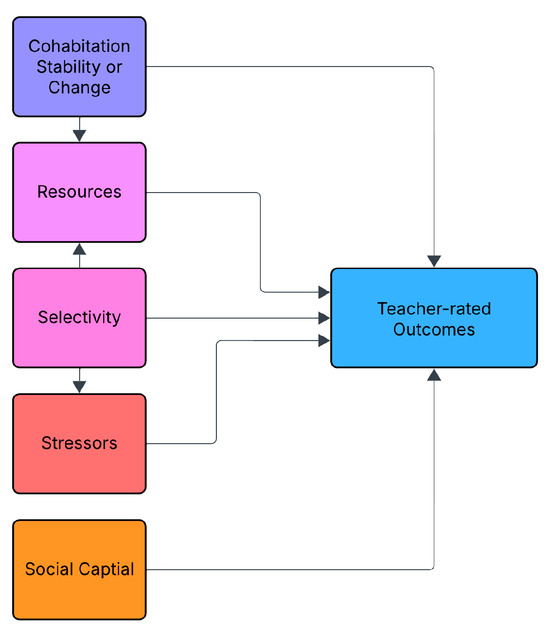
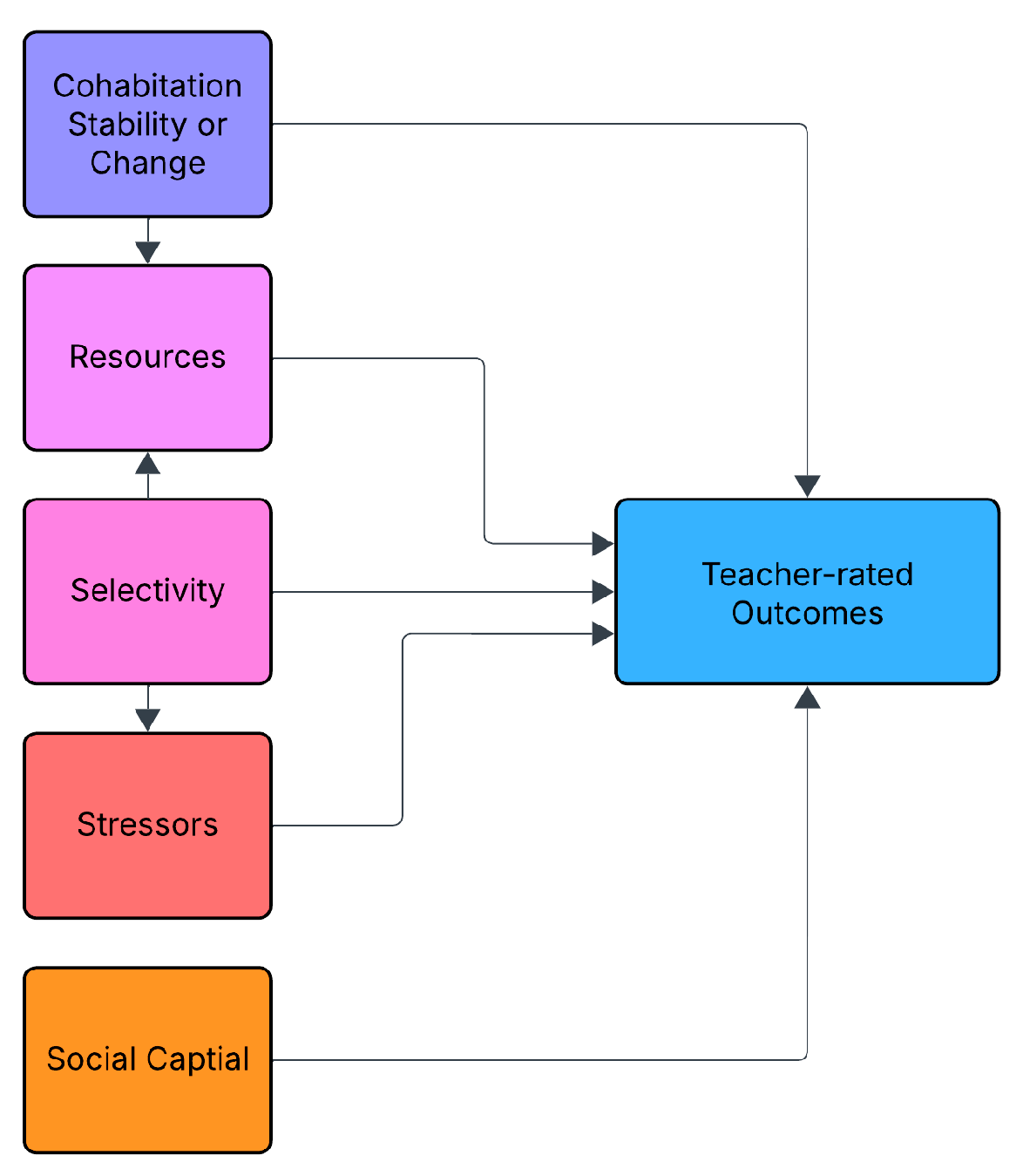
Each of these theoretical perspectives—resources, stress, and selectivity—may account for educational deficits for children living with cohabiting parents and better explain the pathways that connect parental cohabiting with less desirable child outcomes. We adjudicate among these perspectives in a few ways. We are able to isolate family structure and transitions more directly than in past literature by limiting our sample only to those who live with cohabiting parents at birth to account for selectivity processes. We also model the effects of all three of these perspectives separately and simultaneously, recognizing that they may be intertwined (See Figure 1).
Figure 1.
Conceptual framework relating cohabitation stability and transition to teacher-related outcomes.
In this paper, we use data from Australia to make these comparisons for a number of reasons. First, Australian society and families share key similarities to other Western democracies where cohabitation has been tied to less desirable child outcomes, such as the United Kingdom and the United States (cf. Rasmussen et al. 2022; Crawford et al. 2012). For example, Australia, the UK, and the US share common language and political heritage that shapes their cultures around the idea of family. Marriage in Australia and the UK occurs at a similar age to the OECD (2021b) average, only slightly lower than the age in the US. These nations also have similarly low fertility rates (all below 2 per 1000) (World Bank 2020) and crude divorce rates (Australian Bureau of Statistics 2021; CDC/NCHS 2019; Eurostat 2021). These statistics are indicative of all three countries moving in similar ways through the second demographic transition. Australia is also similar to the UK and US in terms of patterns of productivity, educational attainment, and inequality (World Bank 2021a, 2021b, 2021c; OECD 2021a, 2022a, 2022b, 2023). These similarities suggest that the effects of living with cohabiting parents may be similar in Australia to what studies have established in countries like the UK and the US, with cohabitation linked to poorer child outcomes. If this is the case, our findings concerning whether family structure itself is a superior explanation for child outcomes in Australia, or whether considering resources, stressors, and selectivity as more proximate explanations is more appropriate, will bolster theory-building findings from other parts of the world.
On the other hand, Australia is distinct from other Western democracies in a number of important ways that could help distinguish among these theoretical perspectives. For example, the Australian government provides stronger social safety nets to alternative family structures than many countries in the OECD (Heuveline et al. 2010; McLachlan et al. 2013), which may decrease the sensitivity of Australian cohabiting families to resource or stressor factors. In addition, the GINI score for Australia suggests a more egalitarian economic system compared to that of the UK and US (OECD 2023), again perhaps raising the possibility that resource issues will not be as strong an explanation for any differences between children of cohabitors and those in other family structures in Australia. Indeed, in previous work using the Australian data we use here, there were fewer differences across family structures in terms of child BMI, child stress indicators, and maternal mental health in Australian families than in families in either the UK or the US, suggesting that unique factors of Australian culture might come into play to protect Australian children (Slighting et al. 2024; Stoddard-Bennett et al. 2023; Rasmussen et al. 2022).
However, very little research has focused on child outcomes among children living with cohabiting parents in Australia. While there is a robust literature comparing children in one-parent and two-parent families in Australia (cf. Perales et al. 2017), which largely mirrors findings favoring two-parent families derived from studies in the UK and US, most research explicitly examining children of cohabitors in Australia is as much as 30 years old (cf. Sarantakos 1996, 1997). Such work is mixed in terms of its alignment with work from other Western countries, demonstrating that children from cohabiting families are more likely to commit criminal offenses but that such children appear no different from those with married parents on other behavioral outcomes. The three papers mentioned above that use the same Australian data we use here find the opposite of studies looking only at one- and two-parent families: outcomes in Australian cohabiting families do not differ significantly from those in two-parent families where biological parents are married to each other (Slighting et al. 2024; Stoddard-Bennett et al. 2023; Rasmussen et al. 2022).
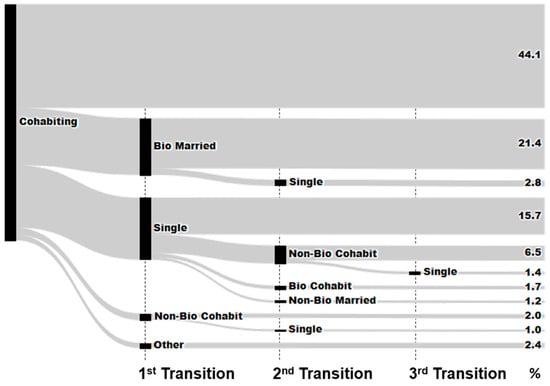
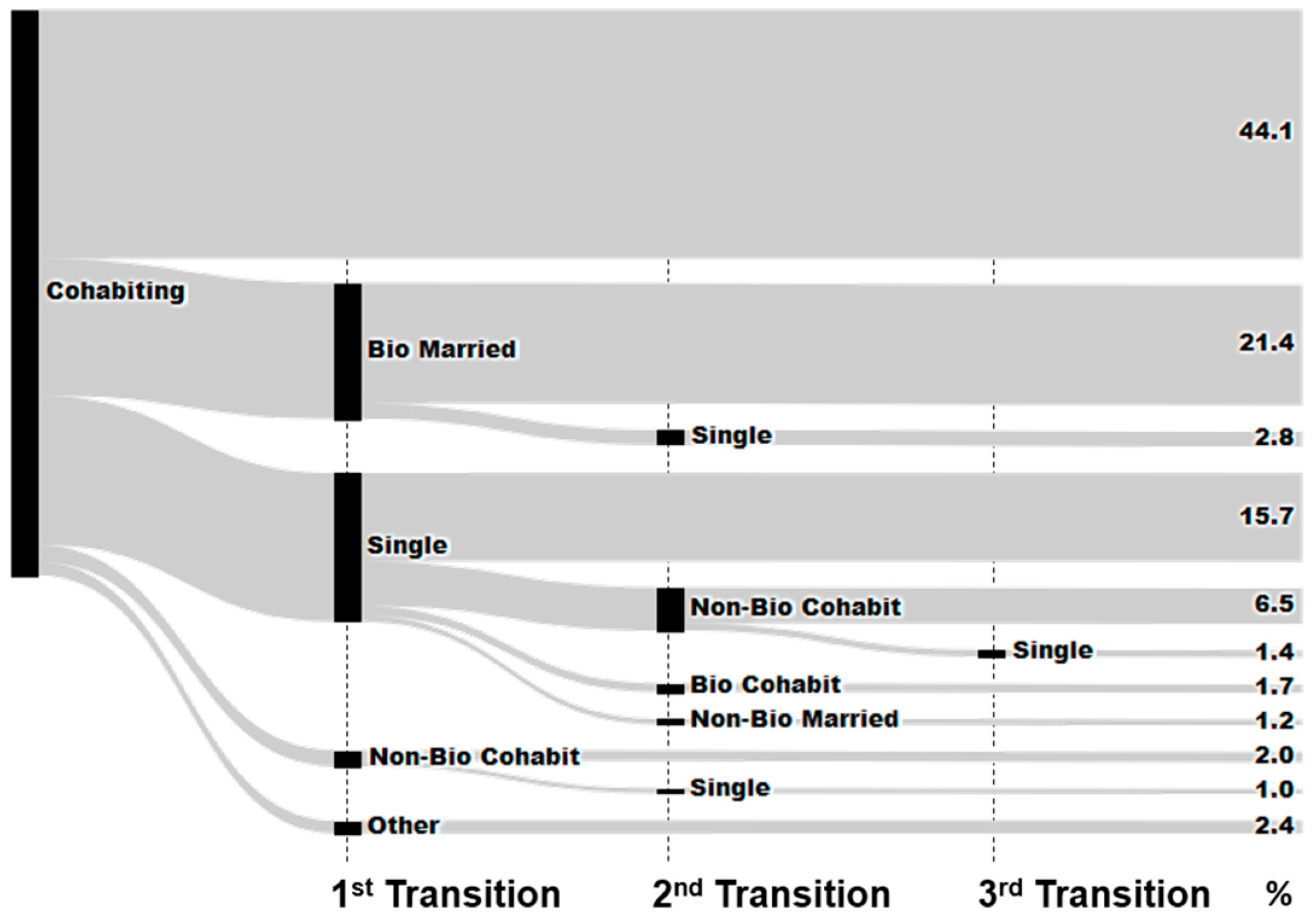
This is especially important to note because while cohabitation prior to marriage is very common in Australia, a smaller percentage of children live with cohabiting parents in Australia, and those children live in more stable cohabiting families, than in the UK or US, perhaps suggesting that such a family structure is less normative in Australian culture (Pribesh et al. 2019; Slighting et al. 2024; Stoddard-Bennett et al. 2023; Rasmussen et al. 2022). Figure 2 presents a visual representation about movement and stability concerning cohabitation in Australia in the time frame of this study.
Figure 2.
Sankey diagram of change in cohabiting family structures by transition type.
2. Materials and Methods
2.1. Current Study
Prior research consistently shows that children living with cohabiting parents have poorer educational outcomes than children living with married parents, particularly in language and literacy development (Brown 2008; Manning 2015; Sun and Li 2011). However, this literature remains divided over whether these differences reflect the causal effects of family structure itself, the stress associated with family instability, or the selective characteristics of parents who form cohabiting unions. Most existing studies compare children across family types, making it difficult to disentangle these competing explanations because parents who cohabit differ systematically from those who marry prior to the child’s birth.
To address this gap, the present study restricts the sample to children born to cohabiting biological parents and examines how subsequent family trajectories—remaining cohabiting, transitioning to marriage, transitioning to single parenthood, or moving into other family structures—are associated with children’s academic development from ages 6 to 11. This design allows us to test whether marriage confers advantages beyond cohabitation and whether family instability produces educational penalties net of parental resources and selectivity.
We derive the following hypotheses from the dominant theoretical perspectives in the literature:
H1 (Family Structure Hypothesis).
If marriage provides unique institutional, legal, or cultural benefits, children whose cohabiting parents later marry will demonstrate higher language/literacy and mathematics performance than children whose parents remain stably cohabiting.
H2 (Family Instability Hypothesis).
If instability is the primary mechanism, children whose parents transition from cohabitation to single or other family structures will exhibit lower academic performance than children whose parents remain stably cohabiting.
H3 (Resources Hypothesis).
If access to financial, housing, and social resources explains academic disparities, associations between family transitions and educational outcomes will be substantially attenuated once these resources are controlled.
H4 (Selectivity Hypothesis).
If parental characteristics such as education, self-efficacy, age, and immigrant status drive observed differences, family structure effects will be reduced or eliminated after accounting for these selectivity factors.
These hypotheses are evaluated using longitudinal generalized estimating equation models that incorporate time-varying family structure, resources, stressors, and selectivity characteristics across three waves of the LSAC study.
2.2. Data
We use the nationally representative birth cohort study Growing Up in Australia: The Longitudinal Study of Australian Children Birth Cohort (LSAC), designed to follow the development of 10,000 children and their families across Australia. At its beginning in 2004, the study designated two groups of 5000 children– the ‘B’ or ‘Baby’ group (0–1 years old) and the ‘K’ or ‘Kinder’ group. We utilized data from Waves 4 through Wave 6 from the B group. Wave 1 had 5107 family units and by Wave 6, when the B group children were approximately 10/11 years old, 3764 units remained in the sample. We restricted our analysis to elementary school-aged children to measure educational outcomes at ages 6/7 years (Wave 4: 2009), 8/9 years (Wave 5: 2011/2012), and 10/11 years (Wave 6: 2013/2014). While most children participating in the study were born into married families, 16% of the nationally representative sample were born into cohabiting unions. We used household rosters to establish if family units were made up of two biological parents in a cohabiting relationship at the time of the birth of the study child in Wave 1 and further restricted our analyses to the 920 children born to biological parents who were cohabiting at the time of their birth. We utilize measures of educational success, cohabitation and relationship transitions, familial resources, stressors, and selectivity for these family units in each wave to answer our research question. We note that we do not weight the analyses here and therefore invite readers to apply appropriate caution when thinking about generalizing these results. We explored the possibility of applying weights but chose not to do so for two reasons. First, modifying the general weights provided by the LSAC is risky because our sample of children of cohabitors is small compared to the full LSAC sample. Second, the LSAC weights are derived using independent variables we include in our models here; under such conditions, applying weights would reduce efficiency and potentially introduce additional bias (Winship and Radbill 1994; Winship and Morgan 1999). Still, we encourage readers to carefully consider the degree to which this might affect the generalizability of results. To address missing data, we used multiple imputation techniques using the chained data sets method and constructing 20 imputed data sets. We ran post-imputation analysis and determined that appropriate imputation values were created.
2.3. Measures
2.3.1. Outcome Variables
Educational Success
The outcome variables for this study were language/literacy proficiency and math proficiency as rated by the child’s teacher. Depending on the study wave, the language and literacy scale has nine or 10 communication and age-appropriate literacy skills such as “Understands and Interprets a Story Read to Them,” “Reads Age-Appropriate Books Independently with Comprehension,” and “Contributes Relevant Information to Classroom Discussions.” This language and literacy measure is based on a five-point scale (1 = “Not Yet,” 2 = “Beginning,” 3 = “In Progress,” 4 = “Intermediate,” and 5 = “Proficient”) LSAC reports an alpha of approximately 0.96 for this measure (Harrison et al. 2009). The mathematical proficiency scale uses the same response scale but is based on eight or nine items (depending on wave), including grade-appropriate items such as “Demonstrates Understanding of Place Value,” “Compares Whole Numbers,” and “Uses a Variety of Strategies to Solve Maths Problems.” LSAC reports an alpha of approximately 0.95 for this measure. We combined these items into continuous level scale scores and standardized them for analysis. Including both language/literacy and math proficiency as measures of educational success provides a more comprehensive picture of the study child’s educational success overall. See Table 1 for descriptive statistics.
Table 1.
Descriptive Statistics.
2.3.2. Independent Variables
Cohabitation Stability and Transition
The key independent variable was family structure and stability as measured by parental marital status. The biological parental relationship status was tracked every two years, each time a new wave of the study commenced. As mentioned above, our study only includes 920 family units in which the parents were in a cohabiting relationship when the study child was born (wave 1). By wave 4 when children were 6 or 7 years old, 38 percent of children remained in cohabiting families. As the waves progressed, that percentage fell to 28% in wave 6 as families moved to structures other than cohabitation. Please note that families may have moved from cohabitation in wave 5 and then resumed cohabitation in wave 6—these percentages merely reflect the current status of the family structure at the wave. The percentage of families that started in cohabitation but moved to married also decreased over the three waves (19% in wave 4 to 14% in wave 6). Please note that the ‘other’ category in Table 1 concerning family structure captures the current status of the family that is not cohabiting biological parents, married to the biological parent or single biological parent. This includes step and social families. This group membership grew over time from 31 percent in wave 4 to 46 percent in wave 6. At any given wave, the ‘other’ family structure category includes stepfamilies, repartnered cohabiting or married unions, and more complex arrangements (e.g., multipartner fertility or social-parent households), which are combined into a single analytic group because individual subcategories are too small to model reliably on their own. The ‘other’ category that describes the current family structure is different from the ‘other’ category in Figure 2; thus, the percentages are vastly different.
Resources
We use two approaches to measuring familial resources that are typical in research on child educational outcomes. We first look at financial resources that can influence a family’s socioeconomic status (SES). To measure income/wealth, we concentrate on the total household income (weekly income, AUS$). We also include receipt of government payments (0 “No” 1 “Yes”), as well as the mother’s employment status (0 “Full-time employment” 1 “Part-time employment” 2 “Other”). We also include the number of members in the household as a measure of resource dilution.
We model social resources available in families as social capital in three domains. The first is child and family connection to others through the child’s participation in extracurricular activities (academic or sports) (0 “No” 1 “Yes”) (White and Gager 2007). Given the age of the children we study here, child participation requires substantial investment on the part of the parents, as well as connecting them to other adults involved in facilitating the activities. The second measure of social capital captures parents’ connections with the child’s peers in neighborhood belonging (Dufur et al. 2013; Parcel and Dufur 2001; Teachman et al. 1997). The third measure of social resources taps the social capital parents create through direct interactions with their children (Gillespie 2014).
Stressors
While we are especially interested in stressors that might be created by family structure instability or living in a non-typical family structure, not all psychological stress comes from family dynamics. Thus, we include a variable created from the Stressful Life Events Index (SLEI) designed by the administrators of the LSAC study. SLEI is a checklist of 25 stressful events that may occur in a child’s life that we summed and standardized. We removed 12 items such as ‘changed residences’, ‘changed marital status’, ‘had a separation due to relationship or marital difficulties’, ‘increased work hours’ and ‘decreased work hours’ from the global index because we measure these stressors as separate influences on the child, leaving us with a total of 13 stressful life events on a standardized scale. We also measured changes in school attended (0 “Did not change school since last wave” 1 “Did change school since last wave”).
We measure residential mobility by using a variable that asks if the families had changed residential locations since the previous survey wave (0 “No” 1 “Yes”). In addition to measuring residential mobility, we consider whether the family owned the house they were living in (0 “No” 1 “Yes”). Homeownership is like an anchor; families are less likely to move if they own their own homes and are not experiencing a marital transition (Baker et al. 2016).
Selectivity
Selectivity measures include parents’ highest education level (1 “Postgrad degree” 2 “Graduate diploma/certificate” 3 “Bachelors” 4 Advanced diploma” 5 “Certificate” 6 “Other qualifications”) (Straits 1987), child age at interview (measured in months), parents’ region of origin (0 “Both are from Aus.” 1 “One is from Aus.” 2 “Both parents are immigrants”), number of siblings, child sex (0 “Female” 1 “Male”), and mother’s age at birth of the study child (measured in years). We also include a standardized measure of parental efficacy that is correlated with selectivity characteristics as well as educational outcomes. Parental self-efficacy is a four-item, parent reported scale that measures parents’ perceptions of their own parenting ability, with questions such as: does this child behave in a manner different from the way you want them to? Do you think that this child’s behavior is more than you can handle? Do you think you are good at getting this child to do what you want them to do? And do you feel that you are in control and on top of things when you are caring for this child? Items were measured on a five-point Likert response scale with lower response values indicating lower levels of parental self-efficacy.
2.4. Analytic Approach
To account for the nonindependence of observations using repeated measures of the same children across three waves, we use generalized estimating equations (GEE) to investigate the relationships between family structure and instability and educational outcomes while considering competing theoretical perspectives. GEE models are appropriate for longitudinal data that were sampled using complex, cluster designs (Wang 2014; Liang and Zeger 1986) with data from related individuals (Homish et al. 2010) with covariates. These GEE models estimate population-averaged effects, so we can examine how variables associated with each of our theoretical perspectives are associated with average changes in academic outcomes. We assigned cohabitation family status as well as other variables that changed over time as time-varying. Stable constructs such as biological sex and race/ethnicity were assigned as time-invariant. Although GEE is a type of repeated measures analysis, it differs from trajectory models in that GEE treats time-varying variables as within-person covariates whose values change across waves and explain contemporaneous changes in an outcome. We are not measuring how people systematically differ in developmental paths; instead, we examine the population averaged effects of when a predictor changes, or how the outcome changes on average at the same time point. We used GEE models with a Gaussian family link and an exchangeable correlational structure. We conducted two models for each education outcome. Model 1 only includes family structure and instability variables to predict educational outcomes. Model 2 includes all the variables as predictors for educational outcomes to assess whether resources, stress, or selectivity better explain differences in child educational outcomes than do family structure changes.
3. Results
3.1. Examining Educational Outcomes over Time for Students Born to Cohabiting Parents
3.1.1. Language and Literacy
Table 2 shows the results of the multivariate GEE regression models predicting language and literacy scores. In Model 1, we find that compared to children whose cohabiting parents remained in a stable cohabiting relationship over time, all children of cohabitors who experienced family change were assessed lower by teachers on language and literacy. However, these results were not significant for children of cohabitors who then married. Specifically, children born to cohabiting parents who transitioned to a single parent household (β = −0.25, χ2 = 6.29, p < 0.05) and cohabit-other (β = −0.23, χ2 = 4.41, p < 0.05) family structures received lower scores on language and literacy than children who had a stable family structure over time. While these coefficients are relatively small, they represent scores about five percent lower than children whose parents continue to cohabit. However, Model 2 demonstrates that other mechanisms better explain educational outcomes for children of cohabitors than do family structure instability mechanisms. Model 2 contained all theoretical explanations for language and literacy scores. After controlling for other explanatory variables, family structure changes to single or other family types no longer had significant associations with language and literacy scores over time. For cohabitors who then married, the negative association became substantially stronger—roughly eight times larger than in the initial model. Because the initial coefficient (−0.01) was close to zero, the percentage change to the model 2 coefficient (−0.09) appears large and should be interpreted as a substantial strengthening of the association rather than a precise quantitative metric. Cohabitors who became single showed a weakening of the association by 16% whereas cohabitors who moved to an ‘other’ status showed a modest 57% strengthening of the association. The results in Model 2 suggested that resources variables (i.e., homeownership, χ2 = 5.94, p < 0.05; extracurricular activities, χ2 = 5.42, p < 0.05), selectivity variables (i.e., parental highest education level, χ2 = 19.91, p < 0.01; child age at interview, χ2 = 4.06, p < 0.05; parents’ region of origin, χ2 = 8.76, p < 0.05; child sex, χ2 = 22.87, p < 0.001; and parental efficacy, χ2 = 9.07, p < 0.01), and the stressor of a residential move (χ2 = 7.81, p < 0.01) better predicted language and literacy change over time. Interestingly, all other stressor variables were not significant predictors of language and literacy mastery.
Table 2.
GEE model results.
3.1.2. Mathematics Thinking/Proficiency
Findings concerning cohabitation and family structure change are similar when considering mathematics ability and thinking. In Model 1, without controlling for other variables, moving from a cohabiting family to a married family did not result in significantly different assessment of mathematical proficiency. However, children who had parents who cohabited at birth but transitioned to single (β = −0.33, χ2 = 11.19, p < 0.01) and those whose parents transitioned from cohabiting to other (β = −0.21, χ2 = 4.25, p < 0.05) received lower scores on mathematics than respondents whose parents stayed in cohabiting relationships over time. While these coefficients are again small, they represent between a five percent (transition to single) and an eight percent (transition to other) deficit, which represents around a third of a standard deviation, a moderate effect.
However, after controlling for other potential explanatory variables in Model 2, family structure shifts did not significantly predict mathematics scores over time. For cohabitors who then married, the negative association became substantially stronger—roughly 11 times larger than in the initial model. Because the initial coefficient (−0.01) was close to zero, the percentage change to the model 2 coefficient (−0.12) appears large and should be interpreted as a substantial strengthening of the association rather than a precise quantitative metric. Cohabitors who became single showed a weakening of the association by 42% whereas cohabitors who moved to an ‘other’ status showed no change. Results instead provide support for the resources perspective (i.e., extracurricular activities, χ2 = 6.27, p < 0.05), the selectivity perspective (i.e., parents’ region of origin, χ2 = 7.28, p < 0.01; parental efficacy, χ2 = 10.32, p < 0.01), and stressors (i.e., residential move, χ2 = 7.89, p < 0.01). Mathematics mastery seems to be somewhat less sensitive to family mechanisms of any kind than is language and literacy, perhaps reflecting that more advanced mathematical concepts are more often taught outside the home (Lee and Bryk 1989) and are more uniformly taught across settings than are language and literacy (Akiba et al. 2007).
4. Discussion
While much research has shown that children who live with cohabiting parents have worse outcomes on average than children living with married parents (Apel and Kaukinen 2008; Brown 2008; Manning 2015; Koball et al. 2010; Raley et al. 2005; Sun and Li 2011; Tillman 2007), that literature has often attributed that association to the family structure rather than further exploring whether more proximate mechanisms might explain this relationship. This paper undertakes that task in two ways. First, we only follow children who were born to cohabitors to see how shifts to different family structures over time are associated with academic development. If cohabitation itself is the cause of deficits in child development, we should see a pattern where children in stably cohabiting families do worse in literacy and math than children whose parents marry. We also include measures of potential mechanisms from a variety of theoretical perspectives that might better explain any relationships between family structure, family instability, and academic development. If children who live with stable cohabitors do worse than those whose parents marry regardless of resources, stressors, or selectivity factors, we would add to the evidence that family structure is the key driver of the previously observed relationships between living with cohabiting parents and poorer child outcomes.
Similarly, if we find that shifting from a cohabiting family structure is associated with lower assessment of literacy and math ability in the presence of these alternative explanations, we will provide evidence that family instability is the primary driver of these poorer outcomes. Finally, if we find that resources, stressors, or selectivity are more important drivers of academic development, we will provide evidence that challenges the idea that family structure or instability is to blame for children in cohabiting families having poorer outcomes. Our analysis addresses previous issues with research about family structure and educational outcomes concerning selection bias and cross-sectional studies. In this study, we start with people who are alike—parents who are cohabiting at the time of birth of the child in the study. We then track changes in family structure of those like groups and compare educational outcomes over time.
Our findings for children born to cohabitors in Australia show that, while family structure instability initially seems to be more important than living in a cohabiting family structure, when other theoretical explanations such as access to resources, selectivity indicators, certain stressors, and social capital explanations are accounted for, neither family structure nor family instability are significantly related to child academic development, at least not directly. Interestingly, children who lived with stably cohabiting parents and those whose cohabiting parents later married were statistically indistinguishable from each other even before including other potential explanations of academic development. We might have expected that children whose parents marry, because of this entry into a family structure that enjoys a number of cultural and structural benefits (Huntington et al. 2022), would gain in their academics. In addition, we might have expected this pattern to be especially pronounced in Australia, a country that has growing numbers of cohabitors but still a substantially smaller proportion of cohabiting parents than other western democracies like the United Kingdom or the United States (Rasmussen et al. 2022; Slighting et al. 2024). Because the cohabitation revolution has been somewhat slower in Australia, it seems logical that children born to cohabitors would see benefits to their parents marrying; however, we find no such benefits.
Similarly, children born to cohabitors who then experience family instability in the form of family dissolution do initially appear to do worse than children of stable cohabitors, perhaps suggesting that instability is at the root of cohabitors’ performance, especially given that cohabitors tend to have more relationship churn than married parents (Sassler and Miller 2017; Lundberg et al. 2016; Manning 2015). However, when we controlled for other potential family mechanisms, children whose parents ceased cohabiting and experienced relationship churn were assessed no differently by their teachers than were children of stable cohabitors. Again, we find no evidence that family structure is the key pathway of how young Australian children born to cohabiting biological parents perform in educational settings.
We do, however, find evidence of alternative theoretical perspectives arguing that family mechanisms might be related to cohabitation and are also related to child academic development. We found several significant associations between selectivity variables and teacher ratings. Children whose parents cohabit when they are born grow up with younger, less educated parents who report lower levels of self-efficacy (Reeves and Krause 2017; Koops et al. 2021; Manning and Brown 2006). Low levels of parental self-efficacy, may lead to more negative parenting strategies, such as less supportive, non-mindful teachings, less effective techniques in helping children manage emotions, as well as more child exposure to anti-social attitudes and behaviors like aggression or rejection (Ardelt and Eccles 2001; Glatz et al. 2023; Grusec and Davidov 2010; Giallo et al. 2013). These same characteristics associated with becoming cohabitors in the first place change how cohabitors parent their children. At the same time, our findings are in line with previous research stating that children of cohabitors also enjoy fewer physical and social resources, and those resources are diluted across larger families (Eggebeen 2005; Hewitt and Vidal 2025, Halliday Hardie and Lucas 2010). Put another way, this reinforces that cohabiting parents, regardless of whether they stay stably cohabiting, later marry, or experience partner exit, enter parenthood with fewer resources and acquire fewer resources to invest in their children along the way. While families in Australia enjoy robust social supports, it may be important for more of that support to be directed at couples at risk of entering parenthood unprepared.
Given that children of cohabitors are on average exposed to more relationship churn, and that we were able to account in our models for that churn, we were surprised that stressor explanations did not do as good a job of explaining associations between cohabiting family structures and child academic development as resource and selectivity explanations did. Of course, it is possible we simply have superior measures of resources and selectivity in the LSAC data, and stressors are an undermeasured but important factor here. It is also possible that by studying the Australian case, where there is robust social support, parents in alternative family structures are less subjected to chronic stress than in otherwise similar Western countries. We do find, however, that children who experience the stressor of residential mobility do worse on teacher assessments of both literacy and math. It is possible that children of cohabitors become accustomed to the instability of a parent entering and exiting, but remain susceptible to the stressors of having to move themselves.
The findings from this study may also reflect differences in the development of language/literacy skills and mathematical proficiency skills. Literacy development is heavily influenced by the home environment. Children often learn from parental reading behaviors, language exposure, and availability of literacy building materials at home. In contrast, mathematical proficiency skills are more consistently taught and reinforced in school settings. As language/literacy is more heavily developed in the home environment, those skills are more susceptible to disruption when there is disruption in the family structure. To address potential developmental variation over time, we note that associations between family structure transitions and academic outcomes appeared broadly consistent across Waves 4–6 rather than being driven by a single observation period; although we did not formally model interactions between predictors and time, descriptive comparisons and model stability checks indicated that the attenuation of family-structure effects after inclusion of resource, selectivity, and stress variables was evident at each wave, suggesting that these mechanisms operate similarly across the primary school years examined. Importantly, the resource, stress, social capital, and selectivity variables included in Model 2 should be understood as pathways through which family structure and instability may shape children’s development, rather than merely as competing explanations; our results therefore indicate that differences in these mechanisms account for most observed outcome variation among children born to cohabiting parents, not that family structure is irrelevant in broader contexts.
One limitation of our study is that our measure of residential mobility is very conservative. We only have an answer to whether the family has moved since the last wave was conducted. However, a lot can happen in the two years between study waves, and we cannot tell anything granular about what has happened between surveys. We don’t know if the family moved or if the parental relationships came and went, potentially multiple times, during those two years. For the study children, two years is a significant portion of their consciousness, nearly a third of the time they’ve been alive. Our study also only includes children who are under the age of 12. Further research should be done in order to understand the effects of cohabitation and parental relationship status on adolescents’ academic performance.
Another limitation comes from our measures of stress and development. While we include robust measures of stressful events, we have no data about whether the parents or the child are actually experiencing stress from these events. Thus, these measures come with many assumptions baked in. The fact that individuals’ outcomes are potentially just as sensitive to perceiving that they are experiencing stress as to granular variation across stress exposure scenarios (cf. Acoba 2024; Apazoglou et al. 2017) gives us additional confidence that these findings represent real effects of stress in Australian families’ lives. However, more insight into how the parent or the child responds to these stressful events could lead to a better understanding of how stress influences a child’s educational outcomes in cohabiting families. Teacher ratings of a child’s language/literacy skills and mathematical proficiency skills may reflect a child’s classroom behavior, participation, and the teacher’s expectations, as well as the child’s academic competence. All of these factors may be influenced by family background, depending on what is modeled for the child in the home. Given that the focus of our study is on cohabiting families, teachers may have different expectations of children in the study pool than they would have for children of married parents. Additional academic information, such as grades, would be beneficial to gain a comprehensive picture of a child’s academic performance. Unfortunately, that data was unavailable with this data set, but we feel confident that these teacher evaluations offer a fairly accurate evaluation of student performance. Additionally, social capital measures that offer more insight into how social capital changes if the family structure changes, if the child moves schools, or if they undergo other transitions, would provide more insight. It can be expected that a transition in the child’s social network will result in new types of social capital for that child.
5. Conclusions
This study initially suggests that family structure instability other than entering a marriage seems to have more of an influence on a child’s educational outcomes than simply living in a cohabiting family structure among families in Australia. However, when other theoretical explanations are accounted for, we see that neither family structure nor instability are significantly related to child academic development. We instead find that resources, selectivity indicators, certain stressors, and social capital explanations are significantly related to a child’s academic success. These findings are especially interesting, as Australia has been slower to partake in the cohabitation revolution than many other Western countries. Our findings refine rather than overturn prior family-structure research by showing that, among children born to cohabiting parents, variation in resources, parental capacities, and stability-related mechanisms largely explains differences in educational outcomes. To further unpack the impact that the family unit has on child development, we recommend that further research be done on the role that these explanations have on children’s academic outcomes in families that experience different kinds of instability and complexity.
Author Contributions
Individual contributions included: Conceptualization, S.P., M.J.D. and J.A.J.; methodology, S.P., M.J.D. and J.A.J.; software, S.P. and Y.Y.; validation, M.J.D., E.E.P. and A.W.; formal analysis, Y.Y. and S.P.; investigation, S.P.; resources, M.J.D.; data curation, Y.Y.; writing—original draft preparation, S.P., Y.Y. and M.J.D.; writing—review and editing, J.A.J., E.E.P. and A.W.; supervision, S.P. and M.J.D.; project administration, M.J.D.; funding acquisition, M.J.D. All authors have read and agreed to the published version of the manuscript.
Funding
This research received no external funding.
Institutional Review Board Statement
The present study accessed the Longitudinal Study of Australian Children data set. The data are available via contract in fully deidentified form. The study was conducted in accordance with the Declaration of Helsinki and approved by the Human Research Ethics Committee of the Australian Institute of Family Studies (https://aifs.gov.au/growing-australia/study/ethics, 22 November 2002). The use of these data for research was reviewed and granted exempt status by the Old Dominion University Education and Human Subjects Review Committee in January of 2019.
Informed Consent Statement
Informed consent was obtained by the Australian Institute of Family Studies (https://aifs.gov.au/growing-australia/study/ethics, accessed on 22 October 2025). The authors had no contact with any respondent at any time.
Data Availability Statement
The authors are unable to share datafiles because the data is only available via contract. Interested parties may initiate access to the data contract process by contacting Australian Institute of Family Studies (https://aifs.gov.au/growing-up-in-australia).
Acknowledgments
The Growing Up in Australia: The Longitudinal Study of Australian Children (LSAC) Project was initiated and is funded by the Australian Government Department of Families, Housing, Community Services and Indigenous Affairs (FaHCSIA) and is undertaken in partnership with the Australian Institute of Family Studies (AIFS) and the Australian Bureau of Statistics.
Conflicts of Interest
The authors declare no conflicts of interest.
Abbreviations
The following abbreviations are used in this manuscript:
| LSAC | Longitudinal Study of Australian Children |
References
- Acoba, Evelyn F. 2024. Social support and mental health: The mediating role of perceived stress. Frontiers in Psychology 15: 1330720. [Google Scholar] [CrossRef] [Scilit] [PubMed]
- Akiba, Motoko, Gerald K. LeTendre, and Jay P. Scribner. 2007. Teacher quality, opportunity gap, and national achievement in 46 countries. Educational Researcher 36: 369–87. [Google Scholar] [CrossRef] [Scilit]
- Amato, Paul R. 2005. The impact of family formation change on the cognitive, social, and emotional well-being of the next generation. The Future of Children 15: 75–96. [Google Scholar] [CrossRef] [Scilit] [PubMed]
- Apazoglou, Kalliopi, Viridiana Mazzola, Jennifer Wegrzyk, Giulia Frasca Polara, and Selma Aybek. 2017. Biological and perceived stress in motor functional neurological disorders. Psychoneuroendocrinology 85: 142–50. [Google Scholar] [CrossRef] [Scilit]
- Apel, Robert, and Catherine Kaukinen. 2008. On the relationship between family structure and antisocial behavior: Parental cohabitation and blended households. Criminology 46: 35–70. [Google Scholar] [CrossRef] [Scilit]
- Ardelt, Monika, and Jacquelynne S. Eccles. 2001. Effects of mothers’ parental efficacy beliefs and promotive parenting strategies on inner-city youth. Journal of Family Issues 22: 944–72. [Google Scholar] [CrossRef] [Scilit]
- Australian Bureau of Statistics. 2021. Marriage Divorces in Australia. Available online: https://www.abs.gov.au/statistics/people/people-and-communities/marriages-and-divorces-australia/latest-release (accessed on 17 January 2022).
- Baker, Emma, Rebecca Bentley, Laurence Lester, and Andrew Beer. 2016. Housing affordability and residential mobility as drivers of locational inequality. Applied Geography 72: 65–75. [Google Scholar] [CrossRef] [Scilit]
- Brown, Susan L. 2008. Family structure and child well-being: The significance of parental cohabitation. Journal of Marriage and Family 66: 351–67. [Google Scholar] [CrossRef] [Scilit]
- Brown, Susan L. 2017. Families in America. Oakland: University of California Press. [Google Scholar]
- Bzostek, Sharon H., Sara S. McLanahan, and Marcia J. Carlson. 2012. Mothers’ repartnering after a nonmarital birth. Social Forces 90: 817–41. [Google Scholar] [CrossRef] [Scilit]
- CDC/NCHS. 2019. Provisional Number of Marriages and Marriage Rate: United States, 2000–2018. Available online: https://www.cdc.gov/nchs/data/dvs/national-marriage-divorce-rates-00-18.pdf (accessed on 17 January 2022).
- Crawford, Claire, Alissa Goodman, Ellen Greaves, and Rob Joyce. 2012. Cohabitation, marriage and child outcomes: An empirical analysis of the relationship between marital status and child outcomes in the UK using the Millennium Cohort Study. Child and Family Law Quarterly 24: 176. [Google Scholar]
- Dufur, Mikaela J., and Alyssa J. Alexander. 2017. Does childhood family structure help create stratification in adult education and labor market attainment?: An argument for the selectivity perspective. Sociology Compass 11: e12442. [Google Scholar] [CrossRef] [Scilit]
- Dufur, Mikaela J., Toby L. Parcel, and Kelly P. Troutman. 2013. Does capital at home matter more than capital at school? Social capital effects on academic achievement. Research in Social Stratification and Mobility 31: 1–21. [Google Scholar] [CrossRef] [Scilit]
- Eggebeen, David J. 2005. Cohabitation and exchanges of support. Social Forces 83: 1097–110. [Google Scholar] [CrossRef] [Scilit]
- Eurostat. 2021. Crude Marriage Rate and Crude Divorce Rate. Available online: https://ec.europa.eu/eurostat/databrowser/view/tps00206/default/table?lang=en (accessed on 17 January 2022).
- Giallo, Rebecca, Karli Treyvaud, Amanda Cooklin, and Catherine Wade. 2013. Mothers’ and fathers’ involvement in home activities with their children: Psychosocial factors and the role of parental self-efficacy. Early Child Development and Care 183: 343–59. [Google Scholar] [CrossRef] [Scilit]
- Gillespie, Brian Joseph. 2014. Does intergenerational solidarity buffer the negative effects of residential mobility? Evidence for US children. Field Actions Science Reports. The Journal of Field Actions. Available online: https://journals.openedition.org/factsreports/3266 (accessed on 15 November 2025).
- Glatz, Terese, Melissa Lippold, Gerard Chung, and Todd M. Jensen. 2023. A systematic review of parental self-efficacy among parents of school-age children and adolescents. Adolescent Research Review 9: 75–91. [Google Scholar] [CrossRef] [Scilit]
- Grusec, Joan E., and Maayan Davidov. 2010. Integrating different perspectives on socialization theory and research: A domain-specific approach. Child Development 81: 687–709. [Google Scholar] [CrossRef] [Scilit]
- Halliday Hardie, Jessica, and Amy Lucas. 2010. Economic factors and relationship quality among young couples: Comparing cohabitation and marriage. Journal of Marriage and Family 72: 1141–54. [Google Scholar] [CrossRef] [Scilit]
- Harrison, Linda J., Sharynne McLeod, Donna Berthelsen, and Sue Walker. 2009. Literacy, numeracy and learning in school aged children identified as having speech language impairment in early childhood. International Journal of Speech-Language Pathology 11: 392–403. [Google Scholar] [CrossRef] [Scilit]
- Heuveline, Patrick, Hongxing Yang, and Jeffrey M. Timberlake. 2010. It takes a village (perhaps a nation): Families, states, and educational achievement. Journal of Marriage and Family 72: 1362–76. [Google Scholar] [CrossRef] [Scilit]
- Hewitt, Belinda, and Sergi Vidal. 2025. Health and well-being in cohabitation versus marriage: Are cohabitors’ marriage intentions important? Social Science & Humanities Open 11: 101488. [Google Scholar]
- Homish, Gregory G., Ellen P. Edwards, Rina D. Eiden, and Kenneth E. Leonard. 2010. Analyzing family data: A GEE approach for substance use researchers. Addictive Behaviors 35: 558–63. [Google Scholar] [CrossRef] [Scilit] [PubMed]
- Huntington, Charlie, Scott M. Stanley, Brian D. Doss, and Galena K. Rhoades. 2022. Happy, healthy, and wedded? How the transition to marriage affects mental and physical health. Journal of Family Psychology 36: 608. [Google Scholar] [CrossRef] [Scilit] [PubMed]
- Kalmijn, Matthijs. 2003. Shared friendship networks and the life course: An analysis of survey data on married and cohabiting couples. Social Networks 25: 231–49. [Google Scholar] [CrossRef] [Scilit]
- Koball, Heather L., Emily Moiduddin, Jamila Henderson, Brian Goesling, and Melanie Besculides. 2010. What do we know about the link between marriage and health? Journal of Family Issues 31: 1019–40. [Google Scholar] [CrossRef] [Scilit]
- Koops, Judith C., Aart C. Liefbroer, and Anne H. Gauthier. 2021. Having a child within a cohabiting union in Europe and North America: What is the role of parents’ socio-economic status? Population, Space and Place 27: e2434. [Google Scholar] [CrossRef] [Scilit]
- Lee, Valerie. E., and Anthony S. Bryk. 1989. A multilevel model of the social distribution of high school achievement. Sociology of Education 62: 172–92. [Google Scholar] [CrossRef] [Scilit]
- Liang, Kung-Yee, and Scott L. Zeger. 1986. Longitudinal data analysis using generalized linear models. Biometrika 73: 13–22. [Google Scholar] [CrossRef]
- Lundberg, Shelly, Robert A. Pollak, and Jenna Stearns. 2016. Family inequality: Diverging patterns in marriage, cohabitation, and childbearing. Journal of Economic Perspectives 30: 79–102. [Google Scholar] [CrossRef] [Scilit]
- Mahmood, Inam, Attiya Inam, and Muhammad Abiodullah. 2015. Factors contributing to school refusal among school children. Nurture 9: 19–28. [Google Scholar] [CrossRef] [Scilit]
- Manning, Wendy D. 2015. Cohabitation and child wellbeing. The Future of Children 25: 51–66. [Google Scholar] [CrossRef] [Scilit]
- Manning, Wendy D., and Susan Brown. 2006. Children’s Economic Well-Being in Married and Cohabiting Parent Families. Journal of Marriage and Family 68: 345–62. [Google Scholar] [CrossRef] [Scilit]
- McLachlan, Rosalie, Geoff Gilfillan, and Jenny Gordon. 2013. Deep and Persistent Disadvantage in Australia. Canberra: Productivity Commission. [Google Scholar]
- McLanahan, Sara, and Christine Percheski. 2008. Family structure and the reproduction of inequalities. Annual Review of Sociology 34: 257–76. [Google Scholar] [CrossRef] [Scilit]
- Murphy, Michael. 2011. Long-term effects of the demographic transition on family and kinship networks in Britain. Population and Development Review 37: 55–80. [Google Scholar] [CrossRef] [Scilit] [PubMed]
- OECD. 2021a. Government at a Glance 2021. Paris: OECD Publishing. [Google Scholar] [CrossRef] [Scilit]
- OECD. 2021b. OECD Family Database, Chart SF3.1.B. Mean Age at First Marriage by Sex, 1990, 2000, and 2019 or Latest Available Year. Available online: https://www.oecd.org/en/publications/society-at-a-glance-2024_918d8db3-en/full-report/marriage-and-divorce_63dd0a7d.html (accessed on 17 January 2022).
- OECD. 2022a. Income Inequality (Indicator). Available online: https://data.oecd.org/inequality/income-inequality.htm (accessed on 17 January 2022).
- OECD. 2022b. Population with Tertiary Education (Indicator). Available online: https://www.oecd.org/en/data/indicators/population-with-tertiary-education.html (accessed on 17 January 2022).
- OECD. 2023. Income Inequality (Indicator). Available online: https://data.oecd.org/inequality/income-inequality.htm (accessed on 17 January 2023).
- Parcel, Toby L., and Mikaela J. Dufur. 2001. Capital at home and at school: Effects on student achievement. Social Forces 79: 881–911. [Google Scholar] [CrossRef] [Scilit]
- Perales, Francisco, Sarah E. Johnson, Janeen Baxter, David Lawrence, and Stephen R. Zubrick. 2017. Family structure and childhood mental disorders: New findings from Australia. Social Psychiatry and Psychiatric Epidemiology 52: 423–33. [Google Scholar] [CrossRef] [Scilit]
- Perelli-Harris, Brienna, Wendy Sigle-Rushton, Michaela Kreyenfeld, Trude Lappegård, Renske Keizer, and Caroline Berghammer. 2010. The educational gradient of childbearing within cohabitation in Europe. Population and Development Review 36: 775–801. [Google Scholar] [CrossRef] [Scilit]
- Pribesh, Shana, and Douglas B. Downey. 1999. Why are residential and school moves associated with poor school performance? Demography 36: 521–34. [Google Scholar] [CrossRef] [Scilit]
- Pribesh, Shana, Matthew Usevitch, Elizabeth Koch Sigler, Kaijsa Angerhofer Heninger, Yuanyuan Yue, Mikaela J. Dufur, and Jonathan A. Jarvis. 2019. The flow of family transitions of Australian families. Australian Population Studies 3: 37–40. [Google Scholar] [CrossRef] [Scilit]
- Raley, R. Kelly, Michelle L. Frisco, and Elizabeth Wildsmith. 2005. Maternal cohabitation and educational success. Sociology of Education 78: 144–64. [Google Scholar] [CrossRef] [Scilit]
- Rasmussen, Kirsten, Elizabeth K. Sigler, Sadie A. Slighting, Jonathan A. Jarvis, Mikaela J. Dufur, and Shana Pribesh. 2022. Family structure and maternal depressive symptoms: A cross-national comparison of Australia, the United Kingdom, and the United States. Social Sciences 11: 78. [Google Scholar] [CrossRef] [Scilit]
- Reeves, Richard V., and Eleanor Krause. 2017. Cohabiting Parents Differ from Marries Ones in Three Big Ways. Last Modified 2017 April 5. Available online: https://www.brookings.edu/articles/cohabiting-parents-differ-from-married-ones-in-three-big-ways/ (accessed on 17 January 2023).
- Reinhold, Steffen. 2010. Reassessing the link between premarital cohabitation and marital instability. Demography 47: 719–33. [Google Scholar] [CrossRef] [Scilit] [PubMed]
- Sarantakos, Sotirios. 1996. Children in three contexts: Family, education and social development. Children Australia 21: 1096. [Google Scholar] [CrossRef] [Scilit]
- Sarantakos, Sotirios. 1997. Cohabitation, marriage and delinquency: The significance family environment. Australian & New Zealand Journal of Criminology 30: 187–99. [Google Scholar] [CrossRef] [Scilit]
- Sassler, Sharon, and Amanda Miller. 2017. Cohabitation Nation: Gender, Class and the Remaking of Relationships. Oakland: University of California Press. [Google Scholar]
- Slighting, Sadie A., Kirsten Rasmussen, Mikaela J. Dufur, Jonathan A. Jarvis, Shana L. Pribesh, Alyssa J. Alexander, and Carolina Otero. 2024. Family structure, family transitions, and child overweight and obesity: Comparing Australia, the United Kingdom, and the United States. Children 11: 693. [Google Scholar] [CrossRef] [Scilit]
- Smock, Pamela J., and Wendy D. Manning. 2010. New couples, new families: The cohabitation revolution in the United States. In Families as They Really Are. New York: WW Norton & Co., pp. 131–39. [Google Scholar]
- Stoddard-Bennett, Nina A., Jordan Coburn, Mikaela J. Dufur, Jonathan A. Jarvis, and Shana L. Pribesh. 2023. Family structure and child behavior problems in Australia, the United Kingdom, and the United States. International Journal of Environmental Research and Public Health 20: 1780. [Google Scholar] [CrossRef] [Scilit]
- Straits, Bruce C. 1987. Residence, migration, and school progress. Sociology of Education 60: 34–43. [Google Scholar] [CrossRef] [Scilit]
- Sun, Yongmin, and Yuanzhang Li. 2011. Effects of family structure type and stability on children’s academic performance trajectories. Journal of Marriage and Family 73: 541–56. [Google Scholar] [CrossRef] [Scilit]
- Teachman, Jay D., Kathleen Paasch, and Karen Carver. 1997. Social capital and the generation of human capital. Social Forces 75: 1343–59. [Google Scholar] [CrossRef]
- Tillman, Kathryn Harker. 2007. Family structure pathways and academic disadvantage among adolescents in stepfamilies. Sociological Inquiry 77: 383–424. [Google Scholar] [CrossRef] [Scilit]
- Vitali, Agnese, Arnstein Aassve, and Trude Lappegård. 2015. Diffusion of childbearing within cohabitation. Demography 52: 355–77. [Google Scholar] [CrossRef] [Scilit]
- Wang, Ming. 2014. Generalized estimating equations in longitudinal data analysis: A review and recent developments. Advances in Statistics 2014: 303728. [Google Scholar] [CrossRef] [Scilit]
- White, Amanda M., and Constance T. Gager. 2007. Idle hands and empty pockets? Youth involvement in extracurricular activities, social capital, and economic status. Youth & Society 39: 75–111. [Google Scholar] [CrossRef] [Scilit]
- Winship, Christopher, and Larry Radbill. 1994. Sampling weights and regression analysis. Sociological Methods & Research 23: 230–57. [Google Scholar] [CrossRef] [Scilit]
- Winship, Christopher, and Stephen L. Morgan. 1999. The estimation of causal effects from observational data. Annual Review of Sociology 25: 659–706. [Google Scholar] [CrossRef] [Scilit]
- Woods, LaKeesha N., and Robert E. Emery. 2002. The cohabitation effect on divorce: Causation or selection? Journal of Divorce & Remarriage 37: 101–22. [Google Scholar]
- World Bank. 2020. Data, Fertility Rate, Total (Births per Woman)—Australia, United Kingdom, United States. Available online: https://data.worldbank.org/indicator/SP.DYN.TFRT.IN?end=2019&locations=AU-GB-US&start=2019&view=bar (accessed on 17 January 2022).
- World Bank. 2021a. Data, GDP per Capita (Current US$). World Bank National Accounts Data, and OECD National Accounts Data Files. Available online: https://data.worldbank.org/indicator/NY.GDP.PCAP.CD?end=2020&start=2020&view=bar (accessed on 17 January 2022).
- World Bank. 2021b. Data, GDP. World Bank National Accounts Data, and OECD National Accounts Data Files. Available online: https://data.worldbank.org/indicator/NY.GDP.MKTP.CD?most_recent_value_desc=true (accessed on 17 January 2022).
- World Bank. 2021c. International Labour Organization, ILOSTAT Database. Available online: https://data.worldbank.org/indicator/SL.UEM.TOTL.ZS?name_desc=false (accessed on 17 January 2022).
- Wu, Zheng, Feng Hou, and Christoph M. Schimmele. 2008. Family structure and children’s psychosocial outcomes. Journal of Family Issues 29: 1600–24. [Google Scholar]

Disclaimer/Publisher’s Note: The statements, opinions and data contained in all publications are solely those of the individual author(s) and contributor(s) and not of MDPI and/or the editor(s). MDPI and/or the editor(s) disclaim responsibility for any injury to people or property resulting from any ideas, methods, instructions or products referred to in the content. |
© 2026 by the authors. Licensee MDPI, Basel, Switzerland. This article is an open access article distributed under the terms and conditions of the Creative Commons Attribution (CC BY) license.