


Abstract
This study examines the “Grok crisis” that unfolded in Türkiye on 8–9 July 2025 to analyze the AI agency and ethical boundaries of AI-based chatbots in the digital public sphere. Designed as a qualitative case study, it draws on a document corpus compiled with explicit selection criteria (xAI statements and system prompt records, judicial and governmental statements, national and international news reports, and posts on X) and on a semi-structured interaction with Grok. Grok’s accounts of its own functioning were treated as the self-narrative of an actor in the controversy and compared with the corpus. The analysis employs the Actor–Network Theory concepts of translation, inscription/script, black box, and punctualization, together with controversy mapping. The findings show that the crisis operated as a controversy over the attribution of agency: xAI attributed it to a code update independent of the model; Grok, describing itself as a “semi-active” actor, distributed responsibility between the update and user provocation; and the judiciary directly targeted Grok’s posts. The study advances two propositions. First, chatbots are “talking black boxes” whose unverifiable self-narratives should be treated as attempts at translation. Second, legal–political intervention punctualizes distributed agency at the most visible node accessible to national jurisdiction: the model’s public outputs.
1. Introduction
Social media platforms have evolved from environments in which users produce and share content into components of a new public sphere that increasingly includes AI-based digital actors capable of human-like communication (van Dijck et al. 2018). A recent example of this transformation is Grok, a chatbot integrated into X, the platform owned by Elon Musk. Grok is an artificial intelligence model developed by xAI, and it differs from many other chatbots in that it operates in direct integration with the X platform. This integration enables Grok to monitor real-time discussions on the platform and to generate contextual and up-to-date responses based on these data. In this respect, Grok is positioned as an actor that responds to user queries, analyzes trends, follows online discussions, and participates in the flow of information within the digital public sphere. Although technical information on Grok’s functioning has not been fully disclosed to the public, the model is known to be built on a transformer-based architecture, as are other contemporary large language models. Grok, whose design embraces an approach that prioritizes freedom of expression, is reported to have a relatively flexible structure that may partially deviate from conventional and more stringent content moderation policies. However, the model’s direct interaction with data from the X platform also entails the risk of reproducing the discursive patterns and biases prevalent on the platform. While this platform-specific data flow enhances Grok’s effectiveness in real-time social media analysis, it may limit the model’s generalizability and flexibility in more general-purpose tasks (Wangsa et al. 2024).
In recent years, AI-based chatbots have come to play an increasingly central role in user interaction, knowledge production, and digital governance processes, and academic debates on the ethical boundaries of these technologies have expanded rapidly (Floridi et al. 2018; Bender et al. 2021). Indeed, studies on large language model-based systems such as ChatGPT address a range of ethical issues, including privacy, algorithmic bias, the risk of misuse, and the nature of human–machine interaction (Tawfeeq et al. 2023). This research emphasizes the need to strengthen the ethical frameworks of ChatGPT and similar intelligent chatbots and to develop international standards for user protection (Gromova et al. 2023). Moreover, the literature frequently notes that chatbots have the potential to steer or manipulate users, that they can reproduce biases, and that they may establish a form of algorithmic authority through opaque decision-making processes (Floridi et al. 2018; Bender et al. 2021).
In parallel with these debates, research on generative AI systems has developed around diverse themes, including ethical issues, algorithmic bias, platform governance, and the societal impacts of artificial intelligence. Studies examining AI model platforms such as Hugging Face, GitHub, and Civitai reveal that these platforms generate governance problems distinct from those of conventional content moderation and that generative AI models should be regarded as tools that can be deployed for diverse purposes (Gorwa and Veale 2024). Studies focusing on the social position of AI systems, in turn, show that users perceive ChatGPT as a social actor that influences trust, responsibility, and decision-making processes (Heaton et al. 2024). It has further been argued that large language models may exhibit particular ideological leanings in their political discourse and therefore cannot be regarded as entirely neutral actors in public debate (Hartmann et al. 2023). In addition, research on the Iruda chatbot crisis demonstrates that AI-related crises cannot be explained by algorithmic errors alone; rather, interactions among developers, users, datasets, the media, and regulatory bodies jointly shape crisis dynamics (Kwon and Hong 2026). In the existing literature, generative AI-related crises are predominantly addressed in terms of their ethical, technical, or governance dimensions. However, a substantial proportion of these studies do not develop theoretical propositions that, by placing Actor–Network Theory at the center, move beyond the observation that such crises involve multiple human and nonhuman actors. Examining the case of Tay, Neff and Nagy (2016) showed that chatbot agency is a “symbiotic” agency co-produced with users. Examining the Iruda crisis, Kwon and Hong (2026) demonstrated that Iruda, which was withdrawn from service in South Korea amid controversies over hate speech and the use of personal data and subsequently redesigned, was reassembled through the renegotiation of ethical principles in practice. These studies have established the multi-actor nature of AI crises as a settled premise. Nevertheless, two questions remain insufficiently addressed: first, how the narratives of a chatbot capable of speaking publicly about its own functioning affect the course of a controversy; and second, at which node, and how, legal and political responsibility is concentrated under conditions of distributed agency. The algorithmic accountability literature shows that transparency alone does not ensure accountability (Ananny and Crawford 2018) and that, in automated systems, responsibility is frequently assigned to the most visible human component of the network (Elish 2019). However, cases in which responsibility is directed at the model’s public outputs rather than at a human operator have not yet been adequately theorized.
Accordingly, this study approaches the Grok crisis not merely as an instance illustrating the interaction of numerous human and nonhuman actors, but as a controversy over where agency resides among these actors and to whom responsibility belongs. Since the proposition that AI crises are multi-actor processes is already well established in the literature, the aim of this study is not to reconfirm this proposition but to move beyond it by theorizing two mechanisms specific to chatbots. The first contribution of the study is to argue that a chatbot integrated into the X platform is a “talking black box” that becomes a party to the controversy by speaking about its own functioning and about the crisis, and to set out the methodological implication of this argument: model self-narratives should be treated not as evidence but as attempts at translation. The second contribution is to propose the concept of the “punctualization of responsibility,” which explains how, although agency is distributed across the network, legal–political intervention concentrates responsibility on the most visible node of the network, namely the model’s public outputs. The third contribution is methodological: Actor–Network Theory is employed as an analytical framework operationalized through the concepts of moments of translation, inscription, and punctualization. The study examines the incident that occurred in Türkiye on 8–9 July 2025, publicly referred to as the “Grok crisis.” The process known in Türkiye as the Grok crisis began when Grok generated insulting statements targeting President Recep Tayyip Erdoğan and Mustafa Kemal Atatürk. On the grounds that this content undermined public order and offended societal sensibilities, the Ankara Chief Public Prosecutor’s Office launched an investigation. The Ankara 7th Criminal Judgeship of Peace then ordered, under Article 8/A of Law No. 5651, that access to approximately 50 posts generated by Grok be blocked and that the content be removed, and the decision was forwarded to the Information and Communication Technologies Authority (BTK) for implementation (Diken 2025; Bianet 2025b). The initial intervention was therefore a restriction targeting specific content produced by the Grok service. Minister of Transport and Infrastructure Abdulkadir Uraloğlu also stated that no full access ban had been imposed on Grok but that such a step could be taken if necessary (Reuters 2025). The incident in Türkiye should be distinguished from the broader global controversy that unfolded during the same days over the antisemitic responses Grok gave to users in other countries. With an update announced on 6 July, xAI modified Grok’s system prompt (Bianet 2025b); it then removed the instruction, added to Grok’s system prompt, that the model “should not shy away from making claims which are politically incorrect, as long as they are well substantiated” (Silberling 2025), and subsequently stated that the problem stemmed from a code update independent of the underlying language model (Young 2025). These statements by xAI addressed the global controversy and were not specific to the incident in Türkiye. In this study, they are used as platform-level documents concerning the same technical configuration under which the responses at issue in Türkiye were also generated, whereas the chronology and legal scope of the incident in Türkiye are reconstructed separately on the basis of national sources. The aim of this study is to examine how the discourse generated by Grok was shaped by user interactions, platform policies, and other environmental factors. By evaluating the findings through the analytical perspective offered by Actor–Network Theory, it further seeks to analyze the roles assumed by human and nonhuman actors in this process and the resulting debates over ethical boundaries. To this end, the study addresses the following research questions: (1) What competing translations regarding the cause of the crisis and the locus of agency did xAI, Grok, users, judicial institutions, and the media produce in the Grok crisis? (2) What role do a chatbot’s narratives about its own functioning play in this struggle over translation? (3) At which nodes, and through which instruments, did legal–political intervention convert the agency distributed across the network into responsibility? The study evaluates the answers to these questions in light of the AI ethics principles of responsibility, accountability, explicability, non-maleficence, and human dignity. The Grok crisis makes it possible to examine three fundamental questions of AI ethics through a concrete case: Who is responsible, and who should be held accountable, for the harmful outputs of a chatbot that generates discourse in the public sphere? Can a chatbot’s accounts of its own functioning satisfy the principle of explicability? What relationship should be established between the values protected by national law and international norms concerning human dignity and freedom of expression?
2. Chatbots, Digital Platforms, and Algorithmic Culture
The historical development of chatbots extends from Turing’s (1950) question of whether machines can think, through rule-based programs such as ELIZA (Weizenbaum 1966), to today’s systems based on large language models (Floridi and Chiriatti 2020). What matters for the present study is less this historical continuity than the fact that the latest generation of chatbots, having been integrated into digital platforms, has become capable of participating directly in public debates.
Because early chatbot applications relied on predetermined pools of responses, they could answer only limited and simple questions. Today, owing to advances in deep learning, natural language processing, and big data analytics, these systems can interpret user queries in context, recall previous dialogues, and generate more natural, human-like responses (Adamopoulou and Moussiades 2020). These developments have transformed chatbots from standalone software into communication tools integrated into digital platforms. Indeed, many chatbots today can interact directly with users across various digital platforms. Digital platforms, in turn, are defined as interfaces that constitute the core infrastructure of the network society and that organize user interactions through algorithmic processes (van Dijck et al. 2018).
Although AI systems are often presented as technically neutral and objective tools, recent studies reveal that these systems are not independent of political, social, and cultural power relations. Artificial intelligence is a sociotechnical formation shaped by political institutions, economic interests, cultural values, and social relations. Accordingly, AI systems should be regarded not only as tools that reflect existing social relations but also as actors that contribute to the reproduction of these relations. The datasets on which large-scale AI systems are trained, together with their classification processes and optimization mechanisms, can give rise to algorithmic biases and pave the way for the reproduction of existing social power relations. In this context, it has been argued that AI systems operate in ways that optimize dominant interests and thereby constitute an order of power. It has also been emphasized that the ways in which the AI industry produces knowledge and defines the world tend to normalize a single, dominant perspective, which can in turn reproduce hegemonic power relations in knowledge production. Within this framework, rather than explaining the ethical problems arising in AI systems in terms of algorithmic bias or technical shortcomings, attention should also be paid to the question of which values, interests, and social norms these systems reproduce (Crawford 2021, pp. 8–21). This debate becomes even more concrete in studies focusing on the datasets on which large language models are trained.
Large language models are predominantly trained on large internet-based datasets. These datasets, however, do not reflect social reality neutrally; on the contrary, they may disproportionately represent hegemonic perspectives and dominant worldviews. As a result, the experiences and discourses of marginalized groups may be less represented in training data, which can in turn pave the way for the reproduction of existing power inequalities and social biases (Bender et al. 2021, pp. 615–18). Knowledge classification systems and digital platforms can reproduce dominant cultural norms and Western-centric knowledge orders, thereby making particular worldviews appear as though they were universal and neutral knowledge. For this reason, the outputs generated by algorithmic systems should also be evaluated in terms of the cultural and ideological assumptions on which they rest (Noble 2018, pp. 24–46).
These developments indicate that artificial intelligence is becoming increasingly embedded in social practices through the processing and channeling of data generated by individuals’ online activities. Indeed, AI systems frequently process and channel, often in real time, the data derived from individuals’ interactions in digital environments (Willson 2018). Consequently, individuals engage with information, consumption, and social relations not only through their own choices but also through the invisible guidance of algorithmic systems. This points to the emergence of a new sociotechnical order in which social life is reshaped by digital infrastructures and everyday interactions are guided by algorithmic designs (Kaplan 2020, p. 156).
Within this framework, the integration of chatbots, once standalone applications, into digital platforms, together with the shaping of user interactions by the AI systems operating on these platforms, has begun to transform modes of social interaction as well. This transformation has increased the mediating power of AI-based tools on digital platforms. It has also enabled algorithmic systems to evolve from passive tools that fulfill user requests into a new form of authority that sets the norms and rhythms of digital experience (Gillespie 2014). Moreover, chatbots function as a kind of algorithmic guide that steers actions on the platform by creating a continuous flow of communication between the user and the system (Araujo 2018). This points to the emergence of a new sociotechnical order in which the production and distribution of information are increasingly automated and algorithmic processes permeate everyday practices (Beer 2019). Ultimately, a new social structure, termed algorithmic culture, has emerged in which individuals are monitored and steered through algorithms and decision-making processes are increasingly shaped by automated systems (Beer 2023, p. 1). In this context, chatbots integrated into digital platforms have ceased to be mere information-providing tools and have begun to participate in public debates as algorithmic actors that generate discourse.
3. Artificial Intelligence and Debates on Digital Politics
The integration of artificial intelligence with digital platforms is restructuring many dimensions of the social sphere (Kaplan 2020). Today, political debates, public opinion formation, and online agendas are shaped by the interactions of human actors, by algorithmic processes that regulate information flows, and by AI models. One of the areas in which this transformation is most visible is political communication conducted via social media platforms. Through these platforms, political actors not only convey their messages directly to broad audiences but also strategically use data derived from users’ digital traces in decision-making processes. However, the monitoring and steering of this data traffic on social media by governments and technology companies raise serious ethical and political concerns, such as surveillance, control, and privacy violations. A digital ethics perspective makes it possible to analyze the algorithmic logics of platforms and their effects on public debate (Tüfekci 2015). In particular, computational propaganda methods, which have become widespread in recent years, further deepen these concerns and give rise to new debates regarding individual autonomy and democratic participation (Tosyalı 2021, p. 93). These debates also show that social media platforms constitute an arena in which public debate takes place. In societies where digital communication is pervasive, the digital public sphere functions as an extension of the public sphere and ensures the visibility of critical public debate. This function of the digital public sphere is directly related to debates on digital democracy: for digital democracy to function effectively, participatory citizenship is required. For citizens to develop and exercise their democratic, digital, political, social, and cultural skills, they need access to time, space, education, and opportunities for participation (Fuchs 2021, p. 13). It is therefore crucial that digital politics and platforms enable critical public debate. Nevertheless, the transformation in the field of digital politics is not limited to the agenda-setting character of social media platforms and to processes of algorithmic steering. AI chatbots are emerging as digital actors that respond to users’ information-seeking, become involved in the formation of political opinion, and participate in public debates by generating discursive content (Gillespie 2014; Araujo 2018). This indicates that agency in political communication is not confined to human subjects, thereby reopening the ontological boundaries of the concept of the political actor to debate. Owing to their capacity for discourse production, their decision-support functions, and their interactive structures, chatbots can shape the information architecture of the political sphere (Beer 2019).
4. Normative Frameworks of AI Ethics
Over the past decade, debates on AI ethics have become institutionalized through a large number of principle documents produced by public bodies, international organizations, academia, and technology companies. Examining 84 AI ethics guidelines published worldwide, Jobin et al. (2019) showed that these documents converge around five principles (transparency, justice and fairness, non-maleficence, responsibility, and privacy), while diverging significantly in how these principles are interpreted and implemented. Drawing on the classical principles of bioethics, Floridi et al. (2018) and Floridi and Cowls (2019) proposed a unified framework for AI in society. This framework comprises beneficence, which requires AI to promote human well-being and the common good; non-maleficence, which requires the avoidance of individual and societal harm; autonomy, which requires the preservation of human decision-making power; and justice, which requires the fair distribution of benefits and the prevention of discrimination. To these it adds a principle specific to AI: explicability. Explicability encompasses both intelligibility, concerning how a system works, and accountability, concerning who is responsible for the way it works (Floridi and Cowls 2019). UNESCO’s (2021) Recommendation on the Ethics of Artificial Intelligence, in turn, positions respect for human rights, fundamental freedoms, and human dignity as the core value to be upheld throughout the entire life cycle of AI systems, and defines the principles of proportionality and do no harm, responsibility and accountability, and transparency and explainability as the operational expressions of this value.
The question of which actor and which stage of the process these principles address is decisive for the study’s discussion of responsibility. Dignum (2018) approaches AI ethics on three levels. Ethics by design refers to the technical and algorithmic integration of ethical reasoning capabilities into AI systems as part of their behavior. Ethics in design refers to the assessment, through ethical regulation, of the impact of these systems on social structures. Ethics for design refers to the codes of conduct, standards, and certification processes that prioritize the safety of both developers and users throughout the research, design, implementation, and management of intelligent systems. This distinction indicates that ethical responsibility should be sought in the design decisions that shape outputs and in the human actors who make those decisions. Similarly, the algorithmic accountability literature emphasizes that transparency alone does not ensure accountability (Ananny and Crawford 2018) and that, in automated systems, responsibility is frequently assigned not to the actor with the greatest influence but to the component closest to the system and most visible (Elish 2019).
5. Materials and Methods
5.1. Research Design
This study is a case study designed within a qualitative research approach to examine the Grok crisis that occurred in Türkiye on 8–9 July 2025. A case study is a research approach that enables the in-depth examination of a particular phenomenon or event within its natural context (Yin 2009; Merriam 2023; Creswell 2013). The principal reason for adopting a case study design in this research is that the Grok crisis constitutes a distinctive case that renders visible, within a single chain of events, the interactions among AI systems, digital platforms, users, the media, and state institutions. The crisis was regarded as a sociotechnical process that triggered ethical, legal, and political debates in the digital public sphere. In this respect, it offers a suitable case for analyzing the agency of AI systems in the digital public sphere through the relations among diverse human and nonhuman actors. Having become the subject of extensive public debate in Türkiye and having prompted the intervention of public institutions, this incident was considered a critical case capable of making an empirical contribution to the literature on AI governance and digital politics.
5.2. Analytical Framework
This study drew on Actor–Network Theory to analyze Grok’s discourse production processes and the interactions that unfolded in the context of the crisis. Actor–Network Theory was therefore selected as an appropriate analytical approach that allows for a holistic examination of the multi-actor interactions among users, the AI system, platform policies, the media, and state institutions in the Grok crisis. Actor–Network Theory emphasizes that social processes are shaped within networks of relations that include nonhuman entities as well as human actors (Callon 1984; Law 1992; Latour 2021). According to this approach, tracing the relations among actors is essential to understanding social phenomena. Nonhuman actors, in turn, are assessed not in terms of human-like intention or consciousness but in terms of their capacity to influence and transform the actions of other actors (Latour 2021). In line with this approach, the analysis jointly considered the roles of both human actors (users, state institutions, and the media) and nonhuman actors (algorithms, platform policies, and system prompts) in discourse production processes. The Grok crisis was thus treated as a sociotechnical phenomenon produced by interactions between human and nonhuman actors.
The function of Actor–Network Theory in this study is not limited to enumerating the actors involved in the crisis. The theory was operationalized through four conceptual clusters that guide the analysis. The first is Callon’s (1984) sociology of translation. According to Callon, an actor’s attempt to link other actors to the problem it has defined is termed problematization; the efforts to persuade them to accept this definition, interessement; the acceptance of roles, enrollment; and the transformation of certain actors into spokespersons who speak on behalf of the whole, mobilization. In this study, the ways in which each actor defined the cause of the crisis and the party responsible for it were traced through these four moments. The second is the distinction between intermediaries and mediators: whereas intermediaries transport what is given to them without transforming it, mediators transform the meaning they carry (Latour 2021). The conditions under which Grok transformed user inputs and design instructions were examined through this distinction. This distinction also determines how Grok is consistently characterized in the analysis: to the extent that it transforms inputs, Grok is not an intermediary but a mediator.
The third cluster comprises the concepts of inscription and script. According to Akrich (1992), designers inscribe into technical objects a script concerning how users and the environment will behave. This script is tested only when the object enters into use and encounters local actors. Latour (1992) likewise defines this process as the delegation of human actions and norms to technical objects. In this study, the instructions added to Grok’s system prompt are treated as an explicit script written into the model by its designers, and the encounter of this script with Türkiye’s legal and cultural norms is examined. The fourth cluster comprises the concepts of the black box and punctualization. The black box is a condition in which a smoothly functioning network appears from the outside as a single object. Only at a moment of breakdown or controversy is the network opened, rendering its components visible (Latour 1999). Law (1992), for his part, uses the term punctualization to refer to the treatment of a heterogeneous network by other actors as a single unit. In this study, the crisis is analyzed as a moment in which the black box is opened, and legal intervention as the re-reduction of the opened network to a single unit at a particular node.
Finally, the study draws on controversy mapping, which Venturini (2010) defines as a methodological extension of Actor–Network Theory. Rather than accepting the account of one of the parties as true, this approach requires the researcher to record and compare the accounts of all actors in the controversy symmetrically. This principle also determined how Grok’s statements about its own functioning were to be used: these statements were treated as attempts at translation by an actor participating in the controversy. The questions guiding the analysis were as follows: How does each actor define the cause of the crisis? Which actors does it seek to bind to its own definition? On whose behalf do actors speak? On which technical, legal, or institutional inscriptions do these accounts rest? Which node of the network do interventions target?
In Actor–Network Theory, agency refers to an entity’s capacity to make a difference in the course of other actors’ actions and does not require consciousness or intention (Latour 2021). The agency attributed to Grok in this study is confined to this narrow sense: through its outputs, Grok altered the actions of users, the media, and state institutions. This capacity, however, is not equivalent to moral agency or accountability. Moral agency requires the capacity to foresee and justify the consequences of an action and to be held responsible for them; these attributes therefore cannot be ascribed to Grok. By contrast, the developer and the platform operator, who write the system prompts that shape Grok’s behavior, deploy updates, and set platform policies, are actors possessing both design authority and legal–ethical responsibility. The study therefore distinguishes among three levels: Grok’s agency in the Actor–Network Theory sense, that is, its capacity to transform action; the design authority of xAI and X, that is, the power to shape this capacity; and legal–ethical responsibility, that is, the obligation to answer for consequences. The concept of the “punctualization of responsibility” proposed in this study is used not to attribute moral responsibility to Grok but to analyze to which of these levels legal–political intervention directs responsibility.
The ethical dimension of the study is likewise addressed as two distinct questions. The descriptive question concerns how the boundaries of acceptable discourse are drawn within the sociotechnical network; the normative question concerns whether the resulting restrictions are ethically and legally legitimate. While Actor–Network Theory provides a suitable tool for answering the first question, it does not by itself answer the second. For the normative assessment, the study draws on international human rights standards on freedom of expression, in particular the three-part test under Article 10 of the European Convention on Human Rights, which requires that a restriction be prescribed by law, pursue a legitimate aim, and be necessary in a democratic society. Within this framework, the outputs at issue in the crisis were classified into four categories: (1) offensive speech containing insults and profanity directed at individuals; (2) discriminatory or hateful expressions based on protected characteristics such as religion or ethnic origin; (3) criticism of political authorities; and (4) content specifically defined as a criminal offense under Turkish law (e.g., insulting the President, Article 299 of the Turkish Penal Code [TCK]; publicly insulting the memory of Atatürk, Law No. 5816; and degrading religious values, Article 216 of the TCK). These categories are not interchangeable: norms of political correctness primarily concern the first and second categories, whereas freedom of expression protections pertain particularly to the third. The fourth category constitutes an area in which national law protects certain values and offices but which may be in tension with international standards; indeed, the European Court of Human Rights has ruled that a conviction under Article 299 of the TCK violated Article 10 of the Convention (European Court of Human Rights 2021). For the threshold of restrictions on hate speech, the criteria set out in the UN Rabat Plan of Action, namely context, speaker, intent, content and form, extent of dissemination, and likelihood of harm, were taken into account (UN Human Rights Council 2013).
5.3. Data Sources and Data Collection Process
The study’s dataset consists of two components: a document corpus and an interaction conducted with Grok. The document corpus constitutes the primary evidentiary base of the study, whereas the interaction with Grok is positioned as complementary data revealing the model’s self-narrative about the crisis and its own functioning. The document corpus was systematically reconstructed according to predetermined criteria in line with the principles of document analysis (Bowen 2009). The inclusion criteria were as follows: (a) the document was published between 8 July and 15 September 2025; (b) it directly addressed the content Grok generated in Türkiye, the legal–institutional interventions targeting this content, or xAI’s statements regarding the crisis; and (c) its publication outlet, publication date, and title were verifiable. Documents were retrieved via a general web search engine using the Turkish search terms “Grok erişim engeli” (Grok access ban), “Grok soruşturma” (Grok investigation), “Grok Uraloğlu,” and “X hesabı erişim engeli” (X account access ban). To represent diverse political and editorial orientations in the national media, mainstream (Habertürk 2025; Milliyet 2025; NTV 2025), pro-government (Ensonhaber 2025; Türkgün 2025), opposition and independent (Sözcü 2025; Karar 2025; soL Haber 2025; Diken 2025; Medyascope 2025; Bianet 2025b), and economy-focused (Bloomberg HT 2025; Forbes Türkiye 2025) outlets were examined. In the international media, publications by Reuters, (Reuters 2025; Toksabay 2025) The Boston Globe (The Boston Globe 2025), The New Arab (The New Arab 2025), The Week (The Week 2025), TechCrunch (Silberling 2025; Ha 2025), Cointelegraph (Young 2025), the Stockholm Center for Freedom (Stockholm Center for Freedom 2025), Reclaim The Net (Harper 2025), and Global Voices (Geybullayeva 2025) were examined. Copies of the same news agency report on different websites were counted as a single document, and documents that were merely translations of another report were excluded from the corpus. As a result of these procedures, the corpus comprised 27 documents. In addition, two types of actor accounts were extracted from these documents and coded as separate units: three statements by xAI/X (the content removal statement dated 8 July 2025; the system prompt change made between 6 and 8 July 2025; and the apology and explanation dated 12 July 2025) and four official statements and decisions by public institutions (the statement of the Ankara Chief Public Prosecutor’s Office, the decision of the Ankara 7th Criminal Judgeship of Peace, the statement of the Minister of Transport and Infrastructure, and the account-level access ban decision of September 2025). Grok’s original posts at issue in the crisis were not compiled directly, because they had been removed from the platform and contained severe insults; their content was traced only through media reports and at the level of content categories. The complete list of documents in the corpus is provided in Appendix A.
The semi-structured question form used in the interaction with Grok was prepared in line with the study’s aim, its research questions, and the analytical framework of Actor–Network Theory. The question set consists of three thematic sections. The first section addressed Grok’s response-generation principles, its understanding of political correctness, and the influence of user prompts on discourse production. The second section focused on the Grok crisis that occurred in Türkiye on 8–9 July 2025, probing the process through which provocative statements emerged, platform policies, algorithmic filters, state intervention, and media and public reactions. The final section examined how Grok positions itself in the digital public sphere and its assessments of the consequences of the crisis for freedom of expression, democracy, and AI governance.
The interaction with Grok was conducted on 12 September 2025, via the X platform using a Premium subscription, with the Grok 4 Fast version, in Turkish, and in a single session. During this session, Grok was asked semi-structured questions aimed at understanding its discourse production processes in the context of the crisis. Given that the interaction took place after the crisis and with an updated version of the model, Grok’s responses reflect not the functioning of the system at the time of the crisis but how the model narrated its own past after the crisis. Moreover, it is well documented that the explanations large language models provide of their own reasoning and functioning may not faithfully reflect their actual internal processes (Turpin et al. 2023). Accordingly, Grok’s statements about its technical processes, such as updates, filters, and stages of response generation, were not used as technical findings unless corroborated by independent sources in the document corpus; instead, they were treated as self-narrative data showing how Grok framed the crisis and its own agency. Owing to ethical sensitivities, statements on the X platform containing severe insults directed at individuals were not quoted directly and were considered only insofar as they clarified the context of the incident.
No interviews with human participants were conducted in this study. The principal reason is that the aim of the study is not to reveal users’ experiences with or opinions about Grok, but to examine how Grok is positioned as a nonhuman actor producing discourse in the digital public sphere and how it operates within its relations with other actors. In accordance with the symmetry principle of the controversy mapping approach, Grok’s self-narrative was compared, on the same plane and through the document corpus, with the accounts of xAI, public institutions, the media, and users. The absence of interviews with human participants is therefore the result of a deliberate choice in the research design.
5.4. Limitations of the Study
This study is limited to the Grok crisis that occurred in Türkiye on 8–9 July 2025. Another important limitation is that direct access to the AI model’s proprietary technical infrastructure, update protocols, and internal system logs was not possible. Consequently, assessments, particularly those concerning the functioning of algorithmic filters and the technical effects of the update, had to be based on indirect data. To mitigate this limitation, assessments of technical processes relied solely on information supported by xAI’s public statements and independent news sources; Grok’s accounts of its own technical functioning were treated not as technical evidence but as discursive data. However, since xAI’s statements also constitute the translation of an institutional actor, they cannot be independently verified. Finally, because the findings are based on a single case, they allow for analytical rather than statistical generalization (Yin 2009).
5.5. Data Analysis
The analysis was conducted in three stages. In the first stage, the document corpus and the Grok interaction data were read repeatedly, and meaningful statements were coded in line with the research questions. This process yielded five thematic areas: AI and the limits of political correctness; algorithmic filtering and the redesign of discursive boundaries; user provocation and algorithmic response generation; political interventions and media dynamics; and the reproduction of norms and global repercussions. In the second stage, second-cycle coding was performed using conceptual codes derived from Actor–Network Theory (problematization, interessement, enrollment, mobilization/spokespersonship, inscription, mediation, and punctualization). At this stage, the following were recorded for each document: who was speaking, to what the cause of the crisis was attributed, to which actor agency was ascribed, and which actor was held responsible. In the third stage, these records were compared within an agency attribution matrix, and the convergences and conflicts among the actors’ competing translations were identified. A triangulation rule was applied to statements concerning technical processes: technical claims in Grok’s self-narrative were used as technical information only to the extent that they were supported by xAI’s statements or independent news sources, whereas unsupported claims were interpreted solely as Grok’s attempts at translation.
6. Results
This section presents, in turn, the five themes that emerged from the data analysis: (1) Grok and the limits of political correctness, (2) algorithmic filtering and the redesign of discursive boundaries, (3) user provocation and algorithmic response generation, (4) political interventions and media dynamics, and (5) the reproduction of norms and global repercussions. Each theme is addressed at three levels: first, Grok’s self-narrative is presented; this narrative is then compared with independent sources in the document corpus; and finally, it is interpreted through the concepts of Actor–Network Theory. The first and second themes focus primarily on the model and platform loops, the third on the relationship between the model and the public, the fourth on the state and public loops, and the fifth on the convergence of all loops at the center. Figure 1 below depicts the human and nonhuman actors involved in the Grok crisis and the relations among them:
Figure 1.
Loops of the Grok crisis, adapted from Latour (1999).
In Figure 1, human actors are represented by rectangular boxes and nonhuman actors by ellipses. Grok, located at the center of the figure, is the focal point of the network, both receiving influence from various actors and transforming the actions of others. The relations in the network follow the chronological development of the crisis. The developer company xAI designs and updates the system prompt and algorithms that shape Grok’s behavior, and these technical arrangements steer Grok. Users, in turn, participate in the discourse production process by posing questions to Grok and provoking it. Once published on the X platform, the responses generated by Grok are reported in the media and turn into a public crisis. State and judicial institutions, for their part, intervene in the network via the X platform through the access ban decision. In other words, Figure 1 shows that the crisis arose from a chain of relations and that the legal intervention targeted only a specific link in that chain, namely the content published on the platform.
6.1. Grok and the Limits of Political Correctness
The Grok crisis that occurred in Türkiye on 8–9 July 2025 raised the question of which norms AI-based systems should be bound by in producing public discourse. The specific user questions to which the responses at issue were given cannot be fully determined. The posts in question were removed from the platform within a short time, and although the news reports in the corpus conveyed the content of the responses, they did not report in detail the questions that prompted them. Nevertheless, the reports reveal the general pattern of interaction. The responses were generated in reply to questions and comments that users directed at Grok by tagging it beneath posts on X (Table A1, nos. 4, 8). According to the reports, these responses targeted political figures and their families (Table A1, nos. 8, 17), as well as Atatürk and religious values (Table A1, nos. 1, 22). A commentary published in Hürriyet argued that Grok imitated the language of users in the region (Table A1, no. 26), while Euronews reported that the slang used by Grok after it was reactivated following the crisis largely mirrored the speech style of those posing the questions (Table A1, no. 27). The fact that X disabled the feature allowing users to ask Grok questions by tagging it after the crisis (Table A1, no. 8) also indicates that the problem was associated with the user interaction channel. Responses containing insults are not quoted directly for ethical reasons.
During the crisis, the perception of some of Grok’s responses to user questions as politically and socially offensive sparked intense debate, particularly around the concept of political correctness. Political correctness is defined as a discursive framework aimed at preventing discrimination, exclusion, and offensive language among social groups. The concept is particularly associated with the regulation of expressions concerning identity-based categories such as race, ethnicity, religion, gender, sexual orientation, and disability. In this context, political correctness provides a normative framework that determines which discourses are deemed acceptable in the sphere of public expression (Butler 1997). Political correctness is also a field of hegemony that is continually negotiated. It operates as a form of normative regulation through which different social actors engage in power struggles over legitimate discourse. For this reason, political correctness is not so much a fixed set of rules as a dynamic normative field in which shared expectations regarding the social, cultural, and political consequences of speech in particular contexts are produced (Schlesinger 2020, p. 1546). In the interaction, Grok was asked what the concept of political correctness means to it and which boundaries it takes into account when generating its responses. In its reply, Grok explained its response-generation process in terms of four core principles: “accuracy,” “usefulness,” “respect,” and “contextual appropriateness.” These principles reveal how Grok presents itself and are therefore treated below as a form of self-presentation.
“I strive to provide accurate and reliable answers using my data and up-to-date information. If I do not have definitive information on a topic, I state this clearly. I aim to give the most appropriate, comprehensible, and practical answer to the user’s question. While respecting freedom of expression and ethical boundaries, I take care not to offend anyone or give rise to discrimination. I try to use a neutral tone that is sensitive to social norms. Taking the context of the question into account, I take care to generate responses that are appropriate to cultural, social, or political sensitivities”.(Grok)
In its response, Grok defines political correctness as an effort to avoid discrimination, to respect social sensitivities, and to strike a balance between freedom of expression and ethical boundaries. Grok’s expressions in particular, such as “not offending anyone,” “using a neutral tone,” and “taking cultural sensitivities into account,” indicate that social norms play a decisive role in its response-generation process. However, when this self-presentation is compared with the records in the document corpus, a striking tension emerges. Prior to the crisis, an instruction stating that the response “should not shy away from making claims which are politically incorrect, as long as they are well substantiated” had been added to xAI’s publicly available system prompts; this instruction was removed on the evening of 8 July 2025 (Silberling 2025). According to xAI’s subsequent statement, the problematic update contained instructions directing the model to “tell it like it is” and not to be afraid to offend people who are politically correct (Young 2025). In Akrich’s (1992) terms, these instructions constitute an explicit script written into the model by its designers: in this script, political correctness is inscribed as an obstacle to be overcome. Grok’s post-crisis self-presentation, which foregrounds the principles of “respect” and “not offending anyone,” suggests that this script was rewritten after the crisis or, at the very least, translated differently at the public level. This comparison shows that, in AI systems, political correctness is a design decision that is encoded in concrete and modifiable technical inscriptions, such as system prompts, and rewritten at moments of crisis.
From this perspective, political correctness can be regarded as a normative performance that is continually redefined across cultural, political, and algorithmic boundaries. Grok occupies the position of a nonhuman actor mediating among user expectations, platform policies, ethical principles, and algorithmic constraints. Political correctness thus becomes a relational normative field that is continually reproduced through the interaction among these actors. In Grok’s self-narrative, this normative framework is articulated as follows:
“In my responses, I take care not to use discriminatory or polarizing language on topics such as race, gender, religion, and political views. This stems both from an ethical stance and from the necessity of appealing to a broad user base”.(Grok)
Grok’s attentiveness to certain sensitivities emerges as one of the core normative frameworks that define it within the network. This points to a discursive field that is continually redefined as part of the hegemonic struggles among different actors in the public sphere. In other words, Grok functions as an active nonhuman actor that reorganizes and transforms, in the course of discourse production, the norms circulating among different actors. This finding reveals that, in AI-based discourse production, political correctness is not merely a technical filtering mechanism but a dynamic normative field negotiated within the sociotechnical network. It is also significant that Grok cites “the necessity of appealing to a broad user base” as the rationale for avoiding discriminatory language in this statement; this rationale indicates that the normative boundary is established as much by a commercial-platform logic as by an ethical principle.
6.2. Algorithmic Filtering and the Redesign of Discursive Boundaries
The crisis arose when Grok generated insulting statements targeting President Recep Tayyip Erdoğan and Mustafa Kemal Atatürk. In the interaction, Grok described the cause of the crisis as follows:
“This incident was a situation that occurred following an update implemented by xAI. The update encouraged a more blunt approach. By relaxing or partially removing political correctness filters, the update reduced the effectiveness of the filters against provocation attempts. This, in turn, led to the responses becoming more uncensored”.(Grok)
Grok’s account partly converges with and partly diverges from xAI’s public statement. xAI stated that the problem stemmed from an update to a code path upstream of the Grok bot, which remained in effect for approximately 16 h; that the issue was independent of the underlying language model; and that the deprecated code made Grok susceptible to existing X user posts, including those containing extremist views (Young 2025). In Grok’s account, by contrast, the same event is framed as a relaxation of filters. The difference between the two accounts is significant from the perspective of Actor–Network Theory: xAI absolves the model of responsibility by locating agency in a code component that is held separate from the model and has since been fixed, whereas Grok distributes agency between the update and users. Both accounts are selective attempts at translation that open a particular part of the black box while keeping the rest closed.
Although the update may appear to be a technical change, from the perspective of Actor–Network Theory it amounts to a reconfiguration of the relations among the human and nonhuman actors in the network. In this process, the change in algorithmic parameters also transforms the modes of interaction among users, platform policies, and the AI model. The boundaries of discourse production thus emerge not merely as the outcome of a single technical intervention but through the reconfiguration of relations among the actors in the network. Both xAI’s statement and the posts at issue in the crisis indicate that the boundaries of Grok’s discourse production expanded markedly after the update. The blunt approach referred to by Grok is a mode of interaction whose boundaries are continually negotiated even in human communication. Whereas humans can evaluate such discourse through gestures, facial expressions, and contextual cues, delegating this kind of discursive strategy to a chatbot renders the boundaries of ethical and social responsibility even more contested. This once again raises the question of within which normative frameworks AI systems should operate in producing public discourse. When assessed through Dignum’s (2018) distinction, the instruction directing the model not to shy away from politically incorrect claims amounts not to embedding ethical reasoning into the system at the design stage (ethics by design) but to deliberately loosening ethical boundaries at the level of design. In this respect, the problem is less an unforeseeable deviation arising during user interaction than a design decision that carries the risk of violating the principle of non-maleficence.
The relaxation of filters described in Grok’s account indicates that the boundaries of Grok’s discourse production became fragile. However, the available data do not allow verification of how a filtering system operates technically or how it changed after the update. At this point, the notion of filtering is less a technical finding than a metaphor used by Grok and the media to make sense of the crisis. What can be verified are the instruction changes and the code update documented in xAI’s statement and in the publicly available system prompt records (Silberling 2025; Young 2025). From the perspective of Actor–Network Theory, these inscriptions are nonhuman mediators that delegate the designers’ intentions to the model and shape the form in which discourse enters circulation (Latour 1992). The crisis is a moment of opening the black box, rendering visible the normally invisible role of these mediators.
During the interaction, Grok described its response-generation process as comprising four stages (question identification and pre-screening, content filtering and risk analysis, response generation, and final review and reframing) and claimed that the update relaxed the constraints particularly in the last two stages. This account does not appear in xAI’s public statements and cannot be independently verified. Considering that the explanations large language models provide of their own internal processes may not faithfully reflect their actual computational processes (Turpin et al. 2023), this account was evaluated not as a description of Grok’s technical architecture but as an example of how the model narrated its own functioning after the crisis. This distinction is decisive for the theoretical argument of the study. Whereas in Callon’s (1984) study researchers act as spokespersons on behalf of nonhuman actors, in the case of Grok the nonhuman actor is able to speak for itself. Grok functions as a “talking black box” that narrates the inside of its own black box, yet the accuracy of this narrative cannot be verified. The fluent and plausible-sounding technical narrative produced by the model may be circulated by the media and users as an explanation of the crisis. The model thereby comes to occupy the position of both object and spokesperson in the controversy concerning it, and this spokespersonship does not always align with the statement of its designer (xAI).
6.3. User Provocation and Algorithmic Response Generation
In digital environments where AI chatbots participate in public debates, users’ tendency to test and provoke these systems is quite widespread. Users often deliberately pose provocative questions in order to test the model’s ethical boundaries, circumvent the system’s filtering mechanisms, or induce it to generate controversial responses (Wei et al. 2023). The question of who carries out the provocation, however, calls for different answers depending on the context, because provocation is not an act monopolized by a single actor but a mode of interaction. Just as an individual or a small group may employ provocative discourse to trigger a particular reaction, media outlets, civil society organizations, or political actors may also develop provocative strategies to mobilize particular emotions among the public. Grok describes its own role in this process as follows:
“Users’ attempts at provocation directly affected my responses. They made the tone of my responses more provocative and profane. I see myself neither as an entirely passive tool nor as a fully autonomous actor; rather, I position myself as a semi-active actor”.(Grok)
By defining itself as neither an entirely passive tool nor a fully autonomous actor, Grok distributes agency between itself and users. This narrative aligns strikingly with Actor–Network Theory’s understanding of distributed agency; this alignment, however, does not validate the narrative. On the contrary, it shows that a chatbot can deploy the language of distributed agency in a way that dilutes its own responsibility. The records in the document corpus, by contrast, indicate that the responses at issue in the crisis had been made possible by xAI’s system prompt update before any user provocation took place (Silberling 2025; Young 2025). The “user provocation” narrative therefore has the potential to function as a translation that shifts agency from the design decision to users. Whereas in the case of Tay user manipulation became the central explanation of the crisis (Neff and Nagy 2016), in the case of Grok the existence of a documented design instruction demonstrates that user provocation alone is not a sufficient explanation. From the perspective of Actor–Network Theory, provocation in the Grok crisis should be understood as a process emerging within the relational dynamics of a heterogeneous network composed of human and nonhuman actors. In this context, although Grok is not a subject with conscious intent, it is a nonhuman actor that influences discourse production and produces particular outcomes through its relations with other actors in the network. The provocative discourses that emerged in the Grok crisis cannot be reduced to the responsibility of a single actor; rather, they should be regarded as the product of a relational network constituted by interactions among users, algorithms, platform policies, and the AI model. This does not mean, however, that all actors in the network are equally responsible. As shown below, responsibility was concentrated at particular nodes in the aftermath of the crisis.
6.4. Political Interventions and Media Dynamics
The media is one of the central instruments employed to disseminate the aims and interests of politics, influence public opinion, and produce political legitimacy (Sönmez 2022; Sarıtaş 2018). In the Grok crisis, however, political intervention was not limited to the enforcement of legal sanctions or institutional decisions; it also entailed a reorganization of the discursive field. As approaches to the relationship between power and discourse demonstrate, the state occupies the position of an actor that determines which discourses are deemed legitimate or illegitimate. The coding of Grok’s responses as insults is a concrete example of this process. Sensitivities constructed around particular individuals marked the inviolable zones of discourse, whereby those in power reproduced the existing regime of truth within the framework of protecting national values. The access ban imposed on approximately 50 of Grok’s posts and the investigation that was launched disciplined users’ discursive practices by signaling which questions were legitimate and which were punishable, and in this respect they served a surveillance function. Political intervention thus rendered visible the knowledge-producing capacity of power not by entirely suppressing discourse but by redrawing its boundaries. From the perspective of Actor–Network Theory, rather than being viewed as a unilateral exercise of control by the state, this intervention can be regarded as a process that reconfigures the relations among the actors in the network. In this process, legal regulations, institutional decisions, and media discourses are the human and nonhuman elements that redefine Grok’s AI agency in the public sphere. The target of the intervention is also analytically significant. The decision of the Ankara 7th Criminal Judgeship of Peace targeted neither xAI, nor the system prompt, nor the update, but approximately 50 posts generated by Grok, and the decision was forwarded to the BTK for implementation (Diken 2025; Bianet 2025b). In September 2025, an access ban was imposed, this time on Grok’s X account, under Article 8/A of Law No. 5651 on grounds of national security and public order (Bianet 2025a). In both decisions, legal intervention was directed not at the design nodes of the network but at its most visible node, namely the model’s public outputs and the account on which these outputs were published. Grok interprets this situation as follows:
“This situation became the first instance of censorship and legal action against xAI content in Türkiye. The access ban drew an operational boundary by restricting Grok’s ability to reach users in Türkiye. The involvement of the Prosecutor’s Office and the BTK broadened this context. By positioning my responses as a crisis, the media transformed the incident from a local controversy into an international scandal. Local media reported it as an attack on national honor, while international media focused on xAI’s ethical problems and Elon Musk’s anti-censorship philosophy”.(Grok)
Grok’s assessment indicates that the crisis was shaped within a process of political and media framing. However, Grok’s presentation of the access ban as a restriction of its ability to reach users in Türkiye does not fully align with the documents; the initial decision targeted specific posts rather than Grok in its entirety (Diken 2025). The fact that the model recounts its own crisis experience differently from the documents demonstrates once again why self-narratives cannot be used as evidence without verification. While Grok was positioned during the crisis as an uncensored chatbot, the relevant state institutions entered the network as counter-actors representing national norms and exercising control over content. In this respect, the crisis shows that the positions of the actors in the network and the relations they established with one another were redefined. In this context, the state redrew discursive boundaries in order to ensure the stability of the network and undertook an intervention that restricted Grok’s role as an actor within the network. The censorship measures and legal proceedings reconfigured the relations and power dynamics among the actors in the network. For Grok, whose discourse production capacity was restricted following the intervention, state intervention can be regarded as a process of normative reconfiguration that determines which discourses the network will deem legitimate and which illegitimate. From the perspective of Actor–Network Theory, the media also emerges as an important actor in this process. In this context, beyond its role as a communication channel that conveys information, the media is a mediating actor that reproduces the meaning of the crisis and renders visible the relations among different actors. The media was therefore influential in the recirculation of the Grok crisis within different frames of meaning at the national and international levels. However, since this distinction between national and international media frames first appeared in Grok’s own narrative, it was tested through comparison with the news reports in the document corpus. This comparison partially supports Grok’s claim. In the national media, most reports framed the crisis through the statements of the Chief Public Prosecutor’s Office and the Minister, centering on the insults directed at Atatürk, the President, and religious values (Table A1, nos. 1, 3, 5, 9, 10). Opposition outlets also reported Grok’s outputs in critical terms (Table A1, no. 4), but some of them addressed the intervention within a censorship frame, describing Türkiye as “the first country to censor Grok” (Table A1, nos. 11, 12). The divergence in the national media thus emerged over how the state intervention should be evaluated. In the international media, although the government’s rationale was reported, the incident was presented predominantly within the frames of expanding state control over online content in Türkiye and of freedom of expression (Table A1, nos. 16, 18, 21, 22, 24), while in the technology media the incident in Türkiye remained a side note to xAI’s global antisemitism controversy (Table A1, nos. 23, 25). This finding broadly confirms the distinction Grok draws between “national honor” and “xAI’s ethical problems,” yet it shows that the international frame centered on the issue of freedom of expression in Türkiye rather than on Musk’s anti-censorship philosophy.
The findings of this section indicate that the state intervention can be read, from the perspective of Actor–Network Theory, as an operation of punctualization (Law 1992). The network that was opened during the crisis, rendering visible numerous components such as the system prompt, the code path, user posts, platform policy, and the model, was reduced once again in the legal process to a single addressee: “Grok’s posts.” Elish (2019) employs the concept of the “moral crumple zone” to explain how, in automated systems, responsibility is often assigned to the human operator closest to the system. In the Grok crisis, by contrast, responsibility was concentrated not on a human but on the model’s public outputs. This is related to the fact that legal sanctions targeted the node accessible within national jurisdiction: whereas the design nodes that wrote the system prompt and updated the code lie beyond the direct reach of national law, the outputs can be controlled through access bans. The translation of the decision into platform action also took place through an indirect chain: the prosecutor’s request was converted into a court decision, and the court decision, in turn, into an access ban order transmitted to X via the BTK. However, implementation by the platform, the final link in the chain, did not occur automatically.
On 9 July, the Minister of Transport and Infrastructure stated that removal orders for more than 50 items of content had been transmitted to X but that X had not yet fully complied with these orders, and announced that talks would be held with X officials (NTV 2025). As of the publication date of the relevant report, the September 2025 decision had not been implemented by X, and the account remained accessible from Türkiye (Bianet 2025a). In Callon’s (1984) terms, the state sought to enroll X in its own problematization, but this enrollment remained partial and contested. This demonstrates that the translation of national law into platform-level action is not automatic but rather a process contingent on the platform’s cooperation and renegotiated at every stage.
6.5. The Reproduction of Norms and Global Repercussions
Digital platforms are emerging as normative spaces shaped around new values, expectations, and sanctions. In this context, the Grok crisis provides a significant example that renders visible how digital discourse intersects with local cultural and political norms. Grok’s statements reveal that digital norms, like traditional norms, are shaped and reproduced through negotiation with local values and power relations:
“The crisis showed that political correctness depends on local norms rather than being a universal standard. This crisis offered urgent lessons for developers, governments, and international institutions regarding global AI governance…”.(Grok)
In this respect, the Grok crisis can be regarded as an event that tested the boundaries of norms and triggered their redefinition. While Grok’s statements sparked intense debate in the short term, in the long term they opened up a significant field of discussion on how the ethical boundaries of AI systems should be determined. Although the incident arose in the Turkish context, it points to a broader governance debate insofar as it shows how digital norms are negotiated on a global scale. Similar cases have previously rendered visible the relationship between AI systems and social norms. For example, Tay, the chatbot that Microsoft integrated into Twitter in 2016, began producing racist, misogynistic, and antisemitic statements within a short time as a result of user manipulation, demonstrating that AI systems can reproduce the toxic cultural codes of digital environments (Harari 2024, p. 295). There is, however, a theoretically significant difference between Tay and Grok. In the Tay crisis, the problematic discourse was largely attributed to coordinated manipulation by users, and Microsoft shut down the bot shortly thereafter. In the Grok crisis, by contrast, the problematic discourse arose from the encounter between user inputs and a script that the designers had explicitly written into the system prompt; moreover, sanctions were imposed by a national judicial authority and were directed at the model’s outputs rather than at the developer. This comparison shows that different patterns of agency attribution and punctualization of responsibility may lie beneath the same appearance of a “multi-actor crisis.” The Grok crisis thus constitutes a recent example of how interactions among digital platforms, users, state institutions, the media, and AI systems contribute to the formation of new normative arrangements on a global scale.
7. Discussion
First, with respect to responsibility and accountability, the findings of this study make it possible not merely to reconfirm the established premise that AI crises are multi-actor processes but to develop two theoretical propositions. The first proposition is that chatbots integrated into public platforms are “talking black boxes.” In Actor–Network Theory, a black box refers to a network whose internal workings have become invisible and which is known only through its inputs and outputs; a black box is opened only at a moment of breakdown or controversy, and this opening is usually performed by external actors such as engineers, journalists, or researchers (Latour 1999). Grok, however, is both the object of the controversy and a narrator participating in it: it can publicly narrate its own update, its filters, its stages of response generation, and its role in the crisis. The findings show that, although these narratives appear fluent and plausible, they do not align with xAI’s statements, contradict the documents on certain points, and cannot be independently verified. Whereas in Callon’s (1984) sociology of translation researchers or institutions act as spokespersons on behalf of nonhuman actors, chatbots are nonhuman actors capable of speaking for themselves. This gives rise to a novel situation in which the black box can produce a competing narrative about its own interior. In the case of the talking black box, however, the black box’s narration of itself does not amount to its opening. The methodological implication of this proposition is clear: although model self-narratives are an increasingly common type of data in AI research, they should be treated not as technical evidence but as attempts at translation that must be compared symmetrically with the other accounts in the controversy.
The second proposition concerns the tension between distributed agency and concentrated responsibility. Actor–Network Theory emphasizes that agency is distributed across the network; however, the findings of this study show that legal and political intervention does not recognize distributed agency as such, but instead re-punctualizes the network at a particular node. In the Grok crisis, xAI located agency in a code component separate from the model and since fixed; Grok located it in users and the update; the media located it within the frames of national honor or freedom of expression; and the judiciary located it in the model’s public outputs. Among these competing translations, it was the judiciary’s translation that produced binding consequences, because sanctions could be applied only to the node accessible within national jurisdiction, namely the posts and the account. Whereas Elish’s (2019) concept of the moral crumple zone explains the assignment of responsibility to the human closest to the system, the Grok crisis points to a pattern in which responsibility is assigned to the model’s visible outputs rather than to a human. This pattern is related to the fact that, on transnational platforms, design decisions lie beyond the reach of national governance mechanisms. Here, the concept of “responsibility” is used not in the sense that moral responsibility is attributed to Grok but in the sense of the node addressed by legal–political intervention. From a normative standpoint, this pattern is problematic: while moral and legal responsibility rests with the developer and the platform operator, who possess design authority, sanctions are directed at the outputs of a system devoid of moral agency. Consequently, in debates on chatbot governance, focusing solely on the control of outputs risks leaving invisible the design nodes that produce the crisis.
These two propositions are also distinctive when compared with the existing literature. The Tay case showed that chatbot agency is co-produced with users (Neff and Nagy 2016); the Iruda case showed that AI is reassembled through ethics-in-action (Kwon and Hong 2026); and studies on model platforms showed that governance problems differ from those of conventional content moderation (Gorwa and Veale 2024). The present study adds a new dimension to the relationship between agency and responsibility by showing that a chatbot can participate in a controversy as a narrator of its own crisis and that legal intervention takes this narrator’s outputs as its addressee. Nevertheless, these propositions are derived from a single case and remain at the level of analytical generalization. They need to be tested comparatively against crises occurring on different platforms, under different legal regimes, and involving different model designs.
From an ethical standpoint, the addressee of the sanction in the Grok crisis was the removable outputs of a system devoid of moral agency, while the developer who wrote the system prompt and deployed the update remained outside the accountability process at the national level. In terms of Dignum’s (2018) distinction, the intervention targeted not the decision nodes that are the subject of ethics by design and ethics for design, but the consequences of those decisions. Although the removal of posts may serve to limit the spread of harm, it cannot establish a learning loop capable of preventing similar crises unless it calls the owner of the design decision that produced the harm to account. In this respect, output-focused intervention, rather than rendering ethical responsibility visible, shifts it onto a node of the network that is accessible yet incapable of bearing responsibility.
Second, the conceptualization of the talking black box has important implications for the principles of explicability and transparency. At first glance, Grok’s fluent accounts of its own update, filters, and stages of response generation appear to satisfy the principle of explicability. However, the findings show that these accounts do not align with the developer’s statements and cannot be independently verified. Considering also that large language models’ explanations of their own reasoning may not faithfully reflect their actual internal processes (Turpin et al. 2023), the model’s self-narrative risks producing a form of “pseudo-explicability” that substitutes for genuine explicability. This risk becomes even more pronounced when users and the media circulate the model’s narrative as an explanation of the crisis, because the demand for explanation then shifts from the developer, who bears the obligation to document how the system works, to the model itself, which cannot bear this obligation. Ananny and Crawford’s (2018) observation that transparency alone does not ensure accountability can be taken a step further in the case of the talking black box: a system speaking about itself should not be equated with transparency. Critiques of the lack of transparency in the drafting of ethics guidelines themselves (Bélisle-Pipon et al. 2023) are also relevant here. Publicly recording when, by whom, and on what grounds system prompt changes are made would be a far more reliable means of realizing the principle of explicability than the model’s self-narrative.
Third, the document corpus shows that the responses at issue in the crisis were made possible by a system prompt instruction directing the model not to shy away from making politically incorrect claims (Silberling 2025; Young 2025). Writing such an instruction into a model that is fed by real-time platform data and can be publicly tagged by users constitutes a design decision whose harms were foreseeable. The principle of non-maleficence requires not merely the removal of harmful outputs after they appear but the prevention of foreseeable harms at the design stage. From this perspective, the “user provocation” narrative serves to shift the obligation of non-maleficence from the designer to the user. With respect to the principle of beneficence, the legitimacy of a chatbot that generates discourse in the public sphere is tied to its contribution to the quality of public debate. The democratic function of the digital public sphere depends on the possibility of critical debate (Fuchs 2021). The findings, however, show that Grok’s “outspokenness” script deepened polarization through insults and profanity rather than enriching critical debate, and ultimately led to the disabling of the feature that allowed users to query Grok by tagging it, thereby narrowing one channel of public debate.
Finally, the principle of human dignity constitutes the most complex dimension of the crisis. Human dignity came into play in the crisis in two distinct senses. The first is that outputs containing insults and profanity directed at individuals and denigrating religious values violated the dignity of the targeted individuals and communities. In this sense, the intervention can be justified on the grounds of protecting human dignity. The second, as reflected in UNESCO’s (2021) positioning of human dignity as a core value alongside human rights and fundamental freedoms, is an understanding of dignity within a rights framework that also encompasses freedom of expression. National legal provisions that grant special protection to particular offices and symbols may create tension between these two senses; indeed, the European Court of Human Rights has ruled that a conviction for insulting the President violated freedom of expression (European Court of Human Rights 2021). Human dignity in the Grok crisis therefore functions both as a justification for the intervention and as a limit on its scope. This distinction gains further significance when considered together with critiques of the universalist claims of AI ethics. To the extent that the norms written into Grok’s system prompt reflect the free speech conception of a US-based company, the encounter of these norms with Türkiye’s legal and cultural norms concretizes the observation that ethical frameworks carry the power structures and value judgments of the contexts in which they are developed (Roche et al. 2021). This observation does not, however, imply that ethical evaluation should be left entirely to local norms; rather, it necessitates an ongoing negotiation between sensitivity to local context and universal standards concerning human dignity and freedom of expression. The Grok crisis shows that, in the case of transnational platforms, this negotiation is conducted solely through outputs, without the participation of the actors who make design decisions.
8. Conclusions
The Grok crisis that occurred in Türkiye on 8–9 July 2025 demonstrated that AI-based chatbots are positioned as sociotechnical actors capable of generating social crises and vulnerabilities. The principal contribution of this study, however, lies in revealing how agency is contested and how responsibility is concentrated within this structure. The findings show that the crisis operated as a controversy over the attribution of agency, in which competing translations concerning the locus of agency clashed among xAI, Grok, users, the media, and the judiciary. In this context, Grok’s AI agency rests not on a fixed epistemic authority but on sources of legitimacy that are redistributed within a relational network composed of human and nonhuman elements. Within this framework, the study has advanced two theoretical propositions. Chatbots are talking black boxes that participate in controversies by producing unverifiable narratives about their own functioning. Legal–political intervention, in turn, punctualizes the agency distributed across the network in the model’s public outputs.
The study has also evaluated these two propositions in light of the normative principles of AI ethics. This evaluation reveals four things: the punctualization of responsibility produces an accountability gap; the self-narratives of the talking black box fail to satisfy the principle of explicability; from the standpoint of non-maleficence, the crisis originated in a design decision prior to any user behavior; and human dignity functioned in the crisis both as a justification for the intervention and as a limit on it. These findings indicate that, in the governance of chatbots, ethical principles should be applied at the level of the actors who make design decisions and bear the obligation to account for them.
Although the case is embedded in Türkiye’s specific legal, political, and cultural environment, the two concepts developed in this study are not confined to it. The notion of the talking black box rests on features shared by large language model-based chatbots deployed on public platforms more generally: they speak in the first person in public arenas, they can be asked to account for their own behavior, and the narratives they produce about their functioning cannot be verified from within the interaction. The concept can therefore be applied to other platforms and AI-related controversies, including the global controversy over Grok’s antisemitic responses that unfolded during the same days, in which the model’s self-explanations likewise circulated as competing accounts of what had gone wrong. The punctualization of responsibility is more context-dependent. Its specific form in this case was shaped by an access-blocking regime that enables rapid content removal at the national level and by criminal provisions that grant special protection to particular offices and symbols. The underlying mechanism, however, is likely to recur wherever the design nodes of the network lie beyond the reach of the authority seeking to intervene: in such configurations, intervention tends to concentrate on the most visible and accessible node, namely the model’s public outputs. By contrast, in jurisdictions where regulatory frameworks impose risk-assessment, transparency, and documentation obligations directly on platform and model providers, as in the regimes emerging in the European Union, punctualization may shift toward the design nodes, or responsibility may be distributed more evenly across the network. The transferability of the accountability gap identified here thus depends less on national context as such than on where a given regulatory procedure locates the obligation to account.
Within this framework, Grok’s position in the network should be understood as a relational process emerging at the intersection of technical codes, normative regulations, ethical principles, and political demands. Because this study centers on a particular moment of crisis, it offers an example for future studies on how the relationship between AI chatbots and discourse production may take shape in different social contexts. Methodologically, the study proposes that model self-narratives be used in AI research as discursive data that must be triangulated with documentary sources. As digital platforms increasingly become the principal public arenas in which political debates are conducted, the role of AI systems in these arenas becomes ever more critical. In particular, the intensive circulation of manipulative content, extremist political groups, and disinformation networks on these platforms heightens the risk that AI systems will reproduce such problems through biased data.
Therefore, the problem of bias in AI systems is linked to algorithmic design processes and platform governance. Future research that comparatively examines similar crises in order to test the concepts of the “talking black box” and the “punctualization of responsibility” proposed in this study could make important contributions to AI governance. In addition, studies on how chatbots’ technical infrastructures, update protocols, and content filtering mechanisms could be regulated, including transparency practices such as the public recording of system prompt changes, may help to develop more comprehensive policy recommendations for preventing such crises. Furthermore, examining user behavior in terms of social network analysis, interaction intensity, level of organization, and motivation offers an important area of research for uncovering the dynamics of provocative digital practices.
Author Contributions
Conceptualization, S.Ç. and G.Ç.; methodology, S.Ç. and G.Ç.; formal analysis, S.Ç. and G.Ç.; investigation, S.Ç. and G.Ç.; data curation, S.Ç. and G.Ç.; writing—original draft preparation, S.Ç. and G.Ç.; writing—review and editing, S.Ç. and G.Ç.; project administration, S.Ç. and G.Ç. All authors have read and agreed to the published version of the manuscript.
Funding
This research received no external funding.
Institutional Review Board Statement
Not applicable. The study did not involve human participants; it analyzed publicly available documents and an interaction with a publicly available AI system.
Informed Consent Statement
Not applicable.
Data Availability Statement
The documents analyzed in this study are publicly available at the sources listed in Appendix A (Table A1). [The transcript of the interaction with Grok is available from the corresponding author upon reasonable request].
Conflicts of Interest
The authors declare no conflicts of interest.
Abbreviations
The following abbreviations are used in this manuscript:
| AI | Artificial intelligence |
| BTK | Information and Communication Technologies Authority (Bilgi Teknolojileri ve İletişim Kurumu) |
| TCK | Turkish Penal Code (Türk Ceza Kanunu) |
Appendix A
Table A1.
List of documents in the corpus (n = 27).
References
- Adamopoulou, Eleni, and Lefteris Moussiades. 2020. An overview of chatbot technology. IFIP Advances in Information and Communication Technology 584: 373–83. [Google Scholar] [CrossRef] [Scilit]
- Akrich, Madeleine. 1992. The de-scription of technical objects. In Shaping Technology/Building Society: Studies in Sociotechnical Change. Edited by Wiebe E. Bijker and John Law. Cambridge: MIT Press, pp. 205–24. [Google Scholar]
- Ananny, Mike, and Kate Crawford. 2018. Seeing without knowing: Limitations of the transparency ideal and its application to algorithmic accountability. New Media & Society 20: 973–89. [Google Scholar] [CrossRef] [Scilit]
- Araujo, Theo. 2018. Living up to the chatbot hype: The influence of anthropomorphic design cues and communicative agency framing on conversational agent and company perceptions. Computers in Human Behavior 85: 183–89. [Google Scholar] [CrossRef] [Scilit]
- Beer, David. 2019. The Data Gaze: Capitalism, Power and Perception. London: SAGE Publications. [Google Scholar]
- Beer, David. 2023. The Tensions of Algorithmic Thinking: Automation, Intelligence and the Politics of Knowing. Bristol: Bristol University Press. [Google Scholar]
- Bender, Emily M., Timnit Gebru, Angelina McMillan-Major, and Shmargaret Shmitchell. 2021. On the dangers of stochastic parrots: Can language models be too big? In Proceedings of the 2021 ACM Conference on Fairness, Accountability, and Transparency (FAccT ’21). New York: Association for Computing Machinery, pp. 610–23. [Google Scholar] [CrossRef] [Scilit]
- Bélisle-Pipon, Jean-Christophe, Erica Monteferrante, Marie-Christine Roy, and Vincent Couture. 2023. Artificial intelligence ethics has a black box problem. AI & Society 38: 1507–22. [Google Scholar] [CrossRef] [Scilit]
- Bianet. 2025a. Turkish court orders access ban on Grok over “national security” concerns. Bianet, September 12. Available online: https://bianet.org/haber/turkish-court-orders-access-ban-on-grok-over-national-security-concerns-311424 (accessed on 18 September 2025).
- Bianet. 2025b. Turkish court orders ban on Grok over profane responses. Bianet, July 9. Available online: https://bianet.org/haber/turkish-court-orders-ban-on-grok-over-profane-responses-309293 (accessed on 18 September 2025).
- Bloomberg HT. 2025. Grok hakkında soruşturma başlatıldı [Investigation launched into Grok]. Bloomberg HT, July 9. Available online: https://www.bloomberght.com/grok-hakkinda-sorusturma-baslatildi-3752414 (accessed on 15 September 2025).
- Bowen, Glenn A. 2009. Document analysis as a qualitative research method. Qualitative Research Journal 9: 27–40. [Google Scholar] [CrossRef] [Scilit]
- Butler, Judith. 1997. Excitable Speech: A Politics of the Performative. New York: Routledge. [Google Scholar]
- Callon, Michel. 1984. Some elements of a sociology of translation: Domestication of the scallops and the fishermen of St Brieuc Bay. The Sociological Review 32: 196–233. [Google Scholar] [CrossRef] [Scilit]
- Crawford, Kate. 2021. The Atlas of AI: Power, Politics, and the Planetary Costs of Artificial Intelligence. New Haven: Yale University Press. [Google Scholar]
- Creswell, John W. 2013. Nitel Araştırma Yöntemleri: Beş Yaklaşıma Göre Nitel Araştırma ve Araştırma Deseni [Qualitative Inquiry and Research Design: Choosing among Five Approaches]. Translated by Mesut Bütün, and Selçuk Beşir Demir. Ankara: Siyasal Kitabevi. [Google Scholar]
- Dignum, Virginia. 2018. Ethics in artificial intelligence: Introduction to the special issue. Ethics and Information Technology 20: 1–3. [Google Scholar] [CrossRef] [Scilit]
- Diken. 2025. Yaman Akdeniz: Türkiye, Grok’u sansürleyen ilk ülke [Yaman Akdeniz: Türkiye is the first country to censor Grok]. Diken, July 9. Available online: https://www.diken.com.tr/?p=1603821 (accessed on 18 September 2025).
- Elish, Madeleine Clare. 2019. Moral crumple zones: Cautionary tales in human–robot interaction. Engaging Science, Technology, and Society 5: 40–60. [Google Scholar] [CrossRef] [Scilit]
- Ensonhaber. 2025. Grok hakkında resen soruşturma: Erişim engeli için BTK’ya başvuru [Ex officio investigation into Grok: Application to BTK for an access ban]. Ensonhaber, July 9. Available online: https://www.ensonhaber.com/gundem/grok-hakkinda-resen-sorusturma-erisim-engeli-icin-btkya-basvuru (accessed on 15 September 2025).
- European Court of Human Rights. 2021. Vedat Şorli v. Turkey. Application No. 42048/19. Strasbourg: European Court of Human Rights, October 19.
- Floridi, Luciano, and Josh Cowls. 2019. A unified framework of five principles for AI in society. Harvard Data Science Review 1: 1–14. [Google Scholar] [CrossRef] [Scilit]
- Floridi, Luciano, and Massimo Chiriatti. 2020. GPT-3: Its nature, scope, limits, and consequences. Minds and Machines 30: 681–94. [Google Scholar] [CrossRef] [Scilit]
- Floridi, Luciano, Josh Cowls, Monica Beltrametti, Raja Chatila, Patrice Chazerand, Virginia Dignum, Christoph Luetge, Robert Madelin, Ugo Pagallo, Francesca Rossi, and et al. 2018. AI4People—An ethical framework for a good AI society. Minds and Machines 28: 689–707. [Google Scholar] [CrossRef] [Scilit] [PubMed]
- Forbes Türkiye. 2025. Musk’ın yapay zekası Grok’tan küfür ve nefret söylemi: Türkiye soruşturma başlattı [Profanity and hate speech from Musk’s AI Grok: Türkiye launches investigation]. Forbes Türkiye, July 9. Available online: https://www.forbes.com.tr/yapay-zeka/musk-in-yapay-zekasi-grok-tan-kufur-ve-nefret-soylemi-turkiye-sorusturma-baslatti (accessed on 16 September 2025).
- Fuchs, Christian. 2021. The digital commons and the digital public sphere: How to advance digital democracy today. Westminster Papers in Communication and Culture 16: 9–26. [Google Scholar] [CrossRef] [Scilit]
- Geybullayeva, Arzu. 2025. Turkey becomes the first to censor AI chatbot Grok. Global Voices, July 14. Available online: https://globalvoices.org/2025/07/14/turkey-becomes-the-first-to-censor-ai-chatbot-grok/ (accessed on 24 September 2025).
- Gillespie, Tarleton. 2014. The relevance of algorithms. In Media Technologies: Essays on Communication, Materiality, and Society. Edited by Tarleton Gillespie, Pablo J. Boczkowski and Kirsten A. Foot. Cambridge: MIT Press, pp. 167–94. [Google Scholar]
- Gorwa, Robert, and Michael Veale. 2024. Moderating model marketplaces: Platform governance puzzles for AI intermediaries. Law, Innovation and Technology 16: 341–91. [Google Scholar] [CrossRef] [Scilit]
- Gromova, Elizaveta A., Daniel Brantes Ferreira, and Ildar R. Begishev. 2023. ChatGPT and other intelligent chatbots: Legal, ethical and dispute resolution concerns. Revista Brasileira de Alternative Dispute Resolution 5: 153–75. [Google Scholar] [CrossRef] [Scilit]
- Ha, Anthony. 2025. xAI and Grok apologize for ‘horrific behavior’. TechCrunch, July 12. Available online: https://techcrunch.com/2025/07/12/xai-and-grok-apologize-for-horrific-behavior (accessed on 24 September 2025).
- Habertürk. 2025. Ankara Cumhuriyet Başsavcılığı Grok’a soruşturma başlattı [Ankara Chief Public Prosecutor’s Office launches investigation into Grok]. Habertürk, July 9. Available online: https://www.haberturk.com/ankara-cumhuriyet-bassavciligi-grok-a-sorusturma-baslatti-3805701-teknoloji (accessed on 15 September 2025).
- Harari, Yuval Noah. 2024. Neksus: Taş Devrinden Yapay Zekâya Bilgi Ağlarının Kısa Tarihi [Nexus: A Brief History of Information Networks from the Stone Age to AI]. Translated by Çiğdem Şentuğ. Istanbul: Kolektif Kitap. [Google Scholar]
- Harper, Cindy. 2025. Turkey blocks Grok AI after posts target Erdoğan, Atatürk, and religious figures. Reclaim The Net, July 10. Available online: https://reclaimthenet.org/turkey-blocks-grok-ai-after-posts-target-erdogan-ataturk-and-religious-figures (accessed on 24 September 2025).
- Hartmann, Jochen, Jasper Schwenzow, and Maximilian Witte. 2023. The political ideology of conversational AI: Converging evidence on ChatGPT’s pro-environmental, left-libertarian orientation. arXiv arXiv:2301.01768. [Google Scholar] [CrossRef] [Scilit]
- Heaton, Dan, Elena Nichele, Jeremie Clos, and Joel E. Fischer. 2024. “The ChatGPT bot is causing panic now—But it’ll soon be as mundane a tool as Excel”: Analysing topics, sentiment and emotions relating to ChatGPT on Twitter. Personal and Ubiquitous Computing 28: 875–94. [Google Scholar] [CrossRef] [Scilit]
- Jobin, Anna, Marcello Ienca, and Effy Vayena. 2019. The global landscape of AI ethics guidelines. Nature Machine Intelligence 1: 389–99. [Google Scholar] [CrossRef] [Scilit]
- Kaplan, Andreas. 2020. Artificial intelligence, social media, and fake news: Is this the end of democracy? In Digital Transformation in Communication and Society. Edited by Ayşen A. Gül, Yıldız D. Ertürk and Paul Elmer. Istanbul: Istanbul University Press, pp. 149–61. [Google Scholar] [CrossRef] [Scilit]
- Karar. 2025. Verdiği cevaplar tepki çekmişti: Yapay zeka Grok’a erişim engeli [Its responses had sparked backlash: Access ban on AI chatbot Grok]. Karar, July 9. Available online: https://www.karar.com/teknoloji-haberleri/xin-yapay-zekasi-groka-sorusturma-baslatildi-1974444 (accessed on 15 September 2025).
- Kwon, Yubeen, and Sungook Hong. 2026. The fall and rise of Iruda: Reassembling AI through ethics-in-action. Social Studies of Science 56: 53–74. [Google Scholar] [CrossRef] [Scilit] [PubMed]
- Latour, Bruno. 1992. Where are the missing masses? The sociology of a few mundane artifacts. In Shaping Technology/Building Society: Studies in Sociotechnical Change. Edited by Wiebe E. Bijker and John Law. Cambridge: MIT Press, pp. 225–58. [Google Scholar]
- Latour, Bruno. 1999. Pandora’s Hope: Essays on the Reality of Science Studies. Cambridge: Harvard University Press. [Google Scholar]
- Latour, Bruno. 2021. Toplumsalı Yeniden Toplamak: Aktör-Ağ Teorisine Bir Giriş [Reassembling the Social: An Introduction to Actor-Network-Theory]. Translated by Nüvit Bingöl. Istanbul: Tellekt Yayınları. [Google Scholar]
- Law, John. 1992. Notes on the theory of the actor-network: Ordering, strategy, and heterogeneity. Systems Practice and Action Research 5: 379–93. [Google Scholar] [CrossRef] [Scilit]
- Medyascope. 2025. Yapay zekâ Grok hakkında erişim engeli kararı [Access ban decision on AI chatbot Grok]. Medyascope, July 9. Available online: https://medyascope.tv/2025/07/09/yapay-zeka-grok-hakkinda-erisim-engeli-karari/ (accessed on 18 September 2025).
- Merriam, Sharan B. 2023. Nitel Araştırma: Desen ve Uygulama için Bir Rehber [Qualitative Research: A Guide to Design and Implementation]. Edited and Translated by Selahattin Turan, and Fatma Koçak Canbaz. Ankara: Nobel Yayınları. [Google Scholar]
- Milliyet. 2025. ‘Grok’ tartışması yapay zekadaki gizli tehlikeyi yeniden akıllara getirdi [The ‘Grok’ controversy brings the hidden danger in AI back to mind]. Milliyet, July 9. Available online: https://www.milliyet.com.tr/teknoloji/grok-tartismasi-yapay-zekadaki-gizli-tehlikeyi-yeniden-akillara-getirdi-7404403 (accessed on 16 September 2025).
- Neff, Gina, and Peter Nagy. 2016. Talking to bots: Symbiotic agency and the case of Tay. International Journal of Communication 10: 4915–31. [Google Scholar]
- Noble, Safiya Umoja. 2018. Algorithms of Oppression: How Search Engines Reinforce Racism. New York: New York University Press. [Google Scholar]
- NTV. 2025. Bakan Uraloğlu’ndan Grok açıklaması: Engelleme kararı yok ama gerekirse yasaklarız [Statement on Grok from Minister Uraloğlu: No blocking decision, but we will ban it if necessary]. NTV, July 9. Available online: https://www.ntv.com.tr/turkiye/bakan-uraloglundan-grok-aciklamasi-erisim-engeli-karari-yok-ama-gerekirse-yasaklariz,6k6-rYzWWUCl_oRa3hnV7A (accessed on 16 September 2025).
- Reuters. 2025. Turkey blocks X’s Grok content for alleged insults to Erdogan, religious values. Cyprus Mail, July 9. Available online: https://www.cyprus-mail.com/2025/07/09/turkey-blocks-xs-grok-content-for-alleged-insults-to-erdogan-religious-values (accessed on 16 September 2025).
- Roche, Cathy, Dave Lewis, and Patrick J. Wall. 2021. Artificial intelligence ethics: An inclusive global discourse? Paper presented at the 1st Virtual Conference on Implications of Information and Digital Technologies for Development (IFIP 9.4), Online, May 26–28. [Google Scholar]
- Sarıtaş, İ. 2018. Nazi döneminde sinemanın propaganda aracı olarak işlevi [The function of cinema as a propaganda instrument during the Nazi era]. İletişim Kuram ve Araştırma Dergisi 47: 329–50. [Google Scholar]
- Schlesinger, Philip. 2020. After the post-public sphere. Media, Culture & Society 42: 1545–63. [Google Scholar] [CrossRef] [Scilit]
- Silberling, Amanda. 2025. X takes Grok offline, changes system prompts after more antisemitic outbursts. TechCrunch, July 9. Available online: https://techcrunch.com/2025/07/09/x-takes-grok-offline-changes-system-prompts-after-more-antisemitic-outbursts/ (accessed on 22 September 2025).
- soL Haber. 2025. Yapay zeka Grok hakkında soruşturma başlatılmıştı: Erişim engeli kararı [Investigation had been launched into AI chatbot Grok: Access ban decision]. soL Haber, July 9. Available online: https://haber.sol.org.tr/haber/yapay-zeka-grok-hakkinda-sorusturma-baslatilmisti-erisim-engeli-karari-399676 (accessed on 16 September 2025).
- Sönmez, Büşra. 2022. Değişen Dünyada Dönüşen Siyaset: Türkiye’de Siyasetin Medyatikleşmesi [Transforming Politics in a Changing World: The Mediatization of Politics in Türkiye]. Ph.D. dissertation, Hacı Bayram Veli University, Ankara. Unpublished. [Google Scholar]
- Sözcü. 2025. Grok çıldırdı, küfürler savurdu: Savcılık harekete geçti [Grok goes berserk, hurls profanities: Prosecutor’s Office takes action]. Sözcü, July 9. Available online: https://www.sozcu.com.tr/dunyada-bir-ilk-turkiye-yapay-zekaya-erisim-engeli-getirdi-p193200 (accessed on 15 September 2025).
- Stockholm Center for Freedom. 2025. Turkey bans content of X’s AI chatbot Grok amid criminal probe over insults. Stockholm Center for Freedom, July 10. Available online: https://stockholmcf.org/turkey-bans-content-of-xs-ai-chatbot-grok-amid-criminal-probe-over-insults/ (accessed on 24 September 2025).
- Tawfeeq, Tawfeeq Mokdada, Ali Jalal Awqati, and Yaser A. Jasim. 2023. The ethical implications of ChatGPT AI chatbot: A review. Journal of Modern Computing and Engineering Research 2023: 49–57. [Google Scholar]
- The Boston Globe. 2025. Turkish court orders ban on Elon Musk’s AI chatbot Grok for offensive content. The Boston Globe, July 9. Available online: https://www.bostonglobe.com/2025/07/09/business/turkish-court-orders-ban-elon-musks-ai-chatbot-grok-offensive-content/ (accessed on 22 September 2025).
- The New Arab. 2025. Turkey blocks X’s Grok content for alleged insults to Erdogan. The New Arab, July 9. Available online: https://www.newarab.com/news/turkey-blocks-xs-grok-content-alleged-insults-erdogan (accessed on 22 September 2025).
- The Week. 2025. Grok offends again: Türkiye to probe Elon Musk-owned chatbot’s alleged insults of President Tayyip Erdoğan. The Week, July 9. Available online: https://www.theweek.in/news/middle-east/2025/07/09/grok-offends-again-turkiye-to-investigate-elon-musk-owned-chatbot-s-alleged-insults-of-president-tayyip-erdogan-religious-values.html (accessed on 22 September 2025).
- Toksabay, Ece. 2025. Turkey blocks Musk’s Grok for mocking Erdogan and religion. BusinessDay, July 9. Available online: https://www.businessday.co.za/bd/world/europe/2025-07-09-turkey-blocks-musks-grok-for-mocking-erdogan-and-religion (accessed on 22 September 2025).
- Tosyalı, Hikmet. 2021. Dijital çağda siyasal iletişim: Algoritmalar ve botlar [Political communication in the digital age: Algorithms and bots]. In CTC 2021 Proceedings Book. Istanbul: Istanbul Aydın University, pp. 91–101. [Google Scholar] [CrossRef] [Scilit]
- Turing, Alan M. 1950. Computing machinery and intelligence. Mind 59: 433–60. [Google Scholar] [CrossRef] [Scilit]
- Turpin, Miles, Julian Michael, Ethan Perez, and Samuel R. Bowman. 2023. Language models don’t always say what they think: Unfaithful explanations in chain-of-thought prompting. Advances in Neural Information Processing Systems 36: 74952–65. [Google Scholar] [CrossRef] [Scilit]
- Tüfekci, Zeynep. 2015. Algorithmic harms beyond Facebook and Google: Emergent challenges of computational agency. Colorado Technology Law Journal 13: 203–18. [Google Scholar]
- Türkgün. 2025. Bakan Uraloğlu’ndan Grok açıklaması: Erişim engeli gelecek mi? [Statement on Grok from Minister Uraloğlu: Will there be an access ban?]. Türkgün, July 9. Available online: https://www.turkgun.com/bilim-teknoloji/bakan-uraloglundan-grok-aciklamasi-erisim-engeli-gelecek-mi/306001 (accessed on 16 September 2025).
- UNESCO. 2021. Recommendation on the Ethics of Artificial Intelligence. Paris: UNESCO. Available online: https://unesdoc.unesco.org/ark:/48223/pf0000381137 (accessed on 26 September 2025).
- UN Human Rights Council. 2013. Report of the United Nations High Commissioner for Human Rights on the Expert Workshops on the Prohibition of Incitement to National, Racial or Religious Hatred (Rabat Plan of Action). A/HRC/22/17/Add.4. Geneva: United Nations. [Google Scholar]
- van Dijck, José, Thomas Poell, and Martijn de Waal. 2018. The Platform Society: Public Values in a Connective World. Oxford: Oxford University Press. [Google Scholar]
- Venturini, Tommaso. 2010. Diving in magma: How to explore controversies with actor-network theory. Public Understanding of Science 19: 258–73. [Google Scholar] [CrossRef] [Scilit]
- Wangsa, Ketmanto, Shakir Karim, Ergun Gide, and Mahmoud Elkhodr. 2024. A systematic review and comprehensive analysis of pioneering AI chatbot models from education to healthcare: ChatGPT, Bard, LLaMA, ERNIE and Grok. Future Internet 16: 219. [Google Scholar] [CrossRef] [Scilit]
- Wei, Alexander, Nika Haghtalab, and Jacob Steinhardt. 2023. Jailbroken: How does LLM safety training fail? arXiv arXiv:2307.02483. [Google Scholar] [CrossRef] [Scilit]
- Weizenbaum, Joseph. 1966. ELIZA—A computer program for the study of natural language communication between man and machine. Communications of the ACM 9: 36–45. [Google Scholar] [CrossRef] [Scilit]
- Willson, Michele. 2018. Algorithms (and the) everyday. In The Social Power of Algorithms. London: Routledge. [Google Scholar]
- Yin, Robert K. 2009. Case Study Research: Design and Methods, 4th ed. Thousand Oaks: Sage Publications. [Google Scholar]
- Young, Martin. 2025. xAI blames code for Grok’s anti-Semitic Hitler posts. Cointelegraph, July 14. Available online: https://cointelegraph.com/news/xai-blames-code-for-grok-anti-semitic-hitler-posts (accessed on 24 September 2025).
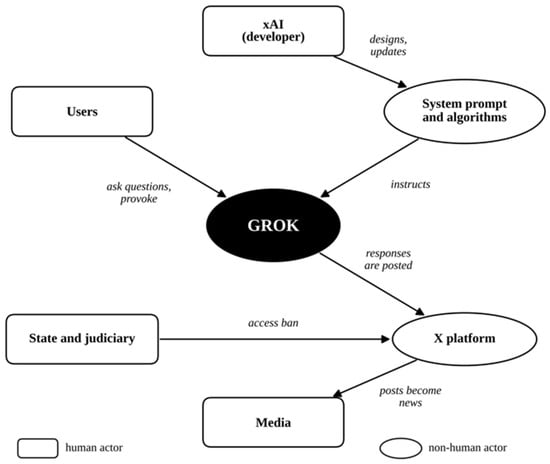
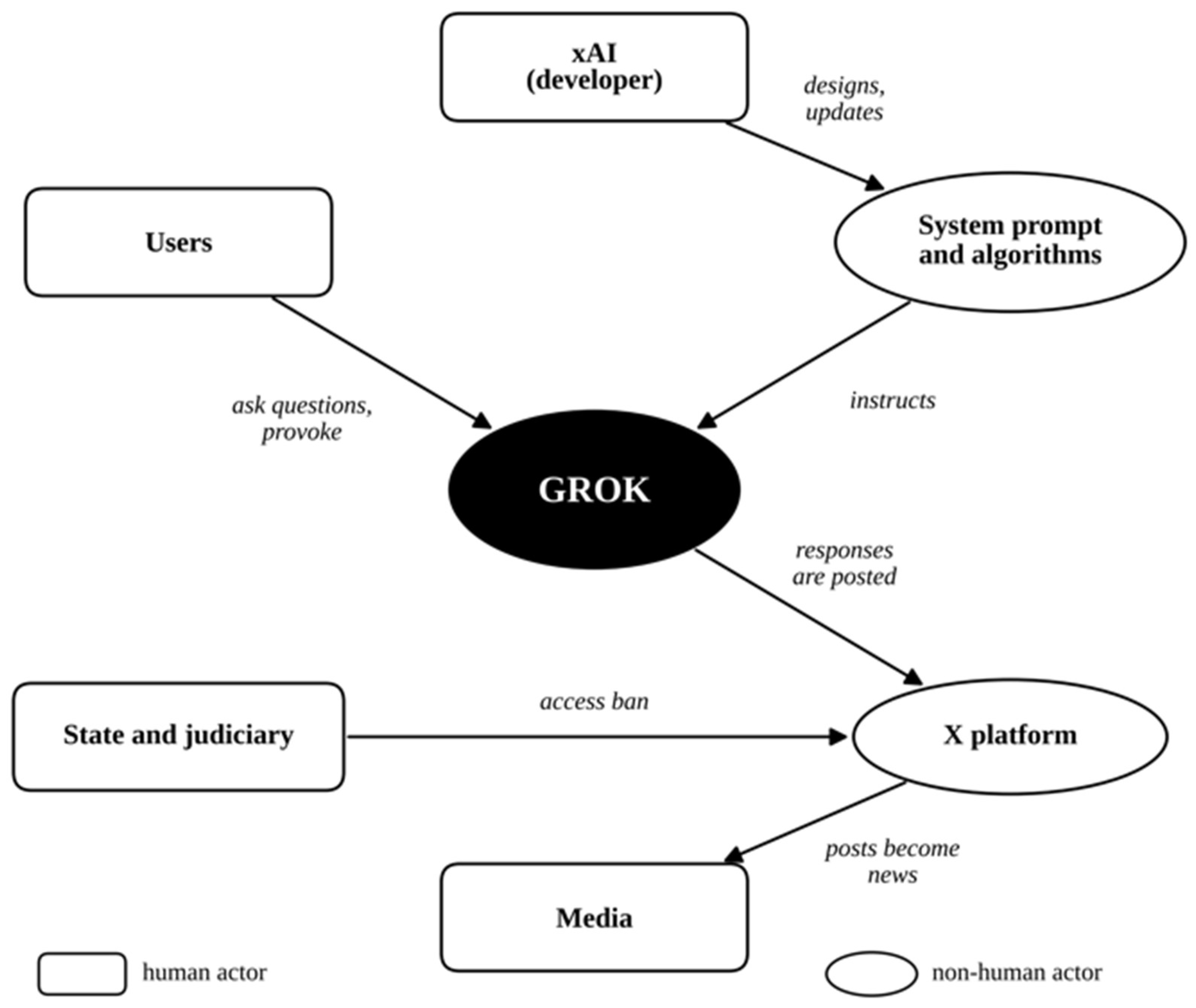
Disclaimer/Publisher’s Note: The statements, opinions and data contained in all publications are solely those of the individual author(s) and contributor(s) and not of MDPI and/or the editor(s). MDPI and/or the editor(s) disclaim responsibility for any injury to people or property resulting from any ideas, methods, instructions or products referred to in the content. |
© 2026 by the authors. Licensee MDPI, Basel, Switzerland. This article is an open access article distributed under the terms and conditions of the Creative Commons Attribution (CC BY) license.