


Abstract
There is an association between frequent Accident and Emergency (A&E) hospital attendances—high-intensity service use—and contact with the justice system. This paper addresses the lack of evidence regarding the scale and nature of high-intensity service use in a prison context, including while people are in prison and before and after prison. Using 2023/24 Emergency Care Data, we looked at A&E attendances for 16,384 people in prison in England. While in prison, 698 people (4.3%) attended A&E five or more times over a year, meeting the criteria for high-intensity service use, with attendances commonly due to chest pain, seizure or self-injurious behaviour. A total of 5227 people (32%) attended A&E in and out of prison in the same year, with nearly 1 in 4 (n = 1282) attending five or more times outside of prison. There is a need for mechanisms to enable identification and support for high-intensity service use in a prison context. This may include facilitating data linkage, developing prison-specific services and/or enabling routes of access for community services to operate within prisons. Effective management of high-intensity use in a prison context would have the dual benefits of reducing inappropriate use of urgent care services both in and out of prison.
1. Introduction
People in prison are identified as being at an increased risk of poor health in addition to having poorer access to, and experiences of, healthcare (NHS England n.d.-b). A review of ‘natural’ and other ‘non-natural’ deaths in prisons across England and Wales reported an average age of death of 67.5 years, compared to 86.7 years in the general population (NCEPOD 2024). The Chief Medical Officer’s report (2025) regarding the health of people in prison in England and on probation provides comprehensive coverage of the history of prison health and care arrangements and the challenges addressing high levels of communicable and non-communicable diseases in overcrowded environments in addition to significant mental health needs (Chief Medical Officer 2025).
Although it is acknowledged that people in prison have high unmet health needs, there is a lack of basic data available about the scale of healthcare needs in the England and Wales prison estate. There are limited national prevalence estimates for a range of long-term health conditions in prison and an inability to link health and justice data impacts to effectively analyze healthcare data and inform service provision in prison (Chief Medical Officer 2025).
Despite uncertainty regarding the scale of healthcare needs, there is clear evidence that healthcare demand in prison is driven by the ongoing challenges of managing high levels of poor mental health, drug and alcohol misuse and violence and self-harm. A systematic review and meta-analysis of the prevalence of severe mental illness including 558,8383 people in prison across 43 countries over five decades reported a pooled prevalence of depression of 12.8% and psychosis of 4.1%, indicating at least one in seven people in prison have a severe mental illness (Emilian et al. 2025). These issues directly impact the health of those in prison and have wider implications for healthcare delivery. The annual report of HM Chief Inspector of Prisons for England in Wales (HM Inspectorate of Prisons 2026) highlights that the availability of illicit drugs in prison generates significant healthcare demand and responding to crisis situations diverts staff from managing routine healthcare issues. In 2025/2026, across inspection reports, 41% of men said it was easy to obtain drugs in prison. It is also generally accepted that people in prison are more likely to experience poor mental health than the general population, with the prevalence of depression estimated to be double the rate seen outside of prison and psychoses estimated to be four times higher (Chief Medical Officer 2025).
Healthcare for people in prison in England currently falls under the responsibility of NHS England and based on the underlying principle of ‘equivalence’ of care between prison and the community, people in prison should have access to the range and quality of health services available to those in community with the aim being to achieve equitable health outcomes (HM Government and NHS 2019). Despite the aspiration for equivalence, operational challenges such as staff availability impact access to services in prison (Ismail and De Viggiani 2018) and it has been argued that there has been too much emphasis placed on the equivalence of processes rather than health outcomes (Charles and Draper 2012).
Hutchings and Davies (2021) provided an overview of healthcare commissioning arrangements in prisons in England and the range of healthcare services people in prison should have access to. There is some access to healthcare on site in prisons, including primary care and mental health services, but exactly how services are organized and the nature of what is available differ between prisons. People can also be escorted to leave prison if hospital care is required. This may include inpatient and outpatient care or Accident and Emergency (A&E) healthcare. There is limited publicly available data regarding prisoners’ use of hospital services, but research studies have highlighted that people in prison face challenges in accessing hospital care, with 40% of outpatient appointments missed year on year (Davies et al. 2020; Health Services Safety Investigation Body 2024). The Ministry of Justice and HM Prison and Probation Service (2026b) publish limited data regarding the number of self-harm incidents that require hospital attendance, noting that the numbers are a reflection of not just severity but also of the availability of appropriate healthcare provision across prisons. There were 3013 self-harm incidents reported in the Safer Custody Statistics as requiring hospital attendance between March 2025 and March 2026. These data are not directly comparable with hospital data due to coding differences.
In the general population, A&E services are under increasing pressure resulting from frequent use and extended waiting times. Demand for services continues to rise, with a 22% increase in A&E attendance between 2015/16 and 2025/26 to just under 28 million visits a year (National Health Service (NHS) England 2026). In February 2026, a third of all admitted cases waited more than 12 h between arrival and subsequent admission (Scobie and Bagri 2026). Despite poor patient experience, some people use A&E services frequently, which such attendances referred to as ‘high-intensity use’. British Red Cross research estimated that 1% of England’s population account for 16% of A&E attendances at a cost to the NHS of £2.5bn a year (British Red Cross 2021). High-intensity use occurs for many reasons but the British Red Cross highlight having spent time in prison as a key risk factor, with people at risk at particular times, such as on release, due to a lack of care continuity. Many of the other risk factors for high-intensity use, such as drug and alcohol misuse, mental health challenges, and experiences of violence and abuse, overlap with contact with the justice system.
Despite the noted association between high-intensity use of A&E services and past experience in prison, missing from the evidence base is an understanding of the extent to which people currently in prison are frequent users of A&E services. This work aims to address the gap in data regarding high-intensity service use in a prison context, by utilizing routinely collected hospital data to describe the extent to which people in prison regularly attend A&E and the reasons why.
2. Materials and Methods
2.1. Data
Pseudonymized records of people who attended Accident and Emergency (A&E) from a prison address in England between 1 April 2023 and 31 March 2024 were extracted from the Emergency Care Data Set (ECDS). The ECDS is England’s national data set for urgent or emergency care.
Prison-linked A&E activity was identified within ECDS data based on the presence of an associated prison postcode, based on an established methodology (See Davies et al. 2020). The researchers provided NHS England with a list of prison postcodes and a numerical identifier for each prison. Using this information, NHS England were able to provide unique ECDS record identifiers (RECORD_IDENTIFIER) for activity linked to a prison estate address, as well as the accompanying numerical identifiers to indicate the prison each activity was associated with. This enabled the creation of a minimized ECDS data file containing just the records for patients who had prison-linked A&E attendance during the analysis period (Davies and Julian 2026).
2.2. Study Population
The study population was people who attended A&E while recorded as living at a prison address in England in 2023/24. While the prison estate covers both England and Wales, healthcare is a devolved responsibility, with health data stored separately, and therefore this work focuses on A&E hospital attendances from prisons in England only. On 30 June 2023 there were 78,713 people living in the prison estate in England, across 117 locations, which included prisons and young offender institutions (Ministry of Justice and HM Prison and Probation Service 2023).
2.3. Defining High-Intensity Service Use
This work considers two distinct contexts in which high-intensity service use may occur, the first being when people are in prison and attend A&E. There is no universally accepted definition of the number of A&E attendances that equate to high-intensity service use, but NHS England describes this as five or more attendances in one month, or 20 or more over the course of a year (NHS England n.d.-a). Work by the British Red Cross used a lower threshold of five or more attendances over one year (British Red Cross 2021). Within this work we adopted the same definition. This decision was made on the basis that attending A&E while in prison is more difficult than in the community as people in prison are reliant on being escorted by prison staff.
Secondly, the work goes on to consider A&E attendances outside of prison, including people who attended A&E at least once while in prison in 2023/24 and went to A&E outside of prison within the same year. This could have been before prison, after prison or between two prison stays. Analysis was not carried out to distinguish between pre- and post-prison A&E activity because some people had multiple stays in prison within the same year and therefore it is not necessarily clear that activity was uniquely pre or post prison.
2.4. Statistical Analysis
Data analysis was conducted using SAS V.9.4. Descriptive statistics were calculated to identify the chief complaint of people in prison who attended A&E five or more times over the course of the year. Sample size limitations meant that it was not feasible to provide a breakdown of high-intensity service users’ chief complaints by sex. This is considered further in the Limitations section.
To learn more about high-intensity use of A&E before or after prison, and why the highest users of A&E were attending, descriptive analysis was conducted to consider the chief complaint reported for those who attended 20 times or more times.
This work was part of a wider study utilizing routinely collected hospital data to explore the use of A&E services by people in prison (see Davies and Julian 2026).
3. Results
There were over 27,000 A&E attendances from people in prison in 2023/24. Table 1 provides a breakdown of the demographics of people in prison who attended A&E. Most attendances (93%) were by men, which is in line with the broader profile of the prison population, but women attended proportionally more than would be expected, making up just 4% (Ministry of Justice and HM Prison and Probation Service 2026a) of the overall prisoner population but accounting for 9% of A&E attendances. A&E attendances by age group are broadly in line with the age profile of the prison population (see Ministry of Justice and HM Prison and Probation Service (2023) Offender Management statistics quarterly: January to March 2023).
Table 1.
A&E attendances by people in prison, 2023/24.
Table 2 shows the number of A&E attendances from prison per person in 2023/24. In total, 16,384 people attended A&E over the course of the year, with 30% (n = 4963) attending more than once. A total of 4.4% (n = 719) attended five or more times, meeting the criteria set for high-intensity service use. Attendances by this group made up 22% of all A&E attendances from prison.
Table 2.
Number of A&E attendances per person by people in prison, and overall number of attendances, 2023/24.
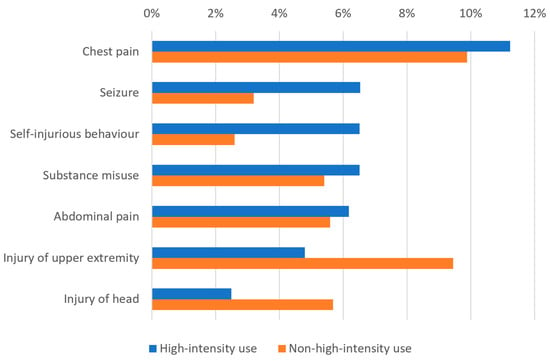
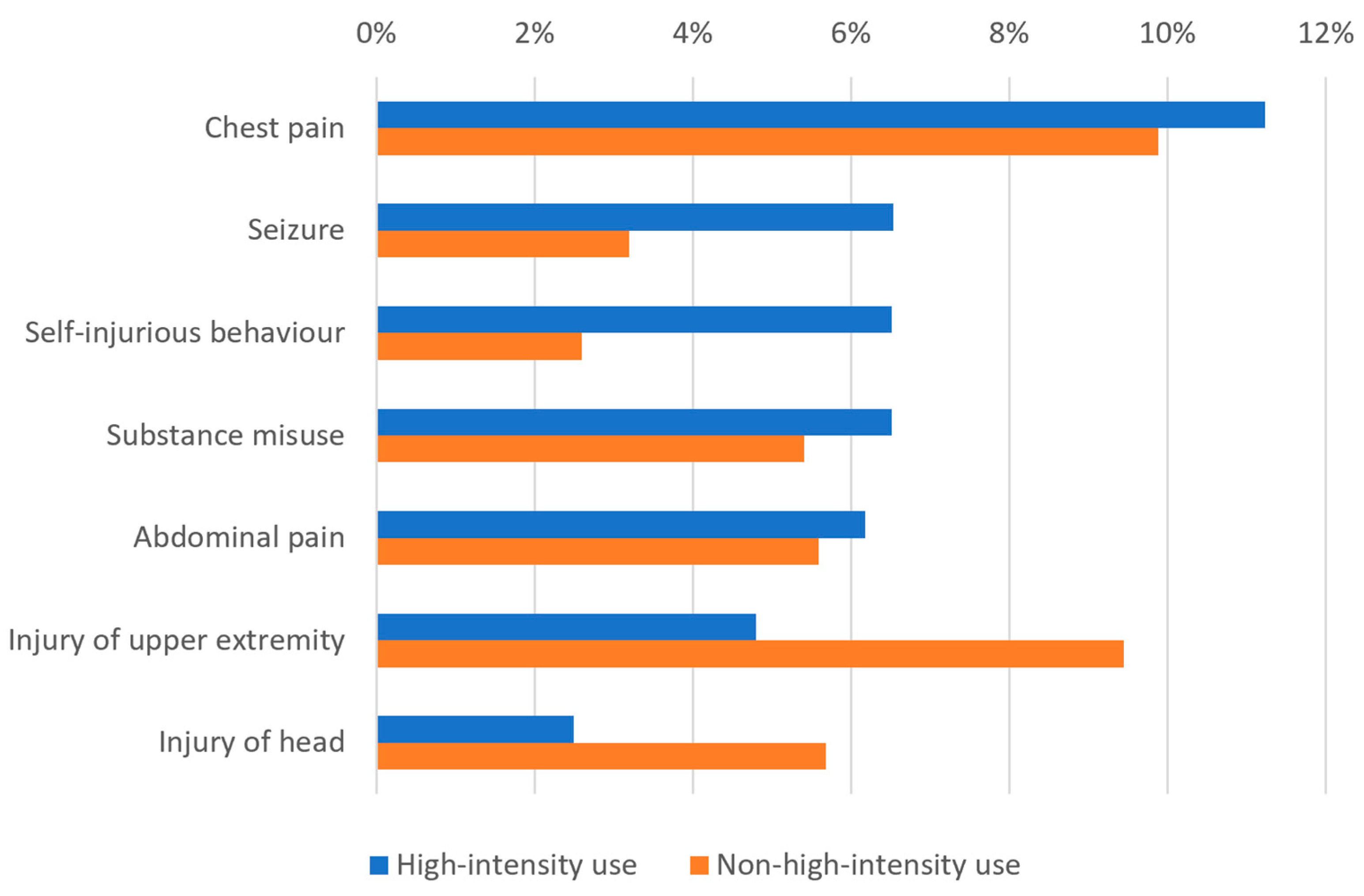
Figure 1 compares the chief complaint recorded for people who attended A&E from prison and met the criteria for high-intensity service use compared to those who attended less frequently (less than five attendances). For those who attended A&E regularly from prison, the most common reasons for attendance were chest pain, seizure or self-injurious behaviour. This differed from those who attended less frequently, where injury of upper extremity or injury of the head were more common. Important context when considering high-intensity service use and A&E attendances due to self-injurious behaviour is the high rates of self-harm in prison, particularly for women. In the year leading up to March 2026, there were 16.6 incidents of self-harm per woman who self-harmed in prison, and 4.2 per man who self-harmed (Ministry of Justice and HM Prison and Probation Service 2026b), although not all instances of self-harm in prison result in hospital attendance.
Figure 1.
Chief complaint reported for prisoners attending A&E: those who attended five or more times a year (high-intensity service use) versus those who attended less than five times a year (non-high-intensity service use), 2023/24.
Frequent A&E Attendance Outside of Prison
Table 3 provides a breakdown of high-intensity service use in and out of prison for those who attended A&E at least once while in prison. Even among those who attended A&E but not at a frequency which met the threshold for high-intensity service use, 32% attended A&E at least once outside of prison.
Table 3.
High-intensity service use in and out of prison, 2023/24.
There were 5227 people who attended while both in and out of prison in the same year in 2023/24. Table 4 provides a breakdown of the frequency of attendance for this group both in and out of prison. In total, 1 in 4 of those who attended A&E outside of prison attended five or more times, meeting the criteria for high-intensity service use. While in prison, for the same group, 65% (n = 3420) attended just once.
Table 4.
A&E attendances per person outside of prison, for those who also attended A&E while in prison in 2023/24.
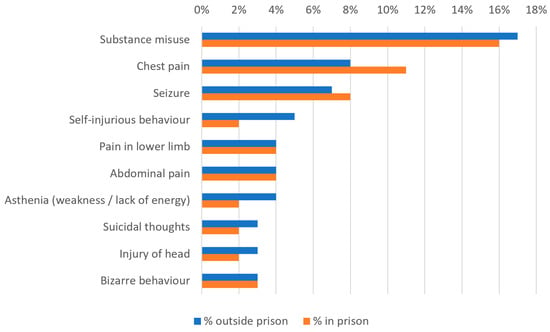
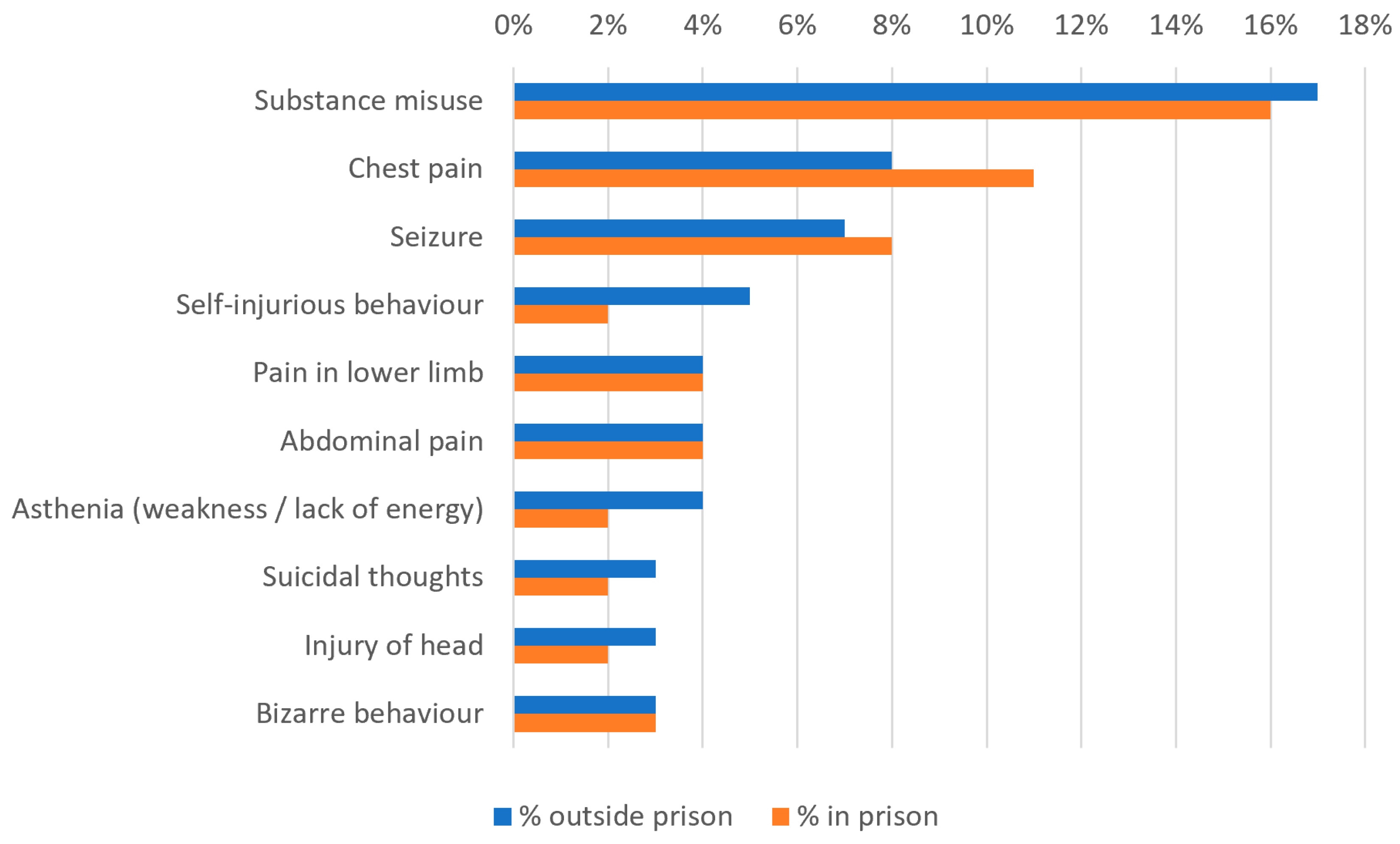
Figure 2 shows the most common reasons for attending A&E outside of prison for the most frequent users—those with 20 or more attendances (n = 202)—with reasons for attendances for the same group while in prison provided as a point of comparison. The most common reason for attending A&E outside of prison was substance misuse, chest pain or seizure, with attendances due to substance misuse also representing the greatest proportion of attendances while in prison.
Figure 2.
Chief complaints reported for high-intensity use (20+ times) outside of prison attending A&E, compared to the same population in prison (at least one attendance), 2023/24.
4. Discussion
High-intensity service use has a practical and human cost. While the British Red Cross (2021) estimate that the cost of all high-intensity service use to the NHS is approximately £2.5 billion pounds a year, for patients, this reflects multiple missed opportunities to address unmet needs. This paper provides new evidence on the scale of high-intensity service use in a prison context. While previous commentary highlighted that contact with the justice system is common for those who use A&E services frequently, the number of people who attend A&E regularly while in prison, and what drives high-intensity service use, has not been quantified. In total, 30% of those who attended A&E while in prison in England in 2023/24 attended more than once, and 4% attended five or more times over a 12-month period. This is despite the logistical difficulties of attending A&E while in prison due to the necessity of a prison officer escort. We found no evidence of current services that exist to reduce frequent use of A&E services from prison in terms of either prison-specific services, or community services that can operate within the remit of prisons.
The findings also highlight a less visible impact of the challenge of managing substance misuse in prison, which was the chief complaint accompanying 17% of A&E attendances for the highest users outside of prison (those with 20 or more attendances). For people in contact with the justice system, there can be a lack of trust in healthcare providers based on past experiences of discrimination and stigma that drive urgent healthcare attendances versus use of other services (Vandergrift and Christopher 2021). For this group, substance misuse also drives A&E attendances in prison. This aligns with wider research evidence from the general population that substance misuse drives high-intensity use. An evaluation in Norfolk of high-intensity use of 1705 patients between 2022 and 2025 noted that substance or alcohol use was a high area of need for patients (Butcher and Pugh 2025).
4.1. Implications for the Future of Prisons
In the future, A&E will continue to remain a necessary route to healthcare for people in prison who require urgent care but identifying and addressing high-intensity service is important to reduce avoidable hospital attendances. Central to this is ensuring appropriate access to healthcare in prison. Research exploring cancer diagnosis and treatment in prison highlights that people face practical barriers to diagnosis, with low literacy levels being an example of one factor causing difficulties for some people navigating the triage process to access the care they need (Armes et al. 2024). An analysis of patient safety incidents involving prisoners found that just under one-sixth of incidents related to delays accessing healthcare (McFadzean et al. 2026).
It is vital to acknowledge and address the gap that exists in the support of high-intensity service use in a prison context. Currently, high-intensity service providers in the community should be aware of patients within prison settings who meet the criteria for high-intensity service use, but crucially we could find no evidence either of people in prison being supported by these services or tailored services operating under prison health oversight. This may be the result of no clear routes of access for community services to operate within prisons, or a lack of clarity regarding responsibility for management in these instances, with it being seen as a solely prison health issue. Further research is required to establish effective solutions.
Finding and disposing of contraband in prison will also continue to be a priority, as one route to managing high-intensity service use associated with substance misuse. The 2019 Security Investment Programme set out to establish X-ray body scanners in adult male prisons across the closed estate (Ministry of Justice 2021), but staffing challenges mean X-ray scanners are not always used consistently (The Telegraph 2024).
This work highlights the importance of facilitating clear routes to utilizing data to identify the drivers of high-intensity A&E use in prison settings. Self-injurious behaviour was one of the most common reasons for high-intensity use of A&E, and the data is therefore a powerful source of evidence regarding the need for mental health support in prison. High-intensity use data is important to support the delivery of care in prison and to improve understanding of needs in order to develop services and evaluate solutions. In the longer term, effective decision-making regarding health service organization within criminal justice settings requires longstanding data linkage challenges to be overcome. Data is currently held in silos, which restrict usage. This issue was raised in the Chief Medical Officer’s (2025) report on prison health and healthcare, which recommended utilization of the NHS number as a unique identifier to facilitate linkage between data sets.
Prisons are likely to continue to be impacted by substance misuse both in terms of its role in driving healthcare need and the part it plays in driving poor day-to-day living conditions within prisons. A whole-system approach to managing substance misuse is required as the findings clearly highlight the overlap between high-intensity service use in and out of prison driven by substance use. Given the challenges of managing substance misuse in prison, particularly for those on short sentences, alternatives to prison where people receive treatment for substance misuse as part of a community order or suspended sentence may play an important future role. The Ministry of Justice Independent Sentencing Review recommended increasing investment in options for Community Sentence Treatment requirements as a route to achieving this (Ministry of Justice 2024).
4.2. Limitations
It would be valuable to explore the breakdown of high-intensity service use in prison by demographic characteristics such as age, gender, ethnicity and their intersections but this was not feasible within one year of data (2023/24) due to sample size limitations. Future research would benefit from examining the scale of high-intensity use of A&E from prisons in England over a longer time frame to increase the sample size.
5. Conclusions
This work highlights that people in prison can be frequent users of A&E services and that there is currently a gap in health service provision to meet the needs of this group. The work also provides clear evidence that failure to address high-intensity use in prison has wider implications on health services. Those who use A&E in prison are likely to be frequent users of A&E outside of prison. As such, effective management of high-intensity service use in prison would have the dual benefit of reducing inappropriate use of urgent care services both in prison and out of prison.
Author Contributions
Conceptualization, M.D. and S.J.; methodology, M.D. and S.J.; validation, M.D. and S.J.; formal analysis, M.D. and S.J.; data curation, M.D. and S.J.; writing—original draft preparation, M.D. and S.J.; writing—review and editing, M.D. and S.J. All authors have read and agreed to the published version of the manuscript.
Funding
This research received no external funding.
Institutional Review Board Statement
Not applicable.
Informed Consent Statement
Not applicable.
Data Availability Statement
Restrictions apply to the availability of these data. Data was supplied securely by NHS England under a Data Sharing Agreement.
Acknowledgments
We would like to thank Fiona Butcher (Commissioning Manager—Community and VCSE) for advice and guidance regarding high-intensity service use during the research and feedback on the emerging findings.
Conflicts of Interest
The authors declare no conflicts of interest.
Abbreviations
The following abbreviations are used in this manuscript:
| A&E | Accident and Emergency |
| ECDS | Emergency Care Data Set |
References
- Armes, Jo, Renske Visser, Margreet Lüchtenborg, Jennie Huynh, Sue Wheatcroft, Anthony X, Alyce-Ellen Barber, Emma Plugge, Rachel M. Taylor, Rachael Maree Hunter, and et al. 2024. Cancer in prison: Barriers and enablers to diagnosis and treatment. eClinicalMedicine 72: 102540. [Google Scholar] [CrossRef] [Scilit] [PubMed]
- British Red Cross. 2021. Nowhere Else to Turn. Exploring the High-Intensity Use of Accident and Emergency Services. Available online: https://www.redcross.org.uk/about-us/what-we-do/we-speak-up-for-change/exploring-the-high-intensity-use-of-accident-and-emergency-services (accessed on 20 October 2026).
- Butcher, Fiona, and Paul Pugh. 2025. Bridging the Gap: How HIU Services Address Health Inequalities in Urgent Care. Norwich: Norfolk and Waveney Integrated Care Board. [Google Scholar]
- Charles, Anna, and Heather Draper. 2012. “Equivalence of care” in prison medicine: Is equivalence of process the right measure of equity? Journal of Medical Ethics 38: 215–18. [Google Scholar] [CrossRef] [Scilit] [PubMed]
- Chief Medical Officer. 2025. The Health of People in Prison, on Probation and in the Secure NHS Estate in England. Available online: https://www.gov.uk/government/publications/the-health-of-people-in-prison-on-probation-and-in-the-secure-nhs-estate-in-england (accessed on 20 October 2026).
- Davies, Miranda, and Sophie Julian. 2026. What’s the Emergency When Prisoners Go to A&E? Emergency Hospital Attendances by People in Prisons in England. Research Report. London: Nuffield Trust. [Google Scholar]
- Davies, Miranda, Lucina Rolewicz, Laura Schlepper, and Femi Fagunwa. 2020. Locked Out? Prisoners’ Use of Hospital Care. Research Report. London: Nuffield Trust. [Google Scholar]
- Emilian, Christina, Noura Al-Juffali, and Seena Fazel. 2025. Prevalence of severe mental illness among people in prison across 43 countries: A systematic review and meta-analysis. The Lancet Public Health 10: e97–e110. [Google Scholar] [CrossRef] [Scilit] [PubMed]
- Health Services Safety Investigation Body. 2024. Healthcare Provision in Prisons: Continuity of Care. Available online: https://www.hssib.org.uk/patient-safety-investigations/healthcare-provision-in-prisons/second-investigation-report/ (accessed on 20 October 2026).
- HM Government, and NHS. 2019. National Prison Healthcare Board Principle of Equivalence of Care for Prison Healthcare in England. Available online: https://assets.publishing.service.gov.uk/government/uploads/system/uploads/attachment_data/file/837882/NPHB_Equivalence_of_Care_principle.pdf (accessed on 20 October 2026).
- HM Inspectorate of Prisons. 2026. HM Chief Inspector of Prisons for England and Wales Annual Report 2025–26 HC 432. Available online: https://www.gov.uk/government/publications/hm-chief-inspector-of-prisons-annual-report-2025-to-2026--2 (accessed on 20 October 2026).
- Hutchings, Rachel, and Miranda Davies. 2021. How Prison Health Care in England Works. London: Nuffield Trust. [Google Scholar]
- Ismail, Nasrul, and Nick De Viggiani. 2018. How do policymakers interpret and implement the principle of equivalence with regard to prison health? A qualitative study among key policymakers in England. Journal of Medical Ethics 44: 746–50. [Google Scholar] [CrossRef] [Scilit] [PubMed]
- McFadzean, Isobel J., Lauren Donovan, Thomas Hewson, Jake Hard, Jenny Shaw, Adrian Edwards, and Andrew Carson-Stevens. 2026. Critical illness in prisons: A multi-methods analysis of reported healthcare safety incidents in England. British Journal of General Practice 76: e244–52. [Google Scholar] [CrossRef] [Scilit] [PubMed]
- Ministry of Justice. 2021. Prison Security Investment Programme: X-ray Body Scanners Ad Hoc Management Information. Available online: https://www.gov.uk/government/statistics/prison-security-investment-programme-x-ray-body-scanner-management-information (accessed on 20 October 2026).
- Ministry of Justice. 2024. Independent Sentencing Review Final Report and Proposals for Reform. Available online: https://www.gov.uk/government/publications/independent-sentencing-review-final-report (accessed on 20 October 2026).
- Ministry of Justice, and HM Prison and Probation Service. 2023. Offender Management Statistics Quarterly: January to March 2023. Available online: https://www.gov.uk/government/statistics/offender-management-statistics-quarterly-january-to-march-2023 (accessed on 20 October 2026).
- Ministry of Justice, and HM Prison and Probation Service. 2026a. Offender Management Statistics Quarterly: October to December 2025. Prison Population: 31 March 2026. Available online: https://www.gov.uk/government/statistics/offender-management-statistics-quarterly-october-to-december-2025 (accessed on 20 October 2026).
- Ministry of Justice, and HM Prison and Probation Service. 2026b. Safety in Custody Statistics, England and Wales: Deaths in Prison Custody to June 2026 Assaults and Self-harm to March 2026. Available online: https://www.gov.uk/government/statistics/safety-in-custody-quarterly-update-to-june-2026/safety-in-custody-statistics-england-and-wales-deaths-in-prison-custody-to-september-2026-assaults-and-self-harm-to-june-2026 (accessed on 20 October 2026).
- National Health Service (NHS) England. 2026. A&E Attendances and Emergency Admissions. Available online: https://www.england.nhs.uk/statistics/statistical-work-areas/ae-waiting-times-and-activity/ (accessed on 20 October 2026).
- NCEPOD. 2024. The National Confidential Enquiry into Patient Outcome and Death. ‘Inside Prison Healthcare’ 2024. London: NCEPOD. Available online: https://www.ncepod.org.uk/2024prisonhealthcare/Inside%20Healthcare_full%20report.pdf (accessed on 20 October 2026).
- NHS England. n.d.-a. High Intensity Use Programme. Available online: https://www.england.nhs.uk/high-intensity-use-programme/ (accessed on 20 October 2026).
- NHS England. n.d.-b. Inclusion Health Groups. Available online: https://www.england.nhs.uk/about/equality/equality-hub/national-healthcare-inequalities-improvement-programme/what-are-healthcare-inequalities/inclusion-health-groups/ (accessed on 20 October 2026).
- Scobie, Sarah, and Stuti Bagri. 2026. Long Waits for a Hospital Bed in an Emergency: Will Urgent Care Policies Make a Difference for Patients? London: Nuffield Trust. [Google Scholar]
- The Telegraph. 2024. X-ray Scanners ‘Fail to Keep Drugs Out of Jails Because of Staff Shortages’. Available online: https://www.telegraph.co.uk/news/2024/09/08/prison-xray-drug-scanners-fail-staff-shortages/ (accessed on 20 October 2026).
- Vandergrift, Lindsey A., and Paul P. Christopher. 2021. Do prisoners trust the healthcare system? Health Justice 9: 15. [Google Scholar] [CrossRef] [Scilit] [PubMed]

Disclaimer/Publisher’s Note: The statements, opinions and data contained in all publications are solely those of the individual author(s) and contributor(s) and not of MDPI and/or the editor(s). MDPI and/or the editor(s) disclaim responsibility for any injury to people or property resulting from any ideas, methods, instructions or products referred to in the content. |
© 2026 by the authors. Licensee MDPI, Basel, Switzerland. This article is an open access article distributed under the terms and conditions of the Creative Commons Attribution (CC BY) license.