


Abstract
Pain during the menopausal transition can be normalized, minimized or attributed prematurely, including to stress or psychological distress, raising questions of patient credibility and possible sex- and gender-related bias in clinical interpretation. This scoping review mapped pain recognition, attribution, assessment and care during the transition, interpreting the evidence primarily through a lens of patient credibility and gender bias, with mental-health-informed and interdisciplinary implications considered alongside. The protocol was deposited on the Open Science Framework. Following JBI guidance and PRISMA-ScR, two human reviewers independently screened records from eight databases searched from inception to 30 June 2026; final decisions were concordant. Data were charted and analysed using hybrid deductive–inductive descriptive qualitative content analysis. Of 8938 records, 4856 were screened, 43 reports assessed and 21 sources of evidence included, representing 23 studies. Most evidence was qualitative (n = 15), and pain was usually secondary or incidental. Musculoskeletal pain (n = 12), headache or migraine (n = 9), and sexual or genitourinary pain (n = 5) predominated. Six categories addressed recognition and attribution, normalization and legitimacy, clinical response, delay and misframing, inequality, and transferable implications for mental-health-informed interdisciplinary care. The evidence identifies the risks of both diagnostic omission and premature attribution but cannot show that all pain is menopause-related, quantify diagnostic bias or delay, or establish epistemic injustice as a mechanism. Assessment should include psychological wellbeing without allowing distress, a mental-health label, or an assumption about reduced credibility to substitute for physical differential diagnosis, referral and follow-up. No included study primarily examined mental-health services or tested a mental-health-specific intervention.
1. Introduction
Pain is a frequent and clinically important concern during midlife. Longitudinal evidence indicates that overall bodily pain can increase around the final menstrual period, while musculoskeletal, back, joint and knee pain may become more common or severe across later reproductive stages (Huang et al. 2024; Lee et al. 2017). Pain occurs within a wider constellation of vasomotor, sleep, psychological and urogenital changes whose trajectories are interrelated but not uniformly attributable to reproductive ageing (El Khoudary et al. 2019; Freeman et al. 2007). Systematic reviews document a substantial burden of musculoskeletal pain while also showing heterogeneous staging and limited characterization of specific pain conditions (Kruse et al. 2026; Lu et al. 2020). Prevalence, however, does not explain how pain is understood when a person seeks care.
Clinical interpretation can range from a structured differential diagnosis to attribution to expected hormonal change, ageing, stress, psychological distress or an established comorbidity. None of these explanations are inherently incorrect, and psychological assessment may be an important part of safe pain care. Problems arise when any attribution becomes an untested default, closes diagnostic reasoning prematurely, minimizes the reported experience or leaves no plan for reassessment. Wider pain-care research shows that sex- and gender-related expectations can influence pain estimation, documentation and treatment decisions (Guzikevits et al. 2024; Samulowitz et al. 2018). Experimental work also suggests that a depression label can alter observers’ causal attributions and judgements of pain genuineness (Turcotte and Holtzman 2024). These findings make transition-specific inquiry plausible, but they do not demonstrate bias in menopause care.
Evidence relevant to the question is dispersed. Menopause-care studies describe limited recognition of less familiar symptoms, constrained consultation options, culturally mediated help-seeking and the work required to advocate for care (MacLellan et al. 2023). The broader chronic-pain literature similarly documents the effort women expend to be treated as credible (Werner and Malterud 2003). Pain may therefore appear inside qualitative accounts, health-service studies, dissertations, diagnostic-delay narratives and work on sex and gender rather than in records indexed under a single menopause-and-pain label.
Pain and mental health are clinically intertwined. Pain may coexist with sleep disturbance, anxiety, low mood, cognitive complaints and distress during the menopausal transition, but co-occurrence does not establish that pain is psychogenic (Freeman et al. 2007). A mental-health-informed approach therefore has two responsibilities: to assess psychological wellbeing and psychosocial context, and to avoid using either as a substitute for physical assessment. This distinction is relevant across mental health, primary care, gynaecology, pain services, rehabilitation and community care, because credibility, explanatory language and referral decisions can either preserve or prematurely narrow diagnostic possibilities.
The Stages of Reproductive Aging Workshop + 10 framework distinguishes the menopausal transition from early postmenopause using menstrual-cycle and endocrine criteria (Harlow et al. 2012). Primary evidence nevertheless uses self-reported status, broad age bands, retrospective descriptions and mixed peri-, meno- and postmenopausal samples. This heterogeneity can obscure whether a pain account is transition-specific and requires explicit charting rather than assumption.
Existing syntheses are adjacent to the present question. Reviews have examined the occurrence and manifestations of musculoskeletal pain (Kruse et al. 2026; Lu et al. 2020) and healthcare-provider gender bias in musculoskeletal pain management across populations (Wilford et al. 2026). The present review instead maps the clinical meaning assigned to pain during the menopausal transition across pain sites, with particular attention to psychological attribution, credibility and diagnostic openness; it remains neutral about whether any individual attribution constitutes bias.
A scoping approach was selected because the literature is methodologically and conceptually heterogeneous and the purpose is to clarify definitions, sources, contexts and gaps rather than estimate a pooled effect. The review maps empirical evidence about recognition, attribution and care pathways and interprets that evidence through a mental-health-informed, interdisciplinary lens.
1.1. Aim
The aim of this review is to map evidence on how pain experienced during the menopausal transition is recognized, labelled and diagnostically attributed in healthcare, with particular attention to patient credibility, possible sex- and gender-related bias, psychological attribution, and implications for mental-health-informed interdisciplinary care.
1.2. Objectives
The objectives of this study are as follows:
Characterize the evidence by pain presentation, menopausal-stage definition, population, study design and healthcare context.
Synthesize how pain was recognized, attributed and responded to, including accounts of normalization, credibility, dismissal, diagnostic uncertainty and care pathways, while distinguishing reported experience from directly observed practice.
Identify evidence gaps and implications for credibility-sensitive, mental-health-informed interdisciplinary assessment and care.
1.3. Review Question
What evidence exists on how pain experienced during the menopausal transition is recognized, labelled or diagnostically attributed in healthcare?
2. Materials and Methods
2.1. Design, Protocol and Reporting
This scoping review followed current JBI methodological guidance (Peters et al. 2020). Reporting was informed by the Preferred Reporting Items for Systematic Reviews and Meta-Analyses extension for Scoping Reviews (PRISMA-ScR) and the literature-search extension PRISMA-S (Rethlefsen et al. 2021; Tricco et al. 2018). No meta-analysis was planned or performed.
The protocol was deposited on the Open Science Framework (OSF); the associated project URL is supplied to the Editorial Office and temporarily masked in this manuscript for double-anonymous peer review, and a registration DOI has not yet been issued. Departures from the protocol were reported transparently. Searches were conducted on 16–17 July 2026 rather than the planned 15 August 2026, and covered records through to 30 June 2026 rather than the planned end date of 31 July 2026. Embase, LILACS and the planned grey-literature sources were not executed; institutional access could not be obtained for Embase. The completed review used eight bibliographic databases and citation searching. Data charting was not independently duplicated, and formal critical appraisal was not undertaken. The protocol used the terms ‘thematic content analysis’ and ‘thematic synthesis’; the completed review reports the approach more precisely as hybrid deductive–inductive descriptive qualitative content analysis, consistent with the JBI guidance for scoping reviews. This terminological clarification did not alter eligibility, charted data or the substantive content of the six categories. The protocol’s original framing emphasized a mental-health-informed and interdisciplinary lens; following the completion of charting and analysis, the reporting emphasis was refined to foreground patient credibility and possible sex- and gender-related bias as the primary interpretive lens, with mental-health-informed and interdisciplinary implications retained as a transferable practice dimension. This reframing is a change in interpretive emphasis and did not alter eligibility criteria, charted data, category definitions or category-support counts.
For the revised report, the six previously listed objectives were consolidated into three overarching objectives to improve focus and reduce overlap. This editorial consolidation retained the original review question and all substantive domains; it did not change eligibility criteria, included sources, charted data or the six descriptive categories.
2.2. Eligibility Criteria
Eligibility was defined using the Population, Concept and Context framework (Table 1). Empirical qualitative, quantitative and mixed-methods studies, theses, service evaluations and research reports were eligible. Reviews were used for citation searching but were not charted as evidence sources. Sources in English, Spanish, Portuguese or French were eligible. Records were excluded when they concerned only prevalence, biological mechanisms or treatment effectiveness without evidence about recognition or attribution; when pain was absent from the clinical presentation, assessment, diagnosis or pathway; when menopausal-transition findings were not separable; or when sufficient report information could not be recovered after reasonable attempts.
Table 1.
Population, Concept and Context eligibility framework.
2.3. Information Sources and Search Strategy
Searches were executed on 16–17 July 2026 in PubMed/MEDLINE, ASSIA, Sociological Abstracts, Scopus, Web of Science Core Collection, CINAHL, PsycINFO and ProQuest Dissertations & Theses Global, covering database inception through 30 June 2026. The strategy combined menopausal-transition terms with pain terms and used a complementary recognition/attribution pathway in which pain relevance was assessed during screening. Controlled vocabulary and free-text terms were adapted to each interface. Citation searching identified one additional eligibility report. Full database-specific search strings and publication-date restrictions are reported in Table S1.
The reported database strategies used English-language free-text terms and database-specific controlled vocabulary where specified; they did not include separate Spanish, Portuguese or French term sets. Publication-language eligibility should therefore be distinguished from the language of search terms. No language-restriction clause appears in the reported search strings. Non-English reports could be retrieved when searchable titles, abstracts or subject indexing matched these terms, but this does not establish comprehensive multilingual coverage. The French-language thesis by Houle (1998) was identified in ProQuest Dissertations & Theses Global and its full text was obtained from Library and Archives Canada.
2.4. Record Management and Study Selection
Database exports were consolidated and deduplicated using identifiers and normalized titles, followed by human review of additional duplicate pairs. Two human reviewers independently screened all titles and abstracts and independently assessed potentially eligible reports. Disagreements were to be resolved by discussion and, if necessary, a third reviewer; final decisions were concordant and no third-reviewer adjudication was required. OpenAI Codex did not make, replace or adjudicate any eligibility decision; its role was limited to consistency checks of confirmed denominators and supporting documentation.
2.5. Data Charting and Source Verification
A consolidated charting row was maintained for each of the 21 included sources of evidence. Fields covered bibliographic details, design, recruitment, setting, participants, menopausal-stage definition, pain presentation, point of care, clinical attribution, assessment, referral, time to diagnosis, credibility and dismissal, psychological attribution or psychologization, equity factors, practice relevance, findings, limitations and research gaps. Report-family linkage was performed separately so that multiple reports and multi-study reports did not inflate the study count. The full charting matrix and the report-to-study linkage map were retained and are available from the corresponding author upon reasonable request.
An AI-assisted source audit using OpenAI Codex (OpenAI, San Francisco, CA, USA; interface version not displayed; accessed 18 July 2026) compared the consolidated charting matrix with retained primary reports, primary bibliographic abstracts and documented source records. The audit checked citations, denominators, separation of pain-specific from study-wide findings, and the wording of source limitations. Three sources of evidence remained limited to an abstract or triangulation without the exact target report (Mikhail and Ragheb 1996; Moloney et al. 2006; Tlou 1990). The audit did not constitute duplicate independent human extraction. Both authors reviewed the final matrix and synthesis and retain responsibility for all judgments and reported data.
2.6. Critical Appraisal
No formal risk-of-bias or methodological-quality appraisal was performed because the purpose was to map the extent, characteristics and concepts of the evidence rather than estimate intervention effects or causal associations. Design and source limitations relevant to interpretation were charted and used to qualify the synthesis.
2.7. Data Synthesis
Counts described the 21 included sources of evidence, not participant prevalence and not necessarily 21 unique studies. Publication year, country, design, evidence perspective, pain role, pain type and menopausal-stage specificity were summarized descriptively. Data were analysed using hybrid deductive–inductive descriptive qualitative content analysis. Deductive codes reflected the review question, eligibility concepts and charting domains; codes were refined inductively as recurring patterns and exceptions were identified, then grouped into six review-level descriptive categories. The final category definitions, supporting sources, counterexamples and interpretive boundaries were checked against the source-linked matrix and reviewed by both authors. The synthesis distinguished directly observed practice, professional self-report, patient-reported experience and review-level interpretation. Category-support counts record sources of evidence containing substantive evidence; separately reported gap counts record the absence of a prespecified measurement or analysis. Neither count estimates participant frequency, effect size or certainty. Report–study linkage established a separate denominator of 23 underlying study entities.
2.8. Sex, Gender and Equity
Sex and gender were treated as related but distinct constructs. Source terminology was retained. For the revised report, sample descriptions and sex or gender reporting were audited systematically for the 23 study entities reported in Section 3.3. We distinguished women/female terminology, explicit cisgender identification, broader recruitment wording, and professional samples. Gender identity was recorded as not reported when the available report did not specify it; the terms women or female were not taken to establish cisgender identity. Professional demographics were distinguished from those of the patients whose care was described. Eligibility did not exclude gender-diverse people who experience the menopausal transition, but this inclusive criterion does not establish their representation in the included evidence. Ethnicity, socioeconomic position, migration, language, disability, occupation, sexuality and geography were charted when reported.
2.9. Ethics and Patient and Public Involvement
The review used published or otherwise lawfully accessed sources and did not require research-ethics approval. Patients and members of the public were not directly involved in the conduct of this review. Patient or public involvement reported within included studies was charted when available.
3. Results
3.1. Selection of Evidence Sources
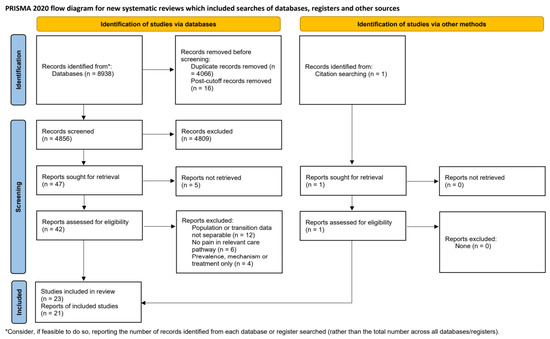
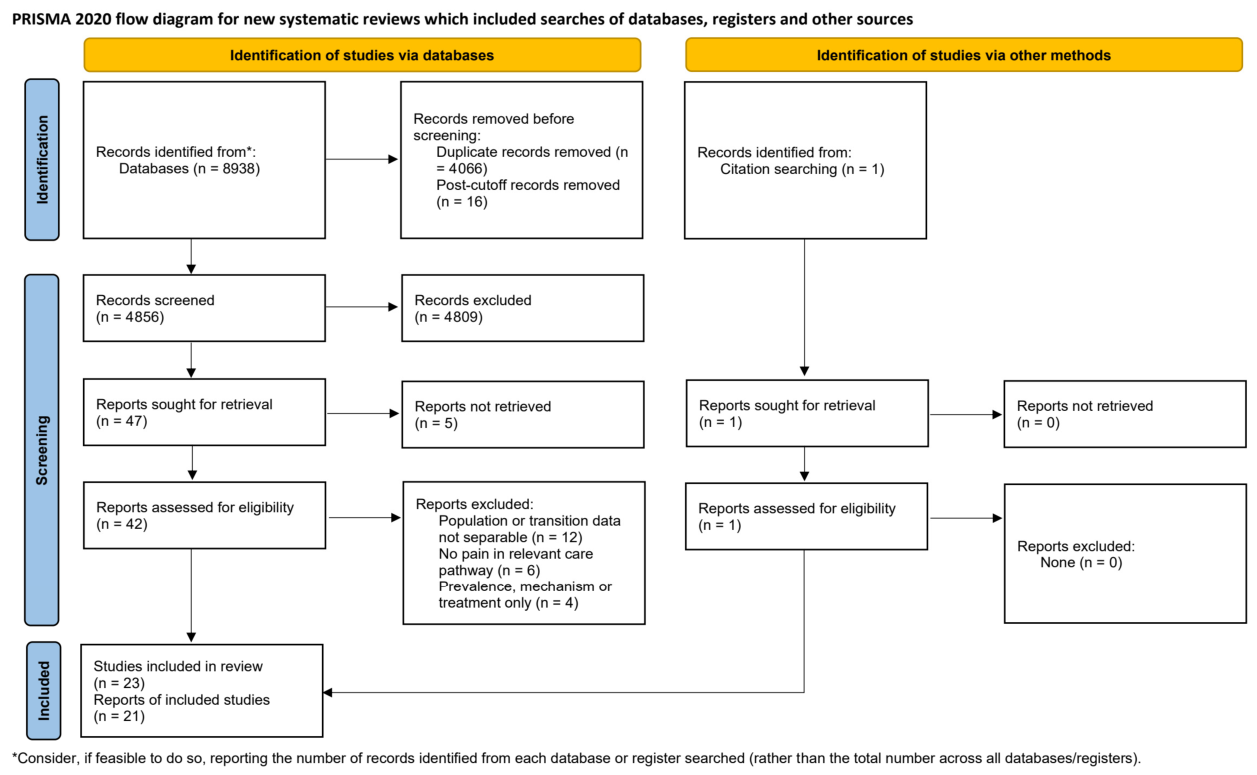
The eight databases yielded 8938 rows. Before title-and-abstract screening, 4082 rows were removed: 16 exceeded the date cut-off, 6 were internal ProQuest Dissertation overlaps, 4012 were exact duplicates, and 48 were additional duplicates confirmed during review. The remaining 4856 records were screened independently by two human reviewers; 4809 were excluded. Forty-seven database-derived records progressed to retrieval, and citation searching contributed one additional eligibility item. Of the 48 items sought, 5 were not retrieved and 43 were assessed. Here, 22 assessed items were excluded: 12 for an ineligible population or non-separable transition data (E1), 6 because pain was absent from the relevant presentation, assessment, diagnosis or care pathway (E2), and 4 because they concerned prevalence, mechanism or treatment without recognition/attribution evidence (E3). Twenty-one sources of evidence were included (Figure 1).
Figure 1.
PRISMA 2020 flow diagram. The post-inclusion linkage audit covered 27 report references: 25 were traceable or documented and 2 cited companion references were not recovered; those 2 references were not eligibility-stage reports. Adapted from Page et al. (2021), licensed under CC BY 4.0.
3.2. Report-to-Study Linkage
The 21 included sources of evidence were not equivalent to 21 studies. A many-to-many linkage audit identified 27 report references representing 23 underlying study entities (Table 2). Twenty-five report references were traceable through a local source, sufficient bibliographic record or documented prior review. Two cited companion references were not recovered and were retained only as linkage markers; they were not counted as additional retrieved or assessed eligibility reports.
Table 2.
Ratified report-family structure and study-unit decisions.
3.3. Characteristics of Included Evidence
The 21 sources of evidence spanned 1984–2026, with 13 published in the 2020s. Six were from the United States and five from the United Kingdom. Nine represented Australia, Botswana, Brazil, Canada, Egypt, Estonia, Guatemala, Japan and Sweden, and country was not reported for one. The distribution indicates geographical breadth but not representativeness.
Of the 21 included sources of evidence, 20 were published in English and 1, the thesis by Houle (1998), was published in French. None were published in Spanish or Portuguese. Publication language was distinguished from the languages used in primary-study interviews or fieldwork.
Qualitative designs dominated (n = 15). Three sources combined qualitative techniques with questionnaires, two were descriptive cross-sectional quantitative studies, and one was a quality-improvement audit using routine electronic health-record data. Fourteen sources relied primarily on patient or participant self-report, four on professional self-report, one on routine quality-improvement data, one on a comparative participant–professional survey, and one on directly observed clinical encounters. Only Houle (1998) directly observed consultations; most claims about clinical response came from recollection or professional description.
Sex and gender reporting varied across the studies (Table 3). Most reports described women or female participants without specifying gender identity. Richardson et al. (2023) used a broader term, people with ovaries, and Solis (2024) specified female sex assigned at birth in recruitment; neither reported a gender-identity distribution demonstrating inclusion of transgender or non-binary participants. Zhou et al. (2025) explicitly described cisgender female clients. No confirmed inclusion of transgender or non-binary participants was identified in the available reports. This is a reporting gap, not evidence that all other participants were cisgender or that gender-diverse people were necessarily excluded. Professional samples and mixed community samples should also not be conflated with patient samples.
Table 3.
Characteristics of the 23 underlying studies represented in the 21 included sources of evidence.
3.4. Pain Presentations and Menopausal-Stage Specificity
Pain was primary or central in 6 sources and secondary or incidental but explicit in 15. Musculoskeletal, joint, muscle or back pain was explicitly coded in 12 sources, headache or migraine in 9, and sexual, genitourinary or dyspareunia-related pain in 5. Abdominal pain appeared in one source, while pain was unspecified or not reported in one. These overlapping source-level counts are not mutually exclusive and cannot be interpreted as symptom prevalence.
Stage specificity was limited. Seven sources used a transition-specific sample or a separable pain account; six mixed peri-, meno- and postmenopausal stages without stage-separated pain findings; four professional or service sources did not record patient stage; and four used broad, retrospective or age-based definitions. Causal or comparative conclusions by menopausal stage were therefore not supported.
3.5. Review-Level Descriptive Categories
Across the source accounts, a recurring descriptive pattern linked bodily experience, attribution or normalization, legitimacy in the clinical interaction, assessment and response, and renewed help-seeking. Language, culture, socioeconomic resources, occupation, insurance, geography, consultation time and professional knowledge modified each stage. Six review-level descriptive categories structured the synthesis, including a final category concerning transferable implications for mental-health-informed and interdisciplinary care. Substantive support identifies sources contributing relevant evidence. Measurement or analytical gaps were coded and counted separately; neither type of count measures participant frequency (Table 4). The categories are interpreted through patient credibility and possible sex- and gender-related bias where the source evidence supports that connection. Contextual and methodological patterns are not assumed to demonstrate a credibility deficit or gender bias. Section 3.3 and Section 3.4 address evidence characteristics, the categories below address recognition and care processes, and Section 4.3, Section 4.4 and Section 4.5 develop practice implications and gaps.
Table 4.
Review-level descriptive categories across the 21 included sources of evidence.
3.5.1. Recognition and Attribution of Pain
Attribution was relational rather than a binary clinical fact. Women did not always connect headache, musculoskeletal, bodily or sexual pain with the menopausal transition; recognition sometimes emerged retrospectively through symptom patterning or a broader menstrual and hormonal history. Professionals could integrate a transition-related explanation but could also separate symptoms into disconnected problems or favour an alternative label. This pattern appeared across patient accounts, physiotherapy and primary-care professional reports, migraine narratives and culturally situated studies (Turner et al. 2025; Cortés et al. 2024; Moloney et al. 2006; Richardson et al. 2023).
The evidence showed a double risk. Failure to consider the transition could leave pain unrecognized within a broader syndrome, while assuming menopause as the explanation could itself produce diagnostic closure. The synthesis therefore supports inclusive reasoning: ask whether pain and reproductive-stage changes are temporally related, but continue to consider red flags, comorbidity and other causes. It does not establish a biological menopausal cause for every reported pain presentation. For credibility, the relevant distinction is whether the pain report warrants assessment and follow-up, independently of agreement about its cause. The source accounts do not establish that non-recognition necessarily reflected a credibility judgement.
3.5.2. Normalization, Legitimacy and Epistemic Authority
Normalization had mixed consequences. It sometimes reduced fear and helped women interpret bodily change, but it could also recast pain as an inevitable feature of ageing, womanhood or menopause that should be endured. Legitimacy increased when clinicians listened, offered a comprehensible explanation and were willing to revise a plan. It decreased when women were judged too young, did not fit a classic vasomotor presentation, encountered age or gender stereotypes, or could not discuss sexual pain safely (Dubois 1996; Pepper and Shaw 2026; Fox and Mano 2024; Michel et al. 2006).
Epistemic injustice was explicitly named in only a small part of the literature. Elsewhere, it is a review-level interpretation of repeated descriptions of credibility, listening and self-advocacy. Because only one included source directly observed clinical encounters, patient-reported dismissal and professional self-report should not be treated as direct observation of clinician behaviour. This category provides the clearest connection to the review’s credibility lens because accounts concerned listening, legitimacy and epistemic authority. These reported relational experiences do not by themselves establish the mechanisms through which gender stereotyping affected assessment or care.
3.5.3. Clinical Response and Care Pathways
Responses ranged from symptom control without a satisfactory explanation to broad assessment, education, opportunistic screening, referral and follow-up. Some accounts described analgesia, injections, opioids, antidepressants or other management while uncertainty about attribution persisted. More coherent pathways included direct questions, menstrual and hormonal history, pain severity and function, mood and sleep where relevant, differential assessment, explanation and explicit referral. These elements appeared across physiotherapy, primary care, community nursing, sexual-health quality improvement and patient accounts (Turner et al. 2025; Carlsson et al. 2025; Grünthal-Drell 2025; Zhou et al. 2025).
Care commonly crossed general practice, physiotherapy, gynaecology, rheumatology, orthopaedics, pain services, community resources and self-care. Fragmentation prompted repeat visits, second opinions, provider changes and substantial self-navigation. Few reports followed the entire pathway or documented referral completion, safety-netting, treatment response or continuity, so comparative effectiveness conclusions were not possible. Fragmentation may leave a pain account acknowledged without a sustained response. The available reports rarely distinguish credibility-related inaction from referral constraints, limited resources or other organizational barriers.
3.5.4. Delay, Missed Diagnosis and Misframing
The literature frequently invoked delayed recognition, repeated consultation or an unsatisfactory label, but almost never measured a pain-specific diagnostic interval. Only Pepper and Shaw (2026) reported a numerical interval in a retrospective account: one participant in a four-person qualitative sample described approximately four years of consultations for painful gynaecological symptoms before menopause was accepted as relevant. This single account cannot be generalized.
Repeated visits, second opinions or persistent uncertainty may indicate a disrupted pathway, but they do not establish diagnostic delay without a defined start point, endpoint and final diagnosis. Likewise, musculoskeletal labels, fibromyalgia, long COVID, stress or depression sometimes competed with a menopause-related explanation, while menopause itself could become an alternative premature-closure label. Mention of a psychological factor or diagnosis is not by itself evidence of bias; the concern is whether it was supported, integrated with physical assessment and followed by reassessment. Substantive evidence for delay, repeated consultation, missed diagnosis or misframing was identified in 15 sources. Twenty sources lacked a quantified pain-specific diagnostic interval, and six contributed only this measurement gap. These counts cannot estimate the prevalence or mean duration of delay or establish a confirmed missed diagnosis. These findings connect credibility with diagnostic openness: acknowledging pain should lead to a reasoned assessment and a plan to revisit uncertainty. Neither an overlooked transition-related explanation nor a premature label establishes gender bias without evidence about how the judgement was reached.
3.5.5. Inequality and Intersectionality
Language, ethnicity, culture, socioeconomic position, occupation, geography, insurance and service organization influenced who could name pain, be understood, pay for care and sustain self-advocacy. The evidence included urban Latina women, ethnic-minority primary-care contexts, Q’eqchi Maya women, Brazilian participants, Chinese-speaking sex workers and racialized academic experiences (Benetti-Pinto et al. 2026; Cortés et al. 2024; Fox and Mano 2024; MacLellan et al. 2023; Michel et al. 2006; Zhou et al. 2025).
However, most sources described social characteristics rather than testing how multiple axes interacted. Substantive contextual evidence concerning inequality, access or structural conditions was identified in 15 sources. All 21 lacked pain-specific intersectional analysis or stratification sufficient for interaction claims, and 6 contributed only this analytical gap. This does not mean that no study used a broader intersectional perspective or that an observed inequity event occurred in every participant. Self-advocacy also emerged as an unevenly available strategy because it requires time, language, health literacy, money and the ability to change professionals. The sex and gender reporting gaps in Table 3 further prevent comparison of these processes across gender identities. Structural barriers may make it harder to contest a dismissive response. This concern supports investigation of how gendered credibility judgements interact with access and resources; such interactions were not demonstrated by the source-level counts.
3.5.6. Mental-Health-Informed and Interdisciplinary Care
Evidence contributing to this category came chiefly from patient accounts and professionals in primary care, nursing, physiotherapy and sexual health; no included study primarily examined mental-health services. Across these settings, psychological language could support a broader formulation when distress, mood, sleep and social context were assessed alongside pain, but it could also become an untested endpoint when stress or depression displaced further inquiry. Here, mental-health-informed care means taking psychological wellbeing seriously while preserving physical differential diagnosis and avoiding a false division between ‘real’ physical pain and ‘only psychological’ pain (Rosenberger 1984; Richardson et al. 2023; MacLellan et al. 2023).
Transferable functions included asking about pain alongside menstrual and hormonal change; assessing severity, function, mood, sleep, comorbidity and red flags; validating the account without promising a single cause; providing anticipatory education; using culturally and sexually safe communication; and coordinating referral, safety-netting and follow-up. The 20/21 support count reflects the transferability of these needs and functions, not direct evidence about mental-health professionals. No included report tested whether a mental-health-informed or other interdisciplinary pathway improved pain, diagnostic recognition, equity or time to recognition. The credibility implication is to treat pain and psychological distress as experiences requiring attention, while assessing their relationship rather than presuming that invalidates the other.
4. Discussion
4.1. Principal Findings
This scoping review identified a small, heterogeneous and predominantly qualitative evidence base on the clinical meaning assigned to pain during the menopausal transition. Twenty-one included sources of evidence represented twenty-three underlying studies. Pain was usually embedded in broader menopause, help-seeking, cultural or professional-practice accounts rather than designed as a discrete diagnostic-attribution outcome. Musculoskeletal pain, headache or migraine, and sexual or genitourinary pain were the most visible presentations.
The prominence of pain within the original studies matters for interpretation. Only 6 sources treated pain as a primary or central concern; in the other 15, it appeared within broader accounts of menopause, quality of life or care. Such studies can reveal how a symptom acquires meaning, but a general account of unsatisfactory menopause care cannot automatically be treated as evidence of dismissal of a particular pain episode. Consequently, the synthesis is most informative about reported explanatory and relational processes, and less informative about the sequence linking a specific pain complaint to assessment, diagnosis and outcome.
Reproductive-stage heterogeneity further limits transition-specific inference. Seven sources provided either a transition-specific sample or an individually separable pain account; this does not mean that seven studies used a uniformly defined perimenopausal cohort. The remaining sources combined stages, reported professional or service perspectives without patient-level staging, or relied on broad, retrospective or age-based definitions. Recalled symptom onset, the stage at interview and the stage during a clinical encounter may therefore differ. These distinctions prevent conclusions about whether a credibility problem or attributional pattern is more frequent during a particular reproductive stage and support more precise staging in future research (Harlow et al. 2012).
The range of settings and countries broadens the kinds of experience represented but does not make the map internationally representative. Eleven countries were identified across the 21 sources; country was unreported in 1 source. Eleven sources came from the United States or the United Kingdom, and qualitative studies predominated. Patient accounts illuminate the consequences of uncertainty and repeated help-seeking, whereas professional interviews describe perceived knowledge and organizational constraints. These perspectives are complementary but are not interchangeable evidence of what occurred in a given consultation. Cross-sectional surveys and routine-data audits contribute different information from qualitative interviews, and a dissertation is a report format rather than a study design. With only one source directly observing clinical encounters, consistency across narratives should be understood as a recurring concern that warrants investigation rather than a measured frequency of clinician behaviour. Differences in referral arrangements, affordability and access also limit transfer of practice propositions between health systems.
Across the six descriptive categories, recognition depended on whether patients and professionals connected pain to reproductive-stage change while keeping alternative causes open. Normalization could support understanding or legitimize endurance; credibility and shared explanation shaped agency; pathways were often fragmented; and contextual resources influenced access. Psychological explanations were sometimes part of this interpretive field, but the evidence seldom documented whether they followed an integrated assessment or replaced one. The strongest conclusion is therefore not that menopause causes all midlife pain, that psychological factors are irrelevant or that bias is ubiquitous. Rather, the literature reveals uncertain attribution, variable legitimacy and weak measurement of diagnostic processes and outcomes. Fricker’s (2007) framework helps formulate questions about whose account is accepted, what explanations are available and whether clinical action follows; these recurring concerns are examined in Section 4.2, without treating them as established markers of gender bias.
4.2. Interpretation in Relation to Existing Evidence
Existing reviews establish that musculoskeletal pain is common in peri- and postmenopausal populations, while emphasizing heterogeneous stage definitions and pain measurement (Kruse et al. 2026; Lu et al. 2020). The present map extends the question from symptom burden to the clinical interpretation and credibility judgements surrounding pain. Taking a report of pain seriously does not require accepting menopause, stress or any other proposed cause without assessment. Conversely, uncertainty about a cause does not invalidate the reported experience. Cortés et al. (2024) described joint pain that was unexpected and disruptive despite participants’ proximity to specialist medical resources. Pepper and Shaw (2026) documented retrospective accounts of symptoms that participants had struggled to understand or have recognized. These findings illuminate the consequences of limited explanatory resources and unsatisfactory responses, without identifying a single mechanism responsible for every encounter.
Fricker’s (2007) concept of testimonial injustice provides an interpretive resource for examining whether identity-related assumptions unduly diminish a person’s credibility. The present evidence does not establish that every instance of uncertainty, poor communication or unsuccessful treatment constitutes gender bias or epistemic injustice; these constructs were not systematically measured across the corpus. Demonstrating such a mechanism requires information about the assumptions operating in an encounter and how they affected assessment or action. Patient-reported dismissal is important evidence of experienced care, but remains analytically distinct from observed stereotyping, sex- or gender-based comparisons and documented diagnostic error. A body of literature largely described in women/female terms cannot, by that fact alone, demonstrate discriminatory treatment or establish how care differs for gender-diverse people.
Related pain research strengthens the rationale for investigating these mechanisms but cannot supply missing transition-specific evidence (Samulowitz et al. 2018; Wilford et al. 2026). Guzikevits et al. (2024) identified sex-related disparities in emergency-department pain management and differences in a clinical-scenario experiment. Turcotte and Holtzman (2024), using a vignette involving one woman with chronic pain, found an indirect pathway linking a depression label, psychological attribution, perceived pain genuineness and pain-intensity estimates, but no overall difference in pain-intensity ratings between conditions. These findings concern different populations and designs; the latter study also cannot establish that the process is specific to women. They justify testing attribution and credibility in menopause-related encounters rather than assuming the same magnitude or mechanism in the present corpus.
The clinical implications therefore centre on maintaining diagnostic openness alongside validation. Failure to consider reproductive-stage change can leave a potentially relevant temporal pattern unexplored; automatically assigning pain to menopause can also close inquiry too soon. Psychological wellbeing, sleep and social circumstances belong within assessment, but their coexistence with pain does not establish psychogenic causation (Freeman et al. 2007). Future work should examine whether explanations are supported by assessment, whether alternatives are considered, and whether uncertainty is accompanied by reassessment or referral. This makes the question empirically testable without presuming that either hormonal or psychological attribution is inherently dismissive.
4.3. Implications for Credibility-Sensitive and Mental-Health-Informed Practice
The evidence supports the following propositions for development and evaluation across mental-health and other care settings. They are transferable practice implications, not causal-effectiveness recommendations:
Use non-stigmatizing language, sexually safe communication and linguistically or culturally responsive support; avoid labels that imply pain is less genuine.
Reduce navigation burden rather than making access depend on a patient’s capacity for repeated self-advocacy, and communicate which professional retains responsibility for follow-up.
Recognize and actively counteract the power and credibility asymmetry of the clinical encounter, for example by inviting disagreement, checking understanding, and documenting the patient’s own account alongside the clinician’s interpretation.
Validate both pain and distress without assuming that menopause or a psychological cause is the sole explanation; distinguish co-occurrence from causation and explain differential reasoning.
Ask proactively about musculoskeletal pain, headache or migraine, and sexual or genitourinary pain when assessing the menopausal transition or midlife psychological distress.
Integrate pain location, severity, duration, function and red flags with menstrual/hormonal history, sleep, mood, anxiety, medication, comorbidity and psychosocial context.
Agree referral, reassessment criteria, safety-netting and follow-up across physical- and mental-health services so the pathway does not end with an unverified recommendation.
Evaluate professional education and integrated mental-health-informed pathways using pain, distress, diagnostic, credibility, equity, function and continuity outcomes.
4.4. Strengths and Limitations
Strengths include broad searching across eight health and social-science databases, inclusion of dissertations, independent screening by two human reviewers, transparent reconstruction of the consolidated decision record, explicit separation of report and study units, source-level verification of the extraction, and attention to evidence perspective, sex, gender, equity, psychological attribution and mental-health-informed interdisciplinary relevance. The final linkage audit reduced the risk of treating companion reports or multiple data collections as equivalent units.
Review-process limitations also qualify the results. Searches were conducted earlier than planned, used a 30 June 2026 rather than 31 July 2026 cut-off, and did not include Embase, LILACS or the planned grey-literature sources. Separate reviewer-level screening exports were not retained after a technical failure. Both reviewers confirmed the reconstructed decisions, but agreement statistics and original decision provenance cannot be regenerated. Data charting was not independently duplicated; an AI-assisted source audit and author review do not eliminate residual field-level errors. Three included sources of evidence were abstract-only or triangulated without the target full text, and two cited companion references identified during report-family linkage were not recovered. The linkage audit was restricted to the 27 references already detected and identified signals of possible additional publications outside that set for the publication programmes represented by Moloney et al. (2006) and Rosenberger (1984); future updates should extend publication-family surveillance.
Additional evidence-base limitations constrain interpretation. Most evidence was qualitative and self-reported; only one source directly observed clinical encounters. No study primarily examined mental-health services, systematically evaluated mental-health professionals’ attribution of pain or tested a mental-health-informed intervention. The mental-health framing is therefore an interpretive and practice-transfer lens rather than a direct effectiveness synthesis. Menopausal-stage definitions were inconsistent, and pain was often secondary or incidental, limiting stage-specific inference. Source-level category-support and gap counts are descriptive coding summaries, not prevalence, risk, effect or certainty estimates. No formal critical appraisal was undertaken, consistent with the scoping objective.
Eligibility was limited to English, Spanish, Portuguese and French, while the reported free-text searches used English terms. Relevant records without matching English-language metadata or appropriate subject indexing may therefore have been missed, even within the eligible languages. The predominance of English-language publications and the absence of searches in LILACS further limit linguistic and regional coverage. These restrictions may underrepresent locally published accounts of culturally specific pain interpretation, credibility and care-seeking; the extent and direction of any resulting bias cannot be determined from this review.
Gender-inclusive eligibility at review level did not yield confirmed representation of transgender or non-binary participants in the available reports. Inconsistent sex and gender terminology, absent identity distributions and the inclusion of professional rather than patient samples limit conclusions about whose experiences are represented. We therefore describe reporting practices without treating missing identity information as proof of a binary sample or using sexual orientation as a proxy for gender identity. Future studies should report relevant sex and gender variables separately and explain recruitment and analysis decisions.
4.5. Research Priorities
The research priorities derived here are as follows:
Measure pain-specific diagnostic intervals using explicit start points, endpoints and final diagnoses.
Observe consultations and audit clinical records so patient and professional accounts can be compared with documented practice.
Stratify pain findings by menopausal stage and pain presentation using reproducible staging criteria.
Use formal intersectional designs and recruit linguistically, racially, socioeconomically and geographically diverse samples. Report sex and gender separately, distinguish reproductive eligibility from gender identity, and document the representation of transgender and non-binary people where relevant.
Report referral completion, treatment response, safety-netting, continuity and functional outcomes.
Directly study how mental health and other professionals interpret pain during the menopausal transition, and evaluate integrated pathways using pain, distress, credibility, equity, function and time-to-recognition outcomes.
Recover the two full reports currently represented only by bibliographic abstracts, the exact 2006 Moloney et al. report used through triangulation, and the two unlocated companion references.
5. Conclusions
Evidence on the clinical recognition and diagnostic attribution of pain during the menopausal transition is fragmented and dominated by qualitative, self-reported accounts, and raises recurring questions about patient credibility and possible sex- and gender-related bias. Pain can be overlooked when it falls outside familiar menopause narratives, while menopause, stress or a mental-health label can also become an overly broad explanation that forecloses further inquiry. Care should resist a false choice between physical and psychological pain, and between validating a patient’s account and investigating it: practitioners should assess distress and psychosocial context, preserve physical differential diagnosis, treat the patient as a credible reporter of their own experience, and close referral and follow-up loops. This credibility-sensitive, mental-health-informed approach is conceptually supported by the mapped evidence, but direct studies of gender bias, epistemic injustice, mental-health services and the effectiveness of integrated interventions remain priorities.
Supplementary Materials
The following supporting information can be downloaded at: https://www.mdpi.com/article/10.3390/socsci15100717/s1: Table S1, search strategies.
Author Contributions
Conceptualization, V.P.-J., S.T.-G., M.T.R.-C., A.P.P. and S.J.-G.; methodology, V.P.-J., S.T.-G. and A.P.P.; software, S.J.-G.; formal analysis, S.J.-G.; investigation, V.P.-J. and M.T.R.-C.; data curation, S.J.-G.; writing—original draft preparation, V.P.-J. and S.J.-G.; writing—review and editing, V.P.-J., S.T.-G., M.T.R.-C., A.P.P. and S.J.-G.; supervision, V.P.-J. and A.P.P.; project administration, V.P.-J. All authors have read and agreed to the published version of the manuscript.
Funding
This research received no external funding. Funding of the included evidence sources was not systematically charted and therefore cannot be summarised.
Institutional Review Board Statement
Not applicable. This study is a scoping review of published and lawfully accessed evidence.
Informed Consent Statement
Not applicable.
Data Availability Statement
The article and Supplementary Materials present the reported findings and search/selection information. The full data-extraction matrix and the report-to-study linkage map underlying Table 2, Table 3 and Table 4 were retained and are available from the corresponding author upon reasonable request. The protocol was deposited on OSF; the associated project URL is supplied to the Editorial Office and temporarily masked here for double-anonymous peer review, and a registration DOI has not yet been issued.
Acknowledgments
During preparation of this manuscript, the authors used OpenAI Codex (OpenAI, San Francisco, CA, USA; interface version not displayed; accessed 18 July 2026) to audit confirmed screening denominators and documentation, support report-family linkage, source-check extracted fields, and assist with language and formatting. Codex did not replace independent human screening or authorial judgment. The authors reviewed and edited all outputs and take full responsibility for the content of the publication.
Conflicts of Interest
The authors declare no conflicts of interest.
References
- Benetti-Pinto, Cristina Laguna, Gabriela Pravatta Rezende, Renan Massao Nakamura, Daniela Angerame Yela, Jie Sun, Julie Taylor, Om Kurmi, Sharron Hinchliff, Carol Atkinson, and et al. 2026. Menopause in Brazil: Lived experiences, inequities, and opportunities for inclusive care (MARIE-Brazil WP2a). Women & Health 66: 178–194. [Google Scholar] [CrossRef] [Scilit] [PubMed]
- Carlsson, Alexandra, Veronica Milos-Nymberg, and Peter Nymberg. 2025. ‘The climacteric transition: District nurses’ role in managing women’s health’: A qualitative interview study. Scandinavian Journal of Caring Sciences 39: e70099. [Google Scholar] [CrossRef] [Scilit] [PubMed]
- Cortés, Yamnia I., Margaret Altemus, and Nancy E. Reame. 2024. From maca to marijuana: Cultural influences on joint pain symptoms and management in urban perimenopausal and early postmenopausal Latinas. Menopause 31: 756–763. [Google Scholar] [CrossRef] [Scilit] [PubMed]
- Dubois, Catherine Ione. 1996. Towards an Understanding of Women’s Experience in the Perimenopausal Transition. Doctoral dissertation, Massachusetts School of Professional Psychology, Newton, MA, USA. [Google Scholar]
- El Khoudary, Samar R., Gail Greendale, Sybil L. Crawford, Nancy E. Avis, Maria M. Brooks, Rebecca C. Thurston, Carrie Karvonen-Gutierrez, L. Elaine Waetjen, and Karen Matthews. 2019. The menopause transition and women’s health at midlife: A progress report from the Study of Women’s Health Across the Nation (SWAN). Menopause 26: 1213–1227. [Google Scholar] [CrossRef] [Scilit] [PubMed]
- Fox, Joanna, and Irine Mano. 2024. A duoethnography: Female academics’ experiences of gendered health issues at the intersection of middlescence, ethnic origin, social and professional status in the neoliberal academy. Journal of Organizational Ethnography 13: 333–351. [Google Scholar] [CrossRef] [Scilit]
- Freeman, Ellen W., Mary D. Sammel, Hui Lin, Clarisa R. Gracia, Grace W. Pien, Deborah B. Nelson, and Li Sheng. 2007. Symptoms associated with menopausal transition and reproductive hormones in midlife women. Obstetrics & Gynecology 110: 230–240. [Google Scholar] [CrossRef] [Scilit] [PubMed]
- Fricker, Miranda. 2007. Epistemic Injustice: Power and the Ethics of Knowing. Oxford: Oxford University Press. [Google Scholar]
- Giedosh, Deborah M. 2001. A Comparative Study of Perimenopausal Symptoms Perceived by South Dakota Midlife Women, Family Practice, and Obstetric/Gynecology Physicians. EdD dissertation, University of South Dakota, Vermillion, SD, USA. [Google Scholar]
- Gravini, Victoria. 2023. Women’s Perceptions of the Role of Menopause and Perimenopause on Quality of Life. Doctoral dissertation, Walden University, Minneapolis, MN, USA. [Google Scholar]
- Gross, Julia, Gareth Stephens, and Andrew Soundy. 2025. What are the barriers and facilitators to women with menopausal symptoms participating in physiotherapy intervention? medRxiv. [Google Scholar] [CrossRef] [Scilit]
- Grünthal-Drell, Marelle. 2025. The experiences and needs of family nurses in counselling climacteric female patients. Proceedings of the Estonian Academy of Sciences 74: 461–472. [Google Scholar] [CrossRef] [Scilit]
- Guzikevits, Mika, Tom Gordon-Hecker, David Rekhtman, Shaden Salameh, Salomon Israel, Moses Shayo, David Gozal, Anat Perry, Alex Gileles-Hillel, Shoham Choshen-Hillel, and et al. 2024. Sex bias in pain management decisions. Proceedings of the National Academy of Sciences of the United States of America 121: e2401331121. [Google Scholar] [CrossRef] [Scilit] [PubMed]
- Harlow, Siobán D., Margery Gass, Janet E. Hall, Roger Lobo, Pauline Maki, Robert W. Rebar, Sherry Sherman, Patrick M. Sluss, and Tobie J. de Villiers. 2012. Executive summary of the Stages of Reproductive Aging Workshop + 10. Menopause 19: 387–395. [Google Scholar] [CrossRef] [Scilit] [PubMed]
- Houle, Nathalie. 1998. La Construction Socio-Culturelle de la Relation Médecin/Patiente à l’intérieur d’entretiens Cliniques Portant sur la Ménopause au Québec. Master’s thesis, Université Laval, Québec, QC, Canada. [Google Scholar]
- Huang, Feiling, Yubo Fan, Ruiyi Tang, Zhuolin Xie, Lingjin Yang, Xiaonan Ma, Jinghui Liang, and Rong Chen. 2024. Musculoskeletal pain among Chinese women during the menopausal transition: Findings from a longitudinal cohort study. Pain 165: 2644–2654. [Google Scholar] [CrossRef] [Scilit] [PubMed]
- Kruse, Colin, Tyler McKechnie, Joshua Dworsky-Fried, Aariz Sardar, Georgia Hacker, Sahaar Rattansi, Evan Fang, Sheila Sprague, Alison K. Shea, Mohit Bhandari, and et al. 2026. Musculoskeletal manifestations of perimenopause: A systematic review and meta-analysis of 93,021 women. JBJS Open Access 11: e25.00254. [Google Scholar] [CrossRef] [Scilit] [PubMed]
- Lee, Yvonne C., Arun S. Karlamangla, Zhi Yu, Chih-Chin Liu, Joel S. Finkelstein, Gail A. Greendale, Siobán D. Harlow, and Daniel H. Solomon. 2017. Pain severity in relation to the final menstrual period in a prospective multiethnic observational cohort. The Journal of Pain 18: 178–187. [Google Scholar] [CrossRef] [Scilit] [PubMed]
- Lu, Chang-Bo, Peng-Fei Liu, Yong-Sheng Zhou, Fan-Cheng Meng, Tian-Yun Qiao, Xiao-Jiang Yang, Xu-Yang Li, Qian Xue, Hui Xu, Ya Liu, and et al. 2020. Musculoskeletal pain during the menopausal transition: A systematic review and meta-analysis. Neural Plasticity 2020: 8842110. [Google Scholar] [CrossRef] [Scilit] [PubMed]
- MacLellan, Jennifer, Sharon Dixon, Sultana Bi, Francine Toye, and Abigail McNiven. 2023. Perimenopause and/or menopause help-seeking among women from ethnic minorities: A qualitative study of primary care practitioners’ experiences. British Journal of General Practice 73: e511–e518. [Google Scholar] [CrossRef] [Scilit] [PubMed]
- Michel, Joanna L., Gail B. Mahady, Mario Veliz, Doel D. Soejarto, and Armando Caceres. 2006. Symptoms, attitudes and treatment choices surrounding menopause among the Q’eqchi Maya of Livingston, Guatemala. Social Science & Medicine 63: 732–742. [Google Scholar] [CrossRef] [Scilit] [PubMed]
- Mikhail, Blanche I., and Mirrelle S. Ragheb. 1996. Health-related concerns and experiences of employed perimenopausal women in Alexandria, Egypt. Health Care for Women International 17: 173–186. [Google Scholar] [CrossRef] [Scilit] [PubMed]
- Moloney, Margaret F., Ora L. Strickland, Sarah E. DeRossett, Melissa K. Melby, and Alexa S. Dietrich. 2006. The experiences of midlife women with migraines. Journal of Nursing Scholarship 38: 278–285. [Google Scholar] [CrossRef] [Scilit] [PubMed]
- Page, Matthew J., Joanne E. McKenzie, Patrick M. Bossuyt, Isabelle Boutron, Tammy C. Hoffmann, Cynthia D. Mulrow, Larissa Shamseer, Jennifer M. Tetzlaff, Elie A. Akl, Sue E. Brennan, and et al. 2021. The PRISMA 2020 statement: An updated guideline for reporting systematic reviews. BMJ 372: n71. [Google Scholar] [CrossRef] [Scilit] [PubMed]
- Pepper, Lisa B., and Rachel L. Shaw. 2026. ‘I’m falling apart, and I don’t know why’: An interpretative phenomenological analysis of women’s experiences of living with menopause. Journal of Health Psychology. advance online publication. [Google Scholar] [CrossRef] [Scilit] [PubMed]
- Peters, Micah D.J., Casey Marnie, Andrea C. Tricco, Danielle Pollock, Zachary Munn, Lyndsay Alexander, Patricia McInerney, Christina M. Godfrey, and Hanan Khalil. 2020. Updated methodological guidance for the conduct of scoping reviews. JBI Evidence Synthesis 18: 2119–2126. [Google Scholar] [CrossRef] [Scilit] [PubMed]
- Rethlefsen, Melissa L., Shona Kirtley, Siw Waffenschmidt, Ana Patricia Ayala, David Moher, Matthew J. Page, Jonathan B. Koffel, and PRISMA-S Group. 2021. PRISMA-S: An extension to the PRISMA Statement for reporting literature searches in systematic reviews. Systematic Reviews 10: 39. [Google Scholar] [CrossRef] [Scilit] [PubMed]
- Richardson, Marcie K., Nina Coslov, and Nancy Fugate Woods. 2023. Seeking health care for perimenopausal symptoms: Observations from the Women Living Better survey. Journal of Women’s Health 32: 434–444. [Google Scholar] [CrossRef] [Scilit] [PubMed]
- Rosenberger, Nancy Ross. 1984. Middle-Aged Japanese Women and the Meanings of the Menopausal Transition (Aging, Change, Development). Doctoral dissertation, University of Michigan, Ann Arbor, MI, USA. [Google Scholar]
- Samulowitz, Anke, Ida Gremyr, Erik Eriksson, and Gunnel Hensing. 2018. ‘Brave men’ and ‘emotional women’: A theory-guided literature review on gender bias in health care and gendered norms towards patients with chronic pain. Pain Research and Management 2018: 6358624. [Google Scholar] [CrossRef] [Scilit] [PubMed]
- Solis, Amanda R. 2024. The Psychosocial Aspects of the Menopausal Transition in Women Ages 45–65. Doctor of Health Science dissertation, Thomas Jefferson University, Philadelphia, PA, USA. [Google Scholar]
- Tlou, Sheila Dinotshe. 1990. The Experience of the Perimenopause Among Botswana Women. Ph.D. dissertation, University of Illinois at Chicago, Health Sciences Center, Chicago, IL, USA. [Google Scholar]
- Tricco, Andrea C., Erin Lillie, Wasifa Zarin, Kelly K. O’Brien, Heather Colquhoun, Danielle Levac, David Moher, Micah D.J. Peters, Tanya Horsley, Laura Weeks, and et al. 2018. PRISMA extension for scoping reviews (PRISMA-ScR): Checklist and explanation. Annals of Internal Medicine 169: 467–473. [Google Scholar] [CrossRef] [Scilit] [PubMed]
- Turcotte, Kara, and Susan Holtzman. 2024. Does a diagnosis of depression influence observer ratings of pain severity? The mediating role of causal attributions of pain and pain genuineness. British Journal of Pain 18: 128–136. [Google Scholar] [CrossRef] [Scilit] [PubMed]
- Turner, Kate, Jennifer S Crampton, and Nick Dobbin. 2025. Physiotherapists’ perceptions on the management of musculoskeletal conditions in women of perimenopausal and menopausal age: A qualitative focus group study. Physiotherapy Theory and Practice 41: 2404–2417. [Google Scholar] [CrossRef] [Scilit] [PubMed]
- Werner, Anne, and Kirsti Malterud. 2003. It is hard work behaving as a credible patient: Encounters between women with chronic pain and their doctors. Social Science & Medicine 57: 1409–1419. [Google Scholar] [CrossRef] [Scilit] [PubMed]
- Wilford, Katherine F, Maria Jesus Mena-Iturriaga, Margaret Vugrin, Macarena Wainer, and Gesine H. Seeber. 2026. International perspective on healthcare provider gender bias in musculoskeletal pain management: A scoping review. BMJ Open 16: e107766. [Google Scholar] [CrossRef] [Scilit] [PubMed]
- Zhou, Ying, Arthur Wong, Maggie Ma, Luming Xu, Xiaoxin Shi, and Rosalind Foster. 2025. Genitourinary syndrome of menopause in Chinese-speaking sex workers attending an urban Australian sexual health clinic: A quality improvement project. Sexual Health 22: SH25077. [Google Scholar] [CrossRef] [Scilit] [PubMed]

Disclaimer/Publisher’s Note: The statements, opinions and data contained in all publications are solely those of the individual author(s) and contributor(s) and not of MDPI and/or the editor(s). MDPI and/or the editor(s) disclaim responsibility for any injury to people or property resulting from any ideas, methods, instructions or products referred to in the content. |
© 2026 by the authors. Licensee MDPI, Basel, Switzerland. This article is an open access article distributed under the terms and conditions of the Creative Commons Attribution (CC BY) license.