


Abstract
This critical literature review examines how scholarship in sociology, criminology, law, and geography conceptualizes consent within U.S. sex trafficking, survival sex, and sex work. We identify four recurring socio-legal debates: the choice/coercion binary; hierarchies of victim recognition; the victim/criminal nexus; and surveillance, rescue, and punishment. Drawing on critical geographic understandings of cartography, we examine how socially produced meanings of places and bodies shape sexual agency and interpretations of consent, victimhood, and criminality. Across these studies, similar acts acquire different meanings depending on who is involved, where they occur, and how bodies, relationships, and spaces are socially coded. We introduce cartographies of consent, a framework explaining how social, relational, spatial, and institutional power shapes both the conditions under which consent is negotiated and the processes through which it is recognized. The framework examines how unequal access to resources and protection, and unequal opportunities to refuse or exit, interact with meanings attached to bodies, relationships, and places. Rather than equating consent with its social or legal recognition, cartographies of consent examines how the social conditions shaping sexual agency become visible, obscured, or reinterpreted, with consequences for recognition, protection, and criminalization.
1. Introduction
In contemporary debates about sex trafficking in the United States, the meaning of consent remains deeply contested. Rather than functioning solely as an individualized choice, consent is negotiated within unequal relations of power, intimate relationships, and conditions of economic dependence. Its meaning is also shaped by the social, legal, and institutional assumptions through which sexual participation is interpreted. Consequently, commercial sexual exchange may be classified as trafficking, prostitution, or labor—and understood as coerced or consensual—depending on both the circumstances of the exchange and how those circumstances are evaluated. These distinctions carry material consequences, shaping access to protection, recognition as a victim, and exposure to criminalization.
Recent U.S. high-profile federal trafficking prosecutions involving R. Kelly and Sean Combs illustrate these tensions. Both cases involved charges under the Mann Act, a federal statute enacted in 1910 amid a moral panic surrounding “white slavery” that originally criminalized interstate transportation for prostitution or other “immoral purposes” (Donovan 2006; Donovan and Barnes-Brus 2011). Although the prosecutions reached different legal outcomes, both brought questions of victimhood, sexual agency, coercion, and the legal significance of interstate transportation into public debate (Jacobs and Sisario 2025; Sisak 2025). These cases underscore the importance of distinguishing the circumstances of sexual participation from the legal and cultural judgments made about it. Economic support, intimate relationships, continued involvement, and interstate travel may acquire different meanings depending on the surrounding evidence of coercion and the frameworks through which that evidence is evaluated. Women involved in trafficking prosecutions may consequently be positioned simultaneously as victims of coercion and as agents whose perceived choices complicate recognition of their victimization (Doezema 2010).
The public debates surrounding Cassie Ventura, a central witness in the federal prosecution of Sean Combs, make this distinction particularly visible. Ventura described intimate partner abuse, economic and professional dependence, and coercion within a relationship that included sexual encounters with paid third parties in which she said her participation was not voluntary. Public interpretations of her allegations, however, became a site of contested victim recognition. Hersh (2025) criticized victim-blaming during Combs’s prosecution, while research into social-media responses identified victim-blaming as one way commenters responded to allegations of harm (Salifsky et al. 2026). Such interpretations risk treating participation as evidence of consent without adequately considering how dependency, violence, and unequal power may constrain opportunities to refuse, negotiate terms, or leave. Meanwhile, the prosecution’s reliance on charges involving interstate transportation for prostitution raised distinct questions about the relationship between sexual exploitation and the legal classification of trafficking. The case thus illustrates how the conditions under which people negotiate sexual encounters can become obscured or reinterpreted through the cultural and legal frameworks used to judge that agency.
These tensions extend beyond individual prosecution. Whether exploitation becomes recognizable depends not only on the circumstances of an encounter but also on its racialized, gendered, sexualized, and classed assumptions about legitimacy, respectability, intimacy, and participation. Ventura’s position within elite social and professional spaces further complicates these judgments. Economic resources and public visibility do not necessarily eliminate intimate dependency or coercion, just as continued involvement in a relationship does not establish that every sexual encounter within it was consensual. Yet, social expectations about privilege, vulnerability, and victimhood may influence which experiences are understood as exploitation and which are attributed to individual choice. As critical legal scholars have argued, law does not merely regulate social relations; it also helps produce the categories through which those relations become intelligible (Calavita 2010). The problem, then, is not simply whether consent is present or absent, but how unequal circumstances shape the possibilities for sexual self-determination and how institutions assign meaning to the choices people make within those circumstances.
Although scholarship on trafficking, sexual commerce, and sexual violence has examined many of these dynamics, the relationship between the conditions shaping sexual agency and the processes through which consent is interpreted has not been sufficiently integrated within a shared analytic framework. We develop cartographies of consent to address this problem. Drawing on critical geographic understandings of cartography as a socially situated practice that produces rather than merely represents knowledge, we conceptualize consent as both a situated negotiation and an object of social and institutional interpretation. The framework traces how social location, interpersonal relationships, spatial arrangements, and institutional practices structure opportunities to exercise agency while also shaping the meanings assigned to sexual participation. Historically contingent assumptions about race, gender, sexuality, class, respectability, mobility, and place influence whose choices are treated as voluntary, whose accounts of coercion become credible, and whose participation is classified as labor, exploitation, or criminality. These processes are interconnected: the same relations of power that constrain opportunities to refuse or exit may also influence whether those constraints are recognized as coercive.
The cartographic metaphor directs attention to the uneven social and spatial organization of sexual agency and its interpretation. Places are not neutral settings in which consent simply occurs. Homes, workplaces, streets, hotels, detention facilities, and other spaces are differently organized through relations of dependence, surveillance, protection, and criminalization. They also carry social meanings that influence how the people and activities within them are perceived. By examining these material arrangements alongside the classifications attached to particular bodies and places, cartographies of consent connects the lived circumstances of sexual exchange to the production of victimhood, agency, and criminality. Rather than treating consent as either an isolated individual decision or a classification imposed entirely from outside, the framework examines the relationship between people’s ability to negotiate sexual participation and the authority of others to define what that participation means.
We focus on the United States because consent occupies a prominent, though legally variable, position within its sexual politics, anti-trafficking policy, and public discourse. Across these domains, consent serves as an important organizing concept for distinguishing permissible sexual activity from exploitation and harm, even where formal legal doctrine turns on related but distinct elements such as force, fraud, coercion, or legal capacity. Consent also carries considerable moral and cultural authority. As Fischel (2016, p. 4) argues, contemporary U.S. sexual politics invests consent with an outsized role in distinguishing permissible from impermissible, or “good” from “bad,” sex, while producing corresponding figures of the innocent victim, the consenting sexual citizen, and the predatory offender. This convergence of legal, institutional, and moral meanings makes the United States a productive context for examining how sexual agency is constrained or enabled and how participation becomes classified as consensual, coercive, or criminal. Our focus does not presume that consent is absent or unimportant elsewhere. Rather, it bounds the analysis within a particular legal and cultural formation while developing a framework that may inform future comparative research.
Within this context, we conduct a critical interdisciplinary review of scholarship spanning sociology, criminology, law, geography, and feminist scholarship. We do not seek to resolve whether commercial sexual exchange is inherently a form of labor or exploitation, nor do we presume that agency and coercion are mutually exclusive. Instead, we examine how existing scholarship conceptualizes consent, coercion, victimhood, and governance within U.S. sex trafficking, survival sex, and sex work. We identify four recurring socio-legal debates: the choice/coercion binary; hierarchies of victim recognition; the victim/criminal nexus; and surveillance, rescue, and punishment. Reading these debates through a critical geographic lens, we consider how material inequalities, intimate relationships, spatial arrangements, and institutional practices shape sexual decision-making and the classification of those decisions. This synthesis provides the foundation for cartographies of consent, a framework that connects the circumstances of sexual exchange to the social production of agency, victimhood, and criminality.
The remainder of this article proceeds as follows. First, we define key concepts that structure debates over commercial sexual exchange and describe the methodology and scope of our selective critical literature review. Next, we examine four recurring socio-legal debates concerning consent, coercion, victim recognition, and governance. Drawing on these debates and critical geographic scholarship, we develop cartographies of consent as a framework connecting social, relational, spatial, and institutional power. Finally, we consider its implications for future empirical, historical, and comparative research.
2. Defining Consent and Sexual Commerce in the United States
Definitions of consent, sexual commerce, sex trafficking, survival sex, and sex work remain contested across legal, sociological, criminological, feminist, and activist scholarship. These debates concern the boundaries between coercion and consent, labor and exploitation, and agency and structural constraint, particularly in contexts marked by poverty, gender inequality, migration precarity, racism, and criminalization (Agustín 2007; Kempadoo 2015; Mai 2018). In this article, we distinguish between sex work, prostitution as a legal and policy category, and trafficking for sexual exploitation rather than treating them as synonymous. Yet, these distinctions are neither socially neutral nor institutionally settled. They shape whose participation is understood as labor, whose experiences qualify as exploitation, and who becomes recognized as a trafficking victim, worker, or offender (Doezema 2010; Bernstein 2010; Musto 2016). Clarifying these categories is thus essential to understanding both the circumstances of sexual exchange and the judgments through which its meaning is established.
Consent occupies a central but contested position within these classifications. Although U.S. legal and policy frameworks frequently invoke consent to distinguish permissible sexual activity from exploitation or abuse, scholars disagree about what constitutes consent, how it should be communicated, and how it should be interpreted (Gruber 2016; Tremblay 2021; James-Hawkins and Ryan-Flood 2024). As Gruber (2016) argues, dominant legal approaches often conceptualize consent through a liberal framework emphasizing individual autonomy, free choice, and agency. Within this framework, consensual sexual activity is commonly understood in terms of an individual’s internal willingness, the external communication of that willingness, and another person’s reasonable interpretation of those communications (Gruber 2016). However, this model leaves important questions unresolved. What opportunities does an individual have to refuse, establish boundaries, or withdraw participation? How do economic dependence, interpersonal power, and threats of violence affect those possibilities? And how do legal decision-makers and other observers determine whether expressions of willingness constitute meaningful consent?
These questions reveal two related dimensions of consent. The first concerns the circumstances of sexual decision-making: the resources, relationships, constraints, and opportunities through which individuals negotiate participation. The second concerns interpretation: how expressions of willingness, refusal, or compliance are understood by other participants, institutions, and broader publics. Neither dimension can be adequately understood in isolation. An individual may exercise sexual agency within severely constrained circumstances, while observers may interpret continued participation as evidence of unrestricted choice. Conversely, institutional classifications may obscure forms of self-determination exercised by people whose sexual activities are already associated with criminality or exploitation. Thus, consent cannot be reduced either to an individual’s stated preference or to an external judgment about whether that preference should count. Its meaning emerges through the relationship between situated agency and the social authority to interpret it.
We use sexual commerce as a broad analytic category encompassing sexual exchanges involving economic or material compensation, including activities variously classified as sex work, survival sex, prostitution, or trafficking. These exchanges occur under substantially different circumstances and involve varying degrees of economic inequality, interpersonal dependence, coercion, and control. The category allows us to examine these differences without presuming that all commercial sexual activity is either consensual labor or exploitation.
Within this broader category, sex trafficking refers, under U.S. federal law, to the recruitment, harboring, transportation, provision, obtaining, patronizing, or solicitation of a person for a commercial sexual act involving force, fraud, or coercion, or where the person induced to engage in the act is under eighteen years of age. The Trafficking Victims Protection Act (TVPA) of 2000 established the federal framework for these distinctions, and proof of force, fraud, or coercion is not required when the person induced to engage in commercial sex is a minor (Musto 2016). Trafficking may involve third-party facilitators—including intimate partners, recruiters, transporters, managers, or organized criminal networks—who exercise control over or profit from another person’s sexual activity (Clawson et al. 2009; Marcus et al. 2014). Yet, the presence of a third party or a commercial arrangement does not, by itself, establish trafficking under every applicable legal definition.
Scholars have also demonstrated how anti-trafficking enforcement can extend beyond identifying coercive exploitation to encompass practices through which sex workers organize their labor and protect themselves. Sharing space, screening clients, exchanging safety information, or coordinating work may be interpreted as trafficking-related activity under particular legal and enforcement frameworks (Burns 2015). Such interventions can restrict collective safety strategies and expose sex workers to criminalization rather than protection. In this sense, the distinction between trafficking and sex work is consequential not only for how sexual activity is classified but also for the practical resources and risks available to those involved. Institutional responses may expand opportunities for safety and exit in some circumstances while narrowing them in others.
The gap between legal classification and social recognition is especially visible in cases involving minors. As Hagstrom (2019) and Baker (2018) argue in their critiques of the media coverage of Jeffrey Epstein’s victims, terms such as “child prostitute,” “underage women,” and “sex with minors” can attribute adult sexual agency or voluntary participation to children who cannot legally consent to commercial sex. Such language obscures the distinction between a minor’s involvement in sexual activity and the legal status of that involvement as exploitation. The Epstein case illustrates how media representations, elite status, institutional protection, and gendered assumptions may shape public understandings of victimhood even when the applicable legal framework does not require proof of coercion. In short, the existence of a legal category does not guarantee that the people it is intended to protect will be publicly understood through its terms.
Other forms of sexual commerce further complicate the relationship between agency and constraint. Survival sex describes sexual exchange undertaken to secure immediate material or social needs, including housing, food, transportation, migration opportunities, drugs, protection, or temporary safety (Sanders 2004; Benoit et al. 2018; Czechowski et al. 2022). Such exchanges may involve deliberate decisions and negotiated arrangements while also reflecting limited access to viable alternatives. Thus, the concept directs attention to the material circumstances shaping sexual participation without assuming that economic necessity eliminates agency or that participation necessarily establishes meaningful freedom of choice.
Sex work is commonly employed within labor-oriented and rights-based scholarship to emphasize sexual commerce as work and to recognize the agency, labor rights, and occupational interests of those involved (Kempadoo and Doezema 1998; McMillan et al. 2018; Weitzer 2009; Vanwesenbeeck 2017). This terminology challenges frameworks that automatically equate commercial sexual activity with victimization. It also draws attention to how criminalization, labor conditions, and access to collective protections influence workers’ ability to negotiate boundaries, refuse clients, establish working conditions, and seek assistance. Recognizing sex work as labor, however, does not require assuming that all commercial sexual exchanges occur under conditions of unrestricted choice or are free from exploitation.
These distinctions illuminate why many scholars question rigid boundaries among sex trafficking, survival sex, and sex work (Agustín 2007; Brennan 2014; Kempadoo 2015; Mai 2018). Sexual commerce encompasses heterogeneous experiences that cannot be adequately captured by a simple opposition between freely chosen labor and coerced exploitation. Economic insecurity, intimate dependency, migration status, criminalization, and access to protection can shape the options available to individuals without determining their experiences in identical ways. Moreover, legal and institutional classifications do not merely describe these circumstances; they influence whether individuals receive assistance, encounter surveillance, or become subject to punishment.
For our purposes, the central question is not how to locate every sexual exchange within a fixed continuum of choice and coercion. Rather, it is how relations of power structure sexual participation and how legal, cultural, and institutional actors assign meaning to it. The categories of trafficking, survival sex, and sex work provide an entry point into this inquiry because they reveal how agency, exploitation, labor, and criminality are experienced and differentially recognized. Examining their boundaries allows us to connect the material organization of sexual commerce to the interpretive practices through which consent acquires social and legal significance.
3. Methodology: Selective Critical Literature Review
This article employs a selective critical literature review to examine how scholarship on sex trafficking, sexual exploitation, and related forms of sexual commerce explains both the conditions under which consent is negotiated and the processes through which it is interpreted and made consequential. Our review was guided by two related questions: How does existing scholarship explain the social, relational, spatial, and institutional conditions under which individuals negotiate participation or refusal? And why do similar expressions of willingness or refusal receive different interpretations and produce different outcomes across social and spatial contexts?
We identified relevant scholarship through searches of ProQuest, EBSCOhost, and JSTOR using the terms “sex trafficking,” “sexual commerce,” “survival sex,” and “sexual consent,” with a primary publication window of 2000–2026. We moved from search results to selected sources by assessing their direct relevance to the review’s guiding questions. Sources were included when they addressed at least one of the following: how social, relational, spatial, or institutional conditions shape sexual decision-making; how consent, coercion, or victimhood is interpreted; or how those interpretations bear on protection, surveillance, and criminalization. We prioritized scholarship that offered sustained empirical, historical, legal, or conceptual analysis of these questions rather than including a work solely because it addressed trafficking or sex work in general. The review is selective and conceptually oriented; it does not claim to be a systematic review or an exhaustive search of all publications in these databases.
The review focused primarily on U.S.-based peer-reviewed scholarship published since 2000 addressing sex trafficking, commercial sex, consent, victimization, and the institutional recognition of trafficking victims. We supplemented the literature with meta-analyses and review articles that synthesize broader patterns in trafficking and victimology research. Research monographs were included when their extended historical, ethnographic, legal, or theoretical analyses directly illuminated the review’s guiding questions, particularly how social position, interpersonal relationships, spatial meanings, or institutional practices shape the conditions of sexual decision-making and the recognition of consent. These works were examined alongside the peer-reviewed literature to identify recurring patterns, clarify contradictions, and compare accounts of social, relational, spatial, and institutional power. Earlier scholarship was retained selectively when necessary to establish the historical or conceptual development of key debates.
The named cases in the article serve as illustrations of the conceptual patterns identified in the reviewed literature, not as a separately sampled or systematically analyzed case-study dataset. They were not independently coded or comparatively analyzed to generate the framework’s categories. We discuss Pamela George through Razack’s (2002a) scholarly analysis and draw on cited scholarship for the other examples where available; published reporting and organizational accounts provide additional context for particular events, including the Sean Combs prosecution and Yang Song’s death. These accounts make the framework’s distinctions concrete but do not independently establish the prevalence of a pattern or make the cases representative of experiences of trafficking or sexual commerce more broadly. The examples also serve different illustrative purposes: some foreground social and institutional classifications, while others illuminate relational constraints or the material and interpretive dimensions of place. Piedmont Park, for example, illustrates how social meanings become attached to spaces rather than serving as evidence about a particular person’s experience of trafficking or sexual commerce. Our conceptual claims rest on the interdisciplinary synthesis, not on a comparative empirical analysis of the cases.
Consistent with the geographic scope established in the Introduction, the literature reviewed is predominantly U.S.-focused. We included a limited number of Canadian sources concerning Indigenous experiences where they provided critical insight into dynamics not as clearly developed in the comparable U.S.-focused scholarship. These sources included research on Indigenous youths’ experiences of survival sex as well as Razack’s (2002a) analysis of the murder of Pamela George, which examines how Indigeneity, sex work, and spatial stigma shaped the social and legal interpretation of her victimization. We draw on these works to illuminate broader processes of colonialism, spatial classification, victim recognition, and sexual governance while remaining attentive to differences between Canadian and U.S. legal, institutional, and settler-colonial contexts. Their inclusion informs the conceptual development of the framework without presuming equivalence across national settings.
A second body of literature was selected for a different analytical purpose. We drew on foundational and contemporary scholarship in critical geography, feminist geography, and spatial theory to develop the conceptual architecture of cartographies of consent. These works were not selected as empirical evidence about sex trafficking. Instead, they provide theoretical tools for understanding space and cartography as socially produced and implicated in relations of knowledge and power. Bringing this scholarship into conversation with research on trafficking, sexual commerce, and consent allowed us to examine how spatial meanings and arrangements interact with social location, interpersonal relationships, and institutional practices to shape the conditions of sexual agency and the recognition of consent and coercion.
We synthesized these studies through an iterative process of critical comparison rather than quantitative aggregation or formal meta-analysis. Across the literature, we identified recurring points of convergence, contradiction, and conceptual tension concerning consent, agency, coercion, victimhood, criminalization, and institutional recognition. Particular attention was given to scholarship examining how unequal social, relational, spatial, and institutional conditions shape individuals’ opportunities to negotiate participation or refusal, as well as how ostensibly similar expressions of agreement or refusal become differently interpreted and governed. We compared these patterns across bodies of scholarship and returned iteratively to the literature as recurring analytic dimensions became apparent.
The conceptual framework developed in this article emerged through this process of synthesis rather than from predetermined categories imposed on the literature. Repeated comparison revealed that existing scholarship offers substantial insight into particular social, relational, spatial, and institutional dimensions of consent but provides a less integrated account of how these dimensions operate together to shape both opportunities to exercise sexual agency and the interpretation of that agency. These points of convergence and fragmentation provided the basis for the framework developed in the sections that follow. Thus, our aim is not to offer an exhaustive taxonomy of scholarship on trafficking or consent, but to develop a framework for examining how social, relational, spatial, and institutional power jointly shape the conditions under which consent is negotiated and how expressions of willingness, refusal, and coercion are recognized, disregarded, or reinterpreted through social and institutional judgment.
4. Literature Review
Our critical review identifies a recurring tension across scholarship on sexual commerce and trafficking. Although scholars have extensively examined the structural inequalities that complicate consent, less attention has been paid to how those circumstances acquire meaning in particular social and institutional contexts. Socio-legal, criminological, and feminist scholarship shows that people navigate sexual encounters within unequal relations of power; that victimhood is differentially recognized; that victimization and criminalization may coexist; and that institutions actively classify and govern marginalized populations. These insights, however, are rarely brought together to explain how social position, interpersonal relationships, institutional practices, and spatial meanings interact to produce divergent interpretations of similar forms of participation. We first examine four recurring debates in socio-legal and criminological scholarship before turning to feminist and critical geography to examine the spatial dimensions of these processes.
4.1. Part I: Socio-Legal and Criminological Scholarship
4.1.1. Conceptualizing Consent Through the Choice/Coercion Binary
One of the most persistent debates in scholarship on sexual commerce concerns the relationship between choice and coercion. George et al. (2010) characterize this divide as a debate between the neo-abolitionist and regulationist perspectives. Neo-abolitionist approaches generally understand prostitution as embedded in patriarchal relations of domination and exploitation, while regulationist approaches emphasize the possibility of sexual labor, agency, and self-determination. These positions differ not only in their assessments of commercial sexual exchange but also in how they understand the relationship between structural inequality and meaningful consent.
Neo-abolitionist scholars argue that prostitution is inherently exploitative because it commodifies women’s bodies within patriarchal systems of power. From this perspective, commercial sexual exchange constitutes a form of gender-based violence even in the absence of overt force or physical coercion (Raymond 2003; Farley 2004; Farley et al. 2011). Payment and apparent agreement do not necessarily establish free choice because the exchange itself occurs within unequal gender relations. This position draws on broader feminist critiques of liberal conceptions of consent that treat individuals as autonomous actors whose decisions can be understood independently of social power (Pateman 1988). Earlier feminist interventions concerning marital rape, workplace sexual harassment, and pornography similarly challenged the assumption that formal agreement or participation necessarily reflects freedom from coercion (MacKinnon 1979, 1989; Brownmiller 1975; Dworkin 1981). These critiques established an important analytical insight: sexual agency cannot be evaluated without considering the relations of power within which choices are made.
Contemporary anti-trafficking campaigns have extended aspects of this feminist critique to commercial sexual exchange. Bernstein (2010) argues that these campaigns increasingly frame prostitution and trafficking through a shared language of exploitation while aligning feminist objectives with criminal justice interventions. Within such approaches, the distinction between consensual sex work and trafficking may become secondary to their common location within systems of gendered inequality. This orientation foregrounds the structural conditions that can make apparent agreement compatible with exploitation. However, when commercial sexual exchange is understood as inherently coercive, the varied circumstances, motivations, and negotiations of those involved may become difficult to distinguish.
Regulationist and sex worker rights perspectives challenge the assumption that commercial sexual exchange necessarily negates agency. Rather than treating payment as evidence of exploitation, these approaches emphasize that sexual commerce can constitute labor and that individuals may exercise meaningful choice within unequal circumstances. Agustín (2007), for example, shows how migrant sex workers make calculated decisions within constrained labor markets in pursuit of financial security and autonomy. Such distinctions cannot be adequately understood through frameworks that presume migrant women are necessarily passive victims of trafficking.
This distinction has important implications for anti-trafficking interventions. Shih (2021) examines how approaches that overlook migrant workers’ agency can reproduce the vulnerabilities they seek to address. Following the death of Yang Song, a Chinese migrant massage worker who fell from a fourth-story window during a police raid in New York in 2017, the grassroots coalition Red Canary Song emerged to challenge rescue-oriented approaches that neglect migrant workers’ labor conditions, safety, and vulnerability to criminalization (Red Canary Song 2024). The case illustrates how institutional efforts to identify and combat exploitation may themselves restrict the resources and protections available to workers.
Similarly, Weitzer (2011) critiques the neo-abolitionist “oppression paradigm” for overlooking variation in working conditions, motivations, and experiences within sexual commerce. His proposed “polymorphous paradigm” recognizes that agency and exploitation are not uniformly distributed across commercial sexual exchanges. Yet, labor-oriented and choice-centered accounts are not without their own limitations. Berg (2014) questions how narratives of empowerment, pleasure, and individual choice may reproduce neoliberal ideologies of autonomy. When economic participation is treated as sufficient evidence of self-determination, the material pressures shaping that participation can recede from view. Recognizing sexual commerce as labor does not, by itself, establish that workers possess equal bargaining power, viable alternatives, or the ability to refuse particular exchanges.
Taken together, these debates demonstrate why neither payment nor participation provides a sufficient basis for determining consent. Commercial sexual exchange may involve deliberate negotiation while also being shaped by economic precarity, interpersonal dependence, coercion, or limited alternatives. Thus, the disagreement between neo-abolitionist and regulationist perspectives is not simply about whether individuals possess agency, but about how structural inequality should figure in assessments of sexual choice.
The debate also raises a related question that neither position fully resolves: how do particular expressions of agency come to signify consent, coercion, or exploitation? The same forms of participation may be understood as labor in one setting, survival in another, or evidence of victimization in a third. These differences cannot be explained by the presence of payment or structural constraint alone. They also depend on the social meanings attached to particular people, relationships, and forms of sexual exchange. This problem directs attention from the choice/coercion binary to the hierarchies through which victimhood becomes recognizable.
4.1.2. Classifying Victims Through Hierarchies of Victim Recognition
If the choice/coercion debate concerns how sexual agency is understood, scholarship on victim recognition examines whose experiences of exploitation are acknowledged as legitimate. Victimhood is not an automatic consequence of harm. It is also a social, legal, and political status shaped by expectations about innocence, responsibility, credibility, and deservingness. These expectations influence whether an individual’s circumstances are interpreted as evidence of coercion, voluntary participation, or culpability.
Early victimological frameworks helped establish the relationship between victim status and judgments about individual conduct. Foundational theorists such as Von Hentig (1948) and Mendelsohn (1956) developed typologies that categorized victims according to their perceived contributions to crime (Fattah 2000; Doerner and Lab 1998). Feminist scholars subsequently challenged the ways such approaches could conflate victimization with responsibility, particularly through gendered assumptions about sexual behavior and responsibility (Fitz-Gibbon and Walklate 2018; Jordan 2022). Women who conformed to expectations of passivity, innocence, and sexual propriety were more readily recognized as victims, while those who departed from these norms risked having their experiences of violence questioned or attributed to their own conduct (Kelly 1988; Richardson and May 1999). These critiques exposed how assessments of victimhood could reproduce the very inequalities that shaped experiences of violence.
Building on this insight, feminist and critical scholarship distinguishes the experience of victimization from the social recognition of victimhood (Vollhardt 2012; Jacoby 2015; van Dijk 2009; Bar-Tal and Cehajic-Clancy 2014). Experiencing harm does not automatically confer credibility, institutional protection, or public sympathy. Rather, these forms of recognition are distributed through cultural and political processes that establish whose suffering is legitimate and whose claims warrant intervention (Vollhardt 2015). Lawther (2023) conceptualizes victimhood through a politics of deservingness, while Jankowitz (2018) describes an “order of victimhood” in which individuals occupy unequal positions according to their perceived legitimacy, visibility, and institutional support. These approaches move beyond a simple distinction between recognized and unrecognized victims to examine how credibility and protection are hierarchically distributed.
Such hierarchies are consequential for interpretations of consent. Individuals whose experiences conform to dominant expectations of victimhood may have their accounts of coercion more readily accepted. Others may encounter skepticism because their behavior, social position, or previous participation in sexual commerce is taken as evidence of willingness or responsibility. Victim recognition thus shapes not only responses to an established experience of harm but also the interpretive standards through which coercion and consent are assessed.
Intersectional scholarship demonstrates that these standards are structured through overlapping systems of power. Crenshaw’s (1991) concept of intersectionality shows how dominant frameworks for understanding gender-based violence that privilege a single axis of inequality can render women of color invisible. Race, class, citizenship, legal status, gender, and sexuality do not operate as independent characteristics that simply accumulate; they intersect to shape experiences of violence and access to institutional recognition (see also Glenn 2004; Potter 2015; Sokoloff and Dupont 2005).
These inequalities are rooted in longer histories of regulating sexuality, mobility, and public presence. Racialized and gendered assumptions have historically marked some bodies as respectable and vulnerable while constructing others as sexually available, disorderly, or threatening (Valentine 1989; Hoskin 2021). Such distinctions shape the circumstances in which marginalized people encounter surveillance and violence, as well as how their subsequent claims of exploitation are received. Consequently, working-class women, migrant women, Black women, women of color, and gender-nonconforming people may encounter forms of sexual suspicion that complicate recognition of their vulnerability without eliminating their capacity for agency.
These dynamics are particularly visible in anti-trafficking discourse. Scholars have documented the prominence of an idealized trafficking victim imagined as a young, white, cisgender woman or girl who is sexually innocent, vulnerable, and lacking meaningful agency (Boggiani 2015; Cojocaru 2015). This figure establishes an implicit standard against which other experiences of sexual commerce are evaluated. People engaged in survival sex, migrants, criminalized populations, and LGBTQ individuals, particularly trans women of color, may occupy more ambiguous positions within dominant narratives of trafficking and exploitation (Boggiani 2015; Cojocaru 2015; Kempadoo 2005).
The ideal victim narrative is especially consequential because it makes the recognition of exploitation appear incompatible with certain expressions of agency. Individuals who negotiate the terms of sexual exchange, maintain relationships with those who exploit them, resist intervention, or reject a victim identity may be viewed as less credible or less deserving of protection. The problem is not that these actions necessarily establish or negate consent. Rather, they acquire meaning through expectations about how a victim should behave. Thus, recognition may depend on whether individuals can present their experiences in ways that conform to established narratives of coercion and innocence.
These expectations extend beyond public discourse into advocacy, service provision, and institutional practice. Cojocaru (2015) argues that some anti-trafficking organizations condition recognition and assistance on survivors’ performance of recognizable victimhood, including displays of gratitude, passivity, and political compliance. In these settings, nongovernmental organizations become gatekeepers whose assessments influence access to resources and support. C. Jackson (2016) similarly shows how sex worker activists who oppose coercion and trafficking but reject identification primarily as victims may be positioned by anti-trafficking advocates and state actors as criminals or as complicit in exploitation. Together, these studies show that victim recognition can depend not only on experiences of harm but also on individuals’ willingness or ability to conform to institutional expectations.
Legal and policy frameworks can reinforce these hierarchies. Although the Trafficking Victims Protection Act (TVPA) of 2000 established federal protections for trafficking survivors, Srikantiah (2007) demonstrates how access to particular forms of immigration relief and legal recognition can be shaped by cooperation with law enforcement and expectations of idealized victimhood. These requirements may privilege survivors whose circumstances and responses align with institutional understandings of exploitation. Media representations reproduce related inequalities by disproportionately centering white, middle-class women as paradigmatic victims, a pattern discussed in scholarship on “missing white women syndrome” (Sommers 2016; Slakoff and Fradella 2019).
These processes do more than distribute sympathy. They influence access to legal assistance, immigration relief, social services, and protection from criminalization. They can also reshape the circumstances in which individuals must make subsequent decisions. When recognition depends on cooperation, compliance, or a particular account of victimization, seeking assistance may involve navigating additional institutional demands. Thus, the social classification of victimhood is connected to the material conditions of agency rather than operating solely as a judgment made after exploitation occurs.
The case of Cyntoia Brown illustrates these tensions. Brown, a Black girl who was sixteen when she killed a man who had paid her for sex, was prosecuted as an adult and sentenced to life in prison (Javidan 2023). Her experiences of trafficking and sexual exploitation did not prevent her from being prosecuted for homicide. As Rodriguez (2021) and Javidan (2023) show, the case raised competing interpretations of Brown’s victimization, agency, and criminal responsibility. Her involvement in commercial sexual exchange could be understood as evidence of exploitation while at the same time her actions were evaluated through the framework of criminal culpability.
These competing interpretations are inseparable from racialized constructions of childhood and responsibility. Epstein et al. (2017) demonstrate that Black girls are often perceived as older, more knowledgeable, and more responsible for their actions than their white peers. Such adultification can diminish the presumptions of innocence and vulnerability culturally associated with childhood. Morris (2016) similarly examines how racialized and gendered expectations contribute to the criminalization of Black girls across educational and legal institutions.
Brown’s case demonstrates that recognized victimhood and criminal responsibility are not mutually exclusive categories, but neither are they accorded equal weight in every institutional setting. A person may be acknowledged as having experienced trafficking while also being subjected to criminal punishment. The significance assigned to each aspect of that person’s experience depends on the legal questions at issue and the broader assumptions through which vulnerability, agency, and responsibility are understood. Thus, the case reveals how hierarchies of victim recognition intersect with the victim/criminal nexus, a relationship we examine more fully in the following section.
The Atlanta spa shootings illustrate a different dimension of racialized and gendered victim recognition. In March 2021, a white gunman killed eight people at three massage businesses in the Atlanta area, including six Asian women. Early police statements foregrounded the perpetrator’s account of a purported “sexual addiction,” directing attention toward his stated motivations rather than the broader histories of racialized misogyny through which Asian women have been constructed as hypersexualized, sexually available, and perpetually foreign (Bragg 2021; Shimizu 2007; Shah 2001).
These histories are relevant not because the victims’ involvement in sexual commerce can be presumed, but because racialized associations between Asian women, massage businesses, and sexual availability shaped the context in which the killings were publicly interpreted. The framing of the violence raised questions about whether the victims would be recognized primarily through narratives of anti-Asian racism, gender-based violence, or presumed sexual commerce. The case illustrates how the meanings attached to particular bodies and workplaces influence which dimensions of violence become visible and which remain obscured.
Read together, the Brown case and the Atlanta spa shootings reveal different mechanisms of unequal recognition. Brown’s experience demonstrates how a person’s vulnerability to exploitation may coexist with, and be subordinated to, assessments of criminal responsibility. The Atlanta shootings show how racialized and sexualized meanings attached to people and places can shape public interpretations of violence, even when the victims’ participation in sexual commerce has not been established. In both cases, the recognition of harm is mediated by assumptions about innocence, sexuality, agency, and belonging.
Scholarship on victim recognition thus establishes that consent and coercion are not interpreted independently of the social position of those involved. It also reveals that recognition has consequences beyond the attribution of victim status, influencing access to protection, institutional credibility, and exposure to punishment. Yet, these hierarchies cannot be understood solely through the characteristics attributed to individuals. They also operate through relationships, institutional settings, and the social meanings of particular spaces. The possibility that an individual may be recognized as a victim in one context and an offender in another leads directly to scholarship on the victim/criminal nexus.
4.1.3. Criminalizing Victims Through the Victim/Criminal Nexus
A growing body of scholarship examines the victim/criminal nexus within the governance of sex trafficking and sexual commerce. As the Cyntoia Brown case illustrates, individuals who experience exploitation may simultaneously be recognized as victims and subjected to surveillance, detention, or criminal punishment. Victimhood and criminality are not necessarily mutually exclusive statuses; they can become intertwined through legal and institutional responses to sexual commerce. Bernstein (2010) argues that contemporary anti-trafficking campaigns combine humanitarian and punitive logics, linking the protection of victims to expanded criminal legal intervention. Gruber (2020) similarly demonstrates how reforms intended to address violence against women have strengthened reliance on policing, prosecution, and punishment. These approaches reveal a central contradiction: institutions may recognize exploitation while responding to it through practices that expose the very people they seek to protect to additional forms of state control.
This contradiction is particularly consequential for individuals whose experiences do not conform to dominant narratives of coercion, innocence, and vulnerability. As Doezema (2010), Weitzer (2011), and Musto (2016) show, people engaged in sexual commerce may be understood as victims in need of rescue, willing participants, or sources of social disorder, depending on how their circumstances are classified. These categories can overlap or shift across institutional settings. Recognition as a victim does not necessarily prevent criminalization, while evidence of agency may be interpreted as undermining claims of exploitation. As such, the victim/criminal nexus reveals how institutional judgments about consent and responsibility can produce contradictory responses to the same person’s experiences.
These contradictions are not experienced uniformly. Research on survival sex, trafficking, and commercial sexual exchange indicates that the victim/criminal nexus is patterned by race, gender, migration status, sexuality, and other forms of structural marginalization. Women of color, Indigenous women, migrants, LGBTQ individuals, unhoused youth, and others facing structural inequality may encounter heightened surveillance and criminalization alongside barriers to protection and support (Kempadoo 2015; Ting and Showden 2019; Lam et al. 2021; Benoit and Mellor 2023). Thus, the conditions that increase exposure to exploitation can also increase the likelihood of punitive intervention. For individuals engaged in survival sex, economic insecurity, housing instability, or precarious legal status may constrain available alternatives while simultaneously bringing them into contact with institutions that treat their activities as criminal or disorderly.
The nexus becomes especially visible when protection and punishment operate through the same institutional arrangements. Weitzer (2011) critiques anti-trafficking campaigns that collapse distinctions between prostitution and trafficking, thereby legitimizing expanded policing in the name of victim protection. Lerum and Brents (2016) describe a “rescue industry” in which law enforcement agencies, service providers, and nongovernmental organizations collaborate to identify and rehabilitate trafficking victims (see also Agustín 2007; Musto 2016). Although intended to identify exploitation and provide assistance, such interventions may also involve detention, mandatory programming, immigration enforcement, or child welfare interventions. Individuals may consequently receive support while remaining subject to institutional monitoring and discipline.
This convergence of care and control has implications for sexual agency. People engaged in survival sex may be treated as too victimized to possess legitimate labor claims yet too criminalized to receive unconditional protection (Benoit and Mellor 2023). Their access to assistance may depend on accepting institutional classifications or complying with intervention requirements, even when those requirements conflict with their own assessments of safety and need. Protection can become conditional, then, upon forms of cooperation that limit individuals’ ability to determine the terms of their participation in services or their subsequent survival strategies.
The victim/criminal nexus reveals that recognition as a victim does not necessarily displace criminal responsibility or guarantee protection from punitive intervention. Instead, institutions may assign overlapping statuses that authorize different, sometimes contradictory, responses. This scholarship extends the analysis of victim recognition by showing that classifications do not simply determine whose experiences are believed; they also shape the interventions to which individuals become subject. The next question is how these institutional practices organize surveillance, assistance, and punishment—and how their operation affects the circumstances in which sexual participation takes place.
4.1.4. Governing Victims Through Surveillance, Rescue, and Punishment
Where scholarship on the victim/criminal nexus reveals the coexistence of protection and punishment, research on anti-trafficking governance examines how these competing objectives are organized through institutional practices. Law enforcement agencies, social service providers, immigration authorities, and nongovernmental organizations do not simply respond to exploitation after it occurs. They identify populations deemed vulnerable, establish criteria for intervention, and determine which forms of assistance, monitoring, or criminal legal intervention are appropriate (Chapkis 2003; Bernstein 2010; Musto 2016; Gruber 2020). Through these practices, institutions help establish which activities attract scrutiny, whose circumstances warrant protection, and how individuals become subject to state and organizational authority.
Surveillance and intervention are unevenly distributed across populations and settings. Anti-trafficking initiatives have expanded policing and regulatory oversight of commercial environments associated with sexual commerce (Cheng 2013; Chuang 2014; Mai 2018). Cheng (2013), for example, examines how anti-trafficking initiatives targeting commercial sex establishments bring victim protection into alignment with moral regulation and social control. Such interventions may make certain workers, businesses, and forms of sexual exchange highly visible to authorities. By contrast, exploitation occurring within socially protected relationships and institutions may be more difficult to identify or may attract less sustained scrutiny (Bernstein 2010; Gilmore 2007; Wacquant 2009). These differences suggest that institutional attention is shaped not only by evidence of harm but also by assumptions about where exploitation is expected to occur and which populations are considered suspicious or vulnerable.
The case of Jeffrey Epstein offers an exceptional illustration of the relationship between institutional visibility and protection. His wealth, social status, and institutional connections raise questions about how exploitation can persist within settings associated with privilege and legitimacy. The case also illustrates why the visibility of exploitation must be distinguished from institutions’ willingness or capacity to intervene. Harm may be known, suspected, or reported without prompting timely or effective action. Conversely, individuals in heavily policed environments may encounter repeated intervention even when authorities have not established that trafficking has occurred. These contrasting possibilities suggest that institutional scrutiny is not distributed according to harm alone.
Governance also shapes vulnerability before any particular instance of sexual exchange occurs. Research identifies poverty, restrictive migration regimes, labor market inequalities, housing insecurity, gender inequality, colonial displacement, racial marginalization, and family rejection as conditions that can structure participation in sexual commerce (Sanders 2004; Kempadoo 2015; Boggiani 2015; Benoit et al. 2018; O’Brien 2019; Ting and Showden 2019; Hogan and Roe-Sepowitz 2023). Agustín (2007), Weitzer (2011), and Mai (2018) show that individuals may enter sexual commerce in response to constrained economic opportunities, restrictive migration policies, family obligations, or aspirations for financial security and mobility. Such decisions may involve purposeful action without occurring under conditions of unrestricted choice.
Ting and Showden (2019), for example, situate Indigenous youths’ participation in survival sex within histories of settler colonialism, homelessness, child welfare intervention, and chronic underinvestment in Indigenous communities. Their analysis demonstrates how institutional arrangements shape the resources and options available to young people, making it insufficient to understand sexual participation solely as either an individual choice or an externally imposed act. Migration controls, housing policies, labor regulations, and child welfare systems can similarly produce or intensify forms of precarity that anti-trafficking institutions are also tasked with addressing.
These findings reveal an important relationship between governance and sexual agency. Institutions do not merely evaluate decisions made under preexisting conditions of inequality; their policies and interventions help establish those conditions. Restrictive immigration policies may limit employment alternatives, housing insecurity may increase dependence on others, and criminalization may discourage individuals from seeking assistance or reporting violence. Conversely, access to secure housing, labor protections, and material support may expand the range of available choices. Thus, the possibilities for refusing, negotiating, or leaving sexual exchanges are partly shaped by institutional arrangements that extend well beyond anti-trafficking enforcement itself.
Governance scholarship also shows that institutional classifications can reshape these circumstances through intervention. A person identified as a trafficking victim may gain access to services and protection but may also encounter requirements concerning cooperation, mobility, employment, or participation in programming. Someone classified as a willing participant or offender may instead face criminal penalties or exclusion from assistance. These responses can alter access to resources, relationships, and safety, reshaping the options available within and across sexual encounters. Recognition and negotiation are thus connected through the practical consequences of institutional action.
Taken together, this scholarship shows that anti-trafficking governance operates through more than the identification and punishment of exploitation. It organizes the distribution of surveillance, assistance, mobility, and protection while shaping the vulnerabilities that interventions are intended to address. Yet, a further question remains: how do particular people, relationships, and environments become associated with consent, coercion, vulnerability, or criminality in the first place? Answering this question requires attention not only to institutional authority but also to the social and spatial meanings through which that authority is exercised.
Across the socio-legal and criminological scholarship reviewed here, a common analytic gap emerges. Scholarship on the choice/coercion debate uncovers the difficulty of determining consent under conditions of inequality; research on victim recognition shows that experiences of harm do not automatically produce recognized victimhood; the victim/criminal nexus reveals that victimization, agency, and criminalization may coexist; and governance scholarship demonstrates that these classifications become consequential through surveillance, protection, and punishment. Together, these studies identify crucial components of the interpretive process, including social position, interpersonal relationships, institutional authority, and structural inequality. Yet, these components remain analytically dispersed, leaving less fully developed an account of how they operate together to make similar expressions of agency recognizable as consent in some circumstances, and coercion, exploitation, or criminality in others. Moreover, comparatively less attention has been paid to how geography itself organizes these processes. Thus, we turn to feminist and critical geography to examine how space is socially produced, how places acquire social meaning, and how those meanings shape the interpretation of bodies, relationships, and social action.
4.2. Part II: Feminist and Critical Geographies
4.2.1. Producing Space Through Power
Critical geography begins from the premise that landscapes are not neutral settings in which social life unfolds. They are produced through historically contingent relations of racialized, gendered, sexual, classed, and colonial power that shape what is built, preserved, demolished, remembered, and forgotten (Cosgrove 1984; J. B. Jackson 1979; McDowell 1999; Penning-Rowsell 1986; Schein 1997; Soja 1980; Tuan 1977). Landscapes do more than reflect social relations: they organize movement, belonging, visibility, surveillance, and access. These processes extend to the spatial organization of sexuality and sexual commerce. States and municipalities have historically regulated prostitution, intimacy, leisure, and moral order through the designation and policing of parks, vice districts, brothels, entertainment quarters, and residential neighborhoods (Chauncey 1994; Lewis 1979; McKittrick 2006; Mumford 1997; Razack 2002b). As such, geography is not merely a backdrop to sexual life but one of the means through which it is organized and governed.
Pierce C. Lewis describes human landscapes as an “unwitting autobiography” that gives tangible form to collective values, aspirations, and fears (Lewis 1979, p. 12). Atlanta’s Piedmont Park offers an illustration. To a contemporary visitor, its trees, lake, and views of the city may suggest a landscape devoted to recreation. Yet, the site has been shaped by successive uses and political orders, including a plantation, the 1895 Cotton States and International Exposition, a driving club, baseball grounds, and spaces for heterosexual and same-sex intimacy (Frilingos 2007; Howard 1995). These histories matter not simply because the park has changed physically, but because different populations have encountered different possibilities for occupying and using it.
During the twentieth century, public parks provided opportunities for courtship and sexual encounters outside the home. Chauncey (1994) and Howard (1995) show how such settings could offer gay men a measure of anonymity within spaces shared by families, couples, neighbors, and strangers. In Piedmont Park, however, the visibility of same-sex intimacy also contributed to the park’s designation as a site of vice, inviting heightened police surveillance and regulation (Howard 1995). Activities understood as ordinary romance when associated with heterosexual couples could become grounds for suspicion when associated with gay men. The park’s physical openness did not translate into equal freedom to use it.
That apparent openness was further constrained by the racial geography of the Jim Crow South. Accounts centered on white parkgoers or gay men should not be mistaken for evidence that Black Atlantans enjoyed comparable access or safety. Woods (2017) situates Jim Crow surveillance, violence, and exclusion within longer histories of plantation power that disciplined where Black communities could gather, travel, and remain. Thus, the park illustrates how a shared physical environment can contain sharply unequal conditions of mobility, intimacy, and exposure to state intervention. Its significance lies not only in the meanings assigned to particular activities but also in the practical opportunities and risks attached to occupying the space.
The production of public space has also been structured through gendered and racialized distinctions between visibility, mobility, and respectability. The public/private divide served as a central organizing logic of nineteenth-century U.S. cities, associating public life with commerce and masculine activity while linking private space to femininity and moral virtue (Ryan 1990). Although women’s participation in public life has expanded considerably, feminist geographers have shown how gendered expectations continue to shape mobility, fear, and belonging in public space (Valentine 1989; Koskela 1999; Pain 2001). These expectations have never operated uniformly. Black, Indigenous, Latina, migrant, and transgender women have often been denied the protection associated with respectable white femininity while facing heightened surveillance, criminalization, and violence (McKittrick 2006; Eaves 2017; Currah 2022; Gill-Peterson 2024; Luibhéid 2020; Ryo et al. 2025).
Spatial inequalities are sustained through planning, policing, property regimes, zoning, redevelopment, and other forms of governance that regulate who may occupy particular places and for what purposes (Cresswell 1996; Delaney 1998; Duncan and Duncan 1988). Such practices shape where sexual commerce is tolerated, concealed, regulated, or criminalized. They also affect the circumstances in which people negotiate sexual participation: where they can work or meet others, whether they can seek assistance without attracting attention, and what alternatives are available when a setting becomes unsafe. The organization of space has consequences for sexual agency as well as for institutional control.
Critical geography adds a further dimension to the socio-legal debates examined above. Places do not only structure opportunities for action; they also carry historically accumulated meanings that inform how actions are interpreted (Schein 2010). A sexual encounter in a park, fraternity house, brothel, hotel, or private residence may be interpreted through different assumptions about intimacy, danger, morality, and legitimacy. These associations do not determine whether consent was present. They can, however, influence which questions observers ask, which accounts they credit, and when intervention appears warranted. Thus, understanding consent requires attention to both the unequal organization of space and the meanings through which people interpret what happens within it.
4.2.2. Constructing Meaning Through Landscape
If space is socially produced, the next question is how particular environments acquire meanings that appear natural or self-evident. Critical geographers understand landscapes as material environments through which narratives of power, belonging, exclusion, violence, memory, and identity are communicated and contested (Duncan and Duncan 1988; Ryan et al. 2016; McKittrick 2006). People learn to interpret places through families, schools, churches, institutions, and everyday life. As Lillian Smith’s account of Southern childhood suggests, segregation was taught not only through explicit rules but also through ordinary spatial distinctions: white streets and Black streets, front doors and back doors, and separate schools, churches, and neighborhoods (Smith 1994; Cresswell 1996). These arrangements taught children where they belonged and how to understand the people who occupied different spaces. Geography became a learned social grammar.
The meanings attached to landscapes are neither inherent nor universally shared. Piedmont Park, for example, may signify recreation to some, a site of LGBTQ belonging to others, and vice or disorder to those who understand the park through different moral histories. Relations of power influence which interpretations become authoritative and which are marginalized. Through repetition, historical narrative, and institutional practice, particular associations with safety, danger, respectability, or disorder can become so familiar that they appear to describe the place itself rather than the social judgments attached to it (Barton 2001; Ryan et al. 2016). As such, landscape is an interpretive field as well as a material environment.
Colonial governance provides a historical illustration of how the meanings assigned to intimacy change with political priorities. Stoler (1989) reveals that colonial authorities classified domestic arrangements through shifting distinctions between civilization and savagery, purity and contamination, and belonging and exclusion. Interracial households and intimate relationships that had been tolerated within some colonial labor arrangements came under increasing scrutiny as European settlement and racial governance changed. White femininity became more closely associated with protection and boundary maintenance, while interracial intimacy was increasingly cast as a threat to colonial order. The meanings assigned to interracial intimacy changed not because the relationships themselves changed, but because the racial, political, and spatial order through which they were interpreted had changed.
Related moral geographies shaped sexuality in North America. Colonial narratives represented Indigenous lands and racialized populations through distinctions between civilization and disorder, while associating white femininity with domesticity, purity, and protection (Ward 1989; McClintock 1995). Nineteenth-century urban landscapes reproduced related distinctions between public commerce and private domesticity (Ryan 1990). Streets, commercial and entertainment districts, and parks became associated with commerce and mobility, while the home signified domesticity and feminine virtue. Women occupying public streets or entertainment districts alone—particularly after dark—risked being viewed as sexually available or morally suspect (Hartman 2019; Stansell 1987). Municipal authorities concentrated, tolerated, regulated, and at times tolerated or condemned prostitution within designated vice districts (Gilfoyle 1992; Mumford 1997). These practices made location a cue for distinguishing romance from vice and respectable conduct from suspected sexual commerce. Yet, such meanings also developed beyond designated vice districts. As Piedmont Park became a visible LGBTQ gathering place, associations between homosexuality, sexual deviance, and public disorder shaped responses to activities there (Howard 1995). Later redevelopment and preservation introduced competing expectations about the park’s appropriate uses and users (Doan and Higgins 2011).
The consequences extend beyond reputation. When understandings of place are incorporated into planning, preservation, policing, and administrative decisions, they shape who can occupy a landscape, which activities are permitted, and where resources and surveillance are directed. The relationship also works in reverse: redevelopment and policing can reinforce associations with safety, disorder, or vice by changing who is present and which activities remain visible. Zoning regulations, infrastructure, maps, and bureaucratic classifications can further formalize distinctions among places and populations. Foucault (1984, pp. 241–43) situates the administration of space within broader practices through which territory becomes an object of governmental knowledge and intervention. As a result, hotels, brothels, massage businesses, transportation corridors, ports of entry, and commercial districts may attract scrutiny not simply because of what occurs within them but also because authorities approach them through established expectations about disorder, prostitution, migration, or illicit exchange (Gilfoyle 1992; Foucault 1977).
Contemporary anti-trafficking initiatives illustrate the continuing relevance of these spatial expectations. Enforcement efforts have focused on hotels, massage businesses, transit hubs, ports of entry, and tourist destinations (De Vries 2023; De Vries and Farrell 2023; Mletzko et al. 2018; Musto 2013, 2016). Such attention may reflect documented concerns as well as institutional assumptions about where trafficking is likely to be found. Herbert (1996) shows how policing relies on territorial classifications that define and regulate social order, while Hamilton and Foote (2018) examine how geographically uneven policing reproduces racial boundaries by translating understandings of race and place into institutional practice. Thus, authorities do not apply legal categories within socially neutral environments: they encounter people and activities in places already marked by histories of surveillance, exclusion, legitimacy, or suspicion. These histories can influence where authorities look for exploitation, which circumstances prompt concern, what counts as evidence, and whose account is treated as credible.
The significance of landscape for our analysis is twofold. Spatial arrangements shape the practical conditions of sexual exchange, while inherited meanings of place influence how participation is understood. These dimensions also interact: when spatial meanings inform policing, planning, and access to resources, they can alter the circumstances in which people negotiate sexual participation. Neither a hotel nor a private home, for example, establishes consent or coercion by virtue of its location. Yet, assumptions about privacy, commercial activity, danger, and respectability may affect whether an encounter attracts scrutiny and how the people involved are classified. Over time, meanings attached to a landscape can also become attached to the people understood to inhabit or frequent it. This movement from place to person is the focus of the next section.
4.2.3. When Landscapes Become Bodies
Spatial meanings do not remain confined to neighborhoods, districts, or parks. Through historical narratives, everyday encounters, and institutional practice, and historical narrative, they become associated with the people understood to inhabit, frequent, or belong to particular places. These associations can shape assumptions about innocence, credibility, danger, respectability, and sexual availability even when individuals move elsewhere (Ryan 1990). In this sense, geography becomes a way of interpreting bodies as well as landscapes.
Places do not classify people on their own; people classify one another through the meanings they attach to places. Speech, accent, dress, movement, hairstyle, foodways, race, gender presentation, and other characteristics may be read as geographical markers. None inherently signals morality, criminality, or sexual respectability. They acquire such significance through associations with landscapes already understood as respectable or disreputable, familiar or foreign, safe or dangerous. Geography becomes portable when people are interpreted through the presumed characteristics of places with which they are associated. Critical geographers have long argued that embodiment is spatial: race, gender, class, and sexuality shape where bodies are understood to belong and how they are treated as they move across environments (Domosh and Seager 2001; Mountz 2004).
These associations are historically produced. Stoler (1989) demonstrates how colonial authorities treated clothing, speech, bodily practices, religion, movement, and everyday customs as evidence of racial, geographic, and moral difference. Similar classificatory anxieties emerged in U.S. cities as industrialization and urbanization unsettled established markers of feminine respectability. Mumford (1997, pp. 110–11) shows how the figure of the “New Woman” complicated distinctions among respectable women, wage-earning women, and women engaged in commercial sex. As appearance became an uncertain guide to moral identity, neighborhood, race, and other geographical associations could serve as alternative cues through which observers interpreted women’s sexuality and social position.
The capacity to move without carrying a place’s stigma has never been equally distributed. Gilfoyle (1992) and Chauncey (1994) describe how middle-class New Yorkers entered vice districts as visitors through practices of slumming, treating these neighborhoods as sites of leisure, spectacle, or experimentation. Their ability to leave often allowed them to distance themselves from the districts’ moral reputations. Women who lived or worked in those same neighborhoods, by contrast, could remain associated with vice even after they moved geographically. Mobility thus involved more than physical movement; it also depended on whether a person could shed the meanings assigned to place. That capacity was shaped by race, gender, and class.
These associations could persist across considerable geographic distance. Black Southerners migrating to cities throughout the Midwest and Northeast were identified through accents, speech, movement, and cultural practices interpreted as markers of Southern identity (Feather 1998; Trotter 1991; Wilkerson 2010). Young Black women, in particular, found that behaviors considered ordinary within Southern communities—such as gathering on porches, walking to work, speaking loudly in public, or occupying public streets—could be interpreted through northern assumptions about prostitution, sexual availability, or disorder (Hartman 2019). Such associations are not necessarily displaced by conventional markers of class status. Professional Black women have reported being profiled as prostitutes in luxury hotels, resorts, airports, and international destinations despite possessing conventional markers of middle- or upper-class status (Collins 2004; Arthurs 2014). Education, occupation, income, and dress do not necessarily override historically produced associations linking Black femininity with criminalized, impoverished, or sexually suspect spaces (Higginbotham 1994). Thus, spatial meanings may continue to shape social interpretation even when individuals have left—or have never occupied—the places with which observers associate them.
The consequences of embodied geography become especially clear when these interpretations enter legal and institutional settings. Razack’s (2002a) analysis of the murder of Pamela George shows how meanings attached to prostitution, Indigeneity, and urban space shaped understandings of her victimization and the perpetrators’ actions. George was not encountered as an abstract legal subject; her life and death were interpreted through a racialized geography that associated particular people and places with sexual commerce, disposability, and diminished protection. In this account, spatial stigma helped shape the meaning and institutional response related to George’s murder by white college men. Contemporary accounts of “walking while trans” reveal a related process. Transgender women, particularly Black and Latina transgender women, have been profiled as sex workers on the basis of their presence and movement in public space (Carpenter and Marshall 2017; Currah 2022). Ordinary acts of movement such as walking or waiting may become grounds for suspicion when read through racialized and gendered assumptions about who belongs in a particular setting and what their presence signifies. Thus, embodied geography has consequences beyond perception: it can expose individuals to surveillance, police intervention, and criminalization. These examples establish an important foundation for analyzing consent, but spatial stigma alone does not explain the process. Being presumed sexually available is not the same as consenting to a particular encounter. Nor does being classified as a sex worker establish either unrestricted choice or coercion. The analytical question is how these presumptions affect a person’s ability to set boundaries, refuse participation, or seek protection—and how they influence others’ responses when that person reports exploitation or violence.
The concept of personal cartographies helps specify how meanings of place become attached to people. Lauriault and Wood (2009) use the term personal cartographies to describe autobiographical mapping, including Wood’s GPS-generated records of movement through landscapes. Hamilton’s (2017) concept of personal cartography has a different object and direction. Rather than describing a map generated by an individual’s travels, personal cartography identifies how historically produced meanings of place are mapped onto people and accompany them across social and institutional contexts. In Lauriault and Wood’s formulation, the moving person generates a record of the route; in Hamilton’s, social power assigns geographical meaning to the moving person. Personal cartography thus helps explain how racialized, gendered, classed, and sexualized associations travel beyond their original settings.
Cartographies of consent builds on this insight while addressing a broader problem. Embodied spatial meanings are one element in a framework that also considers social position, interpersonal power, material resources, and institutional authority. Together, these relations affect the options available to individuals in sexual encounters and the significance others assign to their participation, refusal, or continued involvement. The framework asks how presumed sexual availability may weaken the credibility of a refusal; how intimate dependency or economic precarity may limit available alternatives; and how similar conduct may be classified differently across settings associated with respectability, vice, or vulnerability. It also examines the consequences of judgements: recognition as a victim may open access to assistance, while classification as an offender may intensify surveillance or restrict future options.
The socio-legal and geographic studies provide complementary foundations for this analytic framework. Socio-legal scholarship examines constrained agency, victim recognition, criminalization, and institutional intervention. Critical geography shows how space is produced, how landscapes acquire unequal meanings, and how those meanings become attached to bodies. Bringing these insights together makes it possible to examine how social, relational, spatial, and institutional power shapes both the circumstances in which sexual participation is negotiated and the interpretations through which it is recognized, contested, or disregarded. The next section develops cartographies of consent by specifying how these intersecting relations of power shape judgements about consent and coercion, including whether individuals are recognized as victims, offenders, consenting participants, or ignored altogether.
5. Introducing Cartographies of Consent
The preceding review has demonstrated that consent cannot be understood solely as an individual or interpersonal phenomenon. Across socio-legal, feminist, and critical geographical scholarship, consent emerges as embedded within relations of power and interpreted through socially produced meanings attached to bodies, relationships, places, and institutions. Yet, these insights remain insufficiently integrated into an account of how such processes operate together to inform both the conditions shaping the negotiation of consent and the terms through which it is recognized.
To address this gap, we introduce cartographies of consent, an analytic framework for examining the socially situated and spatially mediated negotiation and recognition of consent. Rather than treating consent as a discrete expression of “yes” or “no,” the framework examines how social position, relational power, spatial meaning, and institutional authority shape the conditions under which individuals can exercise sexual agency and the processes through which their expressions of agreement or refusal acquire meaning and consequence. At its core, cartographies of consent asks two related questions: Under what conditions can individuals meaningfully negotiate participation or refusal? And how do similar expressions of willingness or refusal become differently interpreted, recognized, and governed across social and institutional contexts?
Figure 1 identifies four overlapping zones—social location, relationships, spatial interpretation, and institutional interpretation—through which consent is negotiated and recognized. These zones are analytically distinct but neither sequential nor independent. First, they structure the conditions under which individuals exercise sexual agency: social location shapes access to resources and protection; relational power influences dependency and the capacity to refuse; spatial arrangements may enable or constrain opportunities for negotiation and exit; and institutional practices establish the rules and material conditions within which encounters occur. These same dimensions also shape the social recognition of consent—the process through which expressions of willingness or refusal are interpreted and acted upon. A person’s continued participation, for example, may be shaped by economic dependency or limited opportunities to exit an encounter, yet subsequently interpreted as evidence of voluntary consent. Conversely, an expression of willingness may be discounted when the individual is presumed incapable of exercising meaningful agency. Thus, the framework examines how the conditions under which agency is exercised become visible, obscured, or reclassified through social and institutional judgment, producing different and sometimes overlapping consequences for recognition, protection, intervention, surveillance, and punishment.
Figure 1.
Cartographies of Consent. This framework conceptualizes the negotiation and social recognition of consent as emerging through the interaction of four overlapping zones of interpretation. Note: During the preparation of this manuscript, the authors used ChatGPT, version 5.5 (Open AI, San Francisco, CA, USA; accessed 15 July 2026) to assist in the preparation and visual organization of Figure 1. The authors have reviewed and edited the output and take full responsibility for the final figure.
5.1. Zone One: Social Location
Social location refers to the historically produced social positions individuals occupy within social hierarchies of race, gender, sexuality, class, nationality, migration status, age, disability, and respectability, which shape how they are perceived and treated. Stoler’s analysis of colonial governance illustrates how these hierarchies shaped the meaning of consent: white women were constructed as sexually vulnerable and in need of protection, while colonized women were more often presumed sexually available or placed outside the boundaries of protection. These racialized and gendered classifications shaped not only whose claims of harm were considered credible or deserving of protection, but also the unequal conditions under which women could exercise sexual agency. Thus, social location refers not simply to identity or perception, but to historically produced inequalities in resources, autonomy, vulnerability, and access to protection that shape both opportunities for negotiation and the interpretation of willingness or refusal.
5.2. Zone Two: Relationships
Relationships refer to the interpersonal contexts—including intimacy, dependency, trust, coercion, economic exchange, and unequal power—through which consent is negotiated and interpreted. Relational power shapes individuals’ opportunities to express willingness, refuse participation, or withdraw consent, while also influencing how their actions are understood. The prosecution of boxer Jack Johnson under the Mann Act illustrates how racialized judgments about an interracial relationship could render an adult woman’s willingness to travel legally insufficient to prevent criminalization. In 1913, an all-white jury convicted Johnson of transporting Belle Schreiber, a white woman, across state lines for an “immoral purpose.” Although Schreiber testified against Johnson, Butler (2015) notes that she described her travel with him as consensual. Her willingness to travel did not prevent authorities from assigning that travel a criminal meaning within the racialized enforcement of the Mann Act.
The federal prosecution of Sean Combs reveals a different relationship between participation and its interpretation. Combs’s defense presented affectionate messages and Cassie Ventura’s participation in sexual encounters to challenge allegations of coercion. By contrast, Ventura testified that Combs exercised control over her personal and professional life and that she participated in encounters she did not want (Queen and Stempel 2025). Public responses also revealed contested understandings of victimhood: in their analysis of 1000 high-engagement Instagram comments about the trial, Salifsky et al. (2026) identified victim-blaming and minimization of harm among some commenters, alongside expressions of sympathy and criticism of institutional failures among others. Professional and intimate dependency may constrain an individual’s capacity to refuse or withdraw, even as expressions of affection or continued participation are interpreted as evidence of willingness. Taken together, these cases illustrate how relational meanings—shaped by historically specific racial, gendered, and legal contexts—can influence both the conditions shaping sexual agency and the judgments made about consent.
5.3. Zone Three: Spatial Interpretation
Spatial interpretation refers to the historically produced meanings attached to places and to the bodies and activities associated with them, as well as the ways spatial arrangements shape the conditions of agency. The material organization of space and its symbolic meanings are interconnected: spatial arrangements—including accessibility, visibility, and regulation—can enable or constrain options for setting boundaries and leaving, while historically produced meanings influence how actions within those spaces are interpreted. The Yang Song case illustrates how authorities may interpret migrant women’s participation in massage work through racialized and sexualized assumptions about the workplace. Within this spatial grammar, participation in massage work may be treated as evidence of trafficking victimization or illicit sexual commerce rather than recognized as labor agency (Red Canary Song 2024; Kim 2023). The case illustrates how racialized and sexualized meanings attached to a workplace can shape the recognition of labor and victimhood; examining the material organization of that workplace raises the related but distinct question of how spatial arrangements affect opportunities for negotiation, refusal, and exit.
5.4. Zone Four: Institutional Interpretation
Institutional interpretation refers to the processes through which courts, police, immigration authorities, healthcare providers, social service agencies, nongovernmental organizations, media organizations, and other institutions authorize particular interpretations of consent and confer material consequences upon them. Interpretation is one exercise of institutional authority: institutional rules, enforcement practices, and access to protection also shape individuals’ options to establish boundaries or leave an encounter. Institutions influence both the conditions shaping sexual agency and the judgments through which experiences are recognized as consensual, coercive, criminal, or deserving of intervention. Cyntoia Brown’s prosecution illustrates this process: despite being trafficked as a minor, she was prosecuted as an adult after killing a man who had solicited her for sex, as her involvement in commercial sexual exchange and use of lethal force were interpreted through frameworks of agency and culpability rather than solely through victimization and constrained choice (Javidan 2023). Institutions do more than apply rules to preexisting facts: they authorize particular interpretations and make them consequential through decisions about recognition, services, protection, surveillance, prosecution, and punishment.
5.5. The Negotiation and Social Recognition of Consent
The four zones do not operate independently. Social location shapes individuals’ access to resources and protection within relationships; relational power influences their opportunities to negotiate participation or refuse; spatial arrangements may facilitate or constrain their capacity to leave an encounter; and institutional practices establish the rules and protections within which these possibilities unfold. These conditions are also interpreted through social meanings attached to bodies, relationships, and places, while institutions authorize particular readings and act upon them. The social recognition of consent emerges through the interaction of these zones rather than from any single expression, identity, relationship, place, or institutional judgment.
Consider an individual whose economic and professional dependency constrains their capacity to refuse or withdraw from a sexual encounter. Their social location may limit access to alternative employment, housing, or institutional protection, while the spatial organization of the encounter may further restrict opportunities for refusal or exit. Yet, the meanings attached to the relationship and setting may lead observers to interpret continued participation as voluntary. When the encounter is subsequently evaluated by institutional authorities, that same participation may be treated as evidence of consent, obscuring the conditions under which it occurred. Thus, the interaction of the four zones shapes both the conditions under which agency is exercised and whether those conditions are subsequently recognized as relevant to consent.
This interaction helps explain why ostensibly similar expressions of agreement or refusal can be interpreted differently and contribute to different forms of recognition or intervention. One person’s “no,” when expressed from a social location associated with innocence, within a relationship recognized as coercive, in a setting understood as dangerous, and before an institution prepared to recognize victimization, may be accepted as evidence of non-consent and support recognition of that person as a victim. Another person’s ostensibly similar “no” may be discounted when their body is associated with sexual availability, their relationship is interpreted as voluntary, the space they occupy is stigmatized, or the institution evaluating their claim regards them as deviant, disorderly, or culpable. Under such conditions, non-consent may become institutionally invisible—or conduct associated with resistance, survival, or self-protection may itself become grounds for criminalization.
The reverse is also possible. A person’s “yes” may be accepted as evidence of autonomous choice within one configuration of social, relational, spatial, and institutional conditions, while an ostensibly similar “yes” is discounted or interpreted by others as evidence of exploitation within another. These differences cannot be explained by the expression alone. They emerge from the interpretive cartographies through which bodies, relationships, places, and institutional judgments become mutually meaningful.
Thus, the cartographies of consent framework moves beyond treating consent as an isolated expression of individual choice to examine how the conditions of sexual agency and the recognition of consent are jointly shaped by social, relational, spatial, and institutional power. As Figure 1 indicates, the interaction of the four zones may produce multiple interpretive outcomes, including recognition as a victim, recognition as a consenting participant, criminalization, or invisibility. These outcomes are neither mutually exclusive nor fixed. As scholarship on the victim/criminal nexus shows, the same individual may simultaneously be recognized as a victim and subjected to criminalization, surveillance, or punishment. An individual may also be recognized as a consenting participant in one context while becoming legible as a victim in another, or have one form of harm acknowledged while other dimensions of their experience remain invisible. Thus, interpretive outcomes may overlap, shift across time and institutions, and carry contradictory material consequences. By examining how the conditions of agency interact with the processes through which consent is interpreted and governed, the framework explains how unequal relations of power can both constrain individuals’ capacity to negotiate consent and shape whether those constraints are subsequently recognized, disregarded, or transformed into grounds for intervention and punishment.
6. Conclusions and Future Directions
This article has argued that scholarship on sex trafficking, survival sex, sex work, and consent offers important but insufficiently integrated accounts of how power shapes both the conditions under which consent is negotiated and the processes through which it is interpreted and recognized. Existing research has generated important insights into coercion, vulnerability, victimhood, criminalization, and governance, yet these insights have not been fully brought together to explain how people’s ability to set terms, decline participation, or leave an encounter relates to the social and institutional judgments made about their actions. To address this gap, we introduced cartographies of consent, a conceptual framework for examining the socially situated and spatially mediated negotiation and recognition of consent. Rather than treating expressions of agreement and resistance as self-explanatory, the framework asks what conditions shape sexual agency, how those conditions become visible or obscured, and how interpretations of participation and refusal carry material consequences.
Building on socio-legal, feminist, and critical geographical scholarship, cartographies of consent makes three related contributions. First, it brings the conditions of sexual agency into the same analytic frame as the recognition of consent, without equating the two. In doing so, it challenges what Pascoe (2023) describes as the liberal fantasy of individual choice: the assumption that consent can be understood as an autonomous expression detached from the social relations and structures of power within which choices are made. Second, the framework identifies four overlapping zones of interpretation—social location, relationships, spatial interpretation, and institutional interpretation—that shape people’s capacity to negotiate the terms of participation and influence how their actions are assigned meaning. Third, it explains how the interaction of these zones can produce divergent and sometimes overlapping consequences, including recognition as a victim or consenting participant, access to protection, criminalization, surveillance, or invisibility. Thus, the framework does not substitute social recognition for consent itself. It examines how the conditions under which people make and act on choices may be acknowledged, disregarded, or reinterpreted when consent and harm are judged.
The framework also contributes to the central theme of this Special Issue, Zones of Violence, by conceptualizing space not merely as the location in which gender-based violence occurs, but as part of the conditions shaping sexual agency and the processes through which harm becomes intelligible and governable. Spatial arrangements can facilitate or restrict a person’s ability to negotiate terms or leave, while meanings attached to places and the people associated with them shape interpretations of participation and victimhood. Zones of violence, then, are not defined solely by the occurrence of coercion or abuse within particular settings. They are also constituted through unequal arrangements of resources, surveillance, stigma, and institutional authority that shape exposure to harm and responses to it. These zones may be institutional as well as physical: courts, immigration systems, child welfare agencies, and nongovernmental organizations establish the conditions that affect individuals’ options while also classifying experiences and mediating access to services, protection, intervention, and punishment. In this respect, our argument parallels Córdova-Esparza et al.’s (2026) concept of juridical–patriarchal habitus, also developed in this Special Issue, which examines how institutional environments shape the recognition and adjudication of gender-based violence. Cartographies of consent extends this insight by tracing how social, relational, spatial, and institutional power shapes both the possibilities for sexual agency and the judgments made about it. In doing so, it shows how material arrangements and interpretive practices can unevenly distribute opportunities for self-determination, recognition, protection, intervention, criminalization, and abandonment.
We view cartographies of consent as the beginning rather than the endpoint of a research agenda. Because the framework was developed through scholarship and legal and cultural formations centered primarily on the United States, it should not be treated as a universal account of sexual agency or the recognition of harm. Its comparative utility lies in providing a set of analytic questions rather than presuming that the same categories or relationships operate identically everywhere. Comparative research should examine how social hierarchies, relational dependencies, spatial arrangements, and institutional practices affect people’s ability to establish boundaries, decline unwanted activity, or leave particular situations. It should also ask how expressions of agreement, refusal, and resistance are interpreted; who has the authority to act on those interpretations; and whether consent occupies the same legal, institutional, and moral position across settings. In some contexts, concepts such as coercion, exploitation, vulnerability, dignity, or harm may perform classificatory work that U.S. institutions and sexual politics organize more explicitly through consent. Applying the framework comparatively thus requires attention to locally specific categories and relations of power rather than assuming that U.S. understandings of consent travel unchanged across national contexts.
Future scholarship might develop and test the framework through historical, comparative, and empirical research. Studies might examine how the four zones interact in particular encounters; which material resources, relational dependencies, spatial arrangements, or institutional practices expand or restrict people’s options; and when these circumstances are treated as relevant to judgments about consent. Research could also trace how individuals are differently classified across institutions and over time—as victims, consenting participants, offenders, or people whose experiences of harm remain unrecognized—and how these classifications affect access to protection, services, and other material resources. Of particular importance is research on how institutions and service providers shape both the choices available to individuals and the interpretations applied to their experiences, as well as how people positioned outside dominant narratives of innocence and vulnerability navigate and contest these processes. Comparative and historical work can further illuminate how the relationships among agency, interpretation, and institutional responses are produced and transformed across legal regimes, political economies, and cultural formations. More broadly, we hope cartographies of consent encourages conversations across socio-legal studies, feminist theory, geography, trafficking scholarship, and related fields about how unequal landscapes of power shape the possibilities for sexual agency and the recognition and governance of consent and harm.
Author Contributions
Conceptualization, K.B.M., Y.K.D., and A.R.H.; methodology, K.B.M., Y.K.D., and A.R.H.; literature review, K.B.M., Y.K.D., and A.R.H., writing—original draft preparation, K.B.M., Y.K.D., and A.R.H.; writing—review and editing, K.B.M. All authors have read and agreed to the published version of the manuscript.
Funding
This research received no external funding.
Institutional Review Board Statement
Not applicable.
Informed Consent Statement
Not applicable.
Data Availability Statement
No new data were created or analyzed in this study. Data sharing is not applicable to this article.
Acknowledgments
During the preparation of this manuscript, the authors used ChatGPT, version 5.5 (OpenAI, San Francisco, CA, USA; accessed 15 July 2026) to assist in the preparation and visual organization of Figure 1. The authors have reviewed and edited the output and take full responsibility for the final figure.
Conflicts of Interest
The authors declare no conflicts of interest.
References
- Agustín, Laura María. 2007. Sex at the Margins: Migration, Labour Markets and the Rescue Industry. London: Zed Books. [Google Scholar]
- Arthurs, Maureen. 2014. How Women of Color Are Stereotyped as Overly Sexual. The News Tribune, November 14. Available online: https://www.thenewstribune.com/opinion/article25894045.html (accessed on 17 June 2026).
- Baker, Carrie N. 2018. Fighting the U.S. Youth Sex Trade: Gender, Race, and Politics. New York: Cambridge University Press. [Google Scholar]
- Bar-Tal, Daniel, and Sabina Cehajic-Clancy. 2014. From Collective Victimhood to Social Reconciliation: Outlining a Conceptual Framework. In Intergroup Conflicts and Their Resolution: A Social Psychological Perspective. Edited by Linda R. Tropp. New York: Psychology Press, pp. 125–36. [Google Scholar]
- Barton, Craig E. 2001. Sites of Memory: Perspectives on Architecture and Race. Princeton: Princeton Architectural Press. [Google Scholar]
- Benoit, Cecilia, and Andrea Mellor. 2023. Decriminalization and What Else? Alternative Structural Interventions to Promote the Health, Safety, and Rights of Sex Workers. Social Sciences 12: 202. [Google Scholar] [CrossRef] [Scilit]
- Benoit, Cecilia, Michaela Smith, Mikael Jansson, Emilie Healey, and Leslie Magnuson. 2018. The Prostitution Problem: Claims, Evidence, and Policy Outcomes. Archives of Sexual Behavior 48: 1905–23. [Google Scholar] [CrossRef] [Scilit]
- Berg, Heather. 2014. Working for Love, Loving for Work: Discourses of Labor in Feminist Sex-Work Activism. Feminist Studies 40: 693–721. [Google Scholar] [CrossRef] [Scilit]
- Bernstein, Elizabeth. 2010. Militarized Humanitarianism Meets Carceral Feminism: The Politics of Sex, Rights, and Freedom in Contemporary Antitrafficking Campaigns. Signs: Journal of Women in Culture and Society 36: 45–71. [Google Scholar] [CrossRef] [Scilit]
- Boggiani, Michele. 2015. When Is a Trafficking Victim a Trafficking Victim: Anti-Prostitution Statutes and Victim Protection. Cleveland State Law Review 64: 915. [Google Scholar]
- Bragg, Ko. 2021. The Legacy of U.S. Policy and Violence Against Asian American Women. The 19th, March 18. Available online: https://19thnews.org/2021/03/legacy-us-policy-violence-against-asian-american-women/ (accessed on 3 June 2026).
- Brennan, Denise. 2014. Life Interrupted: Trafficking into Forced Labor in the United States. Durham: Duke University Press. [Google Scholar]
- Brownmiller, Susan. 1975. Against Our Will: Men, Women, and Rape. New York: Simon & Schuster. [Google Scholar]
- Burns, Tara. 2015. People in Alaska’s Sex Trade: Their Lived Experiences and Policy Recommendations. Master’s thesis, University of Alaska, Fairbanks, AK, USA. [Google Scholar]
- Butler, Cheryl Nelson. 2015. The Racial Roots of Human Trafficking. UCLA Law Review 62: 1464–514. [Google Scholar]
- Calavita, Kitty. 2010. Invitation to Law and Society: An Introduction to the Study of Real Law. Chicago: University of Chicago Press. [Google Scholar]
- Carpenter, Leonore F., and R. Barrett Marshall. 2017. Walking While Trans: Profiling of Transgender Women by Law Enforcement, and the Problem of Proof. William & Mary Journal of Women and the Law 24: 5–38. [Google Scholar]
- Chapkis, Wendy. 2003. Trafficking, Migration, and the Law: Protecting Innocents, Punishing Immigrants. Gender & Society 17: 923–37. [Google Scholar]
- Chauncey, George. 1994. Gay New York. New York: Basic Books. [Google Scholar]
- Cheng, Sealing. 2013. The Paradox of Freedom: Migrant Domestic Workers, Sex Trafficking, and the Politics of Rescue. Social Politics: International Studies in Gender, State & Society 20: 162–84. [Google Scholar]
- Chuang, Janie A. 2014. Exploitation Creep and the Unmaking of Human Trafficking Law. American Journal of International Law 108: 609–49. [Google Scholar] [CrossRef] [Scilit]
- Clawson, Heather J., Nicole Dutch, Amy Solomon, and Lisa Goldblatt Grace. 2009. Human Trafficking into and Within the United States: A Review of the Literature; Washington: U.S. Department of Health and Human Services, Office of the Assistant Secretary for Planning and Evaluation.
- Cojocaru, Claudia. 2015. Sex Trafficking, Captivity, and Narrative: Constructing Victimhood with the Goal of Salvation. Dialectical Anthropology 39: 183–94. [Google Scholar] [CrossRef] [Scilit]
- Collins, Patricia Hill. 2004. Black Sexual Politics: African Americans, Gender, and the New Racism. New York: Routledge. [Google Scholar]
- Cosgrove, Denis E. 1984. Social Formation and Symbolic Landscape. London: Croom Helm. [Google Scholar]
- Córdova-Esparza, Karen-Edith, Elvia-Izel Landaverde-Romero, Diana-Margarita Córdova-Esparza, Rocio-Edith López-Martínez, and Teresa García-Ramírez. 2026. Juridical–Patriarchal Habitus: Invisibility of Moral Violence Based on Gender Against Women in the Legal Field of Queretaro, Mexico. Social Sciences 15: 339. [Google Scholar] [CrossRef] [Scilit]
- Crenshaw, Kimberlé. 1991. Mapping the Margins: Intersectionality, Identity Politics, and Violence against Women of Color. Stanford Law Review 43: 1241–99. [Google Scholar] [CrossRef] [Scilit]
- Cresswell, Tim. 1996. In Place/Out of Place: Geography, Ideology, and Transgression. Minneapolis: University of Minnesota Press. [Google Scholar]
- Currah, Paisley. 2022. Sex Is as Sex Does: Governing Transgender Identity. New York: New York University Press. [Google Scholar]
- Czechowski, Konrad, John Sylvestre, and Serena Corsini-Munt. 2022. Survival Sex: Sexual Agency and Consent in a State of Deprivation? A Scoping Review. Canadian Journal of Human Sexuality 31: 293–308. [Google Scholar] [CrossRef] [Scilit]
- Delaney, David. 1998. Race, Place, and the Law, 1836–1948. Austin: University of Texas Press. [Google Scholar]
- De Vries, Ieke. 2023. Examining the Geography of Illicit Massage Businesses Hosting Commercial Sex and Sex Trafficking in the United States: The Role of Census Tract and City-Level Factors. Crime & Delinquency 69: 2218–42. [Google Scholar] [CrossRef] [Scilit]
- De Vries, Ieke, and Amy Farrell. 2023. Explaining the Use of Traditional Law Enforcement Responses to Human Trafficking Concerns in Illicit Massage Businesses. Justice Quarterly 40: 337–62. [Google Scholar] [CrossRef] [Scilit]
- Doan, Petra L., and Harrison Higgins. 2011. The Demise of Queer Space? Resurgent Gentrification and the Assimilation of LGBT Neighborhoods. Journal of Planning Education and Research 31: 6–25. [Google Scholar] [CrossRef] [Scilit]
- Doerner, William G., and Steven P. Lab. 1998. Victimology. Cincinnati: Anderson Publishing. [Google Scholar]
- Doezema, Jo. 2010. Sex Slaves and Discourse Masters: The Construction of Trafficking. London: Zed Books. [Google Scholar]
- Domosh, Mona, and Joni Seager. 2001. Putting Women in Place: Feminist Geographers Make Sense of the World. New York: Guilford Press. [Google Scholar]
- Donovan, Brian. 2006. White Slave Crusades: Race, Gender, and Anti-Vice Activism, 1887–1917. Urbana: University of Illinois Press. [Google Scholar]
- Donovan, Brian, and Tori Barnes-Brus. 2011. Narratives of Sexual Consent and Coercion: Forced Prostitution Trials in Progressive-Era New York City. Law & Social Inquiry 36: 597–619. [Google Scholar] [CrossRef] [Scilit]
- Duncan, James, and Nancy Duncan. 1988. (Re)Reading the Landscape. Environment and Planning D: Society and Space 6: 117–26. [Google Scholar] [CrossRef] [Scilit]
- Dworkin, Andrea. 1981. Pornography: Men Possessing Women. New York: G. P. Putnam’s Sons. [Google Scholar]
- Eaves, Latoya E. 2017. Black Geographic Possibilities: On a Queer Black South. Southeastern Geographer 57: 80–95. [Google Scholar] [CrossRef] [Scilit]
- Epstein, Rebecca, Jamilia J. Blake, and Thalia González. 2017. Girlhood Interrupted: The Erasure of Black Girls’ Childhood. Washington: Georgetown Law Center on Poverty and Inequality. [Google Scholar]
- Farley, Melissa. 2004. Bad for the Body, Bad for the Heart: Prostitution Harms Women Even if Legalized or Decriminalized. Violence Against Women 10: 1087–125. [Google Scholar] [CrossRef] [Scilit]
- Farley, Melissa, Jacqueline M. Golding, Emily Schuckman Matthews, Neil M. Malamuth, and Laura Jarrett. 2011. Comparing Sex Buyers with Men Who Do Not Buy Sex: New Data on Prostitution and Trafficking. Journal of Interpersonal Violence 26: 792–809. [Google Scholar]
- Fattah, Ezzat A. 2000. Victimology: Past, Present and Future. Criminologie 33: 17–46. [Google Scholar]
- Feather, Carl E. 1998. Mountain People in a Flat Land: A Popular History of Appalachian Migration to Northeast Ohio, 1940–1965. Athens: Ohio University Press. [Google Scholar]
- Fischel, Joseph J. 2016. Sex and Harm in the Age of Consent. Minneapolis: University of Minnesota Press. [Google Scholar]
- Fitz-Gibbon, Kate, and Sandra Walklate. 2018. Gender, Crime, and Criminal Justice, 3rd ed. London: Routledge. [Google Scholar]
- Foucault, Michel. 1977. Discipline and Punish: The Birth of the Prison. Translated by Alan Sheridan. New York: Pantheon Books. [Google Scholar]
- Foucault, Michel. 1984. Space, Knowledge, and Power. In The Foucault Reader. Edited by Paul Rabinow. New York: Pantheon Books, pp. 239–56. [Google Scholar]
- Frilingos, Timothy. 2007. Discover Atlanta: Jogging Through Atlanta’s Past. History News 62: 28–29. [Google Scholar]
- George, Annie, Undurti Vindhya, and Sawmya Ray. 2010. Sex Trafficking and Sex Work: Definitions, Debates, and Dynamics—A Review of the Literature. Economic and Political Weekly 45: 64–73. [Google Scholar]
- Gilfoyle, Timothy J. 1992. City of Eros: New York City, Prostitution and the Commercialization of Sex, 1790–1920. New York: W.W. Norton. [Google Scholar]
- Gill-Peterson, Jules. 2024. A Short History of Trans Misogyny. London and New York: Verso. [Google Scholar]
- Gilmore, Ruth W. 2007. Golden Gulag: Prisons, Surplus, Crisis, and Opposition in Globalizing California. Berkeley: University of California Press. [Google Scholar]
- Glenn, Evelyn N. 2004. Unequal Freedom: How Race and Gender Shaped American Citizenship and Labor. Cambridge: Harvard University Press. [Google Scholar]
- Gruber, Aya. 2016. Consent Confusion. Cardazo Law Review 38: 415–58. [Google Scholar]
- Gruber, Aya. 2020. The Feminist War on Crime: The Unexpected Role of Women’s Liberation in Mass Incarceration. Oakland: University of California Press. [Google Scholar]
- Hagstrom, Emily. 2019. Covering the Epstein Case: Girls are Children. The Irina Project, July 23. Available online: https://theirinaproject.org/2019/07/23/covering-the-epstein-case-girls-are-children/ (accessed on 14 June 2026).
- Hamilton, Aretina R. 2017. I Thought I Found Home: African American Lesbians in the American South, Atlanta, Georgia, 1990–2010. Ph.D. dissertation, University of Kentucky, Lexington, KY, USA. [Google Scholar]
- Hamilton, Aretina R., and Kenneth Foote. 2018. Police Torture in Chicago: Theorizing Violence and Social Justice in a Racialized City. Annals of the American Association of Geographers 108: 399–410. [Google Scholar] [CrossRef] [Scilit]
- Hartman, Saidiya. 2019. Wayward Lives, Beautiful Experiments: Intimate Histories of Social Upheaval. New York: W.W. Norton & Company. [Google Scholar]
- Herbert, Steve. 1996. The Normative Ordering of Police Territoriality: Making and Marking Space with the Los Angeles Police Department. Annals of the Association of American Geographers 86: 567–82. [Google Scholar] [CrossRef] [Scilit]
- Hersh, Lauren. 2025. The Combs case and its Victim Blaming. New York Daily News, May 21. Available online: https://www.nydailynews.com/2025/05/21/the-combs-case-and-its-victim-blaming/ (accessed on 2 August 2026).
- Higginbotham, Evelyn B. 1994. Righteous Discontent: The Women’s Movement in the Black Baptist Church, 1880–1920. Cambridge: Harvard University Press. [Google Scholar]
- Hogan, Kimberly A., and Dominique Roe-Sepowitz. 2023. LGBTQ+ Homeless Young Adults and Sex Trafficking Vulnerability. Journal of Human Trafficking 9: 63–78. [Google Scholar] [CrossRef] [Scilit]
- Hoskin, Rhea A. 2021. Femmephobia. In The SAGE Encyclopedia of Trans Studies. Edited by Abbie Goldberg and Genny Beemyn. Thousand Oaks: Sage, pp. 258–59. [Google Scholar]
- Howard, John. 1995. The Library, the Park, and the Pervert: Public Space and Homosexual Encounter in Post–World War II Atlanta. Radical History Review 62: 166–87. [Google Scholar] [CrossRef] [Scilit]
- Jackson, Crystal. 2016. Framing Sex Worker Rights: How U.S. Sex Worker Rights Activists Perceive and Respond to Mainstream Anti–Sex Trafficking Advocacy. Sociological Perspectives 59: 27–45. [Google Scholar]
- Jackson, John Brinckerhoff. 1979. The Order of a Landscape: Reason and Religion in Newtonian America. In The Interpretation of Ordinary Landscapes: Geographical Essays. Edited by Donald William Meinig. New York: Oxford University Press, pp. 153–63. [Google Scholar]
- Jacobs, Julia, and Ben Sisario. 2025. Combs Sentencing Focuses Attention on Prostitution Law From 1910. New York Times, September 19. Available online: https://www.nytimes.com/2025/09/19/arts/music/sean-combs-diddy-sentencing-mann-act.html?eafs_enabled=false (accessed on 29 May 2026).
- Jacoby, Tim. 2015. Understanding Conflict and Violence: Theoretical and Interdisciplinary Approaches. London: Routledge. [Google Scholar]
- James-Hawkins, Laurie, and Róisín Ryan-Flood, eds. 2024. Consent: Gender, Power, and Subjectivity. London: Routledge. [Google Scholar]
- Jankowitz, Sarah E. 2018. The Order of Victimhood: Violence, Hierarchy, and Building Peace in Northern Ireland. Cham: Palgrave Macmillan. [Google Scholar]
- Javidan, Pantea. 2023. Alienation and Activism: Pursuing Justice in the Human Trafficking Cases of Cyntoia Brown and Jeffrey Epstein. Humanity & Society 47: 566–89. [Google Scholar]
- Jordan, Jan. 2022. Victimology and Feminist Perspectives. In The Routledge International Handbook of Victimology. Edited by Pamela Davies, Peter Francis and Chris Greer. London: Routledge, pp. 85–98. [Google Scholar]
- Kelly, Liz. 1988. Surviving Sexual Violence. Minneapolis: University of Minnesota Press. [Google Scholar]
- Kempadoo, Kamala. 2005. From Moral Panic to Global Justice: Changing Perspectives on Trafficking. In Trafficking and Prostitution Reconsidered: New Perspectives on Migration, Sex Work, and Human Rights. Edited by Kamala Kempadoo, Jyoti Sanghera and Bandana Pattanaik. Boulder: Paradigm Publishers, pp. vii–xxxiv. [Google Scholar]
- Kempadoo, Kamala. 2015. The Modern-Day White (Wo)Man’s Burden: Trends in Anti-Trafficking and Anti-Slavery Campaigns. Journal of Human Trafficking 1: 8–20. [Google Scholar] [CrossRef] [Scilit]
- Kempadoo, Kamala, and Jo Doezema, eds. 1998. Global Sex Workers: Rights, Resistance, and Redefinition. New York: Routledge. [Google Scholar]
- Kim, Anna Soojung. 2023. Eliminating Temptation: Anti-Asian Fetishization, Criminalization, and Violence in America. Asian Pacific American Law Journal 26: 61–74. [Google Scholar] [CrossRef] [Scilit]
- Koskela, Hille. 1999. Gendered Exclusions: Women’s Fear of Violence and Changing Relations to Space. Geografiska Annaler: Series B, Human Geography 81: 111–24. [Google Scholar] [CrossRef] [Scilit]
- Lam, Elene, Rachel Swan, Andrea Chu, and Chanelle Gallant. 2021. Negotiating Safety: Migrant Sex Workers and the Limits of Anti-Trafficking and Immigration Enforcement. Anti-Trafficking Review 16: 86–103. [Google Scholar]
- Lauriault, Tracey P., and Jeremy Wood. 2009. GPS Tracings—Personal Cartographies. The Cartographic Journal 46: 360–65. [Google Scholar] [CrossRef] [Scilit][Green Version]
- Lawther, Cheryl. 2023. Transitional Justice and Constructing Victims and Victimhood. In Research Handbook on Transitional Justice, 2nd ed. Edited by Cheryl Lawther and Luke Moffett. Cheltenham: Edward Elgar Publishing Ltd., pp. 174–90. [Google Scholar]
- Lerum, Kari, and Barbara G. Brents. 2016. Neoliberalism, the ‘Rescue Industry,’ and the Challenge of Feminist Sex Work Politics. Sexuality Research and Social Policy 13: 382–88. [Google Scholar]
- Lewis, Pierce F. 1979. Axioms for Reading the Landscape: Some Guides to the American Scene. In The Interpretation of Ordinary Landscapes: Geographical Essays. Edited by Donald William Meinig. New York: Oxford University Press, pp. 11–32. [Google Scholar]
- Luibhéid, Eithne. 2020. ‘Treated Neither with Respect nor with Dignity’: Contextualizing Queer and Trans Migrant ‘Illegalization,’ Detention, and Deportation. In Queer and Trans Migrations: Dynamics of Illegalization, Detention, and Deportation. Edited by Eithne Luibhéid and Karma R. Chávez. Urbana: University of Illinois Press, pp. 19–40. [Google Scholar]
- MacKinnon, Catharine A. 1979. Sexual Harassment of Working Women: A Case of Sex Discrimination. New Haven: Yale University Press. [Google Scholar]
- MacKinnon, Catharine A. 1989. Toward a Feminist Theory of the State. Cambridge: Harvard University Press. [Google Scholar]
- Mai, Nicola. 2018. Mobile Orientations: An Intimate Autoethnography of Migration, Sex Work, and Humanitarian Borders. Chicago: University of Chicago Press. [Google Scholar]
- Marcus, Anthony, Ric Curtis, Karen Sanson, Efrat Avieli, and Jeremy Horning. 2014. Conflict and Agency among Sex Workers and Pimps: A Closer Look at Domestic Minor Sex Trafficking. New York: John Jay College of Criminal Justice and the Urban Institute. [Google Scholar]
- McClintock, Anne. 1995. Imperial Leather: Race, Gender, and Sexuality in the Colonial Contest. New York: Routledge. [Google Scholar]
- McDowell, Linda. 1999. Gender, Identity, and Place: Understanding Feminist Geographies. Oxford: Blackwell. [Google Scholar]
- McKittrick, Katherine. 2006. Demonic Grounds: Black Women and the Cartographies of Struggle. Minneapolis: University of Minnesota Press. [Google Scholar]
- McMillan, Karen, Heather Worth, and Patrick Rawstorne. 2018. Usage of the Terms Prostitution, Sex Work, Transactional Sex, and Survival Sex: Their Utility in HIV Prevention Research. Archives of Sexual Behavior 47: 1517–27. [Google Scholar] [CrossRef] [Scilit]
- Mendelsohn, Benjamin. 1956. Une Nouvelle Branche de la Science Bio-Psycho-Sociale: La Victimologie. Revue Internationale de Criminologie et de Police Technique 10: 95–109. [Google Scholar]
- Mletzko, Deborah, Lucia Summers, and Ashley N. Arnio. 2018. Spatial Patterns of Urban Sex Trafficking. Journal of Criminal Justice 58: 87–96. [Google Scholar] [CrossRef] [Scilit]
- Morris, Monique W. 2016. Pushout: The Criminalization of Black Girls in Schools. New York: The New Press. [Google Scholar]
- Mountz, Allison. 2004. Embodying the Nation-State: Canada’s Response to Human Smuggling. Political Geography 23: 323–45. [Google Scholar] [CrossRef] [Scilit]
- Mumford, Kevin J. 1997. Interzones: Black/White Sex Districts in Chicago and New York in the Early Twentieth Century. New York: Columbia University Press. [Google Scholar]
- Musto, Jennifer. 2013. Domestic Minor Sex Trafficking and the Detention-to-Protection Pipeline. Dialectical Anthropology 37: 257–76. [Google Scholar] [CrossRef] [Scilit]
- Musto, Jennifer. 2016. Control and Protect: Collaboration, Carceral Protection, and Domestic Sex Trafficking in the United States. Berkeley: University of California Press. [Google Scholar]
- O’Brien, Erin. 2019. The Politics of Trafficking: The First International Movement to Combat the Sexual Exploitation of Women. Stanford: Stanford University Press. [Google Scholar]
- Pain, Rachel. 2001. Gender, Race, Age and Fear in the City. Urban Studies 38: 899–913. [Google Scholar] [CrossRef] [Scilit]
- Pascoe, Jordan. 2023. The Whiteness of Consent. In Consent: Gender, Power, and Subjectivity. Edited by Laurie James-Hawkins and Róisín Ryan-Flood. London: Routledge, pp. 11–22. [Google Scholar]
- Pateman, Carole. 1988. The Sexual Contract. Cambridge: Polity Press. [Google Scholar]
- Penning-Rowsell, Edmund. 1986. Themes, Speculations, and an Agenda for Landscape Research. In Landscape Meanings and Values. Edited by Edmund Penning-Rowsell and David Lowenthal. London: Allen, pp. 114–28. [Google Scholar]
- Potter, Hillary. 2015. Intersectionality and Criminology: Disrupting and Revolutionizing Studies of Crime. New York: Routledge. [Google Scholar]
- Queen, Jack, and Johnathan Stempel. 2025. Sean Diddy Combs’ Ex-Girlfriend Cassie Testifies ‘Freak Offs’ Become Her Job. Reuters, May 13. Available online: https://www.reuters.com/business/media-telecom/sean-diddy-combs-ex-girlfriend-cassie-testify-star-witness-sex-trafficking-trial-2025-05-13/ (accessed on 16 June 2026).
- Raymond, Janice G. 2003. Ten Reasons for Not Legalizing Prostitution and a Legal Response to the Demand for Prostitution. Journal of Trauma Practice 2: 315–32. [Google Scholar] [CrossRef] [Scilit]
- Razack, Sherene H. 2002a. Gendered Racial Violence and Spatialized Justice: The Murder of Pamela George. In Race, Space, and the Law: Unmapping a White Settler Society. Edited by Sherene H. Razack. Toronto: Between the Lines, pp. 121–56. [Google Scholar]
- Razack, Sherene H. 2002b. When Place Becomes Race. In Race, Space, and the Law: Unmapping a White Settler Society. Edited by Sherene H. Razack. Toronto: Between the Lines, pp. 1–20. [Google Scholar]
- Red Canary Song. 2024. About Us. Flushing: Red Canary Song. Available online: https://www.redcanarysong.net/about-us (accessed on 16 June 2026).
- Richardson, Diane, and Tamsin May. 1999. The Myth of the Ever-Willing Female: The Social Construction of Women’s Sexuality. In Constructing Sexualities: Readings in Sexuality, Gender and Culture. Edited by Diane Richardson and Steven Seidman. London: Macmillan, pp. 172–91. [Google Scholar]
- Rodriguez, Nickera. 2021. The Plight of Cyntoia Brown: Can Safe Harbor Laws Prevent the Prosecution of Child Sex Trafficking Victims? University of Florida Journal of Law & Public Policy 31: 459–84. [Google Scholar]
- Ryan, Marie-Laure, Kenneth Foote, and Maoz Azaryahu. 2016. Narrating Space/Spatializing Narrative: Where Narrative Theory and Geography Meet. Columbus: The Ohio State University Press. [Google Scholar]
- Ryan, Mary P. 1990. Women in Public: Between Banners and Ballots, 1825–1880. Baltimore: Johns Hopkins University Press. [Google Scholar]
- Ryo, Emily, Jennifer Chacón, and Cecilia Menjívar. 2025. Criminalization of Immigration. RSF: The Russell Sage Foundation Journal of the Social Sciences 11: 282–343. [Google Scholar] [CrossRef] [Scilit]
- Salifsky, Daniel, Maurice St. Matthews, and Paul Bleakley. 2026. Who Gets to be a Victim? Public Responses to Victimhood in Diddy’s Trial. Victims & Offenders, 1–21. [Google Scholar] [CrossRef] [Scilit]
- Sanders, Teela. 2004. Sex Work: A Risky Business. Cullompton: Willan Publishing. [Google Scholar]
- Schein, Richard H. 1997. The Place of Landscape: A Conceptual Framework for Interpreting an American Scene. Annals of the Association of American Geographers 87: 660–80. [Google Scholar] [CrossRef] [Scilit]
- Schein, Richard H. 2010. Cultural Landscapes. In Research Methods in Geography. Edited by Basil Gomez and John Paul Jones III. Chichester: Wiley-Blackwell, pp. 222–36. [Google Scholar]
- Shah, Nayan. 2001. Contagious Divides: Epidemics and Race in San Francisco’s Chinatown. Berkeley: University of California Press. [Google Scholar]
- Shih, Elena. 2021. The Trafficking Deportation Pipeline: Asian Body Work and the Auxiliary Policing of Racialized Poverty. Feminist Formations 33: 56–73. [Google Scholar] [CrossRef] [Scilit]
- Shimizu, Celine Parreñas. 2007. The Hypersexuality of Race: Performing Asian/American Women on Screen and Scene. Durham: Duke University Press. [Google Scholar]
- Sisak, Michael R. 2025. What Is the Mann Act? Here’s What to Know About the Law Used to Convict Sean ‘Diddy’ Combs. Associated Press, July 2. Available online: https://apnews.com/article/what-is-mann-act-transportation-sentencing-diddy-7360e375ed8dcf3431216c358e18ebfb (accessed on 3 June 2026).
- Slakoff, Danielle C., and Henry F. Fradella. 2019. Missing White Woman Syndrome: An Empirical Analysis of News Coverage of Missing Persons. Criminology, Criminal Justice, Law & Society 20: 36–49. [Google Scholar]
- Smith, Lillian. 1994. Killers of the Dream. New York: W.W. Norton. [Google Scholar]
- Soja, Edward W. 1980. The Socio-Spatial Dialectic. Annals of the Association of American Geographers 70: 207–25. [Google Scholar] [CrossRef] [Scilit]
- Sokoloff, Natalie, and Ida Dupont. 2005. Domestic Violence at the Intersections of Race, Class, and Gender: Challenges and Contributions to Understanding Violence against Marginalized Women in Diverse Communities. Violence Against Women 11: 38–64. [Google Scholar]
- Sommers, Zach. 2016. Missing White Woman Syndrome: An Empirical Analysis of Race and Gender Disparities in Online News Coverage of Missing Persons. Journal of Criminal Law and Criminology 106: 275–314. [Google Scholar]
- Srikantiah, Jayashri. 2007. Perfect Victims and Real Survivors: The Iconic Victim in Domestic Human Trafficking Law. Boston University Law Review 87: 157–211. [Google Scholar]
- Stansell, Christine. 1987. City of Women: Sex and Class in New York, 1789–1860. Urbana: University of Illinois Press. [Google Scholar]
- Stoler, Ann L. 1989. Making Empire Respectable: The Politics of Race and Sexual Morality in Twentieth-Century Colonial Cultures. American Ethnologist 16: 634–60. [Google Scholar] [CrossRef] [Scilit]
- Ting, Lily C., and Carisa R. Showden. 2019. Theorizing Survival Sex and Exploitation among Indigenous Youth: Colonialism, Vulnerability, and Constrained Agency. Canadian Journal of Women and the Law 31: 235–60. [Google Scholar]
- Tremblay, Francine. 2021. Labouring in the Sex Industry: A Conversation with Sex Workers on Consent and Exploitation. Social Sciences 10: 86–106. [Google Scholar] [CrossRef] [Scilit]
- Trotter, Joe William. 1991. The Great Migration in Historical Perspective: New Dimensions of Race, Class, and Gender. Bloomington: Indiana University Press. [Google Scholar]
- Tuan, Yi-Fu. 1977. Space and Place: The Perspective of Experience. Minneapolis: University of Minnesota Press. [Google Scholar]
- Valentine, Gill. 1989. The Geography of Women’s Fear. Area 21: 385–90. [Google Scholar]
- van Dijk, Jan J. M. 2009. Free the Victim: A Critique of the Western Conception of Victimhood. International Review of Victimology 16: 1–33. [Google Scholar] [CrossRef] [Scilit]
- Vanwesenbeeck, Ine. 2017. Sex Work Criminalization Is Barking Up the Wrong Tree. Archives of Sexual Behavior 46: 1631–40. [Google Scholar] [CrossRef] [Scilit]
- Vollhardt, Johanna Ray. 2012. Collective Victimization. In The Oxford Handbook of Intergroup Conflict. Edited by Linda R. Tropp. New York: Oxford University Press, pp. 136–57. [Google Scholar]
- Vollhardt, Johanna Ray. 2015. Inclusive Victim Consciousness in Advocacy, Social Movements, and Intergroup Relations: Promises and Pitfalls. Social Issues and Policy Review 9: 89–121. [Google Scholar] [CrossRef] [Scilit]
- Von Hentig, Hans. 1948. The Criminal and his Victim: Studies in the Sociobiology of Crime. New Haven: Yale University Press. [Google Scholar]
- Wacquant, Loïc. 2009. Punishing the Poor: The Neoliberal Government of Social Insecurity. Durham: Duke University Press. [Google Scholar]
- Ward, David. 1989. Poverty, Ethnicity, and the American City, 1840–1925: Changing Conceptions of the Slum and the Ghetto. Cambridge: Cambridge University Press. [Google Scholar]
- Weitzer, Ronald. 2009. Sociology of Sex Work. Annual Review of Sociology 35: 213–34. [Google Scholar] [CrossRef] [Scilit]
- Weitzer, Ronald. 2011. Sex Trafficking and the Sex Industry: The Need for Evidence-Based Theory and Legislation. Journal of Criminal Law and Criminology 101: 1337–70. [Google Scholar]
- Wilkerson, Isabel. 2010. The Warmth of Other Suns: The Epic Story of America’s Great Migration. New York: Random House. [Google Scholar]
- Woods, Clyde. 2017. Development Arrested: The Blues and Plantation Power in the Mississippi Delta. London: Verso. [Google Scholar]
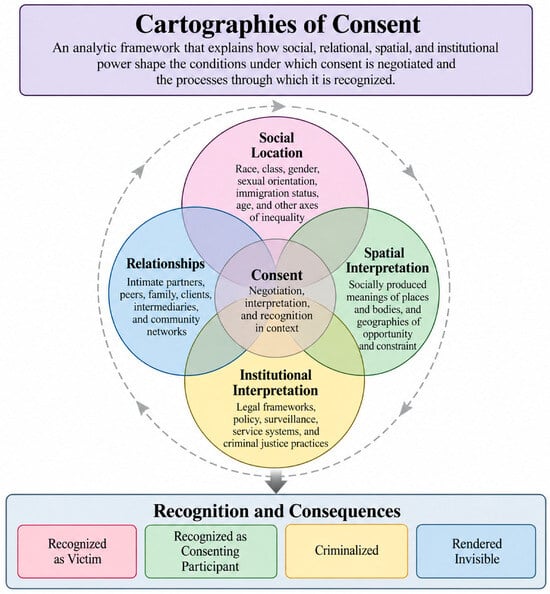
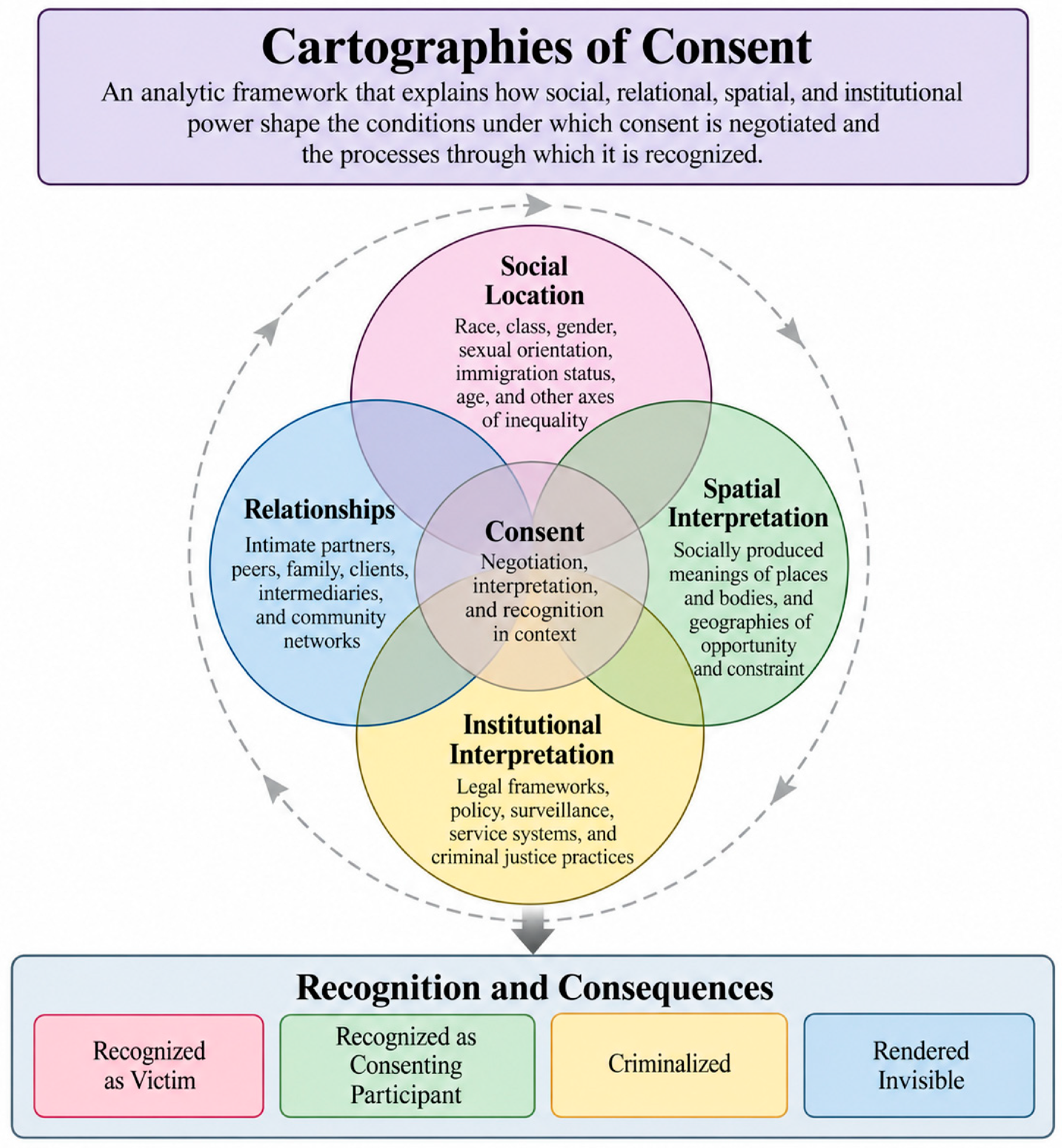
Disclaimer/Publisher’s Note: The statements, opinions and data contained in all publications are solely those of the individual author(s) and contributor(s) and not of MDPI and/or the editor(s). MDPI and/or the editor(s) disclaim responsibility for any injury to people or property resulting from any ideas, methods, instructions or products referred to in the content. |
© 2026 by the authors. Licensee MDPI, Basel, Switzerland. This article is an open access article distributed under the terms and conditions of the Creative Commons Attribution (CC BY) license.