


Abstract
Differing perspectives on the ephemerality of performance have led to debates since the 1980s regarding its ontology. Sondra Fraleigh and Peggy Phelan, for example, believe that performance’s ‘only life is in the present’. Others have disagreed. For example, Rebecca Schneider believes that performance remains in the body of the spectator in a complicated manner and Miranda Joseph, drawing on Marxist theory, argues that performance is in fact material because it produces social relations which have material effects: they affect our thinking and behaviour. In alignment with Joseph, this text begins with the presupposition that performance, and, specific to this text, the object we might call dance performance—the dance performance event and its particular contours, in other words, the performance event as an entity which emerges in the space-time where/when the onlooker and the work meet—is material because it is social. I discuss two dance performance objects, my work Martyro (2011) and Jérôme Bel’s (2005) Veronique Doisneau, as (im)material affective objects. I examine each work individually, providing first a thick description of each in order to communicate how they used affect to connect to their spectators and to critique the contexts of their presentation, the worlds in which the Subject in each of these performances worked. Drawing on understandings and theories of affect (from Deleuze and Guattari, Gilbert Simondon, and Brian Massumi to Lauren Berlant) and political economy (including David Harvey, Cedric Robinson, Jeremy Gilbert, Ashok Kumar, and Katerina Paramana), I then argue that both works used affect to remind their audiences, their witnesses, of the power of revealing one own’s experience of ‘suffering’ as Subjects, whilst simultaneously critiquing the wider economies in which these works, these affective objects and their Subjects, are embedded. It is this production of affect, I suggest, that potentiated action for change, by affecting others’ perspectives and behaviours.
1. Introduction
Differing perspectives on the ephemerality of performance have led to debates since the 1980s regarding its ontology. Sondra Horton Fraleigh, for example, suggests that ‘the dance begins and ends in lived time and immediate perception’ and ‘leaves nothing concrete—as object—behind’ (Fraleigh 1987, p. 48). Similarly, Peggy Phelan, in a frequently cited passage,1 argues that performance’s ‘only life is in the present’ and that it is the ephemerality of performance, its disappearance, which allows it to become itself. It is due to this disappearance, an ontology which is antithetical to documentation, Phelan argues, that performance resists reproduction and the circulation of capital (Phelan 1993, pp. 146–48).
Phelan’s views have since been countered by cultural theorist Miranda Joseph and performance theorists André Lepecki and Rebecca Schneider, among others. For example, Rebecca Schneider argues that performance need not leave behind objects, documents, bones (playing with a death analogy) in order to remain. It remains in our memory and flesh in a much more complicated manner. Performance thus becomes an act of remaining, a means of reappearing. She explains that although in, for example, a museum context performance’s claimed disappearance can challenge the status of objects and, as a consequence, the hegemony of the visual, such a claim ignores different possibilities of knowing and ways of remembering; it ignores the body of the witness in which memory is stored threatening the much-valued original; it ignores the ability to transmit memory and knowledge from one body to another as with a ritual act (Schneider 2001, pp. 100–8). In the same vein, Lepecki (2004b) suggests that performance remains through its tracemaking and its ability to transmit through a different technology: through body-to-body transmission.
Cultural theorist Joseph (2002) counters Phelan’s arguments on both the performance’s disappearance and its resistance to the circulation of capital. She emphasises that, although performance is produced and deproduced in the same moment, it is, nevertheless, not unproductive:
[P]erformance is just as well able to bear value (use, exchange, surplus, status) and to produce subjects and social formations as any material commodity, arguably better able: ‘The commodification of images of the most ephemeral sort would seem to be a godsend from the standpoint of capital accumulation’.(Harvey [1989] 1991, Postmodernity, p. 288) (Joseph 2002, p. 66)
Performance is indeed productive because it is consumed by its witnesses. This act, Joseph holds, is a ‘performative production’ (Joseph 2002, p. 34): performance utilises signification, the spectator consumes these signs, and, consequently, this ‘productive consumption’ is an act of production (ibid., p. 66). Joseph argues that, for Marx, performances are therefore material products: ‘consciousness, culture, religion, language and politics are all social (and thus material products), products of people making their world together through their actions and interactions’ (Joseph 2002, p. 36). It is for this reason, Joseph argues, that performance does not resist the circulation of capital. Although performance might be considered to be unproductive because it perishes the moment that it is produced, it is on such vanishing products that capitalism flourishes (ibid., p. 61).
I agree with Joseph that performance, and, specific to this text, the object we might call dance performance—the dance performance event and its particular contours, in other words, the performance event as an entity which emerges in the space-time where/when the onlooker and the work meet—is material because it is social. It remains, as Schneider suggests, in the body of the spectator in a complicated manner. Spectators ‘ingest’ a performance’s ideas and affects, which are then metabolized and stored in spectators’ memories and affect thinking and future behaviour. Performance, consequently, has material (social) effects.
Here, I discuss two dance performance objects, my work Martyro (Paramana 2011) and Jérôme Bel’s Veronique Doisneau (Bel 2005), as immaterial—yet, as I have already suggested, very material due to their social effects—affective objects. Following a discussion on affect as an event itself, I look at each work, and the affects it produced, individually. I first provide a thick description of each work in order to communicate how they used affect to connect to their spectators and to critique the contexts of their presentation, the worlds in which the Subject in each of these performances worked. Drawing on thinking on affect and political economy, I then argue that both works, both affective objects, used affect to remind their audiences, their witnesses, of the power of revealing one own’s experience of ‘suffering’ as Subjects, whilst simultaneously critiquing the wider economies in which these works and their Subjects are embedded. It is these particular ways in which the two works produced affect, I will suggest, that potentiated action for change, by affecting others’ perspectives.
It is worth noting here, first, my different kinds of perspectives on these performances and how they affect my reading of them, and, second, these performances’ position in a larger work. My discussion of Martyro emerges from my dual position as creator and performer with a clear intention with regard to affect: to produce it. My analysis of Martyro, however, also takes into account the spectators’ perspectives, in particular as they relate to the production of affect and the work’s relation to the context of presentation, as spectators articulated them at the Q & A and my individual conversations with them following the work’s presentation. My consideration of Veronique Doisneau emerges from my position as a spectator being affected and interpreting the work, as well as a creator of performance work more generally that was preoccupied with the production and potential of affect. Although with both works it might be argued that it is the sharing of the Subjects’ experience with the audience that produces the affect, when I refer to affective objects potentiating change, I refer to the two specific works as entities, as events. Martyro and Veronique Doisneau are part of a larger project (of which Paramana 2025, 2026 are a part) that also examined very different (to those in this text) kinds of suffering and suffering Subjects within their economies: the homeless, asylum seekers, and immigrants in Santiago Sierra’s works, the Cuban citizens and immigrants in Tania Bruguera’s works, and the relation of both artists’ works to the Cuban, German, Mexican, UK, and US political economies. For the purposes of this text, situated within the specific journal issue, the analysis of Martyro and Veronique Doisneau is restricted to the cultural economies of their presentation, which are primarily western, White, and to a great extent of privilege (as are the ‘protagonists’ of these works). Veronique Doisneau was a work I was examining while in the process of creating Martyro, working on affect and interrogating the relationship between works and the cultural and political economies in which they are created and presented.
2. On Affect, Events and Objects
My discussion of the two performance events, the two entities, as affective objects will be complicated by the consideration of affect itself as a dimension of an event. Brian Massumi, drawing on Spinoza, understands affect as an ‘ability to affect or be affected’ (Massumi cited in Loktev and Massumi 2009, p. 1). Crucially, he considers these two abilities as facets of the same event or a dimension of it (ibid.). Massumi points out that the second aspect of affect, for Spinoza, is that the ‘power to affect and be affected governs a transition, where a body passes from one state of capacitation to a diminished or aumented state of capacitation’ (ibid., pp. 1–2). This moment of transition—from being affected to an activation or capacitation (which leaves a trace and creates a memory, a lived past)—is also a moment of ‘relation’, and more specifically of an ‘occurrent relation’, because it is bound up to the specific time and space of the event (ibid., pp. 2–3). Or we might think of it as the ‘space-time’ between the onlooker and the work looked at, where/when performance (understood as an event co-produced by performers and spectators) emerges and does something to both.
Understanding what precedes the event, what gives rise to it, is also important. Massumi, following Peirce, suggests that shock, an imperceptible shift of attention or focus to something, where only effects are felt and registered, is what gives rise to it:
Before you can even consciously recognize what you’re afraid of, or even feel that it is yourself that is the subject of the feeling, you are catapulted into a feeling of the frightfulness of the situation. It only dawns on you in the next instant that you’d better figure out what might have done the catapulting, and what you should do about it. It is only then that you own the feeling as your own, and recognize it as a content of your life, an episode in your personal history. But in the instant of the affective hit, there is no content yet. All there is is the affective quality, coinciding with the feeling of the interruption, with the kind of felt transition…That affective quality is all there is to the world in that instant. It takes over life, fills the world, for an immeasurable instant of shock. Microperception is this purely affective rebeginning of the world.(Massumi cited in Loktev and Massumi 2009, pp. 4–5, my emphasis)
In addition to shedding light onto the emergence of the affective event, this passage by Massumi also affords us the opportunity to see the relation/distinction between affect and emotion. Here, affect is understood to precede emotion, for the latter presupposes that what we are feeling in the moment can be identified and named. This moment of the ‘affective hit’ makes, gives birth to, the moment but it also reveals that ‘affect is not in time’; affect ‘makes time, it makes time present, it makes the present moment, it’s a creative factor in the emergence of time as we effectively experience it; it’s constitutive of lived time’ (Massumi cited in Loktev and Massumi 2009, p. 9). It is the instance when our mind-bodies have to pause to digest the moment experienced in order to acknowledge and identify its impact and what emotion arises as a result. Both Martyro and Veronique Doisneau, in producing affect, functioned as affective (dance) objects. Martyro, in particular, was preoccupied with suspending the moment of ‘the affective hit’ and attempted to do so by remaining ambiguous, by retaining its status as an affective object/event.
3. Martyro (2011), Court Room, Toynbee Studios, London, UK
3.1. ‘Martyro’
The audience enters the room. In the left corner they see an installation. It consists of a ‘girly’, fabric and wood wardrobe that appears fragile and has no doors. Within the wardrobe, they see a pair of men’s black shoes sitting on the wardrobe’s shelf and a men’s black dress shirt hanging on its rack. A text by Pablo Neruda hangs on the inside, back, fabric wall of the wardrobe:
If I die, survive me with such sheer forcethat you waken the furies of the pallid and the cold;from south to south lift your indelible eyes,from sun to sun dream through your singing mouth.I don’t want your laughter or your steps to waver;I don’t want my heritage of joy to die;don’t call up my person. I am absent.Live in my absence as if in a house.Absence is a house so vastthat inside you will pass through its wallsand hang pictures on the air.Absence is a house so transparentthat I, lifeless, will see you, living,and if you suffer, I will die again.
A text that offers the definition and noun form of the verb ‘martyro’—the work’s title—and a quote by Gay Hawkins hangs on the wall beside the wardrobe:
| Martyro | |
| by Katerina Paramana | |
| μαρτυρώ (v.) (martyro) | |
| 1. to betray, denounce, give away, grass, grass on (colloquial; British), | |
| to inform against, rat, report, sell down the river, shit, shop, sneak on, | |
| snitch, snitch on (colloquial), squeal (colloquial), stag, tell on (colloquial) | |
| 2. to attest, bear witness, certify, communicate, demonstrate, denote, | |
| depose, evidence, give, give-away, manifest, prove, reveal, show, | |
| suffer, testify | |
| μάρτυρας (n.) (martyras) [plural: martyres] | |
| deponent, deposer, informant, informer, martyr, sufferer, testifier, | |
| witness, witnesser | |
| ‘[W] hat we want to get rid of tells as who we are…but what we | |
| want to get rid of also makes us who we are’ (Hawkins 2006, | |
| Ethics of waste: How we relate to rubbish, p. 2). | |
A speech from one of the organizers of the performance platform turns the attention of the audience to the opposite side of the room. At the end of his speech, the organiser introduces the performance, Martyro, and directs their gaze back towards the installation.
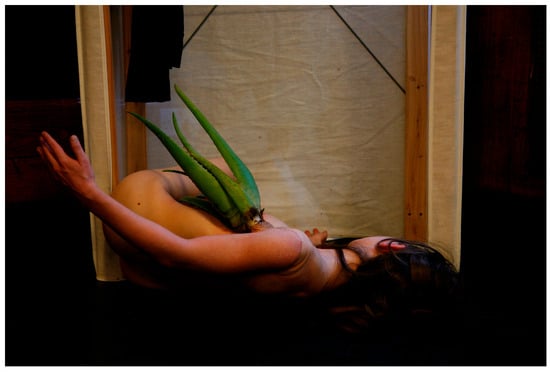
A naked figure is now lying still, in foetal position, on the floor inside the wardrobe. An excerpt of Rezso Seress’ original version of ‘Gloomy Sunday’ starts playing. It is a haunting song, sung a Capela in Hungarian by a young female (Szomorú Vasárnap 2010). It is repeated three times. The figure in the wardrobe, extremely slowly, begins to turn her upper body towards the audience by initiating movement from her shoulder. Her arm eventually begins to extend outwards, revealing live aloe vera plants emerging from each of her armpits (Figure 1). She then begins slowly, almost imperceptibly, to come to a standing position. Her field of vision begins to slowly expand. She begins to take in and make eye contact with the audience. Then, very slowly, she exits the room.
Figure 1.
Photo of Katerina Paramana performing her work Martyro, Toynbee Studios 2011 (Paramana 2011). First presented at P o P, as part of Performance Matters, a collaboration between Goldsmiths, University of London, University of Roehampton, London and the Live Art Development Agency. Financially assisted by the Arts and Humanities Research Council. Photo by Christa Holka, 2011.
This performance of approximately 20 min was based on an idea for a work I had never created, having ‘wasted’ /‘trashed’/ ‘rejected’ it for several years as too personal/private. The images created within it—the aloe vera under my arms—were from a dream I had months before my previous partner even felt ill. That same year, 2005, following a less than three-month period of illness, he died, only a few weeks after diagnosis. In the dream, I was sitting on the sofa reading, when the plants suddenly began sprouting down and out from my armpits pushing my arms outwards, producing at the same time a foul smell. The image created in Martyro both draws from this dream and at the same time considers the healing property of aloe vera. Despite the fact that this loss was for quite some time catastrophic for me and has changed me in many ways, I did not want the work to be ‘emotional’; emotion was kept at bay. I intentionally created a minimalist work that was affective to critically engage with the work’s contexts.
3.2. The Contexts of ‘Martyro’
The work was created and presented as a response to the value and ideological systems of its contexts of presentation, and on which contexts the work depended for its reading. I considered these contexts—the economies of the work’s presentation—to be composed of three concentric circles: the Performance Matters research project (the outer circle); the Performance Matters’ second year symposium theme, ‘Trashing Performance’ (the second circle); and the performance platform in which Martyro was to be presented within this symposium, the ‘Trash Salon: How to do things with waste?’ (the inner circle).
Performance Matters, in which I worked as Associate Researcher, was an AHRC-funded creative research project and collaboration between Goldsmiths, University of London, University of Roehampton, London and the Live Art Development Agency. It was directed by Professor Adrian Heathfield, Professor Gavin Butt, and Lois Keidan. It investigated ‘the contemporary values associated with performance’ in the contemporary moment and set out to ‘explore the interface between performance theory and practice, as well as differing approaches to performance within higher education institutions and the public sector’ (Performance Matters 2009–2012). The Performance Matters project itself, then, was concerned with questioning the construction of value in relation to performance and its potential to affect what matters and how it matters. In the yearly symposia, lectures, dialogues, and performances, theorists and artists addressed these concerns by commenting on them explicitly or implicitly through their choice of words, images, and actions whether on a page or a stage, and through the ways they situated them within specific existing discourses and economies. The symposia revealed what sorts of things people talk about and consider important in the economy of the academy: what ideas and values they hold and privilege, and for what kind of academy they hope.
‘Trashing Performance’, the second year of the project and the second concentric circle of the context of Martyro’s creation and presentation, was specifically concerned with an exploration of ‘marginal and degraded performance practices…in order to produce critical and cultural innovations through non-institutional manifestations and informal disseminations’ (Performance Matters 2010–2011). In a text that contextualised and elaborated on the year’s theme, the research project’s curators observed that:
Performance has long suffered a history of critical trashings. As Jonas Barish argues in his magisterial study from 1981 The Antitheatrical Prejudice, ‘theatre’ has long been approached in various world cultures as a sign of value-less activity, whilst performance art in the west has, up until very recently, suffered critical and institutional neglect as ‘the runt of the litter of contemporary art’ (Phelan, Unmarked). But to what degree have things changed with the recent embrace of performance in the institutions of contemporary culture?(Performance Matters 2010–2011)
‘Trashing Performance’, observing that certain forms of performance and Live Art had recently been embraced by institutions of contemporary culture, was interested in four questions: (a) whether and which performance forms are still neglected, are still ‘trashed’ critically and therefore institutionally; (b) how artists today engage with trashing strategies by working in modes or genres considered unworthy of critical acclaim and/or outside the mainstream; (c) what the ‘gendered, racialised, sexualised and classed’ associations, and ethical and political implications, of the term ‘trashy’ itself are; and (d) what potential might emerge from engaging with trashy strategies for the ‘production of the democratic public sphere’ (Performance Matters 2010–2011).
Finally, ‘Trash Salon: How to do things with waste?’, a performance platform within the ‘Trashing Performance’ symposium and the inner concentric circle of Martyro’s context, invited the sharing of ‘wasted works’.
At the Trash Salon, presentations, papers and performances and various show-and-tell formats explored and put to question those ideas, works, and projects that for various reasons were unfinished, refused, rejected, thrown out, and interrupted: the sketch in the notebook, the unsuccessful project proposal, the unaccomplished element, the event that was cancelled. What happens to these wasted works and ideas, and what are their potentials, if any? Does showing wasted work imply salvaging it from the trash heap? Is recuperating and transforming waste enough? Or might we think about the ways we reflect upon, present and perform these wasted works?(Performance Matters 2010–2011)
The ‘Trash Salon’, although reflecting the concerns of the symposium’s theme, articulated them in more ecological terms, with evaluation of the reasons for a ‘wasted’ or ‘trashed’ work only coming at the end of this articulation.
3.3. On Nuancing and Affects
A response to the call of the symposium and to that of the Trash Salon necessitated an understanding of ‘trash’ culture and what it itself rejects. Bourdieu argues that ‘tastes are perhaps first and foremost distastes, disgust provoked by horror or visceral intolerance of the tastes of others’ (Bourdieu 1984, p. 57). He believes that ‘[i]t is no accident that when they have to be justified, they are asserted negatively, by the refusal of other tastes’ (ibid.). The ‘trash’ culture is a response to the general understanding of what is ‘tasteful’ and ‘appropriate’, what is valued as ‘good’ or ‘worthy’. As with paracinema, ‘trash’ performance is overall characterised by ‘an aesthetic of excess’, which ‘represents an explicitly political challenge to reigning aesthete discourses in the academy’ (Sconce 1995, p. 380). Gay Hawkins and Stephen Muecke consider the aesthetisation of waste also as something else: ‘an economic move, an attempt to invert value, to recuperate the negative’ (Hawkins and Muecke 2003, p. xi). They argue that waste has a generative dynamic in the formation and destruction and of value. ’Loss, waste and the unproductive are antieconomic. They disturb the logic of “general positivity” that… is what defines an economy: the production of positive value, gain, or benefit’ (Hawkins and Muecke 2003, pp. xi–xii). Hawkins and Muecke also believe that ‘changing relations to waste mean changing relations to self’ (Hawkins and Muecke 2003, p. xiv). In fact, Hawkins argues, ‘what we want to get rid of tells us who we are…but what we want to get rid of also makes us who we are’ (Hawkins 2006, p. 2).
With these three concentric circles in mind (the Performance Matters research project, the ‘Trashing Performance’ Symposium and the ‘Trash Salon’) in creating and presenting Martyro, I was interested in two things: First, addressing the three contexts critically, whilst critiquing my own ideas and values; and doing so by resuscitating a work that I had rejected (according to the ‘Trash Salon’), which also comments on the idea of ‘trash’ (the symposium’s theme), and considers the cultural value of performance in the contemporary world (the concern of the Performance Matters project). Second, I was interested in interrogating how the work, while remaining outside the mainstream, is not characterized by what is conventionally understood as ‘trash aesthetics’ (an aesthetic of visual or emotional excess), therefore creating a tension with the symposium’s theme by using queer strategies: by turning on its head and critically engaging with the context of the symposium’s theme, ‘Trashing Performance’, enabling an act of nuancing of what ‘trash’ might include and therefore of the different ways by which a ‘democratic public sphere’ might be thought to be constituted.2
With this work, I also wanted to nuance and press on terms and their considered significance and efficacy: ‘affect’ versus ‘emotion’ and ‘identity politics’ versus ‘macro politics’. I wanted to evoke affect, for I considered affect more open than emotion, which can be immobilising. Affect hands agency over to the spectator. It encourages an act of deciphering, an effort to identify the situation, what causes the affect, how they experience it, and what emotion emerges as a result.
‘Affect’ is understood…as a dimension of experience which is at once physical and psychological, a domain of varying intensities which are not fully articulated, individuated and represented in consciousness; ‘emotion’ might be understood as what we experience once we have identified an affective shift and represented it to ourselves as something which can be named and which can be understood as happening to us internally as individuals.(Gilbert 2014, pp. 144–45, my emphasis)
In this way, spectators were afforded the opportunity to attach their emotions to the affect produced by the work and to the work itself.
In addition, by presenting the work as something I had rejected, I wanted to suggest a rethinking of what is most urgent in the contemporary moment: that although identity politics is a crucial issue and the personal is political, what I considered pressing in a moment (and to this day), when democracies across the world are failing, is the making of work that deals with macro politics; because critical to imagining but also materialising a different world is the action of bodies in concert, solidarity amongst oppressed groups—for identity-oppression is rooted in capitalist dynamics (Kumar et al. 2018) and capitalism is predicated on racism (Robinson [1983] 2000)—and a robust anticapitalist movement (Paramana 2021). I suggested, in other words, a shifting of emphasis to what I thought needs to be more urgently addressed through performance in the contemporary moment for—what the year’s theme referred to as—‘the production of a democratic public sphere’ (Performance Matters 2010–2011).
Lauren Berlant, in her talk at the symposium, also urged for an act of nuancing of terms important to it such as ‘trash’, ‘emotion’, ‘excess’ and ‘popular’. They argued that we should not presume a relationship between trashing something and knowing that it is trash or feeling something and knowing what it is, that popular is not always loud and tough, and that we do not have one emotion at a time. As I attempted to gesture towards with Martyro, it is important that the perceived radicality of an act of trashing be questioned, not so that it is rejected, but in order to make it specific and therefore an act that can potentiate change. Berlant proposed that we know that we are in a historical moment when time feels out of joint, because we feel that the conditions of the reproduction of life are threatened (Berlant 2011). It seems that we were, and continue to be, in a historical moment, which requires a rethinking of our strategies for change.
Martyro, as an (im)material affective object/event, attempted to make clear how a dance object’s context—the economy in which a work is presented and its relation to it—can crucially affect a work’s reception and perceived efficacy, and how a work can comment, be complicit with or create tension with that economy. It attempted to potentiate change by affecting those with whom the work engaged. My writing on Bel’s Veronique Doisneau—a dance object which was also affective, but aimed at critiquing the ballet economy instead—reflects on and addresses the questions that arose from the making and experience of presenting Martyro: questions about the production of (im)material objects, specifically of affect and its effects, about the potency of the context of a work’s presentation, and about the politics of the body and its ‘suffering’ in the view of others.
4. Veronique Doisneau (2005 [2007 Film]), Palais Garnier, Opéra National de Paris, France
Jérôme Bel’s work has influenced the thinking and making of artists and scholars of his and my generation, including myself, and has been widely discussed by theorists, artists and reviewers of dance and performance (e.g., Buffard and Le Roy 1999; Etchells 2004; Lepecki 2004a, 2006; Hohenadel 2005; Bauer 2008a, 2008b; Bishop 2009; Burt [2009] 2011; Bel and Goldberg 2012; Paramana 2015, 2025).
Elsewhere (Paramana 2025), I have suggested that his work and the relations it produces are best read through the lens of economy, for this lens reveals most strikingly how elements in the work are layered (the work’s economy of time, representation, gesture, movement, and relations), the work’s production of economies of interaction and encounter, and how the work is complicit, reveals, or resists the economies in which it is embedded (i.e., the theatre economy, the contested and ill-defined contemporary dance economy, and the capitalist political economy). I have additionally suggested that from his first work to his most recent, Bel takes on board the smallest economy—that of the work’s construction—and with every work he continues to expand his consideration of economy to larger circles. Although he does this in a way with every work (for example, tension with the dance economy is always created by the fact that in most of his works he does not use what is conventionally understood as dance movement), the consideration of a larger economy becomes more explicit with every new performance, creating what I consider to be an appearance of concentric circles around the idea of economy. For example, in Bel’s first works,3 the subject of the work is the theatre as a meaning-making mechanism: theatre’s conventions, how meaning is produced in this space, the function of spectacle and representation, and understandings of the role of the author and spectator. I refer to the subject in these works as the theatre economy and suggest that these concerns are best illustrated with The Show Must Go On (Bel 2001). However, there is a body of work from Veronique Doisneau (2005) until Dances for an Actress (Jolente De Keersmaeker) (2021),4 where Bel’s subject shifts. In these works, and with Veronique Doisneau being the best example of this, the subject of his work becomes the Subjects that occupy the theatre space in the economy of dance. And for this he selects specific subjects: the ballerina, the contemporary dancer, the non-western dancer, the contemporary dance collaborator, the disabled dancer, the amateur dancer, and so forth. In both cases—that is, in Bel’s examination of both the theatre economy as well as the individual Subjects represented and who are representative of different dance economies—his consideration of what is and can be named dance is tested, and furthermore the spectator and their understanding of what they see and the values they bring with them are highly important.5
Here, I focus on his work Veronique Doisneau, which was first presented at the Palais Garnier of the Opéra National de Paris in 2004 and toured Europe in 2005. The work disappears from Bel’s live presentation repertory in December 2005, having been presented for the second and last time at the Palais Garnier in October of that year. It reappears in 2007 only as a film, which is still presented internationally to this day. It is the film version of the 2005 performance at the Palais Garnier that I would like to discuss here, because, as with Martyro, it provides particular insights into the site for and due to which this dance object was originally constructed6 and with which, through its production of affect, it creates the most tension.
4.1. ‘The Question Never Came Up’
As the film starts, we hear Veronique Doisneau humming the music of a ballet. I do not recognise which one it is. Her humming has a soothing quality, like a mother putting her baby to sleep. The rustiness in her voice indicates fatigue; as if she has sung this song already a few too many times and Hypnos, the Greek figure of sleep that comes and puts babies to sleep, has still not heard her calling for him.
While we are hearing the humming, we see images from the awe-inspiring Paris National Opera at night-time. We see the word ‘Choreographie’ sculpted under the arch of the building. Immediately below, the word ‘Director’ appears as part of the titles of the film; Bel points us to his roles in the work. Even if one does not know much about this building, it is clear from its architecture that it has a significant and long history7—that it is an institution where important performances, performances that are considered ‘of value’, have been presented for quite some time.
The Palais Garnier and the Opera Bastille merged to form the Opéra de Paris in 1990, which in turn became the Opéra National de Paris in 1994. The renaming reveals the intention of the Opera ‘to extend its scope beyond the confines of the capital’ (Opera National de Paris 2013). Τhe main façade of the Opera was completely renovated in 2000, bringing back to the surface ‘the original rich colours and golden statue-work’ (ibid.). The famous double stairway Grand Staircase of the Palais Garnier, ‘itself a theatre where, in years gone by, the crinolines of fashionable society ladies would brush’, is built with different coloured marbles and leads to the foyers and the different levels of the theatre (ibid.).
It is within this important building, the Palais Garnier, that the Paris Opera Ballet is housed. The Paris Opera Ballet company has a reputation as one of the best companies in the world. At the time of the performance the following was the case: it was the youngest (the average age of the dancers was 25) and had the most extensive repertoire, staging locally and internationally 180 performances ranging from romantic and classical ballet to contemporary work every season. It consisted of 154 dancers, 18 étoiles, and 14 premiers danseurs, who joined the corps de ballet through a competitive entrance exam between the age of sixteen and twenty, and retire at age 42. This annual exam allowed dancers ‘to move up the echelons of the hierarchy: quadrille, coryphée, sujet, premier danseur’ (Opera National de Paris 2013).
The étoiles were appointed by the Director of the Opera on the basis of recommendations made by the Company Director. The company’s strict hierarchy involved the Company Director, assisted by an Administrator, a Ballet Master directly associated with the Company Director, two ballet masters, four assistant ballet masters, a stage manager, five assistant stage managers, and six teachers, who ran daily lessons every morning due to afternoon or evening rehearsals (Opera National de Paris 2013).
Despite the images we see of the Palais Garnier, Veronique Doisneau’s humming tells us that tonight’s performance—this story, this ballet—will be different than all of those we have seen or heard about; it will be coloured by the sound of her humming. We see images of the grandiose staircase and of audience members entering. Despite the formality of the building and its décor, they are dressed casually. Art-seeing is not an experience reserved only for special nights in expensive clothes, but an everyday experience for everyone. It is indeed funded by everyone, by the taxes of the citizens. And so is all of Bel’s work (Bel and Wood 2013).
We are now taken inside the theatre. We see its gold décor and its red and golden curtain. We hear the orchestra warming up in the pit. The house lights go out. The theatre curtain goes up. A floodlight covers the whole of the space giving it an informal, workspace feel. A slim and slender figure enters diagonally from upstage right and walks down centre. All the objects that enter with her hold significance and are crucial to establishing audience expectations: she is wearing pointe shoes, black rehearsal trousers, and a white dancer, upper-torso-covering shirt conceals her pink leotard underneath. She is holding a white tutu, a pair of ballet slippers, and a water bottle. She is wearing no dance make-up, barely any make-up at all. She is wearing a headset microphone though. Ballet-goer expectations failed so far: natural lighting, no music, a single dancer onstage with no costume or make-up, wearing a mic, indicating that the ballerina will speak. And in fact, this is how the performance begins.
She greets us with a ‘Good evening’. She looks at the audience in the whole of the theatre—the boxes, the upper circles, the stalls—and starts sharing personal information reminiscent of those shared on a chalkboard by the performers in Bel’s work Jérôme Bel. She announces her name, that she is married with two children six and twelve years old, that she herself is 42 years old, that she will be retiring in eight days, and, therefore, that this performance will be her last at the Paris National Opera. Looking up to the upper circles, she lets them know that if they cannot see her well, people say that she resembles the French actress, Isabelle Huppert. The ones that could afford less expensive seats are acknowledged—an effort is made to provide an equal experience. She looks up again, takes a few steps back towards centre stage. An intimate relationship is already established with the viewer. She physically reaches out as much as possible to the spectators, looks at them, introduces herself, and shares personal information. The tone and type of this exchange have been established.
Having taken centre stage, speaking slowly and calmly, she explains that when she was twenty years old, she had to undergo a spine surgery which resulted in the removal of an entire damaged vertebrae and no expectation of her dancing again. In spite of this, she continued to dance and is a ‘subject’ in the Paris Opera Ballet. In its hierarchy, a ‘subject’ is the one that can dance both ‘Corps de Ballet’ and soloist roles. She explains that she earns €3,600/month and that she never became an étoile, because ‘the question never came up’. Bitterness, disappointment and profound sadness lie underneath this statement. She justifies the lack of consideration for such a position with reference to her physical fragility and insufficient talent.
She goes on to narrate her meeting with Rudolf Nureyev and expresses her love for dancing the second variation of ‘The Shades Pas de Trois’ from the third act of his La Bayadère. She walks briskly upstage and dances it, simultaneously humming the musical score. Although singing the music while dancing is helpful to perform the movement in time and with the correct breath control, the effort required to do both simultaneously very quickly leads to exhaustion. Her dancing is elegant and precise, but soon her voice starts weakening and her breathing becomes much heavier. Spectators clap warmly; it becomes evident that such a task requires enormous effort and strength. She walks around trying to regain control of her breath. She breathes heavily, inhaling and exhaling from her nose. There is no rush though, nor any effort to obscure the process. This is not a typical ballet performance. We breathe with her; our heartbeat slows down with hers. She drinks water and, after almost a minute and a half, she starts speaking again.
She shares with us her favourite ballets to interpret (by Marius Petipa, George Balanchine, Rudolf Nureyev, and Jerome Robbins) and her least favourite (Maurice Bejart and Roland Petit). Admitting publicly her dislikes is neither an easy task nor a common one, which makes her apprehensive about the admission. We can see this from the way she holds her breath at the end of her sentence, as if listening for our reaction. She relaxes again when she mentions Cunningham. We can see her thinking back, remembering pleasantly the experience of working with him. She removes her pointe shoes and wears her ballet slippers. She dances part of Points in Space with clarity and precision.
She speaks to us again, this time sitting down. She admits that she often wanted to dance male roles such as the Melancholic from Balanchine’s Four Temperaments. Her voice drops a register when she confesses that her biggest dream was to dance Giselle. She stands up, wears her tutu, and walks offstage. She starts humming. It is the same humming we heard at the beginning of the film. We can hear her singing it from offstage. She sounds melancholic and nostalgic, a dream coming true under different circumstances than she had hoped for, in a different context. She dances it with expressivity while humming. I keep thinking that the most haunting images of suffering I have seen were silent—paintings, photographs of countries at war. We do not hear their pain, their scream. Perhaps what makes them barely bearable is that the visual chokes the auditory. But here, for once, the ‘suffering’ body of the ballerina in pain is heard. Not only is it heard through her voice’s changing strength and rhythm, but it is articulated in language. ‘The question never came up’. The audience claps again.
Doisneau explains that although the scene from Swan Lake, in which 32 female dancers of the Corps de Ballet dance together, is considered to be one of the most beautiful moments in classical ballet, it involves long moments of immobility for the dancers: the ‘poses’ where ‘they become the human décor for the stars’. She explains that these moments are the most horrid for the Corps de Ballet dancers; they make her want to scream or leave the stage. She asks the sound operator to play the music recording for Swan Lake and assumes a pose. We keep expecting her to move but she only does so after a whole minute, only to assume another pose. She stays immobile again, this time for two and a half minutes. She dances again, almost in place. Another long pose. Another brief moment of movement and another pose—there is minimum movement involved in this section for about ten minutes. Of course, in ballet, our eyes are averted from the labour of the Corps de Ballet to those drawing the lights to themselves: the stars (étoiles).
She receives a warm and appreciative clap from the audience, for whose pleasure bodies ‘suffer’ onstage. One can see a glimpse of resentment in her expression—perhaps towards herself for wanting the audience’s love and the expression of this love during the bow, but also towards the audience for enjoying her double ‘suffering’, both physical and emotional, onstage. She admits to loving the moment of the bow and hearing the audience at the end of the show. She performs two classical ballet bows and a contemporary dance one. The audience claps harder with each one. She exits. Curtain flies in.
4.2. The Affective Object of ‘Veronique Doisneau’ and the Ballet Economy
Unlike Bel’s previous work, which exposes the theatre economy, the theatre as a space of representation, and suggests specific relationships between the work and the spectator, Veronique Doisneau, a contemporary dance work/object in its composition, exposes the reality of the Subject of the work. It exposes the systems in which it and its subject are embedded: the dance economy, and more specifically the economy of ballet. Although technical virtuosity is mostly absent in Bel’s previous work, in Veronique Doisneau technique is used as a ready-made, as part of the performer’s subjectivity. Music, as with technique, comes with the body represented. Bel’s previous works can be presented in any theatre, but Veronique Doisneau, like Martyro, is made for the context of its presentation—the specific country, city and theatre where Veronique Doisneau works8—and deals with how we expect subjects of ballet to be represented and represent themselves onstage. And, although in previous works of Bel we learn little or nothing about the performers, in Veronique Doisneau we learn a great deal about the specific performer through a long text spoken by her—an autobiographical text.
Veronique Doisneau presents herself onstage as herself. As with Martyro, she is presented as a ‘suffering’ subject in the presence of others. She speaks about where she finds herself in the hierarchical ladder of ballerinas, revealing to us how the specific Ballet Opera and the ballet scene in Paris function. At the same time that she testifies about difficulties or unfairness she has dealt with, exposing inequalities and perhaps injustices in the economy of ballet, she is revealed as a ‘suffering’ body, affected by these inequalities and unfairness. It is this act of sharing her autobiography, of Veronique as a subject of dance testifying about the economy of which she is part and her position in it that creates the work’s, this dance object’s, potential: to effect further action by affecting her audience, how it understands dance, and ballet more specifically, their knowledge or ignorance of how a ballerina’s weightlessness and ethereality is produced, and the romanticism that is associated with the world of ballet. Hannah Arendt suggests how small acts, such as Veronique Doisneau’s testimony, her doing and ‘suffering’, can potentiate further action:
Because the actor always moves among and in relation to the other acting beings, he is never merely a ‘doer’ but always and at the same time a sufferer. To do and to suffer are like opposite sides of the same coin, and the story that an act starts is composed of its consequent deeds and sufferings. These consequences are boundless, because action, though it may proceed from nowhere, so to speak, acts in a medium where every reaction becomes a chain reaction and where every process is the cause of new processes. Since action acts upon beings who are capable of their own actions, reaction, apart from being a response, is always a new action that strikes out on its own and affects others… the smallest act in the most limited circumstances bears the seed of the same boundlessness, because one deed, and sometimes one word, suffices to change every constellation. Action, moreover, no matter what its specific content, always establishes relationships, therefore has an inherent tendency to force open all limitations and cut across all boundaries.(Arendt [1958] 1998, p. 190, my emphasis)
Veronique Doisneau’s actions, then, from Arendt’s point of view, can have an infinite influence on others through the effect they have on her audience. For her actions—exposing her circumstances and by extension the ballet economy—have the potential to not only influence this specific audience, but whomever these audience members might happen to speak to about this performance. Although the influence of her actions and the actions these precipitate are boundless and unpredictable, they can perhaps affect the economy of ballet and its accompanying inequalities. Gilbert speaks about Arendt’s aforementioned thinking in terms of an ‘infinite relationality’ that ‘constitut[es] both the condition of possibility and the inherently limiting factor of all human agency’ (Gilbert 2014, p. 112, my emphasis). What I am referring to here as the effect that both Martyro and Veronique Doisneau might have on their audience emerges from their status and function as affective objects, as events that produce affects in particular ways and consequently have material (social) effects.
5. On Affect and Change
Political theorist Jeremy Gilbert observes that although ‘Freud’s model of group psychology does not actually accord a primary role to the unconscious’,9 French philosopher Gilbert Simondon argues for ‘“a fundamental layer of the unconscious which is the subject’s capacity for action” (Simondon 2005, p. 248)’ and which he names the ‘affective’ or ‘affectivo-emotive’ subconscious (Gilbert 2014, p. 112). Gilbert suggests that the implication of the model offered by Simondon is that ‘our capacity to act in the world is… dependent upon our relations with others’ (ibid., pp. 144–45, my emphasis). And these relations, although they ‘cannot always be easily represented in any conscious way’ are in fact ‘constitutive of our subjectivity as such’ (ibid.). Importantly, following Simondon (and in alignment with Massumi), Gilbert believes that these relations take place at the level of affect (ibid.): in the passage, as Deleuze and Guattari hold, ‘from one experiential state of the body to another and implying an augmentation or diminution of that body’s capacity to act… (with body taken in its broadest possible sense to include “mental” or ideal bodies)’ (Deleuze and Guattari 1988, p. xvi).
The relationship that Veronique Doisneau builds with the spectators by coming close to the edge of the proscenium stage and addressing those she knows are too far away to see her, by revealing facts that expose the economy of which she is part (the inherent inequalities in it that enable us to think about how these circumstances came about and the effects of these circumstances on her, let alone on dancers battling with racial and worse economic inequalities), and by exposing her own ‘suffering’ influences the spectator at the level of affect. The figure in Martyro, similarly, invites the audience to stand in close proximity, in her own world, to sense her ‘suffering’ and the weight of her loss, all while inviting them to consider what ‘waste’ and ‘trash’ might mean to them, both in relation to this performance and its particular contexts on ‘trash’, as well as in relation, more broadly, to contemporary performance and the contemporary world.
Both affective objects, Martyro and Veronique Doisneau, are about pain, loss, and waste (loss of persons and time, waste of potential), about generated affects, and critiques of contexts. Martyro is an exit, Veronique an entrance. Both performance events, as objects, as entities, use audience expectations, material objects like props and text to help them tell a story, and the potency of a performance figure/Subject to produce affect, to materially (socially) affect their witnesses and contexts.
Simondon argues that what in the end binds groups are the ‘shared sentiments and sensations’ which function at a ‘subconscious’ level—not a ‘commitment to some common activity or project…nor their identification with consciously identifiable images or ideas’ (Gilbert 2014, p. 144).
If we can speak, in a certain sense, of the individuality of a group or of people, it is not by virtue of a community of action—too discontinuous to be a solid base—nor of an identity of conscious representations, too broad and too continuous to allow the segregation of groups; rather it is at the level of the affective-emotional themes, mixtures of representation and action, that collective groupings constitute themselves. Inter-individual participation is possible when affective-emotive expressions are the same. The vehicles of this affective community are elements in the life of groups which are effective, but which are not only symbolic: the regime of sanctions and rewards, symbol, the arts, objects which are collectively valorised and de-valorised(Simondon 2005, pp. 248–49; Gilbert 2014, p. 143).
Although it could be argued that all dance objects are in different ways affective, it is the specific ways that Martyro and Veronique Doisneau pursue and produce affect that potentiates action outside the performances by affecting the way of thinking and acting of their spectators, of their witnesses. The material immateriality of these two affective dance objects illuminates dance/performance’s capacity to affect others’ thinking and behaviour and compel action. Because of their ability to produce ‘affective hits’, performances—these (im)material objects/events which emerge in the space-time where/when the onlooker and the work (produced by the labour of creators and performers) meet—can function as micropolitical events. Although always somewhat incomplete, and unable, on their own, as singular events, to effect change, the goal, as Massumi also suggests, is not to overcome the incompleteness but to make it compelling:
Compelling enough that you are moved to do it again, differently, bringing out another set of potentials, some more formed and focused, others that were clearly expressed before now backgrounded. That creates a small, moveable environment of potential. The goal is to live in that moveable environment of potential. If you manage to, you will avoid the paralysis of hopelessness. Neither hope nor hopelessness—a pragmatics of potential. You have to live it at every level. In the way you relate to your partner, and even your cat. The way you teach a class if you’re a professor. The way you create and present your art if you’re an artist… [T]his will provide a continuous background for what comes of those events to disseminate into and diffuse through. A symbiosis of the special event and the day-to-day, in creative connivance.(Massumi cited in Loktev and Massumi 2009, pp. 18–19)
It is continuous action that produces visible and concrete change, for macropolitical change is tied to an accumulation and intensification of micropolitical events. Micropolitics ‘is what makes the unimaginable practicable. It’s the potential that makes possible’ (Massumi cited in Loktev and Massumi 2009, p. 20). What is crucial is to keep the affective encounters, the potential, going and lay the ground for this potential to be captured and shaped into a world for the flourishing of the many, not the few.
Funding
This research was supported by funding from the AHRC project Performance Matters and the Onassis Public Benefit Foundation.
Institutional Review Board Statement
Not applicable.
Informed Consent Statement
Not applicable.
Data Availability Statement
Data sharing is not applicable. No new data were created or analyzed in this study.
Acknowledgments
My gratitude to both funding bodies, the AHRC project Performance Matters and the Onassis Public Benefit Foundation, and to all academic and artists colleagues and spectators involved in the Performance Matters’ project events for their support. Special thanks to Joe Kelleher and Anna Pakes for their encouragement during the thinking-making of Martyro and to the issue’s Academic Editors for their thoughtful comments on this text.
Conflicts of Interest
The author declares no conflicts of interest.
Notes
| 1 | ‘Performance’s only life is in the present. Performance cannot be saved, recorded, documented, or otherwise participate in the circulation of representations of representations: once it does so, it becomes something other than performance. To the degree that performance attempts to enter the economy of reproduction it betrays and lessens the promise of its own ontology. Performance’s being, like the ontology of subjectivity proposed here, becomes itself through disappearance […] The disappearance of the object is fundamental to performance; it rehearses and repeats the disappearance of the subject who longs always to be remembered… Performance in a strict ontological sense is nonreproductive. It is this quality which makes performance the runt of the litter of contemporary art. Performance clogs the smooth machinery of reproductive representation necessary to the circulation of capital’ (Phelan 1993, pp. 146–48). |
| 2 | Drawing on 1960s poststructuralist thought, ‘queering’ is an act of deconstruction, which emerges in the late 1980s and early 1990s in the gay community and is also addressed by Judith Butler’s work on performativity (Butler 1993). In the context of performance studies, ‘queering’ is a reading strategy and practice—‘queer’ does not (only) refer to an identity. Unlike the verb ‘to deconstruct’, which implies a movement of opening out, of disassembling, ‘to queer’ also implies a movement of twisting the object of analysis, turning it on its head, looking under and above it and from all angles. |
| 3 | I.e., Nom donne par l’auteur (1994), Jérôme Bel (1995), Shirtology (1997), The Last Performance (1998), Xavier Le Roy (2000), The Show Must Go On (2001). |
| 4 | E.g., Pichet Klunchun and Myself (2005), Isabel Torres (2005), Lutz Förster (2009), Cédric Andrieux (2009), 3Abschied (2010), Disabled Theater (2012). |
| 5 | This is perhaps most evident in Pichet Klunchun and Myself, for the western understanding of dance and of the ‘other’ more broadly is brought to the surface. |
| 6 | In a conversation with Daniel Buren, Jérôme Bel explains that the piece ‘came to [him] thanks to [Buren’s] idea of art, to this history of “on site”, of working with the context. For [him], dance is just a tool, just like [Buren] use[s] stripes in [his] work’ (Bel and Buren 2008). |
| 7 | For more on the history of the building see Opera National de Paris (2013). |
| 8 | The work was later presented in different countries (Bel [2006] 2010). The work’s transferability to different countries points to the fact that the hierarchies and problematic politics of the ballet world are not restricted to Paris. For my own reading of the work, it was important to use the presentation of the work in the place for which it was created, the place that it comments on and therefore with which it creates the most productive tensions. |
| 9 | Freud ‘understand[s] the unconscious, irrational relations of suggestion which obtain between group members as being dependent upon an identification with the leader which may not be particularly rational, but is certainly conscious and representable’ (Gilbert 2014, p. 112). |
References
- Arendt, Hannah. 1998. The Human Condition. Chicago: The University of Chicago Press. First published 1958. [Google Scholar]
- Bauer, Una. 2008a. Jérôme Bel: An interview. Performance Research 13: 42–48. [Google Scholar] [CrossRef] [Scilit]
- Bauer, Una. 2008b. The movement of embodied thought. The representational game of the stage zero of signification in Jérôme Bel. Performance Research 13: 35–41. [Google Scholar] [CrossRef] [Scilit]
- Bel, Jérôme. 2001. The Show Must Go On. [DVD] Lee, Aldo (film) Teatro Nacional San Joao. Porto: Association R. B. Jérôme Bel. [Google Scholar]
- Bel, Jérôme. 2005. Veronique Doisneau. YouTube. Available online: https://www.youtube.com/watch?v=OIuWY5PInFs (accessed on 25 May 2012).
- Bel, Jérôme. 2010. RB jerome bel. Available online: https://www.jeromebel.fr/index.php?lg=2 (accessed on 5 October 2013). First published 2006.
- Bel, Jérôme, and Catherine Wood. 2013. Frieze Talks: Jérôme Bel in conversation with Catherine Wood. Paper presented at Frieze London, London, UK, October 20. [Google Scholar]
- Bel, Jérôme, and Daniel Buren. 2008. Conversation Daniel Buren with Jérôme Bel. RB Jerome Bel. Available online: https://www.jeromebel.fr/index.php?p=5&cid=216 (accessed on 5 September 2014).
- Bel, Jérôme, and RoseLee Goldberg. 2012. Why Dance in the Art World? Jérôme Bel and RoseLee Goldberg in conversation. Part of Performance Now. Performa Magazine. Available online: https://archive.performa-arts.org/archive/12y-pi-0003 (accessed on 24 November 2014).
- Berlant, Lauren. 2011. Under- and Overwhelmed. In Performance Matters, ‘Trashing Performance’ Symposium. London: Toynbee Studio, Toynbee Theatre. [Google Scholar]
- Bishop, Claire. 2009. Deskilling Dance—Showtime: Jérôme Bel 1994–2005. RB Jerome Bel. Available online: https://www.jeromebel.fr/index.php?p=5&lg=2&cid=217 (accessed on 5 September 2014).
- Bourdieu, Pierre. 1984. Distinction: A Social Critique of the Judgement of Taste. London: Routledge. [Google Scholar]
- Buffard, Alain, and Xavier Le Roy. 1999. The Last Performance—Alain Buffard and Xavier Le Roy. RB Jerome Bel. Available online: https://www.jeromebel.fr/index.php?p=5&lg=2&cid=189 (accessed on 5 September 2014).
- Burt, Ramsay. 2011. Jérôme Bel. In Fifty Contemporary Choreographers. Edited by Martha Bremser. New York: Routledge, pp. 42–48. First published 2009. [Google Scholar]
- Butler, Judith. 1993. Bodies that Matter: On the Discursive Limits of ‘Sex’. New York: Routledge. [Google Scholar]
- Deleuze, Gilles, and Félix Guattari. 1988. A Thousand Plateaus: Capitalism and Schizophrenia. London: Athlone Press. [Google Scholar]
- Etchells, Tim. 2004. More and more clever watching more and more stupid. In Live: Art and Performance. Edited by Adrian Heathfield. London: Tate Publishing, pp. 196–99. [Google Scholar]
- Fraleigh, Sondra Horton. 1987. Dance and the Lived Body: A Descriptive Aesthetics. Pittsburgh: University of Pittsburgh Press. [Google Scholar]
- Gilbert, Jeremy. 2014. Common Ground: Democracy and Collectivity in an Age of Individualism. London: Pluto Press. [Google Scholar]
- Harvey, David. 1991. The Condition of Postmodernity: An Enquiry into the Origins of Cultural Change. Oxford: Blackwell Publishers. First published 1989. [Google Scholar]
- Hawkins, Gay. 2006. The Ethics of Waste: How We Relate to Rubbish. Lanham: Rowman & Littlefield Publishers. [Google Scholar]
- Hawkins, Gay, and Stephen Muecke, eds. 2003. Culture and Waste: The Creation and Destruction of Value. Lanham: Rowman & Littlefield Publishers. [Google Scholar]
- Hohenadel, Kristin. 2005. Nondances That Spur Critics to Brawl and Audiences to Sue. The New York Times. March 20. Available online: http://www.nytimes.com/2005/03/20/arts/dance/20hohe.html?_r=0 (accessed on 25 September 2014).
- Joseph, Miranda. 2002. Against the Romance of Community. Minneapolis: University of Minnesota Press. [Google Scholar]
- Kumar, Ashok, Adam Elliott-Cooper, Shruti Iyer, and Dalia Gebrial. 2018. An Introduction to the Special Issue on Identity Politics. Historical Materialism 26: 3–20. [Google Scholar] [CrossRef] [Scilit]
- Lepecki, André. 2004a. Concept and Presence: The contemporary European dance scene. In Rethinking Dance History. A Reader. Edited by Alexandra Carter. London: Routledge, pp. 170–81. [Google Scholar]
- Lepecki, André. 2004b. Of the Presence of the Body: Essays on Dance and Performance Theory. Middletown: Wesleyan University Press. [Google Scholar]
- Lepecki, André. 2006. Exhausting Dance: Performance and the Politics of Movement. London: Routledge. [Google Scholar]
- Loktev, Joel, and Brian Massumi. 2009. Of Microperception and Micropolitics—An Interview with Brian Massumi. Inflexions: A Journal for Research-Creation 3. Available online: https://www.inflexions.org/n3_Of-Microperception-and-Micropolitics-An-Interview-with-Brian-Massumi.pdf (accessed on 26 April 2026).
- Opera National de Paris. 2013. The Paris Opera. Available online: http://www.operadeparis.fr/en/ (accessed on 5 October 2013).
- Paramana, Katerina. 2011. Martyro, Court Room, Toynbee Studios, London, UK. First presented at P o P, as part of Performance Matters, a collaboration between Goldsmiths, University of London, University of Roehampton, London and the Live Art Development Agency. Financially assisted by the Arts and Humanities Research Council.
- Paramana, Katerina. 2015. Re-Turning to The Show: Repetition and the Construction of Spaces of Decision, Affect and Creative Possibility. Performance Research 20: 116–24. [Google Scholar] [CrossRef] [Scilit]
- Paramana, Katerina. 2021. Performance, Dance and Political Economy: A Provocation. Edited by Katerina Paramana and Anita Gonzalez. London: Bloomsbury. [Google Scholar]
- Paramana, Katerina. 2025. Contemporary Performance and Political Economy: ‘Oikonomia’ as a New Ethico-Political Paradigm. Abington and New York: Routledge. [Google Scholar]
- Paramana, Katerina. 2026. Coalitional Politics and Ethics: Tania Bruguera’s coalitional work and artist collectives. Performance Research 30.2. in press. [Google Scholar]
- 2009–2012. Performance Matters. Available online: http://www.thisisperformancematters.co.uk (accessed on 24 November 2014).
- Phelan, Peggy. 1993. Unmarked: The Politics of Performance. London: Routledge. [Google Scholar]
- Robinson, Cedric J. 2000. Black Marxism: The Making of the Black Radical Tradition. Chapel Hill: University of North Carolina Press. First published 1983. [Google Scholar]
- Schneider, Rebecca. 2001. Archives: Performance remains. Performance Research 6: 100–8. [Google Scholar]
- Sconce, Jeffrey. 1995. Trashing the academy. Screen 36: 371–93. [Google Scholar] [CrossRef] [Scilit]
- Simondon, Gilbert. 2005. L’Individu et sa Genèse Physico-Biologique: L’individuation à la Lumière des Notions de Forme et d’Information. Paris: Millon. [Google Scholar]
- Szomorú Vasárnap—Marozsán Erika (Gloomy Sunday Hungarian). 2010. Available online: https://www.youtube.com/watch?v=EjpAohE6Jv4&list=RDEjpAohE6Jv4&start_radio=1 (accessed on 5 May 2026).
Disclaimer/Publisher’s Note: The statements, opinions and data contained in all publications are solely those of the individual author(s) and contributor(s) and not of MDPI and/or the editor(s). MDPI and/or the editor(s) disclaim responsibility for any injury to people or property resulting from any ideas, methods, instructions or products referred to in the content. |
© 2026 by the author. Licensee MDPI, Basel, Switzerland. This article is an open access article distributed under the terms and conditions of the Creative Commons Attribution (CC BY) license.