


Abstract
An ecological approach in the broadest sense arguably places art in a context that is unconstrained by disciplinary categories. It is focused on the form of art in context and on all the variables that account for its making and the contexts of its use at the time of its making. The argument of the paper is centred on a set of Yolŋu bark paintings exhibited in the Madayin exhibition that opened in the Hood Museum at Dartmouth College in New Hampshire in September 2022. In a period of 80 years Yolŋu art has moved from a moment of first contact to becoming a global contemporary phenomenon, while maintaining its cultural distinctiveness. Rather than using an ecological approach to examine Yolŋu culture, Yolŋu art as a mode of action exemplifies the ways in which the natural environment is integral to their sense of being in the world.
1. Prelude
In 2022 Madayin, an exhibition whose lead curators were two Yolŋu artists, Wukun Wanambi and Djambawa Marawili, opened in the Hood Museum at Dartmouth College in New Hampshire (Waṉambi et al. 2022b). It was the beginning of a journey that finished in 2024 with the exhibition’s installation in the Asia Society Galleries in New York. Madayin was the result of a collaboration between Kluge-Ruhe Aboriginal Art Collection of the University of Virginia and Buku Larrŋgay Mulka Art and Knowledge Centre in Yirrkala in the Northern Territory of Australia.1 Significantly, the exhibition had dual subtitles. The Yolŋu subtitle Waltjaṉ ga Waltjaṉbuy Yolŋuwu Miny’tji Yirrkalawuy translates as ‘Rainy (Season) after Rainy Season Yolŋu paintings from Yirrkala’. The English subtitle title is more prosaic: Eight Decades of Aboriginal Australian Bark Paintings from Yirrkala. Interestingly, this could not be simply translated into the Yolŋu Matha language: Yolŋu do not measure time in decades. The choice of different subtitles was deliberate. The English subtitle refers to linear time: the exhibition included bark paintings from the first years of the effective European colonisation of Yolŋu country to the time of the curation of the exhibition. The Yolŋu subtitle emphasises the continuity of Yolŋu culture over time and its deep connection to the environment.
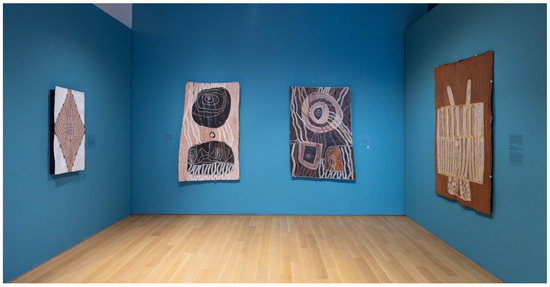
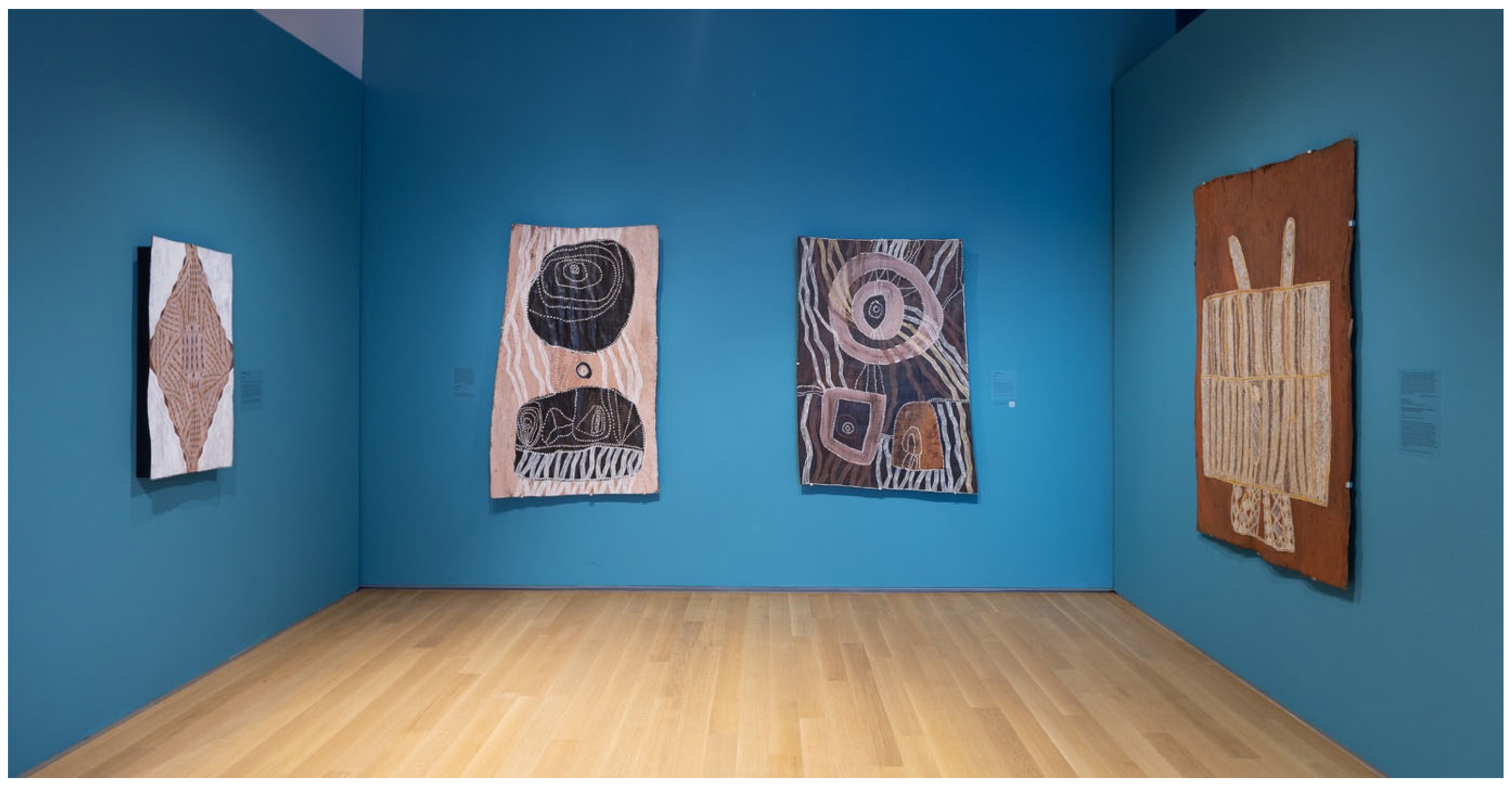
The Yolŋu rationale for the exhibition—its core structuring principles—is revealed by the Yolŋu curators’ chapters in the catalogue (Marawili 2022; Waṉambi et al. 2022a). A key principle that challenges a simple linear narrative was to organise the hang on the basis of the moiety and clan identity, and the identity of the Waŋarr Ancestral beings manifest in the form of the paintings. I will illustrate my more general theoretical argument on the basis of a set of paintings brought together in an alcove in the exhibition hang at the Hood (Figure 1).
Figure 1.
Madarrpa alcove. Maḏayin: Eight Decades of Aboriginal Australian Bark Painting from Yirrkala at the Hood Museum of Art, Dartmouth, 2022. Photo by Rob Strong.
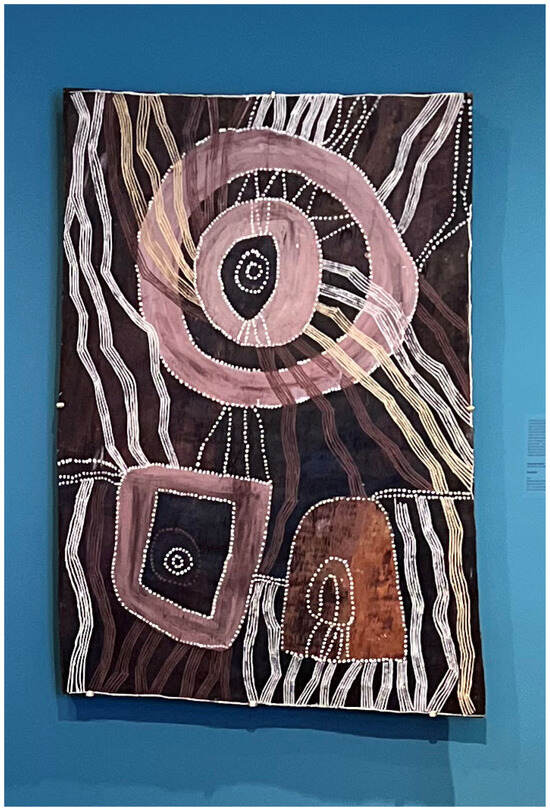
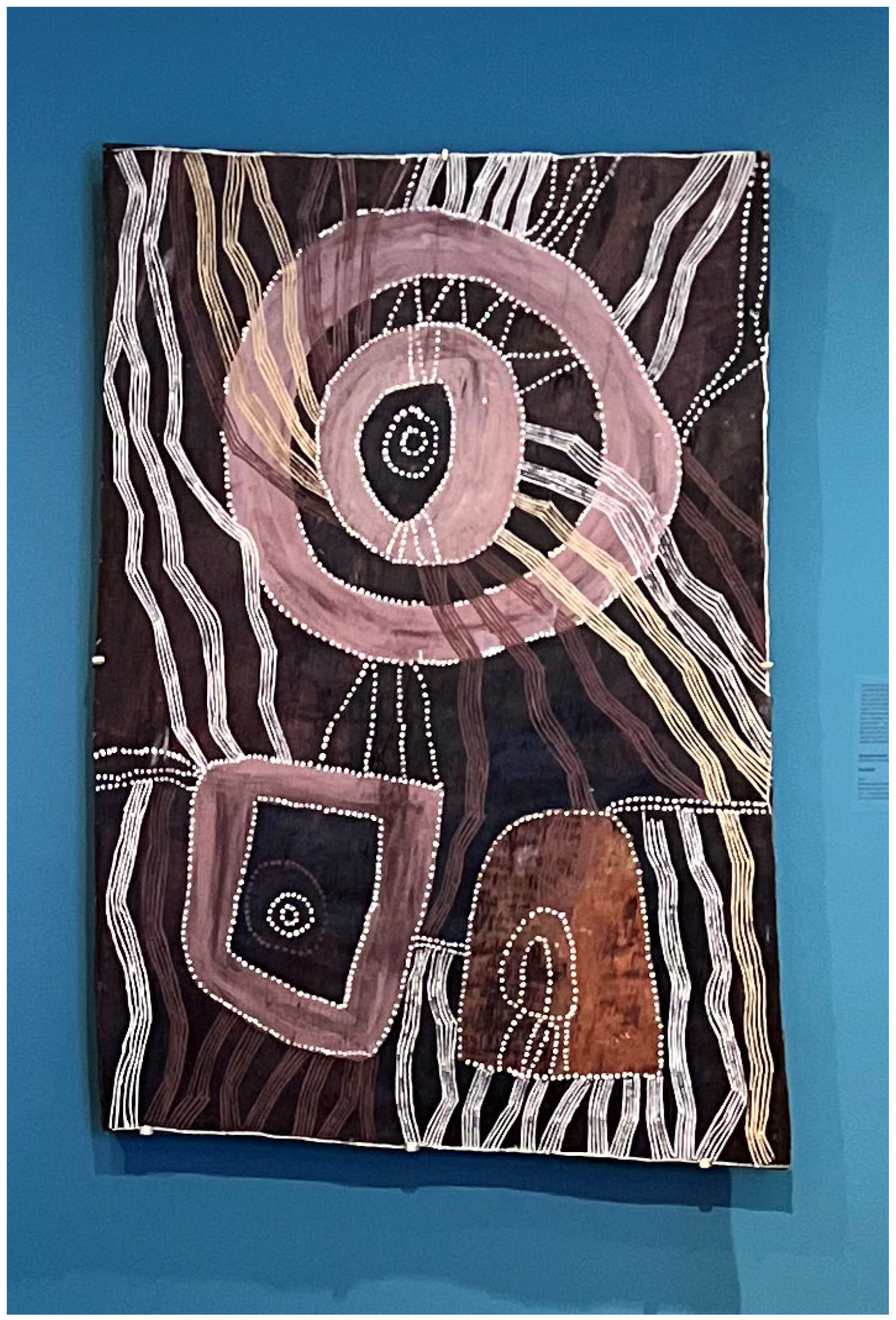
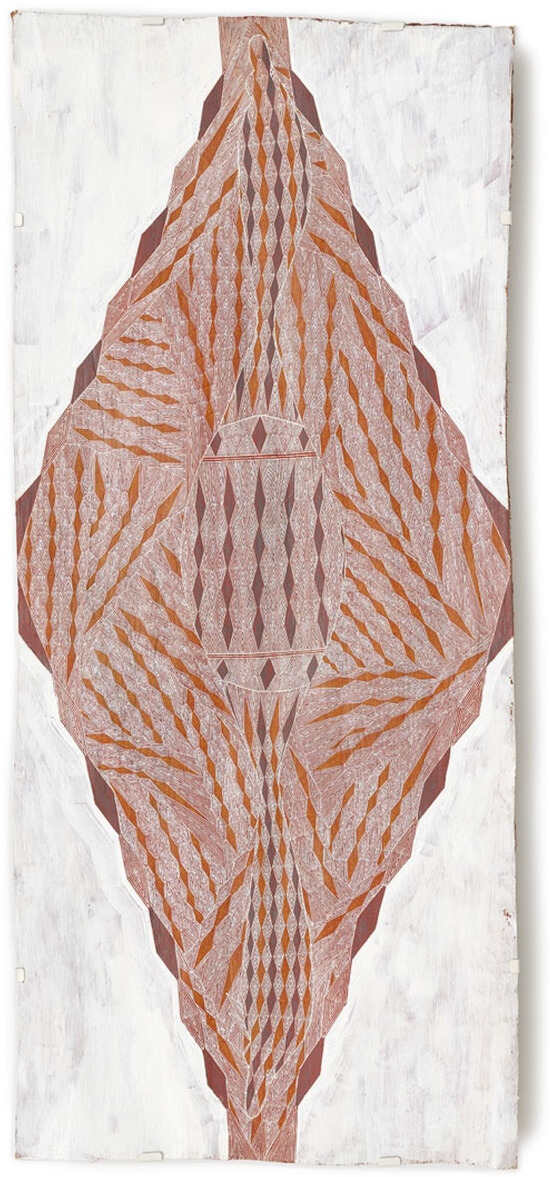
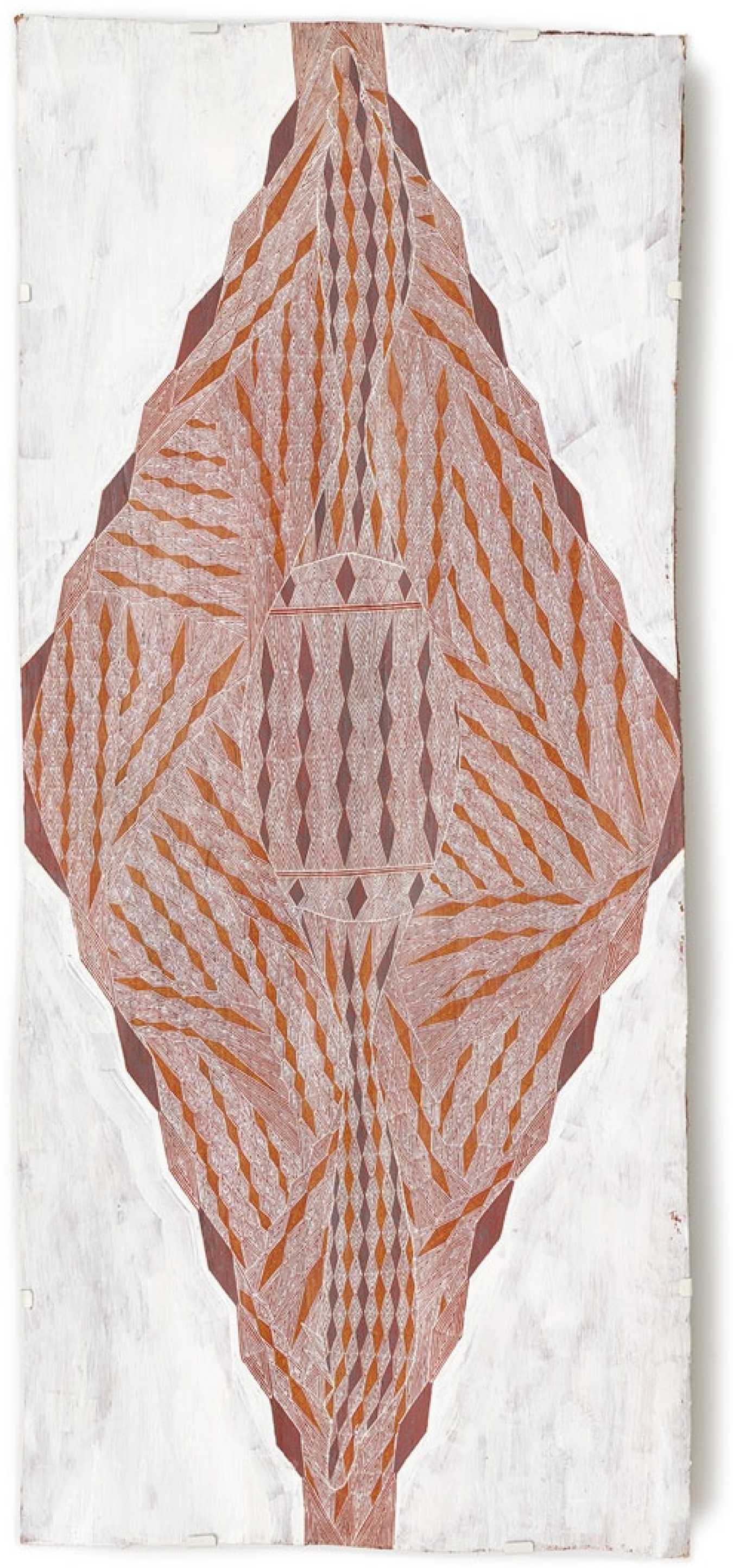
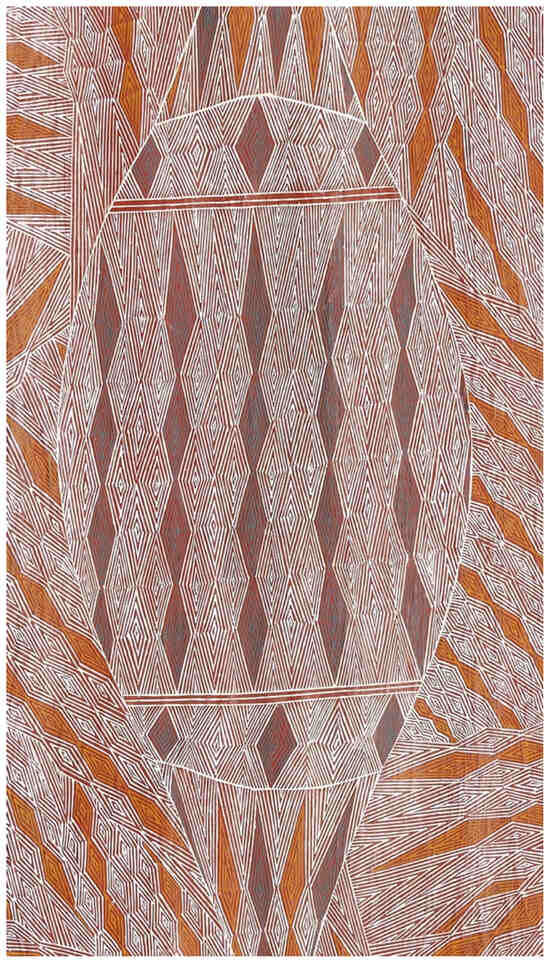
The painting on the right was made in 1942 for the anthropologist Donald Thompson. The artist is Mundukuḻ Marawili of the Madarrpa clan of the Yirritja moiety. The title of the painting is Mundukul ga Yirrwara Dhawu—Ancestral Snake and the Fishtrap Story. It represents a design that today could be painted on a boy’s body prior to circumcision (dhapi). The lines and the diamond designs at the bottom would be painted on the top of the initiate’s thighs, the central image on his chest and the straps at the top over his shoulders. The main panel represents a fish trap created by the Ancestral snake, one of whose names is Mundukul. The fish trap comprises stakes stretched across the river mouth Baraltja on Blue Mud Bay. Today the design as a sacred design (madayin miny’tji) continues to be painted in Yirritja moiety dhapi ceremonies. The painting on the left dates from 2018 and is by Mundukul’s grandson Wurrandan Marawili. The title of the painting is Diamond, referring to the sacred design of Bäru the ancestral crocodile, another important Ancestral figure in Madarrpa myths of origin. The strings of stretched diamonds, variants of a Madarrpa clan design, create a dynamic pattern. A closer inspection reveals the faint but discernible underlying shape of animals extending from an oval in the centre of the painting. Yolŋu have a term for that stylistic feature (buwayak ‘faintness’). The two paintings in the centre are by Mundukul’s daughter Noŋgirrŋa Marawili and were also painted in 2018. They represent the same Ancestral snake as her father’s but at a different place, Barratjala. Mundukul as snake is associated with the onset of the wet season and the powerful storms that bring thunder and lightning (Figure 2). Significantly, this is not a design that would be used in a ceremonial context, but it expresses dramatically the power generated by the Ancestral snake as flashes of lighting illuminate the rocky shore while rain cascades down and thunder rumbles. The painting uses the same palette of earth colours as in the other paintings but combines them together in different ways, creating shades of pink. The flashes of lightning are a modification of the diamond pattern.2
Figure 2.
Noŋgirrŋa Marawili Baratjala, 2018 Natural pigments on eucalyptus bark 63 25/32 × 44 1/2 in. (162 × 113 cm) Kluge-Ruhe Aboriginal Art Collection of the University of Virginia. The 2017-19 Kluge-Ruhe Maḏayin Commission. Photograph by Neil Greentree.
Curated by Yolŋu, the alcove invites the viewer to see a family resemblance between the paintings that might not at first seem obvious. They are labelled as being of the Madarrpa clan and in the catalogue the primary reason given for exhibiting them together is that they belong to a clan of the Yirritja moiety. Wukun Wanambi explicitly states that: ‘You shouldn’t show one person’s painting on its own. Paintings need family, to show they’re connected.…’ (Waṉambi et al. 2022a, p. 26). But how do they talk to each other and how do they relate to the environment of Blue Mud Bay?
The art historian needs to place the Yolŋu perspective at the centre of their analysis of the paintings but will have questions about how their difference is created and how they came into being over a span of time covering three generations of practitioners. In the next section I reflect in general terms on the way in which the expanded set of relationships implicit in an ecological perspective to art may indeed help us understand the formal and agentive—in the sense of action-oriented—trajectory that Yolŋu have been pursuing over the 80 years since European colonisation began to have its impact on their society and way of life.
2. A Theoretical Detour
Ecology developed in the natural sciences as a framework that explicitly focussed on the relationships among living organisms and their environment. Etymologically, ecology derives from Ancient Greek οἶκος (oikos ‘house’ and -λογία(-logía) ‘study of’). Etymology is not always a guide to the subsequent uses and meanings of a word but the encompassing and limiting frame of a house does perhaps signal a potential problem with the ever-widening scope of how that ‘house’ is conceived in modern uses of the term. While some components of the environment such as changing temperatures have a global, all-encompassing impact, local systems are relatively autonomous of each other. Yet the impact of global factors needs to be understood and addressed locally. Boundaries fuzzily conceived are methodologically integral to analysing the relationships between different scales of phenomena. The intertidal zone is a meaningful focal point for understanding the relationships contained within it but cannot be understood as separated from the tidal flow that connects its waters to the open sea or the biogeography and geomorphology of the adjacent shore (Morphy and Morphy 2006). And when climate change is brought to bear the full complexity of the interrelationships within the ‘house’ is inescapable.
The term ecology first began to be used in the second half of the nineteenth century to apply to the ‘endless varied phenomena of animal and plant life as they manifest themselves under natural conditions’ (Sanderson 1893, p. 613).3 In most studies human beings, as scientists, had the role of observers and theorists rather than seeing themselves as actors in what was being observed—the focus was on the ‘natural world’ without human intervention. Indeed, the late arrival on the scene of Homo sapiens as a species meant that for much of history they were absent from the stage. Nevertheless, from an evolutionary perspective they were an emerging part of the narrative, and the limited focus of ecology reflected a failure to see humans as an integral part of nature—not simply as observers but as agents of change. It was not until the mid-twentieth century that the human impact on the environment began to emerge as a central topic of ecological study. By that time hominids had been integral to global ecology for millennia.
When a concept such as ecology crosses disciplinary boundaries it signals their contingent nature. But in so doing it will simultaneously be applied to different bodies of data and enter into different debates as well as reflect more general concerns of the times. Ecology will have a different focus in art history from that in anthropology. But in the movement of ecology as a concept into the humanities and the social sciences it articulates with trends that cut across the disciplines.
O’Neill and Uebel argue that in political science and economics it is possible to identify the development of two distinct traditions of political ecology that still remain in tension in subsequent debates: a science-based approach that is concerned with the material and ecological conditions for human well-being and social relationships; and a science-sceptical approach that takes the environmental crisis to be founded in a technocratic commitment to the domination of humans and nature that is built into the constitution of scientific reason (O’Neill and Uebel 2015).
The distinction resonates with recent debates in both anthropology and art history, although as with all dualistic distinctions it does not fully cover the complexities of the issues at hand. As Gaynor and Mclean write:
An ecological art history would therefore, of necessity, engage with the science of ecology. Whilst the current trend within the humanities is to conflate science with ideology, an ecological art history needs to develop a relationship between the two that maintains a difference between them, but one that is not mutually exclusive or binary (Gaynor and Mclean 2005, p. 5).
The interrelationships between people and the environment were always present in evolutionary models of human society and economy that viewed societies as moving through progressive stages from hunting and foraging to ‘civilization’, by way of agriculture and industry. In anthropology an ecological approach first emerged strongly in the study of hunter–gatherer and subsistence agricultural societies where there is a priori a close interrelationship between people and the environment. As a term ecological/environmental anthropology gained wide currency in the 1950s through the study of economies as adaptive systems. (Sahlins 1973) can be seen as a positioned statement on ecological anthropology as it developed in the latter half of the twentieth century. It can be seen as a shift away from simple forms of determinism that foreground an extractive relationship between people and the affordances of the environment to one in which cultural forms and social values are viewed as important determinants of human action. This change resulted in a more complex understanding of the nature of the relationships between people and their environment (Morphy 1993). Towards the end of the twentieth century some researchers in the humanities and social sciences began to move towards understanding and evaluating different cultural ways of relating to the environment in the context of addressing the development of sustainable human economies which do not damage the global and local environments (Strang 2016).
3. Foreshadowing an Ecological Art History
The idea of an ecological approach to art history has been on the edge of the discipline for a considerable time. Gombrich’s (1999, p. 48) ecology of images emphasises the importance of understanding stylistic change in the context of changes in society and changes to ‘the functions’ assigned to visual imagery. Campbell’s (2014) ecological approach to the decorative arts has a similar focus on the interrelationships between visual arts and the worlds in which people live. Interestingly, her research does indeed focus methodologically on the home/house as a microcosm of the ecology of a particular moment, epoch, or era—‘the home as forming part of an integrated environment of people, things, and spaces’ (Campbell 2014, p. 5). Her analysis is concerned with the role of objects and space in social processes (ibid). In employing an ecological framework Campbell is aiming to unsettle established categorisations, in particular the distinction between ‘art’ and ‘craft’ and the associated categories of ‘fine art’ and ‘decorative art’ that have distanced objects from each other without reference to historical or cultural context (Campbell 2014).
In (Gaynor and Mclean 2005) the focus is on the environment in a broad sense, and the dialogical nature of the relationship between science and the humanities inevitably comes to the fore. Their primary concern is the relationship between the aesthetic and representational functions of landscape art, the environment depicted, and the ecology of that environment. They suggest that the modest aim of an ecological art history should be to ‘to gather art historical and ecological data that will allow us to evaluate any congruencies between natural and cultural histories’ (Gaynor and Mclean 2005, p. 6). They argue that the focus must be on the evidence, the art/craft/material forms that are the substantive basis of their research:
The potential utility of landscape paintings for understanding past environments is immense but needs to be evaluated initially in the context of its times—‘the artists’ attitudes to the environment and how this is reflected in the content of their work. How the aesthetic faculty contributes to ecological sensibility (ibid, p. 5).
They are critical of the presentist framing of some fellow art historians who are ‘more interested in interpreting landscape art as an expression of aristocratic desire, panoptic sensibilities and imperialism than in pursuing an ecological engagement with the natural world’ (ibid, p. 9).
Gaynor and Mclean acknowledge Bonyhady’s (1985) analysis of post-European colonisation landscape painting as a step towards the development of an Australian ecological art history. In Images in Opposition Bonyhady argues that the sensibility of Australian artists to the aesthetics of the Australian environment was relatively independent of the colonial enterprise that they were part of. Gaynor and Mclean provide a qualification that the ‘cross-disciplinary nature of an ecological art history means that it should also have uses beyond art history’ (Gaynor and Mclean 2005, p. 7). In addition to providing evidence of cultural attitudes it could also be a resource for the remediation of the environment and provide evidence of environmental change.
Perhaps the most impressive example of research moving in this direction in an Australian context is historian Bill Gammage’s The Biggest Estate on Earth: How Aborigines made Australia (Gammage 2011). The book shows how an analysis of Australian colonial representations of landscape provides implicit evidence of millennia of Indigenous Australian engagement with, and modification of, the environment and can be used as a resource for its future land management. The irony of the book, though this is not in itself a criticism, is that the sources it brings to interpreting Australian colonial landscape painting in the light of Indigenous Australian cultural practices are not primarily Indigenous Australian works of art but anthropological, archaeological and historical sources. Gammage’s analysis of European colonial landscape art shows what remains as evidence of the Indigenous achievement but it does not show the social and cultural processes of its reproduction over millennia, because that perspective is not encoded in European landscape art. The study of Indigenous Australian art is a complementary resource since it opens up ways of understanding Indigenous societies and the interrelationships between art, people and the environment over time. Yolŋu paintings are, as I will argue, the product of a system of knowledge that has been an integral component of the lives of people living in the environment of eastern Arnhem Land through epochs of change.
In the Yolŋu case it would be unproductive to look for a precise equivalent to European-Australian post-colonisation landscape paintings, but it would be equally unproductive to overemphasise difference, on a priori grounds, by viewing the two traditions through separate substantive, theoretical or ideological lenses. The very fact that an analysis of Yolŋu art can be set in dialogue with an analysis of colonial Australian representations in the same academic frame of discourse suggests that there is a deep relationship between the phenomena under review. For the purposes of this argument this relationship can be nested within the framework of an implicit and overlapping cross-cultural category of ‘art’.
An orientation towards globalisation and a more expansive category of the contemporary, less tied to the trajectory leading to the western avant garde, ‘flattens the ladder of art history’4 and allows synergies to be seen across cultural divides and art historical categories such as ‘style’, ‘epoch’, ‘tribe’, ‘nation’ and ‘era’. The recognition of synergy across the domain of global art practice is one of the factors that has challenged European categorisations of world arts as ‘other’ and facilitated their occupation of the same exhibitionary spaces, without denying their relative autonomy.
Claire Farago suggests that an orientation towards an ecological art history is one that looks ‘beyond Eurocentric models’.5 She captures the broad conspectus of the uses of the term ecological art history: on the one hand it is an orientation towards a ‘more pluralistic historical vision … that considers different signifying systems, world views, and contexts of use on an equal footing’ (Farago 2025, p. 1), and on the other hand it challenges the drawing of an overly strong distinction between nature and culture, or social and biological systems. Potentially, art history’s breadth and anthropology’s cross-cultural engagement articulate well.
4. An Anthropologist’s Orientation Towards an Ecological Art History
To an anthropologist who has written about cultural adaptation the idea of an ecological approach to the history of art is immediately attractive. Art history as a discipline has always been both interdisciplinary and cross-cultural and in dialogue in particular with archaeology, anthropology and history—all disciplines which take a holistic approach to their subject matter. However, until relatively recently, as is the case with most academic disciplines, its viewpoint has been influenced by the post-Enlightenment trajectory of European academic thought and its attendant cultural categories.
My orientation to the making of artworks broadly conceived is to understand art as a way of acting in the world, ‘how they have meaning’,6 how they are made, the technology of affect and effect (Morphy 2008, 2010). As an action framework linked to the history and analysis of forms, it is synergistic with Georges Kubler’s summary that: ‘the principal aim of history …. has been to identify and reconstruct the particular problem to which any action or thing must correspond as a solution. Sometimes the problem is a rational one, and sometimes it is an artistic one: we always may be sure that every man-made thing arises from a problem as a purposeful solution’ (Kubler 1962, p. 8).7
An ecological approach brings into place that wider set of variables that lead to art production in context but at the same time it brings into place the ‘natural environment’ that for much of recent urban human history has been positioned outside human society. An ecological approach makes art a resource for understanding how people place themselves in their environment, how they see and experience the world they live in.
As an anthropologist I am focussing on a local ‘house’—the art of the Yolŋu people of eastern Arnhem Land—but this house is not isolated from space or time. An ecological approach in the broadest sense means placing art in a wider context that is unconstrained by disciplinary categories and also focussed on the form of art in context and on all those variables that account for its making and the contexts of its use at the time of its making. In Yolŋu art we can see—in the variables that connect art practice to the moment of production in the present (the contemporary)—a journey across space and time that would have been impossible to imagine in the past. In a period of 80 years Yolŋu art has moved from a moment of first contact to global contemporary, a move which challenges the characterisation of the distance between the past and present and at the same time problematises many of the artistic categories that developed historically from a ‘Eurocentric’ perspective.
5. Yolŋu in Recent Times: Towards an Ecological Art History
Yolŋu people have occupied northeast Arnhem Land in northern Australia for at least three thousand years (Morphy and Morphy 2023). European colonisation of Australia began with the establishment of the convict settlement of Sydney in the south of the continent in 1788, but Yolŋu remained effectively on the other side of the colonial frontier until the twentieth century.8 On his voyage mapping the coast of Australia Matthew Flinders visited their region in 1802, but it was not until the 1920s that Yolŋu began to come under government control with the establishment of the mission station of Milingimbi in 1923. In the early 1930s increasing conflict developed between Yolŋu and people who came uninvited to their country. In 1935 the Federal Government commissioned an anthropologist Donald Thomson to investigate their concerns and in effect facilitate the development of policies for the administration of Arnhem Land (Rigsby and Peterson 2005). The subsequent history of Yolŋu people and their resistance and accommodation to the situation they found themselves in is well known (Williams 1986; Morphy 2008; Egan 1996). The late era of their effective colonisation enabled them to take a lead in the struggle for Indigenous rights in land. Today they own their traditional lands in Australian law under the Aboriginal Land Rights (Northern Territory) Act 1976.
Acting through art has been integral to Yolŋu life post-missionisation as they moved from a hunting, foraging and trading society to one that has become increasingly incorporated in the Australian and global domain. Their occupation of the same geographical space for millennia argues for continuities in cultural and social formations that may lead the analyst to overemphasise the structural components of the Yolŋu ‘system’ rather than its dynamics. Art must have played a central role in people’s lives through earlier periods of change, and the dramatic changes that have occurred during the past 80 years in the Yolŋu social, cultural and ‘natural’ environment provide a case study of the dynamics involved in acting through art. Yolŋu art has achieved a considerable presence in the study of world arts in recent decades, so my limited focus in this essay is on some of the ways in which art has been incorporated in this recent process of change by reflecting on this small set of paintings from a Yolŋu perspective. Yolŋu artists have long given agency to their paintings to communicate beyond their society as a means of attempting to get outsiders to understand and appreciate their culture and way of life.
6. Art as Knowledge and Law
Yolŋu continually stress that their art is an integral part of their knowledge system. The dialogical relationship between art and sciences is encompassed and framed more generally in the Yolŋu concept of two-way learning (ganma). Two-way learning as a mode of education was developed in the 1980s by Yolŋu teachers at the time that bi-lingual education was being introduced to schools in Indigenous communities across the Northern Territory (Mununggiritj 1999). In essence this was an acknowledgement that Yolŋu and ‘mainstream’ European-Australian knowledge systems were relatively autonomous but could work well together, just as languages could be translated cross-culturally, and at the time this initiative was supported by the education authorities. This practice of adjustment in the post-colonial context was oriented towards making different systems work together. In the domain of religion Yolŋu were fortunate to encounter sympathetic missionaries with synchretic inclinations. In the legal arena they benefited from land rights legislation that enabled their system of rights in estates to be recognised under Australian property law. Art in a broad sense9 had always been integral to the continuing existence of the Yolŋu polity over millennia, operating as its communicative heart. As a result of colonisation the frame of operation has become increasingly global over time. And that has resulted in change and a dynamic response that has influenced the formal trajectory of Yolŋu art practice. The paintings in the alcove (Figure 1), cutting across time, provide a palimpsest of this process.
6.1. Gurrutu Ga Bäpurru (Kinship and Clan)
Yolŋu society is divided on the basis of clan membership and moiety identity. There are two patrilineal moieties—Dhuwa and Yirritja. Each moiety comprises a set of clans (bäpurru) that are the primary land-owning groups. The clans are exogamous which means that a person has to marry a woman or a man of the opposite moiety. This structure is so central to Yolŋu society that it is the initial lesson that any outsider will be taught. In the case of the Madayin exhibition the Yolŋu curators insisted that the exhibition be structured on the basis of moiety and clan first and chronology second. The paintings in the alcove represent three non-contiguous Maḏarrpa clan estate areas. Mundukul’s painting represents the river mouth at Baraltja, an area shared with another Yirritja moiety clan, the Dhalwaŋu. Wurrandan’s image is from the estate of Yathikpa on the other side of the bay from Baraltja where Bäru trapped within a blazing bark hut changed shape from human to crocodile as he dived into the sea to quench the flames (Figure 3). Noŋgirrŋa’s paintings represent Barratjala, a river estuary to the north-east on the shore of the Gulf of Carpentaria.
Figure 3.
Wurrandan Marawili Diamond, 2018 Natural pigments and synthetic polymer paint on eucalyptus bark 40 15/16 × 17 23/32 in. (104 × 45 cm) Kluge-Ruhe Aboriginal Art Collection of the University of Virginia. Purchased with funds provided by William Alexander and Terrence Sykes, 2020. Photograph by Neil Greentree.
Although in this case the artists all belong to different generations of the same clan, non-clan members can, if they have the authority, produce paintings owned by other clans connected to them along their matriline—their mother’s (ŋäṉḏi) clan which is of the opposite moiety to them and their mother’s mother’s (märi) clan, a clan of the same moiety. And wives often contribute to the production of paintings of their husband’s clan, under his direction.10
6.2. Madayinbuy Miny’tji
Many Yolŋu paintings (miny’tji) are components of the clan’s sacred law (madayin). The madayin comprises songs, dances, paintings, sacred objects, names and much more that are manifestations of the Waŋarr—the clan’s Ancestral Beings. The miny’tji are designs that arose out of the Waŋarr times of transformation and are in themselves expressions of spiritual power (märr). Potentially, there is a Waŋarr/spiritual presence in everything and the songs, dances and paintings express through poesis their eternal presence. But Yolŋu also see the sacred as relatively autonomous from nature. This is reflected in the fact that they make a distinction between animals in the everyday sense (wakinŋu) and animals as manifestations of Ancestral presence and determination (madayinbuy). Yolŋu do not see themselves as part of nature in the same sense as wakinŋu crocodiles or tidal flows are. I would argue that they accord a mediating role to human exceptionalism, while Ancestral determination is nevertheless central to their ontology.11 They see song as the voice of the Waŋarr, but it is Yolŋu who sing it. While Ancestral power is manifest in the Waŋarr it is reproduced through human action. In the words of Djambawa Marawili: ‘The land has everything it needs, but it could not speak. It could not express itself, tell its identity, so it grew a tongue. That is the Yolŋu’ (Marawili 2022, p. 40),12. But Waŋarr presence is revealed through their exceptional and underlying powers which are manifest in nature. The distinction in Yolŋu epistemology between maḏayin and wakinŋu is a reflection of Yolŋu dualism mediated by Ancestral power (märr). The idea of a rational soul is in many ways compatible with Yolŋu conception of mind—thinking through the madayin (Morphy and Morphy 2020).
Rights in the madayin are strongly protected and sacred paintings cannot be used without the permission of the owning clan. They are seen to be integral to the clan’s ownership of their estates as well as to its spiritual continuity. Certain named places within a clan’s estate are seen to be foundational in nature and certain designs are seen to be an integral expression of their spiritual power. Mundukuḻ’s painting (Figure 1) is an example of such a design associated with the major Yirritja moiety ceremony celebrating the Waŋarr snake. Wurrandan’s painting (Figure 3) is based on the diamond clan design of the Yirritja moiety associated with crocodile and fire which is frequently painted on the chests of dancers in ceremonial performance. Noŋgirrŋa’s painting is not strictly speaking a madayinbuy painting. Barratjala is a public camping place, where in the past Macassan traders worked with Yolŋu in the gathering and preparation of trepang.13 It too is associated with the ancestral snake. It is one of the places where, at the onset of the wet season the Ancestral snakes stretched up into the sky to communicate to relatives in distant places, talking in this case to the snake at Baraltja. Noŋgirrŋa’s painting is acknowledged to be her own expression of the snake rather than a madayinbuy painting. In conversation with her Djambawa Marawili, the current leader of her clan, concluded:
It is good that you have come up with your own way of painting. You have used your knowledge to come up with your own designs. With your knowledge you can choose to make up your own designs or you can paint the same designs that our elders used to paint (Marawili and Marawili 2022, p. 102).
6.3. Mapping the Land
For the reader, the place-centred nature of madayinbuy miny’tji should already have opened up the possibility that Yolŋu paintings create a spatial framework linking people to place and the environment. Yolŋu clan estates are distributed across the region, distinguished on the basis of moiety and clan. The Waŋarr are deeply connected to the environment—to land and sea, forests and wetlands, rivers, tides and currents. They are the creative force that underlies the ‘natural’ environment and links it to the spiritual lives of people. The environment is expressed and performed through the designs, aesthetics and poetics of the madayin. The songs provide a gazetteer of places but also a record of the species that inhabit them and the seasonal changes that occur. They are not distanced reflections on nature that separate people from the environment; rather they incorporate human life within the Ancestral dimension. For example, they might concern the fish traps set up towards the end of the wet season, as the floodwaters begin to recede and the rivers flow with fish, which were once an integral part of the seasonal economy. Every major river system had one or more fish traps set up at that time of year, each one a little different from the next, all linked to Waŋarr beings who ensured the distribution of the rich resources and authorised the form of the trap. The overall set of paintings, songs and dance map—in comprehensive detail—Yolŋu country, its natural resources and ways in which they are used.
Yolŋu art and cultural forms more generally provide encyclopaedic coverage of the spiritual and natural world. The encyclopaedia is distributed, in the sense that knowledge is divided on the basis of clan. It is the members of the clan and their kindred who are the primary knowledge holders and most responsible for ensuring that nothing is forgotten. Ceremonial performances continually bring the knowledge into play on a community-wide basis; the archive is shared and utilised and managed over a wide region. The reenactment of Bäru’s transformation through fire into the form of a crocodile is performed not infrequently at mortuary rituals and circumcision ceremonies and the epic journey on which Bäru set out after leaving Yathikpa in Maḏarrpa country forges links to other Yolŋu clans across the region. Yolŋu recognise their cultural forms as living archives and constantly insist that people appreciate them not only as aesthetically powerful objects but as meaningful ones. As Djambawa Marawili wrote when his works were exhibited at the Sydney Biennale—words he has repeated on many other occasions: ‘I want people to know that these paintings all have meaning—they are not just pretty things’.
7. A Body of Practice and Engagement
The exhibition Madayin; Eight Decades of Aboriginal Australian Bark Paintings from Yirrkala, begins in a temporal sense with the first paintings collected by Donald Thomson in 1935. On July 13 in that year Thomson met Woŋgu at Trial Bay and on 14 July he began to document him making this bark painting. I will quote from his fieldnotes because this is, as far as I know, the first detailed documentation of a Yolŋu bark painting in production.
The old man worked on a miny’tji, painting on the reverse side of a sheet of bark. He concentrated for hours on the job and did close fine lines. He used as a brush a piece of Flagellaria frayed at the end by biting, and for the finer lines he used a brush made from human hair (actual specimen preserved as used) composed of a tuft of human hair called simply a marwat (hair of the head). He used three pigments, consisting of lumps of red ochre a yellow stone and white clay. The white he simply mixed with water: the other two he rubbed on a stone, wetting the top as a palette.
Thomson published relatively little on his research, but his writing on Yolŋu aesthetics and on the categories of Yolŋu art show a deep understanding.14 And perhaps against all expectations art became central to the developing frontier discourse. The founding missionaries in Yolŋu country—TT. Webb at Milingimbi in the west and Wilbur Chaseling at Yirrkala in the east—both saw the marketing of Yolŋu art as a means of supplementing the mission’s finances. And the anthropologists who followed Thomson into field, Ronald and Catherine Berndt (1946) Charles Mountford, and Fred McCarthy (1948), were all engaged with Yolŋu art. In his catalogue essay on Yolŋu art history Djambawa shows his awareness of the power of Yolŋu art in its capacity to affect people emotionally. Yolŋu artists have the ability in his words ‘to hook the eye’ of the viewer (maŋutji-wiḻiŋguŋala) and he argues that ‘as artists have gained fame, the paintings have become our voice’ (Marawili 2022, p. 40).
The achievements of Yolŋu through the mediation of their miny’tji have indeed been many and noteworthy. In 1962 when a new church was built at Yirrkala at the initiative of the Reverend Edgar Wells, Yolŋu convinced him to install two composite panels of Yolŋu sacred clan paintings on either side of the altar. One panel for each moiety. The panels were there to reference Yolŋu spirituality and the compatibility of their religion with Christianity. The following year when their land was threatened by mining exploration they sent a petition to Parliament—two versions, one Dhuwa moiety, the other Yirritja moiety, attached to bark and edged with miny’tji.
The petition was not successful and in 1971 they took the Commonwealth Government to court in what came to be known as the Gove Land Rights case. In preparing the case the anthropologist W. E. H. Stanner as an expert witness and the claimants’ solicitor Frank Purcell were taken to a place where they were shown sacred objects. Stanner recalled: ‘One of the men said to me: “Now you understand”. He meant that I had seen the holy raŋga which in a sense is the clan’s title deeds to its land, and heard what they stood for: so I could not but “understand”’ (Stanner 1979, p. 278). Although they lost the case Yolŋu eventually gained rights in their land through the passage of the Aboriginal Land Rights Act. The expressive power of Yolŋu miny’tji raŋga and manikay is integral to their system of knowledge and belief. Their history of engagement with outsiders has shown that acting through and with them as instruments of persuasion can facilitate cross-cultural understanding and some recognition of their rights.15
8. Internal Dialogues
Art is integral to relationships within Yolŋu society on the basis of such factors as kinship, gender and intergenerational continuity. Those relationships have been challenged as a consequence of European colonisation. The key structuring principles of the Yolŋu marriage system broadly continue to apply today, with marriages predominantly occurring between designated categories of kin; but gerontocratic polygamy has ceased and most marriages take place between people of a similar age. Men and women still play different and complementary roles in ceremonial performance but the focus of ceremonial life has shifted towards public and more inclusive performances in which the community as a whole participates. Over time in the domain of art practice adjustments have been made. Women began to take a role in making paintings for sale in the 1960s, as helpers to the men. Works of art that used to be produced in restricted contexts began to be displayed in open places. The Church Panels, produced by senior male artists belonging to the respective clans, were in a public space for everyone to see. Over time women have begun to play a much more independent role, producing paintings that at the time of European colonisation they would not have seen.
Noŋgirrŋa’s paintings exemplify that process of change. Noŋgirrŋa was a woman of immense knowledge and authority within the community. As a mature woman she began to work closely with her husband Djutjatjutja Munuŋgurr on his Djapu clan paintings. She credited him with teaching her to be an artist. Her daughter Marrnyula has become an artist in her own right and towards the end of her father’s life began to produce his (and her) clan’s paintings, often in partnership with her mother. In the last two decades more women have begun to paint images linked to their own clan’s Ancestral country. This opening up of artistic practice has happened over time and collaboratively. In Noŋgirrŋa’s case she chose to paint the Ancestral snake Mundukul at a place that is not a major ceremonial site of the Yirritja moiety. It is a ‘safe’ place for her to represent and evoke the power of the Waŋarr, and she does it without producing easily recognisable clan designs. Indeed, in her conversation with the clan leader Djambawa she emphasises this fact: ‘I will do my paintings from the outside and go along from there … I will not take away from the men their thoughts, because I have my own ideas from the waters that form the outside part of the story’ (Marawili and Marawili 2022, p. 101). And Djambawa replies acknowledging the importance of her work: ‘We must continue to paint this story so that it will pass on. Barratjala has been shown to the world through these paintings’ (ibid).
9. Conclusions
These themes that I have outlined above are of course interrelated in the context of action in a changing present—‘purposeful solutions’ but so much more. We do not know directly the different contexts in which Mundukuḻ would have fashioned his painting in his lifetime. The component parts of the painting would have been produced many times: the geometric clan designs put onto on a boy’s body at circumcision, or on the body of a deceased person before burial, or engraved onto message sticks, stitched onto ceremonial baskets (bathi) and so on. The bark painting collected by Thomson could be regarded as a hybrid object—a representation made for sale of a body painting used in many contexts. But such paintings were already made in instructing novice artists on the form of ceremonial designs and were on occasions revealed—as bark paintings—in restricted ceremonies. Miny’tji are relatively autonomous of context and their transfer to the Church Panels and the Bark Petition was a collaborative action, possible in a new context. Yolŋu art is a rich and dynamic tradition of practice, responsive to context and ever changing as a trajectory of forms, techniques and meaning over time. But there is no simple determinacy. The trajectory of forms is relatively autonomous of the purposes for which artworks are made and used.
The past 80 years of increased incorporation of Yolŋu artistic practice within the global economy is reflected in Yolŋu contemporary art and musical styles. Yolŋu art is an innovative and a continuing tradition in which artists are both reflecting back on and engaging with past practices to create new (yuṯa) images and songs. The primary context of madayinbuy paintings in the past was as body paintings and Mundukuḻ’s painting shows the miny’tji as if it were on a body. As the bark painting tradition developed in the post-World War II era the bark became the analogue of a canvas—a rectangular shape with a border framing the design. In recent years Yolŋu have again begun to produce works that challenge the constraints of the border, painting to the edge of the bark, responding to and foregrounding its surface irregularities, and even painting and engraving designs on found metal objects. The cylindrical hollow log coffin—formerly the final resting place of the bones of the dead—has become a Yolŋu icon, partly because of the Aboriginal Memorial (McLean 2025). Recently, again, artists (among them Wurrandan) have deliberately selected irregularly formed hollow logs to exploit the details of their form to artistic effect.
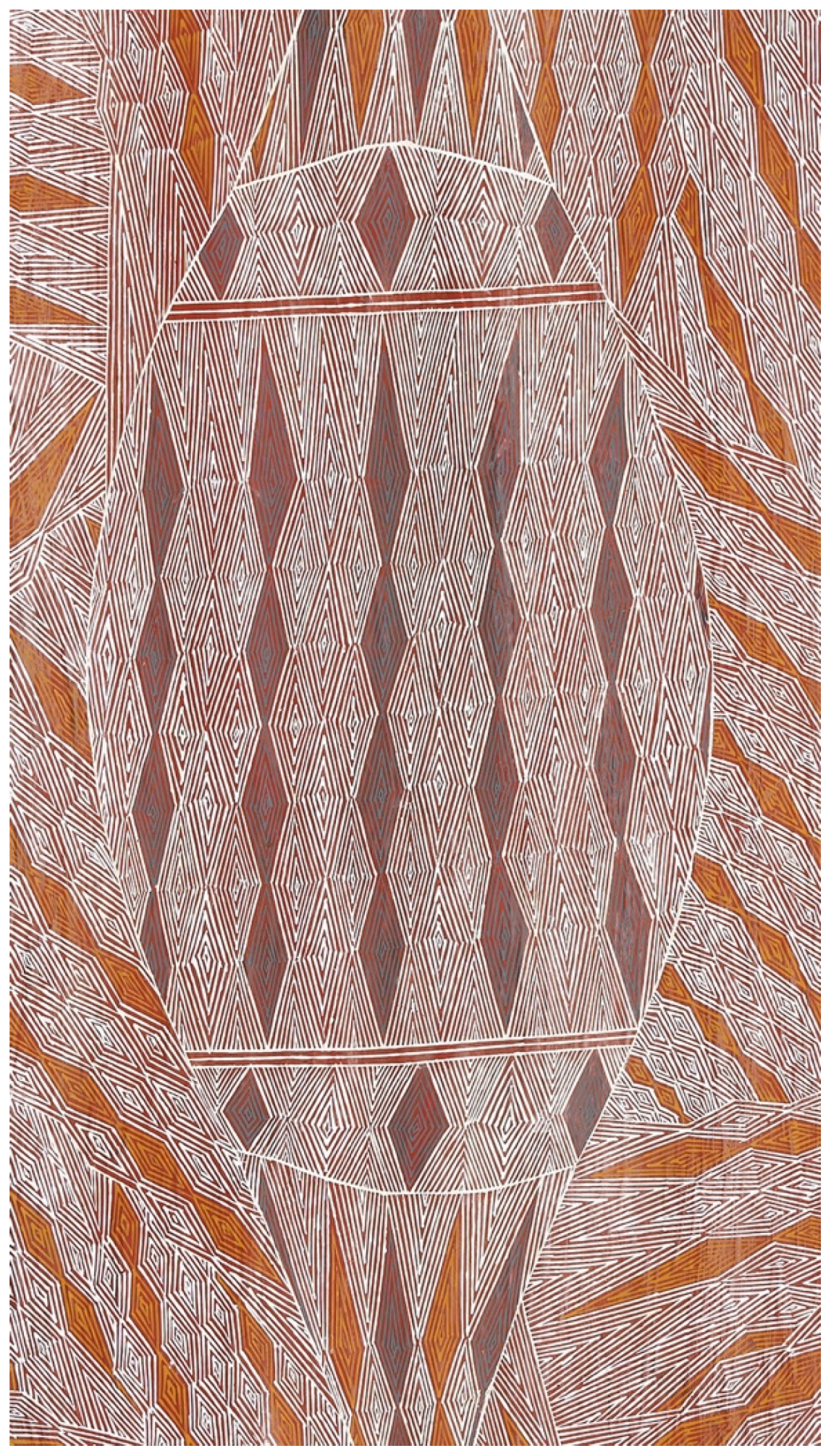
Wurrandan’s painting for Maḏayin (Figure 3) can be viewed as a contemporary reflection on Yolŋu art practice and in part a response to Thomson’s bark paintings, which Yolŋu view as an important part of their art history.16 The most generic body painting in Yolŋu ceremonies consists of covering the body in white pipeclay (gamanuŋgu), which in this case provides the background to Wurrandan’s work. The madayinbuy miny’tji is shown as if painted on the chest.17 The overall pattern is dominated by the extended and stretched Madarrpa diamond clan design. This miny’ṯji is associated with the fire generated by Bäru the crocodile Waŋarr being as it spread from Yathikpa out into the bay. The outline of the diamond pattern reflects the shape of a saltwater crocodiles head as drawn by Yolŋu artists. But as one looks closely at the design, other figurative forms emerge (Morphy 2023). In the centre is a sacred rock Nimbarrki (Figure 4) and just below the surface of the sea and on either side are the Waŋarr dugong who in turn had been caught by the flames burning beneath the surface. The title—Diamond—prioritises the moiety and the clan at quite a general level. The painting is a masterly exercise in the fundamental aesthetic techniques of emergence (buwayak) and shimmer (bir’yun) that catch the eye. However, applying local knowledge to the painting locates it precisely in the place where the rock lies towards the middle of the bay in the direction of Baraltja. The fundamental meaning and importance of the image are not lost to the initiated eye.
Figure 4.
Nimbarrki—the sacred rock in the middle of the bay (detail of Figure 3 Diamonds).
Anthropologists need to detail the ways in which particular societies understand, their knowledge about the natural world, how they position themselves in relation to nature, and the extent to which human exceptionalism is or is not present in their views. Yolŋu art practice exemplifies a borderless art history. The holism of Yolŋu art allows it to be set in dialogue with people from different cultural backgrounds that enter the Yolŋu domain. It is making in a small way an important intervention in global art practice and discourse but that does not thereby deny the relative autonomy of the local. Yolŋu art exemplifies transcultural processes in operation—it offers passageways through complexity, which are not in themselves solutions to global problems but examples of possible futures for some local to global trajectories freed from the imposition of pre-existing categories and presuppositions. The trajectory is not predetermined and will be contingent on many different factors but in human societies those changes are the result of structured processes of systems of value, of power relations, of bodies of knowledge, all of which articulate with value creation processes. Serendipity will always play a part in the history of different locals, which argues against the wisdom of a teleological interpretation of art history.
In this sense an ecological approach to world art is likely to be a forum rather than constituting a hegemonic methodology or a set of competing theoretical frameworks. I would argue that interrelatedness is an inevitable product of the broadening of the scope of a field. The objective of the analyst is to understand processes over time, how things change, the factors that result in change, and the continuities and discontinuities in what is produced. From a disciplinary point of view one of the benefits brought about by widening the frame by adopting an ecological framework is that essential factors previously neglected by overly narrow definitions of topics and the imposition of external categories are now brought into play.
Funding
This research received no external funding.
Institutional Review Board Statement
Not applicable.
Informed Consent Statement
Not applicable.
Data Availability Statement
No new data were created or analyzed in this study.
Conflicts of Interest
The author declares no conflict of interest.
Notes
| 1 | The full curatorial team for Maḏayin in addition to Djambawa Marawili and Wukun Wanambi included Henry Skerritt, Kade McDonald, Yinimala Gumana and Wäka Munuŋgurr. Maḏayin was installed in four different venues: the Hood Museum of Art (Dartmouth College, Hanover, NH): 3 September 2022–4 December 2022; American University Museum (Katzen Arts Center, Washington, D.C.): 4 February–21 May 2023; the Fralin Museum of Art (University of Virginia, Charlottesville, VA): 2 February 2024–14 July 2024; Asia Society Museum (New York, NY): 17 September 2024–5 January 2025. |
| 2 | The paintings in their different ways all create the sensation of shimmering brilliance (bir’yun) that is a characteristic of Yolŋu ceremonial paintings. |
| 3 | For a history of the use of the term in the late 19th Century see Dyball and Carlsson (2017). |
| 4 | Deliberately echoing the word used by the Australian modernist (Preston 1927, unpaginated), an early advocate for the recognition of Australian Aboriginal art—‘The ladder of art lies flat, not vertical’. |
| 5 | The phrase comes from Claire Farago’s invitation to contribute to this issue of the journal arts. |
| 6 | An emphasis on how things mean has been central to my analysis of art (see Morphy 1991, 20, 143). |
| 7 | In his book The Shape of Time while fundamentally broadened what was encompassed within the framework of art history while at the same time focussing on formal trajectories over time. Nanay (2018) convincingly argues that the evolutionary implications of his work rather than being interpreted in progressive terms are best understood within the framework of post-Darwinian population theory. |
| 8 | In the two and a half centuries before European colonisation of Australia Yolŋu had established relations with Macassan traders from eastern Indonesia, who visited the region to gather and prepare trepang (beche de mer) (see Macknight 1976). |
| 9 | I am using art here in a general and inclusive sense to include that diversity of cultural forms that Yolŋu see as expressions and evidence of Waŋarr (Ancestral) power and designs: songs (manikay), paintings (miny’tji), dances (buŋgul) (Morphy 1991). |
| 10 | Noŋgirrŋa was also represented in a panel of her husband’s Djapu clan paintings in a work produced in collaboration with two of her daughters (Waṉambi et al. 2022a, p. 299). |
| 11 | There are echoes of Farago’s (2025) analysis of the place of techne in European theological discourse. Her argument puts techne at the centre of a comparative ecological framework for art history at a level of generality that sees art as mediating between people and the environment. She places it in the context of religious discourse in which religion (in her case study Christianity) plays the role of moral arbiter. |
| 12 | Translated from the Yolŋu Matha: ‘Wäŋayuya bukmak ḏälkuma yukurra nhä malana dhiyalami. Yurru dhäruk-miriwnha. Ŋayi yurru yakana ḻakanhami. Ḻakanhami ŋanyapinya yol ŋayi’ (Marawili 2022, p. 32). |
| 13 | The place was one of a number of sites where Macassan traders established camps for their seasonal visits to the region in order to gather and process trepang (beche de mer or sea cucumber). They established trading relationships with some Yolŋu groups who worked with them. The trade ended in 1917 when the Australian Government discouraged the trade (Macknight 1976). |
| 14 | Shortly after his initial period of fieldwork he published two short articles (Thomson 1939a, 1939b). But his richest accounts on Yolŋu art are in his field notes summarised in (Morphy 1991, 193ff). |
| 15 | Yolŋu action through art has been continuous across eastern Arnhem Land. In 1988, the year of the Australian bicentenary, Yolŋu from the west of the region together with artists from neighbouring language groups created the Aboriginal Memorial comprising 200 painted hollow log coffins (see McLean 2025). The Memorial is now one of the centre pieces of the Australian National Gallery in Canberra. In 1998 artists from Yirrkala led by Djambawa Marawili produced the Saltwater collection of paintings when they discovered illegal fishing in their country (Buku-Larrŋgay Mulka 1999). The set of paintings toured Australia and were eventually acquired by the Australian National Maritime Museum. The Saltwater collection was a significant step to the Blue Mud case, which resulted in the recognition of the ownership of the intertidal zone of land under the Land Rights Act (NT) (Morphy and Morphy 2009). |
| 16 | Indeed, a subsequent exhibition Yolŋu Power at the Art Gallery of New South Wales featured a series of clan miny’tji in the form of body paintings painted by contemporary Yolŋu artists as a conscious response to the analogous set of paintings collected by Thomson (Pinchbeck 2025). |
| 17 | Interestingly, Thomson (1939b) early on identified a set of categories of painting that Yolŋu recognised, and it is not difficult to see Wurrandan’s painting as referencing the dialogical relationship between different categories of Yolŋu miny’tji ranging from plain body painting (bulgo) and ones with clan designs (madayinpuy miny’tji). The ground colour is the generic body painting in white clay that is used in many contexts to protect the body from contagion, as a sign of mourning, to cover the body of hunters and so on. They are produced quickly and in the open. The madayinpuy paintings are powerful manifestations of the Waŋarr and take several hours to complete, often in semi-restricted contexts. Wurrandan’s paintings includes both. |
References
- Bonyhady, Tim. 1985. Images in Opposition: Australian Landscape Painting 1801–1890. Oxford: Oxford University Press. [Google Scholar]
- Buku-Larrŋgay Mulka. 1999. Saltwater: Yirrkala Paintings of Sea Country—Recognising Indigenous Sea Rights. Sydney: Jennifer Isaacs Publications. [Google Scholar]
- Campbell, Erin J. 2014. Listening to objects: An ecological approach to the decorative arts. Journal of Art Historiography 11: 1–23. [Google Scholar]
- Dyball, Robert, and Liesel Carlsson. 2017. Ellen Swallow Richards: Mother of Human Ecology? Human Ecology Review 23: 12–28. [Google Scholar] [CrossRef] [Scilit]
- Egan, Ted. 1996. Justice All Their Own. Melbourne: Melbourne University Press. [Google Scholar]
- Farago, Claire. 2025. Writing Borderless Histories of Art: Human Exceptionalism and the Climate Crisis. New York: Routledge. [Google Scholar]
- Gammage, Bill. 2011. The Biggest Estate on Earth: How Aborigines Made Australia. Sydney: Allen and Unwin. [Google Scholar]
- Gaynor, Andrea, and Ian Mclean. 2005. The limits of Art History: Towards an Ecological History of Landscape Art. Landscape Review 11: 4–14. [Google Scholar]
- Gombrich, Ernst H. 1999. The Uses of Images: Studies in the Social Function of Art and Visual Communication. London: Phaidon Press. [Google Scholar]
- Kubler, George. 1962. The Shape of Time. New Haven: Yale University Press. [Google Scholar]
- Macknight, Campbell C. 1976. The Voyage to Marege: Macassan Trepangers in Northern Australia. Melbourne: Melbourne University Press. [Google Scholar]
- Marawili, Djambawa. 2022. Maḏayin’tja Dhuwalaya Ŋayi Marrparaŋ Our sacred knowledge makes us strong. In Madayin Waltjaṉ ga Waltjaṉbuy Yolŋuwu Miny’tji Yirrkalawuy. Edited by Wukuṉ Waṉambi, Henry Skerritt and Kade McDonald. Charlottesville: DelMonico Books and Kluge-Ruhe. [Google Scholar]
- Marawili, Djambawa, and Noŋgirrŋa Marawili. 2022. ‘Ganydjarr Dupthuna Marrtji Ŋayi’ Where its Power Emerges. In Madayin Waltjaṉ ga Waltjaṉbuy Yolŋuwu Miny’tji Yirrkalawuy. Edited by Wukuṉ Waṉambi, Henry Skerritt and Kade McDonald. Charlottesville: DelMonico Books and Kluge-RuheMarika. [Google Scholar]
- McLean, Ian. 2025. Djon Mundine and the Aboriginal Memorial. In Mediating Modernisms: Indigenous Artists, Modernist Mediators, Global Networks. Edited by Ruth B. Phillips and Norman Vorano. Durham: Duke University Press. [Google Scholar]
- Morphy, Frances, and Howard Morphy. 2009. The Blue Mud Bay Case: Refraction Through Saltwater Country. Dialogue of the Academy of Social Science in Australia 28: 15–25. [Google Scholar]
- Morphy, Frances, and Howard Morphy. 2020. Locating ‘mind’ (and ‘soul’) cross-culturally. In Meaning, Life and Culture: In Conversation with Anna Wierzbicka. Canberra: ANU Press. [Google Scholar]
- Morphy, Howard. 1991. Ancestral Connections: Art and an Aboriginal System of Knowledge. Chicago: University of Chicago Press. [Google Scholar]
- Morphy, Howard. 1993. Cultural Adaptation. In Human Adaptation. Edited by G. A. Harrison. Oxford: Oxford University Press. [Google Scholar]
- Morphy, Howard. 2008. Exploring Cross-Cultural Categories. Oxford: Berg. [Google Scholar]
- Morphy, Howard. 2010. Art as action, art as evidence. In The Oxford Handbook of Material Culture Studies. Edited by Dan Hicks and Mary C. Beaudry. Oxford: Oxford University Press. [Google Scholar]
- Morphy, Howard. 2023. Abstraction. In Routledge International Handbook of Visual Research Methods in Anthropology. Edited by Chris Wright and Rupert Cox. New York: Routledge. [Google Scholar]
- Morphy, Howard, and Frances Morphy. 2006. Tasting the waters: Discriminating identities in the waters of Blue Mud Bay. Journal of Material Culture 11: 67–85. [Google Scholar] [CrossRef] [Scilit]
- Morphy, Howard, and Frances Morphy. 2023. The Yolŋu system as a regional polity. In Sentient Archaeologies: Global Perspectives on Places, Objects and Practice. Edited by Courtney Nimura, Rebecca O’Sullivan and Richard Bradley. Oxford: Oxbow Books, pp. 163–73. [Google Scholar]
- Mununggiritj, Raymattja. 1999. The Wentworth Lecture 1998. Aboriginal Studies 1: 3–9. [Google Scholar]
- Nanay, Bence. 2018. George Kubler and the Biological Metaphor of Art. British Journal of Aesthetics 58: 423–34. [Google Scholar] [CrossRef] [Scilit]
- O’Neill, John, and Thomas Uebel. 2015. Analytical Philosophy and Ecological Economics. In Handbook of Ecological Economics. Edited by Joan Marteınez-Alier and Roldan Muradian. Cheltenham: Edward Elgar. [Google Scholar]
- Pinchbeck, Cara. 2025. Yolŋu Power: The Art of Yirrkala. London: Thames and Hudson. [Google Scholar]
- Preston, Margaret. 1927. From eggs to Electrolux. In Art in Australia, the Margaret Preston Number. 3rd Series. Number 22. [Google Scholar]
- Rigsby, Bruce, and Nicolas Peterson. 2005. Donald Thomson: The Man and Scholar. Melbourne: Museum of Victoria & Academy of the Social Sciences in Australia. [Google Scholar]
- Sahlins, Marshall. 1973. Culture and Practical Reason. Chicago: University of Chicago Press. [Google Scholar]
- Sanderson, John Burdon. 1893. On the origin of biology and its relation to the other branches of natural science. British Medical Journal 2: 613–17. [Google Scholar] [CrossRef] [Scilit] [PubMed]
- Stanner, William Edward Hanley. 1979. The Yirrkala Land Case: Dress Rehearsal. In White Man Got No Dreaming. Canberra: ANU Press. [Google Scholar]
- Strang, Veronica. 2016. Justice for all: Inconvenient truths and reconciliation in human–non-human relations. In Routledge Handbook of Environmental Anthropology. New York: Routledge. [Google Scholar]
- Thomson, Donald F. 1939a. Notes on the smoking pipes of North Queensland and the Northern Territory of Australia. Man 39: 81–91. [Google Scholar] [CrossRef] [Scilit]
- Thomson, Donald F. 1939b. Two painted skulls from Arnhem Land, with notes on the significance of the designs. Man 39: 1–3. [Google Scholar] [CrossRef] [Scilit]
- Waṉambi, Wukuṉ, Henry Skerritt, and Kade McDonald, eds. 2022a. Madayin: The sacred and the beautiful. In Madayin Waltjaṉ ga Waltjaṉbuy Yolŋuwu Miny’tji Yirrkalawuy. Charlottesville: DelMonico Books and Kluge-Ruhe. [Google Scholar]
- Waṉambi, Wukuṉ, Henry Skerritt, and Kade McDonald, eds. 2022b. Madayin Waltjaṉ ga Waltjaṉbuy Yolŋuwu Miny’tji Yirrkalawuy. Charlottesville: Delmonico Books/Kluge-Ruhe. [Google Scholar]
- Williams, Nancy. 1986. The Yolngu and Their Land: A System of Land Tenure and Its Fight for Recognition. Canberra: Australian Institute of Aboriginal Studies Press. [Google Scholar]
Disclaimer/Publisher’s Note: The statements, opinions and data contained in all publications are solely those of the individual author(s) and contributor(s) and not of MDPI and/or the editor(s). MDPI and/or the editor(s) disclaim responsibility for any injury to people or property resulting from any ideas, methods, instructions or products referred to in the content. |
© 2026 by the author. Licensee MDPI, Basel, Switzerland. This article is an open access article distributed under the terms and conditions of the Creative Commons Attribution (CC BY) license.