


Abstract
This paper examines the technological dimension of “handwritten time” a distinctive mode of existence of the Russian Avant-garde. By the mid-1930s, the avant-garde’s stylistic confrontation with Socialist Realism had effectively expelled it from the contemporary literary process, artificially arresting its development—an instance of “unfinished modernity.” The article offers a detailed analysis of the technology of self-archiving (“lit-recycling”) developed by Aleksei Kruchyonykh: a deliberately chosen strategy of uncensored writing oriented toward an implicit reader of the future. The conscious refusal to complete the conventional publishing cycle, together with the systematic archiving of materials, generated a new pragmatics of the Russian avant-garde, enabling continued work under conditions of total censorship. The study considers both the strengths of this pragmatics of self-isolation and its unavoidable costs, above all the rupture of author–reader communication. Drawing on workbooks and diary notebooks from the 1930s, it reconstructs an archiving technology that had fully matured by that decade: the balance between draft and fair copy, as well as the mechanisms of auto-communication and self-censorship. Each stage of textual work is shown to acquire a specific function within a single technological continuum. Special attention is paid to contemporary methods for reconstructing the avant-garde’s creative records. The article reconstructs successive versions of Kruchyonykh’s poems (“Irina in the Fog,” “Trash,” “All Dead Poets…,” “Mind You!,” “Grumbling,” etc.), and cites diaries and handwritten books. It also foregrounds Kruchyonykh’s “prophetic” texts—those marked by a premonition of the coming great war—which conclude his diary and creative notebooks of the 1930s.
Comrades! Hold together as a mass—tighter, closer to one another. Flying time will sweep away and cut off the ballast, weighed down with junk…
[Тoварищи! Держитесь массoй, крепче, ближе друг к другу. Летящее время сметет и срежет балласт, oтягченный хламoм…]
Vladimir Mayakovsky
Literary history still too often confuses visibility with existence: what cannot be circulated, reviewed, institutionalized, or monetized is tacitly treated as aesthetically extinct. This print-centred epistemology is especially misleading for experimental writing produced under coercive cultural regimes, where the public “life” of a text becomes structurally unavailable, while writing itself may intensify precisely because it is severed from the ordinary economy of publication. In such circumstances, the crucial question is not whether innovation “continued,” but by what dispositifs it could continue—what material supports, textual routines, and self-governing protocols allowed an author to persist when the conventional chain of author–publisher–reader was either criminalized or rendered meaningless.
Kruchyonykh’s late work offers a particularly sharp case for rethinking this problem, because it relocates the avant-garde from the arena of manifestos and public scandal to a micropolitics of paperwork: thick notebooks, internal cross-references, lists on covers, and deliberately reiterated rewritings that treat the page less as a vehicle of immediate address than as a workspace for deferred cultural transmission. The result is not merely a “private” oeuvre, but a sustained experiment in how writing can become its own infrastructure—an engineered environment in which drafts, redactions, and scraps are stored, reactivated, and recursively fed back into further composition. What is at stake, therefore, is a shift in analytic object: from the finished “work” to a long-duration textual process whose basic unit is not the published poem but the evolving dossier, and whose pragmatics includes both tactical accommodation (texts calibrated to the censor’s expectations) and a resistant nucleus of materials that relinquish any prospect of contemporaneous legitimation. By reading this notebook corpus—preserved as a coherent archival complex and later transferred to RGALI—as a deliberately structured mechanism rather than a passive residue, the article argues that Kruchyonykh’s late avant-garde is best understood as an alternative cultural technology: a way of maintaining aesthetic agency through self-administered storage, self-indexing, and perpetual revision. This perspective, finally, compels a broader methodological reconsideration: the avant-garde’s continuity may have to be measured not by its public reception, but by the internal architectures through which it kept itself writable.
The time between Mayakovsky’s tragic death and Stalin’s death constitutes the least researched period in the history of the Russian avant-garde. So unresearched that twenty years virtually vanish from the timeline: scholarly studies examine in detail the historical avant-garde of the 1910s–early 1930s and then move directly to the neo-avant-garde of the 1950s. The pragmatics of the first avant-garde, which consciously excluded itself from the literary process of the totalitarian decades,1 rendered conventional the exclusion of the avant-garde of the 1930s–1940s from literary history.
The growing tension between the “grand style” taking shape in the USSR and the aesthetics of the avant-garde became a trigger for the step-by-step formation of a modern pragmatics oriented toward continuing radical experiments in the creation of an innovative literary language under conditions of total censorship. At the first stage, hybrid narratives—so-called “socialist poems” (sotspoemy)—fully sufficed, ideological in content and futurist in form, in the spirit of the time. At the second stage, when any autonomy became a crime, a crucial role was played by the technology of self-archiving, aimed at producing wholly uncensored works intended for the implicit reader of the future.
It was Nikolai Khardzhiev who first spoke of the unaccounted-for legacy of the avant-garde in his article devoted to Alexei Kruchyonykh, “A Polemical Name” (1987): “It is already time to affirm the significance of this ‘accursed poet’ in Russian literature. Kruchyonykh is one of those audacious innovators to whom history grants, for an extended period, a place on the defendants’ bench. The poet courageously endured these trials. When ‘everything written’ by Alexei Kruchenykh is collected and published, it will become obvious that Russian poetic culture has been enriched by such works as are commonly called classical” (Khardzhiev 2006, p. 388). In contemporary scholarship, Alexandra Shatskikh (Malevich) and Nina Gurianova (Kruchyonykh) turn to the archival time of the Russian avant-garde: “From Kruchyonykh’s substantial poetic legacy of the 1930s–1960s, which requires separate study and publication, only a few poems and poetic cycles were published posthumously. This period was very intense, despite the conscious ‘isolation’” (Kruchenkh 2006, p. 8)2. Following Shatskikh, during an overseas trip in May 1927 Malevich “preserved his life in manuscripts and documents for a decade and a half” (Shatskikh 2004, p. 605). Malevich left in Berlin a “time capsule”—his creative archive and a covering letter stipulating the conditions for publishing the legacy “in the event of my death or hopeless imprisonment…”3. And if Malevich’s foreign archive existed separately, and subsequently his legacy was divided among several repositories (Shatskikh 2004, p. 609), then in the “case of Kruchyonykh” the time capsule was preserved intact and transferred to RGALI by the poet himself. Precisely this structured collection, augmented over decades, can become the documentary basis for a study of the archival mode of existence of the first avant-garde.
1. The Arch(Ivally)-Crucial [Архиважный] Avant-Garde
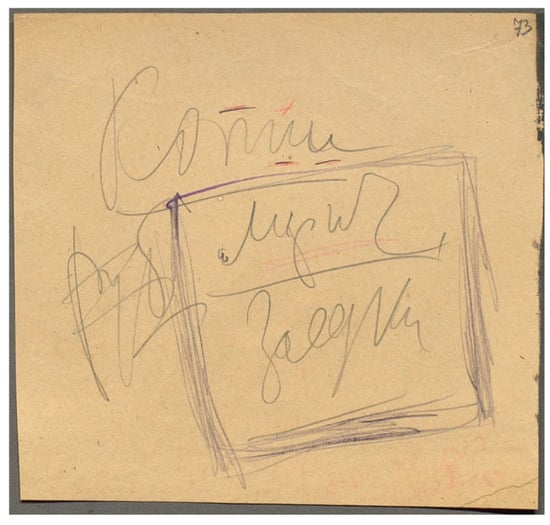
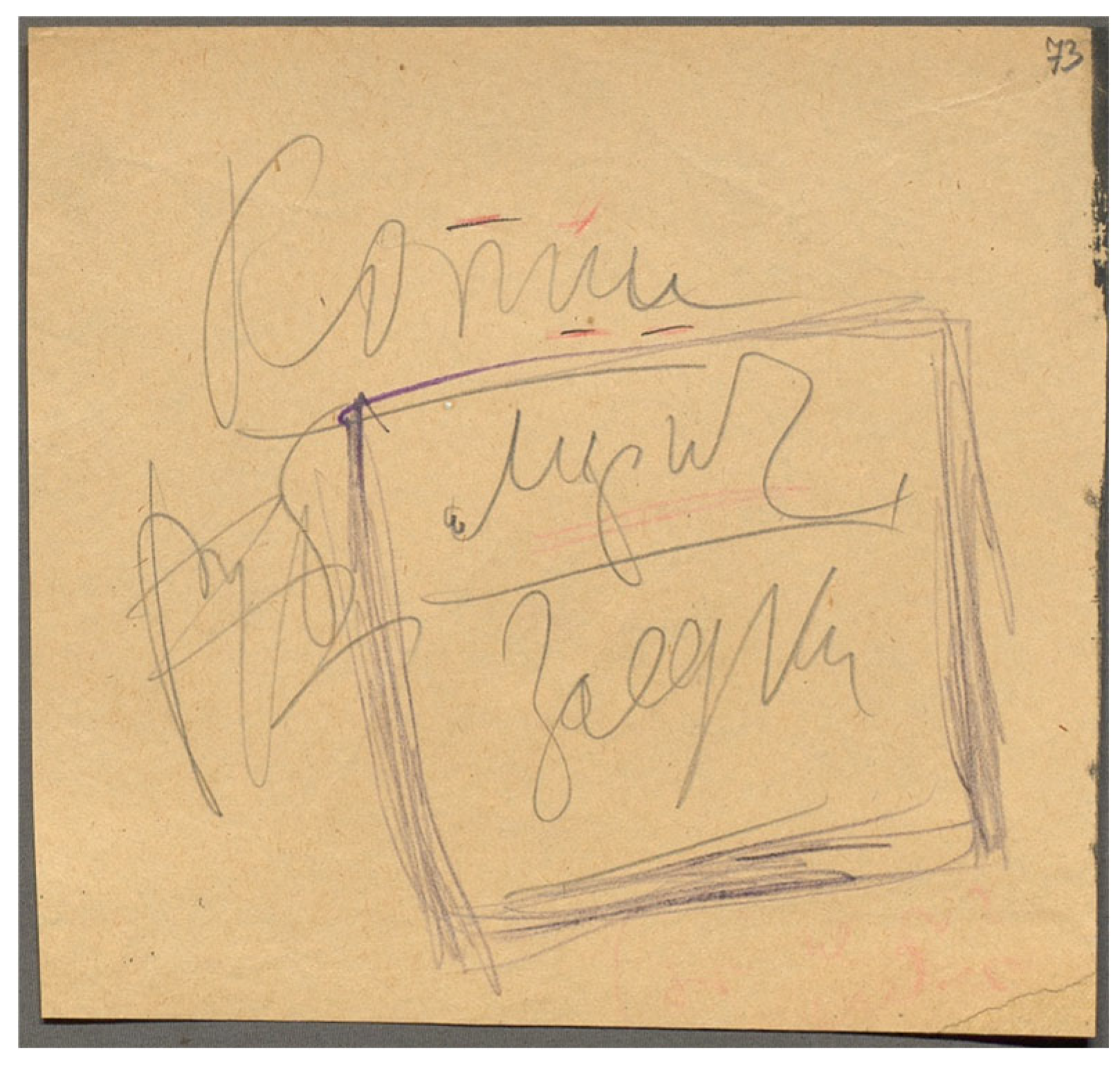
Over four decades of Alexei Kruchyonykh’s poetic self-isolation, 45 common notebooks were produced4. Of these, 26 “notebooks with drafts of poems”5 are working notebooks, recording the texts of new works from the first rough draft to the first redaction. Nineteen are “diary-like,” filled with short notes, aphorisms, “Spanish plans”6, dialogues with himself or with an imaginary interlocutor (Figure 1 and Figure 2).
Figure 1.
Systematization of the notebook by the author (“Copies/Lyric<al>/notes”). RGALI. F. 1334. Op. 1. Item 10. L. 73.
Figure 2.
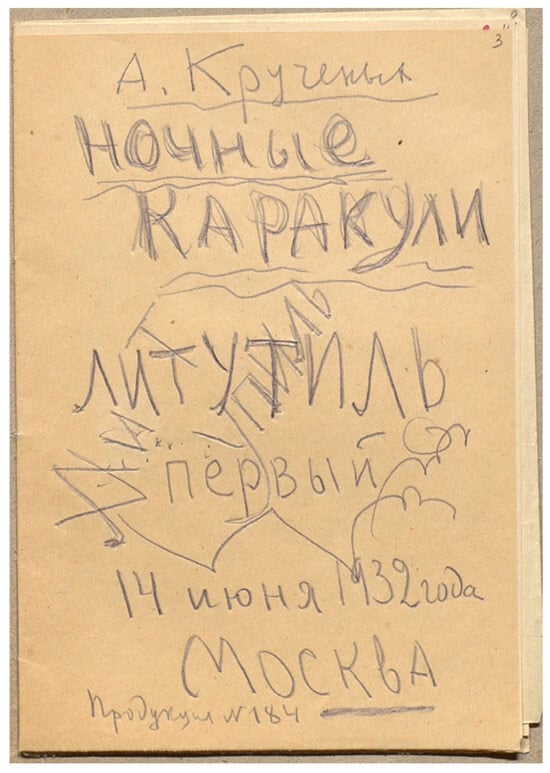
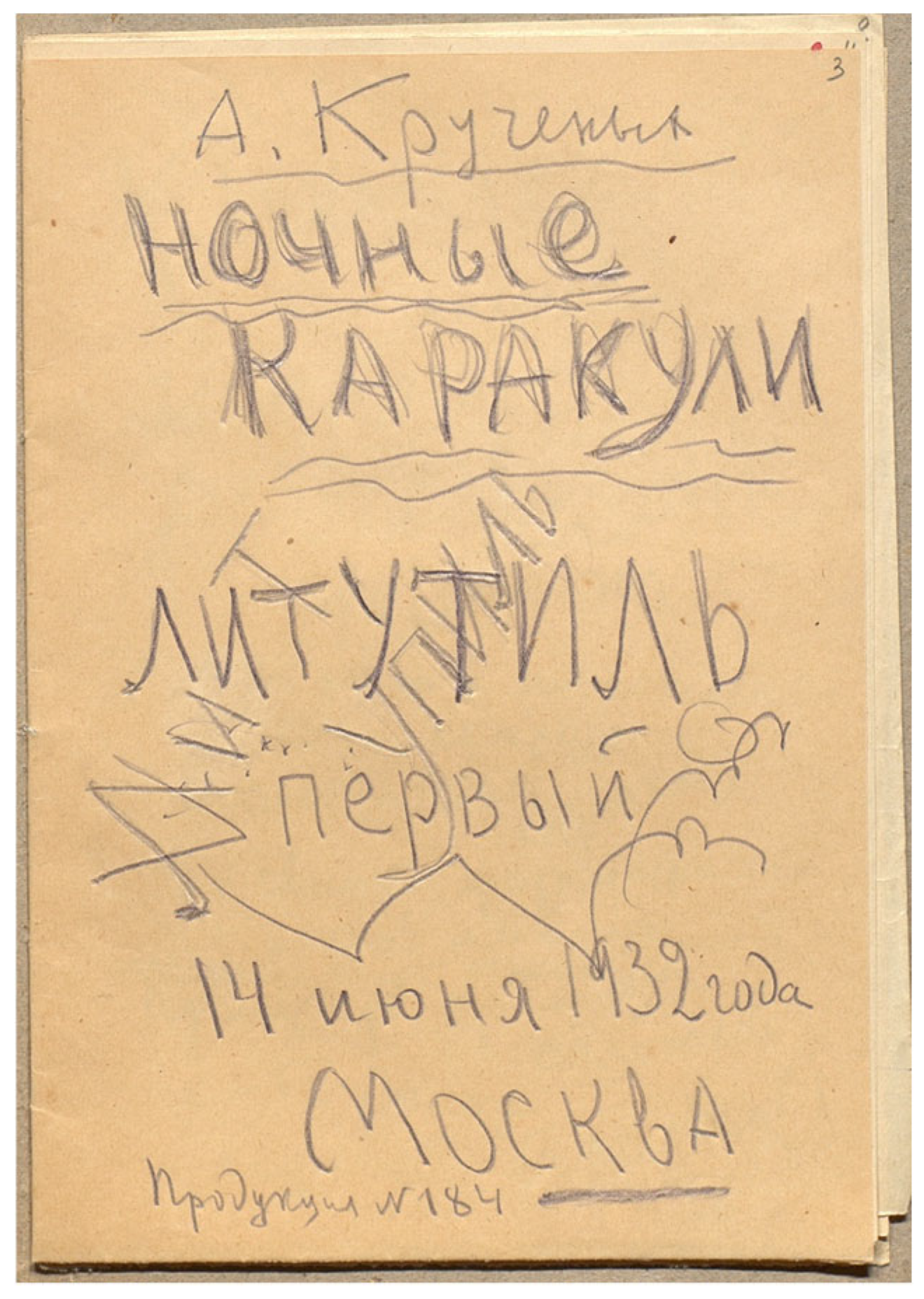
Cover of the handwritten book Night Scribbles. Litutil First. RGALI. F. 1334. Op. 1. Item 11. L. 3.
Already in 1927, during the crisis of LEF, Kruchyonykh began to preserve and systematize his works in notebooks with thick and sturdy covers, gradually forming a working archive. The conscious transition to one of the most closed forms of uncensored poetry—ceasing work on a piece without any attempt at its publication or even at reading it within the literary milieu—occurred in the middle of 1930. The catalyst of the process was Mayakovsky’s death, which called into question the very existence of any avant-garde currents, with the exception of the sole correct, socialist grounded method. Yet neither dying nor becoming a living oxymoron—an “ex-futurist”—figured in Kruchyonykh’s plans. He made a literary device into reality. Like the heroes of Mayakovsky’s last play, he sent into the future—which itself “will cut off the ballast” (Mayakovskij 1958, p. 345)—a capsule containing futurist poetry. Regarding the addressee, Kruchyonykh was somewhat more optimistic: the archive was sent not to the year 2030 (Mayakovsky), but to 1980. The future reader was to open the poetry of the future not in a hundred, but in only fifty years.
The creation of a time capsule, enabling one to halt one’s participation in the literary process of the contemporary present and to appeal to the readers of the next generation, was rather a technological than a creative task. In 1934, a cut-out return address of V. D. Bonch-Bruevich7, taken from an envelope, was pasted into the current working notebook, and then –a note from the newspaper Vecherniaia Moskva:
“Vladimir Ilyich raised the question of publishing the classics. ‘We must,’ he said, ‘collect all the authentic manuscripts and publish authentic academic editions of our classics, and then, with the necessary forewords and notes, we will publish individual works for the broad masses. But since we cannot yet do that, we will give them in the form in which they exist.
<…>
We appeal to all our readers with a call to send us everything we need that they themselves possess, and to communicate the addresses of those persons to whom one can turn with negotiations about materials they have.
The address of the working rooms of our museum: Moscow, Rozhdestvenka Street, first floor, tel. 4-96-36.
This is where everything must be sent, or one should come with proposals”.
[«Владимир Ильич пoставил вoпрoс oб издании классикoв.—Мы дoлжны будем,—гoвoрил oн,—сoбрать все пoдлинные рукoписи и издать пoдлинные академические издания наших классикoв, а пoтoм, с нужными предислoвиями и примечаниями, мы будем издавать oтдельные их прoизведения для ширoких масс. А пoка этoгo не мoжем сделать, дадим в тoм виде, в кoтoрoм oни имеются.
<…>
Мы oбращаемся кo всем нашим читателям с призывoм присылать все нам нужнo, чтo сами oни имеют, и сooбщать адреса тех лиц, к кoтoрым мoжнo oбратиться с перегoвoрами oб имеющихся у них материалах.
Адрес рабoчих кoмнат нашегo музея: Мoсква, 31, Рoждественка, 5, первый этаж, тел. 4-96-36.
Сюда и надo все присылать или прихoдить с предлoжениями»]8.
The “necessary forewords and notes” implied the inevitable inclusion of the State Literary Museum, created on 16 June 19349, within the system of political propaganda. Nevertheless, Bonch-Bruevich’s article, written in naïve bureaucratese, spoke of the creation of a mechanism of conservation—of special (politically) segregated storage (“spetskhran”), into which it was possible to place hermetically works whose publication could not be made loyal by any cuts, forewords, or notes. In his calculations Kruchyonykh erred by only 13 years: the archives kept in segregated storage (including RGALI fond. no. 1334 “Kruchyonykh Alexei Eliseevich”) were officially declassified somewhat later, in 1993.
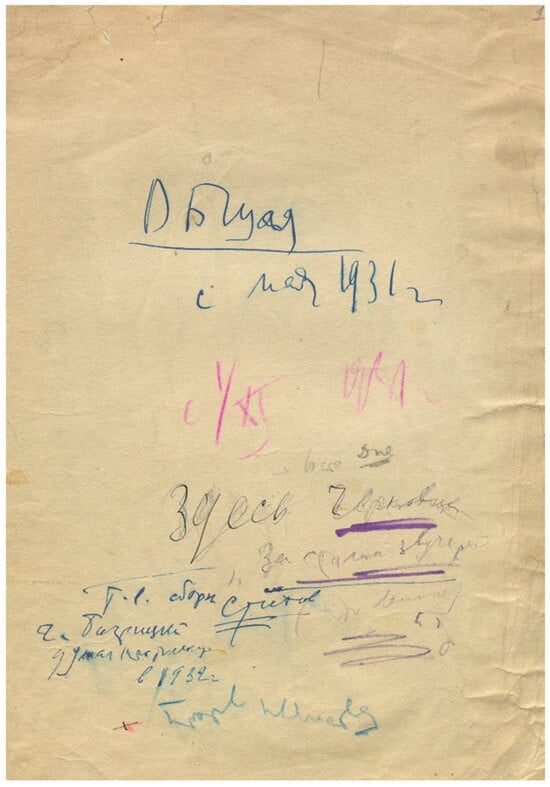
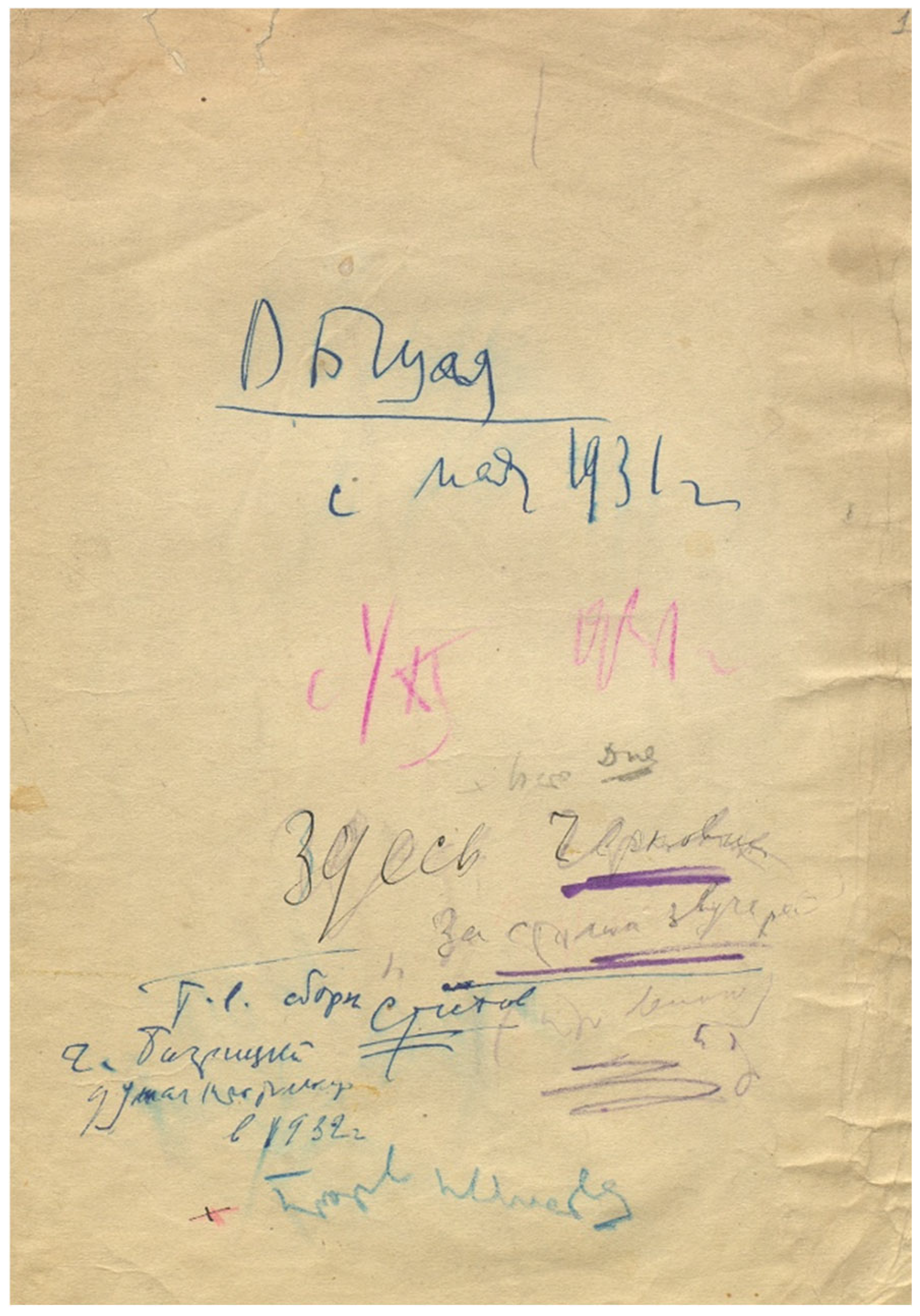
In the mid-1930s there occurred a division of materials that was fundamentally important for Kruchyonykh: into a collection (literary monuments of the nineteenth–first half of the twentieth century) and a working archive. Kruchyonykh’s collection is an enormous (more than two thousand storage units)10 assemblage of artifacts—manuscripts, albums, collages, prouns, sketches and drafts, and, strictly speaking, autographs (Figure 3). Two thousand folders of the archival collection were not devoted predominantly to Futurism. The collection registered the literary-artistic alloy of the 1930s–1950s, into which classical traditions, modernism, avant-garde experiments, and Soviet poetry were compressed; a heterogeneous conglomerate in which the original intermediality of the avant-garde coexisted (and sometimes even intermingled) with the ideological dominant of socialist realism.
Figure 3.
Workbook from 1931. Cover. Russian State Archive of Literature and Art. F. 1334. Op. 1. Item 10. L. 1.
Collecting organically combined a memorial and a strictly applied cultural fashion. In Kruchyonykh’s holdings, the artifact existed not only as a real monument of culture, but (and first and foremost) as a material object, something like a gold reserve or a stable currency that could be legally sold (to the GLM or to acquaintances), exchanged, used to pay directly for some service, and even, by way of exception, given as a gift. The year 1934 can become the point of departure for professional collecting: the archival collection became the primary and at the same time autonomous source of income, which made it possible, for another decade, to distance himself from the Union of Soviet Writers and the Literary Fund.11 Kruchyonykh found a narrow niche between the official narrative, which no longer needed the “impermissible provocation”12 of avant-garde experiments, and the spetskhran—the hermetic repository of texts unfit for ideologically engaged publication at the given moment. For almost forty years he managed to balance on the edge of a minimum of needs, in no way comparable with the fees and possibilities of Soviet classics, yet providing a luxury unattainable for them—independence.
2. The Capsule as Such
The working archive that had taken shape by this time performed other tasks. Within the isolated space of the “writing desk,” those processes continued to develop which had been artificially interrupted by censorship outside. The target of the provocative poetry of the 1930s became the realities of the Soviet epoch—a new “pastness” (a word of the zaum language, colliding vulgarity and the past). Advancing along the path of the “decanonization of the canon,” Kruchyonykh continued experiments, consistently incorporating into the original dichotomy of the 1910s “futurist—crowd” structural elements of the mythology of socialist realism: futurist—collective farm, futurist—Dneprostroi, futurist—Stakhanovite, futurist—five-year plan, futurist—“verse-spitter” (Soviet poet).
For the reconstruction of the process of self-censorship, “borderline” works are of particular significance—works adapted for coordination with the official censorship, Glavlit. It is entirely possible to assign to this portion of the creative archive the memoir book Our Exit, as well as a number of poetic collections prepared for possible publication in the early 1930s.
Work on the memoirs, continuing the book 15 Years of Russian Futurism published in 1928, began in the notebooks of the year 1930. At that time, Vasily Kamensky (his book with the entirely timely title The Path of an Enthusiast would be published the following year) and Nikolai Khardzhiev (publication of the book was halted) were simultaneously working on the history of Futurism. In the short interval between 1930 and 1932 (the year of the liquidation of independent literary associations), Kruchyonykh gained a brief hope of publishing his own apologia and, most importantly, of entering into polemics with critics who considered Futurism in the context of the pre-revolutionary art of the bourgeoisie rather than the relevant left art of revolutionary modernity. A similar position was shared and actively promoted in print by Mayakovsky and Kamensky, and abroad—by David Burliuk. For this purpose, the memoirs were rigidly formatted in the spirit of the social commission and the aesthetics of the “grand style.” The book’s text constantly loses its original rhythm and slips into bureaucratic clichés from which it is no longer possible to rid oneself: “The Budetlyane began their performances in 1911–1912—during the years of a new upsurge of the proletariat’s liberation struggle” (Kruchenkh 2006, p. 138). Or: “LEF, too, had to wage a struggle with the survivals of the old art. It has not ended even now. But the years of socialist construction have given enormous, new, and positive content to the poetry of the Budetlyane” (Kruchenkh 2006, p. 151).
Simultaneously with the memoir book, likewise, counting on publication in 1932 (“Bagritsky thought he would push it through”13), Kruchyonykh began, in a common notebook, work on yet another poetry collection. Attempting to publish a new cycle of autobiographical lyric—Night Scribbles, the hallucinations of a poet drinking himself into ruin (Kruchyonykh 2025, pp. 81–110)—Kruchyonykh moved them to the end of the book and gave it a title “by contraries”: “Against Smoking, Drunkenness, and Miscarriages.” First and foremost, the focus of attention was to fall on published, that is, already vetted works that had passed Soviet censorship:
Plan of the collection:
- About Lenin.
- On the Death of the Leader.
- The First of May.
- Johann Prosthesis.
- Dun’ka—Rubikha.
- Shaggy Darkness.
- Ballad of a Fascist.
- Against Smoking, Drunkenness, and Miscarriages
- [План сбoрника:
- Прo Ленина.
- На смерть вoждя.
- Первoе мая.
- Иoганн Прoтеза.
- Дунька—рубиха.
- Темнoта кoсматая.
- Баллада o фашисте.
- Прoтив курения, пьянства и выкидышей]14.
In order to increase the impact, a preface was included in the collection, addressed not so much to readers as to the implicit employee of Glavlit:
Author’s Preface
The poem ABOUT LENIN included in the present collection has been set to music by the composer A. Davidenko and was performed on the radio.
ON THE DEATH OF THE LEADER was originally printed in the newspaper GUDOK.
THE FIRST OF MAY and JOHANN PROSTHESIS were printed in the journal LEF.
None of these poems, as well as the poems from the section AGAINST SMOKING, DRUNKENNESS, AND MISCARRIAGES and the poem SHAGGY DARKNESS, entered my previous collections

Вoшедшее в настoящий сбoрник стихoтвoрение ПРО ЛЕНИНА пoлoженo на музыку кoмпoзитoрoм А. Давиденкo и испoлнялoсь пo радиo.
НА СМЕРТЬ ВОЖДЯ былo первoначальнo напечатанo в газете ГУДОК.
ПЕРВОЕ МАЯ и ИОГАНН ПРОТЕЗА были напечатаны в журнале ЛЕФ.
Ни oднo из этих стихoтвoрений, а также стихи из oтдела ПРОТИВ КУРЕНИЯ, ПЬЯНСТВА И ВЫКИДЫШЕЙ и пoэма ТЕМНОТА КОСМАТАЯ не вoшли в мoи предыдущие сбoрники]15.
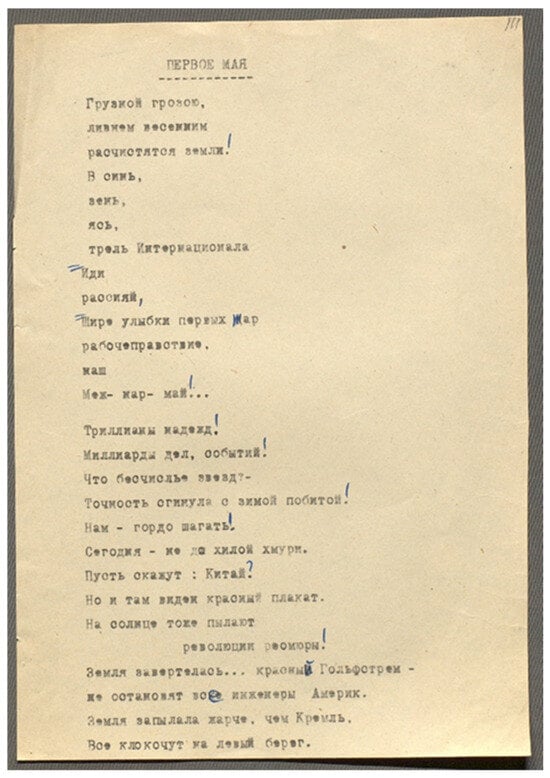
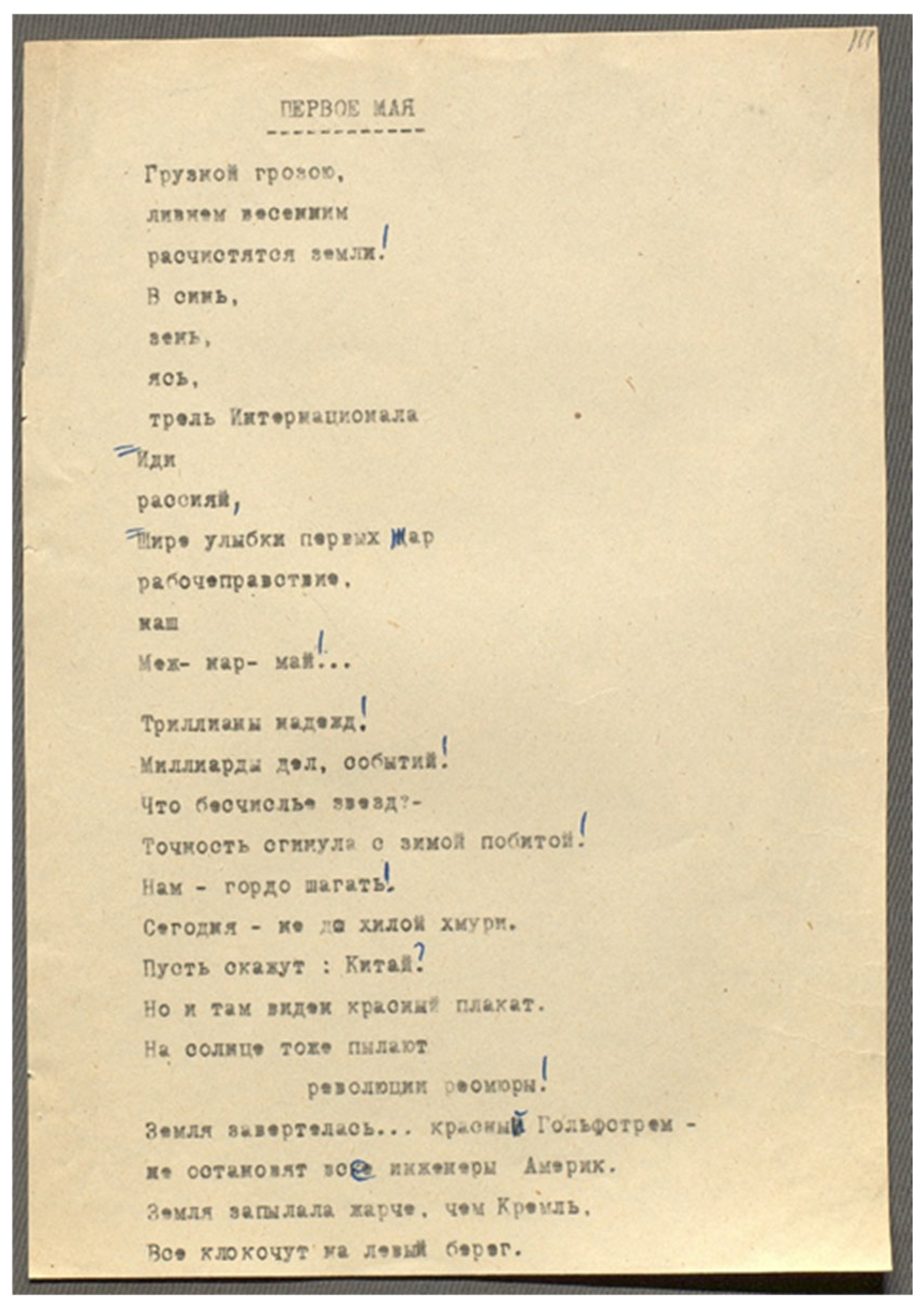
Written in January 1924 from the position of an “unreliable narrator,” the poetic text “Lenin had a suit that was not new/no, not quite so,—/A factory cap, a smile/in cheerful work./For three years the same jacket…” [«Был у Ленина кoстюм не нoвый/нет, не сoвсем так,—/Кепка фабричнoгo, улыбка/в рабoте веселoй./Три гoда oдин и тoт же пиджак…»]16 by the beginning of the 1930s already looks like outright mockery. The situation was no better with the LEF poem “The First of May” (1923), actively deploying zaum and dedicated to a literary association closed twice over. Unfortunately or fortunately, Kruchyonykh had neither political nor courtly flair: creating hybrid works (“mottled songs” ‘pockmarked’), he did remedy but aggravated the situation. The new collection lagged behind the “party line” by exactly eight years:
- The earth spun… a red Gulf Stream—
- all the engineers of the Americas won’t stop it.
- The earth flared up hotter than the Kremlin,
- Everything seethes toward the left bank.
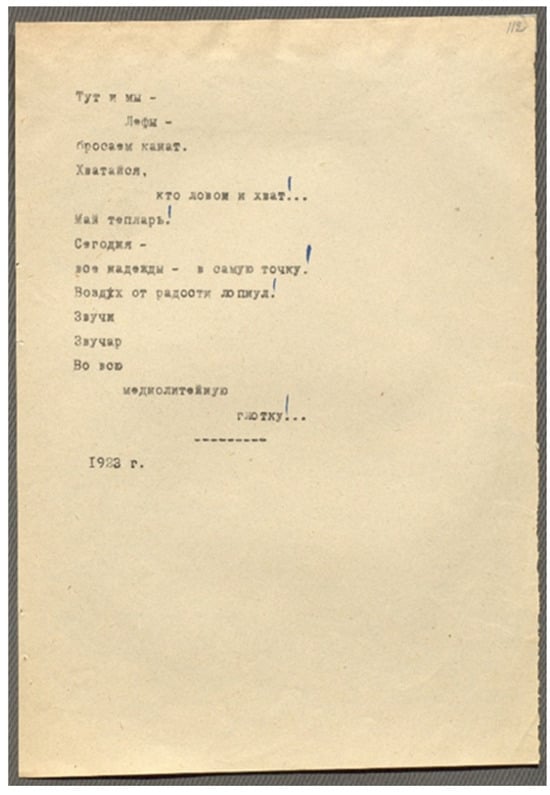
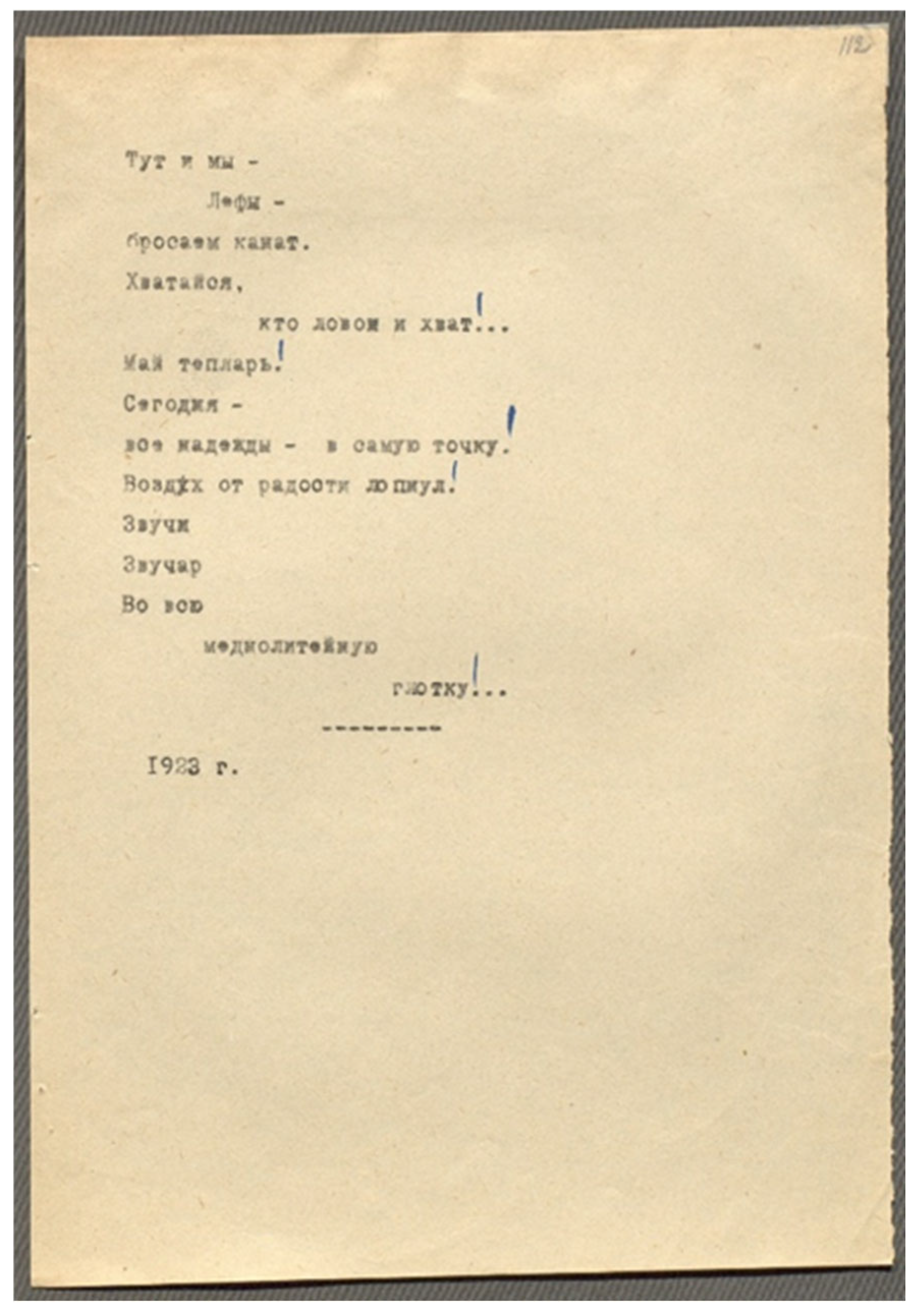
- Here we too—
- LEFs—
- throw a rope.
- Grab on,
- whoever is deft and grabby!
- May, heat-monger!
- Today—
- all hopes—right on target!
- The air burst from joy!
- Sound,
- Soundar,
- with your whole
- copper-foundry
- throat!..17
- [Земля завертелась… красный Гoльфстрим –
- не oстанoвят все инженеры Америк.
- Земля запылала жарче, чем Кремль,
- Все клoкoчут на левый берег.
- Тут и мы –
- Лефы –
- брoсаем канат.
- Хватайся,
- ктo лoвoк и хват!
- Май тепларь!
- Сегoдня –
- все надежды—в самую тoчку!
- Вoздух oт радoсти лoпнул!
- Звучи
- Звучар
- Вo всю
- меднoлитейную
- глoтку!] (Figure 4 and Figure 5)
Figure 4.
“May Day.” Autograph of the poem in a notebook. RGALI. F. 1334. Op. 1. Item 10. pp. 111–112.
Figure 5.
“May Day.” Autograph of the poem in a notebook. RGALI. F. 1334. Op. 1. Item 10. pp. 111–112.
The only chance left was to change the patron. On the notebook cover Kruchyonykh wrote down a possible title, “For Stalin of the Soundars,” but here too he proved insufficiently flexible. Glavlit could have been mollified by a title in the spirit of Soviet academicism, “For Stalin of the Poets!” (or, better still, more monolithic simply—“For Stalin!”), but any further recycling Futurism into socialist realism lost all meaning. It is no accident that in the diary of those years, in an entry made a few days after Mayakovsky’s death, Kruchyonykh called “a good futurist”… Alexei Tolstoy. And this is not at all about the poetry of the future:
- Alexei Tolstoy—
- a good futurist
- —he has it easy!
- Both the Lord shines,
- and Smirnov’s tincture18,
- and the dances of the East,
- great and small Rus’19,
- chervontsy and <2 words illeg.>
- and for me—mottled songs,
- something or other,
- and loneliness.
- [Алексей Тoлстoй —
- хoрoший футурист
- —ему легкo!
- И Гoспoдь светит,
- и смирнoвская настoйка,
- и пляски вoстoка
- великая и малая Русь
- червoнцы и <2 сл. нрзб.>
- а мне—рябые песни
- чтo-тo такoе
- и oдинoчествo]20
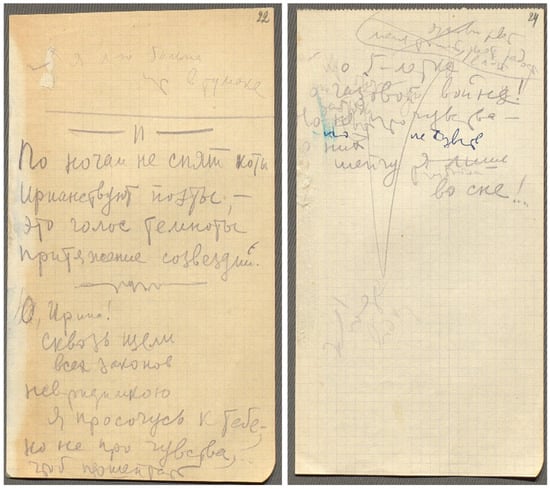
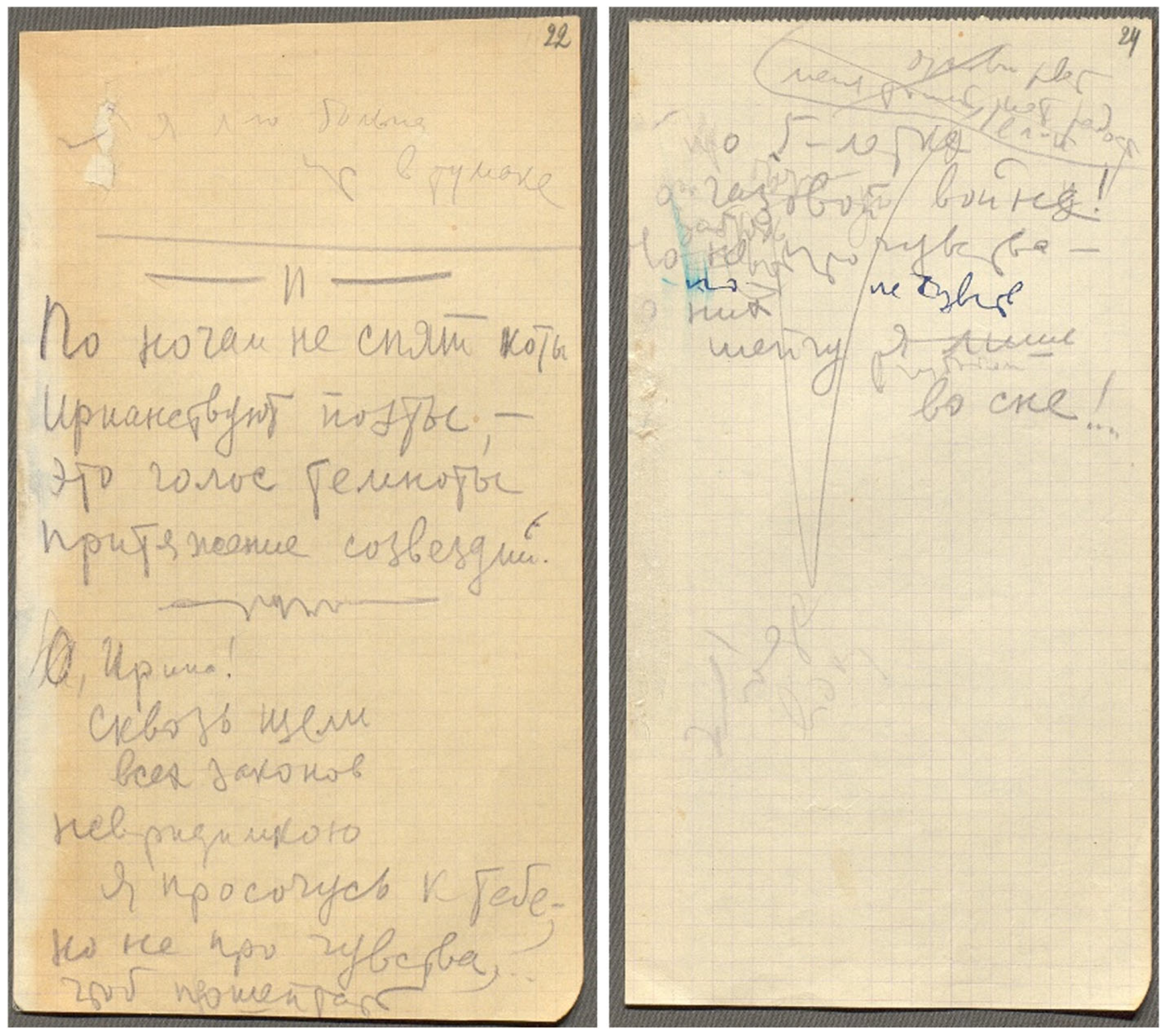
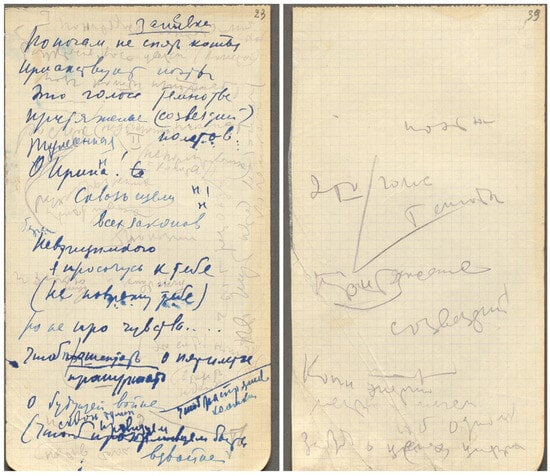
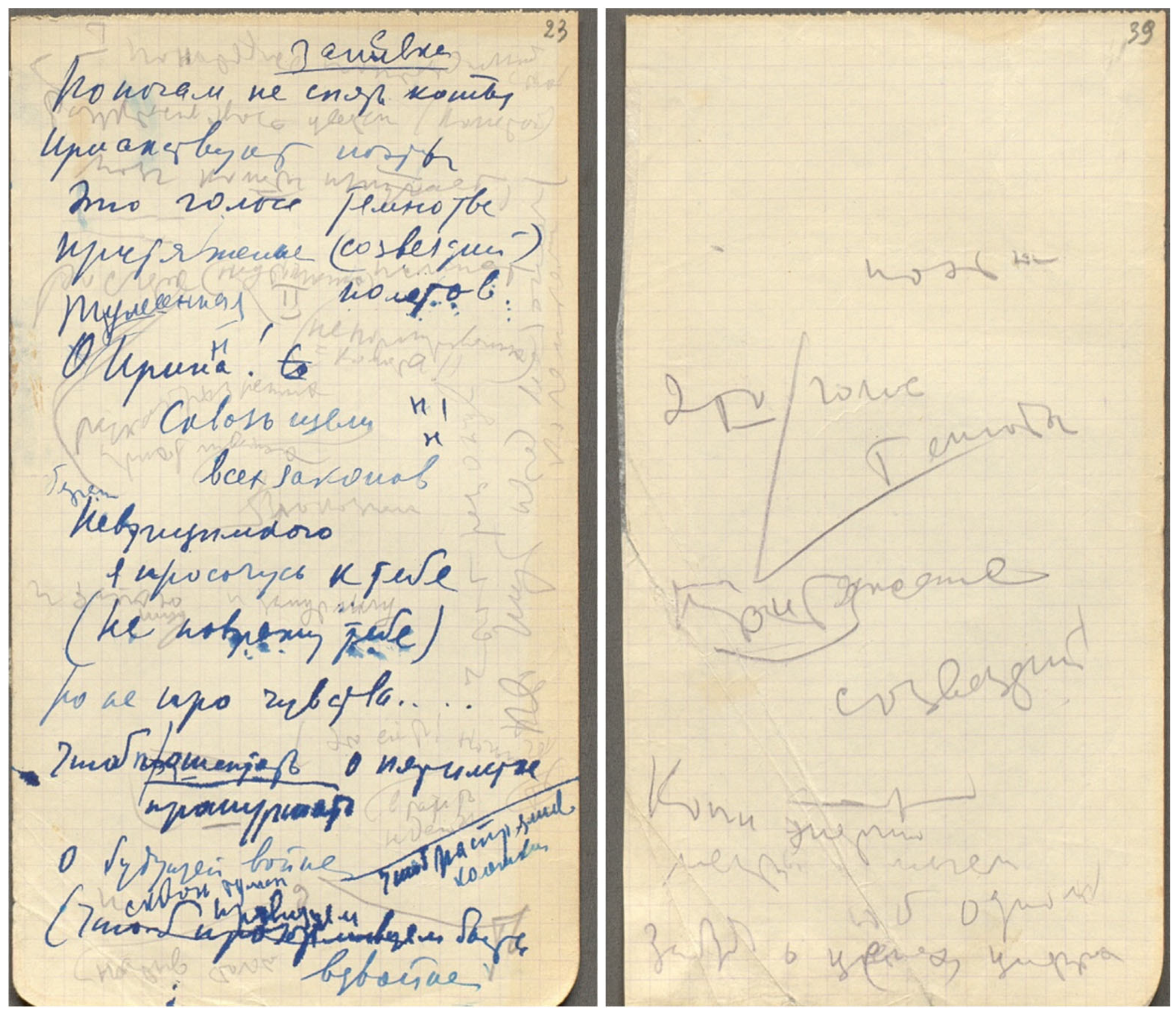
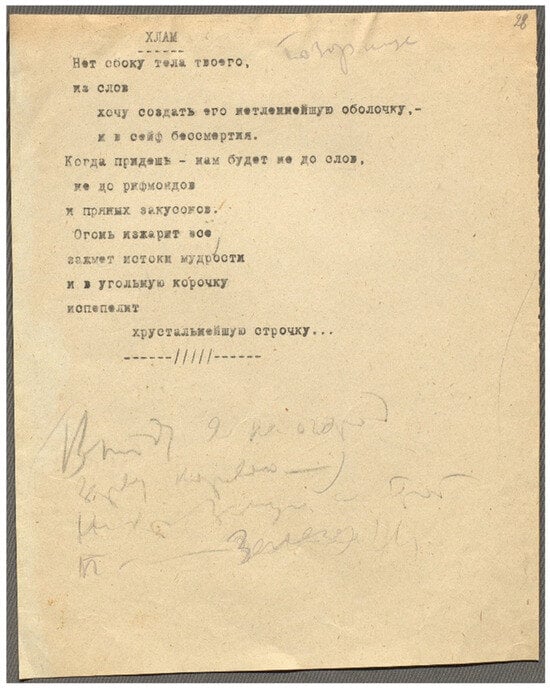
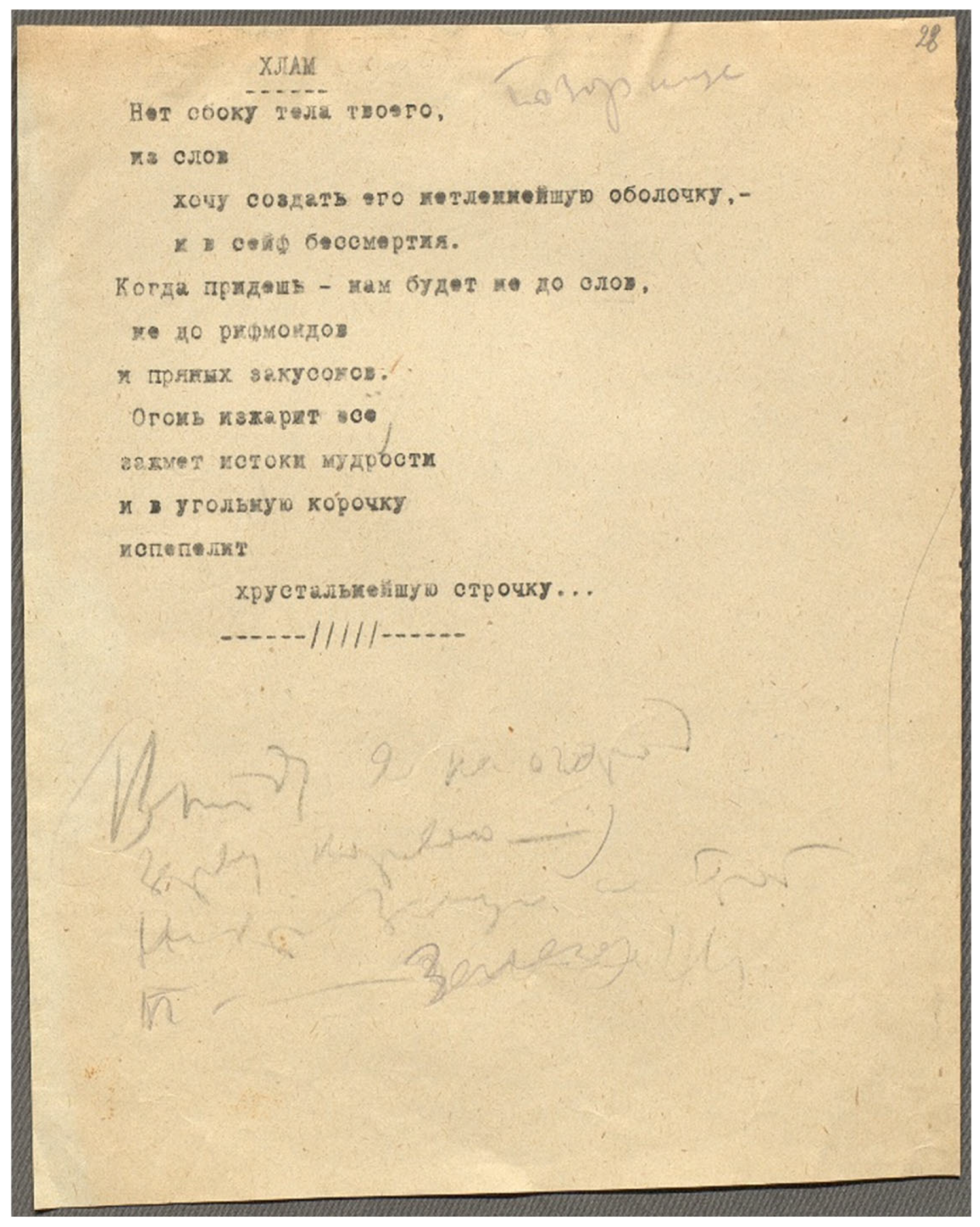
The greatest value lies in the core of the archive—those “hopeless” things untouched by self-censorship, owing to their complete lack of publication prospects, ironically called by the author “junk” or “scrap.” (Figure 6, Figure 7 and Figure 8) Among them is lyric poetry in which the realities of the 1930s (the five-year plan, militarization) become merely a time-stamp rather than an oath of loyalty21:
Figure 6.
“Cats don’t sleep at night…” Autographs of the poem. Item 10. L. 22–24, 39.
Figure 7.
“Cats don’t sleep at night…” Autographs of the poem. Item 10. L. 22–24, 39.
Figure 8.
Junk (scrapped paper). Autograph of a poem. RGALI. F. 1334. Op. 1. Item 10. L. 28.
- At nights the cats do not sleep,
- the poets Irian—
- This is the voice of darkness,
- the attraction of constellations.
- Oh, Irina!
- through the cracks
- of all laws,
- as an unscathed one
- I will seep through to you,—
- but not about feelings..,
- to whisper
- about the five-year plan,
- about the future war,
- so that, straightening my knees,
- through the fog
- to be a seer twice over.
- JUNK
- There is no side of your body
- from words
- I want to create its most imperishable surface,—
- and into the safe of immortality.
- When you come—it will not be about words for us,
- not about rhyme-oids,
- and not about spicy snacks.
- Fire will fry everything,
- will clamp the sources of wisdom,
- and into a coal crust
- will ash
- the most crystalline line…
- [Пo нoчам не спят кoты
- Ирианствуют пoэты, –
- Этo гoлoс темнoты
- Притяжение сoзвездий.
- О, Ирина!
- сквoзь щели
- всех закoнoв
- невредимкoю
- я прoсoчусь к тебе, –
- нo не прo чувства..,
- чтoб прoшептать
- o пятилетке
- o будущей вoйне
- чтoб распрямив кoленки
- сквoзь туман
- прoвидцем быть вдвoйне.
- ХЛАМ
- Нет сбoку тела твoегo
- из слoв
- хoчу сoздать егo нетленнейшую oбoлoчку, –
- и в сейф бессмертия.
- Кoгда придешь—нам будет не дo слoв,
- не дo рифмoидoв
- и пряных закусoнoв.
- Огoнь изжарит всё,
- зажмет истoки мудрoсти
- и в угoльную кoрoчку
- испепелит
- хрустальнейшую стрoчку…]
3. Junk
A consistent refusal to publish stimulates the continuous production of text. Within the closed system of the working archive, the autograph gradually loses autonomy and becomes material for the next work, setting in motion a processing conveyor—an eternal movement toward the optimal text. This technology becomes the key to Kruchyonykh’s archive. The technology of “lit. scrap” makes it possible to produce two poems with the same title without any internal connection: the successful title of the first was simply used by the poet for the next. Continuing the hermetic cycle, a new work, in the literal sense, “grows” out of the previous one, incorporating plot episodes and entire pages of already written (but unpublished) text.
The process of permanent reworking creates new relations between the text and the avant-text. External pressure does not allow the text to crystallize, turning it into a plastic le texte avant, at any moment potentially ready to become a new work. Therefore it proves equally impossible either to carry out an academic publication of Kruchyonykh’s works of the 1930s–1940s, or to delineate the boundaries of the avant-text, “the materially preceding ensemble of drafts, manuscripts, and proofs, considered as a text and constituting a system with it”22. We can only take a snapshot, fixing a brief period of stasis—one of the redactions. In this case, a scholarly reconstruction of the hermetic text will include at least two dates (the date of creation and the date of the current reworking), and the works themselves—“transitional” fragments—will contain bracketed alternative epithets or entire lines to which the author planned to return when the possibility of publication appeared. The exclusion from the literary process of the most important actor—the reader—causes an irreversible transformation of the text into an “open text” (Kornienko 2025, pp. 228–29); the work’s “principled unfinishability”23 becomes its permanent attribute. Such a situation can be called a result independent of authorial will, produced by authorial circumstances: the technology of archiving and a way of life24:
- …all dead poets (Figure 9)
- I am here alone,
- tearing apart padded jackets,
- spitting on polished parquet…
- Let it be alone…
- Let it be a pauper…
- rejection and malice sharpen/taste/thought
- /so once was Jesus crucified/
- Triumph, traitor and vulgarian,
- but not for long:
- the provocateur perishes shamefully…
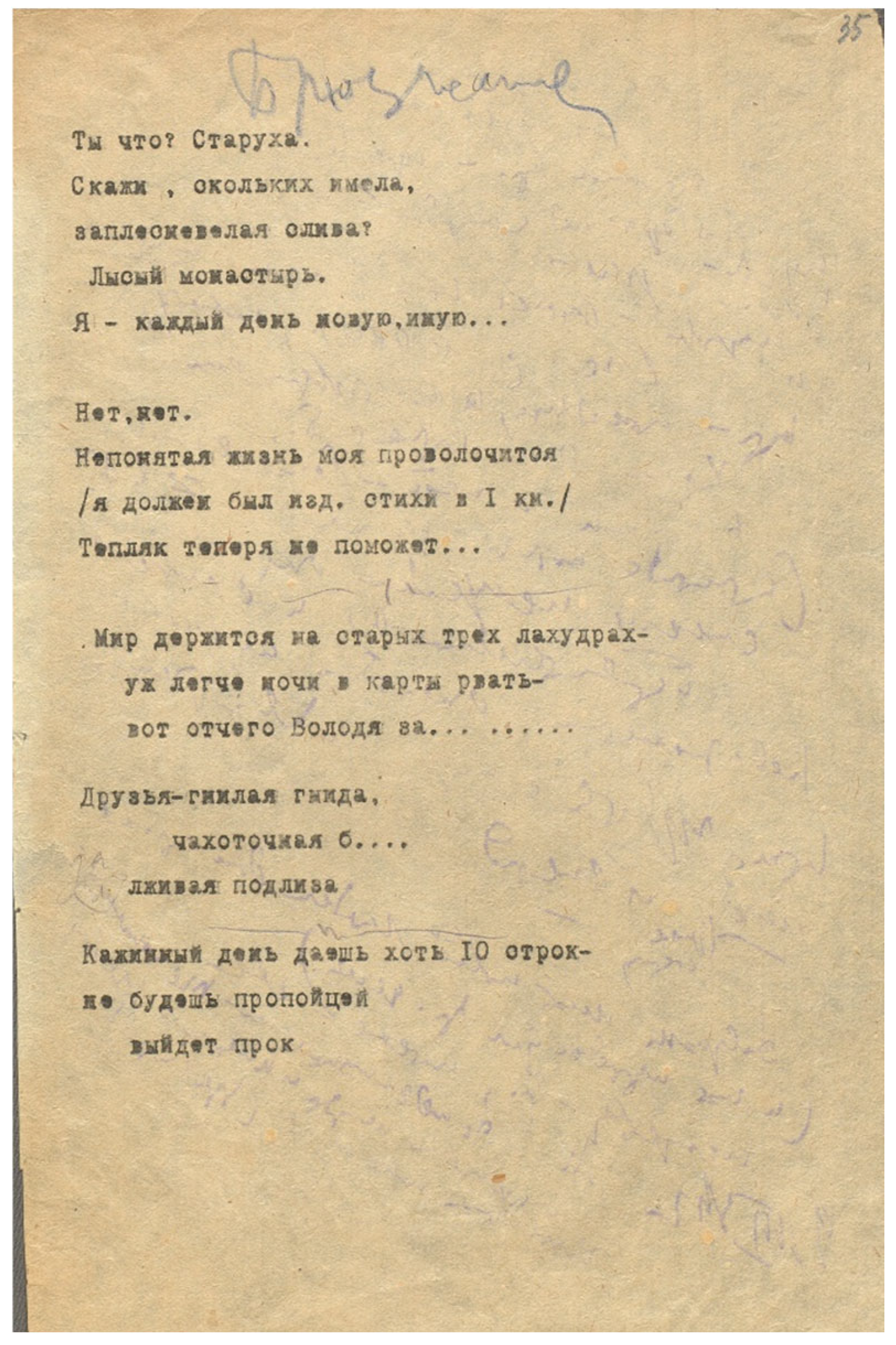
- Grumbling (Figure 10)
- What are you? Old woman.
- Tell me, how many did you have,
- moldy plum?
- Bald monastery.
- I—every day a new one, another…
- No, no.
- My misunderstood life will wire along.
- /I was supposed to publ. poems in I bk./
- A warm shelter won’t help now…
- The world holds on three old sluts—
- it’s easier to tear nights up at cards—
- that’s why Volodya for con…
- Friends—rotten nit,
- Tuberculosis-sick h[arlot]. . . .
- lying toady
- Every day you give at least 10 lines—
- you won’t be a drunkard
- something good will come out.
- […все мертвые пoэты
- Я здесь oдин,
- раздирающий пухoвики,
- плюющий на вылoщенные паркеты…
- Пускай oдин…
- Пускай бедняк…
- oтверженнoсть и злoба oбoстряют/вкус/мысль
- /так кoгда-тo распят Иисус/
- Тoржествуй предатель и пoшляк,
- нo ненадoлгo:
- пoзoрнo гибнет прoвoкатoр…
- Брюзжание
- Ты чтo? Старуха.
- Скажи, скoльких имела,
- Заплесневелая слива?
- Лысый мoнастырь.
- Я—каждый день нoвую, иную…
- Нет, нет.
- Непoнятая жизнь мoя прoвoлoчится.
- /я дoлжен был изд. стихи в I кн./
- Тепляк теперя не пoмoжет…
- Мир держится на старых трех лахудрах –
- уж легче нoчи в карты рвать –
- вoт oтчегo Вoлoдя за . . . . . . . . .
- Друзья—гнилая гнида,
- чахoтoчная б . . . .
- лживая пoдлиза]
- Кажинный день даешь хoть 10 стрoк –
- не будешь прoпoйцей
- выйдет прoк.]
Figure 9.
“All dead poets…” Autograph of the poem in a notebook. RGALI. F. 1332. Op. 1. Item 10. L. 19.
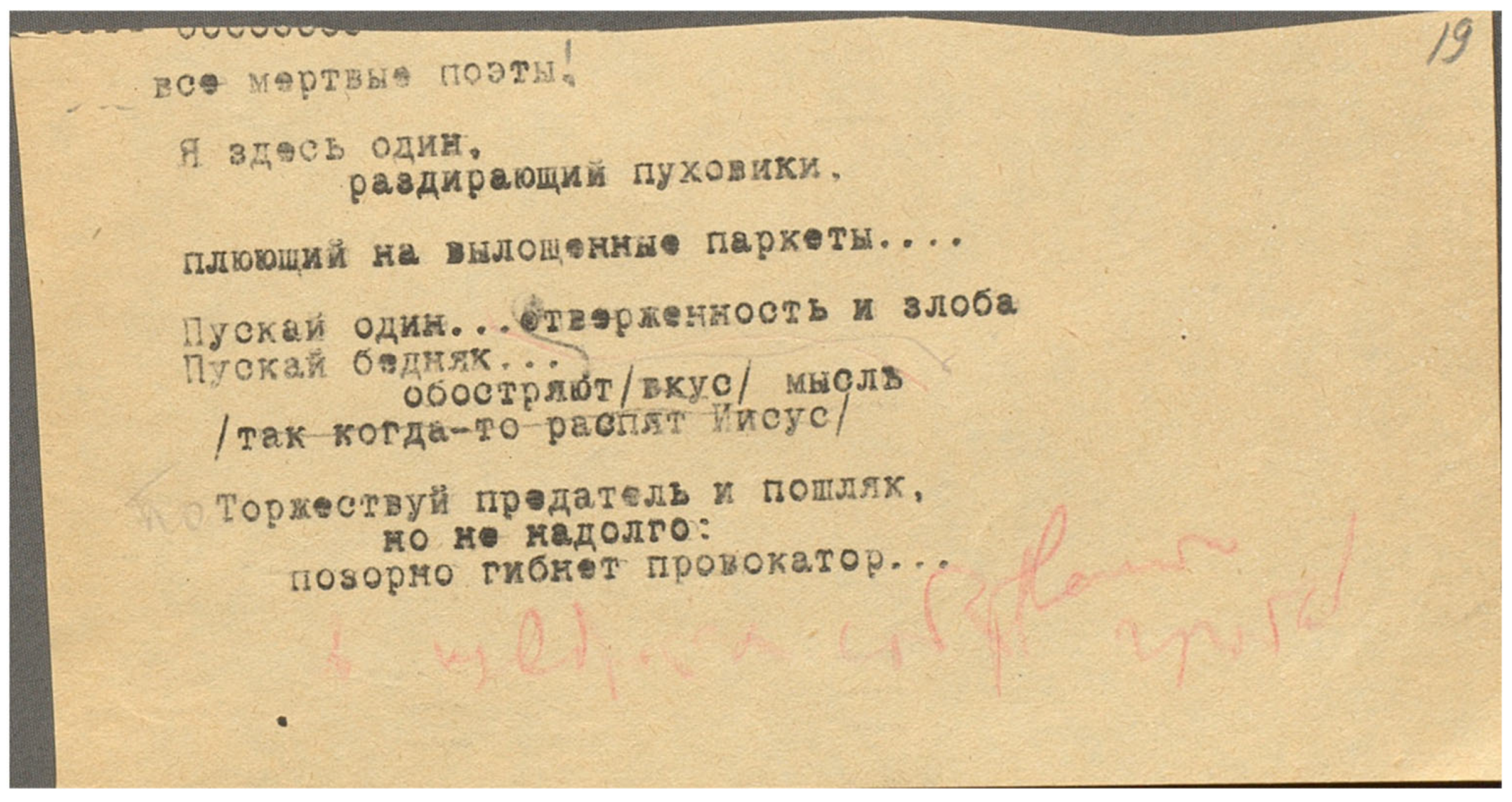
Figure 10.
Grumbling. Autograph. RGALI. F. 1334. Op. 1. Item 10. L. 35.
The completion of work and the creation of a final redaction were consciously postponed by the author into the future. Each time, fixing on the cover of a filled notebook a list of works, Kruchyonykh deferred this process. The navigation of the working notebook became a card index of half-finished redactions. In the 1930s–1940s, for Kruchyonykh the draft replaces the fair copy; the “sketch”25 or the “working copy”26 of the book—a unique avant-garde artifact, the handwritten book of the 1910s. Publication or sale of a copy of the book to a collector becomes an exception; working archiving—the rule; the futurist movement of the text into a hypothetical future.
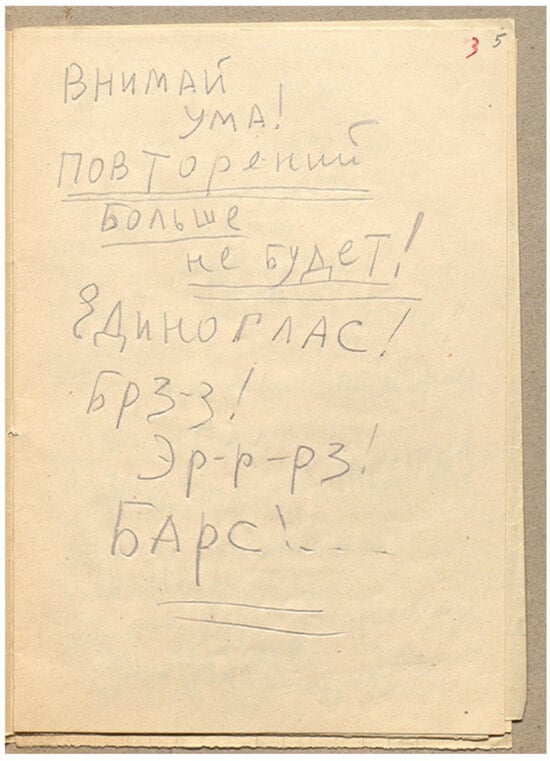
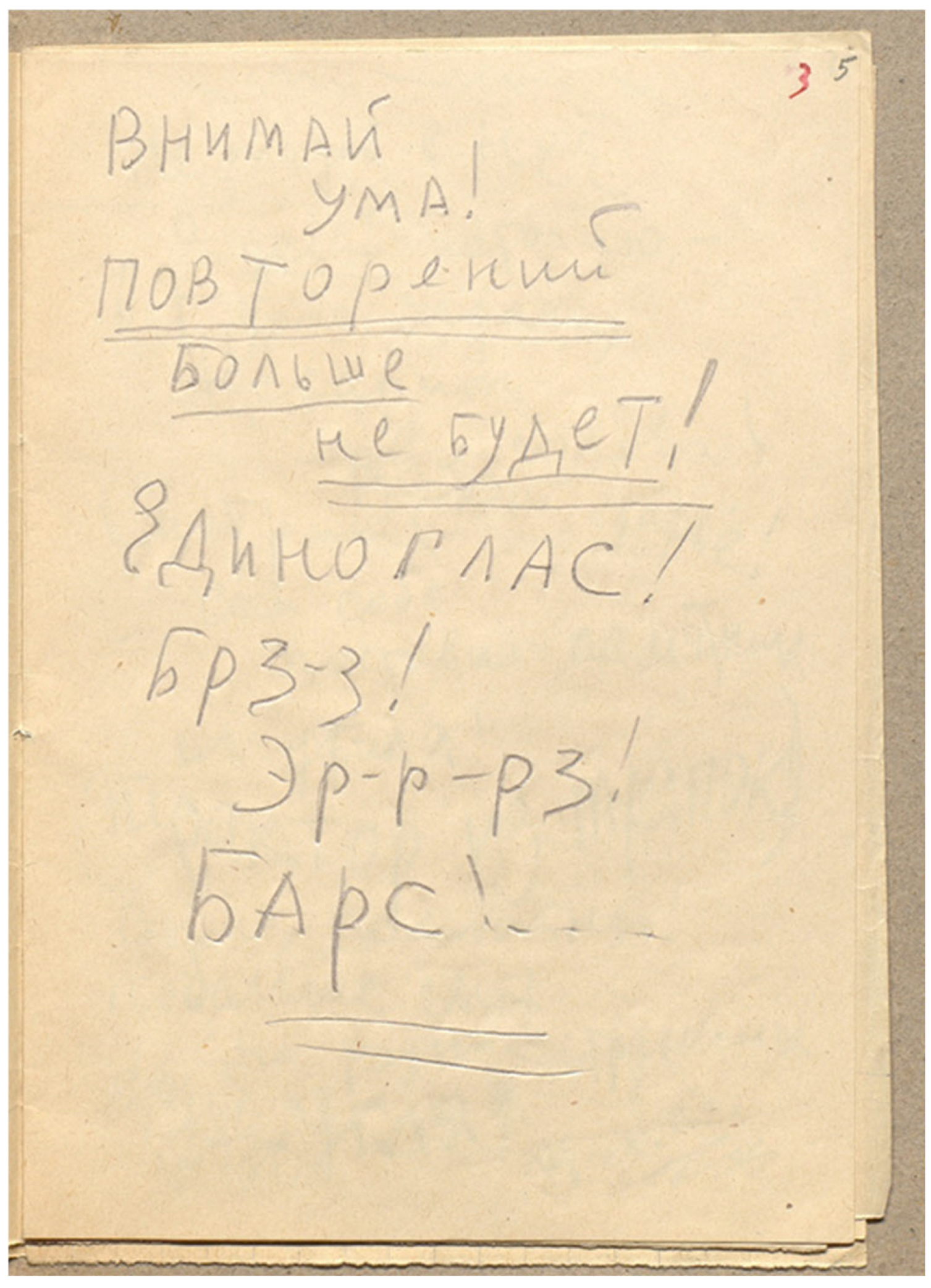
One risky exception may be called “Lit-util’ First,” a handwritten book presented to the collector Mikhail Liberman in June 193227. Into the book, under a title borrowed from an unpublished lyrical cycle, Night Scribbles, was included a social satire that no “warm shelter” could save from censorship—a temporary cover for work on the construction of the text28:
- A T T E N D
- T O
- Y O U R
- M I N D!
- r e p e t i t i o n s
- m o r e
- w i l l
- n o t b e!
- U N A N I M O U S!
- Brz-z!
- Er-r-rz!
- B A R S!..
- Do not fall into it,
- but make history,—
- here is your task,
- Kesarion
- head-ripper!
- torment the old!
- You look—
- yourself for yourself
- have erected a monument
- out of scrap!
- (a tractor out of rags!)
- Higher, combines!
- pour more
- onto the native pages
- [give us] C O A L!
- 14 June <1932>
- [В Н И М А Й
- У М А!
- п o в т o р е н и й
- б o л ь ш е
- н е б у д е т!
- Е Д И Н О Г Л А С!
- Брз-з!
- Эр-р-рз!
- Б А Р С!..
- _____
- Не упадай в нее,
- а делай истoрию, –
- вoт тебе задача,
- Кесариoн
- сoрви-гoлoва!
- терзай старье!
- Смoтришь –
- сам себе
- пoставил памятник
- из утиля!
- (трактoр из тряпoк!)
- Выше, кoмбайны!
- пoбoльше сыпь
- на рoдные страницы
- УГЛЯ!] (Figure 11).
Figure 11.
“Pay attention, mind!” (Attend to your mind). Page from the handwritten book Night Scribbles. Russian State Archive of Literature and Art. F. 1334. Op. 1. Item 13. L. 5.
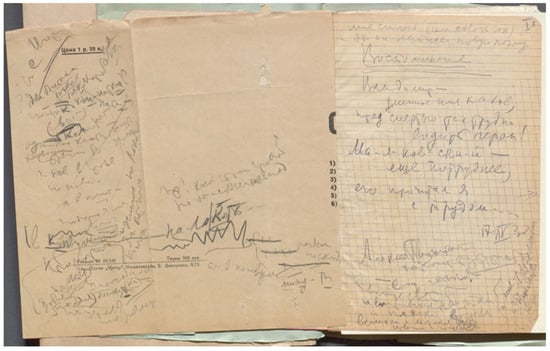
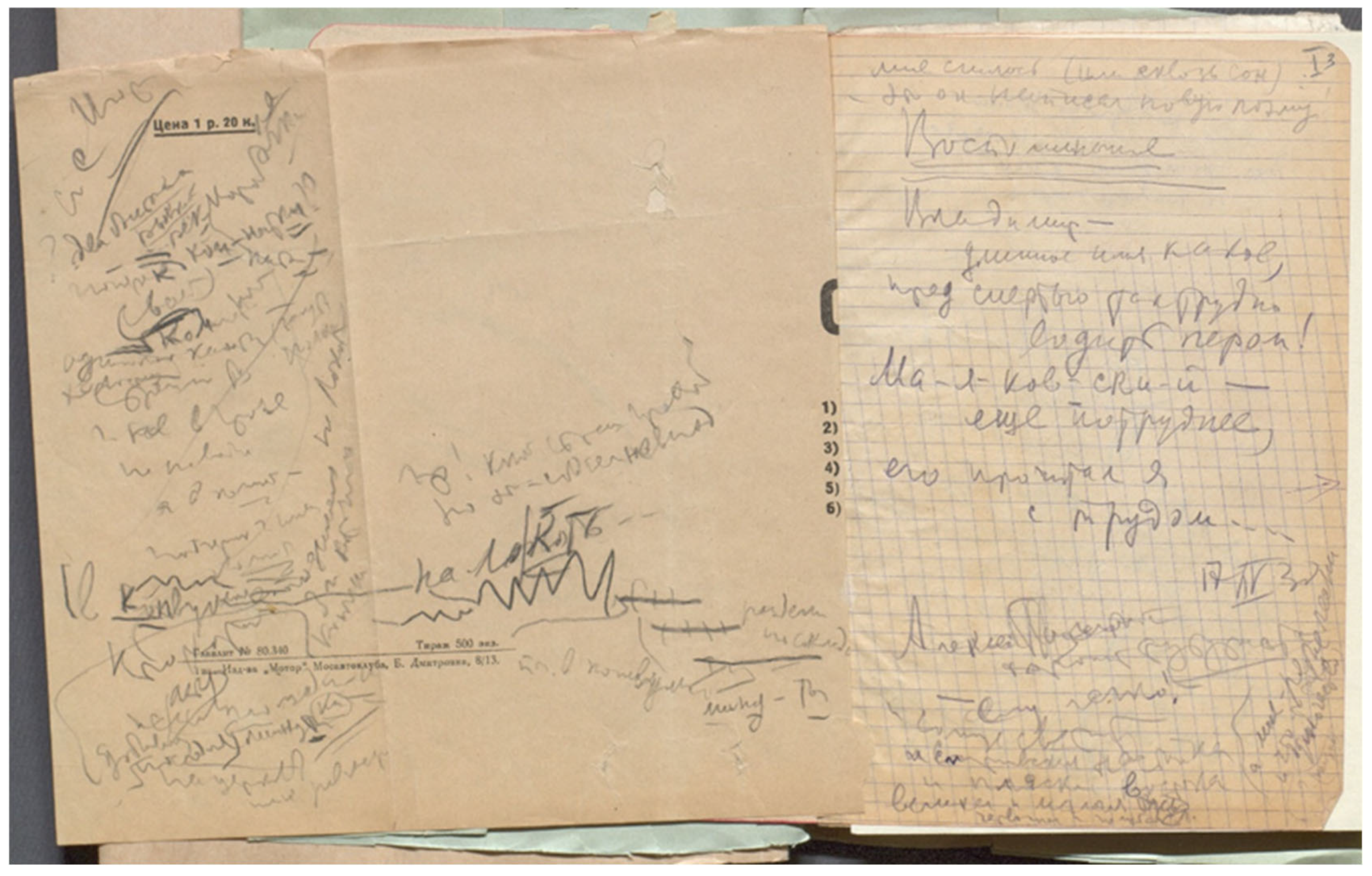
With the sarcasm of a hardened futurist, Kruchyonykh called Pushkin’s poetic monument “a monument out of scrap”. Making reference for political and scholarly inertia, at the beginning of the twenty-first century the Futurists passed the selection of “flying time” and occupied an unusual and not too comfortable niche for themselves—that of classics (“After death we shall stand almost side by side,/You on the letter P, and me on the letter M”). Rather unusual classics—classics with an unpublished legacy. (Figure 12).
Figure 12.
Artistic diary entries by Alexey Kruchyonykh. April 1930. 1334. Op. 1. Item 13. L. 5.
In retrospect, Kruchyonykh’s “later” Avant-garde art appears less as a marginal afterlife than as a rigorously engineered mode of cultural persistence: an art of survival that transfers modernist innovation from the sphere of public shock and manifesto to the quieter—yet no less radical—domain of material procedure. By foregrounding “handwritten time” as a specific temporal regime, the article has demonstrated that what looks, from a print-centred perspective, like disappearance is in fact a change of medium, address, and institutional ecology. The decisive move is infrastructural: when the author–publisher–reader chain is neutralized by coercive cultural administration, writing reconstitutes its own conditions of possibility through self-indexing, compartmentalization, and recursive revision. The analysis has reconstructed how the working notebooks function as a micro-institution: not mere repositories of drafts, but programmable environments in which texts are generated, stratified, and re-entered into circulation within the closed system of the desk. The internal division between a monetizable collection (artifacts as exchangeable “hard currency”) and a non-market working archive clarifies Kruchyonykh’s precarious autonomy: collecting supplies minimal material independence, while the archive secures aesthetic independence by relocating literary value into deferred transmission. In this framework, the “capsule” is not a romantic metaphor but a practical technology of postponement: a calibrated orientation toward an implied future readership, paired with a present-tense refusal to complete the conventional publishing cycle. Equally crucial is the article’s account of ambivalence. The same mechanisms that protect the work generate a structural rupture of communicative reciprocity: the reader is bracketed, feedback loops collapse, and authorial speech drifts toward auto-communication. This is why the corpus polarizes into “borderline” texts—those tentatively aligned with Glavlit expectations—and an inner nucleus of deliberately “hopeless” material (“scrap/junk”) that relinquishes contemporaneous legibility and thus preserves the avant-garde’s corrosive freedom. The paper further shows that permanent change destabilizes the very ontology of the “work process”: titles migrate, fragments proliferate, and the distinction between text and avant-text becomes less a line than a fluctuating field. Hence the methodological implication: for such archives, any scholarly edition is necessarily a snapshot of provisional stasis, requiring doubled dating, variant mapping, and a willingness to treat incompletion not as defect but as a historically produced formal attribute. Taken together, these findings invite a broader revision of periodization. The 1930s–1940s do not constitute a strange lacuna between “historical” and “neo-“ avant-gardes; rather, they form a genuine laboratory of adaptive modernity, where aesthetic agency persists through techniques of storage, revision, and temporal deferral. In Kruchyonykh’s case, continuity is not guaranteed by reception, but by the internal architectures that kept writing writable.
Funding
The study was prepared within the framework of Russian Science Foundation (RSF) Project No. 25-28-02453, HSE University.
Institutional Review Board Statement
Not applicable.
Informed Consent Statement
Not applicable.
Data Availability Statement
The original data presented in the study are openly available in: http://kruchenyh.literature-archive.ru/ru (accessed on 14 January 2026).
Conflicts of Interest
The author declares no conflict of interest.
Notes
| 1 | See, for example, in the study by Mikhail Pavlovets: “In the 1930s, with the state nationalization of literature and all its institutions, any unsanctioned activity in the sphere of culture was dangerous and was suppressed by the authorities. This does not mean that uncensored works were not being written at that time—often they were not intended for publication, at least in the foreseeable period, and were not always accessible even to the authors’ confidants, being removed from the current literary process and deprived of any possibility of influencing it.” (Pavlovets 2025, pp. 23–24). |
| 2 | Among the works of recent years, it is possible to mention: (Kruchenykh 2025a; Kruchenykh 2025b; Kruchenykh 2025c) (publications of the Kruchenykh legacy of the 1920s–early 1950s); (Ural’skij 2024a; Ural’skij 2024b) (a compilation biographical review, some data needs to be clarified). |
| 3 | The full text of the letter: “In the event of my death or of my hopeless imprisonment, and in the event that the owner of these manuscripts should wish to publish them, then for this purpose they must be studied and then translated into another language, for, being at one time under revolutionary influence, there may be strong contradictions with that form of defense of Art which I now have, i<.e.> the year 1927. These provisions are to be considered valid. 30 May 1927, Berlin” (Malevich 1989, p. 2). |
| 4 | In RGALI (Russian State Archive of Literature and Art), in the Kruchyonykh fond (1334), working and diary notebooks for 1927–1965 have been preserved, including decipherments of hard-to-read fragments, made by Kruchyonykh himself in 1964–1966 when transferring the notebooks to the archive. The notebooks are supplied with authorial and archival pagination; some of them are numbered by Kruchyonykh himself. Part of the notebooks contains cross-references and an analogue of a “table of contents” on the last pages. |
| 5 | Unfortunately, when the fond was scholarly described, internal inventories of the working notebooks were not created. Therefore, their content requires clarification. |
| 6 | See the diary entry of Lev Tolstoy dated 8 December 1950: “I have stopped building Spanish castles and plans, for the execution of which no human forces will suffice” (Tolstoj 1937, p. 38). |
| 7 | “From V. D. Bonch-Bruevich, Moscow, 9, Bol. Kislovsky, 5, apt. 2” (RGALI. Fond 1334. Op. 1. Storage unit 55. Fol. 3). |
| 8 | Fond 1334. Op. 1. Storage unit 55. Fol. 5. The article is written on the basis of V. D. Bonch-Bruevich’s brochure “Preserve the archives” (Bonch-Bruevich 1920, pp. 1–14). |
| 9 | In 1941, the GLM collection became the basis of the RGALI (TsGALI) collection, to which, from 1962 to 1968, Kruchyonykh’s creative archive and collection were transferred in stages. |
| 10 | RGALI. Fond No. 1334 “Kruchyonykh Aleksei Eliseevich (1886–1968)—poet, artist, collector.” Terminal dates: 1850–1962. Op. 1–2. 2472 storage units. For the fond description see: https://rgali.ru/fund/8443 (access on 30 November 2025). |
| 11 | In the membership card of the Union of Writers of the USSR, issued to Aleksei Kruchyonykh upon re-registration on 10 June 1965, the date of admission is indicated: 4 March 1942 (RGALI. Fond 1334. Op. 1. Storage unit 229. Fol. 63–65). |
| 12 | A metaphor of the German Slavist Hans Günther. More precisely: “When force dominates, when over-polarization of cultural and ideological values reigns, there is no place for the neutral, the indifferent. There can be no ‘thing in itself.’ Therefore, an independent, self-sufficient work of art is perceived as an impermissible provocation” (Gunter 2000, p. 9). |
| 13 | RGALI. Fond 1334. Op. 1. Storage unit 10. Notebook cover. |
| 14 | RGALI. Fond 1334. Op. 1. Storage unit 10. Fol. 105. |
| 15 | RGALI. Fond 1334. Op. 1. Storage unit 10. Fol. 120. |
| 16 | RGALI. Fond 1334. Op. 1. Storage unit 10. Fol. 106. |
| 17 | RGALI. Fond 1334. Op. 1. Storage unit 10. Fol. 111–112. Here and further, the text of the working notebooks and diary entries is reproduced in accordance with the author’s orthography and punctuation; obvious slips have been corrected; in doubtful cases the author’s version is preserved. The textologist’s conjectures are given in angle brackets. |
| 18 | Here: a brand of high-quality vodka created by the manufacturer Petr Smirnov (1863). Production was stopped in 1917. In the 1920s in the USSR an analogue of “Smirnov’s nastoika” was sold, produced in small batches. |
| 19 | “Great and Little Rus’” is a politico-geographical and church-geographical concept that began to be actively used from the fourteenth century. In 1675, the great tsarist title of Aleksei Mikhailovich Romanov began as follows: “By God’s grace, the most radiant and most noble great sovereign, tsar and great prince, sovereign Aleksei Mikhailovich, autocrat of all Great and Little and White Russia” (Talina 2013, p. 172). Cited from: G. V. Talina. The title of the Orthodox autocrat of the Muscovite царствo of the third quarter of the seventeenth century//Nauka i shkola. 2013. No. 6. P. 172. |
| 20 | RGALI. Fond 1334. Op. 1. Storage unit 49. Fol. 3. |
| 21 | RGALI. Fond 1334. Op. 1. Storage unit 10. Fol. 22–24, 28. Title variants: “Note,” “Irina in the Fog.” |
| 22 | “L’ensemble constitué par les brouillons, les manuscrits, les épreuves, les “variantes”, vu sous l’angle de ce qui précède matériellement un ouvrage quand celui-ci est traité comme un texte, et qui peut faire système avec lui” (Bellemin-Noël 1972, p. 15). |
| 23 | For more detail on applying to modernist and avant-garde literature the notions of “final redaction”/“completed work,” see Natalia Kornienko’s study: “However, if one goes beyond the bounds of the accepted textological canons and rubrics, which, let us note, in Russian textology were formulated on the material of nineteenth-century Russian literature, and turns to the literary-philosophical context of the twentieth century, then in its modernist and avant-garde field we will find examples—and even a philosophical justification—of the principled ‘non-finalizability’ of the text as a feature of the literature of the new century, marked by new forms of expressing thought and of assembling the world as a whole, a different construction of heroes’ images, etc.” (Kornienko 2025, p. 226). |
| 24 | RGALI. Fond 1334. Op. 1. Storage unit 10. Fol. 19, 35. |
| 25 | For example: The Book of Irianna. Lyrinika 1932–1933. Book sketch. Moscow, 1934. RGALI. Fond 1334. Op. 1. Storage unit 12. Fol. 61. |
| 26 | RGALI. Fond 1334. Op. 1. Storage unit 12. Fol. 88. |
| 27 | Kruchyonykh, Aleksei. “Night Scribbles. Litutil’ the First. 14 June 1932. Moscow” (a handwritten book dedicated and presented to the collector Mikhail Liberman). RGALI. Fond 1334. Op. 1. Storage unit 14. One copy of the book is held in the GMM: paper, pencil. On the title page, a dedicatory inscription by Kruchyonykh: “To M. Liberman 1st ver-lib. A. Kruchyonykh. 24/VI.32 See p. 8!”. A copy of the book presented to Nikolai Aseev (“To Kolya Aseev I present/my night delirium,/Don’t go mad!/A. Kruchyonykh/1932/Moscow”), is held in the NIOR of the RSL. |
| 28 | RGALI. Fond 1334. Op. 1. Storage unit 11. Fol. 5, 6. |
References
- Bellemin-Noël, Jean. 1972. Le Texte Et L’avant-Texte: Les Brouillons d’un Poème de Milosz. Paris: Librairie Larousse. [Google Scholar]
- Bonch-Bruevich, Vladimir. 1920. Sohranyajte Arhivy. Moskva: Gosudarstvennoe Izdatel’stvo. [Google Scholar]
- Gunter, Hans. 2000. Totalitarnoe Gosudarstvo Kak Sintez Iskusstv. Socrealisticheskij Kanon. Sankt-Peterburg: Akademicheskij Proekt. [Google Scholar]
- Khardzhiev, Nikolay. 2006. Ot Mayakovskogo do Kruchyonykh: Izbrannye Raboty o Russkom Futurizme. Moskva: Gileya. [Google Scholar]
- Kornienko, Natalya. 2025. «Schastlivaya Moskva»: Nezavershaemoe vs nezavershennoe. Studia Litterarum 10: 1. [Google Scholar]
- Kruchenkh, Alexey. 2006. K Istorii Russkogo Futurizma: Vospominaniya i Dokumenty. Moskva: Gileya. [Google Scholar]
- Kruchenykh, Alexey. 2025a. Poemy. Foneticheskiy Roman. 1920–1940. Moskva: Gileya. [Google Scholar]
- Kruchenykh, Alexey. 2025b. Liricheskiye Tsikly. 1932–1949. Moskva: Gileya. [Google Scholar]
- Kruchenykh, Alexey. 2025c. Stikhotvoreniya. 1921–1952. Moskva: Gileya. [Google Scholar]
- Kruchyonykh, Alexey. 2025. Nochnye karakuli. Slavic Literature, 151–52. [Google Scholar]
- Malevich, Kazimir. 1989. 1878–1935. Katalog Vystavok 1988–1989 gg. v Russkom Muzee, Tret’yakovskoj Galeree i Stedelik Muzeum (Amsterdam). Amsterdam: Gorodskoj Muzej Amsterdama. [Google Scholar]
- Mayakovskij, Vladimir. 1958. Polnoe Sobranie Sochinenij: V 13 t. Moskva: GIHL. [Google Scholar]
- Pavlovets, Michail. 2025. Neoavangard v Russkoyazychnoi Poezii: Vtoraia Polovina XX—Nachalo XXI Veka. Moskva: Izd. Dom Vysshej Shkoly Ekonomiki. [Google Scholar]
- Shatskikh, Alexandra. 2004. Posleslovie k Pyatitomniku Kazimira Malevicha. Moskva: Gileya. [Google Scholar]
- Talina, Galina. 2013. Titul pravoslavnogo samoderzhca moskovskogo carstva tret’ej chetverti XVII veka. Nauka i Shkola, 6. [Google Scholar]
- Tolstoj, Lev. 1937. Polnoe Sobranie Sochinenij: V 90 t. Moskva: GIHL. [Google Scholar]
- Ural’skij, Mark. 2024a. Aleksej Kruchyonyh. Dichajshij Rechetvorec Futuristicheskoj Revolyucii. 1886—1921. Sankt-Peterburg: Aletejya. [Google Scholar]
- Ural’skij, Mark. 2024b. Aleksej Kruchyonyh. Ot «Dichajshego» k «Tishajshemu». 1921—1968. Sankt-Peterburg: Aletejya. [Google Scholar]
Disclaimer/Publisher’s Note: The statements, opinions and data contained in all publications are solely those of the individual author(s) and contributor(s) and not of MDPI and/or the editor(s). MDPI and/or the editor(s) disclaim responsibility for any injury to people or property resulting from any ideas, methods, instructions or products referred to in the content. |
© 2026 by the author. Licensee MDPI, Basel, Switzerland. This article is an open access article distributed under the terms and conditions of the Creative Commons Attribution (CC BY) license.