


Abstract
I revisit Benjamin’s text ‘The Work of Art in the Age of Its Technological Reproducibility’ and find it both problematic and richly suggestive. Carefully reading it, both with and against, I search it for continuities and breaks with ‘reproducibility’ today and hence insights into AI and its relationship to art. In so doing, I sketch some tentative conclusions about how such an investigation might assist us towards understanding what art is and isn’t, how the practice of art relates to our humanity and finally, though a thorough settling of accounts with AI and its boosters will require political change on a grand scale, how Benjamin’s ‘aura’ might offer a small but significant locus of resistance to the commodification and dehumanising drive currently occasioned by AI in the field of art.
Keywords:
materiality; facture; provenance; AI; base and superstructure; aura; reproducibility; art and politics; resistance - In a statement by an artist who claims to ‘collaborate with’ an AI to make artworks, we read ‘At our present moment, the advent of AI-generated imagery asks us to consider the work of art in the age of not only mechanical reproduction but also algorithmic production’ (HG Contemporary 2019, Emphasis mine). The talismanic reference to the famous—though in this statement unacknowledged—work by Walter Benjamin, ‘The Work of Art in the Age of Its Technological Reproducibility’ (W. Benjamin 2003, pp. 251–83), also translated as ‘The Work of Art in the Age of Mechanical Reproduction’ and henceforward TWOA, is far from atypical.
- Even when not invoked for reasons of sympathetic magic, the frequent references to Benjamin in art and AI literature (Ambrosini 2025; Arielli and Manovich 2022; Aris et al. 2023; Bolter et al. 2006) are largely, at best, agnostic about the consequences of AI for art practices and outcomes and uncritical of Benjamin’s text itself. This piece will be neither of those things.
- And because it is intended as weapon rather than exercise in disinterested reflection, it will, on occasion, employ what Benjamin’s friend and collaborator, Bertolt Brecht, dubbed Plumpes Denken—crude thinking. ‘The main thing is to learn crude [plump] thinking—that is, the thinking of the great’ (Benjamin and Eiland 2006, p. 7).
- This, not in order to oversimplify or obfuscate—in fact, the opposite, to cut through to use cases. As Benjamin helpfully continues, ‘Crude thoughts have a special place in dialectical thinking because their sole function is to direct theory toward practice’ (Benjamin and Eiland 2006, p. 7).
- An initial plump paraphrase of Benjamin’s argument might go like this:
- The possibility of mass technological reproducibility brought about by the then-current state of the development of productive forces gives rise to a qualitative shift in the nature of cultural activity and specifically in visual culture.
- A consequence of this shift, to Benjamin not only symptomatic but actively to be welcomed, is the destruction of a quality that Benjamin called the ‘aura’ of an artwork.
- Welcomed, because both processes lead to an increasing democratisation of access to art, but more importantly, because this mass reproducibility and the destruction of aura allegedly provide cultural weapons in the urgent struggle against rising fascism.
- Benjamin observes carefully, thinks deeply, writes beautifully and in this instance is almost completely wrong. Lest this be construed as a kind of lèse majesté, it’s worth quoting from contemporaneous comments on the ideas of TWOA by Brecht, the great Marxist playwright and Benjamin’s friend and sometime collaborator, ‘A load of mysticism, although his attitude is against mysticism. This is the way the materialist understanding of history is adapted. It is abominable’ (Wizisla 2016, p. 169)
- Nevertheless, TWOA can usefully be read against the stream of Benjamin’s argument to furnish a shield against the baleful influence of AI in the sphere of culture.
- And the assumption here will be that ‘actually existing’ AI is almost wholly a bad thing: the huge cost to the environment, the use by corporations of AI as a substitute for human labour in order to try to bolster falling profit rates (Roberts 2023), the hidden and hungry consumption of the labour power of actual human beings, often in the global South, and often in the most appalling conditions, the enthusiastic adoption by government agencies closely intertwined with the market in a period of late neoliberalism and the concomitant ‘enshittification’ of many resources and practices around everyday living and working for the 99%, not to mention the widespread and enthusiastic adoption of AI by the leaders of competing nation states to make their killing machines yet more effective (Alexander 2025; Bender and Hanna 2025; Crawford 2021; Hao 2025; Hartzog and Silbey 2025; Zitron 2025).
- Zooming in, the same applies in the cultural sphere. AI renders culture a succession of isolated and static (and largely digital) objects rather than an ongoing dynamic and historical dialogic expression of our embodied and reflecting humanity.
- One of the problems with the discussion of AI and art is that there is a lack of clarity over what constitutes ‘art’. The term is used very flexibly, not to say carelessly. For example, in cases where AI is claimed to output work ‘in the manner of’, for example, Chinese ink paintings (Xue 2021), the question of the materiality of the original is overlooked or fudged. Gangadharbatla (Gangadharbatla 2022) claims that a majority of people were unable to distinguish between an artist’s original work and AI-generated product, but entirely neglects to say that this is on the basis of comparisons solely between ‘natively digital’ AI output and digital images of physical artworks. That physical presence is a substantial part of what constitutes the very being of works in not just the Western, but the entire pre-20th-century world art tradition, is conveniently ignored. The distinction is particularly important in a fine art context—illustration, ads and design, of course, rely heavily on digitally reproduced images and here it’s clear that the general use of AI to cut out human labour is already in play and accelerating.
- The replacement of illustrators or designers is not something about which we should be sanguine, but the kind of resistance that can be mounted to it is very much one that sits firmly in long-standing labour movement traditions and practices. The recent writers’ and actors’ strikes in the USA, where protections over the use of AI were central demands, bear witness to this (Oi 2023).
- The fine art tradition is something else. It involves the creation of formally compelling and apparently entirely useless things (or, rather, à la Wittgenstein’s games (Wittgenstein and Anscombe 1994), there is no generalisable, predictive rule for what their useful content is or might be or, indeed, for their character as art) which have properties which, first and foremost, engage our sustained attention, give rise to networks of discussion and commentary and, at best, enhance our humanity and our knowledge of ourselves and empathy for others (Szpakowski 2019b)
- A new usage has been coined for the ‘cultural output’ of AI—‘slop’ (Smith and Southerton 2025). A Google search on ‘AI slop’ at the initial time of writing yielded 31,000,000 results and at the time of revision 39,400,000 (I’m not going to reference it—you can try it for yourself), a rough and ready, but significant, indication of how widely, and increasingly resonant this characterisation is.
- A settling of accounts with AI and its masters and deployers is something that will take place in the larger political realm. Here, we look solely at the question of art as a characteristically and centrally human activity, and of defending it against commodification.
- Eagleton dubbed Benjamin ‘The Marxist Rabbi’ (W. Benjamin 2003, p. 253). TWOA genuflects to Marx in its opening sentences but subsequently fails to develop any sort of consistently Marxist critique. Indeed, that it presents any sort of consistently developed or coherent argument is open to question, since Benjamin’s argumentation consists largely of assertions, usually offered without serious support or foundation, and the entirety is rife with non sequiturs.
- Many of these assertions are ahistorical or have social, political and cultural changes mechanically grounded in technological change, as if Marx’s ‘base and superstructure’ (Harman 1986) march always in lockstep. For example, Benjamin seems to recognise only two possibilities for the presentation and consumption of art over the whole varied development of human history, from cave art to the present day: what he dubs ‘cult’ value and ‘exhibition’ value.
- There are sleights of hand, too, when Benjamin conflates a work of art with its technologically reproduced image in a manner strangely anticipatory of Instagram or ‘online exhibitions’ of paintings or, indeed, the work by Gangadharbatla cited above. ‘Around 1900, technological reproduction not only had reached a standard that permitted it to reproduce all known works of art…’ (W. Benjamin 2003, p. 253 Emphasis mine). True, only if one believes that the material qualities of a painting are marginal to what is represented in it, to what a mechanically or digitally reproduced version of it ‘looks like’.
- As noted, Benjamin seems to believe that the technological reproducibility of the image is in itself a progressive thing.
- He points to the ability of photography and film to ‘bring out aspects of the original that are accessible only to the lens…but not to the human eye; or…use certain process such as enlargement or slow motion, to record images which escape natural optics altogether’ (W. Benjamin 2003, p. 254). Undoubtedly true. However, this is not a consequence of reproducibility but simply of the lens and film-based technologies of image capture in still or moving image photography, and this prior to the question of mass reproduction.
- It’s certainly also true that the increasing availability of reproductions of physical artworks has played a significant role within education (but educational methods alone will not suffice for progressiveness—who controls education and to what end?), but it is in his final remarks that we arrive at Benjamin’s key conclusion and destination—that reproducibility in and of itself offers some sort of bulwark against fascism. ‘In what follows, the concepts which are introduced into the theory of art differ from those now current in that they are completely useless for the purposes of fascism.’ (W. Benjamin 2003, p. 252) He cites ‘the desire of the present day masses to ‘get closer’ to things spatially and humanly, and their equally passionate concern for overcoming each thing’s uniqueness by assimilating it as a reproduction’ (W. Benjamin 2003, p. 255). I am unsure what this means. He simply asserts. No evidence is brought to bear, nor serious supporting argument made.
- In actual fact, fascist spectacle—a key part of the aestheticizing of politics of which Benjamin speaks (W. Benjamin 2003, p. 269)—hinged mightily on the mass reproduction and choreography of images and symbols and the penetration of these deep into everyday life and the same is true of the cultural manifestations of the various variants of high Stalinism and on into Maoism, both anti-working class perversions of Marxism. The technological reproducibility of images is also a key tool for all governments in time of war, as well as being the foundation of the advertising industry, not a notably progressive walk of life.
- One might conclude that technological reproducibility is actually a central resource for those who want to pull the wool over the eyes of the masses.
- Fortunately, this is only one side of the matter.
- Whatever the lacunae in Benjamin’s arguments, he is a careful observer with a sure feeling for grasping the crucial dead centre of an issue, oftentimes invisible to others, and encapsulating it in the most lucid and fertile of aphorisms. The richness and beauty of his writing can indeed lend his conclusions an authority his arguments do not always earn, making a plump and sceptical raised eyebrow indispensable.
- That said, Benjamin’s compressed account of the arc of development of reproduction within the arts is splendid and lends itself naturally to an extension which uncannily foreshadows developments since his untimely death:Objects made by humans could always be copied by humans…The Greeks… casting, stamping…bronzes, terracotta and coins…the woodcut…movable type…In the course of the Middle ages…engraving and etching…the nineteenth century…lithography…a few decades later…photography…cinematographer…The technological reproduction of sound.(W. Benjamin 2003, p. 252)
- Which we can seamlessly extend to digitisation: the transmuting of an image into, or its creation as, a selection of ones and zeros, infinitely and perfectly reproducible.
- And this fact of digitisability, crucially, underlies and enables the development of the ‘hyper reproduction’ which characterises AI, where images or text, adjacent in varying degrees to images or text already made by human beings, can be churned out ad infinitum (one might say, ad nauseam). See Bender and Hanna’s (2025) repeated insistence on characterising Chat GPT and its siblings as ‘synthetic text extruding machines’.
- And the characterisation of AI image generation as a kind of reproduction is key here, being, as it is, a series of near brute force (the amount of computer time needed for ‘training’, the sheer amount of power required for this) applied statistical techniques to create simulacra of human creations derived indissolubly from, and only from, digitised images of previous human creations and necessitating, furthermore, the hidden labour of those who tell the ‘artificial intelligence’ what it is ‘looking at’, as well as, of course, the famous ‘prompt’.
- For AI has nothing whatsoever to do with intelligence (except perhaps the misdirected intelligence of those humans who devised it and the vampire-like consumption of the mental labour power of those employed in ‘labelling’ etc.). It simply uses statistical methods and massive databases to predictively create plausible simulacra of human-made text and images. (For a succinct statement of this position, see this recent letter to Nature (Quattrociocchi et al. 2026), fleshed out somewhat in this related substack post (Marcus 2025)).
- So far, we have not discussed the question of the ‘aura’. This is a concept so key to Benjamin that he employs it almost ‘definitionally’ to underscore the alleged break brought about by technological reproducibility.
- Unfortunately, even within one piece of writing, ‘aura’ seems to represent a—a very Benjaminian word—constellation of ideas. Its initial statement is concrete and grounded, but later manifestations spin off and are difficult to parse, to put it mildly.
- In the spirit of plumpes denken, I will try to unpick the useful out from the mystical. I won’t try to square any explanatory circles, but will ruthlessly select the areas which seem to me to offer tools for assisting us in understanding what is going on and concomitantly, to assemble a programme of emancipatory, humane, resistance to AI in the practice of art.
- In the section of TWOA devoted to ‘aura’, Benjamin takes four paragraphs to ground, to lead up to, the word itself. These are as clear and concrete as one could wish for:In even the most perfect reproduction, one thing is lacking: the here and now of the work of art—its unique existence in a particular place. It is this unique existence—and nothing else—that bears the mark of the history to which the work has been subject…The authenticity of a thing is the quintessence of all that is transmissible in it from its origin on, ranging from its physical duration to the historical testimony relating to it…what is really jeopardized when the historical testimony is affected is the authority of the object…One might encompass the eliminated element within the concept of the aura and go on to say: what withers in the age of the technological reproducibility of the work of art is the latter’s aura.(W. Benjamin 2003, p. 253)
- Before moving on, it’s worth acknowledging a second contemporary criticism, from a left perspective, of Benjamin’s ideas (addressing an earlier statement of Benjamin’s aura argument) from the radical theatre director, Bernhard Reich.
- Reich wrote that he did not understand that ‘the destruction of the aura [appeared] as an advantage’ and he was prepared to bet that ‘the highly personal relationship with the work of art and the expression of the highly personal in it would be maintained even in Socialism and develop even more strongly.’ (Wizisla 2016, p. 161)
- If Benjamin was prescient about the development of the technology of reproduction, Reich was surely equally so about the problematic nature and consequences of Benjamin’s eventual conclusions.
- Indeed, working on the basis of the imputed extension of Benjamin’s account of reproducibility given above, we are forced to the conclusion that what definitively vanquishes the ‘aura’, perhaps in line with a process that Benjamin spotted (but without accepting his value judgements), is the generation of Ghost/Golem/Zombie ‘cultural objects’ by AI.
- What Benjamin dubs the aura of an artwork and somewhat clumsily aligns with political reaction is better framed as the positive consequence of cultural creation as a process carried out by embodied, thinking, commenting and social human beings.
- People make art at particular times, in particular historical, economic and social circumstances. The process gives rise to objects of various kinds, but these objects are embedded in networks of discussion, history, economic relations, social structures and physical locations—what Benjamin calls ‘tradition’.
- If we have to thank AI for anything, it is for enabling us to see clearly that this ‘tradition’ is a progressive, humane thing which we should defend. Far from celebrating the aura’s demise, we should actively fight it.
- What does this mean in practice?
- We should certainly not attempt to restrict by diktat what can and cannot constitute art, and it would be foolish to deny that, as with conceptual art from Duchamp onwards, it is not impossible that the act of ‘choosing to present’ or ‘framing’ something found carries enough agency with it to fit into our broad working definition of human made art. We surely would not want to exclude Gonzalez Torres’s piles of fragrant sweets (“Untitled” (USA Today) 1990), nor the vast bulk of computer or digital art. Indeed, under certain circumstances, and a good deal of current ‘art and AI’ writing is devoted to making a case for this, see, for example, the work of Roddy and Bridges on AI and music (Roddy and Bridges 2026), this framing might include works made with the use of AI. In this case, the argument is simply a moral one: ‘What makes yours—the artist’s—need to employ a technology which carries such deleterious consequences for the environment and for other human beings so special that you do not have to consider the moral consequences? Would you consider, say, the reintroduction of gladiatorial fights to the death in performance art, because it fitted with your artistic ‘vision’?’ In short, there is simply, currently, a pressing case for boycott.
- Someone asked: ‘Is Benjamin’s ‘aura’ an actual thing?’ (Szpakowski 2019a).
- No—except as an indication of, a feeling for, a way of referring to the forces, relationships and processes involved in the making of much human-made art. There is no chemical, physical or other test for it, no necessary and sufficient set of conditions and no universal set of logical or hermeneutic procedures which can demonstrate its presence.
- Does this mean that, as a tool, it is useless? Far from it.
- First and foremost, it embodies the uniqueness that comes with the complex materiality of a hand-made object, painting or sculpture, and of its trajectory through history.
- This is not simply something of curiosity value. Any serious examination of specific works in these practices considers both topic—what is depicted (in the broadest sense; this can include non-figurative work) but equally facture, with what materials the piece is made, how those materials are handled, how those materials resist such handling, where the artist yields to this resistance, where they use the resistance as a tail wind and where they fight it. Indeed, if works of art carry meanings, then facture surely plays a key role in this.
- Benjamin speaks of the artwork’s ‘core’. ‘That core is its authenticity,’ and he expands upon this to speak of ‘all that is transmissible in it from its origin on, ranging from its physical duration to the historical testimony related to it’ (W. Benjamin 2003, p. 254).
- No confusion or mysticism there. Clearly material existence and physical duration (and change, and decline) are closely related as is ‘the historical testimony related to it’ a materialist reading of which is not simply the history of the object itself, of its owners, locations and periods of exhibition, but of all discourse around it, important elements of which would be practices such as criticism and ekphrasis, but also jokes, gossip and news.
- It is necessary to observe that we have by no means exhausted all Benjamin has to say—definitionally—about aura.
- The next section brings the following curious expansion: ‘The concept of the aura which was proposed above with reference to historical objects can be usefully illustrated with reference to an aura of natural objects. We define the aura of the latter as the unique apparition of a distance, however near it may be. To follow with the eye—while resting on a summer afternoon—a mountain range on the horizon or a branch that casts its shadow on the beholder is to breathe the aura of those mountains, of that branch’ (W. Benjamin 2003, p. 255).
- And further on in the piece, Benjamin makes some remarks which imply the extension of the auratic under certain circumstances within photography and film themselves.
- His prolixity around the concept represents a problem to those who would seek to give him some kind of last word, but an opportunity for those of us seeking to actively and flexibly apply the best of his thinking.
- Valiant (and lengthy) attempts have been made to square the ever-expanding circle and redeem aura as a unitary concept (A. Benjamin 1986; Bratu Hansen 2008; Kaufman 2002; Rosen 2004), but it is better, and ultimately more useful, to eschew this in favour of treating aura as a rich, fruitful and highly poetic metaphor and to treat TWOA as a species of belle-lettres rather than science.
- For at any level of explication, ‘aura’ fails even to resemble an apparently similar concept like Marx’s ‘value’, where a scientific attempt is made to derive concrete reality from a concept with an initial high level of abstraction by ‘Rising from the abstract to the concrete’ (Marx 2012).
- ‘Aura’ is not that type of abstraction but something more diaphanous and impressionistic, which is far from saying analytically or argumentatively useless.
- In this, it is akin to a pair of related ideas to be found in Barthes’s ‘Camera Lucida’ (Barthes 2000, p. 42): studium and punctum, which likewise elude necessary and sufficient grounds for determining how to locate specific instances of each, but rest upon human subjectivity, admittedly trammelled and conditioned by historical and social being.
- We might want to characterise all three notions as reminders, or signposts, as we look at and consider cultural objects—’Look at this, here…’, ‘Don’t you see…?’
- What AI, both as cold hard fact and as something which can clearly be seen as a culmination of Benjamin’s historical account of reproducibility, illuminates, is that far from aura and its dissolution being a welcome symptom and herald of a progressive change in how art is made and received, it was and remains, rather, the absolute core of art as a dialogic, social, historically situated human practice and, therefore, represents an invaluable locus of resistance to the negation of this practice represented by AI.
- So, one significant way for artists to resist the corporate, dehumanising onward march of AI is for us to consciously embrace and foreground the auratic both in our practice and our discourse around art making.
- Does this mean that artists should retreat backwards into the purely material and confine ourselves only to this in our work? Not at all.
- One part, and it is a substantial one, of Benjamin’s piece, so far not addressed here, is his long excursus on film, which he seems to regard as somehow an archetype, a template of technological reproducibility.
- The word excursus is used advisedly for although Benjamin has many interesting things to say about film, which of course does mark a historically new form of medium, which he is right to celebrate, he fails anywhere to clinch the case that it is the fact of reproducibility in film, in imaging, in print, in the digital, which is in itself somehow game changing and progressively so.
- It may seem odd that, given the thrust of his case about aura, Benjamin, on a number of occasions, associates the concept with the allegedly aura-dissolving technologies of photography and film.
- He does this inconsistently, but we should seize upon the fact that he does it and run with it.
- Mindful of both the aim of wielding aura as a weapon in defence of our humanity and of our desire to take cultural activity and products as we find them and not limiting them by decree, can we meaningfully extend the concept into other areas of cultural activity, ones, indeed, where reproducibility is an issue?
- Yes.
- First, photography.
- Let’s think back to Barthes, whose Camera Lucida is a long expression of childlike wonder—‘Always the photograph astonishes me, with an astonishment which endures and renews itself, inexhaustibly.’ (Barthes 2000, p. 82)—at the rootedness of the photograph in a specific time and place.
- ‘Here are some Polish soldiers resting in a field…nothing extraordinary, except this, which no realist painting would give me, that they were there…’
- Two things spring to mind.
- The first is that Barthes speaks as we speak, of the or a photograph, meaning the type and not its tokens, i.e., all possible manifestations of the image, in a way which suggests strongly that its reproducibility is not a key factor in our reception of it but that these multiple manifestations form a unitary thing (analogous to, but not identical with, all performances of a musical score).
- This, in both its sense of locatedness in time and place, but also its rootedness in the ‘tradition’ of which we have spoken, the critical and other literature about, say, an art photograph or the simple fact of repeated appearances in various media of a photograph judged to have historical/cultural significance, for example Eisenstaedt’s ‘V-J day in Times Square’ (V-J Day in Times Square-Wikipedia 2025).
- Time in two senses—the time of ‘making’ and a time of cultural ‘maturation’—contributes to the pinning down of a photograph in history, criticism, collective memory, as a unitary object and to the power over us it brings with it and which we feel with a shiver: its aura.
- Likewise, film. Decades of collective movie viewing allows us the benefit of a hindsight not available to Benjamin, but a cursory glance at, say, a Powell and Pressburger film (actually, pretty much any film) demonstrates that such works are permeated consciously and unconsciously by references and clues to the time of their making and that subsequent screening and discussion further strengthens their unitary character as works, and works moreover which are thereby saturated by particularity, by a sense of being the outcome of human led processes, that is, by aura.
- Neither the reproducibility of film nor any of the alleged distancing arising from the nature of film acting and the mediation of camera and editing cited by Benjamin militate against this eventual situatedness in our collective human experience and memory.
- This aura we can also inscribe on our banners as we defend our humanity and our human practices.
- This aura is part of Benjamin’s legacy for the struggle against capitalism and against its vile metastasis into fascism.
- There is absolutely no doubt that Benjamin was utterly sincere in his desire both to fight fascism and to create a world fit for all human beings to inhabit in comfort and with grace. We honour him best through a critical use of his ideas to defend our general humanity and, specifically, our cultural lives and activities in the face of the technology developed at the behest of a system that would undermine and traduce both.
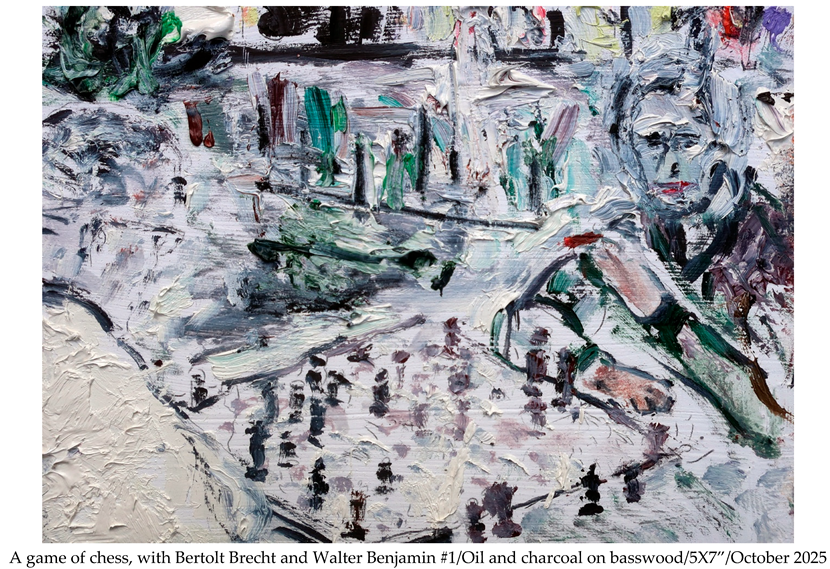
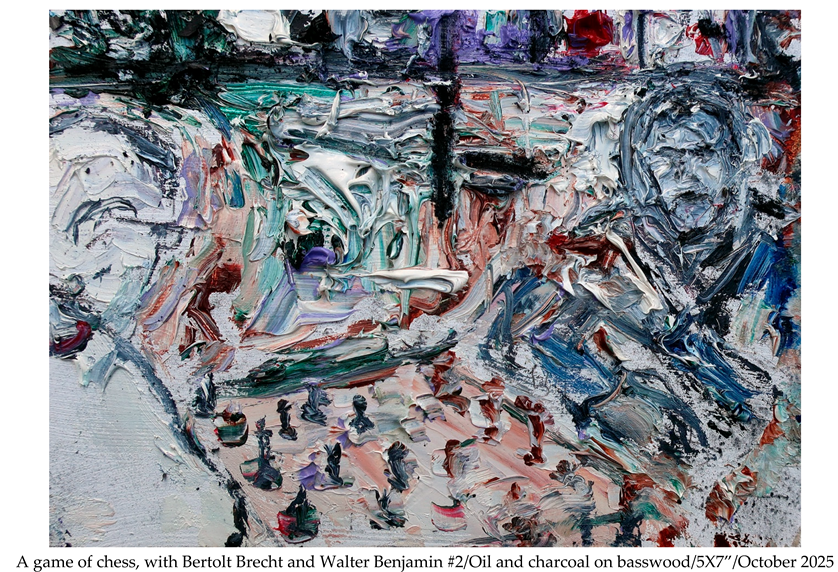
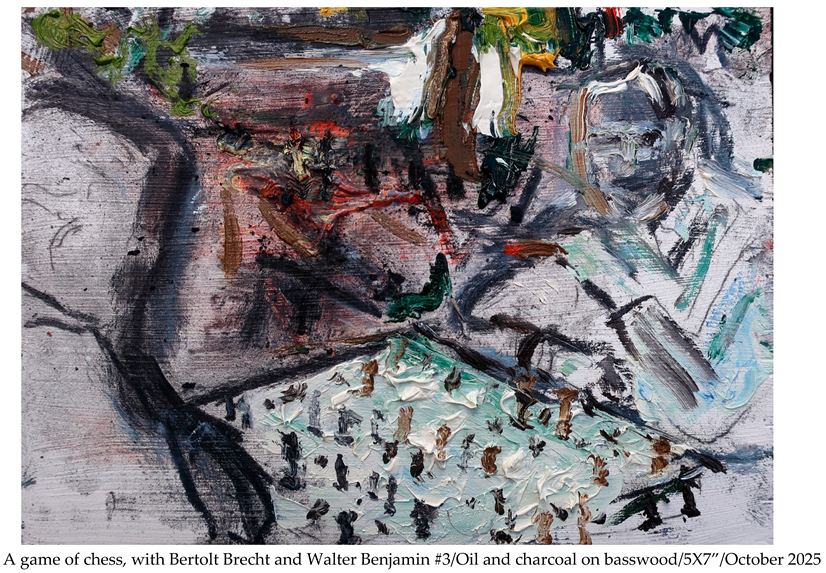
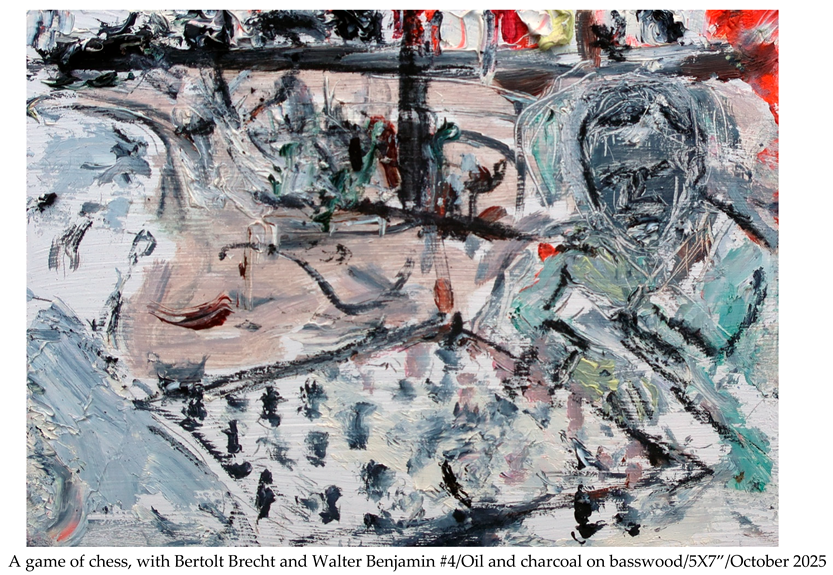
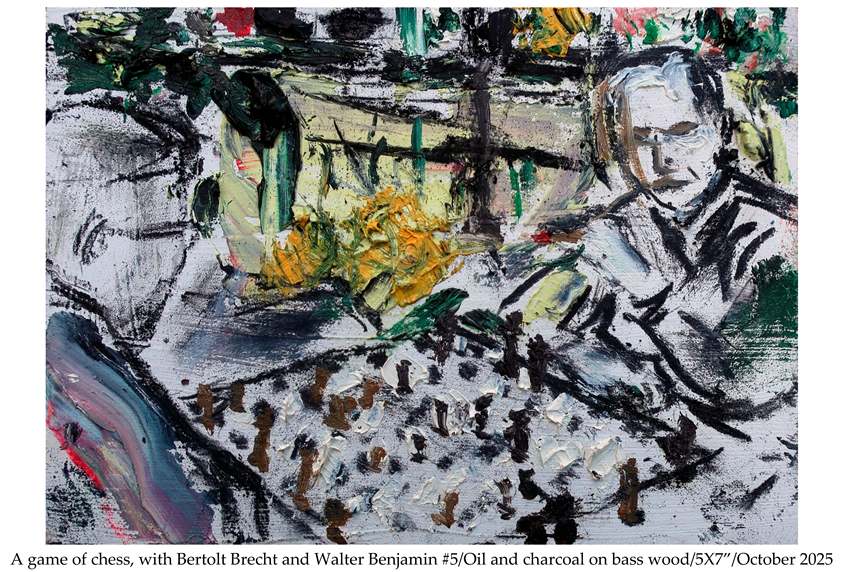
- A final note on the pictures included in this piece. They’re intended as a kind of parallel narrative. A photograph was taken, mechanically, onto film, in Skovsbostrand, in the summer of 1934, of Brecht and Benjamin, key figures in this text, playing a game of chess. At some point the image was digitised so it could feature in the book (Wizisla 2016, p. 108, fig. 16), where I first encountered it. I took it upon myself to transcribe the image in oils on basswood, not once, but in the spirit of addressing kinds of reproduction, five times. As an act of political engagement and solidarity, I then offered the paintings for sale to support the charity Medical Aid for Palestinians, and two, so far, have been sold. If the rest also sell, I will offer to make further reproductions to anyone interested, for sale for the same cause. Think of this final paragraph as a kind of kōan.
Funding
This research received no external funding.
Institutional Review Board Statement
Not applicable.
Data Availability Statement
No new data were created or analyzed in this study. Data sharing is not applicable to this article.
Acknowledgments
Thanks to Robert Vinten for careful reading and helpful comments. Thanks, also, to an anonymous reviewer, for a careful, sensitive and sympathetic reading of this piece and some constructive feedback and suggestions, most of which suggestions I have ignored, but which have nonetheless shaped the small but significant changes I did make in revision.
Conflicts of Interest
The author declares no conflict of interest.
References
- AICAN + Ahmed Elgammal-Artists-HG Contemporary. 2019. Available online: http://www.hgcontemporary.com/artists/aican-ahmed-elgammal (accessed on 13 October 2025).
- Alexander, Anne. 2025. The AI Arms Race. International Socialism, July 1.
- Ambrosini, Luciano. 2025. The Aura in the Algorithm: Reimagining Walter Benjamin’s Aesthetic Theory in the Era of Artificial Intelligence. In Dialectic of Digital Enlightenment: Reclaiming Radical Philosophy for Our Times. Edited by Bhabani Shankar Nayak. Cham: Springer Nature. [Google Scholar] [CrossRef] [Scilit]
- Arielli, Emanuele, and Lev Manovich. 2022. AI-Aesthetics and the Anthropocentric Myth of Creativity. Nodes Journal, 91–97. Available online: https://nodesjournal.com/en/nodes-19-20/ai-aesthetics-and-the-anthropocentric-myth-of-creativity/ (accessed on 13 October 2025).
- Aris, Sharareh, Shaghayegh Nosrati, and Masoomeh Moosavand. 2023. A Digital Aesthetics? Artificial Intelligence and the Future of the Art. Cyberspace Studies 13: 219–36. [Google Scholar]
- Barthes, Roland. 2000. Camera Lucida: Reflections on Photography. Translated by Richard Howard. Vintage Classics. Vancouver: Vintage Books. [Google Scholar]
- Bender, Emily M., and Alex Hanna. 2025. The AI Con: How to Fight Big Tech’s Hype and Create the Future We Want, 1st ed. Glasgow: HarperCollins. [Google Scholar]
- Benjamin, Andrew. 1986. The Decline of Art: Benjamin’s Aura. Oxford Art Journal 9: 30–35. [Google Scholar] [CrossRef] [Scilit]
- Benjamin, Walter. 2003. Selected Writings. 4: 1938–1940. Edited by Howard Eiland and Michael W. Jennings. Translated by Edmund Jephcott, and Others. Cambridge, MA: The Belknap Press of Harvard University Press. [Google Scholar]
- Benjamin, Walter, and Howard Eiland. 2006. Selected Writings. Volume 3: 1935–1938. Edited by Howard Eiland and Michael W. Jennings. Translated by Edmund Jephcott, Howard Eiland, and Others. Cambridge, MA: Belknap Press of Harvard University Press. [Google Scholar]
- Bolter, Jay David, Blair MacIntyre, Maribeth Gandy, and Petra Schweitzer. 2006. New Media and the Permanent Crisis of Aura. Convergence 12: 21–39. [Google Scholar] [CrossRef] [Scilit]
- Bratu Hansen, Miriam. 2008. Benjamin’s Aura. Critical Inquiry 34: 336–75. [Google Scholar] [CrossRef] [Scilit] [PubMed]
- Crawford, Kate. 2021. Atlas of AI. New Haven: Yale. [Google Scholar]
- Gangadharbatla, Harsha. 2022. The Role of AI Attribution Knowledge in the Evaluation of Artwork. Empirical Studies of the Arts 40: 125–42. [Google Scholar] [CrossRef] [Scilit]
- Hao, Karen. 2025. Empire of AI: Inside the Reckless Race for Total Domination. London: Allen Lane. [Google Scholar]
- Harman, Chris. 1986. Base and Superstructure. International Socialism, July 1.
- Hartzog, Woodrow, and Jessica M. Silbey. 2025. How AI Destroys Institutions. SSRN Scholarly Paper No. 5870623. Social Science Research Network. December 5. Available online: https://papers.ssrn.com/abstract=5870623 (accessed on 23 February 2026).
- Kaufman, Robert. 2002. Aura, Still. October 99: 45–80. [Google Scholar] [CrossRef] [Scilit]
- Marcus, Gary. 2025. Rumors of AGI’s Arrival Have Been Greatly Exaggerated. June 7. Available online: https://garymarcus.substack.com/p/rumors-of-agis-arrival-have-been (accessed on 23 February 2026).
- Marx, Karl. 2012. Grundrisse: Foundations of the Critique of Political Economy (Rough Draft). New York: Penguin Classics. [Google Scholar]
- Oi, Mariko. 2023. Hollywood Writers Agree to End Five-Month Strike after Studio Deal-BBC News. BBC News. September 27. Available online: https://www.bbc.co.uk/news/world-us-canada-66932556 (accessed on 3 October 2025).
- Quattrociocchi, Walter, Valerio Capraro, and Gary Marcus. 2026. Statistical Approximation Is Not General Intelligence. Nature 650: 792. [Google Scholar] [CrossRef] [Scilit] [PubMed]
- Roberts, Michael. 2023. AI-GPT: A Game Changer? Michael Roberts Blog. April 8. Available online: https://thenextrecession.wordpress.com/2023/04/08/ai-gpt-a-game-changer/ (accessed on 20 October 2025).
- Roddy, Stephen, and Brian Bridges. 2026. Cybernetic Resurgences: Machine Music Beyond AI Slop. In Artificial Media: Emerging Trends in Narratives, Education and Creative Practice. Edited by Nelson Zagalo and Damián Keller. Cham: Springer Nature. [Google Scholar] [CrossRef] [Scilit]
- Rosen, Michael. 2004. Benjamin, Adorno, and the Decline of the Aura. In The Cambridge Companion to Critical Theory. Cambridge: Cambridge University Press. [Google Scholar] [CrossRef] [Scilit]
- Smith, Naomi, and Clare Southerton. 2025. AI and Aesthetic Alienation: The Image and Creativity in Contemporary Culture. Social Science Computer Review. ahead of print. [Google Scholar] [CrossRef] [Scilit]
- Szpakowski, Michael. 2019a. 97 Questions about Art. Borderless Philosophy.
- Szpakowski, Michael. 2019b. On Art and Knowledge. International Journal of Art & Design Education 38: 7–17. [Google Scholar] [CrossRef] [Scilit]
- “Untitled” (USA Today). 1990. Hammer Museum. Available online: https://hammer.ucla.edu/take-it-or-leave-it/art/untitled-usa-today (accessed on 25 October 2025).
- V-J Day in Times Square-Wikipedia. 2025. Available online: https://en.wikipedia.org/wiki/V-J_Day_in_Times_Square (accessed on 10 October 2025).
- Wittgenstein, Ludwig, and G. E. M. Anscombe. 1994. Philosophical Investigations, 3rd ed. St. Raleigh: Repr. Blackwell. [Google Scholar]
- Wizisla, Erdmut. 2016. Walter Benjamin and Bertolt Brecht: The Story of a Friendship. Translated by Christine Schuttleworth. Seoul: Verso. [Google Scholar]
- Xue, Alice. 2021. End-to-End Chinese Landscape Painting Creation Using Generative Adversarial Networks. Paper presented at 2021 IEEE Winter Conference on Applications of Computer Vision (WACV), Virtual, January 5–9; pp. 3862–70. [Google Scholar] [CrossRef] [Scilit]
- Zitron, ed. 2025. The Case Against Generative AI. Available online: https://www.wheresyoured.at/the-case-against-generative-ai/ (accessed on 29 September 2025).
Disclaimer/Publisher’s Note: The statements, opinions and data contained in all publications are solely those of the individual author(s) and contributor(s) and not of MDPI and/or the editor(s). MDPI and/or the editor(s) disclaim responsibility for any injury to people or property resulting from any ideas, methods, instructions or products referred to in the content. |
© 2026 by the author. Licensee MDPI, Basel, Switzerland. This article is an open access article distributed under the terms and conditions of the Creative Commons Attribution (CC BY) license.