


Abstract
This essay focuses on a series of radical, never-built “garden” designs from 1969 by the artist-turned-landscape-architect Patricia Johanson (1940–2024), which proposed sites in and around New York City that would confront the public with complex human–ecological interrelationships of the day, often posing thorny questions about them. In all, she composed 150 drawings and 7 related essays, sparked by a misguided commission from House & Garden magazine, which envisioned everything from skyscrapers retrofitted with plant trellises to filter water; to the conversion of a highway interchange into a clover field for honey production; fissures sliced into asphalt to allow the release and observation of subterranean steam; and a river dyed to highlight, rather than conceal, ongoing industrial pollution. I revisit this ambitious, multidisciplinary body of work not only in relation to its original context, when a modern ecology movement was gaining momentum, American cities were becoming ever more privatized, and a number of fellow artists began making large-scale outdoor artworks that would come to dominate art historical accounts of land and environmental art, but also, through the lens of its continued, and arguably heightened, relevance in our own moment of spiraling climate breakdown, corporate geo-engineering schemes, and further enclosures of various commons, as well as an ever-growing field of eco-art history, to which this special journal issue is a testament.
Prologue
Before turning to Patricia Johanson’s visionary garden proposals from 1969, I want to open with some thoughts on this special journal issue and the questions it poses about the potentials and stakes of an ecological approach within art history. For some time, there have been art historical accounts of art about ecology, the environment, and landscape, or which takes up these subjects in a topical sense. Something far more expansive and potentially disruptive to the discipline is being teased here, however. In the catalogue for their 2018 exhibition, Nature’s Nation: American Art and Environment, the art historian Alan C. Braddock and curator Karl Kusserow usefully assert that eco-art history entails thinking about the ways that all art, no matter its subject, is materially and environmentally entangled, and inevitably so (Braddock and Kusserow 2018).1 Following from this, one definition of eco-art history might be that which emphasizes intricate interrelations between the human and more-than-human, pushing against the anthropocentrism characteristic of the humanities, with art history arguably being among the most human-centering fields of all, given its focus on cultural works. What might come of de-centering the human within art history? Within the young branch of the environmental humanities, scholars have noted the necessary, and in fact inescapable, “unsettling” of the human in the face of mounting scientific evidence of our non-autonomy as a species; not to mention Indigenous and other non-Western epistemologies which never saw humans as separate in the first place; myriad insights gleaned from animal studies, multispecies ethnography, and other fields which foreground more-than-human perspectives; as well as recognition of the profound impacts humans have had on the environment at the planetary scale, a condition captured by the term “Anthropocene” and its many counter-terms such as Capitalocene, Plantationocene, Chthulucene (Rose et al. 2012). Our own moment of extreme environmental transformation, precarity, and danger, I would echo, demands new methods and forms of representation in order to grasp, navigate, envision, and potentially intervene in it, ones that wrangle with the more-than-human, material world and our differentiated relations to it—past, present, and future.2 It elicits, in other words, disciplinary re-evaluation, including by pushing art history to ask of itself what specific tools and insights it might sharpen and lend at this juncture—for example, tied to its longstanding concern with materiality or the politics of representation. Attention to differentiated relations is crucial, however, if eco-art history is to be adequately nuanced, and to avoid the mistake of over-generalizing and thus abstracting categories such as “human” and “environment.” Environmental and climate justice frameworks—which foreground differential power relations and center the perspectives of “frontline” communities, or those subjected to disproportionate environmental harms, employing intersectional, multi-scalar, and other methods to do so—provide vital reference points for any critical eco-art history. While Johanson’s early landscape work does not fully anticipate either spiraling climate breakdown or the significance of environmental justice perspectives, in its depiction of complex multispecies assemblages, in which the human and more-than-human are inextricably enmeshed, it stands as a compelling model for eco-art and eco-art history alike.
Re-Imagining Gardens-as-Usual
On an otherwise regular afternoon in the late 1960s, the young artist Patricia Johanson pulled to the side of the road in Hoosick Falls, New York—a small, industrial town through which she frequently passed on her weekly commute between nearby Buskirk and New York City, some two hundred miles to the south. Something had caught her eye…3 The river below, a tributary of the Hudson, shimmered with otherworldly iridescence. Transfixed by the scene’s Oz-like beauty, the artist became alarmed only the next day after returning to find the water’s surface littered with fish carcasses. A local newspaper reported that a factory, known for illegally discharging toxins into the channel, had once again opted for a cheaper means of waste disposal than properly trucking it away.4 This event, while producing visually arresting and biologically deadly results, was in fact commonplace at the time. The Hudson River corridor—beneath its pastoral veneer, made iconic by painters and writers a century before—was heavily industrialized in the nineteenth century, largely in service of New York City’s explosive growth downstream.5 By the 1960s, with the intensified manufacture of goods including synthetic substances, the river functioned much as an open chemical sewer. Claimed one magazine: “residents used to say they could look at the river and tell what color the big General Motors plant was painting the vehicles that day.”6
Such conditions were not unique to this place. In the same decade, the Cuyahoga River in Ohio repeatedly burst into flames due to its saturation with pollutants, several prominent oil spills ravaged California’s coastline, and Lake Erie was proclaimed near dead. In response to these and other crises, scientists, legislators, and the American public increasingly turned attention to the environmental degradation of the country’s land, air, and waters.7 Because of the Hudson River region’s historical role in shaping a national romantic landscape tradition, however, the collision of industry and “nature” here was perhaps especially poignant. 8
For Johanson, the incident was a jolting reminder of the “limits of ‘beauty’” as well as the distinction between how something looks (spectacular) and how it functions (poisonous) (Johanson 2010). Her experience at the edge of the tainted Hoosic was also one of many site-based encounters that formed the basis for a series of radical garden proposals that she drafted over several months in 1969, sparked by a commission from House & Garden magazine in March of that year.9
In one, Toxic Rainbow, ribbons of vibrant yellow, red, and blue merge as they snake their way from the background to foreground, through a quickly penciled riparian habitat (Figure 1). Floating text fills the non-figurative spaces of the drawing, identifying each color as a type of contaminant flowing into the river from the surrounding landscape—yellow from agriculture, red from industry, blue from highways—and spelling out the plans of Johanson’s proposed intervention:
In lending “color, form, and dimensions” to that which is typically invisible, Johanson illuminates, and thereby makes traceable, an ever-shifting geography of contamination. Her “garden,” here as in the other proposals, operates as a medium for communication through which to stir the public’s awareness of, and, ultimately, its active participation in, the fate of vernacular environments.Harmless color-coded dyes are added to all major water pollutants. As harmful substances mix with water, the specific poison, or mixed chemical cocktail is revealed. Forms generated by flow-patterns and wind, & colors mixed by chance, indicate the extent & path of the poisons.
Figure 1.
Patricia Johanson, Toxic Rainbow (1969); courtesy: Nathaniel Goossen and Gerrit Goossen.
In all, Johanson composed one hundred and fifty garden drawings as well as seven related essays.10 Together, they not only subvert traditional notions of the garden (at least in the Euro-Western context), but also catapult the artist into the realm, and scale, of urban design. While my essay will focus on only a handful of drawings, a broad sweep of her proposals is helpful to grasp their overall scope: skyscrapers are retrofitted with plant trellises to filter water; the thermal pollution from an electrical plant is diverted from an affected river into a tropical garden; the leftover space of a highway interchange is converted into a clover field for the production and harvesting of honey; a swamp is inserted into the center of the city; fissures are sliced into inner-city asphalt to allow the release and observation of subterranean steam rising from subway and sewage systems below.
House & Garden, of course, had something entirely other in mind when they had invited Johanson to design a garden for its pages. The magazine whole-heartedly rejected this sprawling, manifesto-like body of work, which, as already suggested, exploded basic precepts of the garden itself. Upon delving into the project, Johanson quickly identified several fundamental objections she held toward gardens-as-usual: First and foremost, she opposed approaches to landscape that reduced it to mere decoration, or ornamental elements. Her essays and drawings, instead, address the complexity and dynamism of landscapes as fully functioning systems. Her concern was with understanding landscape’s inherent and imposed workings to the point of being able, for example, to bring damaged places back into biological and social circulation. Secondly, and reversing the notion of the garden as a (typically bourgeois) private retreat from the surrounding world, Johanson suggested that gardens should exist within, and take on as their content, the day-to-day fabric of cities and their reaches. Reframed as “spaces for dialogue between nature and culture,” many of her gardens proposed to confront the public with pollution and other unsightly cultural byproducts, with the aim not only of broadening people’s ideas about “nature” to include human–nature interactions, but also of improving actual urban design (Kelley 2006).
In order to comprehend House & Garden’s initial interest in Johanson, one must return to the magazine consultant James Fanning’s enthusiastic impression of her earlier outdoor sculpture, Stephen Long (1968), which he’d discovered in the “People Are Talking About…” column of Vogue magazine a month prior to contacting the artist.11 A photograph there showed the attractive twenty-eight-year-old Johanson astride her massive, linear artwork, its primary colors receding into the wooded distance, as if one of the faddish super-graphics featured in House & Garden had been imposed onto the land itself12 (Figure 2 and Figure 3). Fanning would reach for a piece of letterhead stationery and his typewriter,
Having interpreted Stephen Long as an audacious, yet charming, formalist exercise, Fanning believed Johanson’s garden ideas would fit perfectly into a magazine devoted to the tasteful integration of interior and exterior decorating, or “incorporating living for young homemakers.”14 (And, in all fairness, how could he have seen what was coming?)Dear Miss Johanson: Would you like to design a garden for this magazine? After seeing your 1600-foot-long railroad track sculpture in Vogue it occurs to me that your fresh approach is one that would make considerable impact on the field of landscape design. A knowledge of, or even interest in, gardening is not required at all. The kind of design I am thinking of would approach the problem as one of form, color and texture, with materials used to execute the design being selected as required.13
Figure 2.
Patricia Johanson, Stephen Long (1968); courtesy: Patricia Johanson Foundation.
Figure 3.
Patricia Johanson, Stephen Long (1968); courtesy: Patricia Johanson Foundation.
House & Garden’s assumptions about what kind of space a garden should be—not to mention its unsubtle attitudes regarding gender, class, and race—are easily gleaned from its pages, particularly its ongoing series, “Gardener’s Month,” which imparted practical tips by way of showcasing exemplary gardens. An April 1969 entry, “The Secluded Garden,” for instance, advised that in order to assure the “occasional modicum of peace and quiet” crucial to one’s well-being in modern times, the garden should be an “oasis of calm and at the same time solve the problem of making an ordinary backyard attractive to live with and pleasant to the view of passers-by” (The Secluded Garden 1969). The month that Johanson built Stephen Long, the column focused on the “Refinements of a Well-Ordered Garden,” including the potential of using “plants as embroidery” to achieve “drifts of springtime color” (Refinements of a Well-Ordered Garden 1968). At this very same time, the pivotal exhibition, “Earth Works,” curated by Robert Smithson and Virginia Dwan at the Dwan Gallery, was on view in New York City. Cited by many at the time, and retrospectively, as the birth of “earth art” as a coherent body of works, this exhibition was accompanied by Smithson’s now-legendary essay, “Sedimentation of the Mind: Earth Works,” which appeared in Artforum a month prior to the show’s opening and served as a manifesto of sorts for the emergent practices featured in it. Within the essay, Smithson directly critiqued the kinds of conservative ideas about art and landscape embodied in House & Garden, asking at one point, sardonically, if “art degenerates as it approaches gardening?” (Smithson 1968).15
As for Johanson, who had naively taken the magazine’s encouragement of her “fresh” and “impactful” approach to landscape design at face value, cynicism was slower to develop as she began working on her project for the journal:
Against the backdrop of House & Garden, the iconoclastic nature of her imagined interventions comes into even sharper relief.As I was writing these philosophical texts and producing more and more drawings, Mr. Fanning was taking me around to the houses of extremely wealthy people who would dutifully show me their estates. It finally dawned on me that they wanted me to design something for one of these people so they could photograph it for the magazine.(Kelley 2006)
Engaging Real Ecologies as a Counterpoint to Scenic Nature and Earthworks
By the time she embarked upon her House & Garden-prompted endeavor, Johanson had steeped herself in books on ecology and ecological design. Indeed, in its sophisticated grasp of ecological principles and emphasis upon putting such principles into action, the project diverged sharply from most other land-based artistic practices of the day, at least in the U.S. context.16 We might more usefully consider it in the context of a pronounced shift away from objects and toward systems on the part of certain vanguard artists at the time well as a related, burgeoning ecological consciousness in the same period.17
By the end of the 1960s, ecology had gained considerable ground not only as a science that emphasized the intricate interdependence of all life forms in and with their habitats, but also as the basis for a growing political movement in the United States.18 The same summer that Johanson feverishly drafted her visionary garden proposals, Time magazine declared that it was “the year of ecology”:
Johanson believed that derelict sites, in their messy complexity, held a particular potential to move people beyond reductive—e.g., scenery-focused—views of the land. Her explicit appeal to the biological, or the “living world,” however, blatantly clashed with many of her contemporaries’ allergic reaction to all things “natural.” Smithson, for example, in an oft-cited series of conversations with the curators Liza Bear and Willoughby Sharp in 1968–1969, expressed: “I have a stronger tendency towards the inorganic than to the organic. The organic is closer to the idea of nature: I’m more interested in denaturalization or in artifice than I am in any kind of naturalism” (Bear 1970).19 This taste for the abiotic, as noted again shortly, aligned with Smithson’s and his peers’ turn to extreme landscapes such as deserts and icy poles, and aversion to all things green.20There has not been a topic for such worried conversation since James Baldwin forecast the fire next time. Suburban matrons predict the melting of the polar ice caps followed by catastrophic floods. Busy executives and bearded hippies discuss the presence of DDT in the flesh of Antarctic penguins. All sorts of Americans utter new words like ecology and eutrophication. Pollution may soon replace the Vietnam War as the nation’s major issue of protest.(Ecology 1969)
The most caustic of Johanson’s gardens is a direct response to Smithson. Garden of Sulphur & Tar (for Bob) depicts a landscape in the form of a poisonous tropical butterfly, with topographical islands of yellow crystalline sulfur rising from viscous pools of tar. Immediately beneath the drawing’s title, the artist gives the directive that this “formal” garden “should never be built,” thereby casting it as thoroughly conceptual (Figure 4). Other blocks of text elaborate that the visual beauty of this garden “would be outweighed by the noxious destructiveness of sulphur and tar,” and that the black ooze comprising the butterfly’s wings would present a lethal trap for flora and fauna. This garden specifically addresses two artworks by Smithson: his earliest (unrealized) earthwork proposal, Tar Pool and Gravel Pit (1966) and Asphalt Rundown, completed in October 1969 near Rome, a piece in which he released a truckload of hot asphalt down the slope of a quarry, documenting its gradual process of cooling and solidification.21
Figure 4.
Patricia Johanson, Garden of Sulphur & Tar (for Bob) (1969); courtesy: Nathaniel Goossen and Gerrit Goossen.
For Johanson, Smithson’s focus on raw materials without consideration for their connection to, and effects upon, larger systems amounted to a dangerous fetishization. She was moreover critical of what she perceived to be his and other earthwork artists’ ultimate orientation toward photography, or interest in creating seductive images for gallery and magazine contexts. Despite being out in the world, in other words, she believed that most earthworks remained hitched first and foremost to the New York art world and a circumscribed set of concerns that animated it at the time. Another of Johanson’s gardens, History of the Highway: Debris Gardens, explicitly riffs on Smithson’s Asphalt Rundown, further elucidating the difference between the two artists’ approaches (Figure 5). Johanson’s proposed installation would commemorate geological forms and processes (e.g., mudslides) along a busy roadway, by leaving them visible onsite rather than clearing them away to reveal the natural forces at play in even the most constructed of environments. While visually invoking its precursor, her debris gardens transform an ordinary infrastructural element into a public educational device.
Figure 5.
Patricia Johanson, History of the Highway: Debris Gardens (1969); courtesy: Nathaniel Goossen and Gerrit Goossen.
Like many ambitious artists in New York at the time, including others who would also go on to make works on the land, Johanson was deeply involved with Minimalism, and its concern with “real space,” in the mid-60s. Three of her paintings had been included in “Eight Young Artists” at the Hudson River Museum in 1964, considered by many to be “the first exhibition devoted strictly to what is now called ‘Minimal’ art” (Battcock 1968b).22 Reviews of her inaugural solo show at Tibor de Nagy gallery in 1967 lauded her paintings for one-upping other minimalists, including her renowned teachers from Bennington College, which she attended from 1958 to 1962, Tony Smith and Paul Feeley.23 In Art News, for example, Marcia Tucker proclaimed that the “audacious understatement […] [of Johanson’s paintings] makes the work of other minimalists seem Baroque” (Tucker 1967). Her expansive piece, William Clark (1966)—eight and a half feet high and twenty-eight feet wide, with a thin strip of blue stretching across its otherwise unadorned canvas, interrupted only by several intervals of orange—hung among works by many of the best-known artists of the day in “The Art of the Real: 1948–1968,” at the Museum of Modern Art in the summer of 1968 (Figure 6).24 The exhibition had been guest curated by Eugene, or Gene, Goossen, chair of the art department at Hunter College, and Johanson’s romantic partner since the two met while she was an undergraduate at Bennington.25 Significantly, William Clark was named after an explorer, second in command to Meriwether Lewis on the famous Lewis and Clark expedition of 1805, which played a key role in opening up the American West to settlers. Much to Johanson’s delight, one critic caught this detail, thereby reading the painting along her intended lines, as a horizon of sorts (Frankenstein 1968). “Everybody else was looking at it as a stripe painting […] as a Minimal painting,” she later recalled in an interview with the author (Johanson 2008). “I was thinking of it as demarcating space, as going forth, you know, and of course the paintings were getting bigger because I was involved in space. I wasn’t involved in the image […]” (Johanson 2008). One of the most distinguishing features of Johanson’s stark, large-scale paintings from this period is, indeed, her explicit invocation of specific historical figures (e.g., artist-naturalists, cartographers) from the 18th- and 19th-century American landscape tradition. In doing so, Johanson articulated her own move from pictorial space to “real space” via the trope of empirical discovery.
Figure 6.
Patricia Johanson, William Clark (1966); courtesy: Patricia Johanson Foundation.
In 1960, Goossen had introduced Johanson to the piece of former farmland outside of Buskirk where she created her first outdoor sculpture, William Rush in 1966, and where she lived full-time since 1974 until her death in 2024.26 Just fifteen miles from Bennington as the crow flies, Goossen’s 150-acre family property, equal in area to roughly thirty Manhattan city blocks, was mostly wooded and teemed with wildlife. A 19th-century farmhouse stands at its edge, with no neighbors anywhere within eye or earshot. Once she began to spend time there regularly, Johanson embarked upon learning intimately about the domain by way of daily walks. In its bucolic and domestic qualities, the land contrasted sharply with the kinds of places actively scouted by many of her contemporaries. In a 2010 interview with the author, she recalled:
Because she had access to a parcel of property, Johanson was able to realize an artwork on the actual land before any “earth artist” drove his shovel into desert hardpan.27 The conventional idyllic-ness of William Rush’s location, however, turned out to be a critical liability. Part of the reason that Johanson’s early outdoor sculptures went largely unacknowledged by her peers, many of whom (e.g., Clement Greenberg, Helen Frankenthaler, Hans Namuth, Carl Andre, Smithson) traveled to Buskirk to see them, is arguably that their site was judged as being too “natural.”28 More specifically, the landscape type and methodology she employed fell outside the narrow parameters of what was considered to be “critical” at the time, particularly according to Smithson’s influential rhetoric about emergent earth-based practices. Art historically speaking, in other words, Johanson was in the wrong place at the right time, at least in terms of her early works on the land.[…] most of the artists I knew were trying to find the ideal site for their work, usually a desert or someplace equally remote that would photograph well. Personally, I don’t believe in the ideal. I believe in working with whatever you’ve got, so when I met Gene and he offered me his property as a place to work, I set about exploring the possibilities.(Johanson 2010)
Multispecies Public Landscapes in/and the City
One of Johanson’s core intents with her 1969 garden designs and eventual, later work as a landscape architect, also very different from the concerns of earthwork artists, was to improve existing infrastructural and urban design. More specifically, she was keen to develop alternatives to the divisive and deadening qualities she believed were characteristic of many new postwar spaces (e.g., interstates, “Levittown” suburbs, corporate plazas, levees). “True wastelands have been created by urban designers,” she charged, echoing comments made by the radical urban theorist Jane Jacobs in her 1961 benchmark critique of then-orthodox city planning, The Death and Life of Great American Cities (Johanson 2008; Jacobs 1961).
The dead spaces that Johanson wished to counteract were, of course, the outcome of specific circumstances at the time, including policies forwarded by the Federal Housing Administration and other government agencies. The Federal-Aid Highway Act of 1956, for instance, not only made possible, but also essentially underwrote, the mass exodus of affluent whites and many commercial businesses from the city to the suburbs. Meanwhile, massive-scale urban renewal programs were initiated to combat the worsening problem of “urban blight” in ever more economically gutted, African American inner cities. An almost schizophrenic impulse for private, ordered, and “hygienic” space took hold of many of those who could afford it—reflected in the mass-production of hyper-uniform suburbs like those originally developed by the Levitt brothers on Long Island and outside of Philadelphia, a 45% jump in overall suburban populations in the 1950s, and a near tripling of individual car registrations between 1945 and 65.29 Johanson bemoaned in 1969,
The system of “public landscapes” she proposed was meant to physically connect urbanized areas with agricultural, industrial, and wilderness lands, making the city more like nature, which she perceived to be characterized by cooperation, flux, and “multiple overlapping functions,” as opposed to the monolithic and thoroughly anthropocentric drivers shaping most cities and suburbs. To make the city “in nature’s image,” then, was not to make it simpler or to go back in time, but, to the contrary, to make it more complex, perhaps even more democratic.Perhaps the most dismal development in recent years has been the gobbling up of farmland and wilderness by suburban developers. These pseudo-cities—neither urban nor rural—are doubly exclusive, excluding not only people, but the earth itself. It would seem that the time has come for the creation of a vast new public landscape; for the creation of new meeting grounds; for designs that are inclusive rather than exclusive.(Wu 2007)
The half-acre, open granite plaza—set back from Park Avenue between 52nd and 53rd Streets, at the base of the gleaming thirty-eight-story Seagram Building by the modernist architect Ludwig Mies van der Rohe—appears mundane and innocuous enough today. Its unveiling in 1958, along with the towering, International Style architectural monument it framed, however, marked a pivotal moment in Manhattan’s built environment to come and, more generally, in the rampant privatization of urban space that has characterized American cities in the decades since. While van der Rohe reportedly conceived of the spare, rectangular plaza—which features two angular fountain pools, but is otherwise stripped of ornamentation—to provide a sense of spaciousness, or breathing room, for the building and its users, the site became quickly cluttered with people, a bustling locus of social activity.30 Partly in response to its popular success, the city government enacted a landmark revision to its zoning laws, commonly known as the Plaza Law of 1961, offering incentives for developers to install similar “privately owned public spaces.”31 This was the first “incentive zoning device” of its kind, and directly facilitated the widespread “construction of high-rise buildings on small footprints, creating a series of open plazas” across the city (Finkelpearl 2001).Van der Rohe’s template, in the end, became the first in a string of much less successful clones. Many corporate plazas, unlike the lively Seagram Plaza, stood typically vacant—aside from the mammoth abstract sculptures that populated them, a new breed of public art ushered in by the establishment of the Art in Public Places Program at the National Endowment of the Arts in 1967 and subsequent percent-for-art programs (Lacy 1995).32 They were often avoided by pedestrians, the sites of increasing crime and subsequent police regulation. In the opinion of Jane Jacobs, these spaces were doubly insidious because they displaced the complex social interactions traditionally supported by the street. Johanson would extend such a critique to public infrastructure more generally, lamenting the fact that dams, retaining walls, utility facilities, and other tax-funded engineering projects most often took the form of a “big hunk of concrete sitting somewhere,” imposing a destructive barrier to people and nature, or “cutting off the life” (Johanson 2008).
Between two angular skyscrapers, Johanson imagined a dripping, polychromatic “public canyon” (Figure 7). Multistory limestone cliffs covered in moss and fern were to be affixed to the side of one building, acting as a natural filter for the structure’s waste air and water. This artificial landform/architectural appendage would wholly interrupt the spatial ordering of its surroundings, breaking in form from the procession of hard-edged modernist office buildings and more general urban grid, while at the same time creating a perpetually “cool moist climate,” or atmospheric oasis. In re-purposing the leftover space between structures, it was meant to simultaneously open new opportunities for leisure and recreation (e.g., rock climbing) and create viable habitat for plants and other non-human species. The expansion of activities, or multi-layered functionality, embodied in this design not only mirrors the ecological worldview that was taking hold at the time, but also reacts directly to the spatial “purity” promulgated by modern architecture.
Figure 7.
Patricia Johanson, Building That Cleans Its Own Water (1969); courtesy: Nathaniel Goossen and Gerrit Goossen.
Frederick Law Olmsted’s Central Park, just “up the road” from the Seagram Building, represented a vibrant (counter-) example of civic space in Johanson’s eyes, and was a key referent for her. As a child, she frequented this and other parks with her grandfather, who was a foreman with the New York City Department of Parks & Recreation. She remembers the thrill of exploring Central Park and observing minute natural details as well as an abundance of social activities constantly underway on the part of a diverse group of users. In contrast to racially and socio-economically segregated suburbs, and likewise to the heavily manicured landscapes characteristic of them, things in Central Park were not pre-sorted, leaving room for unexpected encounters. While a powerful model of democratic social space, and also of landscape architecture that has had a profound and lasting impact on peoples’ everyday lives, Johanson, however, found Olmsted’s working definition of landscape to be too restrictive. His investment in the picturesque tradition, which prescribed designers to carefully arrange landscapes, so as to make them look “natural,” contrasted sharply with her own interest in foregrounding—rather than masking—the human–nature dialectic inherent to built environments.33
Her gardens sought to broaden peoples’ ideas about landscape (not to mention art), performing such work in no small part by being dispersed throughout the thick of the city and its peripheries. A group of “highway gardens” were proposed to not only disrupt the standardization of postwar everyday life and the emergent built landscape that supported it, but also to socialize spaces by way of facilitating new interactions with urban highways and their corridors. Highway Garden: Gas Tanks proposed to convert two drab gas tanks along the Belt Parkway, a congested commuter circuit linking three of New York’s five boroughs, into an animated local promontory (Figure 8). To amplify the tanks’ existing pattern of rising and falling based on the volume of liquid inside, the behemoth structures were to be painted shimmering gold and floodlit at night. The pipelines leading to and from this temporary storehouse would likewise be colored, demarcating the resource’s path of transit and geographical connection to distant locales. These spectacular modifications transform an otherwise overlooked infrastructural installation into a visually engaging orientation device for the immediate vicinity, while also prompting self-reflection on the part of its passers-by (e.g., about the relationship between the fuel propelling their vehicles and that awaiting distribution in the massive receptacles, and more generally, the way in which their day-to-day existence was reliant upon elaborate engineering systems). This garden plan furthermore invited commuters to stop and get out of their automobiles, a subtle, yet radical, gesture in light of many Americans’ newfound routine of traveling between work in the city and home, at its outskirts, in the autonomous space of the car (which amounted to nothing less than a profound shrinkage of “social space” in the era).
Figure 8.
Patricia Johanson, Highway Garden: Gas Tanks (1969); courtesy: Nathaniel Goossen and Gerrit Goossen.
Another proposal in this series, Regional Highway Garden: Pig Society, would bring drivers face to face with a live encampment of swine, a “pig city” coexistent with their own (Figure 9). Unlike at a zoo or typical farm, here, the animals would wander freely in family groups through a multi-faceted habitat: with trees for shelter, waterholes for wallowing, peat and bark for rooting. A loop road here spins off from the main highway, presenting the opportunity for a literal and figurative detour from one’s prescribed route—and for contact with a normally unseen reality that is directly opposed, for example, to the experience of buying cleanly packaged meat at the supermarket.
Figure 9.
Patricia Johanson, Regional Highway Garden: Pig Society (1969); courtesy: Nathaniel Goossen and Gerrit Goossen.
Other interventions were to operate on a smaller and more dispersed scale, sparking public participation, for instance, in the interrelated cycle of food production and composting. “Garbage Garden” (the Functional Landscape) proposed the integration of sculptural configurations of organic waste “into roadsides, vacant lots, rooftops, & apartment terraces,” as a means of introducing sustainable agriculture into the city. Again, the activation of under-utilized spaces, here civic and domestic, is central. Evocative of the do-it-yourself ethic associated with a burgeoning countercultural movement, most vividly personified by communities who moved to the hinterlands and attempted to produce their own shelters and food “off the grid,” Johanson’s garbage garden instead instigates grassroots action on the urban home front.34
Those gardens that foregrounded “difficult” or controversial matters, in particular, represent a potential expansion of what the art historian Rosalyn Deutsche calls “democratic public space” (Deutsche 1996). In the most extreme instance, Garden of Organized Killing/Soil Fertility, the grounds of an animal slaughterhouse were to be turned into a grotesque public garden. Blood from the factory’s killing floor is channeled to the building’s exterior, where it “splatters onto rockery” and collects in a “fetid, stinking pool,” before being circulated in a surface irrigation system to fertilize the soil “with the blood of sacrificed victims.” Heavy-handed to be sure, this morbid garden is repulsively multi-sensory. “The stench of death is everywhere,” we learn from its plans. Such a project is antithetical, on several axiomatic grounds, to both idyllic gardens and to the contemporaneous public art that was being sited in downtown plazas across major U.S. cities in the era (e.g., Tony Rosenthal’s 1967 Alamo, at Astor Place in New York City; Picasso’s untitled sculpture installed at Daley Plaza in downtown Chicago the same year).35 Beyond recasting the site of the artwork as its central content, and the artist as one who creates space rather than filling it, this garden, like Johanson’s others, re-imagines the role of art as provoking public awareness and dialogue.
In this, Johanson’s 1969 project represents an early, and important, precursor to socially engaged art and design, especially that focused on the urban built environment. This breed of work takes a direct interest in the civic sphere, often grappling head-on with the politics of public space and seeking to expand frameworks for citizen involvement in the city, including its ground-up management and planning. A clear resonance exists, for example, between a number of Johanson’s gardens, and more general approach to the city as a complex socio-environmental formation, and Mierle Laderman Ukeles’s multi-decade body of art on the “social ecology” of waste in New York City.36 (Since 1977, Ukeles has been the official artist-in-residence at the New York Department of Sanitation, a position she created for herself.) More recently, the Center for Urban Pedagogy, a New York-based nonprofit organization founded in 1997, set to work with the mission to “demystify the urban policy and planning issues that impact our communities, so that more individuals can better participate in shaping them” (Center for Urban Pedagogy n.d.). Often collaborating with public schools and other civic institutions, the Center for Urban Pedagogy has created a dizzying array of tools (e.g., guidebooks, maps, exhibitions, curricula) to elucidate how things from zoning laws to predatory real estate practices to affordable housing mandates operate, opening up the city to critical inspection and potential re-making. Numerous artists since the 1990s have addressed the rampant privatization and “securitization” of once-public sites in an age of mass surveillance. The British artist Nils Norman’s book, The Contemporary Picturesque, for instance, features deadpan photographs of the small-scale infrastructures—which have since come to be commonly called “hostile architecture”—installed throughout London in the 1990s to curtail loitering and/or block access to certain kinds of use and occupation (e.g., spiked windowsills, caged entryways, anti-climb and anti-graffiti paint, bus shelter benches angled to make sure no one lingers too long (Norman 2000).37 All of this work shares affinity with Johanson’s 1969 garden drawings and essays, which directed attention to the existing and imagined built environment, eliciting their critical re-evaluation.
In the 1970s, Johanson went on to formally study architecture and engineering, receiving a Bachelor of Architecture from City College of New York in 1977. Starting in 1981, she began realizing the large-scale built projects for which she is now best known, most of which have involved the remediation of degraded public urban landscapes (e.g., Fair Park Lagoon in Dallas, Texas, 1981–1986; Endangered Park in San Francisco, California, 1987–1997; Draw at Sugar House in Salt Lake City, Utah, 2003–2019).38 These elaborate and deeply researched landscape architectural works, which are often held up as banner examples of ecological design, have certainly been discussed, and rightly so, in relation to pressing environmental issues such as pollution, climate change, and biodiversity loss. Johanson maintained, however—and I am seeking, in this article, to duly amplify—that her most important works were her “small drawings from the 1960s,” because they represent the turning point from “a focus on art and the making of art objects to a focus on nature and the living world” (Kelley 2006).
Conclusions
Crucially, Johanson’s turn to “nature and the living world” did not fall into the all-too-common traps—both at the time and through to this day—of approaching nature in nostalgic, binary, and/or essentializing ways, or as a static baseline outside of culture, history, and politics. Quite the opposite, as I hope is by now clear, her radical proposals from 1969 foregrounded messy, situated, and contingent entanglements between the social and the ecological, or human and more-than-human worlds, foreshadowing discourse that would come decades later on “social nature,” “the trouble with wilderness,” posthumanism, the rights of nature, and multispecies assemblages.39
Ironically, and frustratingly, one explanation for why Johanson’s expansive body of work has remained largely overlooked within art history, at least outside of considerations of a relatively thin strand of “eco-art,” is that it has been misperceived by “critical” art historians as reflecting a quasi-spiritual, or even New Age, tone. Indeed, the figurative dimension of her built projects after 1981, which incorporate the forms of site-specific native species (e.g., snakes, butterflies, flowers) into their designs, is like fingernails on the chalkboard to many a contemporary art or architectural historian (Foster 1981). This knee-jerk aversion misses the crux of Johanson’s contribution, however, in part because it judges her work according to a narrow, and misguided, set of aesthetic parameters—prioritizing form over function, as it were, despite the latter being of most relevance to the artist herself and to the import of her work. This mis-assessment, I would argue, reflects the same kind of artworld-centered tunnel vision for which Johanson herself critiqued contemporaneous earthwork artists in the late 1960s and which is still detectible in some contemporary art historical writing, which falls short of meeting practices like Johanson’s in all their complexity. A brief return to the example of the “butterfly” garden she designed “for Bob [Smithson],” which directly addressed his own, much-lauded outdoor works involving geological matter and processes, is instructive here. While both artists were keenly interested in the physical world, the “dialectics” between humans and landscapes, and frameworks beyond the human, Johanson’s garden “response” at once employed iconographic, ecological, and pedagogical means to foreground ongoing ecological relations (Smithson 1973). Reflecting an eco-centric as opposed to anthropocentric ethos, Garden of Sulphur & Tar (for Bob) reframes materials like sulphur and tar through the lens of other-than-human perspectives, while also underscoring Smithson’s failure (and/or disinterest) to do the same. Her critique not only points to the non-autonomy of art, or its inevitable imbrication within social and environmental systems, but also helps to distill contrasting artistic approaches to “nature” at the time.
Advocating for critical aesthetic engagements with nature in the 21st-century context, the architectural historian David Gissen has stressed that nature is always contingent—an idea that is humanly constructed and therefore necessarily culturally and historically specific as well as changeable. He specifies: “[…] every epoch, era, and urban or architectural episteme arrived at particular views, uses, or conceptions of ‘nature’ […]. […] History can be visualized within things that make nature appear as the problem it is, versus our given reality” (Gissen 2015).40 Johanson’s House & Garden drawings, in making nature appear as the problem it was in the late 1960s—as well as in emphasizing social-ecological relations over objects; encouraging civic engagement with various urban commons; and seeking to make both art and landscapes more public—remain every bit as trenchant today as they were in 1969. Arguably, their relevance has only grown given that the “problem of nature” has become all the more convoluted and high-stakes, as evident in a process-phenomenon like climate change, which is entangled, quite literally, with “everything” (Klein 2014; Solnit 2014; Demos et al. 2021). One of the most incisive and invaluable offerings of Johanson’s extraordinary proposals is the way in which they are deeply attentive to existing sites and realities, while also opening onto speculative futures—ones which are more multi-dimensional, inclusive, life-supporting, and abundant (Collard et al. 2015). For ecocritical art and art history, they provide a shining model as well as a daunting challenge to persistently consider the extent to which our own work is enmeshed materially and environmentally with the world—as it exists and as it is yet to be pulled into existence.
Funding
This research was funded by an Andy Warhol Foundation Arts Writers Grant.
Institutional Review Board Statement
Not applicable.
Informed Consent Statement
Not applicable.
Data Availability Statement
The original contributions presented in this study are included in the article. Further inquiries can be directed to the author.
Conflicts of Interest
The author declares no conflict of interest.
Notes
| 1 | In addition to Nature’s Nation, see the foundational collection of eco-art critical essays, A Keener Perception: Ecocritical Studies in American Art History, eds. Braddock and Irmscher (2009); and, much more recently, Methods for Ecocritical Art History, eds. Smith and Patrizio (2026). |
| 2 | My reference to “environmental danger” is a nod to the excellent book: Julie Sze, Environmental Justice in a Moment of Danger (Sze 2020). |
| 3 | Patricia Johanson interview with the author on 23 August 2008, and email to the author on 10 January 2010 (Johanson 2008). |
| 4 | Johanson erroneously attributed the event to Oak-Mitsui, a manufacturer that began copper foil production in Hoosick Falls in 1977. (Several other major manufacturers operated in Hoosick Falls in the 1960s, however, and Oak-Mitsui would later be charged with illegal chemical spills matching Johanson’s description.) In 1973, Oak-Industries purchased the facility along the river where it still resides, previously owned by a paper mill named Noble and Wood Company. In 1976, Oak-Mitsui was incorporated as a joint venture between Oak-Industries, Mitsui Mining and Smelting of Japan, and Anaconda; at the time, it was one of only three major companies in the U.S. manufacturing copper foil for use in the printed circuit industry. Email to the author on 25 January 2010, from Chris Stevens, Operation Manager at Oak-Mitsui in Hoosick Falls, and company website: http://www.oakmitsui.com/pages/company/mission.asp, (accessed on 15 January 2017). (Crossed-checked against the Hoosick Township Historical Society webpage: https://hoosickhistory.com, (15 January 2017). Oak-Mitsui, Inc. has been fined for multiple toxic discharges from its Hoosick Falls facility over the years. In June 2001, for instance, “nearly 2000 gallons of an acidic copper sulfate solution spilled into the river from the Oak-Mitsui plant,” causing the river to “glow with toxic blue chemicals” and killing thousands of fish” (Hoosick 2001). |
| 5 | A 2008 New York Times article on the “post-industrial re-pastoralization” of the Hudson River Valley notes that already when the Hudson River School painters arrived in the early 19th century, the region was transformed by tourism and industry: “In 1825, when Thomas Cole arrived, steamboats were already taking tourists to hotels in the mountains, and the Erie Canal was completed, opening the river as a thoroughfare for commerce and industry. Stone quarries were gutting the hills, and Cole himself was soon complaining about the tanneries that fouled streams and denuded many acres of hemlock forest, so that ‘the most noble scenes are made desolate’” (Strausbaugh 2008). |
| 6 | Ibid. An article in Time magazine from in February 1966 confirms such an impression, naming the Hudson (whether accurately or not) the most polluted river in the U.S. at the time: “There is not a river on the continent that surpasses it in natural beauty […]. Nor has any other American stream earned so rich a place in the nation’s history, art, and folklore. Yet the Hudson […] today is the most wantonly abused river in the U.S., its banks in many places a riparian slum, its waters a running sewer” (New York 1966). |
| 7 | Major legislation was passed around this time to confront pollution and the growing public concern about it, such as the Clean Air Act in 1970, which amended an earlier 1963 law, and the Clean Water Act in 1972, which revised and expanded the original 1948 Federal Water Pollution Control Act. Meanwhile, 22 April 1970, marked the first Earth Day, itself the culmination of widespread, grassroots activism in response to various environmental disasters, including the fiery explosion of the Cuyahoga River on the southern shores of Lake Erie the previous June, when chemicals, oil, and other industrial materials saturating the river ignited. After this catastrophe, Gaylord Nelson, who served as the Governor of Wisconsin (1958–1962) and in the U.S. Senate (1963–1981), helped to organize a nationwide “teach-in” about environmental issues, in which more than 2000 colleges and universities, 10,000 public schools, and 20 million citizens—nearly 10 percent of the U.S. population at that time—participated. This sprawling event, indeed, comprised the first Earth Day. It also helped to shift the political climate and pave the way for the establishment of the National Oceanic and Atmospheric Administration (NOAA) and the U.S. Environmental Protection Agency (EPA) on 3 October 1970. https://oceanservice.noaa.gov/facts/earth-day.html (accessed on 23 October 2025). |
| 8 | A central thrust of environmental activism related to the Hudson since the 1960s has been the protection of the river’s scenic “viewshed,” or that area along its corridor visible to river-goers. This has generally meant that industry is made inconspicuous (e.g., hidden behind bluffs or other barriers), so as to maintain or re-institute a “natural” appearance along the river’s course. In 1963, for example, the still-active conservationist group, Scenic Hudson, was established in reaction to Consolidated Edison’s proposal to erect a massive hydroelectric power plant at base of Storm King Mountain, which would have visually marred the local landmark, frequently depicted by the Hudson River School painters. (The group was successful in fending off this development.) Major art institutions have settled into the Hudson River Valley in recent decades, indicative of the de-industrialization and gentrification that has taken place there since the 1960s. Storm King Art Center, founded in 1960, began placing sculptures (e.g., by David Smith) across its expansive grounds in the mid-late 1960s. In May 2003, the Dia Art Foundation opened Dia:Beacon, a museum housing its permanent collection of artworks from the 1960s to present, many of them iconic pieces associated with Minimalism and “earth art.” Reflective of the region’s transformation, this museum occupies a 300,000-square-foot, defunct Nabisco box-printing factory (built in 1929), on the edge of the small town of Beacon, which is today mostly driven by tourism including that generated by the museum itself. See Dia’s website: http://www.diabeacon.org/sites/page/1/1003, (accessed on 12 December 2025). Matt Coolidge, director of the Center for Land Use Interpretation, explains, “‘The deindustrialization of the Hudson River has been for aesthetic purposes as well as environmental ones.’ As factories are turned into museums, and environmental advocates become hotel developers, he says, tourism, recreation, and real estate are ‘the dominant industries on the river now’” (Strausbaugh 2008). For a more in-depth look, see the Center for Land Use Interpretation’s Up River: Man-Made Sites of Interest on the Hudson from the Battery to Troy, a book-length study of the Hudson as a microcosm of the historical friction between American industrialism and environmentalism (Center for Land Use Interpretation 2008). |
| 9 | The spelling variation between Hoosick Falls (the town) and the Hoosic River reflects different transliterations of the river’s original Algonquin name, which has been translated to mean “the beyond place” or “the stony place.” |
| 10 | This project was published in near entirety (146 of 150 drawings and all seven essays) for the first time in the two-volume book: Xin Wu, Patricia Johanson’s House and Garden Commission: Reconstruction of Modernity (Wu 2007). The first volume contains essays by Wu, the second, reproductions of Johanson’s drawings and essays. |
| 11 | “People Are Talking About…” Vogue (February 1969): 191. Stephen Long—installed for several days only in October 1968—drew intense attention from members of the local community as well as the national media, who flocked to it as if a rare natural phenomenon. The small-town newspaper in Hoosick Falls boasted, “One TV station’s helicopter hovered over Buskirk for three days. Another gave Stephen Long forty minutes of primetime. Time followed, as did Fortune, with spreads.” CBS’s coverage aired both locally and regionally, tracking the artwork’s life cycle from its installation by the artist and a half dozen motley laborers, to its unveiling, to its finished form—a band of three parallel lines (red, yellow, and blue) extending in a straight shot for sixteen hundred feet along an old railroad bed—seen from ground level as well as the air. We hear a voice-over of Johanson reading a script about the piece, as we see the cheerful-looking artist flitting about in sunglasses, a paint-splattered t-shirt, and a pair of patched jeans. She informs us during the clip that this is a “color-experiment” in real space. While the “problem of color” has concerned artists for centuries, she notes, “I wanted to examine these things in a more systematic, controlled way—and literally set up a situation where they would happen.” The media’s coverage of Stephen Long, especially as seen on television, greatly bolstered Johanson’s exposure as an artist and garnered several important invitations, in addition to that from House & Garden magazine. Architect Peter Blake, editor in chief for Architectural Forum (from 1965 to 1972) and the author of God’s Own Junkyard: the Planned Deterioration of America’s Landscape (Blake 1964), later described his reaction to seeing the piece on television: “Stephen Long was as long as three Seagram Buildings laid end to end. Which suggests that Patricia Johanson may be one of the few visual artists working today who have a sense of contemporary architectural scale.” See his introduction to Patricia Johanson: Plant Drawings for Projects (Blake 1978). John Lindsay, the Mayor of New York City, after seeing the aerial footage on television, invited Johanson to install Stephen Long along the Mall in Central Park—the allotted space was only 1300 feet long, however, and she ultimately decided not to display only a fragment of the piece. The groundbreaking outdoor exhibition, “Sculpture in Environment,” had taken place in and around New York City in October 1967 (exactly one year prior to Stephen Long), under Lindsay’s watch. Curated by Sam Green, who had previously organized “Art for the City” in Philadelphia, it was “the earliest exhibition in New York City for which large-scale sculpture was temporarily moved out of the interiors of art world studios, galleries, and museums and into public places.” See Sculpture in Environment (Sculpture 1967). Johanson apparently also rejected an invitation to install Stephen Long in Detroit, because that city was “torn by racial strife.” See “A Kooky Artist Story,” The Standard Press, Hoosick Falls, NY (5 June 1969): 2, see (A Kooky Artist Story 1969). (She would participate, in 1973, in the “Art in Space” exhibition at the Detroit Institute of the Arts.) |
| 12 | In March 1969, the same month Fanning wrote to Johanson, the magazine was devoted to the topic of color, including articles such as “Color Makes Things Happen” (Color Makes Things Happen 1969, p. 88) and “Colors in Action” (Colors in Action 1969, p. 77). |
| 13 | Letter from James Fanning to Johanson, dated 24 March 1969. Patricia Johanson papers, 1964–1998, Archives of American Art, Smithsonian Institution. |
| 14 | House & Garden: Incorporating Living for Young Homemakers is how the magazine was listed on its title page in the late 1960s. Published by Condé Nast from 1911 to 2007, the magazine was initially focused on architecture, then became more specialized on interior design. Several foreign editions of the magazine are still being published. |
| 15 | The epigraph for this section of Smithson’s essay is taken from House & Garden’s July 1968 issue. The title, “Better Homes and Industries,” of course references Better Homes and Gardens magazine, one of House & Garden’s competitors. See Smithson, “A Sedimentation of the Mind: Earth Projects,” Smithson (1968, p. 46). |
| 16 | While beyond the scope of this essay, her project arguably had much more in common with radical architecture from the late 1960s–early 1970s that took up issues like air and water pollution, such as the “living pods” designed by the British architect David Greene (a key member of the collective, Archigram); the Viennese collective Haus-Rucker-Co’s “breathing zones,” devices, and other pneumatic structures; and Ant Farm’s Clean Air Pod, an outdoor installation and participatory performance on the campus of UC-Berkeley on the occasion of the inaugural Earth Day, in April 1970. For more on these practices see, among other: Hippie Modernism: The Struggle for Utopia, ed. Blauvelt (2015). |
| 17 | The art critic Jack Burnam wrote a highly influential 1968 piece in Artforum, indeed appearing in the very same issue as Robert Smithson’s aforementioned “Sedimentation of the Mind,” about what he termed “system aesthetics,” featuring the work of the German-born artist, Hans Haacke, and others. Pertinent to Johanson’s 1969 garden project and later work, Burnham asserted that, partly in response to the intensifying ecological crisis, “some of the more aware sculptors no longer think like sculptors, but they assume a span of problems more natural to architects, urban planners, civil engineers, electronic technicians, and cultural anthropologists” (Burnham 1968, p. 34). Post-formalist in nature, this emergent “systems viewpoint” was “focused on the creation of stable, ongoing relationships between organic and non-organic systems, be these neighborhoods, industrial complexes, farms, transportation systems, information centers, recreation centers, or any other number of matrixes of human activity,” according to Burnam (p. 31). See Jack Burnham, “Systems Esthetics,” (Burnham 1968, pp. 30–35). |
| 18 | Many books have been written on the history of American environmentalism, including the influence of ecology, as a science (itself undergoing a paradigmatic shift in the 1950s–1960s) and as a broader concept, in its formation. See in particular: Robert Gottlieb, Forcing the Spring: The Transformation of the American Environmental Movement (Gottlieb 1993), especially Chapter 3, “The Sixties Rebellion: The Search for a New Politics” (pp. 81–114); Philip Shabecoff, A Fierce Green Fire: the American Environmental Movement (Shabecoff 2003); and Donald Worster, Nature’s Economy: A History of Ecological Ideas (Worster 1985), originally published by the Sierra Club in 1977. |
| 19 | This article is the edited transcript of a series of conversations between these (Michael) Heizer, (Dennis) Oppenheim, Smithson and the curators Liza Bear and Willoughby Sharp, which took place between December 1968 and January 1969. |
| 20 | For extended discussions of the desert as a specific artistic destination in the period, see Emily Eliza Scott, “The Desert in Fine Grain,” in The Invention of the American Desert, eds. Lyle Massey and James Nisbet (E. E. Scott 2021, pp. 145–64); and Emily Eliza Scott, “Wasteland: American Landscapes in/and 1960s Art” (E. E. Scott 2010). |
| 21 | A model of Tar Pool and Gravel Pit (no longer extant) was displayed in two exhibitions in New York 1967: “Scale Models and Drawings” at the Dwan Gallery (7 January–1 February 1967) and “Monuments, Tombstones, Trophies” at the Museum of Contemporary Crafts (17 March–5 May 1967). See (Boettger 2001), “A Found Weekend, 1967: Public Sculpture and Anti-Monuments,” Art in America (June 2001): 80–85+. In “Sedimentation of the Mind,” Smithson describes that this piece was intended to “make one conscious of the primal ooze. A molten substance is poured into a square sink that is surrounded by another square sink of course gravel. The tar cools and flattens into a sticky level deposit. The carbonaceous sediment brings to mind a tertiary world of petroleum, asphalts, ozokerite, and butiminous agglomerations” (Smithson 1968, p. 46). In 1970, Smithson referred to Tar Pool and Gravel Pit as his first piece dealing with “raw materials” (Smithson 1996, p. 239). In 1994, Jane Crawford and Robert Fiore made a twelve-minute documentary, Rundown, with clips from Smithson’s three pour pieces: Asphalt Rundown (Rome, October 1969); Concrete Pour (Chicago, November 1969); and Glue Pour (Vancouver, January 1970). (Available from Electric Arts Intermix.) According to the Center for Land Use Interpretation’s website, Smithson’s infamous Partially Buried Woodshed, created at Kent State University in January 1970, was intended to be a mud pour piece, but the weather was too cold, so a substitute plan was hastily developed by Smithson and some students he was working with during his one-week visiting artist residency there. In an interview with Paul Toner, in reaction to criticisms leveled against his earthworks on account of their being destructive to the land, Smithson retorted that “the ecological thing” was itself out of balance because it was overly “life directed. […] The view of the earth polluting itself out is a death fear,” he complained, adding that it dismissed the inevitable dialectic between life and death (Smithson 1996). |
| 22 | This exhibition, at the Hudson River Museum in Yonkers (October 1964), featured work by artists under thirty years old who had not previously shown in New York City, including Johanson, Carl Andre, Robert Barry, and Robert Huot. |
| 23 | Unidentified reviewer, Time (13 October 1967): NYR1. Johanson’s show was at Tibor de Nagy was open from 7 to 26 October 1967. |
| 24 | This exhibition was on view at the Museum of Modern Art from 1 July to 8 September 1968, and then traveled to the Grand Palais in Paris (14 November–23 December 1968); Kunsthalle Zurich (19 January–23 February 1969); and the Tate Gallery in London (22 April–1 June 1969). American critics’ reception of the show was decisively lukewarm. “Full enjoyment of the exhibition must depend upon one’s readiness to renounce all expectation of humanistic expression in contemporary art,” reported John Canaday. “I suspect the two paintings that I found most satisfying—vast canvases by Kenneth Noland and Patricia Johanson in the next-to-final gallery—will become almost literally, in spite of the cliché, wallpaper.” John Canaday, “Low Temperature Recorded at 53rd Street Lab,” New York Times (Canaday 1968): D-19. Gregory Battcock’s review of the show was more cutting, criticizing it for being overly academic, for highlighting “art for art historians.” Goossen’s interpretation of contemporary art was run of the mill, Battcock complained, and moreover over-polemicized the works in the show. The “best way to ruin [art] is to academicize it,” he concludes. “The art of the real has been put into history. It has been made unreal.” Gregory Battcock, “Art of the Real,” Arts Magazine (June/Summer 1968): pp. 44–47 (Battcock 1968a). |
| 25 | Goossen was married at the time, but would later divorce his wife and marry Johanson; they would have three sons together. |
| 26 | Johanson spent roughly equal amounts of time in the rural New York-Bennington College area and in New York City between 1958 and early 1974. Following birth of her first son, Alvar, in December 1973, she settled more or less exclusively in Buskirk. |
| 27 | Michael Heizer’s North East South and West, small-scale trenches dug into the earth in the Sierra Nevada of California in Winter 1967–1968, are sometimes cited as the earliest instance of “earth art.” More often, Rift, the first of his Nine Nevada Depressions, is named as the first realized outdoor “earthwork.” It was dug into the desert floor of Jean Dry Lake, near Las Vegas, with the help of none other than Robert Smithson and Nancy Holt on a group road trip in July 1968. See Michael Heizer, Michael Heizer: Sculpture in Reverse, ed. Julia Brown (Heizer 1984). Art historian Suzaan Boettger, to the contrary, positions Claes Oldenburg’s Placid Civic Monument (1967) as the “origin” of earth art. Suzaan Boettger, Earthworks: Art and the Landscape of the Sixties (Boettger 2002). |
| 28 | Many powerful figures from the New York art world witnessed Johanson’s William Rush in situ soon after it was created, including Ellsworth Kelly, Helen Frankenthaler, Robert Motherwell, Kenneth Noland, Hans Namuth, Robert Morris, Tony Smith, and critic Clement Greenberg—most of whom were associated with Abstract Expressionism and/or Bennington College, and all of whom were friends with Goossen and Johanson. (Others glimpsed it on the back cover of Artforum’s summer 1968 issue, in a Tibor de Nagy advertisement showing a figure standing at the piece’s distant vanishing point.) “Anybody who visited us in Buskirk would have been hauled off by Gene for a tour of my sculpture,” Johanson recalls, adding that she typically stayed back at the house to cook for the guests. Several years later, she built a second permanent outdoor work on Goossen’s land, Cyrus Field, which attracted an expanded cadre of artists, including Smithson and Carl Andre. She recollects, with detectable resentment, “An amazing number of ‘important’ artists, critics, and others saw those pieces and were influenced by them, but nobody ever wrote a line about them.” Johanson letter to Carol Betsch and Carolyn Straughan, dated 1 August 1981. Patricia Johanson Papers, 1964–1998, Archives of American Art, Smithsonian Institution. |
| 29 | Jon C. Teaford, The Twentieth-Century American City (Teaford 1993, p. 98). See also Kenneth Jackson’s classic study of American suburbanization, Crabgrass Frontier (Jackson 1975). |
| 30 | The Seagram Building’s plaza was the central site of a sociologist William H. Whyte’s well-known Street Life Project, which took the form of a book and companion film in 1980, both titled The Social Life of Small Urban Spaces (Whyte 1980). Both book and film focused upon how people use actual spaces; the latter visually documented the daily patterns of people socializing in and around the plaza. |
| 31 | See Jerold S. Kayden, The New York City Dept. of City Planning, and The Municipal Art Society of New York, Privately Owned Public Space: The New York City Experience (Kayden et al. 2000). More information on the 1961 Zoning Resolution is also available on the New York City Dept. of City Planning’s website: http://www.nyc.gov/html/dcp/ (accessed on 18 December 2025). |
| 32 | In her 1995 book, Mapping the Terrain: New Genre Public Art, the artist Suzanne Lacy proposed the term “new genre public art” for a category of emergent art that, very differently from its modernist predecessors and contemporaneous counterparts, was socially- and politically engaged, often with an intent to intervene in real-world conditions, that interacted with sites and publics in non-universalizing ways, and that reflected “experimentation in both form and content” (Lacy 1995, p. 20). Johanson’s garden drawings, while not mentioned by Lacy specifically, bear many of the hallmarks of new genre public art, as painted by Lacy. |
| 33 | On the history and characteristics of picturesque gardens, see in particular John Dixon Hunt, Gardens and the Picturesque: Studies in the History of Landscape Architecture (Hunt 1992); Christopher Hussey, The Picturesque: Studies in a Point of View (Hussey 1927); S. Lang, “The Genesis of the English Landscape Garden,” in The Picturesque Garden and Its Influence Outside the British Isles, ed. Nikolaus Pevsner (Lang 1974, pp. 1–30). |
| 34 | On “back to the land” counter-culturalism in the period, see Andrew G. Kirk, Counterculture Green: The Whole Earth Catalogue and American Environmentalism (Kirk 2007); and Felicity D. Scott, Architecture or Techno-Utopia: Politics After Modernism (F. D. Scott 2007), especially Chapter 6, “Revolutionaries or Dropouts” (pp. 151–84), and Chapter 7, “Acid Visions” (pp. 185–208). |
| 35 | On the history of public art in relationship to urban plazas, see: Rosalyn Deutsche, “Uneven Development: Public Art in New York City,” in Evictions (pp. 49–107); Miwon Kwon, One Place After Another: Site-Specific Art and Locational Identity (Kwon 2002), esp. Chapter 3, “Sitings of Public Art: Integration versus Intervention” (pp. 56–99); Suzanne Lacy, “Introduction,” Mapping the Terrain: New Genre Public Art (Lacy 1995, pp. 19–47); and the aforementioned Dialogues in Public Art, by Finkelpearl (2001). |
| 36 | There is, by now, a rich body of scholarship on Ukeles’s work. See, among other: Patricia C. Phillips, ed. Mierle Laderman Ukeles: Maintenance Art (Phillips 2016); Mark Dion and Anne Pasternak, “Interview with Mierle Laderman Ukeles: Artist for the NY Dept. of Sanitation,” in Concrete Jungle: A Pop Media Investigation of Death And Survival in Urban Ecosystems, eds. Mark Dion and Alexis Rockman (Dion and Pasternak 1996, pp. 166–71); and Tom Finkelpearl, “Interview: Mierle Laderman Ukeles on Maintenance and Sanitation Art”, in Dialogues in Public Art (Finkelpearl 2001, pp. 294–322). |
| 37 | On this project, see also: T.J. Demos, “The Cruel Dialectic: On the Work of Nils Norman,” Grey Room 13 (2003): pp. 32–54 (Demos 2003). And, for an expanded consideration of “hostile architecture,” see: Tobias Armborst, Daniel D’Oca, and Georgeen Theodore (Interboro), The Arsenal of Exclusion & Inclusion (Armborst et al. 2014). |
| 38 | Johanson’s first major public commission was Fair Park Lagoon, at the Dallas Museum of Art, in 1981. This project involved the remediation and redesign of a lagoon adjacent to the museum, which had become severely stagnant due to toxic runoff. For more on Johanson’s built work, see: Patricia Johanson, Architecture as Landscape (Johanson 1985); Xin Wu, Patricia Johanson and the Re-Invention of Public Environmental Art, 1958–2010 (Wu 2013); Elaine Slater, “Patricia Johanson: The Layered Landscape, Discovered and Recovered,” Woman’s Art Journal (Slater 2016, pp. 3–11); and the already referenced volume by Caffyn Kelley, Art and Survival: Patricia Johanson’s Environmental Projects (Kelley 2006). |
| 39 | Within cultural geography, a number of influential volumes in the 1990s–2000s were devoted to the social production of nature, including Noel Castree and Bruce Braun, eds. Social Nature: Theory, Practice, and Politics (Castree and Braun 2001). In 1995, the environmental historian William Cronon wrote, famously, that one problem with the fantasy-concept of “wilderness” was its flight from history and politics. See: “The Trouble with Wilderness: Or, Getting Back to the Wrong Nature,” in Uncommon Ground: Rethinking the Human Place in Nature, ed. Cronon (1995, pp. 69–90). More recently, writers including the anthropologist Anna Tsing, feminist science and technology studies scholar Donna Haraway, philosophers Rosi Braidotti and Bruno Latour, and environmental humanities scholars Deborah Bird Rose, Thom van Dooren, and many others have developed rich, related discourses on human and more-than-human assemblages, posthumanism, and multispecies ethnography. |
| 40 | See also: Sven Lutticken’s “Unnatural History,” New Left Review 45 (May/June 2007): (Lutticken 2007, pp. 115–31) for more details. |
References
- A Kooky Artist Story. 1969, The Standard Press, June 5, p. 2.
- Armborst, Tobias, Daniel D’Oca, and Georgeen Theodore. 2014. The Arsenal of Exclusion & Inclusion. New York: Actar. [Google Scholar]
- Battcock, Gregory. 1968. Art of the Real. Arts Magazine 6: 44–47. [Google Scholar]
- Battcock, Gregory, ed. 1968. Minimal Art: A Critical Anthology. New York: E.P. Dutton, p. 165. [Google Scholar]
- Bear, Liza. 1970. Discussions with Heizer, Oppenheim, Smithson. Avalanche 6: 67. [Google Scholar]
- Blake, Peter. 1964. God’s Own Junkyard: The Planned Deterioration of America’s Landscape. New York: Holt, Rinehart and Winston. [Google Scholar]
- Blake, Peter. 1978. Introduction to Patricia Johanson: Plant Drawings for Projects. New York: Rosa Esman Gallery. [Google Scholar]
- Blauvelt, Andrew. 2015. Hippie Modernism: The Struggle for Utopia. Minneapolis: Walker Art Center. [Google Scholar]
- Boettger, Suzaan. 2001. A Found Weekend, 1967: Public Sculpture and Anti-Monuments. Art in America 6: 80–85. [Google Scholar]
- Boettger, Suzaan. 2002. Earthworks: Art and the Landscape of the Sixties. Berkeley: University of California Press. [Google Scholar]
- Braddock, Alan C., and Christoph Irmscher. 2009. A Keener Perception: Ecocritical Studies in American Art History. Tuscaloosa: University of Alabama Press. [Google Scholar]
- Braddock, Alan C., and Karl Kusserow. 2018. Introduction. In Nature’s Nation: American Art and Environment. New Haven: Yale University Press, pp. 12–39. [Google Scholar]
- Burnham, Jack. 1968. Systems Esthetics. Artforum 6: 30–35. [Google Scholar]
- Canaday, John. 1968. Low Temperature Recorded at 53rd Street Lab. New York Times, July 7.
- Castree, Noel, and Bruce Braun, eds. 2001. Social Nature: Theory, Practice, and Politics. Oxford: Wiley-Blackwell. [Google Scholar]
- Center for Land Use Interpretation. 2008. Up River: Man-Made Sites of Interest on the Hudson from the Battery to Troy. New York: Blast Books. [Google Scholar]
- Center for Urban Pedagogy. n.d. Available online: https://welcometocup.org/mission (accessed on 14 January 2024).
- Collard, Rosemary-Claire, Jessica Dempsey, and Juanita Sundberg. 2015. A Manifesto for Abundant Futures. Annals of the Association of American Geographers 105: 322–30. [Google Scholar] [CrossRef] [Scilit]
- Color Makes Things Happen. 1969, House & Garden, March. p. 88.
- Colors in Action. 1969. House & Garden. March, p. 77. Available online: https://archive.org/details/usmodernist-HG-1969-03/page/82/mode/2up (accessed on 12 December 2025).
- Cronon, William, ed. 1995. The Trouble with Wilderness: Or, Getting Back to the Wrong Nature. In Uncommon Ground: Rethinking the Human Place in Nature, 2nd ed. New York: W. W. Norton, pp. 69–90. [Google Scholar]
- Demos, T. J. 2003. The Cruel Dialectic: On the Work of Nils Norman. Grey Room 13: 32–54. [Google Scholar] [CrossRef] [Scilit]
- Demos, T. J., Emily Eliza Scott, and Subhankar Banerjee. 2021. The Routledge Companion to Art, Visual Culture, and Climate Change. London and New York: Routledge. [Google Scholar]
- Deutsche, Rosalyn. 1996. Evictions: Art and Spatial Politics. Cambridge: MIT Press. [Google Scholar]
- Dion, Mark, and Anne Pasternak. 1996. Interview with Mierle Laderman Ukeles: Artist for the NY Dept. of Sanitation. In Concrete Jungle: A Pop Media Investigation of Death and Survival in Urban Ecosystems, 2nd ed. Edited by Mark Dion and Alexis Rockman. New York: Juno Books, pp. 166–71. [Google Scholar]
- Ecology. 1969. Ecology: The New Jeremiahs. Time, August 15, pp. 38–40.
- Finkelpearl, Tom. 2001. Dialogues in Public Art. Cambridge: MIT Press, p. 10. [Google Scholar]
- Foster, Hal. 1981. Patricia Johanson. Artforum 6: 75–76. [Google Scholar]
- Frankenstein, Alfred. 1968. The Art of the Real’ in NY. San Francisco Chronicle, July 21.
- Gissen, David. 2015. Nature’s Historical Crisis. Journal of Architectural Education 6: 6. [Google Scholar]
- Gottlieb, Robert. 1993. Forcing the Spring: The Transformation of the American Environmental Movement. Washington, DC: Island Press. [Google Scholar]
- Heizer, Michael. 1984. Michael Heizer: Sculpture in Reverse. Edited by Julia Brown. Los Angeles: Museum of Contemporary Art. [Google Scholar]
- Hoosick: Chemical Spill in River. 2001, New York Times, July 5, p. B6.
- Hunt, John Dixon. 1992. Gardens and the Picturesque: Studies in the History of Landscape Architecture. Cambridge: MIT Press. [Google Scholar]
- Hussey, Christopher. 1927. The Picturesque: Studies in a Point of View. London: G.P. Putnam’s Sons. [Google Scholar]
- Jackson, Kenneth T. 1975. Crabgrass Frontier: The Suburbanization of the United States. New York: Oxford University Press. [Google Scholar]
- Jacobs, Jane. 1961. The Death and Life of Great American Cities. New York: Random House. [Google Scholar]
- Johanson, Patricia. 1985. Architecture as Landscape. New York: Princeton Architectural Press. [Google Scholar]
- Johanson, Patricia. 2008. Interview by Emily Eliza Scott. In person. Buskirk, New York, NY, USA. August 23.
- Johanson, Patricia. 2010. Personal e-mail communication with Emily Eliza Scott. January 10.
- Kayden, Jerold S., New York City Department of City Planning, and Municipal Art Society of New York. 2000. Privately Owned Public Space: The New York City Experience. New York: Wiley. [Google Scholar]
- Kelley, Caffyn. 2006. Art and Survival: Patricia Johanson’s Environmental Projects. Salt Spring Island: Islands Institute, pp. 5–6, 73, 154. [Google Scholar]
- Kirk, Andrew G. 2007. Counterculture Green: The Whole Earth Catalog and American Environmentalism. Lawrence: University of Kansas Press. [Google Scholar]
- Klein, Naomi. 2014. This Changes Everything: Capitalism vs. the Climate. New York: Simon & Schuster. [Google Scholar]
- Kwon, Miwon. 2002. One Place After Another: Site-Specific Art and Locational Identity. Cambridge: MIT Press. [Google Scholar]
- Lacy, Suzanne. 1995. Mapping the Terrain: New Genre Public Art. Seattle: Bay Press, p. 22. [Google Scholar]
- Lang, S. 1974. The Genesis of the English Landscape Garden. In The Picturesque Garden and Its Influence Outside the British Isles. Edited by Nikolaus Pevsner. Washington, DC: Dumbarton Oaks, pp. 1–30. [Google Scholar]
- Lutticken, Sven. 2007. Unnatural History. New Left Review 6: 115–31. [Google Scholar] [CrossRef] [Scilit]
- New York: The Shame of the Shatemuc. 1966, Time, February 22, pp. 24–25.
- Norman, Nils. 2000. The Contemporary Picturesque. London: Book Works. [Google Scholar]
- Phillips, Patricia C. 2016. Mierle Laderman Ukeles: Maintenance Art. New York: Prestel. [Google Scholar]
- Refinements of a Well-Ordered Garden. 1968, House & Garden, October. pp. 248–49.
- Rose, Deborah Bird, Thom van Dooren, Matthew Chrulew, Stuart Cooke, Matthew Kearnes, and Emily O’Gorman. 2012. Thinking Through the Environment, Unsettling the Humanities. Environmental Humanities 6: 1–5. [Google Scholar] [CrossRef] [Scilit]
- Scott, Emily Eliza. 2010. Wasteland: American Landscapes in/and 1960s Art. Ph.D. dissertation, University of California, Los Angeles, CA, USA. [Google Scholar]
- Scott, Emily Eliza. 2021. The Desert in Fine Grain. In The Invention of the American Desert, 2nd ed. Edited by Lyle Massey and James Nisbet. Berkeley: University of California Press, pp. 145–64. [Google Scholar]
- Scott, Felicity D. 2007. Architecture or Techno-Utopia: Politics After Modernism. Cambridge: MIT Press. [Google Scholar]
- Sculpture in Environment. 1967. New York: Cultural Affairs.
- Shabecoff, Philip. 2003. A Fierce Green Fire: The American Environmental Movement. Washington, DC: Island Press. [Google Scholar]
- Slater, Elaine. 2016. Patricia Johanson: The Layered Landscape, Discovered and Recovered. Woman’s Art Journal 6: 3–11. [Google Scholar]
- Smith, Olga, and Adam Patrizio. 2026. Methods for Ecocritical Art History. Manchester: Manchester University Press. [Google Scholar]
- Smithson, Robert. 1968. A Sedimentation of the Mind: Earth Projects. Artforum 6: 44–50. [Google Scholar]
- Smithson, Robert. 1973. Frederick Law Olmsted and the Dialectical Landscape. Artforum 11: 65. [Google Scholar]
- Smithson, Robert. 1996. Interview by Paul Toner (1970). In Robert Smithson: The Collected Writings. Edited by Jack Flam. Berkeley: University of California Press, pp. 234–41. [Google Scholar]
- Solnit, Rebecca. 2014. Are We Missing the Big Picture on Climate Change? New York Times Magazine, December 2.
- Strausbaugh, John. 2008. The Hudson’s New Wave. New York Times, August 1, p. B28.
- Sze, Julie. 2020. Environmental Justice in a Moment of Danger. Berkeley: University of California Press. [Google Scholar]
- Teaford, Jon C. 1993. The Twentieth-Century American City. Baltimore: Johns Hopkins University Press. [Google Scholar]
- The Secluded Garden. 1969, House & Garden, April. pp. 141–42.
- Tucker, Marcia. 1967. Patricia Johanson. Art News 6: 13. [Google Scholar]
- Whyte, William H. 1980. The Social Life of Small Urban Spaces. New York: Project for Public Spaces. [Google Scholar]
- Worster, Donald. 1985. Nature’s Economy: A History of Ecological Ideas. Cambridge: Cambridge University Press. [Google Scholar]
- Wu, Xin. 2007. Patricia Johanson’s House and Garden Commission: Reconstruction of Modernity. Washington, DC: Dumbarton Oaks, p. 131. [Google Scholar]
- Wu, Xin. 2013. Patricia Johanson and the Re-Invention of Public Environmental Art, 1958–2010. Surrey: Ashgate. [Google Scholar]
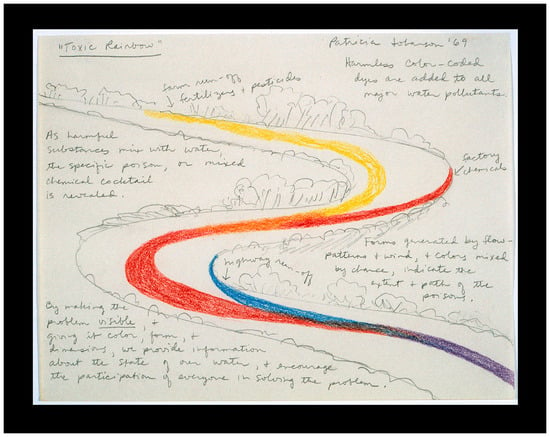
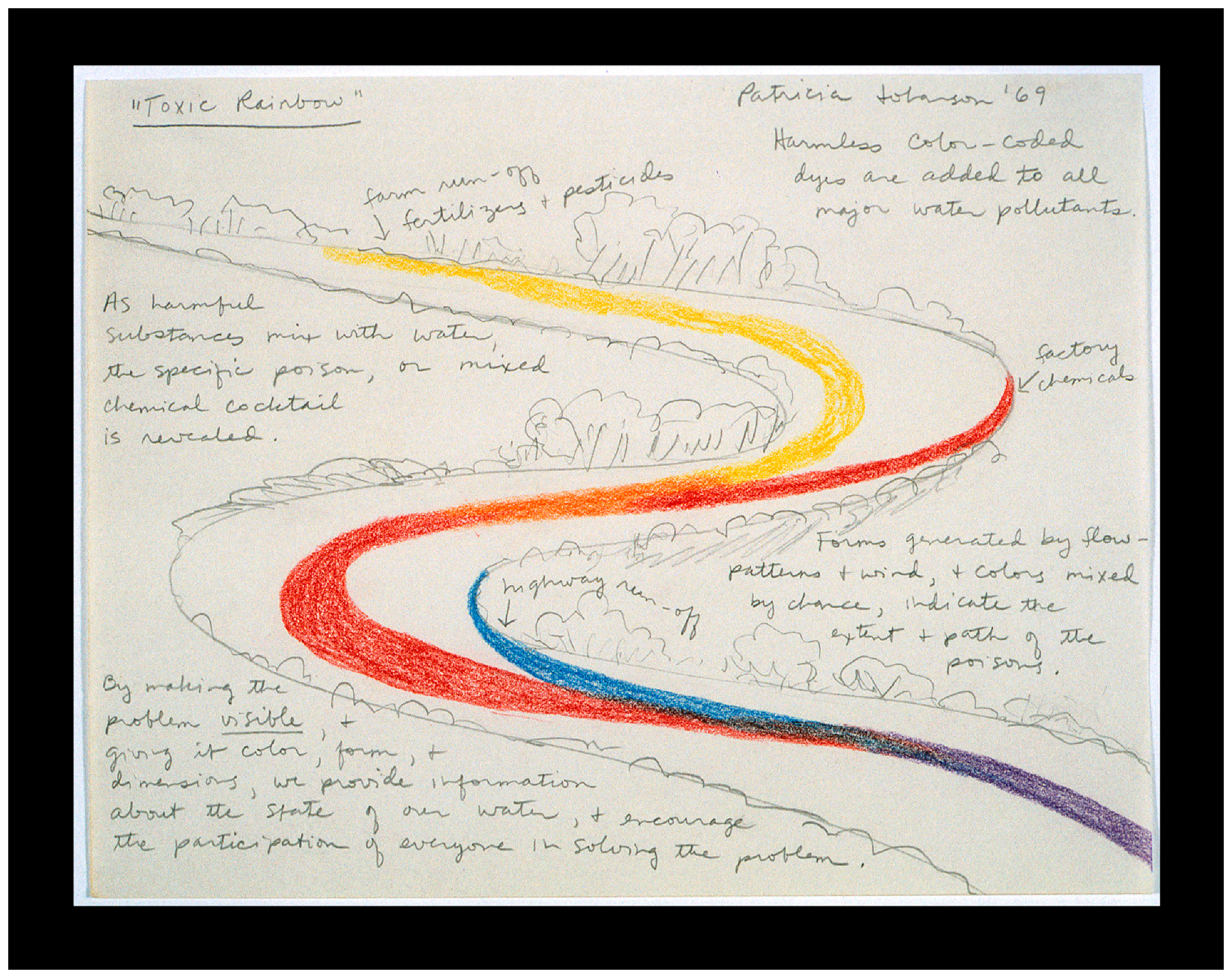
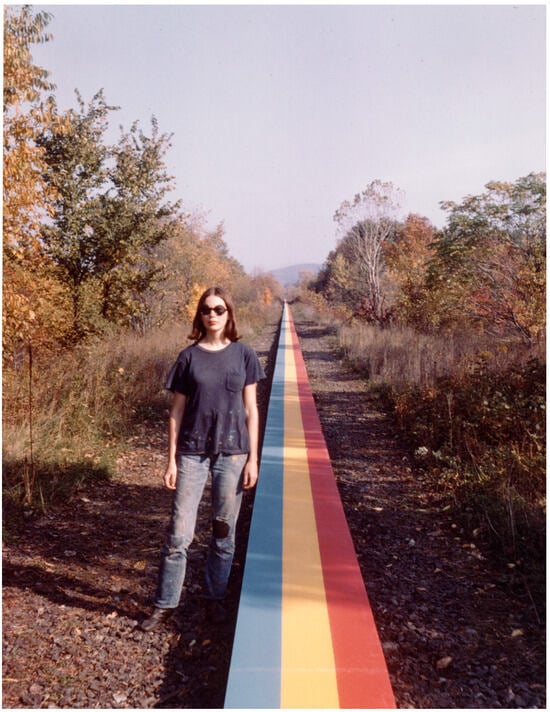
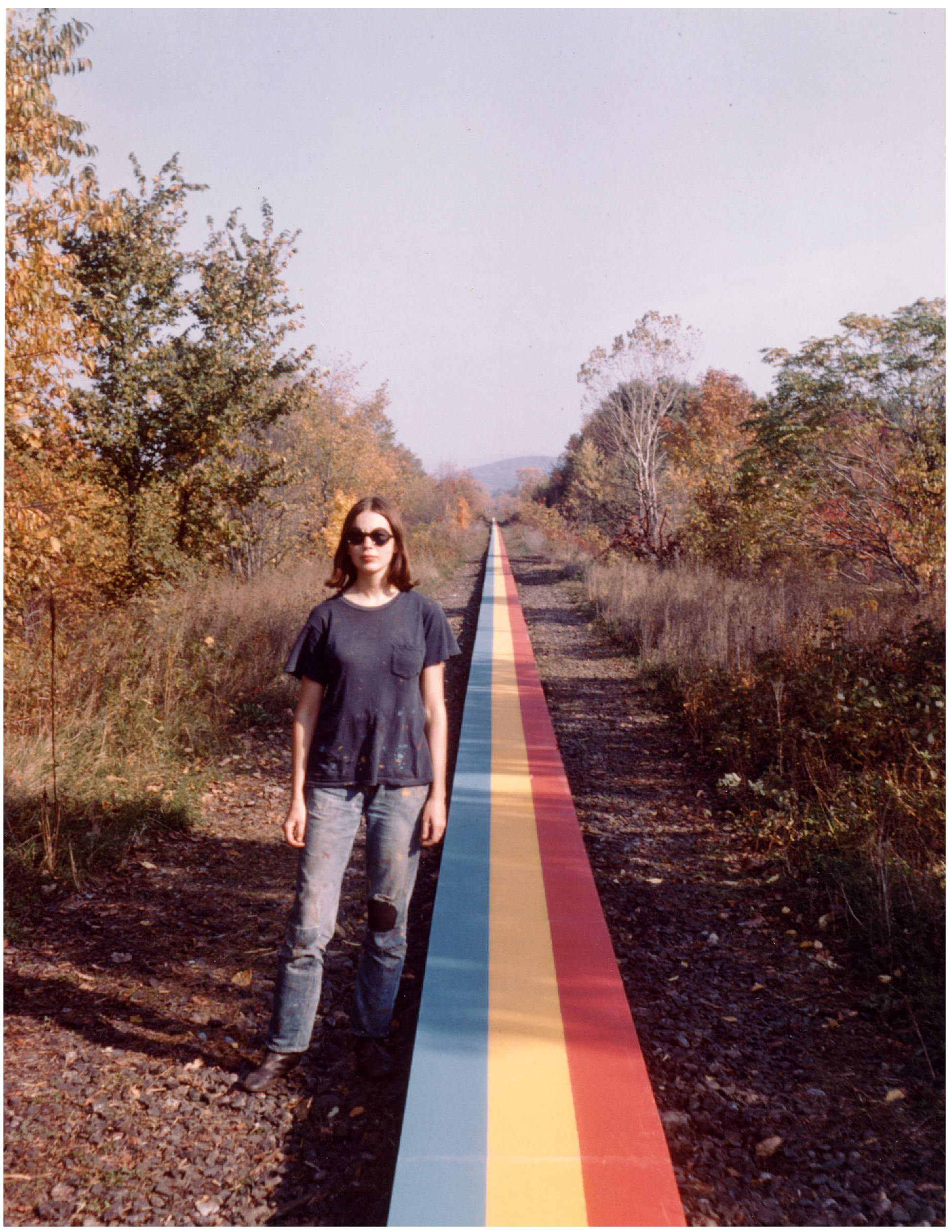
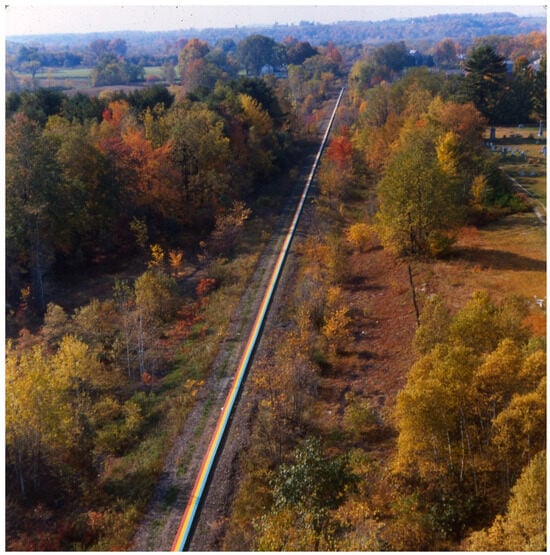
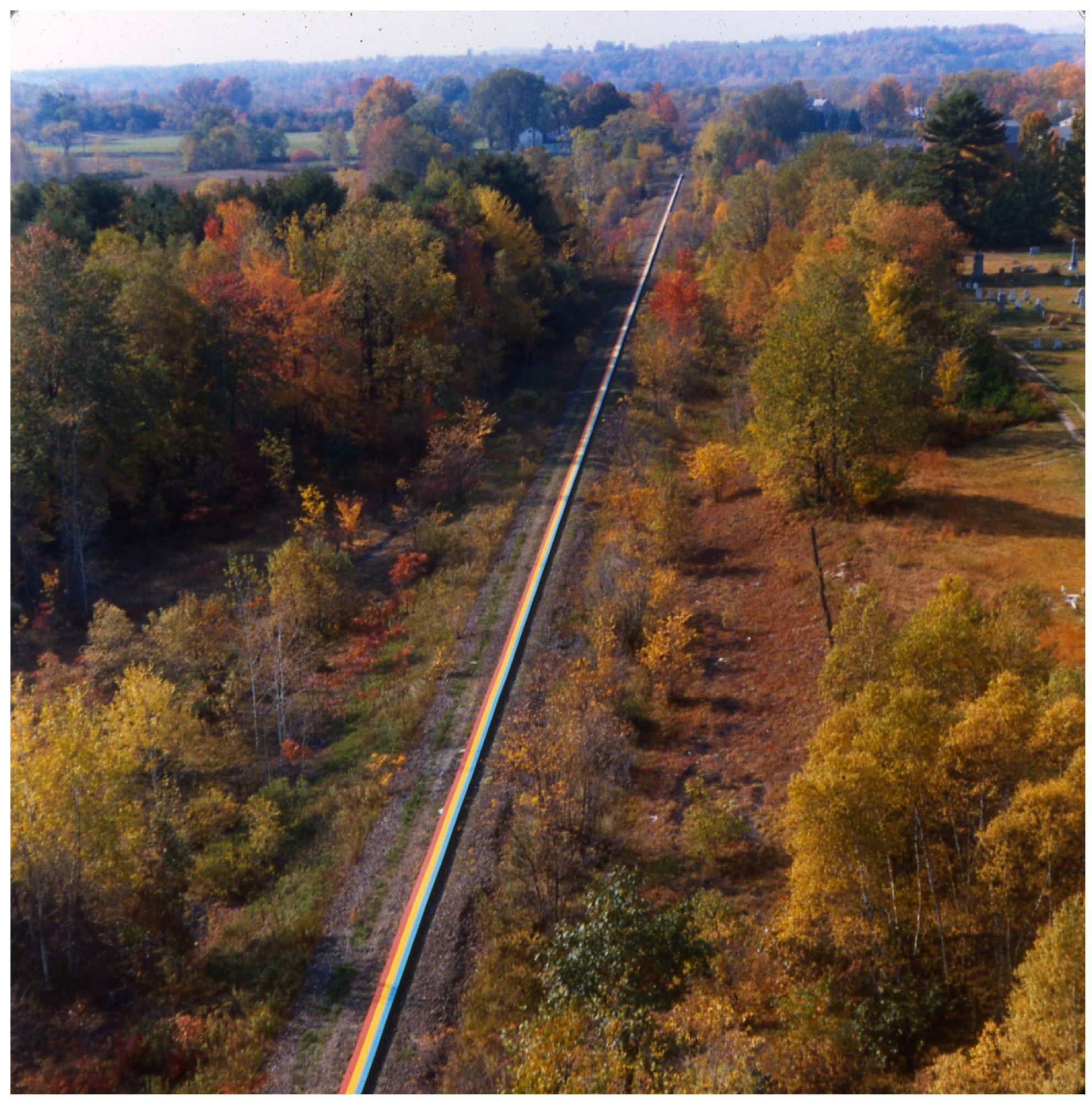
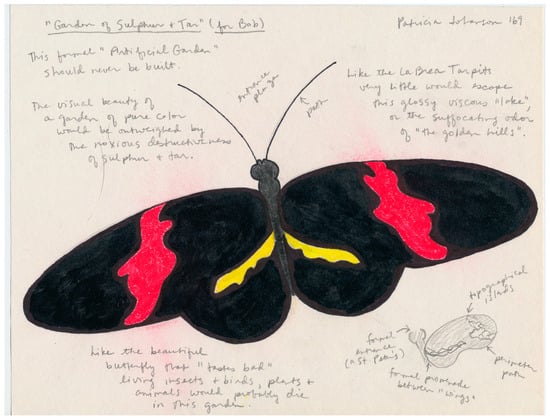
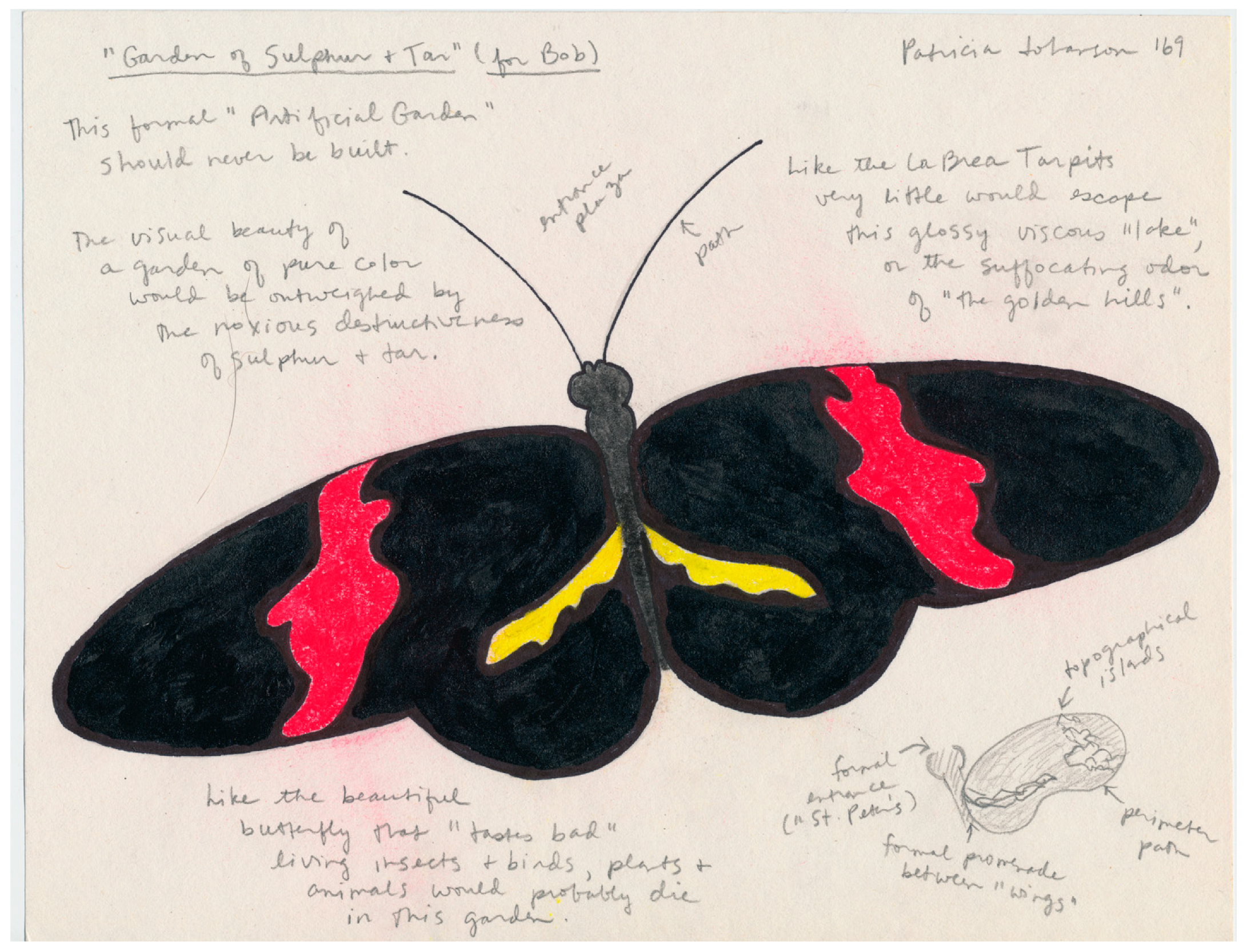
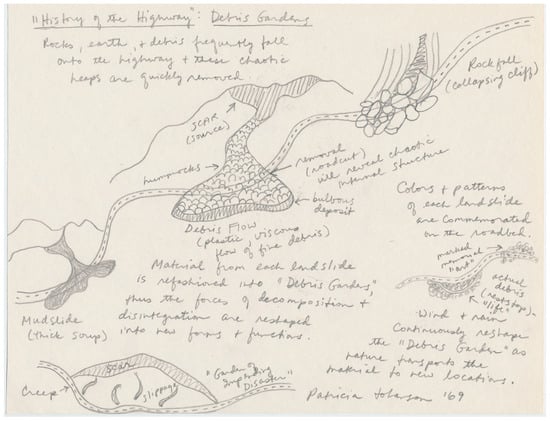
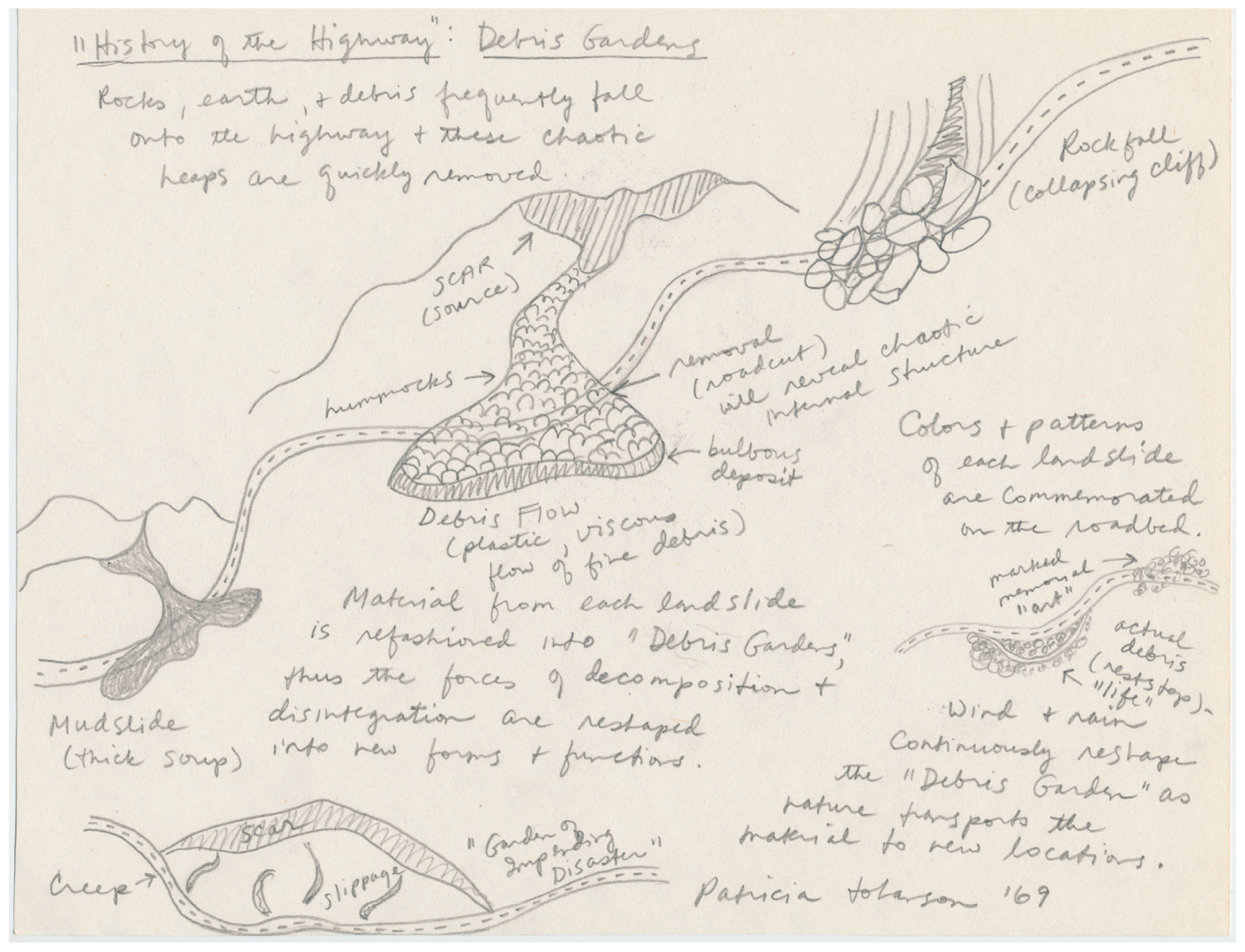
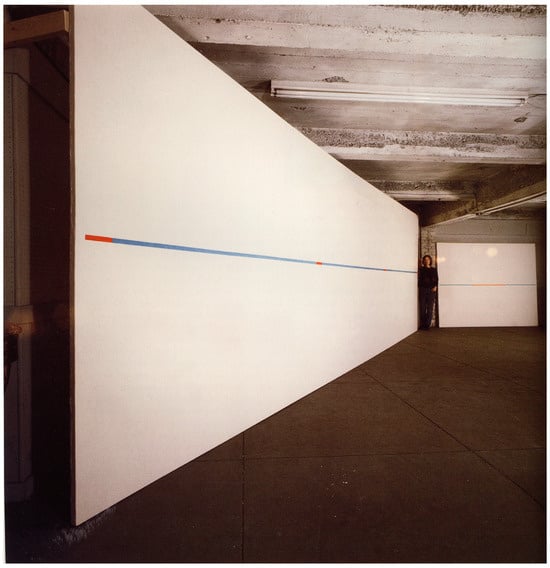
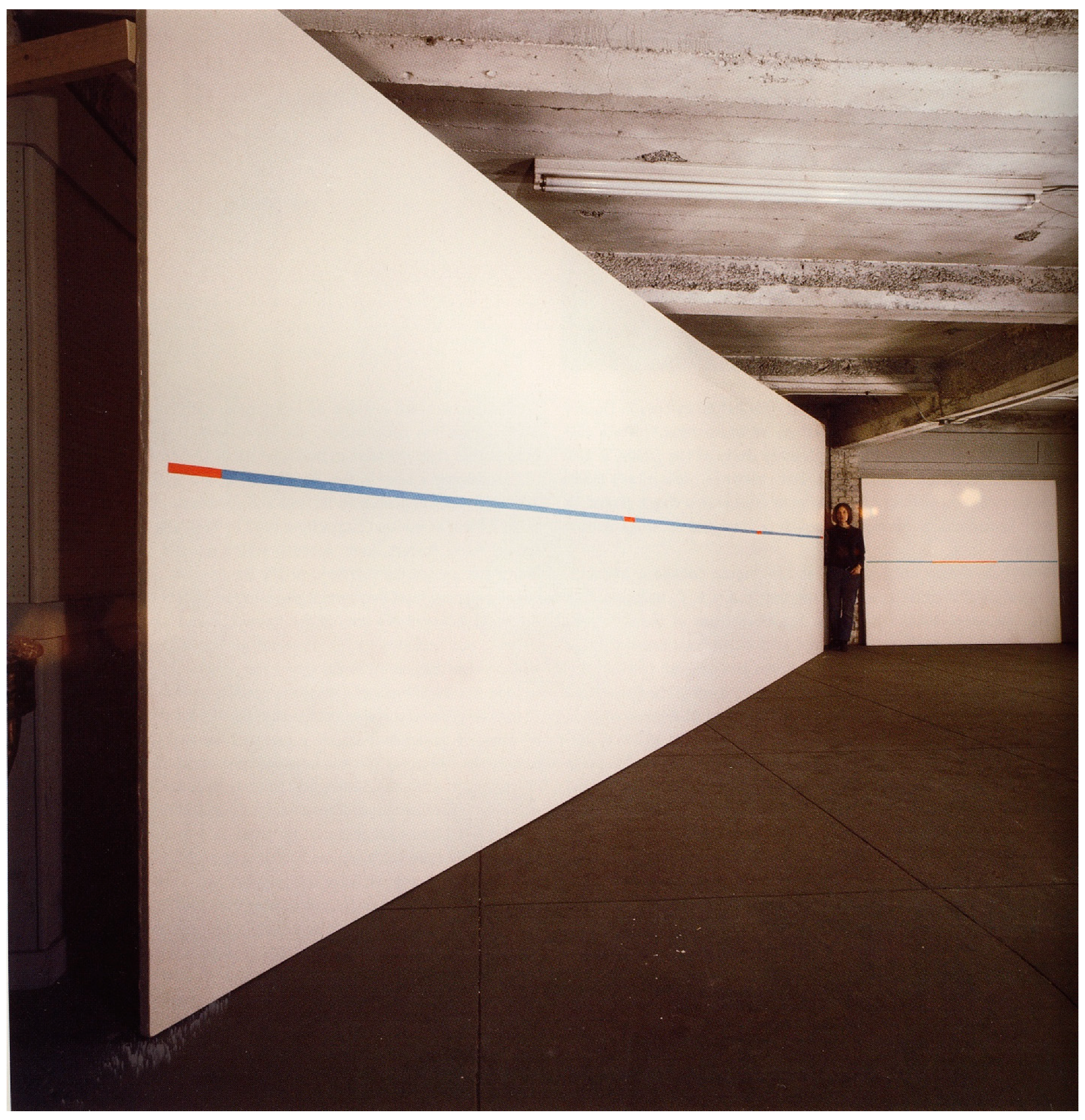
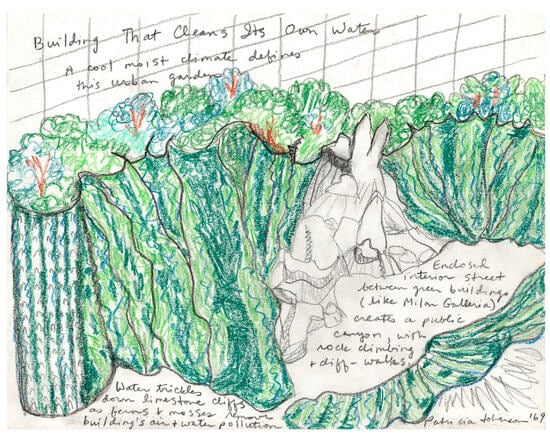
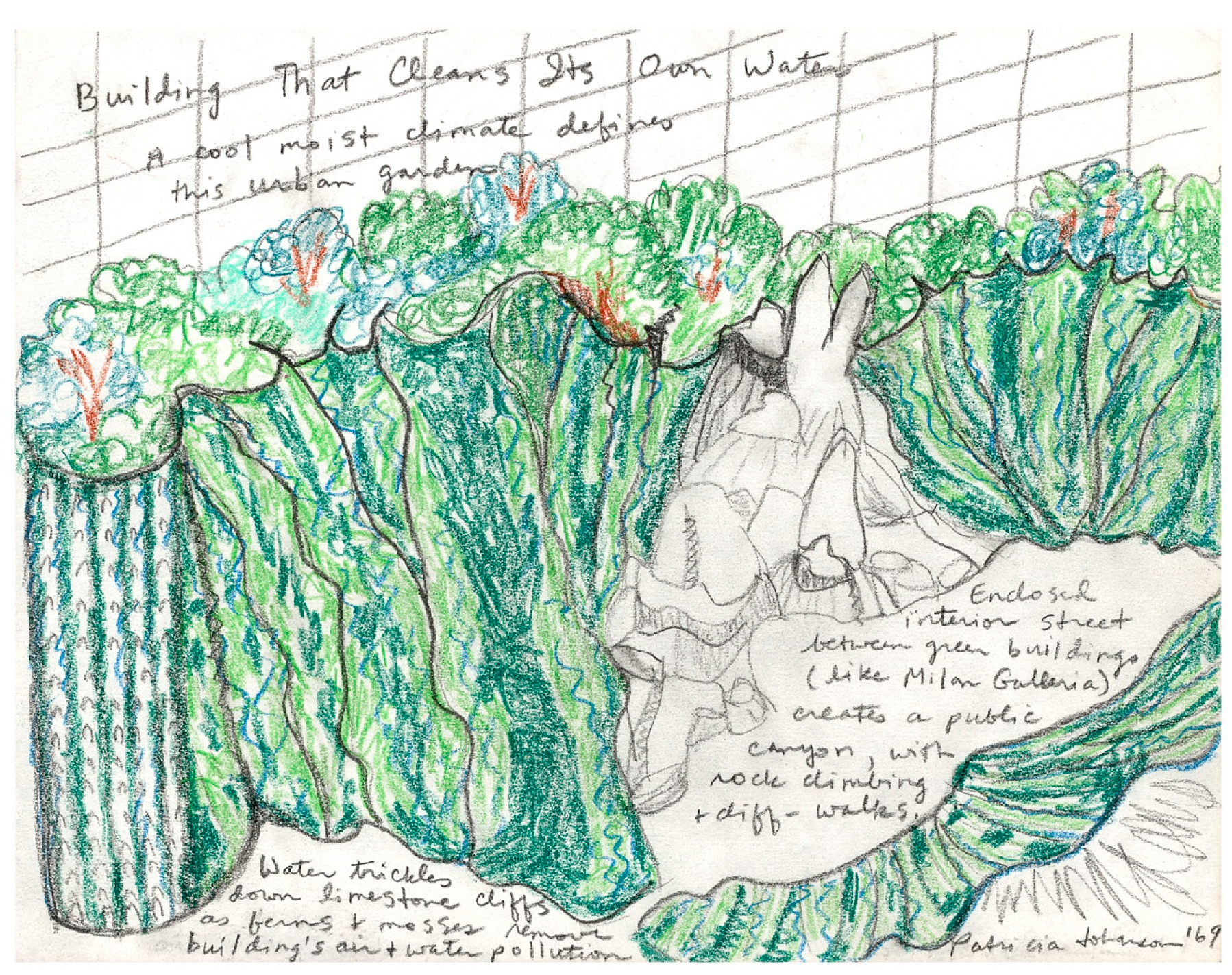
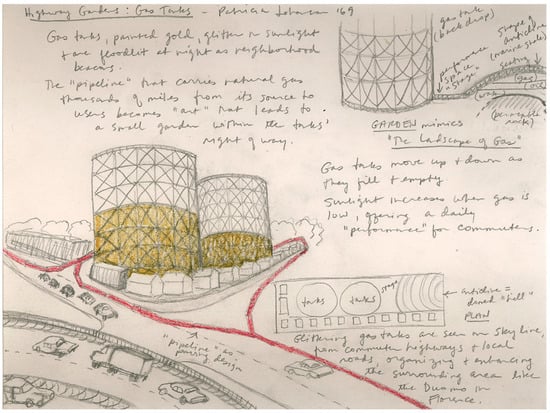
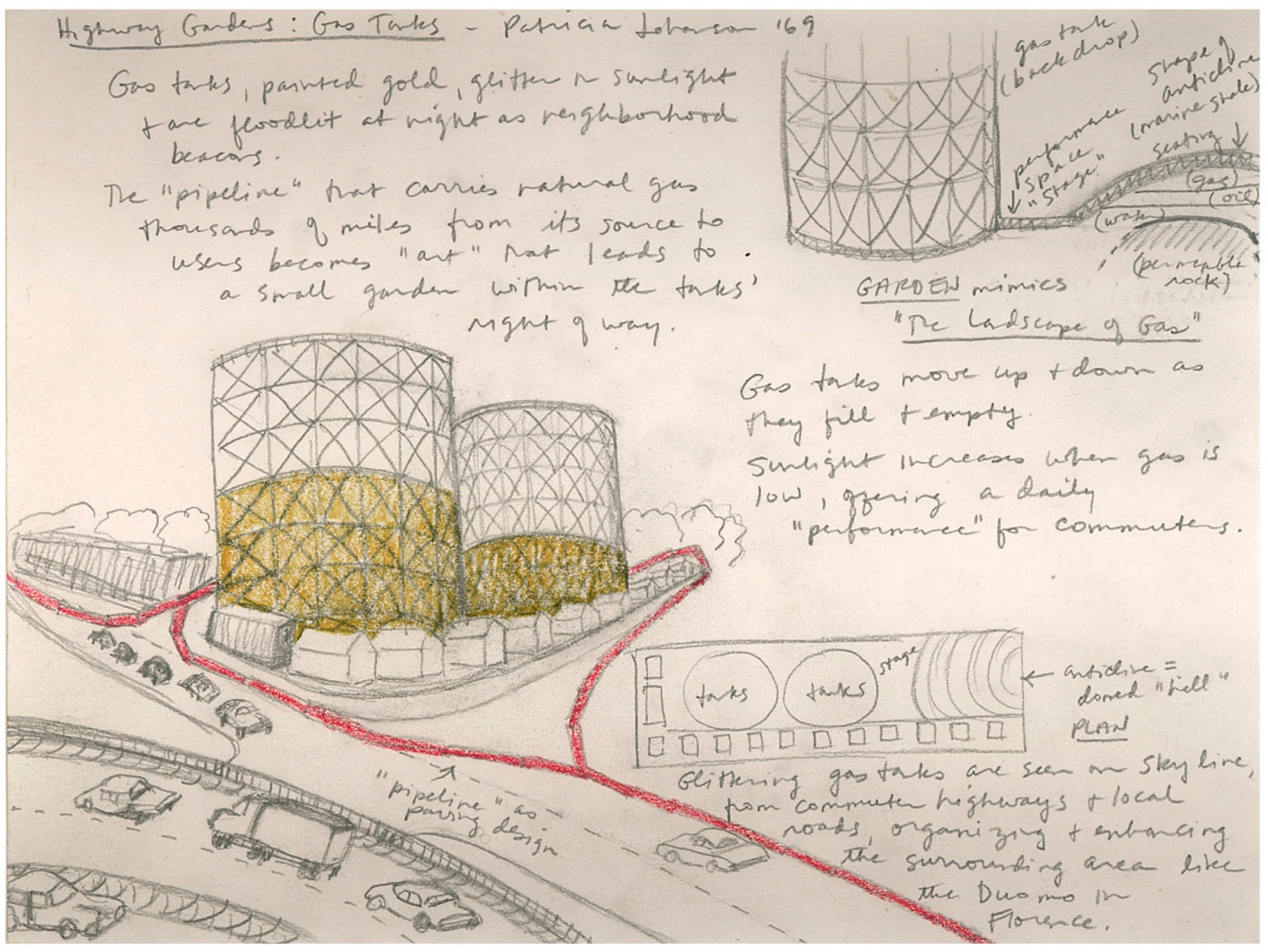
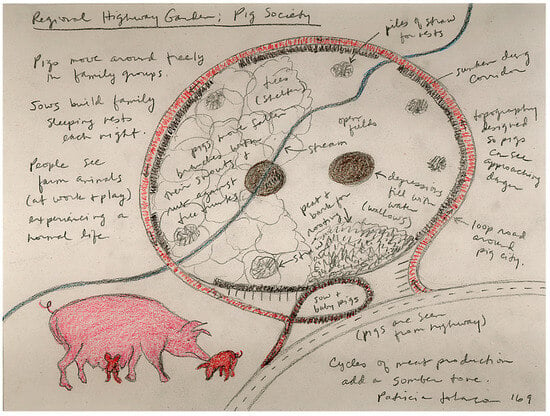
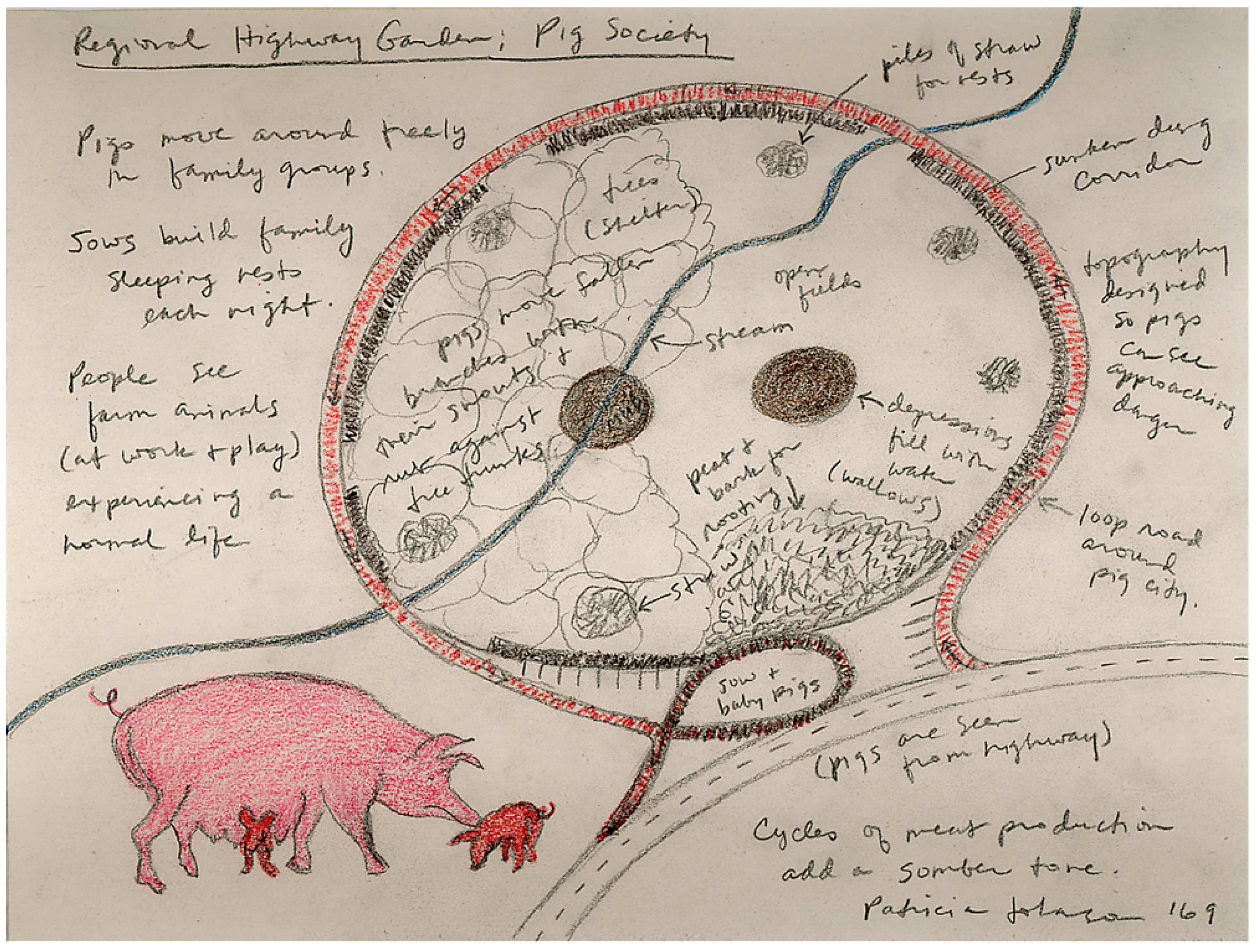
Disclaimer/Publisher’s Note: The statements, opinions and data contained in all publications are solely those of the individual author(s) and contributor(s) and not of MDPI and/or the editor(s). MDPI and/or the editor(s) disclaim responsibility for any injury to people or property resulting from any ideas, methods, instructions or products referred to in the content. |
© 2026 by the author. Licensee MDPI, Basel, Switzerland. This article is an open access article distributed under the terms and conditions of the Creative Commons Attribution (CC BY) license.