Rising at the intersection of engineering and imagination, the Brooklyn Bridge quickly became one of the most charged urban symbols of late nineteenth-century America. This article traces its artistic perception in Vladimir Mayakovsky’s poem Brooklyn Bridge (1926) and in Henry Miller’s Black Spring (1935) and Tropic of Capricorn (1938). The bridge, which spans the East River and connects Manhattan and Brooklyn, was finally planned in 1867 by John Roebling (German by birth, Berlin by training), opened in 1883, almost fifteen years after the death of the designer (who suffered a fatal injury while overseeing the first stages of construction), and was the longest suspension bridge in the world at the time of its opening.
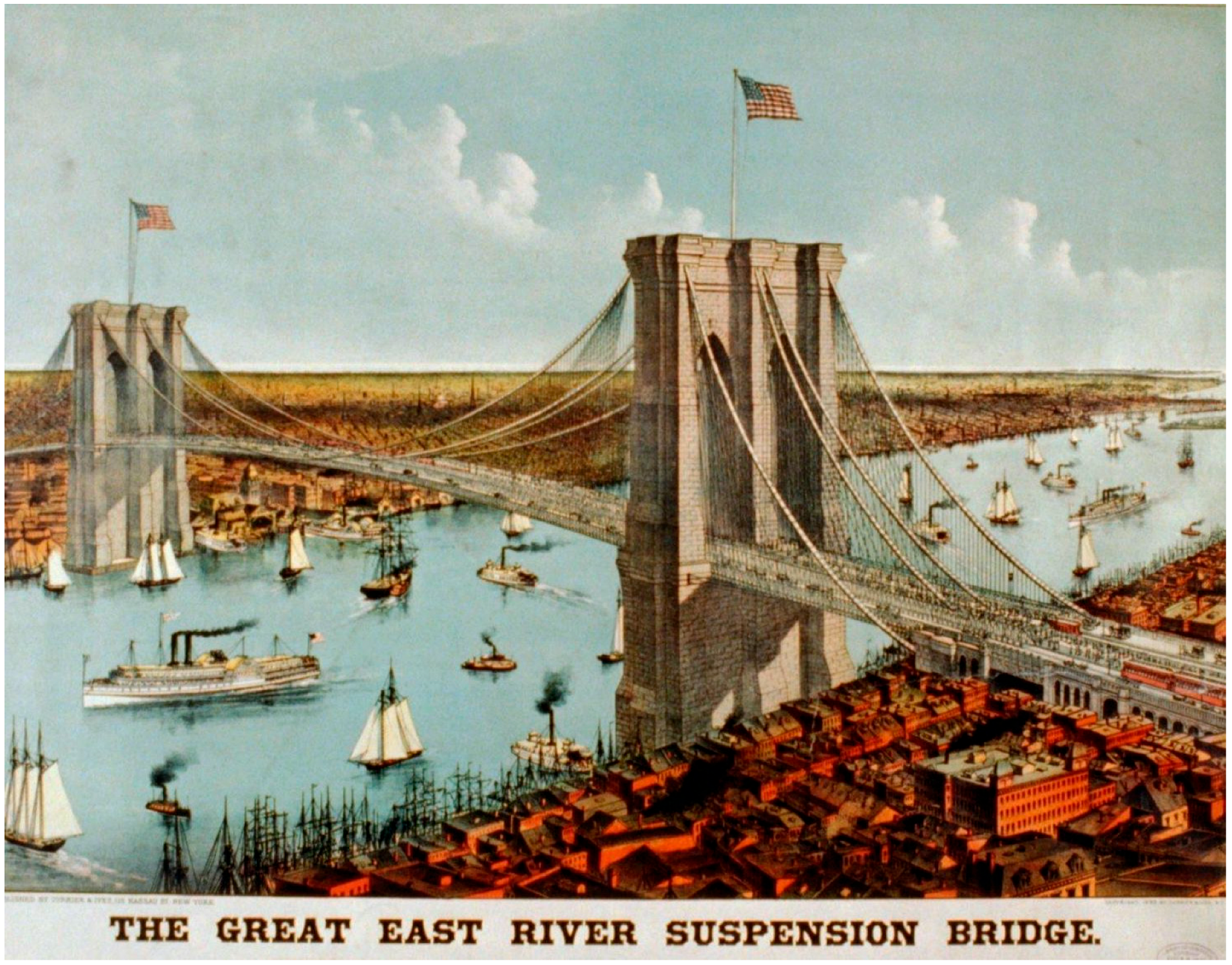
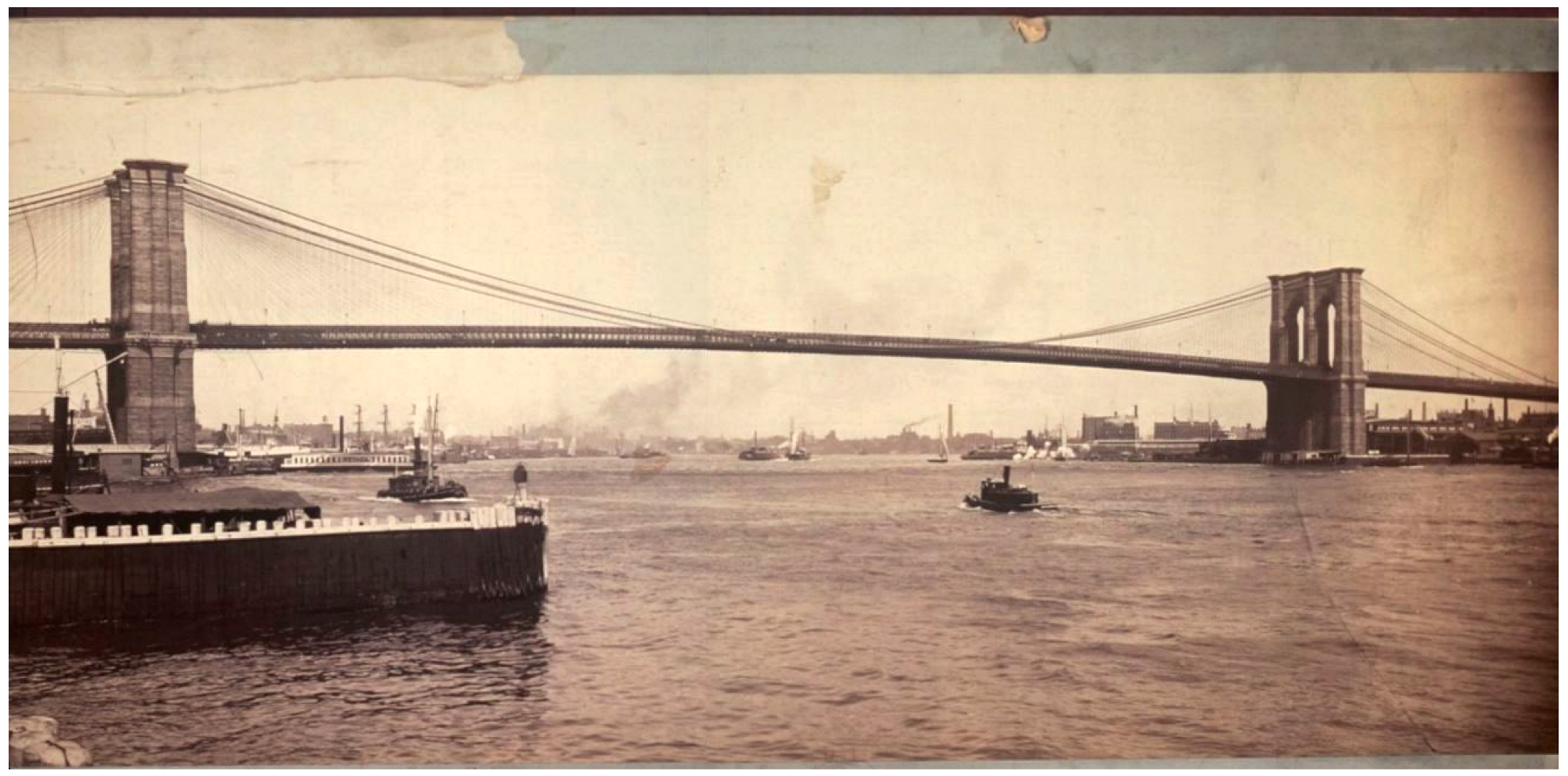
The choice of the authors for this comparative study was not accidental. Vladimir Mayakovsky and Henry Miller were contemporaries, living in different countries, belonging to different cultures, different social systems, and different, albeit close and often intersecting, lines of literary process. The Brooklyn Bridge is a purely American structure in its spirit (
Figure 1), and we are interested in comparing two different perspectives on it, two different assessments of it. The first is offered by Vladimir Mayakovsky, who visited the United States in 1925. In the United States, Mayakovsky was a tourist, and New York City, including the Brooklyn Bridge, seemed unexpected, unfamiliar, and, to some extent, even exotic to him. As a Russian, accustomed to a somewhat different type of urban organization, Mayakovsky had never seen anything like it. For him, the Brooklyn Bridge was something fundamentally new.
Henry Miller, a German-American born and raised in New York, perceived the city as a burdensome everyday reality that surrounded him daily, and the Brooklyn Bridge as something familiar. However, it should be noted that Miller composed his texts in Paris, as an émigré. His view of the Brooklyn Bridge is cast from Europe, from Paris, where he wrote his books Black Spring and Tropic of Capricorn. The European city in which he found himself, and the European texts describing urban space, ultimately marked a cultural distance between him and the Brooklyn Bridge, which, as a result, ceased to be real for him, was reimagined and became a memory.
Mayakovsky’s assessment of the Brooklyn Bridge is that of a citizen of the Soviet Union, a country committed to breaking with the old capitalist world and, more importantly, to building a “bright future” and preparing to implement the industrialization program adopted at the 14th Congress of the All-Union Communist Party (Bolsheviks) in 1925, the goal of which was to transform a backward, agrarian country into an industrial one. In this context, America was perceived by many Soviet cultural figures, including Mayakovsky, as a colonial, capitalist country where African Americans were oppressed, but also as a country of incredible technological advances, a country of the dawning utopian industrial future, that the Soviet Union, in this sense, needed to look up to. And the Brooklyn Bridge, for Mayakovsky, served as one of the important symbols of this progress.
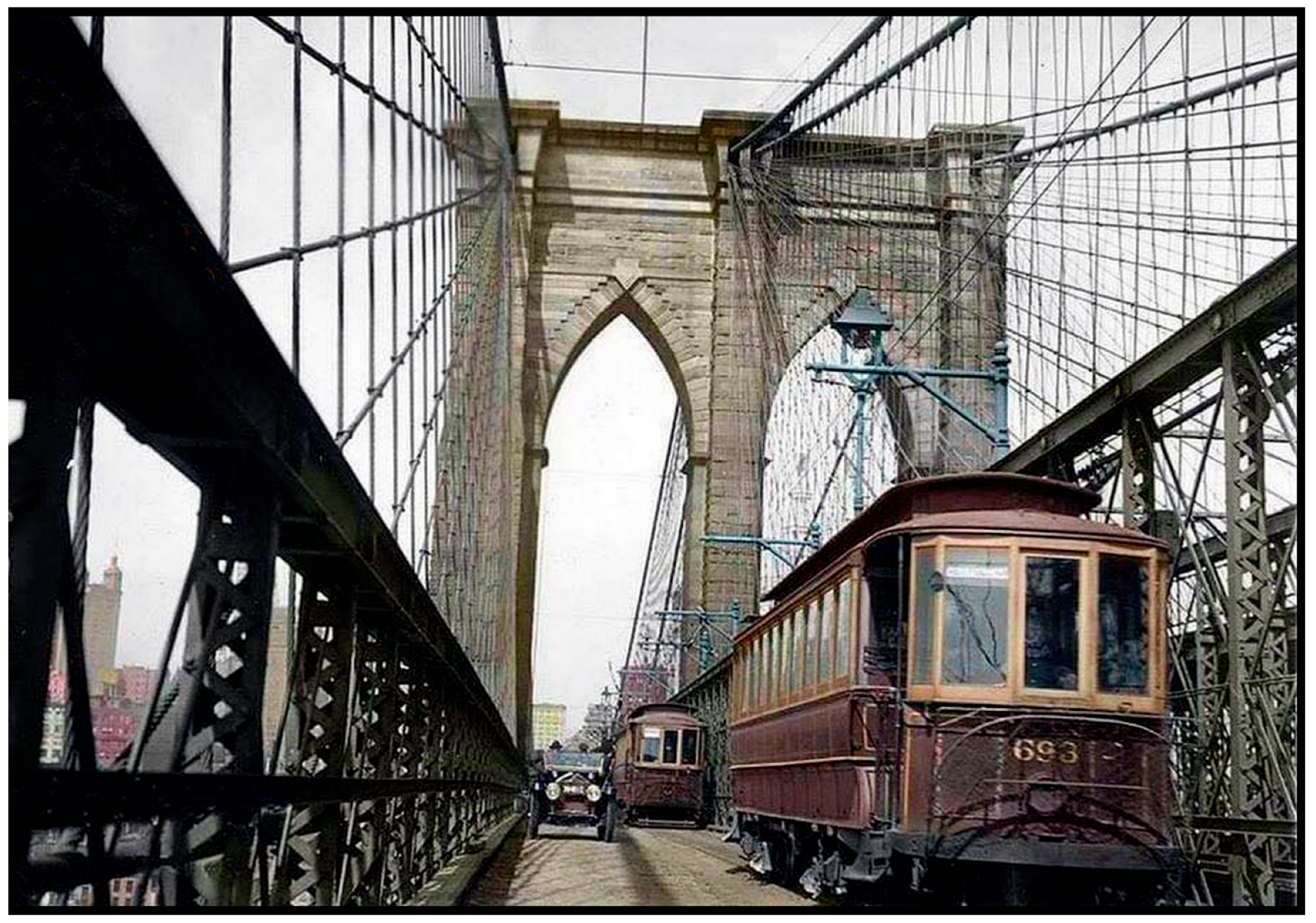
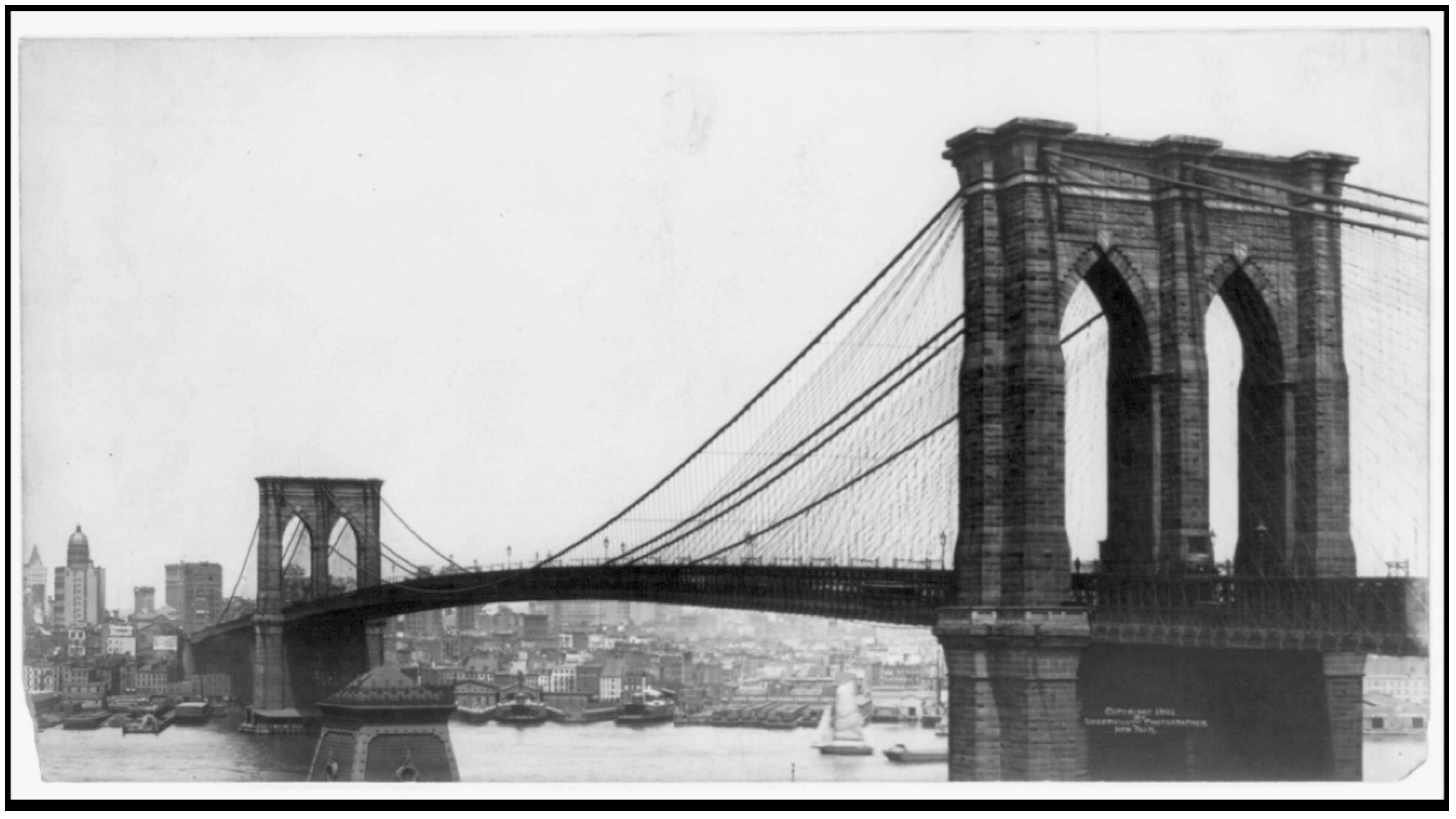
For American culture, the Brooklyn Bridge was undoubtedly a confirmation of the American dream, of the faith in success, progress, and freedom (
Figure 2).
An important testament to this understanding, highlighted by Henry Miller, was the famous poem by Hart Crane (1899–1932)
Poem: To Brooklyn Bridge (1930) (
Masuga 2011, pp. 27–37), conceived as an optimistic response to the pessimistic
The Waste Land (1921) by T. S. Eliot (1888–1965). In his turn, Henry Miller, who grew up on the ideas of anarchism and American social prose (
Ibargüen 1989, pp. 108–10), and in addition, an emigrant who condemned the American spirit and fled from it to Europe, did not share all of the above values, and his assessment of the Brooklyn Bridge naturally turns out to be somewhat different from the assessment of Vladimir Mayakovsky and Hart Crane.
Furthermore, it is important to understand another difference between Vladimir Mayakovsky and Henry Miller. Mayakovsky considered himself a citizen of the USSR, a country whose ideology placed the collective above the personal. As a poet, he actively responded to all the historical turbulences of his country (revolution, civil war, industrialization). Miller, raised in American culture, was an individualist. Moreover, as an intellectual, he shared the anarcho-individualist ideas of Max Stirner and Emma Goldman and deliberately distanced himself from collective life. Political events held little interest for him. And this, as we will show later, influenced the nature of his representation of the Brooklyn Bridge.
The Brooklyn Bridge was perceived and appreciated differently by Vladimir Mayakovsky and Henry Miller, also because they represented different traditions of modernism. Mayakovsky’s work was inextricably linked with Russian Futurism, an avant-garde movement that rejected tradition and outmoded forms of European culture and was inspired by industrial cities and modern technology. In this sense, the Brooklyn Bridge was the most suitable image for him, representing modern technological civilization.
Henry Miller, as we will demonstrate below, had a complex literary background. In his books of the 1930s, presenting urban imagery, he works in the tradition of high modernism (James Joyce, T.S. Eliot), which, in turn, targeted the European urban tradition. In this tradition, the metropolis was typically presented negatively, as a metonym for a dying civilization, as Hell, as a space overrun by entropy. At the same time, high modernism, employing a new poetics, sees traces of the past, of bygone eras, in urban objects and, presenting these traces, carefully emphasizes them. This is precisely what Henry Miller does, as will be discussed further. Mayakovsky and Miller’s representation of the Brooklyn Bridge will thus help to clarify the distinction between the avant-garde and high modernism that has been repeatedly emphasized by critics (
Eysteinsson 1990, pp. 149–56).
Despite the aforementioned differences, we also find certain similarities in Mayakovsky and Miller’s representations of the Brooklyn Bridge. However, what remains fundamentally important is the choice made by the Russian and American writers, and their work, which caused the Brooklyn Bridge to lose its real contours and transform into a complex symbol.
Vladimir Vladimirovich Mayakovsky’s poem
Brooklyn Bridge (
Mayakovskij 2014, pp. 228–31) was written in August-September 1925 in New York and published that same year in the magazine “Prozhektor” (in the issue of 31 December). In 1926, it was published in the collection “Spain. Ocean. Havana. Mexico. America”; this cycle is its natural context.
Brooklyn Bridge is not only the poem’s title, but its central, dominant image; one could say that everything discussed in our article, all the problems of imagery and poetics, are in one way or another (and usually quite strongly) mediated and motivated by the Brooklyn Bridge.
An insufficiently informed reader of Mayakovsky’s poem might get the impression that it is dedicated literally to the state of the art in technology, but there is more than a 40-year gap between the bridge and the text about it. In the poem “A Skyscraper Dissected” (1925) Mayakovsky writes: “I’d meant to go 7000 miles forward, but it looks like I’ve taken 7 years back” (
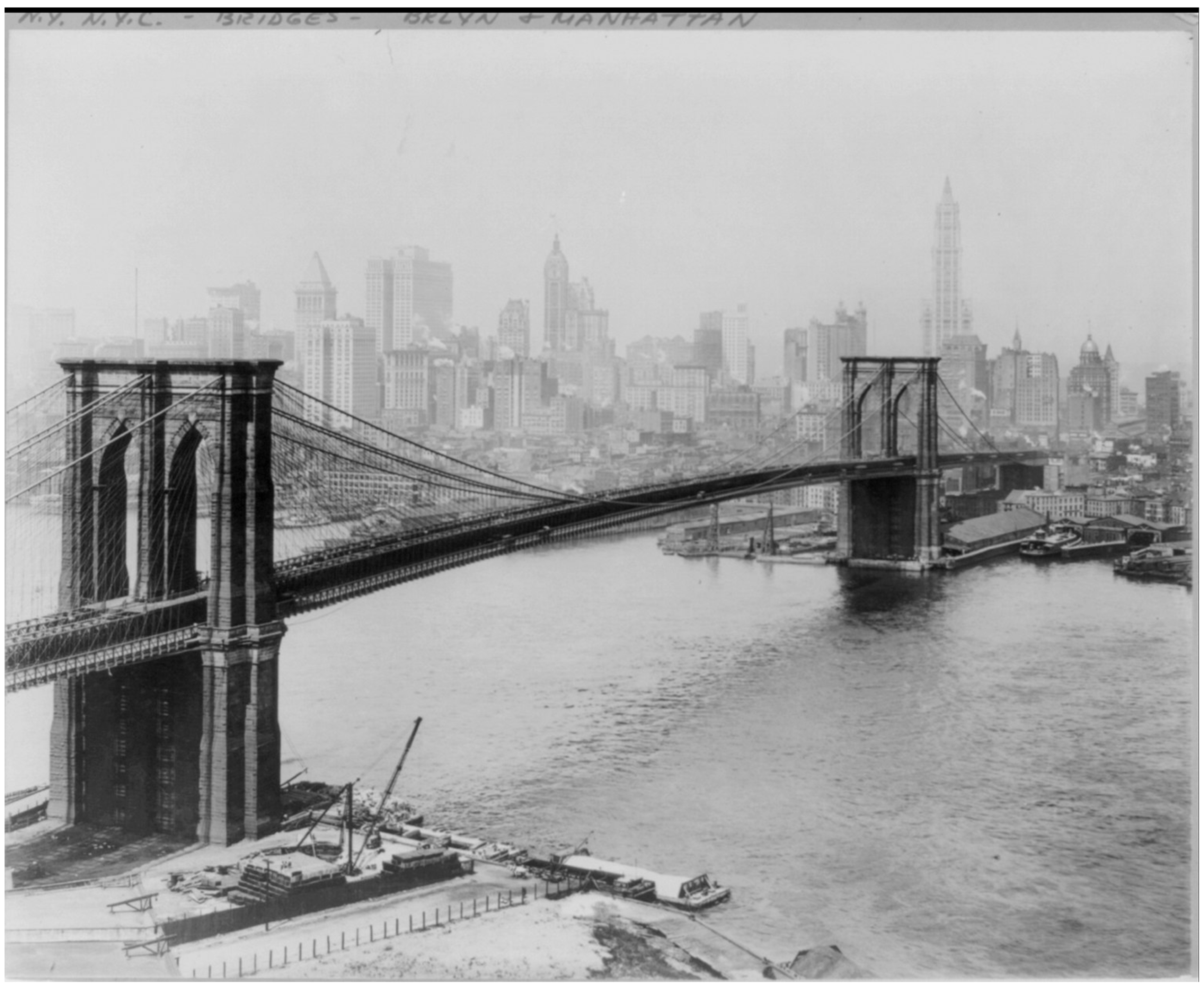
Mayakovsky 1986a, p. 156). It is quite possible that the Brooklyn Bridge did not impress Mayakovsky so much upon his first personal visual experience as it had already been for him a “futuristic” symbol (it is also mentioned in versions of the poem “It”, 1923) (
Figure 3).
The sheer length of the Brooklyn Bridge should not have surprised Mayakovsky: Russian engineers and builders could have responded to its “steel mile” with a railway bridge across the Ob’ River in Novo-Nikolaevsk (Novosibirsk), designed by N.A. Belelyubsky (1897), across the Yenisei River in Krasnoyarsk, designed by L.D. Proskuryakov (1899), and, most notably, the Amur Bridge in Khabarovsk, also designed by Proskuryakov (1917). The main span of the Amur Bridge alone spans over a mile and a half. The width of the Ob’ and Yenisei Rivers beneath the railway bridges that cross them, varies, but is approximately equal to the width of the East River beneath the Brooklyn Bridge. At the time of writing the poem, Lavr Dmitrievich Proskuryakov was still alive (living in Moscow), and the Amur Bridge, partially destroyed by partisans during the Civil War, was finally restored in the spring of 1925, several months before he wrote his poem about the Brooklyn Bridge. Apparently, Mayakovsky was primarily attracted to the Brooklyn Bridge for its design features (suspension, steel wire cables, two supports instead of 11–12, as on Siberian bridges) and the opportunities it offered for visibility.
This poem can be approached as a unique monument of poetic speech, ideology, and cultural history, but it can also be placed within the context of the poetic creativity and views of its author.
The study of Mayakovsky’s work, his poetic language, verse, and the intertextual and allusive panorama of his poetry began during his lifetime and continued soon after his death; during this period, several articles by poets and critics who knew Mayakovsky personally, were published, and these works have had an enduring significance in the more than century-long discussion of his work (
Chukovskij 1921;
Jakobson 1975;
Cvetaeva 1933a,
Cvetaeva 1933b). Slightly more recent studies include those by researchers of the avant-garde, witnesses, and heirs of the era (
Vinokur 1943;
Trenin and Hardzhiev 1970). In the second half of the 20th century, Mayakovsky’s verse was particularly studied (
Gasparov 1984, pp. 372–468;
Gasparov 1981; and others). Monographs and collections on general issues of Mayakovsky’s poetics were published (
Papernyj 1957,
1961;
Goncharov 1983; cf.
Mayakovskij 1940;
Timofeev and Polyak 1952;
Mikhailov and Lesnevkij 1984 and many others).
Certain features of Mayakovsky’s poetics have been noted, which are also embodied in the poem under consideration. It is not that this set of principles and parameters identified by researchers would “predict” the poetics of this text—the poems of the great poet are unique and unrepeatable—but it creates a certain space of expectation in the reader, which, in turn, may or may not be confirmed. Mayakovsky is characterized by a unique (but later partly replicated by his followers and imitators) poetic form: the predominance of accentual verse with frequent lightening or simplification to the dolnik, with the inclusion of significant fragments intonationally subordinate to the model of accentual verse, but actually written in free iambs or trochees. This is characteristic of Mayakovsky’s lyrical masterpieces written almost at the same time in 1924–1926:
Jubilee Poem,
Talking with a Taxman about Poetry, To Comrade Nette—Steamer and Man, Sergei Esenin. The second possibility is not realized in the poem, and the coincidence of the tonic verse in individual lines with the correct forms of three-syllable meters is included as one of the potential possibilities in the “rules of the game” of dolnik and accentual verse. Beginning in 1923 (
Ivanov 1988), Mayakovsky consistently formatted his poems in a “ladder” (stepped lines), the rhyme typically arranged in quatrains, such as “abab”. Mayakovsky is a reformer of Russian rhyme (he shares this discovery with Pasternak): he (since 1913) generously introduces into the set rhymes that are deliberately imprecise, including unequal-syllable and unequally stressed ones, but at the same time (
Zhirmunskij 1923;
Gasparov 1984, and others): (a) extended to the left, by a part of the word that is not necessary for sufficient rhyme, (b) lexically rare, non-trivial, and unexpected, including compound (pun-like) forms: cf. In this poem:
materiyka—Amerika,
veruyushiy—mereschi, muzeja—usejan, dushen—dushi,
nachatoy—machty,
lavochnik—bulavochki,
jaschery—nasoyaschee,
zapad—lapa,
prerii—perja,
eto—Mangetten,
ruki—Bruklin,
pryadi—radio,
para—po aero,
zagvozdki—Mayakovski,
eskimos—most (
Mayakovsky 1986a, pp. 161–63). An exact count is complicated by some transitional cases, at least 40% of rhymes are of this nature. Along with Khlebnikov, Pasternak, and Tsvetaeva, Mayakovsky significantly increases the number and role of deep (and semantically rich) sound repetitions in verse outside the rhyme zone (paronomasia, paronymic attraction (
Grigor’ev 1975,
1979, pp. 250–99, etc.). What makes him different is that he strives to express most (but not all) of his sound-semantic discoveries in rhyme. Here are some examples from the poem
Brooklyn Bridge:
zherlom—zhirafu,
vonzaet glaz,
zdes’—zudit,
budto v buffet ubirayut, stily—stali,
razdelayet… vzdeblennyj,
pylju gibeli vzdyblennyj,
stoyashiye—jashery,
pustiv po vetru perja,
stav stalnoj,
provodam pryadi,
epoha posle para,
orali po radio, golodnyj… gololvoy,
stoyal i stihi slagal po slogam,
Mayakovsky—eskimos (for some cases, see below). Mayakovsky is a friend of Roman Jakobson’s youth, who discovered the meaning of the “grammar of poetry” in all its scope; it is assumed that a special role is played in Mayakovsky by the increase in the number and the role of certain case constructions, first of all, the prepositionless adverbial genitive cases (
Dviniatin 2008;
Nikolaeva 2009;
Uspenskij 2024, cf.
Dviniatin 2017, and others). The poem
Brooklyn Bridge clearly illustrates this:
madonna muzeya,
svechenii okon,
elevejtorov zud,
raschot gaek i stali,
okonchanije sveta,
pylju gibeli,
stoletij geologist,
provodam pryadi. Mayakovsky is characterized by a radical “secularization” (Mandelstam) of poetic speech, the introduction of a significant number of colloquialisms, proseisms, and vulgarisms, often in conflict with poeticisms and biblical expressions (
Gofman 1940;
Vinokur 1943; and others). This is also evident in the poem
Brooklyn Bridge:
materijka, r
azjunaited,
prjot,
v appetite,
zud,
v bufet,
s pod rechki,
s fabriki sahar lavochnik,
konsturkcii,
razdelayet v losk,
orali po radio,
vzletali po aero. In the rough draft of the poem, the parallelism is more justified: z
des’ v nebo uzhe vlezali po aero (
Mayakovskij 2014, p. 442). Let us recall lexical constructions such as
lez’t’ po lestnice (without taking into account this “genetic” subtext, the expression “
po aero” is not clear enough in the final text),
bez zagvozdki,
аzh, klesh’, eto vesh’. At the same time, other constructions also appear:
podnebes’ja,
nad py;ju gibeli,
stihi slagal, v skit udalyaetsa. An integral feature of Mayakovsky’s idiostyle is similes, including extended ones (more on these below) and metaphors (
Jakobson 1987;
Gasparov 1995;
Turanina 1997, and others), right down to their secondary pattern: here, masts are compared to pins, and lizard bones to needles. Both comparisons play with scale in different ways. In terms of composition, Mayakovsky is characterized by a certain stanza quality, a partial completeness, if not isolation, of individual fragments and (quasi-) stanzas; this manifests itself repeatedly in this poem (see below).
Mayakovsky’s work is one context for the poem, another context for the topic is the bridge in Russian poetry and fiction. The theme of bridges in classical Russian literature can be called neither very common nor very rare: it belongs to the “middle ground” in frequency and significance.
One of its most notable features is the relatively rare connection in the bridge’s imagery and symbolism with motifs of connecting banks, crossing a water barrier, or crossing a boundary in general. Symbolic overtones predominate: “urban element; platform over water; part of a road.”
In Leo Tolstoy’s
War and Peace, the bridge is mentioned around 150 times. A significant portion of these references relate to bridges as elements of military communications: in historical overviews, in the thoughts and conversations of characters, and in certain scenes set around bridges. In
Anna Karenina, the bridge appears much less frequently, but the symbolic explications are clearly outlined: “Now he experienced feeling like to what would experienced a man, calm down past over abyss by bridge, and suddenly having seen that this bridge disassembled and there is abyss. This abyss was life-itself, bridge—that artificial life that Alexey Alexandrovich lived…” or “Most important was golden bridge for return”. Bridges play a huge role in “Crime and Punishment”, where Kokushkin, Tuchkov, and Egyptian are mentioned in full text or in easily reconstructed abbreviations (
Turkina 2022;
Kladova 2018); Nikolaevsky bridge is also mentioned in “The Idiot”, and the Voznesensky and Semyonovsky bridges in
The Adolescent. But the greatest number of references are in “Demons”, the location of which is not St. Petersburg. Bridges also play a topographic role in Gogol’s St. Petersburg texts: Kalinkin in
The Portrait and
The Overcoat, Politseisky in
Nevsky Prospect and
The Nose; Isakievsky’s, Voskresensky, and Anichkin (sic!) in
The Nose; Kokushkin in
Notes of a Madman, Kalinkin in
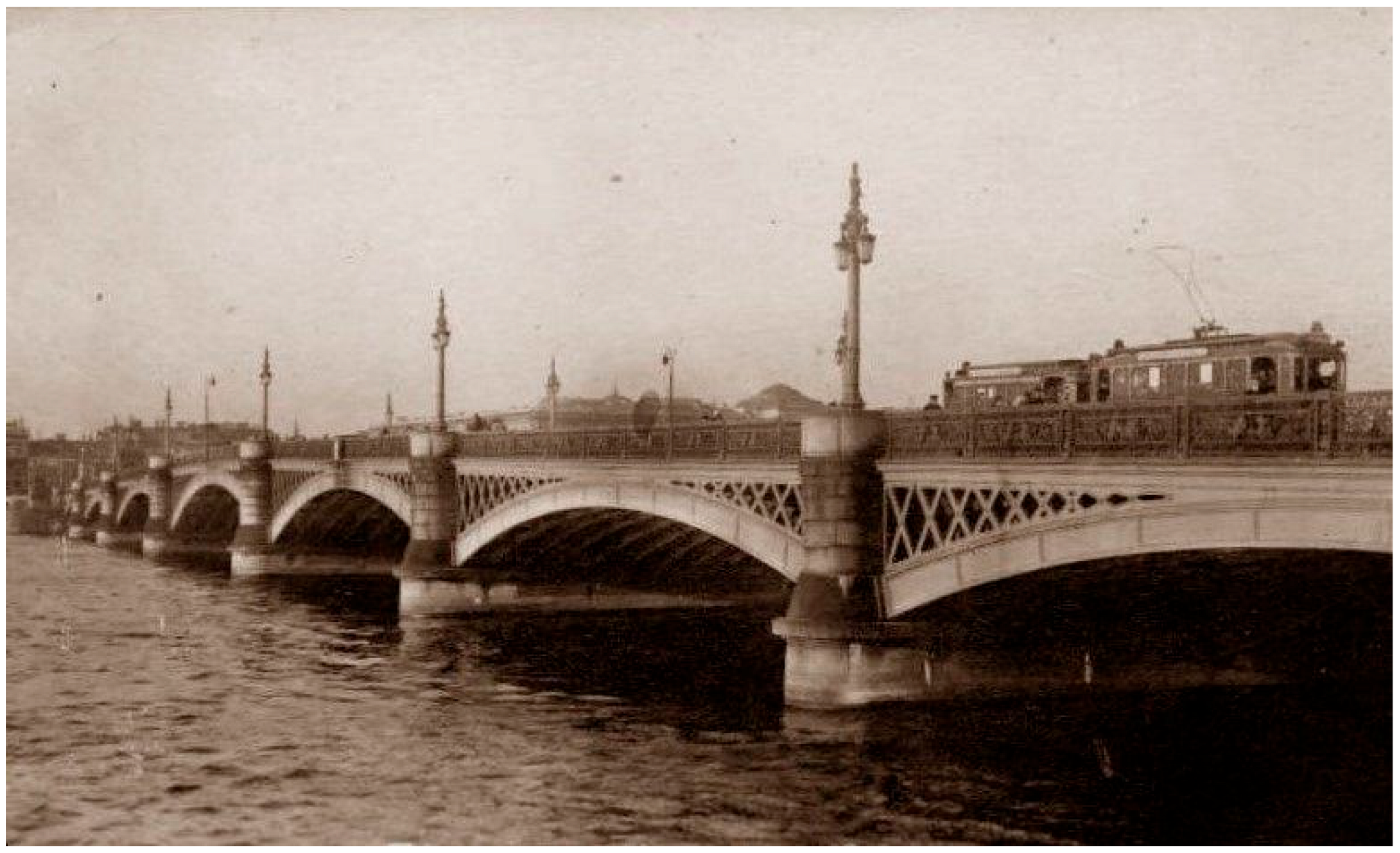
The Overcoat. The Anichkov, Troitsky, Liteiny, and, above all, Nikolaevsky bridges play a significant role in Andrey Bely’s
Petersburg (
Figure 4).
Analyzing the motif of the bridge and the lexeme “bridge” (“most”-Russian) itself in the work of Russian poets of the nineteenth and twentieth centuries, primarily in texts written before 1925, one may arrive at the following conclusion. For some poets (surprisingly not that many), the bridge appears more frequently than the two or three, or even four or five instances typical of most others. Yet even in these cases, what we find are not sustained symbolic patterns but rather isolated, memorable, semantically charged, and poetically accomplished mentions of a bridge or bridges. The bridge, however, does not in fact become a recognizable marker (a signature) of a poet’s work, an identifiable component of his or her artistic world, or a vivid individual symbol.
This, generally speaking, is somewhat surprising, given the multivalent nature of the bridge and its potential “resolving force” as a
ready-made symbolic object: (
Zholkovsky and Scheglov 1996, p. 210). In eighteenth- and nineteenth-century poetry, among first-rank poets, the most frequent and meaningful references to bridges are found in Pushkin. Above all, this includes
The Bronze Horseman, where certain episodes involving bridges
mark key nodes in both the narrative and lyrical plots: “Mosty povisli nad vodami” (“Bridges hang over the waters”); “…Chto edva li/S Nevy mostov escho ne sn’ali” (“That hardly/the bridges from the Neva have yet been removed”); “Grozoy snes’onnye mosty” (“Bridges swept away by the storm”). One should also note the well-known passage on future and present Russian roads in
Eugene Onegin: “Mosty chugunnyje chrez vody/Shagnut shirokoyu dugoy” (“Cast-iron bridges will stride across the waters/in a wide arc”)—a passage Mayakovsky may well have remembered; “Teper’ u nas dorogi plohi/Mosty zabytyje gnijut” (“Now our roads are bad, /forgotten bridges are rotting…”); and two fragments in which Pushkin’s characteristically layered combination of lowering, sarcasm, and the gravest existential and literary themes is especially evident. These include the suggestion of a possible death
under a dismantled bridge in
Road Complaints (once again invoking the motif of
the road), and the mocking poem about the illustrations to the novel
Onegin: “Vot, pereshed chrez most Kokushkin/Opershis’ …” (“Now, having crossed the Kokushkin Bridge, leaning on …”).
In the twentieth century, one must mention Blok and Khlebnikov, both undoubtedly important for Mayakovsky, as well as Anna Akhmatova and Nikolay Gumilev, the Russian poets richest in bridge imagery. Mayakovsky clearly read Akhmatova and responded to her work with respect, though with a degree of personal detachment. Gumilev, by 1925, may have been subject to repression and partial erasure, but he could nonetheless remain present in memory.
In Blok’s poetry, the bridge is mentioned up to twenty times, primarily as a significant site of encounter or meditation, elevated and positioned above water: “Veter hripit na mostu mezh stolbami/Chernaya nit’ pod snegami gud’ot” (“The wind wheezes on the bridge between the pillars”; “Vyhozhu I stoju na mostu/I smotru na rechnyje tsvety” (“I go out and stand on the bridge/and look at the river flowers”); “Ty ne pervaja mne predalas’/Na t’omnom mostu” (“You are not the first to surrender to me/on the dark bridge”); “Ta—neznakomaya prishla/I vstala na mostu” (“She, the unknown one, came/and stood on the bridge”); “Svirel’ zapela na mostu, /I jabloni v tsvetu… I stalo divno na mostu/Smotret’ v takuju glubinu/V takuju vysotu… I pod mostom pojot voda” (“The flute began to sing on the bridge, /and the apple trees are in bloom… And it became wondrous on the bridge/to look into such a depth, /such a height… And under the bridge the water sings”). The final passage is among Blok’s most famous lines and perhaps the best-known example of his melodic, illuminated, almost “paradisal” tone and thematic register. Bridge imagery also introduces the Petersburg theme: “Kogda v Nevu gl’ad’at mosty” (“When bridges gaze into the Neva”); “Elagin most i dva ognja” (“The Elagin Bridge and two lights”), along with one unoriginal metaphor: “Nam v vechnost’ perekinet most” (“A bridge will be cast for us into eternity.”)
In Nikolai Gumilev’s poetry, the bridge sometimes functions as an element of a poetic or exotic landscape: “Tam byl rytsarskij orden: sobory, /Citadel’, bastiony, mosty” (“There was a knightly order: cathedrals, a citadel, bastions, bridges”); “Ty uvodila moryakov/V peshery dzinnov… I na visyachii mosty” (“You led the sailors/into the caves of the jinn… and onto suspension bridges”); “Etot gorod vody, kollonad I mostov” (“This city of water, colonnades, and bridges” [Venice]). At other times, it serves as a marker of provincial life by a typical Russian river: “Nad shirokoju rekoy, /Pojaskom-mostom peret’anutoy” (“Over a wide river, girdled by a narrow bridge”). More often, however, the bridge introduces the Petersburg theme and is accompanied by an existential tension: “Vzojdi na most, skloni svoy vzglyad: /Tam l’diny prygayut po l’dinam” (“Climb the bridge, lower your gaze: there ice floes leap from floe to floe”); “Chtozh, pravoslavnyje, zhgite/Trup moy na t’omnom mostu” (“Well then, Orthodox brothers, burn/my corpse on the dark bridge,”) with an obvious allusion to Rasputin. In The Lost Tram, Gumilev’s peak achievement, the bridge appears within a dense cluster of metaphoric contexts: “Cherez Nevu, cherez Nil, i Senu/My progremeli po tr’om mostam … I srazu veter znakomyj i sladkij, /I za mostom letit na menya/Vsadnika dlan’…” (“Across the Neva, across the Nile and the Seine/we thundered across three bridges… And at once the wind, familiar and sweet, and beyond the bridge it flies toward me, the Horseman’s hand…”).
One of these metaphorical layers derives from a semi-translation of Li Bai, transformed almost beyond recognition by intermediary translators: “Arched like a tiger’s back, /the jasper bridge leads to it… in a clear lake. The bridge is concave, like a jasper moon, and several friends with bowls, turned upside down.” The proximity of the bridge image to the expression “upside down” (“vniz golovoy”) links this passage to Mayakovsky’s poem. A text stemming from the same Li Bai poem was also used in Mahler’s Das Lied von der Erde.
In Anna Akhmatova’s poetry, bridges, whether within a love narrative or outside it, appear, as is characteristic of Acmeist poetics, surrounded by recognizable, widely known, and intimate, often covert quotations and allusions. They shimmer between modest details of the everyday landscape (“Ubogij most, skryvivshijsya nemnogo”) (“A shabby bridge, slightly crooked”); (“I na mostu, skvoz’ rzhavye perila… Kormili deti pestryh zhadnyh utok”) (“And on the bridge, through rusty railings… children fed colorful, greedy ducks”); (“Pochernel, iskryvilsya brevenchatyj most”) (“The log bridge darkened and warped”) and magnificent signs of metropolitan grandeur and unfolding history “I seryje pushki gremeli/Na Troickom gulkom mostu” (“And gray cannons thundered/on the booming Troitsky Bridge”); “Kak ploshchadi eti obshirny, /Kak gulki i kruty mosty” (“How vast these squares are, /how resounding and steep the bridges”); “V gorode rajskogo klyucharya, /V gorode mertvogo tsarya/Majskie zori krasny i zhelty, /Cerkvi bely, vysoki mosty” (“In the city of the paradisal key-bearer, /in the city of the dead tsar… churches are white, bridges are high”).
Both the everyday and, especially, the historical determine the special role of the bridge in the heroine’s life: “Ne goni menya tuda, /Gde pod dushnym svodom mosta/Stynet gryaznaya voda” (“Do not drive me there, /where under the stifling arch of the bridge/dirty water grows cold”; “Novyj most eshche ne dostroyat, /Ne vernetsya eshche zima, /Kak ruki moi pokroet/Parchovaya bahroma” (“The new bridge will not yet be finished… as brocade fringe covers my hands”; “How can you look at the Neva, /how dare you ascend the bridges”); “Pod mostami polyn’i dymyatsya… i shalnaya pulya za Nevoyu/Ishchet serdce bednoe tvoe” (“Under the bridges the polynyas smoke… and a stray bullet beyond the Neva seeks your poor heart”); “Na razvedennom mostu/V den’, stavshij prazdnikom nyne, /Konchilas’ yunost’ moya” (“On the raised bridge, on the day that has now become a holiday, my youth came to an end”). In the latter case, the reference is to the Liteyny Bridge, raised in the middle of the day on 25 October 1917, to allow military vessels to pass. One may compare Blok’s diary entry and Akhmatova’s later recollection of the wooden Isaakievsky Bridge burning and floating down the Neva on 11 July 1916. Mayakovsky was most likely in Petrograd on that day. Bridges remain significant in Akhmatova’s late poetry as well.
In Khlebnikov’s poem Zhuravel (“The Crane”), there is an extended, avant-garde, visionary passage devoted to the bridge: “Most, kotoryj gieraticheskim stihom/Visel nad shumnym gorodom, /Ob’yav prostor v svoi kova, /Zamknuv dva vlagi rukava, /Vot medlenno trogaetsya v put’/S medlennoj pohodkoj vel’mozhi, kotorogo obshita zolotom grud’, /Podrazhaya dvizheniyu l’diny, i im obrazovana pticy grudina” (“The bridge, which in hieratic verse hung over the noisy city, declaring space its coves, closing two sleeves of moisture, now slowly sets off on its way with the slow gait of a nobleman whose chest is trimmed with gold, imitating the movement of an ice floe, and forming the sternum of a bird.”) Although other important bridge contexts exist in Khlebnikov’s work, this passage is likely the central one.
Finally, one must mention Andrei Bely, not so much as a poet but as the author of the novel Petersburg, in which bridges play a significant role as well—above all the Nikolaevsky Bridge, which connects the ceremonial center of the city with the disreputable and suspicious “islands,” among which Bely may have included the Vyborg side.
Mayakovsky’s theme of St. Petersburg bridges is continued to the greatest extent in the famous fragment from the poem It.
There,
the waves at its steel feet dancing,
motionless,
fearsome and mighty in span,
in the city
built of despair
by my fancy
on its hundred-storey supports
it stands.
With its embroidery
of trellised girders,
in the sky’s domain
the bridge intervenes.
I shift my eyes
further and further.
There, there
on the iron railings he leans.
Pardon, Neva!
No, it drives me back.
Have pity!
No, it won’t lift its ban.
There,
chained by myself to the bridge’s rack,
on the sky’s flaming background
stands that man,
his hair unkempt—
never cut it, I reckon.
I paw at my ears—
in vain, of course—
it continues,
my own,
my own voice’s echo—
the knife of my voice
cuts my ears through my paws.
My very own voice:
I can hear it beg;
Vladimir,
stop!
Don’t go off and leave me!
Why didn’t you let me dash down then and wreck
my heart on the buttresses—
that would relieve me.
Seven years
I stand here and gaze at the river,
strapped to the bridge
by your verses’ wire.
For seven long years
the river’s eyes drill me.
Say,
when does my term up here expire?
Perhaps you’re worming your way into their caste?
Kissing?
Guzzling?
Grown one of those paunches?
Want
a bit of their pie to taste?
Begging for it
upon your haunches?
Don’t think,
the spectre’s hand motioned downwards,
menacingly,
at the river’s depth;
don’t think of escape!
It’s I that have summoned you,
I’ll find you anywhere,
hound you to death!
There’s a holiday in town.
I can hear the noise of it.
So, tell them to come,
the holiday marchers.
Let an act be adopted
by the city Soviet
to confiscate,
abrogate my tortures,
till down this wide
and deep-flowing river
Love
the saviour,
comes
and my spirit arouses.
You’re doomed, too, to wander.
You won’t be loved either.
Just paddle
and crash
on the reefs of houses.
And further:
The terror’s come,
it’s filling my brain,
it tightens my nerves
with a jolt.
Bigger and bigger
becomes the strain,
then explodes and nails me:
Halt!
I’ve come here
from seven years ago,
from six hundred versts
away.
I’ve come all that way
to command you:
“No!
Leave off!”
I’ve come here to stay.
Leave off!
No need for talking and pleading.
It’s ridiculous—
you alone succeeding.
What I ache for’s
the whole loveless world to be happy,
to be joined in a planet-wide human mass.
Seven years
I’ve been waiting for that to happen,
and I’ll stand on,
nailed here,
as centuries pass,
on the bridge of time,
abused and despised,
redeemer of earthly love,
I’ll keep
my vigil here
and for all be chastised,
I’ll pay for all
and for all I’ll weep.
In his influential essay “The Generation That Squandered Its Poets,” Roman Jakobson highlights this context as one of Mayakovsky’s central ones: “All the same, he will not live to see the world’s revelation of the absolute fullness of being… His destiny is a redemptive death without the joy he has known. … blood of the blood of Russian literary traditions” (
Jakobson 1975, p. 19).
One of the most curious and remarkable features of the poem
Brooklyn Bridge is that throughout the entire text, not in a single line, not in a single expression is the Brooklyn Bridge described, nor designated from the point of view of the main function of any bridge—to connect the banks of a river, to be part of a road across a river. In the poem, no one crosses the river, either actually or potentially, no one crosses the river’s border, real or mythological, nowhere is the bridge’s transport significance discussed, its role in shortening distances, in establishing a connection between the banks. It is created to be a miracle of technology, the embodiment of the triumph of progress, an envoy of the future in the present. It is—let us run through the metaphorical lines of the poem—like a church relic, a trophy of an invader, a museum exhibit, it is a viewing platform, once again a museum exhibit (this time not an art museum, but a natural science one), a place for committing suicide, and, finally, a stage or a creative laboratory for an inspired poet, and least of all, it is a bridge, “a structure that is built over a river, road, or railway to allow people and vehicles to cross from one side to the other” (Cambridge Dict.). In fact, the poetic modeling of the bridge occurs through the feelings it arouses in the poet, through the description of the view of New York and the East River that opens from it, and through the awareness of it as a sign of the era. “Stal’noyu miley”», (steel—wrought mile), «stal’naya lapa» (paws of steel), ‘stal’noy nogoy (steel leg), “rebro vot eto” (this rib), and this seems to be all that is said directly about the bridge. Let us pay attention to the lines “bor’ba za konstrukcii vmesto stiley”, “In the striving/for structure/instead of style” (
Mayakovsky 1986a, p. 162). In the draft of the poem and first publications the lines are easier and clearer: “mechta o skupom konstruktivnom stile”, “a dream of dry constructive style” (
Mayakovskij 2014, p. 442), turns into the intrinsic value of the construction—in full accordance with the futuristic and formalistic slogans about the intrinsic value of art in general, poetry in particular, and poetic form in the first place. So, in the poem itself (but not with such consistency) the poetic matter, without contradicting the mental task, breaks out of its framework with dozens of versification, sound, grammatical, stylistic, metaphorical (and other heterodiegetic) effects.
For example, a poem, formed mainly by lines of 10–12 syllables (if counted from rhyme to rhyme), begins with two lines of 4 syllables and ends with two lines of 4 syllables. The penultimate line consists entirely of the name “Bruklinskij most” (Brooklyn Bridge). In this case, the rhyme for most (bridge) is eskimos (Eskimo). Four lines above, the rhyme is formed by the author’s surname—Маякoвский (Mayakovsky). (Sphragis, a technique typologically, and even genetically, related to the introduction of takhallus, تخلّص, pen name, in the last beyt of a Persian ghazal.) At the same time, the name “Mayakovsky” and the designation eskimo echo six of the seven elements of the word “eskimos”, forming a deep paronomasia or even the beginning of an anagram (they are not rhymes). Before this, in three closely connected stanzas in verse, syntax and imagery, the word “most” (bridge) rhymes three times—with the words “prost” (simple), “rost” (growth)” and “ostr” (sharp). All three words are monosyllabic, like “most” (bridge) (this is not required in either traditional rhyme or Mayakovsky’s rhyme, it is a local effect), and thus iconically resemble it, latently introducing features of simplicity, sharpness and height (“growth”) into its description. In all three words rhyming with “most”, there is an “extra” “r”. In the first two cases, it is not included in the rhyme zone, in the third one it turns the rhyme into an avant-garde one (phonetically imperfect, but lexically rare, unexpected). The “masculine”, “rolling”, “rough” “r”, which is “lacking” in the word “most” (bridge) itself (barely noticeable, but still noticeable) shifts the description of the bridge towards greater construction, industrialism, reinforced concreteness.
The poet himself likens himself to the Eskimo—as a little earlier to the “pomeshavshijsya veruyushij” (crazy believer), “pjanyj slavoy” (the winner drunk with glory), “glupyj hudozhnik” (“the stupid artist”) (“stupid” here means “lost his mind”), and between the two emblems of the fanatical is the image of aggressive and self-satisfied appropriation, and even, a line below the “Eskimo”—“a tick” (a parallel in the ability to “bite in”). All five comparisons are introduced demonstratively monotonous, creating a seriality, catalogue, and the first three—also as a part of complex comparative unions “like/as …, so …”. The last element of this triad makes the first big compositional junction—from the description of the feelings evoked by the bridge to the representation of New York opening up from the bridge (and the bridge combines the functions of an exhibit and a showcase in which the exhibit turns out to be the city). There are also three stanzas dedicated to New York, but they are connected not by a continuous triad, but by a transitional connection: the first with the second—by the word “tol’ko” (only) and the construction of the image formed by it, the second with the third—by playing with the size. The evening and night city, contemplated from afar, is reduced: instead of the bodies of houses, one can see “tol’ko” (only) the souls of their luminous windows, instead of the close daytime noise “tol’ko” (only) the barely audible distant sound of the city’s mechanisms. The trains rattle like dishes being put away in a buffet, the masts of the large ships on the river below are no bigger than pins. The subsequent transition to enormous time periods continues the line of imagery associated with scale: in the Brooklyn Bridge, one admires not only the power, modernity, and structural perfection, but also the size itself, and the play with scale becomes one of the main parameters of the poem’s figurative system: large, visible from afar and seemingly tiny; the present, visible from the future, the Brooklyn Bridge, itself enormous (“steel mile”), through which a much larger New York can be seen and which opens the way to even incomparably greater distances: here seas and prairies were joined together, and from here Europe from aspired westward.
This intermezzo, which for three stanzas diverts attention from the bridge to its context, fits in quite well with Mayakovsky’s typical demonstrations of the metaphorical and generally artistic power of poetry and his sophistication in it. For example, in the poem Yubileynoye (Jubilee), an imaginary dialogue with Pushkin (a chain of remarks addressed to the monument to the classical poet), the lyrical subject at least once sharply drops out of the series of main topics of conversation: in order to demonstrate the possibilities of poetry as such, he ironically presents the trade brand Koopsakh KOOPSAKH from: KOOPERATIVNYJ SAHAR (cooperative sugar) as a name with a characteristic biblical sound (like Abraham, Isaac, etc.). So, it is here: the description of the bridge, if not interrupted, is weakened, but the creation of a continuous metaphorical model of the surrounding world, on the contrary, is strengthened, preparing the transition to the next compositional block. In the very outline of the bridge (but this is rather incidental) the grandeur, height, and inscription in the urban context are again emphasized. In this segment it becomes clear that the action takes place at night; the mention of stars signals the cosmic scale of what is happening.
The following stanzas—there are 7 of them, 2 + 3 + 2—are united by the figure of the “geologist of centuries”. At the center of these stanzas is a poetic rethinking of the procedure of reconstructing the past from remains (reflexes) and traces. Mayakovsky calls a geologist a scientist who combines in himself a geologist, a paleontologist (this aspect dominates) and an archaeologist; with another turn of the topic, he could add a philologist or linguist here (from Schleicher to the present day, reconstruction is one of the main methods and one of the main achievements of historical linguistics).
Mayakovsky could not have known of the much later research that was prompted by his reading of C. S. Peirce’s ideas on abduction and abductive logic. In the collection “The Sign of Three: Dupin, Peirce, Holmes” (
The Sign 1984) the works of T. Sebeok, J. Hintikka, U. Eco and a number of other researchers were published, and above all—the work of K. Ginzburg (
Ginzburg 1979,
1980,
1984) on Clues (“signs”)—a special intellectual tradition in the history of mankind, connected with the procedure of reconstruction—recreating a case based on the result and the rule (whereas, according to Peirce, who always or almost always preferred the triad typology) induction is the derivation of a rule based on cases and results, and deduction is the prediction of the result based on the rule and the case. Ginzburg lists the stages and branches of this tradition: the ancient hunter, who identifies an animal by its tracks (paw prints, fur, pellets, excrement, smell, frightened birds, etc.) and the hunting tales of trackers-guessers (common, for example, in the Iranian-Central Asian tradition), cf. the episode in
The Name of the Rose by U. Eco, which neutralizes the poetics of the tale of trackers and the detective story; the experience of forensic science, which partly goes back here; the activity of a physician-diagnostician, who determines a disease by symptoms (this section of medicine is called “semiotics”); medical origins of psychoanalysis and the detective genre in literature: the method of attributing pictorial images based on peripheral details (ears, fingers) in G. Morelli (we would like to add: cf. the homage to this logic in O. Pamuk’s novel
Benim Adım Kirmizı (1998) and the adoption of fingerprinting practices by Europeans from Bengal. Historical biology (paleontology), to whose experience Mayakovsky appeals, and comparative-historical linguistics are recognized as the pinnacle of this research logic. According to Ginzburg, a second (in relation to mathematical natural science) scientific nature is formed around abductive logic, characteristic of the medical-biological and historical-humanitarian sciences (cf. (
Shelley 1996;
Gabbay and Woods 2005;
Navarro and de Haro García 2012;
Ribeiro 2024, etc.).
The bridge is likened to a huge lizard (dinosaur). Phonetically, the theme of the lizard, (jasher), is announced many lines above—“sereyushey mereshi” (graying twilight), a distant paronomasia based on the repetition of “r”, “shch”, “e”. This biological image allows us to talk about the “paw”, “rib” and “strand” (three key stanzas) of the lizard-bridge, where the “strand” is the hair of the electric wires. They clearly recreate the era of steel, electricity and spatial expansion, and then, according to the principle of synchronicity—aviation and radio.
Here are grammar triumphs, and first of all grammatical tense. The transition to the future and the actions of the future geologist are named by verbs in the future tense—“(will come, will divide, will remain), “will say”, “will remind”, the plan of his own perception—by verbs in the present “I know, I see”, and his reconstruction—by the past “connected, tore, yelled, took off, was, stood (bis), composed poetry”. The picture is additionally and significantly complicated by the introduction of the subjunctive mood “could recreate”, the imperative “figure it out”, the verbless sentence “kartina moja bez zagvozdki” (my picture without a hitch).
In the fragments comparing the poet to a believer, a conqueror, and an artist, and containing future reconstructions of a geologist of the centuries, Mayakovsky resorts to enumeration, a catalogue. Of course, this is not as extensive a catalogue as the list of ships in the Iliad, Jacques Prévert’s Inventaire, the seventh chapter of the second book of La Fate de l’abbé Mouret by Emile Zola, or A.K. Tolstoy’s letter to N.M. Zhemchuzhnikov, but this is precisely a list, stringing, single-level enumeration.
“Eskimo” and “Indian feathers” (in draft it sounds harder: “sryvaya so skalpom indejskije perja”, (tearing off with scalp Indian feathers) (
Mayakovskij 2014, p. 442) may disappoint the supporter of current anti-colonialist ideas and sentiments. Communist Mayakovsky speaks here more as one who admires technological progress than as one who experiences social empathy. Sources claim that the stanza about the suicides of the unemployed appeared in the poem only after criticism in an ideologically close audience. The image of the future is also emotionally neutral. But, in fact, the first lines of the poem directly declare this special approach: here we will talk not about the social system, but about technology. Until the post-war era, the USA was almost always depicted in the USSR in dual terms: as the most dominant imperialist power and as the most advanced state in technical and organizational terms, moreover, with strong liberating democratic traditions and a hard-working, healthy, truly great people. People’s Commissar Anastas Mikoyan (1895–1978) used the experience of American hamburgers in Moscow (The poster “Hot Moscow cutlets with a bun 50 kopecks”), director Grigori Aleksandrov filmed analogues of Hollywood musical comedies (including “Circus”), and pilots Chkalov, Baidukov and Belyakov made a nonstop flight from Moscow to Vancouver, Washington. But, of course, Mayakovsky was aware of the imperialistic nature of America. He saw it more clearly in Havana, cf. the poem
Black and White (1925), where white masters of life shamelessly exploit African Americans. The poem
Syphilis (1926) is also dedicated to imperialistic colonial policy with its impressive image of syphilis as a decomposing and deadly agent. Syphilis is not only a physical disease, but also an essentially sick nature capitalism with its imperialist ambitions. The presentation of this disease symbolically denotes the pernicious white dominance and the hopeless subordination of African Americans. In fact, the words “rvalas’ na Zapad” (rushed to the West), refer to not to America, but to Europe: the long-standing and persistent European expansion, which gave birth to both technology and colonialism, continues on the North American continent as American expansion (and Mayakovsky could not yet speak with such confidence about the entire world: French and especially British colonialism, as well as Belgian, Dutch, Portuguese, Italian, recently, after the defeat in the Great War, the suffocated German, and former Spanish—Cuba and Mexico, which Mayakovsky visited—could have impressed him precisely with the European specificity of the phenomenon of colonialism).
Two passages in the poem have attracted particular attention from commentators, including as “insertions”—in one case, a subsequent addition, in the other, a complex, largely autonomous image. These are, first and foremost, the stanza about the unemployed. In S.S. Kemrad’s book “Mayakovsky in America”, it is “noted” (
Kemrad 1970, pp. 191–93):
Mayakovsky speaks. He reads his poem “Brooklyn Bridge.” The final lines are:
(…)
Brooklyn Bridge—
yes…
This is a thing!
He expects the usual applause. There is none.
… Flipping through the pages of the newspaper “Russian Voice” for December 1925—Mayakovsky had already left the United States by this time—I noticed an essay in the Sunday supplement to one of the issues, “Two New Yorks.” Incidentally, it says:
When Mayakovsky read his new poem, ‘Brooklyn Bridge,’ to a large working-class audience in New York, in which the poet, expressing admiration for the gigantic technique of human genius, someone threw from the balcony:
“Don’t forget, comrade Mayakovsky, that from this same bridge the unemployed often throw themselves into the water, disappointed and exhausted by life.” Mayakovsky did not “forget”.
The New York unemployed man’s remark did not go unheard. A few more lines were added to the poem. Mayakovsky put the following words into the mouth of the “geologist of centuries” (…):
(…)
From here
unemployed
to the Hudson
threw themselves
upside down.
We see these lines in the same notebook, written separately, on a different page and in different ink, after the original text of the poem.
Mayakovsky’s “American” poems were written by the entire nation, the ordinary people of America, the workers of New York. The great Soviet poet was also their poet; Soviet patriotism organically merged in him with proletarian internationalism and international proletarian solidarity.
First, of course, it is not the Hudson River, but the East River. Had Mayakovsky not been prompted to write these lines by a well-wisher, he would hardly have made this mistake. Second, we see a clear example of the current, even contemporary, influence of the “agenda” on poetic text: the great revolutionary poet deeply sympathized with the poor, the unemployed, and the proletarians, and wrote of their suffering and their revolutionary struggle, but this poem is about something else. Mayakovsky, as we see, is forced to insert the necessary, correct lines (as in the Soviet joke about a film depicting the glamorous life of the ruling classes: “a couple making love and behind the wall they were forging a blank”. Significantly, the passage’s underlying thought, its internal rhythm, is, alas, disrupted (one might say, complicated and enriched). Thirdly, the image chosen by Mayakovsky have been influenced by the tradition of Russian classical literature: in addition to the heroine of
Crime and Punishment and Lopukhov (who staged his own suicide) in Chernyshevsky’s
What Is to Be Done?, there is Nikolai Apollonovich Ableukhov (from Bely’s
Petersburg), who tried (perhaps frivolously) to commit suicide by jumping from a bridge, and Sofia Petrovna Likhutina, who also recalls Liza from Tchaikovsky’s
The Queen of Spades (not Pushkin!), and some other heroes. The line “vniz golovoy” (head down) may be Mayakovsky’s auto reminiscence from one of his most famous poems of the revolutionary era itself—
Ode to the Revolution (1918): “ Prikladami goonish sedyh admiralov/vniz golovoy s mosta v Gelsingforse” (
Mayakovskij 2013, p. 117), “ You drove gray—haired admirals with riffle butts/head—down from the bridge in Helsingfors” (
Mayakovsky 1986a, p. 79). The unemployed are mentioned for the first time in Mayakovsky’s work; ahead is the application of this word to white émigrés and poems from the late 1920s about Soviet unemployment.
The second context about the masts-pins is syntactically and figuratively composed by the first lines: “Kogda zh/kazalos’ s pod rechki nachatoy/razvozit/s fabriki/sahar lavochnik”, “Beneath, from the river’s far-off mouth, sugar/seems carted from mills by peddlers” (
Mayakovsky 1986a, p. 162). Apparently, Mayakovsky really does mean that the factory “started from under the river” (“ nachata” “s pod rechki”). Most likely, Mayakovsky is referring to the Havemeyer sugar factory (Domino brand, etc.), located in Brooklyn on the very banks of the East River, but not near the Brooklyn Bridge itself. Its complex of buildings—if to phrase it delicately—could, in principle, appear to emerge from somewhere beneath the river.
So, what does the bridge have to do with it? In
The Brooklyn Bridge the bridge is first and foremost a structure, it is an achievement (of America and the whole world); it is a pledge of the future and the embodiment of the industrial era with its aesthetics; it is a compressed sign capable of transmitting the most important information across times. All this is true, but does the idea of a bridge itself participate in this semantics? Could a highway, or a residential building, or a railway station, or an ocean vessel play the same role? The task of a bridge is to connect. What does the Brooklyn Bridge connect in Mayakovsky’s poem? The most obvious answer is that it connects times: the present and the future (Mayakovsky is not so committed to the past). The bridge also connects spaces: “this mile-long iron arch/welded oceans and prairies/together" (
Mayakovsky 1986a, p. 162). It also brings together different subject series, different meanings of one time (electricity—radio—aero). In addition, the poet’s feelings with those who arose in other contexts and sometimes “old-fashioned” feelings of those who are not like him (a believer, a winner, an artist, an Eskimo).
But Mayakovsky’s bridge not only connects; it creates. Being itself an example of modern objective and large-scale beauty, it generates the modern beauty of the poem that speaks about it, with its repetitions and echoes, with its linguistic and stylistic exacerbations. And, just as in Mayakovsky’s description of the bridge is not so much a bridge as a miracle; so the poem is not so much the bridge described as a poetic miracle created next to it and around it. Just as the bridge is an example not of non-objective beauty, but of beauty inseparable from industrial urbanism, the poem is an example not of “pure poetry”, but of poetry working with layers of history, science, and everyday language. But just as the bridge still turns out to be beautiful first and foremost, the poem turns out to be poetry first and foremost. In this respect, the Brooklyn Bridge turns out to be a fairly conservative phenomenon—avant-garde poetry, and still poetry. Of course, Mayakovsky knew this. In Jubilee Poem he writes:
Lyrics
have had
from us
many a battering,
we’re seeking a mode of speech
that is bare,
exact.
But poetry’s
a damn stubborn thing:
it’s there—
and you can’t be destroyed—that’s a fact.
The image of the bridge in American literature, as in Russian literature, is relatively rare, though by no means marginal. It appears in key works of the American literary canon. A significant text in which the bridge plays a central role is Ambrose Bierce’s famous short story
An Occurrence at Owl Creek Bridge (1890). The bridge in this story loses its conventional technical function as a means of crossing a body of water—and becomes an extended symbol. It represents the symbolic transition of the protagonist, who is to be hanged, from the world of the living to the world of the dead (
Astvatsaturov 2022, p. 13). In addition, the bridge in the story connects the elements (earth, water, sky, and fire) (
Yampolsky 1996, pp. 8–9) and also serves as a primitive execution device and a stage for the spectacle of death. The same symbolic meaning of transition to death appears in T.S. Eliot’s (1888–1965) poem
The Waste Land (1921), where clerks, the living dead, cross London Bridge, as well as Thornton Wilder’s (1897–1975) novel
The Bridge of San Luis Rey (1927), where he develops this symbol to its highest complexity, imbuing it with the idea of human unity. William Faulkner (1897–1962) in the novel
The Sound and the Fury (1929) demonstrates Anderson Memorial Bridge from which Quentin Compson, jumps to his death into the Charles River. Here the bridge is imbued with the same symbolic meaning of transition. The symbol also appears in F.S. Fitzgerald’s (1896–1940)
The Great Gatsby (1925), where the Queensboro bridge, offers a view of New York City and represents modern civilization. Of particular importance for the present analysis is Hart Crane’s (1899–1932)
Poem: To Brooklyn Bridge (1930), which describes the Brooklyn Bridge and also develops it into a polysemantic, extended symbol.
In Henry Miller’s early books,
Black Spring (1935) and
Tropic of Capricorn (1938), the image of the Brooklyn Bridge recurs persistently and becomes a kind of center around which the narrative is organized. Just as in T.S. Eliot’s description of London Bridge and in F.S. Fitzgerald’s portrayal of the Queensboro bridge, Miller’s Brooklyn Bridge does not appear as a realistic object (
Ibargüen 1989, p. 267), but rather as a symbol. It is also important that, following Mayakovsky’s example, Miller is not interested in its specific technical features, and as a result, the bridge loses its everyday, material concreteness (
Figure 5).
While Miller presents the bridge to the reader as a metonym for modern technological civilization, he does not, unlike Mayakovsky, celebrate it as a sign of technological progress and the coming future. His evaluation of this symbol is extremely negative. The bridge is a symbolic path along which each individual and humanity move as they mature, and this path represents inertia and degradation. Likewise, in Miller, as in Mayakovsky, the Brooklyn Bridge becomes a site where a person experiences a moment of insight, a profound understanding of the foundations of their existence. However, Miller experiences not rapture or inspiration, like Mayakovsky’s lyrical speaker, but a sense of the world’s morbidity and his own inner morbidity. Beyond its symbolic significance, the Brooklyn Bridge appears in Miller’s books as a philosophical concept, alluding to the ideas of Nietzsche, Spengler, and Bergson, with whom he was fascinated.
Miller’s bridge, like Eliot’s London Bridge, is presented as the center of a textual space, a captivating intertextual play, a textual element in which cultural memory reveals itself and multiple pretexts emerge. Moreover, the Brooklyn Bridge consistently mirrors the character’s inner state, as it does in Vladimir Mayakovsky’s poem.
Before turning to the analysis of specific scenes featuring the Brooklyn Bridge, it is necessary to clarify the artistic and ontological function of this image, without which the organization of its textual space is incomprehensible. Miller is a contemporary of Marcel Proust, James Joyce, Ezra Pound, T.S. Eliot, W.H. Auden, Georges Bataille, the surrealists, photographers (Man Ray, Brassaï), and the great film directors of the 1910s and 1920s, such as, for example, Luis Buñuel. His poetics (a specifically constructed narrative, metaliterary devices, intertextuality, visual metaphors, and catalogs) is inextricably linked with the assimilation of their lessons. However, after settling in Paris and joining the Villa Seurat circle, Miller forged an independent literary path and entered into a tense dialogue with his contemporaries. Miller’s literary polemics have been extensively examined in critical scholarship. Miller polemicizes with Proust and Joyce, whom he associates with pure literature rather than authentic life (
Hassan 1967, p. 76;
Ibargüen 1989, pp. 199–202;
Masuga 2011, pp. 124–26;
Nesbit 2005, p. 113;
Mitchell 1966, pp. 104–5); with Auden’s modernism (
Gifford 2010, p. 58); with T.S. Eliot (
Ibargüen 1989, pp. 184–87, 199–204); and with the surrealists, criticizing their idea of collective creativity and their political commitments (
Gifford 2010, pp. 58–60).
In his search for a place within the literary canon, Miller insistently positions himself as a literary non-professional, contrasting his non-professionalism with the professionalism of Pound, Eliot, and Joyce (
Rosenquist 2009, pp. 111–37). Critics have noted that his worldview, while highly original, was not strictly philosophical (
Hassan 1967, p. 49) but eclectic in nature (
Wickes 1966, p. 9). It combined the ideas of anarchism (
Astvatsaturov and Voytsekhovskaya 2018, pp. 163–83;
Ferguson 1991, pp. 24–25, 37;
Gordon 1967, p. 33;
Ibargüen 1989, p. 103), Nietzsche (
Brassai 1995, p. 40;
Gordon 1967, pp. 37–39;
Nesbit 2005, pp. 67–69), Henry Bergson (
Brassai 1995, p. 41;
Blinder 2000, pp. 41–49;
Decker 2005, pp. 22–24;
Gordon 1967, pp. 126–27), Oswald Spengler (
Ibargüen 1989, p. 269), Otto Rank (
Gordon 1967, pp. 47–58;
Ibargüen 1989, pp. 115–16), theosophical and esoteric teachings (
Nesbit 2005 pp. 56–58), and surrealism (
Balliet 1996;
Blinder 2000;
Ekberg 1981, pp. 3–12;
Gifford 2010, pp. 57–71;
Jahshan 2001). At the same time, Miller consistently located himself within the tradition of Emerson, Thoreau, and Whitman (
Brassai 1995, p. 172;
Decker 2005, pp. 151–53;
Jackson 1971, pp. 231–41;
Ibargüen 1989, pp. 110–14, 118;
Masuga 2011, pp. 19–42;
Widmer 1963, p. 3). Within this tradition, literature for Miller is not an end, but a means, an experience enacted through the process of writing, in which process and becoming are important. This is an endless, never-ending experience of becoming a writer (
Masuga 2010, p. 182), an experience of overcoming literature (
Masuga 2010, p. 186) and, at the same time, an experience of self-knowledge and self-development. Moreover, the experience of writing for Miller was a kind of therapy (
Widmer 1963, p. 18), “a self-healing literary quest” (
Crossen 1978, p. vii). Through anarchic attacks on repressive cultural structures embedded within his own consciousness (
Crossen 1978, p. 9), Miller seeks to overcome cultural anxiety (
Decker 2005, p. 2) and get closer to one’s original instincts, the foundation of one’s self, the unconscious, to that transcendental zone situated beyond feelings, ideas and cultural stereotypes. Following Whitman’s model (
Brown 1986, p. 3), Miller constructs a specific autobiographical myth about the self (
Crossen 1978, p. 17), striving to uncover in himself that unconscious area, that original point of peace from which the personality develops and where the unity of the self and the general flow of life occurs (
Nesbit 2005, p. 85). All his works are organized around the idea of the annihilation of the social personality, an idea shaped under the influence of theoretical anarchism, Nietzsche, Bergson, and Eastern wisdom. The path that Miller embarks on is a path both from himself and to himself, from himself as formed by society and to his true self, to the transcendental “I”, to the deep peace from which the personality and all forms of life are born.
This position directly informs Miller’s distinctive mode of textual organization, which is particularly important when interpreting episodes involving the Brooklyn Bridge.
Miller’s texts give the impression of an associative flow. Indeed, positioning himself as a Dionysian artist (
Decker 2005, p. 4;
Hassan 1967, p. 54), he seeks to evoke in the reader the impression of Dionysian dance and chaos (
Hassan 1967, p. 51) and a text subject to the laws of form (
Ibargüen 1989, p. 78). Yet close reading reveals that this chaos, seemingly disorganized, is in fact a rigidly structured “simulacra of chaos” (
Decker 2005, p. 9).
Miller, constantly returning to himself, to the core of his self, introduces a set of images that accompany the bridge and consistently returns to them, recombining them in ever new configurations. At the same time, the bridge, as a word, as a sound combination, sets the rhythm and logic of this cycle. The combination “Brooklyn Bridge” also repeats, accumulating additional connotations. In this way, Miller constructs a musical form, which Ihab Hassan famously compares to a fugue, featuring musical repetitions and memories, revealing leitmotifs and unexpected counterpoint (
Hassan 1967, p. 75). Miller first defines the theme (a catalog of images, words, metaphors, and sound combinations) and, recombining them, develops this theme, introducing it in numerous variations. Music functions as the primary structural principle of Miller’s prose, the Dionysian foundation of the tragicomedy that emerges from it.
This principle of text organization has been likened to an unwinding spiral (
Decker 2005, p. 4–13), in which repeated words reappear at a higher level and acquire additional meanings, revealing their potential and depth. In fact, this is Miller’s goal—to achieve the depth of words. Each episode of
Black Spring and
Tropic of Capricorn is structured according to this principle. However, of course, the main goal of this narrative strategy is Miller’s self-knowledge. As Decker observes: “In
Tropic of Cancer,
Black Spring, and
Tropic of Capricorn, Miller establishes the fluid spiral form that will aid him on his journey of self-discovery. He always thought of his narratives as a means of comprehending his place in the cosmos and destroying the barriers between self and text” (
Decker 2005, p. 60).
In Black Spring the spiral principle is also designated as a theme:
One walks around in a circular cage on shifting levels, stars and clouds under the escalator, and the walls of the cage revolve and there are no men and women without tails or claws, while over all things are written the letters of the alphabet in iron and permanganate. One walks round and round in a circular cage to the roll of drum-fire; the theater burns and the actors go on mouthing their lines; the bladder bursts, the teeth fall out, but the wailing of the clown is like the noise of dandruff falling. One walks around on moonless nights in the valley of craters, valley of dead fires and whitened skulls, of birds without wings. Round and round one walks, seeking the hub and nodality, but the fires are burned to ash and the sex of things is hidden in the finger of a glove.
Whirling may signify the meaningless repetition of biological life, as in T.S. Eliot’s
The Waste Land, which invokes the imagery of the wheel and the whirlpool. Eliot’s wheel corresponds to the wheel of samsara, the wheel of fortune (
Thormahlen 1978, p. 180), a symbol of the profane world, and, as C.L. Brooks (
Brooks 1971, p. 155) notes, a designation of earthly time, which confines human beings to earthly life and prevents them from opening up to God. Whirling may also be associated with an ascent to a higher life and a simultaneous immersion into the foundational depths of existence, that is, into the transcendental self.
Miller articulates repetition and circling not only in the essayistic discussion cited above, but also in the system of isomorphic recurring images conveying the idea of circling and rotation. Most likely, Miller repeatedly recalls “slow-wheeling circles” (
Whitman 1900, p. 183) from Walt Whitman’s poem
Crossing Brooklyn Ferry (1856). Miller’s idea of rotation and circling is conveyed by round tabletops whirl, wheeling gulls, the spinning wheels of the bicycle on which the character travels, crossing bridges, the recurring image of the carousel, the spiral-hung gardens of the casino (
Miller 1968, p. 142). By setting the forms of the world into rotational movement around themselves, both narrator and character situate themselves in contrast to T.S. Eliot’s Phlebas the Phoenician and the rest of his characters, belonging to the repeating time, in the motionless center of rotation, in the “hub of the wheel” (
Crossen 1978, p. 131) in primordial Peace. As D.K. Crossen observes: “Miller’s symbolic use of a wheel with its fixed center allows him to generate multiple meanings and so find increasing significance in his assertion that life is an ongoing process” (
Crossen 1978, p. 103).
Another feature of Miller’s poetics that should be noted is intertextuality, constant references to the works of other authors, references to literary characters from the books the narrator is reading, and the use of quotations and images. Intertextuality, as we know, is the central technique of high modernism, and its main representatives, James Joyce and T.S. Eliot, actively worked with other texts, filling their own works with quotations. However, Miller’s approach differs fundamentally from theirs. Joyce and Eliot are limited by the domain of language. Their aim, using quotations, is to show the genesis of their language and the language of contemporary culture and to actualize the literary tradition in contemporary times (
Gunner 1985, p. 108). Quotations in Eliot’s text, as Ian Probstein emphasizes, have a “truly dialogic” nature (
Probstein 2017, p. 133). The same is true of James Joyce. Moreover, their citations are rigorously organized. In their texts, numerous quotations from the same texts form codes for various authors, numerous chains.
Miller’s intention is somewhat different. His intertextual strategies have been extensively analyzed and become the subject of poststructuralist criticism (
Masuga 2011, p. 1–19). Polemicizing against high modernism, particularly Joyce and Eliot (
Ibargüen 1989, pp. 199–202), who, in his view, engage in dead wordplay, Miller, as we have already stated, constructs his texts as a search for the self. For him, the writers mentioned in
Black Spring and
Tropic of Capricorn (Aristophanes, Dante, Shakespeare, Whitman, Dostoevsky, Hamsun, Strindberg, Thomas Mann) and their characters (Virgil, General Ivolgin, Johan Nagel, Hans Castorp, etc.) function as his own masks, which he tries on not only in texts but also in building relationships with his friends (
Ferguson 1991, p. 82). Through these masks, Miller presents various versions of his self in both life and texts (
Decker 2005, p. 1), writing from each of these positions and employing different optics and different writing styles. When mentioning the authors who inspired him, or their characters, he seeks identification with them, looking for his own image in them exclusively (
Decker 2005, p. 14) and does not engage in a dialogue with them, which Ian Probstein observes. Influenced by Dostoevsky, Miller applies his mask to himself (
Bloshteyn 2007, pp. 124–26) and creates his own myth about him and attributes exclusively his own ideas to the Russian author. Miller is concerned with his own self, not with Dostoevsky, his own feelings or thoughts are only evoked by Dostoevsky. Dostoevsky’s thoughts do not alter his, as it would have happened with Joyce and Eliot. J. Decker notes, “What Dostoevski or Spengler wrote does not matter so much as how their words affected Miller. In creating his mythic supraself, Miller also builds myths around those writers who inspired him” (
Decker 2005, p. 14). Miller does not work as meticulously as Joyce or Eliot; he does not create codes or chains of quotations, and, more often than not, he engages in namedropping. And here it is important that he seeks to present the writer or character precisely as a living person (
Masuga 2011, p. 190) rather than as an author pursuing a certain strategy or textual instance, which frequently results in characters exaggerated into caricatured forms (
Decker 2005, p. 14).
The Brooklyn Bridge first appears in Black Spring. Here, Miller merely outlines his themes in a system of visual images, without unfolding the full philosophical, ideological, and political complexities of these issues. However, in Tropic of Capricorn, a meta-novel featuring a detailed discussion of writing methods, creative challenges, and artistic failures, Miller offers a more elaborate version of the worldview centered on the Brooklyn Bridge.
Like
Tropic of Cancer, Black Spring unfolds in the immediate present tense and represents an experience of self-knowledge fulfilled through literature. However, engaged here in a search for the deep foundations of his self, Miller seeks to expose his discord with civilization, the pain associated with discord within his own self and to identify the source of this pain (
Crossen 1978, p. 125). The search for words that he undertakes here is connected with the goal of describing “hidden layers of the unconsciousness, obsessive life” (
Crossen 1978, p. 125).
Beyond the general features of Miller’s poetics discussed above, a number of others should be noted. In Black Spring, like Mayakovsky in Brooklyn Bridge, Miller employs paranomasia, combining words with similar sounds. Each time he introduces the combination “Brooklyn Bridge”, Miller strives to organize a chain of words around it, thereby creating a lexical and musical pattern. As a result, the bridge theme begins to manifest itself in the most unexpected words. The very combination of “Brooklyn Bridge”, unlike its Russian equivalent (Bruklinskiy most), has a stronger sonic potential, which Miller exploits deliberately. It is a euphonic complex constructed on the principle of alliteration.
Another important technique aligning Miller’s poetics with Mayakovsky’s is the technique of enumeration, or the catalog. Both Miller and Mayakovsky organize the space surrounding the Brooklyn Bridge, by listing images and creating catalogs of objects and actions (
Decker 2005, pp. 94–97, 116–17, 132). Miller, as it is well known, used this technique, focusing on the poetics of Whitman. However, while noting the significance of Whitman’s catalogs for Miller (
Ibargüen 1989, pp. 112–13), it is worth recalling that Joyce used catalogs and enumerations extensively in
Ulysses.
The appearance of the Brooklyn Bridge in Black Spring is linked, as we will show, to the theme of human and world disintegration. The episode in which Miller develops this theme is preceded by pages where Miller describes his childhood, the integrity of the self, the unity of this self and life. In this world of childhood, the world of integrity that has not yet faced disintegration, which is crucial for understanding Black Spring, the Brooklyn Bridge does not yet exist. Miller recalls a ferry journey crossing the East River. The description of his impressions evokes images that will later accompany the bridge and organize the context.
All the changing tides and weather that passed over the river are in my blood. I can still feel the slipperiness of the big handrail which I leaned against in fog and rain, which sent through my cool forehead the shrill blasts of the ferryboat as she slid out of the slip. I can still see the mossy planks of the ferry slip buckling as the big round prow grazed her sides and the green, juicy water sloshed through the heaving, groaning planks of the slip. And overhead the sea gulls wheeling and diving, making a dirty noise with their dirty beaks, a hoarse, preying sound of inhuman feasting, of mouths fastened down on refuse, of scabby legs skimming the green-churned water.
The quoted passage and the following long paragraph, in which Miller, in a Bergsonian manner, discusses memory and life, contain, as Katy Masuga rightly notes (
Masuga 2011, pp. 26–30), allusions to Walt Whitman’s
Crossing Brooklyn Ferry. Miller essentially creates a prose variation of these verses. While preserving Whitman’s core ideas, he transforms the realities of the poem into components of his own individual experience. Like Whitman, the very young Miller crosses the river separating Manhattan and Brooklyn by ferry. In both cases, the river functions as a metaphor for life, and the crossing represents an individual human experience. In
Black Spring, we encounter the same images as in Whitman’s poem: the river of life, the ferry, the railing, seagulls circling above the water, ships moored in the harbor. In the following paragraph, Miller, like Whitman, describes a man disintegrating into fragments. Both characters equally embrace the world in all its diversity. For each of them, bodily reactions are essential. The subject’s body is an integral part of the flow of life; it makes a person a part of life, enabling them to feel the universal rhythm and locate the self within it. Whitman writes:
I too had been struck from the float forever held in solution;
I too had received identity by my body;
That I was I knew was of my body—and what I should be, I knew
I should be of my body.
In Black Spring, Miller does not celebrate the body in this way, but instead constantly insists on the physicality of his impressions, both tactile and visual. By introducing the imagery of predatory seagulls, Miller demonstrates that this holistic world is already permeated by aggression, war, and decay.
The Brooklyn Bridge appears at the moment of final collapse:
Here over these tables, at the first call, the first touch of a hand, there is to come the bitter, gnawing pain that gripes at the bowels; the wine turns sour in our bellies and a pain rises from the soles of the feet and the round tabletops whirl with the anguish and the fever in our bones at the soft, burning touch of a hand. Here there is buried legend after legend of youth and melancholy, of savage nights and mysterious bosoms dancing on the wet mirror of the pavement, of women chuckling softly as they scratch themselves, of wild sailors’ shouts, of long queues standing in front of the lobby, of boats brushing each other in the fog and tugs snorting furiously against the rush of tide while up on the Brooklyn Bridge a man is standing in agony, waiting to jump, or waiting to write a poem, or waiting for the blood to leave his vessels because if he advances another foot the pain of his love will kill him.
Note that when Miller mentions the bridge, he constructs a lexical chain based on the euphonic cluster “Brooklyn Bridge.” The quotation above illustrates only a few individual links in this chain. Some of them appear earlier or later in the text. Significantly, each time Miller approaches the Brooklyn Bridge, he carefully prepares its appearance in the text, using vocabulary with similar sound combinations [b], [r], [u]: burning—buried—boats—brushing—Brooklyn Bridge.
The next reference to the Brooklyn Bridge in the text is structured differently. Here, the phonetically related words appear not before, but after the phrase “Brooklyn Bridge” enters the text:
Day comes when you stand on the Brooklyn Bridge looking down into black funnels belching smoke and the gun barrels gleam and the buttons gleam and the water divides miraculously under the sharp, cutting prow, and like ice and lace, like a breaking and a smoking, the water churns green and blue with a cold incandescence, with the chill of champagne and burnt gills.
In this case, the combination “Brooklyn Bridge” opens the beginning of the lexical chain and generates the appearance of other links: Brooklyn Bridge—black—blanching—barrels—buttons—breaking—burnt.
Notably, this is not the only sound chain that emerges in these episodes. Another sequence is built on the repetition of words, with the letter combination “ch” and, accordingly, the sound [ʧ]: chill—champagne—churn—chuckling.
Thus, the Brooklyn Bridge symbolically appears in similar-sounding words, just as these words appear in it, filling it with a strong semantic impulse.
This technique, of course, was not original in modernist literature and was most famously developed by James Joyce in Ulysses. The entire text of Ulysses is built on such chains, which are constantly expanded upon throughout the text, serving as internal “parallel plots” and giving Ulysses cohesion. Apparently, Henry Miller, for whom Ulysses was a constant companion, borrowed this technique from Joyce. Interestingly, Vladimir Nabokov, a younger contemporary of Joyce and Miller, also made extensive use of this technique from his earliest works onward, creating lexical chains and additional plot lines built either on similar-sounding words or on isomorphic images.
Links in lexical chains recur in most of the episodes of Black Spring and Tropic of Capricorn in which the Brooklyn Bridge appears. Furthermore, Henry Miller connects different episodes by repeating the same words, although they have different meanings in new contexts. One revealing example involves the word “vessel”. It appears in the first episode: “waiting for the blood to leave his vessels”. In the next episode, the word “vessel” arises again: “the heavy body of the vessels moves on”. In the former case, it means “blood vessel “, in the latter—“ship”. Miller thus seeks to collect and designate different meanings of the word, filling it with energy and striving for its foundation.
The first appearance of the Brooklyn Bridge in Black Spring establishes an initial set of themes that will be further developed in both Black Spring and Tropic of Capricorn. Here, first and foremost, it is important to examine the contexts in which the image of the Brooklyn Bridge arises. Anticipating its appearance in the text, Miller spends several pages discussing the loss of human integrity:
Henceforward we walk split into myriad fragments, like an insect with a hundred feet, a centipede with soft-stirring feet that drinks in the atmosphere; we walk with sensitive filaments that drink avidly of past and future, and all things melt into music and sorrow; we walk against a united world, asserting our division. All things, as we walk, splitting with us into a myriad iridescent fragments. The great fragmentation of maturity. The great change. In youth we were whole and the terror and pain of the world penetrated us through and through.
We are not speaking only about youth as a stage of a personal life; rather, we are referring to the youth of all humanity, a conventional time that the Romantics called the “Golden Age”, preceding the emergence of civilization. Everything in a person was determined by their transcendental self, the core of their personality, which made them participants in Peace, the center of vital force, and all the forms of the world around them, filled with this same vital force. Decay turned out to be a consequence of the development of biological life, which represented a struggle among the forms. This biological struggle is the inertia of true life. The person within in whom this struggle occurs becomes alienated from their self, from life, and experiences pain. This pain of fragmentation (
Decker 2005, p. 85), a rupture with oneself (
Crossen 1978, p. 73), and with the world with which one was once united. In connections with this theme arise other motifs: “waiting to jump, or waiting to write a poem, or waiting for the blood to leave his vessels”. As will be shown below, all of these themes are developed in detail by Miller and elaborated through complex imagery. In the fragment quoted above, they are merely foreshadowed.
We will turn to the theme of jumping from a bridge, which unites the texts of Miller and Mayakovsky, in connection with a more detailed development of this motif in Tropic of Capricorn.
Another theme is introduced by the image of blood leaving the vessels. It signifies the loss of connection with life and its energy, which originally filled a person. In the struggle that is the law of biological life, in the social struggle of all against all, a person loses their blood. The “oceans of blood” that Miller mentions below belong to the world of the struggle for existence, which replaces the original peace and tears apart the integrity of the self.
Finally, the third topic is introduced by the expression “waiting to write a poem.” The character, frozen on the Brooklyn Bridge, paradoxically experiences a desire to create, to compose. This desire also seizes Mayakovsky’s lyrical speaker as he enters the Brooklyn Bridge. In fact, in Miller’s text, the character’s reflections on the Brooklyn Bridge are themselves creative. However, the question is what their nature is, for the pain of separation from one’s own self hinders creativity. In
Black Spring, Miller merely hints at this theme, which will later be developed in
Tropic of Capricorn. The Brooklyn Bridge, a mythological location, reveals a painful, distorted vision of reality, and the narrative created by this vision does not affirm life, but denies it, like the works of the high modernists with whom Miller argues. Ch. Decker is convinced that Brooklyn bridge “stands for creative flights that transport the supraself, if ever so transiently, to ‘China’ and self-awareness” (
Decker 2005, p. 78). This observation is fair if we consider the text as a representation of the liminal self (
Decker 2005, p. 76), tracing Miller’s authorial trajectory from a negative image to an ideal. But we also note that the image itself is presented negatively. Whereas for Mayakovsky the Brooklyn Bridge signifies a utopian industrial future, for Miller it is a road to nowhere.
Thus, Miller, unlike Mayakovsky, surrounds the Brooklyn Bridge with contexts that evoke negative connotations of this image. The bridge functions above all as the location where the protagonist uncovers a painful truth. At the same time, the bridge is inextricably linked with time. The bridge signifies a path, a transition, which the protagonist understands as a path of decay, the decomposition of life, and slow dying. The bridge becomes a correlate of the character’s morbid state, saturated with pain and despair.
The next episode of Black Spring that mentions the Brooklyn Bridge follows immediately thereafter.
We are never whole again, but living in fragments, and all our parts separated by thinnest membrane. when the fleet maneuvers in the Pacific it is the whole saga of youth flashing before your eyes, the dream of the open street and the sound of gulls wheeling and diving with garbage in their beaks; or it’s the sound of the trumpet and flags flying and all the unknown parts of the earth sailing before your eyes without dates or meaning, wheeling like the tabletop in an iridescent sheen of power and glory.
Miller returns to the theme of the disintegration of the human self (“living in fragments”) and the disintegration of life. He then mentions a navy maneuvering in the Pacific Ocean and seagulls circling in search of prey, and then introduces the figure of a spectator standing on the Brooklyn Bridge:
Day comes when you stand on the Brooklyn Bridge looking down into black funnels belching smoke and the gun barrels gleam and the buttons gleam and the water divides miraculously under the sharp, cutting prow, and like ice and lace, like a breaking and a smoking, the water churns green and blue with a cold incandescence, with the chill of champagne and burnt gills. And the prow cleaves the waters in an unending metaphor: the heavy body of the vessel moves on, with the prow ever dividing, and the weight of her is the unweighable weight of the world, the sinking down into unknown barometric pressures, into unknown geological fissures and caverns where the waters roll melodiously and the stars turn over and die and hands reach up and grasp and clutch and never seize nor close but clutch and grasp while the stars die out one by one, myriads of them, myriads and myriads of worlds sinking down into cold incandescence, into fuliginous night of green and blue with broken ice and the burn of champagne and the hoarse cry of gulls, their beaks swollen with barnacles, their foul garbaged mouths stuffed forever under the silent keel of the ship.
Once again, the Brooklyn Bridge becomes a place that reveals to the viewer the law of the world’s development, the disintegration of life, and its extinction. The seagulls circling in search of food here differ radically from Coleridge’s albatross, emblem of God’s message, freedom, and romantic creativity; from Ch. Baudelaire’s albatross, symbol of the artist and creative freedom; from Whitman’s seagulls in Crossing Brooklyn Ferry; or from Chekhov’s seagull (The Seagull), which likewise participates in the tradition of Coleridge and Baudelaire. Miller deliberately opposes this tradition. He deromanticizes and demythologizes the seagull, imbuing the image with the same meaning it assumes in James Joyce’s Ulysses in the episode 8, (“Lestrigonians”) where Leopold Bloom goes to the bridge, buys a pie, and feeds the seagulls. Most likely, we can even assume a conscious borrowing here, since both Joyce and Miller use the same verb “to wheel”.
Joyce: The gulls swooped silently, two, then all from their heights, pouncing on prey. Gone. Every morsel. <…>
They wheeled, flapping weakly.
Miller:
<…>the sound of gulls wheeling and diving with garbage in their beaks.
Both Joyce and Miller, as we see, describe circling seagulls. In connection with the corresponding episode in
Tropic of Capricorn, we will focus on a fragment from “Lestrygonians”. For now, we will focus only on the general meaning the authors attribute to the imagery of seagulls. This chapter of Ulysses is a modern version of Book X of the
Odyssey (Hom. X, 80–132), where aggressive giants appear, sinking Odysseus’s ships and carrying off his companions to be devoured. The human organ corresponding to the chapter’s theme is the esophagus. In Joyce’s Dublin reality, the action takes place at lunchtime, and the modern-day Laestrygonians are the city’s diners, as well as animals and birds. The chapter’s symbolic structure mirrors “the anatomical and physiological process of digestive act” (
Yared 2009, p. 470). The dominant feeling that grips Dublin and its inhabitants is hunger (
Blake 2015, pp. 153–70). Miller describes his hunger in the urban space in detail in
Tropic of Cancer, repeating the motifs of Knut Hamsun’s
Hunger. Hunger influences the consciousness of the characters in Hamsun, Joyce, and Miller, forcing them to evaluate reality through the prism of this feeling. Moreover, it is curious that Joyce also connects hunger, the desire to eat, with sexual hunger (
Blake 2015, p. 158), and Miller also makes this connection in
Tropic of Cancer.
Bloom, watching Dubliners having lunch, recalls the idea of the struggle for existence as a “prevailing law” (
Yared 2009, p. 473) and says to himself: “Eat or be eaten. Kill! Kill!” (
Joyce 1985, p. 170) The seagulls that Bloom feeds are “hunting for the ‘grub’” (
Yared 2009, p. 473) and parodically act as Laestrygonians. They aggressively pounce on pieces of pie and greedily devour them, thereby demonstrating the struggle for existence, survival, food, the war that biological forms wage against each other. Once satiated, they circle above the bridge.
In
Black Spring, the appearance of seagulls conveys the same idea of the aggressiveness of primitive biological life. In
Tropic of Capricorn, Miller returns to this theme and formulates it explicitly, like Leopold Bloom, in a direct statement: “Nature is eternally whispering in one’s ear—‘if you would survive you must kill’!” (
Miller 1987, p. 321)
Thus, Miller’s bridge thematically correlates with the general movement, the direction of life, from integrity and unity to disintegration and the rupture of the self. This theme is supported by the appearance of warships under the bridge, cutting through the waters and scorching the gills of fish. The warship under the bridge simultaneously represents war, struggle, and modern mechanistic civilization, which develops according to the laws of war, splitting the remnants of a once integral world, of life itself. Miller then immediately moves on to a description of a destroyed cosmos, falling stars, and drowning people (the stars die):
<…>the waters roll melodiously and the stars turn over and die and hands reach up and grasp and clutch and never seize nor close but clutch and grasp while the stars die out one by one, myriads of them, myriads and myriads of worlds sinking down into cold incandescence.
It is important to note that the bridge occupies a midpoint between sky and water. Miller observes struggle, war, and aggression in the sky (seagulls) above the bridge, and in the water, under the bridge (a warship). Mayakovsky, by contrast, enthusiastically uses violent images of struggle and war in his poem: “v gorod slomannyj prjot pobiditel’, na pushkam—zherlom, zhirafu pod rost” (“As a conqueror rides/through the town he crushes/on cannon by which himself’s a midge”) (
Mayakovsky 1986a, p. 161), “bor’ba za kostrukcii vmesto stilej”, (“in the striving [struggle]/for structure/instead of style”) (
Mayakovsky 1986a, p. 162), “otsuda Evropa rvalas’ na Zapad, pustiv po vetru indejskije per’ja” (“From here old Europe/in westward march /—swished/to the winds/the last Indian feather”) (
Mayakovsky 1986a, p. 163), “vpivayus’ kak v uho vpivaetsa klesch”, (“eyes fixed like a tick on a cat”), “jesli pridjot okonchanije sveta, planetu haos razdelajet vlosk” (“If ever the end of the world should arrive, and chaos sweep off”) (
Mayakovsky 1986a, p. 163). Struggle and war—in history, in everyday life, in nature, and in art fascinate Mayakovsky, who glorified the revolution. Even the prospect of apocalypse, as a direct consequence of struggle, does not frighten him. Miller, on the contrary, is horrified by struggle and aggression in both the human and natural worlds. For him, they represent forms of degradation of life, which should not destroy itself, but must creatively grow up. In the approaching apocalypse, he sees with horror not the prospects of a new world, but the destruction of all life. Accordingly, the bridge connecting water, sky, and earth appears in Miller’s text at the center of war, the law according to which the world develops, moving toward its destruction.
An important image for Miller, constantly associated with the Brooklyn Bridge, is the East River. In every episode where the bridge appears, the East River loses its concrete contours and appears not as a specific river. It is mythologized by Miller and transformed into a symbol. Awareness of this symbol, approaching it, always leads Miller the author and Miller the character toward self-knowledge. The reader discovers the ideal situation, the positive connotation of this image, at the end of the novel
Tropic of Cancer, where the river acts as the novel’s main symbol (
Nesbit 2005, pp. 83–88) described “as a great artery running through the human body” (
Miller 1961, p. 318). The Seina is a force, the vital energy of the human self. Then reader sees that the river and the human subject merge, and Seine flows through Miller: “I feel this river flowing through me—its past, its ancient soul, the changing climate” (
Miller 1961, p. 318). The river in this case is the universal will that fills all life forms, including human beings. Having found it within himself, the artist discovers his true self. What is also important here is that Miller romantically, almost mystically, connects himself with nature and with his essence.
As Thomas Nesbit observes in his commentary on the final passages of
Tropic of Cancer: “Initially trapped in an apartment, then freed into the horizontal network of Paris streets, he [Miller] renders himself as one with nature, there by signaling his liberation in this grand moment of acceptance” (
Nesbit 2005, p. 85). Human essence coincides with the essence of the river, which, like consciousness, is a flow, becoming, transformation. Another significant aspect of this symbol has been emphasized by Thomas Nesbit. For Miller, water is a metaphor for the feminine essence (
Nesbit 2005, p. 86). The masculine principle, the rational one, is associated with civilization and must be overcome and complemented. The feminine principle is natural, more ancient, correlated with the unconscious, which is a form of the world’s flow in the artist. By uniting the city and the river, the rational and the unconscious, the masculine and the feminine (
Nesbit 2005, p. 87), Miller achieves integrity and approaches the foundation of his self, the foundation of peace, a peace that knows no rupture or contradiction.
In Black Spring and Tropic of Capricorn, the river, is typically portrayed as traumatized. The water beneath the Brooklyn Bridge is cut by ships, becoming polluted by civilization or covered with ice. This symbolizes the death of life, transforming the river into a kind of underworld stream, akin to the Styx or the Acheron.
In the chapter
Into the Night Life Miller enhances the dark connotations by making the bridge a direct correlate not merely of dying, but of the character’s death itself. Miller recounts one of his dreams. As is well known, Miller kept a dream notebook in which he recorded images that appeared to him during sleep, which were, in his opinion, manifestations of his self in the process of formation (
Martin 1996, p. 13). In this episode, the dream reveals the movement of the narrator’s self. Miller lies on a bed in a locked room, reminiscent of a cramped coffin: “The bed almost touches the ceiling now” (
Miller 1968, p. 127). The cold and darkness of the room (“cold dark room”) emphasize the presence of death. The narrator’s body crumbles to pieces, turning into dust: “In my hand are the pieces of dry clay which crumbled from my chin.” (
Miller 1968, p. 127). The boundaries of Miller’s ego, as D.R. Crossen notes, dissolve (
Crossen 1978, p. 133). In describing the destruction of the ego, Miller visualizes the famous phrase from the Bible that God speaks to Adam after his fall: “For dust you are, and to dust you shall return.” (Gen. 3:19). The chapter “Into the Night Life” is permeated with biblical allusions. For example, at the very beginning, a hideous old woman appears with demonic cobras, which allude to the image of the Serpent, who seduced Eve. The image of dust appears most vividly in modernist literature in T.S. Eliot’s
The Waste Land, and Miller’s imagery repeatedly evokes the line: “I will show you fear in a handful of dust” (
Eliot 1963, p. 64). The fear of death permeates all of Miller’s fantasies. At the same time, the character seems to be alive and observing his own death. This is, of course, not physical death, but an internal death, about death-in-life, death as a mode of existence (
Decker 2005, pp. 63, 143). This form of existence had already been articulated in T.S. Eliot’s
The Waste Land (
Brooks,
1971, pp. 138–39;
Drew 1959, p. 73;
Smith 1958, pp. 69–72), in particular, in the image of a man turned to dust, like the Cumaean Sibyl and especially in the ghostly clerks crossing London Bridge. Miller, as we see, borrows this motif from Eliot along with the system of images that accompanies it, partly developing it, partly parodying it. At the same time, the death-in-life motif has a long literary tradition, and Eliot, as E. Gunner (
Gunner 1985, p. 143) notes borrows it from S.T. Coleridge’s poem
The Rime of the Ancient Mariner (1789), where it appears with a slightly different designation—life-in-death. Eliot, using Coleridge’s motif, polemicizes with him as a theorist and practitioner of Romanticism, and Miller, in turn, polemicizes with Eliot.
Miller’s character exists in a personal Hell, and the morbid fantasies arising in his dead, lifeless mind reflect this state. The central images around which his fantasy revolves are two identical bridges, the Montreal Bridge and the Brooklyn Bridge. The image of the bridge reappears in Black Spring as a correlate of the character’s state.
Significantly, the bridges do not appear immediately: their images are born from the rhythmic sounds of knocking trains, from the deathly, frozen mechanical music of civilization: “I hear the rumbling of
trains, the regular rhythmic bouncing of the
trains over the frozen
trestle, the sho
rt,
throttled puffs of the locomotive, as if the air were splintered with fro
st” (
Miller 1968, p. 127). The appearance in the text of the euphonic complex “Brooklyn Bridge” is preceded by the gradual development of a long lexical chain built on a similar combination of consonants ‘r’ and ‘t’: train—trestle—short—throtten. This sound combination is rapidly developed by the introduction of consonant combinations ‘b’, ‘r’, ‘l’, ‘d’ (tr, br, bl, rd, dr, dg):
In my hand are the pieces of dry clay which crumbled from my chin. My teeth are locked tighter than ever; I breathe through the holes in my side. From the window of the little room in which I lie I can see the Montreal bridge. Through the girders of the bridge, driven downward by the blinding blizzard, the sparks are flying. The trains are racing over the frozen river in wreaths of fire. I can see the shops along the bridgeway gleaming with pies and hamburger sandwiches. Suddenly I do remember something. I remember that just as I was about to cross the border they asked me what I had to declare and, like an idiot, I answered: “I want to declare that 1 am a traitor to the human race.”
Miller creates a long phonetic chain, gradually introducing the phrase “Brooklyn bridge” that becomes its sounding chord: train—trestle—traitor—short—dry—crumbled—breathe—girders—driven—blinding—blizzard—border—Brooklyn Bridge. However, this chord does not end the movement of music and sounds. The chain, after mentioning Brooklyn bridge, is supplemented by new elements—“bear—trolley—rhododendrons: “At the
Brooklyn Bridge I stand as usual waiting for the
trolley to swing round. In the heat of the late afternoon the city rises up like a huge polar
bear shaking off its rhododen
drons” (
Miller 1968, p. 127).
The Montreal Bridge is a version of the Brooklyn Bridge. Trains rushing across the Montreal Bridge metonymically represent mechanical life, the mechanical movement of civilization, its inertia. The food sold on the bridge—hamburgers and pies—once again recalls
Ulysses (“The Laestrygonians”), where Bloom buys a pie on the bridge to feed the seagulls. Food becomes a shorthand for purely animal, biological existence, which represents the inertia of the movement of the world’s will. Snow, ice, and darkness in this episode are signs of death and Hell, in which the world exists. The water frozen under the bridge is a stopped flow of life, a dead river, a modern version of the Styx and Acheron. On the bridge, Miller encounters a woman with a skull in place of a head: “I remember now that when the woman looked around at me she had a skull on her shoulders, and written into the fleshless brow was the word sex stony as a lizard” (
Miller 1968, p. 127). The word “lizard” is related to “blizzard”, which contains the sound combination “bl”, referring to “Brooklyn. Bridge”. In
Brooklyn Bridge, Vladimir Mayakovsky also uses the same word “jasher” (lizard), which he rhymes with “dni nastoyashie” (days of today), connecting prehistoric past, modern times and the future. Miller’s surrealistic collage arises from the intersection of two optics: the ordinary gaze and the superhuman, maddened transcendental imagination, infected with the disease of death. The image fuses a real woman with a phantom embodiment of sexuality and mortality.
Although Miller’s texts from the “Paris trilogy” are filled with sexual scenes and have often been read as celebrations of erotic liberation, the problem of the representation of sex in Miller’s texts has always provoked debates (
Millet 1970, pp. 294–313;
Mailer 1971, pp. 93–125). Many critics interpret sex in Miller’s writings as a path to liberation (
Jong 1993, p. 271), or even a mystical “holy act” (
Nesbit 2005, p. 89) or having a dual nature, enslaving and liberating (
Gordon 1967, pp. 27–28). James Decker gave a most restrained understanding of the problem stating that for Miller, “sex is neither a mystery nor a grim enterprise, but instead a natural appetite that should be enjoyed without guilt” (
Decker 2007, p. 149). In
Black Spring and
Tropic of Capricorn, Miller evaluates sex mainly negatively, as the inertia of primitive biological life and, and as an obstacle to the creative process and the search for the self (
Masuga 2011, p. 26). Episodes in which Miller seems to mythologize sex or describe it as a Dionysian act or mystery should be perceived as ironic (
Masuga 2011, p. 11), parodic, caricatured (
Decker 2005, p. 15), and having an anti-sexual mood (
Ibargüen 1989, p. 116).
Already in
Tropic of Cancer, Miller describes sex as a mechanical procedure in the famous scene where Van Norden has intercourse with a prostitute (
Miller 1961, pp. 142–43). This scene has been discussed many times by critics (
Decker 2005, p. 69;
Decker 2007, p. 149;
Gifford 2008, p. 53;
Ibargüen 1989, p. 114;
Nesbit 2005, pp. 89–90). It repeats the famous episode from T.S. Eliot’s
The Waste Land, which describes a meeting between a clerk and a typist. In both cases, the sexual partners act as automatons, and sex becomes one of the forms of dying, a mechanical, inertial movement of life that does not grow, but, on the contrary, degenerates. Miller extends Eliot’s model by introducing an additional meaning that is not present in
The Waste Land. In this scene, Miller expresses a political idea, depicting the aggressive biological struggle of all against all embedded within civilization. The sexual act is no longer based on vanity, as in the clerk in Eliot’s poem
The Waste Land, but on violence and the war between human beings (
Jong 1993, p. 109).
That is why the word “sex” is written on the woman’s skull. In this context, it functions as a synonym for death. As D.K. Crossen observes, this passage “gives us a surreal sense of the fear Miller must have felt within the devouring nimbus of female sexuality” (
Crossen 1978, p. 132).
The bridge thus once again appears as a path amidst death, a path of dying. The narrator recalls crossing a border, not merely the state border between the United States and Canada, but the boundary between two worlds of life and death, where life, in this case, is understood as a form of mechanical existence identical to death. He declares himself a “traitor to the human race”, for he internally refuses to continue this movement, this mechanical and simultaneously biological mode of being.
The vision of the Montreal Bridge transports the narrator in his dreams to the Brooklyn Bridge, where he contemplates the urban crowd, which appears as a faceless biological stream of fused bodies flowing out of the houses: “Out of the welter of buildings there pours a jellywash of hot bodies glued together with pants and skirts” (
Miller 1968, p. 128). The Brooklyn Bridge, as a path of death, a vector of dying, dictates a view that shows human beings deprived of individuality, dehumanized, reduced to an indistinguishable organic mass.
In this episode, the crowd is observed from a distance—from the elevated position of the bridge, and a distance is drawn between the bridge and the crowd. In another episode, however, this distance disappears. The bridge metaphorically turns out to be the area that “generates” the crowd. Narrator lists various life phenomena that he notices: “The Jews are moving up from under the shadow of the bridge, the days are getting shorter, the tugs are snorting or croaking like bullfrogs, the harbor is jammed with ice cakes.< …>” (
Miller 1968, p. 94). The season of this episode is winter, a metaphorical time of death. The image of “ice cakes” fuses the theme of food, for which people struggle, with the theme of death, the frozen flow of life. Furthermore, this is the first appearance of the bullfrog. Coupled with the image of the Brooklyn Bridge, the bullfrog theme will be thoroughly developed in
Tropic of Capricorn. Briefly, it derives from Aristophanes’ comedy
The Frogs and refers to the location in which they reside, Hades, the realm of death. However, the reference to Jews here is far more problematic. In the next paragraph, the narrator comments in detail on what he sees:
“From the shadow of the bridges the mob moves up, closer and closer, like a ringworm, leaving a huge festering sore than runs from river to river along Fourteenth Street. This line of pus, which runs invisibly from ocean to ocean, and age to age, neatly divides the Gentile world that I knew from the ledger from the Jewish world that I am about to know from life. Between these two worlds, in the middle of the pus line that runs from river to river, stands a little flower pot filled with gardenias”
The passage may seem an anti-Semitic invective, but in essence, it is not. Miller’s anti-Semitic passages in the texts of the Paris trilogy have been repeatedly examined by the critics.
Miller could not stand anti–Semitism and anti-Semites, as his biographer
Ferguson (
1991, pp. 242–44) demonstrates in detail, citing biographical testimonies from Miller’s friends. Following Nietzsche (
Nesbit 2005, p. 91), however, Miller often criticized the Judeo-Christian complex as a religion of separation of mind and body, of the ideal and life, and “saw Judaism as a rigid religion unable to promote the natural flow of energy Integral to all religious experience” (
Nesbit 2005, p. 91). This Judeo-Christian culture replaces the pagan, Hellenic culture, which, according to Nietzsche and Miller, bequeathed a holistic image of man, the instinct of life growth, and health.
The rupture of spirit and body, the presence of a single God, a single ideal that transforms individuals into a crowd, is for him a symptom of a disease that corrodes the very foundations of life. This is why he speaks here of lichen, of ulcers, of a flow of pus, linking this complex with the image of a bridge, which in this episode serves as a metaphor for the path of all humanity, which has chosen the path of degradation and death. The bridge casts an ominous shadow, beneath which flows a diseased human mass, the history of humanity infected with the disease of decay.
Disease is a key theme in Black Spring. America, as the epitome of modern civilization, is presented as sick because it has lost its instinct for life. Miller frequently depicts sick, crippled, rotting city dwellers, their bodies filled with pus or infected with syphilis. Miller returns to the theme of syphilis repeatedly throughout the book. Notably, Mayakovsky also addresses this theme in his collection of American poems, which includes Brooklyn Bridge. However, while Miller, in discussing syphilis, metaphorically reflects on the history of culture and the disintegration of a holistic vision of reality, Mayakovsky’s poem Syphilis is a scathing social pamphlet, denouncing the mores of capitalists and colonial policies. Significantly, however, for Mayakovsky, capitalism itself, the path chosen by American society, is a disease, a contagion.
Thus, both the Brooklyn Bridge and its Canadian counterpart represent a correlate of the character’s feelings, as well as his inner movement, which shapes a specific perspective and compels him to see various forms of death in the surrounding world. This is a person’s journey, a journey of dying, a symbol of the transition into the world of death. Crucially, however, this journey is not an individual one, for in the journey a person loses individuality and becomes a part of the crowd. The Brooklyn Bridge is the collective journey of humanity. This rejection of a shared collective path fundamentally distinguishes the individualism of Henry Miller from the Communism of Mayakovsky, for whom, as for every Soviet citizen, the collective was more important than the individual was, and the individual found meaning precisely in the collective.
The individual path toward the discovery of a deep, transcendental self (an inner Peace) connected with the essence of all life forms is associated in Black Spring with European and Eastern bridges, which are opposed to the Brooklyn Bridge. The images of these bridges are imbued with positive connotations in the book. The realities surrounding these bridges allude not to death or the degradation of life, but to the idea of its empowerment and growth:
On this day, as I ride toward the Neuilly Bridge past the little island of Robinson with its temple at the far end and in the temple the little statue like a cotyledon in the mouth of a bell, I have such a sense of being at home that it seems incredible that I was born in America.
The character’s sense of home signifies a return to the self, a return to his essence, to the profound Peace that underlies his self and all of life. The Seine, flowing beneath the bridge, represents the universal river of life, the primordial energy that sets the world in motion and captures the character, making him involved into life and all of humanity:
The stillness of the water, the fishing boats, the iron stakes that mark the channel, the low lying tugs with sluggish curves <…>, all this is the history of the Seine which is in my blood and will go down into the blood of those who come after me when they move along these shores of a Saturday afternoon.
This episode evokes the last scene of Tropic of Cancer, where the river, as we have noted, penetrates the protagonist. Crossing the bridge at Sèvres, Miller experiences the moment as a revelation of humanity’s collective memory:
And as I cross the bridge at Sevres, looking to the right of me and left, crossing any bridge, whether it be over the Seine, the Marne, the Ourcq, the Aude, the Loire, the Lot, the River Shannon or the Liffey, the East River or the Hudson, the Mississippi <…> crossing the bridge at Sevres I yell, like that maniac St. Paul—“O death, where is your sting?”
The apostolic words (1 Corinthians 15:56), quoted by Miller, signify that death has receded, and that eternal life, an endless flow, has been established. The character standing on the bridge sees himself at the center of the universe, connected to the stream of life and uniting all its vectors
I and this that passes beneath me and this that floats above me and all that surges through me, I and this, I and that joined up in one continuous movement, this Seine and every Seine that is spanned by a bridge is the miracle of a man crossing it on a bicycle.
Thus, for Miller, the European bridge is a metaphor for a person’s discovery of the self and his personal, authentic path to eternal life, which represents an internal rebirth. (
Figure 6).
Eastern bridges, Chinese and Japanese, perform a similar function in
Black Spring. Miller’s fascination with Eastern philosophy is well documented. Moreover, he used the word “China” as a designation for “spiritual awakening, simulated by the creative art” (
Decker 2005, p. 86), for the imagination reaching its highest point (
Crossen 1978, p. 28), an unknown territory of Peace, Nirvana, where it, finding itself outside of time, outside of space, outside of art (
Decker 2005, p. 5), merges with the world spirit. Significantly, the symbol of “China” proposed by Miller influenced poststructuralist thought and aroused the interest of Gilles Deleuze and Felix Guattari, who reinterpreted it (
Masuga 2009, pp. 85–108), (
Masuga 2011, pp. 106, 180).
Walking past Chinese decorations in a park, the narrator crosses a Japanese bridge and pauses at its summit:
At the summit of one of the curved Japanese bridges I stand a moment, leaning over the handrail, to gather my thoughts. All the roads are clearly spread out before me. They run in parallel lines. In this wooded park which I know so well I feel the utmost security. Here on the bridge I could stand forever, sure of my destination. It hardly seems necessary to go the rest of the way for now I am on the threshold, as it were, of my kingdom and the imminence of it stills me. How well I know this little bridge, the wooded clump, the stream that flows beneath! Here I could stand forever lost in a boundless security, lulled and forever rapt by the lapping murmur of the stream. Over the mossy stones the stream swirls endlessly. A stream of melting snow, sluggish above and swift below. Icy clear under the bridge. So clear that I can measure the depth of it with my eye. Icy clear to the neck.
By ascending the Japanese bridge, Miller symbolically reaches the point of the origin of his own personality, his true, deepest self, which he discovers. He speaks of being on the threshold of his own kingdom and experiencing a state of peace. This peace contrasts with the anxiety and torment experienced at the sight of the Brooklyn and Montreal bridges (
Decker 2005, p. 85). The paths diverging from the Japanese bridge represent possibilities of inner development. Whereas the Brooklyn Bridge is associated with a single path, which represents the fading of life, the Japanese bridge opens onto a plurality of paths that emerge when once the self is recovered. The stream under the bridge again functions as a symbol of the flow of life, which carries the character inwardly. Miller not only thematizes flow, not only describes it, but also strives to construct the text in such a way as to evoke a sense of flow, a universal primordial force that is world music. He again organizes sound patterns, creating, in particular, a lexical chain around the word “stream”, based on the combination of the consonant sounds “s” and “t”: stand—destination—threshold—rest—still—stone—stream. The word “flow” also forms a chain: flow—know—below—snow. In addition, Miller creates rhythmic prose, which at some point becomes indistinguishable from rhymed poetry: “A stream of melting snow, sluggish above and swift below” (
Miller 1968, p. 140).
Standing on the Japanese bridge, the narrator has a vision:
And now, out of the dark-clustered wood, amidst the cypresses and evergreens, there comes a phantom couple arm in arm, their movements slow and languid. A phantom couple in evening dress-the woman’s lownecked gown, the man’s glaming shirt studs. Through the snow they move with airy steps, the woman’s feet so soft and dry, her arms bare. No crunch of snow, no howling wind. A brilliant diamond light and rivulets of snow dissolving in the night. Rivulets of powdered snow sliding beneath the evergreens. No crunch of jaw, no moan of wolf. Rivulets and rivulets in the icy light of the moon, the rushing sound of white water and petals lapping the bridge, the island floating away in ceaseless drift, her rocks tangled with hair, her glens and coves bright black in the silver gleam of the stars.
If the Brooklyn Bridge evokes a modern version of Hell, the Japanese bridge opens a vision of Paradise and leads to Heaven. Snow and ice in this case signify not a frozen, motionless existence, not the ice of the Lake Cocytus, but innocence, the primordial nature of the world. The character sees a diamond light and thus experiences a mystical insight, a unity with the world of Paradise. The ghostly couple that appears in this vision is portrayed in a manner atypical for Miller. In Miller’s works, both male and female characters are typically driven by raw sexual instincts; in this case, however, this dynamic is entirely absent. The couple that appears to Miller are Adam and Eve before the Fall, surrounded by the peace of Paradise.
Thus, in his search for the authentic self, Miller creates a text that outlines a path from the images of the Brooklyn and Montreal Bridges, which reinforce the “liminal sense of time” (
Decker 2005, p. 85) to the European and then to the Eastern bridges, where he finally finds peace. This movement, however, is not linear, but rather spiral-shaped, in accordance with the narrative strategy that Ch. Decker describes in detail. Miller begins with the Brooklyn Bridge, then moves on to the European bridge, then returns to the Brooklyn Bridge and its twin, the Montreal Bridge, culminates at the Japanese bridge, and finally recalls the Brooklyn Bridge once more.
By creating images of European and Eastern bridges, Miller contrasts them with the Brooklyn Bridge, demonstrating an ideal path for the individual and for humanity. At the same time, Miller retains the general functions of the image: it signifies transition, development, while simultaneously mirroring the individual’s inner experiences.
The image of the Brooklyn Bridge, introduced in Black Spring, is thoroughly developed in Tropic of Capricorn. This novel, like Tropic of Cancer and Black Spring, is an example of metaliterature, focusing primarily on the process of text creation and exposing the mechanisms that generate it. However, Tropic of Capricorn differs from the first two books in its greater degree of reflexivity and the author’s greater analytical effort. Tropic of Capricorn is, in its essence, a detailed, expanded commentary on the images and motifs that appear in Tropic of Cancer and are developed in Black Spring. Significantly, in creating this commentary, Miller, like Joyce and Eliot, relies heavily on intertextuality, quotations, and allusions, both overt and covert. Among the authors Miller cites are Aristophanes, Dante, Shakespeare, Dostoevsky, Nietzsche, Eliot, and Humson.
The unifying theme of
Tropic of Capricorn may be described as a transition from one form of death to another. This is the meaningless cycle of biological existence without escape. This theme refers to T.S. Eliot’s
The Waste Land, which is filled with examples of the constant metamorphosis of life forms, coming through a cycle of birth, death, and rebirth. Here, one form of death replaces another (
Brooks 1971, p. 148;
Drew 1959, p. 72;
Langbaum 1973, pp. 112–15). Both authors have the same understanding of the development of life and show similar versions of death-in-life. They both argue that being born biologically is not enough, that it is necessary to be truly born. Yet they diverge in diagnosing cultural collapse and prescribing its remedy. Eliot sees an alternative to the cycle of meaningless births and deaths in the Christian faith, in humility, in the subordination of the individual to values that lie beyond self, a view reflected in the famous formulation “a Catholic in religion, a monarchist in politics, a classicist in art.” Miller absolutely refuses to seek meaning beyond the self. A follower of the directly opposite tradition associated with the ideas of Emerson, Nietzsche, and Otto Rank, he speaks of the importance of “self-reliance”, the task of returning to the origin, to the source of the self, to discover the deep, authentic self, the essence, the force that simultaneously fills all life forms. The problem of the person, according to Miller, developing Rank’s ideas, is also that they metaphorically reside in the womb. The “womb state” suggests that individuals do not live autonomously but allow others to breathe, decide, and act for them. According to Miller, modern human beings continue their intrauterine life after physical birth and establish themselves in this life without truly finding their true self. This unborn state makes their world neurotically painful, striving for death.
The Brooklyn Bridge in this context becomes again a central image, a “symbol of modern futility” (
Decker 2005, p. 94) around which the narrative is built, subordinated to this idea.
The image of the bridge appears at the very beginning of the novel, when Miller introduces the world of death through reflections on his relatives:
My people were entirely Nordic, which is to say idiots. Every wrong idea which has ever been expounded was theirs. Among them was the doctrine of cleanliness, to say nothing of righteousness. They were painfully clean. But inwardly they stank. Never once had they opened the door which leads to the soul; never once did they dream of taking a blind leap into the dark. After dinner the dishes were promptly washed and put in the closet; after the paper was read it was neatly folded and laid away on a shelf; after the clothes were washed they were ironed and folded and then tucked away in the drawers. Everything was for tomorrow, but tomorrow never came. The present was only a bridge and on this bridge they are still groaning, as the world groans, and not one idiot ever thinks of blowing up the bridge.
This fragment is not so much a presentation of biographical information as a free reworking of Nietzsche’s ideas from the second chapter of
Ecce Homo (“Why I Am So Clever”) where Nietzsche reflects on the German spirit. Miller, following Nietzsche, speaks of person’s loss of the true self and of submission to external rules which, once internalized, come to dominate consciousness and ultimately replace it. This theme is connected with the image of a bridge, whose semantics Nietzsche also develops in
Thus Spoke Zarathustra. In Part One, Chapter 4, Zarathustra compares man to a bridge, emphasizing that what matters is that he is a bridge, not a goal; that one must love in him what he is as a crossing and a destruction: “What is great in man is that he is a bridge and not a goal: what is lovable in man is that he is over-going and down-going” (
Nietzsche 1917, p. 8).
The bridge thus functions, on the one hand, as a metaphor for the process of becoming, a necessary part of every living being connected to the flow of life; on the other, it is a metaphor for transcending the human self, the transition to the superhuman. The narrator’s relatives, as we see, did not cross the bridge, did not transcend humanity; they remained stuck there, remaining within the confines of humanity.
This episode serves as a prologue to the system of motifs that Miller will develop in
Tropic of Capricorn around the image of the Brooklyn Bridge. It arises in one of the novel’s first scenes, where Miller and his friend Hymie ride a trolley across the Brooklyn Bridge, and Hymie tells Miller about his wife’s ovarian problems (
Figure 7).
The episode expands into a long essayistic discourse, in which the narrator’s surreal visions arise. Structurally, it resembles the spiral-like episodes of Black Spring we have discussed above, functioning like an unfolding spiral, or a system of variations around a musical theme. Miller constantly returns to the same images and names (the bridge, the trolley, ovarian problems, the river, ice, skyscrapers, Dante, Shakespeare), which through their shifting combinations, generate new layers of meaning. As in Black Spring, Miller exploits the euphonic complex of “Brooklyn. Bridge”, creating a lexical chain in the text, a kind of “through-the-sound” plot, built on the combination of sounds [b], [r], [k], [d] [u]: Brooklyn—bridge—brief—burst—book—boarded—broken—remembrance—bullfrog.
<…> extravagant bursts of gaiety <…>
<…> I could spill out a whole book to Hymie <…>…
We had boarded the trolley at the Brooklyn Bridge <…>
<…> which suddenly the word “ovaries” had broken.
What I had begun, in the middle of the Brooklyn Bridge <…>
What I had begun, in brief <…>
Not for years had I thought of the book which I used to write every day <…>
<…> remembrance of going back and forth over the bridge <…>
<…> And Hymie sitting beside me was a bullfrog, absolutely a bullfrog and nothing more.
Miller denotes the musical presence of the bridge throughout the episode as the central image to which all narrative lines are reduced. This lexical chain in the text is connected to another one, built on the combination of sounds [s], [t], and [r]: train—tragic—trolley—trollop—trance—tropical—sort—assortment—stroke—start—stretch—street:
We had boarded the trolley at the Brooklyn Bridge to go to some flat where a couple of trollops were waiting to receive us.
Hymie had arted to talk <…>
<…> it suddenly seemed so profoundly tragic
From the idea of the diseased ovaries there germinated in one lighting-like flash a sort of tropical growth made up of the most heterogenous assortment of odds and ends <…>
At the same instant I also suddenly remembered my whole private train <…>
<…> a performance which was repeated day in and day out as if in a trance <…>
<…> a stroke of luck <…>
<…> a vein I had struck <…>
Miller opens the episode by remarking on his unstable emotional state: “I was never myself” (
Miller 1987, p. 49). In this way, he defines the discrepancy between his personality and his true essence. Miller recalls riding with his friend Hymie on a trolley across the Brooklyn Bridge to meet trollops, and Hymie discussing his wife’s ovarian problems:
We had boarded the trolley at the Brooklyn Bridge to go to some flat in Greenpoint where a couple of trollops were waiting to receive us. Hymie had started to talk to me in his usual way about his wife’s ovaries. In the first place he didn’t know precisely what ovaries meant and so I was explaining it to him in crude and simple fashion. In the midst of my explanation it suddenly seemed so profoundly tragic and ridiculous that Hymie shouldn’t know what ovaries were that I became drunk, as drunk I mean as if I had a quart of whiskey under my belt. From the idea of diseased ovaries there germinated in one lightning-like flash a sort of tropical growth made up of the most heterogeneous assortment of odds and ends in the midst of which, securely lodged, tenaciously lodged, I might say, were Dante and Shakespeare. At the same instant I also suddenly remembered my whole private train of thought which had begun about the middle of the Brooklyn Bridge and which suddenly the word “ovaries” had broken.
The diseased ovaries function as a metaphor for “womb existence”, the biological captivity in which a person exists, spiritually unborn, unable to find the self and subjected to the general biological movement. The Brooklyn Bridge, which the characters cross, turns out to be an abbreviation of civilization, the path followed by the majority of people. Miller sees himself and Hymie among this majority, who have chosen the Brooklyn Bridge, i.e., the collective false path. Miller offers a surrealistic description of Hymie:
Suddenly, looking at Hymie and thinking of that strange word “ovaries”, now stranger than any word in my whole vocabulary, this feeling of icy isolation came over me and Hymie sitting beside me was a bullfrog, absolutely a bullfrog and nothing more.
The bull-frog eyes were trained on me like two collar buttons stuck in cold fat; they were stuck in the cold sweat of the primeval ooze. Each collar button was an ovary that had come unglued, an illustration out of the dictionary without benefit of lucubration; lacklustre in the cold yellow fat of the eyeball each buttoned ovary produced a subterranean chill, the skating rink of hell where men stood upside down in the ice, the legs free and waiting for a bite. Here Dante walked unaccompanied, weighed down by his vision, and through endless circles gradually moving heavenward to be enthroned in his work.
The word “bullfrog” is a link in the lexical chain organized around the combination “Brooklyn Bridge”. The image of the bullfrog appears in
Black Spring, but is used only once. In
Tropic of Capricorn, Miller repeatedly reintroduces it in varied contexts, so that it acquires additional meanings. This is partly because the Brooklyn Bridge and the bullfrog are associated with the aquatic world. On the other hand, the bullfrog, as we have already noted, is an image borrowed by Miller from Aristophanes’ comedy
The Frogs, where the amphibians form the chorus in Hades, the realm of the dead. Hymie’s bullfrog eyes remind the narrator of the diseased ovaries and are associated with the dead existence of the universe and with Dante’s Inferno. Hymie, like Miller, works for “Cosmodemonic Company”, which is a modern urban version of Dante’s Inferno (
Nesbit 2005, p. 117). According to Thomas Nesbit, Hymie and Miller form a pair similar to Virgil and Dante, with Hymie acting as Virgil, Miller’s guide to the underworld (
Nesbit 2005, p. 120). In the Underworld, Miller—like Dante—sees the icy lake of Cocytus and sinners protruding from the ice (Inferno XXXII, 22–24).
For Miller, Dante is an important and paradigmatic figure, as he is for Eliot. Erica Jong suggested that Miller’s creative path follows a Dantean trajectory:
Hell (
Tropic of Cancer),
Purgatory (
Tropic of Capricorn), and
Paradise (
The Colossus of Maroussi) (
Jong 1993, p. 101). This interesting hypothesis is difficult to confirm or to refute, but in any case, as was exactly formulated by Thomas Nesbit, “Like Dante, whose Divine Comedy begins ‘in the middle of the journey of our lives’, Miller attempts to elevate his autobiography to a testament of spiritual transformation” (
Nesbit 2005, p. 74). Miller sees himself “a modern incarnation of Dante carving his own circles of damnation, climbing his own spiral to salvation” (
Crossen 1978, p. 136).
The recurrent image of ice—a symbol of lifeless existence in Black Spring—takes on an additional connotation in Tropic of Capricorn:
If this then was the true self it was marvellous, and what’s more it seemed never to change but always to pick up from the last stop to continue in the same vein, a vein I had struck when I was a child and went down in the street for the first time alone and there frozen in the dirty ice of the gutter lay a dead cat, the first time I had looked at death and grasped it. From that moment I knew what it was to be isolated: every object, every living thing and every dead thing led its independent existence.
When Miller speaks of “icy isolation” (
Miller 1987, p. 51), he refers to a self-sufficient existence, which for him is a form of death, a personal Hell, since the subject isolated in their ego is not connected to the universal flow of life.
Miller portrays Hymie as an inhabitant of the death world, and his bullfrog gaze is a view from the realm of symbolic death, the Hell. These bullfrog eyes see only death. Significantly, Hymie’s view of Miller discerns him as a manager, merely as a function (at odds with the true self) that Miller fulfills while working for a demonic insurance company.
Hymie the bull-frog was an ovarian spud generated in the high passage between two shores: for him the skyscrapers had been built, the wilderness cleared, the Indians massacred, the buffaloes exterminated; for him the twin cities had been joined by the Brooklyn Bridge <…>
Hymie was symbolically conceived on a bridge, and the bridge was created for the sake of people like Hymie, i.e., the inhabitants of the underworld. In this episode, Miller, like Vladimir Mayakovsky, contextually connects the spirit and purpose of the bridge with the death of the Indians:
From here old Europe/in westward march/—swished/to the winds/the last Indian feather.
<…> for him the skyscrapers had been built, the Indians massacred.
Mayakovsky’s lyrical speaker appears to be in a state of artistic rapture over the wild impulse of European civilization, which Oswald Spengler associates with the figure of Faust and terms “Faustian.” Miller, by contrast, who sees himself as a modern-day Spenglerian Faust (
Nesbit 2005, p. 145) and repeatedly alludes to Goethe’s
Faust in connection with the Brooklyn Bridge, is horrified by the massacre of the Indians. The Brooklyn Bridge, as a metonym for civilization and its movement, thus carries within itself this violent impulse. Notably, in describing the image of the “ideal bridge” in Arizona in
Tropic of Capricorn, Miller once again turns to the image of the Indian:
And over this bridge I had seen a man crossing, a man who looked like an Indian, and he was riding a horse and there was a long saddlebag hanging beside the stirrup.
We will discuss this episode in more detail below. For now, let us focus on the figure of the Indian. In this scene, the Indian appears alive, and his movement across the bridge represents the genuine development of a transforming self.
The Brooklyn Bridge plays the same role for Miller the narrator as it does for Hymie:
But going over the bridge the sun setting, the skyscrapers gleaming like phosphorescent cadavers, the remembrance of the past set in … remembrance of going back and forth over the bridge, going to a job which was death, returning to a home which was a morgue, memorizing Faust looking down into the cemetery, spitting into the cemetery from the elevated train, the same guard on the platform every morning, an imbecile, the other imbeciles reading them newspapers, new skyscrapers going up, new tombs to work in and die in, the boats passing below <…>
There are also notable parallels with Mayakovsky’s text. Miller’s New York, seen from the heights of the Brooklyn Bridge, which frames this perception, is, like Mayakovsky’s, radically abbreviated and reduced to a few elements: skyscrapers, a cemetery, trams, boats. Both Mayakovsky’s lyrical speaker and Miller’s narrator appear on the bridge in the evening, and both behold glowing skyscrapers and a modernist metropolis. Raoul Ibarguen also points to a parallel with Fitzgerald’s
The Great Gatsby, where the Queensboro Bridge offers a similar view of New York. This image presents American culture and the American Dream and, in literary terms, ultimately goes back to the image of London as an Unreal City, a modern Hell, depicted in T.S. Eliot’s
The Waste Land (
Ibargüen 1989, pp. 268–69). Raoul Ibarguen rightly identifies the philosophical-historical idea underlying these texts as that of the world-city, formulated by Oswald Spengler in
The Decline of the West (
Ibargüen 1989, p. 269). The world-city emerges when a culture enters its final stage of civilization, the stage of decline, and the entire country is replaced by the world-city. Miller’s skyscraper is not an emblem of progress (
Nesbit 2005, p. 145), but a metonymic sign of the degeneration of Faustian culture.
In both Mayakovsky and Miller, the time of action is evening, a time symbolizing the dying of the day. Finding himself on the bridge, Miller’s narrator encounters images associated with death. He sees skyscrapers, symbols of decay, resembling corpses. In addition, Miller sees crypts and a cemetery. The character recalls his daily crossings of the Brooklyn Bridge on the way to and from work, from Brooklyn to Manhattan, and back again. Both Brooklyn (his house, resembling a morgue) and Manhattan (his work) appear to him as two forms of Dante’s Hell. As Thomas Nesbit observes: “The twin hells of Brooklyn and Manhattan, where his home and job are located, become linked to death and stagnation” (
Nesbit 2005, p. 145). The Brooklyn Bridge thus connects two forms of Hell (
Nesbit 2005, p. 116), and the movement from one form of death to another. If Mayakovsky’s poem presents a connection of times and a striving toward the future, Miller’s image of the Brooklyn Bridge denies the future altogether, depicting time as a meaningless repetition of the same. Later in the novel, Miller provides a clear commentary on his journey from one world of death to another: “If I walked toward the one shore or the other, it made no difference: either way was hell” (
Miller 1987, p. 60). It is also important that Miller, together with Hymie, crosses the Brooklyn Bridge to meet two trollops, i.e., for having sex. For Miller sex is not an expression of life at its limits, but rather a form of life’s fading, its inertia. The bridge, as a symbolic path, is identified with this fading.
We have already addressed the theme of a person’s discrepancy with their true, deep-seated self and the universal flow of life. The image of the Brooklyn Bridge is inextricably linked to this theme:
Then, as in the middle of the bridge, in the middle of a walk, in the middle always, whether of a book, a conversation, or making love, it was born in on me again that I had never done what I wanted and out of not doing what I wanted to do there grew up inside me this creation which was nothing but an obsessional plant, a sort of coral growth, which was expropriating everything, including life itself, until life itself became this which was denied but which constantly asserted itself, making life and killing life at the same time.
The Brooklyn Bridge, therefore, is a path associated with the loss of self, with the growth of the ego, the false social shell of the individual, detached from life. It is at the top of the bridge, where a person is symbolically elevated above life, removed from it, rather than part of it, that the character experiences a sense of alienation.
The theme of alienation from one’s self, of separation from life, emerges in the scene of Miller’s sexual encounter with Valeska. He first remembers having his tonsils removed, and then, when his wife returns home after an abortion, the Brooklyn Bridge and the warships passing beneath it:
So that every time I walked over the Brooklyn Bridge and looked down toward the Navy Yard I felt as though my guts were dropping out. Way up there, suspended between the two shores, I felt always as though I were hanging over a void: up there everything that had ever happened to me seemed unreal, and worse than unreal—unnecessary. Instead of joining me to life, to men, to the activity of men, the bridge seemed to break all connections.
As becomes evident, the Brooklyn Bridge draws together several motifs. The tonsillectomy is a metaphor for a rupture with life, as is the abortion Miller’s wife had. It is a crime against nature and life. The narrator sees battleships, symbols of mechanical civilization and the war of all against all. The bridge elevates Miller above the world, separating him from life and forcing him to see reality as something optional, something unrelated to him. The Brooklyn Bridge is a symbolic path to a break with the true law of life, a path to the isolation of the individual, that is, a path to death.
Tropic of Capricorn repeatedly mentions jumping from bridges and of death by water. Mayakovsky, notably, also refers to jumping from the bridge. In his Brooklyn Bridge unemployed people throw themselves headfirst into the river. Jumping from the bridge, therefore, has a social subtext—its immediate cause is unemployment and the despair it evokes. In Miller, the motif acquires somewhat different, more complex meaning:
<…> get off and turn around, don’t die yet, wait another day, a stroke of luck, river, end it, down, down like a corkscrew, head and shoulders in the mud, legs free; fish will come and bite, tomorrow a new life, where anywhere, why begin again, the same thing everywhere, death, death is the solution <…>
I was jumping from the bridge head first, down into the primeval ooze, the legs clear and waiting for a bite; like that Satan had plunged through the heavens, through the solid core of the earth, head down and ramming through to the every hub of the earth, the darkest, densest, hottest pit of hell.
Miller’s character, unlike Mayakovsky’s, has a job and is pursuing the American Dream. His thoughts about leaping from the bridge are of a different nature. He wants to escape the path civilization has drawn him onto, a path of death, alienation, and isolation, for which the Brooklyn Bridge serves as a metaphor. Thomas Nesbit interprets the first of the cited fragments as a reference to various episodes from Dante’s Divine Comedy (
Nesbit 2005, p. 120), a path Miller can envision but not complete (
Nesbit 2005, p. 120). The desire to throw himself off the bridge represents a neurotic form of rebellion, a false path leading to death. It is demonic, and it is no coincidence that the narrator associates himself with the fallen Satan of Dante’s Hell, cut off from light and life. Jumping from the bridge into the water will not free him from death. It is simply the exchange of one form of death for another.
In one of the novel’s closing episodes, Miller once again declares his desire to leap from the Brooklyn Bridge, this time in more direct and less symbolically dense terms:
I wished I could have justified myself before the whole world at that moment: I would have jumped off the Brooklyn Bridge if it would have convinced people that I wasn’t a heartless son of a bitch.
Miller repeats his thought, and his primary desire, by jumping from the bridge, is to defend his true self, to prove its presence in himself, to leave that collective path of humanity, the metaphor of which is the Brooklyn Bridge.
Scholars have repeatedly noted that a possible source for the bridge jump motif was Hart Crane ‘s
Poem: To Brooklyn Bridge (1930) (
Ibargüen 1989, p. 225;
Nesbit 2005, p. 119;
Masuga 2011, pp. 27–37). The collection, which includes Crane’s poem, was conceived as a response to T.S. Eliot’s
The Waste Land and its pessimism. For Crane, the bridge is a symbol of a person’s inner freedom, imagination, the path to God (
Nesbit 2005, p. 119) and inspiration. References to Crane’s poem appear as early as in
Black Spring, for example, in the episode where Miller, like Crane, compares the Brooklyn Bridge to a harp.
Crane:
O harp and altar, of the fury fused,
(How could toil align thy choiring strings!
Terrific threshold of the prophet’s pledge,
Prayer of pariah, and the lover’s cry,
Miller:
One walks the street at night with the bridge against the sky like a harp and the festered eyes of sleep burn into the shanties, deflower the walls <…>
However, the image of the Brooklyn Bridge in Black Spring and Tropic of Capricorn is in its turn polemical in relation to the image created by Crane and Miller returns to the mood of The Waste Land. Nevertheless, he seems to have been inspired by the figure of the madman jumping from the bridge, which Crane depicts in his poem:
Out of some subway scuttle, cell or loft
A bedlamite speeds to thy parapets,
Tilting there momentarily, shrill shirt ballooning,
A jest falls from the speechless caravan.
As Katy Masuga observes, Miller’s evocations of drowning draw not only on Crane’s poem but also on his tragic death in 1932 in the Gulf of Mexico, when he leapt from the deck of a ship into the sea (
Masuga 2011, p. 32). Miller identifies with Crane (
Masuga 2011, p. 27) and clearly alludes to Hart Crane’s death when he repeatedly refers to his own imagined drowning in the waters of the Gulf of Mexico. The reference to suicide in the Gulf of Mexico appears twice in
Tropic of Capricorn:
They let you walk unmolested right into the Gulf of Mexico where you can drown yourself.
Yes, sir, I reached the Gulf of Mexico and I walked into it and drowned myself.
Drowning myself in the Gulf of Mexico I was able to partake of an active life which would allow the real self to hibernate until I was ripe to be born.
Immersion in water in Miller’s text cannot be read as purification or baptism, which Eliot alludes to (
Drew 1959, p. 83) in Chapter IV of
The Waste Land (“Death by Water”). Nor does it signify an act of transformation, as a metamorphosis that grants the overcoming of human limitations. Ariel sings of such a transformation in Shakespeare ‘s
The Tempest (Act I, Scene 2):
Full fathom five thy father lies;
Of his bones are coral made;
Those are pearls that were his eyes:
Nothing of him that doth fade,
But doth suffer a sea-change
Into something rich and strange.
Sea-nymphs hourly ring his knell.
Ariel’s song is quoted in
The Waste Land in the first chapter, introducing the motif of transformation and rebirth, important to his text (
Tamplin 1967, p. 361). This motif will be developed in “Death by Water”, which, written in the genre of an epitaph (
Smith 1958, p. 91), tells of the drowned Phlebas the Phoenican. Drowned Phelebas forgets “the profit and the loss” that constituted the essence of his earthly journey, and, having died as a man, thereby overcoming human limitations, becomes a natural form. Essentially, the same thing happens to him as to the father about whom Ariel sings the song. However, the context of Eliot’s poem changes the meaning of Ariel’s words. For him, metamorphosis turns into a meaningless cycle of life, its meaningless renewal each time after death. Moreover, it is without any hope of genuine spiritual rebirth. Miller, when speaking of the Brooklyn Bridge, of jumping into the water and of death by water, and when mentioning Shakespeare, has Ariel’s song in mind. Moreover, he undoubtedly uses Eliot’s model. In
Tropic of Capricorn, the character who jumped from the bridge in his imagination, plunging into the silt, the primordial mud, is not transformed, but rather immersed in an unconscious, primitive, biological state, becoming food for fish. Both Eliot and Miller reenact the ritual of the dying/resurrecting vegetation god, described by J. Frazer in
The Golden Bough. It occurs unconsciously in various forms of modern life and is linked to the task of restoring fertility and biological existence.
It is noteworthy that in Joyce’s
Ulysses (Chapter 8, “Lestrygonians”) the bridge is associated with similar motifs, and it is quite possible that Miller, for whom
Ulysses was a bedside book, was guided by Joyce when surrounding the image of the Brooklyn Bridge with various contexts in
Tropic of Capricorn. Among the motifs surrounding the image of the bridge in
Ulysses are the theme of suicide, jumping from a bridge, the theme of aggressive biological existence, where everyone is at war with everyone else and seeks to devour the other, and, finally, the theme of ritual renewal of life. Notably, Miller, who created lexical chains around the phrase “Brooklyn Bridge”, could also be interested in the wordplay and alliteration techniques that Joyce offers (
Friedman 1974, p. 134). In the episode in which Bloom steps onto the bridge, Joyce constructs a chain associated with the word “bridge”, based on the combination of the sounds [b] and [r] (bridge—brewery—barge—broke—brittle):
As he set foot on O’Connell bridge a puffball of smoke plumed up from the parapet. Brewery barge with export stout.” <…> “Be interesting some day get a pass through Hancock to see the brewery.
He halted again and bought from the old applewoman two Banbury cakes for a penny and brooke the brittle paste and threw its fragments into the Liffey
Standing on the bridge, Bloom reflects on the rats drowned in beer and says to himself: “If I threw myself down?” (
Joyce 1985, p. 152). Rats are associated with death, and thinking about them brings Bloom to the idea of a suicide, of jumping off the bridge. Thus, the bridge turns out to be, in a certain sense, a symbolic transition into the world of death.
Furthermore, as we have already noted, the chapter “Lestrygonians” highlights another important theme that could have also interested Miller: the aggressive biological life associated with digestive processes. This aggression is demonstrated by the seagulls that Leopold Bloom feeds on the bridge: “Aware of their greed and cunning he shook the powdery crumb from his hands” (
Joyce 1985, p. 152).
It is notable that Leopold Bloom himself, despite the fact that he talks about the taste of birds and animals, tries to overcome predatory impulses (
Yared 2009, p. 473), and demonstrates a completely different attitude toward life, Christian generosity and care for others, in this case for seagulls, unconsciously following the commandment of
Ecclesiastes (11:1): “Cast thy bread upon the waters: for thou shalt find it after many days”.
In Black Spring and Tropic of Capricorn Miller, like Joyce, devotes considerable attention to food consumption and the digestive process, demonstrating the primitive biological life. When describing bridges, he likewise introduces images of predatory gulls pouncing on their prey.
The O’Connell Bridge Bloom enters is a place associated with the ritual of renewal. In fact, O’Connell’s Bridge becomes a kind of center of the world, where a parodic ritual is performed. Bloom here plays the role of a priest. He buys a pie, tears it apart as a sacrificial offering, and throws the pieces into the water, where seagulls pick them up. Significantly, having performed this ritual gesture, Bloom is internally drawn to the idea of life. In the stream of his consciousness, the image of a river, a flow of life, appears, capturing his thoughts and feelings:
How can you own water really? It’s always flowing in a stream, never the same, which in stream of life we trace. Because life is a stream.
Joyce’s bridge is simultaneously a path of death and rebirth.
In the episodes where the bridge appears, Henry Miller repeatedly alludes to another text that features a scene of diving, “aquatic suicide”, or death by water. This is Knut Hamsun’s novel
The Mysteries (1892). Miller the narrator explicitly identifies with its protagonist, Johan Nagel: “I was very much like Mr. Nagel myself. No telling from minute to minute what I would do” (
Miller 1987, p. 318). In this context, he talks about a special type of self, authentic, fluid, anarchically spontaneous. Miller, mentioning the jump from the bridge, constantly returns to Hamsun’s novel and analyzes it, offering a version of Nagel’s suicide, his death by water:
Herr Nagel had to dive off the deep end in search of his true ego: his existence was a mystery, to himself and to everyone else.
In Tropic of Capricorn, as in Black Spring, Miller also constructs the image of an “ideal,” mythical, ancient bridge, opposed to the Brooklyn bridge. The bridge Miller sees in Arizona becomes a metaphor for the true path of inner exploration. Miller recounts arriving in Arizona with a romantic dream, and the vision of the bridge shatters that dream:
In the train there was still with me the Arizona which I had brought from New York—even after we had crossed the state line. Was there not a bridge over a canyon which had started me out of my reverie? A bridge such as I had never seen before, a natural bridge created by a cataclysmic eruption thousands of years ago? And over this bridge I had seen a man crossing, a man who looked like an Indian, and he was riding a horse and there was a long saddlebag hanging beside the stirrup. A natural millenary bridge which in the dying sun with air so clear looked like the youngest, newest bridge imaginable.
The romantic dream takes shape in New York, in the world of mechanical civilization. It is false, and leads the character away from his true self. The vision of the bridge shatters this dream, returning the character to himself, to that inner, transcendental realm where freedom and imagination exist.
This then was Arizona, and Arizona was not a figment of the imagination but the imagination itself dressed as a horse and rider.
Whereas the Brooklyn Bridge is an artificial structure imposed on the world, the Arizona Bridge appears organic—as though grown out of nature. If the Brooklyn Bridge is a futuristic toy, then the Arizona Bridge is described as ancient, growing out of life itself, and correspondingly youthful, created at the very beginning of history. Thus, the Arizona Bridge originates at the source of life, at the source of the human self, bestowing clarity of vision and leading to a world of freedom and imagination, becoming a genuine path of human development.
In both Mayakovsky’s poem and Miller’s prose, the Brooklyn Bridge becomes a complex symbol, organized by the contexts that surround it, which leads Mayakovsky’s lyrical speaker and Miller’s narrator to self-discovery. The Brooklyn Bridge enters their consciousness and becomes a correlate of their experiences, revealing the forces that govern cultural and historical development. Elevated above the city, the Brooklyn Bridge, occupies a central position in urban space, offering a magnificent view, according to Mayakovsky, and a nightmarish one, according to Miller. The bridge imposes on the characters who ascend it a special optic, a special gaze, revealing truth and a new poetic language. An analysis of two different representations of the bridge illuminates the differences and similarities in the assessments of technology, urban space, and culture in general, as demonstrated by prominent representatives of, on the one hand, the Soviet Union and the tradition of Russian futurism, and, on the other, émigré America and high modernism.
Vladimir Mayakovsky sees the Brooklyn Bridge as a monumental triumph of technological civilization, a victory of the human spirit, of which he is proud. Henry Miller, by contrast, perceives the bridge—and technological civilization—as a degradation of the spirit, as inertia, and as a weakening of global energy. For him, it is not a human achievement but a symptom of civilizational decay. Mayakovsky’s Brooklyn Bridge, like Hart Crane’s Brooklyn Bridge, brings the person closer to the foundation of life, to the self. Henry Miller’s Brooklyn Bridge, on the contrary, alienates the individual from life and from the self.
Mayakovsky’s Brooklyn Bridge projects into the future, into the sky, connects time and space. Miller’s bridge does not lead to the future. It is linked to the meaningless cycle of existence, the endless repetition. If the bridge connects anything for him, it is only two versions of death, two forms of Hell, between which the person moves.
Mayakovsky’s Brooklyn Bridge inspires his character, much as an image of Madonna painted by a great master of the past inspires an artist. Miller’s character, upon seeing the bridge, is overcome by dark feelings, a sense of impending death and his awakened imagination proves morbid.
Despite his affiliation with Futurism—a movement that rejected classical aesthetics—Mayakovsky nevertheless perceives the bridge and the urban world surrounding it as aesthetically pleasing. His Brooklyn Bridge is certainly aesthetically beautiful. Miller, by contrast, surrounds the Brooklyn Bridge with images of death, decay, decomposition, and forms of aggressive, unattractive biological life.
However, both authors, in addition to the obvious differences, find some similarities, such as common motives (jumping into water) and a number of important techniques discussed above. Thus, the Brooklyn Bridge emerges as an important object, allowing us to understand some nuances of the culture of different countries and to understand more clearly the differences between the close lines of the literary process of the 20th century.