


Abstract
This paper explores the intersection of embodied trauma, resilience, and healing as represented in contemporary art, focusing on a case study analysis of the autoethnographic practice as a reflexive methodology that integrates personal lived experience with cultural, political, and artistic analysis of the works of Zlatar. Central to this study is examining the notion of rematriation, which calls for the reclamation of women’s histories and the restoration of knowledge passed down through generations. Through a series of her paintings, including works from her series A Serbian Renaissance, Refuge For the Oppressed Body, and The Minotaur Came and I Surrendered, Zlatar interrogates the transmission of trauma across generations of women, from Balkan origins, focusing on issues such as gender-based violence, displacement, and identity formation. These works challenge dominant narratives by centring women’s experiences not through externalized indicators or representations of healing, but mediating how mind–body relationships have dialogue, and her art employs this concept as spaces for memory, survival, and meaning-making. Drawing on feminist philosophy, artwork analysis and trauma studies, this paper situates Zlatar’s art to address historical inequities in women’s healing and the ongoing struggle for women’s agency and safety in contemporary society.
1. Introduction
The embodied experiences of women, especially concerning trauma and resilience, have increasingly become a focal point within contemporary art discourse, and through these emerging perspectives, they offer a unique lens through which to understand the intersection of personal and collective histories. Examining the works of Zlatar, an artist and activist whose family comes from former Yugoslavia (modern-day Serbia), she demonstrates how art can serve as both a personal and political commentary on the embodied transmission of trauma and the reclamation of women’s rematriarchal legacies. Considering how the Balkan regions tend to operate on a patrilineal system, it is central to this project that the notion of rematriation remains a concept rooted in the reclamation of feminine histories that have been neglected from our collective insights, and via the restoration of matrilineal knowledge, Zlatar demonstrates how emotional healing, historical subjectification, and women’s representations need to be re-examined through these feminist theoretical lenses. Via autoethnographic art analysis it is understood in this paper as a method that situates the artist’s lived and embodied experience as both subject and analytical lens within broader socio-cultural contexts; the research explores and engages with how trauma is embedded in the body and passed down through generations. This paper highlights the theoretical underpinnings of Zlatar’s art, situating it within broader gendered-experience conversations concerning the body, memory, and the Eastern European politics of representation. In doing so, the research puts forward the notion that to achieve gender justice and reclaim autonomy from trauma, one should consider reclaiming traditional roots and edify how the body is both a vessel for suffering and yet, one that can be reclaimed through rematriation.
2. Investigation
2.1. Art as a Tool for Understanding Embodied Trauma
“Today, I withstood the trials of agony/as my life is still lingering on/trapped in my sorrow, is a tale of a life gone past/why are coffins made of wood when life is fragile as glass?/even if I was a soldier, you know I hate battles/for I have wounds from wars long ago and they seem to last/plough fields with my weapons, and abuse my military vest/as I have grown too tired of this ferocious fight/and wish borne was a concept rather than a place”.(Zlatar 2022, p. 18)
In exploring embodied trauma, Zlatar’s work speaks to a larger discourse within both feminist and trauma studies that examines the way trauma is inscribed on the body and how it informs one’s sense of identity. As Butler (2004) argues, the body is not merely a passive site of trauma but an active participant in the creation and reconstruction of identity. This excerpt fromby Zlatar resonates with the notion of performativity, grief, and vulnerability. In Precarious Life (Butler 2004), Judith Butler expounds the notion of how grief can foster our shared human vulnerability and how the public acknowledgement (or denial) of mourning can become a form of political resistance.
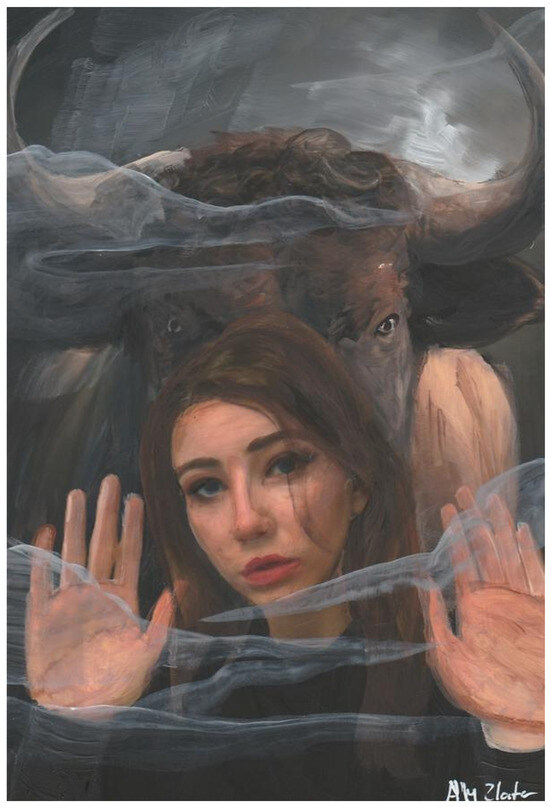
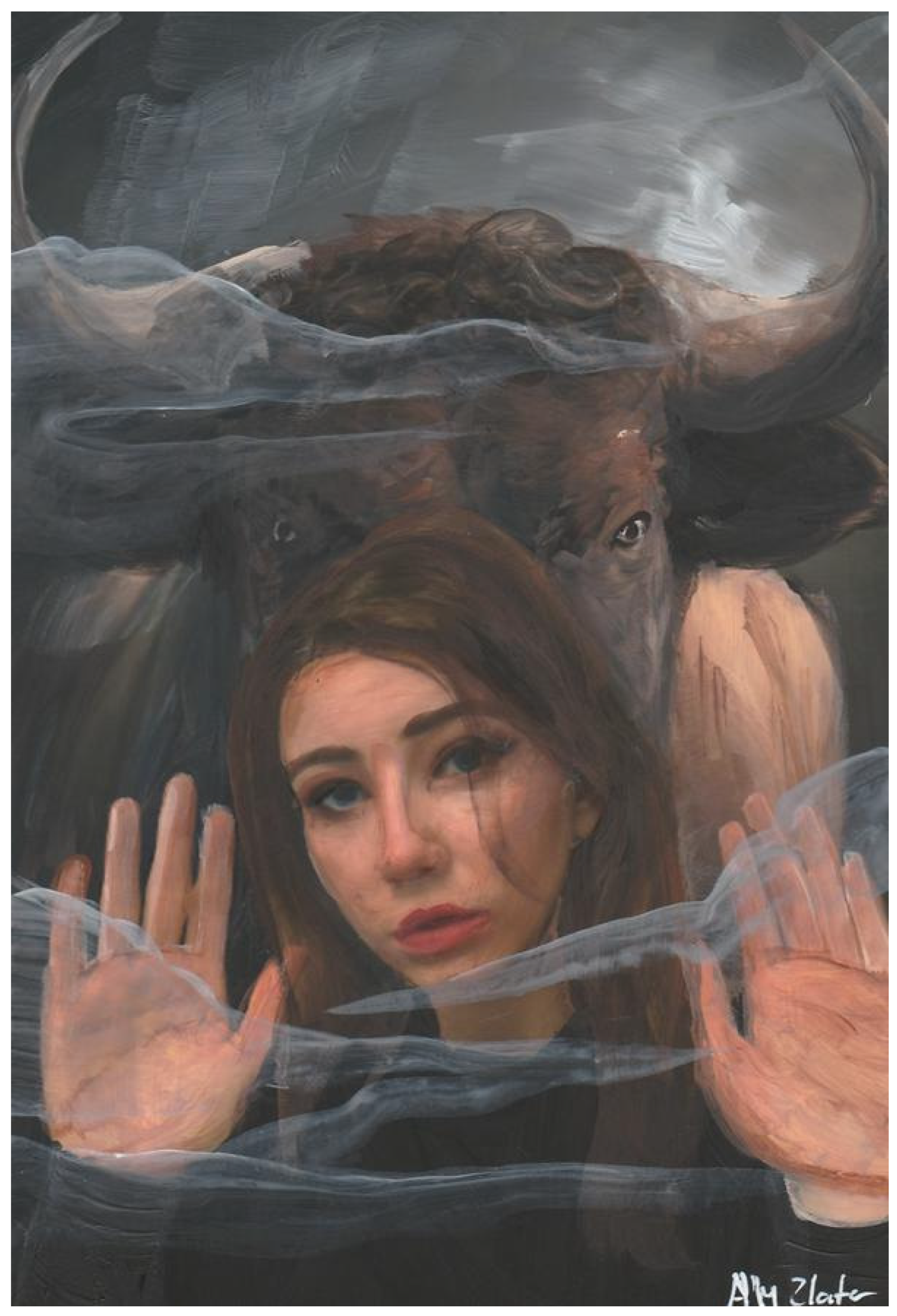
Zlatar’s (2023) The Minotaur Came and I Surrendered (Figure 1) offers a powerful exploration of this embodied trauma, using the mythological figure of the Minotaur to symbolise the destructive power of patriarchal violence. McCracken (2023) iterates how the figure of the Minotaur is emblematic of a masculine and pervasive patriarchal system that consumes and disempowers women and queer voices. When Zlatar utilises the minotaur as a central symbol, the artwork makes visible the invisible forces of domination and control that women experience in intimate relationships and societal structures. Her hands are raised, eyes looking for help, mouth slightly parted as if wanting to speak. The acrylic paint was applied to create a sfumato effect surrounding her, which grapples with how women’s bodies, through generations, are sites of powerlessness. This representation strongly parallels the lived experiences of Serb women in post-siege Sarajevo, as iterated in One Day I Will Tell This to My Daughter by Golubović (2019), who shared personal narratives of women and girls’ suffering, which were effaced by dominant moral economies that demand clear binaries between victim and perpetrator. Golubović (2019) further highlights in this ethnographic investigation that these women’s wartime traumas were rendered ungrievable due to their association with the ‘aggressor’ group, despite her fieldwork showing the complex and often contradictory nature of wartime trauma, which persists. Zlatar’s work provides a critical intervention against this silencing, offering a visual counter-narrative that highlights the impact of denying voice to those who do not neatly fit sanctioned categories of victimhood, insisting on the necessity of reclaiming women’s voices regardless of political and cultural discourse. These “sanctioned categories of victimhood” refer to socially and politically constructed frameworks that determine whose suffering is recognized as legitimate and if the perspectives complicate dominant national or ethnic narratives it is further reduced and excluded.
Figure 1.
Zlatar (2023). The Minotaur Came and I Surrendered [acrylic on board, 102 mm × 152 mm]. Private collection. © Zlatar.
2.2. The Politics of Memory and Matrilineal Reclamation
‘My mother was a pile of crumpled-up papers/for she had ideas that never came to be/these crippled writings could not stand/she has a body that is becoming a blank page again/I wonder what shall she be/her strength comes not from cast iron/but from the purity of her pain/she cries for mercy and to make meaning from her tired aches/her finite pages need ink and seek refuge in the hopes of change/it is time now for her to prepare for new calligraphy to remain’.(Zlatar 2022, p. 22)
A central theme in Zlatar’s autoethnographic art practice is the notion of rematriation, which seeks to restore ancestral knowledge that has been suppressed or erased due to systems of oppression (Schmidt 2019). In this regard, Schmidt (2019) states that rematriation re-centres women’s experiences and how it is carried within their bodies and passed down through matrilineal lines. While this concept is rooted in Indigenous philosophies, particularly those that centre land, kinship, and matrilineal knowledge systems, the maternal as central to cultural continuity is highly valuable in the Balkan region as it ties deeply into specific cultural and epistemological traditions (Schmidt 2019). Todorova (2023) edifies in ‘The History of the “Balkan Family”’ that this process of rematriation is trying to find a platform and agency within a landscape historically shaped by entrenched patriarchal norms in the Balkans. It is challenging to put forward these notions of matrilineal empowerment where historically and contemporary patterns like patrilineal dispossession and male honour persist as “a palimpsest of overlapping dominations” (Tsibiridou 2022, p. 15). Despite these difficulties, feminist theory and modernisation slowly disrupt these structures, especially through creative empowerment, offering space for ancestral matrilineal knowledge to re-emerge and transform (Zlatanović 2022).
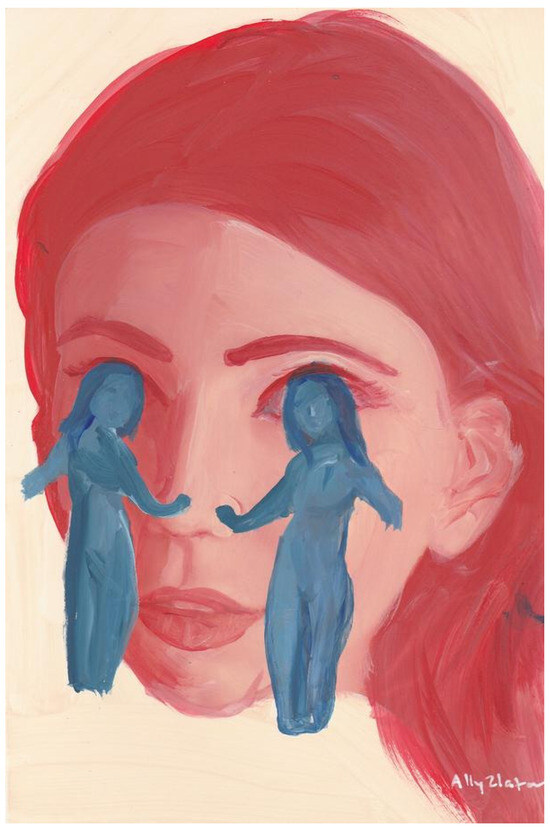
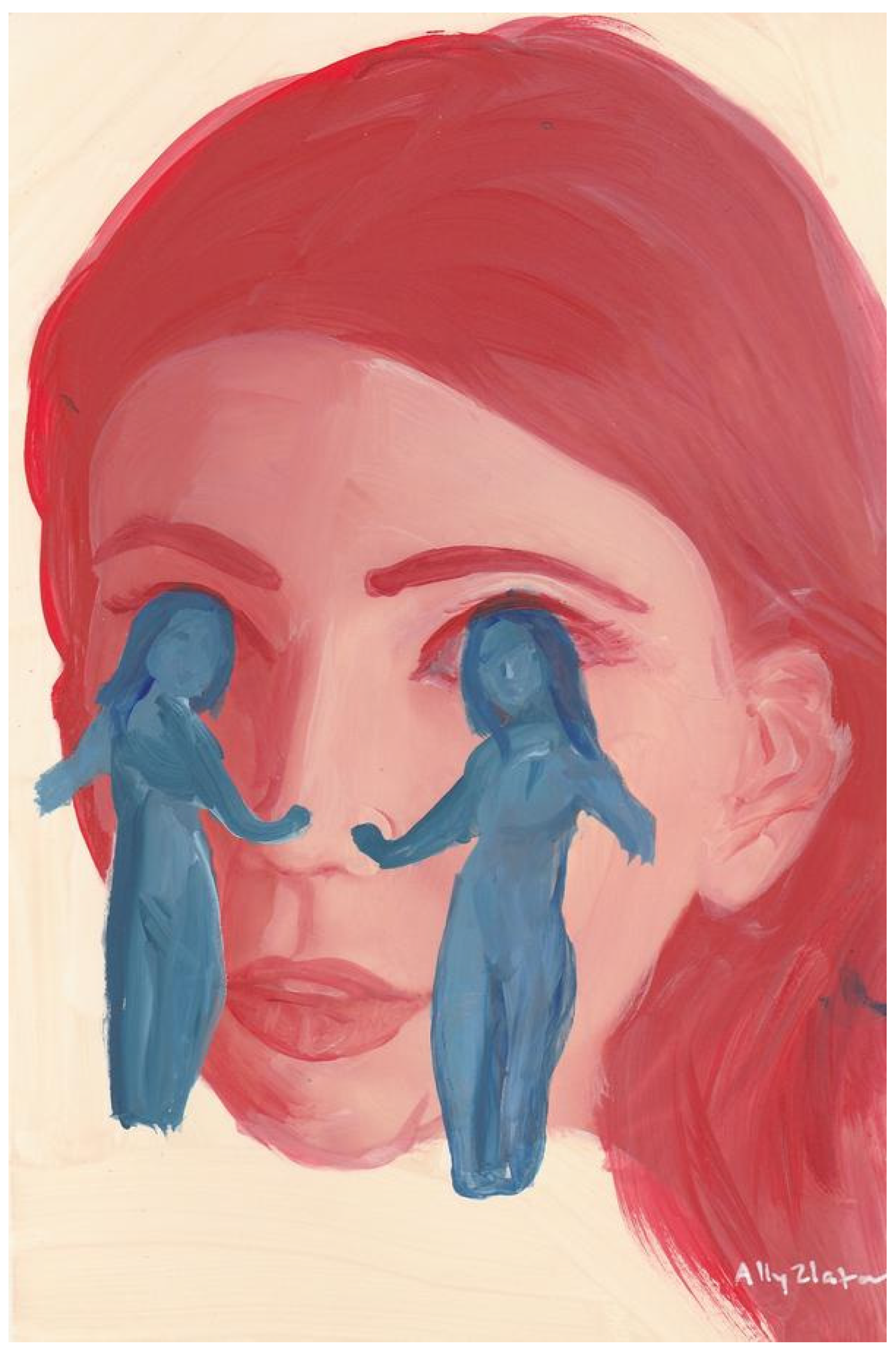
Zlatar’s work engages with this philosophy through her memories and experiences. Both her poem and the artworks We Faced Each Other But I Could Not See Myself (2023) (Figure 2) and I Will Give You All That I Have and All That I Am (2023) (Figure 3) reflect matrilineal reclamation within oppressive patriarchal systems. The works depict the artist wrestling with inherited roles. Her poem expresses this when she states, ‘my mother was a pile of crumpled-up papers/for she had ideas that never came to be’ (Zlatar 2022, p. 22). This text captures the intergenerational burden of female erasure. In this sense, the artist’s emotional experience is not illustrative; rather, it is constitutive of knowledge production which allows for space of exploration of affect, memory, and embodiment to operate as analytical tools rather than supplementary narrative (Evans 2011).
Figure 2.
Zlatar (2023). We Faced Each Other, But I Could Not See Myself [acrylic on board, 102 mm × 152 mm]. Private collection. © Zlatar.
Figure 3.
Zlatar (2023). I Will Give You All That I Have and All That I Am [acrylic on board, 102 mm × 152 mm]. Private collection. © Zlatar.
The artist’s self-portraits highlight the tension between societal expectations and the quest for personal identity, with generational maternal suppression of self-actualisation. We Faced Each Other But I Could Not See Myself (2023) (Figure 2) shows the artist crying two versions of herself, one striving to become her true self and the other embodying who she feels she ought to be due to cultural pressures. The duality critiques how patriarchal expectations fracture a woman’s identity, particularly within matrilineal lines, where both in Zlatar’s case and within society at large, mothers pass on both care and suppression. Zlatar’s work, I Will Give You All That I Have and All That I Am (2023) (Figure 3), aligns with this theme in her relationship; she expresses the relinquishment of one’s sense of self, revealing the internal conflict that accompanies the pursuit of harmony within a couple. The emotional labour portrayed in this artwork examines the weight of generational expectations to be the ‘perfect woman’ for a man and take on the world, self-sacrifice and struggle to meet the pressure of upholding familial and patriarchal expectations. Matrilineal lines are hard to empower in Balkan regions that have had pervasive vertical patriarchal systems. Zlatar exemplifies the effect and emotional toll that denying them has on autonomy and reinforcing agnatic inheritance hierarchies (Todorova 2023). These hidden realities are deeply embedded, such as in Serbian rural farming households where it is expected that the woman ‘make cheese all by herself and needs help’—a euphemism for unpaid domestic servitude (Rajković and Miletić-Stepanović 2014). Zlatar’s work thus exemplifies the need to dismantle agnatic inheritance hierarchies and underscores the urgency of female autonomy and memory as acts of resistance in patrilineal cultures.
3. Discussion
3.1. Art, Conflict, and the Politics of Slavic Memory
There is an often forgotten role of artists in the genealogy of conflict within the Balkans. When investigating the role of artists in the Balkan and Slavic memories, the works of Marina Abramović and Alphonse Mucha provide a comparative lens that further situates Zlatar’s practice in the importance of understanding the experiences of collective and individual practitioners at large. In this sense, Zlatar’s work can also be situated within the broader field of protest art, which edifies how artistic practice functions not only as a form of cultural resistance, but also as a key methodology to challenge and engage with dominant political and social structures. Williams (1999) supports this context and argues that the art of protest is central to shaping cultural, moral and political consciousness. By creating and engaging with art as spaces for protest it enables individuals and communities to contest injustice through symbolic and affective means. Thus, it further contextualises Zlatar’s practice as not only reflective, but actively resistant.
To first examine, Alphonse Mucha’s Slav Epic (1912–1926) is a series of monumental large-scale paintings with the idealised allegory of Slavic identity fostering notions of heroicism and nationalism (Miko 2022). Mucha’s visual language, while politically emancipatory, leans more into the patriarchal and male-dominated historical depiction in which women in the historic battles and scenes are either symbolic or ornamental roles within a grand historical narrative (Miko 2022). Conversely, Zlatar disrupts this with countermapping the larger social and political grand narratives with their autoethnographic visual narratives that foreground women’s suffering, resilience, and agency. Interestingly, size and scale also can be cross-examined here where Mucha made large and bold pieces; Zlatar’s are more small and intimate, inviting viewers into the hidden stories and spaces.
In contrast, Marina Abramović’s Balkan Baroque (1997) offers a unique and pivotal reference point, as a Serbian-Contemporary female artist, in which the artist created a durational performance of herself scrubbing blood-soaked bones and singing childhood folklore songs (Firlej 2025). What Abramović confronts in this work is the inherited violence of the Balkan Wars via the ritualisation of cleaning the endless blood of the chickens and her bodily suffering she endured throughout this performance. This was first displayed at the Venice Biennale in which for several days she subjected herself to this tedious act (Chace 2020). Abramović’s work foregrounds the body as a site of historical inscription, implicating both personal and collective guilt, memory, and trauma, as there was a powerlessness with the endless amount of blood to be cleaned from the chicken bodies, and also how much it affected her, i.e., the aching hands and blood-stained outfit (Chace 2020). While Balkan Baroque perhaps alludes to the externalised conflict through a visceral act of purification and her actions are social commentary, Zlatar’s work turns inward, mapping violence onto the intimate terrain of the female body and also explores women and domestic memory in the form of private embodiment. This divergence marks a feminist intervention to exemplify how conflict is transmitted intergenerationally and reframes it as a mediated space rather than resolved through spectacle. This positioning can be further understood in relation to other global movements where art operates as resistance, such as the Zapatista movement in Chiapas, Mexico, in which the utilization of visual and symbolic art practices responded to NAFTA. As the Zapatista community developed autonomous municipalities (MAREZ) in rural Chiapas they voiced via primarily murals and textiles the importance of Indigenous autonomy and political resistance against neoliberalism and capitalism (Rabasa 2010). While emerging from distinct geopolitical contexts, both practices emphasise how art can function as a site of resistance, identity formation, and the reclamation of suppressed histories. Artists do not subscribe to one approach or even one experience of conflict and these comparisons highlight how important it is to make space to analyze and engage with the diversity of approaches of how to engage with transforming memory.
3.2. Refuge for an Oppressed Body
When examining the notion of how the body is a vessel for transgenerational trauma, maternal memory and as a site for resistance, Irigaray’s (1985) call for women to speak from their embodied subjectivity is one of the key aspects to not only survive but to reclaim their maternal lineages. Zlatar’s intimate visual dialogues with her past resonate deeply with this concept by intertwining the maternal body, domestic rituals, and childhood artefacts as sites of inherited pain and radical healing.
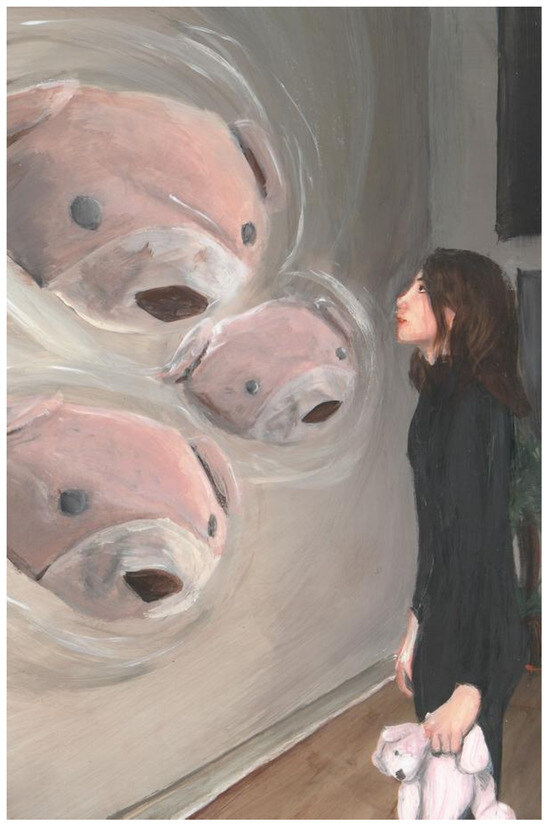
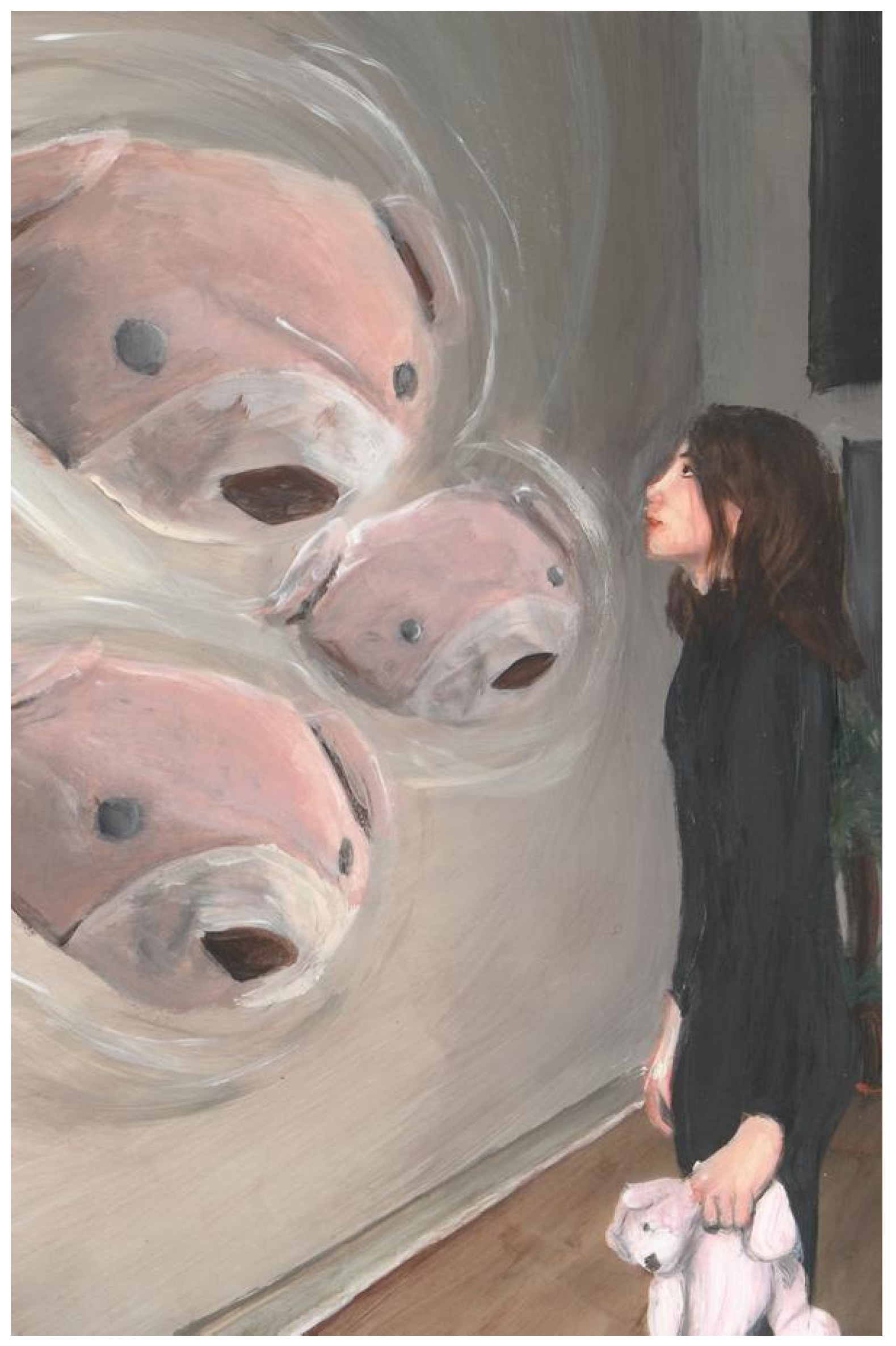
From Zlatar’s series Refuge for the Oppressed Body, her work My Memories Are Coming For Me (Figure 4), Zlatar uses the recurring motif of her childhood teddy bear ‘Pink’ as a symbol of childhood safety; her mother gave her that bear, and at many points in her life, they were ruptured by trauma. This 20-piece acrylic series of her talking to, and embodying her struggles with, the bear as the allegorical figure visually articulates what Logan and Green (2023) highlight: the need to re-establish safety when one experiences psychological devastation. ‘Pink’ becomes a stand-in for Zlatar on the lost maternal security, especially in the absence of comfort and the longing for protection in the face of her mental illness. As Zlatar notes, ‘memories do not live in objects/but in our tender agony’ (Zlatar 2022, p. 39), capturing how her inherited memory is not always conscious, but deeply somatic and affective. The bear and she (the artist) become the bearers of generational sorrow, and also how we find strength through childhood innocence and connections to our roots.
Figure 4.
Zlatar (2025). My Memories Are Coming For Me [acrylic on board, 102 mm × 152 mm]. Private collection. © Zlatar.
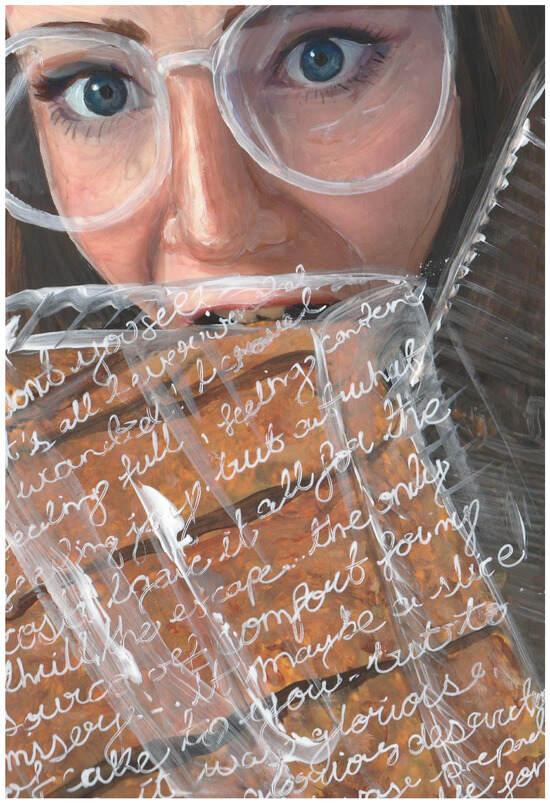
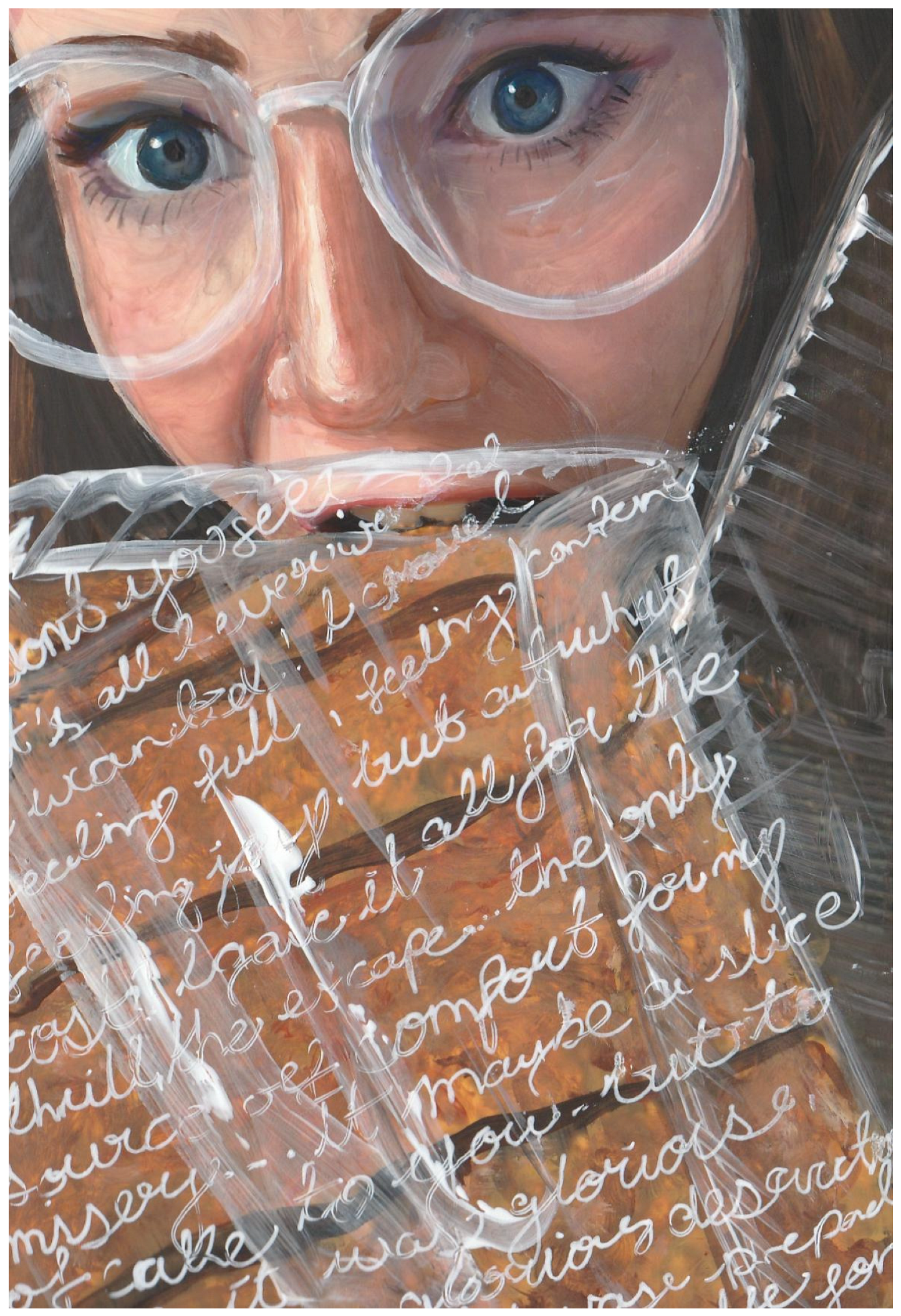
This exploration continues in her series To All the Cakes I Have Eaten, specifically pertaining to A Glorious Death (Figure 5), from a 30-work series reflecting on Zlatar’s lived experience with an eating disorder. The motif of medovik, a traditional Slavic honey cake, was tied to her family and the comforts of home, which for Zlatar, as someone with an eating disorder, serves as both a symbol of comfort and emotional distress. In one poem, she writes: “I asked for just a slice of bread and pain/but you blunt the knives and cut the ties/I said ‘please come back to the dinner table’…/eating honey cake is now a game of one’s own” (Zlatar 2022, p. 33). Here, the act of eating becomes not just about sustenance, but remembering and grieving maternal absence. As the title A Glorious Death suggests, Zlatar is willing to die for the love of her favourite food, exerting agency over one’s own body and the external influences. Ćorić et al. (2023) examine several culturally ingrained traditional values of women’s appearances, with family and socio-cultural factors being highly pervasive predictive factors of disordered eating among adolescents in Bosnia and Herzegovina. Food in this sense is both a source of cultural continuity and internal conflict (Ćorić et al. 2023). Zlatar highlights fragmentation in how mind–body relations are nuanced with ancestral memory and contemporary struggles converge. Zlatar’s work restores the maternal voice often lost in patriarchal systems, allowing embodied knowledge to emerge as a feminist act of remembrance and transformation. Recurring motifs, such as the teddy bear ‘Pink’ or the honey cake, are part of her individual processing and function as affective triggers that reconnect and share her personal memory with embodied experience. Exploring these symbols visually facilitates the reinterpreting of trauma and painful associations to be recontextualised and reclaimed the agency and survival via meaning making. These artworks exemplify both personal pain, but also capture Irigaray’s (1985) notion of reconstruction through matrilineal symbols such as cake, bears, and recipes, insisting that ancestral connection is both a challenging notion of traditional coercive pressures and can be the same source of healing through intergenerational solidarity and embodied connection (Irigaray 1985).
Figure 5.
Zlatar (2025). A Glorious Death [acrylic on board, 102 mm × 152 mm]. Private collection. © Zlatar.
4. Methods
4.1. Matrilineal Embodiment in Serbian Heritage
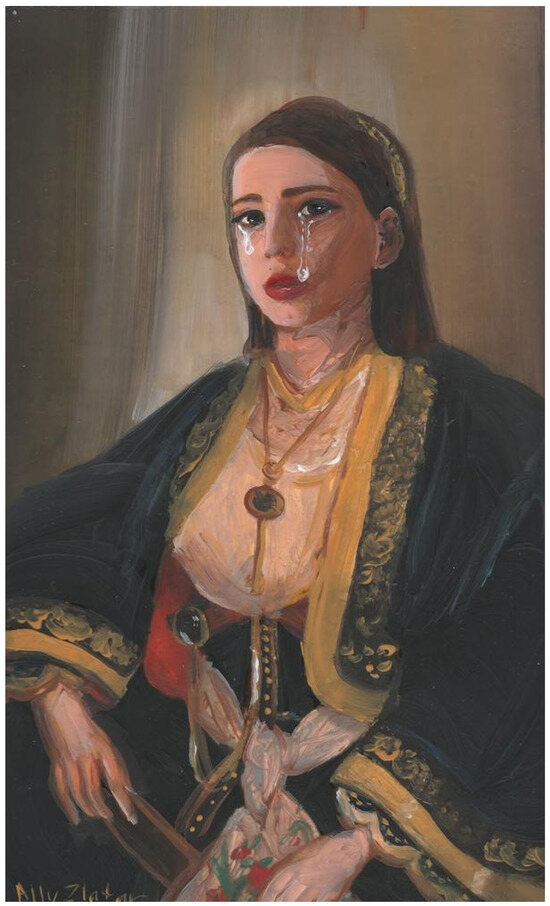
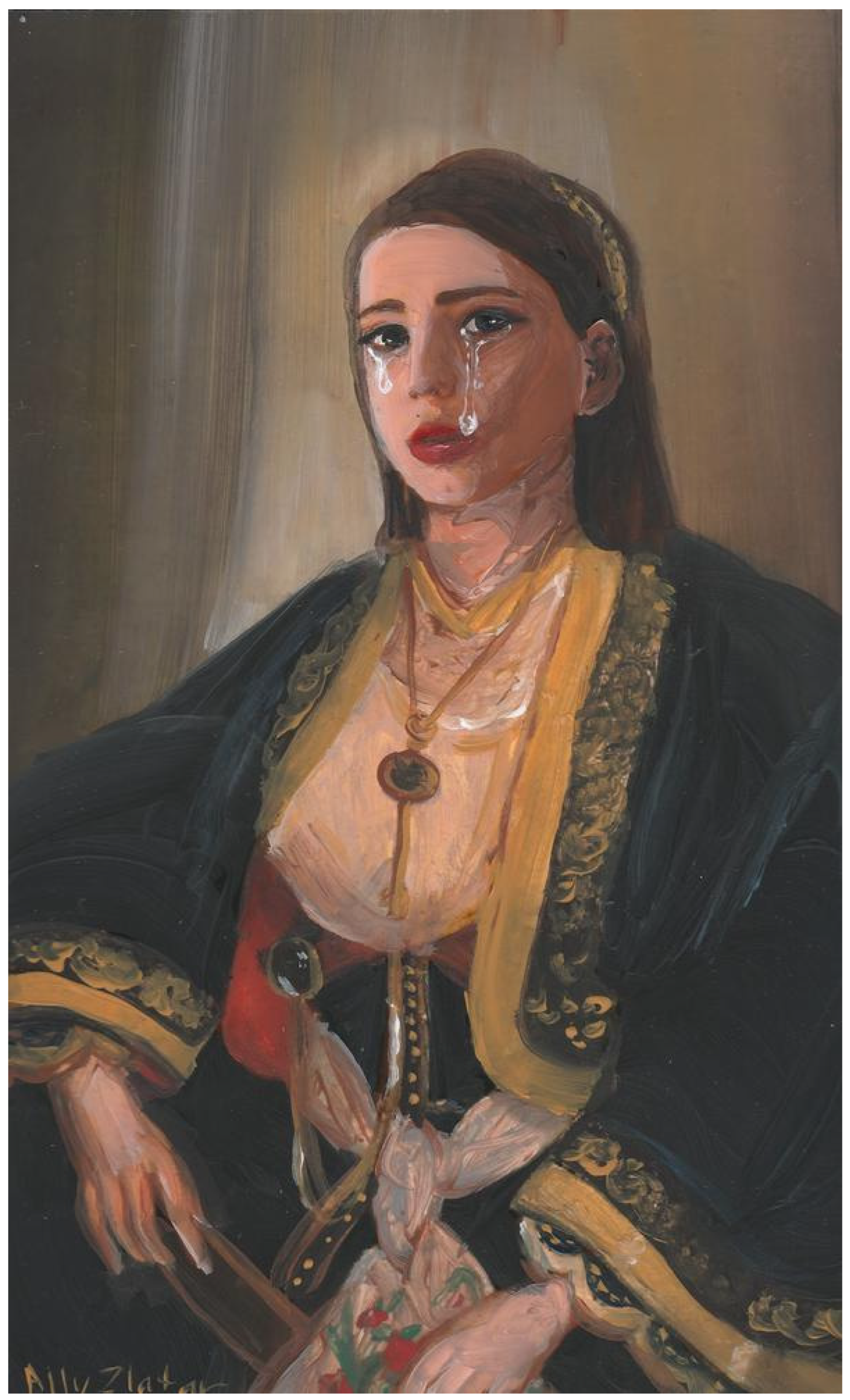
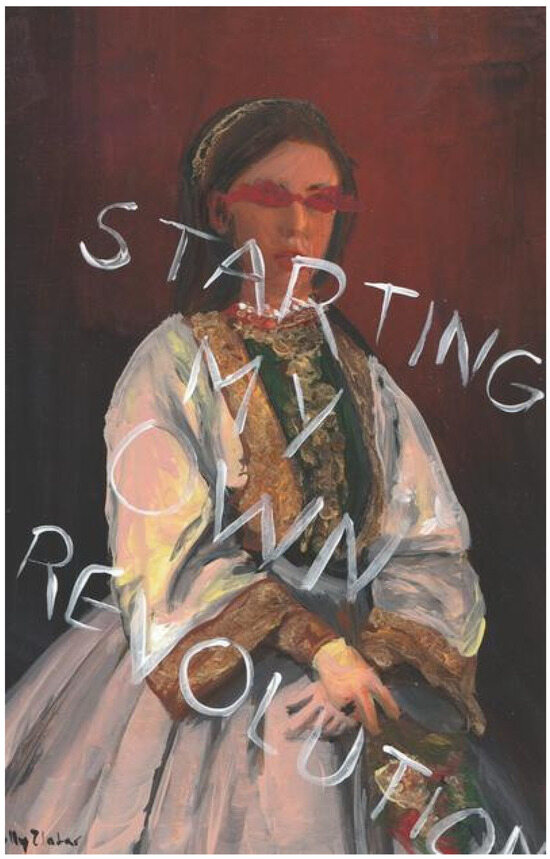
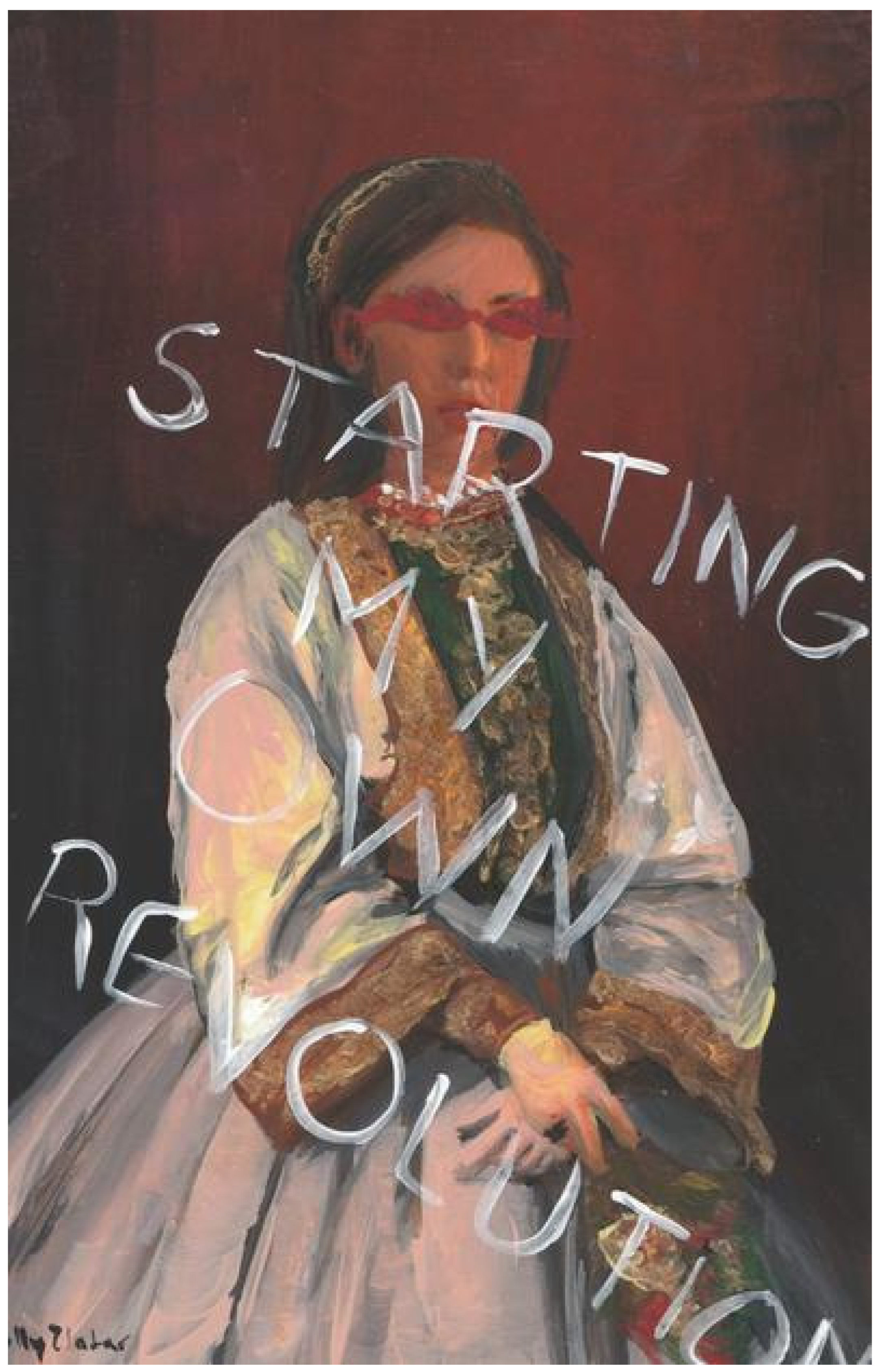
In efforts to showcase a conceptual understanding of female perspectives and neglect in traditional Balkan regions, Vishwanath (1994) highlights how cultural folklore helps edify these perspectives. Zlatar examines the intersection of trauma, identity, and memory, exploring how the burdens of history and emotional repression are carried across generations of women via her work A Serbian Renaissance (Figure 6) and Starting My Own Revolution (Figure 7) in which she reimagines herself in the roles of key historical Serbian artworks of women. While doing so, she embeds both her and the figure’s emotional repression to highlight the importance of honouring personal identities while also edifying that this is not just an issue in the past, but is still pervasive to this day.
Figure 6.
Zlatar (2021). A Serbian Renaissance [acrylic on board, 102 mm × 152 mm]. Private collection. © Zlatar.
Figure 7.
Zlatar (2021). Starting My Own Revolution [acrylic on board, 102 mm × 152 mm]. Private collection. © Zlatar.
Take for instance, Figure 6, which is Zlatar’s painting of herself as the Young Woman in Serbian Costume after the work of Uroš Knežević (c. 1850). She selected the image of a powerless, voiceless, unknown figure, reflecting the historical silencing of women in both art and society. Reiterated in her struggles she mentioned directly into her poem, ‘I screamed into the darkness/to give me power, give me glory/and get me out of my father’s suit/I see empty bottles as I drown above water/I see burn marks on benches/and in the mist/I see I no longer belong’ (Zlatar 2022, p. 76). The image of the woman trapped in her father’s suit becomes a metaphor for societal constraints, illustrating the inherited weight of cultural expectations and the emotional repression imposed upon women.
In contrast, the other work from the series features (Figure 7) Zlatar but with the figure’s face obscured with a bold text on the painting that states ‘starting my own revolution’, embodying a powerful assertion of agency. Zlatar channels the silencing that Irigaray (1985) highlights the importance of women’s distinctiveness and their ability to create new forms of expression that break away from patriarchal structures. Thus, Zlatar’s art shifts from passivity to resistance, as one of her pieces boldly declares justice for historical and contemporary change. Matrilineal empowerment in this sense is both via channelling ancestral experiences but also via reclaiming her agency, calling for a shift in how women are represented and understood in both cultural memory and contemporary society.
4.2. Artistic Responses to Conflict
This research adopts a qualitative, practice-led framework to examine how the artist represents conflict through embodied and visual forms. It illustrates the importance of art not as an accessory or static, but sites of analysis that proceeds step-by-step through visual, symbolic, and emotional elements, enabling non-specialists or community-centric engagement with how meaning is constructed through artistic practice. More largely, artistic responses to conflict are not merely illustrative reactions to geopolitical events, but as embodied. With Zlatar’s utilization of affective and mnemonic practices, it aids in translating lived and inherited trauma into visual form. As Jones (2025) iterates, when research treats artworks as both cultural texts and sites of knowledge production, subsequently the analysis centres on close visual reading and autoethnographic interpretation of the artist’s own works, situating them within broader histories of conflict in the Balkans.
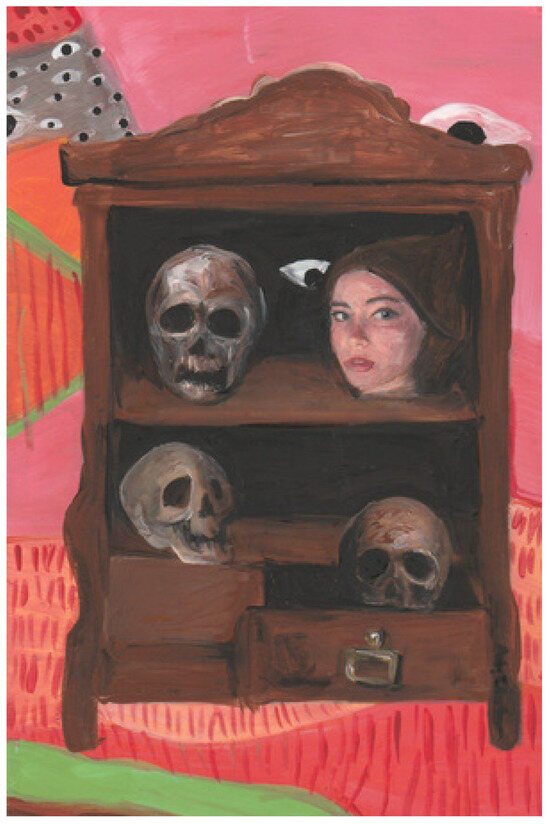
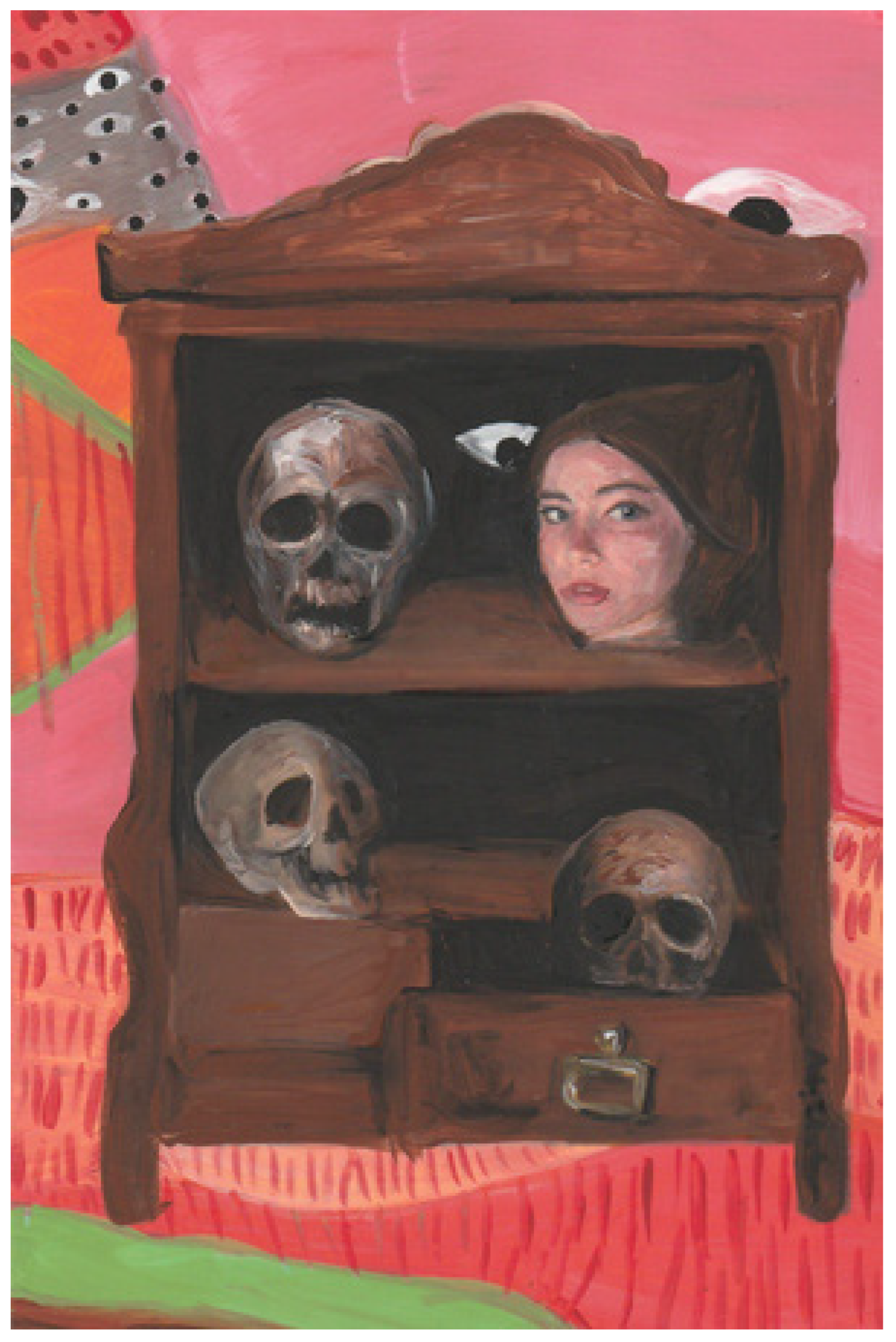
Autoethnography is often a neglected tool that aids in foregrounding subjectivity as it is a powerful method for reflexivity, and lived experience (Ademowo 2023). Recent scholarship in intersectional autoethnography further emphasizes how embodied, emotional narratives such as Johnson and LeMaster (2020) who emphasize the particularity of marginalised positions function as critical sites of theorising rather than anecdotal reflections. This is pivotal in the discourse as the framework strengthens the methodological grounding and illustrates the importance of situating personal narrative within broader systems of power and creation and representation of individuals’ identities. Furthermore, it is particularly valuable when addressing themes of war, displacement, and gendered violence as these perspectives are often silenced, stereotyped, or abstracted in dominant historical narratives (Evans 2011). This approach allows the artist-researcher to position the body as both archive and witness, acknowledging trauma as something carried somatically rather than solely narratively. Zlatar’s Mortality Closet (Figure 8) draws on conflict and memory scholarship and utilises their self alongside the collective understanding with this piece as the art as a mediating force between personal suffering and the numbers of those neglected. Zlatar sits on a shelf with faceless unknown skeletons; devoid of gender and story; here they demonstrate what Golubović (2019) edifies of how women’s wartime experiences in the former Yugoslavia were frequently rendered “ungrievable” due to ethnic and political frameworks of victimhood.
Figure 8.
Zlatar (2025). Mortality Closet [acrylic on board, 102 mm × 152 mm]. Private collection. © Zlatar.
This autoethnographic reflection provides a chilling and stark alternative discourse into the obscured and marginalised experiences of conflict, which are made visible without needing validation from state or institutional narratives. In this sense, not just in the case study of Zlatar, but largely artworks serve as a counter-archives that resist binary constructions of historical experiences.
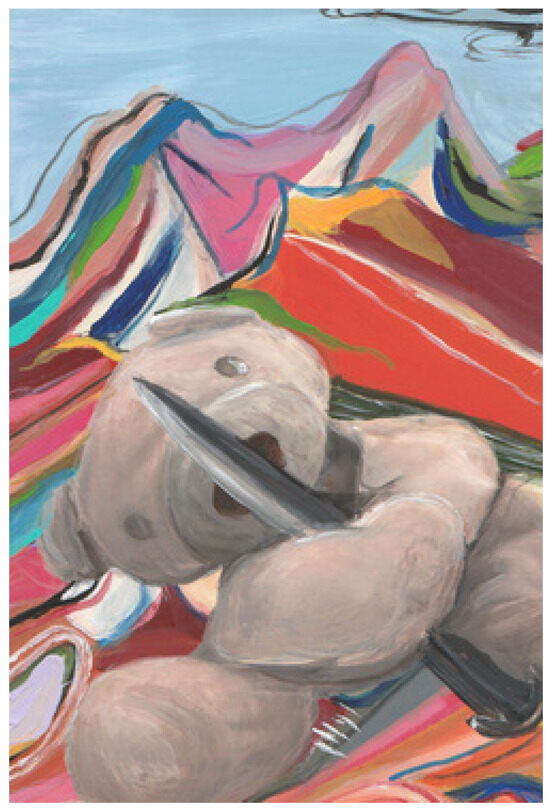
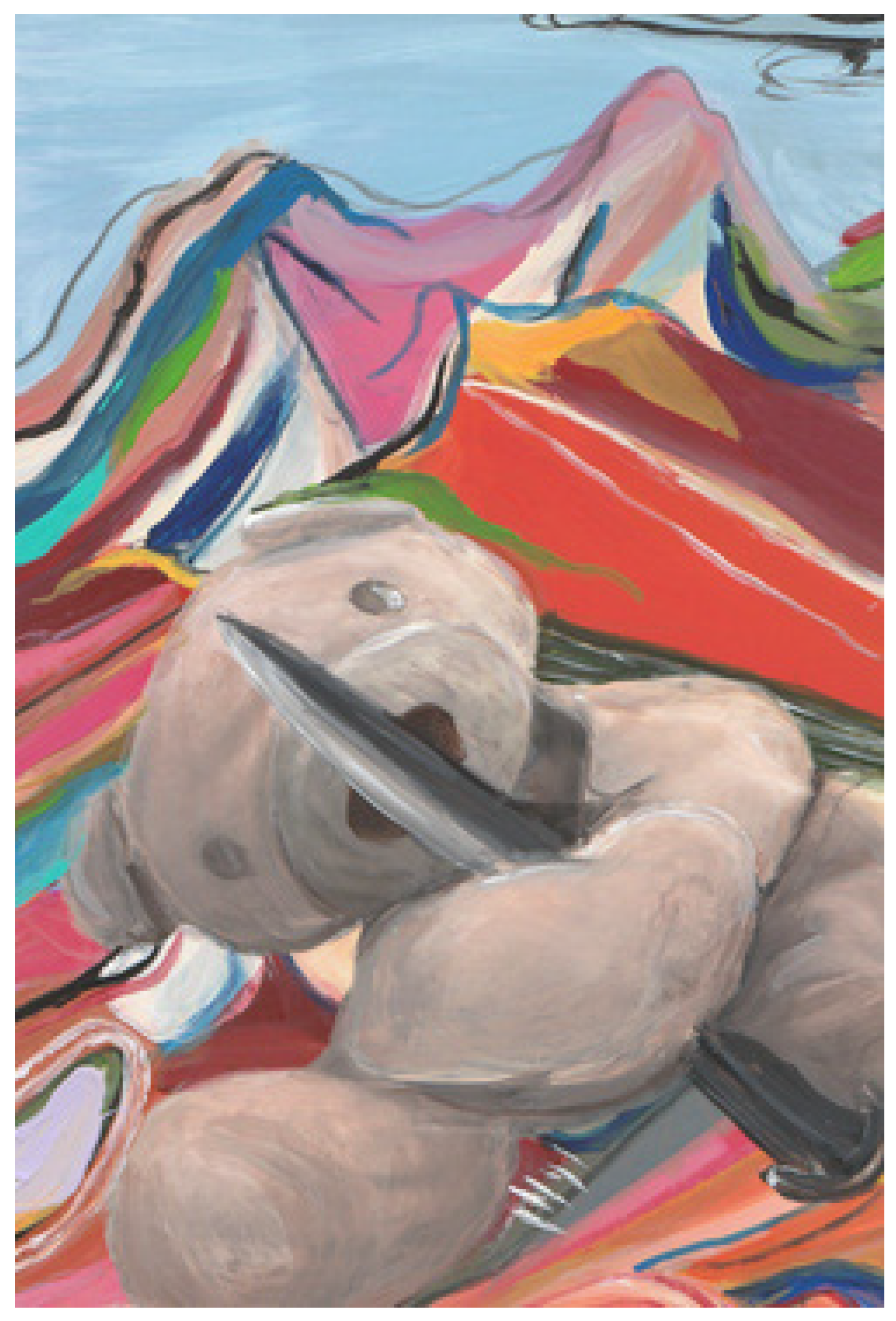
In accordance, the utilisation of visual motifs and bodily gestures is examined as methodological data, with particular attention to how symbolism (such as mythological figures, domestic objects, and self-portraiture) articulates experiences. Providing another work to contextualise in Figure 9, He Crossed Me With His Dagger (2023), depicts the artist’s childhood teddy bear with a blade to allude to a gender-based trauma within the structural violence of her experience.
Figure 9.
Zlatar (2023). He Crossed Me With His Dagger [acrylic on board, 102 mm × 152 mm]. Private collection. © Zlatar.
The bear becomes both the embodiment of her innocence and a way to reclaim agency via the bear holding the blade as an act of endurance and resistance. McCracken (2023) supports this approach as myth and metaphor can be treated as methodological devices to translate systemic oppression into recognisable forms. As a multi-layered analytical approach the affective forms position the artistic practice as both a response to conflict and also a creation of embodied knowledge that contributes to feminist conflict studies at large.
4.3. Visual Narratives and Memory
Artists shape collective memory of historical experiences and contemporary conflicts as visual narratives can be understood as these embodied representations. Takševa (2024) in their work Unforgetting and the Politics of Representation examines the voices from Contemporary Bosnia and Herzegovina and highlights how structure in conflict is not only remembered, but also transmitted, and reinterpreted across generations. But it is an active and politically mediated process. In this regard, the methodological framework integrates artworks that reference personal memory while engaging with broader cultural histories of war, patriarchy, and displacement. Artworks can blend past, presence and permanence. Especially considering that memory is a subjective experience and process, visual art, in this context, becomes a means of re-inscribing the experiences into collective consciousness (Cleary 2017).
Particular emphasis is placed on how women’s bodies and domestic symbols operate as mnemonic devices that counter dominant, male-centred war histories. As Todorova (2023) noted, Balkan family structures and memory regimes have historically privileged patrilineal narratives and when it comes to examination of wartime experiences the marginalising of women’s experiences of conflict and survival artworks aid in this analysis to provide a deliberate narrative strategy that collapses temporal boundaries and systemic structures. As seen in Zlatar’s A Serbian Renaissance the visual strategies of blending the contemporary Balkan women’s experience with the larger ethos of women’s suffering in the historic Balkans illustrate that rematriation and fostering matrilineal knowledge are reclaimed and reactivated through the power of the creative voice (Petrovic 2021).
Petrovic (2021) further conceptualizes that the balkanisation of identity is focused on rebuilding fragmented identities through narratives and this notion supports how images can communicate what language cannot. This is not just in the Balkan conflicts but also largely applies to the contexts of violence and displacement. The importance of rebuilding fragmented narratives rather than seeking closure or resolution is one of the most important aspects, as both the experiences and destruction caused externally and internally leave both the individuals and their communities lost and fractured. Artworks reflect the ongoing nature of trauma healing as they situate spaces for ambiguity and emotional tension within the formation of memory and experience (Burke 2015). Expanding upon the mechanism in which art contributes to healing, it can be understood via the neuroaesthetic perspective that engagement with visual art can trigger associative processes in the brain (Kandel 2013). This allows individuals to redefine and examine their existing mental images and emotional responses (Kandel 2013). Rather than merely representing trauma it actively participates in reshaping how it is remembered and processed. While brief, this case study highlights one experience to provide insights into the importance of analysing visual narratives. Zlatar utilizes the autoethnographic painting approach as a site where personal memory intersects with collective history, to demonstrate that visual arts are not only a passive reflection but also an active agent in shaping cultural memory and challenging hegemonic representations of conflict.
5. Conclusions
Trauma is a pervasive force that permeates not only the psyches of individuals but is also deeply embedded in the cultural zeitgeist of many communities. In terms of contemporary Serbian heritage, Zlatar’s autoethnographic work offers a powerful commentary on the intersection of embodied trauma, resilience, and the politics of memory and identity while employing Indigenous frameworks of rematriation. Via the matrilinal empowerment, Zlatar’s art challenges the erasure of women’s experiences and highlights the embodied nature of trauma and healing, re-centring the female body as a site of memory and resistance. Her work contributes to broader conversations by demonstrating how art functions as both a site of memory and a method of inquiry into trauma, resilience, and identity. The importance is especially relevant when reclaiming traditional roots, as understanding that one must also reclaim the autonomy from it, as the body is both a site of suffering and a space of resilience.
‘Pluck the feathers off the wings of those that cannot fly/cast aside the cross for those who cannot be free/lay them in a field of grass if they cannot appreciate the rain/those who fled to the ports of Europe/will never reach the threshold of paradise/as they have a room with the darkness of their wounds/locked by a key of silence/parted forever is them and who they want to be’.(Zlatar 2022, p. 84)
Author Contributions
Conceptualization, A.Z. and H.G.; Methodology, A.Z.; Validation, A.Z.; Formal analysis, A.Z.; Resources, A.Z.; Data curation, A.Z.; Writing—original draft, A.Z.; Writing—review & editing, A.Z.; Visualization, H.G.; Supervision, H.G.; Project administration, A.Z.; Funding acquisition, A.Z. All authors have read and agreed to the published version of the manuscript.
Funding
This research was funded by Leverhulme Trust, Grant Number ECF-2025-337.
Institutional Review Board Statement
Not applicable.
Informed Consent Statement
Not applicable.
Data Availability Statement
The data presented in this study are available on request from the corresponding author due to author discretion.
Acknowledgments
Thank you for the support from Leverhulme Trust.
Conflicts of Interest
The authors declare no conflicts of interest.
References
- Ademowo, Adeyemi J. 2023. Autoethnography: Unpacking a method and lived experience(s) as data. ABUAD Journal of Social and Management Sciences 4: 162–71. [Google Scholar] [CrossRef] [Scilit]
- Burke, Eliza K. 2015. Unsettling Space: Trauma and Architecture in Contemporary Art. Doctoral dissertation, University of Tasmania, Hobart, Australia. [Google Scholar]
- Butler, Judith. 2004. Precarious Life: The Powers of Mourning and Violence. London: Verso. [Google Scholar]
- Chace, Alex. 2020. The Intersectionality of Mindfulness and Art of Marina Ambramovć. Smithfield: Bryant University. [Google Scholar]
- Cleary, Martina. 2017. The Photograph as a Site of Mnemonic Return. Doctoral dissertation, University of South Wales (United Kingdom), Cardiff, UK. [Google Scholar]
- Ćorić, Martina K., Mirjana Graovac, Nikolina Pravdić, Ana Boban Raguž, and Ana Kaštelan. 2023. Predictive factors of disordered eating among adolescents in Bosnia and Herzegovina. Journal of Education and Health Promotion 12: 258. [Google Scholar] [CrossRef] [Scilit] [PubMed]
- Evans, Laura E. 2011. Eating Our Words: How Museum Visitors and a Sample of Women Narratively React to and Interpret Lauren Greenfield’s THIN. Doctoral dissertation, The Ohio State University, Columbus, OH, USA. Available online: https://etd.ohiolink.edu/ (accessed on 1 January 2026).
- Firlej, Dagmara. 2025. Marina Abramović. Liverpool School of Art and Creative Industries Journal 1: 236–47. [Google Scholar]
- Golubović, Jelena. 2019. “One day I will tell this to my daughter”: Serb women, silence, and the politics of victimhood in Sarajevo. Anthropological Quarterly 92: 1173–99. [Google Scholar] [CrossRef] [Scilit]
- Irigaray, Luce. 1985. This Sex Which Is Not One. Ithaca: Cornell University Press. [Google Scholar]
- Johnson, Amber L., and Benny LeMaster. 2020. Gender Futurity, Intersectional Autoethnography. New York: Routledge. [Google Scholar]
- Jones, Ruth. 2025. Sharing Space and Taking Care: Intersectional Feminist Approaches to Art Practice. Doctoral dissertation, University of East London, London, UK. [Google Scholar]
- Kandel, Eric. 2013. The new science of mind and the future of knowledge. Neuron 80: 546–60. [Google Scholar] [CrossRef] [Scilit] [PubMed]
- Logan, Isabel, and Cheryl A. Green, eds. 2023. Stabilization Approaches That Empower Clients Through Mental Health Crises. Hershey: IGI Global. [Google Scholar]
- McCracken, David. 2023. Gender performance in Jim Shepard’s “Minotaur”. The Explicator 81: 19–23. [Google Scholar] [CrossRef] [Scilit]
- Miko, Kristina M. 2022. Alphonse Mucha’s The Slav Epic. In 19th Century European Art History. Chapter 12. Available online: https://pressbooks.openeducationalberta.ca/19thcenturyart/chapter/chapter-12-mucha-the-slav-epic/ (accessed on 1 January 2026).
- Petrovic, Ljudmila. 2021. Balkanization of Identity: Rebuilding Fragmented Identities Through Narratives. Master’s thesis, Simon Fraser University, Burnaby, BC, Canada. Available online: https://summit.sfu.ca/_flysystem/fedora/2025-07/etd21422.pdf (accessed on 1 January 2026).
- Rabasa, José. 2010. Without History: Subaltern Studies, the Zapatista Insurgency, and the Spectrum of History. Pittsburgh: University of Pittsburgh Press, vol. 74, Available online: https://dokumen.pub/without-history-subaltern-studies-the-zapatista-insurgency-and-the-specter-of-history-1nbsped-9780822973744-9780822960652.html (accessed on 1 January 2026).
- Rajković, Ljubica, and Vesna Miletić-Stepanović. 2014. Patrilineal traditional family: Examples of Serbia and Bulgaria. Bulletin of the Serbian Geographical Society 94: 83–116. [Google Scholar] [CrossRef] [Scilit]
- Schmidt, Januschka. 2019. The Rematriation of Reconciliation. Master’s thesis, University of Groningen, Groningen, The Netherlands. Available online: https://rcs.studenttheses.ub.rug.nl/523/1/1819-RM%20Schmidt,%20J.%20Ma-scriptie.pdf (accessed on 1 January 2026).
- Takševa, Tatjana. 2024. Unforgetting and the Politics of Representation: Voices from Contemporary Bosnia and Herzegovina. Abingdon: Taylor & Francis. [Google Scholar]
- Todorova, Maria. 2023. Introduction: The history of the “Balkan family”. Genealogy 7: 18. [Google Scholar] [CrossRef] [Scilit]
- Tsibiridou, Fotini. 2022. On Honor and Palimpsest Patriarchal Coloniality in Greece, the Western Balkans, and the Caucasus: Anthropological Comparative Accounts from a Post-Ottoman Decolonial Perspective. Genealogy 6: 73. [Google Scholar] [CrossRef] [Scilit]
- Vishwanath, L. S. 1994. Towards a conceptual understanding of female infanticide and neglect in colonial India. In Proceedings of the Indian History Congress. Aligarh: Indian History Congress, vol. 55, pp. 606–13. [Google Scholar]
- Williams, Rhys H. 1999. The Art of Moral Protest: Culture, Biography, and Creativity in Social Movements. Oxford: Oxford University Press, pp. 1673–75. [Google Scholar]
- Zlatanović, Sanja. 2022. Everyday Practices of Gender in the Serbian Community of Post-War South-East Kosovo. Genealogy 6: 78. [Google Scholar] [CrossRef] [Scilit]
- Zlatar, Ally. 2022. The Starving Artist. Glasgow: Good Press Publishing. [Google Scholar]
Disclaimer/Publisher’s Note: The statements, opinions and data contained in all publications are solely those of the individual author(s) and contributor(s) and not of MDPI and/or the editor(s). MDPI and/or the editor(s) disclaim responsibility for any injury to people or property resulting from any ideas, methods, instructions or products referred to in the content. |
© 2026 by the authors. Licensee MDPI, Basel, Switzerland. This article is an open access article distributed under the terms and conditions of the Creative Commons Attribution (CC BY) license.