


Abstract
Released in 2012, Svetlana Baskova’s Za Marksa… (For Marx…) poses the question of the abolition of capitalism through workers’ struggle—that is, the question of revolution in decidedly non-revolutionary times. A follow-up to her activist documentary Odno reshenie—soprotivlenie (The Only Solution Is Resistance, 2011), For Marx… can be read as a post-Soviet return to Sergei Eisenstein’s Stachka (Strike, 1925), one that confronts the historical afterlife of the revolutionary proletariat following the rapid decomposition of the industrial working class once positioned at the center of the socialist imaginary. Borrowing its title from Louis Althusser and situating itself within an international genealogy of left debates on form and revolution—running from the Soviet avant-garde through Brechtian estrangement, militant cinema of 1968, and the collapse of “actually existing socialism”—the film mobilizes inherited models of committed art only to expose their historical limits. I argue that For Marx… does not revive earlier oppositional forms but stages their failure under contemporary capitalism. Montage, estrangement, and documentary realism appear as sedimented forms that no longer cohere into an operative revolutionary praxis. By foregrounding the exhaustion of political form, For Marx… reframes abolition—not only of the police or the carceral state but of capitalism itself—as a horizon that persists precisely where inherited aesthetic strategies break down. The film’s success lies in its refusal to offer closure, keeping the question of political transformation open.
1. Introduction
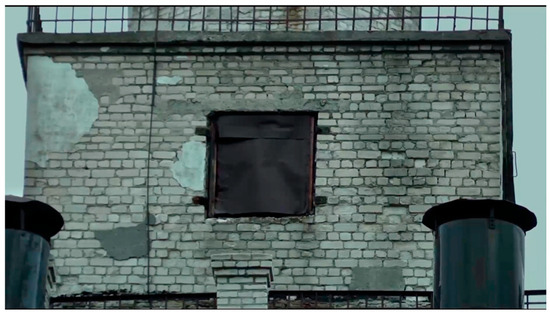
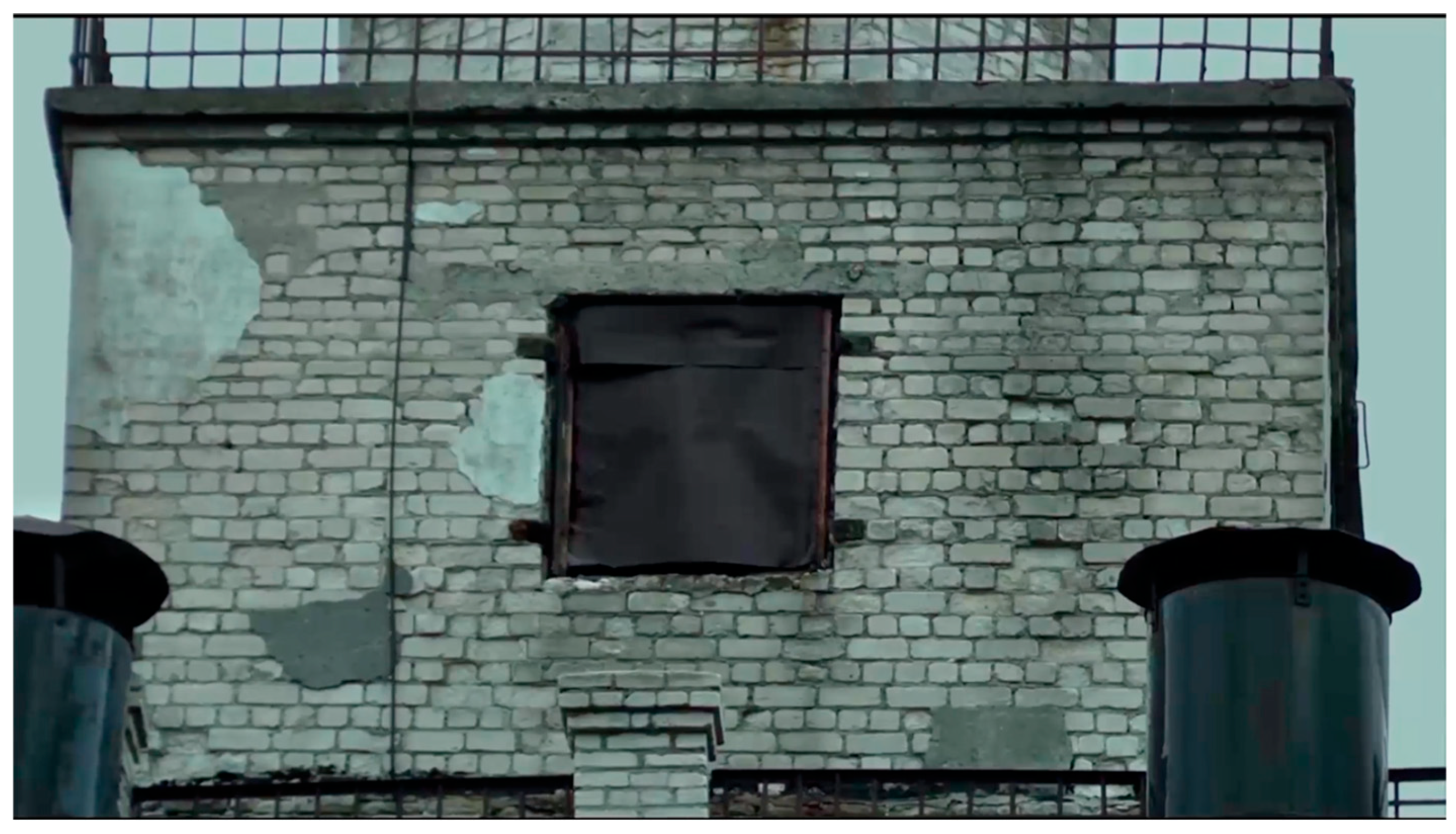
Announcing itself in promotional materials as “New Soviet Cinema” (novoe sovetskoe kino) and a “film about the clash between workers raised by Soviet power and the savage realities of Russian capitalism,” Svetlana Baskova’s Za Marksa… (For Marx…, 2012)—released in the wake of the 2008 global financial crisis—ends with the image of Kazimir Malevich’s Black Square (Chernyi kvadrat, 1915) pasted over a provincial steel plant window after a failed—and deadly—strike by the factory’s workers.1 Lingering in the space between the “new” and the “Soviet,” and framed by a dilapidated factory tower, this avowedly post-Soviet deployment of Malevich’s Suprematist icon inverts the gesture of the original. Rather than declaring a revolutionary break with all hitherto existing art through the renunciation of representation as such, Baskova’s citation of radical negativity asks after the very status of revolutionary art in reactionary times.2 The image condenses the film’s central problem: what can political form mean after the supposed end of history, after the collapse of state socialism, and in a world structured by neoliberal capitalism, financialization, and the globalized reproduction of capital?
As I will discuss in more detail below, Black Square is not the only emblem of older revolutionary aesthetics to be found in For Marx…. The film is also a reworking of Sergei Eisenstein’s 1924 Strike (Stachka) and contains direct references to and formal techniques from Bertolt Brecht and his uptake in the French cinema of 1968, particularly by Jean-Luc Godard and the Dziga Vertov Group. What is more, Baskova’s film is generically ambiguous—containing aspects of the labor film, the late Soviet production drama (proizvodstvennaia drama), and even Hollywood melodrama alongside these avant-garde elements. What, we might ask, is Baskova up to?
I will argue that, at a historical moment in which the critical capacities of both art and labor to enact social change are increasingly called into question—and along with them the very possibility of the abolition of capitalism—For Marx… stages a meditation on the historicity of aesthetic form as a political category. The film’s final gesture does not simply mourn a lost avant-garde but interrogates the conditions under which an abolitionist politics—understood here as the abolition of capitalism as a social totality—can still be imagined. Baskova returns to the left avant-garde neither as a heroic origin nor as a roadmap for contemporary aesthetic politics, but rather as a sedimented historical form. As I will unpack further below, where political forms like Eisensteinian montage or Godard’s mobilization of Brecht could once have been seen as direct political interventions into the social contexts in which they were conceived, their efficacy in a neoliberal moment (however shaken after 2008), after the end of history, is an open question. What we find in For Marx…, then, are the sedimented histories of these forms, which are remobilized as contents of a radically different formal intervention.
I argue, then, that For Marx… is best understood through a dialectical reading that treats art and labor as mutually determining. Drawing on Marxist aesthetic theory—particularly the concept of form as “sedimented content” (T. W. Adorno)—I read the film as a historically specific intervention into left aesthetics after the collapse of so-called actually existing socialism. The film does not simply represent labor, nor does it merely theorize aesthetic autonomy. Instead, it stages the contradiction between autonomous art and heteronomous labor as itself a historical problem generated by capitalism’s transformations in the post-Soviet world. In doing so, For Marx… becomes legible as an abolitionist artwork. The film makes historical contradictions available as formal, thematic, and generic tensions in the service of estranging the present. It has been rightly noted by critics and scholars as part of an emergent leftward trend within post-Soviet Russian aesthetic production.3 While I am indebted and sympathetic to this body of work, I also depart from it insofar as even the most perspicacious readings of For Marx… tend to locate its critical purchase in either its depiction of labor on screen or in its positing of a “relative autonomy” for art (Bozovic 2016, p. 112).4 As I will explain in what follows, each of these tendencies is ultimately one-sided: in these accounts, the film is, at bottom, either about representing labor or it is about the politics of art. I hope, then, to offer a more sustained account of the film’s staging of the historicity of form and the dialectic of autonomous art and heteronomous labor that underwrites it, which, I submit, demands a historically attuned dialectical reading practice that has not yet been brought to bear on the film and which supports a broader critique of capitalism with an eye toward its abolition.
In what follows, I will first briefly characterize the film within Baskova’s wider oeuvre, then turn to the dialectic of art and labor, and finally discuss the film itself and the history of leftist understandings of form on which it draws.
2. Political Cinema After the End of History
When it premiered at the 2012 Kinotavr Film Festival in Sochi, Russia, For Marx… was presented in the program as Svetlana Baskova’s debut, though it was in fact her seventh feature.5 Critics did not know what to make of it. They struggled to situate a film that combined the iconography of class struggle with stylized violence, deadpan performances, and abrupt melodramatic turns. In a 2013 television interview with Baskova and star Sergei Pakhomov, interviewers had a hard time synthesizing the film’s “robust socialist realism” with its “grotesque” and performance-based elements and, despite what they saw as its realism, found the film’s depiction of workers to be highly unrealistic (Za Marksa 2013). Another critic notes that it is as if the film “glides across the surface of [multiple] genres” (skol’zit po poverkhnosti zhanrov) but ultimately works in the one-dimensional style of the agitational poster (plakat) (Nemchenko 2012), while another describes the film as explicitly “not a poster” (ne plakat) but rather a “guide for opposition to exploitation” (rukovodstvo po protivodeistviiu ekspluatatsii) (Mikhailova 2013). Critics based in North America were similarly split on the film’s veracity and even its intention. Responses appeared that were as polarized as to dub For Marx… a “quasi-documentary” (Condee 2012), on the one hand, and, in a different issue of the same publication, to argue that what Baskova presents is in fact a “subjunctive, wishful version of the contemporary worker’s movement rather than attempting to discern what’s really happening in the lives of Russian workers today” (Barskova 2013). In both Russian and North American contexts, the film was read as symptomatic of a broader (though still small) leftward current in post-Soviet aesthetics—whether greeted with alacrity or suspicion.
The film’s narrative is stark and schematic. Set in an unnamed Russian single-industry town (monogorod) in the aftermath of the 2008 financial crisis, it follows a small group of factory workers who attempt to organize a wildcat strike outside the official labor union’s control. None of the workers is given a personal name; the principal figures—played by Sergei Pakhomov, Aleksandr Kovalev, and Lavrentii Svetlichnyi—are each identified in the credits simply as “Trade Union Activist.” Angered by wage cuts and worsening working conditions, they plan a wildcat strike that would circumvent the officially recognized union, which is closely aligned with factory management. Opposing them is Pavel, the factory’s owner (played by Vladimir Epifantsev). Pavel is the son of Sergei Viktorovich—an ex-KGB officer who became an oligarch during the Yeltsin years (played by Viktor Sergachev). Together with his lackey Dodik (played by Denis Yakovlev), Pavel moves to shut down the workers’ organizing efforts. The immediate trigger for this crackdown is his need to secure three million dollars to purchase a collection of Soviet avant-garde artworks at a London auction, which he plans to display in his corporate boardroom.
As plans for the strike gain momentum, repression escalates. Two of the four activists are murdered by hired thugs after factory management and representatives of the official union—both effectively controlled by the bosses—reveal their identities. Soon afterward, a third activist (Lavrentii Svetlichnyi) is also killed. One of the two remaining organizers, played by Sergei Pakhomov, now finds himself isolated and in what the workers describe, borrowing a chess term used in the film, as zugzwang: a position in which every possible move worsens one’s situation. Under pressure from Pavel and the factory’s management, he is coerced into betraying the strike. A final twist complicates the conflict: the last murdered activist turns out to be, unbeknownst to him, Pavel’s estranged half-brother. This revelation provokes the anger of their father, Sergei Viktorovich, and leads to a climactic confrontation orchestrated by Dodik (Denis Yakovlev). On a rooftop in a large city, Pakhomov’s character and Pavel confront one another and ultimately stab each other to death. The film’s final scene abruptly shifts its aesthetic register: Pakhomov appears alone in a factory tower, silently facing the camera and gesturing with his arms before the image gives way to the aforementioned Black Square.
The feature emerged directly from Baskova’s six-part documentary project The Only Solution is Resistance “Odno reshenie—soprotivlenie (2011)”, wherein the film’s cast and directors attempted to embed themselves—with the help of activists from groups like Russian Socialist Movement and Vpered—in the independent trade union movement in Moscow and St. Petersburg, as well as in provincial industrial cities like Kaluga, Cherepovets, Lipetsk, and Tol’iatti, where the film was later shown. Baskova used research from the documentary to, in her words, construct a “typical story” that would put the “contradictions of contemporary life” (protivorechiia sovremennoi zhizni) on display (qtd. Manchuk 2013). The fictional narrative of For Marx… distills this engagement into what Baskova has called a “typical” post-Soviet scenario rather than a dramatization of specific events—and indeed, the film’s plot is almost a direct fictionalization of a conversation between Ilya Budraitskis (credited as a consultant in For Marx…), the film’s main actors, and Lipetsk-based labor organizer Viacheslav Pavlov that features prominently in The Only Solution is Resistance.6
In many ways, the trajectory of Baskova’s career describes the path taken by post-Soviet critical art as it transitioned from 1990s “actionism” on the fringes of a tiny art scene toward various forms of political commitment.7 A self-taught director active in the 1990s Moscow art scene, Baskova gained a cult following from her 1999 film Zelenyi slonik (The Green Elephant), a psychedelic, gruesome arthouse production filmed on a handheld video camera in a Moscow basement—dubbed by critics as “the filthiest film of the millennium” (samyi griaznyi fil’m tysiacheletiia) for its uncensored scenes of coprophagia, necrophilia, rape, and gratuitous physical violence. Other films in Baskova’s oeuvre, such as the absurdist black comedy Golova or The Head (2003) which stages the violence of historical transition when a 90s-style bandit buys a mystical disembodied head that grants his every wish and with whom he consults on matters financial and personal, similarly keep one foot in the art world—not least with the participation of mainstays of post-Soviet art theory and practice like Dmitri Pimenov, Oleg Mavromatti, and Anatoly Osmolovsky (one of the producers of For Marx…)—as they combine trash aesthetics with avant-garde filmmaking.
By contrast, For Marx… was Baskova’s first film produced “with a budget,” partially financed by the Cine Fantom film club that emerged from the late-Soviet samizdat cinema journal (D’iakov 2012).8 The increased resources enabled a larger cast and more controlled production design, even as Baskova retained longstanding collaborators, including Pakhomov and Epifantsev, who had starred in The Green Elephant and other productions. And although Baskova will insist in interviews that she has only ever made “social” films, critics have been right to note the radical shift in aesthetic strategies in For Marx… (Za Marksa. Interv’iu Baskovoi i Pakhoma Magiia Kino 2013).9 Yet this periodization risks overstating the break. What changes in For Marx… is less the presence of politics than the formal strategies through which historical pressures are rendered legible. The earlier films staged degradation as a diffuse condition of post-Soviet collapse; For Marx… concentrates that condition within a more determinate confrontation between workers and capital. The film represents an evolution in scale, genre, and address: from the underground provocation of the late 1990s to a more publicly legible engagement with labor after the global financial crisis. The result is a work that sits uneasily between art cinema, political parable, and industrial melodrama—an uneasy positioning that helps explain the divided critical reception it provoked and underscores its significance within both Baskova’s trajectory and the broader field of post-Soviet left aesthetics.
3. Autonomous Art and Unfree Labor
Despite its title, which is an overt citation of Louis Althusser’s Pour Marx (which first appeared in Russian in 2006), the conceptual grammar of For Marx… is actually quite far from the structuralist Marxism and the vision of a “relative autonomy” for art that he championed (Althusser 1965, 2006).10 In fact, despite its title, in terms of form and symbol, in its use of dialectical reversal, determinate negation, and historically attuned formal strategies, the film has more in common with currents in aesthetic theory proper to the very Hegelian–Marxist tradition from which Althusser sought to break. In this section we turn briefly to Theodor W. Adorno to make this case.
In a remarkable early passage from his posthumously published Ästhetische Theorie (Aesthetic Theory, 1970), Adorno writes the following:
Artworks are alive in that they speak in a fashion that is denied to natural objects and the subjects who make them. They speak by virtue of the communication of everything particular in them. Thus, they come into contrast with the arbitrariness of what simply exists. Yet it is precisely as artifacts, as products of social labor, that they also communicate with the empirical experience that they reject and from which they draw their content [Inhalt]. Art negates the categorial determinations stamped on the empirical world and yet harbors what is empirically existing in its own substance. If art opposes the empirical through the element of form—and the mediation of form and content is not to be grasped without their differentiation—the mediation is to be sought in the recognition of aesthetic form as sedimented content.(Adorno 2015, p. 5)
As at once an autonomous “windowless monad” and a heteronomous “social fact,” for Adorno, the artwork resists both a purely hermeneutic focus on its internal dialectic of form and content and a mere insertion into its external sociohistorical context (5). Writing further of art’s “double character,” Adorno (1992) explains that on the one hand, “[t]he history of art [is] that of its progressive autonomy,” while, on the other, “the aesthetic force of production is the same as that of productive labor…what may be called aesthetic relations of production…are sedimentations or imprintings of social relations of production” (21). Capital, as a relation in which social reproduction is yoked to the exponential valorization of value, is key here, as, again in Adorno’s words, it provides the contradictory “social objectivity” mediated by abstract value-producing labor (qtd. Backhaus 1992, p. 56). That is, since artistic labor is imbricated in value production only in a highly mediated way, it appears as a kind of paradoxical exception to commodity society.11 It is, however, an exception that proves the rule insofar as its autonomy is premised on and helps constitute a heteronomous social formation.
At bottom of these claims of Adorno is the idea—rooted in the Left-Hegelian–Marxist philosophy—that aesthetic form offers a way of inhabiting sociohistorical experience that both occludes the labor of its own making and offers the possibility for the formation of a utopian subjectivity born out of determinate negation. History appears here as a moment of form. In this, the individual artwork can serve as a cipher for sociohistorical phenomena well beyond its own bounds. It might serve, in Adorno’s terms, as the “plenipotentiary of a livable world” (Adorno 2015, p. 40).12 Absent a kind of intention inscribed into the art object itself, manifest, as Nicholas Brown puts it, in “form that calls for interpretation,” we simply have an infinitely fungible commodity rather than an autonomous artwork (Brown 2019, p. 7).13
If a canonical Adorno was famously ambivalent, even dismissive, of the critical possibilities of cinema as an artistic medium, as well as those of overtly politically committed art, the lines of inquiry that his work opens up—the tangle of form and content, autonomous art and alienated labor—nonetheless find a surprising correlate in Baskova’s For Marx….14 Adorno’s most perspicacious readers today use his critical method on itself, allowing them to update the theory in light of the expansion of cultural production beyond the “restricted field” of modernism and in part decoupling dialectical aesthetics from Adorno’s preferred high modernist examples.15 Recently, scholars have conducted much to philosophically reconstruct Adorno’s dialectical understanding of aesthetic autonomy and how it is predicated on the heteronomous labor that underwrites it. Furthermore they use Adorno’s critical method on itself, allowing them to update the theory in light of decades-long neoliberal restructuring within capitalism (Martin 2000, 2007; Roberts 2010, 2015; Stakemeier and Vishmidt 2016; Vishmidt 2019) Rather than an antinomy between “autonomous” and “committed” art inherited from some canonical understandings of the politics of aesthetic form, what these authors offer is a dialectical understanding of autonomy that finds in the “prodigious expansion of capital” the grounds for a political form of autonomy.16 Art’s contradictory relationship to the commodity form seems no longer to be tempered by a socially secured locus of production, such that, in Vishmidt’s words, “art is no longer a separate domain strategically distancing itself from or connecting to an ‘alienated reality’ at will, but a specialized niche within that reality” (Vishmidt 2013). It is, then, art’s unambiguous incorporation into capital alongside labor, rather than its separation or ‘relative autonomy’ from it, that is the source of its critical charge.
This double character of art—as autonomous and heteronomous—provides a crucial framework for understanding Baskova’s intervention in For Marx…. The scholars cited above rightly link their renovated conception of critical art to radical transformations in global political economy. The movement away from state-led Fordist development that characterized both the Eastern and Western blocs during the Cold War, already beginning when Adorno wrote Aesthetic Theory in the late 1960s, has seen capitalism incorporate “artistic” virtues like creativity and even autonomy into the production process. Like the artwork itself, capital, in its financialized or neoliberal form, tends to expel labor rather than incorporate it, tending toward gig work and other precarious forms of employment that make the terms of “normal” employment increasingly similar to those of artists.17 Concomitant with the violent reincorporation of the former Second World into global capitalism after 1989/1991, when state socialism collapsed, I argue that this shift is not complete in Russia until the early 2000s. By this time, the largely Western Marxist debates on the relationship between aesthetic form and the commodity form had become salient for Russian artists seeking political praxis.
It was only after Russia’s 1998 default and the move from chaotic and violent dispossession in the 1990s to Putin-era stability that the problem of art and commodity was fully introduced into the post-Soviet Russian context. Profits from high oil prices on the world market—the economic basis of early Putin-era stability—found their way, like so much “foam from the oil pipeline,” into the post-Soviet culture industries, with significant investment from both corporations and the Russian state.18 This public/private partnership signaled not only normalization of the Russian economy after nearly a decade of gangster capitalism, but also a newly capacious state’s turn to culture.19 With the ‘stabilization’ of the early 2000s, the flexibilization of labor came in tandem with the introduction of strong intellectual property laws alongside state and oligarchic investment in the arts. Keti Chukhrov has dubbed this process a “conservative modernization” of the post-Soviet art world, one that also saw a new imperative for art to claim a critical capacity not only against the state but also against capital (Chukhrov 2011).20 Paradoxical as it may seem at first glance, it was the full subsumption of art to capital—the first such moment in Russia’s history—that also grounded new attempts at politically efficacious aesthetics.
Within this context, Baskova’s For Marx… stages art’s contradictory position with exceptional clarity. The film explicitly links avant-garde art to transformed regimes of capital accumulation: Soviet modernist works are no longer revolutionary objects but are now auction commodities, acquired to adorn corporate boardrooms. The recuperation of older forms of left aesthetics from revolutionary negation into financial assets is part of the film’s central allegory and form part of its mimetic claim. At the same time, the film situates labor within parallel processes of dispossession. Industrial workers appear not as revolutionary subjects but as precarious, isolated, and decomposed as a class. The locus of power seems no longer to be the factory floor, but rather financial circuits, boardrooms, and speculative capital. Labor and art are thus structurally homologous in the film: both are subordinated to capital, both appear politically weakened, and both struggle to function as obvious sites of emancipatory agency.21
This homology is what gives For Marx… its abolitionist dimension as it stages the collapse of both labor militancy and avant-garde politics. Form becomes the site where this critique is articulated. The film’s formal tensions—its unstable oscillation between documentary realism, avant-garde citation, and genre cinema—enacts capitalism’s contradictions at the level of aesthetic structure. The inability of form to stabilize allegorizes the difficult necessity of finding a political subjectivity capable of changing society after generations of defeat. Even so, I argue that For Marx… still operates within an abolitionist horizon, even as it does not offer a positive image of emancipation and actively refuses utopian representation. Rather, what we find in this film is ultimately what Adorno calls “negative knowledge of the real world” (Adorno 1991); the contradictions of its form mediate the contradictions of capitalist society not as a matter of registration or representation (which is what many critics apparently expected of the film), but as determinate negation that only be made good outside the bounds of the artwork itself. In this way, the film succeeds by failing.
4. Inheriting Revolutionary Form
If, as I argued in my introduction, For Marx… works within an abolitionist horizon by interrogating the limits of political art under capitalism, then the film’s dense formal construction must be understood as more than an exercise in citation, homage, or play. The work stages its political intervention through the historical exhaustion of the very aesthetic forms once tasked with mediating between critique and praxis. In what follows, I will show how Baskova mobilizes—and ultimately negates—a genealogy of left aesthetics from within, leaving us not with aporetic failure, but in the space of the negative.
Below, I will focus on the two most obvious such aesthetic currents with which Baskova’s film engages—namely, Sergei Eisenstein’s montage cinema and the Dziga Vertov Group’s development of Brechtian formalism—but it is also worth acknowledging some other sources within Soviet thought that bear on the film. The conjunction of what the Futurist poet Nikolai Aseev termed a “social imperative” (sotsial’nyi zakaz) with an avowedly politicized understanding of form was central to the poetics and politics of the broader Soviet avant-garde, from the Formalists to Proletkul’t (Khlebnikov and Al’vek 1927). This connection is developed quite clearly in Osip Brik’s programmatic article “Tak nazyvaemyi ‘Formal’nyi metod’” (“The So-Called ‘Formal Method’”) where he argues that it is precisely a “scientific”, materialist study of poetic forms that will allow “prolet-poets” (prolet-poety) to overcome the bourgeois idealism and mysticism inherent in the orthodox Marxist aversion to the radical formalism practiced and developed by Left Front of the Arts (Levyi front iskusstv), better known as LEF (Brik 1923).
Though in no sense uniform in its interpretation, this rigorously “scientific” understanding of aesthetic form inaugurated by the Russian formalists coincides with the productivist and industrializing imperatives of the moment, most notably in faktography, or the so-called “Literature of fact.” The latter, perhaps most thoroughly articulated theoretically in Sergei Tretiakov’s work of the late 1920s and early 1930s, works through the transformation of inert fragments of the material world into something of use-value, creating new aesthetic forms that would be adequate to the revolutionary task of their historical moment as part of a larger project of socialist life-creation (zhiznestroenie). At stake here is an attempt at a fundamental reorientation of the political function of art away from timeless aesthetic categories and toward a historically evolving understanding of the needs and demands of the (mass) audience and the concomitant compositional techniques necessary to address them. And while the avant-garde impulse is here directed toward documenting reality, it is—crucially—not conceived as a form of verisimilitude or mimesis, but rather its “interventionist, operative aesthetic” is predicated on a principle of defamiliarization and intended dialectically to take part in reality’s construction (Fore 2006, p. 101).22
Although often seen as an anti-modernist due to his postwar critique of modernism in art, the literary critic and philosopher Mikhail Lifshitz also merits mention in relation to Za Marksa…. Lifshitz’s work in the 1930s, alongside Georg Lukács, Andrei Platonov, and others associated with the journal Literary Critic (Literaturnyi Kritik), amounted to a Hegelian–Marxist critique of official Soviet aesthetics, typically in the idiom of realism. Though not exactly systematic, his important 1933 K voprosu o vzgliadakh Marksa na iskusstvo (first published in English as The Philosophy of Art of Karl Marx in 1938) offers a dialectical development of Marx’s aesthetic thinking relevant to our inquiry into Baskova. In the post-Soviet period, there has been renewed interest in Lifshitz’s work, as evidenced by the artist Dmitri Gutov’s founding of the Lifshitz Institute, a loosely organized intellectual club, research institute, art endeavor, and general effort to reassess Marxist aesthetics. The Institute produced a documentary film about Lifshitz in 2004–2005, and their work has been actively debated by Anatoly Osmolovsky (Baskova’s partner and one of the film’s producers) and others active in the post-Soviet art scene (Gutov and Osmolovsky 2012). This broader conjunction of form, representation, and the critique of political economy, proper to the heterodox Soviet and post-Soviet traditions, informs Baskova’s film even as it is not directly cited in it.
Now, all commentators on For Marx… have noted its obvious affinity with Eisenstein’s Strike. However, the relationship between the two films concerns more than a schematically shared plot or a return to revolutionary style. In addition to using non-professional actors and extended sequences set inside an industrial factory, Baskova mobilizes a set of formal contrasts—between long shots of collectives and rare, delayed facial closeups—that recapitulate, invert, and historicize Eisenstein’s conception of montage as a socially operative form. The point is not that Baskova revives Eisenstein, but that she renders his aesthetic logic visible as historical material—available as a citation or historical inheritance, but no longer a self-evident means of potential political praxis.
Recall that Eisenstein described Strike as “an ideological victory in the field of form,” and, however hyperbolically, “the first proletarian film” (Eisenstein 1988, p. 59). These pronouncements have less to do with the immediate content of the film than with Eisenstein’s mobilization of the notion of “organization” invoked by the quotation from Lenin with which the film begins.23 On the level of plot, Strike, like For Marx…, is about the organization and then violent dissolution of attempts at militant worker self-organization. In both cases, the plot involves a wildcat strike, as the reviewers of Baskova’s film were quick to notice. However, Eisenstein also saw the film as doing political work well beyond the level of representation, conceiving film, as Jonathan Beller has it, as itself “directly engaged in the sphere of production” and therefore a moment within proletarian self-organization itself (Beller 2006, p. 99). In Eisenstein’s own estimation, the form in Strike “turned out to be more revolutionary than the content.” He explains:
[t]he revolutionary quality of Strike was exemplified by the fact that it took its renewing principle not from the ranks of ‘artistic phenomena’ but from those that are directly utilitarian: specifically, the principle of the construction of the exposition of manufacturing processes in the film, a choice that is significant because it goes beyond the limits of the aesthetic sphere (which is, in itself, quite logical for my works which are, always and in every case, orientated towards the principles not of aesthetics but of the ‘meat mincer’ (miasorubka), all the more so because what was in material terms correctly ascertained was precisely that sphere whose principles might alone define the ideology of the forms of revolutionary art just as they have defined revolutionary ideology in general: heavy industry, factory production and the forms of the manufacturing process.(Translation modified; Eisenstein 1988, p. 59)
Eisenstein’s is a decidedly developmentalist aesthetic, cultivated as it was at a time when mass proletarianization and the development of the productive capacities of the agrarian periphery were widely considered a central task on the path to socialism. For him, the achievement in Strike was to have managed a “basic formal realization” (osnovnoe forlmal’noe osoznanie) of this historical process in cinematic form (Eisenstein 1988, p. 59). Baskova’s remake of Strike at a moment not of rapid industrial growth and proletarianization, but rather of deindustrialization and class decomposition, is thus already conducting something more interesting than a mere return.
Baskova’s treatment of the individual and the collective is a case in point. Much like Strike, the first sustained facial closeups in For Marx… do not appear until more than halfway through the film, at the moment when Pakhomov’s comrades have already been murdered and collective action has begun to fracture. Up until this point, Baskova has privileged distant shots of groups of workers, often framed from behind or in lateral motion, minimizing interiority and subordinating individual psychology to the collective body. When individual workers are singled out from the group in Strike, it is always in the service of building increasing tension for the viewer. In Eisenstein, such strategies were integral to an avant-garde project that conceived form as an instrument of socialist construction: montage functioned as a means of organizing perception, disciplining affect, and producing new collective subjectivity adequate to revolutionary transformation. In Baskova’s film, however, the delayed appearance of closeups does not signal a cohering political subjectivity but rather its dissolution. Individual interiority appears only after collective praxis has failed, and, unlike in Eisenstein, the individualized worker never returns to the collective fold. The very formal device that once indexed political formation now registers defeat. This inversion establishes a pattern that runs throughout the film: inherited forms persist, but their political valence has changed. What was once a political intervention now appears as historical material.
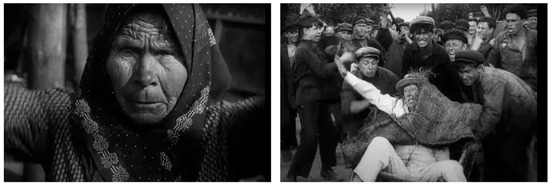
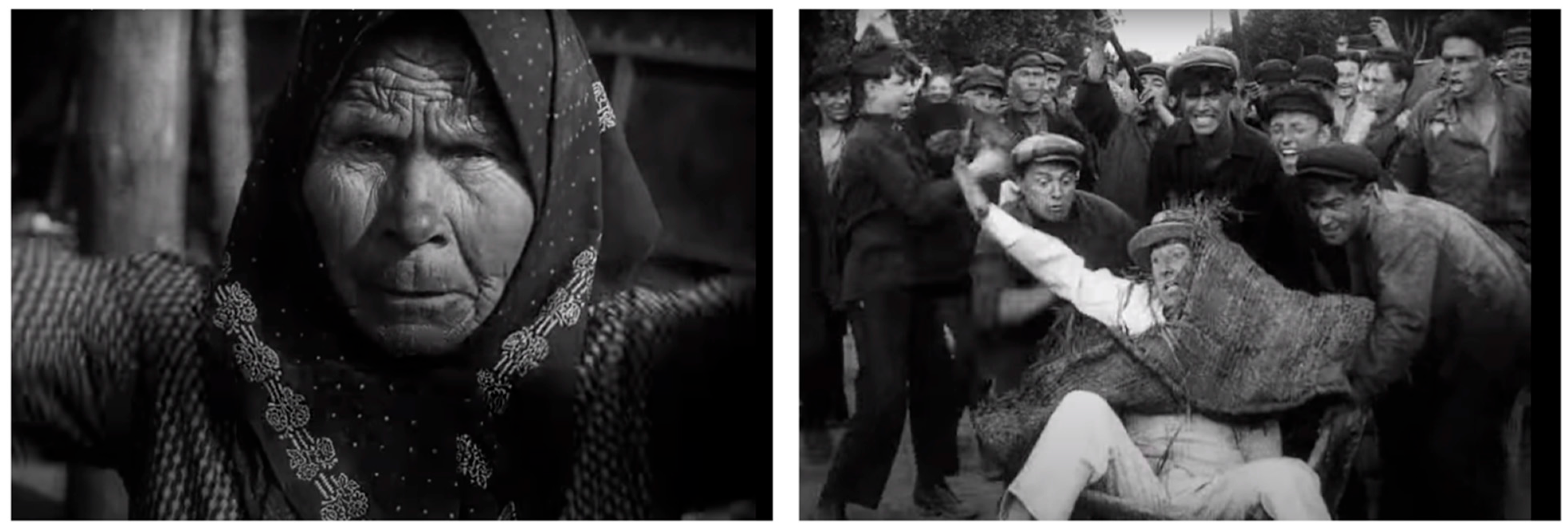
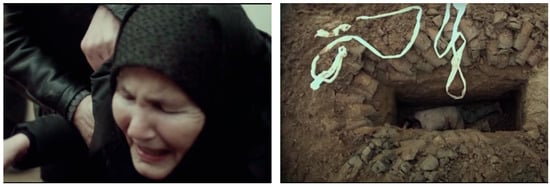
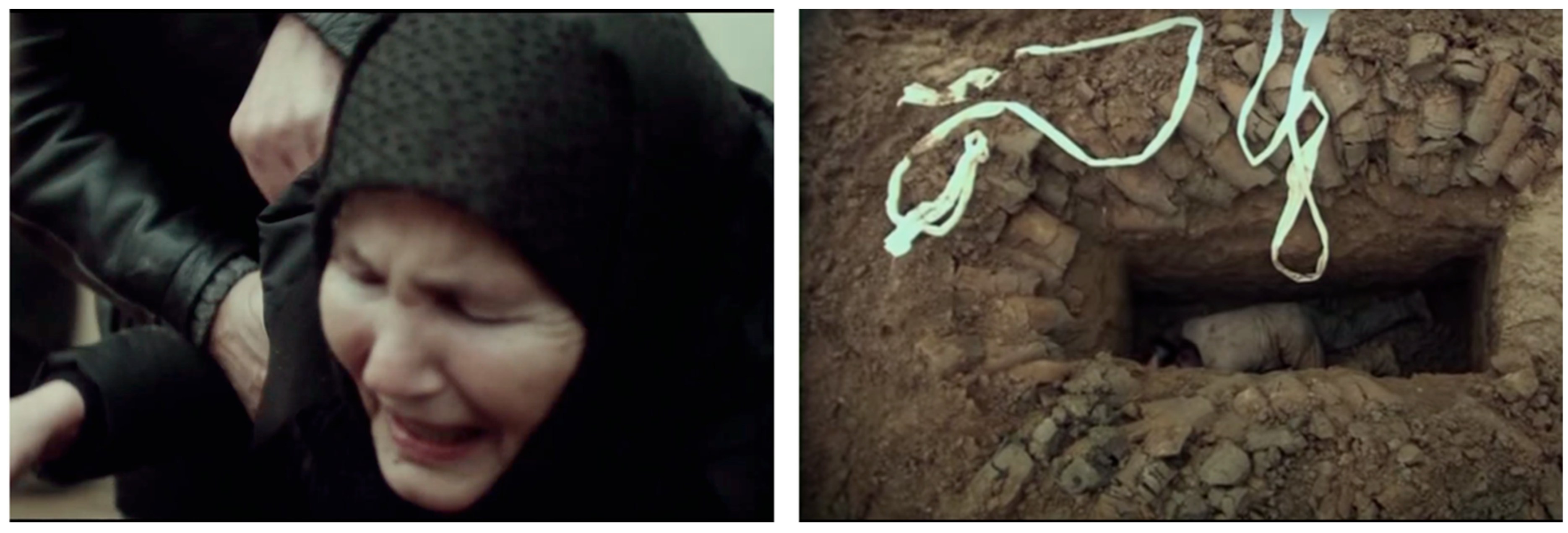
This transformation becomes explicit in the funeral scene that follows shortly thereafter, where Baskova reconstructs—again by way of inversion—one of the most iconic sequences from Strike. In Eisenstein’s film, striking workers throw two members of management down a muddy embankment and into the water, a scene rendered through rapid montage that translates collective rage into kinetic form (Figure 1).24 In Baskova’s version, it is first the corpse of a murdered activist that is toppled from an open casket into the mud, followed by Pakhomov’s character himself, who is kicked into an open grave by a grieving family member (Figure 2). Where Eisenstein’s montage accelerates, Baskova’s camera lingers. The scene unfolds not through frenetic editing and collision, but through meticulously choreographed mise-en-scène and a series of slow, deliberate traveling shots that alternate between long shots and unstable closeups, culminating in a high-angle tracking shot that pans back down over the assembled mourners producing stillness rather than tension. The scene historicizes Eisenstein’s use of form. Montage here no longer organizes collective force but seems to register its petering out. The same formal grammar—crowds, bodies, ritualized motion—individualizes rather than produces political subjectivation. This, however counterintuitive it may seem, is the scene’s critical content. The funeral becomes a site where form appears as sedimented historical experience: a once-operative aesthetic that survives as compulsion, as memory, and as depleted pathos.
Figure 1.
A closeup of an old woman (left) cheering on workers as they “cart out” a hated member of management (right) in Strike.
Figure 2.
A close up of an old woman mourning (left) after Pakhomov’s character has been kicked into the open grave (right) in For Marx….
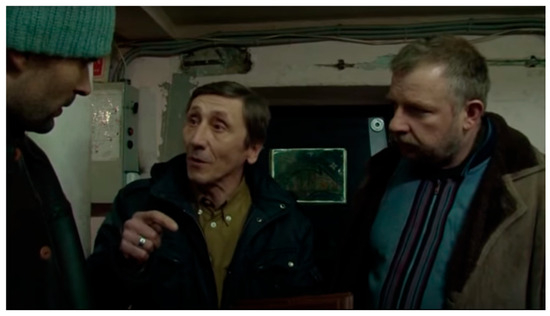
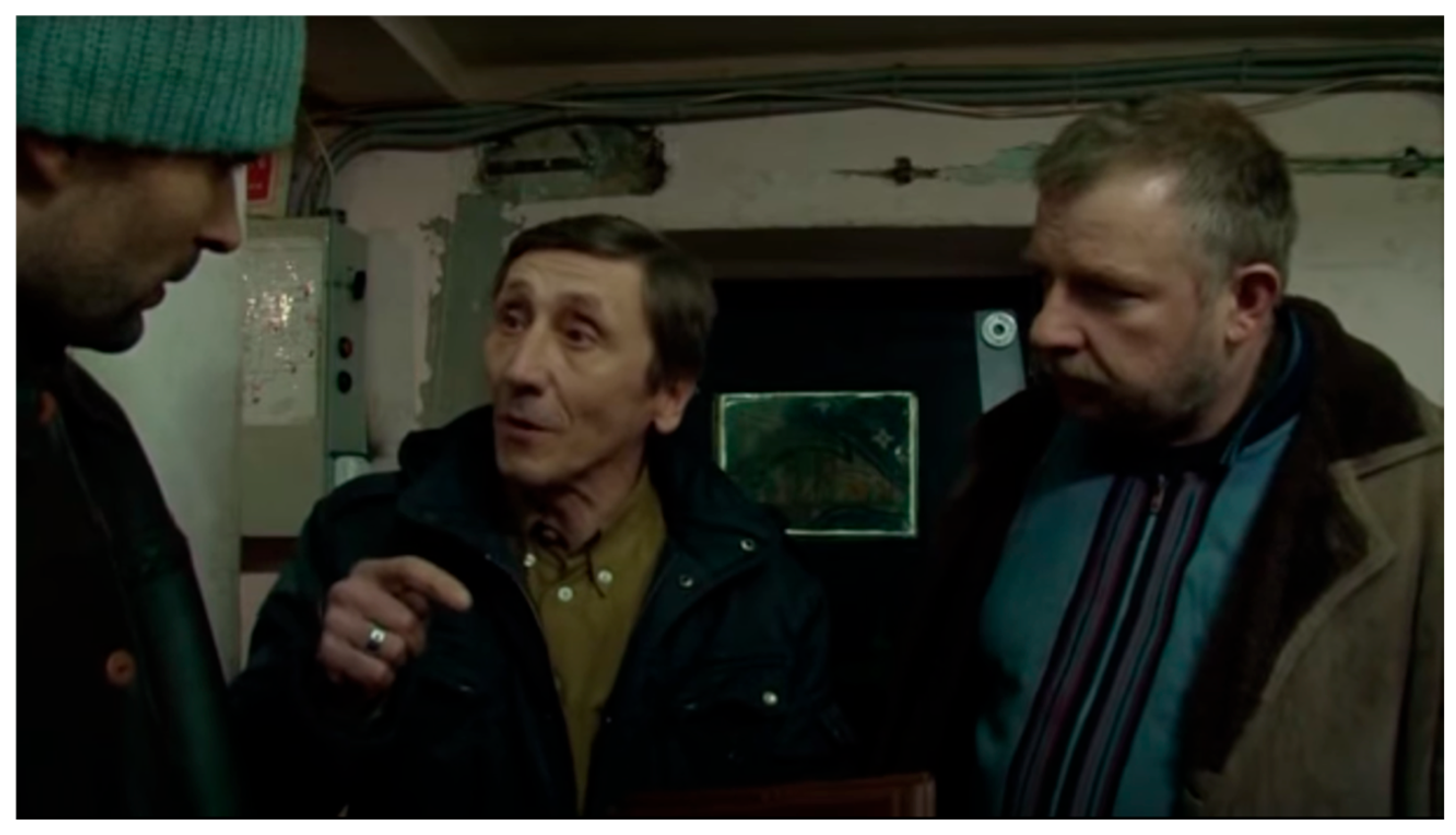
This logic extends beyond Eisenstein to the film’s engagement with Brechtian aesthetics and postwar militant cinema. If the Soviet avant-garde imagined form as a technology of socialist construction, Brechtian modernism further developed this impulse—conceived in Brecht’s terms as “interventionist thinking” (eingreifendes Denken) (Brecht [1935] 1967)—into a theory of art’s dual task of concrete intervention and elimination of the distinction between producer and consumer of art. For Marx… stages this tradition explicitly through worker conversations, particularly those organized around the factory film club. The workers reference Le Vent d’est (Wind from the East), attributed to the Dziga Vertov Group, as well as earlier allusions to La Chinoise. Peter Wollen’s influential essay on the film sees Wind From the East as Brechtian epic theater in cinematic form, and this point is not lost on Baskova’s workers (Wollen 1982).25 These citations situate Baskova’s film within a lineage that reactivated Brechtian estrangement in postwar France, linking form to ideological critique rather than mass (at least in aspiration) proletarian politics.26 Shortly before he is murdered, the labor activist whose corpse will be knocked from its coffin into the mud (here: “Activist 1”), talks to his comrades about what he has learned at film club, namely that 1960s French New Wave filmmakers (here associated specifically with Godard) made a “revolution in film” (Figure 3):
Activist 1: “Ok look, these guys made a revolution in cinema…a revolution, it’s like an extended concept…so these guys were in film and did this revolution in film.”
Figure 3.
Trade union activist (center, played by Aleksandr Kovalev) explains Brechtian film aesthetics to Sergei Pakhomov’s character (right) and a young activist before both are killed in the following scene.
Failing to self-satisfactorily explain the nature of this cinematic revolution to his non-cinephile comrades, he reads from his notes from a film lecture he attended during the cinema club:
Activist 1: So you see they…they were the first to start to bring Brecht’s system into cinema…they made a new kind of hero that executes unmotivated acts, they shot people speaking from behind.[Interrupted when Pakhomov’s character leaves to answer his phone]Activist 1: OK…you see…they said…well, I wrote it down, look: there are two main systems in cinema. One is Brecht’s, the other is Hollywood’s, or as we might rather say, Stanislavsky’s. So, Brecht’s system is the defamiliarization of the film from the viewer. So for example…if I look into the camera, that’s defamiliarization, but if a bloody massacre with its own emotional excitement were to start right now, that would be Hollywood…Young activist: I don’t understand a damn thing…Activist 1: [a few moments later] According to Brecht you’re sitting and watching the action, right? You turn on your mind and you understand yourself as a person sitting in a theater with all your problems. But for Hollywood….it sublimates negative energy and subsumes impulses to protest, so that the person would drown in the picture.Young activist: I don’t understand a damn thing…
The trio leaves the factory shortly thereafter, and both “Activist 1” and the younger activist are shot.
What is happening here? The activist describes looking directly into the camera as an instance of estrangement, and spectacular violence as the hallmark of Hollywood aesthetics. He gestures vaguely toward the camera but never quite delivers the estranging direct address he describes (one moment of direct address occurs at the very end of the film, after Pakhomov’s character has presumably died). Moments later, he is gunned down in precisely the kind of sensational violence he has just identified as ideological mystification. This is not the quintessentially postmodern dilemma of the character who realizes he is a character trapped in a narrative. Rather, the scene stages the failure of Brechtian pedagogy to maintain its efficacy. Here, the film dramatizes a central problem of committed art after the apparent collapse of its social supports. Brechtian form presupposed a public capable of achieving critical distance and a political horizon within which such distance could lead to collective agency. In For Marx…, these conditions no longer seem to obtain. Form appears simultaneously as subjective intention and objective constraint: the activist knows the theory, but the form no longer mediates between knowledge and action. The contradiction between explanation and event becomes the scene’s form and content.
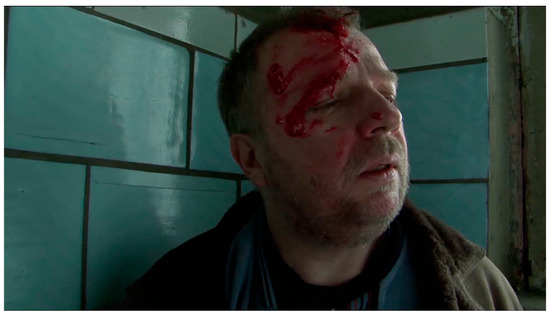
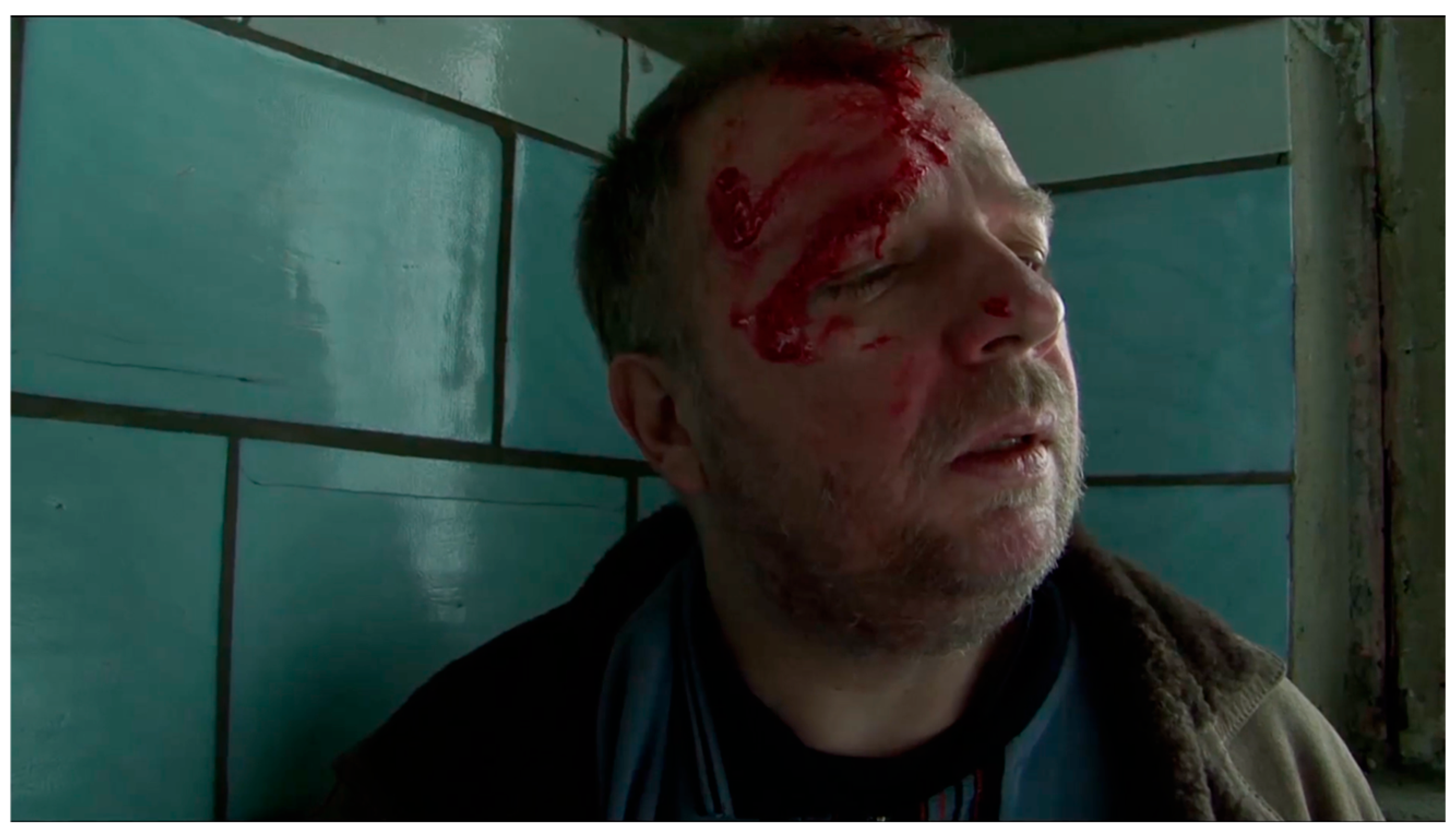
From this point onward, the film’s formal economy shifts decisively. Prior to the murder, the camerawork relies heavily on lateral panning shots, group compositions, and scenes in which speakers are framed from behind—strategies associated with Jean-Luc Godard’s militant cinema and the Dziga Vertov Group’s attempt to foreground relations of production and worker militancy. Historically, such techniques functioned as interventions into the cinematic apparatus itself, aligned with a broader “war of position” within advanced capitalist societies (Gramsci 1985, pp. 235–39). In Baskova’s film, however, their effect is muted. Rather than producing critical distance, they generate repetition and stasis. The gestures remain legible, but their political address has lost its immediacy. After the murder, two changes occur simultaneously. First, the camera increasingly privileges facial closeups of Pakhomov, individualizing him, granting psychological interiority and prompting identification from the viewer, where previously there had been almost no such possibility (Figure 4). Second, the film’s style becomes smoother and more continuous, aligning itself with Hollywood-derived norms of continuity editing. This stylistic shift coincides with a generic one: the film veers rapidly from a Godard-inflected production drama into an exaggerated gangster narrative. Boardroom conspiracies, hired thugs, and melodramatic violence take center stage, culminating in a rooftop sequence whose excess of violence many contemporary commentators found jarring.
Figure 4.
A closeup of Pakhomov’s character.
We ought to read this generic instability and inconsistency as part of the film’s central formal argument. For Marx… stages several incommensurable paradigms—avant-garde reflexivity, quasi-documentary realism, and Hollywood genre cinema—and fails to synthesize them, instead throwing them into a force field of tension. Avant-garde strategies once associated with freedom now function as constraints; genre conventions once dismissed as ideological mystification provide the only available narrative momentum. The artwork does not resolve these contradictions but takes form in and through them. Its formal incoherence is not a defect, as some critics have maintained, but a negative mimesis of real social antagonism.
This tension is further complicated by the film’s ambivalent relationship to realism. For Marx… repeatedly gestures toward documentary authenticity—through its having grown out of a documentary, location shooting, non-professional actors, and references to actual labor struggles—while simultaneously undermining any claim to transparent representation. The incursion of gangster-film tropes is particularly revealing in this respect. After the collapse of the Soviet film industry in the early 1990s, Russian cinema absorbed Hollywood genres as dominant narrative forms, with the gangster film becoming a privileged medium for registering post-Soviet violence, hypermasculinity, and social degradation.27 In For Marx…, these tropes do not simply signal commercialization; they function as historically specific forms through which the violent transition to capitalism has been lived and perceived in Russia.
The result is a film in which realism and modernism defamiliarize one another. Documentary-inflected worker meetings sit uneasily alongside stylized violence and caricatured executives. Rather than producing a coherent social totality, the film dwells within such impossibility. This impossibility mirrors the historical trajectory Baskova’s career has described through the collapse of state socialism, the shock therapy of the 1990s, and the consolidation of neoliberal capitalism. The film’s formal dissonance is thus part of its historical claim. This logic also extends to the film’s representation of class. For Marx… returns insistently to the industrial proletariat, focusing on metal workers—perhaps the most celebrated class of workers in Soviet aesthetics—in a single-industry town. Yet this return is fraught. The workers are almost exclusively male and homosocial; gender, race, and sexuality are conspicuously absent. On its own, the film risks reproducing a class-reductive imaginary. Read through its formal tensions, however, this representation becomes polemical.
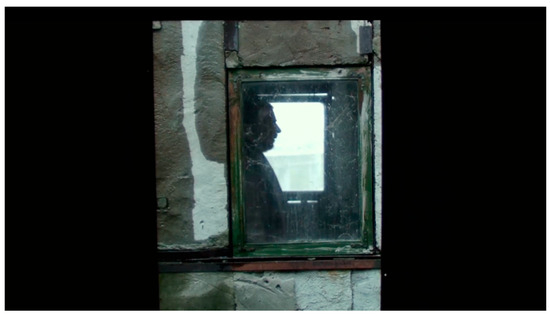
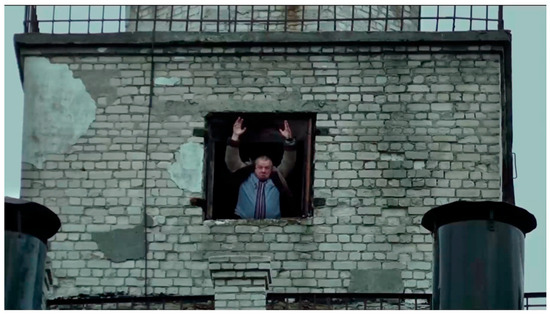
The film’s final sequence crystallizes this reading. After Pakhomov’s death, the camera follows him through factory windows in a long tracking shot recalling La Chinoise (1967) and Tout va bien (1972) (Figure 5). The movement approximates the passage of a film strip, foregrounding cinema’s materiality. This is followed by a sudden cut to Pakhomov emerging in a high window, then looking directly into the camera before climbing back inside (Figure 6). The opening is gradually covered with what appears to be black paper, evoking Malevich’s Black Square (Figure 7). This gesture refuses closure. Black Square appears not as a utopian origin but as a limit—an interruption that blocks narrative resolution. It condenses the film’s formal argument, in which the historical avant-garde’s zero point returns as a negative threshold. What remains is a formal expression of historical failure that nonetheless points beyond itself. The film does not present abolition as a positive program; rather, it clarifies why abolition—understood as the abolition of capitalism as a total social form—is both necessary and impossible at the level of representation. Therefore, For Marx… positions itself as a work of committed art whose commitment consists precisely in exposing the exhaustion of inherited forms and insisting, negatively, on the necessity of praxis beyond the artwork. The film thus tarries with its own failure and with that of workers as the revolutionary subject, and in so doing gestures in negative toward a future praxis from which it must refrain.
Figure 5.
A still from a long tracking shot after Pakhomov’s character’s death.
Figure 6.
A still of Pakhomov’s direct address in the final scene.
Figure 7.
Invocation of Malevich’s Black Square in the last moments of the film.
5. Conclusions: Tarrying with the Negative
I have argued that For Marx… should be read neither as a nostalgic return to Soviet or Western Marxist committed art, nor as a straightforward representation of class struggle under contemporary Russian capitalism. Rather, Baskova’s film stages, at the level of form, a historically specific contradiction: the simultaneous necessity of radical aesthetic strategies and their seeming exhaustion as politically efficacious mediations in the present. The film’s dense intertextual dialogue with Eisenstein, Brecht, and Godard does not function as recuperation or homage, but as an exposure of those forms as sedimented content—historical solutions that persist as aesthetic material even as plausible faith in their capacity to galvanize political agency has waned. I argue that we might understand this gesture in explicitly Adornian terms. For Adorno, the critical force of art does not lie in its capacity to model or enact political solutions, but in its ability to express, through form, the contradictions that cannot be reconciled within existing social relations. Art’s paradoxical autonomy is not a withdrawal from politics, but the condition under which it can negatively reveal the contradictions of the social totality. For Marx… exemplifies this logic. Its refusal to cohere formally—to reconcile avant-garde reflexivity, documentary realism, and genre melodrama—inscribes unreconciled social antagonism at the level of form.
What the film ultimately negates is not the possibility, or indeed the necessity, of class struggle or collective praxis, but the belief that such struggle can be meaningfully articulated through inherited paradigms alone. The Eisensteinian proletarian subject born of the collision of images, the Brechtian pedagogical gesture, and the Godardian reflexive interruption all appear, but only as forms that have become opaque to their own historical promise. Their continued availability as aesthetic resources coincides with their exhaustion as vehicles of political transformation. In this sense, For Marx… immerses itself in the historic failure and defeat of left movements. It is precisely here that the film has something to say for contemporary abolitionist aesthetics. If abolition is understood not merely as the dismantling of discrete institutions, but as the abolition of capitalism as a total social form, then For Marx… can be read as an abolitionist artwork in a negative register. The film does not offer an image of a liberated future, nor does it present images of successful resistance—in fact, it actively refuses the consolation of aesthetic revolution. It is not, however, a work of mourning or capitulation to what merely is; rather, the depth of the film’s failure is also its utopian charge. If it is nostalgic, it is for a praxis of the future toward which the history of Left attempts at political form can only take us so far. In this way, For Marx… presents its final inversion as it offers up failure not as resignation, but as determinate negation—it gestures toward a praxis that can only be made good outside the frame.
Funding
This article received not external funding.
Data Availability Statement
No new data were created or analyzed in this study. Data Sharing is not applicable to this article.
Conflicts of Interest
The author has no conflicts of interest.
Notes
| 1 | Promotional and press materials along with a list of screening locations (up to 2014) can be found at http://baskova.com/kino_za_marksa (Last accessed 5 February 2026). |
| 2 | Alain Badiou discusses Malevich’s White on White (1918) in similar terms, grouping that artwork alongside others of the “avant-garde [which] declares a formal break with preceding artistic schemata” (Badiou 2008, p. 132). It is precisely the question of this “formal break” that I find to be at stake in Baskova’s film. |
| 3 | In addition to a number of reviews and short pieces that appeared shortly after the film’s release, For Marx… has been treated most thoroughly in (Bozovic 2016) and (Kristensen 2017). It also receives brief mention in (Crowley 2015) and (Tsyrkun 2018). For a discussion of leftist post-Soviet art and poetry see (Bozovic and Djagalov 2022; Bozovic 2023). |
| 4 | Bozovic, of course, here invokes one of Louis Althusser’s central concepts developed in his Pour Marx “For Marx (1965)”, from which Baskova drew her title. With the concept of “relative autonomy” Althusser is trying to renovate Marxist philosophy away from its Hegelian iterations, and specifically to redefine the concept of totality for this purpose. He writes: “The Marxist totality is not an expressive totality in which each structure is the ‘expression’ of one and the same essence, but a totality structured in dominance, in which the relations of production are determinant in the last instance, but where the different levels of the whole are relatively autonomous and therefore capable of reacting on one another” (Althusser 2005, p. 271). He applies the concept to art specifically in (Althusser 2001, p. 221). For a critique of “relative autonomy” see (Jameson 1988, p. 16). I further discuss Althusser’s relationship to Baskova’s film more below. For a sense of how the concept of totality, rejected by Althusser and later by most cultural theory, is currently being reclaimed by scholars see (Anderman and Hicks 2023). |
| 5 | The film also premiered in Ulyanovsk in 2012. |
| 6 | The issue of “official”—read: those which collude with the state and with management—trade unions versus independent ones is discussed in Baskova’s The Only Solution is Resistance “Odno reshenie—soprotivlenie (2011)”. It is worth noting that typicality has long been a criterion for politically efficacious art within a long line of Left thinking about art that runs from Karl Marx and Friedrich Engel’s polemics with Ferdinand Lasalle through to Georg Lukács’s work on the Realist novel and into the preoccupation during French cinema’s red years with how one might, in words of the Dziga Vertov Group, “make films politically” (qtd. MacCabe 1980, p. 19). In letters to Lasalle about his play titled, Franz von Sickingen (1859), Marx and Engels each make a claim for typicality that implies a formal problem for literature seeking historical salience: the “typical” character has to line up with the historical reality they are meant to invoke (Marx and Engels 1983a, 1983b). Lukács (1983, 1993) are probably the key developments of this theory in the twentieth century. |
| 7 | Sazs remarks that after about 2001 the ‘actionist’ impulse of the 1990s shifts gears, as it were, from “[t]he ‘spectacle’ of the first years”, which hinged a highly contextualized invasion of public space during the Yeltsin era toward “the opposite strategy of [what Osmolovsky theorized as] non-spectacular art” in later years, in part as evidenced by its new openness to cinema see (Sasz 2003). |
| 8 | The film’s entire budget was about $3000, according to kinopoisk.ru. |
| 9 | On the longer trajectory of her own practice, Baskova had this to say: “Times change, and I am changing. The language in which something was said at one time is no longer interesting. After all, an artist must put forth new tasks… In this I act as a kind of trap… like towers that catch radio signals, like sticky tape for flies. I react to what is here and now. Back then I reacted like this, but today, I react differently.” (My translation. qtd. D’iakov 2012). |
| 10 | The status of Althusser’s text for Baskova herself is unclear. While Bozovic takes Althusser’s main intervention—a renewal of Marxist philosophy and thereby a critique of ossified Stalinist politics not least through positing a “relative autonomy” of art that would exceed party control—to be central to the film, in a personal communication with author Baskova claimed no familiarity with Althusser, asserting that the title was “just a title.” Elsewhere Baskova claimed that the film’s title is not a call for a return to Althusser, as it ends, in her words, “not with an exclamation point, but with ellipses—suggesting meditation” (qtd. Manchuk 2013). |
| 11 | For a cogent summary of recent aesthetic autonomy, or “art and value” debates see (Waller 2023). |
| 12 | See also Brown’s recent uptake in (Brown 2019, pp. 1–39). |
| 13 | Brown (2019, p. 7): Here Brown riffs on Michael Fried’s distinction between “art” and “object”, transposing it into the difference between (autonomous) art and commodity. For the now-classic discussion see (Fried 1998). |
| 14 | While even a schematic accounting of Adorno’s complex relationship to cinema is beyond the scope of this essay, we can note Miriam Hansen’s call decades ago to reread his oeuvre “against the grain” in light of later essays like “Filmtransparente” (“Transparencies on Film”). See (Hansen 1981) Deliberate developments of Adornian aesthetic theory in cinematic practice are also to be found in the work of Adorno’s former student, Alexander Kluge, and the Austrian director Michael Haneke. |
| 15 | The reference is to Pierre Bourdieu, for whom a kind aesthetic autonomy from the larger market could be guaranteed within a “field of restricted production” constituted by intellectuals and artistic professionals (Bourdieu 1993). |
| 16 | A locus classicus of debates around “committed” versus “autonomous” would be Adorno’s much-discussed essay “Commitment” and the essays collected in Aesthetics and Politics (Adorno et al. 2007). |
| 17 | This was one explicit focus of the 2010 and 2011 “May Congress of Art Workers” events in Moscow, which were inspired by New York City’s Art Workers Coalition (AWC) from the late 1960s and early 1970s. See https://maycongress.wordpress.com/about/ (last accessed 5 March 2023) See also (Clément 2007; Chehonadskih 2010) For a thorough Bourdieusian account of post-Soviet art and the transition to capitalism, see (Herrala 2022). |
| 18 | “Foam on the oil pipeline” is my loose translation of art historian Lioudmila Voropai, who, concerning the “second institutionalization” of Russian art in the early 2000s, writes: “In this case, the term “institutionalization” refers to the active development of institutional infrastructure that began in the mid-2000s, including the creation of new galleries, museums, foundations and art centers, publishing houses, magazines, among others. From the perspective of the “political economy” of this process, such institutional development became possible against the backdrop of the relative economic prosperity and stability of the 2000s, established then by high oil prices on the global market. Investments of private, corporate, and public funds in various cultural projects (jokingly referred to as “foam on the pipe”) were, among other things, a way for the new Russian business elite to cultivate their own image, both “for export” and “for domestic consumption.” (my translation and emphasis; Voropai 2009, 2017). |
| 19 | In evidence here is the State Resolution about the founding of the federal “Russian Culture” initiative, which contained the following: “The state’s investment in culture is an investment in ‘human capital’…Strengthening the position of Russian culture abroad, the formation of the image of Russia as a country of great cultural traditions is an integral part of the state strategy of integration into the system of international relations.” The resolution also calls for public/private partnerships: “development of the market of cultural values, joint participation of the state and business in the development of this market and likewise in economically effective projects in the area of culture.” (my translation; Pravitel’stvo Rossiiskoi Federatsii 2005). |
| 20 | On the flexibilization of labor in Russia see (Morris 2012, 2021). On industrial restructuring and single industry towns like the one depicted For Marx… see (Crowley 2016). The early 2000s is marked by a small resurgence of left art in Russia variously positioned against these social transformations. Emblems of this change include: the publication of Anatoly Osmolovsky’s “A Number of Theses on Non-Spectacular Art” (2002), the formation of the Chto Delat? group (2003), Kirill Medvedev’s renunciation of copyright on his poetry (2004), the publication of Yevgeniy Fiks’s “Responsibilities of the post-Soviet Artist” (2007), and the above-mentioned May Congress of Art Workers. |
| 21 | Read in this way, the film’s critical purchase cannot be its resistance to what Kristensen (2017) has called Russia’s “national neoliberalism” by means of its “non-cinematic” elements. If we read labor and art as structurally homologous under capitalism, then uneasy access to the labor and art markets is neither a form of resistance—this precarity is the structural condition of capital accumulation as such in its neoliberal or financialized phase and thus not a form of resistance to it—nor an escape hatch into a non-capitalist realm of freedom. For an elaboration of this basic argument with regard to contemporary art see (La Berge 2019). |
| 22 | In his classic essay “From Faktura to Factography” Buchloh notes the Avant-Garde move in the mid-1920s toward art practice that took seriously the transformation of “forms of distribution and institutions of dissemination and reception” that would be necessary to address a mass, newly proletarianized audience (Buchloh 1987). |
| 23 | The quotation reads: “The strength of the working class lies in its organization. Without organization, the proletariat is nothing. Organized, it is everything. Organization is the unity of action, the unity of practical operations” (Translation modified; Lenin 1965). |
| 24 | With this scene, Eisenstein depicted an actual historical practice of Tsarist-era factory workers “carting out” hated managers and administrators, often literally using wheelbarrows for the purpose. For a discussion of the practice see (Smith 1986, pp. 55–57). |
| 25 | For more on Brecht’s influence on Godard and the Dziga Vertov Group, see (Lesage 1983; Emmelhainz 2018, pp. 55–62). For a broader view of militant French cinema of the period see (Grant 2016). |
| 26 | The development of Brechtian aesthetics in the French cinema of 1968 (and in Godard’s work in particular) has proven interesting to a range of post-Soviet left artists. The year before For Marx…’s release, Baskova and Anatoly Osmolovsky’s Baza Institute also dedicated an entire issue of their in-house journal to a Russian translation of articles from the Tel Quel group. The issue features a piece by Osmolovsky on Godard’s montage, and its compiler Jean-Pierre Salgas elsewhere links part of the significance of Tel Quel for post-Soviet Russia explicitly to that milieu’s reception of early-Soviet formalism via Brecht (Sal’gas 2011). Two years before this publication, the poet and musician Kirill Medvedev’s Free Marxist Press publishing house, with financial help from the Chto Delat? group, released a book dedicated entirely to Godard’s Marxist period (Adibekov et al. 2010). For their part, the Chto Delat? group has produced their own remakes and reworkings of Godard and Dziga Vertov Group films and engaged quite extensively with Brechtian aesthetic theory and practice in general, as well as its influence on Godard and his milieu in particular (e.g., Kirkkopelto and Magun 2006; Vilensky 2006, 2007; Oleynikov et al. 2009). |
| 27 | For an important study of violence and organized crime in the making of post-Soviet Russian capitalism see (Volkov 2002). On the dismantling of the Soviet film industry and the flood of Hollywood films in post-Soviet Russia see (Faraday 2000; Condee 2009, chap. 2) On the role of the gangster film in particular see (Oushakine 2007; Fedorova 2018). |
References
- Adibekov, Kirill, Anis’ia Kazakova, and Kirill Medvedev, eds. 2010. Bor’ba Na Dva Fronta: Zhan-Liuk Godar i Gruppa Dziga Vertov 1968–1972. Moscow: Svobodnoe Marksistskoe Izdatel’stvo. [Google Scholar]
- Adorno, Theodor W. 1991. Extorted Reconciliation: On Georg Lukács’ Realism in Our Time. In Notes to Literature. Edited by Rolf Tiedemann. Translated by Shierry Weber Nicholsen. New York: Columbia University Press, vol. 1. [Google Scholar]
- Adorno, Theodor W. 1992. Commitment. In Notes to Literature. Edited by Rolf Tiedemann. Translated by Shierry Weber Nicholsen. New York: Columbia University Press, vol. 2. [Google Scholar]
- Adorno, Theodor W. 2015. Aesthetic Theory. Edited by Gretel Adorno and Rolf Tiedeman. Translated by Robert Hullot-Kentor. London: Continuum. [Google Scholar]
- Adorno, Theodor W., Walter Benjamin, Ernst Bloch, Bertolt Brecht, and György Lukács. 2007. Aesthetics and Politics. Edited by Fredric Jameson. London: Verso. [Google Scholar]
- Althusser, Louis. 1965. Pour Marx. Paris: François Maspero, S.A. [Google Scholar]
- Althusser, Louis. 2001. Lenin and Philosophy, and Other Essays. Translated by Benjamin Robert Brewster. New York: Monthly Review Press. [Google Scholar]
- Althusser, Louis. 2005. For Marx. Translated by Ben Brewster. London: Verso. [Google Scholar]
- Althusser, Louis. 2006. Za Marksa. Translated by A. V. Denezhkina. Oslo: Praksis. [Google Scholar]
- Anderman, Nicholas, and Zachary Hicks. 2023. The Pot Still Boils: Introducing Totality and Culture. Qui Parle: Critical Humanities and Social Sciences 32: 1–39. [Google Scholar] [CrossRef] [Scilit]
- Backhaus, Hans-Georg. 1992. Between Philosophy and Science: Marxian Social Economy as Critical Theory. In Open Marxism 1. London: Pluto Press. [Google Scholar]
- Badiou, Alain. 2008. The Century. Translated by Alberto Toscano. Cambridge: Polity Press. [Google Scholar]
- Barskova, Polina. 2013. Svetlana Baskova: For Marx (Za Marksa, 2012). Kino Kultura. Issue 39. Available online: http://www.kinokultura.com/2013/39r-zamarksa.shtml (accessed on 5 March 2023).
- Beller, Jonathan. 2006. The Cinematic Mode of Production: Attention Economy and the Society of the Spectacle. Hanover: Dartmouth College Press. [Google Scholar]
- Bourdieu, Pierre. 1993. The Market of Symbolic Goods. In The Field of Cultural Production: Essays on Art and Literature. Edited by Randall Johson. New York: Columbia University Press. [Google Scholar]
- Bozovic, Marijeta. 2016. For Marx: The New Left Russian Cinema. Cinema 8: 108–30. [Google Scholar]
- Bozovic, Marijeta. 2023. Avant-Garde Post-: Radical Poetics After the Soviet Union. Cambridge: Harvard University Press. [Google Scholar]
- Bozovic, Marijeta, and Rossen Djagalov. 2022. Post-Soviet Aesthetics. In After Marx: Literature, Theory, and Value in the Twenty-First Century. Edited by Christopher Nealon and Colleen Lye. Cambridge: Cambridge University Press. [Google Scholar]
- Brecht, Bertolt. 1967. Fragen Des Dialektischen Theaters. In Schriften zum Theater. Edited by Werner Hecht, Jan Kopf, Werner Mittzenzwei and Klaus-Detlef Müller. Berliner Und Frankfurter Ausgabe. Brecht: Werke, Berlin: Aufbau Verlag, vol. 20. First published 1935. [Google Scholar]
- Brik, Osip. 1923. T. N. ‘Formalnyi Method’. Lef. Zhurnal Levogo Fronta, 213–15. [Google Scholar]
- Brown, Nicholas. 2019. Autonomy: The Social Ontology of Art Under Capitalism. Durham: Duke University Press. [Google Scholar]
- Buchloh, Benjamin. 1987. From Faktura to Factography. In October: The First Decade, 1976–1986. Edited by Annette Michelson, Rosalind Krauss, Douglas Crimp and Joan Copjec. Cambridge: MIT Press. [Google Scholar]
- Chehonadskih, Maria. 2010. 48 Hours of Common Effort: How Cultural Workers and Political Activists Met and Talked. Live, Think, Act Politically, June 30.
- Chukhrov, Keti. 2011. Art after Primitive Accumulation: Or, on the Putin-Medvedev Cultural Politics. Afterall: A Journal of Art, Context and Enquiry 26: 127–36. [Google Scholar] [CrossRef] [Scilit]
- Clément, Carine. 2007. Fleksibel’nost’ po-russki: Sgibaemye i nesgibaemye rabotniki. Otechestvennye Zapiski, 1–13. [Google Scholar]
- Condee, Nancy. 2009. The Imperial Trace: Recent Russian Cinema. Oxford: Oxford University Press. [Google Scholar]
- Condee, Nancy. 2012. Fifteen Realities of Russian Cinema (Kinotavr 2012). Kino Kultura. Available online: http://www.kinokultura.com/2012/38---condee.shtml (accessed on 4 March 2023).
- Crowley, Stephen. 2015. The Reemergence of Class in the Wake of the First ‘Classless’ Society. East European Politics and Societies 29: 698–710. [Google Scholar] [CrossRef] [Scilit]
- Crowley, Stephen. 2016. Monotowns and the Political Economy of Industrial Restructuring in Russia. Post-Soviet Affairs 32: 397–422. [Google Scholar] [CrossRef] [Scilit]
- D’iakov, Aleksandr. 2012. ‘Za Marksa…’ Svetlany Baskovoi: ‘Ia prezhde vsego khudozhnik, a ne ideolog’. Biulleten‘ Kinoprokatchika. July 6. Available online: http://www.kinometro.ru/oldblog/2012/06/za-marksa-interview/ (accessed on 5 March 2023).
- Eisenstein, Sergei. 1988. The Problem of a Materialist Approach to Form. In Selected Works: Writings, 1922–34. Edited by Richard Taylor. London: British Film Institute. [Google Scholar]
- Emmelhainz, Irmgard. 2018. Jean-Luc Godard’s Political Filmmaking. Berlin/Heidelberg: Springer. [Google Scholar]
- Faraday, George. 2000. Revolt of the Filmmakers: The Struggle for Artistic Autonomy and the Fall of the Soviet Film Industry. University Park: Pennsylvania State University Press. [Google Scholar]
- Fedorova, Lioudmila. 2018. The Russia They Have Lost. In A Companion to the Gangster Film. Edited by George S. Larke-Walsh. Hoboken: John Wiley & Sons, Inc. [Google Scholar]
- Fore, Devin. 2006. The Operative Word in Soviet Factography. October 118: 95–131. [Google Scholar] [CrossRef] [Scilit]
- Fried, Michael. 1998. Art and Objecthood. In Art and Objecthood: Essays and Reviews. Chicago: University of Chicago Press. [Google Scholar]
- Gramsci, Antonio. 1985. Selections from the Prison Notebooks of Antonio Gramsci, 8th ed. Edited by Quintin Hoare and Geoffrey Nowell Smith. New York: International Publishers. [Google Scholar]
- Grant, Paul Douglas. 2016. Cinéma Militant: Political Filmmaking and May 1968. New York: Columbia University Press. [Google Scholar]
- Gutov, Dmitri, and Anatoly Osmolovsky. 2012. Tri spora. Moskva: Grundrisse. [Google Scholar]
- Hansen, Miriam Bratu. 1981. Introduction to Adorno, ‘Transparencies on Film’ (1966). New German Critique 24–25: 186–98. [Google Scholar] [CrossRef] [Scilit]
- Herrala, Elise. 2022. Art of Transition: The Field of Art in Post-Soviet Russia. Oxfordshire: Routledge. [Google Scholar]
- Jameson, Fredric. 1988. Periodizing the ’60s. In The Ideologies of Theory: Essays 1971–1986. Minneapolis: University of Minnesota Press. [Google Scholar]
- Khlebnikov, Velimir, and Al’vek. 1927. Vsem; Nochnoi bal; Maiakovskii-Aseev/Al’vek. Moskva: Izd. avtora. [Google Scholar]
- Kirkkopelto, Esa, and Artemy Magun. 2006. Brecht. Earth. Helsinki. December. Coffee. Cigarettes. Kirkkopelto. Magun. Chto Delat? January.
- Kristensen, Lars. 2017. Svetlana Baskova’s Response to Russian National Neoliberalism in For Marx…. In Contemporary Cinema and Neoliberal Ideology, 1st ed. Edited by Lars Kristensen and Ewa Mazierska. Oxfordshire: Routledge. [Google Scholar]
- La Berge, Leigh Claire. 2019. Wages Against Artwork: Decommodified Labor and the Claims of Socially Engaged Art. Durham: Duke University Press. [Google Scholar]
- Lenin, Vladimir Ilich. 1965. Party Discipline and the Fight Against the Pro-Cadet Social-Democrats. In Collected Works. Moscow: Progress Publishers, vol. 11. [Google Scholar]
- Lesage, Julia. 1983. Godard and Gorin’s Left Politics, 1967–1972. Jump Cut: A Review of Contemporary Media 28: 51–58. [Google Scholar]
- Lukács, Georg. 1983. The Historical Novel. Lincoln: University of Nebraska Press. [Google Scholar]
- Lukács, Georg. 1993. The Theory of the Novel: A Historico-Philosophical Essay on the Forms of Great Epic Literature, 11th ed. Cambridge: MIT Press. [Google Scholar]
- MacCabe, Colin. 1980. Godard: Images, Sounds, Politics. New York: Macmillan. [Google Scholar]
- Manchuk, Andriy. 2013. ‘Za Marksa…’. Pochemu troetochie? Liva Internet Zhurnal. March 13. Available online: http://liva.com.ua/za-marxa.html (accessed on 5 March 2023).
- Martin, Stewart. 2000. Autonomy and Anti-Art: Adorno’s Concept of Avant-Garde Art. Constellations 7: 197–207. [Google Scholar] [CrossRef] [Scilit]
- Martin, Stewart. 2007. The Absolute Artwork Meets the Absolute Commodity. Radical Philosophy 146: 15–25. [Google Scholar]
- Marx, Karl, and Friedrich Engels. 1983a. Engels to Ferdinand Lasalle. 18 May 1859. In Marx-Engels Collected Works (MECW). London: Lawrence & Wishart, vol. 40. [Google Scholar]
- Marx, Karl, and Friedrich Engels. 1983b. Marx to Ferdinand Lasalle. 19 April 1859. In Marx-Engels Collected Works (MECW). London: Lawrence & Wishart, vol. 40. [Google Scholar]
- Mikhailova, Anna. 2013. Baskova Za Marksa. Simbirskii Kur’er. March 30. Available online: http://sim-k.ru/2013/03/30/baskova-za-marksa/ (accessed on 5 March 2023).
- Morris, Jeremy. 2012. Unruly Entrepreneurs: Russian Worker Responses to Insecure Formal Employment. Global Labour Journal 3: 217–36. [Google Scholar] [CrossRef] [Scilit]
- Morris, Jeremy. 2021. From Prefix Capitalism to Neoliberal Economism: Russia as a Laboratory in Capitalist Realism. Sociology of Power 33: 193–221. [Google Scholar] [CrossRef] [Scilit]
- Nemchenko, Liliia. 2012. V Ozhidanii Marksa. ‘Za Marksa…’, Rezhisser Svetlana Baskova. Iskusstvo Kino. August. Available online: https://old.kinoart.ru/archive/2012/08/v-ozhidanii-marksa-za-marksa-rezhisser-svetlana-baskova (accessed on 2 March 2023).
- Oleynikov, Nikolai, Oleg Zhuravlev, Dmitri Vilensky, and Kirill Medvedev. 2009. 2 + 2: Two Plus Two: The Story of the ‘Communal Life’ Seminar (Material for a Screenplay). Chto Delat? May.
- Oushakine, Serguei Alex. 2007. Aesthetics Without Law: Cinematic Bandits in Post-Soviet Space. The Slavic and East European Journal 51: 357–90. [Google Scholar]
- Pravitel’stvo Rossiiskoi Federatsii. 2005. Postanovlenie ot 8 dekabria 2005 g. No. 740 “O federalʹnoi tselevoi programme ‘Kulʹtura Rossii (2006–2011 gody).’”. Moscow: Pravitel’stvo Rossiiskoi Federatsii. [Google Scholar]
- Roberts, John. 2010. Art and Its Negations. Third Text 24: 289–303. [Google Scholar] [CrossRef] [Scilit]
- Roberts, John. 2015. Revolutionary Time and the Avant-Garde. London: Verso. [Google Scholar]
- Sal’gas, Jean-Pierre. 2011. ‘Tel’ Kel’’ Na russkoi pochve [Interview with Jean-Pierre Sal’gas]. Radio Svoboda. October 26. Available online: https://www.svoboda.org/a/24372426.html (accessed on 4 March 2023).
- Sasz, Nele. 2003. ‘Radical’ Art in Russia, the 1990s and Beyond. Art Margins Online. June 11. Available online: https://artmargins.com/qradicalq-art-in-russia-the-1990s-and-beyond/ (accessed on 3 March 2023).
- Smith, Stephen Anthony. 1986. Red Petrograd: Revolution in the Factories 1917–1918. Cambridge: Cambridge University Press. [Google Scholar]
- Stakemeier, Kerstin, and Marina Vishmidt. 2016. Reproducing Autonomy: Work, Money, Crisis and Contemporary Art. London: Mute. [Google Scholar]
- Tsyrkun, Nina Aleksandrova. 2018. Levaia ideologiia v postsovetskom rossiiskom kino. Mezhdunarodnyi zhurnal issledovanii kul’tury 2: 205–15. [Google Scholar]
- Vilensky, Dmitri. 2006. Why Brecht? Chto Delat? 2006.
- Vilensky, Dmitri. 2007. What Does It Mean to Make Films Politically Today? Chto Delat? September.
- Vishmidt, Marina. 2013. ‘Mimesis of the Hardened and Alienated’: Social Practice as Business Model. E-Flux Journal 43. Available online: https://www.e-flux.com/journal/43/60197/mimesis-of-the-hardened-and-alienated-social-practice-as-business-model/#:~:text=The%20title%20%E2%80%9CMimesis%20of%20the,art%20surmount%20the%20heteronomous%20market (accessed on 4 March 2023).
- Vishmidt, Marina. 2019. Speculation as a Mode of Production: Forms of Value Subjectivity in Art and Capital. Chicago: Haymarket Books. [Google Scholar]
- Volkov, Vadim. 2002. Violent Entrepreneurs: The Use of Force in the Making of Russian Capitalism. Ithaca: Cornell University Press. [Google Scholar]
- Voropai, Liudmila. 2009. Beta-versiia avtopoezisa. Khudozhestvennyi zhurnal/Moscow Art Magazine 71–72. Available online: https://moscowartmagazine.com/issue/21/article/314 (accessed on 4 March 2023).
- Voropai, Liudmila. 2017. O nekotorykh momentakh sotsialʹnoi istorii sovremennogo iskusstva v Rossii desiatykh godov dvadtsatʹ pervogo veka. Khudozhestvennyi zhurnal/Moscow Art Magazine 100: 134–43. [Google Scholar]
- Waller, Thomas. 2023. Stably Unusual: Artistic Labor and Aesthetic Autonomy. Qui Parle: Critical Humanities and Social Sciences 32: 395–428. [Google Scholar] [CrossRef] [Scilit]
- Wollen, Peter. 1982. Godard and Counter Cinema: Vent d’est. In Readings and Writings: Semiotic Counter-Strategies. London: Verso. [Google Scholar]
- Za Marksa. 2013. Interv’iu Baskovoi i Pakhoma Magiia Kino. Available online: https://www.youtube.com/watch?v=bvtCPbLZu3I (accessed on 3 March 2023).
Disclaimer/Publisher’s Note: The statements, opinions and data contained in all publications are solely those of the individual author(s) and contributor(s) and not of MDPI and/or the editor(s). MDPI and/or the editor(s) disclaim responsibility for any injury to people or property resulting from any ideas, methods, instructions or products referred to in the content. |
© 2026 by the author. Licensee MDPI, Basel, Switzerland. This article is an open access article distributed under the terms and conditions of the Creative Commons Attribution (CC BY) license.