


Abstract
While recent game research explores culture and Orientalism, a significant gap remains regarding Sinologism. Gu proposed Sinologism based on Orientalism, laying the theoretical foundation for this study. Utilizing the analytical framework of Chapman and Šisler, this study examines the characteristics of Sinologism within and outside the game, including its scenes, characters, items, abilities, skills, and narrative style. The cultural practice of Black Myth: Wukong exemplifies the complex dynamics described by “Sinologism.” Operating within the globalized framework of the video game industry, it negotiates with Western perspectives while, to a certain extent, challenging established Orientalist modes of representation. However, this study argues that its success is not a result of “complicit” strategies that merely replicate dominant paradigms. Instead, it represents a reconstruction of “cultural subjectivity.” By combining high production values with familiar ARPG conventions, the game makes culturally dense elements more legible to international audiences, encouraging engagement with indigenous cultural logic rather than defaulting to externally imposed interpretive frames. Accordingly, Black Myth: Wukong stands as a paradigmatic case, illustrating how Chinese developers attempt to negotiate agency within an asymmetrical Sino-Western structure to seek autonomous expression amidst structural constraints.
1. Introduction
Not only have video games achieved great business success, but they have also gradually caught the attention of many academic scholars. Video game research is a cross-disciplinary field encompassing computer science, cultural studies, communication studies, philosophy, and design. Some researchers propose that video games exert more influence than traditional entertainment products, often embedding political elements with far-reaching consequences. Some studies categorize the post-9/11 military shooter video games as examples of “Neo-Orientalism” (Höglund 2008). These games draw on the “military-entertainment complex” to sustain Western imperialist policies by reinforcing stereotypes. On the other hand, the Arab countries are portrayed as the origin of terrorism and as backward, irrational, and politically chaotic regions. Chinese video games have similarly been shaped by “Neo-Orientalism.” However, existing analyses in this area often lack depth and fail to yield substantive insights at the discourse level. To address these theoretical gaps, this study focuses on Black Myth: Wukong (Game Science 2024) as a primary case study. Methodologically, we employ a multi-layered analytical framework—encompassing audiovisual, narrative, and procedural dimensions—to decode how the game negotiates cultural agency and challenges traditional Orientalist tropes.
How to challenge these stereotypes? Although Edward Said’s seminal work, Orientalism (Said [1978] 2021), powerfully exposes how Western hegemonic discourse distorts perceptions of Asian and Islamic cultures, his analysis focuses primarily on West Asia and the Middle East. As a Palestinian scholar with lived experience as a colonial subject, Said profoundly deconstructs the problem of the Western gaze; however, his framework does not fully articulate what authentic East Asian—particularly Chinese—cultural expressions look like. Furthermore, because China was never fully colonized, but rather characterized by scholars as a “semi-colony” (Shih 2001), traditional post-colonial theories often require modification when applied to the Chinese context. Consequently, further scholarship is needed to theorize an indigenous Chinese perspective that moves beyond the mere critique of Western representation to actively reconstruct cultural subjectivity. Filling this theoretical gap has thus led to the development of China-specific frameworks, such as Sinological Orientalism and Sinologism.
The Chinese game industry has also faced similar dilemmas in the past. Some Chinese scholars (Li 2024) focus on analyzing aesthetic elements and narrative content when they study Chinese video games and concur that video games would be a high-quality medium for spreading Chinese culture. While recent scholarship has begun to address the global rise of Chinese games—such as Kong’s (2024) analysis of “Guochao” and post-Orientalism—most existing literature evaluates Chinese games primarily through the lens of “soft power” or surface-level visual aesthetics. Consequently, a significant scholarly gap remains regarding how indigenous cultural logic fundamentally negotiates with Western paradigms at the deeper, structural level of game design. Therefore, there is an urgent need to specifically examine how Black Myth: Wukong navigates the theoretical tensions of Sinologism not only through its rich audiovisual presentation but also through its underlying gameplay mechanics.
This paper addresses this gap by investigating how Sinologism manifests in the Chinese action role-playing game (ARPG) Black Myth: Wukong, and how the game’s cultural representation challenges dominant stereotypes. Specifically, we focus on (1) the game’s narrative and aesthetic layers, (2) the interplay between Western and Chinese cultural elements, and (3) the implications for cross-cultural communication and mutual understanding. By doing so, this manuscript contributes to existing scholarships by introducing the concept of Sinologism to transcend traditional Orientalist binaries and by bridging cultural studies with ludology to demonstrate how a non-Western cultural product claims cultural subjectivity within the Western-dominated AAA gaming industry. Before discussing this research, we will clarify key concepts: classic Orientalism, self-Orientalism, Sinological Orientalism, and Sinologism.
1.1. Classic Orientalism
In his work, Said ([1978] 2021) mentions that “Orientalism is a Western style for dominating, restructuring and having authority over the Orient. Therefore, Orientalism is rather a distribution of geopolitical awareness into aesthetic, scholarly, economic, sociological, historical, and philological texts.” In other words, Said defines Orientalism as a discourse, drawing specifically on Michel Foucault’s concept of the power/knowledge nexus. This theory encouraged this discourse’s legitimization through journalism, literature, academia, and politics, and contributed to or produced British domination of the majority in the East. The United States gradually replaced Europe and established Neo-Orientalism as the world changed.
Scholarship on video game Orientalism has predominantly focused on Middle Eastern representations. Šisler (2008) argues that Western games often reduce Arab cultures to “typological depictions rooted in terrorism,” creating a dichotomy between a “civilized” West and a violent “Other.” This Orientalist framework extends to other regions, such as the Pacific (Prawadika Aji 2021), and is described by Höglund (2008) as “Neo-orientalism” in post-9/11 military shooters. Furthermore, recent studies on titles like Assassin’s Creed (Ubisoft Montreal 2007), Ghost of Tsushima (Sucker Punch Productions 2020), and Anno 1404 (Related Designs 2009) identify persistent Orientalist tropes (Buhari 2024; Komel 2015; Malmquist 2022). Notably, Assassin’s Creed Shadows (Ubisoft Quebec 2025) has faced specific criticism for exoticizing Japanese history, triggering backlash from local players.
1.2. Self-Orientalism
Classical Orientalism often overlooks the agency of the marginalized “Other” (Halliday 2003; Niyogi 2006). Consequently, later research shifted toward self-discursive expressions, introducing “Self-Orientalism.” This concept describes how Eastern subjects engage with Orientalist frames in a postcolonial context—either as an anti-colonial attempt at self-definition or as a form of “complicit” self-exploitation (Lyon Macfie 2014; al-’Azm 2014). For instance, the concept of “Reverse Orientalism” often manifests as a simple inversion. Specifically, Arab-developed games like Tahta al-Ramad (Under Ash, Afkar Media 2002), and Tahta al-Hisar (Under Siege, Afkar Media 2005) (Komel 2015) shift negative depictions onto Western targets instead of addressing the nuanced issues within Arab societies. In his analysis, Šisler (2008) nonetheless highlights opportunities to challenge Orientalist frames: either by subverting conventional narratives and gameplay or by introducing Islamic perspectives that humanize Arab and Muslim characters. However, Komel (2015) argues that if Orientalism’s main function is to reinforce a basic ontological divide between East and West, then self-Orientalism functions similarly by exploiting that divide. Such games may uphold Orientalist binaries by using stereotypes to resist stereotypes, ultimately undermining efforts to dismantle them (Saber and Webber 2017).
“Complicit Orientalism” occurs when Eastern subjects leverage Western stereotypes of the East to serve their interests. In Complicit Exoticism: Japan and Its Others, Iwabuchi (1994) argues that the relationship between the West’s Orientalist discourse on Japan and Japan’s discourse on itself is characterized by a profound complicity. Both tend to use the Other to essentialize the Self and to repress the heterogeneous voices within. This perspective opens a dimension of power/knowledge alliance within the nation and between nations. Malmquist (2022), drawing on Benedict’s The Chrysanthemum and the Sword, observes that Western culture embraces and reproduces certain ideas of Orientalism in its engagement with Japan, leading to products such as Ghost of Tsushima. American developers often reinforce stereotypes, such as the samurai’s collectivist ethos, whereas the Japanese themselves sometimes promote a “Japaneseness” rooted in samurai culture. This phenomenon illustrates how Eastern countries may also adopt a complicit stance in response to Western Orientalist discourses.
1.3. Sinological-Orientalism, Sinologism
Unlike Classical Orientalism’s focus on the Middle East, Vukovich (2013) proposed Sinological Orientalism to describe the specific Sino-Western dynamic. It emphasizes “homogeneity” instead of the essential differences between East and West in Classical Orientalism. Although the process of homogenization (becoming the same) is inevitable while still establishing hierarchical differences, it bestows the West a kind of certain positional superiority. This theory represents China’s indispensable role in global capitalism construction, and the West has an ambivalent attitude toward it. On the other hand, Sinological Orientalism affects the international community’s perception of China and its cultural identity.
This framework exerts pressure on Chinese cultural products to align with Western expectations in the international market, risking a China-specific form of complicity distinct from the Japanese context. Examining game-related media discourse, Wirman (2016) applied this theoretical framework to examine Western news media coverage of Chinese games and found “the barbarizing, racist Sinological orientalism still exists in Western news media,” but the Chinese games as a popular cultural image less occupied by the strongly political meanings suggested by Vukovich’s study of Sinological-Orientalism.
Gu (2015) proposed Sinologism based on Orientalism, which is different from Orientalism created unilaterally by the West and is a process of knowledge construction involving China and the West. It is an implicit concept, theory, and paradigm system, established from the original contact between China and the West and used to understand the complexity of Chinese cultures. Gu considers that not only Western scholars adopt perspectives and standards in their study of China, but some Chinese scholars also unconsciously accept such judgmental criteria, leading to the simplification and distortion of Chinese culture in research. In addition, he highlights the dual self-extremist tendency of Sinology, where some Chinese scholars are overly reliant on Western theories. They believe Chinese culture needs to be understood and uplifted through Western perspectives, exhibiting a cultural inferiority complex and presenting a certain tendency of complicity. Another group of scholars rejects Western theories completely because they emphasize the uniqueness and superiority of Chinese culture, which cannot be understood by the West. However, China and the West are involved in the construction of knowledge related to Black Myth: Wukong together and choose the Confucian doctrine of the Mean methods to promote cross-cultural communication instead of dual self-extremist tendencies. For ease of comparison, Table 1 consolidates the core definitions and distinguishing features of the four concepts that inform the following research questions and analysis.
Table 1.
Comparison of Four Key Concepts.
Before discussing the theoretical framework, this study explicitly proposes three research questions to guide the analysis of Black Myth: Wukong through the lens of Sinologism:
- RQ1: How are traditional Chinese cultural symbols reconstructed in Black Myth: Wukong at the audiovisual, narrative, and procedural levels?
- RQ2: To what extent does the game’s representation of “Chineseness” challenge or reinforce the stereotypes defined by traditional Orientalism and Sinological Orientalism?
- RQ3: How does the game function as a site of cultural negotiation to mediate tensions between indigenous cultural expression and Western critical frameworks within transnational reception contexts?
To systematically address these research questions, the remainder of this article proceeds as follows: Section 2 details our methodological approach—based on Chapman and Šisler’s multi-layered analytical framework—and provides an overview of the game. Section 3 conducts a detailed textual analysis of the game’s cultural representations. Section 4 discusses the broader implications of these representations regarding transnational reception and epistemic friction. Finally, Section 5 summarizes the study’s contributions to the discourse on digital anti-colonialism.
2. Theoretical Framework, Methodology, and Game Overview
2.1. Theoretical Framework, Methodology
This study employs a qualitative textual analysis rooted in the “close reading” tradition of game studies. The analysis adopts the multi-layered framework proposed by Šisler (2023) as the primary analytical structure, focusing specifically on three dimensions: (1) the Audiovisual Layer, which examines architectural and artifactual representations (e.g., the digital reproduction of the Yungang Grottoes) to decode their semiotic functions; (2) the Narrative Layer, which analyzes in-game textual archives (“Portraits”), dialogue, and animated “Music Videos” to identify counter-narratives to Orientalist tropes; and (3) the Procedural Layer, which investigates how combat mechanics—specifically the “Three Stances” system—embody Chinese philosophical concepts through gameplay rather than mere spectacle.
The primary text for analysis is the PC version of Black Myth: Wukong. To operationalize our multi-layered framework, data were collected through approximately 120 h of critical and analytical playthroughs. During this process, gameplay footage, in-game textual archives (such as ‘Portraits’ and item descriptions), and environmental screenshots were systematically recorded. Analyzing this comprehensive corpus required a purposive multi-chapter design. In-game Chapter II (‘Yellow Sand’) serves as the focal case for examining desert and religious material culture, making it the primary site for the Audiovisual Layer. Here, we cross-referenced in-game architectural assets with real-world Chinese heritage databases to assess the degree of cultural fidelity versus exoticization.
To substantiate our claims regarding the Narrative and Procedural Layers, we employed explicit cross-chapter triangulation, analyzing elements repeatedly referenced throughout the game’s broader interpretive system (e.g., later chapter revelations and animated sequences). For the Narrative Layer, we conducted a discourse analysis of dialogue and character lore to identify deviations from traditional Orientalist binaries. Concurrently, for the Procedural Layer, we analyzed the game’s rule sets and mechanics, specifically tracking how the combat system (e.g., the “Three Stances”) and spatial constraints (“invisible walls”) physically require the player to enact Chinese philosophical concepts (such as Ke Ji or self-restraint) through gameplay rather than mere visual spectacle. Ultimately, all these elements are critically interpreted through Gu’s theory of Sinologism to determine whether they constitute an act of “self-Orientalism” or a claim to autonomous cultural expression.
2.2. Game Overview
Black Myth: Wukong, developed by Game Science (founded by Feng Ji and Yang Qi, former Tencent developers), was officially released globally on 20 August 2024, across multiple platforms including PC and PlayStation 5. As the first large-scale action role-playing game fully developed by a Chinese studio, it achieved immense commercial success and widespread critical acclaim. Artistically, the game leverages Unreal Engine 5 to deliver high-fidelity graphical presentations, meticulously reconstructing historical Chinese architecture, religious statuary, and natural landscapes. Inspired by the classical Chinese novel Journey to the West, its narrative structure and aesthetic characteristics are deeply rooted in Chinese mythology, blending traditional cultural motifs with modern game mechanics to offer a distinctly indigenous cultural experience to a global audience.
Having established these theoretical contours and the game’s background, the following sections will apply the three-layered analysis—audiovisual (Section 3.1), narrative (Section 3.2), and procedural (Section 3.3)—to demonstrate how the game actively negotiates its cultural agency within the global industry.
3. Cultural Representation in Black Myth: Wukong
3.1. Crafting Immersion: An Exploration of the Audiovisual Layer
Black Myth: Wukong has been noted for its high-fidelity graphical presentation, utilizing Unreal Engine 5 to reconstruct historical sites. However, given space limitations, this study concentrates on Chapter II, “Yellow Sand: Desolate Dusk.”
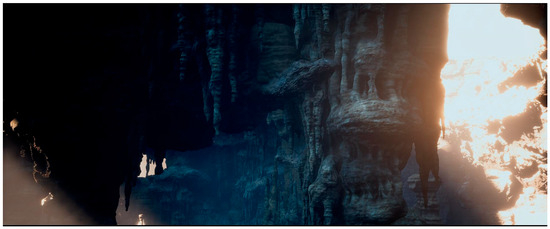
In the game environment, deserts and caves not only illustrate the decline of civilization but also challenge stereotypical “Eastern Desert” imagery through carefully orchestrated visual cues. Chapter II unfolds in a wind-scoured desert region. Within traditional Orientalist frameworks prevalent in digital games, such arid landscapes frequently serve as signifiers of conflict and underdevelopment when depicting Middle Eastern-inspired settings. However, archaeological design elements within the game challenge this trope. Stalactite formations suggest a karst landscape formed by substantial historical groundwater systems, while NPC dialogue (“Yellow Wind Ridge, a mighty ole’range, once buzzin’ with joy and glee”) and in-game lore about the ancient Kingdom of Flowing Sands (a.k.a. the “Land of the Setting Sun,” famed for gold) highlight a once-prosperous civilization now reduced to desert (Figure 1). This environmental storytelling through geological features and textual fragments progressively unveils the chapter’s central narrative regarding civilizational decline precipitated by unspecified historical cataclysms.
Figure 1.
Prologue of Chapter II. Reproduced with permission from Game Science (2024).
Building upon the narration of the geological environment in Chapter II, Black Myth: Wukong further operationalizes this narrative framework through its syncretic representation and adaptation of China’s religious material culture. Black Myth: Wukong adapts China’s seminal Ming dynasty Journey to the West, a mythological novel rooted in Tang-dynasty syncretic religious cosmology where the “Three Teachings” (Confucianism, Buddhism, Taoism) underwent profound integration. This historical context manifests in the game’s dense interweaving of religious iconography, with meticulously reconstructed temples, shrines, and ritual objects. The developers used photogrammetry and custom modeling to recreate Chinese architectural heritage while adapting details for storytelling. Weathered stone tablets combine Tang-era Guanyin iconography with excerpts from Chapter 14 of the Diamond Sutra—an intentional juxtaposition promoting the chapter’s central critique of doctrinal literalism.
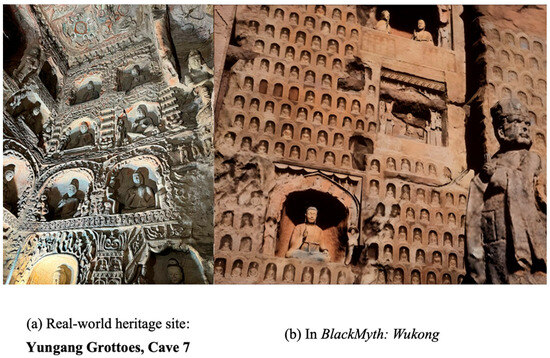
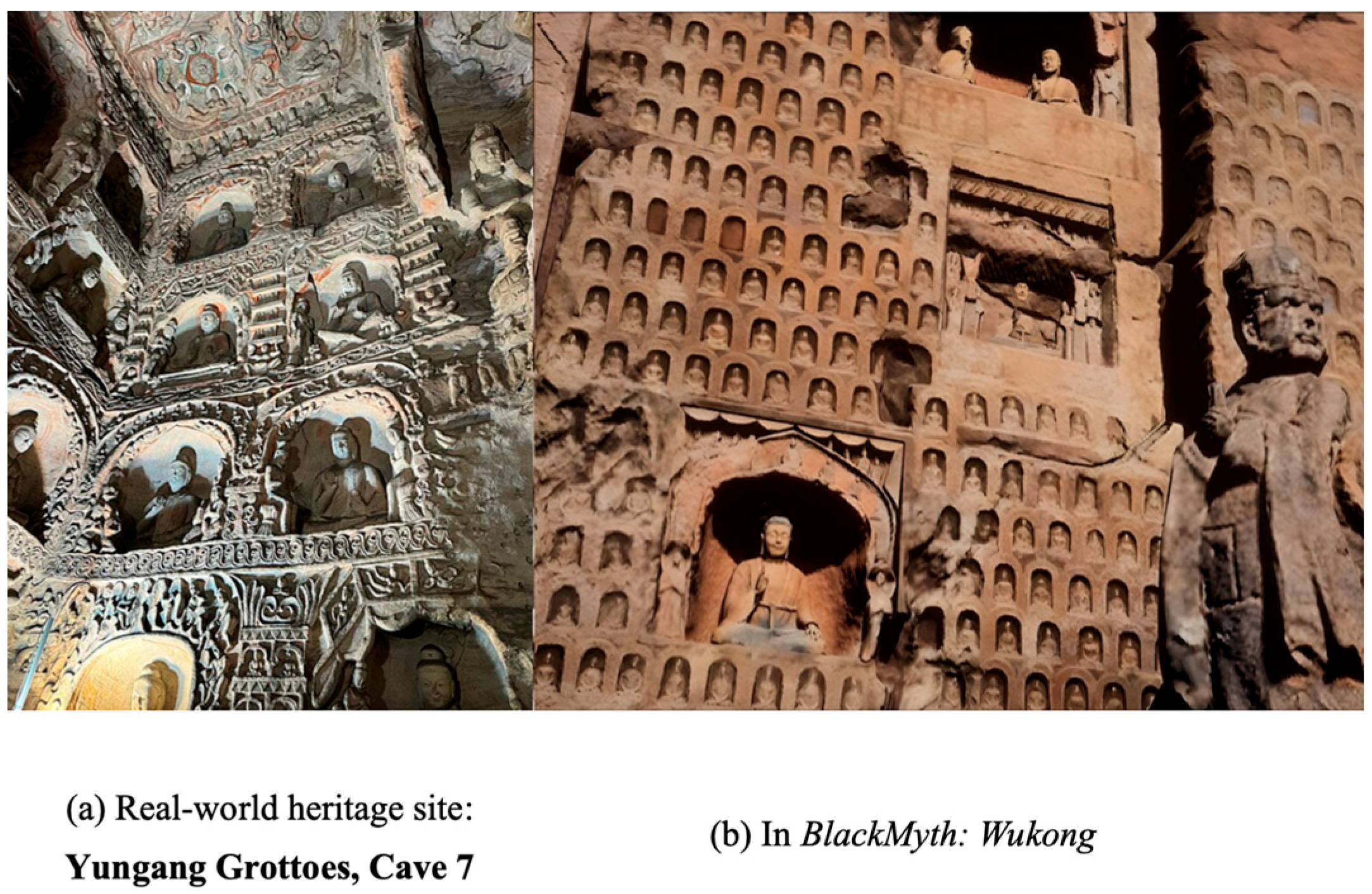
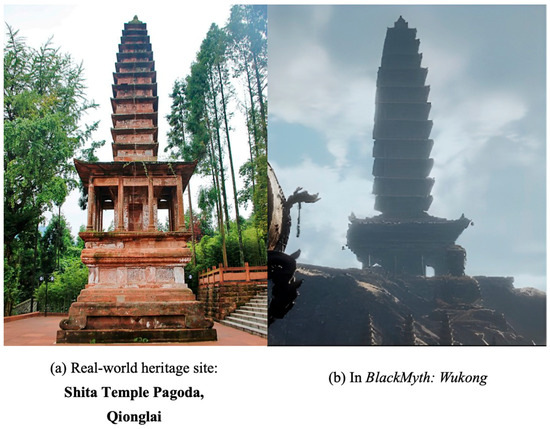
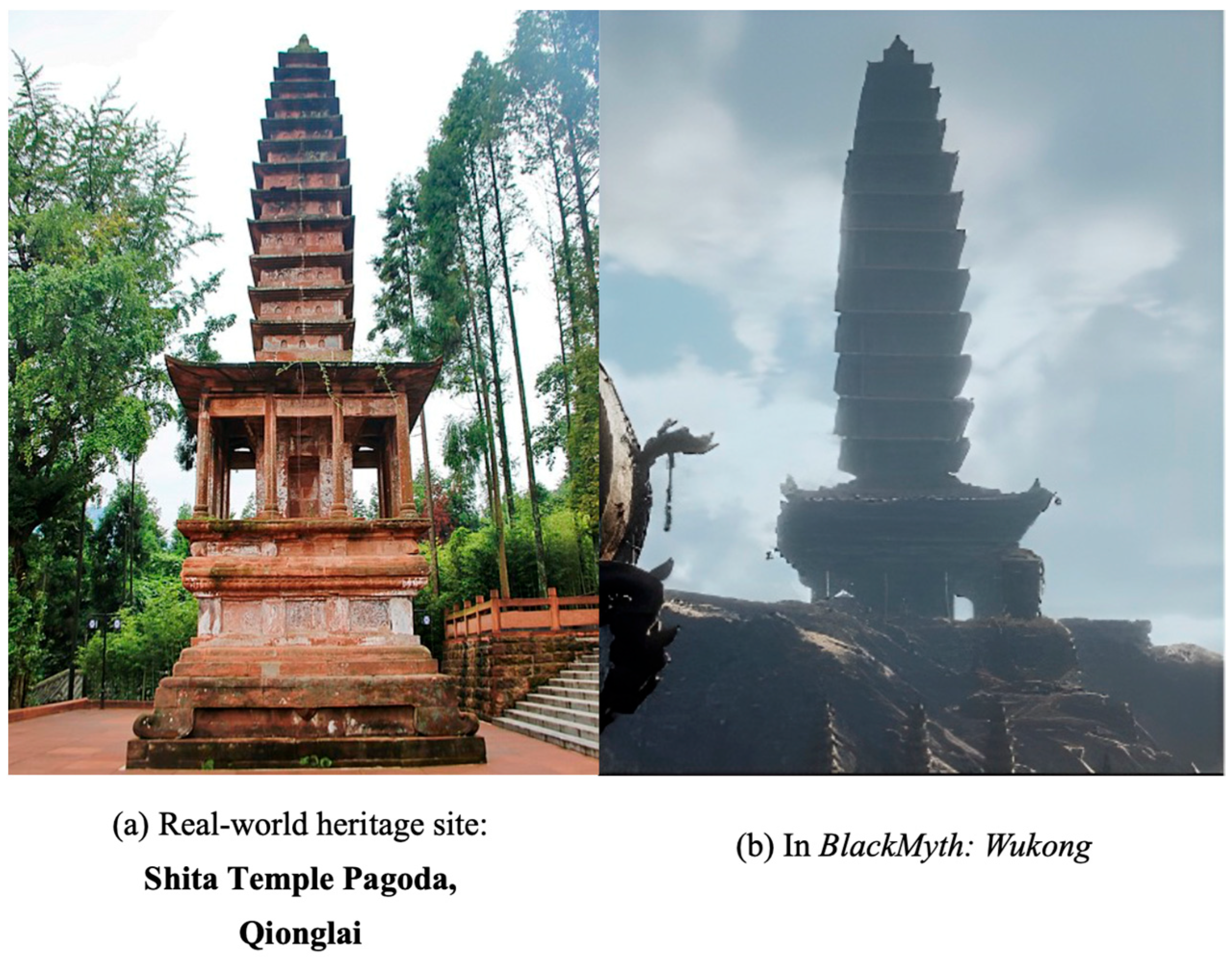
The visual reconstruction of the Yungang Grottoes serves a function beyond verisimilitude; it acts as a counter-narrative to the Orientalist trope of the ‘Generic East.’ Unlike the abstract mysticism often found in Western depictions of Asian settings (e.g., Far Cry 4, Ubisoft Montreal 2014a), the hyper-realistic inclusion of the Grottoes anchors the game world in a specific, tangible materiality. This aligns with Gu’s concept of an epistemological shift: by grounding fantasy in verifiable archaeological heritage, the developers reject the ‘homogenization’ typical of Sinological Orientalism. However, this reliance on “museum-quality” aesthetics introduces a critical tension. While the hyper-realistic rendering of the Yungang Grottoes asserts cultural ownership, it arguably risks ‘spectacularizing’ Chinese history by transforming sacred religious sites into objects of visual consumption rather than fostering deeper understanding (Figure 2 and Figure 3). This reflects the paradox of Sinologism: to be seen on the global stage, indigenous culture must often be packaged through the high-fidelity technological standards (Unreal Engine 5) favored by the Western market. Thus, the visual fidelity serves a dual purpose: it is an act of cultural preservation for domestic players, but potentially an act of “self-exoticism” for the global gaze, validating the game’s worth through its visual alignment with Western AAA standards. Crucially, this hyper-realistic reconstruction transcends mere aesthetic presentation. By rejecting the Orientalist tendency to render the East as an abstract, ahistorical fantasy, the developers assert indigenous curatorial authority and, in doing so, navigate the tensions of Sinologism while shaping how Chinese heritage is digitally consumed.
Figure 2.
Comparison of material culture between reality and game. (a) Yungang Grottoes, Cave 7 (image by Patrick20242023 via Wikimedia Commons, licensed under CC BY-SA 4.0, image has been cropped and combined with an in-game screenshot); (b) In-game screenshot from Black Myth: Wukong (reproduced with permission from Game Science 2024).
Figure 3.
Comparison of the Stone Pagoda of Shita Temple between the game and real life. (a) Stone Pagoda of Shita Temple in Qionglai, Sichuan (image by Nekitarc via Wikimedia Commons, licensed under CC BY-SA 4.0, image has been cropped and combined with an in-game screenshot); (b) In-game screenshot from Black Myth: Wukong (reproduced with permission from Game Science 2024).
The environments and architectural design set the overall narrative context of the game, while the individual chapters of the game are further developed through NPCs and objects that reveal deeper themes. In the second chapter, Bodhisattva Lingji appears as a pivotal NPC who unifies various subchapters. Acting as a guide, he introduces the chapter’s backstory through Northern Shaanxi storytelling, a traditional Chinese folk oral narrative art. The English localization uses a Scottish accent for Bodhisattva Lingji to highlight regional flavor. As the story progresses, players ultimately discover that Bodhisattva Lingji is the chapter’s key Buddhist figure. Moreover, in the concluding music video “Deaf Ear,” his dialogue conveys crucial thematic messages. This musical design provides Chinese players with a notably unique experience—indeed, the track has been adapted into a popular internet meme—and has drawn praise from non-Chinese players for its distinctive display of Northern Shaanxi storytelling.
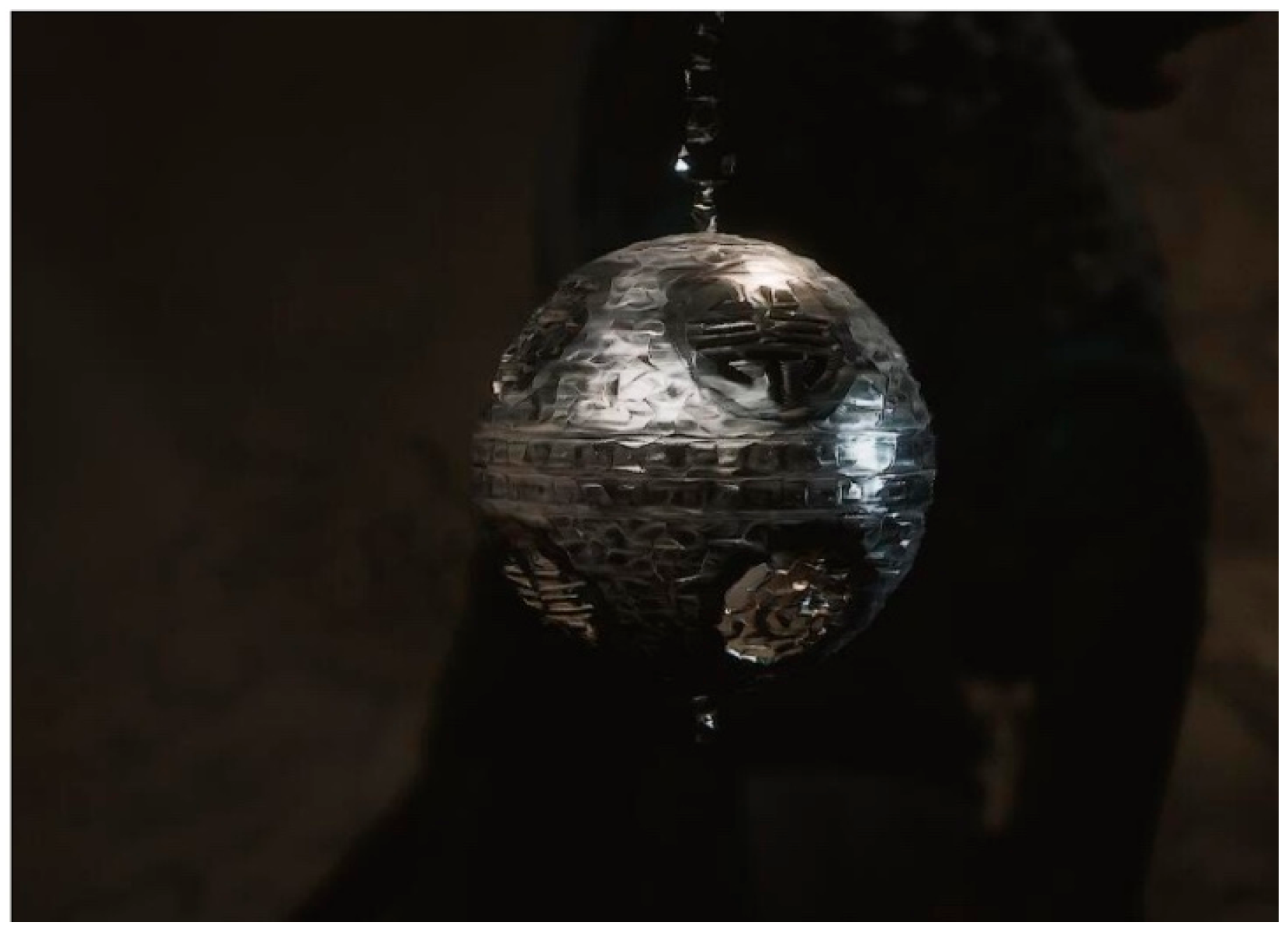
The chapter also introduces another important NPC, Xu Dog. His wardrobe, speech, and gestures are replete with Taoist elements, exemplified by his first line upon receiving the player’s help: “Man follows Earth, Earth follows Sky, Sky follows Dao, Dao follows nature”. This phrase underscores a vision of harmonious coexistence among humanity, nature, and society and respect for a higher guiding principle. Xu Dog further enhances the player’s capabilities by crafting elixirs. Additionally, the game incorporates a pivotal artifact—categorized as a “Vessel” and denominated the Wind Tamer—which is meticulously modeled on the historical Tang Dynasty Silver Gilt Openwork Perfume Ball and fulfills a role that transcends mere visual verisimilitude (Figure 4). Unlike the generic “magical artifacts” prevalent in Western fantasy games, this item functions as a “cultural anchor”, one that validates the authenticity of the game world through archaeologically rigorous design. By integrating a museum-caliber artifact into the procedural gameplay mechanism of “wind manipulation”, the development team reclaims the discursive authority of cultural representation. This design choice thereby signifies that the game’s magical logic is rooted in indigenous Chinese material culture, rather than the abstract mysticism frequently projected onto Chinese culture through the lens of Western Orientalist discourse. However, this reliance on material authenticity introduces a dialectical tension: Does this high-fidelity restoration truly challenge the Western gaze, or does it merely provide a higher-resolution version of the ‘mystical Orient’ that Western players already expect? By framing these objects as functional ‘cultural anchors’ rather than mere decorations, the game strives to shift the player’s gaze from exotic consumption to historical preservation.
Figure 4.
The Wind Tamer in the game. Reproduced with permission from Game Science (2024).
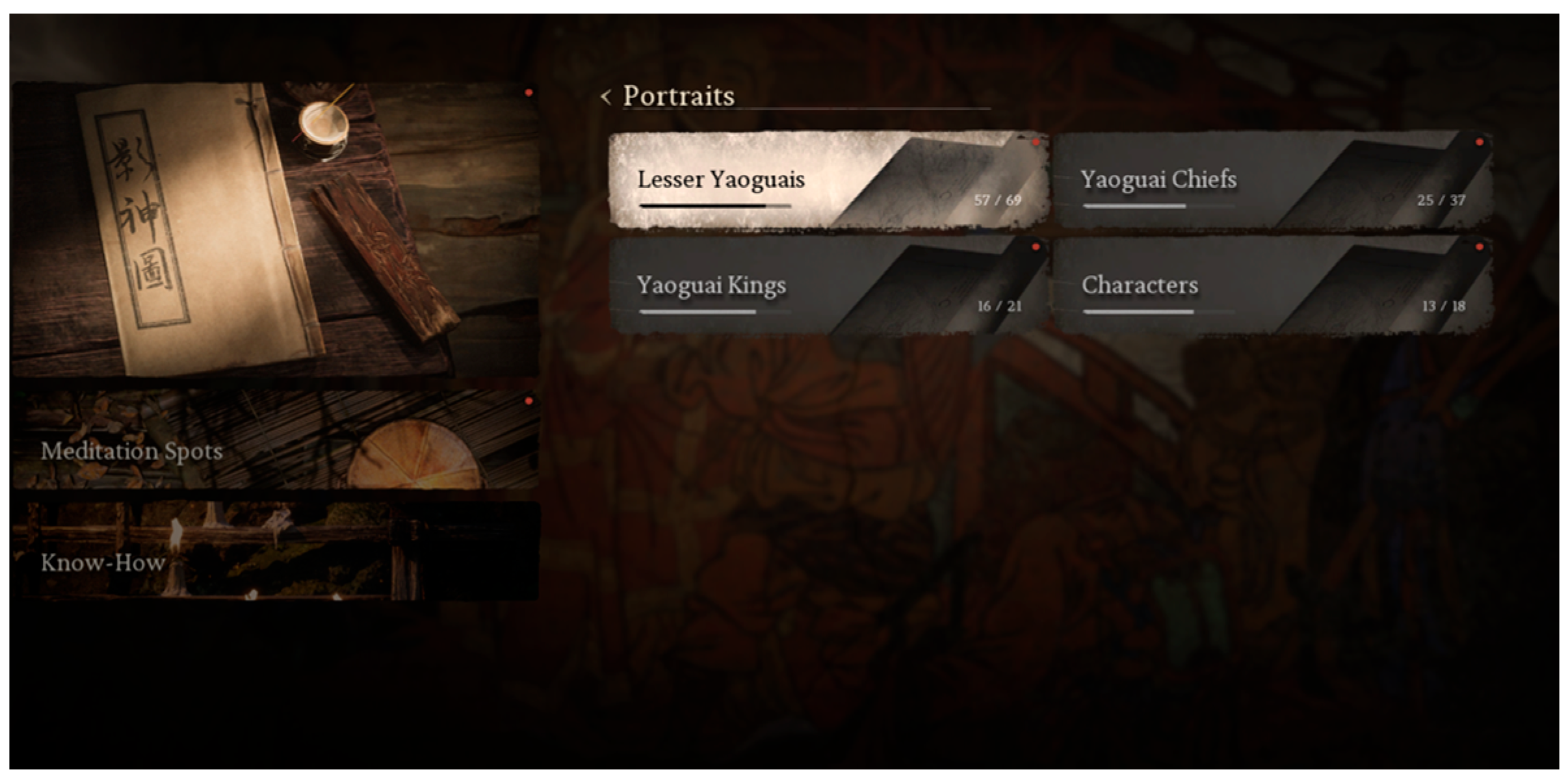
In Black Myth: Wukong, architectural design, NPC dialogue, and various in-game items function both overtly and subtly, embedding crucial narrative elements within Chinese cultural contexts. These components extend beyond evoking an ancient Chinese setting, using detailed depictions and cultural symbolism to enrich the storyline. After defeating a Yaoguai, players may consult the “Portraits” for further narrative insights (Figure 5).
Figure 5.
Portraits. Reproduced with permission from Game Science (2024).
Moreover, each chapter features a short animation inflected with Chinese artistic aesthetics—referred to in-game as a “Music Video.” Not only does this animation serve to summarize the core philosophical concepts of each chapter, but it also supplements hidden plotlines and bridges the overall story arc. In the final boss battle of the third chapter, the English script reverses the Buddhist Eight Precepts, skillfully incorporating the original Chinese meaning and preserving parallelism and rhyme. By flexibly employing archaic English to evoke the style of the Christian Ten Commandments, this localization offers Western players—many of whom are deeply influenced by Christianity—a particularly distinctive experience. Such linguistic adaptation enables Western players to appreciate the depth of Huangmei’s character design more vividly.
In essence, the audiovisual layer of Black Myth: Wukong operates as more than just a visual spectacle. By refusing to cater to the abstract, homogenized ‘Orient’ expected by Sinological Orientalism, the game leverages high-fidelity graphics to assert its cultural agency. By encouraging global audiences to engage with a historically grounded material culture, the game contributes to the reconstruction of Chinese cultural subjectivity within the broader global gaming landscape.
3.2. Mythic Reimagining: An Exploration of the Narrative Layer
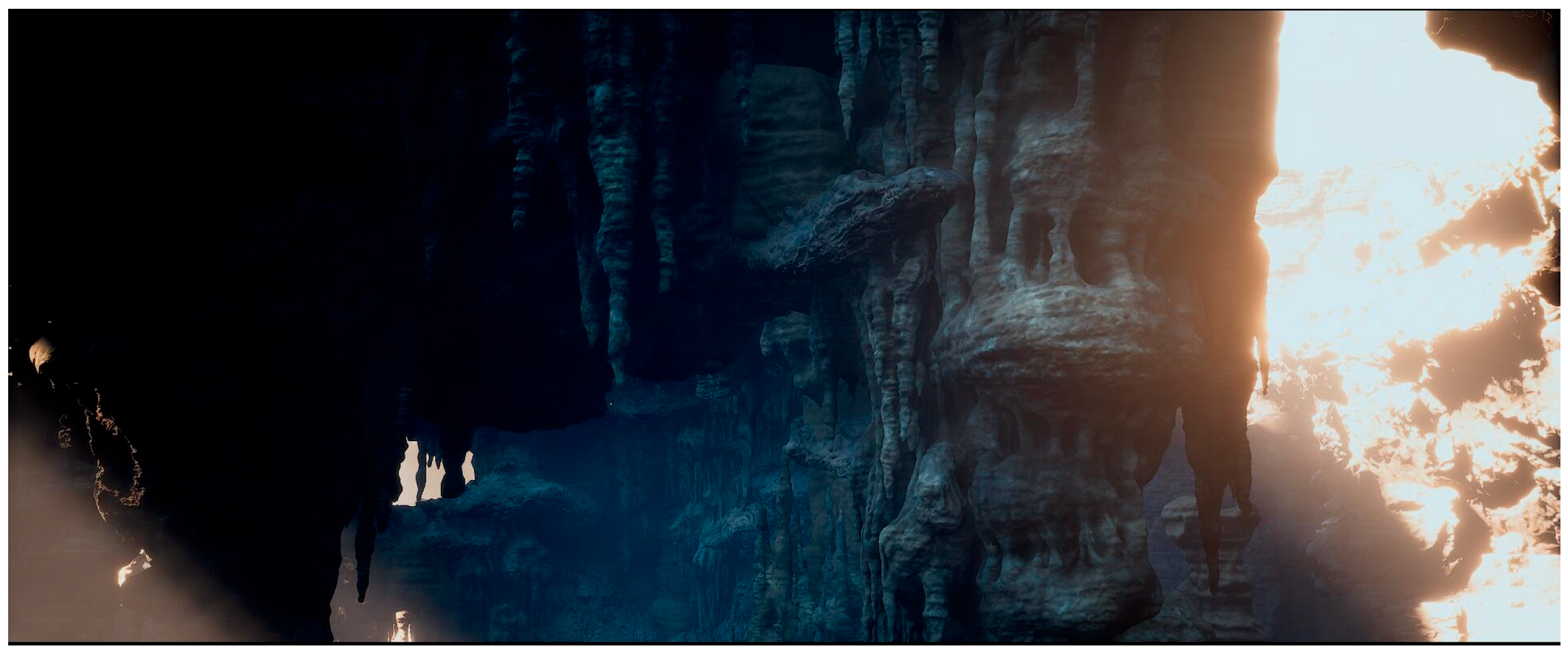
Although Chapter II remains the focal case for audiovisual analysis, this Narrative Layer section draws on evidence from the entire six-chapter structure. This contextualizes how meaning is disclosed over time within a narrative set in a fictional world comprising deserts, mountains, and snowy peaks. From the northern snowfields and western deserts to the Flaming Mountains in the northwest, these regions collectively reflect various Chinese landscapes, stabilizing the game in China (Figure 6). Notably, the game does not underscore a stark opposition between “East” and “West.” In previous Orientalist studies, deserts are often depicted as symbols of chaos and backwardness in certain games. However, in Black Myth: Wukong, the desert region and its inhabitants were once prosperous, only becoming desolate due to conspiracies among the deities and Buddhas.
Figure 6.
The karst cave and stalactite landscapes in the game. Reproduced with permission from Game Science (2024).
Creatures in the game are primarily categorized by species, while most player encounters focus on yaoguai. Players can pursue side quests and consult “Portraits” beyond the main storyline to uncover the broader narrative. A hidden plot thread, revealed in the fourth chapter, shows that deities and Buddhas rely on absorbing spirits for immortality. Sun Wukong’s attempt to overthrow this practice incites renewed suppression from these higher powers, thrusting him into the over-arching storyline. To achieve his aims, players must defeat enemies, enhance skills, confront each chapter’s boss to restore local order—often finding these antagonists to be blameless or sympathetic—and interact with NPCs to receive quests, rewards, and assistance. Rather than simply flipping stereotypes or exploiting them for international appeal, Black Myth: Wukong uses layered metaphors to convey Eastern philosophical ideas and dissect the complexities and socio-cultural roots behind these tropes.
In many video games, Chinese characters occupy more nuanced roles compared to Orientalist portrayals of Muslim or Middle Eastern characters, which frequently present Muslims as targets to be defeated and Arab regions as impoverished or terror-stricken. Chinese figures often appear as gang members, soldiers, martial artists, or mythical creatures bearing Chinese cultural symbols (e.g., Pandaren in World of Warcraft, Blizzard Entertainment 2004). Gangsters like Chen Tao (Grand Theft Auto V, Rockstar North 2013), Wu Zimu (Grand Theft Auto IV, Rockstar North 2008), and Pagan Min (Far Cry 4) may exhibit loyalty or charisma but are ultimately outlaws, disrupting social order. In shooters, the Chinese government often contrasts with Western protagonists (as in Battlefield 4, DICE 2013, and Battlefield 2, DICE 2005). Meanwhile, the Pandarens, while somewhat stereotyped, are sought after by many Chinese players for their excellent character designs.
Black Myth: Wukong does not resort to an overt symbolic reversal—such as crafting a world in which a “highly civilized East” stands in direct opposition to a “malevolent, backward West.” Rather, it adapts Journey to the West, recounting the journey of a group traveling from the East to the West (Tianzhu, or ancient India) to study and obtain Buddhist scriptures. This structure can be interpreted as akin to the currently popular “road movie” style in Western cinema. The main protagonist’s story merges individualistic growth with a collective mission of restoring his race. Players become the “Fated One,” seeking the Great Sage’s relic. Combat drives progression, while “Portraits” reveal deeper motivations behind each yaoguai, showing that many are neither purely good nor evil. For instance, Erlang Shen, initially cast as an opponent, ultimately aids the hero and finds personal resolution through their encounter. In the sixth stage, supposedly lesser yaoguai—like the Hound Soldier and Jackal Soldier—begin as enemies but prove to be ordinary individuals coerced into violence.
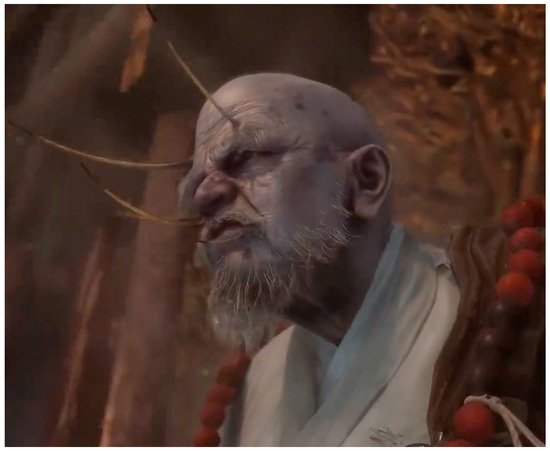
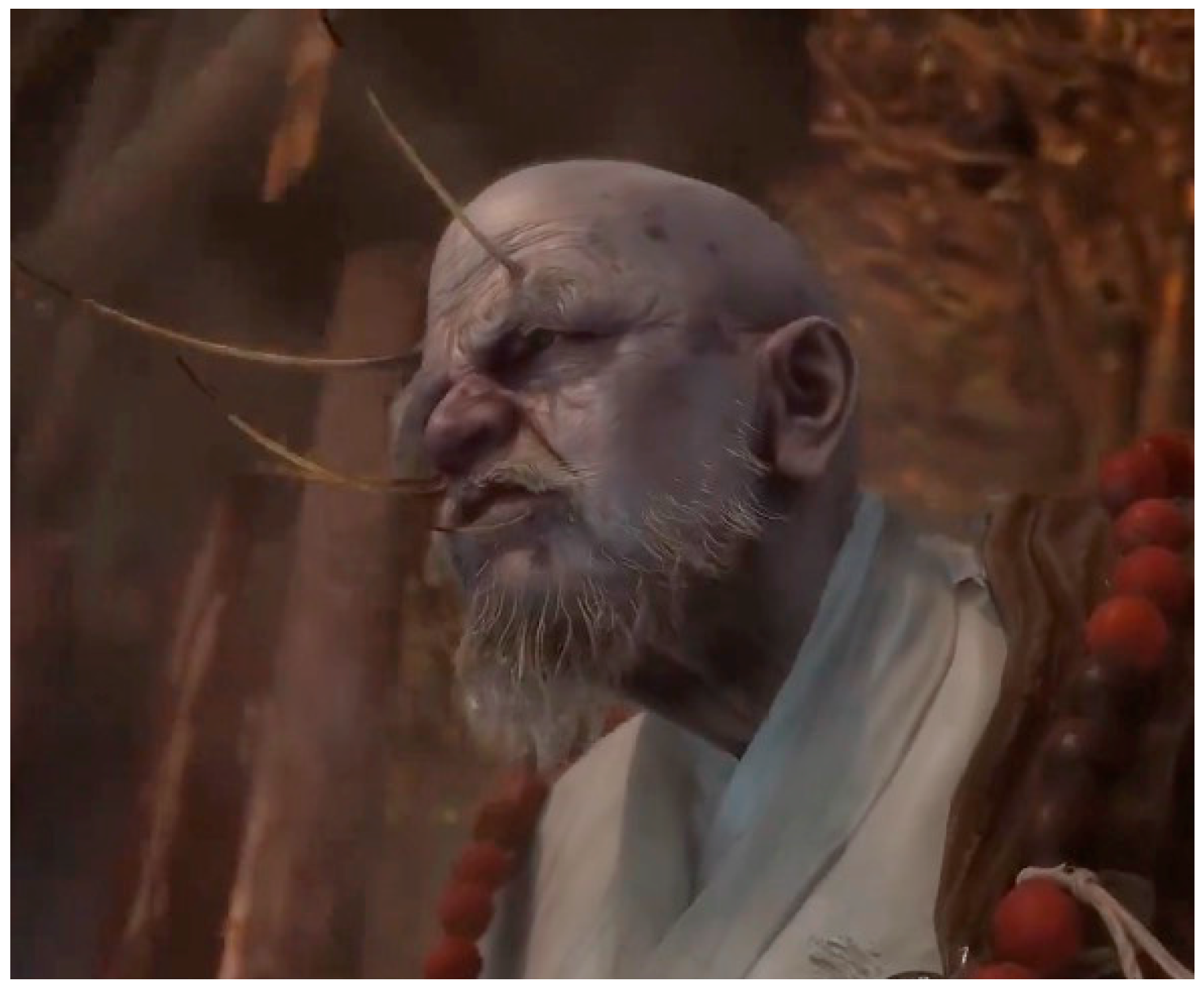
In the game, Non-Void stands out as an Eastern character bearing negative connotations (Figure 7). His design closely follows stereotypical depictions of Chinese figures: not only is he rendered as a mysterious elder, but he also sports an unusually long beard that suggests a subtle demonization. In Chinese, his name straightforwardly represents the opposite of Wukong—“Non-Void” as the counterpoint to “void.” He serves as the chief disciple of the chapter’s boss, Yellow Brow. Initially, he seemed to study wholeheartedly with Yellow Brow (the chapter’s antagonist), chanting sutras and reciting Buddha’s name in his territory every day. However, when the player takes on a fox form during a side quest and visits his territory, Non-Void abruptly departs from his former composure, panicking at the sight of the foxlike protagonist and initiating combat. This reaction reveals that he is, in fact, the young man from the cut scene at the end of Chapter Two—the one who killed a fox after experiencing a dream. Clues gleaned from Non-Void’s “Portrait” and the Snow Zombie’s “Portrait” further expose his hypocrisy. Although his outward design strongly embodies traditional “Chinese/Eastern” stereotypes and exhibits a demonic twist, the narrative deftly portrays him as both profoundly evil and tragically pitiable. As his junior disciple, Non-able remarks: “Brother, the pretense behind justifying killing is the real sin.” Ultimately, Non-Void exemplifies how Black Myth: Wukong navigates the tensions of Sinological Orientalism. While his outward appearance aligns with conventional expectations of a mysterious Eastern antagonist, the game uses supplementary narratives to reveal his moral complexity. This juxtaposition allows the game to utilize familiar visual tropes while simultaneously offering a culturally specific critique of human nature, thereby resisting one-dimensional portrayals.
Figure 7.
Non-Void. Reproduced with permission from Game Science (2024).
Furthermore, Black Myth: Wukong deliberately avoids amplifying stereotypes for Western audiences. In contrast to the phenomenon observed in Malmquist’s (2022) research—where certain games overemphasize and oversimplify elements of Japanese bushidō, thereby obscuring complex historical realities—the developers of Black Myth: Wukong explicitly prioritized local Eastern players. They believed that strong storytelling and polished gameplay would naturally attract Western gamers without the need to pander to Western expectations of China. Ultimately, the game’s narrative layer avoids the trap of ‘Self-Orientalism’ and simple binary inversion. By presenting morally ambiguous yaoguai and exposing the systemic exploitation perpetrated by supposed ‘deities,’ the game refuses to homogenize its cultural narrative for easier Western consumption.
This narrative complexity embodies the intellectual struggle inherent in Sinologism: the developers assert their cultural agency by demanding that players engage with deep, context-heavy indigenous philosophies rather than familiar Western tropes of absolute good and evil. While the game’s visually ‘exotic’ setting may initially draw international players, this uncompromising narrative structure ensures that it ultimately sparks a genuine engagement with Chinese culture rather than a superficial consumption of it.
3.3. Martial Innovations: An Exploration of the Procedural Layer
As an action role-playing game, Black Myth: Wukong places particular emphasis on its combat system, which is designed around the theme of Chinese martial arts. Traditional Orientalist perspectives suggest that Western audiences often oversimplify, mystify, or exoticize Chinese martial arts.
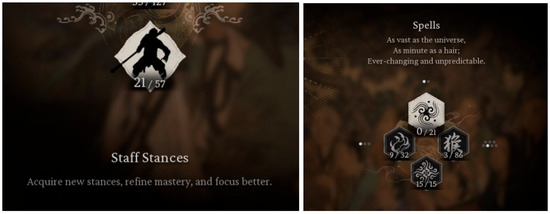
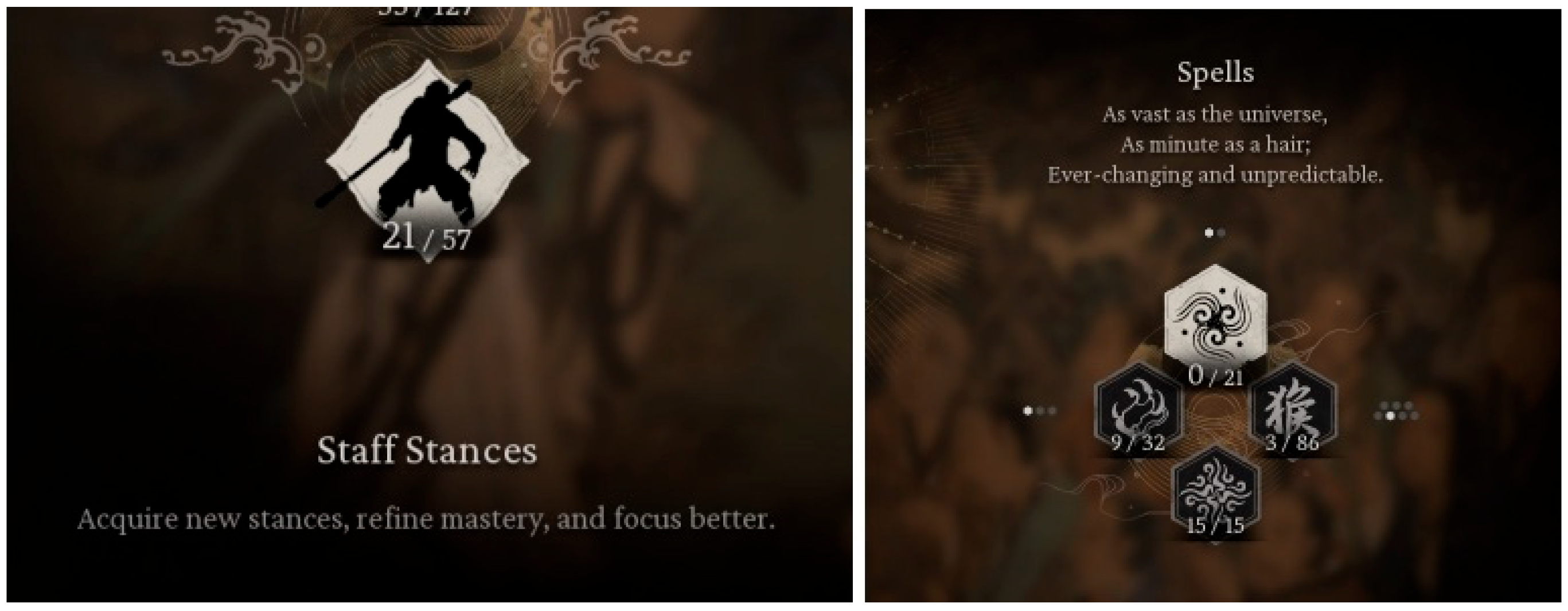
In this game, martial arts mechanics are developed through two separate skill trees: “Foundations” and “Staff Stances” (Figure 8). The “Foundations” tree aligns with the common practice in current video games of assigning base stats such as health, stamina, mana, strength, and defense. By contrast, the “Staff Stances” tree—comprising three distinct forms (Smash Stances, Pillar Stances, and Thrust Stances)—further refines moves and attack styles. Unlike previous stereotype-reinforcing representations, Black Myth: Wukong adds depth to Chinese martial arts through textual elements rather than merely depicting them superficially. For instance, in the user interface for upgrading abilities, players encounter passages that provide cultural or philosophical context, such as: “Seeking guidance from the deities, is better to steer your path. Chanting scriptures, better to have abilities in hand,” or “As vast as the universe, As minute as a hair; Ever-changing and unpredictable.” These lines reflect ideas outlined by Allen (2014) in Daoism and Chinese Martial Arts (Allen 2014), which examines the relationship between Chinese philosophy and martial disciplines. In line with this emphasis on unifying inner cultivation and outer technique, Black Myth: Wukong calls for players to both enhance their base attributes (inner cultivation) and master staff-specific combat moves (outer skill) to overcome opponents. Far from a cursory demonstration of martial prowess, the game offers a deeper insight into Chinese martial arts, transcending conventional stereotypes.
Figure 8.
Text supplementation in the upgrade section. Reproduced with permission from Game Science (2024).
Examining the game’s combat, narrative, and character designs shows that Black Myth: Wukong does not perpetuate stereotypes. Rather, it amalgamates elements typically regarded as “stereotypically Chinese”—such as martial arts, mysticism, and religion—with Chinese philosophical concepts, encouraging deeper contemplation. No characters are mere representations of “evil,” nor are the “heroes” devoid of moral complexity. Essentially, Black Myth: Wukong employs a middle-way approach—like the Confucian principle of the Mean—to negotiate the power disparities inherent in the global gaming industry. In this context, the “Mean” does not imply neutrality, but a strategic balance between “Self-Orientalism” (catering to Western expectations of mysticism and martial arts) and “Cultural Autonomy” (insisting on obscure, high-context narratives like the Portraits). However, this negotiation occurs within an asymmetrical power structure. As the game relies on Western foundational technologies to render its “Chinese story,” it operates within a technical architecture that inevitably shapes its aesthetic presentation.
Overall, this structural dependence does not negate the game’s cultural autonomy, which is most powerfully realized in its procedural layer. By translating Daoist cultivation and martial arts into core interactive mechanics, the game demands that players perform—rather than passively consume—indigenous cultural logic. This mechanical integration across the audiovisual, narrative, and procedural layers illustrates how Black Myth: Wukong actively reconstructs Chinese cultural subjectivity against the homogenizing tendencies of Sinological Orientalism. However, because this negotiation of agency occurs within the complex power dynamics of the global gaming industry, the text itself is only half the story. Building upon these internal findings, Section 4 broadens the scope to examine the external implications: specifically, the ‘ludic agency’ imposed on the player and the resulting ‘epistemic friction’ observed in the game’s transnational reception.
4. Discussion: Sinologism and Ludic Agency
Rather than merely adapting Journey to the West as a narrative skin, Black Myth: Wukong operationalizes Chinese philosophical concepts into its very ludic structure. This section argues that the game employs ‘strategic constraints’—narrative linearity and spatial restrictions—to assert a form of curatorial authority. By forcing players to engage with the cultural text on its own terms rather than consuming it through the Western trope of the ‘open-world sandbox,’ the game exemplifies Gu’s (2015) concept of Sinologism: a site of intellectual struggle where indigenous logic negotiates with globalized forms.
4.1. Restrained Freedom and Cultural Expression
Drawing on Chapman’s distinction (Chapman 2018) between “framing narrative” (developer-structured context) and “ludonarrative” (player-driven action), Black Myth: Wukong prioritizes the former to establish a distinct curatorial authority. While the game offers a linear storyline with limited endings, its most significant narrative enforcement occurs through spatial control. By meticulously reconstructing architectural heritage spanning the Northern and Southern Dynasties to the Tang, Song, and Ming eras, the developers define strict boundaries of “authorized” player activity. Unlike smaller in-game artifacts that serve as interactive powerups, massive historical relics—some dating back to 600 CE—are deliberately rendered non-interactive or restricted to observation and photography modes. This design choice creates an interactional hierarchy: while the profane (monsters, consumables) can be physically engaged, the sacred (cultural heritage) demands a respectful distance. Consequently, the game’s spatial architecture functions not merely as a backdrop, but as a disciplinary mechanism, teaching players that these digital antiquities are objects of reverence rather than targets for virtual vandalism.
This contrast is stark when compared to Western titles like Watch Dogs (Ubisoft Montreal 2014b), where game mechanics often encourage players to interact with the environment through traversal or destruction—even prompting parkour over a grave. While this design philosophy maximizes ‘player agency’ through unrestricted movement, it can inadvertently create a dissonance with the solemnity of specific cultural spaces. Black Myth: Wukong circumvents this dissonance by prioritizing ‘Curatorial Authority’ over player freedom. By restricting player interaction with reconstructed relics (such as the Yungang Grottoes) to observation or photography modes, the game treats these digital spaces not as playgrounds for the player’s amusement, but as museums demanding preservation. The restriction teaches the player that some things are meant to be witnessed, not conquered.
However, beyond respect for cultural artifacts, games also face another major challenge in terms of exploration freedom: ‘invisible walls’. Critics often dismiss the game’s ‘invisible walls’ as mere technical limitations. However, from a Sinological perspective, these boundaries challenge the colonial logic of ‘spatial conquest’ prevalent in Western open-world genres (e.g., Assassin’s Creed). In such games, the ability to traverse, climb, and occupy every inch of the map mirrors an imperialist desire to possess the landscape. Black Myth: Wukong rejects this ‘unbridled freedom.’ By physically barring players from treading on sacred ruins or climbing Buddha statues, the game enforces a phenomenology of reverence. Therefore, while the ‘invisible wall’ is indeed a technical limitation often criticized by players, it also serves a narrative purpose. In the context of this game, it acts like a digital ‘Precept’ (戒律). By preventing players from roaming freely, these boundaries encourage them to focus on the disciplined path of a pilgrim, rather than trying to conquer every corner of the map.
This design choice requires Western players to negotiate their expectations of absolute control and adapt to a more disciplined, narrative-centric spatial logic. Thus, the “invisible walls” create a necessary tension: they prevent the dilution of the storyline by keeping the player anchored to the specific historical and mythological context defined by the developers. Within this focused framework, the game still offers significant agency through hidden quests and intricate combat, proposing a model of “restrained freedom” that aligns with the game’s philosophical undertones of cultivation and discipline. Ultimately, these spatial constraints reconfigure the player’s identity. Instead of the Western archetype of the ‘Explorer-Conqueror’ who dominates the map, the player is cast as a ‘Pilgrim’ (苦行僧). In Journey to the West, the path to enlightenment is singular, arduous, and disciplined; one cannot simply ‘open world’ their way to Buddha. While critics may view these invisible walls as technical limitations, from a ludological perspective, they functionally enforce a linear pilgrimage. This spatial restriction inadvertently aligns with the Confucian and Buddhist virtue of ‘Ke Ji’ (Self-Restraint 克己), compelling players to adhere to a disciplined path rather than indulging in the colonial fantasy of unbridled spatial conquest.
Beyond spatial constraints, Black Myth: Wukong employs what Chapman (2018) terms “framing controls”—structural rules that regulate narrative interpretation—through its use of stylized animated sequences (Music Videos). These sequences serve not merely as visual spectacles but as essential hermeneutic anchors for cross-cultural communication. For instance, the “Listen Not” sequence in Chapter Four does not simply retell the romance between Zhu Bajie and Zi Zhu’er; it actively intervenes in the player’s understanding, recontextualizing a “horrible creature” into a tragic figure driven by familial love. By suspending gameplay to enforce this narrative framing, the developers mitigate the risk of Orientalist simplification, ensuring that Western players perceive the yaoguai not just as targets for violence, but as subjects with complex moral interiorities.
Furthermore, the game’s combat system can be analyzed through Chapman’s concept of “Lexia”—the configurable units of meaning available to the player. Unlike Western RPGs that prioritize liberal agency through vast arsenals (swords, guns, magic), Black Myth: Wukong deliberately restricts the player’s “lexical unit” to the staff (Ruyi Jingu Bang) and specific transformation spells rooted in the original novel. This restriction is a form of procedural rhetoric: to play the game, one must physically enact the specific martial identity of the Monkey King.
This distinct ludic specificity facilitates a shift from “Self-Orientalism” to cultural affirmation. As one Chinese player poignantly noted after years of navigating Western digital avatars: “I have been an assassin in Paris … a Dragonborn in Skyrim … an American soldier in Afghanistan … But what I want to do most is to play as the Monkey King”. This testimony suggests that the game’s rigid “lexia” and “framing controls” do not limit experience but rather offer an opportunity to disengage the Chinese player from the “Otherness” of Western narratives. By adhering to these indigenous narrative and mechanical frameworks, the game resists the ‘homogenization (becoming the same)’ associated with Sinological Orientalism, allowing players to embody a sovereign cultural subject rather than a generic hero.
4.2. Epistemic Friction and the Co-Construction of Knowledge
Gu (2015) conceptualizes Sinologism not merely as a Western gaze, but as a dominant “knowledge production system” where ideologies and evaluation criteria are anchored in Western-centric intellectual frameworks. Within this system, Chinese cultural artifacts are frequently analyzed through Western paradigms (e.g., universal humanism or liberalism), which often obscure China’s distinct historical and philosophical contexts. This epistemological dominance exerts a coercive pressure on non-Western creators. As Vukovich (2013) observes in his critique of Sinological Orientalism, Chinese creators may consciously or unwittingly incorporate “Oriental elements” predicted by Western audiences to cater to the global market, a phenomenon akin to “self-Orientalization”. However, Black Myth: Wukong disrupts this complicit cycle. Instead of aligning with the “universal” templates expected by Western critics, the game’s insistence on high context cultural fidelity triggers what can be termed “epistemic friction.”
In the instance of Black Myth: Wukong, Western gaming media sparked great debate over pre-release game evaluations, with some conflicts arising from a lack of comprehension of the game’s cultural meaning and affective manifestations. A notable example occurred with IGN France, which sparked intense backlash on social media by commenting: “C’est pas un peu risqué de mettre son baton magique qui grandit dans l’oreille? C’est pas un coton tige” (“Isn’t it a bit risky to put his growing magic stick in his ear? It’s not a cotton swab”). This episode possibly demonstrates cultural dissonance, since Chinese players saw such “humor” as inexplicable and disrespectful to their revered cultural hero. This incident exemplifies not merely cultural ignorance, but epistemic arrogance. By reducing a totemic artifact of Eastern mythology to a disposable Western utility, the critique reflects a colonialist reflex: the refusal to engage with the “Other” on its own ontological terms. This phenomenon may originate from a cultural unconscious shaped by Western hegemony in global cultural dissemination—a framework that habitually subordinates Eastern cultural products to Western evaluative paradigms, thereby marginalizing their indigenous cultural logics and distinct artistic values. As illustrated below, the video game business replicates the same challenges identified in cinematic cross-cultural reception.
Yet these critical misalignments are not merely accidental; they are the direct product of the game’s refusal to dilute its cultural density. Rather than simply presenting history as a static backdrop, Black Myth: Wukong operationalizes Journey to the West as a contested site of epistemological negotiation. By anchoring the narrative in a specific Sinocentric historical cultural framework, the developers prioritize ‘Curatorial Authority,’ treating the source material as a fixed heritage to be preserved. However, this rigid adherence created a critical hermeneutic gap: while domestic audiences scrutinized the game for deviations from the ‘canon,’ international players faced narrative incoherence due to a lack of contextual knowledge, a friction reflected in the divergence of critical scores. Crucially, the game’s cross-cultural functionality was not achieved through the developer’s design alone but was salvaged by a grassroots mediation process. The spontaneous emergence of ‘knowledge brokers’ on platforms like Reddit—where Chinese players translated cultural nuances for Western peers—demonstrates that meaning-making in Black Myth: Wukong is not a unilateral transmission but a collaborative labor. However, this reliance on player labor also highlights the limitations of the text itself; without these ‘grassroots translators,’ the ‘anti-colonial’ or ‘philosophical’ nuances might remain opaque to the average global player, leading to a consumption of spectacle rather than an engagement with values. This aligns with Gu Mingdong’s conceptualization of Sinologism as a multi-directional production of knowledge.
4.3. Digital Anti-Colonialism: Reframing the “Other”
In terms of the employment of historical ideology, both in-game storylines and outside the game, “Black Myth: Wukong” demonstrates an anti-colonialist and anti-cultural hegemonical nature. One of the most direct definitions of colonialism is the creation of “political and economic control” over dependent territories. Various manifestations of colonialism in history, including in the field of electronic games, have been focused on exploiting colonial rulers at the center of domination over the exploited colonized people at the periphery, with the colonialists establishing a system of control and exploitation around their rule. In Anno 1404, such a situation arises (Buhari 2024). In the game, the Eastern people are politically and economically responsible to (Western) players and pay tribute to them. When they lack dates, players will receive a notification: “Your people are starving.” Players must supply their requirements, and in return, they give labor, with their products reaching the Western coast to meet the demands of Westerners.
Drawing a parallel to this historical model of resource extraction, exploitation is an important content hidden under the main plot of “Black Myth: Wukong.” After players go through the content of Chapter 4 of the game, they can find that this is a heavenly court’s farm plantation, where ordinary people are deceived into coming and then tricked into eating insect eggs to be transformed into demons and evil spirits. Many demons are formed, then refined into elixirs (Mind Core) to be provided to the celestial court for cultivation and immortality.
This systemic cruelty serves as the catalyst for the protagonist’s rebellion, clarifying the narrative subtext. From the Portraits picture of the Great Sage Equal to Heaven, we can understand that he and Bajie went missing after becoming intoxicated together. In this chat, he remarked, “These tributes should go to those who need them more. If we eat them, those people will have less to eat.” After he finished saying this, he got Bajie drunk again and then fought his way up to the heavenly court again. The following plot is the scene at the beginning of the game. Sun Wukong is a representative of the spirit of resistance. He needs to break free from the rule of East and West Heaven and save the poor people from this exploitation. It is worth emphasizing that the hidden boss in the game, Erlang Shen, supports Sun Wukong’s resistance plan and secretly aids players with his Meishan brothers.
5. Conclusions
This study addresses the three research questions as follows. Regarding RQ1, Black Myth: Wukong reconstructs traditional Chinese cultural symbols through (a) heritage-based audiovisual worldbuilding and material anchors in Chapter II (Section 3.1), (b) high context narrative devices such as “Portraits” and animated sequences that disclose meaning across chapters (Section 3.2), and (c) martial arts centered procedural design that embeds philosophical ideas into gameplay (Section 3.3). Regarding RQ2, the game challenges classic Orientalist typologies by foregrounding culturally specific logics and morally complex subjects, while it also faces a tension insofar as global AAA fidelity standards may risk spectacularizing and self-exoticizing readability (Section 4.1; Section 5, paragraphs 2–3). Regarding RQ3, cultural negotiation becomes most visible at the level of transnational reception: epistemic friction emerges when Western commentary evaluates the game through misaligned frameworks, while cross-cultural understanding is partially co-constructed through community “knowledge brokers” who translate and contextualize culturally dense elements (Section 5, paragraphs 4–5).
As Edward Said pointed out, artistic creations are not independent of ideology and power connections. In traditional Orientalism studies, many digital games have evident Orientalist characteristics, with Muslim communities being the primary emphasis. Additionally, there is a certain tendency towards countries and places in East Asia and the Pacific, such as in Ghost of Tsushima and Far Cry 3 (Ubisoft Montreal 2012). However, Black Myth: Wukong, widely regarded as the first “AAA” title developed by a Chinese studio, has gained immense popularity among players due to its integration of Eastern aesthetic elements from China, its restoration of Chinese cultural relics and architecture, the design of ancient Chinese characters, and its combat system centered around Chinese martial arts. Although it also contains exoticization, this is not the Oriental world that Westerners perceive. Here, Western gamers, due to the distinct setting, become the “Other.” But what impact does this have on Western audiences, who are traditionally positioned within an Orientalist gaze, when they play Black Myth: Wukong? How does it vary from their experience playing games like Anno 1404, which exoticize Orientalism? Current critical reception and player discourse suggest that many Western players, despite navigating an unfamiliar cultural landscape, do not report a sense of alienation often associated with being the “Other.”
Based on the foregoing study viewpoints, this study offers a novel approach compared to prior Orientalist studies. It does not just switch Eastern and Western roles, as in Under Siege, so remains caught within the Orientalist rhetoric. Nor does it reinforce Japanese prejudices to cater to a bigger international market, as Ghost of Tsushima shows. The characters in Black Myth: Wukong are not backward, evil, or one-dimensional; they are nuanced and captivating. The game’s plot addresses the debate of good and evil, as the promotional PV indicates: “Blind kindness is an accomplice to evil.” Moreover, the antagonists in the game are not totally bad, nor is good purely nice. According to the researchers, this presents a certain amount of intricacy and even represents features of China’s social reality to some extent. Further investigation of Sinologism relating to Chinese games is still needed. As Vukovich emphasized, China does not aspire to become “the same” as the West but to reach equality with it. Even if China becomes economically prosperous, regionally dominant, or even exploitative, it may still be othered by the West through Orientalist spectacles. Black Myth: Wukong does not, like researchers or filmmakers in Sinological Orientalism, self-otherize for profit, appealing to stereotypes or internalizing the East as the West demands. However, it cannot totally avoid building a dichotomy between the self and the Other. Some scholars argue that many Eastern thinkers and movements attempting to resist Western prejudices have fallen into the trap of “reverse Orientalism,” adopting a similar mindset to traditional Orientalism by emphasizing the independence of the East, thereby reinforcing the opposition between the two.
Although external factors like business models and media coverage also shape player perceptions, this study restricts its focus to the game’s internal textual and procedural elements to ensure analytical coherence. A key limitation of this approach is the absence of quantitative data on player reception. By relying on textual analysis, we can uncover the ‘anti-colonial’ narratives encoded by the developers, but we cannot definitively conclude that Western players decode these messages as intended. Additionally, the ‘spectacularizing’ of Chinese culture mentioned earlier remains a significant risk: where the researcher perceives ‘cultural agency,’ the player may merely perceive ‘exotic fantasy.’ This over-reliance on qualitative tools inevitably results in insufficient data support and potential perspective bias. Future research should integrate developer interviews to ascertain intent and player reception studies to measure the actual depth of cross-cultural understanding.
Black Myth: Wukong is a major step forward for both the Chinese game industry and Sinologism research; however, it still confronts numerous hurdles. In Black Myth: Wukong, we can still notice the game developers gaining inspiration from Western game developers, whether in the narrative’s presentation of Western individualism, the technical support from NVIDIA and Unreal Engine, or the distribution of Chinese cultural symbols. As a collaborative intellectual and artistic construct including both Chinese and Western contributions, the game would not have attained such tremendous success without either side. Through its high-quality visual presentation and adaptation of the source material, the game still reflects certain stereotypes about China found in traditional Orientalism, such as kung fu, religious mysticism, and ancient architecture. However, by incorporating textual explanations and narrative, it attempts to move away from these stereotypes. Unlike some Western digital works that vilify or otherize Eastern cultures, or some Eastern digital works that self-otherize, Black Myth: Wukong strives to avoid these pitfalls. Nevertheless, it still has its issues, such as the limitations of its narrative perspective. Even with the inclusion of textual explanations and narrative attempts to counter preconceptions, the narrative perspective may still be bound by the needs of game design and the cultural background of the developers. For example, the game’s stunning visuals and impressive effects may inadvertently “spectacularize” Chinese culture, turning it into an exotic and fantastical spectacle rather than fostering genuine understanding and respect. Therefore, it still needs to continue its efforts to avoid the traps of Orientalism. Future developments require deeper reflection on cultural representation, avoiding cultural simplification and symbolization, and presenting the richness and complexity of Chinese culture from more diverse and critical perspectives. This is not only a desire for the game itself but also a challenge for the entire Chinese gaming business and cross-cultural communication.
Author Contributions
Conceptualization, N.C. and J.L.; methodology, N.C.; data curation, N.C.; writing—original draft preparation, N.C. and C.D.; writing—review and editing, N.C., J.L. and C.D.; supervision, J.L.; project administration, J.L.; funding acquisition, J.L. All authors have read and agreed to the published version of the manuscript.
Funding
This research work was funded by the project FRG-25-038-FA and granted by the Research Fund of Macao University of Science and Technology (FRG-MUST).
Institutional Review Board Statement
Not applicable.
Informed Consent Statement
Not applicable.
Data Availability Statement
The original contributions presented in this study are included in the article. Further inquiries can be directed to the corresponding authors.
Acknowledgments
We would like to convey our deepest gratitude to our advisors for their invaluable guidance and to all collaborators whose contributions have been pivotal in bringing this work to fruition. We are also especially indebted to the Bilibili creator Baishan Zheng of Tianshidao (天师道的白山正), whose meticulous investigations and video analyses inspired the research direction that ultimately shaped this study. Furthermore, we extend our sincere appreciation to Game Science for kindly granting permission to reproduce in-game screenshots and visual materials for this academic publication. During the preparation of this manuscript, the authors used Gemini and DeepSeek for the purposes of translation and language polishing. The authors have reviewed and edited the output and take full responsibility for the content of this publication.
Conflicts of Interest
The authors declare no conflicts of interest.
References
- Afkar Media. 2002. Tahta al-Ramad (Under Ash). Jeddah: Dar al-Fikr. [Google Scholar]
- Afkar Media. 2005. Tahta al-Hisar (Under Siege). Jeddah: Dar al-Fikr. [Google Scholar]
- al-’Azm, Sadik Jalal. 2014. Orientalism and Orientalism in reverse. In Is Islam Secularizable? Challenging Political and Religious Taboos. Berlin: Gerlach Press, pp. 31–53. [Google Scholar]
- Allen, Barry. 2014. Daoism and Chinese martial arts. Dao 13: 251–66. [Google Scholar] [CrossRef] [Scilit]
- Blizzard Entertainment. 2004. World of Warcraft. Irvine: Blizzard Entertainment. [Google Scholar]
- Buhari, Ömer Kemal. 2024. Dates, carpets, and pearl necklaces: The case of anno 1404s exotic Orientalism. Games and Culture 19: 139–57. [Google Scholar] [CrossRef] [Scilit]
- Chapman, Adam. 2018. Digital Games as History: How Videogames Represent the Past and Offer Access to Historical Practice. London: Routledge. [Google Scholar]
- DICE. 2005. Battlefield 2. Redwood City: Electronic Arts. [Google Scholar]
- DICE. 2013. Battlefield 4. Redwood City: Electronic Arts. [Google Scholar]
- Game Science. 2024. Black Myth: Wukong. Hangzhou: Game Science. [Google Scholar]
- Gu, Ming Dong. 2015. Sinologism: An Alternative to Orientalism and Postcolonialism. London: Routledge. [Google Scholar]
- Halliday, Fred. 2003. Islam and the Myth of Confrontation: Religion and Politics in the Middle East. New York: I.B. Tauris, In U.S. and Canada Distributed by Palgrave Macmillan. [Google Scholar]
- Höglund, Johan. 2008. Electronic Empire: Orientalism Revisited in the Military Shooter. Game Studies 8. Available online: https://gamestudies.org/0801/articles/hoeglund (accessed on 23 March 2026).
- Iwabuchi, Koichi. 1994. Complicit exoticism: Japan and its other. Continuum 8: 49–82. [Google Scholar] [CrossRef] [Scilit]
- Komel, Mirt. 2015. Orientalism in Assassin’s Creed: Self-Orientalizing the Assassins from Forerunners of Modern Terrorism into Occidentalized Heroes. Available online: https://www.academia.edu/10053826/Orientalism_in_Assassins_Creed_Self_Orientalizing_the_Assassins_from_Forerunners_of_Modern_Terrorism_into_Occidentalized_Heroes (accessed on 23 March 2026).
- Kong, Degang. 2024. Internationalization and post-Orientalism: The evolution of the Guochao of contemporary Chinese video games. In The Chinese Video Game Industry. Cham: Springer International Publishing, pp. 61–74. [Google Scholar]
- Li, Mengqi. 2024. Beyond Stereotypes: Exploring the Multi-Layered Portray of China in and Around Video Games. Welcome to BCU Open Access Repository. Available online: https://www.open-access.bcu.ac.uk/15919/ (accessed on 23 March 2026).
- Lyon Macfie, Alexander. 2014. Orientalism. Boca Raton: Taylor and Francis. [Google Scholar]
- Malmquist, Willy. 2022. The Ghost of Orientalism: Case Study of Historical Representations, History Culture and Orientalism in the Video Game Ghost of Tsushima. Available online: https://lup.lub.lu.se/student-papers/search/publication/9100554 (accessed on 23 March 2026).
- Niyogi, Chandreyee. 2006. Reorienting Orientalism. Thousand Oaks: Sage Publications. [Google Scholar]
- Prawadika Aji, Angga. 2021. From scorching desert to Tropical Paradise: New form of video game Orientalism in far cry 3. Jurnal Media Dan Komunikasi Indonesia 2: 73. [Google Scholar] [CrossRef] [Scilit]
- Related Designs. 2009. Anno 1404. Montreal: Ubisoft. [Google Scholar]
- Rockstar North. 2008. Grand Theft Auto IV. New York: Rockstar Games. [Google Scholar]
- Rockstar North. 2013. Grand Theft Auto V. New York: Rockstar Games. [Google Scholar]
- Saber, Dima, and Nick Webber. 2017. ‘This is our call of duty’: Hegemony, history and resistant videogames in the Middle East. Media, Culture & Society 39: 77–93. [Google Scholar] [CrossRef] [Scilit]
- Said, Edward W. 2021. Orientalism. New York: Penguin. First published 1978. [Google Scholar]
- Shih, Shu-mei. 2001. The Lure of the Modern: Writing Modernism in Semicolonial China, 1917–1937. Berkeley: University of California Press. [Google Scholar]
- Sucker Punch Productions. 2020. Ghost of Tsushima. San Mateo: Sony Interactive Entertainment. [Google Scholar]
- Šisler, Vít. 2008. Digital Arabs: Representation in video games. European Journal of Cultural Studies 11: 203–20. [Google Scholar] [CrossRef] [Scilit]
- Šisler, Vít. 2023. Theoretical and methodological framework for studying video games and Orientalism. CyberOrient 17: 4–56. [Google Scholar] [CrossRef] [Scilit]
- Ubisoft Montreal. 2007. Assassin’s Creed. Montreal: Ubisoft. [Google Scholar]
- Ubisoft Montreal. 2012. Far Cry 3. Montreal: Ubisoft. [Google Scholar]
- Ubisoft Montreal. 2014a. Far Cry 4. Montreal: Ubisoft. [Google Scholar]
- Ubisoft Montreal. 2014b. Watch Dogs. Montreal: Ubisoft. [Google Scholar]
- Ubisoft Quebec. 2025. Assassin’s Creed Shadows. Montreal: Ubisoft. [Google Scholar]
- Vukovich, Daniel F. 2013. China and Orientalism: Western Knowledge Production and the P.R.C. London: Routledge. [Google Scholar]
- Wirman, Hanna. 2016. Sinological-Orientalism in Western News Media: Caricatures of Games Culture and Business. Games and Culture 11: 298–315. [Google Scholar] [CrossRef] [Scilit]



Disclaimer/Publisher’s Note: The statements, opinions and data contained in all publications are solely those of the individual author(s) and contributor(s) and not of MDPI and/or the editor(s). MDPI and/or the editor(s) disclaim responsibility for any injury to people or property resulting from any ideas, methods, instructions or products referred to in the content. |
© 2026 by the authors. Licensee MDPI, Basel, Switzerland. This article is an open access article distributed under the terms and conditions of the Creative Commons Attribution (CC BY) license.