


Abstract
This article investigates how women’s relative absence from medieval textual archives can be reconsidered through the study of visual and material culture. Focusing on Mongol and Yuan China and read in relation to The Travels of Marco Polo, it argues that women’s artistic production functioned as a form of embedded counter-archive that preserves traces of participation obscured in narrative sources. Drawing on Black feminist epistemology as a heuristic framework and employing critical fabulation and poetic inquiry as analytical methods, the study interprets silence as a meaningful historical trace rather than a void, and considers silence not as absence but as a structured condition of archival production. Four case studies—Guan Daosheng’s literati bamboo painting, the handscroll tradition associated with Lady Su Hui, imperial phoenix embroidery, and Silk Road textile fragments—demonstrate distinct modes through which women’s presence becomes materially legible: mediated visibility, formal containment, infrastructural anonymity, and circulatory displacement. These “quiet arts” reveal how women’s labour and creativity persisted within and alongside patriarchal inscriptional systems even when textual attribution receded. In dialogue with the shadow silhouettes of contemporary artist Kara Walker, the article further situates these premodern archives within a broader visual language of absence and recovery. Rather than reconstructing lost biographies, it proposes a transdisciplinary method—integrating art history, feminist theory, theology, and poetic inquiry—for reading material culture as a site where historical silence becomes structurally legible. It proposes a transdisciplinary approach that expands art historical methods for interpreting gender, authorship, and archival silence in medieval visual culture.
Keywords:
women; art; silence; history; theology; poetic inquiry; black feminist theory; Marco Polo; archive; counter archive; methodology; Kara Walker 1. Introduction: Reading Silence as Archive
Women move through medieval Mongol and Chinese history as shadows: present everywhere in labour, culture, and empire, yet largely absent from the textual archive. Travel narratives, court chronicles, and official histories preserve conquest, diplomacy, and male achievement, while women’s lives are rendered fragmentary, mediated, or unrecorded (Rossabi 2014, pp. 326–29). This underrepresentation is not accidental. It reflects gendered epistemic priorities that determined what counted as historical knowledge and whose activity merited inscription (Scott 1988, p. 28). This research argues that such silence is not a failure of historical evidence but a historically meaningful condition produced by gendered epistemic power. Rather than attempting to recover women’s voices as if they had simply been lost, this study reads silence itself as an archive.
Focusing on the Mongol Empire and Yuan China as interconnected cultural worlds, the research brings together Black feminist theory, critical fabulation, theology, and poetic inquiry to develop a methodological framework for reading women’s history through absence, mediation, and material form. Drawing on the work of Saidiya Hartman, Patricia Hill Collins, bell hooks, and Kimberlé Crenshaw, it treats women’s disappearance from narrative history as a structural effect of patriarchal and colonial knowledge systems rather than an accident of preservation. Silence is therefore approached not as emptiness, but as a site where power, exclusion, and historical meaning are concentrated.
This article advances four interrelated claims:
First, women’s disappearance from medieval textual records is a structural effect of gendered knowledge production rather than evidence of women’s insignificance (Hartman 2008, pp. 4–6). In Mongol contexts, elite women exercised demonstrable political authority, yet chronicles prioritised military expansion and patrilineal succession (Broadbridge 2018, p. 49). In Confucian Chinese contexts, ideals of inner seclusion (nei) and ritual propriety positioned women’s virtue within domestic invisibility, discouraging public textual authorship (Ebrey 1993, p. 22). Women were present in history but often illegible to the forms through which history was recorded.
Second, women’s material and visual arts—painting, embroidery, textile production—function as embedded counter-archives. These objects do not stand outside dominant symbolic systems; rather, they preserve women’s labour and technical mastery within the very structures that constrained them (Ko 2001, p. 18). The bamboo paintings of Guan Daosheng, phoenix-embroidered silks, devotional handscrolls, and Silk Road textiles record women’s participation in aesthetic, economic, and political life even when their names remain unchronicled (Weidner 1988, p. 6). Material culture thus provides historical evidence of women’s authorship that textual sources often obscure.
Third, women’s artistic survival frequently depended not on overt resistance but on the strategic inhabitation of masculinist or imperial aesthetic codes. Participation in literati painting, imperial iconography, or courtly textile production required mastery of symbolic systems structured by patriarchal or dynastic hierarchies. Women’s entry into literati painting did not dismantle gendered hierarchies but required mastery of their symbolic codes, a pattern consistent with broader structures of gendered participation in Mongol and Yuan political culture (Broadbridge 2018, pp. 45–52). The works examined here demonstrate that counter-memory may operate through accommodation and recalibration rather than opposition.
Fourth, poetic inquiry operates in this study as an analytically autonomous method for testing the limits of archival interpretation. Drawing on Saidiya Hartman’s (Hartman 2008, pp. 4–6) concept of archival violence and Monica Prendergast’s (Prendergast 2009, p. 74) articulation of poetic inquiry as knowledge production, poetry here functions not as affective amplification but as epistemic intervention. At points where the material record becomes structurally indeterminate—where mediation, anonymity, or symbolic ambiguity complicate interpretation—the poems stage conceptual tensions that prose analysis alone might prematurely resolve. They do not invent evidence or supply speculative biography; rather, they expose the interpretive stakes of reading archival omissions.
The concept of “silence as archive” has often been invoked metaphorically to signal absence. This article treats silence not as metaphor but as historical evidence, revealing the structural conditions that produced women’s archival absence. Material culture becomes crucial at precisely this juncture. Embroidery techniques, ink modulation, compositional hierarchies, and iconographic conventions are not decorative supplements; they are repositories of embodied knowledge transmitted through gendered networks. The quiet arts considered here do not simply fill documentary gaps. They reveal patterned mechanisms of attribution, regulation, and survival embedded within the record itself.
By situating medieval women’s art alongside feminist historiography and the methodological provocations of contemporary visual practice—including the shadow artwork of contemporary visual artist Kara Walker—this study develops a model for writing history at the threshold of archival loss. It argues that historical recovery requires learning to read embedded evidence differently.
Following the first three introductory sections, which include Marco Polo and the Gendered Archive, this research proceeds in four movements. Section 4 establishes a comparative historical context, demonstrating how Mongol and Chinese gender systems produced women’s archival disappearance in different but structurally related ways. Section 5 develops the theoretical framework of silence as archive and art as counter-archive and positions women’s quiet arts as a methodological bridge between history and material culture. Section 5 presents four case studies—Guan Daosheng, Lady Su Hui, Mongol women’s textiles, and Silk Road embroidery—that enact the framework in practice. The conclusion reflects on what it means to write medieval women’s history when the archive itself is a site of epistemic violence.
2. Marco Polo and the Gendered Archive: Women, Mediation, and Historical Narrative Omission
Marco Polo’s The Travels of Marco Polo remains one of the most influential European accounts of medieval Mongolia and China, yet its representations of women reveal the deeply gendered and mediated nature of medieval travel writing (Dickason 2025). Women appear frequently in Polo’s narrative, but rarely as historical subjects with voices, intentions, or social complexity. Instead, they are framed as instruments of hospitality, sexual curiosities, or diplomatic objects, reflecting European literary conventions and Christian moral frameworks rather than ethnographic transparency (Polo 1993, pp. 44–45).
2.1. Women as Sexualised Curiosities and Cultural Spectacle
Polo’s descriptions of hospitality practices—in which Mongol women are said to be offered to male travellers—have generated extensive scholarly debate. Margaret Kim argues that such passages reflect European fantasies of Eastern sexual permissiveness rather than reliable observation, constructing Mongolian culture as morally transgressive for a Christian audience (Kim 2012). Sharon Kinoshita similarly situates these descriptions within the “literary economy of desire” that shaped medieval travel writing, where the foreign female body functions as a narrative device signalling otherness rather than social reality (Kinoshita 2024, p. 78).
Polo’s language essentialises and eroticises: women are “remarkably beautiful”, “very free with their favours”, and culturally defined by sexual availability (Polo 1993, pp. 44–45). Such portrayals flatten women into spectacles that affirm European curiosity and male authority while obscuring women’s labour, kinship networks, and political influence.
2.2. Elite Women, Mediation, and the Limits of Access
Polo’s rare, detailed portrait of an elite woman, Princess Kokachin, further illustrates the gendered limits of his travel accounts. Although Kokachin is described with admiration, she appears primarily as an object of diplomatic exchange, conducted “with much honour” to Persia. Anne Broadbridge demonstrates that Mongol princesses exercised substantial political and administrative authority, often managing estates and diplomatic negotiations, yet Polo’s account reduces Kokachin to a passive figure within male political arrangements (Broadbridge 2018, pp. 45–52).
Similarly, Polo’s omission of foot binding—a central practice among elite Song Chinese women—has fuelled scepticism about his travels (Wood 2018, p. 39). Yet Bettine Birge notes that elite women lived in secluded domestic spaces inaccessible to foreign men, meaning Polo’s omission reflects the gendered boundaries of his access rather than the absence of the practice itself (Birge 2024, p. 630). What Polo records, and what he cannot see, are both products of a patriarchal system of record-making.
2.3. Reading Polo Against the Grain
Taken together, these representations reveal that The Travels of Marco Polo is not a transparent window onto women’s lives but a mediated, literary, and gendered construction. Polo’s narrative preserves traces of women’s authority—in his observations of Mongol women’s managerial roles, for example—yet consistently filters these through European moral expectations and narrative conventions.
Reading Polo against the grain therefore requires attending not only to what he records, but to what he leaves out. His omissions regarding women’s artistic labour, textile production, and everyday authority are not signs of women’s insignificance, but evidence of the epistemic limits of medieval travel writing. These exclusions create the methodological necessity for turning to alternative archives—painting, embroidery, and material culture—through which women’s lives can be read historically despite their exclusion from textual chronicle.
3. Women in Medieval Mongolia and China: Comparative Historical Context
3.1. Gender, Labour, and Authority in Mongol Society
Pastoral nomadism shaped gender relations in the Mongol world in ways that differed markedly from those of sedentary agrarian societies. Mobility, seasonal migration, and the demands of herding economies required flexible divisions of labour, and women’s work was foundational to political and economic life. Mongol women managed households and encampments, processed dairy products, produced felt and textiles, oversaw trade, and assumed expanded authority during military campaigns when men were absent. These responsibilities were not marginal but constitutive of imperial power, sustaining the logistical infrastructure that enabled Mongol expansion (de Rachewiltz 2006, pp. 53–61).
Elite Mongol women exercised particularly significant authority. Sorghaghtani Beki and Töregene Khatun governed territories, managed estates, and shaped succession politics, operating as diplomatic and administrative actors within imperial networks. Their authority was embedded in kinship structures that recognised women as political brokers rather than secluded dependants (de Rachewiltz 2006, pp. 53–61). Yet even here, textual sources tend to preserve women’s power unevenly, recording exceptional figures while leaving the everyday labour of non-elite women largely unacknowledged. This selective visibility reflects not the absence of women’s agency, but the gendered priorities of the historiographic tradition itself.
3.2. Gender, Seclusion, and Labour in Yuan China
In contrast, Chinese gender ideology was shaped by Confucian moral philosophy, which associated ideal femininity with modesty, domestic seclusion, and hierarchical obedience. Elite women were spatially and symbolically located within the inner quarters (nei). The term nei (“inner” or “inside”) when applied to women denoted not merely a spatial domain but a gendered and ritualised sphere of social expectation that confined women primarily to domestic roles while limiting their participation in public, political, or expansive social life. In the Confucian-influenced Chinese context, women were socially situated within the nei sphere—the household and familial interior—where their identities were defined through kinship roles such as daughter, wife, and mother, with restricted access to the external public (“wai”) realms of official status, mobility, and scholarly pursuits (Rosenlee 2023). This concept also shaped the experience of Chinese women under Mongol rule in the Yuan dynasty. Even as Mongol women enjoyed relatively greater social autonomy and responsibilities in steppe society, the contrast between the Confucian ideal of women’s nei confinement and the more flexible Mongol gender norms highlights how “inner” versus “outer” spheres functioned as a cultural lens for women’s roles across these intertwined medieval societies (Rosenlee 2023). The virtue of Elite women was measured through withdrawal from public life and adherence to ritual propriety (Ebrey 1993, pp. 76–79). Practices such as foot binding, while neither universal nor static, encoded gender hierarchy onto the body and became markers of refinement and moral discipline among elite families (Hinsch 2016, p. 48).
Yet these prescriptive ideals did not reflect the lived realities of most women. Lower-status women laboured in agriculture, market exchange, and textile production, contributing directly to household and regional economies. Silk cultivation and embroidery, in particular, depended on women’s embodied knowledge and intergenerational transmission of skill, forming the material backbone of courtly and commercial culture alike. The disjunction between prescriptive ideology and everyday practice explains why women’s labour was essential yet poorly recorded: Confucian historiography privileged moral exemplars and male achievement over the documentation of domestic and artisanal work (Xu 2021, pp. 87–94).
This comparative context clarifies why Marco Polo’s Travels both reveals and conceals women’s lives. His observations of Mongol women’s managerial roles gesture toward real authority, while the gaps in his documentation regarding Chinese women’s labour and artistic production reflect the gendered boundaries of his access and the priorities of medieval travel writing. Understanding these structural conditions prepares the ground for reading women’s art and material culture as historical evidence rather than decorative supplement.
4. Theoretical and Methodological Framework: Silence, Materiality, and Counter-Archive
4.1. Women’s Disappearance from the Historical Record
Women’s lives in medieval Mongolia and China are largely absent from narrative historical sources—not because women were marginal to these societies, but because archival records are structured by the gendered dynamics of knowledge production (Rossabi 2014, p. 332). As Patricia Hill Collins argues, knowledge systems are organised through hierarchies that determine whose experiences are recognised as authoritative and whose are rendered peripheral or invisible (Collins 2019, p. 32). bell hooks similarly demonstrates that patriarchal cultures produce silence by design, flattening women into stereotypes or excluding them from historical narration altogether (Hooks 1981, p. 8). Kimberlé Crenshaw’s concept of intersectionality further clarifies that gender never operates in isolation: women’s visibility is shaped by intersecting hierarchies of status, class, and power (Crenshaw 1991, p. 1242). These dynamics help explain why elite women appear sporadically in historical records while non-elite women—artisans, herders, embroiderers, and market traders—largely disappear. Travel narratives such as Marco Polo’s Travels reflect this epistemic pattern. Women appear frequently within the text but rarely as historical subjects. Writing women back into medieval history therefore requires a methodological shift: from treating silence as a void to recognising it as a historically meaningful condition.
4.2. Silence as Archive
Saidiya Hartman’s concept of archival violence provides a foundation for this shift. Writing on the histories of enslaved Black women, Hartman demonstrates that archives often preserve marginalised lives only through the mechanisms of domination that constrained them. The result is a record marked by distortion, fragmentation, and erasure. Rather than treating these absences as empty spaces, Hartman proposes reading them as traces—evidence of the power relations that determined what could be recorded and whose lives could appear in the archive (Hartman 2008, p. 12).
Black feminist and theological scholars extend this insight by emphasising that silence is not emptiness but density. Barbara A. Holmes argues that when written testimony fails, meaning persists in embodied practices, visual culture, and spiritual expression because marginalised communities develop alternative languages through which life is sustained and remembered (Holmes 2004, p. 49). Heather Marsh similarly suggests that historical inquiry must remain “structurally open to life,” engaging what is unseen, unheard, and unsayable within the archive (Marsh et al. 2017, p. 7). If absence functions as structural trace rather than lack, historical interpretation must attend to sites where women’s presence endured in forms other than textual self-representation.
4.3. Material Culture as Counter-Archive
Material culture becomes particularly significant at this interpretive juncture. When women disappear from narrative chronicles, they often remain present in objects. Paintings, textiles, embroidery, and devotional artefacts preserve traces of women’s labour, skill, and symbolic authorship even when their names are absent. Material culture studies demonstrate that such objects can function as historical witnesses, retaining evidence of the social worlds that produced them (Wong 2004, p. 148).
Textile production offers a particularly clear example of women’s material presence within medieval China and the Mongol world. Embroidery, weaving, and silk manufacture formed central domains of women’s labour, relying on their expertise, thereby linking female labour to household economies and long-distance trade networks (Rossabi 2014, pp. 67–81). Although the artisans responsible for these works rarely appear in textual records, their absence from written sources does not indicate absence from cultural life; rather, their presence persists in the objects themselves. Embroidery illustrates this paradox of visibility and erasure. Associated with feminine virtues such as patience, discipline, and composure, the artworks functioned both as artistic practice and moral training, and young women were often judged by their skill as part of expectations surrounding marriage and household reputation (Wang 2023, p. 2). Surviving textiles nonetheless reveal remarkable technical refinement: delicate needlework produced through sustained labour and mastery of complex stitching techniques (Cammann 1992, p. 19; Man 2016, p. 62). In this way, textiles fulfilled practical functions while simultaneously operating as works of art shaped by intensive creative practice (Cammann 1992, p. 37).
Classical literature likewise recognised the cultural significance of textile artistry. Song No. 83 in The Book of Songs celebrates the beauty and prestige embodied in embroidered garments:
- Gorgeous in its beauty
- Is her pheasant-wing robe…
- Rich the embroideries
- That she trails and sweeps…
- Truly such a lady
- Is a beauty matchless in the land.
—The Book of Songs, trans. Arthur Waley (Waley 2005, Song No. 83)
Such imagery underscores how textile craftsmanship functioned as a cultural language through which virtue, beauty, and status were expressed. In this sense, artistic production operates as a counter-archive. Objects embody gestures of labour, habits of discipline, and traditions of craft transmitted across generations. They preserve forms of knowledge that dominant textual archives often overlook, allowing historians to recognise women not merely as figures within male-authored narratives but as creators and transmitters of cultural meaning.
4.4. Methodological Tools: Critical Fabulation and Poetic Inquiry
To work ethically with such silences, this study draws on two complementary methodologies: critical fabulation and poetic inquiry.
Hartman introduces critical fabulation as a response to archives marked by violence and omission. Rather than inventing stories, critical fabulation reconstructs the plausible contours of erased lives by weaving historical context with ethically constrained imagination. This method acknowledges the impossibility of full recovery while refusing to abandon those rendered invisible. Absence becomes evidence, and imagination becomes a disciplined scholarly tool rather than a speculative indulgence (Hartman 2008, p. 12).
Patricia Hill Collins’s Black Feminist Thought articulates a body of critical social theory grounded in the lived experiences and intellectual traditions of African-American women, emphasising how intersecting systems of race, class, gender, and other structures of power produce distinctive standpoints and epistemologies that challenge mainstream paradigms of knowledge production (Collins 2019; p. 231). Rather than serving as a strictly universal analytical framework applicable across all societies and historical contexts, Black feminist thought functions metaphorically as a “parallel archive”—it maps recurring patterns of intersectional power and resistance, archiving voices and knowledges otherwise marginalised in dominant historical narratives, and thereby facilitates heuristic reflection on gendered experiences across time and space without collapsing distinct histories into equivalence. Within this parallel archive, themes such as the embodiment of multiple, simultaneous oppressions and the epistemic value of subjugated knowledges resonate across contexts; however, the analytic must remain anchored in specificity lest it risk reifying superficial similarities. Thus, while Black feminist thought’s focus on intersectionality, matrixed power, and epistemic agency can enrich comparative conversations, its scope is limited to illuminating patterns of structural power and epistemic silencing rather than offering a template to judge other historical formations; careful contextualization is essential to avoid oversimplified analogies between radically different social worlds.
4.5. Poetic Inquiry
Poetic inquiry extends the methodological framework of this study by recognising that certain dimensions of historical experience—labour, grief, endurance, and intimacy—often resist capture through conventional academic prose (Palmgren 2023). Scholars argue that poetry can function not as aesthetic embellishment but as a form of analysis. By sustaining ambiguity, attending to affect, and foregrounding tension, poetic forms enable engagement with forms of knowledge that exceed the explanatory limits of positivist historical methods (Prendergast 2009, p. 74; Leggo 2008, p. 4).
Within this study, poetic inquiry operates as a mode of analysis that engages the limits of the historical archive. When records are partial or mediated, interpretation must confront what cannot be fully reconstructed. Poetry functions at this threshold: it does not invent historical content or replace evidence with speculation but renders visible the tension between what the material record demonstrates and what it cannot disclose. The poems therefore do not attempt to recover lost voices or supply absent biography. Instead, they illuminate interpretive limits (Palmgren 2023) and test conceptual frameworks—particularly silence-as-archive and counter-archive—by staging the tensions embedded within the objects under analysis.
The analytical autonomy of poetic inquiry in this study lies in three functions. First, the poems reveal interpretive limits produced by gendered archival structures. Second, they explore tensions within key theoretical concepts, including silence-as-archive and counter-archive. Third, they generate interpretive insights about survival, conformity, mediation, and material authorship that extend beyond what art-historical prose alone can articulate. In this sense, poetic inquiry functions as a method for analysing historical absence.
Together with the concepts of silence-as-archive, material counter-archives, and critical fabulation, poetic inquiry forms the methodological framework guiding the case studies that follow. These examine works of art from medieval Mongolia and Yuan China to identify distinct modes of historical presence within patriarchal inscriptional systems: mediated visibility, in which women’s authorship survives through male inscriptional networks; formal containment, in which expression gains legitimacy through mastery of regulated aesthetic forms; infrastructural anonymity, in which labour sustains institutional systems while individual attribution recedes; and circulatory displacement, in which objects move across regions, separating production from identifiable makers. These categories clarify how textual disappearance may coexist with material persistence.
All poems presented in this study are original works authored by the researcher as part of the analytical process, with one exception: Song No. 83 from The Book of Songs (Shijing), an early Chinese anthology composed between the Western Zhou and late Warring States periods. Although earlier than the medieval contexts examined here, the collection preserves voices attributed to both elite and non-elite authors and provides an important archive for examining women’s aesthetics, ritual participation, and creativity in early Chinese culture (Man 2016, p. 45).
Each poetic section remains grounded in documented historical and material contexts—including literati aesthetics in Yuan painting, phoenix symbolism in imperial visual culture, textile labour structures in Mongol and Chinese societies, and the historiographic mediation of women’s authorship (Cammann 1992; Broadbridge 2018). The poems therefore work through historical evidence rather than apart from it, making visible the interpretive implications of archival silence. As argued by Saidiya Hartman, the absence of marginalised subjects from dominant archives reflects epistemic power shaping what can be recorded, preserved, and remembered (Hartman 2008, p. 3).
In dialogue with critical fabulation and the analysis of material culture as counter-archive, poetic inquiry offers an ethical framework for reading damaged historical records. Rather than claiming to recover definitive truths about women’s lives, it foregrounds the limits of historical knowledge while insisting on the continued significance of women’s experiences within constrained archival conditions.
5. Women’s Quiet Arts as Alternative Archives
5.1. Case Study 1: Mediated Visibility—Guan Daosheng and Literati Inscription Networks
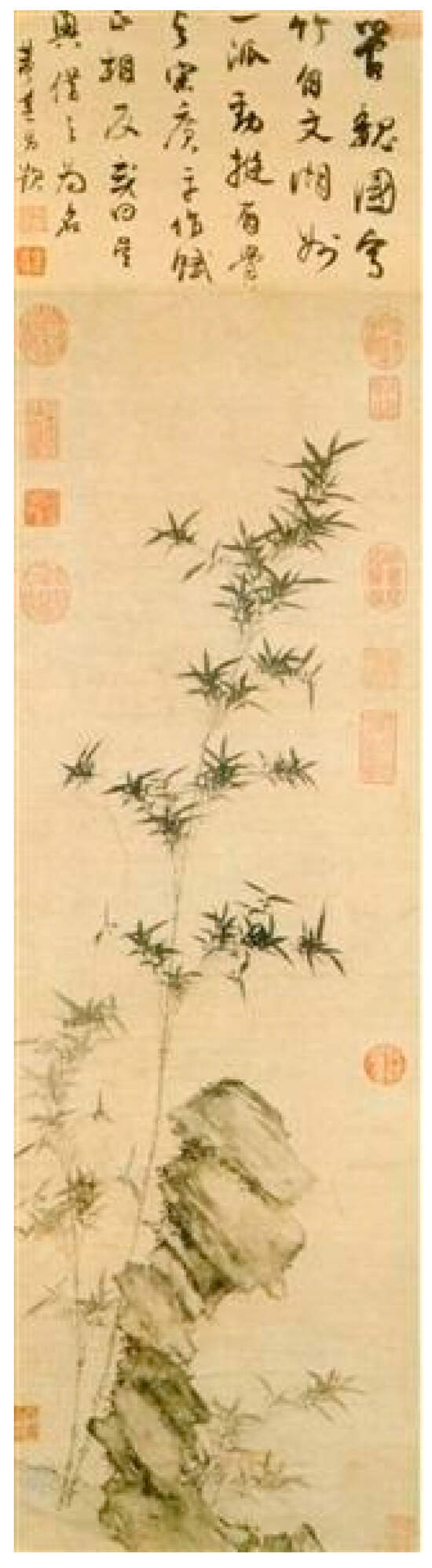
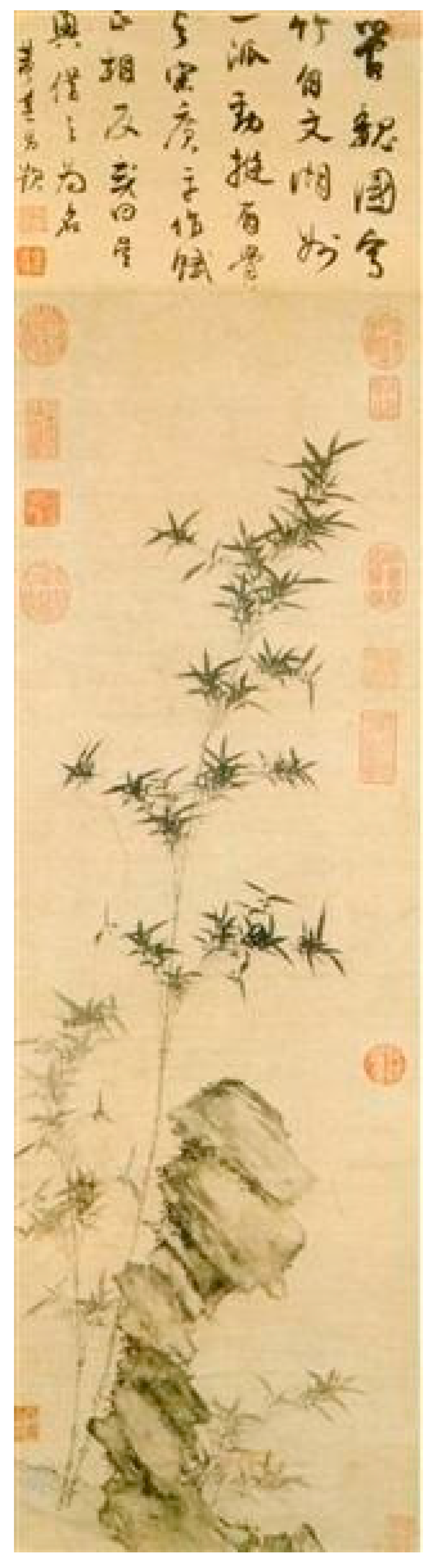
This case Figure 1 study examines the mode of mediated visibility.
Figure 1.
Ink Bamboo and Garden Rock. Attributed to Guan Daosheng (1262–1319), Yuan Dynasty. Ink and wash painting. (WikiArt: Visual Art Encyclopedia. Public domain. https://www.wikiart.org/en/guan-daosheng/bamboo-and-stone, accessed on 13 March 2026).
The artistic legacy of Guan Daosheng, widely recognised as the most accomplished woman painter of the Yuan dynasty, survives within a highly mediated inscriptional field. Literati painting in Yuan China functioned not simply as aesthetic practice but as a social network structured through scholarly exchange, calligraphic inscription, and connoisseurial validation. Authorship, circulation, and preservation depended on literati endorsement—structures overwhelmingly dominated by men (Rossabi 2014, p. 66).
Guan’s visibility was inseparable from her marriage to Zhao Mengfu, whose inscriptions and reputation facilitated the circulation and preservation of her work. Surviving paintings and later attributions frequently appear alongside his calligraphy, situating Guan’s authorship within literati networks of validation. Rather than diminishing her artistic authority, this context clarifies the conditions under which her work became legible within elite culture (Rossabi 2014, p. 67). Guan’s legacy therefore exemplifies mediated visibility: authorship sustained through inscriptional networks rather than autonomous institutional recognition.
Feminist historiography has emphasised that women’s historical presence often appears only through indirect traces embedded within dominant archives. As Saidiya Hartman argues, archival silence is not an absence but a record of the processes that produced erasure (Hartman 2008, p. 3). In the case of medieval Chinese women, artistic production frequently became one of the few domains in which expression could circulate beyond the inner quarters. Elite women’s writings were filtered through patriarchal structures, while their movements remained largely confined to the domestic sphere (Ebrey 1993, pp. 3–5). Visual art therefore operated as a parallel site of historical articulation—one capable of encoding presence within symbolic form.
The literati bamboo tradition provides a revealing context for this dynamic. Within Yuan artistic culture, bamboo symbolised the cultivated gentleman (junzi): upright, resilient, and morally disciplined. Participation in this genre required fluency in its aesthetic language—controlled brushwork, tonal modulation, and compositional balance between emptiness and form. Guan’s bamboo paintings demonstrate full command of this vocabulary. Her brushwork is confident and rhythmically structured, while the restrained composition reflects the cultivated elegance associated with literati refinement (Rossabi 2014, p. 69).
Ink Bamboo and Garden Rock pairs two emblematic motifs. Bamboo bends without breaking, signifying moral flexibility under pressure, while the garden rock suggests endurance and permanence. Both were conventional markers of elite masculine virtue within literati discourse. Guan’s engagement with this symbolic system does not overturn its gendered foundations; instead, it demonstrates strategic mastery within them. Her painting participates in literati aesthetics while subtly expanding the space available to women within that tradition. As Rossabi observes, women in Yuan elite culture often exercised influence not through overt opposition but through quiet participation in established intellectual and artistic networks (Rossabi 2018, pp. 67–70).
5.1.1. Poetic Inquiry: “A Quiet Archive”
- A Quiet Archive
- Bamboo leans,
- but never breaks.
- A woman’s brush traces what the record forgets.
- Her name survives
- carried in her husband’s hand—
- yet the ink is hers.
- A quiet archive
- stitched in resilience:
- a whisper made visible,
- the silence of women
- rendered in strokes
- that will not fade.
5.1.2. Poetic Intervention
A Quiet Archive functions as a methodological exploration that tests how visual symbolism translates into historical narrative. Its imagery condenses the structural conditions described in the prose: bamboo becomes a figure for resilience within constraint, while the line “her name survives/carried in her husband’s hand” evokes the inscriptional mediation through which Guan’s authorship circulated.
The poem’s central intervention lies in the phrase “a whisper made visible.” Here, visual art becomes a mode of historical articulation that transforms suppressed speech into material form. The brushstroke operates simultaneously as aesthetic gesture and archival trace. Through this condensation, the poem demonstrates how artistic form can register forms of presence that remain only partially visible within textual history.
In this sense, the poem does not provide an alternative interpretation of Ink Bamboo and Garden Rock. Instead, it stages a brief methodological experiment: translating visual symbolism into poetic language reveals how Guan’s work operates simultaneously as literati painting and as historical evidence of women’s participation within elite cultural systems.
5.1.3. Concluding Claim
Ink Bamboo and Garden Rock illustrates how women’s artistic survival in Yuan visual culture often depended on participation within dominant aesthetic frameworks. Guan Daosheng’s mastery of literati bamboo painting did not challenge the symbolic language of masculine virtue directly; rather, it demonstrated that women could inhabit and circulate within that language. The painting’s survival through literati inscription networks further underscores the mediated conditions through which women’s artistic visibility entered the historical record.
The poetic inquiry clarifies this dynamic by condensing the painting’s symbolic logic into narrative form. In doing so, it foregrounds a central methodological insight of this study: women’s artistic works often function simultaneously as aesthetic objects and as archival traces, revealing forms of presence that conventional historical documentation leaves only partially visible.
5.2. Case Study 2: Formal Containment—Lady Su Hui and Rule-Bound Poetic Structure
5.2.1. Reading the Handscroll of Lady Su Hui
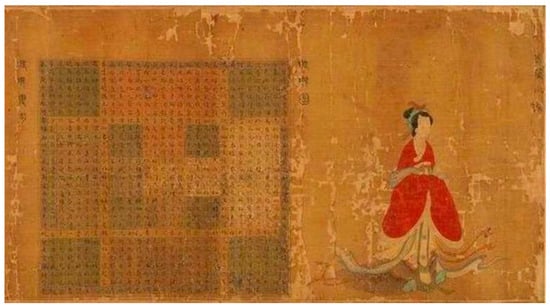
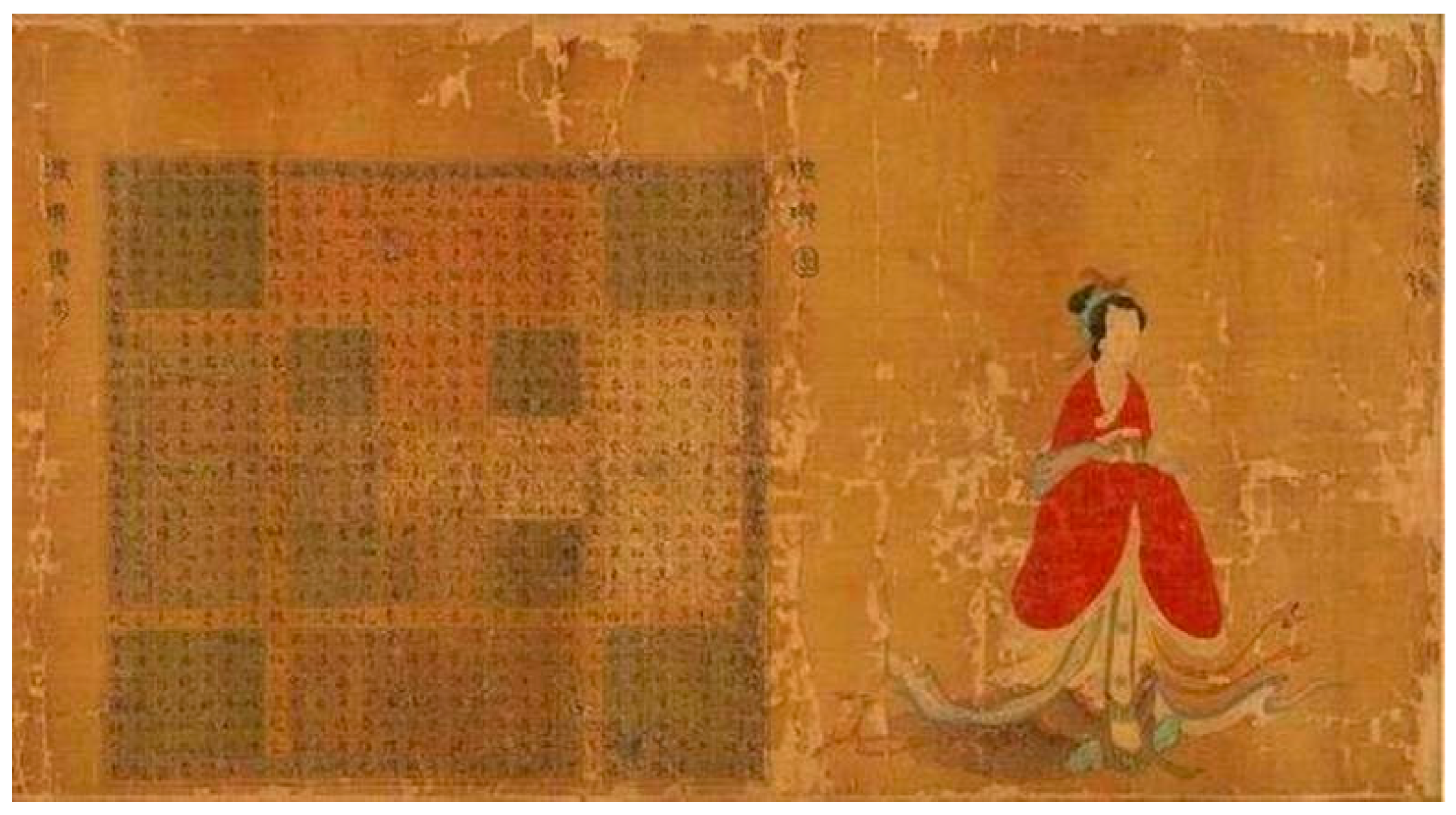
This example Figure 2 illustrates formal containment.
Figure 2.
Portrait of Lady Su Hui with a Palindrome in the Manner of Zhu Shuzheng. Attributed to Guan Daosheng (1262–1319), Yuan Dynasty. Ink and wash painting. (WikiArt: Visual Art Encyclopedia. Public domain. Accessed on 13 March 2026. https://www.wikiart.org/en/guan-daosheng/portrait-of-lady-su-hui-with-a-palindrome-in-the-manner-of-zhu-shuzheng, accessed on 13 March 2026).
The handscroll attributed to Guan Daosheng depicting Su Hui alongside a palindrome poem offers an important lens through which to examine women’s visibility within medieval Chinese cultural production. Combining figural painting and calligraphy, the scroll operates as a multimodal artefact in which textual and visual forms intersect. Through this interplay, women’s presence emerges not solely through written authorship but through the symbolic language of visual representation.
In Chinese literati culture, calligraphy held exceptional authority. It signified education, moral cultivation, and elite intellectual status. Yet access to formal literary production was shaped by gendered structures that confined many elite women to the domestic sphere of the inner quarters (nei) (Ebrey 1993, pp. 3–5). Within this context, the pairing of calligraphy with a female subject becomes especially significant. The scroll situates a woman within the visual field of literati culture while simultaneously invoking the textual authority from which women were often excluded.
The figure represented in the painting is traditionally associated with Su Hui, the fourth-century poet celebrated for composing the xuanji tu, an intricate palindrome poem arranged in a grid structure that can be read in multiple directions. This formally constrained literary composition has long been regarded as a remarkable example of women’s intellectual ingenuity (Purtle 2018, pp. 109–17). By pairing Su Hui with calligraphy in the scroll, the artist invokes a lineage of women’s literary accomplishment while translating that tradition into visual form.
Rather than presenting Su Hui solely as a literary figure, the painting renders her bodily presence within the composition. Draped in red robes and depicted with composed dignity, the figure functions not merely as an illustration of textual content but as a visual counterpart to the written inscription. As scholars have noted, images of women in Yuan painting frequently carried symbolic significance that extended beyond narrative representation (Rossabi 2018, p. 69). In this case, the scroll establishes a dialogue between script and image: the calligraphy articulates textual authority while the painted figure asserts presence where historical documentation remains partial.
5.2.2. Red as Symbolic Language
Colour plays a crucial role in this visual articulation. In Chinese cultural symbolism, red is associated with vitality, celebration, fertility, and spiritual protection. To represent a female figure in red situates her within a symbolic register of auspicious transformation and generative power. The chromatic intensity of the robe functions as a visual declaration of vitality, counterbalancing the relative abstraction of the written text. Through colour, the image conveys meaning not through language but through embodied symbolism.
5.2.3. Calligraphy and the Question of Authority
Within literati aesthetics, calligraphy was widely regarded as the highest artistic form—an index of moral character and cultivated intellect. Women’s participation in this domain was limited by social conventions that privileged male scholarly authorship (Williams 2006, p. 44). By juxtaposing calligraphic inscription with a female figure, the handscroll complicates this hierarchy. The visual presence of Su Hui does not replace the authority of text; rather, it reframes it. The painting suggests that intellectual lineage and symbolic authority may also be transmitted through visual form.
5.2.4. Poetic Inquiry: Marks in Time
- Marks in Time
- Words brushed onto silk,
- a square of devotion.
- Marks in time—
- silent, yet luminous.
- Script carries authority,
- but image carries her presence.
- Red robe, phoenix feet:
- she is knowledge and symbol both.
- History frays,
- the scroll worn thin.
- Still, her voice threads between text and paint,
- a survival written in time.
5.2.5. Poetic Intervention
Marks in Time functions as a brief methodological experiment that translates the scroll’s formal dynamics into narrative language. The imagery condenses several elements of the artwork: the geometric structure of the palindrome poem, the authority associated with calligraphic script, and the embodied presence of the painted figure.
The poem’s central claim appears in the line “Script carries authority, but image carries her presence.” Here the poem reframes the relationship between text and image not as a hierarchy but as a complementary system of meaning. While calligraphy signifies intellectual authority within literati culture, the visual figure registers forms of presence that textual structures alone cannot fully convey. By juxtaposing these modalities, the poem highlights the scroll’s formal strategy: women’s intellectual and symbolic presence emerges through the interaction of script, colour, and image.
In this sense, the poem does not reinterpret the artwork so much as test how its visual logic operates when translated into another medium. The result foregrounds the scroll’s central dynamic—formal containment paired with creative expression—demonstrating how rule-bound literary and artistic structures could nevertheless provide spaces for women’s cultural visibility.
5.2.6. Concluding Claim
The handscroll depicting Su Hui illustrates how formal constraint itself could become a site of creative articulation. The palindrome poem associated with Su Hui represents an extreme form of rule-bound structure, yet its complexity has long been understood as evidence of intellectual mastery. The scroll extends this logic visually: by combining calligraphy with a female figure rendered in vivid colour, it creates a space in which textual authority and embodied representation coexist.
Reading the artwork alongside poetic inquiry highlights the methodological value of examining how visual and textual forms intersect. The painting does not simply commemorate a literary figure; it stages a dialogue between inscription and image through which women’s intellectual presence becomes perceptible within the broader framework of literati culture.
5.3. Case Study 3: Infrastructural Anonymity—Imperial Embroidery and Collective Artistic Labour
5.3.1. Embroidery as Gendered Artistic Knowledge
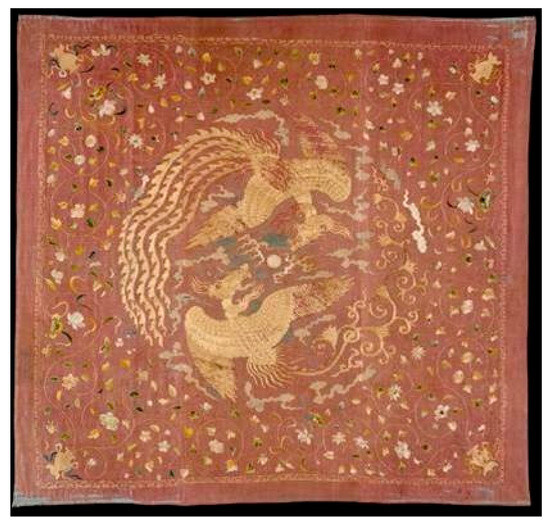
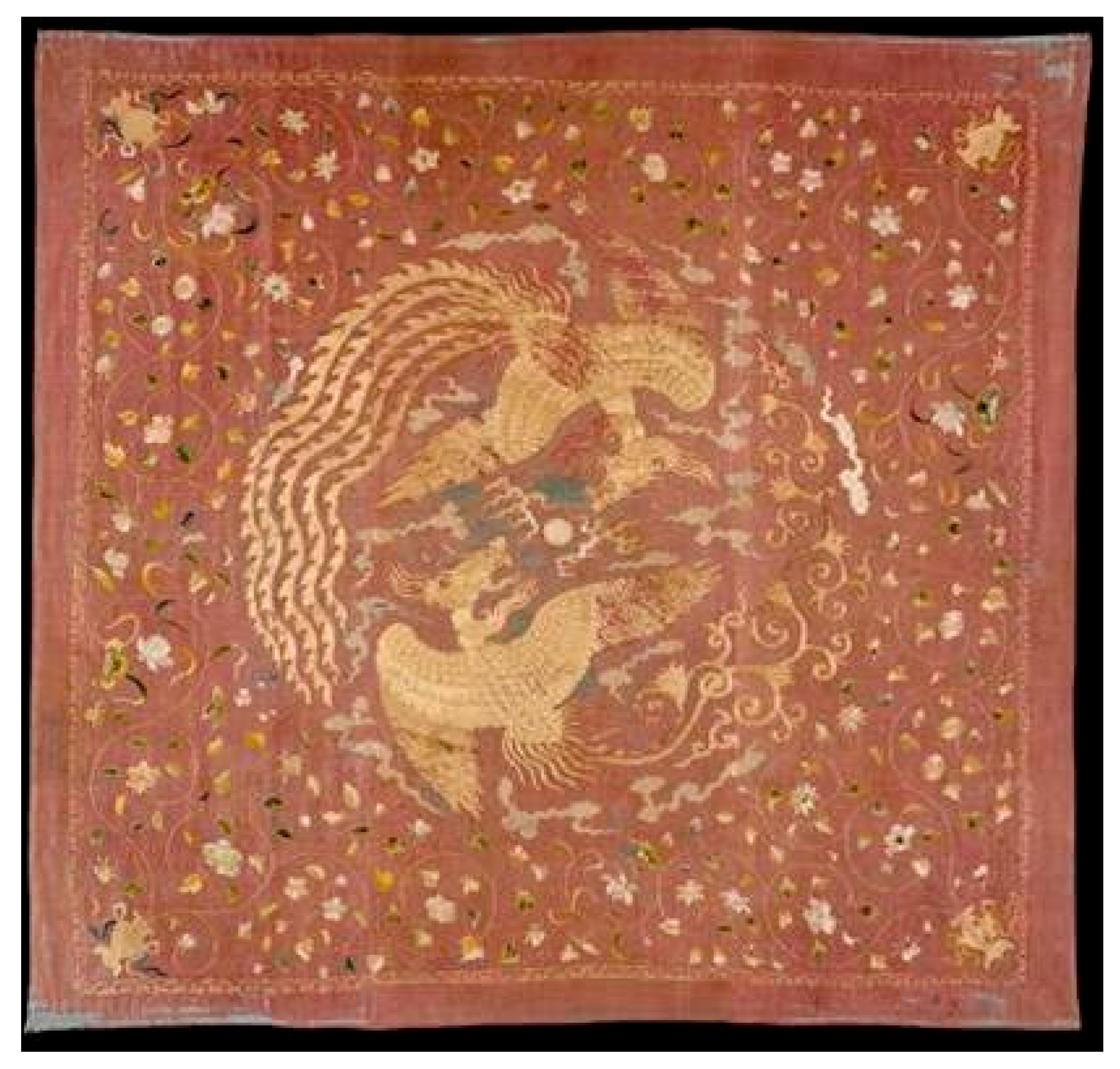
Here Figure 3 the archive reveals infrastructural anonymity.
Figure 3.
Panel with Phoenixes and Flowers. Silk and metal thread embroidery China. Fourteenth century (The Met Museum. Public domain. https://www.metmuseum.org/art/collection/search/39736, accessed 13 on March 2026).
Among the many forms of women’s artistic labour in medieval China, embroidery occupied a distinctive position at the intersection of domestic craft, devotional practice, and imperial production. While literati painting and calligraphy were largely dominated by elite male scholars, textile production—from the spinning of silk to the intricate placement of embroidered stitches—was overwhelmingly practiced and transmitted by women. Embroidery thus constituted a specialised body of knowledge circulated through female networks across generations (Cammann 1992, p. 19).
Despite its ubiquity and cultural significance, embroidery remains largely invisible within official historical records. The women who produced imperial garments, ceremonial banners, and wedding textiles are rarely named in court archives. Their work circulated widely within elite material culture, yet the identities of its makers were seldom preserved (Rossabi 2014, p. 69). This dynamic reflects what may be understood as infrastructural anonymity: a condition in which women’s artistic labour is embedded within institutional systems of production while the individual artisans themselves remain largely undocumented.
5.3.2. The Phoenix Motif: Feminine Virtue and Imperial Symbolism
The phoenix (fenghuang) occupies a central place within Chinese decorative arts and imperial symbolism. Traditionally associated with virtue, renewal, and cosmic harmony, the phoenix functioned as the feminine counterpart to the dragon within the symbolic hierarchy of imperial imagery. The motif adorned empresses’ robes, dowry garments, and ceremonial textiles, visually linking feminine virtue with imperial order.
Embroidery played a crucial role in materialising this symbolic system. Through careful stitchwork, artisans rendered the phoenix’s feathers, wings, and elaborate plumage in silk thread, transforming abstract symbolism into tactile form. While the image represented imperial femininity and dynastic authority, it was produced through the skilled labour of women whose names rarely appear in historical records (Williams 2006, p. 67). The phoenix thus embodies a paradox within courtly material culture: a powerful symbol of feminine sovereignty created through largely anonymous female craftsmanship.
5.3.3. Embroidery as Disciplined Practice
The process of embroidery required extraordinary patience, dexterity, and technical training. Each stitch was placed with precision, contributing to the gradual emergence of the overall image. This repetitive and highly disciplined process produced not only decorative surfaces but also a material record of skilled labour. The embroidered textile therefore registers the presence of its maker indirectly, through the visible traces of technique and craft embedded within the fabric.
Rather than functioning solely as ornament, embroidered court textiles reveal the institutional networks through which women’s labour supported imperial visual culture. Workshops associated with palace production systems trained artisans to produce textiles that adhered to strict aesthetic and symbolic conventions. Women’s creative agency thus operated within structured systems of patronage and regulation rather than outside them.
5.3.4. Poetic Inquiry: Fire in Silk
- Fire in Silk
- She threads the phoenix into being,
- a bird born from quiet hands.
- Stitch by hidden stitch,
- she writes what she cannot say.
- Silk glows beneath the lamp,
- a dawn she conjures in the dark.
- No record keeps her name,
- but her labour burns bright—
- a fire folded into silk.
- Every feather a testament,
- every thread a prayer.
- Her craft survives the centuries,
- though she remains unspoken.
5.3.5. Poetic Intervention
Fire in Silk translates the material logic of embroidery into narrative form. Its imagery emphasises the gradual emergence of the phoenix through repeated acts of stitching, foregrounding the embodied labour required to produce imperial textile imagery.
The poem’s central claim appears in the metaphor “a fire folded into silk.” Here the phoenix’s symbolic association with flame and renewal becomes inseparable from the physical labour that produces the image. By focusing on the transformation of thread into symbol, the poem highlights how anonymous artisans contributed materially to the visual language of imperial authority. The embroidered phoenix thus emerges not simply as a decorative motif but as the visible outcome of disciplined craft embedded within institutional systems of production.
Through this translation of textile process into poetic language, the poem foregrounds the structural dynamic at the centre of this case study: women’s artistic labour was integral to imperial visual culture even when the identities of individual makers remained undocumented.
5.3.6. Concluding Claim
The embroidered phoenix illustrates how women’s artistic contributions operated within the infrastructural frameworks of imperial material culture. Court workshops and production networks relied on highly trained female artisans whose work helped construct the symbolic language of dynastic authority. Yet the institutional systems that enabled this production rarely preserved the names of the individuals responsible for it.
Reading imperial embroidery alongside poetic inquiry underscores the importance of attending to the material traces of labour embedded within decorative objects. The phoenix motif, while traditionally interpreted as a symbol of feminine virtue and imperial power, also reflects the collective craftsmanship of women whose technical expertise shaped the visual culture of the court. Through the careful placement of each stitch, anonymous artisans contributed to a visual tradition that continues to circulate long after the identities of its makers have faded from the historical record.
5.4. Case Study 4: Circulatory Displacement—Silk Road Textile Fragments
5.4.1. The Silk Road and Gendered Material Production
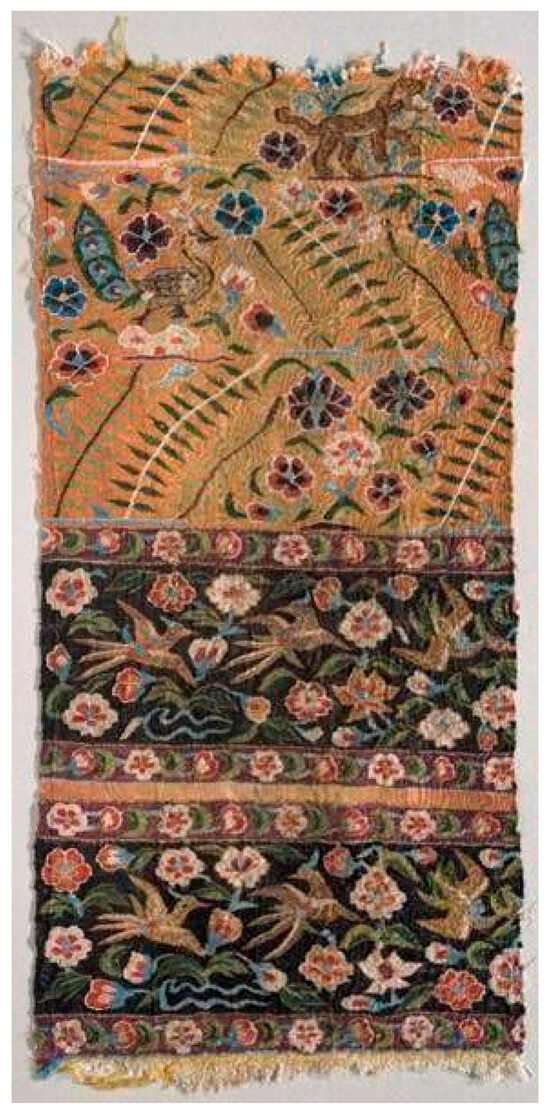
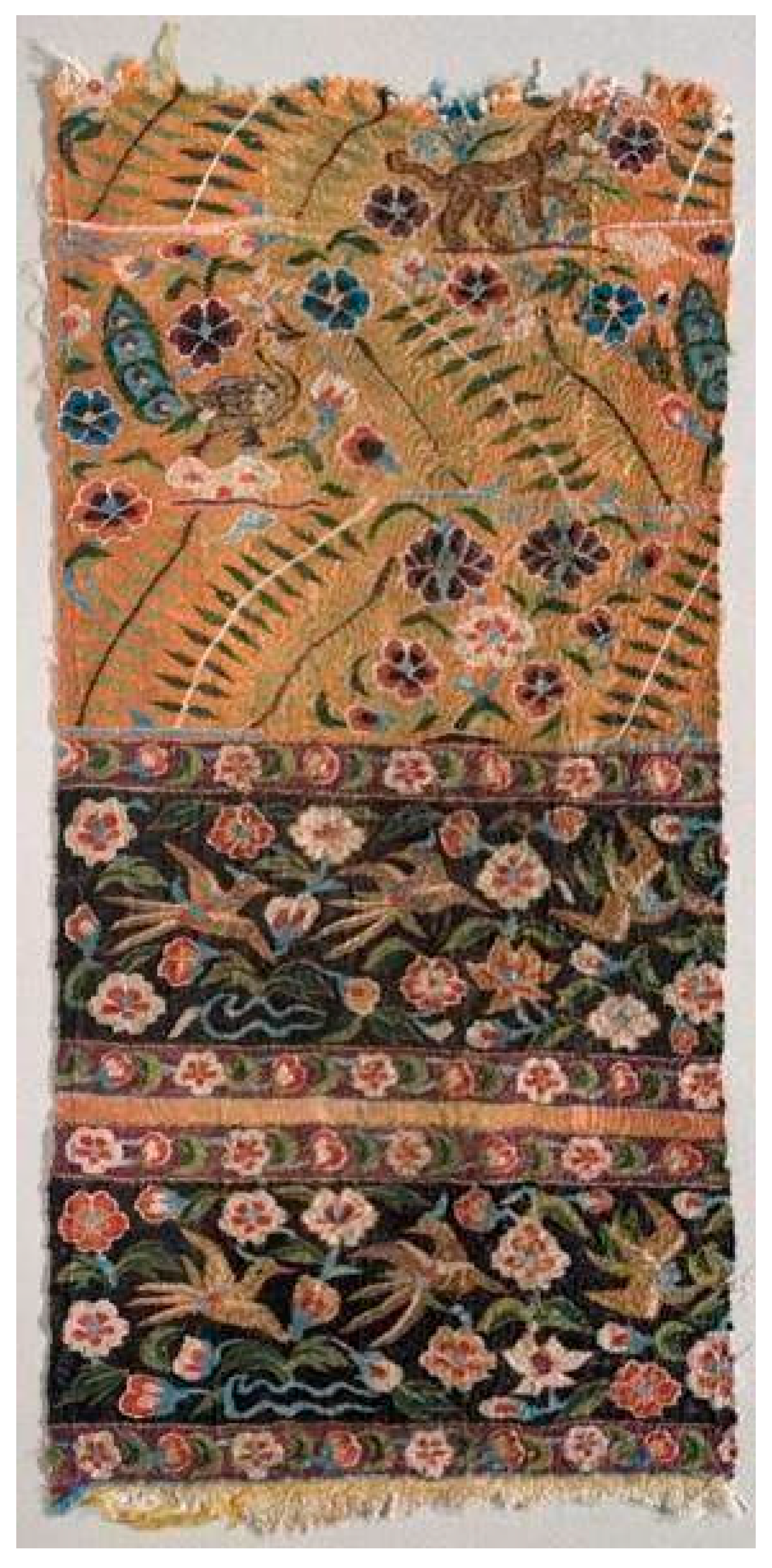
This final case Figure 4 demonstrates circulatory displacement.
Figure 4.
Fragment with Tiger and Birds on a Floral Ground. Silk and metal thread tapestry. Eastern Central Asia. Tenth to twelfth century. (The Met Museum. Public domain. https://www.metmuseum.org/art/collection/search/39734, accessed on 13 March 2026).
Histories of the Silk Road typically foreground merchants, imperial envoys, and caravan routes that linked East and Central Asia with the Mediterranean world. Yet much of the material culture circulating along these routes—silk textiles, brocades, felted cloth, embroidered saddlecloths, and banners—was produced through the labour of women (Broadbridge 2018, p. 98). Textile production therefore formed a critical but often overlooked foundation of Silk Road exchange networks.
A surviving woven tapestry fragment offers a material entry point into this history. Although incomplete, the fragment preserves intricate patterning and near-symmetrical motifs that attest to sophisticated weaving techniques (Crill 1999, p. 45). Its survival as a fragment rather than an intact textile reflects both the vulnerability and durability of textile materials: while fabrics often deteriorate over time, small sections sometimes endure as archaeological remnants of broader artistic traditions.
5.4.2. Women as Textile Technicians and Cultural Translators
Across pastoral and nomadic societies connected to Silk Road networks, textile production was central to both domestic life and long-distance trade. Women produced felt coverings for tents, woven cloth for clothing, embroidered textiles for ceremonial use, and decorated saddlecloths that signalled political or social status. These textiles circulated widely through exchange, tribute, and migration, carrying with them visual motifs and technical practices developed within local communities (Broadbridge 2018, p. 108).
Through these processes, women functioned as cultural transmitters within transregional exchange systems. Patterns, dyes, and weaving techniques moved across landscapes alongside the objects themselves, embedding local knowledge within goods that travelled far beyond their points of origin.
5.4.3. Fragmentation and Circulatory Displacement
The survival of a textile fragment reflects the broader dynamics of circulation that characterised Silk Road material culture. Objects moved across great distances through trade and exchange, often becoming detached from the specific contexts of their production. In many cases, the artisans who produced these textiles remain unknown, while the objects themselves continue to circulate through museums, archaeological collections, and scholarly study.
This condition can be understood as circulatory displacement: historical endurance that arises through mobility rather than stable attribution. The fragment survives because it travelled and was preserved, yet that same movement separated it from the biographical histories of its makers. What remains visible today is evidence of technical skill and intercultural exchange embedded in the textile itself.
5.4.4. Poetic Inquiry: Woven Horizons
- Woven Horizons
- A fragment of a world,
- worn thin by time.
- Yet her hands remain—
- their rhythm woven into every thread.
- Tiger, bird, and blossom:
- symbols crossing borders
- she herself could not traverse.
- The cloth remembers her,
- even when history does not.
- Warp and weft whisper stories
- of women moving through stillness,
- their labour the map of a world
- stitched across continents.
5.4.5. Poetic Intervention
Woven Horizons translates the textile’s material structure into narrative form. Its imagery focuses on the relationship between weaving techniques—particularly the interlocking system of warp and weft—and the mobility of the object within Silk Road exchange networks.
The poem’s central claim appears in the line “their labour the map of a world/stitched across continents.” Here the woven textile becomes a metaphorical cartography of cultural exchange. While merchants and caravans physically transported goods across Eurasia, the patterns embedded within the fabric also carried aesthetic knowledge across regions. The poem thus reframes the fragment not simply as a remnant of loss but as evidence of a transregional network sustained through textile production.
By translating the structure of weaving into poetic language, the poem highlights the dynamic relationship between stillness and movement: the labour of weaving occurred within local domestic settings, yet the resulting textiles travelled widely through trade. This tension underscores the central dynamic of circulatory displacement—mobility that preserves objects while obscuring the identities of their makers.
5.4.6. Concluding Claim
Silk Road textile fragments reveal how women’s labour contributed to the formation of transregional material cultures. Weaving expertise developed within local communities but became embedded within broader economic networks as textiles circulated through trade, tribute, and migration. The fragment therefore represents both a local act of craftsmanship and a node within a larger system of exchange.
Reading the object alongside poetic inquiry highlights the methodological value of attending to the material structure of textiles themselves. The woven surface preserves traces of technical skill, aesthetic choice, and cultural translation even when the identities of individual makers are no longer recoverable. Through their mobility across landscapes and centuries, these textiles continue to register the presence of the women whose labour helped sustain Silk Road exchange networks.
6. Kara Walker in Dialogue: Shadow and Recovery
The silhouette artwork of contemporary American artist Kara Walker offers a powerful methodological bridge for interpreting medieval suppressed histories. Walker’s art enters into this study not as anachronistic comparison but as a methodological dialogue. Her work demonstrates how histories structured by violence, erasure, and racialised power can be read through absence, shadow, and fragment rather than through full recovery. By staging history as a field of silhouettes, Walker materialises the idea that the violence embedded in visual and narrative conventions is not empty, but densely inhabited by power, memory, and ethical demand (Walker 2011, pp. 15–20). Her cut-paper installations operate as visual counter-archives. They refuse the authority of monumental history painting, substituting instead a fragile, theatrical space in which enslaved and marginalised figures appear as silhouettes—present and absent at once. The black silhouette, historically associated with racial caricature and scientific classification, is reworked as a feminist and anti-racist strategy of historical critique. What cannot be spoken safely in the documentary erasure is rendered visible through shadow (Walker 2011, pp. 15–20).
Read through critical fabulation, Walker’s practice models how disciplined imagination can engage historical trauma without claiming mastery over it. Her scenes do not reconstruct specific events; they stage historically plausible relations of power, encouraging the viewer into ethical proximity with what the textual record both records and conceals (Hartman 2008, p. 11). Poetic inquiry attends to negative space, scale, and gesture, revealing how affect and embodiment carry historical knowledge when narrative fails. The viewer learns to read history not through linear recovery but through an encounter with mediated absence (Prendergast 2009, p. 74).
Placing Walker in dialogue with medieval women’s quiet arts clarifies the transhistorical stakes of this methodology. Guan Daosheng’s bamboo, Lady Su Hui’s woven poem, Mongol imperial textiles, and Silk Road embroidery all operate as parallel records that preserve women’s historical presence through material form rather than textual voice. Walker’s silhouettes make explicit the political logic that underwrites these practices, when dominant narrative priorities are structured by gendered and racial power, art becomes a necessary site of historical knowledge.
Walker therefore does not “recover” the past; she teaches us how to read what cannot be fully recovered. Her work insists that ethical history-writing requires attention to shadow, mediation, and the limits of knowledge. She is a contemporary theorist in visual form whose practice illuminates how archival marginalisation, when read with feminist discipline, becomes a powerful archive rather than an empty space.
Walker’s practice demonstrates that confronting representational constraint can itself be a form of critical production. By refusing to stabilise narrative closure, her work exposes how history is constructed through selection, omission, and framing. Similarly, the quiet arts examined here do not merely supplement textual archives; they reveal the patterned mechanisms that rendered women indispensable yet differentially legible.
If the silhouette operates as a visual theory of archival distortion, then poetic inquiry operates here as a methodological analogue. Both refuse to resolve absence into certainty. Both insist that the ethics of historical reading require attention to structure.
Walker’s silhouettes do not compensate for historical occlusion; they make its structure visible. It is this structural visibility—not narrative restoration—that guides the method of this study.
7. Conclusions: Toward Alternative Practices of Reading Embedded Presence
This research has argued that women’s absence from medieval Mongol and Chinese textual archives is not a problem to be solved but a historical condition to be interpreted. By reading narrative omissions as archive, it has shown how gendered epistemic power shaped what could be recorded, remembered, and valued. Rather than seeking a full recovery of women’s voices, the study has demonstrated how disciplined feminist reading practices can transform absence into historical testimony.
Through a condensed theoretical framework grounded in Black feminist thought, critical fabulation, and poetic inquiry, the research has developed a methodology for working with record-based exclusion. The case studies have shown how paintings, textiles, and poetic artefacts function as counter-archives: sites where women’s labour, skill, and ethical self-fashioning persist despite patriarchal conditions of preservation. Guan Daosheng’s bamboo, Lady Su Hui’s woven poem, Mongol imperial textiles, and Silk Road embroidery each record women’s participation in history.
What remains is not archival rupture as metaphor but structure as evidence. Women’s labour in medieval Mongolia and Yuan China was indispensable to political, aesthetic, and economic systems, even when textual inscription privileged other actors. Reading those systems with precision does not reveal absence, but patterned conditions of recognition. The quiet arts do not merely supplement the archive; they expose the frameworks through which history was written.
Taken together, these examples demonstrate that medieval global history cannot be written through conquest narratives alone. Women’s quiet arts, in particular material, affective, and intellectual labour, sustained cultural worlds across medieval Mongolia and China. By learning to read differently—against the grain of patriarchal systems of record keeping and in dialogue with material culture—historians can write women back into history without reproducing the epistemic violence that first rendered them silent.
This feminist practice of reading fragmentary survival does not promise recovery. Instead, it offers something more rigorous and more ethical: a way of acknowledging loss while refusing erasure, and of recognising women’s historical presence precisely where the narrative conventions sought to make them disappear.
This study also has clear limits. It focuses on objects that survive within institutional and museum collections, which necessarily privileges forms of women’s production that were preserved, collected, or canonised. Many forms of everyday labour—ephemeral textiles, domestic craft, oral exchange—remain beyond the scope of available material evidence. The case studies centre primarily on elite or court-adjacent contexts, where documentation, however uneven, allows structural analysis; they do not claim to represent the full range of women’s experiences across medieval Mongolia and Yuan China. In addition, the transhistorical dialogue with Black feminist theory and contemporary visual practice is offered as a heuristic framework rather than as a direct analogy. While this approach clarifies structural mechanisms of archival disappearance, it cannot eliminate the asymmetries between contexts.
Read in this light, the women who appear flattened, exoticized, or absent in The Travels of Marco Polo by Marco Polo emerge not as historical voids but as figures rendered structurally illegible within his narrative frame—figures whose presence persists in the material and visual archives his account could neither fully see nor record.
As poet and feminist Audre Lorde reminds us, “the master’s tools will never dismantle the master’s house” (Lorde 1984, p. 110). New tools—transdisciplinary, feminist, artistic—are required. Treating silence as archive with an artistic approach is one such tool, opening space for layered, kaleidoscopic histories in which women are recognised not merely as subjects of history, but as makers of the worlds they inhabited.
Funding
The symposia where this research was initiated were financed through collaboration with the Nordic Summer University who received Nordplus funding from the Nordic Council of Ministers for the arrangement of study circles. The main part of this research was conducted within the research project Praxis of Social Imaginaries-a Theo-artistic Intervention for Transdisciplinary Knowledge, that is funded by the following: Inez and Julius Polin Institute of Theological Research at Åbo Akademi Foundation, and additional support from Otto Malm: Culture and Education; Svenska Kulturfonden i Finland: travel grants; Sigtuna Foundation: cultural collaboration; Gustaf Packalens Minnesfond and Jubileumsfonden at Stiftelsen for Åbo Akademi for travel in the Nordic region.
Institutional Review Board Statement
The study was conducted in accordance with the Declaration of Helsinki, and the guidelines of the Finnish National Board on Research Integrity (TENK). According to the latest guidelines from 2019, the kind of research that this article is built upon does not require an ethical review.
Informed Consent Statement
Informed consent was obtained from all subjects involved in the study.
Data Availability Statement
The datasets presented in this article are not readily available due to the sensitive nature of the materials and the agreements we have made to apply what is stipulated in the Global Indigenous Data Alliance and The CARE Principles for Indigenous Data Governance, when it comes to how materials are shared with outsiders. Requests to access the datasets should be directed to author.
Conflicts of Interest
The author declares no conflict of interest.
References
- Birge, Bettine. 2024. Women and Gender under Mongol Rule. In The Cambridge History of the Mongol Empire. Edited by Timothy May and Michael Hope. Cambridge: Cambridge University Press, pp. 628–54. [Google Scholar]
- Broadbridge, Anne. 2018. Women and the Making of the Mongol Empire. Cambridge: Cambridge University Press. [Google Scholar]
- Cammann, Schuyler. 1992. Chinese Embroidery. New York: Dover Publications. [Google Scholar]
- Collins, Patricia Hill. 2019. Intersectionality as Critical Social Theory. Durham: Duke University Press. [Google Scholar]
- Crenshaw, Kimberlé. 1991. Mapping the Margins: Intersectionality, Identity Politics, and Violence against Women of Color. Stanford Law Review 43: 1241–99. [Google Scholar] [CrossRef] [Scilit]
- Crill, Rosemary. 1999. Chinese Embroidery. London: V&A Publications. [Google Scholar]
- de Rachewiltz, Igor. 2006. The Secret History of the Mongols: A Mongolian Epic Chronicle of the Thirteenth Century. Leiden: Brill. [Google Scholar]
- Dickason, Kathryn. 2025. The Blackness of Medieval Dance. Florilegium 38: 1–29. [Google Scholar] [CrossRef] [Scilit]
- Ebrey, Patricia. 1993. The Inner Quarters: Marriage and the Lives of Chinese Women in the Sung Period. Berkeley: University of California Press. [Google Scholar]
- Hartman, Saidiya. 2008. Venus in Two Acts. Small Axe 12: 1–14. [Google Scholar] [CrossRef]
- Hinsch, Bret. 2016. Women in Imperial China. Lanham: Rowman & Littlefield. [Google Scholar]
- Holmes, Barbara Ann. 2004. Joy Unspeakable: Contemplative Practices of the Black Church. Minneapolis: Fortress Press. [Google Scholar]
- Hooks, Bell. 1981. Ain’t I a Woman? Black Women and Feminism. Boston: South End Press. [Google Scholar]
- Kim, Margaret. 2012. Polyandry and The Travels of Marco Polo: Sexual Hospitality, Cultural Difference, and Medieval European Understandings of Asia. Journal of Medieval History 20: 217–245. [Google Scholar]
- Kinoshita, Sharon. 2024. Marco Polo and His World. London: Reaktion Books. [Google Scholar]
- Ko, Dorothy. 2001. Every Step a Lotus: Shoes for Bound Feet. Oakland: University of California Press. [Google Scholar]
- Leggo, Carl. 2008. Poetic Inquiry. Qualitative Inquiry 14: 1–15. [Google Scholar]
- Lorde, Audre. 1984. Sister Outsider. Berkeley: Crossing Press. [Google Scholar]
- Man, Eva Kit Wah. 2016. Bodies in China: Philosophy, Aesthetics, and Politics. Hong Kong: Chinese University Press. [Google Scholar]
- Marsh, Charles, Peter Slade, and Sarah Azaransky, eds. 2017. Lived Theology: New Perspectives on Method, Style, and Pedagogy. Oxford: Oxford University Press. [Google Scholar]
- Palmgren, Ann-Charlotte. 2023. Your Roundabout in My Ear Lobe: Poetic Inquiry as Creative and Embodied Knowledge Production. Cultural Analysis 21: 8–21. [Google Scholar]
- Polo, Marco. 1993. The Travels of Marco Polo. Edited and Translated by Ronald Latham. London: Penguin Classics. [Google Scholar]
- Prendergast, Monica. 2009. Introduction: The Phenomenon of Poetic Inquiry. In Poetic Inquiry: Vibrant Voices in the Social Sciences. Edited by Monica Prendergast, Carl Leggo and Pauline Sameshima. Rotterdam: Sense Publishers, pp. 19–30. [Google Scholar]
- Purtle, Jennifer. 2018. Guam Daosheng and the Idea of a Great Woman Artist. Orientations 49: 109–17. [Google Scholar]
- Rosenlee, Li-Hsiang. 2023. Gender in Confucian Philosophy. Edited by Edward N. Zalta and Uri Nodelman. Stanford: The Stanford Encyclopedia of Philosophy. [Google Scholar]
- Rossabi, Morris. 2014. The Mongols and Global History. New York: Norton. [Google Scholar]
- Rossabi, Morris. 2018. Women in the Mongol Empire. In The Mongol Empire and Its Legacy. Leiden: Brill, pp. 60–75. [Google Scholar]
- Scott, Joan Wallach. 1988. Gender and the Politics of History. New York: Columbia University Press. [Google Scholar]
- Waley, Arthur. 2005. The Book of Songs. Routledge. [Google Scholar]
- Walker, Kara. 2011. Projecting Fictions: ‘Insurrection! Our Tools Were Rudimentary, Yet We Pressed On’. Available online: https://art21.org/read/kara-walker-projecting-fictions-insurrection-our-tools-were-rudimentary-yet-we-pressed-on/ (accessed on 13 March 2026).
- Wang, Hailan. 2023. Silk and Embroidery in Chinese Women’s Culture. Shanghai: Tongji University Press. [Google Scholar]
- Weidner, Marsha. 1988. Views from Jade Terrace: Chinese Women Artists 1300–1912. Indianapolis: Indianapolis Museum of Art. [Google Scholar]
- Williams, Charles Alfred Speed. 2006. Chinese Symbolism and Art Motifs. Vermont: Tuttle Publishing. [Google Scholar]
- Wong, Dorothy. 2004. Chinese Steles: Artistic and Cultural History. Honolulu: University of Hawai’i Press. [Google Scholar]
- Wood, Frances. 2018. Did Marco Polo Go to China? New York: Routledge. [Google Scholar]
- Xu, Guang. 2021. Women’s Labor and Markets in Medieval China. Shanghai: Fudan University Press. [Google Scholar]
Disclaimer/Publisher’s Note: The statements, opinions and data contained in all publications are solely those of the individual author(s) and contributor(s) and not of MDPI and/or the editor(s). MDPI and/or the editor(s) disclaim responsibility for any injury to people or property resulting from any ideas, methods, instructions or products referred to in the content. |
© 2026 by the author. Licensee MDPI, Basel, Switzerland. This article is an open access article distributed under the terms and conditions of the Creative Commons Attribution (CC BY) license.