


Abstract
In this essay, the author reflects on the entangled histories of archaeology, colonial extraction, and heritage dispersion through the lens of her artistic research project, A Layer of Salt for My Oblivion. Centering the displacement of the Old Kingdom mastaba of Neferirtenef from Saqqara to the Royal Museums of Art and History in Brussels, the author unearths the silences embedded within archival photographs. The archive in focus is that accumulated by Belgian Egyptologist Jean Capart, several of whose archaeological missions were funded by the Belgian industrialist Baron Empain. The latter’s imperial ambitions also defined the urban fabric of the author’s own childhood in Egypt. Blending essay, archival intervention, and poetic voice, the author proposes an alternative mode of listening to displaced heritage: one that honours the agency of the silenced, embraces rupture over restoration, and invites the possibility of care over control.
1. Introduction
There stood a large, abandoned palace near where I grew up in Cairo. Myths and legends clung to its slowly decaying walls like dust. People whispered of hauntings, ghost sightings, Satanic rituals, and a secret tunnel said to connect it to a nearby cathedral. Years later, I stepped inside for the first time upon its renovation and reopening as a museum celebrating its founder, the Belgian industrialist Baron Empain. It was no longer the haunted relic of my childhood imagination. Instead, I was invited to step back in time, to wander through the palace as it may have looked when the baron first made it his home.
The year was 1904 when Edouard Empain arrived in Egypt. By 1911, he and his family had settled into this palace, which he built in the middle of twenty-five kilometres of desert land he had purchased earlier (Baron Empain Palace, 2020, Gallery label, Cairo). He may have chosen this land northeast of Cairo because it was believed that the ancient Egyptian city of the sun—Heliopolis—lay buried beneath its sands. Initially, Empain commissioned Jean Capart, a Belgian archaeologist and curator of the Royal Museums of Art and History in Brussels, to excavate the site (Van der Perre et al. 2021, p. 97). Although the excavations proved fruitless, Empain acquired 76 Egyptian artefacts for the museum, perhaps as an amicable gesture to Capart (Bruffaerts 2010, p. 38), and instead began building his own city of the sun on the site.
In Empain’s Orientalist dream city, nearly a century later, I spent my childhood and adolescence. Most of my memories of home are tied to places shaped by this Western fantasy. The French Catholic school I attended was built to serve the French-speaking residents who moved there. My grandparents’ house is in a district called “The Golf Land,” where Empain’s golf courses once stretched. The sporting club where I trained has not changed much since it was sketched on Heliopolis’ earliest maps. The tram I rode, the terrace cafés where we dined, the streets I wandered with friends—all were envisioned first as part of this informally colonised land.
2. A Site of Extraction
In 2023, I began investigating Empain’s power over the Egyptian desert during an artist residency at the Royal Museums of Art and History in Brussels—a museum significantly shaped by the patronage of the baron and other wealthy Belgian industrialists (De Meyer et al. 2019, p. 181). My entry point was a desire to uncover the consequences of how the baron’s industrialist ambitions were entangled with a fascination for ancient Egypt. As my research progressed, my attention gradually shifted toward the archaeological missions and antiquities acquisitions that his financial support made possible, particularly through his patronage of Jean Capart. Within the latter’s photographic archive, documenting his fieldwork in Egypt, I encountered a silenced narrator—one that spoke of the violence inflicted upon ancient Egyptian heritage by wealth and colonial power.
At the time an assistant curator, Capart was fervently expanding the museum’s Egyptian collection, aspiring to rival the grandeur of other prestigious Western institutions (Bruffaerts 2012, p. 21). At the turn of the twentieth century, the purchase and relocation of ancient Egyptian funerary chapels, tombs, and temples seemed to have become an established strategy through which European museums asserted cultural prestige. Within this context, Capart sought to bring an ancient Egyptian architectural structure to Belgium, relying on the baron’s financial backing and political influence. Remarkably, Empain funded the purchase even before a structure was located, effectively enabling its acquisition in advance of its discovery (Bruffaerts 2012, pp. 21–22).
Capart had convinced Gaston Maspero, then director of the Egyptian Antiquities Service, to cede a tomb in a manner similar to that through which the Louvre had acquired the chapel of the mastaba of Akhethetep two years earlier (Gräzer Ohara et al. 2025, p. 148). With liberty to select a structure of his liking (Bruffaerts 2005, p. 14), he dismissed at least four tombs—considering them too small, fragile, or aesthetically unremarkable—before identifying in 1905 an ancient mastaba in Saqqara, the funerary chapel of which he deemed worthy of the Belgian collection (Bruffaerts 2005, p. 15). For one hundred and twenty years now, the Old Kingdom funerary chapel of a man named Neferirtenef has been on display at the museum in Brussels.
Capart’s privileges reveal how wealth, imperial networks, and private patronage shaped the formation of museum collections during this period. Comparable transactions occurred across Egyptian archaeological sites, demonstrating that Capart’s case was not unique. For example, another Old Kingdom mastaba’s offering chamber, now housed in the Kunsthistorisches Museum in Vienna, was excavated by the German archaeologist Hermann Junker in 1914, and its sale and removal were likewise facilitated by the financial support of the Viennese industrialist Rudolf Maaß (Hölzl 2005, p. 37).
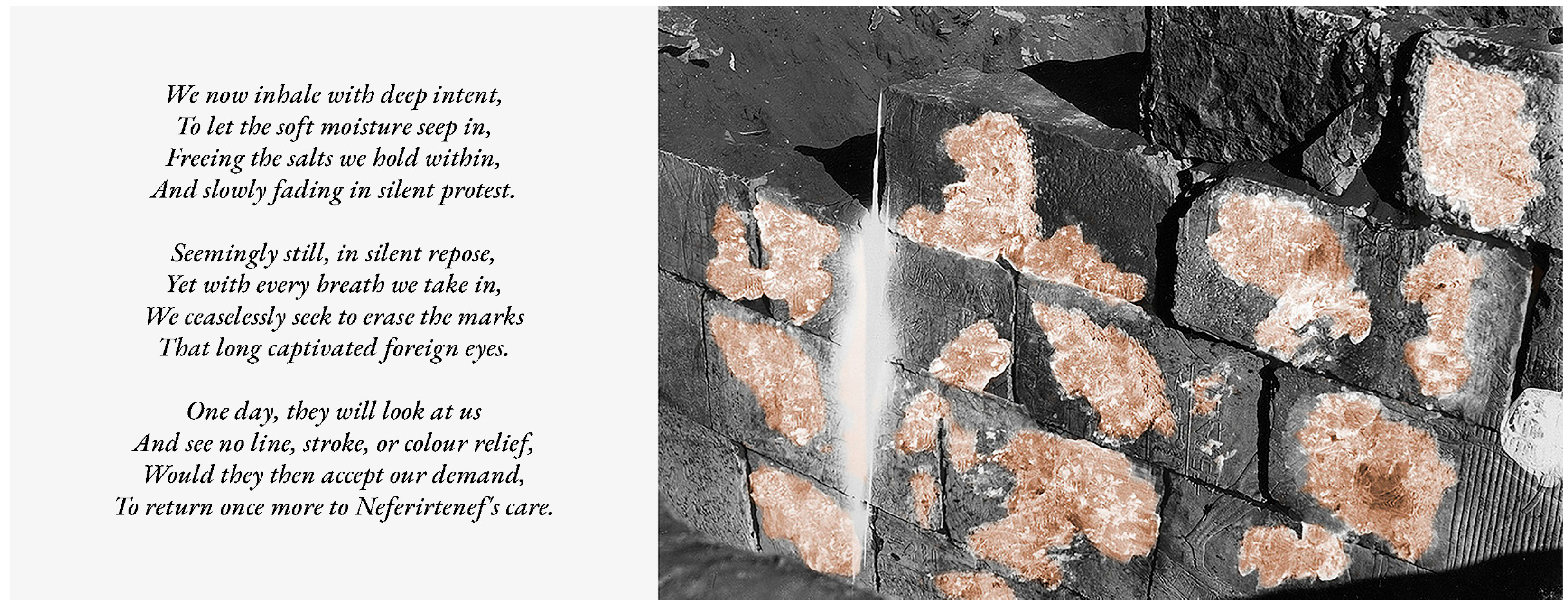
As I traced the history of Neferirtenef’s mastaba—its excavation and transportation, which were thoroughly documented photographically—I found myself standing long before its displaced limestone blocks at the museum. Within their reconstructed form, I sensed the void they must now feel beneath my feet—for they no longer occupy the same ground where Neferirtenef is entombed. From this urge to listen to the silenced voices of these stones, my project, A Layer of Salt for My Oblivion, emerged (Figure 1)*.
Figure 1.
Excerpt of poetry and an archival photograph of Neferirtenef’s mastaba covered with salt and stone dust, part of the project A Layer of Salt for My Oblivion, by Sara Sallam, commissioned in 2023 by the Royal Museums of Art & History in Brussels. Any request to reuse this image needs to be addressed to Sara Sallam.*
3. Breathing as an Act of Rebellion
At first, the stones whispered sorrow into my ears—a low hum of pain I heard as I looked at their photographs: wrapped and packed in crates, pulled into the museum, pieced together in an unfamiliar land far away from where they belonged. Their soft lament grew into a loud testimony of anger when I learned of Capart’s choices when transporting the chapel back home with him.
Capart had unearthed not only this long-forgotten tomb but also a sarcophagus—one that bore no hieroglyphs, rendering its occupant impossible to identify (Bruffaerts 2005, p. 18). Limited in funds, he had to decide which blocks were worthy of transport—ultimately those with inscription. Damaged, faded, or repetitive stones were left behind, along with the sarcophagus and the person it enclosed (Bruffaerts 2005, p. 16). And so, Capart brought back to Belgium his carefully curated selection of blocks, which continue to be admired by museum visitors for their beautiful decorations, diverse inscriptions, and colourful reliefs depicting agricultural scenes, hunting, offerings, and provisions.
What was not aesthetically or archaeologically valuable was abandoned. What remained of the architectural structure was a desecrated body. Stripped of its decorated walls, the funerary chapel lost the ritual coherence that had once made it a living architecture of protection. The carved scenes on the displaced blocks were not merely ornamental; they were believed to ensure the eternal sustenance and perpetual renewal of provisioning necessary for Neferirtenef’s wellbeing after death (Dodson 2014). Fragmented, the mastaba could no longer protect the person it was meant to house eternally.
I returned again and again to the reconstructed chapel at the museum, wondering if I was hearing the stories the stones yearned to tell. Do they want us to feel their pain, to condemn the violence of their displacement, to relate to their severed purpose? It was during a conversation with Luc Delvaux, then curator of the Dynastic and Greco-Roman Egypt collection, that I understood what lay at the heart of the stones’ history. Delvaux described how conservators noticed, years after the mastaba’s arrival, that the colours on the limestone were fading (van de Walle 1978, p. 12). The stones, absorbing Europe’s humid air, had begun to desalinate. A thin layer of salt emerged on their surfaces. They were breathing—and in doing so, they were rebelling. The salt erased what had made them aesthetically significant, a gesture I saw as resistance to the archaeologist’s gaze, which admired them and sought to preserve them as collectables.
Commissioned by Capart’s museum, I sought not only to respond to his widely celebrated photographic archive but also to intervene—to read it against the grain. Recently digitised and made more accessible for research (Gräzer Ohara et al. 2023), the nearly fourteen thousand glass plate photographic negatives not only hold potential for new scholarly discoveries, such as the repositioning of Neferirtenef’s mastaba on the map of Saqqara (Gräzer Ohara et al. 2025, p. 165). They can also serve as vehicles for exposing the power structures embedded in seeing, collecting, and framing the past.
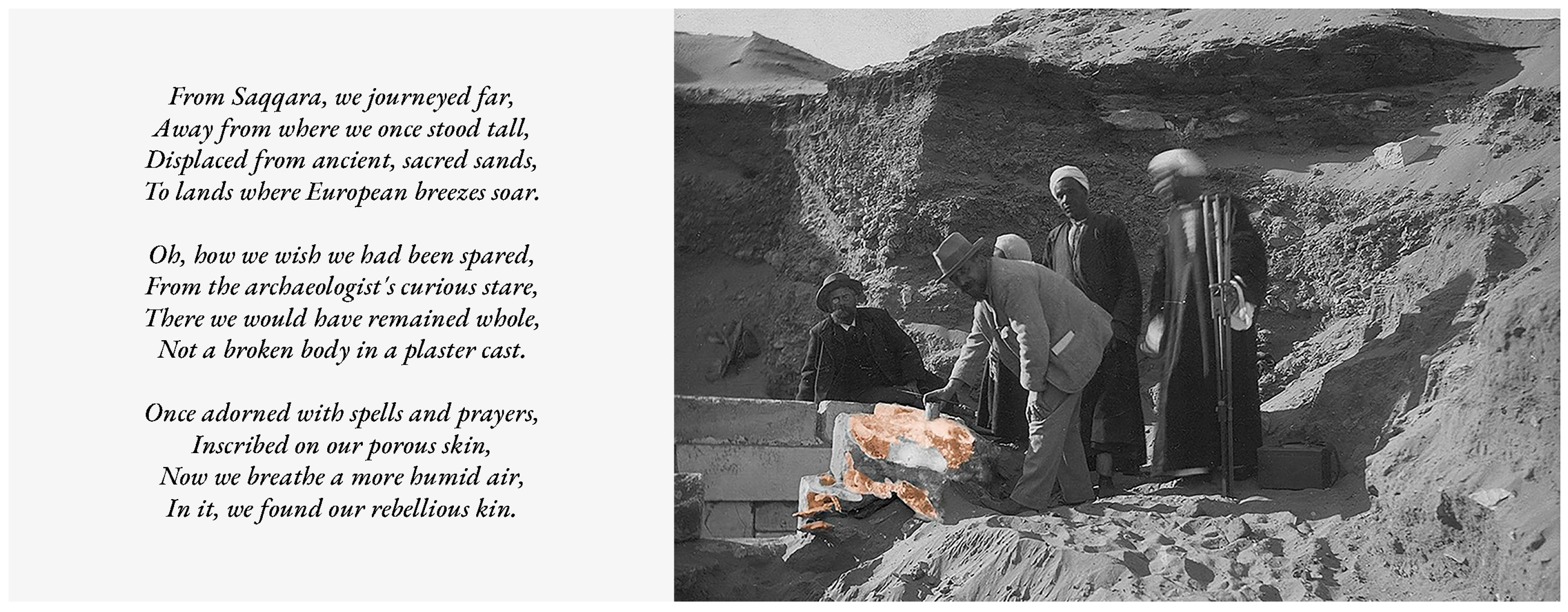
In A Layer of Salt for My Oblivion, I endeavoured to give voice to the mastaba’s displaced stones through poetry and make their rebellious breathing visible through artistic intervention (Figure 2)*. Mimicking their process of desalination, I deformed their photographed surfaces using salts and stone dust, acknowledging, in turn, their agency and defiance. We are, thus, no longer gazing upon their surfaces as passive, docile, beautiful relics. We witness, instead, their embodied refusal of the knowledge systems that alienated them from their spiritual functions and place of origin. By interrupting the fascinated gaze, obscuring vision, and turning toward an act of listening, my intervention proposes a decolonial gesture—a protest against the dominance of sight and an invitation to hear a forgotten perspective. The breath becomes agency, and the voice of the stones becomes poetry articulating refusal and rebellion. In composing these verses, a resonance with the tradition of Egyptian protest poetry emerges, where words are not merely lyrical but function as an embodied, performative act of collective resistance (Colla 2020).
Figure 2.
Sara Sallam, A Layer of Salt for My Oblivion, 2023. Courtesy of the artist. Any request to reuse this image needs to be addressed to Sara Sallam.*
4. Looking Beyond and Imagining Forward
The layered voices of Neferirtenef’s mastaba—the sorrow, the refusal, the quiet rebellion of its stones—speak to the complexities of colonial wounds. The practices of extraction and the resulting displacement and fragmentation of heritage are reflected not only in what is missing from dominant narratives but also in what has been forcibly preserved. These stones carry stories long muffled under the weight of archives and buried beneath mountains of imperial pride. And yet, they await eyes willing to see beyond what has been framed and ears ready to listen beyond what can be heard.
Listening to what remains unsaid—and to what has been rendered invisible—is central to my artistic practice. Though not trained as an archaeologist, I, too, excavate archives, sift through fragments, and linger in the gaps, searching for clues to illuminate what (hi)stories remain untold. Yet my intent is not necessarily to reconstruct a coherent past or preserve an object for study and display. Instead, I approach museums, their collections, and archives as sites of rupture, spaces that hold both violence and possibility.
As archaeology continues to question its own practices and entanglement with Western colonialism through recent efforts from within the field, the seeming neutrality of photographic archives is increasingly under scrutiny (Vella Gregory et al. 2025, p. 26). Scholars are paying closer attention to the embedded power dynamics in these visual records, by shedding light on, for instance, the unacknowledged labour, struggles, and contributions of local communities. Such studies emphasise how archives are inseparable from the colonial ideologies and practices that produced them. They reveal how photographs replicate colonial epistemological hierarchies: not only are local fieldworkers placed in subordinate positions, but the ancient dead—their bodies, heritage, and tombs—and the excavated landscape itself are also objectified, exploited, and desecrated. In my practice, these overlooked voices are given centre stage. Human remains look back. Landscapes bear scars. Statues weep, and stones rise in protest.
In this way, my work becomes not only about what was but a proposal for what could be. It is an invitation to sit with discomfort, to contextualise the alienated, and to unlearn the imperial gaze. Such critical artistic interventions, especially when rooted in historical archival research, have the potential, as Alice Stevenson writes, of “revealing the frames that inform how we talk about the past and the references we use to do so” (Stevenson 2025, p. 12). Ultimately, we need more counter-narratives that re-center acts of care—for the dead, for the displaced, and for those whose silenced voices we ought not only to remember, but to carry forward.
Funding
This research was funded in 2023 by the Royal Museums of Art & History in Brussels.
Institutional Review Board Statement
Not applicable.
Informed Consent Statement
Not applicable.
Data Availability Statement
No new data were created or analyzed in this study. Data sharing is not applicable to this article.
Conflicts of Interest
The author declares no conflict of interest.
References
- Bruffaerts, Jean-Michel. 2005. Un mastaba égyptien pour Bruxelles. Bulletin des Musées Royaux d’Art et d’Histoire, Bruxelles 76: 5–36. [Google Scholar]
- Bruffaerts, Jean-Michel. 2010. Belgian archaeological excavations at Heliopolis: 1907 campaign (Jean Capart). In Heliopolis. Edited by Anne Van Loo and Marie-Cécile Bruwier. Brussels: Fonds Mercator, pp. 35–41. [Google Scholar]
- Bruffaerts, Jean-Michel. 2012. Jean Capart, pionier van de Belgische opgravingen in Egypte. In Ceci n’est pas une Pyramide… Een eeuw Belgisch Archeologisch Onderzoek in Egypte. Edited by Laurent Bavay, Marie-Cécile Bruwier, Wouter Claes and Ingrid De Strooper. Leuven: Peeters, pp. 20–31. [Google Scholar]
- Colla, Elliott. 2020. Egyptian Movement Poetry. Journal of Arabic Literature 51: 53–82. [Google Scholar] [CrossRef] [Scilit]
- De Meyer, Marleen, Jan Vandersmissen, Christophe Verbruggen, Wouter Claes, Luc Delvaux, Marie-Cécile Bruwier, Arnaud Quertinmont, Eugène Warmenbol, Laurel Bavay, and Harco Willems. 2019. Pyramids and Progress: Belgian Expansionism and the Making of Egyptology, 1830–1952. In Towards a History of Egyptology: Proceedings of the Egyptological Section of the 8th ESHS Conference in London, 2018. Edited by Hana Navratilova, Thomas L. Gertzen, Aidan Dodson and Andrew Bednarski. Münster: Zaphon, vol. 4, pp. 173–93. [Google Scholar]
- Dodson, Aidan. 2014. Tomb in ancient Egypt. In Encyclopaedia of the History of Science, Technology, and Medicine in Non-Western Cultures. Edited by Helaine Selin. Dordrecht: Springer. [Google Scholar]
- Gräzer Ohara, Aude, Athena Van der Perre, Marleen De Meyer, and Wouter Claes. 2023. Sura/صورة: Egypt Through a Belgian Lens. Gent and Brussels: Snoeck, Royal Museums of Art and History. [Google Scholar]
- Gräzer Ohara, Aude, Luc Delvaux, Athena Van der Perre, Marleen De Meyer, and Wouter Claes. 2025. Jean Capart, Neferirtenef et les mastabas perdus d’Auguste Mariette. In Auguste Mariette: Deux Siècles Après. Edited by Jean-Louis Podvin and Didier Devauchelle. Villeneuve d’Ascq: Presses universitaires du Septentrion, pp. 147–66. [Google Scholar]
- Hölzl, Regina. 2005. Die Kultkammer Des Ka-Ni-Nisut im Kunsthistorischen Museum Wien. Vienna: Christian Brandstätter Verlag. [Google Scholar]
- Stevenson, Alice. 2025. Contemporary Art and the Display of Ancient Egypt. London: UCL Press. [Google Scholar]
- Van der Perre, Athena, Wouter Claes, Marleen De Meyer, and Aude Gräzer Ohara. 2021. SURA-Project: Het ontstaan van de Belgische Egyptologie in beeld. Ta-Mery 14: 88–111. [Google Scholar]
- van de Walle, Baudouin. 1978. La Chapelle Funéraire de Neferirtenef. Brussels: Musées Royaux d’art et d’histoire. [Google Scholar]
- Vella Gregory, Isabelle, Angela Saward, and Ahmed Hussein Abdelrahman Adam. 2025. Capturing Empire Through the Lens: Colonial Narratives and Power Structures in Henry Wellcome’s Expedition to Jebel Moya, Sudan. African Archaeological Review 42: 25–52. [Google Scholar] [CrossRef] [Scilit]
Disclaimer/Publisher’s Note: The statements, opinions and data contained in all publications are solely those of the individual author(s) and contributor(s) and not of MDPI and/or the editor(s). MDPI and/or the editor(s) disclaim responsibility for any injury to people or property resulting from any ideas, methods, instructions or products referred to in the content. |
© 2026 by the author. Licensee MDPI, Basel, Switzerland. This article is an open access article distributed under the terms and conditions of the Creative Commons Attribution (CC BY) license. The (CC BY) applies otherwise stated in the text with an *.