This text focuses on Vladimir Tatlin and the various—and apparently conflicting—concepts of dynamism and energy that he embraced during the 1920s. At the beginning of the decade, he produced his
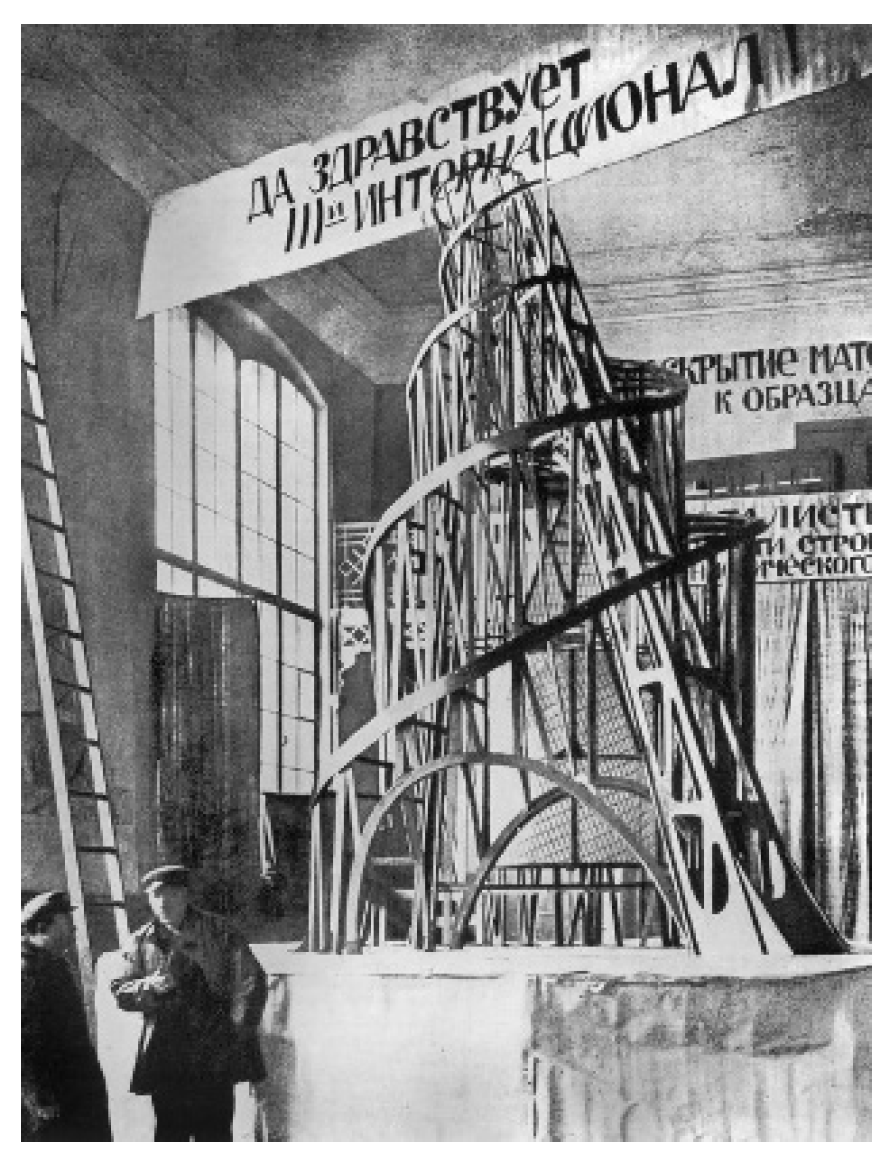
Model for a Monument to the Third International (1920,
Figure 1), which is based on the potentials of industrial technology and engineering. By the end of the decade, he seems to have rejected this approach completely when he developed his flying machine,
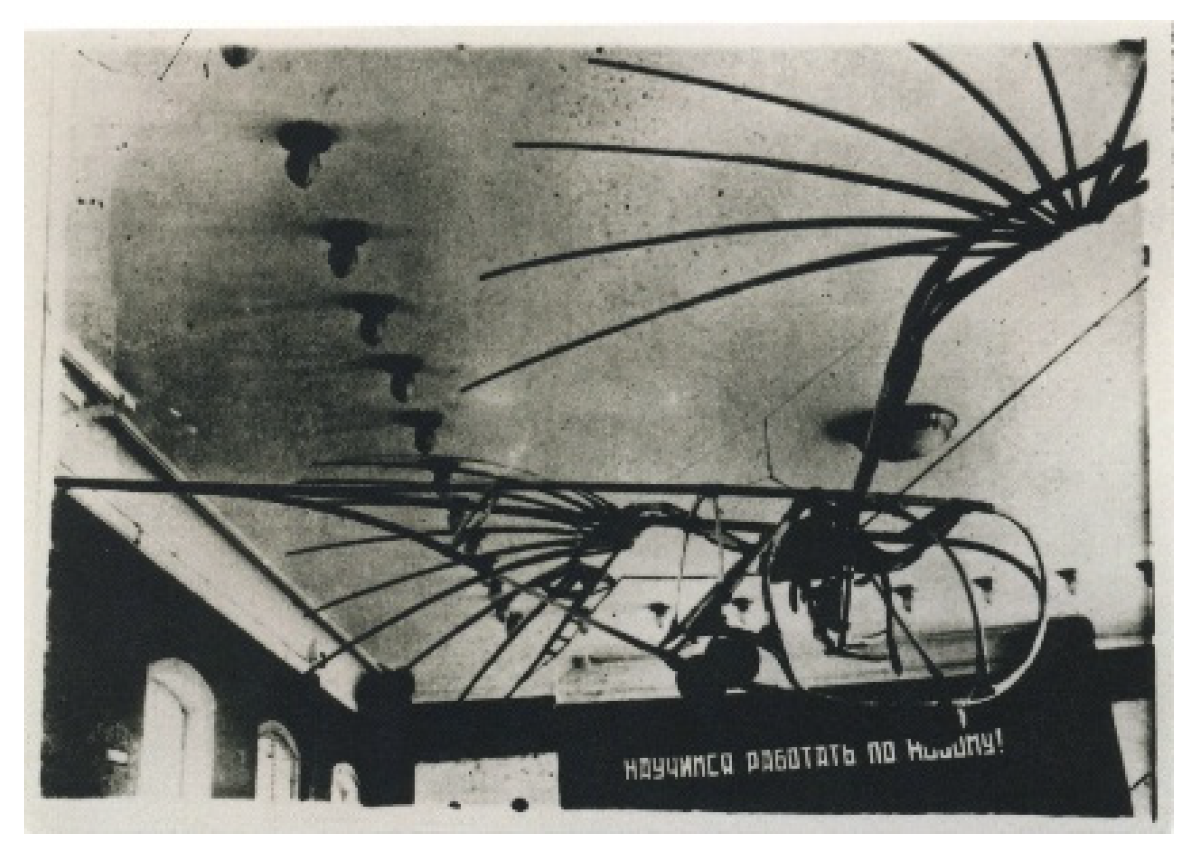
The Letatlin (
Figure 2), which was “built on the principle of using living organic forms” (
Tatlin 1932;
Zhadova 1988, p. 311), in terms of its structure, the material from which it was made, and the energy it employed.
During the course of this article, I shall examine these two projects in more depth, discussing the motives underpinning their construction and the different contexts in which they were made. Despite the striking differences between them, I shall argue that there are strong continuities in Tatlin’s approach to material itself and its innate properties. At the same time, I shall suggest that Tatlin’s emphasis on the organic in the late 1920s possessed ideological and political implications, which acted as an implicit criticism of current Communist Party policy.
The Tower, as the monument is often called, commemorated the Communist Revolution of October 1917. It was conceived as the blueprint for a working building, the headquarters for the Comintern or Communist International, an organization that was devoted to promoting world revolution. Ultimately, it was to be built on a gargantuan scale (a third higher than the Eiffel Tower), using iron and glass, which Tatlin called “the materials of modern classicism” (
Tatlin 1921;
Zhadova 1988, p. 239). The ambition was to use prefabricated industrial components and to celebrate the achievements of contemporary science and technology. One banner proclaimed, “Engineers—Builders of Bridges. Make calculations, for the Creation of new forms!” (
Zhadova 1988, p. 274, Figure 177). The
Tower seemed to symbolize not only social and political progress but also energy and movement. Inspired by modern engineering, its dynamic appearance, comprising a diagonal frame supporting two spirals, was matched by its construction, which included moving elements. These comprised several geometric structures to be made of glass, which would eventually house the various functions of the Comintern. The lowest structure (a cylinder in the model) housing the legislature was intended to move at one revolution a year; the pyramid (housing the executive) at one revolution a month; the cylinder (housing information services) at one revolution a day, all topped by a hemisphere, accommodating screens and a radio station (
Punin 1920;
Zhadova 1988, p. 344). The building seems to mark time spatially, like a cosmic clock, especially as the diagonal support was inclined at the angle of the Earth’s axis. Moreover, the whole edifice was to be surmounted by radio masts. Ultimately, the power to move these geometric structures would have been provided by electricity. When the model was exhibited, however, the power was apparently supplied by someone turning a handle by hand (
Strigalev 1973, p. 444).
The monument was to be powered by energy, but it was also intended to be a propaganda center, and to generate energy within the wider community, energy that would be directed towards changing the world’s political, social and economic realities. Indeed, the Monument resembled an enormous machine set to change the world; a beacon and machine for Communism, spreading its message to the world. Viktor Shklovskii stated, “The Monument is made of glass, iron and Revolution.” (
Shklovskii 1921;
Zhadova 1988, p. 343).
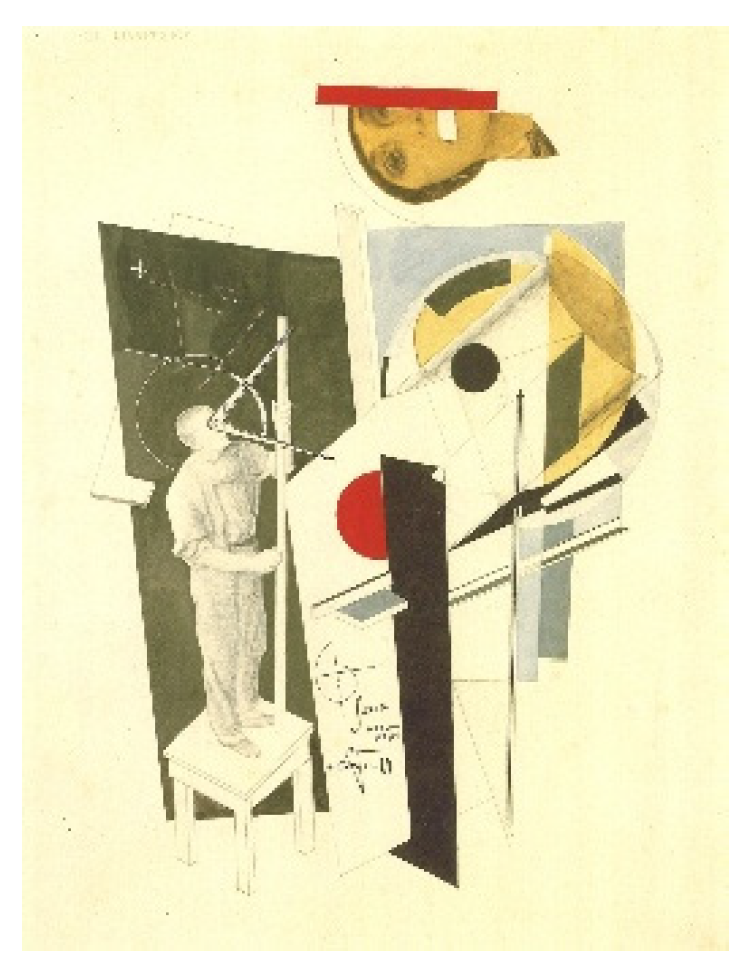
To many of his colleagues, Tatlin’s work at this point epitomized Machine Art. El Lissitzky depicted him with mathematical formulae, compasses and a ruler in
Tatlin at Work, an illustration for Ilya Ehrenburg’s
Six Tales with Easy Endings (1922,
Figure 3). This view of Tatlin extended beyond Russia’s borders. A 1920 photograph, for instance, shows George Grosz and John Heartfield holding a placard stating, “Art is Dead—Long Live Tatlin’s Machine Art”. Raoul Hausmann also produced a series of photomontages of “Tatlin at Home”, which emphasized Tatlin’s close relationship to industrial technology.
In contrast to the consciously collective and high-tech ethos of the
Tower, the
Letatlin embodied a much more individualistic and low-tech approach. It was conceived as an air bicycle, which would enable individuals to move through the air. It was relatively small-scale, made with completely organic materials, and its form was based on an intensive study of birds and their physical attributes. In contrast to the
Tower, the
Letatlin represented a celebration of nature and the renewable energy produced by the human body. While some structures in the
Tower were meant to move, driven by energy derived from electricity, the
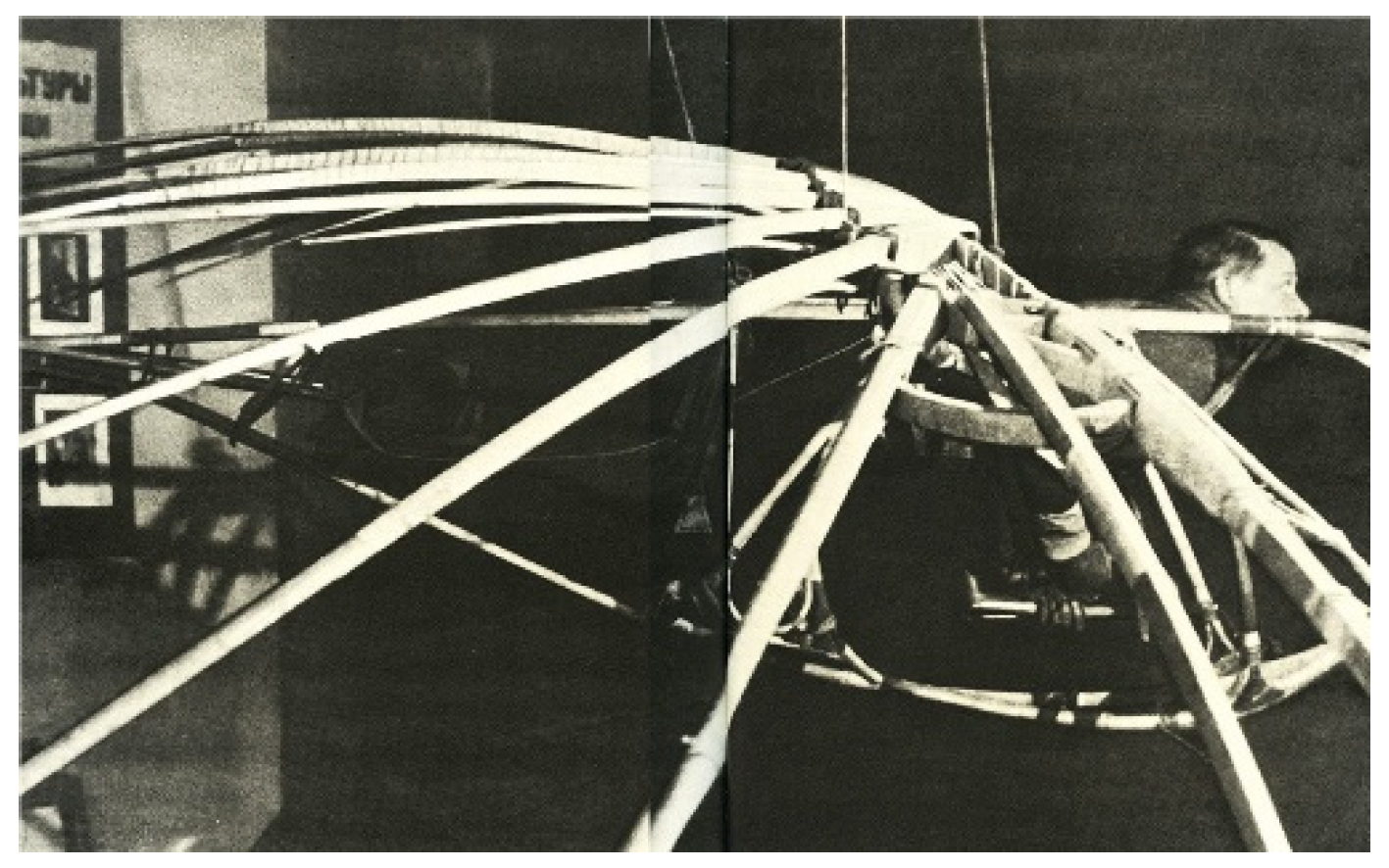
Letatlin was set in motion by the energy generated by the physical actions of a single individual. Tatlin explained: “A man in the
Letatlin will lie in the position of a swimmer. And do the flying. He will work with his arms and legs as he already works when he is swimming” (
Rakhtanov 1932;
Zhadova 1988, p. 310). (
Figure 4).
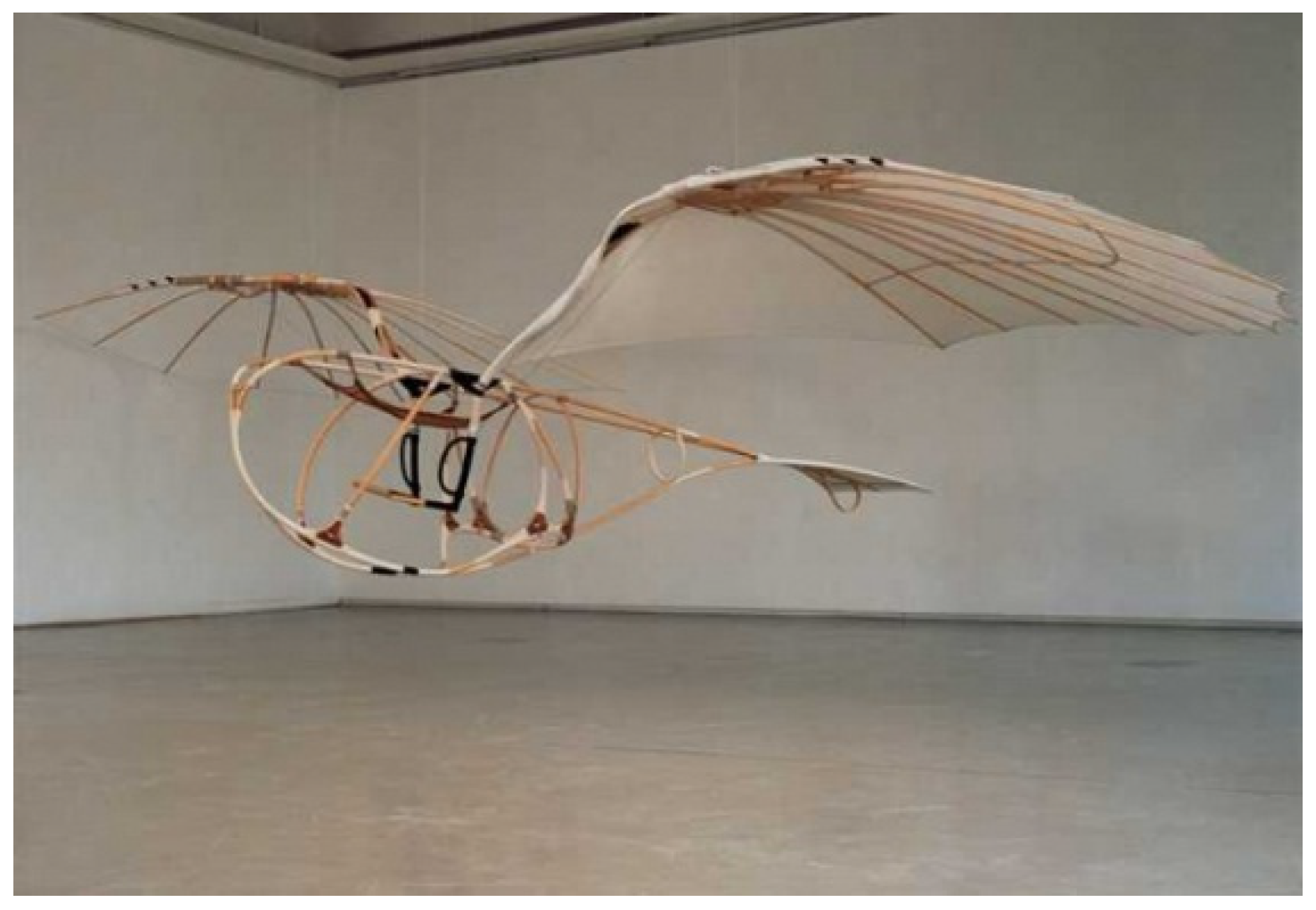
Moreover, the shape of the
Letatlin evoked that of a bird, explicitly relating the construction to organic forms and to the energy produced by the natural world (
Figure 5) Tatlin explained that he had actually studied young cranes as a basis for his design. As a sailor (he had run away to sea when he was 13 years old), he had admired the energy of the gulls that followed the ships for days on end without tiring or resting (
Rakhtanov 1932;
Zhadova 1988, p. 309). In 1926, while living near Kyiv on the Pirnova nature reserve, Tatlin drew and observed herons and storks, while Anna Begicheva’s husband made calculations for him (
Begicheva n.d., p. 305).
In this respect, the
Letatlin represented a rejection of contemporary technology and the airplane as it had developed in the early twentieth century. Tatlin stressed, “A man does not fly, but sits in a machine with its motionless, dead, outspread wings. This is how the dream of an individual flight died.” (
Begicheva n.d., p. 304).
There seems, therefore, to be a vast gulf between the Tower of 1920 and the Letatlin of 1929–1932. In less than a decade, Tatlin apparently made an enormous shift—from celebrating industrial technology to rejecting it, from using industrial materials to employing completely organic materials, from harnessing energy produced by technology to using energy produced by the human body, from high-tech to low-tech. The change has always been enigmatic. What motives—personal, artistic, political, social, spiritual, or ecological—impelled Tatlin in this new direction?
Tatlin’s apparent rejection of industrial technology is particularly puzzling in the context of the dominant ethos governing life in the Soviet Union at this time, when industry and technology were celebrated and actively pursued as the keys to progress and building socialism. For the Communist Party, industrial technology was vital to its aim of transforming Russia into a modern socialist state. In 1921, Lenin introduced the programme for the Electrification of Russia along with the New Economic Policy (NEP), which was intended to kickstart the economy after the devastation of the Civil War by allowing small-scale private enterprises to flourish alongside state-run heavy industries. In 1928, Stalin abolished NEP and its compromise with capitalism. In its place, he instituted the First Five-Year Plan and the Collectivization of Agriculture, harnessing all the country’s resources to transform the Soviet Union into a major industrial power. Industry, technology and engineering expressed the modern world and represented the world of the future. They were both the symbols and the means of achieving socialism. The policy of fomenting a world revolution was discarded—Stalin now promoted the policy of “Socialism in one country”.
At this juncture, Stalin also took the opportunity to consolidate his own power. Leon Trotsky, who had been removed from the Central Committee in 1927, was expelled from the Soviet Union in 1929. Nikolai Bukharin, who criticized the policy of rapid industrialization, was ejected from all official positions in 1929. Economists expressing similar views ended up in the GULAGs. In 1928, at the Shakty show trial, 53 engineers were found guilty of sabotaging the Soviet economy, a verdict that initiated a campaign against bourgeois specialists. Discontent with the government’s policies was rife. In the countryside, resistance to collectivization and the forced acquisition of grain was brutally suppressed, resulting in millions starving to death. In the new urban areas and industrial centres, workers were forced to live and work in appalling conditions.
Tatlin would not have been alone, therefore in feeling a certain amount of discontent with the current situation. He certainly seems to have wanted to modify the strategy of industrializing the Soviet Union on the Western model. There is no evidence that he was linked in any way with Stalin’s political opponents, and, of course, he never explicitly criticized the government publicly. It would have been highly dangerous to do so and would have inevitably attracted accusations of counter-revolutionary activity, or worse. The closest Tatlin came to voicing any criticism of the Communist Party’s policies was in his article, “Art into Technology” of 1932. He wrote: “I came to the conclusion that an artist’s approach to technology can and must pour new life into outmoded methods, which often resist the tasks of a period of reconstruction” (
Tatlin 1932;
Zhadova 1988, p. 311). In the current climate, this was an audacious and courageous statement. Clearly, Tatlin was aware of the danger he was courting, and it was probably as an insurance policy and to stress his loyalty to the Party that he took the precaution of placing at the head of his article Stalin’s statement “During the epoch of reconstruction, technology determines everything” (
Tatlin 1932;
Zhadova 1988, p. 310).
At this point, it is worth pointing out that this was not the first time that Tatlin had had the temerity to express an opinion about government policy and suggest an amendment to it. In 1918, as head of the Moscow Department of Fine Arts within the Commissariat for Enlightenment (IZO, Narkompros), he had been in charge of implementing Lenin’s Plan of Monumental Propaganda. In June that year, in a report to the Council of People’s Commissars (Sovnarkom), he had stressed the difficulty of executing the project quickly without endangering the quality of the monuments produced and had emphasized that “the State, as it is now, cannot and must not be the initiator of bad taste.” (
Strigalev 1973, p. 414;
Lodder 1983, p. 55).
By 1932, Tatlin was no longer working for the government, and the political situation had changed drastically. Stalin was now firmly in power, and in presenting his alternative approach to design, Tatlin was courting official opprobrium. Earlier, in 1927, Tatlin had cautiously criticized contemporary furniture design in the Soviet Union for copying Western models and using metal tubing which was impractical in Russia because it responded badly to extreme cold, was scarce, and expensive to produce. Tatlin’s emphasis on the importance of the national context complemented the Party’s rhetoric, but it was in conflict with the realities of Party policy, which enthusiastically imported Western machinery and specialists.
It was in 1929, in his article “The Artist as the Organizer of Everyday Life”, that Tatlin first publicly advocated an organic approach to design. He mildly suggested supplementing Western technology with his own approach based on organic form, i.e., taking “the phenomena of living nature as models”:
What do we use in constructing one object or another? Modern technology is working on those questions first and foremost. But that is not enough. Besides the “what”, the “how” is very important, organic form is important. For this, we take and analyse existing objects, we use technical constructions as models for the forms of everyday objects, and finally we also use the phenomena of living nature as models. Such are our principal tasks in working on organizing the new object for the new way of life.
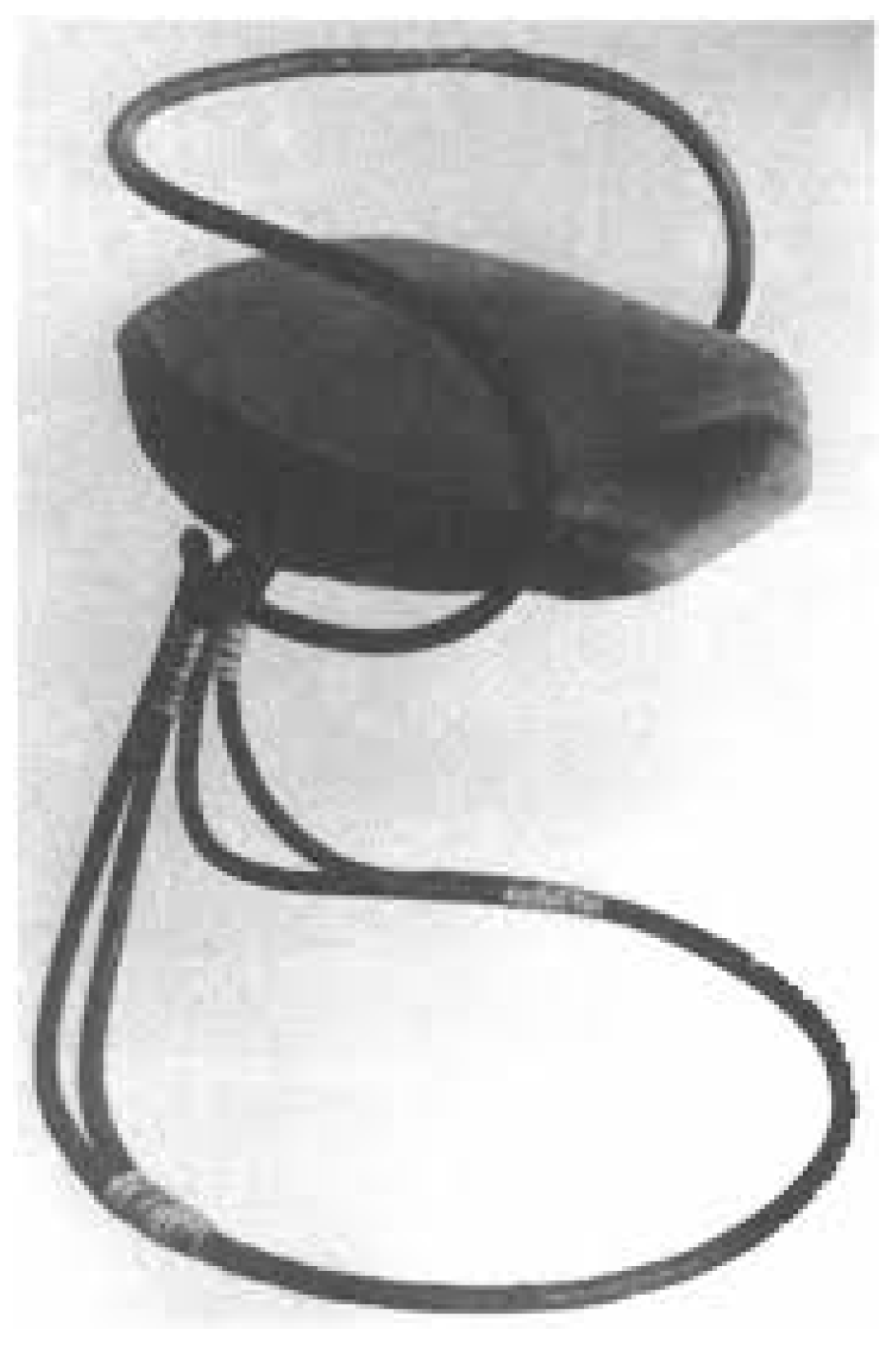
The text was accompanied by illustrations of two wooden sleighs and the bentwood chair that Nikolai Rogozhin had created under Tatlin’s guidance at the Moscow Vkhutein (
Figure 6). Tatlin explained: “We replaced the tube with strips of maple, bent according to the principles of Viennese or bentwood furniture. The advantages for us are evident. The material is at our disposal—whole forests—the working of it is not complicated nor expensive.” (
Tatlin 1929;
Zhadova 1988, p. 267).
Tatlin pointed out the important role that an artist with a profound knowledge of materials could play in the design process: “The artist must confront technology with the fact of the new interrelations in material forms and his work on them.” (
Tatlin 1932;
Zhadova 1988, p. 311). He stressed that “We need to widen the range of our thinking in the area of materials and their inter-relationships, looking for the prerequisites for form from within the material itself.” (
Tatlin 1929;
Zhadova 1988, p. 267). For Tatlin, organic forms and materials were crucial to the design process. He even implied that the material itself generated the form, or at least, the artist working the material would be able to release the form or “the prerequisites for form from within the material itself.” (
Tatlin 1929;
Zhadova 1988, p. 267). Of course, Tatlin was not alone in stressing the potential of organic materials and forms. At this time, other artists in Europe and Russia were also looking to nature for inspiration. In the Soviet Union, Mikhail Matiushin and his students were pursuing an organic approach in their art (
Wünsche 2015), while Petr Miturich evolved notions of wave-like motion and developed various apparatuses that would be able to use this method to move over land, through water and in the air (
Lodder 1983, pp. 219–21).
Tatlin’s published statements of the late 1920s suggest that this organic approach to materials represented a new departure in his work. He certainly hadn’t published statements concerning his concept of materials nor his relationship to them in such detail before. Nevertheless, I would argue that a concern with the innate properties of materials represents a continuous thread in his creative work. It was a concern that continued to develop with variations throughout his career, encompassing his work on both the Tower and the Letatlin, but it became more intense, more involved with the energies within the materials, and more focused on organic materials as the 1920s progressed, reaching its apogee in the Letatlin.
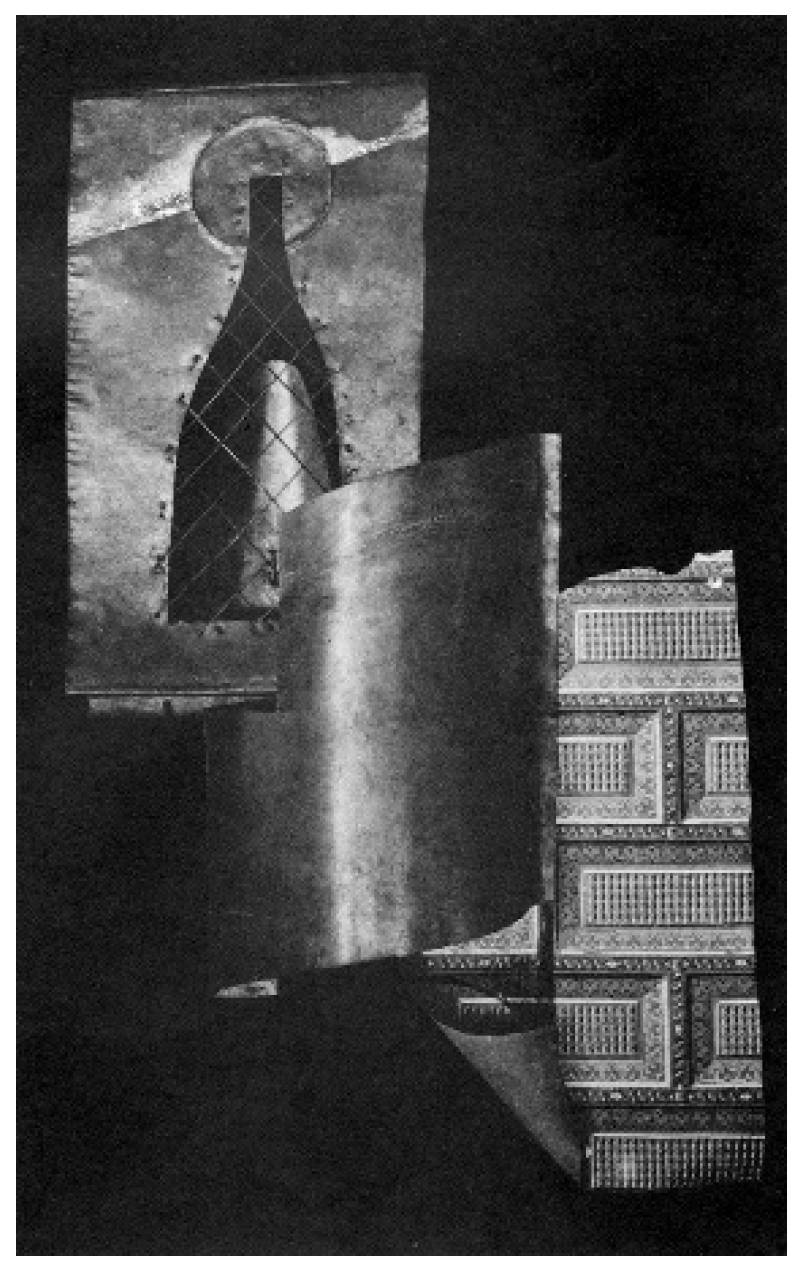
Tatlin’s concern with materials was initially manifested in the reliefs and counter reliefs, which he started making in 1914. These consisted of a wide variety of everyday materials: glass, plaster, paint, various types of wood, found elements, various metals, leather, wire and even wallpaper. His earliest reliefs, such as
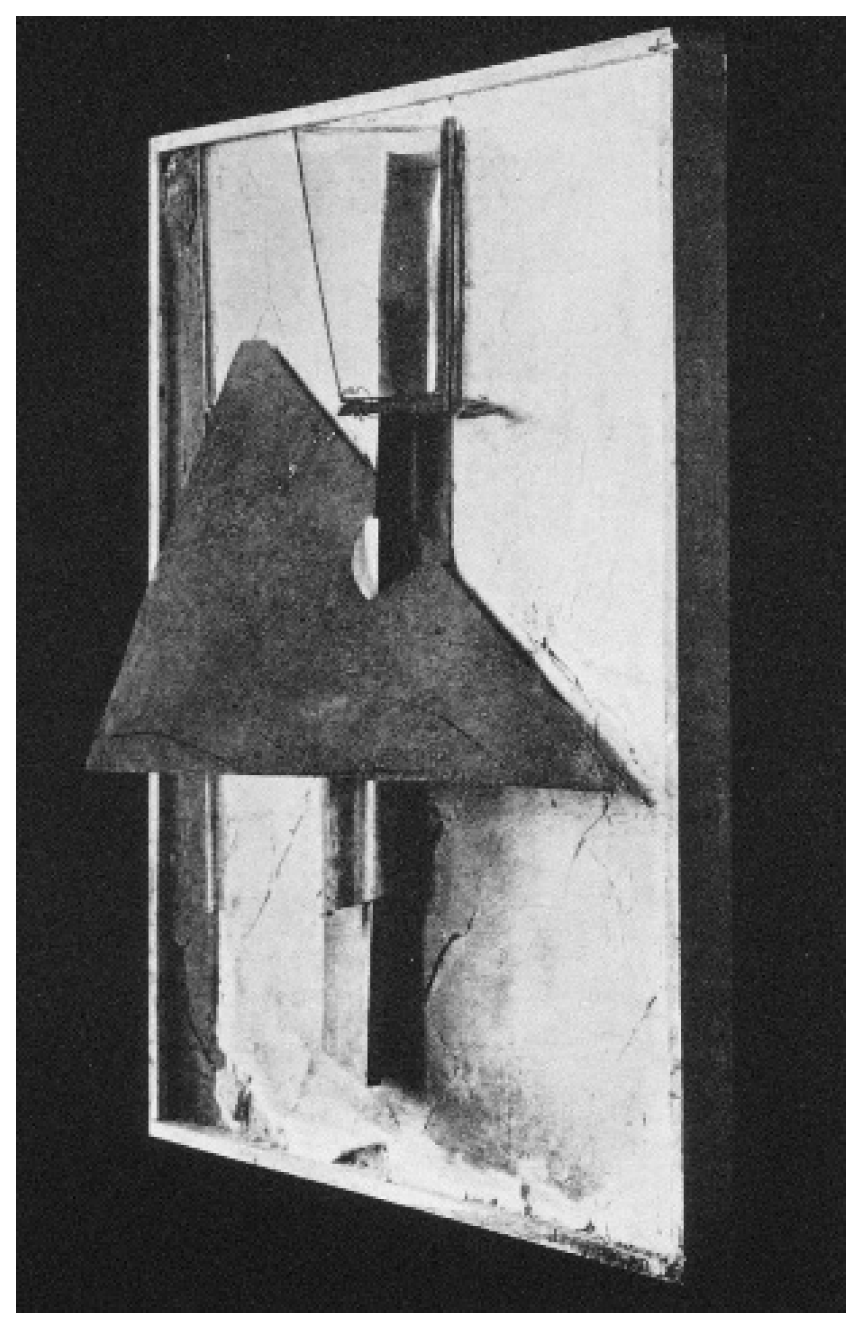
Bottle and
Selection of Materials (
Figure 7 and
Figure 8), were built up from a flat plane and the component elements created a limited interaction with the surrounding space. The focus in
Bottle of 1914 was on the form and structure of a bottle: the circle in the plaster indicates the ground plan of the bottle; the glass indicates its overall shape, while the metal and the wire evoke its transparency and translucency. The wallpaper denotes the environment within which it was used. In
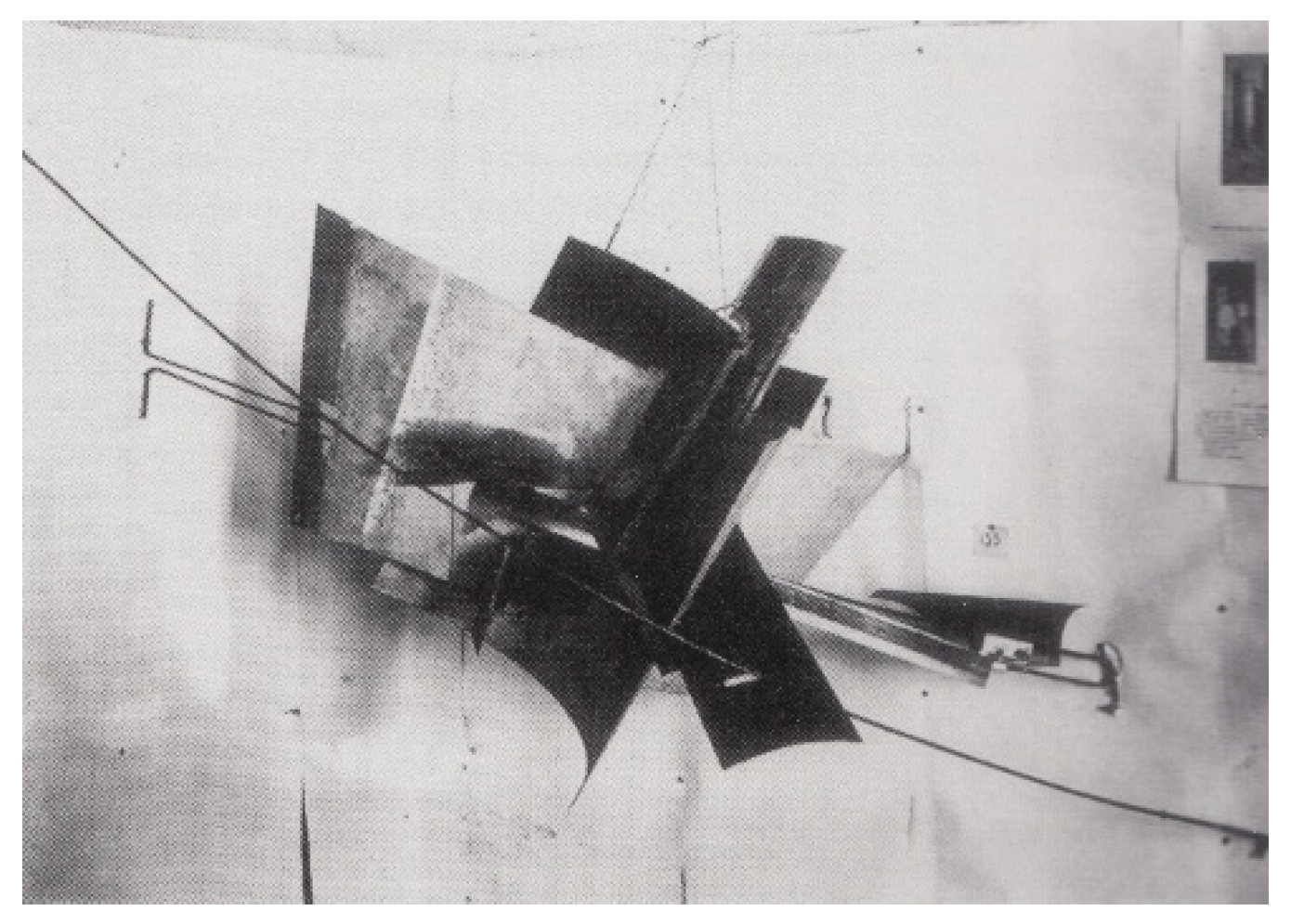
Selection of Materials, Tatlin created a more dynamic relationship with space; the triangular piece of metal juts dramatically outwards, presaging the later works, like
Corner Counter Relief (
Figure 9), which was built up in space and incorporated space fully within itself. Attached minimally to the wall, the structure comprising intersecting metal elements appears weightless, floating in space.
In “The Work Ahead of Us,” which accompanied the display of the Tower in Moscow (in the House of the Trades Unions where the Eighth Congress of the Soviets was being held), Tatlin explained that his earlier work with materials in the reliefs had enabled him to create this new work and would underpin future design work:
This research into material, volume and construction allowed us in 1918 to begin creating an artistic form of a selection of materials, like iron and glass, as materials belonging to modern classicism […]
In this way, it becomes possible to combine purely artistic forms with utilitarian goals. For example, the project of a Monument to the Third International […]
The results of this are models which give rise to discoveries serving the creation of a new world and which call upon producers to control the forms of everyday life.
Subsequently, Tatlin’s Section of Material Culture at the State Institute of Artistic Culture in Leningrad concentrated on continuing and developing this approach further. Tatlin reported:
Work was done and developed on the shaping of material in space; to this end research was undertaken into the construction of reliefs and counter-reliefs, our experience in analysing a fully material volume was extended, and finally the significance of material as an unlimited element, which uniquely shapes culture, was confirmed.
Tatlin continued to advocate engaging with materials in his research work and in his teaching. He stressed that “the culture of materials makes it possible to take into account both the properties of individual materials and the most advantageous features of their inter-relationships … the artist, in creating an object, furnishes himself with a selection of different materials, which he uses on the basis of their properties—[…] colour, texture, density, elasticity, weight, strength, etc.” (
Tatlin 1930;
Zhadova 1988, p. 268).
Tatlin’s statements concerning form and material could perhaps be related to Wilhelm Ostwald’s theory of energetics and the concept that material is the materialization of energy. Of course, Tatlin never mentioned Ostwald, nor is there any evidence that he read any of the chemist’s publications, but Ostwald’s ideas were well known amongst Tatlin’s artist colleagues (
Douglas 2002). For Ostwald, bulk and weight were the principal properties of “matter” but they were to be considered as manifestations of particular forms of energy. He explained: “the most important form of spatial energy is that which depends on volume” (
Ostwald 1893, p. 30). He considered that other forms of “spatial” energy are “distance” energy and “surface” energy and later he also included “form” energy, which enables a system to maintain its shape (
Ostwald 1902, pp. 167–68).
A statement that Tatlin made in the mid-1920s about the Monument implies that at this point, he did not consider industrial technology and nature to be irreconcilable, and both had inspired him when he was conceiving and constructing the Tower. For him, organic and inorganic materials embodied dynamism and energy, and both had the potential to change people’s lives. They were complementary. In this respect, there is an implicit continuity between the Tower and the Letatlin and between the visions for the future that inspired them both:
My principles are concentrated in The Tower of the Third International […] My monument is the symbol of the era […] I based the design of the building on a screw [vint] as the most dynamic of forms. The screw is the sign of our time, indicating energy, dynamism, aspiration. The entire construction consisted of metal forms and looked like a spiral, inclined to coincide with the movement of the earth. Objects tilted to the earth’s axis are the most stable and soft of forms […] I based the entire construction on a tree. The stories of the tower were fixed to the central axis like branches to a tree, which ensured stability and mobility. […] The monument would have been a symbol of the friendship of all people—a future worldwide family—united in time and space. An artist looks at nature. It builds better than us. Nature creates a wise construction, which has its own system of control and assures structural soundness.
In fact, Tatlin’s approach to materials, their innate properties, and their relationship with space, was essentially the same in the Tower and the Letatlin. Wood was a major structural component in both works. Tatlin intended ultimately to construct the Tower from metal and prefabricated metal components, reflecting the latest technology and engineering, but, in fact, he built the model from wood. In other words, although the concept and form were related to the achievements of advanced technology and engineering, the execution of the model remained in the realm of hand-made production, and the materials employed were organic.
In reality, if not conceptually, both works (the Tower and the Letatlin) were low-tech. The concept of the Tower might have been high-tech—but the execution of the model was definitely low-tech. Both the Tower and the Letatlin were made by hand, using organic materials. Both works were moved by energy generated by the human body. The Tower’s moving components were set in motion by someone turning a handle, while the Letatlin moved by the energy produced by the fliers inside, using their arms and pumping their legs up and down. Indeed, although the rhetoric accompanying the display of the Tower on the third anniversary of the Revolution in November 1920 might have been scientific and technological, in line with socialist ideology and current Party terminology, the method of production was clearly more organic and in line with the method that Tatlin had employed in making the reliefs and counter-reliefs.
Both the
Tower and the
Letatlin are concerned with space, and both develop a dynamic relationship to it. As an air bicycle, the
Letatlin was intended to enable its occupant to move through space. Tatlin explained, “I wanted to give back to man the feeling of flight” (
Zelinskii 1932;
Zhadova 1988, p. 309). He stated, “I chose the flying machine as an object for artistic construction because it is the most complicated dynamic material form that can enter into the daily lives of the Soviet masses as an object of widespread use.” (
Tatlin 1932;
Zhadova 1988, p. 311). In the
Tower, the various premises move, but also the diagonal strut and the two spirals supported by it soar up into space.
The technological resonances of the
Tower are self-evident, but it would be misleading to ignore the scientific impulses and studies that underpinned the creation of the
Letatlin. In this respect, both works had a quasi-scientific basis. Although Tatlin stressed that he had made the
Letatlin as an artist (
Zelinskii 1932;
Zhadova 1988, p. 309), it is also clear that he approached the task scientifically, studying birds, examining previous experiments, and making calculations. He clearly researched the problem and referred to the results in his report to the Ministry of Aviation, where he “indicated that man can fly with great manoeuvrability, landing where he wishes.” (
Begicheva n.d., p. 304). Alongside artistic inspirations like the inventions of Leonardo da Vinci, Tatlin studied the writings of the German engineer Otto Lilienthal about bird flight and his drawings of gliders (
Siukonen 2001, p. 124). Lilienthal’s book
Der Vogelflug als Grunndlage der Fliegelkunst (1889) was published in Russian in 1905, and his standard glider was on show in Moscow in 1909 at the aviation exhibition. (
Siukonen 2001, pp. 124–25). Tatlin also consulted the father of Soviet rocketry, the scientist Konstantin Tsiolkovsky, recalling, “Tsiolkovsky also believed in my bird. I visited him in Kaluga and we talked. […]. He was supportive of me: ‘Dare!’ he said, ‘Man must fly!’ […] He advised: ‘Take curves from organic forms, stimulate the thinking of engineers’.” (
Begicheva n.d., pp. 304–5). Outside the Soviet Union, silent, man-powered flight was the subject of numerous experiments during the 1910s–1930s and was of interest to the military in various countries, for its spying potential. The Soviet Air Force displayed some interest in the Letatlin, acquiring one model, which eventually ended up at the Central Air Force Museum, at Monino, although it has now been relocated to the State Tretyakov Gallery.
In political terms, both the
Tower and the
Letatlin promoted revolution and liberation. While the
Monument was intended as a propaganda machine to spread revolution throughout the world, freeing workers everywhere, the
Letatlin was intended to give each individual person the additional freedom of moving in space. In 1925, when the
Letatlin was still just an idea, Tatlin insisted, “I must realize this dream. This is not an idle fantasy. This air-bicycle would relieve the city from traffic, noise, and crowding, and would clean the air of gasoline. One could take off from one’s window, balcony, rooftop— from anywhere. It would be fast, convenient, and cheap.” (
Begicheva n.d., p. 304). The notion of realizing an individual’s potential within the structure of communism was an established tenet of Marxism, although it and Tatlin’s vision are idealistic and utopian, especially when considered within the context of Soviet reality and the Communist Party’s harsh industrialization policies of the late 1920s and 1930s.
Despite the strong parallels between the
Tower and the
Letatlin, and the continuities with the reliefs, particularly in the artist’s approach to materials, one vital difference remains. The
Tower boldly celebrated the latest achievements of science, technology and engineering, while the
Letatlin stood in opposition to them. Yet it is possible that this apparently dramatic change of direction, merely represented a change of emphasis, which was itself a response to the Revolution. One could argue that Tatlin’s attitude to materials remained constant, but in embracing the events of October 1917, he also adopted the Communist emphasis on industry and technology. When he conceived the
Tower, he was an active member of IZO Narkompros and was responsible for administering Lenin’s Plan of Monumental Propaganda in Moscow (
Lodder 1983, pp. 53–56). In 1924, after Lenin’s death, he suggested that the monument to Lenin should be “a triumph of the technological aspect of engineering. We should bring in everything that characterizes our late leader as an innovator and revolutionary
in all areas of knowledge and human thought” (
Tugendkhol’d 1924, p. 111;
Zhadova 1988, p. 250). By the late 1920s, however, Tatlin was no longer attached to the government and had returned to his creative interests in the innate properties of materials, particularly as embodied in organic materials.
Tatlin’s implicit opposition to official policy is particularly evident in the ecological dimension of his thinking, which seems to have emerged by the late 1920s, when he began to express it publicly. His explanation that the
Letatlin would “clean the air of gasoline” (
Begicheva n.d., p. 304) implies a criticism of the contemporary urban environment with cars and buses polluting the atmosphere—the result of Western technology. Indeed, Tatlin’s vision of the
Letatlin, his emphasis on clean air and renewable energy, resonates with ecological concerns today. His admiration for nature and natural phenomena was clear from his living in the woods near the Pirnovo nature reserve outside Kyiv in the mid-1920s (
Begicheva n.d., p. 305). Not surprisingly, his plans for a garden city stressed the need for everything to be within easy walking distance for the residents, thus minimizing the need for public transport and pollution (
Begicheva n.d., p. 308).
Clearly, there is a strong element of continuity in Tatlin’s concern with the “culture of materials” from the earliest reliefs and the Tower to the creation of the Letatlin. Nevertheless, by the late 1920s and early 1930s, his approach had undergone a distinct change in emphasis. While his interest in materials per se remained constant, the celebration of technology, industrial materials and electricity in the Tower had been replaced with a focus on nature, organic materials and renewable energy. With the creation of the Letatlin, Tatlin made an explicit commitment to the natural environment, natural materials, and to the renewable energy they embody. At the same time, he also revealed his vision for a communist society that entailed people realizing their full potential while using renewable energy and living in harmony with one another and with nature in a clean and healthy environment. This seems to have been a vision that was at variance with or at least modified the image of the highly industrialized and centralized state envisaged by the Communist Party of the Soviet Union.