1. Introduction
The invitation was sent via fax while I was working with Tukak’ Teatret, a Greenland Inuit group in Jutland, Denmark. Anatoly Antohin, a colleague at the University of Alaska Fairbanks, where I was a professor from 1988 to 2003, had invited me to St. Petersburg, Russia, to work with Metamorphosis Theatre, a group dedicated to Slavic pre-Christian rituals. Antohin, a well-known playwright in Soviet Russia, had defected to the US in the early 1980s and, after the fall of the USSR, returned to his hometown to establish the Russian–American Theatre. It was the early summer of 1992, and the Soviet Union had dissolved unceremoniously six months earlier.
I recently returned from working on a production with the Kwasa, a Zulu group in Durban, South Africa, and was at Tukak’ to conduct a month of workshops. Tukak’ was a former farm turned into an Inuit theater and cultural center—Greenland was once a Danish colony and is now a protectorate, working toward home rule. Part of this process included generously funded cultural revitalization programs. My work with other Indigenous groups, specifically the Yup’ik and Inupiat of Alaska, had helped establish an ongoing relationship with Tukak’. To my delight, the center was situated between the North Sea’s swells on one side and Europe’s most fertile farmland on the other. Unperturbed Viking burial mounds dotted the wheat fields, waving in the wind.
In the office on the day I received the invite, I met Morten Ilsøe, a classically trained percussionist doing a government internship with Tukak. He asked if he could come along, and two weeks later, we were on a train from Copenhagen to Berlin to St. Petersburg. The trip took two and a half days by train. The St. Petersburg part of the journey was aboard a lumbering Soviet train, built like a tank, overstuffed with smells, noise, and people transporting boxes and bags of merchandise. Morten and I were among the few Western passengers. Most of our fellow travelers were aspiring capitalists, small-time importers and exporters trying to make a living by shuttling goods from the East to the West and vice versa. The train’s hallways were full of lurking, suspicious-looking characters who kept us vigilant, and, at the conductor’s suggestion, we wired our door latch shut at night. The feelings of loss, desperation, threat, and confusion foreshadowed my time in St. Petersburg.
A methodological note is warranted before proceeding. This article is an autoethnographic and practitioner account—what
Haseman (
2006) calls “performative research”: knowledge generated through creative practice and reflexive engagement rather than detached observation. The claims made here about ritual, tradition, and trance are therefore grounded primarily in embodied fieldwork accumulated over three decades across six continents. Where the account draws on Indigenous knowledge traditions, those traditions are named and attributed. The theoretical terms employed—most centrally “ritual,” “tradition,” and “trance”—are defined as the article proceeds; readers seeking a fuller survey of the interdisciplinary literature on these concepts are directed to the foundational work of
Grimes (
1982),
Bell (
1992), and
Turner (
1969). The term “ritual” is used throughout in the sense proposed by
Grimes (
1982) and
Bell (
1992): situated, formative action that encodes and enacts a community’s cosmological orientation—not mere repetitive behavior, but the active constitution of meaning, community, and world.
1.1. St. Petersburg in Collapse
St. Petersburg had reclaimed its original name only months before my arrival, renouncing Leningrad like they had the USSR and communism—without sentiment. With the casting off of the old and dysfunctional for an unknown order came anxiety and a frantic search for something to replace the paternalism of communism. St. Petersburg, founded by Peter the Great early in the eighteenth century, was the cultural capital of Czarist Russia and its aspirational link to Europe. Unlike political and pragmatic Moscow, St. Petersburg was a city of magnificent architecture, parks, broad thoroughfares, and world-class cultural activity. In 1992, the city crumbled, fatigued by neglect and poverty. Hucksters, beggars, drunks, petty gangsters, moneychangers, hookers, gypsies, and shell-shocked ordinary people wandered the city. Some embraced the change as an opportunity, while others were in denial or dazed.
A loaf of bread cost about three cents US when I arrived; a large lunch for two was less than sixty cents. Due to a severe housing shortage caused by investors buying up properties, many artists lived with their families. My translator, Anya Malachiyeva, shared a large two-bedroom apartment with her parents, paying less than $3 US each month. The average worker earned around $15 per month. Inflation was in the triple digits, with many prices rising daily. Life was dramatically changing as remnants of the protective, artificial, and isolated Soviet economy gave way to a global market economy, consumerism, and materialism. Values, greed, and a fierce struggle for survival came like an unavoidable rising tide.
Although communism was a discredited economic and political system, it had fostered a commendable sense of camaraderie rooted in the resilient and stoic Russian character. On the streets, all kinds of groups handed out leaflets and proselytized. Any day, you could see on Nevsky Prospekt or in the subway clean-shaven, neck-tied Southern Baptists from the US. Elsewhere, there were drumming and chanting Krishna devotees, black-robed Russian Orthodox monks, bright-eyed white-robed Bahá’ís, Jehovah’s Witnesses distributing the Watchtower, and Scientology tables conducting surveys, among others. The large void left by the all-encompassing Soviet regime after its collapse heightened the need for meaning in Russia.
1.2. The Chemical Factory
The Metamorphosis Theatre offices and rehearsal space were forty minutes away from the city center: a subway ride, bus ride, and walk. The ramshackle, overcrowded buses, smelling of human sweat, urine, vodka, and beer, passed countless similar, anonymous, tall Soviet-era apartment complexes made of poured concrete. Between the buildings were empty dirt lots where children played. People on the street appeared to drift aimlessly.
Metamorphosis was in a state-run chemical factory situated in a neglected park filled with weeds and statues of forgotten Soviet heroes. As you approached, the factory’s faint, rotten smell was immediately noticeable. The uncle of Metamorphosis’s Artistic Director Olga Chernyarskaya was the factory director and had provided rent-free space. Inside, the dull walls and dim lighting felt stale and worn; glass cases displayed old Soviet progress charts and photos of solemn-faced “victorious workers” to greet visitors in the lobby. A sense of malaise, mixed with a faint chemical odor, hung in the air as workers in long white coats moved listlessly down the halls. The Metamorphosis rooms were at the far end of a long, institutional green corridor in a secluded part of the sprawling complex. A worn and battered door opened to a dazzling, surreal explosion of color, flowing scarves, pillows, books, and day-glow posters. Ersatz religious altars, statues, and icons decorated and overwhelmed the entrance, arranged in a cozy living-room style. Nearby were an office, a fully equipped kitchen, and a communal dining area with a large wooden table. The group had responded to the newly gained political freedoms and the huge influx of information it brought by embracing every kind of formerly forbidden spiritual and religious pursuit. From Zen Buddhism to crystals, astrology, and new-age music and healing, they eagerly and indiscriminately explored the possibilities.
The rehearsal room was starkly plain—completely neutral, with brown burlap covering the walls, floor, and ceiling. In this inner sanctum, dedicated to their Slavic ritual theatre work, they welcomed me, Morten, and Sven Holmberg—a student and Tuma Theatre actor from the University of Alaska—into their group. A theatre inside a chemical factory symbolized the arts in an increasingly hostile, capitalist-driven world, trying to create a space and function despite challenging, and often unhealthy, conditions. In 1992, over 150 small theatres existed in St. Petersburg; by 1996, fewer than 20 remained.
2. Materials and Methods
2.1. Establishing Trust: The Initiation
Anatoly Antohin had told the group about my Indigenous performance work and proposed that I conduct a three-week workshop. Eager to learn from similarly minded foreigners, Metamorphosis—a small, insular group—agreed. The times were quickly changing, and they sensed the need to shed their cloistered ways and be open to new experiences. However, before we could work together, we had to see if we could. For such a relationship to be fruitful, it had to be mutually beneficial and stimulating. It was not just about my presenting a workshop; we would be spending part of our lives together, living, eating, working, and sharing. As the workshop progressed, we often spent eight to twelve hours together each day.
My first day gave me many conflicting impressions. The group insisted on initiating Sven, Morten, and me, claiming it was necessary before beginning work. Wearing long robes, lighting many candles, and singing in Old Russian, they put three small pebbles into an ornate water bowl. Water is a sacred spirit in Slavic folk belief—called
mavka or
rusalka—and is used in purification rites and divination (
Dynda 2017;
Ivanits 1989, pp. 75–85). After an incantation and ritual smudging, they offered a pebble for each of us to swallow. I swallowed the stone, taking their offering—a small but significant gesture of taking into myself a part of Russia. In pagan Slavic tradition, as with other cultures, rocks are considered the bones of the earth, the elders that have been here since the beginning and will be here until the end, witnessing the endless cycles of life on earth (
Ryan 1999, pp. 52–58). Although I had previously worked with Indigenous groups and respected traditions, I felt the pebble-swallowing initiation was too soon an imposition without knowing the obligations and responsibilities required in return.
2.2. The Methodological Challenge
Though they expressed interest in ritual, their training was more typical of theatre and of character- and plot-based drama. I mentioned this inconsistency to them, and they responded by saying they went to the theatre because there was no other viable medium for developing ritual. “There are no ritual schools and no Slavic elders left, only fragments in dance and song and books,” observed Olga, the Artistic Director.
This observation is well-supported historically. Pre-Christian Slavic practices were systematically dismantled first by the Christianization of Kievan Rus in 988 CE, then by centuries of Orthodox church suppression, and finally by Soviet atheist ideology, which regarded folk spiritual practices as reactionary superstition (
Álvarez-Pedrosa Núñez and Santos Marinas 2023, pp. 3–18;
Ivanits 1989, pp. 1–20). By the late twentieth century, only fragments remained: isolated chants, ritual objects preserved in museums, agricultural calendar customs partially absorbed into Soviet celebrations, and syncretic sects like the White Doves that had survived underground (
Propp 1963;
Warner 2000, pp. 67–70). “Tradition,” in this context, does not imply a continuous, unbroken inheritance—it refers, as
Hobsbawm and Ranger (
1983) describe, to a set of practices assembled from fragments and given a sense of origin and continuity. This view of tradition as constructed and contingent, rather than inherently given, runs throughout the article.
Due to the absence of a unified Slavic ritual tradition, the Metamorphosis group saw theatre as the closest keeper of tradition. They consisted of like-minded seekers, sharing an innate desire, who diligently pieced together fragments to express the ritual longing they felt. Their approach was similar to various global efforts—such as new-age shamanism, Wicca, different neo-pagan practices, esoteric and spiritual revival movements, alternative healing methods, playback theatre, psychodrama, drama therapy, the men’s movement, and other methods of alternative spirituality and community—each responding to issues like consumerism, competition, technological change, alienation, and existential concerns.
Seventy years of Soviet rule had further alienated them from their rich cultural traditions by imposing an alien social and political order. The enculturation was so thorough and subtle that they had little sense of individual identity. Their thoughts, feelings, and bodies had become disconnected. If you have little, you must start with where you are and what you have. Our work began with a rediscovery, laying a foundation for rebuilding and reimagining self and community through ritual. I designed our workshop with goals of drama and social therapy in mind, applying and tailoring the work I developed while collaborating with other traumatized Indigenous groups to meet the needs of Metamorphosis.
2.3. Rhythm as Foundation
A daily yoga program was created to recognize the body as the source and reference for being in and with the world—a crucial first step. The stress caused by social and economic uncertainty was evident and needed to be addressed. The second step of our work with body and consciousness was rhythm awareness. Experience taught me the importance of re-establishing rhythm awareness as a freeing, expressive foundation for our performance work to develop.
Initial exercises focused on awareness of the core rhythms of life: the heartbeat and breath. These semi-meditative explorations became daily touchstones, emphasizing rhythm as the connective tissue of the body–mind–spirit from which community and its rituals emerge. Unlike traditional theatre, a ritual requires the performer to serve the community, acting as a medium of exchange among human, communal, and spiritual spaces. Rhythm expressed through breath and heartbeat, extending into externalized rhythms—percussion, vocalizations, and movement—serves as a medium for the community of humans, animals, elements, flora, spirits, and ancestors to synchronize, participate, and communicate. A simple heartbeat/breath exercise we returned to daily.
Standing, establish a regular deep-breathing pattern through the nose and out through the mouth. Once deep breathing is established, hold your breath to create stillness so you can hear/feel your heartbeat. Hold your breath for five heartbeats, exhale, and return to normal deep breathing. Then hold for seven, then nine, then ten pulses. You are developing the ability to hold your breath for up to 30 heartbeats. The exercise aims to clear the lungs and promote regular deep breathing and full use of lung capacity.
Breath and rhythm training fostered this awareness: (1) calming, centering, and connecting with one’s unique rhythm; (2) group connection; and (3) a foundation and preparation for extended work. Physiologically, it conditioned performers to use more of their lungs, breathe more deeply, and inhabit their bodies. People who are stressed and live in urban environments—like the Metamorphosis performers—tend to breathe shallowly, using less lung capacity and delivering less oxygen and energy to the mind and body, which impacts power, mindfulness, and presence.
Once a performer could determine the time needed for one breath (marked by heartbeats, easily felt in the quiet body), they were asked to hold and guide their breaths for a number of breath units. In Taoist practice, breath guidance is called Tao-yin, meaning “guiding the energies.” The number of breath units—three, five, seven, or nine—corresponds to the heart, kidneys, lungs, and liver. When holding for a specific number of breath units, performers were instructed to mentally direct their chi to that specific organ (
Schipper 1993, p. 138). Later, sounds were added and linked to different organs—vocalizations during exhalation: for the spleen, bou!; for the heart, kha!; for the lungs, si!; for the kidneys, tse!; and for the liver, su! (
Schipper 1993, p. 138).
2.4. Decolonizing the Soviet Body
The Soviet educational and political system conditioned Metamorphosis’s performers to follow instructions and do things “right,” making it difficult to trust their feelings and bodies and requiring reassurance about what they should be feeling and how. Performer Arkadi Zhiekin wanted to know if his feeling was “a correct heartbeat.” Because they were conditioned to think collectively and, as a result, second-guess themselves and their instincts, they expressed concern that their heartbeat was out of sync with others in the group. Our heartbeat and breathwork emphasized the importance of listening to and honoring individual uniqueness—a concept unfamiliar to those indoctrinated by communism’s collectivism. The decolonization of the conditioned mind and body was integrated into our process.
Morten and Sven, both musicians, had worked with me before and understood my methodology and goals. They served as models, leading the others by setting an example. Although I was asked multiple times to demonstrate personally, I avoided active participation to prevent “showing by example,” stressing that there was no single correct way and that the process was a self-guided initiation. They were accustomed to an authoritarian Russian style of stage directing. I had to remind the group that my role was to be a facilitator, guide, and mentor to enable their flourishing.
The Metamorphosis performers and Russians, in general, tended toward pessimism; keeping this in mind, open-ended improvisational free play was introduced. The idea of playing for one’s own enjoyment was unfamiliar to the group; they preferred a clear, well-structured approach and wanted to know the purpose of our exploratory play. I often voiced my frustration with their habit of constantly explaining why things did not work—a lifetime of things not working had shaped their perception of the world. I understood and empathized, but I reminded them that self-victimization impeded the growth of our work. The Soviet Union maintained its power by instilling and sustaining petty fears and complex, capricious obstacles, making it difficult to trust, believe, and hope.
When asked to move, they seemed disconnected from their bodies; they appeared like forms without feeling. They conformed to externally imposed political and social norms taught by the Soviet state. We used the traditional Slavic three-beat to locate the Slavic ritual body (
Chernyarskaya 1992). Morten provided rhythm through drumming, and the group explored rhythmic expressiveness with isolation exercises. Starting seated, we traced each body part: head, face, arms, shoulders, chest, feet, legs, hands, pelvis, and the whole body. The exercise then focused on isolating body parts, standing, and expressing through movement. For example, after articulating the Slavic beat in their feet, the performers began to shuffle, then dance, eventually transforming into established Slavic dances. The rhythm connected the human and spiritual, the material and immaterial.
2.5. Collective Creation: Chants and Sticks
Traditional Slavic chant sounds were created in total darkness, with participants seated throughout the room. My work was inspired by traditional Alaska Native performance techniques, which, similarly, produced songs and chants in darkness through collective authorship. This method of collective creation was called “bursting with song” (
Riccio 1991, p. 27). In Metamorphosis, we started with chant and sound fragments from the Slavic and Old Russian traditions (
Chernyarskaya 1992). These fragments included (phonetically and spelled in English):
Hey ya/choo/Yay gay/hada; hayha/Yong (nasal)/Who (with a wide oh)/Doo/When (like hogan)/Ohh yeah/cha da/hoo/Chong (nasal)/Yay vo aa/Dook yayvoi/Ei ga ei ga ei ga/Chacha hugg/Batu school ti TSR ree u goon’
The act of blending personal and modern elements with traditional expressions broke psychological and creative boundaries for the group. Previously, Metamorphosis accepted the authority of and supported traditional Slavic movements and vocalizations with little personal involvement. In contrast, our movement and chant explorations used traditional inheritances as a reference point to build upon—a modern, living medium of tradition.
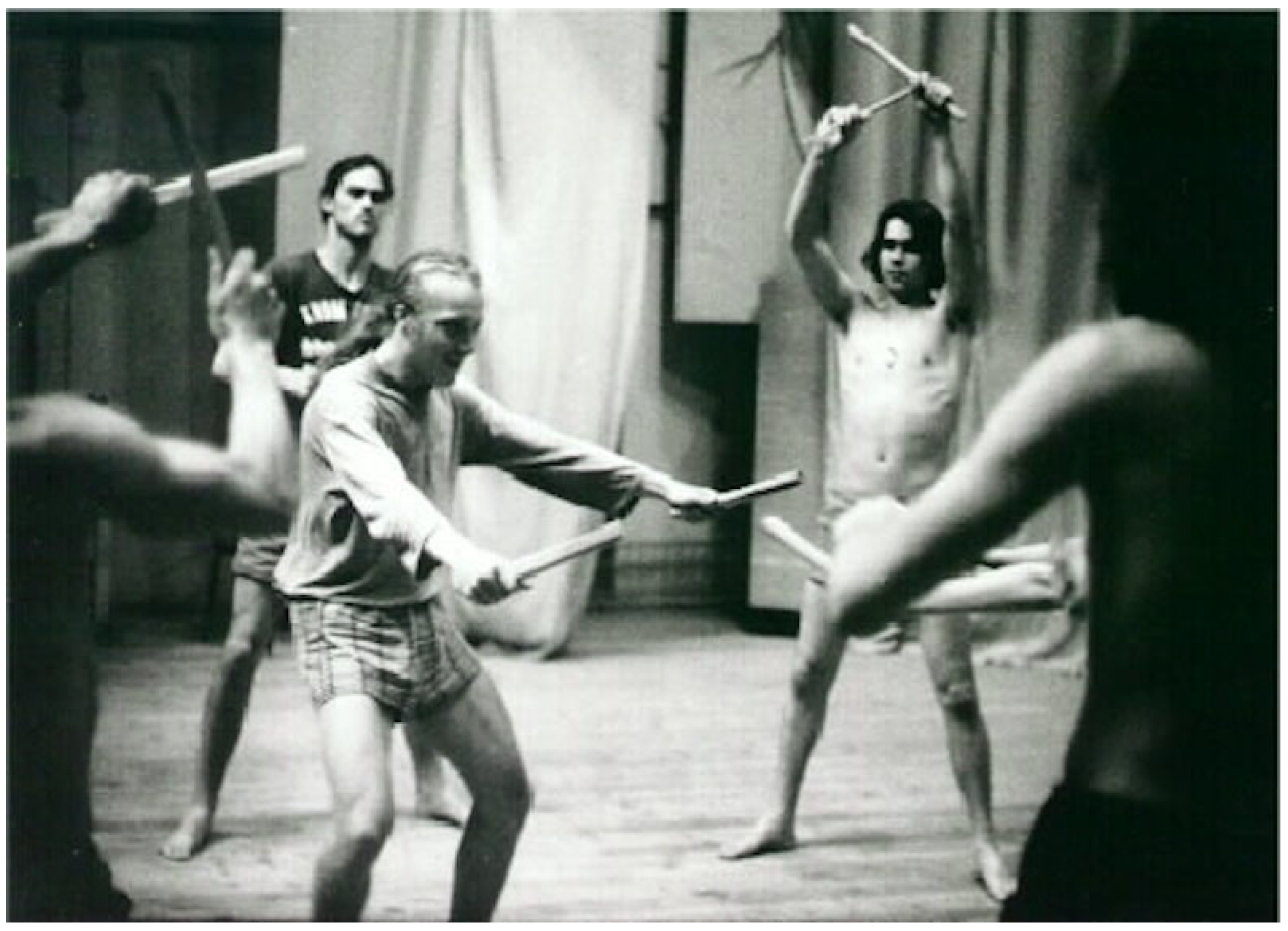
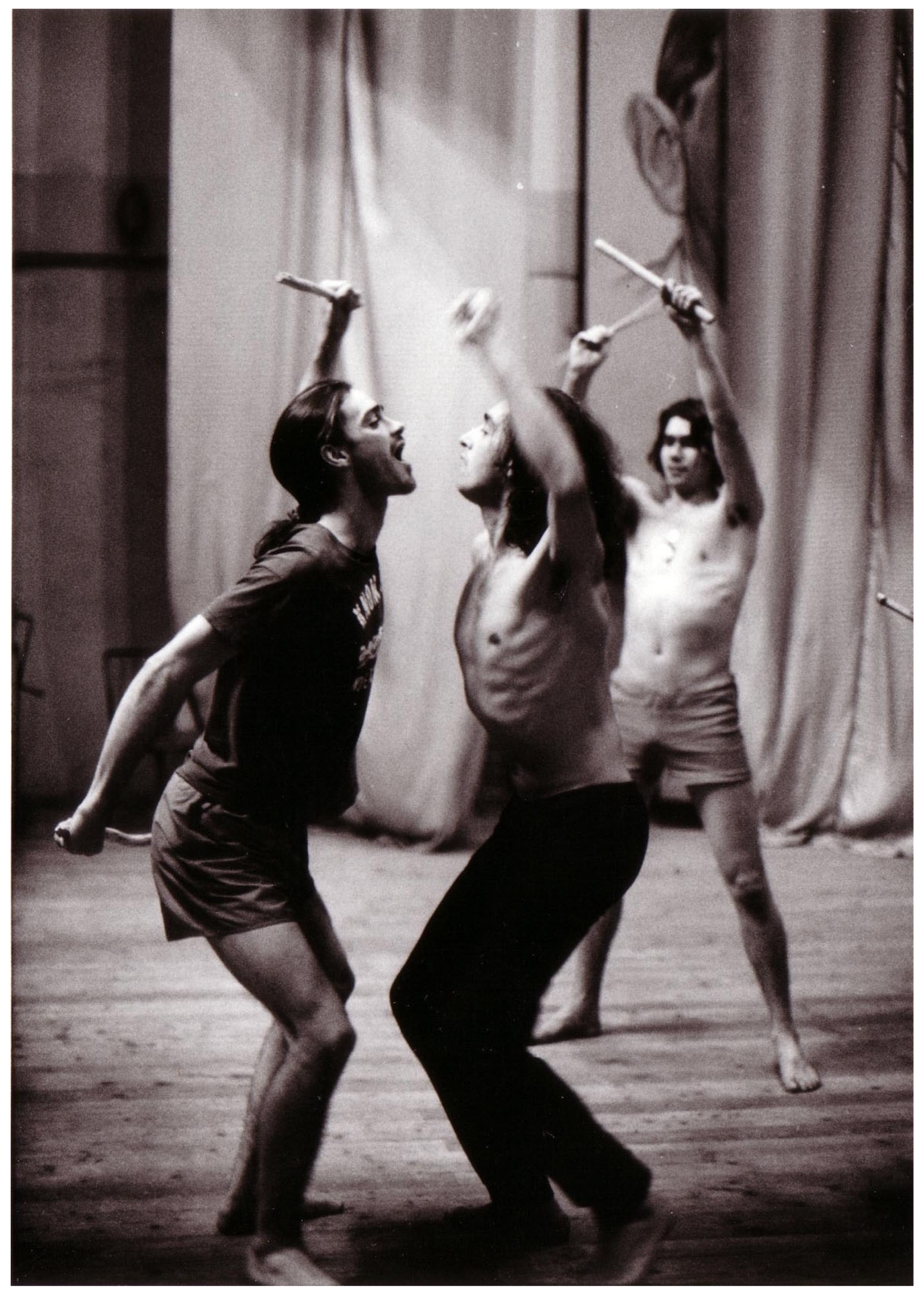
Next came the introduction of sticks to project bodily rhythms and interact with and communicate with the world (
Figure 1 and
Figure 2). One beautiful afternoon, we spent several hours in the park near the chemical factory, finding and preparing sticks. The sticks had only one requirement: they could not be longer than the distance between their wrist and elbow. Fallen branches were cut, bark peeled, and carved with knives. Our work led to exploration and wide rhythmic variations, including several “stick jam” improvisations. Exploration scenarios were introduced and included “the rhythmic–vocal–movement expressions of their lives.” Everything we did would later be referenced; with each exploration, the group’s confidence grew, and songs and dances often emerged. Through rhythm and vocal work, we were retracing an ancient process of place expressiveness that would lead to ritual creation.
2.6. Ritual Archaeology: The White Doves
Before describing the White Dove ritual system, some background on the group itself is warranted. The White Doves (
Belye Goluby) are a syncretic Slavic spiritual sect with roots in the seventeenth-century
Khlysty (Flagellants) tradition—one of the most enduring of Russia’s heterodox religious movements, which blended ecstatic bodily practice with folk Christian theology. Like the
Khlysty, the White Doves developed outside official Orthodoxy, emphasizing direct experience of the divine through collective ritual, trance, and the figure of the living prophet. The sect survived Soviet anti-religious campaigns through underground community networks, preserving its practices within trusted domestic circles. By 1992, small White Dove communities still operated in St. Petersburg and its environs, though with diminished membership and without the public visibility they had maintained in pre-Soviet times (
Ryan 1999, pp. 140–55;
Ivanits 1989, pp. 105–20). Olga Chernyarskaya, Metamorphosis’s Artistic Director, was herself an initiated White Dove—a fact that gave our collaboration its ethnographic grounding and distinguished it from mere antiquarian interest in Slavic paganism. Her insider knowledge of living practice, however fragmentary, was the bridge between historical reconstruction and embodied understanding (
Figure 2).
Figure 2.
Sven Homberg and Vitali Zharkoff performing a ritual warm-up using sticks to enact rhythmic-vocal-movement expression. (Photo by the author).
Figure 2.
Sven Homberg and Vitali Zharkoff performing a ritual warm-up using sticks to enact rhythmic-vocal-movement expression. (Photo by the author).
We began the archaeological reconstruction of pre-Christian Slavic ritual performance by identifying the White Doves’ ritual system and vocabulary. This nature-based pagan Slavic cult interpolated Orthodox Christian symbolism into an older cosmological framework. The origins of pre-Christian Russian Slavic culture and practices were vague at best. Oral cultural traditions are fragile, with few written records, and what might have existed was likely erased by the Russian Orthodox Church. Traditions that have existed for hundreds, if not thousands, of years are constantly interpolated and adapted to pre-existing contexts, creating a syncretic culture that accommodates and blends into unique local expression (
Álvarez-Pedrosa Núñez and Santos Marinas 2023;
Propp 1963). Through interviews with Olga Chernyarskaya—an initiated White Dove—I outlined the White Dove ritual practice to which Metamorphosis referred.
The White Doves believe humans can attain a state of Godliness on earth, but they must protect themselves from outsiders who might resent, challenge, soil, or threaten that ability. Their central ritual is organized into ‘ships,’ which carry the White Doves (three to seven per ship) on a voyage ‘flying’ toward a state of Godliness and spiritual unity. Each ship is arranged hierarchically and led by a ‘helmsman,’ who can be either male or female. Each ship also includes a ‘prophet,’ who is central to the ritual and must be a woman. The prophet appears as the mother of God, also known as the Damp Mother Earth and Theotokos. The other White Doves on the ship create a protective envelope for the ship’s successful journey. Their focused intention drives the ship forward through movement, dance, and vocalization.
The Helmsmen perform the ritual as facilitators, guides, and guardians of the ship’s prophet, who may face spiritual dangers when entering a trance. Located at the physical center of the ritual ship is a water font, crossed by two long white towels, symbolizing purity and the white path to Godliness and spiritual unity. The white path (a flight) allows the White Doves to connect heaven, water, and earth.
A ritual begins with each ship calling upon the water element or spirit for its purifying and divinatory powers. This is followed by washing with sacred water as an act of self-cleansing, allowing each White Dove to become a vessel for the spirit to enter and serve as a medium with life-giving powers. After water purification, the White Doves dry themselves on white towels (white way) under the Helmsman’s supervision. The repeated chanting of Dukh, a calling of the spirits, accompanies this. The chant intensifies and builds rhythmically, led by the prophet to induce a trance-like state. Handclapping, body-slapping, and foot-stomping evolve into ritual dancing and singing. The Helmsman places long towels around each White Dove’s neck, and with their placement, each moves into a larger space and begins whip-like movements that produce sounds with the towels. These sounds resemble the flapping of bird wings. The towel whips across the backs and bodies of each White Dove, and, combined with the rhythmic dance, grows into a spinning motion, with the White Doves taking flight. The buildup of energy, towels, rhythm, and spinning induces an ecstatic trance and spiritual purity, transforming the human and material into a state of spiritual unity. The Helmsman does not trance or participate in these ritual actions but instead “keeps the ship steady.”
With towels around each of their shoulders, the White Doves continue to sing, hitting their bodies with slaps as they spin into bird-like beings. A one-sentence chant is repeated with accelerating, high, quick, and rhythmic breathing: Ba toou Schott du sario go. The white way is fully open, and their bodies are ‘sacrificed,’ reaching a state of Godliness and becoming mediums to channel information from the spirits. Then, reaching a climax, the White Doves collapse to the ground. With the vibration of the spirits alive in their bodies and the air, the prophet questions and interprets each White Dove, who is a medium. Often, the prophet speaks in secret, and the Helmsman deciphers the divination for the gathered community.
3. Results: Trance as Creative Methodology
3.1. Entering the Work
With Metamorphosis, I did not have to explain or apologize for my interest in exploring spirituality through performance. Working with other groups, the introduction of, or even the perception of, anything related to spirituality or belief often triggered unexpected reactions. In one workshop, an Alaska Native woman who was a devout Christian accused me of being the devil’s prophet because I taught yoga. In a workshop at Cleveland’s Karamu House Theater, another woman began speaking in tongues during a visualization exercise, upsetting the group and affecting the group’s work later. Fortunately, I had attended Baptist Pentecostal services and, without thinking, laid hands on her in the way I had seen, then used deep breaths to help her come out of her glossolalia. Metamorphosis felt unique and freeing because they were open to exploring ritual to express their spirituality, free from judgment.
Before describing the trance work itself, it’s crucial to clarify a methodological distinction. In the Indigenous traditions I studied, learned, and practiced trance—including those of Yup’ik and Inupiat in Alaska, Zulu in South Africa, Sakha in Siberia, and Miao in China—trance is the domain of trained specialists: the
angakok among the Yup’ik and Inupiat;
sangoma among the Zulu;
badai and
xianniang among the Miao. These specialists work within detailed cosmological systems with established protocols for inducing, navigating, and safely exiting altered states. Shamanic trance in these settings involves many years of apprenticeship, considerable personal risk, and a specific social role: the specialist moves between worlds to gather information or provide healing for the community (
Harner 1980;
Jakobsen 1999). The approach I used with Metamorphosis was different, though related: an applied trance methodology adapted for non-specialist, cross-cultural performance development. The techniques primarily rely on
Goodman’s (
1988,
1990) pan-cultural, posture-based system—which she crafted specifically for use outside Indigenous ceremonial settings—and on
Harner’s (
1980) “core shamanism,” a simplified set of trance-induction techniques designed for non-shamans. The aim was not to imitate shamanic practice but to use altered states as a creative tool: accessing imagery, emotion, and bodily knowledge beyond ordinary critical awareness.
The question of legitimacy—what Indigenous practitioners would say about this transposition—deserves honest engagement. My fieldwork conversations with Yup’ik, Magar, Miao, Zulu, and Sakha elders on this subject yielded varied responses. Some expressed cautious endorsement, insofar as the work visibly honored rather than mimicked; others were skeptical that de-contextualized trance methods could access anything of genuine spiritual consequence. What most agreed upon was that the practitioner’s intent and the care taken with participants were the primary ethical markers—a view consistent with the relational ethics that govern Indigenous gift cultures more broadly (
Riccio 2003, p. 104;
Riccio 2019, p. 86). I proceed here in the spirit of that accountability.
Metamorphosis was an opportunity to explore trance and spirituality as means to create a performance. The trance methods applied evolved over years of self- and group-experimentation, combining various techniques. Among the techniques explored were those of Michael Harner (psychotherapeutic), Felicitas Goodman (trance postures), Yup’ik and Inupiat (Alaska Native), Sangoma (Zulu), Brazilian trance dancing, and color-associated vocally induced trance. Since then, my trancework has evolved to include techniques derived from work with the !Xuu Bushmen, Sakha (Central Siberia), Mudangs (Korea), and Xian Niang (Miao, China).
I had initially explored trance as a resource for performance development while working with Tuma Theatre in Alaska. My work with Alaska Native spiritual guides and research into traditional Yup’ik and Inupiat Eskimo rituals led me to apply trance as a creative tool to access cultural images, atmospheres, movements, and emotions filtered from the conscious mind. Eskimo shamans developed performances, dances, and masks following a similar model. By manifesting the subconscious (the lower world or an altered state of consciousness) in performance, a community could then address the underlying issues affecting it.
The shaman—angakok, as the Yup’ik and Inupiat of Alaska know them—uses trance states to serve their community. A trance experience, much like a dream, was only partially understood when it first occurred. Through enactments performed by and for the community, understanding grew. The trance experience inspired and guided the performance, with the shaman serving as the medium and messenger on behalf of the community. This role closely mirrors the artist’s role and function.
3.2. The Trance Sessions
The goals of the initial trance experiences were to introduce an altered state of consciousness, familiarize participants, and make them comfortable. We began by reducing sensory input through decreasing alertness and relaxing critical faculties, encouraging a passive, receptive state of mind with minimal active, goal-directed thinking. This was followed by the introduction of repetitive, monotonous stimuli—two beats per second, synchronized with the heartbeat. Once established, we implemented progressive changes in the pattern of sensory exposure (rhythm, tempo, and variations) based on the group’s responses. The effects of trance are highly subjective and vary from person to person. In general, trance results in mental states ranging from sensory overload, which can provoke emotional arousal, to increased alertness, mental involvement, and focused or hyper-alertness, to mental fatigue.
Working with non-specialists requires particular care. All thirteen sessions were time-limited (between 20 and 40 min), and each was initiated and closed with grounding exercises—breath work, physical contact with the floor, quiet discussion—to ensure participants fully returned to ordinary consciousness before continuing. I monitored participants closely throughout. On two occasions, performers experienced strong somatic responses (involuntary shaking and, in one instance, extended weeping) that required individual attention and a brief pause in the session. These were not crises, but they underscored the real psychophysiological potency of even lightly induced altered states, and the responsibility incumbent on the facilitator. The distinction between productive altered consciousness and genuine distress remained a constant point of awareness.
I entered a light trance to deepen my understanding and connection with the group. Trances with the group strengthened our connection, elevating it from conscious to supra-conscious, bringing us closer to an ideal working model. Through trance, our work went beyond traditional devised performance. We embarked on a journey that interwove the personal, professional, and spiritual. Trance served as our communal entry into the cosmic rhythm and as a means of participating in the spontaneous evolution of nature. As practitioners engage with this universal movement, they become one with the significant mutation of all beings (
Schipper 1993, p. 138).
The group entered a trance a total of 13 times. As they became more comfortable with the process, they gained confidence and were able to go further, accept, remember, and achieve more. It quickly became clear that Olga, Elena Stepahova, and Anya Malachiyeva, were especially skilled. Ludmila Babenkova, the costume and set designer, had trance experiences that were particularly helpful in developing the performance’s visual aspects. The experiences of Elena, Vitali Zharkoff, Sven Holmberg, Morten Ilsøe, Yuri Maikoff, and Arkadi Zhilkin made important contributions by focusing specifically on the needs of their individual performances.
3.3. Visions from the Birthing Posture
Using Goodman’s “Birthing: Life-Death Passages” trance posture, the following responses were evoked:
There was an eye in space—it was far away, but I came closer until it became enormous, and then I entered the eye’s retina. Once I entered, I spiraled downwards into an ever-narrowing tunnel. The spiral had white trails and was in a black void. It was a new universe.
There were many sets of eyes. They were the eyes of some animal and were floating. The light was unclear; everything was in shadow.
Then, in front of me was a river. The river led to an underground lake where the surface was calm. Then, from above, I saw myself floating on the lake. I became the symbol of a human body, like a cutout cardboard figure. I was a ghost lying on the water with aura-like colors surrounding me. There were many pairs of eyes watching me. The symbol of my human body moved as if it was dancing, and then two Eastern men with turbans came and danced next to the lake, watching me. Then, the men in turbans repeated a one-gesture movement.
3.4. Calling the Spirits
Goodman’s “Calling the Spirits” trance posture provided vivid imagery and insights:
At the center of the floor, a female figure showed me movements—praise actions—white symbols on a black background.
In the distance, I heard drumming, and something approached. The rhythm became rapid, and I felt an unpleasant sensation. A creature with many teeth on each side of its mouth was coming towards me. It was flying straight for me. Suddenly, we were looking into each other’s eyes. I went into his eye, to the bottom of the eye, and into a dark space, and felt I was in a great wheel, turning clockwise. There was a wheel sound. I moved with the wheel.
Silence and darkness, then the sound of footsteps coming from the corner. It was a spirit coming. The spirit transformed into several different geometrical shapes. It then settled on one geometric face; two large slits were large eyes. The mask was yellow and followed me wherever I went.
I saw a girl in a long white shirt playing some game and running between the trees. Then she ran to a circle of people dancing around the fire. People were dancing, wearing dark and white strips of clothing and black masks with no mouths, only eyes.
3.5. Metamorphosis Visions
With the trance postures’ success, we continued with Goodman’s “Chalchihuitlique Metamorphosis” trance posture, which revealed vivid performative imagery:
People jumped, danced, and shouted. In the fire around which they danced were pictures and idols. They were burning. The girl was standing near the circle. A boy, also wearing a long skirt, moved closer to her. I saw the boy’s face up close, and it was terrible. It looked like a corpse, all black and dark. I became afraid. Then I saw the girl’s face close; it was just like mine.
Squares, circles, and triangles changed very fast. At my feet was a thin, very long grey stripe. I was curious to know where it led. Then, the girl walked on the stripe. I could see inside her body—it was exposed to me in layers.
A white-and-black image appeared very quickly, with white arrows. I saw the girl wearing a white dress made of fine mesh. Something was licking my feet, and a pinprick feeling. I could not feel other parts of my body.
Shadows were moving quickly. Their movements were like leaves of grass.
A tiny black hole entrance appeared underneath. A rhythmic light was moving. The light rhythm matched the drum’s rhythm.
I began to be bitten on the legs and different parts of my body. The biting was to call my attention to the faces above me. They were old faces. Faces made of ancient wood and bark. Painted faces but human faces like from another civilization. They were not terrifying. Their skin was like tree bark. There was a human face, but it changed into a tree face, then back to a tree face. They were constantly changing—each time I opened and closed my eyes, it was a different face of a different old man.
I looked around and was surrounded by light. Beneath me, I felt like the surface of calm water.
A ray of light found a tree, and it began to dance.
It is hard to keep my balance, and a long hallway is like a palace. It had a red carpet. Then a man appeared, a stranger with a full white beard and white shirt. Suddenly, he tried to suffocate me and pressed my eyeballs. He turned into an angry animal monster with horns.
I went through several small, claustrophobic spaces and encountered a black man and a yellow woman. They were raising and lowering a strip of blue sky.
Goodman’s trance postures provided a wellspring of imagery. As the performers became more comfortable, each successive trance became a continuation of the previous ones, and soon a narrative and visual language evolved to guide our subsequent work. The process suggested how trance traditionally served shamanic and Indigenous cultures, providing access and the ability to dialogue with the spirit world.
3.6. From Trance to Performance
Trance experiences featured many charged images, ideas, and emotions, many of which inspired and influenced our performance. Connecting to a higher reality expanded perceptions of self, reality, and community. We retraced the process used to create the Ritual Preparation, and through discussion, we reached a consensus and consolidated related images, movements, ideas, sounds, and feelings. Similar ones were condensed; outlier experiences were kept on a ‘reserve’ list. Soon, the trance experiences began to merge into narrative clusters.
The initial work was not focused on creating a sequential story or assigning meaning. Instead, it aimed to reenact experiences as literally as possible. Each piece contained a dense amount of information that needed to reveal and organize itself on its own terms. Too often, there is a tendency to jump into interpretation and structuring without fully understanding what was presented. Listen carefully, and the work will guide you—it’s a dialogue, and one must stay open and avoid rushing to judgment. Instinct and patience are crucial.
My inability to communicate directly with non-English speakers in the group was an advantage that required heightened sensory and emotionally sensitive communication. Without spoken language, the group seemed to develop heightened awareness of one another, a shift in feelings, and nuanced expressions communicated directly in ways no words could convey. This approach was adaptable and perfectly suited to our goals—the process itself was a vital part of the project. Rituals communicate primarily through the senses—since they lack language-based mental constructs, this worked in our favor. We thought and spoke through our bodies.
As the trance work progressed, several motifs became evident. The initial trance experiences served as general indicators and outlines of the process. During the trance, the group members allowed the experience to unfold freely, without direction. The next stage of trance work was ‘directed,’ whereby a question was formulated before entering the trance, guiding the experience toward an answer. Directed trances are similar to lucid dreaming techniques that steer a dream experience.
Questions for directed trances were developed through group discussion. For example, the appearance of Egyptian-like men with turbans intrigued the group, so during a trance, Sven and Vitali each formulated a question to ask: “How do you speak, talk to me?” and “What do you want and why are you here?” Their experiences added characters, movement, and motive detail, enriching their process. Performers asked questions similar to how a shaman in a traditional society might inquire about hunting, weather, or illness. Their relationship with the turban men (as they became known) deeply influenced their performance, and they became like mediums, channeling another reality.
Whether the other reality was a phenomenon that could be explained as spiritual, imaginative, creative, or psychological, or it was the collective unconscious, didn’t matter. We were tapping into a resource beyond rational, cause-and-effect thinking—a resource that had been long neglected, denigrated, and marginalized by scientific materialism. We were creating a ritual modeled on a process used in various forms by shaman-centered Indigenous cultures.
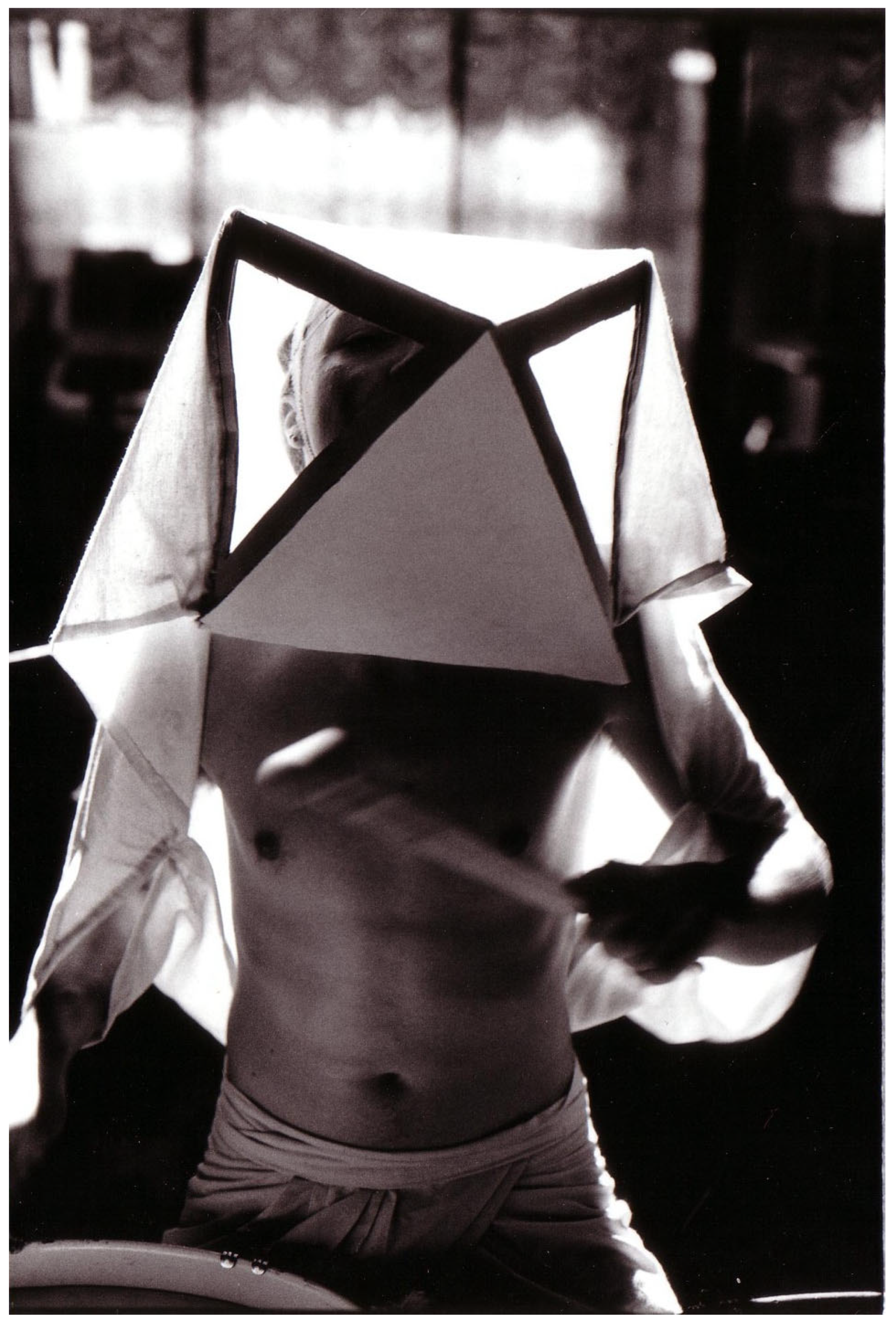
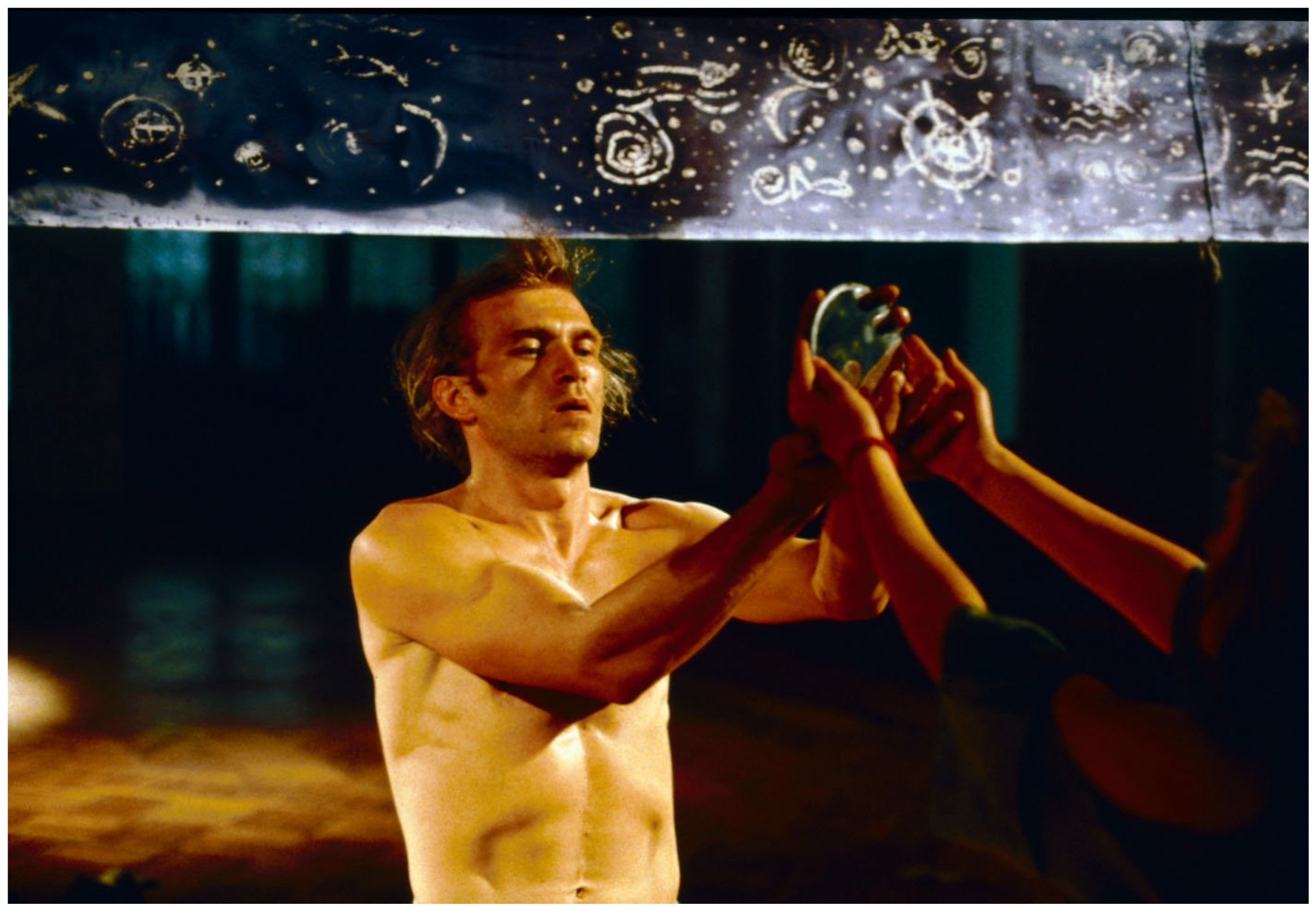
Morten Ilsøe developed a connection with a geometrical spirit that appeared repeatedly in his trances. He planned his actions and rhythms through focused trances, and the shapes and geometries that often appeared within them came to be known as “Pyramid Man.” These geometric forms were translated into inspiring elements for his rhythmic compositions. Ludmila, the costume and set designer, built on his trance experiences with her own, creating the geometric mask and costumes for the Pyramid Man (
Figure 3).
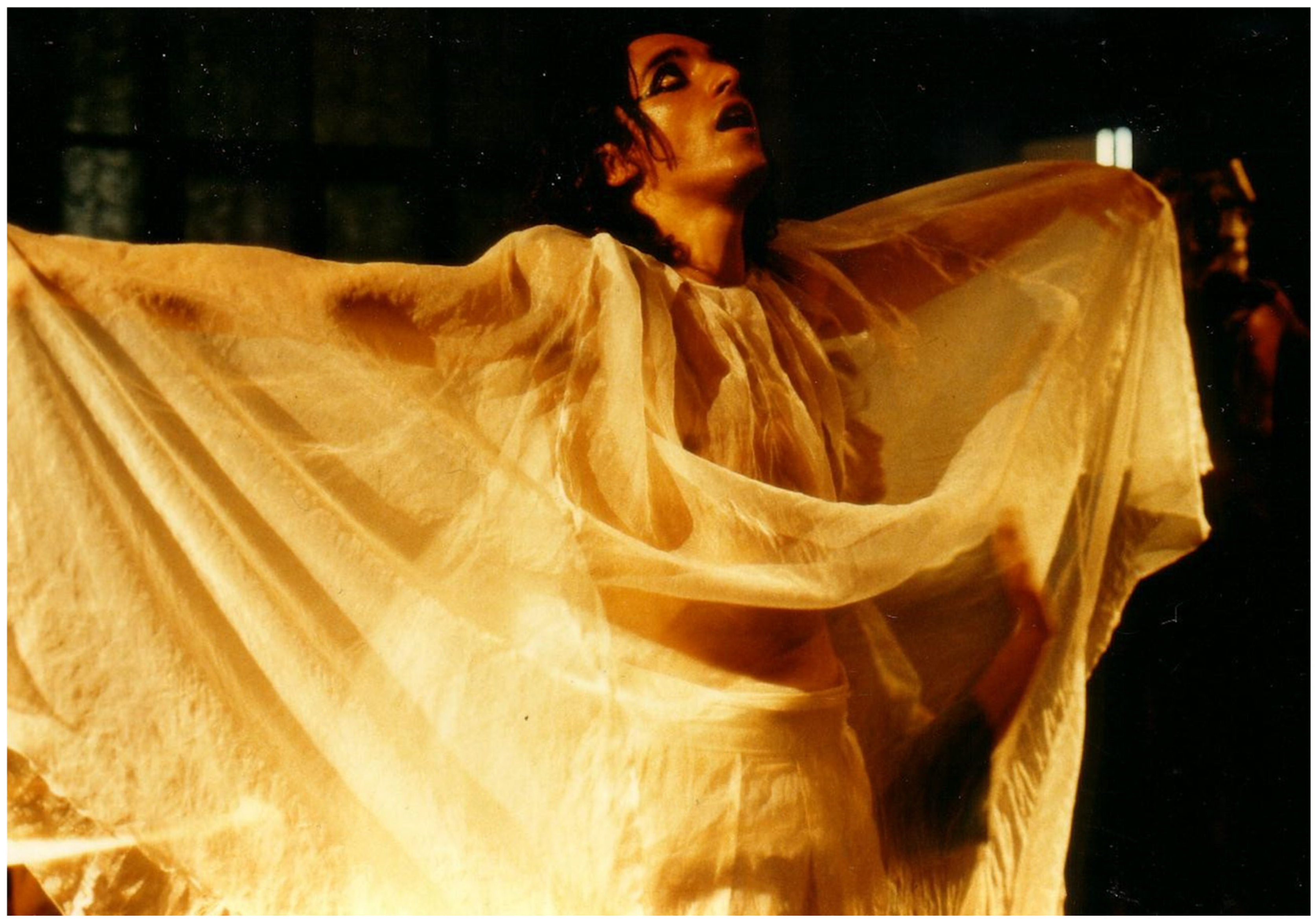
Vitali Zharkoff encountered a ghostly figure that taught him several songs. After one significantly affecting trance, Vitali, as a man possessed, isolated himself for hours with the piano in the propaganda theatre. Three songs of an exceptionally haunting quality resulted. His continued trance work revealed the androgynous figure as a god or goddess sent to help the girl’s initiation into womanhood. Working with Elena, they incorporated the imagery and actions revealed by her trances, and soon a scene took shape. The mist and smoke so prominent in Elena’s trances became a flowing white veil in the performance, which Vitali Zharkoff wore to shroud and protect Elena Stepahova (
Figure 4).
3.7. The Tree People: Magic and Synchronicity
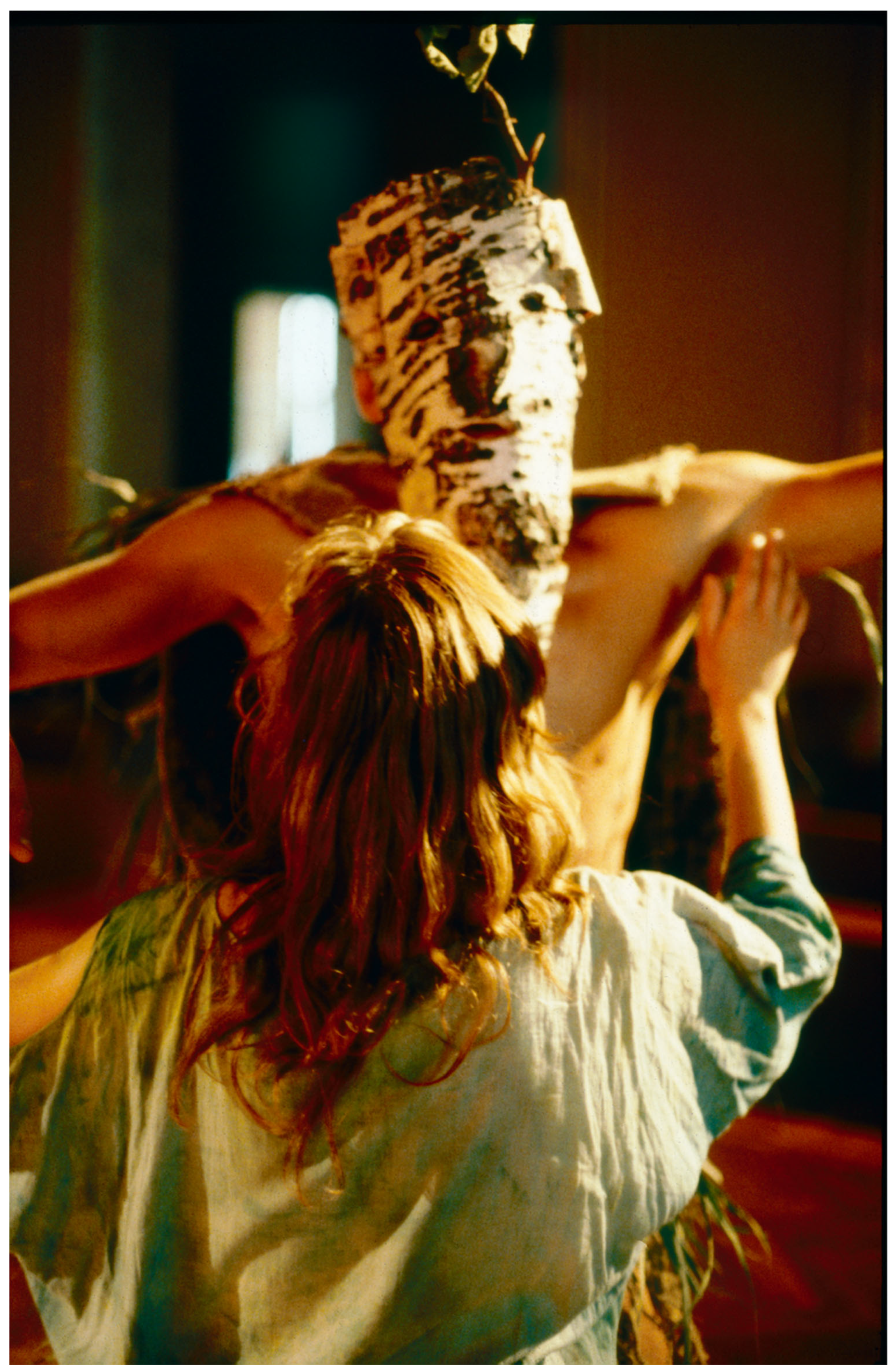
Arkadi Zharkoff and Sven Holmberg developed the “Tree People,” (
Figure 5) which found expression in birch-bark masks, a tradition of pre-Christian Slavic culture (
Kajkowski 2021). Olga and Ludmila, the costume designer, were well-versed in traditional Slavic relationships and in the symbolism of trees, and they provided the two men with abundant visual and historical references. Although visual examples of the birch bark masks exist in books and museums, their actual ritual applications remain undiscovered. The two men defined their relationship with the Tree People through trances, revealing their ritual function and actions. Ludmila, the costume designer, used trance to create birch bark masks, leaf-and-stick cloaks, and a hand rattle (
Kajkowski 2021, p. 248).
How does one portray a Tree spirit without turning it into a cartoon, stereotype, or grade school drawing? In traditional cultures, trees were seen as another kind of people. Living in or near a vast forest allowed for sensory interaction and learning from tree spirits. This understanding and relationship do not exist in a modern, urban world. While trance is not a substitute for actual experience—something that takes generations to develop—these trance states can trigger insights that cannot be gained or explained logically.
The Tree People, whether they represent suggestion, fantasy, or projection, initially appeared to each of the two men independently, without any prompting. The effect on both men was unexpected, direct, and immediate, leading them to explore further together. This process is not causal, and without a better explanation, it seems magical. How could two men from vastly different backgrounds—one Russian and the other American—independently generate so many shared trance-induced images and experiences across all possible variations of elements, time, and space?
Magic and mystery surround us; we are taught to avoid seeing and understanding what they offer. Sven and Arkadi’s performance of The Tree People, performed by Holmberg and Zhilkin, was for a human audience and the spirits. They honored and taught us, and we returned the favor by giving them a voice, for what is given is not ours to keep but to pass on.
Elena’s trance experiences featured a central and recurring motif: traveling into the earth through a series of tunnels, transforming into a snake, and then into the sky. Portraying her evocative experiences in performance without relying on literal depiction was a challenge. Elena and Yuri trance to reveal details of the snake, which he would later perform. Their subsequent trances, each asking questions, led to a shared, detailed experience. In a way, they were dialoguing and rehearsing their relationship in an altered state of consciousness. Soon, the snake person, his appearance, movements, role within the story, and connection to Elena were revealed (
Figure 6).
A series of trances undertaken by Ludmila, Elena, and Olga offered movements, images, and feelings, such as tracing currents in the sky, which Elena remarked looked cloth-like. Our discovery process referenced trance imagery as a script that set the action. Inspired by the imagery, varying lengths, widths, textures, and cloth colors were explored and eventually staged.
4. Discussion
4.1. The Family of Metamorphosis
The family atmosphere at Metamorphosis Theatre was typical of the small theatres I visited in St. Petersburg. The day would start with tea and discussion. The group’s lunch or dinner break was usually the day’s social highlight. Everyone pitched in for preparation; eating and cleaning up often took more than 2 h. Once a week, usually on Saturday or Sunday, we took an extended dinner break that lasted up to three and a half hours. During these meals, we celebrated birthdays, shared photos, listened to music, sang songs, played guitar, and danced folk dances. It was a warm, family-like environment with lasting fond memories.
For our daily meals, actors brought baked goods, vegetables, and fruits grown in family urban gardens or in their family’s dacha (summer home). Because we were guests, Morten, Sven, and I were not asked to contribute. Although we appreciated their generosity, we still felt a bit awkward. Out of economic necessity, some group members also sold family-grown fruits and vegetables in parks or on the street after rehearsals or on their days off to earn extra money. One day, feeling the desire to help, I offered Olga 200 rubles, about $1.40, and expected her eyes would bulge from her head. She embarrassedly refused, thinking we were not fed enough. To avoid further issues, we bought items from the market and contributed to the cause instead. I will always remember my reaction when Sven bought several kiwi fruits. Having never seen or tasted the fruit before, the Metamorphosis group gathered around the table, fascinated as they watched the fruit being sliced and shared.
The Artistic Director, Olga Chernyarskaya ruled the group with benign authoritarianism, which was understandable, given the models available. She often went to great lengths to assist the company members in their private affairs. Arkadi, a former Soviet army commando who had served in Afghanistan and had a pending court case regarding a fight, caused Olga’s maternal anxiety. During the workshop and rehearsals, Olga often called lawyers on Arkadi’s behalf. Every day, she would quiz him about his behavior and remind him what could happen if he were sent to a Russian prison. Elena Stepahova and Sergi Popov were the relatively new members of the group. The diligent Sergi was the youngest, but Olga required him to give her remedial lessons because he had not passed a recent university exam. As punishment for failing another exam, Olga made him responsible for preparing the daily meals, saying he should get used to it—that would be his only job if he didn’t graduate from university. Olga would treat Elena like a daughter, bringing her clothes and counseling her about her recent separation from her abusive husband.
Although I shared a family-like bond with the group, my inability to speak Russian and communicate directly with the Metamorphosis members was frustrating. We had spent much time together and shared many emotionally and psychologically intense experiences, yet the language barrier kept us apart. I longed for natural interactions, everyday observations, songs (we did share pop song lyrics), and jokes. Our cultural and language differences demanded great patience and understanding. Although the language gap challenged my spontaneity, it made me more reflective and sensitive to emotional shifts, which I highlighted to the group. We turned this obstacle into an opportunity for growth, enriching our communication. We relied on unfiltered, honest, and sensory-based exchanges, emphasizing bodily awareness over words and thought.
4.2. Finding an Island
Russia was gravely wounded and abused, the trauma and distortions of the Soviet era infecting its people’s souls and being. How could the ritual performance of Metamorphosis Theatre serve to remedy and heal?
To clear my mind and think things through, I would often jog, sometimes for hours, through St. Petersburg’s night. The city, full of noise, activity, and anxiety during the day, became quiet after midnight, revealing a melancholic charm and the rhythms of another era. A night sea breeze swept away the day’s heavy diesel and auto exhaust. In 1992, jogging in public was still exotic in Russia, a capitalist-bourgeois import that made me self-conscious as I passed the tattered, filthy beggars bedding down for the night.
As travel restrictions from the former Soviet republics eased, a flood of migrants, including those from rural areas, the Roma community, and other impoverished groups, moved into the city. When a woman saw I was a Westerner, she fell to her knees, crying, with children in her arms, blocking my path while pleading and grabbing at my legs. The city’s faint hope also drew many con artists, money changers, and shady Russian mafia members, all looking to exploit others to survive. The uncertainty and unfamiliarity fueled a strong sense of anxiety. Just a year earlier, in the artificially protected Soviet economy, one ruble was worth five US dollars. During my three months there, the ruble’s value plummeted from 125 to 200 against the dollar.
It was common to see men and women walking the streets with bandages, scars, bruises, black eyes, or just deep pain on their faces. Not a day went by without witnessing a scuffle or fight, usually among men, in the street, at a marketplace, or on a subway. Public drunkenness was widespread. St. Petersburg felt unhealthy physically, emotionally, and spiritually.
Marketplaces and kiosks sprouted everywhere, selling everything imaginable. Everyone seemed eager to start a business. The collectivism promoted by Soviet ideals faded more each day into an everyman-for-themselves reality. Among young Russians, there was a rush to be anything but Russian, and American culture became an obsession. Baseball caps with the “USA Dream Team” or various American sports teams were everywhere. American pop culture, blue jeans, US Army surplus, Mickey Mouse, and McDonald’s brought order, meaning, and hope to their world. Items from US discount stores were displayed in glass cabinets like sacred objects. Shops had small altar-like displays of American and Western European products: watches, T-shirts with American logos, blue jeans, lingerie, liquor, aftershaves, and cigarette lighters. The sleek design, high-gloss appeal, and fashion-forward look were new, strange, and fascinating to the Russians. It was as if they were trying to distract or soothe their spiritual loss by embracing the trinkets of materialism.
Another side of St. Petersburg revealed itself in the quiet of the night while I was jogging. Desperate, expressionless faces and vacant eyes still haunt me. Families fishing off city bridges for murky water dinners, mothers and children scavenging through garbage for morsels, drunks staggering or lying sprawled and bloody on the sidewalk, and young girls heavily made-up prostituting themselves in the shadows of an alley.
I was jogging without a map, wandering, always moving, afraid to stop, exploring, getting lost, and one day reaching a refuge. This island was once the summer retreat of the Russian aristocracy, then a Soviet park. No cars were allowed on the island; the ocean breeze was like a cleansing bath. A labyrinth of tree-shaded pathways lit only by nineteenth-century pole lights. Quiet except for the sound of my footfalls on the cinder. Lost in the rhythm of my stride, carried to another place and time by the fragrance of trees, flowers, and ocean brine.
I wondered what relevance performance and ritual had to people so overwhelmed with change and daily struggles. Was it a form of escapism? Were performance and ritual no different from the island I sought, a temporary refuge from pollution, noise, and social chaos? Then I thought, what if it was? What if I were nothing more than an escape artist? People need to find their island of quiet and peace, and so must individuals, communities, and cultures. Performance, at its core, takes us somewhere else. It is a way to hold time still and catch a glimpse of the infinite that quietly and persistently lives in the ever-moving present. It is a means to reaffirm and reflect on the communal, spiritual, bodily, emotional, and mental wholeness of what it means to be human. I do not create islands when working with other cultures; I only find them. Usually, they are at the center of where people live, surrounded by a world in disarray.
4.3. How Ritual Works
Every aspect of the ritual is bundled with significance and potency. Like learning a spoken language, one must know the meaning and syntax to create a framed event of networked and ontological understanding of what a ritual is and how and why it works.
Bell (
1992, p. 74) has argued that “ritualization” is, above all, a strategic way of acting—a mode that distinguishes certain acts from others by situating them within a special context of time, place, and attention. This understanding is congruent with what I observed in practice: the ritual elements of the White Dove ceremony were not arbitrary but were carefully curated actions that activated the symbolic and cosmological universe shared by the participants.
The enactment of a ritual script or sequence does not ensure its effectiveness. A ritual’s power comes from its participants and the larger community, who are familiar with the environment, symbolic languages and objects, mythologies, rhythms, tones, and textures imbued with meaning. For example, a Catholic participating in mass engages in a mythic-magical sphere of understood stories that blend myth and history, repeated, referenced, and implied through various symbolic means. The chalice, a key object in the mass, holds deep ritual significance, symbolizing the vessel Christ used at the Last Supper, transforming wine into his blood, and offering it to his apostles and the world. Transubstantiation is a central concept in Christian theology.
The chalice is both functional and archetypal. It is a common, ancient drinking cup that holds nourishment, quenches thirst, and promotes fellowship and celebration—its practical purpose charged with symbolic meaning, making it a transcendent symbol of hope, forgiveness, and generosity. The image and memory of this event have been preserved for 2000 years in the chalice. Objects serve to signify, hold, and convey meaning across time and space. The chalice is a mnemonic device, enhanced by valued metals and decorative artistry, which increases its material significance. It is so central to Christian theology that it stands as a symbol, alongside the crucifix, of the religion itself.
The chalice exists as both physical and mythical, carrying a sense of magic. Every action involving it acknowledges its significance and is performed to maximize its impact. When a Catholic priest today stands at the altar preparing for communion and raises the chalice to the heavens, speaking poetically and using gestures, a deep layer of ritual meaning is conveyed. The church’s architecture, with its vaulted, upward-reaching ceilings, communicates to the congregation that they are small and humble. The communion ritual holds a complex, historical, mythical, and sensory significance that creates a personal, psychological, and emotional experience.
The above offers a brief overview of how ritual functions as a network of meaning across linguistic, narrative, sensory, emotional, intellectual, and symbolic levels to induce a changed state of consciousness. The ritual components are not arbitrary; they are familiar and purposeful. Drawn from specific contexts, gestures, objects, and sensory elements are imbued with meaning and arranged into a coherent system. In this process, the everyday is transformed and sanctified, turning into a sacred narrative. The sacred is an outgrowth of a collective agreement and belief, which lives in a liminal state between believers, the material, and the ephemeral—what
Turner (
1969) termed the “liminal” space in which social structures are dissolved and reformed. A shared narrative gives shape and is a standard reference, enabling participation in a community of believers.
A ritual is a demonstration, reassessment, and reassurance of what resides within the individual and the community. The ritual participant bears responsibility not only to the present but also to the past and future, as they, like the ritual, are links of continuity. No religions, belief systems, or civic or community organizations I know of lack some form of ritual—repeated actions that symbolize order and serve to reinforce the group’s values. A ritual is situated knowledge enacted. A ritual act is how a community or culture sustains its narrative. Ritual encodes a group’s perspective to fulfill the basic human need for order and meaning, helping individuals understand their place within the world and the human continuum.
What happens when only the gestures of the ritual remain? How do those gestures rebuild and reconnect with their cosmological story? This was the main question behind my work with Metamorphosis. A ritual is not just a reenactment of moments, undefined symbols, and objects. How can we create a ritual that combines functionality, immediacy, and value?
Our work resembled that of archaeologists or geneticists, reconstructing something lost from pottery shards or DNA samples. The rituals of the hunter-gatherers I have worked with directly and tangibly referenced the cycles of life—rituals that, for them, were not metaphors but were still physically present. In my observation, based on my extensive work with a wide variety of Indigenous cultures, the pre-Christian Slavic tradition, like the traditions of industrialized cultures, had become detached from its practical and participatory origins; it was no longer dialogic with the world; its time and place had passed. Like the gods of ancient Greece, their rituals and beliefs faded as the world sought meaning, comfort, and value elsewhere.
The questions about Metamorphosis were mine as well. In many ways, I was like them. A product of modernity and city life, cut off from nature, shaped by political, cultural, religious, and economic systems that worked to eliminate the direct connection between land, spirit, and self. It will likely take generations for the Russians to heal from the trauma they and their spiritual selves have suffered. Can any of us go back to the rituals of early times? Is it necessary, or is it a tragedy if we do? Is it possible for anyone today to reclaim a ritualized way of living in the world? There’s no turning back. We begin where we are, and create from the fragments, rediscovering and remaking ritual anew in our image.
4.4. Toward a Techdigenous Framework
The principles from this early work have developed into what I now call “Techdigenous” practice, which combines Indigenous wisdom with ever-encroaching advanced technology and modern performance settings. The core element of ritual is rhythm, making it a gathering space and a medium through which communities connect and align with the cosmic rhythm encompassing seasons, moon cycles, and solstices (
Eliade 1959, p. 96). Humans, as the most empowered and vital beneficiaries of place, are responsible for rituals that unify humans, animals, elements, spirits, and ancestors.
Ritual embodies an implicit ethos of recognition and generosity, which is central to place-based Indigenous cultures, often called ‘gift’ cultures. Historically, the most successful hunters were the sponsors of the Inupiat “Eagle-Wolf Messenger’s Feast” and the Yup’ik “Inviting-In Feast” because they gained the most and gave the most. In the past, it was common for a great hunter to give away everything he possessed, a gesture seen as a major achievement. I attended an Athabaskan funeral Potlatch—held years after a son’s death—where the parents had saved for years to give nearly
$30,000 worth of gifts, including rifles and snow machines. Despite modern influences, the saying “to give is to receive” remains strong among Alaska’s Native communities (
Riccio 2003, p. 104). It was this ethos—one that my Indigenous collaborators over the years had explicitly and implicitly affirmed as the ethical ground for any legitimate transposition of their practices—that I sought to carry into the Metamorphosis work.
Research has shown that rhythmic stimuli trigger simultaneous intense discharge from both the sympathetic and parasympathetic nervous systems in humans (
D’Aquili and Laughlin 1996, p. 134). Trance can produce ecstatic states through rhythmic auditory, visual, or tactile stimuli, which creates a biophysical sense of union with other participants. Repetition of actions in humans and other species influences the biological unity of a social group through limbic discharges. Rhythm and repeated actions, fundamental to trance and ritual, also generate pleasurable arousal. “The ic quality in and of itself produces positive limbic discharges resulting in decreased distancing and increased social cohesion” (
D’Aquili and Laughlin 1996, p. 135).
This neurobiological reality explains why every human culture has developed ritual technologies. Understanding this mechanism opens up possibilities for reconstructing or designing new ritual technologies suited to modern needs—forming the basis of the Techdigenous approach. Function is more important than form. Communities do not gain from copying Indigenous cultural practices—they need to find their own gestures, rhythms, and balance. What matters across different contexts is understanding how ritual functions (
Riccio 2010, p. 131).
5. The Performance: Shadows from the Planet Fire
Working methods evolved naturally and remained flexible, open, and adaptable. The emerging performance was alive and present among us. Thoughts, reflections, and dreams from the night before were welcomed. The work progressed naturally and in its own way. As a narrative sequence formed from fragments, I had to remind others, and myself, to resist the urge to force the work into a cause-and-effect sequence, but instead to let it breathe and flow like a river. We created a ritual performance called “Shadows from the Planet Fire.”
Without a written script, we relied on oral and sensory methods; presence and an awakened consciousness guided us. As Damasio observes: “The organism constituted by the brain-body partnership interacts with the environment as an ensemble, the interaction being of neither the body nor the brain alone. However, complex organisms like ours do more than interact; they do more than merely generate the spontaneous or reactive external response known collectively as behavior. They also generate internal responses, some of which constitute images (visual, auditory, and somatosensory)” (
Damasio 1994, p. 89).
Our performance was like a living being, existing within and between us, connecting the physical and the metaphysical, which is the way, function, and necessity of ritual. Working in this “alive” manner required acceptance and non-judgment, with every part of the process and the lives we lived during it speaking for themselves. If, during our work, an action was forgotten, reversed, or remembered differently, that was as it should be—this way of working demanded performers to engage and know differently. An older part of the brain and somatic consciousness was activated. With this approach, there is no waste. Everything—every feeling, idea, movement, and interaction—contributed to the work. The process called for a new way of working inspired by an ancient way of being (
Figure 7).
Just as with our hunter-gatherer ancestors, everything communicates. Boundaries between the real and the imagined, the spirit and the physical, the world and the self are permeable. Like the shaman before them, the artist is an expert who moves between worlds and does what must be done to ensure the survival of both the species and the planet: to recreate the world.
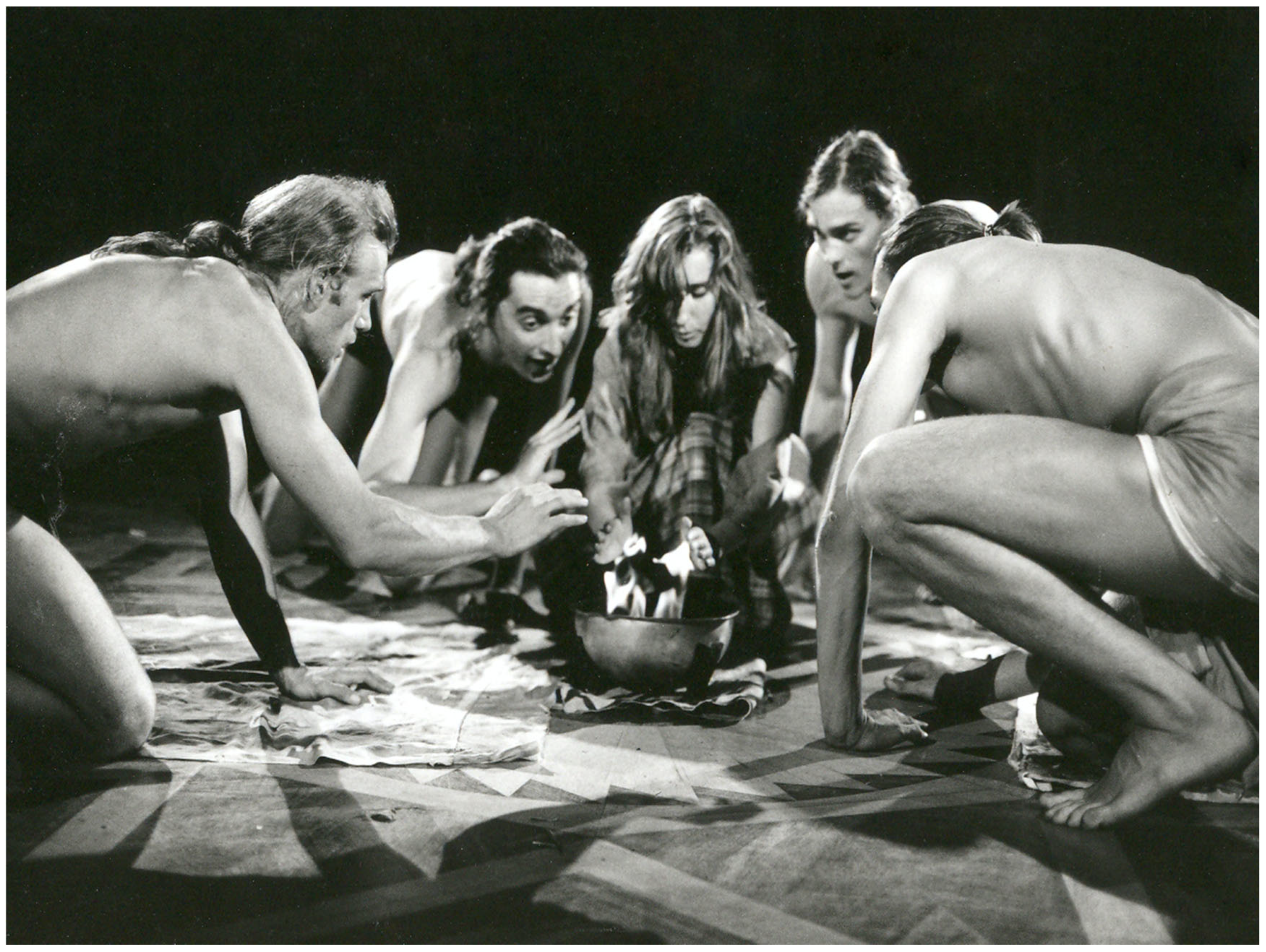
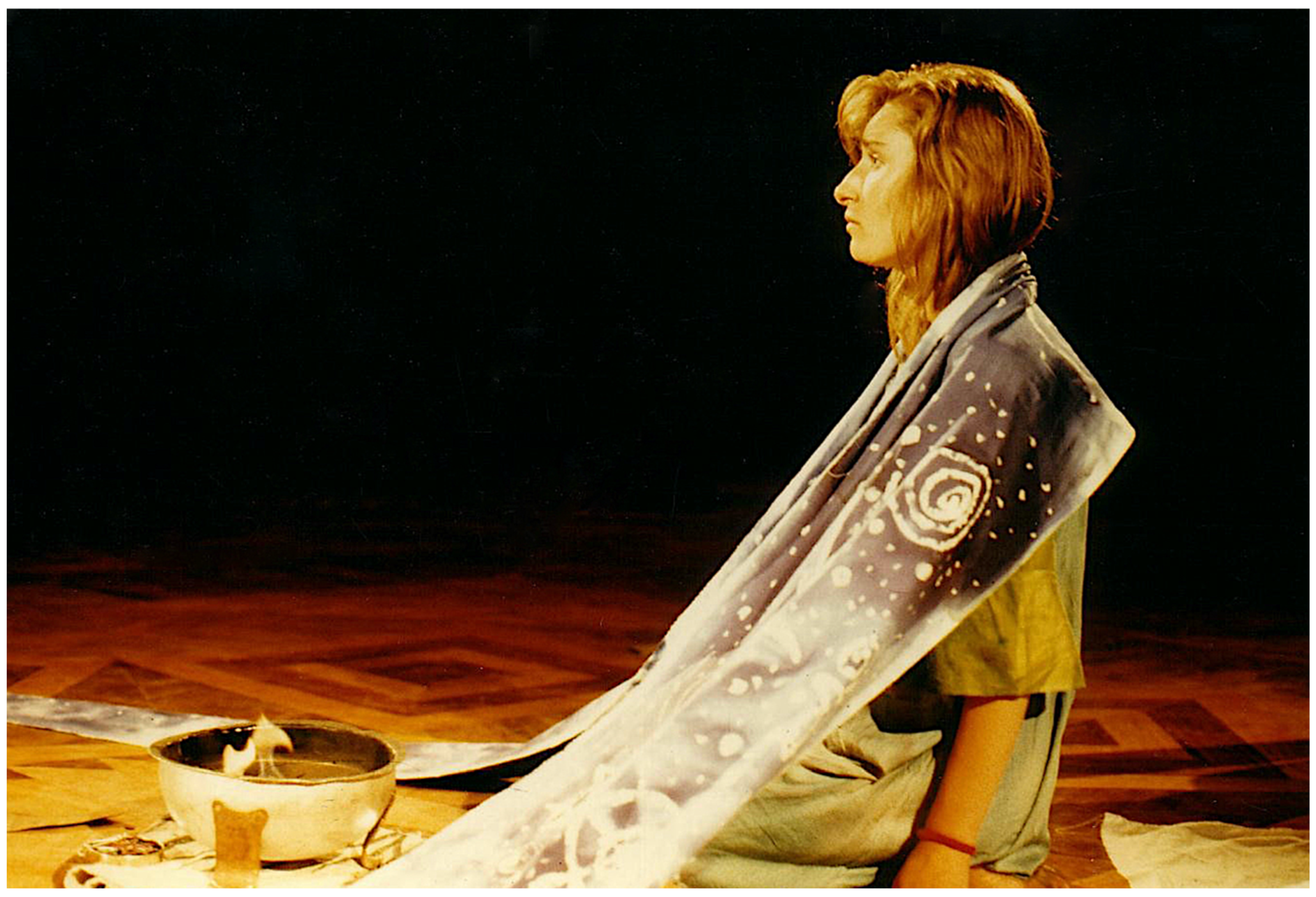
Three weeks after our initial trance work, we developed a performance outline. Surprisingly, a story about a girl’s journey to womanhood emerged naturally, without deliberate planning. The women’s input, in particular, provided valuable perspectives. We integrated the White Dove ritual framework, which shaped Elena’s role into that of a prophet (
Figure 8). Her journey became about learning and embodying the prophet—a messenger of knowledge to the ancient Slavic people during a period of significant, often traumatic, change in Russia. The White Doves community welcomed the performance enthusiastically, with many seeing it as an initiation ritual for women, symbolizing the female spirit and energy: the Slavic Mother Earth coming alive once more.
The spinning section of the Ritual Preparation was inspired by trance experiences and amplified similar White Dove ritual actions. The White Dove’s use of towels grew into thirty-foot-long strips of cloth, connecting Slavic tradition with trance states. Long strips of cloth became tunnels and pathways the girl traveled through, and then she was wrapped, cocoon-like. Large strips of cloth for the sky cloth—fifteen feet by two feet—expanded the trance towel motif. The white pathway of knowledge that the girl follows at the end of the performance leads to a firepot. She leaps over the fire, entering another state of being.
Everything that happened, whether planned or by chance, shaped the work: Russia and St. Petersburg during a time of deep political, economic, and psychological upheaval, working in the chemical factory, communicating through a translator, using trance, and participating in camping rituals in the woods—all of it and more left a lasting imprint on the performance and a small part of the ongoing process of life on Earth.
Opening Night
The premiere of Shadows from the Planet Fire took place on 10 August 1992, in the lobby of the Baltic House Theatre in St. Petersburg. The building was a classic example of Stalin-era grandeur, featuring massive columns, high ceilings, marble statues, and staircases that celebrated the Soviet state. It housed several theatres and shops, including a large proscenium theatre with nearly a thousand seats. Everything showed signs of benign neglect.
The management initially wanted us to perform in the large or smaller two-hundred-seat studio theatre. We rejected the idea, preferring the second-floor lobby with its beautiful wooden floor and a surrounding balcony where audiences could sit informally on three sides. It was a former grandeur in ruin—a vast, echoing emptiness at sixty feet with a forty-by-sixty-foot playing space. It perfectly complemented the larger-than-life, mythic-ritual expression the performance aimed for. It was ideal.
Getting the production to open required a lot of ingenuity, bending the rules, and persistence. The production budget was about $400 in US dollars—the largest the Metamorphosis had ever had for a production, and there was much concern about how they would afford it. Wanting a smooth production, I personally underwrote the entire cost. Providing the money was the easy part. In post-Soviet Russia, finding necessary items like ‘D’ cell batteries, muslin, or paint meant scouring kiosks, spreading the word among friends, and dealing with the Russian Mafia, who could find anything for a price.
Finding drums and drumsticks of any kind, shape, or size was next to impossible. After three weeks of searching, we only found a tuba and a marching band bass drum. I will forever be indebted to Ludmila for her tireless efforts and resourcefulness in bringing the costume and set design together with quality and artistry.
The day before the opening, Russian National Television crews unexpectedly filmed the dress rehearsal, adding to the chaos. Word had gotten out, and the television feature was shown nationwide.
On the day of the opening, we had a successful rehearsal of the performance. Noticing that the performers needed a break, I gave them the afternoon off. I decided to go to the city center to do some shopping. Needing some rubles, I exchanged money near the local Metro station—something I had done several times before and was common practice throughout the city. Soon after, a large, burly man physically accosted me. First thinking it was a robbery, but I quickly realized I was being arrested. A new law had just gone into effect, making street money changing illegal that day.
I was held, handcuffed, shuffled around, and yelled at for six hours. Finally, they contacted the Russian–American Theatre administrator and met me at what I discovered then were KGB offices, the feared Soviet secret police assigned to domestic duties. They set me free after negotiating with a sympathetic officer, paying the fifty-dollar fine, and signing a confession.
I arrived at the theater thirty minutes before our opening. The cast and crew greeted me with tears and emotion worthy of someone returning from the dead. They explained how KGB arrests in the recent past, even for a minor incident, often meant a person disappeared.
Opening night was a success. Along with members of the general public and the theater community, several White Doves members attended. The production sparked much discussion and interpretation. Although opinions varied, everyone I talked to agreed it was a story that needed to be told. Some said the performance was about searching for purity, returning to nature, and finding meaning. Others said it was: “A search for a home and understanding of personal feelings and impulses.” “The girl’s journey and lessons were to gain the knowledge to help others because they are helpless.” “Because the earth is dying, more knowledge about herself is necessary.” “The girl, like all of us, must reevaluate our purpose and goals. We must all connect to the common pulse and beat to become a small part of the earth. It was a journey of women to become who they are.” “The girl was symbolic of Russia’s journey to find itself.” “Russia is regaining its female, intuitive side and its softness.” The performance would go on to have a successful run in St. Petersburg and later tour Ukraine and the Ural Mountains.
6. Conclusions
The conditions that made this work urgent in 1992 have grown more severe worldwide. Ecological collapse, political polarization, epidemic loneliness, and existential anxiety define the modern era. The human-centered systems are clearly breaking down—economically, politically, environmentally, and psychologically. What will take their place remains unknown.
Indigenous knowledge suggests the path: not a return to a prelapsarian past, but the recognition that consciousness and community of place are inseparable. Performance can catalyze this recognition, providing technologies for reestablishing sensorial participation in the living totality we never actually left but merely convinced ourselves we transcended. The revolution underway is decentering—accepting our actual position as one species among millions, radically dependent on systems we did not create and cannot control. This acceptance is not defeat but liberation into reality as it is.
The Metamorphosis collaboration proved that these technologies are effective—that people disconnected from ancestral traditions can rebuild meaningful ritual practices, that trance offers real access to creative and spiritual resources, and that rhythm training can restore the disconnection between body and consciousness. These findings are just as relevant today as they were in post-Soviet Russia, perhaps even more so as the crises have only worsened.
The island I discovered running through St. Petersburg’s midnight streets was not an escape but a realization: that refuge, meaning, and connection must be actively built through practice. We do not create islands; we merely find them. Usually, they are at the heart of where people live, surrounded by a chaotic world, waiting to be rediscovered.