


Abstract
This article examines the design of plant-based musical performance from a practitioner-research perspective, focusing on a concert system in which electrical variations captured from three plants are transformed into sound, visual display, and live musical form. Rather than treating plants merely assources of Musical Instrument Digital Interface (MIDI) notes, the project develops a concert architecture in which vegetal signal variation can influence pitch, register, articulation, density, timing, silence, audiovisual cues, and spatial differentiation. The article situates plant-based performance on a continuum between anthropocentric musical design and a more phytocentric orientation of attention toward vegetal variability, while acknowledging that sensing, mapping, instrumentation, dramaturgy, and interpretation remain human-designed. Through a three-movement form—Calibration, Diversity, and Plantocontrol—the performance moves from a relatively transparent gesture–signal–sound relation toward increasingly differentiated and temporally unpredictable musical behaviours. Practice-based results include the preservation of silences, ostinatos, rapid bursts, repetitions, abrupt accelerations, articulation changes, and moments of saturation as compositional material. The article argues that the significance of plant concerts lies less in the simple sonification of biosignals than in the construction of a performative situation in which vegetal variability, digital mediation, and human compositional intention coexist. The project calls this relation organic aleatorics: a form of musical indeterminacy conditioned by continuously changing signals acquired from living organisms and their electrical environment.
1. Introduction
The sonic and musical relationship between humans and plants has developed in two main directions. On the one hand, plants have long been treated as recipients of sound and music in scientific, para-scientific, and cultural experiments concerned with growth, vitality, sensitivity, or response to external stimuli. This line extends from eighteenth-century work on electricity and vegetation (Bertholon de Saint-Lazare 1783) to early twentieth-century research on plant response and the visualization of plant micromovements (Bose 1902), and later to popularized claims about the effects of different musical styles on plant life (Retallack 1973). These historical examples are cited here as part of the cultural genealogy of plant-music practices, not as equivalent forms of contemporary scientific evidence.
On the other hand, more recent artistic and technological practices have attempted to render vegetal activity audible by capturing and transforming electrophysiological signals. This second direction intersects with contemporary plant electrophysiology, a field in which electrical signaling in higher plants is understood as physiologically meaningful, environmentally responsive, and measurable through a range of experimental approaches (Yan et al. 2009; Vodeneev et al. 2015; Johns et al. 2021; Barbosa-Caro and Wudick 2024).
Within artistic research, Augustine Leudar has argued that plant electrophysiology should not simply be translated into sound as raw data, but artistically mediated through mapping, spatialization, and perceptual design, so that art and science meet not only in the resulting work but also in the performance itself and in the audience’s experience of it (Leudar 2013, 2018). His question—why should a plant sound like a piano?—opens a fundamental debate in plant sonification: the tension between anthropocentric approaches, which place plant variability within familiar human instrumental and tonal systems, and more phytocentric approaches, which seek to preserve something of the plant’s temporal and structural irregularity within the resulting sound world.
What was once an experimental niche has become a visible public scene. International plant-music festivals and a growing population of plant artists on social media have expanded the cultural circulation of this practice. A substantial part of the public-facing scene relies on commercial devices such as Music of the Plants, PlantWave, and MIDISprout. These systems have been decisive in making plant-derived data publicly audible, but commonly emphasize MIDI-note generation and recognizable ambient outputs (Kieft 2020; Plant Music 2024; PlantWave 2026; Music of the Plants 2014). Simone Vitale’s live performance at the First International Festival of the Music of the Plants, integrating plant-derived material with guitar performance, exemplifies this broader paradigm (Vitale 2017).
Recent scholarship has begun to analyze the field more rigorously. Miller and Cox (2024) provide a conceptual and analytical orientation to music derived from plant biosignals and show that MIDI behaviour can differ across specimens and temporal conditions. Their work is particularly useful because it addresses devices already active in the plant-music scene and highlights the interpretive consequences of mapping biological variation into musical output. In adjacent research, Arrey (2025) situates plant sonification within contemporary bioart, while Wu et al. (2025) examine real-time human–plant interaction through shared biosignal visualization and more-than-human artistic design.
The field is also marked by a conceptual tension. Electrical responsiveness in plants is scientifically established, but its interpretation in terms of intelligence, cognition, sentience, intentionality, or consciousness remains controversial. Segundo-Ortin and Calvo (2022) argue that plant cognition and consciousness deserve careful empirical and philosophical consideration, whereas Taiz et al. (2019) reject the claim that plants possess or require consciousness. For artistic practice, this distinction is essential. A performance may encourage listeners to experience plants as responsive or agentive without constituting scientific evidence of consciousness or intention.
Practitioner observations during and after performances have included informal comments from listeners who felt that the experience resonated with a prior intuition that plants could, in some sense, “talk” or “sing”. These comments were not collected through structured interviews or questionnaires and are therefore treated as contextual practitioner observations rather than as generalizable audience-research findings.
The present article enters this field from a practitioner-research perspective and from a specifically musical problem: not simply how to obtain plant signals, but how to design a concert in which vegetal variability becomes musically legible and experientially meaningful. The performance model is built around three simultaneous signal streams, live visualization at different scales, differentiated camera and lighting cues, and a three-movement structure named Calibration, Diversity, and Plantocontrol. Max/MSP functions as the principal environment for transforming and mapping incoming values to MIDI, virtual instruments, effects, timing, and visual control.
Compared with the dominant commercial galvanometric paradigm, the project seeks a broader range of digital transformations and, above all, a broader range of musical functions for the incoming signals. Parameters such as register, note duration, density, tempo, articulation, and activation conditions may be conditioned by signal variation. The technical chain is therefore treated not as an end in itself but as an instrument of musical mediation.
The purpose of this article is to examine how plant concerts can create musical experiences through the artistic mediation of recorded vegetal electrical variation; how visual and spatial design help audiences follow the contribution of several simultaneous plant streams; how human compositional decisions coexist with non-predetermined incoming values; and how this combination can generate what the project terms organic aleatorics.
2. Materials and Methods
2.1. Practice-Based Artistic Research Approach
The project is developed as a practice-based artistic research process combining plant-signal acquisition, Max/MSP programming, mapping to virtual instruments, sound design, audiovisual mediation, spatial dramaturgy, and experimentation through tests, rehearsals, workshops, and public performances. The aim is not to produce electrophysiological measurements equivalent to calibrated laboratory instrumentation, but to develop and evaluate a performative system capable of making recorded electrical variability perceptible and musically productive in a live setting.
The process has been iterative. After technical tests, rehearsals, workshops, and performances, audiovisual recordings, signal traces, Max/MSP patches, audio files, photographs, and practitioner notes were reviewed together. Recurring behaviours and problems of musical or audiovisual legibility were used to modify acquisition choices, thresholds, mapping ranges, orchestration, mixing, visualization, and concert dramaturgy in subsequent iterations. Informal audience comments are used only as contextual observations, not as the results of a formal audience study.
2.2. Plant Material and Performance Suitability
Different species and individual specimens have been used across signal-acquisition tests, sonification studies, rehearsals, and performances. The documented inventory includes, among others, Crassula falcata, Echinopsis tubiflora, hybrid specimens of the Echinobivia group, Calathea spp., Aloe spp., Hydrangea spp., jade plant (Crassula ovata), and croton (Codiaeum variegatum).
At the present stage, the project does not attribute stable electrophysiological characteristics to individual species. Such comparisons would require calibrated scientific instrumentation, controlled protocols, replicated measurements, and comparable recording conditions. Observed differences are therefore treated as technical and performative observations rather than as evidence of species-level physiology.
Operational differences nevertheless matter for live performance. Flowers, leaves, stems, fleshy tissues, and central plant regions do not always provide the same conductivity or mechanical stability for connection. In exploratory tests with Aloe specimens, for example, central and fleshier regions sometimes offered more stable or conductive contact. Accessibility, mechanical stability, and the possibility of performing visible gestures—such as touching a leaf or approaching the plant—without displacing the contacts are relevant practical criteria. Some plant/specimen/contact combinations are consequently better suited than others to gestural interactivity in performance, without implying a species-specific physiological interpretation.
2.3. Signal Acquisition System
The acquisition system examined in this article uses three generic SparkFun-compatible AD8232 heart-rate/electrocardiography (ECG) modules, one for each plant. The units used in the project did not display an identifiable manufacturer; SparkFun Electronics (Niwot, CO, USA) is cited as the reference breakout-board design. Although originally designed for electrocardiographic acquisition, the modules were repurposed as analog front ends for plant-contact recordings. In the documented protocol, Right Arm (RA) and Left Arm (LA) were used as plant contacts and Right Leg (RL) was placed in the potting substrate as a reference. Depending on plant morphology and contact stability, adhesive ECG electrodes could be supplemented or replaced by conductive pins or leads.
The three channels were transmitted through Arduino/ESP32-class microcontrollers to the computer and processed in Max/MSP. Each AD8232 channel was treated as an independent stream. Documented MuBu acquisition tests from this development phase include configurations of approximately 90 samples/s distributed across the three channels for time-series capture and inspection; because recording conditions varied across tests, the artistic analysis emphasizes relative temporal variation rather than absolute physiological voltage comparisons.
The project repeatedly monitored the influence of the electrical environment during this phase. Recorded signals can include contributions from the plant/contact system, acquisition electronics, cable placement, computer/power configuration, and 50 Hz mains interference. Absolute voltage values are consequently not treated as directly comparable physiological measurements between plants. The artistic analysis focuses primarily on relative temporal variation and on how that variation behaves within the mapping system.
2.4. Signal Processing, Visualization, and Recording
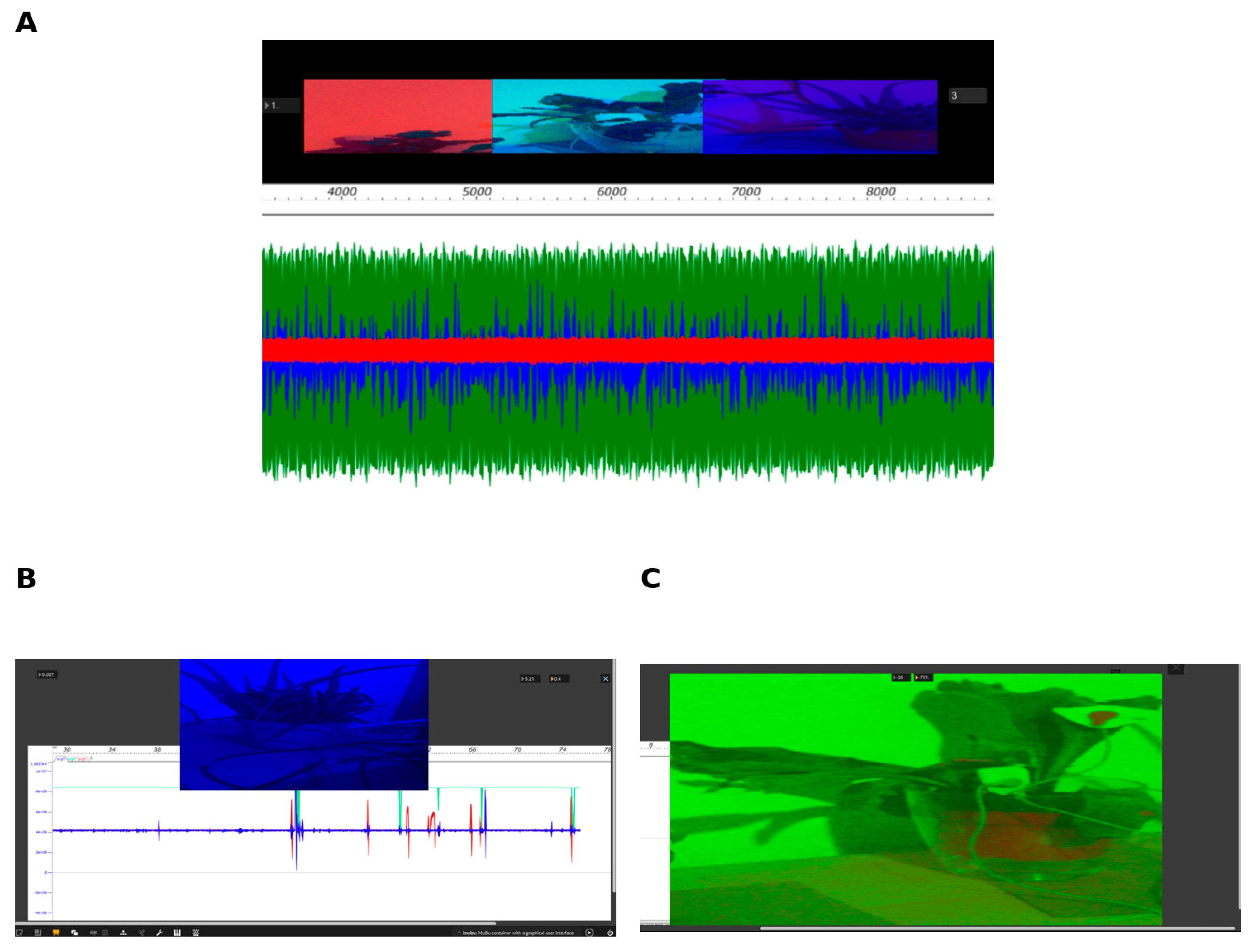
Incoming values are routed into Max/MSP, where they can be visualized, stored, scaled, thresholded, and transformed through different mapping processes. The system can display the three signal streams simultaneously at different temporal scales, facilitating observation of both slower variation and shorter changes. MuBu (Multibuffer) has been used for time-series capture and subsequent inspection.
The current concert architecture primarily transforms the three streams into MIDI events and parameters. Direct conversion of continuous amplitude into audible frequency—an approach explored in earlier prototypes—remains part of the project history but is no longer the core of the current performance system. REAPER is used as a recording and mixing environment for the resulting channels. In the most recent routing approach, each channel can also be duplicated to a headphone pre-monitoring path so that the performer can inspect and adjust a channel before sending it to the public output.
2.5. Max/MSP Sonification and Mapping Architecture
Max/MSP functions as the central composition and performance environment. It receives the incoming channel values, rescales and maps them, restricts pitches to selected scales and modes, defines registers, routes MIDI to instruments from the Sforzando environment for SFZ-format instruments (Plogue 2012), controls effect parameters—especially decay and predelay—adjusts levels, and implements Plantocontrol operations affecting tempo and note duration. The composer–performer–programmer defines transformation rules and module limits, while the incoming values provide non-predetermined variation within those conditions.
Live performance control also includes channel level adjustment, spatialization, fade-ins and fade-outs, and the performative definition of excerpt openings and endings. These interventions alter balance and presentation but do not shift one channel in time relative to the others: temporal synchrony among the three streams is preserved throughout.
This combination of predefined structure and non-predetermined incoming variation is termed organic aleatorics: musical indeterminacy conditioned by numerical streams acquired from living organisms, their contacts, and the surrounding electrical environment. Table 1 summarizes the principal human-defined compositional decisions and the role of incoming plant-derived values in the mapping system.
Table 1.
Principal human-defined compositional decisions and the role of incoming plant-derived values in the mapping system. Source: authors.
2.6. Three-Movement Concert Design
The concert is organized into three movements that progressively change the role of the incoming streams. Calibration establishes a legible gesture–signal–sound relation through thresholded MIDI triggering; Diversity differentiates the three streams through scales, registers, instruments, and effects; and Plantocontrol allows signal variation to affect temporal parameters such as tempo, note duration, density, activation, and silence. Table 2 summarizes these functions and the balance between signal-derived variation and human control.
Table 2.
Three-movement concert design and its main signal-derived functions, performer controls, and performative results. Source: authors.
2.7. Visual and Spatial Mediation
The concert incorporates audiovisual mediation intended to help audiences identify the three vegetal sources. Each stream can be visualized independently, while camera views alternate between general shots and close-ups according to dramaturgical decisions and, in some configurations, signal-related parameters. Plants are also associated witha red–green–blue (RGB) code—plant 1 red, plant 2 green, plant 3 blue—and lighting intensity may be related to the corresponding signal stream. Sound spatialization and differentiated sonic roles further support source identification.
During Plantocontrol, thedirector–disc jockey (DJ)/performermay be positioned among the audience rather than at a dominant stage location. This does not remove human control but alters the visual hierarchy of the event and reduces the performer’s scenic centrality.
2.8. Practitioner-Research Corpus and Documentation
The corpus comprises technical tests, time-series recordings, Max/MSP patches, sonification trials, rehearsals, public performances, photographs, video, audio recordings, and practitioner notes. Materials were reviewed iteratively after each phase to identify recurrent or musically consequential behaviours, technical problems, relations between signal and sonic output, and possibilities for further artistic development. The practitioner-research corpus reviewed for this analysis is summarized in Table 3.
Table 3.
Practitioner-research corpus reviewed for the present analysis. Source: authors.
2.9. Audiovisual and Supplementary Materials
Audiovisual documentation is treated as research material because it allows simultaneous observation of spatial arrangement, manipulation of plants, signal visualization, performer interaction, and sonic result. The revised submission therefore integrates selected performance photographs, technical screenshots, and supplementary video documentation where rights and technical conditions allow. These audiovisual and Supplementary Materials are listed in Table 4.
Table 4.
Audiovisual and Supplementary Materials associated with the present study. Source: authors.
Figure 1.
Signal-acquisition configuration used in the phase examined in this article. (A) Example of plant-contact electrode placement. (B) Three-channel prototype using three SparkFun-compatibleAD8232 electrocardiography (ECG) moduleswith acquisition electronics. Source: authors.
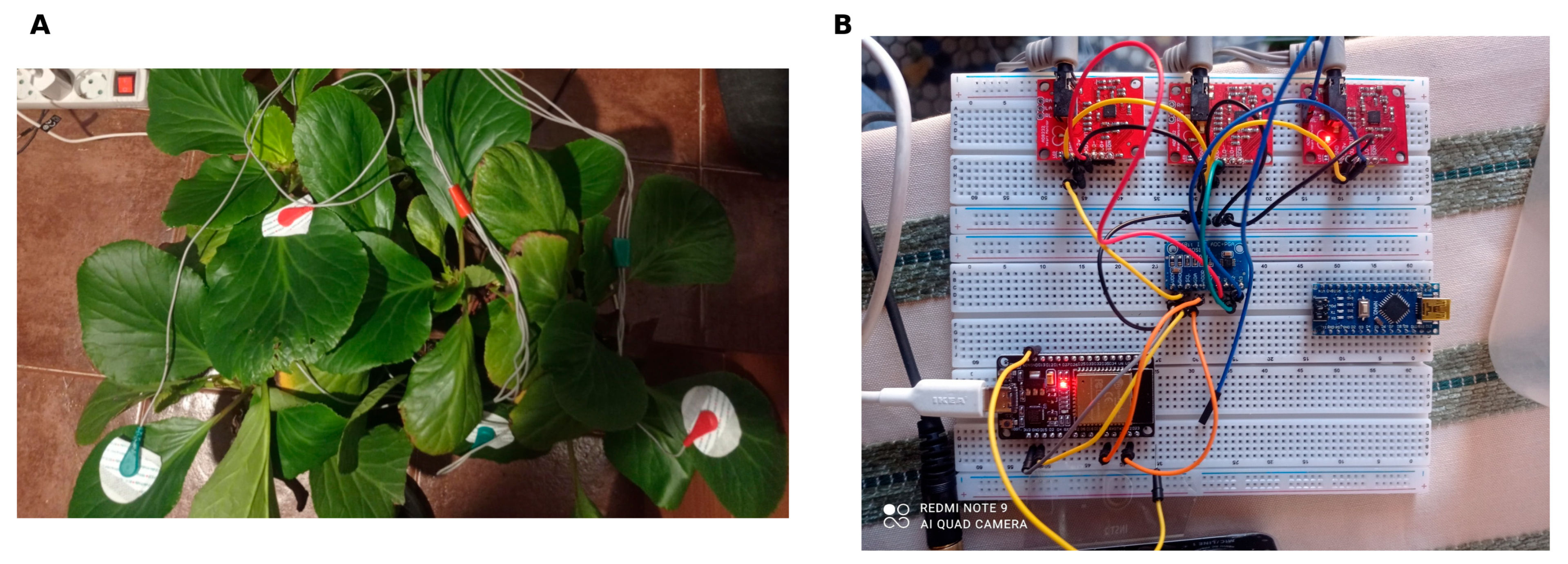
Figure 2.
Three-plant performance layout using red, green, and blue visual differentiation. Source: authors.
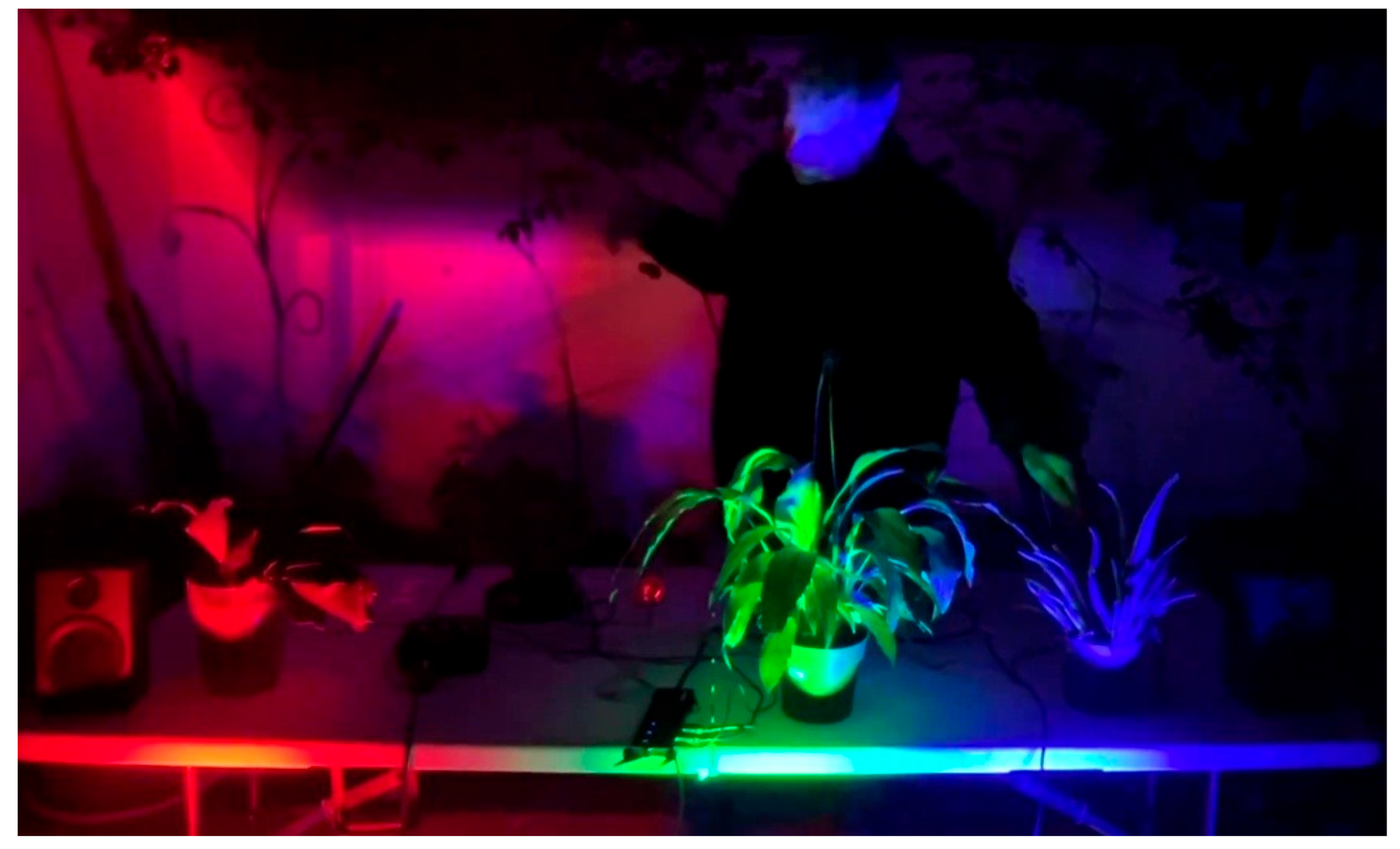
Figure 3.
Selected examples of the visual mediation environment used in the project. (A) Simultaneous red–green–blue (RGB)-coded signal displayof the three channels. (B) MuBu time-series display combined with a blue-channel close-up. (C) Green-coded close-up view of one plant in performance. Source: authors.
3. Results
3.1. Consolidation of a Three-Movement Concert Form
One of the principal results of the artistic research process was the consolidation of a concert form organized into three differentiated movements: Calibration, Diversity, and Plantocontrol. This structure emerged progressively through technical tests, rehearsals, and performances and addressed a recurring problem in the project: how to transform three continuous streams of plant-derived values into a musical experience that would not be perceived as an undifferentiated sonification.
The three movements produce different perceptual and musical situations. Calibration makes the relation among gesture, signal change, and sound appearance relatively explicit; Diversity explores the musical differentiation and combinatorial potential of the three streams; and Plantocontrol shifts emphasis from pitch selection toward timing, density, duration, articulation, activation, and silence. The resulting form therefore moves from a comparatively transparent signal–sound relation toward increasing complexity and unpredictability.
3.2. Movement-Specific Results
3.2.1. Calibration: Legibility of Gesture, Signal, and Sound
Calibration showed that interactivity is most immediately legible when presented through a simple logic of silence → contact → sound → silence. In suitable configurations, touching the plant/contact system is temporally associated with a visible change in the displayed signal; when the change crosses the calibrated threshold, MIDI events are activated. If the signal subsequently returns below the activation range, the system returns to silence.
The Supplementary Video S1 provides a full demonstration dedicated to this principle using a single plant connected to three plant-contact channels. The configuration is intentionally different from the normal three-plant concert setup, but it makes the touch–signal–sound–silence sequence particularly easy to observe. Video S2 provides an additional example in which a visible signal change coincides temporally with touch at approximately 00:48. Neither video is presented as a controlled physiological causality experiment; they document the performative coupling of gesture, recorded signal, mapping, and audiovisual outcome.
Practice also showed that not all specimens and contact positions are equally manageable for this kind of gestural interaction. Morphology, accessibility, baseline stability, contact attachment, and the ability to perform visible gestures without displacing the setup affect suitability. These are performance-engineering observations rather than evidence of physiological differences among species.
3.2.2. Diversity: Combinatorial Expansion Rather than Automatic Source Identification
A second result concerns the musical expansion produced when three simultaneous streams are mapped through different registers, virtual instruments, scales, modes, and effects. Without spatialization or other strong perceptual cues, audiences can lose track of which signal is producing which sonic result. The project therefore does not claim that differentiated mapping alone guarantees immediate source identification.
The more significant result is compositional: the combination of three independent streams with more than forty available virtual instruments, multiple articulation zones, two principal effect families used in the current patches, approximately twenty scalar/modal resources developed across the project, and independent mixing produces a very large space of possible musical outcomes. That diversity can evoke culturally recognizable musical territories—for example, flamenco-oriented bulerías or saeta-like materials—while remaining driven by non-predetermined signal values inside human-designed mappings. The work therefore demonstrates not a fixed “sound of a species”, but the potentially open-ended musical diversity obtainable from three continuously changing streams. Published examples of the broader three-stream sonification practice include Pirilampo (León 2025) and Green Koto (León 2026), both available through SoundCloud.
The ability to introduce or remove channels progressively also generates solo, duo, and trio configurations and changing combinations among plants 1–2, 1–3, and 2–3. Spatialization, RGB identity, camera focus, and channel-specific instrumentation become especially important when the audience is expected to understand which stream is active.
3.2.3. Plantocontrol and Non-Predetermined Temporal Behaviour
The most characteristic and original musical behaviour of the project emerges in Plantocontrol. When signal variation begins to intervene in tempo, note duration, event spacing, activation, density, silence, and—under certain instrument mappings—articulation zones, the performance becomes considerably less predictable.
Across experimentation and performance, recurrent behaviours included sudden silences, bursts of very short events, ostinatos, persistent repetitions, strong accelerations, fragmented phrasing, dense accumulations, abrupt changes in activity, and passages approaching saturation. Some virtual-instrument configurations also produced articulation changes that were not individually selected by the performer during execution. In the koto/Sforzando configuration, for example, the system could move among single notes, muted sounds, tremolo variants, bends, and glissandi as incoming MIDI values entered corresponding articulation regions.
These outcomes do not mean that the plants compose autonomously. The composer still determines instruments, scales, ranges, mappings, effects, and levels. Once those conditions are established, however, the concrete sequence of incoming values governing some parameters is not predetermined. This relationship between human-designed structure and non-predetermined variation is the core of the project’s concept of organic aleatorics.
3.3. Silence and Irregularity as Musical Material
One initially less obvious result was the compositional importance of silence. Silence does not arise only as a pause decided by the composer. It can occur because signal values do not satisfy activation conditions or because the mapping extends beyond the responsive range of a virtual instrument. Systematically removing such interruptions made the output more continuous but also more uniform and less representative of the variability feeding the system.
For this reason, selected silences, irregular repetitions, excessive accelerations, fragmented phrases, and dense accumulations were progressively retained rather than corrected or normalized. These behaviours are one way in which a non-human source of variation remains perceptible within a musical system that is nevertheless extensively human-designed.
3.4. Expansion of the Musical Vocabulary of Plant-Derived Signals
The tests show that the same incoming stream can assume different musical functions depending on mapping. Across the project, plant-derived values have acted as pitch selectors, pulses, temporal intervals, density controls, articulation selectors, textural parameters, melodic triggers, and effect/control variables. The principal musical contribution therefore does not consist in obtaining more notes from plants, but in expanding the number of dimensions of performance that can be conditioned by signal variation.
Plantocontrol is especially significant in this respect: the signal does not determine only what may sound, but also when events occur, how densely they occur, how long they last, and under which conditions particular behaviours or articulations become available.
3.5. Perceptual Differentiation of the Three Plant Streams
Another result was the progressive construction of the three streams as differentiated musical presences. This differentiation does not depend on attributing intrinsic musical properties to species. It is constructed through interaction between captured variation and concert design: channel-specific instrumentation, different registers, scale/mode assignment, independent entrances and exits, spatialization, separate visualization, RGB lighting, and camera close-ups.
These devices reduce the risk that the three inputs collapse perceptually into a single collective texture. The intended result is closer to three changing presences that may act simultaneously, in pairs, or individually than to one digital instrument supplied by three interchangeable inputs.
3.6. Visual and Spatial Mediation as a Structural Requirement
Rehearsals and performances also showed that sound alone does not reliably communicate which vegetal stream is active, especially when effects, articulation changes, or temporal transformations are applied. Visual and spatial mediation therefore became a structural component rather than a decorative addition.
Simultaneous RGB-coded signal displays, channel-linked lighting, plant close-ups, and differentiated spatial projection help relate audible events to visible sources. Camera alternation adds another layer by directing attention toward a particular plant and making the relation among organism, contact system, and displayed activity visible. During Plantocontrol, placing the director-DJ among the audience further changes the spatial hierarchy: human control remains indispensable, but the visible focal field can remain on the plants, signals, and transformations.
3.7. Overall Result: From Sonification to Concert Architecture
Taken together, the results indicate that the main contribution of the project does not lie in extracting plant signals or translating them directly into notes. The process has produced a concert architecture in which signal, code, virtual instruments, space, lighting, cameras, gesture, silence, and compositional decisions operate together. Plant-derived variation acquires musical meaning inside this network of mediations.
The system neither eliminates human intervention nor presents plants as autonomous composers. Instead, it makes explicit the coexistence of deliberate human design and a source of variability that is not fully controlled in real time. The tension among composition and contingency, control and organic aleatorics, human mediation and vegetal variation constitutes one of the project’s principal artistic results.
4. Discussion
The results clarify the anthropocentric/phytocentric tension that runs through plant-based performance. A strongly anthropocentric system tends to normalize plant-derived values into familiar tonal, metrical, and instrumental conventions. A naive phytocentric claim, by contrast, risks implying that the plant composes or intends music in a human-like sense. The present project occupies a more cautious intermediate position. “Phytocentric” is used here as an orientation of attention toward vegetal variability, not as a claim that the work escapes human framing. Sensing, mapping, instrumentation, dramaturgy, aesthetic selection, and interpretation remain human-designed. Table 5 summarizes this continuum between more anthropocentric and more phytocentric orientations.
Table 5.
Continuum between more phytocentric and more anthropocentric orientations in plant-based musical performance. Source: authors.
Silence illustrates this position especially clearly. If a plant-music system is expected to produce continuous pleasant sound, silence may be regarded as a technical problem. In Plantocontrol, silence becomes an aesthetic and epistemic event because it makes audible the fact that the system is not simply generating continuous ambient output. The same applies to ostinatos, extreme accelerations, dense passages, articulation jumps, or saturation: retaining selected irregularities prevents the incoming variability from being entirely normalized into conventional musical continuity.
The project also demonstrates the importance of visual and spatial mediation. Without it, the audience may hear a musically rich result while losing the attribution of particular events to particular streams. This is not a minor presentational issue: source legibility is central to the very claim that several plants participate as distinct inputs. RGB differentiation, signal visualization, camera close-ups, independent channel mixing, and spatialization therefore function as epistemic as well as aesthetic devices.
At the same time, Diversity shows that source legibility and musical diversity are not the same problem. Even when the origin of each event is difficult to follow, the combinatorial musical space generated by several signals, instruments, modes, effects, and temporal mappings remains extremely large. The artistic challenge is therefore to preserve this richness while providing enough visual/spatial information for audiences to understand the structure of the system.
The project must also remain cautious about physiological interpretation. The acquisition chain uses non-laboratory contacts and electronics and is sensitive to cable placement, grounding, mains noise, baseline drift, and computer configuration. Consequently, signal changes that occur near touch, approach, or disconnection are observations of temporal association within a performance system, not demonstrations of a specific physiological causal mechanism. Such observations argue for controlled replication rather than for stronger causal claims.
Finally, the term agency is used in a performative and aesthetic sense rather than as a synonym for intention or consciousness. Plant-derived variability has agency in the limited sense that it can modify the conditions, timing, density, and character of a musical event once embedded in the designed mapping architecture. This is a distributed effect of living tissue, electrical environment, contacts, acquisition electronics, software, mapping, and performance framing. It should not be confused with evidence that the plant consciously intends the resulting music.
5. Conclusions
This article has argued that the significance of plant-based musical performance lies less in the mere sonification of biosignals than in the design of concert situations in which recorded vegetal variability becomes audible, visible, and musically meaningful. The project develops a three-movement form—Calibration, Diversity, and Plantocontrol—that progressively moves from a relatively transparent gesture–signal–sound relation to differentiated musical roles and finally to signal-conditioned temporal and articulatory behaviour.
The principal conceptual and artistic contribution is the broader concert architecture rather than Plantocontrol as an isolated device. Signal visualization, channel differentiation, virtual instruments, modal design, effects, cameras, lighting, spatialization, live mixing, silence, and irregularity together create the conditions in which non-predetermined incoming values can remain perceptible inside a human-designed work.
The project therefore proposes a model in which human compositional intention does not disappear but is redistributed. The composer designs a space of musical possibilities, while incoming vegetal/electrical variation can interrupt, accelerate, repeat, densify, suspend, or articulate the resulting performance. This relation is described as organic aleatorics. It does not demonstrate plant consciousness or musical intention; rather, it offers an artistic method for listening to and composing with the variability of living systems while keeping the mediating role of technology and human design explicit.
Supplementary Materials
The following supporting information can be downloaded at https://www.mdpi.com/article/10.3390/arts15100235/s1: Supplementary Materials include Videos S1–S3 and selected performance, visualization, and acquisition images. These materials are cited where relevant in the text and are intended to document both the technical setup and the audiovisual concert mediation. Video S1: Full Calibration-style stimulus–response demonstration using one plant with three plant-contact channels. Video S2: Concert excerpt with visual mediation and close-up imagery; video by Inti Cordera. Video S3: Concert excerpt showing poinsettia, staghorn fern, and Spathiphyllum sp. (peace lily) within the three-plant configuration.
Author Contributions
Conceptualization, M.G.-U.; methodology, M.G.-U.; software, M.G.-U.; investigation, M.G.-U.; resources, M.G.-U.; writing—original draft preparation, M.G.-U.; writing—review and editing, M.G.-U. and J.C.B.T.; bibliographical analysis, J.C.B.T.; visualization, M.G.-U.; supervision, J.C.B.T. All authors have read and agreed to the published version of the manuscript.
Funding
This work has been co-funded by the European Union, European Regional Development Fund (85%), and Junta de Extremadura. Managing authority: Ministerio de Hacienda (Spain). Grant GR24145.
Institutional Review Board Statement
Not applicable.
Informed Consent Statement
Not applicable.
Data Availability Statement
Selected compositions and concert excerpts supporting the reported results are available through the supplementary or online materials cited in the article. The public SoundCloud archive is available at https://soundcloud.com/martin-leon-art (accessed on 15 June 2026). The software patches and full mapping environment are not publicly available, as they constitute the authors’ original creative and technical system.
Acknowledgments
The authors acknowledge the artistic, technical, and audience contexts in which the plant-concert system was developed and tested.
Conflicts of Interest
The authors declare no conflicts of interest.
References
- Arrey, Rodrigo. 2025. Bioart and Plant Sonification: A Possible Experiment. Resonancias 29: 261–68. [Google Scholar] [CrossRef] [Scilit]
- Barbosa-Caro, Juan Camilo, and Michael M. Wudick. 2024. Revisiting Plant Electric Signaling: Challenging an Old Phenomenon with Novel Discoveries. Current Opinion in Plant Biology 79: 102528. [Google Scholar] [CrossRef] [Scilit]
- Bertholon de Saint-Lazare, Pierre. 1783. De l’électricité des végétaux. Paris: P. F. Didot jeune. [Google Scholar]
- Bose, Jagadis Chunder. 1902. Response in the Living and Non-Living. London: Longmans, Green, and Co. [Google Scholar]
- Johns, Sarah, Takuma Hagihara, Masatsugu Toyota, and Simon Gilroy. 2021. The Fast and the Furious: Rapid Long-Range Signaling in Plants. Plant Physiology 185: 694–706. [Google Scholar] [CrossRef] [Scilit]
- Kieft, Henk. 2020. The Mysterious Singing of Plants. Plant Music. Available online: https://www.plantmusic.com/the-mysterious-singing-of-plants-by-henk-kieft/ (accessed on 14 January 2026).
- León, Martín. 2025. Pirilampo. SoundCloud. October 1. Available online: https://soundcloud.com/martin-leon-art/pirilampo-2 (accessed on 5 February 2026).
- León, Martín. 2026. Green Koto. SoundCloud. January 29. Available online: https://soundcloud.com/martin-leon-art/green-koto (accessed on 12 February 2026).
- Leudar, Augustine. 2013. Integrating Plant Electrophysiology, Plant Signalling and Art. Belfast: Sonic Arts Research Centre, Queen’s University Belfast. [Google Scholar]
- Leudar, Augustine. 2018. Surrounded: A Series of Sound Installations That Combine Plant Electrophysiology and 3D Sonic Art. Leonardo 51: 517–23. [Google Scholar] [CrossRef] [Scilit]
- Miller, Paul V., and Christopher Cox. 2024. Music from Plant Biosignals: A Conceptual and Analytical Orientation. Music Theory Online 30. [Google Scholar] [CrossRef] [Scilit]
- Music of the Plants. 2014. FAQ. Plant Music. Available online: https://www.plantmusic.com/faq/ (accessed on 3 March 2026).
- Plant Music. 2024. Festival International de la Musique des Plantes: A Fusion of Science and Art. Available online: https://www.plantmusic.com/festival-des-musiques-des-plantes-a-fusion-of-science-and-art/ (accessed on 17 March 2026).
- PlantWave. 2026. Use PlantWave with a Digital Audio Workstation (DAW). Available online: https://help.plantwave.com/en-US/use-plantwave-with-a-digital-audio-workstation-%28daw%29-232539 (accessed on 8 April 2026).
- Plogue. 2012. sforzando: Free SFZ Player. Available online: https://www.plogue.com/products/sforzando.html (accessed on 7 May 2026).
- Retallack, Dorothy L. 1973. The Sound of Music and Plants. Santa Monica: DeVorss. [Google Scholar]
- Segundo-Ortin, Miguel, and Paco Calvo. 2022. Consciousness and Cognition in Plants. WIREs Cognitive Science 13: e1578. [Google Scholar] [CrossRef] [Scilit]
- Taiz, Lincoln, Daniel Alkon, Andreas Draguhn, Angus Murphy, Michael Blatt, Chris Hawes, Gerhard Thiel, and David G. Robinson. 2019. Plants Neither Possess nor Require Consciousness. Trends in Plant Science 24: 677–87. [Google Scholar] [CrossRef] [Scilit]
- Vitale, Simone. 2017. Music of the Plants Live. Bandcamp. June 24. Available online: https://soundofgoldenlight.bandcamp.com/track/simone-vitale-music-of-the-plants-live (accessed on 11 June 2026).
- Vodeneev, Vladimir, Elena Akinchits, and Vladimir Sukhov. 2015. Variation Potential in Higher Plants: Mechanisms of Generation and Propagation. Plant Signaling & Behavior 10: e1057365. [Google Scholar] [CrossRef] [Scilit]
- Wu, Zi Wei, Meng Yang, Dan Lu Fei, Jia Qi Shi, and Jon McCormack. 2025. Empathic Growth: Designing Human-Plant Interaction through Artistic Exploration. In Expanded Conference 2025—Animation and Interactive Art. New York: Association for Computing Machinery, pp. 213–21. [Google Scholar] [CrossRef] [Scilit]
- Yan, Xiaofei, Zhongyi Wang, Lan Huang, Cheng Wang, Ruifeng Hou, Zhilong Xu, and Xiaojun Qiao. 2009. Research Progress on Electrical Signals in Higher Plants. Progress in Natural Science 19: 531–41. [Google Scholar] [CrossRef] [Scilit]

Disclaimer/Publisher’s Note: The statements, opinions and data contained in all publications are solely those of the individual author(s) and contributor(s) and not of MDPI and/or the editor(s). MDPI and/or the editor(s) disclaim responsibility for any injury to people or property resulting from any ideas, methods, instructions or products referred to in the content. |
© 2026 by the authors. Licensee MDPI, Basel, Switzerland. This article is an open access article distributed under the terms and conditions of the Creative Commons Attribution (CC BY) license.