


Abstract
This study deals with the painting Snowy Stream, which is often used to represent the style of the poet painter Wang Wei (699–761). This album leaf, with several colophons by Dong Qichang, was long believed to have been in his collection. It played a significant role in giving form to “painter Wang Wei” as the founding patriarch of the Southern School and thereby helped Dong shape his theoretical reorientation of Chinese landscape painting. First, the paper examines the social life of this painting during the time of Dong Qichang and argues that it underwent major remodeling and renovation that significantly changed its format and appearance before being acquired by Cheng Jibai. Dong’s unreserved approval of this painting was largely motivated by financial concerns for the benefit of Cheng. Second, the paper explores the rationale behind the warm reception of this image despite its dubious provenance and severe condition. The author argues that the remodeled image echoes the pastoral theme and level perspective that is a signature of Wang’s poetry, embodies the key doctrines and aesthetics of Chan Buddhism, and demonstrates the visual effect of using a pure ink wash to replace linear outlines and patternized texture strokes.
1. Introduction
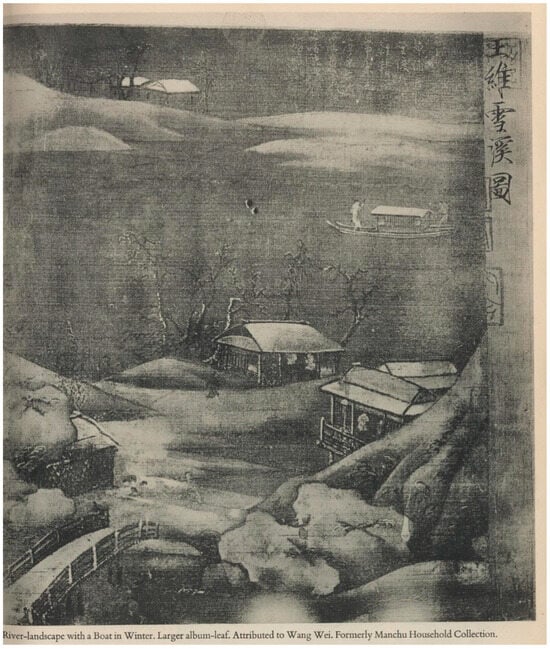
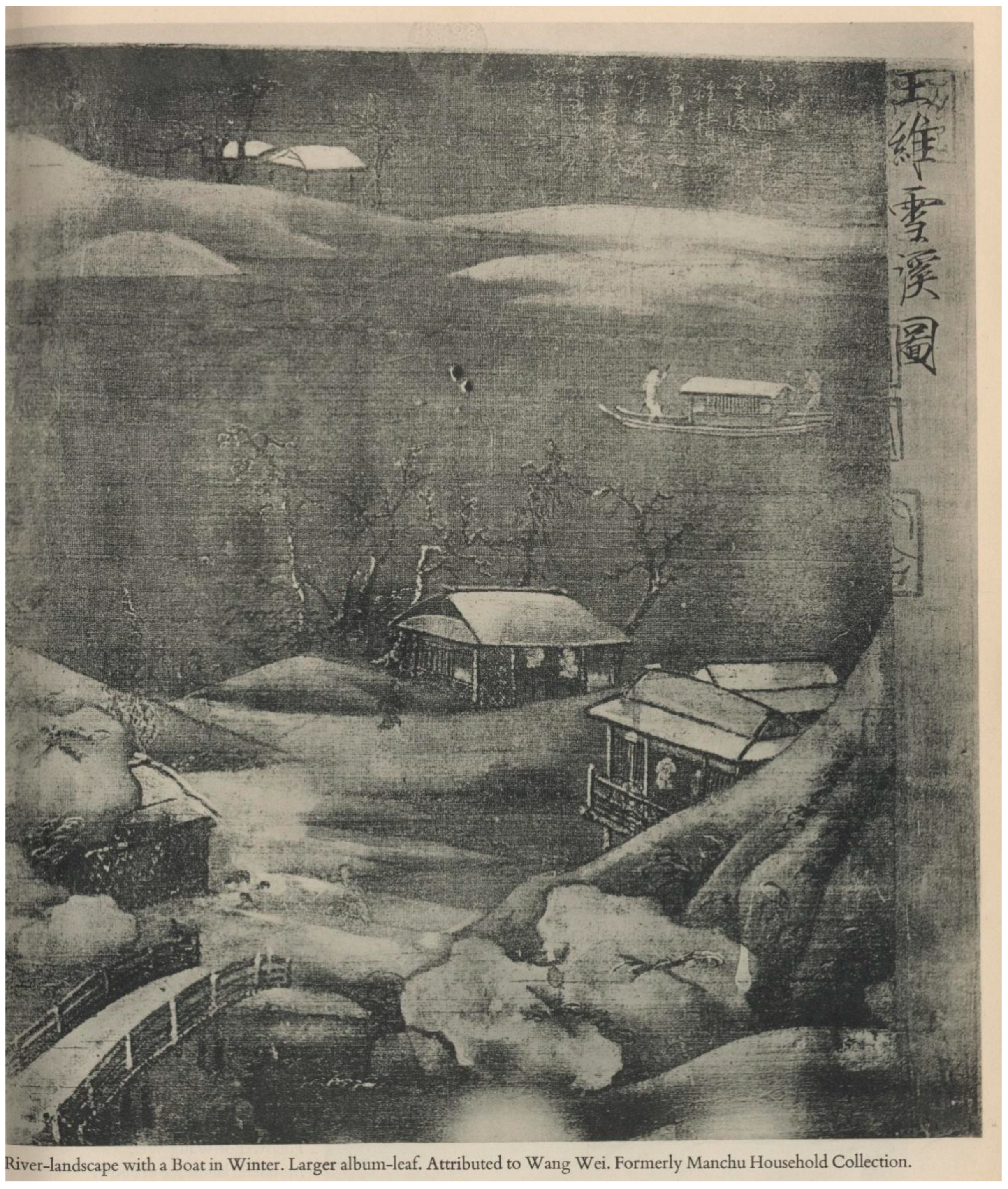
The painting Snowy Stream (xuexi tu) is an enigmatic and tantalizing work (Figure 1). Recognized as a representative piece of the legendary literati painting master Wang Wei (699–761), it is now lost and can only be observed through a black-and-white photo.1 The photo appeared in most textbooks on Chinese painting published in the twentieth century to demonstrate the monochromatic style of landscape and the graded ink wash technique of Wang Wei.2 This work gradually faded from attention in the twenty-first century, likely because the photo’s poor quality could no longer satisfy the need of art historical inquiries.
Figure 1.
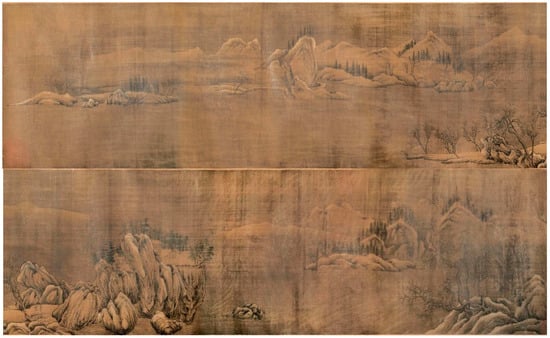
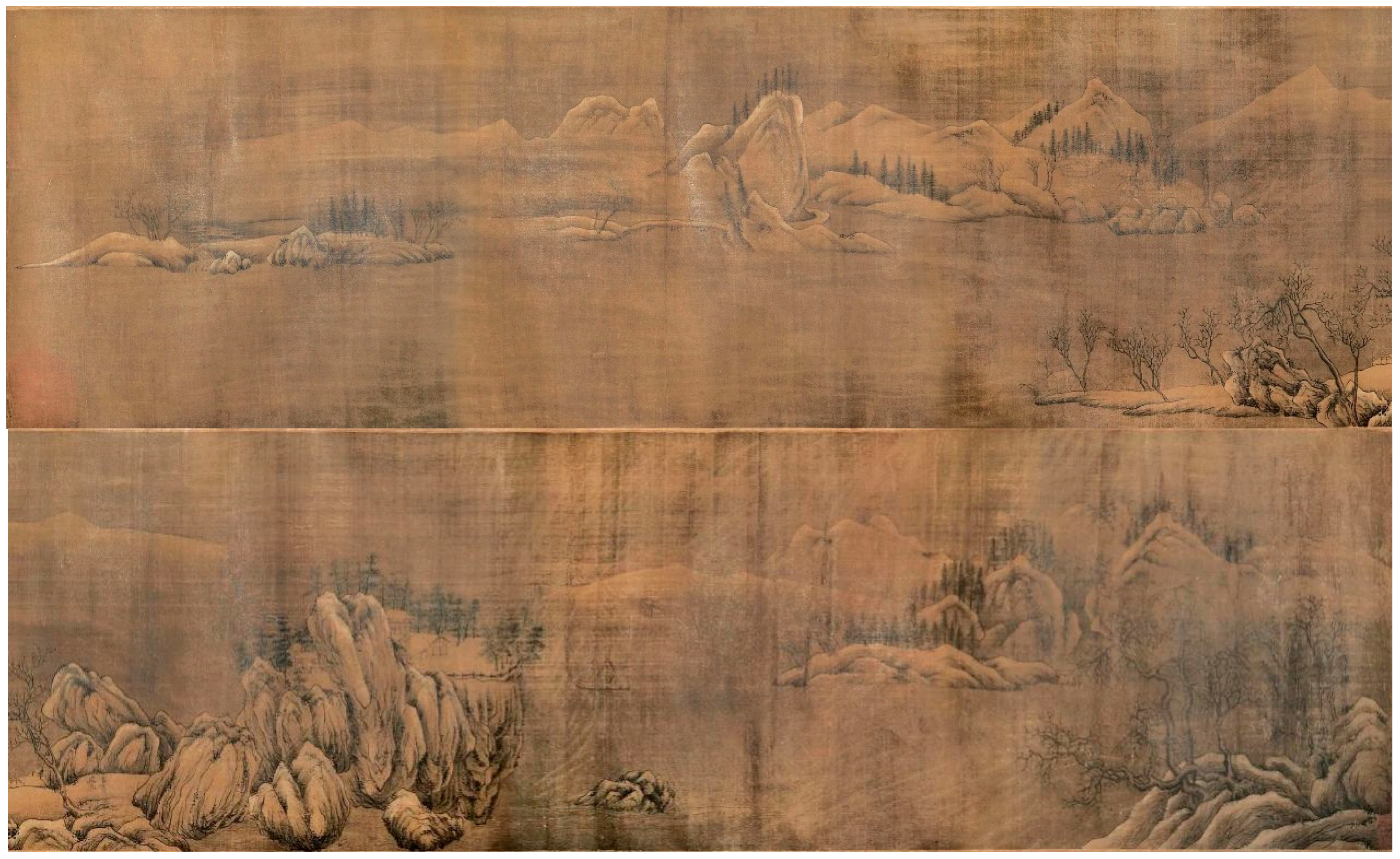
Attributed to Wang Wei, River-Landscape with a Boat in Winter, larger album leaf. Formerly Manchu Household Collection (after Osvald Sirén, Chinese Painting: Leading Masters and Principles, Vol. 3, plate 97).
Another factor might be that scholars gradually came to realize that “the painter Wang Wei” was by and large an imagined patriarch of the invented tradition of “literati painting (Southern School),” constructed by late Ming critic Dong Qichang (1555–1636). In other words, the “Wang Wei style” that we see today is likely an idealized projection of Dong’s artistic agenda from the sixteenth century, rather than something that once existed in the eighth century. Thus, it seems inappropriate to feature it in either the Tang (618–907) or Ming (1368–1644) art section.
More specifically, Dong borrowed the terminology of the Northern School and the Southern School of Chan Buddhism to construct his theory of the Southern and Northern Schools of painting. The practice of professional painters who painstakingly sharpen their skills with years of practice is comparable to the Northern Chan practice of attaining gradual enlightenment through a holistic set of Buddhist practices involving wisdom, precepts, rituals, and meditation. In contrast, amateur literati painters who paint to express their individual subjectivities are akin to Southern Chan practitioners, who achieve sudden enlightenment by realizing the shaded inner Buddha nature intrinsic to themselves. Like Southern Chan, which prevailed over Northern Chan, Dong considered literati painting superior to professional painting. In this process, Wang Wei, a poet–painter and devout Buddhist, was chosen as the focal ancestor of the Southern School of painting.
2. Method
This study tells a two-part story about this enigmatic painting, comprising the shifting physical states and receptions of the painting during the lifetime of Dong Qichang, as well as the reasons that it has enjoyed a splendid afterlife since the time of Dong. In the first section, by examining the social life of this painting in Dong’s time, I argue that it underwent major remodeling that significantly changed its size, format, layout, and even provenance.3 Dong Qichang’s shifting attitude toward this painting from a neutral or even skeptical standing to passionate approval seems to have been driven by a financial concern to benefit its incumbent owner, Cheng Jibai (d. 1626), to whom Dong owed much favor. The second section focuses on the rationale behind the great reception of this highly suspicious and heavily damaged image, in addition to the unreserved praise from Dong. I argue that the remodeled work echoed several key characteristics of Wang Wei’s poetry, emphasized by Dong Qichang in his construction of the former as the “legendary” patriarch of the Southern School. These include the pastoral theme and level perspective recalling Wang Wei’s poetry, the core doctrines and aesthetics of Chan Buddhism related to illusion and emptiness, as well as the vital technique of using ink wash to replace linear outlines and texture strokes.
3. The Conflicting Attitudes of Dong Qichang: A Story of Money and Friendship
This section explores why Dong Qichang held contradictory opinions on the authenticity and artistry of Snowy Stream in his earlier and later years. By examining the circulation and remodeling history of this painting during the lifetime of Dong Qichang, I argue that Dong’s shifting attitude was largely motivated by financial concerns rather than historical art judgments. More specifically, his approval and eulogy of this painting of poor condition, fake components, and suspicious provenance was a return of favor to his friend Cheng Jibai, who lent financial support to Dong when he was in a severe political and financial crisis.
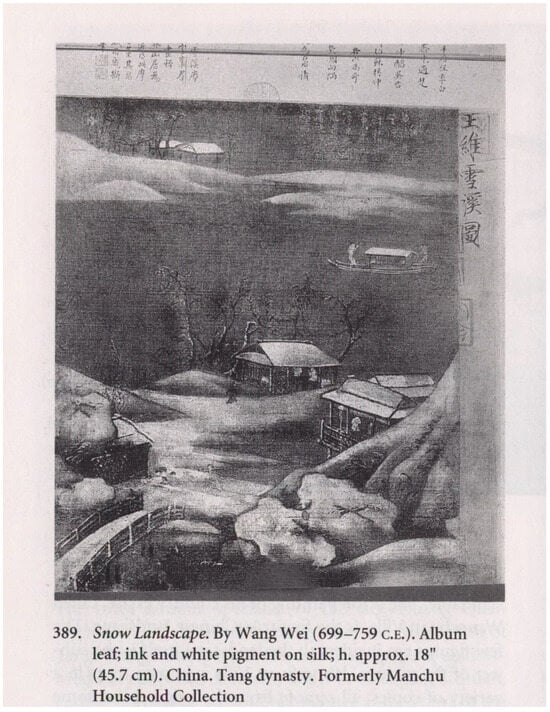
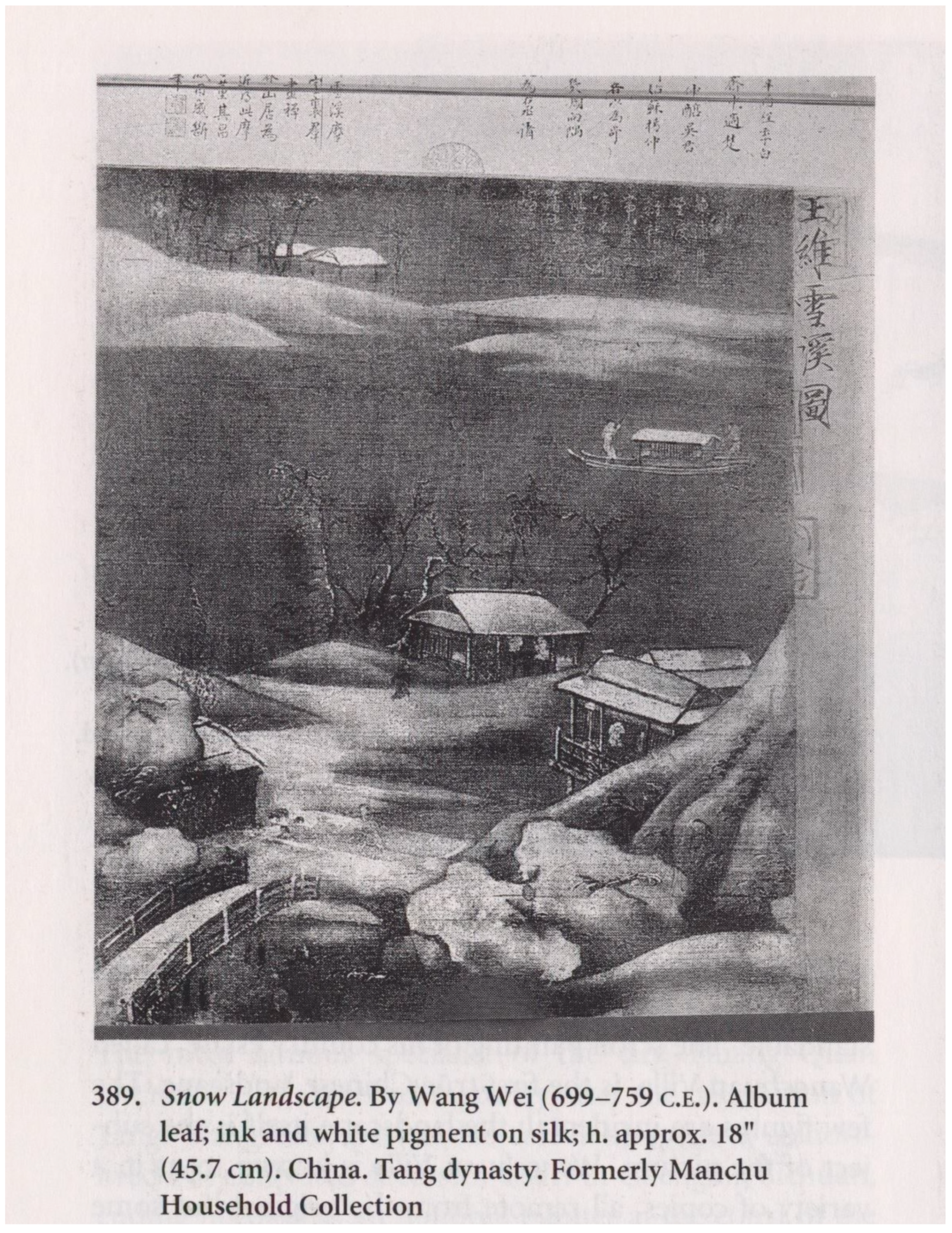
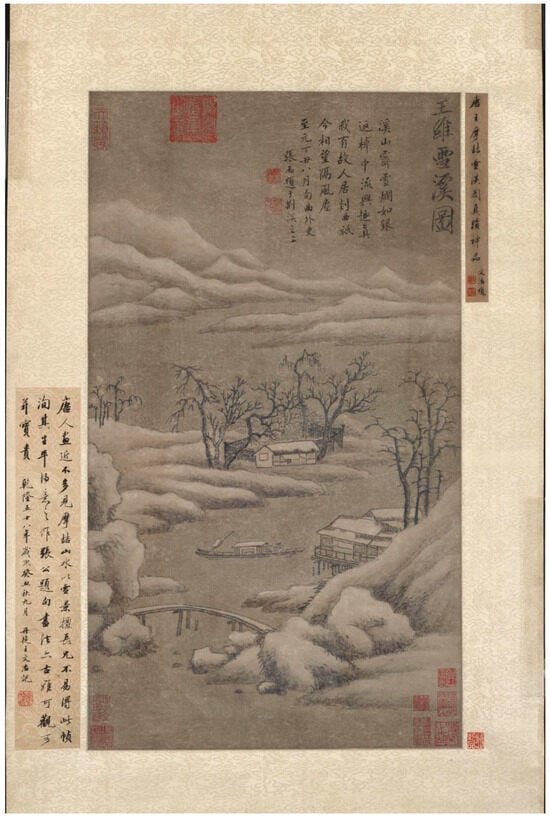
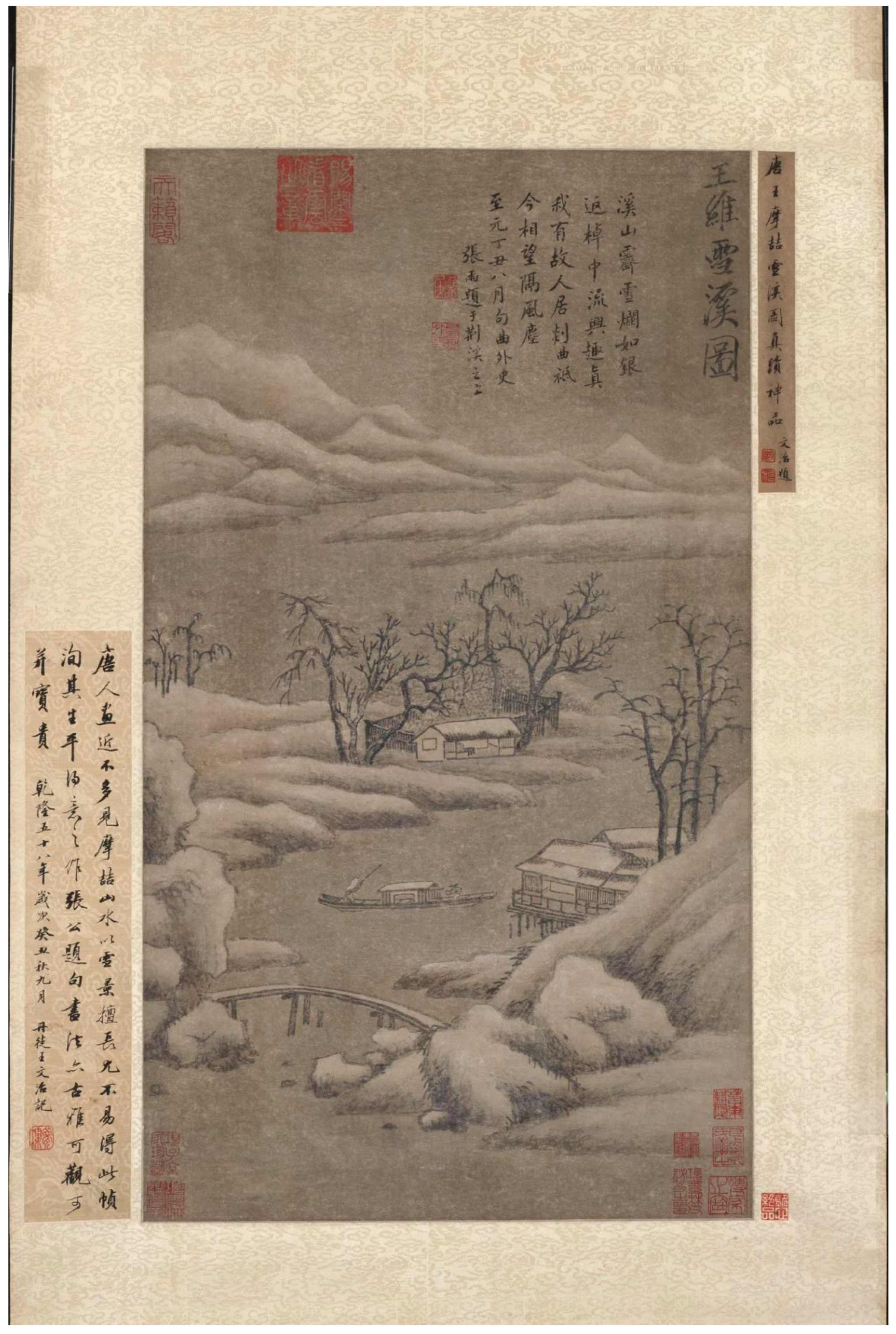
Most scholars consider Xiang Yuanbian (1525–1590), a renowned collector living in Jiaxing, as a former owner of Snowy Stream, from whom Dong Qichang obtained this precious work.4 Even copies or forgeries of this painting have fake seal imprints, suggesting that the work was once in the Xiang collection. A good example surviving today is a work with the same title of “Snowy Stream” mounted as a hanging scroll now at the Princeton University Art Museum (Figure 2).5 This painting was once considered a genuine work by Wang Wei based on the additional title and colophon written by the Qing dynasty calligrapher Wang Wenzhi (1730–1802), which were attached to the current mounting. Among the nine collectors’ seals on the painting, at least four refer to Xiang Yuanbian.6 These seals can be identified easily as fakes by comparison with their authentic counterparts. This matter does not require further analysis.
Figure 2.
Attributed to Wang Wei, Snow Landscape, Tang Dynasty, ink and white pigment on silk (album leaf), height approx. 18 in. (45.7 cm). Formerly Manchu Household Collection (after Sherman Lee, A History of Far Eastern Art, 304, Figure 389).
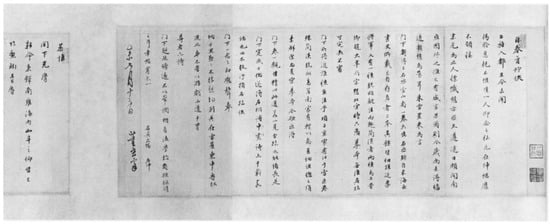
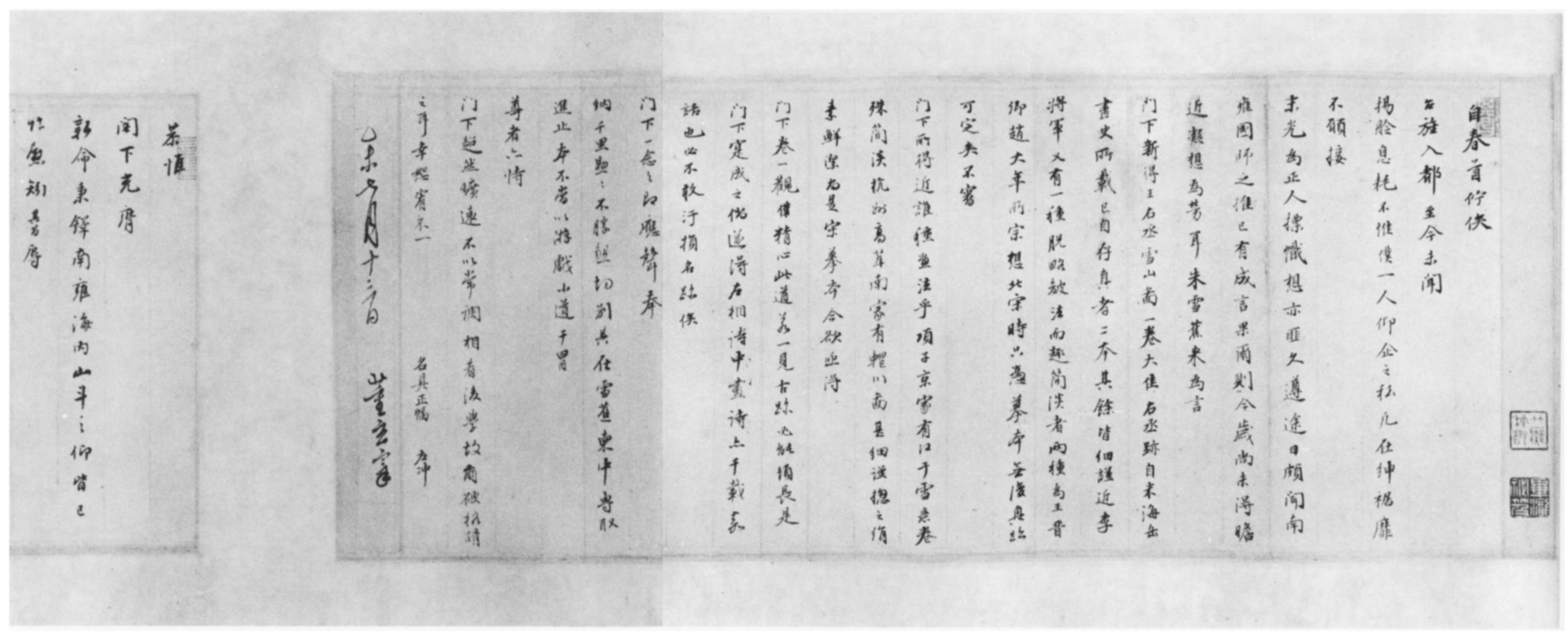
People believed Snowy Stream to be associated with Xiang Yuanbian because Dong mentioned seeing this painting in Xiang’s home in many different writings, including the inscription still legible on the top of this image (Figure 3), which described Dong’s early encounters with the Snowy River (xuejiang juan) painting by Wang Wei. The earliest record existed in a letter written in 1595 by Dong to his friend Feng Mengzhen (Figure 4), with the aim of borrowing another painting also attributed to Wang Wei titled Rivers and Mountains after Snow (jiangshan xueji, Figure 5).7 After receiving the painting from Feng in the same year, Dong wrote a colophon on it (Figure 6). Both the letter and colophon mentioned this “Wang Wei painting” in the possession of Xiang Yuanbian, though with slightly different names. In the letter, Dong recalled all the paintings attributed to Wang Wei or in Wang’s style that he had seen. The first work he mentioned is a handscroll titled The Feeling of Snow on the River Bank (jianggan xueyi juan) in Xiang’s collection, which was simple and plain.8 In this lengthy colophon, Dong attempts to systematically express his opinion on Wang Wei’s style. He discussed the Xiang Yuanbian painting in greater detail, describing it as “only featuring the silhouettes of [rocks and mountains], with almost no texture strokes and ink washes.”9 The title of this handscroll became Snowy River. Considering that both the letter and colophon were written in the same year, with a purpose of exhausting the existing works attributed to Wang Wei to shed light on his “mysterious” style, the two titles should refer to the same work. Snowy River may be the abbreviated name for the original title mentioned in the letter.
Figure 3.
After Wang Wei, Snowy River, undated, ink and white pigment on paper, 27 3/16 × 15 3/8 in. (69.1 × 39.1 cm), Princeton University Art Museum, Princeton (photograph provided by Princeton University Art Museum).
Figure 4.
Tung Ch’i-ch’ang (Dong Qichang), Letters from Tung Ch’i-ch’ang to Feng K’ai-chih, dated in accordance with A.D. 1595, 1596, and 1604, Ogawa Family Collection, Japan (after Wen C. Fong, “Rivers and Mountains after Snow (Chiang-shan hsüeh-chi) Attributed to Wang Wei (AD 699–759),” Archives of Asian Art 30 (1976–1977), 31, figure G).
Figure 5.
Attributed to Wang Wei, Rivers and Mountains after Snow, Tang Dynasty, ink and white paint on silk, Ogata Collection, Japan (photograph photocopied by the author from the National Diet Library, Japan).
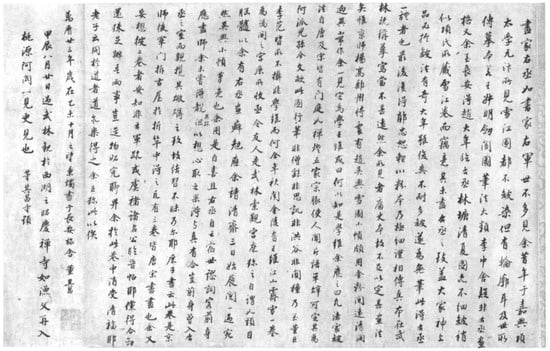
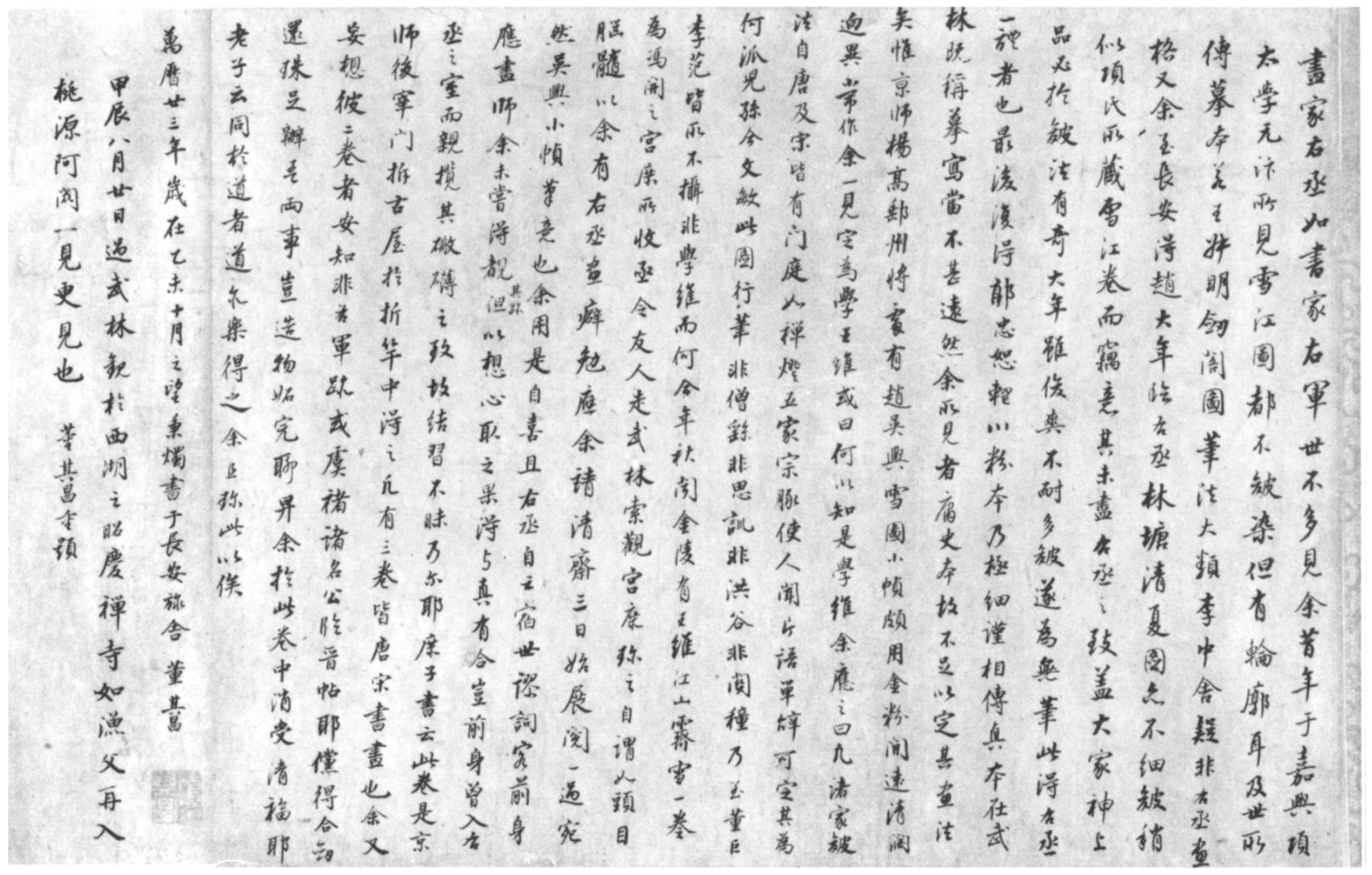
Figure 6.
Tung Ch’i-ch’ang (Dong Qichang), short note signed by Tung Ch’i-ch’ang attached to the scroll of Chiang-shan Hsüeh-chi, 1604, Ogawa Family Collection, Japan (after Wen C. Fong, “Rivers and Mountains after Snow (Chiang-shan hsüeh-chi) Attributed to Wang Wei (AD 699–759),” Archives of Asian Art 30 (1976–1977), 29, figure C).
However, there is no direct evidence demonstrating that Dong Qichang acquired Snowy Stream from Xiang Yuanbian or his heirs, despite Dong being familiar with them. Moreover, contradicting common sense today, I argue that Dong likely never owned the painting. Scholars consider Dong to be its owner, believing that this piece was mounted as the first leaf on an album titled Precious Paintings in the Tang, Song and Yuan [dynasties] (TangSongYuan baohui ce) owned by Dong Qichang. This understanding has been embodied in numerous writings on Chinese painting since the early Qing dynasty (1644–1911). The best example is perhaps Emperor Qianlong’s (r. 1735–1796) inscription on this painting. Although not completely visible in the current photo, it has been documented in the painting inventory of the Imperial Household. One inscription by the emperor dated to 1747 states: “I identified the painting Dwelling in the Fuchun Mountains as an authentic piece of Huang Gongwang and recently acquired the Snowy Stream by Wang Wei, both of which were once stored in the painting studio of Dong Qichang.”10
People consider this painting to have belonged to Dong Qichang because of Dong’s colophon; however, it is misleading. The Qing court inventory mentioned above documented Dong’s colophon, at the beginning of which he stated, “on the first year of the Tianqi reign, which is a jiwei year, Cheng Jibai brought this album back to my studio.”11 Cheng Jibai, Dong’s close friend, was a wealthy salt merchant from the Xin’an region of Anhui, China. Dong’s colophon alludes to Cheng acquiring this album from him, which was the case. Dong’s friend Wang Keyu recorded this transaction in his writing Wangshi shanhuwang (Coral Net of the Wang Clan): “Dong Qichang brought this album to my town [Jiaxing] in the spring of the dingsi year during the Wanli reign (1617), I got on his boat with Xiang Dexin and Xiang Shengmo to view [it]…Later, the album was acquired by Cheng Jibai.”12 Dong did not bring this album to Jiaxing for no reason; he attempted to sell it. The people who were invited to view the album, namely, the two heirs of Xiang Yuanbian and Wang Keyu, were not only old friends of Dong but also major collectors in the region.
In early 1617, Dong Qichang was in a tough situation due to a discreditable event that occurred a year before.13 Dong seduced a young maidservant named Lüying. Once she went home to visit her sick mother and failed to return, Dong’s son led hundreds of family slaves into her household, terrorized the family, ransacked their possessions, and carried off Lüying. What made matters worse was that Dong persecuted his brother-in-law, Fan Chang, as Dong suspected him to be the author of a satirical novel on the Lüying incident. Later, Fan’s mother and wife went to Dong’s mansion to mourn their loss and tax Dong with the deed. Dong had his servants strip the ladies’ clothes, beat them, and eventually throw them out onto the street, triggering rage among the crowds. Consequently, a riot targeted Dong; people were angry and burned down Dong’s luxury mansions, looted his precious collections, and even chopped the wooden plaques inscribed by him in Buddhist monasteries. Although Dong escaped legal punishment thanks to the protection of his friends in the capital, he nevertheless suffered a severe financial loss.
In other words, Dong’s visit to Jiaxing can be viewed as a temporary refuge away from his hometown, where he was notorious, to seek emotional and financial help from his friends. The key way for Dong to deal with his financial hardship was to sell the paintings in his collection.14 However, neither Wang Keyu nor Xiang Yuanbian’s heirs were willing to purchase Dong’s album. Wang was said to have an initial interest but eventually returned the album to Dong after one night of scrutiny.15 Both Wang and Xiang were experienced connoisseurs; their rejection might indicate that the quality and authenticity of the album leaves were unsatisfactory, as many good paintings were lost during the riot.16
Fortunately, another friend, the salt merchant Cheng Jibai, offered to buy the album. Cheng paid a fairly good price to relieve Dong from his financial crisis. After Cheng’s death, this album was sold to Wang Shimin (1592–1680), another renowned painter and a Dong student. Wang Keyu later commented on the transaction: “Jibai was persecuted to death by eunuch Wei Zhongxian. His possessions were transported back to the She County. In the winter of renshen year during the Chongzhen reign (1632), [I] heard this album was sold to Wang Shimin from Taicang…only at the price of a thousand taels of silver, less than half of the original price.”17 The “original price” here should refer to what Cheng paid Dong to acquire the album; the price should have been more than two thousand taels of silver, a huge amount of money in the late Ming era.
This album did not feature Snowy Stream when sold to Cheng in 1617. Suzhou collector Zhang Chou (1577–1643) documented the album that he saw at Dong Qichang’s home in his book Qinghe shuhuafang (Boat of the Calligraphy and Paintings on the Pure River), in which he referred to the album as SongYuan baohui, or Precious Paintings in the Song and Yuan [dynasties]. He recorded the first leaf as A Solitary Temple amid Clearing Peaks (Qingluan xiaosi tu) attributed to the Song painter Li Cheng (919–967).18 The book was written in 1616, suggesting that the album did not contain the Wang Wei piece at that time. Wang Keyu’s writing further echoed Zhang’s record; he stated: “in the autumn of the jiwei year (1619), I viewed this album again at the Jiaoyuan Pavilion. By that time, a painting by Ma Wan and another Yuan dynasty colored painting of a white-headed bird were gone. The Snowy Stream by Wang Wei was added [to the album], which was acquired from Cao Qixin in Qingpu, at the price of five hundred taels of silver.”19 It seems that Wang was talking about the difference between this album and what he had seen two years before. He further wrote: “Dong Qichang thereby wrote another inscription saying that the character ‘Tang’ could eventually be added to the title [of the album] now! I recorded his inscription then.”20 In summary, Snowy Stream was incorporated into the album between 1617 and 1619, when the latter was in the possession of Cheng Jibai. In 1619, when Cheng brought the album back for a group-viewing event, Dong Qichang renamed it Precious Paintings in the Tang, Song and Yuan [dynasties], as the Snowy Stream was included. In other words, Dong never owned this painting.
In a different article, I noticed that Dong seemed to have a self-contradictory opinion of this painting.21 Before the 1616 incident, while discussing Wang Wei’s painting style, he clearly preferred the Rivers and Mountains after Snow (Figure 5) over the Snowy Stream and all other suspected “Wang Wei paintings.” He even alluded that the other images might not be genuine. For example, Dong once critically assessed all the Wang Wei paintings he had seen, and stated, “however, [they are] all inferior to the Rivers and Mountains after Snow owned by Feng Mengzhen in terms of embodying the marvelous spirit of Wang Wei. I used to borrow it for viewing for more than a year. Now I am like a fisherman leaving [the paradise] of Peach Blossom!”22 This statement was made before 1616, as it is documented in Qinghe shuhuafang, a book completed in that year. On the contrary, in a colophon on Snowy Stream dated to 1621, he eulogized the unrivaled quality of the painting, as well as the whole album, with no reservation: “the Snowy Stream and A Solitary Temple amid Clearing Peaks at the beginning of this album are precious enough to surpass [the value of] the collection that a person could accumulated during his whole life. Connoisseurs know they are unrivaled.”23
I used to consider this kind of eulogy part of an effort to sell Snowy Stream. More appropriately, it seems that Dong was performing a post-sale service to Cheng Jibai to repay Cheng’s favor for funding him during a difficult time in the form of purchasing the album. Although Snowy Stream was not directly sold to Cheng by Dong, he did many things to increase its value and credibility.
Dong deliberately confused Snowy Stream with another painting named Ferry in Snow (xuedu tu) by renowned Jiangnan painter Shen Zhou (1427–1509) in an inscription on Rivers and Mountains after Snow. In his 1621 colophon on Snowy Stream, Dong wrote: “Mr. Shen Zhou’s inscription on Rivers and Mountains after Snow stated that [speaking of Wang Wei’s painting,] he had only seen the Ferry in Snow in the collection of the Chen Family in Shaxi, which is just about one chi long. [What he mentioned] is just this very painting. He might have made a typo to miswrite ‘stream’ as ‘ferry.’”24 Kohara suggests that it is quite unlikely for Shen Zhou to mistake the name of Snowy Stream as Ferry in Snow if the title inscription on the right of the picture in the style of Emperor Huizong (r. 1100–1126) was there at that time.25 He alluded that Emperor Huizong’s inscription and seals were likely fake.
I believe this inscription could not have been written by Emperor Huizong, as he never collected a painting with this title. According to Xuanhe huapu (Xuanhe Catalogue of Paintings), the catalog of Huizong’s painting collection, he owned 126 paintings by Wang Wei, among which there was no Snowy Stream.26 However, among these titles, the closest one to Snowy Stream is Ferry in Snow. As a renowned critic and collector, Dong Qichang was very familiar with Xuanhe huapu, especially the particular entry on Wang Wei paintings. He mentioned that he once determined the correct title for a painting attributed to Wang Wei in the possession of Yang Taihe by checking the Xuanhe huapu.27 In other words, Dong was clearly aware that the title “Snowy Stream” on this painting was a fake of Emperor Huizong’s writing. This is likely why he wanted to identify Snowy Stream with Ferry in Snow. By doing so, he not only transplanted Shen Zhou’s approval of a different painting to Snowy Stream, but also remedied the issue that the title “Snowy Stream” did not appear in Huizong’s painting catalog.
To lend credibility to the fake Huizong inscription, Dong Qichang deliberately concealed that the painting had undergone major alternations and refashioning. Although Cheng Jibai acquired Snowy Stream from Cao Qixin, Dong was familiar with this image for some time, as it was essentially the same piece as Snowy River owned by Xiang Yuanbian. Their close friend Wang Keyu had clarified the matter. He recorded a colophon by Xiang Yuanbian once attached to this painting: “I (Xiang) used to see this painting thirty years ago. It is only slightly more than one chi long. The application of color is lofty and archaistic; the positioning of landscape shows depth. There is someone poling a boat with bamboo sticks, and a herdsman whipping pigs to return home.”28 Xiang’s description matches the current image perfectly. Furthermore, Wang Keyu documented additional information. He wrote, “This handscroll was later owned by Cheng Jibai and incorporated into the album Precious Paintings in the Tang, Song and Yuan. Both colophons were cut off [from the painting].”29 Notably, he mentioned the format of this painting in Xiang’s possession as a handscroll (juan). In Dong Qichang’s colophon on the Rivers and Mountains after Snow and his letter to Feng Mengzhen written in 1595, he also referred to this painting as a handscroll.30
It seems clear that the painting underwent reformatting from a handscroll to an album leaf. Xiang’s colophon also indicated that an incident may have necessitated a major refurbishing and remounting project. Despite first describing the painting as “splendid colors fill the eyes, making all other Wang Wei pictures I have seen merely impostors,” he reported that the painting had suffered a misfortune: “Now I asked an unskilled worker to remount [this painting] at a friends’ place. The ink and white paint became disordered and rambling, the spirit of it turned boring. I would feel frustrated for many days every time I saw it.”31 It is easy to understand why Xiang’s colophons were removed; they presented a case of destruction that reduced the value and credibility of the current painting. After the death of Xiang Yuanbian, this damaged painting was likely sold by his heirs at a low price, either directly to Cao Qixin or someone else.
A major remodeling of the painting must have been carried out by one of the intermediate owners between Xiang and Cheng. I argue that the key purpose of this remodeling project was not merely to restore the damage, but to construct it as a genuine Wang Wei painting with prominent provenance. The title inscription attributed to Emperor Huizong was likely added at that time. The key evidence supporting this opinion is that Dong Qichang used to refer to this painting in Xiang’s possession by several different names, including The Feeling of Snow on the River Bank, Snowy River, Fishing in the Snow, and Ferry in Snow, but it suddenly became Snowy Stream after Cheng Jibai acquired it.32 Dong was undoubtedly aware that this painting did not feature the Huizong inscription when it was in the possession of Xiang Yuanbian. Instead of telling the truth, he leveraged his cultural capital as a renowned critic, collector, and scholarly official to authenticate this fake inscription for this friend, likely to return the favor of Cheng’s earlier assistance in purchasing the album for more than 2000 taels of silver.33 In his 1621 inscription on the painting, following an effort to confuse Snowy Stream with Ferry in Snow, he wrote: [The painting] features a title written by Emperor Huizong and seal imprints [of collectors] in different eras. There should be no doubt [on its authenticity]. It must be a rare treasure.”34
Sirén notes that Snowy Stream seems to have been cut from a larger picture, as its current composition appears odd.35 Kohara further points out that the relationship between the earthen banks in the lower-right corner of the image is confusing, and that the sizes and proportions of the motifs are strangely out of balance.36 Many strange aspects can be seen if the painting is carefully observed. The extended contour of the earthen bank on the bottom-right is still partially visible under the white silk strip featuring the fake Huizong inscription (see Figure 1). A boulder on the opposite side appears to have grown from the roof of the house adjacent to it. The bridge below the house is also partially cut off by the periphery of the image. This layout appears to be logical in the sense of giving the audience a clear hint on where to enter the image, but this layout is extremely rare in Chinese landscape paintings owing to such exclusiveness and clarity. Furthermore, the current composition drags the viewer too close to the land in the foreground, making the gravity of the image unbalanced and centered on the lower half. Stylistically speaking, the Princeton piece is a later work than our center piece; it adopts a more calligraphic linework and pays less attention to realistic representation, indicating that is likely an imitation from the Ming dynasty. However, its composition seems to be more rational than that of our piece, suggesting that the imitator may have seen the original work prior to its remodeling. In other words, the Princeton piece may, to some extent, represent the layout of the original painting while in the possession of Xiang Yuanbian.
The photo also shows many traces of heavy repair, echoing the once-damaged status of the painting mentioned by Xiang Yuanbian. The linework defining the roof of the house under the “boulder” appears to be drawn on a layer of newly applied white paint which breaks the silhouettes of the ambient earthen slope and land. Only two of the three pavilions on the distant shore have snow on their roofs, with the one on the very left unpainted and almost invisible. The snow on the roofs was painted whiter than that used in other areas of the painting. The contours of the roofs were executed in poor-quality linework, resembling the roof under the boulder. Traces of two men walking down a slope appear in the middle-left area of the painting. The paint inside the contour has fallen off, making the figures phantom-like and almost illegible. Some unusual drips of white paint remain on the rocks and earthen banks in the lower-right corner. Given the reality of the painting, Kohara wonders why this painting would have infatuated Dong Qichang.37
I think Dong knows best about what happened to this painting. He was not interested in this painting, even while seeing it in its intact form at the home of Xiang.38 Remarkably, he suddenly became fascinated with this heavily repaired semi-fake reincarnation in 1621. This likely does not reflect any change in his artistic taste. Instead, it is more likely due to a change in his financial interests; he was performing a post-sale service for Cheng Jibai, who acquired the Song-Yuan album from him. Intriguingly, despite Dong talking about this painting on many different occasions, he never mentioned that it was formerly part of the Xiang collection. This is quite odd, as provenance from renowned collector Xiang Yuanbian could greatly increase the value and credibility of this painting. It was from Wang Keyu, a close friend of both Dong and Xiang, and we know that what Cheng Jibai received was the work formerly owned by Xiang. I argue that Dong intentionally alienated this work from Xiang Yuanbian to prevent other people familiar with the Xiang collection from noticing the complicated nature and fake title of the painting.
4. Construction and Reception of the Snowy Stream: An Art Historical Discourse
Even though Dong’s approval of this painting as the authentic style of Wang Wei was largely driven by financial concerns, there may also be reasons why Dong’s opinion was widely accepted by scholars and painters after his time. During the Ming dynasty, Wang Wei, as a painter, provided a conceptual framework. Genuine works by Wang Wei had long since disappeared. People came to understand his style through a chaotic and contradictory corpus of descriptions in the writings of the Tang and Song people. The distance of time and scarcity of materials provided an opportunity for Dong Qichang to project his ideal painting model onto the body of Wang Wei. Since Wang Wei was chosen by Dong as the retrospective founding patriarch of the Southern School, an invented tradition of Chinese literati painting, authenticated Wang Wei paintings could be viewed as a manifestation of Dong’s artistic renewal: a theoretical effort to prioritize individualist expression and amateur-scholar painters over formal likeness and professional artistry. In addition to being a known painter, Wang Wei was selected by Dong mainly owing to his alternate identities as a highly achieved poet and devout Buddhist. In this section, I will assess this “broken” painting from the perspectives of poetry, painting, and Chan Buddhism.
Dong’s re-envisioning of paintings was largely subject to the impact of Chan Buddhism. Dong deliberately borrowed Chan terms to name his Southern School and called his studio “Chan of Painting (huachan shi).” According to the “Tathāgatagarbha” idea in the Parinirvana Sutra, all beings contain the essential Buddha nature. Therefore, the Southern School, pioneered by Huineng (638–713) and Shenhui (684–758), switched their focus of cultivation from the external world to their inner selves: by realizing the Buddha nature intrinsic to the practitioners themselves, they could attain enlightenment.39 Similarly, Dong aspired to shift the purpose of painting from representing the ambient world to expressing intrinsic selves. Although Su Shi (1037–1101) had already devalued formal likeness in painting, he did not specify a particular way in which personal feelings could be effectively conveyed on a pictorial surface.40 I think by enthroning Wang Wei as the patriarch of his Southern School, Dong borrowed the rhetoric devices of poetry, especially the technique of “xing 興,” to be used in the artistic expression of painting. The “xing” technique emphasizes the intrinsic echoing between described landscape and expressed emotion, a connection conditioned by the shared cultural experience of the audiences.41
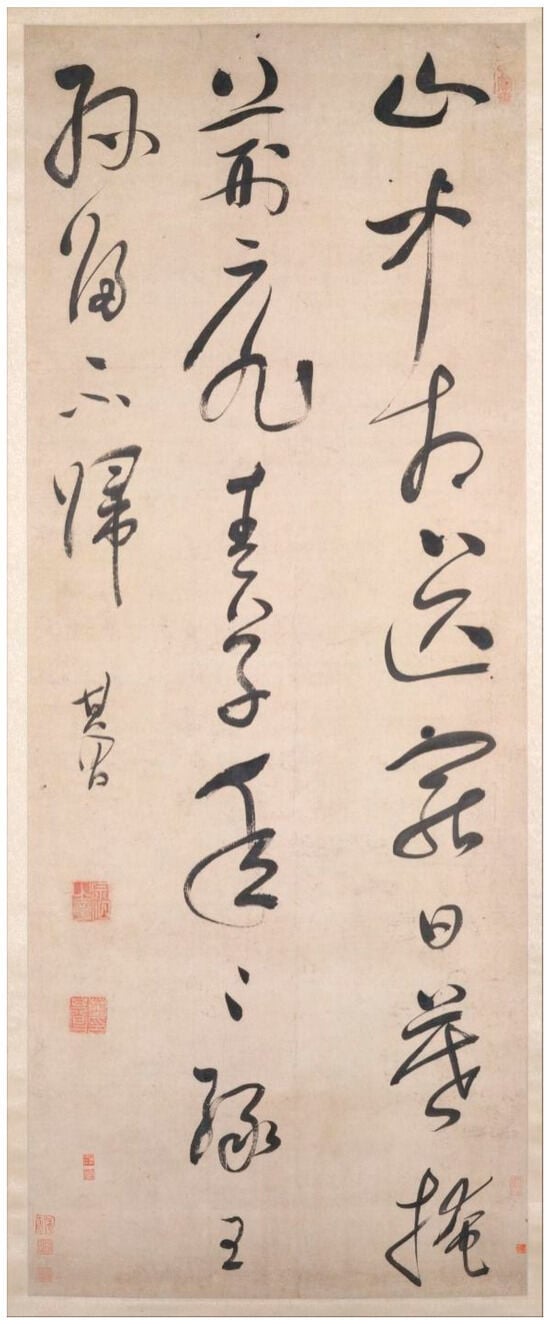
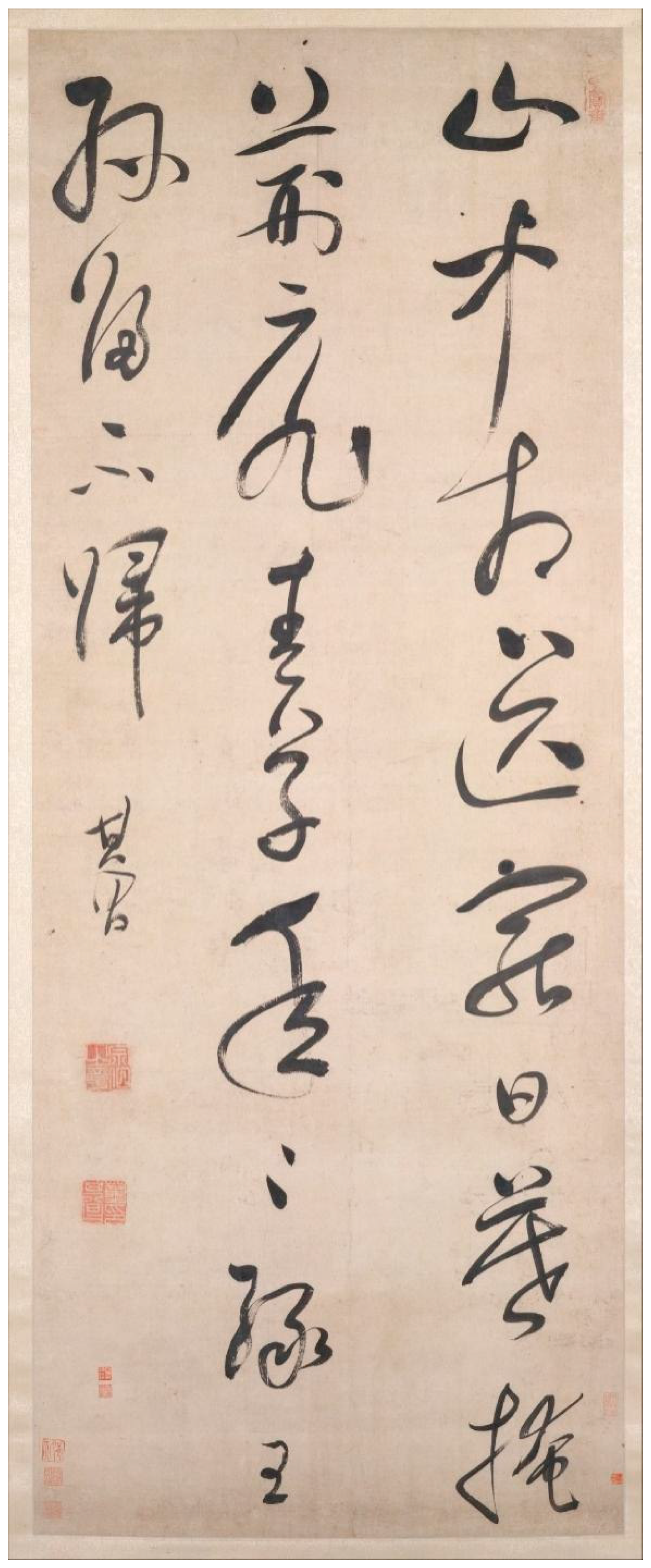
Dong frequently mentioned the words “yi 意” and “jing 境” in his commentaries, referring to a constructed mental image with symbolic meanings. Wang Wei was known for his capacity to construct a vivid, symbolic mental image in his poetry with very simple and plain words. In many of his poems, Wang concentrated on constructing scenery or scenarios, with only the last sentence revealing emotions. For example, in a poem by Wang Wei handwritten by Dong Qichang (Figure 7), Wang spent the first three sentences describing a farewell scene in the mountain, the home-return scene after the farewell, and an imaginative scene of grassland becoming green every year; he eventually revealed his concern about whether his friend would return. That is why Su Shi commented that “poetry [has imagery like] a painting, and paintings [have emotion like] poetry.42
Figure 7.
Dong Qichang, Poem by Wang Wei, after 1632, ink on paper, 74 3/8 × 29 1/4 in. (189 × 74.3 cm). The Metropolitan Museum of Art, New York (photograph provided by The Metropolitan Museum of Art).
From this perspective, the painting was smartly cropped to echo the two key symbolic images associated with Wang Wei. First, it recalls the theme of pastoral life, for which Wang’s poetry is the most acclaimed. By cutting out a section of a larger panoramic landscape painting, the remodeler successfully created a close-view image focused on country life. Within this small pictorial space, at least ten people are depicted, including the boatsmen, guests in the wine houses, pedestrians and herders, and two barely visible hikers walking down a hilly slope. Despite the cold and serene tone of the snowscape, the image shows a vibrant rural community segregated from the outside world. The imagery in Wang Wei’s poems was also constructed primarily by the observing angle of “level distance,” an eye-level gaze from the near to the remote.43 In sum, this album echoes the key theme of Wang’s poetry, as well as the signature perspective through which Wang constructed the imagery in the poems.
The second point concerns the philosophy and aesthetics of Chan Buddhism. In Buddhist doctrines, our world of existence is considered illusory, filled with inevitable and eternal suffering, as we are incarnated repeatedly within the six realms. The way to terminate endless suffering is to attain enlightenment and thereby enter nirvana to quit the game of reincarnation. The ultimate wisdom leading to enlightenment is to understand that our world is essentially empty and that such emptiness is omnipresent and coessential with Buddhist dharma and enlightenment. The Southern Chan monks were seeking to uncover this “emptiness” inside their consciousness and subconsciousness to achieve enlightenment and enter nirvana. The “emptiness (kong)” and “nirvana (ji)” are the key goals in Chan Buddhism, which triggered the Chan aesthetics of “sparse and silent.” Methodologically, Southern School Chan practitioners strive to realize this “emptiness” intrinsic to them by removing the inner obstacles that shaded this Buddha nature. For this reason, Chan art favors simple and austere imagery that can be created quickly and spontaneously. Through such improvisations, Chan monks externalize their mental worlds to seek the hidden Buddha nature.
Wang Wei, known as the “Buddha of Poetry,” engaged with Chan monks of both the Northern and Southern schools, though such sectarian division did not actually exist during his life time.44 Although the extent to which his poetry can be interpreted from a Chan perspective remains debated, Wang Wei’s association with Chan Buddhism became a vital component of his image during the Ming dynasty, with Su Shi playing a central role in shaping this perception.45 The snow scene and winter season naturally resonated with the “sparse and silent” character of Chan aesthetics, which matched well with the Chan identity of Wang Wei. The composition of the album leaf also provided some insights. Due to the cropped status of the album leaf, it became an irrational image. The bridge in the bottom-left corner provides a clear entry into the land in the foreground. However, the movement trajectory suggested by the orientation of the bridge and pedestrian was cut off at the earthen road between the three wine houses. There is no viable route connecting the land in the foreground and background. Even the semantic linkage hinted at by the existence of a ferry or dock is absent. Insofar as the foreground land becomes a segregated island, people are forced to enter but find it difficult to leave, a good metaphor for the endless incarnations from which we all suffer. The worn-out and broken status of this painting not only adds to its antiquity, but also contributes to the embodiment of a distorted illusory world.
More importantly, the binary structure of “this shore and other shore” easily reminds viewers of the famous Buddhist simile: the practice of Buddhism is likened to making a raft to travel from this shore, representing the endless reincarnations filled with inevitable suffering, to the other shore of enlightenment and nirvana. The boat was depicted traveling in a direction parallel to the close and distant shores without connecting them. This seems to echo the mentality of painstakingly seeking a path toward enlightenment. Finally, the fuzzy quality caused by the falling paint and poor linework repair suggests the chaotic and illusive nature of “this shore” and the misty and hard-to-access character of “that shore.”
The abandonment of using texture strokes (cun 皴) in this painting generated a visual effect of fashioning it as the only surviving work embodying the ink wash technique purportedly devised by Wang Wei. Texture strokes are patternized calligraphic strokes used to mimic the surface quality of earth and rocks and suggest the volumetric depth of mountains and riverbanks. The most vital feature of Snowy Stream emphasized by Dong in many of his writings is the technique of the no texture stroke.46 In Dong’s theory on the Southern School, he defined the style of Wang Wei as “initiated the use of ink wash [to produce a light and plain surface of landscapes], transforming completely the method of outlines.”47 Ink washing is a technique used to paint images using a free-flowing broad brush saturated with diluted ink. Thus, the contours of images are not defined by carefully planned linear outlines; the surface texture is not represented by meticulously executed, repetitive calligraphic strokes. Both are shaped by the free movement of the broad brush. Again, this technique is consistent with Chan aesthetics in the sense of spontaneity and non-artificialness, the paths to discovering the hidden nature of the inner Buddha. No Wang Wei paintings executed using the ink wash technique have survived. As Sherman Lee points out, Snowy Stream can be viewed as a reverse ink monochrome painting: the toned silk provides the dark or shaded areas, and the opaque paint builds the highlights.48 In this sense, this painting becomes the only image associated with Wang Wei that displays a visual effect similar to that of ink washing. That is why James Cahill says it is “supposed to represent Wang Wei’s graded ink wash technique.”49
This entirely different method of representing textures enabled Dong to construct Wang Wei as a unique painter throughout art history and to serve and justify Dong’s theoretical reorientation of Chinese painting. Dong considered texture strokes to be the most significant technique among the pictorial elements of Chinese landscape paintings.50 They became individualized devices for different artists to express their emotions. By connecting the signature texture strokes of famous painters with their key emotional tones known in the art historical canon, Dong turned landscape painting into a practice of composing a pictorial essay by selectively quoting relevant calligraphic strokes from previous masters. Dong discussed his rationale for attributing a painting by Zhao Mengfu to Wang Wei’s style. He said: “the brushwork of this painting is not [in the style of] Zhang Sengyou, not Li Sixun, not Jing Hao, not Guan Tong, not inspired by Dong Yuan, Ju Ran, Li Cheng or Fan Kuan. How can it not be imitating Wang Wei?”51 He defined Wang Wei by claiming the uniqueness of his style from all other renowned painters before and after his time.
I think that the absence of texture strokes in Snowy Stream enabled Dong to distinguish Wang Wei from all of his alleged followers in the Southern School tradition, as it is essentially different from all other types of texture strokes. For Dong Qichang, the role of Wang Wei as the mythical founding father of the Southern School is different from that of all other painters in this lineage. He had to be distinct enough to legitimize Dong’s efforts to systematically repurpose, reorient, and reform Chinese landscape painting in the name of revival and succession. His style functioned on a strategic rather than technical level. This was why Dong never painted after Wang Wei’s style, despite his imitation of the styles of all other painters in the lineage of his Southern School.
5. Conclusions
The financial and rhetorical narratives may seem to conflict, as readers might question which truly motivated Dong Qichang’s wholehearted endorsement and canonization of this painting. However, as J. P. Park demonstrates, for late Ming Jiangnan elite artists and connoisseurs who were anxious about the erosion of their social prestige, assuming cultural dominance and seeking profits were inseparable aspects of the same enterprise.52 To advance these aims, they asserted their authority by constructing a new artistic canon, one grounded in a fabricated past embodied by reimagined artists and falsified works. Dong undoubtedly occupies the pivotal position in this rewriting of art history, while Wang Wei himself, by and large, defines the very history being rewritten. In helping his friend market the broken painting of Snowy Stream, Dong keenly recognized an opportunity to handcraft a history that he regarded as “a past that ought to have happened.” As discussed by Park, the book Baohuilu (A Record of Treasured Paintings) written by Zhang Taijie constructs a fabricated past in the form of a catalogue consisting of fabricated paintings and inscriptions53. Similarly, the album Precious Paintings in the Tang, Song, and Yuan functions as a material embodiment of the artistic canon constructed by Dong Qichang. This is likely why Dong continued to promote the album even after it was no longer in his possession: it was a vital component of the Jiangnan elite literati’s collective project of reinforcing their authority over artistic production and connoisseurship.
Funding
This research received no external funding. The APC was funded by the Department of Chinese History and Culture at the Hong Kong Polytechnic University.
Data Availability Statement
No new data were created or analyzed in this study. Data sharing is not applicable to this article.
Conflicts of Interest
The author declares no conflicts of interest.
Notes
| 1 | The earliest known publication of this image is on Osvald Sirén’s book published during the 1950s, in which Sirén documented it as being taken in Beijing in 1928. See Osvald Sirén (1973, Volume 3), Chinese painting: Leading masters and principles, plate 97 and its caption. |
| 2 | See Michael Sullivan (2008), The Arts of China, 142 and Figure 6.22; Sherman Lee (1994), A history of far Eastern art: 304 and Figure 389. James Cahill also briefly discussed the history of this painting in his 2010 lecture on Chinese painting titled “A Pure and Remote View” and asked his audience to inform him if they happened to know where the painting was. See his lecture notes “4B”, accessed 20 September 2025, https://jamescahill.info/lecture-links. |
| 3 | For the concept of social life, I borrow from the theory of Arjun Appadurai, see Arjun (1986, pp. 3–63), The Social Life of Things. |
| 4 | Such examples are too numerous to list. For an example, see Kohara (1992, pp. 86–87), ”Tung Ch’i-ch’ang’s Connoisseurship in T’ang and Sung Painting”. |
| 5 | Princeton University Art Museum calls this painting “Snowy River,” but the Chinese title on the painting suggests that it should be “Snowy Stream;” see Princeton University Art Museum (n.d.), “Snowy River,” accessed 20 September 2025, https://artmuseum.princeton.edu/art/collections/objects/22730. |
| 6 | The scripts for the four identifiable seals are: 天籟閣, 項子京家珍藏, 項墨林鑒賞章 and 項墨林秘笈之印. |
| 7 | For more information on the correspondence letters between Dong and Feng, see Wen C. Fong (1976–1977, pp. 6–33), “Rivers and Mountains after Snow (Chiang-shan hsüeh-chi) Attributed to Wang Wei (AD699–759)”. |
| 8 | The transcription of the relevant Chinese text is: 項子京家有江幹雪意卷, 疏簡淡. |
| 9 | The transcription of the relevant Chinese text is: 餘昔年於嘉興項太學元汴所, 見雪江圖, 都不皴染, 但有輪廓耳. |
| 10 | The Chinese text is: 餘既辨明富春山居為大癡真蹟無疑, 近得此摩詰雪溪圖, 二物皆董其昌畫禪室中所藏; see Shiqu baoji, juan 42–15; accessed through the Database of Chinese Classic Ancient Books, (Beijing: Beijing Airusheng Shuzihua Jishu Yanjiu Zhongxin, 2023), http://dh.ersjk.com/, accessed on 10 September 2025. |
| 11 | The Chinese text is: 天啟元年, 嵗次辛酉, 程季白重攜此冊至餘齋中; see Shiqu baoji, juan 42–8. |
| 12 | 此冊在萬歷丁巳春仲, 董太史玄宰攜至吾地, 餘同項又新孔彰過其舟中得閱…後是冊歸程季白. |
| 13 | For a summarization of the incident, see Riely (1992, pp. 415–18), “Tung Ch’i-Ch’ang’s life”. For more details, see Right Vice Censor-in-chief Wang Yingling’s memorial to the throne, in Nanguo shucao, juan 8, 817–36; accessed through the Database of Chinese Classic Ancient Books, (Beijing: Beijing Airusheng Shuzihua Jishu Yanjiu Zhongxin, 2023), http://server.wenzibase.com/dblist.jsp, accessed on 10 September 2025. |
| 14 | Celia Riely noted that Dong was obliged to produce paintings as gifts for those from whom he received support while his house was being reconstructed after the 1616 incident; see Riely (1992, p. 418), “T’ung Ch’i-Ch’ang’s Life”. Wu Qiuye also analyzes how Dong Qichang fabricated the Rising Pavilion as an authentic work of Mi Fu and gave it to Wu Zhengzhi, to received political support to shield Dong from possible publishment from the court; see Wu (2013, pp. 137–58), “Yunqiloutu zuoweizhe kao”. |
| 15 | See Kohara (1992, p. 87), “Tung Ch’i-ch’ang’s Connoisseurship in T’ang and Sung Painting”. |
| 16 | For example, on a colophon by Dong’s friend Chen Jiru attached to a painting by Dong now in the Palace Museum, Chen mentioned that he obtained this painting from a mounting merchant after the burning incident. He dared not to show this image to Dong in worry of triggering his rage. See the website of Palace Museum (n.d.), Beijing https://www.dpm.org.cn/collection/paint/230735.html, accessed on 11 September 2025. |
| 17 | The original text is: 季白遭魏璫毒手, 其家裝還歙,崇禎壬申冬, 聞售於東倉王[遜之]…僅償千金, 未及原值之半也 Wang Keyu, Wangshi shanhuwang, juan 19, 2340; accessed through the Database of Chinese Classic Ancient Books, (Beijing: Beijing Airusheng Shuzihua Jishu Yanjiu Zhongxin, 2023), accessed on 10 September 2025. |
| 18 | Zhang Chou, Qinghe shuhuafang, juan 12, 773; accessed through the Database of Chinese Classic Ancient Books, (Beijing: Beijing Airusheng Shuzihua Jishu Yanjiu Zhongxin, 2023), accessed on 10 September 2025. |
| 19 | The original text is: 於己未秋,餘復閲於交逺閣, 已去馬文璧一幅, 元人著色櫻桃白頭翁鳥一幅, 補入王摩詰雪溪圖, 用五百金得之青浦曹啟新者; see Wang, Wangshi shanhuwang, juan 19, 2340. |
| 20 | The original text is: 太史因題其籤雲: 今日始得加一唐字矣, 餘時錄其題語; see Wang, Wangshi shanhuwang, juan 19, 2340. |
| 21 | See Zhao (2019, pp. 353–84), “A Venerated Ghost: Social Life of the Snowy Stream attributed to Wang Wei”. |
| 22 | The Chinese text is: 然總不如馮祭酒江山雪霽圖, 具有右丞妙趣, 予曾借觀經歳, 今如漁父出桃源矣; see Zhang, Qinghe shuhuafang, juan 12, 335. |
| 23 | The Chinese text is: 此冊開卷右丞營邱, 便足壓一世收藏, 鑒賞家知其不敵; see Wang, Wangshi shanhuwang, juan 19, 2329. |
| 24 | The Chinese text is: 沈啟南先生題右丞江山雪霽圖, 有曰:平生止見沙溪孫[陳]氏所藏雪渡圖, 盈尺而已, 正此圖也, 或筆誤以溪為渡耳; see An Qi, Moyuan huiguan lu, juan 4, 573; accessed through the Database of Chinese Classic Ancient Books, (Beijing: Beijing Airusheng Shuzihua Jishu Yanjiu Zhongxin, 2023), accessed on 10 September 2025. |
| 25 | See Kohara (1992, p. 87), “Tung Ch’i-ch’ang’s Connoisseurship”. |
| 26 | Xuanhe huapu, juan 10, 211; accessed through the Database of Chinese Classic Ancient Books, (Beijing: Beijing Airusheng Shuzihua Jishu Yanjiu Zhongxin, 2023), accessed on 10 September 2025. For an English version, see Amy McNair (2019, pp. 228–29), Xuanhe Catalogue of Painting. |
| 27 | The relevant Chinese text is: 京師楊太和家所藏, … 有右丞畫一幀, … 檢宣和畫譜, 此為山居圖; see Dong Qichang, Huachanshi suibi, juan 2, 148; accessed through Database of Chinese Classic Ancient Books, (Beijing: Beijing Airusheng Shuzihua Jishu Yanjiu Zhongxin, 2023), accessed on 10 September 2025. |
| 28 | The Chinese text is: 餘於三十年前, 獲觀右丞此幅, 僅盈尺有咫,設色高古, 位置幽遠, 有刺篙濟渡者, 有牧奴驅豕而歸者; see Wang Keyu, Wangshi shanhuwang, juan 1, 1475–76. |
| 29 | The Chinese text is: 此卷歸程季白, 入唐宋元寶繪冊, 二跋俱截去; see Ibid., 1476. |
| 30 | As discussed previously, the painting was referred to as 江幹雪意卷 in the colophon and 雪江卷 in the letter. |
| 31 | The Chinese text is: 神彩溢目, 餘所見皆優孟也, 今在一友處命庸工所裝, 一時粉墨狼藉, 神氣索然, 偶復見之, 惋悵累日; see Wang, Wangshi shanhuwang, juan 1, 1476. |
| 32 | The names “The Feeling of Snow on the River Bank 江幹雪意卷,” “Snowy River 雪江卷,” and “Ferry in Snow 雪渡圖” have been discussed in earlier section of this paper. For Dong Qichang’s using of “Fishing in the Snow 釣雪圖” to call this painting, see Dong, Huachanshi suibi, juan 2, 143. |
| 33 | For clarity, as previously analyzed, the album that Dong sold to Cheng Jibai in 1617 did not yet include the Snowy Stream. |
| 34 | The Chinese text is: 有徽廟禦題, 有厯代小璽, 無復遺論, 當為希世之寳; see An, Moyuan huiguan, juan 4, 573. |
| 35 | See Osvald Sirén (1973, Volume 1, p. 132), Chinese Painting: Leading Masters and Principles. |
| 36 | See Kohara (1992, p. 87), “T’ung Ch’i-ch’ang’s”. |
| 37 | See Ibid. |
| 38 | While trying to borrow the Rivers and Mountains after Snow from Feng Mengzhen, Dong was alluding that he had never seen a real work by Wang Wei despite having critically assessed several paintings attributed to Wang, including Snowy River owned by Xiang Yuanbian; see the original letter (Figure 5). |
| 39 | For a thorough discussion on Chan Buddhism’s grasp and development of the “Tathagatagabha,” see John McRae (2004, pp. 86–91), Seeing Through Zen: Encounter, Transformation, and Genealogy in Chinese Chan. |
| 40 | See Wen Fong (1992, p. 49), “Tung Ch’i-ch’ang’s and Artistic Renewal”. |
| 41 | For a thorough discussion on the rhetoric of “xing” in poetry and painting, see Qing Luo (2018), Xing zhi meixue. |
| 42 | See Cai Zhengsun, Shilin guangji, juan 5, 176; accessed through the Database of Chinese Classic Ancient Books, (Beijing: Beijing Airusheng Shuzihua Jishu Yanjiu Zhongxin, 2023), accessed on 10 September 2025. |
| 43 | For more analysis on the observing angle of the imageries in Wang Wei’s poetry, see Wang (1980, pp. 76–81), “Shitan shanshuihua fazhanshi shang de yige wenti: cong zhichiqianli dao zhichi chongshen”. |
| 44 | For a summary on Wang Wei’s interactions with Chan monks, see Nie (2011, pp. 7–9), “Wang Wei xingxiang zai huashi zhong de guannian jiangou” (Master Thesis, Central Academy of Fine Art China). For a discussion on the formation of the Northern and Southern Schools of Chan, see John McRae (1986), Northern School and the Formation of Early Ch’an Buddhism. |
| 45 | Many scholars approach Wang Wei’s poetry by situating them within a Chan context; for example, see Xiao (2003, pp. 139–71), “Rulai qingjingchan yu Wang Wei wanqi shanshui xiaopin”. For a counterargument, see Yang (2007), The Chan Interpretations of Wang Wei’s Poetry. |
| 46 | For examples, see Dong Qichang’s inscription on the Rivers and Mountains after Snow; also see Dong, Huachanshi suibi, juan 2, 143. |
| 47 | The relevant text is: 南宗則王摩詰始用渲淡, 一變鈎研之法; see Ibid., juan 2, 152. |
| 48 | See Lee (1994, pp. 304–5), A History of Far Eastern Art. |
| 49 | See Cahill (2012), “A pure and remote view,” lecture note 4B, https://jamescahill.info/lecture-links, accessed on 11 September 2025. |
| 50 | See Wen Fong (1976–1977), “Rivers and Mountains,” 15. |
| 51 | The text is: 此圖行筆, 非僧繇非思訓非洪穀非關仝, 乃知董巨李範皆所不攝, 非學維何; see Dong Qichang, Rongtai ji, juan 4, 1912; accessed through the Database of Chinese Classic Ancient Books, (Beijing: Beijing Airusheng Shuzihua Jishu Yanjiu Zhongxin, 2023), accessed on 10 September 2025. Also see Figure 6. |
| 52 | See J. P. Park (2025), The Forger’s Creed: Reinventing Art History in Early Modern China. |
| 53 | See J. P. Park (2022, pp. 181–219), “Art-Historical Fiction or Fictionary Art History”. |
References
Primary Source
Accessed Through Beijing Airusheng shuzihua jishu yanjiu zhongxin 北京愛如生數字化技術研究中心. Zhongguo jiben guji ku 中國基本古籍庫. Beijing: Beijing Airusheng shuzihua jishu yanjiu zhongxin, 2023. http://dh.ersjk.com/, accessed on 10 September 2025.An, Qi 安岐. Moyuan Huiguan Lu 墨緣匯觀錄.Cai, Zhengsun 蔡正孫. Shilin Guangji 事林廣記.Dong, Qichang 董其昌. Huachanshi Suibi 畫禪室隨筆.Dong, Qichang 董其昌. Rongtai Ji 容台集.Wang, Keyu 汪砢玉. Wangshi Shanhuwang 汪氏珊瑚網.Wang, Yining 王以寧. Nanguo shucao 南國疏草.Zhang, Chou 張醜. Qinghe Shuhuafang 清河書畫舫.Zhang, Zhao 張照and etc. ed. Shiqu Baoji 石渠宝笈.Xuanhe Huapu 宣和画谱.Secondary Source
- Arjun, Appadurai, ed. 1986. The Social Life of Things. Cambridge: Cambridge University Press. [Google Scholar]
- Cahill, James. “A Pure and Remote View.” Lecture on Chinese Painting, 2010. Lecture Note 4B. Available online: https://jamescahill.info/lecture-links (accessed on 20 September 2025).
- Fong, Wen C. 1976–1977. Rivers and Mountains after Snow (Chiang-shan hsüeh-chi 江幹雪意卷) Attributed to Wang Wei (AD 699–759). Archives of Asian Art 30: 6–33. [Google Scholar]
- Fong, Wen C. 1992. Tung Ch’i-ch’ang’s and Artistic Renewal. In The Century of Tung Ch’i-ch’ang 1555–1636. Edited by Wai-kam Ho and Judith G. Smith. Kansas City: Nelson-Atkins Museum of Art, Seattle: University of Washington Press, vol. 1, pp. 43–54. [Google Scholar]
- Kohara, Hironobu. 1992. Tung Ch’i-ch’ang’s Connoisseurship in T’ang and Sung Painting. In The Century of Tung Ch’i-ch’ang 1555–1636. Edited by Wai-kam Ho and Judith G. Smith. Kansas City: Nelson-Atkins Museum of Art, Seattle: University of Washington Press, vol. 1, pp. 86–87. [Google Scholar]
- Lee, Sherman. 1994. A History of Far Eastern Art. New York: Harry N. Abrams. [Google Scholar]
- Luo, Qing 羅青. 2018. Xing zhi meixue興之美學 [The Aesthetics of Xing]. Taipei: Chuwen chubanshe. [Google Scholar]
- McNair, Amy. 2019. Xuanhe Catalogue of Paintings. Ithaca: Cornell University Press. [Google Scholar]
- McRae, John. 1986. The Northern School and the Formation of Early Ch’an Buddhism. Honolulu: University of Hawaii Press. [Google Scholar]
- McRae, John. 2004. Seeing Through Zen: Encounter, Transformation, and Genealogy in Chinese Chan Buddhism. Berkeley: University of California Press. [Google Scholar]
- Nie, Yiting 聶一婷. 2011. “Wang Wei xingxiang zai huashi zhong de guannian jiangou” 王維形象在畫史中的觀念建構 [The Construction of Wang Wei’s Image in the Conceptual History of Chinese Painting]. Master’s thesis, Central Academy of Fine Arts, Beijing, China. [Google Scholar]
- Palace Museum. n.d. Collected Drawings of Old Trees and Rocks. Beijing. Available online: https://www.dpm.org.cn/collection/paint/230735.html (accessed on 11 September 2025).
- Park, J. P. 2022. Art-Historical Fiction or Fictional Art History? Archives of Asian Art 72: 181–219. [Google Scholar] [CrossRef] [Scilit]
- Park, J. P. 2025. The Forger’s Creed: Reinventing Art History in Early Modern China. Oakland: University of California Press. [Google Scholar]
- Princeton University Art Museum. n.d. Snowy River. Available online: https://artmuseum.princeton.edu/art/collections/objects/22730 (accessed on 20 September 2025).
- Riely, Celia Carrington. 1992. Tung Ch’i-Ch’ang’s life. In The Century of Tung Ch’i-ch’ang 1555–1636. Edited by Ho Wai-kam and Judith G. Smith. Kansas City: Nelson-Atkins Museum of Art, Seattle: University of Washington Press, vol. 2, pp. 400–38. [Google Scholar]
- Sirén, Osvald. 1973. Chinese Painting: Leading Masters and Principles. New York: Hacker Art Books Inc., vols. 1 and 3. [Google Scholar]
- Sullivan, Michael. 2008. The Arts of China. Berkeley: University of California Press. [Google Scholar]
- Wang, Qufei 王去飛. 1980. “Shitan shanshuihua fazhanshi shang de yige wenti: Cong zhichiqianli dao zhichi chongshen” 試談山水畫發展史上的一個問題——從 咫尺千里到咫尺重深 [A Preliminary Discussion on a Question in the Developmental History of Landscape Painting: From “A Thousand Miles in an Inch” to “Profound Depth in an Inch”]. Wenwu 12: 76–81. [Google Scholar]
- Wu, Qiuye 吳秋野. 2013. “Yunqiloutu zuoweizhe kao” 雲起樓圖作偽者考 [Exploring the Forger of The Painting Pavilion of Rising Clouds]. Shuhua Yishu Xuekan 15: 137–58. [Google Scholar]
- Xiao, Chi 蕭馳. 2003. “Rulai qingjingchan yu Wang Wei wanqi shanshui xiaopin 如來清淨禪與王維晚期山水小品” [Tathāgata Chan and Wang Wei’s Late Landscape Poetry]. Hanxue Yanjiu 21: 139–71. [Google Scholar]
- Yang, Jingqing. 2007. The Chan Interpretations of Wang Wei’s Poetry: A Critical View. Hong Kong: The Chinese University of Hong Kong Press. [Google Scholar]
- Zhao, Yi. 2019. A Venerated Ghost: Social Life of the Snowy Stream attributed to Wang Wei. Meishushi yu Guannianshi 24: 353–84. [Google Scholar]
Disclaimer/Publisher’s Note: The statements, opinions and data contained in all publications are solely those of the individual author(s) and contributor(s) and not of MDPI and/or the editor(s). MDPI and/or the editor(s) disclaim responsibility for any injury to people or property resulting from any ideas, methods, instructions or products referred to in the content. |
© 2025 by the author. Licensee MDPI, Basel, Switzerland. This article is an open access article distributed under the terms and conditions of the Creative Commons Attribution (CC BY) license (https://creativecommons.org/licenses/by/4.0/).