


Abstract
While most existing studies addressing greenwashing emphasize governmental regulation, they often overlook the role of public participation. This study examines how managers’ risk preferences affect enterprise decision-making under public scrutiny. In this study, an agent-based simulation model incorporating enterprises, media, and consumers is established on the basis of signaling theory and the wolf-sheep model. The conclusions are as follows: (1) Both positive and negative public opinion can curb greenwashing behavior in building material enterprises, but negative public opinion intensity is more effective in this context. (2) Regardless of whether building material enterprises operate in positive or negative public opinion scenarios, constraining managers’ risk preferences consistently serves as an effective internal mechanism for curbing greenwashing behavior. (3) The effectiveness of constraint managers’ risk preferences in suppressing greenwashing behavior is influenced by the external public opinion scenario, with its inhibitory effect being more pronounced under negative public opinion scenarios. This study incorporates public opinion as a key external factor and integrates dynamic managers’ risk preferences into a behavioral simulation framework. It expands the theoretical understanding of greenwashing decision-making mechanisms and offers practical implications for regulatory enforcement and enterprise governance.
1. Introduction
Building material enterprises (BMEs), as suppliers of materials to building enterprises, also contribute significantly to environmental pollution. For instance, the production of building material products contributes 15% of the European Union’s carbon emissions [1]. On the basis of carbon emission data, BMEs rank among the primary sources of pollution, with their greenwashing behavior (GWB) having particularly severe environmental impacts. Therefore, to develop a sustainable development strategy, BMEs should also take into account their environmental responsibility while expanding their scale. In fact, some BMEs continue to neglect their environmental responsibilities. For example, Nippon Paint Co. claims to have sustainability as its primary goal and is committed to realizing full life-cycle green development. However, the Shanghai Environmental Protection Bureau fined NIPPON 40,000 yuan in March 2016 for failing to conduct production activities that generate VOC-containing exhaust gas in an enclosed space. Such false advertisements are countless in the BMEs, thus causing consumers to be skeptical of green products while adding a burden to BMEs that are truly engaged in greening the environment. GWB aggravates environmental problems and is gradually becoming a serious challenge for the government in terms of environmental governance [2].
Fortunately, the government has formulated relevant environmental policies to address this issue. At the government level, countermeasures to manage enterprise GWB focus primarily on increasing green standards [3], disclosing environmental information [4], and improving environmental regulation and government supervision [5]. From the perspective of environmental information disclosure, the measures of the government’s governance of the GWB of BMEs lie in improving the transparency of environmental information. However, the majority of BMEs tend to selectively disclose environmentally favorable information while avoiding bad environmental information. This may result in the government’s GWB governance of BMEs being less effective. The results of this study revealed that public opinion can disclose environmental information about BMEs to a greater extent. On the one hand, public opinion can improve the quality of information, and on the other hand, it can assist the government in regulating BMEs. Therefore, the study of public opinion is of vital practical significance to the government’s governance of enterprise GWB.
However, the literature on public opinion focuses on three main aspects: the mechanism of generating and disseminating public opinion, the mechanism of monitoring and responding to it, and the impact and influence on society [6,7,8]. Although some scholars have explored the impact of public opinion on the development of BMEs, they have neglected the influence of internal factors on the behavioral decisions of enterprises. The literature on the factors influencing the GWB of enterprises focuses mainly on various aspects, such as external government regulation [3] and internal enterprise scale [9]. However, existing studies have not yet clarified the causal relationship between public opinion and BMEs’ GWB, and research on the potential behavioral decisions between the two is lacking. In fact, clarifying the relationship between public opinion and BMEs’ GWB is highly important for revealing the impact of public opinion on enterprise GWB decisions. It helps us understand the extent to which public opinion influences the GWB of BMEs. Therefore, it offers a fresh approach for the government to oversee the disclosure of environmental information by enterprises and encourage them to take responsibility for the environment.
At the public level, GWB management measures in BMEs mainly start with improving public environmental awareness and media supervision. Specifically, once an enterprise’s GWB is discovered, the media exposes and causes extensive public discussion, followed by the formation of a public opinion crisis, which places reputational pressure on the enterprise [10]. In fact, most BMEs have a sense of fluke, and the government does not punish them enough. Enterprise managers would rather risk being penalized by the government by insisting on high profits through GWB. Moreover, managers with higher risk preferences are more likely to ignore environmental regulations and tend to engage in high risk-taking behavior [11]. Indeed, negative public opinion (NPO) negatively affects the goodwill and reputation of GWB enterprises [12]. When NPO is on the rise, it is widely disseminated. The government should increase awareness and impose penalties on BMEs accordingly. In this case, the BMEs had to stop GWB. Therefore, understanding the role of managers’ risk preference level in different public opinion situations is important for determining the GWB of BMEs from a public opinion perspective. With respect to the government’s governance of the GWB links of BMEs, only their supervision is far from sufficient, and public awareness of environmental protection needs to be improved. In this study, positive public opinion (PPO) increased public awareness of environmental protection. However, small-scale publicity in real life falls far short of increasing public environmental awareness and may even be mistaken for rumors. Therefore, it is crucial to expand publicity and increase the scope of influence to enhance the credibility of PPO. For example, public figures and official reports can increase the credibility of public opinion [13]. Consequently, this study offers theoretical support for public opinion to oversee enterprise GWB.
In this study, by signaling theory, a wolf-sheep model and agent-based modeling (ABM), the role of managers’ risk preferences in influencing the GWB decisions of BMEs in the context of public opinion is investigated. This study aims to answer the following scientific questions: How do public opinion and managers’ risk preferences impact BME GWB? What is their role in influencing BME GWB? By answering these questions, this study makes the following contributions: (1) Existing studies have explored the decision-making mechanism of enterprise GWB from different perspectives, such as environmental regulation, information disclosure, and green certification. This study investigates the greenwashing issue from the perspective of public opinion, enriching related studies on enterprise greenwashing decision-making mechanisms. (2) Empirical studies have been conducted on managers’ risk preferences as one of the factors affecting enterprises’ GWB. However, these studies fail to reveal the dynamic impact of risk preferences on enterprises’ GWB over a longer time period. To compensate for this deficiency, this study introduces managers’ risk preferences into the simulation model, aiming to dynamically simulate its impact on enterprises’ GWB. This approach enables a time-scale analysis of behavioral evolution and reveals the evolutionary trend of enterprises’ GWB. (3) In this study, the wolf-sheep model is introduced into the analytical framework for examining GWB in BMEs for the first time, and a corresponding evolutionary computational experimental model is constructed. While prior research has made some progress, it has not fully considered the potential internal competitive mechanisms among enterprises with differing development philosophies. To address this, this study innovatively incorporates the wolf-sheep model to reveal in depth the dynamic evolutionary mechanisms of GWB in BMEs under the interactive influence of multiple stakeholders, including the media, the public, and enterprises themselves. This study has both theoretical and practical implications. This study provides a new research perspective for governing enterprise GWB. Moreover, this study provides a solution for the government to oversee enterprise GWB and provides a realistic reference for enterprise behavioral decisions in the face of public opinion.
The chapter schedule is as follows: Section 2 reviews relevant research on signaling theory, managers’ risk preferences, public opinion, and ABM and the wolf-sheep model in environmental decision-making. Section 3 provides a description of the research methodology for modeling influencing factors using NetLogo6.4.0 software. Section 4 analyzes the simulation results for various levels of public opinion and managers’ risk preferences. Discussion and implications are discussed in Section 5. The relevant conclusions are drawn from the discussion in Section 6.
2. Literature Review
In this subsection, the similarities and differences between this study and related studies in the context of drifting green at three levels (i.e., signaling theory, managers’ risk preferences, and public opinion) are analyzed, as shown in Table 1.
Table 1.
Comparison with similar studies.
On the basis of an analysis of existing research, this study considers public opinion and managerial risk preference as core variables when greenwashing is being examined. On the basis of an analysis of existing research, this study considers incorporating public opinion and managerial risk preferences as core variables in the simulation model. Public opinion, as the entry perspective of the study, is subdivided into PPO and NPO, and we measure its influence on the GWB of building material enterprises through the strength indicators of PPO and NPO, respectively. The behavioral decisions of enterprises are strongly influenced by managers’ subjective factors. Specifically, managers with higher risk preferences tend to take risks and may ignore the impact of the NPO and continue to promote highly profitable GWB. On the other hand, managers with lower risk preferences tend to be conservative and are more inclined to make decisions that meet public expectations in a PPO environment. In this study, the application of signaling theory, public opinion and managers’ risk preferences are detailed in Section 2.1, Section 2.2 and Section 2.3 to provide theoretical support for understanding enterprises’ GWB.
2.1. Signaling Theory
Signaling theory is mainly used to solve the challenge of unequal information between stakeholders [19]. During the process from the sender of the signal to the receiver of the signal, distortion of the message occurs because of internal and external environmental factors [20]. That is, the receiver of the message cannot fully understand or misinterpret the substance of the signal sender. In addition, the signals sent out by the sender are not completely realistic [21]. Both act simultaneously to the extent that it makes it more difficult for signal receivers to receive real information. Therefore, this study establishes a bridge between the public, businesses, and government by utilizing media signals as a medium for disseminating information [22]. The operation of the building materials market involves multiple stakeholders, including building material enterprises, the public and the media. The main channels through which the public obtains information about the commodities of building material enterprises are the enterprises’ own publicity or media reports. However, many enterprises tend to disclose only good environmental protection information or exaggerate their green image to spread positive public opinion. This kind of behavior is false propaganda, i.e., enterprise greenwashing. In this case, the public often tends to believe the media’s publicity, mistakenly believing that the building material product is green and purchasing it as a result. However, exposure to greenwashing by the authoritative media sparks negative public opinion and public fury. This, in turn, intensifies consumer boycotts and seriously damages the enterprise’s goodwill.
However, research on signaling theory has focused mainly on the fields of communication, control systems, image processing, artificial intelligence, etc., and has seldom considered its application between enterprises and consumers. Therefore, exploring and clarifying the behavioral decision-making between consumers and enterprises by using signaling theory as the theoretical basis and the gradual transparency of information is important.
2.2. Managers’ Risk Preferences
Managers’ risk preferences refer to the strategic choices that managers make when faced with risk [23]. The degree of managers’ risk preferences varies according to internal and external factors such as perception and the environment. Managers with high risk preferences tend to favor high-risk activities [24] in exchange for high profits. Managers with low risk preferences tend to avoid risks and obtain lower returns within reasonable limits. For example, when enterprises make strategic decisions, managers with high risk preferences tend to adopt GWB in exchange for high profits. Managers with low risk preferences tend to adopt green development behavior (GDB) to achieve greater benefits with lower risks. Researchers have reported that enterprises’ behavioral decisions are influenced by the degree to which managers prefer risk [17]. Therefore, from the perspective of whether GWB should be adopted, managerial risk preferences can be categorized into low-risk and high-risk orientations. Managers with low adventurism think rationally to a certain extent, avoid risks rationally, and seek greater returns for the enterprise [25]. In contrast, managers with high adventurism lack rational thinking and are prone to risky activities, ignoring regulations and pursuing maximum gains by any means. This behavior will not only increase the enterprise’s earnings but also accelerate its decline. Therefore, studying the effect of managers’ risk preferences on the GWB of BMEs is highly practical and provides a theoretical basis for stakeholders to supervise enterprises.
Moreover, existing enterprises have not recognized the significant impact of managers’ risk preferences on their behavioral decisions. Therefore, this study adds managers’ risk preferences to the GWB-affecting decisions that BMEs make. This provides us with a theoretical basis for examining how managers’ risk preferences affect enterprises’ GWB.
2.3. Public Opinion
Public opinion is a phenomenon in which an influential event arouses widespread public discussion [26]. In particular, sudden and influential events can erupt into public opinion crises [6]. Public opinion crises are characterized by wide dissemination, fast dissemination, and strong influence [27]. For example, when an enterprise’s GWB is revealed, this type of NPO is more likely to trigger a public opinion crisis than PPO. This may lead to a decline in enterprise image, which attracts the government’s attention and exacerbates the pressure on corporations to make strategic decisions. Public opinion can be divided into positive and negative according to its nature. PPO refers to a situation in which a positive image of the subject of the event is highlighted through official reports by the media and others, and public support is obtained [28]. For instance, enterprise GDB is featured in the media and is gaining strong consumer support. When official reports from the media and other organizations reveal a negative image of the event’s subject, it incites public resistance. NPO refers to a situation in which the negative image of the subject of an event is disclosed through official reports by the media and other sources, triggering a public boycott [29]. For instance, the media’s exposure to the enterprise GWB phenomenon sparked a widespread consumer boycott. For both PPO and NPO, there was an inverted U-trend in the level of discussion from the time of the incident to the time it died down [30]. The subject of the incident is more likely to experience trauma in the rising stage of public opinion than in the declining stage, resulting in a greater degree of damage to its goodwill, image, revenue, and many other aspects [31].
However, most existing public opinion research has focused on the process of public opinion dissemination and has rarely focused on the impact of public opinion on enterprise GWB. However, most existing studies on public opinion have focused on the process of public opinion dissemination, and few studies have focused on the role of public opinion in influencing enterprise GWB. Therefore, this study considers public opinion as an influencing factor and explores its impact on BME GWB decisions. This provides a new research point of view for governing enterprise greenwashing.
2.4. ABM and the Wolf-Sheep Model in Environmental Decision-Making
As a classic predator—prey dynamics model in ecology, the wolf–sheep model aims to simulate the antagonistic, cyclical, and interdependent relationships among different populations in environments with limited resources [22]. This model has been widely applied in the field of ecology; for example, the sequential predation model developed by Simon et al. [32] integrates multiple environmental covariates to provide methodological support for evaluating the effectiveness of conservation measures. With the expansion of research dimensions, significant progress has been made in the application of ABM and evolutionary dynamics methods in environmental decision-making within the building sector. As a complex sociotechnical system, the building industry often exhibits nonlinear and dynamically evolving environmental behaviors. Recent studies have begun to utilize evolutionary dynamics methods to explore complex behavioral phenomena within the building sector; for example, complex network models have been constructed to simulate the evolutionary logic of building owners’ energy-saving renovation decisions [33], revealing the profound influence of social interactions and network topology on the diffusion of environmental decisions. These cutting-edge studies demonstrate that ABM simulation tools can effectively identify the emergent patterns of complex environmental behavior in the building industry, providing crucial theoretical support for the use of simulation methods in this study to explore environmental governance in the building materials sector. On this basis, in this study, an interdisciplinary adaptation of the wolf-sheep model is conducted: “wolves” are defined as media entities endowed with regulatory functions to modulate the “sheep” population (i.e., enterprise scale). Simultaneously, enterprises are further categorized into groups that exhibit GWB and GDB to characterize their dynamic competitive relationships. Such models demonstrate strong application potential in management contexts; for instance, prior studies have utilized the “Game of Life” to explore the evolutionary mechanisms of enterprise green behavior or employed the SEIR (susceptible-exposed-infectious-recovered) model to reveal the propagation patterns of GWB [34,35]. The evolution of GWB in the building materials industry essentially stems from the strategic evolution and dynamic competition between GWB and GDB enterprises; therefore, the improved wolf-sheep model provides an effective pathway for simulating its underlying mechanisms.
Furthermore, existing research often focuses on the superficial aspects of behavioral diffusion while neglecting the underlying complex logic of interactions. In building market practices, enterprises often use strategic camouflage and other means to mask direct conflicts, forming complex relationships that appear symbiotic but are actually competitive. Therefore, introducing the wolf-sheep model to analyze coopetition relationships within enterprise alliance networks, with a particular focus on strategic camouflage behavior, represents an innovative research direction. This not only provides a new theoretical perspective for understanding and addressing environmental violations such as greenwashing in the building materials industry but also offers a scientific simulation platform for the precise development of policy tools to guide the industry’s green transition.
2.5. The Meanings of the Main Variables and Their Sources Are Shown in Table 2
The definitions and sources of variables such as the initial number of BMEs, the initial number of media, managers’ risk preferences, the public green preferences, public opinion, and the running number of steps are shown in Table 2.
Table 2.
Explanation of the variables and their sources.
3. Methodology
ABM studies the evolutionary patterns of complex systems by simulating interactions among autonomous agents [40]. Compared with structural equation modeling, which focuses on testing theoretical hypotheses, ABM offers distinct advantages in capturing dynamics and emergence. While structural equation models can analyze static relationships between variables, they struggle to capture dynamic, emergent behaviors [41]. ABM precisely addresses these limitations, offering the following advantages: (1) Agents have autonomy [39]. By setting subject attributes for agents, agents can learn autonomously and embody different individual characteristics, thus better responding to social phenomena. For instance, during the process of developing an enterprise strategy, different battle plans are created via the availability of liquidity. During the enterprise operation process, the enterprise learns from the experience of similar projects to compensate for any deficiencies. (2) ABM can constitute complex systems to better study social emergent phenomena [42]. This provides a research tool for studying the complex system of real society and shows the possibility of social development in a more intuitive way. In summary, this study probes the decision-making mechanism of public opinion on BME GWB using the ABM method with signaling theory as the theoretical basis.
Today, the internet and the real world are intertwined to form a more complex society. In particular, communication in the network can greatly affect daily life. Therefore, to explore the decision-making mechanism of enterprise GWB, the factor of public opinion is essential. This study focuses on the role of managers’ risk preferences and public opinion in influencing the GWB decision-making of BMEs. In a GWB, enterprises may disseminate incomplete environmental information to the outside world to confuse consumers. To address information asymmetry, governments have enacted environmental regulations to prevent enterprises from releasing inaccurate information. However, the results of these measures have been insignificant. Some scholars have reported that the media’s release of public opinion can effectively increase public awareness of enterprise GWB, thereby halting large-scale enterprise GWB [38]. As a result, this study employs ABM to investigate the influence of public opinion on BME GWB decision-making.
3.1. Model Evolution Process
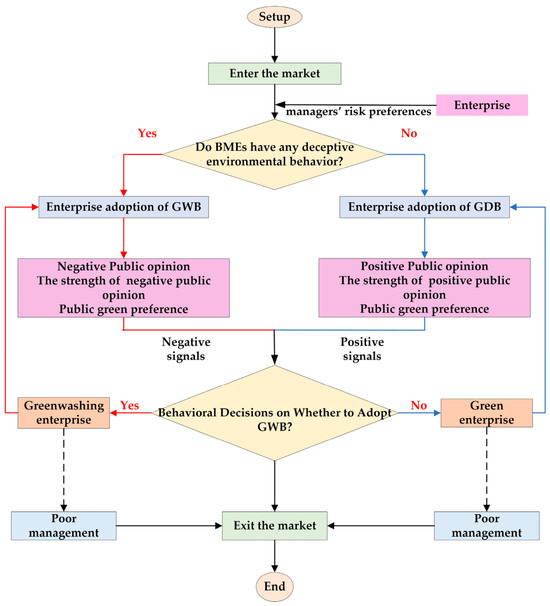
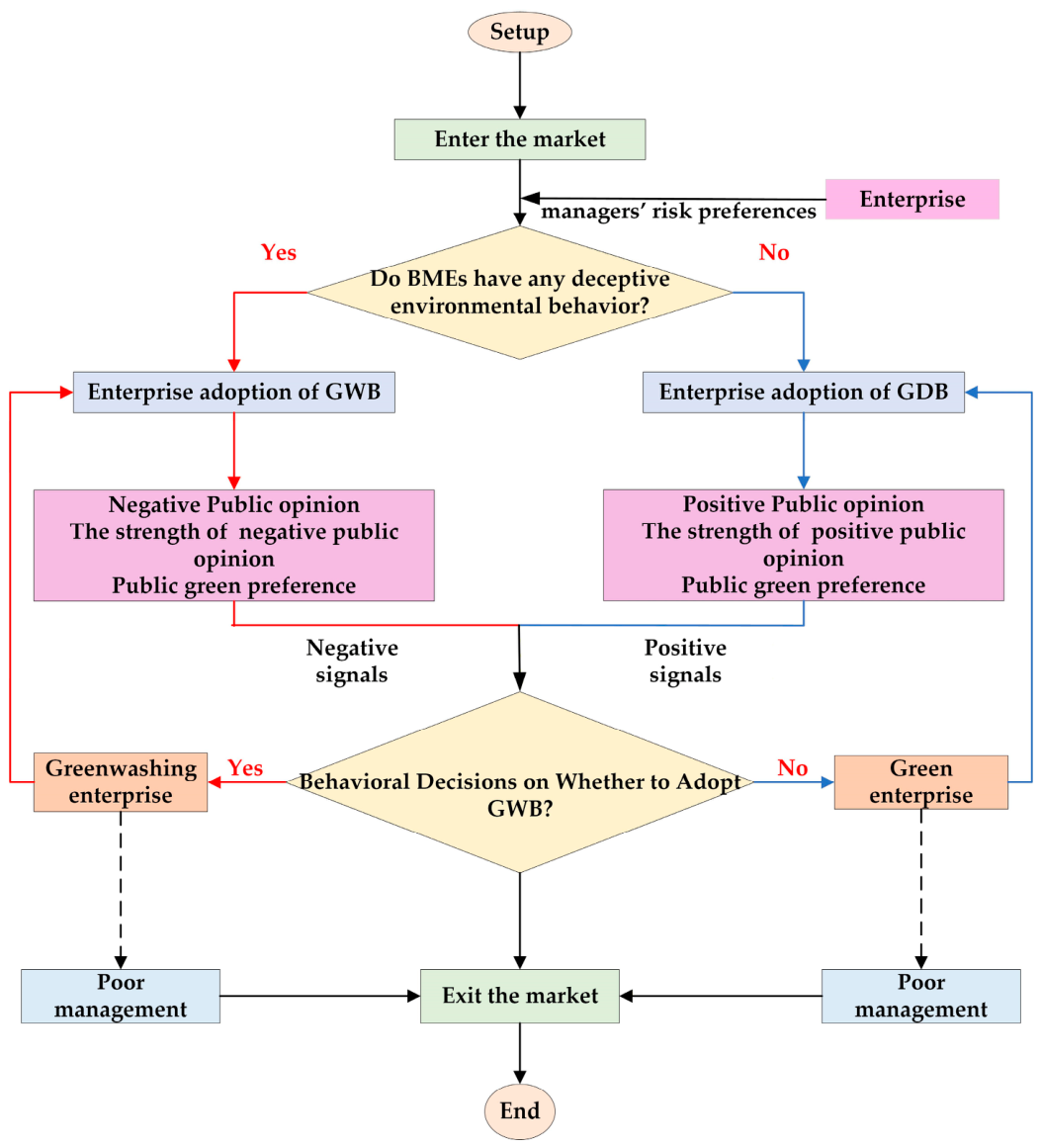
In the initialization stage, positive and negative opinion situations are established separately. Three types of subjects are defined: BMEs, media and consumers in different contexts. Managers’ risk preference factors influence enterprises’ behavioral decisions, leading BMEs to select either GWB or GDB on the basis of their varying risk preferences. In various public opinion scenarios, the media’s role model for public opinion varies. For instance, in a situation where public opinion is favorable, the media promotes the GDB of a building material enterprise to encourage consumers to support it. In a NPO situation, the media publicizes GWB, a building material enterprise, to lead consumers to oppose GWB. Moreover, consumers’ acceptance of media opinion differs between positive and negative opinion situations. PPO spreads much less strongly than NPO. As a result, this study also determines the effects of different strengths of public opinion on the GWB of BMEs. The flow chart for this study’s experimental model is shown in Figure 1. The model operates as follows.
Figure 1.
Model flowchart.
In this study, it is assumed that building material enterprises are categorized into greenwashing enterprises and green enterprises. In the initial stage of the model, enterprise managers make decisions on greenwashing or greening behaviors according to their risk preferences. To analyze the impact of different risk preferences on the behavior decisions of enterprises, it is assumed that in the initial stage of the enterprise, the managers’ risk preferences are not affected by external environmental factors. As enterprise operations advance, managers are influenced by PPO and NPO and adjust or maintain their original behavioral decisions according to their degree of risk preference. Finally, enterprises that fail to operate exit the market.
3.2. Model Assumptions
Because enterprise GWB are complex, diverse, and not easily identifiable, consumers are easily fooled by enterprise GWB to the extent that it makes it more difficult for the government to manage enterprise GWB. Therefore, this study reveals the decision-making mechanism of enterprise GWB, with the aim of hindering its development. In this study, to explore its evolutionary process more scientifically at the theoretical level, the following assumptions were made for the model:
- (1)
- At the level of enterprises’ behavioral decisions, assume that enterprise managers are finitely rational [43]. The degree of risk preference is set to B. Enterprises that want high returns, ignore environmental regulations, and are willing to take risks are selected; otherwise, they choose GDB.
- (2)
- Once the building material enterprise enters the business process, it involves enterprise gain and loss. When the building material enterprise is in a state where losses outweigh gains, the enterprise considers bankruptcy and gradually withdraws from the building materials market.
- (3)
- Due to the deceptive nature of enterprise GWB, it is difficult for consumers to differentiate between enterprise GWB and GDB. Therefore, in the initial stage, consumers’ preferences for the two types of corporations are not considered. The degree of public green preferences P is set to 50% [44].
- (4)
- When BMEs are exposed to greenwashing enterprises, consumers with green preferences refuse to purchase their products and instead insist on buying from genuinely green enterprises.
- (5)
- Public opinion tends to show polarization during the evolutionary process [45]. Therefore, this study divides public opinion into two categories. One category is PPO, which manifests itself in promoting a positive image of enterprise GDB. The other category is NPO, which manifests itself in publicizing Enterprise GWB’s negative image.
- (6)
- Finally, to ensure the authenticity of the model, this study assumes that consumers are inevitably affected by public opinion when they purchase building material products during enterprise operations. It is found that NPO triggers consumers’ aversion and makes them abandon their purchase intention, whereas PPO enhances consumers’ purchase desire. However, given that NPO is more likely to attract consumers’ attention and reactions in reality, NPO has a greater degree of aversion to consumers [46].
3.3. Parameterization
In the simulation process, first, the relevant variables required by the model are set, and the corresponding rules are formulated. To ensure the scientific validity and reliability of the model, the data sources include mainly expert discussions and related literature, which are detailed in Table 2. In the expert discussions, this study obtains the reasonable range and degree of influence of each variable through several exchanges and evaluations, and a review of the literature helps ensure that the model parameters are in line with the results of existing studies and provides a theoretical basis. The model’s realism was further enhanced by incorporating parameters informed by extensive experiments, which provided data on hard-to-quantify factors. The main variables used in this work are listed in Table 3. This series of measures helps to enhance the accuracy and practicality of the model.
Table 3.
Main variables.
This study employed two primary methods for data collection. The first involved synthesizing literature (as shown in Table 2 and Table 3), and the second involved conducting expert interviews. First, in accordance with the methods of Sharma [49], this study adopted a combination of targeted invitations and brainstorming sessions to invite Chinese experts from the building materials industry and the field of environmental management to participate in the survey. The selection of experts strictly adhered to the following criteria (at least one of which must be met): (1) extensive practical experience in the management and operations of BMEs; (2) representative academic achievements in the field of enterprise greenwashing research; and (3) long-standing focus on green building materials and greenwashing issues. Ultimately, 15 experts were invited to form a review panel, comprising 5 academic researchers, 5 enterprise managers, and 5 representatives from the general public. Through multiple rounds of brainstorming, the expert panel evaluated variables in the model that are difficult to obtain through direct observation, providing professional support for the model’s logic. Second, to enhance the objectivity of the simulation parameters, this study conducted a text analysis of annual environmental reports and enterprise social responsibility reports from leading enterprises in the building materials industry in recent years [47]. Data collection focused primarily on the authenticity of enterprise green investments, violation records, and environmental statements. Using keyword searches and content analysis, this study identified behavioral patterns among industry companies when facing external environmental pressures and converted these empirical observations into the basis for assigning initial states to entities in the simulation model. For example, by statistically analyzing the frequency of environmental penalties disclosed in enterprise reports and the corresponding intensity of public feedback, the study established a benchmark range for the intensity of NPO within the model, thereby ensuring that the input data for the simulation experiments had a solid foundation in reality. Finally, this study quantified the qualitative feedback generated during brainstorming sessions through repeated testing and training [48].
3.4. Actor Attributes and Interaction Rules
The key actors addressed in this chapter include BMEs, the media, the public, and public opinion, which serve as intermediary variables. On the basis of signaling theory and the wolf-sheep model, the behavioral attributes and interaction rules of these actors are defined as follows.
- (1)
- BMEs
As the core decision-making entities, BMEs primarily choose between greenwashing and green development. The decision-making bias of these enterprises and their likelihood of engaging in greenwashing are represented by variable C [48]. This process is driven by a combination of enterprises’ own risk preferences and external pressures, including media scrutiny, public preference for sustainability, and potential reputational risks. To simulate the dynamic evolution of real-world decision-making, the model sets a base probability of 0.20 for strategy updates and state transitions in BMEs. Additionally, to refine the survival logic of the entities, the model introduces an asset threshold mechanism: when an enterprise’s net assets remain negative because of market boycotts or reputational penalties resulting from exposed greenwashing, the entity is deemed bankrupt and is forced to exit the simulation system.
- (2)
- Media
As the disseminator and supervisor of information within the environment, the media’s core attribute is represented by supervision intensity M (M = M1 + M2), with a value range set between [0, 300]. This parameter reflects not only the media’s level of attention to industry malpractices but also the probability of enterprise violations being exposed [34]. When M is zero, it indicates a lack of oversight, providing a cover for greenwashing; conversely, when it reaches its peak value of 300, it signifies the establishment of a comprehensive, transparent regulatory environment where no deceptive environmental practices can go undetected. Additionally, considering the dynamic and random nature of media coverage, the model sets the incremental probability of media participation in exposure at 0.20, thereby simulating the media’s ability to capture social hot topics and its continuous monitoring of enterprise environmental performance.
- (3)
- Public
As the source of market demand, the public’s core attribute is its level of preference for green products, denoted by P, which ranges from 0 to 1 [44]. This green preference is not static but exhibits dynamic characteristics throughout the simulation process, guided by both the spread of public opinion and the intensity of media oversight. In-depth media exposure to greenwashing effectively heightens the public’s environmental sensitivity, prompting them to exercise greater discernment in their consumption decisions. To more accurately reflect consumer behavior, the model also incorporates a public recognition lag: initially, under conditions of information asymmetry, public preference is evenly distributed between green enterprises and greenwashing enterprises. However, as negative information spreads, this preference rapidly shifts toward genuinely green enterprises, thereby exerting a coercive influence on enterprise behavior.
- (4)
- Public opinion
Public opinion serves as an intermediary mechanism in the model, transmitting signals between enterprise behavior and market feedback and implementing rewards and penalties by directly affecting an enterprise’s reputation score. The fluctuation range of the reputation score is [0, 100]. When the media exposes a building material enterprise’s GWB, an outbreak of NPO will result in an immediate deduction of 9 units from its reputation score; conversely, if the media provides positive verification of the enterprise’s substantive green behavior, its reputation score will increase by 13 units.
4. Simulation Analysis
4.1. Initialization Interface
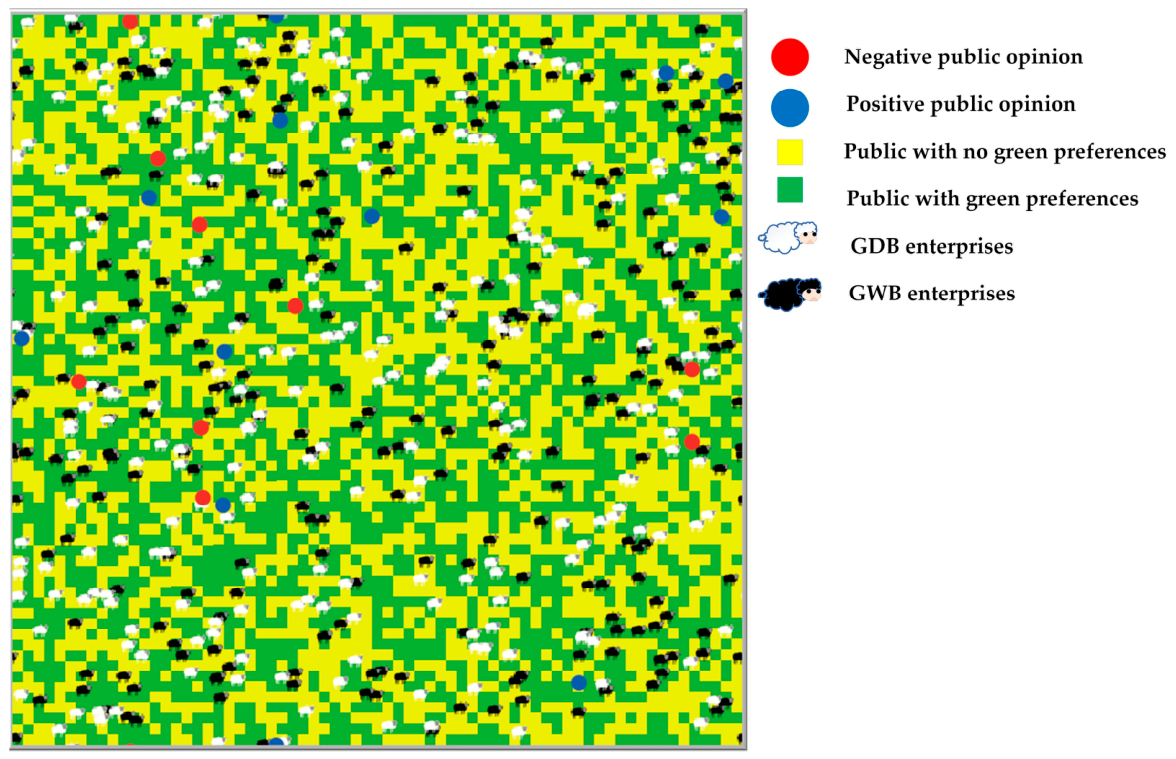
A central challenge in transactions is information asymmetry, which leaves the public unable to reliably verify the quality of information provided by businesses. It is also possible for enterprises to selectively disclose favorable environmental information and avoid bad environmental information, which increases the difficulty for the public to obtain data. This has resulted in public misinterpretation of enterprise GWB while simultaneously increasing environmental burdens and, to some extent, impeding the government’s ability to effectively govern enterprises. This study explores the decision-making mechanism of GWB in BMEs by introducing managers’ risk preference-influencing factors in the public opinion context. In addition, this study probes the effects of PPO and NPO on the GWB of BMEs by adjusting the different levels of managers’ risk preferences (B) and the PPO and NPO intensity (A1/A2) in PPO and NPO situations, respectively. In this study, a two-dimensional view was constructed with the help of NetLogo 6.4.0 simulation modeling software, and the runtime of the system was set to 60 times because of the change in agents’ behaviors over time. Green grasslands represent the public with green preferences, while yellow grasslands represent those without such preferences. The black sheep indicate GWB BMEs, and the white sheep represent genuinely GDB BMEs. Red dots and blue dots represent negative and positive public opinion signals, respectively, disseminated by the wolf pack (media). The system’s initial interface is shown in Figure 2.
Figure 2.
Simulation interface.
In this study, the NetLogo6.4.0 platform is used to construct a multiagent evolutionary simulation model to simulate the dynamic evolution of GWB in BMEs through computational experiments [48]. The specific simulation implementation process is as follows: First, during the system initialization phase, the model establishes the logical boundaries of the simulated world by defining the enterprise agents (GWB and GDB enterprises) and their core attributes (such as initial behavioral states and risk preferences) while simultaneously setting global environmental variables such as the intensity of positive or negative public opinion. Second, during the agent decision-making and strategy evolution phase, the model simulates the individual decision-making behavior of enterprises in complex environments through predefined behavioral rules. At each simulation step, enterprise agents dynamically adjust the probability of choosing between GWB and GDB on the basis of the interactive influence of external public opinion pressure and internal risk preferences. During operation, a set of instructions is used to facilitate strategy interaction and state updates among agents, and the system’s evolutionary trends under different parameter combinations are observed over time steps. Finally, to ensure the robustness of the simulation results, multiple rounds of repeated experiments on risk preference thresholds and public opinion intensity critical points are conducted in this study, effectively eliminating the impact of random disturbances during system operation. This allows the identification of key variable characteristics that suppress enterprise GWB under different scenarios.
4.2. Operational Process
4.2.1. The Impact of Public Opinion Intensity on GWB in BMEs Under Positive and Negative Public Opinion Scenarios
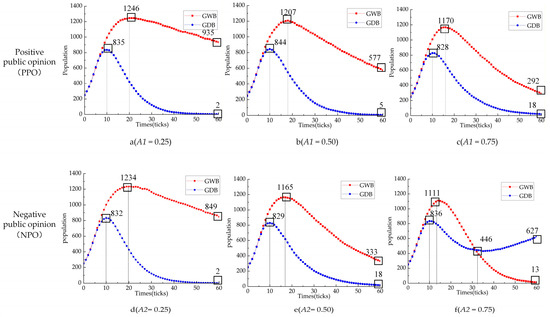
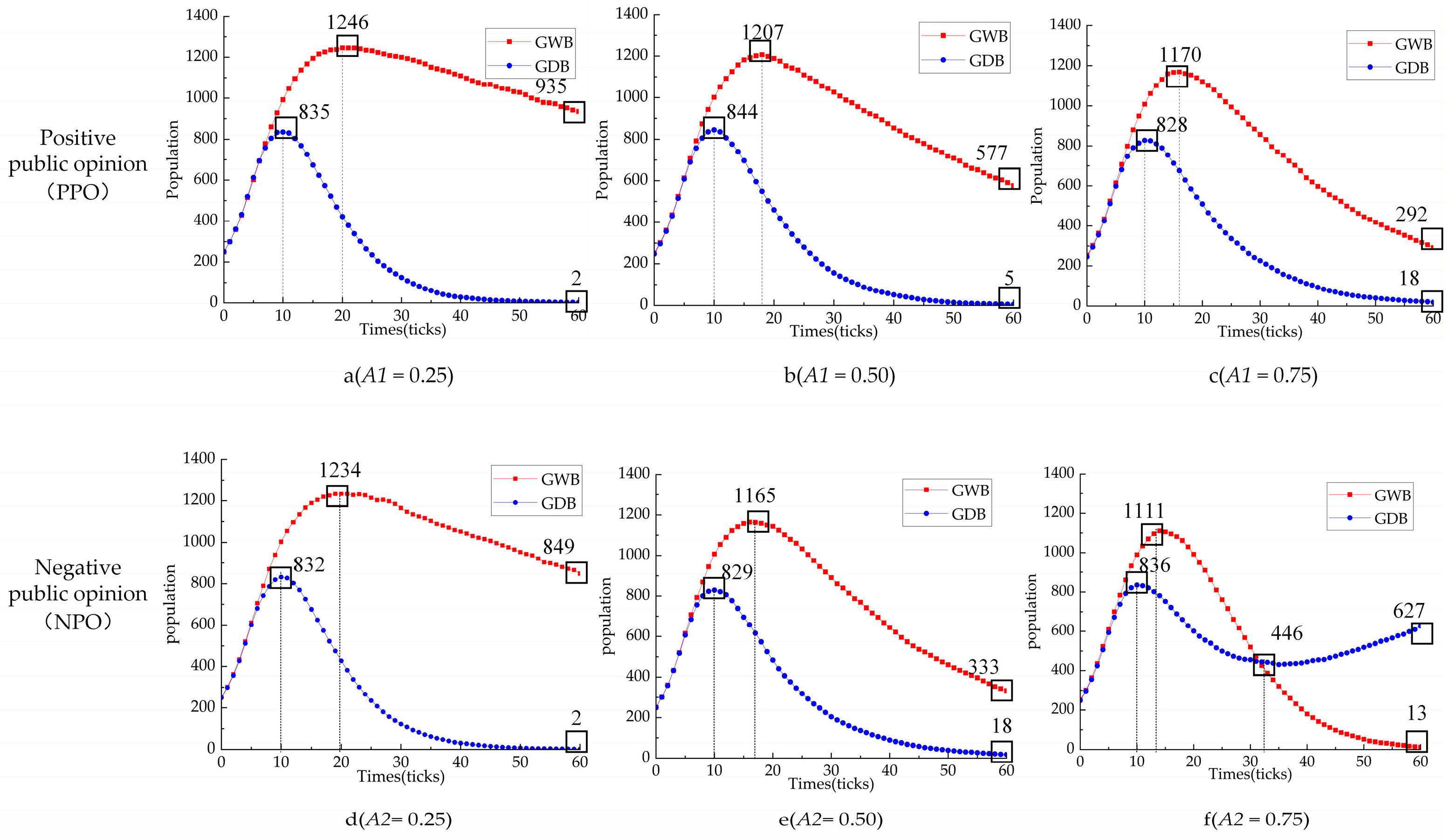
This section primarily analyzes the dynamic impact of varying degrees of public opinion intensity on GWB in BMEs during model simulation under both positive and negative public opinion scenarios. Using the initial simulation parameters shown in Table 3 as a baseline, this study employed the control variable method to establish three distinct scenarios of public opinion intensity: low, medium, and high (i.e., A1 = 0.25, A1 = 0.5, A1 = 0.75; A2 = 0.25, A2 = 0.5, A2 = 0.75, respectively). The specific simulation evolution results are shown in Figure 3.
Figure 3.
Impact of different levels of public opinion intensity on GWB in BMEs. Note: (a) illustrates the impact of positive opinion intensity A1 = 0.25 on the behavioral decisions of BMEs; (b) illustrates the impact of positive opinion intensity A1 = 0.50 on the behavioral decisions of BMEs; (c) illustrates the impact of positive opinion intensity A1 = 0.75 on the behavioral decisions of BMEs. (d) illustrates the impact of negative opinion intensity A2 = 0.25 on the behavioral decisions of BMEs; (e) illustrates the impact of negative opinion intensity A2 = 0.50 on the behavioral decisions of BMEs; (f) illustrates the impact of negative opinion intensity A2 = 0.75 on the behavioral decisions of BMEs.
As shown in Figure 3, Figure 3a–c illustrate the impact of positive opinion intensity on GWB in BMEs under the PPO scenario. Figure 3d–f demonstrate the influence of negative opinion intensity on the GWB in BMEs under NPO scenarios. In the PPO scenario (time period T = 0 to T = 60), both GWB enterprises and GDB enterprises exhibit a development trend that first increases but then decreases. Throughout this process, the scale of GWB enterprises consistently exceeded that of GDB enterprises. This occurs because while PPO enhances the reputation of GDB enterprises, GWB enterprises excel at disguising. Some GWB enterprises are also easily mistaken by the public as GDB enterprises. Consequently, driven by both reputation and profit considerations, BMEs persist in adopting GWB. A comparison of the data in Figure 3a–c reveals that by T = 60, the number of GWB enterprises decreased from 935 to 577 to 292. These findings indicate that increasing the PPO intensity can effectively curb the GWB in BMEs to a certain extent.
Further analysis of Figure 3d–f reveals that under NPO scenarios (time interval T = 0 to T = 60), GWB enterprises consistently exhibit a trend of initial increase followed by decline. Moreover, Figure 3d,e show that GDB enterprises also follow this pattern of rising and then falling. However, in Figure 3f, the number of GDB enterprises also initially increased but then decreased during the period from T = 0 to T = 32. However, in subsequent model runs, this shifted to an upward trend. This occurs because GWB enterprises, which are impacted by the NPO, suffer reputational collapse and incur severe losses, ultimately forcing them to exit the building materials market. A comparison of the data in Figure 3d–f reveals that by T = 60, the number of GWB enterprises had decreased from 849 and 33 to 13, whereas the number of GDB enterprises had increased from 2 and 18 to 627, with a persistent upward trend thereafter. This finding indicates that NPO intensity not only suppresses greenwashing adoption among BMEs but also encourages it to some extent.
Finally, this study conducts a longitudinal analysis of public opinion intensity. A comparison of Figure 3a,d and Figure 3b,e and Figure 3c,f reveals that the scale of GWB enterprises under the PPO scenario consistently exceeds that under the NPO scenario. For instance, under the PPO scenario, the peak numbers of GWB enterprises reached 1246, 1207, and 1170, respectively. At T = 60, the numbers stood at 935, 577, and 292. In contrast, the peak numbers of GWB enterprises under the NPO scenario were 1234, 1165, and 1111, respectively; at T = 60, the numbers were 849, 333, and 13, respectively. This finding indicates that compared with PPO, NPO intensity has a stronger suppressive effect on GWB among BMEs.
4.2.2. The Impact of Managers’ Risk Preferences on GWB in BMEs Under Positive and Negative Public Opinion Scenarios
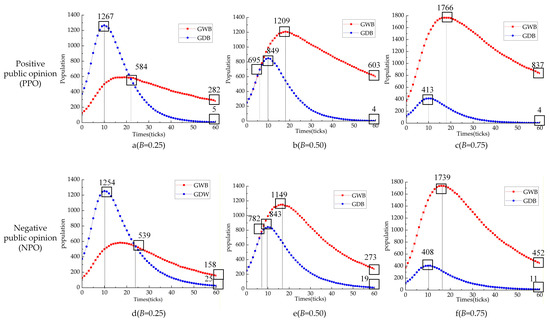
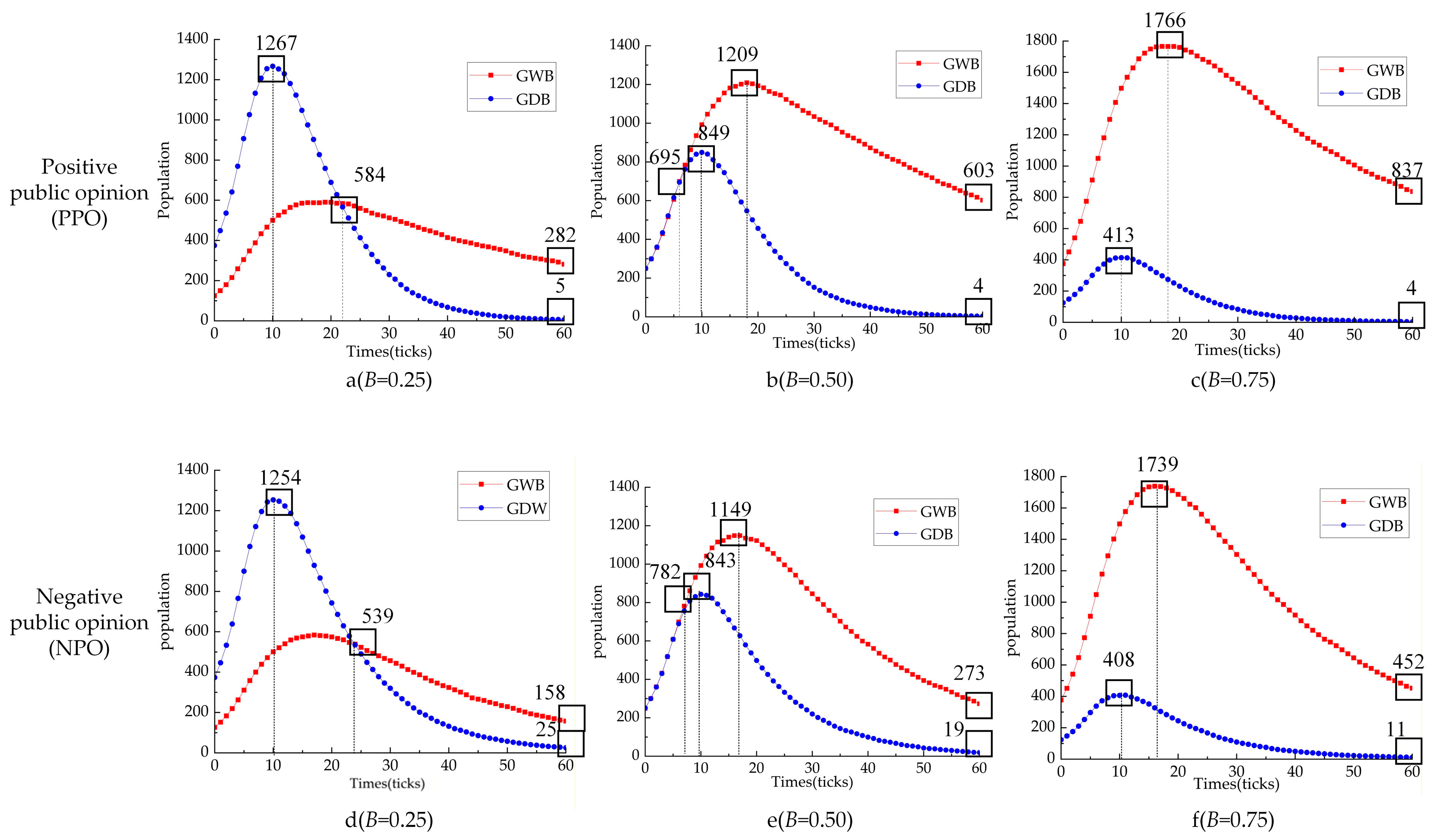
This section primarily examines the patterns of how managers’ risk preferences influence the evolution of GWB in BMEs under positive and negative public opinion scenarios. Using the initial parameters set in Table 3 as a reference, three representative scenarios, namely, low (B = 0.25), medium (B = 0.5), and high (B = 0.75), are constructed by adjusting managers’ risk preference levels. While holding the other variables constant, this section systematically analyzes the impact of managers’ risk preferences on BME decision-making by comparing simulation curves across different risk preference levels. It further reveals the evolutionary characteristics of this behavior under various public opinion scenarios. The specific simulation results are presented in Figure 4.
Figure 4.
Impact of managers’ risk preferences at different levels on GWB in BMEs. Note: (a) illustrates the impact of a manager’s risk preference B = 0.25 on the behavioral decisions of BMEs under PPO scenario; (b) illustrates the impact of a manager’s risk preference B = 0.50 on the behavioral decisions of BMEs under PPO scenario; (c) illustrates the impact of a manager’s risk preference B = 0.75 on the behavioral decisions of BMEs under PPO scenario. (d) illustrates the impact of a manager’s risk preference B = 0.25 on the behavioral decisions of BMEs under NPO scenario; (e) illustrates the impact of a manager’s risk preference B = 0.50 on the behavioral decisions of BMEs under NPO scenario; (f) illustrates the impact of a manager’s risk preference B = 0.75 on the behavioral decisions of BMEs under BMEs under NPO scenario.
As shown in Figure 4, regardless of whether the public opinion scenarios are positive or negative, the scale of GWB enterprises and GDB enterprises both initially tends to increase but then decrease. This is because in the early stages of public opinion development, its influence remains relatively limited and spreads only through word-of-mouth among closely connected members of the public. Analysis of Figure 4a–c reveals that as managers’ risk preferences increase (i.e., B = 0.25, B = 0.50, B = 0.75), the scale of GWB enterprises continues to expand, with its peak rising from 584 to 1209 and then to 1766 enterprises. Conversely, the scale of GDB enterprises steadily contracted, with peak values decreasing from 1267 and 849 to 413. This finding indicates that under PPO conditions, constraining managers’ risk preferences can suppress GWB in BMEs. Analysis of Figure 4d–f reveals that as managers’ risk preferences increase, the scale of GWB enterprises expands, with the peak rising from 539 and 1149 to 1739. Conversely, the scale of GDB enterprises steadily decreases, with its peak decreasing from 1254 and 843 to 408. This finding indicates that in NPO scenarios, constraining managers’ risk preferences can also curb GWB in BMEs.
To further investigate the impact of managers’ risk preferences on GWB in BMEs under different public opinion scenarios, a comparison of Figure 3a,d, Figure 3b,e, and Figure 3c,f reveals that the scale of GWB enterprises is consistently smaller under NPO scenarios than under PPO scenarios. For instance, the peak numbers of GWB enterprises under NPO scenarios were 539, 1149, and 1739, respectively; at T = 60, the numbers were 158, 273, and 452, respectively. In contrast, the peak numbers of GWB enterprises under the PPO scenario were 584, 1209, and 1766, respectively; at T = 60, the numbers were 282, 603, and 837, respectively. This finding indicates that compared with PPO, constraining managers’ risk preferences under NPO scenarios is more effective at suppressing GWB in BMEs.
4.3. Sensitivity Analysis
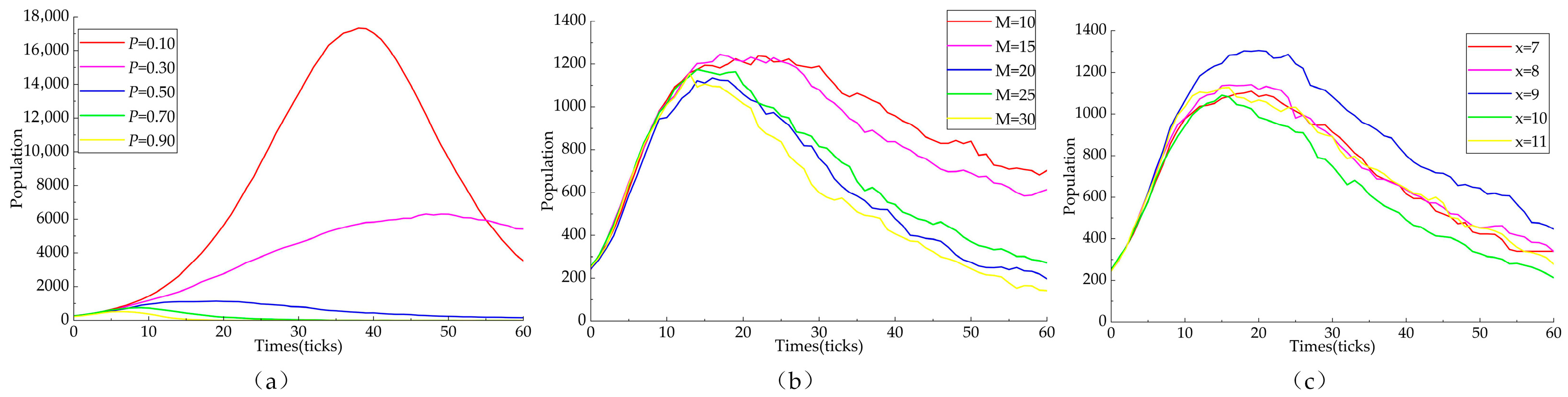
Uncertainty in parameter selection within simulation models often affects the robustness of results. Therefore, it is necessary to conduct sensitivity analysis to examine how fluctuations in key variables across different value ranges affect the simulation conclusions. This section focuses on analyzing the impact of parameters such as public green preferences (P), initial media number (M), and the impact of PPO(x) on GWB in BMEs. The specific sensitivity analysis results are presented in Figure 5.
Figure 5.
Sensitivity analysis. (a) the sensitivity analysis of public green preferences, (b) the sensitivity analysis of the initial number of media, (c) the sensitivity analysis of the impact of PPO.
The impact of fluctuations in public green preference (i.e., P = 0.10, P = 0.30, P = 0.50, P = 0.70, P = 0.90) on the scale evolution of GWB enterprises is shown in Figure 5a. The figure reveals a significant negative correlation between P and the scale of GWB enterprises, indicating that heightened public green preference effectively curbs the adoption of GWB in BMEs. From a sensitivity perspective, the evolutionary response to P exhibits distinct phased characteristics: when P is at lower levels (i.e., P = 0.10, P = 0.30), the system evolution is highly sensitive to parameter changes, with the scale of GWB enterprises shrinking sharply as P increases; however, once P crosses the 0.50 threshold, the evolutionary trajectories for different values (i.e., P = 0.50, P = 0.70, P = 0.90) gradually converge, with significantly reduced curve fluctuations and a flattening marginal suppression effect. Given that this study’s benchmark analysis sets P = 0.50, the system has entered a low-sensitivity zone at this point. This finding indicates that the model’s conclusions maintain robust stability even when key parameters undergo certain perturbations.
The impact of variations in the initial number of media outlets (i.e., M = 10, M = 15, M = 20, M = 25, M = 30) on the scale evolution of GWB enterprises is shown in Figure 5b. As shown in the figure, the value of M is negatively correlated with the size of GWB enterprises, indicating that an increase in the initial number of media outlets suppresses the adoption of GWB among enterprises. The figure also reveals that the impact of M on the evolution of GWB enterprise size tends to be relatively consistent. When M is low (i.e., M = 10, M = 15), the system’s evolution is highly sensitive to parameter changes; as M increases, the size of GWB firms decreases within a certain range; however, once M exceeds the threshold of 20, the evolutionary trajectories for different values of M (i.e., M = 20, M = 25, M = 30) gradually converge, the fluctuations in the curves decrease significantly, and the marginal inhibitory effect tends to level off. Given that the baseline analysis in this study sets M = 20, the system has entered a low-sensitivity region at this point. This finding indicates that even when key parameters are subject to certain perturbations, the model’s conclusions remain robustly stable.
The impact of fluctuations in the impact of PPO (i.e., x = 7, x = 8, x = 9, x = 10, and x = 11) on the scale evolution of GWB enterprises is shown in Figure 5c. As shown in the figure, the x values do not have a significant effect on the scale of GWB enterprises, and the influence of x on the evolution of the GWB enterprise scale is relatively consistent. This finding indicates that when x = 9, the model’s output results are robust, allowing for further discussion.
5. Discussion and Implication
5.1. Discussion
The findings of this study reveal the underlying mechanisms through which the public opinion environment and managerial risk preferences influence GWB in BMEs. The study revealed that the constraints imposed by the public opinion environment on enterprise behavior are significantly asymmetric. While PPO can guide enterprises toward the GDB by sending positive signals, NPO demonstrates greater efficacy in curbing GWB. The underlying mechanism of this phenomenon lies in the fact that NPO rapidly amplify the costs of noncompliance by increasing information transparency, thereby triggering the warning effect of social oversight [50,51].
Notably, when the intensity of NPO reaches a critical threshold of A2 = 0.75, it not only significantly curbs greenwashing tendencies but also prompts enterprises to adopt substantive GDB in subsequent stages. This disproportionate effectiveness stems from the greater penetrating power and destructive nature of the diffusion of negative information. In the building materials market, NPO is often linked to high-risk signals such as environmental violation records and administrative penalties, triggering expectations of capital withdrawal among market investors and a crisis of consumer trust. As Zhang et al. [52] note, the market pressure generated by NPO far exceeds the incentive effect of positive publicity. From the perspective of psychological factors in individual decision-making, enterprise decision-makers are more sensitive to potential reputational losses than to the pursuit of additional gains. Therefore, when A2 reaches a high level, the potential benefits of greenwashing can no longer offset the risk of social sanctions, forcing enterprises to undergo a fundamental reversal in their strategic choices (shifting from strategic concealment to substantive compliance).
Furthermore, the interaction between managerial risk preference (B) and the external public opinion environment further explains the differentiation in enterprise decision-making. The results indicate that the degree of risk preference positively influences the probability of greenwashing, which is consistent with the conclusions of Yue et al. [15]. However, this study further reveals that when risk preference is at a lower level (B = 0.25), the constraining effect of the NPO reaches its optimal level. These findings reveal that cautious decision-makers exhibit a stronger risk-averse tendency when facing public opinion crises. In the B = 0.25 scenario, managers have a higher level of awareness regarding negative chain reactions following a failed greenwashing attempt, enabling the NPO to exert a stronger constraining effect with minimal intensity. In contrast, managers with high risk preferences may become desensitized to public opinion signals and attempt to bet against the market by exploiting information asymmetry. Wei et al. [53] argued that negative emotional interactions guided by opinion leaders accelerate the outbreak of public crises, whereas enterprise management with low risk preferences is better able to anticipate this diffusion effect, thereby a priori terminating noncompliant behavior upon perceiving A2 signals.
5.2. Implication
On the basis of the results derived from this study, the following insights are suggested. First, the government and regulatory authorities should leverage the asymmetric deterrence mechanism of NPO to develop a tiered public opinion guidance strategy. The simulation results show that NPO is more effective than PPO in curbing enterprise GWB, and when the intensity of NPO reaches the critical threshold A2 = 0.75, it can prompt enterprises to shift from passive compliance to proactive GDB. These findings indicate that regulators should not limit themselves to conventional positive publicity but should significantly increase the dissemination speed and scope of negative information by establishing a green violation blacklist and strengthening environmental complaint and reporting mechanisms. By amplifying the reputational costs of greenwashing and leveraging the asymmetric pressure of negative information, enterprises can be compelled to shift their decision-making logic from opportunistic greenwashing to strategic green transformation when facing a high-pressure public opinion environment. Second, an internal control system based on risk-preference monitoring should be established, particularly to implement precise constraint strategies targeting management. Research has demonstrated that, regardless of the external public opinion environment, constraining managers’ risk preferences at a low level (e.g., B ≤ 0.25) is the most effective internal mechanism for curbing greenwashing. Therefore, regulatory authorities should promote innovation in green policy tools, such as by linking a lifetime accountability system for environmental responsibility to executive compensation incentives and eligibility for appointment. In practical terms, it is recommended that large BMEs adopt risk-weighted environmental performance evaluations. By increasing the certainty of the costs of noncompliance, this approach reduces managers’ expectations of risk premiums, thereby blocking greenwashing decisions at their internal source. Third, the synergistic governance effects of the external public opinion environment and internal risk management should be strengthened. Given that the constraining effect of risk preferences is more pronounced in a NPO environment, policymakers should coordinate the use of media oversight and industry access tools. During sensitive periods or in specific regions where NPO frequently arise, the frequency of audits on management teams with high risk preferences should increase, and external public pressure should be used to amplify the effectiveness of internal constraints. Additionally, policy tools such as green credit and environmental pollution liability insurance should be optimized to incorporate enterprise public opinion fluctuations and managers’ risk records into credit scoring models, thereby achieving deep integration between external administrative constraints and social oversight. Looking back at practical developments, the Chinese government laid a policy foundation in 2021 by adopting “Opinions on Deepening the Battle Against Pollution,” and in 2024, it fostered broad social consensus through the coordination of mainstream media and environmental protection authorities [54]. With the refinement of the mandatory enterprise greenhouse gas information disclosure system in 2025, this transition path from administrative guidance to social oversight and internal self-discipline is maturing. The quantitative thresholds proposed in this study (A2 = 0.75, B = 0.25) provide a theoretical basis for precise policy implementation during this transition, helping to prevent enterprises from misleading the market through information asymmetry and ultimately achieving a virtuous green cycle in the building materials industry.
Although this study reveals the influence mechanisms of the public opinion environment and risk preference on GWB in BMEs, there remains room for improvement in the following aspects. First, with respect to research methods and model construction, the ABM adopted in this study moderately simplifies the logic of interenterprise interactions because of the abstract nature of the simulation environment when modeling the dynamic evolution of GWB in BMEs. The model evolves primarily on the basis of predefined decision-making rules and fails to fully capture the nonlinear characteristics of enterprise decision-making in real markets as well as complex and variable external random shocks. Additionally, as this study focuses on examining the driving role of public opinion, government regulation is not incorporated into the evolutionary system as a core constraint variable. This may result in an incomplete exploration of collaborative governance mechanisms. Second, with respect to data collection and parameter setting, some of the simulation parameters in this study were obtained primarily through expert consultation. Since the interviewed experts are all from China, their judgment criteria are significantly influenced by the characteristics of the domestic building materials industry, the legal framework, and the sociocultural environment. This regional sample selection may limit the study’s conclusions when explaining the market behavior of multinational enterprises or those operating under different institutional contexts; the global applicability of these conclusions still requires further validation through cross-regional data collection. Furthermore, when enterprise heterogeneity is being examined, this study focuses primarily on the influence of risk preference, with insufficient coverage of the differentiated impacts of factors such as enterprise size, ownership structure, and levels of environmental responsibility. In real-world building materials markets, these characteristics often lead to markedly different response patterns among enterprises when they are faced with public pressure. To address these limitations, future research could proceed in the following directions: First, government regulation (such as administrative penalties and green subsidies) should be incorporated into dynamic evolution models to explore the synergistic effects of administrative directives and public opinion in curbing enterprise greenwashing; second, data collection methods should be optimized by incorporating cross-national expert samples or combining large-scale empirical data to calibrate and validate simulation models, thereby enhancing the explanatory power and international applicability; and third, parameters related to enterprise heterogeneity should be further refined to simulate in greater detail the strategic decision-making processes of enterprises with different characteristics in complex decision-making environments.
6. Conclusions
In this study, public opinion is divided, and the decision-making of GWB in BMEs under the PPO and NPO scenarios is analyzed. Through signaling theory, this study introduces managers’ risk preferences into the influence model and explores its role in influencing the decision-making of GWB in BMEs. The conclusions of this study are as follows:
- (1)
- Both positive and negative public opinion can curb GWB in BMEs, but NPO intensity is more effective in this context. Moreover, in scenarios involving NPO, when its intensity reaches A2 = 0.75, it not only suppresses GWB but also encourages enterprises to adopt GDB during later operational phases.
- (2)
- Regardless of whether BMEs operate in an external environment characterized by positive or negative public opinion, constraining managers’ risk preferences remains an effective internal mechanism for curbing GWB. This effect is particularly pronounced when managers’ risk preferences are low (B = 0.25); as such, constraints prove more effective in suppressing GWB in BMEs.
- (3)
- The effectiveness of constraining managers’ risk preferences in curbing GWB in BMEs is influenced by the external public opinion environment. Moreover, this curbing effect is more pronounced under NPO scenarios. A comparison of the effects of varying levels of managers’ risk preference (i.e., B = 0.25, B = 0.50, and B = 0.75) on GWB in BMEs under positive and negative public opinion scenarios reveals that constraining managers’ risk preference is more effective at curbing GWB in NPO scenarios.
Author Contributions
X.L.: Conceptualization, Methodology, Writing—Original Draft, Supervision, Project administration; S.L.: Methodology, Validation, Formal analysis, Investigation, Resources, Data Curation, Writing—Original Draft, Writing—Review & Editing, Visualization; Y.Z.: Formal analysis, Visualization, Writing—Review & Editing. All authors have read and agreed to the published version of the manuscript.
Funding
This work was supported by the National Natural Science Foundation of China (grant number 72204178).
Data Availability Statement
The data that support the findings of this study are available from the corresponding author upon reasonable request.
Conflicts of Interest
We declare that we have no financial and personal relationships with other people or organizations that can inappropriately influence our work, there is no professional or other personal interest of any nature or kind in any product.
Abbreviations
The following abbreviations are used in this manuscript:
| BMEs | Building material enterprises |
| GWB | Greenwashing behavior |
| NPO | Negative public opinion |
| PPO | Positive public opinion |
| ABM | Agent-based modeling |
References
- Diaz Gonçalves, T.; Saporiti Machado, J. Origins of the Sustainability Concept and Its Application to the Construction Sector in the EU. Sustainability 2023, 15, 13775. [Google Scholar] [CrossRef] [Scilit]
- Xu, T.; Sun, Y.; He, W. Government digitalization and corporate greenwashing. J. Clean. Prod. 2024, 452, 142015. [Google Scholar] [CrossRef] [Scilit]
- Zhu, Q.; Zhao, X.; Wu, M. Third-party certification: How to effectively prevent greenwash in green bond market?–analysis based on signalling game. Environ. Dev. Sustain. 2024, 26, 16173–16199. [Google Scholar] [CrossRef] [Scilit]
- Xing, C.; Zhang, X.; Zhang, Y.; Zhang, L. From green-washing to innovation-washing: Environmental information intangibility and corporate green innovation in China. Int. Rev. Econ. Financ. 2024, 93, 204–226. [Google Scholar] [CrossRef] [Scilit]
- Liu, C.; Wang, J.; Ji, Q.; Zhang, D. To be green or not to be: How governmental regulation shapes financial institutions’ greenwashing behaviors in green finance. Int. Rev. Financ. Anal. 2024, 93, 103225. [Google Scholar] [CrossRef] [Scilit]
- Shen, Y.; Bian, S.; Song, X.; Geng, X. Research on Risk Assessment of Enterprise Public Opinion in Cross Social Media Context and Sustainable Development Strategies. Sustainability 2024, 16, 1700. [Google Scholar] [CrossRef] [Scilit]
- Sun, H.; Xu, D.; Wang, L.; Wang, K. How Does Public Opinion Influence Production Safety within Small and Medium Enterprises in the Sustainability Context? Sustainability 2023, 15, 3519. [Google Scholar] [CrossRef] [Scilit]
- Hoyle, A.; Rhodes, E. Explaining public support for net-zero climate policy instruments: Perceptions of distributive fairness under competing frames. Energy Policy 2025, 203, 114644. [Google Scholar] [CrossRef] [Scilit]
- Zhang, T.; Qin, H.; Xu, W. Environmental regulation, greenwashing behaviour, and green governance of high-pollution enterprises in China. Int. J. Environ. Res. Public Health 2022, 19, 12539. [Google Scholar] [CrossRef] [Scilit]
- Gan, K.; Ye, S. Window Dressing in Impression Management: Does Negative Media Coverage Drive Corporate Green Production? Sustainability 2024, 16, 861. [Google Scholar] [CrossRef] [Scilit]
- Wang, W.; Yu, W.; Niu, J. Forgetting’ or ‘Precipitation’: Literary inquisition in Qing Dynasty and modern enterprise risk preference. PLoS ONE 2024, 19, e0300639. [Google Scholar] [CrossRef] [Scilit]
- Liang, C.; Zhu, L.; Zeng, J. Analysis on the impact of media attention on energy enterprises and energy transformation in China. Energy Rep. 2024, 11, 1820–1833. [Google Scholar] [CrossRef] [Scilit]
- Sun, J.; Gong, Z.; Song, H.; Xu, Y.; Forrest, J.Y.L. Multiple criteria decision modeling in social networks: An application to identify opinion leaders in online public opinion events. Expert Syst. Appl. 2024, 249, 123591. [Google Scholar] [CrossRef] [Scilit]
- Seyfi, S.; Elhoushy, S.; Kuhzady, S.; Tan, V.T.; Zaman, M. Bridging the Green Marketing Communication Gap: Assessing Image Coherence in Green Hotels. Int. J. Tour. Res. 2025, 27, e70027. [Google Scholar] [CrossRef] [Scilit]
- Yue, J.; Li, Y. Media attention and corporate greenwashing behavior: Evidence from China. Financ. Res. Lett. 2023, 55, 104016. [Google Scholar] [CrossRef] [Scilit]
- Liu, M.; Luo, X.; Lu, W.Z. Public perceptions of environmental, social, and governance (ESG) based on social media data: Evidence from China. J. Clean. Prod. 2023, 387, 135840. [Google Scholar] [CrossRef] [Scilit]
- Amin, M.H.; Ali, H.; Mohamed, E.K. Corporate social responsibility disclosure on Twitter: Signalling or greenwashing? Evidence from the UK. Int. J. Financ. Econ. 2024, 29, 1745–1761. [Google Scholar] [CrossRef] [Scilit]
- Li, G.; He, T.; Chen, B.; Wang, F. Investor attention and corporate greenwashing: Evidence from China. Appl. Econ. Lett. 2024, 32, 2244–2249. [Google Scholar] [CrossRef] [Scilit]
- Di Chiacchio, L.; Vivian, B.; Cegarra-Navarro, J.; Garcia-Perez, A. The evolution of non-financial report quality and visual content: Information asymmetry and strategic signalling: A cross-cultural perspective. Environ. Dev. Sustain. 2024, 27, 26427–26457. [Google Scholar] [CrossRef] [Scilit]
- Elrashidy, Z.; Haniffa, R.; Sherif, M.; Baroudi, S. Determinants of reward crowdfunding success: Evidence from Covid-19 pandemic. Technovation 2024, 132, 102985. [Google Scholar] [CrossRef] [Scilit]
- Li, Q.X.; Ji, H.M.; Huang, Y.M. The information leakage strategies of the supply chain under the block chain technology introduction. Omega 2022, 110, 102616. [Google Scholar] [CrossRef] [Scilit]
- Wang, J.; Ma, Y.; Tang, B.; Wu, Y. Fret or overpay? How online review valence of green hotels influences public’ green purchase intentions: The moderating role of social media influencer type. Int. J. Hosp. Manag. 2026, 133, 104419. [Google Scholar] [CrossRef] [Scilit]
- Lou, Z.; Chen, S.; Yin, W.; Zhang, C.; Yu, X. Economic policy uncertainty and firm innovation: Evidence from a risk-taking perspective. Int. Rev. Econ. Financ. 2022, 77, 78–96. [Google Scholar] [CrossRef] [Scilit]
- Yu, C.; Zhang, H.; Lian, T. Outdoor tourism: Risk preference, information acquisition, and safety decisions. Tour. Rev. 2024, 79, 797–811. [Google Scholar] [CrossRef] [Scilit]
- Baixauli-Soler, J.S.; Belda-Ruiz, M.; Sanchez-Marin, G. An executive hierarchy analysis of stock options: Does gender matter? Rev. Manag. Sci. 2017, 11, 737–766. [Google Scholar] [CrossRef] [Scilit]
- Geng, L.; Yang, S.; Wang, K.; Zhou, Q.; Geng, L. Modeling public opinion dissemination in a multilayer network with SEIR model based on real social networks. Eng. Appl. Artif. Intell. 2023, 125, 106719. [Google Scholar] [CrossRef] [Scilit]
- Sun, L.; Zhang, Y.N. Research on the impact of information interaction between government and media on the dissemination of public opinion on the internet. Heliyon 2023, 9, e17407. [Google Scholar] [CrossRef] [Scilit] [PubMed]
- Hu, B.; Luan, Q.; Meng, X.; Wang, K. Media inclination and outward foreign direct investment: Evidence from Chinese firms. China World Econ. 2023, 31, 134–155. [Google Scholar] [CrossRef] [Scilit]
- Cui, W.; Chen, X.; Xia, W.; Hu, Y. Influence of Media Attention on the Quality of Environmental, Social, and Governance Information Disclosure in Enterprises: An Adjustment Effect Based on the Shareholder Relationship Network. Sustainability 2023, 15, 13919. [Google Scholar] [CrossRef] [Scilit]
- Wang, J.; Zhang, X.; Liu, W.; Li, P. Spatiotemporal pattern evolution and influencing factors of online public opinion——Evidence from the early-stage of COVID-19 in China. Heliyon 2023, 9, e20080. [Google Scholar] [CrossRef] [Scilit]
- Wang, X.; Chen, S.; Xie, Y.; Zhang, J. An interaction model among enterprise and government actions and public opinion dissemination in negative events. Electron. Commer. Res. 2023, 25, 2847–2865. [Google Scholar] [CrossRef] [Scilit]
- Simon, R.N.; Calenge, C.; Drouet-Hoguet, N.; Jean, N.; Quenette, P.Y. Modelling the predation sequence of wolves hunting sheep: Implications for evaluating the effectiveness of preventive methods. Glob. Ecol. Conserv. 2025, 62, e03685. [Google Scholar] [CrossRef] [Scilit]
- Chen, R.; Fan, R.; Yao, Q.; Qian, R. Evolutionary dynamics of homeowners’ energy-efficiency retrofit decision-making in complex network. J. Environ. Manag. 2023, 326, 116849. [Google Scholar] [CrossRef] [Scilit]
- Li, X.; Li, J.; Shen, Q. Infection mechanism of greenwashing behavior of construction material enterprises under multi-agent interaction. Dev. Built Environ. 2024, 17, 100321. [Google Scholar] [CrossRef] [Scilit]
- Li, X.; Li, J.; Huang, Y.; He, J.; Liu, X.; Dai, J.; Shen, Q. Construction enterprises’ adoption of green development behaviors: An agent-based modeling approach. Humanit. Soc. Sci. Commun. 2022, 9, 244. [Google Scholar] [CrossRef] [Scilit]
- Hora, M.; Subramanian, R. Relationship between positive environmental disclosures and environmental performance: An empirical investigation of the greenwashing sin of the hidden trade-off. J. Ind. Ecol. 2019, 23, 855–868. [Google Scholar] [CrossRef] [Scilit]
- Velaoras, K.; Menegaki, A.N.; Polyzos, S.; Gotzamani, K. The role of environmental certification in the hospitality industry: Assessing sustainability, consumer preferences, and the economic impact. Sustainability 2025, 17, 650. [Google Scholar] [CrossRef] [Scilit]
- Horobet, A.; Smedoiu-Popoviciu, A.; Oprescu, R.; Belascu, L.; Pentescu, A. Seeing through the haze: Greenwashing and the cost of capital in technology firms. Environ. Dev. Sustain. 2024, 27, 21651–21682. [Google Scholar] [CrossRef] [Scilit]
- Guo, N.; Shi, C.; Yan, M.; Gao, X.; Wu, F. Modeling agricultural water-saving compensation policy: An ABM approach and application. J. Clean. Prod. 2022, 344, 131035. [Google Scholar] [CrossRef] [Scilit]
- Rand, W.; Rust, R.T. Agent-based modeling in marketing: Guidelines for rigor. Int. J. Res. Mark. 2011, 28, 181–193. [Google Scholar] [CrossRef] [Scilit]
- Zhang, Y.; Huang, X.; Ji, Y. Cocoon breaking: A dual-path exploration of occupational stigma in China’s insurance industry using grounded theory and structural equation model verification. Financ. Res. Lett. 2025, 85, 107892. [Google Scholar] [CrossRef] [Scilit]
- Bonabeau, E. Agent-based modeling: Methods and techniques for simulating human systems. Proc. Natl. Acad. Sci. USA 2002, 99, 7280–7287. [Google Scholar] [CrossRef] [Scilit] [PubMed]
- Ellegaard, C.; Normann, U.; Lidegaard, N. Intuitive global sourcing–a study of supplier selection decisions by apparel SMEs. Int. J. Oper. Prod. Manag. 2022, 42, 151–181. [Google Scholar] [CrossRef] [Scilit]
- Oktaviani, R.D.; Naruetharadhol, P.; Padthar, S.; Ketkaew, C. Green Consumer Profiling and Online Shopping of Imperfect Foods: Extending UTAUT with Web-Based Label Quality for Misshapen Organic Produce. Foods 2024, 13, 1401. [Google Scholar] [CrossRef] [Scilit]
- Bowen, T.R.; Dmitriev, D.; Galperti, S. Learning from shared news: When abundant information leads to belief polarization. Q. J. Econ. 2023, 138, 955–1000. [Google Scholar] [CrossRef] [Scilit]
- Xu, G.; Sun, S.; Wang, G.; Wang, Y.; Hu, X.; Li, C.; Liu, X. Evolution mechanism and influencing factors of multidimensional public opinion dissemination from the perspective of game theory. Eng. Appl. Artif. Intell. 2024, 138, 109319. [Google Scholar] [CrossRef] [Scilit]
- Zhang, W.; Qin, C.; Zhang, W. Top management team characteristics, technological innovation and firm’s greenwashing: Evidence from China’s heavy-polluting industries. Technol. Forecast. Soc. Change 2023, 191, 122522. [Google Scholar] [CrossRef] [Scilit]
- Li, X.; Hao, J.; Ding, Z.; Yang, J.; Yao, Y. Unveiling the driving mechanism of greenwashing behaviors: An agent-based modeling approach integrating new institutionalism and halo effect theories. Humanit. Soc. Sci. Commun. 2025, 12, 895. [Google Scholar] [CrossRef] [Scilit]
- Sharma, R. Unveiling the effects of the Corporate Sustainability Reporting Directive (CSRD) on company sustainability reporting practices: A case of German companies. Sustain. Account. Manag. Policy J. 2025. ahead of print. [Google Scholar] [CrossRef] [Scilit]
- Yang, X.; Cao, D.; Andrikopoulos, P.; Yang, Z.; Bass, T. Online social networks, media supervision and investment efficiency: An empirical examination of Chinese listed firms. Technol. Forecast. Soc. Change 2020, 154, 119969. [Google Scholar] [CrossRef] [Scilit]
- Wan, X.; Xiao, S.; Li, Q.; Du, Y. Evolutionary policy of trading of blue carbon produced by marine ranching with media participation and government supervision. Mar. Policy 2021, 124, 104302. [Google Scholar] [CrossRef] [Scilit]
- Zhang, Z.; Chen, H. Media coverage and impression management in corporate social responsibility reports: Evidence from China. Sustain. Account. Manag. Policy J. 2020, 11, 863–886. [Google Scholar] [CrossRef] [Scilit]
- Wei, J.; Wang, L.; Zhu, H.; Huang, W. Cooperation Behavior of Opinion Leaders and Official Media on the Governance of Negative Public Opinion in the Context of the Epidemic: An Evolutionary Game Analysis in the Perspective of Prospect Theory. Complexity 2023, 2023, 1366260. [Google Scholar] [CrossRef] [Scilit]
- Ministry of Ecology and Environment of the People’s Republic of China. Create a Favorable Public Opinion Environment to Thoroughly Advance the Battle Against Pollution. 2021. Available online: https://www.mee.gov.cn/zcwj/zcjd/202112/t20211213_963955.shtml (accessed on 30 September 2025).

Disclaimer/Publisher’s Note: The statements, opinions and data contained in all publications are solely those of the individual author(s) and contributor(s) and not of MDPI and/or the editor(s). MDPI and/or the editor(s) disclaim responsibility for any injury to people or property resulting from any ideas, methods, instructions or products referred to in the content. |
© 2026 by the authors. Licensee MDPI, Basel, Switzerland. This article is an open access article distributed under the terms and conditions of the Creative Commons Attribution (CC BY) license.