


Abstract
This study investigates whether Responsible Property Investing (RPI) attributes are capitalized into condominium prices in the Bangkok Metropolitan Region. An integrated analytical framework combining Exploratory Factor Analysis (EFA) and a log–log Hedonic Price Model (HPM) was applied to a dataset of 187 condominium units derived from Environmental Impact Assessment (EIA) reports and market data. The results indicate that traditional determinants remain dominant. Unit characteristics, particularly spatial quality (β = 0.530) and interior decoration (β = 0.244), exhibit the strongest positive effects, while building amenities also contribute positively (β = 0.260). In contrast, building density (β = −0.168) and location-related distances, including transport accessibility (β = −0.323), negatively affect prices. Most RPI-related attributes are not statistically significant. Only sustainable technology (R4) shows a significant but negative effect (β = −0.206), reflecting heterogeneous valuation. These findings suggest that sustainability features are valued primarily when their benefits are directly observable, while other attributes remain weakly perceived due to information asymmetry and delayed economic returns. Overall, sustainability is only partially capitalized and context-specific in this emerging market, highlighting the need for improved market signaling, policy incentives, and greater transparency of performance information to enhance value recognition.
1. Introduction
In recent years, sustainability has become a central concern in the built environment, particularly in rapidly urbanizing regions where residential development plays a critical role in shaping long-term environmental performance. Building performance is no longer evaluated solely based on cost and functionality, but also in terms of environmental efficiency, energy consumption, and long-term impacts on urban sustainability. As a result, real estate development increasingly incorporates environmental, social, and governance (ESG) considerations into investment and design decisions [1,2,3].
Despite this growing emphasis, the economic value of sustainability-related attributes in real estate markets remains insufficiently understood, particularly in emerging economies. While green building practices and sustainability assessment tools have been widely promoted, developers often face uncertainty regarding their financial returns. Higher initial costs, lack of clear economic incentives, and limited market awareness continue to discourage the adoption of sustainable development strategies [4,5,6,7]. This gap between sustainability ambition and financial feasibility represents a critical challenge for real estate stakeholders.
One approach that has emerged to address this challenge is Responsible Property Investing (RPI), which integrates ESG principles into real estate investment decision-making. RPI provides a structured framework for evaluating sustainability-related attributes of property assets and their long-term impacts on environmental performance and financial returns [8,9,10]. Previous studies have explored the integration of RPI into building assessment systems and investment strategies, highlighting its potential to enhance both sustainability outcomes and asset value [11,12]. However, the extent to which RPI-related attributes are reflected in actual market prices remains unclear, particularly in emerging urban markets.
The Bangkok Metropolitan Region (BMR) presents a particularly relevant context for this investigation. As one of the fastest-growing urban regions in Southeast Asia, Bangkok has experienced rapid expansion in condominium developments driven by urbanization and changing housing demand. However, the integration of sustainability-oriented investment frameworks such as ESG and RPI remains at an early stage compared to more mature markets. This creates an opportunity to examine how sustainability-related attributes are reflected in property values within an emerging real estate market [13,14,15]. This transitional context makes Bangkok a suitable case for examining whether sustainability-related attributes are meaningfully incorporated into property pricing mechanisms.
Despite growing interest in sustainable real estate, an important knowledge gap remains regarding whether sustainability-related attributes are effectively capitalized into housing prices in emerging urban markets. Existing evidence from developed markets suggests that green and sustainability-related features can be reflected in property values [12,16]. However, such capitalization effects remain less consistent and less well understood in developing real estate contexts, where market structures and institutional conditions differ significantly [17].
This question is relevant to multiple stakeholder groups. For policymakers, empirical evidence on capitalization is essential to evaluate whether sustainability regulations and disclosure frameworks are reflected in market behavior [18]. For developers and investors, it helps clarify whether additional investments in sustainability features can be translated into financial returns [19]. From an academic perspective, the issue remains underexplored, particularly in emerging cities where sustainability signals and institutional support are still evolving. As a result, the market relevance of Responsible Property Investing (RPI) attributes remains uncertain, and addressing this issue is therefore critical not only for advancing academic understanding, but also for informing policy design and supporting investment decision-making in sustainable real estate development. These limitations highlight the need for a structured empirical approach that can systematically examine whether and how sustainability attributes are translated into market value in emerging urban environments.
To address this gap, this study adopts an integrated analytical framework combining Exploratory Factor Analysis (EFA) and the Hedonic Price Model (HPM). This integration is motivated by the multidimensional and interdependent nature of sustainability-related property characteristics, which are difficult to assess using conventional hedonic variables alone [20]. EFA is employed to identify latent sustainability dimensions from a large set of RPI-related indicators, while HPM is used to estimate whether and how these dimensions are capitalized into condominium prices [21]. By linking latent construct identification with market valuation, this approach provides a structured way to evaluate the economic relevance of sustainability attributes, particularly in market contexts where sustainability signals may remain fragmented or weak [17,22].
The objectives of this study are threefold:
- (1)
- To identify the underlying sustainability-related dimensions associated with Responsible Property Investing (RPI) in condominium developments.
- (2)
- To evaluate the extent to which these dimensions are capitalized into condominium prices using a hedonic pricing approach.
- (3)
- To provide empirical evidence on the economic relevance of sustainability attributes in an emerging real estate market.
2. Theoretical Background
2.1. Responsible Property Investing (RPI)
The real estate sector accounts for more than 40% of global energy consumption and approximately 30% of greenhouse gas emissions, making it a critical component of sustainable development in the built environment [23,24]. As a result, environmental, social, and governance (ESG) considerations have become increasingly integrated into real estate investment and development practices.
Responsible Property Investing (RPI) has emerged as a framework that incorporates ESG principles into real estate decision-making processes. Unlike traditional approaches that primarily focus on financial returns, RPI emphasizes the integration of environmental performance, social responsibility, and governance practices while maintaining long-term investment value [8,9,10]. The concept originated from broader Corporate Social Responsibility (CSR) and Socially Responsible Investment (SRI) frameworks and has since been adapted specifically for real estate assets.
Previous studies have identified multiple dimensions of RPI, including energy efficiency, environmental protection, public transport accessibility, health and safety, social equity, and community development [25]. These dimensions reflect both tangible building characteristics and broader socio-environmental impacts. Increasingly, investors and developers use RPI criteria to evaluate property portfolios, manage risks, and enhance asset performance over the building lifecycle [16,21].
Empirical evidence suggests that sustainability-related building attributes can generate economic benefits, such as reduced operating costs, improved asset value, and enhanced market positioning [21]. However, the adoption of RPI in emerging markets remains limited due to barriers such as higher initial costs, lack of incentives, and uncertainty regarding financial returns [13,14,15]. This highlights the need for quantitative approaches that can demonstrate the economic value of sustainability-related attributes in real estate markets.
2.2. Hedonic Pricing Model in Real Estate Analysis
The Hedonic Pricing Model (HPM) is a widely used analytical framework for estimating the implicit value of property attributes embedded in market prices. The theoretical foundation of HPM was established by Rosen (1974), who proposed that the price of goods can be decomposed into the marginal contributions of its individual characteristics [21].
In the context of real estate, housing units are considered composite goods consisting of multiple attributes, such as size, location, design, environmental quality, and accessibility. HPM enables researchers to estimate how each attribute contributes to the overall market price. The general form of the model can be expressed as:
where X represents the set of property attributes.
Price = f(X1, X2, X3, …, Xn)
The model is typically estimated using regression techniques, particularly Ordinary Least Squares (OLS), to determine the marginal effects of individual variables. HPM has been widely applied in studies examining housing prices, environmental quality, and urban amenities, making it a suitable approach for evaluating the economic impact of sustainability-related attributes in real estate markets.
However, one key limitation of HPM is the potential issue of multicollinearity when many correlated variables are included in the model. Additionally, the presence of unobservable or latent factors, such as sustainability performance, may not be directly captured using conventional variables. These challenges highlight the need for integrating dimension reduction techniques to improve model robustness.
2.3. Conceptual Framework and Research Hypotheses
This study proposes a conceptual framework that explains how sustainability-related characteristics, represented by Responsible Property Investing (RPI) attributes, are expected to influence condominium market values. RPI indicators capture multiple dimensions of building performance, including energy efficiency, environmental quality, infrastructure provision, and amenity-related features. These characteristics are expected to affect property values through their influence on perceived quality, operational efficiency, and long-term investment attractiveness.
However, sustainability-related attributes are inherently multidimensional and highly interdependent, making them difficult to evaluate individually within conventional pricing models. To address this complexity, Exploratory Factor Analysis (EFA) is employed to identify latent sustainability dimensions from a large set of heterogeneous indicators. These latent factors represent underlying dimensions of building performance and environmental quality that are not directly observable but are reflected through multiple indicators.
These latent dimensions are subsequently incorporated into a Hedonic Price Model (HPM), which estimates the implicit prices of property attributes within the housing market. By integrating latent sustainability dimensions into the hedonic framework, the model captures how bundled sustainability characteristics are reflected in condominium prices. This approach enables a clearer and more interpretable assessment of whether sustainability-related attributes are reflected in property prices.
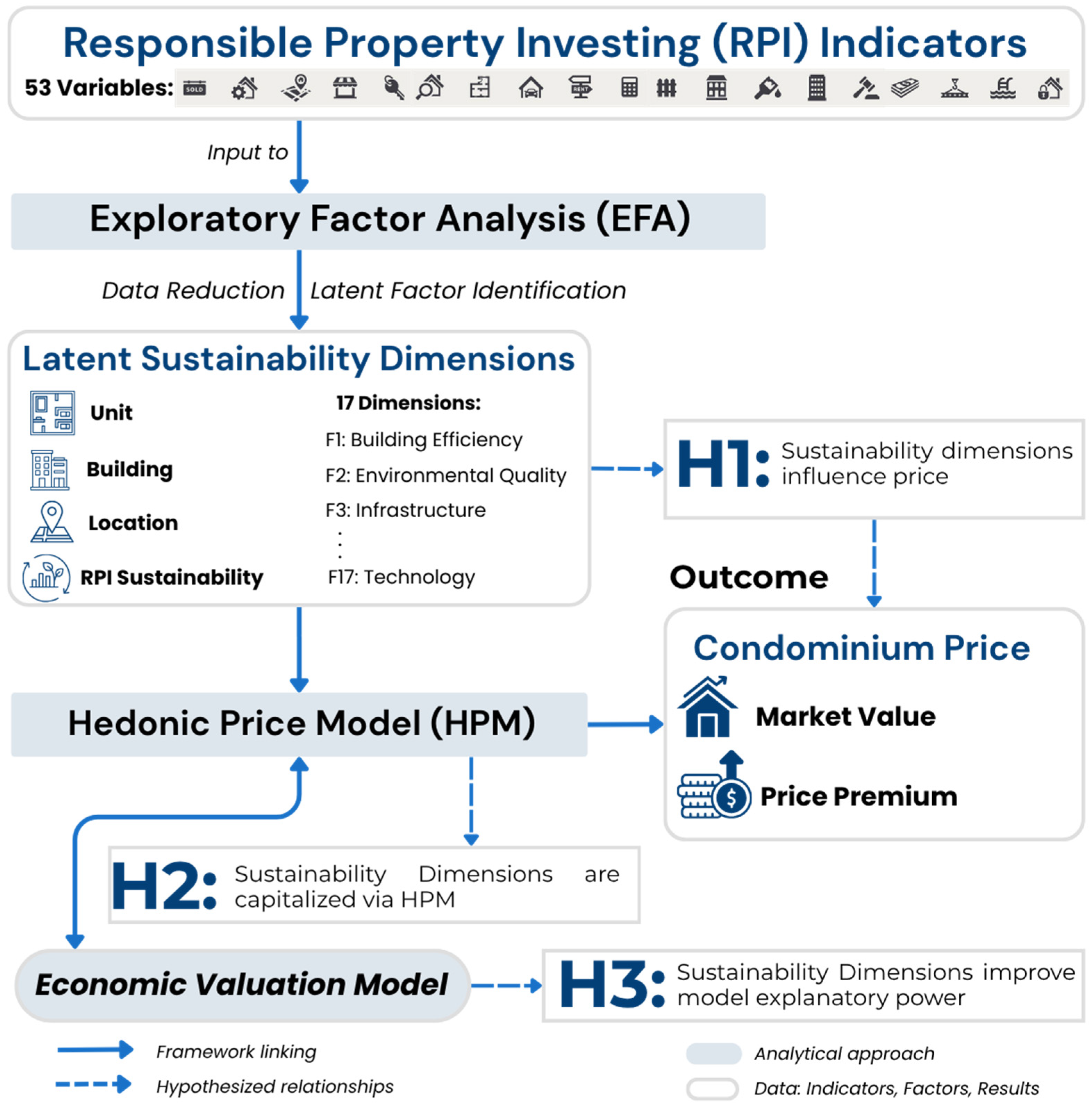
The proposed framework therefore establishes a mechanism linking sustainability attributes to economic outcomes through the formation of latent sustainability dimensions and market valuation processes. The structure of this integrated analytical framework is illustrated in Figure 1.
Figure 1.
Conceptual framework linking Responsible Property Investing (RPI) indicators to condominium price formation through latent sustainability dimensions derived by Exploratory Factor Analysis (EFA) and their incorporation into the Hedonic Price Model (HPM). The framework also illustrates the hypothesized relationships (H1–H3) regarding the influence, capitalization, and explanatory power of sustainability-related attributes.
Based on this framework, the following hypotheses are proposed:
H1:
Sustainability-related dimensions derived from RPI indicators significantly influence condominium prices.
H2:
Latent sustainability dimensions derived from RPI indicators are positively associated with price premiums.
H3:
Incorporating sustainability-related dimensions into a hedonic pricing framework improves the explanatory power of the model in predicting property values.
As illustrated in Figure 1, RPI indicators are first transformed into latent sustainability dimensions using Exploratory Factor Analysis (EFA). These dimensions represent underlying aspects of building performance and environmental quality. The framework hypothesizes that these dimensions influence condominium prices (H1) and are capitalized into property values through the Hedonic Price Model (HPM) (H2). In addition, incorporating sustainability-related dimensions into the hedonic model is expected to improve its explanatory power (H3), providing a more comprehensive understanding of price formation in emerging real estate markets.
3. Materials and Methods
3.1. Data Collection
This study adopts a quantitative research approach to examine the influence of Responsible Property Investing (RPI) attributes on condominium valuation. The dataset was constructed over a one-year observation period to capture stable market conditions.
Data on condominium units were collected from multiple sources, including Environmental Impact Assessment (EIA) reports, publicly available databases, and online real estate platforms. Specifically, resale transaction information was obtained from major property listing websites, including hipflat.com, livinginsider.com, ddproperty.com, and home.co.th. To ensure data consistency and avoid duplicate listings, each building was sampled from a single platform only, as the same unit may appear across multiple websites with varying price information.
Building-related characteristics were derived from official EIA reports submitted by developers, which provide standardized and publicly accessible information on building specifications, infrastructure, and environmental considerations. Spatial variables, including proximity to key urban amenities (e.g., airport, shopping malls, hospitals, universities, parks, and expressway access points), were calculated using Geographic Information Systems (GIS) with QGIS version 3.22 (QGIS Development Team, Open Source Geospatial Foundation, Chicago, IL, USA). Distances between locations were estimated using Google Maps (Google LLC, Mountain View, CA, USA, a web-based mapping service, https://maps.google.com, accessed on 15 March 2022) routing data to ensure realistic travel-based measurements.
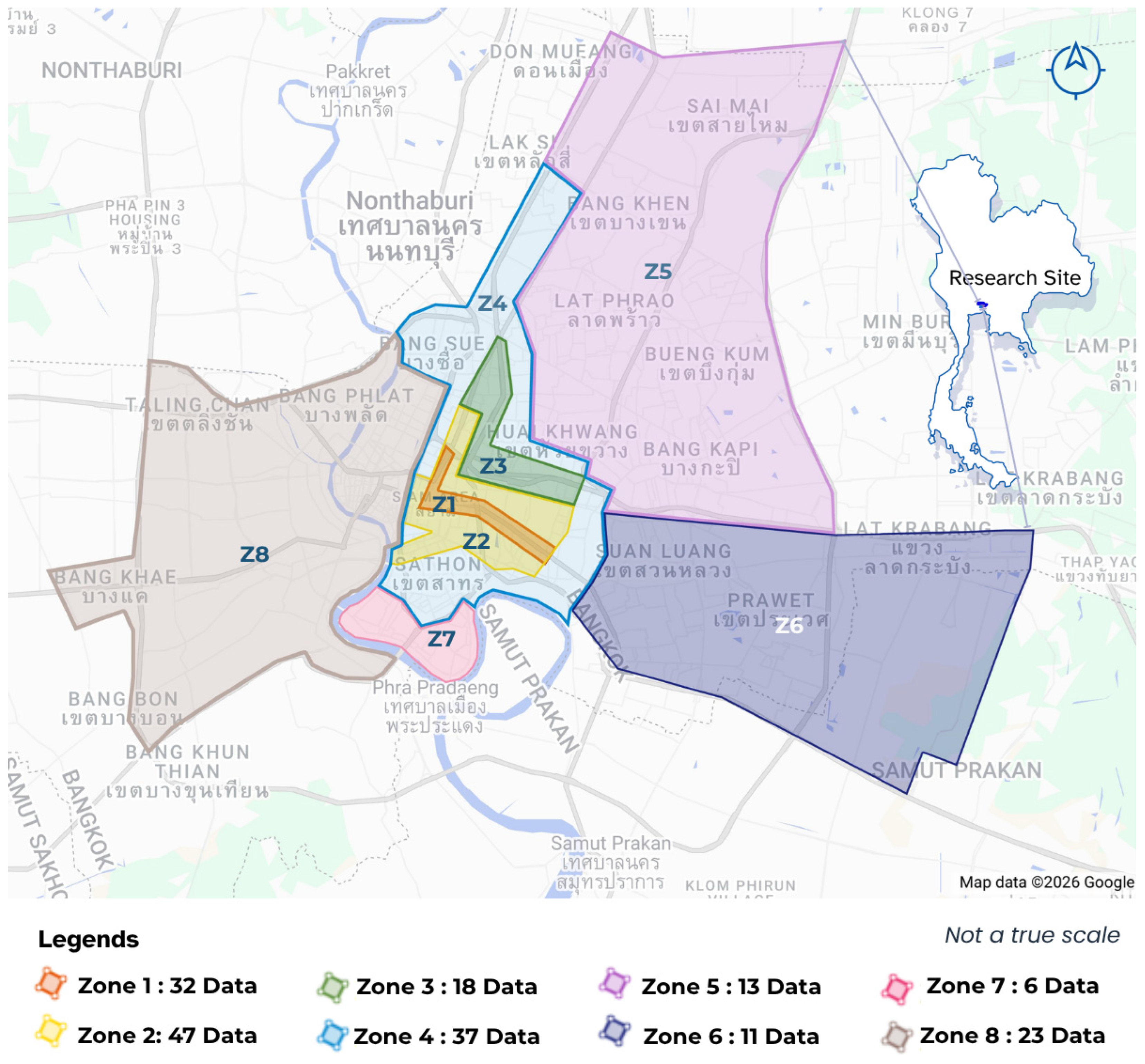
The dataset includes condominium units with prices ranging from 64,000 to 360,000 Baht per square meter. GIS tools were further employed to map and spatially model the distribution of condominium units across different urban zones. Figure 2 illustrates the spatial zoning of the study area in relation to the mass transit system.
Figure 2.
The research scope of the study’s zoning area.
To ensure that the analysis reflects actual market valuation rather than developers’ asking prices, this study focuses exclusively on completed condominium projects that were fully sold out. In addition, only buildings with publicly available EIA reports were included in the dataset to maintain data consistency and transparency. This selection criterion results in a dataset of 187 condominium units.
The inclusion of completed and occupied buildings allows the study to capture realized market values and reduces speculative bias typically associated with newly launched developments. Moreover, the variation in building age spans multiple market cycles, thereby mitigating short-term price volatility and enabling the identification of more stable and persistent determinants of property value.
The collected variables were subsequently processed and grouped into latent dimensions using Exploratory Factor Analysis (EFA), as described in the following section.
3.2. Variable Definition
This study employs a total of 53 independent variables derived from an extensive review of the literature on Responsible Property Investing (RPI) and condominium market analysis in Thailand. These variables are designed to capture the multidimensional characteristics influencing real estate value, including physical attributes, spatial accessibility, and sustainability-related performance.
The variables are categorized into four major groups: (1) unit characteristics, (2) building characteristics, (3) location characteristics, and (4) RPI sustainability characteristics, as summarized in Table 1. This classification reflects the integration of conventional hedonic pricing determinants (e.g., unit size, building features, and accessibility) with sustainability-oriented indicators aligned with RPI principles.
Table 1.
Research variable.
The unit characteristics include variables related to room configuration, interior quality, and unit-level attributes, such as ceiling height and decoration level. Building characteristics capture structural and functional aspects of the development, including building size, density, amenities, and operational efficiency. Location characteristics represent spatial accessibility and proximity to key urban facilities, derived using GIS-based measurements. Finally, RPI sustainability characteristics incorporate indicators related to resource consumption, environmental performance, land-use impact, and the adoption of sustainable technologies.
Given the relatively large number of variables and the potential for multicollinearity, a variable reduction procedure was applied prior to regression analysis. Pearson correlation analysis was first conducted within each variable group to examine linear relationships and to identify highly correlated indicators. Variables exhibiting strong pairwise correlations (r > 0.80) were carefully reviewed to avoid redundancy. The results indicated no severe multicollinearity among the retained variables, supporting their suitability for subsequent Exploratory Factor Analysis (EFA).
Subsequently, Exploratory Factor Analysis (EFA) was employed to further reduce dimensionality and extract latent dimensions representing underlying sustainability and property characteristics. This step enables the transformation of a large set of observed variables into a smaller number of interpretable factors, which are then used as explanatory variables in the Hedonic Price Model (HPM).
The variables of particular interest in this study include building scales (e.g., number of units, gross floor area), functional capacity (e.g., parking provision), and sustainability-related performance indicators, which collectively reflect both traditional market determinants and RPI-driven value components.
All statistical analyses, including correlation analysis, Exploratory Factor Analysis (EFA), and regression modeling, were performed using IBM SPSS Statistics version 26 (IBM Corp., Armonk, NY, USA).
3.3. Exploratory Factor Analysis (EFA)
Exploratory Factor Analysis (EFA) was employed to reduce the dimensionality of the dataset and to identify latent dimensions underlying the 53 observed variables related to Responsible Property Investing (RPI) and condominium characteristics.
Prior to conducting the factor analysis, the suitability of the data was assessed using the Kaiser–Meyer–Olkin (KMO) measure of sampling adequacy and Bartlett’s test of sphericity. The results indicate that the dataset is appropriate for factor analysis, with KMO values exceeding the acceptable threshold and Bartlett’s test showing statistical significance (p < 0.05).
The factor extraction was performed using Principal Component Analysis (PCA), followed by varimax rotation to achieve a clearer and more interpretable factor structure. Factors with eigenvalues greater than 1 were retained based on Kaiser’s criterion. In addition, factor loadings greater than 0.50 were considered significant for interpretation.
The EFA results reveal a set of latent factors representing key dimensions of property characteristics, including building scale, spatial accessibility, structural density, and sustainability-related performance. These factors provide a more parsimonious representation of the original variables while preserving the essential information contained in the dataset.
To further ensure robustness, variables with high cross-loadings or low communalities were carefully examined and excluded where appropriate to improve the stability of the factor structure.
The resulting factor scores were computed for each observation and subsequently used as independent variables in the Hedonic Price Model (HPM). This sequential approach enables the transformation of complex and potentially collinear variables into a set of orthogonal and interpretable factors, thereby improving the reliability and explanatory power of the regression analysis.
3.4. Hedonic Price Model (HPM)
The Hedonic Price Model (HPM) was employed to estimate the implicit value of sustainability-related attributes on condominium prices. The model is based on the premise that the observed price of a property reflects the combined value of its underlying characteristics.
In this study, the dependent variable is the unit price per square meter of the condominium. The independent variables consist of factor scores derived from the Exploratory Factor Analysis (EFA), representing latent dimensions of unit, building, location, and RPI sustainability characteristics.
To improve model interpretability and reduce heteroscedasticity, a semi-log functional form was adopted, where the dependent variable is transformed into its natural logarithm:
where ln(Price) represents the natural logarithm of the condominium price per square meter, Fk denotes the factor scores derived from EFA, labeled in this study as U1, U2, B3, B4, B5, L1, L3, L4, and R4 according to their dominant variable group and conceptual meaning, β represents the estimated coefficients, and ε is the error term.
ln(Price) = β0 + ΣβkFk + ε
The model was estimated by Ordinary Least Squares (OLS). Prior to regression analysis, Pearson correlation coefficients were calculated to examine the linear relationships among the independent variables and to identify potential multicollinearity issues. In addition, the Variance Inflation Factor (VIF) was computed for each explanatory variable. All VIF values were found to be within acceptable thresholds, indicating no serious multicollinearity concerns.
Model performance was evaluated using standard statistical indicators, including the coefficient of determination (R2), adjusted R2, and root-mean-square error (RMSE). Statistical significance of individual coefficients was assessed using t-tests.
The integration of EFA and HPM in this study provides a structured analytical framework that transforms a large set of correlated variables into a reduced number of orthogonal factors, thereby improving model stability and allowing for a more robust estimation of the economic value of RPI-related attributes in the condominium market.
4. Results and Discussion
4.1. Results of Exploratory Factor Analysis (EFA)
This section presents the empirical results of the study, integrating statistical analysis and model evaluation to address the research objectives. The analysis begins with the selection of an appropriate functional form for the hedonic model, followed by the interpretation of the regression results based on the extracted factors.
Table 2 presents the comparison of alternative functional forms of the hedonic pricing model. Among the four tested specifications, the log–log (ln–ln) model demonstrates the highest explanatory power, with an adjusted R2 of 0.729 and a statistically significant F-test (p < 0.01). This indicates that the log–log specification provides the best fit for capturing the relationship between condominium prices and the underlying property characteristics. Therefore, the ln–ln model was selected for further analysis.
Table 2.
Model comparison.
The use of a log–log functional form also allows for elasticity-based interpretation, where the estimated coefficients represent the percentage change in price associated with a one-percent change in each explanatory variable. This enhances the interpretability of the results and aligns with standard practices in real estate economics.
Following the model selection, Exploratory Factor Analysis (EFA) was applied to reduce the dimensionality of the original variables and to construct latent factors representing unit, building, location, and RPI sustainability characteristics. The resulting factors were subsequently used as inputs in the hedonic regression model, as presented in Table 3.
Table 3.
ln–ln model result from EFA.
4.2. Hedonic Price Model Results
Table 3 presents the estimation results of the log–log hedonic pricing model based on the factors derived from the Exploratory Factor Analysis (EFA). The estimated model is expressed in Equation (1), where the coefficients can be interpreted as elasticities, indicating the percentage change in condominium price associated with a one-percent change in each explanatory variable.
Prior to the regression analysis, Pearson correlation coefficients were examined to assess the linear relationships among the explanatory variables. The results indicate that no pairwise correlation exceeded the commonly accepted threshold (r > 0.80), suggesting the absence of severe multicollinearity. This finding is consistent with the Variance Inflation Factor (VIF) results and further supports the robustness of the model specification.
Overall, the model demonstrates strong explanatory performance, with statistically significant coefficients and acceptable VIF values across all variables. The use of the log–log functional form allows for direct comparison of the relative importance of each factor in influencing condominium prices.
The estimated model is expressed as Equation (1):
ln(Price) = 15.539 + 0.530U1 + 0.244U2 − 0.168B3 + 0.260B4 − 0.108B5 − 0.079L1 − 0.297L3 − 0.323L4 − 0.206R4
The results indicate that variables from all four groups—unit, building, location, and RPI characteristics—contribute to condominium price formation, although their effects vary in magnitude and direction.
4.2.1. Unit Characteristics
The unit characteristic group consists of U1 (room size and spatial quality) and U2 (unit decoration), both of which exhibit positive and statistically significant coefficients. U1 has the largest coefficient (0.530), indicating that a 1% increase in unit size and related spatial attributes leads to an approximate 0.53% increase in price. This confirms that spatial quality—such as room size, ceiling height, and layout—remains the most influential determinant in the condominium market.
Similarly, U2 (0.244) indicates that higher levels of interior decoration and associated costs contribute positively to property value, reflecting buyers’ preferences for quality finishes and livable environments.
4.2.2. Building Characteristics
The building characteristic group includes B3 (building density), B4 (building amenities), and B5 (building efficiency). B4 shows a positive coefficient (0.260), indicating that an increase in amenities—such as parking capacity and shared facilities—enhances property value.
In contrast, B3 has a negative coefficient (−0.168), suggesting that higher density, measured as the number of units per floor, reduces property value due to perceived overcrowding and reduced privacy.
B5 (−0.108) also exhibits a negative relationship, which may reflect a trade-off between functional efficiency and perceived luxury or spatial comfort within the building design.
4.2.3. Location Characteristics
All location-related variables (L1, L3, and L4) display negative coefficients, primarily due to their definition in terms of distance or accessibility. L3 (mass transit accessibility) has a relatively large negative coefficient (−0.297), indicating that reduced proximity to rail transit significantly decreases property value.
Similarly, L4 (domestic transportation accessibility) shows the strongest negative effect (−0.323), emphasizing the importance of transportation connectivity in shaping housing demand in urban areas. L1 (public amenities) has a smaller negative coefficient (−0.079), suggesting that while proximity to amenities matters, its effect is relatively weaker compared to transport accessibility.
4.2.4. RPI Sustainability Characteristics
Within the RPI group, only R4 (sustainable technology) is found to be statistically significant, with a coefficient of −0.206. This factor reflects the combined effects of electric vehicle (EV) charging infrastructure and roof thermal transfer value (RTTV).
The negative elasticity suggests that these sustainability-related features are not yet positively capitalized into property prices. In the case of EV charging infrastructure, this may be attributed to the relatively low adoption rate of electric vehicles during the study period, leading to a perception of underutilized infrastructure and additional shared costs among residents.
Conversely, the RTTV component aligns with theoretical expectations: a higher RTTVs indicate greater heat transfer into the building, resulting in higher energy consumption and reduced thermal comfort. Therefore, lower RTTVs contribute positively to property value, highlighting the importance of energy-efficient building design.
Overall, the results derived from Equation (1) indicate that traditional determinants—such as unit size, building amenities, and accessibility—remain the dominant drivers of condominium prices. However, sustainability-related attributes, particularly technology-based indicators, are beginning to influence market valuation. Their effects, however, remain transitional and context-dependent, reflecting the evolving stage of Responsible Property Investing (RPI) adoption in emerging urban markets.
4.3. Discussion
The findings of this study provide important insights into the role of Responsible Property Investing (RPI) in shaping real estate values in emerging urban markets. From a hedonic pricing perspective, the results indicate that the capitalization of sustainability-related attributes into condominium prices is heterogeneous and highly context-dependent.
Consistent with established hedonic pricing theory, traditional determinants—particularly unit characteristics, building attributes, and location accessibility—remain the dominant drivers of property value. Variables such as room size, building amenities, and transport connectivity exhibit strong and statistically significant effects, reaffirming that structural and locational attributes continue to play a central role in price formation in urban housing markets.
However, beyond these conventional factors, the results reveal a more nuanced and transitional role of sustainability-related attributes. The limited statistical significance and mixed directional effects of RPI-related variables suggest that sustainability features are not yet fully internalized into condominium prices in the Bangkok market. This finding contrasts with evidence from mature markets, particularly in Europe, where energy performance indicators are consistently capitalized into housing prices [26].
Within the hedonic pricing framework, this divergence implies that buyers’ marginal willingness to pay for sustainability attributes in emerging markets remains constrained. One key explanation is the presence of information asymmetry, where buyers may lack sufficient knowledge or trust in the long-term economic benefits of energy efficiency and environmental performance. In addition, the delayed realization of financial benefits—such as energy cost savings—reduces the immediate perceived value of sustainability features at the point of purchase.
Comparative evidence further highlights the importance of market maturity in shaping capitalization mechanisms. Copiello et al. (2023) [27] demonstrate that sustainability-related attributes generate positive price premiums when spatial heterogeneity and neighborhood effects are explicitly accounted for, particularly in markets where sustainability signals are well established and recognized by buyers. In contrast, the weak and inconsistent capitalization observed in this study suggests that sustainability attributes in the Bangkok condominium market function as latent qualities, whose economic value is only partially reflected in transaction prices.
This interpretation is supported by findings from the commercial real estate sector. Eichholtz et al. (2010) [16] show that environmentally responsive buildings tend to attract tenants with strong corporate social responsibility (CSR) orientations, indicating that the value of sustainability attributes depends not only on technical performance but also on user preferences, market segmentation, and information transparency. In residential markets where such mechanisms remain underdeveloped, sustainability attributes may therefore exhibit weaker or inconsistent price effects.
Furthermore, empirical evidence suggests that sustainability attributes are more likely to be capitalized when they generate clear and immediate economic benefits. As reported by Gholamzadehmir et al. (2025) [28], energy performance improvements tend to enhance property value when they result in measurable reductions in operating costs or are supported by regulatory incentives. In emerging markets, sustainability-related features are therefore more likely to influence prices when their benefits are directly perceivable by buyers, rather than based on long-term environmental considerations alone.
The findings of this study also provide important implications for developers, investors, and policymakers. For developers, the results suggest that integrating sustainability features into condominium projects can enhance long-term competitiveness, but their market value depends on how effectively these features are communicated and perceived by buyers. For investors, the results highlight the importance of evaluating sustainability attributes not only in terms of technical performance but also in relation to market readiness and user demand. From a policy perspective, the findings support the need for stronger regulatory frameworks, incentive mechanisms, and information disclosure systems to enhance the visibility and credibility of sustainability performance in the real estate market.
In addition, this study demonstrates the methodological contribution of integrating Exploratory Factor Analysis (EFA) with the Hedonic Price Model (HPM). By transforming a large set of correlated variables into interpretable latent dimensions, this approach improves model stability, reduces multicollinearity, and enables a more robust assessment of the economic significance of sustainability-related attributes.
Overall, this study extends hedonic price theory by providing empirical evidence that the capitalization of sustainability in real estate markets is contingent upon market maturity, institutional context, and information transparency. While RPI-related attributes are beginning to influence property valuation, their effects remain transitional, reflecting an evolving stage of market development in emerging urban contexts such as Bangkok.
5. Conclusions, Contributions, and Limitations
This study provides empirical evidence on whether and how sustainability-related attributes associated with Responsible Property Investing (RPI) are capitalized into condominium prices in an emerging real estate market. Addressing the research gap identified in the Introduction, the findings indicate that such capitalization remains partial and varies depending on market context.
Empirically, the results show that among the four RPI dimensions proposed by Dendoung et al. (2020) [29] only R4—Sustainable Technology, which captures electric vehicle (EV) charging infrastructure and roof thermal transfer value (RTTV)—is statistically associated with condominium pricing. In contrast, RPI dimensions related to resource efficiency, land-use planning, and regulatory compliance (R1–R3) do not exhibit significant price effects. This suggests that, in the Bangkok condominium market, most sustainability attributes are not yet directly internalized into property values.
The negative coefficient associated with R4 reflects the heterogeneous valuation of its underlying components. EV charging infrastructure appears to be weakly or negatively valued under current market conditions, where internal combustion vehicles remain dominant and shared infrastructure costs may outweigh perceived benefits. In contrast, RTTV exhibits a theoretically consistent relationship with property value: lower thermal transfer improves energy performance and indoor comfort, which is particularly relevant in tropical climates. These findings indicate that sustainability attributes are more likely to influence property prices when their benefits are immediate, tangible, and directly perceived by occupants, rather than when they are associated with abstract environmental or regulatory considerations [30].
From a theoretical perspective, this study contributes to the literature by demonstrating that the capitalization of sustainability attributes depends on market maturity, institutional context, and information transparency. In emerging urban markets, sustainability features may function as latent attributes whose economic value is only partially reflected in prices due to limited market awareness, weak signaling mechanisms, and delayed realization of benefits.
Methodologically, this study contributes by integrating Exploratory Factor Analysis (EFA) with the Hedonic Price Model (HPM) to link latent sustainability dimensions with market valuation. This integrated approach enables the transformation of multidimensional and interdependent sustainability indicators into economically interpretable effects, thereby providing a structured framework for assessing sustainability capitalization in complex real estate markets. In addition, the use of Environmental Impact Assessment (EIA) reports as a data source enhances transparency and replicability by providing standardized and technically detailed building-level information.
From a practical and policy perspective, the findings offer important implications for multiple stakeholders. For policymakers, the results provide insights into the extent to which sustainability-related regulations and disclosure frameworks are reflected in market behavior. For developers and investors, the findings clarify that sustainability-related investments are more likely to generate value when their benefits are clearly communicated and directly perceived by end users. More broadly, the results highlight the need for stronger policy incentives, improved information disclosure, and more consistent sustainability metrics to support the effective capitalization of environmental performance in real estate markets.
Despite these contributions, several limitations should be acknowledged. First, the study is based on cross-sectional data from a single urban context (Bangkok), which may limit generalizability. Second, the analysis relies on asking prices rather than transaction prices, which may introduce valuation bias. Third, while EFA improves model parsimony, it may obscure the individual effects of specific variables within each factor. Finally, temporal dynamics, such as changes in policy, technology adoption, and market conditions, are not explicitly captured.
Future research should extend this framework by incorporating longitudinal and transaction-based data, as well as comparative analyses across different cities and property types. As sustainability awareness increases and technologies such as EV infrastructure become more widely adopted, the valuation of sustainability-related attributes is expected to evolve. Further studies may also apply advanced modeling approaches, such as Structural Equation Modeling (SEM) or spatial econometric techniques, to capture more complex causal relationships and spatial heterogeneity.
Overall, this study demonstrates that Responsible Property Investing is not only conceptually relevant but also economically meaningful, although its effects remain uneven and context-dependent. By clarifying the conditions under which sustainability attributes are capitalized into property values, this research provides a foundation for advancing both academic inquiry and evidence-based policy in sustainable urban development.
Author Contributions
Conceptualization, K.T. and D.R.; methodology, K.T. and D.R.; software, T.D.; formal analysis, K.T., D.R. and T.D.; writing—original draft preparation, K.T., D.R., N.P. and T.K.N.A.; writing—review and editing, K.T., D.R., T.D. and T.K.N.A.; visualization, N.P. and T.K.N.A. All authors have read and agreed to the published version of the manuscript.
Funding
The research was supported by a grant from the Thammasat Postdoctoral Fellowship, Contract Number TUPD 5/2569, and Chiang Mai University partially supported it.
Data Availability Statement
Data available upon request.
Acknowledgments
During the preparation of this manuscript, the authors used ChatGPT (OpenAI, GPT-5.3) for language editing and improvement of clarity. The authors have reviewed and edited the output and take full responsibility for the content of this publication.
Conflicts of Interest
The authors declare no conflicts of interest.
Abbreviations
The following abbreviations are used in this manuscript:
| BMR | Bangkok Metropolitan Region |
| CSR | Corporate Social Responsibility |
| EFA | Exploratory Factor Analysis |
| EIA | Environmental Impact Assessment |
| ESG | Environmental, Social, and Governance |
| HPM | Hedonic Price Model |
| GIS | Geographic Information System |
| KMO | Kaiser–Meyer–Olkin (Measure of Sampling Adequacy) |
| OLS | Ordinary Least Squares |
| OSR | Open Space Ratio |
| OTTV | Overall Thermal Transfer Value |
| RMSE | Root Mean Square Error |
| RPI | Responsible Property Investing |
| RTTV | Roof Thermal Transfer Value |
| SPSS | Statistical Package for the Social Sciences |
| VIF | Variance Inflation Factor |
References
- Kats, G.H. Green Building Costs and Financial Benefits; Massachusetts Technology Collaborative: Westborough, MA, USA, 2003. [Google Scholar]
- Kingsley, B.S. Making it easy to be green: Using impact fees to encourage green building. N. Y. Univ. Law Rev. 2008, 83, 36. [Google Scholar]
- Yong, A.G.; Pearce, S. A beginner’s guide to factor analysis: Focusing on exploratory factor analysis. Tutor. Quant. Methods Psychol. 2013, 9, 79–94. [Google Scholar] [CrossRef] [Scilit]
- Patel, C.; Chugan, P.K. Measuring awareness and preferences of real estate developers for green buildings over conventional buildings. In Consumer Behaviour and Emerging Practices in Marketing; Himalaya Publishing House: Mumbai, India, 2013. [Google Scholar]
- Säynäjoki, A.; Heinonen, J.; Junnila, S. A scenario analysis of the life cycle greenhouse gas emissions of a new residential area. Environ. Res. Lett. 2012, 7, 034037. [Google Scholar] [CrossRef] [Scilit]
- Chen, Z.-M.; Ohshita, S.; Lenzen, M.; Wiedmann, T.; Jiborn, M.; Chen, B.; Lester, L.; Guan, D.; Meng, J.; Xu, S.; et al. Consumption-based greenhouse gas emissions accounting with capital stock change highlights dynamics of fast-developing countries. Nat. Commun. 2018, 9, 3581. [Google Scholar] [CrossRef] [Scilit]
- Pivo, G.; McNamara, P. Responsible property investing. Int. Real Estate Rev. 2005, 8, 15. [Google Scholar]
- Kaklauskas, A.; Zavadskas, E.K.; Dargis, R.; Bardauskiene, D. Sustainable Development of Real Estate; Technika: Vilnius, Lithuania, 2015. [Google Scholar]
- Biener, S. Climate Change Implications for Real Estate Portfolio Allocation—Business as Usual or Game Shift? Urban Land Institute: Regensburg, Germany, 2016. [Google Scholar]
- United Nations Environment Programme Finance Initiative. Sustainable Real Estate Investment: Implementing the Paris Climate Agreement; UNEP FI: Geneva, Switzerland, 2016. [Google Scholar]
- Lützkendorf, T.; Lorenz, D.P. Using an integrated performance approach in building assessment tools. Build. Res. Inf. 2006, 34, 334–356. [Google Scholar] [CrossRef] [Scilit]
- Reichardt, A.; Fuerst, F.; Rottke, N.B.; Zietz, J. Sustainable building certification and the rent premium: A panel data approach. J. Real Estate Res. 2012, 34, 99–126. [Google Scholar] [CrossRef] [Scilit]
- Rattanaprichavej, N. Possibilities and challenges of sustainable condominium development in Thailand: An analysis through the circle of blame concept. Pac. Rim Prop. Res. J. 2020, 26, 19–40. [Google Scholar] [CrossRef] [Scilit]
- Shen, L.; Zhang, Z.; Long, Z. Significant barriers to green procurement in real estate development. Resour. Conserv. Recycl. 2017, 116, 160–168. [Google Scholar] [CrossRef] [Scilit]
- Addae-Dapaah, K.; Hiang, L.K.; Sharon, N.Y.S. Sustainability of sustainable real property development. J. Sustain. Real Estate 2009, 1, 203–225. [Google Scholar] [CrossRef] [Scilit]
- Eichholtz, P.; Kok, N.; Quigley, J.M. Doing well by doing good? Green office buildings. Am. Econ. Rev. 2010, 100, 2492–2509. [Google Scholar] [CrossRef] [Scilit]
- Chegut, A.; Eichholtz, P.; Kok, N. Supply, demand and the value of green buildings. Urban Stud. 2014, 51, 22–43. [Google Scholar] [CrossRef] [Scilit]
- United Nations Economic Commission for Europe. Policy Framework for Sustainable Real Estate Markets; United Nations: Geneva, Switzerland, 2019. [Google Scholar]
- World Green Building Council. The Business Case for Green Building: A Review of the Costs and Benefits for Developers, Investors and Occupants; World Green Building Council: Toronto, ON, Canada; London, UK, 2013. [Google Scholar]
- Hair, J.F.; Black, W.C.; Babin, B.J.; Anderson, R.E. Multivariate Data Analysis, 8th ed.; Cengage: Andover, UK, 2019. [Google Scholar]
- Rosen, S. Hedonic prices and implicit markets: Product differentiation in pure competition. J. Political Econ. 1974, 82, 34–55. [Google Scholar] [CrossRef] [Scilit]
- Fuerst, F.; McAllister, P. Green Noise or Green Value? Measuring the Effects of Environmental Certification on Office Values. Real Estate Econ. 2011, 39, 45–69. [Google Scholar] [CrossRef] [Scilit]
- Rogelj, J.; Den Elzen, M.; Höhne, N.; Fransen, T.; Fekete, H.; Winkler, H.; Schaeffer, R.; Sha, F.; Riahi, K.; Meinshausen, M. Paris Agreement climate proposals need a boost to keep warming well below 2 °C. Nature 2016, 534, 631–639. [Google Scholar] [CrossRef] [Scilit]
- United Nations Environment Programme Finance Initiative (UNEP FI). Global ESG Real Estate Investment Survey Results; UNEP FI: Geneva, Switzerland, 2019; pp. 1–24. [Google Scholar]
- Pivo, G. Responsible property investment criteria developed using the Delphi method. Build. Res. Inf. 2008, 36, 20–36. [Google Scholar] [CrossRef] [Scilit]
- De Ruggiero, M.; Forestiero, G.; Manganelli, B.; Salvo, F. Buildings energy performance in a market comparison approach. Buildings 2017, 7, 16. [Google Scholar] [CrossRef] [Scilit]
- Copiello, S.; Coletto, S. The Price Premium in Green Buildings: A Spatial Autoregressive Model and a Multi-Criteria Optimization Approach. Buildings 2023, 13, 276. [Google Scholar] [CrossRef] [Scilit]
- Gholamzadehmir, M.; Pandolfi, A.M.; Del Pero, C.; Leonforte, F.; Sdino, L. Increasing the Market Value of Buildings Through Energy Retrofitting: A Comparison of Actual Retrofit Costs and Perceived Values. Buildings 2025, 15, 376. [Google Scholar] [CrossRef] [Scilit]
- Dendoung, T.; Tochaiwat, K.; Rinchumphu, D.; Dodgson, J. Technology for identifying determinants of condominiums responsible property investing in Thailand. Int. J. Build. Urban Inter. Landsc. Technol. 2020, 15, 45–64. [Google Scholar]
- Teotónio, I.; Cabral, M.; Cruz, C.O.; Silva, C.M. Decision support system for green roofs investments in residential buildings. J. Clean. Prod. 2020, 249, 119365. [Google Scholar] [CrossRef] [Scilit]

Disclaimer/Publisher’s Note: The statements, opinions and data contained in all publications are solely those of the individual author(s) and contributor(s) and not of MDPI and/or the editor(s). MDPI and/or the editor(s) disclaim responsibility for any injury to people or property resulting from any ideas, methods, instructions or products referred to in the content. |
© 2026 by the authors. Licensee MDPI, Basel, Switzerland. This article is an open access article distributed under the terms and conditions of the Creative Commons Attribution (CC BY) license.