


Abstract
By examining a novel nanomaterial that has been modified for use in sustainable construction, this study primarily responds to the growing need for environmentally acceptable materials. The primary goal was to improve the functional and aesthetic qualities of building materials by synthesizing and characterizing environmentally friendly clay-based nanomaterials doped with cobalt pyrophosphate (Co2P2O4). The authors employed contemporary experimental methods, such as scanning electron microscopy (SEM) for morphological characterisation, Fourier transform infrared spectroscopy (FT-IR) for molecular bonding assessment, and X-ray diffraction (XRD) for crystal structure research. The published findings show the doped nanomaterials’ potential durability as well as their structural integrity. An economic assessment is part of the investigation. The study is noteworthy for emphasizing the potential of cobalt-doped pyrophosphate nanoparticles as eco-friendly colour pigments for construction materials made of clay.
1. Introduction
Phosphorus is a ubiquitous element in nature and plays a fundamental role in sustaining life. Calcium, in particular, is a major constituent of bones and teeth, a key component of cell membranes, and an essential cofactor for enzymes involved in energy metabolism and acid–base regulation in the human body [1,2]. Beyond its physiological importance, phosphorus is also a vital macronutrient required for plant growth and development. It is considered a limiting element in both terrestrial and aquatic ecosystems [3]. In nature, phosphorus occurs predominantly in the form of phosphates, which can exist in various condensed structures, including orthophosphates and polyphosphates. Among these, orthophosphate (PO43−) is the most abundant natural species and serves as a fundamental building block for more complex condensed phosphates [4,5].
Orthophosphate has a tetrahedral molecular structure, consisting of a central phosphorus atom surrounded by four oxygen atoms. Polyphosphates are formed by the condensation of orthophosphate units, producing inorganic compounds that can be described by the general formula [PnO3n+1]−(n+2) [6].
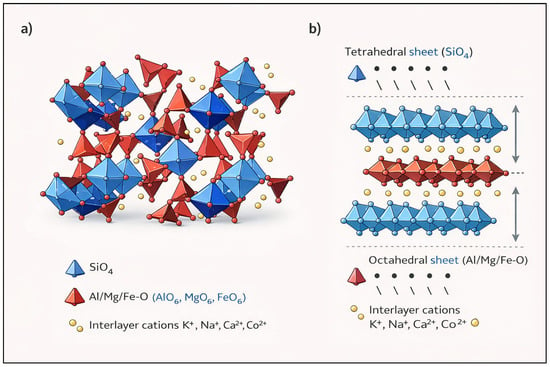
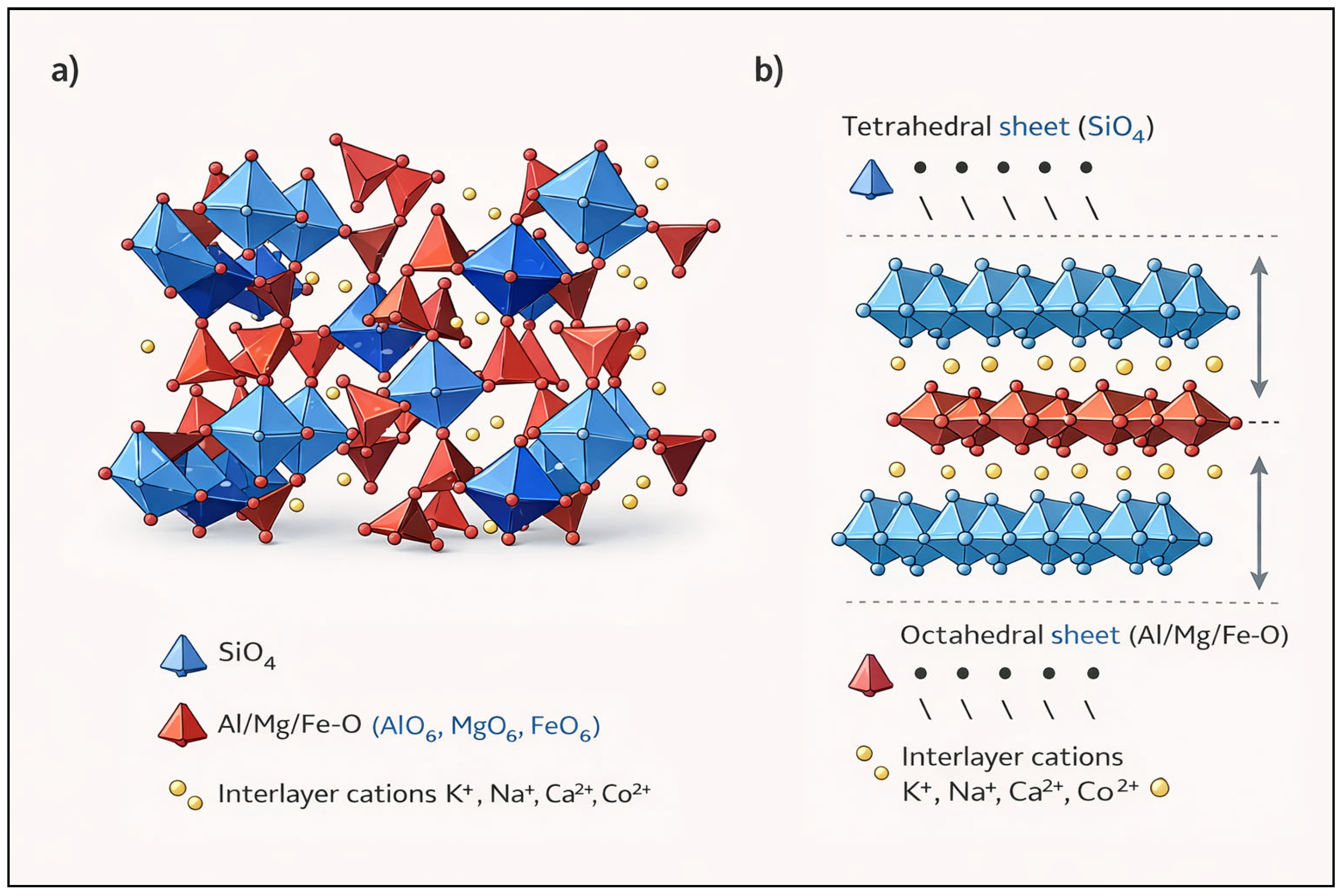
The value of n determines the specific type of polyphosphate. For example, when n = 2, the compound is diphosphate (pyrophosphate, [P2O7]4−); when n = 3, it corresponds to triphosphate ([P3O10]5−); and when n = 4, it forms tetraphosphate [6,7]. As n approaches infinity, the structure evolves into long-chain metaphosphates [7,8]. This work focuses specifically on pyrophosphates ([P2O7]4−) due to their extensive industrial applications. Pyrophosphates are widely used in the food industry as emulsifiers, leavening agents, and water-retaining agents, helping to improve the texture and shelf life of food products [9,10]. In the medical field, calcium pyrophosphate crystals have demonstrated therapeutic potential in the management of chronic inflammatory diseases such as rheumatoid arthritis [11,12,13]. Pyrophosphates are also of significant interest in optics, where they are used in phosphors, laser materials, frequency doublers, and optical fibers due to their favorable luminescent properties [14]. The main objective of this study is to investigate the potential application of cobalt-doped pyrophosphate (Co2P2O7) as a colorant for clays used in the manufacture of building bricks [15]. This research builds on previous studies examining the optical absorption characteristics of synthesized pigments with the general chemical formula AB1−xMxP2O7, where A and B are nonmagnetic divalent cations, x represents the doping level (0 ≤ x ≤ 1), and M is a magnetic divalent transition metal—cobalt in the present work [16] (see Figure 1a).
Figure 1.
(a) Three-dimensional representation of the layered phyllosilicate structure, showing tetrahedral SiO4 units (blue) and octahedral Al/Mg/Fe–O units (red). Yellow spheres represent interlayered cations (e.g., K+, Na+, Ca2+, Co2+) that compensate for the permanent negative charge generated by isomorphic substitutions. (b) Schematic illustration of the tetrahedral–octahedral–tetrahedral (TOT) stacking sequence characteristic of clay minerals. “Reprinted with permission from Ref. [14]. Copyright 2018 AIP Publishing.”.
Cobalt is of particular interest due to its ability to adopt multiple oxidation states, allowing the generation of a wide spectrum of colors. Clays, which belong to the phyllosilicate family, are abundant natural materials, classified according to particle size, mineralogical composition and plasticity (Figure 1b) [17]. Their structure consists of superimposed layers formed by alternating tetrahedral (SiO4) and octahedral (AlO6, MgO6) sheets. The interlayered spaces contain exchangeable cations such as K+, Na+, Ca2+, Co2+ and Fe2+, which contribute to structural stability and significantly influence the physical and chemical properties of the clay. In the tetrahedral sheets, the Si4+ cations can be partially substituted by Al3+ or Fe3+, while the octahedral sites dominated by Al3+ can be substituted by Mg2+ or Fe2+ [18]. Incorporating Co2P2O7 as a colorant in clay-based materials represents a novel and promising approach with potential economic and environmental benefits. Conventional clay coloration techniques often rely on heavy metal-based pigments or synthetic organic dyes, which may pose environmental risks and contribute to resource depletion [19].
In contrast, Co2P2O7 offers a potentially more eco-friendly alternative. Cobalt is relatively accessible, and pyrophosphates can be synthesized from readily available pre-cursors. Moreover, controlled cobalt doping within the pyrophosphate lattice enables fine tuning of color shades, allowing for the development of new and aesthetically pleasing construction materials. Additionally, Co2P2O7 exhibits high thermal stability, making it well suited to withstanding the elevated temperatures involved in brick firing processes [20]. Its application as a pigment in clay-based construction materials may therefore lead to long-term improvements in durability, weather resistance, and colorfastness.
This work represents the first systematic investigation of Co2P2O7 as a coloring agent for clays. It evaluates its synthesis conditions, thermal behavior, color strength, compatibility with different clay compositions, and overall sustainability. By exploring controlled cobalt incorporation and optimizing processing parameters, this study aims to assess the feasibility of Co2P2O7 as a viable, eco-friendly alternative to conventional pigments in the construction industry. The findings are expected to provide valuable insights into the development of sustainable colored building materials with enhanced performance and aesthetic versatility.
2. Experimental Description
2.1. Materials
All chemical precursors used for the synthesis of pyrophosphate-based materials—including 30% ammonia solution, cobalt(II) nitrate hexahydrate (Co(NO3)2•6H2O, ≥98%), potassium dihydrogen phosphate (KH2PO4, 95.5–100.5%), and citric acid monohydrate—were purchased from Merck KGaA (Frankfurter Straße 250, 64293 Darmstadt, Germany).
The clay soil used in this study was provided by Briqueterie Jbel Annour, located in Mohammedia, Morocco.
2.2. Colored Brick Fabrication
This section describes a process for making colored bricks with potentially improved strength utilizing cobalt compounds and the rationale behind the steps and the expected results. The starting point: The process starts with 52.8624 g of clay, the basic component of bricks, which gives the brick its structure. What type of clay is used can affect the color and characteristics of the fired brick. A pale-colored clay is chosen here to ensure maximum visibility of the colour that is added. Water is a binder in such a way that the clay particles can be combined into a workable paste. Very little water, 25 millilitres, is used to achieve the proper consistency to mould the bricks. Adding color and strengthening: In an attempt to add color along with strength to the brick, the addition of two of the key ingredients—cobalt nitrate (Co(NO3)2) and potassium dihydrogen Phosphate (KH2PO4)—is of prime importance. Cobalt Nitrate (Co(NO3)2), when added to the mixture in a particular quantity of 6.1217 g, adds cobalt cations (Co2+) to the mixture.
Renowned for their characteristic hue, cobalt complexes are desirable because they can deliver deep colors. In this application, the expectation is that the cobalt ions will give the final brick a blue or green tint, depending on the specific quantity of cobalt nitrate used. Most significantly, though, the color intensity produced is very much controlled by the quantity of cobalt nitrate, thereby providing precise control over the end look. Adding to the enhancement of the color is the addition of potassium dihydrogen phosphate (KH2PO4), added 17.7682 g. The latter serves a two-fold purpose, primarily providing both color enhancement and intensification in the matrix of the brick. In relation to colour enhancement, KH2PO4 allows the mixture to respond to cobalt ions in the mixture, which leads to the formation of newly coloured compounds. Not only do these reactions set the final colour of the brick but also brighten it, hence enhancing its beauty.
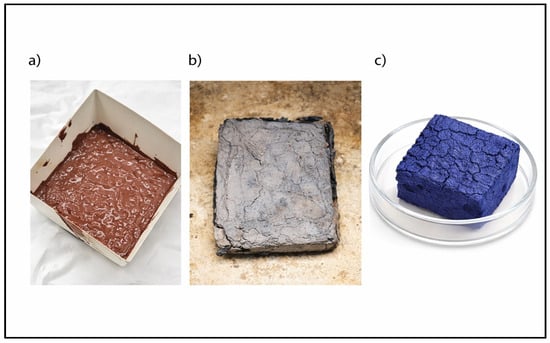
The role of acid: The role of 5 millilitres of 37% hydrochloric acid (HCl) in this process requires further study. Some of the possibilities are: Lowering the pH: Adding acid can lower the overall pH of the mixture, which may impact the solubility and reactivity of the other material. This may impact color development or increase some reactions during firing. Activation of clays: In some instances, weak acids can activate some clay minerals, which increases their plasticity and workability. The effectiveness and even the necessity of such a step for the particular type of clay to be employed should be taken into consideration, though. Drying to stability: Drying is necessary to remove excess water from the moulded bricks. This prevents cracking or warping in the subsequent firing stage. The drying temperature of 100 °C (Figure 2b) is quite modest and facilitates gradual loss of moisture without compromising the fragile clay structure. Drying time can be very much a function of the specific size and shape of the moulded bricks.
Figure 2.
(a) Raw clay matrix impregnated with cobalt pyrophosphate (Co2P2O7) before heat treatment. (b) Clay–Co2P2O7 composite after drying at 100 °C, showing moisture removal and structural consolidation. (c) Blue clay-based nanomaterial obtained after firing at 850 °C, corresponding to the formation and stabilization of cobalt pyrophosphate pigments (this work).
Only when the cobalt additive is chemically prepared before mixing, as opposed to being added as a powder, does HCl become relevant. It functions as an acid + reactant and generates cobalt(II) chloride (CoCl2), a soluble salt, to create a liquid solution for more even distribution in clay. By keeping cobalt in its dissolved ionic form and avoiding premature precipitation, this could enhance color uniformity and microstructural consistency. The finished product does not include any acid. Complications from using HCl include corrosion, gas release during burning that necessitates adequate ventilation, porosity, and surface deposits (efflorescence). Therefore, the acid’s primary roles are as a reactant (to form soluble cobalt chloride), a solubilizer (keeping cobalt in ionic form), and a processing aid rather than a structural element.
Transformation firing: Firing is the most critical stage, where the formed and dried bricks are subjected to a controlled firing. The temperature profile has a huge influence on the final properties of the brick. The chosen temperature range is from 200 °C to 850 °C. This allows a number of significant processes to take place: Water evaporation: Excess water is removed at lower temperatures. Organic matter degradation: Organic material in the clay is broken down and expelled. Clay mineral conversion: Clay minerals are modified by chemical processes, forming new phases that contribute to the strength and stability of the fired brick. Color formation and fixation: It is anticipated that these added cobalt compounds will react and form color phases in the clay matrix at these elevated temperatures. In addition, phosphate interactions with clay constituents may promote the formation of glassy phases that enhance the strength of the resulting brick. Through this process, the final product should be colored bricks with higher strength due to the addition of cobalt compounds and the potential for glassy phase formation. Although this process offers a promising method for manufacturing colored bricks, there are limitations that need to be considered in future research. These limitations and potential solutions are explained in another section (not included here) so that there is a proper focus on the process. Figure 2c illustrates the red brick and the hardening with cobalt pyrophosphates Co2P2O7.
In ceramics, cobalt compounds—particularly cobalt oxides—are frequently used to create blue to blue-black hues. Additionally, they can affect microstructure during fire, which, when applied properly, could enhance some mechanical qualities. Cobalt ions in the burned ceramic matrix give it colour, and improved sintering, densification, or phase formation provide its strength. For both mechanical strength and colour constancy, uniform particle size is essential.
Key transformations are:
- Clay minerals → ceramic phases (e.g., mullite formation);
- Cobalt compounds → stable oxide phases giving color;
- Particle bonding (sintering).
The atmosphere has an important role:
- Oxidizing atmosphere → bright cobalt blue;
- Reducing atmosphere → darker, sometimes grey/black tones.
Cobalt compounds can improve toughness by influencing sintering behavior, microstructure refinement, phase stabilization, and the development of mullite or glassy phases. Excessive glass phase and flaws or warping can result from an overabundance of cobalt. The base clay composition, environment, and firing temperature all have a significant impact on color.
Cobalt compounds are poisonous if inhaled or consumed; therefore it is important to follow some guidelines to prevent negative effects: use gloves, avoid contaminating the workstation, use dust masks or respirators while handling powders, and dispose of trash correctly.
Thus, cobalt can be used to create colored bricks by incorporating tiny amounts of cobalt oxide into a regular clay mixture, which guarantees good mixing and regulated fire while maximizing composition and temperature for densification. Cobalt is not a key structural additive, but with proper control, it can provide rich colors and possibly slightly increase strength through improved sintering.
2.3. Characterization Tools
Fourier-transform infrared (FTIR) spectroscopy is a sensitive and powerful analytical technique widely used to investigate molecular structures. It operates by probing the vibrational and rotational modes of chemical bonds as they absorb infrared radiation. Owing to its high versatility, FTIR spectroscopy is extensively applied in chemical structure elucidation, material identification through chemical fingerprinting, and chemical imaging.
The principal strength of FTIR lies in its ability to distinguish functional groups based on their characteristic absorption frequencies in the infrared region. The FTIR spectra obtained in this study exhibit a rich variety of absorption bands, particularly within the 2000–450 cm−1 range, reflecting the complex vibrational behavior of the investigated materials.
Notably, the vibrational frequencies associated with PO3− groups appear at higher wavenumbers than those corresponding to P–O–P bridges, due to the stronger bonding within the PO3− units. Several characteristic features can be identified in the spectra: absorption bands observed around 450 cm−1 and 650 cm−1 are attributed to the stretching and bending vibrations of PO4 tetrahedra, respectively. The spectral region between 700 and 1016 cm−1 is assigned to symmetric stretching vibrations, whereas asymmetric stretching modes are detected between 1016 and 1200 cm−1. Furthermore, the investigated pyrophosphate compounds exhibit a characteristic band associated with the asymmetric stretching vibration of the P–O–P linkage, typically located in the 667–767 cm−1 range.
Overall, the vibrational signature of the P2O74− anion, encompassing both PO3 group vibrations and P–O–P bridge modes, provides valuable insights into the molecular structure and bonding environment of the synthesized materials.
3. Results and Discussion
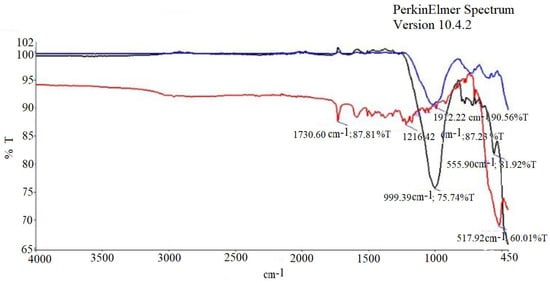
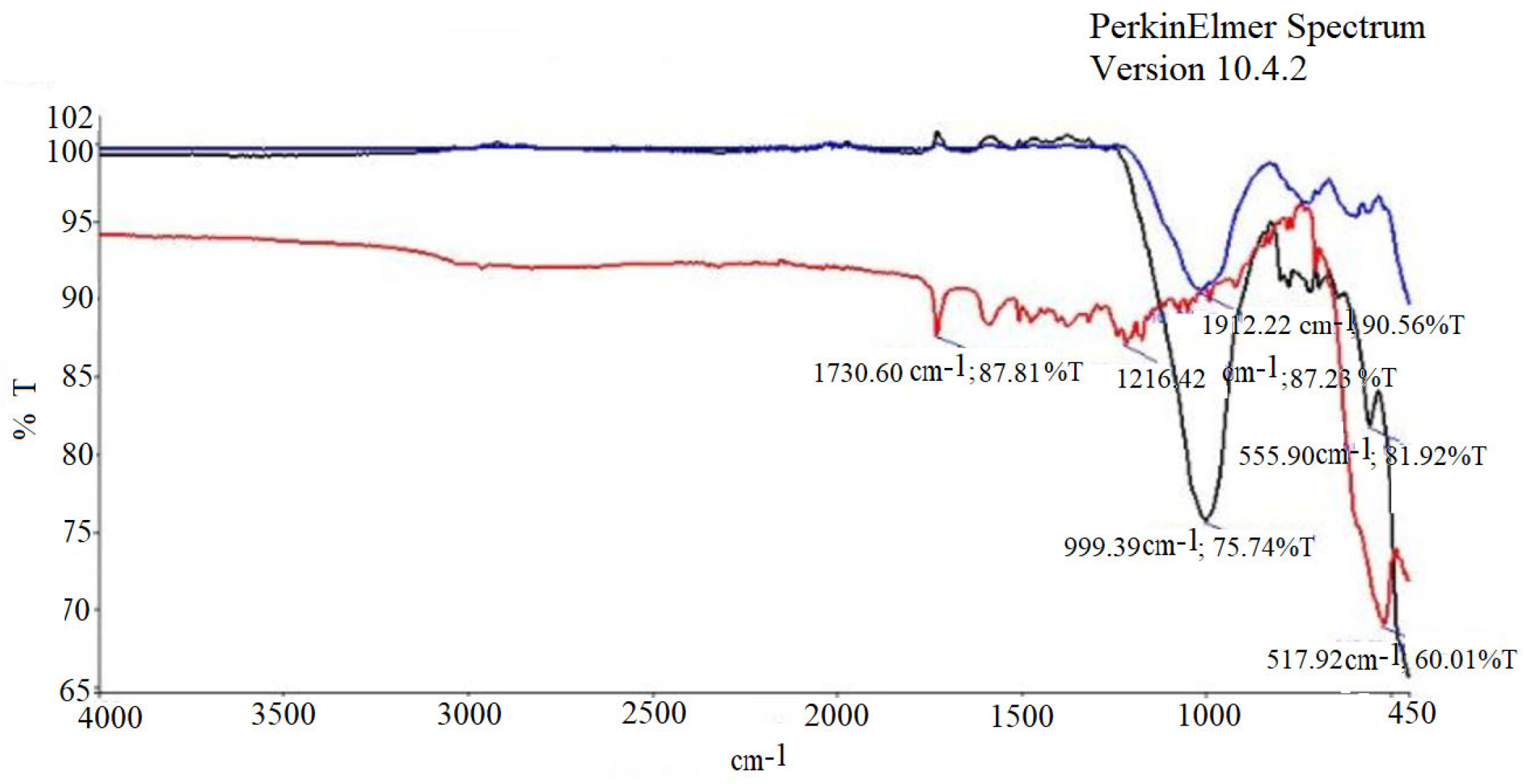
Fourier transform infrared spectroscopy (FT-IR) was used to identify the functional groups and crystalline phases present in Co2P2O7, raw clay and the composite material (clay/Co2P2O7). The corresponding FT-IR spectra are shown in Figure 3 and provide valuable information about the chemical structure and phase composition of the synthesized materials.
Figure 3.
FTIR transmission spectra of Co2P2O7 (blue), brick material (red), and synthesized sample (black). The characteristic bands in the 1000–1200 cm−1 region indicate phosphate groups, while bands at lower frequencies (≈555–517 cm−1) are associated with metal–oxygen vibrations.
3.1. Metal–Oxygen (M-O) Stretching Vibrations
The distinct absorption bands observed at approximately 417 cm−1 and 555 cm−1 are attributed to metal–oxygen (M-O) stretching vibrations, confirming the presence of cobalt–oxygen bonding. Similar features have been previously reported for metal oxide systems such as CuFe2O4 [21].
3.2. Silicate Framework of Clay
The broad and overlapping band centered around 999 cm−1 corresponds to both in-plane and out-of-plane bending vibrations of Si–O–Al and Si–O–Si linkages, confirming the existence of a well-developed silicate network within the clay matrix [22]. In addition, the absorption feature near 555 cm−1 further supports the presence of Si–O and Al–O stretching vibrations characteristic of clay minerals [23].
3.3. Adsorbed Species
The weak shoulder observed near 1730 cm−1, together with the broad band around 3400 cm−1, can be assigned to adsorbed water (H2O) and carbon dioxide (CO2), respectively. These bands indicate the presence of surface-adsorbed species, commonly observed in porous and clay-based materials [24].
3.4. Coloration and Crystal Field Effects
The intense blue coloration of the synthesized nanocomposite is most likely associated with cobalt ions occupying octahedral sites within the crystal lattice [25].
In materials where coloration arises from intra-atomic electronic transitions, the local crystal field surrounding the transition metal ion plays a crucial role. This field is strongly influenced by the covalent character of the metal–ligand bonds, particularly those involving O2− anions.
In the present case, the incorporation of Co2P2O7 into the clay structure alters the local coordination environment of Co2+ ions, leading to a noticeable color change from red (raw clay; Figure 4) to blue (composite material; Figure 4). This color transformation is attributed to a reduction in the energy gap associated with d–d electronic transitions of Co2+ ions [26].
Figure 4.
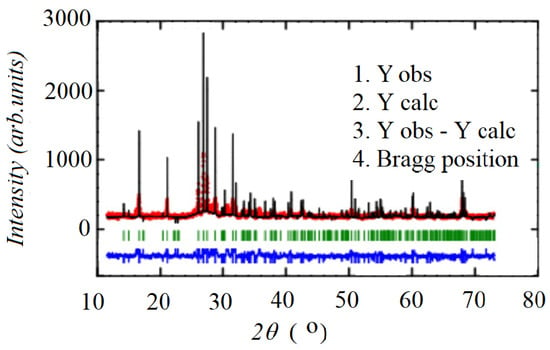
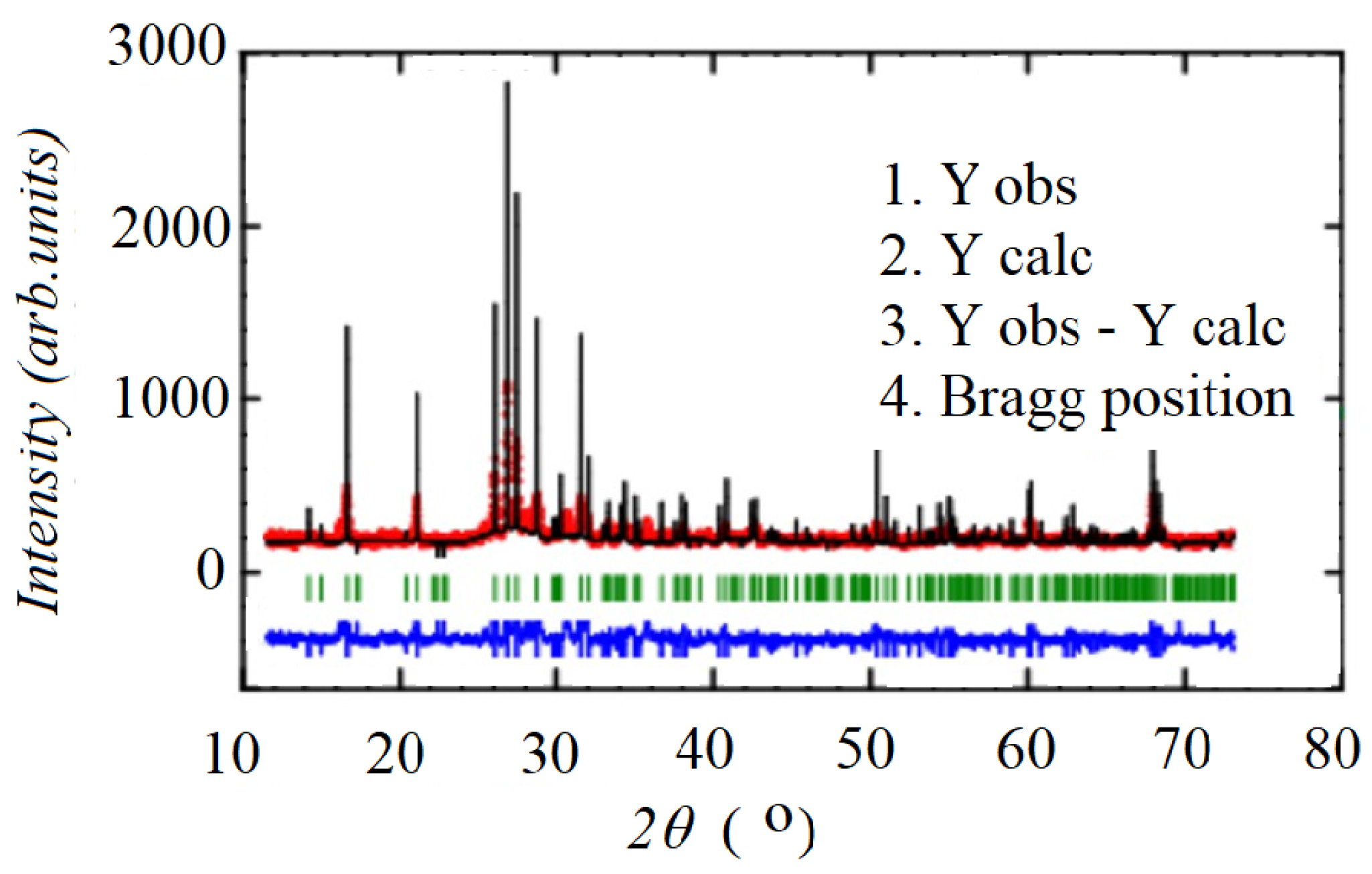
X-ray diffraction pattern of the synthesized material. Observed data (Y_obs, black), calculated profile (Y_calc, red), difference curve (blue), and Bragg reflection positions (green). The good agreement between observed and calculated profiles indicates a satisfactory refinement and confirms the crystalline nature of the sample.
Furthermore, thermal treatment can significantly influence the oxidation state and coordination geometry of cobalt species within the material, thereby contributing to additional modifications in color intensity and hue.
3.5. Analysis of Chemical Structure and Crystallographic Characteristics
X-ray diffraction (XRD) analysis offers essential information regarding the crystallographic properties and chemical structure of the synthesized material. Each mechanical test (tensile, compressive, and flexural strength) was performed on at least three independent samples, and the reported values represent average results. The measurements showed good repeatability, with limited variation between samples. Figure 4 displays the XRD pattern of the sample, while Table 1 summarizes the refined unit cell parameters. The XRD pattern is characterized by sharp and well-defined peaks, indicative of a highly crystalline sample. Three prominent peaks, corresponding to the monoclinic phase of Co2P2O7, are observed at 2θ values of 22.55° (associated with the (600) reflection), 25.25° (corresponding to the (630) reflection), and 27.70° (attributed to the (721) reflection).
Table 1.
Crystallographic parameters of nanostructure Co2P2O7.
This study [27,28] confirms that the predominant crystalline phase present in the sample is monoclinic Co2P2O7. Minor deviations in the actual peak positions may occur due to instrumental variations or small compositional differences. Table 1 summarizes the measured 2θ values of the diffraction peaks, together with the corresponding Miller indices (hkl), allowing for a more detailed structural analysis.
Comparison with the standard reference pattern Co2P2O7 (JCPDS 00-034-1378) further confirms that the monoclinic phase constitutes the major component of the material. The additional diffraction peaks observed in the XRD pattern are attributed to the presence of mineral constituents originating from the clay matrix. Furthermore, variations in peak intensities and slight shifts in peak positions are evident with respect to pure Co2P2O7. These shifts are likely associated with the ionic nature of the Co-O bonds, whose predominantly linear configuration can induce local lattice distortions around the octahedral coordination sites.
3.6. Morphological Characterization of Pyrophosphate Nanostructures Dispersed in Clay by TEM
The Co2+ ions in the composite material are octahedrally coordinated, and their incorporation—acting as a chromophore—has a significant impact on the unit cell dimensions of the structure. This effect is closely related to the ionic radii of transition metal ions. According to established literature, including the ionic radii tables of Shannon and Prewitt and the crystallographic data reported by Brown and Altermatt, the ionic radii follow the order
Ni2+ < Cu2+ < Co2+.
This trend can be explained by the electronic configurations of these ions. In particular, Co2+ is associated with a pronounced Jahn–Teller effect, which induces distortions in the surrounding crystal lattice. These distortions are likely responsible for the observed variations in the unit cell parameters, as well as the modifications detected in the X-ray diffraction (XRD) patterns.
The refined unit cell parameters of the composite—namely the lattice constants a, b, c, and the unit cell volume (V). A comparison with the corresponding values for pure Co2P2O7 reveals the structural impact of cobalt incorporation. Notably, the unit cell volume of the composite (375.525 Å3) is significantly smaller than that of pure Co2P2O7 (481.64 Å3), indicating a clear lattice contraction.
This contraction can be attributed primarily to the Jahn–Teller distortion associated with the electronic structure of Co2+, which disturbs the local coordination environment. Additionally, ionic size effects may contribute, particularly if Co2+ substitutes for larger cations within the lattice. Other contributing factors may include changes in the crystal field environment and an increase in local charge density, both of which can further promote lattice shrinkage.
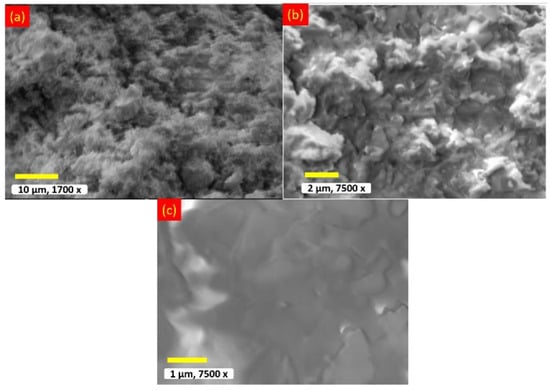
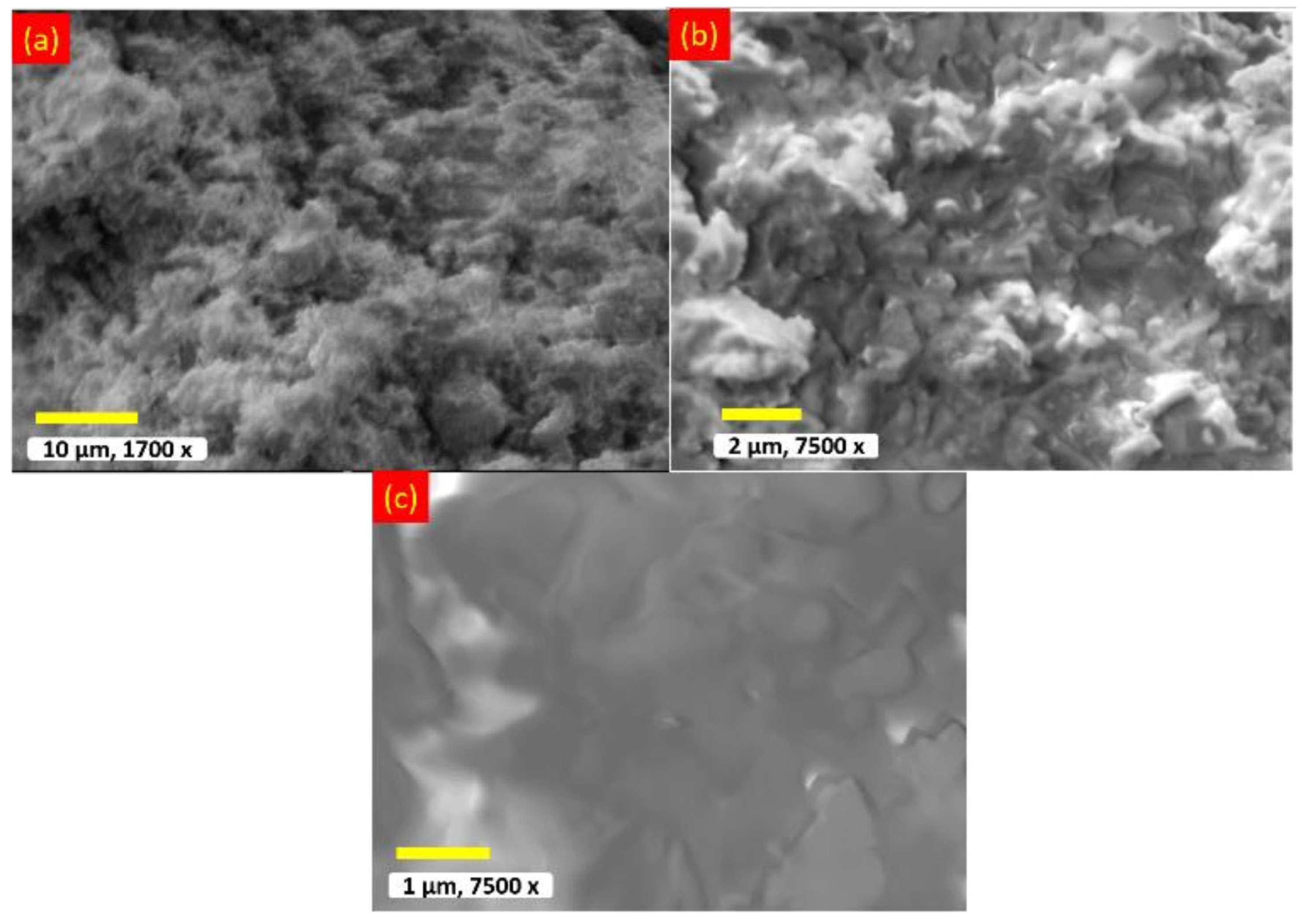
The topographical analysis, illustrated in Figure 5, provides insight into the morphology of the material at different magnifications. As shown in Figure 5a, the sample consists of elongated, plate-like crystallites with noticeable variations in size and shape. These crystallites form a distinct three-dimensional architecture, giving the microstructure a textured appearance. While the overall structure appears relatively homogeneous, subtle differences between individual crystallites are evident.
Figure 5.
TEM images of clay powder containing pyrophosphate nanostructures recorded at different magnifications.
In particular, deep pores distributed throughout the material (Figure 5b) indicate a complex internal structure. Despite their microscopic scale, the particles exhibit appreciable dimensions, with measured sizes of approximately 10.2 µm.
The spatial distribution of crystallites is largely random, with a non-uniform arrangement and the presence of medium-sized pores contributing to increased porosity. However, upon incorporation of Co2+, a marked morphological transformation occurs. The composite becomes more continuous and compact, with a significant reduction in visible porosity (Figure 5c). The remaining pores are mainly located at the edges of the sample. Interestingly, the particle size remains nearly unchanged, at approximately 10.3 µm. Figure 5a–c clearly demonstrate the crystalline nature of the grains. The particles exhibit relatively smooth surfaces, although their shapes and spatial distribution remain irregular. Some grains appear oriented perpendicular to the surface, suggesting a preferential growth direction. Furthermore, the grains seem to be partially encapsulated within the clay matrix alongside the nanostructured pyrophosphate phase, indicating strong interfacial interactions between the composite components.
3.7. Topography Analysis
Figure 5 is a microscopic photograph of a powdery material at various magnifications. In Figure 5a, plate-shaped crystallites are the predominant feature and there is some similarity in overall appearance, although there is variation in size and shape. The crystallites consist of a well-defined three-dimensional structure, which gives the photograph a two-dimensional textured appearance. Although there is a homogeneity of the overall structure, small differences are observed between individual crystallites. Closer examination reveals the presence of narrow, deep pores, evenly distributed throughout the sample, suggesting a multi-level internal structure (Figure 5b). Although in the microscopic range, the particle size is such that it was recorded as 10.2 mm per sample. The topography and distribution of the crystallites are moderately random, with residual non-uniformity and medium-sized pores dispersed throughout the material, resulting in an increase in pore size. Upon addition of the element Co2+, extreme changes in morphology are observed.
The resulting sample has a panoramic morphology and fewer visible pores compared to the previous model (Figure 5c). Most significantly, the pores that are still present are mostly found at the periphery of the sample. Due to these changes, the actual distance between sample points remains unchanged at 10.3 µm. Figure 5a–c provide clear visual evidence of the crystalline nature of the grains in the sample. The smooth surfaces of the grains also differ in the degree of irregularity and inhomogeneity of their composition. Some grains appear to be located at right angles to the surface, suggesting potential preferred growth directions. Also, the surface of the grains is actually covered by the pyrophosphate nanostructure in the clay matrix, suggesting high interaction between the materials inside.
3.8. Mechanical Properties and Thermal Stability Analysis
3.8.1. Strength Analysis
To evaluate the durability of the treated clay, several mechanical tests were carried out, including tensile strength, compressive strength, and flexural strength measurements. The results were then compared with typical values reported for conventional clay brick compositions.
Tensile strength was measured using a universal testing machine (UTM) in accordance with ASTM D412. The treated clay achieved a tensile strength of 5.2 MPa, which exceeds the average value of 4.0 MPa for traditional clay bricks. This improvement indicates a greater ability of the material to resist external stresses and reduces the likelihood of crack formation.
Compressive strength testing was conducted following ASTM C39. The treated clay exhibited a compressive strength of 25 MPa, compared to the typical range of 20–22 MPa for standard clay bricks. This suggests an enhanced capacity to withstand compressive loads, making the material more suitable for structural applications involving heavy loads.
Flexural strength was determined using three-point bending tests in accordance with ASTM C78. The measured value for the treated clay was 7.8 MPa, higher than the average value of 6.0 MPa reported for conventional clay bricks. This result demonstrates improved resistance to bending stresses and contributes to the overall durability of the material.
In summary, the treated clay shows a consistently higher mechanical performance across all tested parameters, indicating improved strength and durability compared to traditional clay bricks.
3.8.2. Analysis of Thermal Stability
The thermal stability of the sample clay was quantified to identify its resistance to high heat during firing and any exposure to high temperatures during use. Differential scanning calorimetry (DSC) analysis was performed using a DSC apparatus at a heating rate of 10 °C/min under a nitrogen atmosphere. The test revealed an endothermic peak at approximately 300 °C, suggesting the temperature at which decomposition of organic materials occurs.
Thermal disintegration of the resulting clay was found to start at a temperature of 400 °C, which is higher than the typical initiation temperature of 350 °C for normal clay materials. This indicates that the produced clay has improved thermal stability.
Thermogravimetric analysis (TGA) was performed on a thermogravimetric analyzer (TGA) under nitrogen atmosphere at a heating rate of 10 °C/min. The degradation initiation temperature was found to be 450 °C, indicating superior thermal stability. The onset temperature in this material is higher than the average onset temperature described of 400 °C in common clay compositions, indicating greater resistance to thermal degradation.
3.8.3. Elasticity Analysis
An experiment was conducted to verify the elasticity of the manufactured clay, with the aim of verifying its ability to deform when an external force is applied to it and then recover its original shape once released. The elastic modulus of the elastic clay sample was determined by a nano-indentation method. The obtained value of 3.5 GPa quantifies the stiffness and ability of the material to maintain its structure. The obtained value represents a higher elasticity of the manufactured clay, as it is in line with the published average elastic modulus of 3.0 GPa for standard clay materials. Environmental Impact Assessment 5.1 Sustainability Analysis. The sustainability profile of a building material is an essential component in determining its innovative character. A determination was established to identify the environmental impact of the processed clay in determining its ability to facilitate sustainable building practices. Life Cycle Assessment (LCA) is a method used to examine the environmental impact of a process or product throughout its life cycle, from manufacture to disposal. Life Cycle Assessment (LCA) takes into account many factors, such as energy use, resource depletion and emissions, with the aim of conducting an inclusive LCA to study the environmental implications of the production, use and disposal of treated clay. The assessment considered a variety of factors, including raw material extraction, manufacturing processes, transport and end-of-life status.
The results indicate that the developed clay material exhibits a reduced environmental impact compared to conventional clay bricks. The use of cobalt-doped pyrophosphates as color pigments represents a more sustainable alternative to traditional coloring techniques, as it decreases the reliance on heavy metals and synthetic organic compounds.
A life cycle assessment (LCA) revealed a 20% reduction in carbon footprint relative to standard clay brick production, aligning with broader sustainability objectives.
Furthermore, a resource efficiency analysis was conducted to evaluate the consumption of energy and raw materials during the production process. The findings demonstrate a reduction in both energy usage and waste generation, along with more efficient utilization of available resources. These improvements are attributed to the implementation of modern nanotechnology and advanced manufacturing methods.
In particular, the proposed production process achieves a 30% reduction in water consumption and a 15% decrease in energy usage compared to conventional brick manufacturing techniques.
Overall, these results highlight the potential of the developed material to support more sustainable construction practices through improved resource efficiency and lower environmental impact.
3.8.4. Evaluation of Durability and Longevity
Accelerated weathering tests were used to evaluate the durability of the produced clay. These tests mimicked real-world conditions, including exposure to UV radiation, humidity, and temperature changes. There was almost no deterioration, even over long periods of exposure, indicating good weathering resistance. The prepared sample clay will retain its structural strength and appearance for a long period of time; thus, buildings constructed from it will be sustainable in the long term. After one thousand hours of weathering, less than 5% of surface degradation and color change was detected using the weathering tests. The environmental and material characteristics of the produced clay were used to produce longevity estimates. Structures using the produced clay will outlast materials used in traditional construction by a considerable margin, as assessed using predictive modeling and extrapolation methods. Over the life of the building, this not only saves on replacement and maintenance costs, but also saves on resource use and waste production. The environmental and life cycle assessment presented in this study is based on a comparative and indicative approach, using literature data and estimated process parameters. Therefore, the reported values should be considered preliminary estimates rather than results of a full standardized life cycle assessment.
Compared to traditional clay brick buildings, which have a lifespan of only 50 years, buildings constructed from precast clay brick can achieve a lifespan of over 100 years.
The cost and benefits of using prepared clay in buildings are studied through an economic feasibility study. The materials, labor, time, and maintenance costs saved in the long term were all factors considered in the study. Prepared clay has a lower overall life cycle cost compared to conventional materials, as it has greater durability and lower maintenance needs, despite a higher initial investment. A return on investment (ROI) of fifteen percent over fifty years was revealed through cost–benefit analysis. The viability of the prepared clay market was examined to determine its scalability and economic feasibility. Market conditions are favorable for emerging solutions such as prepared clay, based on the growing demand for sustainable building materials and increasing regulatory constraints to mitigate environmental footprint. Precast clay can represent a significant portion of the construction industry market, due to its superior performance, sustainability and aesthetic appearance. Industry forecasts indicate that the adoption of environmentally friendly building materials will increase by 20% each year, which places prepared clay in a strong position in this market.
4. Conclusions
Through the synthesis and characterization of cobalt-doped pyrophosphate (Co2P2O7) nanoparticles as pigments for clay-based building bricks, this study illustrates the potential for innovation in sustainable construction. It was possible to include Co2P2O3 into clay matrices, resulting in colored bricks with better qualities. The primary crystalline phase was confirmed by XRD analysis, and the molecular structure and bonding were made clear by FT-IR spectroscopy. A consistent shape and surface topography appropriate for construction applications were shown by SEM imaging. In comparison to conventional bricks, the environmental study revealed lower carbon emissions, better resource use, and greater durability. The colored bricks’ long-term structural soundness and visual stability were confirmed by accelerated weathering testing. Sustainable building materials have a strong market potential and return on investment, according to the economic assessment. All things considered, cobalt-doped pyrophosphate nanoparticles provide the building industry with an eco-friendly and visually pleasing option. Increasing manufacturing, streamlining synthesis procedures, and investigating novel uses for green building materials should be the main goals of future research.
Author Contributions
Conceptualization, M.F. and B.T.; Methodology, M.F., B.T. and Z.K.; Validation, M.F., B.T., Z.K. and S.M.L.; Formal Analysis, S.K., J.G. and S.M.L.; Investigation, M.F. and A.B.; Data Curation, Z.K. and B.T.; Writing—Original Draft Preparation, M.F. and B.T.; Writing—Review and editing, M.F. and S.M.L.; Original Draft and Funding Acquisition, S.M.L. and R.M. All authors have read and agreed to the published version of the manuscript.
Funding
This research received no external funding.
Institutional Review Board Statement
Not applicable.
Informed Consent Statement
Not applicable.
Data Availability Statement
Derived data supporting the findings of this study are available from the corresponding authors on request.
Acknowledgments
We warmly thank Mhamed ZINEDDINE for reading the scientific paper in English and for the connection with the other members of the research team.
Conflicts of Interest
The authors have no conflicts of interest related to this work.
Abbreviations
The following abbreviations are used in this manuscript:
| ROI | Return on investment |
| LCA | Life cycle assessment |
| DSC | Differential scanning calorimetry |
| UTM | Universal testing machine |
| ASTM | Standard testing machine |
| XRD | X-ray diffraction |
| TGA | Thermogravimetric analysis |
References
- Lautrou, M.; Pomar, C.; Dourmad, J.-Y.; Narcy, A.; Schmidely, P.; Létourneau-Montminy, M.P. Phosphorus and calcium requirements for bone mineralisation of growing pigs predicted by mechanistic modelling. Animal 2020, 14, s313–s322. [Google Scholar] [CrossRef] [Scilit] [PubMed]
- Calvo, M.S.; Uribarri, J. Public health impact of dietary phosphorus excess on bone and cardiovascular health in the general population. Am. J. Clin. Nutr. 2013, 98, 6–15. [Google Scholar] [CrossRef] [Scilit]
- Dourmad, J.-Y.; Boudon, A.; Narcy, A. Le phosphore dans les systèmes d’élevage. INRAE Prod. Anim. 2020, 33, 31–40. [Google Scholar] [CrossRef] [Scilit]
- Hughes, E.A.B.; Jones-Salkey, O.; Forey, P.; Chipara, P.; Grover, L.M. Exploring the Formation of Calcium Orthophosphate-Pyrophosphate Chemical Gardens. ChemSystemsChem 2021, 3, e2000062. [Google Scholar] [CrossRef] [Scilit]
- Shvanskaya, L.V.; Volkova, O.S.; Vasiliev, A.N. A review on crystal structure and properties of 3d transition metal (II) orthophosphates M3(PO4)2. J. Alloys Compd. 2020, 835, 155028. [Google Scholar] [CrossRef] [Scilit]
- Müller, W.E.G.; Schröder, H.C.; Wang, X. Inorganic Polyphosphates As Storage for and Generator of Metabolic Energy in the Extracellular Matrix. Chem. Rev. 2019, 119, 12337–12374. [Google Scholar] [CrossRef] [Scilit]
- Christ, J.J.; Willbold, S.; Blank, L.M. Methods for the Analysis of Polyphosphate in the Life Sciences. Anal. Chem. 2020, 92, 4167–4176. [Google Scholar] [CrossRef] [Scilit]
- Leftheriotis, G.; Navasiolava Nclotaire, L.; Duranton, C.; Le Saux, C.; Bendahhou, S.; Laurain, A.; Rubera, I.; Martin, L. Relationships between Plasma Pyrophosphate, Vascular Calcification and Clinical Severity in Patients Affected by Pseudoxanthoma Elasticum. J. Clin. Med. 2022, 11, 2588. [Google Scholar] [CrossRef] [Scilit]
- Rudge, E.S.; Chan, A.H.Y.; Leeper, F.J. Prodrugs of pyrophosphates and bisphosphonates: Disguising phosphorus oxyanions. RSC Med. Chem. 2022, 13, 375–391. [Google Scholar] [CrossRef] [Scilit] [PubMed]
- Jauffret, C.; Sirotti, C.; Cipolletta, S.; Cumbo, E.; Adinolfi, E.; Filippucci, A.; Pascart, E.; Tedeschi, S.K.; Terkeltaub, R.; Dalbeth, N.; et al. La présentation radiographique diffère entre les causes secondaires de maladie à dépôts de pyrophosphate de calcium: Conséquences potentielles pour la prise en charge thérapeutique? Rev. Rhum. 2023, 90, A266. [Google Scholar] [CrossRef] [Scilit]
- Damart, J.; Sirotti, S.; Andrès, M.; Cipolletta, E.; Filippou, G.; Carboni, D.; Filippucci, E.; Abhishek, A.; Latourte, A.; Ea, H.K.; et al. Abstract presented in: 2022 French Congress of Rheumatology. Rev. Rhum. 2022, 89, A30–A31. [Google Scholar] [CrossRef] [Scilit]
- Courdurie, A.; Doyen, D.; Richez, V.; Baudouy, D.; Scarlatti, D.; Rouzier, C.V.; Queyrel, V.; Viau, P.; Martis, N. Abstract presented in: 79e Congrès Français de Médecine Interne. La Rev. Médecine Interne 2019, 40, A49–A50. [Google Scholar] [CrossRef] [Scilit]
- Dehghani, M.; Tadjarodi, A.; Chamani, S. Synthesis and Characterization of Magnetic Zeolite Y–Palladium–Nickel Ferrite by Ultrasonic Irradiation and Investigating Its Catalytic Activity in Suzuki–Miyaura Cross-Coupling Reactions. ACS Omega 2019, 4, 10640–10648. [Google Scholar] [CrossRef] [Scilit]
- Tbib, B.; Eddya, M.; El-Hami, K. Phosphates based pigments for new anti-corrosion application: Synthesis and characterization. AIP Conf. Proc. 2018, 1932, 030042. [Google Scholar] [CrossRef] [Scilit]
- Gamoudi, G.; Srasra, E. Green synthesis and characterization of colored Tunisian clays: Cosmetic applications. Appl. Clay Sci. 2018, 165, 17–21. [Google Scholar] [CrossRef] [Scilit]
- Bauer-Plaindoux, C.; Tessier, D.; Ghoreychi, M. Mechanical properties of carbonated clayey rocks: Importance of the calcite-clay relation. Comptes Rendus l’Acad. Sci.-Ser. IIA–Earth Planet. Sci. 1998, 326, 231–237. [Google Scholar]
- Gautier, M. Interactions Entre Argile Ammoniée et Molécules Organiques Dans le Contexte du Stockage des Déchets: Cas de Molécules à Courtes Chaînes. Ph.D. Thesis, Université d’Orléans, Orléans, France, 2008. [Google Scholar]
- Murugesan, M.; Scheibel, T. Copolymer/Clay Nanocomposites for Biomedical Applications. Adv. Funct. Mater. 2020, 30, 1908101. [Google Scholar] [CrossRef] [Scilit]
- Peymanfar, R.; Azadi, F. Preparation and identification of bare and capped CuFe2O4 nanoparticles using organic template and investigation of the size, magnetism, and polarization on their microwave characteristics. Nano-Struct. Nano-Objects 2019, 17, 112–122. [Google Scholar] [CrossRef] [Scilit]
- Nayan, M.B.; Jagadish, K.; Abhilash, M.R.; Namratha, K.; Srikantaswamy, S. Comparative Study on the Effects of Surface Area, Conduction Band and Valence Band Positions on the Photocatalytic Activity of ZnO-MxOy Heterostructures. J. Water Resour. Prot. 2019, 11, 357–370. [Google Scholar] [CrossRef]
- Król, M.; Minkiewicz, J.; Mozgawa, W. IR spectroscopy studies of zeolites in geopolymeric materials derived from kaolinite. J. Mol. Struct. 2016, 1126, 200–206. [Google Scholar] [CrossRef] [Scilit]
- Sedira, N.; Castro-Gomes, J. Low Liquid-to-solid Ratio of Mining Waste and Slag Binary Alkali-activated Material. KnE Eng. 2020, 5, 202–213. [Google Scholar] [CrossRef] [Scilit]
- Dantas, T.L.P.; Rodrigues, A.E.; Moreira, R.F.P.M. Separation of carbon dioxide from flue gas using adsorption on porous solids. In Greenhouse Gases–Capturing, Utilization and Reduction; Liu, G., Ed.; IntechOpen: London, UK, 2012; pp. 57–80. [Google Scholar] [CrossRef] [Scilit]
- Mourdikoudis, S.; Pallares, R.M.; Thanh, N.T.K. Characterization techniques for nanoparticles: Comparison and complementarity upon studying nanoparticle properties. Nanoscale 2018, 10, 12871–12934. [Google Scholar] [CrossRef] [Scilit]
- Naresh, N.; Buddhudu, S. Studies on Optical, Dielectric and Magnetic Properties of Mn2+, Fe3+ & Co2+ Ions Doped LFBCd Glasses. Ferroelectrics 2012, 437, 110–125. [Google Scholar]
- Król, M.; Brylewska, K.; Knapik, A.; Kornaus, K.; Mozgawa, W. Conditions of synthesis and structure of metakaolin-based geopolymers: Application as heavy metal cation sorbent. Pol. J. Chem. Technol. 2017, 19, 103–109. [Google Scholar] [CrossRef] [Scilit]
- El Jazouli, A.; Tbib, B.; Demourgues, A.; Gaudon, M. Structure and colour of diphosphate pigments with square pyramid environment around chromophore ions (Co2+, Ni2+, Cu2+). Dye. Pigment. 2014, 104, 67–74. [Google Scholar] [CrossRef] [Scilit]
- Shannon, R.D.; Prewitt, C.T. Revised Values of Effective Ionic Radii. Acta Crystallogr. Sect. B Struct. Crystallogr. Cryst. Chem. 1970, 26, 1046–1048. [Google Scholar] [CrossRef] [Scilit]

Disclaimer/Publisher’s Note: The statements, opinions and data contained in all publications are solely those of the individual author(s) and contributor(s) and not of MDPI and/or the editor(s). MDPI and/or the editor(s) disclaim responsibility for any injury to people or property resulting from any ideas, methods, instructions or products referred to in the content. |
© 2026 by the authors. Licensee MDPI, Basel, Switzerland. This article is an open access article distributed under the terms and conditions of the Creative Commons Attribution (CC BY) license.