The Impact of Elements from Classical Chinese Gardens on Thermal Comfort Within Architectural Gray Spaces—The Case of Xishu Celebrity Memorial Garden


Abstract
1. Introduction
2. Materials and Methods
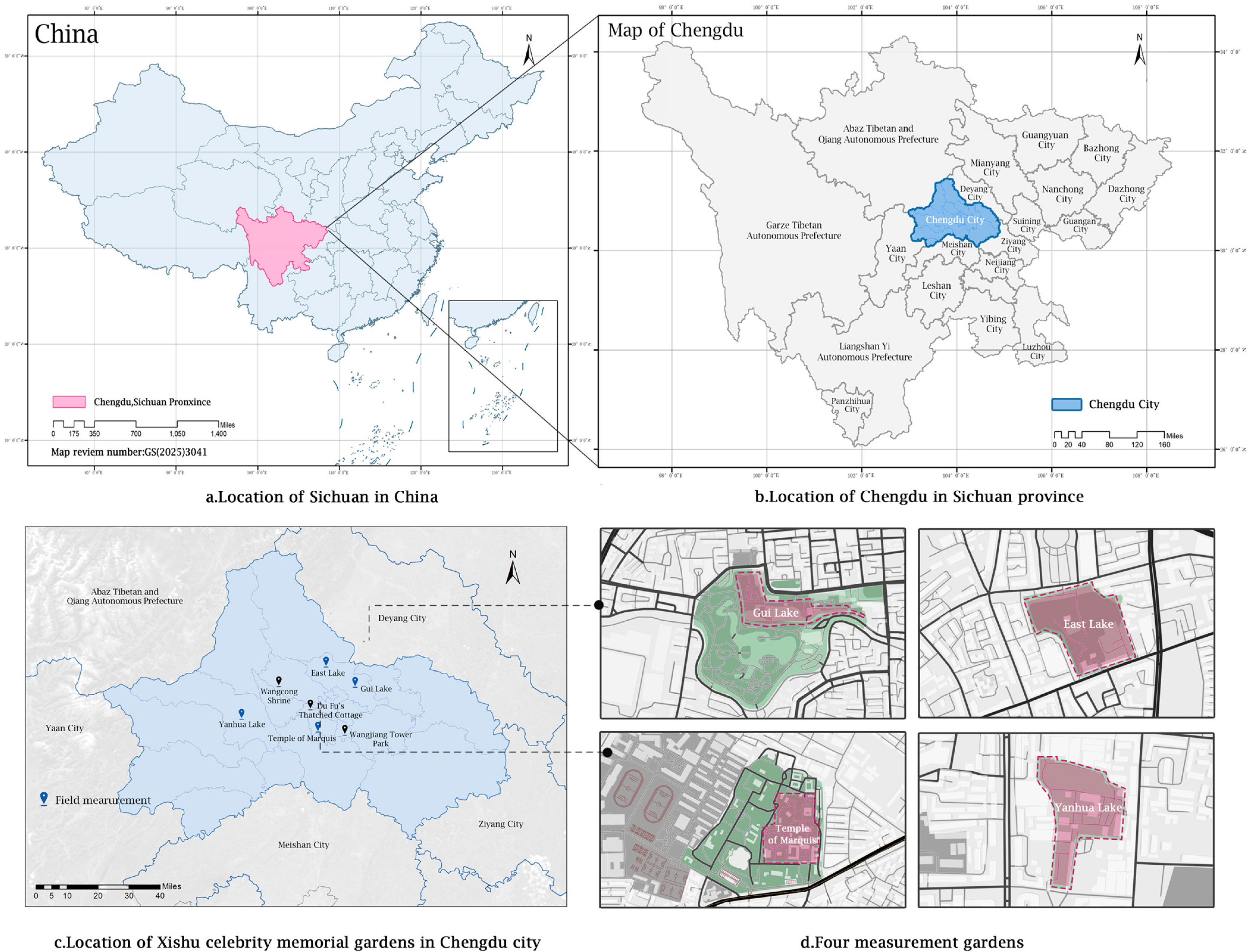
2.1. Research Area Classification and Actual Survey Points
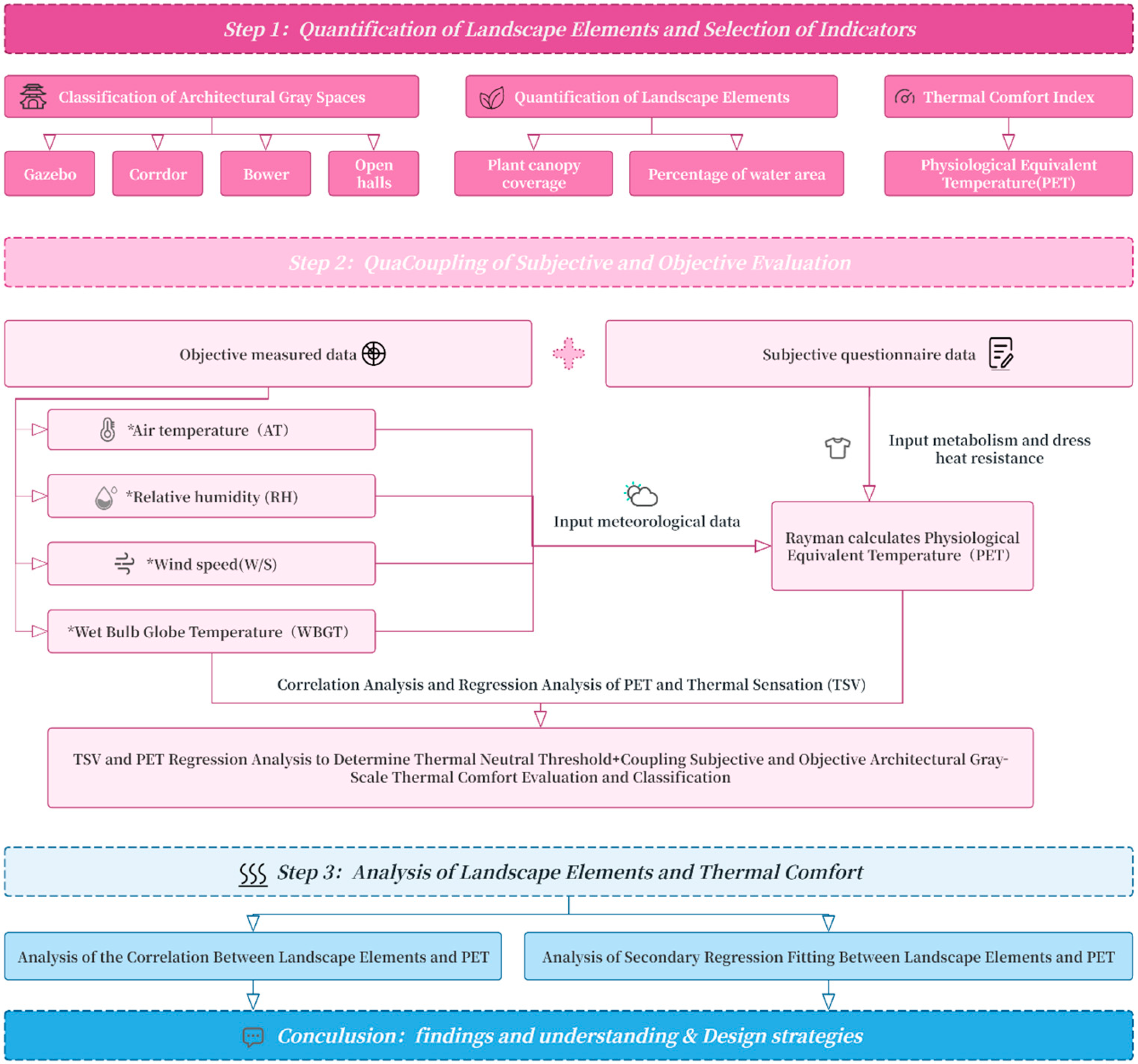
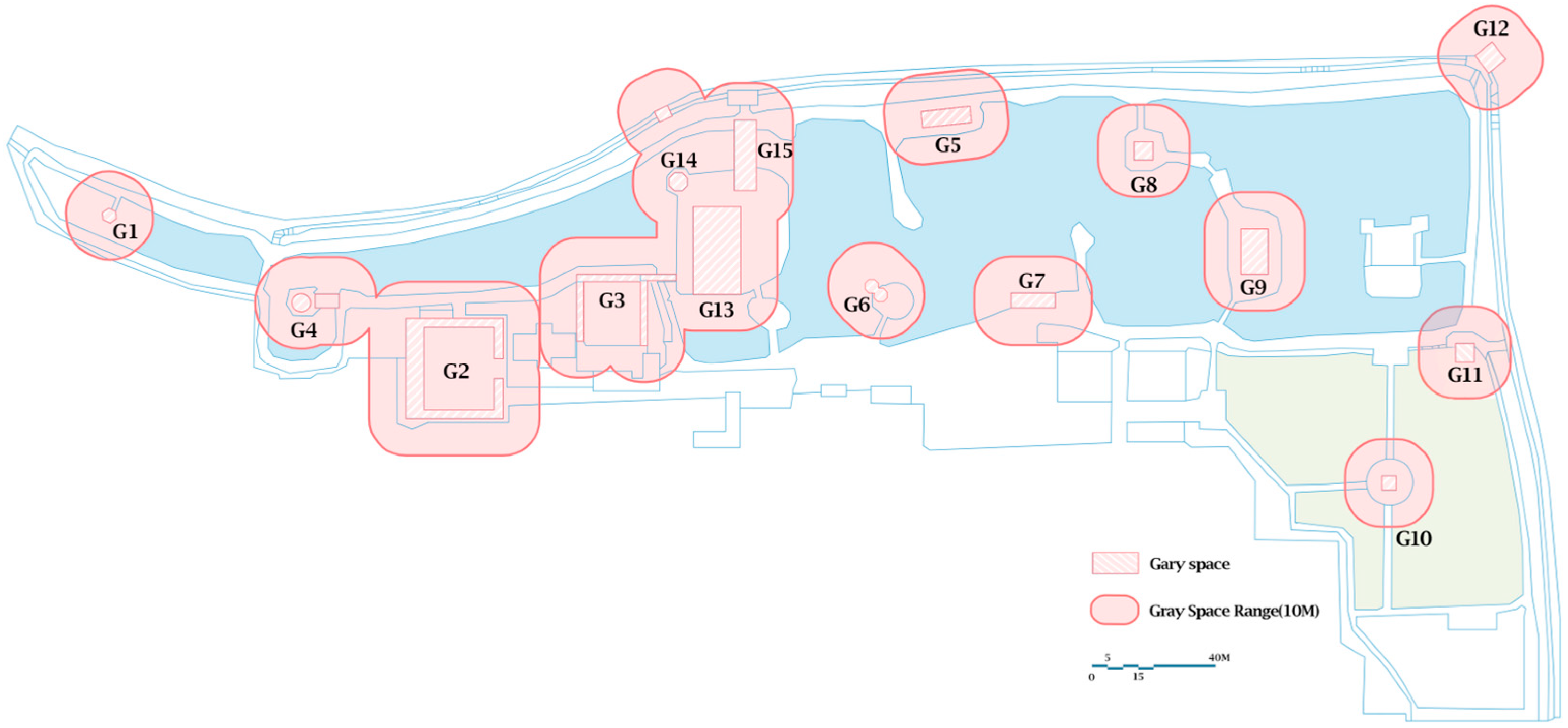
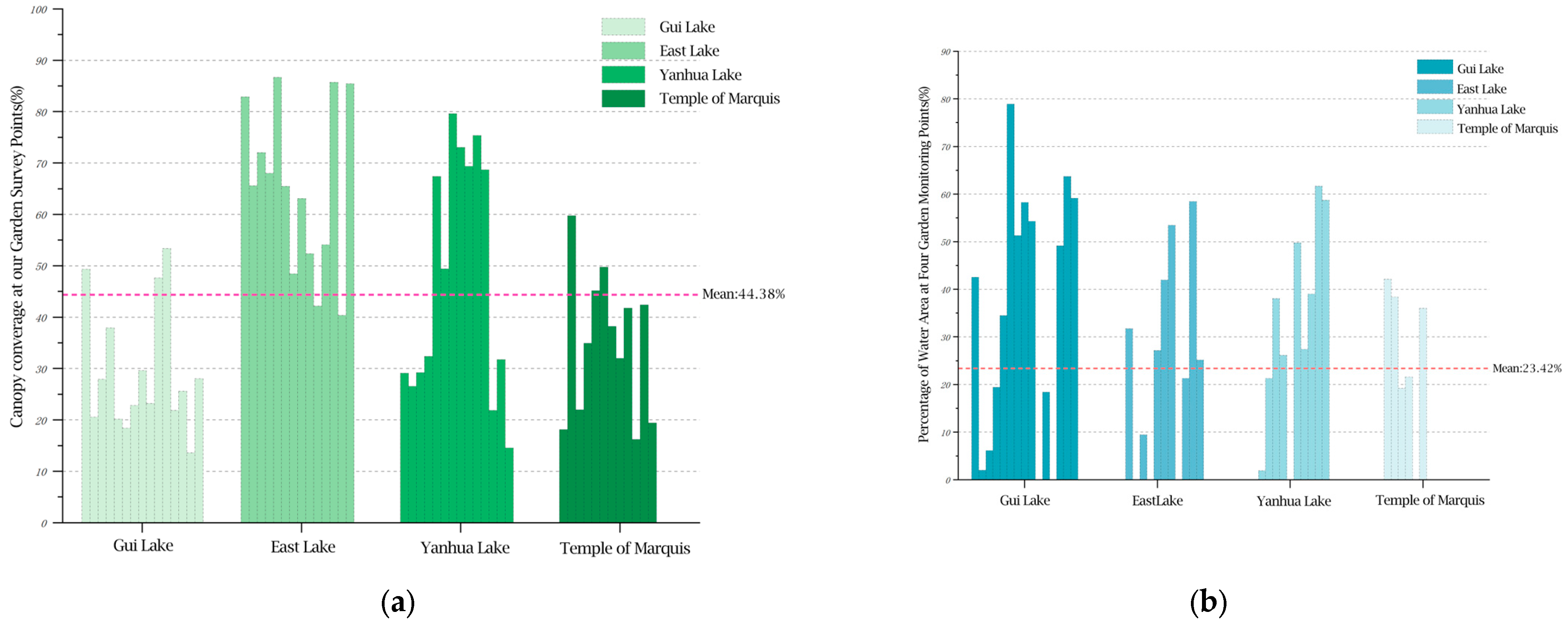
2.2. Quantification of Landscape Elements and Classification of Measurement Points
2.3. Field Measurements and Questionnaire
3. Results
3.1. Analysis of the Coupling Between Subjective and Objective Outcomes
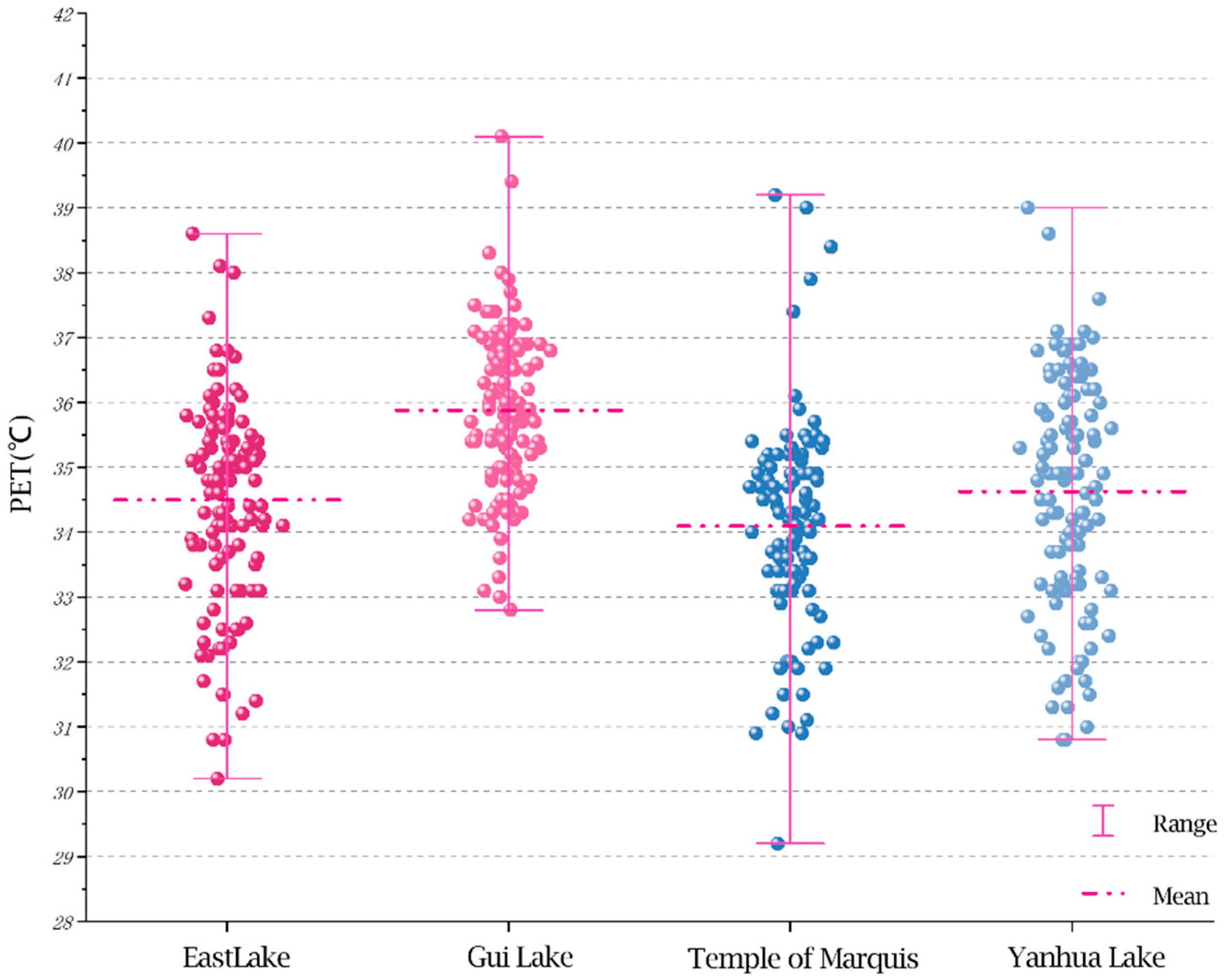
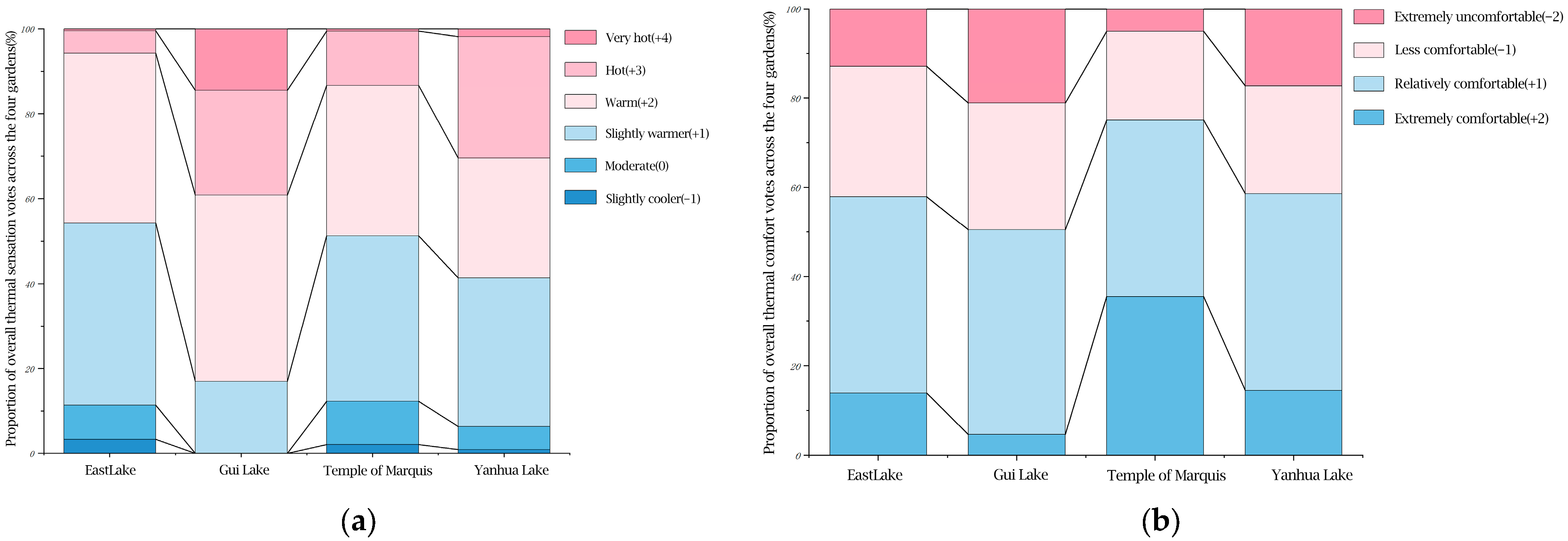
3.1.1. Analysis of Field Measurements and Questionnaire Results
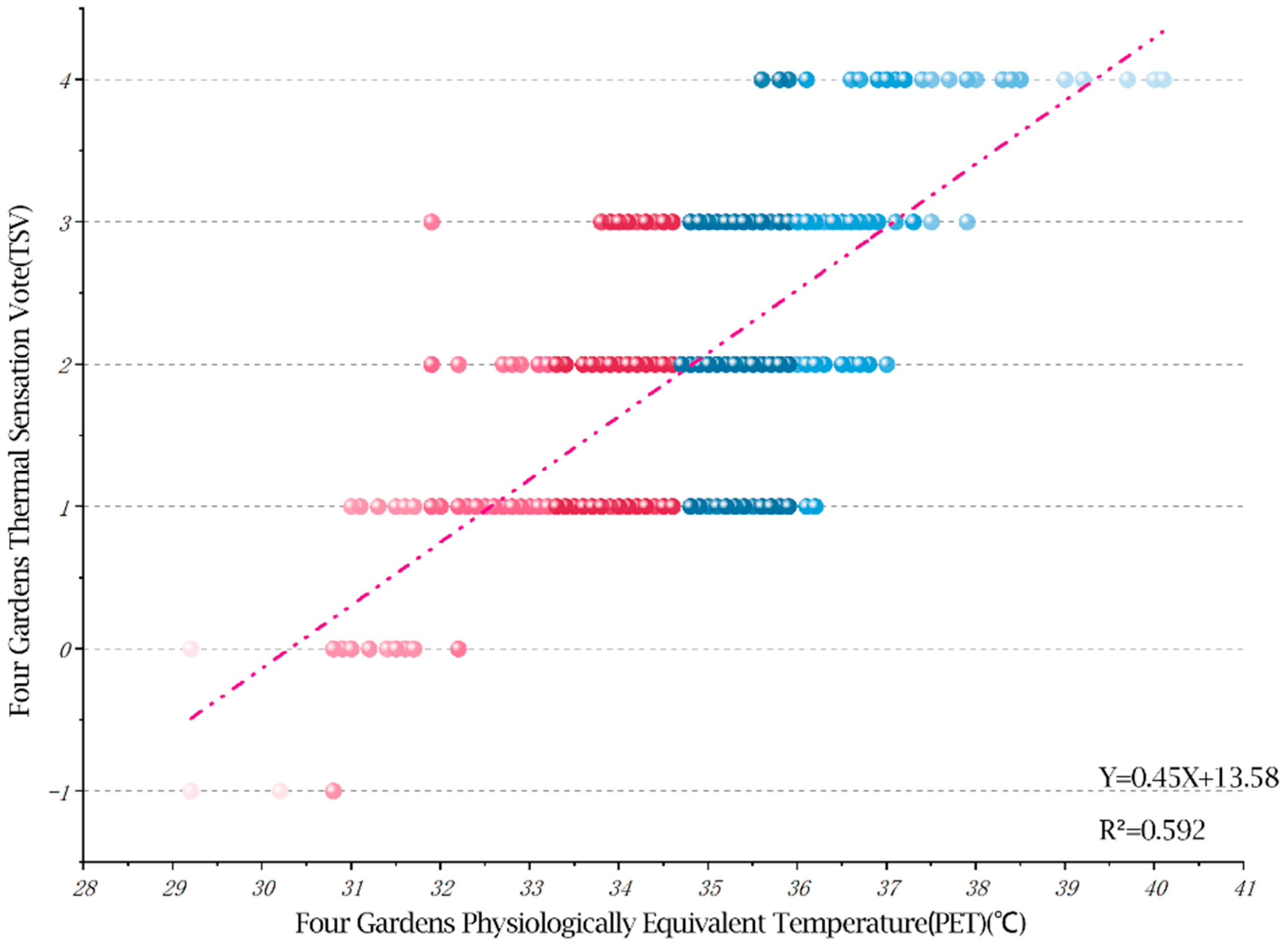
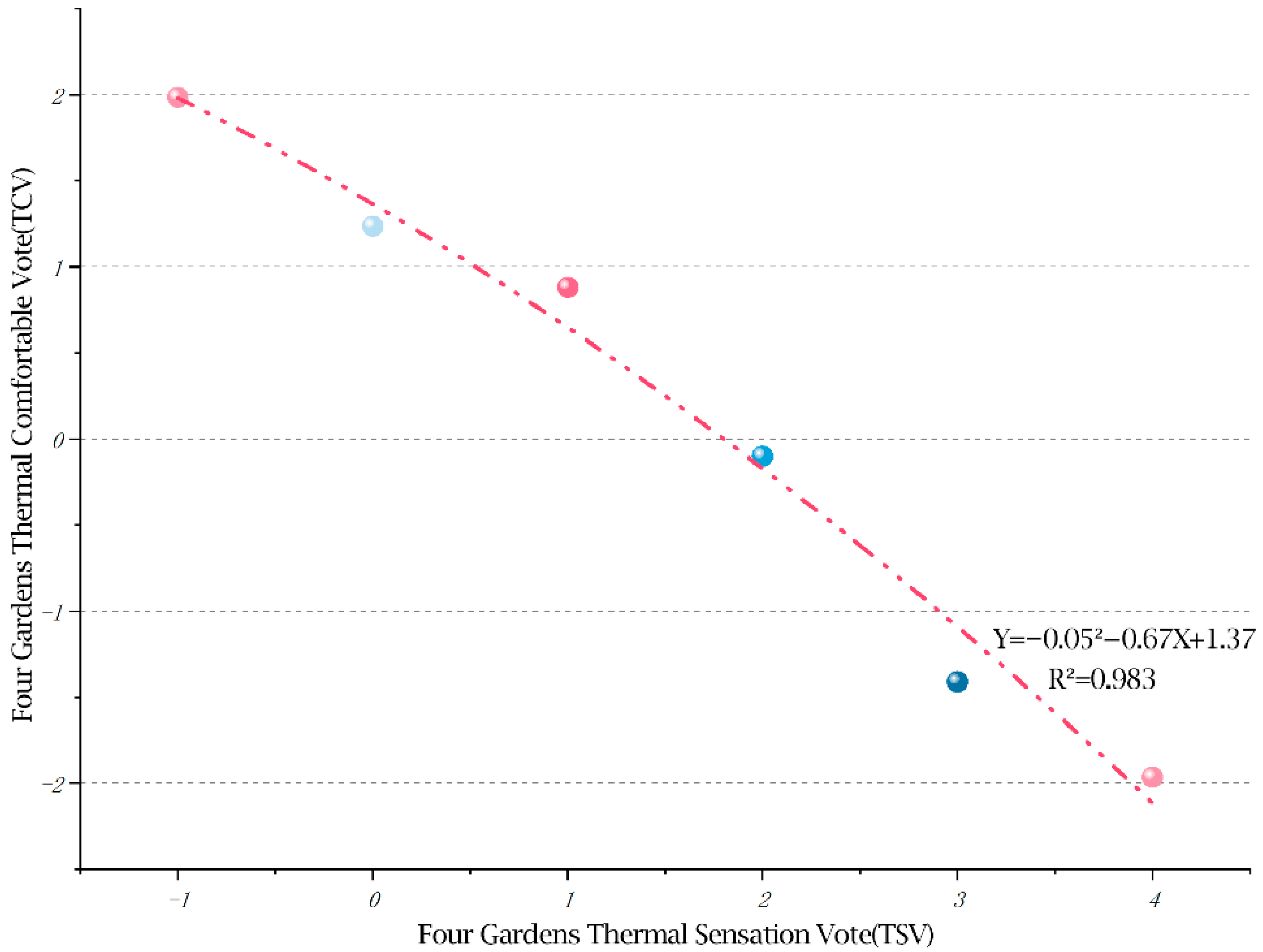
3.1.2. Analysis of PET and Its Correlation with Thermal Comfort and Thermal Sensation in Celebrity Memorial Gardens in Xishu Region
3.2. Identification of the Thermal Neutrality Threshold
3.3. Assessment and Categorization of Thermal Comfort in Architectural Gray Spaces Integrating Subjective and Objective Parameters
3.4. Analysis of Landscape Elements and Thermal Comfort
3.4.1. Correlation Analysis Between Physiological Equivalent Temperature (PET) and Landscape Factors
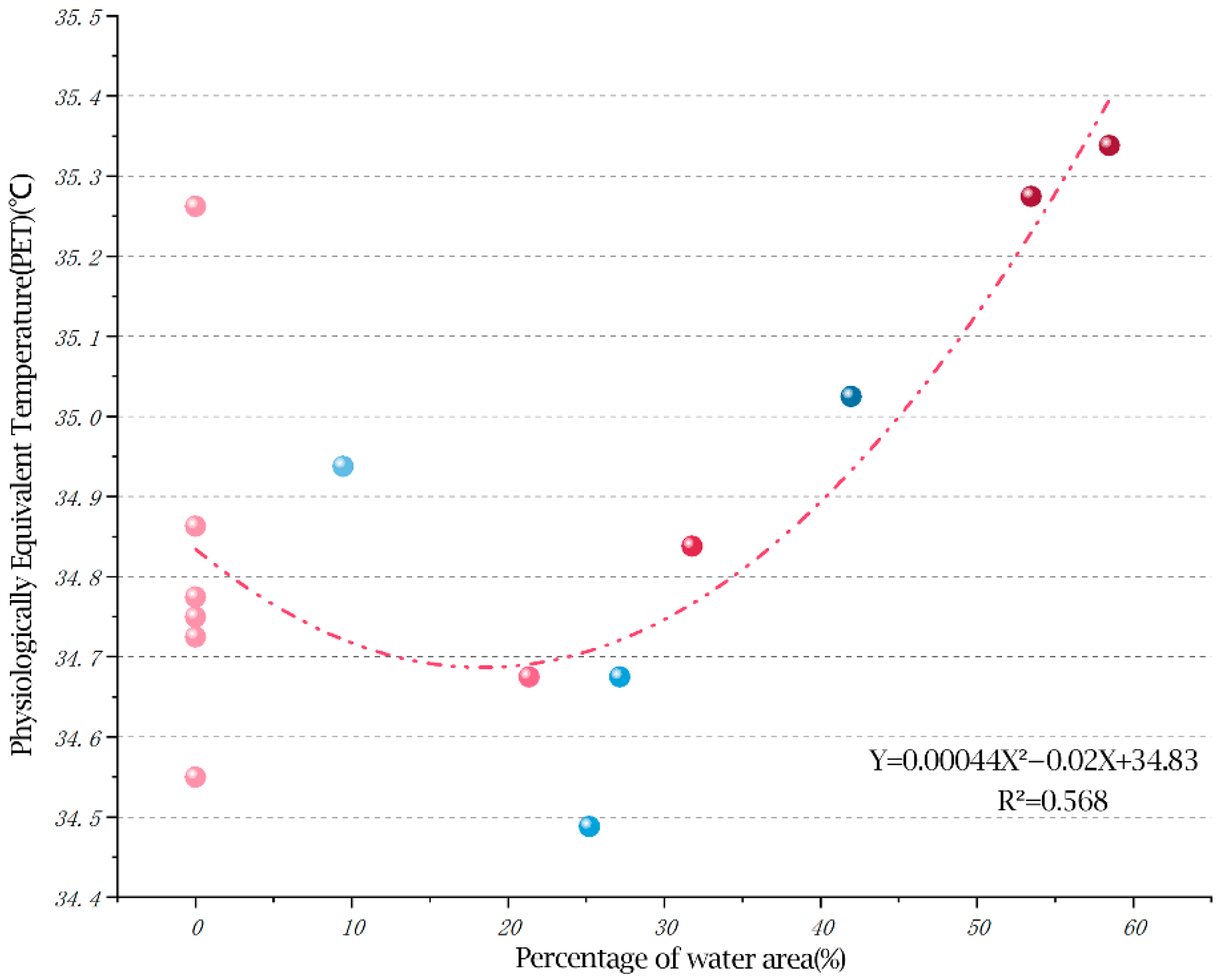
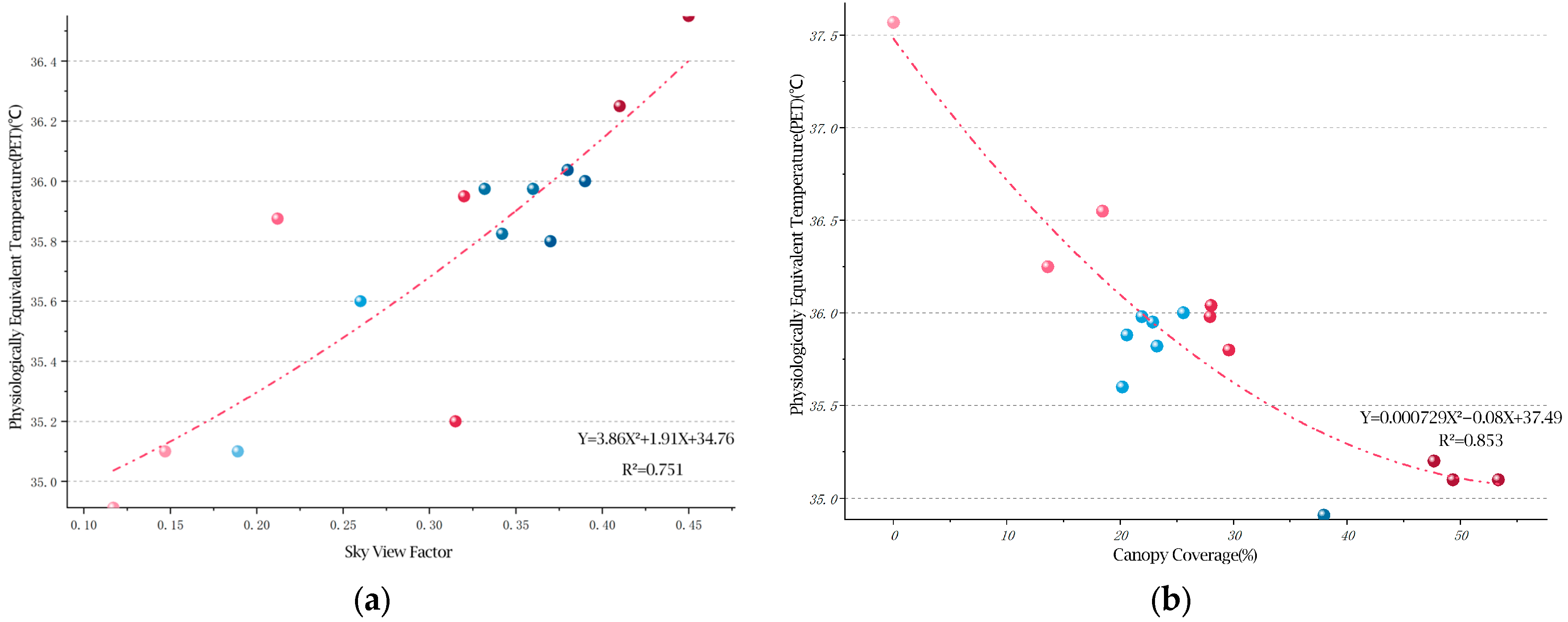
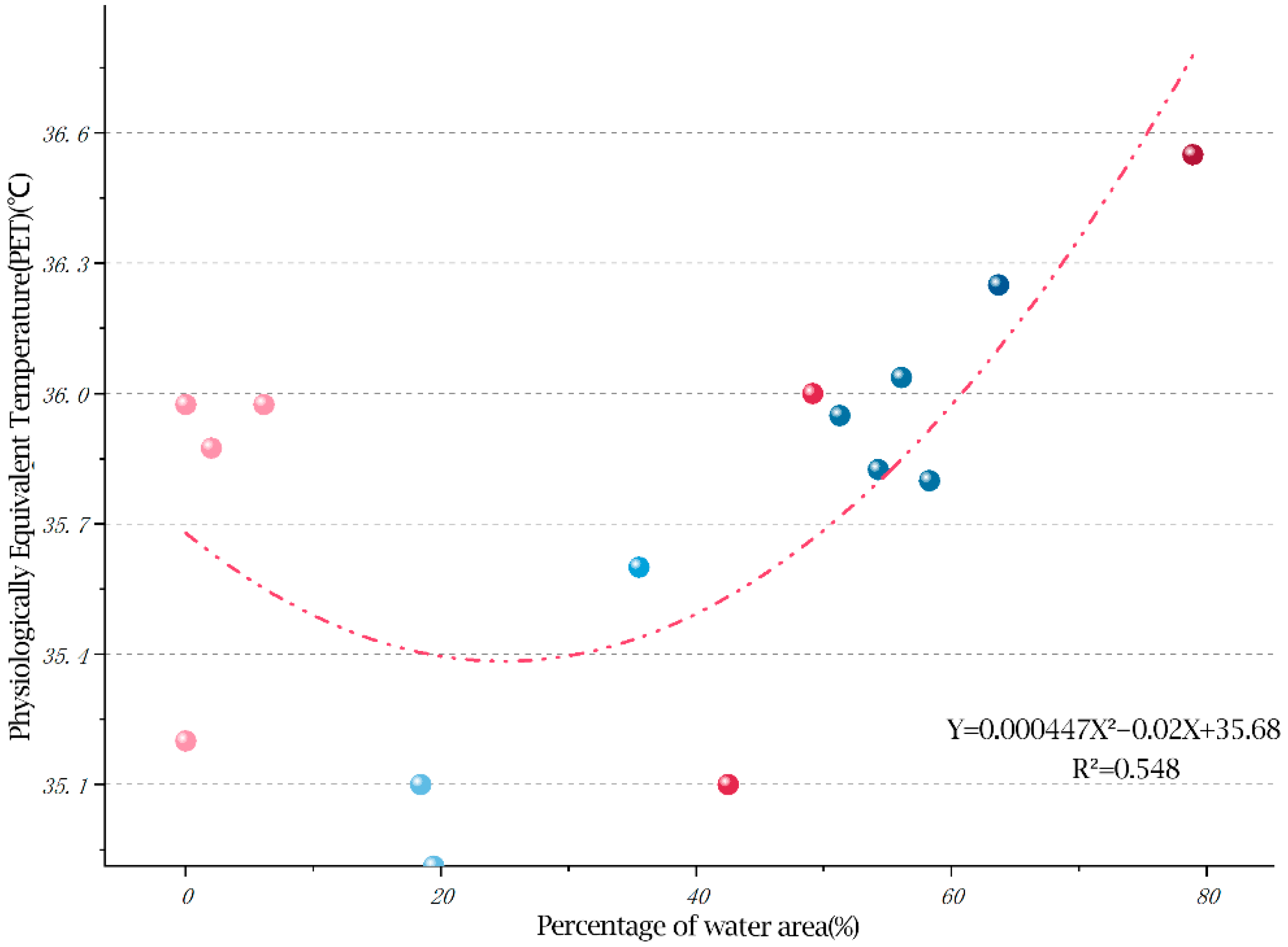
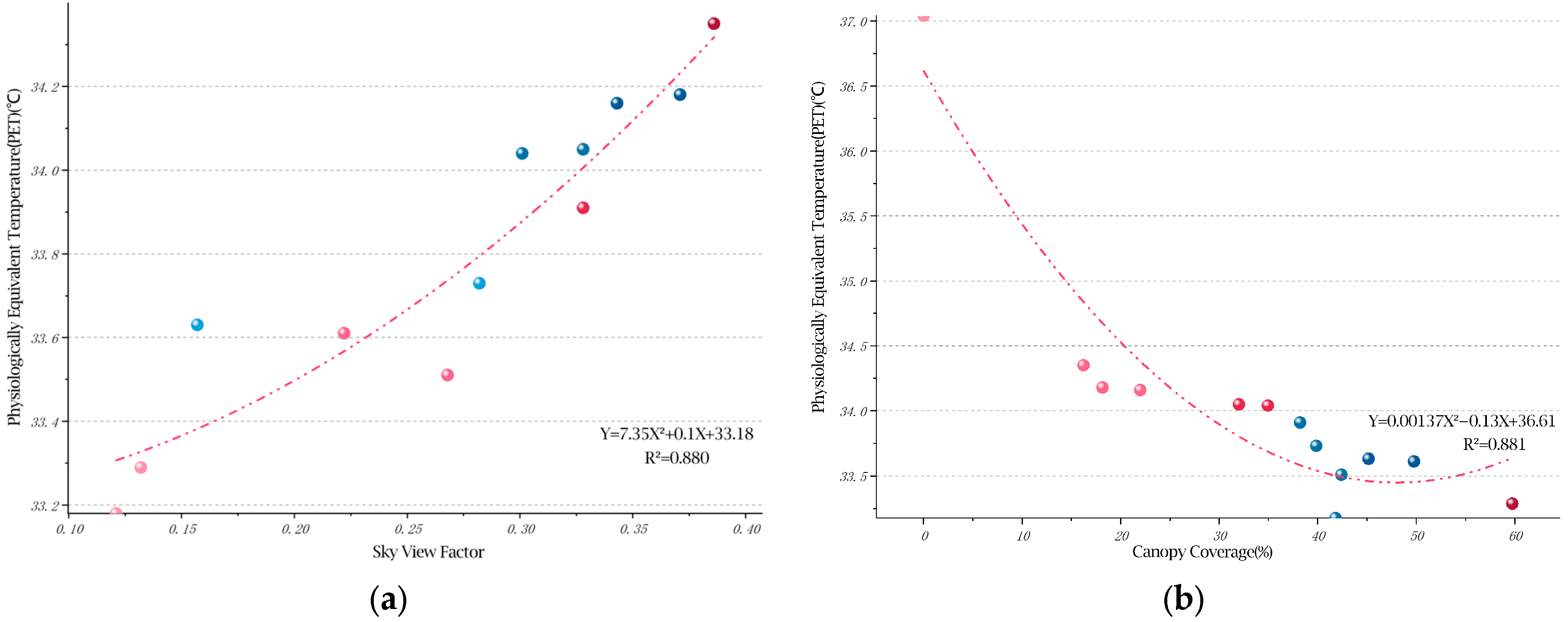
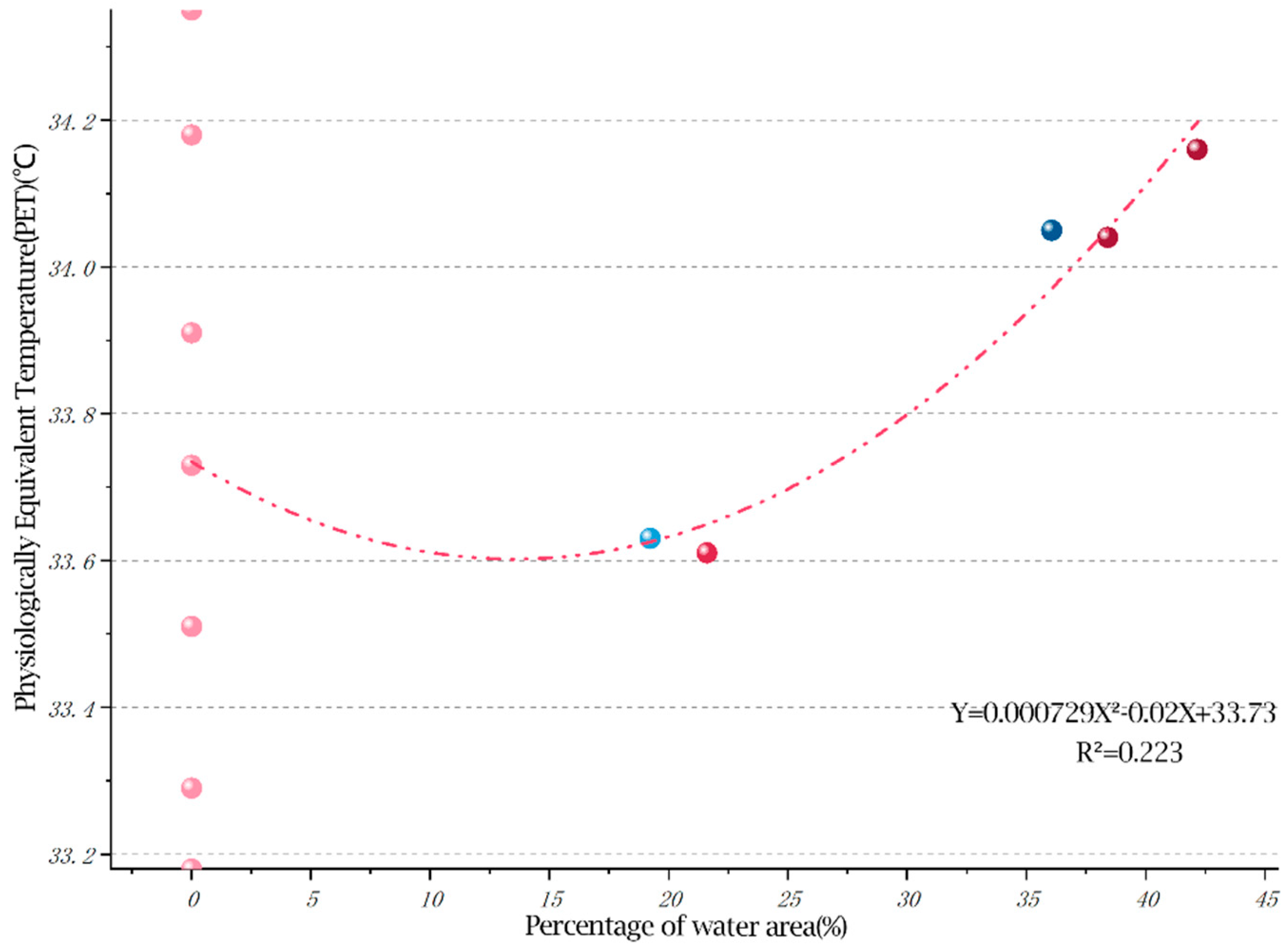
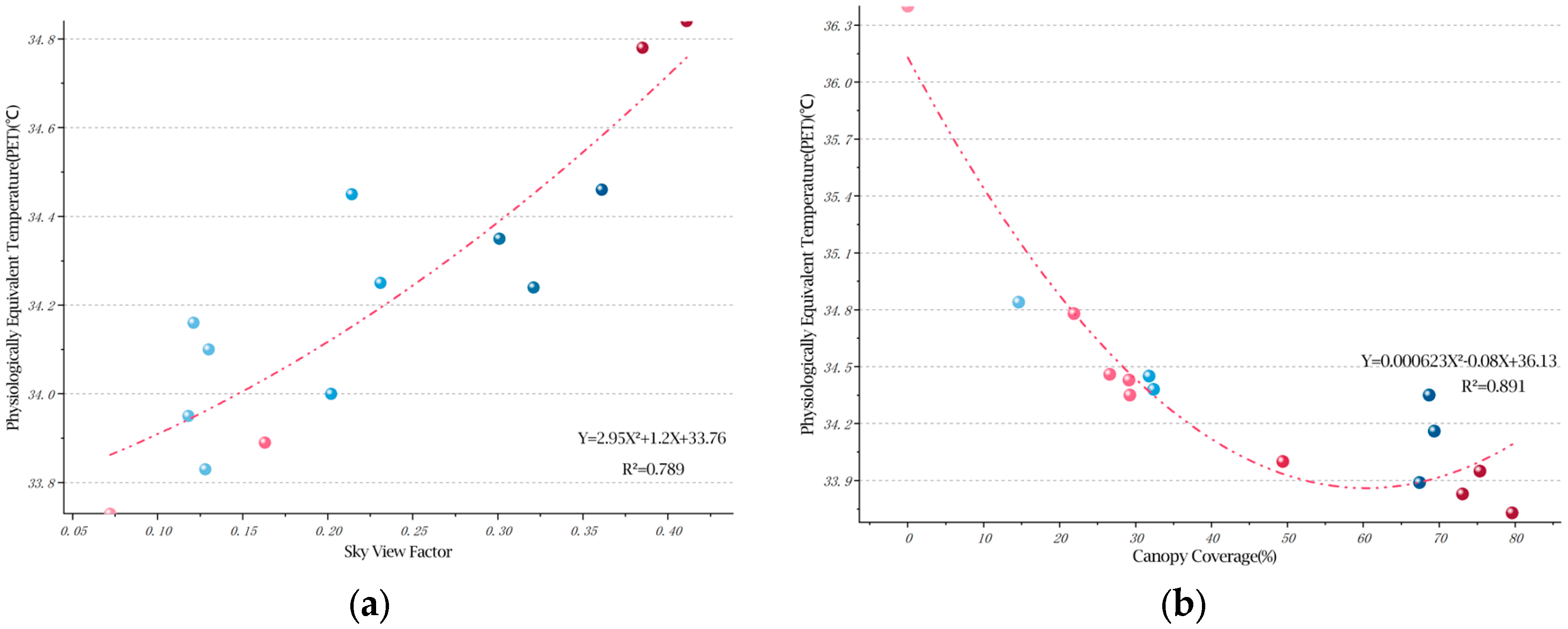
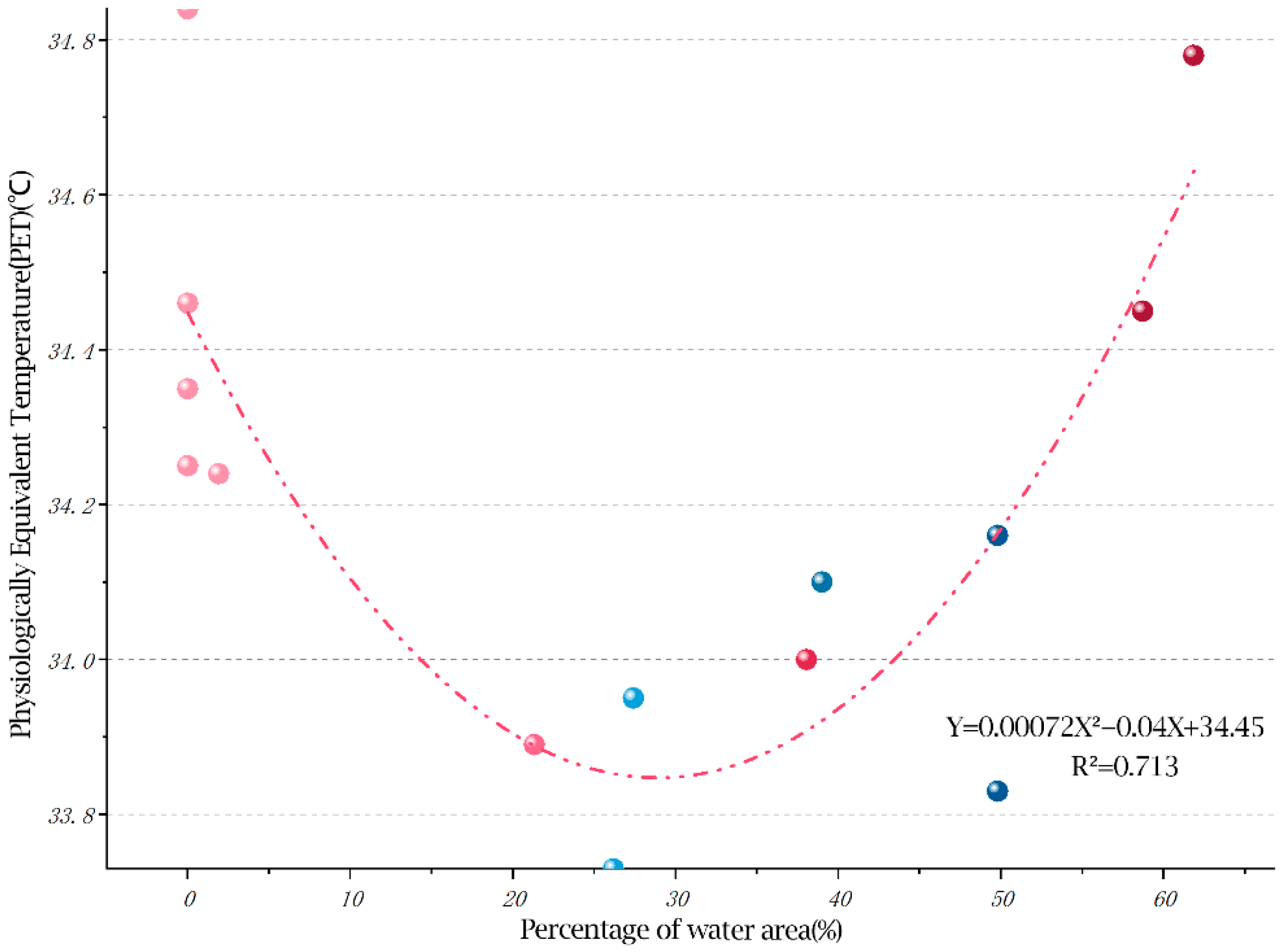
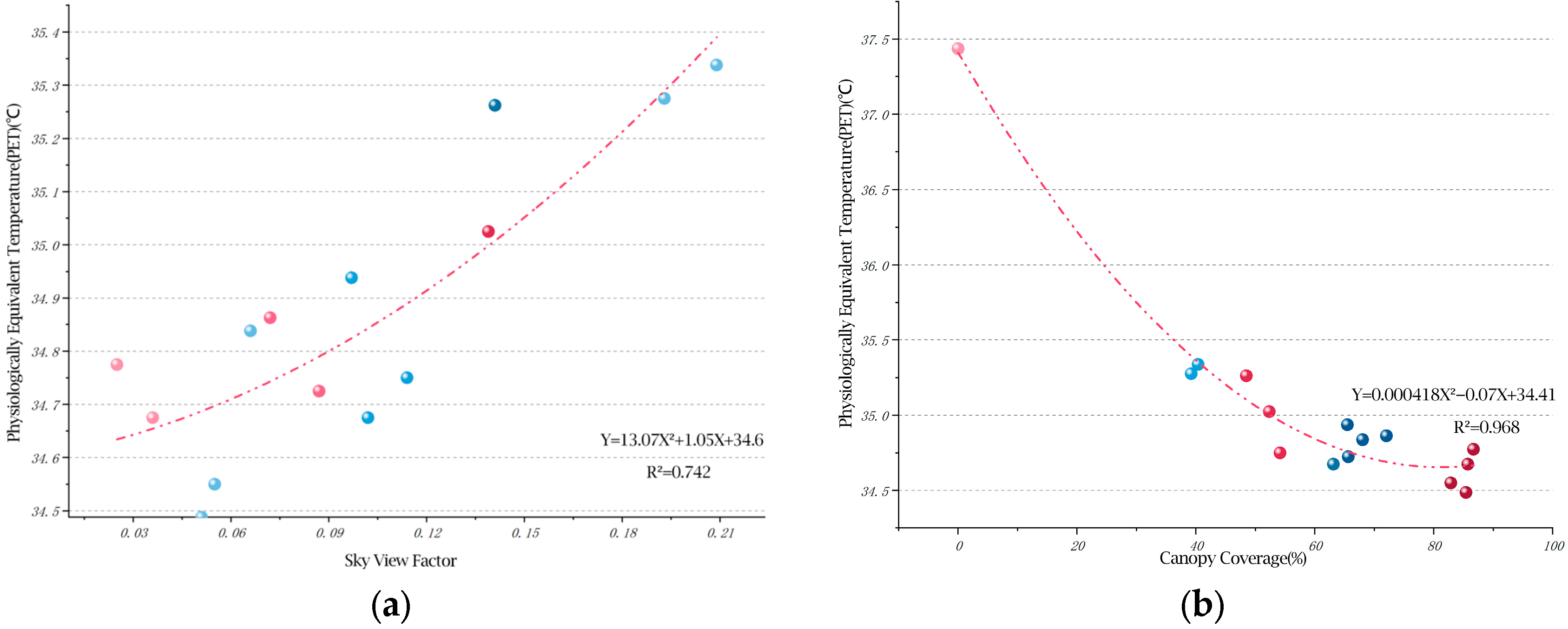
3.4.2. Secondary Regression Analysis of Physiological Equivalent Temperature (PET) and Landscape Factors
East Lake
Gui Lake
Temple of Marquis
Yanhua Lake
3.4.3. Assessment and Enhancement Methodologies
4. Conclusions, Discussion and Limitations
4.1. Conclusions and Discussion
4.2. Limitation
Author Contributions
Funding
Data Availability Statement
Acknowledgments
Conflicts of Interest
Abbreviations
| PET | Physiological Equivalent Temperature |
| MRT | Mean Radiant Temperature |
| SVF | Sky View Factor |
| TCV | Thermal Comfort Vote |
| TSV | Thermal Sensation Vote |
References
- Bongaarts, J. IPCC, 2023: Climate Change 2023: Synthesis Report. IPCC, 184 p., doi: https://doi.org/10.59327/IPCC/AR6-9789291691647. Popul. Dev. Rev. 2024, 50, 577–580. [Google Scholar] [CrossRef] [Scilit]
- Ding, T.; Ke, Z. Characteristics and changes of regional wet and dry heat wave events in China during 1960–2013. Theor. Appl. Climatol. 2014, 122, 651–665. [Google Scholar] [CrossRef] [Scilit]
- Lin, Z.; Peng, J.; Xu, H.; Hu, X.; Liu, Q.; Yao, X.; Zhu, Z.; Liu, Z. The impact of gray-green space features on thermal environments across urban core-fringe gradients: A path-interaction and non-linear analysis. Sustain. Cities Soc. 2025, 134, 106950. [Google Scholar] [CrossRef] [Scilit]
- Wu, X.; Yuan, C.; Xue, H.; Yan, Y. Comprehensive effects of thermal and acoustic environments on overall comfort in urban parks of cold regions in China. Energy Build. 2025, 347, 116329. [Google Scholar] [CrossRef] [Scilit]
- Niu, J.; Xiong, J.; Qin, H.; Hu, J.; Deng, J.; Han, G.; Yan, J. Influence of thermal comfort of green spaces on physical activity: Empirical study in an urban park in Chongqing, China. Build. Environ. 2022, 219, 109168. [Google Scholar] [CrossRef] [Scilit]
- Guo, J.; Wang, W.; Yu, Z.; Jia, S.; Liang, D.; Sun, Z.; Guo, H. Moderating mechanisms of urban environment and vegetation structure in the cooling effect of urban green space: A case study of Glasgow. Sustain. Cities Soc. 2026, 138, 107120. [Google Scholar] [CrossRef] [Scilit]
- Zhang, J.; Gou, Z. Tree crowns and their associated summertime microclimatic adjustment and thermal comfort improvement in urban parks in a subtropical city of China. Urban For. Urban Green. 2021, 59, 126912. [Google Scholar] [CrossRef] [Scilit]
- Yu, X.; Yang, Z.; Xu, D.; Wang, Q.; Peng, J. Urban green spaces enhanced human thermal comfort through dual pathways of cooling and humidifying. Sustain. Cities Soc. 2025, 118, 106032. [Google Scholar] [CrossRef] [Scilit]
- Wu, R.; Yan, H.; Shu, Y.; Shi, Y.; Bao, Z. Microclimate Characteristics of Bamboo Plants in Summer and Their Impact on Human Comfort. Chin. Gard. 2019, 35, 112–117. [Google Scholar] [CrossRef]
- Playán-Escribano, J.; González-Cristóbal, I.R.; Villa, A. Urban green spaces and cardiovascular health: From landscape to clinical impact. Rev. Esp. Cardiol. (Engl. Ed.) 2026, in press. [Google Scholar] [CrossRef] [Scilit]
- Liu, S.-Y.; Yi, C.; Yang, B.; Jiang, X.-Y.; Wei, S.-Y.; Yuan, X.-C. The role of urban green spaces in mitigating heat-induced labor productivity losses of global megacities. Urban For. Urban Green. 2026, 117, 129270. [Google Scholar] [CrossRef] [Scilit]
- Kajosaari, A.; Arnberger, A.; Wenmakers, S.; Humer, A. Urban green and blue space characteristics contributing to multiple perceived health benefits. Urban For. Urban Green. 2026, 118, 129229. [Google Scholar] [CrossRef] [Scilit]
- Ury, B.; Yang, J.; Rosenthal, S.R.; Barker, D.H.; McGeary, J.E.; Dunsiger, S.I.; Grigsby-Toussaint, D.S. Associations between subjective and objective green space on children’s mental health and cognitive function. Urban For. Urban Green. 2025, 114, 129156. [Google Scholar] [CrossRef] [Scilit]
- Zheng, Z.; Jin, Y.; Liu, W.; Yin, R.; Song, B.; Liu, J.; Sun, N.; Chen, H. The impact of green space environments on college students’ mental health at multiple spatial scales in Chinese universities: An empirical study based on a multilevel mediation model. Appl. Geogr. 2026, 188, 103903. [Google Scholar] [CrossRef] [Scilit]
- Lee, K.O.; Yeung, A.H. Urban green space dimensions, visit behavior, and mental well-being: A comparative study of Singapore and Hong Kong. Cities 2026, 171, 106734. [Google Scholar] [CrossRef] [Scilit]
- Rahaman, S.; Cai, D.; Cheng, Y.; Wei, X.; Gong, X. AI-integrated framework for green space optimization and air quality improvement: A futuristic approach toward sustainable urban development. Sustain. Cities Soc. 2026, 137, 107117. [Google Scholar] [CrossRef] [Scilit]
- Ding, W.; Liu, M.; Wu, Y.; Feng, W.; Chen, H. Urban blue-green spaces for wintertime microclimate regulation: Interactive and marginal effects. Sustain. Cities Soc. 2026, 138, 107095. [Google Scholar] [CrossRef] [Scilit]
- Gong, C.; Yang, R.; Li, S. The role of urban green space in promoting health and well-being is related to nature connectedness and biodiversity: Evidence from a two-factor mixed-design experiment. Landsc. Urban Plan. 2024, 245, 105020. [Google Scholar] [CrossRef] [Scilit]
- Hanna, E.; Comín, F.A. Urban Green Infrastructure and Sustainable Development: A Review. Sustainability 2021, 13, 11498. [Google Scholar] [CrossRef] [Scilit]
- Khosravipoor, Z.; Patuano, A.; Nickayin, S. Designing green and blue spaces for health: A systematic literature review of current spatial design recommendations for healthy and thermally comfortable urban environments. Urban For. Urban Green. 2026, 116, 129216. [Google Scholar] [CrossRef] [Scilit]
- Xie, W.; Li, S.; Li, T.; Zhao, K.; Chu, Z.; Yan, Z.; Ye, Q. Thermal environmental effects of greening layouts and greening combinations on outdoor spaces for children. Ecol. Front. 2025, 45, 1505–1517. [Google Scholar] [CrossRef] [Scilit]
- Adamu, S.U.; Yong, H.; Yusuf, D.A.; Bello, A.; Bala, H.S.; Habila, S.K.; Muhammad, A.M. Is green truly public? Unpacking green space dynamics, mechanisms of change, and recreational consequences amid Abuja’s urban growth. Prog. Plan. 2026, 203, 101033. [Google Scholar] [CrossRef] [Scilit]
- Xu, T.; Huang, L.; Aini, A.M.; Nordin, N.A. Characterizing the critical role of older people’s overall satisfaction with green spaces for their well-being using machine learning methods: Feature extraction and predictive modeling. Acta Psychol. 2026, 262, 106001. [Google Scholar] [CrossRef] [Scilit] [PubMed]
- Hung, S.-H. Does perceived biophilic design contribute to human well-being in urban green spaces? A study of perceived naturalness, biodiversity, perceived restorativeness, and subjective vitality. Urban For. Urban Green. 2025, 107, 128752. [Google Scholar] [CrossRef] [Scilit]
- Zhan, D.; Zhou, J.; Liu, D.; Yu, X.; Yang, T.; Zhang, W.; Kwan, M.-P. How multiple environmental perceptions mediate associations between urban blue-green spaces exposures and the subjective well-being of migrants. Cities 2026, 169, 106556. [Google Scholar] [CrossRef] [Scilit]
- Johansson, E.; Thorsson, S.; Emmanuel, R.; Krüger, E. Instruments and methods in outdoor thermal comfort studies—The need for standardization. Urban Clim. 2014, 10, 346–366. [Google Scholar] [CrossRef] [Scilit]
- Ghaffarianhoseini, A.; Berardi, U.; Ghaffarianhoseini, A. Thermal performance characteristics of unshaded courtyards in hot and humid climates. Build. Environ. 2015, 87, 154–168. [Google Scholar] [CrossRef] [Scilit]
- Antoniadis, D.; Katsoulas, N.; Papanastasiou, D.; Christidou, V.; Kittas, C. Evaluation of thermal perception in schoolyards under Mediterranean climate conditions. Int. J. Biometeorol. 2016, 60, 319–334. [Google Scholar] [CrossRef] [Scilit]
- Theeuwes, N.E.; Solcerová, A.; Steeneveld, G.J. Modeling the influence of open water surfaces on the summertime temperature and thermal comfort in the city. J. Geophys. Res. Atmos. 2013, 118, 8881–8896. [Google Scholar] [CrossRef] [Scilit]
- Nikolopoulou, M. Outdoor thermal comfort. Front. Biosci. 2011, 3, 1552–1568. [Google Scholar] [CrossRef] [Scilit]
- Fanger, P.O. Thermal Comfort: Analysis and Applications in Environmental Engineering; Danish Technical Press: Copenhagen, Denmark, 1972. [Google Scholar]
- Liu, Z.; Zheng, S.; Zhao, L. Evaluation of the ENVI-Met Vegetation Model of Four Common Tree Species in a Subtropical Hot-Humid Area. Atmosphere 2018, 9, 198. [Google Scholar] [CrossRef] [Scilit]
- Xiong, N.; Song, H.; Zhou, F.; Yan, Y.; Jia, J.; Li, Q.; Liu, D.; Wang, J. Simulation of Microclimate and PM2.5 Dispersion in Typical Urban Parks in Beijing Based on the ENVI-Met Model. Sustainability 2025, 17, 7247. [Google Scholar] [CrossRef] [Scilit]
- Koutsanitis, S.; Sinou, M.; Kanetaki, Z.; Tousi, E.; Varelidis, G. Thermal Performance Investigation in Historical Urban Neighborhoods Using ENVI-Met Simulation Software. Land 2025, 14, 284. [Google Scholar] [CrossRef] [Scilit]
- Jo, H.H.; Yuk, H.; Kang, Y.; Kim, S. Conservation of architectural heritage: Innovative approaches to enhance thermal comfort and promote sustainable usage in historic buildings. Case Stud. Therm. Eng. 2023, 51, 103500. [Google Scholar] [CrossRef] [Scilit]
- Wang, Y.; Zhen, Y.; Ning, Q. Four-objective optimization of historic building renovation considering climate change: A trade-off in energy, economy, environment, and thermal comfort. J. Build. Eng. 2025, 110, 113017. [Google Scholar] [CrossRef] [Scilit]
- Martinez-Molina, A.; Williamson, K.; Dupont, W. Thermal comfort assessment of stone historic religious buildings in a hot and humid climate during cooling season. A case study. Energy Build. 2022, 262, 111997. [Google Scholar] [CrossRef] [Scilit]
- Olgyay, V.; Olgyay, A.; Lyndon, D.; Olgyay, V.W.; Reynolds, J.; Yeang, K. Design with Climate: Bioclimatic Approach to Architectural Regionalism—New and Expanded Edition; Princeton University Press: Princeton, NJ, USA, 2015. [Google Scholar]
- Martinelli, L.; Matzarakis, A. Influence of height/width proportions on the thermal comfort of courtyard typology for Italian climate zones. Sustain. Cities Soc. 2017, 29, 97–106. [Google Scholar] [CrossRef] [Scilit]
- Ergün, R. The effect of iwan as traditional shading element on indoor temperature: The case of Diyarbakır houses. Inf. Constr. 2025, 77, 6980. [Google Scholar] [CrossRef] [Scilit]
- Soflaei, F.; Shokouhian, M.; Mofidi Shemirani, S.M. Traditional Iranian courtyards as microclimate modifiers by considering orientation, dimensions, and proportions. Front. Archit. Res. 2016, 5, 225–238. [Google Scholar] [CrossRef] [Scilit]
- Cui, L.; Shibata, S. Exploring climate-adaptive green-space designs for hot and humid climates: Lessons from Japanese dry gardens. Urban For. Urban Green. 2024, 93, 128207. [Google Scholar] [CrossRef] [Scilit]
- Yao, P.; Zhao, Q.; Zhang, M.; Chen, S.; Liu, Y. Analysis of Climate Comfort Variation Characteristics Based on the Temperature-Humidity Index in the Chengdu Region Over the Past 37 Years. Mt. Plateau Meteorol. Res. 2019, 39, 61–66. [Google Scholar]
- Gang, P. Analysis of Classical Chinese Gardens; China Architecture & Building Press: Beijing, China, 1968. [Google Scholar]
- Quan, Z. History of Classical Chinese Gardens; Tsinghua University Press: Beijing, China, 2008. [Google Scholar]
- Chen, Y.S.D. The Rational Application of Gray Spaces in Classical Gardens. Res. Art Educ. 2022, 7, 122–123. [Google Scholar]
- Pei, Y.; Qi, C. Gardens of Western Sichuan; China Forestry Publishing House: Beijing, China, 2010. [Google Scholar]
- Chen, Y.; Deng, S.; Hou, Y.; Yan, Q. Impact of environmental elements in classical Chinese gardens on microclimate and their optimization using ENVI-MET simulations. Energy Build. 2025, 329, 115238. [Google Scholar] [CrossRef] [Scilit]
- Zhao, S.; Yang, L.; Gao, S.; Li, M.; Yan, H.; Zhai, Y. Field investigation on the thermal environment and thermal comfort in shopping malls in the cold zone of China. Build. Environ. 2022, 214, 108892. [Google Scholar] [CrossRef] [Scilit]
- Yao, J.; Yang, F.; Zhuang, Z.; Shao, Y.; Yuan, P.F. The effect of personal and microclimatic variables on outdoor thermal comfort: A field study in a cold season in Lujiazui CBD, Shanghai. Sustain. Cities Soc. 2018, 39, 181–188. [Google Scholar] [CrossRef] [Scilit]
- Elnabawi, M.H.; Hamza, N.; Dudek, S. Thermal perception of outdoor urban spaces in the hot arid region of Cairo, Egypt. Sustain. Cities Soc. 2016, 22, 136–145. [Google Scholar] [CrossRef] [Scilit]
- Xue, S.; Xiao, Y. Study on the Outdoor Thermal Comfort Threshold of Lingnan Garden in Summer. Procedia Eng. 2016, 169, 422–430. [Google Scholar] [CrossRef] [Scilit]
- Asimakopoulos, D. Passive Cooling of Buildings, 1st ed.; Santamouris, M., Ed.; Routledge: London, UK, 1996. [Google Scholar]
- ISO 7726:2023; Ergonomics of the Thermal Environment—Instruments for Measuring Physical Quantities. ISO: Geneva, Switzerland, 2023.
- Debray, A.; Sardar, S.; Deshayes, T.A.; Mornas, A.; Oubouchou, K.; Ouazaa, Y.; Gagnon, D. Sex-related differences in temperature regulation during heat stress from childhood to older age. Auton. Neurosci. 2025, 260, 103294. [Google Scholar] [CrossRef] [Scilit]
- Zhang, C.; Li, W.; Fan, Q.; Hu, J.; Wang, D.; Ping, X.; Li, W. The Influence of Vegetation Environment on Thermal Experience in Hot Summer: A Case Study from Perspectives of Fitting Scale and Gender Disparity. Buildings 2024, 14, 3036. [Google Scholar] [CrossRef] [Scilit]
- Shoenfeld, Y.; Udassin, R.; Shapiro, Y.; Ohri, A.; Sohar, E. Age and sex difference in response to short exposure to extreme dry heat. J. Appl. Physiol. 1978, 44, 1–4. [Google Scholar] [CrossRef] [Scilit]
- Leach, O.K.; Cottle, R.M.; Fisher, K.G.; Wolf, S.T.; Kenney, W.L. Sex differences in heat stress vulnerability among middle-aged and older adults (PSU HEAT Project). Am. J. Physiol.-Regul. Integr. Comp. Physiol. 2024, 327, R320–R327. [Google Scholar] [CrossRef] [Scilit]
- Matzarakis, A.; Mayer, H.; Iziomon, M.G. Applications of a universal thermal index: Physiological equivalent temperature. Int. J. Biometeorol. 1999, 43, 76–84. [Google Scholar] [CrossRef] [Scilit]
- Li, Z.; Zhou, L.; Hong, X.; Qiu, S. Outdoor thermal comfort and activities in urban parks: An experiment study in humid subtropical climates. Build. Environ. 2024, 253, 111361. [Google Scholar] [CrossRef] [Scilit]
- Qin, H.; Ma, Y.; Niu, J.; Huo, J.; Wei, X.; Yan, J.; Han, G. Investigating differences of outdoor thermal comfort for the elderly among genders across seasons: A case study in Chongqing, China. Urban Clim. 2025, 61, 102398. [Google Scholar] [CrossRef] [Scilit]
- Fu, J.; Qian, H.; Song, C.; Zhao, P.; Wang, R.; Li, Z.; Zheng, X. Assessment on the Impact Factors of Outdoor Thermal Comfort Among the Elderly Across Diverse Climate Zones in China. Energy Built Environ. 2025, in press. [Google Scholar] [CrossRef] [Scilit]
- Yang, W.; Wong, N.H.; Jusuf, S.K. Thermal comfort in outdoor urban spaces in Singapore. Build. Environ. 2013, 59, 426–435. [Google Scholar] [CrossRef] [Scilit]





| Gardens | Area (m2) | Water Area | Building Area | Road and Paved Area | Green Area |
|---|---|---|---|---|---|
| East Lake | 18,100 | 4700 (26%) | 2900 (16%) | 2500 (12.8%) | 8000 (45.2%) |
| Gui Lake | 45,300 | 15,000 (33.2%) | 6500 (14.3%) | 7900 (17.4%) | 15,900 (35.1%) |
| Temple of Marquis | 50,100 | 6000 (12%) | 8200 (16.4%) | 19,800 (39.5%) | 16,100 (32.1%) |
| Yanhua Lake | 33,900 | 8700 (25.7%) | 6000 (17.7%) | 7100 (20.9%) | 12,100 (35.7%) |
| Gardens | Ponits | Plant Proportion (%) | Water Proportion (%) | Types of Gray Spaces | Types of Landscape Elements |
|---|---|---|---|---|---|
| East Lake | E1 | 82.88 | 0 | Gazebo | Plant |
| E2 | 65.61 | 0 | Bower | Plant | |
| E3 | 72.02 | 0 | Gazebo | Plant | |
| E4 | 68.03 | 31.76 | Gazebo | Hybrid | |
| E5 | 86.68 | 0 | Bower | Plant | |
| E6 | 65.49 | 9.45 | Corridor | Plant | |
| E7 | 48.46 | 0 | Gazebo | Plant | |
| E8 | 63.1 | 27.15 | Corridor | Hybrid | |
| E9 | 52.35 | 41.96 | Bower | Hybrid | |
| E10 | 39.19 | 53.47 | Bower | Water | |
| E11 | 54.13 | 0 | Bower | Plant | |
| E12 | 85.73 | 21.33 | Gazebo | Plant | |
| E13 | 40.37 | 58.47 | Bower | Water | |
| E14 | 85.45 | 25.21 | Gazebo | Hybrid | |
| Gui Lake | G1 | 49.35 | 42.54 | Gazebo | Hybrid |
| G2 | 20.6 | 2 | Corridor | Hybrid | |
| G3 | 27.92 | 6.14 | Corridor | Hybrid | |
| G4 | 37.96 | 19.44 | Bower | Hybrid | |
| G5 | 20.19 | 35.51 | Bower | Water | |
| G6 | 18.45 | 78.95 | Gazebo | Water | |
| G7 | 22.86 | 51.29 | Bower | Water | |
| G8 | 29.6 | 58.29 | Gazebo | Water | |
| G9 | 23.24 | 54.28 | Bower | Water | |
| G10 | 47.67 | 0 | Gazebo | Plant | |
| G11 | 53.36 | 18.4 | Gazebo | Plant | |
| G12 | 21.9 | 0 | Gazebo | Plant | |
| G13 | 25.58 | 49.15 | Corridor | Water | |
| G14 | 13.6 | 63.72 | Gazebo | Water | |
| G15 | 28.02 | 56.12 | Bower | Water | |
| Temple of Marquis | M1 | 18.17 | 0 | Open halls | Plant |
| M2 | 59.76 | 0 | Open halls | Plant | |
| M3 | 21.99 | 42.16 | Gazebo | Water | |
| M4 | 34.96 | 38.4 | Corridor | Hybrid | |
| M5 | 45.16 | 19.22 | Corridor | Plant | |
| M6 | 49.77 | 21.6 | Gazebo | Hybrid | |
| M7 | 38.22 | 0 | Gazebo | Plant | |
| M8 | 32.01 | 36.05 | Bower | Water | |
| M9 | 41.81 | 0 | Open halls | Plant | |
| M10 | 16.22 | 0 | Open halls | Plant | |
| M11 | 42.4 | 0 | Corridor | Plant | |
| M12 | 19.46 | 0 | Corridor | Plant | |
| YanHua Lake | Y1 | 29.12 | 0 | Open halls | Plant |
| Y2 | 26.59 | 0 | Corridor | Plant | |
| Y3 | 29.24 | 0 | Gazebo | Plant | |
| Y4 | 32.37 | 1.9 | Gazebo | Plant | |
| Y5 | 67.42 | 21.3 | Gazebo | Hybrid | |
| Y6 | 49.4 | 38.07 | Gazebo | Hybrid | |
| Y7 | 79.6 | 26.17 | Gazebo | Hybrid | |
| Y8 | 73.06 | 49.79 | Corridor | Plant | |
| Y9 | 69.36 | 0 | Bower | Hybrid | |
| Y10 | 75.37 | 27.41 | Corridor | Hybrid | |
| Y11 | 68.68 | 39.02 | Open halls | Hybrid | |
| Y12 | 21.9 | 61.86 | Open halls | Water | |
| Y13 | 31.78 | 58.72 | Gazebo | Water | |
| Y14 | 14.59 | 0 | Gazebo | Plant |
| Field Measurement Date | Maximum Air Temperature (°C) | Minimum Air Temperature (°C) | Weather Conditions | Wind Direction | Wind Speed |
|---|---|---|---|---|---|
| 28 July 2025 | 37 | 25 | Clear sky | Southwest wind | Wind force 2 |
| 29 July 2025 | 39 | 25 | Clear sky | Northwest wind | Wind force 2 |
| 30 July 2025 | 38 | 26 | Partly cloudy | West wind | Wind force 2 |
| Thermal Sensation | Very Cold (−4) | Cold (−3) | Cool (−2) | Slightly Cool (−1) | Moderate (0) | Slightly Warm (+1) | Warm (+2) | Hot (+3) | Very Hot (+4) | |
|---|---|---|---|---|---|---|---|---|---|---|
| Gender | Men | 6 (1.5%) | 23 (5.9%) | 130 (33.3%) | 143 (36.7%) | 75 (19.2%) | 13 (3.3%) | |||
| Women | 7 (1.4%) | 26 (6.1%) | 146 (34.0%) | 157 (36.6%) | 72 (16.8%) | 21 (4.9%) | ||||
| Age | <30 years old | 5 (2.2%) | 15 (6.6%) | 70 (30.8%) | 80 (35.2%) | 45 (19.8%) | 12 (5.3%) | |||
| 30–50 years old | 5 (1.5%) | 20 (6.1%) | 112 (34.0%) | 120 (36.5%) | 55 (16.7%) | 17 (5.2%) | ||||
| >50 years old | 3 (1.6%) | 14 (5.3%) | 94 (35.7%) | 100 (38%) | 47 (17.9%) | 5 (1.9%) | ||||
| Total | 819 | 13 (1.6%) | 49 (6.0%) | 276 (33.7%) | 300 (36.6%) | 147 (17.9%) | 34 (4.2%) | |||
| Thermal Comfort | Extremely Comfortable (+2) | Relatively Comfortable (+1) | Less Comfortable (−1) | Extremely Uncomfortable (−2) | |
|---|---|---|---|---|---|
| Gender | Men | 66 (16.9%) | 170 (43.6%) | 98 (25.1%) | 56 (14.4%) |
| Women | 74 (17.2%) | 186 (43.4%) | 110 (25.6%) | 59 (13.8%) | |
| Age | <30 years old | 30 (13.2%) | 90 (39.6%) | 65 (28.6%) | 42 (18.5%) |
| 30–50 years old | 55 (16.7%) | 145 (44.1%) | 85 (25.8%) | 44 (13.4%) | |
| >50 years old | 55 (20.9%) | 121 (46.0%) | 58 (22.1%) | 29 (11.0%) | |
| Total | 819 | 140 (17.1%) | 356 (43.5%) | 208 (25.4%) | 115 (14.0%) |
| Gardens | Sample Size | TSV | TCV | ||
|---|---|---|---|---|---|
| PET | Spearman | East Lake | 210 | 0.706 ** | 0.657 ** |
| Sig. (2-tailed) | <0.01 | <0.01 | |||
| Spearman | Gui Lake | 194 | 0.838 ** | 0.739 ** | |
| Sig. (2-tailed) | <0.01 | <0.01 | |||
| Spearman | Yanhua Lake | 220 | 0.740 ** | 0.857 ** | |
| Sig. (2-tailed) | <0.01 | <0.01 | |||
| Spearman | Temple of Marquis | 195 | 0.709 ** | 0.810 ** | |
| Sig. (2-tailed) | <0.01 | <0.01 |
| Thermal Sensation | East Lake | Gui Lake | Temple of Marquis | Yanhua Lake | Four Gardens | |||||
|---|---|---|---|---|---|---|---|---|---|---|
| Neutral Temperature | Threshold Range | Neutral Temperature | Threshold Range | Neutral Temperature | Threshold Range | Neutral Temperature | Threshold Range | Neutral Temperature | Threshold Range | |
| Slightly cool | 28.3 | ≤29.6 | 29.7 | ≤30.6 | 28.2 | ≤29.3 | 28.1 | ≤29.2 | 28 | ≤29.3 |
| Moderate | 30.9 | 29.6–32.2 | 31.4 | 30.6–32.3 | 30.4 | 29.3–31.5 | 30.2 | 29.2–31.3 | 30.2 | 29.3–31.5 |
| Slightly warm | 33.5 | 32.2–34.7 | 33.2 | 32.3–34 | 32.6 | 31.5–33.7 | 32.3 | 31.3–33.4 | 32.4 | 31.5–33.7 |
| Warm | 36.0 | 34.7–37.3 | 34.9 | 34–35.8 | 34.8 | 33.7–35.8 | 34.4 | 33.4–35.4 | 34.6 | 33.7–36 |
| Hot | 38.6 | 37.3–39.9 | 36.6 | 35.8–37.5 | 36.9 | 35.8–38 | 36.5 | 35.4–37.5 | 36.8 | 36–38.2 |
| Very hot | 41.2 | >39.9 | 38.3 | >37.5 | 39.1 | >38 | 38.6 | >37.5 | 39 | >38.2 |
| Type | Plant-Dominanted | Water-Dominanted | Hybrid |
|---|---|---|---|
| Gazebo | E1, E3, E7, E17 M7 Y3, Y4, Y14 G10, G11, G12 | G6, G8, G14 Y13 | E13, E14 M3, M6 Y5, Y7, Y6 |
| Corridor | E6 M5, M11, M12 Y2, Y8 | G13 | E8 G2, G3 M4 Y10 |
| Bower | E10, E13 G5, G7, G9, G15 M8, Y12 | E9 G4 Y9, Y11 | |
| Open halls | M1, M2, M9, M10 Y1 |
| Gardens | Canopy Coverage | Percentage of Water Area | SVF | ||
|---|---|---|---|---|---|
| PET | Spearman | East Lake | −0.283 ** | 0.018 | 0.284 ** |
| Sig. (2-tailed) | 0.002 | 0.847 | 0.002 | ||
| Spearman | Gui Lake | −0.330 ** | 0.072 | 0.385 ** | |
| Sig. (2-tailed) | <0.01 | 0.419 | <0.01 | ||
| Spearman | Yanhua Lake | −0.282 ** | −0.118 | 0.273 ** | |
| Sig. (2-tailed) | 0.002 | 0.199 | 0.003 | ||
| Spearman | Temple of Marquis | −0.361 ** | −0.040 | 0.376 ** | |
| Sig. (2-tailed) | <0.01 | 0.971 | <0.01 | ||
Disclaimer/Publisher’s Note: The statements, opinions and data contained in all publications are solely those of the individual author(s) and contributor(s) and not of MDPI and/or the editor(s). MDPI and/or the editor(s) disclaim responsibility for any injury to people or property resulting from any ideas, methods, instructions or products referred to in the content. |
© 2026 by the authors. Licensee MDPI, Basel, Switzerland. This article is an open access article distributed under the terms and conditions of the Creative Commons Attribution (CC BY) license.
Share and Cite
Fu, Y.; Ye, D.; He, Y.; Li, X.; Huang, X. The Impact of Elements from Classical Chinese Gardens on Thermal Comfort Within Architectural Gray Spaces—The Case of Xishu Celebrity Memorial Garden. Buildings 2026, 16, 1408. https://doi.org/10.3390/buildings16071408
Fu Y, Ye D, He Y, Li X, Huang X. The Impact of Elements from Classical Chinese Gardens on Thermal Comfort Within Architectural Gray Spaces—The Case of Xishu Celebrity Memorial Garden. Buildings. 2026; 16(7):1408. https://doi.org/10.3390/buildings16071408
Chicago/Turabian StyleFu, Yuting, Dingying Ye, Yiyang He, Xi Li, and Xinxin Huang. 2026. "The Impact of Elements from Classical Chinese Gardens on Thermal Comfort Within Architectural Gray Spaces—The Case of Xishu Celebrity Memorial Garden" Buildings 16, no. 7: 1408. https://doi.org/10.3390/buildings16071408
APA StyleFu, Y., Ye, D., He, Y., Li, X., & Huang, X. (2026). The Impact of Elements from Classical Chinese Gardens on Thermal Comfort Within Architectural Gray Spaces—The Case of Xishu Celebrity Memorial Garden. Buildings, 16(7), 1408. https://doi.org/10.3390/buildings16071408