


Abstract
The sustainable renewal of old residential communities faces increasing challenges in addressing the diverse environmental needs of older residents while respecting spatial constraints. Conventional approaches often treat older adults as a homogeneous group, overlooking how functional and social heterogeneity shape spatial perception. To address this gap, this study examines perceptual priorities in micro-public spaces of old residential communities in Qingdao, China, by classifying 60 community-dwelling older adults into four profiles using the Successful Aging framework. Participants performed free-viewing tasks using eye-tracking to observe 18 areas of interest (AOIs). Results reveal a clear perceptual hierarchy structured by individual profiles. Older adults with lower functional ability (Q3, Q4) allocate significant visual resources to safety-critical elements as a form of compensatory monitoring. Conversely, a systematic perceptual shift from survival-oriented assessment to quality-oriented evaluation was observed as functional and participatory reserves increased. High-participation groups (Q1, Q3) prioritized comfort facilities, while esthetic features attracted sustained attention primarily among the high-function/high-participation group (Q1). These findings provide empirical evidence for differentiated micro-renewal strategies that prioritize perceptual stress reduction and affordance enrichment in old residential communities.
1. Introduction
Global population aging has emerged as a major challenge for urban planning and design, requiring built environments to better support older adults’ health, autonomy, and social participation [1,2]. In China, this challenge is particularly pronounced due to the rapid growth of the aging population and the prevalence of aging-in-place in established urban neighborhoods. Public spaces play a crucial role in older adults’ daily lives by facilitating physical activity, social interaction, and psychological well-being [3,4]. For many community-dwelling seniors with limited mobility, everyday outdoor activities are concentrated not in large parks or plazas but in micro-public spaces, such as street corners, small pocket spaces, and building entrances within residential areas [5,6].
The issue becomes especially complex in old residential communities. Taking Qingdao’s old town as a representative case, these neighborhoods are characterized by dense urban fabrics, complex topography, and strong heritage conservation constraints. While they possess high cultural and social value, they often present substantial barriers for older residents, including narrow pathways, steep slopes, and insufficient accessibility facilities [7,8]. Large-scale redevelopment is typically infeasible in such contexts, making targeted and low-impact micro-renewal strategies a pragmatic and urgent approach for improving age-friendliness.
In the context of global aging, the sustainable micro-renewal of old residential communities has become a pressing urban priority [9,10,11]. The relationship between the built environment and older adults’ behavior is well-documented in Environment-Behavior (E-B) studies, which demonstrate that physical neighborhood characteristics heavily influence outdoor activity and functional independence [12,13,14,15,16]. Specifically, elements such as accessible pedestrian infrastructure, seating availability, and neighborhood esthetics have been consistently identified as critical enablers for older adults’ outdoor mobility and psychosocial well-being [17,18]. Furthermore, the perception of urban design qualities is inherently tied to the pedestrian experience [19,20]. However, traditional evaluation methodologies relying on subjective surveys or interviews often fail to capture real-time, unconscious interactions with the environment. To overcome this, researchers are increasingly adopting objective, data-driven approaches, such as street view image-based emotional perception modeling [21]. Concurrently, to overcome this methodological limitation, eye-tracking technology has been increasingly adopted to objectively explore perceptual and cognitive responses to urban micro-spaces [22,23,24,25]. Despite this technological shift, existing studies often treat older adults as a homogenous demographic, ignoring the perceptual variances caused by physiological decline. A key limitation of existing age-friendly design strategies is the implicit assumption that older adults constitute a homogeneous group. In reality, older populations exhibit substantial heterogeneity in functional ability and social participation, which shapes how they perceive, evaluate, and use public spaces. The concept of Successful Aging, proposed by Rowe and Kahn, highlights functional capacity and active engagement as central dimensions of later-life well-being [9]. This diversity directly informs the “Person–Environment (P–E) Fit” framework, particularly the Environmental Press Model proposed by Lawton and Nahemow [26]. This model asserts that an individual’s adaptive behavior and well-being arise from the specific interaction between individual functional competencies and the demands of the environmental context. Empirically, the creation of age-friendly environments has been proven to be especially critical for frail older populations, as dependence on supportive neighborhood characteristics increases significantly with physical decline [27,28]. However, the evaluation of such environments has traditionally relied on subjective methods, such as self-reported questionnaires and interviews. While these approaches capture conscious preferences, they are inherently limited by recall bias and may fail to capture real-time, unconscious interactions with the built environment. To address these methodological limitations, recent environmental psychology and urban design research has increasingly adopted objective physiological measurements. Specifically, eye-tracking technology has emerged as a robust tool for quantifying visual attention and cognitive load in the built environment. Recent studies have successfully utilized eye-tracking to assess neural stress responses during urban community renewal [29,30,31], evaluate age-related visual engagement differences in tourism contexts [32], and develop inclusive urban mobility frameworks for vulnerable populations [33]. Furthermore, evidence shows that visual environmental characteristics directly influence the cognitive performance and daily functioning of older adults [34,35].
Despite these technological advancements, existing empirical research largely treats older adults as a homogeneous group, overlooking the profound impact of functional heterogeneity. Theoretical models like P-E Fit remain underexplored in terms of how varying levels of physical frailty and social participation alter the real-time visual perception of specific environmental elements at a micro-spatial scale. Methodologically, most studies on age-friendly environments rely on questionnaires, interviews, or post-use evaluations, which are subject to recall bias and may fail to capture unconscious perceptual processes [36,37]. Eye-tracking technology offers an objective, fine-grained alternative by recording real-time visual attention and cognitive processing [38]. Although eye-tracking has been applied in architectural and gerontological research, its use to investigate heterogeneous older adult groups within urban micro-public spaces remains limited.
This study asks whether and how functional ability and social participation systematically restructure older adults’ visual prioritization of safety, comfort, and environmental quality in old community micro-public spaces.
2. Materials and Methods
2.1. Study Design and Participants
This study adopted a cross-sectional experimental design combining eye-tracking technology with theory-driven participant segmentation to examine spatial perception differences among older adults in micro-public spaces of old residential communities. Experimental designs integrating sensor-based behavioral data with structured participant profiling have been increasingly used in research on built environment perceptions among older adults, as they provide both objective measurements and contextual behavioral insights [39,40,41].
2.1.1. Participant Recruitment and Demographics
A total of 60 community-dwelling older adults (mean age = 72.8 ± 6.1 years; 57% female) were recruited using a stratified sampling strategy from three representative old residential communities located in the urban core of Qingdao, China. The spatial characteristics of Qingdao’s historic urban areas exhibit strong topographic dependence and historical lag, forming a unique spatial typology. First, the mountainous terrain—such as the Guanxiang Road area, which has an average slope of 15°—has generated numerous undulating, stepped alleyways. This rigid spatial constraint creates a pronounced conflict with the declining lower-limb strength of older adults. Second, the extreme narrowness of the alleyway systems (a legacy of historical planning, averaging only 2.5 to 2.8 m in width) severely restricts the installation of standardized accessible ramps. Finally, the high-density homogenized structures, particularly in traditional danwei (work unit) communities like Qingcheng Road, suffer from prolonged decay. The per capita public activity space falls far below national standards, and the coverage rate of age-friendly facilities is less than 40%, forcing a severe contraction in older adults’ daily activity radii.
To contextualize these environmental stressors, Figure 1 illustrates the spatial fabric of the three selected neighborhoods, highlighting the highly fragmented distribution of building-adjacent micro-public spaces (gray) against the dense building footprints (black). These specific morphological features directly correlate with the scope of our eye-tracking research: the steep terrain provides the ecological setting to evaluate visual vigilance toward mobility hazards (e.g., stairs); the lack of public amenities corresponds to the cognitive priority of locating functional affordances (e.g., seats); and the mixed-use, dense fabric offers the visual complexity needed to assess cognitive load.
Figure 1.
Spatial morphology and land-use distribution of the three selected historic neighborhoods in Qingdao (Black: Building footprints; Gray: Building-adjacent micro-public spaces; White: Other land uses).
Twenty participants were recruited from each neighborhood to ensure balanced spatial representation. Stratified sampling across neighborhoods is recommended in built environment research to increase environmental variation while controlling sociodemographic confounders. All participants provided written informed consent prior to participation. Inclusion criteria were: (1) age ≥ 65 years; (2) continuous residence in the target community for at least five years; (3) normal or corrected-to-normal vision with no color blindness; and (4) absence of diagnosed severe cognitive impairments that could interfere with task comprehension.
2.1.2. Theory-Driven Grouping Based on the Successful Aging Model
To capture heterogeneity among older adults, participants were classified into four profiles based on Rowe and Kahn’s Successful Aging framework, operationalized along two core dimensions: physiological function and psychosocial adaptation [26,42,43,44].
Physiological function was assessed using the Short Physical Performance Battery (SPPB), which yields a composite score ranging from 0 to 12 based on balance, 4 m walking speed, and repeated chair-stand performance (M = 7.23, SD = 2.15). Psychosocial adaptation was assessed using the Social Participation Frequency Scale (SPFS), a 10-item instrument rated on a 5-point Likert scale (total score range: 10–50), measuring perceived environmental adaptation and social participation (M = 34.62, SD = 7.38). To ensure comparability between the two measures, raw SPPB and SPFS scores were standardized using Z-score transformation:
where μSPPB = 7.23, σSPPB = 2.15, μSPFS = 34.62, and σSPFS = 7.38. Median values of the standardized scores were ZSPPB = 0.13 and ZSPFS = 0.19.
Participants were then classified using a median split on both dimensions into four theoretical groups (as shown in Figure 2):
- Q1 (High Function–High Participation);
- Q2 (High Function–Low Participation);
- Q3 (Low Function–High Participation);
- Q4 (Low Function–Low Participation).
Figure 2.
Scatter plot of standardized SPPB and SPFS scores for participant classification using median splits.
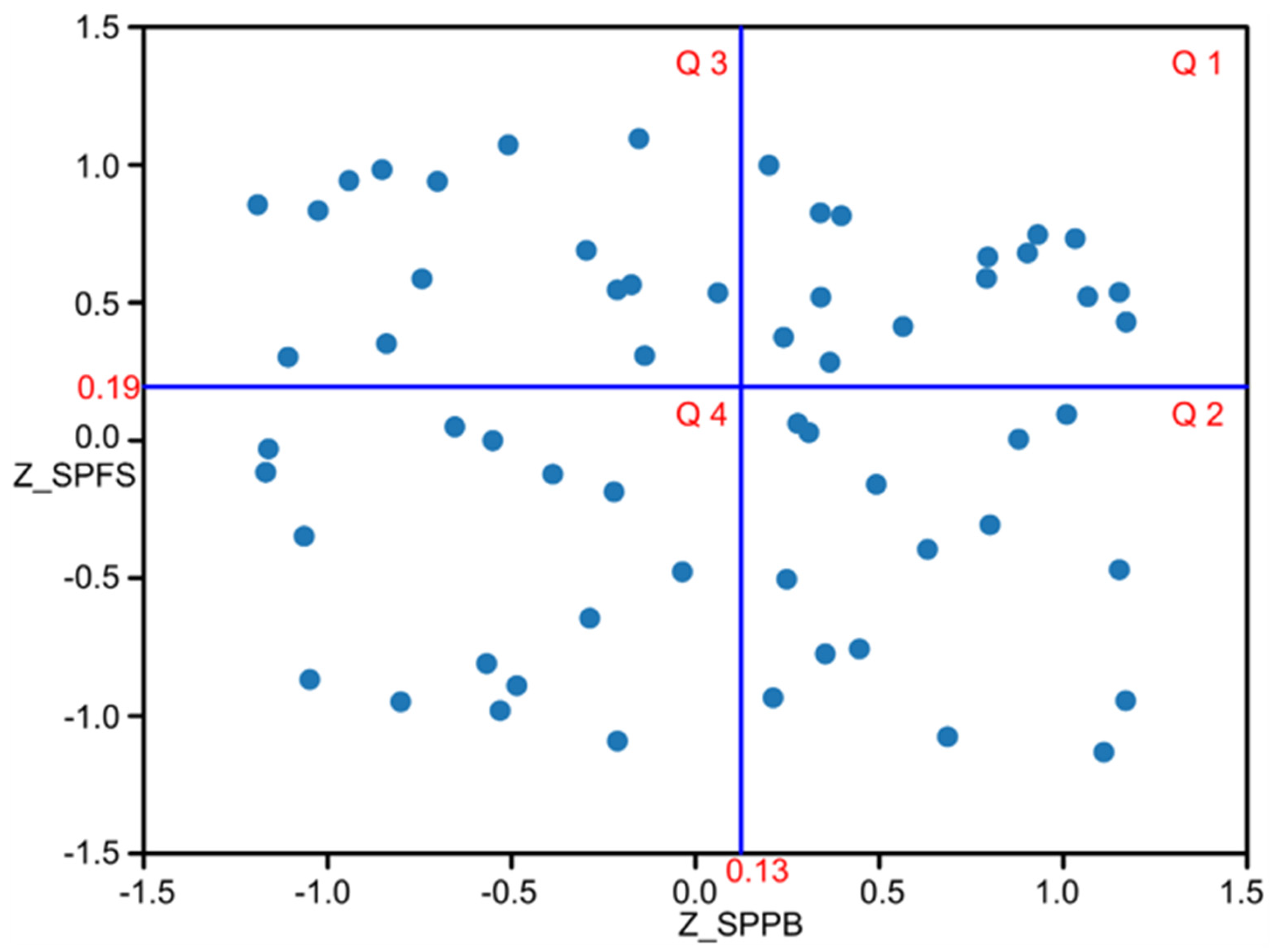
The final group distribution is presented in Table 1.
Table 1.
Distribution of participants across the four functional groups based on neighborhood origin.
2.2. Experimental Stimuli
Experimental stimuli were developed based on the spatial typology of Qingdao’s historic urban areas to ensure ecological validity. Photographs were collected from the same three neighborhoods and covered six typical micro-public space types: alleyway systems, enclosed courtyards, street plazas, residential frontage activity areas, community green spaces, and commercial service frontages. Final stimuli according to five criteria: (1) preservation of authentic spatial features with luminance normalized to 70–90 cd/m2; (2) inclusion of at least 10 predefined physical environmental elements used as Areas of Interest (AOIs); (3) consistent natural lighting conditions (sunny days, 10:00–14:00); (4) standardized eye-level shooting height of 1.5 m; and (5) inclusion of typical potential safety hazards.
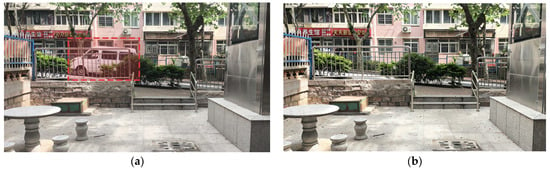
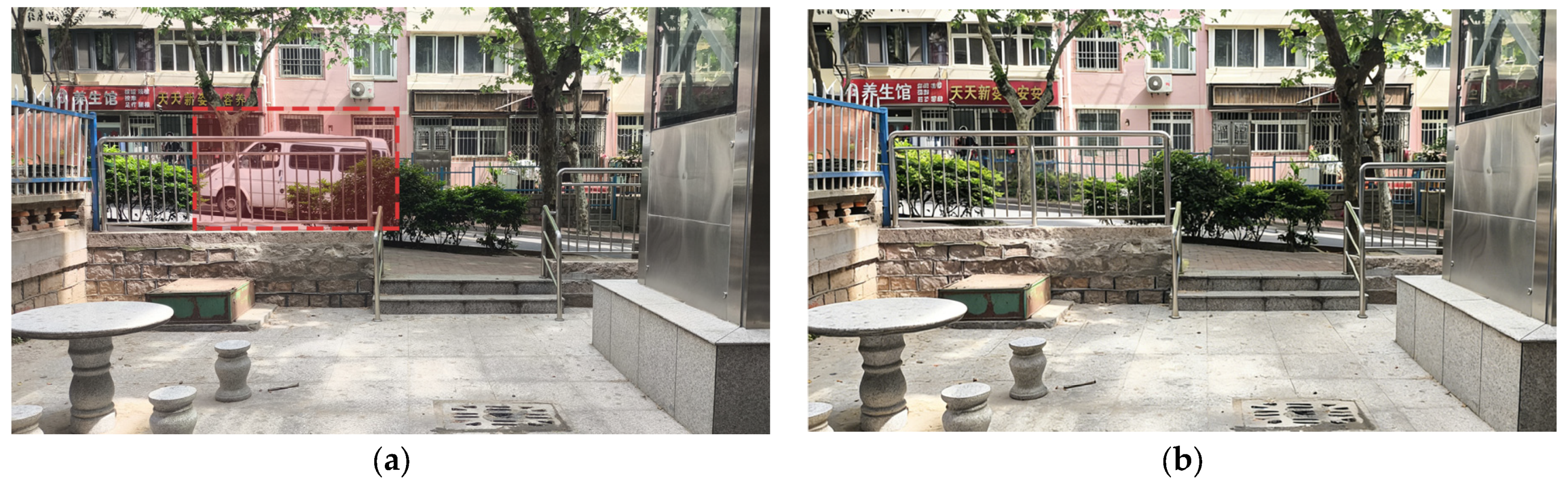
From an initial pool of 287 photographs, 27 representative images were selected and validated for the final tasks. Dynamic elements such as pedestrians and vehicles were digitally removed to eliminate visual noise. Color balance and contrast were uniformly adjusted to ensure visual consistency across stimuli (Figure 3).
Figure 3.
Examples of experimental stimuli and image processing workflow: (a) Original photograph where the dashed box indicates the area with dynamic elements removed and luminance normalized; (b) Processed stimulus for the free-viewing task.
2.3. Apparatus and Eye-Tracking Metrics
Eye movements were recorded using Tobii Pro Glasses 2 (Tobii AB, Danderyd, Sweden) via Tobii Glasses Controller software (version 2.4.3, Tobii AB, Danderyd, Sweden), a wearable eye-tracking system allowing unrestricted head movement. Eye movement data were captured at a sampling rate of 100 Hz. Calibration, stimulus presentation, and data recording were conducted using Tobii Pro Lab software (version 24.21, Tobii AB, Danderyd, Sweden). To ensure rigorous experimental control, all photographic stimuli were presented on a 27-inch LED monitor (1920 × 1080 resolution) positioned at a standardized viewing distance of 60 cm in a controlled laboratory environment. A single-point calibration was performed for each participant prior to the tasks. Calibration quality was strictly monitored; participants’ data were excluded if the spatial gaze deviation exceeded 0.5° of visual angle or if the overall tracking ratio fell below 85% during the session. To quantify visual attention and cognitive processing within the predefined Areas of Interest (AOIs), three primary eye-tracking metrics were extracted and analyzed:
- Total Fixation Duration (TFD): The sum of all fixation durations within an AOI, representing the overall level of interest or information processing effort.
- First Fixation Duration (FFD): The duration of the very first fixation on an AOI, serving as an indicator of initial attentional capture and the immediate saliency of environmental elements.
- Average Fixation Duration (AFD): Calculated as TFD divided by the number of fixations, reflecting the depth of cognitive processing or task difficulty.
These metrics were selected to provide a comprehensive understanding of both the initial orientation and the sustained cognitive engagement of older adults toward various environmental features.
2.4. Experimental Procedure
The experiment was conducted in a single 30-min session, structured into two distinct phases to minimize cognitive interference. Following eye-tracker calibration, participants performed the following tasks:
- Phase I: Free-Viewing Task (Spontaneous Preference). Participants viewed 12 randomized photographs (20s each). The instructions were kept minimal— “Observe the spaces as if you were on a daily stroll”—to capture unbiased visual exploration and potential “staying interest” without specific cognitive goals.
- Phase II: Risk Identification Task (Targeted Search). After a brief pause, participants viewed 15 different photographs containing potential physical hazards. They were instructed to actively identify and fixate on elements they perceived as risky.
To prevent fatigue, a 5-min rest period was provided between phases. To ensure accessibility for participants in lower-function groups (Q3 and Q4), all instructions were delivered through both standardized text on screen and synchronized verbal guidance by the researcher. Upon completion, participants were debriefed and received a small gift as a token of appreciation.
2.5. Data Analysis
Eighteen physical environmental elements were defined as Areas of Interest (AOIs) and manually delineated using Tobii Pro Lab. To ensure the objectivity and reproducibility of the manual AOI delineation, two independent researchers coded a 20% random subset of the stimuli. Inter-rater reliability was confirmed to be high (Cohen’s Kappa = 0.88), and any minor discrepancies were resolved through discussion to establish a standardized coding protocol. Raw eye-tracking data were exported and analyzed using SPSS 28.0 and Microsoft Excel.
Descriptive statistics were calculated for the three primary metrics: Total Fixation Duration (TFD), First Fixation Duration (FFD), and Average Fixation Duration (AFD). To examine the influence of participant heterogeneity on spatial perception, repeated-measures ANOVA models were conducted with AOI type as the within-subject factor and participant group (Q1–Q4) as the between-subject factor. Significant Group × AOI interactions were further examined using simple effects analyses and LSD or Tukey HSD post hoc tests (α = 0.05) to identify specific inter-group differences.
To translate these metrics into design priorities, an adapted Importance-Performance Analysis (IPA) framework, originally established by Martilla and James [45], was performed. Within this framework, First Fixation Duration (FFD) was operationalized as the “Alertness” dimension (vertical axis), representing immediate attentional capture, while AFD was operationalized as the “Cognitive Load” dimension (horizontal axis), representing information processing difficulty. To ensure comparability across metrics and groups, raw scores were standardized using Z-score transformation. This allowed for the mapping of environmental elements into a four-quadrant matrix—High Alert/High Load, Low Alert/High Load, Low Alert/Low Load, and High Alert/Low Load—providing a systematic basis for differentiated micro-renewal strategies. Furthermore, to mathematically quantify the diagonal tendency observed in the IPA matrix, a simple linear regression was conducted using the standardized values of initial alertness (FFD, dependent variable) and cognitive load (AFD, independent variable) across the 18 physical environmental AOIs. The coefficient of determination (R2) was calculated to measure the explanatory strength of this Perceptual Burden Gradient.
2.6. Data Availability and Use of Generative AI
The de-identified numerical eye-tracking datasets generated during the current study are available from the corresponding author upon reasonable request. Due to privacy and ethical restrictions regarding personal identifiable information (e.g., raw gaze-overlay videos capturing identifiable individuals and community locations), the raw visual data cannot be deposited in a public repository.
Generative artificial intelligence tools were not used in study design, data collection, analysis, or interpretation. AI-assisted tools were used only for language editing.
3. Results
To examine differences in spatial perception across heterogeneous older adult groups, this study analyzed three eye-tracking metrics—Total Fixation Duration (TFD), First Fixation Duration (FFD), and Average Fixation Duration (AFD)—across predefined Areas of Interest (AOIs). TFD reflects cumulative attentional allocation, FFD captures initial processing upon first encounter, and AFD indicates per-fixation processing intensity [38]. Results are presented from overall patterns to inter-group differences.
3.1. Overall Visual Attention Patterns Across All Participants
Across all participant groups, consistent visual attention patterns emerged, revealing shared attentional hierarchies within the micro-public spaces of old residential communities.
3.1.1. Visual Dominance Hierarchy and Baseline Environmental Needs
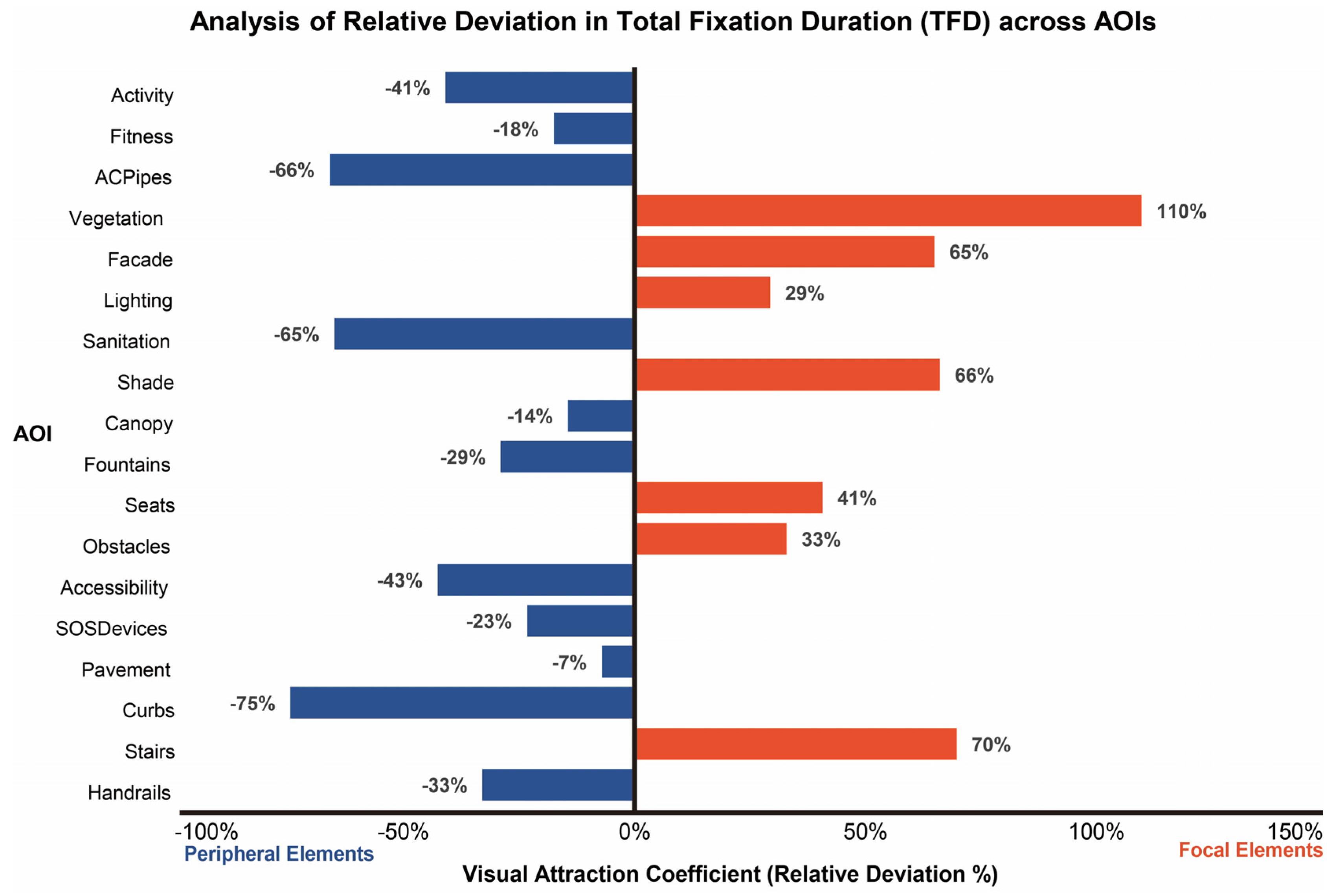
To illustrate the universal visual attention hierarchy across all participants, we generated an aggregated attentional ranking of AOIs based on normalized Total Fixation Duration (TFD). As shown in Figure 4, safety-critical elements such as Stairs, Obstacles, and Lighting consistently received the highest attentional engagement, whereas boundary or low-information elements like AC Pipes and Curbs showed comparatively low attention. This overall structure provides a baseline perceptual hierarchy that underpins subsequent group-specific differences.
Figure 4.
Visual Dominance Hierarchy of AOIs based on Relative Deviation in Total Fixation Duration (TFD). Note: The central axis represents the mean attention level. Warm-colored bars (right) identify “Visual Anchors”—elements with above-average TFD and high attentional priority; cool-colored bars (left) identify “Background Elements” processed incidentally.
3.1.2. Functional Differentiation and Complementarity of Eye-Tracking Metrics
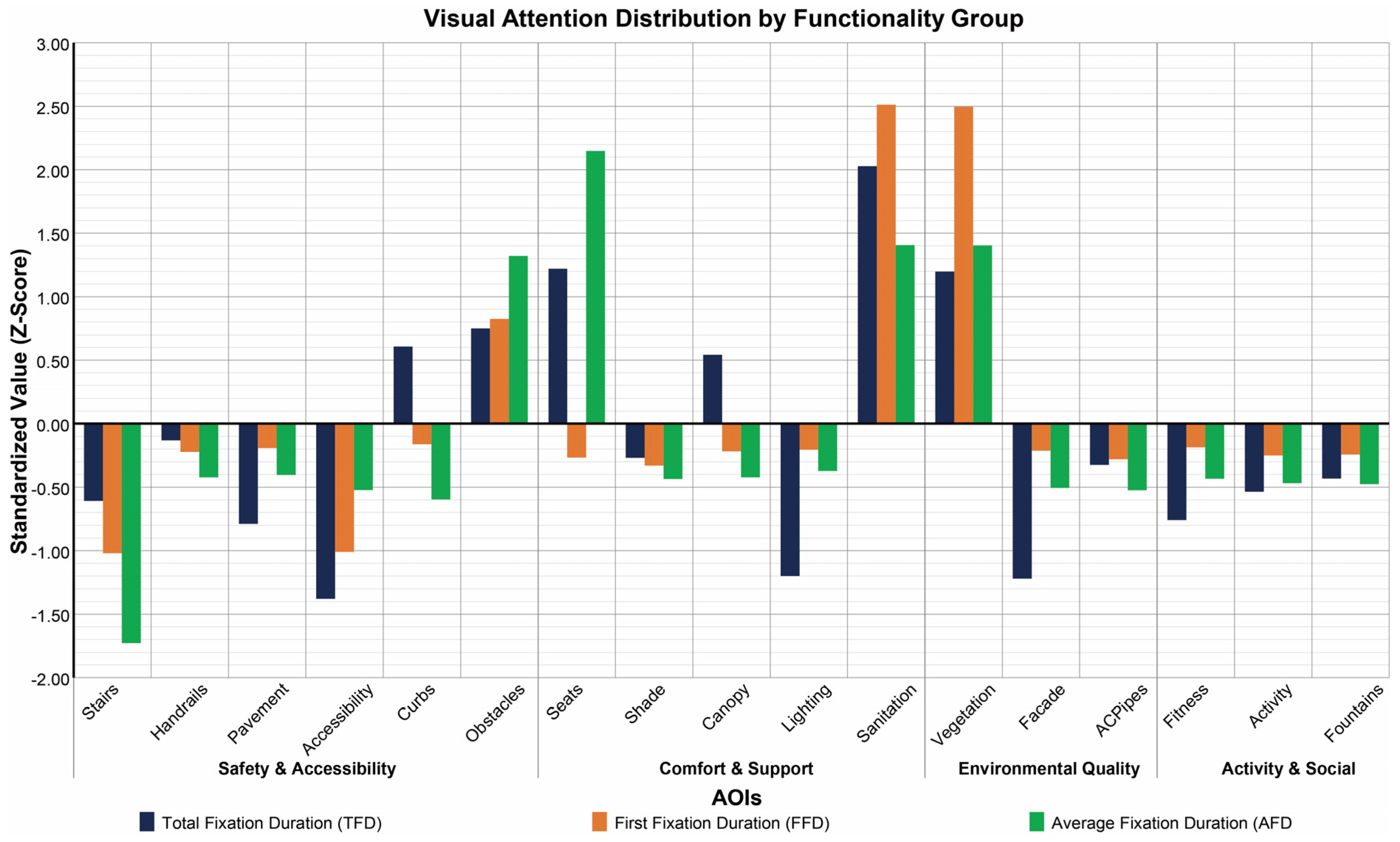
To ensure the analytical rigor of the subsequent comparisons, a baseline validation was performed to examine the complementarity of the selected eye-tracking metrics. This comparison demonstrates a clear functional differentiation: TFD captures cumulative attentional allocation, FFD reflects initial attentional capture, and AFD indicates fixation-level cognitive processing intensity. Collectively, these metrics provide a multi-dimensional mapping of how older adults interact with environmental elements. For instance, a high TFD paired with low FFD or AFD indicates that certain elements, while not immediately salient, require sustained visual monitoring.
As illustrated in Figure 5, specific environmental features exhibited distinct attentional signatures:
- Obstacles: These elements were characterized by significantly elevated TFD alongside reduced FFD and AFD values. This indicates that obstacles require high cumulative attention through multiple repetitive fixations rather than immediate visual saliency or intensive single-glance processing.
- Handrails: Similarly, handrails demonstrated high cumulative TFD but low initial acquisition (FFD) and cognitive depth (AFD). The attention distribution was repetitive and distributed, identifying them as peripheral environmental references.
- Stairs: A dissociated pattern was observed, where low initial saliency (FFD) was followed by high total monitoring duration (TFD). This suggests a requirement for prolonged visual tracking despite low immediate attraction.
- Esthetic Elements (Vegetation and Facades): In contrast, these features elicited higher FFD values but comparatively low TFD. Such elements show rapid initial attentional capture followed by prompt de-prioritization.
This comparison, further detailed in Figure 5, demonstrates that TFD, FFD, and AFD capture complementary stages of visual attention, providing a comprehensive mapping of the aging-environmental interaction.
Figure 5.
Functional differentiation and complementarity of TFD, FFD, and AFD across AOIs.
3.2. Inter-Group Differences in Total Fixation Duration (TFD)
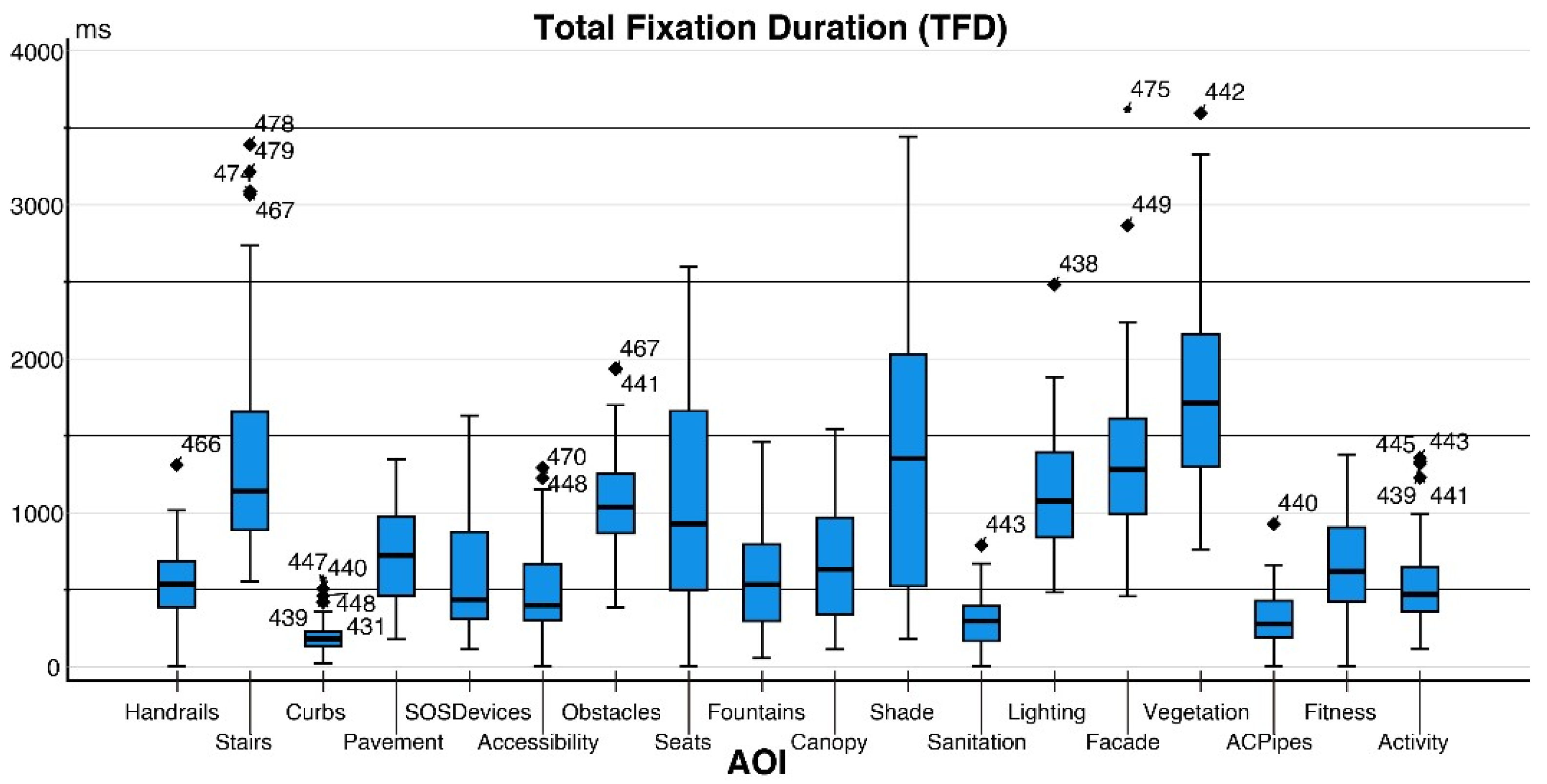
To examine differences in visual processing depth across the four functional profiles, Total Fixation Duration (TFD) was analyzed for each AOI. Figure 6 illustrates the distribution and variance of TFD across all AOIs, while Table 2 summarizes the elements showing statistically significant inter-group differences. Beyond the shared attention structure described previously, clear group-specific hierarchies of environmental needs emerged.
Figure 6.
Box plots of Total Fixation Duration (TFD) across AOIs.
Table 2.
Summary of inter-group differences in TFD for significant AOI elements.
3.2.1. Low-Function Groups (Q3, Q4): Compensatory Monitoring of Safety
Participants with lower functional capacity demonstrated a clear reliance on supportive architectural elements. One-way ANOVA revealed significant group effects on TFD for Stairs and Pavement (p < 0.001), with the Q4 group allocating significantly more visual attention to Stairs than the Q1 and Q2 groups. This sustained fixation reflects compensatory monitoring: a survival-based strategy where frail older adults must continuously evaluate “environmental press” (e.g., stairs, handrails) to mitigate mobility-related risks during navigation.
3.2.2. High-Participation Groups (Q1, Q3): Shift Toward Comfort and Activity
Conversely, groups with higher social participation levels exhibited a perceptual shift toward environmental affordances. Significant inter-group differences were found for Vegetation ($*F*(3, 56) = 38.13, *p* < 0.001$) and Fountains ($*F*(3, 56) = 95.13, *p* < 0.001$), with Q1 and Q2 participants devoting substantially more visual resources to these focal points than lower-participation groups. For these active seniors, once basic mobility demands are perceived as manageable, visual attention is liberated to prioritize “comfort anchors” such as seats and greenery, facilitating social engagement and environmental appreciation. (Table 2).
While TFD reveals how attentional resources are cumulatively distributed across environmental elements, it does not capture how these elements are initially appraised. Therefore, FFD was further analyzed to examine early-stage cognitive evaluation across groups.
3.3. First Fixation Duration (FFD): Initial Cognitive Appraisal
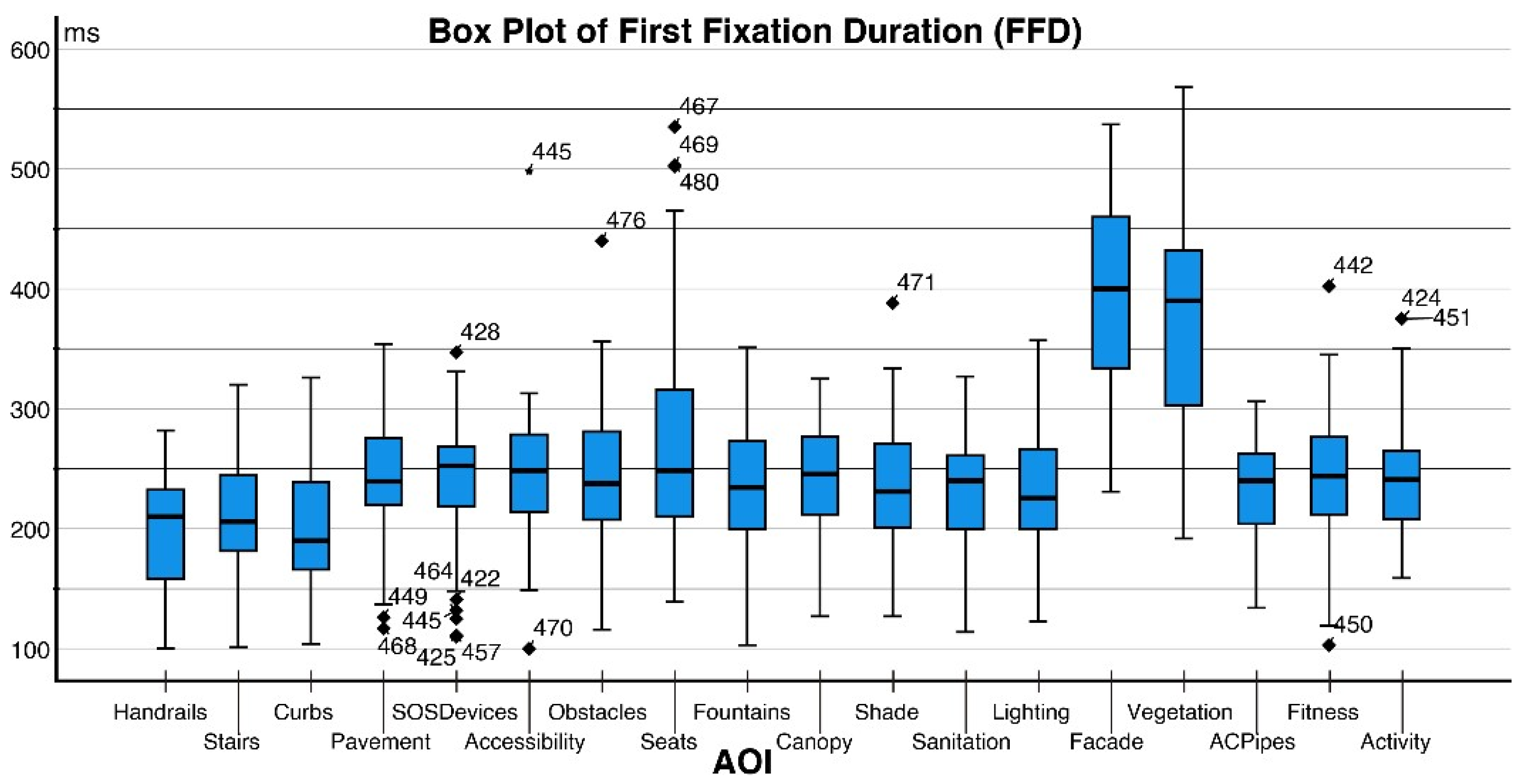
First Fixation Duration (FFD) was examined to capture the initial processing depth and immediate evaluative appraisal upon first encountering an AOI. This metric serves as a key indicator of initial attentional capture and the perceived saliency or risk associated with environmental features. Figure 7 illustrates the distribution of FFD across all AOIs, while Table 3 summarizes the significant inter-group differences.
Figure 7.
Box plots of First Fixation Duration (FFD).
Table 3.
ANOVA and post hoc results for FFD.
While FFD captures the initial stage of processing, the efficiency of sustained cognitive engagement is further reflected in the Average Fixation Duration (AFD).
Universal Initial Capture vs. Immediate Affordance Evaluation in the Frail Group
The initial cognitive appraisal, captured by First Fixation Duration (FFD), revealed that initial visual capture across most micro-space elements (e.g., Stairs, Handrails, Vegetation) was universal, showing no statistically significant differences among the four functional profiles (*p* > 0.05). This suggests that baseline environmental features attract initial human attention similarly, regardless of age-related functional decline. However, a highly significant divergence emerged regarding Rest Seats (*F*(3, 56) = 126.75, *p* < 0.001). The Q4 group (Low Function–Low Participation) exhibited drastically longer initial fixations on Seats compared to all other groups (Q4 > Q1, Q2, Q3). This massive increase in FFD indicates that for individuals with the lowest physical reserves, locating and evaluating a place to rest is the immediate, overriding cognitive priority upon entering a space. Rather than a casual glance, frail older adults must conduct an intense, prolonged initial assessment of a seat’s availability and safety before committing to further spatial navigation.
3.4. Average Fixation Duration (AFD): Processing Efficiency Across Groups
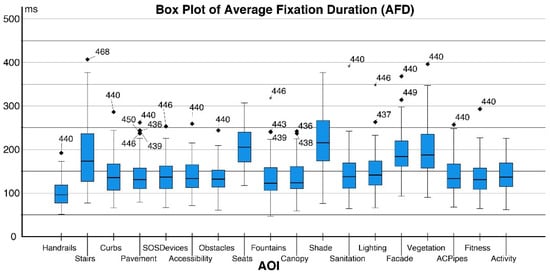
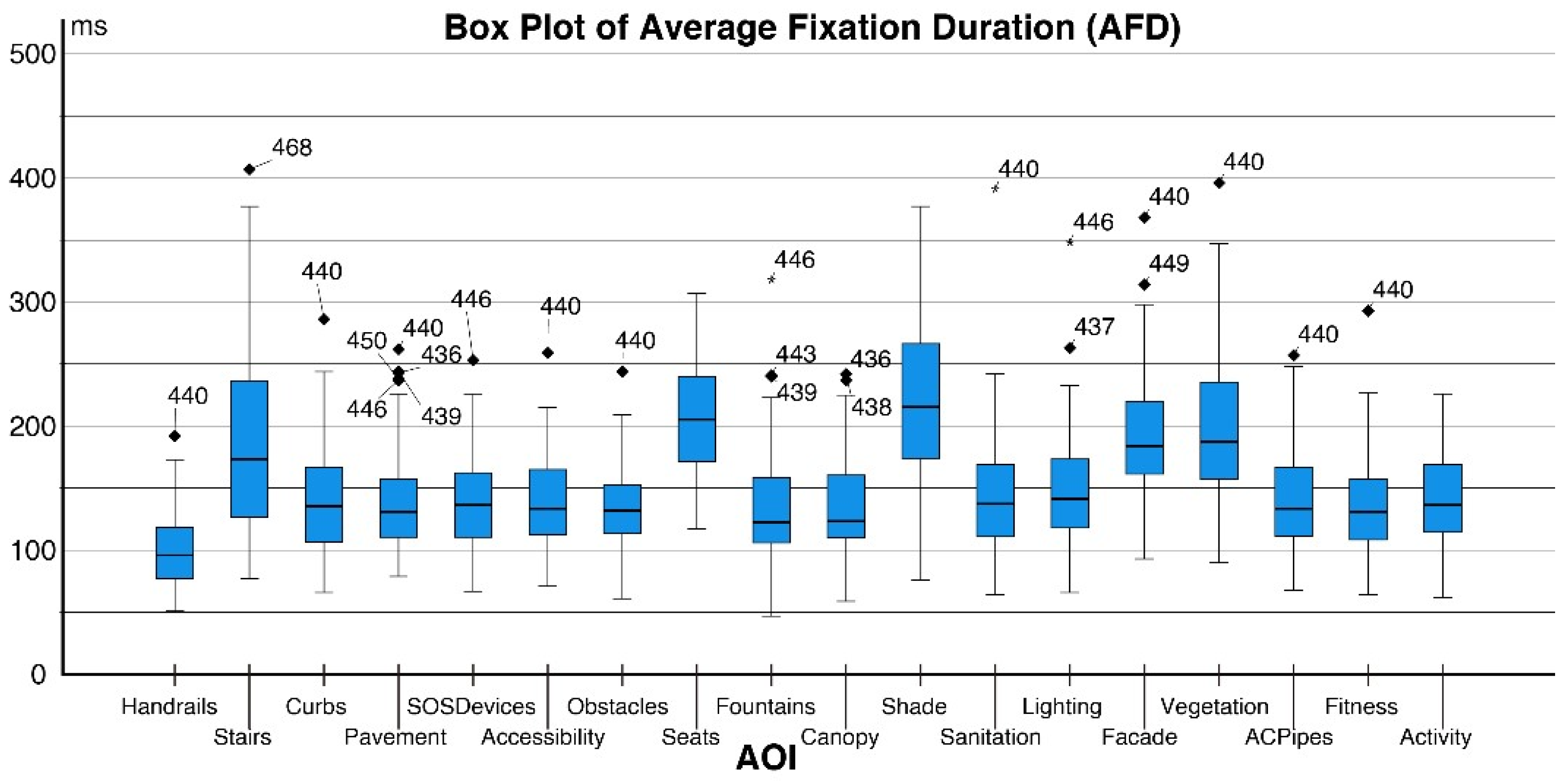
Average Fixation Duration (AFD) was analyzed to assess the cognitive processing efficiency associated with individual fixations. Longer AFD values typically reflect increased cognitive load or deeper information extraction during a single glance. Figure 8 illustrates the distribution of AFD across all AOIs, while Table 4 compares the mean AFD values for key environmental elements across the four functional profiles.
Figure 8.
Box plots of Average Fixation Duration (AFD). Note: The asterisk (*) symbols denote extreme outlier data points (values exceeding 3 times the interquartile range), labeled with their respective case numbers.
Table 4.
Comparison of mean AFD values across groups for selected AOIs.
3.4.1. Effortful Processing of Mobility Hazards in the Low-Function Group (Q4)
The Average Fixation Duration (AFD) revealed significant group-level differences in cognitive processing efficiency. Participants in the Q4 group exhibited the highest AFD values for mobility-critical elements, particularly on Stairs (315.6 ms), which was identified as highly significant. This indicates slower, more effortful processing among individuals with the lowest functional reserves. Navigating micro-spaces requires these seniors to devote substantial cognitive resources to decoding irregular physical features, reflecting a high level of mental effort directed toward accident prevention.
3.4.2. Quality-Oriented Processing in High-Function Groups (Q1, Q2)
Conversely, participants in the Q1 and Q2 groups displayed longer AFD values for environmental quality features rather than safety cues. For instance, the Q2 and Q1 groups showed higher processing depth for the Canopy (184.3 ms and 141.1 ms, respectively) compared to the lower-functioning groups (e.g., Q3 at 112.4 ms and Q4 at 125.1 ms), while the Q2 group exhibited sustained engagement with Vegetation (254.3 ms). These patterns reflect a transition in cognitive focus: when functional ability reduces navigational stress, cognitive resources are liberated to evaluate the esthetic details and quality of the surroundings. (Table 4).
3.5. Summary of Perceptual Hierarchies Across Functional and Participatory Profiles
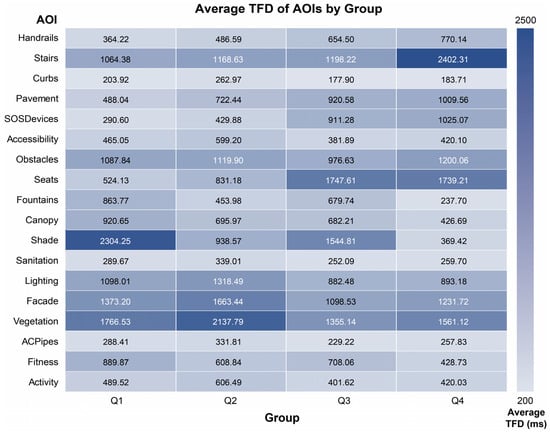
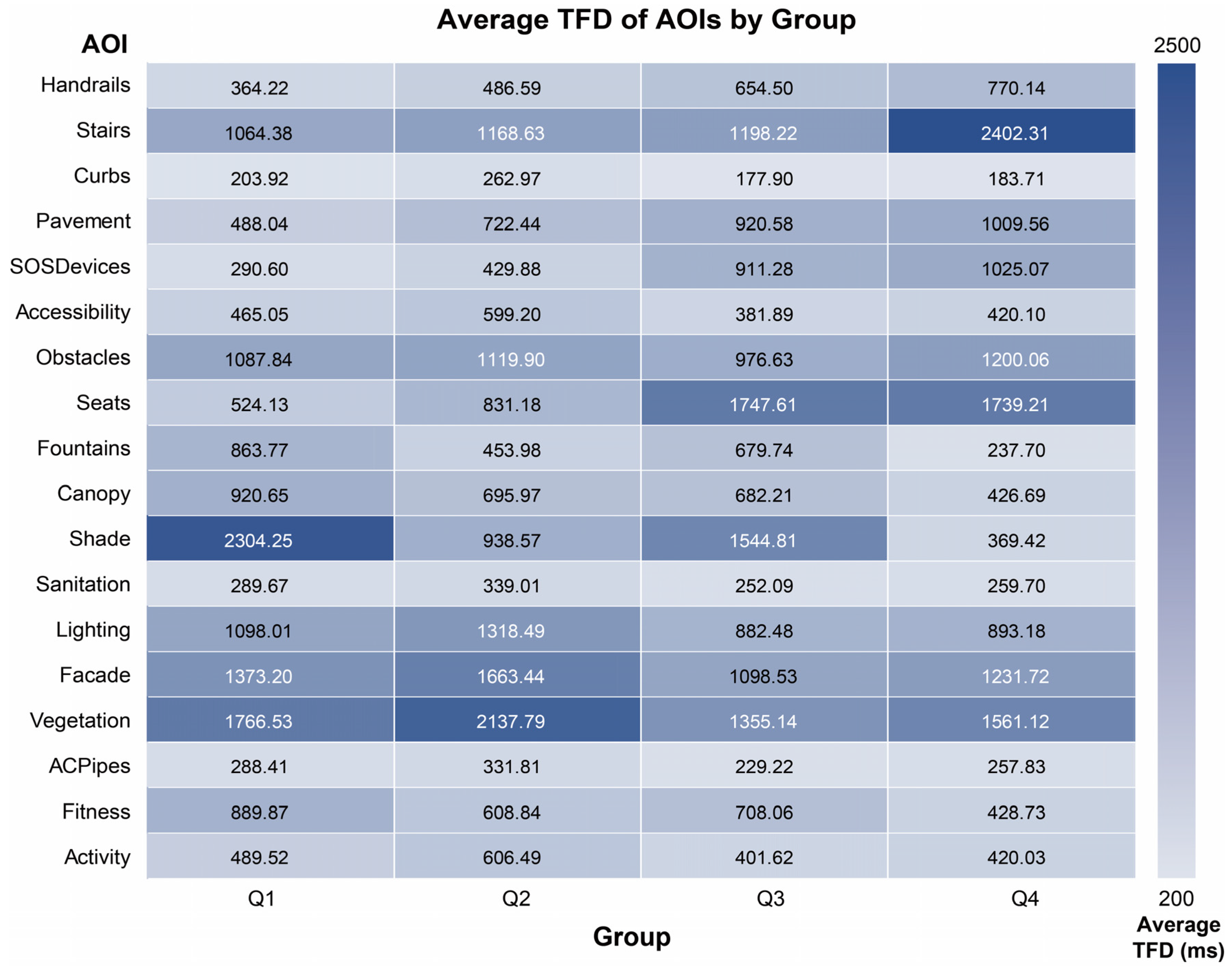
The integration of multiple eye-tracking metrics reveals distinct attentional structures associated with different functional and participatory profiles. As illustrated in the matrix heatmap (Figure 9), a systematic shift in visual priority is observed across the four groups. Safety- and accessibility-related AOIs, such as Stairs, Obstacles, and Handrails, receive the highest relative attentional allocation from the low-function groups (Q3 and Q4), establishing a baseline focus on elements critical for navigation. Furthermore, the initial cognitive appraisal (FFD) uniquely identifies Rest Seats as a critical immediate requirement for the frailest group (Q4), shifting its role from a mere comfort amenity to a vital mobility-support affordance.
Figure 9.
Matrix heatmap of average TFD: Mapping visual attention distribution across Functional (Q1–Q4) profiles.
Conversely, as functional capacity and social participation levels increase (Q1 and Q2), visual attention is progressively redistributed toward comfort- and esthetic-related AOIs, including Vegetation, Seats, and Fountains. The heatmap shows that the Q1 group exhibits the most balanced distribution across environmental quality features compared to the safety-centric patterns of the Q4 group. These distinct attentional signatures provide empirical evidence of non-uniform spatial perception among older adults. The observed variance across groups Q1–Q4 supports the requirement for differentiated evidence-based micro-renewal strategies that account for the diverse functional and social characteristics of the aging population.
4. Discussion
This study demonstrates that older adults do not perceive old community micro-public spaces uniformly. By integrating theory-driven participant segmentation with eye-tracking data, the findings reveal systematic differences in visual prioritization structured by functional ability and social participation. The following discussion synthesizes these findings through three interrelated lenses: theoretical implications, perceptual decision logic, and design relevance for age-friendly micro-renewal.
The observed perceptual divergence strongly aligns with foundational theories in environmental psychology and gerontology, validating the necessity of a non-uniform approach to micro-renewal. The frail group’s (Q4) intense visual vigilance toward mobility hazards (e.g., Stairs) and their immediate, prolonged initial search for physical affordances (e.g., Rest Seats) corroborates existing literature on the “fear of falling” [46]. confirming that the perception of fall risks in public environments is highly contingent upon an individual’s specific level of physical frailty [47]. Previous clinical and behavioral studies have demonstrated that older adults with elevated fall risks exhibit fundamentally altered gaze behaviors, prioritizing immediate hazard detection over spatial exploration to secure physical stability [48]. In stark contrast, the active groups’ (Q1, Q2) sustained engagement with Vegetation and Fountains supports the principles of Attention Restoration Theory (ART) [49] and Stress Recovery Theory (SRT) [50]. When an individual’s functional reserves are sufficient to buffer basic environmental press, visual attention is liberated to process restorative and esthetic elements, facilitating higher-level psychological well-being. These eye-tracking findings empirically validate classic urban design frameworks which posit that public spaces must first satisfy basic physiological and safety needs before fulfilling higher-order esthetic functions [50,51]. Furthermore, our results regarding the Q1 and Q2 groups’ sustained engagement with vegetation and water features provide physiological evidence for Nasar’s theory of urban design esthetics, demonstrating that visual preference and evaluative qualities are highly dependent on the observer’s functional autonomy [52]. Thus, age-friendly micro-renewal cannot be a uniform esthetic upgrade; it must be a stratified intervention that secures the physical baseline for the frail while providing esthetic affordances for the active.
4.1. Theoretical Implications: Perceptual Burden Gradient
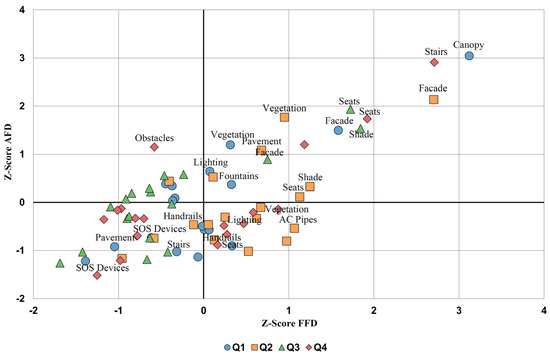
While the preceding analysis reveals group-specific perceptual differences, these results do not directly indicate where design interventions should be prioritized. To bridge this gap, an adapted Importance–Performance Analysis (IPA) framework was employed to translate visual attention metrics into actionable renewal priorities [46].
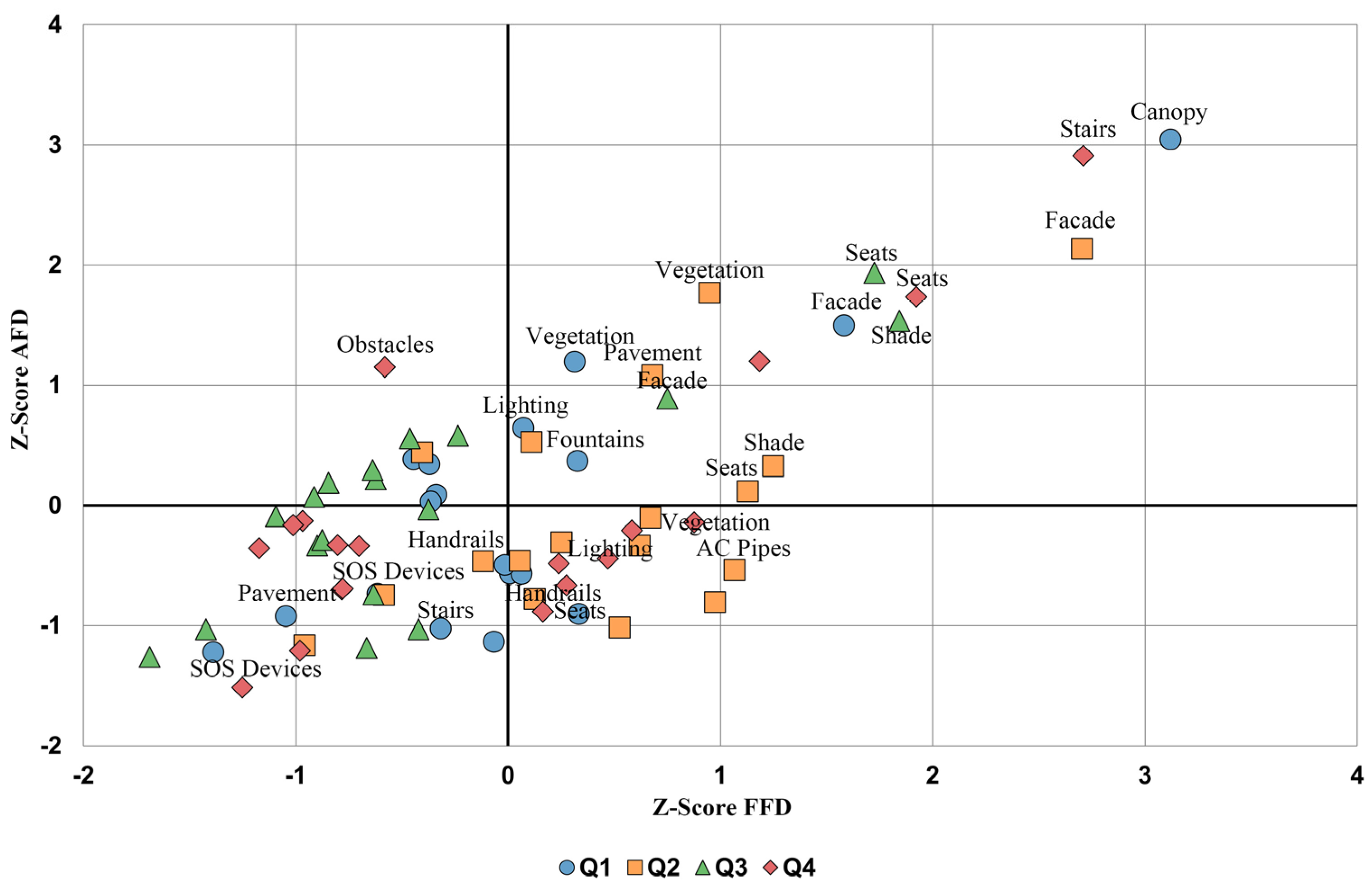
Figure 10 visualizes the relationship between initial attentional alertness (FFD) and per-fixation cognitive load (AFD) across environmental elements using an adapted Importance–Performance Analysis (IPA) framework. Rather than being evenly distributed, AOIs cluster into distinct regions of the matrix, indicating systematic differences in perceptual demand.
Figure 10.
Perceptual Structure Revealed by the IPA Matrix.
Elements located toward the upper-right quadrant are characterized by both high initial alertness and high processing load, reflecting situations in which older adults are immediately drawn to an element but require sustained cognitive effort to interpret or manage it. In contrast, elements in the lower-right quadrant combine high alertness with low processing load, indicating perceptually efficient features that are easily detected and cognitively manageable. The left side of the matrix captures elements that impose cognitive load without strong attentional salience, as well as elements that are neither salient nor demanding.
Notably, when data are examined across functional profiles, a consistent diagonal tendency emerges from the upper-right toward the lower-right quadrant. This trajectory reflects a gradual reduction in perceptual burden, which can be conceptualized as a Perceptual Burden Gradient (quantified by the regression model as R2 = 0.5379, p < 0.01). Movement along this gradient indicates a shift from environments that demand intensive cognitive monitoring toward those that support more effortless and efficient perception. This gradient provides a structural link between individual functional capacity, visual attention patterns, and perceived environmental press.
4.2. Translating Perception into Micro-Renewal Priorities (IPA Framework)
While eye-tracking metrics reveal how visual attention is distributed across environmental elements, they do not directly indicate how renewal interventions should be prioritized. To bridge this gap between perceptual evidence and design decision-making, this study applies an adapted Importance–Performance Analysis (IPA) framework that translates visual attention patterns into interpretable renewal priorities.
In this framework, First Fixation Duration (FFD) is used to represent attentional alertness, reflecting how strongly an environmental element captures immediate visual attention. Average Fixation Duration (AFD) is used to represent processing load, indicating the cognitive effort required to interpret or manage an element once attention is engaged. All values are standardized using Z-scores to ensure comparability across AOIs and participant groups.
Unlike conventional IPA models that evaluate satisfaction and performance, this adaptation reframes the matrix in cognitive terms. The four quadrants represent distinct perceptual states defined by the interaction between alertness and load (Table 5). Elements in the High Alert/High Load quadrant signal areas of elevated perceptual burden, where immediate attention is required but processing is cognitively demanding. Conversely, the High Alert/Low Load quadrant represents perceptually efficient conditions, in which environmental cues are both visible and easily processed.
Table 5.
IPA Quadrant Definitions Adjusted for Cognitive Load.
This cognitively grounded IPA framework does not assume that all highly attended elements require improvement. Instead, it distinguishes between attentional reliance that reflects environmental stress and attentional reliance that reflects effective affordance. By doing so, it provides a structured basis for prioritizing micro-renewal interventions according to how older adults actually perceive and cognitively manage old community micro-public spaces.
4.3. Design Implications for Old Community Micro-Renewal
The IPA-based perceptual structure offers clear guidance for differentiated micro-renewal strategies in old communities, where spatial constraints limit the feasibility of large-scale interventions. Rather than applying uniform age-friendly standards, renewal efforts should respond to variations in perceptual burden associated with different functional profiles.
4.3.1. Reducing Perceptual Burden in High-Stress Elements
Environmental elements located in the High Alert/High Load quadrant represent priority targets for intervention. These elements demand immediate attention while imposing substantial cognitive processing effort, indicating elevated environmental press. In old community micro-public spaces, such conditions are particularly problematic for older adults with reduced functional capacity, as sustained cognitive monitoring is required to ensure safe navigation.
Micro-renewal strategies for these elements should focus on stress reduction through perceptual simplification. Design measures may include enhancing material contrast, clarifying spatial boundaries, improving localized lighting, and reducing ambiguity in surface transitions. The objective is not to eliminate attention to these elements, but to lower the cognitive effort required to interpret them, thereby shifting their perceptual position toward a more efficient state along the Perceptual Burden Gradient.
4.3.2. Preserving and Enhancing Perceptually Efficient Affordances
Elements located in the High Alert/Low Load quadrant function as perceptual anchors within the environment. These features are easily detected and require minimal cognitive effort to process, supporting comfortable and confident use of space. For older adults with higher functional and participatory reserves, such elements facilitate social engagement and environmental appreciation without increasing perceptual burden.
Micro-renewal in these areas should prioritize affordance enrichment rather than structural modification. Improving the ergonomic quality, visibility, and continuity of these elements can strengthen their supportive role. Importantly, interventions should avoid unnecessary complexity that could inadvertently increase cognitive load.
4.3.3. Visual Subtraction and Cognitive De-Cluttering
The Low Alert/High Load quadrant highlights elements that impose cognitive effort without providing corresponding functional or perceptual benefit. In old community, such conditions often arise from accumulated visual clutter, including exposed utility installations, redundant signage, or fragmented façade details.
For these elements, renewal strategies should emphasize visual subtraction and integration rather than enhancement. Concealing or reorganizing visually chaotic features can reduce background cognitive load, thereby improving overall environmental legibility for all older adults, regardless of functional status.
4.3.4. Managing Low-Priority Elements Within Routine Maintenance
Elements located in the Low Alert/Low Load quadrant exert minimal influence on perceptual experience and do not require immediate intervention. These features can be managed through routine maintenance rather than targeted renewal, allowing limited resources to be allocated toward higher-impact interventions identified elsewhere in the matrix.
4.4. Translating Eye-Tracking Evidence into Design Practice: Micro-Renewal Prototypes
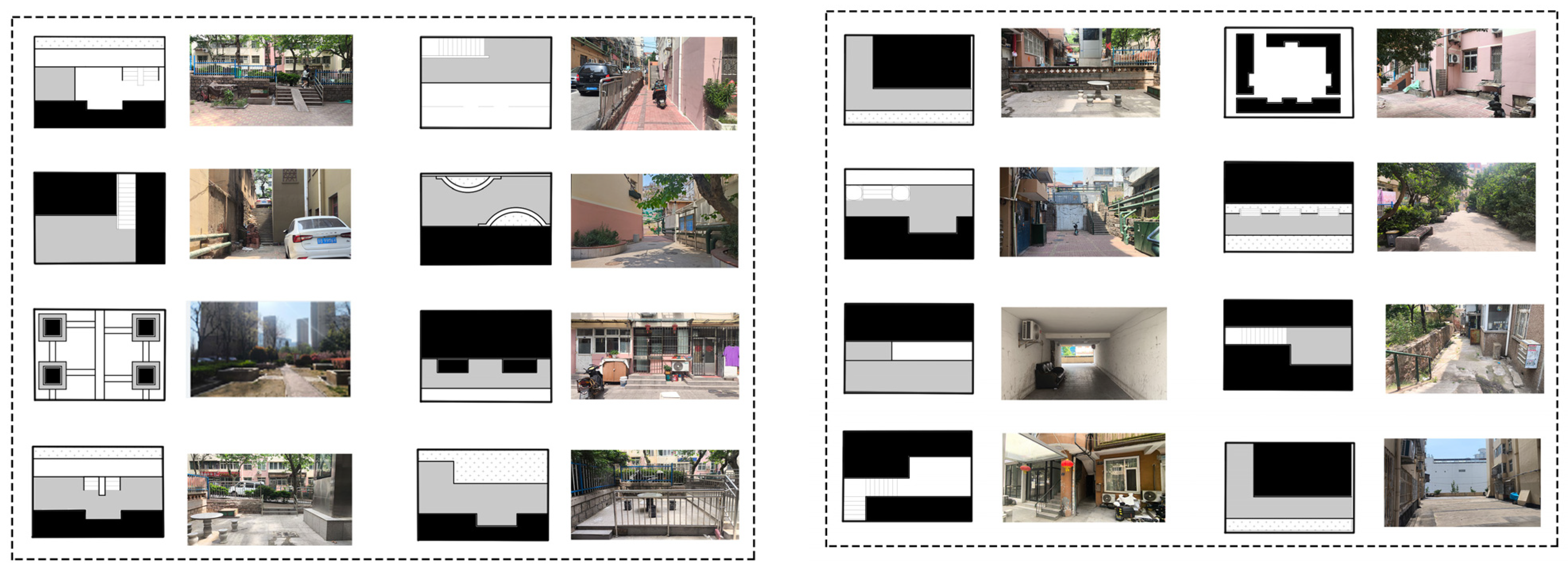
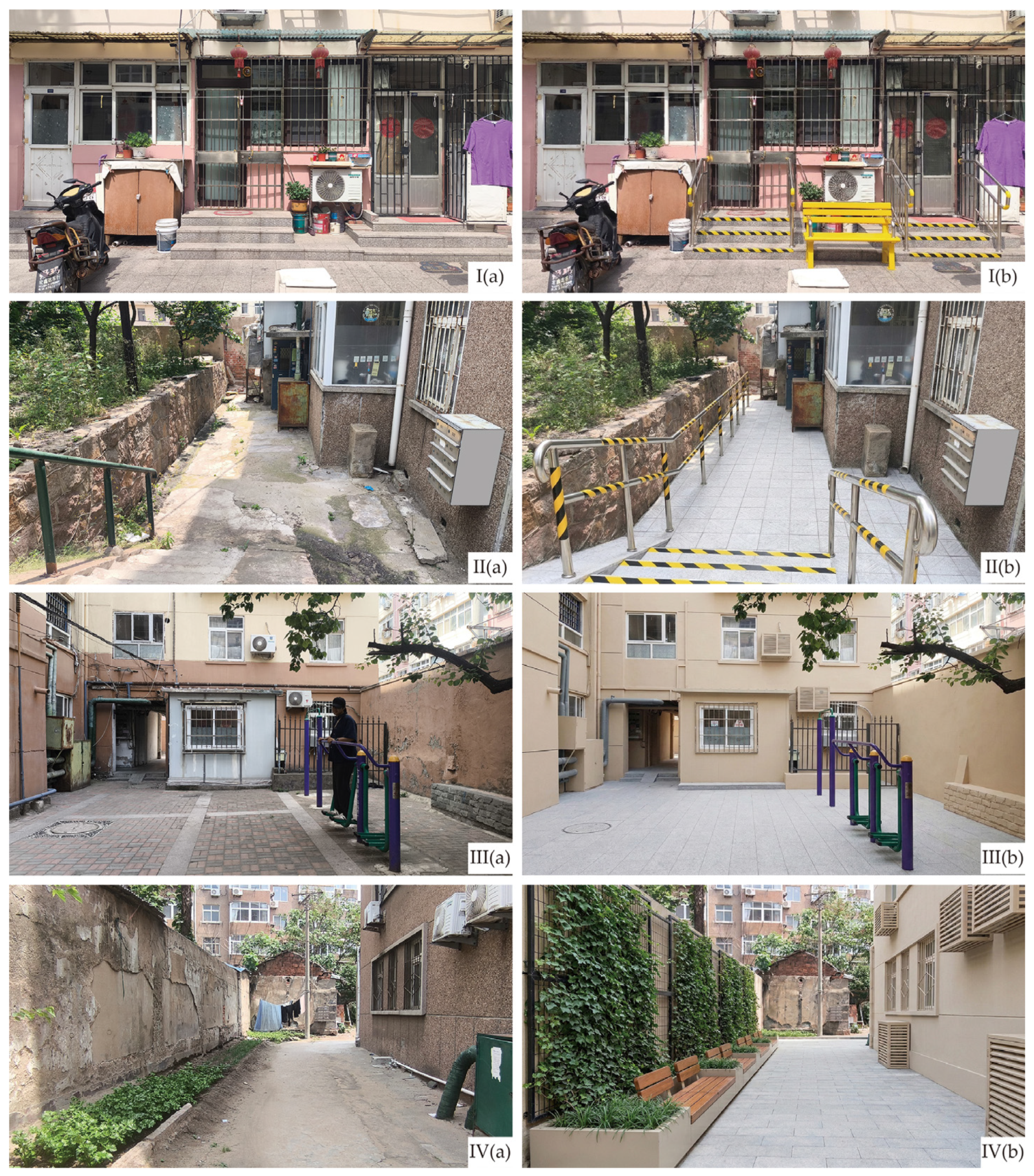
To demonstrate the practical applicability of the findings, this study translates the physiological metrics (FFD, AFD, TFD) into four actionable micro-renewal prototypes using the original experimental stimuli (Figure 10). Rather than implementing generic esthetic upgrades, the interventions are strictly evidence-based, directly targeting the perceptual deficits identified across the functional profiles (as shown in Figure 11).
Figure 11.
Evidence-based micro-renewal prototypes translated from eye-tracking metrics (Scenes I–IV): I(a) Original state of Scene I; I(b) Proposed intervention for Scene I; II(a) Original state of Scene II; II(b) Proposed intervention for Scene II; III(a) Original state of Scene III; III(b) Proposed intervention for Scene III; IV(a) Original state of Scene IV; IV(b) Proposed intervention for Scene IV.
First, addressing the extreme cognitive load (AFD) and initial visual vigilance (FFD) of frail older adults (Q4) towards mobility hazards, interventions prioritize “cognitive unloading” and “survival affordances” (Figure 11 I(a), II(a)). To mitigate the fall risk on irregular stairs and ramps, high-contrast yellow-and-black anti-slip warning strips and continuous double-layer stainless steel handrails are installed. Furthermore, responding to the Q4 group’s intense initial visual search for physical support, bright yellow, hard-surfaced seating equipped with backrests and armrests is strategically retrofitted at spatial entry points to eliminate acute navigational anxiety (Figure 11 I(b), II(b)).
Second, for areas burdened by visual clutter (Figure 11 III(a)), the design priority shifts to “visual subtraction.” Exposed black pipes and chaotic AC cables are hidden or covered with unified louvers, and the facades are repainted with low-saturation beige to minimize visual noise and navigational fatigue. The ground is also replaced with uniform, low-contrast light gray flat tiles (Figure 11 III(b)).
Finally, “stratified quality enhancement” is introduced (Figure 11 IV(a)). Directly catering to the sustained esthetic engagement (TFD) observed in the active groups (Q1, Q2), a metal grid vertical greening system integrated with planter boxes and continuous wooden seating is installed. Crucially, this multi-sensory restorative intervention is implemented alongside flat paving and concealed AC units, confirming that esthetic upgrades must be built upon baseline mobility safety. These prototypes confirm that objective physiological data can directly parameterize architectural interventions. (Figure 11 IV(b)).
4.5. Limitations and Future Directions
While this study provides robust empirical evidence for age-friendly micro-renewal, several limitations must be acknowledged. A primary limitation, as highlighted by our methodological approach, lies in the reliance on advanced, high-fidelity eye-tracking equipment (e.g., Tobii Pro Glasses 2). Such professional-grade hardware requires substantial financial investment and specialized expertise, potentially limiting the immediate replicability of this assessment framework in resource-constrained municipalities or less-developed countries. However, it is crucial to note that the core value of this research lies in the established E-B (Environment-Behavior) analytical framework rather than the specific hardware. To democratize this methodology globally, future urban audits can readily adopt rapidly advancing open-source, webcam-based eye-tracking solutions. These low-cost alternatives, requiring only standard cameras and accessible software algorithms, can capture analogous gaze metrics (FFD, TFD), thereby ensuring that our evidence-based design toolkit is highly scalable and practically available to urban planners across both developed and developing regions.
5. Conclusions
This study employed eye-tracking technology to investigate the systematic differences in how functional ability and social participation shape older adults’ perception. By operationalizing the Successful Aging framework through two core dimensions—physiological function (SPPB) and psychosocial adaptation (SPFS)—this research categorized participants into four distinct profiles (Q1–Q4) to move beyond a homogeneous conceptualization of the aging population.
The empirical results reveal a clear perceptual hierarchy governed by individual physiological and social reserves. While safety-critical elements like stairs, obstacles, and lighting are universally prioritized, their cognitive impact varies significantly. Key conclusions include:
Compensatory Monitoring and Environmental Press: Frail older adults (Q4) experience the highest “Environmental Press,” characterized by a survival-based logic where mobility-related AOIs (Stairs, Obstacles) fall into the Critical Stress Area (Quadrant I). These individuals must devote excessive cognitive resources to safety features, resulting in slower, more effortful processing (high AFD).
Perceptual Shift and Affordance Enrichment: As functional capacity and participation increase (Q1), visual attention systematically shifts from risk avoidance to environmental appreciation. For active seniors, esthetic and social elements (Vegetation, Fountains) act as Comfort Anchors (Quadrant IV), capturing spontaneous interest with minimal cognitive burden.
Strategic Mismatches in Social Participation: Group Q3 (Low Function–High Participation) represents a unique “Strategic Mismatch,” where high social intent is hindered by functional limitations, causing essential social facilities like seats to become cognitively taxing stressors.
Translating IPA Perceptual Priorities into Micro-Renewal Practice: To directly improve the daily lives and outdoor mobility of older adults, the adapted IPA matrix (Figure 9) was utilized to generate a prioritized, site-specific design toolkit for the historic neighborhoods studied.
- (1)
- Urgent Stress Reduction (Quadrant I Stairs/Obstacles): To mitigate the massive cognitive load (AFD) experienced by frail seniors, designs must implement continuous double-height ergonomic handrails and high-luminance anti-slip nosing on all irregular stairs.
- (2)
- Immediate Survival Affordances (Rest Seats): Driven by the frail group’s extreme initial visual reliance (FFD), high-visibility seating equipped with armrests must be installed at short intervals (e.g., maximum 30 m), particularly near spatial entry points, to reduce acute fall anxiety and actively extend their viable activity radius.
- (3)
- Visual Subtraction (Quadrant II—AC Pipes/Clutter): To prevent cognitive fatigue during navigation, background clutter must be visually camouflaged (e.g., unifying facade colors, hiding exposed pipes), enabling safer and faster spatial decoding.
- (4)
- Stratified Quality Enhancement (Quadrant IV—Vegetation): Because active seniors direct sustained attention (TFD) to restorative features, multi-sensory planting should be integrated into flat, hazard-free gathering zones to foster social interaction, but strictly implemented only after baseline mobility safety is secured. By quantifying the relationship between initial attentional alertness (FFD) and cognitive burden (AFD), this research provides a robust, evidence-based framework for precise micro-renewal. The identified “Perceptual Burden Gradient” (R2 = 0.5379, p < 0.01) serves as a spatial priority map, enabling planners to tailor interventions to the specific needs of heterogeneous aging populations in old residential communities. Future research should build upon these findings by integrating mobile eye-tracking and physiological sensors to capture real-time affective responses in dynamic, real-world urban environments.
Author Contributions
R.R.: Conceptualization, Methodology, Software, Validation, Formal analysis, Investigation, Resources, Data curation, Writing—original draft preparation, Writing—review and editing, Visualization. T.N.: Conceptualization, Methodology, Validation, Writing—review and editing, Supervision, Project administration, Funding acquisition. Y.S.: Investigation, Resources. C.S.: Writing—review and editing, Visualization. X.D.: Methodology, Resources, Funding acquisition. S.W.: Project administration, Validation, Supervision. W.G.: Writing—review and editing, Supervision. All authors have read and agreed to the published version of the manuscript.
Funding
This research received no external funding.
Institutional Review Board Statement
Ethical review and approval were not required for this study in accordance with the institutional requirements, as the research involved non-invasive testing with anonymized data.
Informed Consent Statement
Informed consent for participation was obtained from all subjects involved in the study.
Data Availability Statement
The de-identified numerical data supporting the findings of this study are available from the corresponding author upon reasonable request. The raw video data are not publicly available due to the inclusion of participants’ personal identifiable information, which could potentially compromise their privacy if disclosed publicly.
Conflicts of Interest
Author Xiaojing Du was employed by the company Mutuzhujian (Qingdao) Architectural Design Consulting Co., Ltd. The remaining authors declare that the research was conducted in the absence of any commercial or financial relationships that could be construed as a potential conflict of interest.
Abbreviations
The following abbreviations are used in this manuscript
| SPPB | Short Physical Performance Battery |
| SPFS | Social Participation Frequency Scale |
| AOI | Area of Interest |
| ART | Attention Restoration Theory |
| TFD | Total Fixation Duration |
| FFD | First Fixation Duration |
| AFD | Average Fixation Duration |
| IPA | Importance-Performance Analysis |
| SRT | Stress Recovery Theory |
References
- Khan, H.T.A.; Addo, K.M.; Findlay, H. Public Health Challenges and Responses to the Growing Ageing Populations. Public Health Chall. 2024, 3, e213. [Google Scholar] [CrossRef] [Scilit] [PubMed]
- E, J.; Xia, B.; Chen, Q.; Buys, L.; Susilawati, C.; Drogemuller, R. Impact of the Built Environment on Ageing in Place: A Systematic Overview of Reviews. Buildings 2024, 14, 2355. [Google Scholar] [CrossRef] [Scilit]
- He, Y.; Hadjri, K.; Woolley, H.; Xiong, J. Towards Ageing-in-Place in China: The Importance of Neighbourhood Outdoor Spaces. Humanit. Soc. Sci. Commun. 2025, 12, 1560. [Google Scholar] [CrossRef] [Scilit]
- Li, K.; Huang, Y.-Z.; Mei, W.-B.; Wu, Q.-H.; Liang, Q.-T. Evaluating Age-Friendly Community Environments: Model Development and Application in Guangzhou, China. Public Health Nurs. 2025, 43, 380–393. [Google Scholar] [CrossRef] [Scilit]
- Ottoni, C.A.; Sims-Gould, J.; Winters, M.; Heijnen, M.; McKay, H.A. “Benches Become like Porches”: Built and Social Environment Influences on Older Adults’ Experiences of Mobility and Well-Being. Soc. Sci. Med. 2016, 169, 33–41. [Google Scholar] [CrossRef] [Scilit]
- Yu, S.; Guo, N.; Zheng, C.; Song, Y.; Hao, J. Investigating the Association between Outdoor Environment and Outdoor Activities for Seniors Living in Old Residential Communities. Int. J. Environ. Res. Public Health 2021, 18, 7500. [Google Scholar] [CrossRef] [Scilit]
- Zhang, A.; Zhang, T.; Fukuda, H. Adaptation Analysis of Urban Village Resettlers Based on Lefebvre’s Spatial Production Theory in Qingdao, China. Sustainability 2025, 17, 3725. [Google Scholar] [CrossRef] [Scilit]
- Lyu, Y.; Sima, Y.; Abd Malek, M.I.; Liu, C.; Gao, P. Urban Heritage Regeneration by Integrating Space Syntax and Data-Driven Spatial Analysis: Insights from Yushan Historic District, China. J. Asian Archit. Build. Eng. 2025, 1–17. [Google Scholar] [CrossRef] [Scilit]
- Zheng, W.; Shen, G.; Wang, H. A Review of Recent Studies on Sustainable Urban Renewal. Habitat Int. 2014, 41, 272–279. [Google Scholar] [CrossRef] [Scilit]
- Cao, N.; Sing, M.C.P.; Hou, C.H.Y. Mapping Urban Renewal Priorities for Aging Residential Districts: A Spatial Evaluation Framework Based on EWM-TOPSIS. J. Urban Manag. 2025; in press. [CrossRef] [Scilit]
- Wen, Z.; Zheng, C.; Hao, J.L.; Yu, S. Built Environment and Elderly Safety Risks in Old Residential Communities Under Urban Renewal. Urban Sci. 2026, 10, 54. [Google Scholar] [CrossRef] [Scilit]
- Van Cauwenberg, J.; De Bourdeaudhuij, I.; De Meester, F.; Van Dyck, D.; Salmon, J.; Clarys, P.; Deforche, B. Relationship between the Physical Environment and Physical Activity in Older Adults: A Systematic Review. Health Place 2011, 17, 458–469. [Google Scholar] [CrossRef] [Scilit] [PubMed]
- Yen, I.H.; Michael, Y.L.; Perdue, L. Neighborhood Environment in Studies of Health of Older Adults: A Systematic Review. Am. J. Prev. Med. 2009, 37, 455–463. [Google Scholar] [CrossRef] [Scilit] [PubMed]
- Moran, M.; Van Cauwenberg, J.; Hercky-Linnewiel, R.; Cerin, E.; Deforche, B.; Plaut, P. Understanding the Relationships between the Physical Environment and Physical Activity in Older Adults: A Systematic Review of Qualitative Studies. Int. J. Behav. Nutr. Phys. Act. 2014, 11, 79. [Google Scholar] [CrossRef] [Scilit] [PubMed]
- Lai, Y.; Wang, P. Evaluating the Experiential Value of Public Spaces in Resettlement Communities from the Perspective of Older Adults: A Case Study of Fuzhou, China. Buildings 2025, 15, 1495. [Google Scholar] [CrossRef] [Scilit]
- Chen, X.; Wang, N.; Tang, H. Influence of High-Density Community Spaces on the Walking Activity of Older Adults: A Case Study of Macau Peninsula. Buildings 2025, 15, 1505. [Google Scholar] [CrossRef] [Scilit]
- Annear, M.; Keeling, S.; Wilkinson, T.; Cushman, G.; Gidlow, B.; Hopkins, H. Environmental Influences on Healthy and Active Ageing: A Systematic Review. Ageing Soc. 2014, 34, 590–622. [Google Scholar] [CrossRef] [Scilit]
- Barnett, D.W.; Barnett, A.; Nathan, A.; Van Cauwenberg, J.; Cerin, E.; Council on Environment and Physical Activity (CEPA)—Older Adults Working Group. Built Environmental Correlates of Older Adults’ Total Physical Activity and Walking: A Systematic Review and Meta-Analysis. Int. J. Behav. Nutr. Phys. Act. 2017, 14, 103. [Google Scholar] [CrossRef] [Scilit]
- Ewing, R.; Handy, S. Measuring the Unmeasurable: Urban Design Qualities Related to Walkability. J. Urban Des. 2009, 14, 65–84. [Google Scholar] [CrossRef] [Scilit]
- Qin, J.; Feng, Y.; Sheng, Y.; Huang, Y.; Zhang, F.; Zhang, K. Evaluation of Pedestrian-Perceived Comfort on Urban Streets Using Multi-Source Data: A Case Study in Nanjing, China. ISPRS Int. J. Geo-Inf. 2025, 14, 63. [Google Scholar] [CrossRef] [Scilit]
- Street View Image-Based Emotional Perception Modeling of Old Residential Communities: An Explainable Framework Integrating Random Forest and SHAP. Available online: https://www.mdpi.com/2220-9964/14/12/471 (accessed on 6 March 2026).
- Hollander, J.B.; Purdy, A.; Wiley, A.; Foster, V.; Jacob, R.J.K.; Taylor, H.A.; Brunyé, T.T. Seeing the City: Using Eye-Tracking Technology to Explore Cognitive Responses to the Built Environment. J. Urban. Int. Res. Placemaking Urban Sustain. 2019, 12, 156–171. [Google Scholar] [CrossRef] [Scilit]
- Adhanom, I.B.; MacNeilage, P.; Folmer, E. Eye Tracking in Virtual Reality: A Broad Review of Applications and Challenges. Virtual Real. 2023, 27, 1481–1505. [Google Scholar] [CrossRef] [Scilit]
- Liu, R.; Neisch, P. Measuring the Effectiveness of Street Renewal Design: Insights from Visual Preference Surveys, Deep-Learning Technology, and Eye-Tracking Simulation Software. Landsc. Urban Plan. 2025, 256, 105291. [Google Scholar] [CrossRef] [Scilit]
- Cruz, M.B.; Rebelo, F.; Cruz Pinto, J. Eye-Tracking Advancements in Architecture: A Review of Recent Studies. Buildings 2025, 15, 3496. [Google Scholar] [CrossRef] [Scilit]
- Lawton, M.P.; Nahemow, L. Ecology and the Aging Process; Eisdorfer, C., Lawton, M.P., Eds.; American Psychological Association: Washington, DC, USA, 1973; pp. 619–674. [Google Scholar]
- Moore, K. An Ecological Framework of Place: Situating Environmental Gerontology Within a Life Course Perspective. Int. J. Aging Hum. Dev. 2014, 79, 183–209. [Google Scholar] [CrossRef] [Scilit] [PubMed]
- Cramm, J.; van Dijk, H.; Nieboer, A. The Creation of Age-Friendly Environments Is Especially Important to Frail Older People. Ageing Soc. 2016, 38, 700–720. [Google Scholar] [CrossRef] [Scilit]
- Xiang, X.; Shang, W.; Huang, W. EEG-Eye Tracking Integration for Neural Stress Responses to Environmental Cleanliness versus Spatial Function in China’s Unit-Based Community Renewal. J. Asian Archit. Build. Eng. 2025, 1–16. [Google Scholar] [CrossRef] [Scilit]
- The Nature Gaze: Eye-tracking Experiment Reveals Well-being Benefits Derived from Directing Visual Attention towards Elements of Nature-Fleming-2024-People and Nature-Wiley Online Library. Available online: https://besjournals.onlinelibrary.wiley.com/doi/full/10.1002/pan3.10648 (accessed on 6 March 2026).
- Shi, M.; Wang, R.; Zhang, L. Novel Insights into Rural Spatial Design: A Bio-Behavioral Study Employing Eye-Tracking and Electrocardiography Measures. PLoS ONE 2025, 20, e0322301. [Google Scholar] [CrossRef] [Scilit]
- Age-Related Differences in Visual Attention to Heritage Tourism: An Eye-Tracking Study. Available online: https://www.mdpi.com/1995-8692/18/3/16 (accessed on 6 March 2026).
- Sudhakaran, G.; Booth, C.; Prabhakaran, A.; He, P.; Renukappa, S.; Abbey, S. Development of an Immersive Virtual Reality, Eye-Tracking-Informed Framework to Enhance the Inclusive Urban Mobility of Wheelchair Users. Smart Sustain. Built Environ. 2025, 1–35. [Google Scholar] [CrossRef] [Scilit]
- Luo, K.; Wei, D.; He, B.; Fei, Y. Association between the Indoor Visual Environment and Cognition in Older Adults: A Systematic Review. Buildings 2024, 14, 3066. [Google Scholar] [CrossRef] [Scilit]
- Dadson, D.A.; Ball, K.K.; Clay, O.J.; Bell, T.R. Sensory and Cognitive Contributions to Everyday Functioning in Later Life: The Role of Social Determinants of Health over Time. Int. Psychogeriatr. 2025; in press. 100150. [CrossRef] [Scilit]
- Figueiredo, M.; Eloy, S.; Marques, S.; Dias, L. Older People Perceptions on the Built Environment: A Scoping Review. Appl. Ergon. 2023, 108, 103951. [Google Scholar] [CrossRef] [Scilit]
- Valtakari, N.V.; Hooge, I.T.C.; Viktorsson, C.; Nyström, P.; Falck-Ytter, T.; Hessels, R.S. Eye Tracking in Human Interaction: Possibilities and Limitations. Behav. Res. 2021, 53, 1592–1608. [Google Scholar] [CrossRef] [Scilit] [PubMed]
- Pauszek, J.R. An Introduction to Eye Tracking in Human Factors Healthcare Research and Medical Device Testing. Hum. Factors Healthc. 2023, 3, 100031. [Google Scholar] [CrossRef] [Scilit]
- Trivic, Z. A Study of Older Adults’ Perception of High-Density Housing Neighbourhoods in Singapore: Multi-Sensory Perspective. Int. J. Environ. Res. Public Health 2021, 18, 6880. [Google Scholar] [CrossRef] [Scilit] [PubMed]
- Hou, Y.; Moogoor, A.; Dieterich, A.; Song, S.; Yuen, B. Exploring Built Environment Correlates of Older Adults’ Walking Travel from Lifelogging Images. Transp. Res. Part D Transp. Environ. 2021, 96, 102850. [Google Scholar] [CrossRef] [Scilit]
- Lee, S.; Cyma-Wejchenig, M.; Alcan, V.; Morais, A.; Langeard, A.; Attoh-Mensah, E.; Epiphaniou, E.; Mack, M.; Gözüm, S.; Ilgaz, A.; et al. Key Considerations and Recommendations for Recruiting Older Adults in Physical Activity Studies. BMC Med. Res. Methodol. 2025, 25, 207. [Google Scholar] [CrossRef] [Scilit]
- Western, M.J.; Malkowski, O.S. Associations of the Short Physical Performance Battery (SPPB) with Adverse Health Outcomes in Older Adults: A 14-Year Follow-Up from the English Longitudinal Study of Ageing (ELSA). Int. J. Environ. Res. Public Health 2022, 19, 16319. [Google Scholar] [CrossRef] [Scilit]
- Kameniar, K.; Mackintosh, S.; Van Kessel, G.; Kumar, S. The Psychometric Properties of the Short Physical Performance Battery to Assess Physical Performance in Older Adults: A Systematic Review. J. Geriatr. Phys. Ther. 2024, 47, 43–54. [Google Scholar] [CrossRef] [Scilit]
- Ramírez-Vélez, R.; López Sáez de Asteasu, M.; Morley, J.E.; Cano-Gutierrez, C.A.; Izquierdo, M. Performance of the Short Physical Performance Battery in Identifying the Frailty Phenotype and Predicting Geriatric Syndromes in Community-Dwelling Elderly. J. Nutr. Health Aging 2021, 25, 209–217. [Google Scholar] [CrossRef] [Scilit]
- Martilla, J.A.; James, J.C. Importance-Performance Analysis. J. Mark. 1977, 41, 77–79. [Google Scholar] [CrossRef] [Scilit]
- Zijlstra, G.A.R.; van Haastregt, J.C.M.; van Eijk, J.T.M.; van Rossum, E.; Stalenhoef, P.A.; Kempen, G.I.J.M. Prevalence and Correlates of Fear of Falling, and Associated Avoidance of Activity in the General Population of Community-Living Older People. Age Ageing 2007, 36, 304–309. [Google Scholar] [CrossRef] [Scilit]
- Brući, S.; Bogataj, D. The Contingency of Frailty Level with the Perception of Risks of Falls in Various Living and Public Environments of Older Adults. Healthcare 2025, 13, 3234. [Google Scholar] [CrossRef] [Scilit]
- Chapman, G.J.; Hollands, M.A. Evidence for a Link between Changes to Gaze Behaviour and Risk of Falling in Older Adults during Adaptive Locomotion. Gait Posture 2006, 24, 288–294. [Google Scholar] [CrossRef] [Scilit]
- Kaplan, S. The Restorative Benefits of Nature: Toward an Integrative Framework. J. Environ. Psychol. 1995, 15, 169–182. [Google Scholar] [CrossRef] [Scilit]
- Koohsari, M.J.; Mavoa, S.; Villanueva, K.; Sugiyama, T.; Badland, H.; Kaczynski, A.T.; Owen, N.; Giles-Corti, B. Public Open Space, Physical Activity, Urban Design and Public Health: Concepts, Methods and Research Agenda. Health Place 2015, 33, 75–82. [Google Scholar] [CrossRef] [Scilit]
- Principles for Public Space Design, Planning to Do Better|URBAN DESIGN International|Springer Nature Link. Available online: https://link.springer.com/article/10.1057/s41289-018-0070-3 (accessed on 6 March 2026).
- Nasar, J.L. Urban Design Aesthetics: The Evaluative Qualities of Building Exteriors. Environ. Behav. 1994, 26, 377–401. [Google Scholar] [CrossRef] [Scilit]

Disclaimer/Publisher’s Note: The statements, opinions and data contained in all publications are solely those of the individual author(s) and contributor(s) and not of MDPI and/or the editor(s). MDPI and/or the editor(s) disclaim responsibility for any injury to people or property resulting from any ideas, methods, instructions or products referred to in the content. |
© 2026 by the authors. Licensee MDPI, Basel, Switzerland. This article is an open access article distributed under the terms and conditions of the Creative Commons Attribution (CC BY) license.