Article

Performance of Cast-in-Place Repair Concrete Incorporating Recycled Coarse Aggregate Under Partially Exposed Sulfate Corrosion Environments

1
School of Highway, Chang’an University, Xi’an 710064, China
2
China Railway 20th Bureau Group Corporation, Limited, Xi’an 710016, China
3
China Electric Power Engineering Research Institute, Beijing 100085, China
*
Authors to whom correspondence should be addressed.
Buildings 2026, 16(6), 1239; https://doi.org/10.3390/buildings16061239
Submission received: 15 February 2026 / Revised: 7 March 2026 / Accepted: 18 March 2026 / Published: 20 March 2026
(This article belongs to the Section Building Materials, and Repair & Renovation)

Abstract

To investigate the sulfate corrosion resistance of cast-in-place repair concrete incorporating recycled coarse aggregate (RCA) under partially exposed conditions, cast-in-place repair concrete specimens with different RCA contents (0%, 30%, and 50%) were immersed in Na2SO4 solution. The study systematically investigated the changes in apparent morphology, dimensions, mass, and mechanical properties of the specimens under sulfate corrosion. SEM, XRD, TG/DTG, and MIP were used to characterize the microstructure and mineral composition of the specimens at different corrosion ages. Results indicate that RCA cast-in-place repair concrete partially exposed to a sulfate corrosion environment undergoes coupled physical and chemical corrosion, and the interfacial zone between the recycled aggregate concrete to the base concrete represents the most vulnerable region in the composite system. Incorporating 30% RCA can effectively reduce the degradation rate of specimens under sulfate corrosion, enhance the compactness of the bonding interface, and optimize the interfacial bond strength, compressive strength, and pore structure of the specimens. Excessive RCA content disrupts the internal pore structure, accelerates sulfate ion ingress, and weakens the interfacial bond strength. The presence of RCA significantly reduces the interfacial shear strength of the specimens. After 360 days of sulfate corrosion, specimens featuring 30% and 50% RCA contents exhibit a reduction in shear strength of 15.91% and 40.0%, respectively, compared with the 0% RCA content specimen. Research findings provide a theoretical basis for the application of RCA in concrete repair engineering.

1. Introduction

The effective management of construction waste has become one of the major challenges in achieving the ecological objectives of the construction industry [1]. Data indicate that the annual global generation of construction waste amounts to approximately 3 billion tonnes, of which China alone contributes more than 2.64 billion tonnes [2,3]. The continuous accumulation of large quantities of construction waste not only reduces available land resources but also causes severe ecological and environmental pollution [4,5]. Among various types of construction waste, waste concrete constitutes a predominant fraction. However, the large-scale production of concrete not only depletes virgin aggregate resources but also exerts long-term negative impacts on ecosystems [6].
Currently, transforming waste concrete into recycled coarse aggregate (RCA) for the production of recycled aggregate concrete has become a key strategy for reducing environmental burdens and promoting sustainable development in the construction, resource, and ecological sectors [7,8]. Considerable research effort has been devoted to unraveling the mechanical behavior [9,10,11] alongside the long-term durability characteristics [12,13,14] of recycled aggregate concrete. These studies have shown that, compared to natural aggregates, RCA is characterized by its porous nature, which manifests as reduced bulk density, higher water absorption capacity, and a weakened resistance to crushing [15]. In view of these inherent properties of RCA, subsequent studies have mainly focused on the effects of RCA content on the performance of recycled aggregate concrete [16,17,18]. Yildirim et al. [19] evaluated the mechanical performance and resistance to freeze–thaw action of recycled aggregate concrete with three different RCA contents (0%, 50%, and 100%). Etxeberria et al. [20] examined the required adjustments to the production protocols of recycled aggregate concrete with RCA content increased in 25% increments (up to 100%) to ensure consistent compressive strength. Brasileiro et al. [21] evaluated various performance indicators of pervious concrete with RCA contents of 40%, 50%, and 60%, and found that concrete containing 40% RCA exhibited the best overall performance. Collectively, these studies indicate that the performance of recycled aggregate concrete is highly sensitive to the RCA content. With the continued development of the theoretical framework for recycled aggregate concrete, its application in the cast-in-place repair of conventional concrete structures has become increasingly widespread. Studies have demonstrated that the mechanical behavior of recycled aggregate concrete is primarily governed by its internal mix proportions, whereas the performance of cast-in-place repair concrete is mainly controlled by interfacial bond strength between the newly placed and existing concrete [22,23]. The high water absorption capacity of RCA, together with the weakened old interfacial transition zone (ITZ), suggests that RCA content may significantly influence the interfacial bond and the macroscopic mechanical performance of RCA cast-in-place repair concrete [24]. However, in-depth research on this issue remains limited. Therefore, there is an urgent need to conduct systematic research to reveal the influence of RCA on the performance of composite structures formed by recycled aggregate concrete used to repair natural aggregate concrete.
Sulfate ions (SO42−) are abundant in salt lake and saline soil environments in Northwest China. Concrete structures in salt lake and saline soil regions are subjected to sulfate corrosion, which may lead to cracking, spalling, and other forms of deterioration over time [25,26]. Previous studies have investigated the performance and degradation behavior of recycled aggregate concrete under sulfate corrosion, with a focus on changes in compressive strength, dimensions, mass, and microstructural characteristics. Existing research indicates that the old ITZ present in RCA may provide more accessible pathways for SO42− ingress, thereby promoting faster sulfate accumulation in recycled aggregate concrete than in natural aggregate concrete [27]. Compared to ordinary concrete, recycled aggregate concrete exhibits poorer durability under long-term sulfate corrosion [28,29]. However, some studies have reported differing conclusions. For example, Santillán et al. [30] suggested that the old ITZ in recycled aggregate concrete not only increases porosity and accelerates sulfate penetration but also provides space for the development of corrosion products, thereby delaying structural damage induced by expansion stresses. Therefore, elucidating how RCA influences the sulfate corrosion resistance of concrete structures carries substantial scientific weight and practical value. Unfortunately, research on the effect of RCA on the sulfate corrosion resistance of cast-in-place repair concrete under partially exposed conditions remains insufficient.
Meanwhile, in salt lake and saline soil regions, concrete pavements, piles, and piers are commonly in a partially exposed state [31,32]. Xie et al. [33] reported that three main exposure modes exist in sulfate-rich media, namely full immersion, partial immersion, and wet–dry cycles, among which partial immersion leads to the most severe deterioration. Zhao [34] similarly observed that concrete subjected to partial immersion in sulfate-corrosive environments deteriorates faster than that under other exposure conditions. Under partially submerged conditions, concrete experiences coupled physical and chemical corrosion. Within concrete, significant expansion stresses arise from the joint action of physical sulfate crystallization and the generation of corrosive products, such as ettringite and gypsum. Should these swelling forces exceed the concrete’s internal resistance, the resulting cracking and surface scaling will drastically impair its load-bearing capacity and durability characteristics [35,36]. Unfortunately, although the sulfate resistance of single concrete materials under partially exposed conditions has been widely studied, research on the sulfate corrosion resistance of composite structures formed by repairing existing concrete with recycled aggregate concrete under such conditions is still scarce.
To fill the research gap regarding the performance evolution of RCA cast-in-place repair concrete under partially exposed conditions in sulfate-corrosive environments, this study designed cast-in-place repair concrete specimens with RCA contents of 0%, 30%, and 50%. By examining the variations in surface appearance, dimensions and mass, mechanical properties, as well as the microstructure and mineral composition of the specimens at multiple sulfate corrosion ages, the mechanical performance evolution and structural deterioration mechanisms of RCA cast-in-place repair concrete partially exposed to sulfate-corrosive environments were revealed.

2. Experimental Materials and Methods

2.1. Materials

The RCA cast-in-place repair concrete specimens consist of cast-in-place recycled aggregate concrete and base concrete, where the base concrete represents the existing concrete. The raw materials used for specimen preparation included cement, sand, RCA, and water. P.O 42.5R ordinary Portland cement produced in Jining, Shandong Province (China), was used as the cementitious material. The setting characteristics of the cement, measured according to GB/T 17671-2021 [37], were 211 min (initial) and 269 min (final). Furthermore, X-ray fluorescence (XRF) was employed to analyze the cement’s chemical profile, the details of which are summarized in Table 1. River sand collected from the Wei River in Xianyang, Shaanxi Province, China, was used as the fine aggregate, with a fineness modulus of 2.8 and a bulk density of 1630 kg/m3. Basalt coarse aggregate (3–5 mm) sourced from Zhangjiakou, Hebei Province, China, was partially or fully replaced by RCA sourced from recycled concrete in Qinzhen, Shaanxi Province, China. A comparison of the physical characteristics of the basalt aggregate and RCA is presented in Table 2. The simulation of sulfate corrosion was achieved using a 10 wt% Na2SO4 solution, with isopropyl alcohol serving as the agent to arrest ongoing hydration and corrosive processes at specific intervals.
All specimens were prepared with a constant water-to-cement ratio of 0.45. To investigate the underlying pathways by which the RCA content affects the sulfate resistance of RCA cast-in-place repair concrete under partial exposure conditions, recycled aggregate concrete featuring three RCA contents (0%, 30%, and 50%) was prepared and used to repair the existing concrete. The mix contents of each component of the specimens are presented in Table 3. The specimens were coded as RN0, RN30, and RN50, representing cast-in-place repair concrete containing 0%, 30%, and 50% RCA, respectively.

2.2. Test Specimen Preparation

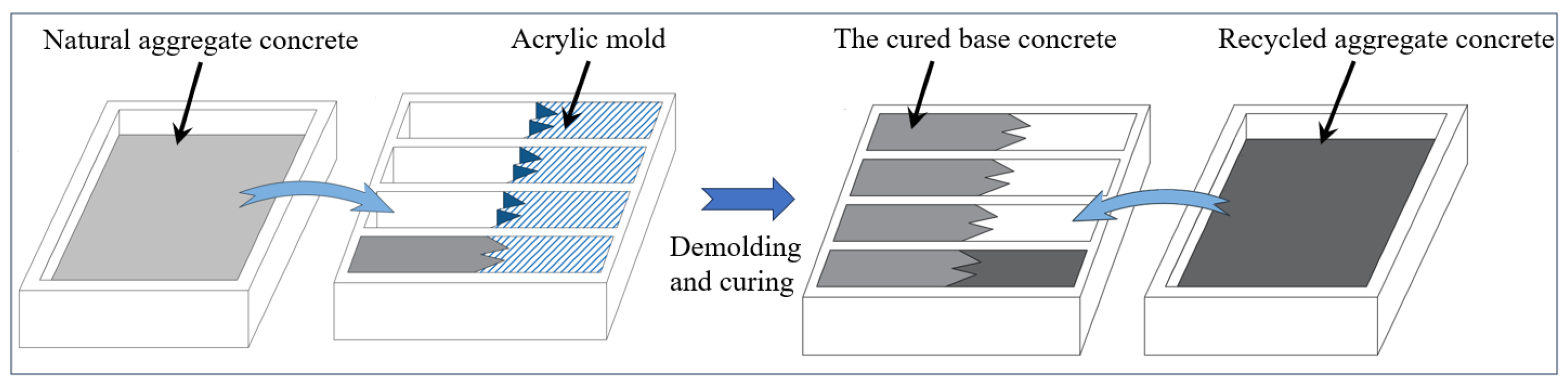
The RCA cast-in-place repair concrete specimens were prepared in two stages. First, the base concrete was poured and allowed to cure fully. Subsequently, recycled aggregate concrete was cast onto the base concrete to complete the specimen preparation. To better investigate the interfacial bonding properties between the recycled aggregate concrete and the base concrete, and to realistically reflect the inherent unevenness of the concrete interface, the bonding interface of the specimens was designed in a “W-shaped” configuration. For specimen fabrication, a specially shaped acrylic mold was placed inside a wooden formwork. In addition, small acrylic molds and longitudinal partitions were installed within specific regions of the wooden formwork to produce specimens suitable for subsequent dimensional measurements.
An HJW-60 concrete mixer (Cangzhou Huayi Test Instrument Co., Ltd., Cangzhou, China) was used for mixing. Once the base concrete paste reached uniform consistency, it was placed into the prepared molds and compacted using an HCZT-1 disk vibrating table (Hebei Lujian Instrument Technology Co., Ltd., Cangzhou, China). After vibration was completed, the molds and specimens were wrapped with polyethylene film and cured at room temperature for 4 h before demolding. The demolded specimens were then placed in pure water for curing for 28 d. After 28 days of standard curing of the base concrete, the recycled aggregate concrete layer was cast. The recycled aggregate concrete was prepared following the same mixing and casting procedure as the base concrete, with RCA incorporated according to the designated content. The schematic flow of specimen fabrication is depicted in Figure 1. It should be emphasized that, given the high water absorption capacity of RCA, the RCA was pre-wetted prior to mixing and then wiped to a saturated surface-dry condition. The required pre-wetting water content was calculated as the product of the total RCA mass and its water absorption rate.

2.3. Test Methods

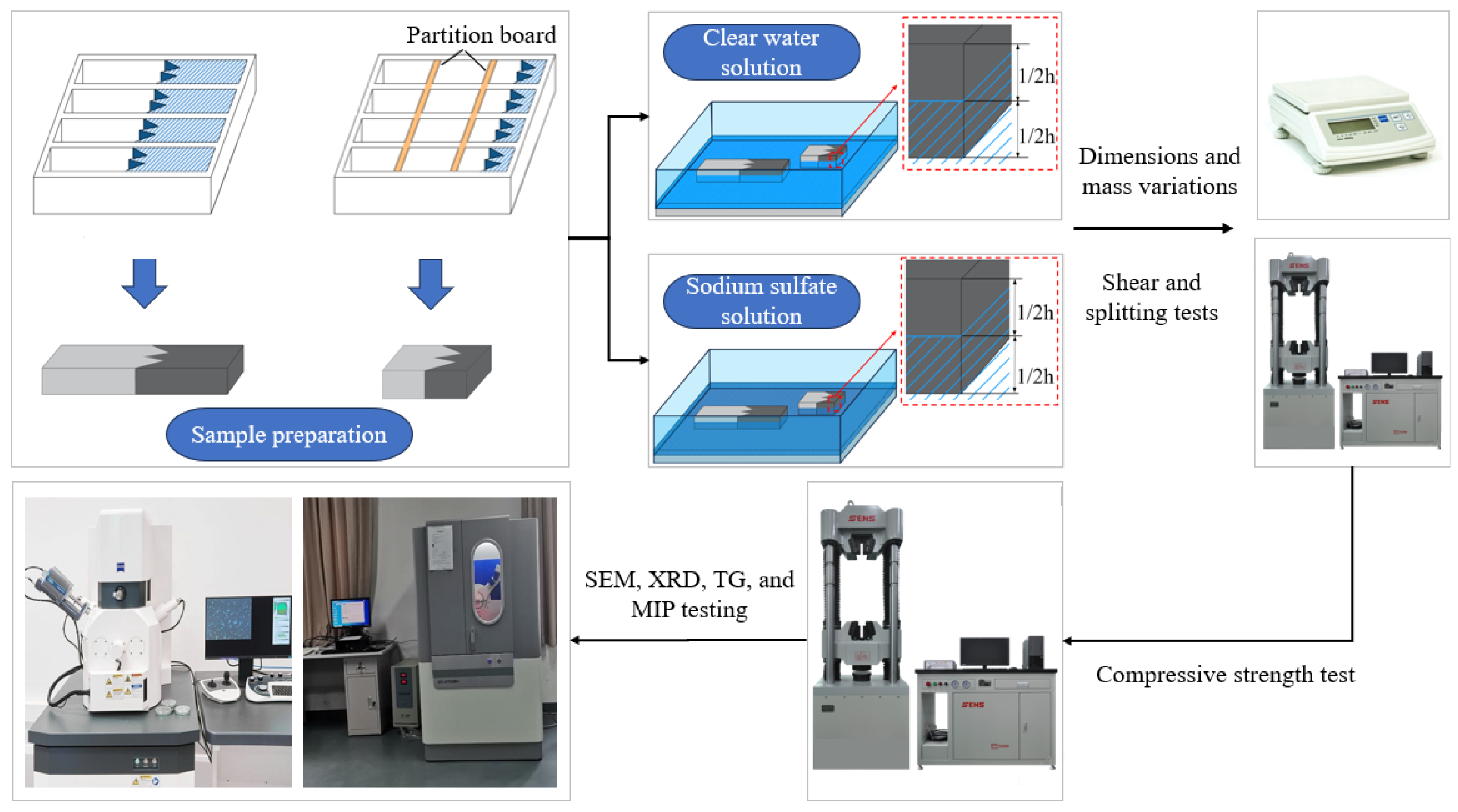
This study employed a long-term immersion method to analyze the sulfate resistance of RCA cast-in-place repair concrete specimens. The specimens were demolded in an intact state 4 h post-casting and subsequently immersed in either a 10 wt% Na2SO4 solution or clean water. Throughout the immersion stage, the liquid depth was consistently maintained at half the specimen height. The test tanks were covered with plastic film to prevent changes in liquid level and solution concentration caused by water evaporation. The liquid level was checked at weekly intervals, and the solutions were replaced once per month. A 10 wt% Na2SO4 solution with the liquid level maintained at half the specimen height was used to simulate a sulfate-accelerated corrosion environment under partially exposed conditions (with half of the specimen immersed in the solution and the other half exposed to air), while the specimens cured in clean water served as the control group for subsequent experimental analysis. It should be noted that the specimens subjected to the corrosion test were immersed in the same tank and randomly placed.
Macroscopic and microscopic tests were conducted on specimens with immersion ages of 1, 3, 7, 14, 28, 90, 180, 270, and 360 days to reveal the variations in mechanical performance and the structural deterioration mechanisms of cast-in-place repair concrete with different RCA contents under partially exposed conditions in sulfate-corrosive environments. The macroscopic indicators included apparent morphology, dimensions, mass, and mechanical properties, while the microscopic indicators included SEM, XRD, TG/DTG, and MIP. All macroscopic test results at the corresponding corrosion ages represent the average of three replicate measurements. The experimental design process is illustrated in Figure 2, and the testing methods are described below.

2.3.1. Appearance, Dimensional, and Mass Measurements

Visual observation was used to examine the surface morphology of the specimens at the specified immersion ages, and photographs were taken to record the observed conditions. An electronic balance and a length comparator were used to measure specimen mass and dimensions. The appearance and mass tests were conducted using specimens with dimensions of 40 × 40 × 160 mm, and the dimensional test was conducted using specimens with initial dimensions of 40 × 40 × 40 mm. The calculation formulas for the dimensional and mass change rates are given in Equations (1) and (2), respectively. It should be noted that, prior to mass measurement, loose crystals on the specimen surface were gently removed using a nylon brush to avoid affecting the accuracy of the mass measurement.
Δ L = L n - L n 1 L 0 × 100
where Δ L denotes the relative dimensional variation in the specimen between two consecutive corrosion ages (%); L n is the measured specimen dimension (mm) at a corrosion age of n days; and L n - 1 is the corresponding specimen dimension (mm) recorded at the preceding corrosion age.
Δ W = W n - W n 1 W 0 × 100
where Δ L denotes the percentage mass variation in the specimen relative to the previous corrosion age; W n signifies the specimen mass (g) after n days of corrosion; and W n - 1 represents the mass (g) after the (n − 1) day interval.

2.3.2. Mechanical Properties Testing

Shear and splitting tests were conducted on the specimens using a universal testing machine in accordance with GB/T 749-2008 and GB/T 50081-2019 [38,39], with the objective of evaluating the interfacial bond performance under sulfate-corrosive conditions. The shear test was conducted using specimens with dimensions of 40 × 40 × 40 mm, and the loading rate was 0.05 MPa/s. The splitting test was conducted using specimens with dimensions of 40 × 40 × 160 mm, and the loading rate was 0.01 MPa/s. Following splitting failure, compressive strength tests were conducted on both the base concrete and recycled aggregate concrete specimens to evaluate the durability performance of the specimens under sulfate corrosion. Based on the measured shear strength, splitting tensile strength, and compressive strength at various immersion durations, a sulfate resistance coefficient was determined to characterize the sulfate resistance performance of the specimens. The concrete was deemed to have failed when the sulfate resistance coefficient dropped below 0.8 [38,40,41]. The corresponding calculation procedure is presented in Equation (3).
K = τ sulfate τ Clear water   or   f sulfate f Clear water
where K is the sulfate corrosion resistance coefficient corresponding to different strength characteristics; τ sulfate or f sulfate denotes the mechanical property measured under sulfate corrosion conditions; and τ Clear water or f Clear water denotes the mechanical property measured under clean water conditions.

2.3.3. Microscopic Structural Testing

After the compressive strength tests, surface fragments of the failed specimens were immersed in isopropanol to terminate further hydration and corrosion reactions. Microstructural tests were then conducted on the collected fragment samples, including SEM, XRD, TG/DTG, and MIP.
(1) Before the SEM test, the specimens needed to be cut to an appropriate size, and the surface needed to be ground and polished. Due to the poor electrical conductivity of concrete specimens, after being fixed with double-sided conductive tape, a conductive coating needed to be sprayed. After placing the treated sample into the test chamber, nitrogen is introduced and vacuum is applied. When the vacuum conditions around the specimen meet the requirements, the microstructure images of the test sample are obtained through a scanning electron microscope, and EDS analysis is conducted.
(2) Before XRD and TG/DTG tests, the specimens needed to be ground into powder samples using an agate mortar and passed through a 200-mesh sieve. Subsequently, the powder was placed in an oven at 60 °C and dried for 48 h until the mass remained constant. After drying, the powder samples were subjected to an XRD test with a scanning speed of 5°/min to analyze the changes in mineral composition of repaired concrete at different curing ages. The TG/DTG test was carried out in a nitrogen atmosphere, with a test temperature range of 30–1000 °C and a heating rate of 10 °C/min.
(3) Before the MIP test, samples with dimensions of 10 × 10 × 10 mm needed to be cut. The cut samples were dried to remove free water, accurately weighed, and the initial volume was recorded. Subsequently, the samples were placed into the test chamber for vacuuming and pore size testing, while the mercury intrusion volume was recorded simultaneously. The MIP test aims to analyze the pore size distribution in concrete.
By analyzing and evaluating the microstructural characteristics and mineral composition of specimens at various sulfate corrosion ages, the mechanical performance variations and structural deterioration mechanisms in RCA cast-in-place repair concrete subjected to sulfate corrosion under partially exposed conditions are elucidated. Table 4 shows the equipment parameters used during the experimental process.

3. Results

3.1. Visual Appearance Changes

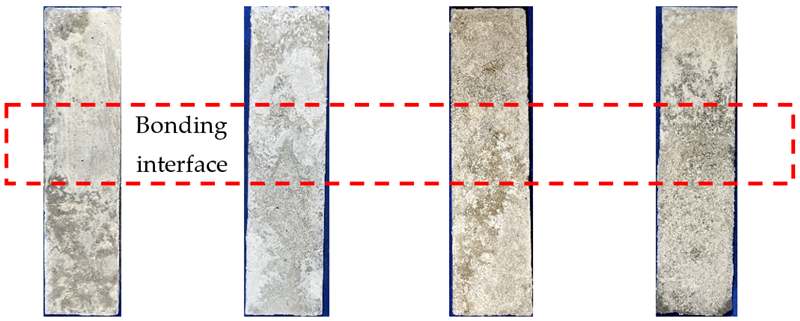
Under partially exposed conditions, the visual appearance changes in RCA cast-in-place repair concrete specimens in a sulfate corrosion environment are shown in Table 5. The upper part of the bonded interface is the base concrete, while the lower part is the newly cast recycled aggregate concrete. The results indicate that, during the early stage of corrosion, surface pores of the specimens gradually decreased and the bonded interface continuously became denser, which is related to hydration reactions inside the structure. As the corrosion age increased, corrosion reactions continued to occur and structural damage began to appear. At a corrosion age of 180 days, surface peeling was observed in all specimens, accompanied by a gradual increase in surface porosity, while localized and irregular damage began to appear in some specimens. When the corrosion age reached 360 days, the quantity of surface pores increased sharply, and the originally dense surface became rough and pitted. Damage was observed around most specimens, and cracks even appeared at the corners of the newly cast recycled aggregate concrete in the RN50 specimen.
Comparing the appearance changes in specimens with different RCA contents, the compactness of the bonding interface in the early stage of corrosion was observed to follow the order: RN30 > RN50 > RN0. This phenomenon stems from RCA’s high water absorption [42], which facilitates the hydration reaction of concrete at the bonding interface and consequently leads to a denser interfacial structure. However, at the later stage of corrosion, obvious damage was observed at the bonding interface of RN50. After 360 days of corrosion, RN30 maintained better structural integrity than both RN0 and RN50, demonstrating superior resistance to long-term sulfate corrosion. Notably, during the immersion process, an increasing number of sulfate crystals gradually adhered to the surfaces of the specimens. These crystals originated from salt spray during early immersion and from the upward ingress of sulfate during late-stage immersion. This phenomenon is also the main cause of physical corrosion of concrete under partially exposed conditions in sulfate corrosion environments [43].

3.2. Dimensions and Mass Variations

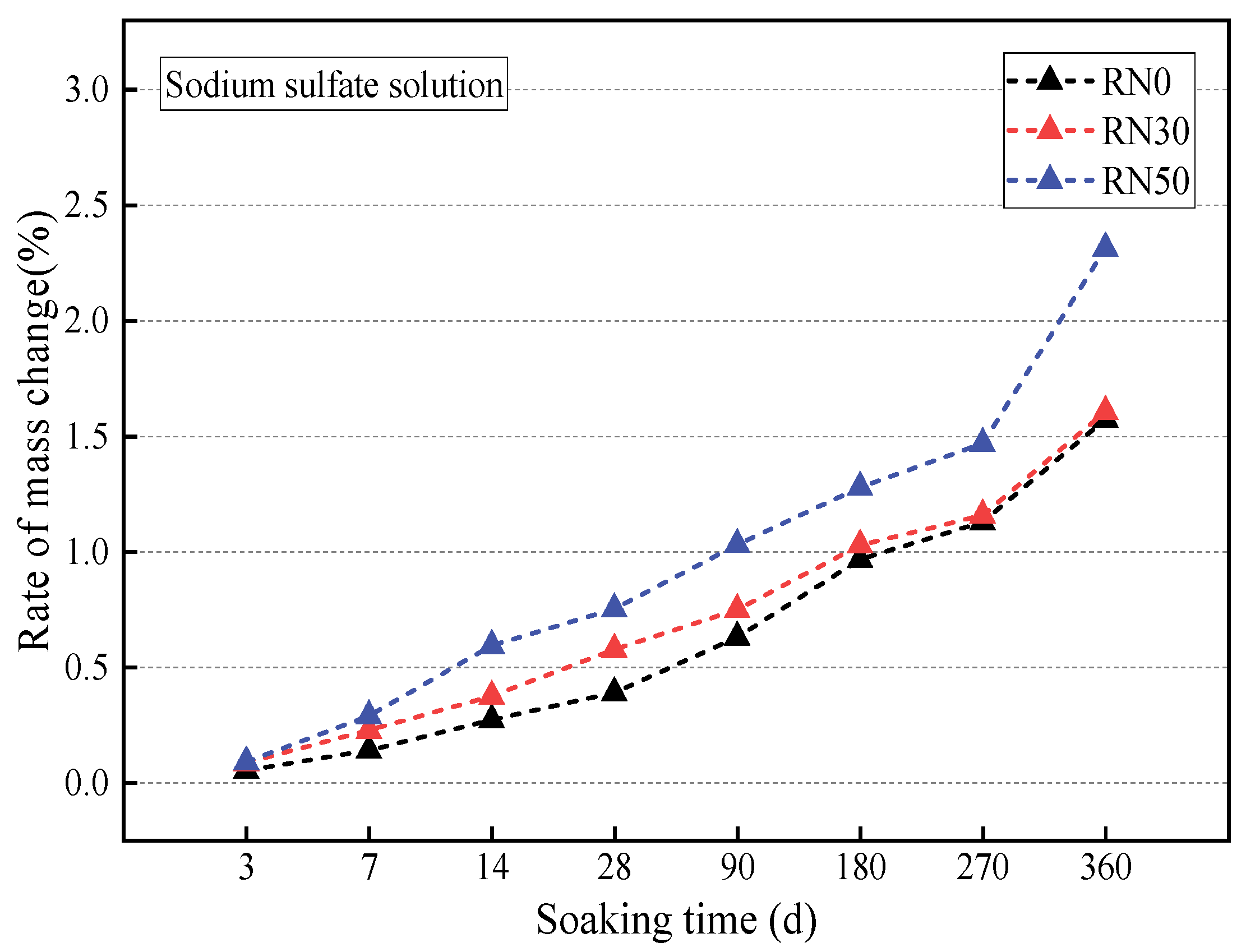
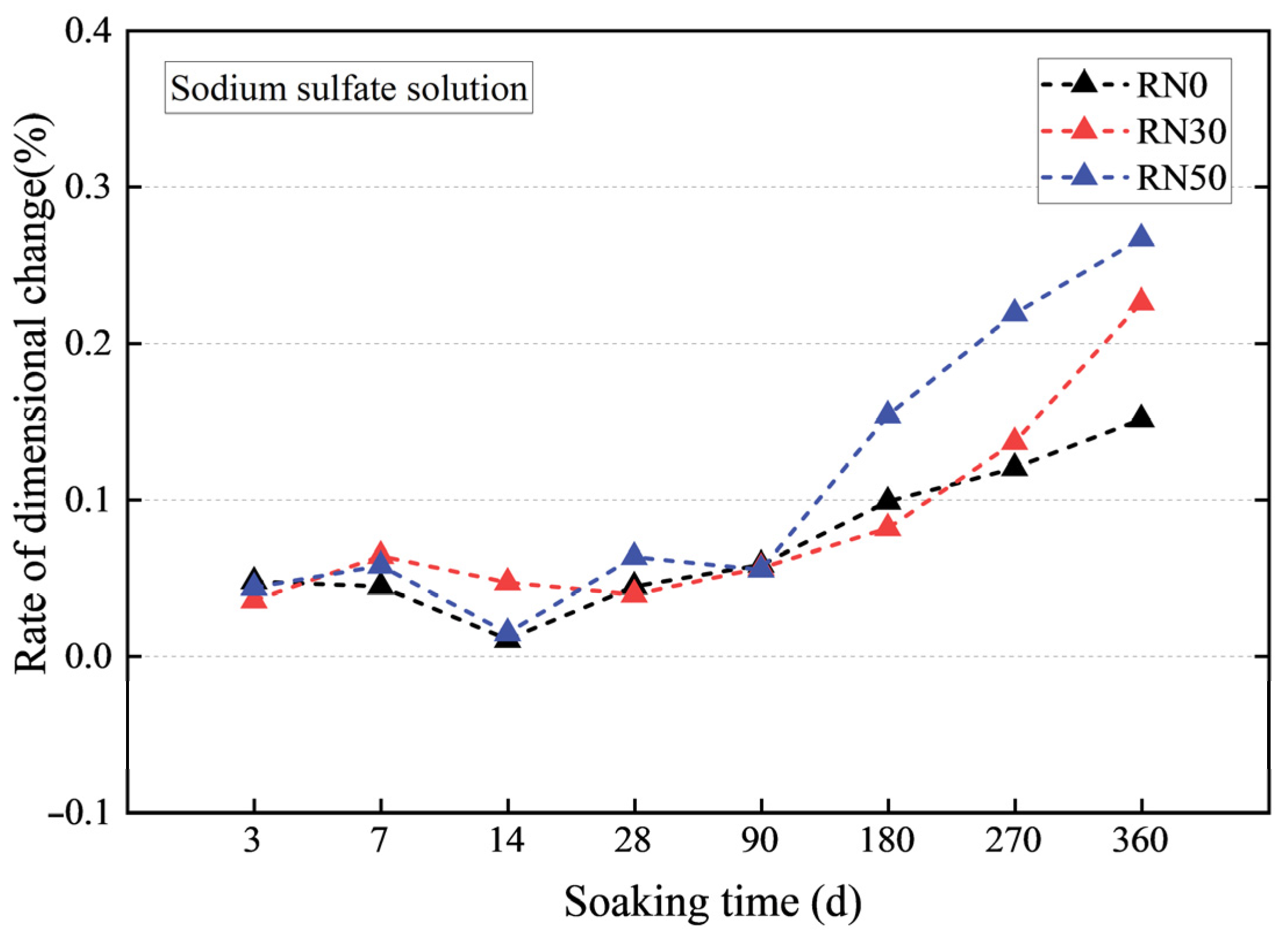
Figure 3 and Figure 4 illustrate the variation in dimensional and mass change rates of RCA cast-in-place repair concrete specimens under partial exposure conditions at different sulfate corrosion durations. Figure 3 and Figure 4 indicate that, during the initial corrosion stage (1–90 d), the dimensional changes in the specimens with different RCA contents were not significant. After the corrosion duration exceeded 90 days, the specimen dimensions increased markedly, with the growth rate accelerating continuously. In contrast, throughout the corrosion process, the specimen mass consistently exhibited a rapid increase trend. This stems from, in sulfate-corrosive environments, hydration reactions and sulfate corrosion reactions continuously occur within the specimens. Specimen mass increases rapidly, driven by the accumulation of hydration and corrosion products. However, the internal pores within the concrete provide sufficient space for the development of these products, resulting in relatively stable dimensional changes during the early stage of corrosion.
Under continuous corrosion reactions, the pores within the concrete are rapidly filled and enlarged, causing the specimen dimensions and mass to increase significantly [44]. This behavior is consistent with existing studies on ordinary concrete and recycled aggregate concrete in sulfate corrosion environments [45,46]. Notably, after 90 days of corrosion, both the dimensional change rate and mass change rate of the specimens were directly proportional to the RCA content. This is because the internal weak interfaces and larger pores introduced by RCA facilitate the penetration of SO42−. Consequently, a higher RCA content leads to more intense sulfate corrosion reactions within the specimens.

3.3. Shear Strength

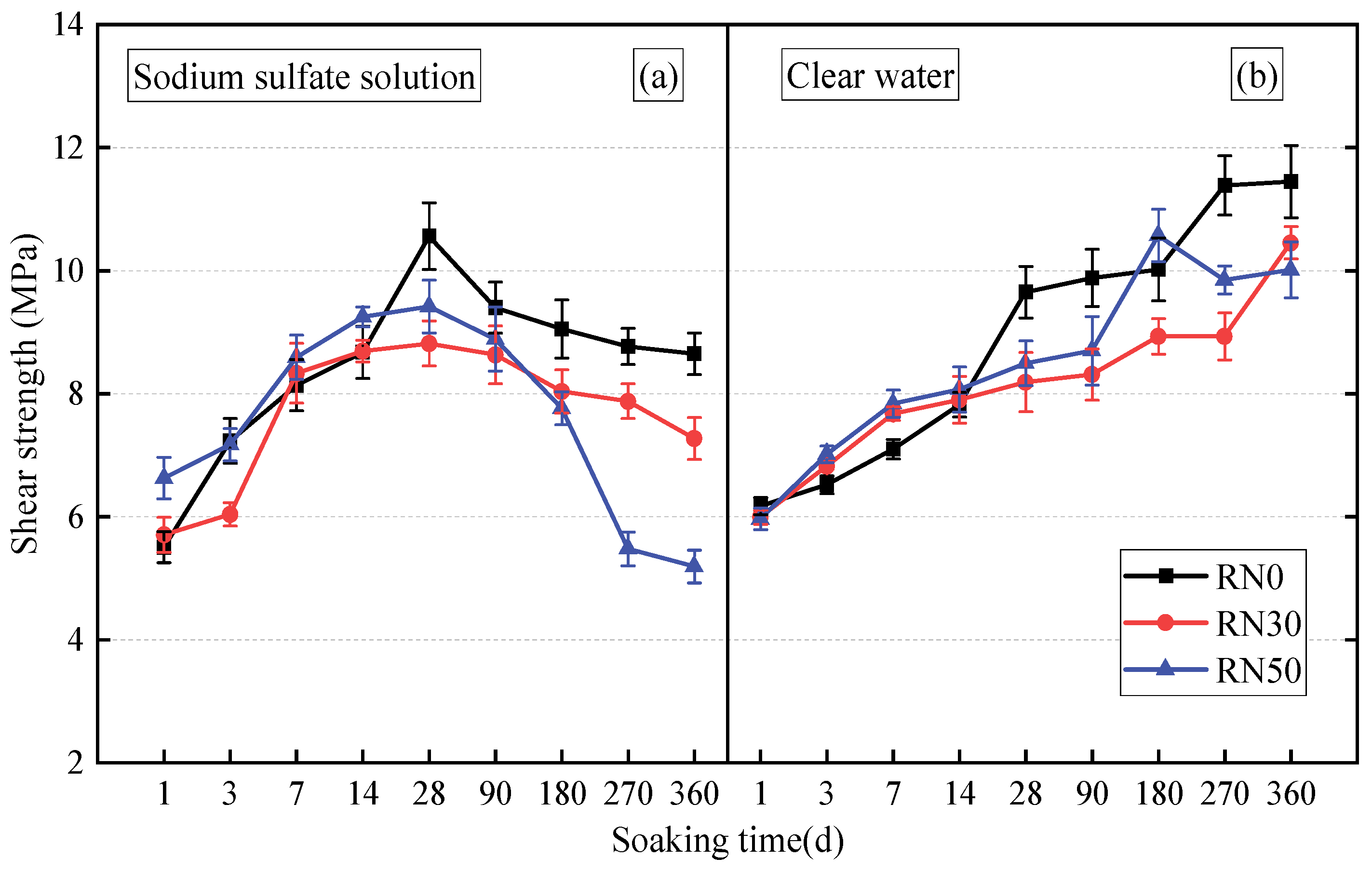
Figure 5 shows the shear strength at the interface of RCA cast-in-place repair concrete specimens under partial exposure conditions at different immersion times in sodium sulfate and clean water solutions. As shown in Figure 5, in clean water, as early-stage hydration reactions progressed, the structure gradually became denser, leading to a continuous increase in interfacial shear strength at the interface of the RCA cast-in-place repair concrete specimens. As the immersion time increased, the shear strength of cast-in-place repair concrete specimens containing RCA gradually became lower than that of specimens without RCA, stemming from the relatively low strength of RCA itself and the weak ITZ associated with the old mortar.
Unlike the specimens immersed in clean water, the interfacial shear strength of the specimens in the early sulfate-corrosive environment continuously increased, reaching a peak at 28 days of corrosion, and then began to decrease. After 360 days of corrosion, the shear strengths for the RN30 as well as RN50 specimens were reduced by 15.91% and 40.0%, respectively, relative to the RN0 specimen. These results indicate that initial hydration and sulfate corrosion product accumulation enhance the interfacial shear strength of RCA cast-in-place repair concrete. However, under prolonged sulfate corrosion, the inherently lower strength of RCA, together with internal structural damage induced by corrosion products, leads to a significant reduction in interfacial bond shear strength. The interfacial shear strength shows an inverse relationship with the RCA content.

3.4. Splitting Strength

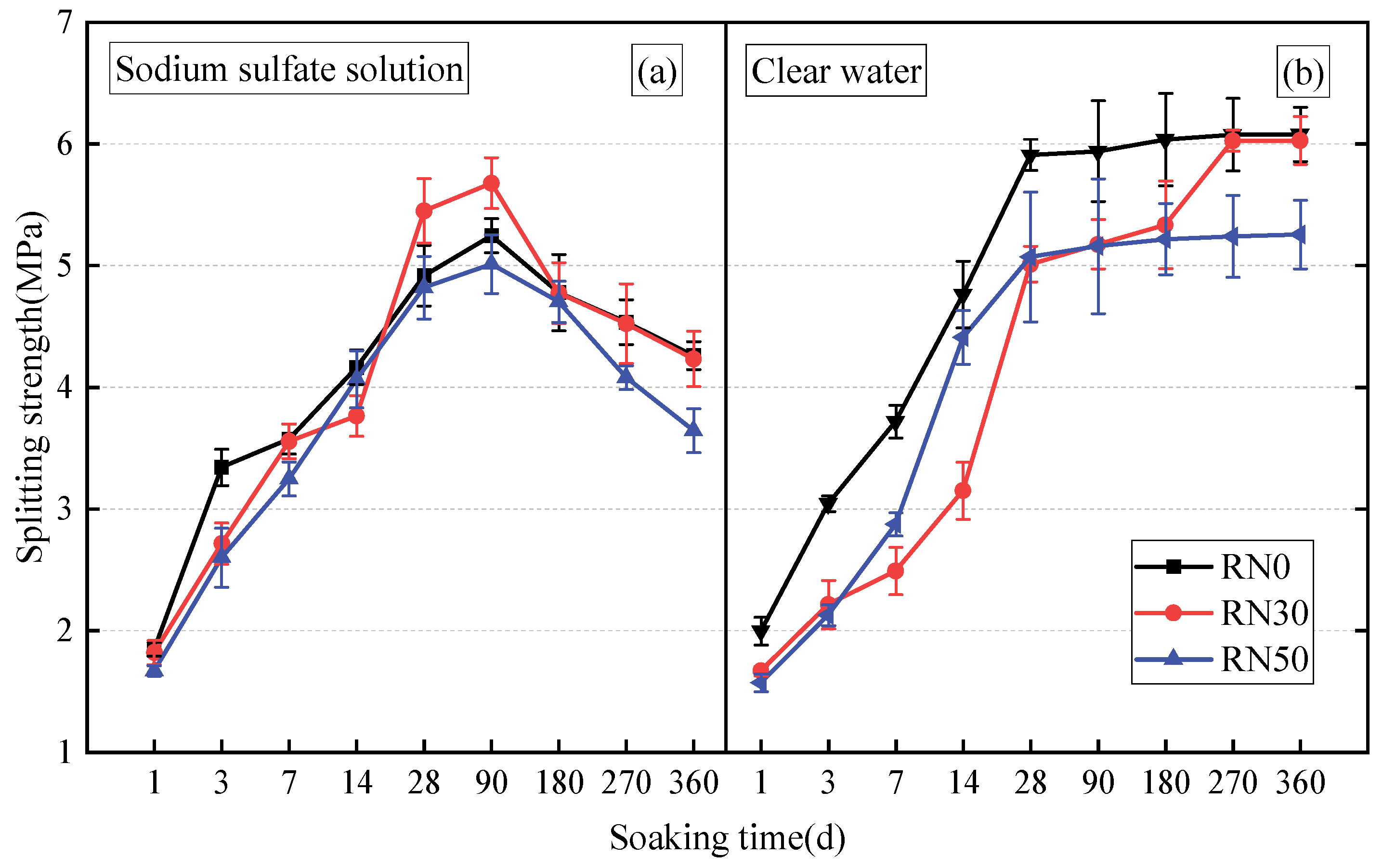
Figure 6 illustrates the interfacial splitting strength of specimens at different immersion ages in clean water and sodium sulfate solutions. In the clean water environment, the evolution of interfacial splitting strength is governed by the progress of hydration reactions, and the interfacial splitting strength of the specimens shows a trend of rapid increase followed by gradual stabilization with prolonged immersion time. Unlike the interfacial shear strength test results, after an immersion duration of 360 days, the incorporation of 30% RCA did not reduce the interfacial splitting strength of the specimens, which can be attributed to the relatively rough surface texture and irregular morphology of RCA.
Under sulfate corrosion, interfacial splitting strength followed a rise-then-fall trajectory over corrosion time, paralleling the interfacial shear test observations. This phenomenon stems from RCA’s inherent strength coupled with continuous corrosion products accumulation. The interfacial splitting strength of cast-in-place repair concrete specimens with different RCA contents all reached their peak values after 90 days of corrosion, with RN30 exhibiting the highest peak splitting strength. After 360 days of corrosion, the interfacial splitting strengths of RN0, RN30, and RN50 were 4.26 MPa, 4.24 MPa, and 3.64 MPa, respectively. The interfacial splitting strength of RN30 was comparable to that of RN0, showing no significant decrease, but it was 16.48% higher than that of RN50. This indicates that, under partially exposed conditions, the incorporation of 30% RCA optimizes the interfacial splitting strength in specimens in sulfate-corrosive environments and enhances the durability of the bond interface under long-term sulfate corrosion.
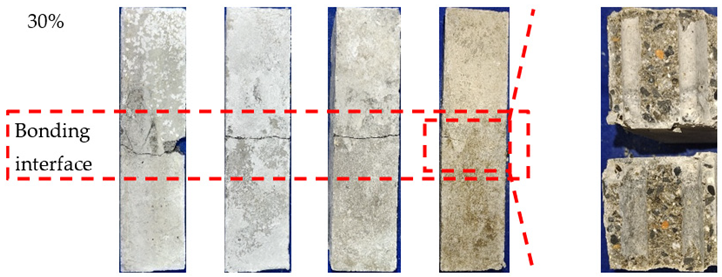
Table 6 presents the fracture morphology of specimens across various corrosion ages following interfacial splitting tests. As shown in Table 6, after 7 days of corrosion, both RN30 and RN50 failed along the “W”-shaped bonding interface, whereas the failure surface of RN0 did not occur along the bonding interface. This discrepancy can be attributed to the lower inherent strength of RCA compared with that of natural aggregate. With increasing corrosion age, the performance of recycled aggregate concrete shows a significant improvement, and the compactness of the bonding interface continuously increases. Therefore, the specimens no longer fail along the “W”-shaped interface. However, after 360 days of corrosion, the failure modes of RN0, RN30, and RN50 all occurred along the “W”-shaped bonding interface. This is because corrosion products continuously accumulated at the bonding interface, which generated expansive stresses that degraded the microstructure of the bonding interface and ultimately reduced its strength. The above splitting test results indicate that, during sulfate corrosion, the bond interface of RCA cast-in-place repair concrete is the weak link in its structural system.

3.5. Compressive Strength

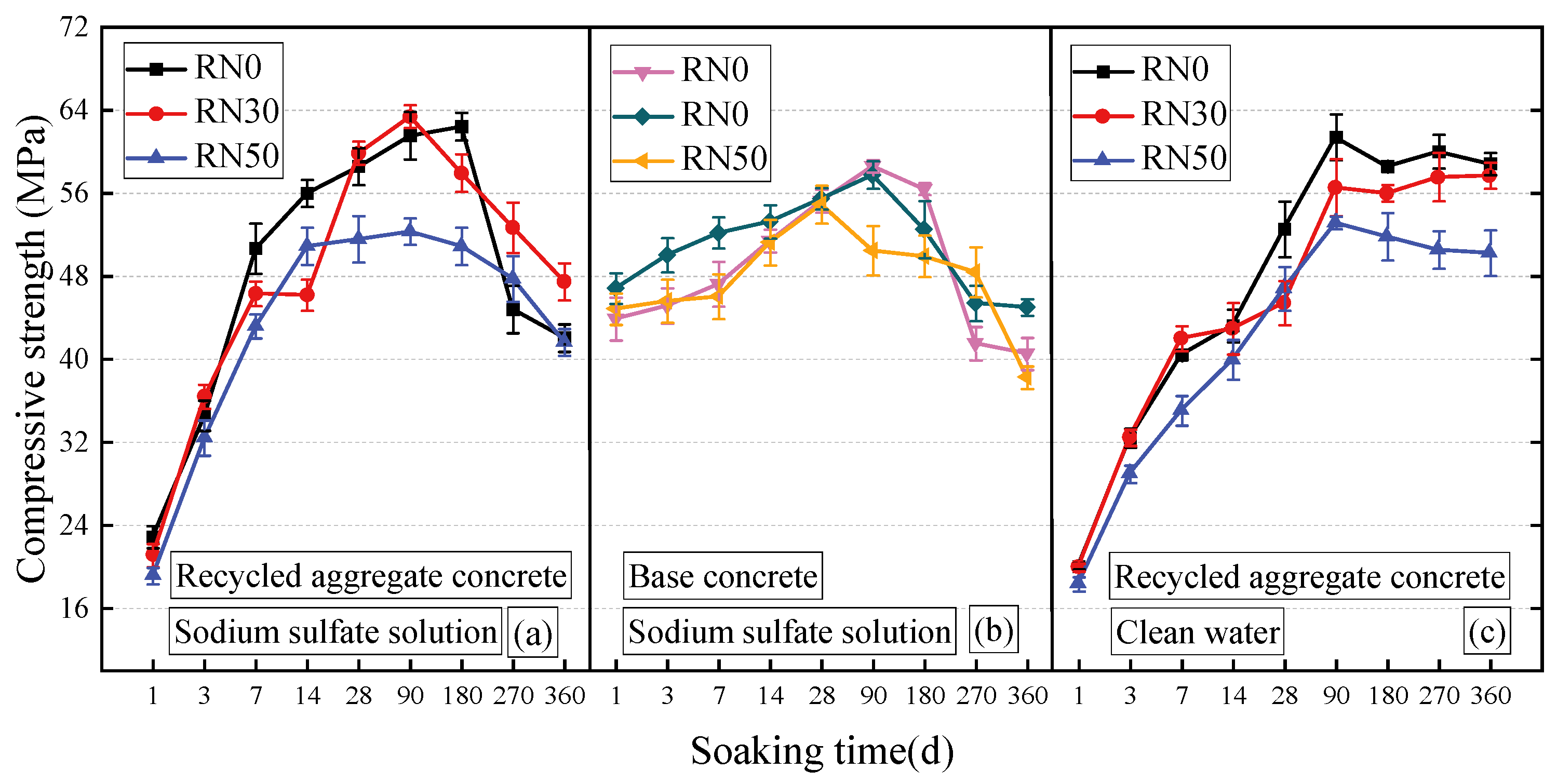
Figure 7 shows the evolution of the compressive strength of cast-in-place recycled aggregate concrete and base concrete under different immersion conditions. As shown in Figure 7, in the clean water environment, the compressive strength of cast-in-place recycled aggregate concrete exhibits a hydration-controlled trend, characterized by a rapid increase followed by stabilization with the extension of immersion time. Under sulfate corrosion conditions, cast-in-place recycled aggregate concrete with different RCA contents shows a gradual increase in compressive strength during the early stage of corrosion and reaches peak values between 90 and 180 days. Notably, after 360 days of immersion, the compressive strength of cast-in-place recycled aggregate concrete containing 30% RCA is 12.89% and 14.00% higher than that of cast-in-place recycled aggregate concrete containing 0% and 50% RCA, respectively. Similarly, the compressive strength of the base concrete corresponding to RN30 is 11.02% and 17.66% higher than that of the base concrete corresponding to RN0 and RN50, respectively. Under partially exposed conditions, the incorporation of 30% RCA helps enhance the long-term sulfate corrosion resistance of cast-in-place repair concrete.
As shown in Figure 7, under sulfate corrosion conditions, both cast-in-place recycled aggregate concrete and base concrete exhibit a trend in which the compressive strength first increases and then decreases, which is consistent with previous studies [47]. Notably, after 360 days of corrosion, the compressive strength of cast-in-place recycled aggregate concrete with all three RCA contents is higher than that of the corresponding base concrete. After 360 days of corrosion, the compressive strengths of cast-in-place recycled aggregate concrete reach 42.03, 47.45, and 41.62 MPa at RCA contents of 0%, 30%, and 50%, respectively, whereas the corresponding base concrete exhibits compressive strengths of 40.51, 44.98, and 38.22 MPa, respectively. These results indicate that, under partially exposed conditions, the newly cast concrete in the specimens exhibits superior durability under long-term sulfate exposure. This behavior can be attributed to the fact that the newly cast concrete is subjected to sulfate corrosion during its early hydration stage, during which hydration products and corrosion products are rapidly generated and accumulate, resulting in a denser pore structure.

3.6. Sulfate Resistance Coefficient K

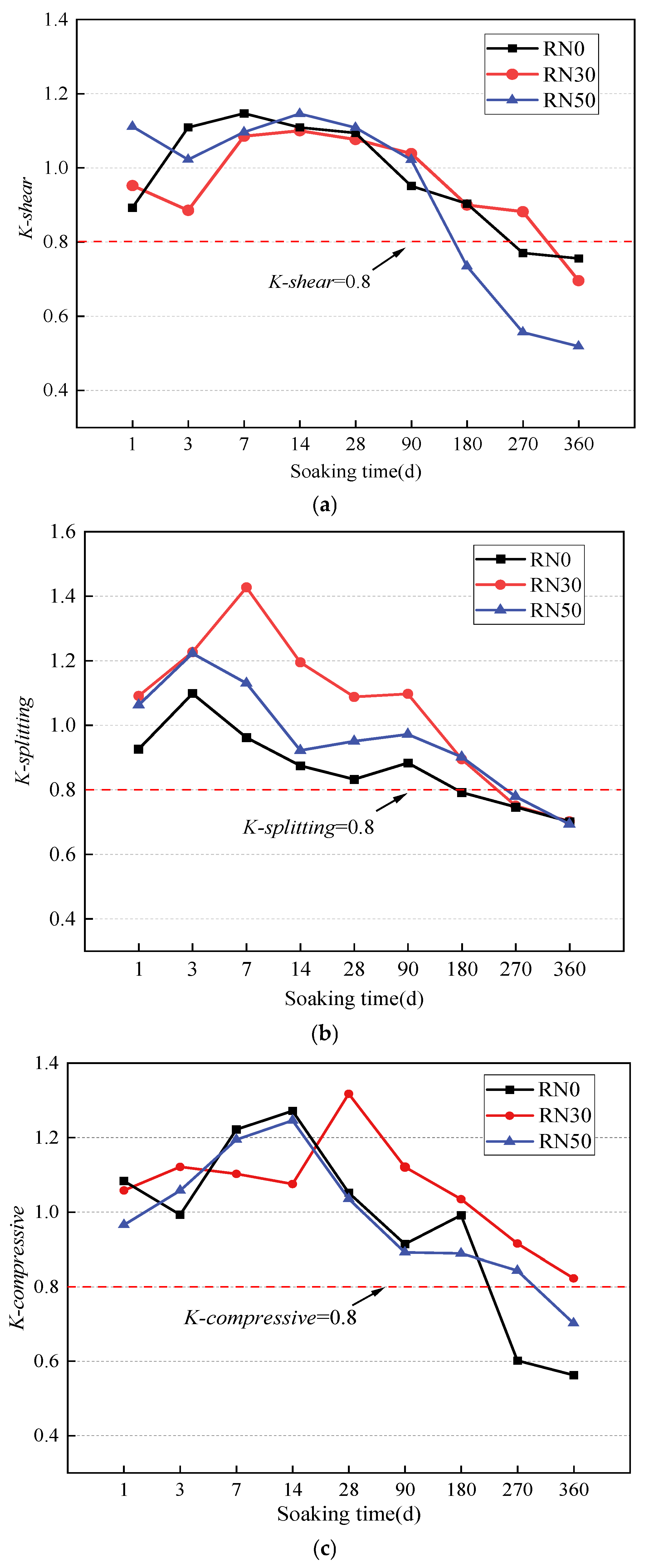
Figure 8 shows the variations in the sulfate corrosion coefficients, K-shear, K-splitting, and K-compressive of the specimens under partial exposure conditions with increasing corrosion age. As shown in Figure 8, except for K-shear., the sulfate corrosion coefficients K-splitting and K-compressive of RN30 and RN50 decreased to 0.8 later than those of RN0. This result indicates that, under partial exposure conditions, RN30 and RN50 exhibit delayed failure compared with RN0 in sulfate corrosion environments. Moreover, Figure 8a shows that although RN50 fails earlier than RN0 and RN30, RN30 still exhibits good sulfate resistance. These results indicate that incorporating 30% RCA effectively enhances the sulfate resistance of cast-in-place repair concrete specimens under partially exposed conditions.

3.7. Microstructure and Mineral Composition Analysis

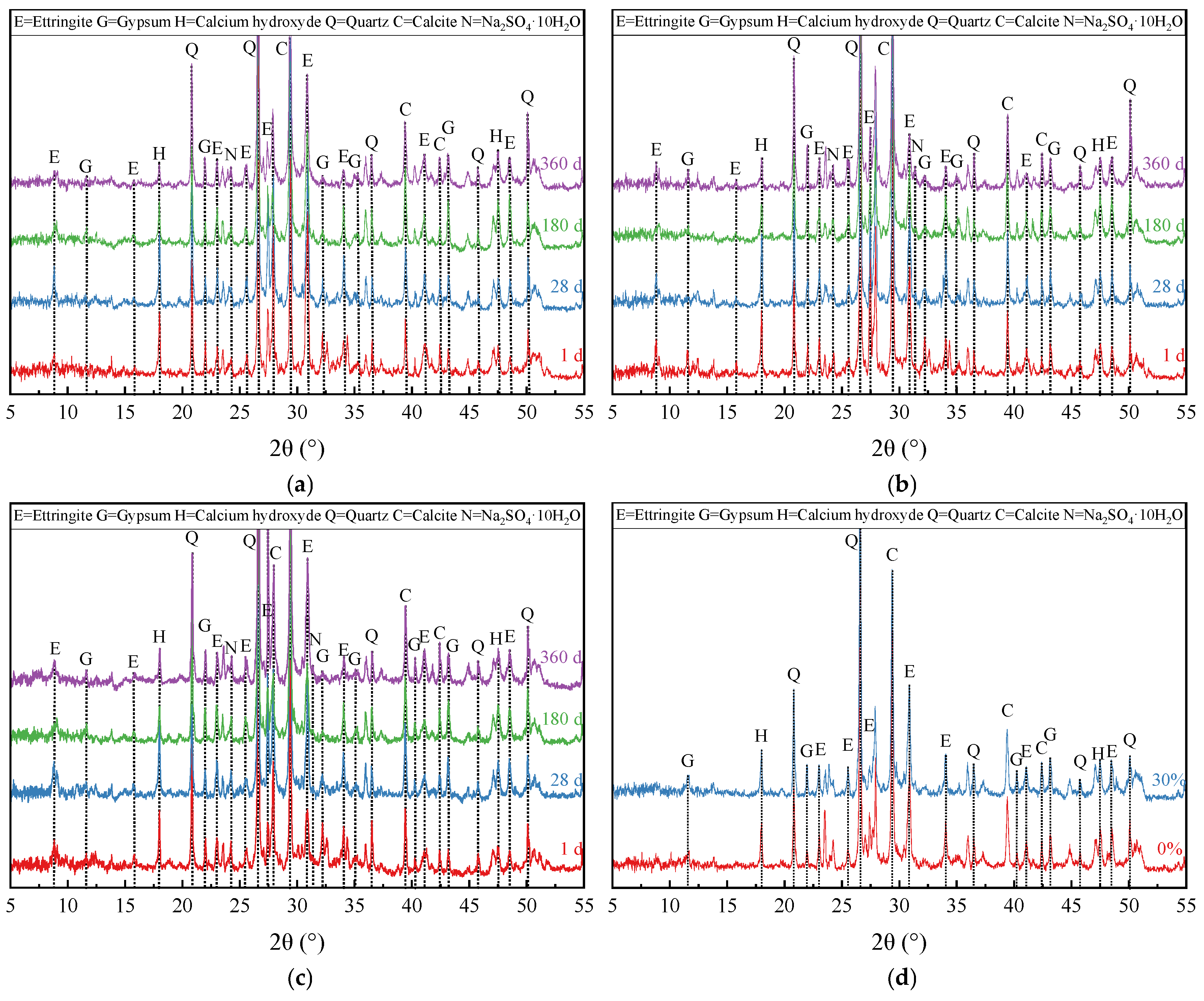
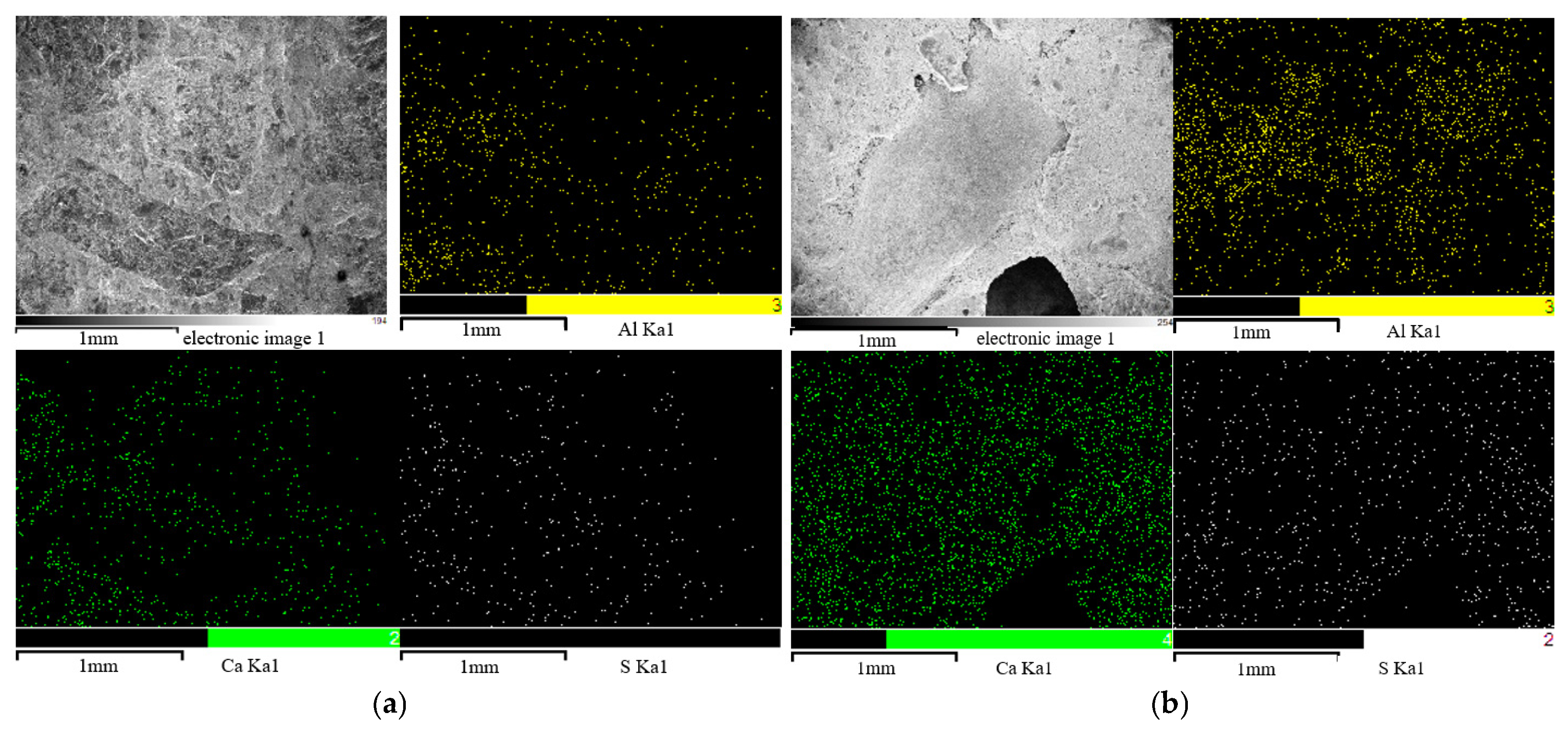
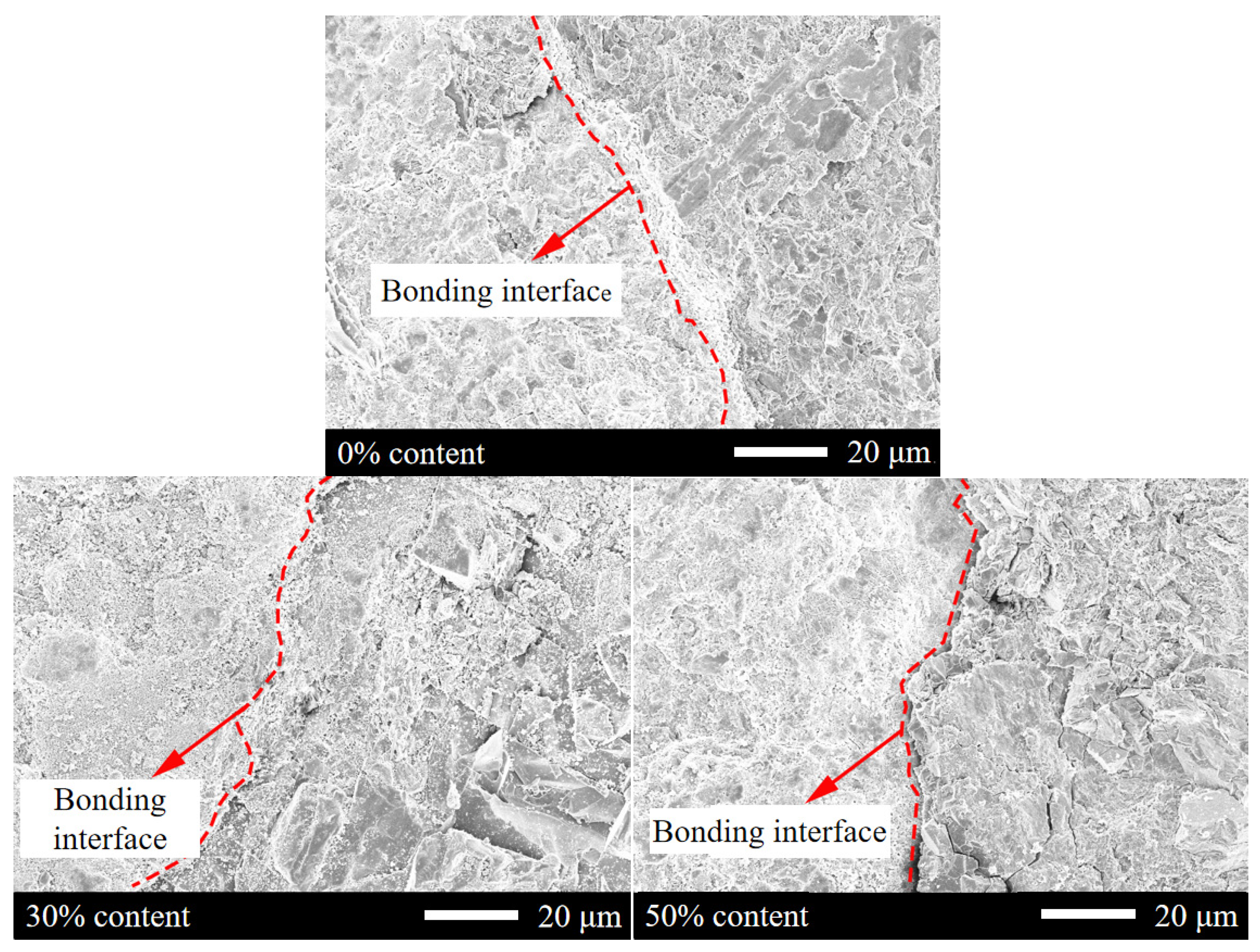
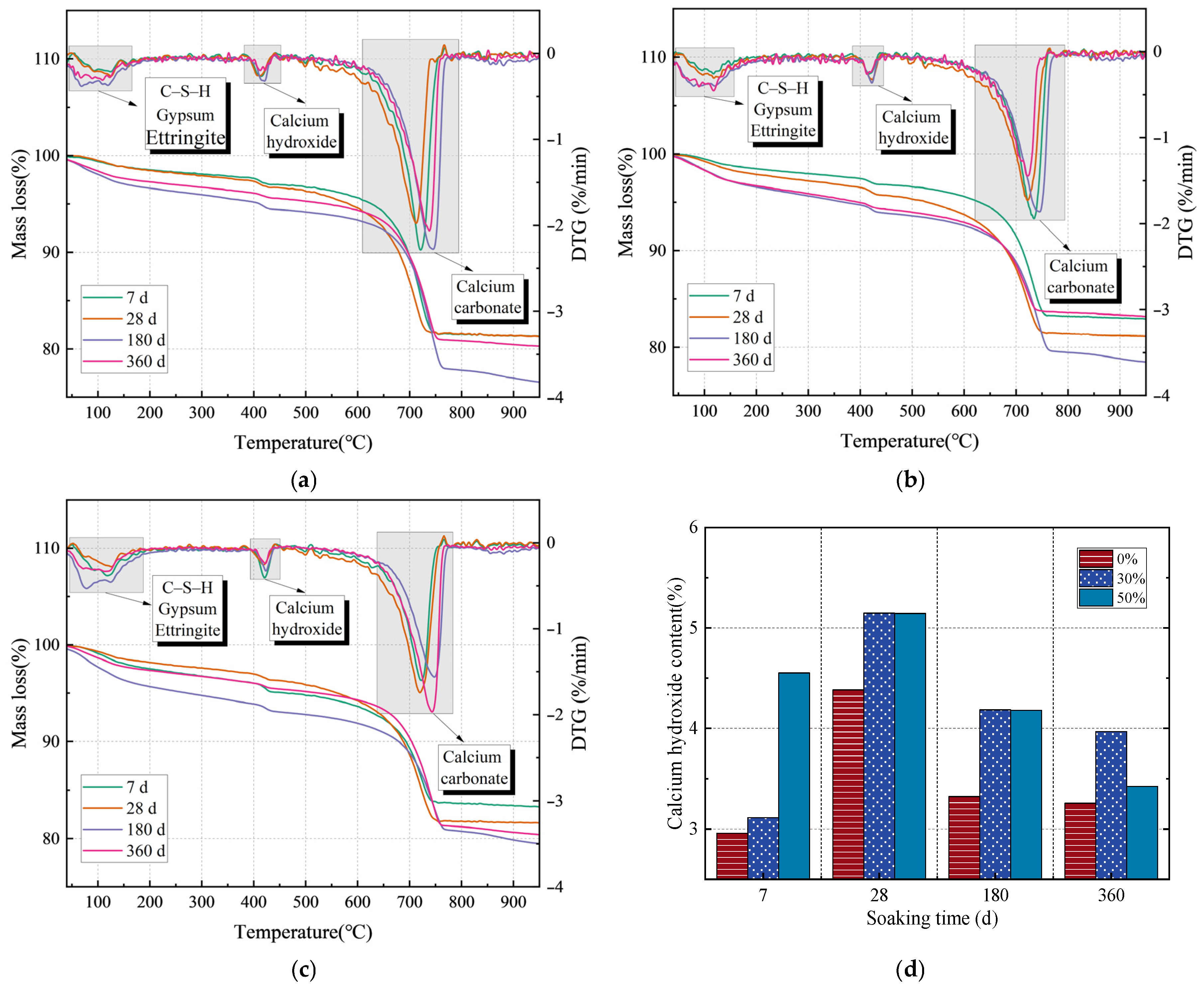
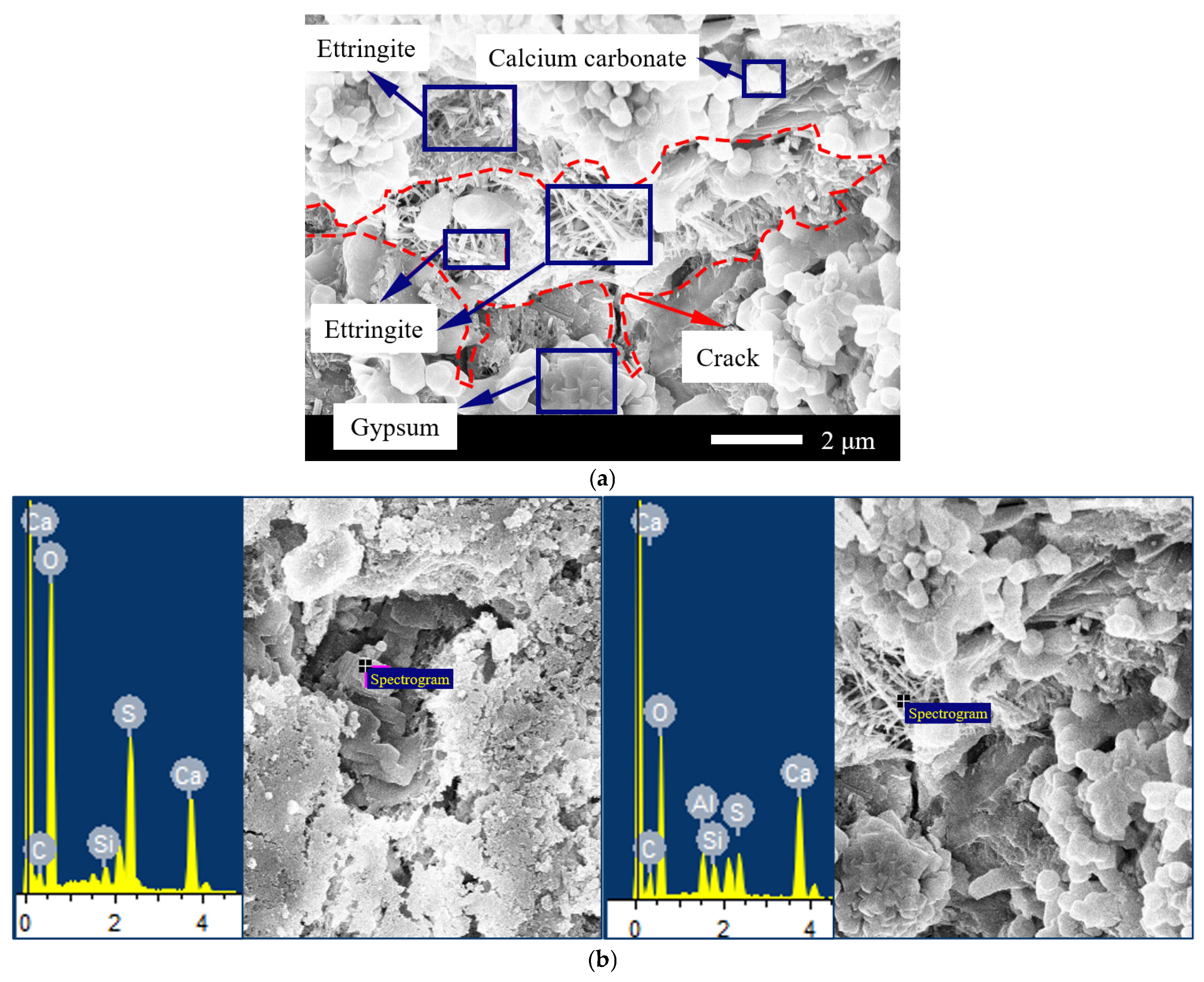
The changes in the physical and mechanical properties of concrete can be interpreted based on its microstructure and mineral composition. The fractured specimens after compressive testing were analyzed by XRD, SEM, EDS, and TG/DTG. Figure 9 shows the XRD results of specimens under different conditions. Figure 10 presents the SEM and EDS results of RN50 after 270 days of sulfate corrosion under partial exposure conditions. Figure 11 shows the EDS results of RN50 after 28 days and 360 days of sulfate corrosion under partial exposure conditions. Figure 12 presents the SEM images of the bond interface of specimens after 270 days of sulfate corrosion under partial exposure conditions. Figure 13 shows the TG/DTG test results of specimens with different RCA contents at different sulfate corrosion ages.
As shown in Figure 9a–c, with increasing corrosion time, the contents of gypsum, ettringite, and Na2SO4·10H2O inside the specimens gradually increased. The generation of these corrosion products results from both chemical and physical sulfate-induced corrosion of concrete, and the corresponding reaction equations are shown below. In addition, the reaction process consumed calcium hydroxide (Ca(OH)2). After 360 days of corrosion, the contents of gypsum and ettringite in RN30 were lower than those in RN0 and RN50, again indicating its superior resistance to long-term sulfate corrosion. Notably, compared with specimens immersed in clean water, increasing the RCA content exerted no substantial impact on the mineral composition of the specimens.
SEM–EDS results similarly demonstrate that under partial exposure conditions, after 270 days of corrosion in a sulfate environment, gypsum and ettringite were formed inside the specimens as a result of corrosion reactions. These corrosion products filled the internal pores and generated expansive stresses, ultimately triggering the initiation and propagation of internal micro-cracks. Similarly, EDS surface scan results of RN50 at corrosion ages of 28 and 360 days show that, with increasing corrosion duration, the contents of aluminum and sulfur ions inside the specimens increased significantly. This suggests that substantial amounts of corrosion products, such as gypsum, ettringite, and Na2SO4·10H2O, have accumulated within the specimens, thereby compromising their internal integrity.
N a 2 S O 4 10 H 2 O + C a O H 2   C a S O 4 2 H 2 O + 2 N a O H + 8 H 2 O
3 ( C a S O 4 2 H 2 O ) + 3 C a O A 1 2 O 3 12 H 2 O + 14 H 2 O   3 C a O A 1 2 O 3 3 C a S O 4 32 H 2 O + C a O H 2   2 Na + + SO 4 2 - + 10 H 2 O Na 2 SO 4 10 H 2 O
2 Na + + SO 4 2 - + 10 H 2 O Na 2 SO 4 10 H 2 O
SEM images of the bonding interface of RCA cast-in-place repair concrete specimens show that the bonding interface of RN30 is denser than that of RN0 and RN50 after 270 days of sulfate corrosion, which is consistent with the macroscopic observations. This indicates that incorporating 30% RCA can optimize the interfacial bonding performance of RCA cast-in-place repair concrete specimens. This improvement can be attributed to the high water absorption capacity of RCA, which promotes hydration reactions at the bonding interface. In addition, the products formed from hydration and sulfate corrosion reactions during the corrosion process fill and densify internal interfacial voids, resulting in a more compact bonding interface.
In contrast, delamination and cracking are observed at the bonding interface of RN50. This is caused by the excessively rapid accumulation of corrosion products such as gypsum, ettringite, and Na2SO4·10H2O. When the RCA content is excessive, recycled aggregate concrete contains a large number of weak interfaces and pores, which makes it easier for SO42− to penetrate into the bonding interface. As a result, intense physical and chemical corrosion reactions occur at the bonding interface, and the excessive generation of corrosion products damages the internal structure of the bonding interface.
The TG/DTG curves of specimens with different RCA contents under partial exposure conditions in a sulfate-corrosive environment show that the peak intensity associated with corrosion products gradually increases. Notably, the peak intensity of corrosion products in RN50 was significantly higher than that in RN0 and RN30. In the temperature range of 420–540 °C, Ca(OH)2 undergoes thermal decomposition to form CaO and release H2O. The Ca(OH)2 content of the specimens was quantified based on the mass loss within this temperature interval, and the calculation method is presented in Equation (7).
C a ( O H ) 2 ( % ) = M C a ( O H ) 2 M H 2 O × Δ m
where M C a ( O H ) 2 = 74 g/mol represents the molar mass of calcium hydroxide; M H 2 O = 18 g/mol represents the molar mass of water; Δ m represents the mass loss of calcium hydroxide in the temperature range of 420–540 °C.
According to Figure 13d, the Ca(OH)2 content first increased and then subsequently declined as the corrosion time increased, which is consistent with the XRD observations. Hydration reactions lead to a continuous increase in Ca(OH)2 content within the specimens, whereas the advancement of corrosion reactions results in the consumption of Ca(OH)2. As hydration reactions gradually slow, the Ca(OH)2 content within the specimens progressively decreases. During the early stage of corrosion, the Ca(OH)2 content in cast-in-place repair concrete specimens containing RCA increased rapidly, with a higher rate of Ca(OH)2 generation than that of specimens without RCA. After 360 days of corrosion, the Ca(OH)2 contents of RN0, RN30, and RN50 exhibited reductions of 1.13%, 1.18%, and 1.72%, respectively, relative to those measured at 28 days. This finding demonstrates that the incorporation of RCA accelerates the initial hydration reaction rate of concrete. However, due to the internal weak interfaces and increased porosity introduced by RCA, the corrosion reaction rate in the later stage was higher for cast-in-place repair concrete specimens containing RCA. The corrosion reaction rate increased with increasing RCA content.

3.8. Pore Structure

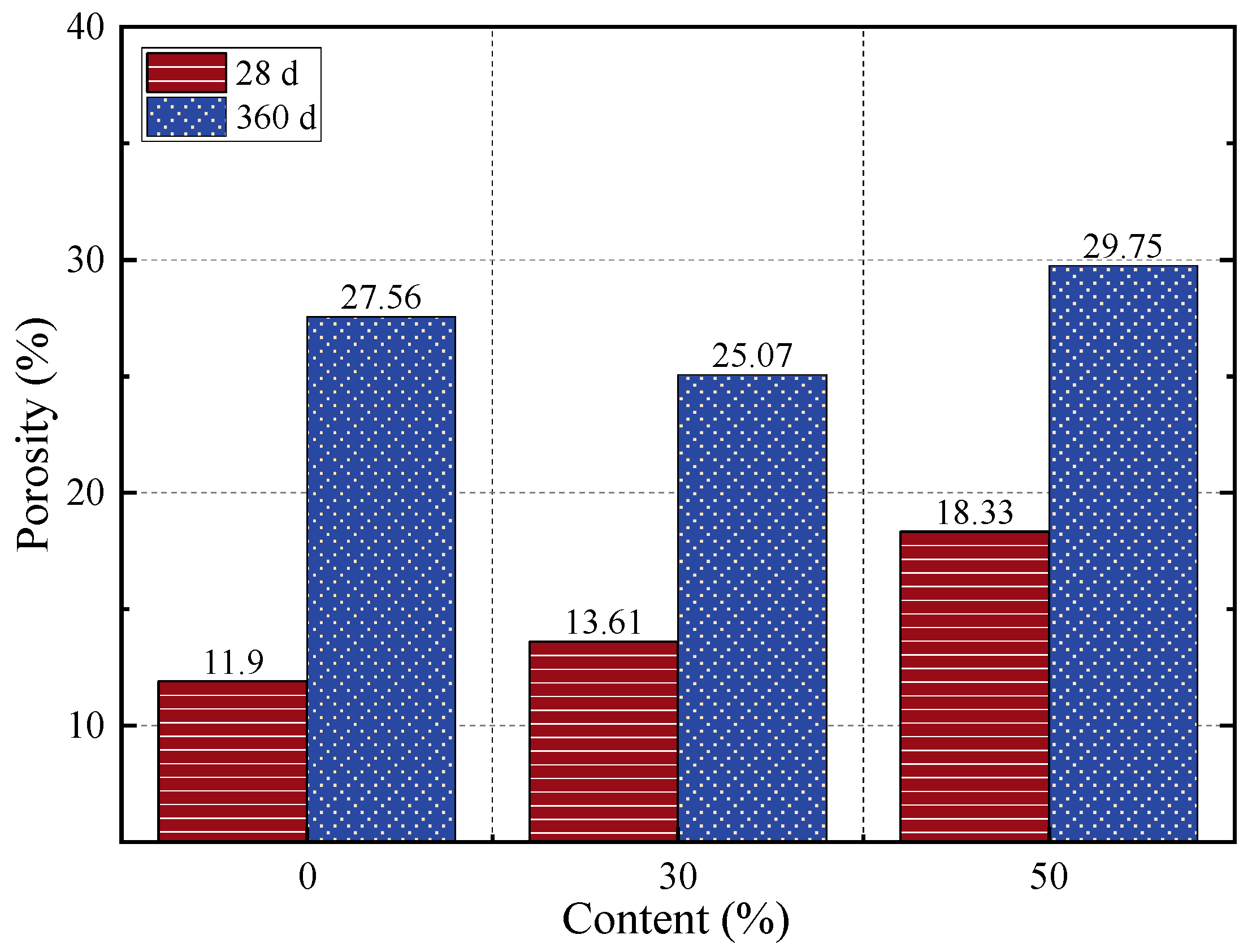
Figure 14 shows the porosity of cast-in-place repair concrete specimens with different RCA contents after 28 and 360 days of sulfate corrosion under partial exposure conditions. As illustrated in Figure 14, after 28 days of corrosion, the internal porosity of the specimens showed a clear positive relationship with RCA content, which can be attributed to the presence of larger pores and abundant weak interfaces within RCA. However, after 360 days of corrosion, the incorporation of 30% RCA did not cause a pronounced increase in the internal porosity of the cast-in-place repair concrete specimens. At this stage, the porosity of RN30 was 9.93% and 18.67% lower than that of RN0 and RN50, respectively. This result suggests that the addition of 30% RCA retarded the increase in internal porosity in specimens exposed to long-term sulfate corrosion, which agrees with the observed changes in specimen appearance.
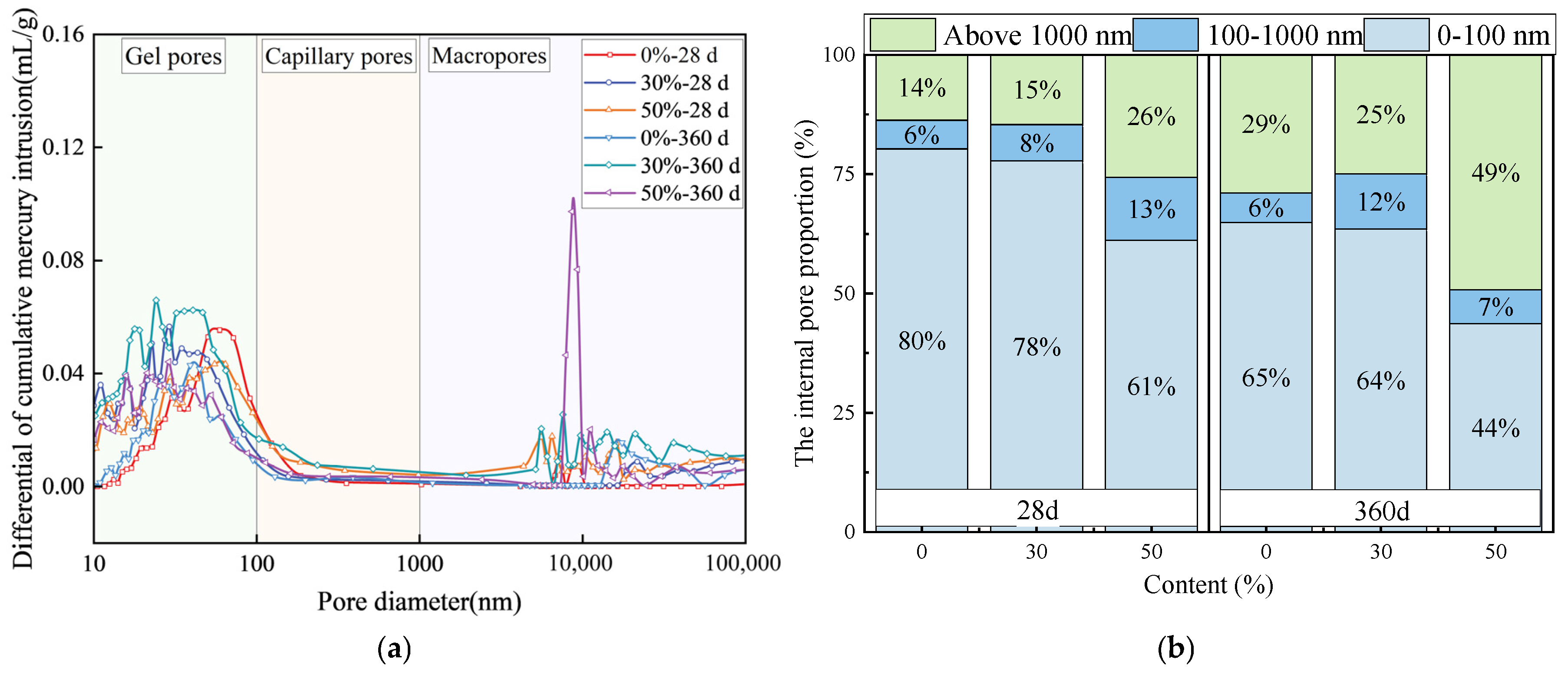
Figure 15 shows the internal pore size distribution and content of cast-in-place repair concrete specimens with different RCA contents under partial exposure conditions after 28 and 360 days of sulfate corrosion. Pores with diameters of 10–100 nm are categorized as gel pores, whereas those with sizes between 100 and 1000 nm are regarded as capillary pores, and pores exceeding 1000 nm are defined as macropores. As illustrated in Figure 15a, the pore size corresponding to the main peak of the differential mercury penetration curve can be regarded as the critical pore size, reflecting the characteristic pore size range that contributes most significantly to the pore volume distribution. After 360 days of sulfate corrosion, the main peaks of the curves for RN0 and RN30 remained within the gel-capillary pore range, indicating that their pore systems still predominantly featured fine pore structures. In contrast, the main peak of RN50 appears in the macropore range (approximately 8000–10,000 nm), indicating a shift in characteristic pore size toward the macropore region. This suggests a significant coarsening of the internal pore structure within the specimen, potentially forming interconnected macropores or a network of cracks. This indicates that the pore structure of RN50 has severely deteriorated under prolonged sulfate corrosion.
As illustrated in Figure 15b, after 28 days of corrosion, the incorporation of RCA increased the proportions of capillary pores and macropores within the specimens, thereby contributing to a reduction in strength. Compared with RN0, the capillary pore contents of RN30 and RN50 were 2% and 7% higher, respectively, while the macropore contents were 1% and 12% higher, respectively, after 28 days of corrosion. At this stage, the overall internal porosity of RN30 was similar to that of RN0. As the corrosion time increased, the accumulation of corrosion products and salt crystals generated expansive stresses, which gradually degraded the pore structure. However, the incorporation of 30% RCA did not lead to a pronounced increase in the internal porosity of the specimens. After 360 days of corrosion, the macropore content of RN30 was 13.79% and 48.98% lower than that observed for RN0 and RN50, respectively. The above results indicate that under partial exposure conditions, incorporating 30% RCA effectively retards the degradation of pore architecture in cast-in-place repair concrete specimens subjected to prolonged sulfate corrosion.

4. Discussion

4.1. Degradation Mechanisms of RCA Cast-in-Place Repair Concrete Under Partial Exposure to Sulfate-Induced Corrosion Environments

In sulfate-corrosive environments, the mechanical performance evolution of RCA cast-in-place repair concrete can be divided into two distinct stages: an initial strengthening phase followed by a subsequent deterioration phase. The early strength gain is mainly ascribed to the sustained formation of hydration products, together with the accumulation of corrosion products. When SO42− migrates into the interior of the specimens, SO42− reacts with Ca(OH)2 and C3A to form higher-volume products, including gypsum and ettringite. Such ettringite precipitation generates significant expansive stresses within the specimens. In addition, SO42− induces decalcification of the C–S–H gel, thereby accelerating gypsum formation. These corrosion products can serve to infill pores and enhance microstructural compactness, which positively affects the mechanical performance of the specimens during the initial corrosion stage. With increasing corrosion time, hydration reactions gradually slow down, whereas corrosion products continue to accumulate and generate expansive stresses. When the expansion stress exceeds the ultimate tensile capacity of concrete, microcracks begin to form within the specimen. The formation and development of microcracks facilitate the ingress of SO42−, thereby accelerating the subsequent deterioration of the internal structure [25]. The aforementioned degradation mechanism is consistent with the microstructural and mineralogical analysis results presented in Section 3.7 of this study.
Simultaneously, during sulfate corrosion, a large amount of crystallization is observed on the specimen surface. This phenomenon occurs because, driven by moisture evaporation and capillary action, the sulfate solution intrudes into the interior of the specimen and gradually migrates upward toward the unsaturated concrete region. With the extension of corrosion duration, due to the supersaturation of the Na2SO4 solution, Na2SO4·10H2O crystals with larger volumes rapidly precipitate in the region above the gas–liquid interface of the specimen [33,48]. Within confined pores, crystallization is accompanied by considerable crystallization pressure, which damages the pore walls and leads to flake-like spalling on the specimen surface. This phenomenon indicates that specimens partially exposed to sulfate corrosion environments are subjected not only to chemical sulfate corrosion but also to physical corrosion [33].
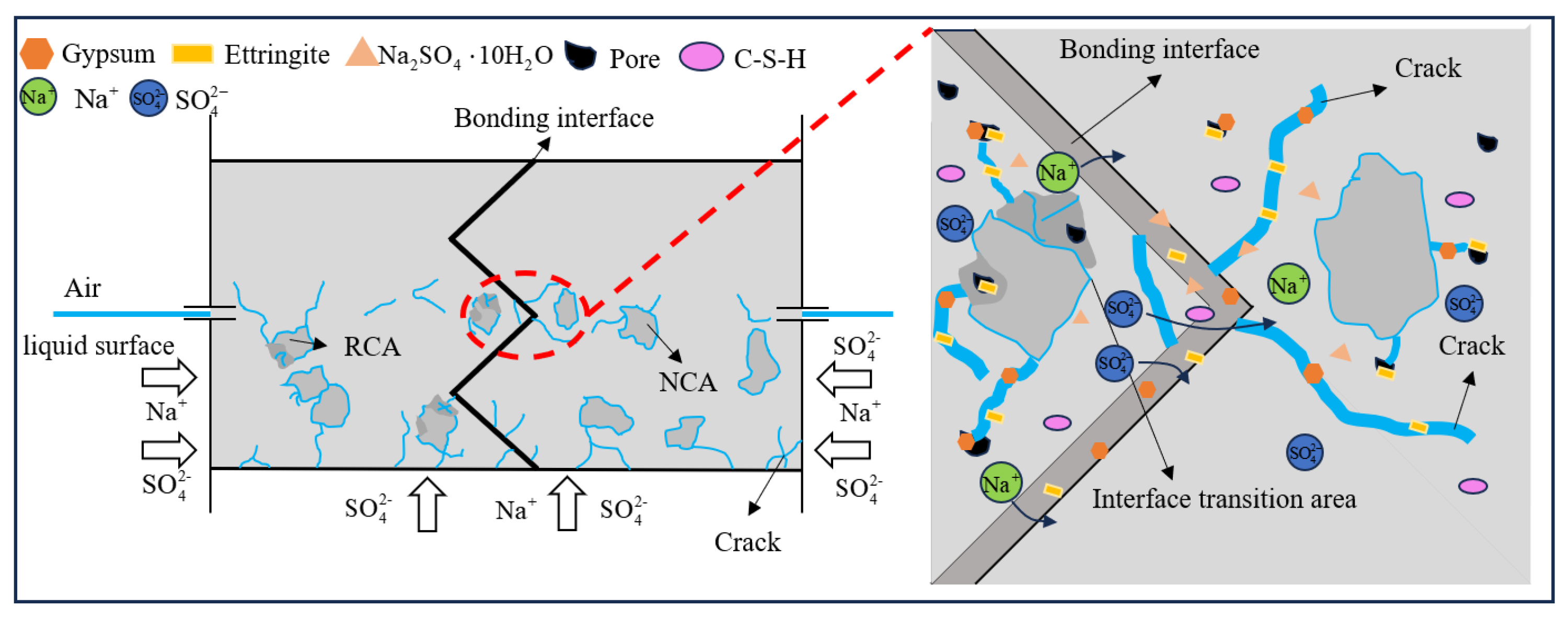
Unlike recycled aggregate concrete and normal concrete, RCA cast-in-place repair concrete is produced by using recycled aggregate concrete to repair fully cured base concrete. On this basis, the presence of recycled aggregate concrete may alter the sulfate resistance of the base concrete. The reduction in strength is mainly attributed to the relatively low strength of recycled aggregate concrete, as well as the weak interfaces and porous structure inherent to RCA, which provide preferential pathways for sulfate ingress. After penetrating into the recycled aggregate concrete, sulfate ions can further migrate into the base concrete. Meanwhile, continuous hydration reactions at the bond interface promote the evolution of a nascent transition zone linking recycled aggregate concrete and the base concrete. This interfacial zone facilitates sulfate transport from the recycled aggregate concrete component to the base concrete more efficiently than direct permeation from the external sulfate solution. Figure 16 illustrates the deterioration mechanism of the RCA cast-in-place repair concrete.

4.2. Differences in Sulfate Resistance Between Existing Concrete and Cast-in-Place Recycled Aggregate Concrete

RCA cast-in-place repair concrete consists of existing concrete (the substrate) and cast-in-place recycled aggregate concrete. In a sulfate corrosion environment, the evolution of the mechanical properties of cast-in-place recycled aggregate concrete and substrate concrete exhibits significant differences. The compressive strength test results show that, at the early stage of sulfate corrosion, the strength of the fully cured substrate concrete is much higher than that of the cast-in-place recycled aggregate concrete, whereas the compressive strength growth rate of the cast-in-place recycled aggregate concrete is much greater than that of the substrate concrete. This difference originates from variations in the development of hydration reactions [28]. At the early stage of sulfate corrosion, the hydration reaction of the fully cured substrate concrete is essentially completed, and its relatively dense internal structure restricts the ingress of water and SO42−, thereby slowing the rates of hydration and sulfate corrosion reactions [45]. In contrast, due to the lower degree of hydration of cast-in-place recycled aggregate concrete, together with the pronounced water absorption capacity and porous structure of RCA, the ingress of water molecules and SO42− is facilitated, promoting the rapid accumulation of hydration products and sulfate corrosion products within the cast-in-place recycled aggregate concrete. These substances strengthen the internal structure of the concrete and fill the internal pores, thereby accelerating the performance development of cast-in-place recycled aggregate concrete.
The compressive strength test results show that, under the combined action of rapidly accumulated hydration products and corrosion products, the peak compressive strengths of cast-in-place recycled aggregate concrete corresponding to RN30 and RN0 are much higher than those of the corresponding substrate concrete. However, for the RN50 specimen, the inherent defects introduced by excessive RCA result in a relatively lower peak compressive strength of the corresponding cast-in-place recycled aggregate concrete. With increasing corrosion time, the compressive strengths of both the cast-in-place recycled aggregate concrete and the substrate concrete begin to decrease. Nevertheless, after 360 days of corrosion, the compressive strengths of cast-in-place recycled aggregate concrete with different RCA contents are still higher than those of the corresponding substrate concrete. This can be attributed to the rapid optimization of the internal structure of cast-in-place recycled aggregate concrete during the early stage of corrosion. In addition, the presence of the bonding interface in RCA cast-in-place repair concrete allows SO42− ions to migrate from the cast-in-place recycled aggregate concrete to the substrate concrete, which to a certain extent accelerates the strength degradation of the substrate concrete in the later stage of corrosion. In summary, under long-term sulfate corrosion, the newly cast concrete exhibits better sulfate resistance than the fully cured existing concrete, among which the cast-in-place recycled aggregate concrete corresponding to RN30 performs the best.

4.3. Effect of Sulfate Corrosion on the Interfacial Bond Strength of RCA Cast-in-Place Repair Concrete

Interfacial bond strength is a decisive parameter governing the performance of cast-in-place repair concrete. Its bonding mechanism is mainly governed by mechanical interlocking, supplemented by physical adsorption and limited chemical bonding interactions [49]. Because significant discrepancies exist between recycled aggregate concrete and the base concrete regarding hydration degree, pore structure, and deformation properties, the bonding interface of RCA cast-in-place repair concrete becomes the weak link in the composite structure.
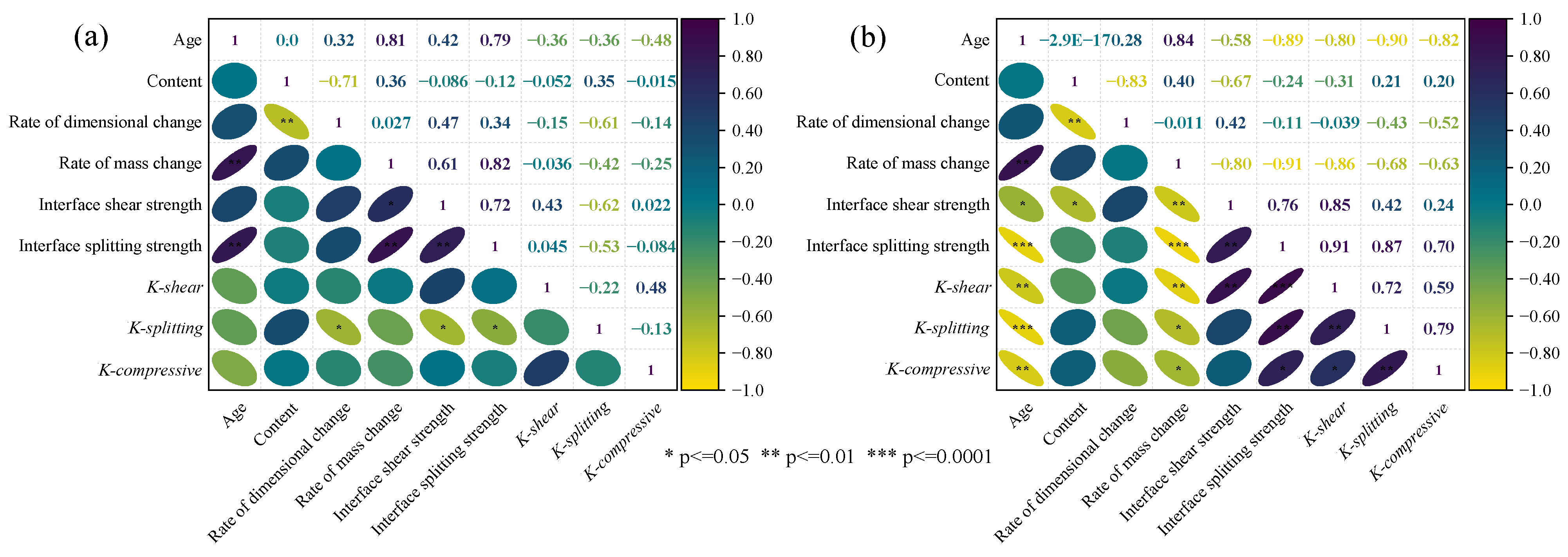
As illustrated in Figure 17, during the early corrosion period (≤90 days), the interfacial bond strength of cast-in-place repair concrete incorporating RCA continues to increase. However, once the corrosion age exceeds 90 days, the interfacial bond strength begins to decrease rapidly. This behavior originates from the initial stage of sulfate corrosion, during which the high water absorption capacity of RCA accelerates hydration reactions at the bonding interface. The resulting hydration products progressively fill the interfacial pores. Moreover, C–S–H gel adsorb onto the surface of the existing concrete and undergoes secondary hydration as well as chemical bonding with partially hydrated particles or Ca(OH)2. These processes promote the formation of a continuous hydration-product network across the interface, thereby enhancing the early-stage bond strength [50]. Meanwhile, sulfate corrosion products help optimize the pore structure at the interface between recycled aggregate concrete and the base concrete and suppress the volumetric shrinkage of the newly cast recycled aggregate concrete. As a result, the interfacial tensile stress caused by shrinkage mismatch between the newly cast recycled aggregate concrete and the base concrete is reduced [49].
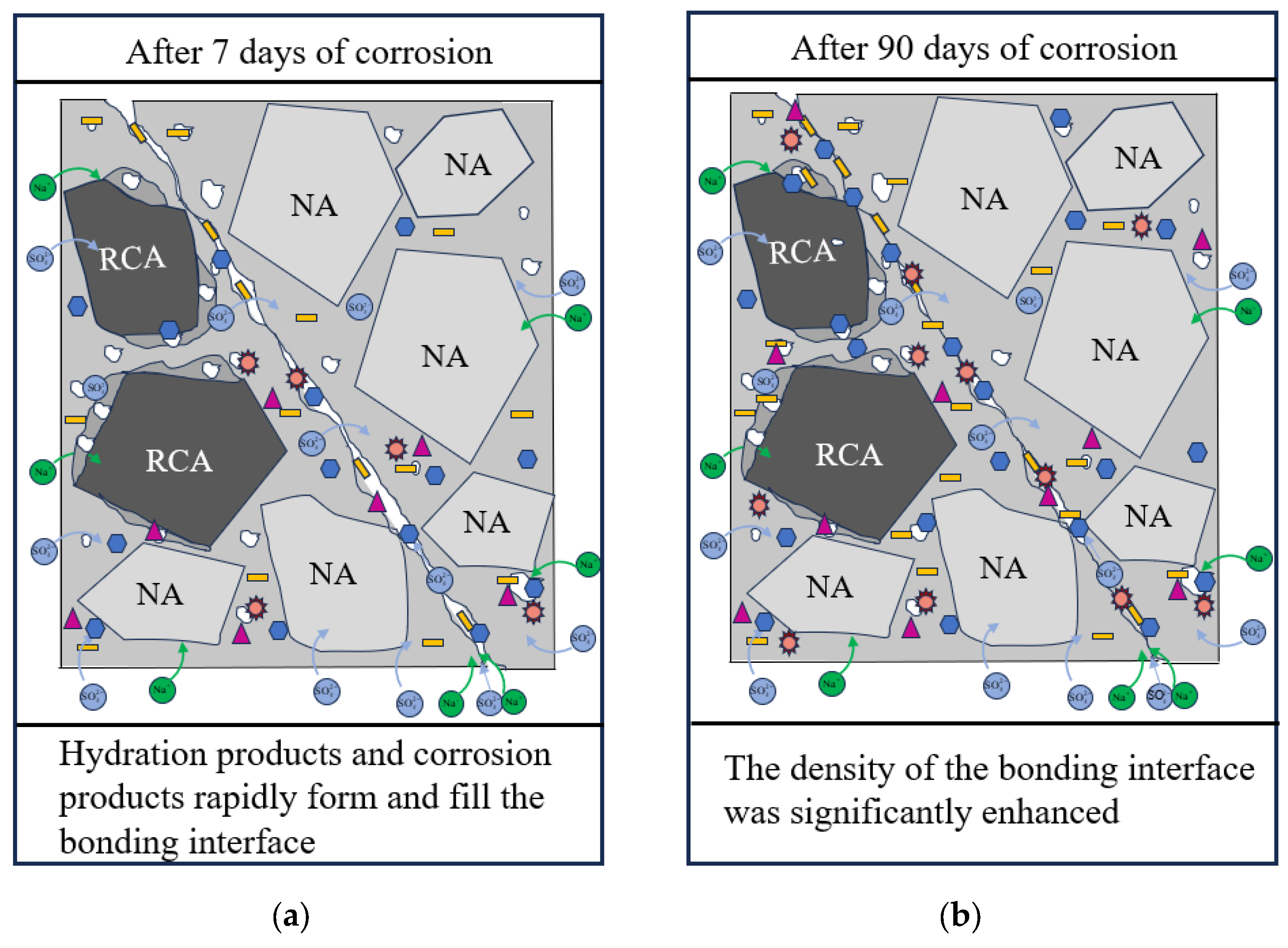
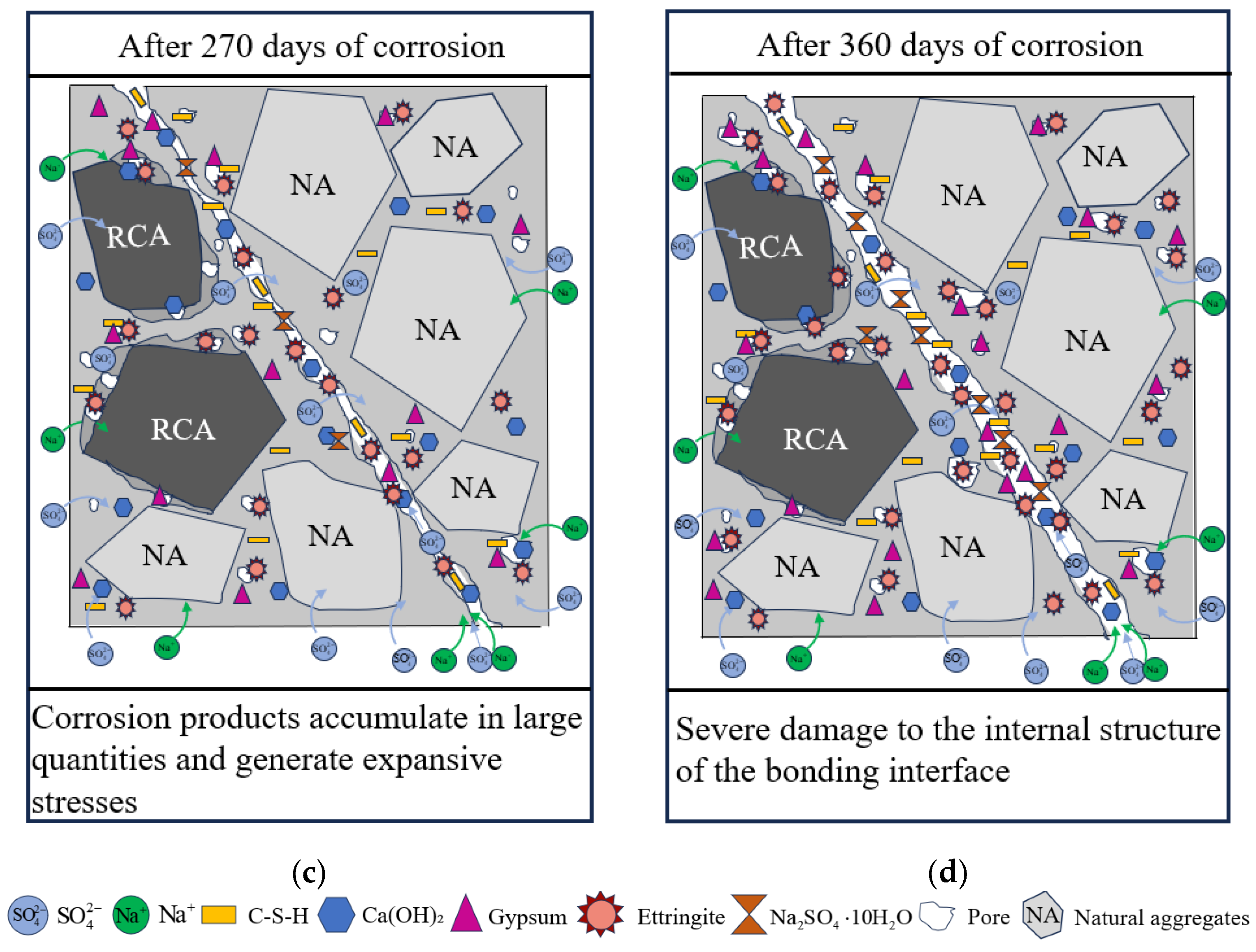
With increasing sulfate corrosion age, the continuous accumulation of corrosion products within the bonding interface generates considerable expansive stresses. Consequently, the interfacial microstructure progressively deteriorates, leading to a rapid reduction in interfacial bond strength. During sulfate corrosion, the bonding interface facilitates the ingress of sulfate, which leads to supersaturation of the sulfate solution above the liquid surface, resulting in the precipitation of large amounts of Na2SO4 crystals. The crystallization pressure generated during this crystallization process also causes significant deterioration of the internal structure of the bonding interface within the specimen. The degradation process of the bonded interface is shown in Figure 18.

4.4. Effect of RCA Content on the Corrosion Resistance of RCA Cast-in-Place Repair Concrete

Specimens immersed in clean water exhibit a decrease in mechanical properties with increasing RCA content, which is related to the relatively low strength of RCA itself and the weak interfaces introduced thereby [15]. In contrast, under partially exposed sulfate corrosion conditions, the influence of different RCA contents on the performance of cast-in-place repair concrete specimens shows significant differences. The interfacial splitting strength and compressive strength of RN30 are both superior to those of RN0. This can be attributed to the pronounced water absorption capacity and porous structure of RCA, which facilitates the ingress of water molecules and SO42− into the specimens, thereby accelerating hydration and corrosion reactions within the specimens and leading to the formation of large amounts of hydration and corrosion products. This process strengthens the internal structure of the specimens and reduces their porosity, thereby compensating to some extent for the inherently lower strength of RCA. Meanwhile, the gradual densification of the internal structure and the bonding interface further limits the subsequent ingress of sulfate, thereby slowing the deterioration rate under long-term sulfate exposure. However, when the RCA content becomes excessively high, the pores within RCA tend to connect with the internal pores of the concrete, making it easier for sulfate ions to penetrate and diffuse throughout the specimens during the corrosion process. Excessively dispersed sulfate results in excessive consumption of hydration products and accelerated accumulation of corrosion products, leading to slow development of internal structural strength during the early stage of corrosion and a sharp increase in porosity at the later stage, ultimately causing rapid deterioration of the specimens.
In addition, the presence of excessive RCA significantly weakens the mechanical properties of the specimens. This is the primary reason why the interfacial splitting strength of RN50 is significantly lower than that of RN0, and why the peak compressive strength of cast-in-place recycled aggregate concrete corresponding to RN50 is much lower than that corresponding to RN0. Meanwhile, excessive sulfate ingress causes the sulfate solution in the region above the gas–liquid interface of the specimens to rapidly reach a supersaturated state, promoting the crystallization and precipitation of Na2SO4·10H2O, which severely damages the internal structure of the specimens. Therefore, selecting an appropriate recycled aggregate content is critically important for cast-in-place recycled aggregate concrete repair applications.
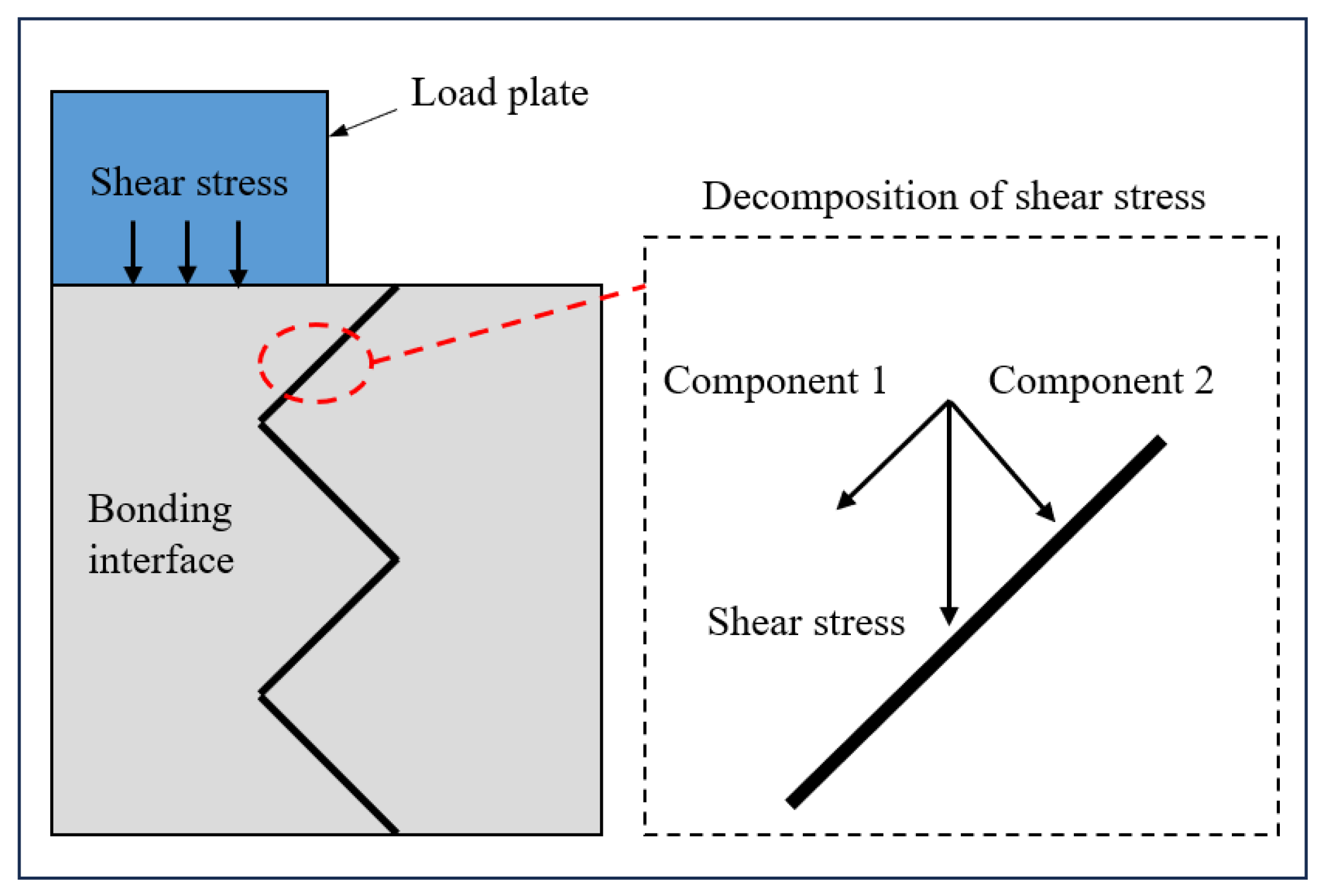
Notably, the results of the shear strength tests indicate that the incorporation of RCA reduces the interfacial bond shear strength of cast-in-place repair concrete. This suggests that, although during the initial stage of corrosion, the compactness of the bonding interface continuously increased due to hydration and corrosion reactions, resulting in a certain enhancement in shear strength. Under partial exposure conditions the penetration rate of SO42− into the interior of the specimens above the liquid surface remained relatively slow. Consequently, interfacial shear strength was highly dependent on the inherent material strength at the interface between recycled aggregate concrete and the existing concrete. However, because RCA itself possesses relatively low strength, the interfacial shear strength decreased rapidly during the later stage of corrosion. The evolution of shear stress transfer at the bonding interface is schematically illustrated in Figure 19. Under shear loading, recycled aggregates within the bonding interface are subjected to compressive stresses, and their lower intrinsic strength renders the interface more susceptible to damage. These results suggest that the interfacial shear strength of RCA cast-in-place repair concrete is closely related to the inherent strength of RCA.

5. Conclusions

This study investigated the changes in apparent morphology, dimensions and mass, mechanical properties, microstructure, and mineral composition of cast-in-place repair concrete incorporating RCA under partially exposed conditions in a sulfate-corrosive environment. By comparing the test results of cast-in-place repair concrete specimens with three different RCA contents, the influence of RCA content on the sulfate-corrosion resistance of the cast-in-place repair concrete structure was systematically assessed. The main conclusions are summarized below:
(1) The incorporation of 30% recycled coarse aggregate effectively slows the damage rate of the specimens, improves both interfacial splitting strength and compressive strength, and enhances sulfate resistance.
(2) Under long-term sulfate corrosion, the compactness of the bonding interface of the specimens is manifested as follows: specimens containing 30% recycled coarse aggregate > specimens without recycled coarse aggregate > specimens containing 50% recycled coarse aggregate. Excessive RCA content will weaken the interfacial bonding performance of the specimens.
(3) The interfacial shear strength decreases with increasing RCA content. After 360 days of sulfate corrosion, the shear strength of specimens containing 30% and 50% RCA decreased by 15.91% and 40.0%, respectively, compared with specimens without RCA.
(4) Under partially exposed conditions, the addition of 30% RCA effectively inhibits the increase in internal porosity and mitigates pore structure deterioration during long-term sulfate corrosion.
(5) In sulfate environments, RCA cast-in-place repair concrete undergoes both physical and chemical corrosion. The bonding interface between the recycled aggregate concrete and the substrate concrete is the weakest region of the composite system, through which sulfate ions can migrate from the recycled aggregate concrete to the substrate concrete.
These research results reveal the performance evolution and deterioration mechanism of recycled coarse aggregate cast-in-place repair concrete in a sulfate corrosion environment under partial exposure conditions, emphasizing that the appropriate incorporation of recycled coarse aggregate (e.g., about 30%) can improve its durability in a sulfate corrosion environment. Therefore, these findings provide useful guidance and a theoretical basis for the rational use of recycled coarse aggregate in concrete repair engineering subjected to sulfate corrosion in practical applications.


Author Contributions

Z.L. Writing—original draft, Resources, Methodology. Z.C.: Investigation, Formal analysis, Resources. G.Z.: Writing—review and editing, Supervision, Methodology, Conceptualization. L.C.: Investigation, Formal analysis. L.Y.: Investigation, Formal analysis. G.G.: Investigation and Visualization. J.Z.: Supervision, Conceptualization, Formal analysis, and Investigation. S.D.: Resources, Formal analysis, Z.N.: Resources. All authors have read and agreed to the published version of the manuscript.
Funding

This study was funded by the National Natural Science Foundations of China (Grant No. 52378322), the National Postdoctoral Program for Innovative Talents (No. BX20200287), the Key Research and Development Program of Shaanxi Province (2025CY-YBXM-156, 2024SF-YBXM-642), and the Fundamental Research Funds for the Central Universities CHD (No. 300102213205).

Data Availability Statement

The original contributions presented in the study are included in the article, further inquiries can be directed to the corresponding author.

Conflicts of Interest

Authors Gang Gu and Jianfeng Zhu were employed by the company China Railway 20th Bureau Group Corporation, Limited. The remaining authors declare that the research was conducted in the absence of any commercial or financial relationships that could be construed as a potential conflict of interest.

Abbreviations

The following abbreviations are used in this manuscript:
RCARecycled coarse aggregate
SEMScanning Electron Microscope
XRDX-ray diffraction
TG/DTGThermogravimetric/Derivative Thermogravimetric
MIPMercury intrusion porosimetry
ITZInterface Transition Zone
AFtAluminate Ferrite trisulfate
XRFX-ray Fluorescence Spectrometer
wt%weight percent
RN0Cast-in-place repair concrete specimens without RCA
RN30Cast-in-place repair concrete specimens containing 30% RCA
RN50Cast-in-place repair concrete specimens containing 50% RCA
C3A3CaO·Al2O3
C–S–HCalcium Silicate Hydrate

References

  1. Liu, Q.; Xiao, J.; Sun, Z. Experimental study on the failure mechanism of recycled concrete. Cem. Concr. Res. 2011, 41, 1050–1057. [Google Scholar] [CrossRef]
  2. Zheng, L.; Wu, H.; Zhang, H.; Duan, H.; Wang, J.; Jiang, W.; Dong, B.; Liu, G.; Zuo, J.; Song, Q. Characterizing the generation and flows of construction and demolition waste in China. Constr. Build. Mater. 2017, 136, 405–413. [Google Scholar] [CrossRef]
  3. He, L.L.; Yuan, H.P. Investigation of construction waste recycling decisions by considering consumers’ quality perceptions. J. Cleaner Prod. 2020, 259, 120928. [Google Scholar] [CrossRef]
  4. Zhang, Y.; Ma, Z.; Zhi, X.; Chen, X.; Zhou, J.; Wei, L.; Liu, Z. Damage characteristics and constitutive model of phosphogypsum/fly ash/slag recycled aggregate concrete under uniaxial compression. Cem. Concr. Compos. 2023, 138, 104980. [Google Scholar] [CrossRef]
  5. Lin, X.; Hu, L.; Yan, Z.; Zhu, H.; Jiang, X. Intelligent decision support for tunnel fire incidents: Integrating dynamic knowledge graph with large language models. Tunn. Undergr. Space Technol. 2026, 172, 107569. [Google Scholar] [CrossRef]
  6. Yue, L.; Wu, T.; Zhao, G.; Yang, K.; Ding, Y.; Zhu, T.; Wang, C.; Zhu, J. Enhancing mechanisms of cast-in-situ concrete durability against magnesium-sulfate-chloride multiple combined attack using iron tailing aggregates. J. Build. Eng. 2026, 119, 115217. [Google Scholar] [CrossRef]
  7. Xing, W.; Tam, V.W.; Le, K.N.; Hao, J.L.; Wang, J. Life cycle assessment of sustainable concrete with recycled aggregate and supplementary cementitious materials. Resour. Conserv. Recycl. 2023, 193, 106947. [Google Scholar] [CrossRef]
  8. Zhao, G.; Yuan, C.; Chen, Z.; Fang, Y.; Wang, C.; Bao, L.; Ding, S.; Wei, F. Durability of cast-in-situ concrete with partial replacement of coarse aggregate by iron tailings under complex combined corrosion of sulfates and chlorides. Constr. Build. Mater. 2026, 512, 145351. [Google Scholar] [CrossRef]
  9. Xuan, D.; Molenaar, A.; Houben, L. Shrinkage cracking of cement treated demolition waste as a road base. Mater. Struct. 2016, 49, 631–640. [Google Scholar] [CrossRef]
  10. Medina, C.; Zhu, W.; Howind, T.; de Rojas, M.I.S.; Frías, M. Influence of mixed recycled aggregate on the physical–mechanical properties of recycled concrete. J. Clean. Prod. 2014, 68, 216–225. [Google Scholar] [CrossRef]
  11. Duan, Z.H.; Poon, C.S. Properties of recycled aggregate concrete made with recycled aggregates with different amounts of old adhered mortars. Mater. Des. 2014, 58, 19–29. [Google Scholar] [CrossRef]
  12. Peng, F.; Zhao, G.; Fang, Y.; Nie, Z.; Wang, C.; Ding, S. Modification of dispersive soil using xanthan gum and water glass: Dispersivity, mechanical properties and mechanisms. Bull. Eng. Geol. Environ. 2026, 85, 79. [Google Scholar] [CrossRef]
  13. Chen, Z.; Yue, L.; Huang, W.; Ding, S.; Zhao, G.; Bao, L.; Wei, F. Impacts of recycled aggregates on the degradation of in-situ repaired concrete induced by sulfate-magnesium and dry-wet combined attack. Colloids Surf. A Physicochem. Eng. Asp. 2026, 737, 139766. [Google Scholar] [CrossRef]
  14. Chen, Z.; Chen, L.; Zhao, G.; Ding, S.; Huang, W.; Zhu, J.; Yang, K.; Zhu, T.; Wei, F. Sustainable Utilization of Recycled Aggregates in Repairing Concrete: Durability Behavior Under Complicated Sulfate-magnesium Attack. J. Build. Eng. 2026, 120, 115457. [Google Scholar] [CrossRef]
  15. Qi, B.; Gao, J.; Chen, F.; Shen, D. Evaluation of the damage process of recycled aggregate concrete under sulfate attack and wetting-drying cycles. Constr. Build. Mater. 2017, 138, 254–262. [Google Scholar] [CrossRef]
  16. Özkılıç, Y.O.; Althaqafi, E.; Karalar, M.; Aksoylu, C. Shear and flexural performance of reinforced concrete beams with recycled concrete aggregates. Rev. Adv. Mater. Sci. 2025, 64, 20250140. [Google Scholar] [CrossRef]
  17. Mohamud, M.A.; Alasiri, M.R.; Özdöner, N.; Yıldızel, S.A.; Özkılıç, Y.O. Physics-guided machine learning framework for RCA concrete by experimental database, modelling, and statistical validation. Sci. Rep. 2026, 16, 7907. [Google Scholar] [CrossRef]
  18. Jagadesh, P.; Karthik, K.; Kalaivani, P.; Karalar, M.; Althaqafi, E.; Madenci, E.; Özkılıç, Y.O. Examining the influence of recycled aggregates on the fresh and mechanical characteristics of high-strength concrete: A comprehensive review. Sustainability 2024, 16, 9052. [Google Scholar] [CrossRef]
  19. Yildirim, S.T.; Meyer, C.; Herfellner, S. Effects of internal curing on the strength, drying shrinkage and freeze-thaw resistance of concrete containing recycled concrete aggregates. Constr. Build. Mater. 2015, 91, 288–296. [Google Scholar] [CrossRef]
  20. Etxeberria, M.; Vázquez, E.; Marí, A.; Barra, M. Influence of amount of recycled coarse aggregates and production process on properties of recycled aggregate concrete. Cem. Concr. Res. 2007, 37, 735–742. [Google Scholar] [CrossRef]
  21. Brasileiro, K.; Nahime, B.D.; Lima, E.C.; Alves, M.M.; Ferreira, W.P.; Santos, I.S.D.; Bezerra, C.P.; dos Reis, I.C. Influence of recycled aggregates and silica fume on the performance of pervious concrete. J. Build. Eng. 2024, 82, 108347. [Google Scholar] [CrossRef]
  22. Liu, K.; Zou, C.; Yan, J. Shear transfer behavior between substrate recycled aggregate concrete and new natural aggregate concrete. Struct. Concr. 2021, 22, 1022–1036. [Google Scholar] [CrossRef]
  23. Ceia, F.; Raposo, J.; Guerra, M.; Júlio, E.; de Brito, J. Shear strength of recycled aggregate concrete to natural aggregate concrete interfaces. Constr. Build. Mater. 2016, 109, 139–145. [Google Scholar] [CrossRef]
  24. Tam, V.W.; Gao, X.; Tam, C.M. Microstructural analysis of recycled aggregate concrete produced from two-stage mixing approach. Cem. Concr. Res. 2005, 35, 1195–1203. [Google Scholar] [CrossRef]
  25. Zhao, G.; Chen, Z.; Peng, F.; Ding, S.; Wang, C. Utilization of tailing aggregates in cast-in-situ concrete: The enhancement in resistance to sulfate-chloride aggressive environment. J. Clean. Prod. 2025, 497, 145127. [Google Scholar] [CrossRef]
  26. Zhao, G.; Zhang, Z.; Chen, Z.; Bao, L.; Wei, F.; Yang, K.; Zhu, J. Durability performance of iron ore tailings sand cast-in-situ concrete subjected to internal-external combined sulfate-magnesium attack. Constr. Build. Mater. 2026, 515, 145653. [Google Scholar] [CrossRef]
  27. Zhao, G.; Ni, X.; Chen, Z.; Huang, W.; Ding, S.; Yang, K.; Zhu, J.; Wei, F.; Bao, L. A potential sustainable way for iron tailings sand in cast-in-situ concrete subjected to sulfate-chloride attack: Performance and mechanisms. J. Sustain. Cem.-Based Mater. 2026, 1–21. [Google Scholar] [CrossRef]
  28. Wei, Y.; Chen, X.; Chai, J.; Qin, Y. Correlation between mechanical properties and pore structure deterioration of recycled concrete under sulfate freeze-thaw cycles: An experimental study. Constr. Build. Mater. 2024, 412, 134794. [Google Scholar] [CrossRef]
  29. Zhao, G.; Ding, Y.; Wang, C.; Ni, X.; Chen, L.; Zhang, C.; Bao, L.; Wei, F. Durability performance of cast-in-situ mortar containing iron tailings sand under synergistic internal-external sulfate, chloride, and magnesium attack. J. Sustain. Cem.-Based Mater. 2026, 1–19. [Google Scholar] [CrossRef]
  30. Santillan, L.R.; Locati, F.; Villagrán Zaccardi, Y.A.; Zega, C.J. Long-term sulfate attack on recycled aggregate concrete immersed in sodium sulfate solution for 10 years. Mater. Constr. 2020, 70, 337. [Google Scholar] [CrossRef]
  31. Campos, A.; López, C.; Aguado, A. Diffusion–reaction model for the internal sulfate attack in concrete. Constr. Build. Mater. 2016, 102, 531–540. [Google Scholar] [CrossRef]
  32. Bushlaibi, A.H.; Alshamsi, A.M. Efficiency of curing on partially exposed high-strength concrete in hot climate. Cem. Concr. Res. 2002, 32, 949–953. [Google Scholar] [CrossRef]
  33. Xie, F.; Li, J.; Zhao, G.; Zhou, P.; Zheng, H. Experimental study on performance of cast-in-situ recycled aggregate concrete under different sulfate attack exposures. Constr. Build. Mater. 2020, 253, 119144. [Google Scholar] [CrossRef]
  34. Zhao, G.; Hu, Y.; Li, S.; Wang, Z.; Guo, M.; Han, F.; Wang, H. Degradation mechanisms of chloride contaminated cast-in-situ concrete partially exposed to magnesium-sulfate combined environment. KSCE J. Civ. Eng. 2023, 27, 618–629. [Google Scholar] [CrossRef]
  35. Tian, B.; Cohen, M.D. Does gypsum formation during sulfate attack on concrete lead to expansion? Cem. Concr. Res. 2000, 30, 117–123. [Google Scholar] [CrossRef]
  36. Santhanam, M.; Cohen, M.D.; Olek, J. Mechanism of sulfate attack: A fresh look: Part 1: Summary of experimental results. Cem. Concr. Res. 2002, 32, 915–921. [Google Scholar] [CrossRef]
  37. GB/T 17671-2021; Test Method of Cement Mortar Strength. Standardization Administration of the People’s Republic of China: Beijing, China, 2021.
  38. GB/T 749-2008; Test Method for Determining Capability of Resisting Sulfate Corrode of Cement. Standardization Administration of the People’s Republic of China: Beijing, China, 2008.
  39. GB/T50081-2019; Standard Test Methods for Physical and Mechanical Properties of Concrete. Standardization Administration of the People’s Republic of China: Beijing, China, 2019.
  40. He, W.; Li, B.; Meng, X.; Shen, Q. Compound effects of sodium chloride and gypsum on the compressive strength and sulfate resistance of slag-based geopolymer concrete. Buildings 2023, 13, 675. [Google Scholar] [CrossRef]
  41. Huang, Q.; Li, Y.; Chang, C.; Wen, J.; Dong, J.; Zheng, W.; A, D.; Liu, P.; Dong, F.; Zhou, Y. The salt attack performance of magnesium oxychloride cement exposure to three kinds of brines. J. Wuhan Univ. Technol.-Mater. Sci. Ed. 2020, 35, 155–166. [Google Scholar] [CrossRef]
  42. Kim, J. Influence of quality of recycled aggregates on the mechanical properties of recycled aggregate concretes: An overview. Constr. Build. Mater. 2022, 328, 127071. [Google Scholar] [CrossRef]
  43. Zhutovsky, S.; Douglas Hooton, R. Experimental study on physical sulfate salt attack. Mater. Struct. 2017, 50, 54. [Google Scholar] [CrossRef]
  44. Morandeau, A.; Thiery, M.; Dangla, P. Investigation of the carbonation mechanism of CH and CSH in terms of kinetics, microstructure changes and moisture properties. Cem. Concr. Res. 2014, 56, 153–170. [Google Scholar] [CrossRef]
  45. Nehdi, M.; Suleiman, A.; Soliman, A. Investigation of concrete exposed to dual sulfate attack. Cem. Concr. Res. 2014, 64, 42–53. [Google Scholar] [CrossRef]
  46. Cheng, H.; Liu, T.; Zou, D.; Zhou, A. Compressive strength assessment of sulfate-attacked concrete by using sulfate ions distributions. Constr. Build. Mater. 2021, 293, 123550. [Google Scholar] [CrossRef]
  47. Muduli, R.; Mukharjee, B.B. Effect of incorporation of metakaolin and recycled coarse aggregate on properties of concrete. J. Clean. Prod. 2019, 209, 398–414. [Google Scholar] [CrossRef]
  48. Wang, H.; Li, Y.; Liao, H.; Zou, D.; Liu, T. Deterioration mechanism of OPC mortar under combined chemical and physical sulfate attack in partial immersion. Constr. Build. Mater. 2025, 475, 141187. [Google Scholar] [CrossRef]
  49. Qin, R.; Hao, H.; Rousakis, T.; Lau, D. Effect of shrinkage reducing admixture on new-to-old concrete interface. Compos. Part B 2019, 167, 346–355. [Google Scholar] [CrossRef]
  50. Zhou, Y.; Fan, Z.; Du, J.; Sui, L.; Xing, F. Bond behavior of FRP-to-concrete interface under sulfate attack: An experimental study and modeling of bond degradation. Constr. Build. Mater. 2015, 85, 9–21. [Google Scholar] [CrossRef]
Figure 1. Sample preparation procedure.
Buildings 16 01239 g001
Figure 2. Experimental design process diagram.
Buildings 16 01239 g002
Figure 3. Dimensional change rate of specimens at different sulfate corrosion ages.
Buildings 16 01239 g003
Figure 4. Mass change rate of specimens at different sulfate corrosion ages.
Buildings 16 01239 g004
Figure 5. Shear strength at the interface of specimens at different soaking times in sodium sulfate and clean water solutions. (a) Sample in sodium sulfate solution; (b) Specimens in clear water.
Buildings 16 01239 g005
Figure 6. Splitting strength at the interface of specimens at different soaking times in sodium sulfate solution and clean water. (a) Sample in sodium sulfate solution; (b) Specimens in clear water.
Buildings 16 01239 g006
Figure 7. Compressive strength of cast-in-place recycled aggregate concrete and base concrete in sodium sulfate and clean water solutions at different soaking times. (a) Recycled aggregate concrete soaked in a sodium sulfate solution; (b) Concrete substrate soaked in a sodium sulfate solution; (c) Recycled aggregate concrete soaked in clean water.
Buildings 16 01239 g007
Figure 8. Sulfate-resistant coefficient of specimens at different corrosion ages. (a) Corrosion coefficient K-shear; (b) Corrosion coefficient K-splitting; (c) Corrosion coefficient K-compressive.
Buildings 16 01239 g008
Figure 9. XRD results of specimens under different conditions. (a) Sulfate-corroded environment (RN0); (b) Sulfate-corroded environment (RN30); (c) Sulfate-corroded environment (RN50); (d) RN0 and RN30 were cured in a clean water solution for 28 days.
Buildings 16 01239 g009
Figure 10. SEM and DES results of RN50 after 270 days of sulfate corrosion under partially exposed conditions. (a) SEM image of the specimen after 270 days of corrosion; (b) DES image of the specimen after 270 days of corrosion.
Buildings 16 01239 g010
Figure 11. EDS results for RN50 at 28 days and 360 days under partially exposed conditions during sulfate corrosion. (a) After 28 days of corrosion; (b) After 360 days of corrosion.
Buildings 16 01239 g011
Figure 12. SEM image of the bonded interface after 270 days of sulfate corrosion under partial exposure conditions.
Buildings 16 01239 g012
Figure 13. TG/DTG test results of specimens with different RCA contents at different sulfate corrosion ages. (a) TG/DTG results for RN0; (b) TG/DTG results for RN30; (c) TG/DTG results for RN50; (d) Calculation results of calcium hydroxide content.
Buildings 16 01239 g013
Figure 14. Porosity of RCA cast-in-place repair concrete specimens with different contents after 28 and 360 Days of sulfate corrosion.
Buildings 16 01239 g014
Figure 15. Internal pore size distribution and proportion of RCA cast-in-place repaired concrete specimens with different contents after 28 and 360 days of sulfate corrosion. (a) Pore size distribution curve; (b) Pore size distribution results.
Buildings 16 01239 g015
Figure 16. Degradation mechanism of RCA cast-in-place repair concrete specimens under partially exposed conditions in sulfate corrosion environments.
Buildings 16 01239 g016
Figure 17. Multivariate relationship plots of the specimens under sulfate corrosion: (a) corrosion time less than 90 days; (b) corrosion time greater than 90 days.
Buildings 16 01239 g017
Figure 18. Degradation process of bonding interfaces. (a) After 7 days of corrosion; (b) After 90 days of corrosion; (c) After 270 days of corrosion; (d) After 360 days of corrosion.
Buildings 16 01239 g018aBuildings 16 01239 g018b
Figure 19. Schematic diagram of shear action at the bonded interface of the specimen.
Buildings 16 01239 g019
Table 1. Chemical composition of P.O 42.5R cement.
Chemical CompositionCaOSiO2Al2O3Fe2O3SO3MgOK2OTiO2Na2OP2O5
Content (%)68.0719.225.683.062.050.710.560.320.270.06
Table 2. Other physical properties of basalt and RCA.
Coarse Aggregate TypeApparent Density (kg/m3)Bulk Density (kg/m3)Water Absorption Rate (%)Crush Value (%)Red Brick Content (%)
Basalt262420511.2352.51-
RCA217618277.04617.181.723
Table 3. Mix contents for test specimens in each section.
Constituent PartsCement (kg/m3)Water (kg/m3)River Sand (kg/m3)Basalt (kg/m3)RCA (kg/m3)Additional Water (kg/m3)
Base concrete400180675101300
R0400180675101300
R30400180675709.1303.921.4
R50400180675506.5506.535.7
Table 4. Experimental equipment parameters table.
Test NameEquipment NameEquipment Model
Dimension measurementLength comparatorSP-176 (Cangzhou Zhongya Test Instrument Co., Ltd., Cangzhou, China)
Mass measurementElectronic balance (accuracy 0.001 g)YT10003 (Shanghai Tianping Instrument Technology Co., Ltd., Shanghai, China)
Mechanical property testCompression testing machineYAW-300C (HST Test Equipment Co., Ltd., Jinan, China)
SEMScanning electron microscopeJSM-6360LV (JEOL China Ltd., Beijing, China)
XRDX-ray diffractometerRINT-2000 (Liyan Shuguang Instruments Co., Ltd., Beijing, China)
TG/DTGThermogravimetric analyzerNetzsch STA449F3 (NETZSCH Scientific Instruments Trading (Shanghai) Ltd., Shanghai, China)
MIPMercury intrusion porosimeterMicroActive AutoPore V9600 (Shanghai Ruice Electronic Technology Co., Ltd., Shanghai, China)
Table 5. Changes in the apparent morphology of specimens with corrosion age.
Content7 d28 d180 d360 d
0%Buildings 16 01239 i001
30%Buildings 16 01239 i002
50%Buildings 16 01239 i003
Table 6. Interfacial failure modes of specimens at different corrosion ages.
Content7 d28 d180 d360 d360 d (Fracture Surface)
Buildings 16 01239 i004
Buildings 16 01239 i005
Buildings 16 01239 i006
Disclaimer/Publisher’s Note: The statements, opinions and data contained in all publications are solely those of the individual author(s) and contributor(s) and not of MDPI and/or the editor(s). MDPI and/or the editor(s) disclaim responsibility for any injury to people or property resulting from any ideas, methods, instructions or products referred to in the content.